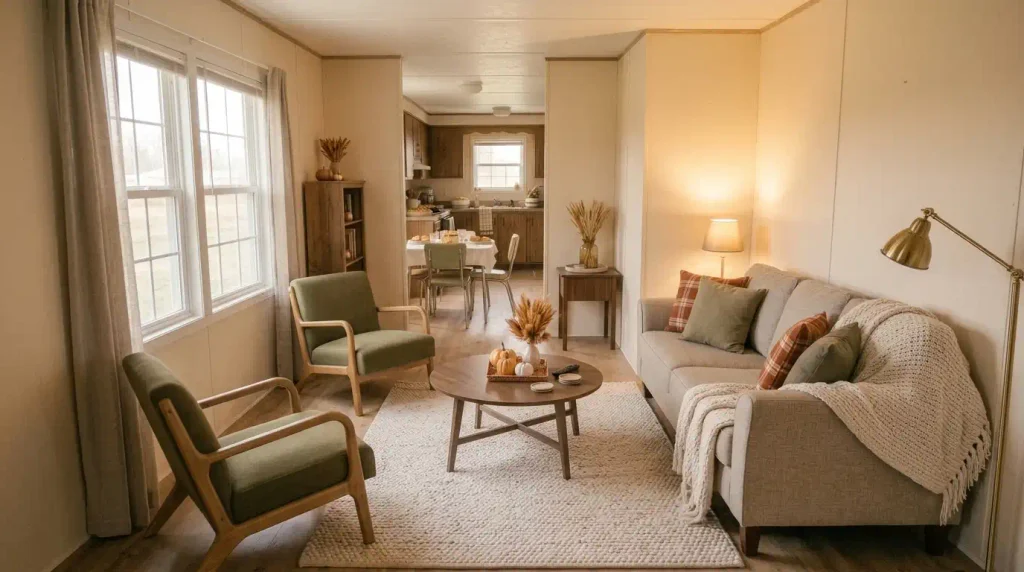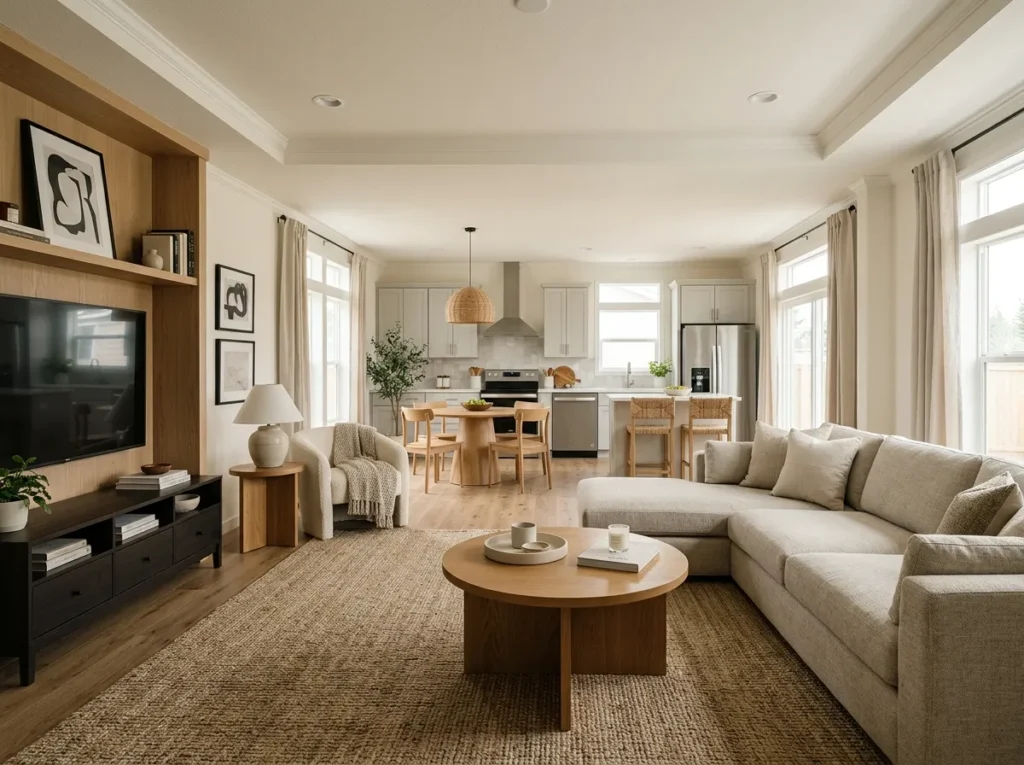
A slim tree can look perfect in a holiday photo and still make a narrow living room harder to use. The difference rarely comes down to the height of the tree alone. In a single-wide mobile home, a door swing, the end of a reclining sofa, or the route to the kitchen can make an otherwise beautiful Christmas display impractical.
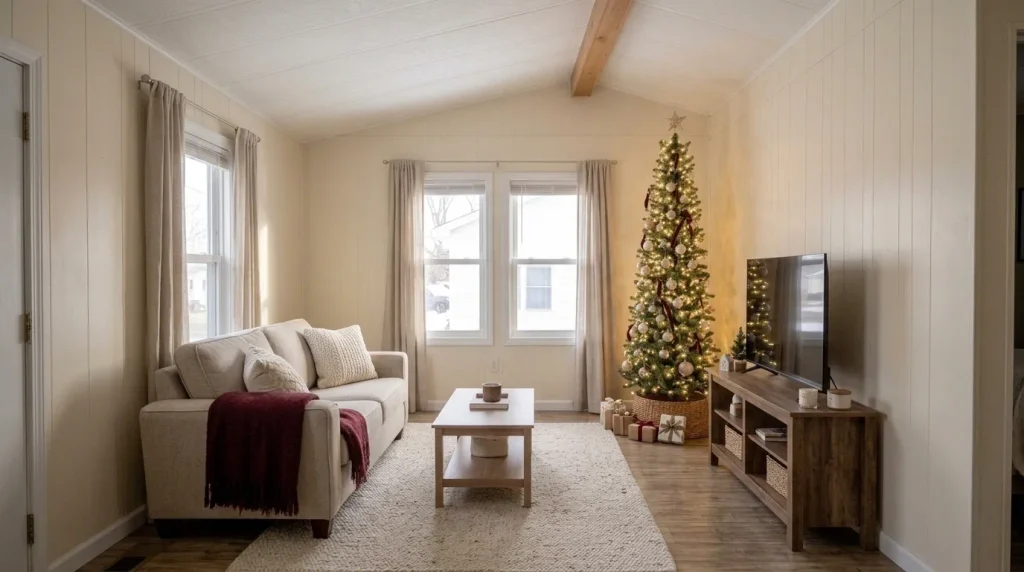
For slim Christmas tree placement in a mobile home, begin with the room you already have. Look for a position that works from the entrance and the seats your family actually uses, while leaving doors, windows, furniture, and walking routes functional. A tree’s footprint includes its fully opened branches, stand, skirt or basket, ornaments, and eventually the presents around it.
Before shopping or moving furniture, use painter’s tape to mark the intended diameter on the floor. Then open the doors, pull out the dining chairs, and walk through with something in your hands. The fifteen ideas below cover different room conditions, from a long single-wide living room to a tight console-side wall.
1. Place a Slim Christmas Tree at the Far End of a Long Single-Wide Living Room
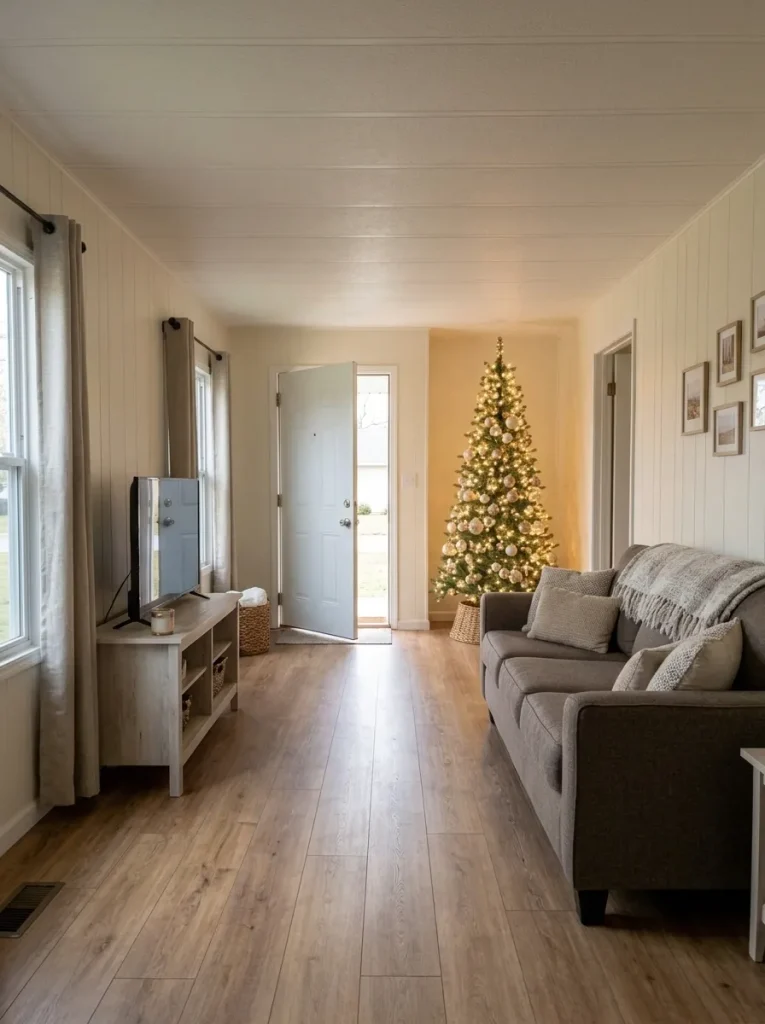
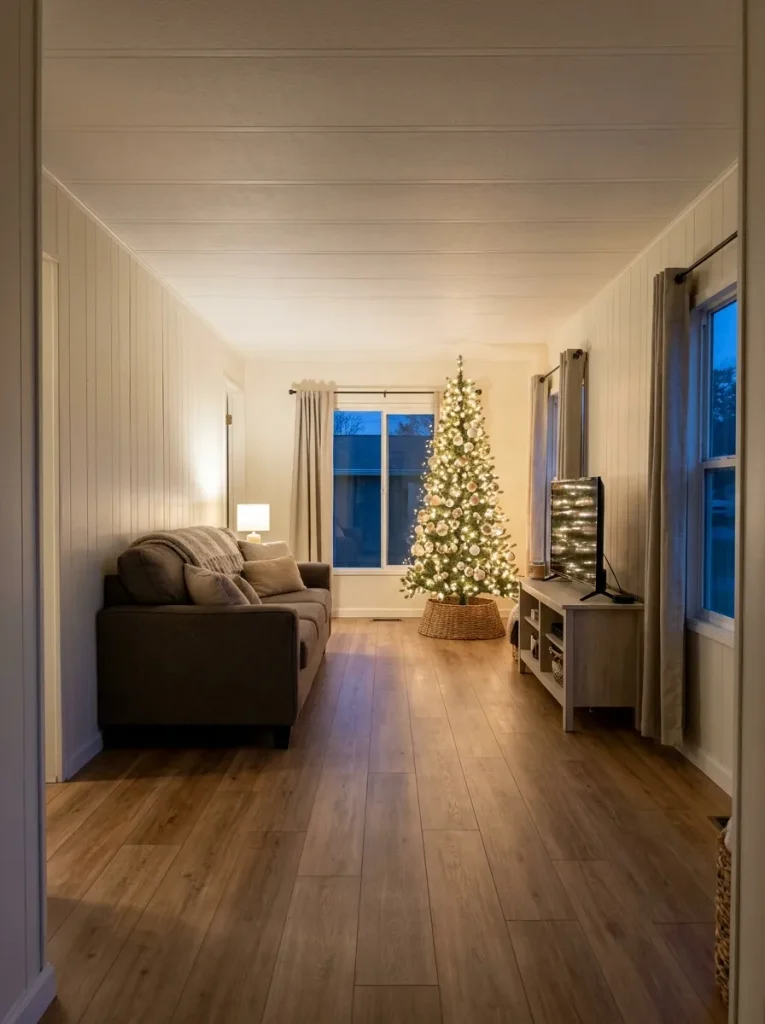
Enter the room and look toward its far wall. In many long single-wide living rooms, a tall pencil tree at that end draws the eye through the space and gives the holiday setup a destination. It works particularly well if the walking route stays to one side of the furniture instead of ending at the tree.
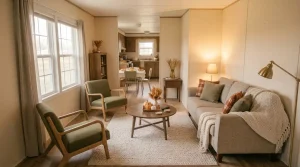
Try two positions before choosing: center the taped footprint on the end wall, then move it toward an unused corner or beside the media console. Compare both from the doorway and from the sofa. An end-wall vent, storage door, or frequently used passage can make the centered version unsuitable.
Our single-wide living room layout guide explains the permanent circulation patterns; the seasonal display should fit around them. The interactive atlas below compares four conceptual narrow-room arrangements, with a rejection rule for each.
The Narrow-Room Placement Atlas
Where does your slim tree belong?
Choose the configuration closest to your living room. Each conceptual plan offers a different placement and a reason to reject it.
01 — Long single-wide living room
Best move: Use a quiet pocket near the far wall, keeping the central route available.
Reject when: The tree occupies an active doorway, heating vent, or circulation path.
02 — Sofa-side wall pocket
Best move: Choose the sofa end against a quiet wall, away from the main passage.
Reject when: Recliners, footrests, or passing people contact the branches.
03 — Media-wall arrangement
Best move: Place the tree outside the screen sightline.
Reject when: Branches interfere with viewing, equipment access, or the cord route.
04 — Living and dining transition
Best move: Use a wall-side transition pocket that defines the two spaces without dividing the walkway.
Reject when: Dining chairs or kitchen traffic extend into the tree.
Conceptual arrangements only. Verify measurements in your own room.
2. Use the Wall Pocket Beside the Front Door—Only When the Door Clears It
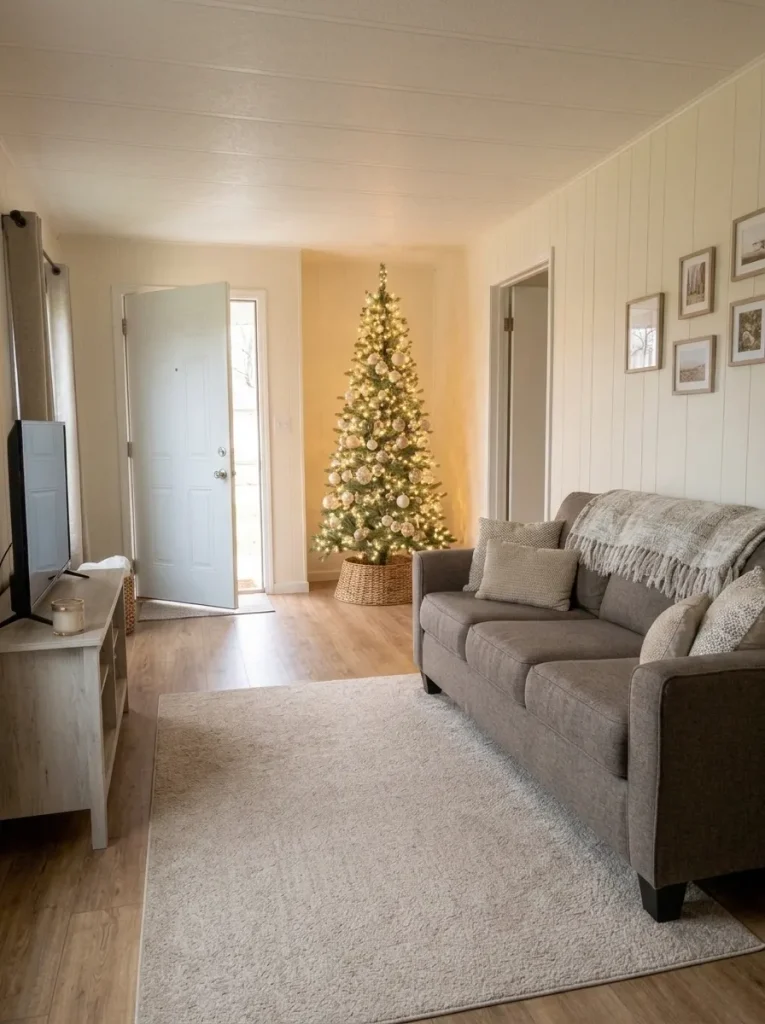
Could you still enter the room carrying two grocery bags? That is a more useful question than whether an empty corner looks attractive in a photograph. A pencil tree beside a gallery wall or entrance mirror can feel welcoming, but the actual doorway may need the very floor area the tree would occupy.
Run this entrance test:
- Open the door all the way and identify its swing and handle clearance.
- Place a cardboard outline or taped footprint where the tree, stand, and gifts would sit.
- Walk in and out while carrying bags, then repeat with another person nearby.
If the path narrows enough that anyone has to turn sideways or brush branches, move the tree. The National Fire Protection Association’s Christmas tree safety guidance also says a Christmas tree must not block an exit.
A beautiful entrance feature is never worth obstructing access.
3. Tuck a Pencil Tree Beside the Quiet End of the Sofa
Imagine a narrow sofa with a doorway on one side and a blank wall on the other. Both ends may appear to have the same amount of empty floor, yet the wall-side pocket is usually easier to decorate because fewer people have to cross it.
Position the pencil tree just beyond that quiet sofa arm and view it from the opposite seat. The sofa becomes a natural boundary for the display, keeping the tree visually connected to the conversation area.
Test any recliner, footrest, and end-table drawer at full extension; a tree that fits beside a stationary sofa might fail as soon as the furniture moves.
Our small mobile home living room ideas explore furniture scale in these rooms.
Here, the decision is specifically seasonal: pick the sofa end with the least everyday movement, and skip this arrangement if the decorated branches extend into the route to the door.
4. Position a Narrow Tree Beside the TV Console Without Crowding the Screen
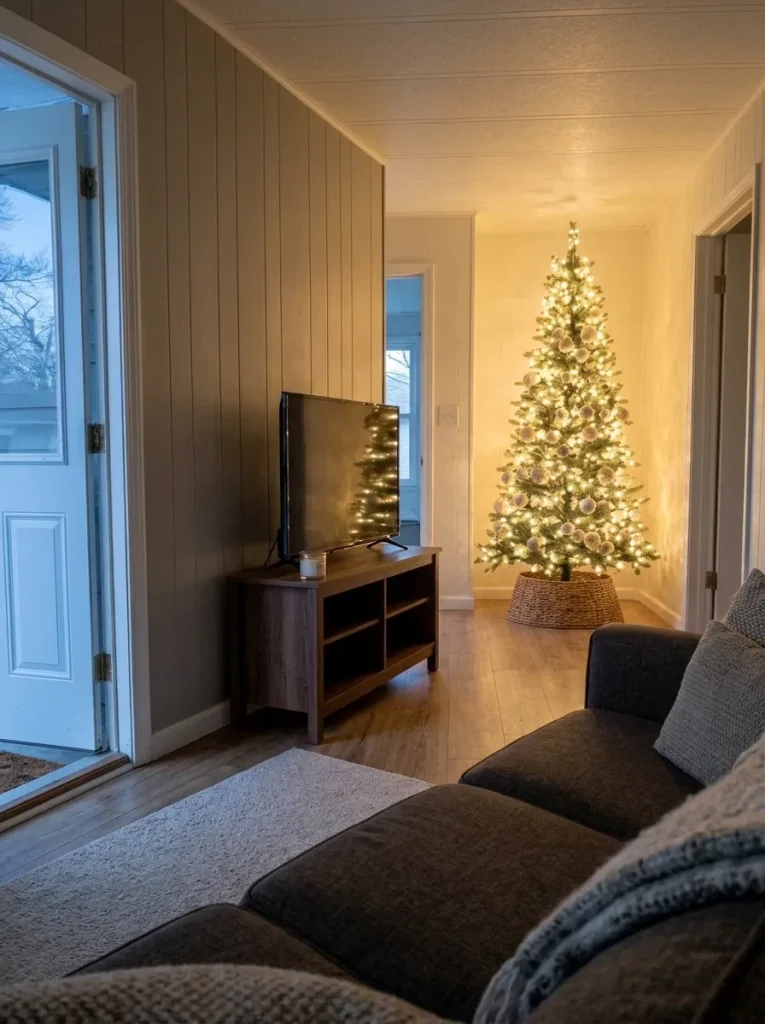
The television wall is already the main visual focus in many single-wide living rooms. A bright tree can balance the media unit on one side, but the effect changes from the sofa: glowing branches may overlap the screen or distract from a film.
Check the viewing position in this order:
- Seated view: Sit in the spot used most often and check whether the planned branches overlap the picture.
- Console access: Make sure drawers, electronics, vents, and everyday storage remain reachable.
- Cord route: Reject locations that require power cables to cross the walkway or pass under rugs.
Use a measuring stick or a cardboard silhouette to represent the tree’s widest branches.
The comparison below shows the difference between a balanced TV-side bay, a distracting overlap, and a wall that has no suitable opening. Where the entire console fills the wall, another placement is the better design decision.
TV Sightline Studio
Does the Christmas tree compete with your TV?
Open each example and compare it with the view from your sofa.
Option A — Separate side bay
Works when: The entire decorated tree is outside the screen’s sightline and furniture access remains easy.
Preferred when a genuine side-wall pocket exists.
Option B — Tree intrudes into viewing area
Problem: Bright branches become distracting and may partly obscure the screen.
Move the tree toward a wall pocket or choose a different location.
Option C — No usable space beside the console
Better move: Use an end wall, sofa-side corner, or appropriately supported tabletop tree elsewhere.
Do not obstruct media vents, drawers, or cables simply to preserve symmetry.
5. Frame a Living Room Window With One Tall, Slender Tree
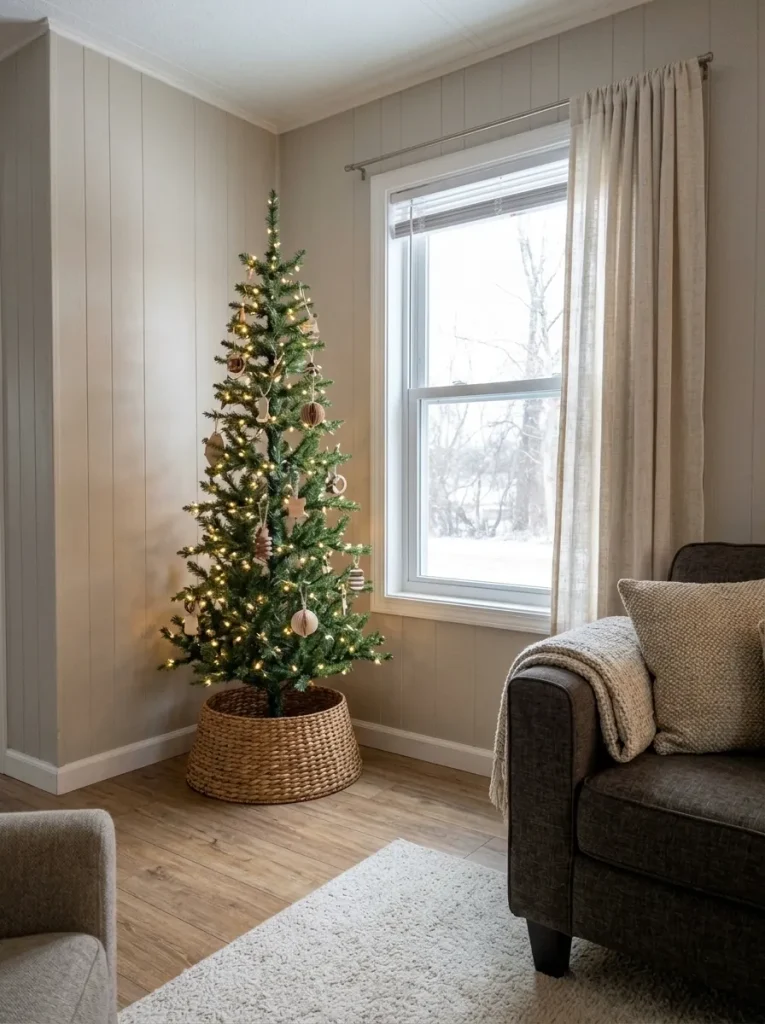
A slim tree to one side of a window can be especially beautiful at dusk, when natural light gives way to warm white Christmas lights. It also keeps more of the window visible than a full tree centered in front of the glass.
Before settling on the composition, check what the window needs to do:
- Curtains and blinds must open and close without catching ornaments.
- Latches and any required emergency escape access must remain usable.
- The tree must stay clear of heat vents and other heat sources.
- Its stand and gift arrangement should not intrude into the sofa-to-door route.
A sparse evergreen can make the view feel lighter; a flocked tree creates more visual weight.
For permanent window and seating relationships, see the broader mobile home living room ideas.
For this Christmas arrangement, window function decides whether the placement is acceptable.
6. Use the Wall Pier Between Two Windows for a Vertical Christmas Display
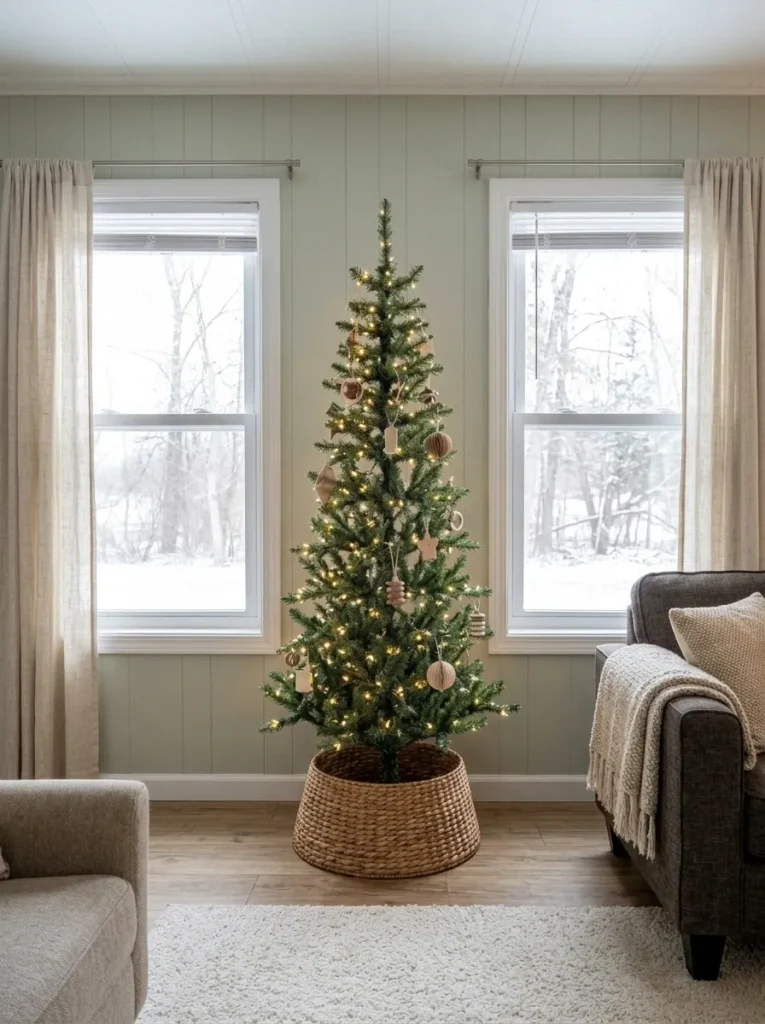
Two windows with a narrow strip of wall between them can make a centered pencil tree look like part of the architecture. But the pretty symmetry disappears if the tree pushes curtain panels over the glass or its basket overlaps a heater.
| Test | Keep the centered tree when… | Change direction when… |
|---|---|---|
| Wall width | The assembled branches stay within usable solid-wall space | Trim or curtain stacks collide with the tree |
| Window function | Both openings still work normally | Access or required escape function is reduced |
| Floor footprint | The base and gifts remain out of traffic | People have to step around the stand |
Draw the two window frames and curtain-stack areas before sketching the tree.
A narrow, softly lit design with little ornamentation near the floor usually suits this location better than a broad flocked tree. If it fails the comparison, place one smaller tree beside a window instead of forcing central symmetry.

7. Angle a Slim Christmas Tree Near a Mirror to Increase Its Visual Presence
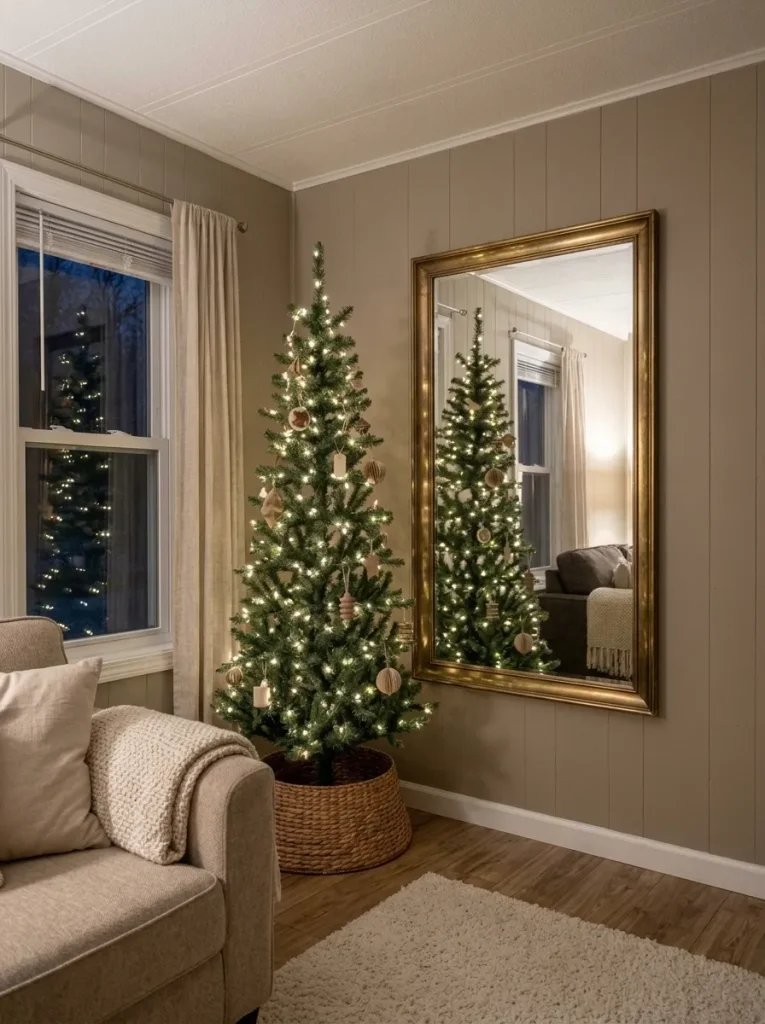
What does the mirror show from your favorite seat?
A slim evergreen placed beside a wall mirror can look more substantial because its lights and branches appear twice. The effect is especially attractive with a sparse tree in a wicker basket, where the reflected outline adds depth without demanding another floor-standing decoration.
Stand or sit where the tree will be viewed most often. Shift its proposed position a few inches at a time, then compare how much of the tree appears in the reflection.
Too close can create an awkward doubled trunk; too far may reflect only a few lights. Avoid positions where the reflected LEDs produce uncomfortable glare beside the television.
The reflection studio below distinguishes an effective side reflection, a distracting direct overlap, and an angle that shows little of the tree.
Use the view that feels calm from the sofa, not merely the angle that looks brightest while standing in front of the mirror.
Mirror Reflection Studio
Find the reflection worth keeping
Compare three visual relationships, then test them from the actual seating position.
01 — Balanced side reflection
Effect: The reflected branches add apparent fullness without using extra floor space.
Choose this angle when the tree is clearly visible in the mirror from your seat.
02 — Excessive overlap or glare
Problem: The doubled trunk or concentrated reflections dominate the room.
Move the tree slightly toward the mirror edge or use less intense lighting.
03 — Mirror misses the tree
Problem: The mirror adds little seasonal depth from the intended viewing position.
Adjust the tree’s position only if the new location also meets floor-space and safety checks.
8. Choose a Fireplace-Wall Position Only When Safe Heat Clearance Exists
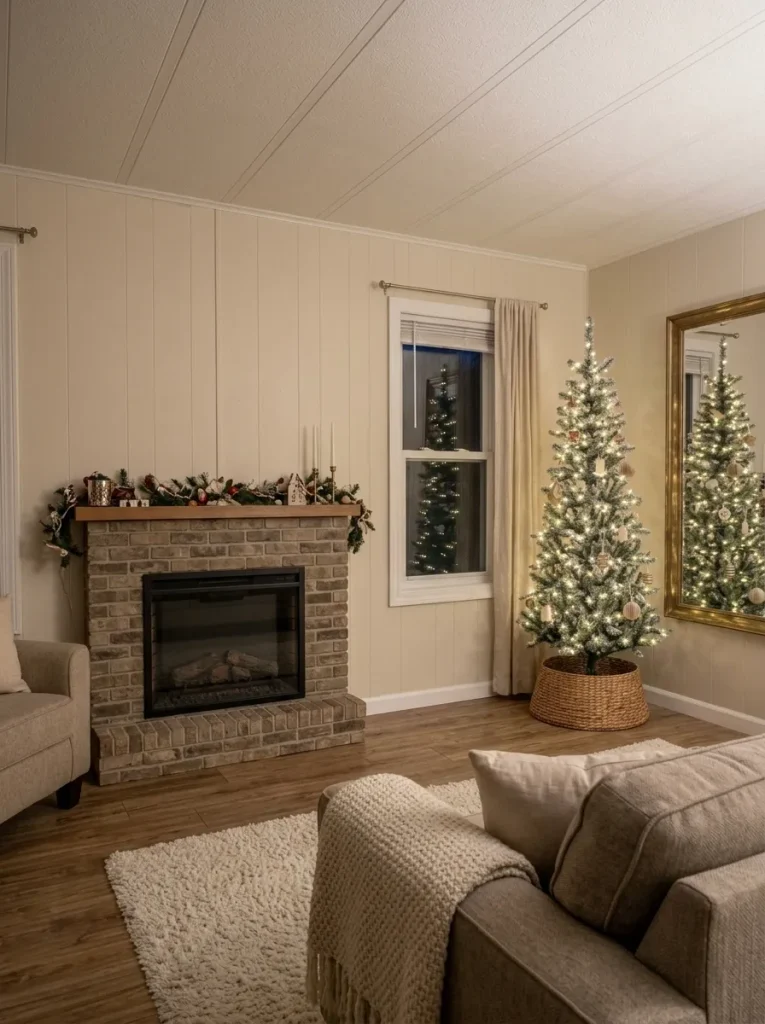
The contrast of dark greenery against brick or stone makes a narrow Christmas tree beside a fireplace visually tempting. Heat clearance is the deciding factor, though; the masonry backdrop does not make a too-close tree safe.
The National Fire Protection Association advises keeping Christmas trees at least three feet away from heat sources such as fireplaces, radiators, candles, and heat vents, and leaving exits clear. Observe any stricter heating-appliance or tree-manufacturer instructions as well.
Measure from the nearest branch or decoration to the heat source, not from the trunk. Also consider how the space behaves when the fireplace is operating.
The stop signal: If safe separation and a clear circulation route cannot both be maintained, use a different wall. Let the fireplace remain its own festive focal point.
9. Define the Living Room–Dining Nook Boundary With a Slender Tree
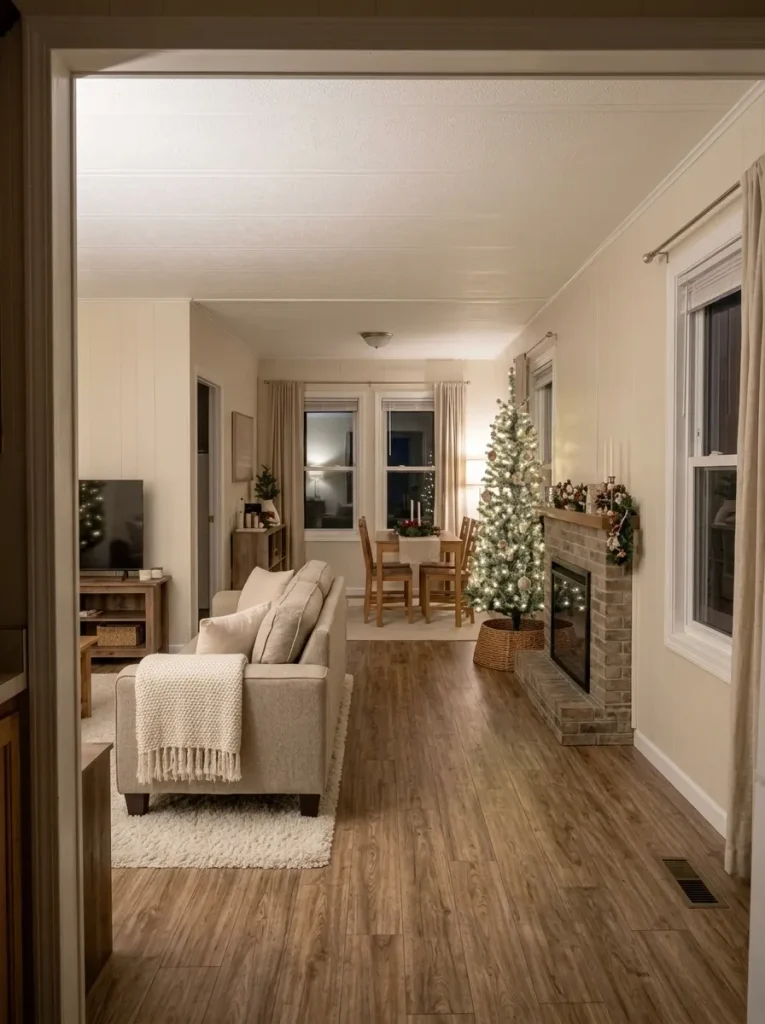
Imagine a small gathering: one person carries food out of the kitchen while another slides a chair back from the dining table. A tree positioned exactly between the living room and dining nook can look like a room divider in a still photo, yet become an obstacle when everyone is moving.
Choose the edge of the transition, preferably a quiet wall return or genuine unused floor pocket.
From the sofa, the tree should mark the seasonal boundary; from the kitchen, the route past it should remain ordinary and comfortable. The arrangement becomes stronger when the tree is visible from both spaces without occupying the center of either.
For permanent open-plan furniture relationships, explore the site’s single-wide mobile home decorating ideas.
The traffic-flow lab below lets you compare three conceptual room routes. Reject any setup that interferes with dining-chair pullback or carrying dishes.
Holiday Traffic Flow Lab
Follow the route before choosing the tree
Different mobile-home layouts create different movement conflicts. Compare the situations below.
Route A — Kitchen-to-living path
Recommendation: Keep the route open and place the tree against a genuine side-wall pocket.
Reject: Any position that forces people carrying food or drinks to turn around the stand.
Route B — Dining-chair pullback
Recommendation: Move the proposed tree away from the chair’s full movement area.
Reject: Locations that only work while the dining chairs are tucked in.
Route C — Quiet wall return
Recommendation: Anchor the tree at a wall edge where it reads from both rooms without interrupting either activity.
Check: The complete decorated footprint, including gifts, must remain clear of traffic.
10. Make an Awkward Cabinet Return Into a Christmas Tree Nook
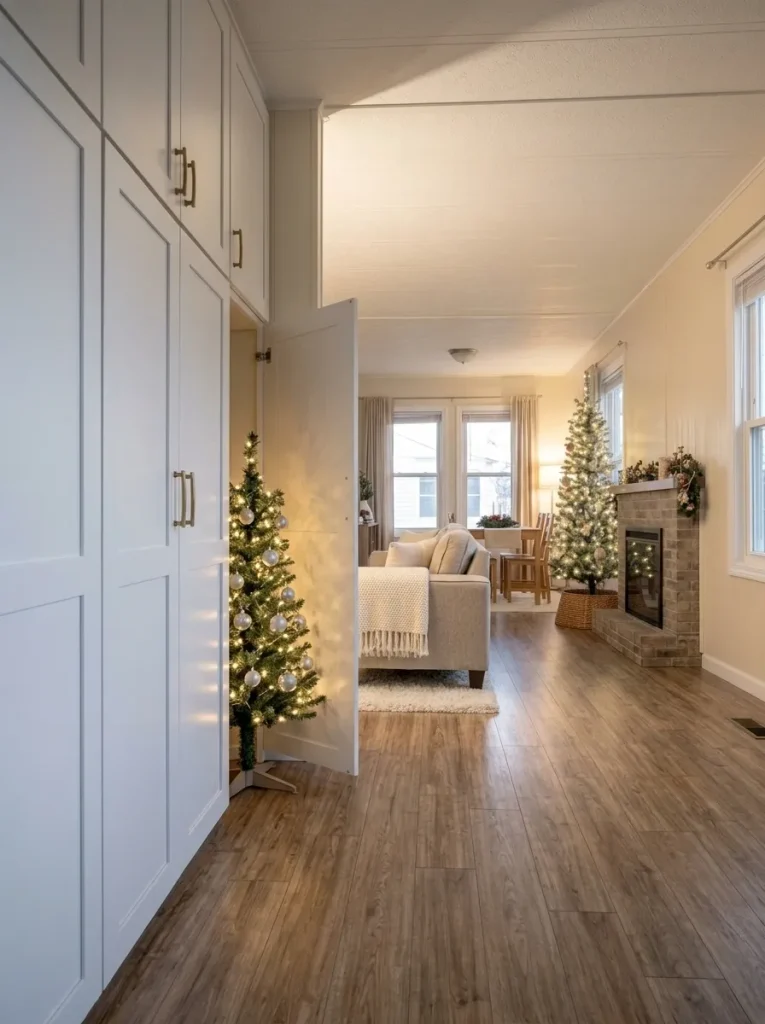
A shallow recess beside fitted cabinets can act like a ready-made Christmas-tree alcove. Its vertical edges frame a narrow evergreen, which softens the sharp meeting of cabinets and wall.
Before adding a tree, operate every object that shares that recess:
- Open drawers completely, including lower drawers beside the stand.
- Swing cabinet and closet doors through their normal range.
- Identify access panels, outlets, vents, and equipment that need unobstructed access.
A tree that passes those tests can carry smaller ornaments on the cabinet-facing side, with gifts contained toward the outer wall.
Where storage is frequently used, a shorter tree on a suitable surface may be better.
The broader narrow single-wide decorating guide covers awkward architectural pockets; here, cabinet function decides whether the Christmas nook is viable.
11. Fit a Pencil Tree Into a Sloped-Ceiling or Vaulted-Corner Position
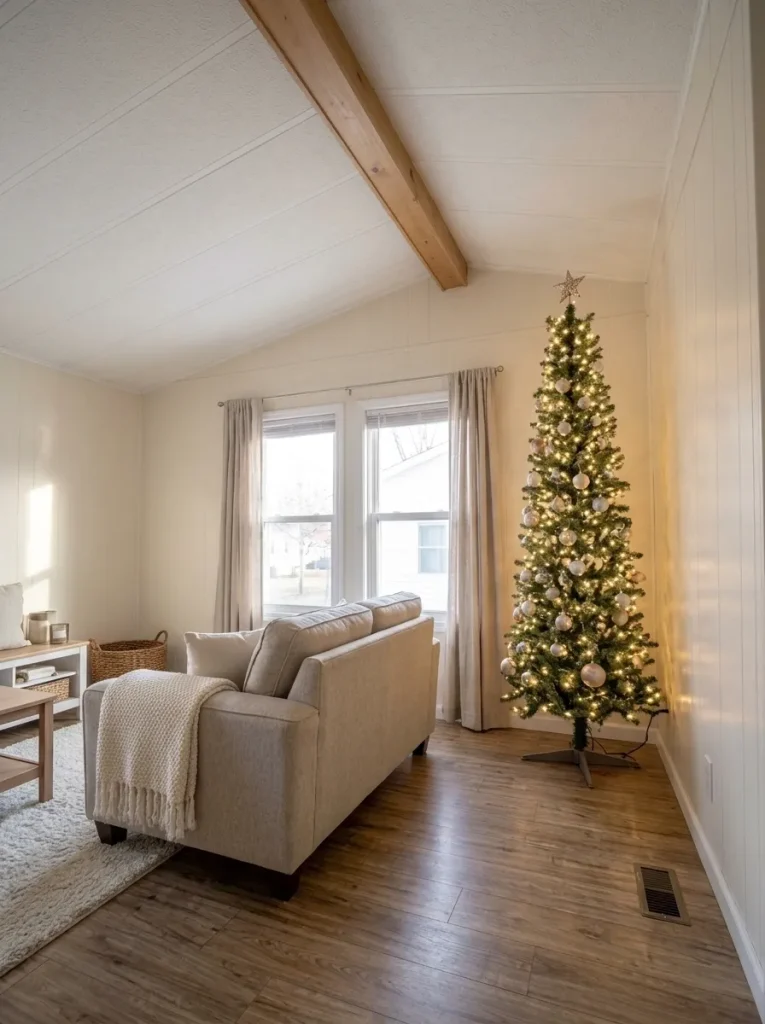
A sloped ceiling can make a tall, thin tree look almost custom-fitted. The risk is that the ceiling is lower above the upper branches than it is above the trunk, particularly where the roofline approaches the exterior wall.
Make three measurements before choosing the tree:
- Height from the floor at the intended trunk position to the ceiling directly above.
- Height available above the widest upper branches toward the sloping side.
- Complete assembled tree height, including the stand and chosen topper.
Then check nearby fans, light fixtures, vents, and other overhead obstacles.
If the topper crowds a fixture, remove it or choose a shorter tree; a pointed silhouette can still look deliberate without one.
Avoid treating a few apparent inches of photographic headroom as proof that a tree will fit safely in your room.
12. Group Two or Three Small Slim Trees Along a Quiet End Wall
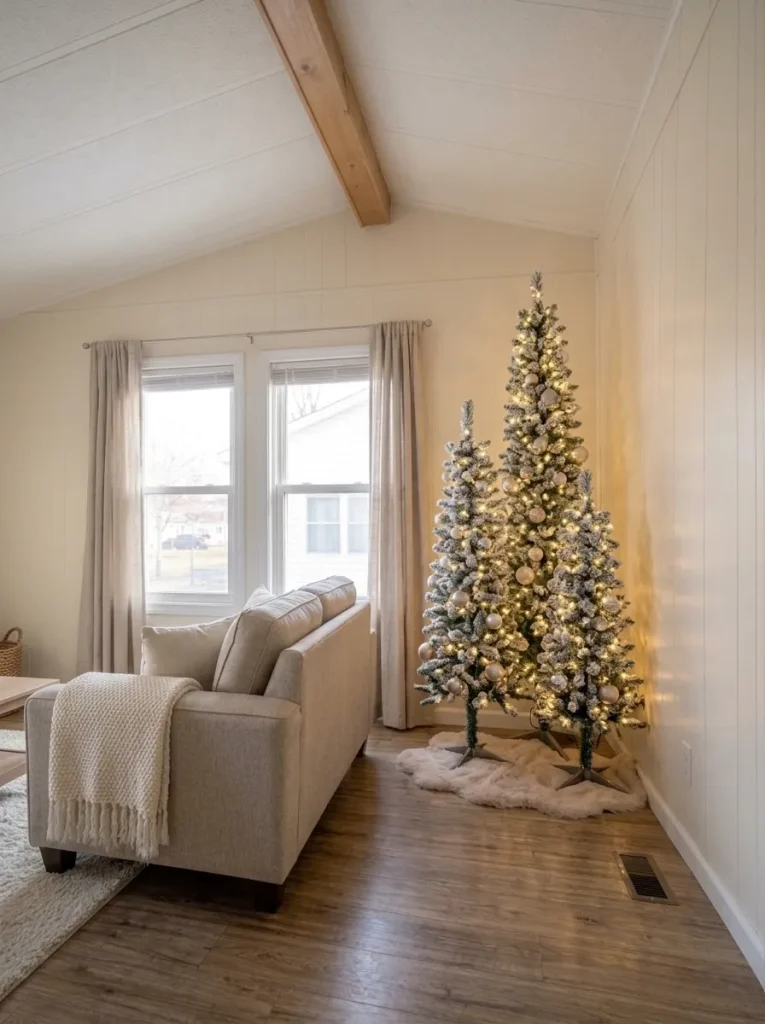
Three slender trees at staggered heights can make a soft woodland vignette, especially with consistent warm-white lighting and restrained flocking.
The surprise is that three narrow bases may take more floor area than one full-height pencil tree.
Compare the two choices before decorating:
One pencil tree: Strong single focal point; usually simpler cord routing and one stand to position. Best for a genuinely narrow floor pocket.
A small grouping: Layered silhouettes and greater flexibility in height; useful only when a broad, underused end-wall zone contains all of the stands, skirts, and future gifts.
Tape each stand location separately, then look from the entrance.
Make the tallest tree the visual anchor and keep shorter trees close enough to read as one arrangement. Choose the group only when the entire cluster stays clear of the passage; otherwise, a single beautiful tree is the more composed option.
13. Raise a Compact Slim Tree on a Stable Living Room Console
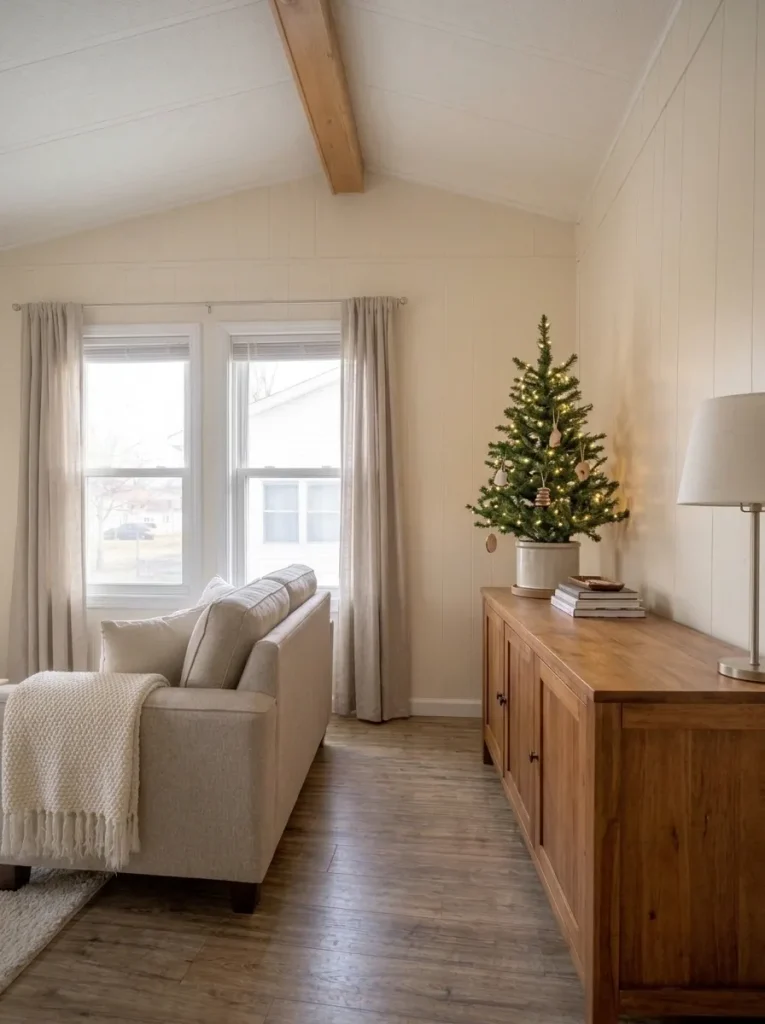
No spare floor pocket?
A compact tree can still be a focal point on an appropriately strong, stable console or cabinet. An elevated tree trades floor area for furniture capacity, so its success depends on the supporting surface and the everyday job of that furniture.
Before placing one, check the manufacturer’s stand and weight guidance, the cabinet’s stability, and whether ornaments or cords could be pulled by children or pets. A narrow ledge, wobbly table, or overburdened cabinet is not suitable.
Consider where the lamp, keys, chargers, or other belongings will go during December.
The comparison below shows three distinct footprint decisions: full-height pencil tree, compact tabletop tree, and flat-back tree.
If a safe surface exists and essential household functions have another home, the tabletop option can feel complete without trying to mimic the scale of a floor-standing tree.
Christmas Tree Footprint Comparison
Which footprint can your room support?
Each tree style solves a different spatial problem. Compare what you gain with what you must measure.
Full-Height Pencil Tree
Creates a tall focal point using a relatively narrow standing footprint.
MeasureWidest branch spread, stand, tree height, and surrounding traffic.
Choose whenA real floor pocket exists and the ceiling allows the assembled height.
Tabletop Tree
Moves the Christmas display onto suitable existing furniture.
MeasureTree and stand dimensions, supporting surface, weight, and furniture stability.
Choose whenFloor space is unavailable but a safe, suitable surface exists.
Flat-Back Tree
Can reduce the amount a tree projects outward from a wall.
MeasureActual assembled depth and stand projection.
Choose whenAn uninterrupted wall is available and projection into the room is the limiting factor.
Illustrations show relative concepts, not measured product dimensions. Follow the tree manufacturer’s stand and installation instructions.
14. Use a Flat-Back Christmas Tree Against an Uninterrupted Wall
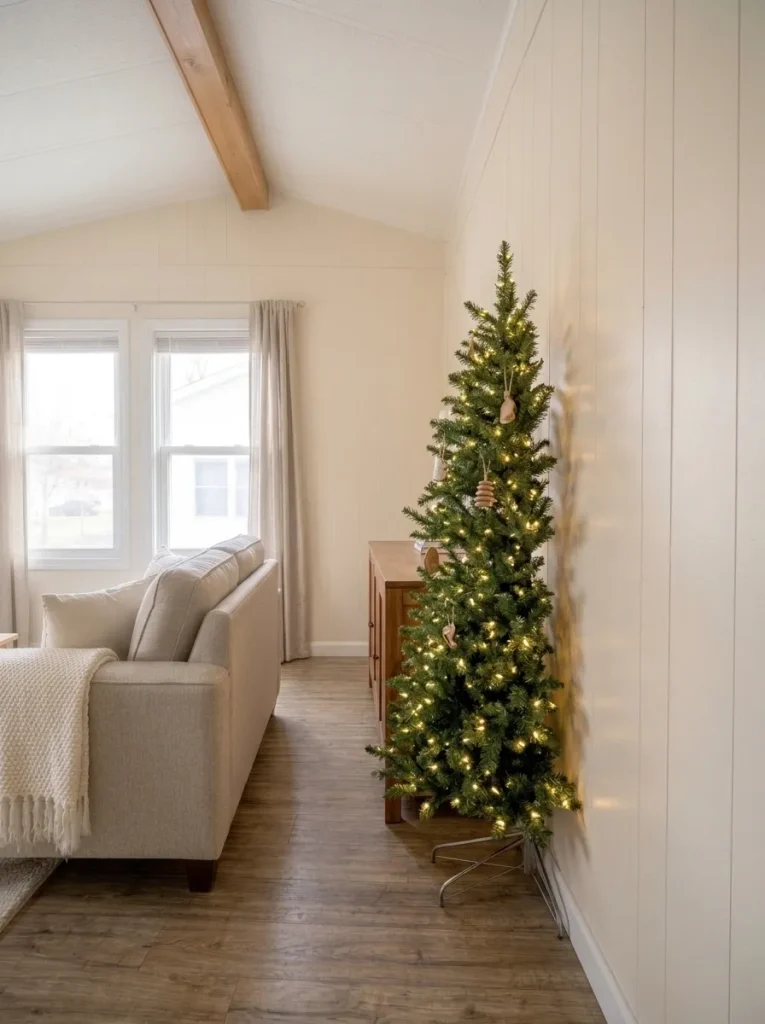
Sometimes a mobile-home living room can accommodate the width of a Christmas tree but not its projection into the walkway.
A purpose-designed flat-back or half tree solves a different problem than a conventional pencil tree.
Measure the right dimension:
- Side-to-side pinch point: Compare each candidate tree’s maximum assembled branch width.
- Wall-to-walkway pinch point: Compare its assembled front-to-back projection, including the stand and ornaments.
A flat-back tree belongs against an uninterrupted wall seen mainly from the front.
Check the manufacturer’s installation and stability instructions; the label “space-saving” says nothing about the footprint of the supplied stand.
If a door, vent, or necessary outlet sits behind that wall area, the shape alone won’t make it a good location.
15. Replace a Seasonal Side Table With a Slim Tree in the Same Footprint
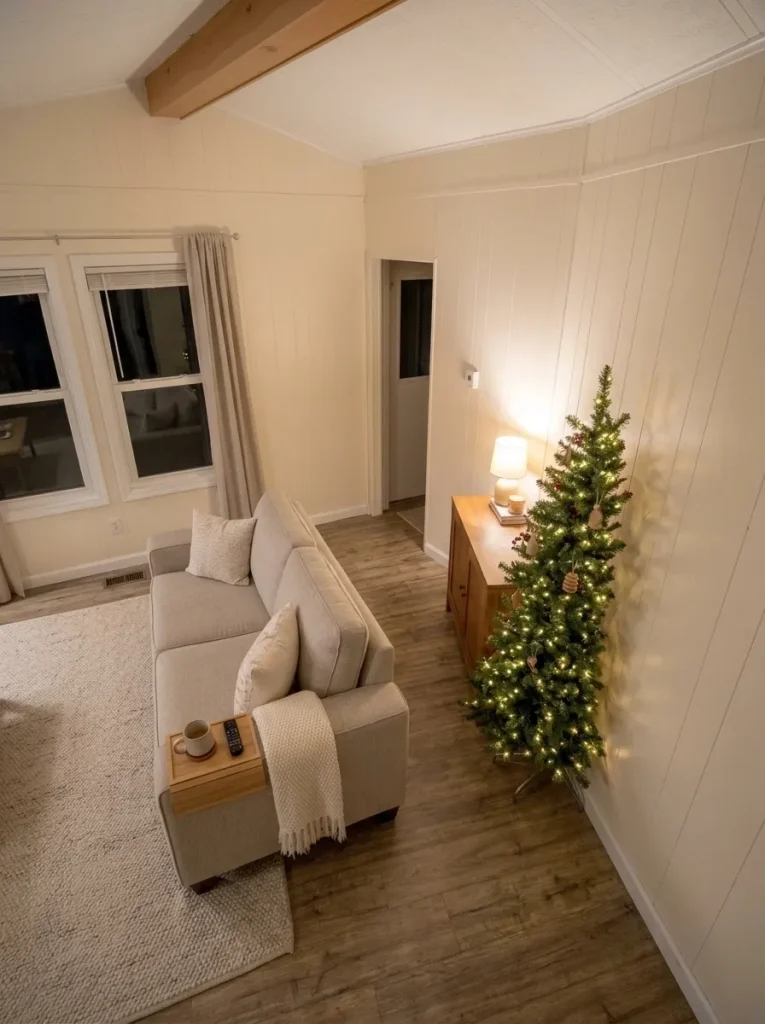
The strongest location may already hold something.
Moving a small side table or plant stand for December can create a proper holiday pocket without forcing another object into a crowded living room. But that piece of furniture was probably doing useful work.
Before moving it, assign its functions elsewhere:
- Drinks and remotes: Is there another reachable, stable surface?
- Reading light: Will the seat still have comfortable light after the lamp moves?
- Charging and power: Can the tree lights reach a suitable outlet without an exposed cord route?
- Everyday access: Does the room still work when people stand, sit, and walk through?
Retape the full tree-and-gift footprint after the furniture leaves.
The Electrical Safety Foundation International advises against cords pinched by furniture, routed through doors or windows, or hidden beneath rugs.
The final six-check inspection below helps catch a pretty placement that still needs correction.
Final Christmas Tree Placement Self-Audit
Is your Christmas tree location actually ready?
Check each condition only after testing it in the real room. Unchecked items show what needs to change.
All six conditions must be verified before treating the location as suitable. This checklist supports planning but does not replace product instructions, fire-safety guidance, or applicable local requirements.
Which Slim Christmas Tree Placement Works Best in Your Mobile Home?
Start with the least-used floor pocket, then test it from the doorway, the sofa, and the daily path to the kitchen.
Long rooms often benefit from a tree near the far end; sofa and TV-side pockets are useful when furniture operation remains easy. Window, mirror, and fireplace placements have extra conditions.
Where floor space truly fails, an appropriately supported tabletop tree or purpose-designed flat-back version may be the better choice.
Before decorating, open doors, pull chairs back, check heating equipment and electrical cords, and inspect the tree with its actual stand, basket, and ornaments installed.
A good placement stays comfortable after the photographs are taken.
Save this guide on Pinterest so you can compare locations when you begin decorating your mobile home for Christmas.