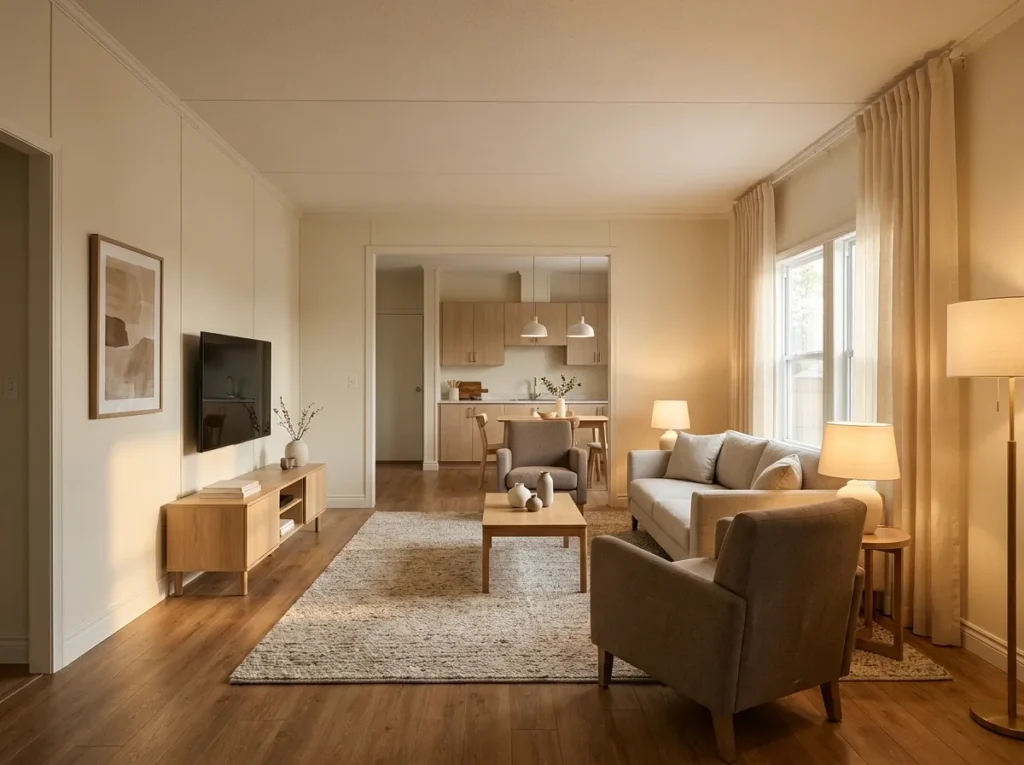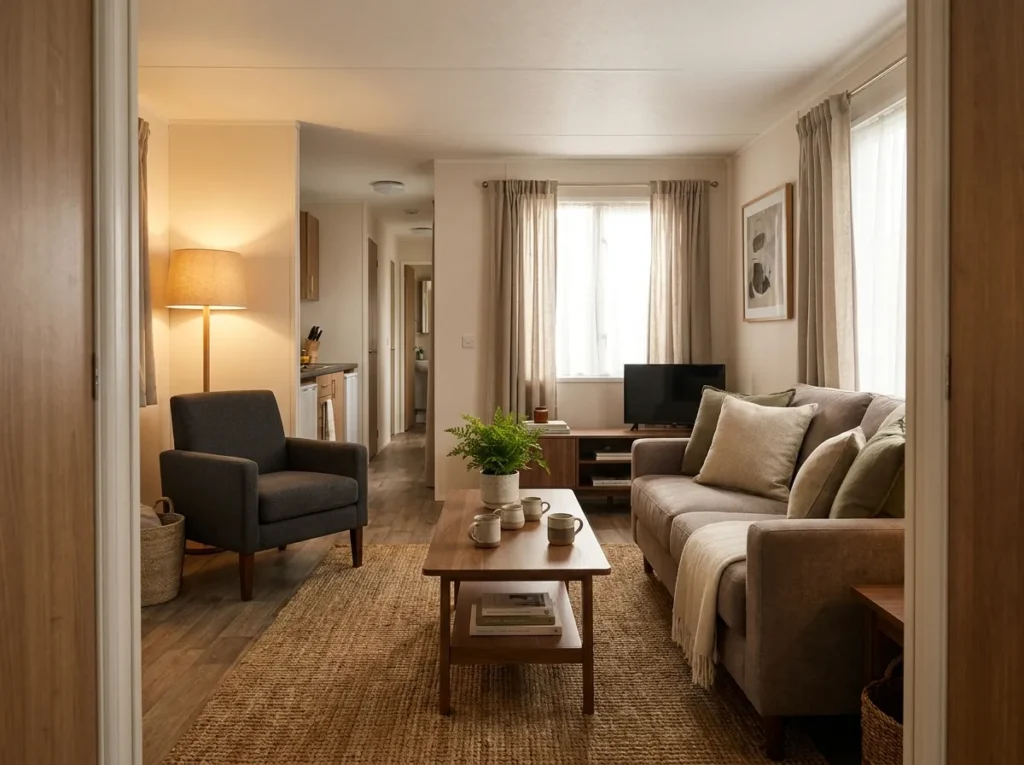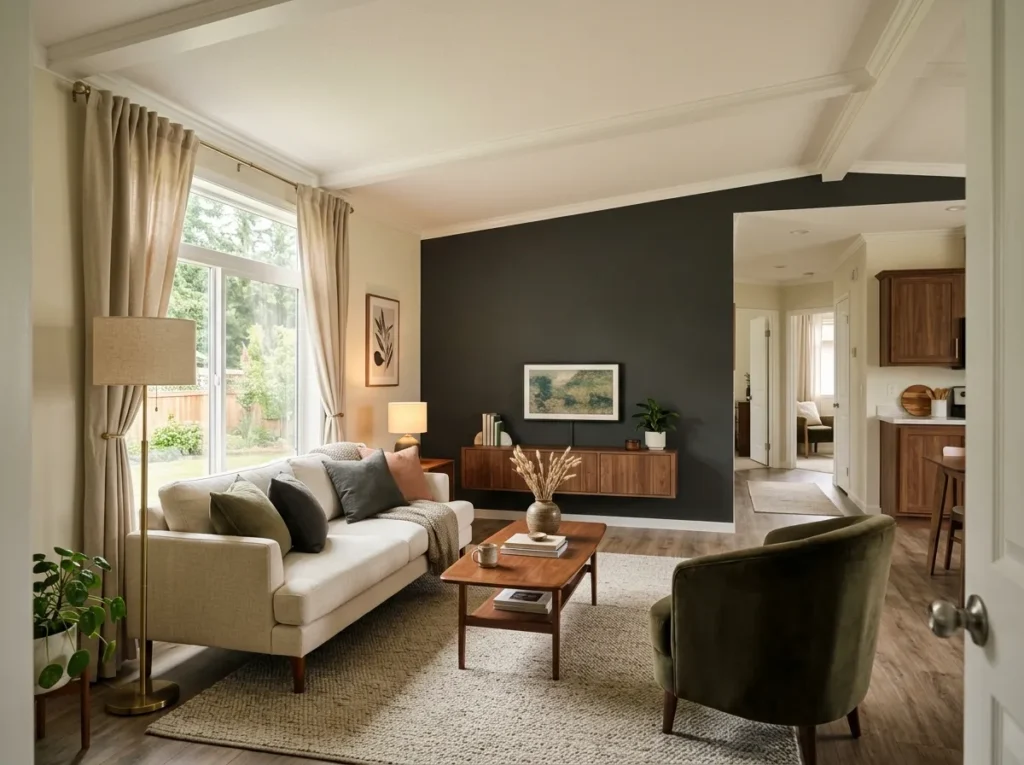
Fall decorating can get tricky in a mobile home. A few extra pillows, pumpkins, and baskets can quickly turn a comfortable living room into a space that feels crowded, especially when the room also handles TV watching, guests, storage, and everyday traffic.
A better fall mobile home living room starts with the room itself. The furniture, walkways, window light, sofa color, and available surfaces should guide what gets added for the season.
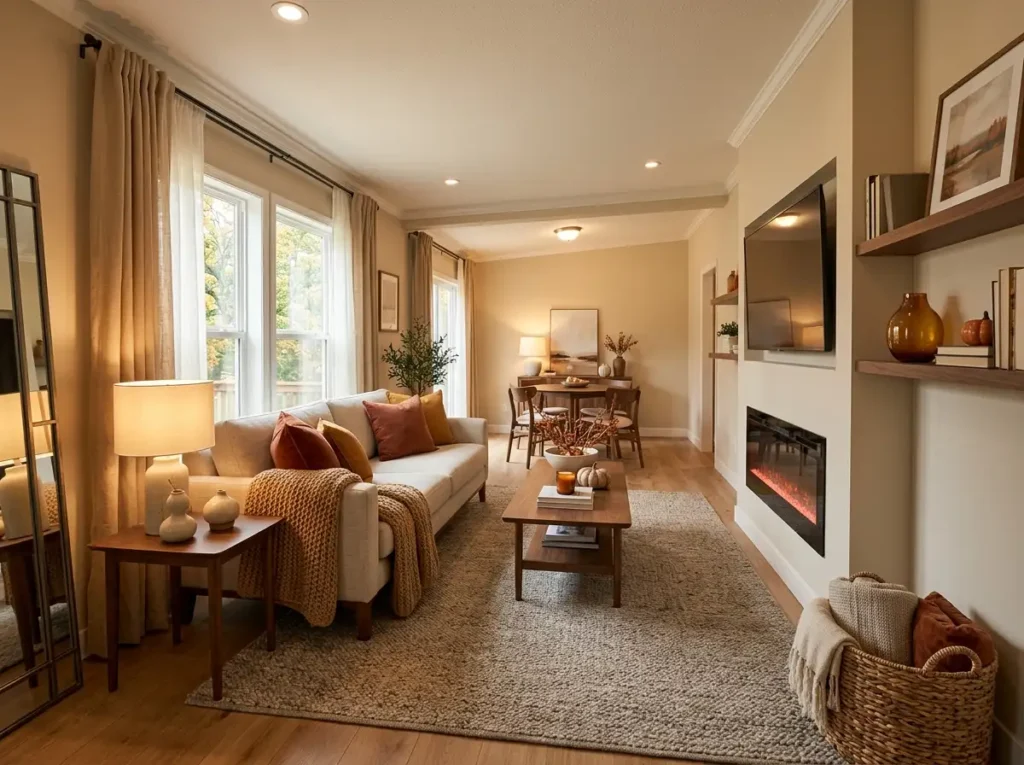
That does not mean the room has to look minimal. Rich rust tones, chunky fabrics, glowing lamps, natural branches, patterned rugs, and seasonal displays can create a beautifully cocooned autumn atmosphere when each element has a clear role.
The 19 ideas ahead move beyond simply scattering fall décor around the room. They focus on proportion, placement, color, lighting, texture, storage, and focal points so the space feels noticeably more seasonal while remaining comfortable to live in.
Whether your mobile home is compact and narrow or open and spacious, these ideas can be adapted to the room you already have.
1. Start With a Seasonal Edit Before Adding Anything
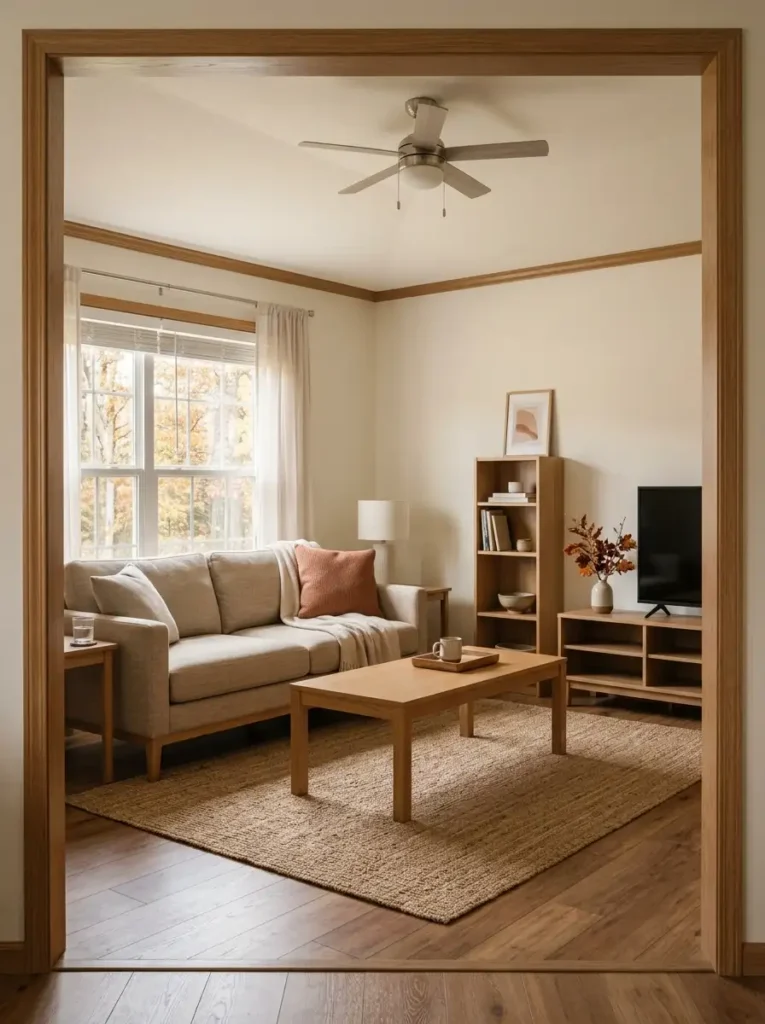
Before bringing out the fall bins, look at the living room as it exists now. Coffee tables, TV consoles, shelves, and side tables often already hold enough objects to create a complete visual layer.
Adding seasonal pieces on top of that layer makes every item compete for attention. The first decorating move is therefore subtraction.
Give existing accessories one of three temporary destinations:
- Keep: objects that support the autumn palette or serve an everyday function.
- Store: decorative pieces that can return after the season.
- Leave open: areas intentionally kept empty so the new fall pieces have room to register.
Pay special attention to small surfaces. A narrow console carrying a lamp, framed photo, candle, tray, and several decorative objects may only need one or two pieces removed before a seasonal arrangement has somewhere meaningful to sit.
The useful checkpoint is not whether the room looks sparse. Look for clearly visible stretches of tabletop, wall, or shelving around the places where fall décor will eventually go.
Those empty areas become part of the composition. They give later autumn accents stronger contrast and keep the finished room from looking like it was decorated by filling every available gap.
2. Build Fall Colors From the Sofa You Already Own
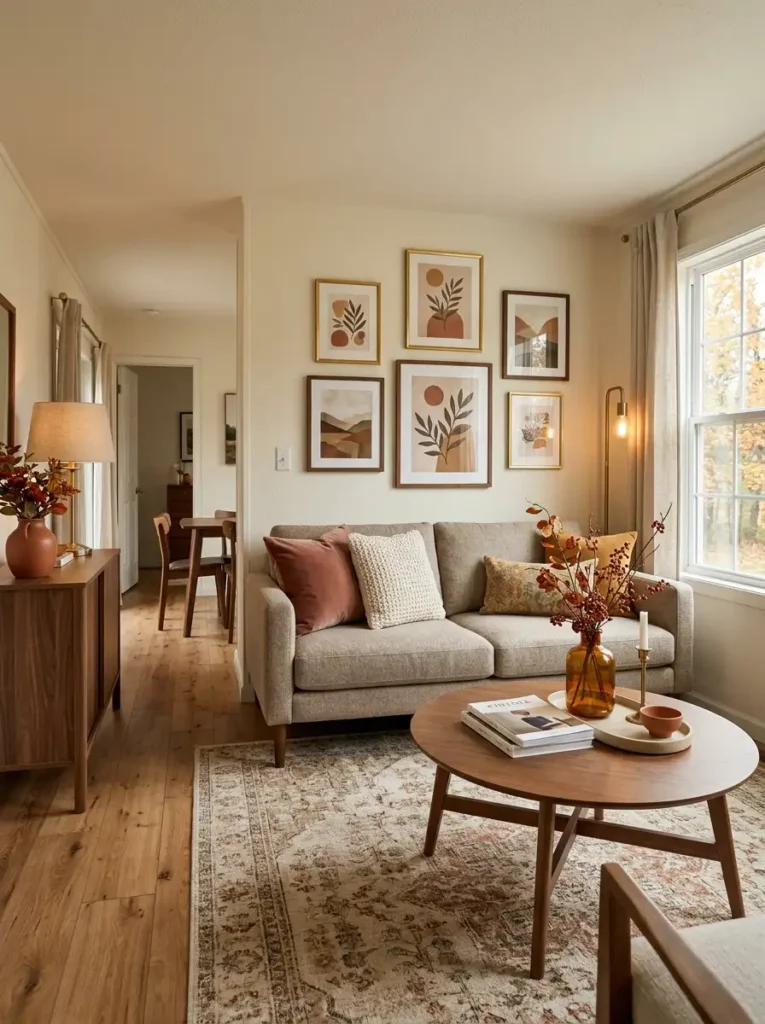
The sofa usually occupies more visual area than any autumn accessory, so let its undertone lead the palette.
A warm beige or oatmeal sofa pairs naturally with terracotta, cinnamon, ochre, muted pumpkin, walnut, and creamy ivory. Cooler gray upholstery often looks cleaner with burgundy, brown-red, charcoal, olive, dusty rust, or subdued copper.
Think of the palette as a simple equation:
existing sofa + existing wood tone + one autumn accent family + one quiet supporting neutral
That formula keeps the room connected even when you add cushions, branches, art, or tabletop décor later.
Wood matters too. Honey oak already contributes noticeable warmth, so it rarely needs an equally strong orange overload. Dark walnut can handle richer rust or amber tones because the deeper brown gives those colors a grounded backdrop.
Before committing to several accessories, place one fabric swatch, pillow cover, or seasonal object on the sofa during daylight. Look again after the lamps are switched on. Warm artificial light can intensify orange and yellow, making a color that looked muted at noon appear much stronger at night.
Choose the autumn family that works in both conditions. Once that family is established, later sections can build texture and decoration around it without introducing a different color story on every surface.
3. Protect the Main Walkway With a Smarter Furniture Angle
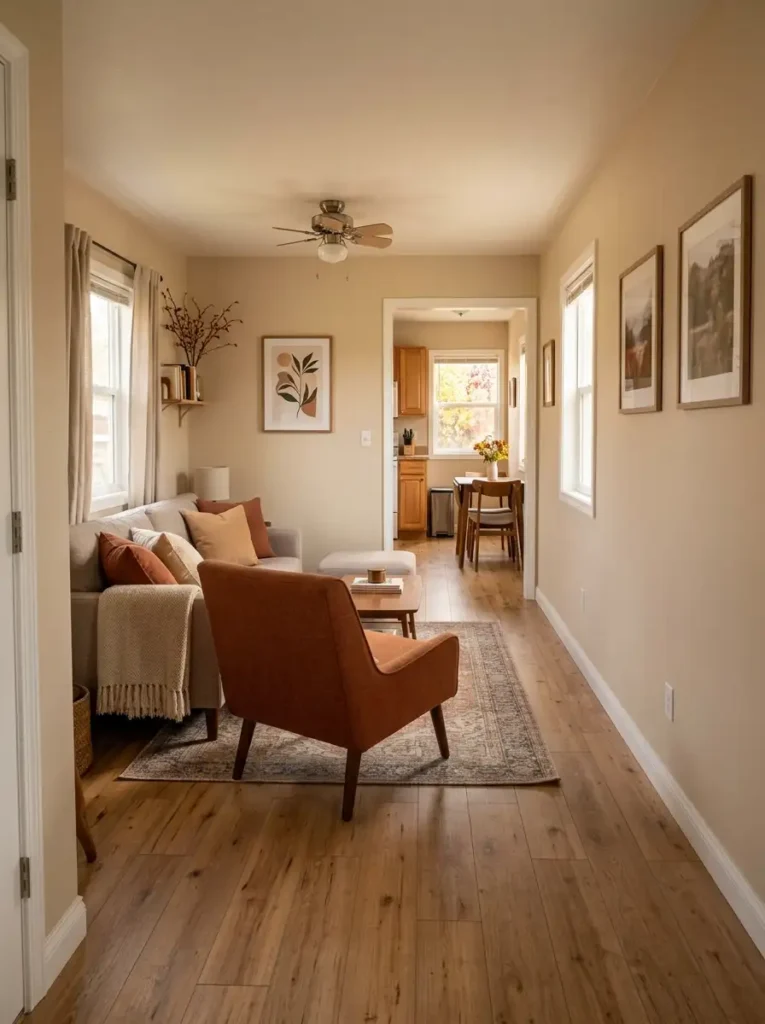
Walk into the room from the doorway you use most often. The route your body naturally wants to take is the route the furniture should respect.
In many mobile homes, that path connects the front door with the kitchen, hallway, or back of the home. A sofa arm, bulky accent chair, oversized coffee table, or seasonal basket sitting along that line can make the whole living room feel tighter.
Before replacing furniture, test small positional changes.
- Turn an accent chair a few degrees toward the sofa so its back no longer projects into the passage.
- Slide a coffee table slightly toward the seating center if one edge crowds the route.
- Move floor baskets into dead corners instead of allowing them to occupy the outer edge of the sofa.
- Check whether an ottoman can tuck beneath or beside another piece when it is not being used.
Tiny shifts matter because circulation is read through continuous floor space. The eye follows the same open channel that the body uses.
Stand at the main entrance after every adjustment. You should be able to understand the route through the room almost immediately, with no furniture corner appearing to block the next step.
That clear path also gives the fall décor a calmer background because practical floor space is no longer competing with decorative objects.
4. Ground the Seating Zone With a Warm, Properly Sized Rug
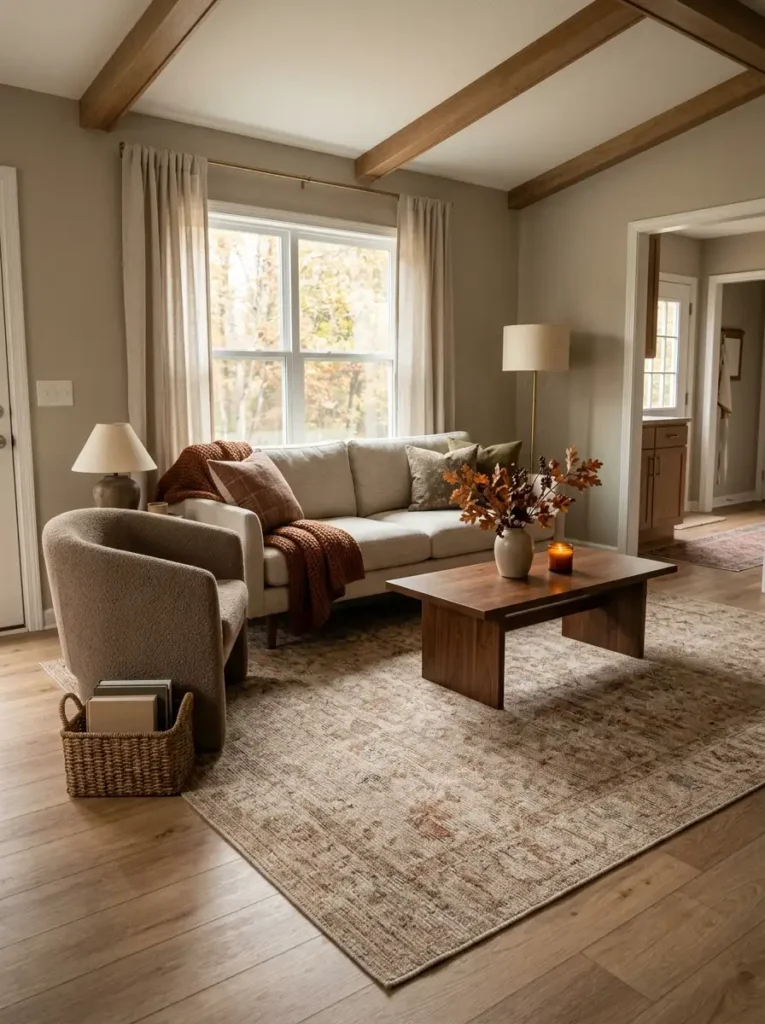
A rug may seem like a background decision, yet it controls how closely the sofa, chairs, and coffee table appear to belong together.
When a rug floats only beneath the coffee table, the surrounding furniture can look like separate pieces placed around a decorative island. In a mobile home living room, that fragmentation is especially noticeable because the exposed floor lines are usually easy to see from one end of the space to the other.
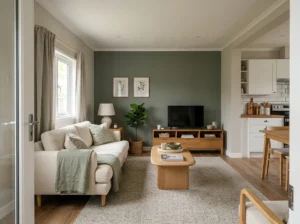
A stronger relationship is:
rug footprint → furniture contact → defined seating zone
For many sofa arrangements, allowing at least the front furniture legs to meet the rug gives the floor plane a clear boundary. Sectionals often need an even broader footprint because a tiny centered rug exaggerates their size.
Pattern deserves equal attention. Highly detailed rugs already contribute a strong decorative layer, so the fall accessories above them can be simpler. A quieter rug gives you more freedom to introduce plaid, leaf motifs, or richer cushion textures later.
Door clearance is the non-negotiable check. Measure any nearby entry door, closet, or cabinet before layering a thicker seasonal rug over an existing one.
The right rug should visually connect the conversation area while leaving a readable band of flooring around it. That perimeter keeps the seating zone defined without making the entire room look carpeted edge to edge.
5. Layer Fall Textiles by Texture, Not by Quantity
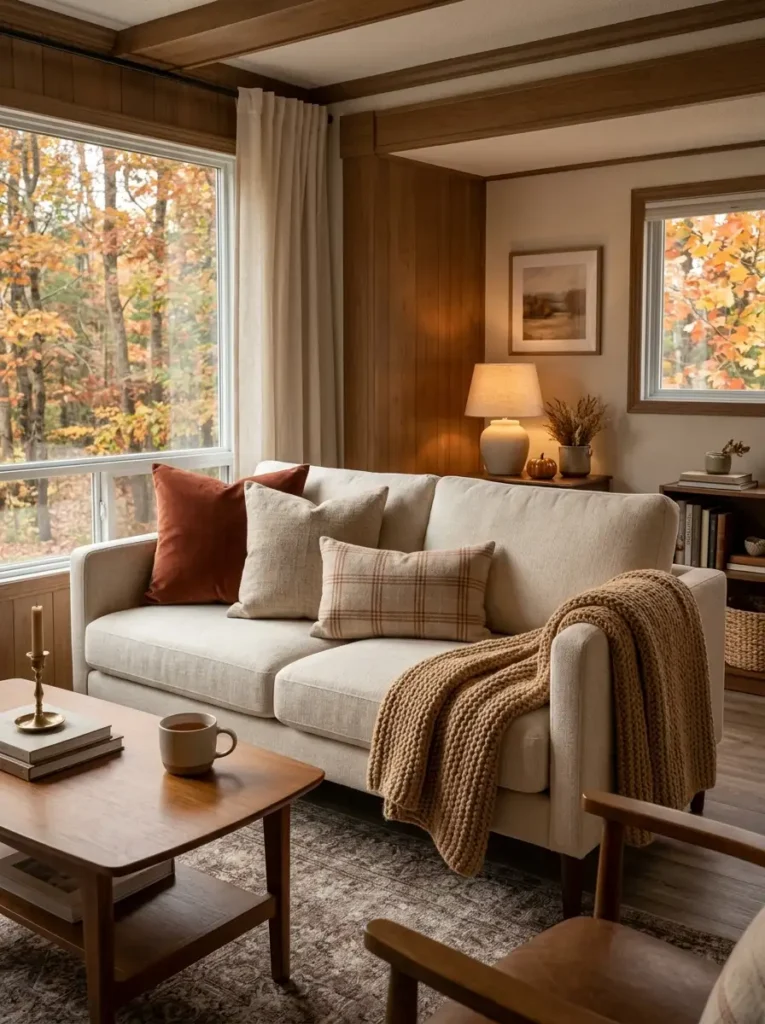
Fall textiles feel richest when your hand would notice a difference between them.
A smooth cotton cushion beside a nubby woven pillow, soft velvet, and a chunky knit throw gives the sofa several tactile layers even if every piece stays within cream, rust, and brown. That material contrast can carry much of the seasonal mood without covering the seating in novelty prints.
Consider what each surface contributes:
- Chunky knit: broad shadow and strong tactile depth.
- Velvet or brushed fabric: deeper color because the pile catches light differently as you move around it.
- Linen or woven cotton: a dry, relaxed surface that keeps the arrangement from becoming too plush.
- One patterned textile: useful for introducing plaid, stripes, leaves, or another autumn reference without repeating motifs everywhere.
Seat capacity is the practical limit. A three-seat sofa that requires people to remove four cushions before sitting has crossed from decoration into obstruction.
Try varying shape before adding quantity. One lumbar cushion, two standard squares, and a folded throw can produce a more deliberate arrangement than six similarly sized pillows.
Look at the sofa after sunset as well. Textures with deeper ridges and softer piles become much more noticeable under side lighting, which is one reason a restrained textile mix often feels especially cozy in the evening.
6. Lift the Window Wall With Taller, Warmer Curtains
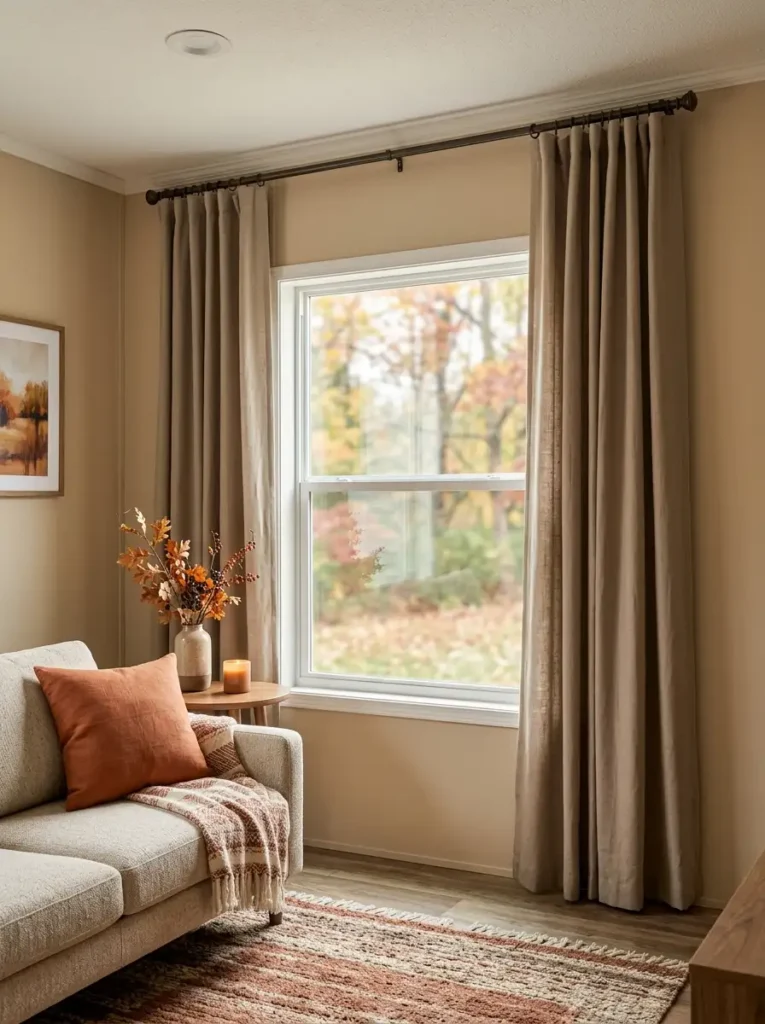
Windows can occupy a surprisingly large share of a mobile home living room wall, which makes the curtain position part of the room’s architecture—not merely a finishing detail.
A rod installed directly above the window trim asks the eye to treat the top of the glass as the wall’s height limit. Raising the rod closer to the ceiling shifts that reference point upward and gives the entire window zone a longer vertical line.
Width deserves the same attention.
Curtains need enough rod space beyond the window frame to stack back when open. Panels that remain over the glass reduce daylight, and that lost daylight can make deep rust, brown, and amber décor look heavier during the day.
Choose the fabric according to what the room already needs. Airy linen-look panels suit a living room that depends heavily on natural light. A slightly denser woven curtain can work beautifully when the room needs more softness or privacy for fall evenings.
Check vents, baseboard heaters, furniture, and nearby doors before changing length.
The successful window wall should still look generous with the curtains open. More fabric is not useful if it takes away the light that makes the autumn palette look alive.
7. Create a Three-Level Evening Lighting Plan
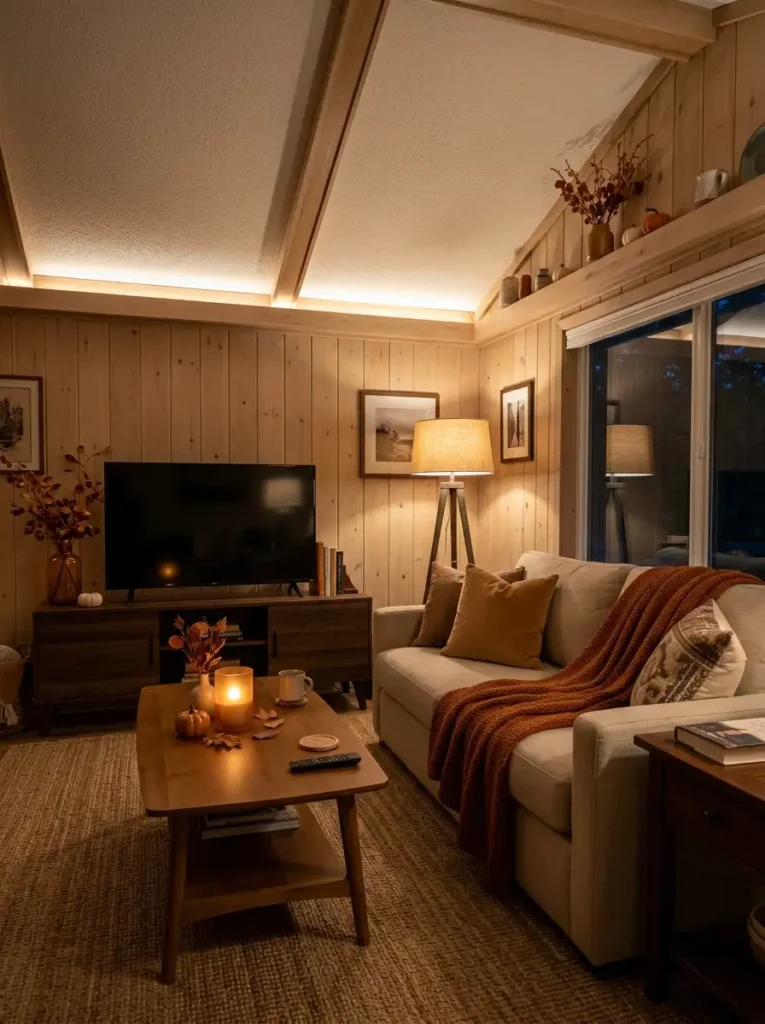
Autumn atmosphere changes dramatically after sunset, and one bright ceiling fixture rarely gives a living room the same comfort as several smaller sources.
Build the evening scene at three heights.
- Low glow: a flameless candle, protected candle, or small accent light near coffee-table or console level.
- Mid-level light: a table lamp beside the sofa, console, or reading chair.
- Upper ambient light: a dim ceiling fixture, wall light, shelf light, or another source positioned above eye level.
Each layer has a different job. The lower source catches texture and reflective details. Table lamps illuminate faces and upholstery. Upper light keeps corners from disappearing completely.
Pay particular attention to the television. A bright lamp visible in the screen can become distracting, while a soft light positioned slightly to the side of the TV wall can reduce the harsh jump between a glowing screen and a dark room.
Bulb temperature also influences the fall palette. Warm-white light usually flatters cream, rust, brown, wood, and muted orange better than a very cool white source.
During the final evening check, turn off the main ceiling light first. Switch on the remaining sources one at a time. The room should gain atmosphere in layers while still remaining practical enough for reading, conversation, and moving around safely.
8. Keep the Coffee-Table Centerpiece Low and Long
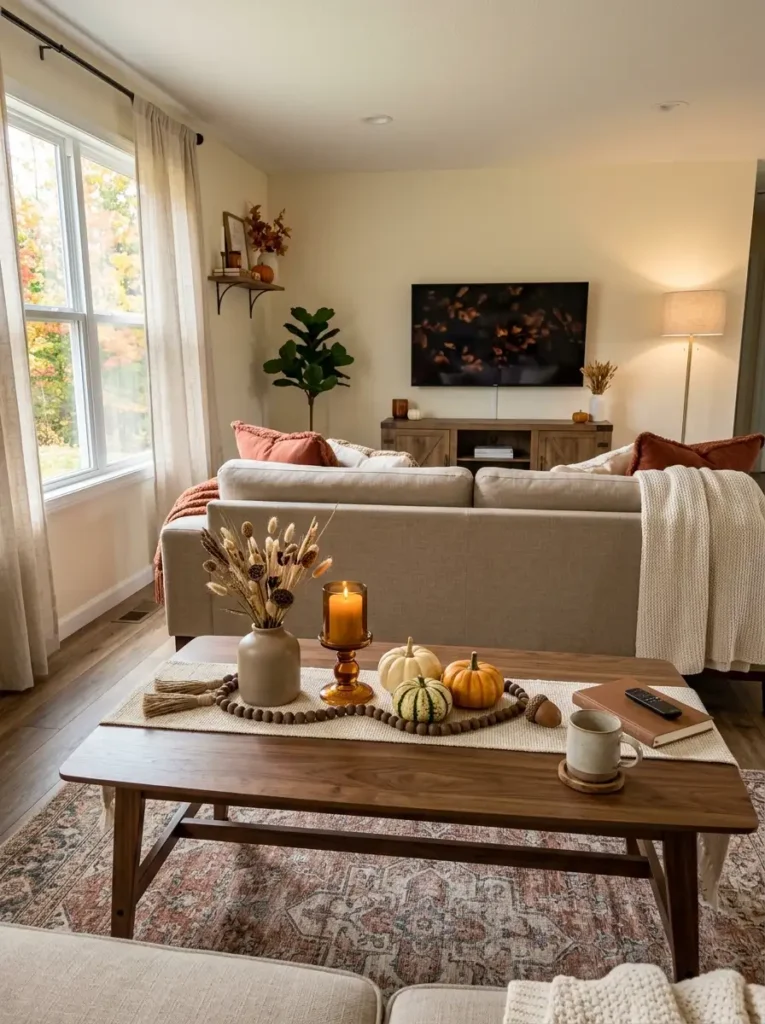
A fall centerpiece can occupy a noticeable amount of coffee-table space without becoming a visual barrier.
Height is the important variable.
From a seated position, your eyes naturally travel across the table toward another person, the television, or the opposite side of the room. A tall arrangement interrupts that line long before the table itself feels physically crowded.
A low horizontal composition works especially well on rectangular tables. Start with a tray, narrow runner, shallow bowl, or elongated base. Then vary the objects across the length instead of building upward.
A useful combination might include a squat ceramic vase with short dried stems, one candle, two small gourds, and a dark wood or amber-glass accent. None of those pieces need to match.
Leave an everyday reach zone accessible. Remotes, a mug, a book, or a snack plate should still have somewhere to land without requiring the entire centerpiece to be moved.
Round tables need a slightly different approach. Keep the arrangement more compact toward the middle so usable space remains accessible from several seating positions.
Sit down before considering the centerpiece finished. From the sofa, you should still see comfortably across the room. The display has succeeded when it enriches the foreground but never behaves like a wall between the people using the space.
9. Style the TV Wall With a Quiet Seasonal Frame
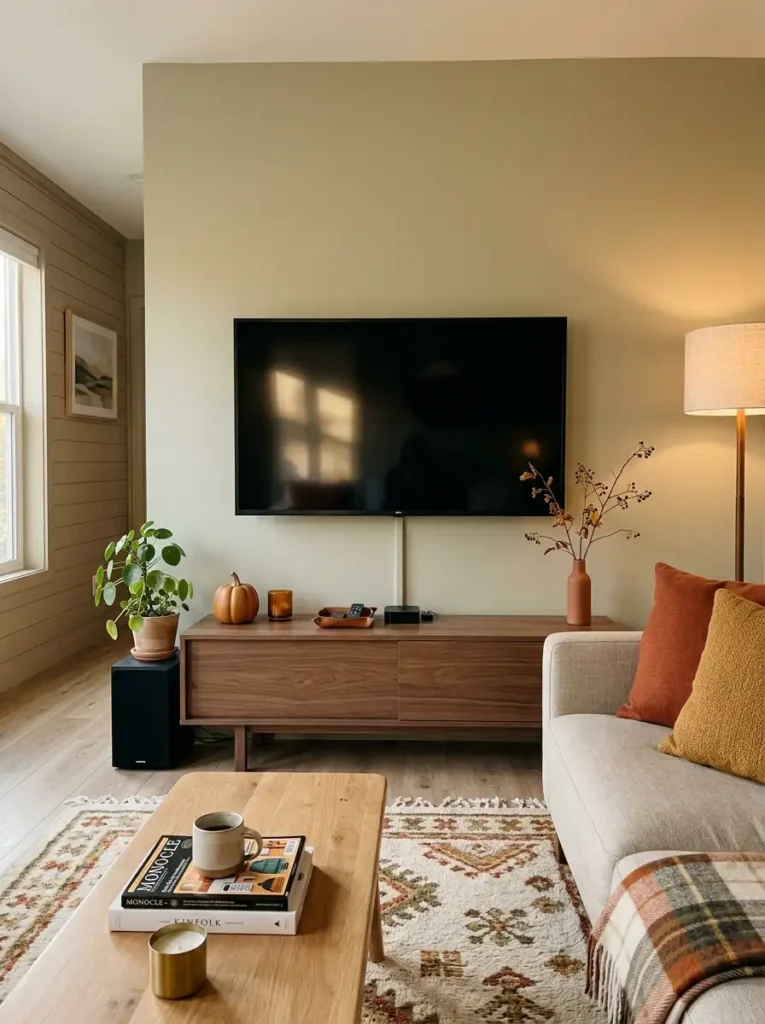
A television is already one of the darkest and visually heaviest rectangles in many living rooms. Fall décor placed near it therefore needs less effort to get noticed.
That high contrast is useful—but easy to misuse.
Wrong: covering the entire console with pumpkins, garland, tall foliage, signs, and candles. The screen becomes surrounded by dozens of competing edges.
Better: leave the area directly beneath most of the screen relatively calm, then add one low arrangement toward one side and a taller but narrow accent toward the other.
Best when: the accessories also relate to something outside the TV wall, such as the established rust accent, a warm wood tone, or one natural material already present in the seating area.
Dark screens intensify nearby color. A modest terracotta vase or amber branch can appear much stronger beside a black television than it would against a beige wall.
Screen clearance remains practical as well as visual. Avoid foliage overlapping the picture, décor blocking ventilation, and reflective objects positioned where they catch the television image.
Cable boxes, remotes, speakers, and game systems need breathing room. Hiding them behind seasonal decorations may look neat in a photograph but can make daily use annoying.
Aim for a frame, not a stage set. The television can remain visually dominant while the autumn accents soften its edges and connect the media wall to the rest of the room.
10. Turn a Fireplace or Faux Mantel Into the Main Fall Moment
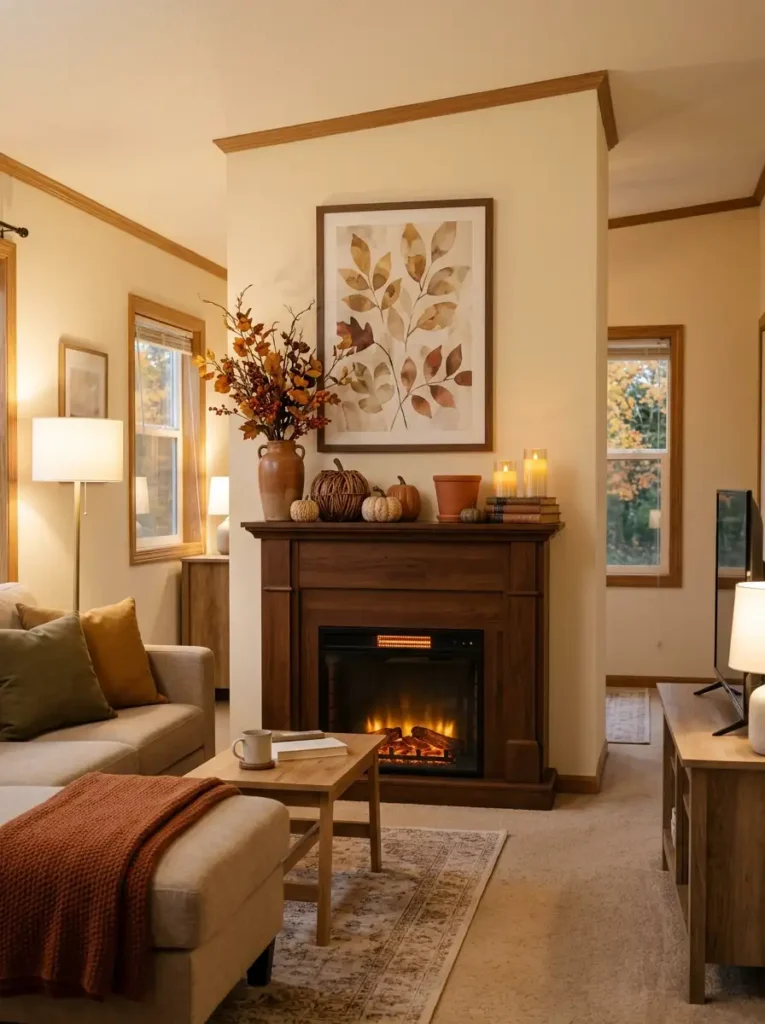
One concentrated fall display can carry more seasonal energy than decorating five unrelated surfaces at the same intensity.
A fireplace naturally provides that opportunity because the hearth, mantel, and wall above it already form an architectural composition. If your mobile home does not have a fireplace, a substantial floating shelf or narrow faux mantel can serve a similar decorative role.
Allow this zone to be richer than the rest of the room.
Start with one larger vertical element—art, a mirror, or a restrained seasonal piece—then build asymmetrically across the ledge. A fuller branch arrangement on one side might be countered by a lower group of pumpkins, candles, or pottery on the other.
The strongest focal displays contain changes in height and material, yet they also leave visible wall or mantel surface between groups. Dense does not have to mean packed edge to edge.
Fire safety controls every styling decision on a functioning fireplace. Keep dry leaves, fabric garlands, paper decorations, baskets, and candles well outside heat and flame zones according to the appliance manufacturer’s requirements.
A faux mantel offers more freedom, although nearby heaters and vents still need clearance.
Once this area is finished, reduce the seasonal volume elsewhere. The sofa can rely more on texture; the coffee table can stay low; side surfaces can remain understated.
That difference in intensity is what makes the fireplace wall feel like the room’s autumn destination.
11. Use Oversized Autumn Art to Fill One Blank Wall
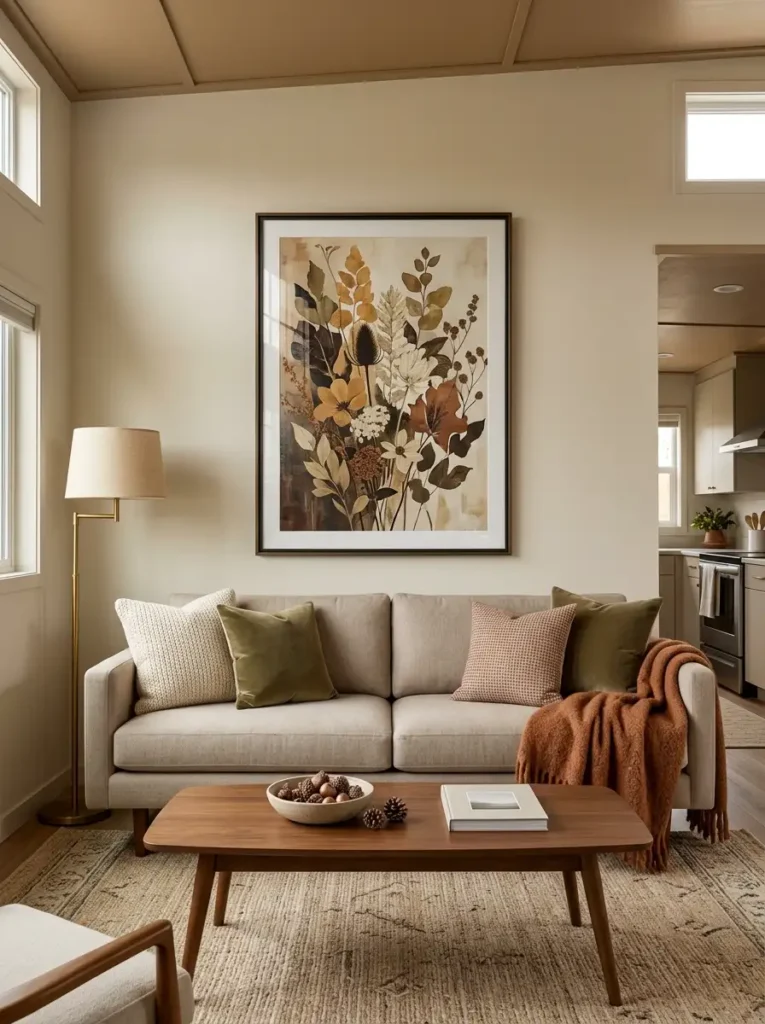
A blank wall above a sofa often tempts people to collect several small fall signs. The individual pieces may be charming up close, yet a scattered group can look undersized once viewed from the opposite side of the room.
Treat the wall as one large visual field.
One substantial autumn print, an oversized botanical piece, or a coordinated pair can carry enough scale to relate to the sofa beneath it. The artwork does not need pumpkins or seasonal wording. Muted branches, dried grasses, landscapes, ochre abstracts, or vintage-style foliage can communicate fall while remaining useful beyond October.
Use the furniture below as your scale reference. A tiny frame centered over a long sectional usually leaves too much disconnected wall around it. A larger piece, or a composition with meaningful width, visually links the wall and seating.
Frame finish matters as well. Warm wood feels softer beside autumn textiles, while slim black framing can sharpen a pale neutral room.
Temporary downloadable art is especially useful for renters or anyone who enjoys changing seasonal imagery. Existing frames can stay in place while only the prints change.
Once the artwork has enough presence, resist filling every remaining inch. The surrounding blank wall acts like a margin around a photograph—it gives the piece authority and keeps the seating zone visually calm.
12. Add a Tall Branch Arrangement to an Underused Corner
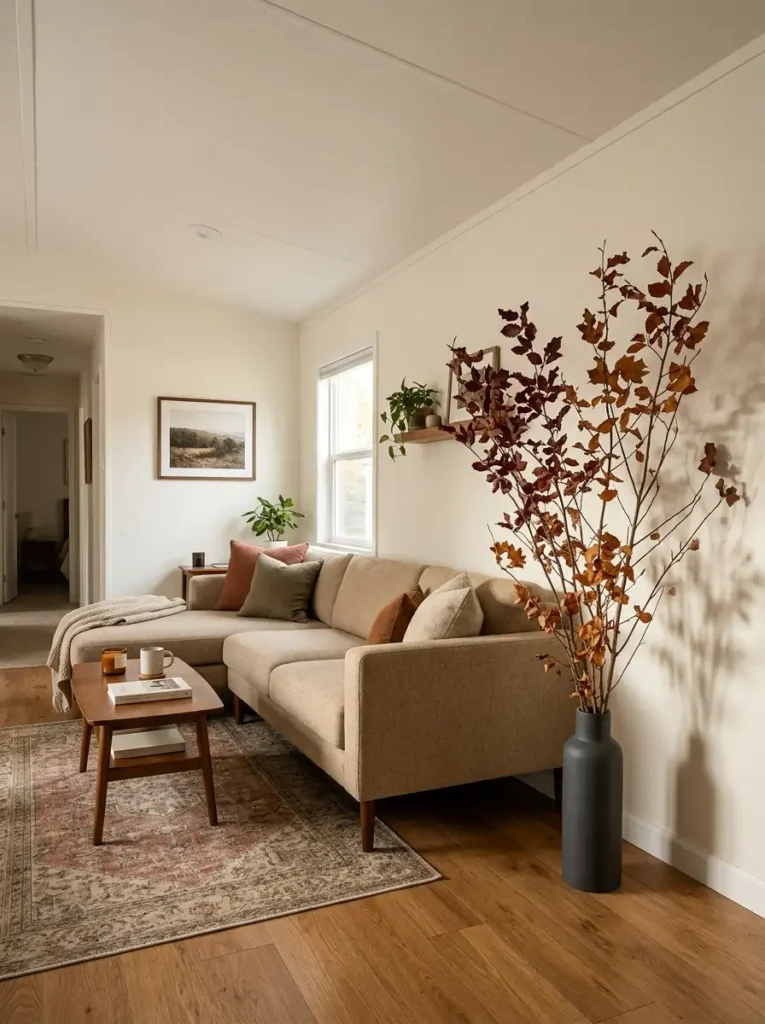
Some mobile home living rooms run out of tabletop space long before they run out of vertical space.
That makes an empty corner a useful place for one tall autumn element.
A narrow floor vase filled with maple-like branches, dried grasses, burgundy foliage, or sculptural bare stems can lift the seasonal color above sofa height without introducing another table or storage piece. The effect is especially useful beside a low sectional, where a corner may otherwise feel visually unfinished.
Floor footprint deserves careful attention. Choose a vessel that is stable but not unnecessarily wide, particularly near a walkway. Branches can extend farther than the base itself, so judge the arrangement at shoulder level as well as at the floor.
Imagine walking past it while carrying groceries or laundry. Anything projecting sharply into that movement zone will become irritating quickly.
The upper part of the arrangement should also respond to the ceiling. Very tall branches can look dramatic in a vaulted room, while a standard mobile home ceiling often benefits from a little visible air above the tallest stem.
Nearby light can add another layer. A lamp or window casting soft shadows from the branches onto the wall gives the corner movement and depth during the evening.
Secure heavy arrangements if pets or children use the room, and keep dried material away from heaters, vents, or open flames.
13. Make a Blanket Basket Part of the Storage System
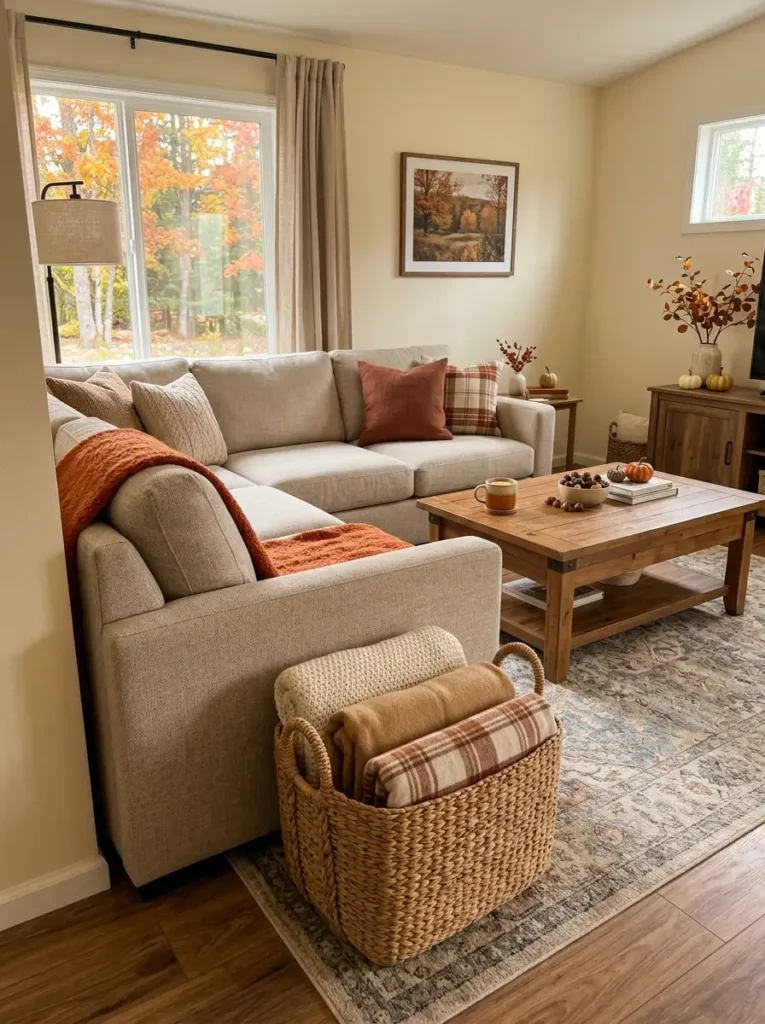
A basket full of blankets only looks effortless when the basket can actually hold the blankets.
That sounds obvious, yet undersized baskets are common in fall living rooms. Two bulky throws get pushed into a narrow container, half the fabric spills over the rim, and the “cozy” accessory slowly turns into another pile that needs constant arranging.
Start with capacity.
If your household uses three throws regularly, choose a basket that can hold those three without compression. Decorative overflow works in a styled photograph, but everyday storage needs enough space for someone to put a blanket away quickly.
Location comes next.
A basket beside the sofa arm is convenient when it does not narrow the passage. An unused gap between a sectional and wall can work even better. Keep handles clear of nearby furniture so the basket remains easy to lift for vacuuming.
Natural woven fiber adds seasonal texture, though it is not the only option. Soft fabric bins work well around children, structured felt can look cleaner in contemporary rooms, and wood-toned storage suits rustic interiors.
Spend first on function, not embellishment. A properly sized basket that solves blanket storage earns its floor space every day.
If an existing basket already meets that requirement, no seasonal replacement is necessary. Fold the throws more loosely, keep only the ones currently being used, and let their color provide the autumn update.
14. Build One Material-Mixed Pumpkin Cluster
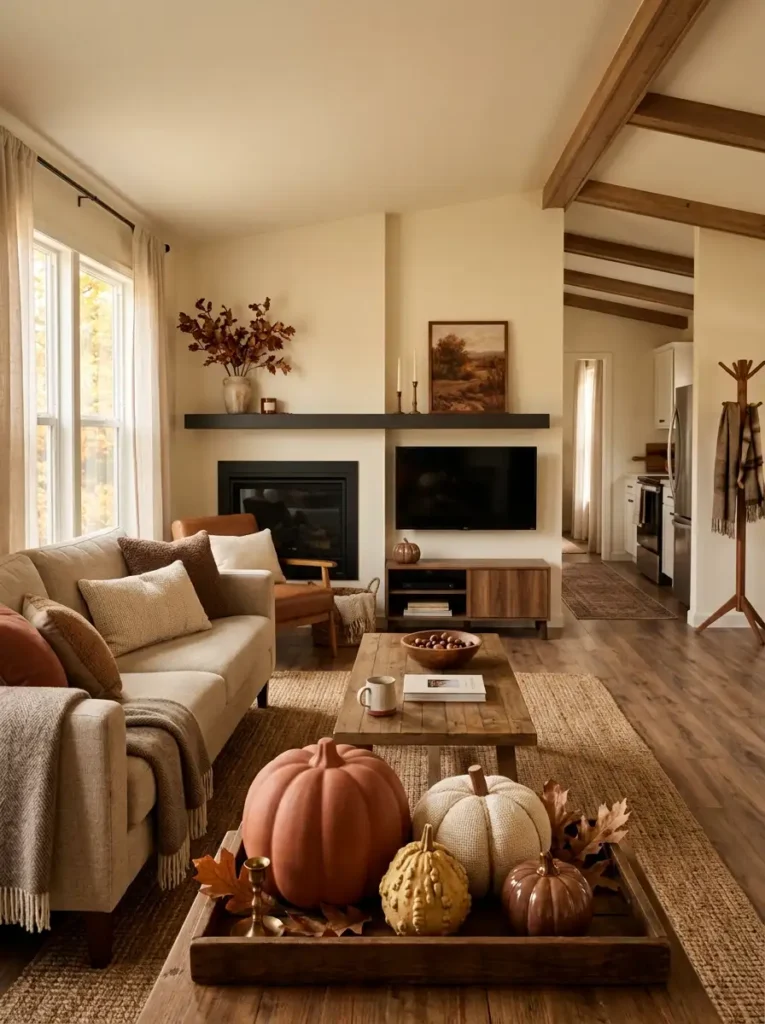
Pumpkins are among the clearest symbols of fall, which is exactly why they can become repetitive so quickly.
The common mistake is distribution: one pumpkin on the coffee table, another beside the television, several on the shelf, two by the sofa, and another near the doorway. The motif loses impact because the eye encounters the same shape everywhere.
Give the pumpkins one dedicated home.
Within that cluster, create variety through material and finish. A matte ceramic pumpkin beside a woven or fabric version and one natural-looking piece offers more contrast than six nearly identical orange gourds.
Size hierarchy matters too. Start with one dominant form, then support it with smaller pieces. Equal-sized objects often produce a row; mixed scale creates a group.
Color does not need to match perfectly. Cream, muted rust, brown, and soft terracotta can all belong together if the finishes already provide enough variation.
Choose the surface based on where the motif will be most visible. A low hearth, console corner, wide coffee-table tray, or protected floor zone may work. Once the cluster has been placed, remove competing pumpkin shapes elsewhere.
A good stopping signal is easy to recognize: if the grouping already reads unmistakably as “fall” from several feet away, another pumpkin contributes very little.
15. Give a Side Table or Console One Compact Fall Vignette
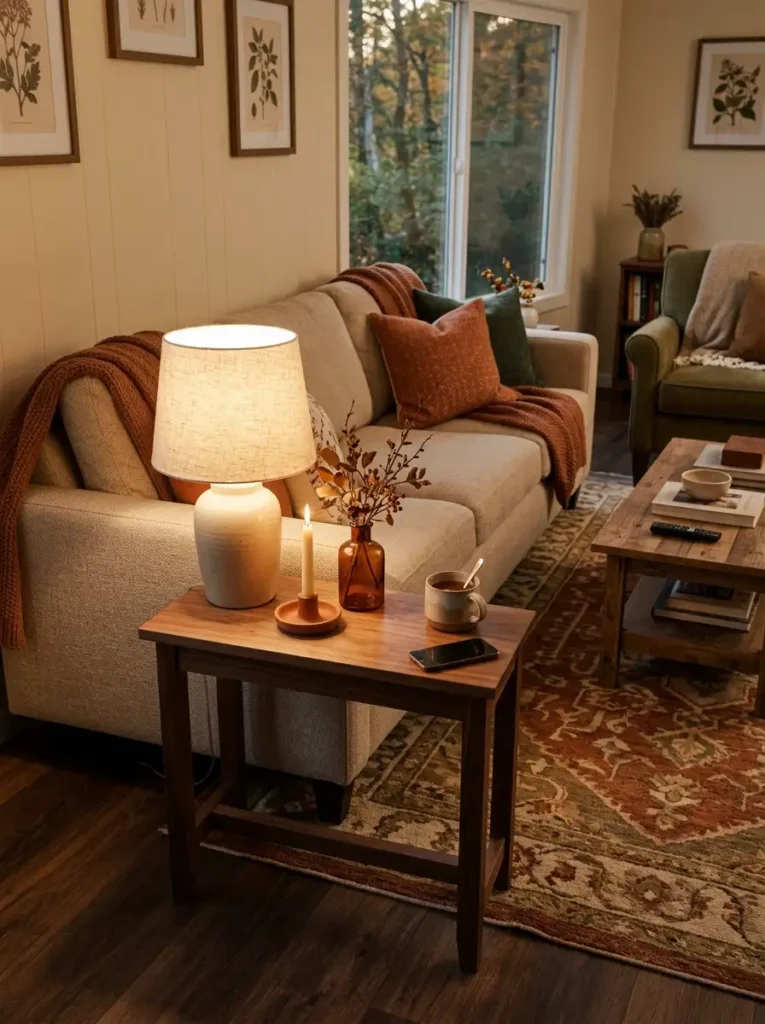
Picture the end of an ordinary evening.
Someone sets down a mug, reaches for the lamp, plugs in a phone, and drops the remote beside the sofa. If every inch of the side table has been styled for fall, the decorative arrangement becomes the first thing that has to move.
That is the wrong order of priorities.
Start by claiming the functional footprint. Keep enough room for whichever everyday activities actually happen there. The remaining area becomes the vignette zone.
A lamp can serve as the tallest part of the composition, so there may be no reason to add another large vertical object. A small amber vase, compact branch, candle, or miniature seasonal piece can sit lower beside it. A shallow tray can contain several tiny objects while still reading as one visual unit.
Console tables have more width, but the same principle applies. Allow useful items—keys, chargers, mail trays, speakers—to retain deliberate locations. Seasonal styling should fit around the function that justified the furniture in the first place.
Use height differences to make a small number of objects look complete. Lamp, medium accent, low detail is often enough.
Then test the arrangement for a full day. If daily items repeatedly land on top of the vignette, the decoration has claimed too much territory. Reduce its footprint until the surface works naturally again.
16. Repeat One Accent Color Into the Open Kitchen or Dining Area
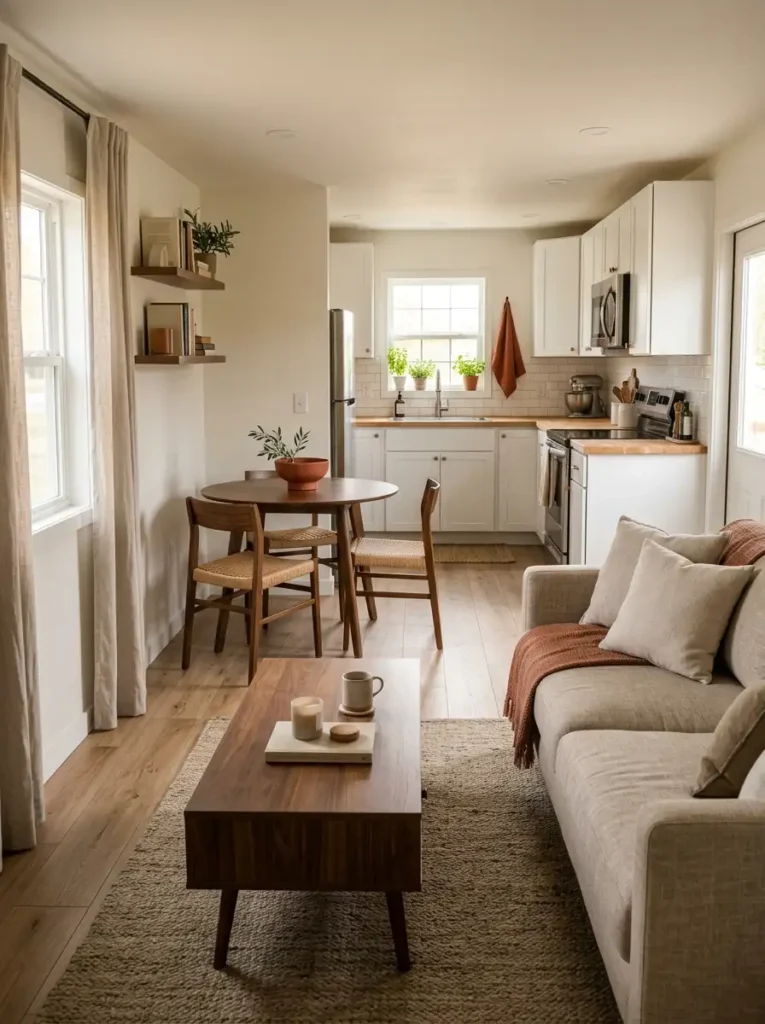
In many mobile homes, the living room does not end at a solid wall. From the sofa, you may also see part of the dining table, kitchen cabinets, breakfast bar, or hallway.
That shared sightline gives you an opportunity to make the fall decorating feel intentional across both spaces.
Choose one accent color already established in the living room and let it appear once in the adjoining area. A rust sofa cushion might connect to a rust kitchen towel. Muted ochre could reappear in a small dining centerpiece. Olive from a botanical print might show up in a ceramic bowl.
The objects themselves do not need to match.
What matters is that the eye encounters the same color family at separate points along the view. That small repetition creates a visual connection while allowing each zone to keep its own function.
Three common layouts call for slightly different responses:
- Living room directly beside the kitchen: echo the accent through one useful kitchen textile or vessel.
- Dining area between both spaces: let the dining table become the color bridge.
- Long single-wide sightline: place the second accent farther into the home so the color gently pulls the eye through the layout.
Avoid carrying every living-room fall motif into the kitchen. Matching pumpkins, garlands, pillows, towels, and signs across both areas can make the spaces feel themed as a set.
One repeated color is often enough to connect them.
17. Convert an Awkward Corner Into a Cozy Autumn Reading Nook
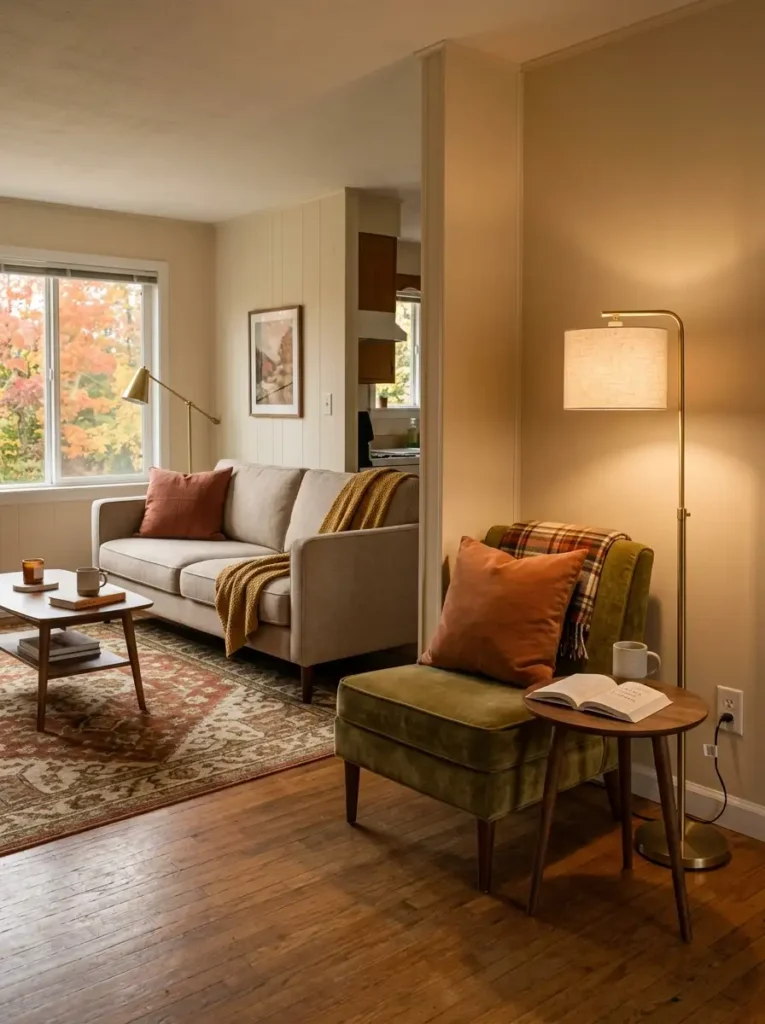
Before: an empty corner holds a small plant, spare basket, or nothing at all.
After: that same corner has a reason to exist.
A reading nook works particularly well in a mobile home living room because it can turn leftover floor area into usable seating without asking the main sofa arrangement to do more work.
Begin with the chair footprint. A compact armchair, slipper chair, or existing occasional chair should fit comfortably while keeping the established passage open.
Then give the chair a light source.
A narrow floor lamp works where table space is scarce. If a side table fits, a small lamp can make the zone feel more enclosed after sunset. Position the light so it falls across the reading area and not directly into the television.
Add only what the activity needs: perhaps a small surface for a drink, one throw, and a cushion in the established fall palette.
The transformation comes from function, not from filling the corner with seasonal objects.
An outlet nearby is useful for a lamp or charger, and it is worth checking before moving heavy furniture into position. Also consider where a book, tablet, or mug will actually rest.
The final test is behavioral: does the corner now invite someone to sit there?
If it looks decorative but remains uncomfortable or inconvenient, refine the furniture placement before adding anything else.
18. Use Vertical Shelves for Fall Detail Without Losing Floor Space
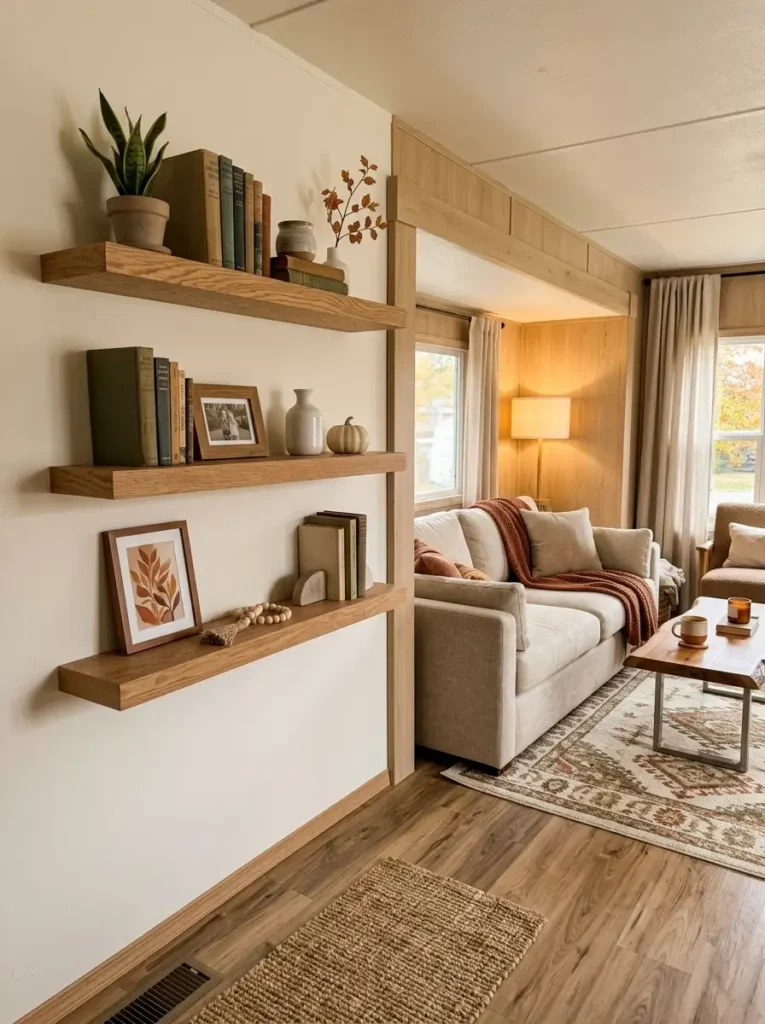
A bookshelf or floating-shelf wall already provides something valuable in a mobile home: decorative space that does not occupy the center of the floor.
There is no need to empty it for autumn.
Keep the books, framed photos, plants, and useful objects that make the shelves feel personal. Seasonal styling works better here as an interruption in the existing rhythm.
Four small changes can shift the mood.
First, change a few forward-facing pieces. A seasonal print or autumn-toned book cover can alter the shelf from a distance.
Second, introduce natural texture. One small branch, wooden object, or muted ceramic pumpkin may be enough in a shelf compartment.
Third, let some shelves remain mostly year-round. The autumn additions become easier to notice when they appear at selected intervals.
Fourth, pay attention to depth. Deep objects near the front edge can make a narrow shelf wall feel bulky. Keep larger seasonal pieces toward shelves that have enough usable depth.
Floating shelves deserve a weight check before heavy ceramics or books are added. Renters can achieve the same vertical strategy with an existing freestanding bookcase and removable seasonal prints.
The useful visual ratio is not fifty-fifty. Fall pieces can remain the minority.
When familiar books, plants, and personal objects are still visible, the seasonal update feels integrated into the home instead of temporarily replacing its identity.
19. Frame One Window or Architectural Edge With a Final Fall Accent
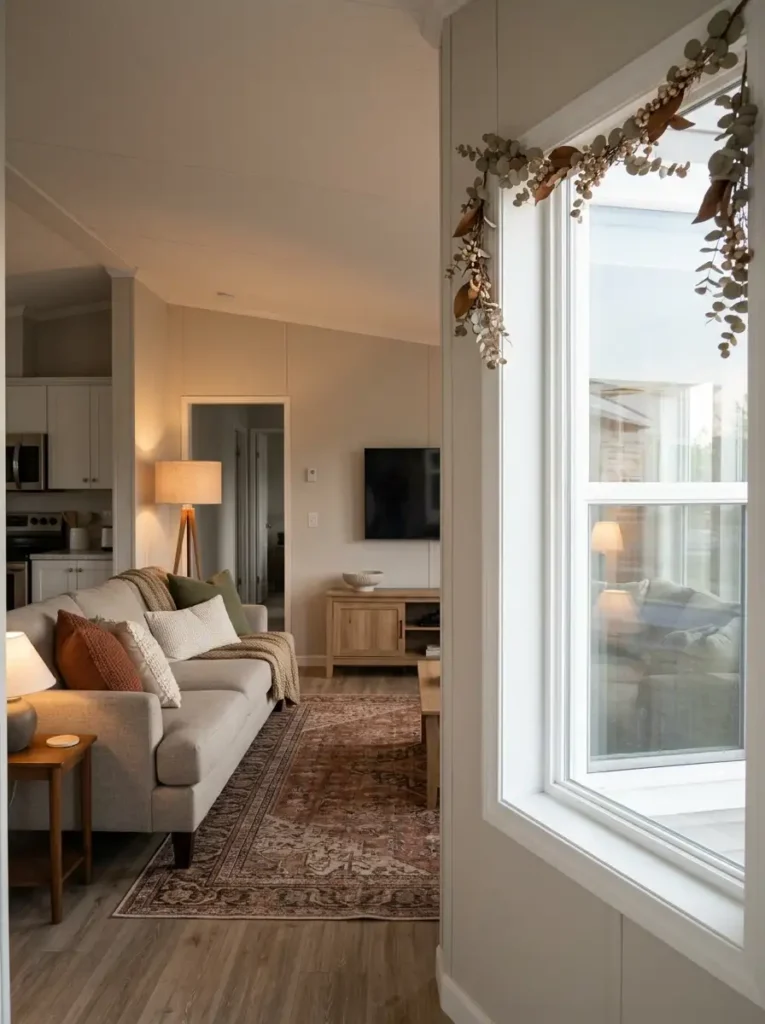
By this point, the room already has color, texture, useful seasonal zones, and an established focal hierarchy.
The final addition can move away from furniture entirely.
A wreath on a window, a restrained leaf strand around an opening, or a removable autumn accent along one architectural edge can make the season visible from several directions at once. These elements sit on the boundaries people look through as they enter, leave, or glance toward another part of the home.
The best location still needs proportion.
A wreath should leave enough visible glass around it that the window remains a source of daylight. Garland around a doorway should stay slim enough to protect headroom and door movement. Any removable hooks or strips need to suit the surface they are attached to.
Consider the view from outside the living room as well. A fall wreath visible through an interior window or a small accent framing an opening can make the room feel finished before someone even enters it.
This is also the moment for a final room-wide density check:
- Can you identify the main fall focal area immediately?
- Are the walkways still visually open?
- Does natural light remain unobstructed?
- Are any seasonal motifs appearing in too many places?
If the room already answers “fall” clearly, choose a very subtle architectural accent—or finish with nothing at all.
A strong room knows when the decorating is complete.
Final Thoughts
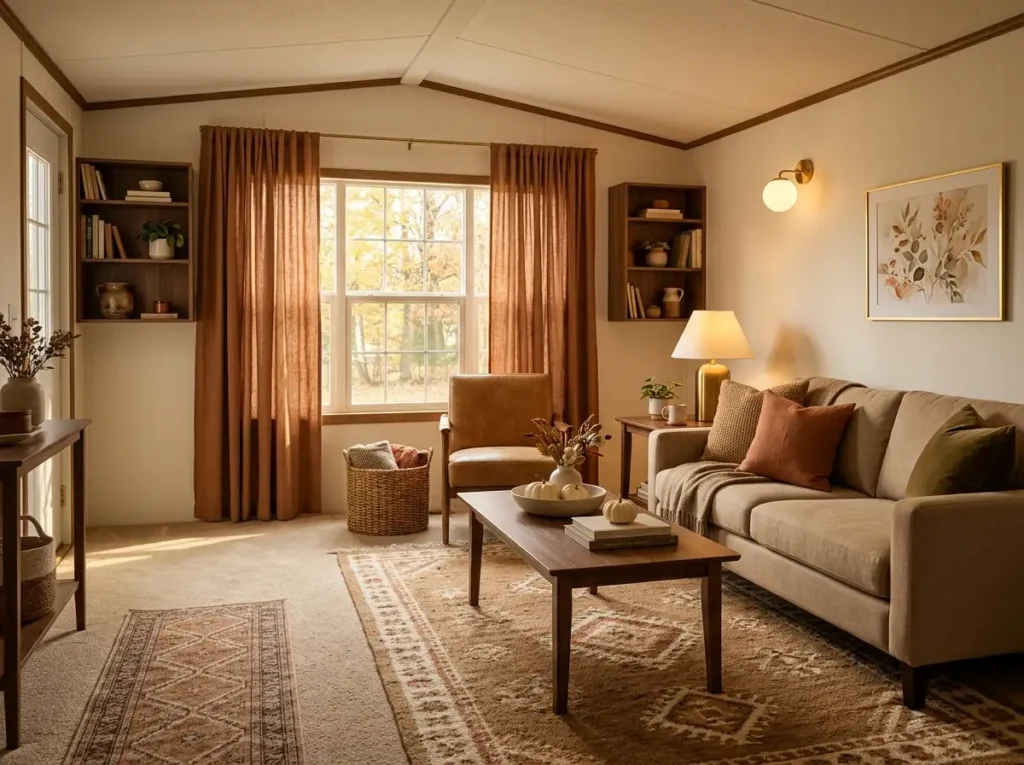
A cozy fall mobile home living room does not depend on how much seasonal décor you own. The biggest improvements often come from choosing the right color family, protecting circulation, giving textiles and lighting clear jobs, and concentrating fall details where they have the most visual impact.
Start with the problem you notice most. A crowded room may benefit from editing first; a flat room might need texture or evening lighting; an empty corner could become useful seating.
Once the room feels comfortable to live in, the pumpkins, branches, autumn art, and warm accents become finishing touches instead of obstacles.
Save your favorite ideas for later, then build your fall room one intentional layer at a time.