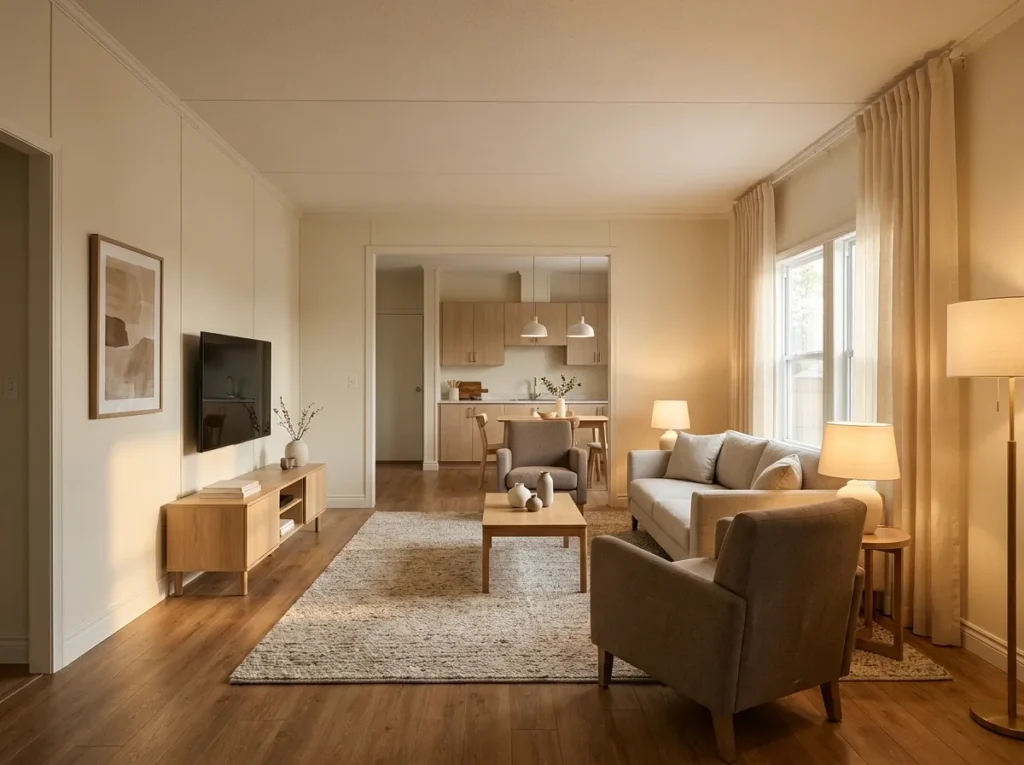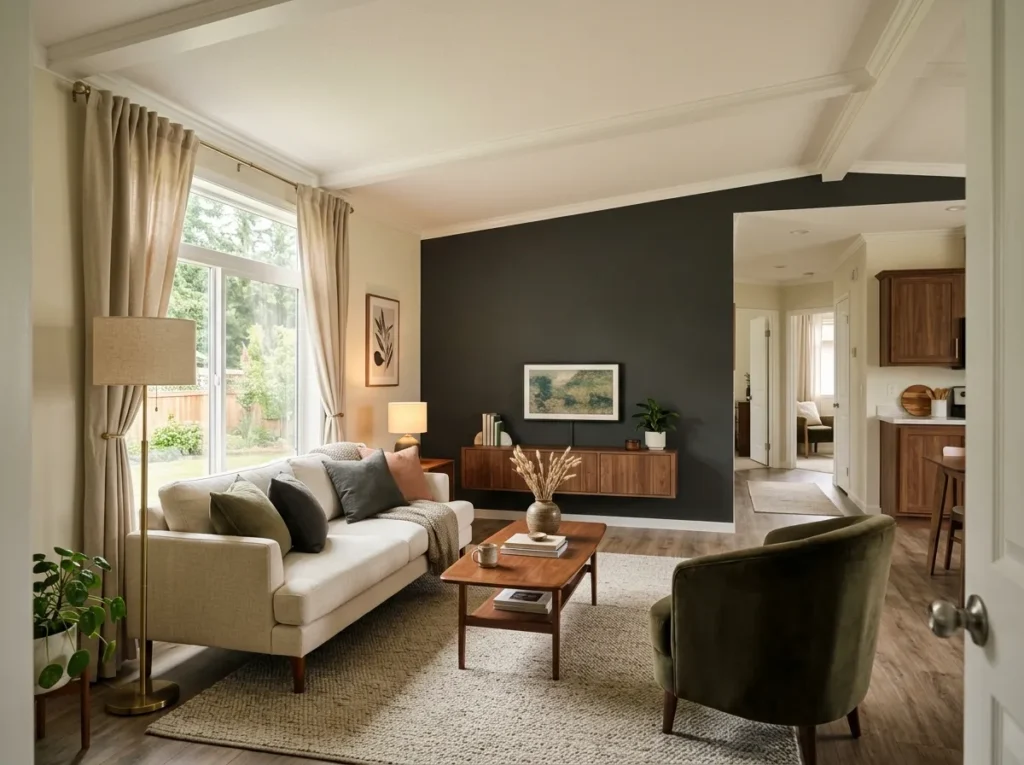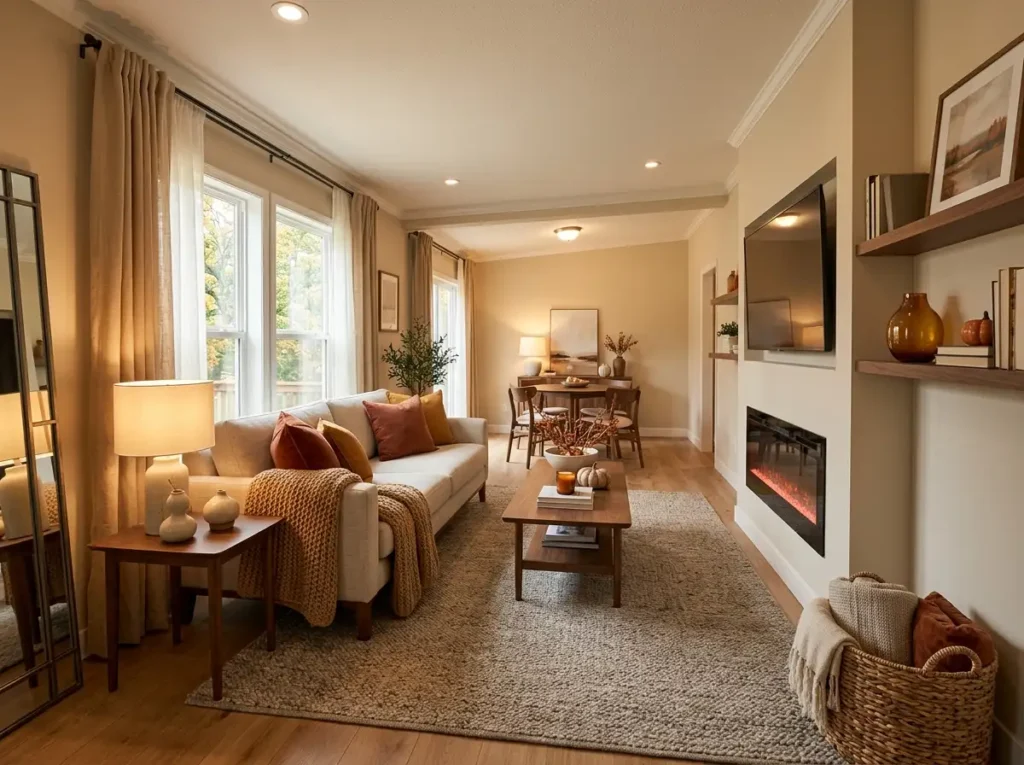
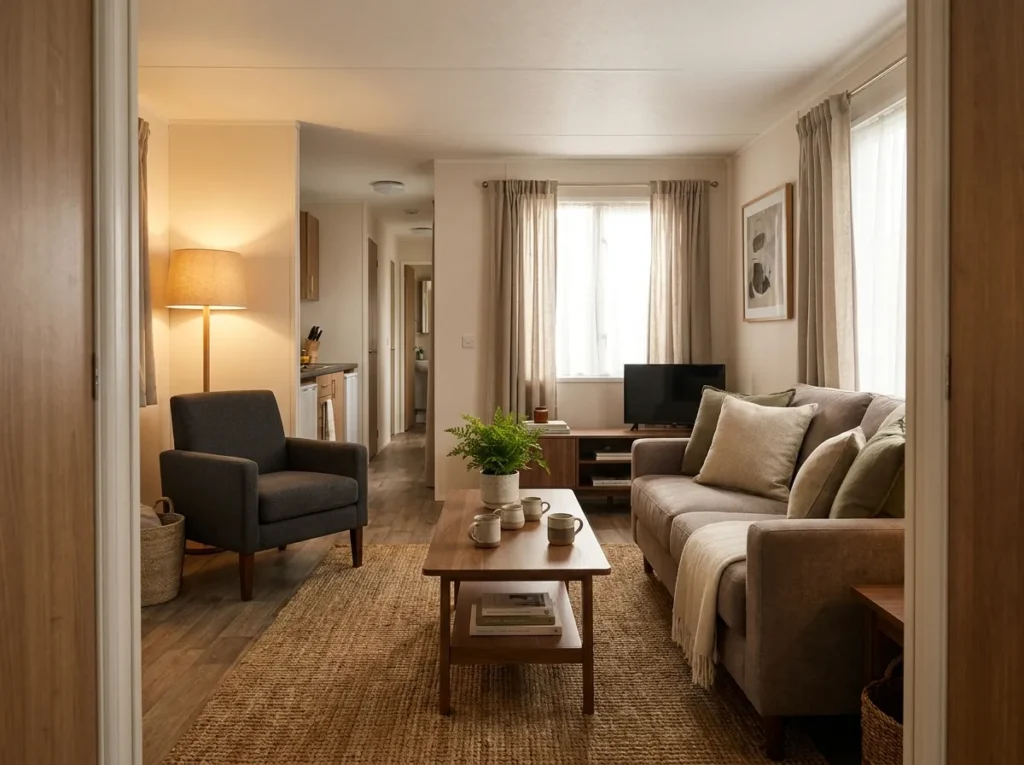
A mobile home living room can be perfectly functional and still feel a little cold, flat, or unfinished. The best cozy mobile home living room ideas solve that feeling without crowding an already hardworking space with piles of décor.
What makes these rooms interesting is that coziness is not tied to one decorating style. A bright room with white upholstery can feel just as inviting as a charcoal living room with dark wood. Leather sofas can work. Gray furniture can work. Even a simple factory-finished interior can become warmer once the room has the right mix of tactile surfaces, gentle contrast, softer evening light, and objects that feel connected to everyday life.
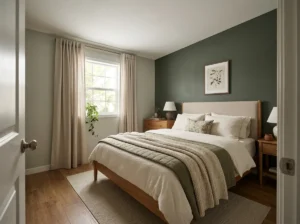
The ideas below focus on those relationships. Some change what you see from the doorway, while others change what you physically experience once you sit down. The aim is a living room that feels comfortable, collected, and genuinely welcoming—without losing the open floor, easy movement, and practical furniture your mobile home still needs.
1. Pick the Cozy Signal Your Room Needs Most: Warmth, Texture, or Enclosure
Before buying another pillow or basket, ask a more useful question: what exactly feels uncozy?
A room that looks visually cold needs a different correction from one that feels bare when you sit down. A third room may have plenty of soft furnishings yet still feel exposed because large windows, open doorways, or bright overhead lighting keep the space from feeling settled.
Look at the room once from the entrance and again from your favorite seat. If pale surfaces and cool gray finishes dominate the first view, begin with warmth. If the room looks finished but feels physically plain, prioritize texture. If it feels comfortable during daylight and strangely exposed after sunset, work on enclosure.
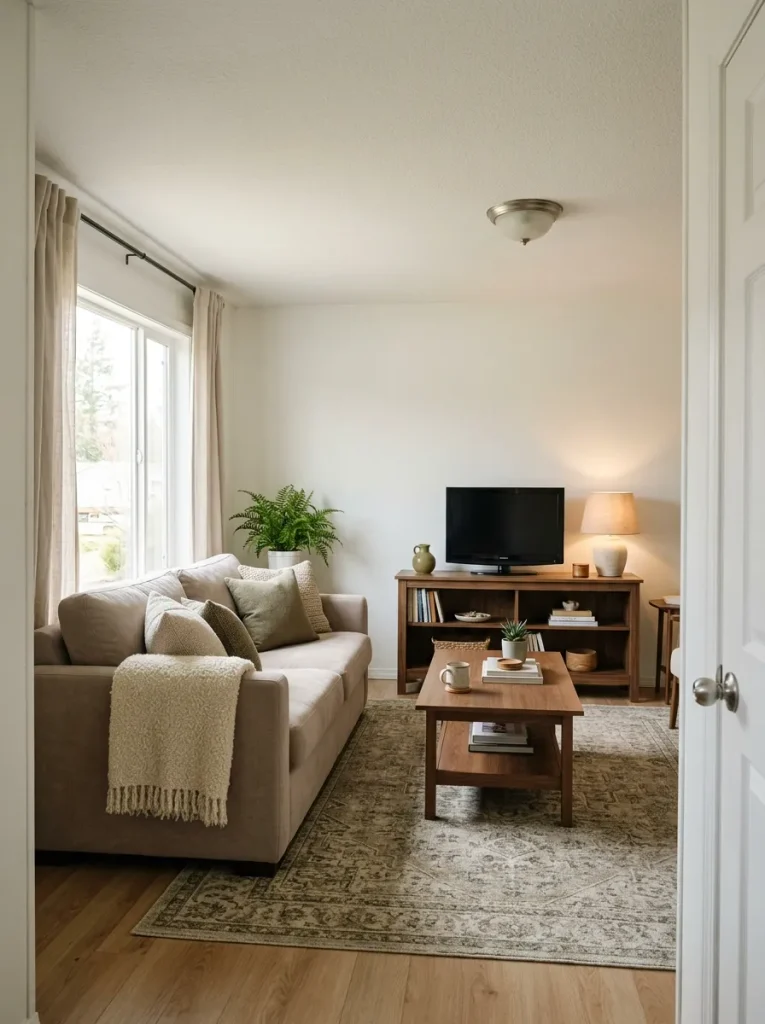
Choosing the missing signal first prevents a small mobile home living room from accumulating décor that takes up space without solving the actual problem.
What is making the room feel least inviting?
Choose the symptom you notice first. Your answer changes the decorating priority, so you can solve the strongest comfort problem before adding more objects.
Choose the closest description:
Warm the visual middle of the room
Introduce one earthy mid-tone through wood, a throw, curtains, art, or a rug. Warmth has more impact when it appears around eye and seating level than as tiny accessories scattered across shelves.
First move → add one medium-value warm material.Change what the seating area feels like to touch
Keep the palette controlled and vary the surfaces: knit, nubby weave, soft upholstery, natural wood, or a tactile rug. The room gains depth without gaining several competing colors.
First move → improve one surface you physically use.Create an evening boundary around the seating zone
Look first at exposed windows, bright ceiling light, and visually open edges. Curtains, localized lamps, and one softly defined seating boundary can make the room feel more settled once daylight disappears.
First move → reassess the room after dark.2. Keep the Comfortable Sofa—Then Balance Its Bulk With Lighter Supporting Pieces
Imagine a mobile home living room with a deep reclining sofa the household genuinely loves. Replacing it with a smaller sofa might free a little visual space, but it can also reduce the comfort that makes the room worth using.
First inspect everything surrounding the sofa. Thick end tables, a heavy coffee table, bulky floor baskets, tall lamps, and another upholstered chair can make one comfortable sofa appear much larger than it really is. Remove or visually lighten a few supporting pieces and the same sofa may suddenly look intentional.
A practical test is to photograph the room from its main entrance and cover the secondary furniture with your thumb on the screen. If the sofa stops feeling oversized, the surrounding mass is the problem—not necessarily the sofa.
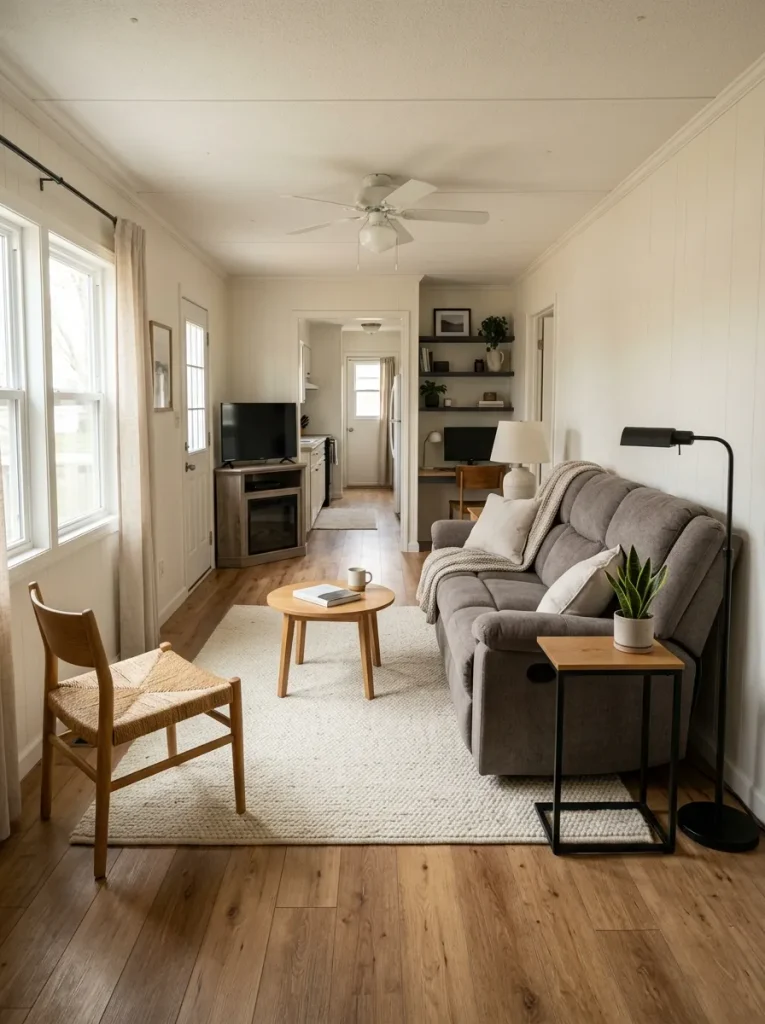
For rooms where physical compactness is the main challenge, continue with StylishGalore’s guide to small mobile home living room ideas that feel surprisingly spacious, which goes deeper into floor visibility, furniture outlines, and spatial pressure.
3. Give Every Seat One Tactile Layer Instead of a Pile of Matching Pillows
Softness becomes convincing when it can be felt, not merely seen. In a mobile home living room, that distinction matters because a sofa covered with five or six decorative pillows may lose usable seating long before it gains meaningful comfort.
Start with one tactile contrast per seat. A smooth sofa might take a chunky knit throw. Leather benefits from a woven or brushed-fabric cushion. A plush sectional often needs less additional softness and may look better with one firmer linen or textured cotton pillow.
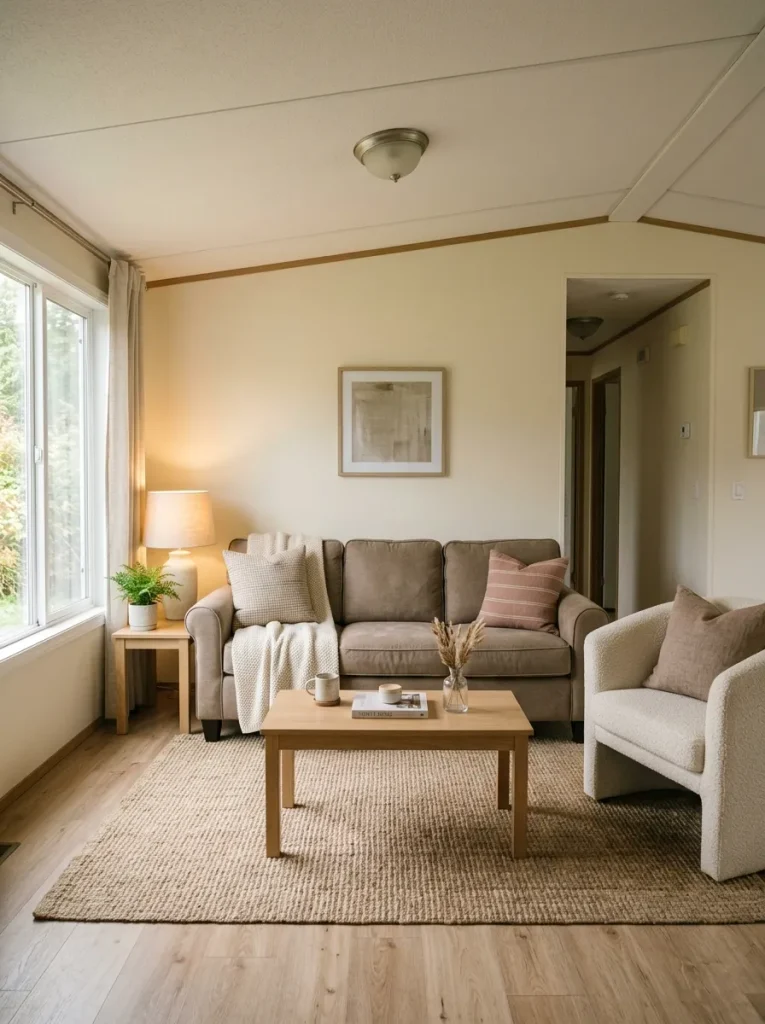
Vary the surface before multiplying the quantity. Bouclé, knit, linen, washed cotton, faux shearling, or a soft woven fabric can each provide a different physical cue while remaining close in color.
One-seat rule: if a guest has to move several decorative pieces before sitting down comfortably, the cozy layer has started competing with the room’s function.
4. Put Warm Wood Where You See and Touch It Most
Look around the living room and notice which hard surfaces your hands actually reach: the coffee table, side table, console, tray, or shelf beside your favorite chair. These small contact points are ideal places to introduce warmer material.
Wood is especially effective when a mobile home already contains pale walls, gray upholstery, laminate finishes, or cool-toned flooring. A medium oak, aged walnut, reclaimed-wood look, or softly weathered finish adds visual warmth without requiring a wall treatment or major furniture replacement.
You also do not need every wood finish to match. Two related tones usually feel more natural than an identical furniture suite. Keep the undertones compatible and allow the pieces to look collected over time.
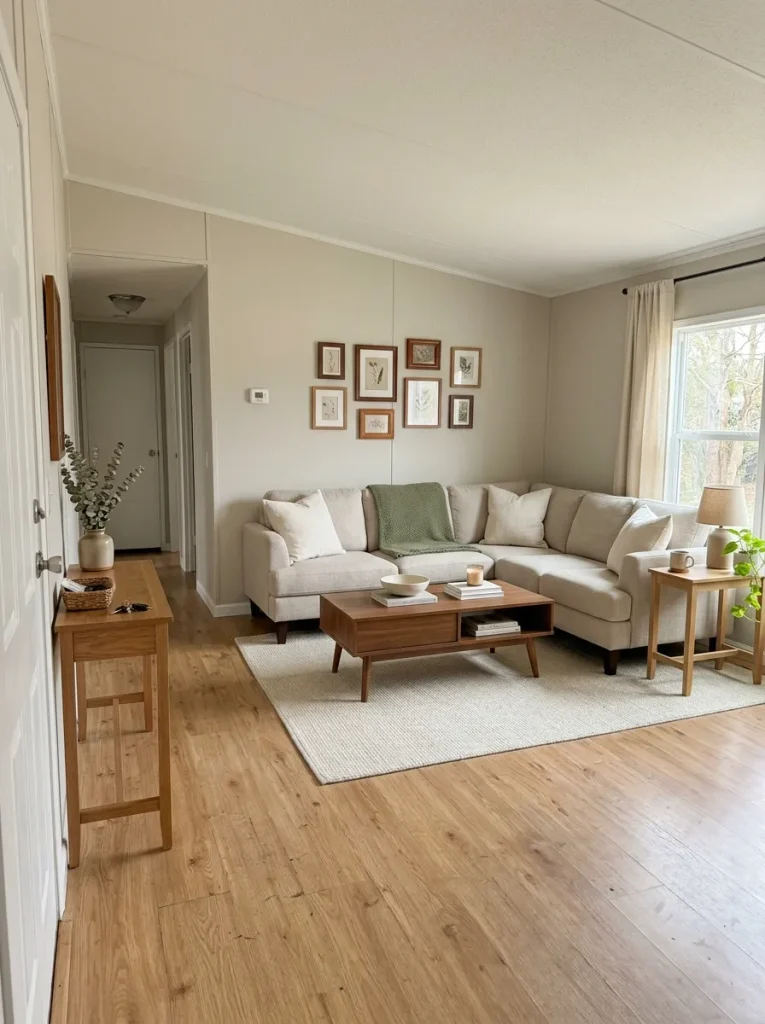
Small-space note: if a large wood coffee table would consume too much floor, bring the material in through a compact side table, sofa tray, picture frame, or shallow console.
5. Make Dark Leather or Charcoal Upholstery Feel Softer With Creamy Contrast
Dark sofas often get blamed for making a mobile home living room feel heavy. The sofa may not be the real issue. Trouble starts when the surrounding rug, tables, curtains, wall décor, and lighting repeat the same dark visual weight.
Keep the upholstery and build a softer buffer around it.
- Add one creamy tactile layer close to the body: oatmeal, ivory, warm white, or pale taupe.
- Introduce medium warm wood so the transition from dark sofa to light room does not feel abrupt.
- Use soft localized light near the seating area so black, charcoal, or brown surfaces retain visible texture after sunset.
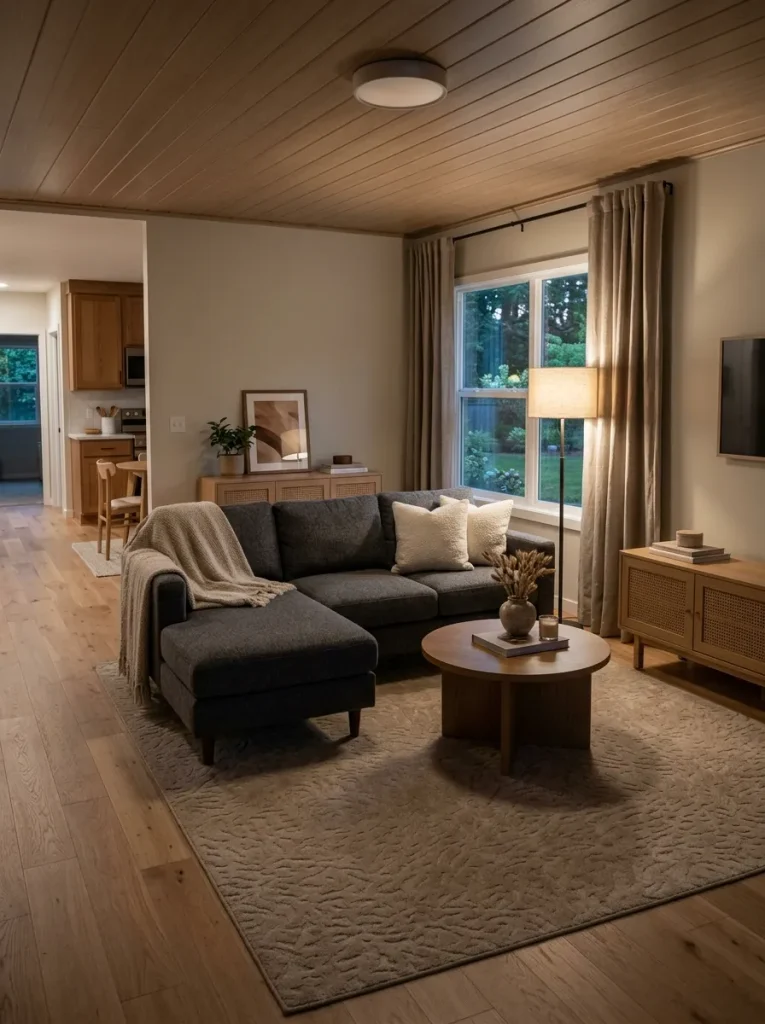
Check the room from several feet away. The dark upholstery should read as an anchor surrounded by softer material, not as one large block occupying the composition.
Material Pairing Studio
Soften the sofa you already own
Choose the upholstery closest to yours. Each state changes the supporting materials worth prioritizing.
Charcoal → creamy texture + medium wood
- Best companion
- Warm ivory, oatmeal, or mushroom textiles with visible weave.
- Second layer
- Medium oak or walnut tones that bridge dark upholstery and pale surroundings.
- Use carefully
- Large areas of stark white or additional black furniture can exaggerate the sofa’s visual edge.
Brown leather → pale woven layers + quieter wood
- Best companion
- Natural linen, oatmeal knits, warm cream, and softly mottled rugs.
- Second layer
- Wood that is lighter or quieter than the leather so every surface does not compete at the same depth.
- Use carefully
- Too many distressed brown finishes can push a warm room into visual heaviness.
Cool gray → camel, oatmeal + warmer timber
- Best companion
- Camel, warm beige, muted clay, or oatmeal to shift the room away from an all-cool palette.
- Second layer
- Wood with a noticeable warm undertone, especially close to the seating area.
- Use carefully
- More silver-gray accessories may make the entire composition feel flatter, even when each item is attractive alone.
6. Break the Boxy Geometry With One Rounded or Upholstered Centerpiece
Mobile home living rooms naturally collect rectangles: wall panels, windows, doors, television screens, sofas, consoles, rugs, and cabinetry. When almost every visible edge runs horizontally or vertically, even a nicely decorated room can feel a little rigid.
You do not need to introduce curves everywhere. One rounded element near the center of the seating arrangement is usually enough to interrupt that visual pattern. Try a round coffee table, circular ottoman, softly curved accent chair, drum-style side table, or an oval tray on a rectangular table.
The strongest choice depends on circulation. A round coffee table is useful when people regularly move around several sides of the seating group because its corners disappear from the walking path. If floor space is already tight, keep the existing coffee table and introduce the curve higher up with a lamp, mirror, or rounded decorative object.
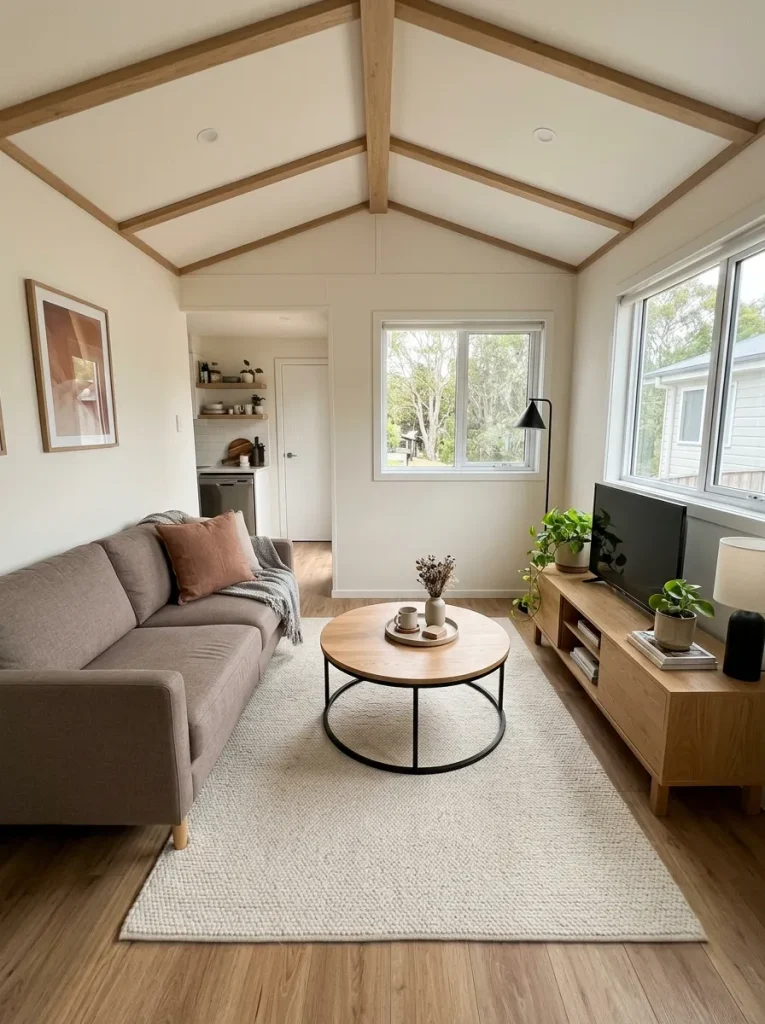
Use the curve as punctuation—not as a new theme.
7. Make the Windows Feel Open by Day and Sheltered at Night
During daylight, a mobile home living room often benefits from every bit of natural light it can receive. Heavy curtains that permanently cover part of the glass can make the room feel smaller than necessary. Yet leaving the windows visually bare after sunset may produce the opposite problem: the seating area suddenly feels exposed and unfinished.
Treat the same window as a two-state feature.
During the day: pull fabric clear of the glass, keep the center of the window visually open, and allow the exterior view or daylight to extend the room.
In the evening: close a soft layer, lower the surrounding light level, and let the window become part of the room’s boundary.
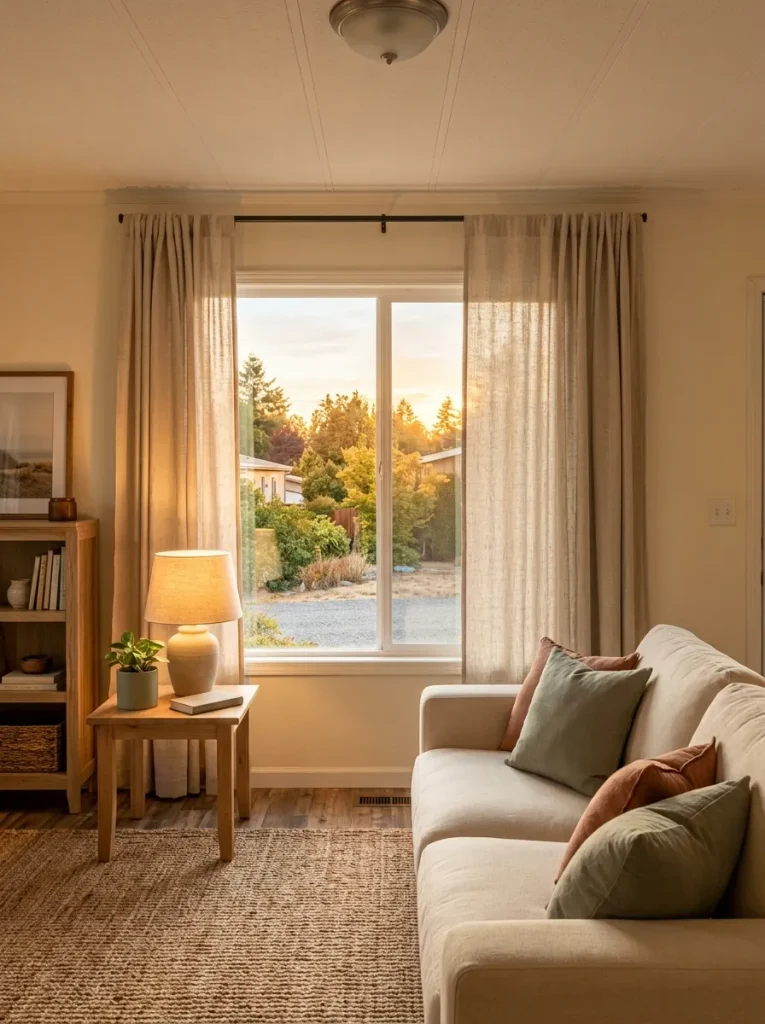
This approach gives you openness when openness is valuable and enclosure precisely when the room needs to feel more intimate.
Day-to-Night Window Studio
The same window should not behave the same way all day
Choose when your room feels least comfortable. The recommendation changes according to whether you need daylight openness, evening enclosure, or a compromise between both.
Clear the glass before adding more lamps
Pull soft panels beyond the useful glass area whenever possible and keep the central view unobstructed. A lighter daytime boundary often improves the room before another decorative layer is needed.
Decision → prioritize window exposure.Turn the glass wall into a soft boundary
Close a fabric layer and lower nearby light to seating height. The window stops reading as a dark opening and begins supporting the intimate zone around the sofa.
Decision → prioritize evening enclosure.Use a movable layer, not permanent visual weight
Choose panels, shades, or another treatment that can visually disappear during the day and become substantial at night. Flexibility is more useful than simply choosing the heaviest fabric.
Decision → prioritize adjustability.8. Lower the Brightest Light Below the Ceiling Line After Sunset
Turn on your living room at night and ask: where is the brightest point?
If the answer is the ceiling fixture, the entire room may be illuminated evenly while still feeling surprisingly uninviting. Overhead light reveals the room; it does not necessarily create a comfortable place to settle into.
Move some evening brightness downward. A table lamp beside the sofa, a floor lamp near an accent chair, or a compact shaded lamp on a console creates a smaller pool of light closer to where people actually sit. That lower light also reveals fabric texture, wood grain, and softer edges that can disappear beneath stronger ceiling illumination.
This is particularly useful in mobile homes with low or visually plain ceilings, where making the ceiling the brightest surface can draw unnecessary attention upward.
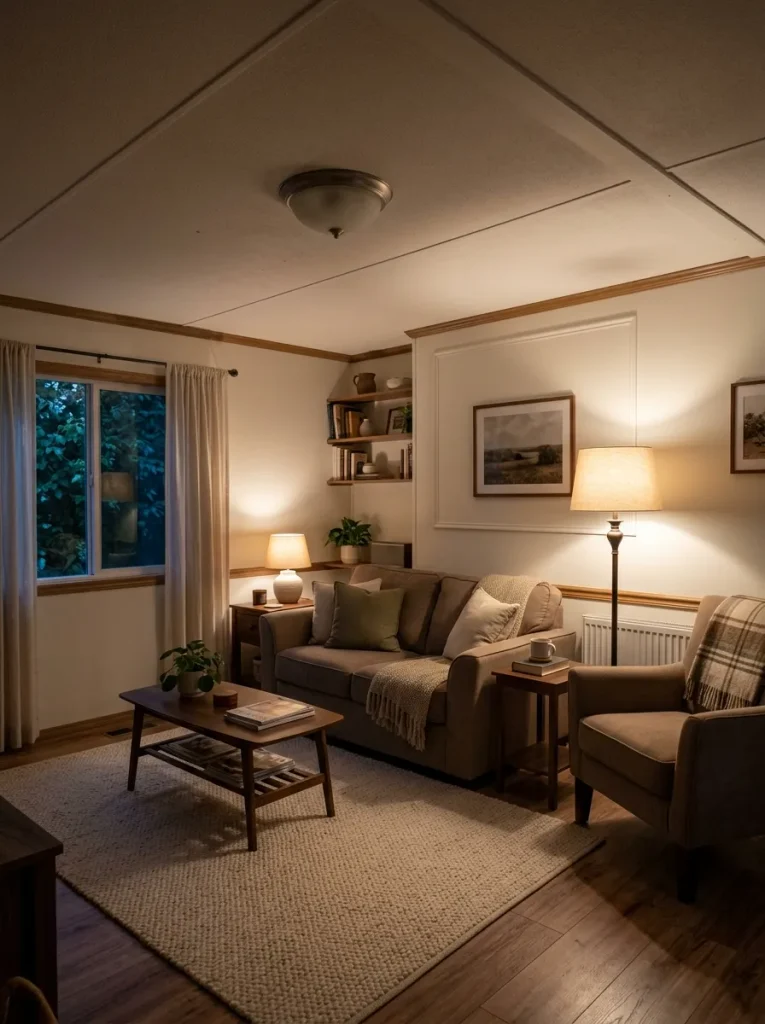
Evening check: sit where you normally relax. If you can comfortably turn off or substantially reduce the overhead fixture while the seating zone still feels usable, the lighting hierarchy is doing its job.
9. Warm Up a Gray or White Living Room With One Earthy Mid-Tone
Picture a room with gray seating, white walls, a pale rug, and light curtains. None of those choices is wrong, yet together they can leave the entire room living at the same cool, pale value.
Before repainting, introduce one color that sits between the darkest and lightest elements.
A muted olive throw, camel leather stool, mushroom curtains, clay-colored cushion, taupe rug pattern, or warm brown wood piece can create that middle layer. Once it appears in one meaningful place, echo it only once or twice at a smaller scale. The purpose is to connect the room, not to create a strict color scheme.
The same approach works in an all-white living room. White can feel extremely cozy when it is surrounded by cream, wood, natural fiber, and gentle warm undertones.
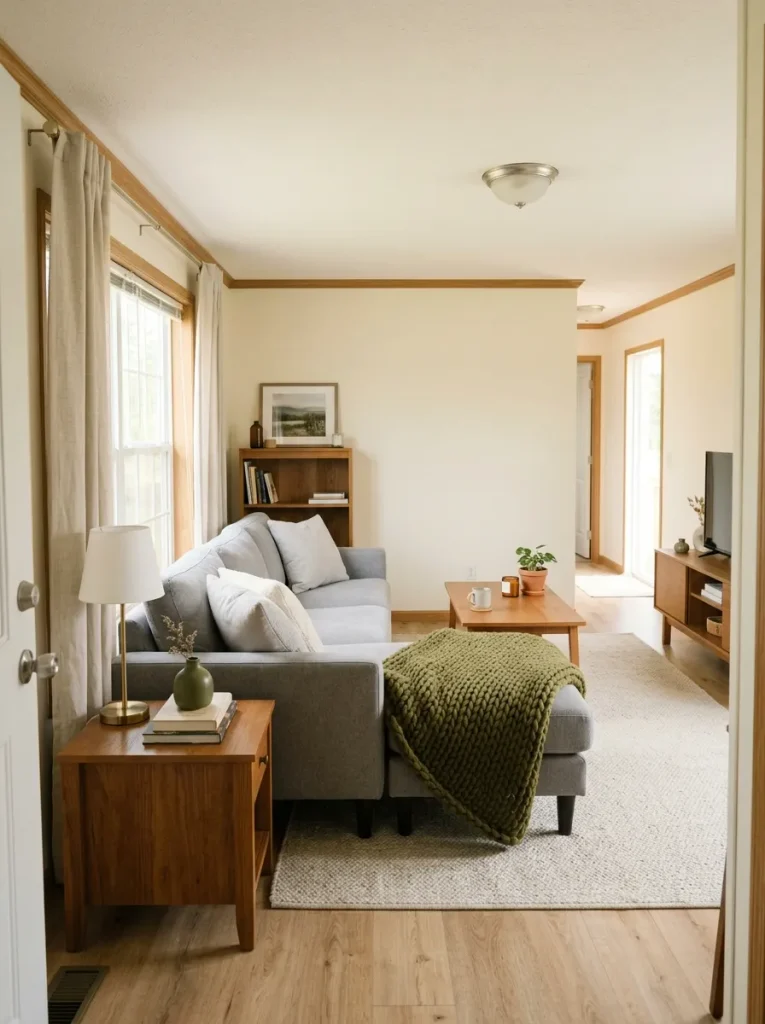
Choose an earthy mid-tone when the room feels chilly despite already having plenty of soft furnishings. If the room is warm in color but still feels flat, texture—not another color—is probably the better next move.
10. Leave One Surface Deliberately Quiet So the Cozy Layers Can Breathe
Adding warmth is only half the job. A small living room also needs somewhere for the eye to rest.
If the coffee table carries a tray, books, candles, flowers, and decorative objects while the media console, shelves, walls, sofa, and side tables are styled just as heavily, no single cozy detail receives much attention. The room starts communicating quantity instead of comfort.
Choose one visible surface and simplify it aggressively. That might mean a nearly empty console beneath the television, one side table with only a lamp, or a wall that carries a single substantial piece of art.
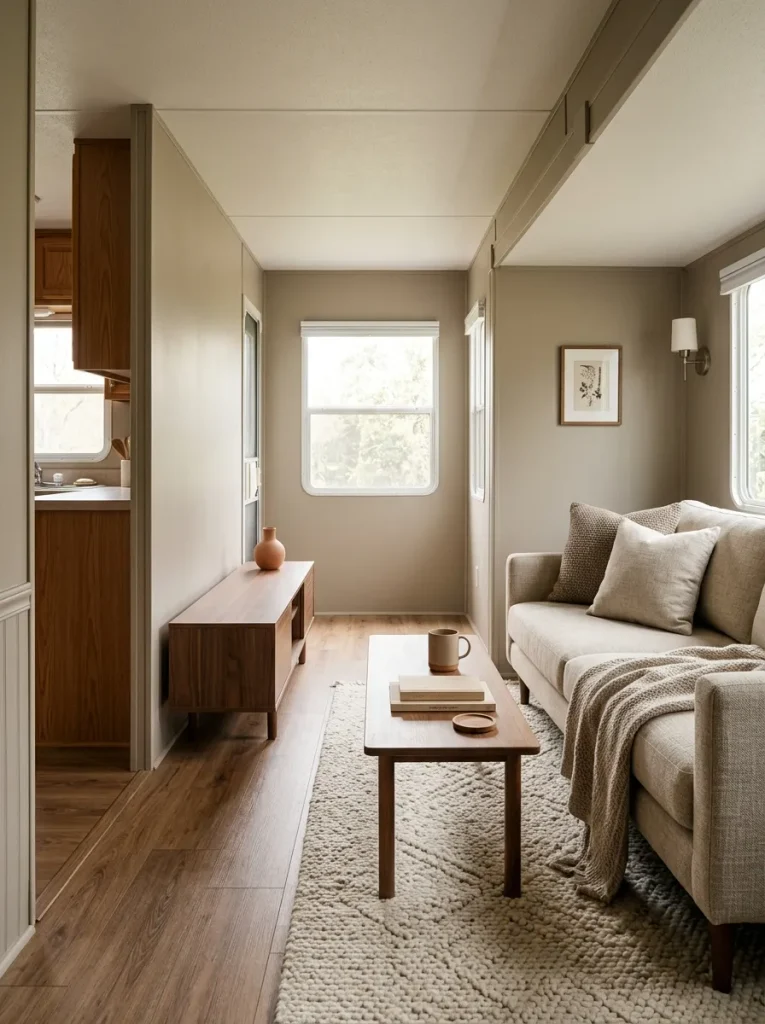
Quiet-surface rule: the more texture and personality you add to the seating area, the calmer at least one nearby plane should become.
This is especially useful in a mobile home living room because several functional zones may already be visible at once. Visual pause gives those zones separation without erecting anything between them.
11. Hide Utility Clutter and Leave the Comfort Objects Visible
Not every object deserves equal visibility.
In a cozy mobile home living room, books, a folded throw, a favorite bowl, a small plant, or a well-used basket can make the space feel lived in. Charging cables, spare remotes, paperwork, game controllers, instruction manuals, and miscellaneous household items usually create a different kind of visual information: unfinished business.
Sort the room by function before buying additional storage.
Keep visible: objects that contribute beauty, comfort, memory, or everyday ritual.
Contain nearby: objects you use frequently but do not enjoy seeing.
Remove from the living room: items that have simply migrated there because no other home was assigned to them.
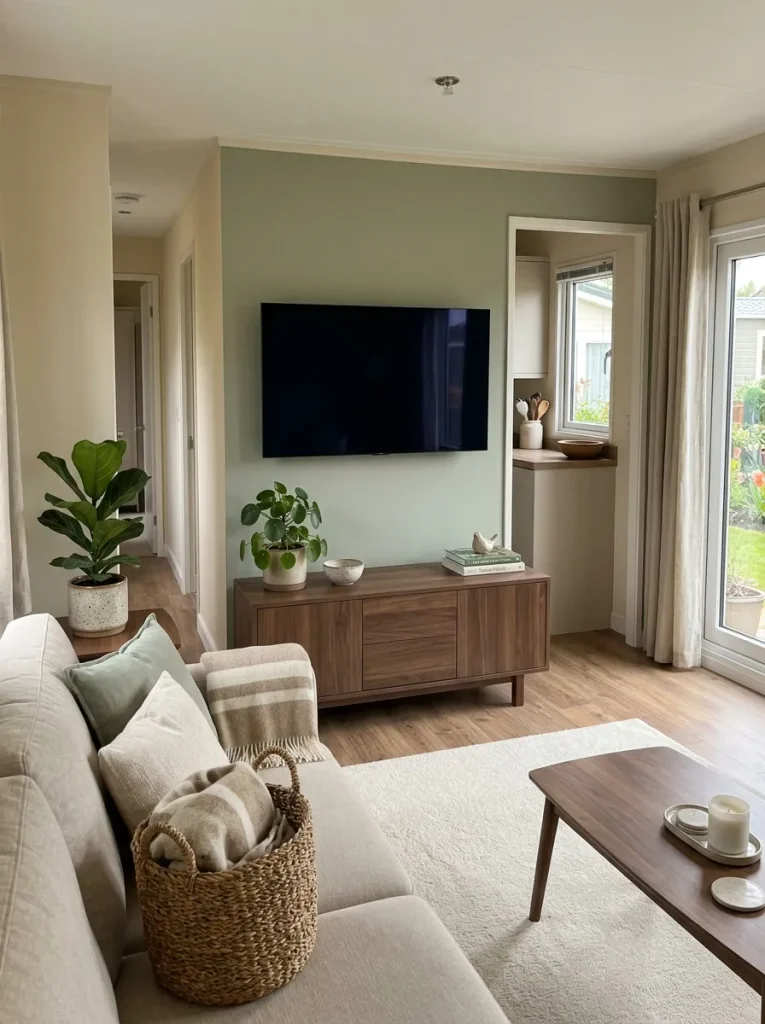
Closed baskets, shallow drawers, lidded boxes, and the concealed part of a media console are especially valuable in a mobile home because one messy surface can often be seen from several adjoining areas.
The test is simple: after tidying, the room should still contain signs of life. If every shelf becomes empty, you have created order. If the useful clutter disappears while the meaningful objects remain, you have created visual calm with personality.
12. Style One Shelf Like a Lived-In Story, Not a Decor Store
A cozy shelf does not need a collection of objects that were purchased at the same time.
Start with something that has a reason to be there: a framed photograph, two books you actually like, a piece of pottery, a small plant, or an object connected to your home or family. Then add one supporting element with a different shape or texture.
The third ingredient is often the one people forget:
empty space.
Leaving part of the shelf exposed gives the meaningful objects enough visual room to register. That matters in a mobile home living room where shelving may already share the view with a television, doorway, seating, kitchen, or dining zone.
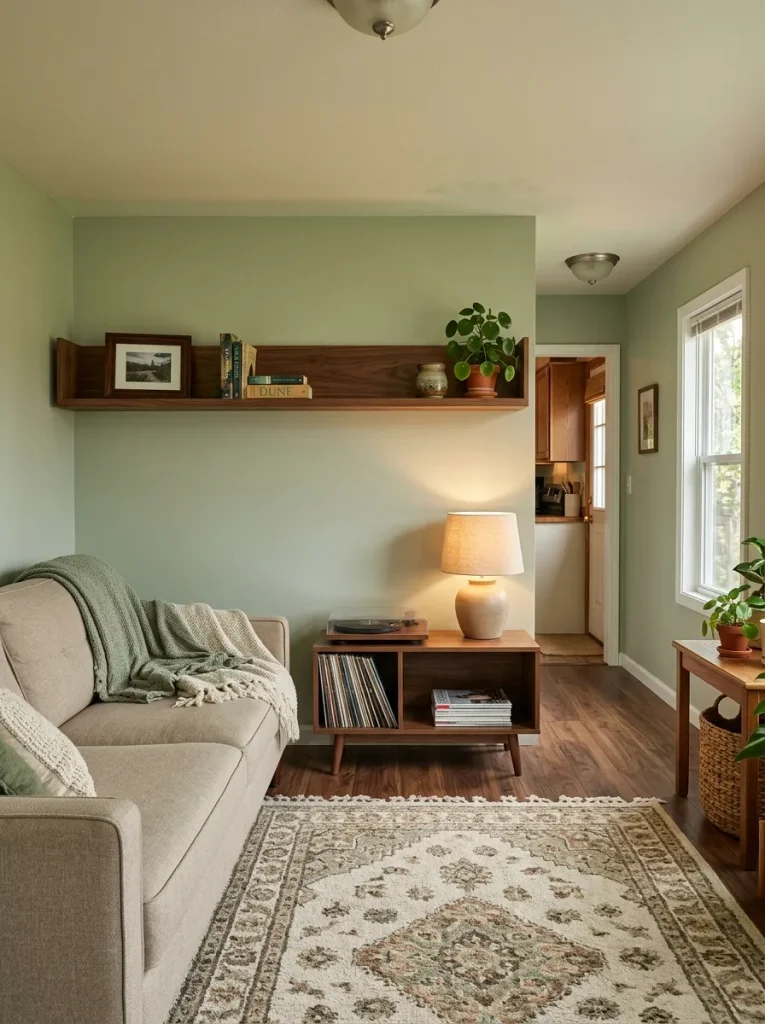
A shelf looks collected when each object seems to have earned its place. It looks staged when every gap appears to have been filled simply because space was available.
Shelf Composition Map
Build a shelf around meaning, support, and breathing room
The visual goal is not symmetry or maximum decoration. It is a small composition where the eye understands what matters first.
Choose the piece with the strongest personal reason to stay visible: a photograph, favorite book, inherited object, handmade piece, or another item connected to real life.
Add one object with a different height, silhouette, or material so the first object does not sit alone.
Leave part of the shelf empty. The uncovered surface becomes part of the composition.
If the eye has nowhere to pause, sentimental objects begin reading like generic clutter.
Useful starting composition: one meaningful anchor + one quieter companion + one visible area of breathing room.
13. Let the Existing Ceiling Shape Add Shelter Without Making It Busier
Look upward before deciding that your ceiling needs more decoration.
A low, flat mobile home ceiling already sits closer to the furniture and can naturally create intimacy. Filling it with contrasting trim, numerous hanging elements, or visually heavy decoration may make the room feel compressed.
A vaulted ceiling creates the opposite opportunity. Its height can become part of the cozy effect when the room below has enough visual weight to connect the seating area back to the architecture.
So the treatment should follow the ceiling you already have.
Low or visually busy ceiling: keep the ceiling itself quiet and build warmth lower in the room.
Vaulted or open ceiling: allow one architectural feature—existing beam treatment, a well-scaled light fixture, or a strong focal wall below—to acknowledge the height.
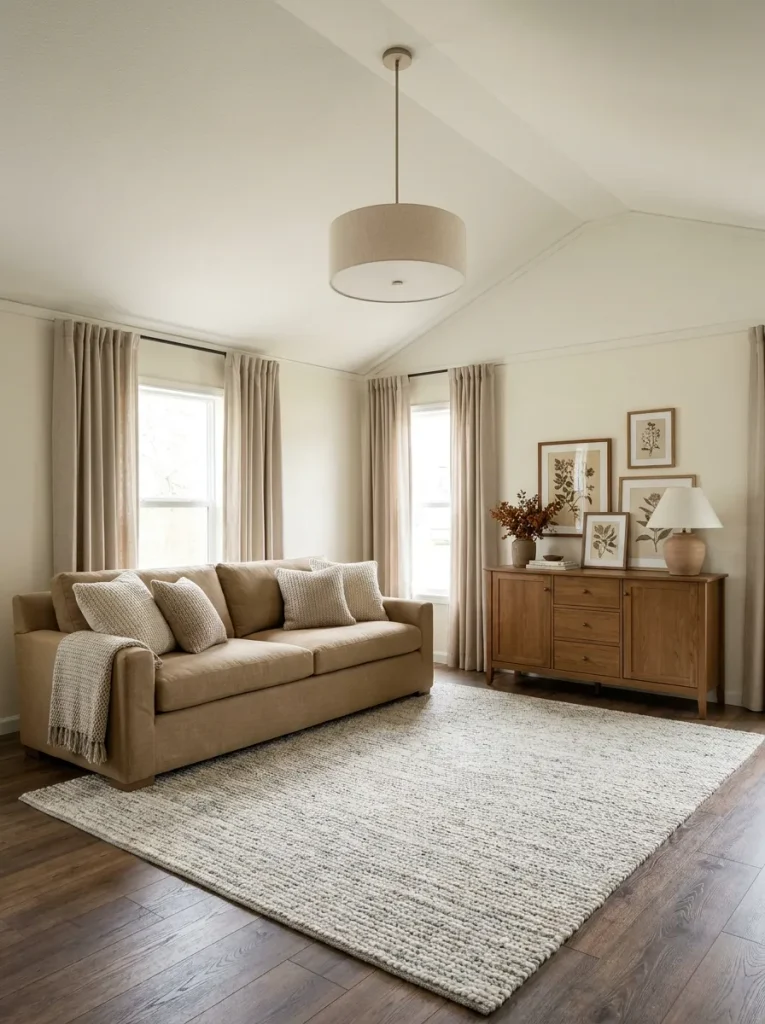
This is a styling decision, not a recommendation to alter structural ceiling components.
The question to ask is not, “How can I decorate the ceiling?” It is, “Does this ceiling already make the room feel enclosed or open?” The answer tells you whether to calm it down or visually connect it to the space below.
14. Use a Mirror Only Where It Reflects Warmth
A mirror can make a living room brighter or more visually layered, but its effect depends entirely on what lands inside the reflection.
Stand where the mirror would hang and look in the opposite direction.
Would it reflect:
- a window with useful daylight?
- a warm lamp?
- artwork and part of the seating area?
- natural wood or another attractive material?
Or would it double:
- a television screen?
- a cluttered passage?
- an open door?
- a bright ceiling fixture?
- a busy kitchen counter?
That second group is where a mirror often adds visual activity without adding comfort.
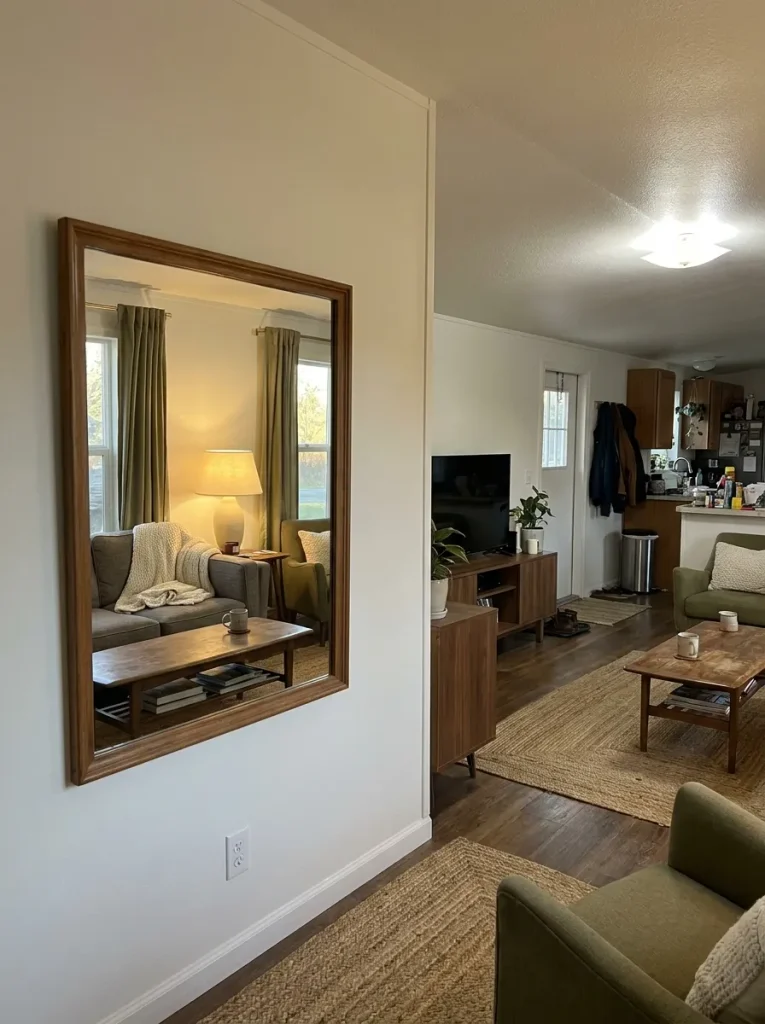
In a small mobile home living room, this matters because the reflected scene may be almost as noticeable as the mirror itself. A well-placed mirror can repeat the room’s warmest visual information. A poorly placed one can repeat exactly what you are trying to quiet.
Placement rule: choose the reflection first; choose the mirror second.
15. Keep the Farmhouse Warmth; Edit Out the Farmhouse Clutter
Farmhouse style became popular in mobile homes for good reasons. Warm wood, woven baskets, checked textiles, aged finishes, simple furniture, and soft neutrals can make an ordinary living room feel relaxed almost immediately.
The problem begins when every cozy signal also becomes a theme signal.
Several word signs, multiple lanterns, buffalo-check pillows, distressed furniture, faux vintage objects, farmhouse typography, windmill motifs, and repeated baskets may individually feel charming. Together they can make the living room visually louder than its size can comfortably support.
Keep the parts that create material warmth:
- natural or warm-toned wood
- woven texture
- soft neutral textiles
- one restrained check or stripe
- aged or handmade-looking finishes
- simple greenery
Then edit the repeated symbols that announce the style over and over.
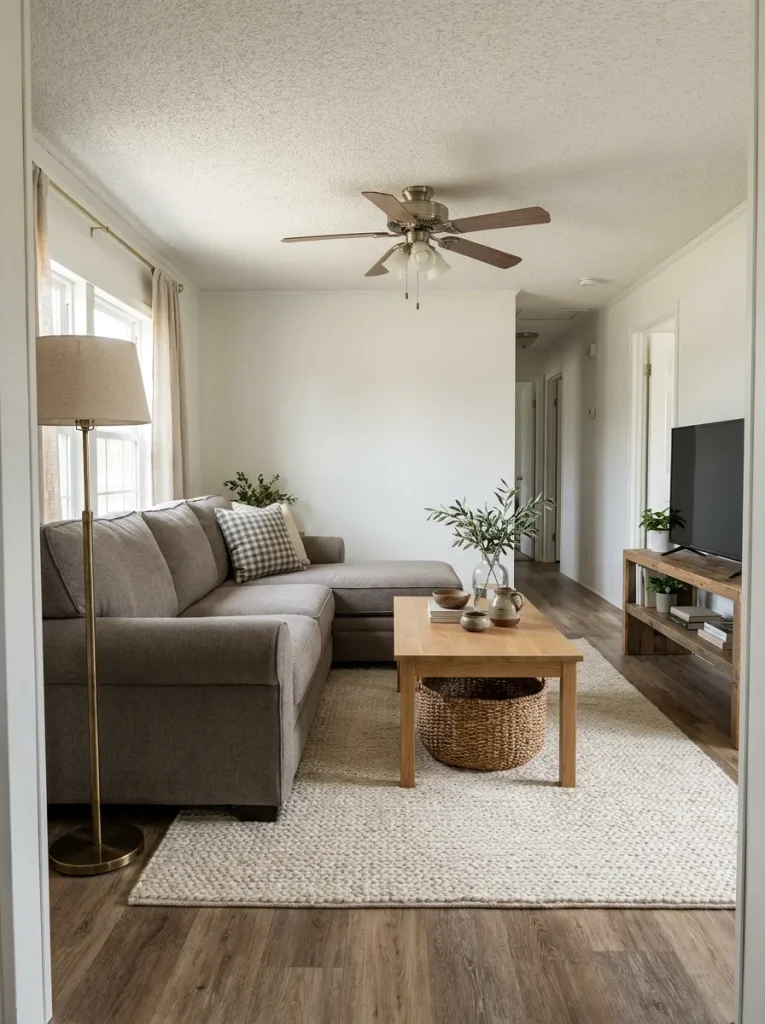
If you want to push this look seasonally, StylishGalore’s fall mobile home living room ideas can carry the autumn-specific layering; this article stays focused on evergreen coziness.
Farmhouse Pressure Audit
Does your room need more farmhouse—or less?
Choose the description closest to your room. The recommendation changes according to how strongly the theme is already competing with the space.
Edit the symbols; keep the materials
Remove repeated words, motifs, lanterns, and duplicate decorative cues first. Keep the wood, woven texture, warm neutral textiles, and one or two character pieces that provide actual material warmth.
Protect the restraint you already have
Your room likely needs refinement, not additional farmhouse identity. Add warmth through texture, lighting, or one meaningful vintage-style object without multiplying the visual vocabulary.
Add one warm character layer
A weathered wood element, woven basket, restrained check, handmade pottery, or aged-looking frame may provide enough character. One clear cue often works better than introducing the entire farmhouse vocabulary.
16. Build a One-Seat Pause Zone at the Quiet Edge of the Room
A cozy living room does not always need another full conversation area. Sometimes the most inviting addition is simply one seat that feels slightly removed from the busiest part of the room.
Look for an underused edge: beside a window, near the end of the sofa, across from the main seating group, or in a corner that currently holds a decorative basket or plant. A comfortable chair with a small table or nearby lamp can turn that passive space into somewhere to read, drink coffee, scroll quietly, or sit while someone else watches television.
The important distinction is purpose. Do not squeeze in an accent chair because the corner looks empty. Add it only when there is enough space to approach the seat comfortably and the position offers something the sofa does not—a window view, quieter lighting, or greater separation from the television.
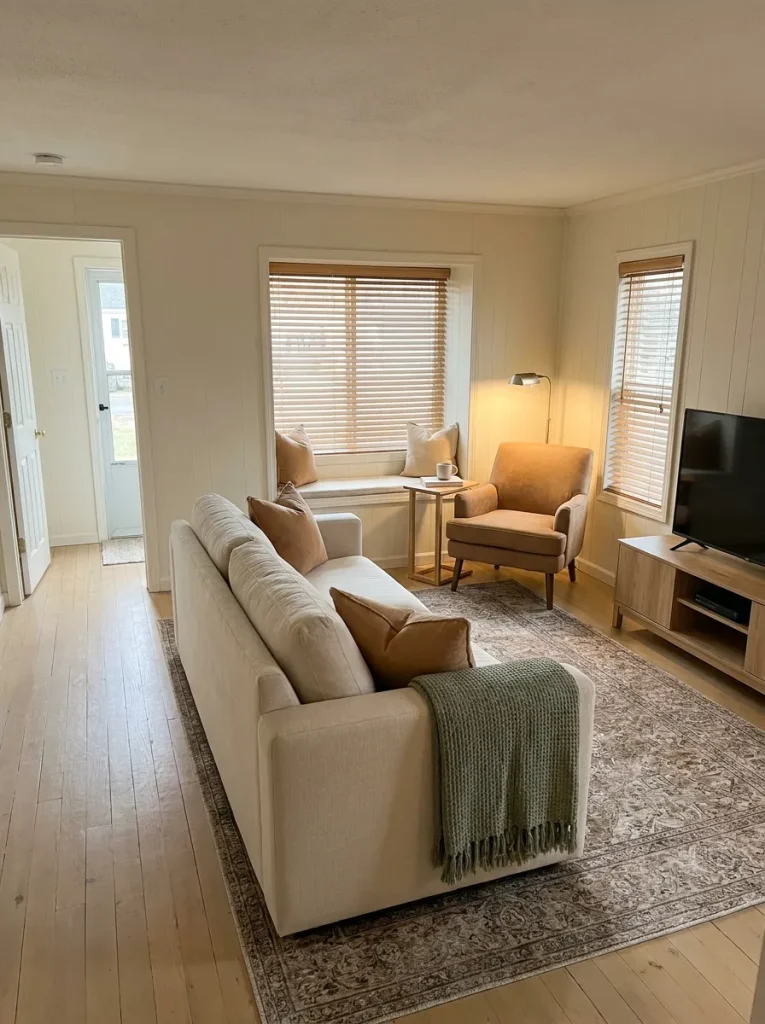
A successful pause zone should feel like a destination within the living room, not spare furniture stored along its perimeter.
17. Mark the Seating Edge With a Soft Boundary, Not a Hard Divider
Open mobile-home interiors often place the living room close to an entry, dining area, or kitchen. The seating arrangement may therefore feel exposed even when the furniture itself is comfortable.
You can strengthen the edge without building a wall or placing a bulky divider across the room.
Start at the point where the living area visually fades into the next zone. Then introduce one light boundary cue:
- Place a floor lamp near the outer corner of the seating arrangement.
- Let a plant, narrow side table, or open-base piece mark the transition.
- Repeat a material or color on the living-room side so the seating cluster reads as one composition.
- Keep the normal walking route visibly open.
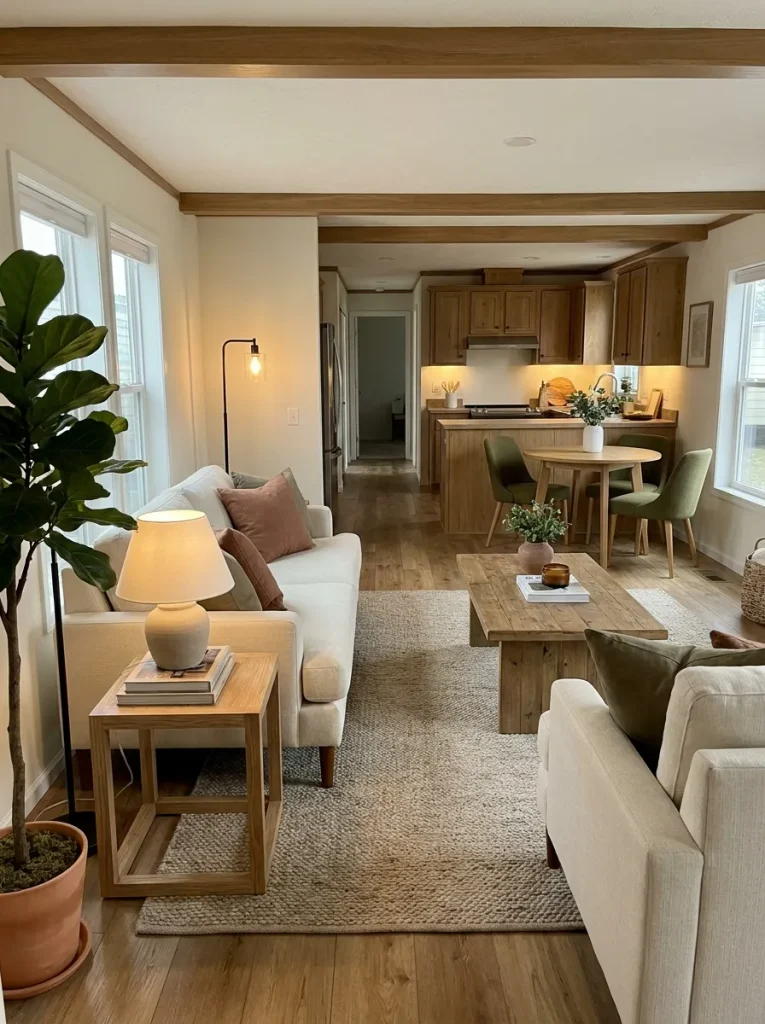
The boundary should be felt before it is noticed. If people have to walk around the new object or the adjoining space suddenly looks blocked, the divider has become too physical.
This matters particularly in a double-wide or larger open living area, where the challenge can shift from fitting furniture to creating a comfortable human-scale zone. StylishGalore’s double-wide interior ideas for making large rooms feel cozy explores that larger-space problem in more depth.
18. Choose One Cozy Upgrade Worth Spending On—and Style the Rest
A room can have several weaknesses at once, but trying to upgrade everything together often spreads the budget across changes that barely register.
Choose the purchase that corrects the strongest comfort problem.
| What the room currently lacks | Higher-priority upgrade | What can stay inexpensive |
|---|---|---|
| Hard, exposed floor around the sofa | A comfortable living-room rug | Pillows and small accessories |
| Harsh evening atmosphere | Better lamps or lamp shades | Decorative tabletop objects |
| Bare, exposed windows | Useful curtains or shades | Wall décor |
| Uncomfortable main seating | Sofa/chair comfort improvement | Trend-driven accents |
| Flat neutral palette | One substantial warm material piece | Multiple tiny color accessories |
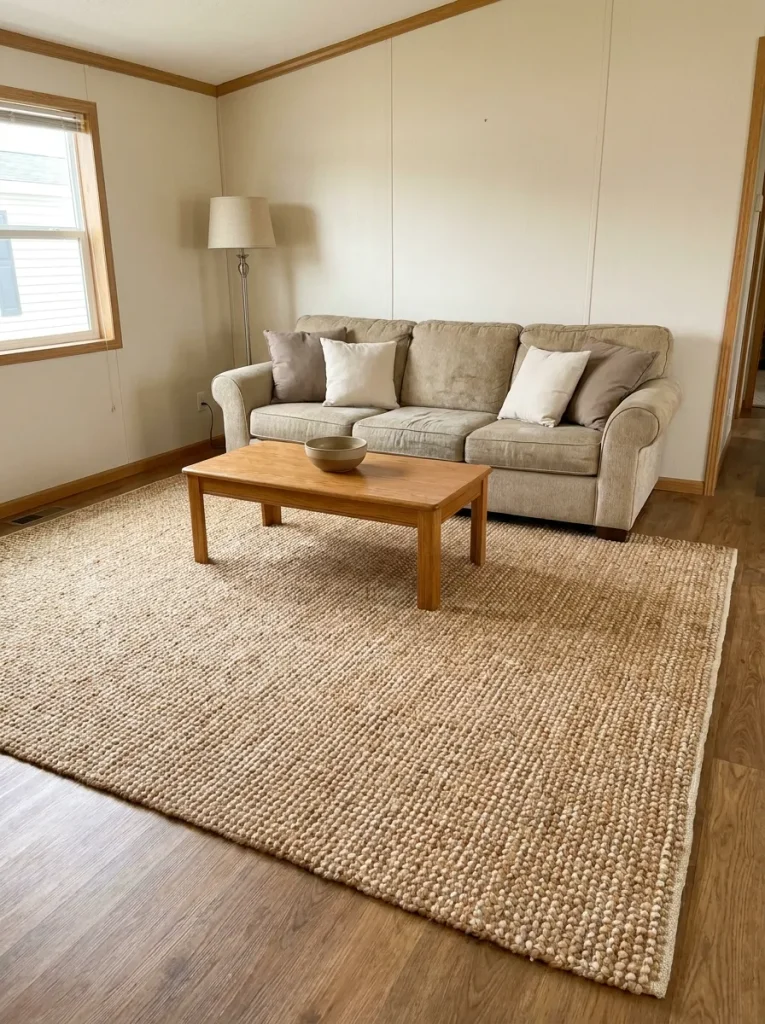
Before spending, imagine the room with the proposed item removed again. Would the overall comfort clearly drop? If yes, it may deserve a larger share of the budget. If barely anything changes, styling or rearranging what you already own may accomplish more.
This also prevents a common decorating trap: owning many inexpensive “cozy” accessories while the rug scratches, the seating is uncomfortable, or the only evening light comes from the ceiling.
19. Make the Rug Feel Warm Underfoot Without Swallowing the Visible Floor
A rug contributes to coziness before anyone notices its pattern. It changes the physical transition between the hard floor and the seating zone, softens the area around your feet, and gives the furniture a more settled visual base.
But a mobile home living room does not automatically benefit from covering nearly every visible inch of flooring.
Look at the room from the entrance. If a comfortable rug connects the main seating pieces while some continuous flooring remains visible around the living zone, the eye can still understand the room’s full footprint. That visible floor is especially useful when the living room opens toward a kitchen, entry, or hallway.
Choose the tactile quality first: low-pile softness, a dense woven surface, or another texture that suits how the household actually uses the room. Then judge the pattern from several feet away; very strong contrast can make a small floor plane feel busier even when the rug itself is attractive.
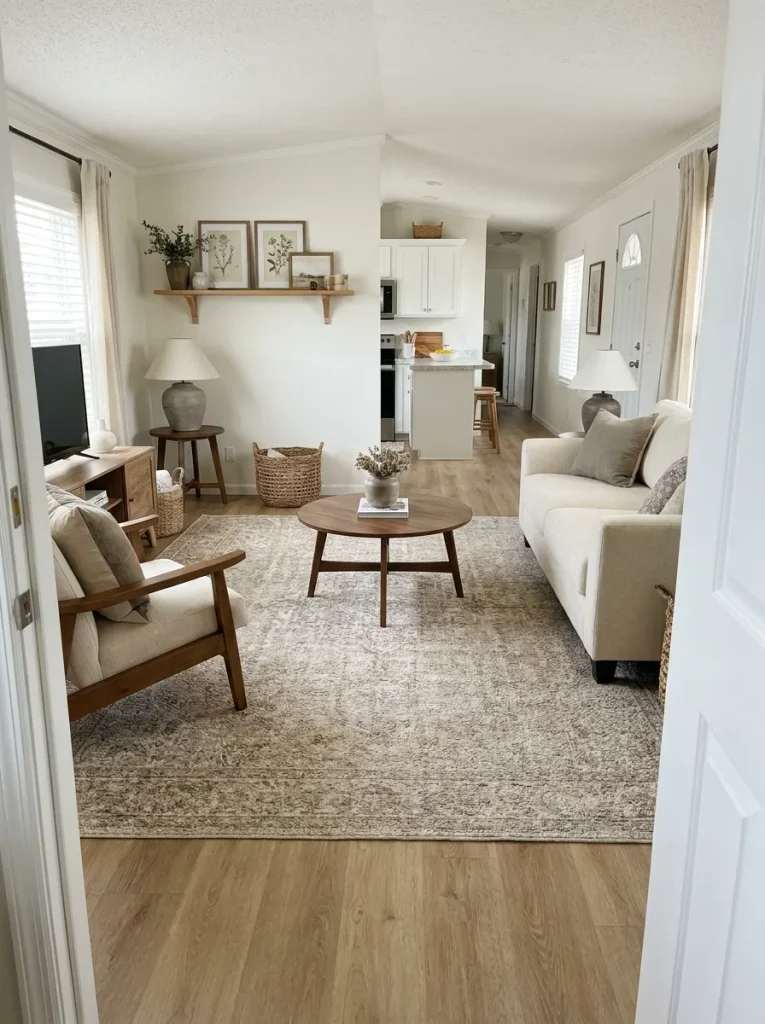
Exception: if the room is physically large and the seating appears to float in the middle, greater rug coverage may provide the grounding that a smaller mobile-home living room would not need.
20. Replace One Generic Sign With Something That Actually Means Something to You
Imagine two walls.
The first carries a mass-produced phrase chosen because the colors match the sofa. The second holds a framed photograph from a meaningful place, a print you genuinely love, an old family image, children’s artwork in a simple frame, or an object connected to a hobby.
Both walls are technically decorated. Only one immediately tells you something about the people who live there.
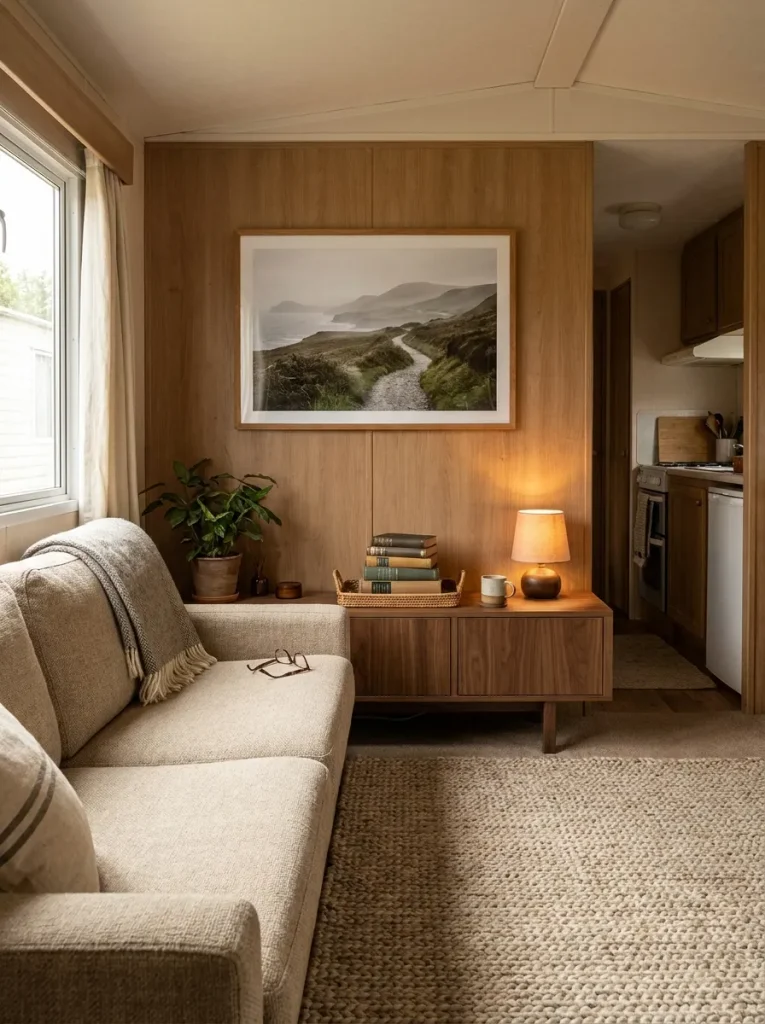
That difference matters because coziness is not purely softness or warm color. A room starts feeling more personal when a few visible objects have history, humor, memory, or real preference behind them.
You do not need to remove every decorative sign. Begin with the most generic one and ask whether another object could occupy the same visual space while contributing more personality.
A mobile home living room has limited display territory, so prominent wall space is valuable. Give the best positions to things you would still care about even if they stopped matching the décor perfectly.
That is often the layer that makes a carefully styled room finally feel like home.
21. Do the 8 PM Test: Fix the First Thing That Feels Cold, Glary, Empty, or Crowded
Some decorating problems are surprisingly hard to see at noon.
Wait until the living room has shifted into its normal evening state. Close the curtains or shades as you usually would, turn on the lights you normally use, sit in your usual spot for a minute, then leave the room and walk back in.
Notice the first discomfort, not every imperfection.
Does the room feel visually cold? Is one light glaring? Does an edge of the seating area feel empty and exposed? Or have the pillows, baskets, tabletop décor, and furniture accumulated until the room feels crowded?
Fix that first symptom before changing anything else.
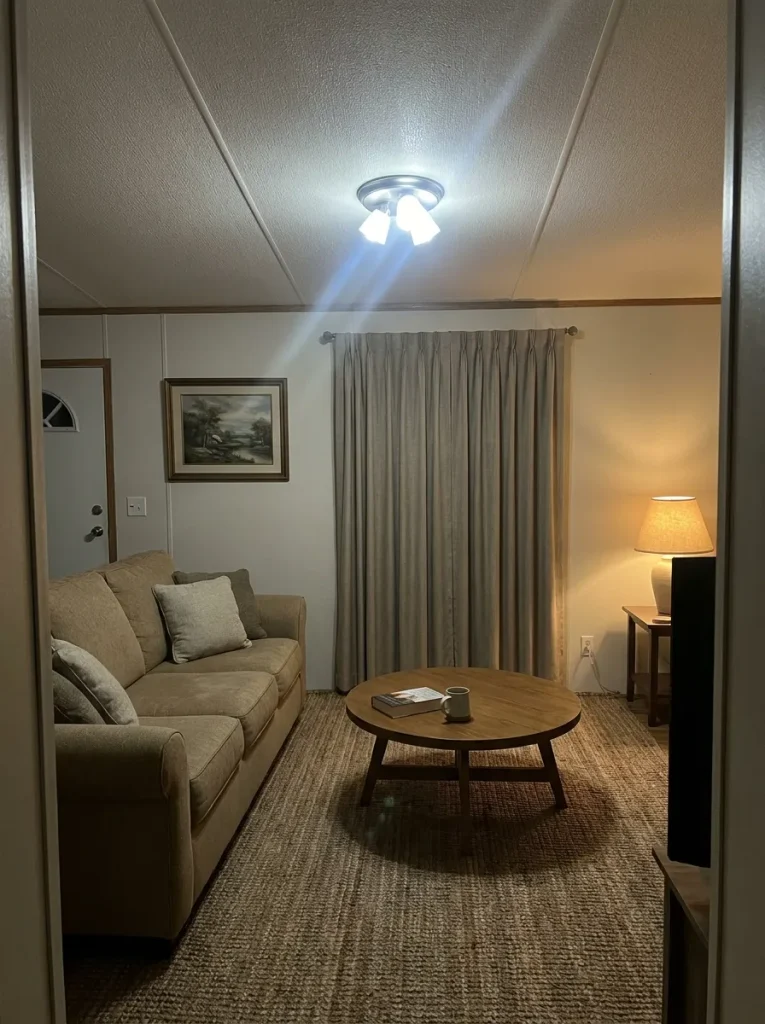
This final check differs from the earlier cozy-signal diagnosis. That first test helps determine the decorating direction. The 8 PM test reveals whether the finished room actually performs as a comfortable place to spend the evening.
8 PM Comfort Priority Ring
What bothers you first after the room changes into evening mode?
Choose only the first symptom you notice. The purpose is to identify the next correction—not to restart the entire room.
Conclusion
A cozy mobile home living room does not need to become darker, fuller, or more heavily decorated. It needs the right comfort signals in the places you notice and use most.
Start with the strongest weakness, make one meaningful correction, and then experience the room during an ordinary evening before buying anything else. A better lamp may matter more than another basket. One tactile throw may outperform five matching pillows. Removing a few generic objects may give your favorite pieces more presence.
When the room feels comfortable from the doorway, from the sofa, and again after sunset, stop decorating for a moment. That sense of ease is the outcome these ideas are meant to create.