A Christmas tree can make a small mobile home feel wonderfully festive—until its branches claim the walking route between the sofa, kitchen, and front door. That is the appeal of a wall mounted Christmas tree mobile home display: you keep the recognizable shape, glowing lights, and sentimental ornaments while giving the floor back to everyday life.
The best design depends on more than how pretty it looks online. Some trees are nearly flat outlines; others use layered greenery, real shelves, or shallow manufactured frames. Those designs have very different weight, projection, and wall-support requirements. Mobile-home interiors can also feature wall panels and finishes that are not interchangeable with conventional drywall.
Below are 17 distinct approaches, from a strand-of-lights silhouette to a corner shelf installation. Start by checking your chosen wall for doors, vents, switches, heat sources, and the route people actually take through the room. Then use the mounting guide below to narrow the options before buying greenery or hardware.
First, check your wall. For temporary adhesive hooks, follow the specific product’s surface guidance, rated load, preparation, wait time, and removal instructions; many products are unsuitable for wallpaper or heavily textured finishes. Heavy shelves and full garland installations require a support method verified for the actual wall construction. The Command hanging FAQ explains why ratings differ by product and surface. Keep light strings away from heat, avoid running cords across walkways, and turn them off before leaving or sleeping, in line with the NFPA winter holiday guidance.
Interactive Wall-Fit Studio
Which wall describes your space?
Open the closest match. A surface appearance does not establish structural load capacity.
Smooth, sound painted wall
Begin with ideas 1, 2 or 15. Consider light, shallow designs only when a specific hanging product is approved for the exact surface and load.
Check paint condition, cure time, the manufacturer’s application instructions and the cord route.
Wallpaper, texture or unknown finish
Hold off on adhesive mounting. Wallpaper, textured walls and uncertain coatings can be incompatible with common removable strips.
Choose a verified alternative support method or a different display location; lightweight material still needs safe attachment.
Exact mounting system professionally verified
Consider ideas 3, 9 or 10. Verify that the specific shelves, brackets, wall location and total decorated weight are covered.
Then test depth and door clearance independently. No wall assessment is a universal permission for heavy décor.
1. Create a Warm-White Zigzag Light Tree on a Narrow Living Room Wall
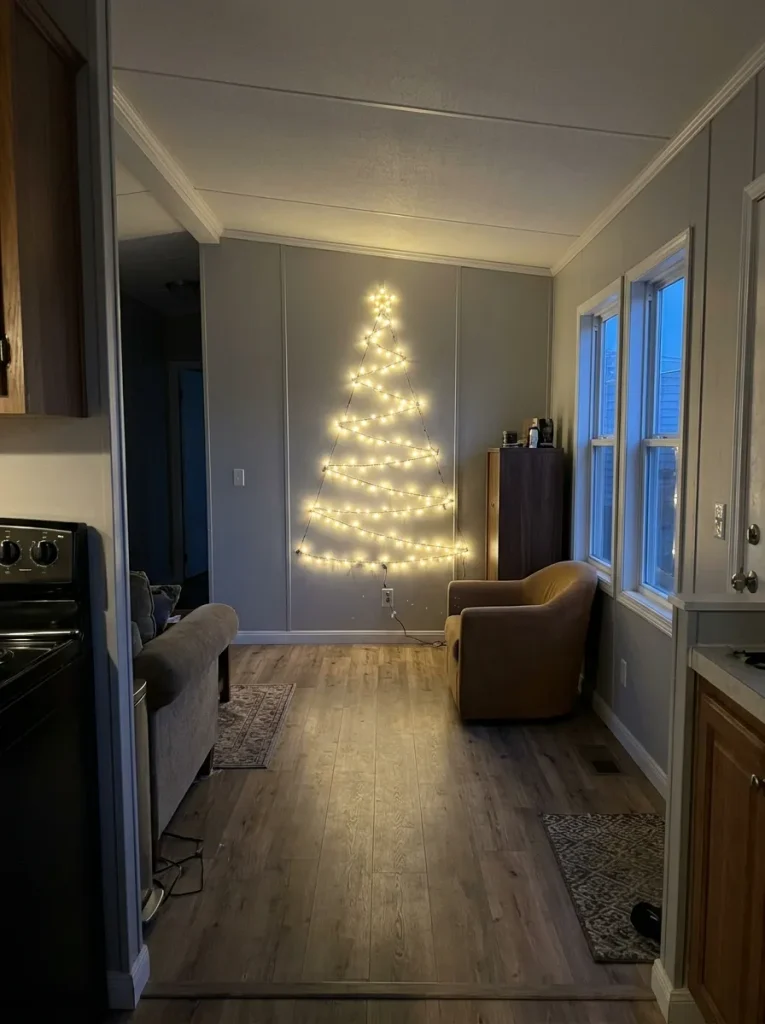
A zigzag of warm-white lights is the simplest way to give a blank wall the visual height of a Christmas tree. Place the widest horizontal sweep near the bottom and shorten each sweep as it travels upward. The illuminated edges create a clear triangular outline at night, even with no foliage or ornaments.
Test it before mounting: lay painter’s tape in a temporary triangle, stand in the main doorway, and check whether the shape is legible from the first view of the room. In a single-wide living area, a narrow vertical composition may read better than a broad base that crowds the television or door trim. For other ways of handling an awkward long room, see these narrow single-wide decorating ideas.
Choose a lighting product rated for indoor use, map the outlet route, and support the strand without staples or sharp fasteners contacting the wire. Battery-powered lights may simplify a location with no nearby socket, but the battery pack still needs an accessible, discreet home.
Best fit: a low-projection display where furniture cannot move.
2. Frame an Open-Center Christmas Tree With Evergreen Garland
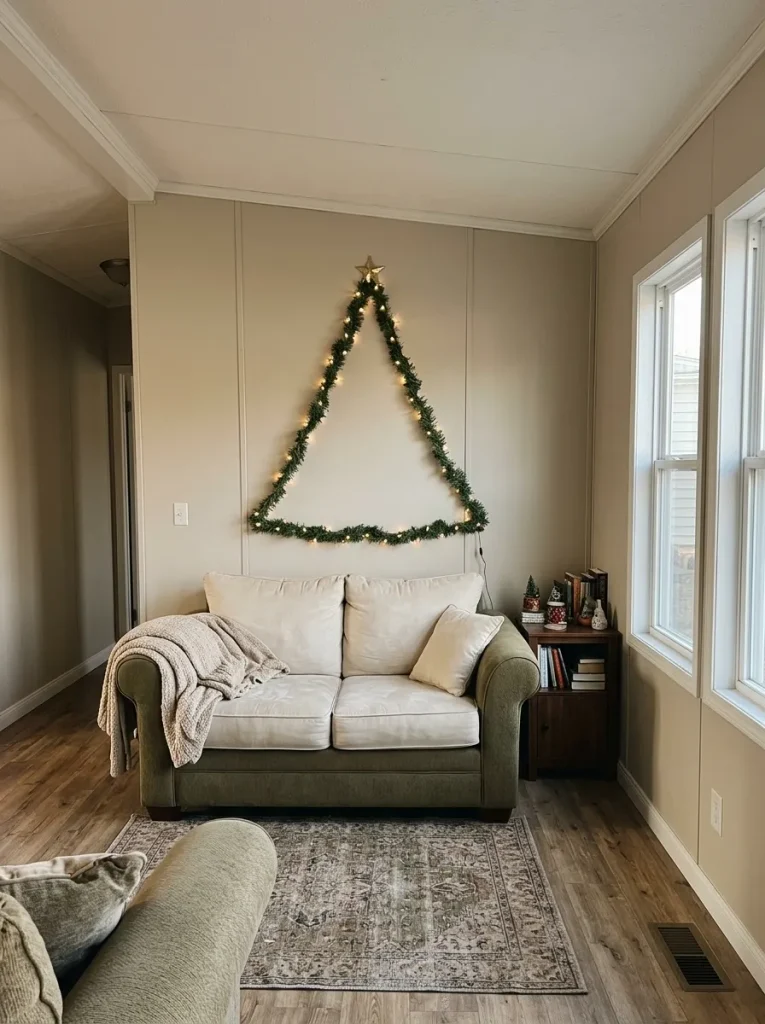
Picture a triangular border of pine garland surrounding a patch of bare painted wall. The empty middle is an advantage: a small room gets the warmth of greenery without a dark, dense block looming above the sofa.
The outline works especially well on an existing accent wall, where its negative space lets the original wall color remain visible. Start with a paper or tape sketch and evaluate the widest point from the seated view; if the bottom edge seems as wide as the sofa, reduce it until the display feels like one intentional feature.
Mounting decision: Fluffy garland is not automatically lightweight. Weigh the full decorated assembly, including lights, then check each support component and its actual attachment method. Use flexible faux pine rather than a rigid frame if you want easier seasonal storage. Skip this look on a wall already cluttered with framed art; the outline loses its definition.
3. Fill a Flat Triangle With Dense Artificial Pine for a Traditional Tree Look
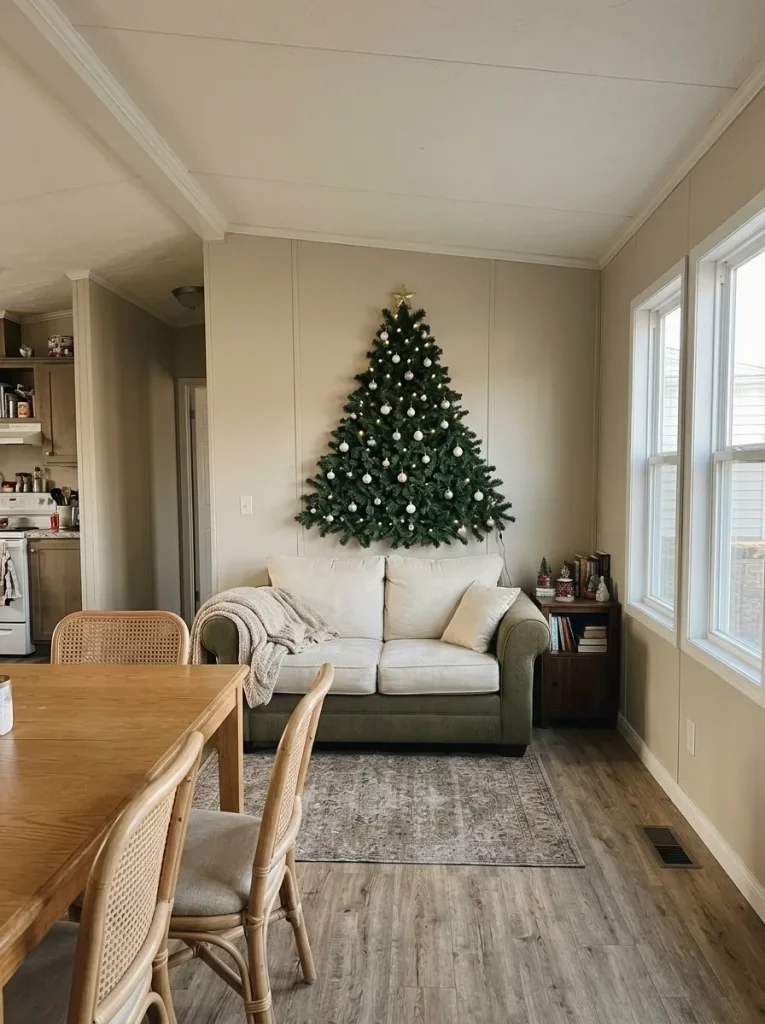
For the classic Christmas-tree silhouette, a dense triangular field of faux pine delivers the strongest resemblance to a freestanding tree. The wall becomes the backing; greenery occupies the face of the triangle while ornaments remain close to the surface.
A successful design needs a planned support structure, not simply more adhesive hooks. Begin by measuring the full decoration’s weight, deciding how each garland section is carried, and confirming that the chosen attachment system suits the wall. Build from the top downward only after the support plan is settled; distribute fullness with shorter branches near the tip and gradually wider tiers at the base.
Finishing sequence:
- Establish the triangular outline.
- Add interior greenery evenly.
- Arrange lights without pinching their wires.
- Hang lightweight ornaments at supported locations.
This is a good substitute for a traditional tree only if the wall and hardware genuinely suit a fuller display. Otherwise, use the open garland outline in idea 2.
4. Mount a Flat-Back Christmas Tree Against a Living Room Feature Wall
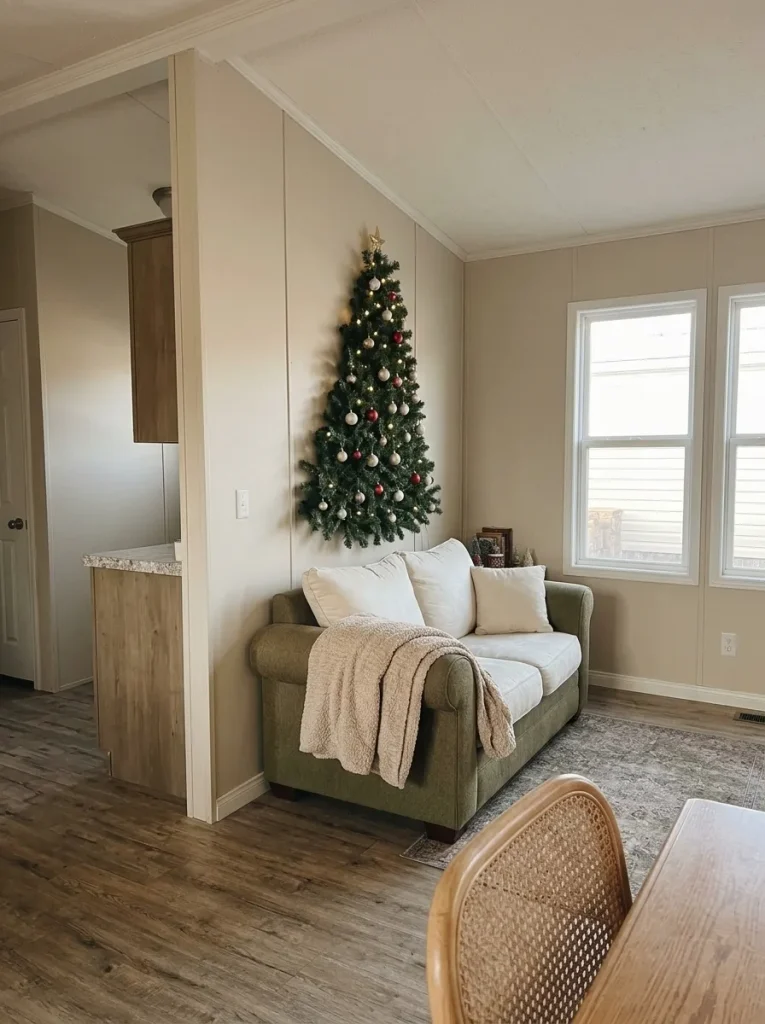
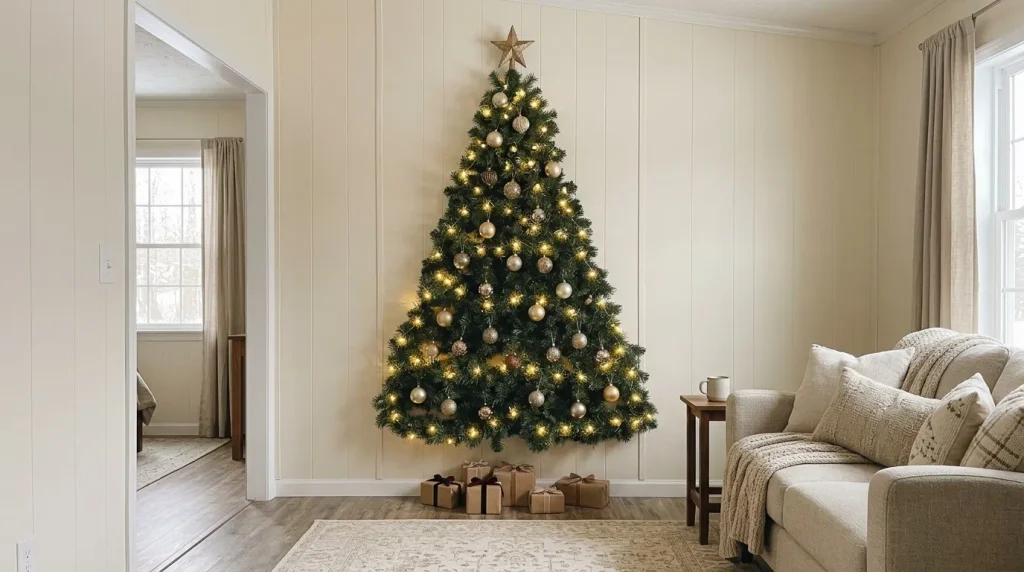
A purpose-made flat-back or half-tree gives the rich profile of a conventional artificial tree from the front. From the side, however, it may still project considerably into the room. That difference matters beside a narrow sofa-to-door passage.
Before purchasing, check the product’s actual depth, support method, and manufacturer’s placement instructions. Some half-trees are freestanding products with a flat back, not products approved to be suspended on a wall. Do not remove their stands or improvise a wall attachment unless the maker specifically supports that arrangement.
Christmas Tree Depth Comparison
What really projects into the room?
Conceptual side views, not to scale. Measure the actual decoration at its deepest point.
Flat outline
Ribbon and light strings: least physical projection when properly supported.Layered greenery
Branches and ornaments add volume; inspect total weight too.Flat-back half-tree
Often much deeper. Some models are freestanding and must not be suspended.Choose this fuller profile when the wall is a genuine feature surface and the side projection stays clear of daily movement. Where even modest depth feels uncomfortable, return to a flat garland or light-tree design. For a broader perspective on what makes a compact seating area work, explore small mobile home living room ideas.
5. Arrange Five Horizontal Garland Swags Into a Floating Tree
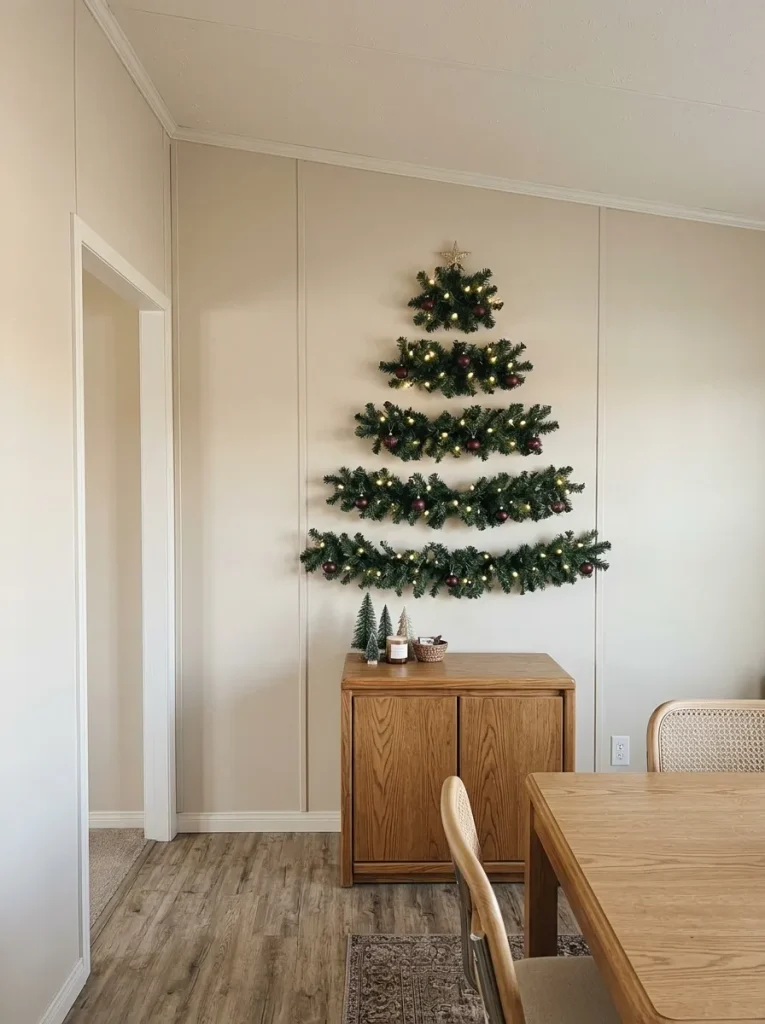
Imagine five separate evergreen rows: a short one high on the wall, then progressively wider rows below it. Their combined outline suggests a Christmas tree while each swag remains an individual decorative element.
Start by deciding the total height and base width. Divide the available height into five visible bands, leaving deliberate breathing room between each one. Equal-looking vertical gaps are more important than an exact measurement: compressed rows appear like one bulky garland, whereas overly separated rows stop reading as a tree. Drape a few tiny warm lights across the branches and place ornaments at alternating positions so the weight does not collect at the row ends.
A wider wall over a console is ideal because the low tier can act as the visual base. Advantage — Individual rows can be removed and packed separately. Tradeoff — Each row still requires suitable attachment support. Do not treat five small hooks as universally safer than one verified mounting system.
6. Turn a Christmas Tree Outline Into a Family Photo Gallery
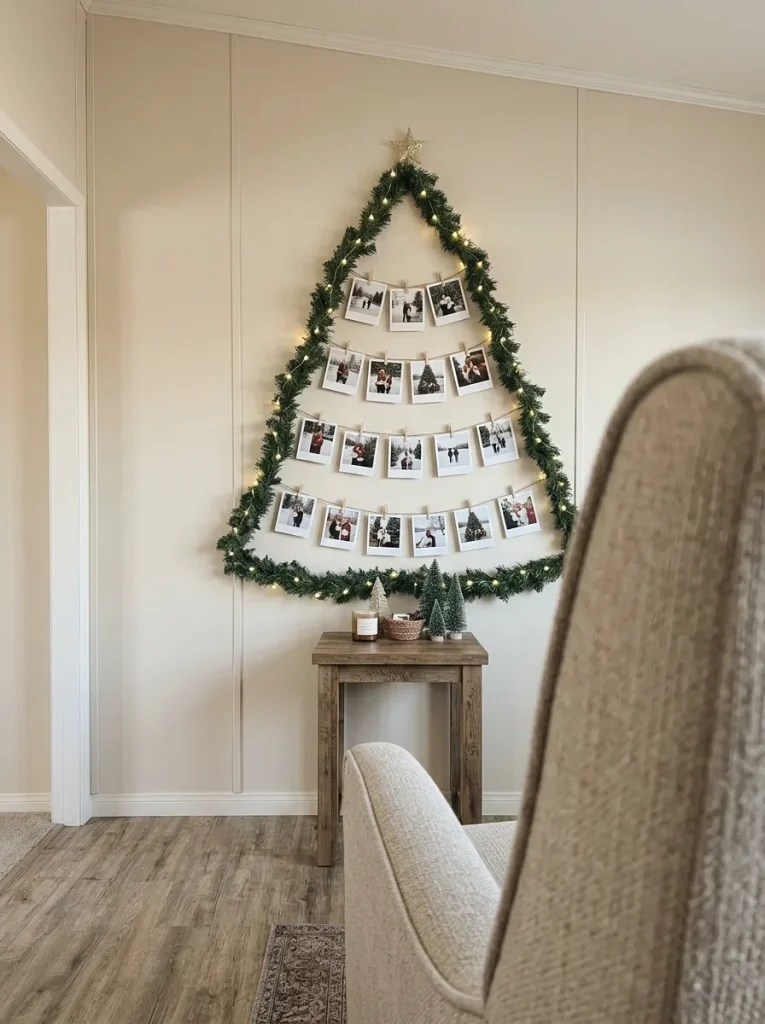
The family-photo tree makes the Christmas wall meaningful even before the lights switch on. Run several short horizontal lengths of twine across a shallow triangular garland outline and attach lightweight printed photographs with miniature wooden clips. Two photographs near the top, followed by more on each lower line, establish the shape without making faces difficult to see.
Use duplicate or reprinted pictures instead of irreplaceable originals, particularly near a window or frequent cooking area. Keep the photo lines taut enough to avoid sagging, but do not tension them against inadequately rated supports. A simple gold star above the collection marks the top and helps the design read as holiday décor from across the room.
Small-home editing rule: Leave some blank wall between photo rows. Filling every gap turns the tree into an overloaded collage.
This is the best pick for a mobile home where family memories matter more than an elaborate ornament collection.
7. Build a Stocking Display Into a Wall-Mounted Evergreen Tree
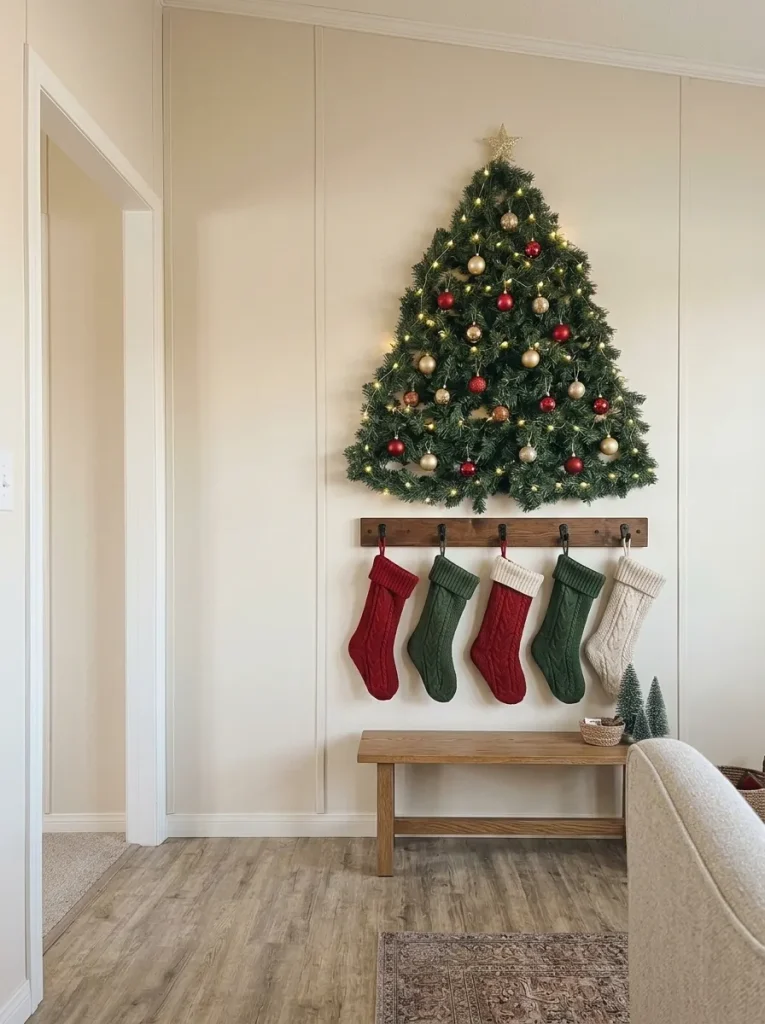
A mantel is not required to display stockings, but a decorative garland is not an appropriate load-bearing replacement for one. Put the leafy tree silhouette on the wall as a visual layer and plan the stocking supports as a separate installation.
Empty stockings: Lightweight decorative supports may suffice if their instructions permit the surface and load.
Filled stockings: Use appropriately verified independent hardware or a separate freestanding stocking holder. Never hang filled stockings from light strings, garland wires, or decorative adhesive clips.
The best arrangement places stockings under the lower branches, where they become part of the same Christmas composition without pulling the greenery downward. Place them away from heater outlets and door swings. Use this idea on an open living-room wall when there is no fireplace; choose a photo tree instead if you lack safe support points for the stockings.
8. Suspend Lightweight Baubles Across a Glowing Triangular Light Grid
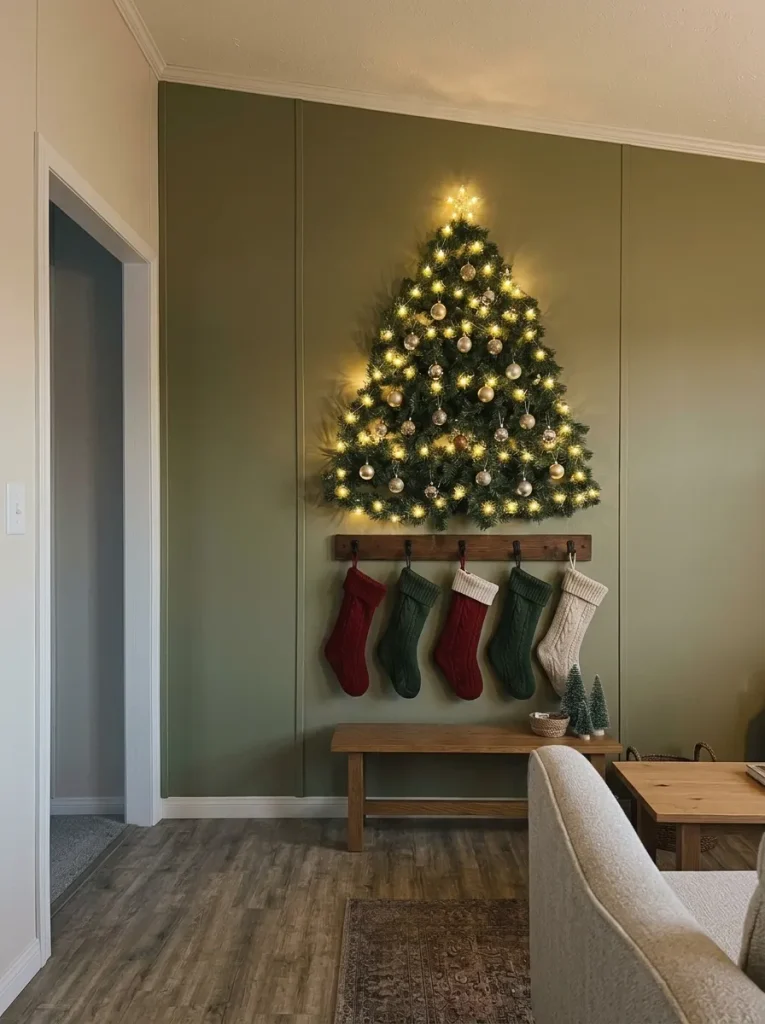
A bright network of light strings across a large triangle has an entirely different personality from an evergreen tree. Its interior is illuminated and airy, with ornaments appearing to float in front of the wall. This works beautifully when the living room already has dark furniture or colorful textiles and needs a lighter seasonal focal point.
Decide on the light structure before choosing ornaments. Perimeter lights emphasize the silhouette, horizontal strands make orderly ornament rows, and zigzag interior strings create the most sparkle. The CPSC’s seasonal-lighting guidance addresses electrical safety characteristics in holiday lighting products; use suitable, undamaged indoor lights and follow their instructions.
Interactive Lighting Composition Lab
Which light pattern suits your room?
Open each arrangement to compare the appearance and planning tradeoff. The diagrams are decorative concepts, not electrical installation plans.
01 — Quiet triangular outline
Maximum negative space
Works on an uncluttered dark wall. Support the light strand with manufacturer-approved clips without piercing its insulation.02 — Horizontal ornament rows
Structured sparkle
Creates orderly tiers. Ornaments need suitable independent hanging points; light wires must never become load-bearing lines.03 — Luminous zigzag web
The brightest focal point
Best with subdued surrounding lamps. Plan a visible, safe plug route and follow the product’s strand-connection instructions.Choose lightweight, shatter-resistant ornaments attached to independently adequate supports. Do not hang baubles by tugging on the electrical wires. At night, let this display supply the festive sparkle and keep surrounding lamps gentle; the cozy mobile home living room guide explores that wider lighting balance.
9. Shape Shallow Floating Shelves Into a Christmas Tree
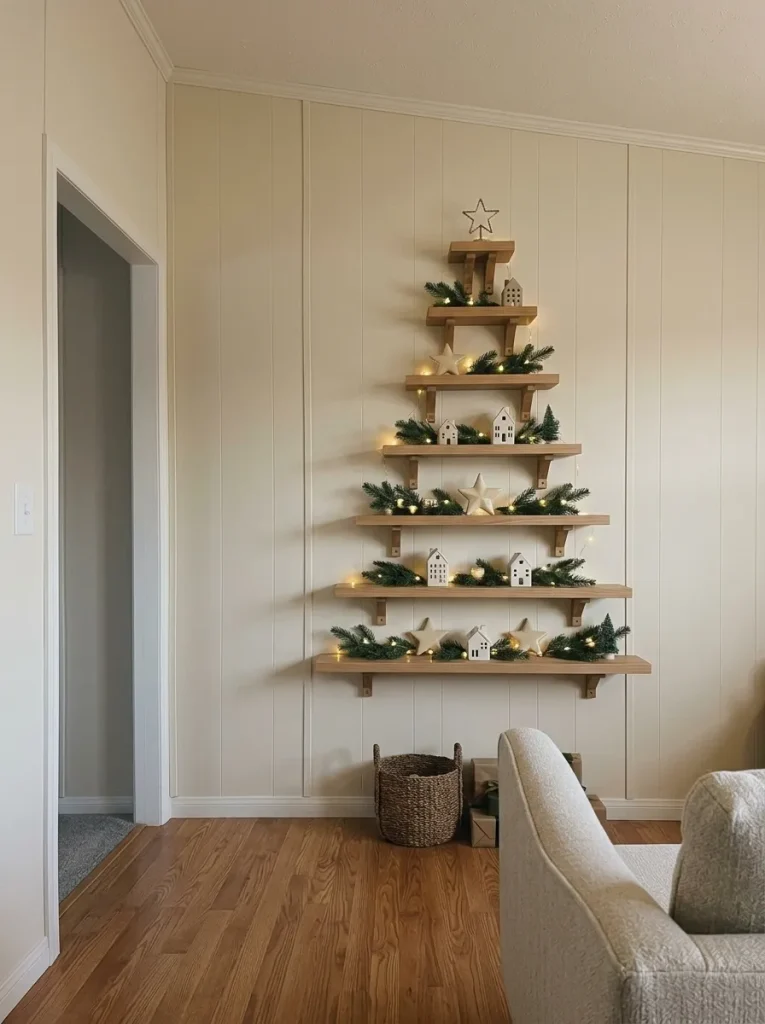
Shelves can create a Christmas tree in stepped layers: a tiny upper ledge, then longer shelves below, with restrained sprigs of pine and ornaments arranged along each level. The advantage is display depth. You can see little houses, paper stars, and miniature trees standing upright, not merely hanging flat.
That advantage introduces a real structural decision. Floating shelves, their contents, and any greenery need support appropriate to the wall framing or another manufacturer-approved mounting system. The surface panel alone may not establish a safe anchor point. Use a stud or construction assessment appropriate to the actual home; where the supporting structure cannot be confirmed, switch to lightweight decorative swags.
Shelf Mounting Decision Studio
Can your wall actually carry shelves?
Choose the closest confirmed condition. The decorative tier arrangement cannot substitute for an installation assessment.
Only the wall finish is known
A decorative wall panel is not a structural rating. Identify the underlying support and an approved fixing method, or choose idea 5’s lightweight swag composition.
Support is identified, load limits are unclear
Check the shelf, bracket, fastener, support and combined ornaments or greenery. Adding multiple shelves does not automatically make the installation acceptable.
The exact mounted shelf system is verified
Mark the deepest shelf position on the floor, operate adjacent doors, and check for collision with furniture and people using the route.
Stop signal: any essential movement route becomes uncomfortable.
A shelf-tree also takes longer to install and remove than seasonal garland. It is worth considering where you already want permanent display ledges. For broader approaches to using wall height, browse vertical storage ideas for small mobile homes.
10. Wrap a Wooden Shelf Tree Around an Unused Living Room Corner
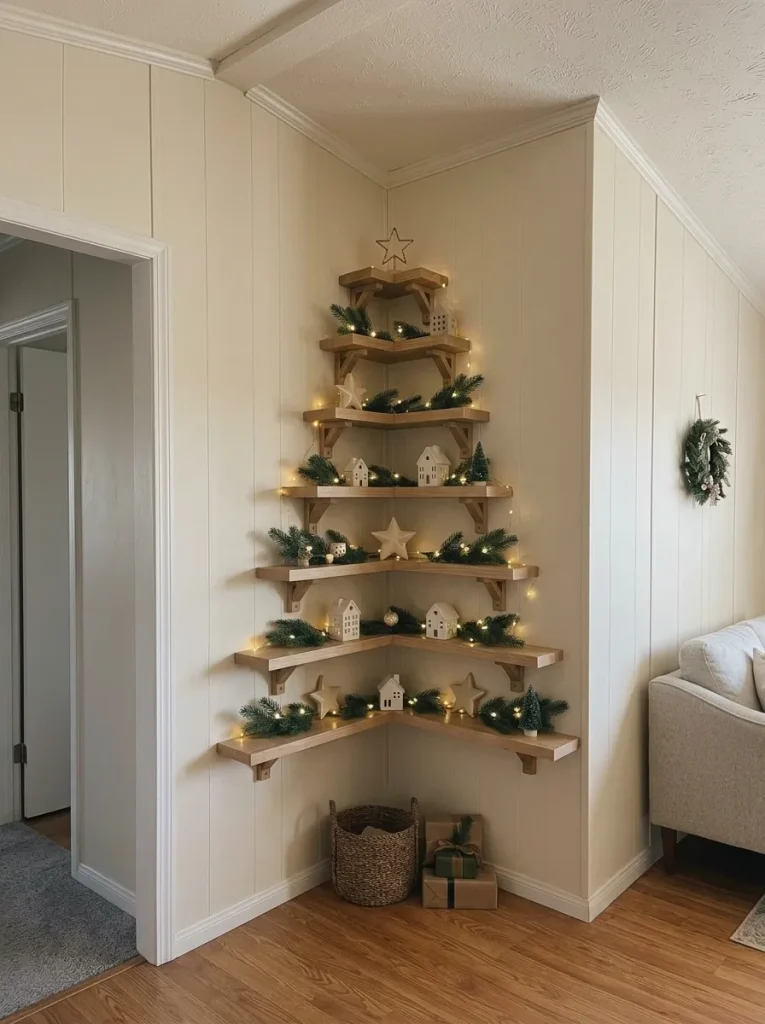
An otherwise awkward inside corner becomes the centerline of this design. Shelves extend a short distance along both adjoining walls, widening toward the floor to form a geometric tree. Tiny village ornaments sit on the shelves, while scattered warm lights define the edges.
The space test is simple: trace the proposed deepest shelf footprint on the floor with removable tape. Then walk through the room, open any adjacent door completely, and check whether someone could bump the projecting corner. Even though the shelves are wall-mounted, their depth occupies real volume in the living area.
Corner check: Both walls must have an appropriate support solution. Two meeting finish panels do not automatically provide stronger mounting.
Avoid the narrowest hallway corner; a quiet living-room alcove is much better. Display only a few pieces per shelf so the stepped geometry remains visible.
11. Make a Rustic Wooden Dowel Ladder Christmas Tree
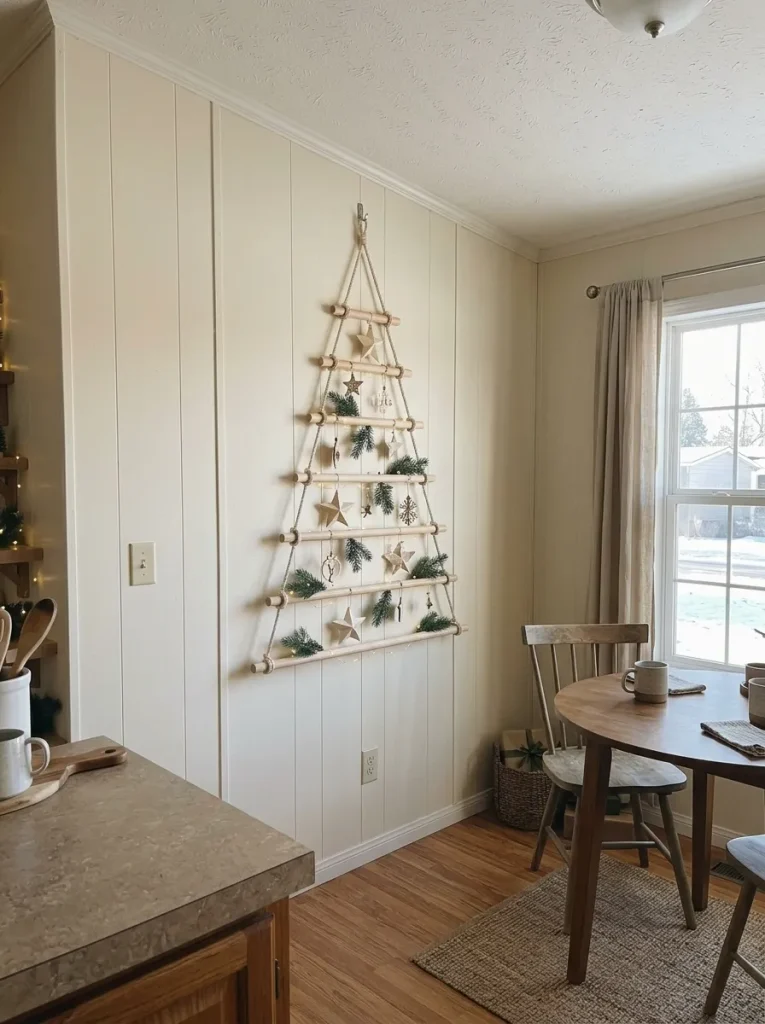
A dowel ladder is an open construction built from straight wooden rods, descending from short to long. Cord or rope connects the rods into a triangular ladder; greenery and lightweight ornaments decorate the bars. It feels handmade without requiring a solid panel of pine.
Unlike a shelf tree, the dowels do not need to act as ledges. Still, the top hanging point carries the entire assembly, and the cord and knots must be suitable for its weight. Build and test the ladder off the wall, check that the rods remain level, and avoid hard or breakable ornaments in locations where people may brush against it.
Material note: Unfinished pale wood suits rustic rooms; darker dowels make the outline more architectural.
A narrow ladder can fit beside a dining nook, provided no chair back or opening door strikes it. Choose dowels over shelves when you want to hang ornaments without adding display ledges.
12. Stack Mini Evergreen Wreaths Into a Sculptural Wall Tree
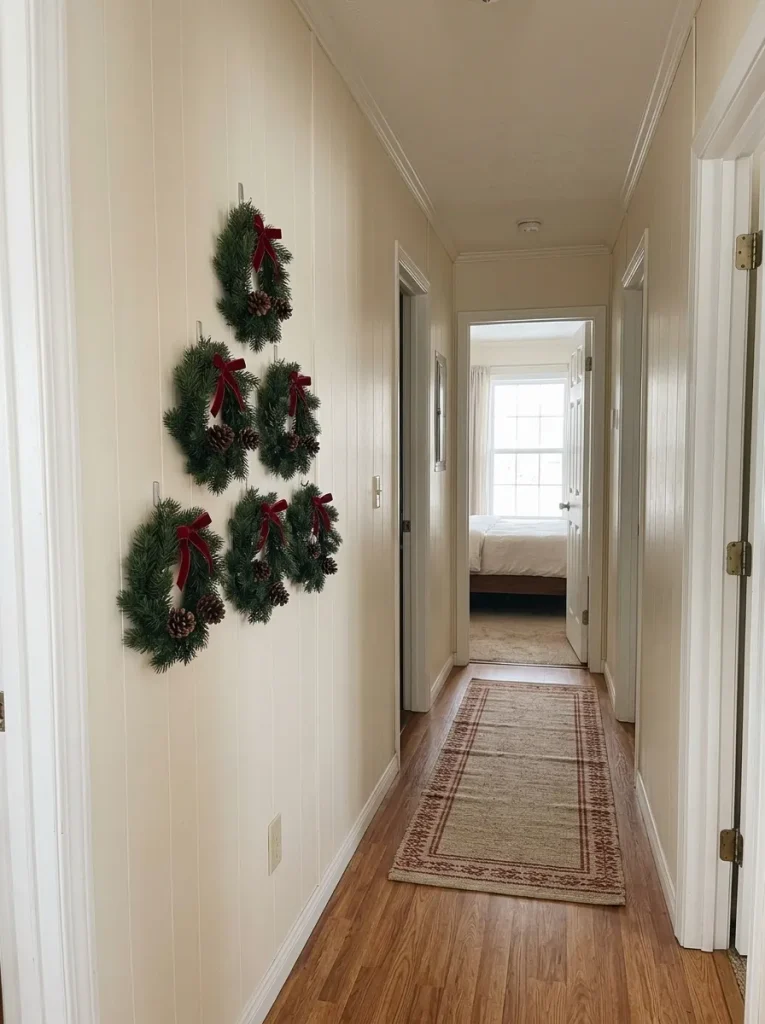
A row of small wreaths can become a tree when arranged in a one-two-three pattern or as a staggered, tapering composition. The circular forms feel softer than the strict lines of wooden shelves and lend themselves to natural textures—pinecones, small bows, or bells.
Test the arrangement on the floor first. From several steps away, check whether the entire collection reads as one tree rather than unrelated wreaths. Consistent greenery and one repeated accent color tie the pieces together; alternating every color and material makes the design visually noisy in a compact room.
Try a staggered formation when a light switch or existing artwork interrupts the wall. Leave controls clear and redistribute the wreaths around them.
This design especially suits a cozy hallway or dining wall where wired lighting would be inconvenient.
13. Create a Soft Felt Christmas Tree for a Family Activity Wall
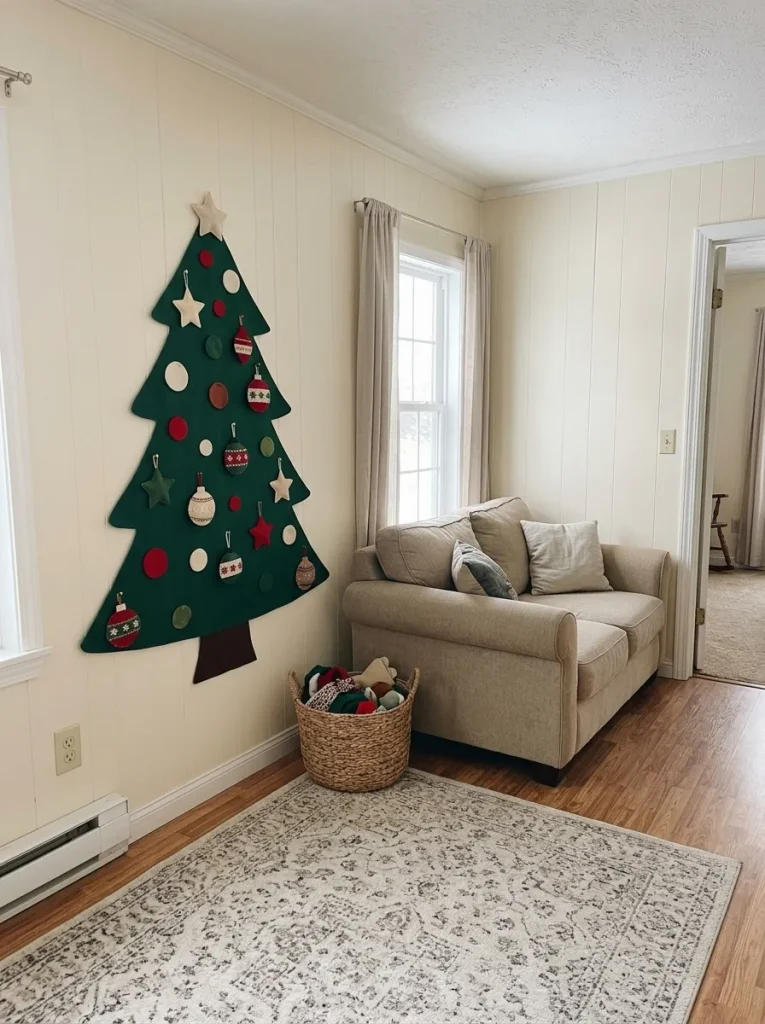
A flat felt tree lets a child rearrange soft stars, stockings, and colorful shapes without dealing with fragile glass ornaments. Place it on an accessible wall near the everyday family area, not over a bed or where the display would obstruct movement.
Begin with a fabric tree backing and decorations made for the children’s ages. Choose large, securely constructed pieces and follow age and choking-hazard guidance: small detachable elements are not appropriate around children who might mouth them. Decide how the backing itself can attach to the specific wall without peeling delicate wallpaper or paint.
Felt Christmas Tree Styling Studio
Choose the feel of your family’s felt tree
Open a style to see a different decoration density. Always select age-appropriate, securely made pieces.
Quiet shapes
Bright and festive
Muted woodland
This is especially practical in a small mobile home because the activity occupies wall area instead of adding a floor-standing play station. Make the top reachable for an adult to reset the display, while placing most frequently used decorations at a comfortable height for the child.
14. Hang a Flat Fabric Christmas Tree on a Guest Bedroom Wall
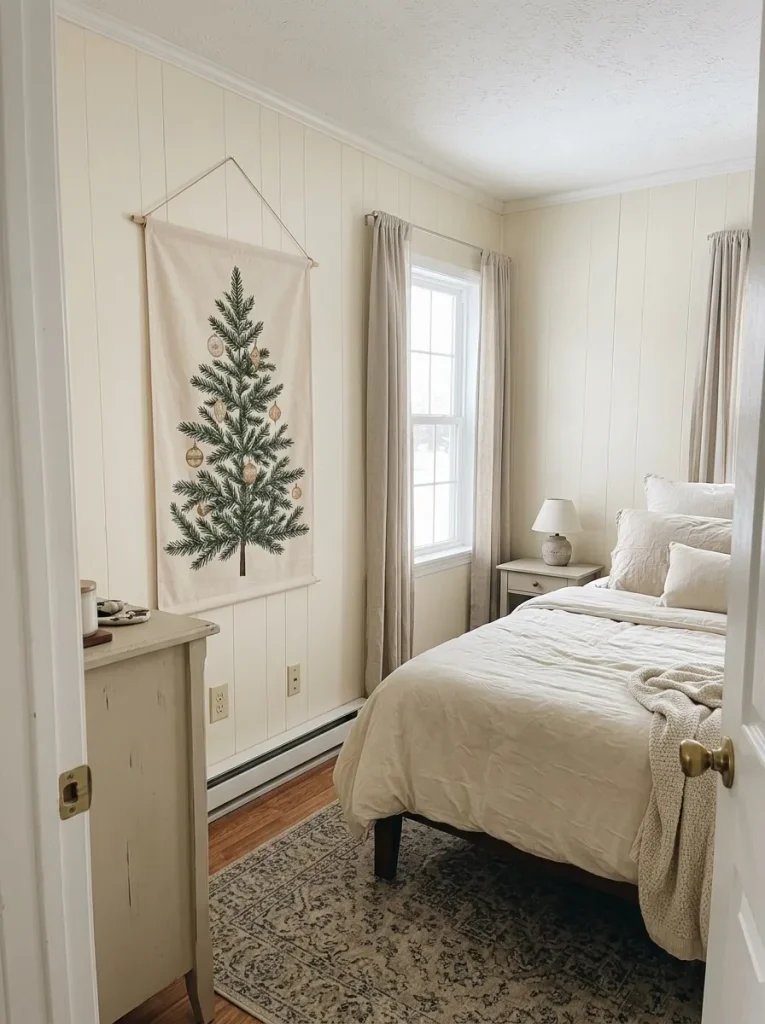
A textile tree turns an empty guest-room wall into holiday décor with little physical projection. Choose a printed canvas or woven hanging showing a large evergreen silhouette; a few restrained stitched or felt details can give it texture without turning the display into a heavy installation.
Fabric wrinkles change the whole result. Hang the piece straight, allow it to relax, then adjust any approved bottom support so it lies neatly. Do not secure it over vents or a sleeping position where falling hardware could cause harm, and do not assume that picture-hanging adhesive strips are rated to suspend fabric.
Compared with greenery, the fabric is easier to fold or roll for storage, has no shedding pine needles, and does not require rearranging ornaments.
Best condition: a room used seasonally, where a decorative background is more useful than a fully illuminated tree. A photograph-style fabric print looks particularly effective against an otherwise simple wall.
15. Trace a Minimal Christmas Tree With Ribbon and Lightweight Ornaments
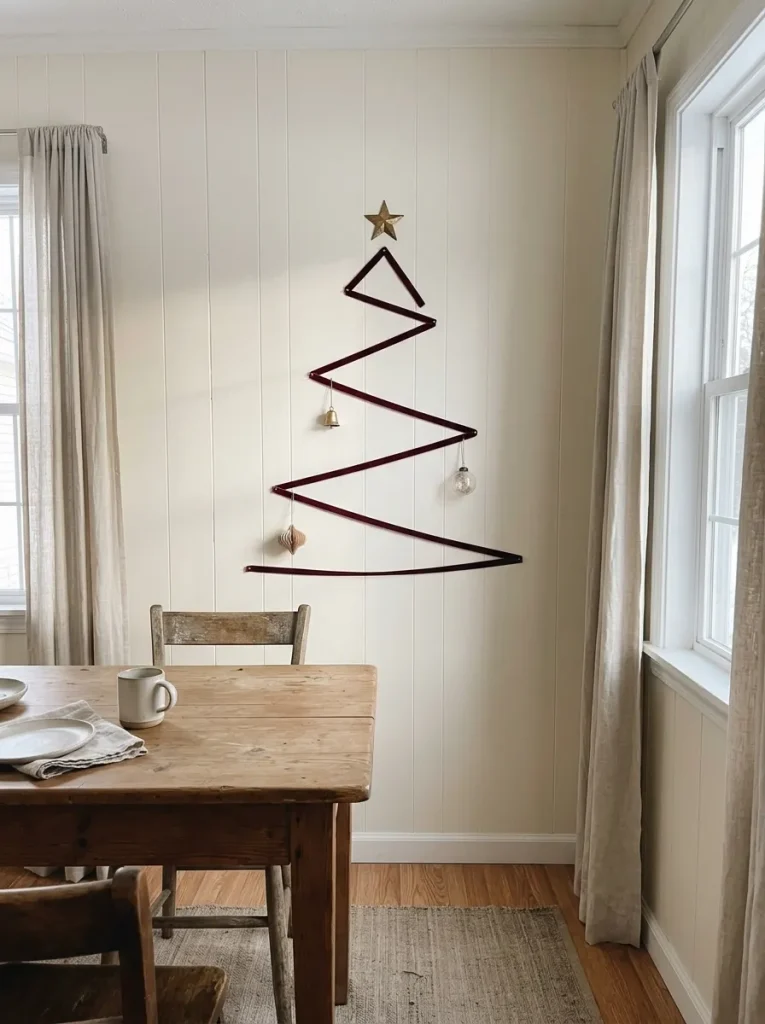
Sometimes the best Christmas wall treatment is a single sweeping line. Thin velvet ribbon, paper trim, or another lightweight material can outline a tall tree, with three or four small decorations marking its branches. Its elegance comes from having far less material on the wall.
First sketch the full silhouette with low-tack drafting material appropriate to the wall finish. Step back and look at the line from the kitchen opening: does it still read as a tree when viewed sideways? If not, increase the width of the lower line or add a clear star at the top. Use approved fixings that suit the chosen ribbon and the surface; test delicate finishes in an inconspicuous location.
Does the shape disappear from across the room?
That usually means the wall has too much competing pattern or imagery. Try a plainer surface before adding more ornaments.
16. Create a Rearrangeable Christmas Tree on a Wall-Mounted Pegboard
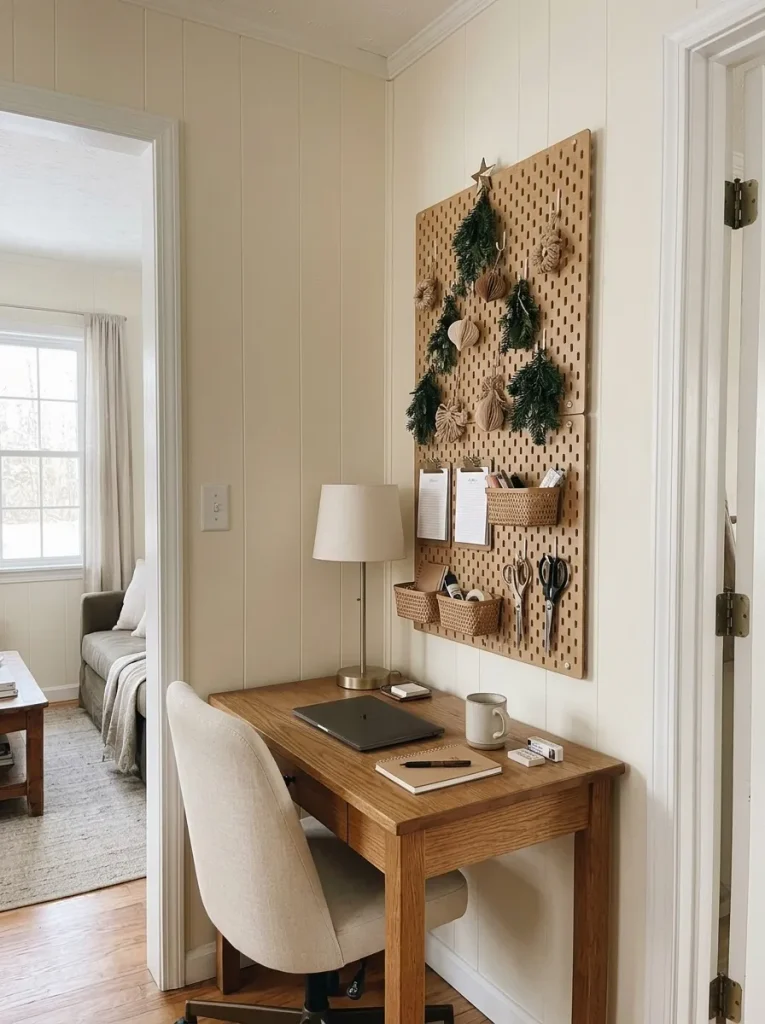
A pegboard turns a seasonal decoration into a modular display. Arrange small removable hooks in a triangular formation, hang light ornaments from the upper rows, and put a few short garland sections across the middle. Next year you can move the hooks and change the entire shape without rebuilding the decorative surface.
The pegboard’s usefulness depends on its mounting: the board, hooks, and attached objects have a combined load. Follow the pegboard manufacturer’s installation requirements and confirm the wall can support the chosen system. A pegboard resting against a wall or attached only to a thin finish panel should not be assumed secure.
Symmetrical arrangement: Repeated ornaments in deliberate rows suit a tidy living-room corner.
Organic arrangement: Loose greenery, wooden stars, and paper ornaments suit a relaxed dining zone.
Choose this idea when the pegboard already works for you year-round; otherwise it adds more hardware than most holiday decorations require.
17. Build a Fold-Flat Paper Fan Christmas Tree for an Awkward Wall Gap
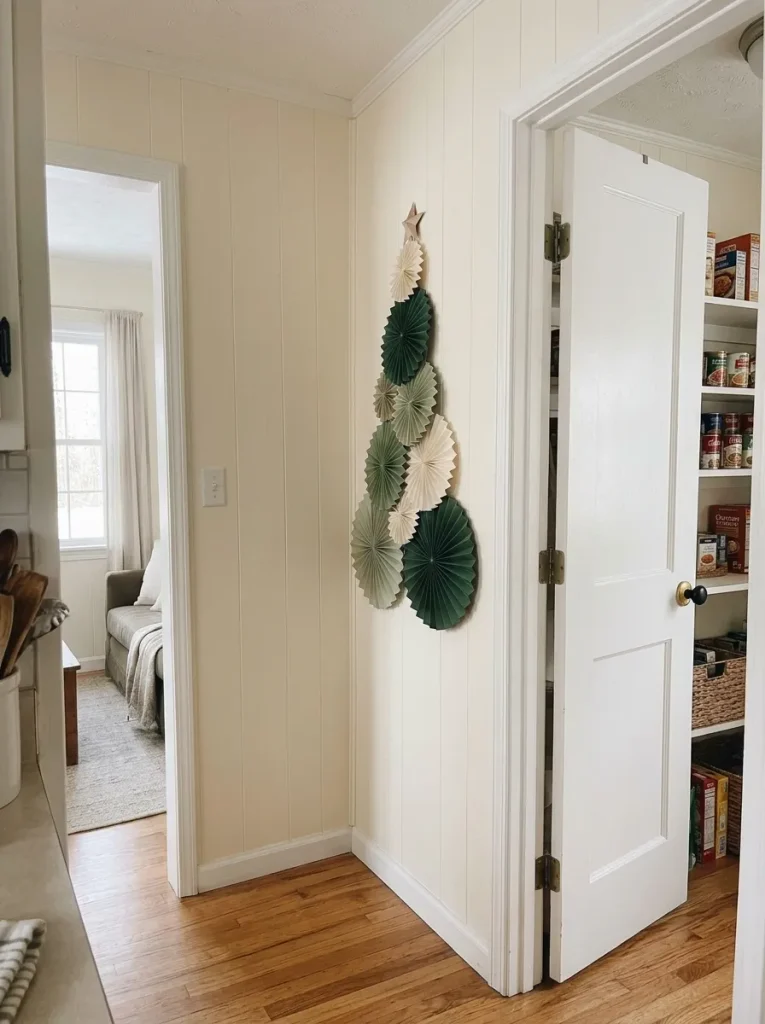
Graduated paper fans make an inexpensive Christmas tree that disappears into a storage envelope in January. Layer the largest fan shapes low on the wall, then narrow the stack toward the top. A matte pine-green palette keeps the shape recognizable; a few cream or gold fans can suggest ornaments without additional hooks.
Make one sample fan first, then open it fully and measure its real projection from the wall. Thin paper designs are not all flat: deep accordion folds can catch a passing shoulder in a narrow passage. Keep the tree out of damp areas, away from heaters, and clear of the door’s swing.
Before decorating, plan removal too. Preserve any packaging that will protect the folds. Use the appropriate fixings for your chosen wall finish, and take the paper down gently without pulling at painted surfaces. This is the best last-minute option for a spare wall niche where permanent shelving or heavier greenery makes little sense.
End-of-Season Removal Guide
Take it down without a January surprise
A calm removal sequence protects delicate wall finishes and reusable decorations.
Power down
Switch off and unplug light strands before touching their supports.Unclip ornaments
Remove photographs, baubles and garland without pulling on light wires.Release fixings
Follow the exact hardware or adhesive manufacturer’s removal method.Pack flat
Separate paper, fabric and strands. Protect shapes from crushing or dampness.Which Wall Christmas Tree Should You Choose?
Start with the wall and the walking route, not the ornament color. If you have an unverified finish or a rental wall, choose a light display or fabric concept that is compatible with a specifically rated removable mounting product; otherwise use a supported alternative that does not load the wall. If the wall’s structural support has been confirmed, a shelf tree or fuller foliage installation can become a lasting feature. For broader room-level planning, these mobile home living room ideas can help balance the Christmas focal point with the rest of your furniture.
The smartest design is the one that still leaves doors opening normally, cords protected, and family movement easy.
Save your favorite version on Pinterest, measure the available wall, and choose the mounting approach before shopping for decorations.