

A small mobile home can feel wonderfully atmospheric at Halloween, but there is a fine line between cozy and crowded. When every counter gains a pumpkin, every shelf gains a ghost, and the floor collects baskets, signs, lanterns, and figures, the room may look seasonal while becoming harder to live in.
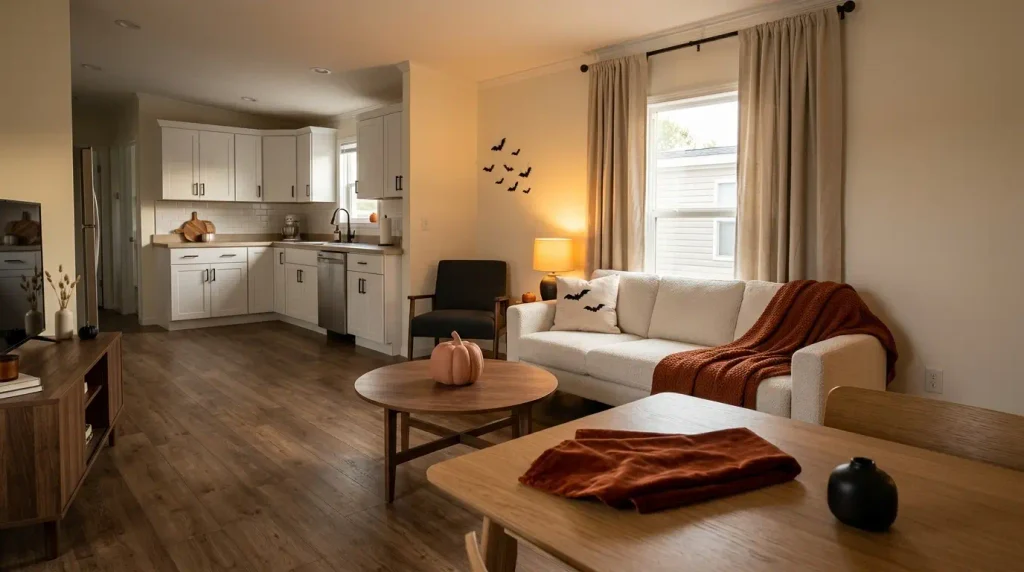
The better approach to cozy Halloween decor in a small mobile home is to build the mood through elements that already influence how the room feels: warm light, tactile fabrics, controlled color, softer materials, and a few recognizable Halloween shapes.
That distinction matters even more in a compact home, where several rooms may be visible from one position and one extra decorative layer can affect the entire sightline.
These 17 ideas focus on Halloween warmth without sacrificing useful surfaces, comfortable movement, or the visual breathing room that helps a small home feel settled. If your bigger challenge is deciding where seasonal décor can physically fit, the guide to <a href=”/small-space-halloween-mobile-home-decor/”>small-space Halloween decorating for mobile homes</a> goes deeper into placement and spatial planning.
1. Build Cozy Halloween With Three Signals: Warm Glow, Soft Texture and One Dark Note
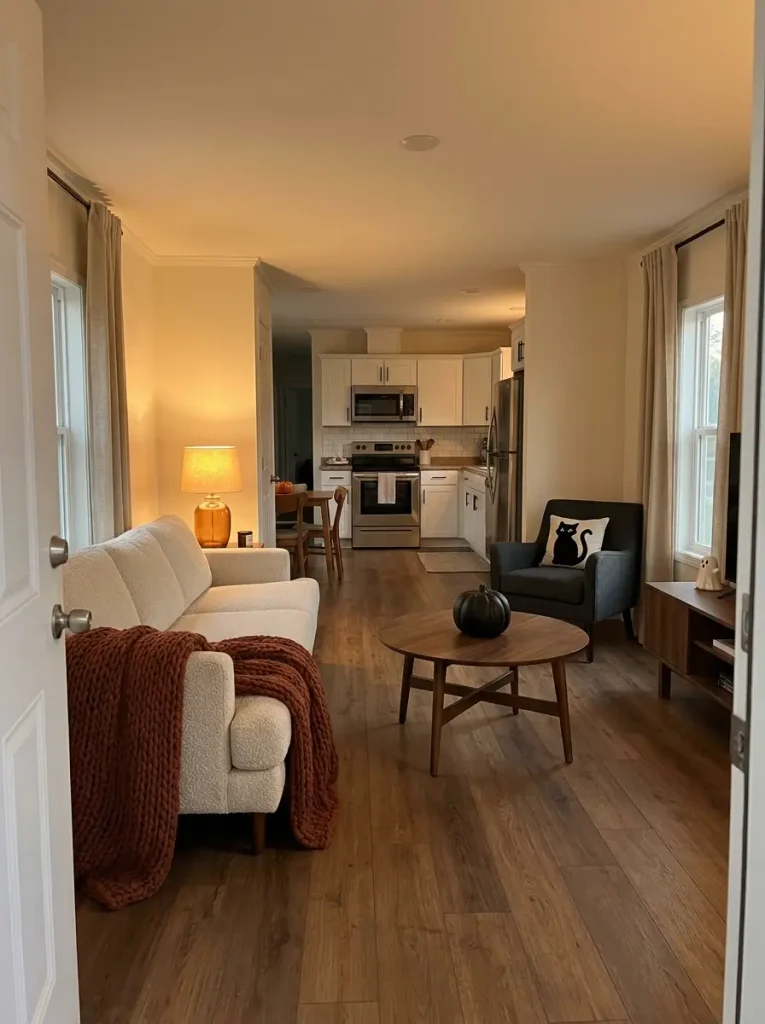
Walk into your living room after sunset and ignore the Halloween objects for a moment. What does the room actually feel like?
In a small mobile home, a convincing seasonal atmosphere can often come from only three signals: a warm source of light, something tactile, and one controlled dark accent.
An amber lamp beside a cream sofa, a rust-colored knit throw, and a single matte-black pumpkin can communicate October more clearly than a dozen small decorations spread across every surface.
Each signal also performs a different job. Light changes the room’s temperature. Texture makes a seating zone look and feel softer. A dark accent gives pale upholstery, walls, and cabinetry enough contrast to register as Halloween.
Before buying another decoration, identify which signal the room is missing.
The 3-signal cozy check
What is your room missing most?
Choose the weakest layer. The answer tells you what to change before another seasonal object enters the room.
Try one warm lamp, a short strand of amber micro-lights, or a flameless candle effect near an existing focal area.
Stop when the seating zone has a warmer evening pool of light. More pumpkins will not correct cold overhead lighting.Replace one everyday cushion cover or throw with velvet, brushed cotton, boucle, knit, or another visually soft surface.
One substantial textile often contributes more coziness than several tiny seasonal figurines.Add one matte-black or charcoal detail near the main seasonal zone: a pumpkin, slim frame, candleholder, or graphic textile motif.
Keep the dark note concentrated. Its job is contrast, not coverage.</div> <p class=”sg-rule”><strong>Editing rule:</strong> repair the weakest signal first, then look at the room again from its main doorway before adding anything else.</p> </section> <!– /wp:html –>
That doorway check matters in a mobile home. A change that feels modest from the sofa may become visually dominant when the living room, dining area, and kitchen sit inside one connected view.
2. Let the Finishes Already in Your Mobile Home Choose the Halloween Warmth
A Halloween palette looks calmer when it grows out of the home that is already there.
Imagine two small mobile-home living rooms. One has honey-toned cabinetry, beige walls, and warm wood flooring. Burnt orange, tobacco brown, cream, and softened black will usually feel naturally connected. Another has cool gray flooring and bright white cabinets; rust, charcoal, muted copper, and warmer off-white can supply seasonal depth without fighting those permanent finishes.
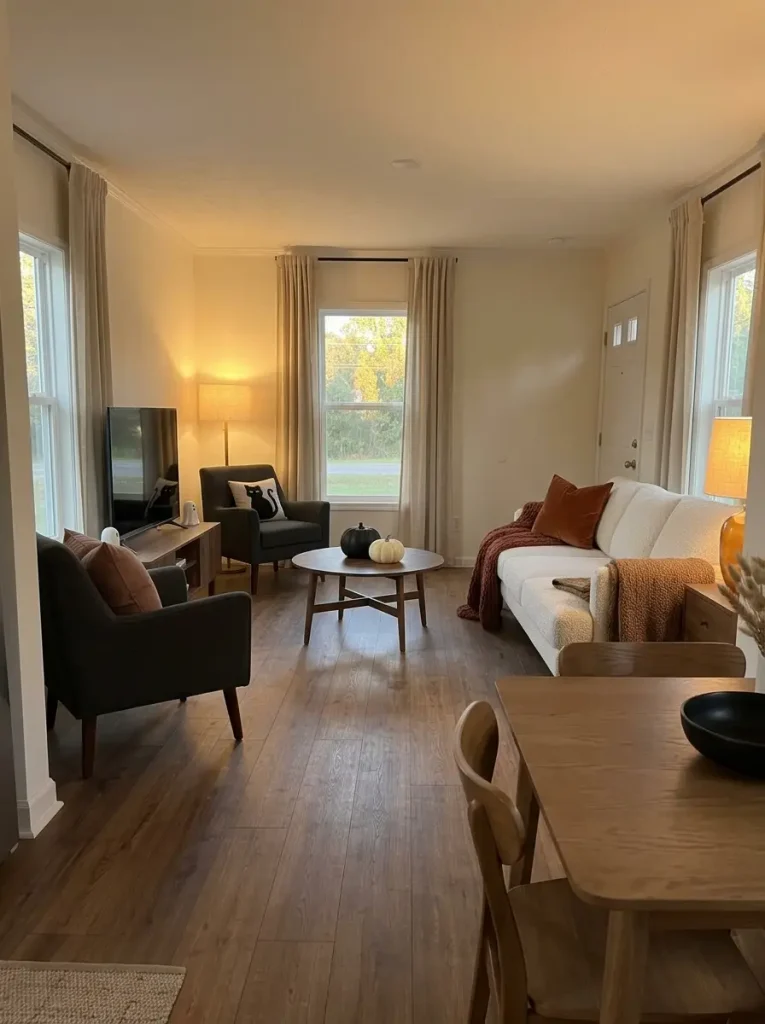
Start with the largest finish you cannot easily change: flooring, cabinetry, wall color, or a dominant sofa. Then choose one warm Halloween color that looks intentional beside it.
This also keeps an older mobile home from feeling as though a separate seasonal scheme was dropped on top of its character. If your finishes lean retro, wood-heavy, or nostalgic, the <a href=”/vintage-halloween-mobile-home-decor/”>vintage Halloween décor guide for an older mobile home</a> explores that specific direction in more depth. That page is a verified specialist on StylishGalore. Stylish Galore
A useful test is simple: mentally remove every pumpkin. If the remaining fall color still looks good with the room, the palette has a strong foundation.
3. Use Black Like an Outline, Not a Heavy Block
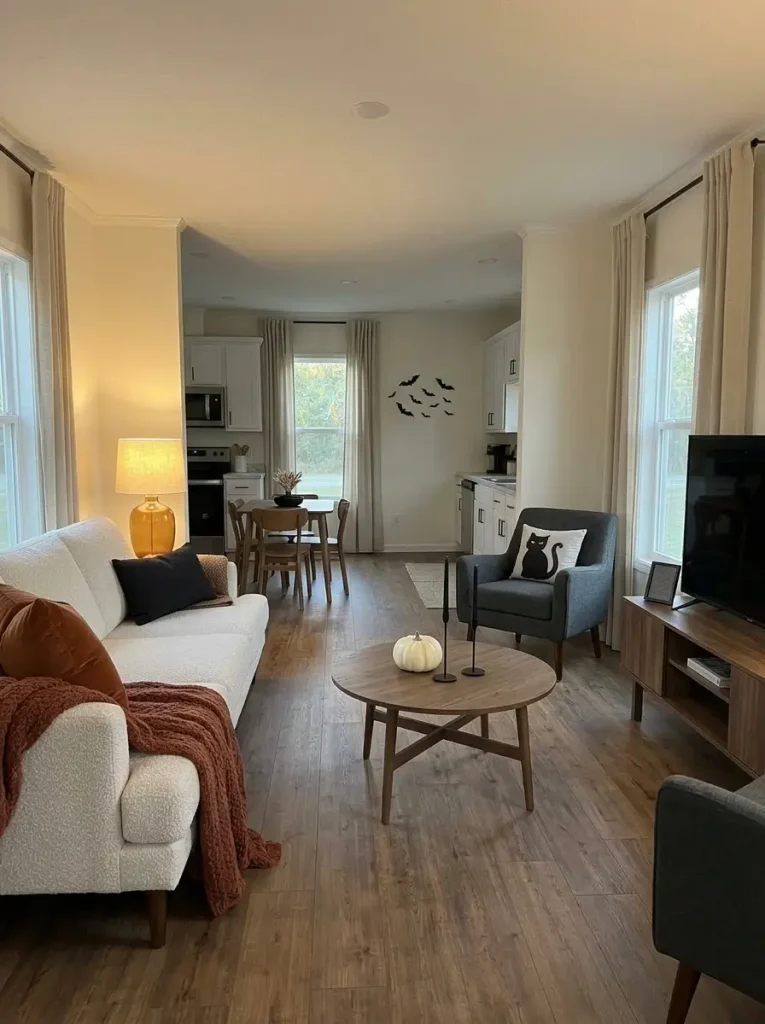
Black can make orange, cream, tan, and warm wood feel immediately more Halloween-like, but its visual weight matters in a small room.
Compare a large black throw, several black pumpkins, black wall art, dark pillow covers, and a black rug with a narrower treatment: one charcoal cushion, two slim candlesticks, and a small bat silhouette above an existing focal area.
Both palettes technically contain black. Only the second allows the lighter room to remain visually open.
Think of dark décor as punctuation.
Use it where the eye benefits from definition: against pale shelving, beside a cream sofa, around an amber light source, or within one seasonal vignette. Stop before unrelated dark accents begin competing from several directions.
Quick check: stand at the longest sightline in your mobile home. If your eye jumps between multiple black patches before it notices the room itself, consolidate them. One purposeful dark note can provide stronger Halloween definition than several disconnected ones.
4. Choose One Pumpkin Tone and Repeat It Through Different Materials
Matching every Halloween object perfectly can feel staged. Using several unrelated oranges can feel restless. A better middle ground is to choose one dominant pumpkin family and let material create the variation.
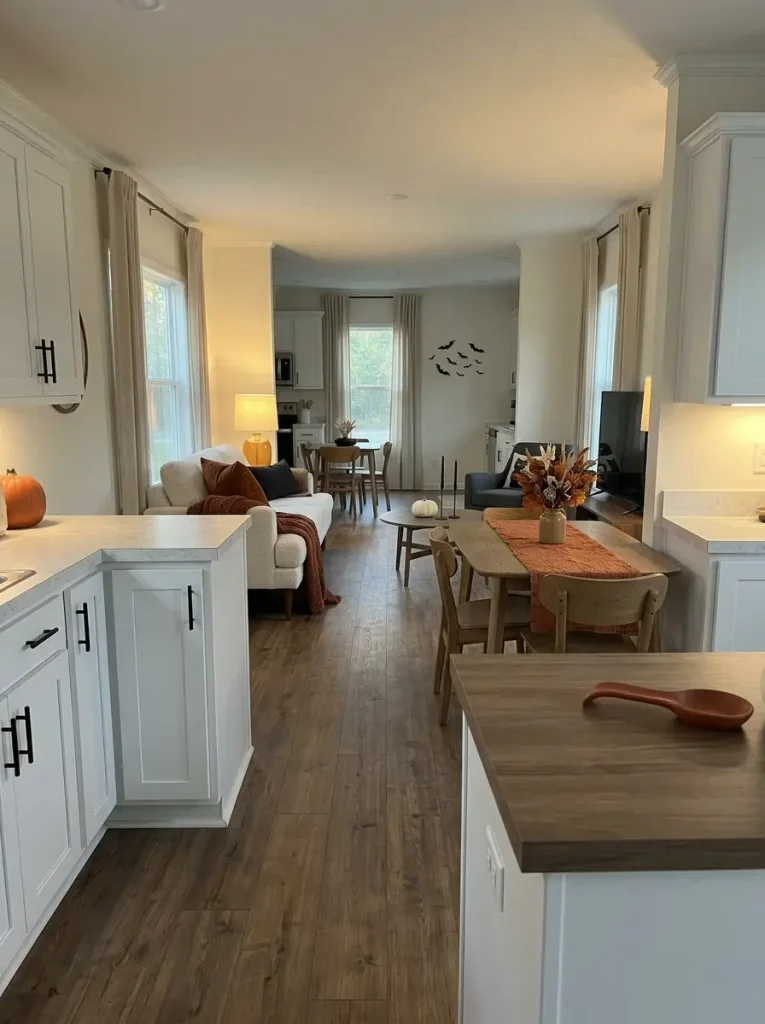
Burnt pumpkin might appear as a velvet cushion, a matte ceramic pumpkin, a washed cotton tea towel, and dried foliage. Their surfaces respond differently to light, so the room gains depth even though the hue stays connected.
That strategy is particularly useful in a small mobile home because connected areas often appear in the same frame. Repeating one tone carries the eye from zone to zone without requiring identical decorative sets.
One hue. Four surfaces. Less visual noise.
Burnt pumpkinIf your permanent room already contains strong orange or rust, shift the seasonal tone slightly darker or dustier so it still reads as an intentional October layer.
5. Let Texture Create the Cozy Feeling Before You Add Another Halloween Character
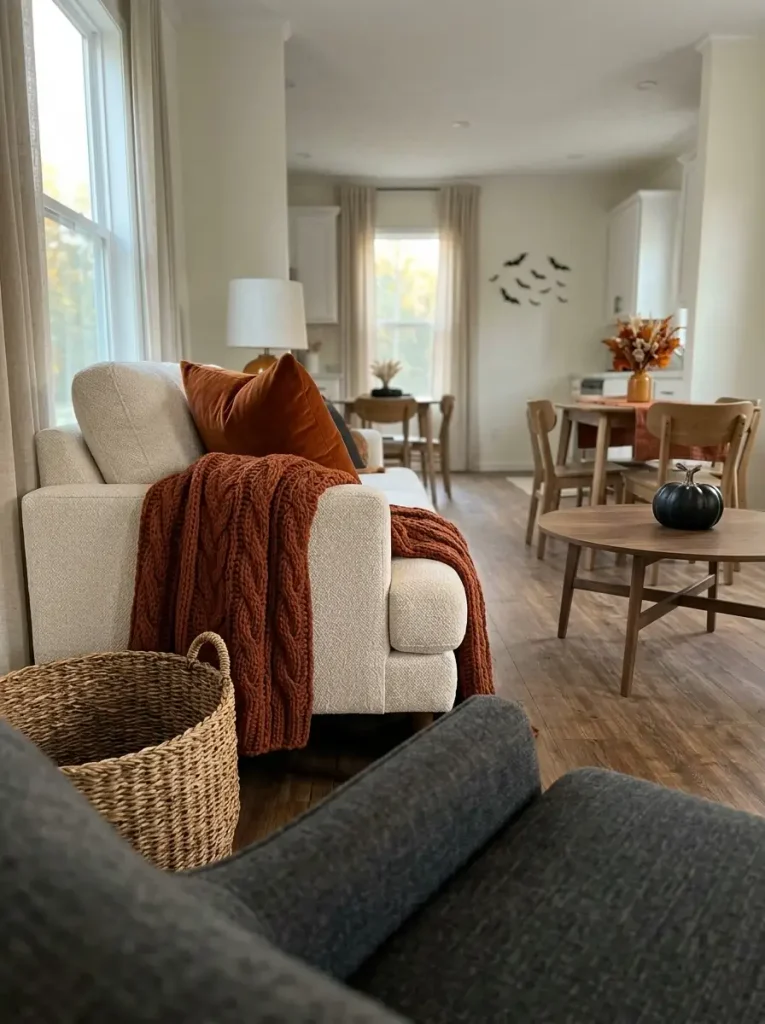
Run your eye across the room as though every decorative motif had been blurred out.
If the sofa, curtains, rug, pillows, and hard surfaces all read as smooth and flat, another jack-o’-lantern may make the room more Halloween, but it will not necessarily make it more cozy.
Texture changes that sensory impression.
A chunky rust throw can soften a plain sofa. Velvet catches evening light differently from cotton. A woven basket beside an existing chair introduces warmth without needing a printed ghost. Even a small boucle or brushed-cotton cushion can make a seating area feel more inviting when the rest of the room contains hard cabinetry and smooth manufactured surfaces.
For a compact mobile home, prioritize texture where people already touch or sit: sofa, armchair, bed, dining seat, or an existing basket. Those locations give the material a practical role as well as a decorative one.
A useful stopping point arrives when the room still looks cozy after you mentally remove the Halloween characters. At that stage, pumpkins, bats, ghosts, or skeletons can act as accents instead of carrying the entire seasonal mood.
6. Swap Everyday Textiles for Seasonal Ones Instead of Stacking More Layers On
Soft furnishings are one of the easiest ways to make a small mobile home feel cozy for Halloween, but they can also create bulk surprisingly fast.
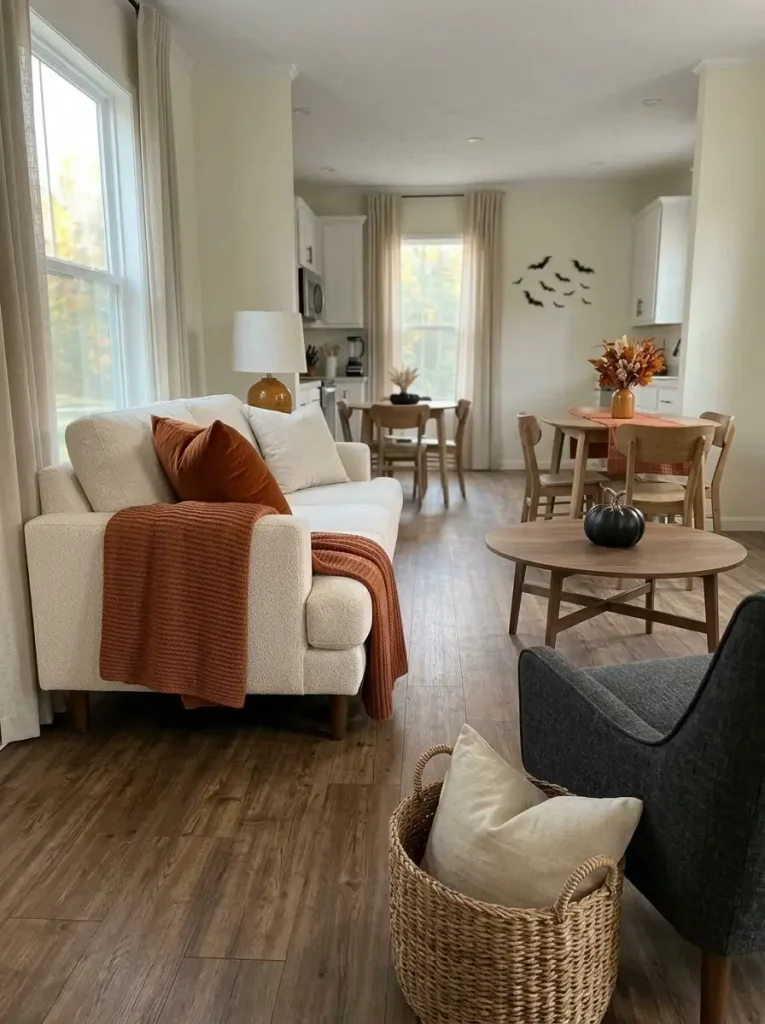
Picture a sofa that already has four everyday cushions and a throw. Adding three Halloween pillows plus another blanket creates eight visible soft-furnishing pieces competing on one compact piece of furniture.
A cleaner move is seasonal substitution.
Remove an everyday cushion cover and replace it with a rust velvet, black-cat, pumpkin, or subtle ghost version. Exchange the regular throw for a heavier burnt-orange or cream knit. Keep the same pillow inserts whenever possible.
The furniture gains a seasonal identity while its physical volume stays almost unchanged.
Add or swap? Check the surface first.
Choose the area you are about to decorate. The recommendation changes according to how much physical space that zone already consumes.
Keep the existing inserts and furniture count. One seasonal textile can change the seating zone without creating extra bulky storage later.
Move a normal vase, tray, or decorative bowl away while the Halloween piece is out. Keep enough clear surface for the activity that table or counter already supports.
Use a rug, runner, or item that occupies an already-defined edge. Freestanding décor deserves more scrutiny because compact walking routes have little spare space.
</div> <p class=”sgx6-rule”><strong>Seasonal editing test:</strong> whenever something enters the room, ask whether an everyday piece can temporarily leave.</p> </section> <!– /wp:html –>
The same idea works on dining chairs, beds, hand towels, and small bench cushions. In a mobile home, substitution is especially useful because one additional object can influence several connected views at once.
7. Choose Matte, Soft and Aged Finishes When Glossy Halloween Decor Feels Too Busy
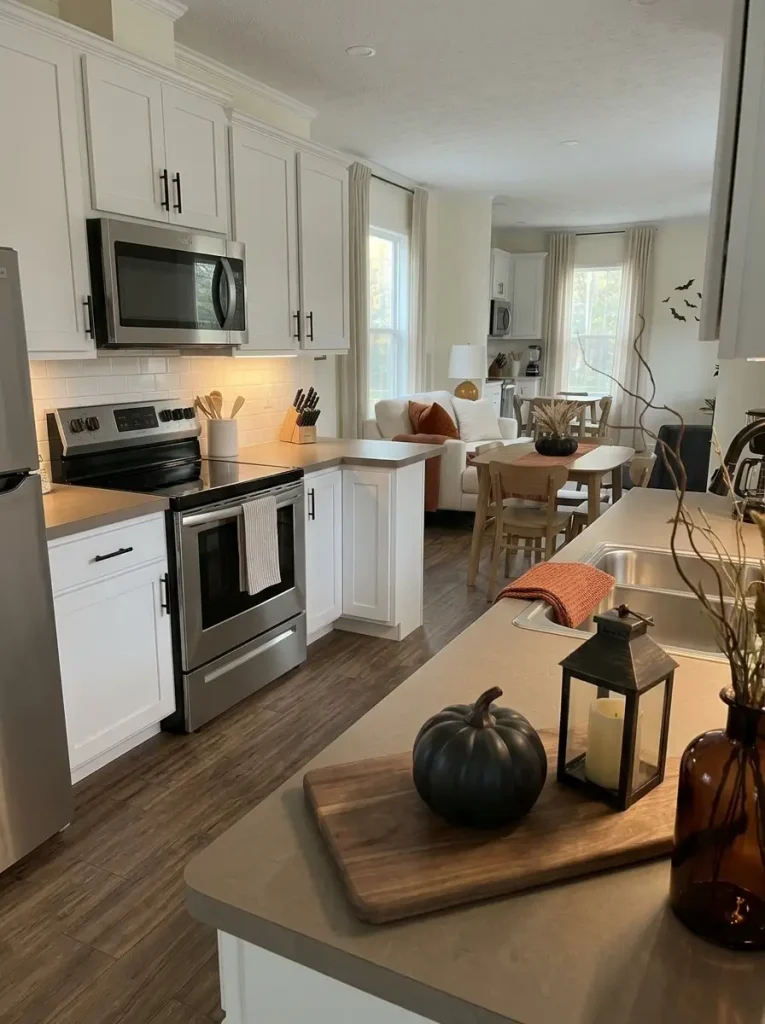
Two decorations can have the same size and color yet create very different levels of visual activity.
A glossy orange pumpkin reflects windows, lamps, television light, and nearby objects. A matte ceramic pumpkin of the same dimensions absorbs more of that visual movement. Velvet, painted wood, aged metal, brushed cotton, papier-mâché, and unglazed ceramic can therefore read more quietly.
That makes finish selection unusually useful in a compact room.
If your kitchen already contains polished appliances, glossy cabinets, reflective tile, or bright stone, another shiny seasonal object may add more sparkle than warmth. Test one softer surface near those hard finishes.
A very matte room can handle one reflective accent—a small mercury-glass pumpkin or metallic candleholder, for example—without suddenly feeling busy.
Photograph the entire room with the lights on. If small seasonal pieces produce several bright highlights across the image, reduce reflective finishes before reducing the color.
8. Use One Rounded Halloween Shape to Soften a Boxy Small Room
Mobile homes often contain a lot of rectangular geometry: cabinet doors, televisions, windows, sofas, built-ins, doors, dining tables, and narrow hall openings.
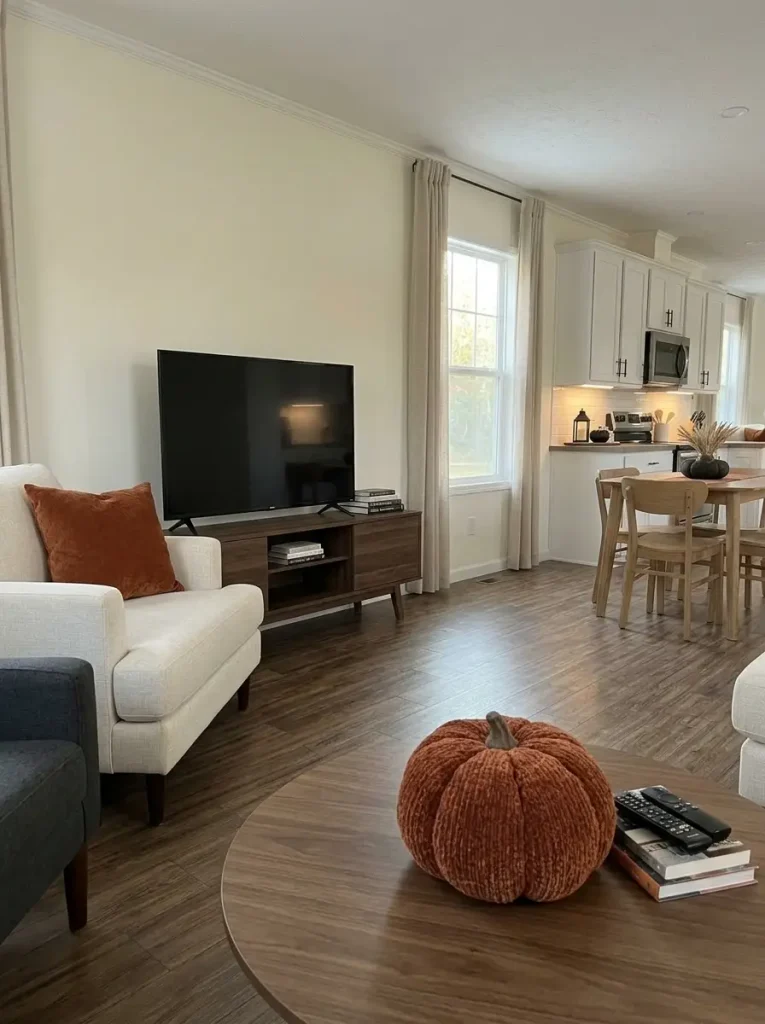
That geometry can make a compact room feel efficient but visually firm.
One rounded seasonal form creates useful contrast without requiring an entire collection. A fabric pumpkin on the coffee table, a soft ghost cushion on an armchair, or one plump pumpkin pillow can break up the harder lines around it.
Imagine a living room with a rectangular television, low media console, straight-edged sofa, and square side table. A cluster of six pumpkins introduces six new decorative objects. One medium rounded pumpkin on an existing tray gives the eye a single soft counterpoint.
Placement clue: use the curved form where several straight lines meet—often the coffee table, sofa corner, dining table, or end of a cabinet run.
Skip this move when the room already contains several round stools, an arched mirror, circular table, or curved upholstery. In that case, Halloween contrast may come more effectively from material or color.
9. Create an October Shelf by Replacing What Is Already There
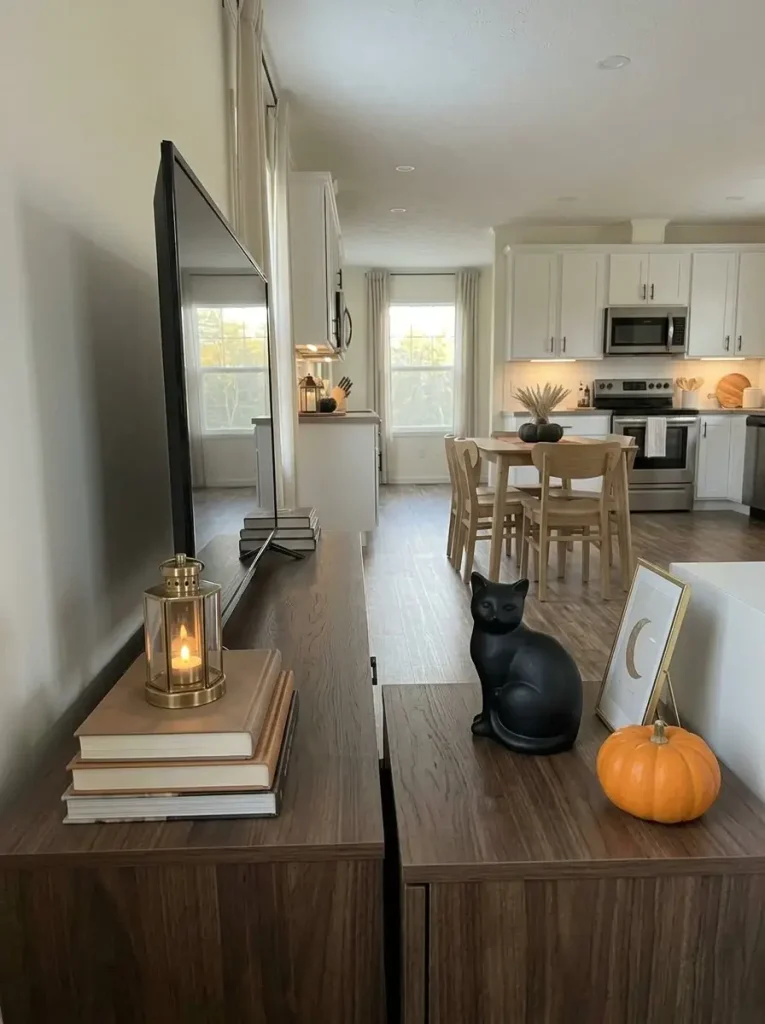
A Halloween shelf often starts as a normal shelf that already contains books, frames, candles, plants, and small objects.
Adding seasonal décor on top of all of that quickly creates density.
Treat the shelf as a temporary edit. Remove some of the everyday decorative pieces first. Keep useful books or objects that help the composition, then introduce only enough Halloween detail to establish the season.
For example:
- keep three neutral books;
- remove two everyday ornaments;
- retain one small lamp;
- add one black ceramic cat;
- exchange the ordinary framed print for a seasonal one.
Stand several feet away after finishing. If you see many individual objects before you understand the shelf as one composition, remove the smallest or most redundant piece.
In a connected mobile-home interior, that restraint has extra value because shelf detail may remain visible from the kitchen or dining area as well as the living room.
10. Lower the Glow After Sunset With Three Small Pools of Warm Light
A room that looks pleasantly autumnal during the day can feel surprisingly flat after sunset when one bright ceiling fixture does all the work.
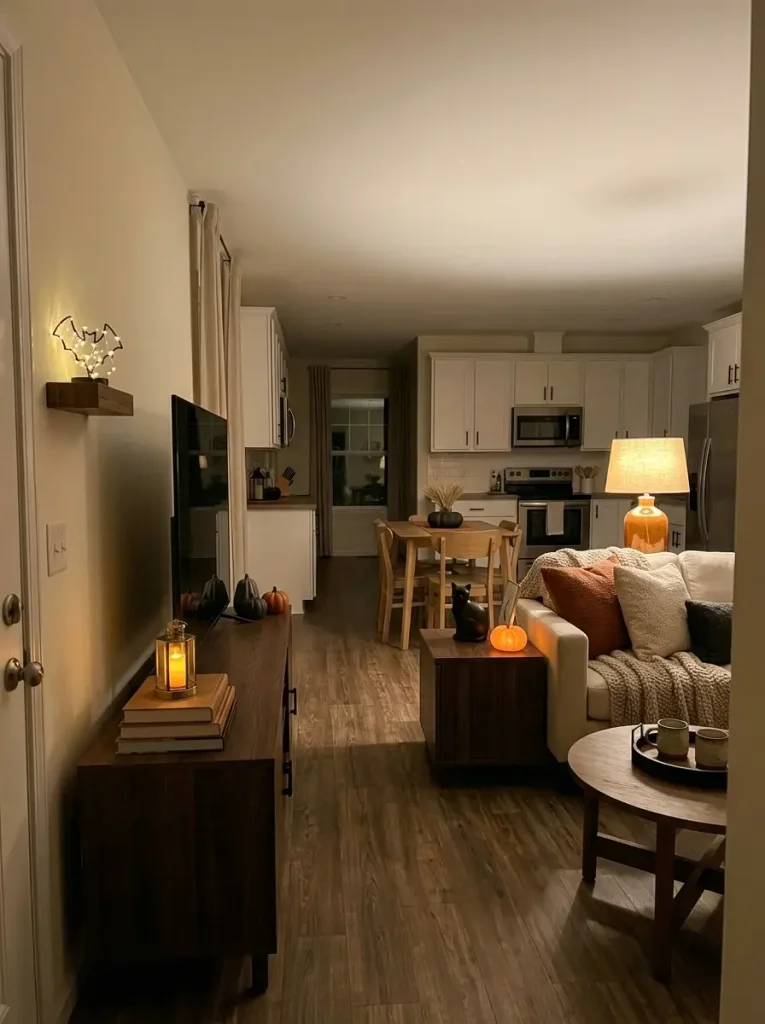
For cozy Halloween atmosphere, think in three lighting levels:
- an existing lamp or warm room light;
- a lower decorative glow near the main Halloween zone;
- a very small accent near another existing feature.
Those sources do not need equal brightness. Their purpose is to create depth at different heights.
In a compact mobile home, distribute the light along the room instead of concentrating every illuminated decoration on one tabletop. The eye can then travel through the space while useful surfaces stay comparatively clear.
After-dark lighting map
Diagnose the glow before adding more décor
Choose the description closest to your room at night. The recommendation changes according to which lighting layer is missing.
Safety note: use decorative lighting according to manufacturer instructions, inspect seasonal light strings before use, and favor battery-operated flameless candle effects when you want a low candle-like glow.
The U.S. Fire Administration recommends considering battery-operated flameless candles, inspecting holiday light strings before use, discarding strands with damaged wiring, and following manufacturer instructions for how many strands may be connected. U.S. Fire Administration
Once those lighting layers are doing their job, resist filling every dark corner with another illuminated pumpkin. Darkness contributes to the composition too.
11. Let Shadows and Silhouettes Supply the Spooky Layer
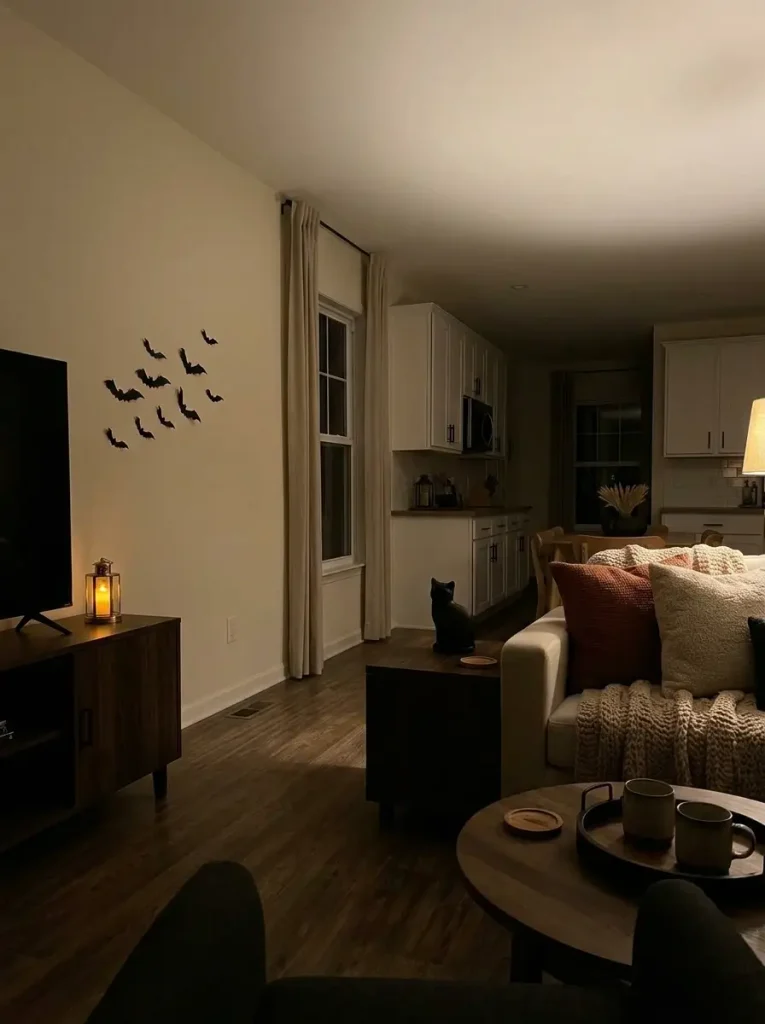
What if a Halloween detail occupied almost no usable room space during the day but became noticeably more atmospheric after sunset?
That is where silhouettes work well.
A small group of black bats on one pale wall, a paper ghost shape near a lamp, or a cutout branch casting a shadow can create more evening depth than another collection of freestanding decorations.
The contrast is especially useful in a small mobile home because the décor can remain close to the architecture. Nothing needs to project far into the room.
Look at the wall from your normal seated position. If the silhouettes already form one readable composition, stop there. Spreading individual bats or spiders across several walls turns a concentrated motif into background noise.
Choose this strategy when the room has enough warm color and texture but still lacks an unmistakably spooky note.
12. Let One Rug or Runner Carry the Floor-Level Halloween Mood
The floor is a powerful visual plane because it can connect several parts of a small home at once.
It does not need several decorative objects to do that.
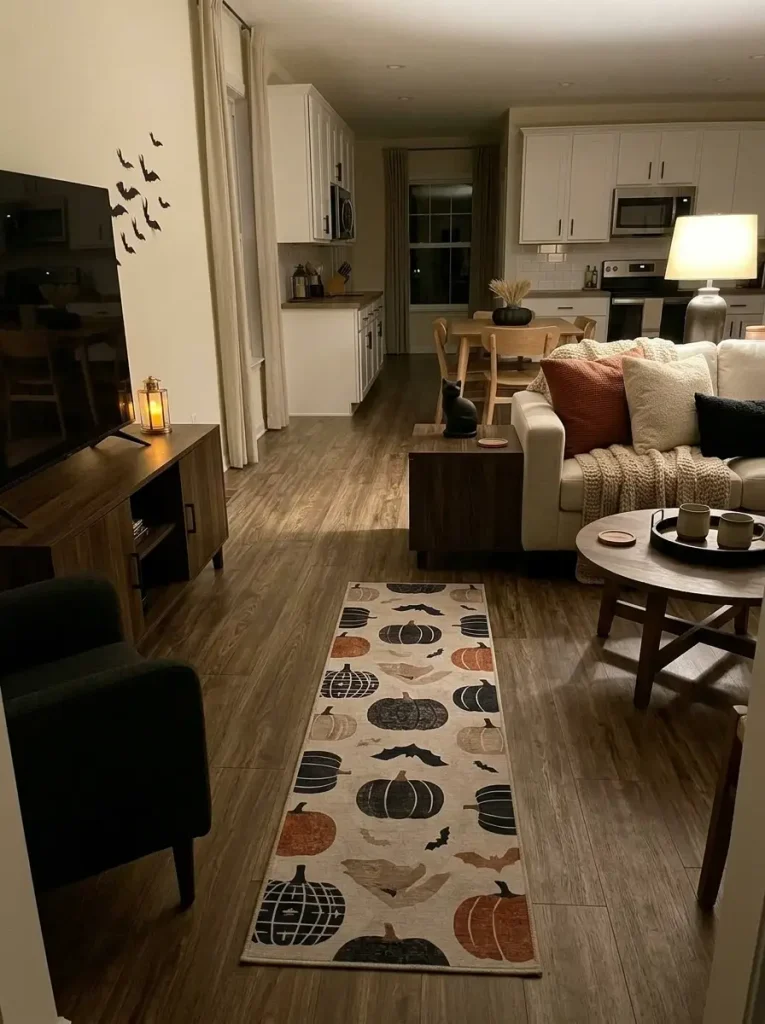
A pumpkin-toned kitchen runner, black-and-cream rug near the sofa, or one ghost-patterned mat at an interior entry can create a low seasonal layer while the surrounding floor stays open.
The strongest candidate is usually a textile replacing one that you already use. That preserves function while changing the seasonal message.
Before keeping the rug in place, check that:
- doors still move freely;
- dining or desk chairs do not catch awkwardly;
- the rug does not create an inconvenient obstacle on a narrow route.
Pattern strength should also respond to the rest of the room. If the furniture and walls already contain obvious Halloween motifs, choose a quieter textile. A plain room can support a more graphic rug.
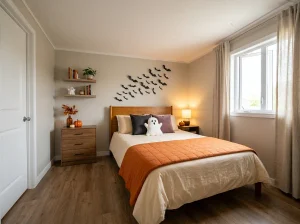
When the floor already says “October,” separate pumpkins and baskets on that same plane often become unnecessary.
13. Give the Dining Area a Halloween Night Mode Instead of Leaving It Decorated All Day
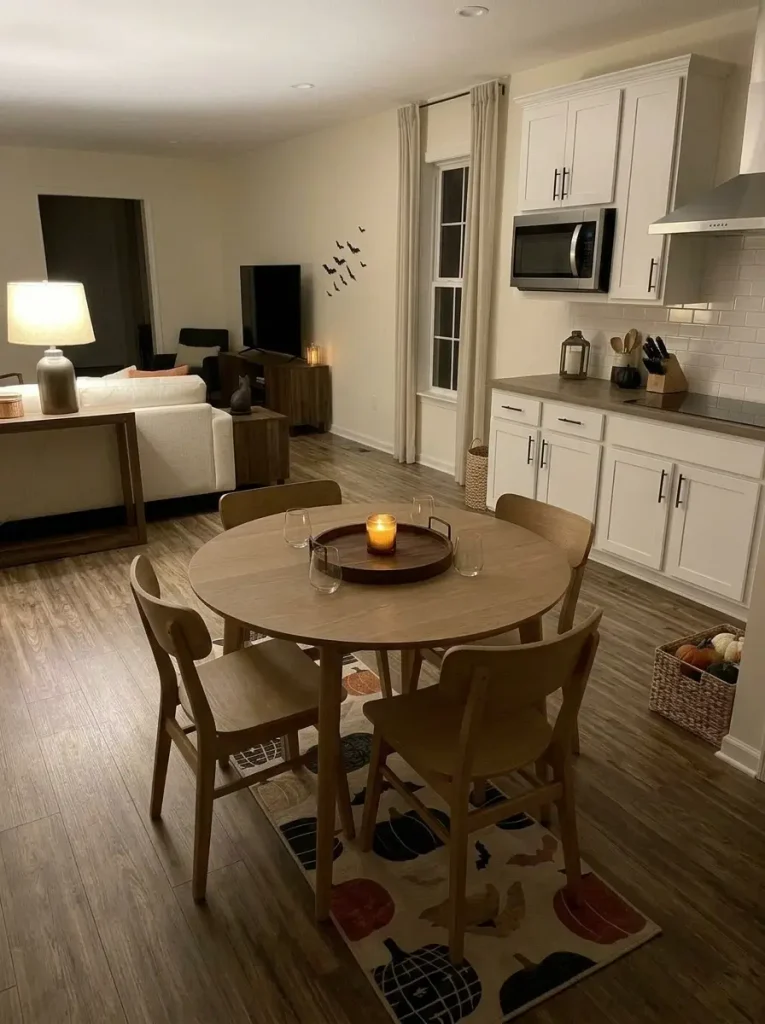
A dining table can support one of the richer Halloween moments in a compact home because the tabletop creates a natural visual boundary.
The problem begins when the display stays in full party mode during breakfast, laptop work, homework, meal prep, and ordinary weekday dinners.
Use time-based styling.
Keep the table almost normal through the day. Before dinner or a Halloween movie night, bring out one shallow tray, a few flameless candle effects, dark napkins, or a compact centerpiece. Afterward, return the temporary pieces to one nearby storage spot.
The same table can therefore feel festive in the evening without becoming an obstacle all day.
Let the table change with the clock
A compact dining area can support richer styling when the display appears only during the hours that benefit from it.
Leave the working table mostly open. One textile cue or small seasonal bowl is enough.
Bring out a shallow tray, seasonal napkins, and a small warm glow.
Return the temporary pieces to one nearby basket, cabinet, or seasonal bin.
Best fit: use this approach when the dining table performs several jobs during the week and permanent centerpieces become frustrating.
The temporary nature of the scene also gives you permission to make it a little richer because its footprint has a defined beginning and end.
14. Make the Kitchen Feel Cozy Through Warm Materials, Not Countertop Characters
A compact kitchen can become visually crowded faster than almost any other room because so many of its visible objects are functional.
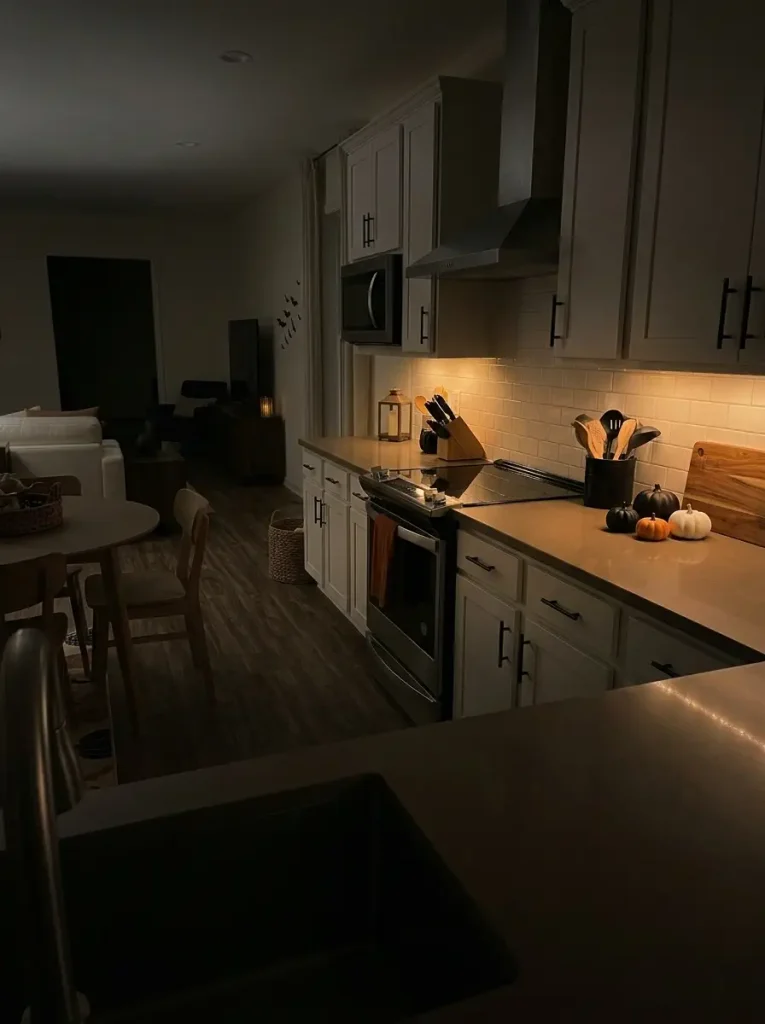
Look first at what can change without occupying another work surface.
A burnt-orange hand towel, warm wood cutting board left in its normal position, dark utensil crock you already use, pumpkin-toned runner, amber under-cabinet glow, or one small seasonal print can alter the atmosphere while the prep area remains available.
For a white kitchen, warm textiles and wood are particularly effective because they soften large pale surfaces. In a darker kitchen, cream, muted orange, or warm tan can keep the Halloween layer from feeling too heavy.
Use the strongest practical test: prepare an ordinary meal.
If pumpkins, figurines, signs, or lanterns have to be moved before chopping, mixing, draining, or setting down cookware, those decorations are occupying premium kitchen territory.
Keep the seasonal character around the edges of the routine and allow material, color, and lighting to carry more of the mood.
15. Give the Bedroom a Softer Echo of the Main Halloween Palette
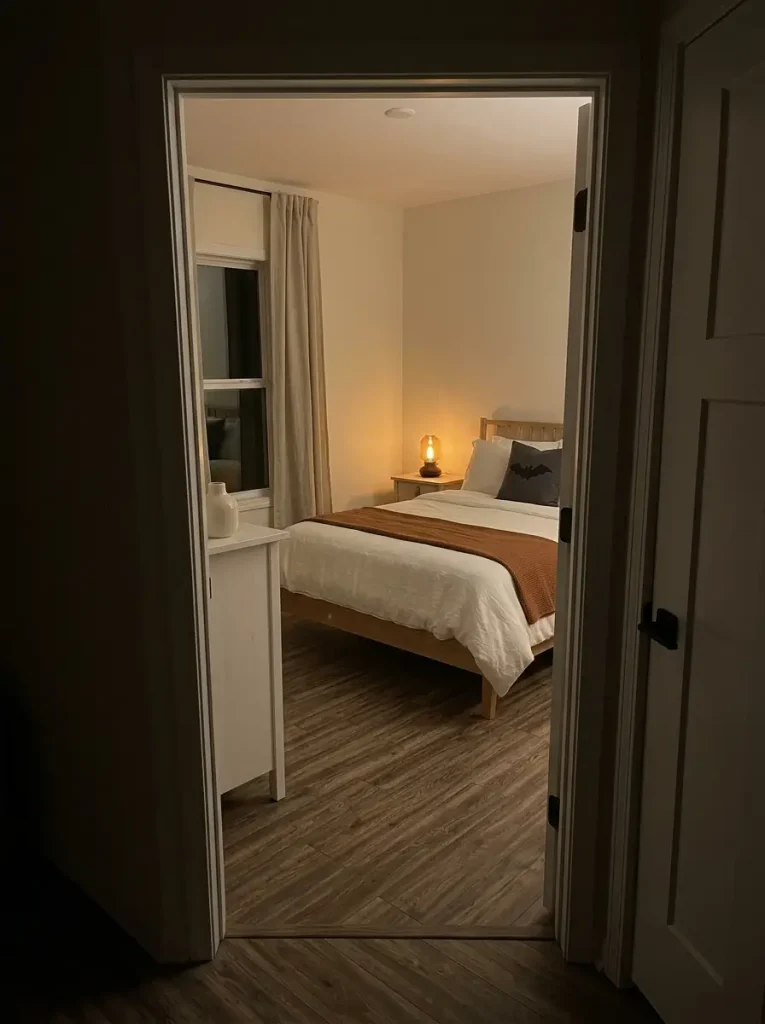
The bedroom does not need to repeat the living room at full intensity.
If the main space uses burnt orange, cream, black, and warm wood, carry only two or three of those cues into the bedroom. A rust throw across the lower portion of the bed, one dark cushion, and a small warm bedside glow can create continuity while maintaining a calmer atmosphere.
The bed already occupies a large share of the visual field in many mobile-home bedrooms, so one textile change can have more influence than several tiny accents scattered around the room.
This whole-home article should stop at that continuity decision. Bedding hierarchy, headboard walls, windows, dresser styling, pathways, and bedroom-specific lighting already belong to the dedicated <a href=”/halloween-mobile-home-bedroom-decor/”>cozy Halloween bedroom decor guide for mobile homes</a>, which is the more specific specialist destination. Stylish Galore
A useful stopping point: if the bedroom clearly belongs to the same Halloween home when viewed from its doorway, it does not need every motif used elsewhere.
16. In the Bathroom, Let One Soft Seasonal Cue Be Enough
Bathrooms compress a lot of function into very little room, so Halloween décor should earn its footprint.
Begin with something the bathroom already needs: a hand towel, shower curtain, soap dispenser, bath mat, or framed print. Change one of those into the seasonal cue before adding another decorative object.
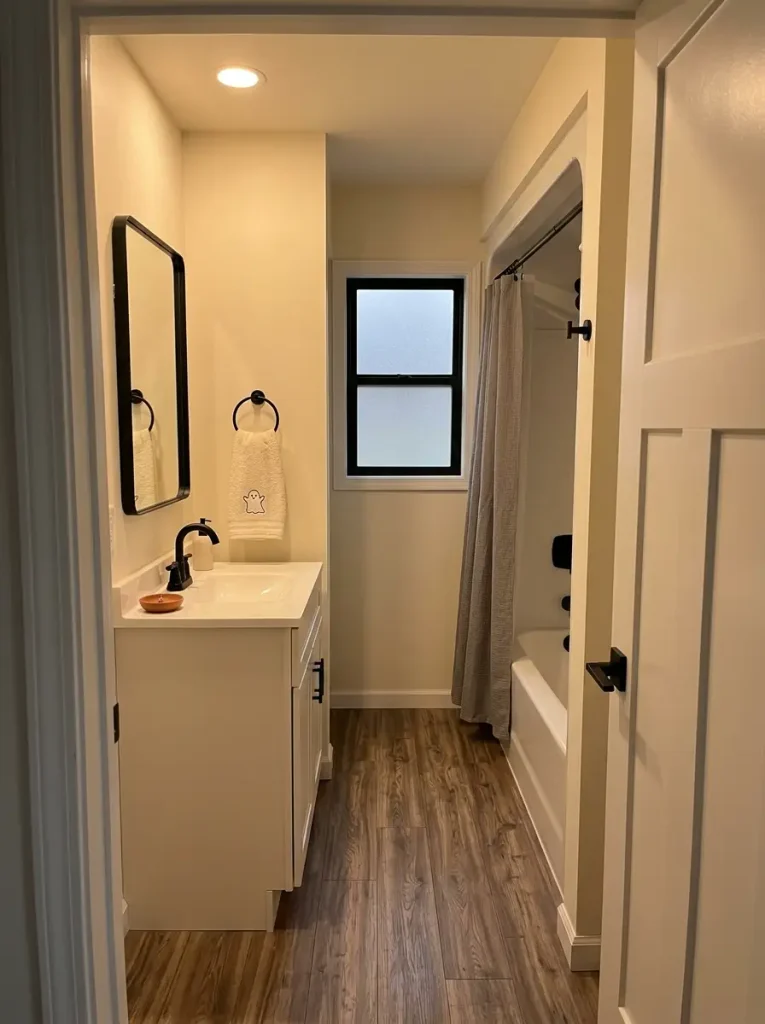
A ghost hand towel beside a neutral sink can be enough. So can a fine bat pattern on an ivory shower curtain or one compact black-and-orange print.
Look at the finished bathroom from the doorway. If the Halloween cue is immediately visible, tiny pumpkins around the faucet or toiletries are unlikely to improve the message.
The dedicated <a href=”/halloween-mobile-home-bathroom-decor/”>Halloween bathroom decor guide for a small mobile home</a> owns the deeper treatment of shower, sink, mirror, shelf, and other bathroom-specific constraints. Stylish Galore
This restrained approach also simplifies cleaning because fewer objects need to be removed from wet or frequently wiped surfaces.
17. Use a One-Bin Rule So Halloween Leaves as Easily as It Arrives
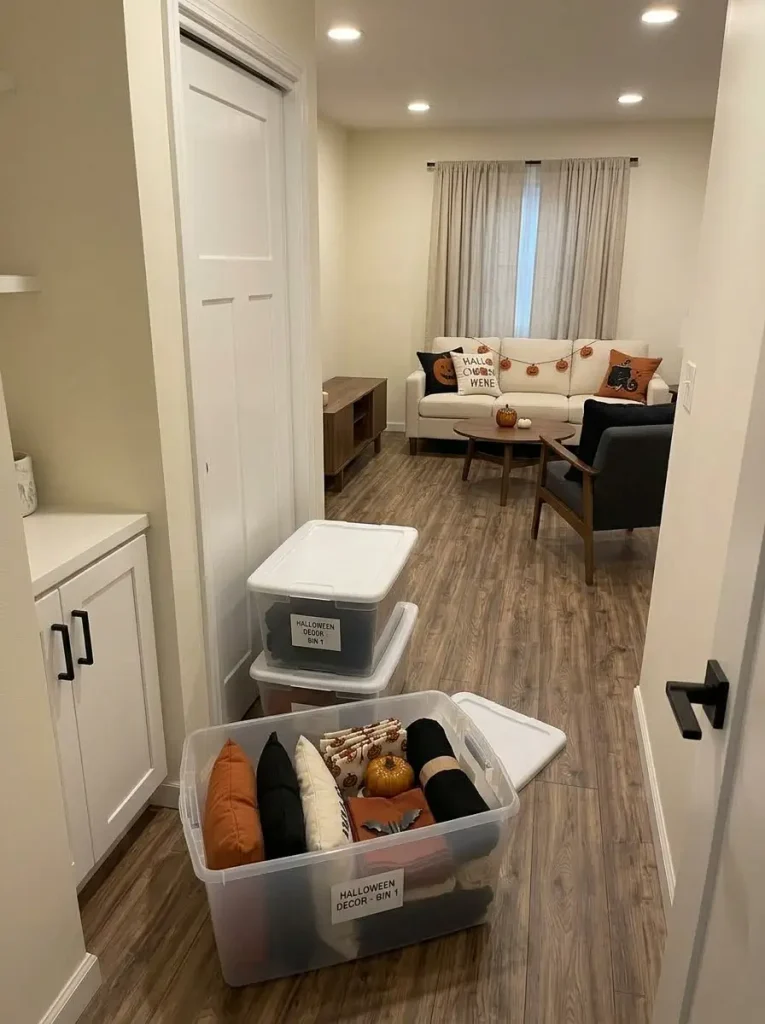
The most overlooked form of Halloween clutter appears after Halloween.
A decorative object may look small on a shelf yet become surprisingly awkward when it has to live in a closet for the other eleven months of the year. Large pillow inserts, rigid signs, tall lanterns, bulky faux pumpkins, and fragile figures can consume more storage volume than their October usefulness justifies.
Set your storage limit before shopping.
For a small mobile home, one seasonal bin can become a practical ceiling for the softer, non-essential part of the collection. The idea is not that every household must literally own only one box. The limit works because it makes every new object compete for finite off-season storage.
Does the new decoration deserve storage space?
Choose the closest storage footprint before buying or making the item.
Buying filter: picture November before picturing October. Storage is part of the decorating decision in a small home.
For Halloween pieces that can be lightweight, removable, or easier to store, continue with the <a href=”/diy-halloween-mobile-home-decor/”>DIY Halloween decor ideas for mobile homes</a>. The specialist guide explicitly focuses on handmade projects that work with limited surfaces and compact-home constraints. Stylish Galore
A Cozy Halloween Home Still Needs Breathing Room
A cozy Halloween mobile home does not have to look empty, and it does not have to be restrained until it loses personality. It simply benefits from letting light, texture, material, color, and a few strong seasonal shapes carry more of the atmosphere.
Start with the room you already have. Repair the weakest cozy layer, exchange everyday pieces where possible, protect the surfaces and routes used every day, and judge the finished home again after sunset.
When one more decoration feels tempting, remove something first and compare the room both ways. In a compact home, a seasonal piece becomes more noticeable when it has enough visual space to matter.
Love this look? Save your favorite idea to Pinterest so you can find it again when you start decorating.