

An older mobile home can be one of the best settings for Halloween because it already has something newer interiors often try to recreate: character. Warm wood cabinets, cream walls, brown tile, old-fashioned mirrors, darker hardware, compact rooms, and slightly retro proportions can make vintage halloween mobile home decor feel deliberate instead of dated.
The trick is not to bury those features beneath modern Halloween merchandise. Let the home participate in the look. Faded orange paper decorations become richer against walnut cabinetry. Black cats and witches feel believable beside an older mirror. A handmade ghost garland can make a narrow architectural opening feel like part of a Halloween tradition that has existed for decades.
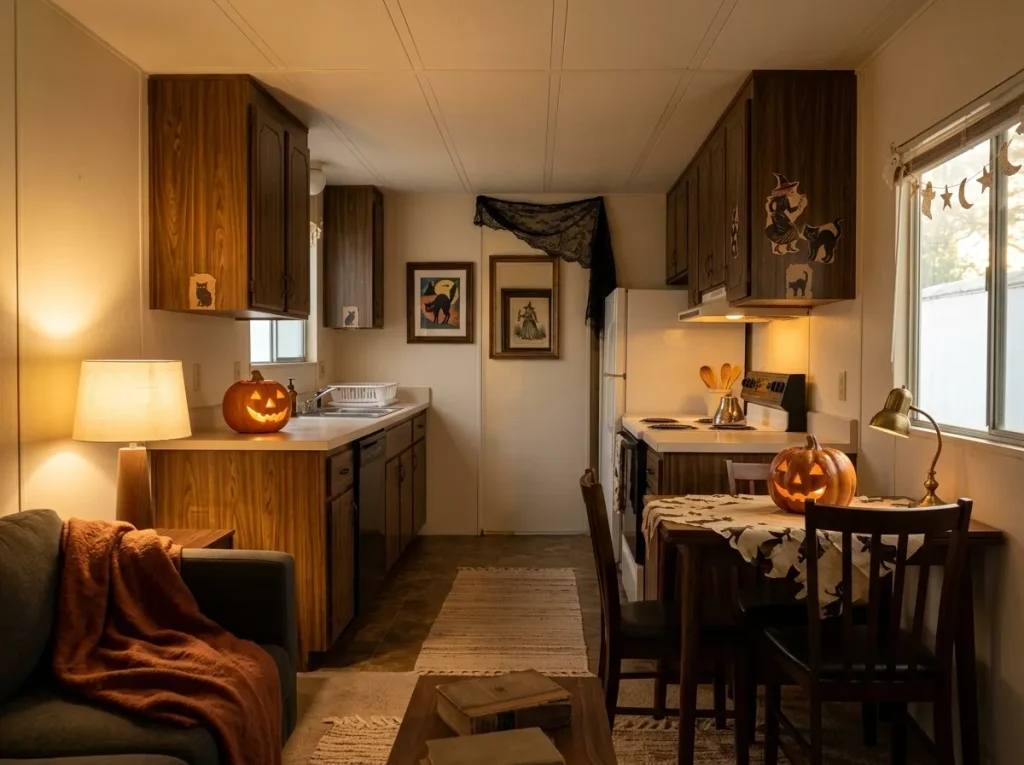
These 19 ideas use the architecture, finishes, sightlines, and limited surfaces of an older manufactured home as part of the decorating strategy. Some changes are tiny. Others reshape the atmosphere of an entire room. Together, they create a house that feels collected over time rather than decorated in one shopping trip.
1. Let the Home’s Original Wood, Brown Tile and Cream Finishes Become the Halloween Backdrop
Before buying anything, stand in the middle of the room and study what is already there.
The honey-toned cabinetry you normally wish were lighter, the brown backsplash you have considered covering, cream laminate, bronze hardware, dark wood trim, or a slightly aged wall color may suddenly become useful.
Pumpkin orange gains depth beside walnut and oak. Ivory paper ghosts look softer against warm cream than against stark white. Black silhouettes gain more presence beside brown tile because the surrounding palette already carries the muted warmth associated with an older interior.
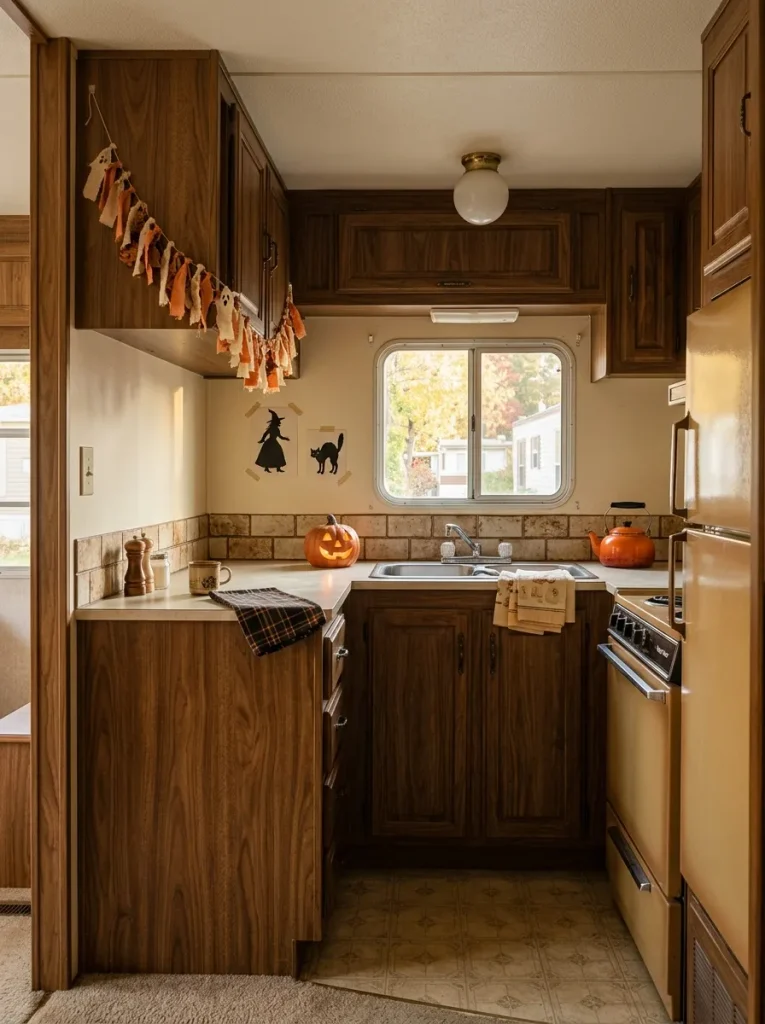
This matters inside a compact mobile home because trying to disguise every dated feature can introduce more visual material than the room needs. Start by deciding which permanent finishes already support the Halloween mood.
Photograph the room before decorating and identify three dominant permanent colors. Then introduce only two or three seasonal colors around them.
A walnut-brown, cream, and aged-brass room might take faded pumpkin, soot black, and parchment beautifully. Honey oak, beige, and dark bronze may work better with rust orange, black, and antique ivory.
For a broader seasonal foundation, see How to Make an Older Mobile Home Feel Cozy for Fall.
Vintage rule: when an original finish already makes the room feel older, test Halloween décor beside it before trying to cover it.
2. Choose Which Kind of Vintage Halloween You Mean Before You Mix the Decades
“Vintage Halloween” can describe several different visual worlds.
A handmade paper witch and crescent moon create one atmosphere. A smiling ceramic jack-o’-lantern creates another. Brown, orange, avocado, and amber produce a very different room from black, cream, and faded paper.
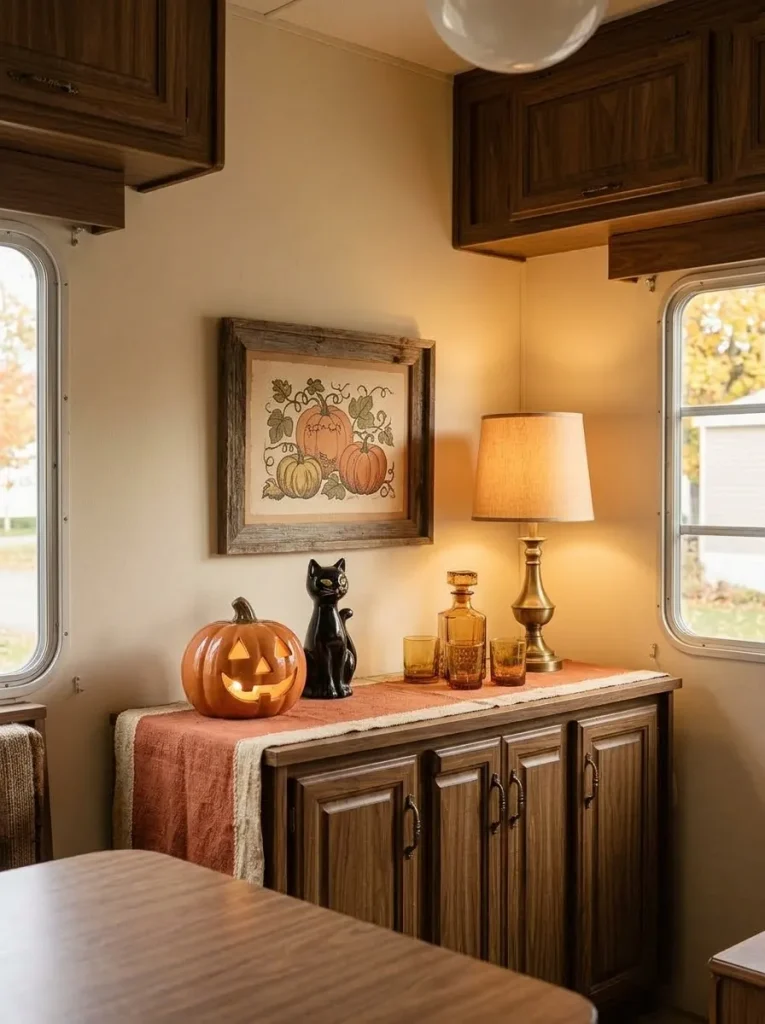
When every reference appears with equal strength, a small home becomes visually crowded quickly.
Choose the era emotion first. You do not need museum-level historical accuracy. You need a visual family strong enough to control later decisions.
Vintage Halloween Era Dial
Vintage direction finder
Build your vintage Halloween direction
Choose a vintage family and then choose how strongly you want Halloween to appear. Both selections change the recommendations below.
1. Choose your vintage family
2. Choose your Halloween intensity
Paper-Spook Nostalgia
Best for a handmade, graphic Halloween look that feels collected over time.
Retro Pumpkin Kitsch
Best for a cheerful vintage room with expressive ceramic characters and stronger graphics.
1970s Harvest Haunt
Best beside walnut cabinetry, brown tile, beige surfaces and naturally warm older finishes.
If your interior already contains walnut, brown tile, amber, or avocado undertones, the 1970s Harvest Haunt option will often cooperate with the room more naturally. A lighter cream or white interior can carry the graphic Paper-Spook Nostalgia direction beautifully.
Once you choose a family, let most of the visible seasonal décor belong to it. A few exceptions keep the home personal; too many exceptions erase the sense of era.
3. Build the Halloween Palette From the Colors That Already Date the Home
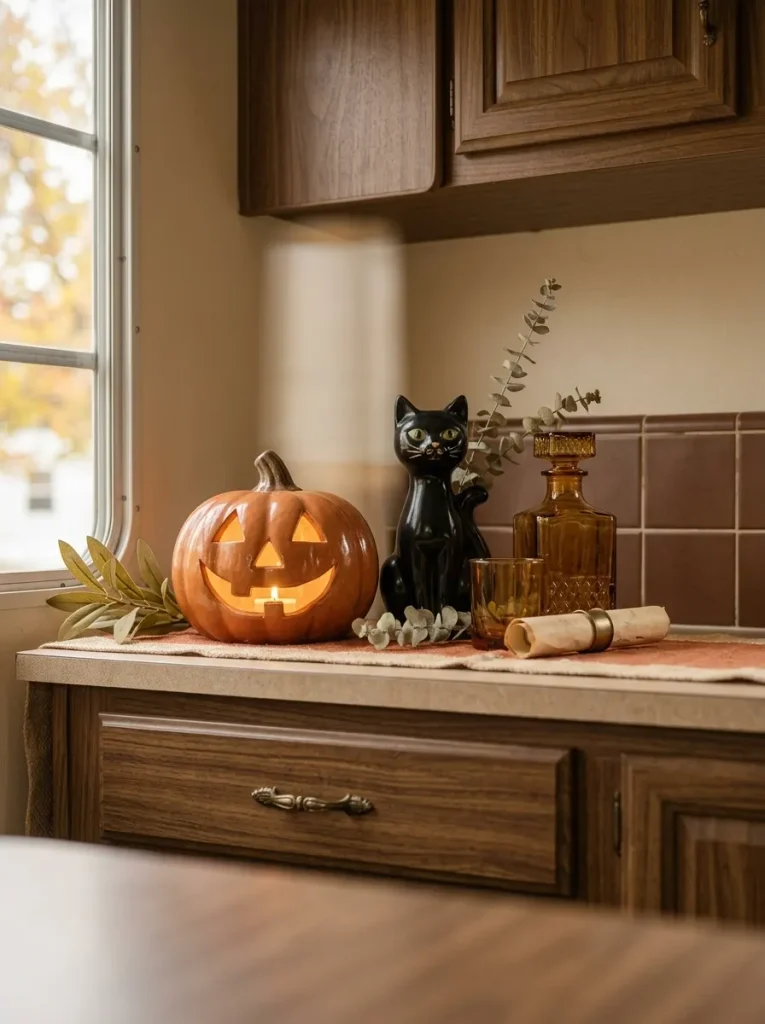
Imagine two older mobile-home kitchens.
One has walnut cabinets, beige counters, and brown tile. The other has white cabinetry, cream walls, and black hardware.
The same bright-orange decorations would produce completely different results in those rooms.
Let the permanent interior choose the seasonal palette.
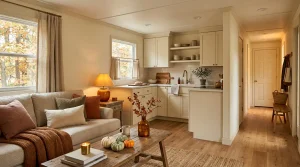
For a warm brown room, try burnt pumpkin, parchment, soot black, muted olive, and small touches of aged brass. The orange should look slightly softened or browned so it sits comfortably beside woodgrain.
A cream, white, or pale-beige room can handle stronger graphic contrast: black, ivory, pumpkin orange, and muted mustard.
If the home already contains avocado, amber, rust, or tobacco tones, do less. Those colors already tell part of the vintage story. Black, parchment, and one concentrated orange detail may be enough.
Test the decoration beside the cabinet, wall, countertop, or upholstery where it will actually live. If a seasonal color makes the permanent finish appear harsher, adjust the seasonal color first.
Older finishes do not have to match every Halloween object. They only need to feel as though they belong inside the same visual story.
4. Turn Old Cabinet Doors Into a Gallery of Paper Witches, Cats and Pumpkins
In a compact mobile-home kitchen, the obvious place for Halloween decorations is often the counter.
That surface is also one of the hardest-working parts of the room.
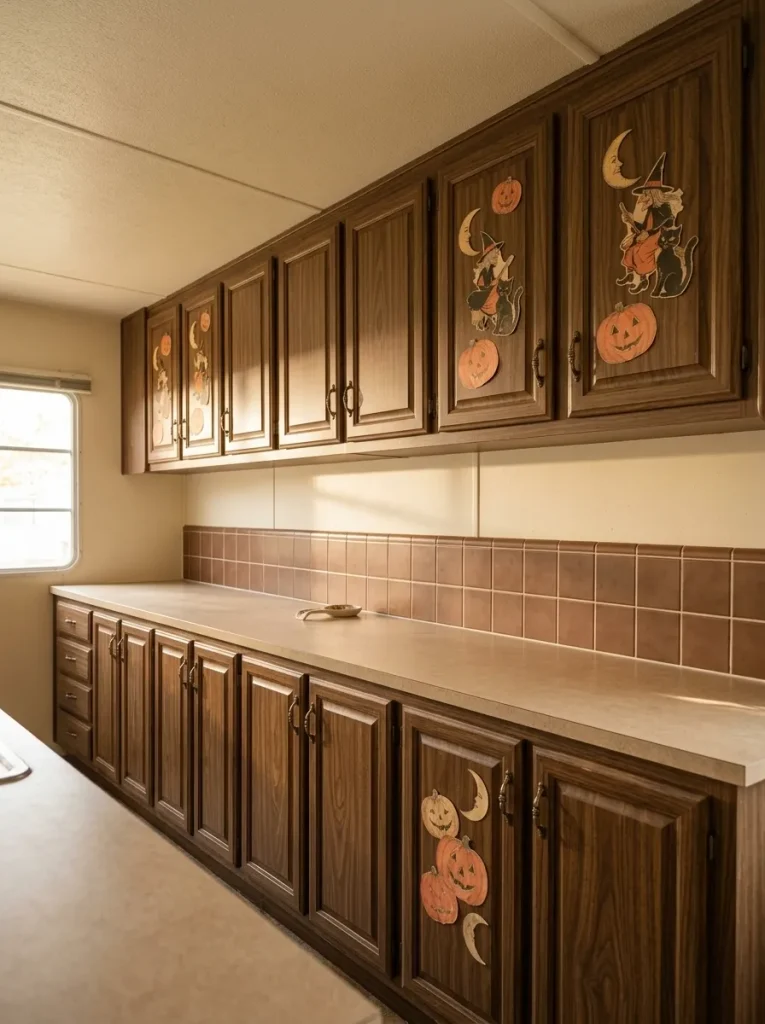
Older cabinet doors offer a better display plane. Vintage-style paper witches, black cats, crescent moons, and smiling pumpkins sit nearly flat against the cabinetry, adding character without taking away prep space.
The important decision is density.
One motif on every door can resemble a sticker collection. A stronger composition creates an intentional cluster and allows nearby cabinet fronts to remain quiet.
Cabinet Ephemera Layout Strip
Build the cabinet-door Halloween layout
Change either selection below. The cabinet preview and decorating recommendation respond immediately without JavaScript.
1. Decoration density
2. How visually active are the cabinets?
Woodgrain cabinets often need the sparse version because the cabinetry already supplies texture. Smooth painted doors can tolerate more repetition.
Keep paper, fabric, dried stems, and similar combustible décor away from flames and heat sources, and keep seasonal pieces clear of the cooking area. CPSC and NFPA give the same general Halloween fire-safety guidance. (U.S. Consumer Product Safety Commission)
5. Make a Book-Page Ghost Garland Feel Like It Has Been Stored Since Another Decade
A vintage Halloween interior benefits from at least one element that does not look freshly manufactured.
A book-page ghost garland fills that role beautifully.
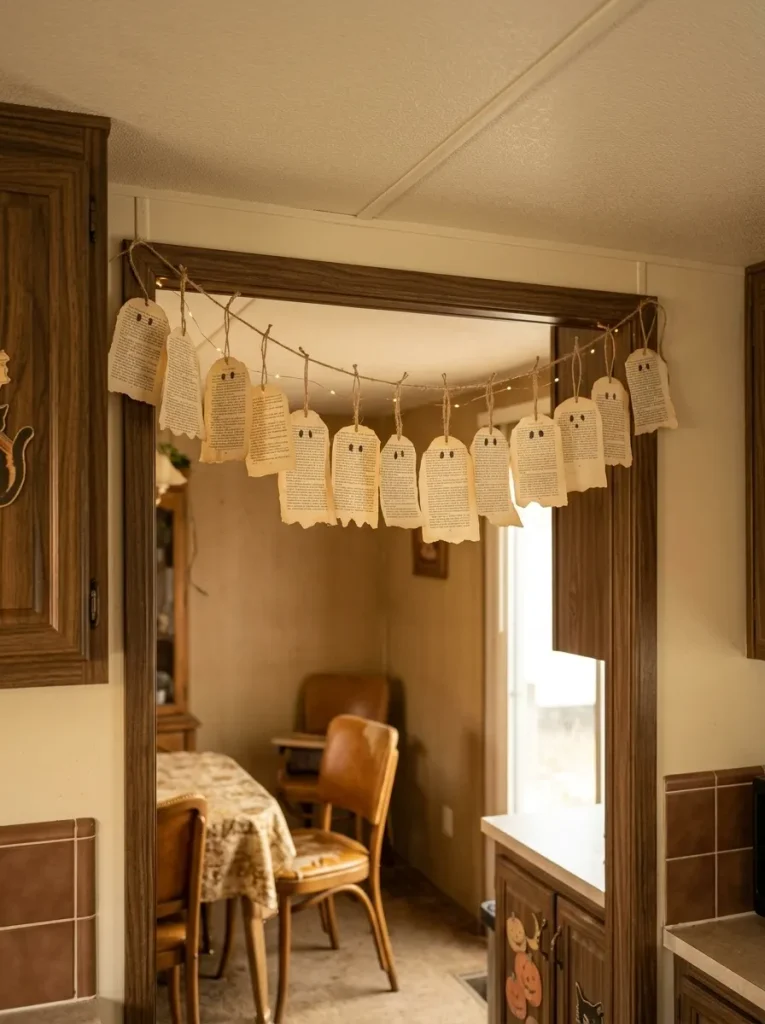
Use craft paper printed to resemble old pages, discarded paper you are comfortable repurposing, or another softly aged paper. Give the ghosts slightly irregular outlines. Draw simple oval faces with black ink and hang them from plain twine.
Perfect spacing is unnecessary.
Small changes in height make the garland feel handmade and introduce gentle movement.
Use it across a short decorative wall, beneath an open shelf, or along a shallow architectural edge where people will not brush against it.
In a low-ceiling mobile home, keep the garland fairly close to the edge it belongs to. A very deep sag lowers the visual plane and can make the room feel more compressed.
Six charming ghosts can read more convincingly than a continuous line wrapping around the whole room.
Stop point: once the handmade detail is readable from the doorway, it has done its job.
6. Use the Low Ceiling as a Vintage Atmosphere Layer, Not a Place to Hang Everything
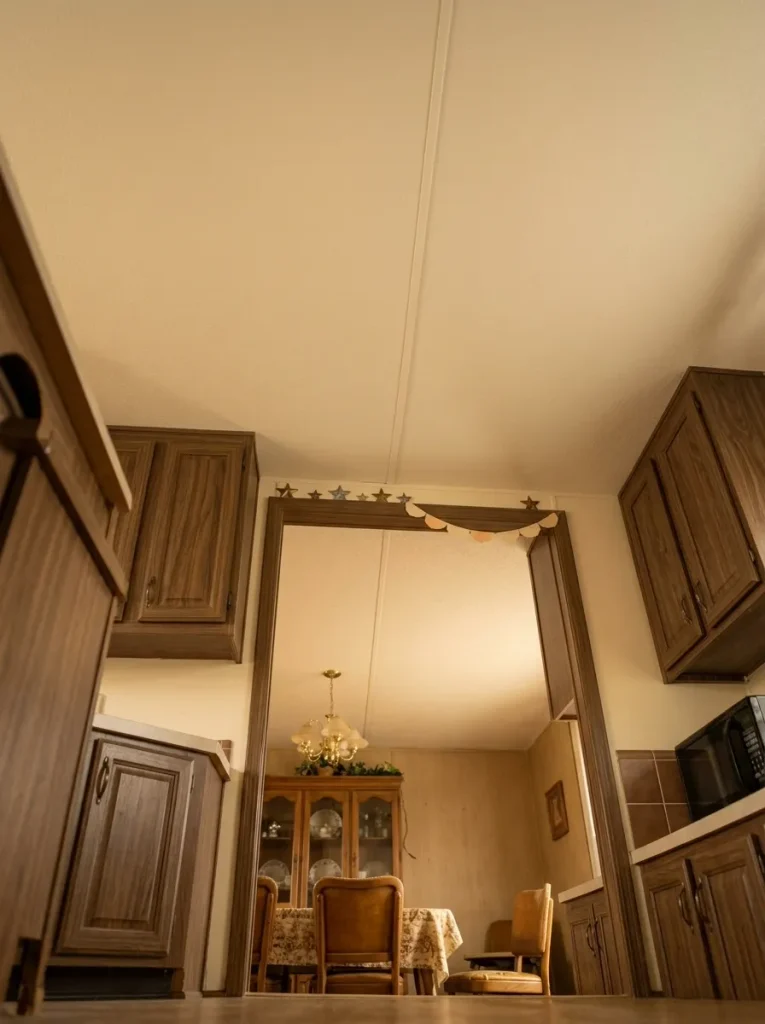
Low ceilings can make Halloween feel wonderfully intimate, but they also magnify overhead clutter.
A single line of faded metallic stars, several lightweight paper motifs, or one restrained hanging cluster can make the ceiling feel intentionally involved without turning the upper half of the room into another display zone.
In a kitchen with active cabinetry, keep the overhead layer quiet. Several silver stars above a dining edge may be enough. A simpler living room can carry a slightly stronger composition because fewer objects are competing below.
Use the doorway as a diagnostic position.
If the hanging décor creates a new visual “ceiling” below the actual ceiling, remove some of it. You should still perceive uninterrupted areas overhead.
The negative space is what allows the small amount of hanging décor to look eerie.
Ceiling stop rule: keep noticeably more empty ceiling than decorated ceiling.
7. Let Retro Kitchen Towels, Potholders and One Ceramic Pumpkin Do the Decorating
A compact kitchen does not need a countertop full of pumpkins.
Objects that already belong to the daily routine can carry much of the seasonal layer.
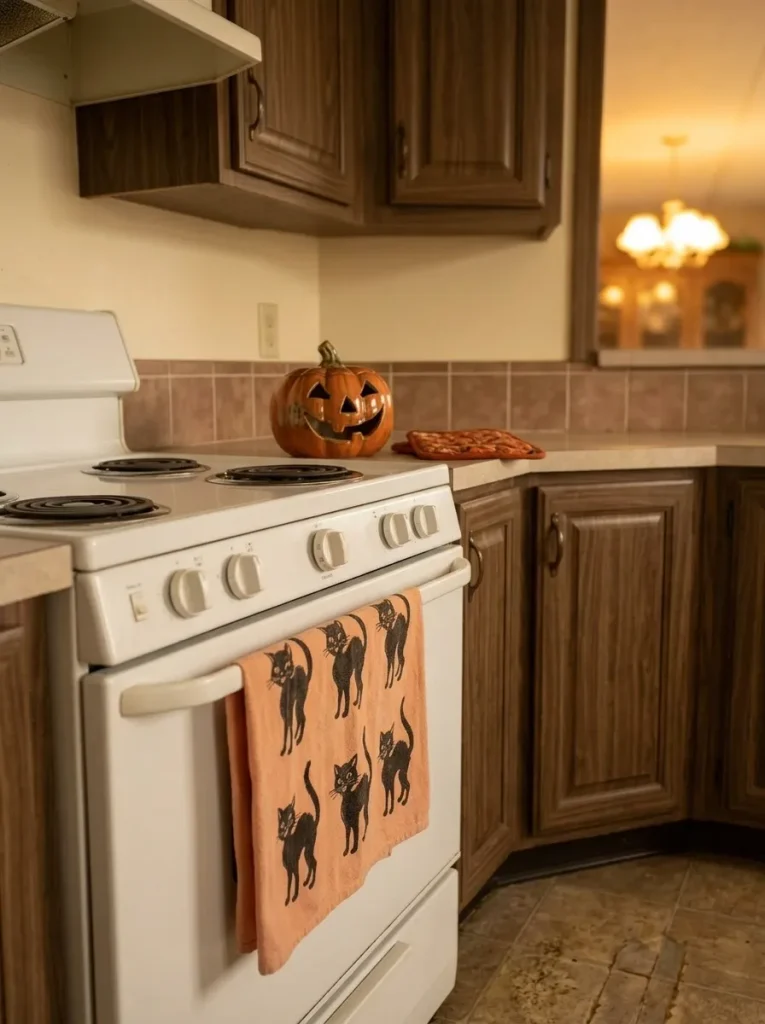
Exchange the ordinary oven towel for a cream-and-orange black-cat print. Add one compatible potholder. Place a single ceramic jack-o’-lantern or black cat where it does not interfere with preparation.
That creates three Halloween signals with almost no additional surface demand.
This is especially effective in an older mobile-home kitchen because textiles soften wood cabinetry, laminate counters, older appliances, and brown or cream finishes without covering them.
Give the ceramic piece the strongest personality. If it has an expressive pumpkin face or unmistakably retro shape, nearby textiles can remain quiet.
For a much broader range of kitchen themes, continue to 36 Halloween Kitchen Decor Ideas for a Spooky Culinary Vibe.
For this article, the useful formula is simple: pattern from the towel, repetition from the smaller textile, personality from one ceramic object.
8. Give the Galley One Graphic Vintage Floor Moment
Older mobile-home kitchens frequently have a strong narrow axis, which makes the floor unusually influential.
A runner with checkerboard, faded pumpkins, black cats, stars, or simple orange-and-black geometry can create more visual impact than several small countertop pieces because the pattern occupies one continuous plane.
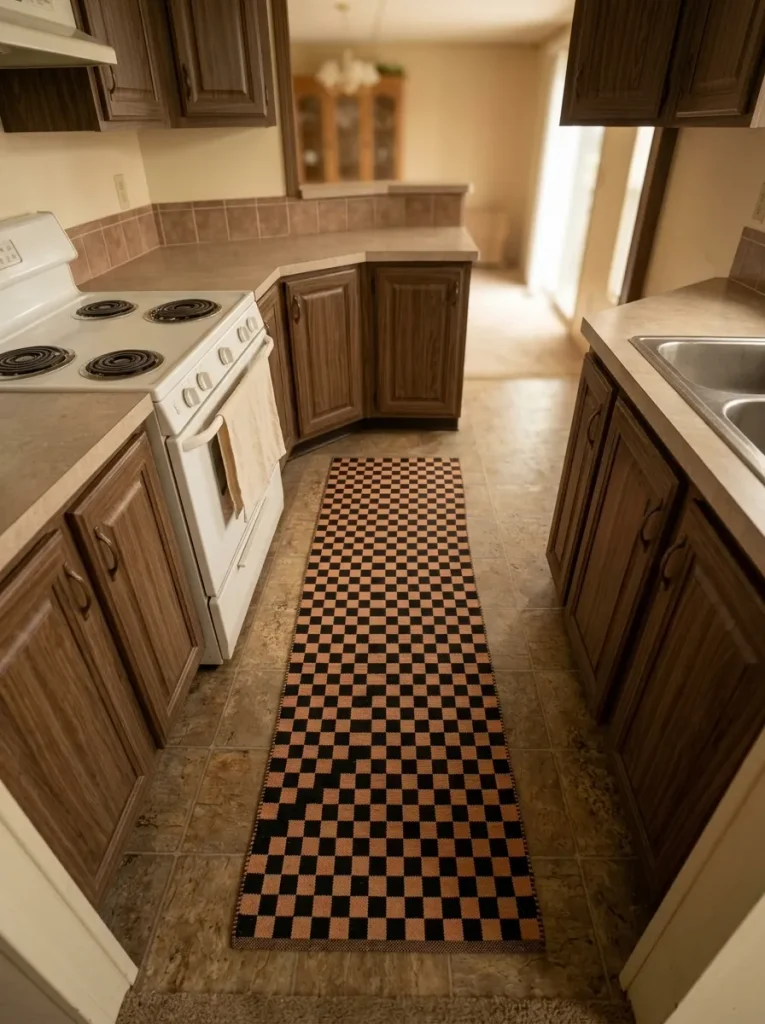
The main decision is where the room can tolerate its strongest pattern.
When cabinets already contain wood grain, handles, paper cutouts, and countertop accessories, another loud treatment through the middle of the wall can overwhelm the working area. Moving the pattern downward separates the visual layers.
Pattern Pressure Map
Where should the strongest Halloween pattern live?
Change both inputs. The visual-pressure bars and written recommendation respond to your choices.
1. Put the main pattern on:
2. How busy is the room already?
For many narrow kitchens, the floor is the strongest candidate because it adds personality without consuming storage or workspace.
Leave plain flooring visible around the runner so the pattern reads as one intentional graphic gesture.
9. Frame One Interior Opening With Black Lace Like a Tiny Haunted-Theater Curtain
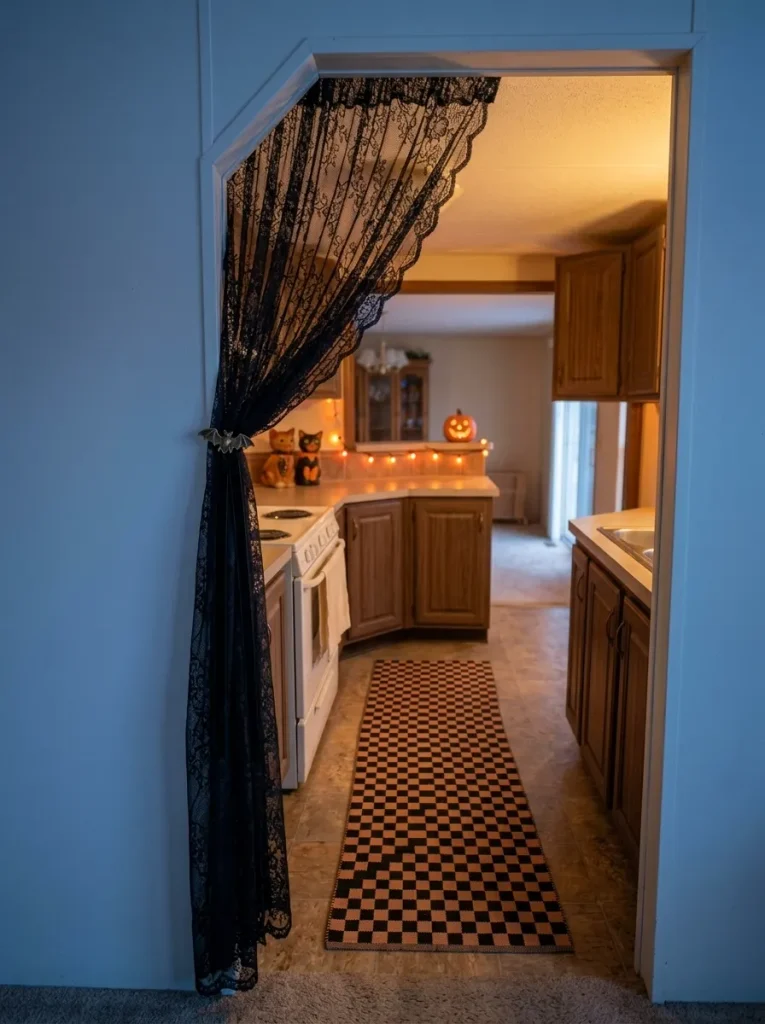
An older mobile home often has strong openings between the kitchen, dining area, hallway, and living room.
One of those transitions can become a memorable Halloween moment.
Use a short, tied-back piece of lightweight black lace along the side or upper edge of one suitable interior opening, allowing the room beyond to remain visible.
The architecture already supplies the frame. The lace simply makes the frame part of the seasonal scene.
One secondary detail is enough: a paper bat near the upper corner, a striped tieback, or a tiny faded-orange ornament.
Then stop.
The view through the opening is more important than filling the opening itself. A softly lit ceramic pumpkin in the next room creates greater depth than a dense curtain of props.
Keep decorative fabric completely clear of walking routes, exits, flame, heaters, and other heat sources. NFPA specifically advises keeping Halloween decorations away from open flame and heat sources and keeping escape routes clear. (NFPA)
Best location: an interior transition that already provides a long view into another decorated room without narrowing circulation.
10. Draw the Spiderweb Onto the Mirror, Not Across the Whole Room
Spiderwebs can appear almost anywhere, which is exactly why concentrating them works better.
An older mirror is particularly effective because the reflection expands the visual event.
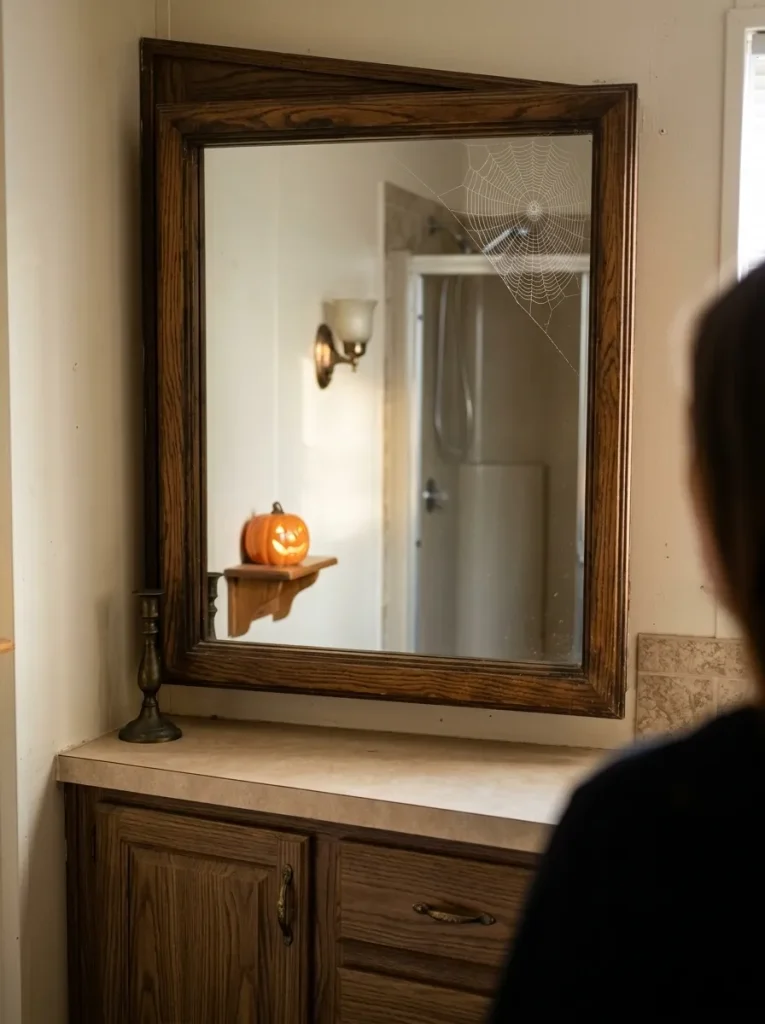
Apply or draw one restrained web from a corner, keeping the primary viewing area clear. A tiny spider can complete it, but the composition does not need to cover the mirror.
Now move sideways.
The web visually overlaps whatever appears in the reflection: perhaps an amber lamp, a black-cat figurine, an older cabinet, or a ceramic pumpkin.
One small intervention gains depth because the room behind it becomes part of the image.
Traditional wood, brass-toned, or carved frames should remain visible. Their age is already contributing to the atmosphere.
A useful rule follows from the reflection itself: when the mirror visually doubles the Halloween scene, reduce the surrounding accessories.
One cat and one pumpkin below the mirror may be enough.
11. Make the Bathroom Feel Vintage With Three Small Signals Instead of a Full Theme
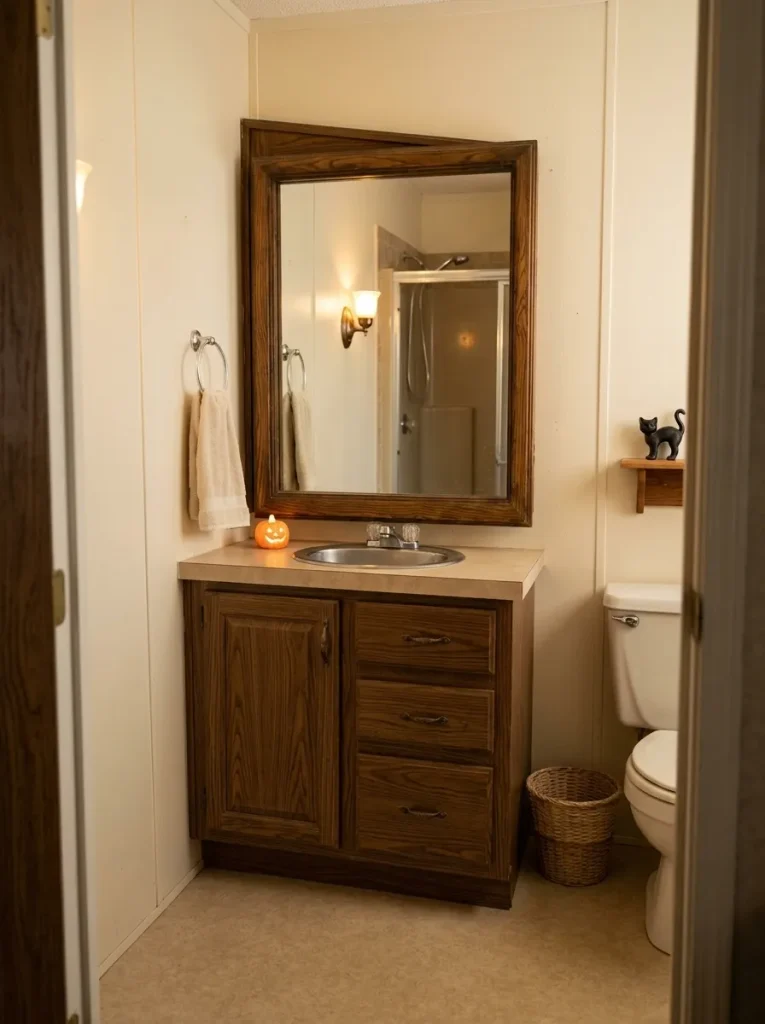
A small bathroom becomes visually crowded quickly because its mirror, vanity, shower, toilet, storage, and doorway already occupy most of the field of view.
Give the room three seasonal signals that perform different jobs.
A cream hand towel with a ghost can supply the textile. A small pumpkin-shaped flameless light or ceramic jack-o’-lantern can supply the warm object. A black-cat, witch, or moon detail can provide the graphic element.
Then inspect the room from the doorway.
If Halloween is obvious immediately, the bathroom has reached its threshold.
Older tile, wood cabinetry, colored fixtures, or a traditional mirror can remain visible and carry part of the vintage impression themselves.
The room-specific specialist goes much further: 17 Classy Halloween Bathroom Decor Ideas for a Small Mobile Home.
For this whole-house article, use the simpler formula:
one textile + one object/glow + one graphic signal.
12. Turn a Tiny Shadowbox Into the House’s Strangest Curiosity Cabinet
Not every Halloween moment has to be cheerful.
A small shadowbox can introduce the slightly unsettling side of vintage Halloween while containing it within one clear boundary.
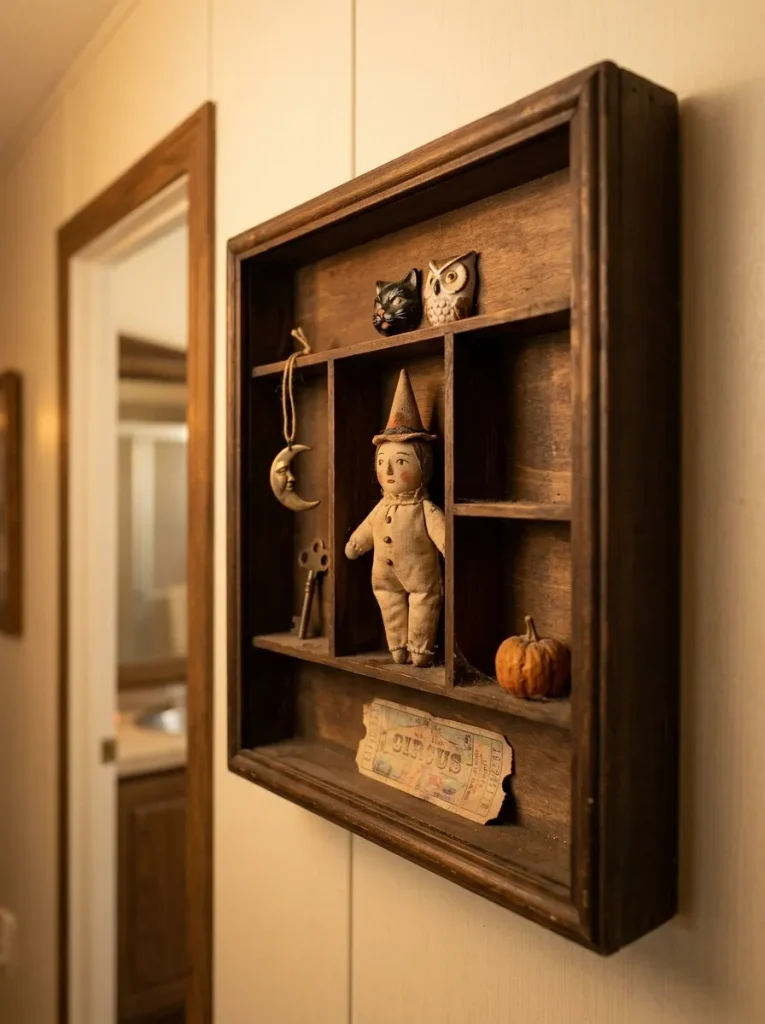
Start with an aged-looking frame or shallow display box. Inside, arrange miniature objects such as small doll-like ornaments, old-style charms, tiny pumpkins, tags, masks, keys, or unusual illustrations.
Negative space matters.
Four pieces across the upper half and several below can feel more deliberate than filling every inch. An intentionally empty area can make the collection feel stranger.
Place the finished box where someone can approach it—beside a hallway, above a narrow console, or on a small dining-area wall.
Its value comes from discovery. From a distance it reads as framed décor. Up close, the viewer realizes the house contains a darker, more curious layer.
Containment is what separates a curiosity collection from scattered clutter.
13. Hang Witch, Moon and Black-Cat Art in Frames That Look Older Than the Print
A printable Halloween illustration can gain enormous character from the frame around it.
Place a simple witch silhouette inside distressed brown wood. Give a black-cat print a muted brass-toned frame. Put a moon illustration inside a narrow dark frame with traditional proportions.
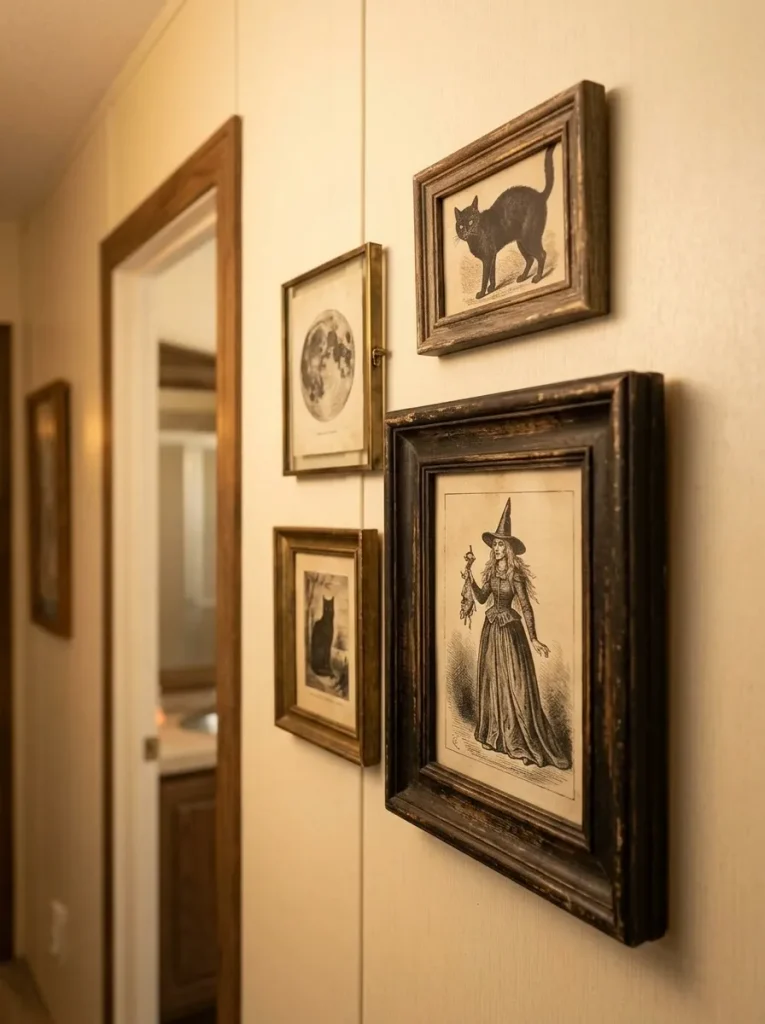
The frame starts the conversation with the older house before the artwork even registers.
Decide where the age should come from.
When the image itself is detailed, faded, and heavily distressed, keep the frame quieter. When the print is visually simple, the frame can carry more texture.
This strategy works particularly well in older mobile homes because traditional frames can connect with wood cabinetry, paneled doors, darker hardware, or an existing vintage mirror.
Avoid filling every wall with small Halloween prints. One larger witch plus one smaller moon or black-cat piece often has more authority.
Frame test: cover the artwork with your hand. If the frame already looks comfortable in the room, the seasonal image inside it has a much better chance of feeling integrated.
14. Give One Narrow Wall a Broom-and-Apothecary Story
A narrow wall may be too small for furniture yet still have enough vertical area to carry Halloween character.
Use that height.
Hang two or three lightweight decorative brooms at different levels. Add dried-looking or faux herb bundles, one shallow shelf, a dark bottle, and perhaps a small raven, faded label, or old-style sign.
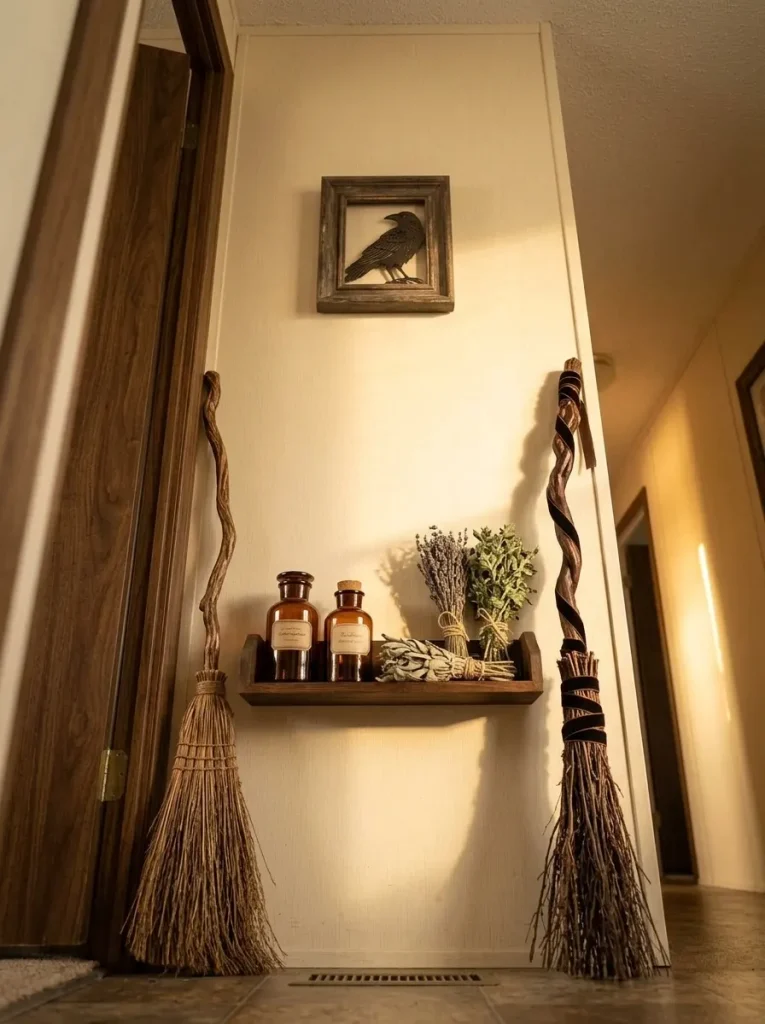
Because the composition rises vertically, it uses little floor area.
That matters in an older mobile home where narrow halls and transitions cannot afford a deep seasonal vignette.
Organize the wall in layers: a small object or shelf low, hanging textures through the middle, and one sign, print, or dark clock higher up.
Do not turn it into a full theatrical laboratory unless that aesthetic owns the entire house. Two mysterious bottles can feel found and old. A wall packed with matching apothecary props can feel like a retail set.
Let wood, dried texture, shadows, and vertical repetition carry most of the story.
15. Choose One Jack-o’-Lantern or Black Cat to Be the Character of the Room
A memorable Halloween room benefits from a protagonist.
It might be a large ceramic jack-o’-lantern with a crooked smile, a glossy black cat, an old-style witch figurine, or one pumpkin-headed character.
Choose one.
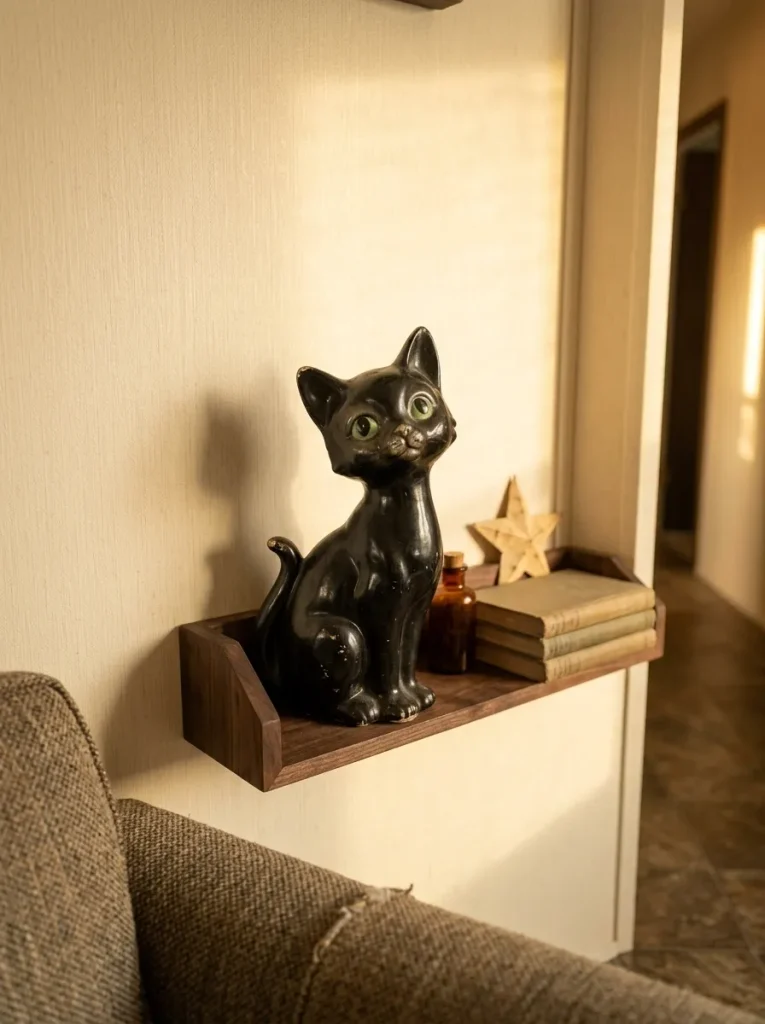
Give it enough surrounding space to register immediately.
On a kitchen counter, that may mean removing two smaller pumpkins. On a shelf, it may mean giving the black cat one side of the composition rather than surrounding it with several similarly sized objects.
Visual hierarchy matters more than quantity.
Stand in the doorway and ask where your eye lands first.
If the answer is an accidental pile of orange accessories, reduce the supporting pieces until your chosen character becomes obvious.
Once the room has its protagonist, the supporting vocabulary can become much quieter: stars, a single towel, one paper silhouette, or a short garland.
One memorable face gives the space personality. It does not need a whole cast.
16. Repeat One Vintage Motif Through Connected Rooms Without Copying the Same Display
Mobile homes often expose several spaces within one visual sequence.
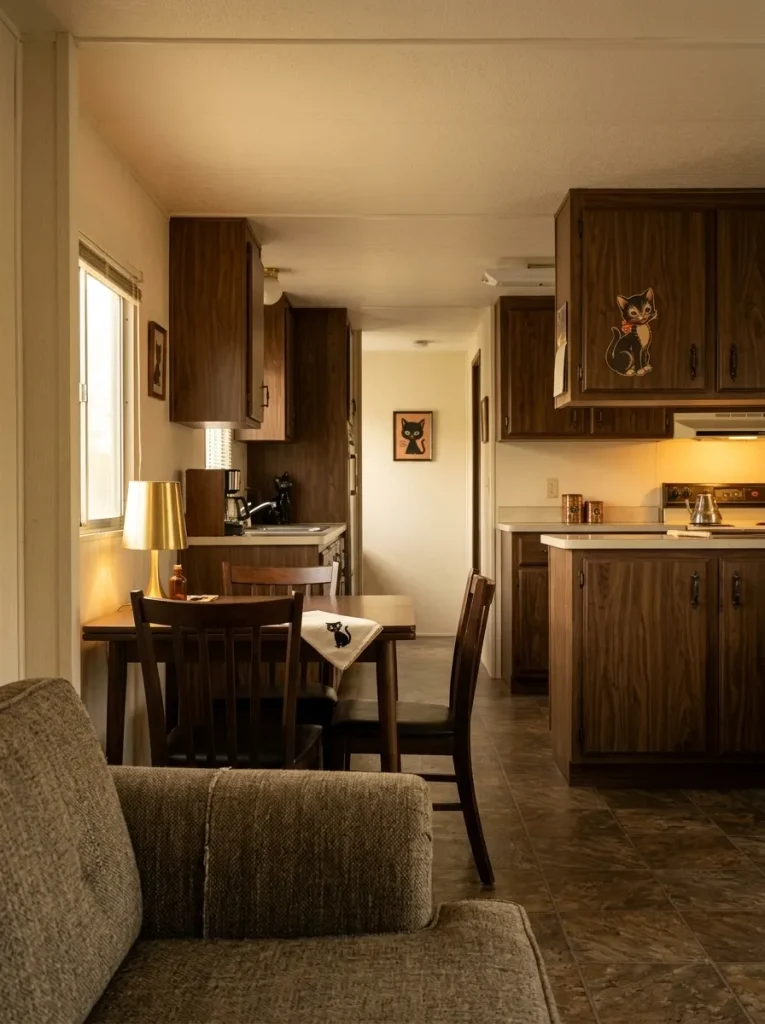
The kitchen may look into the dining area. A hallway may reveal the bathroom. A living-room seat may face toward another decorated opening.
That makes motif repetition powerful.
Literal product repetition, however, can make the scheme feel purchased as a matching set.
Repeat the character, then change the material.
A black cat could appear as paper in the kitchen, embroidery in the bathroom, and a framed illustration near the bedroom.
That is how vintage Halloween mobile home decor begins to feel cohesive across the whole home while each room keeps its own personality.
Vintage Motif Relay Map
Connected-room continuity
Send one Halloween character through the house
Choose the recurring character and then choose the mood. Both selections change the decorating guidance.
1. Choose the motif
2. Choose the mood
Use one cabinet-door silhouette as the first appearance.
Repeat the character through a towel or stitched detail.
Complete the relay with a small illustration in a darker frame.
Place one nostalgic witch near the pantry or cabinet zone.
Repeat the idea as a small witch-and-moon silhouette.
Use a restrained vintage witch print for the final echo.
Start with a handmade paper ghost or short garland.
Repeat it as a small towel or embroidered detail.
Finish with a pale print or quiet textile interpretation.
From one doorway, the reader recognizes the cat. In another room, it appears again through a new material.
The eye makes the connection without seeing duplicated merchandise.
17. Let the Bedroom Borrow the Softest Version of the Vintage Halloween Story
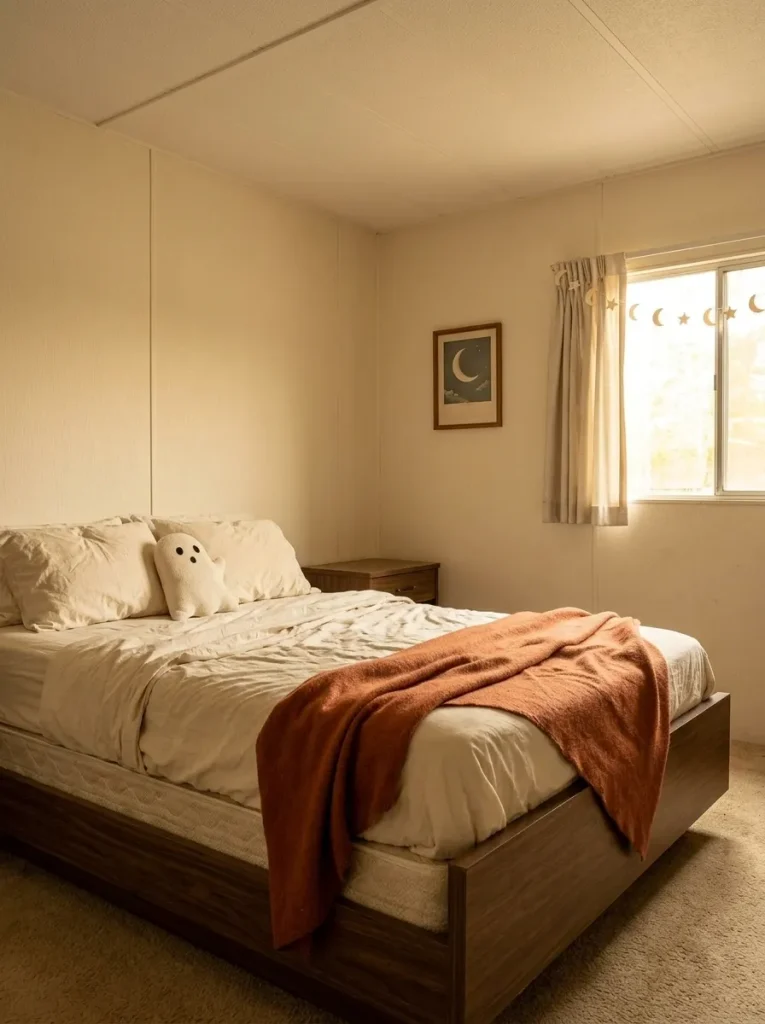
The bedroom does not need to carry the same Halloween intensity as the kitchen or living room.
That contrast can improve the entire house.
If the social spaces use black paper witches, orange ceramics, and stronger graphic patterns, let the bedroom borrow the quieter ingredients: faded pumpkin, tobacco brown, ivory, one tiny ghost motif, or a muted vintage print.
A cream bedspread with one rust-colored throw may already create enough continuity. Add a small old-style cushion or framed moon illustration and the relationship becomes clear.
If a garland appears here, keep it shorter and lighter than the garland used in an active room.
If black is present, concentrate it in a frame, lamp base, or small textile detail so the sleeping area still feels calm.
For a complete room-specific treatment, continue to 15 Cozy Halloween Bedroom Decor Ideas for Mobile Homes.
Within this whole-house scheme, the bedroom should feel like the quiet final chapter.
The same characters are present. Their voices are simply softer.
18. Make the House Look Most Vintage After Dark With a Layered Amber Glow
Vintage Halloween changes character after sunset.
Woodgrain deepens. Orange ceramics begin to glow. Cream paper turns parchment-like. Dark frames gain more weight, and reflective objects become more noticeable.
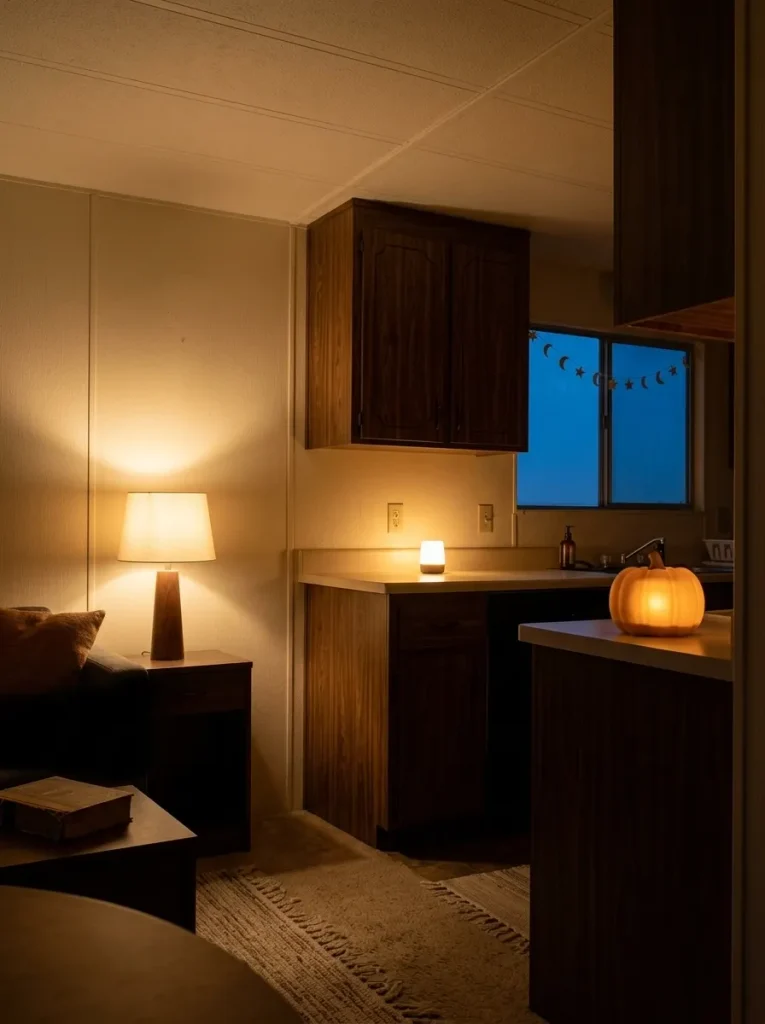
Use the lamps that already belong in the home first. Then add one or two small flameless decorative light sources to create lower pools of warmth.
Different heights create more atmosphere than uniform brightness.
After-Dark Glow Stack
After-dark atmosphere
Build the vintage Halloween glow
Change the number of lighting layers and the mood. The scene and recommendation both update immediately.
1. Choose the lighting depth
2. Choose the mood
Readable and calm, but still close to ordinary evening lighting. Add another height only if you want more atmosphere.
The room gains depth because the eye moves between a broad room light and a lower warm pool.
This creates the strongest after-dark depth. Stop here rather than illuminating every seasonal object.
Keep contrast gentle and let cream paper, warm wood and muted orange absorb the light.
Preserve darkness between the light sources. Fewer isolated pools feel more atmospheric than uniform brightness.
Let the pumpkin or character light read more clearly, while keeping the main room lighting functional.
One normal household lamp plus one lower flameless accent and one small pumpkin glow can be enough.
Do not illuminate every seasonal object. Darkness between the warm areas contributes to the mood.
For fire safety, keep combustible decorations away from open flame and heat sources. CPSC also recommends flameless, battery-operated light for Halloween decorative uses where appropriate. (U.S. Consumer Product Safety Commission)
19. Stop When the House Looks Collected, Not Like a Halloween Store Aisle
The final decorating move is editing.
Walk through the house after everything is in place and look for evidence that the seasonal layer has become stronger than the home beneath it.
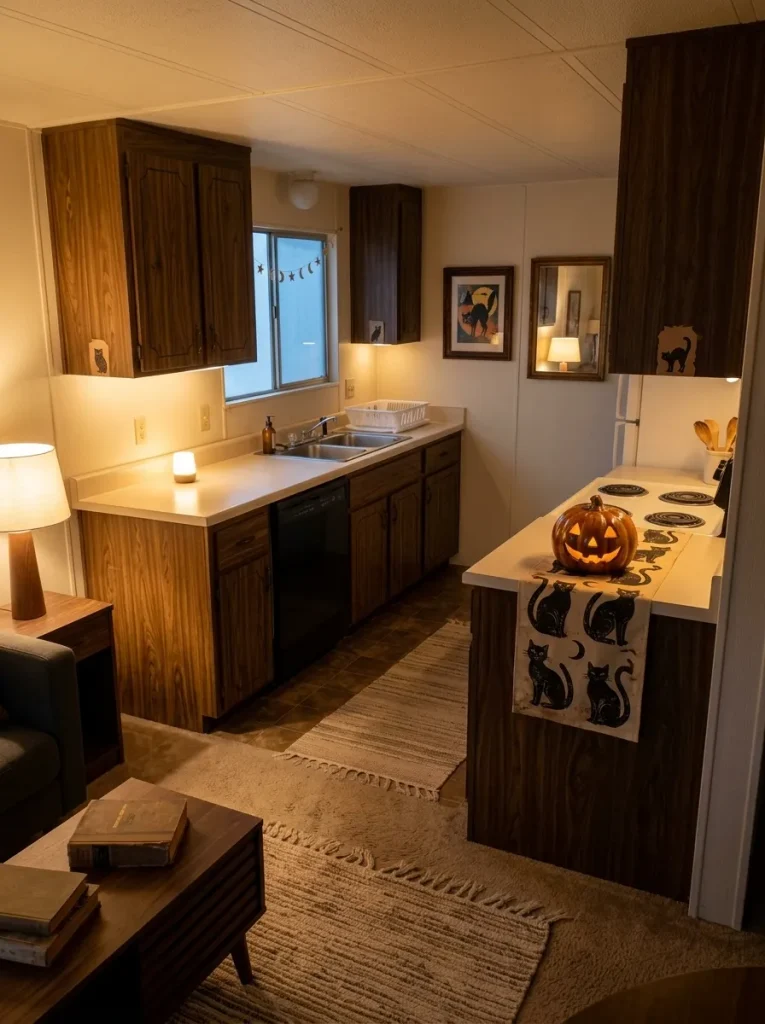
Does almost every flat surface contain a pumpkin?
Does the same black cat appear in essentially identical form five times?
Have the old cabinet fronts, brown tile, mirror frame, or original wood disappeared behind decorations?
If so, remove something.
Vintage rooms feel believable because objects appear to have accumulated over time. Perfectly matched collections and completely filled surfaces communicate a very different story.
Collected vs. Crowded Edit Gauge
What is making the Halloween room feel crowded?
Choose the strongest problem you can see, then tell the tool how noticeable it feels. The editing instruction changes with your choices.
1. Choose the main problem
2. How noticeable is the problem?
This is an editorial editing tool, not a mathematical design score.
Its purpose is to force one useful question: would removing something make the room stronger?
One old cabinet should still look like an old cabinet. A vintage mirror should remain part of the room rather than disappearing beneath decoration. Some floor, wall, and countertop areas should be allowed to remain quiet.
That breathing room gives the decorated areas their impact.
A Vintage Halloween Home Should Still Look Like Your Home
Vintage Halloween décor does not require an older mobile home to pretend it is a different house.
Its woodgrain, brown tile, compact rooms, modest ceilings, traditional mirrors, warm finishes, and retro details can become part of the atmosphere. Choose one vintage direction, repeat a few recognizable motifs through different materials, protect usable surfaces, and let warm evening light deepen the story.
A paper witch on an old cabinet, one expressive ceramic pumpkin, a strange little shadowbox, or a black-cat towel can carry more personality than a room packed with coordinated merchandise.
When the finished house still looks unmistakably like your older mobile home—temporarily haunted by another decade—the vintage Halloween concept is working.