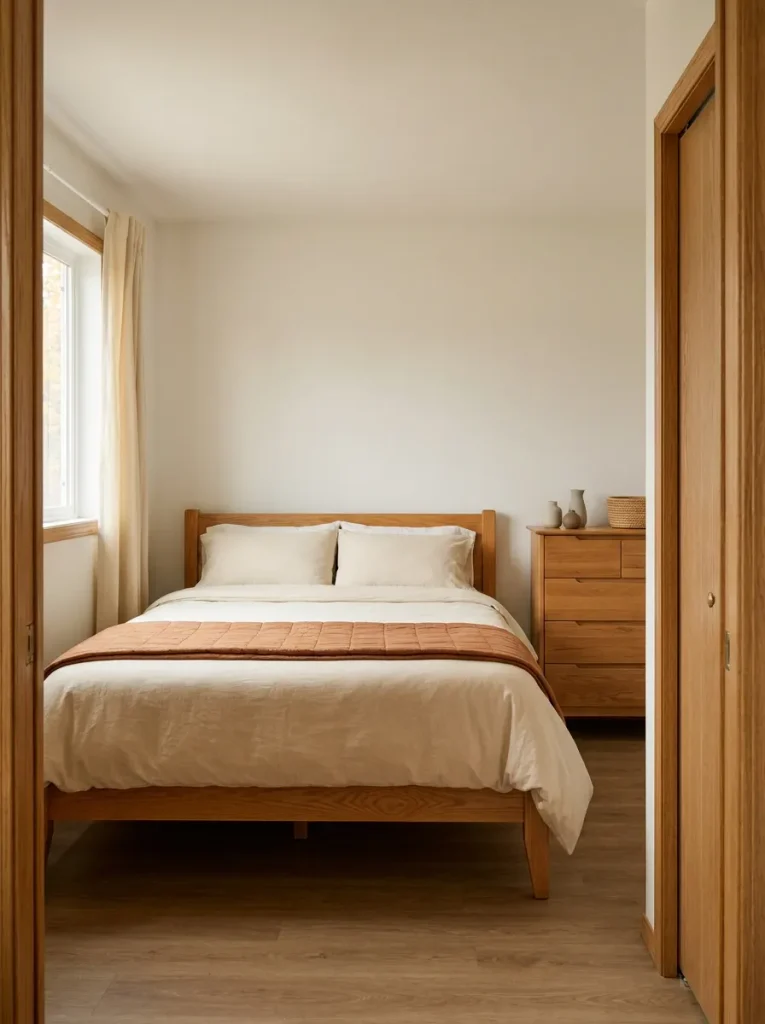
A Halloween bedroom can become visually crowded long before it feels cozy—especially in a mobile home, where the bed, walkway, window, and storage surfaces often sit within one compact view. Good halloween mobile home bedroom decor therefore needs more than a pile of pumpkins and black pillows.
The strongest rooms decide where the seasonal story will live, then leave enough quiet space for the bedroom to remain comfortable after dark and functional the next morning.

The 15 ideas below use the bed, headboard wall, ceiling, window, dresser, shelves, floor, and lighting as separate decorating zones. You can lean cute, classic orange-and-black, or much moodier without giving every surface equal attention.
Simple decision tools will also help you judge intensity, work with furniture and flooring already in the room, and recognize when another Halloween accent would make the bedroom feel smaller.
Start with the room as it is. Halloween should change its atmosphere, not erase the bedroom underneath it.
1. Choose Your Halloween Intensity Before You Decorate the Bedroom
Stand in the doorway first and imagine the room after sunset. In a compact mobile-home bedroom, several decorations that look harmless while shopping can become one continuous field once the bed, walls, window, and dresser are visible together. Deciding the intensity before choosing individual pieces prevents that buildup.
A soft-spooky room might need one ghost-pattern throw, a few removable bats, and amber lighting. Classic Halloween can carry stronger orange-and-black contrast plus one recognizable character. A moody room can use charcoal bedding, aged-looking accents, and lower warm light—but it needs more visual breathing room because dark surfaces already carry greater weight.

Use the selector below as a decorating ceiling. Once the room has reached the ingredients in your chosen level, treat additional pieces as replacements, not automatic additions.
Bedroom mood lab
How spooky should this room feel?
Pick one intensity first. The recommendation changes the amount of pattern, contrast and character décor the room needs.
Choose the version closest to the bedroom atmosphere you want after dark.
2. Let the Bed Carry the Biggest Halloween Pattern
In many mobile-home bedrooms, the bed dominates the view before you notice the walls. That makes bedding unusually powerful seasonal real estate. A pumpkin-print duvet, ghost blanket, orange quilt, black-and-white plaid layer, or one substantial Halloween throw can establish the theme across a large visual area without sacrificing another inch of floor space.

With a neutral existing duvet, fold a Halloween blanket across the lower third and repeat one of its colors in two pillows near the headboard. Highly patterned bedding pairs better with simpler pillows so the bed has a clear visual order. Busy bedding combined with patterned sheets, novelty pillows, and a patterned rug can make a narrow room feel restless.
Small-room rule: once the bed already says “Halloween” from the doorway, surrounding furniture only needs supporting cues. Every surface does not need to repeat the announcement.
That decision also makes the seasonal reset easier: remove the dominant textile, and much of the room immediately returns to normal.
3. Build the Palette Around the Furniture and Flooring That Are Staying
Halloween colors look different beside permanent finishes. Bright pumpkin orange can feel playful against white furniture, warmer and earthier beside brown wood, or sharply graphic against gray flooring. In a compact mobile-home bedroom, those permanent surfaces occupy enough of the visual field that ignoring them can make seasonal décor look pasted on.
Before buying another pillow or garland, identify the finish seen most clearly from the doorway: light/white, warm wood/beige, or cool gray/dark. Then choose Halloween colors that bridge into that background.

For deeper seasonal color planning, StylishGalore’s warm fall bedroom color palettes for mobile homes covers that broader territory. Here, the job is narrower: find a Halloween palette that works with what is already fixed in this bedroom.
Permanent finish → seasonal palette
Match Halloween to the room you already own
Select the finish that occupies the most visual space. The palette and decorating priority change with it.
Once that bridge exists between the permanent room and the seasonal layer, buying decisions become easier. A white dresser does not need disguising; warm wood does not need correcting; gray flooring does not automatically need more black. Let the existing finish supply part of the palette, then spend your Halloween color budget on surfaces that can actually change.
4. Turn the Headboard Wall Into One Concentrated Halloween Scene
A bed positioned against the main uninterrupted wall already gives the room a natural focal zone. In a mobile-home bedroom, concentrating Halloween décor there can establish the theme more clearly than spreading similar-strength accents around every side of the room.

Picture two versions of the same compact bedroom. One has bats beside the dresser, pumpkins on both nightstands, a garland across the window, and novelty signs on several walls. The other keeps the bedding relatively calm while the headboard wall carries one defined scene—perhaps a sweeping bat formation, a seasonal print, or a restrained garland with warm light. The second room gives the eye an obvious destination.
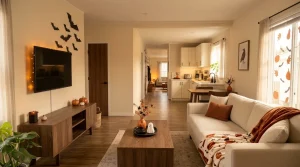
Use the visual width of the bed as a starting boundary. Keep most of the headboard composition inside that zone or only slightly beyond it. The decoration then reads as part of the furniture composition rather than as loose objects floating around the room.
Cute Halloween rooms can combine one ghost or pumpkin detail with soft textiles. Classic rooms gain instant recognition from black shapes on a pale wall. Darker bedrooms may rely more on dimension, warm light, or framed artwork because additional black silhouettes can disappear into the background.
Once the headboard wall already reads unmistakably Halloween from the doorway, keep the opposite side calmer. That quiet area is helping the focal scene look stronger.
5. Send Bats Upward Instead of Scattering Them Across Every Wall
A flock of bats feels more intentional when it appears to be going somewhere.
Begin near one side of the headboard, dresser, or window. Place the first shapes relatively close together, then let the formation climb diagonally toward an upper corner. Increase the spacing as it rises. The direction gives the arrangement movement while the surrounding blank wall keeps the room from becoming a wallpaper of tiny motifs.
This technique works particularly well in a mobile-home bedroom because it uses vertical space without occupying the nightstand, floor, bedding, or narrow passage beside the bed.

- Choose one existing feature as the starting point, such as the headboard edge. Decide which upper corner the movement should lead toward. Use larger shapes nearer the starting point and mix smaller ones into the ascent. Step back to the bedroom doorway before placing the final pieces. Stop once the direction remains obvious without covering the rest of the wall.
For removable decorations, follow the product instructions for the wall finish and test the attachment method in an inconspicuous location where appropriate.
The deciding question is not “Is there still empty wall?” It is “Can I already read the movement from across the room?” Once the answer is yes, the composition is finished.
6. Use the Ceiling for Witch Hats or Bats When Floor Space Is Scarce
Some mobile-home bedrooms reach their decorating limit at floor level almost immediately. There may only be room for the bed, a dresser, perhaps one nightstand, and the walking route connecting them. Adding pumpkin baskets, freestanding characters, signs, or seasonal stools can make the space harder to use.
The ceiling introduces another decorating plane.
A few lightweight witch hats, hanging bats, or another suitable suspended accent can make Halloween visible across the room while leaving everyday surfaces available. The strongest placement usually relates to something below it: a short cluster near the foot of the bed, a continuation of the headboard-wall movement, or a contained composition toward a quiet corner.

Do not automatically fill the entire ceiling. Choose the plane that currently has the least functional pressure. Any suspended decoration should be installed according to the relevant product and attachment instructions.
Use the room-plane selector below to identify where the next Halloween element should go.
Room-plane allocator
Which surface is already doing too much?
Choose the area that currently feels most crowded. The tool points the next Halloween accent toward a less pressured part of the bedroom.
Where the ceiling becomes the chosen zone, keep the installation sparse enough to read as one overhead composition, not a second layer of clutter. Three or four well-positioned lightweight shapes may provide all the visibility the room needs.
The ceiling now has a seasonal role without asking the floor to surrender another useful inch.
7. Give the Window One Halloween Frame Without Blocking Its Daylight
A bedroom window is too useful to sacrifice for seasonal atmosphere. In a smaller mobile-home bedroom, it may provide a large share of the daytime brightness and visual openness, so dense fabric, oversized decals, or heavy garlands across the glass can make the whole room feel tighter.
Treat the edges of the window as decorating space while protecting the center.

A short bat trail can begin near one upper corner. A lightweight garland can cross the top while staying shallow. Small Halloween accents can sit beside the window rather than directly in front of it. Curtains with strong existing color or pattern may need no additional seasonal textile.
Try the room in daylight before committing. Stand near the doorway with the curtains open and check whether the eye still reaches naturally toward the window. Decorations that interrupt that bright visual opening should be reduced or shifted outward.
The window also needs to remain comfortable to use. Keep curtains, blinds, handles, and locks easy to reach throughout the seasonal setup.
Daylight check: Halloween décor should frame the window, not make the window disappear.
That rule supplies seasonal detail during the day while preserving one of the bedroom’s most valuable visual pauses.
8. Trade a Pillow Pile for Two Character Pieces That Read From the Door
Halloween pillows are easy to collect because each one feels small. On the bed, however, six novelty pillows can occupy far more physical and visual space than one or two larger characters.
Imagine a compact bed already carrying a patterned throw. Add a pumpkin pillow, ghost, bat, skull, “Boo” cushion, plaid lumbar pillow, and another seasonal shape. Every piece fits, yet the sleeping area starts to resemble display shelving.
A stronger arrangement begins with two roles.
The recognizable character might be a ghost, pumpkin, skeleton, black cat, or another unmistakable Halloween motif.
The supporting shape can be a quieter solid, plaid, stripe, or textured pillow that connects that character to the bedding.

That pair can produce more impact from the doorway than a row of smaller competing designs.
For a full or queen bed in a tight room, keep seasonal pieces nearer the center so the outer edges remain calmer. A twin or narrow bed may already communicate the idea through one substantial character pillow.
Remove half the Halloween pillows and step back. A room that communicates the same theme just as clearly has identified which pieces were contributing volume more than meaning.
Keep the version that preserves the bed as somewhere to sleep, not somewhere seasonal décor has temporarily taken over.
9. Make the Dresser a Contained Halloween Landing Zone
A dresser is tempting because it offers a ready-made horizontal surface. It is also where everyday objects tend to accumulate—jewelry, skincare, keys, chargers, perfume, or folded clothing. In a mobile-home bedroom, losing that entire surface to seasonal décor can push ordinary clutter elsewhere.
Give Halloween a defined footprint.
Choose one side of the dresser and build a compact vignette within that boundary. A small tray, shallow basket, framed print, or single raised platform can visually contain the display. Layer only a few pieces at different heights: perhaps one pumpkin, one framed element, and a small branch or character.
Use the sequence anchor → height → detail → stop. Begin with the largest object. Add one taller element behind it. Introduce a smaller detail only while the grouping still feels incomplete from normal standing distance. End the display before it spreads across the full dresser.

Where strong Halloween bedding and a decorated headboard wall already dominate the room, the dresser should become quieter—not another major focal point.
Reserve part of the surface for everyday use before decorating. Keeping that area functional prevents the usual routine from migrating to the bed, windowsill, or floor.
Seasonal styling works better in a compact bedroom when the decoration has a clear address and the rest of the furniture can continue doing its job.
10. Style Floating Shelves Vertically When the Nightstands Are Already Full
The nightstand beside a mobile-home bed usually has a practical job before Halloween arrives: lamp, phone, glasses, water, alarm clock, or charger. Covering that small surface with pumpkins and figurines may photograph well, but it can make the bedroom less comfortable every night.
Existing floating shelves offer a better place for the small-detail layer of the theme.

Build the arrangement upward. Put the visually heaviest Halloween piece on the lower shelf, a smaller supporting object above it, and allow the top shelf to become quieter. That progression keeps the display connected without producing several equally busy horizontal bands.
For example, the lower shelf might carry one substantial pumpkin, ghost, skull, or framed seasonal print. The middle shelf can hold two smaller pieces with visible space between them. The highest shelf might need only one quiet accent, trailing greenery, or something already used year-round.
Shelves also let Halloween mingle with permanent bedroom décor. Books, plants, framed photos, and neutral ceramics can remain; seasonal pieces only need to interrupt the everyday arrangement enough to shift the mood.
For newly installed shelves, use hardware and mounting methods suitable for the particular wall and follow the manufacturer’s instructions.
From the bed, you should still see shelf shapes and gaps, not a continuous wall of objects. Once the display starts looking visually solid, remove the smallest pieces first.
The nightstand stays functional while Halloween moves upward into space that was doing less everyday work.
11. Put One Halloween Signal on the Floor—and Stop There
The floor offers a large visual surface, but in a narrow mobile-home bedroom it is also circulation space. That makes floor décor one of the easiest Halloween ideas to overdo.
A pumpkin-shaped rug beside the bed can work beautifully. So can one basket with a seasonal blanket near an unused corner. A floor-standing character may also suit a genuinely open area.

Problems begin when the rug, basket, pumpkins, lanterns, and freestanding decorations all occupy the same small route.
Look at the path from the bedroom door to the bed, dresser, closet, and window. A Halloween floor accent belongs outside the movement route, not where it becomes something everyone learns to step around.
Use this quick floor-space check before adding anything else.
Floor-space stoplight
Protect the route before styling the floor.
The dashed lane represents circulation around the bed. Floor décor belongs outside the route you actually use.
How much breathing room does your floor have?
Choose the description closest to your bedroom. Your result changes how much seasonal décor the floor should carry.
The red result is still a decorating decision, not a decorating failure. Sometimes the strongest small-bedroom floor treatment is no seasonal object at all because the bed or wall already carries enough Halloween.
That restraint makes whatever remains on the floor look deliberate.
12. Use Ghosts, Pumpkins or Skeletons as the Lead Motif—Not All Three at Equal Strength
A Halloween bedroom can contain several motifs without giving each one the same visual authority.
Suppose the bed has ghost bedding, pumpkin pillows, a skeleton figure, bat decals, black-cat art, and witch hats above it. The room clearly communicates Halloween, but there is no obvious visual story. In a compact bedroom, those motifs sit close enough together that the competition becomes more noticeable.

Choose a lead character first.
With ghosts in the lead, repeat them in two or three places—perhaps the blanket, one pillow, and a small shelf accent. Pumpkins can become a secondary shape through color or one object. Bats can provide background movement.
With pumpkins dominant, let orange carry more of the textile color and keep skeleton imagery to one surprising focal piece.
For a darker Halloween bedroom, a skeleton or celestial-gothic direction can lead while pumpkins appear mainly through warm amber tones and only a few literal jack-o’-lantern pieces.
A useful editorial starting point is 60% lead mood → 30% supporting motif → 10% surprise. It is not a mathematical decorating requirement. Its purpose is simply to stop every Halloween symbol from receiving equal visual weight.
Take one photograph from the doorway. The motif identified first should usually be the intended leader. An eye that jumps between several unrelated symbols is a strong cue to edit one category down.
A cohesive Halloween bedroom does not need fewer ideas. It needs a clearer pecking order.
13. Shift the Bedroom After Dark With a Second, Warmer Light Layer
Halloween décor changes character at night. During the day, orange bedding, black bats, and ghost pillows carry much of the visual work. After sunset, that depth can disappear under one bright ceiling fixture.
Give the bedroom one secondary warm light layer.

A bedside lamp with a warm bulb, low-output decorative string lighting around the headboard, or another appropriate plug-in accent can create a softer pool of light near the bed. The purpose is not to make the room artificially dark. It is to change the visual hierarchy once the main room light is no longer needed.
Look at the room from the doorway after dark. A ceiling fixture that makes every surface equally prominent can flatten the seasonal styling. Compare that view with the secondary source on. Ideally, the bed or headboard scene becomes visually stronger while corners and smaller decorative objects become quieter.
Follow the lighting product’s own placement, mounting, and clearance instructions, particularly around bedding, curtains, and other nearby materials.
For readers extending seasonal atmosphere beyond the bedroom, StylishGalore’s cozy fall mobile home decorating ideas explore how connected rooms can share an autumn mood.
Night-view decision: once a single warm lighting layer supplies enough atmosphere, stop adding illuminated accents. Several competing light sources can shift the bedroom away from cozy and toward visual noise.
14. Make a Moody Halloween Bedroom Without Painting the Whole Room Black
A darker Halloween bedroom does not require black walls, black bedding, black curtains, and black furniture all at once.
In a compact room, darkness works better when it has a defined territory.

Start with the largest removable surface you are willing to change. A charcoal quilt, deep-plum duvet, black throw, or dark headboard textile can form the main shadow field. Then place lighter bone, cream, rust, muted orange, or warm metallic accents nearby so the individual shapes remain readable after sunset.
| Existing room condition | Add | Hold back on |
|---|---|---|
| Dark furniture | Lighter bedding with plum or rust accents | More furniture-scale black areas |
| Pale walls and furniture | One dark bed textile or headboard zone | Turning every large surface dark |
| Gray flooring | Warm cream, burnt orange, muted plum | Excessive cool-gray and black layering |
Texture can deepen the atmosphere without increasing the amount of dark color. Velvet-like pillows, matte black frames, aged-metal finishes, heavier woven throws, and softly rumpled bedding add visual depth more efficiently than another flat black object.
The room should still contain somewhere for the eye to rest. In a narrow mobile-home bedroom, that may be an undecorated wall section, pale curtains, lighter pillows, or a clear strip of floor surrounding the bed.
Use darkness as a focal material, not as a requirement applied to every surface.
That approach produces a moodier Halloween bedroom while leaving the architecture visible.
15. Run the Doorway Test and Remove Whatever Competes With the Bed
The final decorating step is subtraction.
Walk out of the bedroom, turn around, and look back through the doorway as though seeing it for the first time. That viewpoint compresses the bed, walls, window, dresser, lighting, and floor into one frame. Visual competition that disappears while styling close-up often becomes obvious from this distance.

Ask three questions in order.
What do I notice first?
For most bedrooms, the bed or headboard scene should answer that question.
What do I notice second?
Ideally, one supporting Halloween feature—a bat composition, framed window, warm lighting layer, or contained dresser vignette.
What is fighting for third place?
That is where unnecessary pillows, scattered pumpkins, duplicate signs, extra garlands, and small floor pieces often reveal themselves.
Use the doorway audit below to decide what survives the final edit.
What happens to your eye first?
Choose the description closest to your doorway view. Each answer leads to a different final edit.
Once the bed remains first, one seasonal feature clearly supports it, and the route through the bedroom still feels open, the useful stopping point has arrived.
For another compact-room example of controlled seasonal decorating, explore StylishGalore’s classy Halloween bathroom décor ideas for a small mobile home.
A Cozy Halloween Bedroom Should Still Feel Like Your Bedroom
The strongest Halloween mobile home bedroom decor does not depend on filling every available surface. Let the bed establish the seasonal mood, give one wall or architectural plane a supporting role, protect the window and walking routes, and use nighttime lighting to deepen what is already there.
Before buying another decoration, look through the doorway and identify what the room actually lacks. Often, stronger hierarchy is more useful than another object.
After Halloween, the best setup should also be easy to unwind: remove a few concentrated seasonal layers and reveal a comfortable bedroom underneath. For year-round inspiration once the seasonal pieces come down, continue with StylishGalore’s cozy bedroom ideas for a warm and relaxing space.