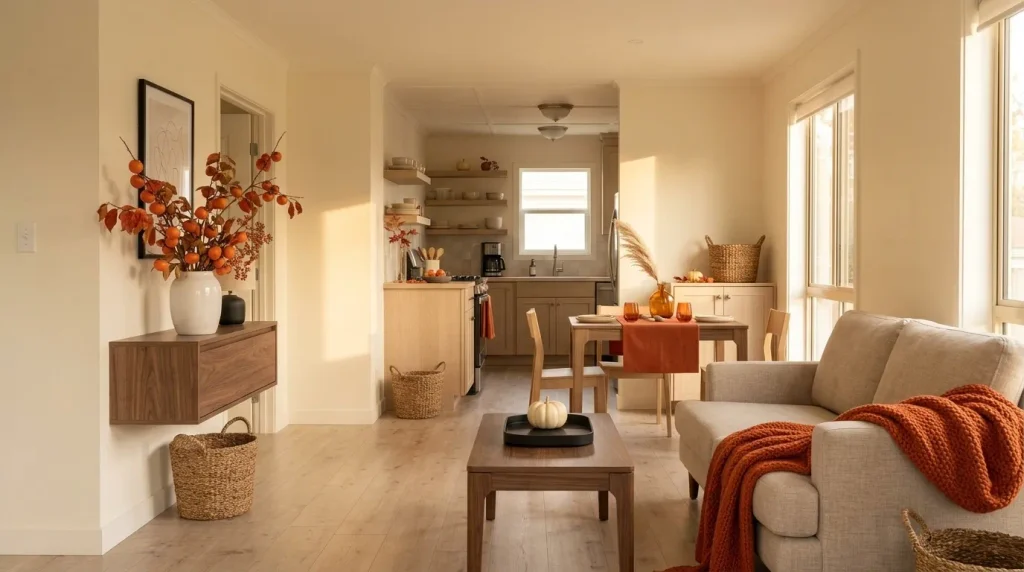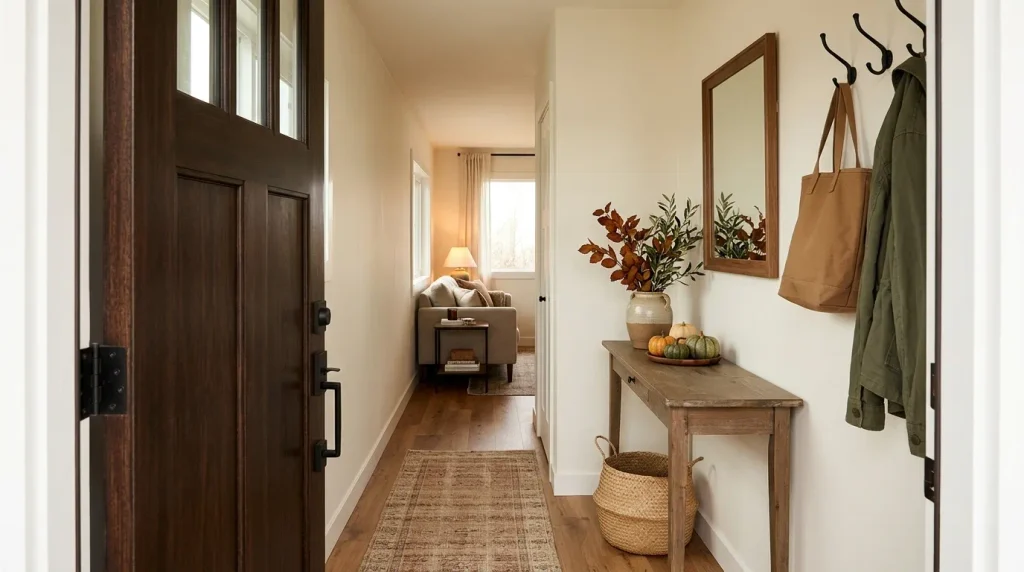
Halloween decorating gets tricky fast in a compact mobile home. A few pumpkins appear on the floor, another display lands on the coffee table, bats gather around the television, and suddenly the room feels smaller even though every decoration looked good on its own.
The smartest small space Halloween mobile home decor uses a different strategy. It works with the surfaces that already have visual influence—the long wall, a window, the TV zone, cabinet-top height, textiles, and lighting after dark—while protecting the walkways, counters, seating, and breathing room that make a smaller home comfortable.
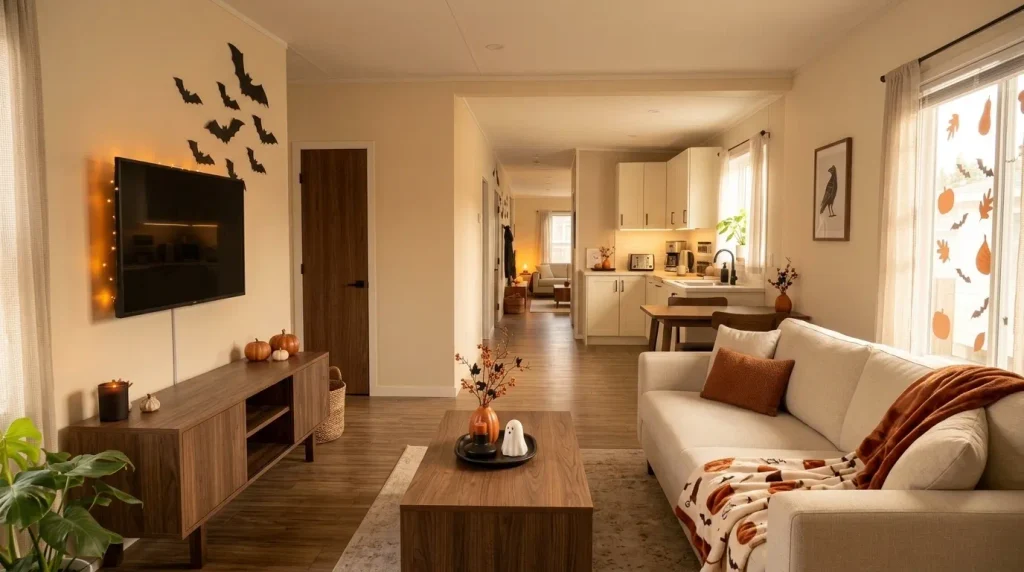
These 21 ideas approach Halloween as a space-planning problem as much as a decorating one. You will find ways to decorate walls, windows, living areas, kitchens, bedrooms, bathrooms, and connecting spaces without asking every square foot to participate.
Start with the footprint planner below. It helps identify where Halloween can make the biggest visual difference while costing the least usable space.
1. Map Your Halloween Footprint Before You Decorate Anything
Before unpacking another bin, look at what your home is already asking you to keep clear. In a small mobile home, the most useful decorating surface is not always the first empty surface you notice.
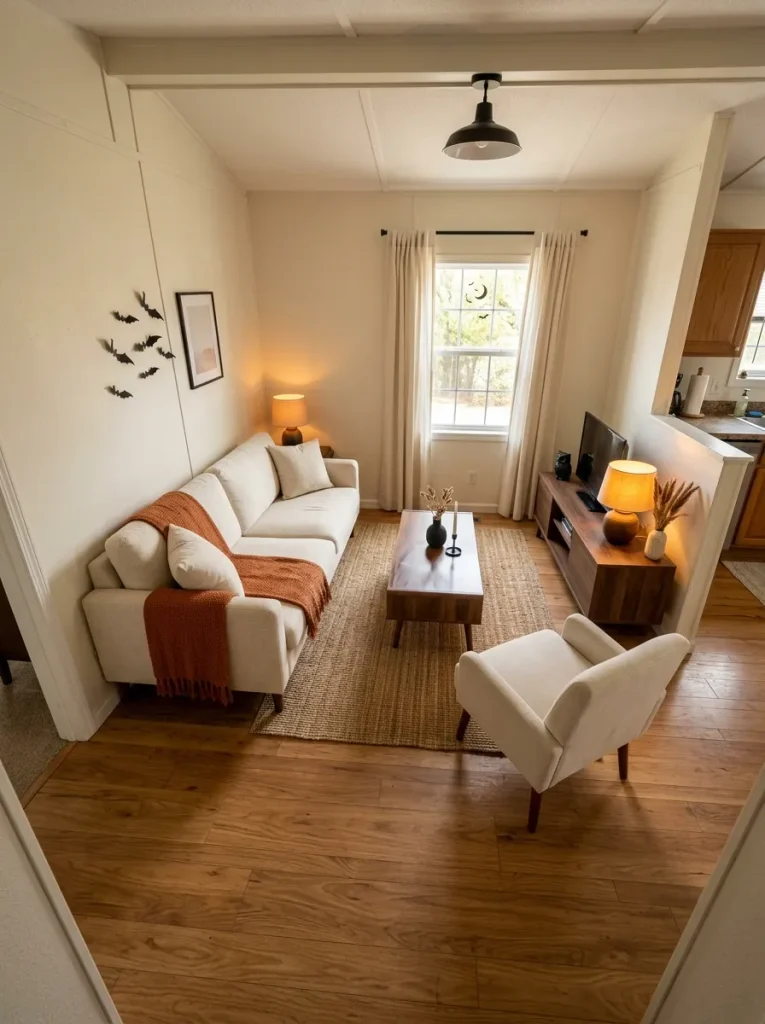
A bare patch of floor beside the TV may fit three pumpkins, yet that same patch may be part of the easiest route between the sofa and kitchen. An unused counter corner may look promising until dinner prep begins.
Start with the pressure point. Tight circulation suggests moving Halloween upward. Busy counters point toward a wall or window. Full walls make textiles or nighttime lighting more attractive.
Use the planner to choose the decorating plane with the lowest everyday cost.
Where should Halloween live in your small home?
Select the part of your room that is already doing the most work. Your result identifies the decorating plane that adds Halloween atmosphere with the lowest spatial cost.
Empty space is not automatically available space. Protect circulation, work surfaces, and daily routines before deciding where another Halloween layer belongs.
Choose a pressure point aboveUse wall bats, window silhouettes, lightweight hanging decor, or one elevated focal point. Keep pumpkins and freestanding props away from the main movement route.
Prioritize wall → window → upper planeShift seasonal impact to walls, windows, or cabinet-top height so cooking, eating, working, and setting things down stay easy.
Prioritize wall → window → upper heightUse one seasonal throw, a limited pillow, or an evening lighting layer. These change the room without competing with an already-composed wall.
Prioritize textiles → lightingConcentrate warm light around the existing focal area. A stronger night scene may solve the problem without another pumpkin, tray, sign, or figurine.
Prioritize focused lightingAn empty gap does not automatically need decoration. Sometimes the room works well precisely because that space remains open.
2. Give the Long View One Lead Scene and Two Quieter Supporting Zones
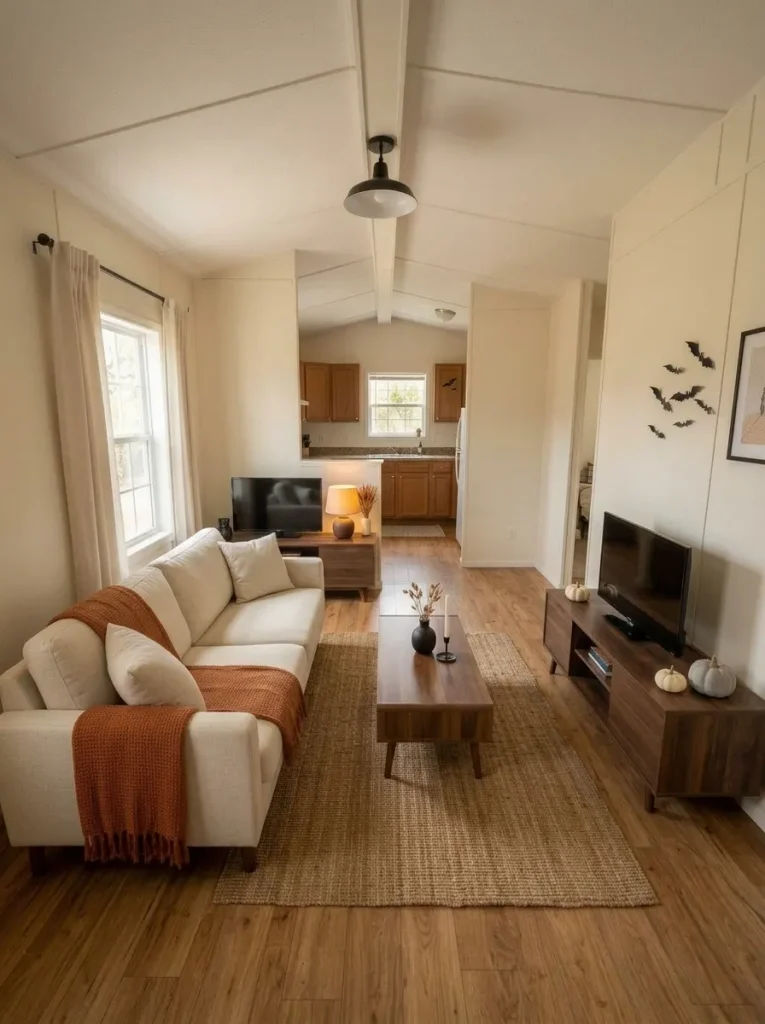
Stand where you first enter the living area and look as far through the home as possible.
In many mobile homes, the living room, dining area, kitchen, and hallway remain visually connected. Four independently decorated zones can therefore appear as one crowded composition.
Choose one lead Halloween scene—the television wall, a window, or another strong focal area. Let the next visible zones become supporting moments. A dramatic TV wall might pair with one quiet kitchen accent and a sparse motif continuing toward the hallway.
Take a phone photo from the entrance. If the eye cannot decide where to land first, reduce the secondary zones before buying another decoration.
Compact sightlines can work in your favor: one well-designed scene may influence several connected spaces at once.
3. When the Floor Feels Full, Move the Halloween Story Onto the Wall
Floor decorations have a high spatial cost in a compact room.
A pumpkin cluster occupies its own footprint, but people also adjust how they walk around it, clean around it, and approach nearby furniture. Flat Halloween decor changes that relationship.
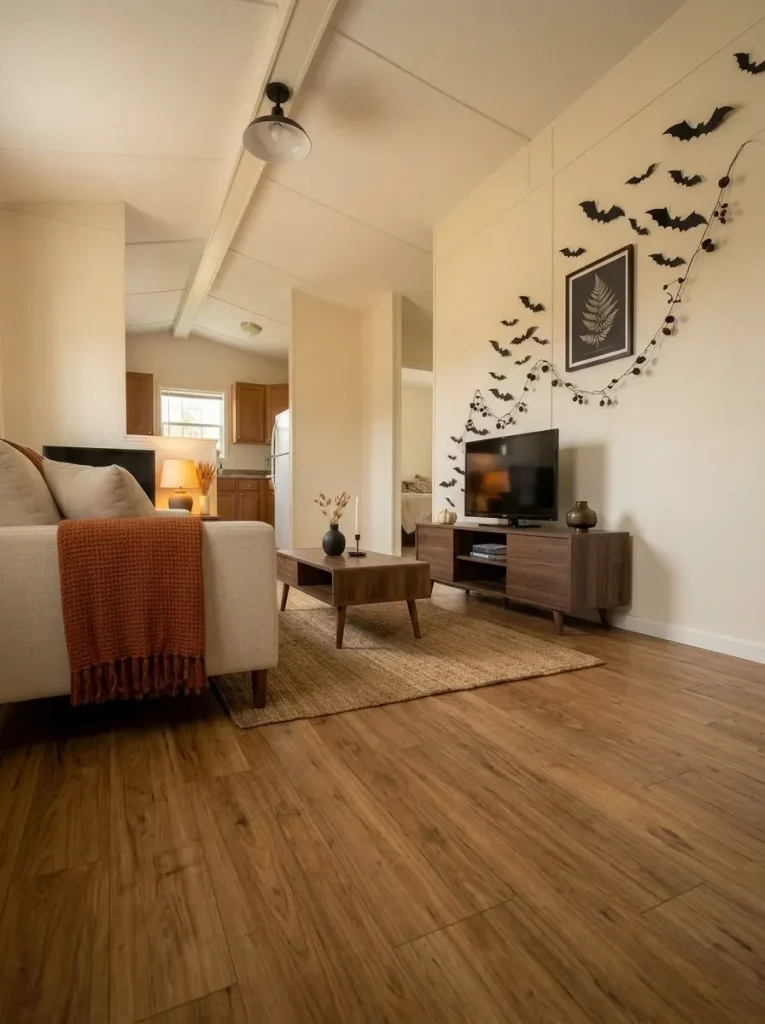
Bat silhouettes, lightweight garlands, framed seasonal art, paper shapes, or a shallow wall composition can occupy a large visual area while using almost none of the circulation plane.
For handmade versions of those pieces, the dedicated guide to DIY Halloween decor ideas for mobile homes goes deeper into construction. Here, placement is the decision: when floor clearance is valuable, let the wall carry more of the seasonal story.
The same Halloween impact can cost very different amounts of usable space
Freestanding floor display
The decorations occupy physical floor area and create an invisible buffer that people naturally walk around.
Wall-based display
The seasonal scene can cover a broad visual field while preserving the floor plane for circulation and daily use.
Use the wall-first move when floor clearance matters. Skip it when the wall is already visually crowded; a window, textile, or lighting layer may then be the cleaner solution.
A wall treatment is not automatically the better answer. Already-busy gallery walls may benefit more from a window, textile, or lighting intervention.
4. Let the TV Wall Carry the Largest After-Dark Moment
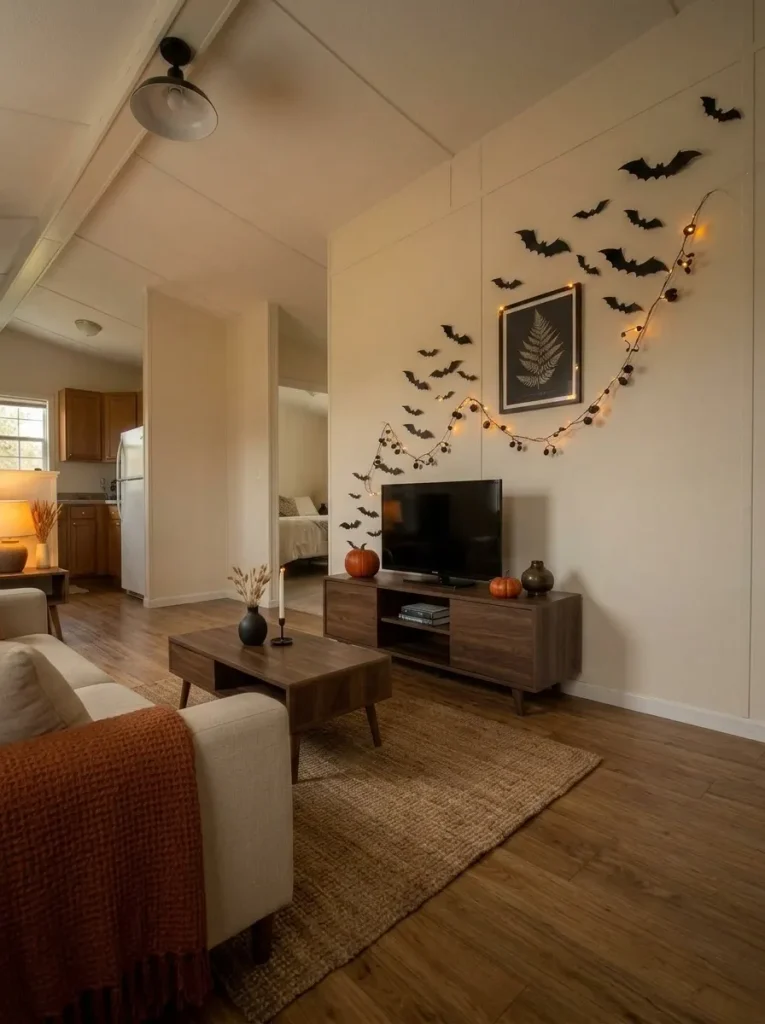
A television already behaves like a visual anchor. That makes the surrounding wall one of the few places where a small living room can handle a stronger Halloween scene without introducing new furniture.
Build outward from what exists.
A loose flight of bats can stretch the composition upward. Warm lights can widen it. One or two pumpkins on the console can give the scene a visual base.
Now judge the area from the sofa, not from two feet away.
If the TV wall clearly reads as the dominant Halloween moment, allow the coffee table, adjacent wall, and floor to become quieter. Plain wall around the display also matters; it gives bats, lights, and pumpkins enough contrast to read separately.
Stop point: once the focal wall tells the Halloween story from the normal seated position, additional density elsewhere should need a reason.
5. Use One Window as a Halloween Scene You Can Read From Both Sides
A window is unusually valuable in small space Halloween mobile home decor because one thin layer can work in two directions.
During the day, translucent orange pieces, sparse silhouettes, or hanging forms can catch natural light inside. After sunset, the same composition may become visible from outside when the room glows behind it.
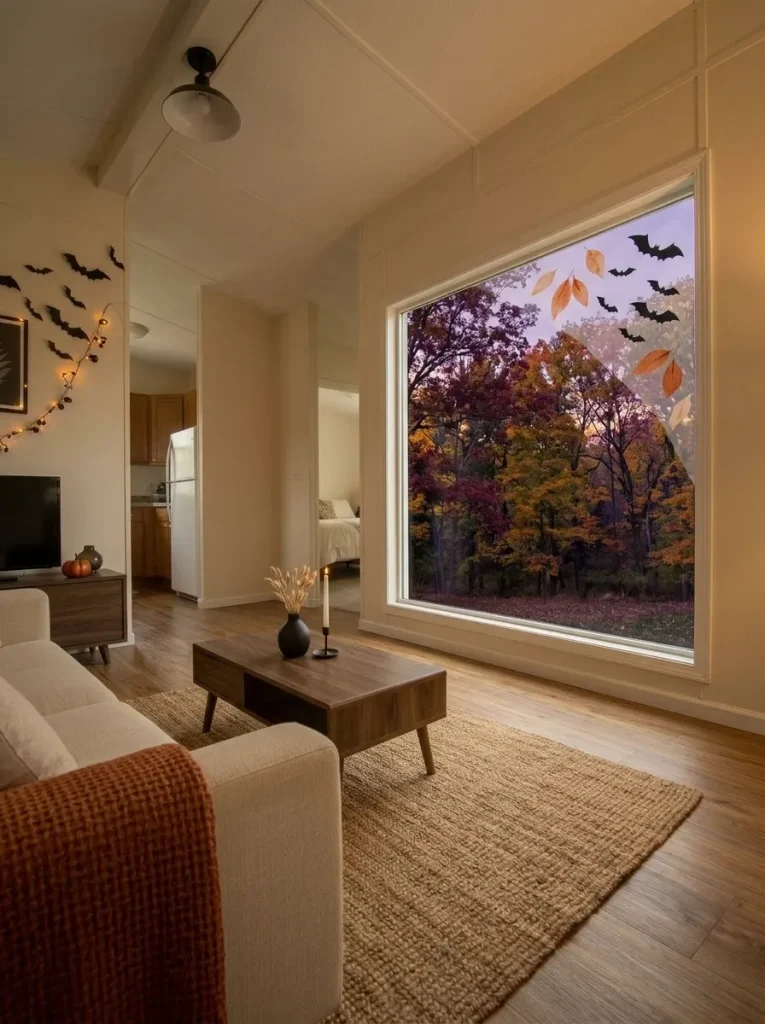
First decide what that window still needs to accomplish. A kitchen window supplying important daylight should stay largely open. A more private window can support denser silhouettes. A front-facing living-room window can become the home’s strongest street-visible Halloween moment without requiring another table or floor display.
Choose the function first; then choose the density.
Design the window around what it still needs to do
A small-home window can provide daylight, privacy, and an exterior Halloween moment. Choose the job you need to protect most.
In a compact room, losing useful daylight or making a window visually heavy can cost more than the decoration contributes.
Use a sparse cluster of bats, translucent orange pieces, or a thin garland. Concentrate detail around the edge or corner so daylight still reaches the room.
Build a denser band along the lower section or one side. The seasonal layer can provide some privacy while the remaining glass keeps the room from feeling enclosed.
Use larger, simpler shapes or a single glowing focal element. An exterior view needs strong contrast more than many tiny details.
Once the window reads clearly from both intended viewpoints, nearby surfaces can remain comparatively quiet.
6. A Narrow Blanket Ladder Can Hold Seasonal Texture Without Filling Another Table
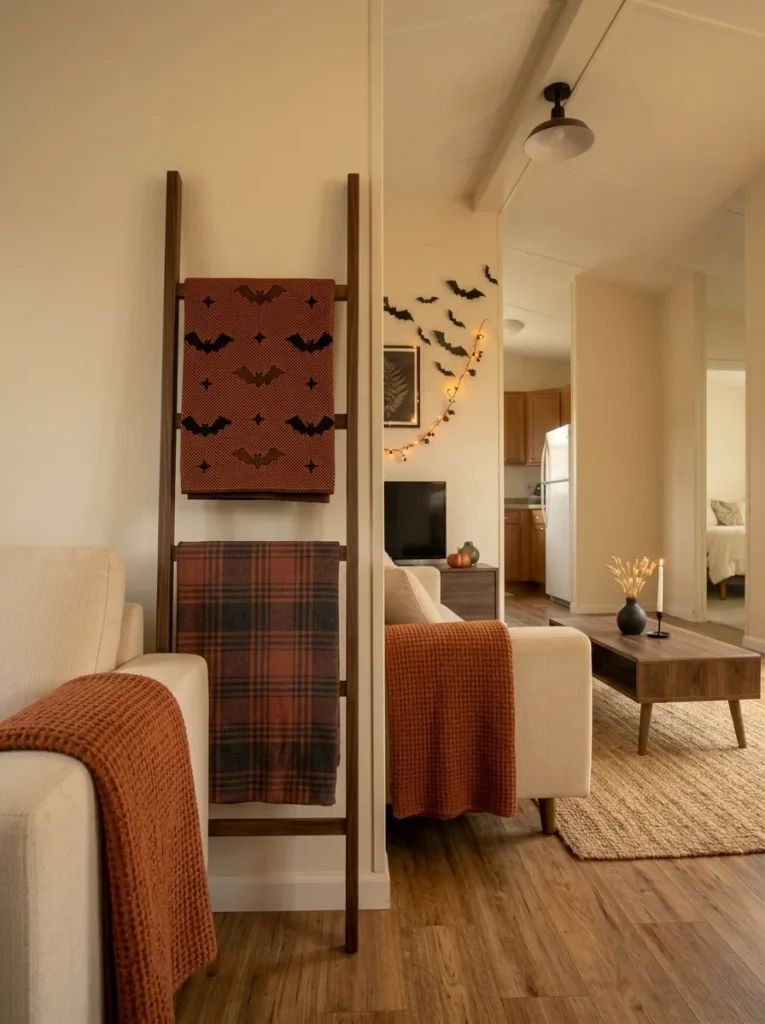
Halloween textiles create color and pattern without introducing another hard piece of decor. Problems begin when every throw ends up on a chair, in a basket, or piled across furniture that still needs to function.
A slim blanket ladder turns that softness into a vertical display.
Hang one recognizable Halloween throw near the top, place a quieter plaid or rust-toned blanket below it, and leave enough frame visible that the ladder still reads as one composed object.
This setup works well beside a sofa, in a bedroom corner, or against a narrow wall where deeper furniture would be awkward.
There is also an editing advantage: if the room already contains strong pumpkins, bats, or ghost motifs, the ladder can carry plain autumn texture instead. The result connects the palette without introducing yet another Halloween character.
Use the ladder when the room needs seasonal softness more than another decorated horizontal surface.
7. Make the Coffee Table Pass the Lift-Off Test
A coffee table is tempting because it occupies the middle of the room. It may also be where drinks, snacks, remotes, books, and everyday clutter need to land.
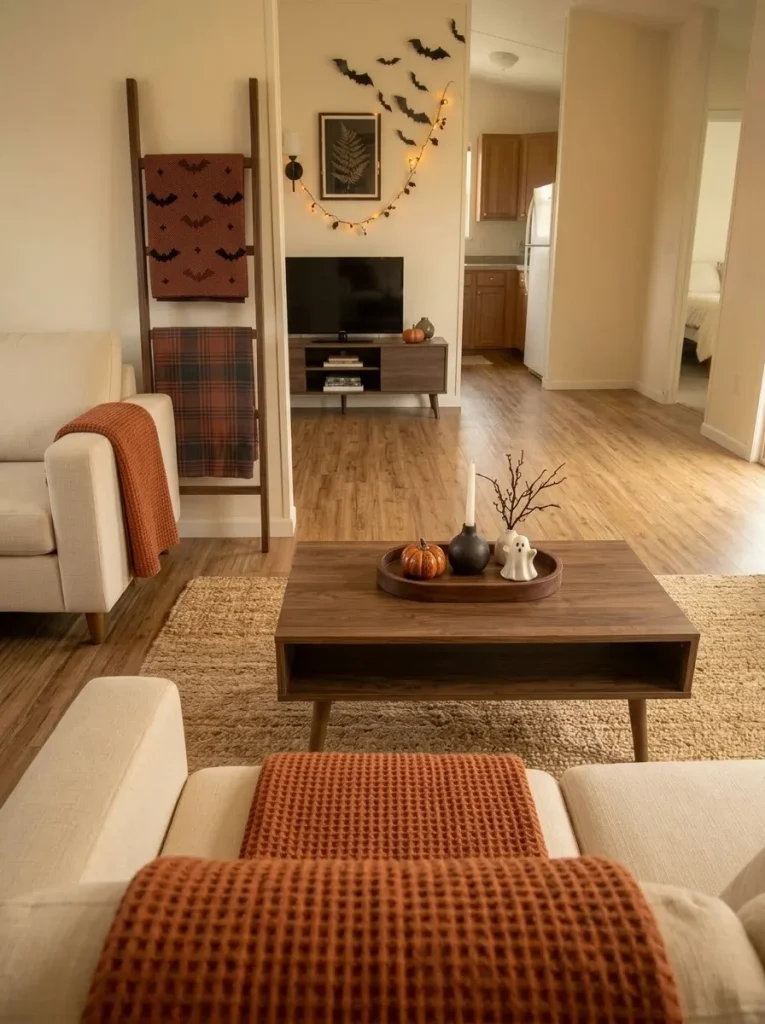
Before creating a centerpiece, ask one question:
Can the entire Halloween display be lifted away in one movement?
A tray, shallow basket, or single contained arrangement can work well. Six individual pumpkins, candles, books, and figurines usually demand much more resetting every time the table is needed.
How much Halloween can your coffee table actually carry?
Choose how hard the table works during everyday life. The result changes the amount of seasonal display that makes sense.
The most beautiful centerpiece still fails when it has to be dismantled every time the household needs the surface.
A compact tray is the maximum useful intervention. Put the stronger Halloween scene on a wall, window, or TV console where it will not compete with daily table use.
Keep every seasonal piece inside one movable boundary. The table stays practical because the entire display can disappear in one action.
Build a richer arrangement, but leave some visible tabletop around it. Negative space prevents a decorative surface from looking like seasonal storage.
The number of objects matters less than how much daily negotiation the display creates.
8. Let the Sofa Carry One Soft Halloween Signal, Not an Entire Costume
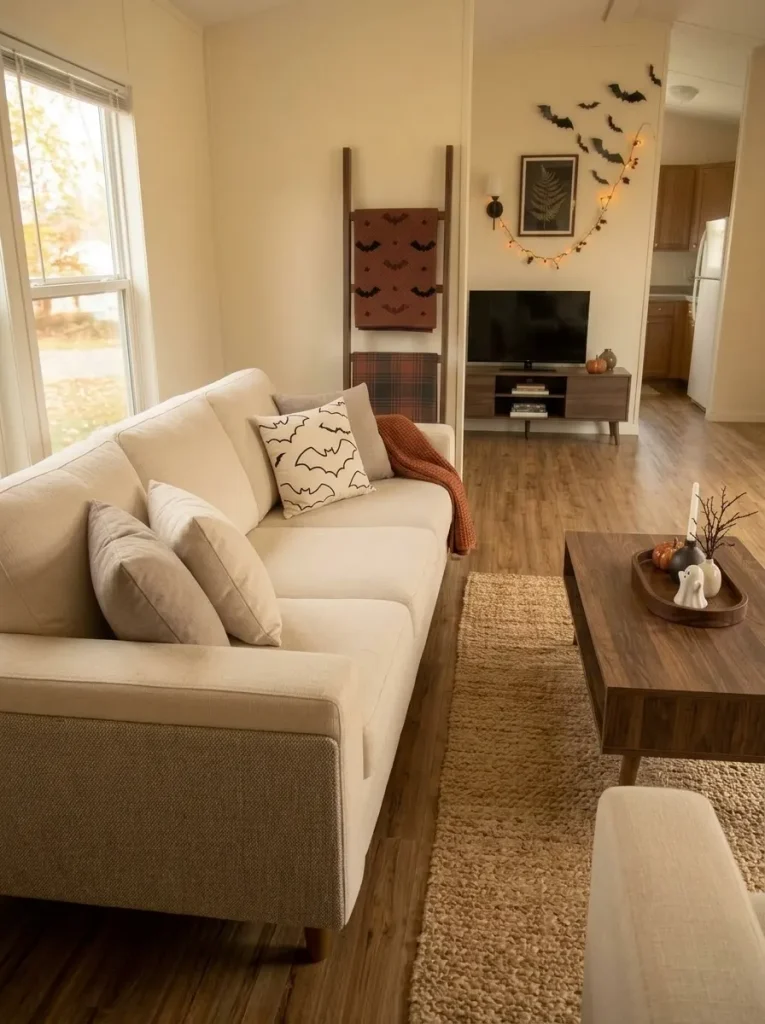
A small sofa becomes visually heavy quickly when every seat gets a themed pillow and several throws are layered across the back.
Try a quieter formula:
- one Halloween-specific pillow or
- one graphic seasonal throw;
- then support it with neutral cushions you already own.
A single signal often reads clearly because the sofa occupies a large percentage of the visible living room. One ghost pillow on a compact loveseat may have more visual influence than several tiny decorations on a distant shelf.
When the TV wall, window, or coffee table already carries obvious Halloween imagery, turn the sofa into the visual rest point. Rust, charcoal, cream, faded orange, or muted plaid can connect the seating to October without introducing another motif.
Comfort is the stop signal. Seasonal cushions should not need to be removed before someone can sit down.
9. Use Cabinet-Top Height for Drama Before You Spend Kitchen Worktop Space
A small mobile-home kitchen commonly has more visual capacity above eye level than functional capacity on its counters.
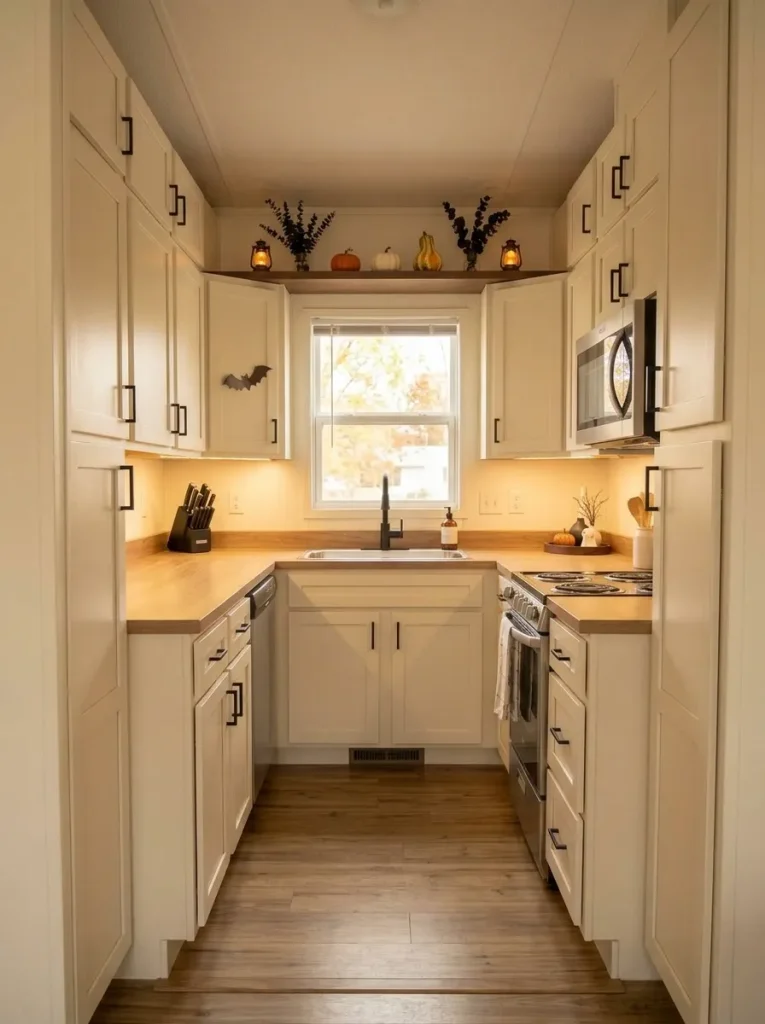
That makes upper height useful for seasonal atmosphere. A restrained run of pumpkins, dark foliage, lantern-like accents, or other lightweight decor can make the kitchen read as Halloween from across the room while the worktop stays comparatively calm.
Read the kitchen vertically: display zone, eye-level accent zone, then working zone.
Let every kitchen height perform a different Halloween job
Small kitchens rarely need equal decoration at every level. Put the biggest visual moment where it costs the least everyday function.
Lightweight pumpkins, restrained foliage, lantern-like accents, or a simple seasonal composition can make the whole kitchen read as decorated from across the room.
One sign, motif, small shelf accent, or short decorative repeat can visually connect the upper display with the working kitchen below.
Give only genuinely low-demand corners to seasonal decor. Prep space, appliance access, and normal daily routines stay more valuable than another vignette.
Decision rule: when the worktop begins to feel crowded, move the Halloween story upward before adding another counter object.
If the cabinet-top area is difficult to reach, unsuitable for objects, or would make cleaning frustrating, skip it. The same principle can move to a nearby wall or window.
10. Keep the Cooking Zone Visually Festive Without Turning It Into a Display Shelf
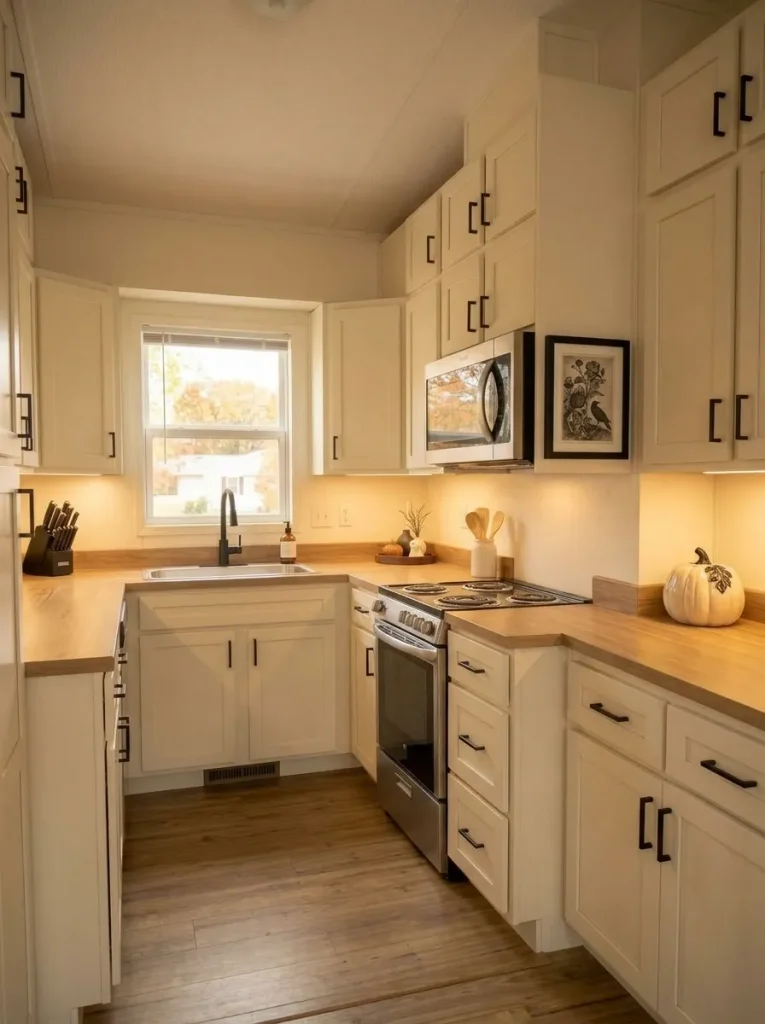
The stovetop is not ordinary display furniture.
In a small kitchen, the range may sit directly in the strongest sightline, which means a modest seasonal cue nearby can register clearly without surrounding active cooking equipment with decorations.
Use another surface for the main arrangement. A seasonal towel, wall accent outside the active cooking area, or protected counter vignette can provide the Halloween signal while the appliance remains a working appliance.
Keep loose fabric, paper decorations, cords, and other combustible seasonal items away from burners, hot surfaces, and other heat sources. Follow the safety and clearance instructions supplied with the appliance and the decorations you use.
A simple test settles many borderline placements:
If the decoration must be moved every time you cook, give it a different home.
The kitchen will still read as Halloween when the cabinets, textiles, wall accents, or one contained micro-zone provide the seasonal layer.
11. Let a Hallway Carry Movement, Not a Collection of Objects
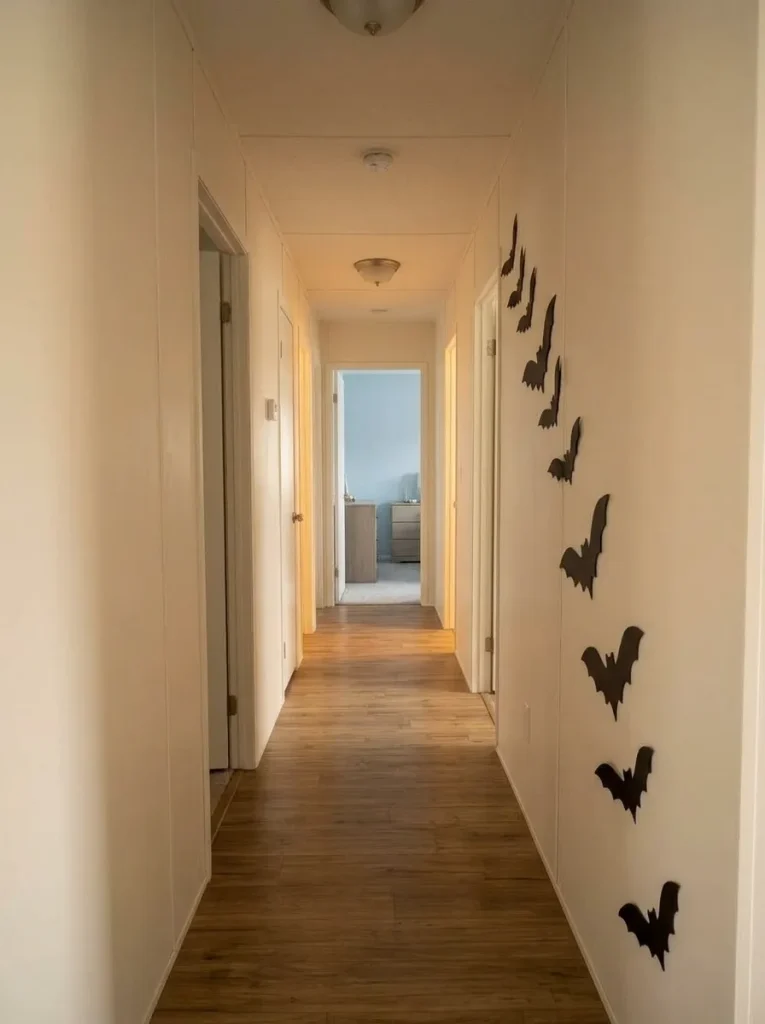
A hallway is experienced while moving through it, so it does not need to behave like a living-room display.
A narrow mobile-home passage usually gains more from rhythm than volume.
Send a small flight of bats diagonally along one wall. Repeat a lightweight silhouette at intervals. Use one restrained hanging detail at the transition between rooms.
The eye follows the sequence while the route itself remains clear.
Now stand at one end of the hallway. If the motif immediately draws the eye toward the next space, the passage already has a Halloween job. Filling every blank section would flatten that sense of movement.
Use hallways to connect larger decorated zones—not to create another dense collection between them.
12. Frame the Doorway, but Keep the Opening Visually and Physically Clear
Doorways arrive with their own scale. Borrow it.
A little black gauze, a short garland, removable bats, or sparse seasonal foliage around part of an existing opening can create a much larger visual gesture than several floor decorations.
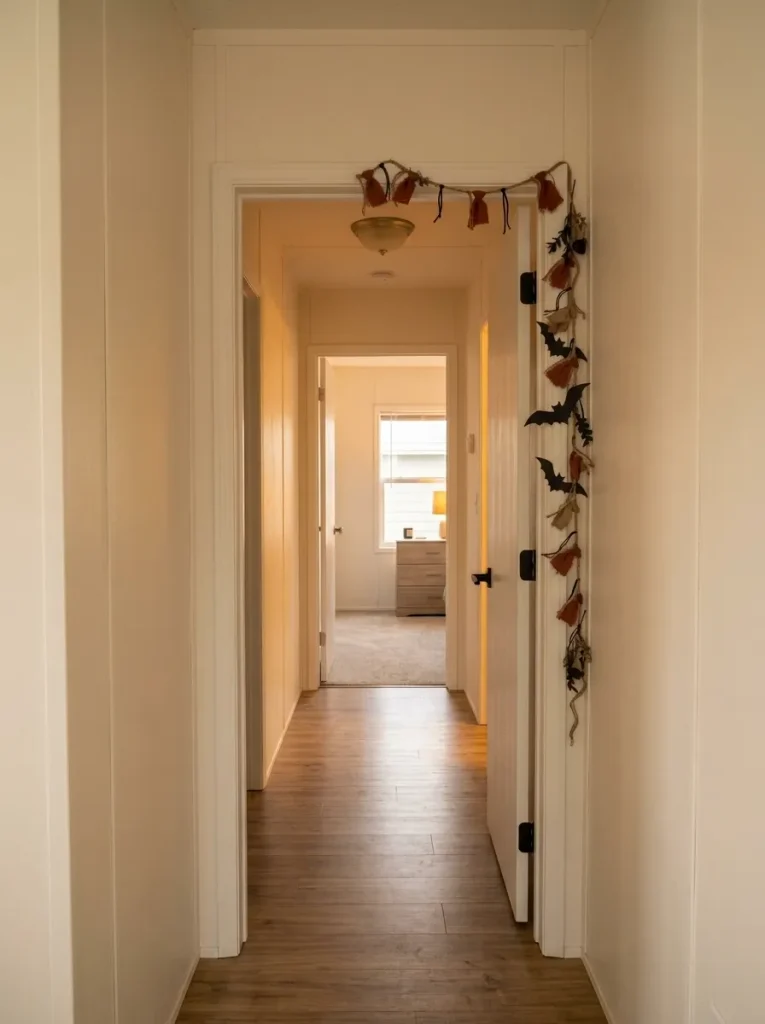
Two viewpoints decide whether it works.
From the approach: does the decorated frame clearly signal a transition?
Through the opening: can you still see the next room without the decoration turning the doorway into a dark visual border?
That second question matters in a mobile home because openings often participate in long sightlines between rooms. A dense surround can make the destination space appear more compressed.
Outline only as much of the doorway as the scene requires. Halloween should reveal the architecture, not make the opening feel closed.
13. Let a Mirror Repeat One Spooky Moment Instead of Adding Another Display
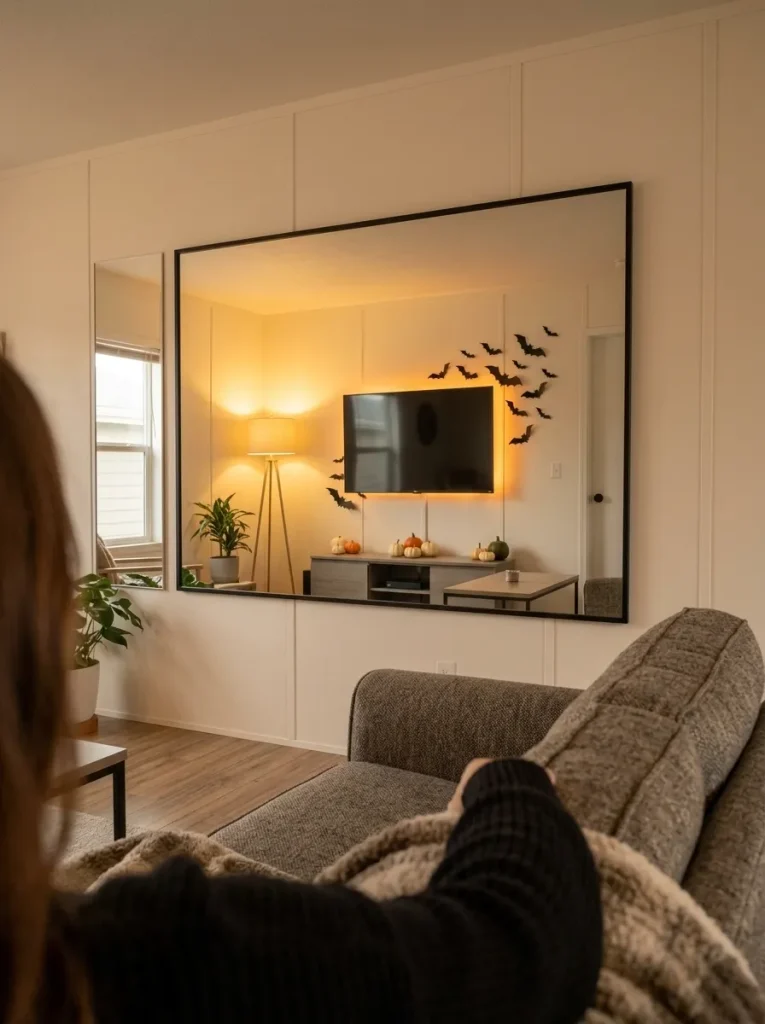
A mirror can duplicate a Halloween scene without duplicating the objects.
Stand in the usual viewing position and inspect what already appears in the reflection.
A bat wall, warm pumpkin grouping, dark branch, or orange-lit focal area can become a second atmospheric layer simply because the mirror catches it.
The opposite outcome is possible too. Mirrors can amplify clutter just as efficiently as they amplify deliberate styling.
If the reflection contains a crowded shelf, exposed storage, or several competing decorative zones, change what the mirror sees before decorating its frame.
When the reflected scene already looks strong, leave the glass and frame mostly untouched. One tiny accent may be enough.
Small-space styling becomes especially effective when the room gains apparent depth and repetition without gaining another physical object.
14. Choose Light-Through Halloween Decor When You Want Color Without Visual Weight
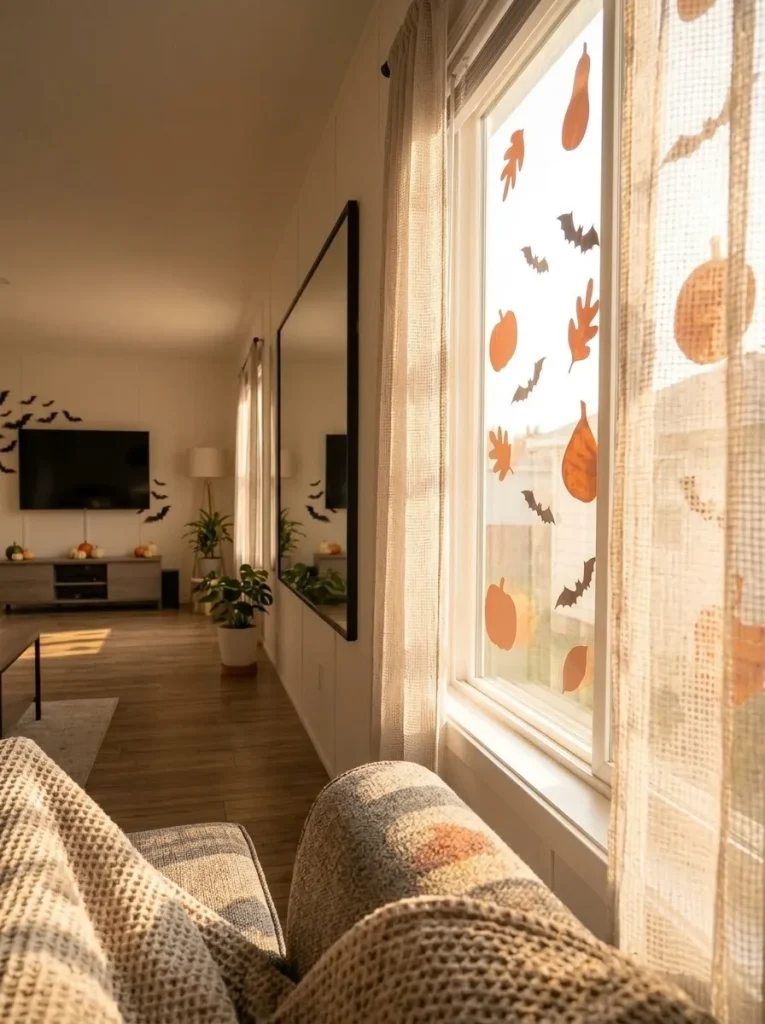
Some Halloween decorations can add color without behaving like solid visual blocks.
Translucent orange pieces, thin paper shapes, delicate fabric, dried citrus, or sparse hanging decorations allow some of the architecture and light behind them to remain visible.
Imagine two similarly sized windows.
One is almost covered by an opaque black-orange design. The other has several spaced pieces glowing against daylight. Both communicate Halloween, but the second preserves more light and background visibility.
The same idea applies near a bright wall or glass door: gaps matter.
Light-through materials are particularly useful when the room already contains dark furniture, a large black television, heavy curtains, or another high-contrast Halloween focal point.
Choose them when you want another seasonal layer without giving the room another visually solid mass.
15. Make Five Small Decorations Behave Like One With a Defined Boundary
Tiny decorations become cluttered when they scatter.
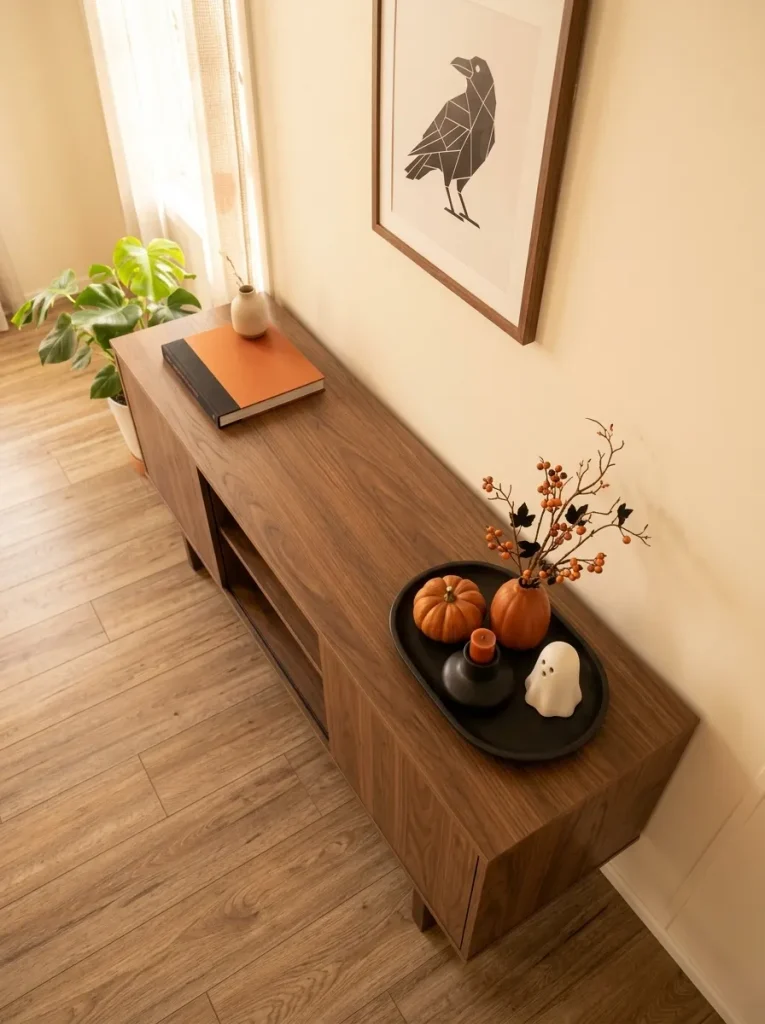
Three pumpkins, a candle, and a ghost spread across a console read as five separate interruptions. Bring them into one shallow tray or a clearly defined corner and the eye begins to interpret a single arrangement.
Useful boundaries include:
- a narrow runner;
- a shallow tray;
- a small basket;
- a cake stand;
- one end of a console;
- a clearly defined shelf section.
Grouping also gives inexpensive pieces more visual discipline. If budget is part of the decision, the guide to cheap Halloween decor ideas for mobile homes goes further into low-cost seasonal styling.
There is still a stopping point. Objects should not hide one another simply because they fit inside the tray. Edit the contents before increasing the boundary.
16. Give the Kitchen One Halloween Micro-Zone and Protect the Rest for Daily Use
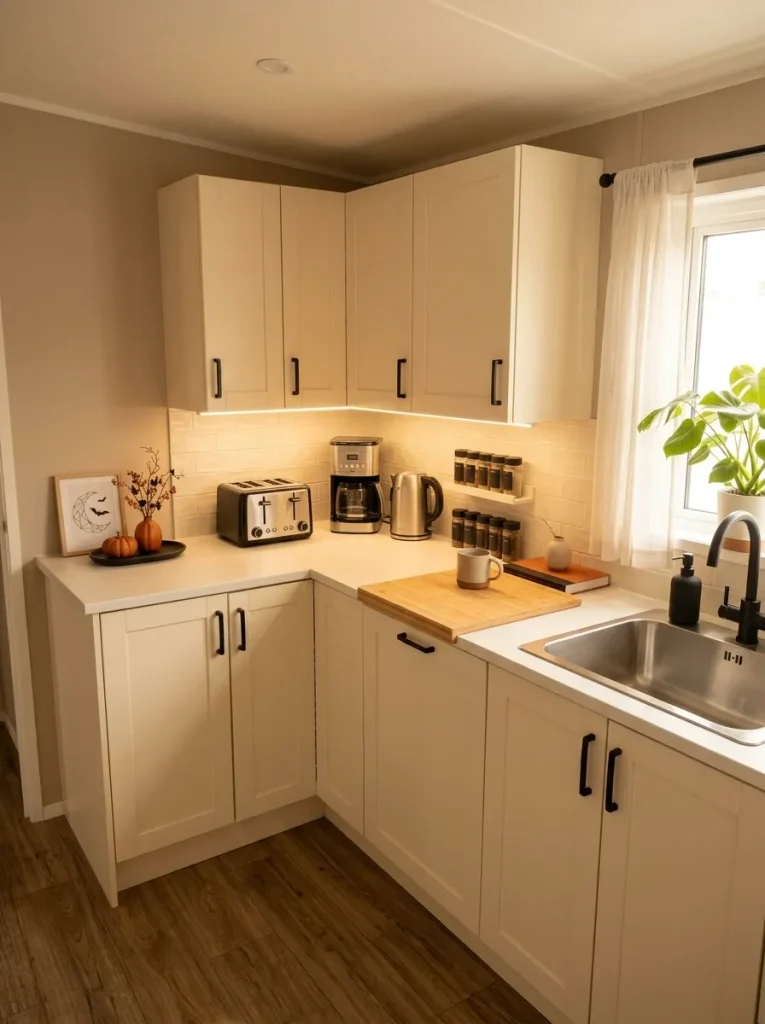
When some counter decoration is unavoidable—or simply enjoyable—choose one low-demand area and declare it the seasonal zone.
A corner away from the primary prep surface might hold a compact pumpkin arrangement, seasonal container, framed sign, or small tiered display.
Then protect the remaining countertop.
Run a quick three-part test:
- Can the main working surface be wiped without moving several Halloween pieces?
- Can a normal meal be prepared without relocating the seasonal display?
- Does the micro-zone still look complete when the rest of the counter is relatively clear?
Three yeses mean the setup respects both decorating and routine.
Several tiny Halloween moments around the toaster, sink, coffee maker, range, and spice area rarely outperform one intentional grouping. In a small kitchen, concentration often looks richer than distribution.
17. In the Bedroom, Let One Large Surface Carry the Mood
A compact bedroom does not need Halloween on the bed, nightstands, dresser, window, floor, and walls simultaneously.
Identify the surface with the greatest visual influence.
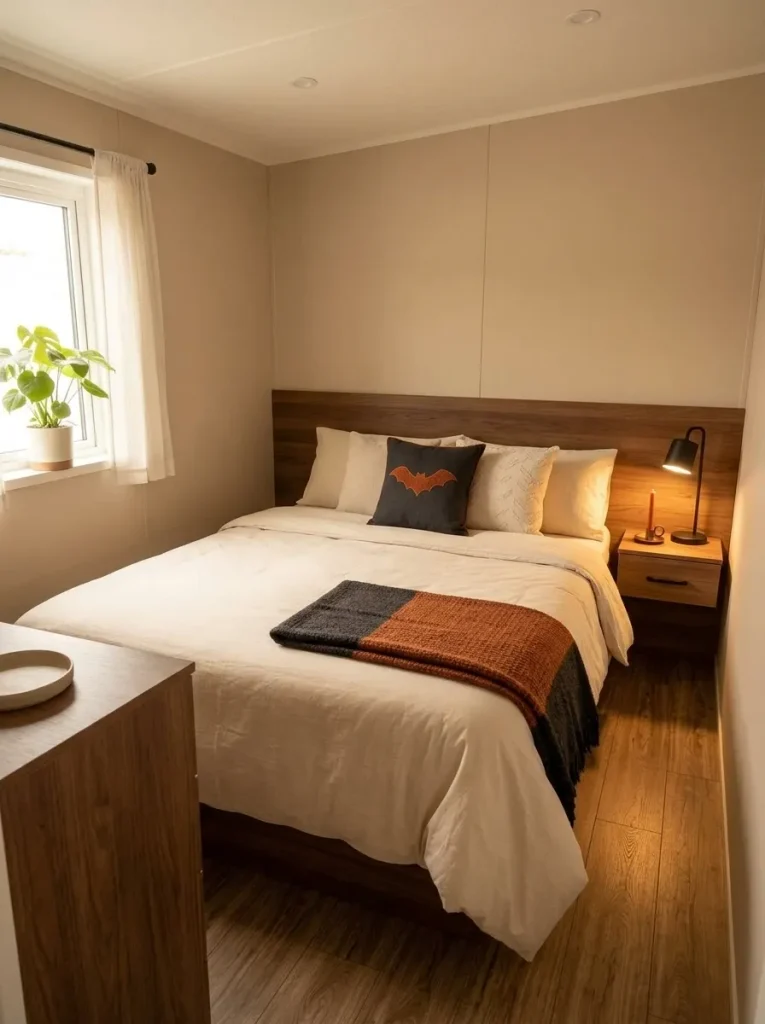
For many bedrooms, that is the bed. One Halloween throw, seasonal quilt, or limited pillow arrangement can establish the room’s direction immediately.
In another bedroom, neutral bedding may allow the headboard wall to become the lead scene. A dresser vignette or window treatment can take that role when the bed is already visually busy.
The choice matters because storage, lamps, curtains, bedding, personal items, and narrow circulation often appear together in a mobile-home bedroom.
Once one major plane clearly carries the mood, reduce the supporting surfaces.
For a deeper room-specific treatment, continue with Halloween bedroom decor ideas for mobile homes.
18. In the Bathroom, Keep Halloween Flat, Compact and Away From Everyday Clutter
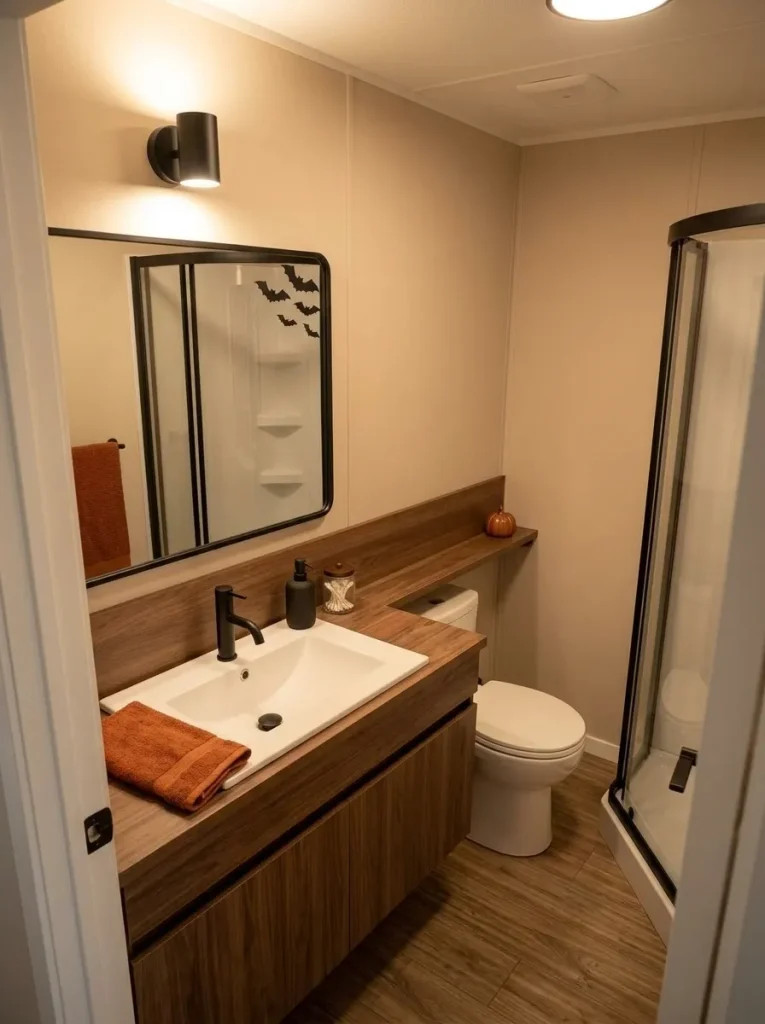
A small mobile-home bathroom reaches visual saturation quickly.
The mirror, fixtures, towels, toiletries, bottles, storage, and vanity already occupy much of what the eye sees. Halloween decor should therefore have a small physical footprint.
Good candidates include:
- one seasonal hand towel;
- a mirror-corner silhouette;
- one compact shelf accent;
- a shallow wall detail;
- a single Halloween motif repeated once.
A crowded vanity is usually the wrong focal point. Keep it functional and shift the seasonal cue onto a nearby vertical surface.
Bathrooms also benefit from restraint because a small dark decoration can carry more visual weight in a tight room than the same piece would in a large living area.
For more room-specific styling, continue with Halloween bathroom decor for a small mobile home.
19. Repeat One Motif Along the Home’s Route Instead of Starting a New Theme in Every Room
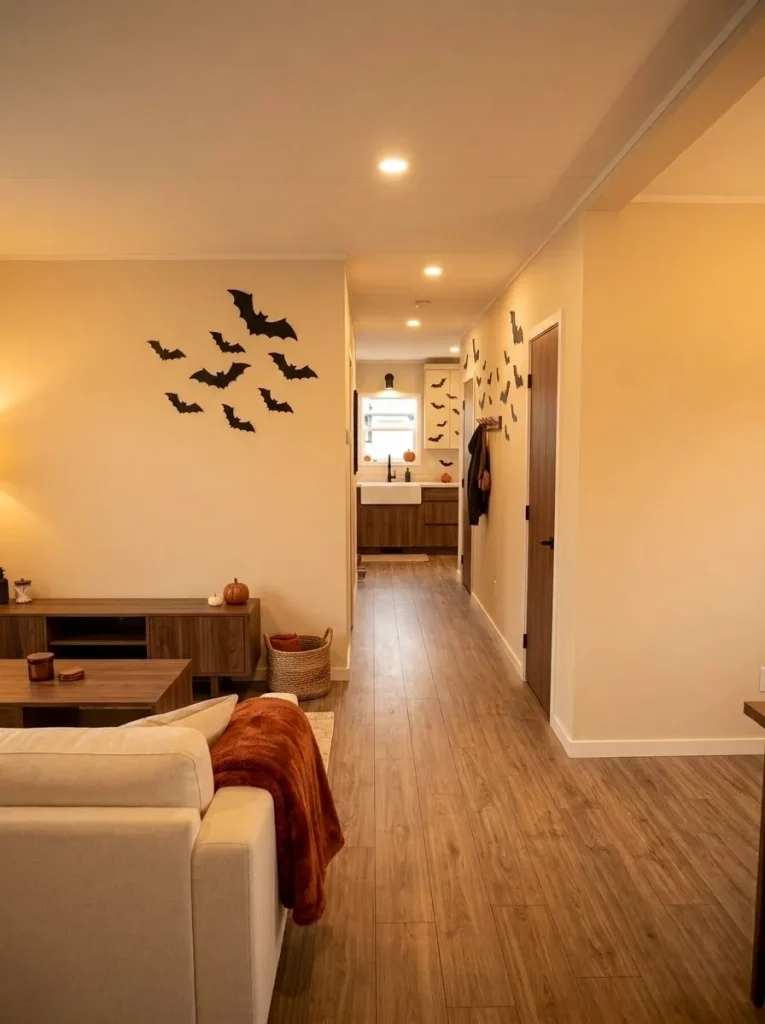
Connected rooms become visually fragmented when every area introduces a new Halloween vocabulary.
The living room has ghosts.
The hallway has skeletons.
The kitchen has witches.
The bathroom has spiders.
The bedroom has pumpkins.
Nothing is inherently wrong with those motifs, yet equal emphasis everywhere can make a compact home feel like several unrelated displays squeezed together.
Choose one motif that can travel.
For example:
Lead scene: a strong bat arrangement around the living-room focal wall.
Transition: two or three bats continue toward the hall.
Kitchen: one tiny bat repeat appears near the seasonal micro-zone.
Bedroom: the motif disappears or returns only once.
Repetition creates continuity. Decreasing intensity preserves hierarchy.
The first appearance should usually do the most work; later appearances behave like echoes.
20. After Dark, Let Lighting Replace Another Layer of Decorations
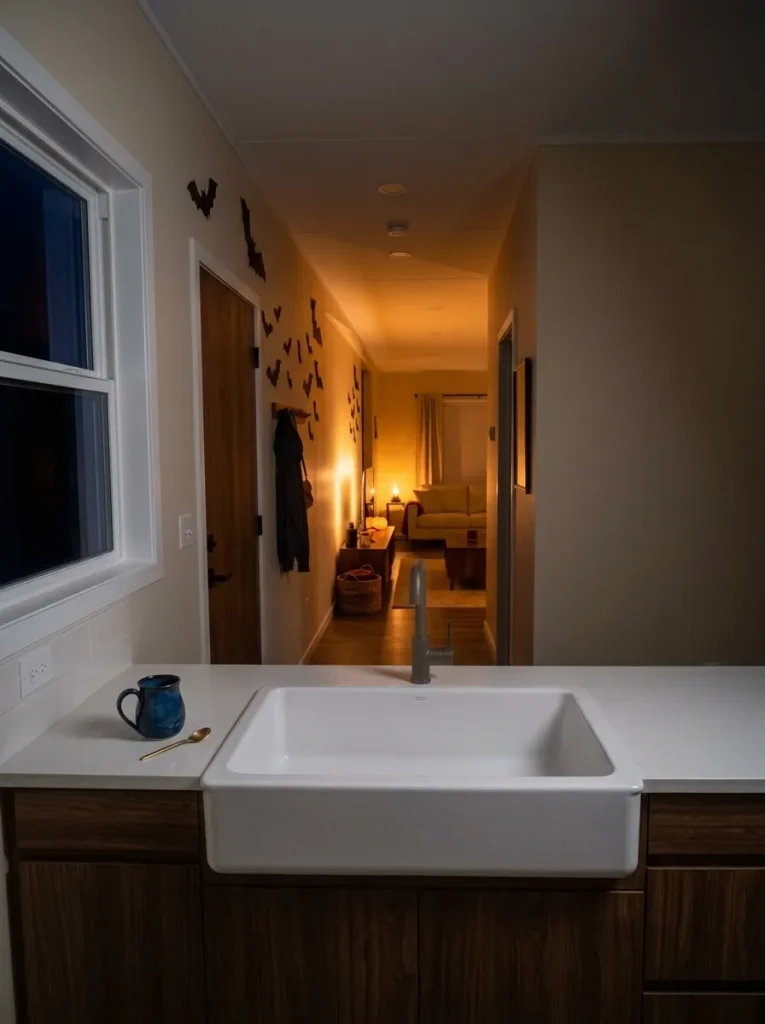
A room that seems under-decorated at noon may feel completely different after sunset.
Evaluate Halloween twice before deciding that another object is missing.
A warm glow around the primary focal point, an illuminated pumpkin, or another restrained evening light can strengthen pieces already in the room. The atmosphere increases while the physical footprint stays almost unchanged.
For electrical seasonal lighting, inspect the actual products before using them. The U.S. Consumer Product Safety Commission advises checking light sets for broken or cracked sockets, frayed or bare wires, and loose connections, and discarding damaged sets. (U.S. Consumer Product Safety Commission)
Does the room need more decor—or simply better light?
Choose what feels wrong after sunset. The output tells you whether to strengthen the focal area, soften the room, or stop adding lighting altogether.
A setup judged only in daylight can lead to unnecessary objects. Nighttime contrast may already provide the drama the room appeared to lack.
Add one concentrated warm glow around the TV wall, window scene, or main seasonal composition. Strong hierarchy matters more than adding another decorative collection.
Try warmer, lower-intensity ambient lighting and see whether the existing pumpkins, silhouettes, and textiles suddenly gain enough contrast to carry the mood.
Keep the strongest lighting layer and switch off secondary decorative lights. Darkness and shadow are part of Halloween composition too.
A successful night scene can eliminate the need for another daytime vignette.
21. Take One Daylight Photo and One Night Photo—Then Edit What Competes
The final decorating move is subtraction.
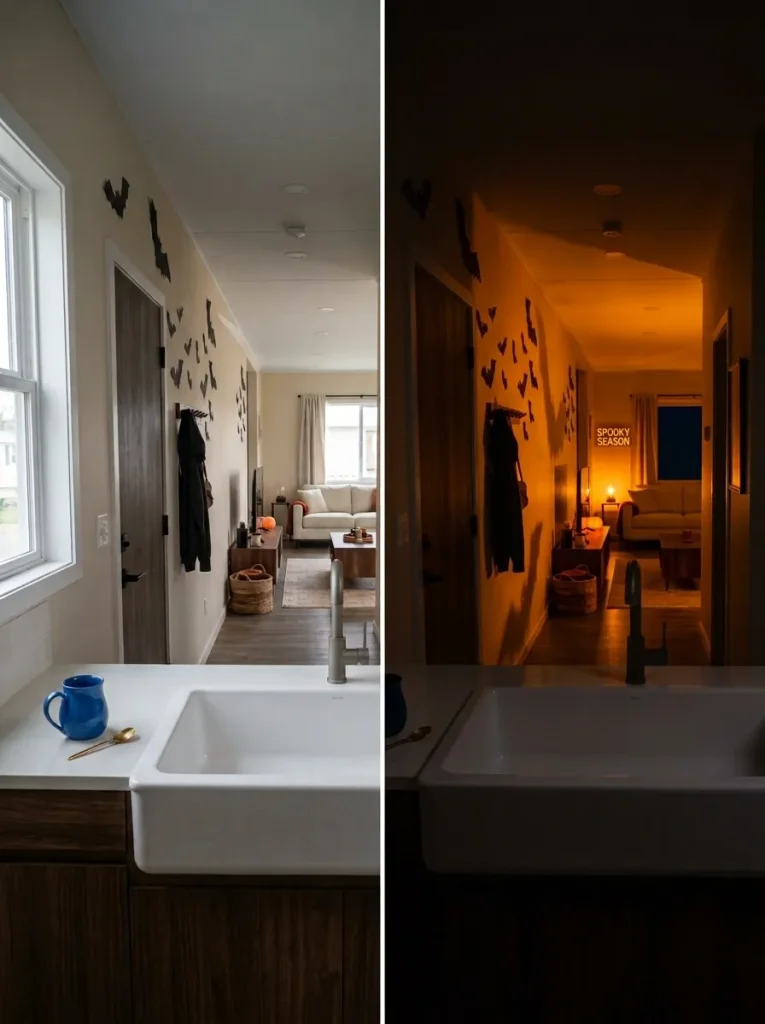
Photograph the main area in daylight from a doorway or position that captures several zones at once. Return to the same position after dark with the Halloween lighting switched on.
Do not study individual objects first. Study the whole frame.
Daylight audit
Look for:
- floor objects interrupting the walking line;
- tiny decorations scattered without a clear group;
- counters that have surrendered too much working area;
- several focal points demanding equal attention;
- dark pieces making an already-small corner feel visually heavier.
Night audit
Look for:
- many glowing points without a dominant light source;
- a secondary zone becoming brighter than the intended focal area;
- decorative lights fighting with the television;
- dark areas swallowing important furniture;
- objects that disappear completely after sunset and add little to the overall scene.
Now remove one questionable item and retake the photo.
If the room loses nothing important, leave that piece in storage.
And if Halloween reveals a year-round layout problem in the main sitting area, continue with these small mobile home living room ideas that feel more spacious.
Small-Space Halloween Decor Works Best When Every Zone Has a Job
A small mobile home does not need a small Halloween personality. It needs clearer priorities. Give the strongest scene to a surface that already has visual influence, let walls and windows work harder than the floor, protect the places required for cooking and everyday routines, and use evening light to deepen the mood before adding another object.
Then look through the home as one connected composition. The most useful final edit is usually the piece that lets the focal point become clearer or gives a walkway, counter, or quiet surface back to daily life.
Halloween should be immediately visible without making the home harder to use.
Love these ideas? Save this article on Pinterest so you can come back to your favorite small-space Halloween decorating ideas when you’re ready to decorate.