

There is a particular kind of Halloween decorating that instantly feels like the 1990s: orange mini lights glowing against honey-oak cabinets, plastic jack-o’-lanterns sitting beside everyday appliances, paper bats taped across a window, novelty towels, paperback horror stacked near the TV, and just enough handmade clutter to make the house feel excited for October.
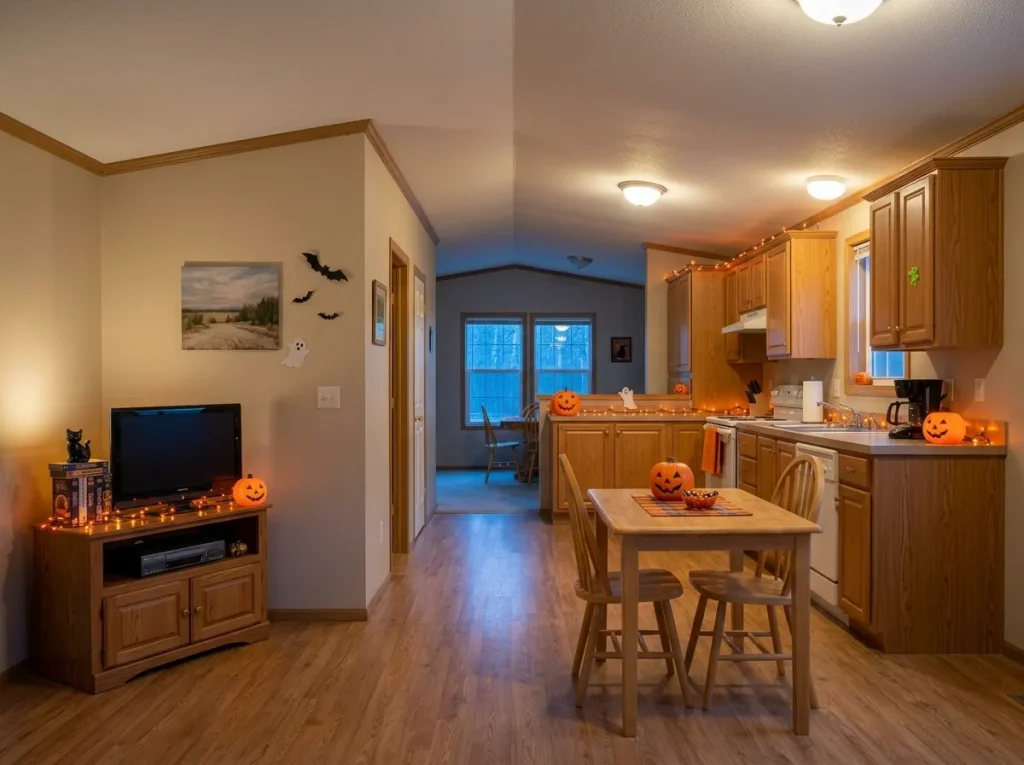
That mood works surprisingly well in a mobile home. Many manufactured homes already have compact rooms, visible kitchens, practical finishes, and connected sightlines that can support the cozy, collected feeling behind 90s Halloween mobile home decor. You do not need to disguise those features or turn the interior into a polished modern Halloween display.
The trick is choosing nostalgic signals that read clearly from across the room, then controlling where the visual density happens. These 17 ideas use recognizable 90s-inspired colors, lighting, objects, textiles, and decorating habits while keeping counters, walkways, windows, and everyday routines usable.
1. Build the Look From Three 90s Signals, Not a Pile of Retro Props
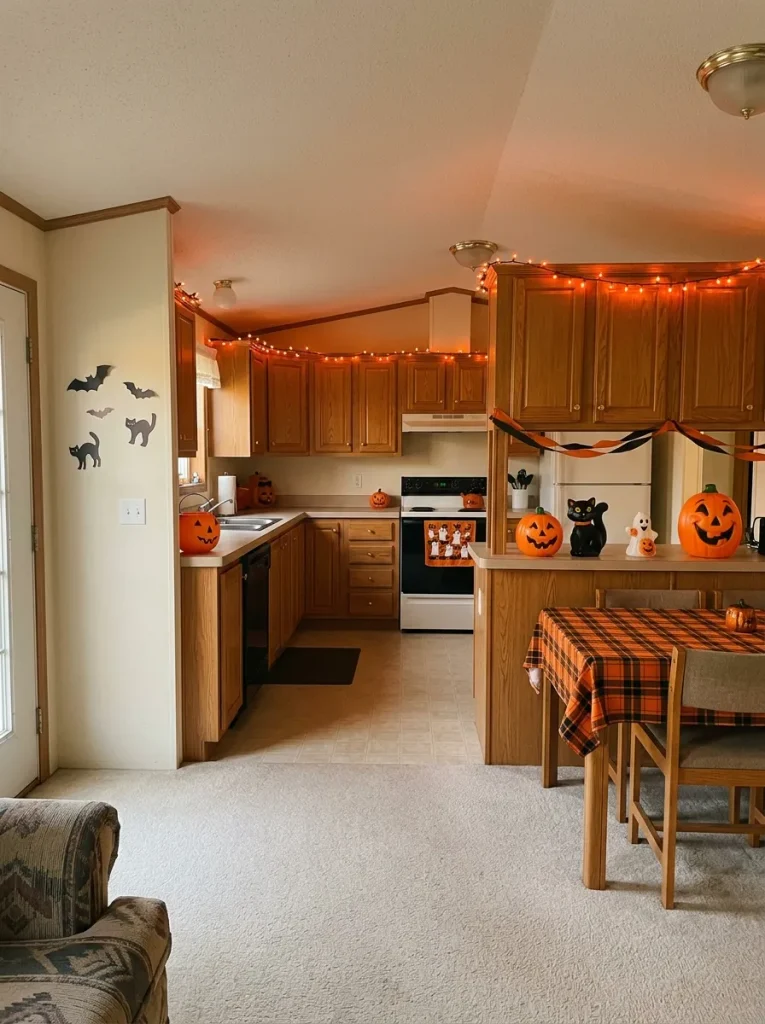
A convincing 90s Halloween room usually needs three things working together: a familiar color story, one recognizable nostalgic object family, and warm seasonal glow. Once those three signals are visible, almost everything else can stay ordinary.
That is especially useful in a mobile home because the kitchen, dining area, and living room may appear within one long sightline. If every surface tries to announce Halloween separately, the house becomes visually crowded before it feels nostalgic.
Start with the permanent room you already have. Honey oak might pair with pumpkin orange and black; white appliances can become the backdrop for colorful plastic decorations; darker wood can handle brighter orange lights and playful green accents.
Then choose one object family—pumpkin buckets, black cats, friendly ghosts, paper die-cuts, or novelty textiles—and repeat it lightly.
90s signal builder
Which nostalgic route already fits your mobile home?
Choose the finish closest to your room. Each route gives you the three signals that can carry the aesthetic before you buy anything else.
Stop signal: if the room already reads as Halloween from the doorway, add detail only where it supports a real activity or empty visual zone.
If those three signals already communicate “90s Halloween” from the doorway, resist filling every remaining surface.
2. Use a Brighter 90s-Inspired Palette: Pumpkin Orange, Black, Cream and a Shot of Slime Green
Many current Halloween interiors lean heavily on muted rust, beige, charcoal, and sophisticated matte finishes. A 90s-inspired room can afford to be more literal and cheerful.
Make pumpkin orange the attention color, black the graphic outline, and cream the visual relief. Then use slime green, purple, or red as a small novelty accent. That extra color is often what keeps the room from drifting into modern farmhouse Halloween.
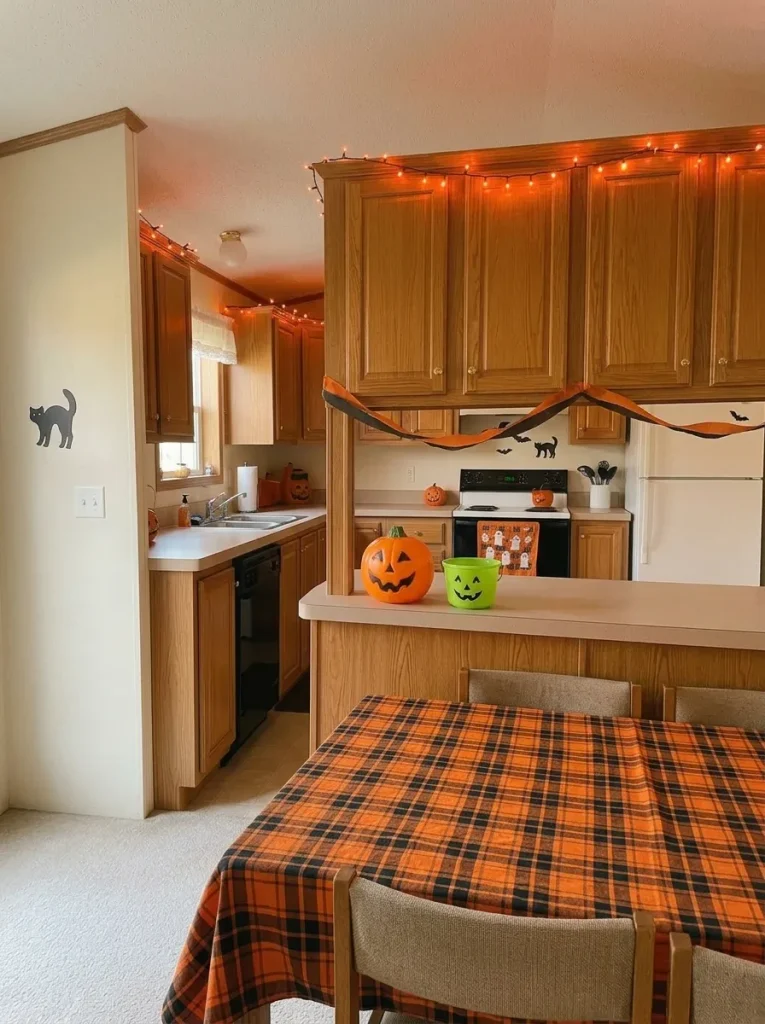
The permanent finishes should still lead. Honey-oak cabinetry naturally warms orange; a white stove or refrigerator creates crisp contrast with black-and-orange textiles; beige walls give colorful plastic decorations somewhere quiet to register.
For a small mobile home, do not divide all four colors equally. Give each one a job. That keeps the palette lively without letting connected rooms fight with one another.
Editorial palette map
Give every color a specific job
These are editorial color directions, not required paint colors. Let your existing cabinetry, flooring and appliances supply much of the neutral background.
Take a phone photograph from the adjoining room. If orange catches your eye first, black gives it definition, and the existing interior still reads clearly around it, the palette is doing enough.
3. Let One Plastic Pumpkin Bucket Become the Room’s Memory Trigger
You may not need a rare vintage collectible to make a room feel nostalgic. One oversized plastic jack-o’-lantern bucket can carry more 90s character than a shelf full of subtle seasonal objects because its shape, bright color, and deliberately playful expression are immediately readable.
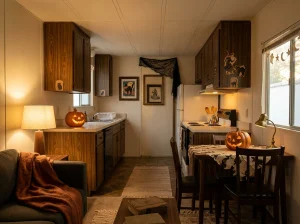
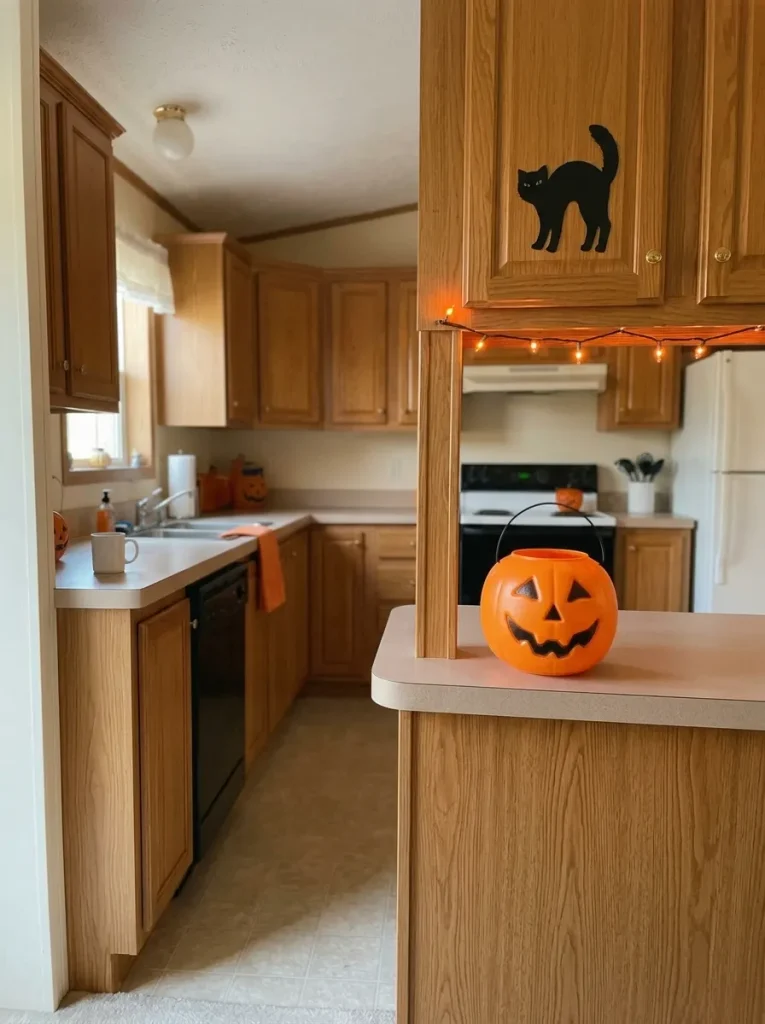
Use it where an everyday container would already make sense. Fill one with wrapped candy near the entry, use another to hold lightweight items away from cooking and heat, or leave an empty bucket on a low shelf beside books and games.
In a narrow mobile-home room, the floor is usually the wrong place for a collection of buckets. Choose one hero pumpkin at eye or counter level and let smaller Halloween details support it.
Try temporarily removing every other pumpkin from the room. If that single plastic jack-o’-lantern still makes the space feel Halloween-ready, it has earned the focal position.
The nostalgic effect comes from recognition—not rarity.
4. After Dark, Orange Mini Lights Do More Than Another Pumpkin
The daytime room establishes the objects. The night view is what can make the house feel like Halloween from childhood.
A short strand of warm orange lights can visually connect ordinary cabinets, an older TV unit, a window frame, and inexpensive decorations into one intentional scene. In a compact mobile home, lighting often gives you more atmosphere per inch than another tabletop object.
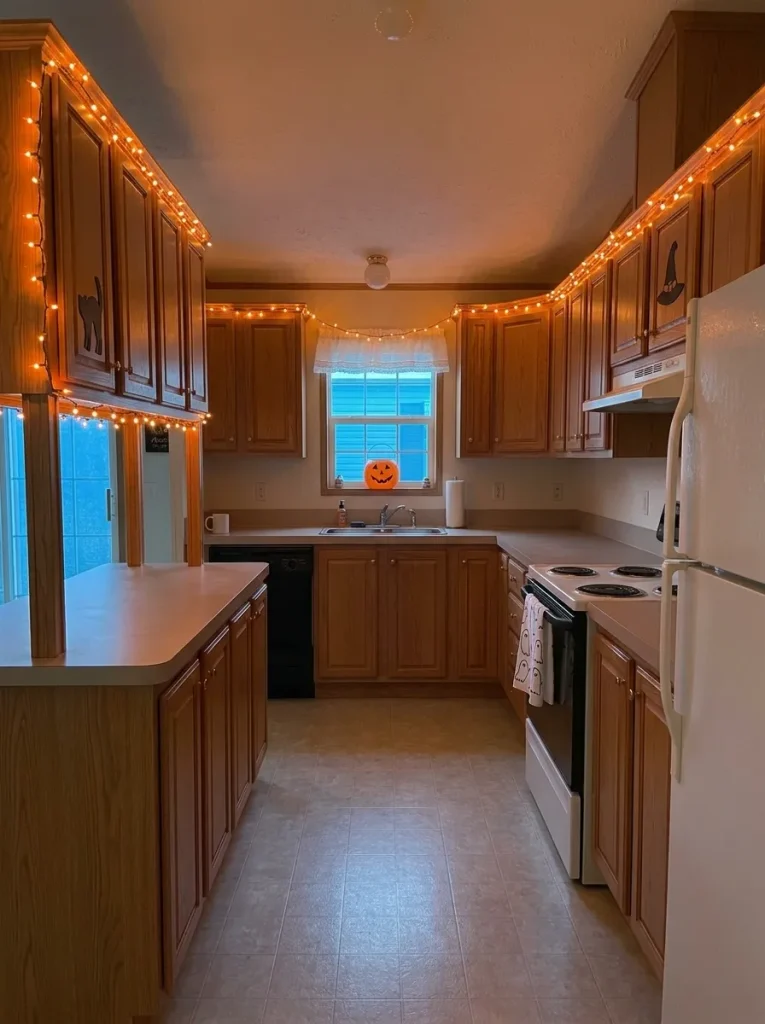
Choose one route, not every edge in the room. A line above kitchen cabinets can make a small kitchen feel festive without occupying prep space. A window route creates a strong silhouette from inside and outside. A media-shelf route produces the darker sleepover-night feeling associated with movies, paperback horror, and Halloween specials.
Where will one strand of orange light work hardest?
Select the zone that matters most after sunset. The result changes the mood and the type of clutter you can avoid.
Small kitchens with busy counters
Use the upper line to create atmosphere while leaving the work surface visually calmer.
Rooms visible from outside
Pair the glow with a few flat silhouettes so the window contributes to both the indoor and outdoor Halloween scene.
A cozy VHS-night atmosphere
Keep the rest of the living room dimmer and let one concentrated shelf become the nostalgic evening focal point.
Editing rule: stop after the first route is visually strong. A second strand should solve a separate dark zone, not simply repeat the same effect.
The lighting route should still make sense during ordinary use. A festive setup that obstructs a window control, cabinet access, or narrow pass-through is asking too much from the room.
5. Give the TV Corner a VHS-Era Halloween Memory Shelf
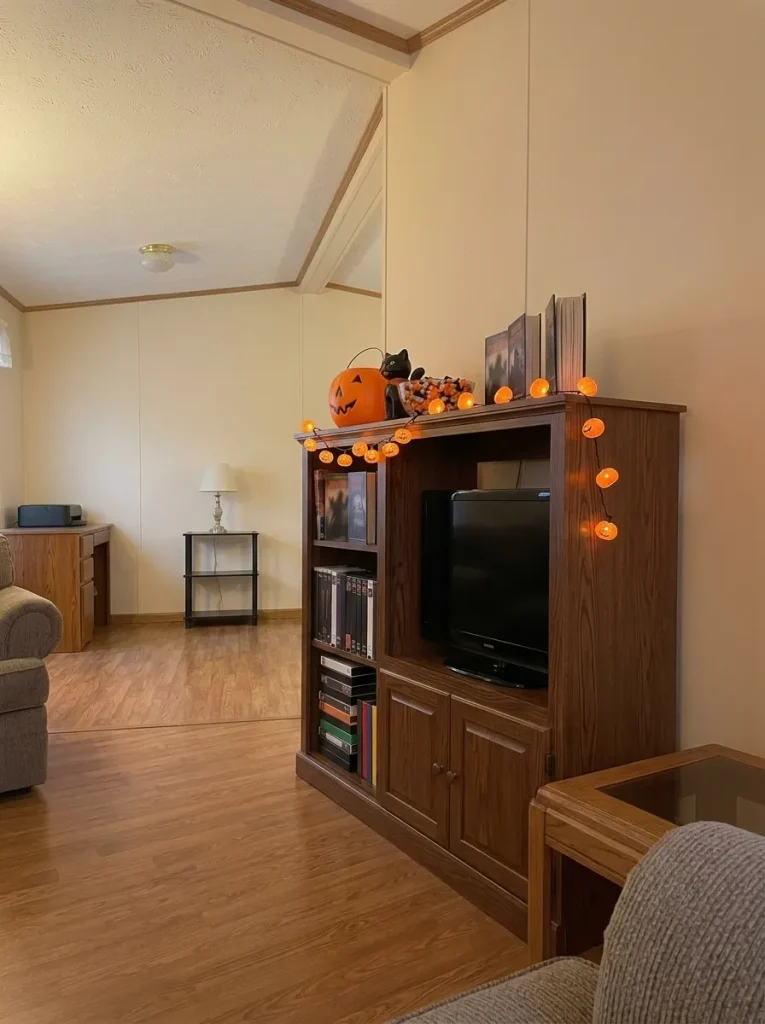
A 90s-inspired Halloween living room does not require hunting down a bulky CRT television. The stronger idea is the media ritual around it: horror paperbacks, old movie cases, a pumpkin container, a black-cat figure, a bowl of candy, and one strand of orange light gathered into a compact zone.
Use whatever television or screen you already own and let the furniture around it carry the nostalgia. A low bookcase, small entertainment unit, or single shelf is enough.
If you already have DVDs, VHS tapes, paperbacks, old board games, or childhood Halloween objects, pull out only the pieces whose spines and silhouettes contribute to the scene. A mobile-home living room can become cramped quickly when collections spread onto the floor or into the circulation path.
Ask one question before adding another object:
Does it strengthen the “Halloween movie night in the 90s” story—or is it simply more Halloween stuff?
That distinction keeps the vignette collected without turning it into storage overflow.
6. Honey-Oak Cabinets, White Appliances and Beige Laminate Can Stay
One of the easiest ways to lose the 90s feeling is to decorate a room as though its existing finishes are a problem that must first be hidden.
Honey-oak cabinet doors, beige laminate counters, cream walls, white coil-burner ranges, vinyl flooring, and warm brown furniture can make excellent backgrounds for 90s Halloween mobile home decor. They supply the familiar domestic layer that lets bright plastic pumpkins, black paper silhouettes, orange textiles, and novelty characters look believable.
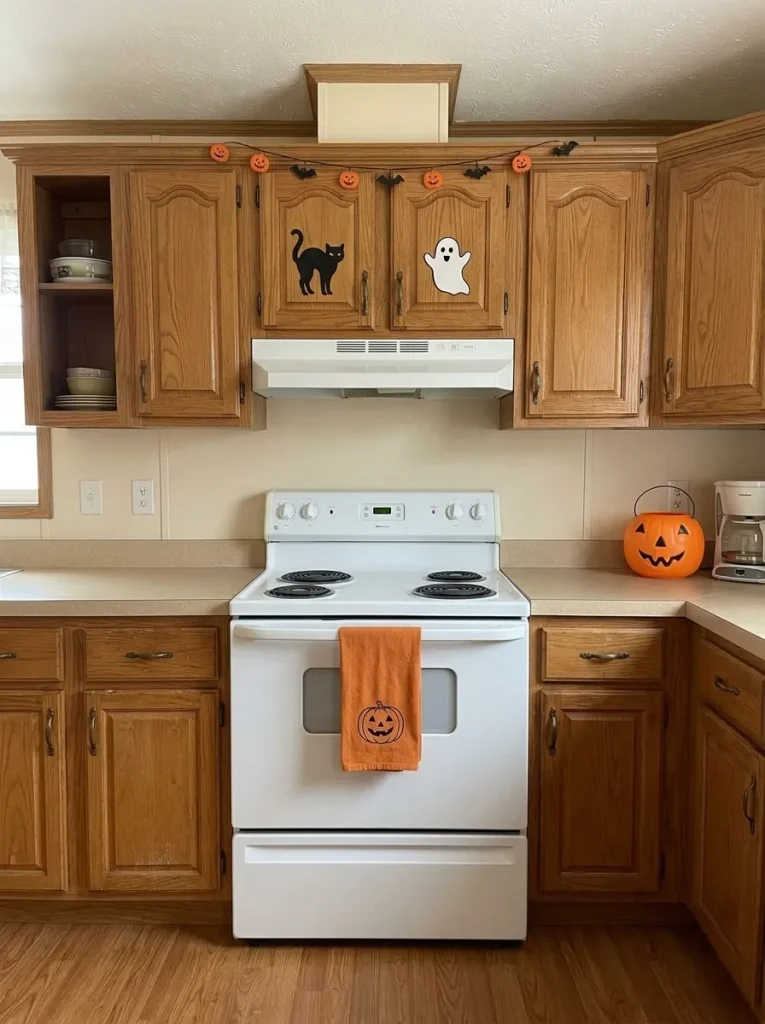
Before covering cabinets with temporary wallpaper or trying to modernize every visible surface, decorate one small zone against the existing finish. Place a pumpkin-orange towel against the white oven, hold a black-cat silhouette against oak, or set a bright molded jack-o’-lantern on a beige counter.
Then step back.
If the permanent finish makes the Halloween object feel warmer and more nostalgic, it is contributing to the aesthetic. Leave it alone.
That is also a useful budget filter: seasonal styling should not automatically become a renovation project simply because the room contains finishes associated with the decade you are trying to recreate.
7. Build the Kitchen Around One Working 90s Halloween Vignette
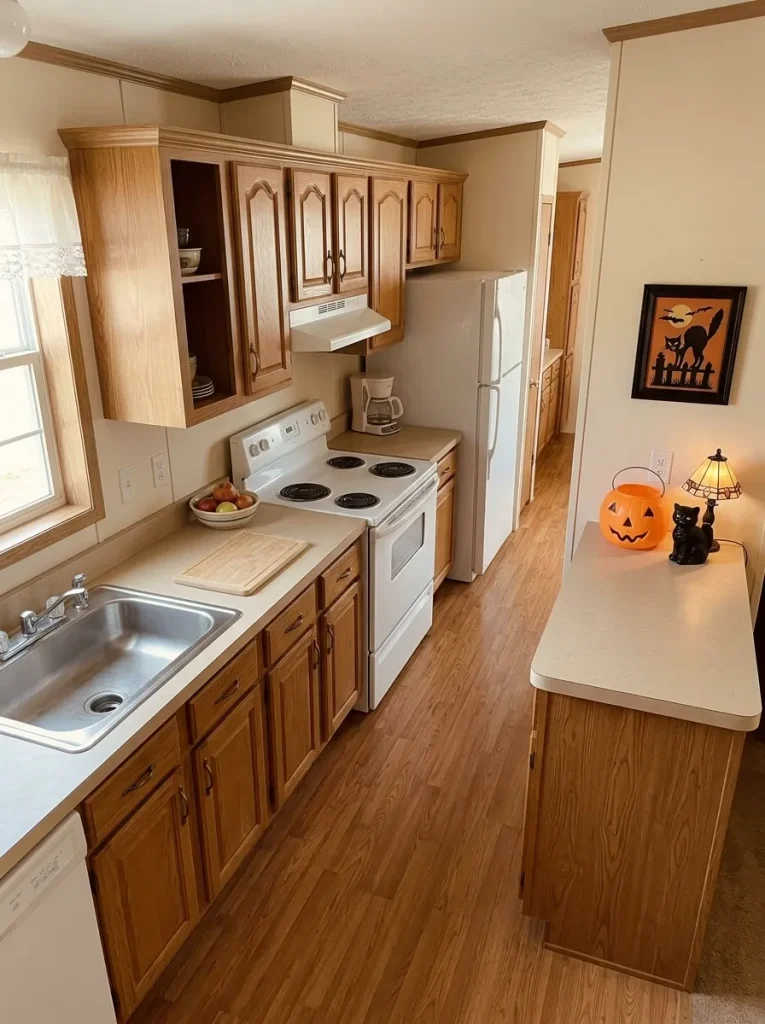
A compact mobile-home kitchen can support a surprisingly rich Halloween scene, but only when the decoration has a defined territory.
Identify where cooking, food preparation, washing, and everyday appliance use happen first. The nostalgic vignette belongs outside those active areas—perhaps along an unused end of the counter, above cabinets when the space is suitable, beside a window, or on a dining-side surface.
That matters because several nostalgic Halloween references show towels, paper decorations, and pumpkins close to a stove. In a working kitchen, items that can catch fire should stay away from the stovetop; the U.S. Fire Administration explicitly includes towels, paper products, curtains, wooden utensils, and similar combustibles in that guidance. (U.S. Fire Administration)
Kitchen vignette mapper
Choose the decorating zone that costs the least function
Select the closest unused area. The diagram separates active work from seasonal display so the room can still operate normally.
One contained countertop scene
Try a plastic pumpkin, framed retro-style print, and small light source where they do not displace tools used every day.
Atmosphere with almost no counter loss
Use lightweight visual accents only where the cabinet-top construction and access make them appropriate; keep working surfaces below quiet.
A vignette seen from two rooms
Use the transition between kitchen and dining as a nostalgic focal point while keeping the actual cooking zone visually lighter.
Non-negotiable: seasonal objects should not compromise heat safety, appliance operation, food preparation, cabinet access, or the walking route.
Once one area does the visual work, let the rest of the kitchen breathe. For a broader range of styles, continue with 36 Halloween Kitchen Decor Ideas for a Spooky Culinary Vibe. Halloween kitchen decor ideas The destination is a substantially broader kitchen specialist, so this article keeps the 90s vignette tightly focused. (Stylish Galore)
8. Frame One Window Like a 90s Front Room With Silhouettes, Faux Leaves and Small Molded Pumpkins
A window is one of the best places to create 90s Halloween atmosphere because simple decorations become more dramatic when light passes around them.
Think in layers. Start with the frame: a loose run of faux autumn leaves or a small orange light strand. Add one or two flat shapes on suitable glass—perhaps a black cat, crescent moon, ghost, or skeleton silhouette. Then place a few compact pumpkins on the sill only if the sill can hold them securely without interfering with blinds, curtains, latches, or opening hardware.
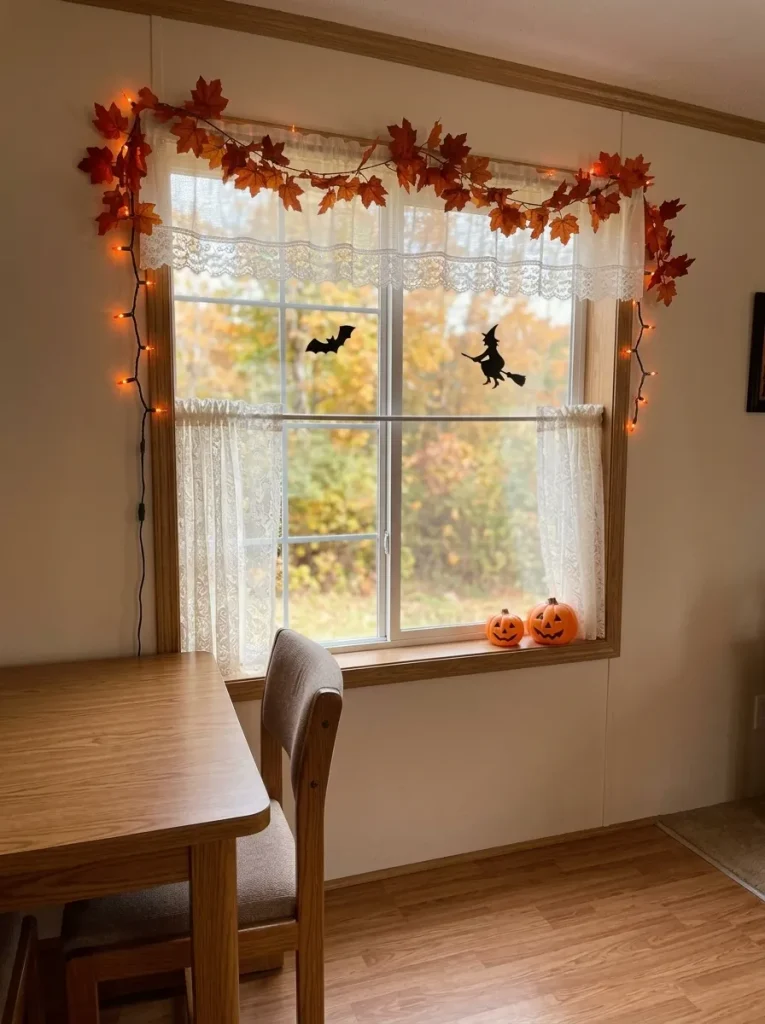
The strongest version usually leaves part of the glass completely clear.
That empty area matters in a mobile home. Windows often make an outsized contribution to how bright a compact room feels, so covering the whole pane can make the interior visually heavier during the day.
Stand across the room and judge the composition as one rectangle. If the silhouettes read clearly and the orange edge lighting gives them a frame, the window has enough.
Decorate the window as one scene, not as storage for every flat Halloween piece you own.
9. Use Flat Paper Bats and Die-Cut Characters Where Floor Space Disappears
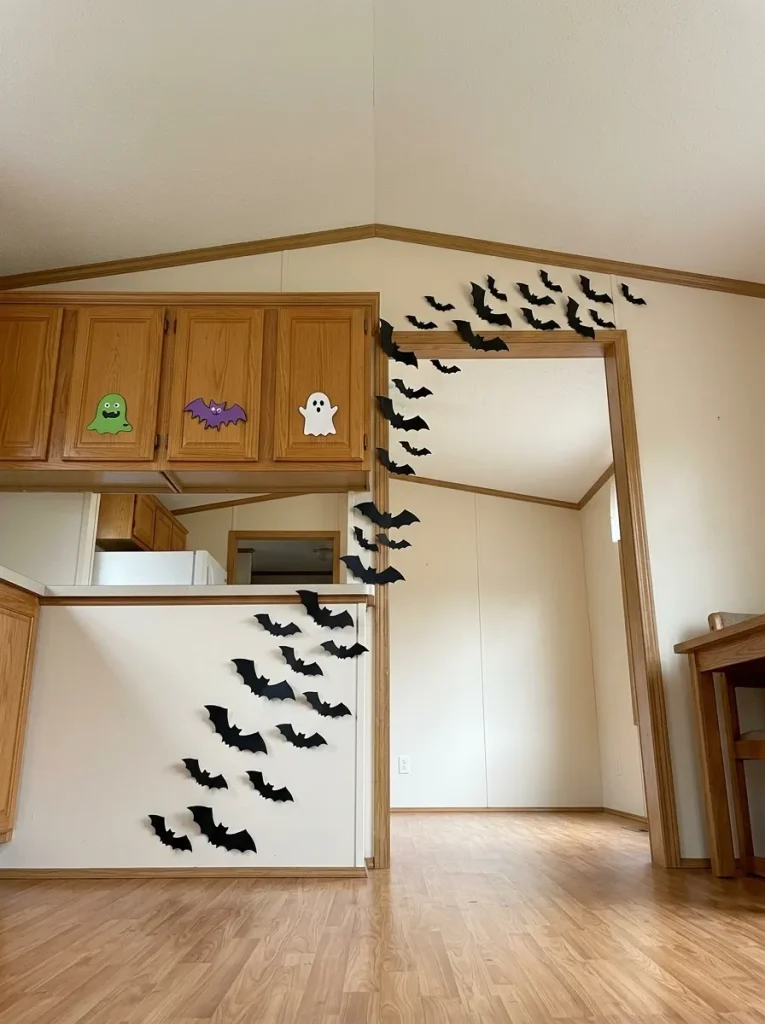
When a mobile home has little room for freestanding decor, the vertical plane becomes valuable.
Paper bats, black cats, ghosts, witches, skeletons, and pumpkin die-cuts can supply the playful graphic quality of old-school Halloween decorating without taking over a countertop or narrowing the walkway. They are especially useful above a doorway, across a cabinet run, beside a media shelf, or in the upper portion of a wall that otherwise feels empty.
The visual trick is clustering.
Five bats moving in one direction usually read more clearly than five bats scattered randomly across unrelated surfaces. Likewise, one ghost, one vampire, and one black cat can form a deliberate character grouping while twenty isolated figures may look like leftovers from several decorating kits.
Before attaching anything, arrange the group on a floor or table first. Photograph the spacing, then reproduce that relationship vertically.
If bats become the dominant motif, the dedicated 38 Creepy Bat Decor Ideas: From Walls to Windows guide can take the idea further without forcing this 90s article to repeat an entire specialist topic. See the bat decor guide (Stylish Galore)
10. Bring Back Novelty Textiles: Ghost Towels, Pumpkin Mats and Checkerboard Runners
Textiles make a compact home look decorated even when very few objects have been added.
A pumpkin kitchen towel can turn a plain oven front into a seasonal surface. A black-and-orange runner can pull the eye through a narrow kitchen. A ghost hand towel can carry most of the Halloween message in a bathroom. A tablecloth or placemat can make a small dining nook feel ready for a party without adding another object to the floor.
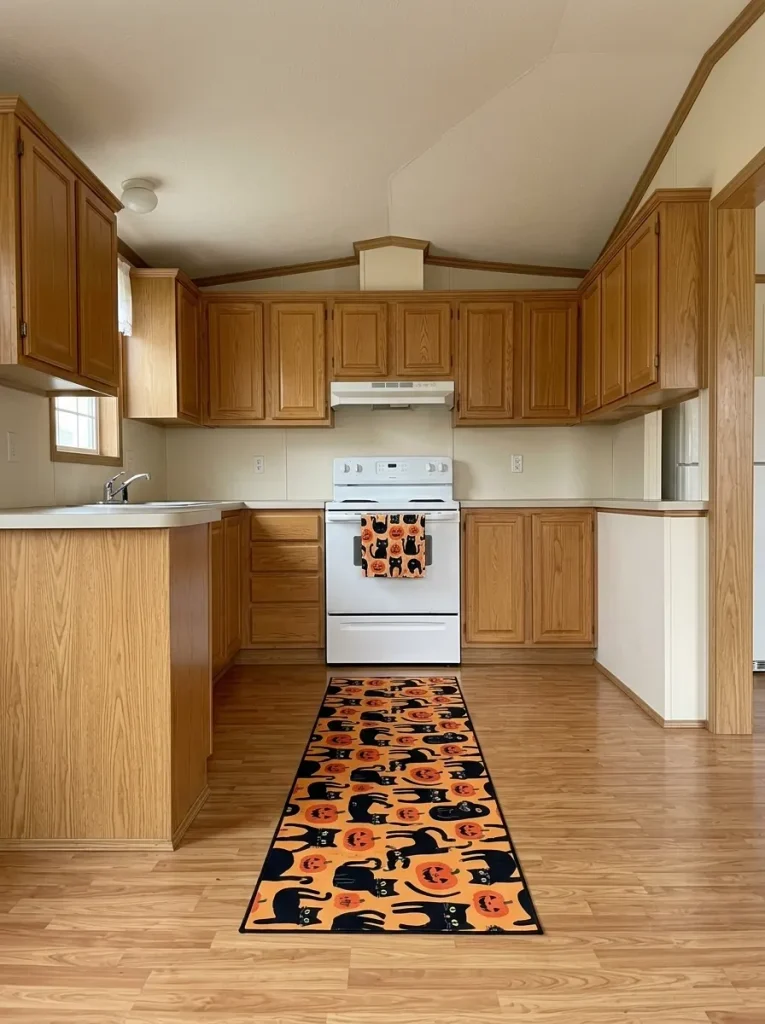
The useful distinction is between replacement textiles and extra textiles.
A replacement earns its space because it takes the place of something already there: Halloween towel instead of plain towel, seasonal mat instead of ordinary mat, patterned tablecloth instead of bare tabletop. Extra layers accumulate on top of what the room already uses.
In a mobile home, choose the replacement first.
Also judge floor textiles with the door fully open and the walking route in use. A nostalgic mat loses its charm quickly if it bunches at a threshold or makes a tight kitchen more awkward to cross.
11. Let One Witch-and-Moon Silhouette Do More Than a Wall Full of Signs
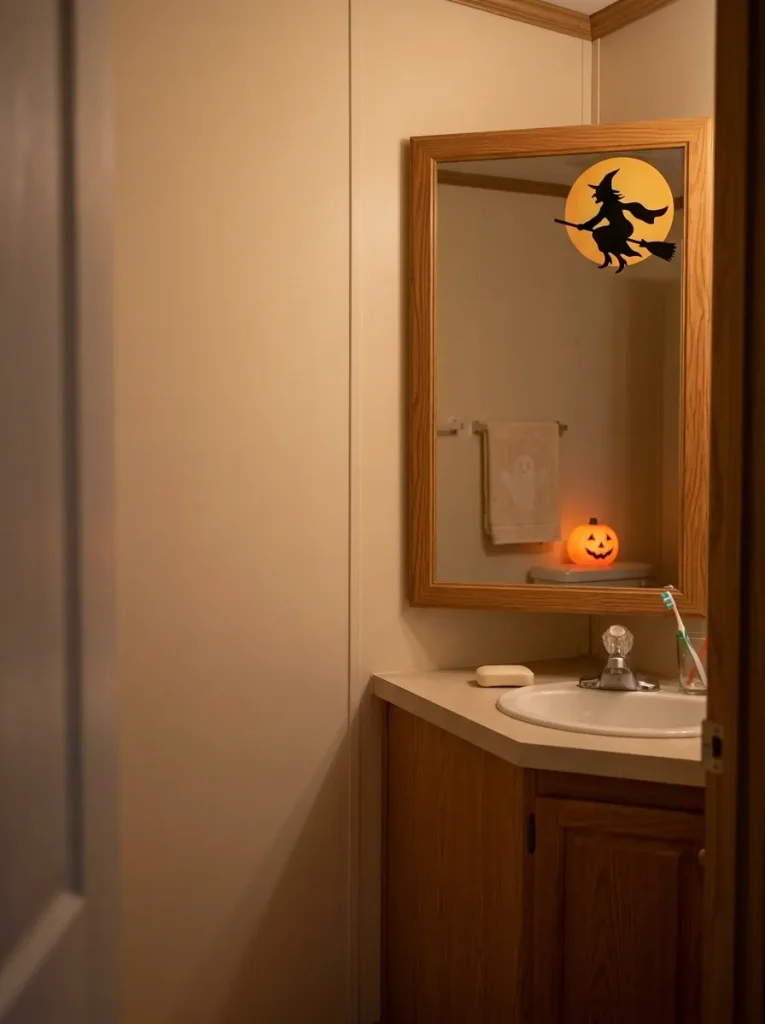
The 90s look does not have to mean filling every wall with slogans.
A single witch crossing a large yellow moon, a black cat outlined against orange, or a simple ghost shape can feel more evocative because the image works like an old seasonal illustration. It gives the eye one recognizable symbol and lets the surrounding room provide the nostalgia.
Mirrors can be especially useful because the motif interacts with whatever is reflected behind it. A small removable witch or moon on a compatible surface can visually sit beside a towel, pumpkin, or warm light without requiring another framed print.
The same principle works on a quiet wall: choose one high-contrast image with a strong silhouette and give it visible space around the edges.
Use words where they contribute something imagery cannot. If the room already contains signs saying “Boo,” “Trick or Treat,” “Spooky,” and “Happy Halloween,” another sign rarely makes the aesthetic more convincing.
The editing decision here is subtraction: preserve the strongest character image and let weaker word art leave the scene.
12. Build a 90s Paperback-Horror and VHS Shelf—Then Stop at One Shelf
This is where the aesthetic can become personal.
A short run of horror paperbacks, old movie cases, vintage-feeling game boxes, Halloween-themed children’s books, or other media already in the house can turn one shelf into a believable 90s memory. Add a molded pumpkin, small ghost, or strand of orange lights and the collection begins to resemble the corner beside which you might have watched Halloween movies after dark.
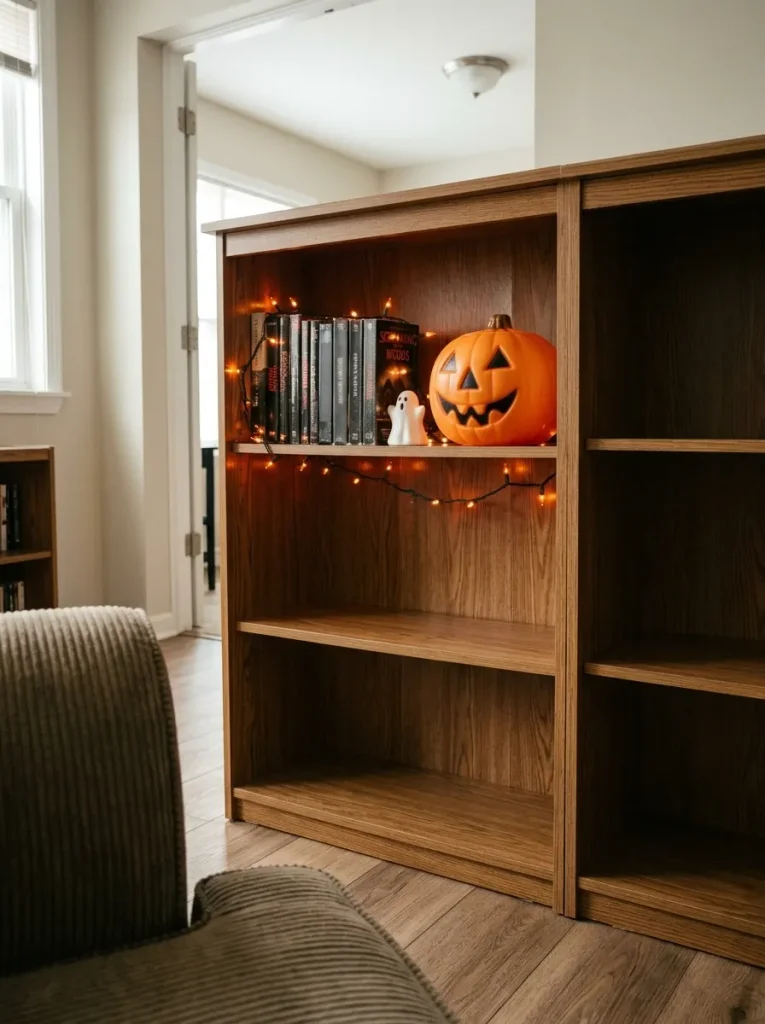
The problem begins when the nostalgia escapes the shelf.
Books stack on the floor. More objects fill the television stand. Plastic buckets appear underneath. Then the collection starts reducing usable space instead of decorating it.
Give the media story a physical boundary: one shelf, one bookcase bay, or one section of the entertainment unit.
Inside that boundary, let height and shape vary. Outside it, restore visual quiet.
That stopping rule is particularly useful in a mobile-home living room because a concentrated collection looks intentional from across the room, while scattered media can make the entire long sightline feel busy.
13. Make the Bathroom Feel Like a 90s Halloween Snapshot
A tiny bathroom does not need to carry every part of the aesthetic.
Imagine the room as a single photograph taken on a disposable camera: a ghost towel hanging from the rail, one small jack-o’-lantern on a suitable dry surface, and perhaps a black cat or witch silhouette appearing near the mirror. Those few cues already tell the story.
Because the room is compact, a decoration that looks tiny in a store can become visually dominant beside the sink. Put the daily objects back first—toothbrushes, soap, hand towel, tissue—and judge the remaining dry display space afterward.
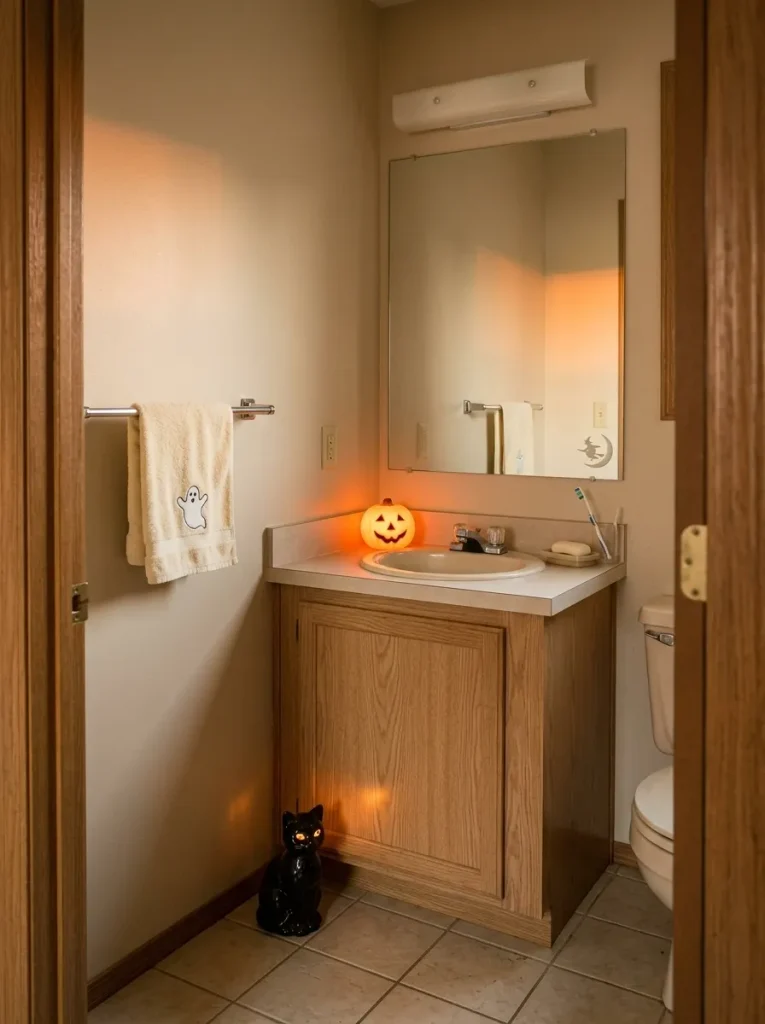
If there is room, add one nostalgic object.
If there is not, let the textile carry the theme.
The dedicated 17 Classy Halloween Bathroom Decor Ideas for a Small Mobile Home guide owns the deeper room-specific decisions, including sink styling, shelves, windows, shower areas, storage, and floor considerations. Explore the small mobile-home Halloween bathroom guide (Stylish Galore)
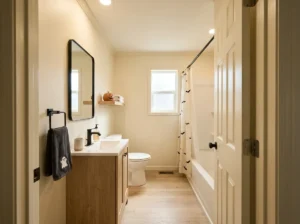
A useful stop point: when the bathroom still works normally and one glance at the towel, mirror, or counter clearly says Halloween, the room is finished.
14. Give the Bedroom a Softer 90s Sleepover Version of Halloween
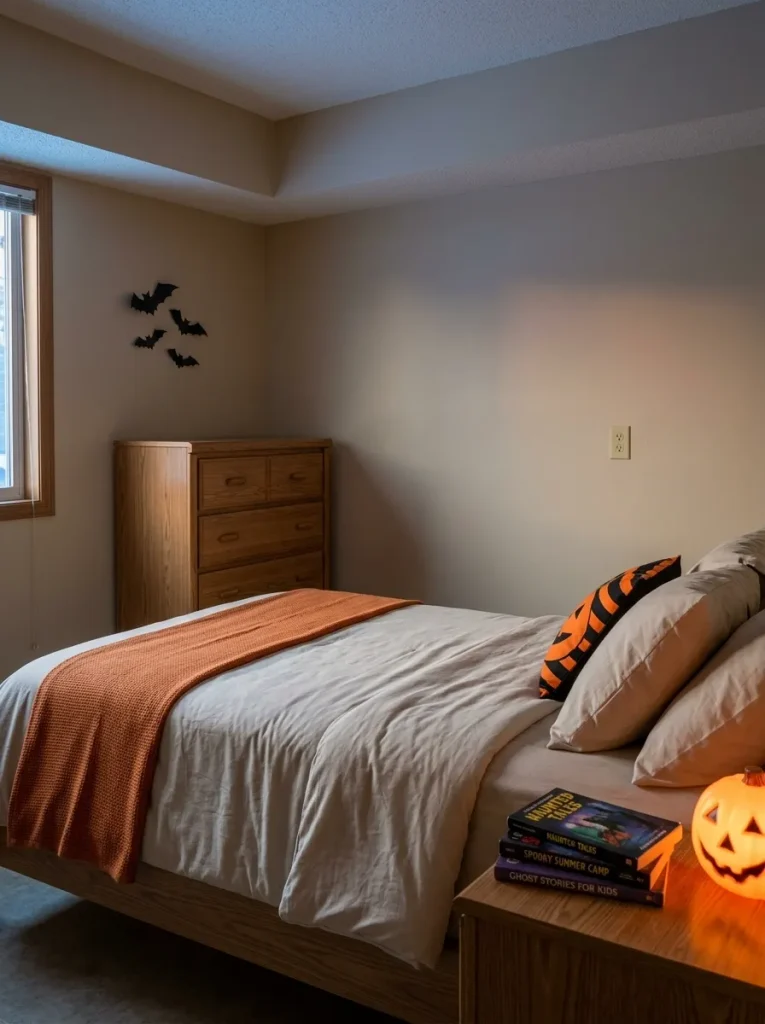
The bedroom can move away from the kitchen’s brighter plastic energy and toward the feeling of an October sleepover.
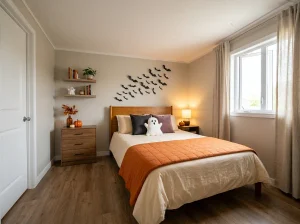
Use one comfortable textile as the dominant cue—perhaps a pumpkin-orange throw, black-and-orange patterned blanket, or simple Halloween pillow. Then add something connected to the evening routine: a stack of spooky paperbacks, a small pumpkin light, a few paper bats near a dresser, or an old movie case beside the television.
What changes here is the intensity.
The bedroom should still feel like somewhere to sleep after the lights go out. If novelty items spread across the bed, floor, nightstand, dresser, and walls at once, the room loses the relaxed quality that makes the sleepover reference work.
Choose whether the bed or a single nostalgia corner is the main Halloween feature. Do not ask both to compete at full strength.
For a complete room treatment, continue with 15 Cozy Halloween Bedroom Decor Ideas for Mobile Homes, which goes deeper into focal hierarchy, circulation, surfaces, lighting, and room-specific editing. See the Halloween mobile-home bedroom guide (Stylish Galore)
Here, the 90s cue can remain wonderfully simple: blanket, paperback, pumpkin glow, movie night.
15. Set the Dining Area Like a 90s School-Party Halloween Table
A dining area is one of the few places where a little visual excess can feel completely appropriate.
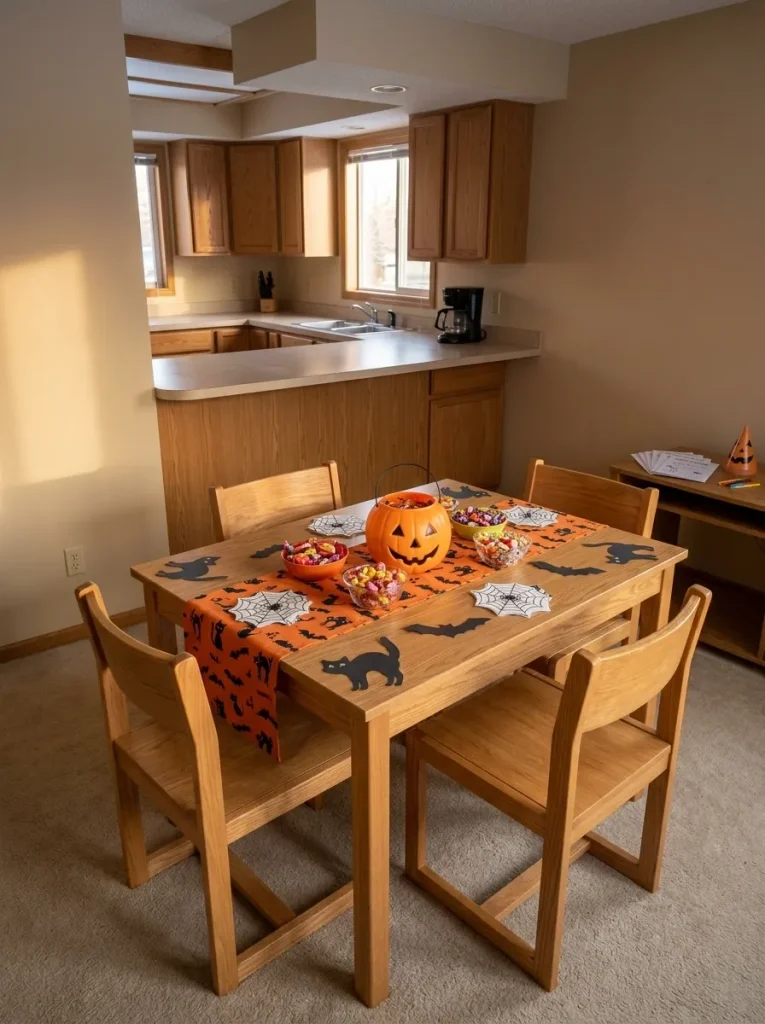
That is because the table already gives the decorations a boundary. Orange and black paper goods, a patterned cloth, candy, plastic pumpkins, friendly ghosts, paper bats, and simple homemade decorations can gather in one place and read as a 90s Halloween party instead of general household clutter.
The amount you use should depend on how often the table must return to everyday service.
Table-use planner
How temporary can your Halloween table afford to be?
Choose how your dining area is actually used. The recommendation changes from an everyday surface to a full party setup.
Keep the nostalgic layer removable in seconds
Use one textile and one compact centerpiece. Leave enough open tabletop for meals, homework, mail, or whatever the table normally handles.
Allow a fuller school-party mood
Add paper cutouts, simple candy dishes, or playful plastic pieces because the table does not need to reset several times a day.
Let temporary abundance become part of the event
For one evening, the denser look can be intentional. Keep serving space and chair clearance practical, then remove the extra layers after the gathering.
Best stopping point: the table should communicate Halloween before the chairs are pulled out. If decorations make sitting, serving, or clearing awkward, the setup has exceeded its useful density.
A party table can be dense for one evening. An everyday dining table needs a faster reset. That difference should control how much styling remains after the photograph is taken.
16. Thrifted Originals or New Reproductions? Spend on the Shape, Not the Rarity
The 90s aesthetic does not depend on proving that every object was manufactured between 1990 and 1999.
What matters visually is often much simpler: bright molded plastic, graphic black outlines, cartoonish jack-o’-lantern faces, chunky novelty shapes, paper decorations, amber mini lights, inexpensive-looking textiles, and the playful proportions associated with mass-market seasonal decor.
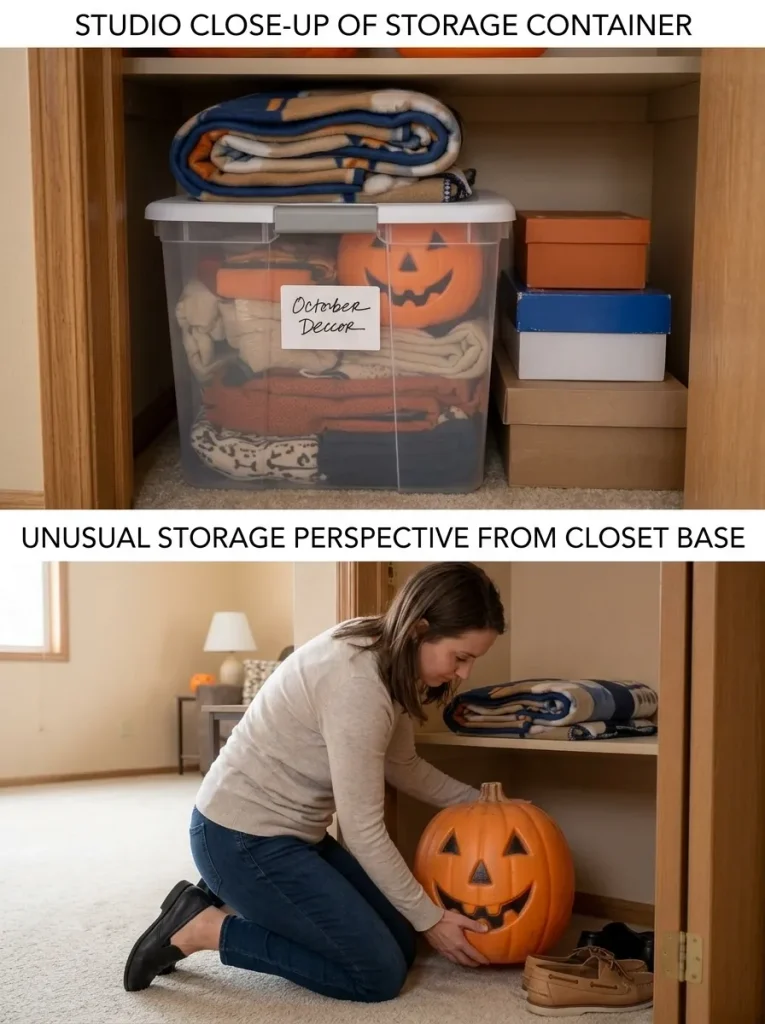
That gives you two legitimate sourcing routes.
An authentic older piece can be worth buying when its shape or material is difficult to reproduce and you genuinely love it. A newer reproduction can be the smarter choice when it delivers the same visual language in a cleaner, easier-to-store size.
In a mobile home, storage volume deserves as much attention as purchase price. An enormous vintage decoration may look fantastic in October and become a problem for the other eleven months.
Before buying, picture the object packed away.
If a compact reproduction gives you the same pumpkin face, saturated color, and molded-plastic character while fitting into storage you already have, the decorating effect is still doing its job.
Pay for what changes the room—not merely for age.
17. Edit the Whole Mobile Home as One 90s Halloween Memory Trail
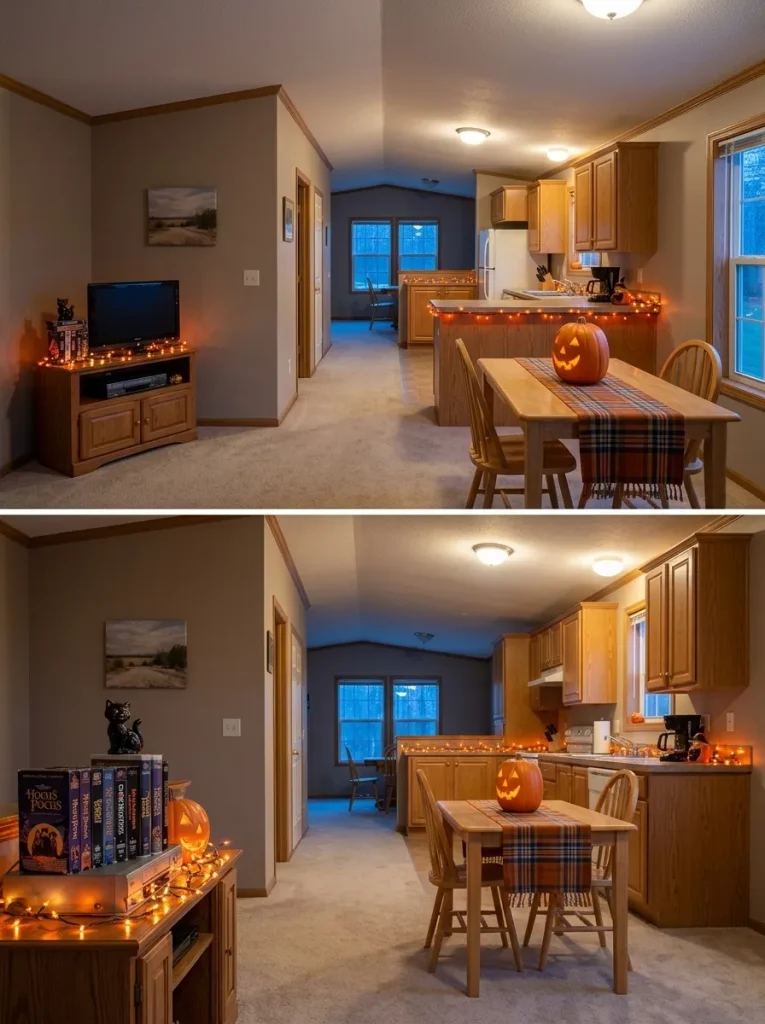
The final check should happen from the longest sightline in the home.
Stand near the entry or at one end of the living area and look through the connected rooms. You should be able to discover Halloween in stages: perhaps orange light in the kitchen, a pumpkin bucket near the dining area, and a darker media vignette farther into the living room.
If every zone contains the same level of orange, black, pumpkins, bats, lights, signs, and novelty textiles, none of those areas gets to feel special.
The stronger rhythm is anchor → pause → anchor → pause.
Long-sightline audit
What do you see when the whole home enters one frame?
Choose the description closest to your current view. The recommendation is based on visual rhythm, not on how many decorations you own.
Remove repeated motifs first
Keep the best pumpkin, best light route, and best textile. Let one connected zone become visibly quieter.
Stop decorating
The theme is already traveling through the home without flattening every room into the same visual intensity.
Repeat one signal, not an entire vignette
Carry one color, motif, or small light cue into the missing zone so the rooms relate without becoming copies of one another.
Final test: walk from one end of the home to the other. Halloween should feel continuous, but each new zone should still give your eye something different to discover.
When Halloween-specific pieces eventually come down, the same permanent finishes and warm materials can transition into 25 Cozy Fall Mobile Home Decorating Ideas without rebuilding the entire seasonal scheme. Continue with cozy fall mobile-home decorating (Stylish Galore)
A 90s Halloween Mobile Home Should Feel Remembered, Not Recreated
A convincing 90s Halloween mobile home does not need to look like a museum of the decade. It needs a few memories that register immediately: saturated pumpkin orange, playful black silhouettes, molded plastic, novelty textiles, warm mini lights, paper decorations, and one or two collected corners that feel as though Halloween night has already started.
Begin with the finishes your home already has. Add the strongest nostalgic object. Create the evening glow. Then judge the house from its longest sightline and remove whatever makes every room shout at once.
That final edit is what turns nostalgia into an interior.
When one kitchen vignette, one glowing window, one textile, or one movie-night shelf can carry the memory on its own, the house has reached the point where adding more would weaken the story.