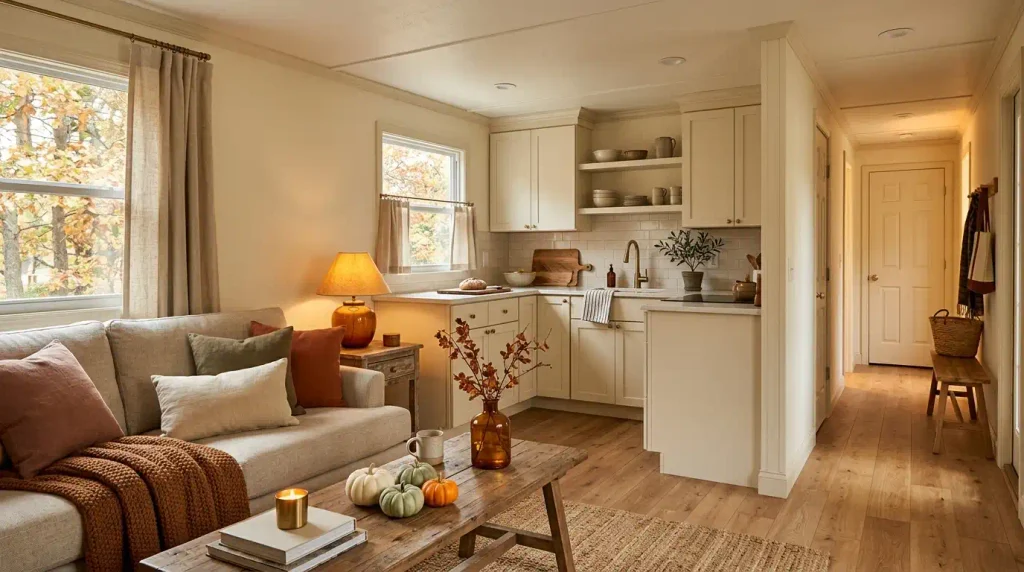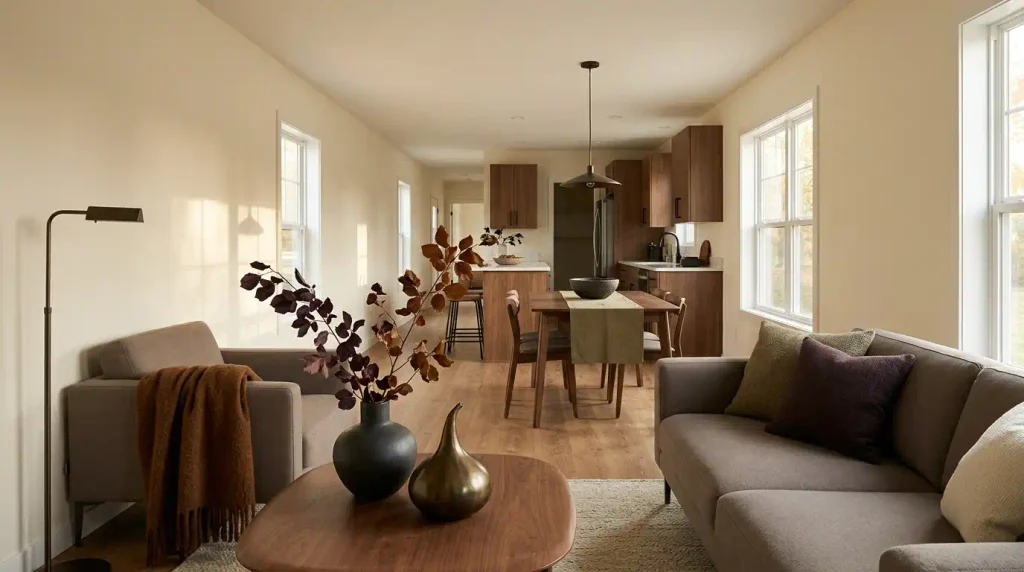
Primitive fall decorating feels most convincing when the room looks as though its warmth accumulated slowly—not when every surface announces that autumn arrived last weekend. Worn wood, old-looking stoneware, woven baskets, homespun fabric, dark iron, faded harvest colors, folk-inspired details, and dried botanicals can all contribute to primitive fall mobile home decor, but their placement matters as much as the objects themselves.
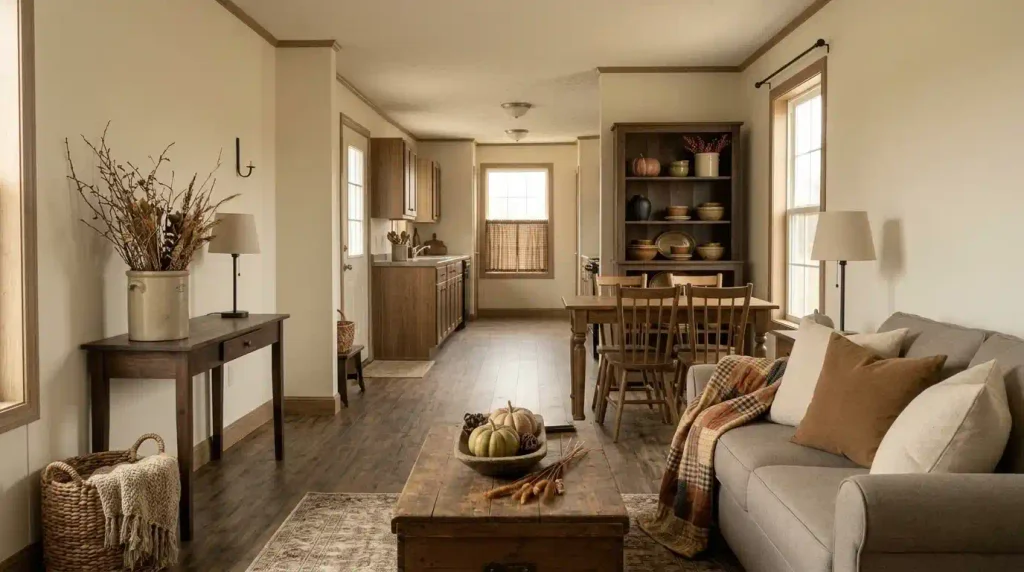
That is especially true in a mobile home. Connected rooms can put the entry, sofa, kitchen counters, dining area, and several decorated surfaces inside one long view. A collection that feels charming up close can become visually heavy from the doorway.
The ideas below treat primitive style as a material-and-age language first and a fall theme second. You will use useful vessels, muted color, handmade-looking textiles, natural autumn material, and a few strong anchors while protecting the surfaces and walking routes the home still needs every day.
The finished look should feel warm, collected, slightly timeworn—and comfortably livable.
1. Build a Faded Harvest Palette Before You Buy Primitive Fall Decor
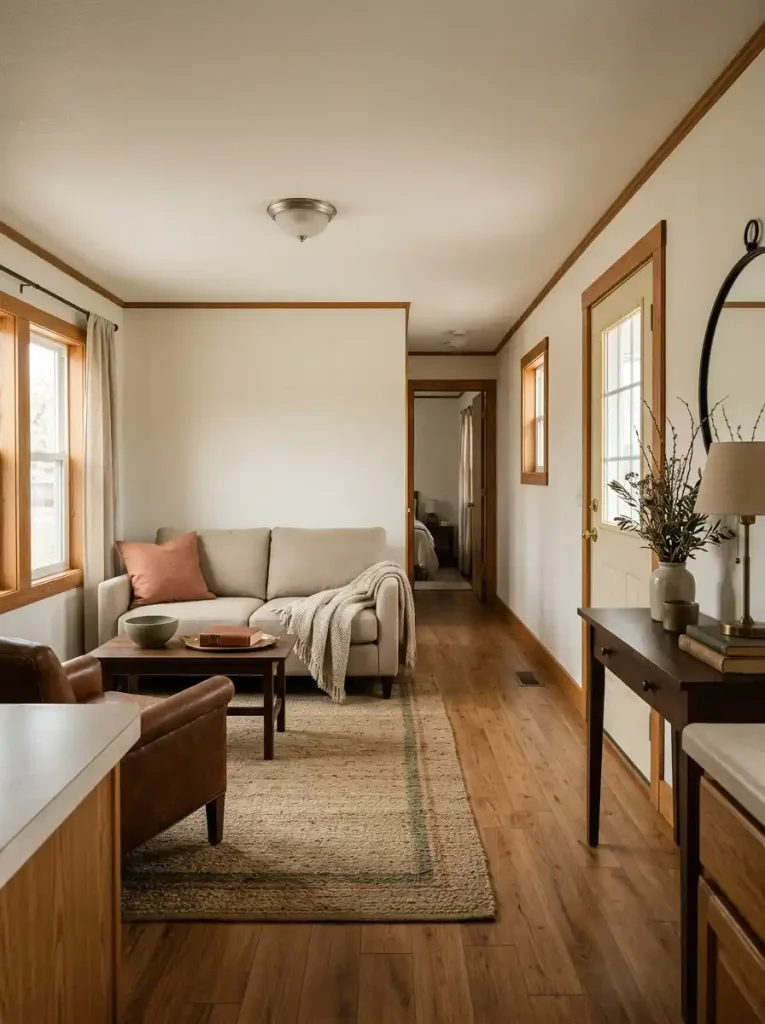
Primitive fall color usually becomes more believable when orange stops being the automatic starting point.
Look first at the permanent surfaces in your mobile home: cabinet stain, floor tone, sofa fabric, wood trim, wall color, and any older furniture you plan to keep. A room with dark walnut furniture may support tobacco brown, faded pumpkin, flax, moss, and blackened iron. Honey-toned wood can work beautifully with muted mustard, dusty rust, warm cream, and aged brass. Cooler gray-brown finishes may need burgundy, olive, mushroom, and weathered tan to bring the room back toward warmth.
The useful distinction is faded versus fresh. Bright pumpkin orange, crisp black-and-white checks, glossy white accessories, and highly saturated faux leaves often push the room toward mainstream farmhouse or themed fall décor. Primitive color tends to look softened—as though sunlight, age, use, and natural materials have already taken some of the sharpness away.
That does not mean every object needs to look antique. Newer pieces simply need to sit quietly enough beside the older-looking ones.
For a cleaner and brighter rustic interpretation, compare this approach with StylishGalore’s Fall Farmhouse Decorating Ideas for Mobile Homes. Primitive rooms can tolerate deeper brown, more irregular texture, darker iron, folk references, and visibly aged surfaces.
Primitive palette decoder
Start with the permanent wood in the room
Choose the undertone closest to the surfaces you are keeping. The suggested fall colors are a starting family—not a shopping list.
Primitive test: if the palette still works after every obvious pumpkin is removed, the material story is doing enough of the seasonal work.
Once that base is established, treat brighter seasonal pieces as accents. A small rust pumpkin can stand out beautifully against tobacco brown and flax. Ten equally bright ones erase the aged restraint you were trying to build.
2. Let One Worn Wood Piece Become the Primitive “Age Anchor”
A primitive room does not need every piece of furniture distressed.
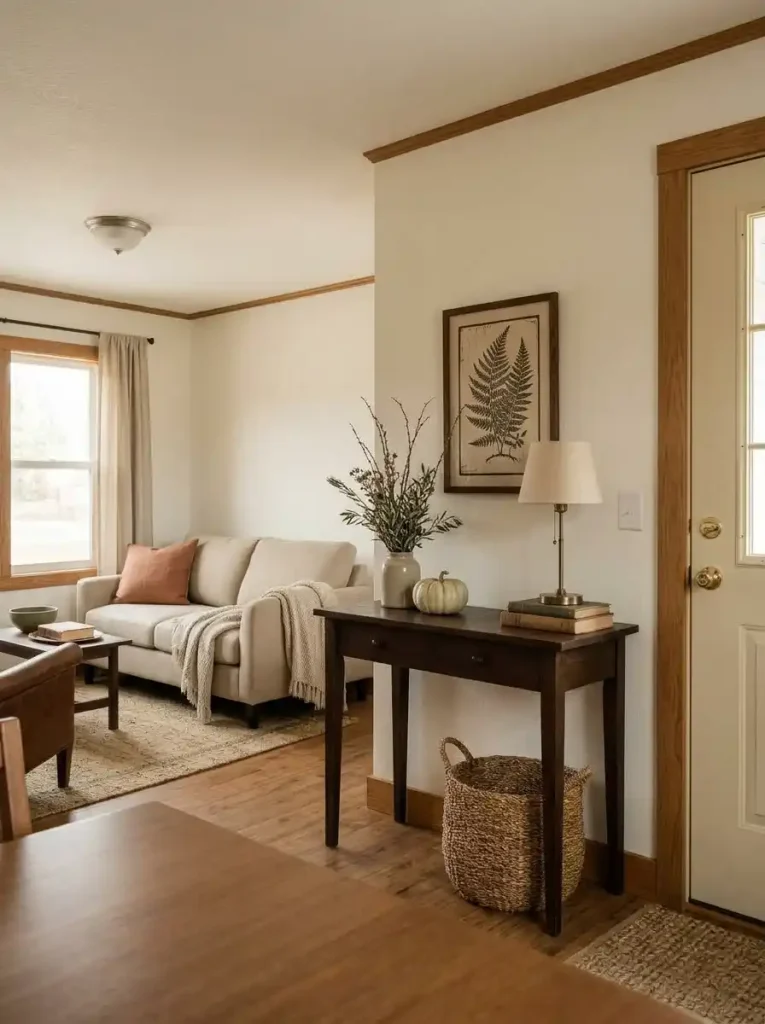
In a compact mobile-home living room, one convincing age anchor often has more influence than several small faux-vintage accessories. It might be a rough console, an old bench beside the door, a dark hutch, a reclaimed-look shelf, a trunk used as a coffee table, or even a simple wood stool with visible grain and an imperfect finish.
Imagine the same room in two versions. In the first, the furniture is relatively simple but an old-looking bench sits beneath a peg rail with a crock and woven basket nearby. The age of that single piece gives the surrounding fall arrangement a believable context. In the second, five brand-new distressed signs, crates, and faux-antique objects compete to manufacture the same story. The second version usually feels more themed.
Use your anchor where it can influence a broad view. A console visible from the entry can connect the front door to the living room. A hutch seen from the sofa and kitchen can carry primitive character through both spaces.
Then let the seasonal layer be smaller: a folded homespun textile, dried branch, pottery vessel, muted pumpkin, or two.
A useful editing question: if you removed all the pumpkins tomorrow, would that piece still make the room feel older, warmer, and more collected?
If yes, you have a foundation. If no, keep looking before adding more accessories.
3. Make Crocks, Baskets and Dough Bowls Work Before They Decorate
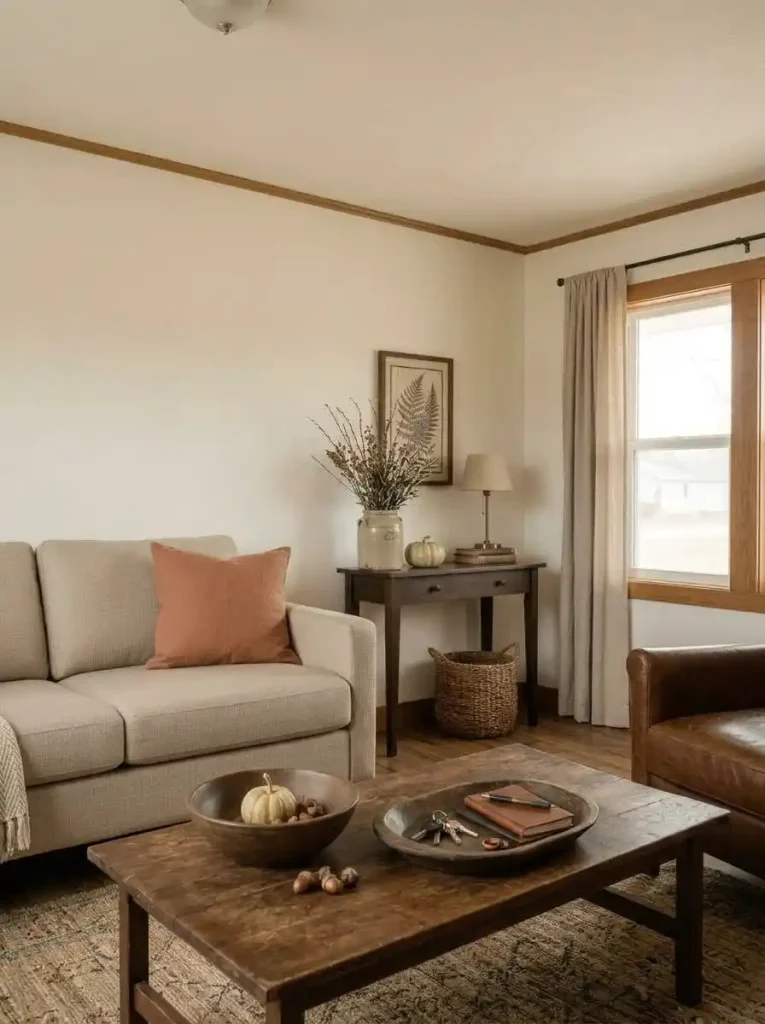
Primitive style has an advantage in a mobile home: many of its most recognizable objects were historically useful.
That makes crocks, woven baskets, wooden bowls, small crates, and handled vessels easier to justify in rooms where storage and surface space are limited. A stoneware crock can hold wooden spoons in the kitchen, dried stems on a shallow console, or rolled hand towels in a bathroom. A deep basket near the sofa can take throws. A low wooden bowl can hold apples, small gourds, or everyday objects that otherwise drift across the table.
The question is not simply, “Does this look primitive?” Ask, “What job earns this object its footprint?”
That filter is especially helpful when thrift shopping. A beautiful large basket is a poor find when there is nowhere for it to live after November. A smaller vessel that solves an everyday storage problem can stay through several seasons.
For deeper secondhand sourcing, continue with StylishGalore’s Thrifted Fall Decor Ideas for Mobile Homes That Look Collected, Not Cheap. Here, the primitive filter is narrower: favor objects whose age, material, and practical function are all visible at once.
Useful primitive vessel matchmaker
Give the object a household job first
Stoneware crock
Wooden utensils, clipped branches, rolled cloths, or a small collection that needs vertical containment.
AvoidParking a large empty crock on the floor simply because the corner is vacant.
Woven basket
Throws, scarves, magazines, pet items, or concealed everyday clutter near the place those things are actually used.
AvoidStacking several decorative baskets where one useful basket would provide the same visual texture.
Low wooden bowl
Apples, a few small gourds, keys on an entry surface, or one contained low centerpiece on a table.
AvoidOverfilling it until the vessel disappears beneath artificial leaves and miniature accessories.
Footprint rule: the best primitive accessory replaces visual clutter, contains something useful, or does both. If it only creates another object to store after fall, judge it more critically.
Primitive decorating becomes easier once useful objects carry part of the visual load. You can then use fewer purely seasonal pieces because basket weave, aged pottery, and old wood already provide the country character.
4. Use Dried Branches and Seed Heads as the Tallest Fall Layer
When a room is compact, height can provide atmosphere without consuming another horizontal surface.
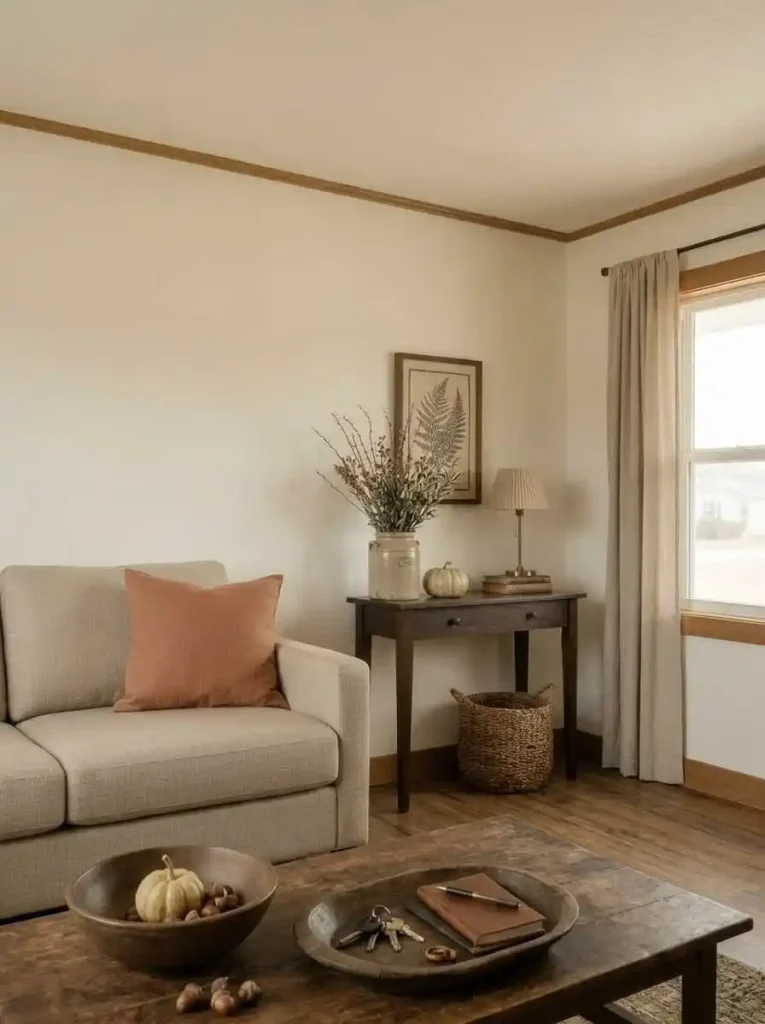
A tall, irregular spray of dried branches, seed heads, grasses, or muted faux botanicals works well because its visual mass is concentrated near the top. The vessel may occupy only a small patch of a console, cabinet, or table while the stems carry autumn color much farther into the room.
Use that advantage deliberately. On a narrow console, pair one tall crock of branches with a low object such as a small framed print or lidded box. On a hutch, let stems rise above the upper shelf while the shelves themselves remain edited. Beside a sofa, a branch arrangement can supply fall color at eye level without adding another basket or pumpkin cluster to the floor.
The shape matters. Primitive arrangements rarely need perfect symmetry. Slightly bare branches, dried pods, wheat-like grasses, faded berry sprays, and uneven stems usually feel more natural than a tightly rounded bouquet.
There is also a stop signal: once the arrangement overlaps several shelves, wall pieces, or doorways from your normal viewing position, reduce its width before reducing its height.
Tall and narrow is often more useful than short and sprawling in a mobile home.
5. Turn a Compact Entry Into a Primitive Arrival Zone, Not a Harvest Pile
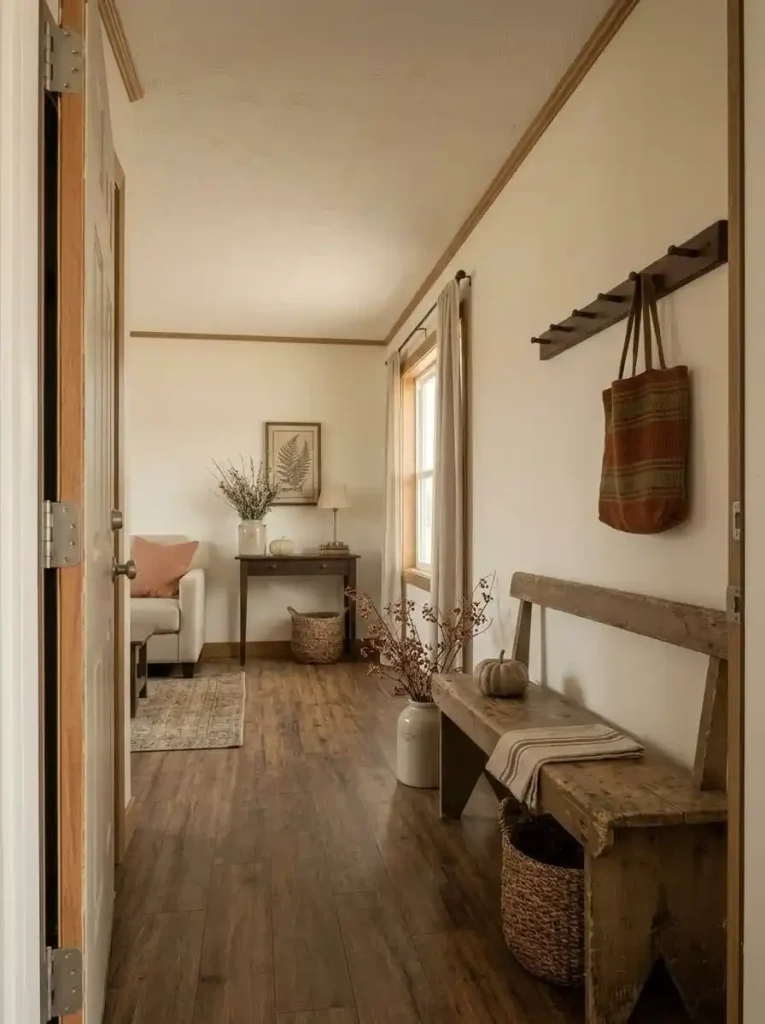
The entrance has unusual visual power in a small mobile home because it can establish the decorating language before the rest of the room is even processed.
Give it one primitive anchor first: a worn bench, narrow wood shelf, peg rail, old-looking basket, crock, or dark-framed folk print. Then choose one seasonal signal—a folded rust textile, clipped berry branch, muted pumpkin, dried leaves, or a small lantern-like accent. The entry now reads as primitive fall without requiring a floor arrangement on both sides of the door.
What happens next depends on the entry type.
If the front door opens directly beside the sofa, the primitive colors should relate to the living room because both zones are read together. A narrow passage benefits from vertical décor and very little on the floor. A small bench entry can put most of the texture below or above the seat while preserving somewhere to sit.
StylishGalore’s Small Fall Entryway Ideas for Mobile Homes goes deeper into circulation, door movement, landing space, vertical decorating, and compact entry layouts. Here, the primitive-specific goal is to make the arrival zone feel old, useful, and edited before making it abundant.
Primitive entry footprint mapper
Choose the entry you actually have
Tap the configuration closest to your home. Each route changes where the strongest primitive fall layer should live.
Let the entry borrow from the living room
The door and sofa belong to one visual field, so repeat one material or faded fall color beyond the entry instead of building an isolated foyer theme.
- Best anchor
- Peg rail, narrow shelf, folk art, or vertical crock of stems.
- Primitive echo
- Repeat rust, dark wood, basket weave, or blackened iron near the sofa.
- Keep clear
- The immediate standing and turning area inside the door.
Move the fall story upward
A tight passage benefits from hooks, framed folk art, an airy wreath, a narrow textile, or a wall-mounted primitive focal point. Floor décor should remain exceptional.
- Best anchor
- Wall composition or functional hooks with one seasonal layer.
- Primitive echo
- A muted runner only when it lies comfortably within the existing route.
- Keep clear
- The continuous path from door to the next room.
Make the bench useful before picturesque
Use one homespun pillow or folded throw, then place the stronger primitive texture above or below the seat so someone can still sit without clearing decorations first.
- Best anchor
- Worn bench plus a basket, peg rail, or dark-framed wall piece.
- Primitive echo
- One crock, lantern-like object, or faded branch arrangement.
- Keep clear
- Most of the sitting surface and the approach to it.
Final test: enter with a bag in one hand. If the primitive arrangement makes you sidestep, move an object, or clear the bench before using it, the décor has claimed space the entry still needs.
The best primitive entrance should register quickly from the doorway, yet the household routine should remain almost invisible. Strong character with surprisingly little obstruction is what makes the style especially effective in a smaller home.
6. Let One Patchwork Quilt Carry the Homespun Pattern in the Living Room
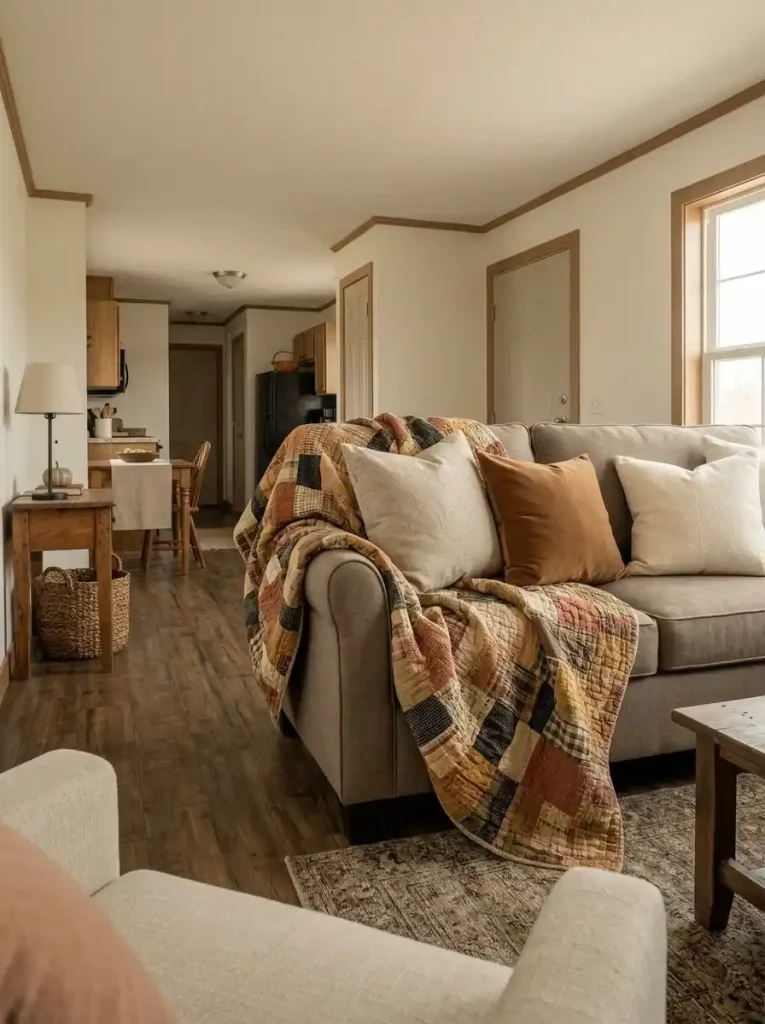
Primitive rooms can handle pattern, but a compact living room rarely benefits from making every textile equally expressive.
Choose one piece to carry the homespun story. A faded patchwork quilt, woven coverlet, small-check throw, or handworked-looking textile can become that piece. Drape it over the sofa arm, fold it across the back of an accent chair, or place it inside a basket where enough pattern remains visible to influence the room.
Then quiet the textiles around it.
If the quilt combines rust, mustard, brown, faded black, and cream, the pillows do not all need checks, pumpkins, stitched phrases, or separate fall motifs. Pull two quieter colors from the quilt and use those for the surrounding cushions. A plain tobacco-brown pillow beside a textured cream one may make the patterned textile look more intentional than three additional country prints would.
In a mobile home, test the textile from the longest sightline, not only from the sofa. If a quilt is visible alongside kitchen towels, dining linens, curtains, and a patterned rug, those pieces begin functioning as one composition.
Keep the quilt expressive. Let nearby fabric become the breathing room.
7. Keep the Coffee Table Primitive With a Low Trencher-Style Harvest Arrangement
Primitive fall décor suits a coffee table particularly well because the style already favors low wooden bowls, trenchers, worn trays, candleholders, and simple natural materials.
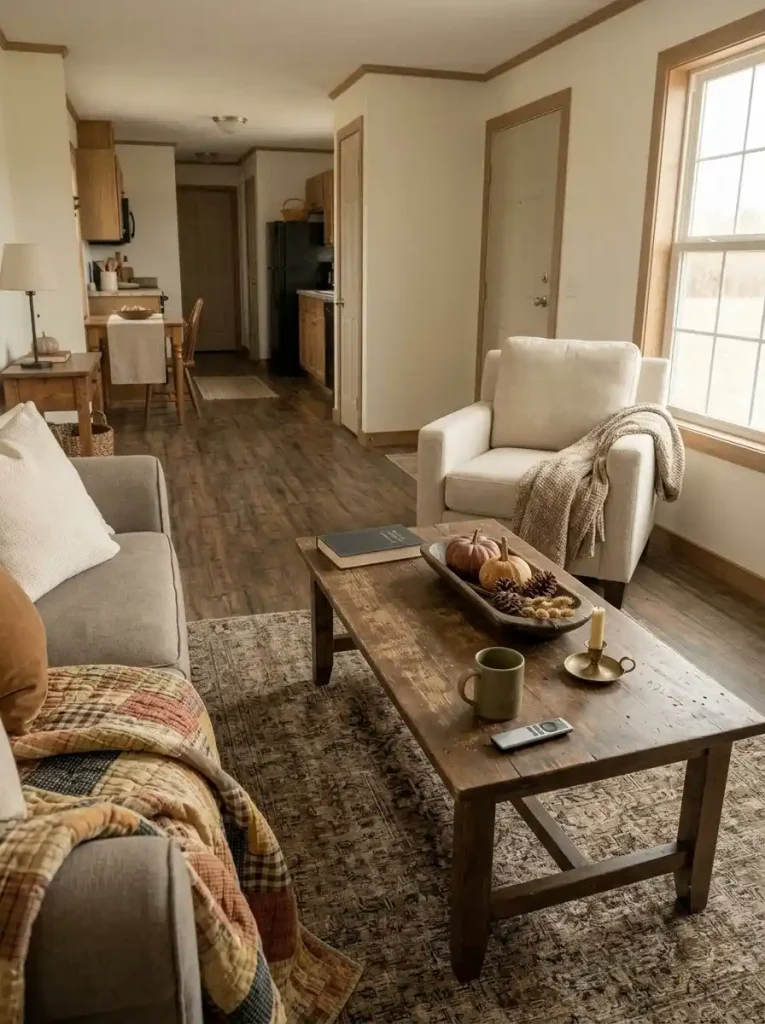
The mistake is turning that compatibility into a miniature harvest market.
Start with one shallow container. A long wooden bowl, dark tray, low basket, or rectangular wooden box can define the footprint. Inside it, use only enough material to establish autumn: perhaps two small gourds, a short candle in a suitable holder, dried seed heads, pinecones, or a folded strip of homespun fabric.
Then sit on the sofa.
Can you see comfortably across the arrangement? Can a drink, book, remote, or laptop still use the table? Can the whole centerpiece be lifted away with one movement when the surface is needed?
If any answer is no, the display is too demanding for the room.
A mobile-home coffee table often sits close to several furniture edges, so tall branches and sprawling garlands affect circulation and seated views quickly. Keep the strongest silhouette low and contained.
The wood itself should provide much of the primitive character. The seasonal filling only needs to make that old-looking vessel feel temporarily autumnal.
8. Use Blackened Iron as a Thin Contrast Line, Not Another Collection
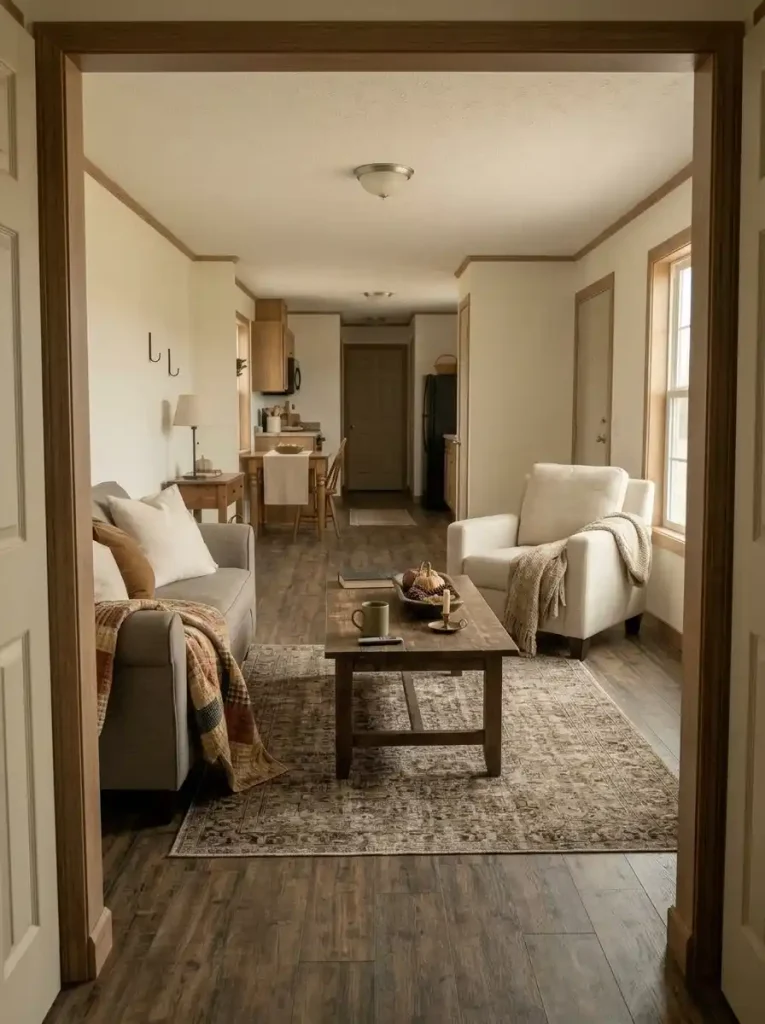
Primitive interiors often look richer when warm brown materials are interrupted by something darker.
Blackened iron can do that job efficiently.
A narrow hook, lantern frame, small candlestick, dark shelf bracket, old-looking hardware, or simple iron wall accent creates enough contrast to sharpen wood grain, faded textiles, and pale stoneware. The effect is similar to outlining a drawing: a little darkness makes the softer materials easier to read.
The danger comes from volume.
A compact mobile-home room with a dark hutch, dark floor, black light fixture, several iron lanterns, black picture frames, and black plaid can lose the warmth that made primitive style appealing in the first place. Iron should generally behave as a line or punctuation mark, not another large material field.
Try this visual test from the doorway:
- If your eye notices the wood, textiles, pottery, and fall color first, the iron is probably supporting them.
- If the dark objects merge into one heavy band, remove or relocate one.
- If the room feels washed out, one additional thin dark accent may help.
Primitive contrast works best when the dark material looks structural or useful—hooks, handles, candleholders, brackets—rather than sprinkled through the room merely to match.
9. Style a Small Hutch With Full Shelves, Quiet Shelves and One Fall Focal Shelf
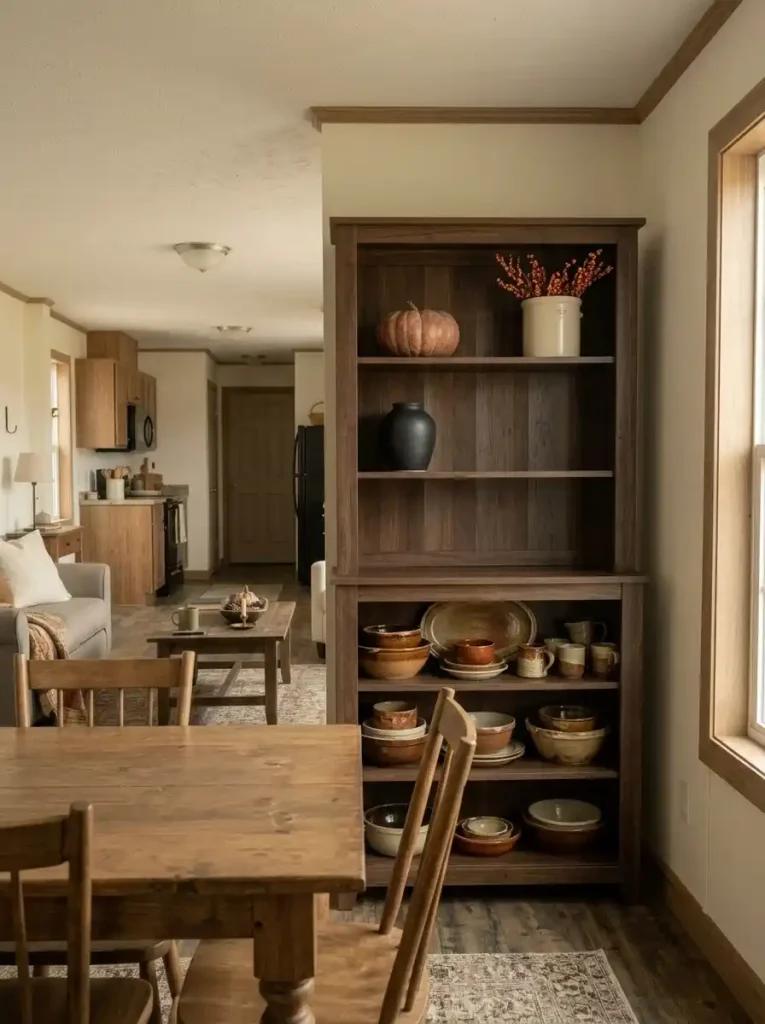
A primitive hutch can hold a lot and still feel coherent, but the shelves should not all speak at the same volume.
That distinction matters in a mobile home because a tall cabinet can occupy a large percentage of a dining or living wall. If every shelf is packed with crocks, pumpkins, baskets, signs, leaves, framed art, and figurines, the hutch stops reading as one furnishing and becomes a wall of separate objects.
A stronger rhythm alternates density.
Let one shelf feel fairly full with useful primitive pieces such as stacked stoneware, old-looking bowls, small baskets, or books. Give the next shelf more breathing room. Then choose one shelf to carry the strongest autumn cue—perhaps a faded pumpkin beside an old crock and short berry stems.
The eye now gets pauses as it travels vertically.
You can also leave one object slightly isolated. A single dark pottery piece on a partially open shelf can make the denser shelf below it feel intentional.
Hutch rhythm composer
Give every shelf a different visual job
A primitive hutch can feel collected without letting every shelf reach maximum density.
Long-view check: step back until the hutch shares your view with another room. You should read a cabinet with rhythm—not dozens of individual decorations.
A primitive cabinet does not need perfect styling. Small variations in height, mismatched pottery, visible wood grain, and slightly uneven arrangements are part of its character. It does need enough negative space for those imperfections to remain legible.
10. Warm a Mobile Home Kitchen Window With a Short Homespun Café Curtain
A kitchen window can contribute primitive character without donating another inch of counter space.
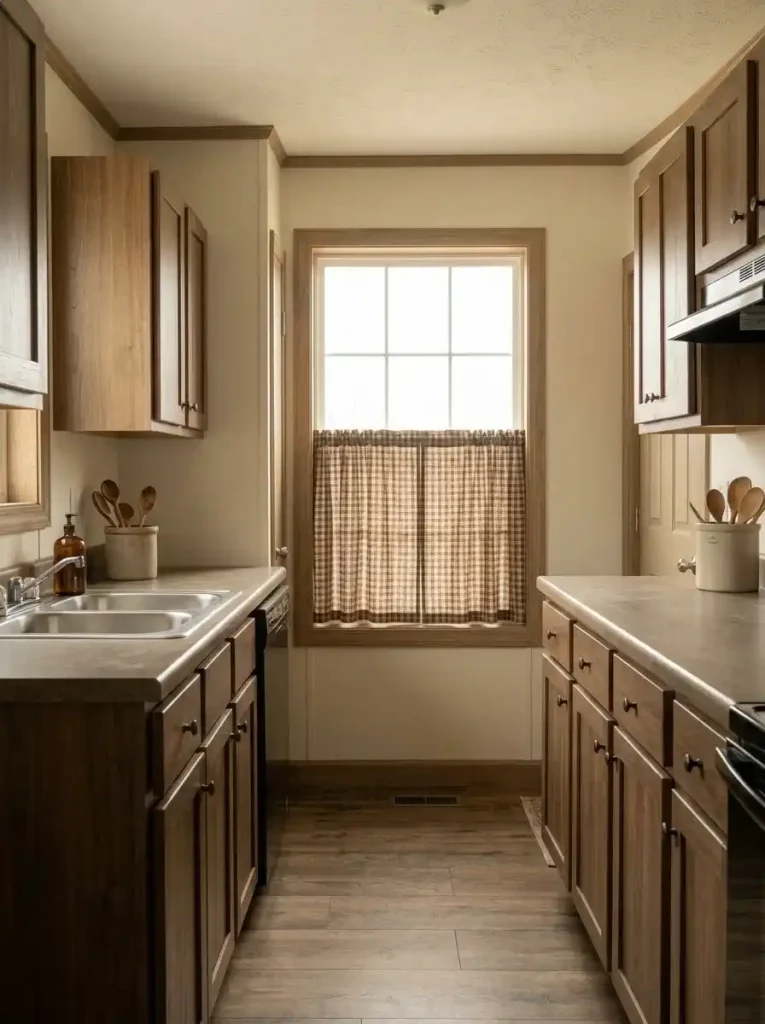
A short café curtain in muted check, ticking stripe, faded floral, flax-colored linen-look fabric, or soft homespun-style cotton introduces pattern near eye level. Because the fabric covers only part of the window, daylight can remain part of the composition—important in a compact kitchen where dark cabinetry or heavy seasonal color can otherwise become oppressive.
Match the curtain to the room’s permanent finishes first.
Warm wood cabinets usually tolerate muted cream, brown, faded red, mustard, or olive patterns. Cooler cabinetry may look better with mushroom, taupe, faded black, or dusty burgundy. Avoid choosing a curtain simply because it carries pumpkins or leaves. A pattern that works in October and still looks believable in November will usually feel more primitive.
Watch the window from the connected dining or living area too. If a fall wreath, checked runner, patterned sofa throw, and kitchen curtain all appear in the same view, make the curtain one of the quieter patterns.
For the smallest kitchen, even a plain flax curtain with an imperfect woven texture may supply enough primitive warmth.
11. Let Stoneware, Wood Boards and Amber Glass Replace Shiny Seasonal Kitchen Decor
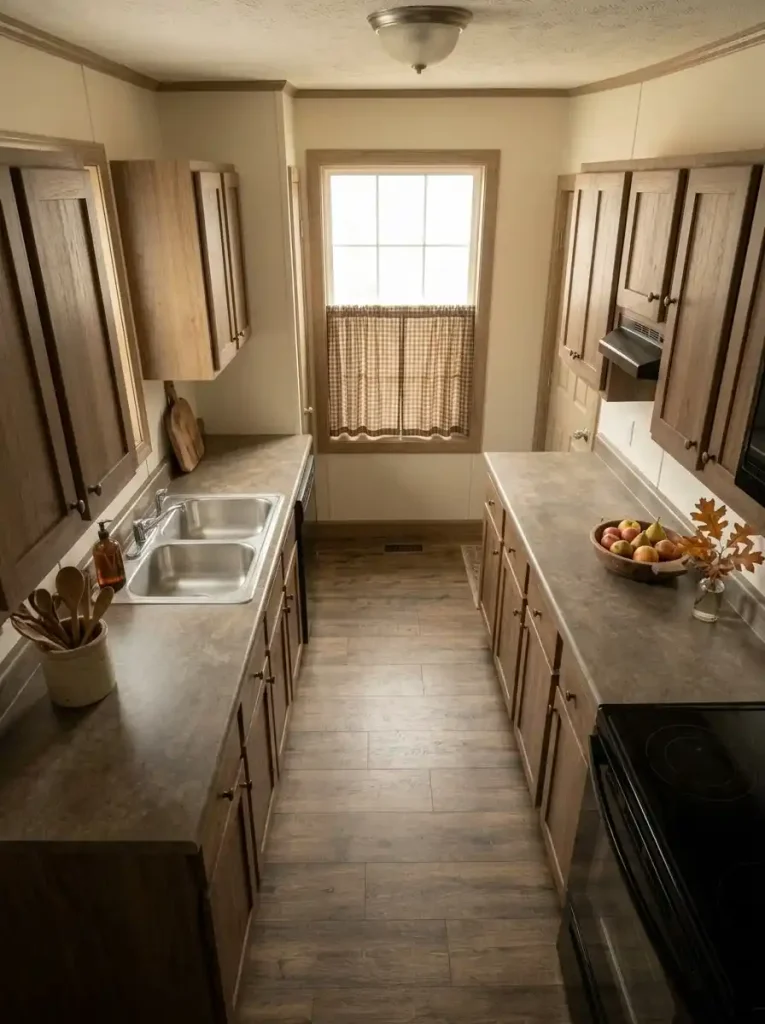
The easiest primitive kitchen transformation may involve substitution, not additional decorating.
Look at the objects already sitting on the counter. A plastic utensil holder can become a stoneware crock. A bright synthetic tray can become a worn wood board. A clear modern soap bottle might be visually contained beside an amber glass dispenser. Everyday fruit can sit in a wood bowl rather than next to a separate pile of faux pumpkins.
The room gains age, warmth, and fall color while roughly the same number of objects remains on the counter.
That trade is especially useful in a mobile-home kitchen because the sink, coffee station, prep zone, stove area, and small appliances often compete for a relatively short run of surface. For the wider seasonal strategy, see StylishGalore’s Cozy Fall Mobile Home Kitchen Decor Ideas, which focuses specifically on bringing autumn warmth into compact kitchens without sacrificing everyday function.
For a primitive interpretation, use a stricter test:
Would this object still belong in the kitchen if it had no autumn motif?
A wood board, crock, basket, amber bottle, cast-iron-looking trivet, or ceramic bowl probably would. That makes it a stronger foundation than a seasonal object whose only job is to say “fall.”
12. Build a Dining Centerpiece That Stays Below the Conversation Sightline
A primitive dining table can look atmospheric without placing a decorative wall between two people.
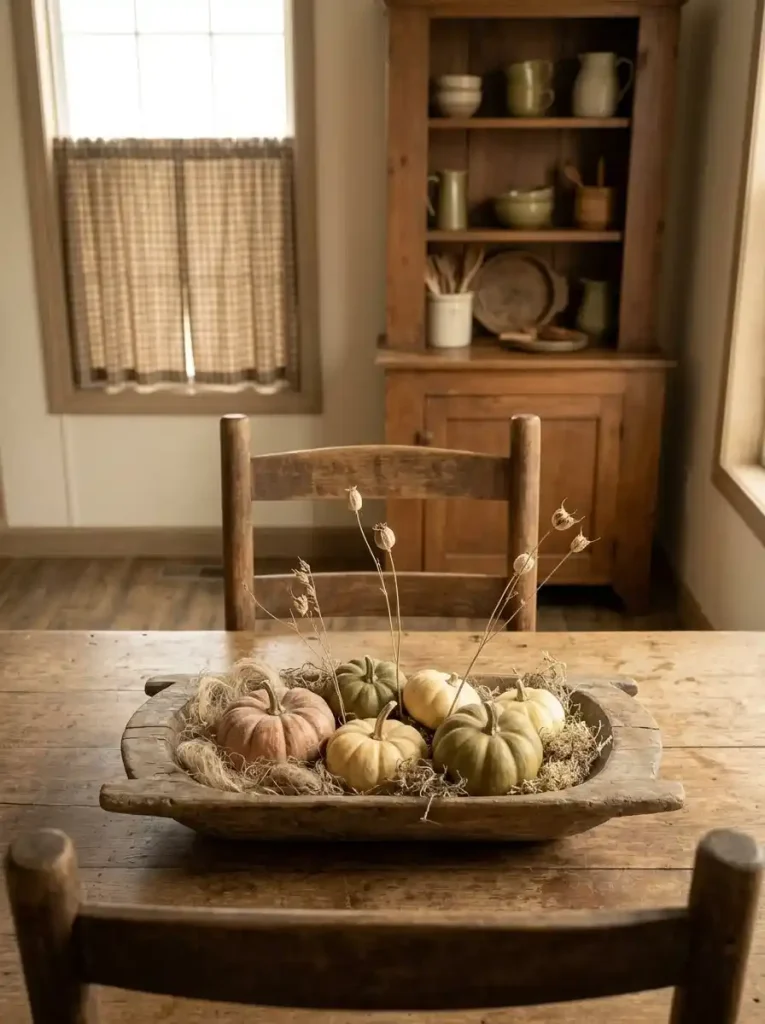
Start by sitting down, not by standing over the table.
From seated height, the centerpiece should feel like part of the lower table plane. A shallow trencher, long wood box, low crock, compact lantern-style object, or small cluster of gourds can create the primitive fall cue while keeping faces visible across the table.
Height is not automatically wrong. A few thin branches can rise through the view because the visual mass remains airy. A dense bouquet at the same height behaves very differently.
Dining sightline gauge
Judge the centerpiece from the chair
If the table doubles as homework space, food prep, mail sorting, or a work surface, containment matters even more. One primitive centerpiece that lifts away as a single unit usually performs better than several attractive objects scattered down the table.
13. Put Primitive Fall Character on the Wall With Folk Art, Samplers and Botanicals
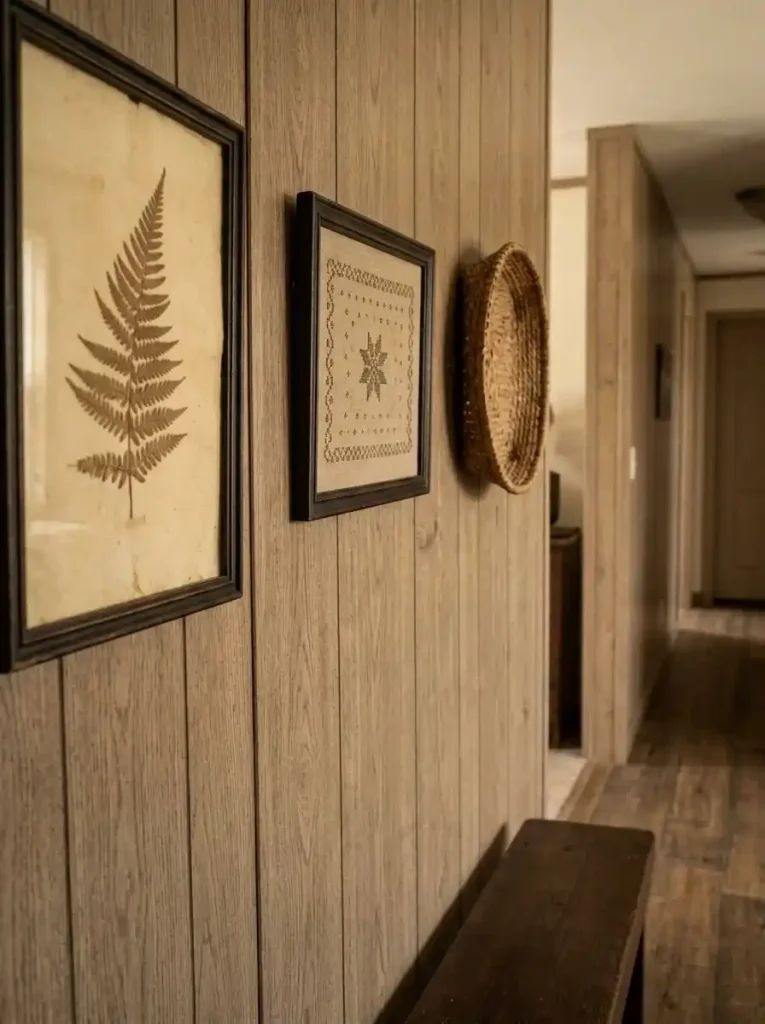
Walls are valuable seasonal territory in a mobile home because they can carry visual character without reducing the usable depth of a table, counter, or walkway.
Primitive wall décor also gives you more choices than another wooden sign.
Try an old-looking botanical print in a dark frame, a reproduction folk-art image, a small sampler-style textile, a framed fragment of faded fabric, pressed leaves, an antique-looking landscape, a shallow basket, or a restrained harvest wreath made from twigs and dried material.
The shared quality should be age, handwork, or natural irregularity.
A small grouping can work well, but do not fill a narrow wall simply because vertical space exists. Start with the strongest piece and judge how much wall remains visible around it. In a room with a dark hutch, patterned curtains, and a textile-heavy sofa, one quiet framed botanical may contribute more than an entire gallery.
If you want to build the wall element yourself, StylishGalore’s DIY Fall Wall Decor Ideas for Mobile Homes goes deeper into shallow, space-conscious seasonal wall projects that keep tables, counters, and walking paths available.
For primitive styling, apply one sourcing filter before hanging anything:
Does the piece look as though it could have remained on the wall before fall arrived?
If yes, you can usually make it seasonal with much less surrounding decoration.
14. Give the Bedroom One Heirloom-Looking Fall Textile Instead of a Theme
The bedroom does not need a second version of the living-room fall display.
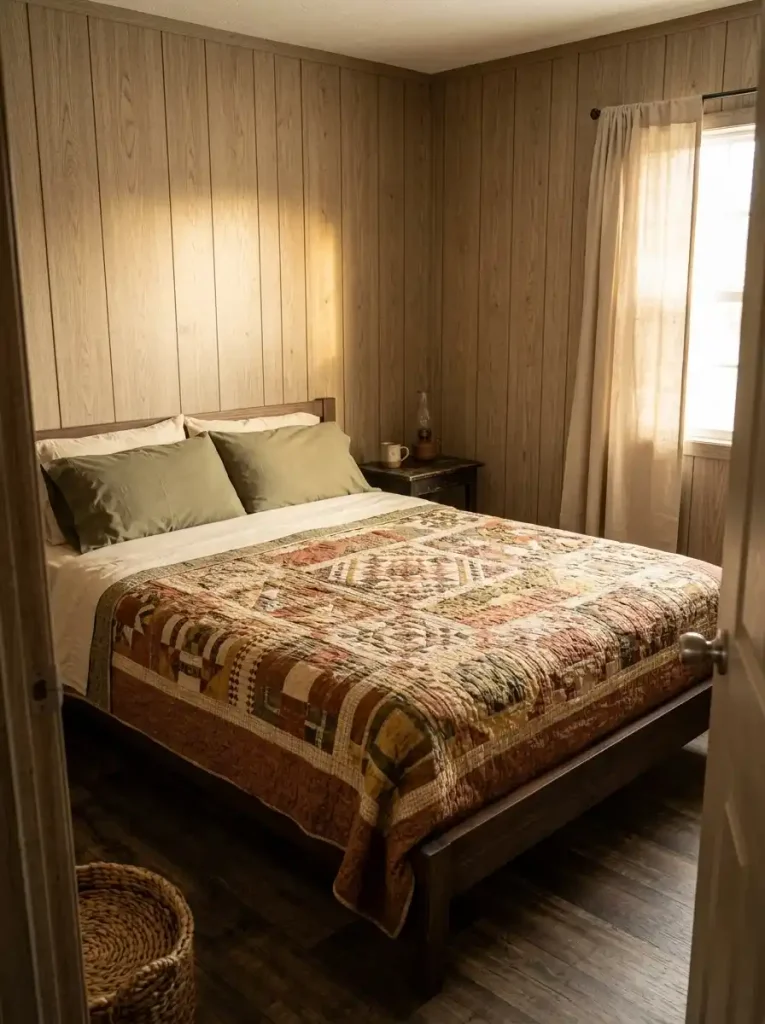
Primitive warmth can arrive through one textile that looks old enough, soft enough, or handmade enough to suggest history: a patchwork quilt, woven coverlet, faded floral throw, crocheted layer, striped blanket, or one hooked-style accent pillow.
Let that piece establish the seasonal color.
If the bed already has a multicolor quilt, keep the remaining layers restrained—perhaps cream sheets, a warm brown blanket, and one solid rust cushion. If the bedding is plain, a smaller patterned throw folded at the foot can provide enough homespun character without changing the entire room.
This is especially useful in a compact mobile-home bedroom, where the bed often occupies most of the visible floor plan. Any strong pattern placed there carries enormous visual weight.
Before buying new fall bedding, view the room from the doorway with the closet, curtains, flooring, and bedside furniture in the frame. Ask whether the textile adds warmth or simply introduces another motif.
Skip extra pumpkins, signs, and themed pillows when the textile already makes the season obvious.
A bedroom benefits from primitive style most when it feels softened by age—not temporarily dressed for an event.
15. Ground a Narrow Passage With a Braided Runner in Muted Harvest Colors
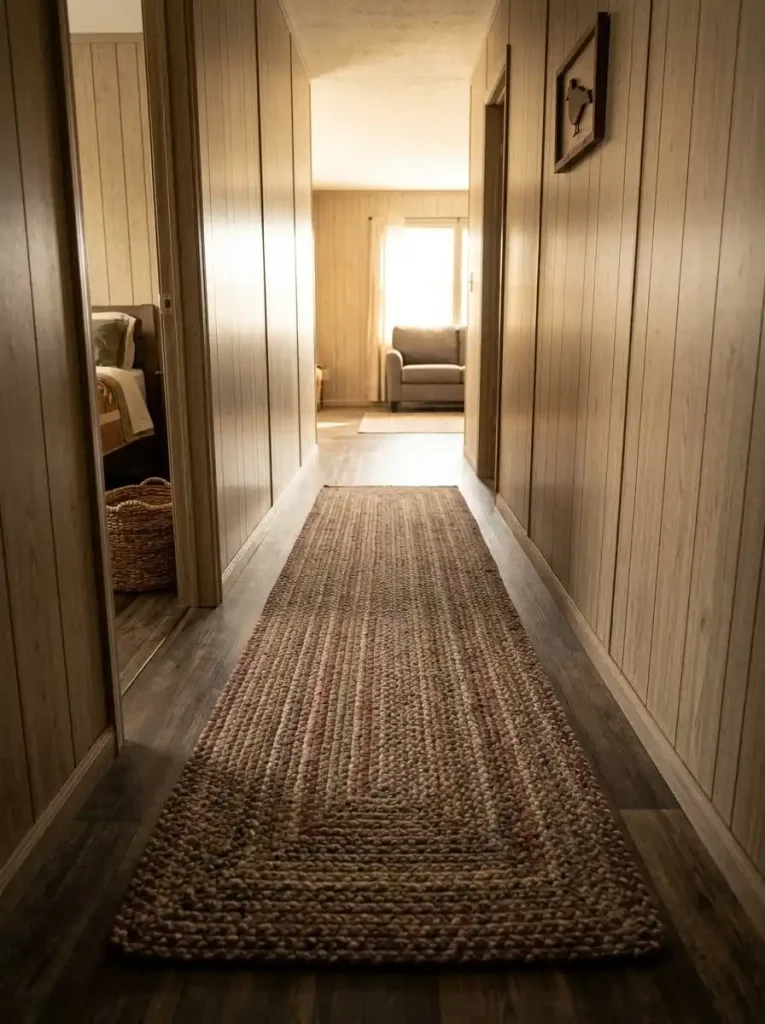
Sometimes the floor is the quietest place to add fall pattern.
A braided or woven runner in faded burgundy, rust, brown, olive, mustard, charcoal, or oat can connect a narrow passage to the rest of a primitive scheme without requiring another shelf or wall display. It is particularly useful when the walls already contain art and nearby rooms already carry baskets, wood, and seasonal textiles.
But a runner should solve a visual problem, not create a walking one.
Lay the rug where you intend to use it and walk the route naturally several times. Open the nearest door. Step around any furniture edge. Carry a laundry basket through the passage. If the runner shifts, catches, bunches, narrows a turn awkwardly, or visually chops an already short hall into pieces, the idea is not earning its place.
Pattern scale matters too. A tight small braid generally reads as texture from a distance; very large contrasting rings or bands can become the dominant feature in a narrow corridor.
Use the floor when surrounding vertical surfaces need a rest.
That gives the primitive palette continuity while letting the hall remain visually simple above knee height.
16. Make Primitive Fall Decor Come Alive After Sunset With Lower Amber Light
Primitive materials often look better in the evening because texture becomes more important than precise daytime color.
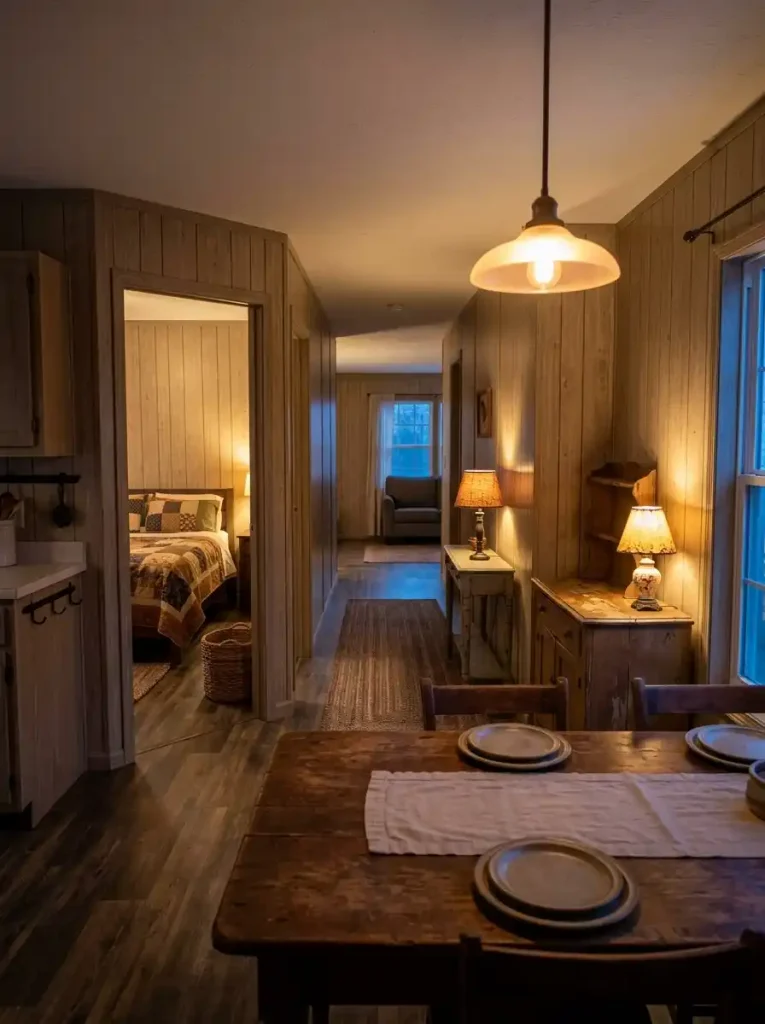
A woven basket throws deeper shadows. Rough wood grain becomes more visible. Stoneware looks heavier. Faded rust fabric becomes richer. Blackened iron acquires a stronger silhouette. All of those effects can make a room feel more autumnal without adding another seasonal object.
Work first with the lamps and fixtures you already use safely.
A table lamp beside a primitive console, a small lamp near a hutch, warm decorative LED light in an appropriate fixture, or an existing pendant over a dining area can create several pools of lower light. Keep all bulbs and fixtures within their manufacturer requirements; the decorating decision here is about where visual warmth is concentrated, not altering electrical components.
Then switch off the strongest overhead light for a moment and look along the connected rooms.
Can you still identify the entry, seating area, dining surface, and kitchen edge comfortably? Do the primitive materials gain depth, or does one corner simply disappear?
A good fall evening scene needs hierarchy, not murk. Light the places where texture matters most and keep normal household use practical.
17. Finish With the “Collected or Themed?” Primitive Mobile Home Edit
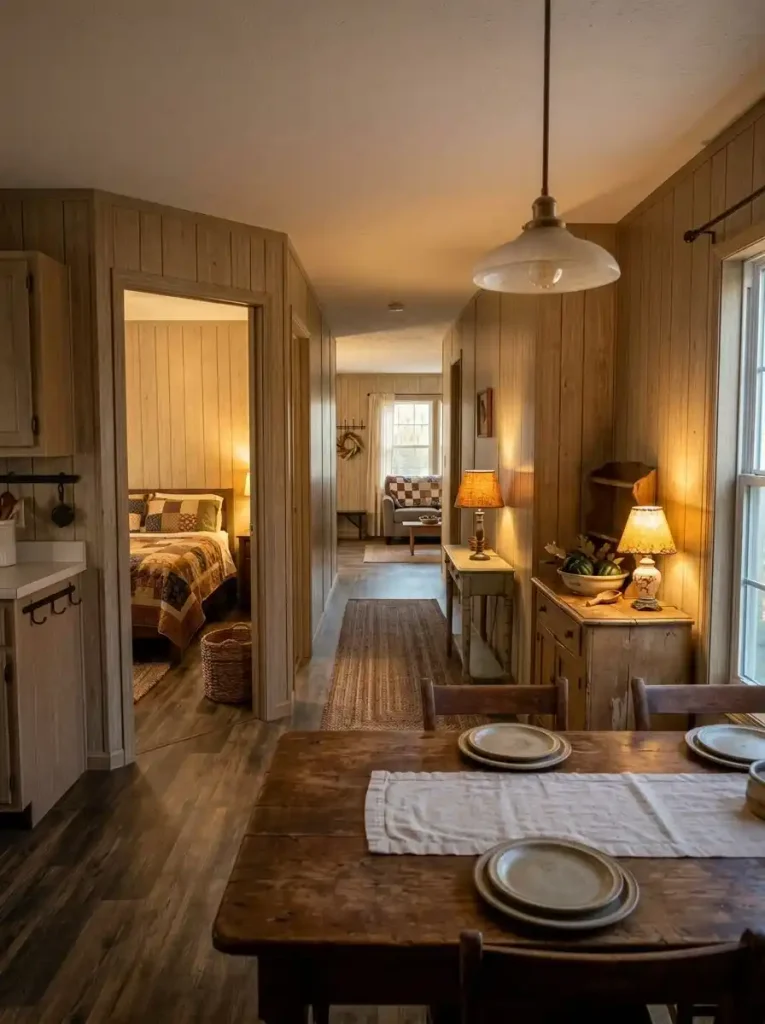
The last step is not adding something.
It is deciding which pieces no longer need to stay.
Walk to the place where you can see the greatest amount of the home at once. In many mobile homes, that might be near the front door, at one end of the living room, or where the living area opens toward the kitchen.
Now ignore individual objects and read the whole picture.
Can you identify one dominant primitive material story—perhaps dark wood, pottery, baskets, worn textile, and iron? Is autumn expressed through a few strong moments, or does every visible zone repeat pumpkins, leaves, checks, lanterns, and signs?
The distinction between collected and themed often appears in repetition. Collected rooms vary the evidence of age. Themed rooms repeat the same seasonal symbol until the symbol becomes the design.
Collected or themed?
Run the final primitive edit from the longest sightline
Open each question only when it describes something you notice. The action underneath tells you what to change before adding another accessory.
I can see the same pumpkin shape in several zones.
Action: remove one repetition. Keep the strongest pumpkin grouping, then let pottery, textiles, dried stems, or baskets represent autumn elsewhere.
Several surfaces contain small separate objects.
Action: consolidate. Move related pieces into one bowl, tray, crock, or shelf composition and return another surface to everyday use.
The room looks rustic, but not convincingly primitive.
Action: strengthen age and handwork. Replace one polished decorative object with worn wood, irregular pottery, homespun fabric, folk art, or another material that suggests use over time.
The room feels dark and heavy from the doorway.
Action: create one visual pause. Remove the smallest dark object from a crowded zone, expose more wall or tabletop, and allow a lighter textile or crock to interrupt the brown-black mass.
A chair, counter or bench is harder to use after decorating.
Action: protect the routine. Relocate the seasonal layer to a wall, shelf, window, basket, or another place that does not have to be cleared before the household can use the room normally.
Every room has the same amount of fall decoration.
Action: assign hierarchy. Keep two or three stronger fall zones and allow connecting spaces to carry only color, texture, or one small seasonal cue.
Edit
Primitive decorating is convincing when removing the obvious fall symbols would still leave a warm, aged, useful interior. If the room passes that test, seasonal décor is supporting the style instead of creating it.
Once the home reads as primitive before it reads as “fall,” stop.
That restraint allows the old-looking wood, pottery, woven texture, faded textiles, natural stems, and autumn color to feel like part of one home instead of a temporary collection spread through seventeen different places.
Final Thoughts
The most effective primitive fall mobile home decor starts with what can remain after the season changes: useful baskets, worn wood, stoneware, homespun textiles, folk-inspired art, muted color, and warm light. Autumn should deepen those materials, not bury them beneath extra objects.
If you are unsure where to begin, choose one visible anchor zone—the entry, living-room seating area, hutch, or kitchen window—and make that area convincing first. Then carry only one or two related materials into the connected rooms.
A smaller home does not need a smaller personality. It benefits from clearer hierarchy. When each primitive piece earns its footprint, the entire interior can feel warmer, older, and more collected without becoming crowded.