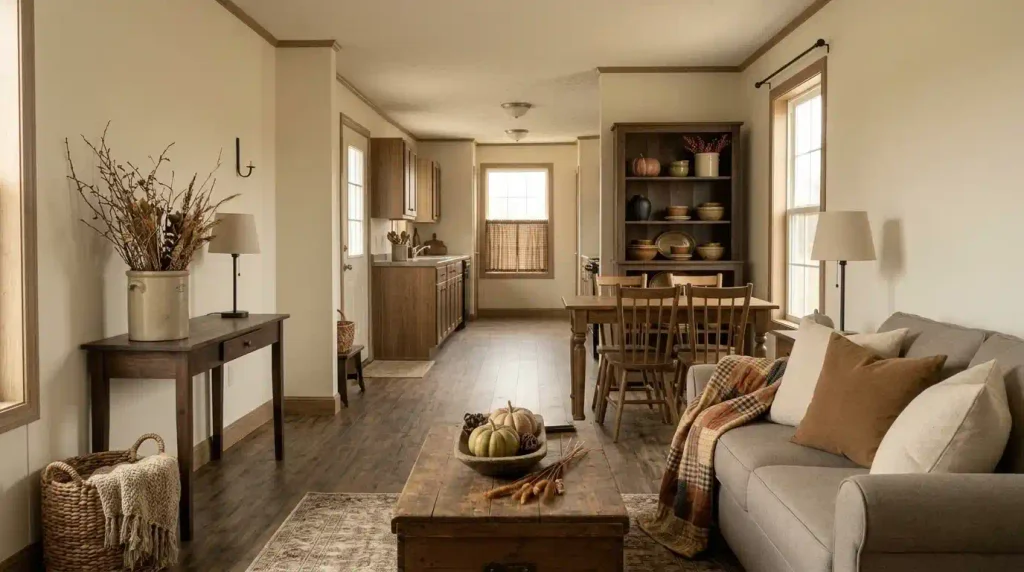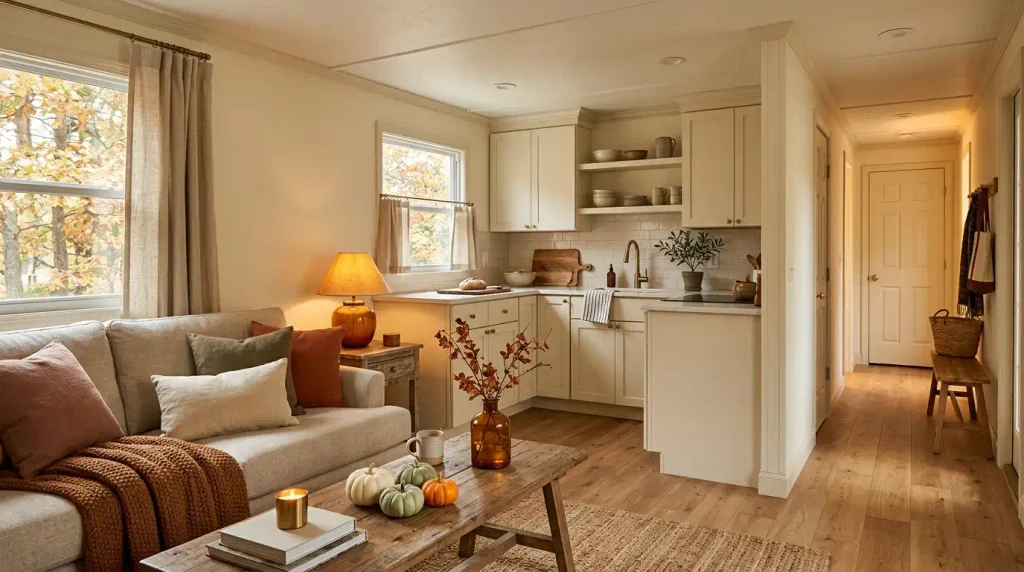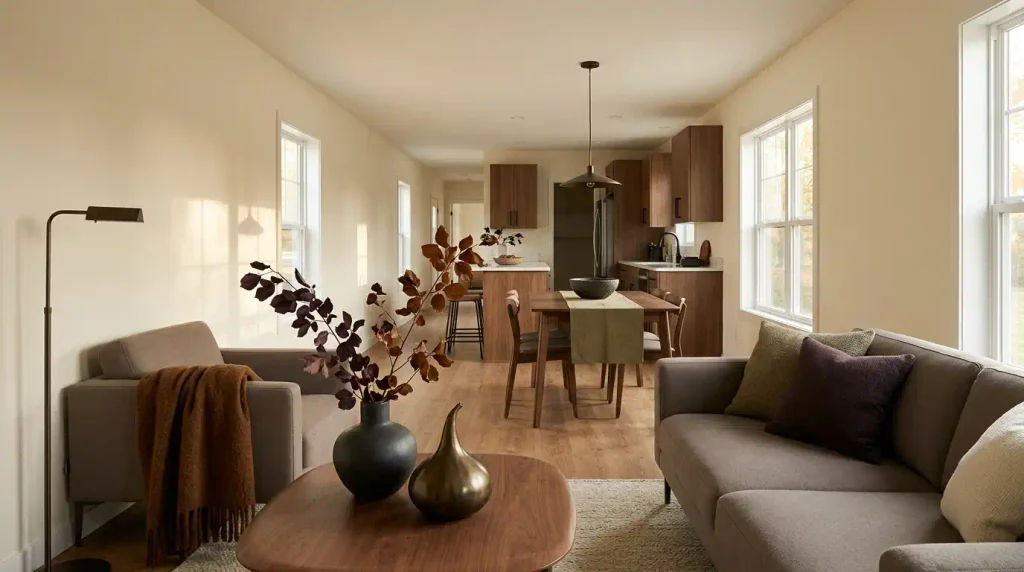
The first problem with a beautiful Thanksgiving centerpiece usually appears when the food comes out. A cluster of pumpkins looks charming on an empty table; add a turkey platter, water glasses, a breadbasket, and four dinner plates, and the same arrangement becomes an obstacle. On a small table, even a modest bowl or runner can claim the only shared serving space.
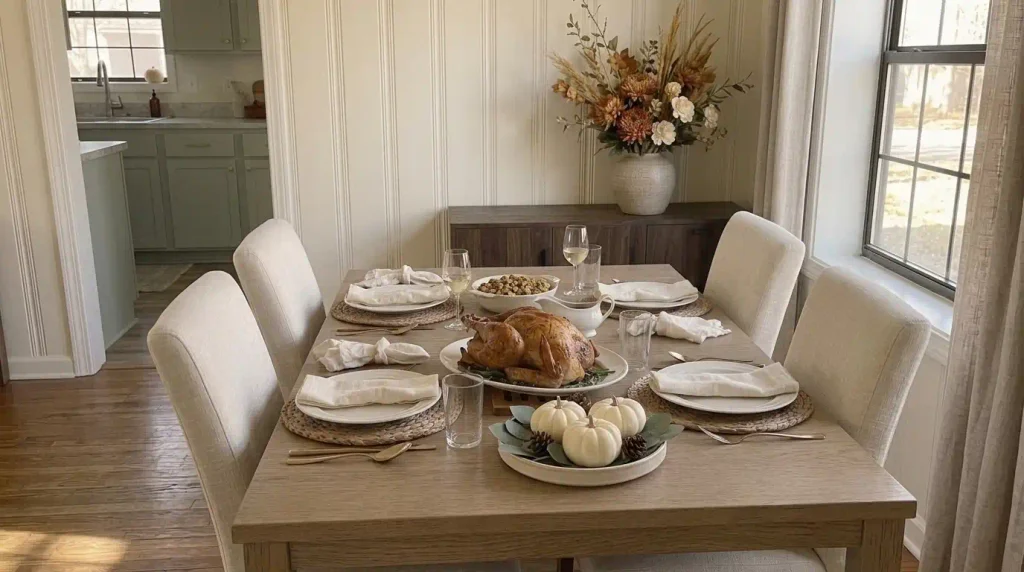
These small table Thanksgiving centerpiece ideas are designed for that exact moment. You’ll find restrained flowers, miniature pumpkins, and smart placement choices that let holiday décor share the table with dinner. The details also suit narrow mobile-home dining nooks, where a banquette, a wall, or a kitchen pass-through may limit which edges guests can reach.
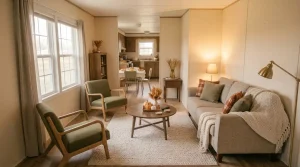
Before choosing a look, set out the plates and glasses you actually use, then put your largest serving dish where it needs to land. Notice the spaces left over. Those gaps—not a photograph of an empty holiday table—will tell you which centerpiece belongs in your home.
1. Bookend a Narrow Table With Mini Pumpkins and Leave the Center Open
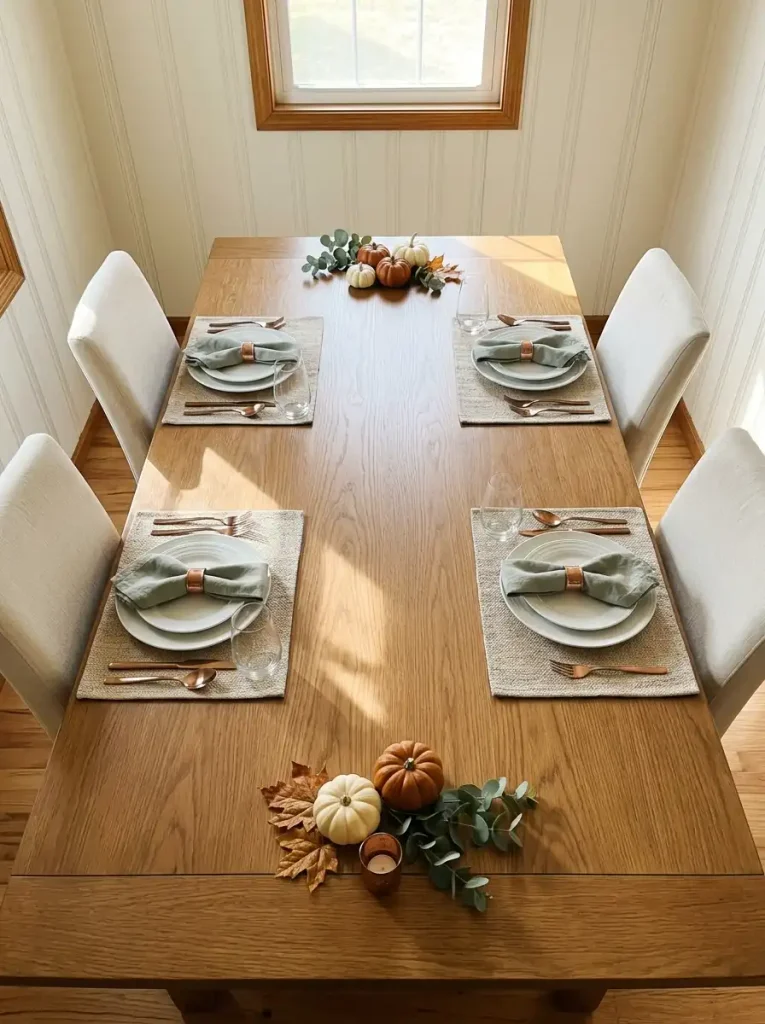
On a slim rectangular table, two tiny harvest clusters can make a stronger composition than one continuous runner. Place one at each short end, using a mini pumpkin, a few eucalyptus cuttings, and one flat autumn leaf. The eye connects them across the table, while the space between them stays available for the turkey, vegetables, or passing bowls.
The arrangement depends on who sits where. It works best when diners occupy the long sides and the short ends remain unused. A person seated at either end needs that edge for a plate, glass, and comfortable reach; the pumpkins should move before the guest arrives.
Thanksgiving Table-Space Atlas
The Thanksgiving table-space atlas · 01
Give the food a place before the flowers.
Switch table shapes to compare where a centerpiece can live once plates and a shared serving dish are on the table. Diagrams are conceptual, not measured furniture plans.
Use your actual dinnerware to test fit. These illustrations communicate placement logic, not fixed clearance dimensions.
The simple stopping rule: once a guest must shift the pumpkins to set down a dish, they are no longer useful bookends. Keep the paired arrangement for a buffet-style meal only if the center and both long-side places still work in practice.
2. Curve a Petite Pumpkin Crescent Along One Side of a Round Table
Does every centerpiece have to sit in the middle? On a little round table, the middle is often the only spot a shared bowl can occupy. Give the decoration an offset position: three miniature cream pumpkins, a few clipped eucalyptus stems, and perhaps a single copper-colored leaf arranged in a loose crescent along an unused section of the rim.
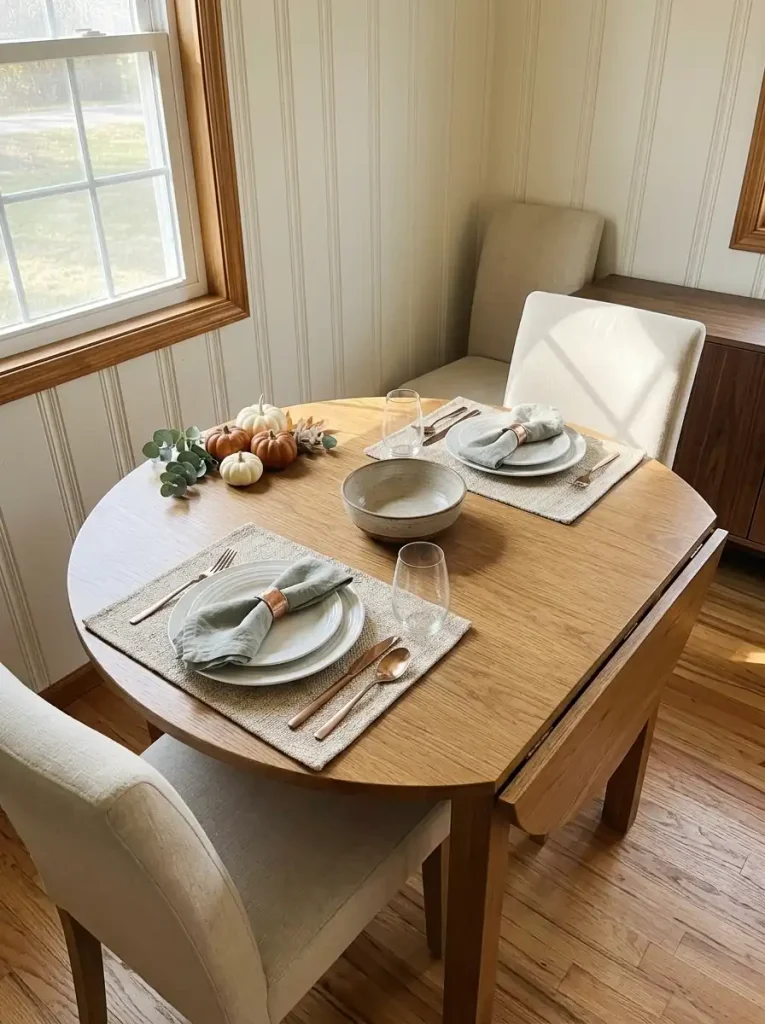
This is a particularly good option for two people at a café table or for a three-seat breakfast nook where one arc is open. Start with the dishes in place; tuck the crescent into the remaining quadrant and check that it does not push a glass toward the edge. Low, separated pieces make it easier to maintain the curve without building a solid ring around the food.
At a fully occupied four-seat round table, there may be no spare arc at all. Take the same pumpkins to the sill or nearby shelf and leave the shared bowl at the center. For the seating and walking-space decisions beyond the tabletop, explore these small mobile-home fall dining nook ideas.
Quick visual check: take a photo from every seat, not only from the doorway. If the crescent appears to crowd one person’s plate, reduce it to a single tiny pumpkin or clear it for dinner.
3. Use One Airy Autumn Branch Vase Where Nobody Needs to Reach
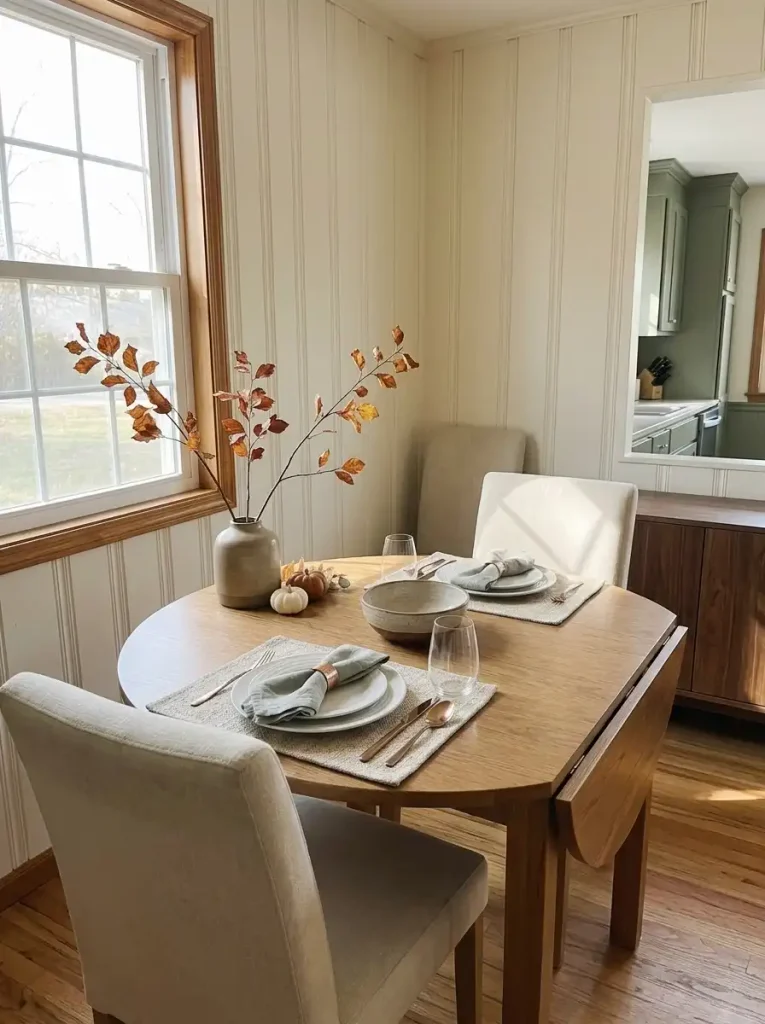
A branch arrangement can occupy very little table surface and still cause a problem above it. Imagine someone passing potatoes across a narrow dining table while a forked stem leans into the route. The vase looks delicate from the entryway; from the chair, it becomes an obstacle.
Choose one to three lightly foliated branches and place them in a short, stable, wide-bottomed vessel at the far side of an unused seating edge. Leave some space between the stems so the display reads as autumn color without forming a leafy screen.
Then run a seated test:
- Look: Sit across from someone and check whether the branches cross either face.
- Reach: Pass the widest serving dish between seats without touching the stems.
- Reset: Rotate or shorten the branches, or move the entire arrangement onto a sideboard if either test fails.
The last option is especially useful in narrow mobile-home dining nooks with a wall-side bench: the bouquet can remain visible in the same room without taking over a shared eating surface. A dramatically tall arrangement is best saved for a nearby shelf if the table serves food family-style.
4. Compress Chrysanthemums Into a Low, Saucer-Shaped Posy
A large vase of rust and gold chrysanthemums may look lovely at the start of Thanksgiving, yet the flowers can hide the person sitting opposite you. Keep the color and lose the height. Cut a small bunch into short, staggered stems and arrange the blooms in a low, stable container that sits comfortably within a saucer or shallow tray.
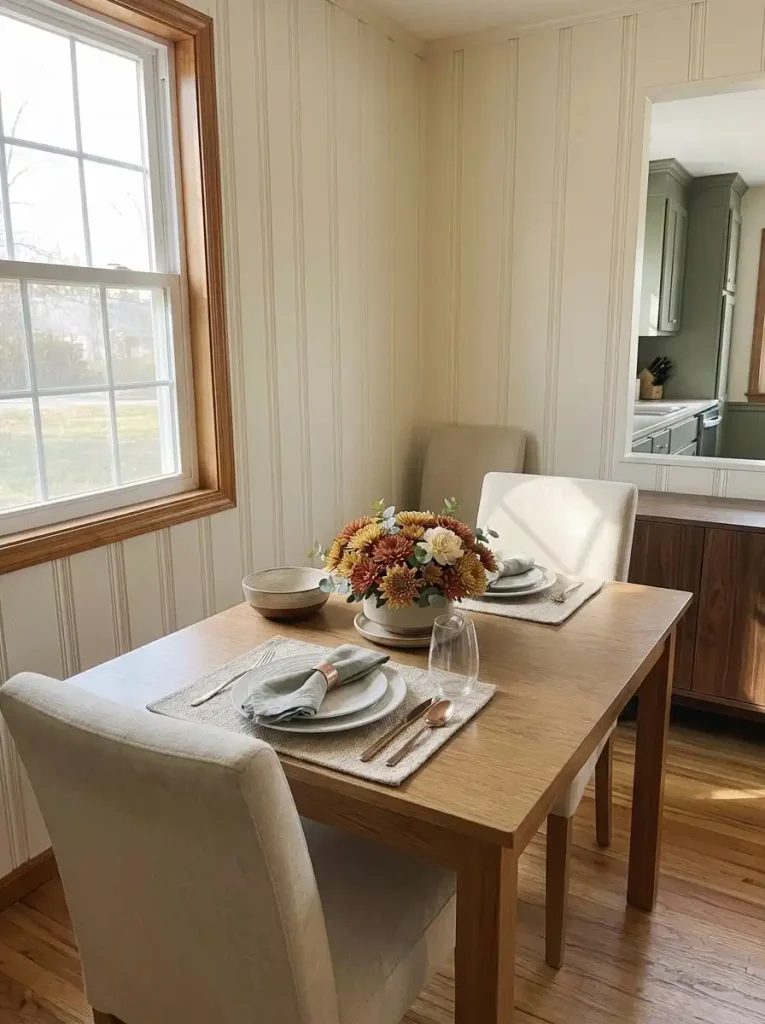
Make the arrangement fuller at its center and looser at the edges, with a few clipped leaves breaking up the round shape. A restrained mix of deep bronze, ochre, and one pale bloom will read as a deliberate centerpiece from the doorway without demanding a large footprint.
Seated-View Flower Comparison
Seated-view comparison · 04
Same flowers. Very different dinner conversation.
Choose the arrangement profile to see what changes at seated eye level. Height alone is not the full test: density, placement, and people’s sightlines all matter.
Illustrative seated-view diagrams. Actual comfort depends on your chairs, diners, container, stem spacing, and table shape.
For a mobile-home dining nook with a small wall-side table, try the low version before buying a taller vessel. Sit in the actual chairs with the arrangement in place; then reach across with a serving bowl. If the flowers interrupt either action, pare back the blooms or use the bouquet on a shelf. The right scale is the one that stays pleasant during the meal. For larger arrangements and alternative floral looks, see these Thanksgiving centerpiece inspirations; scale them down using the seated-view test above.
5. Draw a Thanksgiving Centerpiece Across a Kraft Paper Runner
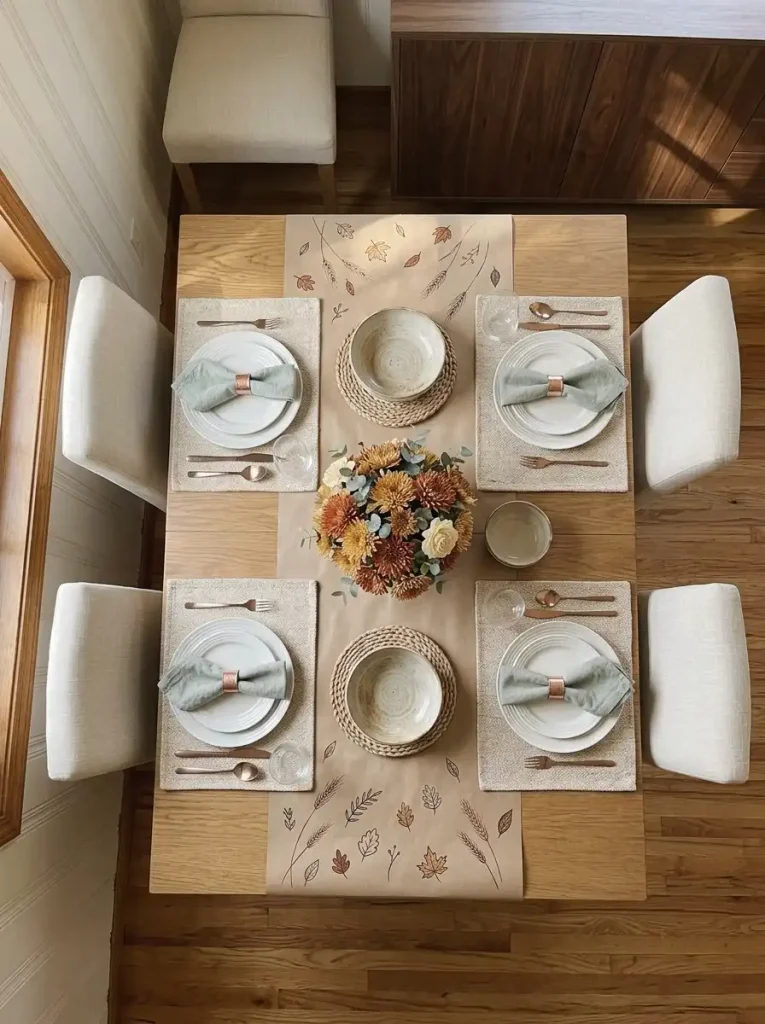
A runner does not have to rise above the table to make an impression. Spread a length of plain kraft paper down the exposed middle of a small rectangular dining table and use a dark brown paint pen to draw a restrained trail of leaves, wheat heads, or handwritten gratitude notes. The decorating happens on the surface; platters can occupy the empty sections without knocking over a vase.
Plan the arrangement in reverse. Set out the actual place settings, followed by the largest serving dishes on trivets. Trace the edges of the space still available, then lift the dishes away and decorate only those areas. Keep permanent marker ink away from anything that directly touches food; plates, trivets and serving boards remain the proper contact surfaces. The paper is decorative, not a substitute for a heat-safe mat.
Kraft-Paper Serving Blueprint
Flat-surface field notes / 05
The runner changes when dinner arrives.
Switch the tabletop view. The point is not the drawn leaf pattern; it is keeping a heat-safe, dish-ready landing area where food must go.
Conceptual tabletop diagrams, not scaled plans. Kraft paper is a decoration, never a heat-safe trivet or food-contact surface.
There is one important distinction between a casual lunch and a full Thanksgiving meal: a bare table may appear to have a long decorative center, while a turkey platter and several sides break that space into small islands. Let the drawing follow those islands. On a two-seat mobile-home table, even a few handwritten words near the table edge may be sufficient; the absence of raised objects is the idea’s greatest advantage.
6. Place Three Tiny Eucalyptus Clusters Between Serving Dishes
Picture a long garland running through the middle of a narrow dining table. The greenery looks coherent before dinner, but passing the mashed potatoes means lifting a bowl over stems. A better approach is to divide the garland into three short, independent clusters and give each one its own spot after the serving dishes have been positioned.
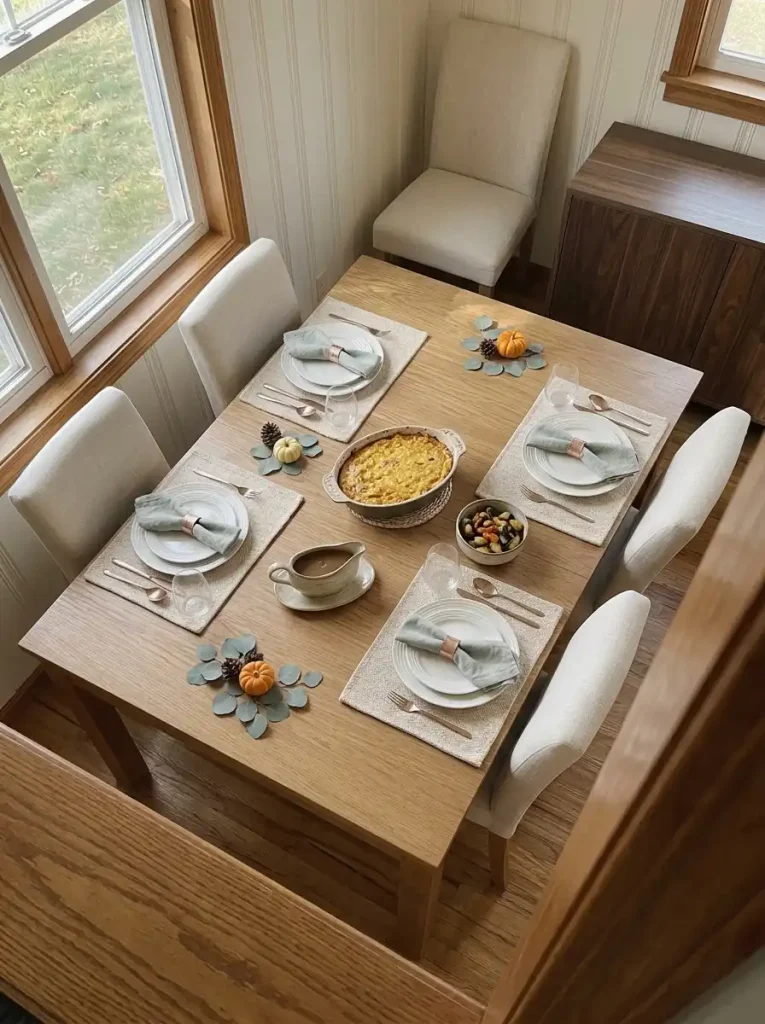
Use a few flat eucalyptus sprigs, a single small pinecone or miniature pumpkin per cluster, and nothing that trails into someone else’s plate. A little space between clusters matters: that gap becomes a landing zone for a gravy boat or a serving spoon. For a short two-person table, use two clusters, or just one; the title’s three is a styling option, not a quota.
Try the dinner rehearsal: move a serving bowl from one guest to the other. Any cluster that gets brushed, dragged, or repeatedly relocated has failed its position test. Remove it and let the other pieces carry the harvest look. The winning arrangement is the one no guest needs to think about.
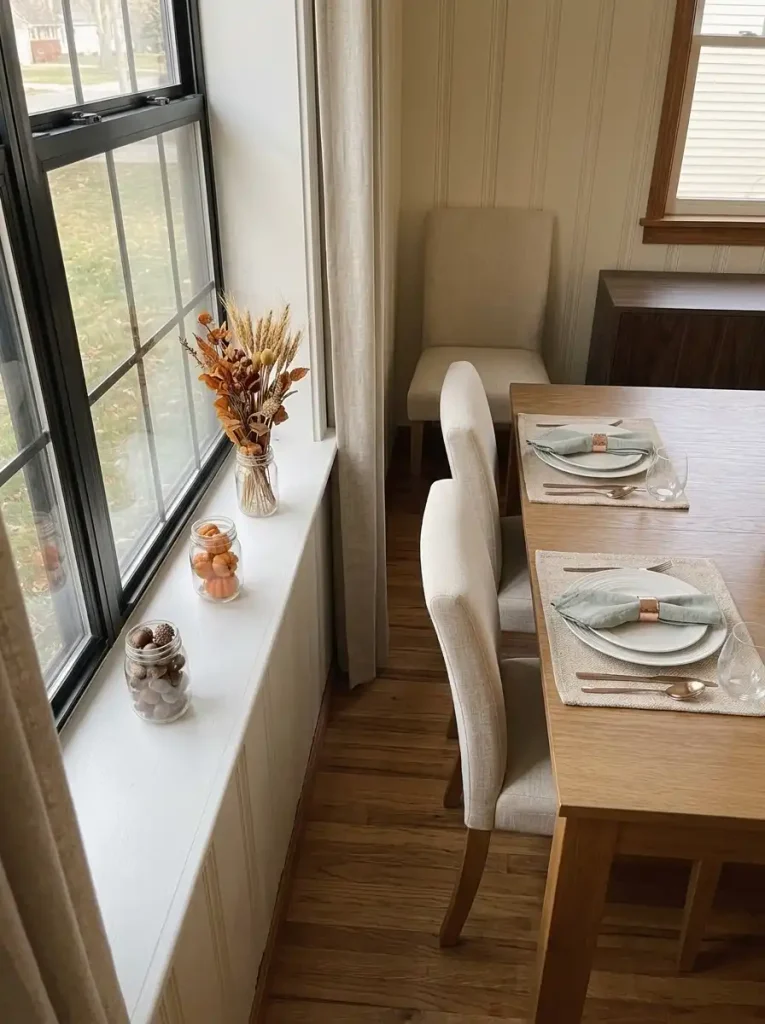
7. Move the Harvest Jar Arrangement to the Dining Nook Windowsill
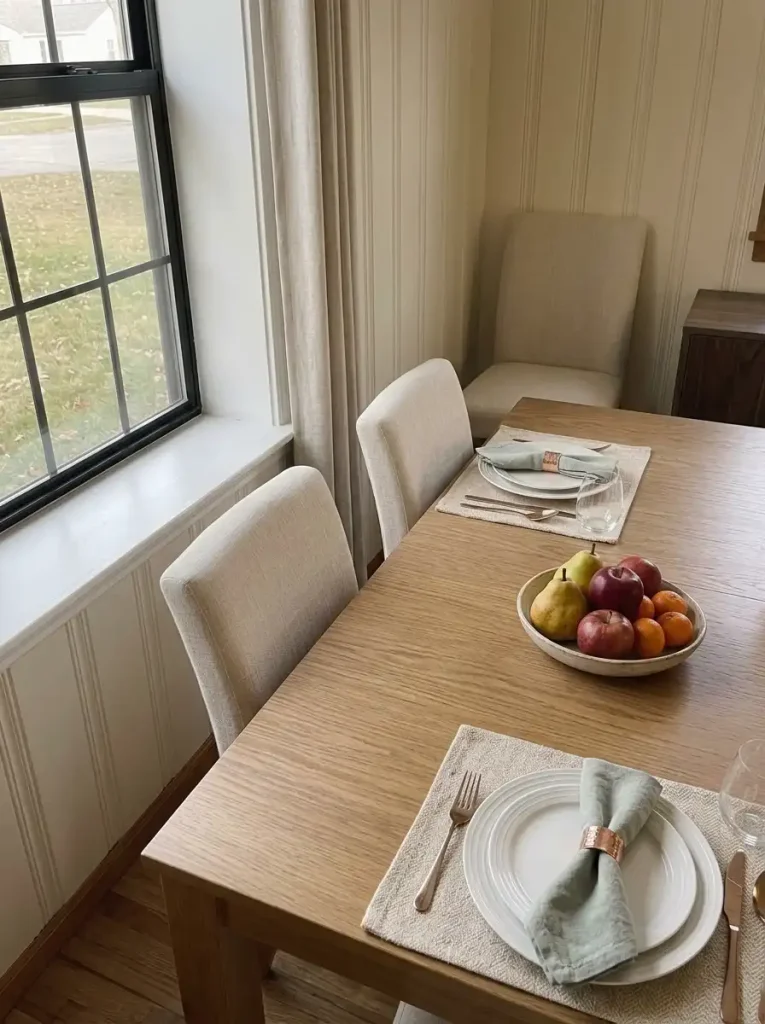
A row of clear jars filled with acorns, corn kernels, or tiny pumpkins can be visually charming and physically awkward when every diner needs elbow room. The solution may be the architecture beside the table: a secure windowsill or narrow shelf within the same sightline.
Place two or three small jars on that ledge, each with a low arrangement of dried wheat, rust-colored leaves, and faux berries. Keep them back from the edge, out of window operation and away from curtains or other heat sources. Avoid loose small fillers where children or pets can reach them. If the sill is too shallow, too exposed, or needed for ventilation, a nearby sideboard is a safer substitute.
From the dining chairs, the seasonal colors still frame the meal. The table itself can hold bread, water, and extra plates. This option is especially useful in a mobile-home breakfast nook where the table meets a window wall. It is a better choice than shrinking an elaborate jar display until it no longer looks intentional.
8. Make a Small Bowl of Seasonal Fruit the Edible Centerpiece
For an intimate Thanksgiving meal, an elegant bowl of pears and small apples can become the decoration and an item guests may enjoy later. The changing arrangement is the appeal: once dessert begins, the bowl can be shared or removed without leaving a bare patch of scattered craft supplies.
Build it with three decisions:
- Choose a low, stable bowl. Its base must fit in the area remaining after glasses and shared food are set down. A wide pedestal may be attractive but less stable on a crowded table.
- Select fruit that belongs on the menu. Wash edible fruit appropriately and keep inedible painted gourds, glittered ornaments, and florist materials in a separate decorative display.
- Decide its serving moment. If guests need the center for savory dishes, move the bowl to a sideboard, then return it for dessert.
A small round café table may support only one or two pears on a little plate. That still reads as a deliberate Thanksgiving accent when paired with linen napkins and warm glassware. Use the food you actually intend to serve instead of buying fruit solely to fill a photograph.
9. Use One Flameless Autumn Leaf Lantern for Gentle Dinner Glow
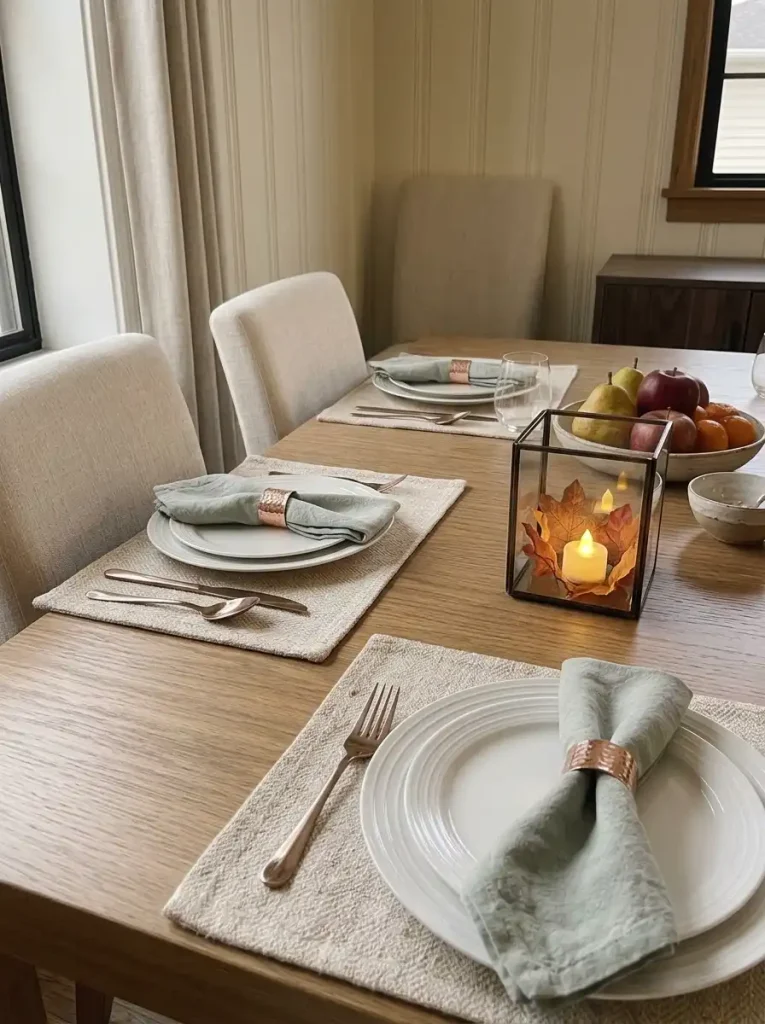
The warm shimmer of fall leaves in a jar can give a small table the ambiance of several candles, even when there is room for just one vessel. Choose a stable, squat glass lantern with battery-operated fairy lights or an LED votive. A handful of translucent faux autumn leaves around the outside of the light creates the amber effect; keep the manufacturer’s battery compartment and controls accessible.
A slender walkway between a mobile-home kitchen and dining table often means somebody reaches across the setting while carrying hot dishes. Avoid real flames in this crowded arrangement. The U.S. Fire Administration recommends flameless candles and says burning candles must be in stable holders at least 12 inches away from anything combustible. See its candle fire-safety guidance.
Place the lantern off the main platter route and switch it on when guests are seated. If it competes with a shared salad bowl, move it to the windowsill from idea #7. The warm light can remain visible without becoming another object to work around.
10. Arrange Dried Oranges and Pinecones on a Short, Contained Board
A rustic orange-and-pinecone centerpiece often becomes a long, unruly trail. A short wooden board gives those pieces a clear boundary. Set a few dried orange slices, two or three small pinecones, and a mini cream pumpkin on a shallow board that can be lifted in one motion. Keep loose decorative pieces off food-contact surfaces and away from ready-to-eat dishes.
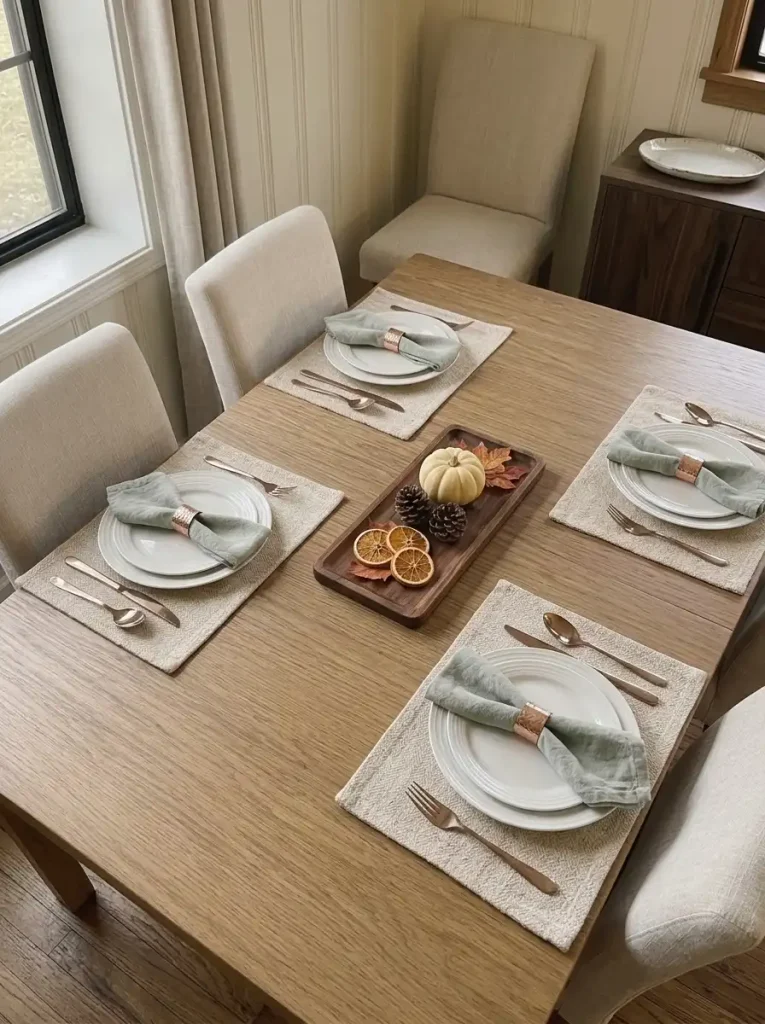
The crucial decision is how dinner is served. A full family-style meal generally asks more of the shared center than a plated meal does. A buffet in the kitchen releases tabletop space, but only if guests still have safe room for their plates and glasses.
Thanksgiving Serving-Style Decision Studio
The service equation / 10
How much of the middle belongs to dinner?
Select the way your meal is served. The same pinecone-and-orange board is either an easy accent, a temporary guest, or an obstacle.
Guest plates Serving bowls Movable decorative board
Treat the board as an optional guest at the table. Once the serving platters arrive, it either fits the remaining space or moves to the sideboard intact. It should never force a hot dish toward the edge. The same harvest palette works in both locations, so the decoration does not lose its purpose when dinner begins.
11. Let a Linen-Dressed Breadbasket Double as the Centerpiece
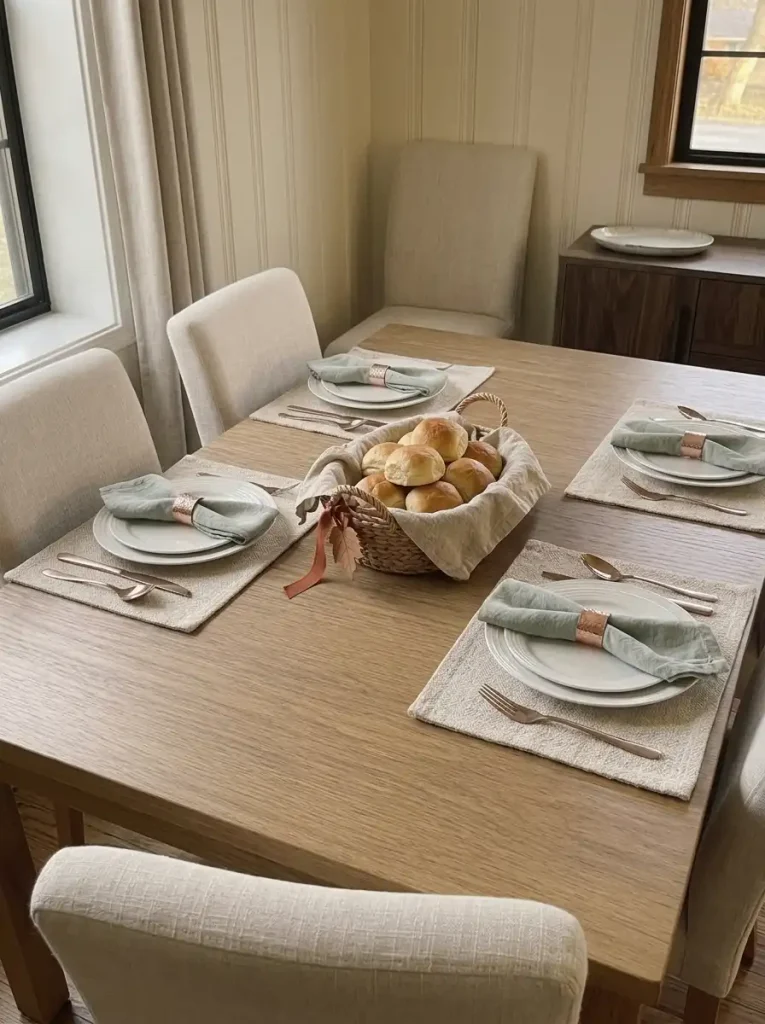
There is already a useful object in the middle of many Thanksgiving tables: the breadbasket. Give it the holiday treatment with a clean oatmeal-linen napkin, a russet-colored textile ribbon around the outside, and perhaps a small removable leaf-shaped tag tied to the handle. The bread remains the focal point; the decorative accents never need to touch the rolls.
This is the most persuasive option when a small table has room for food but little room for separate decoration. Choose a basket that holds the amount of bread you plan to offer, and place it where guests on both sides can reach it. If the table is too narrow to pass it safely, serve the bread from a nearby counter and skip the centerpiece version.
A useful distinction: dress the container, not the food. Avoid glitter, shed-prone dried flowers, loose pine needles, and painted ornaments inside the basket. The styling should be easy to remove before washing and practical through multiple rounds of serving.
12. Create a Distributed Thanksgiving Centerpiece With Mini Pumpkin Napkin Charms
One centerpiece does not always need one central location. For a table whose middle must remain completely clear, build the autumn composition at the individual place settings. Each folded napkin gets a tiny faux pumpkin or a leaf-shaped place card tied with twine; collectively, the repeated accents create the same visual rhythm as a traditional centerpiece.
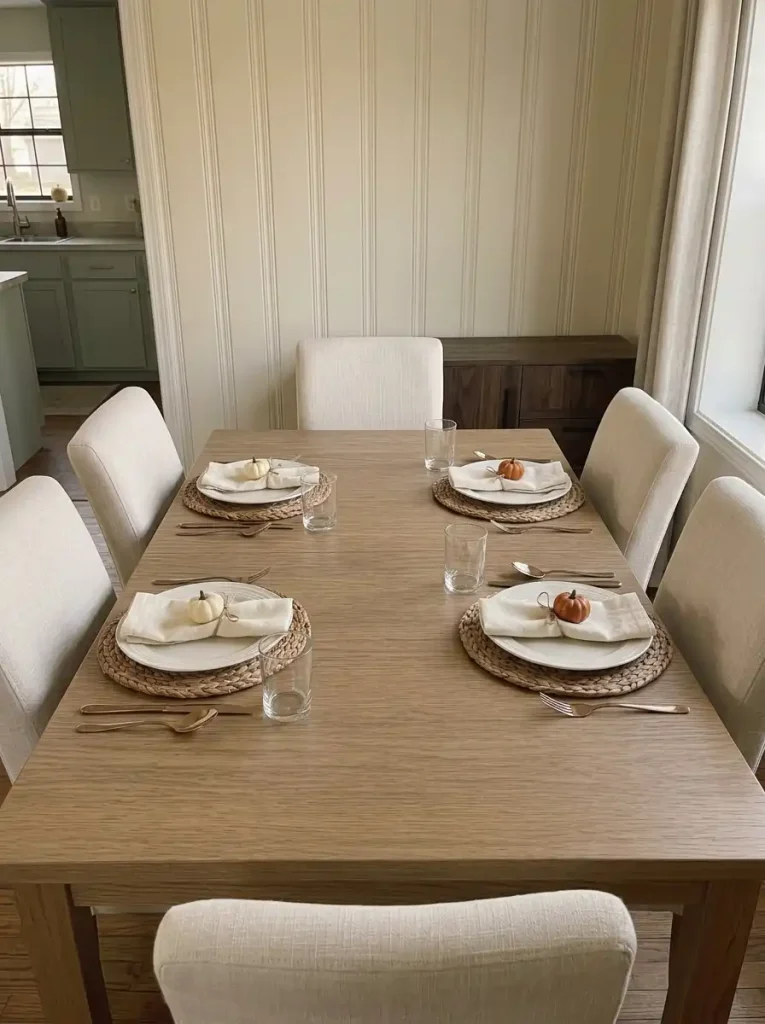
Start by placing a plate, glass, and cutlery at every seat. Add the charm only if the napkin stays comfortably on the plate and the guest can remove the decoration immediately. Place-name tags should be legible, light, and free of loose glitter. Collect reusable charms in a small bowl as dinner starts so they do not wind up in shared dishes.
This is a particularly neat strategy for a narrow mobile-home dining nook with chairs or a banquette crowded around a small top. It leaves the central strip open for serving while giving every guest a deliberate holiday detail. For more ideas that coordinate plates, napkins and seasonal colors, browse these Thanksgiving table settings.
13. Turn the Existing Condiment Caddy Into a Petite Harvest Arrangement
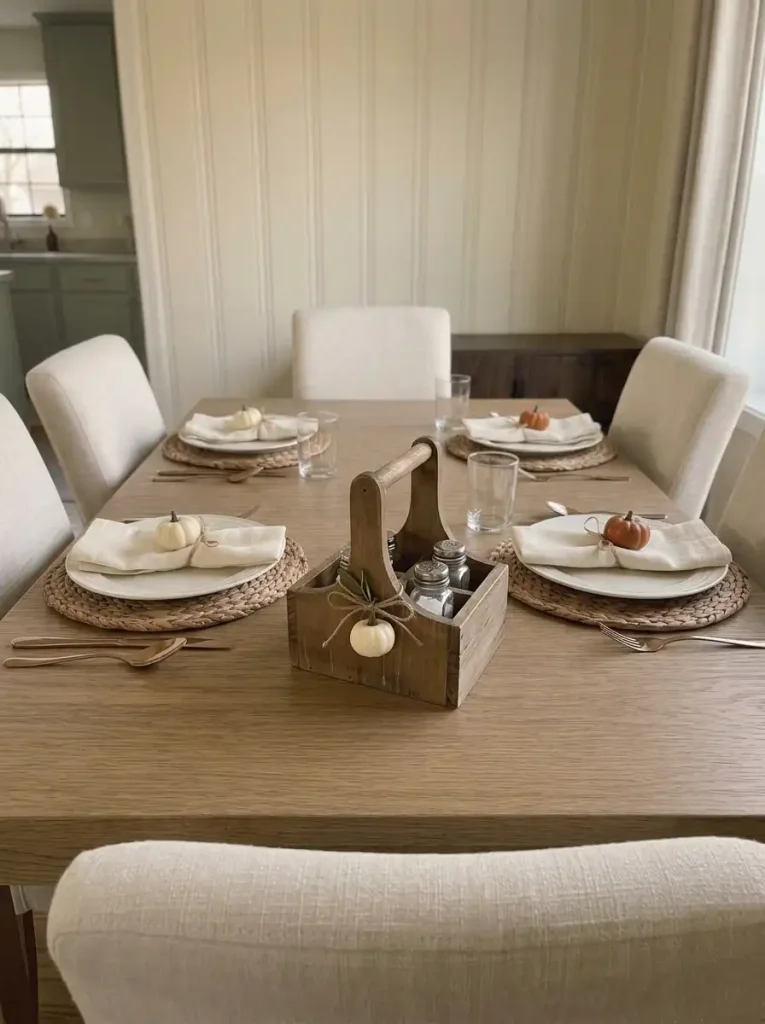
A small salt-and-pepper tray is easy to overlook, even though it is already occupying valuable tabletop real estate. If it has a stable, removable compartment, tuck in one short sprig of faux olive leaves or dried wheat and a thumbnail-size pumpkin accent. The condiment handles, lids, and pouring routes must stay completely unobstructed.
Condiment Access Map
Reach analysis / 13
Can everyone still reach the salt?
A functional centerpiece must pass an access test from both sides of the table. The green paths show clear access; the copper zone shows foliage that would get in the way.
Salt and pepper should lift straight out. A guest should not need to rearrange the seasonal stem to grasp either container.
Leaves or twine that spill across the opening become snag points. Edit them back to a removable, exterior accent.
When the caddy already fills its tray, skip the decorative stem and use a tiny label tied to the handle.
The diagram illustrates an access principle; test your own caddy with the seats and tableware in place.
Consider a four-seat square table where guests already reach toward the center for seasoning. An entirely separate flower vase would compete with that route; an edited caddy combines the two purposes. Set the caddy down, ask two people to reach for the salt from opposite chairs, and watch for fingers catching the decorative stem. If either person has to move the foliage, strip the arrangement back to a leaf tag tied around the outer handle.
Skip the idea altogether when the tray is already packed or easily overturned. Ordinary table salt does not require a centerpiece attached to it; a smart tiny detail is only smart when the caddy still works.
14. Stage the Full Autumn Bouquet Behind the Table, Not on It
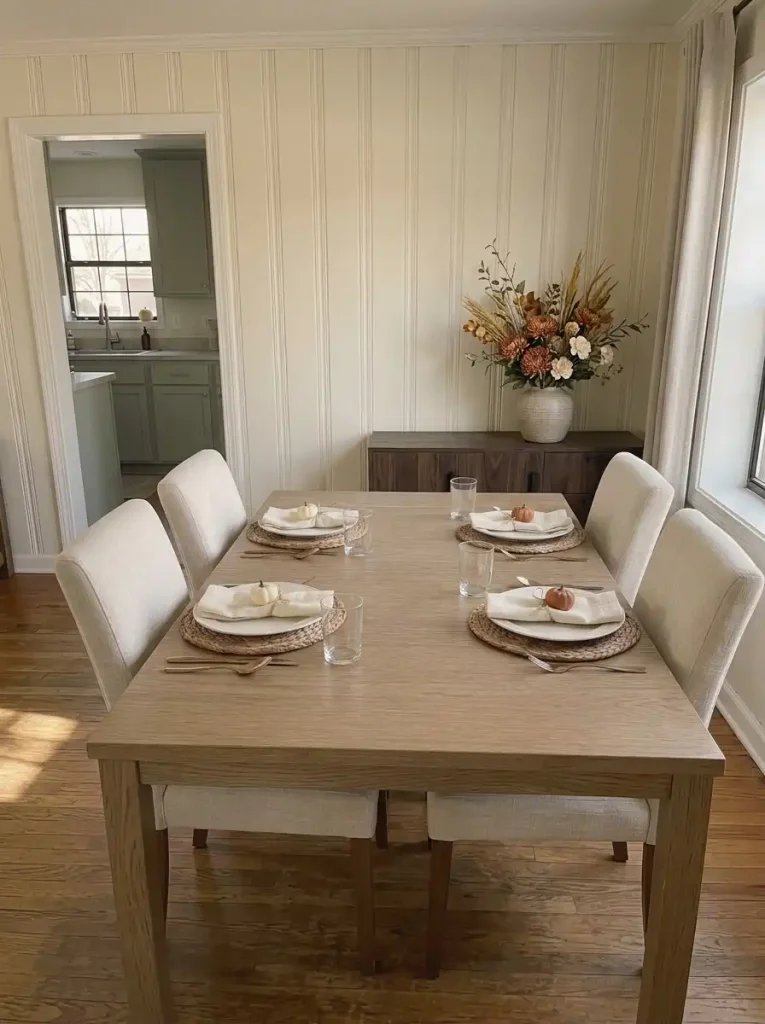
Sometimes a centerpiece deserves to be large. A dramatic arrangement of copper chrysanthemums, dried grasses, and slender branches may be exactly what you want for a Thanksgiving photograph. The mistake is assuming that its only possible home is the table.
Use a console, cabinet, or stable shelf behind the dining area as its visual anchor. Keep the arrangement out of door swing, walkways, windows that need to open, and heating equipment. Check the composition from a seated chair as well as the room entrance. A bouquet that rises behind the table can provide the sense of abundance while dinner remains uncluttered.
For a compact mobile home, an existing kitchen-dining sideboard is a stronger candidate than buying an extra décor table. If the only available surface doubles as the kitchen landing zone, preserve that function first and use a much smaller vase. The decision is about the room’s real workflow, not the grandeur of the flowers.
15. Raise a Few White Pumpkins on a Petite, Stable Footed Dish
A pedestal sounds like an easy space-saver because the arrangement sits above the surface. In reality, its usefulness depends on the base, not the height of the display. A wide foot can occupy more table area than a low cluster; a tall, narrow stand can also become vulnerable to elbows, reaching hands, or uneven weight.
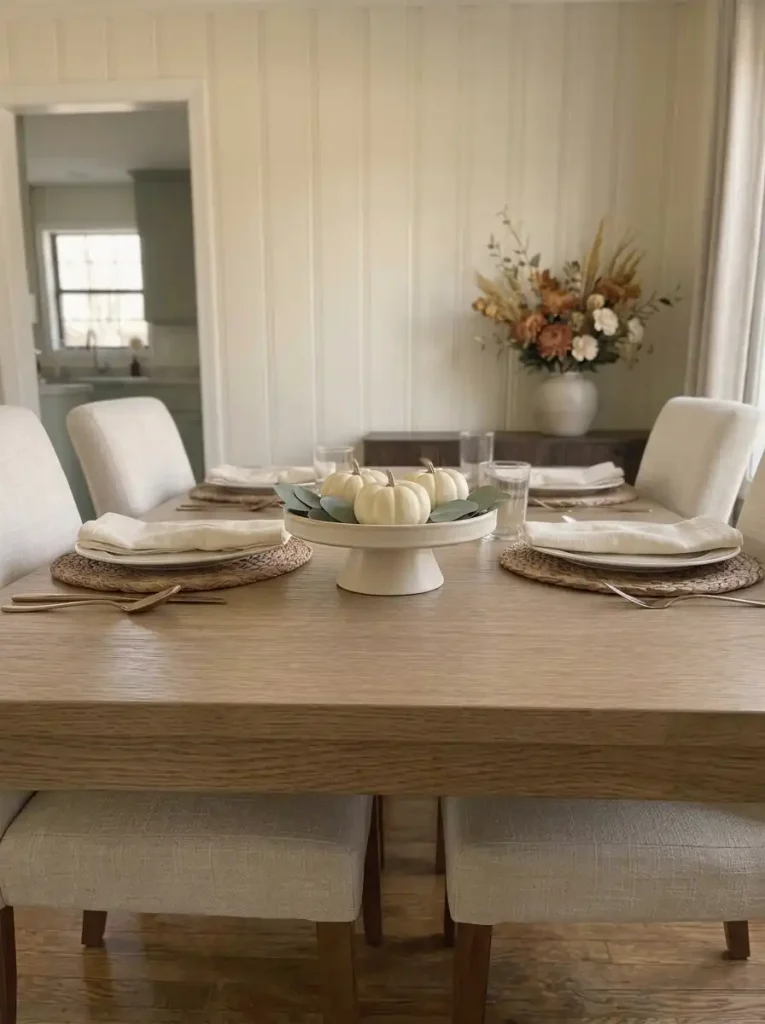
Set two or three lightweight mini pumpkins on a short, broad-based footed dish with a lip. Before adding greenery, measure its footprint against the free area left by your serving dishes. Place it away from the most frequently reached spot and check that nobody must lean around it to see another guest. Avoid stacked, top-heavy pumpkins or fragile display stands during a crowded dinner.
Decision rule: choose a low tray if the elevated dish wobbles, obscures the conversation, or takes up the same surface width. Height is a styling feature only when stability and usability have already passed. The finished look can echo cream pumpkins and golden flatware without copying the oversized layered arrangements seen in formal banquet settings.
16. Design a Centerpiece That Changes When Thanksgiving Dinner Arrives
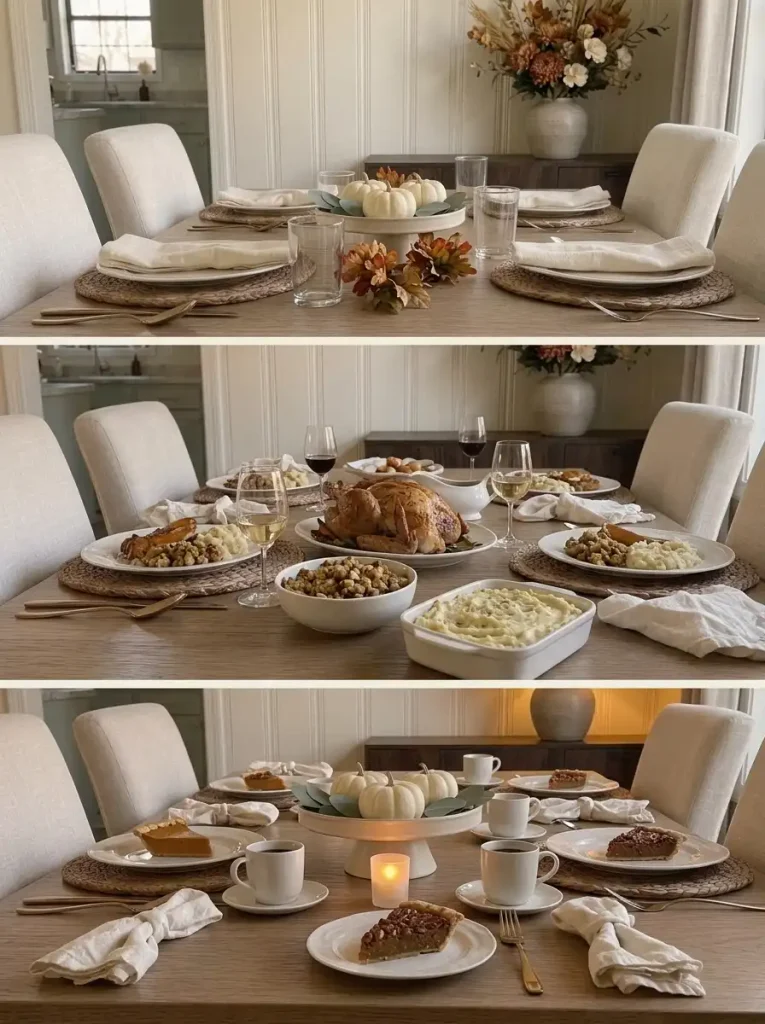
The Thanksgiving table is not static. People arrive and admire the decorations; then the turkey comes out, serving bowls circulate, and finally dessert takes over. A compact dining table often benefits from an arrangement designed for those three different moments rather than one fixed photograph.
Start with a mini pumpkin bowl and two surrounding leaf clusters. Before the main course, lift the bowl to a nearby cabinet, leaving a single flat leaf accent where it cannot interfere with food. When the hot dishes are cleared, return the little bowl with a flameless candle beside it for dessert. All the pieces should move quickly, without loose filler scattering over the table.
Three-Phase Thanksgiving Table Timeline
Dinner has three acts / 16
One small table. Three very different jobs.
Explore the same tabletop from guest arrival through dessert. The decoration changes because the table’s priorities change.
The trick is to identify the landing surface before guests arrive. A narrow mobile-home kitchen might offer only one stretch of clear counter, and that space may already be needed for hot food. Use a secure nearby shelf if available; otherwise create an even smaller decoration that stays put. For simple details you can assemble quickly, see these last-minute Thanksgiving decorating ideas.
17. Let the Main Thanksgiving Serving Platter Become the Focal Centerpiece
At the smallest tables, the turkey platter may be the entire visual centerpiece—and that can be the most welcoming choice. An attractive serving board or simple white platter, a few thoughtfully arranged herbs used appropriately for serving, and coordinated napkins can make the meal feel festive without a permanent decorative object in the shared middle.
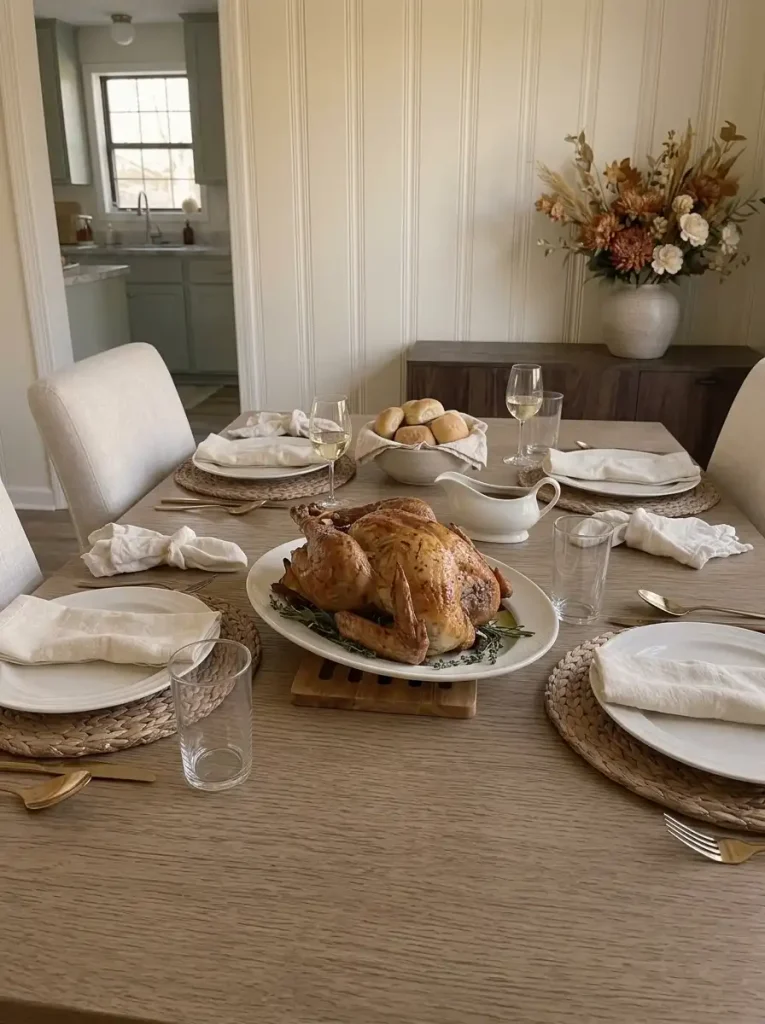
This idea works only when the platter has a stable resting place, the table can carry the serving setup comfortably, and diners can pass or serve the food safely. Keep hot dishes on suitable trivets and use the service method that matches the available surface. With a two-person table, it may be better to plate food in the kitchen and let a small dish of rolls become the table’s focal point.
When the meal is over, the empty center is not a styling failure. It is proof that the arrangement served the gathering. You can return a tiny pumpkin or battery candle for coffee, but there is no obligation to fill every gap.
The Thanksgiving Table Test: Keep What Still Works at Dinner
Set every place and add the actual glasses. Bring out the largest platter, a bowl for sides, and whatever guests will need to pass. Sit in each seat and simulate reaching for the food. Now decide which objects stay, which move, and which were never necessary.
A tiny floral posy may be ideal for a plated meal. A compact breadbasket might suit family-style service. A full autumn bouquet can be beautiful on the sideboard. The right small-table Thanksgiving centerpiece is not the one that fills the photograph; it is the one that lets the people and the food belong at the table together.
Save this article on Pinterest so you can revisit these space-saving Thanksgiving centerpiece ideas before setting the table.