

A small dining nook can turn cozy surprisingly fast in fall—but it can also become crowded just as quickly. In a mobile home, the table often sits along the same visual and physical route that connects the kitchen, living room, and entry, so every pumpkin, pillow, basket, and chair has to earn the space it occupies.
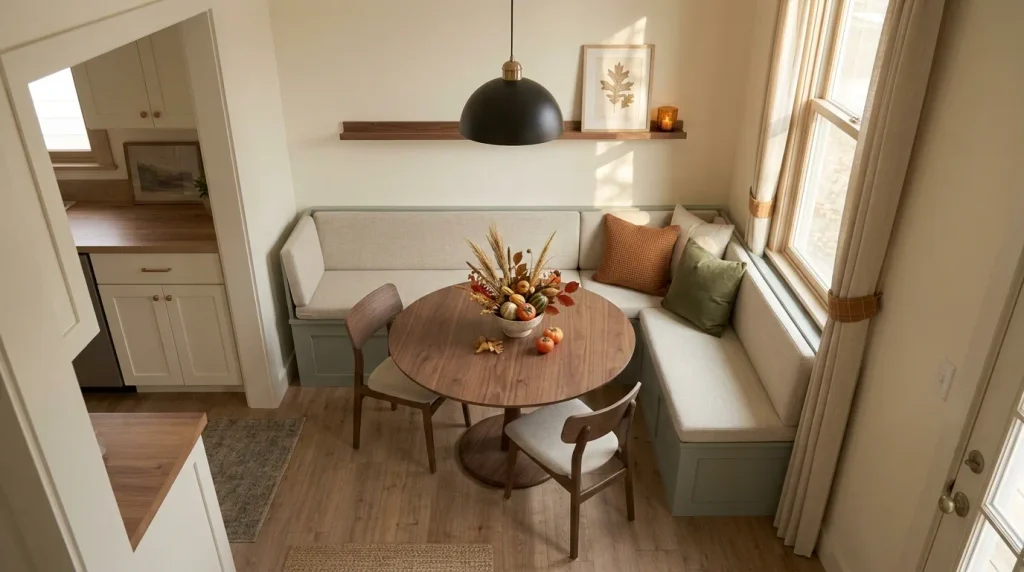
These fall mobile home dining nook ideas focus on making that compact zone feel warmer without sacrificing the things that make it useful: comfortable seating, an easy walking path, daylight, and enough table space for an actual meal. Some ideas work through color and textiles; others change how the table, banquette, wall, or seasonal objects relate to the surrounding room.
The most successful nook will not necessarily have the most fall décor. It will have a clear seasonal focal point, a practical everyday setup, and enough visual breathing room that the dining area still feels like part of a small home—not a holiday display squeezed into one corner.
1. Protect the Chair-Pull Zone Before You Add Fall Decor
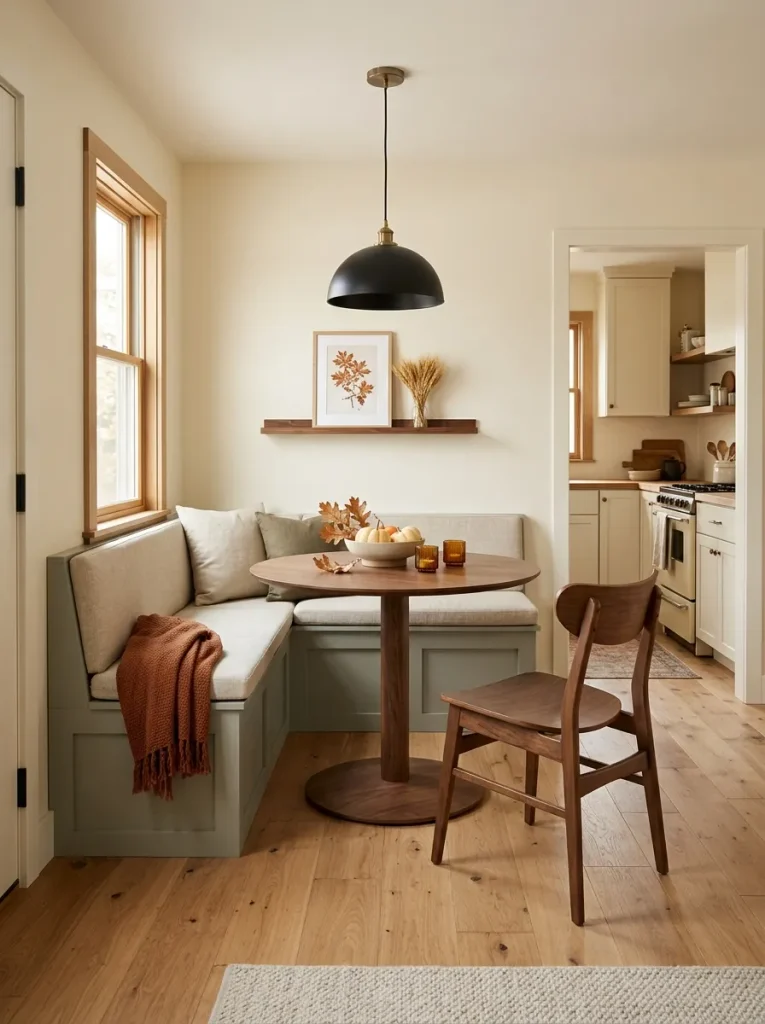
Before placing a floor basket, crock of branches, pumpkin cluster, or extra stool beside the table, pull every dining chair out exactly as someone would when sitting down. Then walk the normal route from the kitchen through the dining area while the chairs are still out.
That simple test reveals the space your fall décor is not allowed to claim.
In a small mobile home, the important area is often not the empty floor visible when the chairs are tucked in. It is the overlap between the chair-pull zone and the home’s main circulation path. A decorative basket that looks harmless in a styled photograph can become the object everyone steps around at dinner.
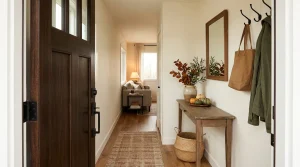
Use this editing rule: if a seasonal object makes you turn sideways, push a chair back in, or change your normal route through the home, move the decoration to a wall, shelf, windowsill, or tabletop.
This gives you a useful decorating boundary before anything is purchased. Once the walking route is protected, the remaining surfaces become much easier to style intentionally.
2. Match the Fall Setup to the Kind of Dining Nook You Actually Have
A corner banquette can carry seasonal color through upholstery and pillows. A tiny café table needs a lighter touch. A narrow wall bench may need the wall to do more of the decorating, while a freestanding four-chair table has to preserve movement on several sides.
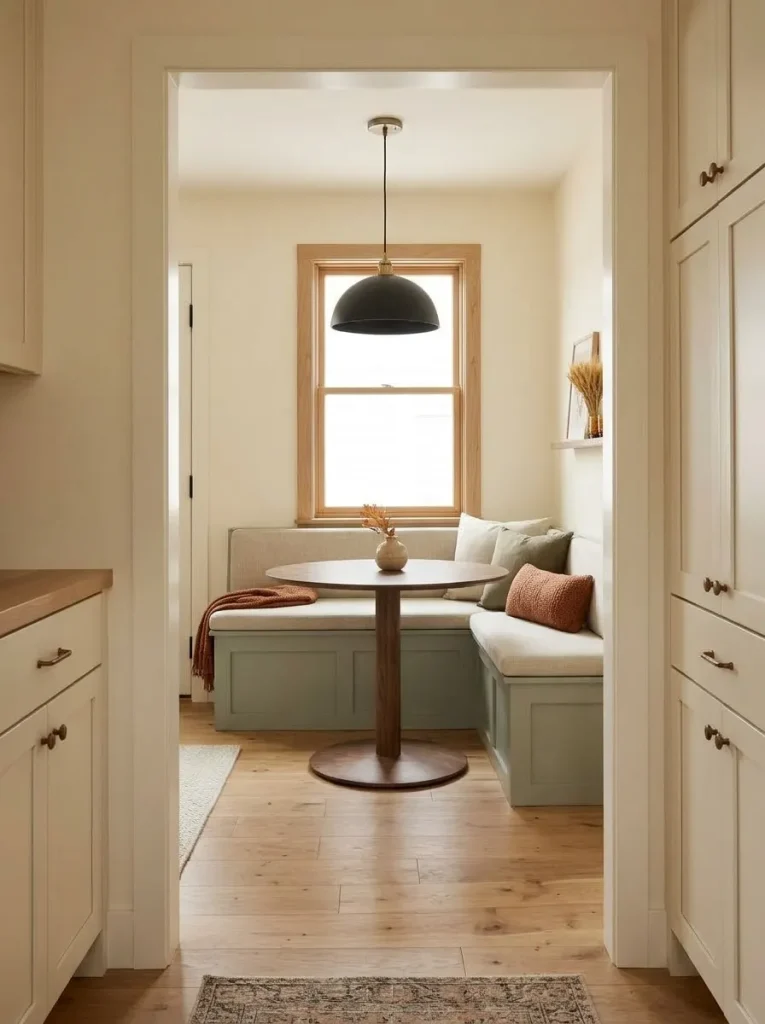
So before copying a fall dining nook you like, identify the spatial type you actually own. The same pumpkins, textiles, branches, and lighting can feel balanced in one configuration and overcrowded in another.
Use the nook matcher below to choose where your strongest autumn detail should go.
Where should the fall personality live?
Select the setup closest to your dining area. The recommendation changes according to where seating, circulation and usable surfaces are concentrated.
Use rust, olive, cinnamon or muted floral pillows across the banquette so the season reads from across the room.
Because the banquette already supplies visual weight, the centerpiece can stay compact and easy to move.
Too many objects around the bench can turn the enclosure from cozy to crowded.
Artwork, a shallow ledge or restrained foliage can provide atmosphere without consuming valuable tabletop space.
Keep floor decorations away from the side where chairs pull into the room’s circulation path.
Bulky shelves or projections can make a narrow dining passage feel even tighter.
Try one vase of clipped branches, one small tray or one textile accent rather than a collection of miniature decorations.
A tiny table should still hold plates and cups comfortably once the styling is finished.
Multiple candles, pumpkins and vessels quickly consume the useful center of a café-size table.
Repeat one fall tone through a runner, nearby art or a small centerpiece so the table feels seasonal without becoming dense.
Freestanding tables require more clearance around their perimeter than fixed-banquette arrangements.
Save baskets, lanterns and large pumpkins for a wall or corner that does not participate in seating movement.
The useful question is not simply “What fall décor should I add?” It is “Which surface in this particular nook can carry the season without stealing function?” Once that surface is identified, the rest of the room can stay much calmer.
3. Let the Banquette Carry the Strongest Fall Color
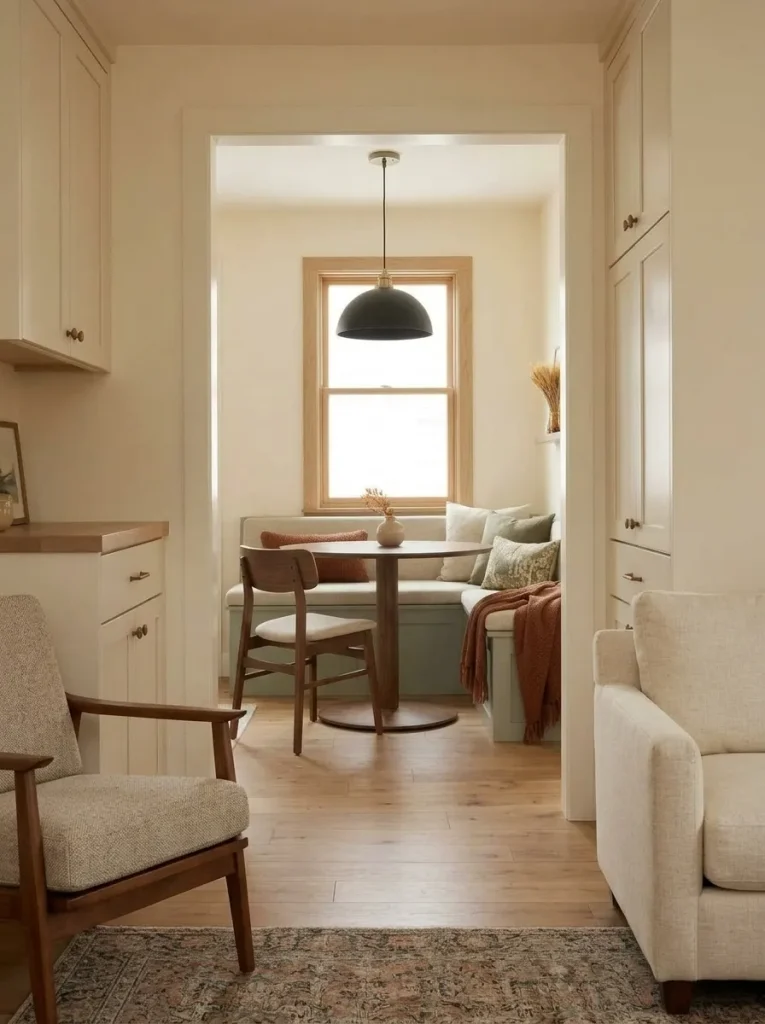
Imagine a compact dining nook with a wood table, neutral walls, a built-in bench, and only a few inches of decorative surface to spare. Adding several small orange accessories may technically make it seasonal, but the eye still has no clear place to land.
The banquette offers a stronger opportunity because it is already one of the largest visual shapes in the nook.
Choose one autumn anchor color—rust, muted terracotta, tobacco brown, olive, ochre, or deep berry—and let it occupy a meaningful portion of the seating through one lumbar cushion, a pair of pillows, or a folded throw. Keep the neighboring textiles quieter: oatmeal, cream, soft tan, faded stripe, or a restrained botanical print.
The seasonal message becomes visible from the adjoining kitchen or living room without filling the table with decorations.
A useful stopping point is reached when the seating reads as autumnal even with the tabletop completely bare. At that stage, any centerpiece you add can be smaller and more functional.
4. Keep Fall Cushions Thin Enough to Preserve Seating Depth
Plush pillows look inviting in autumn photographs, but a small mobile-home banquette has a physical limit: every thick cushion moves the sitter farther toward the edge of the seat and closer to the table.
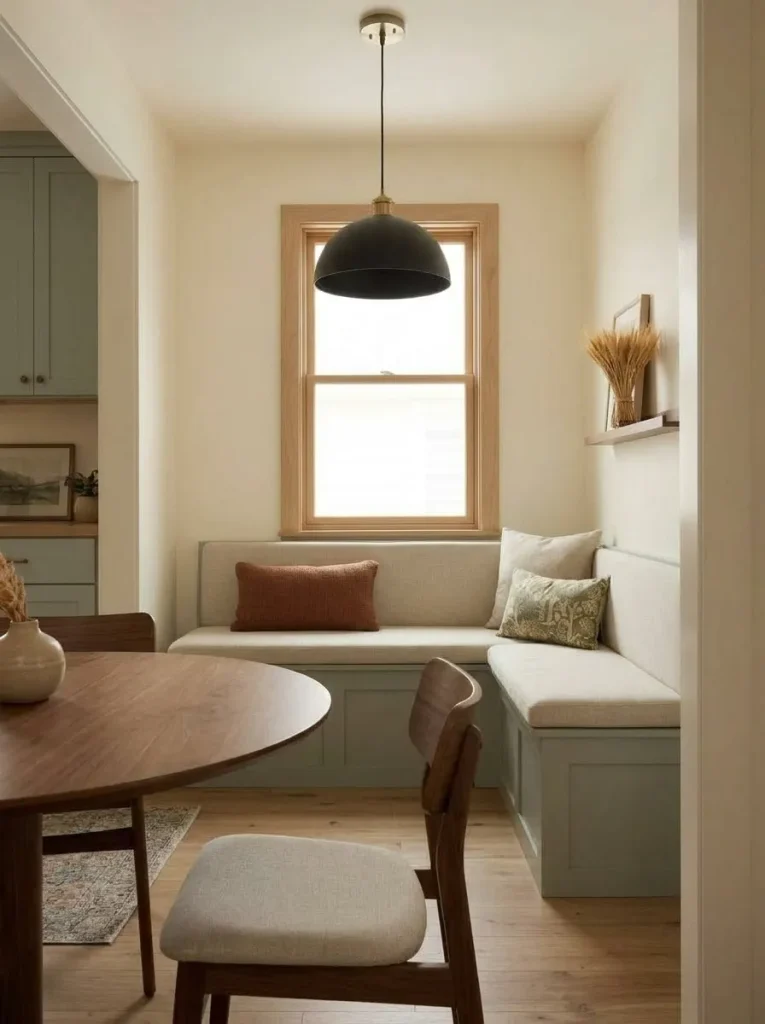
That tradeoff matters most on shallow built-in benches.
Do the seated fit test
Sit in the nook with all of the pillows you plan to display in place.
Check three things:
- Can you sit against the back without perching on the front edge?
- Can you slide into the corner without removing two decorative pillows first?
- Does the table still feel naturally positioned in front of you?
If the answer changes once the fall cushions arrive, edit the pillow depth before changing the furniture arrangement.
A good small-space mix might be one flatter patterned lumbar cushion plus one or two softer accents distributed across the bench. You still get texture, color, and coziness, but the banquette continues to function like seating instead of becoming a seasonal pillow display.
Keep the décor that makes the seat feel better. Remove the piece that makes you sit worse.
5. Give Under-Seat Storage a Seasonal Job
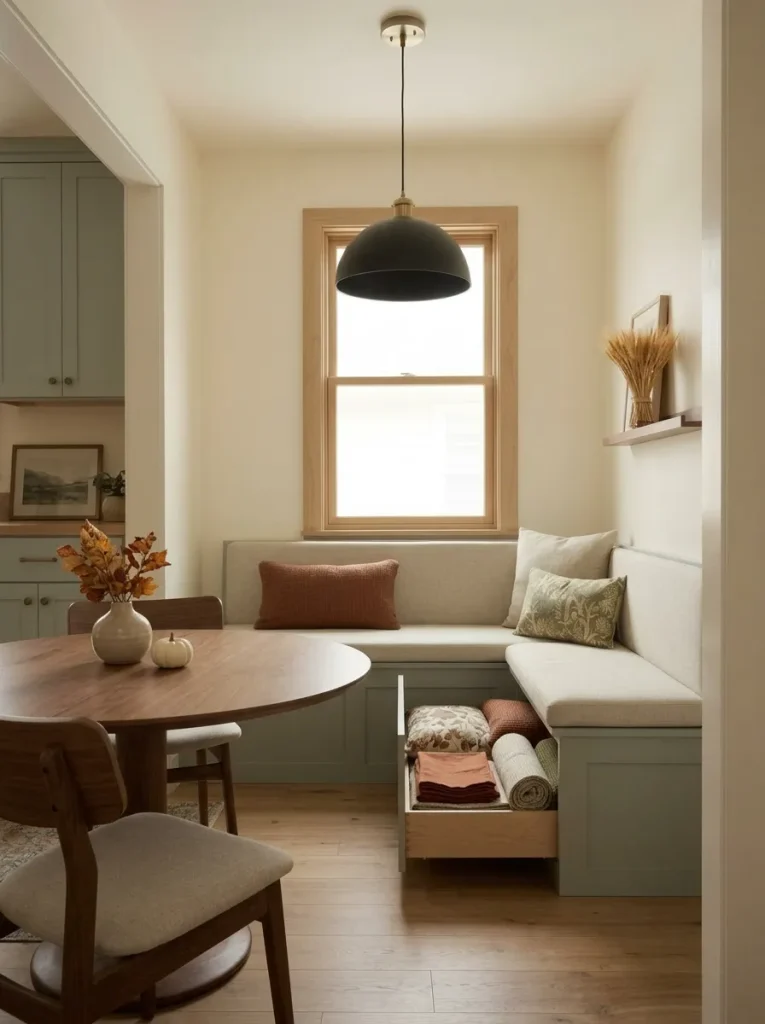
A storage banquette becomes much more valuable in fall when it is treated as part of the decorating system, not simply as a place for miscellaneous household items.
Assign the easiest-to-reach section to things that rotate through the dining nook during the season:
- Everyday rotation: a runner, placemats, or washable napkins that can change the mood of the table quickly.
- Occasional layer: a lightweight throw or extra cushion covers for colder evenings and guests.
- Display reserve: seasonal pieces you like but do not want visible at the same time—small pumpkins, candleholders, serving pieces, or a second vase.
Now the nook can change without accumulating more objects on the floor or open shelves.
The important distinction is accessibility. Items used several times a week belong in the easiest compartment; purely decorative pieces can sit deeper in storage. That prevents the bench from becoming a forgotten seasonal bin.
For a small mobile home, it also creates a useful one-in, one-out rhythm: when a new fall element comes onto the table, another can disappear below the seat.
6. Choose a Round or Narrow Table by the Walking Route
Table shape matters more in a small mobile-home dining nook than it does in a large dining room because circulation often passes immediately beside the eating area.
A round pedestal table can work especially well when people need to move around two or three sides of the nook. With fewer projecting corners, the route can feel more forgiving. A narrow rectangular table makes more sense when the dining zone follows the home’s long axis and movement happens mostly along one side.
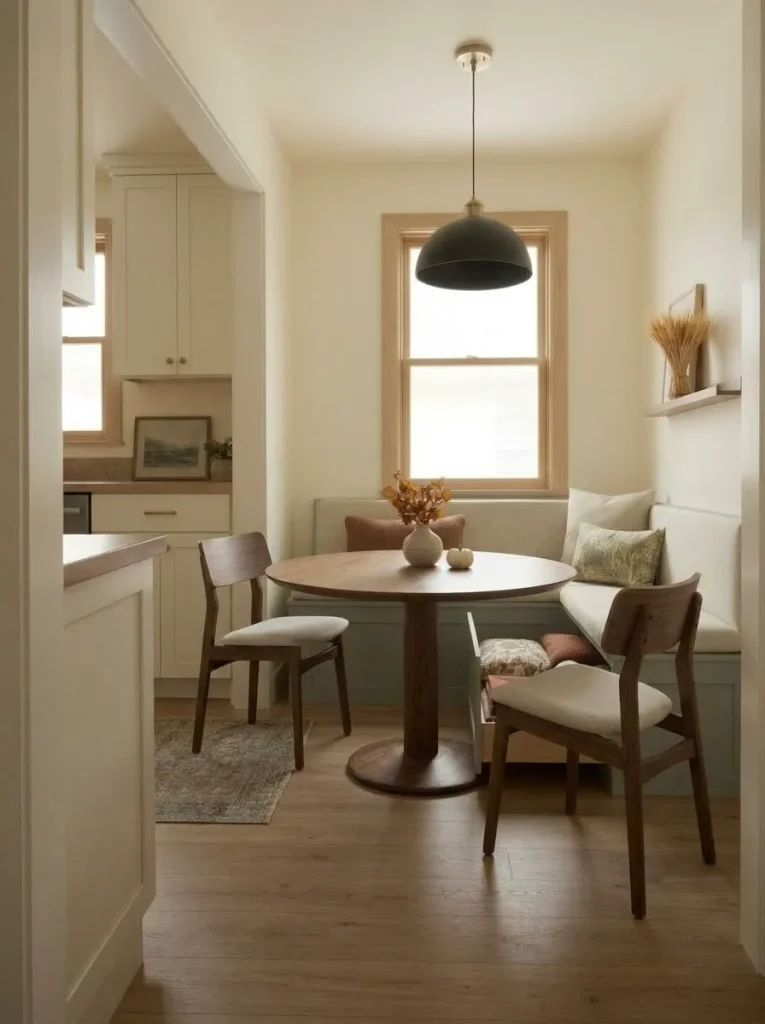
Before buying or replacing anything, look at where people actually walk, not merely at the empty floor plan.
If the route bends around the dining area, test a round footprint. If the route runs parallel to the wall or kitchen, a slim rectangle may preserve more usable table length without pushing farther into circulation.
For a deeper treatment of connected-space planning, explore <a href=”/single-wide-open-floor-plan-ideas/”>single wide open floor plan ideas</a>.
Which direction does everyday traffic move?
A curved perimeter is easier to move around when the dining nook sits in the middle of several movement directions.
A narrow rectangle can follow the long direction of the mobile home and preserve a straighter route beside the dining area.
7. Fit the Fall Centerpiece to the Shape of the Table
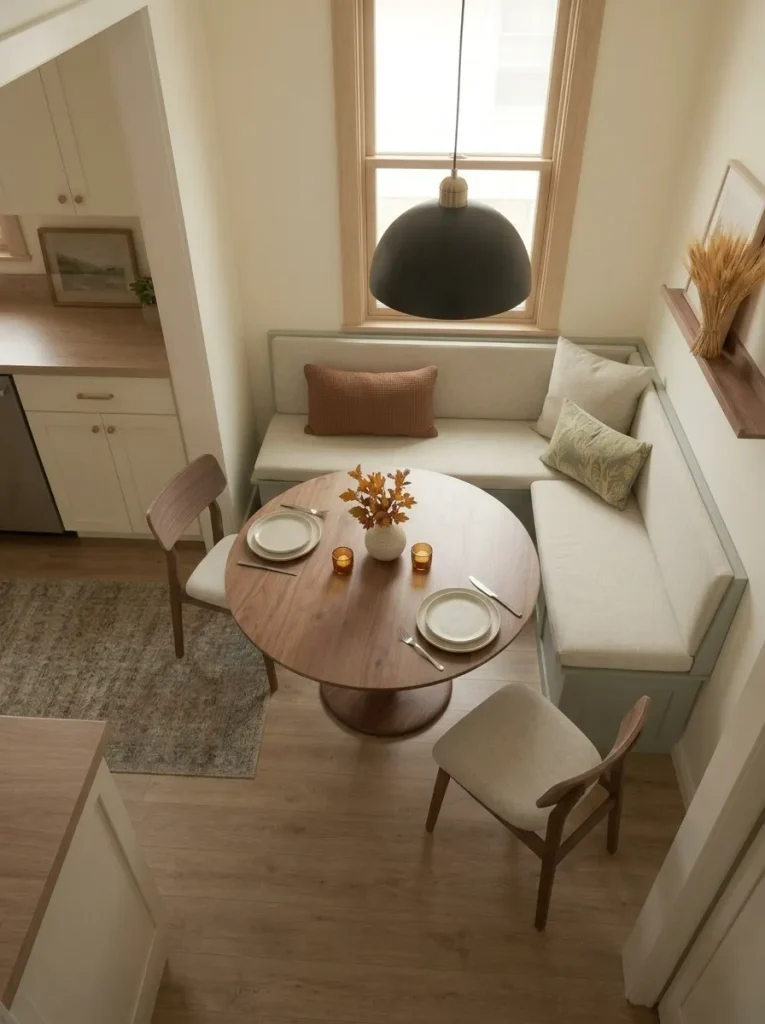
A centerpiece should occupy the part of the table that diners naturally use least. That area changes with table shape.
On a round table, a compact central arrangement usually reads best because everyone shares the same visual center. On a narrow rectangle, a long low arrangement or a few repeated pieces can follow the table’s length. On a small square table, an oversized centerpiece can quickly compete with place settings, so an offset vase or tiny cluster often works better.
The practical test is simple: set the table for an ordinary meal first, then decorate whatever comfortable space remains.
Match the centerpiece footprint to the table.
Decorate the space left after normal place settings—not the other way around.Use one vase, low bowl, or tight cluster so each seat keeps an equal share of usable table area.
Let the styling follow the long axis of the table without widening into the plate zone.
Shift one small arrangement toward an unused corner if the center is needed for serving.
The approach keeps the dining nook seasonal while preserving the thing a small table cannot afford to lose: functional surface area.
8. Dress the Window Edge Without Blocking Autumn Daylight
In a small dining nook, the window can provide more atmosphere than another shelf full of decorations.
Use the edge of the window as the seasonal layer: oatmeal curtains, warm ivory sheers, a restrained plaid café curtain, clipped branches positioned beside the frame, or one earthy textile repeated from the banquette.
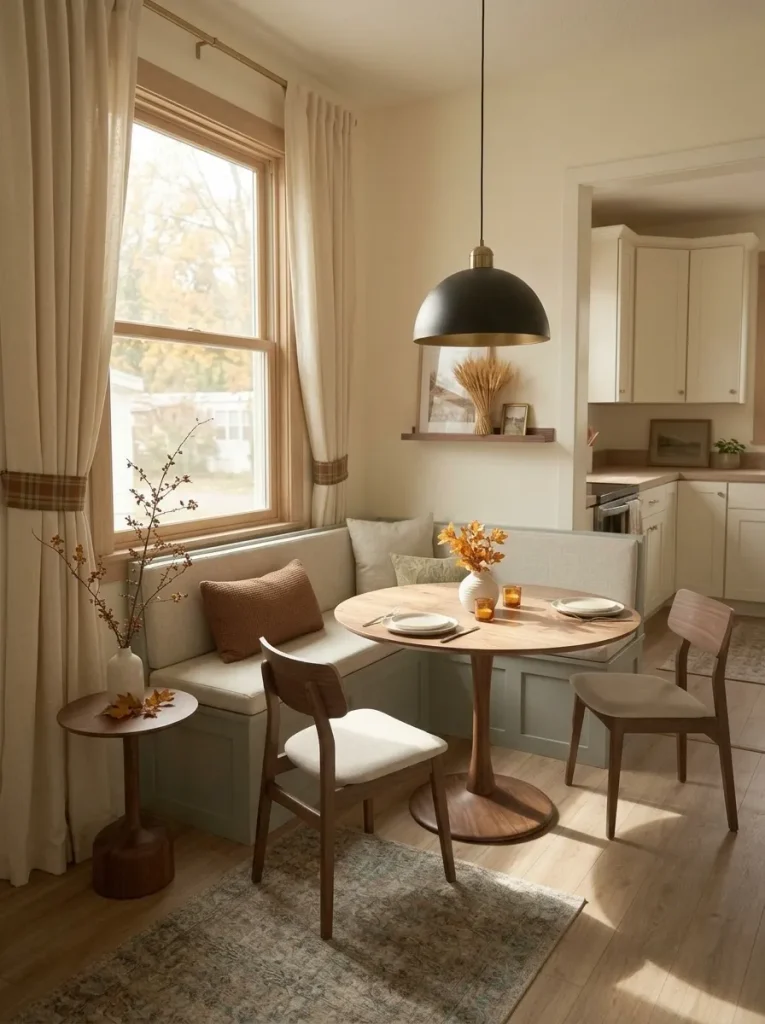
The advantage is visual impact without using floor or table space.
A useful daylight check is to stand in the adjoining room during the brightest part of the day. If the fall additions noticeably darken the nook, move them outward toward the sides of the frame.
Try this hierarchy:
- Keep the glass visually open.
- Add texture at the curtain or frame edge.
- Repeat one autumn color already used in the seating.
- Stop before plants, branches, curtains, and hanging pieces begin competing with one another.
For a small mobile home, fall warmth should soften the daylight—not replace it.
9. Move One Strong Fall Detail Onto the Wall
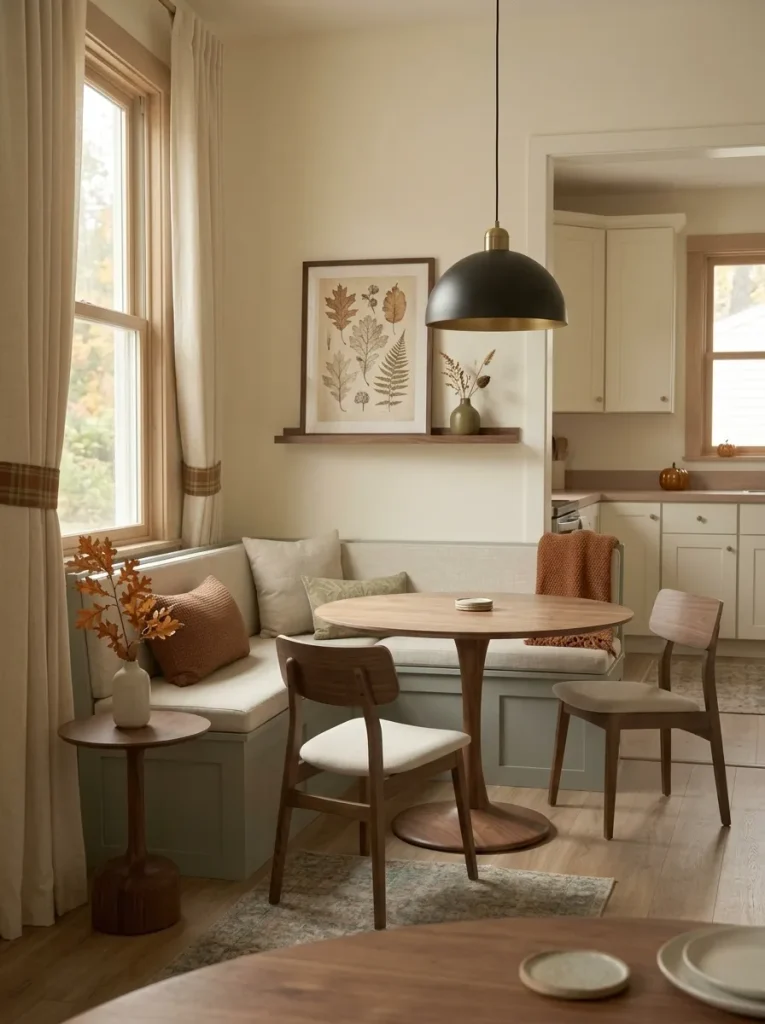
A narrow dining nook may not have room for a large tablescape, floor basket, or layered console. In that situation, the wall becomes the safer place to add personality.
Picture a tiny one-wall bench with only enough table space for two place settings. A single framed autumn print, shallow ledge, woven wall piece, or compact foliage arrangement can give the nook a seasonal identity while leaving the table almost clear.
The important move is concentration. One deliberate wall moment usually works better than scattering several small signs and decorations across every available surface.
If you want to make the wall treatment itself, continue with these <a href=”/diy-fall-wall-decor-mobile-home/”>DIY fall wall decor ideas for mobile homes</a>. For the dining nook, keep the intervention focused on one vertical feature that can be appreciated from the table and from the adjoining room.
When tabletop space is scarce, move decoration up, not out.
10. Warm the Pendant Before Adding More Decorative Objects
A dining nook can feel visually cold even when it already contains pumpkins, florals, pillows, and a runner. In that case, the missing ingredient may be atmosphere, not another layer of décor.
The common mistake is to keep adding objects.
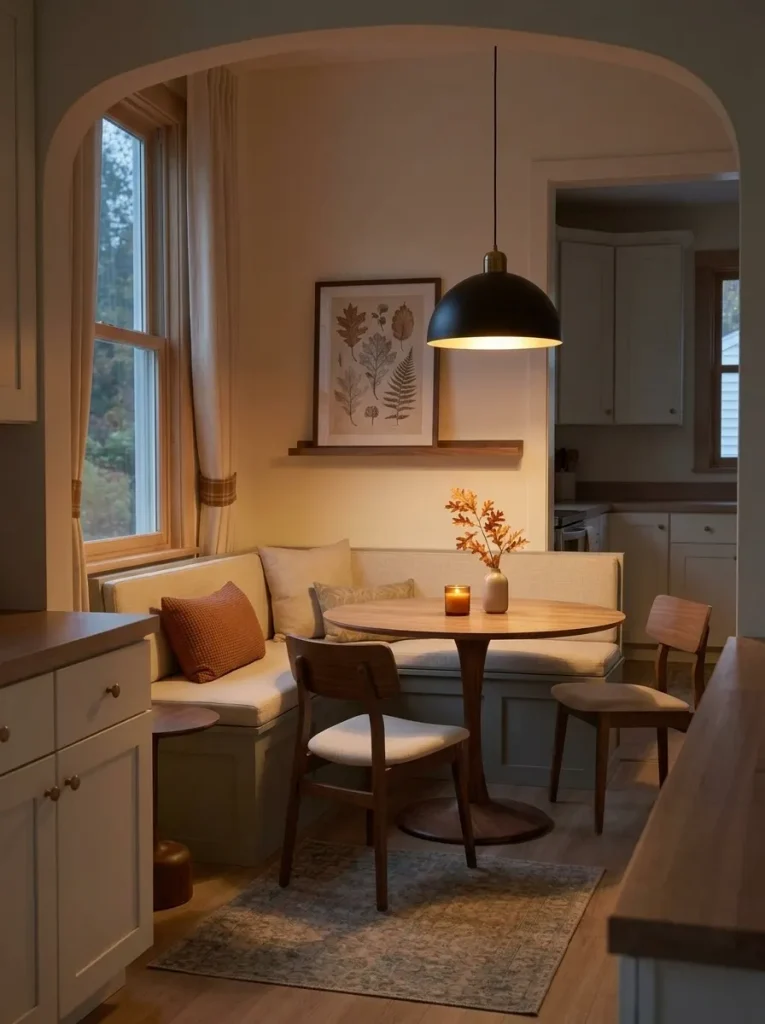
A better first move is to evaluate the light already falling over the table. A pendant with a warm visual character, a softly shaded fixture, or nearby ambient lighting can make wood grain, terracotta, rust textiles, and autumn foliage read more richly in the evening.
A dramatic statement fixture is not required. In a small mobile-home nook, scale still matters. The light should define the table without making the ceiling feel lower or the corner visually heavy.
Night-view test: switch off harsh surrounding light, leave the dining light on, and look at the nook from the living room. If the dining area already feels warm and distinct, resist the urge to add another tray, garland, or shelf display.
Sometimes the better fall decorating decision is simply to stop.
11. Use a Rug Only When the Nook Can Actually Handle One
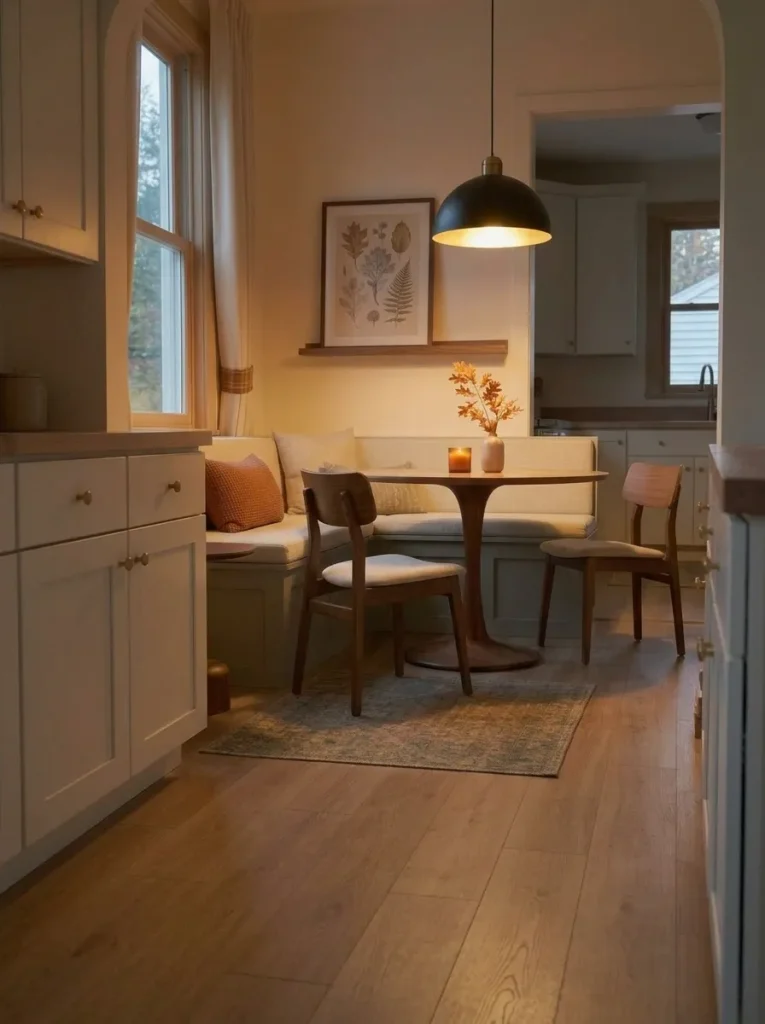
A rug can make a compact dining nook feel intentionally separated from an open kitchen or living area. It also brings in the kind of texture that naturally suits fall.
But the same rug can become irritating if dining chairs repeatedly catch its edge or the home’s main walkway crosses over a corner.
Treat a rug as a conditional tool, not a requirement.
Use one when:
- the nook has a clearly defined footprint,
- the rug can sit flat without invading a narrow passage,
- chair movement remains comfortable,
- the floor would benefit from added visual warmth or separation.
Skip it when:
- the table already presses against circulation,
- chairs constantly move across the rug edge,
- the kitchen route cuts directly through the dining zone,
- the existing flooring already provides enough warmth and definition.
A rug succeeds when it visually contains the nook without creating a new obstacle every time somebody sits down.
12. Build One Removable Fall Tray for Everyday Dining
A small dining table often has several jobs in one day: breakfast table, laptop desk, homework surface, prep area, coffee spot, and dinner table.
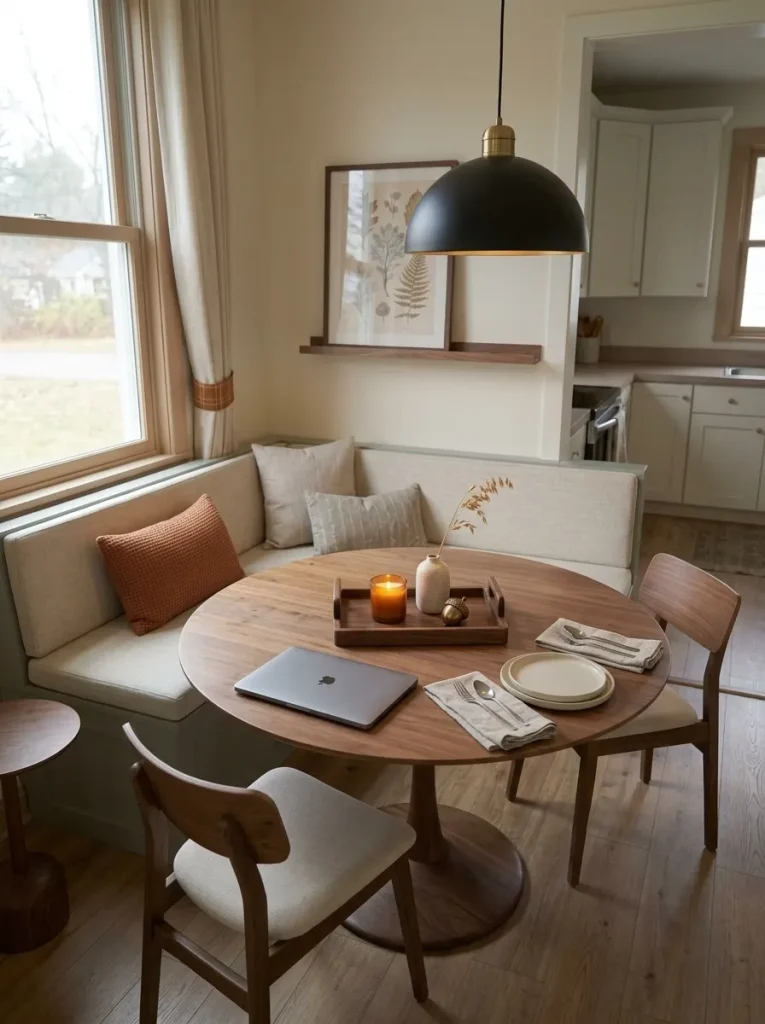
Permanent seasonal styling can therefore become inconvenient surprisingly quickly.
A removable fall tray turns several decorative pieces into one movable unit.
Keep it restrained: a small vase, a candle or lantern-style accent, and one compact seasonal object are often enough. The tray should lift away easily and fit on a nearby counter, shelf, or inside under-seat storage.
Use the selector below to decide how much styling the table can realistically support.
How hard does your dining table work?
Use two or three small elements that stay low enough for conversation and leave most of the table available for meals.
Choose a stable tray with only a few pieces so the entire fall display can disappear before a laptop or paperwork comes out.
Keep the everyday core minimal, then add extra candles or serving accents only when guests arrive.
The tray works because it respects the changing function of the room. Seasonal décor becomes reversible rather than permanent.
13. Repeat One Fall Cue From the Kitchen, Then Stop
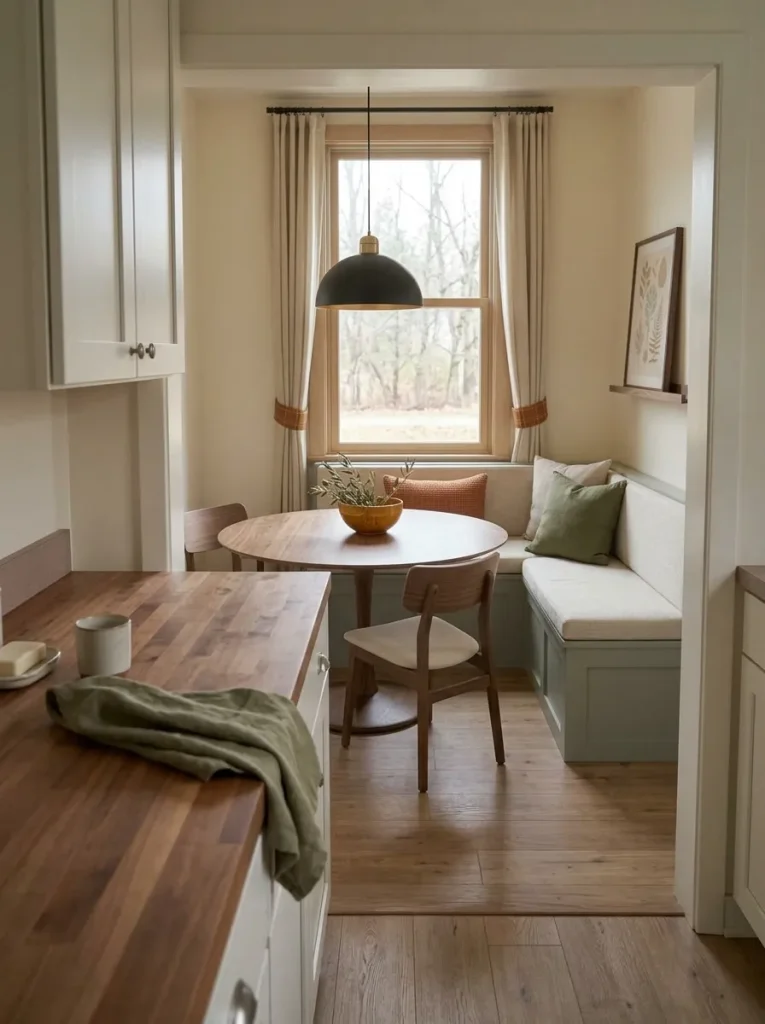
In many small mobile homes, the dining nook is visually attached to the kitchen whether you intended it to be or not.
That means the two areas do not need separate fall themes.
If the kitchen already contains warm copper, amber glass, olive greenery, checked textiles, or muted pumpkin tones, repeat one of those cues in the dining nook. The repetition creates continuity across the connected space.
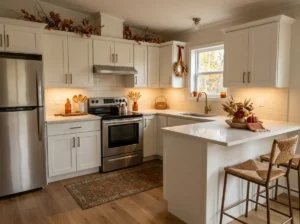
For example:
- copper kitchen accents → one brass or copper candleholder on the table,
- olive kitchen towels → one olive cushion on the banquette,
- amber glass near the sink → one amber vase in the nook,
- checked kitchen textile → one restrained runner or lumbar pillow.
Then stop.
The dining nook should feel related to the kitchen without becoming a second version of it. For deeper seasonal kitchen styling, continue with <a href=”/fall-mobile-home-kitchen-decor/”>fall mobile home kitchen decor ideas</a>.
14. Give the Nook One Dominant Fall Moment in the Long View
The dining nook may look perfectly balanced when you stand beside the table and still feel too busy when viewed from the far end of the mobile home.
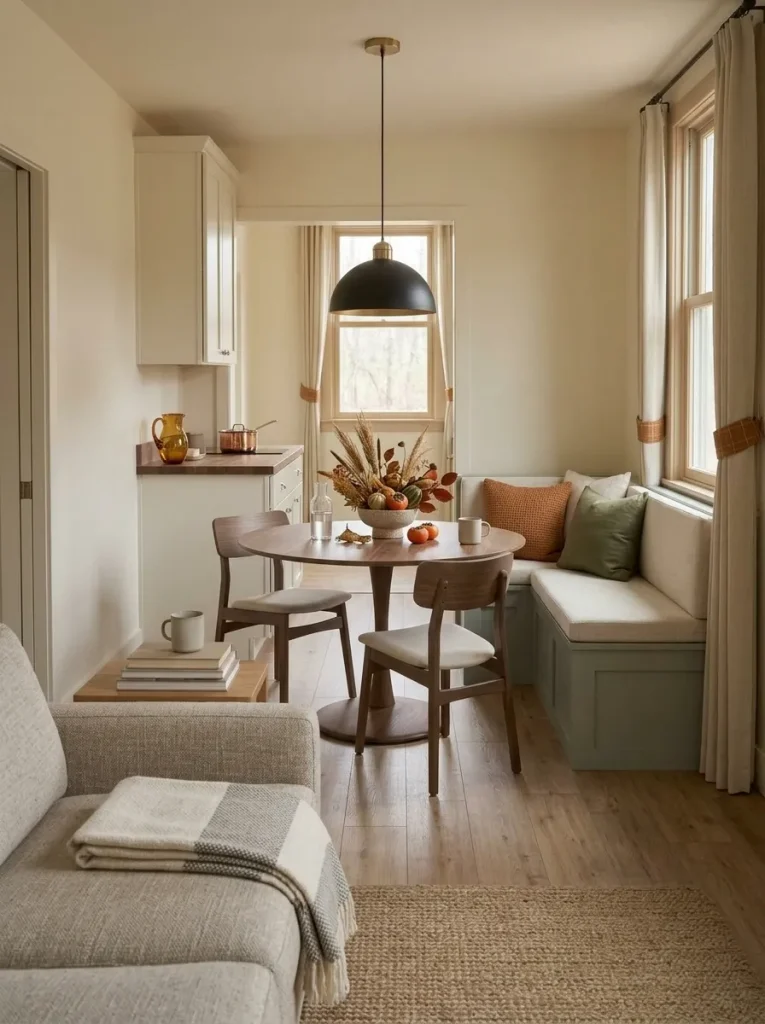
Compact homes can create long sightlines. Kitchen décor, dining décor, living-room pillows, wall art, plants, lamps, and seasonal accents may all appear in one visual frame.
Assign those connected zones different visual roles.
Let one area carry the strongest seasonal statement. Let the second repeat it more quietly. Allow the third to provide breathing room.
Choose which connected zone gets to speak the loudest.
One dominant seasonal moment, one supporting echo, and one quieter zone usually read more intentionally than three equally decorated rooms.
If the dining nook is your dominant zone, make its fall cue unmistakable from the long view—perhaps the richest banquette color, the strongest autumn arrangement, or the warmest wall moment.
If another area already owns the seasonal focal point, reduce the nook to a supporting echo.
For broader coordination across connected rooms, continue with these <a href=”/cozy-fall-mobile-home-decor/”>cozy fall mobile home decorating ideas</a>.
15. Do a Seated Evening Edit Before You Call It Finished
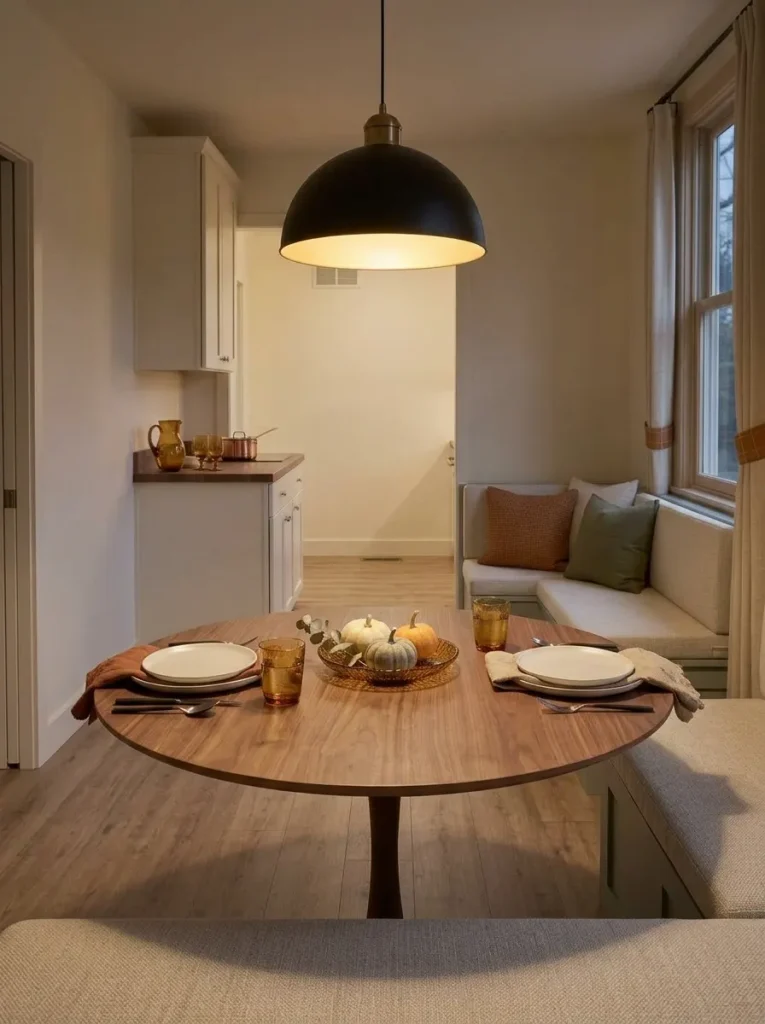
The last decorating decision should happen from the chair, not from the doorway.
Sit where you would actually eat after sunset and look around the nook at eye level. Seasonal objects that seemed harmless while standing can suddenly block the person opposite you, crowd your elbow, reflect too brightly in a window, or make the tabletop feel visually packed.
Run one final edit:
First: turn on the lighting you normally use at dinner.
Then: set out two ordinary place settings.
Next: sit down and look toward every connected room.
Finally: remove the first object that feels intrusive, unnecessary, or difficult to work around.
Do not immediately replace it.
The empty space left behind may be exactly what makes the remaining fall elements look intentional.
That is the strongest finishing test for a small mobile-home dining nook: the room should still work beautifully after the styling is complete.
Make the Nook Feel Like Fall Without Giving Up the Nook
A fall dining nook in a small mobile home does not need layers of seasonal objects to feel cozy. The biggest improvement usually comes from deciding where the season should live—in the banquette, table, wall, window, lighting, or one controlled sightline—then protecting the rest of the nook for everyday use.
Start with circulation and seating comfort before buying décor. After that, build one strong autumn moment and let quieter materials support it.
If the nook still feels crowded, remove one object and look again from the adjoining room. In a compact home, restraint often makes fall color, texture, and warmth more noticeable.
Save this article to Pinterest so you can come back to these fall mobile home dining nook ideas when you’re ready to style your space.