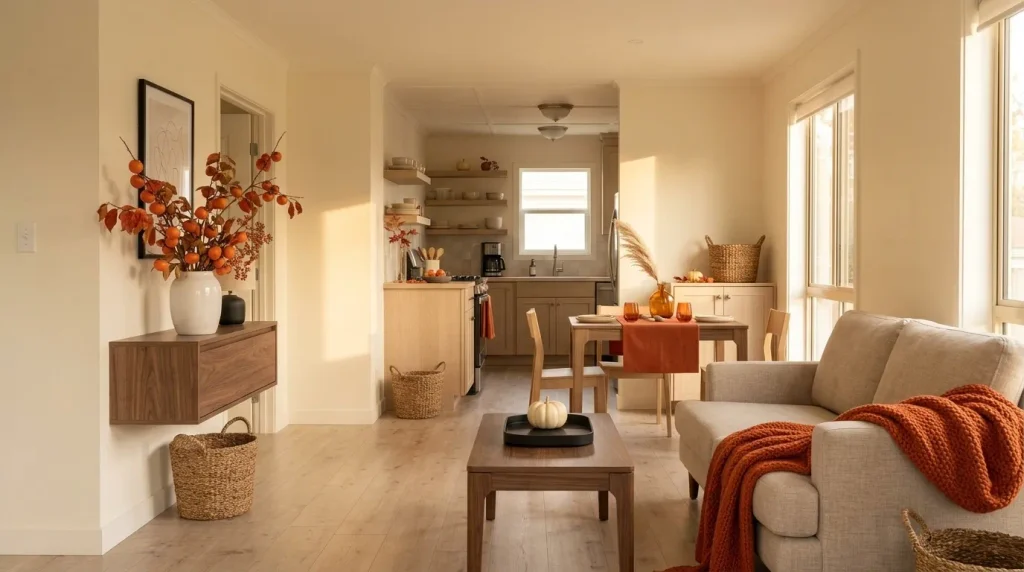
Fall decorating gets surprisingly complicated when the front door opens into a compact mobile-home entryway. A basket that looks charming in a large foyer can steal valuable floor space here, while a cluster of pumpkins can turn the path between the door and living room into an obstacle course.
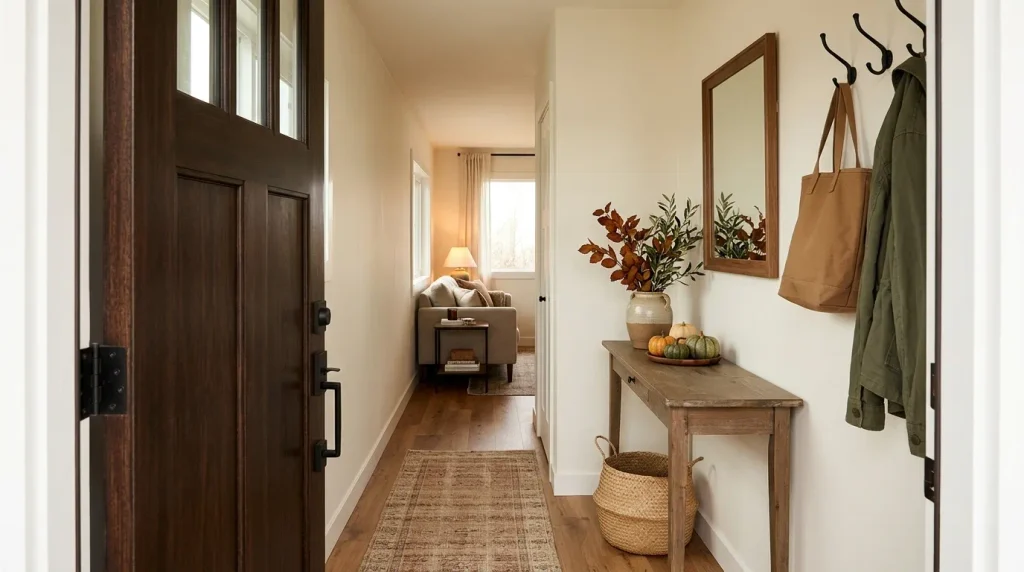
The best fall mobile home entryway ideas work with that limited footprint. They use walls, mirrors, shallow furniture, practical storage, warm lighting, foliage, textiles, and a few carefully placed seasonal accents to create an autumn welcome without sacrificing how the entrance works every day.
Start with the space you actually have—not the foyer you wish you had. Some mobile homes open directly into the living room; others have a narrow pass-through, a tiny defined entry, or enough room for a bench. The Entryway Type Mapper below will help you identify which strategy fits yours before you start layering in fall décor.
1. Protect a Small Landing Pocket Before You Add Fall Decor
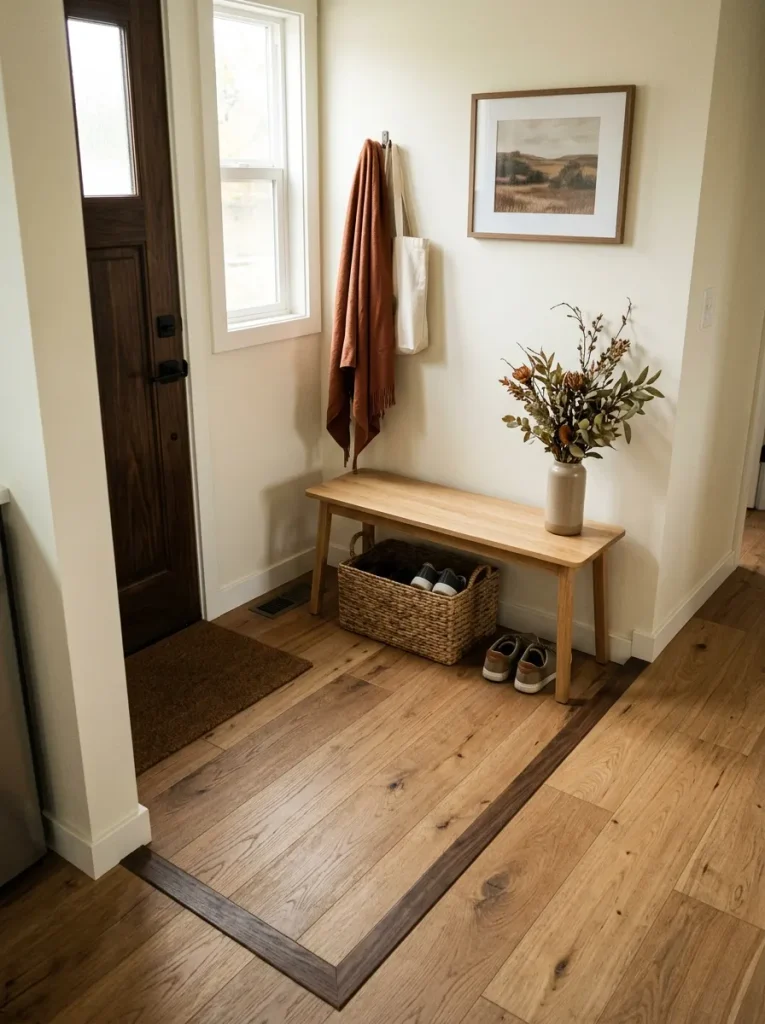
Picture coming home with grocery bags while a pumpkin, shoe basket, narrow console, and the open front door are all competing for the same few feet. That is the point where seasonal decorating stops feeling welcoming.
Before bringing out the fall bins, clear the area immediately inside the door. Open the door through its normal movement, walk in and out several times, and notice where your feet naturally pause, turn, or reach for the handle. Treat that patch of floor as your landing pocket.
Anything that repeatedly forces you to step sideways, move a basket, or avoid an arrangement has failed the entryway test.
Work in this order: first protect the arrival path, then give shoes and bags a predictable destination, identify one seasonal focal area, and only then decorate what remains.
In a small mobile home, the empty space beside your fall décor is part of the design. Preserving it allows the autumn pieces you do use to register more clearly.
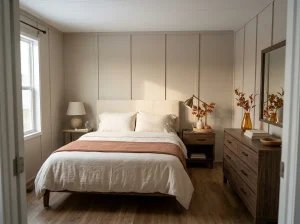
2. Match Your Fall Setup to the Kind of Entryway You Actually Have
Two mobile homes can have almost the same square footage yet need completely different entryway strategies. A front door opening beside the sofa needs visual continuity with the living room, while a narrow passage benefits from keeping most seasonal interest off the floor.
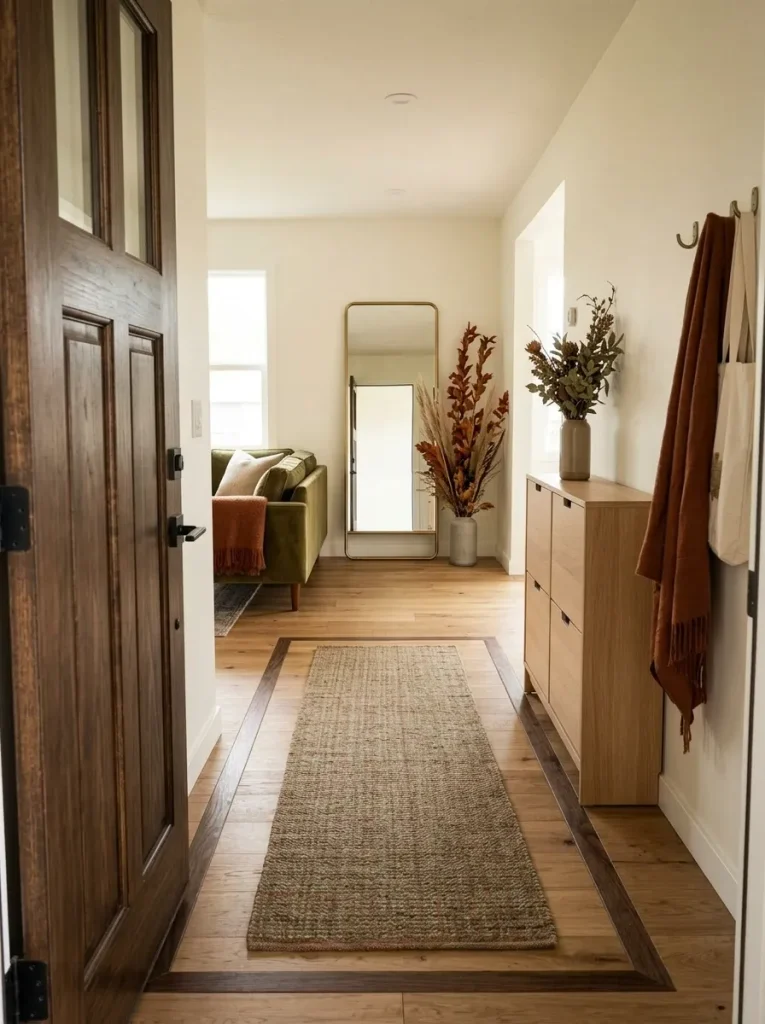
Choose the condition closest to yours below. The recommendations change the anchor, floor treatment, storage priority, and decorating move to avoid, so you can establish the structure of the entrance before shopping for seasonal accessories.
Entryway Type Mapper
Find the fall setup your doorway can actually support
Choose the layout closest to your home. Each route changes where the seasonal focal point belongs and what should stay quiet.
Create a visual threshold
Your entry needs to feel distinct without fighting the living room that appears immediately beyond it.
Push the season upward
A narrow entry gains more from wall height and texture than from objects placed along both edges of the floor.
Build one complete vignette
A defined foyer can handle a stronger seasonal identity, but its small footprint still benefits from one dominant composition.
Let function become the fall look
Your bench already supplies architecture. Seasonal character should layer onto its everyday jobs, not replace them.
Once you know which entry type you have, keep that decision in mind throughout the rest of the article. A beautiful idea that belongs in a tiny foyer may still be the wrong move for a door that opens directly into your sofa area.
3. Let a Slim Autumn Runner Draw the Foyer on the Floor
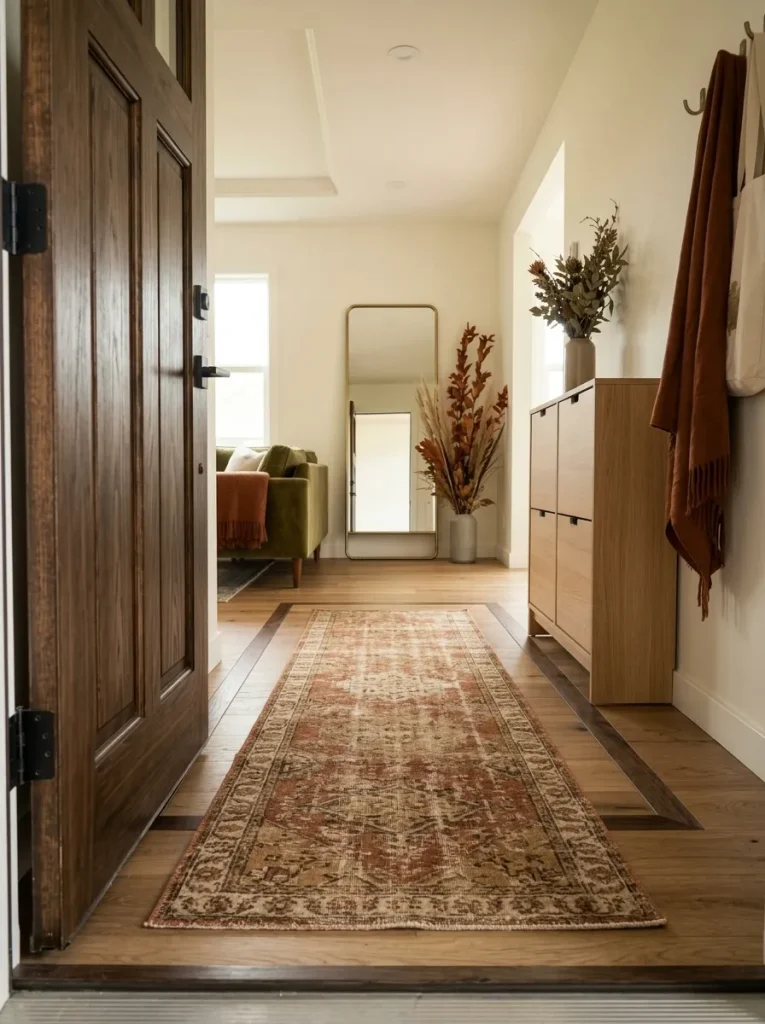
Some mobile homes have no architectural cue that says, “the entry ends here.” The front door simply opens into the living room or a narrow circulation route. A runner can supply that missing boundary without adding furniture.
Look from the doorway toward the interior. If the natural walking direction already forms a clear line, position the runner along that axis and let its shape define the arrival zone. Muted rust, brown, camel, olive, cream, or a restrained vintage-style pattern can introduce fall color while remaining useful beyond October.
Before committing, test the footprint. Open the door fully and walk the route several times. The rug should lie flat and should not become something you consciously walk around.
Use the runner when the floor needs visual definition. Skip it when the door catches it, the passage already feels tight, or another rug begins almost immediately. In those cases, let the wall or console establish the entry.
4. Put the Strongest Fall Moment Above the Floor
When floor area is scarce, autumn has somewhere else to go: upward.
A tall arrangement of rust-colored branches in a stable vessel, a hanging basket with restrained foliage, framed seasonal botanicals, or a shallow wall piece can create more visual impact than several decorations scattered beside the door. The eye notices the vertical shape while the passage remains readable.
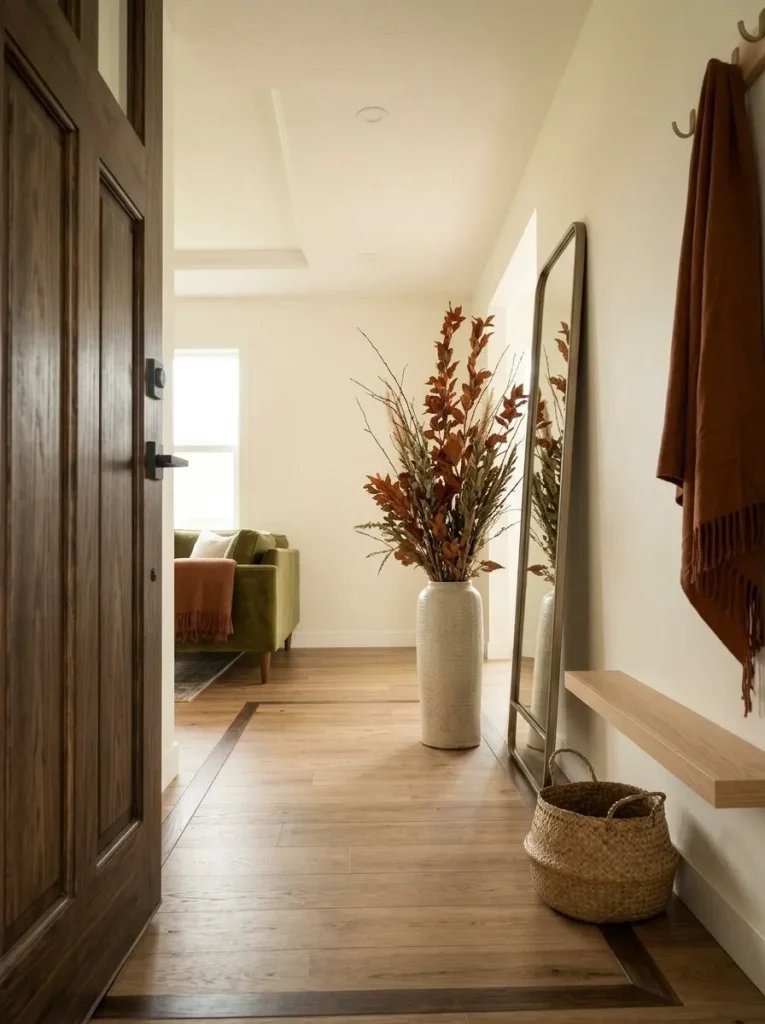
This works especially well in mobile-home entries where a thin strip of wall sits beside the doorway but there is not enough depth for another piece of furniture.
Choose one vertical seasonal statement, then let the objects below it stay quieter. If you want to make the focal piece yourself, continue with StylishGalore’s DIY fall wall decor ideas for mobile homes for compact-wall projects.
A useful stop signal is to stand at the front door. If your eye immediately finds the foliage or wall accent, adding another floor pumpkin underneath probably will not improve the composition.
5. Turn a Small Bench Into an Arrival Station, Not a Display Shelf
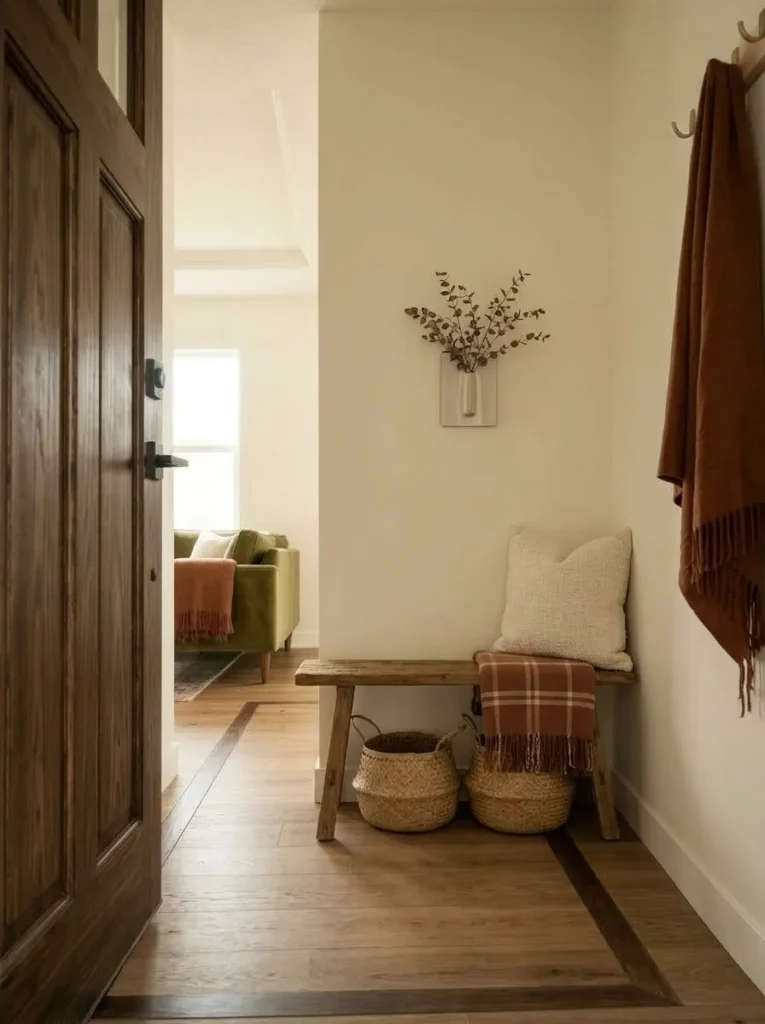
A bench covered with three pillows, a folded blanket, pumpkins, a basket, and a decorative sign may photograph beautifully. Then someone needs to sit down and remove their shoes.
Give a compact mobile-home entry bench a stricter job description.
Keep most of the seat usable. Add one comfortable fall cue—perhaps a rust plaid cushion or a cream textured pillow—then introduce a second seasonal layer through a throw, foliage above the bench, or the baskets underneath. Everyday shoes, scarves, pet leads, or bags should have assigned storage before decorative containers arrive.
Imagine a compact bench with two open cubbies below. Filling the seat with décor reduces its function; filling the cubbies with coordinated baskets and adding one autumn textile keeps the same footprint working harder.
Bench rule: if a seasonal item has to be moved before you can sit down, it belongs somewhere else in the entry.
6. Style Only One Side of the Entry When the Passage Is Narrow
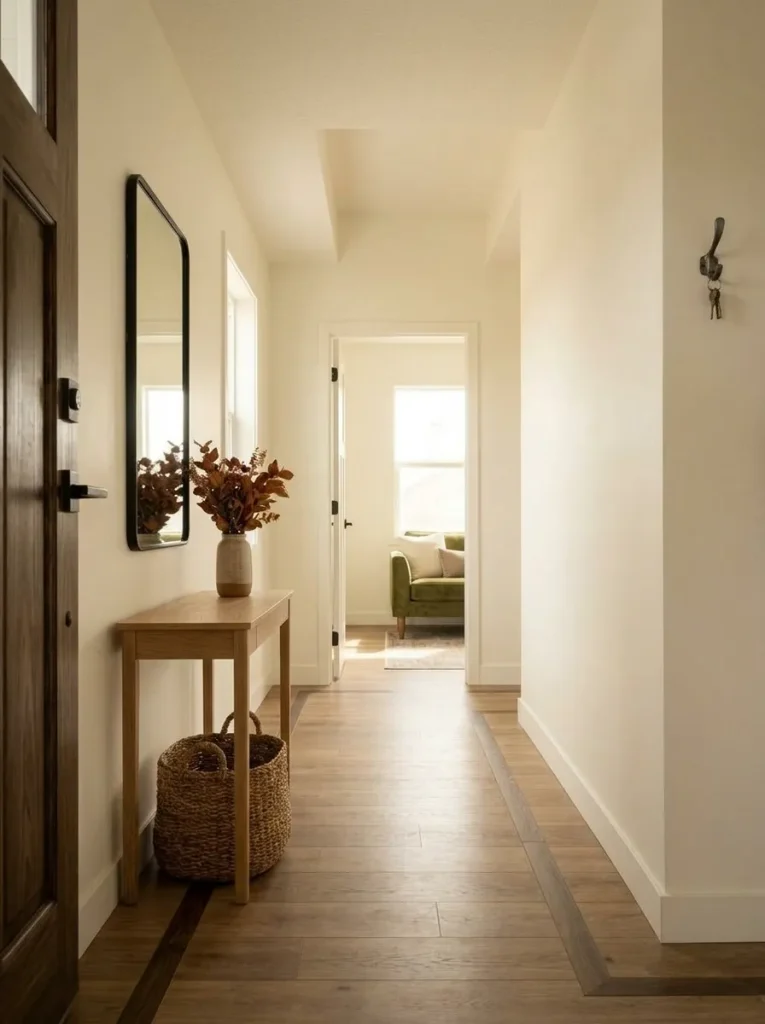
A narrow mobile-home entrance can feel smaller when both walls compete for attention. A console on one side, hooks on the other, baskets below, pictures above, and seasonal pieces at floor level may technically fit while visually squeezing the path.
Try assigning the two sides different roles.
Let one side carry most of the fall character—a mirror with rust foliage, a shallow shelf, a bench with an autumn textile, or one compact arrangement. Keep the opposite edge noticeably calmer so the eye has somewhere to rest as you enter.
This asymmetry can be especially useful when the front door sits near a hallway or living-room opening. The decorated side becomes the destination; the quieter side preserves the sense of movement.
Stand outside the open door and look inward. If seasonal décor creates two equally strong walls framing a narrow corridor, remove detail from one. A small entry often looks more intentionally designed when one edge speaks and the other gives it space.
7. Test the Door Swing Before Anything Earns Floor Space
The easiest way to misjudge an entryway is to style it while the front door is closed.
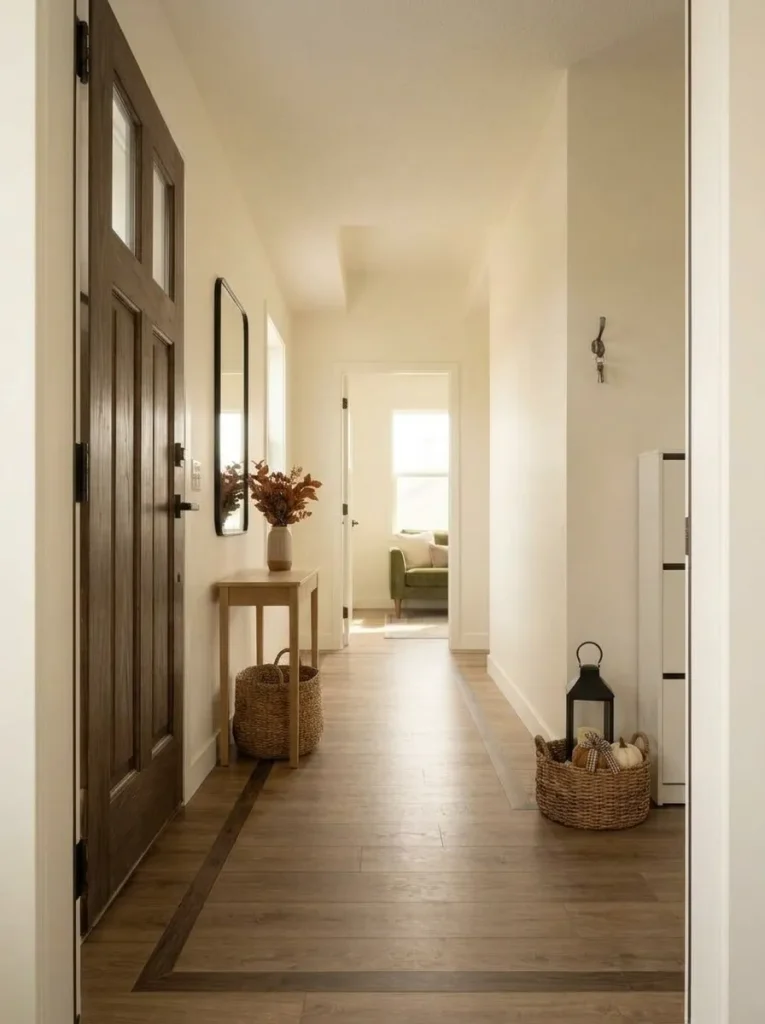
A pumpkin basket may look perfectly positioned beside the door until the door opens toward it. A lantern may sit outside the sweep but still occupy the spot where your feet naturally land. Even a slim decorative stool can interfere with a nearby closet or storm door.
Test the entire sequence before keeping a floor object: open, enter, close, turn, remove shoes, then leave again. Anything that makes one of those actions less natural needs another location.
The visual map below turns that routine into three zones. It deliberately avoids universal measurements because the useful clearance is determined by your actual door, furniture, household routine, and entry configuration.
Door-Swing Safety Zone
Give every floor object three tests before it stays
Your own doorway supplies the useful boundary. Test the moving door, the place where you naturally pause, and the route deeper into the home.
This test is more useful than copying a fixed clearance from somebody else’s foyer because mobile-home door placement and adjoining furniture vary considerably. Decorate only after you know where your own movement zones are.
8. Use a Shallow Console as the Fall Anchor When You Have the Wall for It
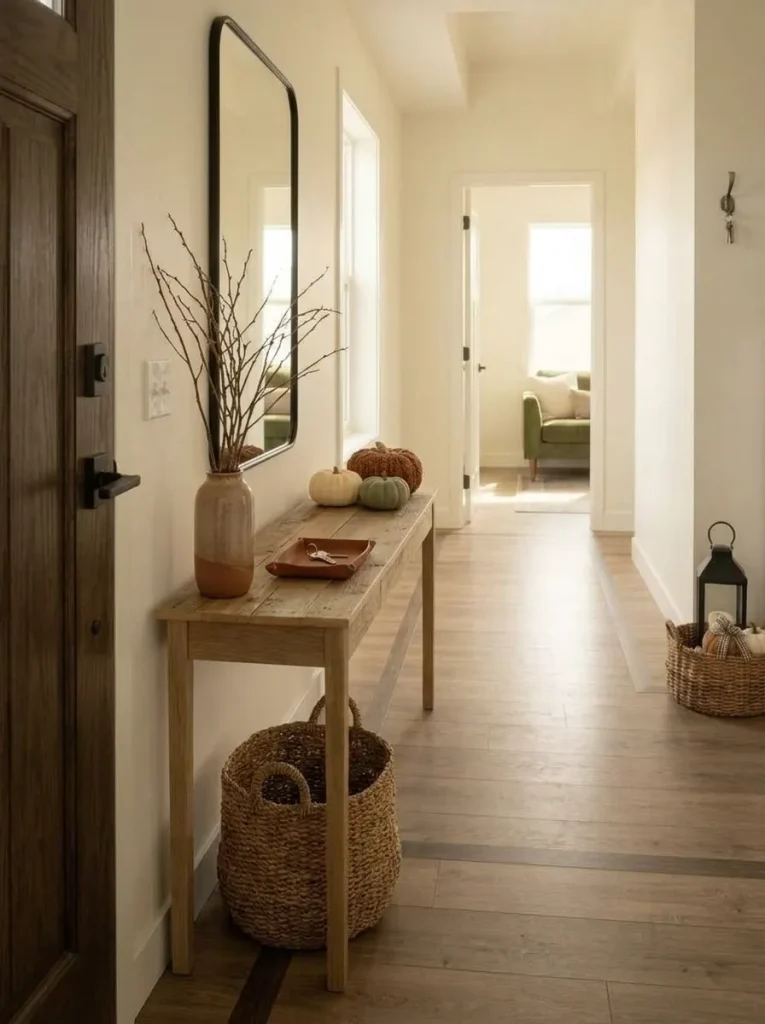
A console can make a tiny entry feel deliberately furnished, but depth matters more here than decorative capacity.
Before buying one, imitate its footprint with painter’s tape, cardboard, or boxes against the wall. Walk past the mock-up several times. If the passage suddenly feels like a corridor between furniture pieces, use a wall shelf or narrower alternative.
When a console does fit, build the composition around four roles: one tall element such as branches or a lamp; one useful element such as a key tray; one low seasonal accent such as a restrained pumpkin grouping; and one open area where the tabletop remains visible.
The open surface matters. In a compact mobile-home entry, a shallow console that still shows some of its top usually feels more refined than one carrying a continuous line of decorations.
If storage is needed below, one basket or a coordinated pair can add function without turning the console into a wall of small objects.
9. Let a Mirror Multiply Autumn Light, Not Double the Clutter
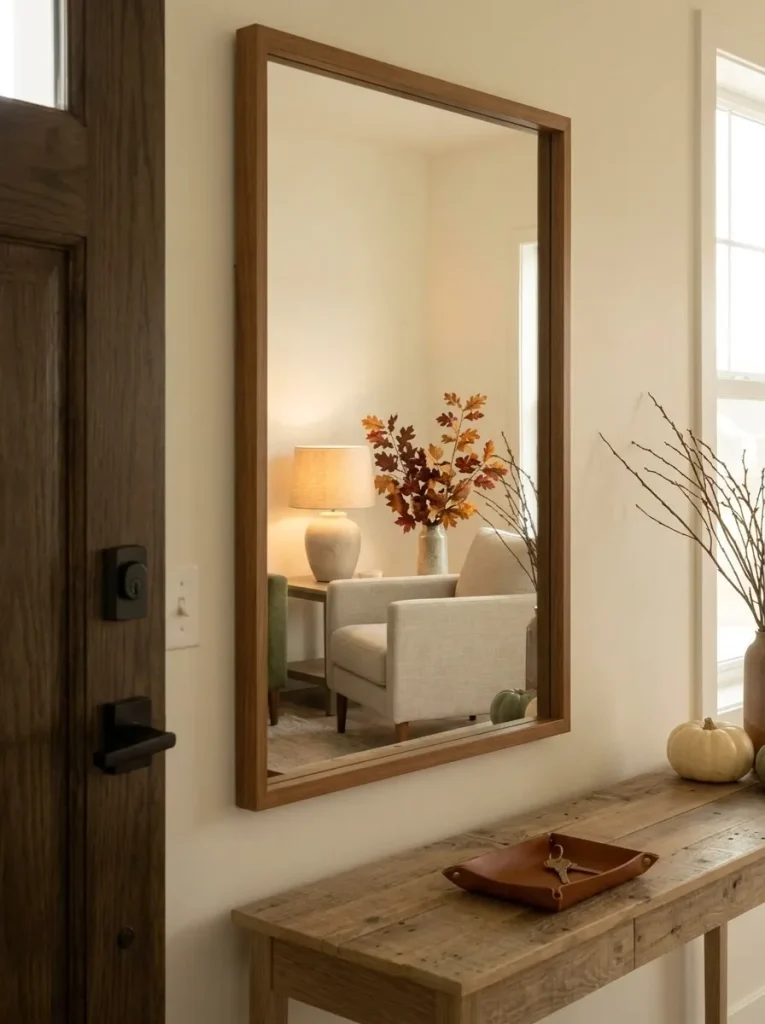
A mirror can perform two jobs in a small entry: create a convenient last-look spot and visually extend the light and color already present in the space.
What it reflects matters more than the mirror style.
Stand where the mirror will hang and look at the opposite view. Does it capture a warm lamp, fall branches, an uncluttered living-room corner, or natural window light? That reflection can make one autumn arrangement feel more substantial without adding another object.
Now check the less flattering possibilities. A mirror aimed directly toward an overflowing shoe basket, busy kitchen counter, or dense cluster of décor will visually duplicate that clutter.
Temporarily prop the mirror in two or three positions before mounting it. Choose the angle where the reflection adds light, depth, or one intentional fall element.
The mirror does not need leaves wrapped around its frame to feel seasonal. Sometimes the strongest fall treatment is simply giving it a better autumn view to reflect.
10. Build the Entry in Three Heights Instead of Adding More Objects
When a small entry still feels unfinished, the temptation is to add another accessory. Often the actual problem is that every object sits at the same visual height.
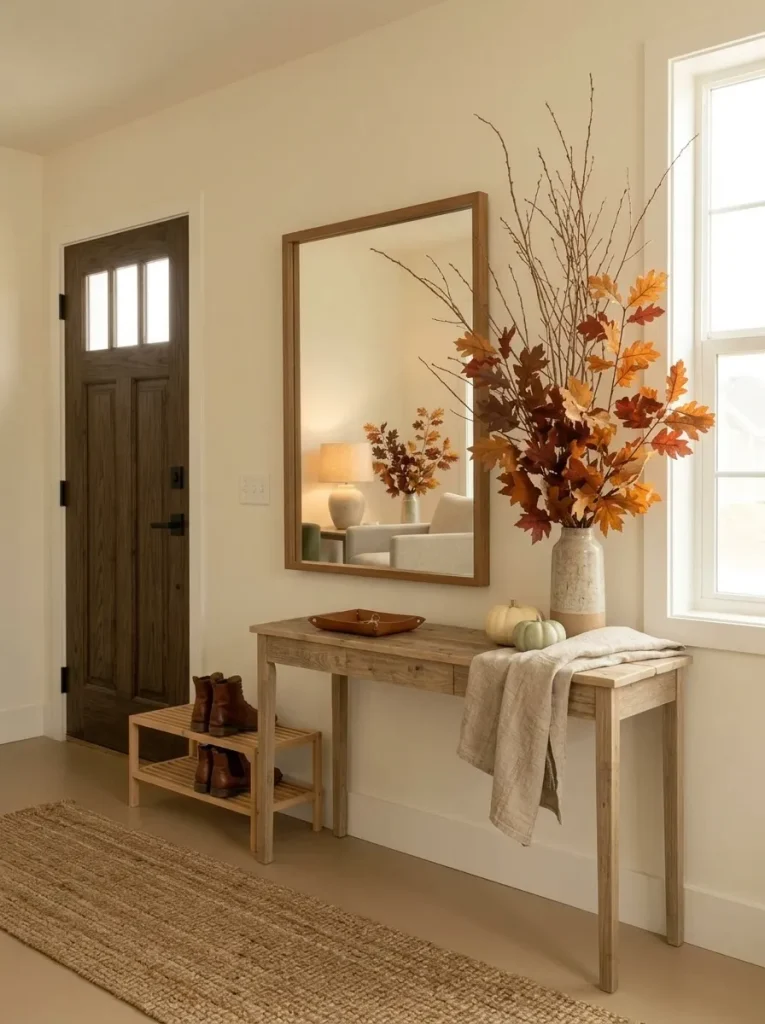
Think of the entrance in three bands:
floor level → hand level → eye level
The right balance changes according to whether your mobile home has a bench, console, or almost no furniture at the entrance.
Vertical Fall Composer
Decide where the seasonal weight should live
Choose the permanent feature already occupying your entry. The balance across floor, hand and eye height changes with it.
Bench: keep the seat useful, move the drama upward
The bench already gives the lower half visual weight. Let the wall above it carry more of the seasonal story.
Console: concentrate the composition at hand height
The tabletop becomes the natural focal plane, while the wall and floor should prevent the vignette from spreading vertically in every direction.
Wall-only: use height to create the foyer you do not physically have
When the front door opens directly into another room, wall composition can signal “entry” without spending floor depth on furniture.
Once those three heights feel balanced, stop solving the entry by adding objects. A compact entrance often needs better distribution more than greater quantity.
11. Move Pumpkins Off the Walking Line
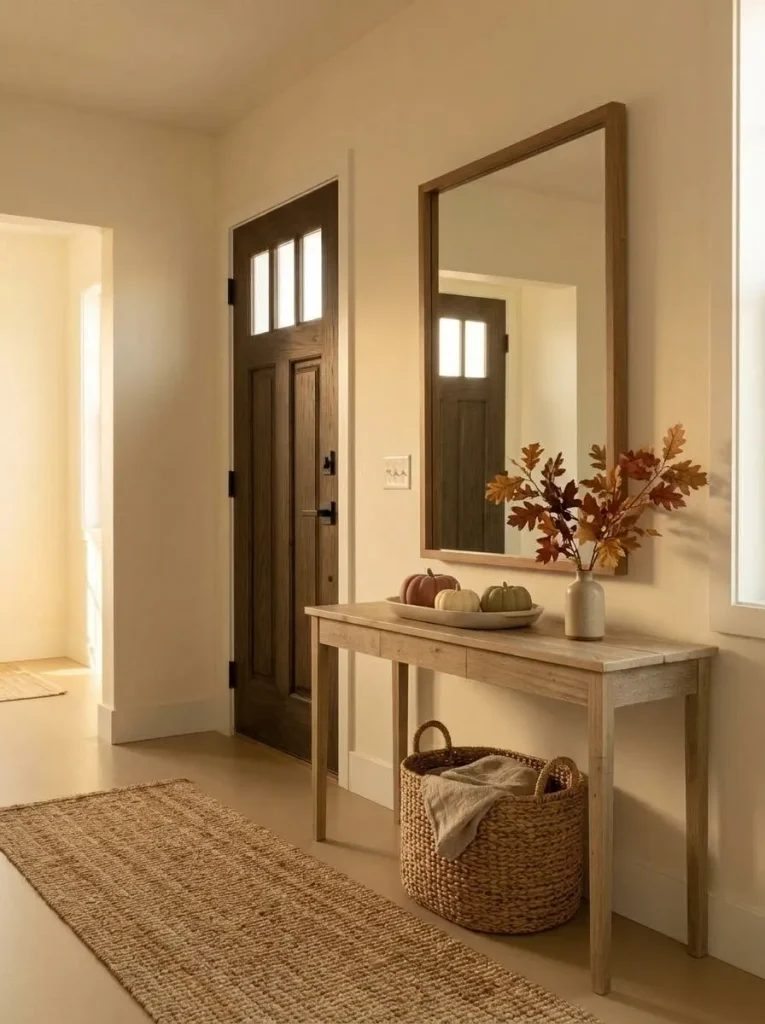
Pumpkins are one of the quickest ways to signal fall—and one of the easiest accessories to overuse in a small entrance.
A cluster on the floor consumes both physical and visual space. It also tends to spread: one pumpkin becomes three, then a lantern, then a basket of leaves. In a mobile-home entry where the walkway may already serve the living room or hallway, that footprint matters.
Start by elevating them. Better locations include a shallow console tray, one corner of an entry shelf, the usable end of a bench, a wall ledge, or a contained grouping above shoe storage.
Three miniature pumpkins together on a tray usually read as one visual unit. Three pumpkins placed separately around the doorway read as three competing objects.
If you still want a floor pumpkin, choose one deliberate location outside the door sweep and normal footpath. Ask whether the entry looks and functions better with it there—not merely whether it technically fits.
12. Make the Hook Rail Look Seasonal Without Making It Decorative
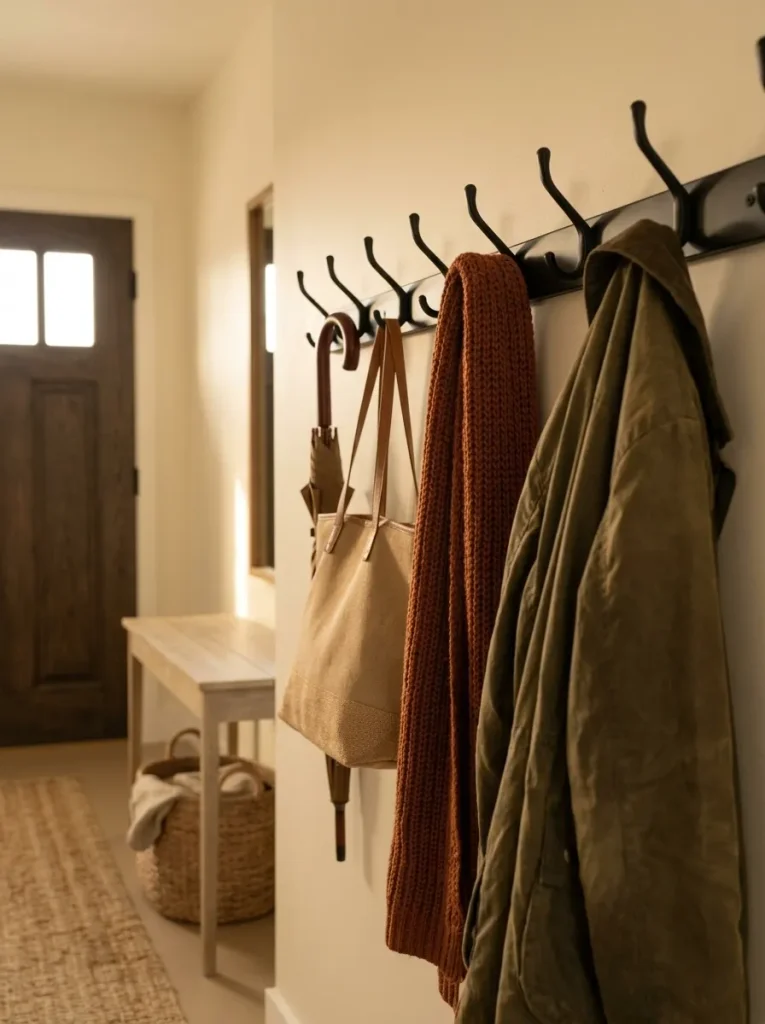
Hooks are valuable because they use wall space that cannot accommodate deep furniture. Do not sacrifice that advantage by turning every hook into a purely decorative display.
Let real household items carry part of the autumn palette.
An olive jacket, rust scarf, woven market bag, tan umbrella strap, or plaid tote can introduce color and texture while remaining useful. If the hooks already look visually busy, seasonal styling may simply mean editing what stays visible.
Keep most hooks available for everyday life and reserve only a small part of the rail for a restrained fall detail such as lightweight foliage or a textured tote.
Avoid hanging several bulky decorative items at shoulder level along a narrow passage. Their physical depth can make the wall feel much closer.
The strongest version should still work on a rainy Tuesday when coats and bags need somewhere to go. Fall styling succeeds here when practical objects become part of the seasonal composition.
13. Hide Everyday Shoes Before You Buy Another Fall Accessory
If the entry still feels messy after you add an autumn runner and pretty foliage, look down.
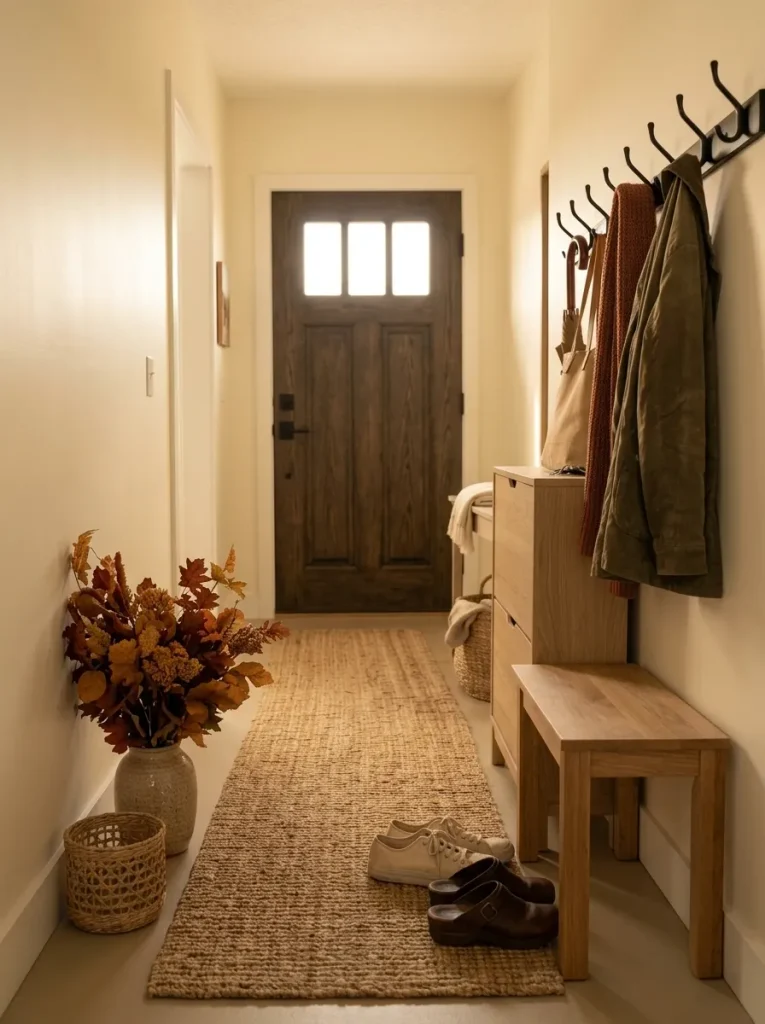
Five pairs of everyday shoes can create more visual noise than any seasonal accessory can correct. Shoe organization often produces a larger decorating improvement than buying another pumpkin or sign.
In a bench nook, assign the cubbies or baskets to the pairs used most often. In a narrow passage, use a shallow storage solution that keeps depth under control. If the front door opens into the living room, visually quiet or closed storage matters more because the shoes remain visible from the seating area. In a tiny defined foyer, one low basket can work if it prevents loose pairs from spreading across the floor.
Decide how many pairs genuinely need to live at the door and store the remainder elsewhere.
Once the shoe line disappears, you may discover that the runner, wood tones, foliage, and one autumn accent already provide enough seasonal character.
14. Pull the Fall Palette From the Door, Floor and Wood You Already Have
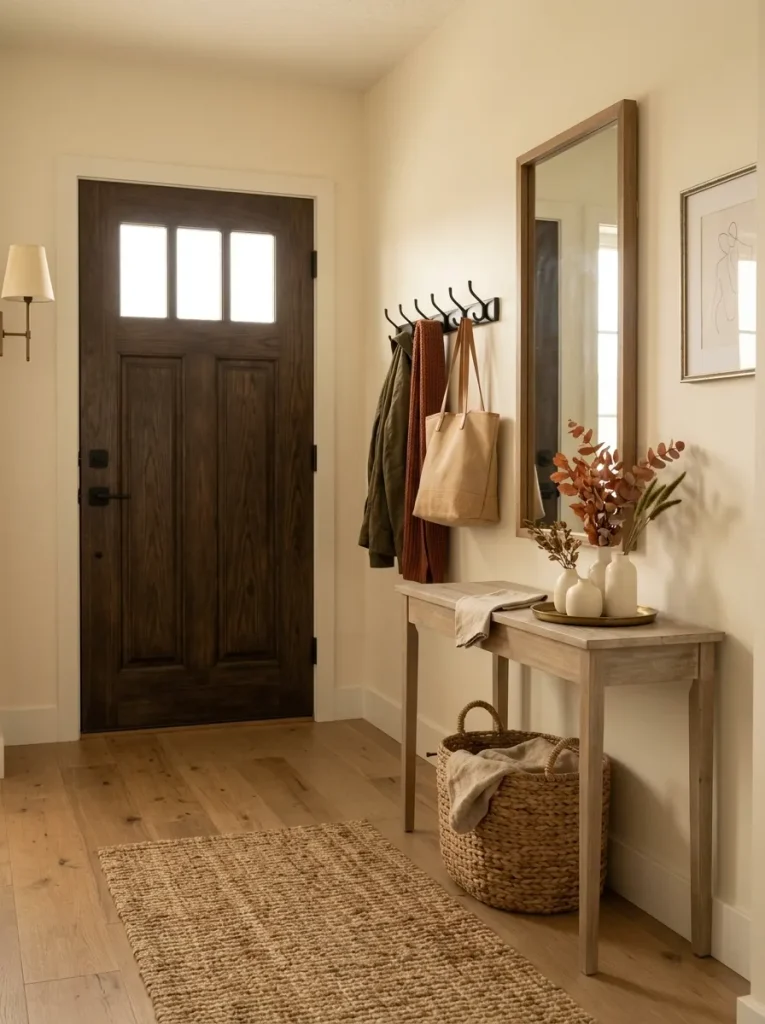
The safest autumn palette is rarely the one displayed together in a store aisle.
Your mobile home’s flooring, front door, wood furniture, and wall color already occupy most of the visual field. Fall accents look more integrated when they bridge those permanent finishes instead of sitting on top of them as a separate orange layer.
Use the palette bridge below as a starting point. Choose the dominant finish closest to your entry and see which autumn tones can warm it while preserving continuity.
Existing-Finish Palette Bridge
Let the permanent finish choose your fall direction
These are styling combinations, not rigid formulas. Start with the large finish you already see at the entry, then borrow two or three supporting tones.
Cool gray → rust + walnut + cream
Rust supplies warmth, walnut prevents the palette from becoming too orange, and cream softens the transition. Best first move: try rust foliage or a textile before replacing any neutral entry pieces.
Warm oak → olive + muted pumpkin + ivory
The wood already supplies warmth, so the palette does not need aggressive orange. Best first move: use olive foliage and one muted pumpkin tone to deepen what the wood is already doing.
Dark door → amber + flax + warm cream
A dark door gives the entry enough visual weight. Lighter autumn tones keep the surrounding zone from becoming heavy. Best first move: bring amber or flax to the wall or console instead of adding more dark accessories.
Beige or taupe → terracotta + moss + soft cream
Earthy reds give the neutral base definition while moss adds enough contrast to keep the scheme from becoming monochrome. Best first move: test one terracotta textile and greenery together before adding patterned fall décor.
Use these combinations to narrow choices, not to make every object match. Repeating two or three related tones across the runner, foliage, and one textile is usually enough to make the entry feel connected.
15. Give One Basket a Permanent Job Before Making It Decorative
Woven baskets immediately look autumnal because they bring natural texture into an entry. That does not mean every empty corner needs one.
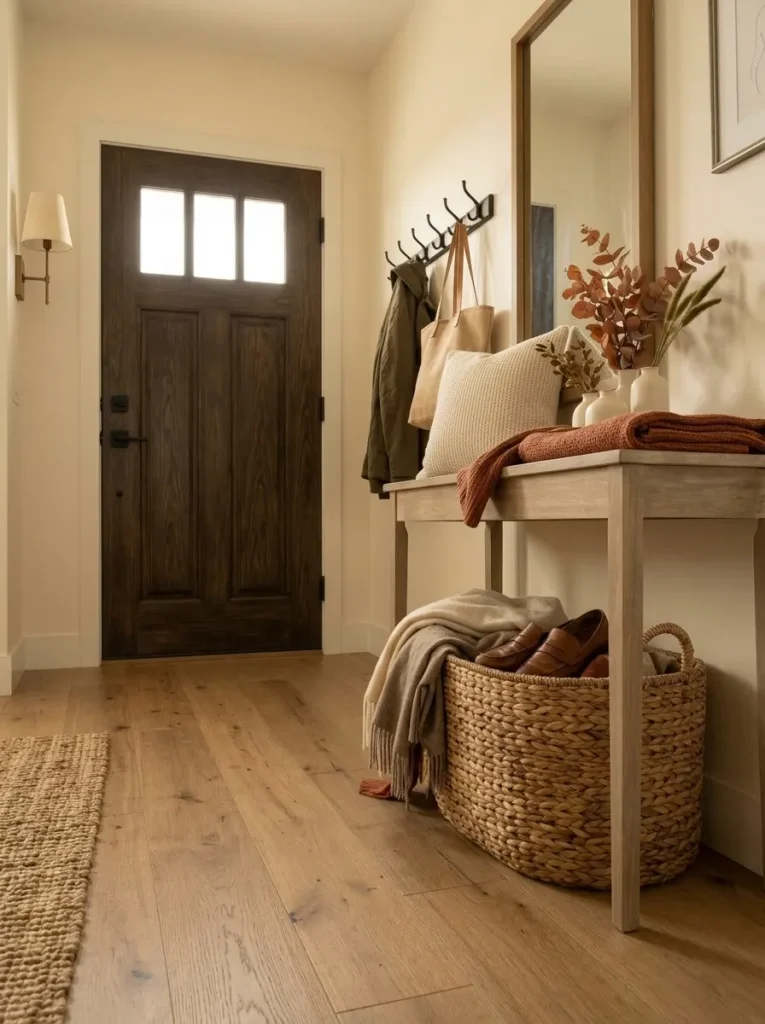
Before placing a basket, decide what belongs inside it all season. Everyday shoes, scarves and gloves, umbrellas, pet gear, reusable shopping bags, or outgoing items are all stronger reasons for a basket than simply filling an empty patch of floor.
Once it has a job, choose the shape around that task and the available footprint. A tall narrow basket may work better for umbrellas; a low rectangular basket can slide beneath a bench; a lidded basket can visually quiet miscellaneous accessories.
If the basket remains empty except for a decorative blanket spilling over the edge, ask whether that floor space would look better open.
This distinction matters in a small mobile-home entry because useful texture is efficient; decorative storage that stores nothing is simply another object competing with circulation.
16. Borrow Fall Character From Thrifted Pieces With a Small Footprint
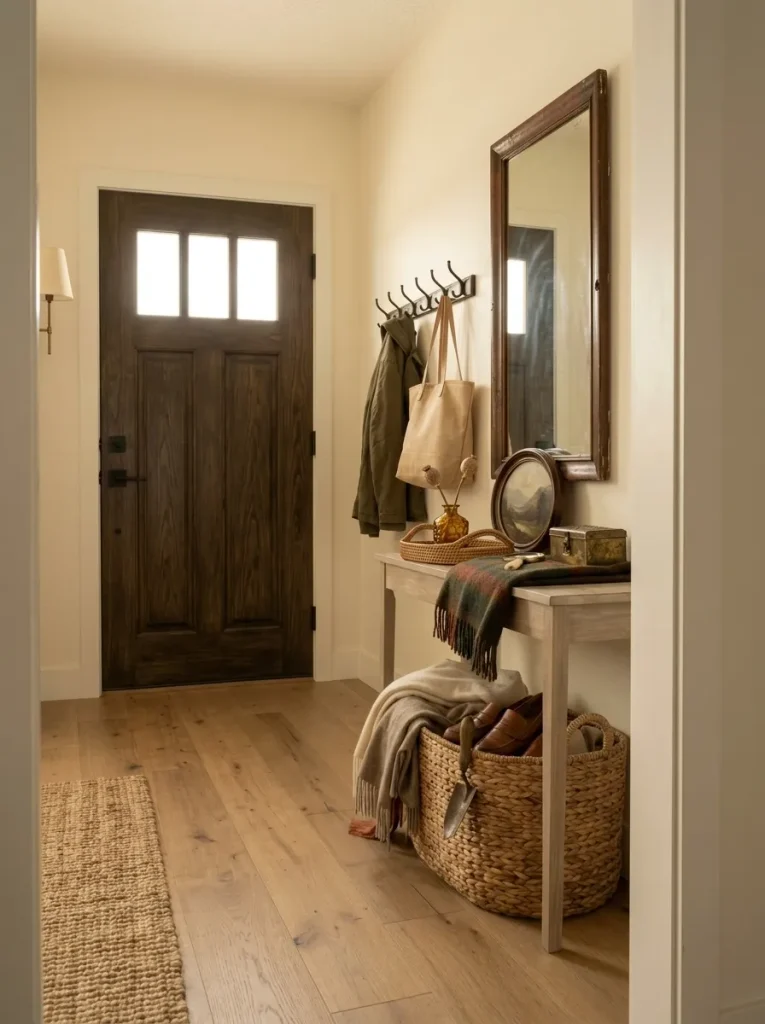
Secondhand pieces can give an entry far more character than a collection of matching seasonal accessories—but scale should filter what comes home with you.
Look for compact pieces with material presence: an aged-wood frame, a small brass or dark-metal accent, amber glass, pottery, a vintage landscape, a shallow woven basket, or a wood tray.
A thrifted object earns its place when its material, color, or function connects to something already in the entry. An old brown frame might echo the front door; amber glass can pick up warm evening light; a shallow basket can become the key drop.
Avoid buying a piece merely because it says “fall.” Vintage character usually comes more convincingly from real materials and age than from seasonal wording.
For a deeper sourcing method, continue with StylishGalore’s thrifted fall decor ideas for mobile homes, where secondhand pieces are treated as part of a coordinated room rather than isolated bargain finds.
17. Make the Entry Look Better After Sunset
Daylight can hide a weak entryway lighting plan. After sunset, a single ceiling fixture may flatten every surface while leaving the corner near a console or bench visually cold.
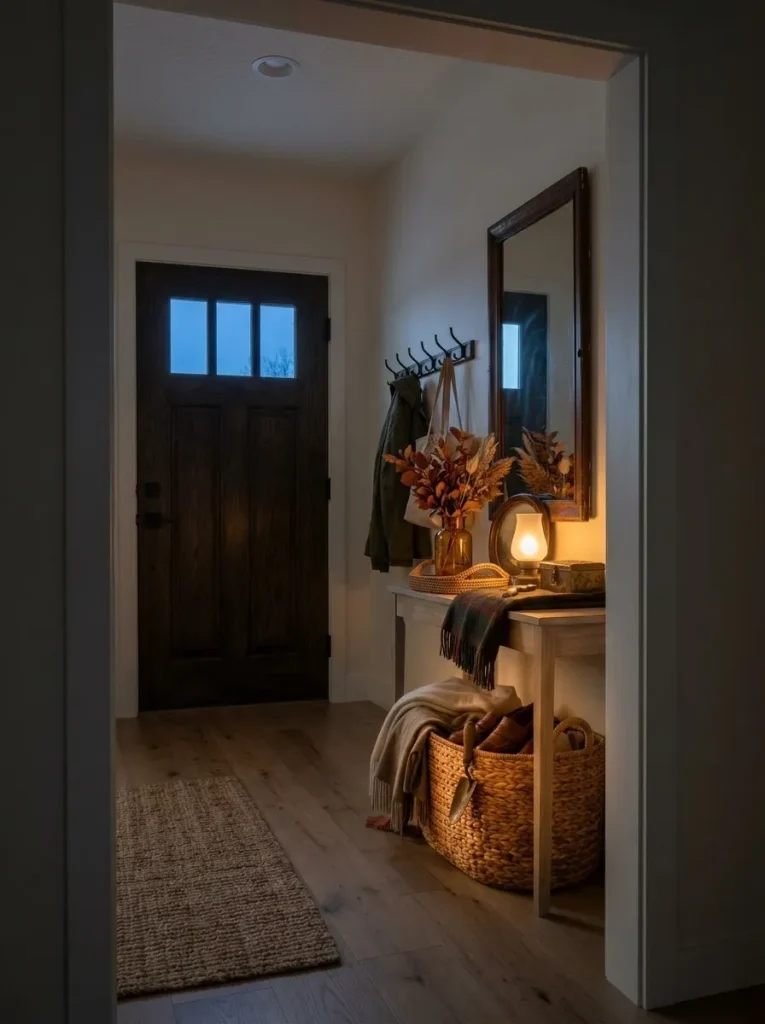
Fall is a useful season to improve the layering of light without rebuilding the room.
The lighting studio below starts with the condition you notice at night. It then changes the source you should emphasize, the seasonal material that benefits most, and the decorating mistake to avoid.
Evening Entry Light Layer
Diagnose what the entry needs after daylight disappears
Choose the night-time condition closest to yours. The recommendation changes the light emphasis, the surface worth highlighting, and the extra décor you can skip.
Bring one lower glow into the composition
A single overhead source can flatten texture. Add a lower light layer through an existing lamp position or a safe decorative LED source, then let foliage, wood, and woven materials catch that warmer light.
Light the dark edge, not the whole entry again
If one corner vanishes at night, concentrate a subtle source or reflective element there. The aim is to restore depth so the entrance does not read as one bright patch beside one empty dark patch.
Let the console become the evening anchor
When the furniture is present but disappears after dark, one contained glow can give the arrangement depth. Keep the illuminated grouping simpler because light itself becomes part of the composition.
Use the lighting you already have as the seasonal effect
If sconces or wall lights already establish the entry beautifully, let them reveal a restrained autumn layer. More decorative illumination may weaken the hierarchy you already have.
The evening test is straightforward: turn on the lighting you normally use, step outside, and enter again. If the foliage, wood, basket, or mirror suddenly looks richer after dark, the light is contributing real seasonal atmosphere. If you mainly notice the bulbs and decorative fixtures, simplify.
18. Repeat One Entry Detail in the Room You See Beyond It
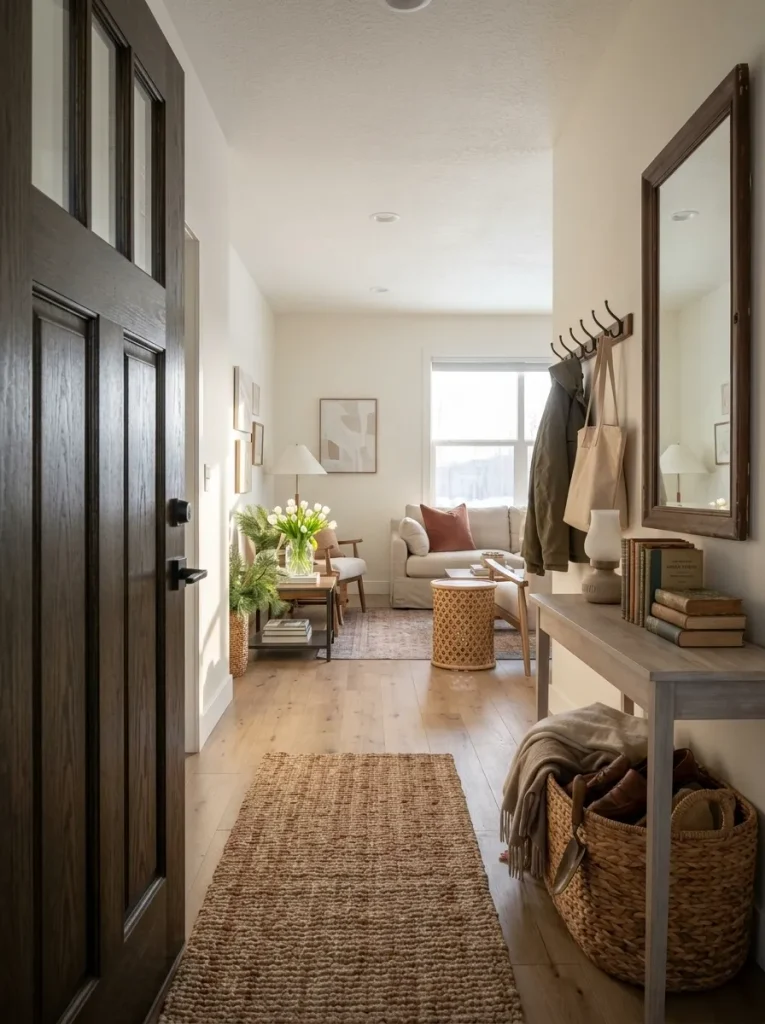
A mobile-home entrance often does not have a visual ending. The front door may reveal the sofa, kitchen, dining area, or several zones in one glance.
That makes continuity more valuable than decorating the entry as an isolated scene.
Choose one cue from the entrance and let it reappear somewhere in the first room you see. Rust from the runner can return in one sofa cushion; olive foliage can echo a plant or textile; basket texture can appear beside the seating area; dark entry hooks can connect with a lamp; warm wood can recur in a tray; or a subtle plaid can appear deeper in the room.
Do not repeat everything. One connection is usually enough for the eye to understand that the entry and adjoining room belong to the same seasonal story.
This is especially effective where the door opens straight into the living space. Continue the transition with StylishGalore’s fall mobile home living room ideas.
If you want autumn to continue across several connected rooms, the broader cozy fall mobile home decorating guide can help carry the look through the rest of the home without turning every surface into a focal point.
19. Walk Out, Walk Back In, and Remove the First Thing That Feels in the Way
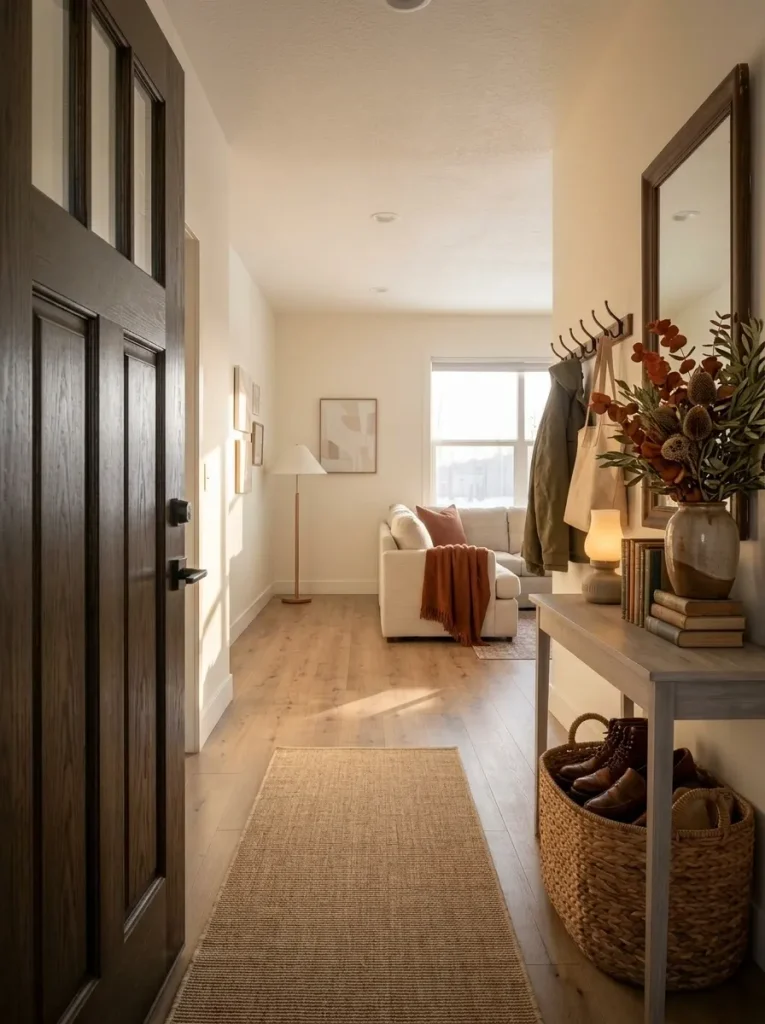
The final styling decision should not happen while you are standing beside the console adjusting leaves.
Leave the home.
Close the door, wait a moment, then walk back inside as though you have not been staring at the entry for the past hour.
Your first few seconds tell you more than close-up styling does. Notice whether the entrance feels easy to move through, whether shoes and bags have obvious destinations, and whether one seasonal moment leads the eye before a dozen small objects begin competing.
Use the audit below as the final filter. Each switch changes the feedback for that part of the entry. You do not need a numerical score; any item that still feels unresolved becomes the next edit.
60-Second Arrival Audit
Judge the entry like someone walking in, not someone decorating it
Does the door open and close without negotiating with décor?
Is the route into the home obvious at first glance?
Do shoes, keys, and daily bags have obvious homes?
Can you identify one dominant fall moment immediately?
Does the room beyond the entry feel related without looking copied?
Would removing one more object make the entry worse?
Final edit: if the entry already reads as fall from the doorway, the next accessory probably belongs back in the seasonal bin.
A finished entryway should feel easier to use after decorating, not merely prettier in a photograph. Once the circulation is clear, daily storage works, one fall focal point is obvious, and the adjoining room feels connected, stop adding.
Final Thoughts
A small mobile-home entryway does not need a large furniture budget or a floor full of pumpkins to feel ready for fall. The strongest approach is to protect the arrival route first, then let one purposeful seasonal moment carry most of the atmosphere.
Use your existing door, flooring, furniture, storage, and sightlines as the framework. Autumn color, woven texture, foliage, warm light, and a few collected pieces can then reinforce that structure without taking over it.
When you are unsure what to add next, walk outside and enter again. If the entrance already feels warm, functional, and unmistakably seasonal, the smartest next move may be to leave it exactly as it is.
Save this guide to Pinterest so you can return to these small fall entryway ideas when you start decorating your mobile home.