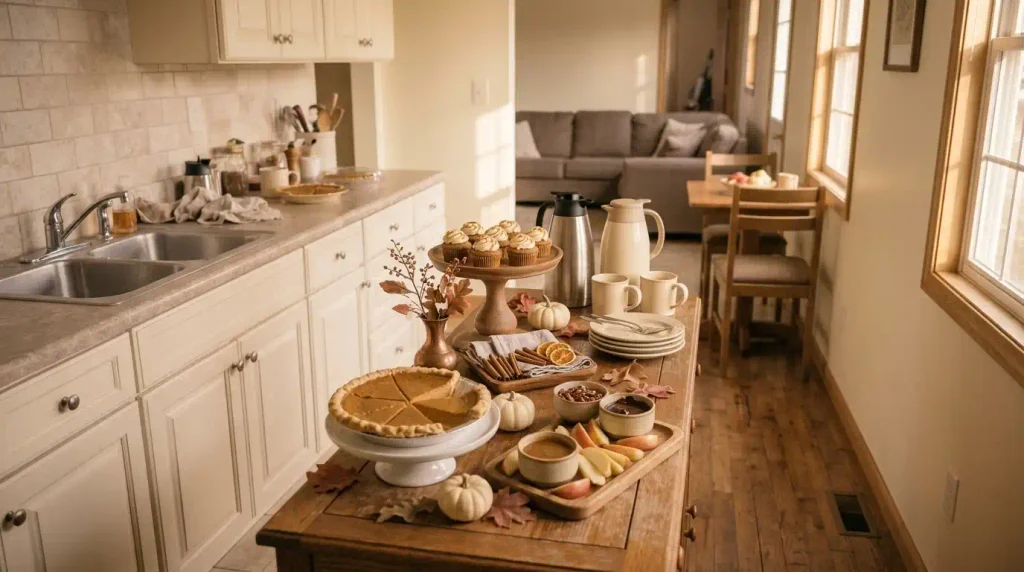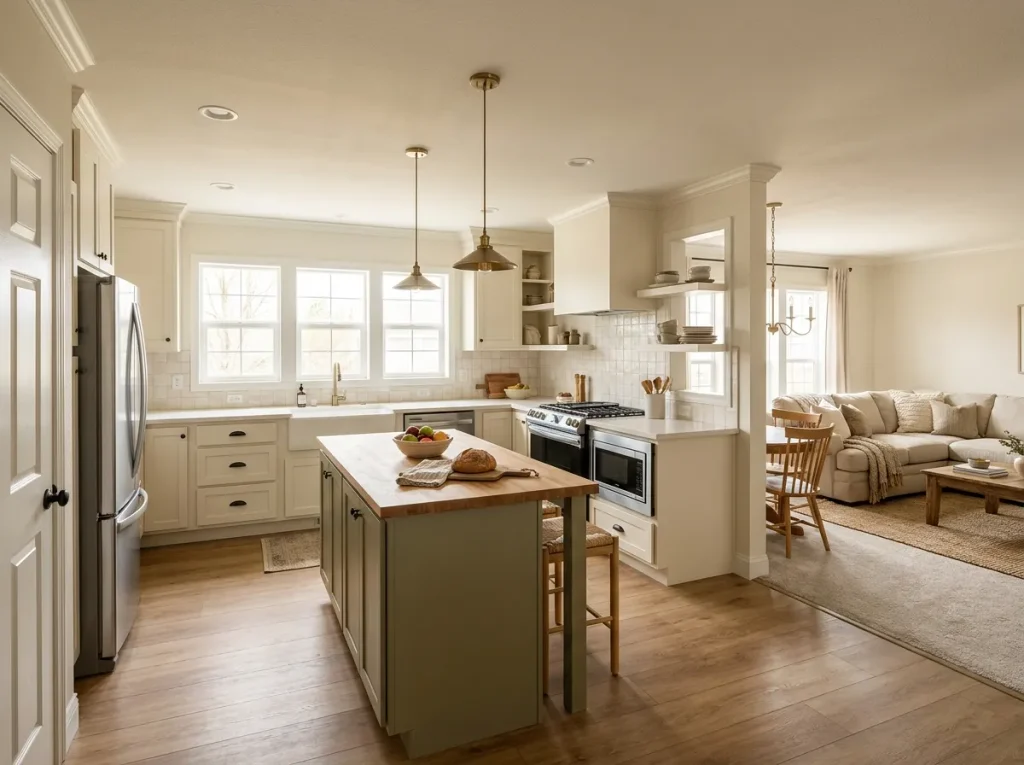
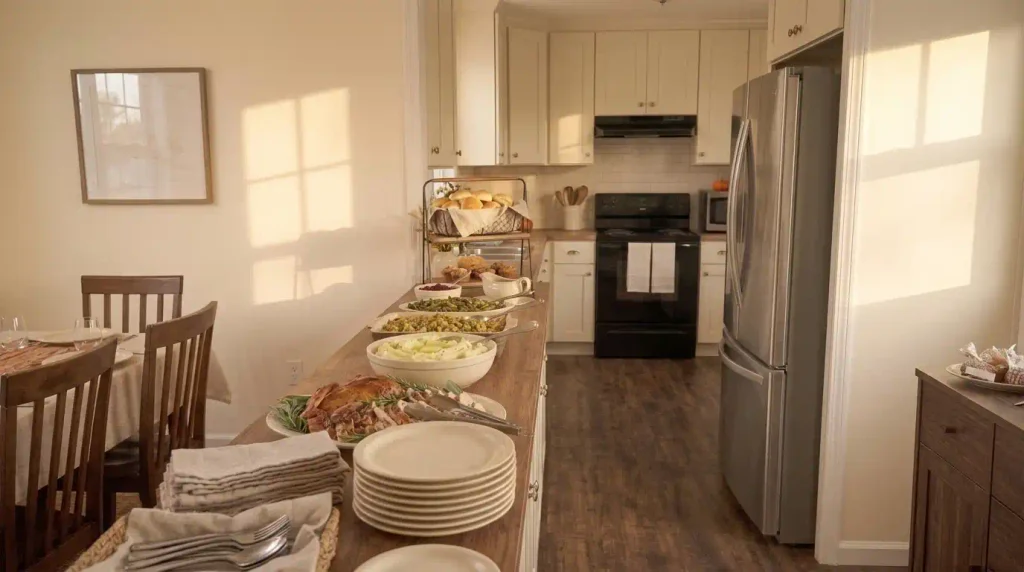
Thanksgiving dinner sounds simple until a roasting pan claims the stove, casserole dishes fill the counter, and three relatives arrive carrying empty plates. In a narrow mobile home kitchen, the problem is rarely the menu alone. The same slender aisle often serves as the cooking route, the path to the refrigerator, and the passage between living and dining areas.
A workable Thanksgiving buffet setup for a mobile home kitchen needs a deliberate service route: somewhere to collect a plate, somewhere to pick up hot and cold food, and a way back to the table that does not send everyone past the oven. That route changes depending on whether your kitchen has one cabinet wall, a galley, or a peninsula.
Below, you will map the best buffet arrangement for your kitchen, assign realistic jobs to every serving surface, and decide what can move out of the kitchen entirely. The result should feel abundant and welcoming—while remaining easy to cook in, serve from, and clean after.
In this guide: Choose a layout · Hold food safely · Arrange counters · Plan service
1. Choose a Thanksgiving Buffet Layout That Fits Your Kitchen Shape
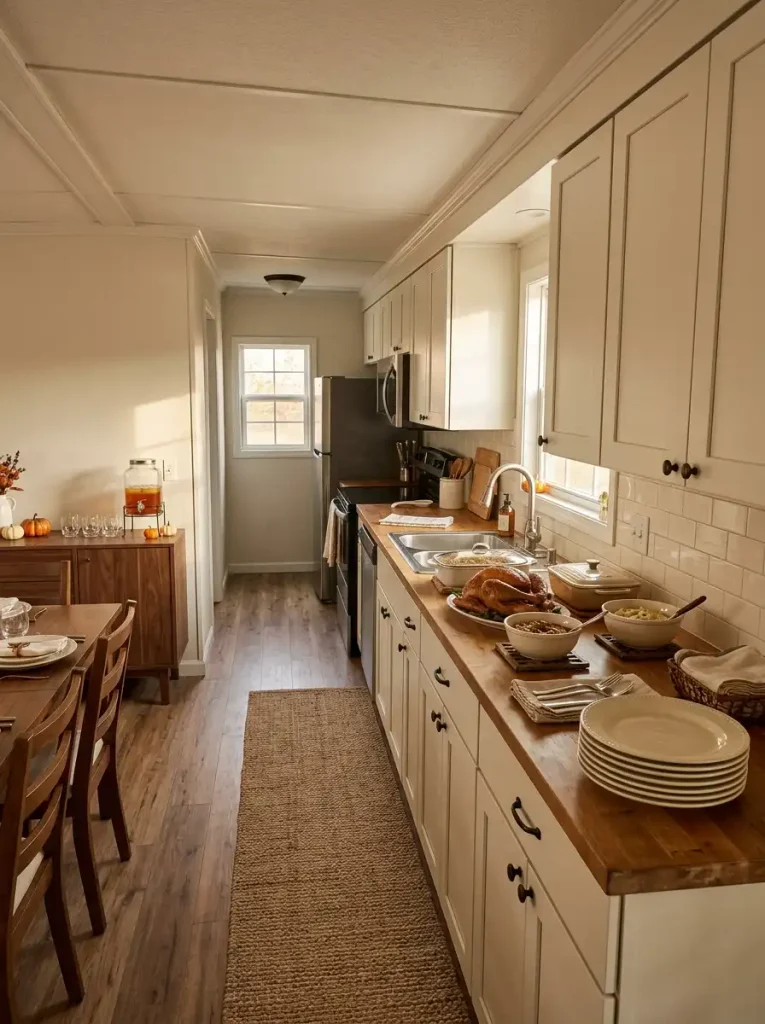
The smartest starting point is the shape of your service route, not the number of dishes you hope to display. A one-wall kitchen can function as a compact buffet, but it usually needs a separate landing spot for drinks. In a galley, two parallel counters look tempting until guests start reaching across the center aisle. A peninsula gives you a valuable guest-facing edge, provided diners can approach it without entering the cooking side.
Sketch your fixed features first: sink, refrigerator, oven, entry to the kitchen, and the dining table. Now draw a line from the point where a guest picks up a plate to the point where they leave with food. If that line turns back through the cook’s workspace, change the serving location—not the home’s cabinetry.
A single-wide with one straight cabinet run often succeeds with plates at the dining end, food along the cleared run, and drinks beyond the kitchen. A narrow galley may work better as a supervised, staggered serving sequence. When neither arrangement allows safe movement, move the entire self-service buffet to an existing dining-side sideboard.
The Thanksgiving Buffet Route Atlas
The Thanksgiving Buffet Route Atlas
Choose the kitchen shape closest to your home. Each plan shows a serving strategy and the interference to test before dinner.
Keep the service route linear
Place plates toward dining; guests take food from the cleared end of the counter, then leave without turning back toward the range.
- Protect: one active prep section.
- Move: drinks beyond the cooking run.
- Reject if: the guest line blocks the refrigerator.
Make one side do the serving
Use a single accessible counter edge for the main buffet; the opposing side remains a working kitchen, not a second queue.
- Protect: access to hot appliances.
- Move: drinks and appetizers out.
- Reject if: doors force people to squeeze past heat.
Serve from the outer edge
A peninsula already divides kitchen and dining; guests can reach food on the dining side without entering the cook’s zone.
- Protect: the passage around the peninsula end.
- Move: stools and decorative trays.
- Reject if: the serving line blocks seating.
Conceptual relationships only—not measured plans. Check actual appliance clearances, furniture, and accessible routes in your home.
2. Test the Guest Walkway With the Refrigerator and Oven Open
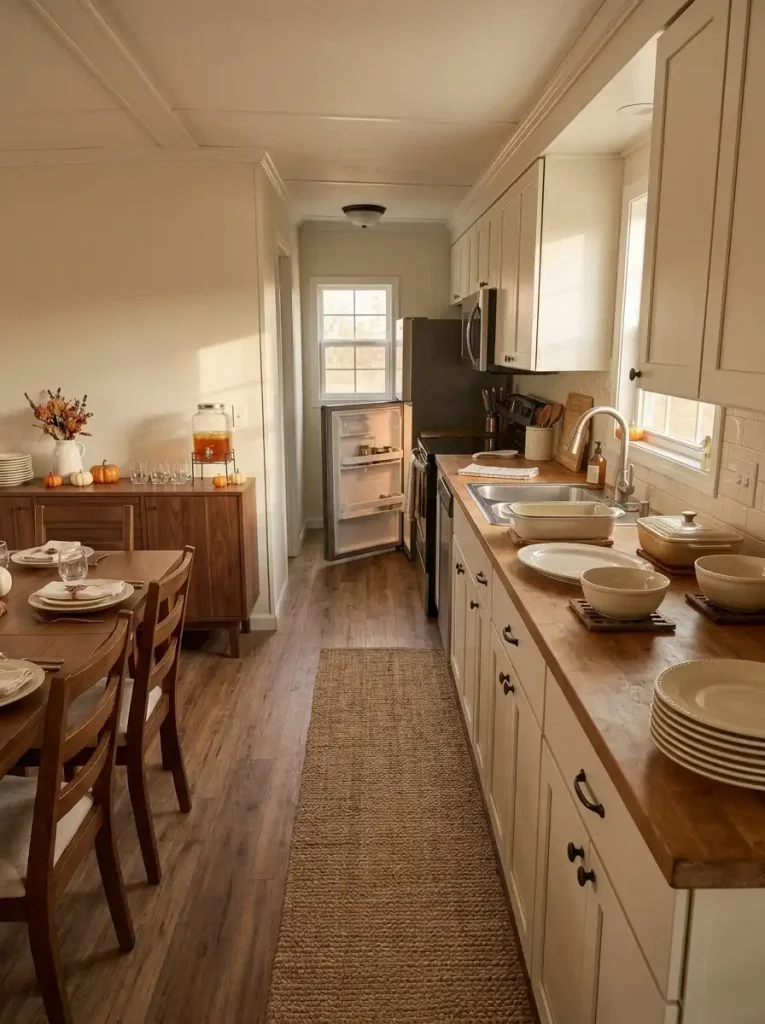
Picture the room at the exact moment someone asks for more gravy. The refrigerator opens, a helper reaches for a casserole, and another guest pauses with a plate. An aisle that appeared clear ten minutes earlier suddenly becomes a dead end.
- Set an empty platter and plate stack where the buffet will stand.
- Open the refrigerator, oven, dishwasher, and frequently used cabinet doors one at a time.
- Have another person carry an empty dinner plate along the guest route while you stand at the most active cooking spot.
- Move the plate pickup, side dishes, or guest route if anyone has to squeeze beside a hot open door.
This is a holiday traffic test, not a remodeling diagnosis. Your usual kitchen may work perfectly well for everyday meals. If the crowding appears only while hosting, use timed serving, a dining-side station, or a designated helper to control it. Readers considering permanent changes can consult single-wide kitchen layout ideas for a deeper look at working aisles and appliance swings.
3. Start the Buffet Where Guests Can Pick Up Plates Without Blocking the Cook
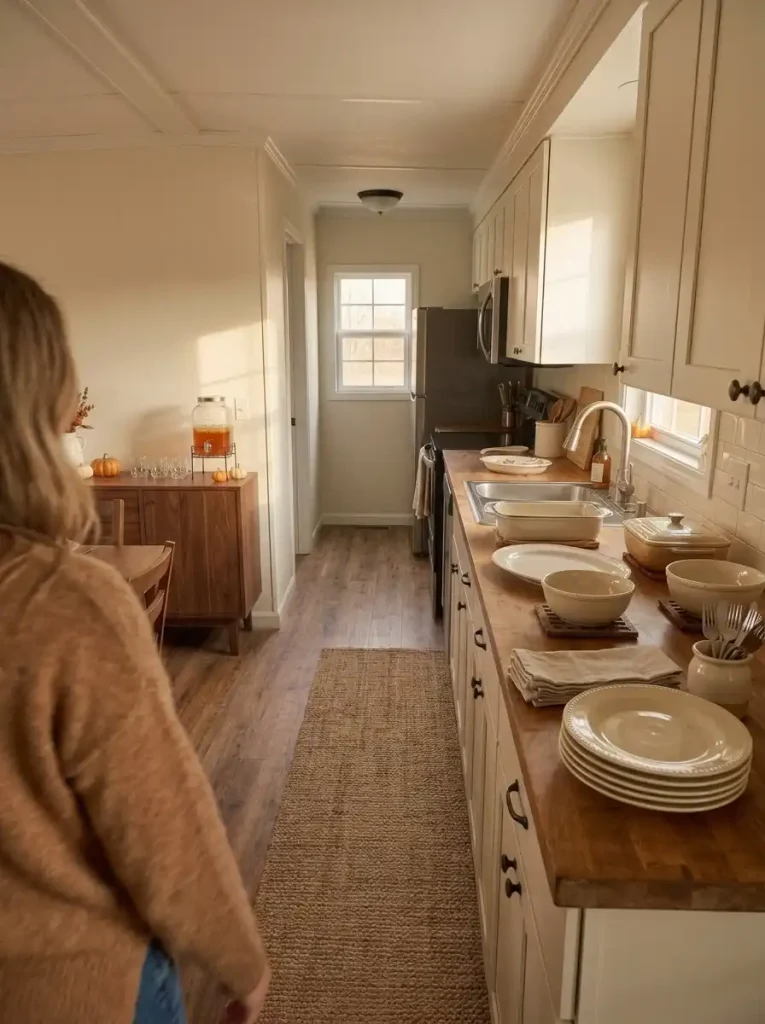
The first three seconds of a buffet determine what happens to the rest of the line. Put the plates beside a doorway that leads back into the work area, and guests will gather exactly where hot dishes need to travel.
Use the dining-facing end of your serving surface as the entry. Set one modest stack of plates there, with napkins close by and cutlery where guests can manage it comfortably. Keep a small reserve of plates nearby, out of the traffic line. This leaves the beginning of the buffet obvious and prevents people from wandering toward the range looking for a place to start.
One useful rehearsal: Ask a guest unfamiliar with the setup where they would begin. If they walk straight into your kitchen’s prep zone, the buffet entrance needs to move.
If the kitchen has only one opening that doubles as the route to the bathroom or living room, consider putting the plate stack just beyond that opening on the dining side. The start point can be outside the kitchen even when the food remains inside.
4. Turn One Short Counter Run Into a Dedicated Serving Surface
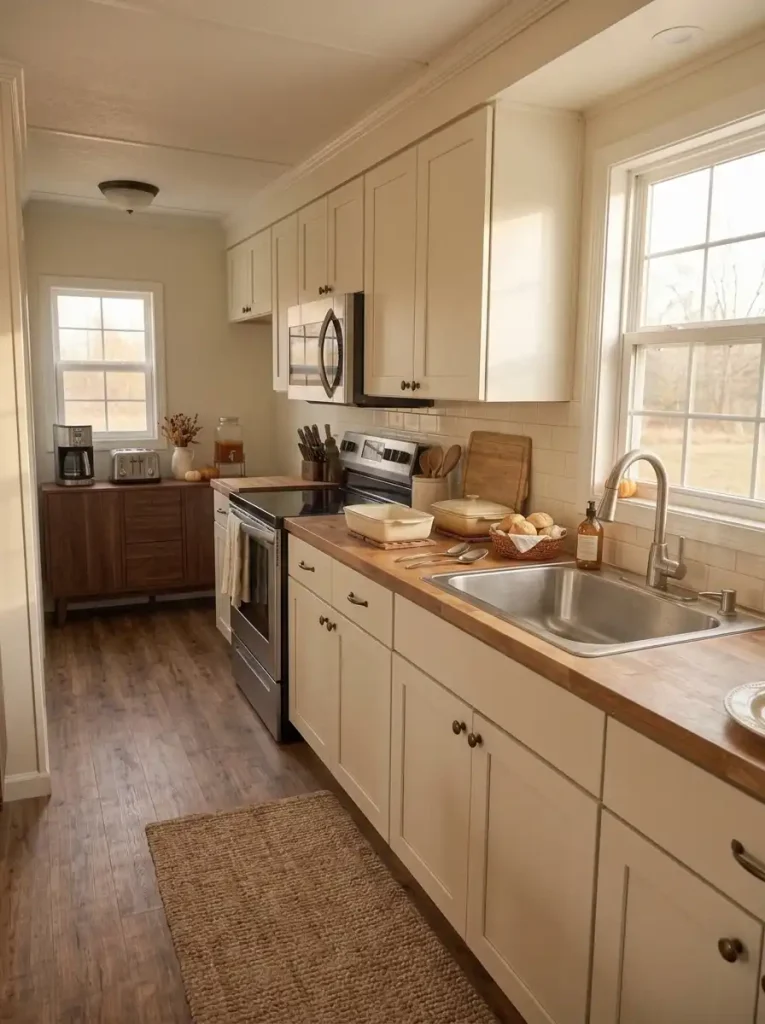
The cleared counter you see in a photograph may contain the coffee maker, knife block, dish rack, and toaster on an ordinary day. Thanksgiving is a temporary change of use. Make that change intentional the evening before the meal.
Identify which existing surface can hold the dishes you actually plan to serve, then remove items that do not participate in dinner. Relocate the coffee setup to a secure alternative counter, tuck small decorative pieces away, and leave your main chopping station free until the final preparation is complete. The sink should remain accessible for handwashing and cleanup; do not cover it with improvised boards while the kitchen is actively serving and cooking.
- Keep: Food-safe landing space, serving utensils, and the equipment needed to hold food safely.
- Relocate: Low-use appliances and holiday décor competing for plate space.
- Decline: Any extra platter that requires balancing food at the counter edge.
If clearing the counter still does not create enough space, that is a signal to divide the buffet across the adjoining dining area. Permanent solutions belong in a separate small mobile home kitchen planning guide; dinner itself rarely requires new cabinetry.
5. Create a Safe Hot-Food Station for Turkey, Gravy, and Casseroles
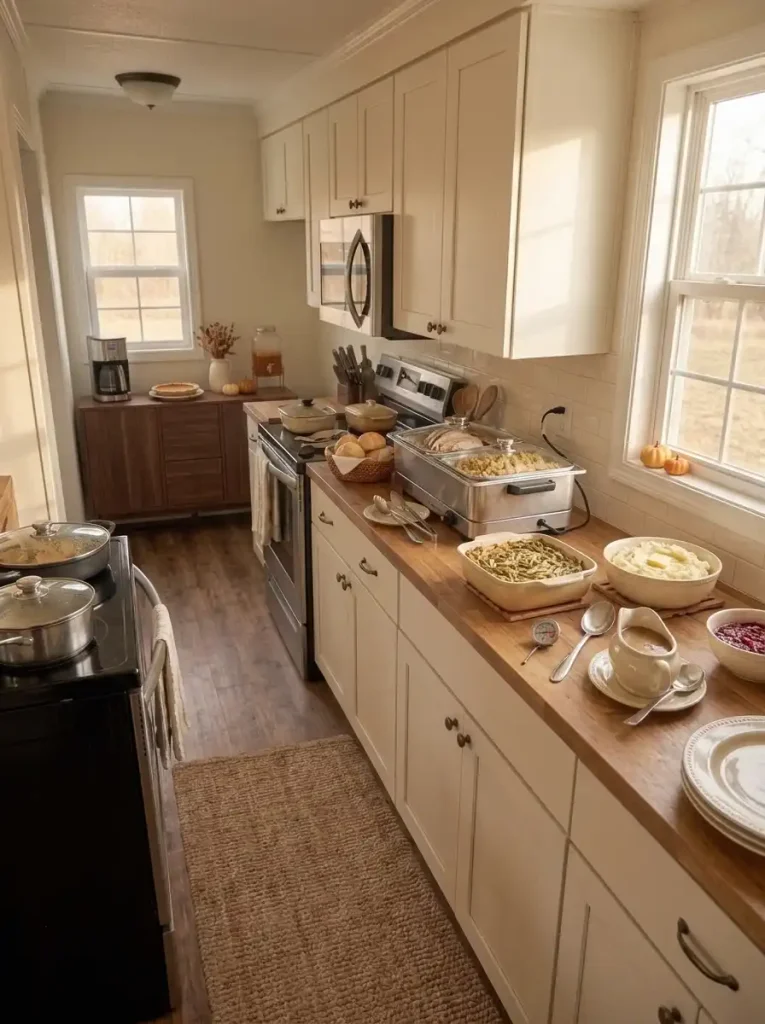
Hot turkey and baked sides look especially generous grouped together, but presentation must follow temperature control. A slow cooker, suitable chafing setup, or preheated warming tray can help maintain hot food at 140°F (60°C) or warmer. Verify the food temperature with a thermometer: some household warming devices do not hold food hot enough. Keep combustible décor away from heat and follow each appliance’s placement, ventilation, and electrical instructions.
Arrange the hot station so guests can approach from the serving side, with handles turned away from accidental bumps. Put gravy in an appropriately stable vessel with a ladle rest. Never set hot dishes on an untested fabric runner, wicker basket, or delicate riser, and keep cords out of the walkway. A large roasting pan may be more attractive carved and transferred to smaller serving dishes, because it frees the oven landing zone.
For a crowded mobile-home counter, the best capacity strategy is often one modest hot serving dish plus properly held backup food. If a dish cannot be kept hot, use smaller batches and track time out of temperature control; perishable food should not remain at room temperature over two hours (one hour above 90°F). The FDA’s buffet guidance explains temperature and replenishment rules.
The Hot-Station Decision Rail
The Hot-Station Decision Rail
Appearance doesn’t verify temperature. Choose the situation that matches your equipment to reveal the next action.
My warmer reliably holds at least 140°F
Check food with a thermometer during service. Put the warmer on an approved stable surface, follow the appliance instructions, and keep guests clear of cords and hot edges.
My equipment warms food but cannot hold 140°F
Do not treat it as safe hot holding. Keep food correctly heated elsewhere, serve smaller quantities, and monitor time out of temperature control. Upgrade to appropriate equipment for extended service.
I have no dedicated hot-holding equipment
Make a short serving window, bring out small platters as guests are ready, replenish with food kept at safe temperatures, and discard perishables that exceed the applicable time limit.
Sources: FDA—Serving Up Safe Buffets and USDA—Buffet Safety.
6. Move Turkey Carving Away From the Main Buffet Queue
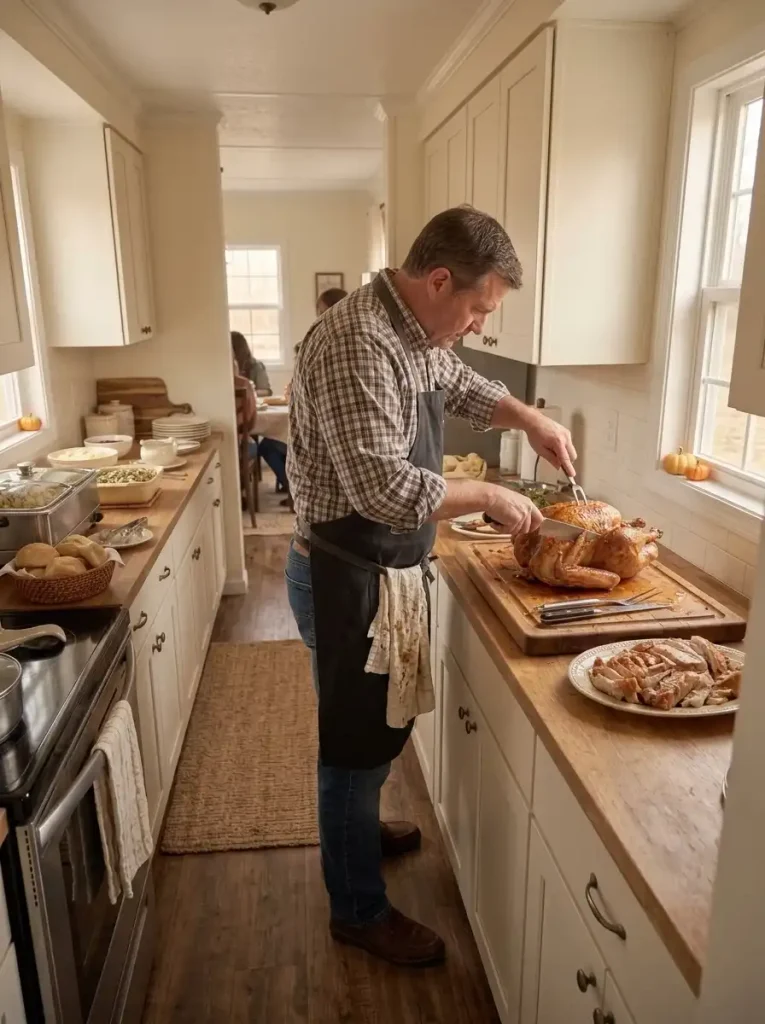
Carving is a task with a knife, a heavy platter, and considerable elbow movement. It should not happen where guests are queuing for mashed potatoes. In a narrow galley, a single carving board can turn the only open countertop into a work hazard.
One option is to carve the turkey before guests line up, transfer the slices to a warm serving dish, and use the hot-food station for portioning. A second option is a dedicated carving area on the cooking side, handled by one person while guests use a dining-facing buffet. Choose the second option only if the cook has a stable board, adequate room, and no crossing foot traffic.

Imagine a guest reaching for cranberry sauce at the exact moment the carving knife moves. If their arms could cross, the carving and service functions are too close. Preserve the ceremony by bringing the intact turkey to the table briefly for presentation, then return it to a safe workspace to carve.
Decision: When the kitchen’s only free counter is also the carving spot, carve ahead. That is a change of sequence—not a loss of the Thanksgiving centerpiece.
7. Keep Cold Appetizers and Salads in Their Own Chilled Zone
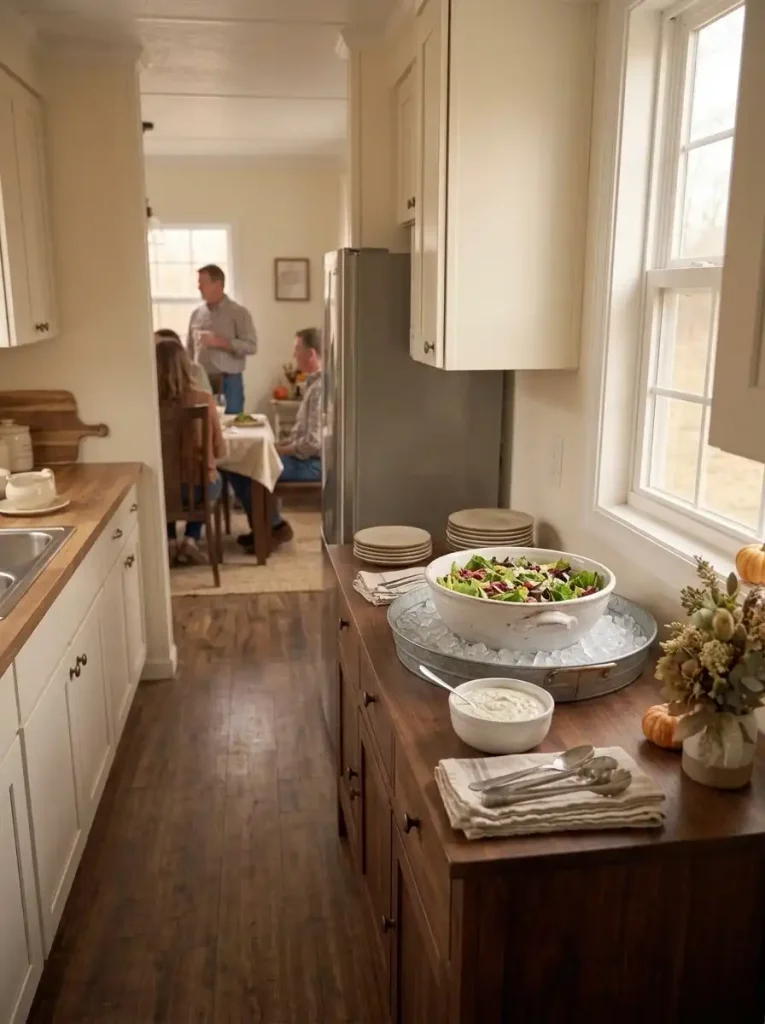
Cold dishes have different needs from the casserole lineup. Deviled eggs, dairy-based dips, prepared salads, and similar perishables must stay at 40°F (4°C) or colder when held cold. A narrow mobile-home counter beside the oven may be the least practical place for them, even if the colors look beautiful together.
Keep backup portions refrigerated and bring out smaller serving dishes when guests are ready. For an extended service period, set a suitable chilled dish over ice and verify that the food remains cold. Assign it a location away from steam, warmers, and the hottest kitchen traffic. A shaded dining-side surface may be more useful than a crowded cooking counter.
For example, a chilled cranberry-and-cream-cheese spread can appear with appetizers and return to the refrigerator before dinner. A room-temperature display is subject to the same time rule: discard perishable food after two hours without safe holding, or one hour above 90°F. Replacing the dish with a fresh, chilled platter also avoids topping up food that has already been handled by guests. Review the FDA’s cold buffet recommendations when planning what stays out.
8. Set Up a Thanksgiving Cider and Beverage Bar Outside the Kitchen Aisle
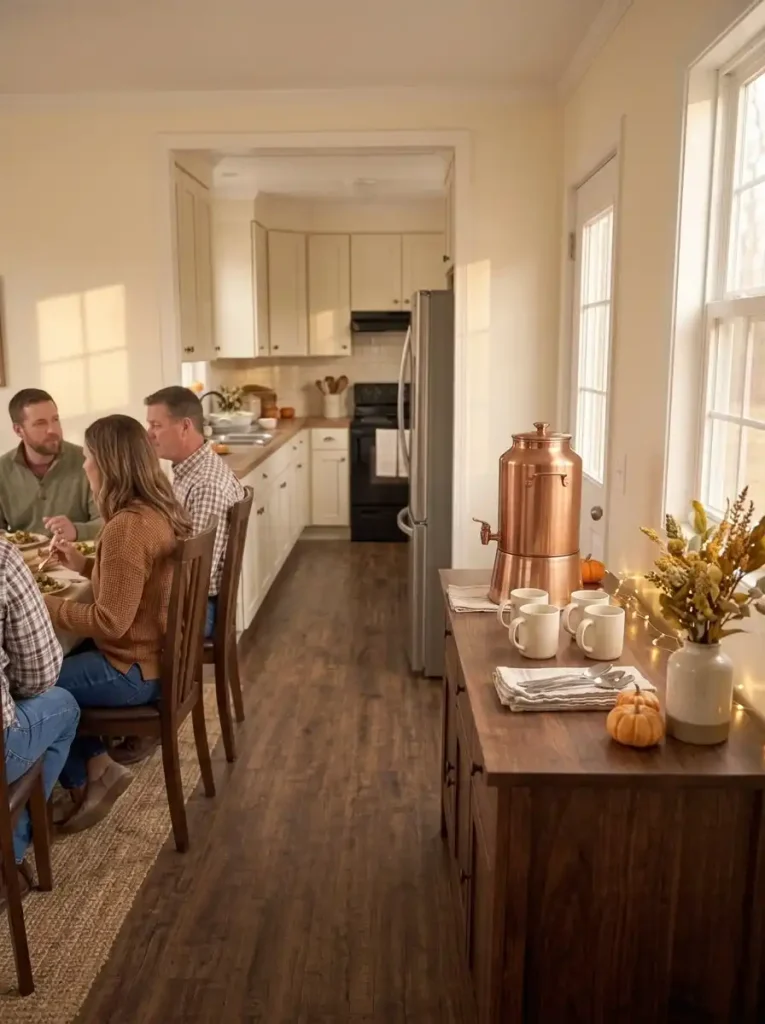
A copper cider urn, a row of mugs, tiny pumpkins, and warm string lights make a charming holiday vignette. They also invite guests to stand still, stir drinks, and chat. Put that beautiful pause in the kitchen’s narrowest passage and your buffet line will stall.
The best beverage station is usually near the dining or living area on a sturdy, appropriate surface. Put the drink container toward the back, cups toward the approach side, and napkins where a spill can be handled quickly. If serving hot cider, keep it in equipment suitable for the drink and follow the device’s hot-holding guidance. Leave enough room for guests to handle a mug without reaching over another person’s plate.
A kitchen peninsula end may work when guests approach it from the dining side and the drinks do not interfere with the cook. An existing sideboard is another strong choice. Avoid improvised crates for heavy liquid dispensers, dangling cords, and glass containers perched above seated guests.
The tradeoff is simple: if the beverage bar looks less dramatic outside the kitchen but keeps the food line moving, the dining-side position is the better hosting decision.
Move the Pause, Not the Pour
Move the Pause, Not the Pour
Drinks cause longer conversations and slower stops than plates of food. The strongest compact-home layout puts that pause somewhere the cook does not need to pass.
Best fit: a sound sideboard with a stable drink container, cups, and easy-to-reach napkins.
Check first: spills, hot liquids, cords, child access, and whether dining chairs still pull out.
9. Arrange Plates, Mains, Sides, and Condiments in the Order Guests Need Them
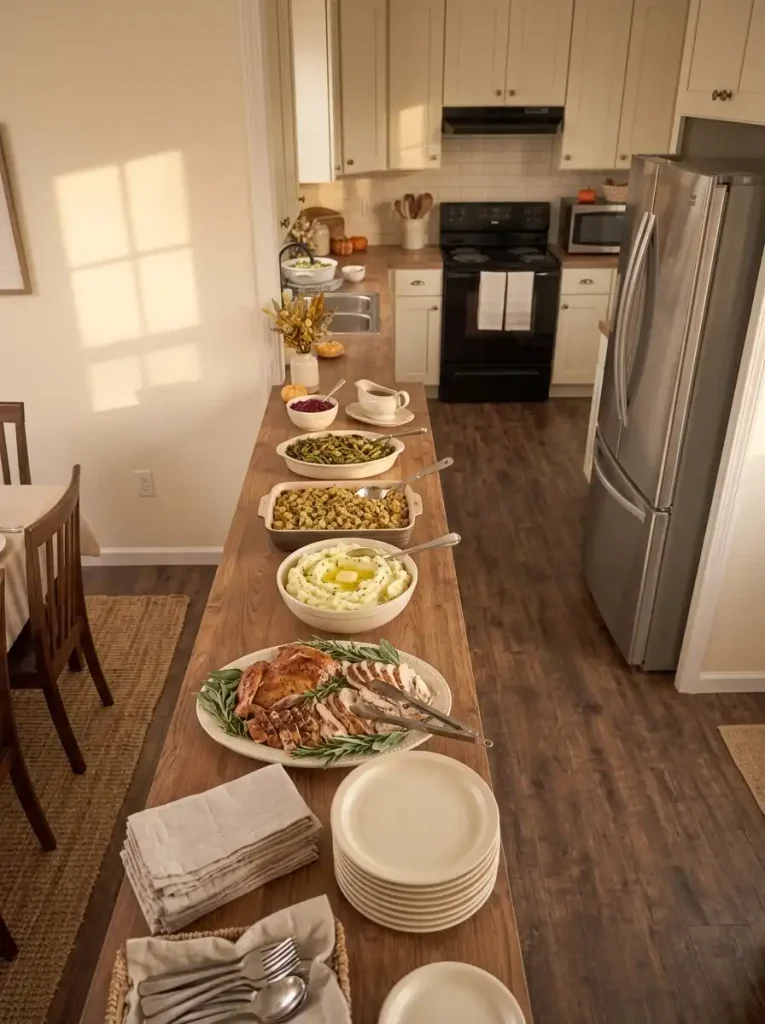
Think through the meal from the moment a guest holds an empty plate. The most natural order is plates → main dish → substantial sides → lighter sides → sauces and garnishes. This sequence minimizes the chance that someone must reach backward over a hot casserole to collect gravy or a spoon.
There is a practical exception: turkey and other main dishes that require a host to serve portions can sit at the downstream end, where a helper can assist without blocking every earlier station. It is better to adjust the order to how your household serves food than to force a standard restaurant-style line into a two-person galley.
- Before guests arrive: Give each dish its own serving utensil and check whether its handle lands over the counter.
- During dinner: Place heavily requested sauces where guests can reach them without crossing back through the hot station.
- After the first round: Observe where people pause. Relocate a frequently requested item if it is causing a queue.
In a tight space, a buffet that works smoothly is more impressive than one arranged only for a photograph.
10. Use Stable Risers to Display More Food Without Losing Serving Access
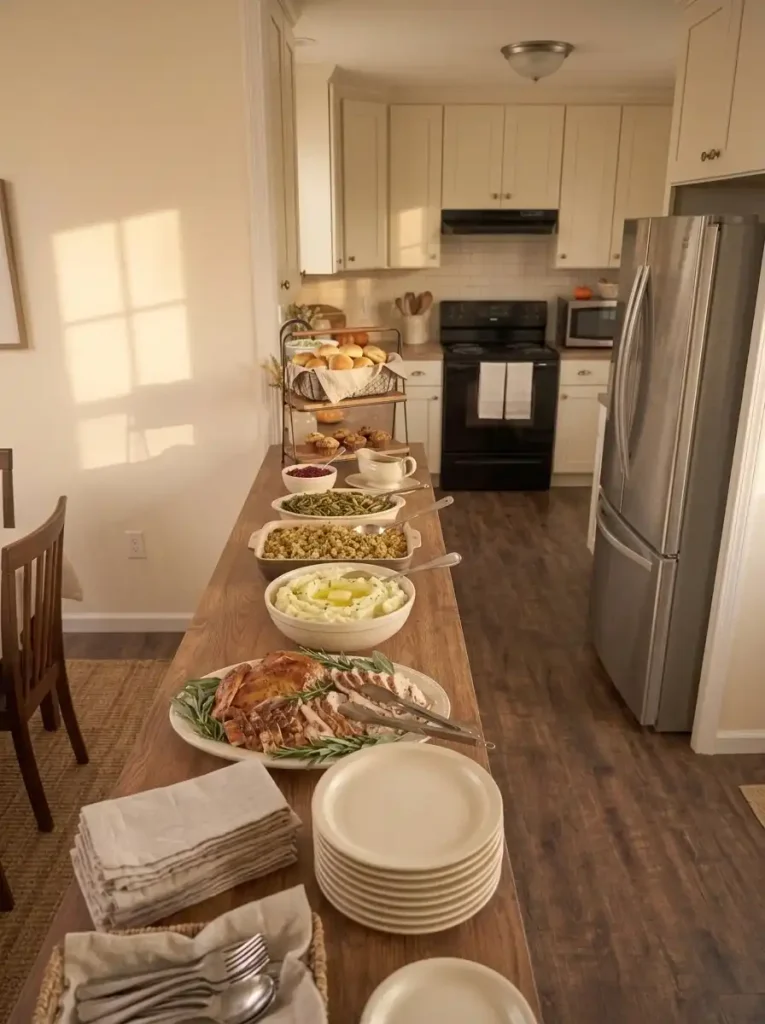
Tiered trays and rustic crates appear throughout Thanksgiving inspiration images, yet a tiered display can make a small counter less useful when guests must reach around tall objects. Height should improve visibility, never make a heavy hot pan harder to lift.
Begin with a flat layout: put large casserole dishes directly on a heat-appropriate, stable surface. Add height only behind lightweight, room-temperature items such as rolls in a basket or individually packaged treats. Test the stand for wobbling with its intended load before food is served, and confirm that upper tiers do not block a cabinet or interrupt someone using the counter behind them.
The most useful arrangement will depend on your actual food. A line of casseroles usually benefits from a low profile; a light dessert-and-bread bar may comfortably use a modest riser. Avoid stacking crates beside the sink or balancing platters on unstable decorative objects.
The Counter Arrangement Lab
The Counter Arrangement Lab
Compare three ways of presenting the same amount of food. Choose the serving arrangement that accommodates dish weight and guest reach—not simply the most dramatic photograph.
Best for heavy or hot serving dishes
Leave pans low, visible, and fully supported. Prioritize serving handles and heat-safe landing space.
Next action: remove display risers from the hot-food run.
Best for reach and variety
Alternate the dish depths slightly while leaving room for individual serving utensils. Keep everything within a comfortable, unobstructed reach.
Next action: test serving from the approach side with a plate in hand.
Best for lightweight, suitable items
Only use a tested, stable stand where its weight and reach are appropriate. Keep hot food off decorative risers.
Next action: inspect stand stability, load limits, and cabinet clearance.
11. Give the Thanksgiving Appetizer Board a Separate Serving Moment
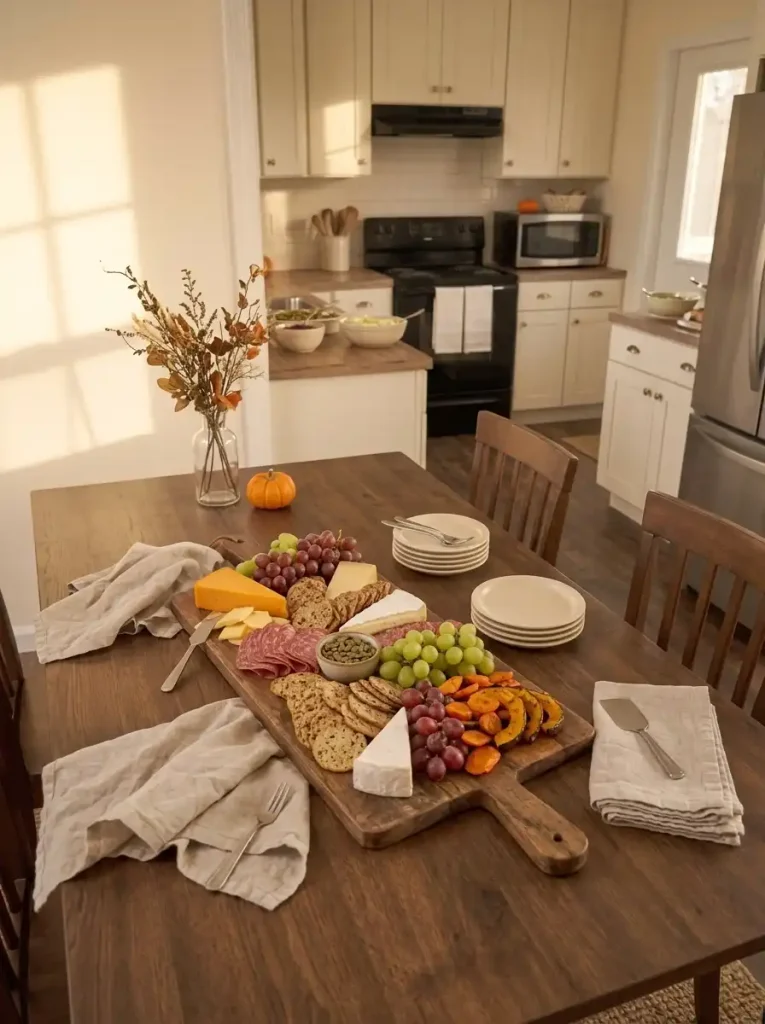
A leaf-shaped charcuterie board can be a wonderful seasonal feature without occupying the Thanksgiving dinner line. Treat appetizers as the first chapter of the gathering, served on a dining table or small sideboard while the kitchen remains focused on cooking.
Make the board visually clear: clusters of crackers or bread, cheese, grapes, nuts, and a few autumn-colored elements are easier to reach than an elaborate arrangement with every item touching. Offer suitable utensils and account for allergies. Perishable meats and cheeses still require chilled holding or time management; a decorative platter does not change food-safety rules.
Then make the important move: clear the appetizer surface before the main course is ready. The same sideboard can accept clean plates, serving utensils, or dessert later. If the only available surface is a narrow peninsula, favor two smaller appetizer platters that can be removed quickly, rather than one dramatic board that takes two people to lift.
This temporal approach preserves the abundance you liked in the reference photographs while keeping the room functional.
12. Use a Dining-Side Sideboard or Peninsula End for Overflow Dishes
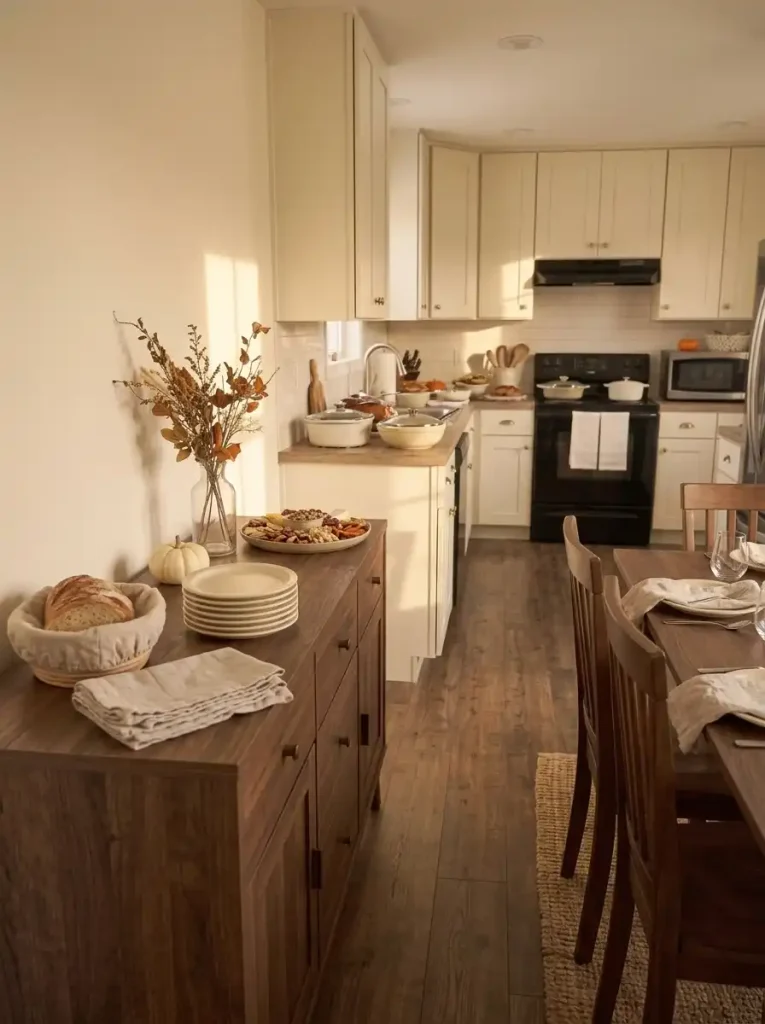
Suppose your main kitchen counter can safely hold turkey, potatoes, and one casserole but nothing else. Adding a folding table directly in the galley may solve the display problem and create a circulation problem. Look for an existing surface on the dining side before introducing new furniture.
A sturdy sideboard, console designed for serving, or guest-facing peninsula end can hold room-temperature bread, plates, napkins, and other suitable items. It can also display cold food with proper temperature control. Keep hot, heavy pots on appropriate stable surfaces and never assume furniture can support loaded equipment or hot items without checking its suitability.
Try the setup with a real dinner plate: can a guest reach the overflow dish without stepping into the cook’s path or blocking someone seated at the table? If the answer is no, adjust the surface’s role. Place items that people take once—such as napkins and bread—at the remote station; keep repeatedly requested hot gravy closer to the main service point.
For one-wall layouts, the overflow station often becomes the missing second half of the buffet. In a tight galley, it may be the difference between a pleasant meal and a constant traffic negotiation.
13. Switch the Buffet From Dinner to Dessert Instead of Displaying Everything at Once
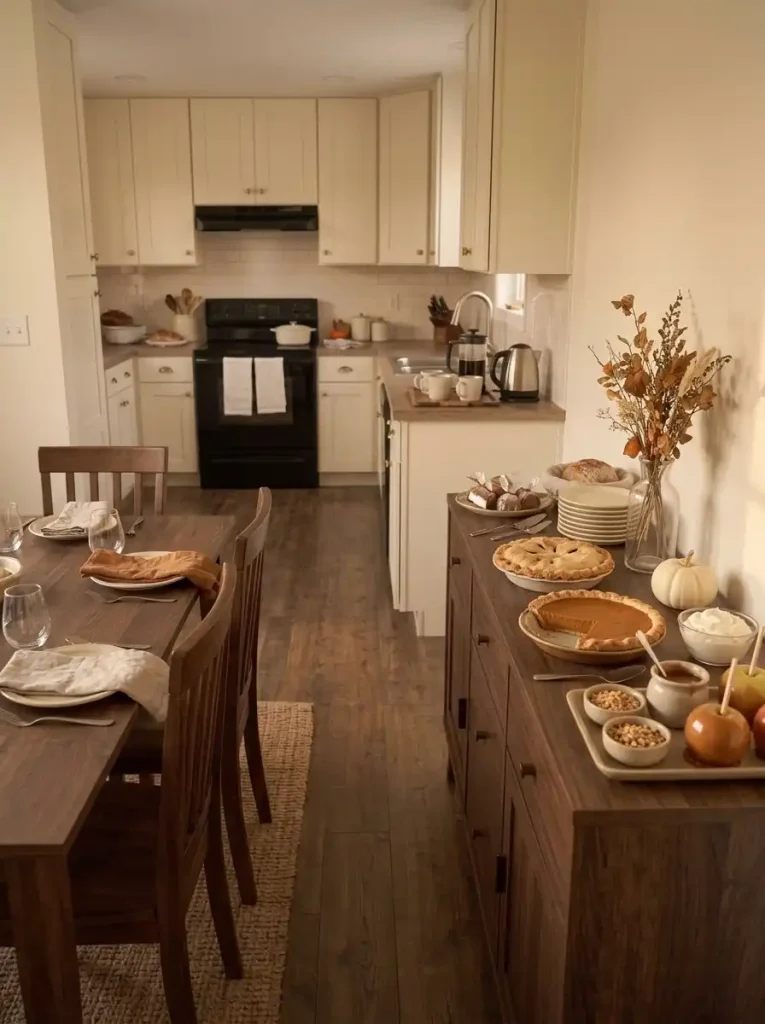
Pies and layered desserts photograph beautifully beside turkey and casseroles, but a narrow serving run cannot comfortably host two meals at the same time. Give dessert its own reveal once people have finished the main course.
- Clear used main-course dishes and transfer safe leftovers to suitable storage.
- Clean and dry the serving surface, checking any food-contact areas.
- Bring out pies, cake, or a small caramel-apple station in quantities suited to the guests.
- Return beverages, dessert plates, and coffee to their designated stations.
A small candy-apple bar is especially effective here: individual apple pieces, a few toppings, and serving utensils can feel playful without needing the entire kitchen island. Keep cut fruit and other perishables within appropriate temperature and time limits, and avoid leaving opened toppings unattended for hours.
If your dining table is already styled, take inspiration from Thanksgiving table settings for the place-setting side of the occasion. The buffet only needs to carry the food for the current course.
14. Make Second Helpings Easy Without Creating a Two-Way Traffic Jam
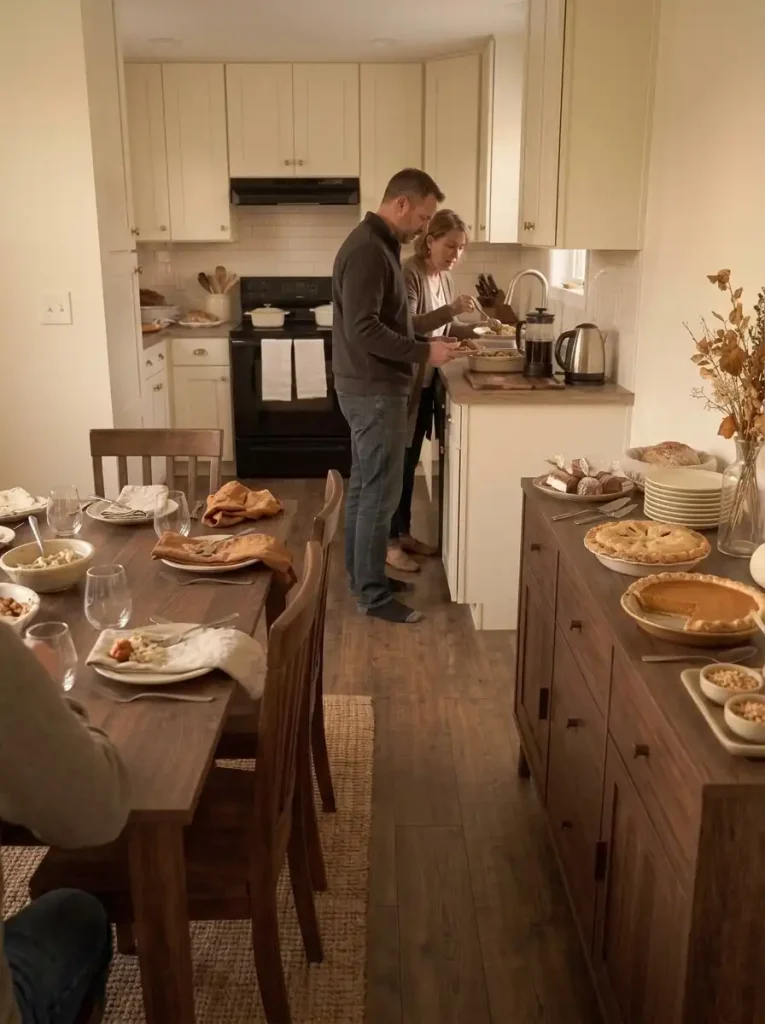
The first serving line can behave perfectly and still fail when everyone returns for seconds. A guest carrying food toward the table meets someone heading back toward the turkey, and suddenly both are trying to pass beside an open cabinet.
Decide where return traffic belongs before dinner begins. In a narrow galley, let the main line finish before announcing seconds, or ask a host to serve popular dishes from one end. In a kitchen opening directly onto a dining nook, leave the most requested sides closest to the dining-facing edge. Guests with mobility needs, children, and anyone using a walking aid may be more comfortable with plate service at the table.
A quick self-audit should consider three conditions: whether the passage remains usable with a chair occupied, whether guests must reach over hot equipment to return, and whether someone can enter or leave the home without being forced through the buffet queue. These are not reasons to exclude people from helping themselves; they are clues about when a second pass needs a different route or direct assistance.
Three Tests Before Offering Seconds
Three Tests Before Offering Seconds
Mark a problem only when you observe it. Each check reveals a specific action; there is no arbitrary score.
Decision rule: any observed obstruction calls for a change to the serving plan before guests return for seconds.
15. Give Used Plates, Trash, and Cleanup Their Own Destination
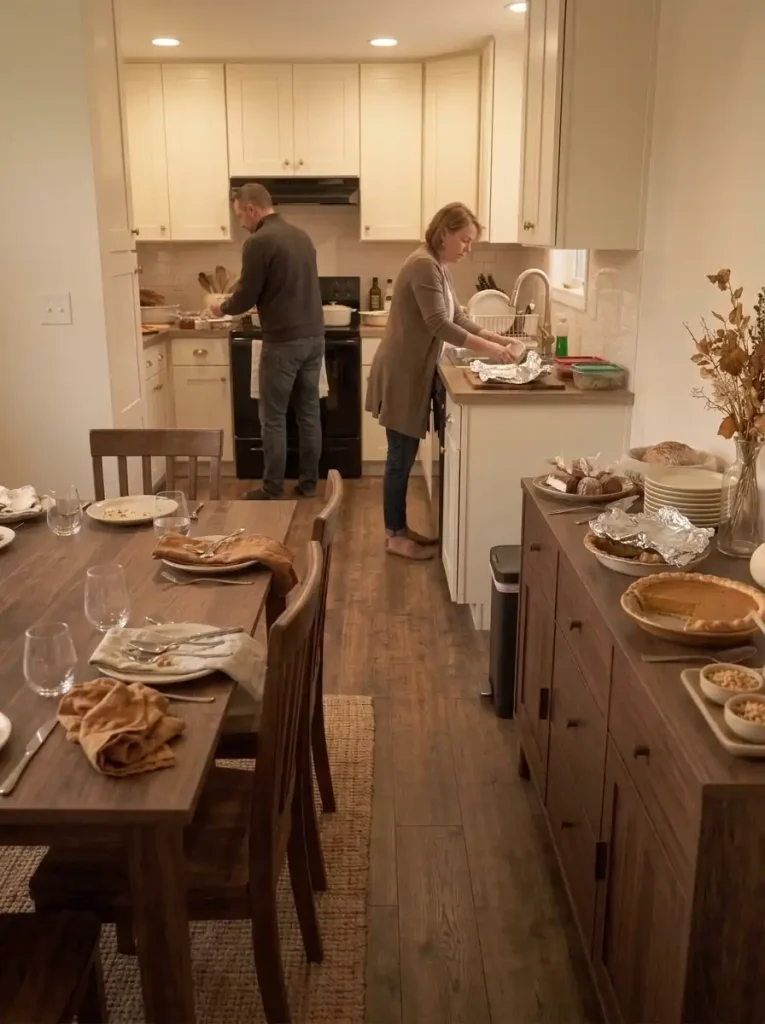
The buffet does not end when the last guest serves a plate. Used dishes begin accumulating, napkins disappear, and someone asks where to put a spoon. If the only answer is the same counter holding your food, the serving line starts to collapse.
Choose a return location away from the active buffet: perhaps the dining-side end of a sideboard, with a tray for used dishes and a discreet waste bin nearby. Keep the sink accessible for handwashing and cleanup, and do not leave soiled dishes beside ready-to-eat food. Avoid placing a bin where the lid, door, or guests’ feet obstruct the main passage.
Useful hosting handoff: Give one helper responsibility for removing empty platters and refreshing serving utensils. This is more effective than having several guests independently wander into the cooking zone carrying dishes.
After the meal, divide leftovers into shallow containers for prompt cooling and refrigeration. USDA advises refrigerating or freezing perishable leftovers within two hours of service, or one hour in conditions over 90°F; food that exceeded its safe unrefrigerated time should be discarded. See USDA leftover guidance.
16. Add One Warm Thanksgiving Focal Point Without Crowding the Food
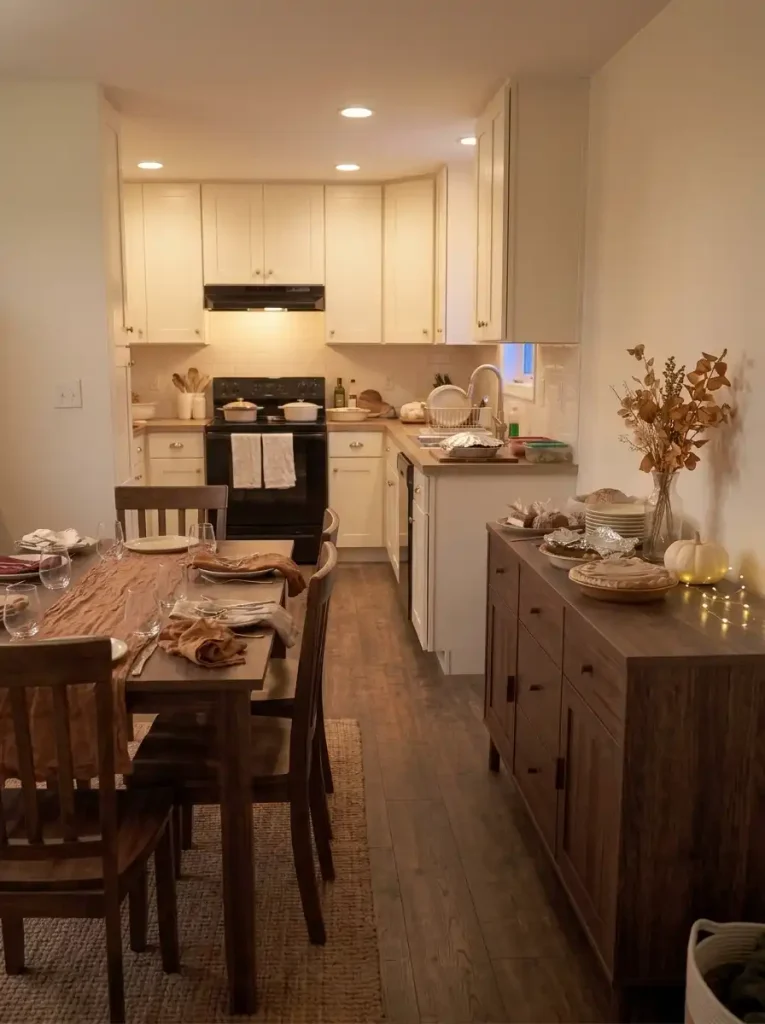
The reference images offer an appealing mood: glowing candlelight, golden foliage, amber cider, cream ceramics, and a few little pumpkins. A narrow mobile home kitchen usually looks more composed when these details gather into one restrained focal point.
Choose a spot that guests can see without leaning across the food—perhaps a small arrangement on an adjoining sideboard, a seasonal print on the dining wall, or battery-operated lights away from heat and water. Avoid draping leaves or ribbons over appliances, running electrical cords across the walkway, or placing candles beside napkins. The NFPA’s Thanksgiving safety advice emphasizes clear floors, awareness around hot food, and safe cooking areas.
A white pumpkin beside a vase of autumn stems can anchor a rustic table without claiming the whole counter. For broader, kitchen-focused seasonal styling, explore fall mobile home kitchen decor ideas—then keep only what can coexist with the food-service route.
The deciding test: if the decorative object must be moved to set down a hot pan or hand someone a plate, it does not belong in that location during dinner.
17. Rehearse the Buffet Before Guests Arrive and Plan the Refill Schedule
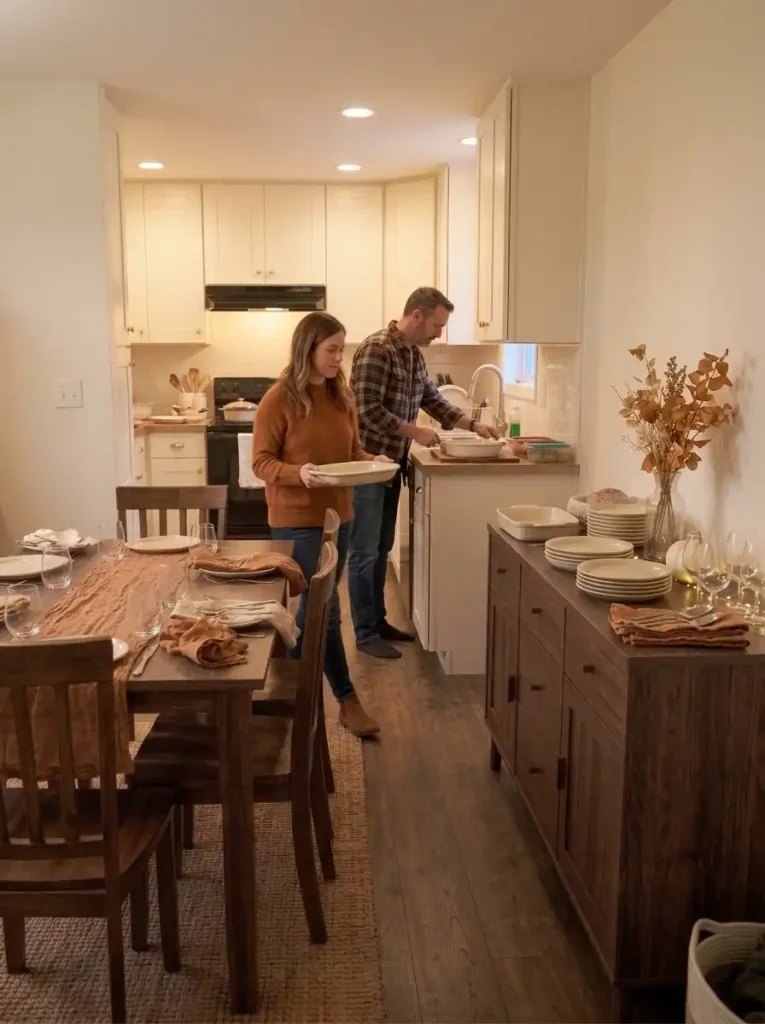
A beautiful Thanksgiving arrangement is ready only when it can operate with actual people, serving dishes, and food temperatures. Do a dry run while the food is still being prepared: set out empty platters, walk the route with a plate, check that cords and chair legs are clear, and identify where empty serving dishes will go.
Then rehearse the time as well as the space. Which dishes can remain safely hot or cold? Which will come out as small replacement platters? Who will take dessert dishes from storage after dinner? Who watches the oven while guests pass through the room? Write those answers on a short timeline so the host is not improvising while carrying a hot casserole.
Have a backup for each pinch point. A crowded serving surface can be relieved by removing appetizers early. A galley with no passing room can switch to one-at-a-time serving. If equipment cannot maintain safe temperature, serve a smaller quantity and replenish promptly from correctly held food, tracking the time that food is out of control.
Stop point: once guests can start, serve, return, and clear the meal without crossing an active hot work area, the arrangement is sufficiently planned. Extra décor and additional stations are optional.
Thanksgiving Service Timeline
Thanksgiving Service Timeline
A narrow kitchen cannot perform every hosting job simultaneously. Choose the moment you are planning for to see the right tasks and the point when the surface should change roles.
Stage 01 — Prove the route
- Place empty platters and open working appliance doors.
- Walk with a plate and check dining-chair positions.
- Decide which surface holds food, drinks, and used plates.
Ready when: guests do not need to cross an active cooking zone.
Stage 02 — Launch the line
- Bring out the properly held hot and chilled dishes.
- Set plates at the actual entrance, not by the oven.
- Place a helper where carving or portioning requires one.
Ready when: serving tools are present and food temperatures are being monitored.
Stage 03 — Keep service safe
- Check hot and cold holding temperatures with a thermometer.
- Replace depleted platters with fresh ones; don’t top off used dishes.
- Track time out of temperature control and clear empty serving items.
Ready when: replenishment does not interrupt guest movement.
Stage 04 — Reset, don’t stack
- Remove dinner food, discard unsafe time-exposed items, and refrigerate safe leftovers promptly.
- Sanitize food-contact surfaces and introduce dessert dishes.
- Move coffee and cider back to the designated drink station.
Ready when: the dessert presentation uses clean, unobstructed space.
Based on household serving flow, with food-safety checks informed by FDA and USDA guidance.
Make the Space Work for the Celebration
A comfortable Thanksgiving buffet in a narrow mobile home kitchen starts with a route that works. Protect the cooking area, give plates a clear starting point, move lingering activities such as drinks and appetizers toward the dining side, and bring out only the food for the current part of the meal. A carefully chosen serving surface is often more useful than an extra table.
Before buying trays or decorations, test the arrangement with empty plates and open appliance doors. Then decide what should move, what should be served in batches, and what can stay in the kitchen. The celebration should feel generous without requiring guests or the cook to navigate obstacles.
Save this article on Pinterest so your buffet plan is easy to revisit when Thanksgiving week arrives.