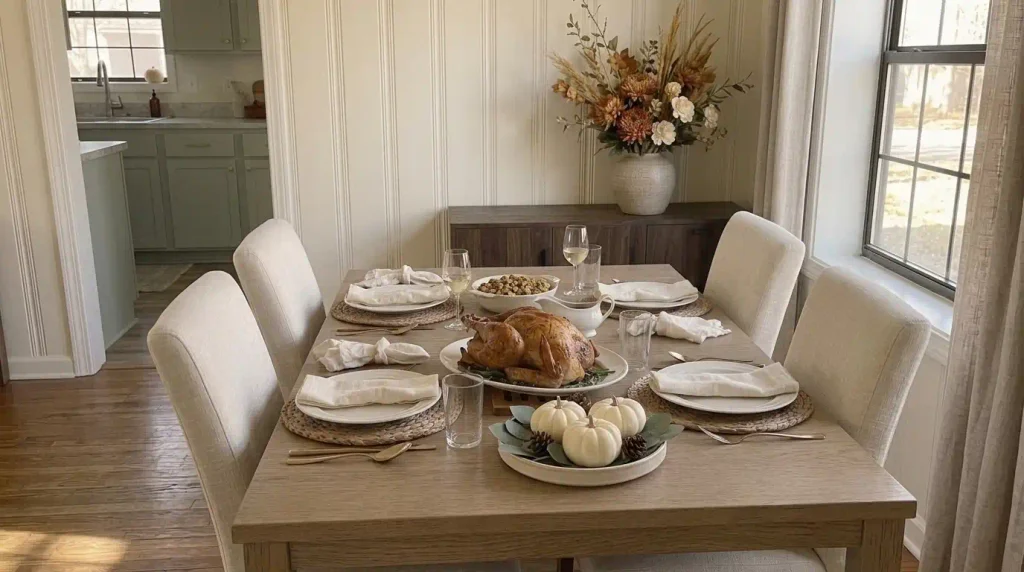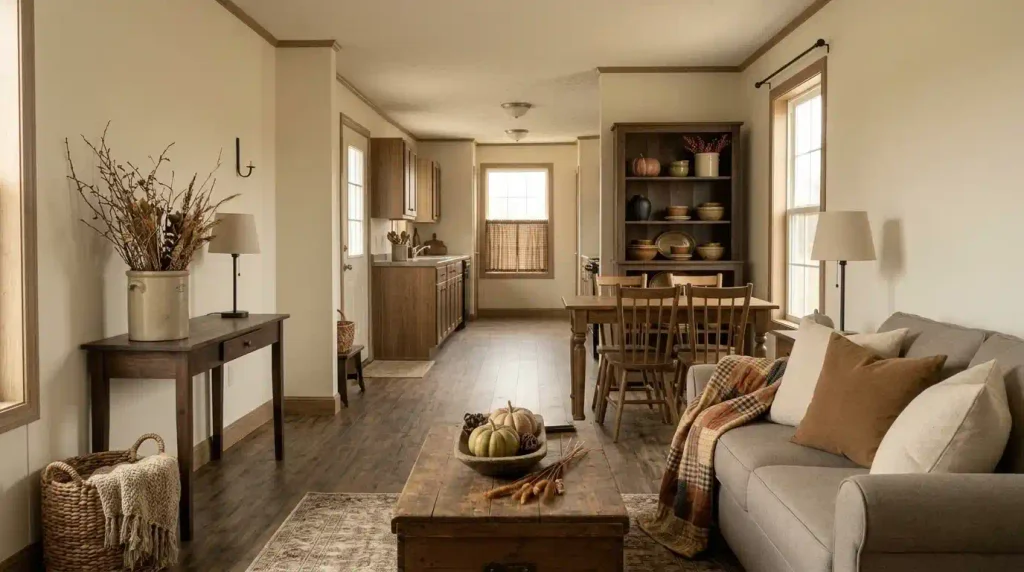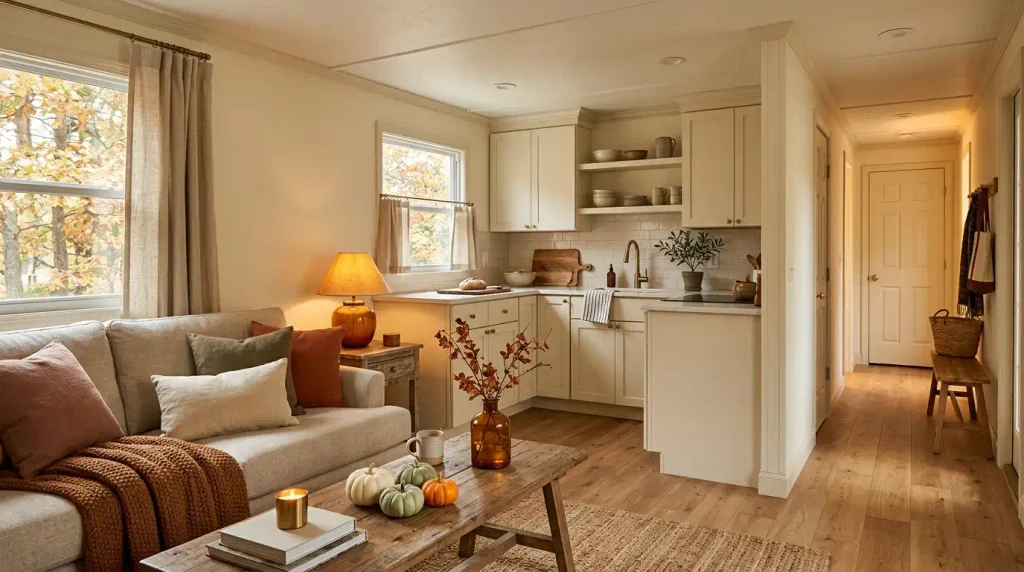
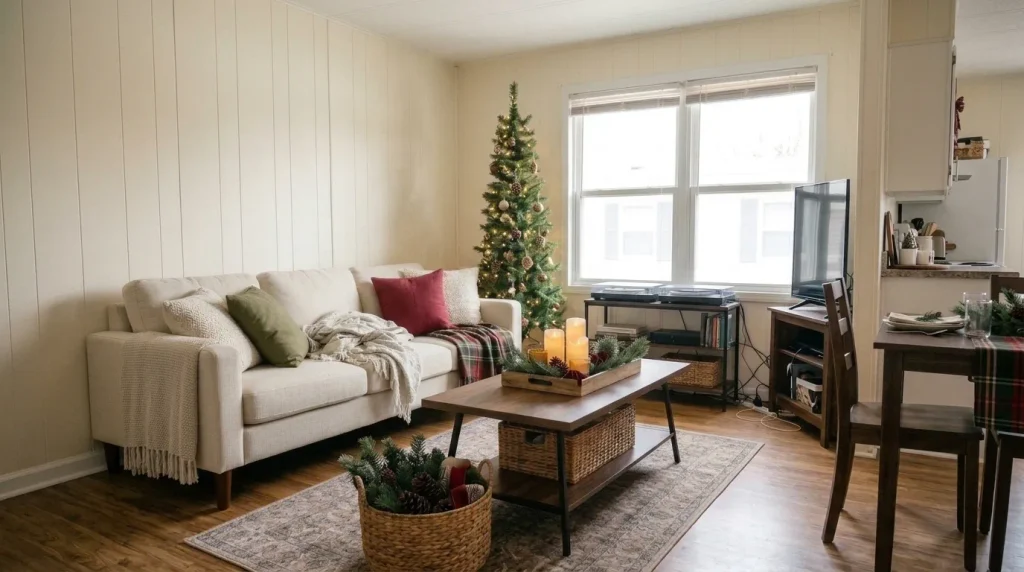
Packing away Thanksgiving decorations can feel like starting all over again. The pumpkins disappear, the table looks bare, and suddenly the living room needs an entirely different holiday look.
But many of those fall decorations can stay.
If you’re planning a Thanksgiving to Christmas decor mobile home transition, the smartest approach is to reuse the pieces that already suit your space. Wooden trays, woven baskets, neutral pillows, warm lighting, and natural textures can all become part of your Christmas setting.
The real change comes from replacing autumn-specific details with evergreen branches, Christmas ribbon, a few ornaments, and carefully placed lights.
In a small mobile home, that also means protecting the counter space, furniture arrangement, and walking routes you use every day.
Here’s how to make the switch, room by room, without turning holiday decorating into a complete home makeover.
Before You Start: What Is Actually Worth Replacing?
| Thanksgiving decoration | Christmas decision | Shopping priority |
|---|---|---|
| Wooden trays, wicker baskets, cream textiles | Keep as the foundation | None |
| Fall centerpieces and reusable greenery | Restyle with Christmas accents | Low |
| Pumpkin signs, turkeys, harvest-themed accessories | Store until next fall | None |
| Amber glassware and neutral candleholders | Keep if they fit the new palette | None |
| Christmas tree, ribbon, suitable lights | Add only what you need | Highest |
| Old ornaments and natural decorations | Inspect before reusing | Replace only if unsuitable |
You don’t need a matching Christmas decoration for every Thanksgiving piece you remove. A few well-chosen additions can change the appearance of the whole room.
1. Sort Thanksgiving Decorations Into Keep, Convert, and Store
Before you open a Christmas storage box, walk through your mobile home and gather the smaller Thanksgiving accessories from the living room, dining table, kitchen, and entryway.
Place them together on a table or another clear surface. You’ll probably notice that some pieces don’t look particularly autumnal when separated from pumpkins and harvest signs.
A wicker tray is simply a wicker tray. An ivory throw can feel as appropriate in December as it did in November.
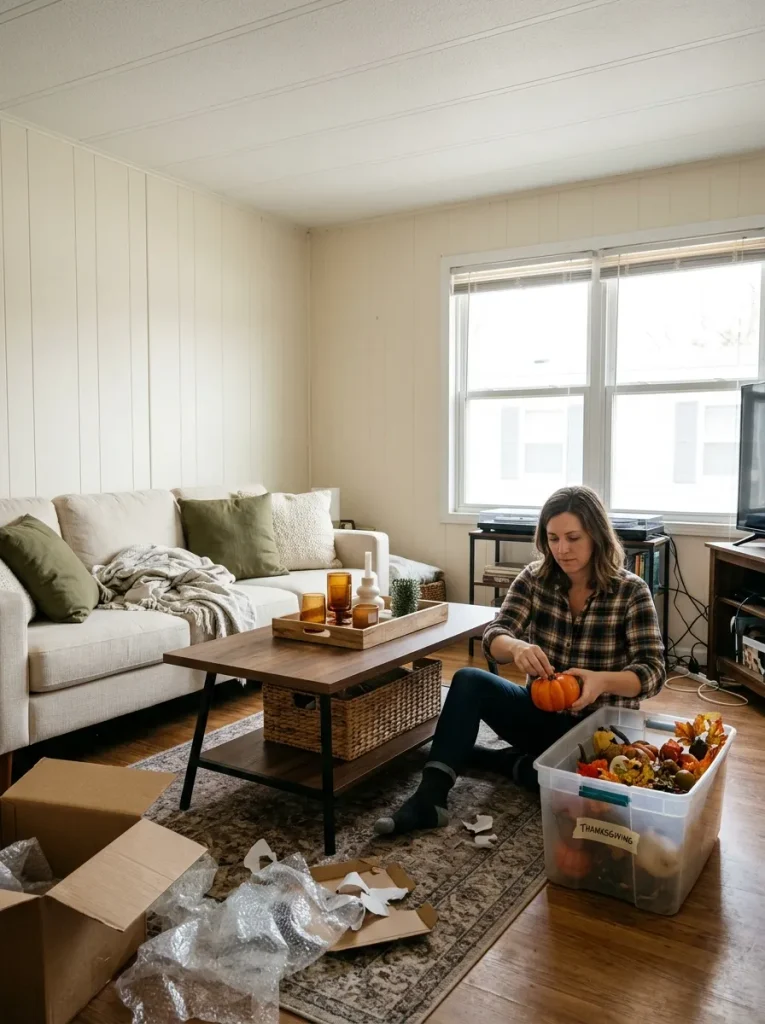
Divide everything into three groups.
Keep: Neutral pieces that already work with Christmas decorating. These might include wooden serving boards, white ceramics, glass jars, woven baskets, solid-colored pillows, and suitable battery-operated decorative lights.
Convert: Arrangements that need only a few changes. A fall centerpiece might become a Christmas centerpiece after its pumpkin accents are removed and evergreen sprigs are added. A reusable garland could receive small ornaments or ribbon, provided it’s still in good condition.
Store: Decorations strongly associated with Thanksgiving, including turkey figurines, artificial pumpkins, harvest banners, and autumn-specific signs.
Inspect natural decorations before deciding to reuse them. Discard spoiled produce or deteriorated foliage rather than placing it back on display.
If storage is limited, use a labeled container for the Thanksgiving-only items and keep the reusable neutrals accessible.
The sorting is finished when every seasonal object has a clear destination. There’s no need to replace a decoration simply because you’ve put it away.

The Seasonal Sorting Editor
The Seasonal Edit / 01
Keep, Convert, or Store?
Use the material and condition of each item to make the decision—not just its original holiday label.
Useful in both seasons
Plain glass hurricane holders, natural wooden risers, neutral blankets, and wicker storage.
Good foundation, wrong accents
A tray with miniature pumpkins: keep the tray, replace the harvest details, and add a compact winter arrangement.
Clearly Thanksgiving-specific
Turkey ornaments, harvest wording, and seasonal figures that would compete with Christmas motifs.
Quick decision: If removing one autumn accent makes an object season-neutral, try converting it before buying a replacement.
2. Build a Christmas Palette From Your Existing Fall Colors
The easiest seasonal color transition starts with the colors already surrounding your furniture.
Imagine a cream sofa with forest-green pillows, a brown wooden coffee table, and a beige rug. That combination can support both autumn and Christmas. The holiday changes when the smaller details change.
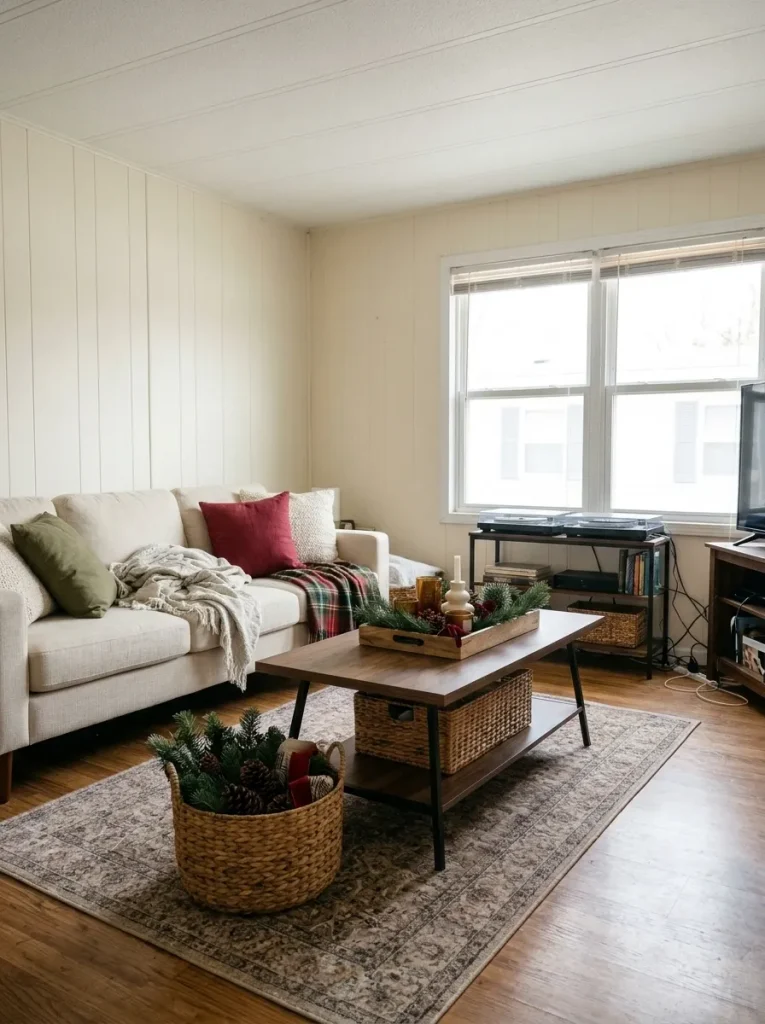
Start by removing the strongest pumpkin-orange accents, mustard leaves, and harvest-patterned accessories.
Keep the soft cream, natural wood, and olive tones. Introduce deeper evergreen through your Christmas tree or branches, then add a little cranberry red through ribbon, cushion covers, or ornaments.
You don’t need equal amounts of red and green. In a narrow living room, evergreen can carry most of the Christmas identity while a few red details provide contrast.
If your home already has a calmer, more contemporary style, skip the prominent red and work with pine green, ivory, and small metallic accents.
Many of the textiles and furniture combinations featured in these fall mobile home living room ideas can remain useful through winter.
Look at the room from the entrance after introducing the new accents.
If the overall impression is still autumn, remove one more strongly orange or harvest-themed element before adding anything else.
Fall-to-Christmas Color Translation
PALETTE TRANSFORMATION / 02
From Harvest Warmth to Christmas Green
THANKSGIVING PALETTE
Warm harvest colors dominate; wood and ivory are reusable.
CHRISTMAS PALETTE
Evergreen becomes the seasonal anchor; cranberry supplies a restrained accent.
3. Make Room for One Christmas Tree Without Rearranging Everything
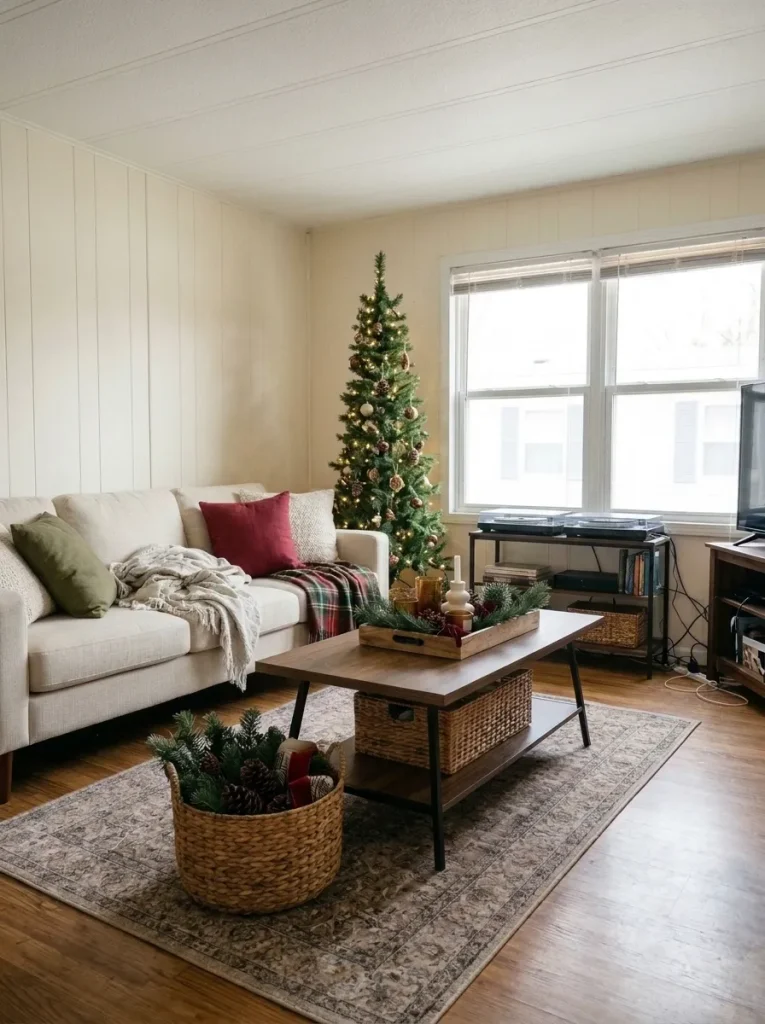
A Christmas tree changes the room more than almost any small decorative accessory. It also makes the biggest demand on floor space.
In a single-wide mobile home, the best position is often an available corner beside a window or at the quieter end of the sofa. But a location that looks empty before the tree arrives may become awkward once its branches are spread.
Start by measuring the actual available floor area, considering the complete tree stand and the widest branches. If you’re reusing an artificial tree, assemble its stand and check the lower branch spread before decorating it.
Consider three possible arrangements.
A window-side corner: This gives the tree a clear background and allows its lights to be seen from several parts of the living room. Choose it only if the tree doesn’t interfere with curtains, the window’s necessary operation, or a passage.
The end of the sofa: A slim tree can fit here when the sofa arm and tree base remain separate. Test the arrangement while someone is sitting at that end of the couch.
A smaller tabletop tree: If there isn’t a safe floor location, a stable existing surface may be the better option. Choose a tree appropriate to the surface and secure it as the product instructions require.
The tree shouldn’t force you to move the coffee table into the walking route or make someone squeeze past furniture to reach the kitchen.
If the room feels cramped, refer to these small mobile home living room layouts to understand how furniture grouping and movement routes work together.
Safety check: Keep the tree away from heat sources and don’t allow it to obstruct an exit. The National Fire Protection Association’s Christmas tree safety guidance recommends keeping Christmas trees at least three feet from heat sources, including heating equipment and candles. This is U.S. safety guidance; also follow your tree and lighting manufacturers’ instructions.
Once the tree is positioned and the usual routes still work, leave the furniture where it is. A compact Christmas tree shouldn’t require a complete living-room redesign.
Mobile Home Christmas Tree Placement Planner
SPACE PLANNING / 03
Will the Christmas Tree Really Fit?
This conceptual layout identifies useful relationships. It is not drawn to scale and does not prescribe clearance measurements.
Illustrative plan only. Your room may have a different door, window, or kitchen relationship.
Branches stay within the available area and seating works normally.
People must move furniture, squeeze past the base, or compromise an exit.
Choose the tree that leaves the room functioning normally—not the tallest tree that technically fits.
4. Turn the Thanksgiving Coffee Table Into a Christmas Centerpiece
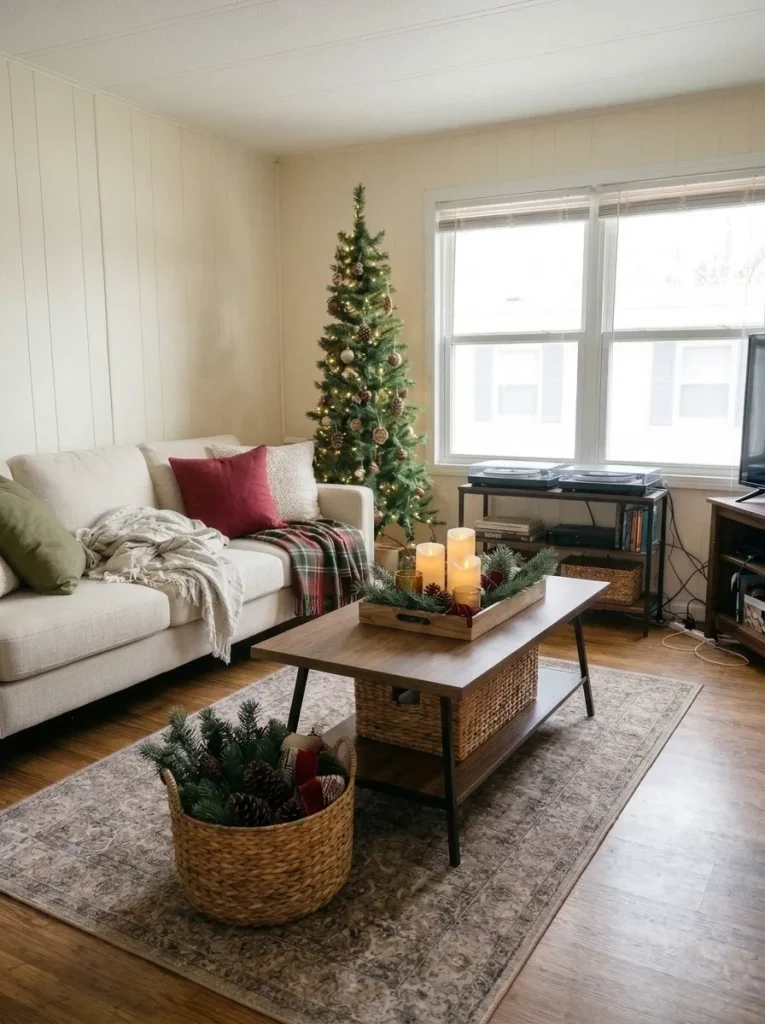
Your Thanksgiving coffee-table arrangement may already contain nearly everything needed for a Christmas centerpiece.
The easiest conversion begins with the tray.
Remove miniature pumpkins, artificial maple leaves, and autumn-specific decorations. Keep a sturdy wooden or metal tray that suits the room’s furniture.
Arrange a small amount of evergreen foliage along one side. Add two or three modest ornaments or decorative pinecones, then position flameless pillar candles of different heights within the grouping.
If your coffee table has a wooden top and dark metal frame, the contrast between natural greenery, ivory candles, and a few metallic accents will work particularly well.
Don’t cover the entire table. Keep the arrangement contained so there’s still a practical place for cups, books, or a remote.
The U.S. Consumer Product Safety Commission’s holiday safety recommendations encourage using flameless candles whenever possible, especially where combustible decorations could come near a flame.
A coffee table used by children or pets may need an even simpler arrangement, with breakable pieces omitted and small objects kept beyond their reach.
If the display looks too busy, remove the extra ornaments first. The combination of greenery, a reusable tray, and gentle candlelight is usually enough to communicate Christmas.
5. Give the Small Dining Nook a Christmas Reset
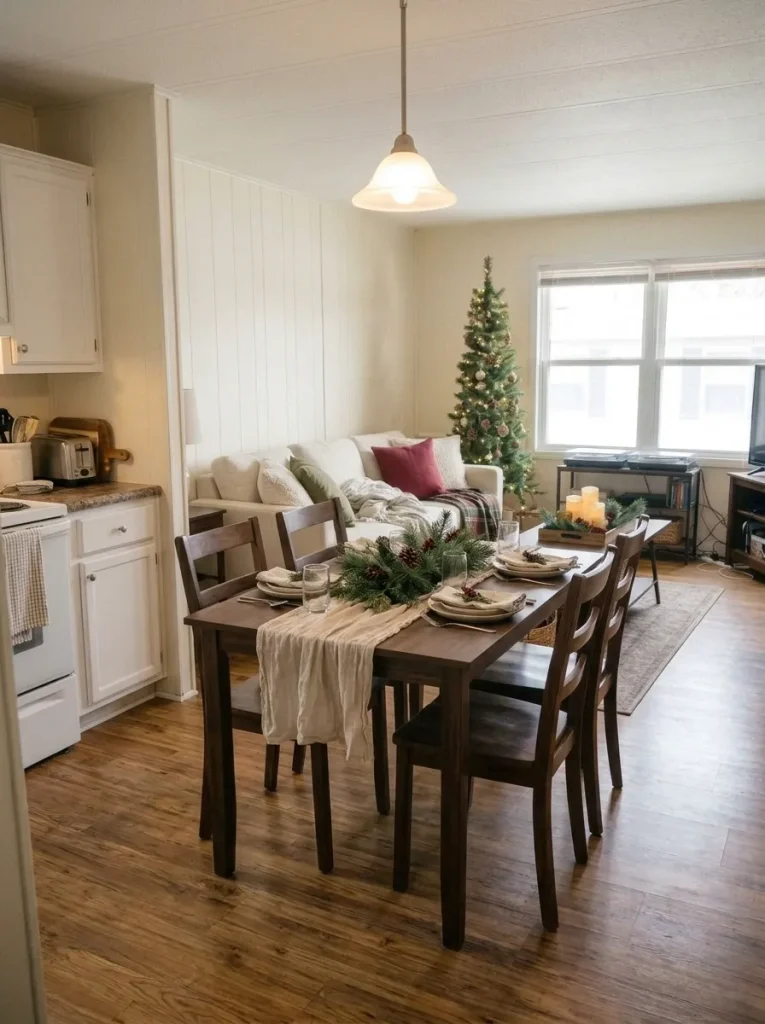
Thanksgiving dining tables tend to feature pumpkins, warm-toned napkins, harvest arrangements, and decorative serving pieces. You can keep the foundation while giving the table a noticeably different holiday character.
For a compact mobile-home dining nook, work through the transformation in this order.
1. Clear the existing centerpiece. Remove seasonal figurines and Thanksgiving-specific accessories, then wipe down the table.
2. Keep a suitable linen foundation. A cream runner or plain tablecloth can support Christmas decoration without requiring a completely different dining setup.
3. Add a low evergreen arrangement. A small bowl, narrow tray, or compact cluster of branches and ornaments creates a seasonal centerpiece without blocking diners’ views.
4. Test the table for a normal meal. Add the number of plates, glasses, and serving items your family actually uses. Pull out the chairs and check that everyone can sit comfortably.
For readers who styled their space with these Thanksgiving table settings for small mobile home dining nooks, the existing layout can provide a useful starting point.
A narrow dining table doesn’t need a full-length Christmas garland if it interferes with serving food.
If the table works well with only a folded runner and a small centerpiece at one end, keep it that way.
The transformation succeeds when the new holiday colors are recognizable but the dining nook still functions as an everyday eating area.
Thanksgiving-to-Christmas Table Reset
DINING NOOK / 04
The Three-State Table Conversion
01 / ORIGINAL
Thanksgiving TableCream runner, pumpkin arrangement, amber accents.
Retain: Runner and suitable serving pieces.
02 / CHANGE
Seasonal SwapStore pumpkin figures and position a compact evergreen arrangement.
Check: Keep the center accessible.
03 / CHRISTMAS
Everyday DiningEvergreen, restrained holiday accents, normal place settings.
Verify: Dishes, chairs, and serving space still fit.
Small-table decision: If a serving bowl requires the centerpiece to be moved, make that centerpiece one lightweight, removable arrangement.
6. Convert the Thanksgiving Dessert Station Into a Hot Cocoa Corner
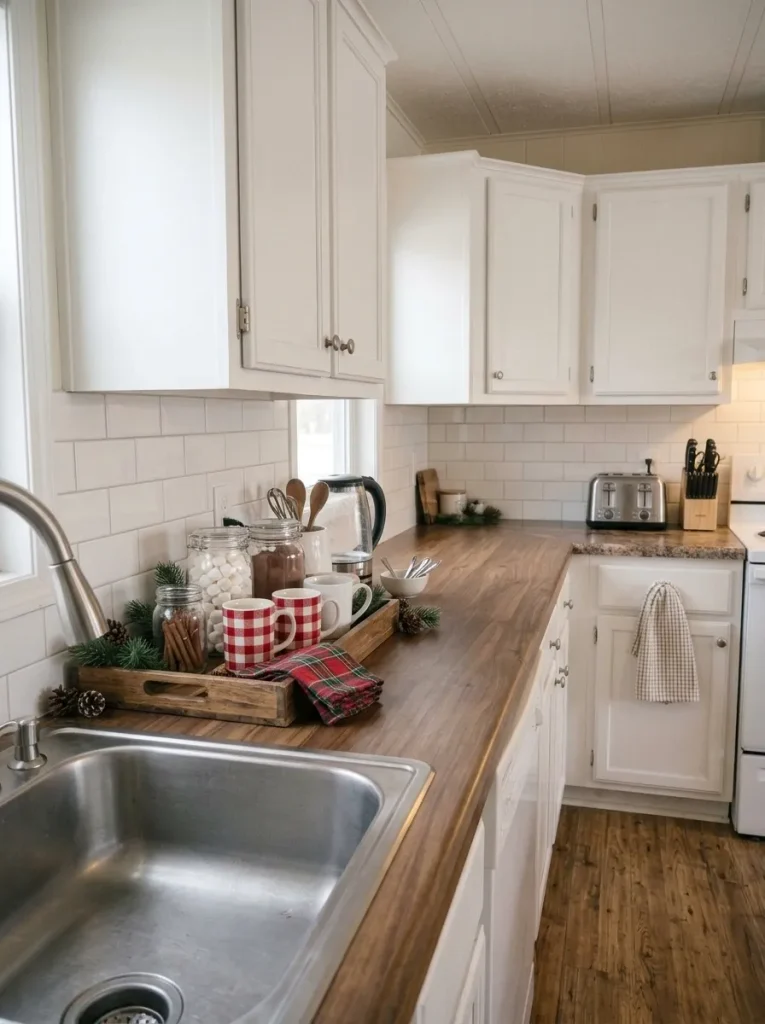
A Thanksgiving coffee-and-dessert setup can become one of the most useful Christmas decorations in a small kitchen.
Glass jars, serving boards, mugs, and woven trays already suit a winter beverage station. The main change is what you serve and how the accessories are arranged.
If you previously followed this Thanksgiving coffee and dessert station guide, keep the practical serving location that worked during the holiday.
Start by removing any leftover food and thoroughly cleaning the jars, trays, and counter.
Next, choose between two arrangements.
For a kitchen with a little spare counter space: Position a wooden tray at one end of the counter. Set out mugs, cocoa supplies, marshmallows in a sealed container, and a small dish of toppings. Keep a clean area available for assembling drinks.
For a very narrow counter: Store most supplies in a nearby cabinet or basket. Display only the mugs and a small seasonal accent until someone wants a drink.
A red-and-white checked mug or a gingham napkin introduces Christmas color without requiring several extra decorative objects.
If you use an electric kettle, coffee maker, or another hot-water appliance, keep it on an appropriate surface and follow the actual manufacturer’s instructions for placement and electrical use. Avoid draping garlands or fabric around heat-producing equipment.
You can also prepare hot drinks using an existing appliance elsewhere in the kitchen and use the station solely for mugs and toppings.
Choose a tray that is easy to lift when the counter needs cleaning.
The final arrangement should feel like a place where someone can comfortably make hot cocoa, not a decorative display that prevents them from using the kitchen.
7. Add Christmas Ribbon and Greenery to Kitchen Cabinets
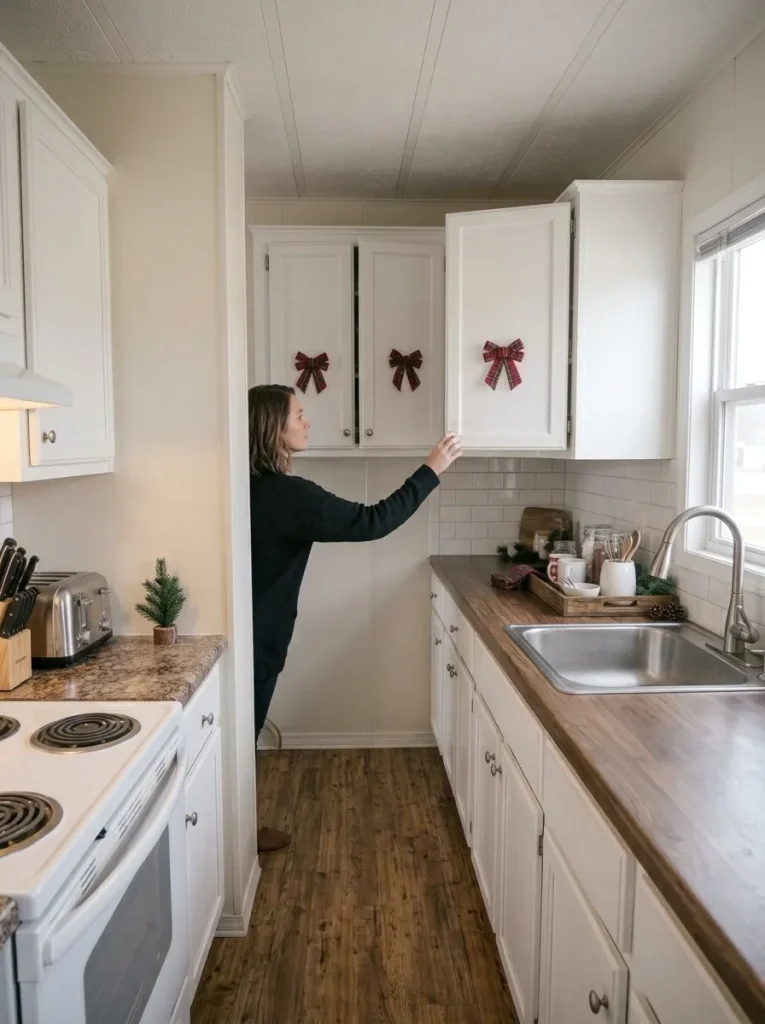
Once the counter is arranged, turn your attention to the empty-looking cabinets above it.
A few well-placed ribbons can bring more Christmas character into a white kitchen without requiring new shelves or countertops.
Cabinet handles: Where the hardware permits it, tie short plaid ribbons that won’t interfere with pulling the doors open. Test each decorated handle several times before repeating the treatment.
Upper cabinet displays: If you have an existing stable shelf or suitable decorative ledge, a small group of lightweight artificial trees can add winter greenery without taking away food-preparation space.
Window or backsplash area: A restrained evergreen accent can connect the kitchen to the rest of your home’s decorations, but it must remain clear of cooking equipment, heat, switches, vents, and daily working areas.
Avoid assuming that adhesive hooks will be suitable for every cabinet finish. Check the actual product instructions and surface compatibility before using removable mounting products.
The reference kitchen with large red ribbons works because the bows are repeated across an otherwise restrained set of white cabinet doors.
You don’t need that treatment on every cabinet.
Try two or three visible accents, then check the kitchen from the dining nook. If the seasonal effect is already clear, leave the remaining doors undecorated.
8. Make Dried Orange and Cinnamon Christmas Decorations
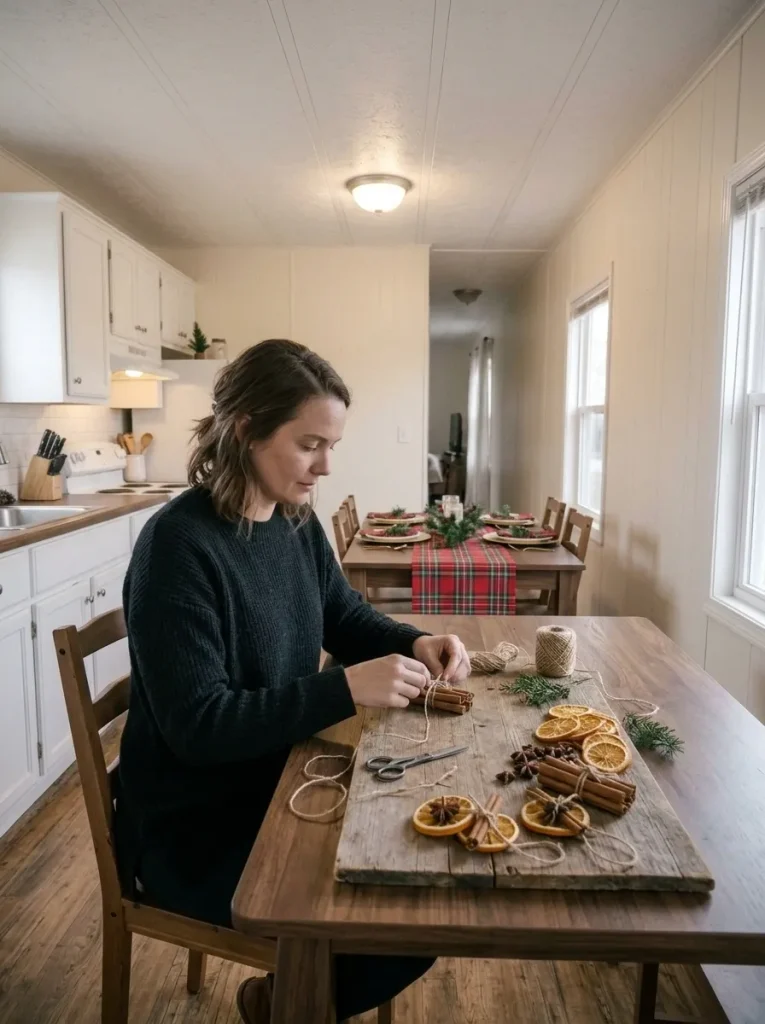
Dried orange slices, cinnamon sticks, twine, and natural greenery are useful materials for carrying the warmth of Thanksgiving into Christmas.
They can become rustic tree ornaments or small decorations attached to a suitable existing display.
You don’t need a complicated craft project. Start with one ornament and repeat the design only if the finished result suits your home.
What You’ll Need
- Fully dried orange slices in good condition
- Cinnamon sticks
- Natural twine
- A blunt, suitable craft needle or a small length of wire for threading, if needed
- Scissors
- Optional lightweight star-anise or artificial greenery accents
Make the Ornament
Step 1 — Select the orange slices. Choose slices that are completely dry and firm. Avoid pieces that feel damp, have signs of mold, or crumble under gentle handling.
Step 2 — Group the cinnamon sticks. Place two small sticks together, then bind them securely with twine. Leave enough twine to connect the arrangement to the orange slice.
Step 3 — Attach the orange. Thread a separate hanging loop carefully through a suitable opening near the top of the slice. Support the slice while doing this so it doesn’t crack.
Step 4 — Finish the decoration. Connect the cinnamon bundle, adjust the position, and tie a secure hanging loop. A small artificial evergreen accent can complete the arrangement.
Test the ornament gently before hanging it.
If the orange cracks around the hole, replace it rather than relying on a weak edge. If the cinnamon sticks slide, retie the bundle before adding the ornament to the tree.
You can use several finished pieces on an artificial tree or an appropriately supported decorative branch.
Keep these natural materials away from open flames and heating equipment. Small or fragile decorations should also remain out of the reach of young children and pets.
The result is a Christmas ornament that preserves the natural textures and earthy character of your Thanksgiving décor without looking like a leftover harvest display.
Natural Christmas Ornament Workshop
DIY WORKSHOP / 05
An Ornament From Autumn Materials
Four construction checks turn simple natural ingredients into a lightweight Christmas decoration.
-
01Choose fully dried slices
Reject any slice that feels damp or breaks too easily for threading.
-
02Bind the cinnamon
Tie the sticks firmly enough that none slide out during handling.
-
03Attach the hanging loop
Position the twine through a firm section of the slice without tearing the edge.
-
04Perform a gentle hanging test
Check the loop, knot, citrus edge, and cinnamon bundle before displaying.
Craft stop signal: If the ornament cannot hang without twisting, slipping, or cracking, repair the connection before making more.
9. Use Doorways and Walls for Christmas Décor Without Crowding the Floor
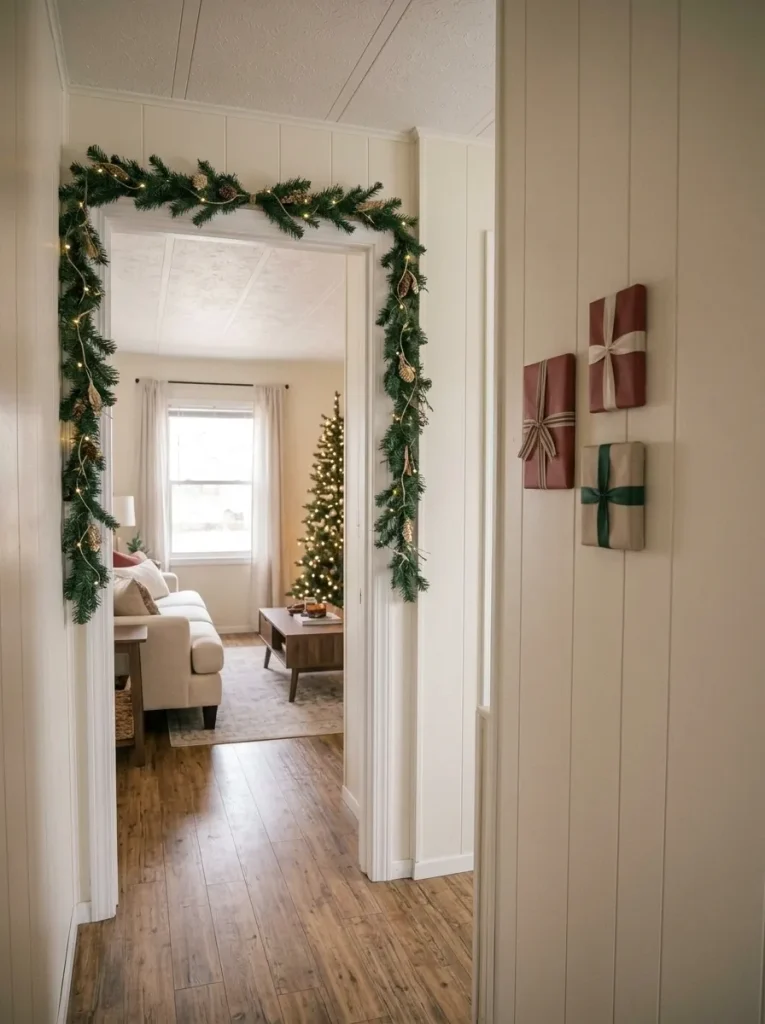
Once your tree and tabletop arrangements are finished, you may still have one plain wall or doorway that could carry a little seasonal decoration.
This is where the more dramatic Christmas inspiration photographs can be adapted to a mobile home.
A large arch covered in lights and ornaments may look beautiful in a spacious house, but a narrow doorway needs a much simpler approach.
Start by identifying what kind of surface is actually available.
An open wall above the sofa: Consider a few lightweight, gift-inspired decorative panels. You can make these from empty, suitably lightweight decorative boxes or wrapped flat panels. Keep the arrangement small enough to suit the sofa and use an attachment method appropriate for the wall and the actual items.
A suitable doorway: If the trim and attachment method permit it, add a short, lightweight evergreen garland along an appropriate part of the opening. Check that the door can open fully and that the decoration doesn’t hang into the walking route.
An existing shallow shelf: Instead of hanging anything, arrange a modest set of miniature artificial trees or other stable Christmas accents. This is often the simplest choice in rentals where wall attachments are restricted.
Avoid hanging a large curtain of ornaments from an unverified ceiling structure. The ceiling and attachment method must be appropriate for the load; decorative panels or fixtures are not automatically suitable supports.
Your entryway also has a job beyond looking festive. Coats, shoes, and bags need their own places, as discussed in these Thanksgiving entryway storage ideas.
Keep that practical arrangement working through Christmas.
The U.S. Fire Administration’s home escape planning guidance advises that doors and windows remain unobstructed. This is general U.S. fire-safety guidance, not a substitute for any requirements specific to your home.
If a garland catches the door, a decorative panel projects too far, or an attachment seems unreliable, shorten, relocate, or omit that decoration.
The objective is to use vertical space wisely—not to fill every visible surface.
Vertical Christmas Decorating Decision Board
VERTICAL SPACE / 06
Where Can Christmas Decor Go?
Choose a location according to what it can support and how people use the surrounding space.
01 — Open wall: lightweight festive panels
Best when: The wall is clear, the hanging method is suitable, and the arrangement doesn’t interfere with seating.
Reject when: The decoration is too heavy or no reliable attachment can be identified.
02 — Doorway: restrained evergreen trim
Best when: The trim and fastening method are suitable and the door remains fully operational.
Reject when: Branches, ribbon, or attachments obstruct the opening or required exit route.
03 — Existing shelf: a small winter collection
Best when: The shelf is stable, suitable for the weight, and away from unsafe heat or electrical exposure.
Reject when: Items are at risk of being knocked down or the display interferes with normal use.
Use a stable existing surface. Christmas decoration doesn’t need ceiling or wall installation to feel complete.
10. Give the Bathroom One Small Christmas Accent
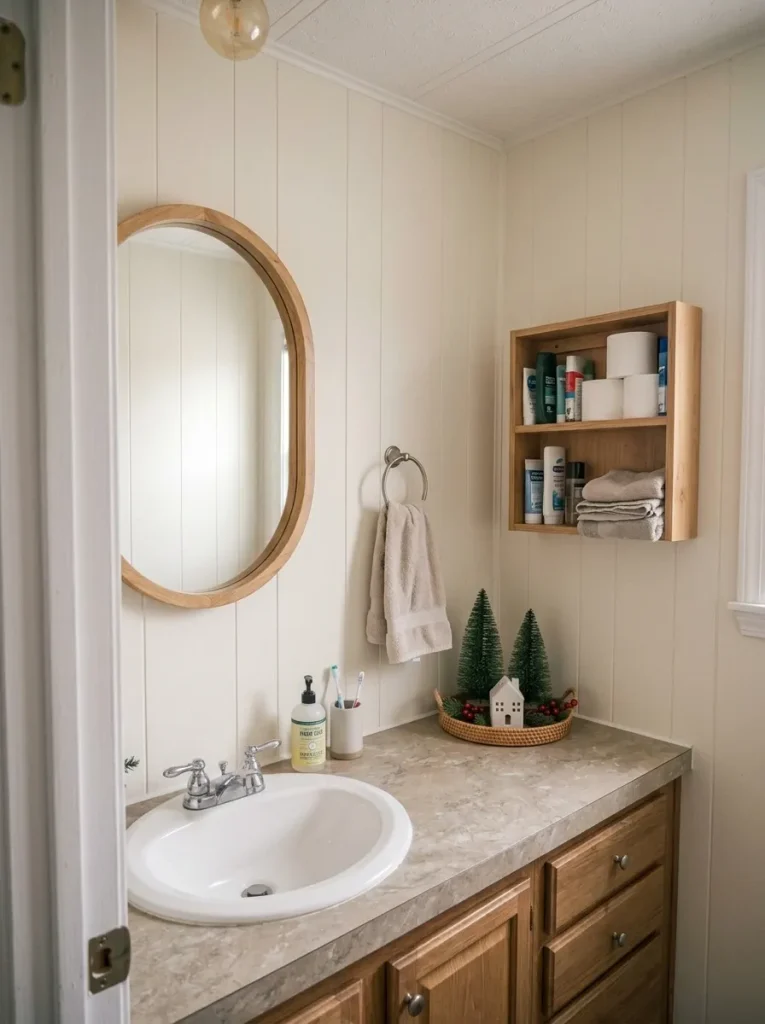
A small mobile-home bathroom doesn’t need a complete Christmas makeover.
If you already have a shallow vanity tray, use it for one simple seasonal arrangement. A miniature artificial evergreen branch, a small ceramic house, or another washable decorative accent can connect the bathroom to the rest of the home.
A suitable battery-operated flameless light may provide an additional cozy detail, but only use products appropriate for their intended location and keep electrical items away from sink splashes unless expressly designed for that exposure.
The sink, tap, soap, and everyday cleaning space should remain easy to access.
If the counter is especially small, place one accent on an existing stable shelf instead of adding a tray.
The bathroom is finished when a single detail suggests Christmas without making normal routines more difficult.
11. Check the Lights, Clear the Walkways, and Store the Leftovers
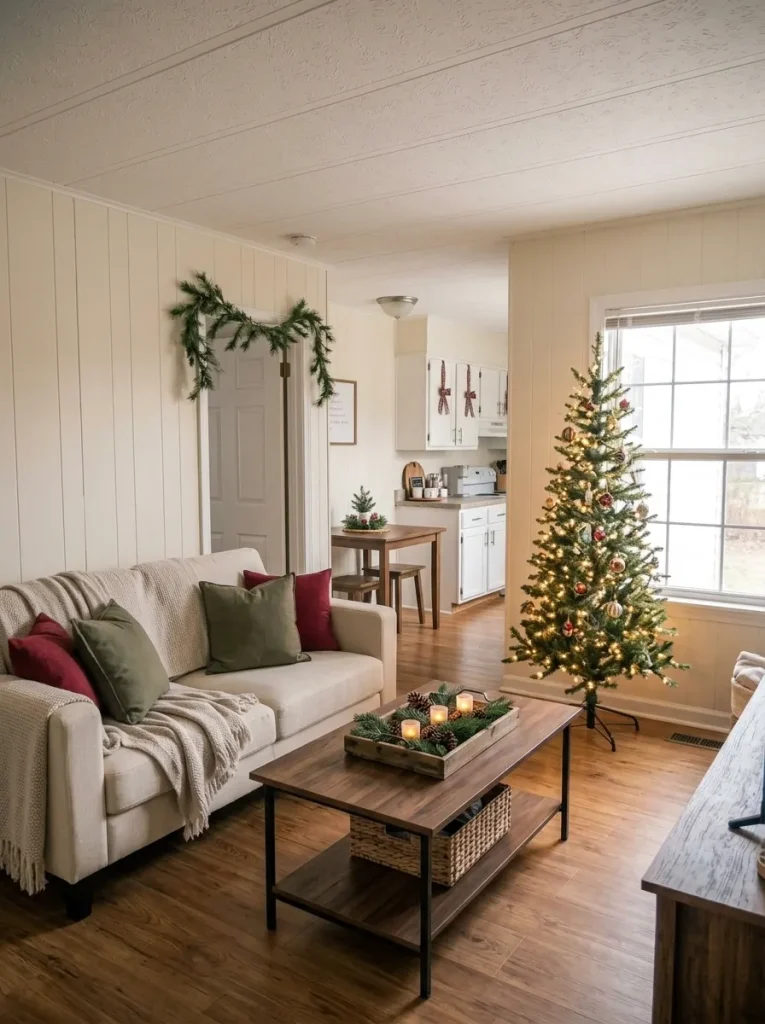
With the decorations in place, take one final walk through your home.
Start at the entrance and move toward the living room. Sit on the sofa, reach the coffee table, and walk toward the kitchen as you normally would.
Next, pull out the dining chairs, open the cabinet doors, and check the kitchen work surfaces.
Pay special attention to decorations that hang from doors, rest on narrow furniture, or depend on temporary attachments.
Inspect each decorative light strand before using it. Don’t use damaged cords, loose connections, or lights that aren’t suitable for the intended indoor location. Follow the manufacturer’s instructions for connecting light strings and turn Christmas tree lights off before leaving home or going to bed.
For additional guidance, the U.S. Consumer Product Safety Commission’s holiday safety page explains precautions for seasonal lighting, electrical outlets, and candles.
Finally, return the remaining Thanksgiving accessories to their labeled containers.
Store fragile decorations so they won’t be crushed, keep natural materials dry where reuse is appropriate, and separate broken or unsuitable items for disposal.
You don’t need to add more decorations simply because an empty shelf is visible.
If the tree is proportional, the table is usable, the kitchen works normally, and the seasonal accents look connected, your Christmas transition is complete.
Christmas Conversion Final Inspection
FINAL WALKTHROUGH / 07
Is Your Christmas Home Ready?
Use this short inspection after every major decoration is in place.
-
Living room
Tree stable, normal seating available, and routes unobstructed.
-
Dining nook
Chairs operate comfortably and the table can still serve meals.
-
Kitchen and bathroom
Appliances, cabinets, sinks, and cleaning surfaces remain usable.
-
Doors and wall displays
Decorations are suitably supported and all required openings remain clear.
-
Lights and storage
Lighting inspected and unused Thanksgiving pieces put away.
Finished means festive and functional.
If all five areas pass, enjoy the home you’ve decorated. More ornaments aren’t automatically an improvement.
A Christmas Home That Still Feels Like Yours
Turning Thanksgiving decor into Christmas decor doesn’t require new furniture, expensive matching collections, or decorations covering every available surface.
The wooden tray that held pumpkins can hold evergreens. The neutral throw that made Thanksgiving feel welcoming can stay on the sofa. Even a few natural craft materials can become Christmas ornaments.
The strongest transformation comes from choosing what changes and allowing the familiar parts of your home to remain.
When the lights come on, the tree fits comfortably, and every room still works for daily life, you’ve achieved something better than a crowded holiday display: a Christmas home that’s comfortable to live in.
Save this guide on Pinterest so you can make the Thanksgiving-to-Christmas transition easier next year, too.