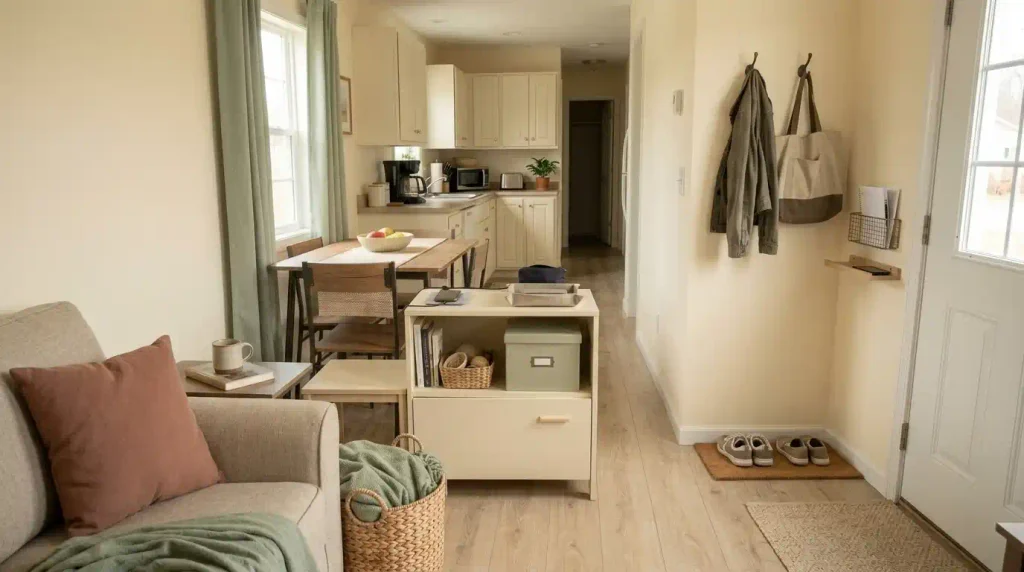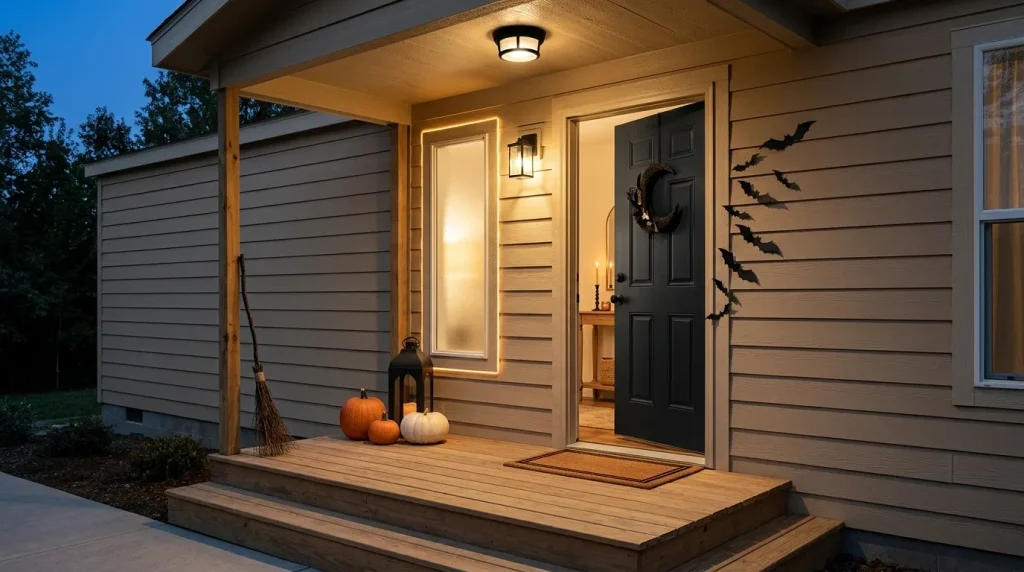
Thanksgiving guests have a way of arriving together: someone is holding a pie, another has a handbag and an overnight tote, and three winter coats need somewhere to go before anybody can step inside. In a small mobile home, a beautiful entryway can become a bottleneck the moment coats begin covering the door-side wall or the dining-room chairs.
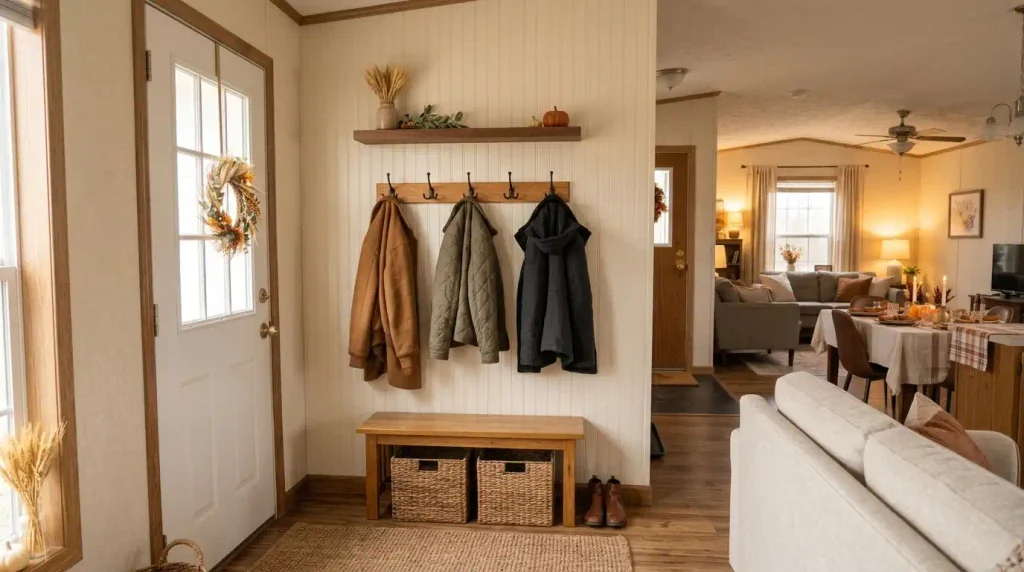
If you are planning Thanksgiving guest coat storage in a mobile home, these ideas are built around that particular hosting problem. You will find compact coat walls, recessed nooks, temporary rails, closet strategies, and guest-identification systems that work with different entry shapes. Some suit a rental; others make sense when you own the home and can confirm suitable wall support.
Start with the arriving guests’ route. Open the entry door completely, stand where someone would take off a coat, and trace the walk toward the living or dining area. Keep exit routes, door operation, and frequently used switches clear. The U.S. Fire Administration’s home escape planning guidance advises keeping doors and windows free of obstructions. Once that movement works, choose the storage idea that makes the Thanksgiving welcome feel calm, warm, and effortless.
1. Turn a Narrow Beadboard Wall Into a Thanksgiving Guest Coat Station
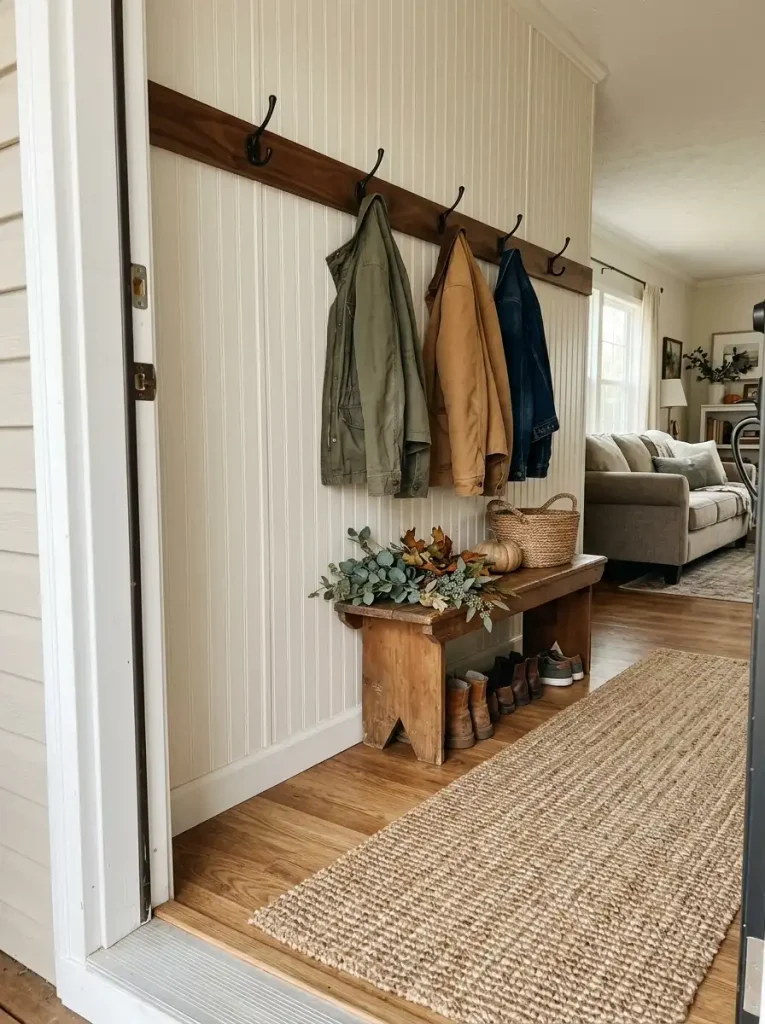
A plain strip of wall beside the entrance can become a handsome coat station with vertical beadboard, one solid rail, and a carefully spaced set of hooks. Warm white boards make the area feel part of the home; black or aged-brass hardware adds enough contrast to help visitors find the hooks. A small harvest print above the rail gives it a seasonal note without filling the floor with decorations.
Do the coat test before the style test. Hang your bulkiest winter jacket from a temporary hook position, then open the front door and have someone walk past carrying a dish. The coat’s shoulder projection matters more than the empty hook. In a single-wide where the front door opens straight into the living room, a rail may belong on the first side wall—not on the wall everyone must pass.
If the route gets squeezed, reduce the number of hooks or move overflow storage farther inside. Coats stay easy to find, but the entrance remains usable.
Interactive Guest-Arrival Pressure Map
Where Should Thanksgiving Coats Land?
Three small-mobile-home entry layouts, three different coat-storage decisions. Choose the closest floor arrangement and compare where jackets fit without interrupting the arrival route.
Green indicates coat storage; lighter green indicates the guest route. Check actual door swing and clearance.
Pull the coats off the direct path.
Use a tested sidewall with a few secure hooks. Move overflow jackets to a closet or spare room.
Protect the hallway’s usable width.
Choose one side for a slim rail. Coats on opposing walls can make the hallway difficult to pass.
Let the niche absorb the pause.
Place hooks and a lightweight accessory shelf inside the recess. Add a bench only where another guest can pass.
Safety baseline: Keep doors, exits and circulation unobstructed. These diagrams are concepts, not measurements or construction plans.
2. Make a Recessed Entry Nook Work as a Coat-and-Bag Drop-Off
An existing recessed niche has a useful advantage: its storage can sit partly outside the main walking line. Treat it as a small arrival sequence, with a shelf for a lightweight guest bag, hooks for jackets, and a low bench only if the remaining space allows someone to sit and stand comfortably.
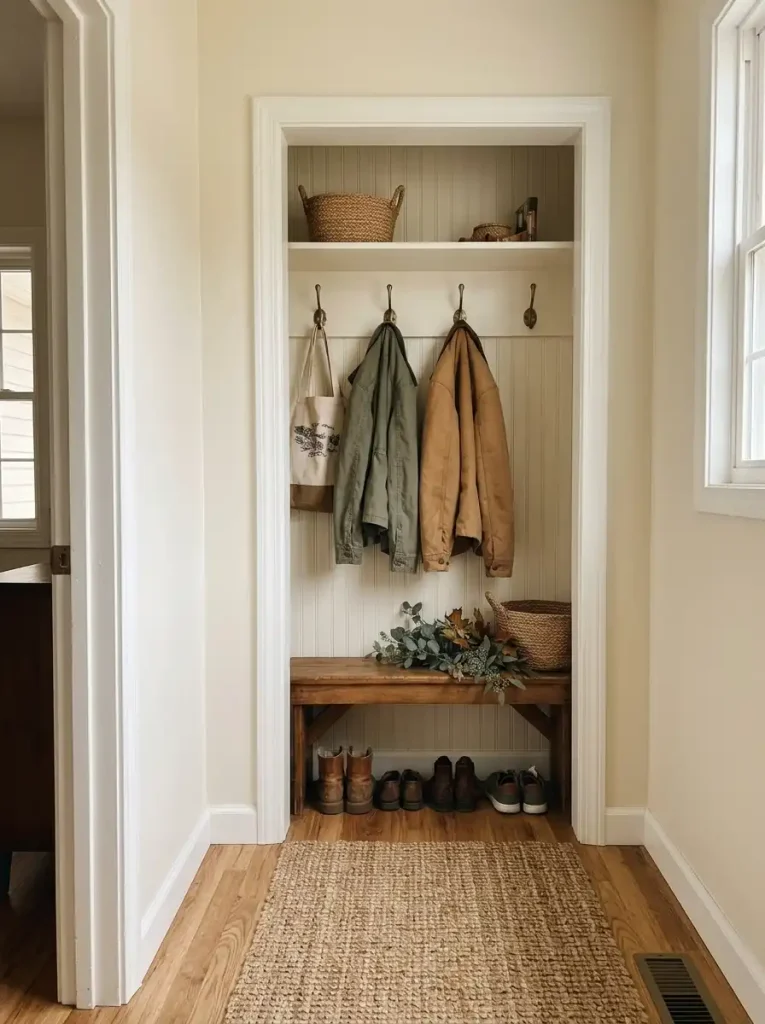
Imagine two people coming in together. The first steps into the nook, takes off a coat, and moves toward the gathering. The second should be able to pass without waiting in an open exterior doorway. If the niche is too shallow for that choreography, remove the bench and keep a hanging-only arrangement.
Nook decision: Keep the shelf clear for setting down a purse or gloves. Add a seat only when the first guest can step fully out of the path; a beautiful bench is optional.
3. Give a Wood-Framed Coat Alcove Warm Evening Lighting
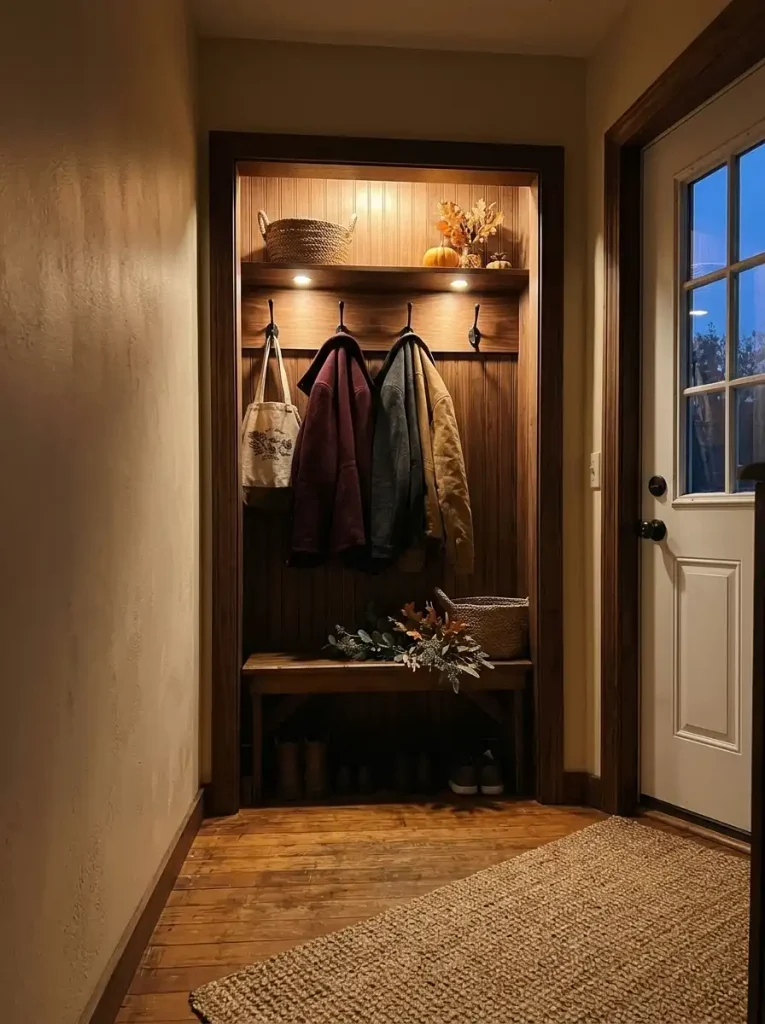
Late-November evenings can make a walnut-stained coat alcove appear deeper than it is. A restrained light inside the upper shelf illuminates hook positions and helps guests distinguish black, navy, and charcoal coats when leaving after dinner. It also gives the entry a particularly welcoming Thanksgiving glow.
There are two practical routes. If a suitable existing fixture already lights the alcove, test it with coats in place before buying anything. If you need additional light, consider a manufacturer-approved battery-operated, low-heat fixture located where coats and bags cannot cover or strike it. Follow the product’s placement instructions. Any new hardwired lighting belongs with a qualified electrical professional.
Night-Visibility Test
- Hang three dark jackets and dim the adjoining room.
- Ask someone unfamiliar with the nook to identify one jacket.
A useful warm pool of light is better than a dramatic fixture that leaves the hooks in shadow.
4. Reserve a Proper Hanging Bay in Your Existing Entry Closet
When the front hall already has a small closet, the least conspicuous Thanksgiving makeover may be an afternoon of editing. Temporarily move everyday family outerwear elsewhere, clear one entire rod section, and set out a few matching hangers. Guests with longer or structured coats will appreciate full-length hanging space; squeezing those coats onto a short double-hang arrangement can leave hems crushed.
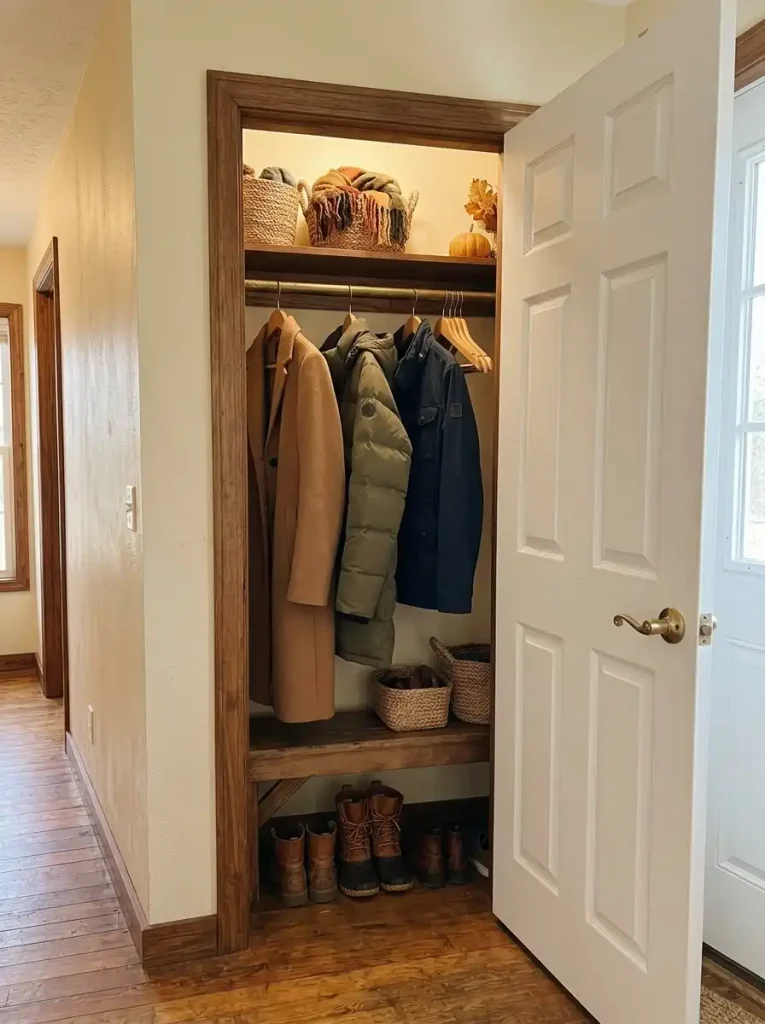
Keep one reachable upper shelf for lightweight guest scarves and hats. Avoid piling handbags on the floor where they can catch the door or become hard to identify. Before guests arrive, test whether the closet door opens fully while another person is standing in the entry.
For permanent improvements after the holiday, the site’s mobile home closet ideas guide covers reach-in access, rod arrangements, and other everyday closet problems in more depth. For Thanksgiving, a cleared hanging bay may be all you need.
Hanging Capacity Editor
The Thanksgiving Hanging-Bay Studio
Your existing closet might be your best guest-coat solution. Select the outerwear mix to see what deserves hanging space and which storage mistake to avoid.
Preserve an uninterrupted drop.
Move your household coats temporarily so longer guest garments can hang without folded hems or crushed shoulders.
Give puffy sleeves breathing room.
Arrange short jackets on separate sturdy hangers. Avoid crowding the rod until sleeves snag when one jacket is removed.
Separate garments from accessories.
Reserve rod space for coats, a reachable shelf for lightweight scarves and a stable low spot for heavy bags.
5. Choose a Freestanding Hall Tree When You Cannot Drill Into Walls
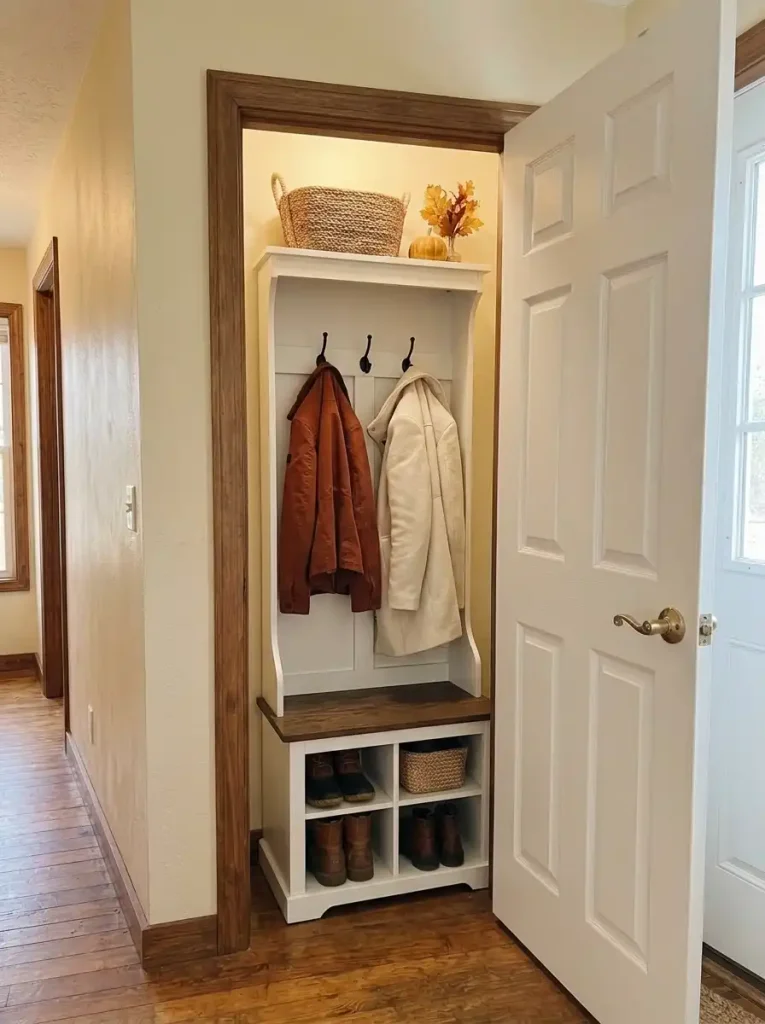
Rental restrictions or uncertain wall construction may make a freestanding hall tree the better answer. A unit combining coat hooks, a narrow bench, and open shoe cubbies can collect several kinds of belongings in one intentional footprint. White cabinetry with a dark timber seat feels light and farmhouse-friendly beside a pale mobile-home door.
The key comparison is not storage capacity on the product label. It is the unit’s loaded footprint: how far coats extend, whether the bench blocks a turn, and what happens when a guest hangs a heavy bag on one side.
Choose furniture rated for the intended loads, follow assembly instructions, and secure it as directed. The U.S. Consumer Product Safety Commission’s Anchor It! campaign explains furniture tip-over risks and why suitable pieces should be anchored.
Hall-Tree Fit Choice
- Comfortable corner available: Try a properly assembled compact hall tree.
- Only a tight turning space: Use a narrow wall-independent option or move overflow to the secondary-room solution in idea 11.
Before buying, compare the hall tree against a cleared closet or borrowed freestanding rail: the latter options may meet a one-day need without adding permanent furniture.
6. Build a Slim Timber Coat Rack With a Useful Entry Bench
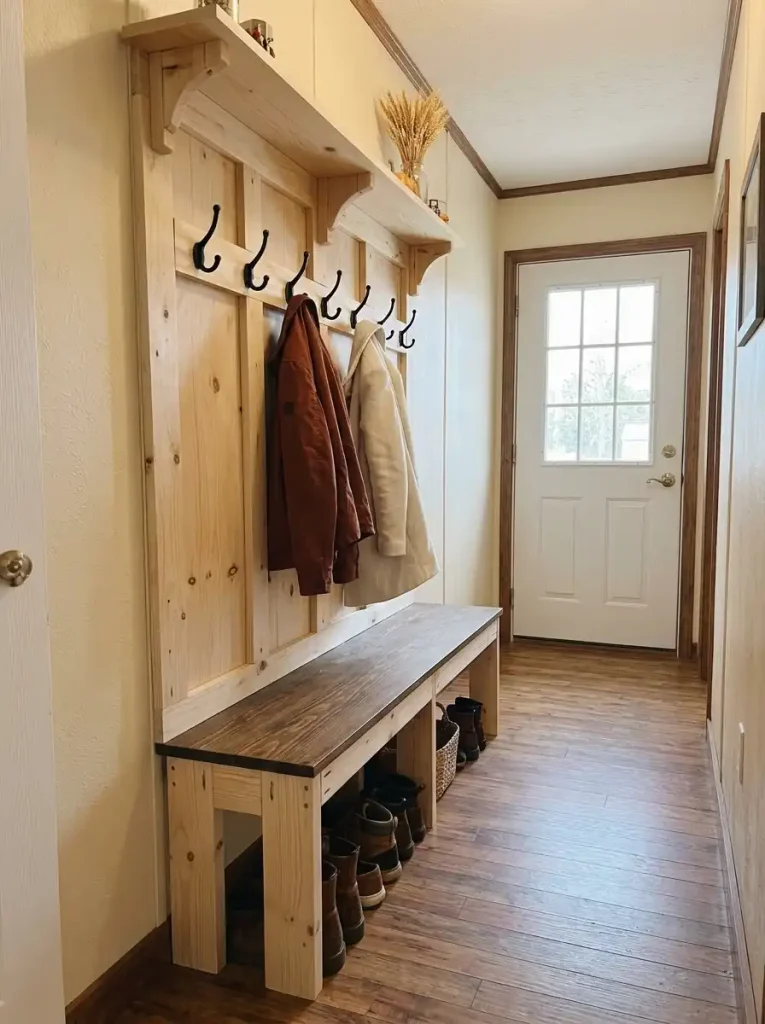
For an owner with a suitable installation surface, a slim timber rack has an advantage over a deep cabinet: its dimensions can follow the available wall. A narrow shelf above hooks gives a place for lightweight gloves or seasonal accents; a modest bench underneath supports shoe changes. Pale unfinished wood, simple braces, and dark hooks create a relaxed farmhouse look.
Construction Order
- Tape the full bench footprint on the floor, including the space someone needs to sit and rise.
- Hold the longest coat at its intended hook and check the bench-to-hem relationship.
- Identify actual framing or use a professionally specified mounting system; decorative wall panels alone must not be assumed to carry people, bags, or coats.
- Construct and finish the rack only after the door and walking tests pass.
A bench attached to a wall rack requires its own properly designed support; do not assume the coat-hook rail can carry seating loads. For other build types, see DIY mobile home storage projects.
7. Fit a Short Peg Rail on an Awkward Door-Side Wall
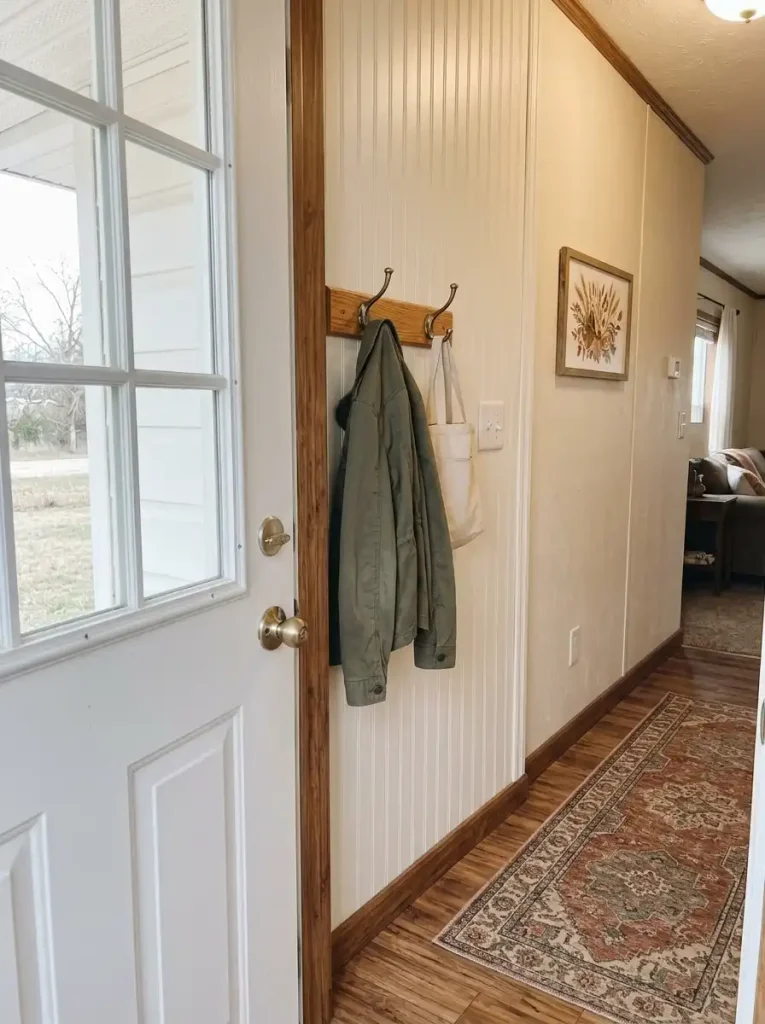
The strip between a door casing and a light switch may look wide enough for several hooks. Once a winter coat hangs there, though, its shoulders and sleeves occupy space that the bare wall measurement misses. That matters especially in a mobile home where the entrance is part of the living-room walkway.
Make a full-size mock-up before drilling:
- Tape the peg-rail length on the wall, leaving the switch and trim available.
- Hold your bulkiest jacket at both proposed hook positions while another person opens the door.
- Carry a grocery bag past the hanging garments; if it brushes fabric, reduce the hooks or reject the location.
A short oak rail with two dark hooks can still look deliberate. The decision is whether the wall has coat-shaped clearance, not whether a rail fits neatly between two pieces of trim.
8. Arrange Two Hook Rows for Adults and Children
A double-row beadboard coat wall looks wonderfully organized in an inspiration photograph. During a Thanksgiving visit, however, two rows of full winter coats can overlap so much that the lower row becomes useless.
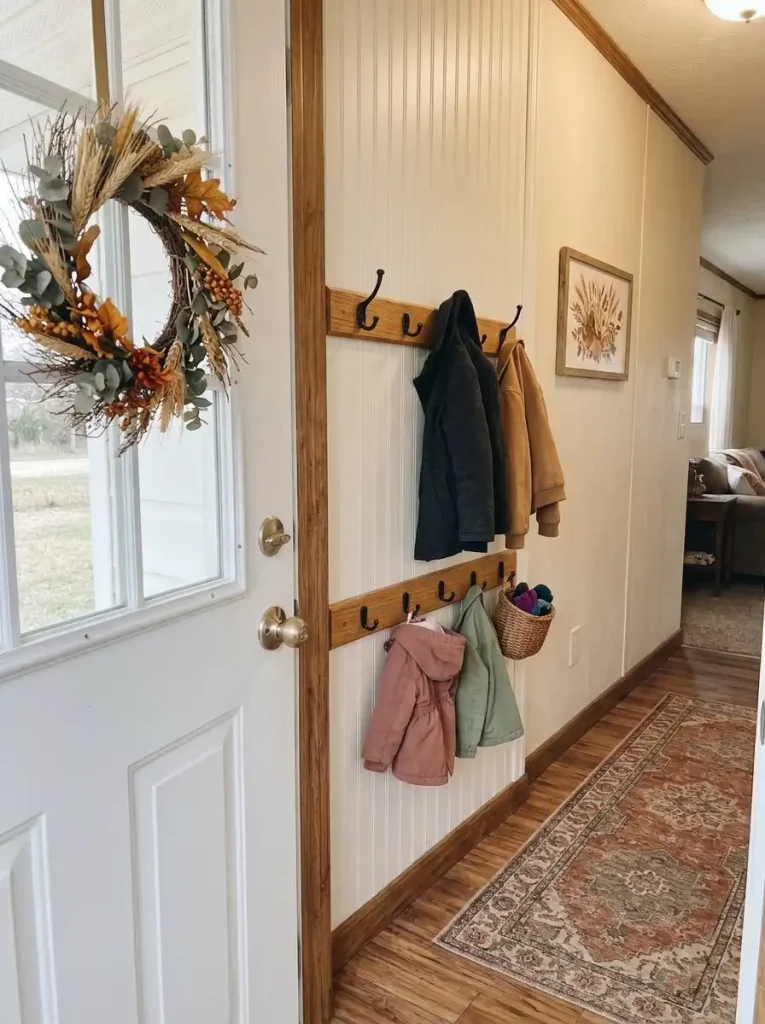
Treat the second row as a different-height access zone, not automatic doubled capacity.
For a family gathering, designate adult-height hooks for substantial coats and place children’s lighter jackets on an easy-to-reach lower row, separated enough to prevent tangled sleeves. If visiting children are very young, an adult may still need to manage hanging and collection. Check that no hook ends project into a route where guests could brush against them.
Stop rule: Choose one row for bulky full-size puffers. Two rows earn their place only when garment lengths and user reach are truly different.
Two-Level Hook Elevation Analyzer
Two Rows. One Wall. Will They Clash?
A second coat rail is only worthwhile when garments stay usable. Select the guest mix to compare how the same wall performs.
Bulky coats can hide the lower hooks.
Choose a single rail when long puffers cover the lower line. Move holiday overflow to a cleared closet or another suitable room.
Separate reach zones can work.
Use a reachable lower row for lighter child-size jackets. Check overlap and projecting hardware; younger children may need an adult’s help.
Reserve the bottom rail for small items.
Scarves or compact accessories may fit below longer coats. Store heavy handbags low on a stable surface so straps do not trail into the walkway.
9. Keep Guest Bags Above the Coats and Shoes Below
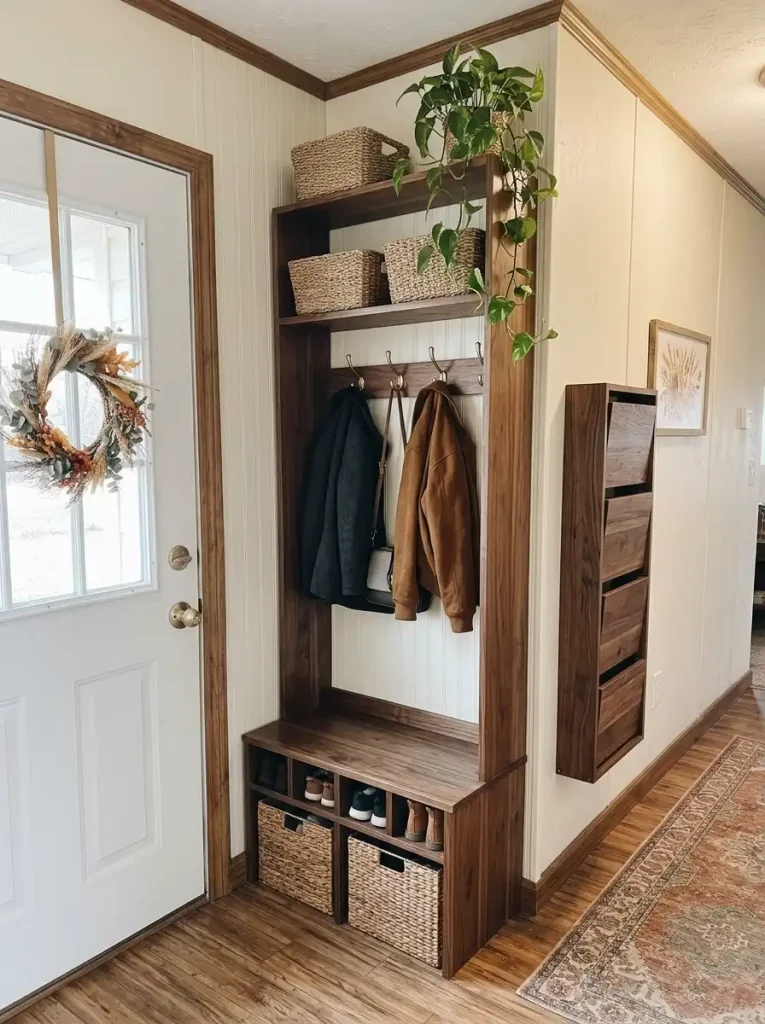
The elegant walnut entryway with upper baskets, brass hooks, and lower shoe storage illustrates a useful organization principle: each layer has a distinct assignment. Light accessories go into reachable upper baskets; jackets hang in the middle; heavy totes and footwear occupy stable, accessible lower storage. Small handbags can use their own reachable cubby, so handles do not tangle with coat sleeves.
Assign Each Storage Level
- Upper baskets: Lightweight scarves and gloves, never heavy totes.
- Middle hooks: Coats on securely supported fittings.
- Lower cubbies: Heavy totes and footwear, separated into accessible spaces.
Keep wet boots separate from textiles.
Choose shallow pieces around the existing entry’s available reach, then test retrieval with an actual filled tote. For broader ways to gain vertical capacity, visit vertical storage ideas for small mobile homes; this Thanksgiving version is specifically about separating temporary guest belongings.
10. Style a Guest Coat Bench With Subtle Thanksgiving Wallpaper
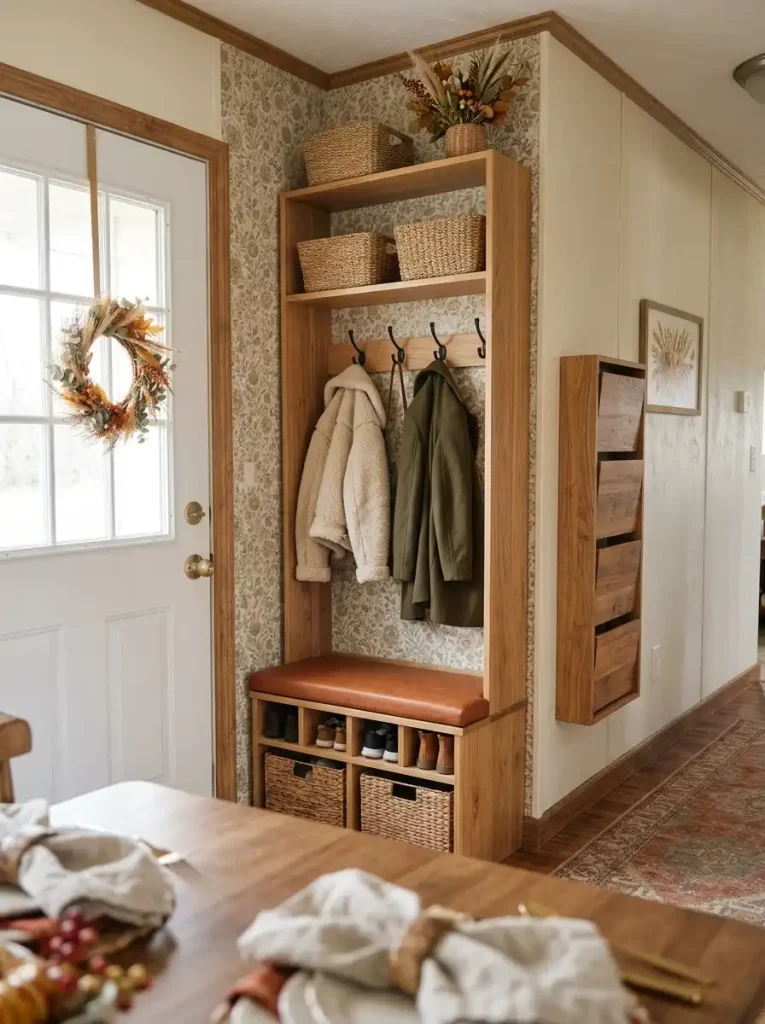
A small floral or vine-patterned wallpaper panel can make the coat area feel thoughtfully finished, especially when viewed from the Thanksgiving dining table. Choose a muted botanical pattern in olive, rust, and cream; add a wipeable or removable bench cushion and a few cubbies beneath. The texture makes a functional storage wall feel at home among holiday decorations.
Which Backdrop Fits the Sightline?
- Visible from the Thanksgiving table: A quiet print can link the coat station with the dining area.
- A nook crowded with jackets: Plain beadboard usually gives the eye more relief.
Photograph the entrance from the dining chair before committing to the print. If hanging coats visually cover most of the wall, invest in storage first and use a single small harvest detail on an upper shelf. For a wider autumn decorating approach, explore small fall entryway ideas for mobile homes.
11. Bring In a Portable Hanger Rail for Bulky Winter Coats
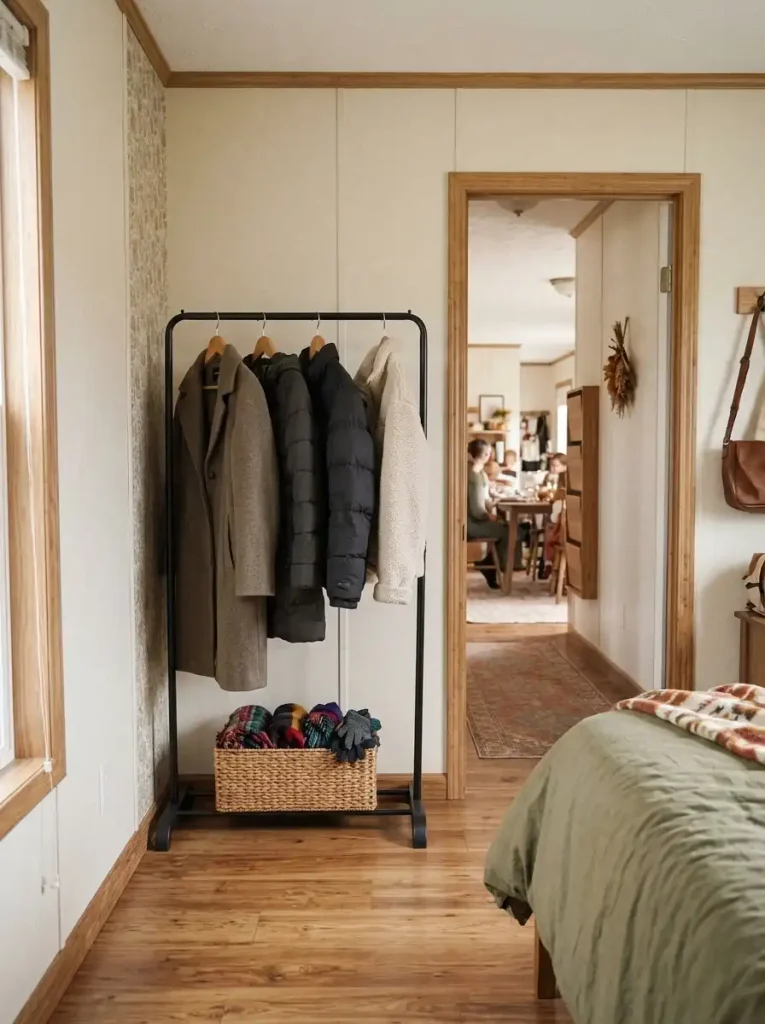
A large Thanksgiving dinner can overwhelm even a beautifully built entry rack. A portable garment rail offers a temporary capacity zone, particularly when the front door opens directly into a narrow living room. The important move is placing the rail where guests can reach it without creating a new pinch point near a doorway.
Portable-Rail Setup Check
- Verify the rated garment load and a level, stable surface.
- Apply manufacturer-specified brakes or other restraints when provided.
- Leave space to select one coat without pulling down its neighbors.
- Keep doorways and circulation out of the rail footprint.
If no secondary room is suitable, use host-assisted transfer to available safe storage farther inside.
After dinner, the rail can be folded away or returned to everyday use. You gain holiday capacity without permanently redesigning your living room around a once-a-year crowd.
Holiday Overflow Storage Studio
Thanksgiving Coat Overflow, Solved.
The front entry should be a landing zone, not an entire coat warehouse. Choose the spare space you actually have to see a realistic overflow strategy.
Make the spare room your coat lounge.
Use a rated stable garment rail where people can select jackets without standing in the bedroom door or blocking an exit.
Borrow a closet for the evening.
Move household garments elsewhere and keep a clear hanging bay for guest coats. This is often simpler than acquiring new furniture.
Make the host the coat transfer point.
Receive garments at the entry, move them to an existing safe storage place, then retrieve them before guests gather at the front door.
12. Use One Stable Corner Coat Stand When Wall Space Is Missing
Is the corner empty at shoulder height, or only at floor level? A freestanding coat stand has a small central stem, but hanging jackets expand into a much wider circle. In a narrow mobile-home entry, that invisible extra width can erase the apparent benefit.
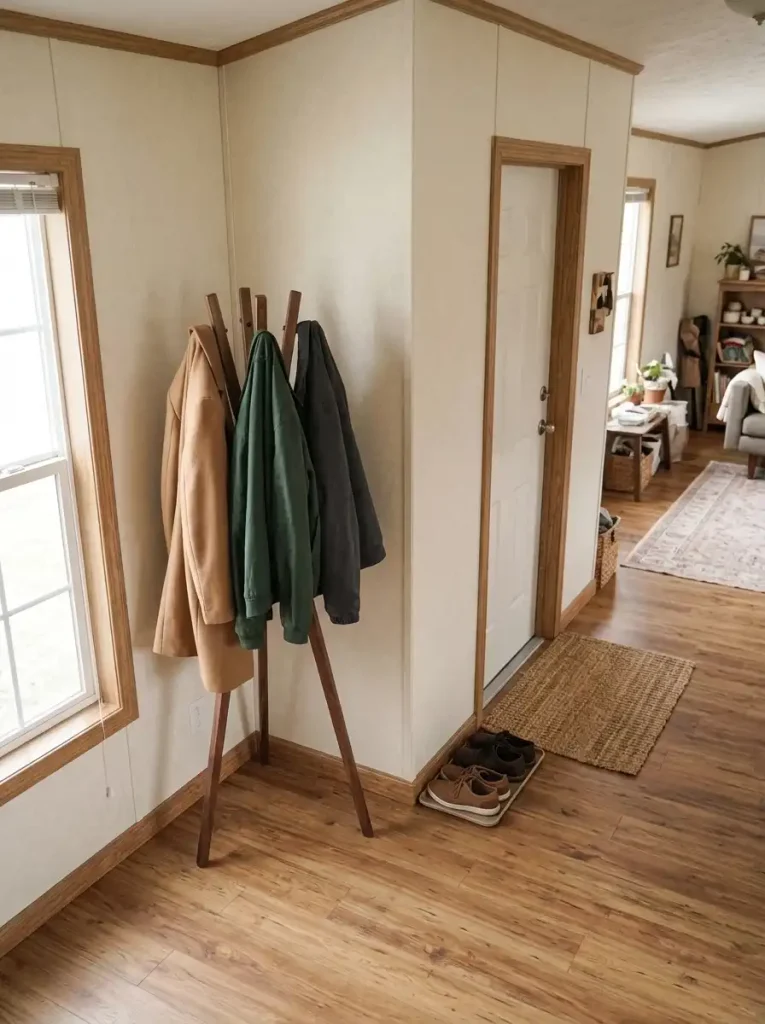
Test the stand’s intended position with a bulky coat held at the outermost hook height. Rotate the coat toward the nearest doorway and walking line. Then assess the base and rated garment load, because removing coats from one side changes how the stand is balanced.
- Choose it: For a modest number of coats in a true unused corner, with a stable product and room around every loaded hook.
- Skip it: If the door touches a sleeve, guests must sidestep the base, or heavy bags would concentrate on one side.
A small stand is a controlled overflow option, not a replacement for a properly sized family closet.
13. Give a Suitable Interior Door Temporary Coat Storage
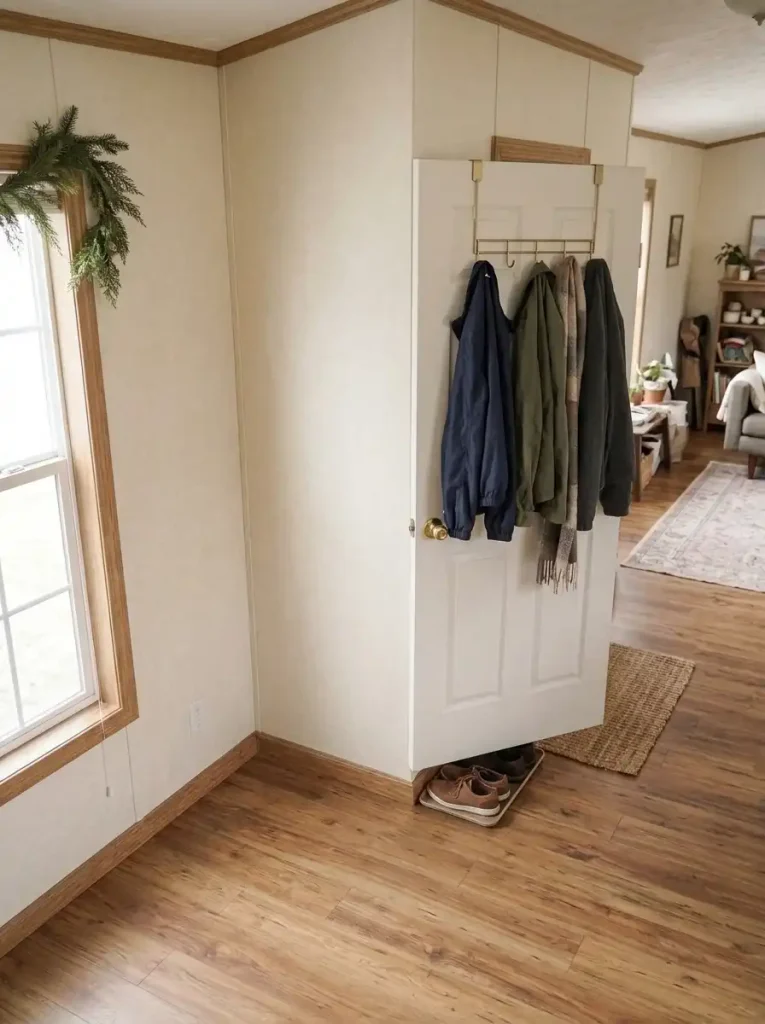
An over-door organizer can help when a mobile home has nearly no free entry wall, but the specific door matters. An interior closet or utility-room door with suitable clearances may hold a small number of lightweight guest garments on a product designed for that door. The main exterior entry, exit route, and thin or ill-fitting doors are poor places for an improvised heavy rack.
Over-Door Rack Fit Check
- Confirm the product matches the interior door thickness and rated load.
- Check the top gap and hardware contact points.
- Open and close the door slowly with a sample light jacket hanging.
- Remove the rack if it rubs against trim or interferes with normal operation.
The payoff is selective, temporary storage. Use it for a few light jackets where a door can still operate normally. If the rack prevents full closure or safe access, remove it and choose another option rather than forcing the fit.
14. Conceal a Secondary Coat Zone Behind a Soft Curtain
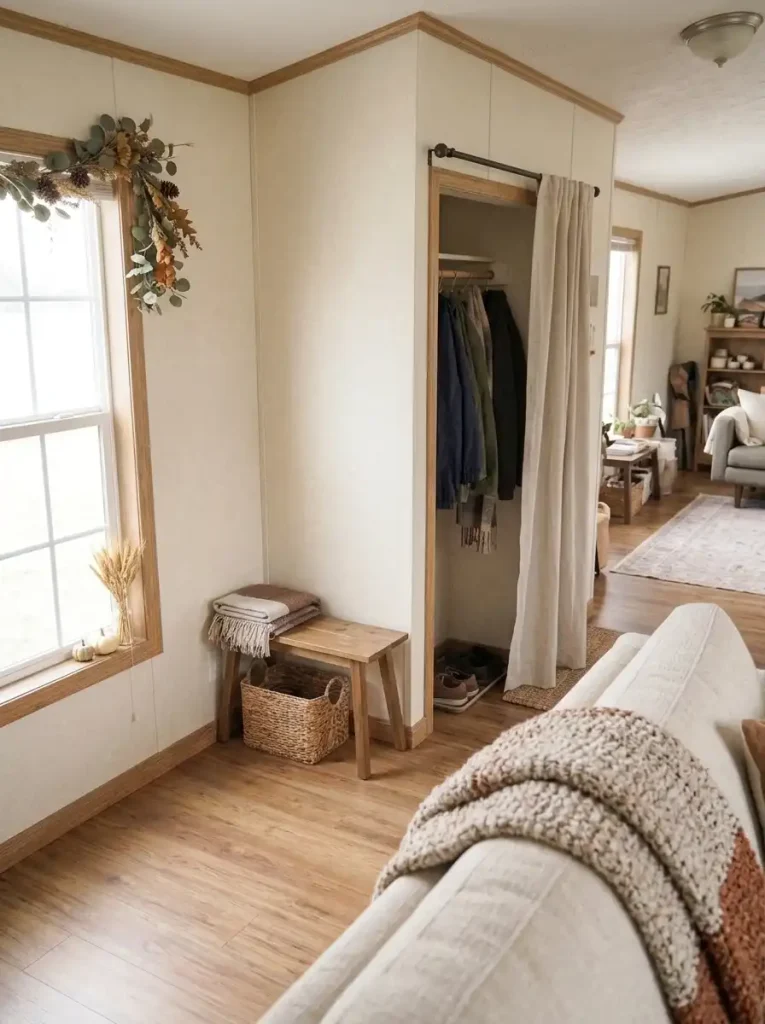
The coat rail that works beautifully during arrivals can dominate the view from a Thanksgiving dining chair. An existing adjacent recess offers a chance to soften that sightline with a washable oatmeal or muted-olive curtain, while coats remain on properly supported hangers behind it.
Compare the two placements before mounting anything:
| Potential location | Best test | What would rule it out |
|---|---|---|
| Curtain across an existing alcove | Can someone collect a jacket without entering the dining-chair zone? | Fabric brushes wet garments, obstructs a door, or hangs near a heater |
| Visible open rail farther inside | Can guests identify their coats at a glance? | Rail intrudes into the kitchen-to-table service route |
Sit at the dining table and rehearse coat retrieval. If a curtain makes access awkward, leave the rail visible and style only the surrounding wall; concealment has no value when people must push through chairs to retrieve a coat.
15. Set Up a Simple Coat-Tag System for a Crowded Thanksgiving Dinner
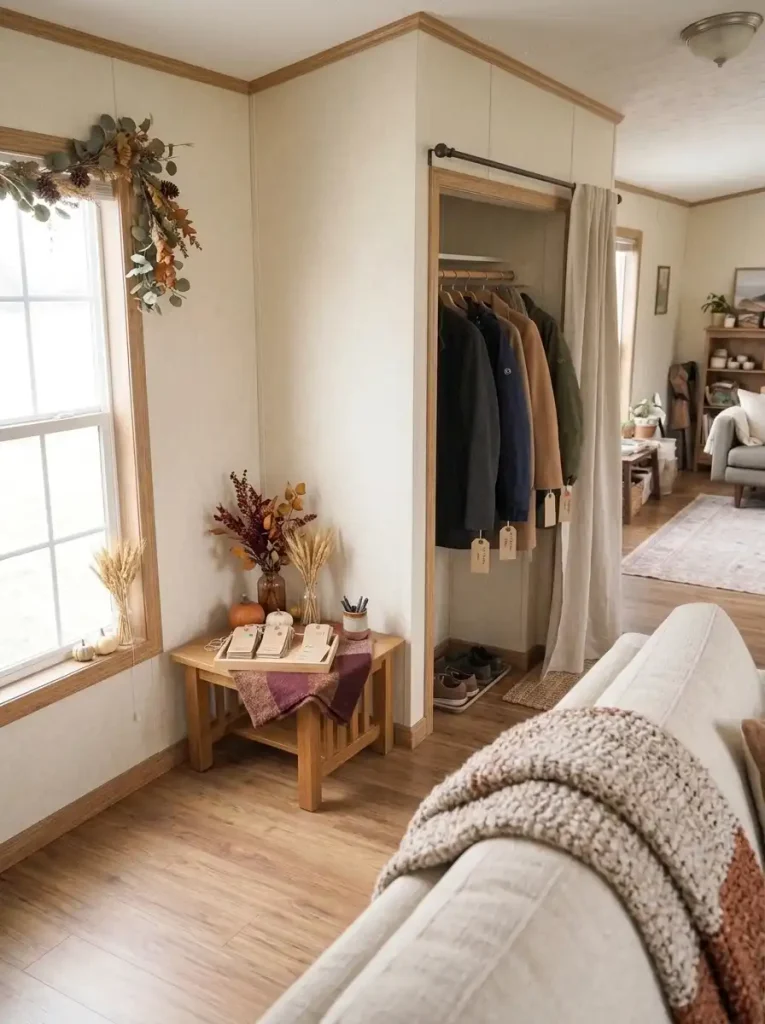
Ten coats can look like five when guests all wear navy, black, or beige. A small identification system saves the awkward end-of-evening search without making the front hall feel like a public cloakroom. Keep the names or numbers discreet, and use the same identifier at the hook or hanger where the garment belongs.
For close family, assigned spots may be enough. With several similar winter jackets, numbered removable tags and a matching guest-held claim slip are easier. Avoid pinning labels into delicate fabric; attach them to hangers or compatible loops, and do not place identifying personal details where visitors can easily read them.
Place the identification materials beside the actual storage zone, not on the dining table. A system only works when both arrival and departure use the same order.
Interactive Guest Coat Identification Planner
No More “Which Black Coat Is Mine?”
Give every guest a low-effort way to find their things. Pick the simplest matching method that fits your Thanksgiving crowd.
A hook per familiar guest.
Assign positions informally. Point each guest to their spot and let them collect the coat directly.
Match a numbered pair.
Fasten a removable number to the hanger and hand the guest the matching ticket. Keep extras beside the coat station.
One family code, several belongings.
Use a family-group code on the hanger and accessory container. Store bags separately from coats but preserve the same identification code.
16. Separate Damp Guest Coats From the Dry Hanging Area
Rain or snow creates a separate Thanksgiving problem: a wet parka can drip onto shoes or a timber bench, while crowding it among dry coats slows air circulation. Give the wettest outerwear its own easy-to-clean stop close enough to the arrival route to be usable but clear of the door swing.
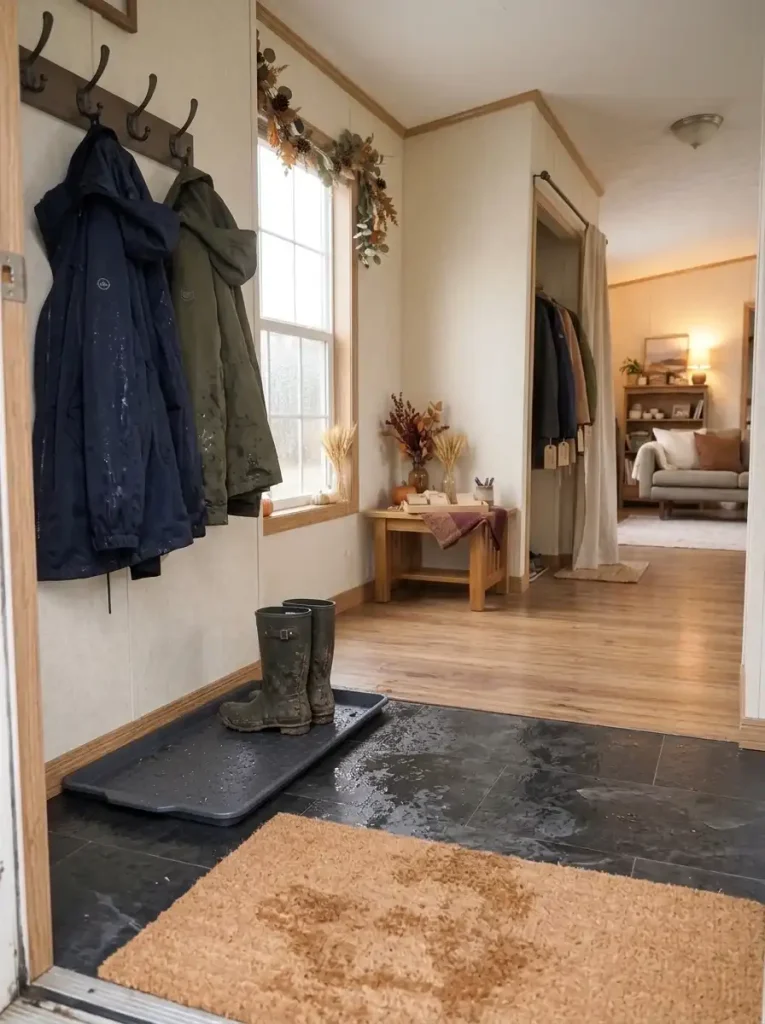
Follow the Moisture, Not the Decorating Scheme
At arrival: Place boots on a washable tray that sits flat and does not intrude into the exit. Use a suitable moisture-resistant rack or hanger for wet coats.
During dinner: Let wet fabrics breathe, and keep them away from heaters, heat sources, and dry clothing. Do not turn a packed reach-in closet into a makeshift drying cabinet.
Before goodbye: Wipe the tray and inspect the floor where guests will stand to put shoes back on.
If cleaning the tray means moving five dry coats first, the setup is too compressed. Shift the wet zone or reduce its capacity.
17. Create an Easy Coat-Return Route for Thanksgiving Goodbyes
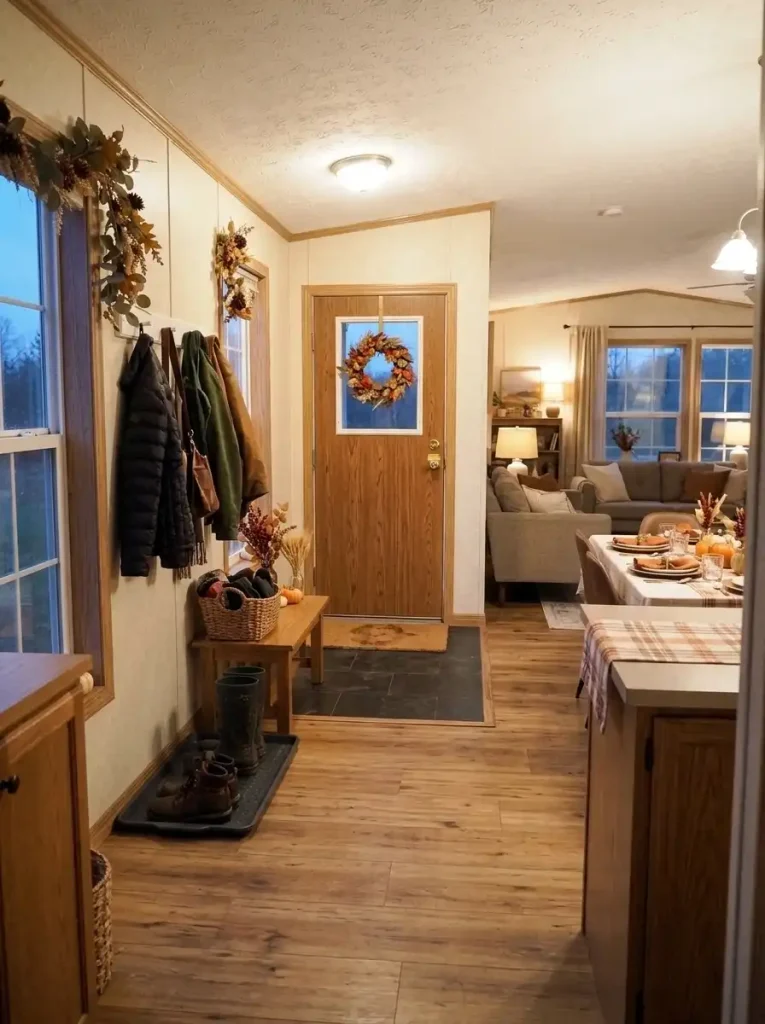
Coat storage becomes a circulation problem again when dinner ends. Three guests step toward the doorway, another looks for gloves, and someone has placed a dessert container on the coat bench. A good entry plan handles that second rush as deliberately as the first.
Use one clear collection order: locate the coat, collect the bag or accessories, put on shoes, and then approach the exit. If the coat supply lives in a spare room, have one host retrieve garments while the doorway stays available. Leave a small reachable surface for keys or gloves, but do not park take-home food in the coat collection path.
Thanksgiving Arrival-to-Departure Route Atlas
The Five-Minute Goodbye Flow
Your coat station has two rush hours: arriving guests and everyone leaving after dinner. Plan the full journey, then inspect each phase.
Create an off-path landing moment.
Let a guest step to the side to remove a coat, or have a host receive it. The exterior doorway should stay operable while other visitors enter.
Remove coat storage from food traffic.
Keep rails and bags away from the route between the kitchen, dining area and buffet. Do not allow overflow to spill into exit paths.
Retrieve first; approach the door last.
Collect each guest’s coat, accessories and shoes from their assigned spots. Have the host bring coats from a secondary room before guests converge at the doorway.
Continue the route outdoors: These Thanksgiving porch decor ideas for mobile homes with narrow steps keep the approach attractive without filling a narrow landing.
A Welcoming Entry Starts With the Route, Then the Rack
The best Thanksgiving guest coat storage in a small mobile home does not have to be a permanent mudroom makeover. For a handful of guests, clear an existing closet or dedicate a few well-positioned hooks. For a larger gathering, move the overflow to a suitable secondary room and make retrieval predictable. Let a warm wood finish, soft greenery, or restrained harvest accent do the decorating.
Before Thanksgiving, rehearse the front-door swing with real coats and a guest-sized load in your hands. Then test the path once more after dark. When arrivals and goodbyes feel easy, the whole home feels more ready to welcome people.
Pinterest save idea: Keep this article on your Thanksgiving hosting board and revisit the setup checklist before guests arrive.