

A small mobile-home entry can look surprisingly dramatic at Halloween, but it rarely has spare space for piles of pumpkins, oversized signs, urns, and props on both sides of the door. The entrance still has to work: the door needs room to move, the landing should feel open, and an indoor entry that opens directly into the living room cannot become a wall of seasonal clutter.
The smartest Halloween mobile home entryway decor works with surfaces that already have visual reach. A door can carry the focal point. Trim can hold a flight of bats. A front window can become part of the scene. One narrow floor cluster can provide depth while the rest of the arrival path stays calm.
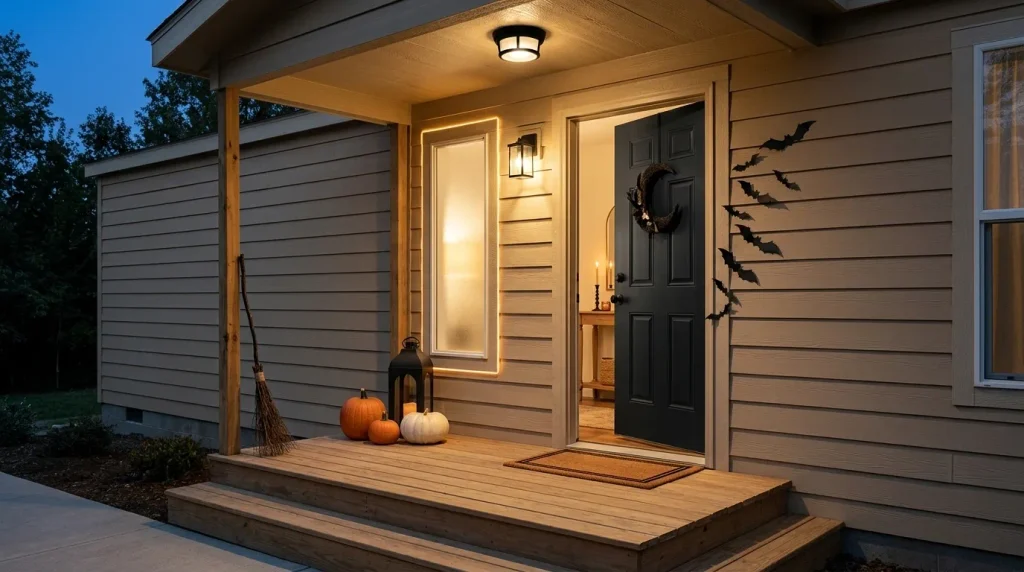
Use the footprint mapper below before choosing an idea. It identifies where your Halloween effect can live based on the space your entry actually gives you. Then use the 15 ideas as options—not a checklist you need to complete.
1. Map the Entry Footprint Before Any Halloween Decor Moves In
Stand outside with the door closed, then open it fully and look again. What space remains genuinely unused?
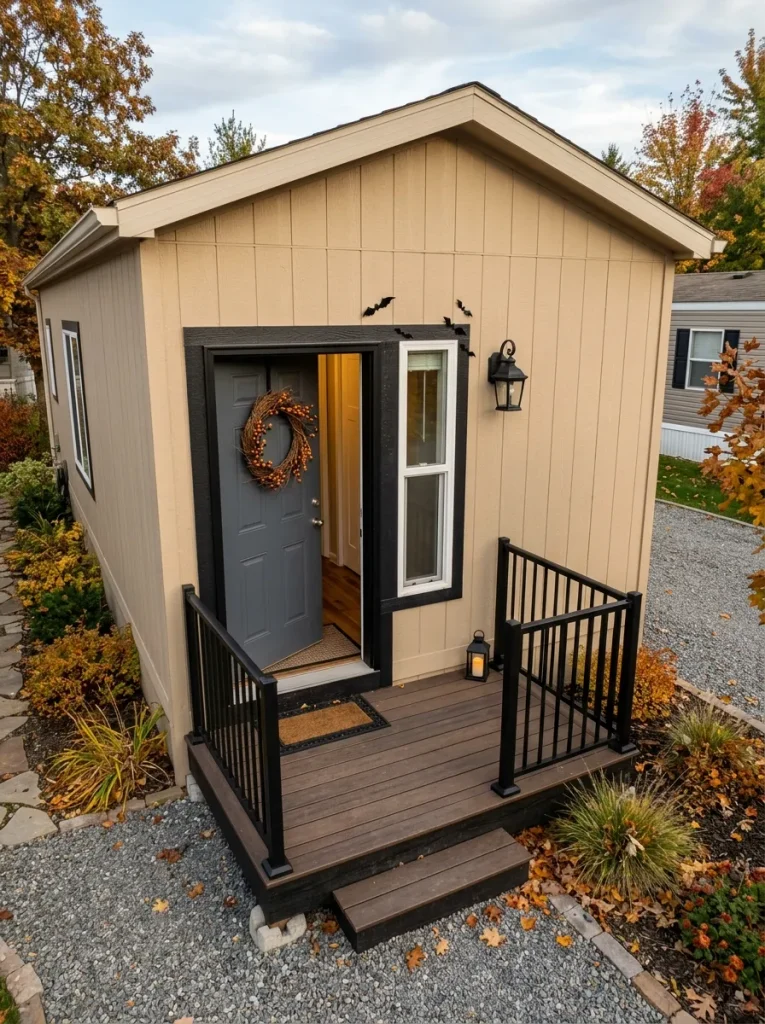
That answer matters more than the number of Halloween decorations you own. Many compact mobile-home entrances have plenty of visual surface but little expendable floor area. A blank door, narrow strip of siding, front window, or upper corner can carry more seasonal character than another object beside your feet.
Choose the entry configuration that most closely matches your home below. The recommendation changes according to where the available decorating space sits.
Architectural Entry Atlas
Where can the Halloween drama live without stealing usable entry space?
Choose the footprint closest to your home. The atlas highlights the surface that can carry the strongest Halloween layer while protecting the working part of the entrance.
Put the strongest Halloween signal directly on the architecture.
A wreath, vertical bat flight, gauze accent or controlled light frame can create the main seasonal statement while the floor remains almost untouched.
Build one narrow composition and let the opposite side breathe.
Use a branch arrangement, broom, lantern stack or small pumpkin grouping on the genuinely unused edge. The visual weight stays concentrated instead of forming a corridor of props.
Shift the atmosphere behind the window and free the landing.
A silhouette, ghost shape, bat composition or warm backlight can extend the entry scene while occupying no walking space at all.
Design the porch and first indoor surface as one connected threshold.
Repeat one color, silhouette or material indoors so the entrance feels longer and more intentional without requiring two complete seasonal displays.
The useful part of this exercise is what you leave empty. Once the strongest decorating plane is clear, the rest of the entry no longer needs to compete for attention.
2. Let the Front Door Carry the First Halloween Hit
A compact entrance often looks more finished when the door does one large visual job instead of being surrounded by six smaller decorations.
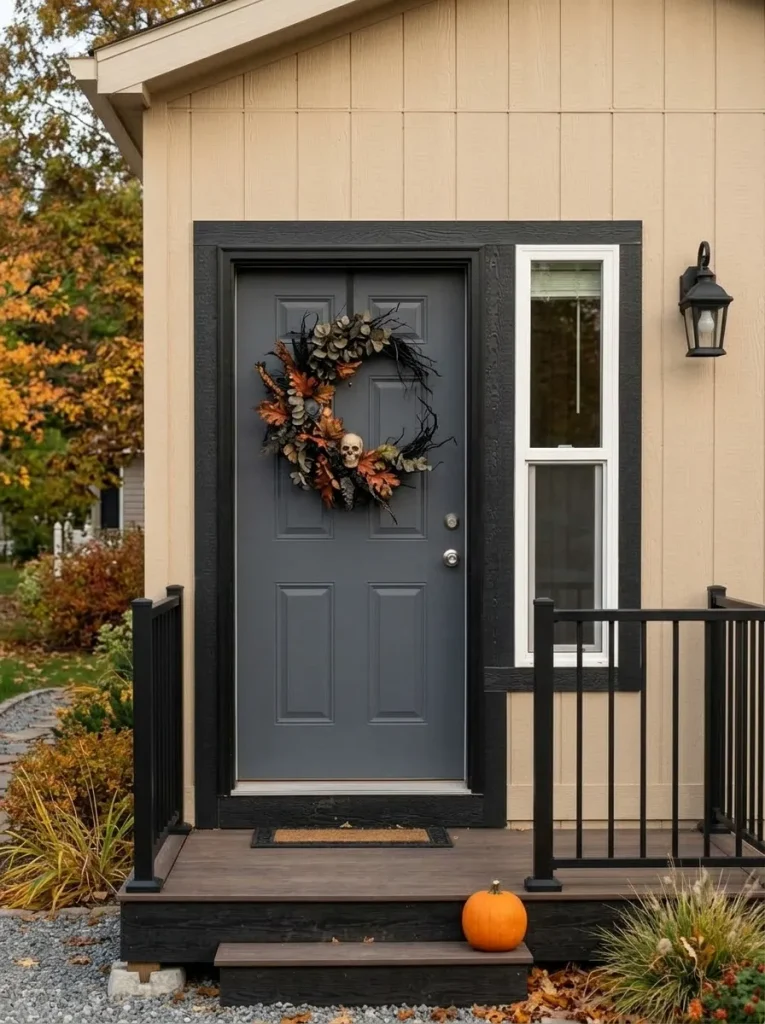
Start with the view from a few steps away. If the door itself is the most visible surface, give it the strongest motif: a dark crescent wreath, black-and-rust foliage, a skull detail, an oversized velvet bow, or a restrained branch arrangement. Then keep the nearby siding and floor comparatively quiet.
Scale matters here. A tiny wreath can disappear against the door and tempt you to compensate with extra pumpkins and signs. One confident focal piece gives the eye somewhere to land before it notices the limited footprint.
Door test: close the door, photograph the entrance from the normal approach, and cover everything except the door with your hand. If the Halloween mood still reads, the focal point is carrying enough visual weight.
For broader door-specific inspiration, explore StylishGalore’s Halloween door decor ideas. In this smaller mobile-home entry, restraint is the more important decision: let the door lead so the landing does not have to.
3. Send a Bat Swarm Up the Trim Instead of Across the Entry
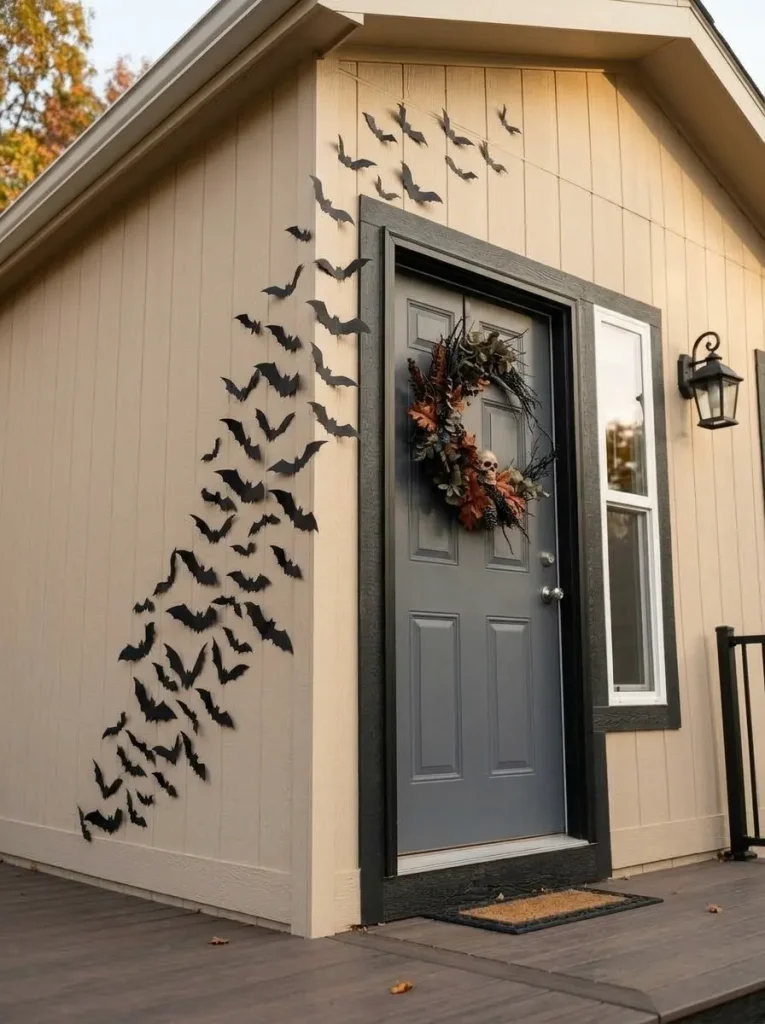
Picture a mobile-home doorway with almost no comfortable decorating depth beside it. A basket of pumpkins immediately claims floor space; flat bats do not.
Begin the flight low near one side of the frame. Keep the first few silhouettes relatively close together, then loosen the spacing as the bats rise toward the upper corner. The changing density gives the eye a direction to follow and makes a modest number of pieces feel like a larger installation.
Avoid spreading the bats evenly around all four sides. A concentrated diagonal creates stronger movement while preserving visible trim and negative space.
For handmade silhouettes and other removable projects, StylishGalore’s DIY Halloween decor ideas for mobile homes owns the deeper construction side of the topic.
When to change course: if the trim does not suit the attachment method you intend to use, shift the flight to a nearby window or indoor wall. The useful idea is the upward movement, not one particular mounting surface.
4. Build One Asymmetrical Floor Cluster Beside the Door
Two matching displays can look polished on a wide porch. On a tiny landing, they can turn the doorway into the narrow gap between two piles of seasonal décor.
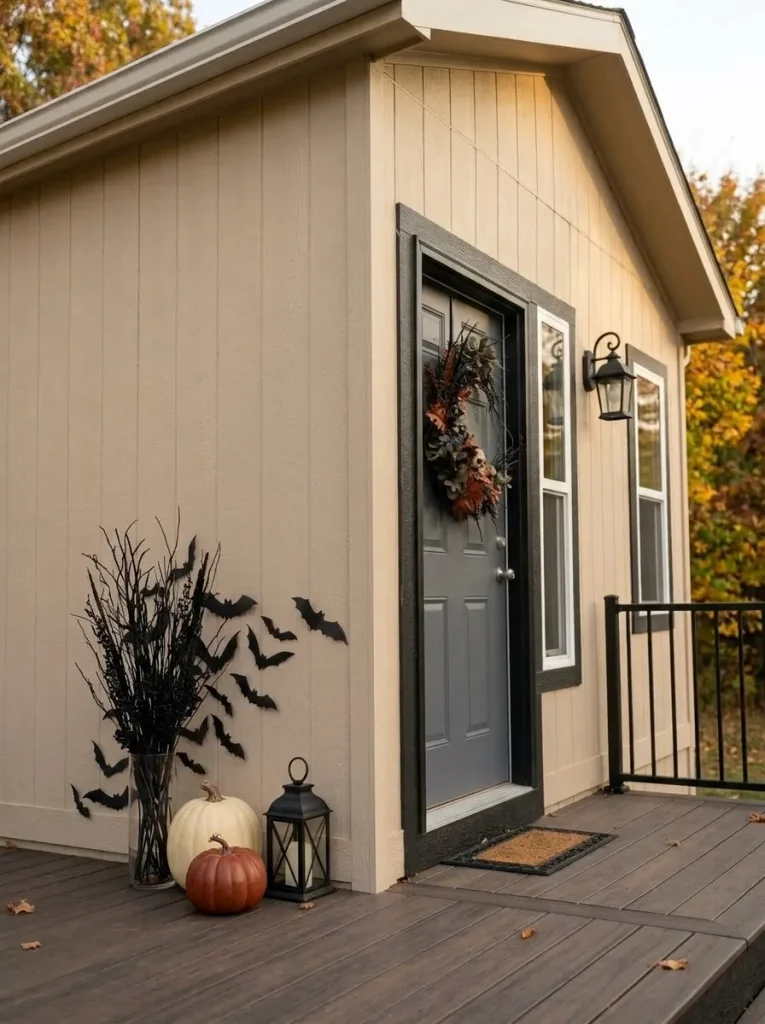
Try one stronger floor composition first. Place the tallest element toward the wall or outer edge, step the heights down toward the doorway, and keep the opposite side comparatively open. A pumpkin, lantern, and branch arrangement can read as a complete vignette because their different heights create a visible sequence.
Use the pressure lab below to decide how much floor styling the entry can absorb.
Asymmetry Atelier
How much floor styling can your landing absorb before it stops feeling open?
Read the blue-green route as protected arrival space. The seasonal composition should build beside it—not consume it.
Take the drama off the floor.
This entrance has visual surface but no meaningful landing capacity. Let the door, trim, wall, window or lighting carry the seasonal effect.
Create one intentional vertical-to-low composition.
Use the open side as a single staging zone. Height at the outer edge gives the scene presence, while one or two lower elements create depth near the ground.
Allow a whisper on the opposite side, not a second full display.
A second small lantern or pumpkin can balance the doorway, but the main asymmetrical group should still read first.
If you have to angle around the display while carrying groceries or approaching the handle, the floor composition is too ambitious for the landing. Move one element upward before searching for a narrower prop.
5. Use Tall Branches and Ravens When the Landing Has Almost No Depth
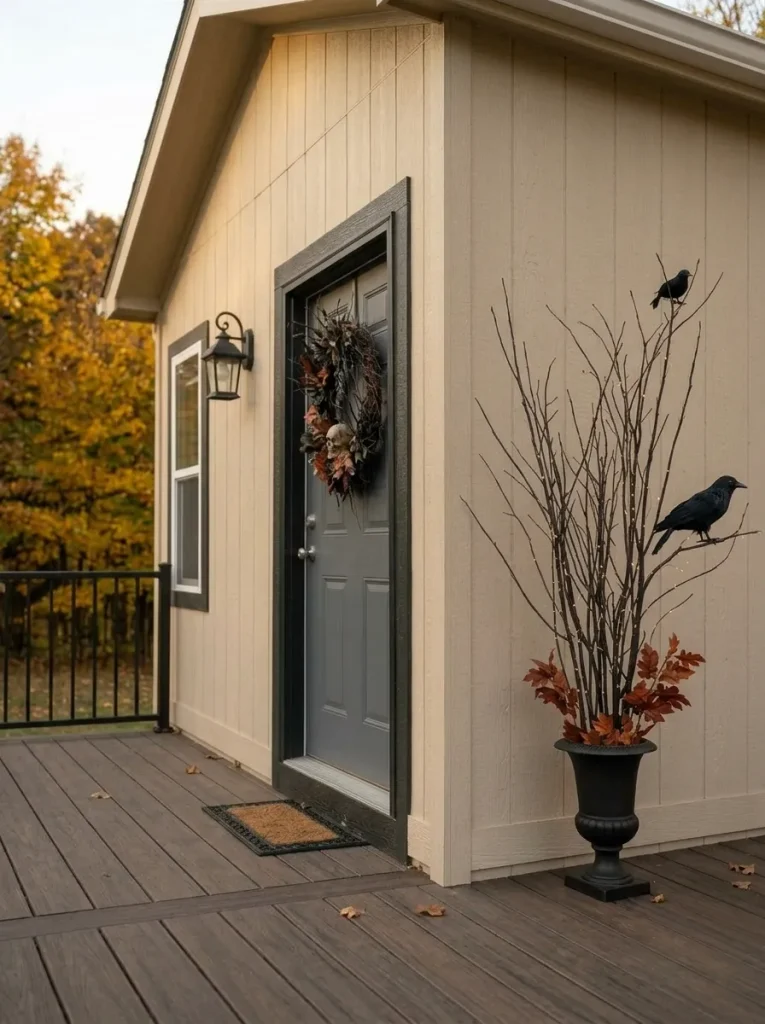
A tall branch arrangement can occupy little ground area while filling the vertical view beside a mobile-home door. That makes bare branches useful when you want the eerie scale of a larger Halloween display without the footprint of stacked crates, hay bales, or several pumpkin groups.
Choose a narrow container that visually balances the arrangement, then let the twigs spread mainly upward. A raven around eye level provides a focal point; a smaller bird higher in the branches can suggest movement without turning the display into a collection.
Compare the silhouette from straight ahead and from the normal approach. If the branches project deeply into the side people walk through, rotate or edit them until most of the width sits toward the wall.
The arrangement does not need orange filler everywhere. Dark branches already provide the spooky silhouette. One rust-colored leaf cluster or a restrained warm-light detail can supply enough seasonal contrast.
Best fit: little floor depth plus one unused vertical strip.
Skip it: when the branch canopy would repeatedly project into the natural route toward the door.
6. Trace the Doorframe With Warm Halloween Light After Dark
A small entry can look finished in daylight and almost disappear after sunset. Lighting can provide presence without asking the landing to hold another object.
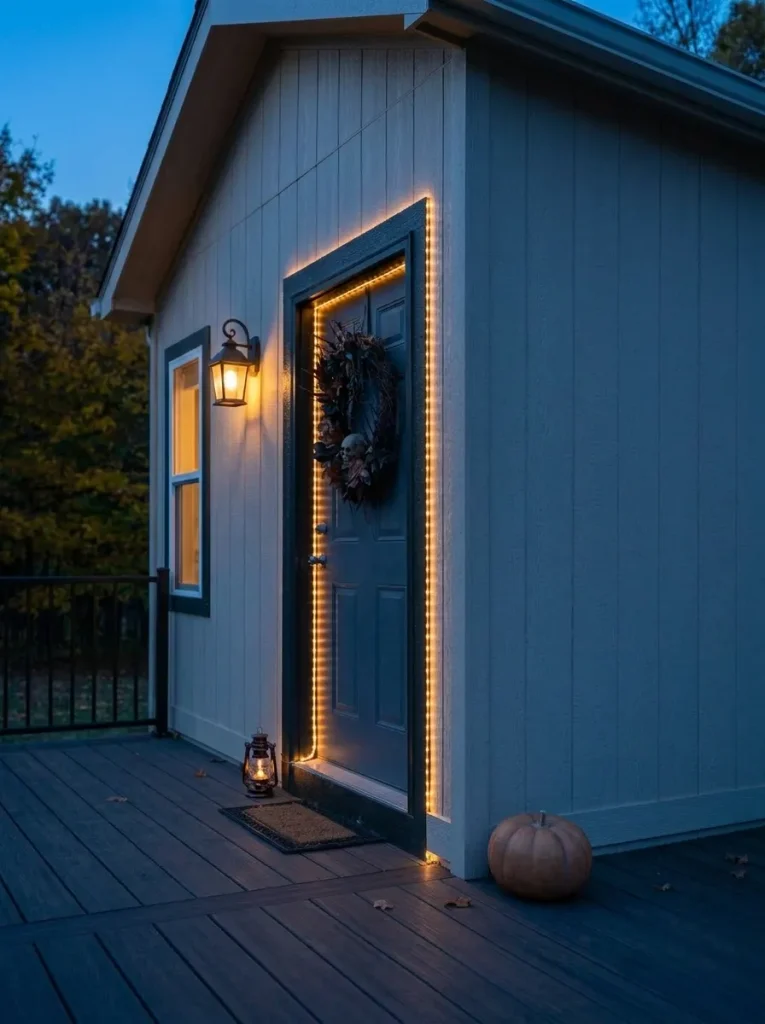
Identify the architectural edge that already frames the entrance. On a compact entry, that may be the door trim, a nearby window edge, or one small lantern zone. A restrained line of warm orange or amber-toned decorative lights can turn that edge into the evening focal point.
The choice should follow the footprint. Very tight entries usually benefit from doorframe or window lighting. If one outer corner remains comfortably unused, a small lantern grouping can create lower-level glow.
Avoid scattering unrelated light sources simply because each one fits. Several equally bright points can make a small facade feel busier after dark.
For electrical or battery-operated decorative products, follow the manufacturer’s stated installation and indoor/outdoor-use instructions for the specific product.
Night Glow Observatory
Where should the evening glow originate?
Choose the source that fits the physical entry. Each lighting strategy creates a different focal hierarchy—and changes how many physical decorations you still need.
Turn the doorway itself into the nighttime feature.
This is the strongest option for tight landings because the illumination follows an existing architectural edge and can replace several smaller ground decorations.
Create a concentrated pool of light beside the route.
Use this only where one edge of the landing is genuinely free. Keep the upper doorway quieter so the lantern zone reads as one deliberate low focal point.
Push the Halloween atmosphere behind glass.
A glowing silhouette or softly lit scene can support the entry from several steps away while leaving the physical landing completely open.
Do the final lighting check from the normal approach. If the wreath, pumpkins, lanterns, and glowing trim all fight for attention after dark, remove a competing element before introducing another light.
7. Make the Front Window Do Double Duty
A window beside the door is valuable Halloween real estate because it can add another visual layer without occupying another inch of the landing.
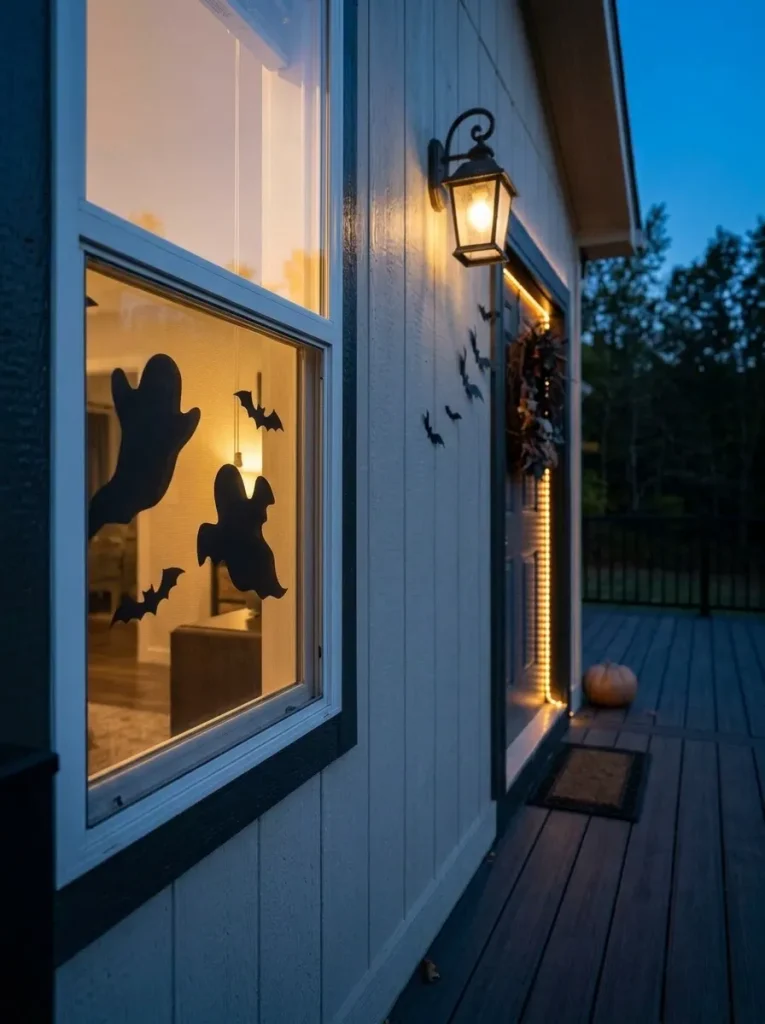
Treat the glass as part of the exterior composition. A black silhouette, ghost shape, a few bats, or a simple paper-cut scene can be visible from outdoors in daylight. At night, interior illumination can turn that same window into a glowing backdrop.
Connect it to the doorway rather than designing an unrelated theme. If bats travel up the trim, allow only a few to continue toward the glass. If the front door uses black and rust, echo one of those tones in the window.
There is an interior advantage too: the treatment can remain lightweight from the living-room side. That matters when the front door and window share one visually connected wall.
Decision rule: move Halloween onto the window when the floor feels crowded before the wall feels finished.
8. Layer a Mat and Runner Only When the Door Still Works Cleanly
Layered mats photograph beautifully because the larger textile frames the smaller one. A shallow mobile-home landing or tight interior threshold can make that extra layer feel much larger in real use.
Test the floor before styling the pattern.
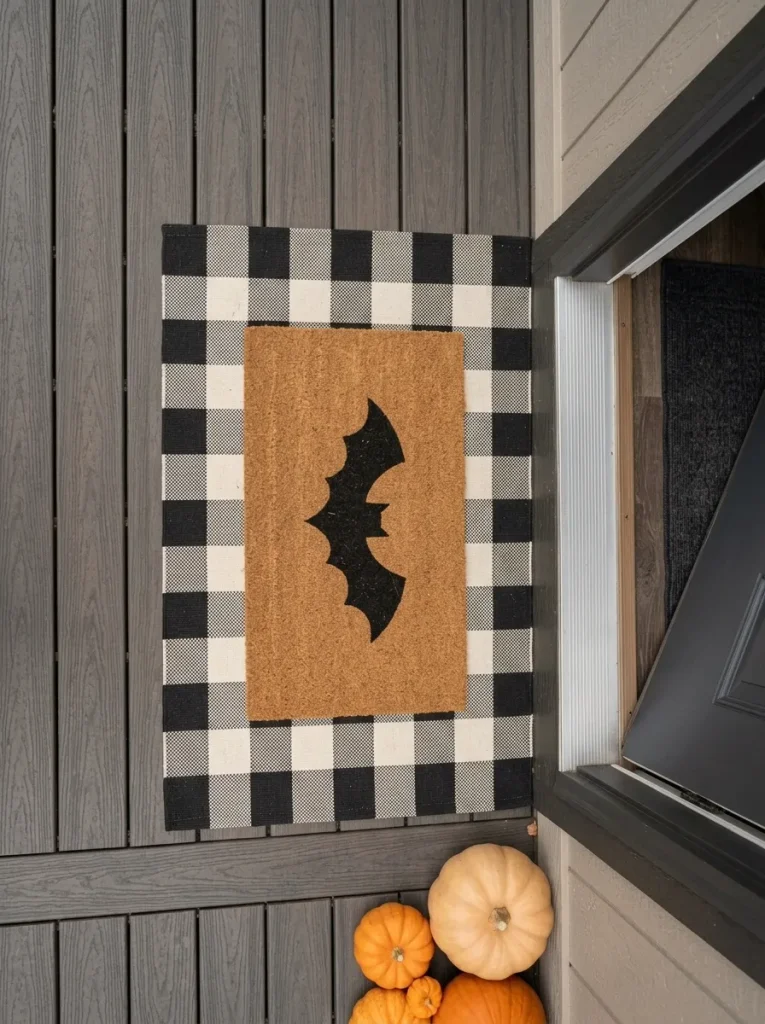
Place the lower rug or runner first. Open the door through its normal movement. Walk through while carrying something. Step back outside. If the textile bunches, catches, curls awkwardly, or simply makes the threshold feel visually crowded, use one mat and move the Halloween pattern elsewhere.
When layering does work, keep the bottom pattern comparatively simple. Black-and-white checks, a narrow stripe, or a quiet natural texture can support a Halloween mat without making the floor the dominant focal point.
Useful edit: when pumpkins, lanterns, and a broom already occupy the lower part of the entry, choose a quieter mat. When the floor is otherwise bare, the textile can carry more graphic personality.
9. Give a Slim Indoor Console One Contained Halloween Vignette
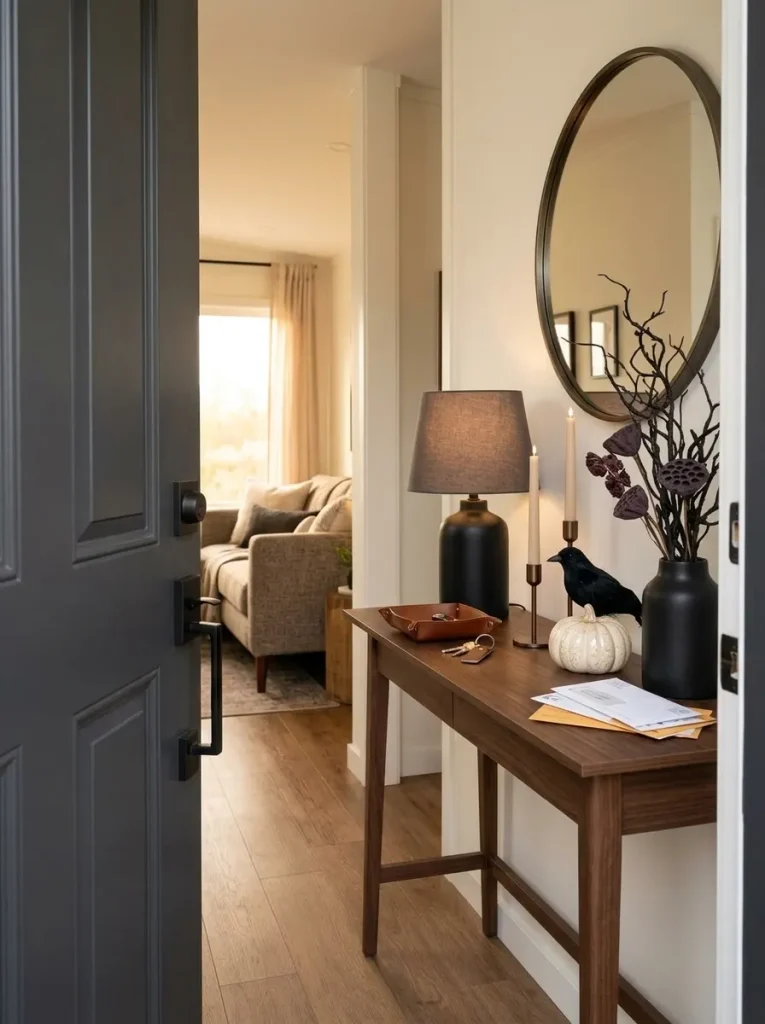
When the exterior entrance opens almost directly into the living room, the first indoor surface often becomes part of the arrival experience. A narrow console can continue the Halloween mood without demanding a second full display.
Protect its everyday job first.
If keys, mail, sunglasses, dog accessories, or charging cables normally land there, reserve a clear zone for them. Build the seasonal arrangement beside that function instead of spreading décor across the entire top.
One dark lamp, two battery-operated taper-style candles, a small pumpkin, a crow, and a branch arrangement are more effective when they read as one vignette. Give one piece height, one piece glow, and one piece the strongest Halloween silhouette.
Then come through the door with your hands full.
If the console no longer works comfortably as a drop zone, the seasonal display has exceeded the space it earned.
10. Use the Mirror for One Skeleton-and-Gauze Composition
A mirror above an entry console can multiply visual impact because it reflects both the vignette and the room beyond. It can multiply clutter for exactly the same reason.
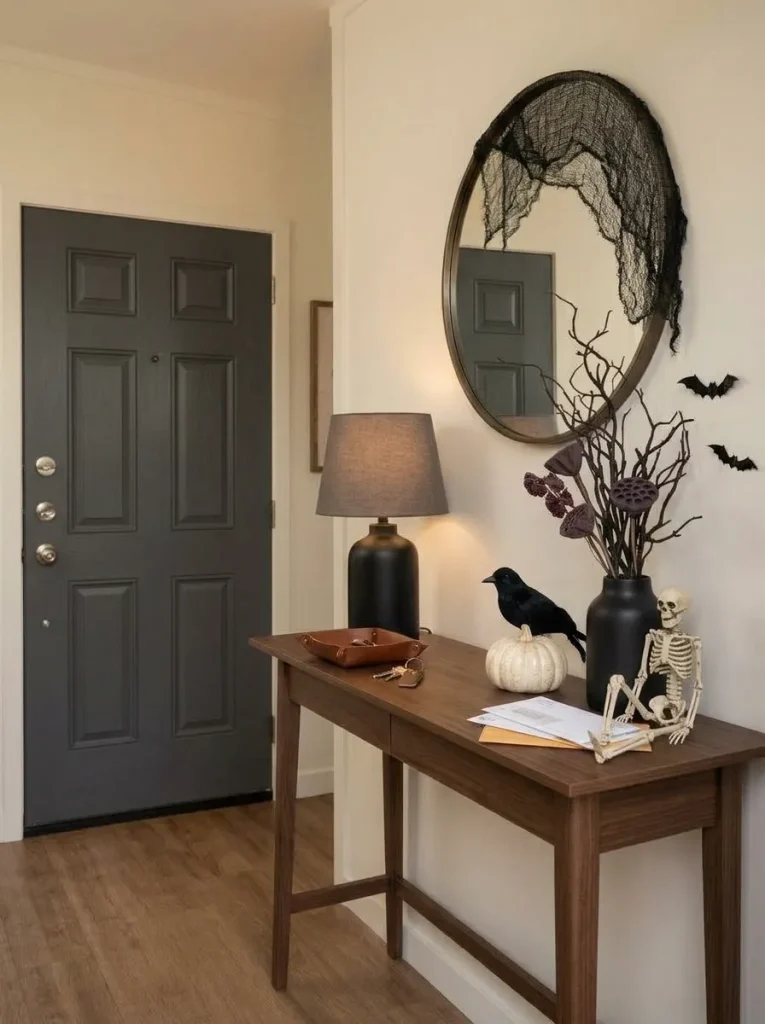
Keep the Halloween intervention concentrated.
Drape distressed black gauze across one upper section of the mirror, then place a skeleton, skull, or dark floral arrangement below so the objects visually connect. A few bats extending onto the adjacent wall can carry the eye upward.
Before adding anything else, inspect what the mirror already reflects. It may catch the front door, living room, kitchen, or another seasonal arrangement. Those reflected objects become part of the entry design whether you planned them or not.
That effect is especially noticeable when an entry opens directly toward another compact living zone.
Reflection test: photograph the setup from the doorway. If the mirror produces a dense mass of unrelated objects, remove one physical or reflected layer before decorating the frame further.
11. Float Ghosts Overhead Only Where the Arrival Path Stays Open
Hanging ghosts create volume without filling the ground plane, but being off the floor does not automatically mean they are out of the way.
A covered entry with an appropriate overhead decorating location can support a small floating group toward the outer or upper portion of the scene. Vary the drop lengths so the ghosts read as a loose cluster, not a straight row.
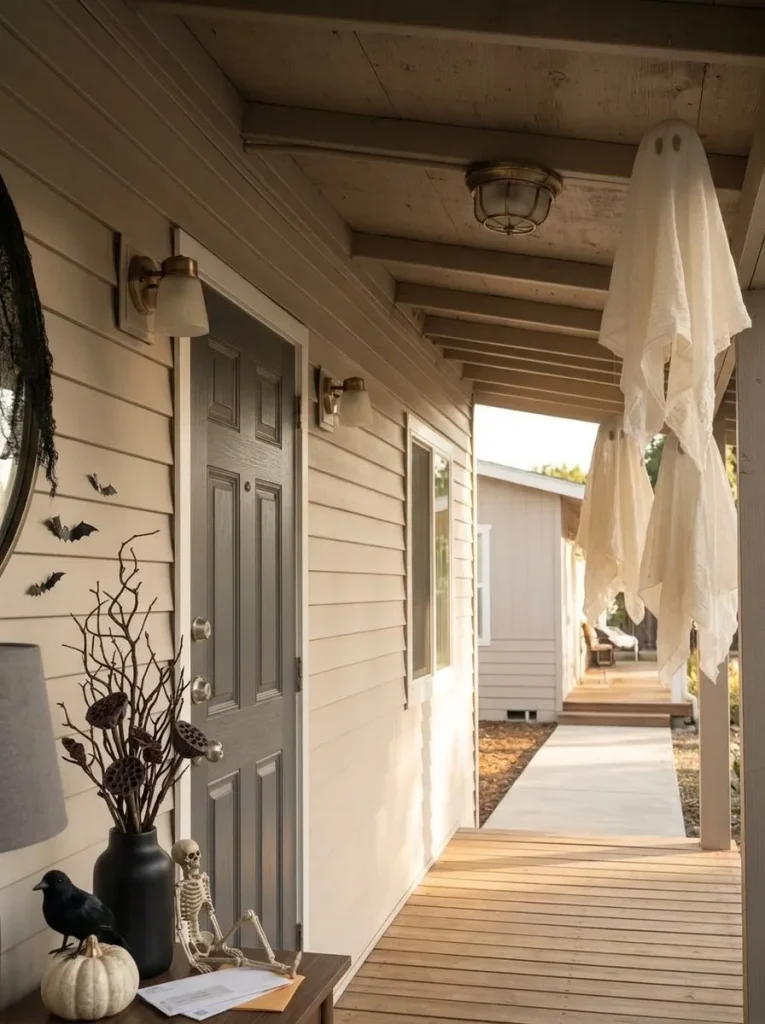
Keep the lowest shapes away from the route people naturally take toward the handle. The installation should create atmosphere around the entrance without asking visitors to duck around it.
If the exterior has no suitable location, move the concept behind the front window. Lightweight ghost forms can still appear to float from the outside while the actual approach stays completely clear.
For construction ideas, return to the DIY Halloween mobile-home decor guide; here, location and visual clearance remain the deciding issues.
Stop signal: when one ghost repeatedly occupies the normal approach line, raise, shift, or remove it.
12. Let One Palette Travel From the Porch Into the Living Room
A mobile-home entrance may have very little visual pause between outside and inside. Open the door and the living room can immediately become part of the composition.
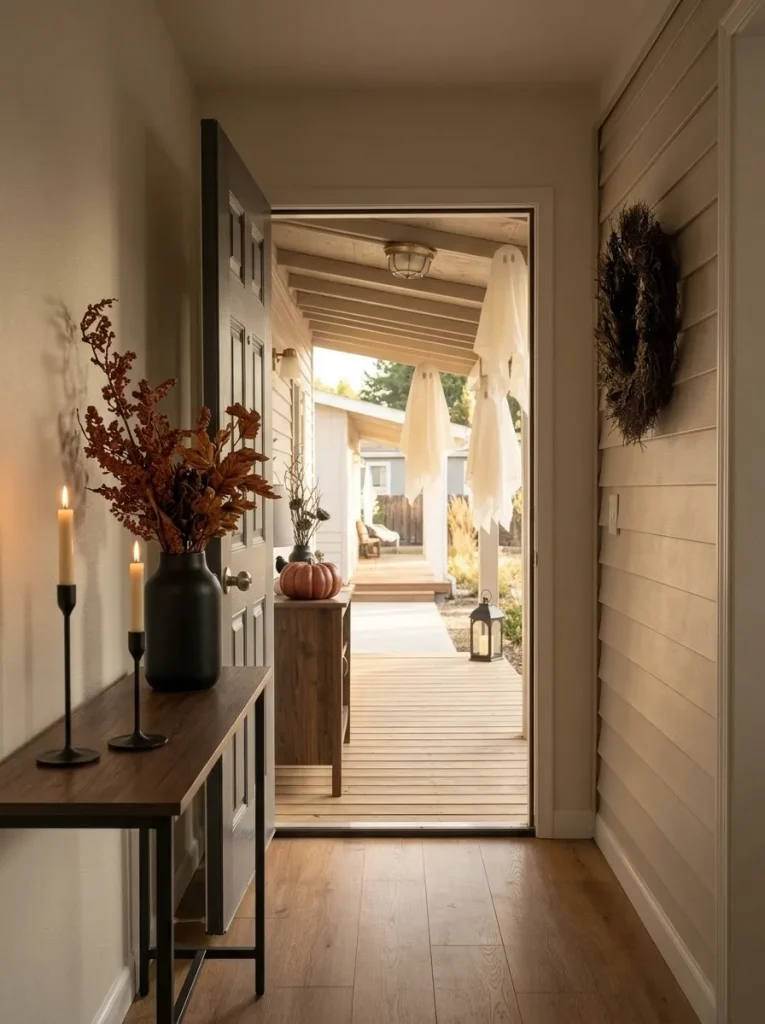
Use that connection deliberately.
Choose one Halloween palette outside, then repeat a controlled part of it on the first indoor surface. A black-and-rust porch might continue as black candlesticks with a rust branch. A bone-and-charcoal doorway might reappear as one ivory pumpkin beside a dark lamp.
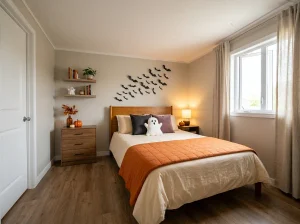
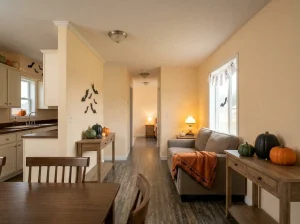
The repetition can make the entry feel deeper without requiring two independent displays.
Threshold Palette Bridge
How strongly should the porch palette travel indoors?
The more of the living room you see from the open front door, the more deliberate the color bridge should become.
Repeat two elements, then let the room become quieter.
Carry one dominant dark tone plus one warm accent through the doorway. The goal is continuity, not a second porch display inside the living room.
Outside anchor → indoor echo → visual restRepeat one color or one material.
A black lantern outside can become black candlesticks indoors, or rust foliage can reappear once on the console. One visual bridge is enough.
One recognizable bridge → no duplicationLet the exterior carry the stronger Halloween identity.
When the inside entry feels visually contained, exact color repetition is optional. Keep the mood related while allowing the indoor palette to become calmer.
Related atmosphere → independent stylingIf you want to carry the same visual discipline farther through the home without a large seasonal spend, continue with StylishGalore’s cheap Halloween decor ideas for mobile homes.
13. Let One Witch’s Broom Mark the Quiet Edge
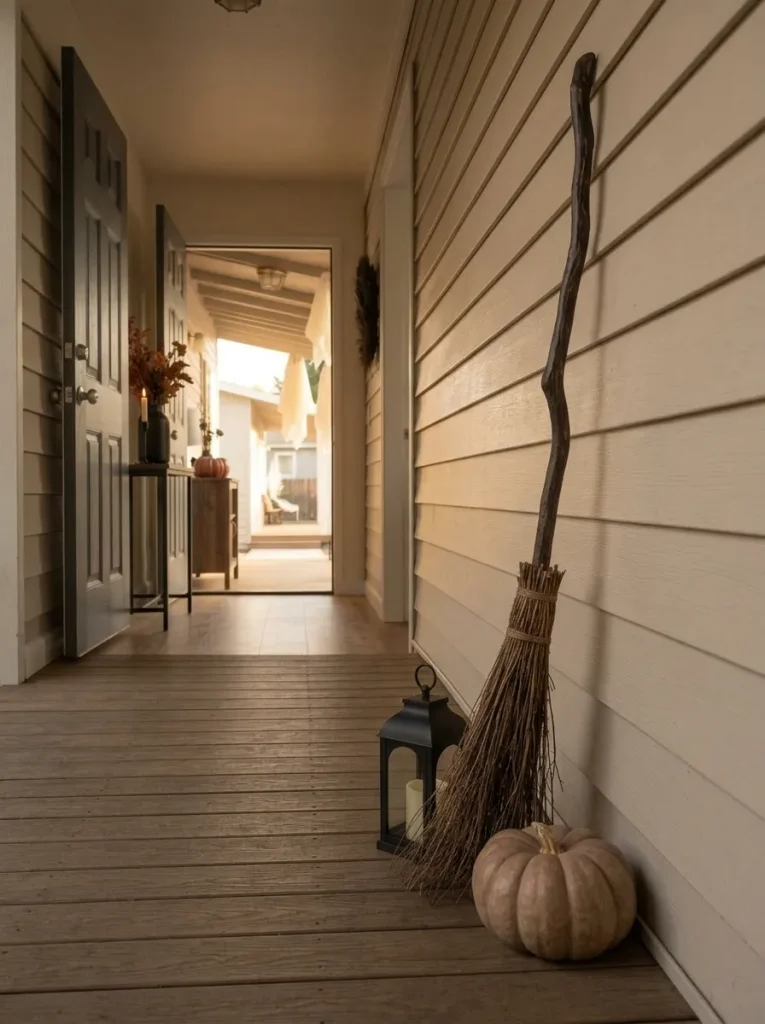
When a compact entry already has enough low objects, the missing ingredient may be one clean vertical silhouette.
A witch’s broom can mark the quiet side of the doorway without becoming another multi-piece vignette. Lean it near an outer wall edge and give the base only one companion—a lantern or pumpkin—if the area needs visual weight.
This differs from a branch arrangement because the broom works as a single graphic line. It is especially useful where permanent features such as a handle, mailbox, house number, or light fixture already make the opposite side visually active.
Step back and check whether the broom still reads clearly.
If you have to surround it with a sign, stacked pumpkins, several lanterns, and another basket before it feels important, the entry does not need a broom composition; it needs editing elsewhere.
Photo check: the broom should remain recognizable as the tall accent even when you photograph the whole doorway, not only the corner where it sits.
14. Choose Halloween Pieces That Collapse, Nest or Reuse After October
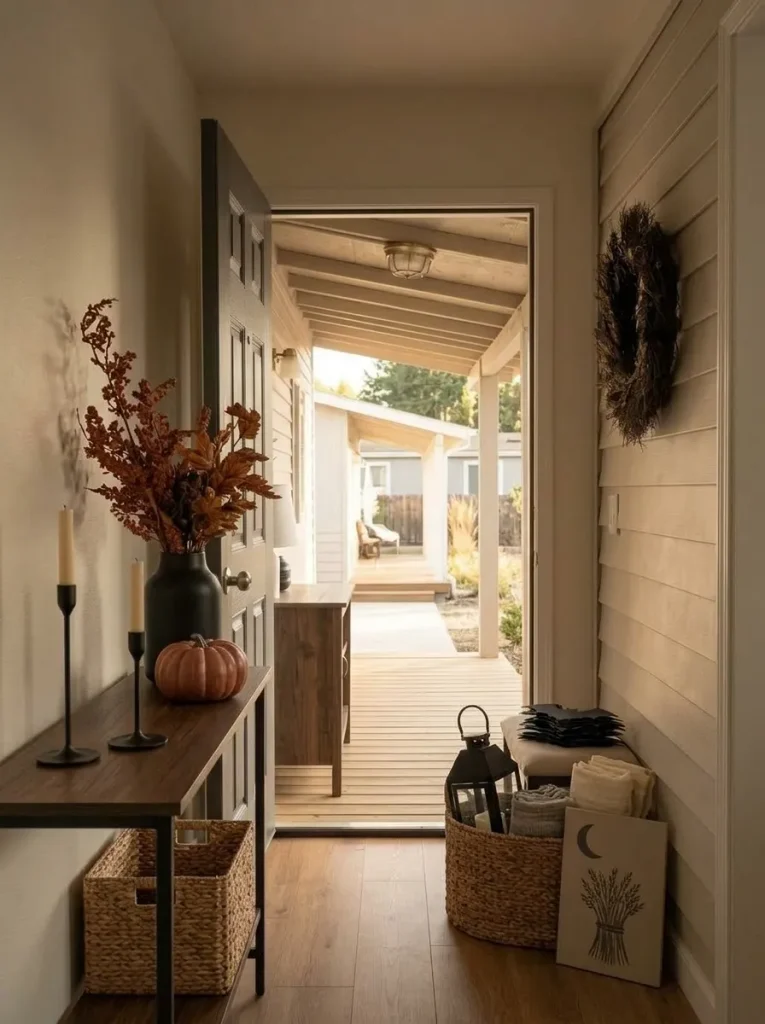
A Halloween object occupies the entry for a few weeks. It may occupy limited storage for the rest of the year.
That tradeoff matters in a compact mobile home, where seasonal bins can compete with everyday storage.
Before buying another bulky prop, picture its November destination. Flat bats, folding paper decorations, removable gauze, collapsible ghosts, nested lanterns, reusable branches, and reversible signs usually demand less offseason volume than rigid single-purpose pieces.
Pumpkins deserve the same test. When storage is tight, a flat pumpkin panel, foldable paper pumpkins, or a small coordinated group may fit the home better than several oversized forms.
For projects designed around narrow surfaces and storage-aware formats, see StylishGalore’s DIY pumpkin decor ideas for small mobile homes.
Ask one question before bringing a new seasonal piece home:
Will I still be happy giving this decoration storage space after Halloween ends?
If not, choose a flatter, nesting, reusable, or multi-season alternative.
15. Run the Door-Open, Night and Approach Test Before Adding Anything Else
The final stage of Halloween entryway decorating is viewing the entrance under the conditions that reveal different problems.
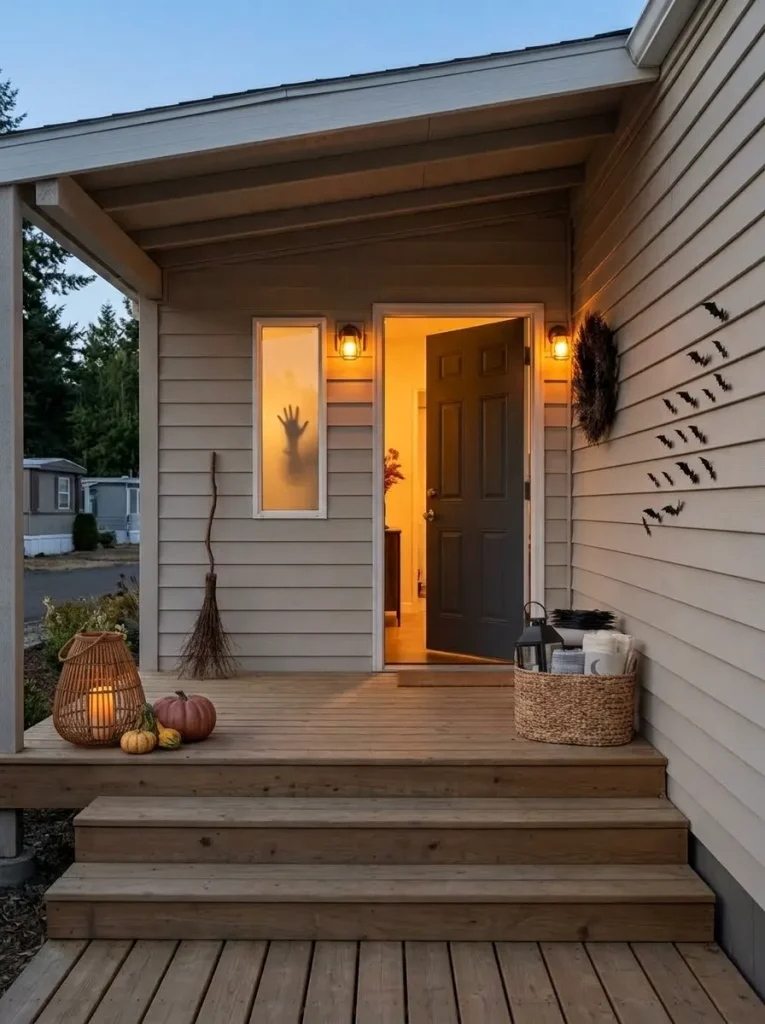
First, open the door fully. Something that looks perfectly placed while the door is closed may become awkward once the entry is in use.
Second, inspect the composition after dark. Lights can elevate a simple display, but they can also reveal that the wreath, pumpkins, bats, lanterns, and window are all competing equally.
Finally, move back to the normal approach and view the entry as one scene. Small accessories fade from attention at distance, while hierarchy becomes much easier to judge.
Use the audit below only after the decorating is essentially finished.
Three-Lens Finish Audit
Has the entry actually reached its stopping point?
Judge the finished entry under three different conditions. A display is complete only when it works in use, after dark, and from the normal approach.
Door-open issue: remove or relocate the element closest to the active threshold before adjusting anything decorative.
Night issue: identify the brightest focal point and reduce one competing illuminated or reflective layer.
Approach issue: strengthen one large silhouette, shape, or color relationship instead of adding more small accessories.
When all three tests pass, stop decorating. Negative space around the wreath, bats, broom, lanterns, ghosts, or pumpkins is part of the final design.
A Small Entry Can Still Make a Big Halloween First Impression
The best Halloween entryway for a small mobile home uses the home’s most visible surfaces before asking the floor to carry more décor. Start with the door, trim, wall, or window; add one controlled source of height or evening glow; then give freestanding decorations only the space the entrance can comfortably support.
When the front door opens directly into the living room, repeating one color or material indoors can make the threshold feel connected without creating another full vignette.
Finish by checking the entry with the door open, after dark, and from the normal approach. When all three views work, the display has earned its stopping point.
For larger themed scenes and broader seasonal inspiration, continue with StylishGalore’s Halloween entryway decor ideas.
Save this article on Pinterest so you can return to these small-space Halloween entryway ideas when it is time to decorate.