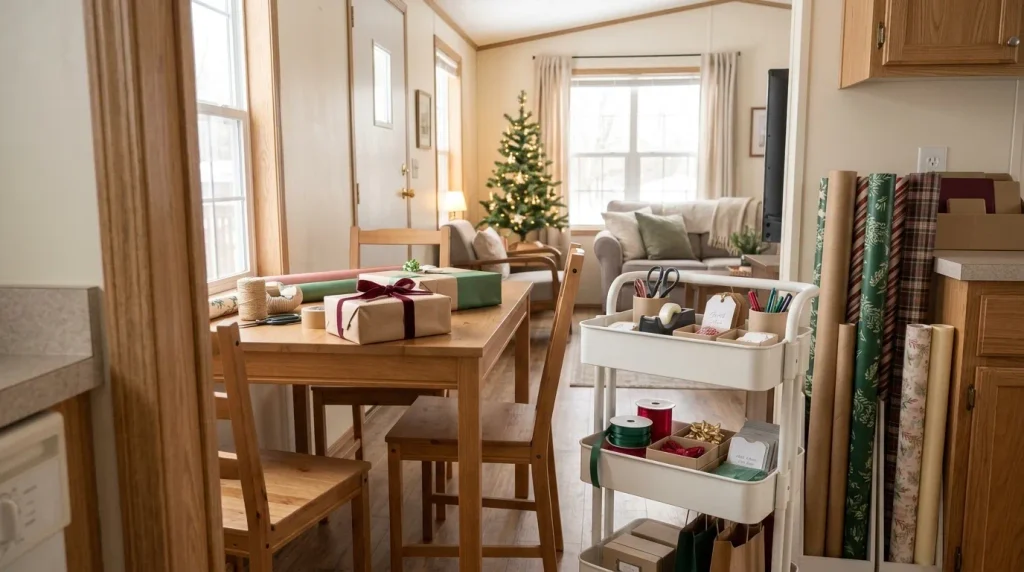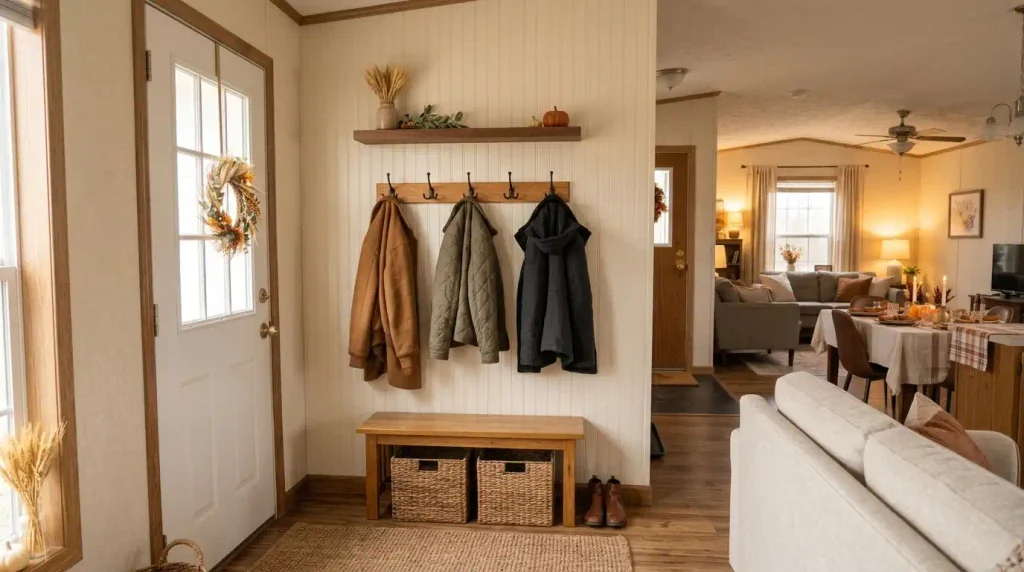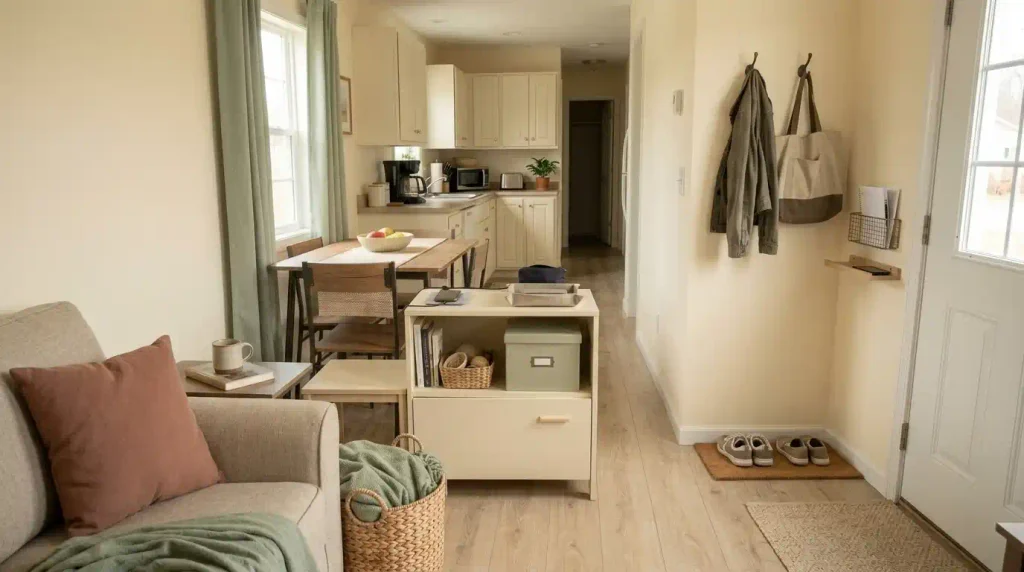
A Christmas wreath might be the first thing visitors notice, but your entryway has a more important job. It needs to handle winter coats, everyday shoes, shopping bags, keys, and holiday deliveries—sometimes all at once.
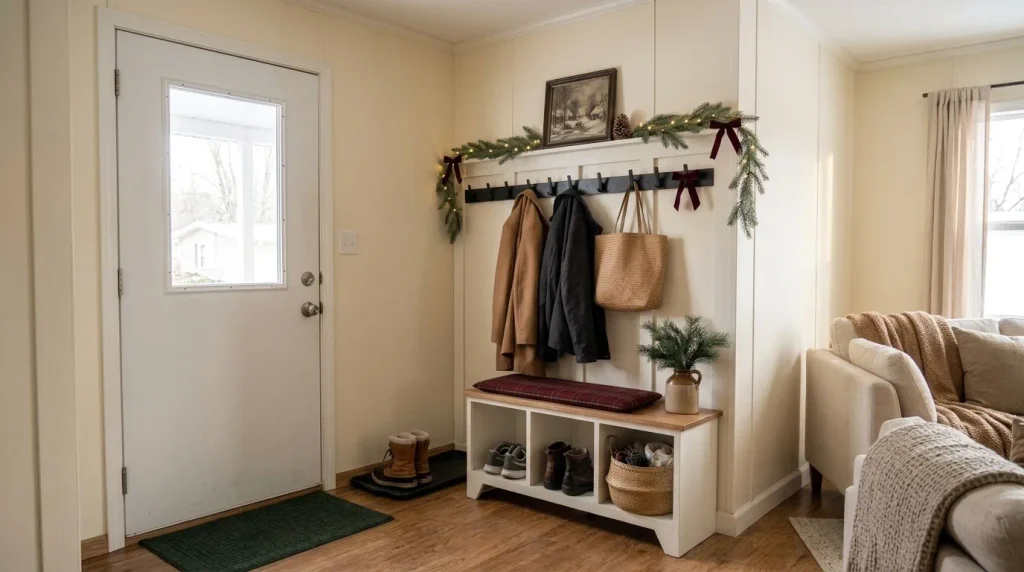
In a small mobile home, that activity often happens in a narrow hallway or directly beside the living room. There may be no separate foyer, coat closet, or mudroom to hide the clutter.
Thoughtful Christmas mobile home entryway organization can make those few feet feel both festive and functional. A bench with baskets can organize shoes. A simple hook rail can become a winter coat station. Even a short stretch of wall can accommodate Christmas cards, keys, and the family’s December schedule.
The twelve ideas below combine warm holiday styling with realistic small-space storage. Each one addresses a different arrival or departure problem, so you can choose what suits your home’s layout and your household’s routines.
1. Map Your Christmas Drop Zone Around the Door’s Actual Swing
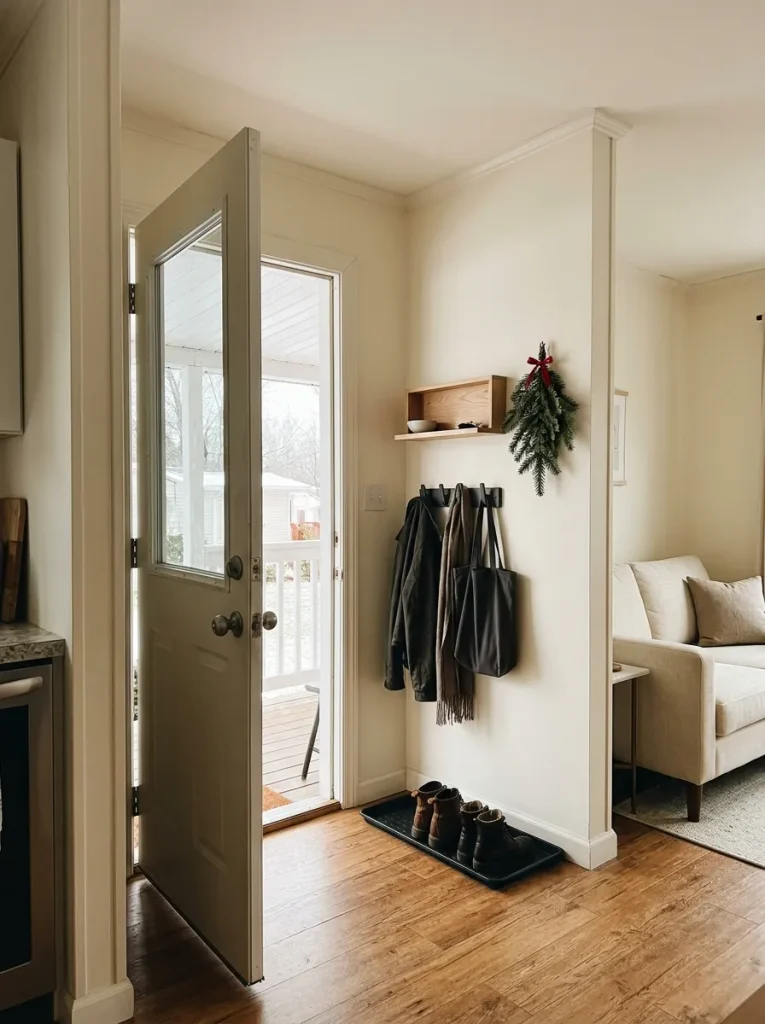
Before buying a bench, hanging hooks, or decorating the wall, watch what happens when someone walks through your front door.
Does the door swing toward the nearest wall? Do people immediately turn into the living room? Is there enough room to set down a shopping bag without stepping around furniture?
These details determine where your Christmas drop zone can function comfortably.
A useful entryway needs three basic landing points:
- Upper zone: hooks or appropriate hanging storage for coats, handbags, and lightweight accessories.
- Middle zone: a small shelf, tray, or organizer for keys, outgoing mail, and everyday essentials.
- Lower zone: a dedicated place for shoes, a washable boot tray, or storage beneath an existing bench.
The arrangement changes with the type of entryway.
| Mobile home entry layout | Best organizational approach |
|---|---|
| Front door opens directly into the living room | Keep storage against a nearby wall and use coordinated finishes that blend with the living area. |
| Long, narrow entry corridor | Use shallow wall-mounted storage and avoid furniture that reduces the walking route. |
| Small recessed entrance | Combine an appropriately sized bench, hooks, and a compact landing shelf if the space allows. |
For a quick test, open the door fully and walk through carrying a laundry basket. Check the path again with shoes or coats in their intended positions.
If furniture forces you to turn sideways, rearrange the storage before introducing Christmas decorations.
Keep the actual exit route unobstructed. The U.S. Fire Administration’s holiday fire-safety guidance specifically advises keeping Christmas trees away from exits, a useful principle when arranging other holiday displays near a small entrance.
For storage solutions throughout the rest of your home, explore these mobile home organization ideas for a clutter-free home.
The Christmas entry route studio
Choose the entrance that resembles yours to get a different placement strategy. Keep the door fully operational and the route unobstructed.
Planning diagram, not a substitute for measuring the actual door swing, furniture footprint, or egress route.
2. Turn an Existing Hook Wall Into a Christmas Coat-and-Tote Station
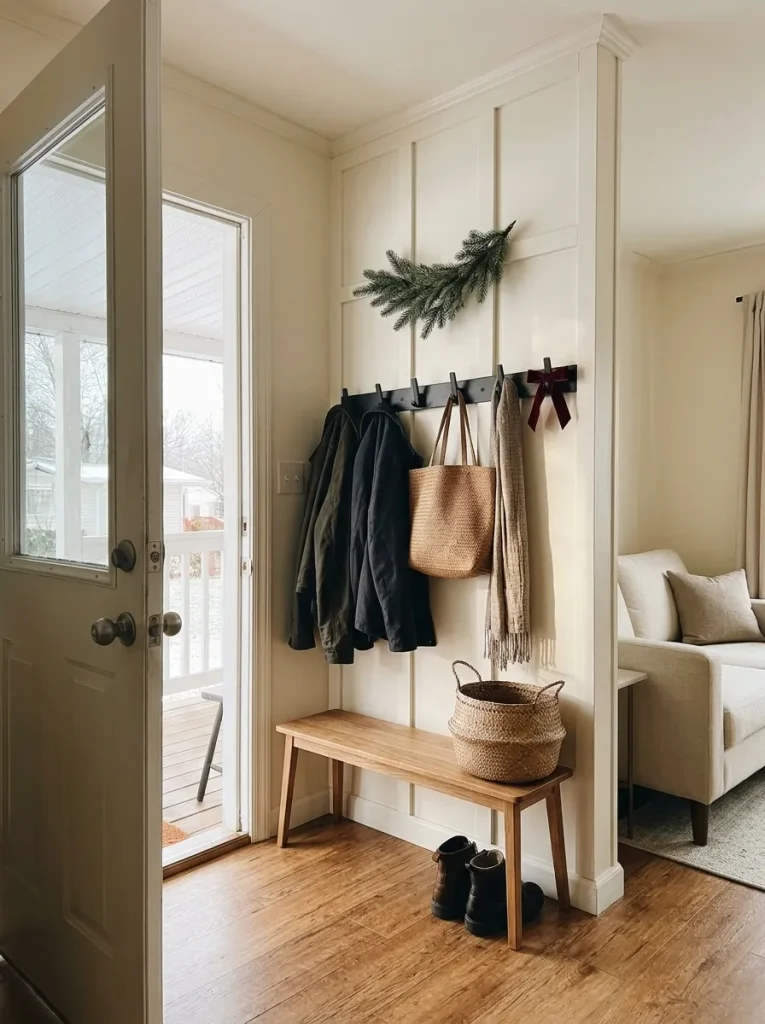
An existing wall-mounted coat rack can become the centerpiece of a Christmas entry without purchasing another piece of furniture.
Picture a white board-and-batten wall with simple black hooks, a woven market tote, and a couple of everyday winter jackets. A small burgundy velvet bow or a restrained sprig of artificial evergreen adds a seasonal detail while leaving the storage easy to use.
Begin by assigning each hook a purpose.
Place frequently worn coats where family members can reach them naturally. Reserve another position for an everyday handbag or tote. If occasional guests need a hook, choose a position that does not interfere with the door or other hanging belongings.
The Christmas decoration should occupy unused space above or beside the working rail. Bulky ornaments hanging from the same hooks can quickly become inconvenient.
For a particularly narrow entry: choose a shorter existing rack with fewer, more useful positions. A wall crowded with heavy jackets can make a small hallway feel tighter even when the floor remains clear.
If you plan to install new hardware, confirm that the wall surface and fixings are appropriate for the intended load. Manufactured-home interior finishes vary, and decorative wall paneling should not automatically be treated as structural support.
For a renter-friendly seasonal accent, follow the instructions for the specific removable product. Command’s official hanging-product FAQ explains that weight ratings and compatible surfaces differ between products, and adding extra strips does not necessarily increase holding capacity.
The finished wall should look festive even with ordinary coats hanging on it. That everyday appearance is more useful than a beautifully styled rack that must be cleared before anyone can use it.
3. Give a Slim Entry Bench Separate Jobs for Shoes and Winter Accessories
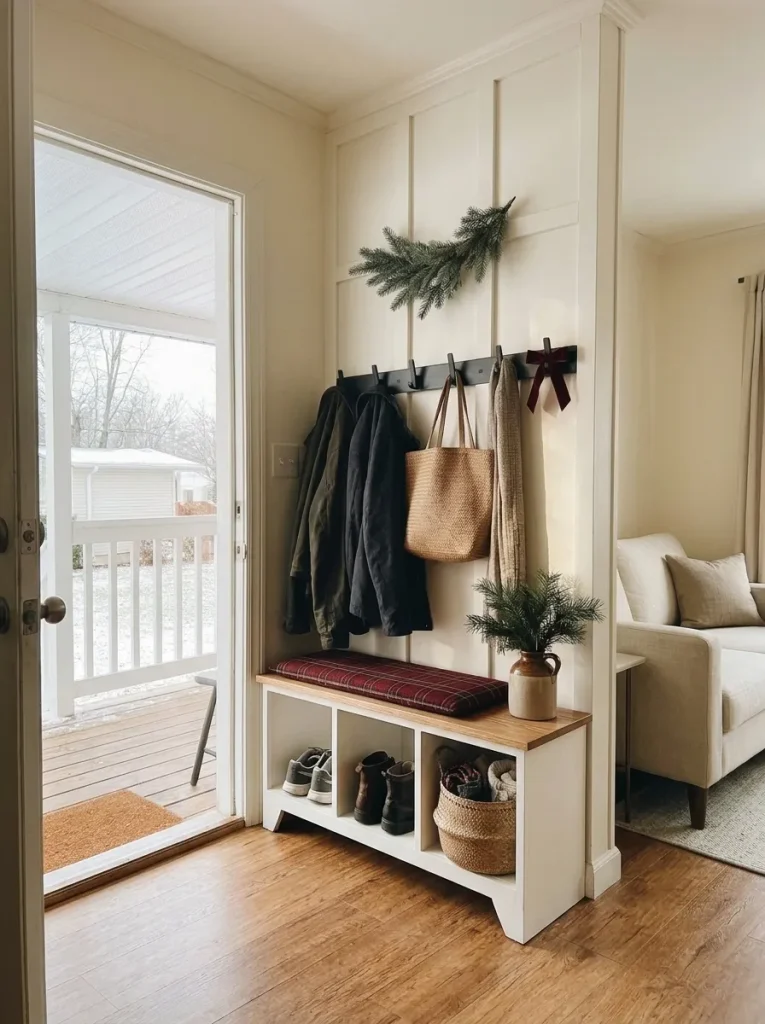
A bench earns its place in a small mobile home when it provides comfortable seating and useful storage without obstructing movement.
Choose a shallow design with open lower compartments if your entry has enough depth. Natural oak, a white-painted base, or weathered wood can complement a farmhouse Christmas palette.
The upper surface has one job: somewhere to sit while putting on shoes.
Keep it mostly clear. A washable plaid cushion or one folded throw adds seasonal texture without turning the bench into a display shelf.
Below the seat, organize belongings according to how often they are used.
Everyday shoes: Place frequently worn pairs where they can be reached without removing baskets or rearranging other footwear.
Dry winter accessories: Use a labeled woven basket for gloves, hats, and scarves after they have dried.
Occasional accessories: Store spare items farther along the lower shelf or in an enclosed compartment.
One large basket containing shoes, gloves, scarves, and holiday decorations can look tidy from a distance but becomes frustrating when someone needs a specific item.
A compact bench with separate storage positions is easier to maintain.
There is one important limitation: if the bench cannot be used comfortably because the walkway becomes cramped, skip it. A narrow wall organizer and a separate shoe tray may serve the entry better.
For readers who want to build or adapt furniture, these DIY mobile home storage projects include an entry bench with shoe storage and other compact furniture solutions.
Does your entry actually need a bench?
The right answer depends on whether seating earns its footprint. Select the closest constraint.
For new benches, check product stability, intended seating use, and applicable installation guidance.
4. Turn a Narrow Family Photo Gallery Into a Tiny Christmas Welcome Station
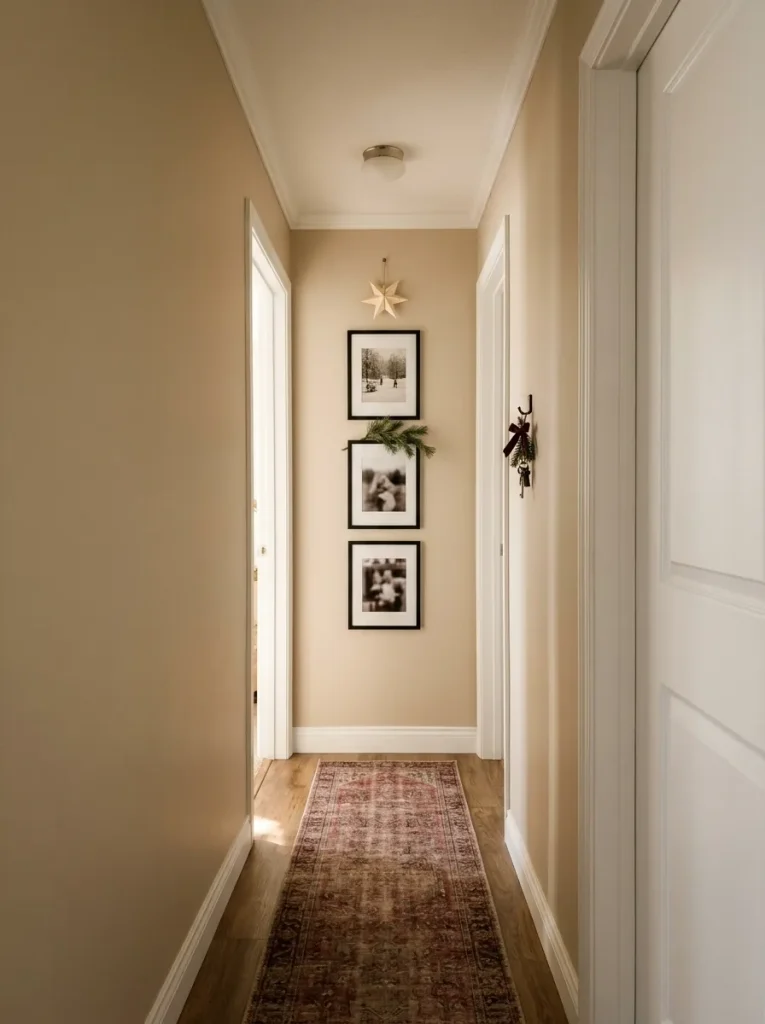
Some mobile homes have an entrance corridor that is simply too narrow for a console or storage bench.
In that situation, the wall can provide the holiday atmosphere while a small existing organizer handles the practical essentials.
A vertical arrangement of three family photographs works especially well in a short hallway. Choose matching frames, such as thin black metal or warm oak, and keep their widths consistent for a tidy appearance.
To introduce Christmas, replace one everyday photograph with a favorite family holiday memory. A small paper star or restrained evergreen detail can add another seasonal note without occupying the floor.
The organization element should remain modest.
A suitable small key hook or shallow wall pocket near the entrance gives everyday essentials a defined home. It can sit beside the gallery or at a convenient hand-height position elsewhere along the wall.
Avoid trying to combine everything into the photo arrangement. Keys, bags, and mail do not need to hang from picture frames or decorative fixtures.
From the opposite end of the hall, the photographs should create a welcoming visual destination. From the doorway, the key location should be easy to recognize.
This approach suits a mobile home with limited floor space because most of the decorative impact comes from the wall itself.
If even a small stool or plant stand interrupts the corridor, leave the floor completely open.
5. Create a December Mail-and-Christmas-Card Sorting Wall
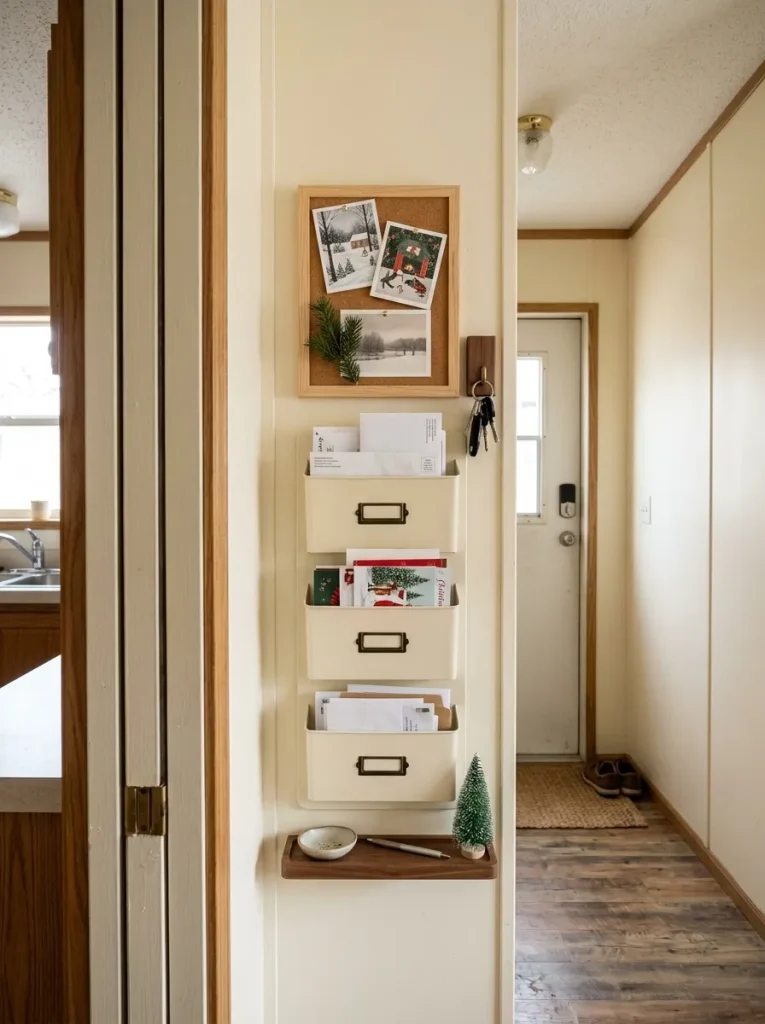
December introduces an unusual mix of paperwork.
Christmas cards arrive alongside bills, shopping receipts, school notices, return labels, and invitations. When everything lands on the kitchen counter, the seasonal clutter spreads well beyond the entryway.
A slim wall-mounted organizer can intercept the paperwork before it reaches the rest of the house.
Look for three shallow pockets or adapt an existing organizer with clearly defined categories.
| What belongs inside | What happens next | |
|---|---|---|
| Action | Invitations, forms, bills, and important notices | Review regularly and complete the necessary task. |
| Christmas Cards | Cards and seasonal notes worth keeping temporarily | Display favorites, then store or recycle after the holidays. |
| Outgoing | Return labels, letters, and papers leaving the house | Take them along during the next relevant errand. |
A small framed Christmas print or a simple greenery accent can soften the functional appearance of the organizer.
For a farmhouse-style entry, natural wood frames and muted cream pockets coordinate beautifully with woven baskets and black hooks. A more modern mobile home might suit a slim metal organizer in a warm neutral finish.
Placement matters more than appearance.
Choose a wall section where mail naturally arrives. If household paperwork is already managed in the kitchen, use only a small incoming pocket by the door and keep the main sorting system where it currently works.
An additional organizer is useful only when it reduces unnecessary movement and forgotten paperwork.
During the Christmas season, review the Action pocket regularly and prevent the card pocket from expanding into other storage categories.
Solve the December paper bottleneck
Pick the pile that most often wins. The output changes which pocket gets priority and what to clear first.
Use the normal place where your household handles paperwork. A second sorting station is unnecessary if everything already runs smoothly elsewhere.
6. Add a Holiday Calendar and Key Station for Busy Family Mornings
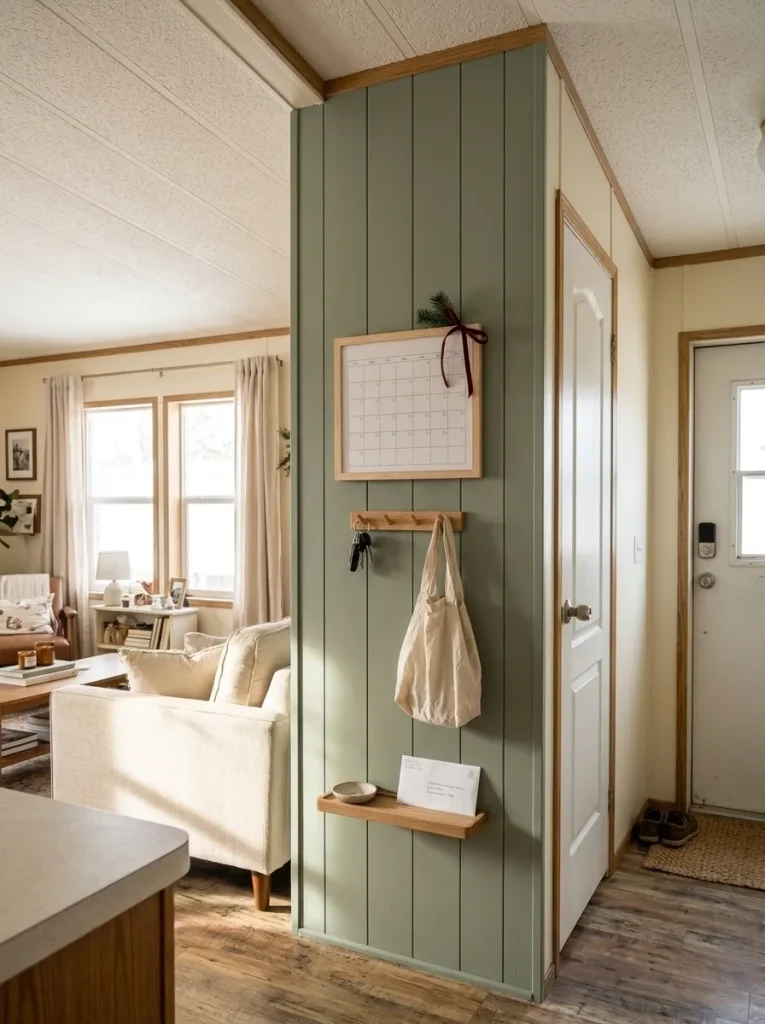
A December family schedule can become complicated surprisingly quickly.
There may be school concerts, family gatherings, shopping trips, parcel collections, and holiday appointments. A compact command center near the entrance can make those commitments visible as everyone leaves the house.
Start with a framed monthly calendar mounted where it can be read comfortably.
Beneath it, add a suitable key rail or use an existing set of labeled hooks. If there is enough wall space, a shallow tray or shelf can hold one or two small items that need to leave the house the following morning.
The arrangement works best when every component has a distinct responsibility.
The calendar records dates and commitments. The hooks hold keys. The departure tray contains items needed for the next outing.
For example, a reusable shopping bag might hang from its assigned hook while a small return parcel sits temporarily on the departure shelf. Neither item belongs permanently on the calendar surface.
Choose a Christmas color palette that remains calm beside your living room. Sage green, natural oak, antique brass, and cream can feel festive with one small red accent.
A tiny evergreen sprig above the calendar is enough to establish the season.
Keep the board editable and readable. Decorative cards should never cover the dates or reminders family members need.
After Christmas, clear the completed events and keep using the same command center. This is one of the few holiday decorating ideas that can directly improve everyday organization long after January begins.
7. Contain Wet Boots, Umbrellas, and Winter Gear Near the Threshold
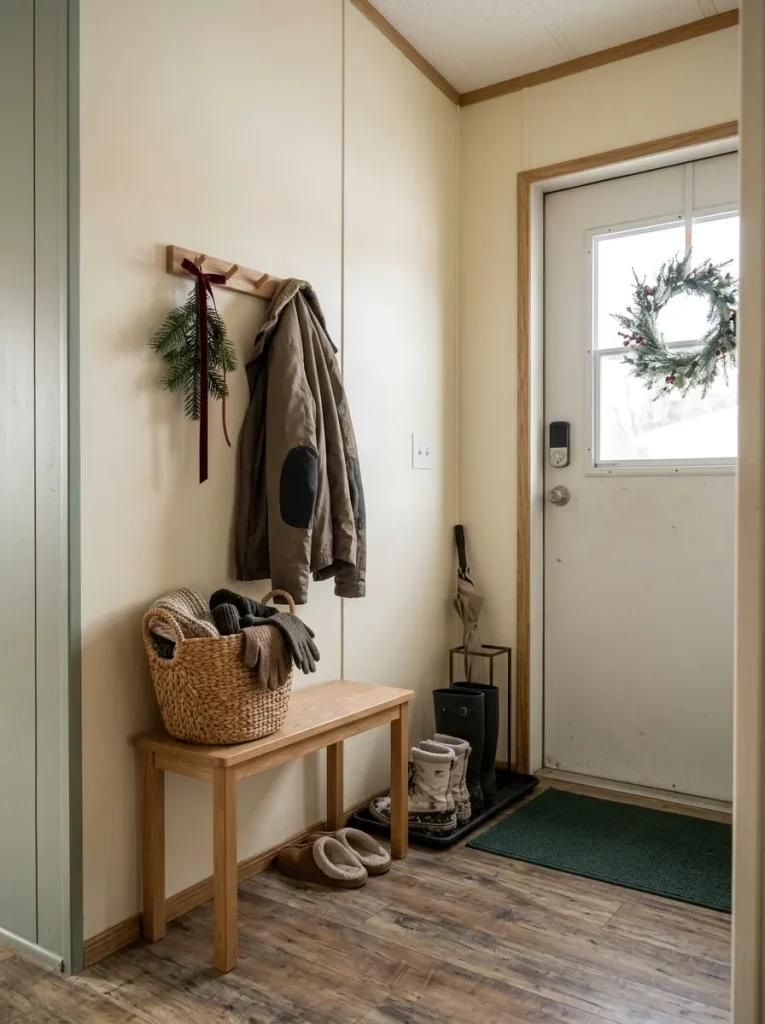
A Christmas entryway styled with pale rugs, wicker baskets, and natural wood can look beautiful in photographs.
But in colder or rainier parts of the country, everyday winter weather creates a different problem: wet shoes, dripping umbrellas, and damp accessories.
Those items need a receiving area that can be cleaned easily.
A low boot tray positioned outside the door’s swing is often more practical than a decorative basket. Choose one that fits the actual available floor space and can be emptied or cleaned without moving other furniture.
Separate winter gear into three groups.
- Wet items: Boots and umbrellas stay in the cleanable receiving area while excess moisture is handled.
- Drying items: Damp gloves, scarves, and hats move to an appropriate ventilated drying location, away from heaters and other heat sources.
- Dry items: Clean accessories return to baskets, cubbies, or hooks designed for everyday use.
The Christmas styling can come from the surrounding materials.
Try a dark green basket label, a washable tartan cushion on an existing bench, or a small framed winter print above the storage area.
Avoid relying on absorbent rugs to collect water from footwear. A decorative runner may work farther inside the entry once shoes have been removed, provided it stays secure and does not create a trip hazard.
Small-space decision: If a boot tray occupies too much of the main passage, find an alternate practical location nearby. The storage should accommodate the way people enter the home, not force them around a new obstacle.
Keep moisture on one side of the routine
A small entry should not force wet footwear through baskets of dry scarves. This diagram shows a simple relationship between two storage jobs and the route people actually walk.
Wet receiving zone
Easy-clean footwear tray; manageable umbrellas. Empty collected water promptly.
Surface: washable and stable.
Dry accessory zone
Woven baskets for dry scarves, hats and gloves; easy to lift and return.
Surface: clean, dry and accessible.
8. Reserve a Discreet Drop Spot for December Parcels and Gift Bags
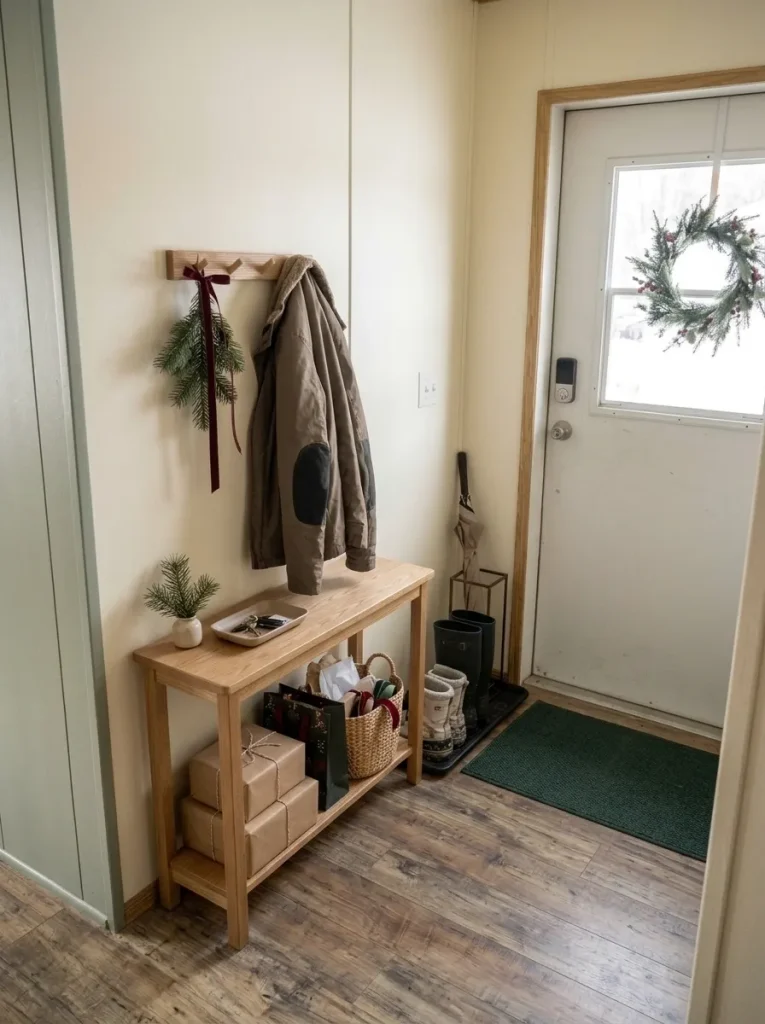
During December, the front entrance often becomes an unofficial delivery station.
Small parcels appear beside the door, gift bags collect on chairs, and empty packaging may remain in the hallway longer than intended.
A designated receiving spot can keep these temporary arrivals under control.
Choose an existing lower shelf, an empty console compartment, or a small basket located away from the main walking route.
Separate incoming and outgoing items.
Incoming parcels need a temporary place while they are checked and moved to their proper location. Outgoing gifts, returns, or packages need somewhere visible enough to remember before leaving.
These jobs can share a piece of furniture, but they should not become one mixed pile.
Consider a simple evening habit: check the receiving spot, remove opened packaging, and relocate anything that no longer needs to remain near the door.
If parcels routinely overflow the area, increase the frequency of sorting before buying a larger organizer.
A woven basket may be sufficient for small gifts, while bulky deliveries are better handled in another designated area of the home.
For Christmas styling, keep the receiving spot visually restrained. A small label or coordinated container is more practical than filling the same shelf with decorative presents.
The display should never block a doorway or the normal route out of the home.
9. Prepare a Compact Christmas Guest Handoff Shelf
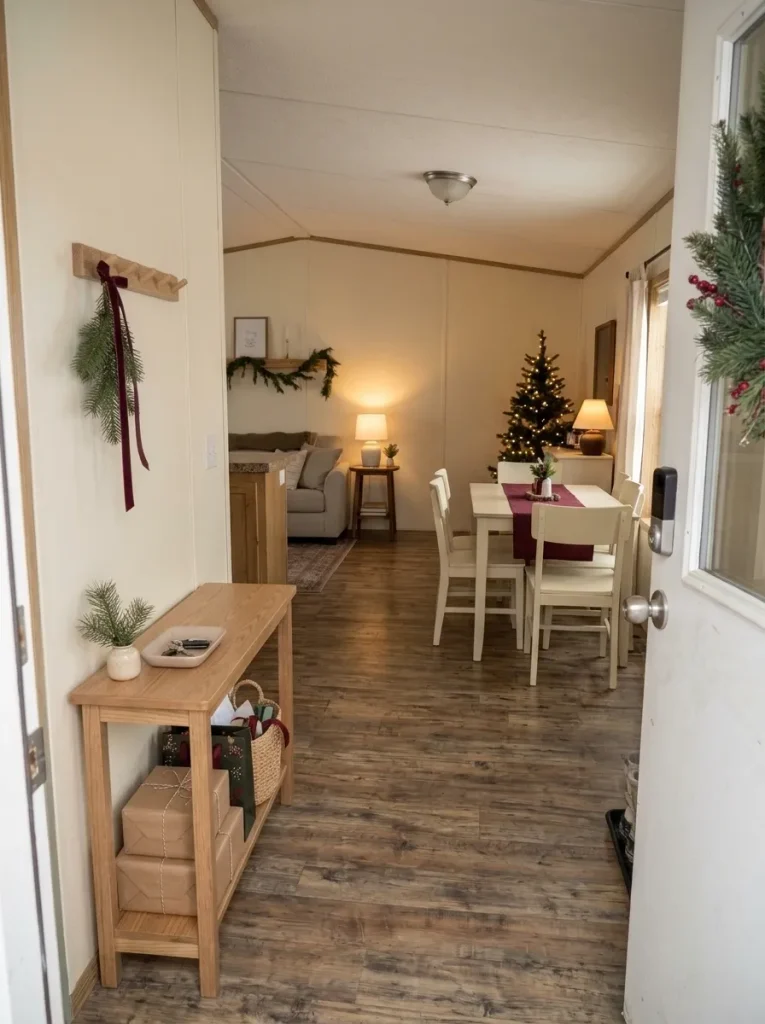
Christmas visitors often arrive carrying several things at once.
Someone may have a handbag, a wrapped present, a winter coat, and a small package for the host. Without a convenient landing point, those belongings end up on the dining table or the nearest chair.
A compact handoff shelf provides a brief place to set things down after guests have stepped fully inside.
An existing narrow console or stable wall shelf can work, depending on the available space and appropriate support.
Keep one section intentionally clear.
A small dish for keys, a modest seasonal greeting, or a framed family photograph can occupy the remaining surface. Avoid arranging delicate glass ornaments where people will place bags.
The important distinction is between temporary handoff and longer-term storage.
A handbag may remain on an appropriate shelf for a short visit. Bulky coats usually need a separate location with enough capacity.
If several guests are expected, identify that coat location before the first person arrives. An entryway designed for two everyday coats may not accommodate six additional winter jackets.
For more detailed overflow solutions, the Thanksgiving guest-coat storage guide for small mobile homes explains temporary hanging arrangements and other guest-coat strategies that can also be useful at Christmas.
A successful guest welcome station gives people somewhere convenient to pause without turning the front door into a storage bottleneck.
10. Dress a Wooden Hook Shelf With Evergreen and Vintage Christmas Accents
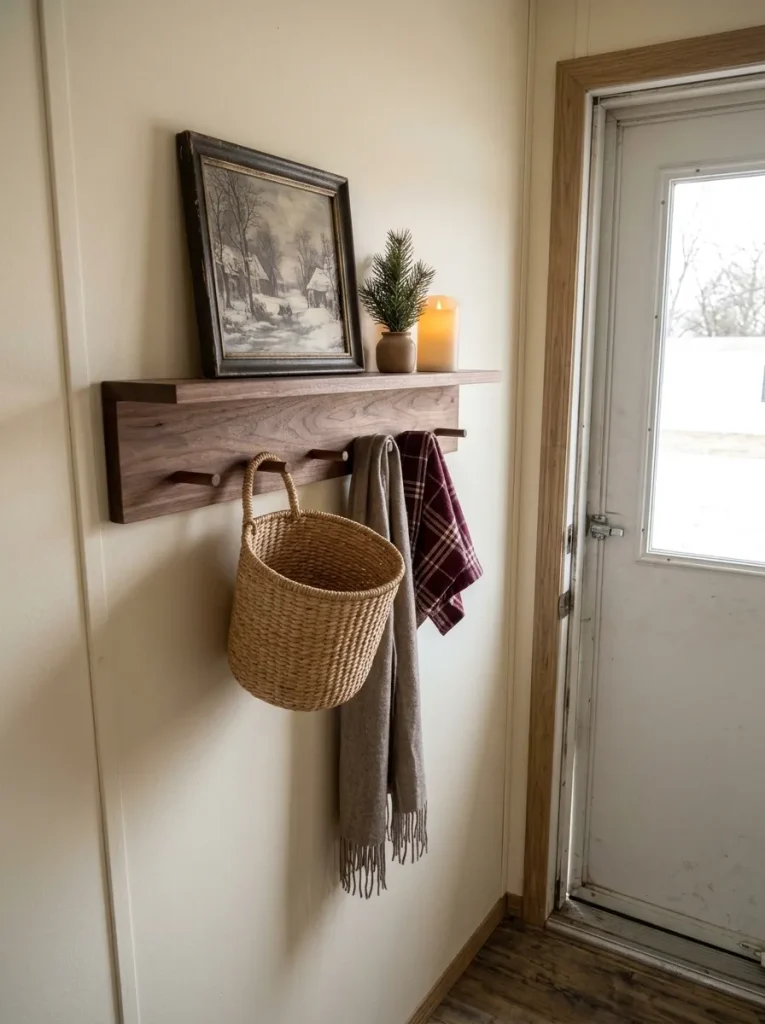
A wooden peg shelf near the entrance offers a particularly charming opportunity for rustic Christmas styling.
It can combine natural timber, a small winter landscape, simple greenery, and an antique-looking seasonal accent while continuing to serve its everyday storage purpose.
Begin with the shelf’s existing arrangement.
If it holds a small bowl, framed artwork, or a frequently used container, decide which items genuinely need to remain. Preserve enough free surface for everyday use before adding seasonal decoration.
Then introduce a restrained Christmas composition.
A short artificial evergreen branch can sit beside a small vintage-style winter print. An aged brass bell, a miniature wooden ornament, or one burgundy textile accent can complete the arrangement.
The working hooks below should remain accessible.
Coats and bags must be able to hang and move freely without catching decorations. Any hanging ornament should be lightweight, secured appropriately, and positioned away from frequently handled items.
For a warm glow, select a battery-operated flameless candle on a stable, suitable surface. Avoid an open flame near greenery, coats, paper, or hanging fabrics. The U.S. Fire Administration’s holiday safety recommendations encourage flameless candles and careful inspection of seasonal lights.
One small festive grouping is generally enough for a narrow mobile-home entrance.
If you want to style larger surfaces elsewhere, these Christmas shelf styling ideas for mobile homes without a fireplace offer more decorative arrangements.
For an additional doorway feature, a separate guide explains how to make a removable Christmas garland for a mobile home doorway while accounting for the opening and suitable mounting methods.
11. Use Gentle Christmas Lighting to Make Evening Arrivals Easier
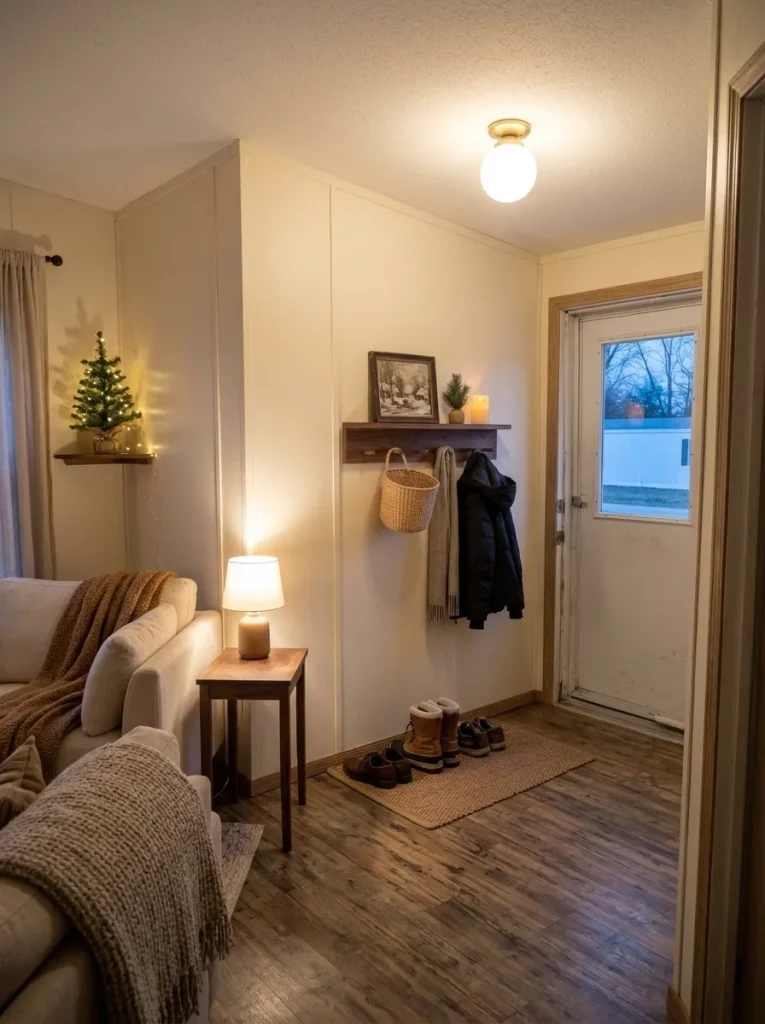
A welcoming entryway should feel comfortable when someone returns home after dark.
In a small mobile home, the entrance may receive some light from the living room, but the coat hooks, shoe storage, or key shelf can still fall into shadow.
Before adding decorative Christmas lights, check whether the everyday lighting illuminates the areas people actually use.
Stand outside the open entrance at night and look toward the key station and shoe area. Then step inside and check whether the floor and any changes in level are easy to see.
A suitable battery-powered wall light or another safely positioned source of illumination may improve visibility without requiring a complicated installation.
Once the practical lighting works, introduce the Christmas atmosphere.
A flameless candle on a stable shelf, a restrained warm-white decorative accent, or a modest illuminated arrangement in a safe location can add a gentle glow.
Avoid trailing cords across walking routes or positioning lights where a moving door, hanging coat, or bag may catch them.
For electric seasonal decorations, follow the manufacturer’s indoor-use requirements and inspect the wiring before installation. The U.S. Fire Administration recommends discarding light strands with damaged or pinched wires and following instructions about connected strands.
Turn decorative lights off when leaving the home or going to bed.
The best evening arrangement makes the entry feel inviting while allowing everyone to see the floor, find their keys, and move through the door comfortably.
12. Build a Christmas Drop Zone That Converts Back to Everyday Storage in January
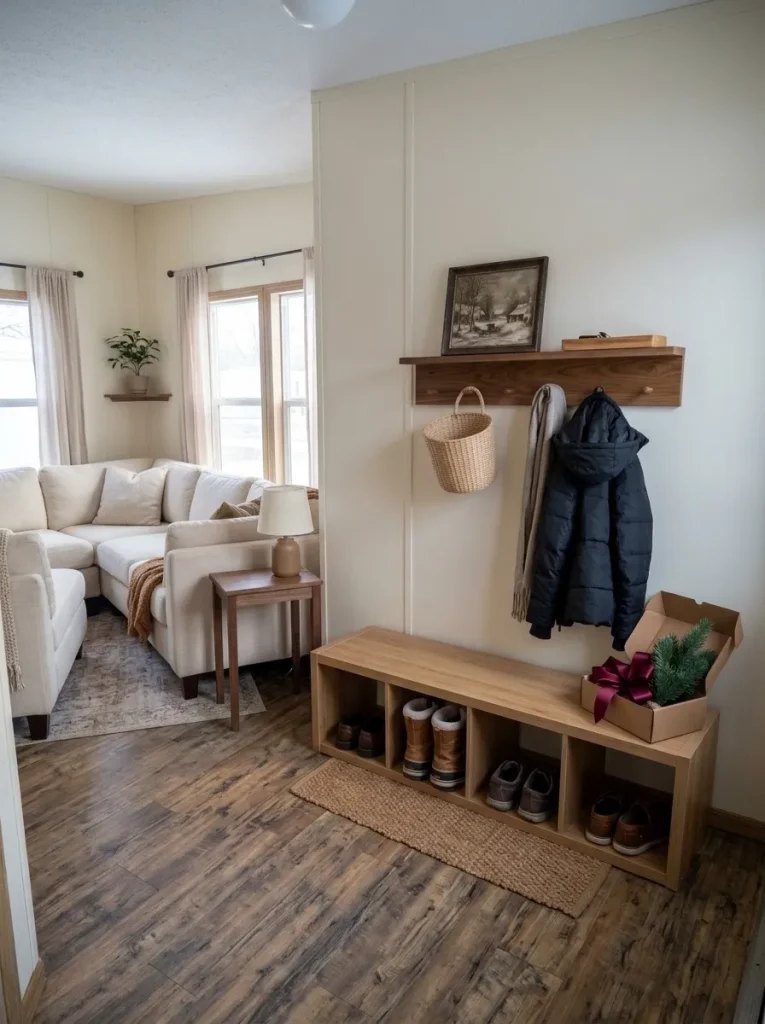
The final test of a Christmas entryway is what happens after the decorations come down.
A system that depends on temporary furniture, extra hooks, or overflowing seasonal baskets may become inconvenient once normal routines return.
Build the permanent organization first, then treat Christmas as a removable decorative layer.
Think of the entryway in three stages.
During Everyday December Routines
Keep the essential storage working normally.
Coats hang on their assigned hooks, shoes return to their proper location, and keys have a consistent landing point.
A small evergreen accent, seasonal cushion, or holiday print introduces Christmas without changing how the area operates.
When Christmas Guests Arrive
Prepare the entry for increased activity.
Clear the handoff shelf, confirm where additional coats will go, and remove fragile tabletop ornaments from surfaces guests may need.
Outgoing gift bags can occupy a designated temporary spot as long as they remain away from the entrance route.
During the January Reset
Remove the decorative layer while preserving the functional system.
Store reusable greenery and bows together. Clear the Christmas-card pocket, process any remaining parcel packaging, and return seasonal baskets to their everyday purposes.
Review what worked during the busiest days.
Did family members consistently use the key hooks? Were shoes easy to put away? Did the guest handoff area stay clear?
Keep those successful arrangements and adjust anything that repeatedly became cluttered.
A useful final rule: Every permanent organizer should have a purpose beyond Christmas. Seasonal decorations can change, but the most practical storage assignments should remain.
That approach makes the entryway easier to maintain and reduces the need to purchase new storage products for every holiday.
One entry, three December-to-January modes
The permanent organizers stay in place while storage priorities and decorative layers change with the calendar.
The goal is a repeatable routine, not a promise that every house needs the same number of containers.
Your Christmas Entryway Setup Checklist
Before considering the project finished, check the space during one ordinary arrival and one busier holiday scenario.
- The entrance door opens completely without hitting furniture, baskets, or decorations.
- The main walking route remains clear.
- Everyday coats and bags have appropriate storage locations.
- Frequently worn shoes have a convenient, accessible place.
- Wet footwear can be handled without damaging nearby textiles.
- Keys and outgoing essentials have a reliable landing point.
- Christmas cards, mail, and parcels do not accumulate in the walkway.
- Guest belongings have a practical temporary destination.
- Decorative lighting and attachments follow appropriate safety instructions.
- Holiday accents can be removed without disrupting everyday organization.
The checklist does not require buying ten new products. Many mobile homes can achieve most of these improvements by rearranging existing hooks, baskets, shelves, and furniture.
Start with whichever issue causes the most inconvenience, then add only the organization that genuinely improves the space.
A Small Christmas Welcome That Works All Season
A memorable Christmas entryway does not require a large foyer or elaborate decorating scheme.
One appropriately positioned coat rail, a small place for keys, and a practical shoe-storage solution may be enough to make your home feel more welcoming. A little greenery, natural wood, and a familiar family photograph can provide the holiday atmosphere.
Prioritize the everyday arrival route, choose storage that suits your mobile home’s actual dimensions, and keep seasonal decorations easy to remove.
The result is an entrance that feels festive when guests arrive and remains comfortable for the people using it every day.
Save these Christmas entryway organization ideas to Pinterest so you can revisit your favorite setup when decorating your small mobile home.