

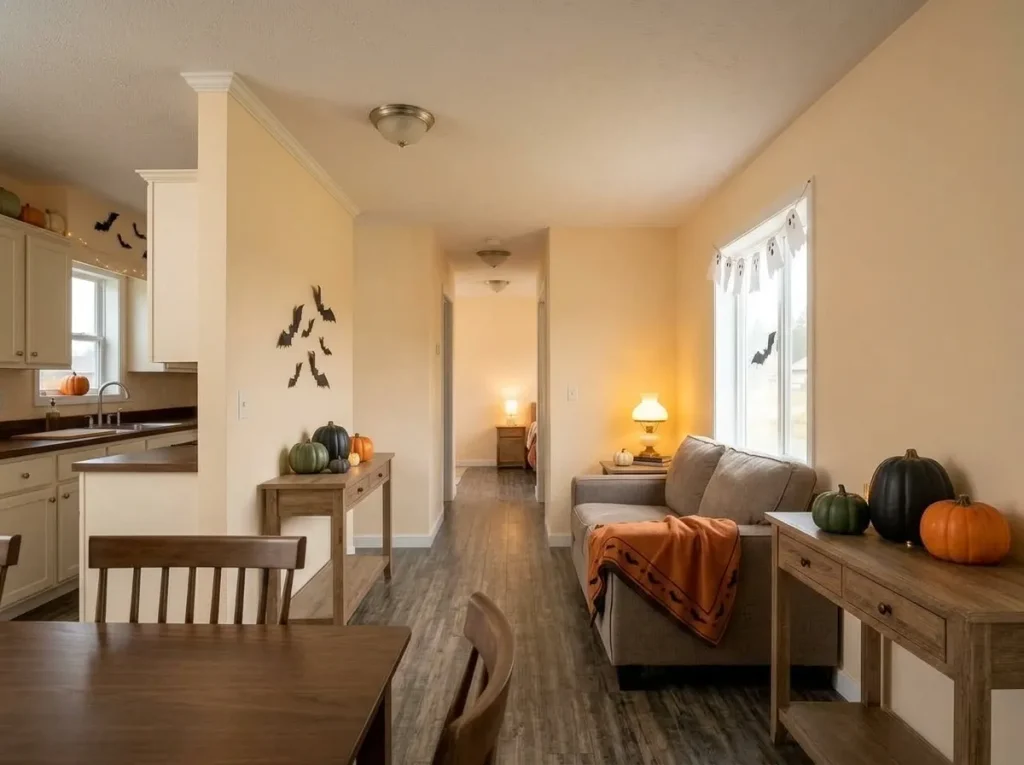
Cheap Halloween décor can save money and still make a mobile home look beautifully styled—but only when the decorations feel connected. A cart full of tiny pumpkins, plastic signs, webs, bats and orange accessories may be inexpensive individually, yet once every counter and wall gets its own moment, a compact home can start feeling more crowded than festive.
The smarter approach to cheap Halloween mobile home decor is to spend less in more visible places. Use a limited color palette, concentrate the drama along one or two strong sightlines, turn inexpensive paper and fabric into larger compositions, and let warm lighting do part of the decorating after dark.
The 21 ideas below work around the realities of mobile-home rooms: lower ceilings, narrow halls, valuable counter space, smaller furniture clearances and connected areas that may be visible at the same time.
You’ll also find budget-planning tools along the way so you can decide what deserves money, what is better made at home and when your Halloween decorating is already finished.
1. Set a Three-Color Halloween Palette Before You Spend Anything
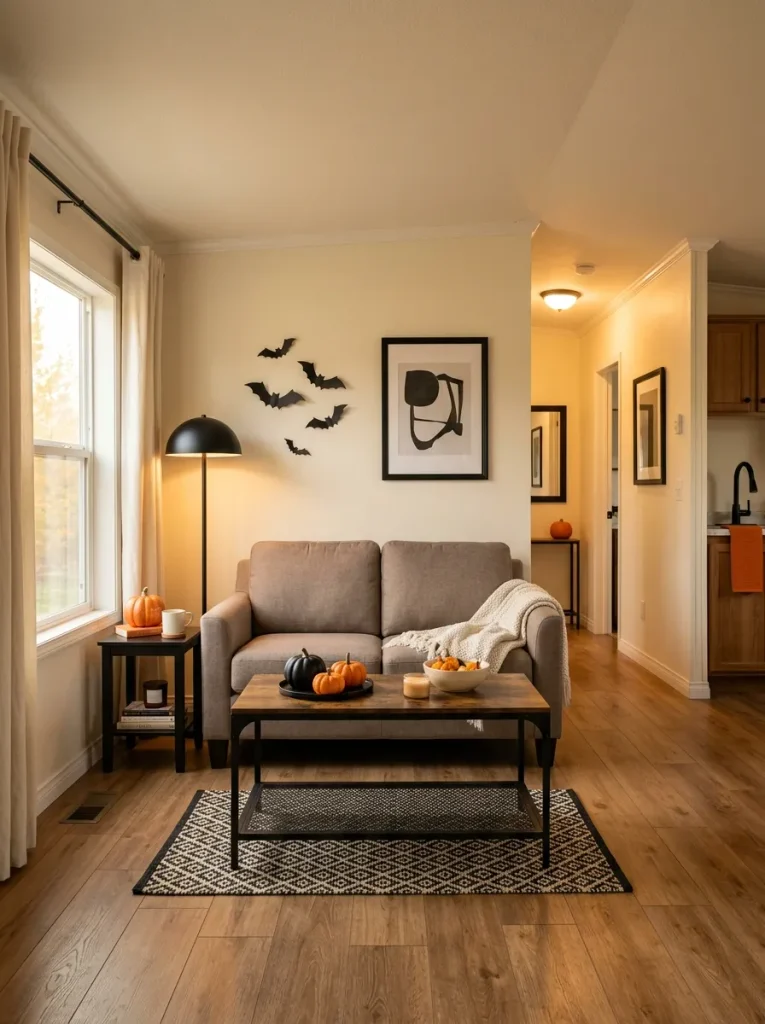
A low-cost decoration usually looks most convincing when it appears to belong to everything around it. In a compact mobile home, that matters even more because the living room, hallway, dining area and kitchen may enter the same view. Five unrelated Halloween color schemes can therefore collide from a single standing position.
Choose three dominant colors before shopping. Treat everything else as a minor accent.
For a warm classic look, try soft ivory, matte black and pumpkin orange, then let amber light behave almost like a fourth color at night. A quieter gothic scheme might combine charcoal, aged bone and muted plum.
Use your existing furniture as the filter. A beige sofa and warm wood floor already provide neutral foundations, so orange and black require less support. Cooler gray interiors may carry bone, charcoal and burgundy more naturally.
Take a phone photograph from the doorway. If one seasonal item introduces a color that appears nowhere else and immediately steals attention, either repeat that shade deliberately or remove the object.
Halloween Palette Lightbox
Palette Lightbox
Choose the Halloween mood that fits your mobile home
Tap a palette. The recommendation underneath will change immediately without JavaScript.
Classic Warm
Use ivory as the calming base, matte black for graphic structure and pumpkin orange only where you want attention. Amber light becomes the evening layer.
Muted Gothic
Build the room around bone, charcoal and muted plum. Use aged brass or warm brown sparingly so the darker palette still feels welcoming.
Soft Spooky
Use cream and warm brown as the foundation, faded orange as the seasonal color and soft black as a small graphic accent.
High-end rule: if a new decoration cannot join the palette naturally, it needs a strong reason to enter the room.
2. Give Every Dollar a Job: Buy One Hero, Make the Supporting Layer
A small Halloween budget disappears quickly when it gets divided among ten ordinary objects. A $4 sign, two $6 pumpkins, a novelty pillow, another garland and several small accessories may feel inexpensive while shopping, yet none becomes strong enough to organize the room.
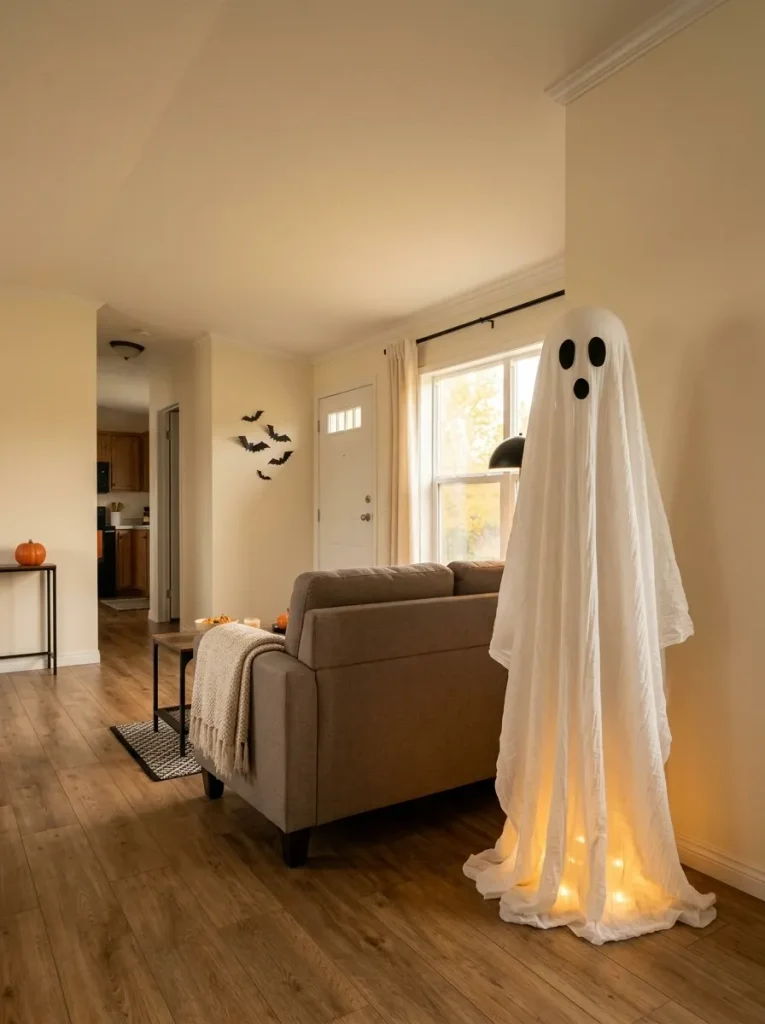
Choose one hero effect first.
That could be an illuminated window, a dramatic TV-wall arrangement, a large homemade ghost or a hallway ceiling treatment. Build the support around it with cardstock, fabric, paper, branches, existing jars, old frames and decorations you already own.
If warm lighting is the part you cannot recreate convincingly, spend there and make the bats yourself. Already own string lights? Put the money toward the focal material. Readers working with very small budgets can also use these ways to decorate a home with dollar-store finds and select only the techniques that fit the Halloween palette.
The useful shopping question becomes:
“What is the one effect this room still needs?”
Halloween Budget Composer
The ranges below are editorial planning bands, not universal retail prices. Local prices and availability vary.
Budget Composer
Which situation looks most like yours?
Choose one route. The spending advice below changes instantly.
Build one reusable atmospheric layer first
Turn the pumpkins you own into the collection
Use your lights as the expensive-looking layer
Your cheapest move is to buy nothing yet
3. Decorate the Longest Sightline, Not Every Small Surface
Stand at the front door—or wherever you naturally enter the main living area—and look toward the farthest point you can see.
That long view is usually more valuable than a dozen individual shelves.
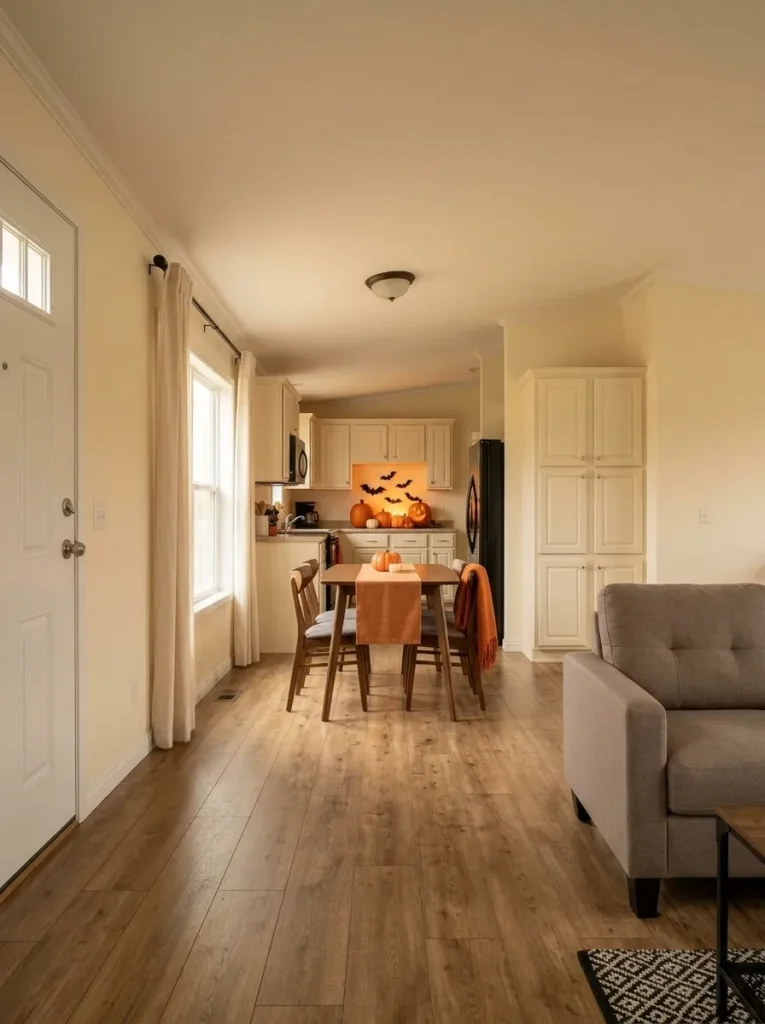
Mobile homes often reveal multiple zones along one axis: an entry may look through the living room toward the dining area or kitchen, while a hallway remains visible from the main seating position. When each surface receives separate Halloween décor, all those small displays combine into one busy image.
Pick one dominant point along that view and let nearby areas become quieter as they move away from it.
- Put the strongest bat arrangement or glowing scene near the visual destination.
- Keep the middle zone to one repeated motif or restrained textile.
- Leave at least one visible stretch of wall, cabinetry or furniture mostly undecorated.
Take another phone photo from the entrance. Shrinking the room onto a screen makes competing focal points surprisingly easy to spot.
If your eye jumps between four equally loud moments, remove one before adding anything.
In a small home, empty space belongs in the decorating plan too.
4. Cut a Rising Bat Flight From Black Cardstock
Few inexpensive Halloween materials cover as much visual territory as black cardstock.
The polished version is not a collection of bats spaced evenly across a wall. Give the swarm one direction. Begin with a denser cluster near a low anchor—a vase, console, television edge or doorway—then allow fewer bats to travel upward or diagonally.
Use roughly three bat sizes. Keep most in the middle scale, add smaller silhouettes near the outer edge and reserve the largest shapes for the dense starting area. That gradual reduction produces movement instead of wallpaper.
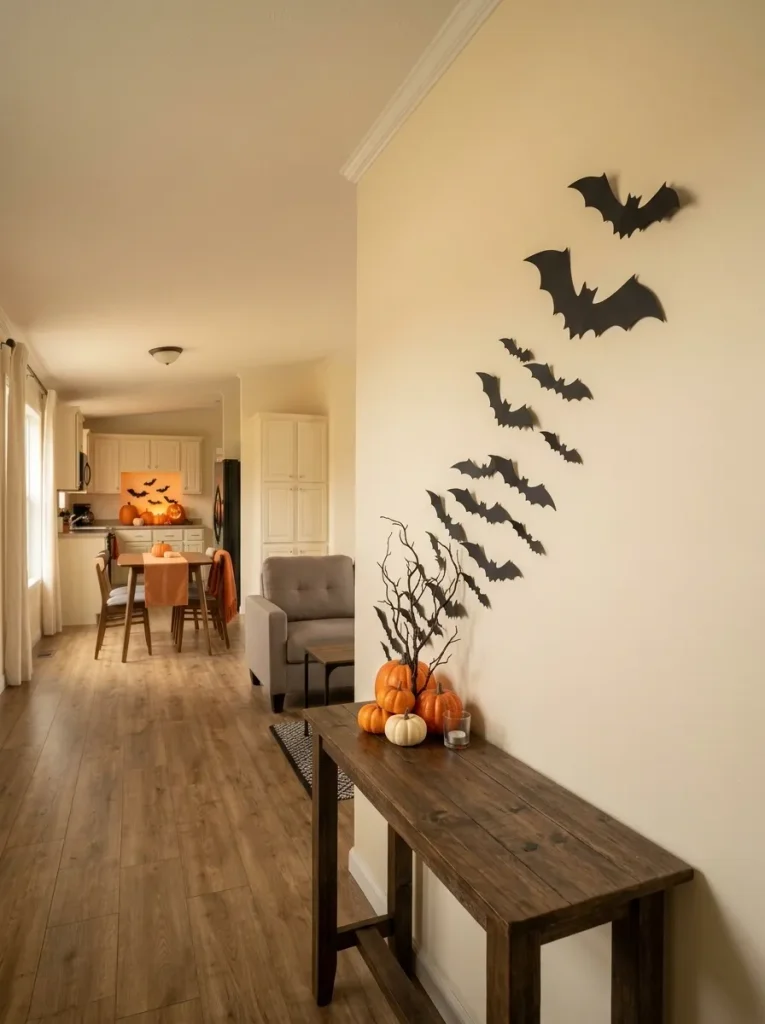
On a compact mobile-home wall, stop while the swarm still has breathing room around it. Continuing onto every neighboring wall can turn one dramatic gesture into background pattern.
Before attaching the full group, tape up five or six temporary paper shapes and view them from the doorway. Adjust the direction first, then expand the path.
Use a removable attachment method appropriate for your wall finish and follow the adhesive product’s instructions.
Decision: once the first test establishes a clear flight path, expand that composition. A second swarm is unnecessary simply because the material is cheap.
5. Turn a Narrow Hall Ceiling Into a Lightweight Halloween Canopy
A hallway is easy to ignore because it may offer almost no furniture surface for seasonal décor. That limitation can work in your favor. In a narrow mobile-home passage, the ceiling is one of the few planes capable of delivering a large Halloween effect without taking away walking space.
Use lightweight materials such as wispy decorative webbing, paper bats, thin black gauze or a restrained run of warm string lights. Let the treatment occupy part of the ceiling while leaving visible areas around it. A continuous overhead gesture feels larger than the amount of material used.
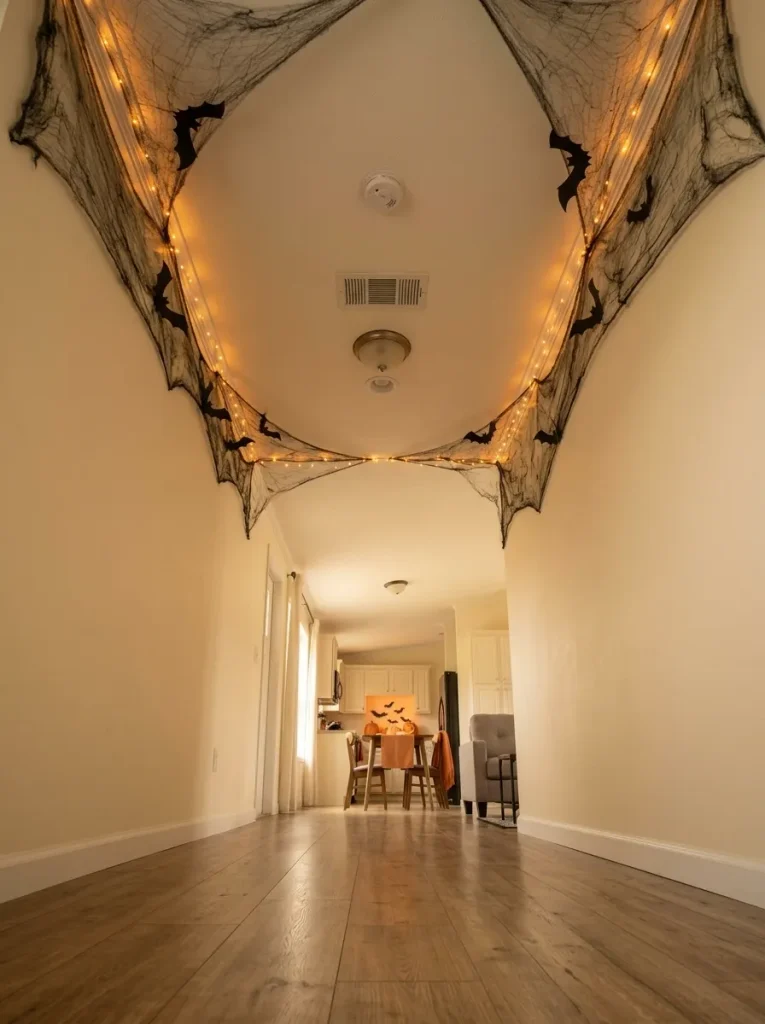
A completely covered low ceiling can feel visually compressed during daylight, so judge the arrangement from the far end of the hallway before finishing it.
If the canopy already creates a strong tunnel effect from that position, stop.
Keep smoke alarms, vents, light fixtures, doors and other functional elements unobstructed, and follow the lighting manufacturer’s installation instructions.
Best fit: a plain hallway that contributes little to the Halloween atmosphere but remains visible from a main room.
6. Make Torn-Paper Ghosts Look Collected, Not Crafty
Paper ghosts become more interesting when they are allowed to look imperfect.
Start with kraft paper, discarded book-page photocopies, cream cardstock or another inexpensive paper that fits the palette. Tear the bottom edge. Draw or cut simple dark eyes, then create several ghosts with small differences in height and width.
What elevates the garland is repetition with variation.
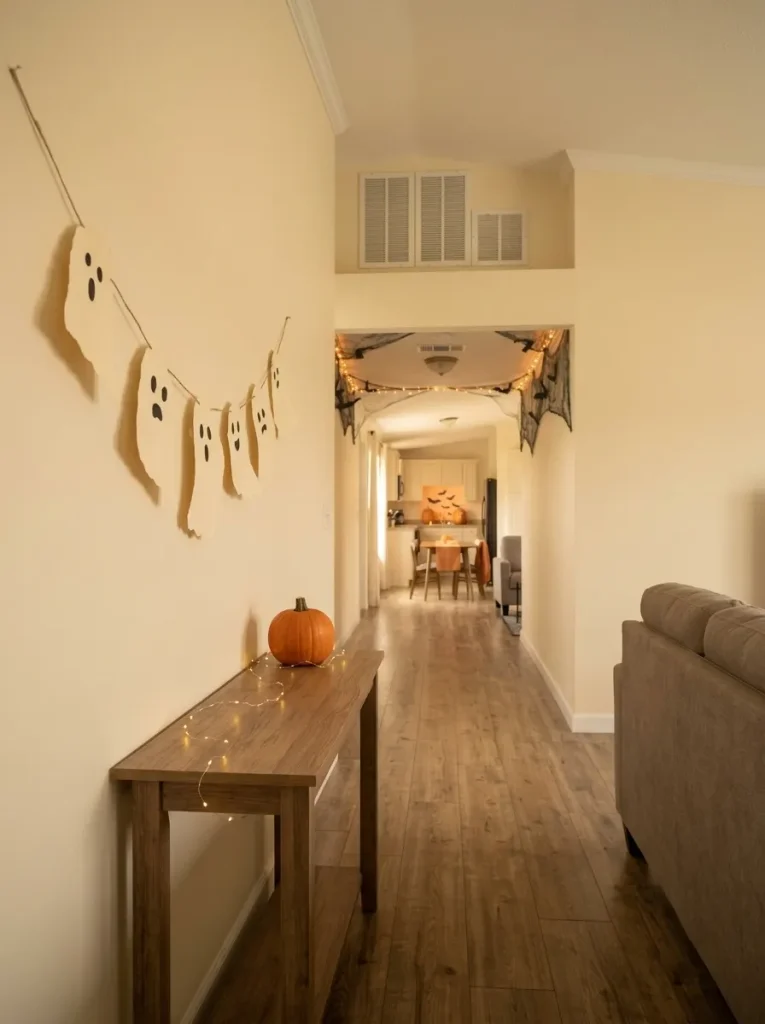
Hang five to nine ghosts along one short strand. Keep the spacing relatively consistent while allowing the silhouettes themselves to differ. The regular rhythm prevents the garland from looking chaotic; the irregular shapes keep it from feeling mass-produced.
If your mobile home already contains patterned textiles, visible kitchen details or busy artwork, choose plainer paper. Printed pages work best against a quiet background where their texture can actually be seen.
The garland also does not need to cross an entire wall. A compact stretch above an entry mirror, console, narrow shelf or doorway often has more presence.
Stop signal: once the ghosts read as one composition, another strand usually adds quantity without improving the idea.
7. Frame One Doorway With Black Gauze Instead of Filling the Floor
A doorway already has scale. Borrow it.
Black gauze, lightweight mesh or inexpensive sheer fabric can turn an ordinary opening into one of the largest Halloween moments in a mobile home while using virtually no floor area.
Let the fabric fall from the upper corners or from one side of the opening. Gather it loosely enough that the passage remains fully usable. A small bat group or one restrained seasonal ornament can connect the threshold to the rest of the décor.
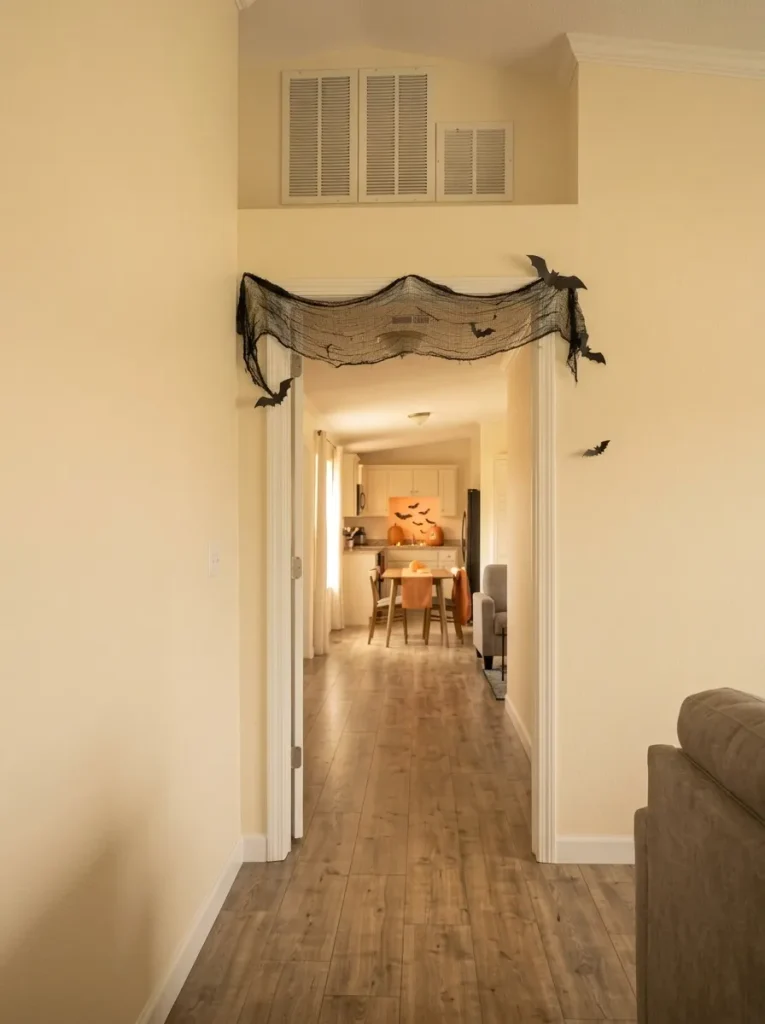
Do not repeat the effect at every door. One transformed threshold feels theatrical; several can make the home resemble a sequence of obstacles.
Test the installation during normal movement. Carry laundry through it. Walk past it in lower light. Open nearby doors fully. If anyone has to duck, brush aside fabric or alter their normal path, pull the treatment farther toward the frame.
Mobile-Home Plane & Sightline Allocator
Plane Allocator
Which surface are you thinking about decorating?
Select one plane and the recommendation will switch immediately.
Wall: strongest all-purpose option
Use bats, framed Halloween art or one short garland. You gain visual scale without sacrificing walking or working space.
Ceiling: high impact with almost no footprint
Use lightweight webbing, paper silhouettes or restrained lighting, especially in a narrow hallway.
Doorway: borrow scale from the architecture
A little gauze or a few bats can produce a much larger visual effect because the opening already frames the composition.
Window: make one project work inside and outside
Bold silhouettes give you interior graphic contrast by day and a glowing outdoor scene after dark.
Furniture: keep it vertical
Use a ladder, cabinet top or narrow console so seasonal pattern does not take over seating or work surfaces.
Floor: use only one intentional anchor
One pumpkin group or one large ghost can work. Numerous small floor props are risky in a compact mobile home.
8. Build One Oversized Ghost With Fabric You Already Own
When a room is small, one large shape can look calmer than twelve little decorations.
A tall ghost made from an old white sheet, sheer curtain or inexpensive lightweight fabric can become the seasonal focal piece. Give the textile enough internal support to create a recognizable silhouette, keep the face minimal and leave the surrounding floor relatively clear.
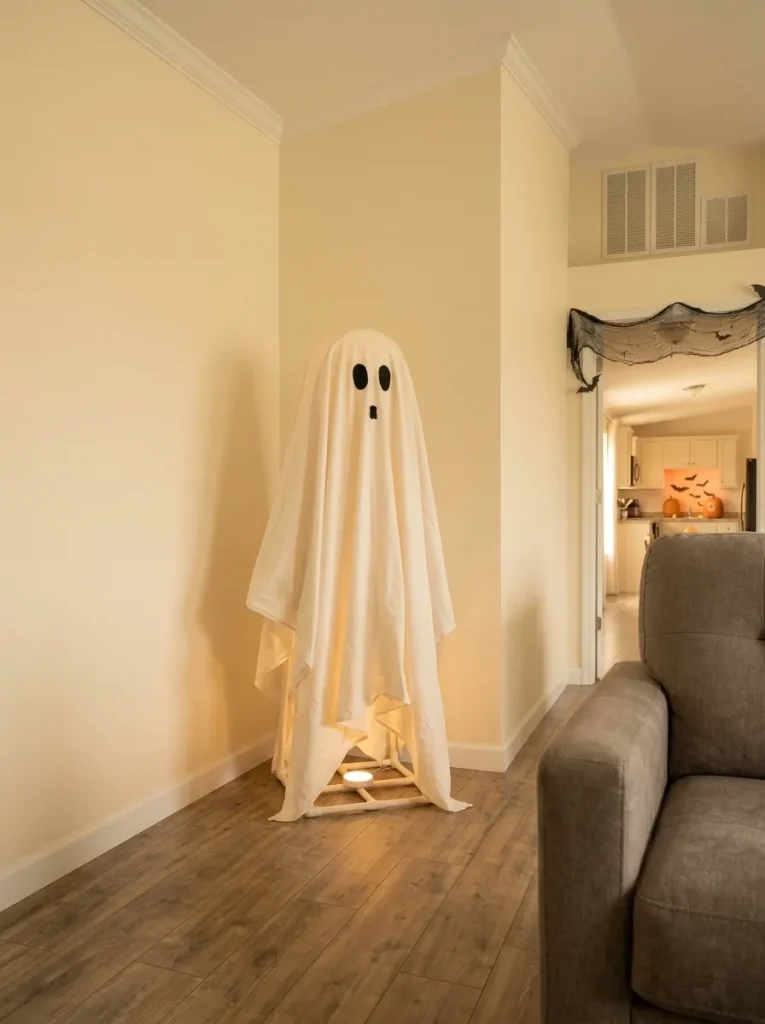
Scale supplies the impact. A figure that reaches well above a coffee table or console creates immediate Halloween presence from across the room even when the material costs almost nothing.
Choose a dead corner beside a console or an unused stretch of living-room wall where the ghost can be seen from the entry or normal seating position without narrowing circulation.
Judge the silhouette before accessorizing it.
If the figure needs five extra props to become interesting, its basic shape is probably too weak. Adjust the height, drape or position first.
The large form should do most of the decorating.
9. Use a Branch as the Structure for a Hanging Halloween Mobile
A dry branch with an interesting bend can look surprisingly editorial when the composition around it stays restrained.
Hang lightweight elements beneath it: miniature paper pumpkins, faded leaves, tiny ghosts, dried seed pods, black ribbon or a few warm micro-lights. Vary the hanging lengths so the arrangement gains movement.
The branch already contributes texture and irregularity. The smaller pieces only need to support that silhouette.
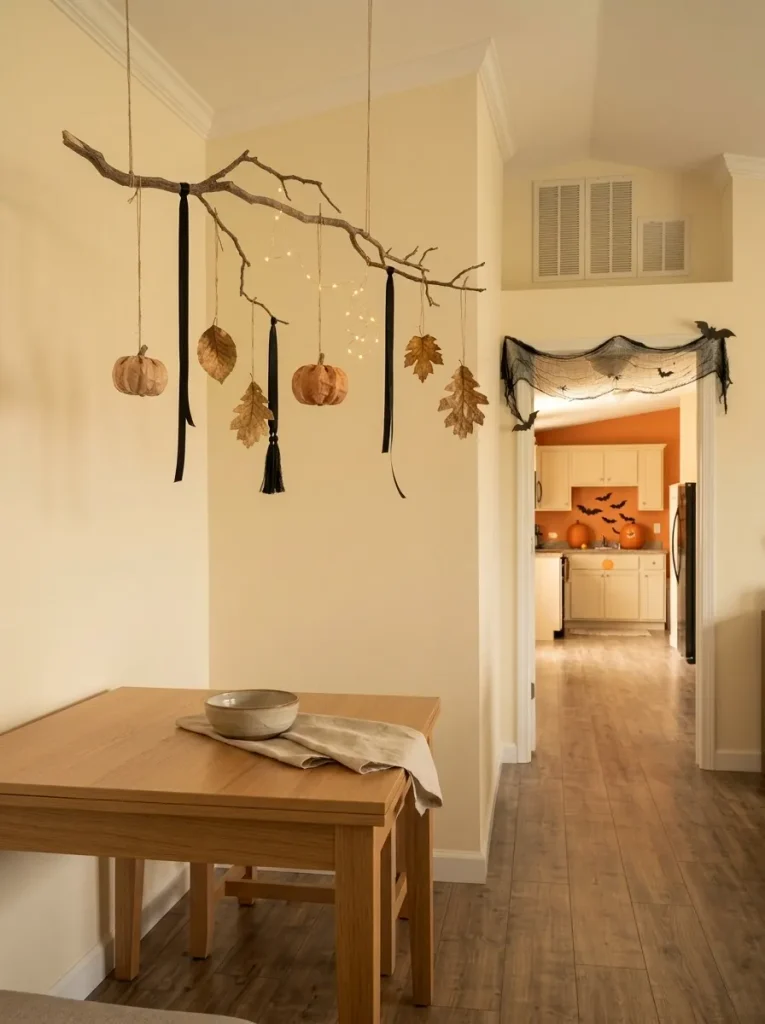
This works particularly well in a mobile home where tabletops are limited because the display occupies a wall or upper zone that might otherwise remain unused.
Six well-spaced objects may look more intentional than twenty tiny ornaments, so keep evaluating the branch itself. If the decorations hide the form that made it interesting, remove several.
Use mounting hardware appropriate for the object and surface, and keep suspended décor away from fans, vents, heat sources and circulation routes.
Take a photograph against the wall before calling it finished. If the branch’s shape still reads clearly, the composition has retained useful negative space.
10. Make the TV Wall the Living Room’s Only Big Halloween Scene
The television wall is already a focal point. Halloween styling can take advantage of that fact.
Frame the area with one coordinated composition: warm lights, a restrained trail of faux autumn foliage, several paper bats, a small group of pumpkins and perhaps a lightweight web across the console. Keep the strongest details near the central zone and reduce their density toward the edges.
The television itself creates a large dark rectangle, so black Halloween pieces may disappear against it. Pumpkin orange, ivory, amber light or another slightly lighter element can provide the contrast needed to make the composition legible.
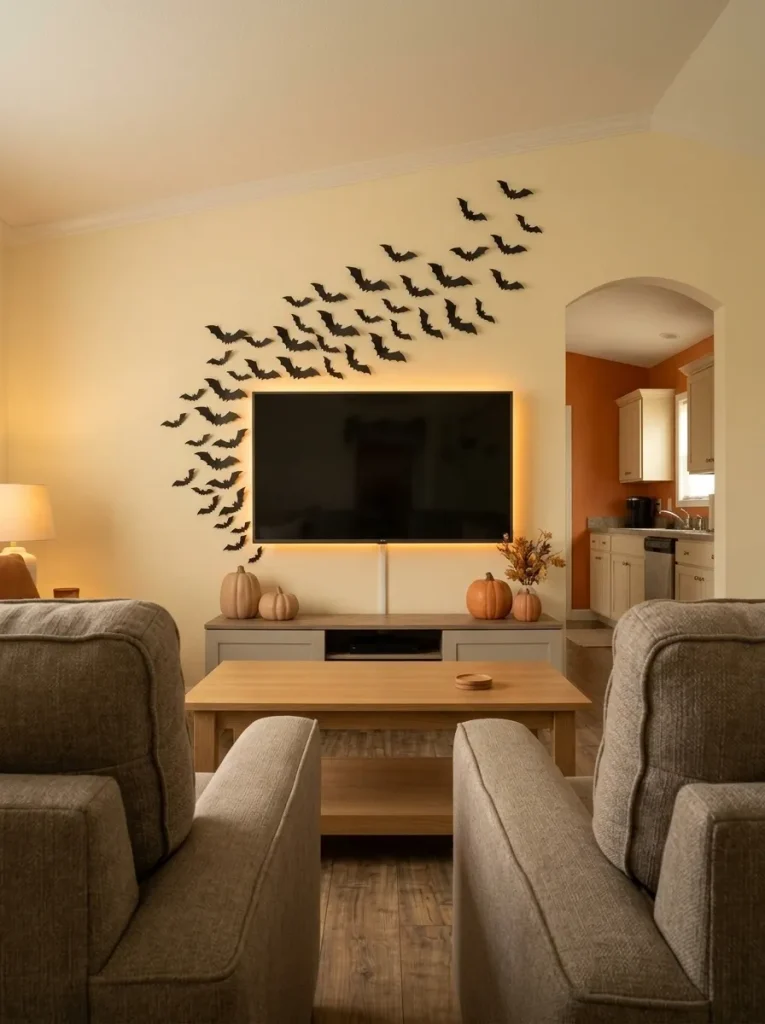
Now simplify the rest of the living room.
If the TV wall carries the main Halloween scene, the coffee table may need only one small object. The sofa might receive one seasonal textile—or nothing at all.
Sit where you normally watch television and scan the complete room. If it already reads unmistakably as Halloween, your remaining budget belongs somewhere else.
Or it can stay unspent.
11. Restyle Existing Frames With Vintage-Looking Halloween Art
Seasonal artwork does not require seasonal frames.
Keep the frames already in your home and temporarily swap some of the contents for printable silhouettes, old botanical illustrations, monochrome moons, faux antique portraits or simple black-and-cream artwork.
The existing frame supplies most of the visual weight and finish quality, allowing an inexpensive paper insert to feel more substantial.
Avoid converting every frame into obvious Halloween imagery. One ghost print, one dark botanical and one vintage moon can feel more collected than three nearly identical “Happy Halloween” signs.
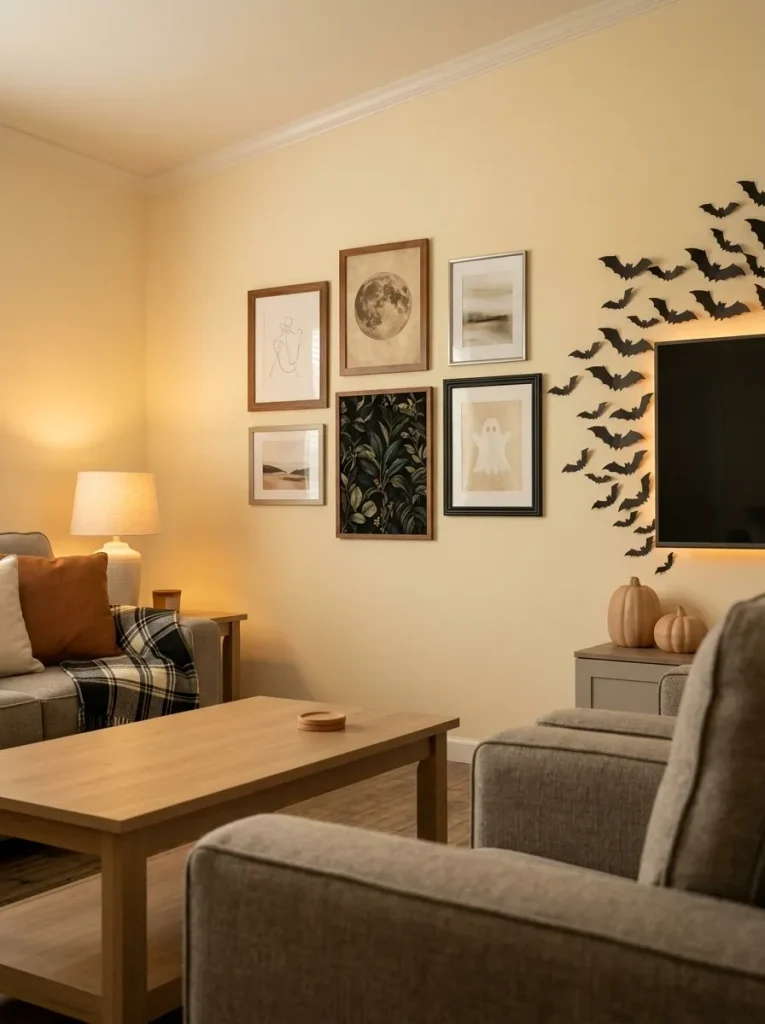
Paper color matters too. Bright printer white can appear abrupt beside cream walls, amber lighting and warm wood. A softer ivory paper usually integrates more quietly.
If you already have a gallery wall, change only selected images and leave permanent artwork between them.
The room should still feel like your home—just temporarily haunted.
12. Turn Plain Jars Into a Small Apothecary Grouping
Three ordinary glass jars can create a convincing Halloween moment when they are treated as one collection.
Use matching or related containers, apply one consistent label style and fill them only with clearly decorative safe materials such as dried leaves, black paper, faux insects, cotton or suitable battery-powered micro-lights.
Keep the jars close enough to read as a single group. Vary their heights, but maintain the same label family and color direction.
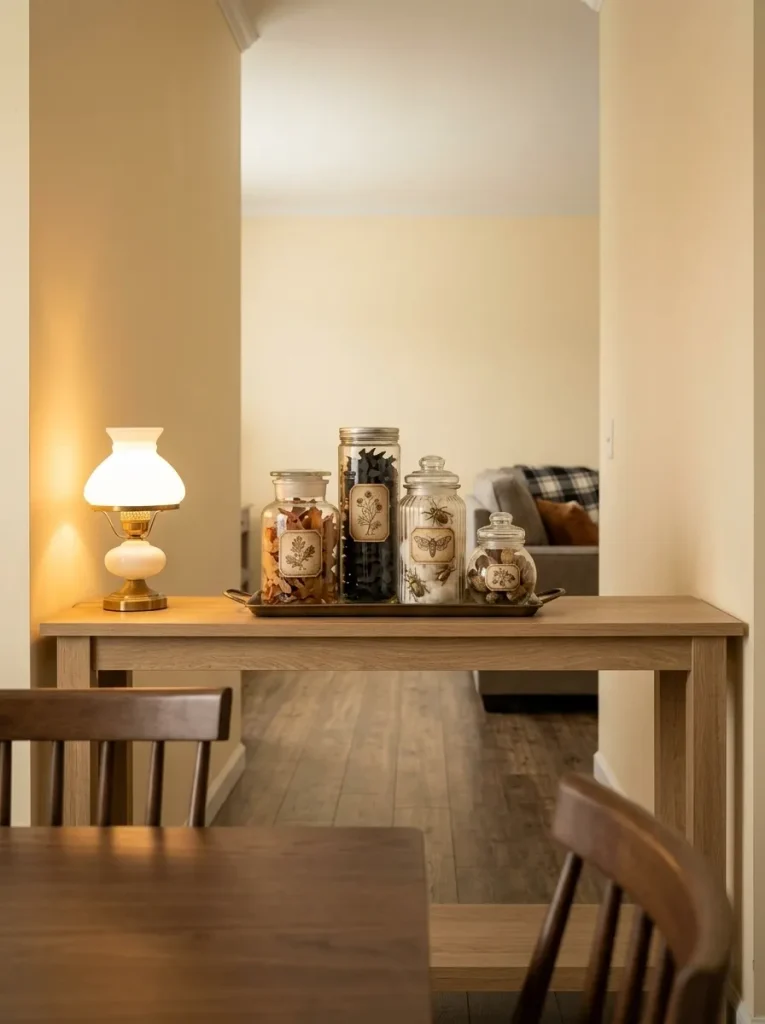
A narrow mobile-home console or shelf rarely needs a sprawling apothecary display. Three to five containers usually communicate the idea without claiming too much usable surface.
A small tray can improve the arrangement further by giving the objects a visual boundary and making everything easy to move when the surface is needed.
Do not move household chemicals, medicines, cleaning products or unidentified substances into Halloween containers.
If the jars still look disconnected, simplify the labels before adding more objects.
13. Give Cheap Pumpkins One Finish So They Read as a Collection
Mixed inexpensive pumpkins often reveal their price because the finishes fight each other.
One may be glossy orange, another covered in glitter, another chalky white and another dark plastic. Each piece can work individually, yet a mixed group may feel like several unrelated purchases.
Choose a finish direction.
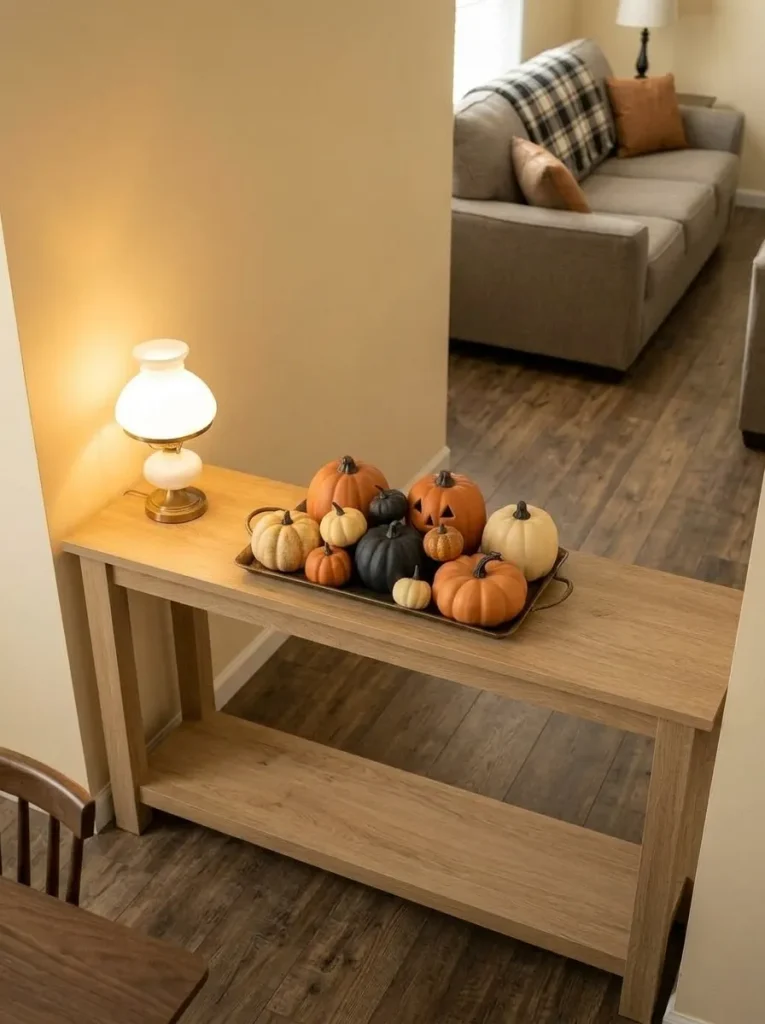
Keep most pieces matte, narrow several colors into the same warm family, repeat one stem treatment, or reserve the brightest orange for only a few focal pumpkins.
Do not automatically paint everything. Arrange the pumpkins together first and identify exactly what is causing the conflict. Some variation makes the collection more believable; excessive variation makes it harder to read as one composition.
Material Upgrade Lab
Material Upgrade Lab
Select the inexpensive material you want to improve
Plastic décor
Paper décor
Fabric décor
Glass jars
Natural branch
14. Let a Blanket Ladder Carry the Pattern Instead of the Sofa
A sofa covered with Halloween pillows, patterned throws, novelty pieces and pumpkins can lose its visual shape quickly—especially when the seating already fills much of a small living room.
Move some of that pattern vertically.
A simple ladder can carry one black throw, one Halloween-patterned blanket and perhaps a smaller textured textile. The narrow arrangement adds seasonal detail without making the seating area harder to use.
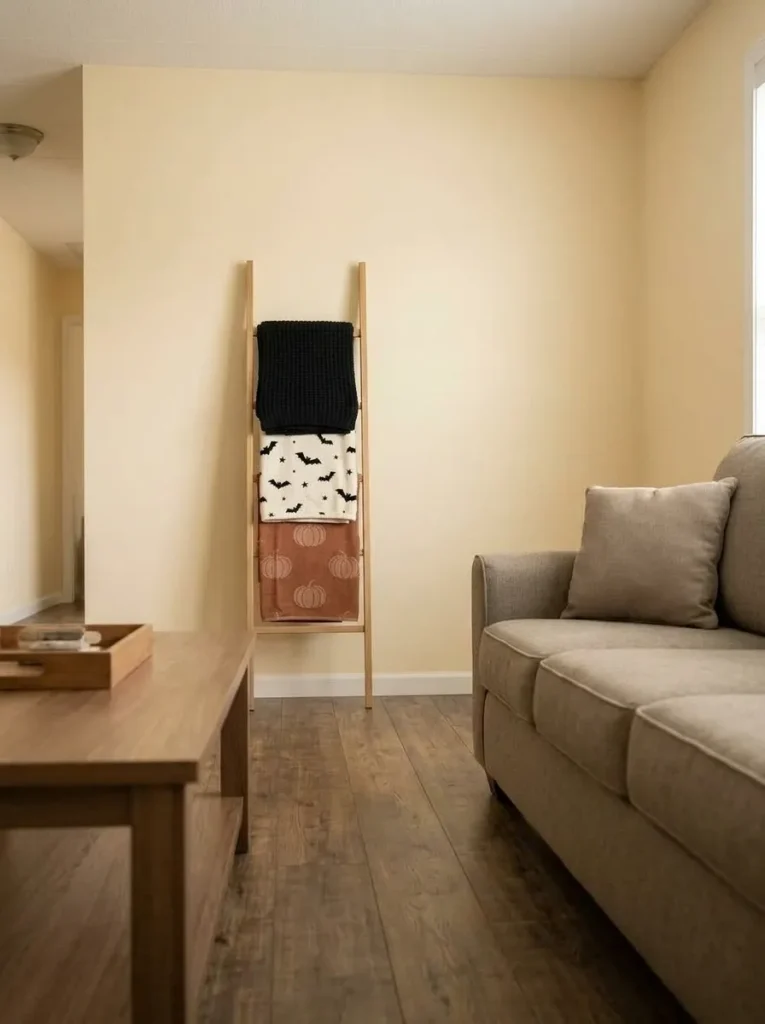
It also gives the room flexibility. Guests can sit without clearing cushions first, and one textile can be removed in seconds if the overall room starts looking busy.
Keep the ladder connected to the article’s main palette. A black, ivory and orange scheme does not automatically benefit from purple, lime green, silver and multicolor graphics simply because those colors appear on Halloween merchandise.
No ladder? Use an existing hook rail, a decorative chair back or another safe vertical textile location.
Decision: before buying another seasonal pillow, check whether the room actually needs more pattern—or simply needs the pattern moved to a better plane.
15. Build Window Silhouettes That Work From Inside and Outside
A window decoration can earn its place twice.
Cut large black silhouettes from cardstock or another suitable lightweight material and position them so useful daylight still enters the room. Ghost faces, oversized bats, crooked branches, jack-o’-lantern expressions or one large cat silhouette usually read more clearly than dozens of tiny shapes.
During the day, the cutouts create strong graphic contrast from inside.
At night, interior illumination turns the same window into a glowing Halloween scene visible from outside.
That double function is valuable when the seasonal budget is limited because a single inexpensive project contributes to both the interior and exterior impression.
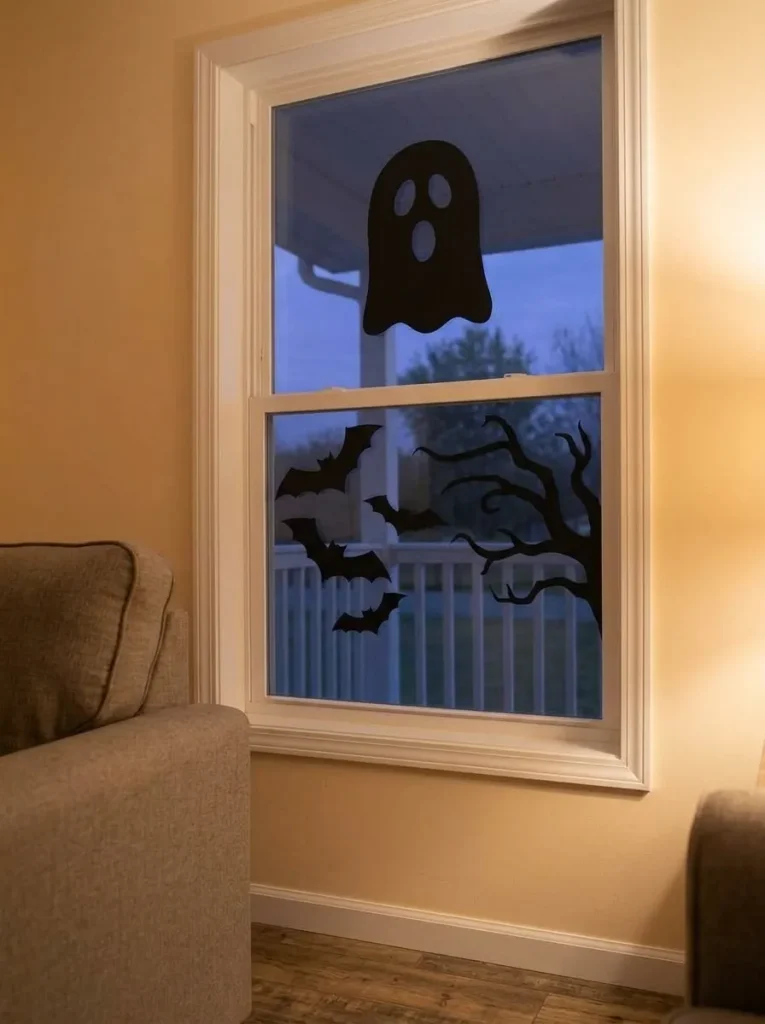
Keep the shapes simple enough to read at distance. Fine cut-paper details may be charming from two feet away and almost invisible from the yard.
Test one sample first. Tape it in place, wait until dusk and walk outside.
If the silhouette is recognizable immediately, you have the right scale. Use that scale for the remaining pieces.
16. Use Amber Light to Make Paper, Fabric and Cardboard Look Richer After Dark
Lighting can change the perceived quality of inexpensive materials more dramatically than another group of ornaments.
Warm amber light softens the flat surface of cardstock, gives thin fabric visible depth, strengthens shadows behind bats and branches and makes orange pumpkins feel more luminous. A simple paper installation that seems ordinary at noon can become one of the most atmospheric elements in the house after sunset.
Choose where the evening scene should happen before distributing the lights.
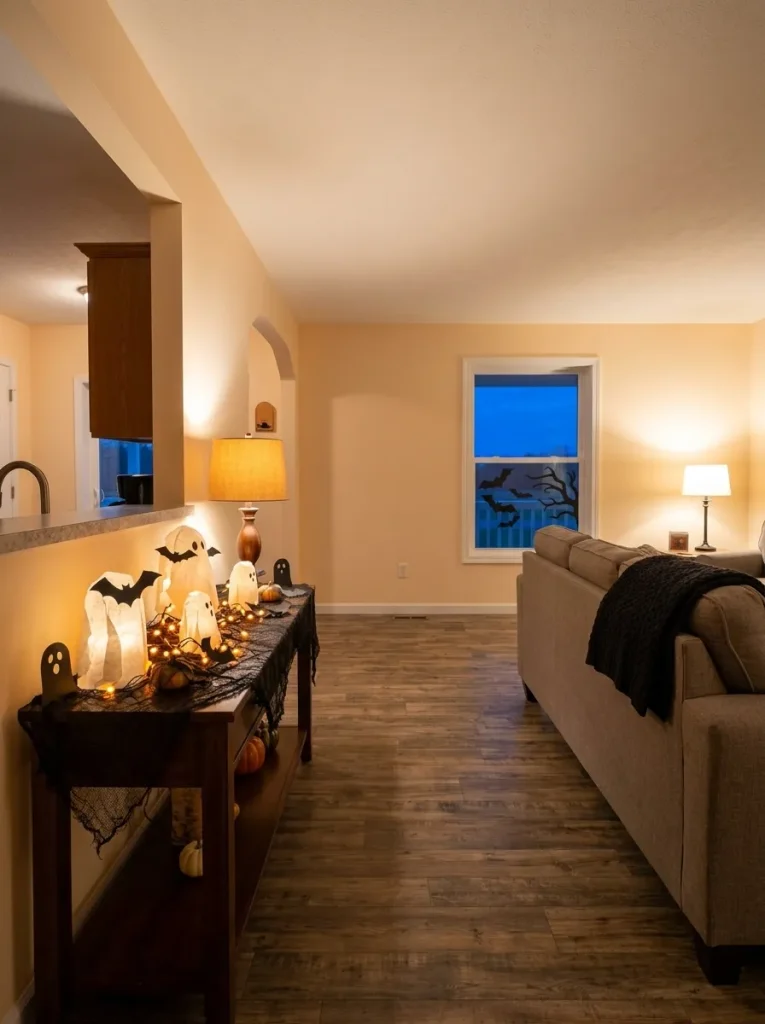
A TV wall, entry console, hallway or front window gives warm illumination enough surrounding surface to create visible glow. Separate light strands in every room can weaken that concentration.
Hide cords as carefully as the installation allows so they do not become part of the daytime composition. Battery-powered and plug-in options each have different practical advantages depending on the product and placement.
Use lighting suited to the intended application and follow the manufacturer’s directions.
Finally, turn the normal household lamps back on. A successful Halloween display should still look considered when the room is actually being lived in.
17. Keep the Kitchen Halloween Layer High, Tight and Easy to Clear
A compact kitchen should not surrender valuable preparation space merely to prove that Halloween has arrived.
Start above the main work zone: cabinet tops, a small backsplash section, one upper corner or a suitable area around the cabinetry can often carry seasonal color without consuming the counter.
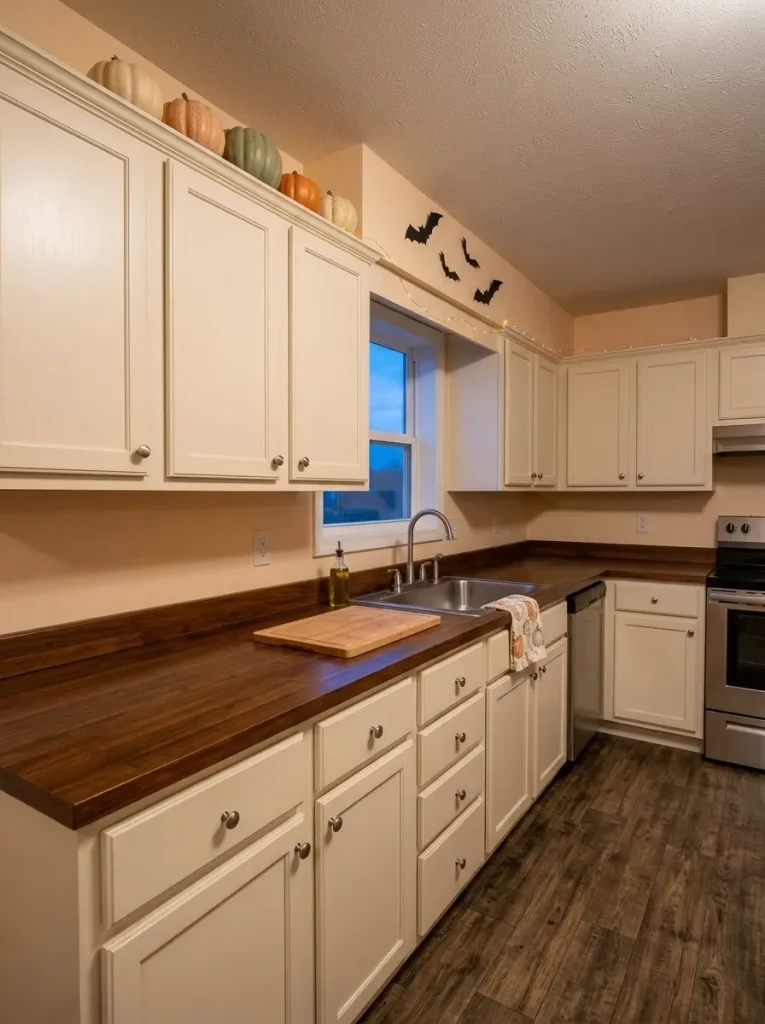
Paper webs, removable silhouettes, a restrained pumpkin line or a limited lighting treatment can work well there.
Then add one low-level accent if the room still needs it—a tea towel, small pumpkin or seasonal tray.
Anything sitting on an active preparation area should be easy to remove. If you repeatedly move a decoration while cooking, that surface has already told you the idea belongs somewhere else.
For a deeper room-specific treatment, continue with these Halloween kitchen decor ideas.
Within this whole-home budget plan, the kitchen succeeds when it feels seasonal and still works like a kitchen.
18. Use One Bedroom Textile as the Seasonal Shortcut
Bedrooms can absorb Halloween décor very quickly because the bed already occupies most of the visual field.
Use that dominance to your advantage.
A black throw across the lower third of the bed, one burnt-orange blanket, a restrained ghost-patterned cushion or another single textile can establish the Halloween palette with very little effort.
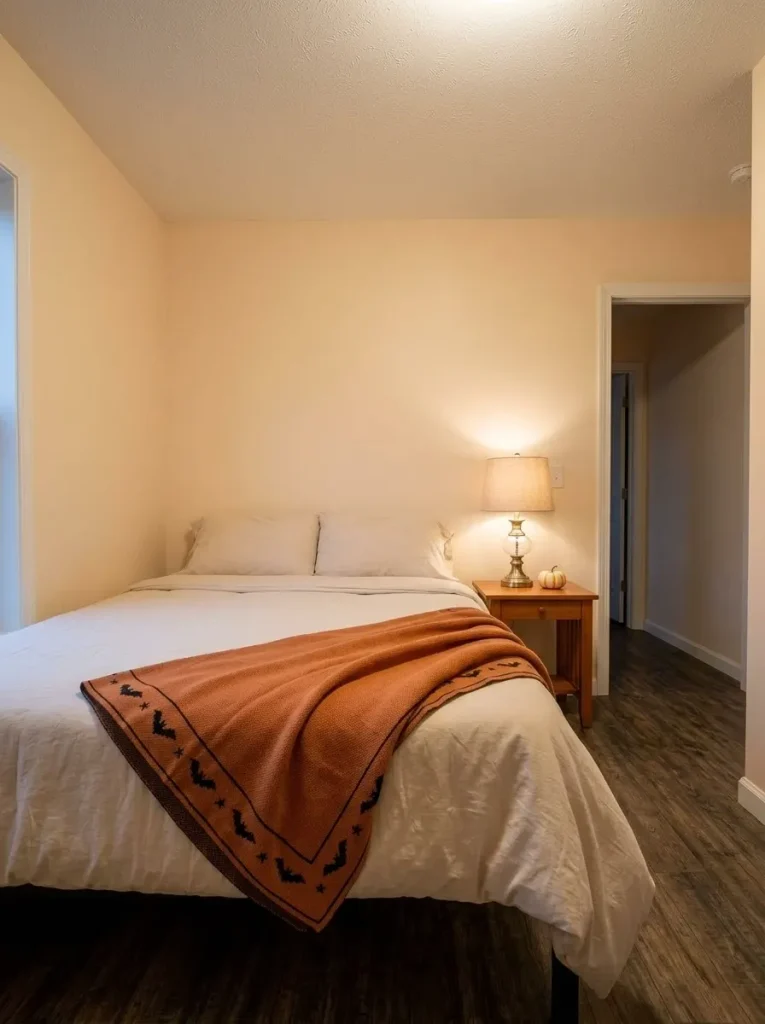
If your everyday bedding is neutral, replacing the entire set for a few weeks rarely gives enough additional visual value.
Stand in the doorway and judge the room from there. If the bed already communicates the seasonal palette immediately, the nightstands may only require warm lighting or one quiet accent.
More elaborate bedroom decorating needs its own logic, particularly in a compact home. The dedicated guide to Halloween bedroom decor for mobile homes develops that room in greater depth.
Budget priority: strengthen the bed’s textile layer before purchasing several independent bedroom ornaments.
19. Give the Bathroom One Tiny Character Moment
A small bathroom rarely needs an entire Halloween theme to feel seasonal.
Choose one place where a little character can appear without interfering with hygiene, storage or cleaning: a small framed ghost, one black hand towel, a tiny pumpkin beside a tray or a removable bat grouping on a quiet wall.
The restraint around that object gives it visibility.
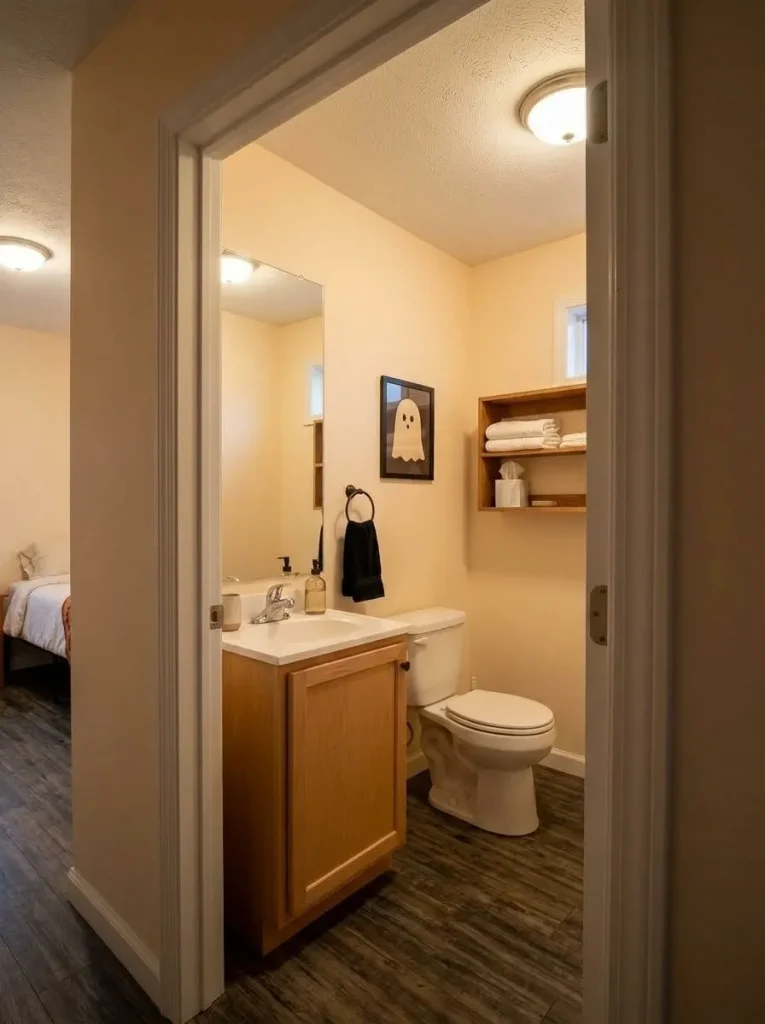
Bathrooms already contain mirrors, bottles, towels, fixtures, toiletries and hardware. Clusters of little Halloween props join that visual inventory immediately and can turn a charming idea into clutter.
Stand outside the bathroom and open the door fully.
If the seasonal detail is clearly visible from that position, it has already done its job.
Readers who want the room itself to become a fuller Halloween scene can continue with these Halloween bathroom decor ideas for small mobile homes.
For this whole-home strategy, one memorable bathroom moment is enough.
20. Hide the Cheap Part: Cords, Packaging, Plastic Shine and Visual Scatter
Sometimes the decoration is not what makes a display feel inexpensive.
The giveaway is how it was installed or presented.
A warm light strand loses some of its effect when a bright cord cuts across the wall. Paper bats appear cleaner when attachment tabs disappear from the normal viewing angle. A large fabric ghost becomes more convincing when its support structure stays visually quiet. Price stickers, packaging remnants and loose battery boxes can have the same effect.
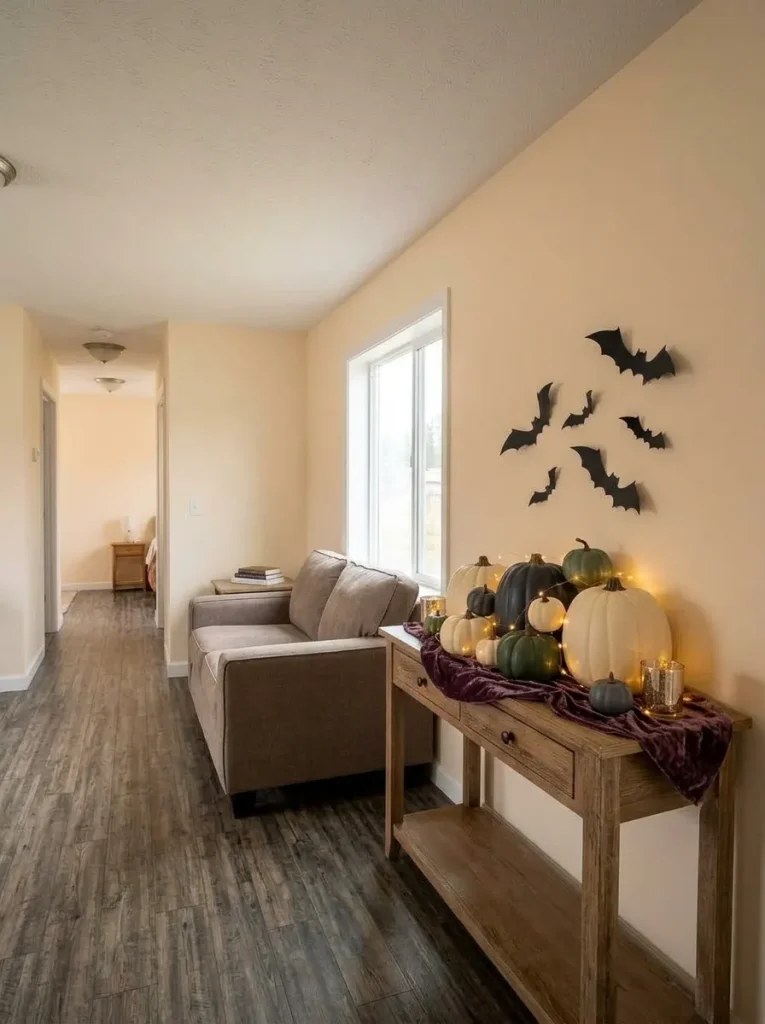
Shine deserves a separate check. Some inexpensive plastics reflect direct light so strongly that they separate visually from matte cardstock, soft textiles and warm wood. Repainting is not always necessary; moving the object away from direct glare or grouping similar finishes together may solve the problem.
Then inspect scatter.
Five weak objects sitting alone on five surfaces may become a convincing collection once several are pulled into one composition and the surrounding surfaces are cleared.
The same principle can continue beyond October through these ways to make a single wide look more expensive without remodeling.
Cheap-Looking Detector
Cheap-Looking Detector
What is making the room feel less polished?
Choose the problem you notice first.
The décor needs concentration.
Small pieces spread across many surfaces fail to build enough visual weight to become a convincing focal point.
The finish is revealing the price.
Strong direct reflections can make inexpensive plastic separate visually from matte paper, fabric and wood.
Too many Halloween symbols are competing.
Ghosts, pumpkins, bats, witches and skeletons can all work—but equal emphasis on every motif removes hierarchy.
The palette has expanded too far.
Connected mobile-home spaces make unsupported seasonal colors especially noticeable.
The installation is becoming part of the décor.
Bright cords, exposed battery packs and visible attachment tabs interrupt otherwise convincing styling.
The room needs a visual pause.
If every shelf, wall and textile carries equal contrast, the eye cannot identify the main seasonal moment.
21. Run the Ten-Minute “Looks Expensive” Edit Before Buying Anything Else
The final improvement costs nothing.
Finish the main decorating, leave the space for a few minutes and return through the entrance you normally use. Look at the whole room before touching anything.
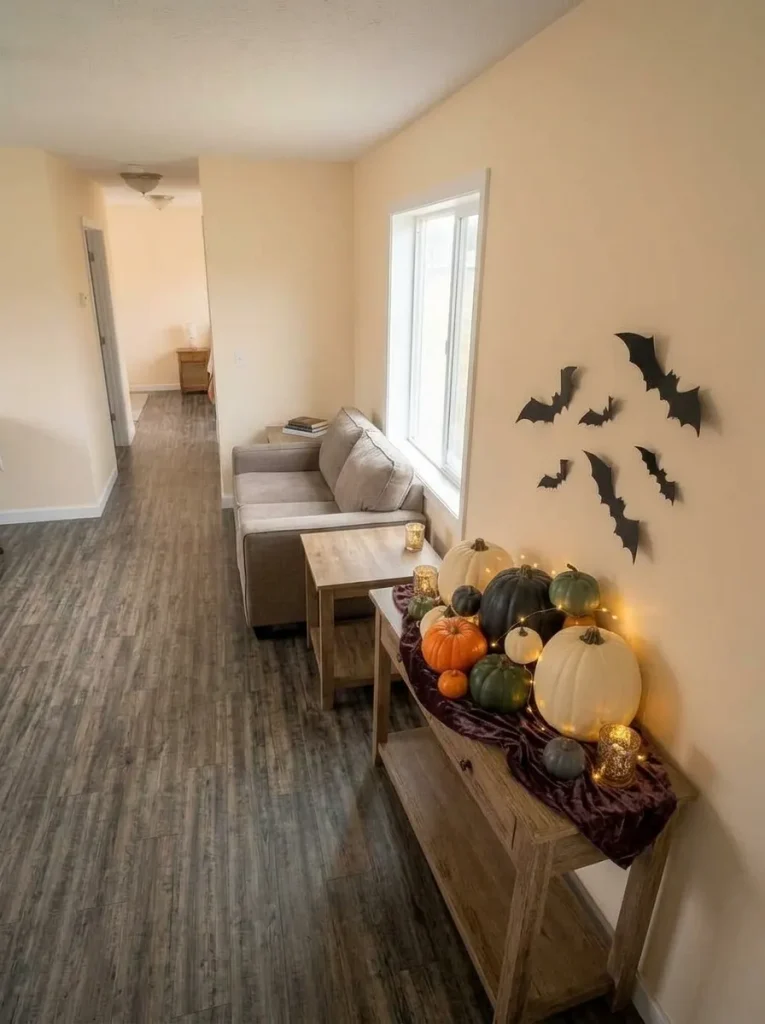
First, identify the strongest Halloween moment.
Everything around it should either support that moment, repeat part of its palette quietly or remain neutral.
Remove one item from the busiest surface. Hide one distracting cord. Rotate a pumpkin grouping until the silhouettes overlap more cleanly. Straighten or deliberately stagger the bat formation. Clear a patch of countertop. Turn on the evening lighting and check whether any glossy object suddenly becomes distracting.
Now take a phone photograph from the doorway.
A photograph flattens the room enough to reveal clutter that your eye may have stopped noticing after an hour of decorating.
If the room becomes more composed after something is removed, trust that evidence.
Your budget does not need to be completely spent.
Ten-Minute High-End Halloween Edit
Ten-Minute Final Edit
Check each statement. Any unchecked line shows your next move.
Cheap Halloween Decor Can Still Feel Intentional
The strongest cheap Halloween mobile home decor does not hide a small budget by filling every open spot. It directs that budget toward the places the eye notices first.
Choose a narrow palette. Establish one dominant seasonal scene. Let paper and fabric provide scale, preserve valuable working surfaces, and use warm light to bring simple materials to life after dark. Then judge the finished home from a doorway before buying anything else.
If one bat flight, glowing window or dramatic hallway already tells the Halloween story, let it.
The high-end effect appears when the decorations stop feeling like separate purchases and start reading as one intentional composition.