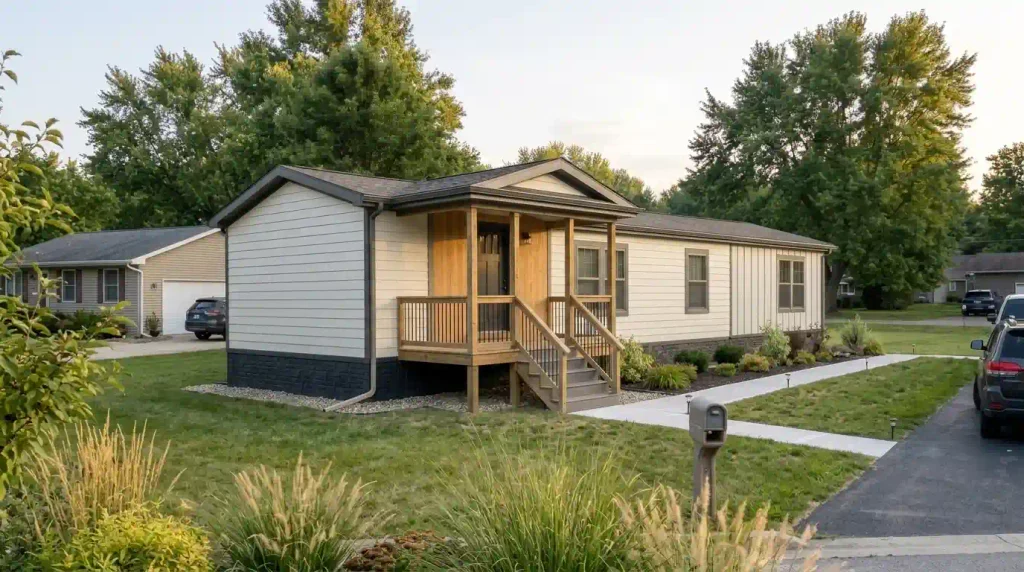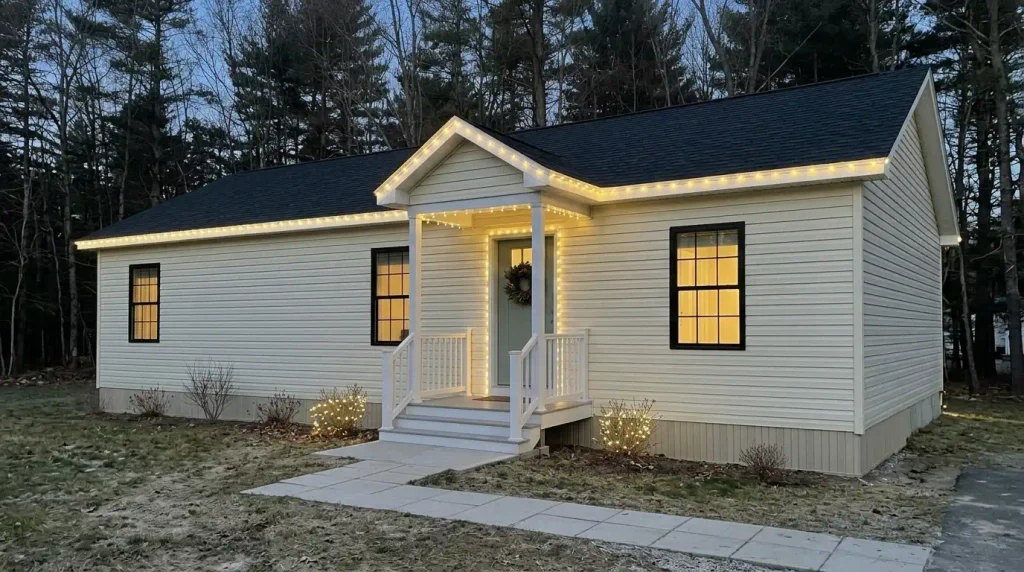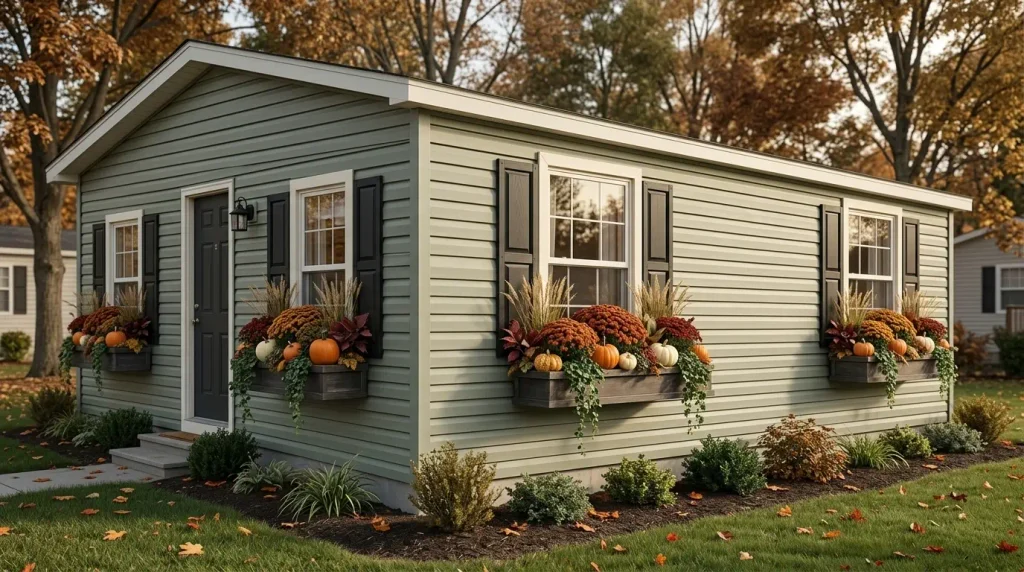

A mobile home exterior makeover on a budget doesn’t have to begin with new siding, expensive windows, or a massive front porch. Sometimes the biggest difference comes from fixing the small details that make an otherwise comfortable home look tired.
Think about an older single-wide with faded skirting, weathered steps, and an entrance that blends into the siding. The house may be perfectly functional, yet a few neglected areas make the entire exterior feel unfinished. A cleaner ground line, refreshed front door, and coordinated finishes could change that first impression without rebuilding anything.
The challenge is knowing where to spend your money. Those beautiful manufactured-home transformations on Pinterest often include major construction, but many of the details that give them character are achievable on a much smaller scale.
These 15 mobile home exterior ideas focus on affordable improvements, realistic DIY opportunities, and smart ways to reuse what you already own. You’ll also find practical spending priorities and sample $100, $250, and $500 makeover plans.
How to Plan a Mobile Home Exterior Makeover Without Overspending
Before choosing paint colors or buying decorative shutters, stand far enough from your mobile home to see the entire front elevation.
Take a photograph and ask yourself one question: What makes the house look unfinished from this viewpoint?
Perhaps the siding is dirty but otherwise sound. Maybe the front steps draw attention because their wood finish is deteriorating. Or the home looks disconnected from the yard because there’s nothing defining the space beneath its long exterior wall.
Identify the most noticeable problem before starting a collection of unrelated improvements.
What Can You Change With Different Budgets?
| Budget ceiling | Main priority | Possible improvements |
|---|---|---|
| $100 | Refresh one visible area | Cleaning, front-door paint, updated house numbers |
| $250 | Coordinate the entrance and surroundings | Door finish, sound existing steps, simple landscaping |
| $500 | Layer several cosmetic improvements | Limited compatible paintwork, porch refinishing, planting beds, entry details |
These are illustrative DIY material budgets in US dollars, not guaranteed project prices. The actual cost depends on the size of your home, surface condition, materials, tools, local prices, and whether professional work is needed.
Keep some money unallocated for supplies or unexpected issues. Structural problems, active leaks, damaged electrical components, and unsafe stairs should be addressed before decorative improvements.
A modest makeover works best when each purchase contributes to one coherent exterior.
1. Clean the Siding Before Deciding It Needs New Paint

The cheapest exterior transformation might already be hiding beneath years of dust and grime.
Manufactured homes surrounded by trees can accumulate pollen, algae, and debris that gradually dull the siding. A wall that looks badly faded from the street may appear noticeably different after a suitable cleaning.
Begin with a small test area in an inconspicuous location. Identify the siding material, then use a cleaning product and method recommended for that surface. Inspect the results after everything has dried.
The test gives you three possible directions:
- The original color looks much better: Cleaning the rest of the sound siding may be worth your time.
- The surface is clean but faded: Explore compatible refinishing options before purchasing paint.
- The siding is loose, soft, warped, or damaged: Investigate the condition before planning cosmetic work.
Be cautious with pressure washers. Excessive pressure or an unsuitable spray direction can force water behind siding, trim, and openings.
Homes with older painted surfaces also deserve special attention. The EPA’s lead-safe renovation guidance explains the risks of disturbing potentially lead-containing paint, particularly in homes built before 1978.
Budget-saving takeaway: Test the existing finish before assuming the entire exterior needs repainting. A little investigation can prevent a much larger unnecessary purchase.
Decision tool / 01
What should your first $100 fix?
Choose the part of your home’s front view that bothers you most. The recommendation changes with your choice.
Clean one inconspicuous siding section.
Use a manufacturer-approved gentle method. If the test patch looks noticeably better, repeat on reachable areas before buying paint.
Stop signal: Loose panels, mold intrusion, or suspected hazardous old coatings require assessment.
Refresh the existing door.
Test a compatible finish on the door material; coordinate the hardware color and house numbers for one deliberate focal point.
Skip: Painting a damaged door that no longer closes or seals correctly.
Check skirting condition and access before buying panels.
Identify missing, damaged, or loose sections. Match repair parts and maintain required openings for ventilation and utilities.
Stop signal: Water damage, pest entry, or widespread failure.
Clean the ground line and sharpen the bed edges.
Remove debris and establish a clear planting-bed edge before adding modest mulch and a few suitable existing plants.
Keep clear: Skirting access, ventilation, drainage paths, and service equipment.
Editorial planner; no price guarantee. Structural or electrical defects outrank cosmetic priorities.
2. Give Your Front Door a Color That Actually Stands Out

Imagine a long beige single-wide with several identical windows and a narrow entry in the middle.
Everything is the same color, so your eye moves along the wall without finding a welcoming focal point. Painting the front door can change that visual balance using a relatively small amount of material.
A muted forest-green door looks beautiful against warm white siding. Deep navy can add definition to a pale-gray exterior, while earthy terracotta introduces warmth to a cream-colored manufactured home.
The choice should connect with something already present—perhaps the roof, existing trim, wood steps, or nearby landscape.
Three color directions worth considering:
- Soft farmhouse: Warm white siding, muted sage door, and natural wood details.
- Modern contrast: Light-gray siding, charcoal door, and restrained black accents.
- Warm rustic: Cream siding, deep brown door, and cedar-toned porch elements.
Test your favorite colors in daylight and shade before committing. A small sample can look different when viewed against the complete front wall.
Check whether your door is steel, fiberglass, or wood, and select the correct preparation method and compatible exterior coating. Keep paint away from seals, locks, and other working components.
A fresh door color is especially useful when the rest of the exterior is in good condition but lacks personality.
3. Repair Damaged Skirting Sections for a More Finished Foundation

Look at the space between the bottom of your manufactured home and the ground.
When the skirting has missing sections, faded patches, loose corners, or mismatched panels, it can make the entire home look neglected—even if the siding above it is attractive.
The good news is that an isolated damaged panel doesn’t always mean the complete skirting system needs replacement.
Start by identifying its material and checking the source of the damage.
| What you notice | What to consider |
|---|---|
| Dirt or surface discoloration | Compatible cleaning |
| One damaged panel | A matching replacement, if the system permits |
| Loose trim or attachments | Proper assessment and repair |
| Recurring moisture or widespread damage | Investigation before cosmetic work |
The important distinction is that skirting serves practical purposes as well as visual ones.
A manufactured home’s perimeter enclosure may need specific ventilation, attachment methods, and access provisions. HUD’s manufactured-home installation guidance explains why proper enclosure installation matters.
Avoid covering vents, blocking utility access, or concealing signs of moisture damage.
Once the system is in suitable condition, a consistent skirting finish can create a cleaner visual boundary beneath the house.
For larger changes involving the exterior walls, entrance, and architectural features, explore these mobile home exterior makeover ideas.
Spend carefully: Repairing a few compatible damaged pieces can be sensible. Covering an unresolved problem with decorative panels is not.
Inspection guide / 03
Skirting: patch, replace, or stop?
Open the condition that resembles your home. An attractive finish must still preserve under-home ventilation, drainage, and service access.
Cosmetic scuffs
Clean with a material-appropriate method. Replace small matching trim only if necessary.
Possible outcome: Little or no new material needed.
One damaged panel
Locate a compatible replacement, confirm how it attaches, then preserve all nearby vent and access openings.
Possible outcome: Targeted materials purchase.
Many loose or wet panels
Pause the decorative makeover.
Investigate attachment, moisture, pest entry, and the enclosure system before selecting new materials.
Possible outcome: Professional assessment and a separate repair budget.
Do not seal an under-home enclosure simply to improve appearance. Check manufacturer instructions and applicable requirements.
4. Refinish Your Existing Front Steps Before Building a Porch
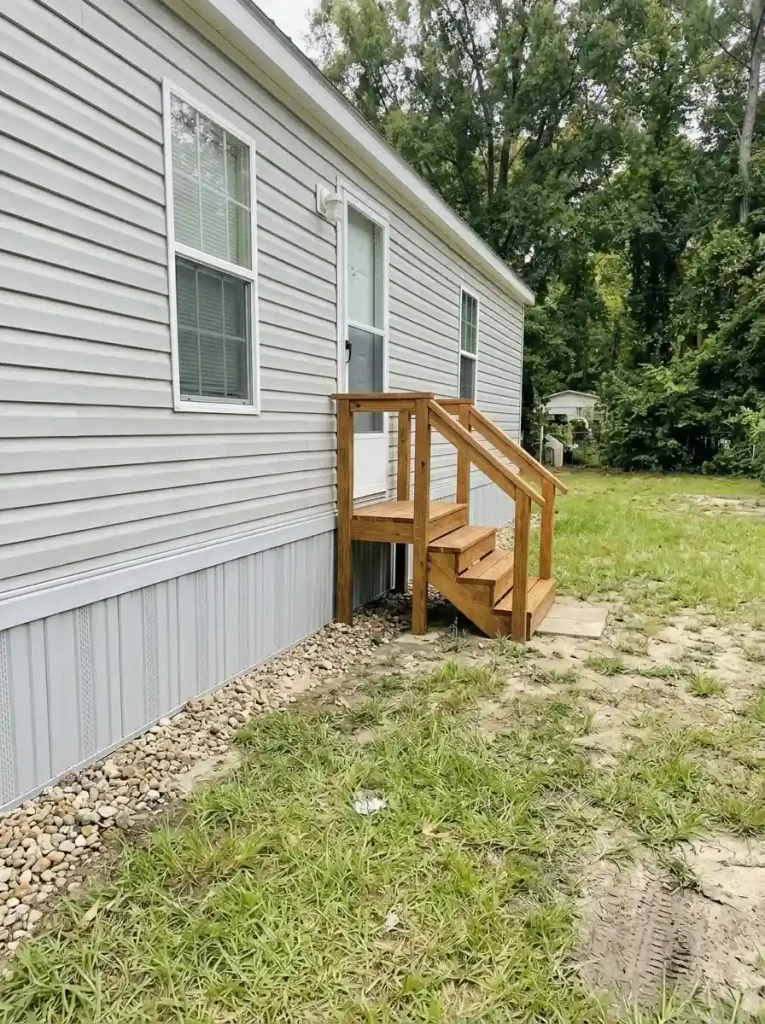
A beautiful covered porch can completely change a mobile home, but building one may involve substantial construction costs.
If your current steps are safe, stable, and structurally sound, improving their appearance could be a more appropriate starting point.
Picture a small wooden staircase with faded boards leading to a plain white entrance. The existing shape may work perfectly well. Its worn finish simply makes it look neglected.
Cleaning the boards, preparing the surface correctly, and applying a suitable exterior finish may bring out the wood’s character. Coordinating the color with the door and nearby trim can make the steps feel like an intentional design feature.
Before buying stain or paint, examine the staircase:
- Are the treads solid and evenly supported?
- Do the railings feel secure?
- Is the existing surface suitable for refinishing?
- Does the landing provide adequate clearance for the door?
Rot, movement, loose handrails, and deteriorated supports require proper repair. Cosmetic coatings do not correct structural defects.
For a small entry, even a restrained change in finish can make the approach feel warmer and more welcoming.
Best budget decision: Preserve a safe, functional staircase when refinishing makes sense. Put the money saved toward another visible improvement.
5. Add Simple Wood Shutters to Give Plain Windows Character

Some single-wide homes have long stretches of siding punctuated by relatively small windows. Decorative shutters can help organize that wall visually, particularly when they complement the home’s proportions.
But more shutters do not automatically create better curb appeal.
A single well-designed window group near the entrance may have greater impact than attaching decorative wood to every window.
Consider a white manufactured home with warm cedar-toned shutters, dark trim, and a modest wooden landing. The materials introduce texture while keeping the overall appearance simple.
Before building or buying shutters, check the window dimensions and surrounding wall space.
A decorative shutter should look proportionate to the window it accompanies. Oversized boards can crowd narrow windows, while undersized pieces may look disconnected from the architecture.
Select weather-suitable materials and mounting methods that won’t damage the siding or interfere with drainage. Never obstruct an operable emergency escape window.
Try one window first. Photograph it from your normal approach and compare the result with the untreated windows.
If the new detail improves the overall composition, you can repeat it selectively.
For more guidance on long exterior walls, entrance placement, and proportions, see these single-wide exterior makeover ideas.
6. Paint a Small Accent Area Instead of the Entire Exterior

An exterior doesn’t always need a completely different color to feel updated.
Sometimes a carefully chosen accent can give an otherwise plain manufactured home more definition.
For example, sound, suitable trim around a front entrance might be refinished in a complementary shade. A limited paintable siding section near the doorway may also provide an opportunity for contrast.
The success of this approach depends on two things: choosing the right location and confirming that the surface can safely accept the proposed coating.
Where an Accent Can Work
An accent is most convincing when it supports an existing architectural feature:
- Around an established entry zone.
- On compatible exterior trim.
- On a clearly defined section of suitable siding.
- Along an existing decorative architectural detail.
Avoid scattering unrelated patches of color across a long façade.
A caution about vinyl siding: Standard exterior paint isn’t automatically suitable for vinyl. Some darker coatings can contribute to heat-related distortion. Sherwin-Williams discusses this issue in its guide to painting vinyl siding, including the role of siding condition, manufacturer recommendations, and specially formulated color options.
Check any remaining siding warranty and follow the coating manufacturer’s requirements.
If the proposed accent requires expensive preparation or creates an awkward boundary, consider a simpler improvement elsewhere.
A small paint project only saves money when it is suitable for the surface and visually worthwhile.
Material choice / 06
Does your siding even need paint?
The right scope depends on the material and its condition. Choose a scenario to see a different action.
Try cleaning first.
Wash a test area gently following the siding manufacturer’s guidance. If the color returns, your budget may be better used at the entrance.
Consider a limited, compatible accent.
Identify the material and recommended coating first. Only sound, paintable surfaces qualify. Vinyl needs an approved coating and color approach because heat absorption can affect it.
Repair takes priority over color.
Paint won’t stabilize buckled panels or concealed deterioration. Get the underlying defect assessed, then revisit cosmetic plans.
7. Refresh an Existing Porch With Coordinated Wood Finishes

A modest porch can look surprisingly polished when its materials feel connected.
The problem with many older entries is not their size. It is the accumulation of unrelated finishes: faded decking, weathered posts, mismatched railings, and hardware that doesn’t suit the exterior.
Start by looking at the porch as one composition.
Suppose the posts and steps are sound but the wood surfaces have aged differently. Appropriate cleaning and refinishing can help bring those existing elements into a more consistent palette.
Natural timber tones look particularly attractive beside olive-green, charcoal, cream, and white siding. Painted railings can also work when they relate to the home’s existing trim.
A Practical Porch Refresh Sequence
First, keep what is sound. Identify existing posts, railings, and decking that are safe and suitable for cosmetic maintenance.
Next, coordinate the visible surfaces. Choose a restrained finish palette based on the siding and entrance.
Finally, edit the accessories. A suitable mat or a single planter may be enough to complete the space.
A porch with unsafe supports, loose guards, or deteriorated decking needs proper repairs before decoration. Adding a roof, enlarging the deck, or changing structural connections is a separate project.
According to HUD’s manufactured-home homeowner guidance, significant additions and structural changes may require permits and can affect compliance with manufactured-home requirements.
Once the existing porch is in good condition, these summer mobile home porch decorating ideas offer additional inspiration for seasonal finishing touches.
Reuse workshop / 07
How much of the porch can you keep?
Check steps, joists, posts and rails before styling.
Keep sound materials and a functional layout.
Refresh small finishes in one restrained palette.
Choose what you see on the existing porch to change the recommended next step.
Coordinate, don’t rebuild.
Repeat one wood tone or trim color on the sound rail, steps and entry accent. Photograph from the walkway to check visual consistency.
Prepare before refinishing.
Confirm that the deck or rail material can take the chosen exterior finish. Repair small nonstructural defects and follow the product preparation instructions.
Stop and get the structure assessed.
Loose railings, rotted treads, and unstable posts are safety issues. Price the necessary repairs separately before using your cosmetic budget.
New roof attachments and major porch construction are separate projects that may require engineering and permits.
8. Upgrade Your House Numbers and Front Entrance Lighting
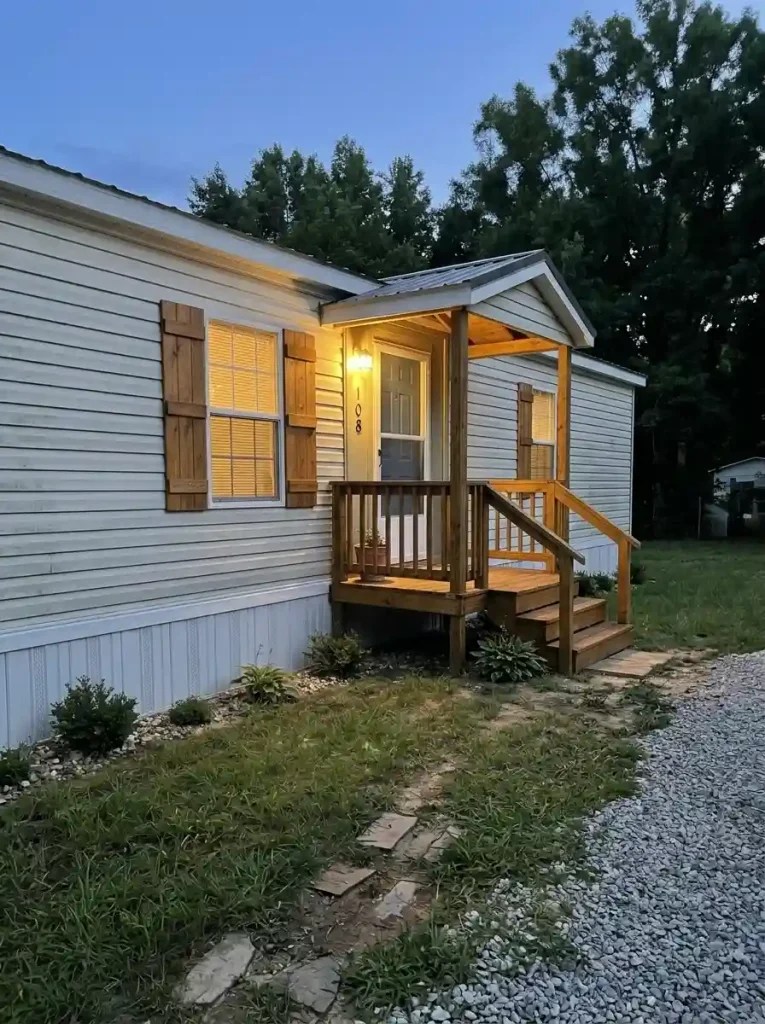
Here’s a simple curb-appeal test: look at your mobile home from the street after sunset.
Can someone immediately identify the front entrance? Are the house numbers easy to read? Does the existing light illuminate the area where visitors approach?
If the answer is no, this small part of the exterior may deserve attention before another decorative project.
Large, legible numbers mounted in a suitable position can bring order to a plain wall. On pale siding, dark numbers offer a crisp contrast. Against charcoal siding, a lighter finish may be more readable.
The lighting should suit the scale of the entry. An oversized fixture can overwhelm a narrow doorway, while a tiny one may fail to provide useful illumination.
You may not need to replace the fixture at all. Cleaning a sound existing fitting and selecting an appropriate compatible bulb can sometimes improve its performance and appearance.
Any new or modified exterior electrical installation must use properly rated components and comply with applicable requirements. Hire a qualified professional where electrical work is involved.
Think about function first: An attractive light that leaves the stairs poorly illuminated is not a successful upgrade.
These small arrival details are particularly valuable on a long single-wide, where the entrance can otherwise disappear into the exterior wall.
9. Create a Neat Landscaping Edge With Affordable Mulch

Even freshly painted siding can look unfinished when the ground beneath it is untidy.
Bare patches, scattered weeds, inconsistent lawn edges, and neglected planting beds draw attention to the lower portion of a manufactured home.
A simple landscape border can improve that relationship without requiring mature shrubs or an elaborate garden design.
Imagine a white mobile home surrounded by patchy grass. Creating a clean planting-bed edge, retaining suitable existing plants, and adding mulch can make the exterior appear more settled into the yard.
Begin by defining the area you want to improve. Follow the shape of the home or entry walkway, but avoid unnecessarily deep beds that create ongoing maintenance.
For a cohesive result, keep the materials restrained.
Dark mulch can bring out green foliage, while light gravel may complement darker siding. Either choice should suit the drainage, climate, and surrounding landscape.
Keep soil, mulch, and other materials from obstructing skirting ventilation, trapping moisture against building components, or hiding needed access.
Where the savings come from: Reuse edging and plants already available on the property. Purchase only enough finishing material for the defined area.
A clear ground line often contributes more to curb appeal than several unrelated decorative ornaments.
10. Reuse Existing Plants to Fill Empty Spaces Around the Home

A garden center isn’t always the first place to look when improving a mobile home’s landscaping.
Healthy plants already growing on your property may provide useful material for a more coordinated planting design.
Some mature perennials can be divided and replanted, allowing one established clump to supply additional planting areas. Other plants may be suitable for relocation, depending on their species, condition, and growing season.
The visual advantage comes from repetition.
Instead of placing a different plant beneath every window, you might repeat a small group of suitable grasses or flowering perennials along the front elevation. That rhythm can make a long manufactured home look more deliberately landscaped.
Before Moving a Plant
Check whether it is suitable for division, whether the destination receives enough light, and how large it will become.
The University of Minnesota Extension’s guide to dividing perennials provides practical guidance on timing and plant requirements.
Also consider the space around skirting and utility access points. A tiny shrub today may become a maintenance problem when it matures.
If you have nothing suitable to reuse, choose a few appropriately sized plants and give them room to grow.
The better long-term investment: Healthy plants positioned correctly are more valuable than buying a large quantity simply to fill every empty space immediately.
11. Improve the Front Walkway With Reused Pavers or a Simple Surface

A mobile home entrance feels more welcoming when the route toward it is obvious.
An uneven patch of bare ground or a poorly defined approach may be more noticeable than the siding color. Improving this path can connect the house visually with its surroundings.
Start by observing how people actually reach the door.
Does the current route cross wet grass? Is the existing surface stable? Are there places where rainwater collects?
If the underlying conditions are appropriate, properly installed reused pavers may help create a more defined path. Gravel can suit certain landscape areas, but its installation and maintenance needs are different.
| Surface | Visual character | Important consideration |
|---|---|---|
| Reused pavers | Structured and traditional | Stable base, levelness, and drainage |
| Compacted suitable aggregate | Casual and natural | Material selection, containment, and stability |
| Existing concrete | Simple and practical | Cleaning, surface condition, and safe edges |
Loose gravel may be unsuitable for routes used by wheelchairs or people with mobility difficulties. The U.S. Access Board’s ground-surface guidance explains the importance of firm, stable, and slip-resistant accessible surfaces.
Do not raise grades against the mobile home, direct runoff toward the skirting, or create a route with unsafe changes in level.
Sometimes the existing walkway only needs cleaner edges and better surrounding landscaping.
Choose the smallest intervention that genuinely improves access.
Ground-line plan / 11
Make the arrival feel intentional
A conceptual top-down diagram—not a construction drawing—showing how a small bed and a clear route can visually organize the front of a manufactured home.
Protect access, ventilation and drainage.
Use appropriate low plants, mulch and a clean boundary.
Choose stable, slip-resistant footing and safe clearances.
Check local site conditions and accessibility needs; no scale or dimensions are implied.
12. Style a Small Front Landing Without Buying More Furniture
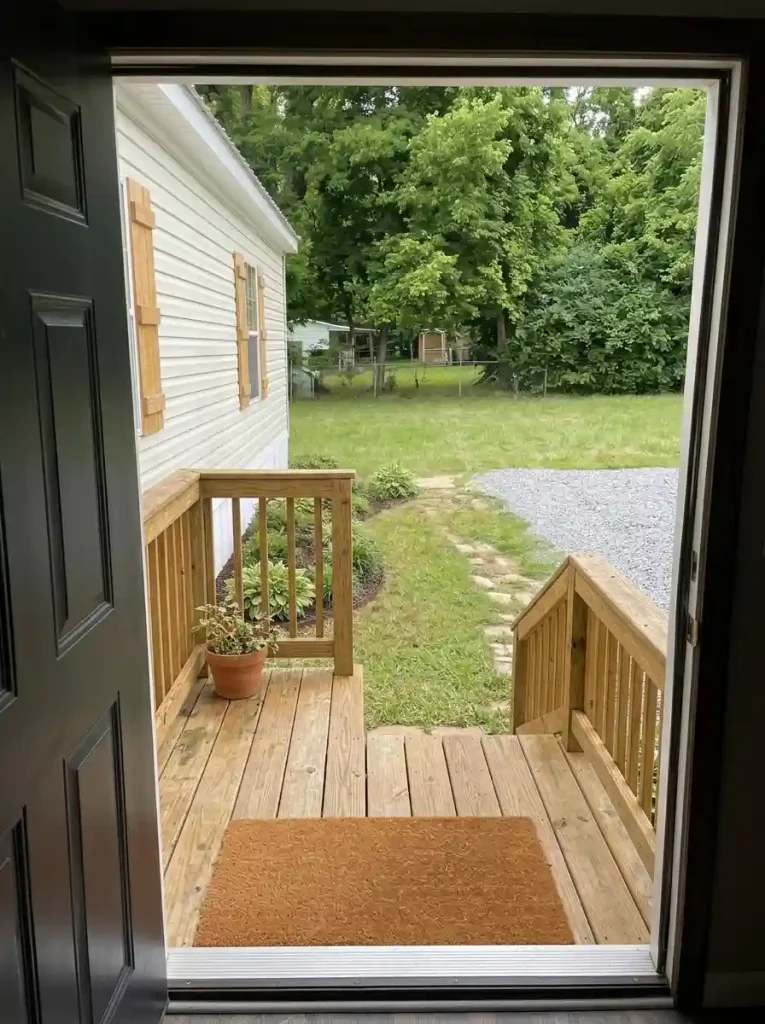
A compact mobile home landing can look lovely with very little decoration.
Imagine a shallow entry platform with steps and a railing. Adding a bench, two oversized pots, a basket, and several decorative signs might produce an attractive close-up photograph, but the space could become difficult to use.
The more useful approach is to let the landing’s size determine the styling.
Stand at the entrance and open the door completely. Consider how someone will enter with groceries, carry packages, or use the railing in wet weather.
Then choose one or two details that fit comfortably.
A clean weather-resistant mat, one suitably positioned planter, or a modest wall decoration can create a welcoming impression without competing with the doorway.
If you already own an outdoor planter or appropriate seasonal accessory, try it before purchasing anything new.
What deserves space: Items that support the entrance visually and don’t interrupt normal use.
What should stay elsewhere: Cluttered decorations, unstable containers, objects on stair treads, and accessories that interfere with movement or handrails.
For additional affordable changes throughout the property, explore these cheap mobile home upgrades.
A small landing feels more considered when every object has enough room around it.
13. Hide Everyday Outdoor Clutter With a Simple Moveable Screen
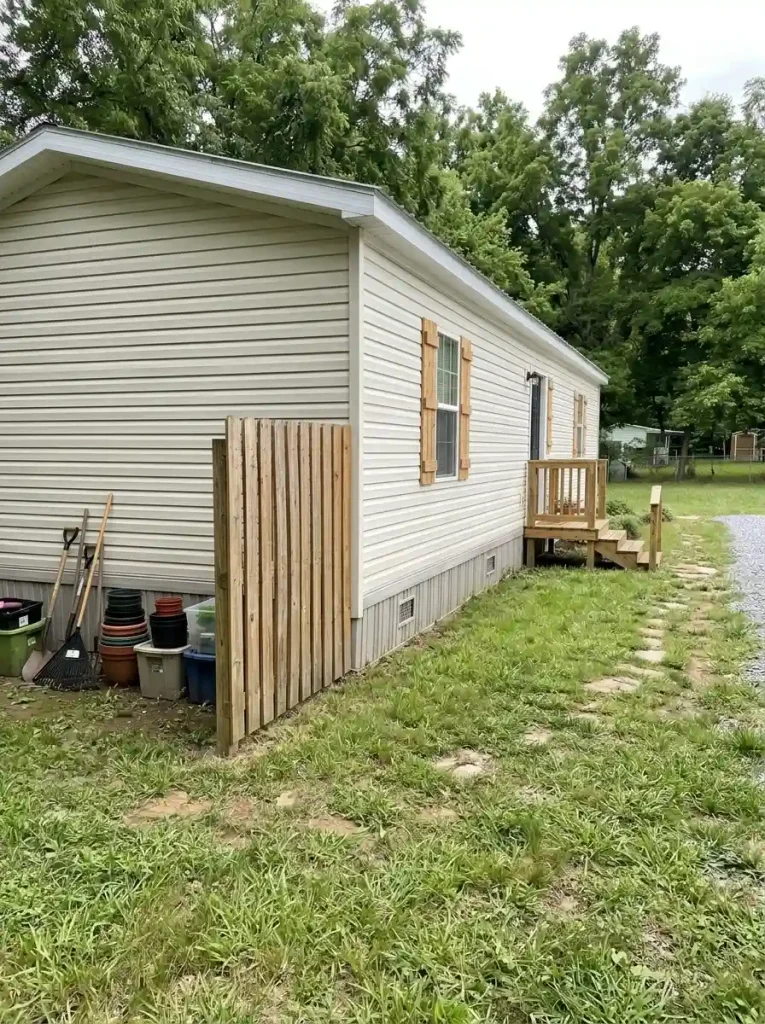
Not every unattractive part of a mobile home exterior is actually part of the building.
Sometimes the biggest distraction comes from the objects gathered beside it: empty containers, garden tools, old planters, or miscellaneous storage that gradually accumulates near the entry.
Before buying a privacy screen, sort through the area.
Throw away what is no longer useful, move appropriate items into existing storage, and group the essentials in one practical location.
Take another photograph from the street.
If the exterior already looks noticeably cleaner, you might not need to spend anything.
For a remaining household storage area, a suitable freestanding screen can sometimes soften the view. The screen should be stable, appropriately secured for local wind conditions, and easy to move when access is needed.
There is an important exception: never use a decorative screen to casually conceal utility equipment.
Air-conditioning units, exhaust vents, meters, electrical components, fuel equipment, and service openings require appropriate access or clearances. Check the applicable manufacturer requirements before placing anything nearby.
A screen belongs around ordinary visual clutter, not around equipment that needs ventilation or servicing.
The best outcome is a tidier exterior that remains practical to maintain.
14. Refresh Roof-Edge Details Before Planning an Expensive Roof Makeover

A mobile home roof can dominate the exterior photograph, even when the roofing itself isn’t the problem.
Sometimes the areas that look most neglected are the fascia, gutters, and visible roof-edge details.
Staining, accumulated debris, peeling finishes, and inconsistent trim can create a tired appearance along the upper edge of the building.
Begin with an inspection from a safe location on the ground.
Look for visible gutter overflow, detached pieces, deteriorated trim, or signs that water isn’t being directed properly.
Different findings call for different responses.
If the components are sound: Appropriate cleaning or compatible cosmetic refinishing may be reasonable.
If something is loose or deteriorated: Arrange the necessary assessment and repairs before considering appearance.
If there are active leaks or water damage: Resolve the underlying issue instead of covering it with paint.
Roof edges are particularly dangerous work areas. Professional assistance is appropriate for elevated tasks, work near power lines, or situations involving damaged components.
This is one place where restraint matters. Decorative roof accents cannot make an unhealthy roof system safe.
If your home needs a much wider rehabilitation, these old mobile home makeover ideas offer a broader perspective on updating an aging manufactured home.
A sound, clean roofline can complement the rest of the makeover without an elaborate architectural addition.
15. Combine Small Improvements Into a Complete Budget Exterior Makeover
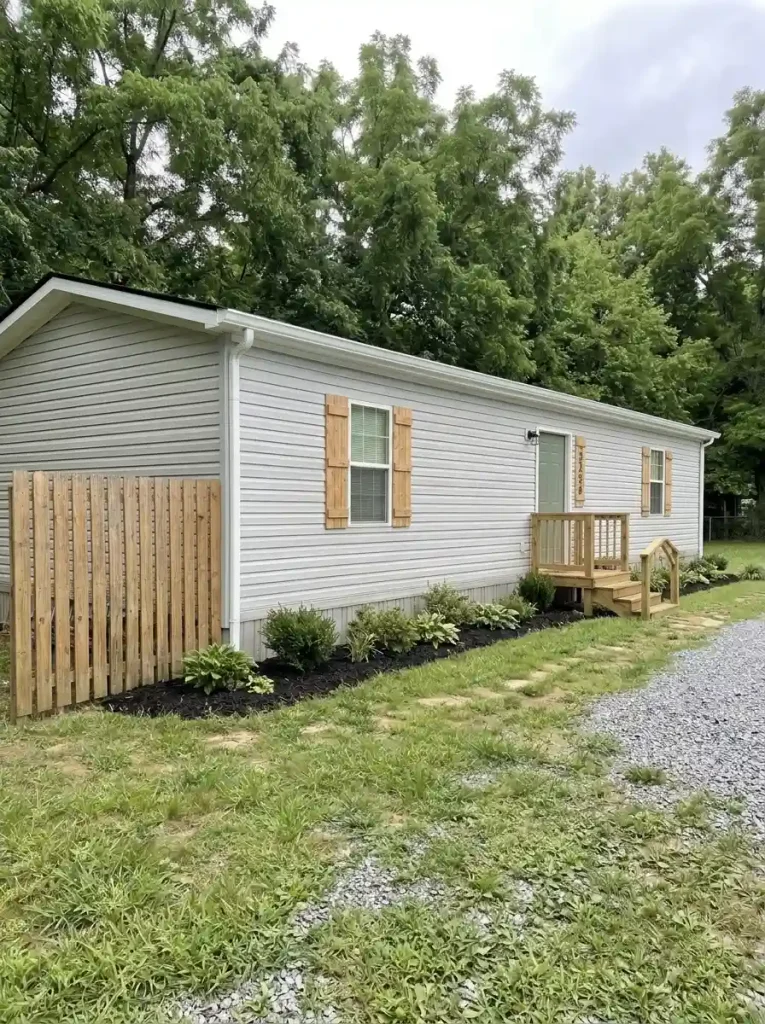
The final secret to an attractive manufactured-home exterior is coordination.
A freshly painted door, tidy steps, clean skirting, and thoughtfully arranged landscaping work together because they improve the same overall impression. Buying several unrelated decorations may cost a similar amount without creating a unified look.
Before making purchases, choose one of these three spending strategies.
Option A: The $100 Front Entrance Refresh
A focused makeover for a home with sound siding, functioning steps, and a neglected doorway.
| Project | Illustrative allowance |
|---|---|
| Exterior cleaning supplies | $10 |
| Compatible door paint and preparation | $45 |
| House numbers or small entry improvement | $25 |
| Contingency | $20 |
| Total spending ceiling | $100 |
The intended transformation is simple: cleaner surroundings, a more noticeable front door, and improved entrance details.
Don’t divide this small budget among too many projects. Let one area become the focal point.
Option B: The $250 Coordinated Curb-Appeal Makeover
Choose this plan when the existing entrance and landscaping need several modest improvements.
| Project | Illustrative allowance |
|---|---|
| Cleaning and preparation | $25 |
| Front door and limited trim supplies | $60 |
| Refinishing materials for sound existing steps | $65 |
| Mulch and planting-bed materials | $65 |
| Contingency | $35 |
| Total spending ceiling | $250 |
Picture an older cream-colored single-wide with a sage-green front door, refreshed wooden steps, and a simple mulch border containing existing plants.
The exterior has a clear relationship between color, materials, and ground-level landscaping.
That is the purpose of this spending plan: several small changes supporting one visual direction.
Option C: The $500 Layered Exterior Makeover
This strategy suits a home that is structurally sound but visually inconsistent across several areas.
| Project | Illustrative allowance |
|---|---|
| Cleaning and surface preparation | $40 |
| Limited compatible paintwork | $130 |
| Cosmetic refinishing of sound porch or step components | $110 |
| Landscape-edge improvements | $90 |
| Entry details | $55 |
| Contingency | $75 |
| Total spending ceiling | $500 |
This is a cosmetic materials allowance. It does not include a new porch, entire-home siding replacement, significant structural repairs, or an extensive professional paint job.
The plan also assumes you already have suitable tools or can obtain them within the amount allocated.
Before purchasing, confirm quantities and current local prices. If the costs exceed your limit, reduce the scope and complete fewer improvements properly.
For homeowners also considering affordable interior changes, these mobile home makeover ideas under $500 provide a broader starting point.
One final spending rule: If the home looks noticeably better after the first two projects, reassess before purchasing the third.
A successful budget makeover doesn’t require spending every dollar available.
Final decision tool / 15
Choose your exterior makeover ceiling
These are sample DIY material allowances—not project estimates. Select a ceiling to see a different shopping order and remaining contingency.
$100 / Make the entry count
| Cleaning | $10 |
| Door finish | $45 |
| House numbers / small detail | $25 |
| Unspent contingency | $20 |
| Total | $100 |
Use where no significant repair is needed.
$250 / Build three coordinated improvements
| Preparation | $25 |
| Door and trim | $60 |
| Sound existing-step finish | $65 |
| Bed edges and mulch | $65 |
| Unspent contingency | $35 |
| Total | $250 |
Do not count needed safety repairs inside this cosmetic example.
$500 / Refresh several connected zones
| Preparation | $40 |
| Compatible limited paintwork | $130 |
| Sound step or porch finishing | $110 |
| Ground-level landscaping | $90 |
| Entry details | $55 |
| Unspent contingency | $75 |
| Total | $500 |
A whole house repaint, new porch, new roof, or structural repairs are outside this example.
Material quantities and prices vary; verify actual costs before purchasing. No allowance here guarantees project completion.
Common Budget Makeover Mistakes to Avoid
Even inexpensive projects can become costly when they are started in the wrong order.
One common mistake is buying decorative materials before checking the condition of the exterior. Fresh shutters won’t solve damaged siding, and attractive skirting panels won’t correct trapped moisture.
Another is trying to change everything at once. Painting the door, shutters, railings, skirting, and siding in several unrelated colors may make a long mobile home façade feel busier than before.
The final mistake is assuming a dramatic Pinterest transformation was necessarily inexpensive. New gables, major porch additions, windows, and roof alterations can involve design, labor, permits, and structural requirements.
Treat those photographs as inspiration for colors, materials, and composition unless actual project costs and construction details are available.
A modest but coordinated transformation is often a more useful goal than attempting to reproduce an expensive renovation with a small materials budget.
Frequently Asked Questions
What is the cheapest way to make a mobile home exterior look better?
Start with cleaning and decluttering. If the siding, steps, and skirting are sound, washing appropriate surfaces and tidying the surrounding landscape can improve the exterior at relatively little cost.
After that, focus on one visible detail, such as the front door, house numbers, or existing entrance finishes.
Can you make a mobile home look like a regular house on a budget?
You can give a manufactured home a more finished, residential appearance through coordinated paint colors, proportional window accents, a welcoming entrance, and tidy landscaping.
However, significant changes to rooflines, porches, or exterior walls are different from cosmetic decorating. They may require professional assessment and construction approvals.
Is $500 enough for a mobile home exterior makeover?
A $500 DIY materials budget may be enough for several limited cosmetic improvements when the existing exterior is in good condition.
It generally won’t cover substantial repairs, whole-home siding replacement, or major new construction. The best approach is to select a few improvements with strong visual impact and verify all costs before starting.
What is the best exterior paint color for an older mobile home?
Warm white, soft gray, muted sage, and earthy neutral colors can work well, depending on the roof, siding material, landscape, and natural lighting.
However, appearance isn’t the only consideration. Painting vinyl siding requires compatible products and appropriate color selection, while other exterior materials have their own preparation and coating requirements.
Always confirm suitability before choosing a finish.
How can I improve a single-wide mobile home without adding a porch?
Focus on the entry door, safe existing steps, window proportions, skirting, and landscaping along the front wall.
A long exterior often benefits from one clear entrance focal point and a consistent ground-level border. These improvements can strengthen the home’s appearance without changing its footprint.
Should I update the siding or landscaping first?
Inspect the siding before making a decision.
Damaged, loose, or deteriorating exterior materials need appropriate attention. If the siding is sound and simply looks plain, cleaning, entry improvements, and landscaping may offer better cosmetic value.
Take a photograph after each stage to judge whether another project is necessary.
Final Thoughts
An attractive mobile home exterior makeover on a budget begins with a clear plan, not a long shopping list.
Look at the home from the street, identify the details that make it feel unfinished, and concentrate your money where the improvement will be most noticeable. Cleaning sound siding, refreshing an entrance, repairing appropriate skirting sections, and defining simple planting beds can all contribute to a more polished appearance.
Keep the colors connected, reuse materials when practical, and separate cosmetic projects from repairs that need professional attention.
You don’t have to recreate an expensive Pinterest transformation. A few well-chosen improvements, completed in the right order, can give your mobile home a welcoming exterior that feels thoughtfully maintained and unmistakably yours.