A Christmas coffee table can make your living room feel festive before anyone notices the tree. But in a small mobile home, that same surface still has to hold a cup of tea, the TV remote, or the puzzle you started last night. A towering centerpiece might photograph beautifully and become a nuisance by lunchtime.
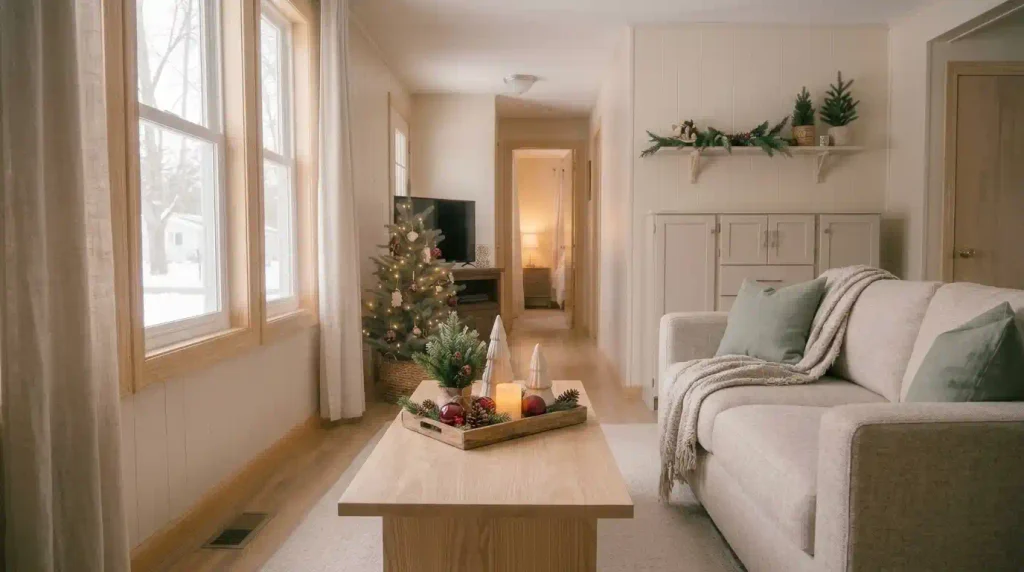
The best christmas mobile home coffee table decor starts with the table you actually have: its shape, material, height, and place between the sofa and the walking route. A compact tray, a little evergreen, or a miniature winter scene can bring the season into view without claiming every usable inch.

These 17 ideas move from everyday-friendly arrangements to nostalgic holiday displays and more polished finishing touches. You’ll see when a shallow bowl beats a tiered tray, how to decorate an ottoman safely, and why some of the most inviting Christmas tables use only a few objects. Pick a look that suits your living room, then edit it for the way your household uses the space.
1. Create a Lift-Away Christmas Tray That Leaves Room for Daily Life
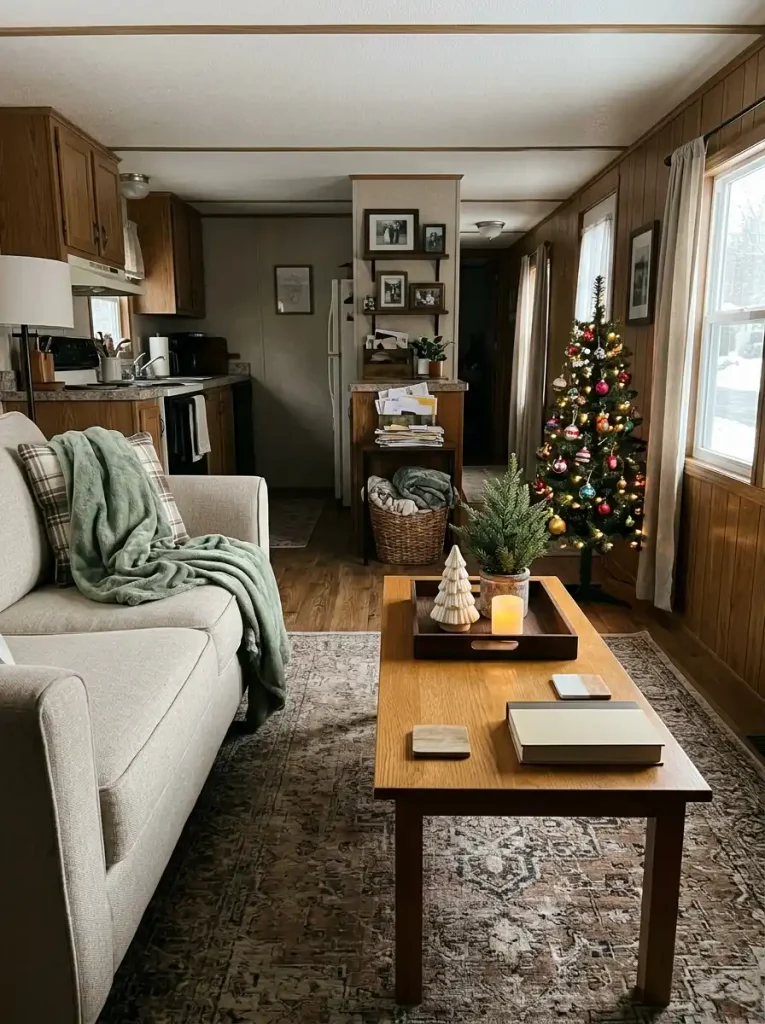
A tray is particularly useful when your coffee table doubles as the place for weeknight dinners, games, or folding laundry. Place a small faux evergreen clipping, one ceramic tree, and a flameless candle inside a sturdy tray. The three pieces move together when the surface needs to be cleared.
Before decorating, set out the mugs, remotes, or books you normally use. Let those everyday objects show how much tabletop area is genuinely available. In a tight single-wide seating arrangement, a display that lifts away in one motion is often more successful than five individually arranged ornaments.
The U.S. Consumer Product Safety Commission recommends flameless candles whenever possible, which is especially sensible around evergreen branches and ribbon.
Choose the tray for its footprint, not for the number of decorations it can hold. A shallow rectangular tray can suit a long table; a round tray may sit more comfortably on a compact square or circular top.
For a bigger furniture-and-circulation reset, the mobile home living room ideas guide explores seating and walkway relationships in more depth.
Your coffee table has a usable zone. Find it.
Choose the shape closest to your furniture. The top-down plans separate your holiday accent from the area your household needs to reach.
REMOTES
Decorate one end
Let a narrow tray hold greenery and a flameless glow. A free end stays ready for a cup or book without moving the décor.
Fit test: reach the empty end from the main sofa seat.
EDGE
Make a contained cluster
Use one shallow round tray. A compact group is easier to walk around than scattered items that approach the curved edge.
Fit test: check every approach to the sofa.
Keep an open band
Place a low round grouping toward the less-used side. Leave an obvious area for the objects you reach for every evening.
Fit test: set down two mugs before committing.
Coffee Table Fit Atlas — Choose Your Shape
Long rectangular table — Decorate one end. Keep the low tray of greenery and flameless light on the quieter end, then reach the clear end from the main sofa seat to test it.
Round or oval table — Make a contained cluster. A shallow round tray is easier to move around than scattered ornaments. Walk around each accessible edge before keeping it.
Small square table — Keep an open band. Position the holiday grouping near the less-used side and test whether you can set down two mugs elsewhere.
These are conceptual tabletop arrangements, not scaled measurements.
2. Stretch Low Evergreen Branches Along a Narrow Rectangular Table
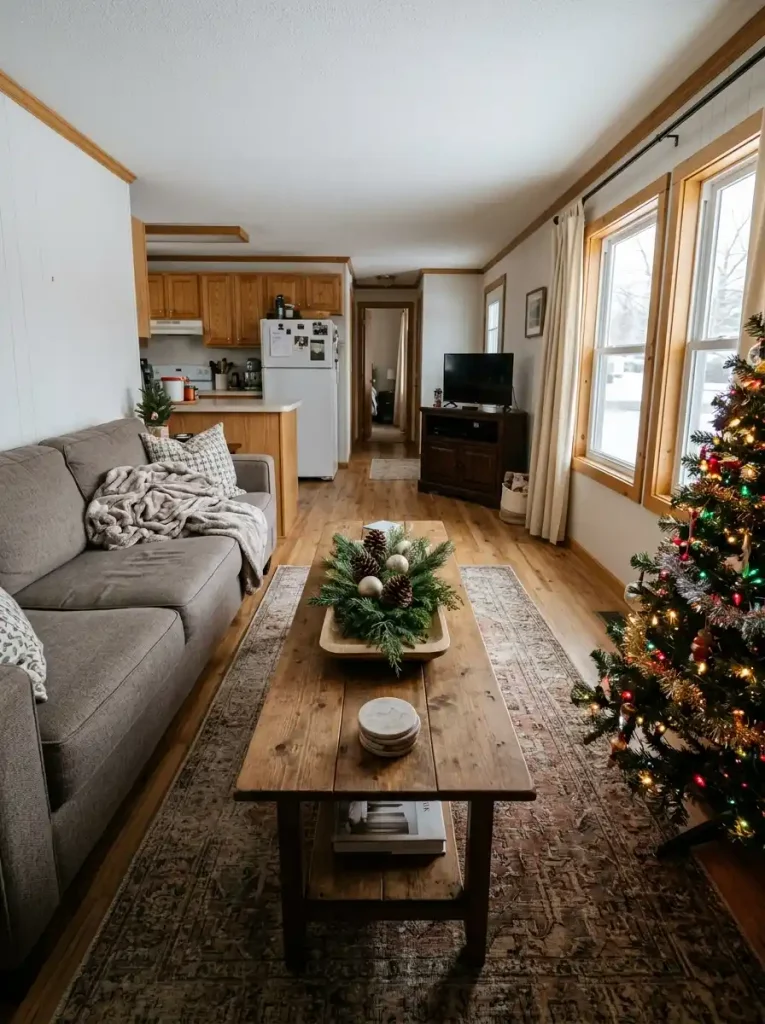
Imagine a narrow wood coffee table between a sectional and the television. A bushy floral centerpiece in its center would obscure the view and crowd the drink space. A low sweep of evergreen solves a different problem: it adds Christmas texture while following the long proportions of the furniture.
Lay a small bundle of faux cedar or pine on a washable shallow base. Trim or fold the ends back so no branch hangs into the route people use to stand up. Nestle a pair of pinecones or oversized ornaments within the greenery; do not scatter loose bits over the whole surface.
Test the finished sweep from your normal seat:
- Look toward the TV: no branch should cut across the important part of the screen.
- Face the person opposite: keep the arrangement below the line of conversation.
- Stand up along the usual route: no loose greenery should catch on clothing.
If the arrangement feels like a hedge, confine it to one end of the table.
3. Place One Mini Christmas Tree Off-Center for a Relaxed Look
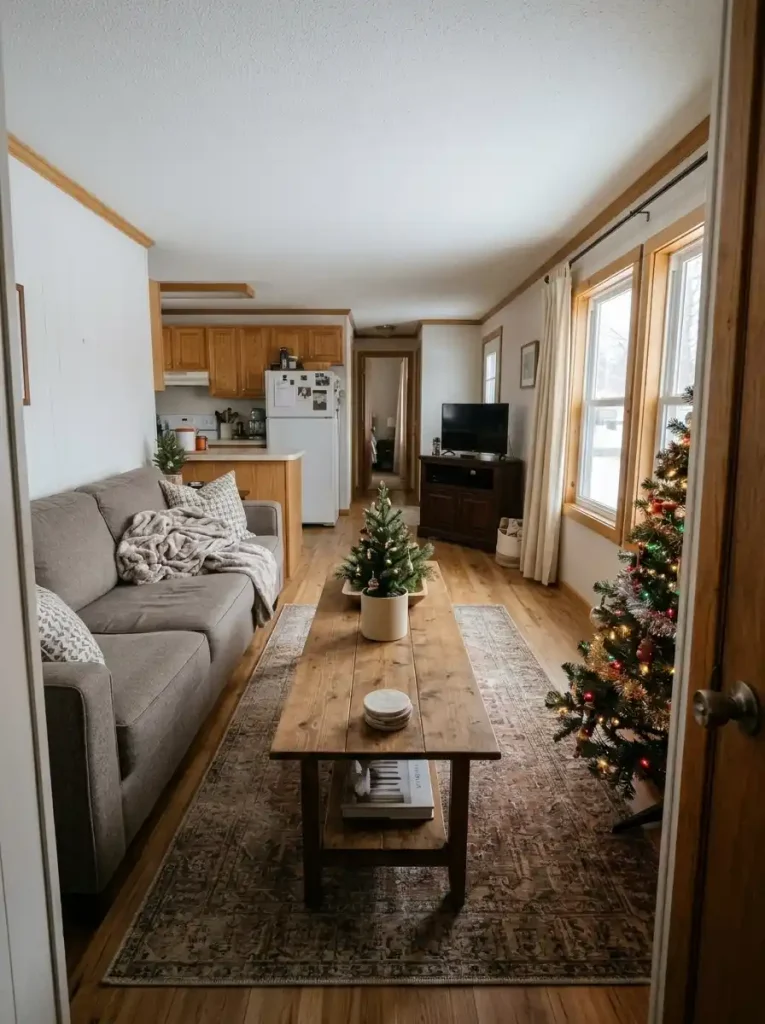
Where should the miniature tree go? Usually where it can be seen without standing in front of everything else. On a small coffee table, an off-center tree can feel less rigid than a centerpiece exactly in the middle.
Set up the grouping in this order:
- Choose a short tabletop tree in a stable container.
- Move it toward the side least used for drinks and remotes.
- Balance its visual weight with a low bowl or coaster stack, then inspect the sofa-level sightline.
A miniature tree that looks small from the doorway can still interrupt the TV view when you sit down.
A mini tree on the coffee table does not have to match the big tree ornament for ornament. Repeating just one finish—perhaps warm white lights or burgundy ribbon—is enough.
If the full-sized tree is squeezing the living room, the separate guide to slim Christmas tree placement in narrow mobile home living rooms tackles that larger floor-space decision.
4. Use a Shallow Round Tray on a Compact Square Coffee Table
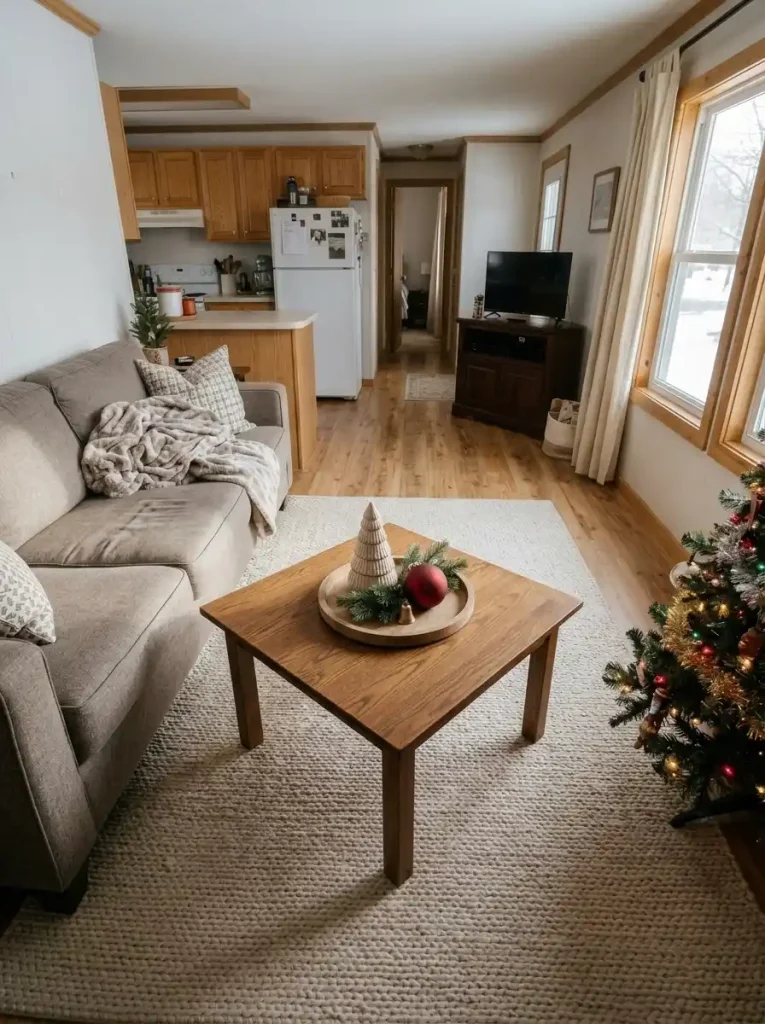
A square tabletop often becomes a collection of unrelated little piles. Centering a modest round tray creates one recognizable decorating zone while leaving the four corners legible and usable.
Try a short ceramic tree, a few evergreen tips, and a single shatter-resistant ornament inside the round edge. Keep all pieces firmly inside the tray so reaching for a drink does not brush the display. Choose a tray with a stable base and a finish that will not scratch the table.
The square-table rule: Preserve enough open tabletop area for daily use. The tray should organize the center without becoming another obstacle.
Use these two tabletop tests before keeping the tray:
- No place for two drinks? Size down or move the grouping toward a quieter corner.
- Display seems lost on a larger square? Add one modest vertical piece inside the tray, then recheck the seated sightline.
The circle organizes the objects; it does not need to cover the square.
5. Make a Tiered Christmas Tray Work Without Blocking the Room
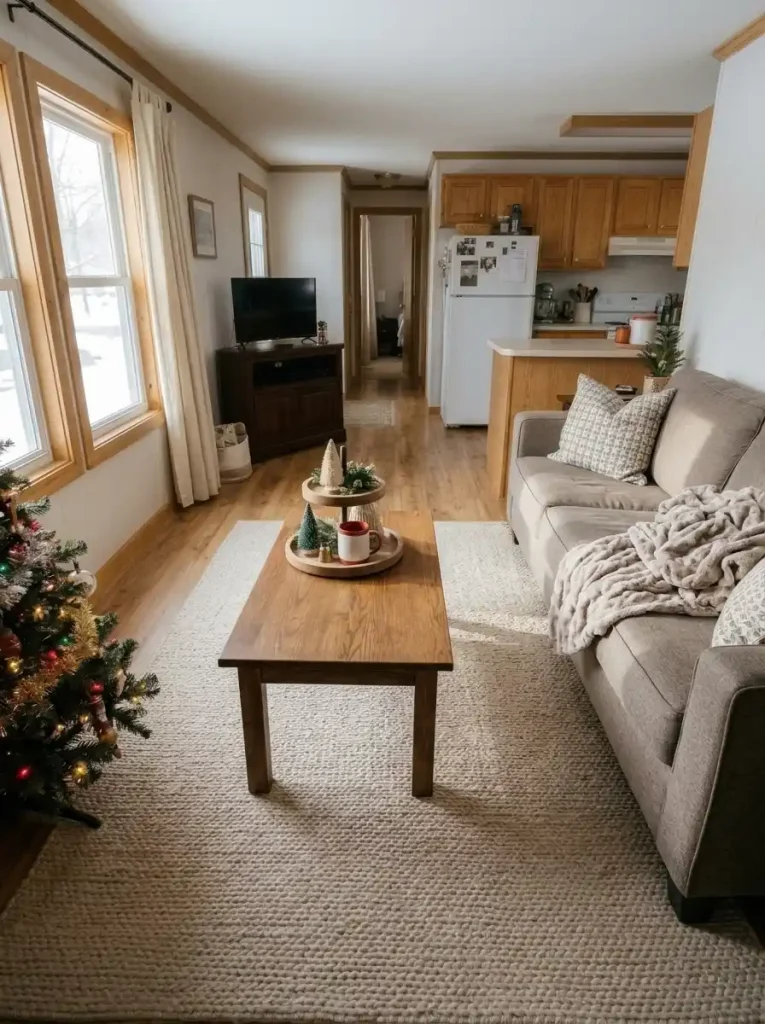
The exception: A tiered tray belongs on a coffee table only if its height does not interrupt the TV, conversation or everyday reaching.
Tiered trays can hold tiny signs, a favorite holiday mug, and bottle-brush trees in a charming, compact footprint. The main tradeoff is height. On a coffee table directly between the sofa and the TV, even a beautifully arranged stand can interrupt the view or feel precarious.
Use a tiered display where the furniture sits beside a sofa or in a corner that is not crossed by regular movement. Keep heavier pieces on the bottom tier, leave the edges clear, and avoid dangling ribbons that can be tugged.

If children or pets frequently brush the table, use a low, single-tier arrangement instead.
What the display looks like from the sofa
Low and conversational
Greenery sits below the view between seats and the television. A better default for narrow, heavily used rooms.
Tall and decorative
A tiered stand has visual charm, but demands a quiet location away from screen views and frequent reaching.
Open the three-point sightline check +
Sit: check the television and the face of anyone opposite. Reach: set down a mug without brushing the stand. Move: walk the common route beside the table. If any step fails, choose a low tray or relocate the tiered stand.
Tiered-Tray Sightline Study
Low and conversational: Greenery below the seated view is the better default for a frequently used coffee table between the sofa and television.
Tall and decorative: Tiered stands need a quieter spot away from screen views and frequent reaching.
Three-part check: Sit to check the view; reach to place a mug; move through the usual walkway. If one check fails, use a low tray or relocate the display.
The decision is simple: a tiered display earns its place only when people can comfortably see, reach, and move around it.
6. Give an Upholstered Ottoman a Stable Christmas Centerpiece

An upholstered ottoman has a softer surface than a normal coffee table. That can make a rigid tray look beautifully tailored—but only if the tray stays stable when the cushion compresses or someone sits nearby.
The empty-tray test: Set a rigid tray on the ottoman and check whether it remains level during normal movement nearby. If the base cannot stay stable, do not add decorations.
Before you decorate, put the empty tray in place, gently test for rocking, and watch what happens when the upholstery shifts during normal use.
If the tray tilts, skip tabletop accessories on that ottoman. Where the support is firm, use lightweight, nonbreakable decorations and keep the arrangement easy to lift away when the ottoman is needed for feet or extra seating.
Is your ottoman a safe base for Christmas décor?
An attractive tray is not proof of stability. Choose the situation that actually matches your furniture and daily routine.
Conditional fit: keep it minimal
Use a suitably sized, stable tray with lightweight, nonbreakable pieces. Check support again during ordinary movement around the sofa.
Stop signal: any rocking, shifting, or tilting means remove the display.
Do not build on a tilting surface
A tray that sinks or rocks is unsuitable for loose ornaments, lights, or breakable objects. Display the decorations on a stable table or shelf elsewhere.
Stop signal: if the tray does not remain level, the styling plan ends here.
Keep the ottoman usable
If people routinely sit on it or rest their feet there, skip a permanent holiday display. Decorate a side table instead.
Better use: restore the ordinary furniture function without repeatedly moving fragile items.
Ottoman Stability Studio — Three Possible Outcomes
Rigid tray stays level: A minimal arrangement of lightweight, nonbreakable objects may work. Check the tray again during normal movement; stop if it shifts or tilts.
Tray rocks or sinks: Do not decorate this base. Move seasonal accessories to a separate stable table or shelf.
Ottoman used for feet or extra seating: Keep it functional. A permanent centerpiece is the wrong choice for furniture that people regularly sit on or use as a footrest.
This is a styling assessment, not a structural load rating.
One grounded evergreen spray and a small ceramic-look resin ornament will usually be more comfortable here than glass hurricane vases, loose beads, or tall candle towers. A holiday ottoman should still behave like the furniture it was before December.
7. Create a Calm White-and-Evergreen Scandinavian Winter Scene
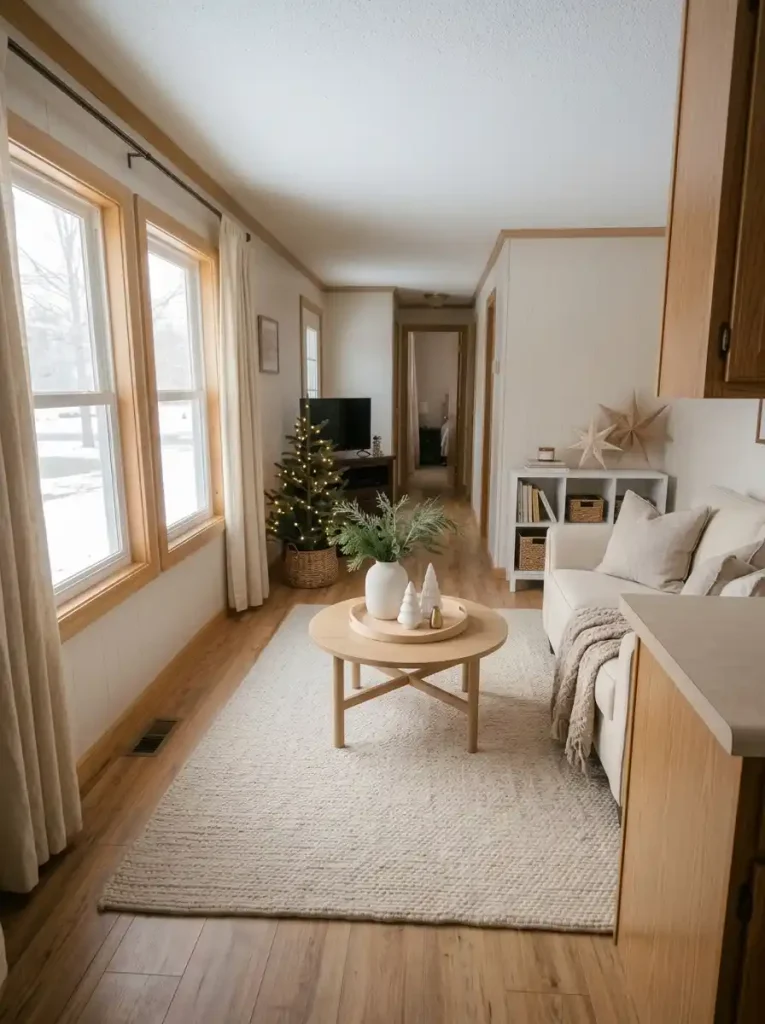
Some open-plan mobile homes already have visually busy kitchens, televisions, shelving, and a decorated tree in the same view. The coffee table can provide a pause.
A matte white vessel filled with airy pine, two white ceramic trees, and a small gold-toned accent make a winter scene that feels seasonal without introducing another loud pattern.
Keep the arrangement edited to three visual roles:
- Greenery: the natural shape and soft vertical movement.
- Ceramics: the pale, quiet anchor against the tabletop.
- One metallic detail: a glint that catches daylight or a warm lamp.
Choose this approach for a light-wood or neutral living room where the Christmas tree is already the strongest source of color.
Skip artificial snow or loose glitter on a surface that people wipe and use every day. The calm effect comes from materials and spacing, not from accumulating white accessories.
8. Pair a White Reindeer With Deep Red Berries for Classic Christmas Charm
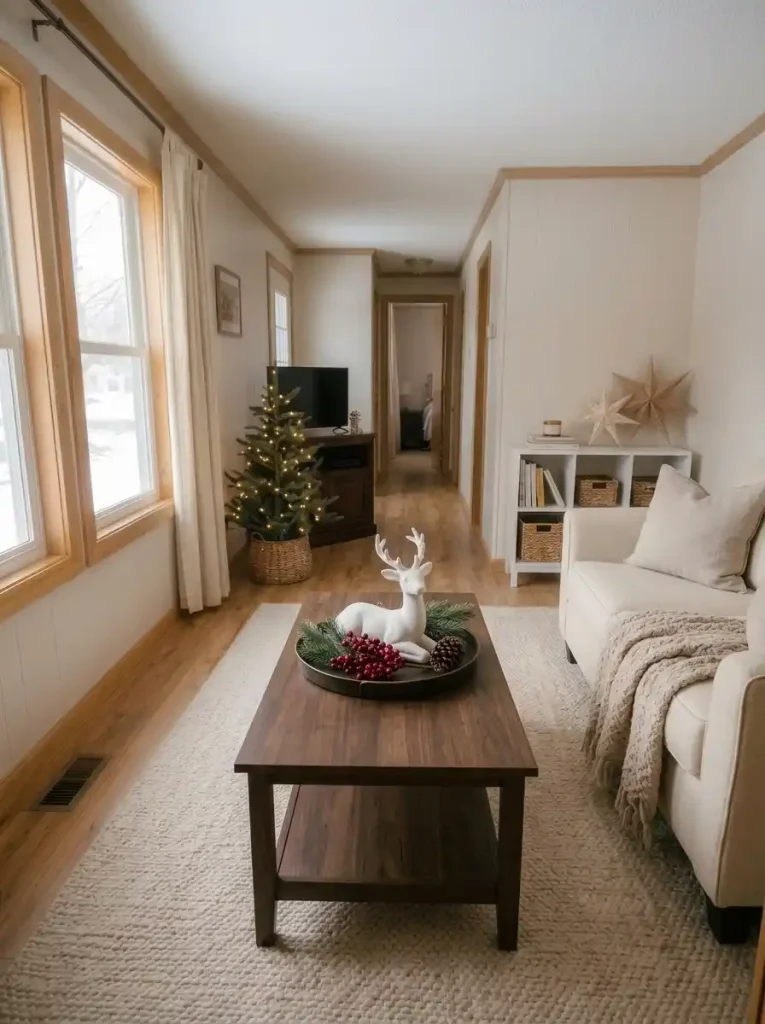
A white reindeer figurine can create a clear Christmas focal point against red berries and frosted greenery.

The contrast is especially effective in a smaller room with cream upholstery and a darker coffee table: the light figurine reads from a distance, while the red adds warmth.
Set the reindeer inside a low tray, keeping its antlers away from the side people walk past. Tuck a short berry stem toward the back and place one pinecone near the base.
It is tempting to add several more red pieces; from the sofa, though, that often turns a composed vignette into a patchwork of disconnected spots.
Editing cue: The white reindeer should still read as the focal point from the doorway; berries provide one contained burst of color.
Doorway Editing Test
- If the berry color reads as one accent around the reindeer, stop.
- If separate red ornaments dominate every corner, remove the extras.
- Where children can reach the table, avoid small detachable berries and fragile figures.
One legible focal point is better than several competing decorations.
9. Tell a Christmas Story With a Tiny Wooden Village
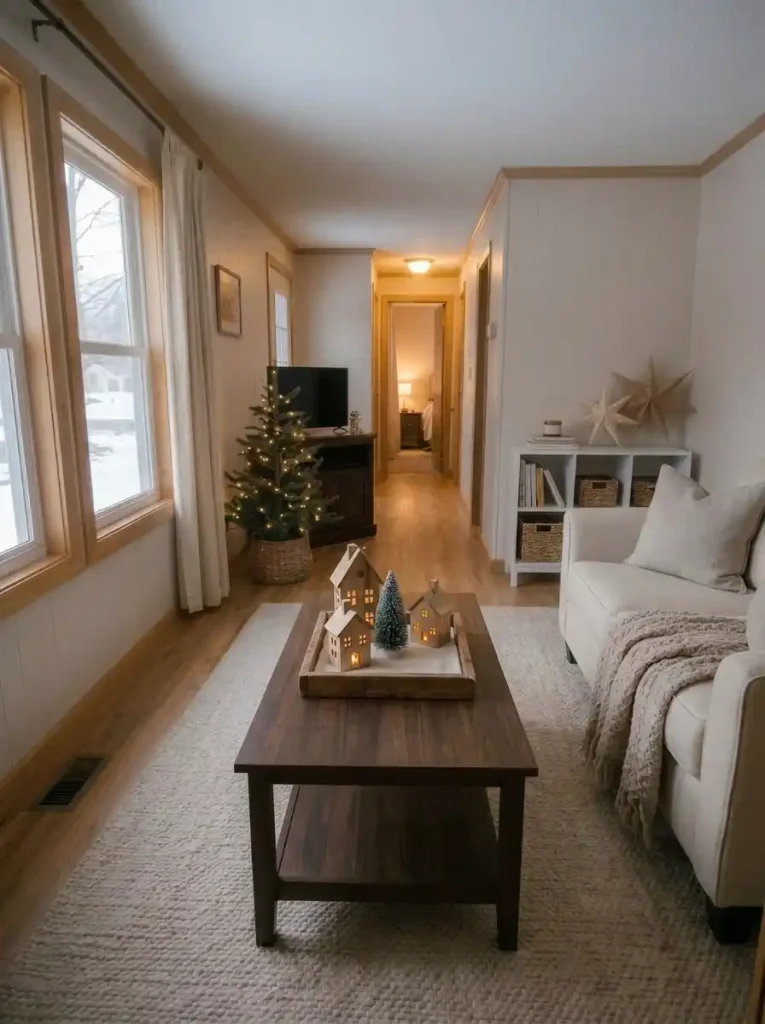
Miniature houses turn a coffee table into a winter scene, but a whole village is rarely necessary.
Two understated wood or ceramic houses, one low tree, and a faux-snow-colored textile base can suggest a tiny street without swallowing the surface.
Build the scene from back to front:
- Place the slightly taller house toward the rear, keeping its silhouette separate from the shorter house.
- Set the shorter house and tree toward the front, preserving gaps that remain visible from the sofa.
Battery-operated lighting inside a suitable house can add atmosphere, provided the battery compartment is secure and the product is used according to its instructions.
Three layers make a miniature village readable
Place the taller house or tree against the far edge of the tray.
Let one miniature tree break the line between the houses.
Leave a lower piece and visible gap so objects remain identifiable.
The diagram is a styling illustration, not a measured model. If houses overlap visually from the sofa, reduce their number or spread them within a smaller contained area.
Miniature Village Depth Study
Rear: Put the taller house or tree toward the far edge of the tray.
Middle: Use one tree to separate the houses’ silhouettes.
Front: Position a lower piece with visible space around it. If the houses overlap when viewed from the sofa, remove one or expand their spacing within the available contained area.
The composition works best where the rest of the room is quiet enough to let this small story be noticed.
On a crowded tabletop, reduce the scene to one illuminated house and a single tree; the storytelling effect survives.
10. Group Bottle-Brush Trees Into a Small Christmas Forest
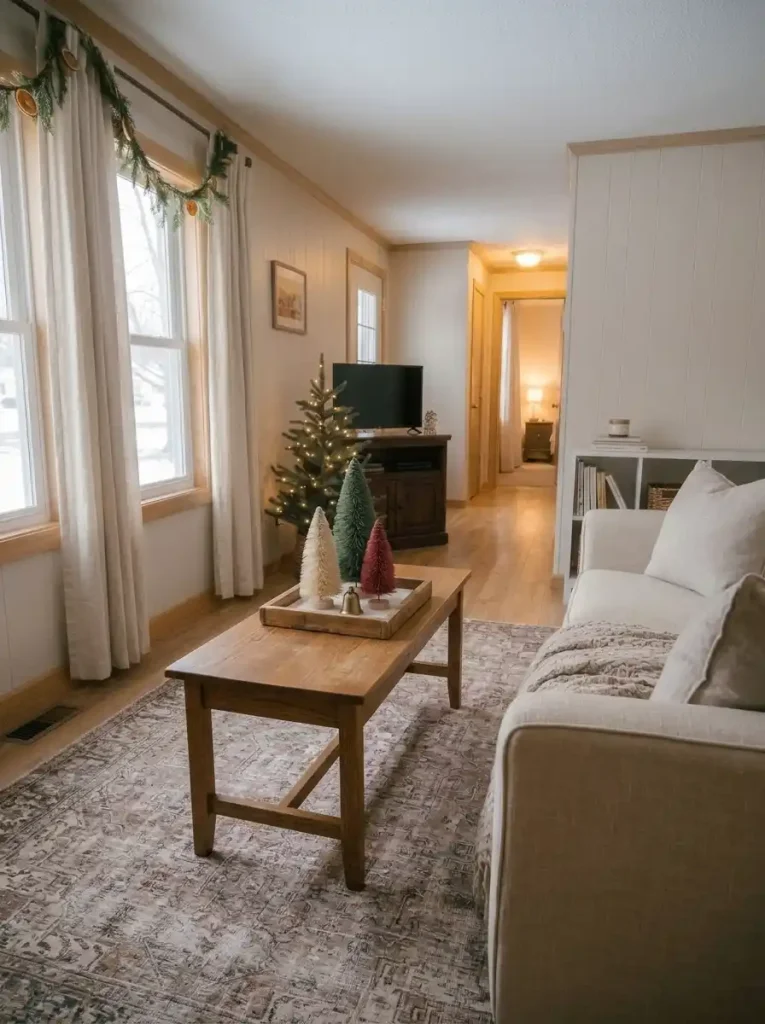
Bottle-brush trees are easy to find and especially appealing on an older farmhouse-style coffee table.
Their narrow bases let several trees occupy one contained area, while varied heights suggest the staggered skyline of a forest.
Three distinct ways to style them:
- Soft vintage: cream, faded green, and muted red trees on a narrow wooden riser.
- Winter monochrome: two snowy whites beside one deep-green tree on a glass-safe tray.
- Classic nostalgic: a small trio in natural green with one red ribbon around the tray.
Keep the tallest tree near the back of the group and leave visible space between their crowns.
If a large Christmas tree already dominates the same corner, use only two tabletop trees or move the mini forest to the coffee table’s opposite end.
More trees are not always a fuller-looking room.
11. Fill One Shallow Bowl With Shatter-Resistant Ornaments
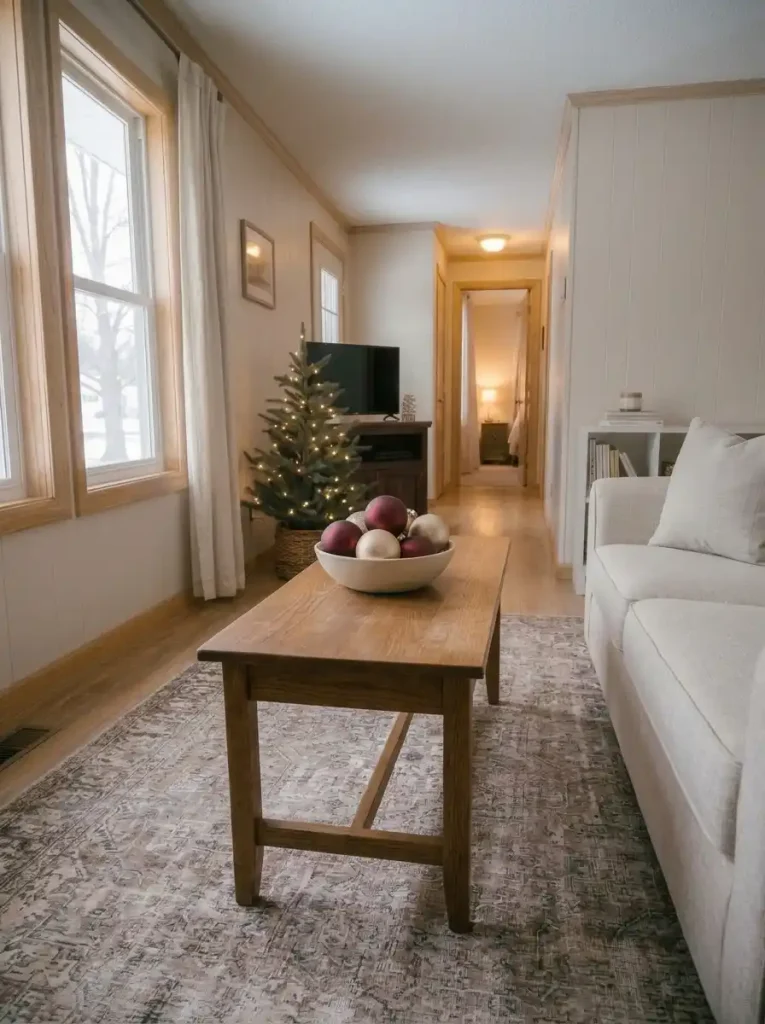
A shallow bowl offers a wonderfully low-effort Christmas centerpiece: ornaments sit together, the arrangement stays below most seated sightlines, and clearing the table takes seconds.
Choose the bowl by household use:
- Busy seating area: use a bowl with enough side height to hold its contents.
- Glass tabletop: check the furniture care guidance and add an appropriate protective base where permitted.
- Small children or pets: avoid loose, detachable, tiny or breakable pieces altogether.
Choose lightweight, shatter-resistant ornaments in two compatible finishes, such as matte cranberry and soft champagne. Check the reach path across the tabletop before settling on a bowl.
When to choose this: a coffee table already crowded by a sectional, television, and family activity. The bowl gives a visual Christmas moment without bringing another tall structure into the room.
On a glass top, place a suitable soft protective pad underneath if recommended for the table finish.
12. Give a Favorite Santa Mug a Nostalgic Holiday Moment
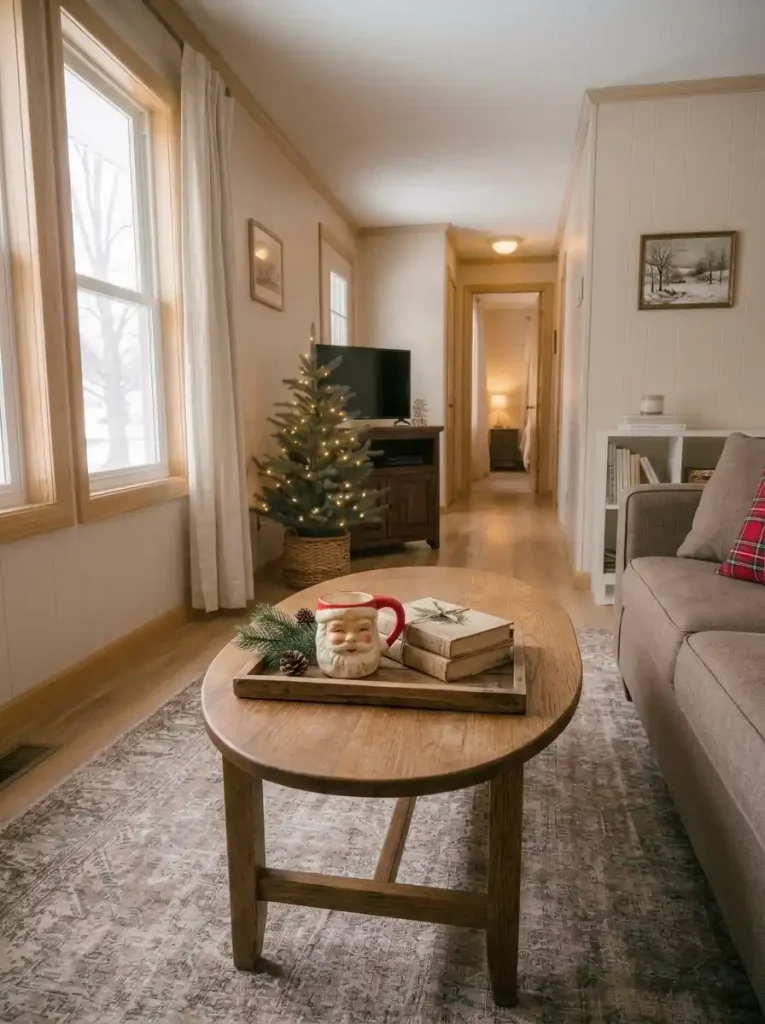
That slightly mismatched Santa mug from a family Christmas does not need to hide in a cupboard.
Rest it on a compact tray beside a small stack of books and one miniature evergreen sprig. Its familiar shape and color can supply all the holiday personality a narrow coffee table needs.
Keep this a display, not a serving station. A mug and a sprig of evergreen make a nostalgic decorative moment; drinks and ingredients belong on an appropriate serving surface.
What Belongs on the Table?
- One empty, clean Santa mug as a nostalgic accent.
- A low stack of seasonal reading and one sprig of greenery.
- No open drink mixes, marshmallow jars, or hot-beverage serving setup; keep those in the kitchen.
A mug used for drinking can return to normal kitchen storage after the display comes down.
If the mug is especially fragile or sentimental, choose a safe shelf away from everyday contact and display a sturdier seasonal cup on the table.
The point is to bring a personal memory into view, not to put it at risk.
13. Tie a Velvet Christmas Bow Around an Existing Book Stack
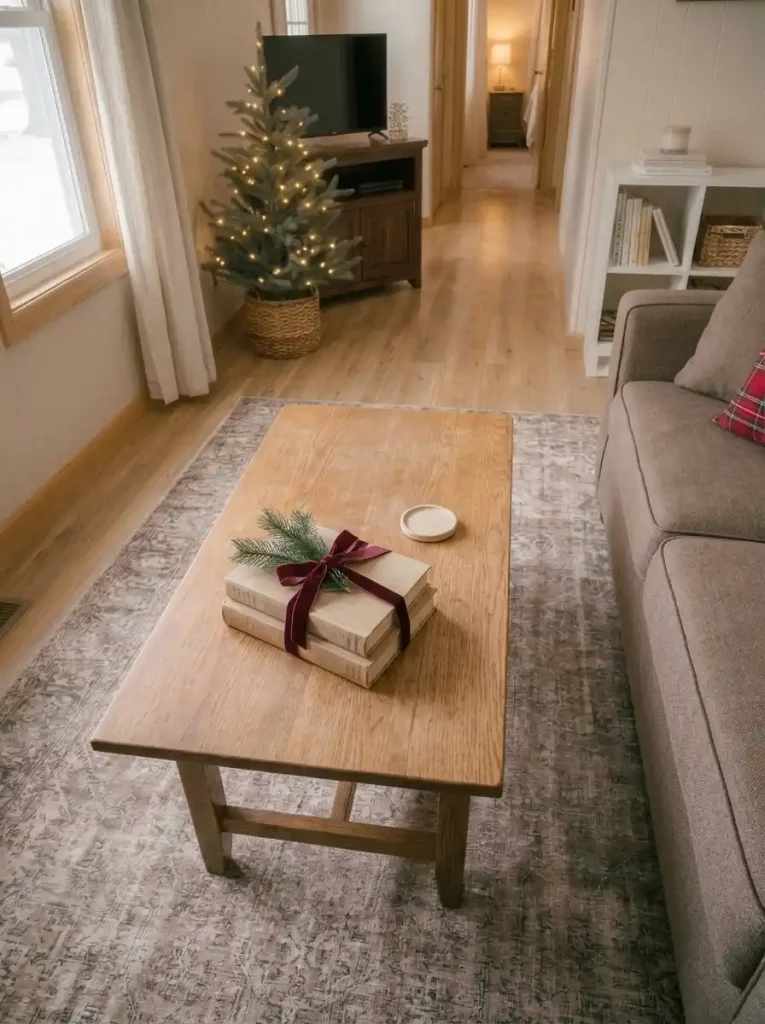
Sometimes the smartest December update is already sitting on the coffee table.
A stack of two or three books can be wrapped with a loose, removable velvet ribbon and topped with a clipped evergreen stem, giving an ordinary object a dressed-for-Christmas look.
Reuse first: If you already keep two or three books on the coffee table, a removable ribbon can be the entire Christmas update.
The Five-Minute Book-Stack Update
- Select two or three books already on the table.
- Wrap them loosely with a removable burgundy or forest-green velvet ribbon.
- Tuck one short evergreen sprig beneath the knot, leaving nearby space free.
Use short ribbon ends in any home where curious hands or pets can reach them, and keep the books easy to untie and read.
If you’re reusing fall trays, baskets, or neutral décor across seasons, the full Thanksgiving-to-Christmas decorating transition guide explains the broader swap.
Here, a simple change of ribbon may be enough.
14. Keep a Glass Coffee Table Airy With a Transparent Winter Display
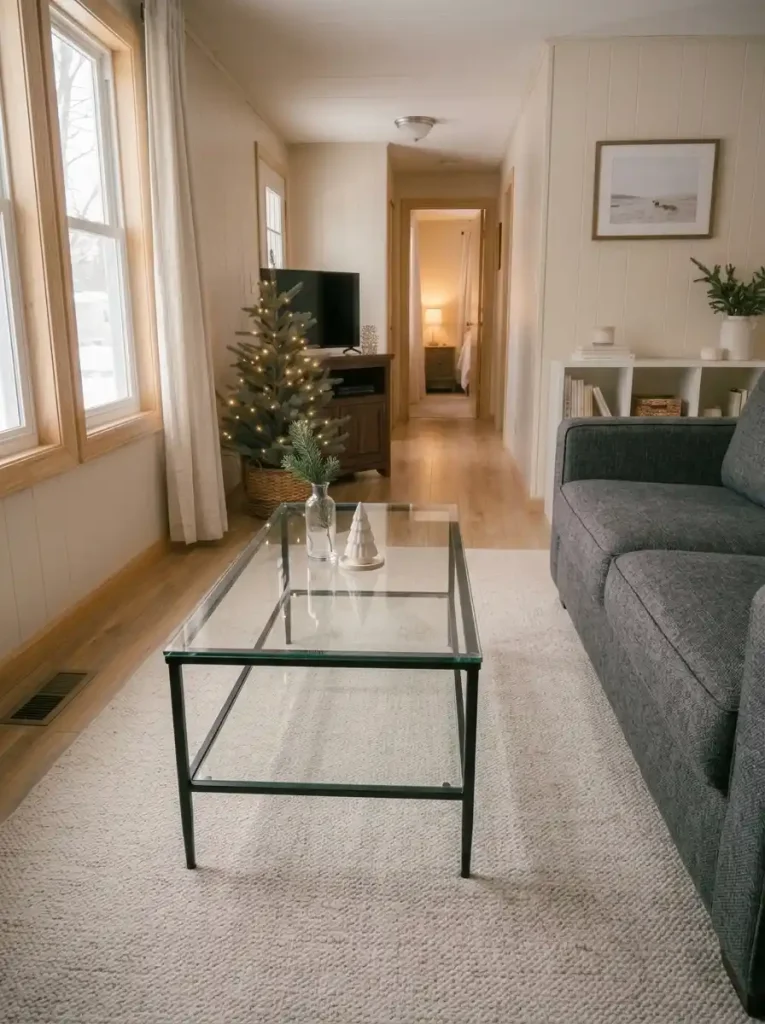
Glass coffee tables often work nicely in narrow rooms because the floor and rug remain visible through them.
Covering that transparency with an oversized solid tray can make the piece feel heavier than it needs to.
Start with a slender clear vase holding one evergreen branch, a small ceramic tree, or two transparent glass-look ornaments in a secure low dish.
Arrange the objects close enough to feel related, then inspect the surface from the doorway and from the sofa. You should still perceive generous open glass around them.
Keep the lightness of a glass coffee table
Open composition
One narrow clear vessel leaves most of the glass visible, preserving views of the rug and floor below.
Heavy opaque grouping
A broad solid tray hides much of the glass, making a lightweight table read as visually heavier.
Choose by room: if the see-through furniture is helping a narrow room feel open, protect that feature. Secure all pieces and follow the glass-top care instructions.
Glass Table Transparency Comparison
Open composition: One narrow clear vessel leaves most of the glass, rug, and floor visible, retaining the table’s light appearance.
Heavy opaque composition: A large solid tray hides the transparent tabletop and gives the furniture more visual weight.
Decision: Choose the open composition when transparency is one reason the glass table works well in your room. Protect the surface according to the furniture manufacturer’s care instructions.
Glass-top protection: Avoid gritty bases or rough metal directly on the surface. Follow the furniture maker’s care guidance; where pieces are frequently knocked, use clear, unbreakable alternatives to glass ornaments.
15. Style Silver, Pewter and Pine for a Subtle Holiday Shine
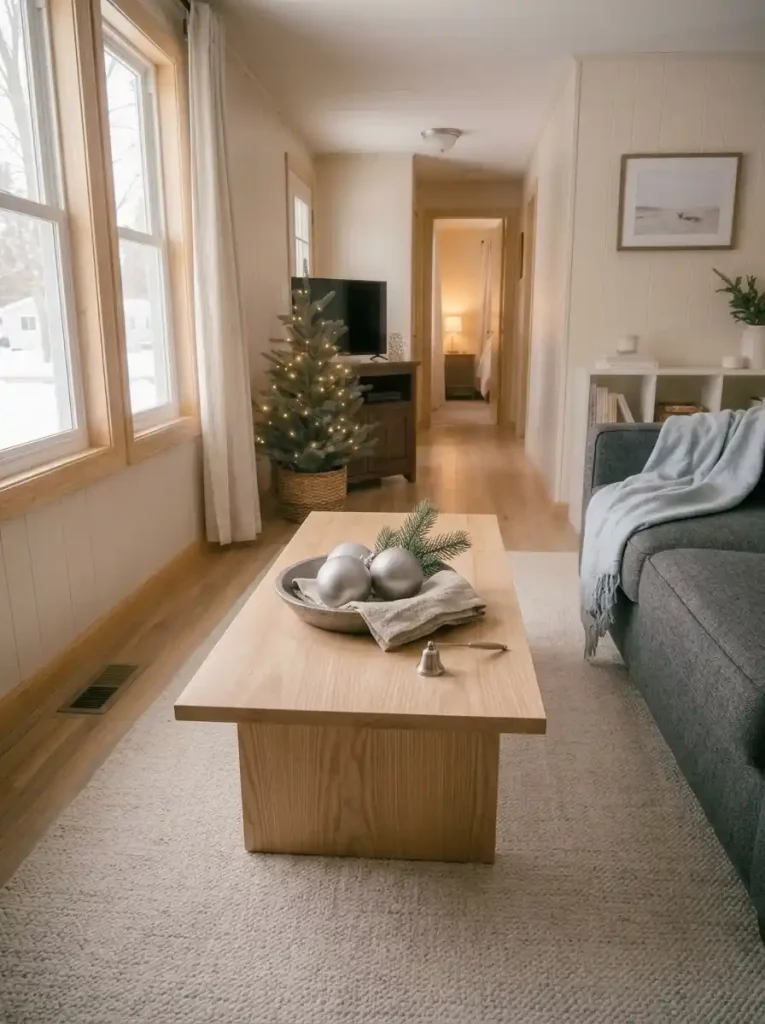
Not every holiday table needs red and green. Silver and pewter can pick up cool daylight, while pine branches soften the hard edges.
Balance these three finishes:
- One silver or pewter focal piece supplies the reflected light.
- Matte pine or textured linen absorbs visual brightness around it.
- Any extra glittered ornaments should be optional; repeated shine may cause distraction near a bright window.
Glare test: Look from a bright window and from the sofa after dark. A distracting gleam near the TV is your signal to use a brushed finish or reposition the display.
The combination is particularly appealing when a small mobile home already has gray upholstery, pale walls, or a brushed-metal lamp.
Try the arrangement under both daylight and evening lamps. If the metal causes distracting glare while watching television, turn the bowl slightly, choose a brushed finish, or move it farther from the screen axis.
Reflective materials should introduce a glimmer, not compete with the screen.
16. Know When to Keep a Family Coffee Table Clear at Christmas
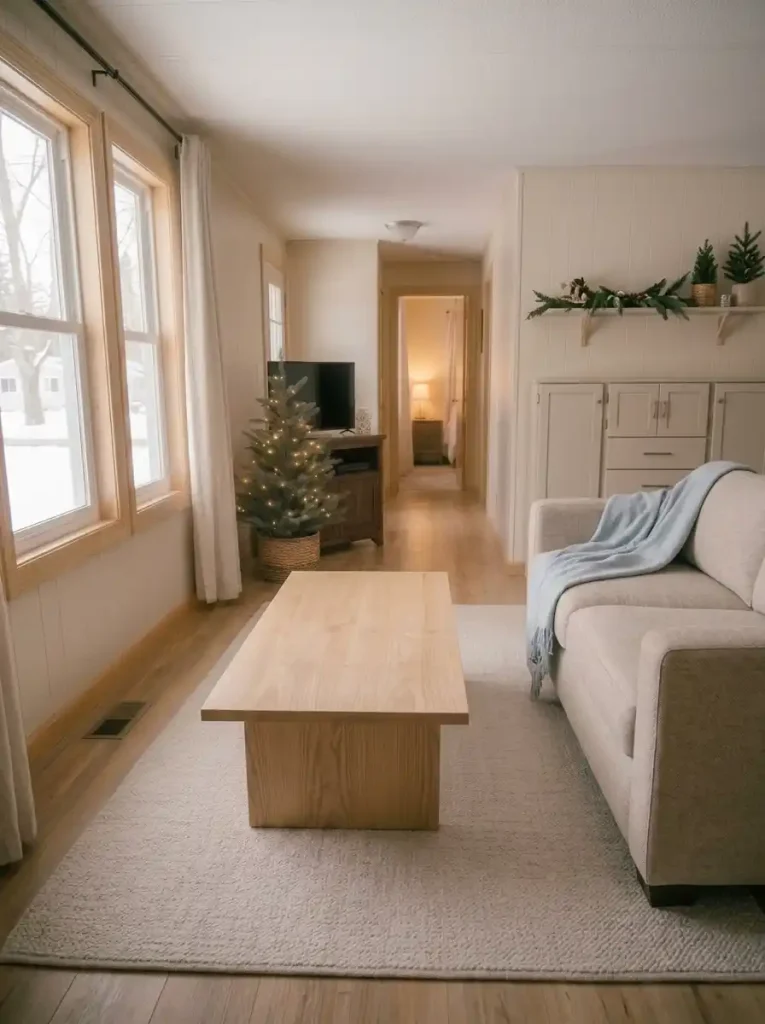
In a household where toddlers can reach the coffee table, decoration becomes an access decision before it becomes a color decision.
Keep the surface clear during active play and move seasonal accents to a genuinely inaccessible, stable location.
In rooms where younger children cannot access the display, soft, securely placed decorations may be more suitable than glass, loose ornaments, or fragile miniatures.
Look for Three Reach Hazards Before Decorating
- Small or detachable pieces: loose beads, miniature berries, and tiny ornaments may be unsuitable for accessible surfaces.
- Fragile or pullable objects: glass figures, dangling branches, and unstable stands can be bumped or pulled.
- Accessible batteries: check secure compartments, current recalls, and product warnings for any battery-operated décor.
Battery-powered decorations are not automatically child-safe; keep hazardous objects and batteries out of children’s reach.
See the U.S. Consumer Product Safety Commission’s holiday safety guidance and its warning about unsafe flameless candles with accessible coin batteries.
Household Reach & Safety Studio — Choose by Access
Toddlers play here: Keep the coffee-table play surface clear. Place seasonal decorations on a genuinely inaccessible, stable display surface.
Children or pets can reach the table: Move loose ornaments, glass items, and battery-powered decorations out of reach. Check whether children can climb or pets can pull down greenery from the proposed alternate location.
Adults-only, low-traffic table: A contained low tray may be appropriate with securely placed items and flameless lighting. Visitors, pets, or young children can change the safe-use conditions.
These recommendations cannot certify individual products. Follow manufacturer instructions and check recalls.
When a coffee table is actively used for play, the safest and nicest-looking choice may be to keep it clear and place Christmas décor on an inaccessible mantel or higher stable shelf.
Who can reach the centerpiece?
The safest decision depends on actual access, not whether a decoration is sold as “shatter-resistant.” Choose your household situation.
Keep the play surface clear
Put decorative items on a genuinely inaccessible, stable display surface. For a table used in active play, an empty center is often the right Christmas design.
Avoid: small parts, detachable caps, ribbons that can entangle, and reachable battery-operated ornaments.
Use a different display location
A reachable tabletop is not the place for loose ornaments, small pinecones, glass, or batteries. Move seasonal objects out of reach and keep ordinary tabletop function available.
Check: whether pets can pull branches or children can climb to the proposed display.
Style with containment and care
A low tray with securely placed items can work where routine contact is limited. Prefer flameless light sources, inspect stability, and avoid loose pieces that can roll.
Still applies: visitors, pets, and young children can change the use conditions at any time.
No centerpiece is worth leaving a hazard within reach.
17. Echo the Christmas Tree Colors in a Simple Coffee-Table Arrangement
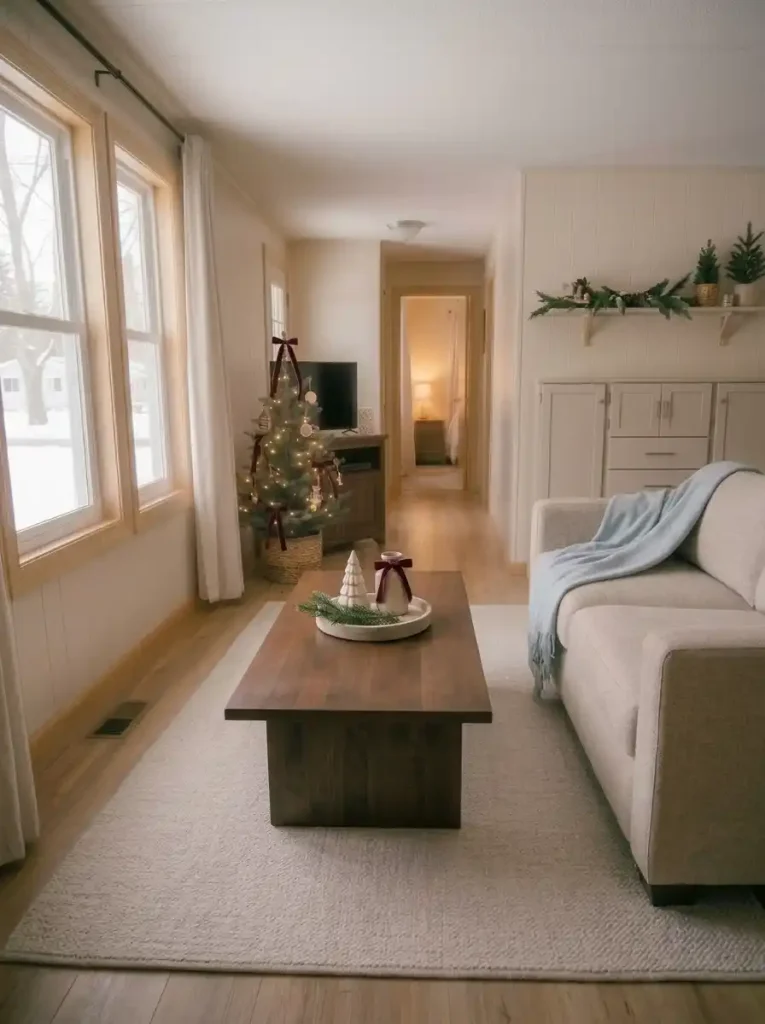
The living room usually looks more cohesive when the coffee table acknowledges the main tree without copying it.
Stand in the doorway and identify one visual detail that already repeats across the room: burgundy ribbons, warm-white lights, antique brass ornaments, or snowy branches.
Select one echo, not the whole theme:
- Burgundy bows on the big tree: repeat burgundy once, as ribbon around a pale tabletop vase.
- Natural wood ornaments: use one carved wooden tree on the coffee table.
- Warm white tree lights: carry the color temperature into one suitable flameless tabletop accent.
Leave surrounding space open so the connection can be noticed.
This final styling choice can also guide rooms without a floor-standing tree.
The guide to wall-mounted Christmas trees for mobile homes with little floor space covers a different approach to the main display; a simple tabletop echo will work with those alternatives, too.
A Little Christmas Is Enough
A small mobile-home coffee table rarely needs a large centerpiece. It needs an arrangement that belongs to the furniture, respects the space between the seats, and survives an ordinary December evening.
Begin with the table’s real usable area and your household’s daily habits. A movable tray, a restrained evergreen stem, or one much-loved holiday object may be all the decoration the room needs.
Then look at the arrangement from the sofa, from the doorway, and in evening light.
Edit anything that blocks a view, crowds a drink, scratches the surface, or creates a safety concern. The most welcoming Christmas styling is the kind you can enjoy without having to work around it.
Save this article on Pinterest so you can come back to your favorite Christmas coffee table styling idea when you’re ready to decorate.