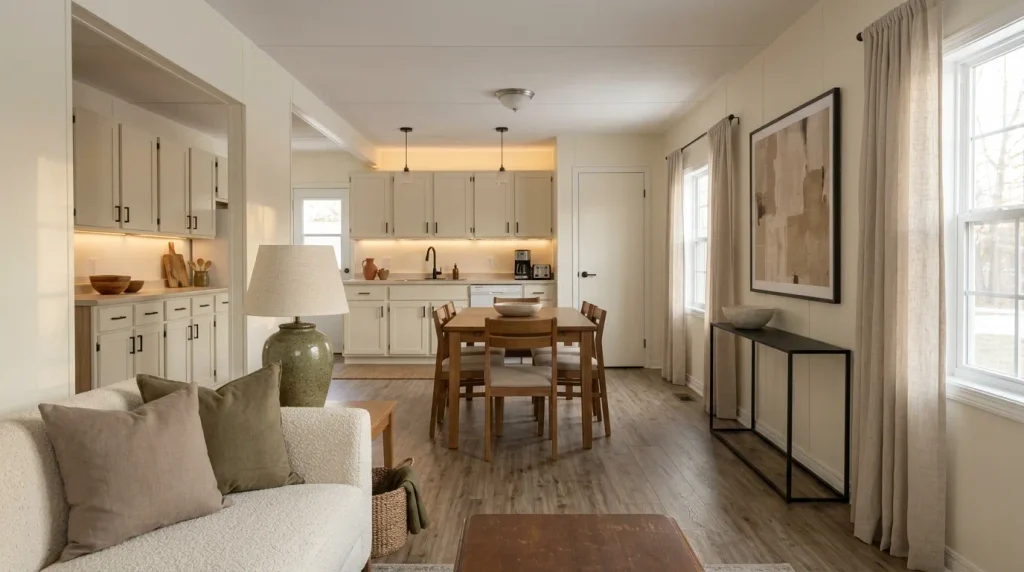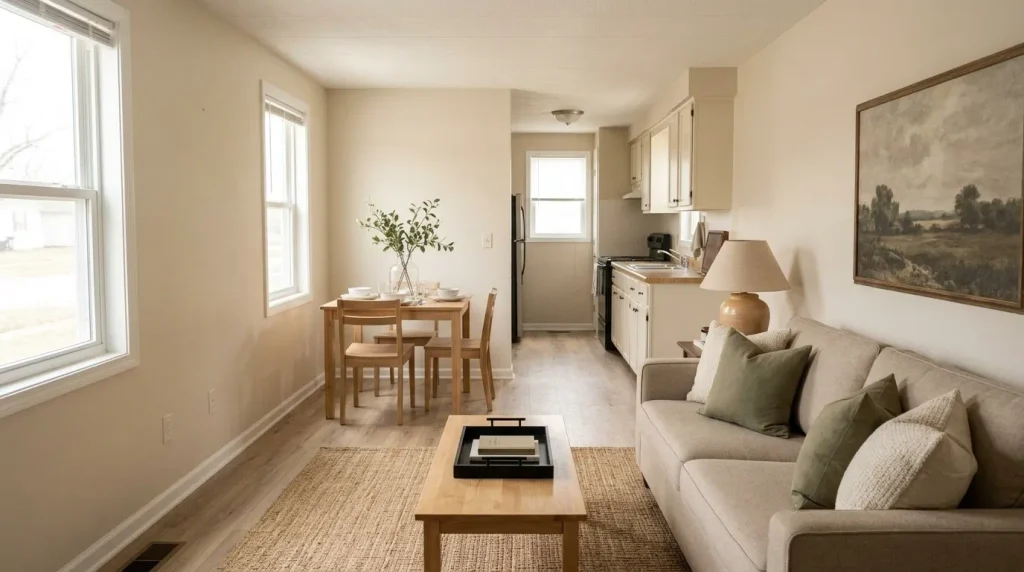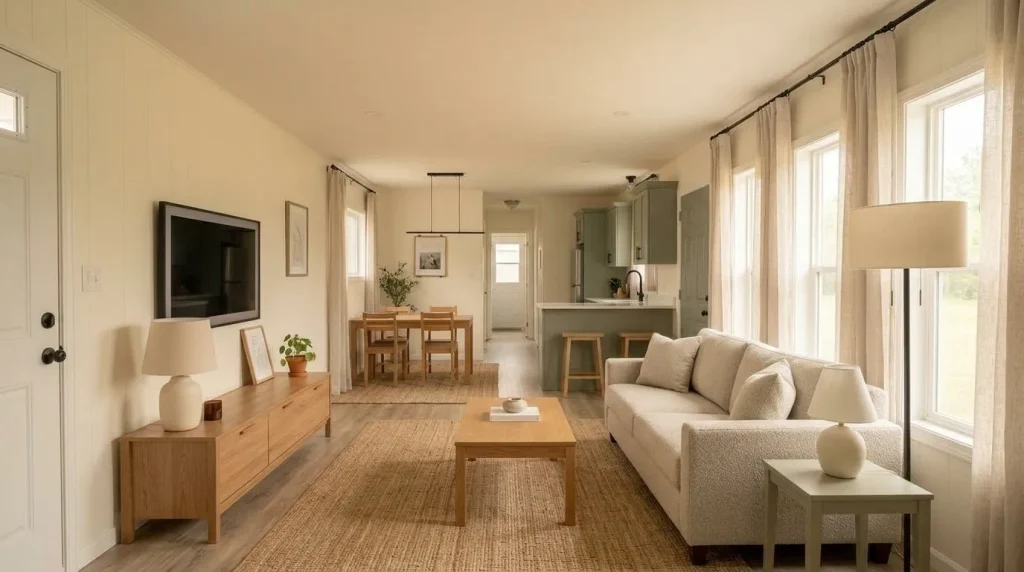
A thrift-store price tag does not decide whether a room looks inexpensive. In a mobile home, the bigger giveaway is usually a piece with no clear role: a chair that crowds the walkway, five tiny accessories fighting for attention, or a “great deal” that needs more repair than it is worth. Good thrifted mobile home decor works differently. It uses secondhand pieces to add real material, useful storage, character, and visual weight without overwhelming a compact floor plan.
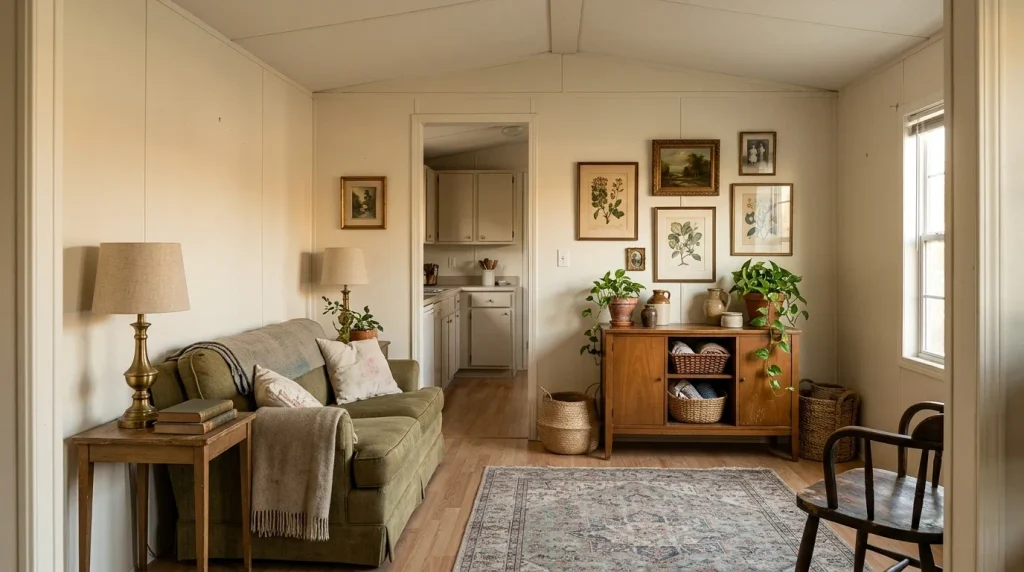
These 21 ideas focus on the part thrift decorating often skips: selection. You will see how to judge condition, footprint, scale, finish, placement, and the way one find relates to the rest of the room. Some pieces are worth preserving exactly because they look old; others need editing, cleaning, reupholstering, or simply leaving at the store.
Start with the decision tool below before you buy anything. A low price is useful only when the piece also earns its space.
1. Judge the Find by Condition, Fit and Role Before You Judge the Price
A good thrift find should pass three separate tests before price enters the conversation: condition, footprint, and role. Condition tells you whether the piece is genuinely usable or whether the “bargain” is hiding a repair project. Footprint asks whether it fits the room and still leaves the route through the space feeling easy. Role asks what the object will actually do once it gets home.
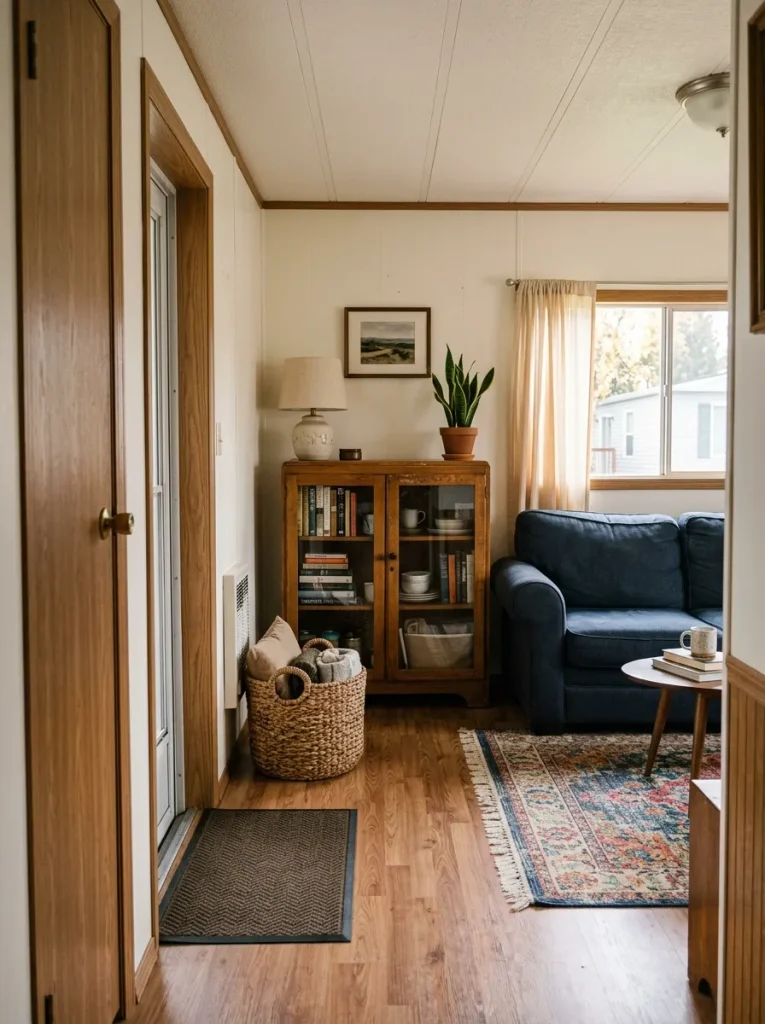
That last test matters most in a mobile home because floor and wall space are visible quickly. A charming stool with no destination becomes clutter. A slightly worn cabinet that replaces two plastic storage units may be the smarter purchase.
Use the viability lab below in the store, at a flea market, or while browsing Marketplace. The strongest finds do not need to be perfect; they need a believable job and a realistic place to perform it.
Thrift Find Viability Lab
Thrift Find Viability Lab
Would this bargain actually improve your mobile home?
Test the piece through three filters. Each choice reveals a different decision—not merely a different visual state.
The strongest thrift purchase: sound enough to use, small enough for its destination, and useful enough to justify the space it occupies.
2. Let One Real-Wood Piece Carry More Visual Weight Than Five Small Accessories
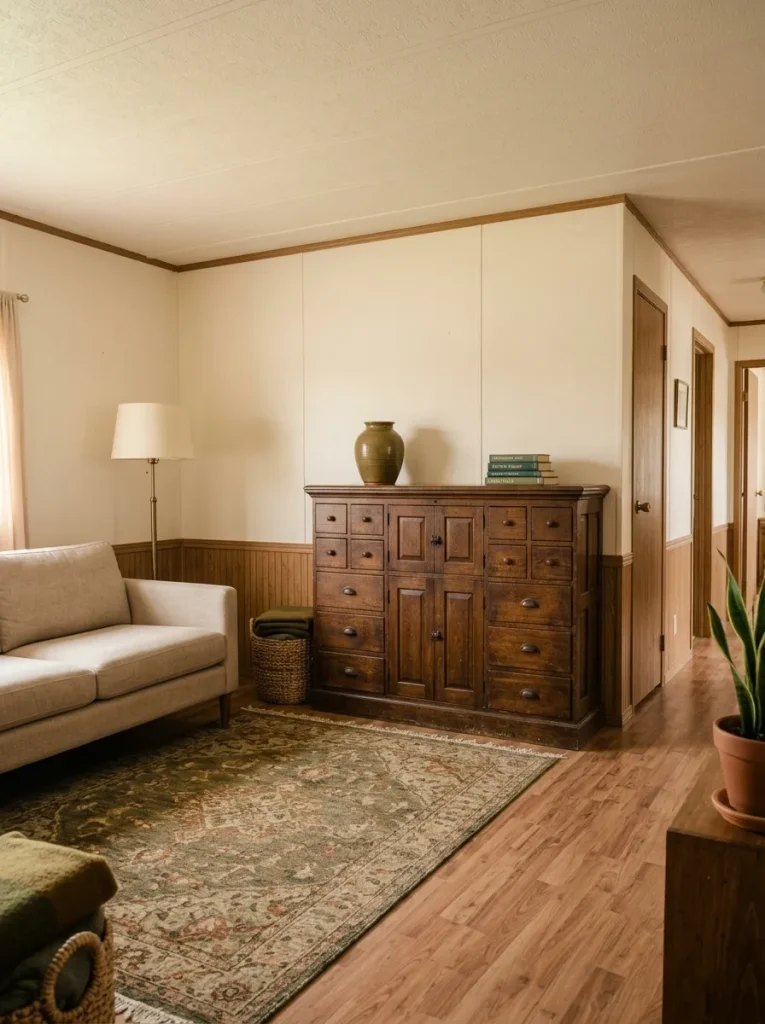
Small accessories are easy to justify because each one costs little, but a shelf full of tiny bargains can make a compact room feel busier than the total spending suggests. One substantial real-wood piece—a side table, narrow cabinet, bench, or low bookcase—often gives the eye a stronger place to land.
Look for solid-feeling construction, useful proportions, and a finish that can live with the furniture already in the room. The piece does not have to match. Its job is to provide visual weight and a stable material note.
Try this before buying another tray, vase, sign, or figurine: imagine removing three or four smaller decor purchases and giving their budget and their visual space to one anchor piece.
Choose the larger find only when it serves a function too:
- a cabinet that hides everyday clutter;
- a bench that adds seating;
- a side table that supports a lamp;
- a bookcase that creates one controlled display zone.
That is how secondhand character stays useful without turning into accumulation.
3. Keep Honest Wear on Wood and Metal—Fix Only What Reads as Neglect
There is a useful difference between age and damage.
A softened brass finish, small scratches across an old wood top, slight color variation, an imperfect glaze, or worn edges can give a thrifted object depth that a brand-new reproduction is trying to imitate. Loose joints, strong persistent odors, unstable legs, deep moisture damage, or a surface that is actively breaking down belong in another category.
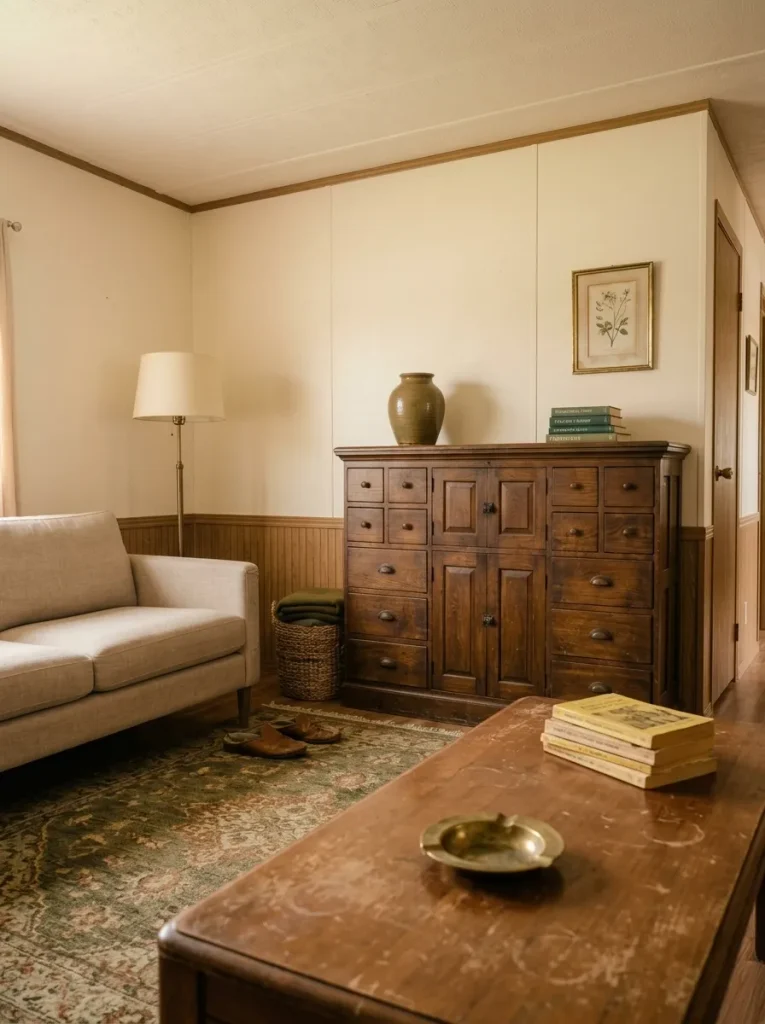
Before stripping or painting an older find, clean a small inconspicuous area and view the surface in daylight. Dust and grime can disguise attractive grain and warmer color underneath. Sometimes the best makeover is simply cleaning, tightening hardware, and stopping.
Preserve wear that contributes character.
Repair problems that affect function.
Walk away when the repair burden becomes the main story of the piece.
That stopping rule is especially useful with thrifted mobile home decor. Limited room means an unfinished “someday project” still consumes real space while waiting for attention.
4. Match Thrifted Seating by Visual Weight, Not by Brand or Upholstery
Picture a narrow living room with a simple newer sofa. You find a vintage armchair in great condition for very little money—but it has deep rolled arms, a high back, a heavy skirt, and a broad seat.
The problem is not that the chair fails to match the sofa. The problem is mass.
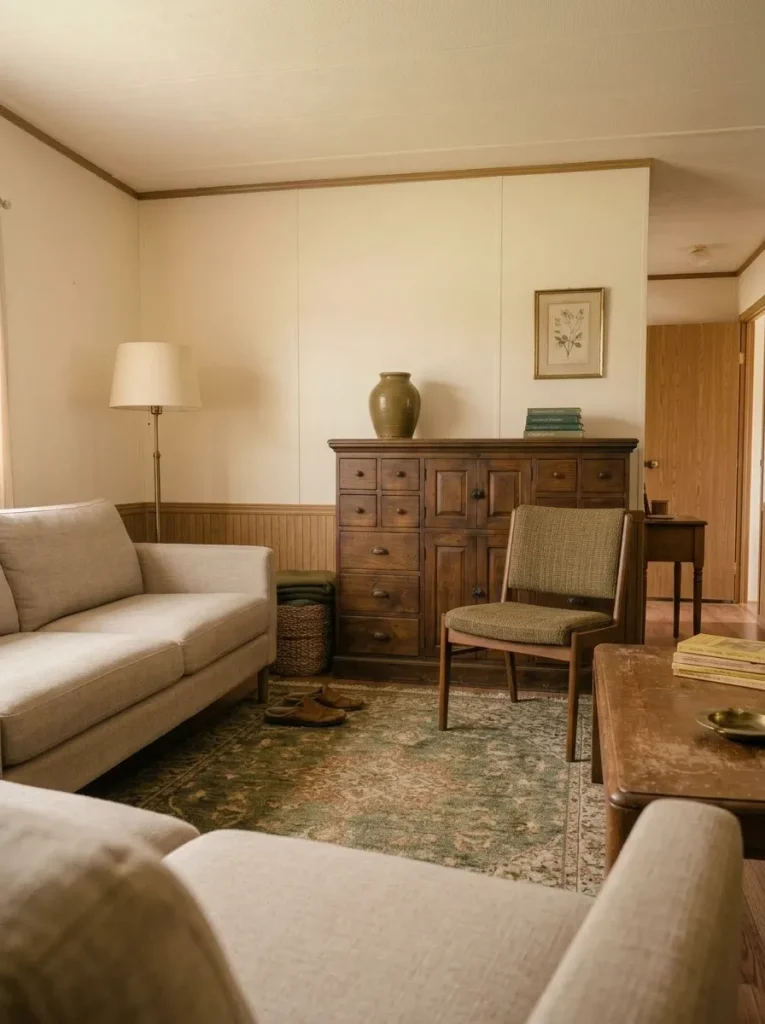
A secondhand chair with open legs, a narrower back, or slimmer arms can sit beside a modern sofa and still feel deliberate because more floor remains visible around it. Likewise, two very different fabrics can coexist when their seat heights and overall visual weights relate well.
From the doorway, compare:
- Seat height — do the pieces feel as though people sit at roughly the same visual level?
- Arm mass — is one piece swallowing the other?
- Visible floor — does the pairing still leave some breathing room underneath and around the furniture?
For the broader relationship between seating, rugs and circulation, continue with the mobile home living room ideas guide.
For this thrift-store decision, ask a narrower question: does the chair belong to the physical scale of the room you already own?
5. Trade Floor Clutter for One Tall Secondhand Storage Piece
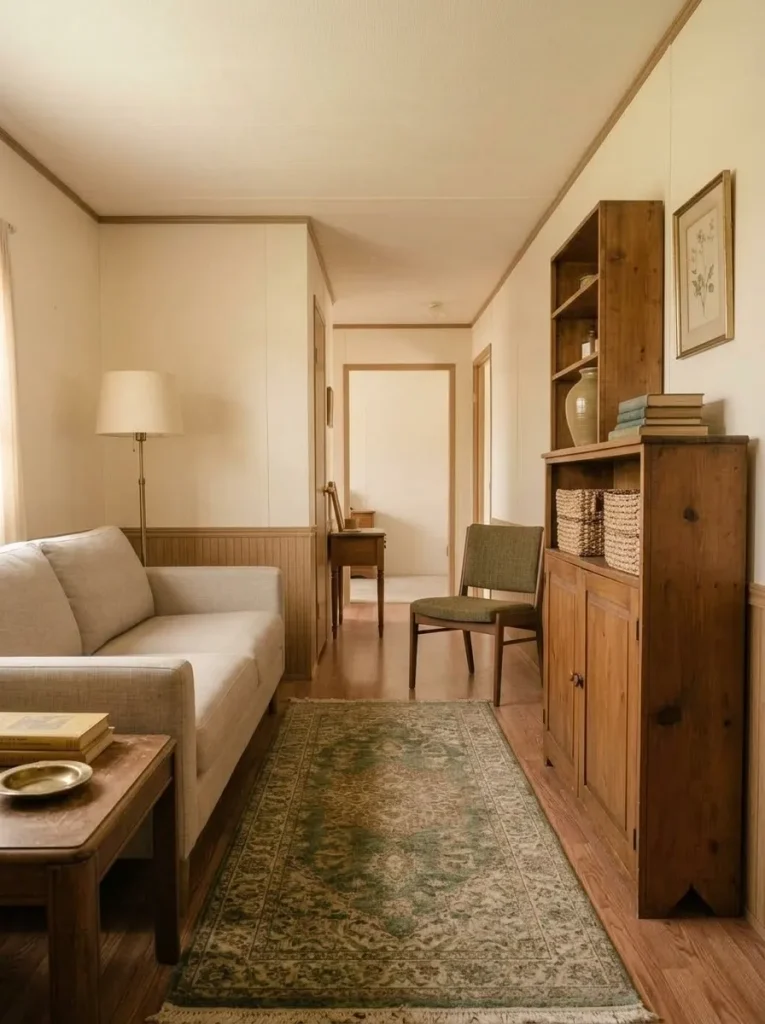
Several small thrifted shelves, baskets, side cabinets and accent tables may technically add storage, yet every extra object also introduces another edge, leg, gap and stopping point along a compact room.
One tall secondhand cabinet or bookcase can consolidate that function while using more of the wall plane.
The best candidate is not automatically the tallest item in the shop. Depth deserves attention first. A relatively shallow cabinet rising upward can feel calmer than a low piece that projects farther into a walkway.
Decide what the tall piece must absorb before buying it: books, linens, serving pieces, games, craft supplies, or loose objects currently spread over several surfaces. Consolidation works only when the new piece actually replaces visual clutter elsewhere.
Vertical Footprint Map
Vertical Footprint Map
Compare storage by floor pressure, not piece count
Both arrangements can hold belongings. The second uses one stronger vertical object and leaves a quieter field around it.
More furniture edges divide the wall and give the eye several small stopping points.
The storage becomes one readable zone while more of the surrounding wall stays visually open.
6. Make Thrifted Baskets Look Intentional by Repeating Shape or Tone
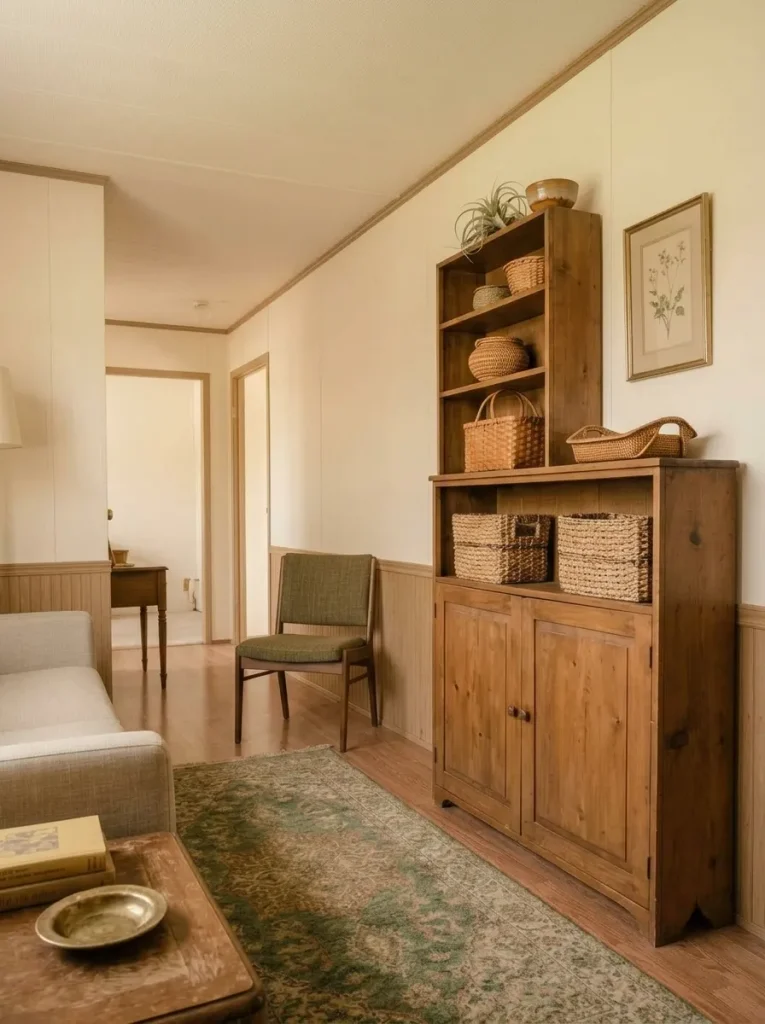
Baskets are forgiving thrift finds because small differences in weave, age and shape can look genuinely collected.
The problem begins when every basket differs in every possible way.
Imagine five baskets together: one pale rectangular seagrass basket, one dark round wicker basket, one orange-toned handled basket, one gray woven bin, and one tiny lidded piece. Individually, each could be attractive. Together, there may be nothing for the eye to connect.
Give the group one shared trait:
- warm honey-colored fiber;
- a rounded silhouette;
- dark handles;
- similar weave density;
- or a repeated natural tone.
Then allow the remaining details to vary.
For open shelving, place visually heavier baskets lower and leave lighter pieces higher. This gives the storage unit an intentional weight distribution without forcing everything into a matching set.
One more filter belongs at the store: handle the basket. Persistent odor, broken structural ribs, or heavily shedding material can turn an inexpensive storage solution into an irritating one. Fading is character. A basket that cannot survive normal use is not.
7. Build a Gallery Wall Around One Strong Vintage Anchor—Then Stop Early
Which picture should determine the gallery wall?
Usually, it is not the first frame you bought or the most expensive one. It is the piece with the strongest visual authority: perhaps the largest landscape, a carved mirror, a botanical print with deeper color, or an unusually substantial frame.
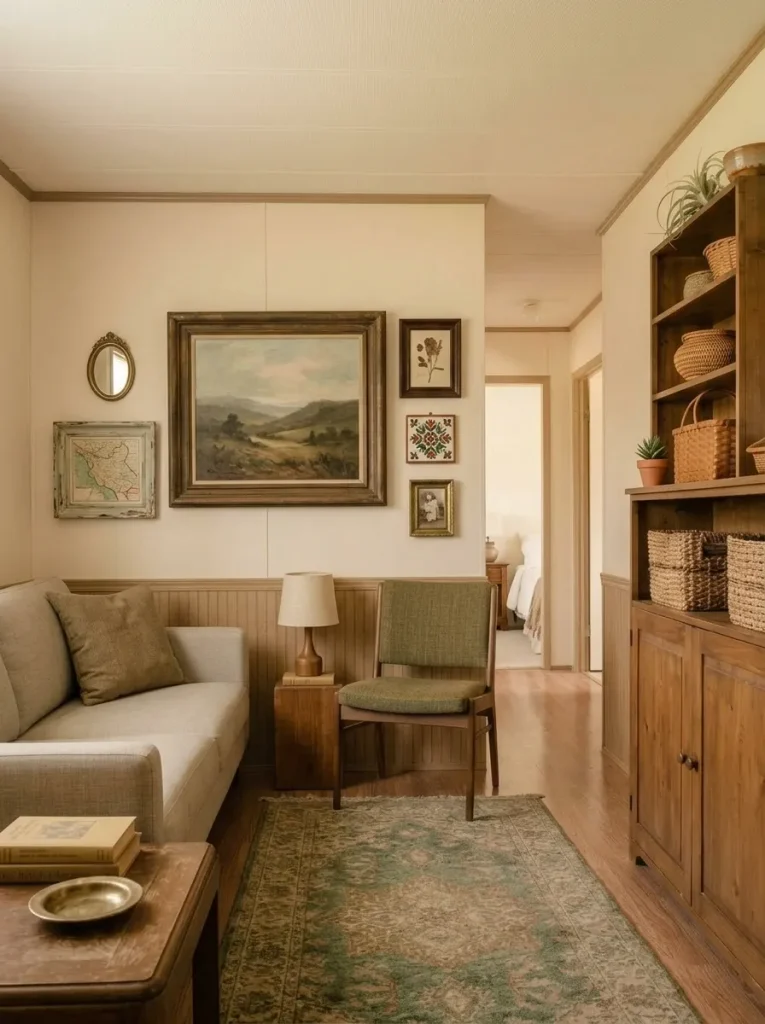
Place that anchor first.
Smaller secondhand art should support its scale and direction. A wall becomes messy when every new thrift find is treated as equally important. This matters even more in a mobile home, where a usable wall may be interrupted by a doorway, window, thermostat, return vent, cabinet edge, or the back of a sofa.
Those interruptions are not blank spaces waiting to be defeated. They are useful boundaries.
For a seasonal version of secondhand sourcing, the thrifted fall mobile home decor guide explores autumn-specific pieces and styling. For a year-round gallery, choose the wall condition below and let its proportions set the stopping point.
Vintage Wall Anchor Studio
Vintage Wall Anchor Studio
Let the architecture decide how many thrifted frames the wall can hold
Select the wall condition closest to your room. The recommendation changes because a narrow wall, sofa wall and interrupted wall need different compositions.
Narrow wall: build vertically
Use one portrait-oriented anchor or a compact vertical grouping. Wide horizontal sprawl makes the wall feel more cramped because the composition pushes toward both edges.
Sofa wall: let the furniture establish the field
The sofa already creates a broad horizontal base. Center the strongest piece first, then add smaller work only where it strengthens that central relationship.
Between openings: treat the boundaries as part of the design
A doorway or window already frames the usable wall. Keep the thrifted art inside that architectural zone instead of trying to bridge across the interruption.
8. Hang a Thrifted Mirror Only Where Its Reflection Improves the Room
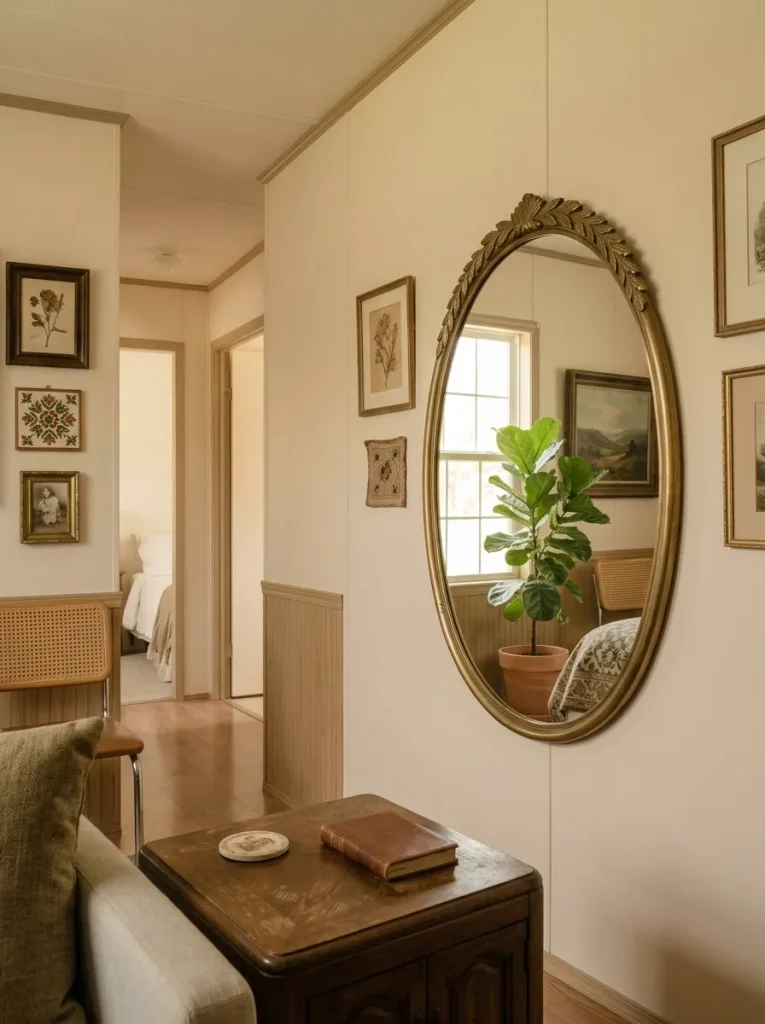
A mirror can be beautiful on its own and still be wrong for the wall.
Stand where you normally enter or sit and look at what the mirror would actually reflect. A vintage brass or carved-wood mirror that doubles a bright window, greenery, artwork, or an uncluttered part of the room can make a compact interior feel more layered. The same mirror reflecting a television, laundry pile, crowded countertop, or dark hallway simply repeats the least attractive view.
That distinction becomes especially noticeable in mobile homes because several zones are often visible along one long sightline.
Before mounting a thrifted mirror, temporarily prop it against the intended wall and check it from at least two normal viewing positions. Move it until the reflection contributes something worth seeing.
Keep it when: the reflected scene adds light, depth, greenery, or another intentional focal point.
Relocate it when: its strongest contribution is merely filling empty wall space.
A mirror is most valuable when both the object and the view inside it earn their place.
9. Choose Secondhand Lamps by Shade Scale and Evening Glow
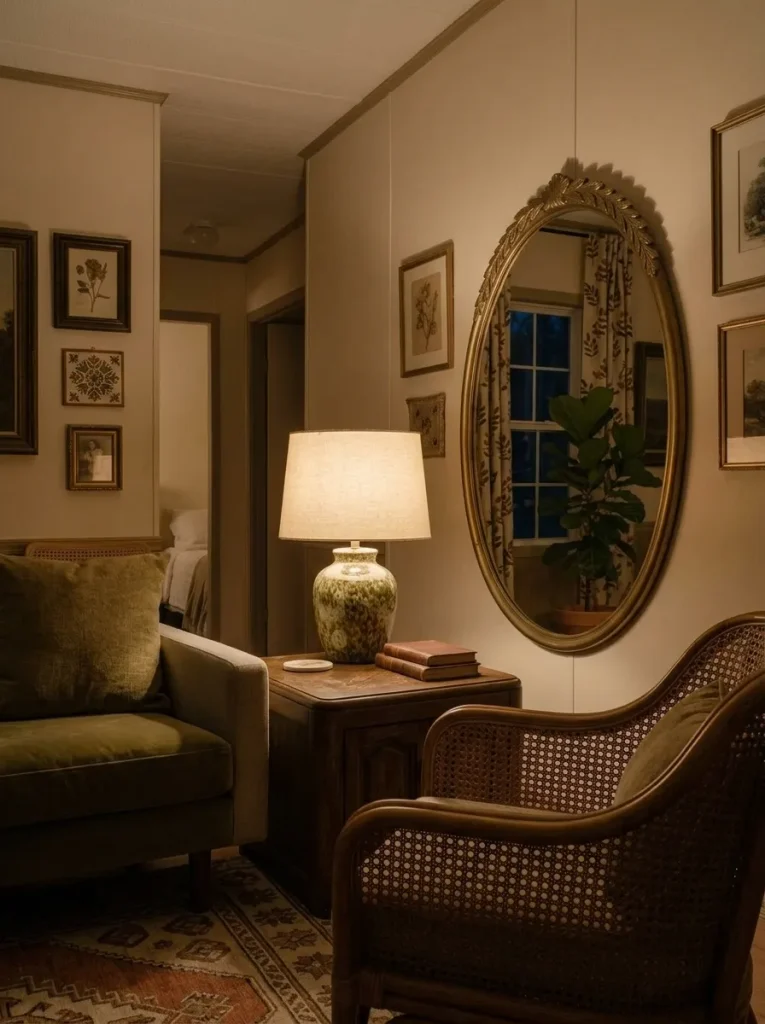
A handsome ceramic or brass lamp may look perfect under fluorescent thrift-store lighting and completely different once it reaches your living room.
The base is only half the composition.
An undersized shade can make a substantial vintage base look top-heavy, while an oversized shade may crowd a narrow side table or overlap visually with nearby wall decor. Before buying, look at the lamp as a complete silhouette: base, shade, table, nearby seating, and the height at which the light will appear when you are sitting down.
Then think about evening use.
A secondhand lamp earns more value in a small mobile home when it creates a soft pool of light where overhead lighting feels harsh—next to the sofa, beside a reading chair, on a bedroom dresser, or at the end of a dining cabinet.
If a thrifted base is excellent but the shade is wrong, treat the shade as replaceable. If the proportions of the base itself are awkward for every surface you own, the low price is less useful.
For older electrical pieces with damaged cords, loose sockets, or uncertain wiring, have the condition assessed appropriately before use.
10. Let One Vintage Rug Do the Pattern Work for the Living Room
A vintage-style rug can accomplish several jobs at once: introduce color, connect furniture from different eras, soften a long room, and establish the largest pattern in the space.
That last role is the important one.
When a rug already contains rust, olive, faded blue, cream, and brown, the room does not need every pillow, curtain, chair and throw to carry another complicated print. Pull one or two quieter tones from the rug and let surrounding textiles settle down.
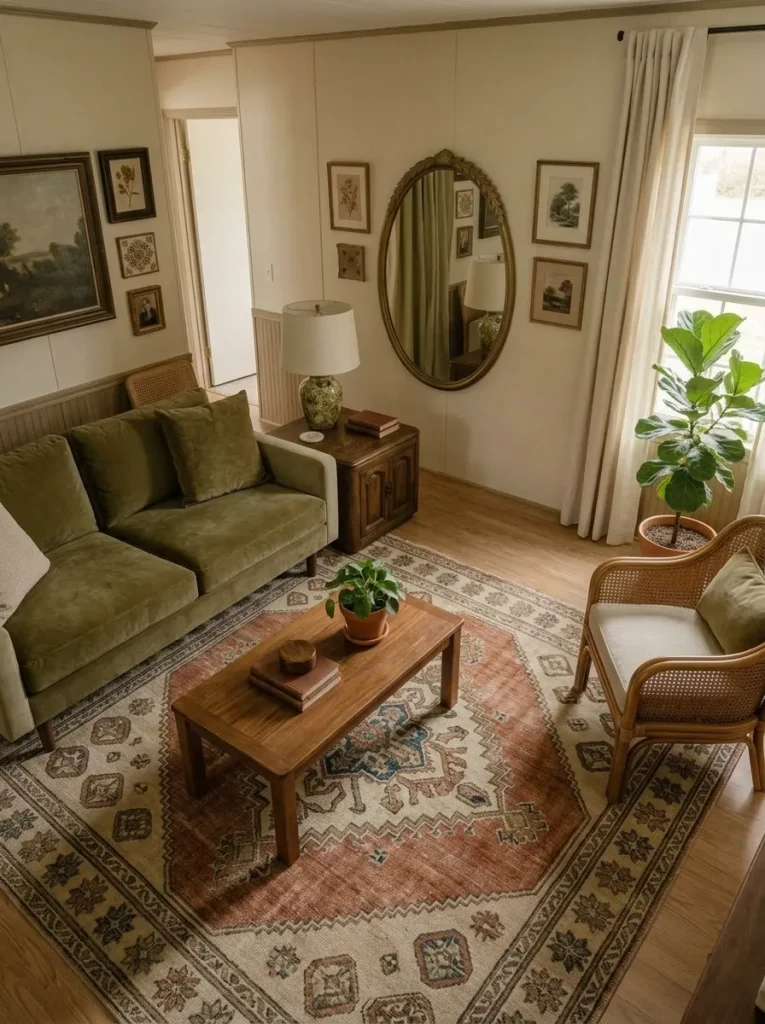
If the rug is visually complex: keep large upholstery and curtains calmer.
If the rug is faded and quiet: you have more room for patterned cushions or art.
If the rug is very small: do not rely on pattern to compensate for weak scale. A tiny decorative rug floating between large furniture pieces often fragments the floor.
In a mobile-home living room, the floor plane is frequently visible across much of the room at once. A well-proportioned rug can therefore unify several unrelated secondhand pieces more effectively than another collection of accessories.
11. Give Old Textiles One Job at a Time: Throw, Pillow or Curtain
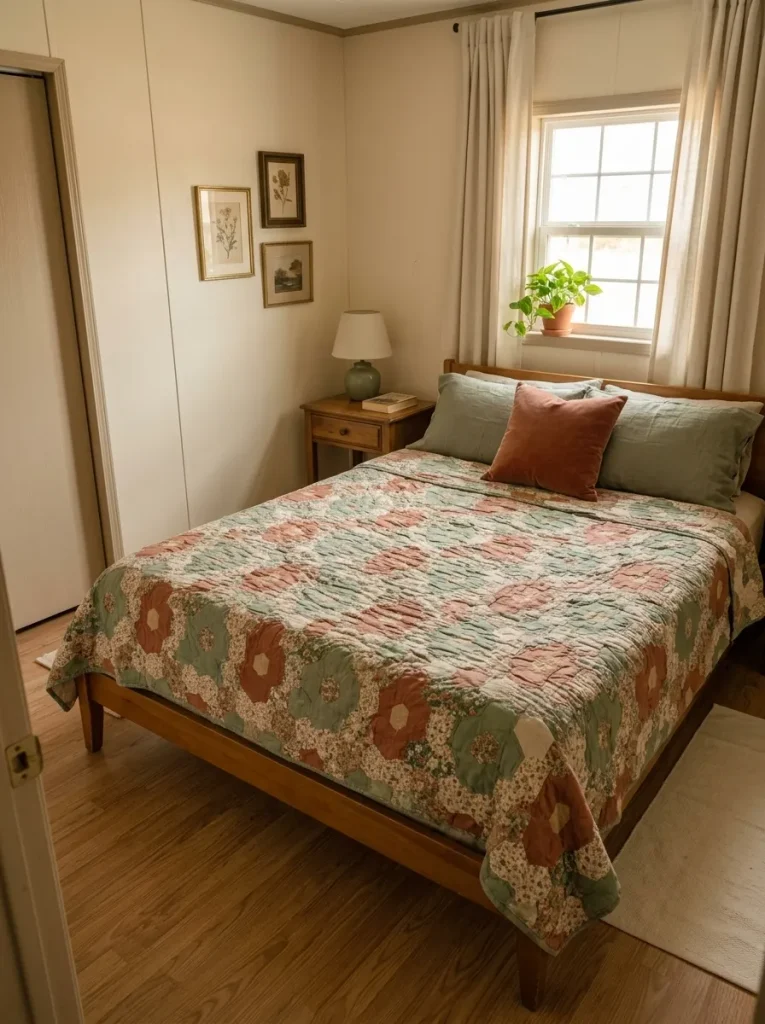
A floral quilt found for $8, striped pillowcases for $2, embroidered fabric from another stall, and vintage curtains for $10 can all feel like irresistible bargains.
Placed together, they may compete for the same visual role.
Treat each patterned textile as a voice. In a compact room, one voice should usually lead.
For example, if a thrifted floral quilt becomes the main pattern on the bed, allow nearby pillows to repeat one or two of its colors without adding another equally strong print. If patterned curtains already frame the entire window wall, a quieter sofa throw gives the eye somewhere to rest.
A useful editing question is:
Which textile should someone notice first from the doorway?
Keep that one expressive. Simplify the pieces around it.
Also inspect secondhand fabric with use in mind. Look for stains, worn seams, persistent odors, thinning areas, and whether the fabric can realistically be cleaned according to its construction. Decorative age is very different from material that will fail quickly.
The bargain is strongest when the textile has one clear job and enough condition left to perform it.
12. Use a Small Thrifted Table as a Dining Anchor, Not a Furniture Obstacle
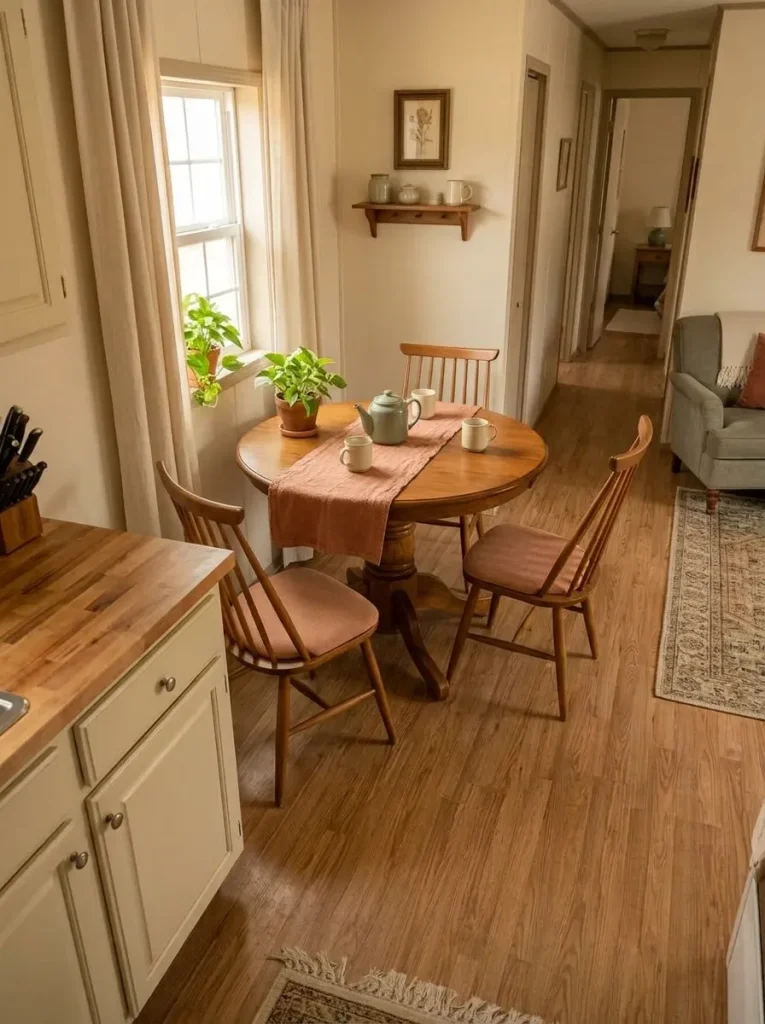
A compact vintage dining table can be one of the most rewarding thrift finds for a mobile home because older tables often bring real wood, distinctive legs, and character for far less than a comparable new piece.
But charm does not override circulation.
Imagine the table with the chairs pulled out, not neatly tucked underneath as they are in the shop. Then consider the busiest route past it. If someone using a chair effectively closes the path to the kitchen, back door, hallway, or living room, the table is too demanding for that location.
Round and pedestal tables can work well in some compact dining areas because they reduce hard corner conflicts and may offer more flexible chair placement. Rectangular tables can be excellent where the room itself is long and narrow.
The decision depends on the route around the table—not on a universal “best” shape.
Dining Nook Fit Route
Dining Nook Fit Route
Start with the route people use, then choose the thrifted table
Select the condition closest to your dining area. The best table shape changes with the room and how people move through it.
Favor softer edges
A small round or pedestal-style thrifted table may reduce corner conflicts when circulation passes close to the dining zone.
Follow the room’s long axis
A narrow rectangular table can use an elongated zone efficiently when it runs with the architecture instead of cutting across it.
Reduce the table before sacrificing the route
A beautiful thrift find is not a bargain when chairs repeatedly collide with the main path through the home.
13. Make Mismatched Dining Chairs Agree on One Repeated Detail
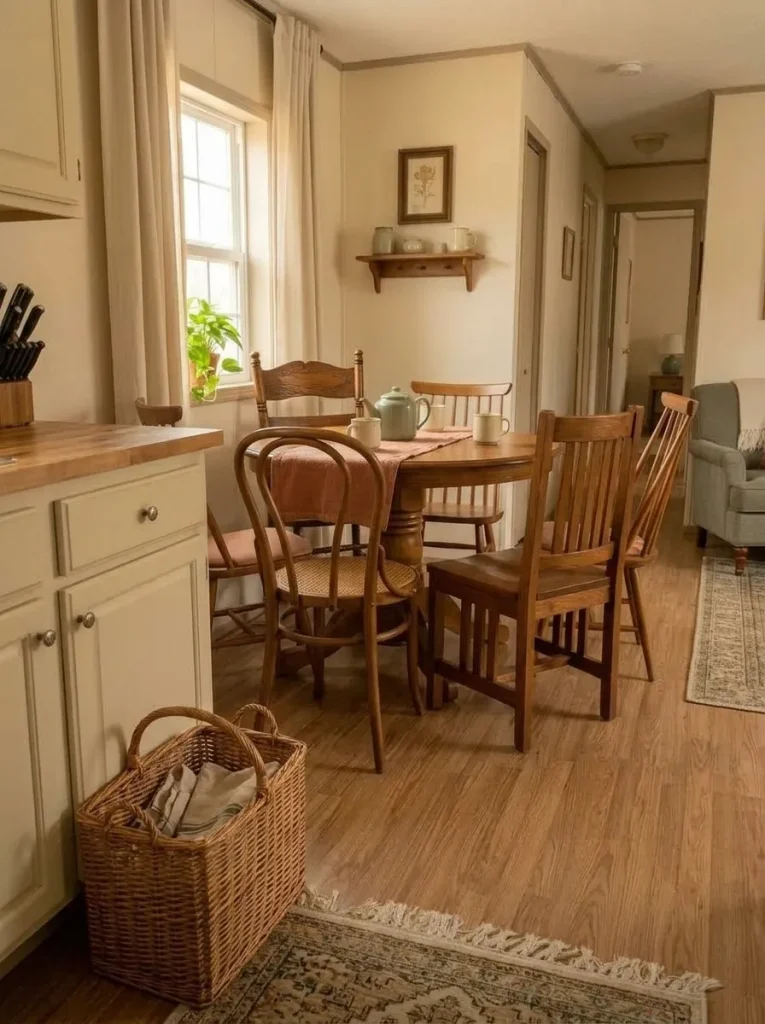
Four identical thrifted dining chairs can take months to find.
Fortunately, they do not need to be identical.
Start by identifying one trait that can repeat across the group:
- similar warm wood tone;
- matching seat height;
- spindle backs;
- woven seats;
- black-painted frames;
- or one repeated upholstery fabric.
Everything else can vary more freely.
For example, two spindle-back chairs and two simpler slat-back chairs can feel connected when the wood tone and seat level are similar. A collection of four totally different chairs becomes harder to read when color, material, back height, leg style and upholstery all change simultaneously.
One repeated detail gives the eye a reason to understand the group as intentional.
Do not force unity by painting attractive wood automatically. First see whether cleaning, moving the chairs together, or repeating one seat cushion is enough.
A collected room gains personality from variation. The trick is giving that variation a visible relationship.
14. Put Useful Vintage Pieces on Kitchen Shelves Before Decorative Filler
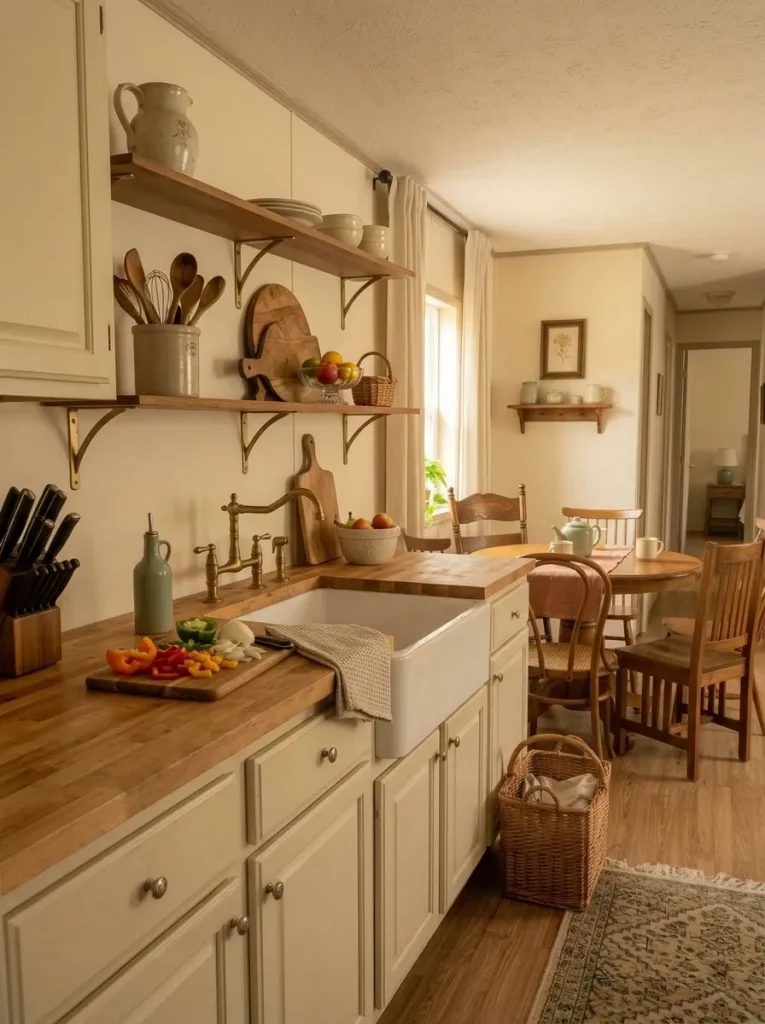
Open kitchen storage fills quickly, so thrifted pieces should earn display space twice: once visually and once practically.
An old stoneware crock can hold utensils. A wooden cutting board can lean behind everyday preparation space. A ceramic pitcher can serve water or hold flowers. A vintage bowl can collect fruit. Small baskets can corral packets, cloths, or frequently used pantry items.
These pieces bring character without requiring a second layer of purely decorative objects.
Try a simple shelf test:
Use weekly? Keep it within comfortable reach.
Use occasionally but love seeing it? Move it higher.
Never use it and it adds little compositionally? The shelf may be stronger without it.
This matters on compact kitchen walls because every open shelf already contributes visual information. Filling the last few inches simply because they are available can make practical storage look like a display case.
Choose secondhand pieces with enough empty space around them for their shape and material to register.
15. Use High Wall Space When the Floor Is Already Doing Enough
Look across the room at standing eye level.
If cabinets, seating, tables, baskets and storage pieces already occupy most of the lower half of your view, the next thrift find probably should not become another floor object.
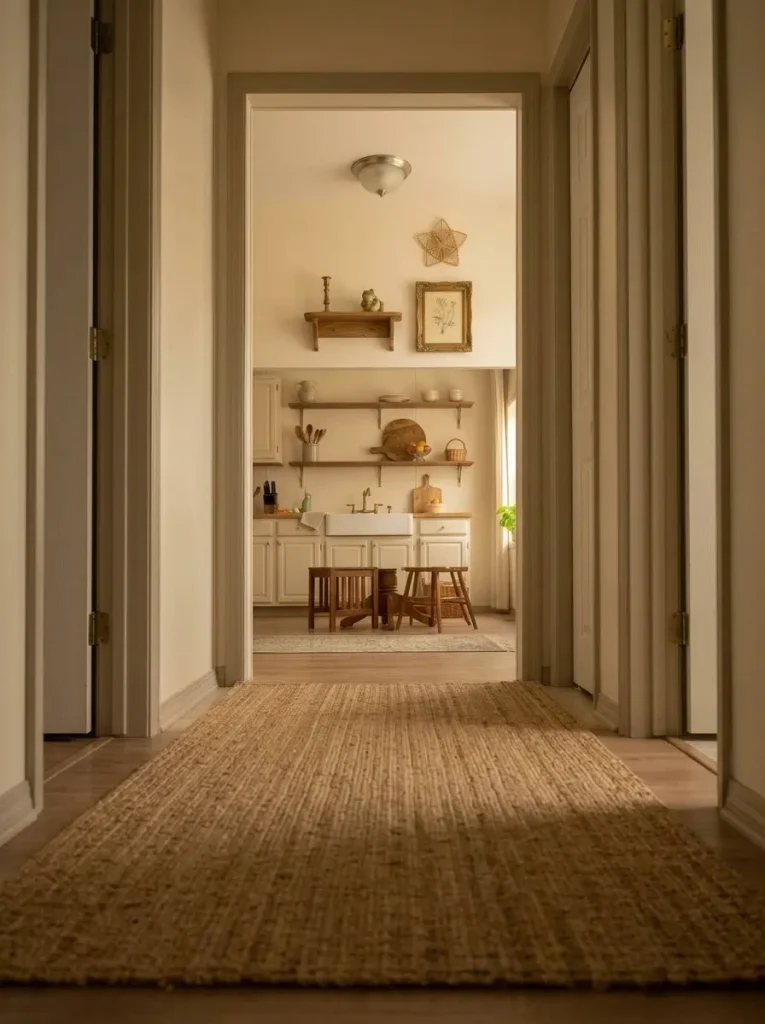
Think upward.
A vintage framed print, shallow shelf, wall basket, plate grouping, lightweight decorative object, or architectural-looking bracket can introduce character higher on the wall while preserving the route below.
This is particularly useful in a single-wide interior, where furniture is often arranged along a long wall and another projecting cabinet can quickly make the passage feel tighter.
The single wide mobile home decorating ideas guide explores that broader narrow-home problem. For thrifted decor, the sourcing rule is simpler:
When the lower visual field is full, shop for the wall—not another footprint.
Be selective with high display zones too. One deliberate shelf or wall composition usually looks more architectural than several unrelated objects scattered near the ceiling.
For heavy or load-bearing pieces, use mounting appropriate to the actual wall construction and item.
16. Give an Old Dresser a Second Life as a Sideboard, Entry Console or Storage Wall
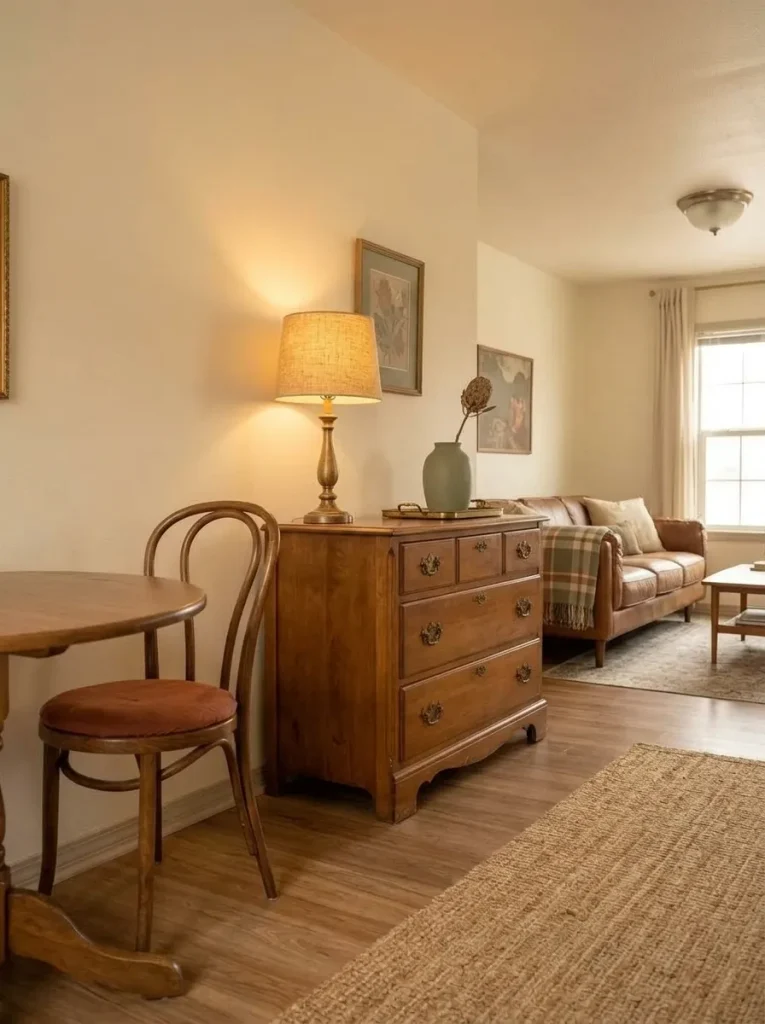
The label attached to secondhand furniture is often less useful than its dimensions.
A dresser does not have to return to a bedroom.
A lower vintage dresser might become a dining-room sideboard for linens and serving pieces. A narrow version may organize an entry. A long piece can replace several scattered living-room storage units. A small chest might even work as substantial bedside storage if the proportions suit the bed.
Repurposing works best when the new job solves a real household problem.
Do not choose a piece merely because its alternative use sounds clever. A dresser used as an entry console still needs suitable depth for the walkway. A dining sideboard should place frequently used drawers at a practical height. A living-room storage piece should absorb enough belongings to justify its visual mass.
Secondhand Furniture Role Mapper
Secondhand Furniture Role Mapper
Start with the problem your home has—not the label the furniture came with
Select the household need. The same old dresser can be evaluated differently depending on where it must work.
Turn it into a compact sideboard
Prioritize drawers that can hold linens, tableware or serving pieces and a top surface that can support a lamp or occasional serving setup.
Create a landing zone with hidden capacity
A narrow dresser can outperform a shallow decorative console when keys, bags, pet items, shoes or household paperwork need somewhere to disappear.
Use one long piece to consolidate the room
The strongest conversion replaces scattered bins, side cabinets or small shelves with one continuous storage anchor.
Convert a small chest into serious bedside storage
A compact chest can provide more useful closed storage than a tiny nightstand while giving a lamp, book and essentials enough surface area.
17. Use a Trunk or Bench Only When It Solves Two Jobs Without Blocking the Route
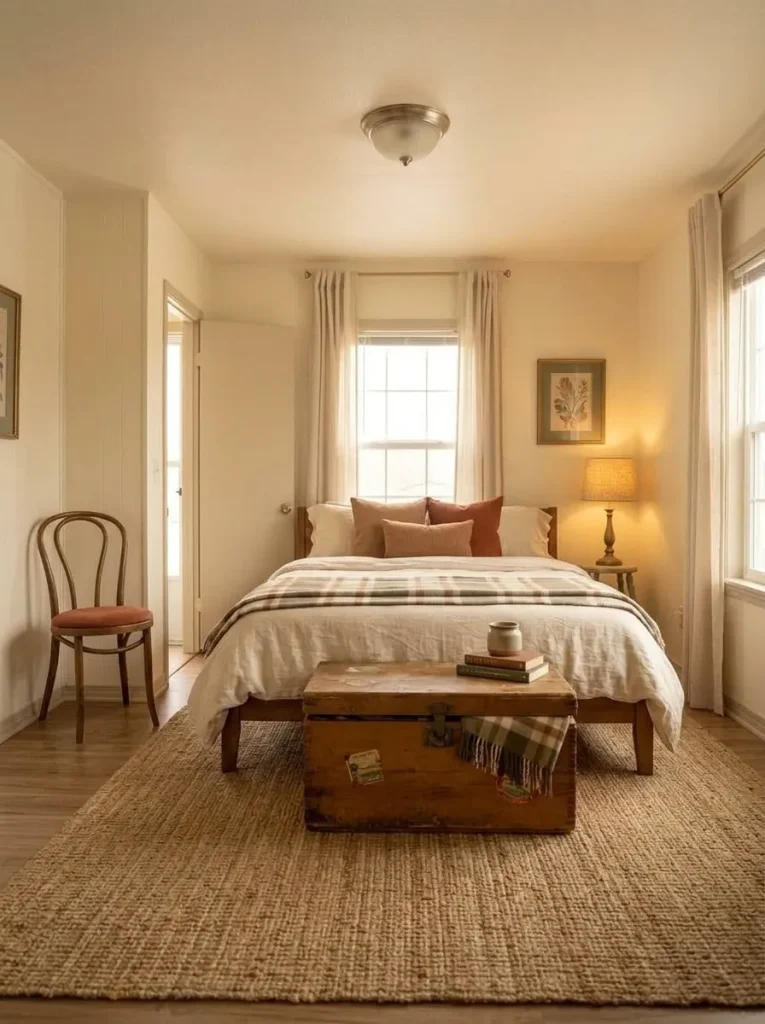
A vintage trunk feels like the ideal thrifty purchase because it promises storage, character, and perhaps even a usable surface.
That does not automatically make it efficient.
A heavy trunk placed at the end of a bed may hold blankets beautifully but still become irritating if it reduces the passage around the mattress. A hallway bench can provide shoes and seating yet fail if people have to turn sideways to pass it.
Give dual-purpose pieces a stricter standard than decorative ones.
A floor-consuming piece should ideally perform two useful jobs at the same time: storage + seating, storage + coffee table, storage + bedside surface, or storage + entry landing zone.
Then test whether those functions interfere with each other. A trunk used as a coffee table is less convenient for daily storage if everything on top must be moved each time it opens.
Sometimes the better secondhand find solves one job extremely well and occupies less space.
18. Make Unequal Nightstands Feel Related Through Height, Lamps and Finish
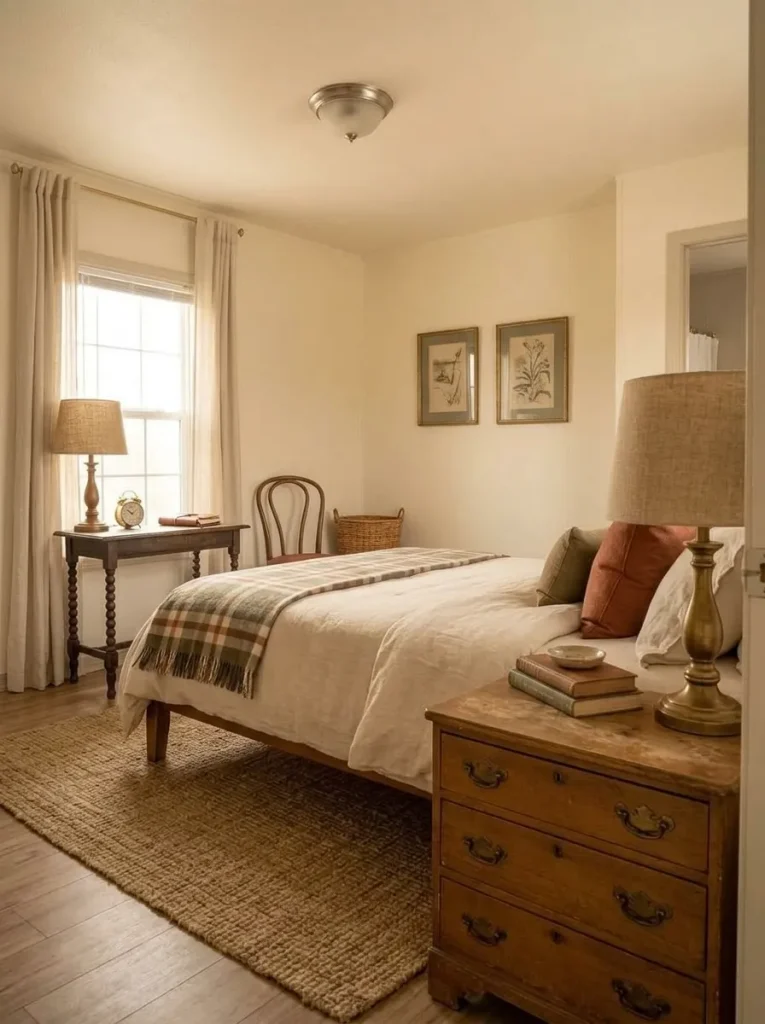
Matching nightstands are convenient, but a small bedroom does not always have equal space on both sides of the bed.
That makes secondhand furniture unusually useful.
One side might accommodate a small three-drawer chest while the other has room only for a narrow table. The pair can still feel balanced when the top surfaces relate to the bed and the styling creates a visible connection.
Check three things:
Height: lamps and bedside essentials should sit at usable levels.
Visual mass: a heavy chest on one side may need a slightly more substantial lamp or wall element on the lighter side.
Material relationship: both pieces might share warm wood, dark hardware, cream paint, or another repeated finish without becoming identical.
Avoid buying two bulky pieces simply to manufacture symmetry. Function should determine how much furniture each side needs.
For deeper bedroom decisions involving proportions, storage and furniture relationships, see the mobile home primary bedroom ideas guide.
The thrifted approach works best when asymmetry feels balanced, not disguised.
19. Use Plants and Simple Ceramics to Bridge Pieces From Different Eras
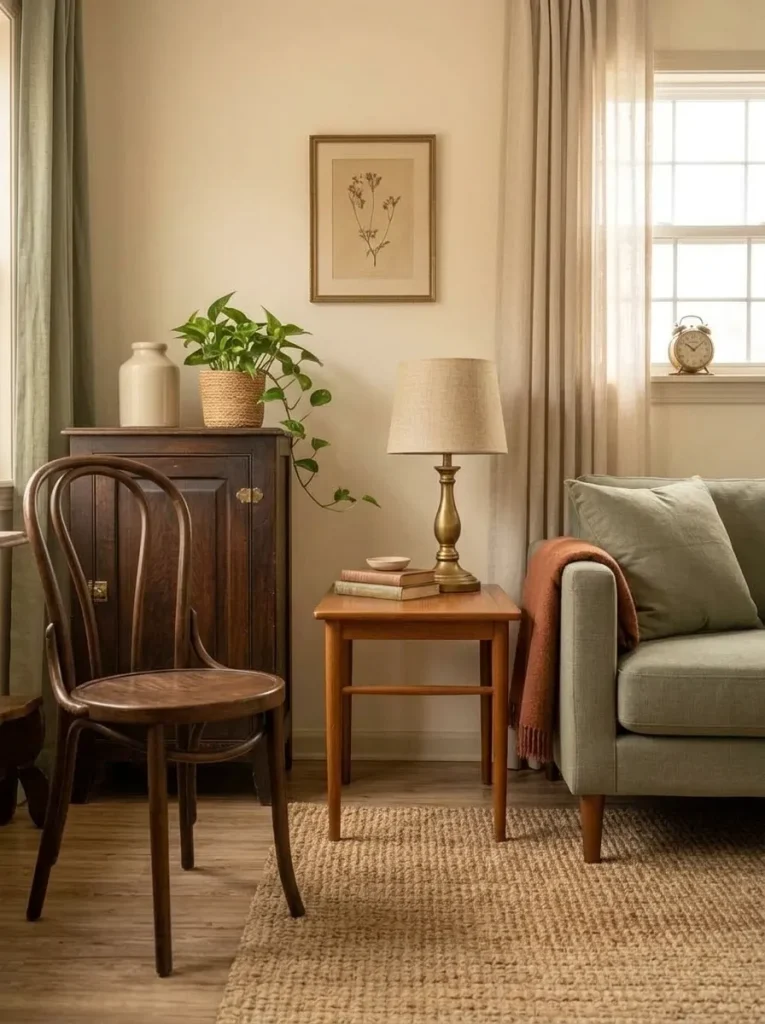
Some thrift combinations feel awkward because the gap between them is too abrupt.
A dark 1970s cabinet, a newer sofa, an antique-style brass lamp and a mid-century table may all be individually appealing, yet their eras can feel disconnected when every object sits in isolation.
Plants, simple ceramics, woven baskets and other quieter organic materials can act as visual bridges.
A trailing plant softens the hard edge of an old cabinet. A simple cream vase can sit comfortably beside ornate framed art without competing with it. A woven planter introduces texture shared by both older wood furniture and more casual contemporary upholstery.
The bridging object should usually be simpler than the pieces it connects.
If the cabinet is carved, the lamp is decorative and the rug is patterned, adding another highly detailed accessory increases the number of competing visual languages. A plain ceramic pot or leafy plant gives the eye a calmer transition.
This is one reason restrained greenery works well in collected interiors: it can connect materials and eras without demanding focal-point status.
20. Repeat One Material Across the Long Sightline to Connect Separate Rooms
Stand at one end of your mobile home and look through the longest visible route.
Perhaps you can see part of the living room, dining area and kitchen simultaneously. That long sightline changes the way thrifted decorating should be edited.
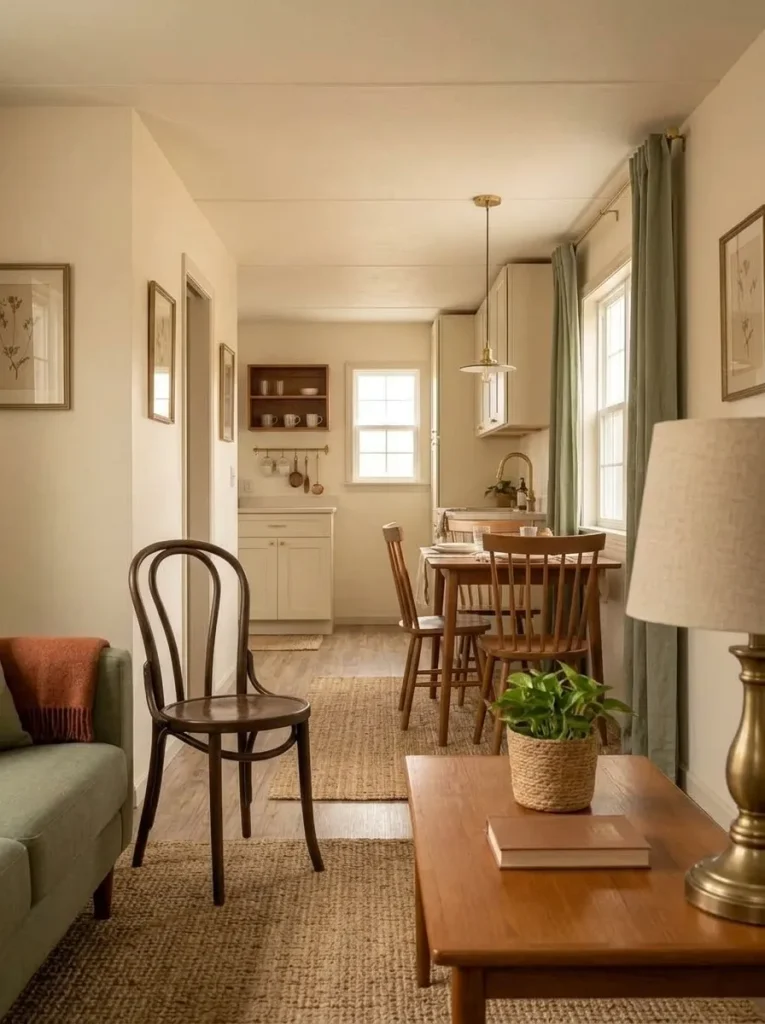
Each room does not need the same furniture or style. It benefits from one recurring material clue.
Warm medium-toned wood might appear in the coffee table, dining chairs and a kitchen shelf. Aged brass could recur in a lamp, mirror and small kitchen object. Woven fiber might connect a living-room basket, dining pendant and planter. Muted olive could move between upholstery, pottery and artwork.
The repetition should be visible without becoming formulaic.
Cover one zone with your hand and look at the others. Do they still seem to belong to the same home?
Pieces bought years apart begin to relate through material continuity even when their shapes and origins remain different.
If the living room is the main visual anchor and you want to polish that end of the sightline further, continue with the broader mobile home living room ideas that look more expensive guide.
21. Do the Doorway Photo Edit: Remove the First Piece That Reads Like a Random Bargain
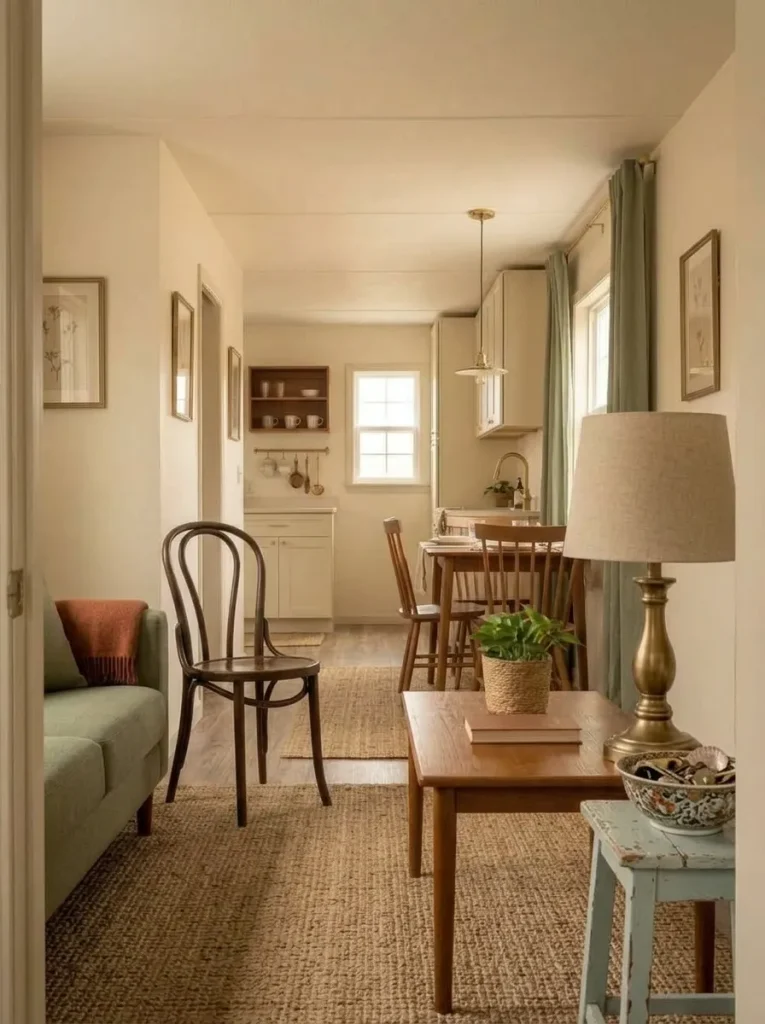
After the room feels finished, photograph it from the doorway.
A photograph compresses the space into one frame, which makes visual competition easier to notice. You may suddenly see that three small baskets are performing the same decorative job, one sign is pulling attention away from better artwork, or an inexpensive accent table is only present because you once found it for a good price.
Do not start by asking which object is cheapest.
Ask:
Which piece looks least connected to the room around it?
That might be a new item. It might be an expensive item. It may also be a thrift find you genuinely like but have never found the right location for.
Remove one candidate temporarily and photograph the room again.
If the room becomes easier to read, the object was costing more visually than its price suggested.
Collected-or-Random Final View
Doorway Photo Edit
Run the room through four removal tests
Check each question after looking at a doorway photo. Each selection reveals the next editing move.
Conclusion: Thrift for the Room You Have, Not the Bargain You Found
The strongest thrifted mobile home decor does not come from collecting the largest number of inexpensive objects. It comes from choosing pieces with good material, believable condition, useful scale, and a clear destination—then giving each one enough visual room to matter.
Start with one problem your home actually has: closed storage, better lighting, a dining table, artwork, or one substantial wood piece. Shop for that role first.
Then imagine every price tag has disappeared. If the room still feels collected, useful, and intentional, the thrift strategy worked. If an object only feels successful because it was cheap, keep looking.
Save this guide to Pinterest so your best thrift-store finds have a plan before they come home.