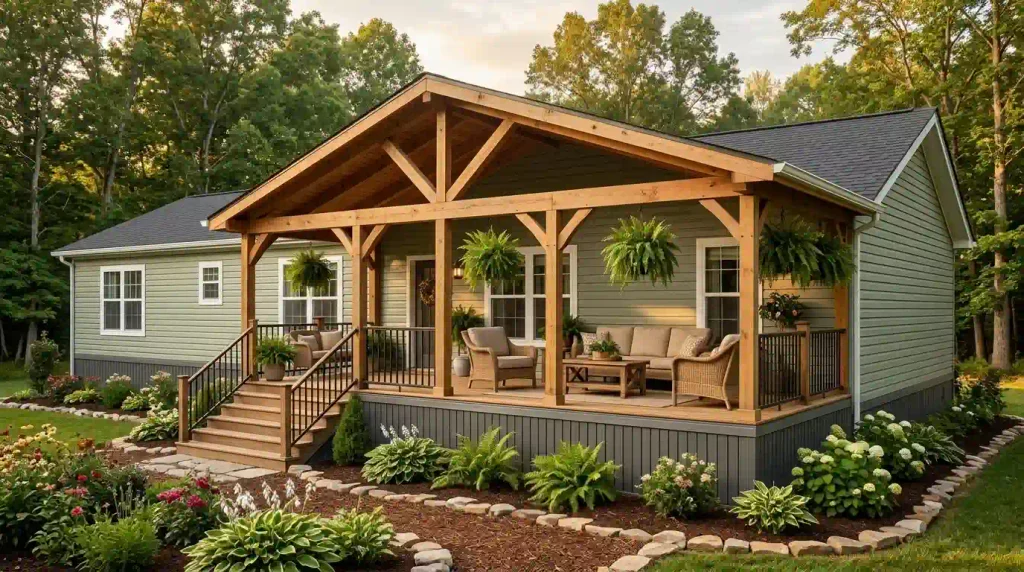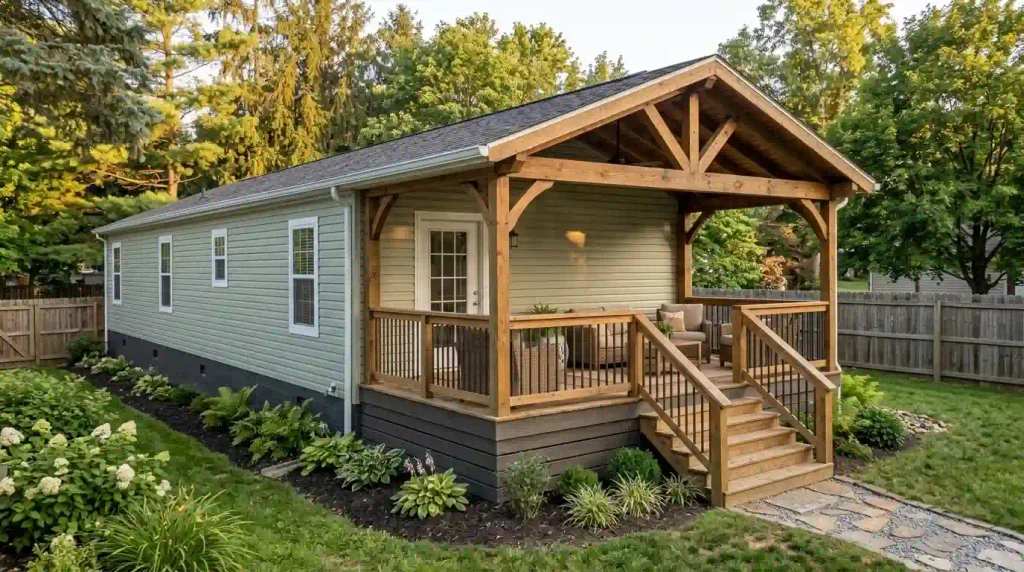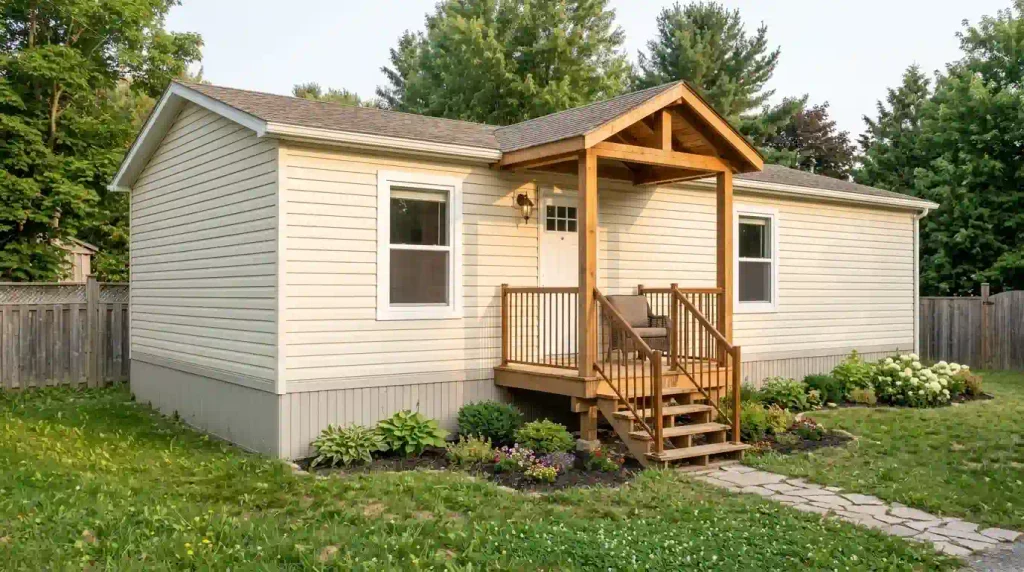
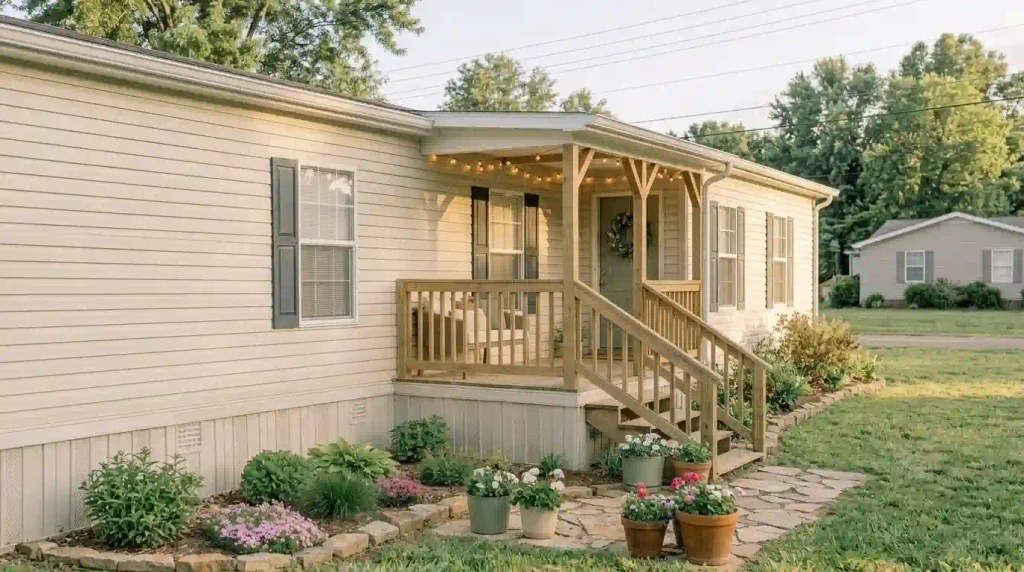
A small mobile home porch can be one of the most charming parts of your home. It might become your favorite place for morning coffee, a quiet evening retreat, or simply a welcoming entrance filled with flowers and warm lighting.
The challenge is making everything work within a limited footprint. A beautiful chair can become an obstacle when the front door opens, oversized planters can crowd the stairs, and too many accessories can make a charming porch feel surprisingly cramped.
The best small mobile home porch ideas balance personality with everyday practicality. Whether you have a narrow single-wide entrance, a compact covered porch, or a modest landing outside a double-wide manufactured home, thoughtful furniture choices and coordinated finishes can make the space feel more inviting.
These 17 ideas explore realistic layouts, affordable decorating improvements, compact seating, greenery, privacy, and lighting, with practical planning tools to help you choose what genuinely fits.
Before undertaking structural additions or major alterations, consult local authorities and the applicable manufactured-home installation guidance.
1. Choose a Small Porch Layout That Fits Your Everyday Routine
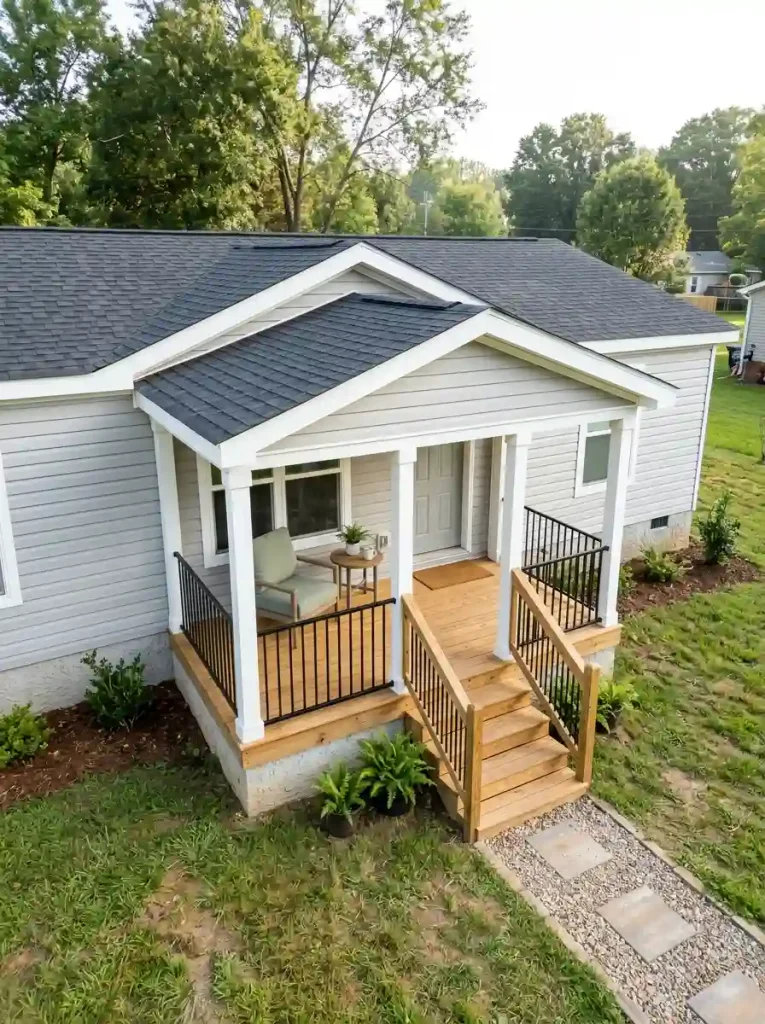
Imagine arriving home with two bags of groceries while a porch chair, flowerpot, and side table compete for the same narrow landing. Everything looks lovely from the yard, but using the entrance becomes unnecessarily difficult.
Begin with the activity your porch needs to support most often.
Find Your Porch Configuration
Choose the activity your porch needs to support most often.
A Welcoming Landing
Position one or two stable planters at the outer edges.
Best for: Shallow entrance landings.
Check: Skip seating if it interrupts access.
A Single-Seat Retreat
Position a compact chair at one end, facing the garden.
Best for: Porches with usable space beside the entrance.
Check: Measure furniture width and depth before buying.
A Small Morning Station
Combine a shallow serving surface with compact seating.
Best for: Porches where both items fit outside the access route.
Check: Consider a folding table when space is limited.
Conceptual plans only; not to scale. Actual door swing, stairs, handrails and applicable access requirements take priority.
Consider three configurations:
- Entrance-first porch: An open landing with attractive doorway styling and greenery around the perimeter.
- Relaxation porch: One comfortable seat positioned at the quieter end of the platform.
- Morning coffee porch: Compact seating paired with a small surface for drinks and everyday essentials.
A shallow single-wide entrance may work beautifully as a decorated landing, while a slightly deeper double-wide porch could accommodate a dedicated sitting corner.
Explore these mobile home porch ideas for additional inspiration across different porch sizes and configurations.
Choose the arrangement that supports your routine without compromising access to the house.
2. Frame the Front Door With One Beautiful Focal Point
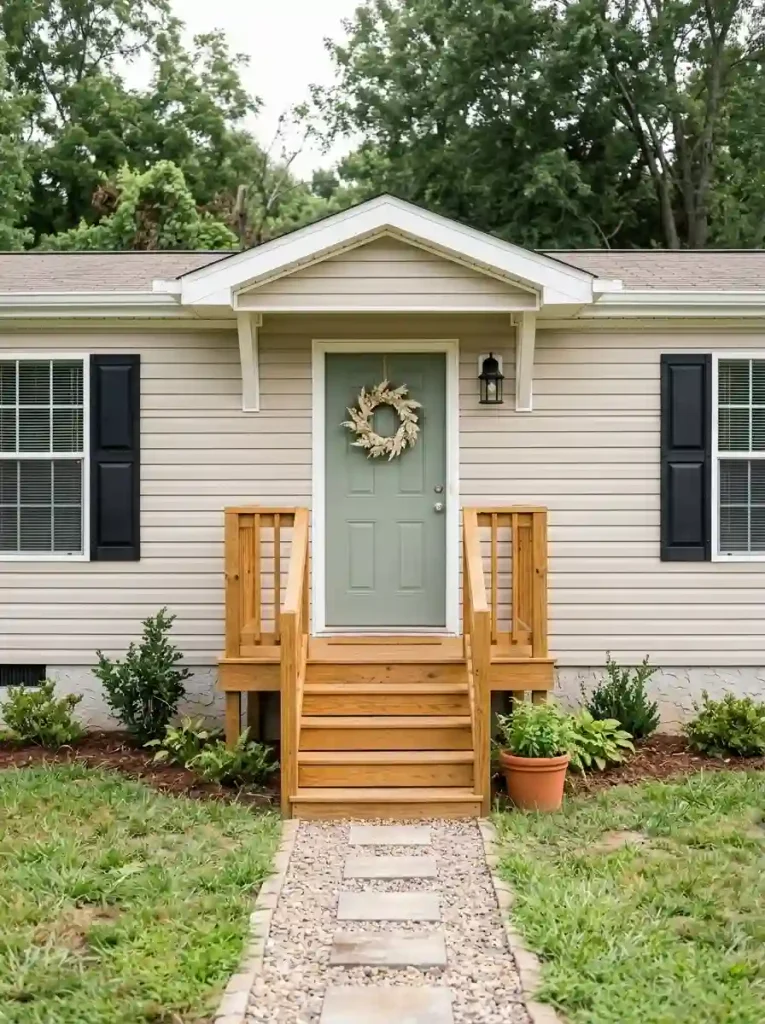
A long manufactured-home exterior often features repeating windows, horizontal siding, and relatively little architectural variation. The front door offers a natural opportunity to introduce character.
Give the entrance one distinctive feature that immediately attracts attention. A soft floral wreath, a beautifully colored door, or a statement exterior lantern can establish that focal point without requiring additional floor space.
Picture a beige single-wide with black shutters, a muted sage-green door, and one terracotta planter filled with seasonal flowers. The combination feels welcoming without overwhelming the small landing.
Styling secret: Allow some undecorated space around your chosen feature. When every surface carries an accessory, the entrance loses its visual hierarchy.
A thoughtfully styled doorway can make even the smallest mobile home porch feel like a deliberate architectural feature.
3. Give a Tiny Covered Porch an Open, Airy Look
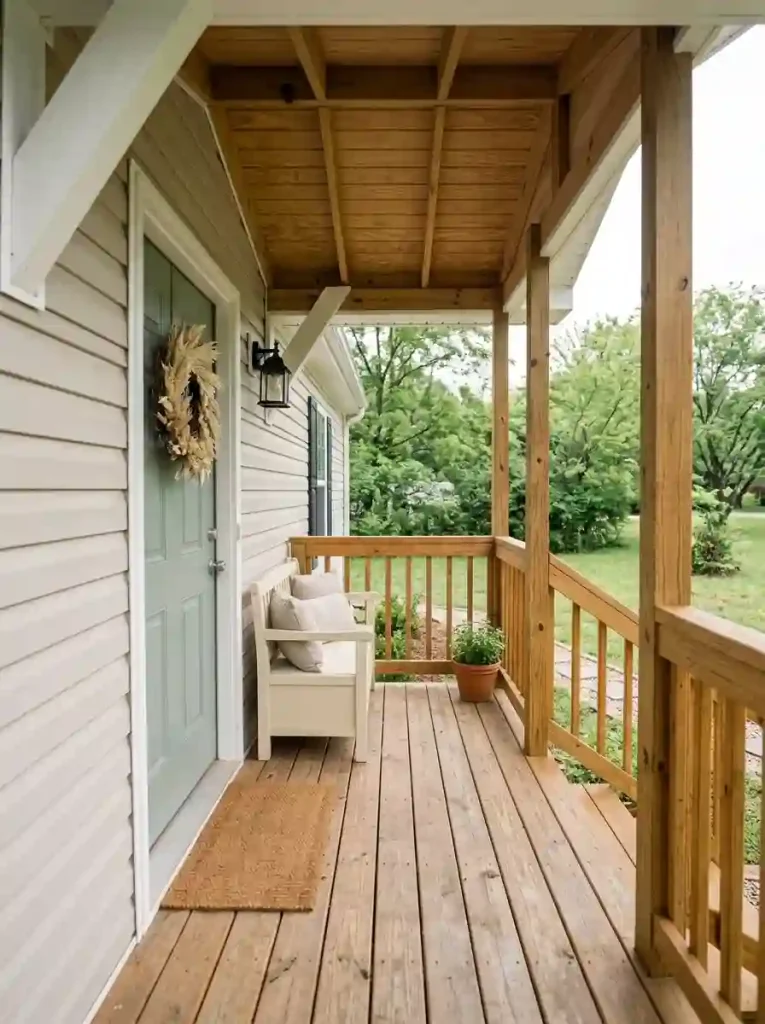
A covered porch provides welcome shelter, but a compact roofed entrance can quickly feel enclosed when its sides are filled with furniture, decorations, and privacy panels.
Two attractive design directions work particularly well:
Open cottage style: Natural timber posts, pale outdoor cushions, delicate greenery, and a clear view toward the garden.
Modern sheltered style: Charcoal accents, streamlined furniture, coordinated existing railings, and carefully selected accessories.
Both approaches allow the porch’s architecture to remain visible.
On a single-wide manufactured home, also consider the relationship between the porch roof and nearby windows. Avoid unnecessary decorative screening that further reduces daylight entering the home.
For additional overhead shelter configurations, explore these covered mobile home porch ideas.
Create openness through furniture placement and visual editing. Required structural posts, guards, railings, and supports must remain intact unless an appropriate alteration has been professionally designed and approved.
4. Choose Porch Furniture That Fits the Space You Actually Have
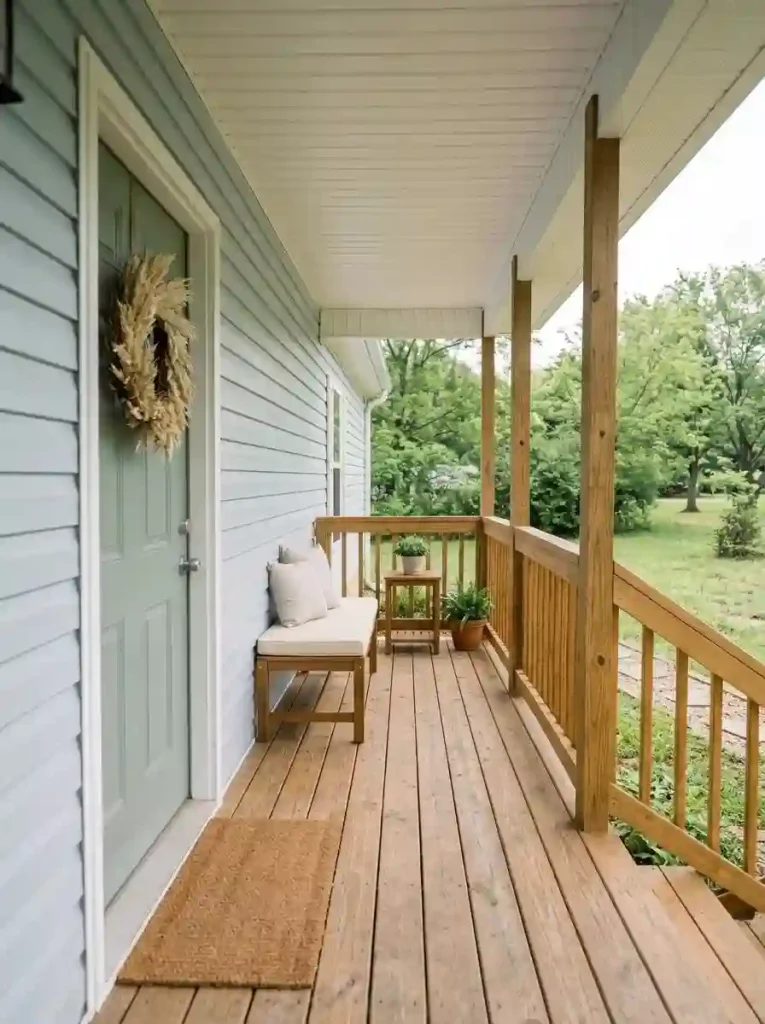
Would that beautiful outdoor loveseat still feel practical once someone needs to open the front door or walk toward the stairs?
The total floor area of a small mobile home porch is rarely the same as its usable furniture area. Door movement, stair approaches, railings, and everyday access all influence what can comfortably fit.
Before shopping, measure the available space and mark the proposed furniture footprint using removable tape.
For example, an illustrative 72-inch-deep porch with a 36-inch circulation allowance leaves 36 inches of depth for furniture. An 18-inch-deep bench uses considerably less of that allowance than a 34-inch-deep loveseat.
Porch Furniture Fit Lab
Compare sample furniture against your selected porch depth and access allowance.
48 − 30 = 18 inches
18 in deep
0 in extra
28 in deep
10 in short
34 in deep
16 in short
Recommendation: Consider a slim bench or leave the landing open.
48 − 36 = 12 inches
18 in deep
6 in short
28 in deep
16 in short
34 in deep
22 in short
Recommendation: Keep this furniture zone free of seating. Consider a nearby ground-level sitting area.
60 − 30 = 30 inches
18 in deep
12 in extra
28 in deep
2 in extra
34 in deep
4 in short
Recommendation: Compare the bench and compact chair before considering larger furniture.
60 − 36 = 24 inches
18 in deep
6 in extra
28 in deep
4 in short
34 in deep
10 in short
Recommendation: Start with a narrow bench and verify its full footprint.
72 − 30 = 42 inches
18 in deep
24 in extra
28 in deep
14 in extra
34 in deep
8 in extra
Recommendation: All three sample depths fit. Compare their widths and actual placement.
72 − 36 = 36 inches
18 in deep
18 in extra
28 in deep
8 in extra
34 in deep
2 in extra
Recommendation: A bench or compact chair provides more flexibility than a deep loveseat.
84 − 30 = 54 inches
18 in deep
36 in extra
28 in deep
26 in extra
34 in deep
20 in extra
Recommendation: Explore a larger seating option if width and circulation also permit.
84 − 36 = 48 inches
18 in deep
30 in extra
28 in deep
20 in extra
34 in deep
14 in extra
Recommendation: Choose seating according to the porch’s primary activity and usable width.
These are illustrative dimensions, not building or accessibility clearance requirements. Check actual furniture dimensions, width, door movement, stair landings and applicable access requirements. For other measurements, subtract the required open depth from the total usable depth.
These measurements are planning examples, not universal building or accessibility requirements.
Consider compact garden chairs, narrow benches, or folding outdoor furniture before purchasing a matching seating set.
Where furniture would interfere with the entrance, an uncluttered porch with a separate nearby sitting area is the better choice.
5. Grow a Vertical Garden Without Crowding the Porch Floor
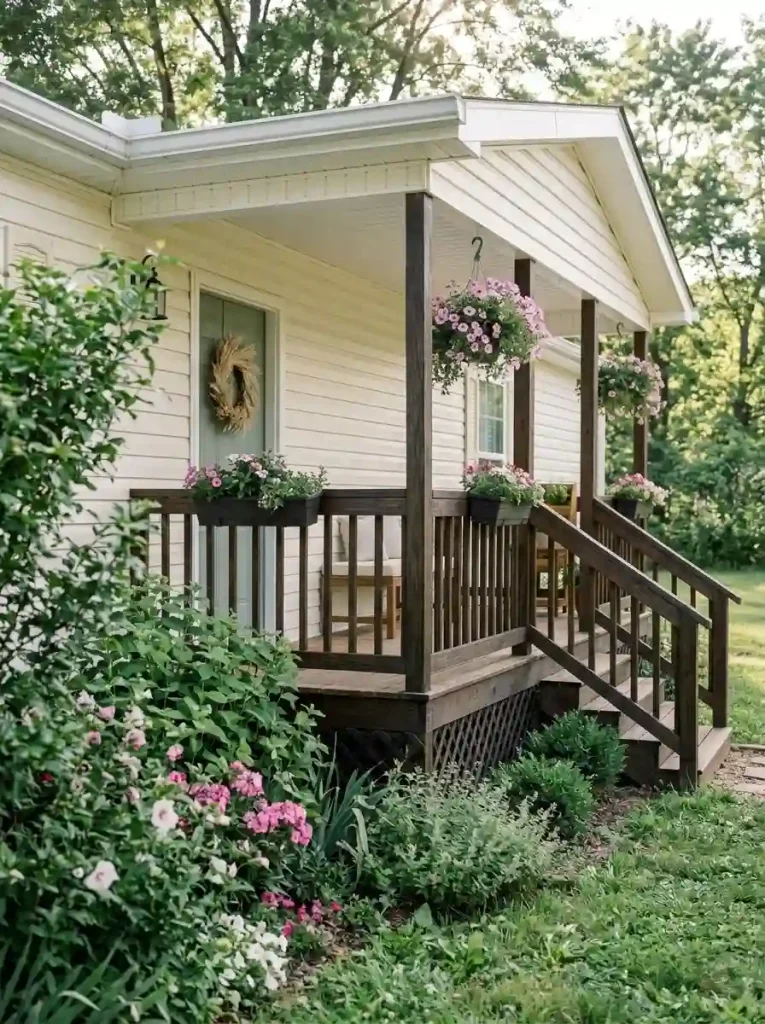
Greenery softens the horizontal lines of manufactured-home siding and introduces a lovely contrast against timber railings. On a tiny porch, however, large floor-standing containers can consume the very space needed for comfortable movement.
Take your planting arrangement upward.
- Hanging baskets: Introduce trailing flowers or foliage above suitable peripheral areas using approved supports.
- Freestanding vertical planters: Create a compact garden along an unused porch side without drilling into the home’s siding.
- Railing planters: Choose compatible containers that can be secured without interfering with handrail use or access.
A grouping of trailing petunias, compact herbs, or leafy plants can make a modest wooden porch feel lush without filling the entire platform.
Choose plants according to available sunlight, rainfall, and wind exposure. Consider the mature size and filled weight of each container before deciding where it belongs.
Concentrate greenery in one or two well-defined areas so the entrance remains comfortable to use.
6. Make Room for a Compact Porch Swing
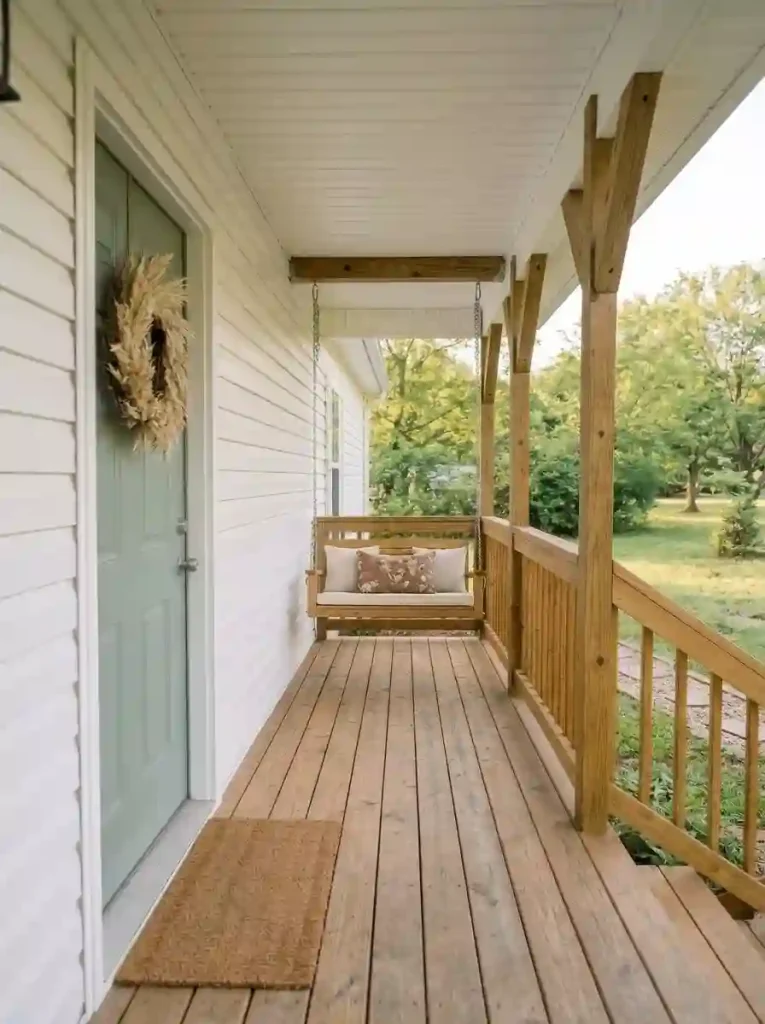
Few outdoor features feel as relaxing as a wooden porch swing. Even a modest covered mobile home porch can sometimes accommodate one, provided its movement and structural requirements are properly considered.
Unlike stationary seating, a swing occupies additional space as it moves. Positioning it at one end of the porch may preserve the central entrance route while creating a dedicated relaxation area.
A compact natural-wood swing with a cream cushion and muted floral pillow can look particularly charming against traditional manufactured-home siding.
For more inspiration involving narrow home frontages, browse these single wide front porch ideas.
An important exception: Never assume existing porch framing or the manufactured home’s roof can support a hanging swing. Confirm the mounting requirements, supporting structure, and required movement clearances with the manufacturer or a qualified professional.
Where suitable support or clearance is unavailable, a stationary garden bench can provide a similar cozy appearance.
7. Keep the Doorway and Stairs Beautifully Uncluttered
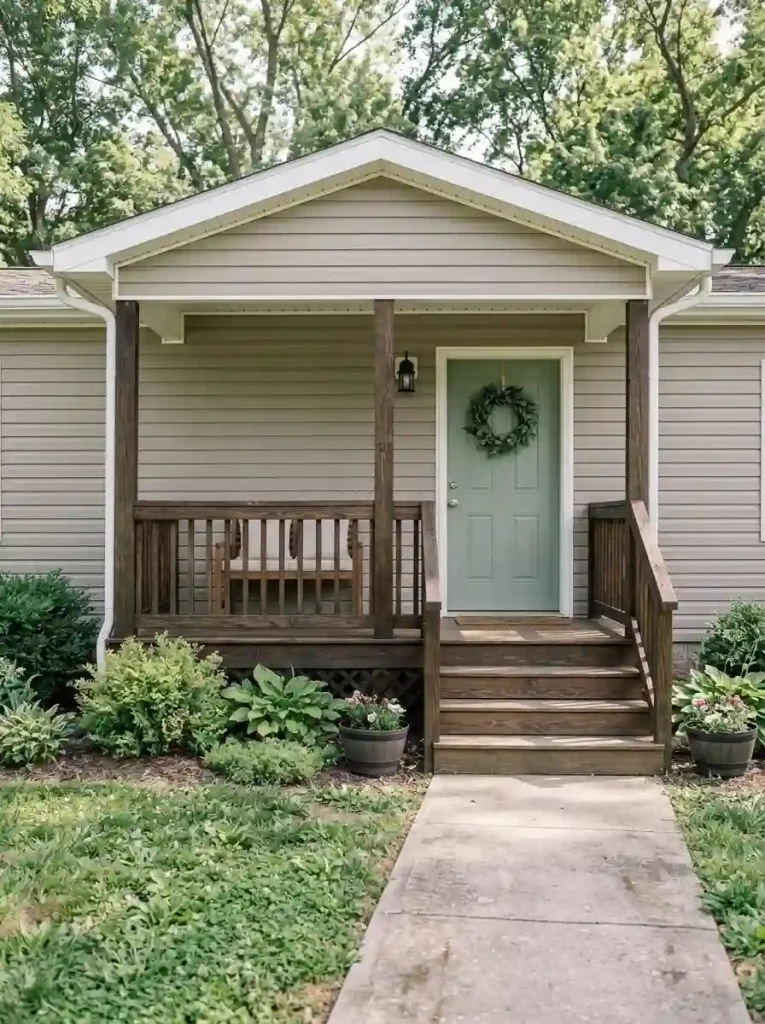
The most valuable empty space on a small mobile home porch is often the route between the front door and the steps or ramp.
Protect the Arrival Route
See how the position of one piece of furniture changes the usability of a small porch.
A Crowded Entrance
A chair interrupts the main route. Entering with shopping bags or bulky items becomes awkward.
A Thoughtful Arrangement
Seating occupies one side of the porch. The central approach remains reserved for access.
Conceptual diagrams only. Confirm actual door movement, required landings, handrail access and applicable requirements before positioning furniture.
Unlike a spacious ground-level patio, a raised manufactured-home entrance may provide only one practical route between the home and the yard. Placing decorative objects along that route can make daily activities awkward.
Try this simple arrival test:
Open the exterior door and storm door through their complete movement. Walk from the yard to the entrance while carrying something bulky, such as an empty laundry basket.
Notice where you need to turn, pause, or move around an object.
A planter that looks attractive beside the staircase may work better in the adjacent garden. A decorative lantern occupying the landing could be relocated to a suitable side surface.
Protect required landing space, handrail access, and exit routes according to applicable local requirements.
A porch with fewer obstacles often looks more spacious as well as more welcoming.
8. Create Privacy at Just One End of the Porch
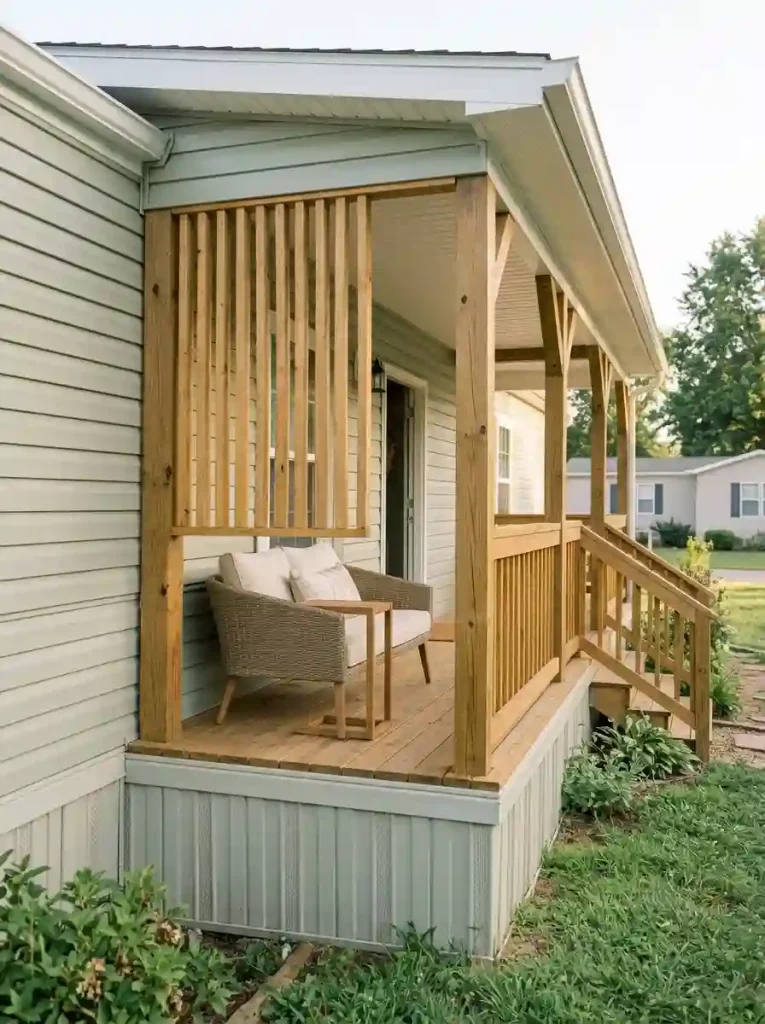
Imagine a small single-wide porch facing a neighboring manufactured home. You enjoy sitting outdoors, but the direct view from the adjacent property makes the space feel exposed.
Screening the entire porch could sacrifice daylight, airflow, and the open feeling that makes outdoor living enjoyable.
A more selective approach is to introduce privacy only where it is needed.
An appropriately installed outdoor screen, a suitable freestanding privacy panel, or a carefully positioned group of plants may provide visual separation around the seating area. The entrance side can remain open to the walkway and garden.
Sit in your usual outdoor chair and observe where the unwanted sightline originates before choosing a screening position.
In manufactured-home communities, check relevant property rules and landlord permissions. Screens also need suitable support for their expected wind exposure.
A small amount of strategically positioned privacy can make a compact porch feel wonderfully personal.
9. Add a Tiny Coffee Station Along the Siding
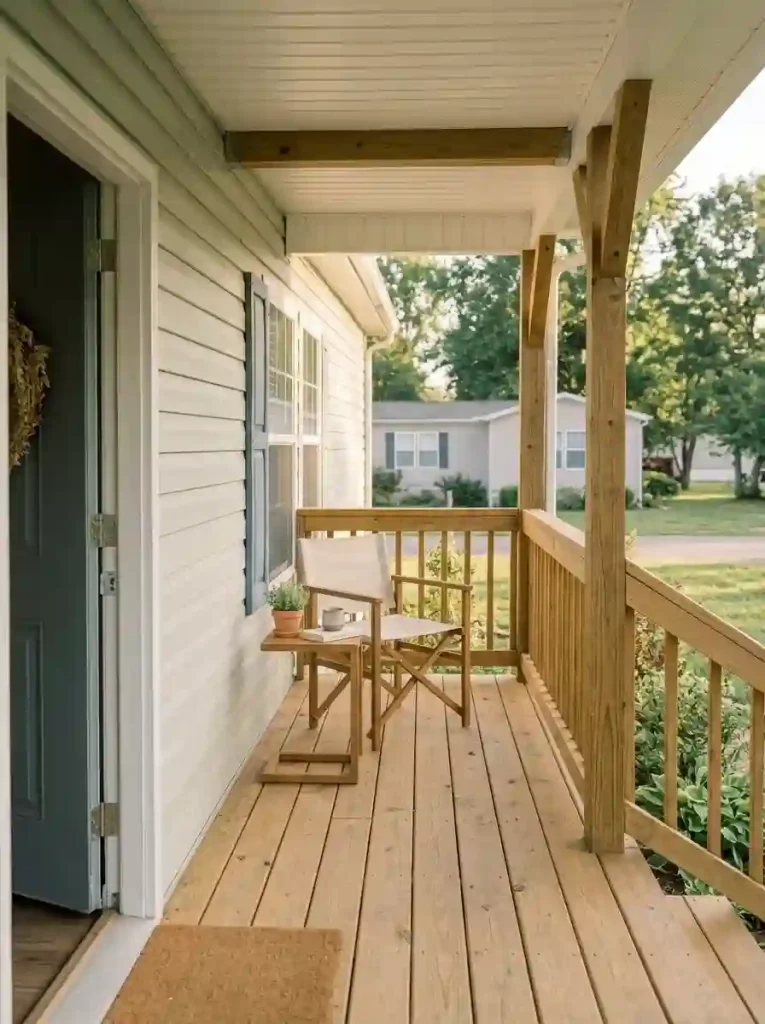
You don’t need an outdoor dining set to enjoy breakfast or morning coffee on your porch.
An unused section of exterior wall beside the front door may provide enough space for a narrow freestanding table, a compact outdoor stool, or a folding side table.
Pair it with your favorite small chair to create a comfortable everyday ritual.
The compact coffee-nook formula:
One comfortable seat + one appropriately scaled surface + one decorative accent.
For a natural timber porch, a small wooden table holding a ceramic cup and a miniature herb planter can create a lovely cottage-inspired arrangement.
Choose a position that leaves nearby windows, doors, and service openings accessible.
On an especially shallow mobile home porch, a portable folding table may be more useful than permanent furniture. Bring it outside when needed and store it afterward to recover the available landing space.
10. Refresh an Existing Porch With a Few High-Impact Changes
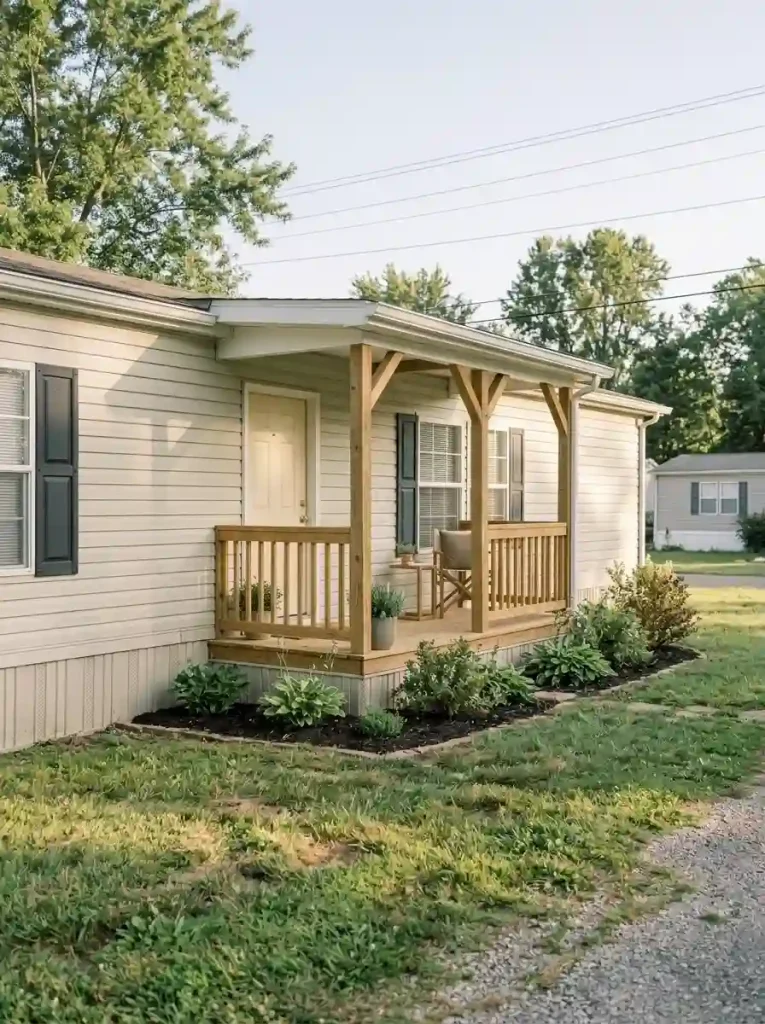
Before purchasing new furniture, stand in the yard and look at your porch as part of the complete manufactured-home exterior.
What makes it feel unfinished?
Perhaps the timber is weathered, the front door lacks character, or mismatched accessories make the entrance appear cluttered. Each problem suggests a different spending priority.
Choose Your First Three Improvements
Identify your porch’s biggest problem and discover where to begin.
Your Improvement Order
- First priority Inspect and clean sound surfaces.
- Second priority Refinish suitable existing timber.
- Finishing detail Coordinate one focal accent.
Your Improvement Order
- First priority Measure the space outside the access route.
- Second priority Add one suitably sized seat if it fits.
- Finishing detail Introduce a small outdoor cushion or plant.
Your Improvement Order
- First priority Remove objects from the door-to-stair route.
- Second priority Reduce redundant furniture and accessories.
- Finishing detail Group remaining decorations at one edge.
Your Improvement Order
- First priority Check functional entrance and step lighting.
- Second priority Correct visibility issues with appropriate fixtures.
- Finishing detail Add suitable outdoor-rated ambient lighting.
Address unsafe steps, loose railings, structural deterioration and moisture damage before cosmetic improvements.
A structurally sound porch with faded finishes might benefit from compatible cleaning and refinishing. An otherwise attractive entrance may need only refreshed cushions, coordinated planters, and a carefully selected decorative accent.
For additional affordable improvements, explore these mobile home exterior ideas on a budget.
Address loose railings, damaged steps, deterioration, and moisture problems before beginning cosmetic work.
Once the existing structure is in suitable condition, focus your budget on improvements that enhance its appearance and everyday usefulness. A small, coordinated makeover can deliver more visual impact than a collection of unrelated purchases.
11. Make a Narrow Porch Feel Cozy With Lightweight Textiles
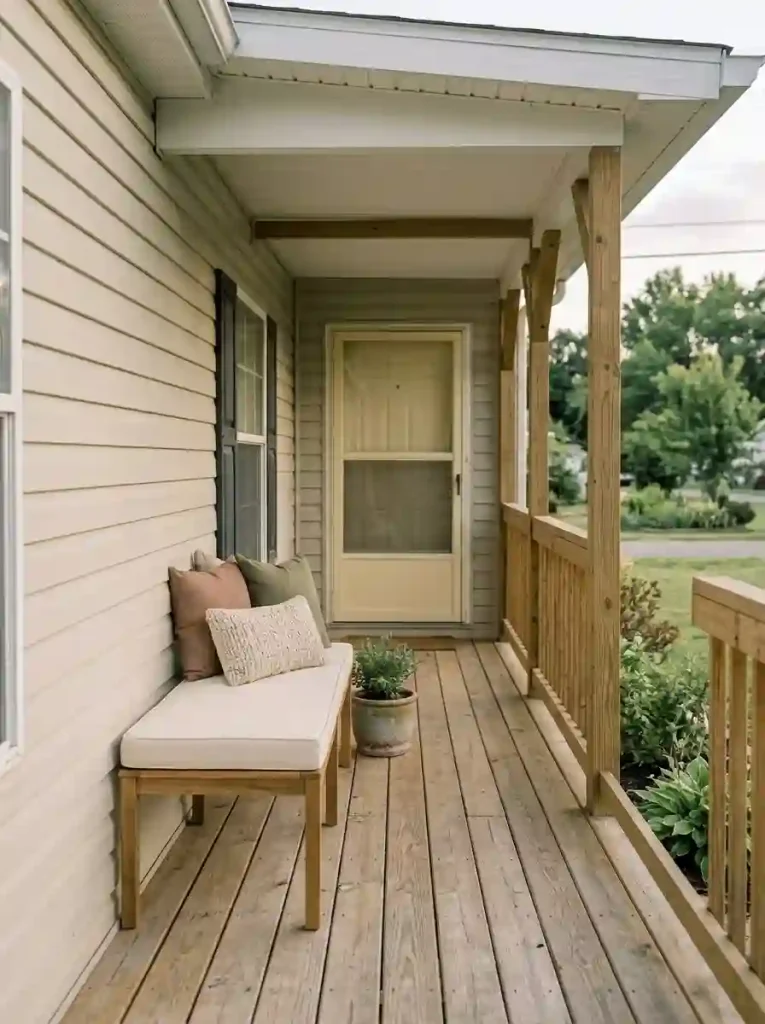
Soft cushions, gentle stripes, and textured outdoor fabrics can transform the atmosphere of a plain wooden porch.
The trick is introducing softness without making a narrow entrance feel crowded.
Choose outdoor-rated cushions that closely fit your furniture. A slim bench cushion paired with two small terracotta or olive-green pillows can add warmth without overwhelming the limited seating area.
For a white manufactured home, pale-blue textiles and natural timber create a relaxed coastal mood. Against darker siding, warm cream and muted rust can introduce a cozy cottage aesthetic.
An outdoor rug is optional.
Use one only where the surface, drainage conditions, stability, and door clearance make it suitable. Avoid loose rugs or raised edges that could create tripping hazards near stairs.
Sometimes a beautifully dressed bench provides all the comfort and texture a small porch needs.
12. Choose Outdoor Materials That Suit Your Porch’s Exposure
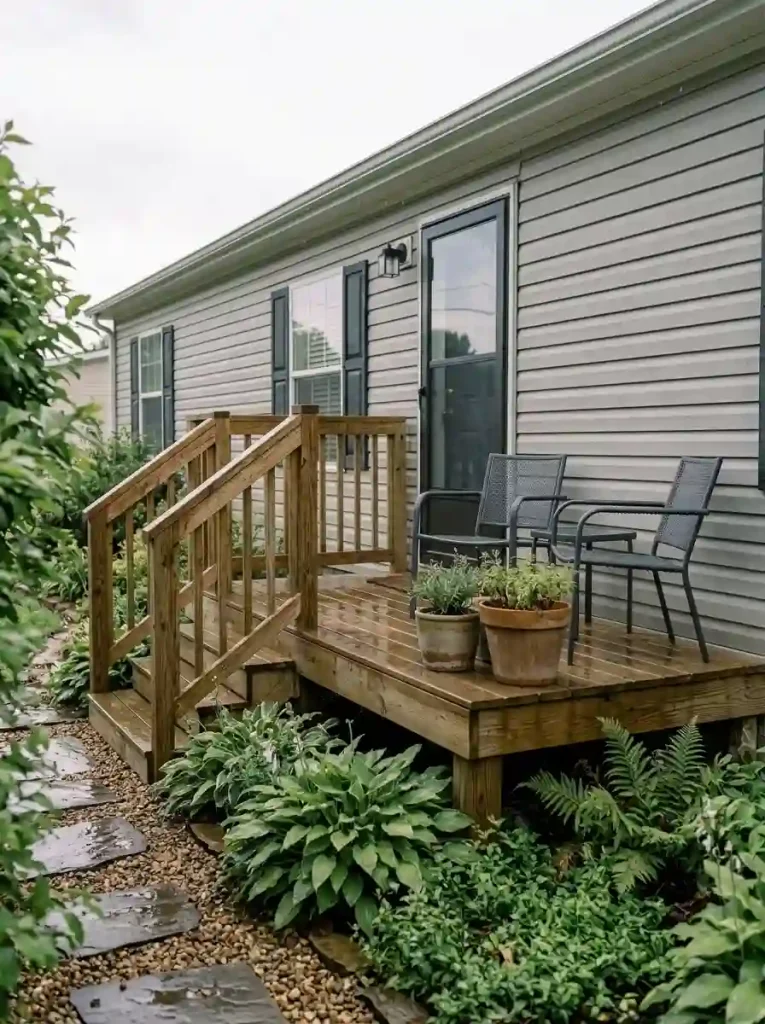
Two mobile home porches of identical size can require completely different furniture and decorating materials.
A sheltered porch beneath a solid roof may experience relatively little direct rain, while an uncovered entrance receives considerably more moisture. A west-facing porch may also encounter intense afternoon sunlight.
Let those conditions guide your choices.
| Porch condition | Suitable decorating direction |
|---|---|
| Mostly sheltered | Outdoor-rated cushions, coordinated textiles, and suitable furniture finishes |
| Frequently exposed to rain | Quick-draining furniture and accessories that dry readily |
| Strong direct sunlight | Outdoor fabrics and finishes rated for UV exposure |
| Wind exposed | Stable furniture, secure planters, and fewer loose accessories |
Match Your Porch Materials to the Weather
Select the environmental condition that most often affects your porch. Combine recommendations when conditions overlap.
Sheltered Porch Material Guide
- Seating
- Outdoor-rated cushions and suitable furniture finishes.
- Floor styling
- Outdoor rugs only where stable and adequately draining.
- Greenery
- Shade-tolerant plants suited to the actual light conditions.
- Care priority
- Check for trapped moisture after storms.
Rain-Exposed Porch Material Guide
- Seating
- Quick-draining outdoor furniture and suitable fast-drying cushions.
- Floor styling
- Avoid rugs or accessories that retain moisture.
- Greenery
- Containers with drainage appropriate to the selected plants.
- Care priority
- Allow surfaces to dry and follow product maintenance instructions.
Sun-Exposed Porch Material Guide
- Seating
- Outdoor fabrics specifically rated for UV exposure.
- Floor styling
- Exterior finishes designed for the expected sunlight exposure.
- Greenery
- Sun-tolerant plants appropriate for your climate.
- Care priority
- Monitor fading, surface temperature and material deterioration.
Wind-Exposed Porch Material Guide
- Seating
- Stable outdoor furniture appropriate to the site.
- Floor styling
- Reduce loose rugs and lightweight textiles that can move.
- Greenery
- Stable planters and appropriately secured accessories.
- Care priority
- Avoid unsupported screens and unsuitable hanging objects.
Always consult individual product ratings, installation instructions and maintenance requirements. Local climate and shelter conditions vary.
Even covered porches may experience wind-driven rain and humidity. Products marketed for outdoor use do not necessarily offer identical weather resistance.
Check individual manufacturer instructions, maintenance requirements, and exposure ratings before purchasing.
Choosing materials that match your actual porch conditions can prevent unnecessary replacement and make the space easier to maintain throughout the year.
13. Soften the Porch Base With a Narrow Garden Border
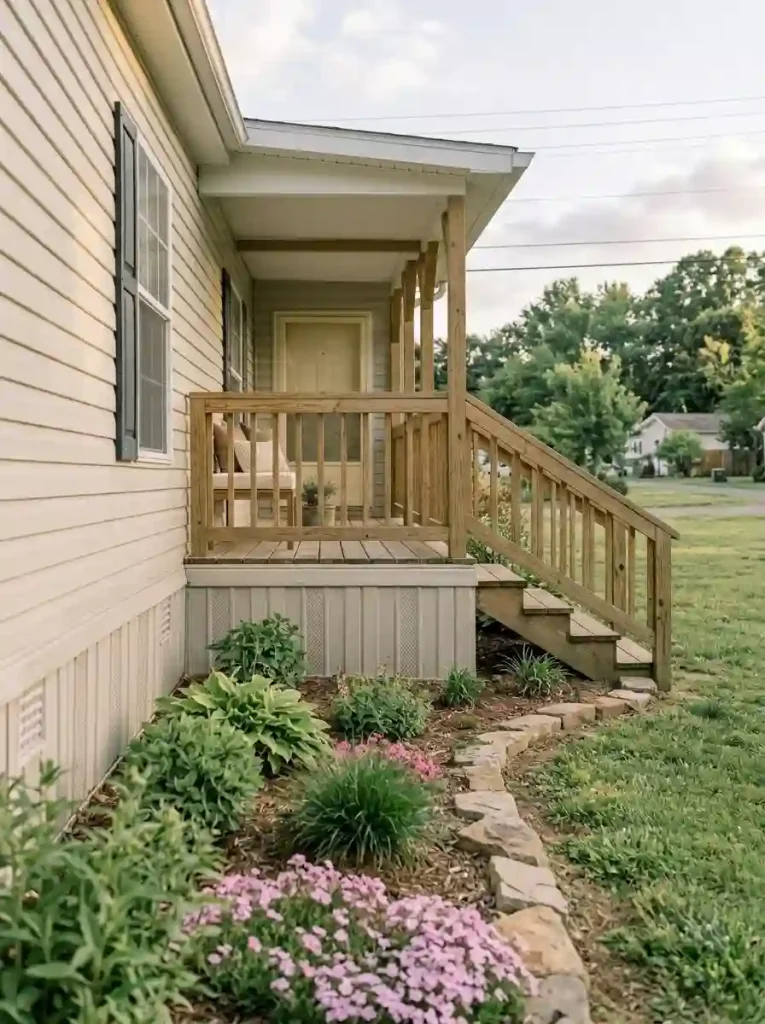
Raised mobile home porches often have a noticeable transition between the platform, the home’s skirting, and the surrounding lawn.
A narrow planting border can visually connect these areas while introducing color and texture without using valuable porch floor space.
Begin at the outside edges of the steps and platform. Position low-growing flowers near the approach, then introduce slightly taller foliage at peripheral corners where it will not restrict visibility or access.
Repeat one flower color or plant variety along the front of the home to create a continuous visual relationship.
Natural stone edging, suitable mulch, and compact shrubs can complement timber porch finishes beautifully.
Keep landscaping clear of required skirting vents, utility connections, inspection openings, and drainage routes. Avoid piling soil or moisture-retaining materials directly against the home’s skirting.
Know when to stop: The border should frame the porch, not conceal the staircase or make essential exterior systems difficult to reach.
14. Layer Warm Lighting From the Steps to the Roofline
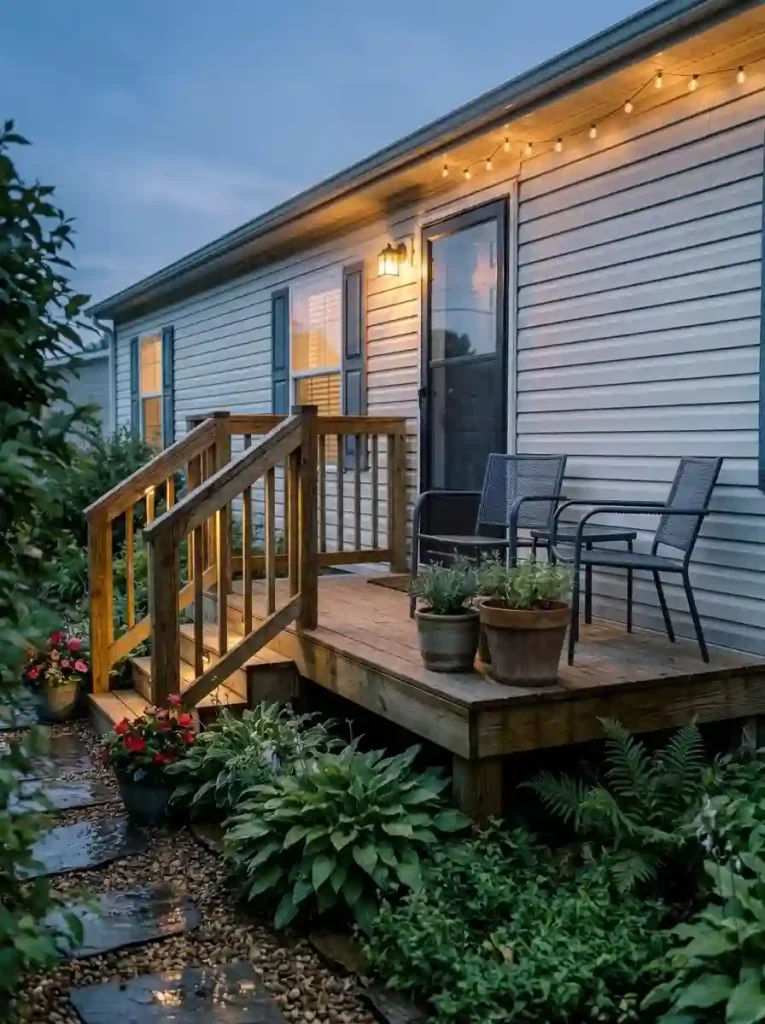
A small mobile home porch can feel especially magical after sunset. Warm light against natural timber, soft-colored siding, and flowering plants creates an inviting atmosphere that extends beyond the front door.
Build your lighting arrangement around three distinct layers.
Doorway lighting: A suitable exterior wall fixture illuminates the entrance and supports everyday activities such as unlocking the door.
Step lighting: Appropriately positioned fixtures help reveal changes in level along the approach.
Ambient lighting: Outdoor-rated string lights and decorative lanterns create warmth around the seating area and existing roofline.
Three Layers of Evening Light
Give your small porch a warm evening atmosphere while preserving practical visibility.
- 01 / Doorway Lighting
- Illuminate the lock, doorway and immediate entrance area to support everyday access.
- 02 / Step Lighting
- Reveal changes in level and stair edges using appropriately positioned fixtures.
- 03 / Ambient Lighting
- Introduce warm, outdoor-rated string lights to create a welcoming evening atmosphere.
Decorative lighting is not a replacement for functional illumination. Keep electrical cords away from walking routes, use suitable outdoor-rated equipment and appropriate GFCI protection, and consult a qualified electrician for new permanent wiring.
Keep decorative lighting secondary to practical illumination. Beautiful string lights should never be the only source of visibility around stairs or entrances.
Follow the Electrical Safety Foundation International’s outdoor decoration safety guidance, including suitable outdoor-rated equipment, GFCI protection, and careful cord positioning.
Use a qualified electrician when new permanent wiring is required.
A combination of functional and decorative light can make even a tiny porch feel welcoming well into the evening.
15. Extend a Tiny Porch With a Ground-Level Sitting Corner
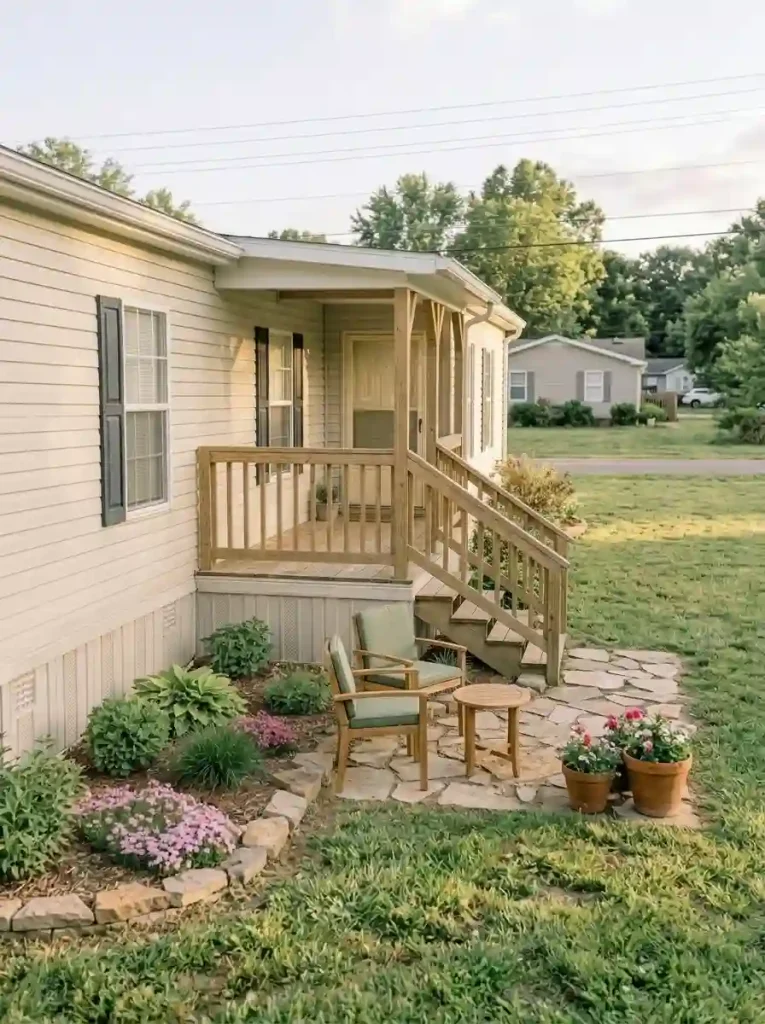
One common misconception is that creating a larger outdoor living area always requires expanding the existing porch.
For mobile homes with very small raised landings, it may be more practical to separate the entrance from the relaxation area.
Keep the elevated porch beautifully styled with a wreath, a few suitable plants, and welcoming lighting. Then introduce a small ground-level sitting corner nearby using appropriately selected outdoor furniture.
Two compact garden chairs, a side table, and a coordinated planter arrangement can create a comfortable retreat without occupying the stairs or landing.
Repeating the porch’s timber tones, cushion colors, or planting scheme will visually connect both spaces.
Explore these mobile home patio ideas for more ground-level outdoor living configurations.
Confirm property boundaries, drainage conditions, accessibility, and applicable community permissions before making permanent changes.
This approach allows the original porch to serve its essential purpose while creating more room for everyday outdoor enjoyment.
16. Keep Everyday Porch Essentials in One Compact Storage Spot
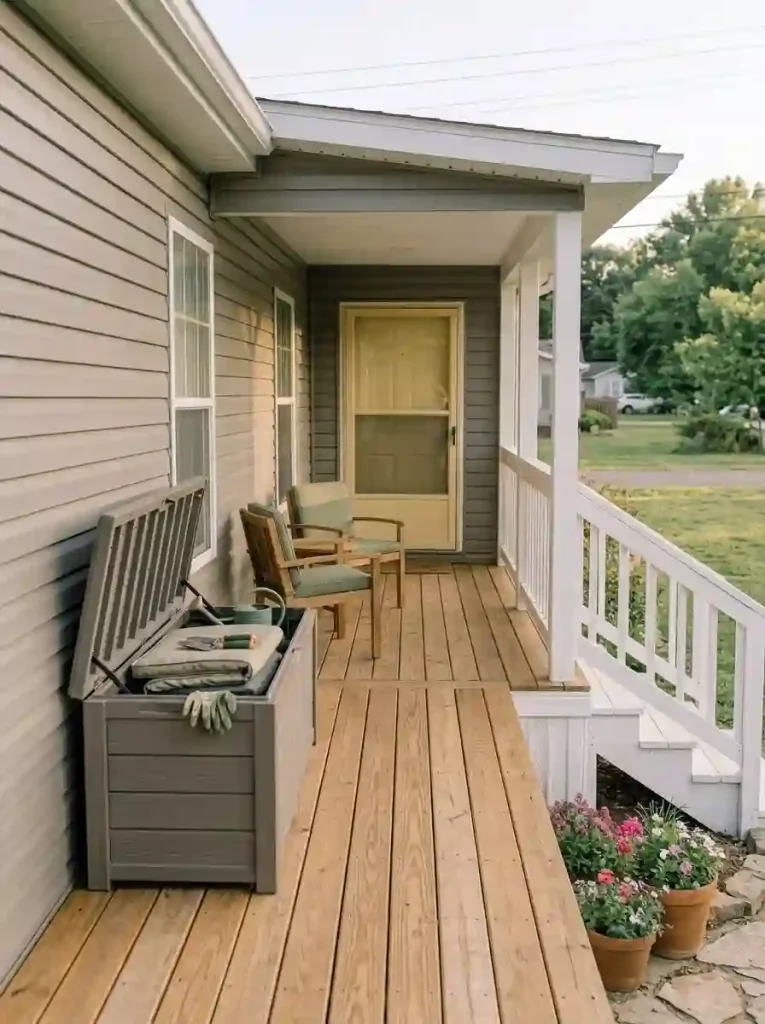
Gardening gloves, spare cushions, watering accessories, and small outdoor essentials can gradually accumulate around a mobile home entrance.
A dedicated storage location makes daily tidying easier and prevents these items from becoming permanent visual clutter.
A compact outdoor storage container or appropriately scaled storage bench may suit an unused end of the porch, provided it leaves enough room for comfortable movement.
Before purchasing, check:
- Can the lid open without obstructing the doorway or another necessary route?
- Is the container suitable for the porch’s weather exposure?
- Can you retrieve its contents without rearranging the furniture?
- Does it remain outside required stair and landing clearances?
Store only items appropriate for that container and environment. Hazardous materials require suitable separate storage.
Where the existing porch is simply too narrow, use an appropriate nearby storage location.
Additional storage earns its place only when it makes the entrance easier to use.
17. Finish the Porch With a Simple, Repeating Color Palette
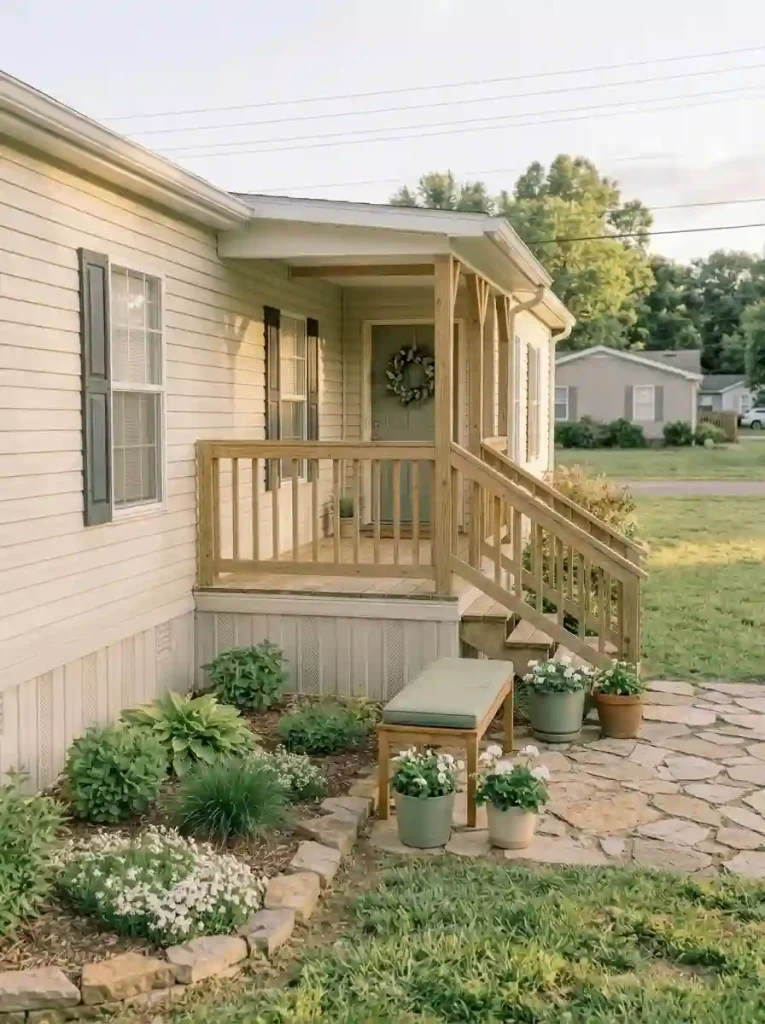
Your manufactured home’s existing siding, shutters, roof, railings, and skirting already establish much of its exterior color palette.
Work with those fixed features when selecting new furniture and accessories.
A simple three-color approach can help bring everything together:
Foundation color: The existing siding or primary porch finish.
Supporting color: A complementary shade appearing in furniture, shutters, planters, or existing railings.
Accent color: A smaller amount of color introduced through flowers, cushions, or doorway decorations.
Here are four combinations worth exploring:
| Porch style | Color combination |
|---|---|
| Cottage garden | Cream, natural cedar, sage green |
| Modern farmhouse | Warm white, charcoal, muted olive |
| Rustic retreat | Walnut brown, terracotta, warm beige |
| Coastal cottage | Soft white, dusty blue, light timber |
Select a combination that complements the home’s permanent exterior features.
Repeat your supporting and accent colors in a few carefully chosen places. A cushion, planter, and wreath can share related tones without matching perfectly.
The finished porch will feel cohesive, welcoming, and personal, even when its furnishings have been collected gradually over time.
Final Thoughts
The most beautiful small mobile home porch is the one that feels comfortable to use every day.
Start with the space you already have. A narrow entrance may benefit from vertical greenery and a beautifully framed doorway, while a deeper covered porch could accommodate a compact bench, a coffee station, and soft evening lighting.
Prioritize comfortable access, suitable materials, and furniture that respects the porch’s proportions. Once those practical needs are satisfied, introduce the colors, plants, textures, and decorative details that make the space feel like your own.
You can create a charming outdoor retreat without a major renovation or an oversized decorating budget. Sometimes a few thoughtful changes are enough to make the smallest porch one of the loveliest parts of your home.