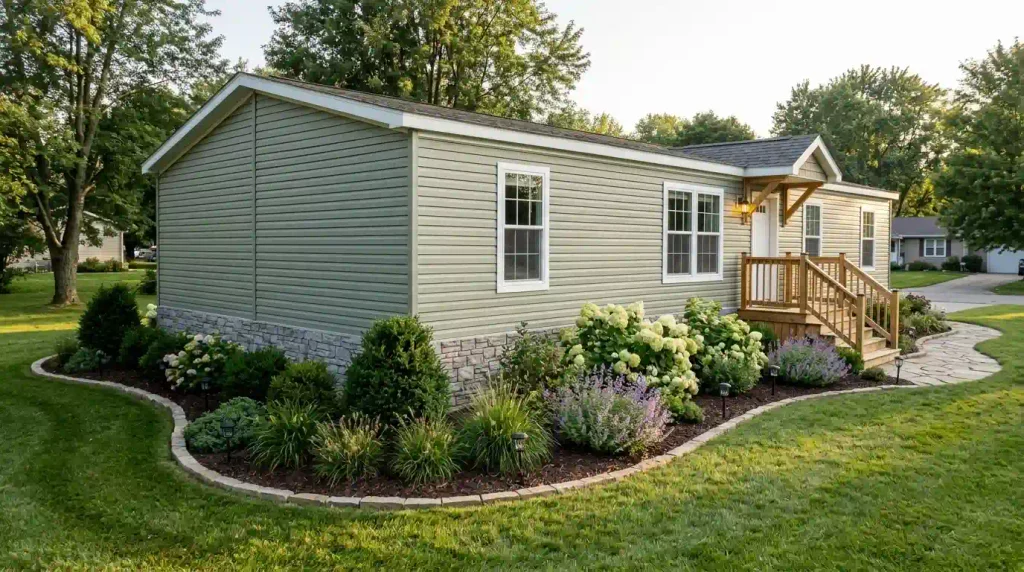
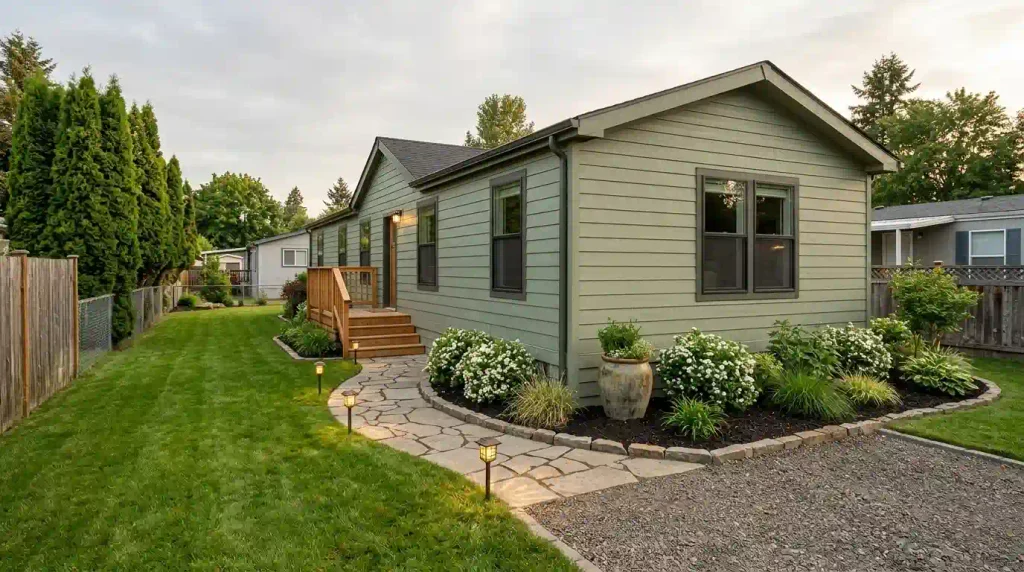
The biggest landscaping challenge around a single-wide mobile home often isn’t the size of the yard. It’s the shape of the available space.
A long exterior wall may leave you with a shallow front lawn, an awkward side passage, an off-center entrance, and very little room for planting once utilities and maintenance routes are accounted for. Filling every empty area with flowers or shrubs can actually make the property feel smaller.
The most effective single wide landscaping ideas work with these limitations. A slim foundation garden can soften the exterior, a thoughtfully positioned stone pathway can improve the entrance, and a narrow evergreen border can introduce privacy without overwhelming the yard.
Even an older manufactured home with basic siding and simple steps can look remarkably inviting with coordinated planting, attractive garden edges, and a few carefully selected materials.
These 21 landscaping ideas cover small front yards, narrow side gardens, privacy solutions, affordable upgrades, and low-maintenance planting arrangements. Whether you own your land or rent a lot in a mobile home community, you’ll find practical ways to create an outdoor space that looks beautiful and remains comfortable to use.
1. Divide a Narrow Single Wide Lot Into Four Functional Zones
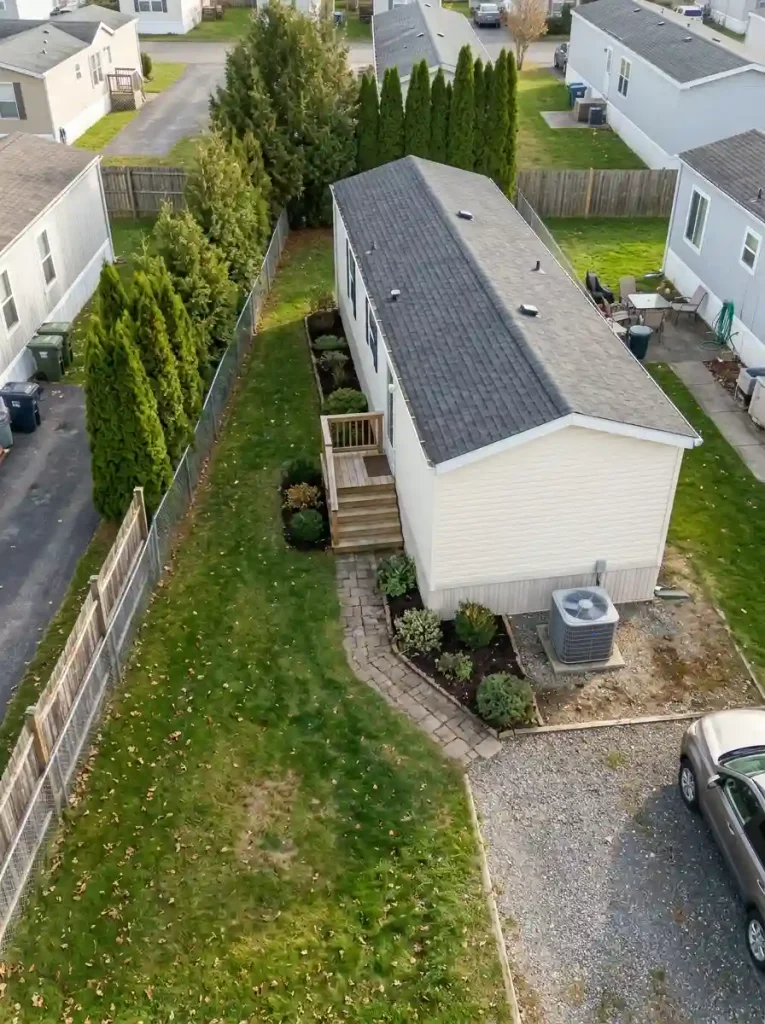
Before choosing plants, look at your entire property as four separate outdoor zones. This approach prevents a small single-wide yard from becoming a collection of unrelated garden features.
| Landscape zone | Primary purpose |
|---|---|
| Arrival zone | Comfortable movement from parking to the front door |
| Foundation zone | Planting that softens siding and skirting |
| Boundary zone | Privacy and attractive perimeter landscaping |
| Service zone | Unobstructed equipment and maintenance access |
A shallow front yard may need a direct entrance path and two compact planting pockets. A property with more side-yard space could accommodate a linear garden alongside an existing walkway.
Draw the home, entrance, utilities, and property boundaries on paper before assigning planting areas.
Before digging, contact 811, the national utility notification service, follow local marking procedures, and arrange separate locating of private utility lines where necessary.
A beautiful landscape begins with knowing which spaces are genuinely available.
STYLISHGALORE / LANDSCAPE STUDIO
Find the layout that fits your lot
Arrival-first layout
Reserve the parking-to-door route. Keep beds shallow and the center open.
Linear garden
Measure the remaining width after access. Choose low plants that fit at maturity.
Targeted privacy
Screen the unwanted sightline only. Keep equipment and escape routes accessible.
2. Create a Slim Foundation Bed Along the Long Exterior
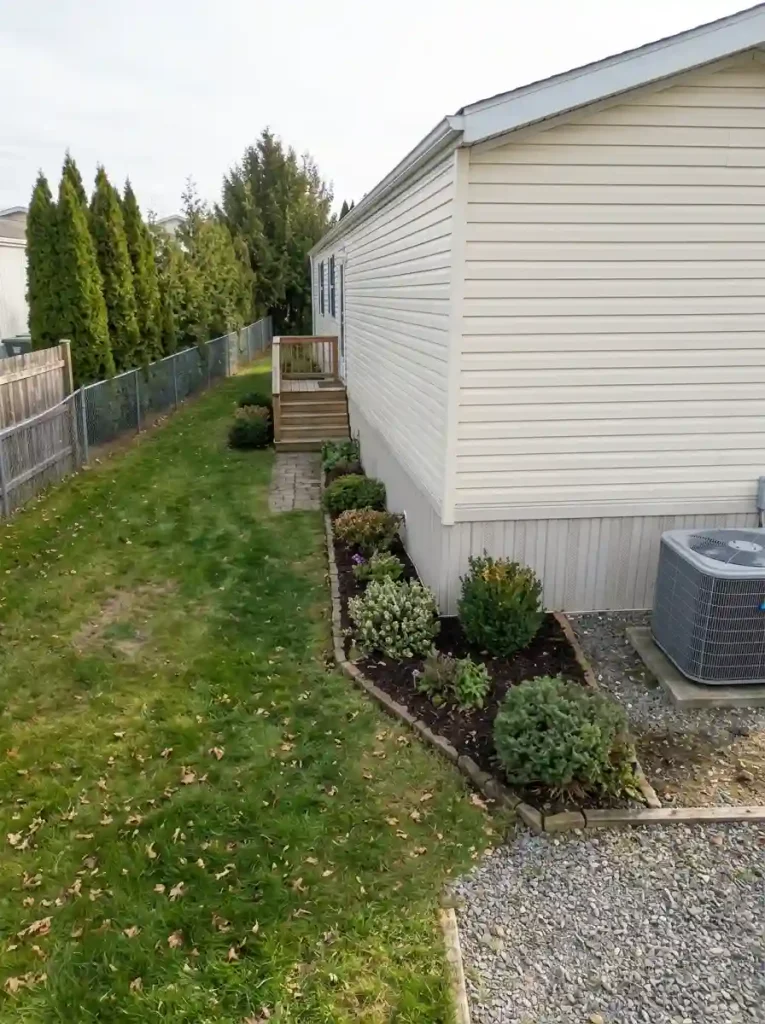
A continuous foundation garden can make the long, horizontal shape of a single wide feel more grounded. The most successful versions use controlled planting depth, with foliage that softens the lower exterior while preserving the remaining lawn.
Start by outlining a potential bed with a garden hose or removable markers. Walk along it and check how much space remains for mowing, accessing the home, and moving around the property. Locate skirting vents, access panels, and utility outlets before finalizing the boundary.
A two-foot-wide planting bed may be a useful starting concept where sufficient space exists, but the appropriate depth depends on site conditions and mature plant dimensions. Where even a narrow continuous bed would interfere with access, create separate planting pockets beneath selected windows.
Keep the planting low enough to complement the home’s proportions, and avoid raising soil or mulch against the skirting.
3. Guide Visitors Toward an Off-Center Front Door With a Defined Path
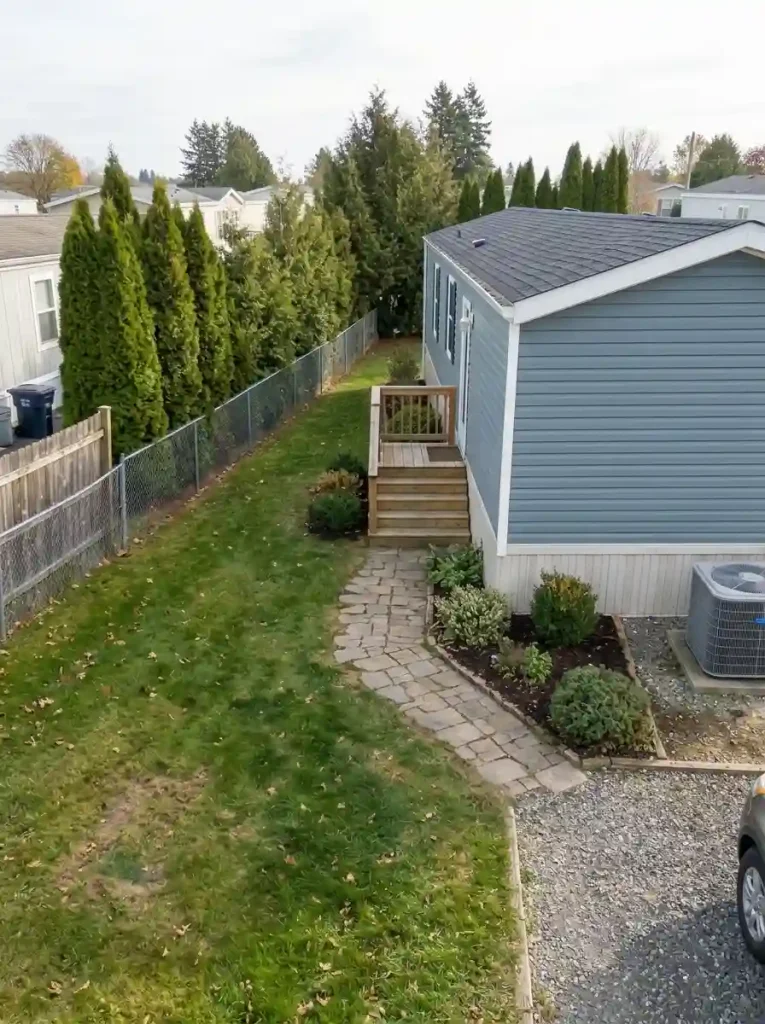
A single-wide entrance doesn’t always sit in the center of the exterior. Installing a symmetrical walkway simply because it looks attractive in a garden photograph can create an unnecessarily awkward approach.
Design the path around the journey from your parking area to the front steps.
- Identify the natural route. Notice where people already walk across the yard.
- Choose the appropriate shape. A direct path works well on shallow lots, while a gentle curve can suit a deeper front yard.
- Test the surface. Select stable paving appropriate for everyday movement, including wet-weather conditions.
Natural flagstone, textured concrete pavers, or an existing walkway refreshed with coordinated edging can all work beautifully.
Avoid loose stepping stones where household members need a particularly stable or accessible route.
For complementary entrance improvements, explore these single wide exterior makeover ideas.
4. Frame an Existing Porch Without Filling the Front Lawn
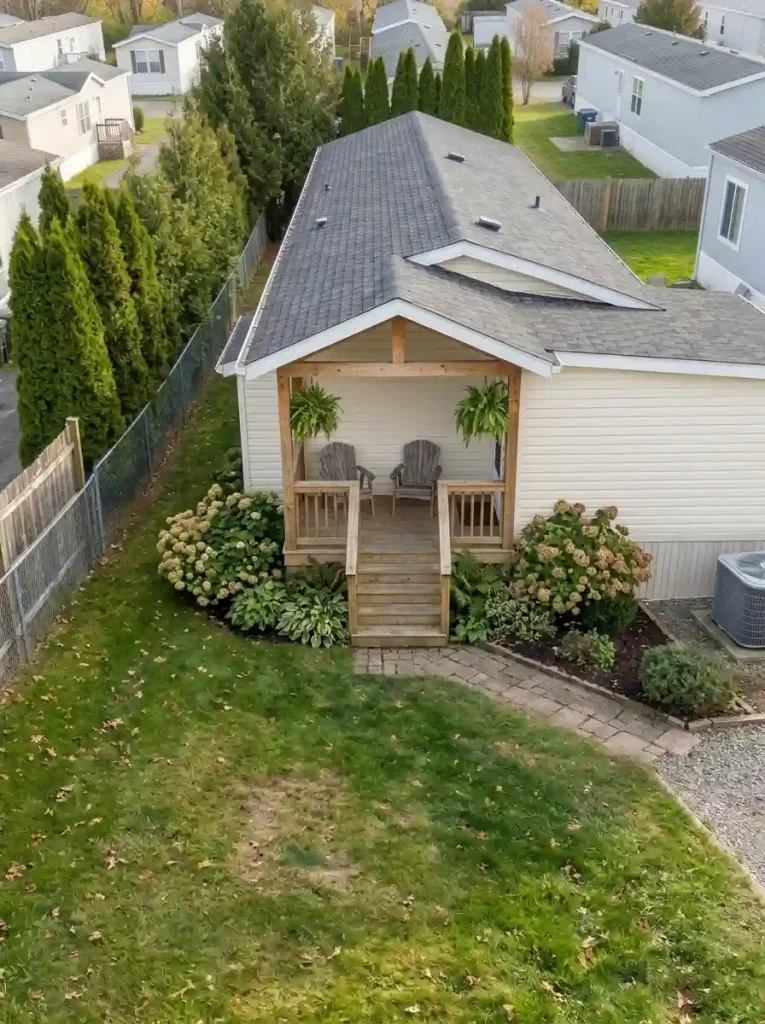
A welcoming wooden porch surrounded by flowers is one of the most attractive looks for a manufactured home. However, planting across the entire front can consume the very outdoor space that makes the porch enjoyable.
For a small entrance porch: Concentrate compact flowering plants around the outer corners. Leave the stair approach open and allow the garden to draw attention toward the doorway.
For a full-length porch: Establish planting groups beneath selected sections of the railing, separated by open areas of lawn or mulch.
The distinction matters because a compact porch needs a focused entrance composition, while a long porch benefits from a more spacious landscape rhythm.
Where the porch casts considerable shade, explore suitable hostas, ferns, or native shade-tolerant perennials.
These single wide front porch ideas provide additional inspiration if your landscaping project also involves refreshing the porch itself.
5. Break Up a Long Wall With Repeated Planting Groups
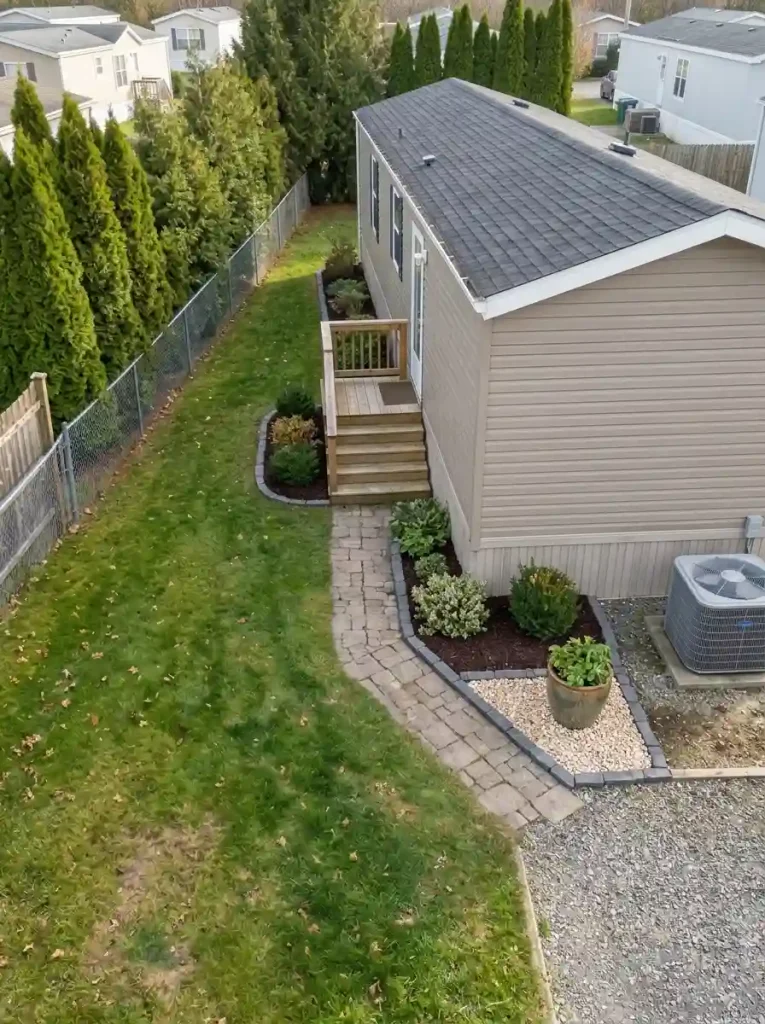
Look at a single-wide exterior from the street and notice where the eye naturally pauses. Windows, doors, and changes in siding often create opportunities for small landscaping compositions.
Repeating a recognizable planting combination can bring order to this long façade.
For example, one compact evergreen, two ornamental grass clumps, and a few low flowering perennials could form a group beneath a suitable window. A similar arrangement farther along the exterior introduces continuity without creating a solid hedge.
The NC State Extension landscape design handbook emphasizes selecting plants according to their eventual growth habits and landscape roles.
A useful design principle: Repeat the character of a planting group, but adjust its size and position to suit the architecture. Empty spaces between the groups are part of the composition.
6. Use Dark Mulch and Pale Gravel to Define Different Ground Zones
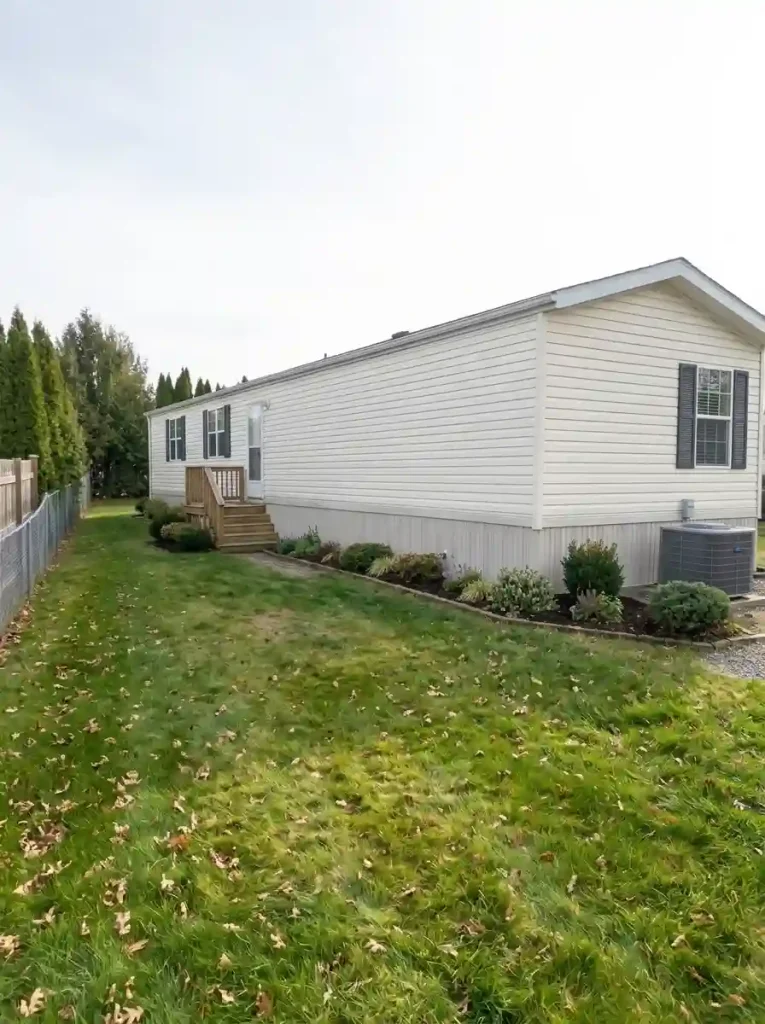
Black or dark brown mulch paired with pale decorative gravel can make an ordinary single-wide yard look surprisingly sophisticated.
The effect is strongest when each material has a clear purpose.
| Material | Where it works | What to consider |
|---|---|---|
| Bark mulch | Living flower and shrub beds | Periodic replenishment |
| Pale gravel | Small decorative, non-planted areas | Heat and stone migration |
| Natural stone | Defined borders and suitable paths | Stability and edge height |
Try using dark mulch around a group of green shrubs, with a smaller pale gravel section highlighting a decorative planter or marking the transition toward a service area.
A restrained combination is generally easier to maintain than several different gravel colors competing for attention.
In hot, exposed yards, reconsider extensive decorative rock around heat-sensitive plants. Preserve the site’s drainage pattern and leave the skirting, siding, and ventilation openings unobstructed.
MATERIAL ATLAS / TAP TO EXPLORE
Three finishes, three different jobs
Dark bark mulch
Living planting beds
Choose for: shrub and perennial beds where organic mulch is appropriate.
Trade-off: periodic replenishment. Keep it away from siding and vents.
Pale gravel
Decorative transitions
Choose for: a small, suitable non-planted accent outside access routes.
Trade-off: heat and stone migration. It does not fix drainage.
Natural stone
Edges and paths
Choose for: stable edging or properly installed walking surfaces.
Trade-off: uneven edges may trip people or catch mower wheels.
7. Landscape Around the AC Unit Without Blocking Airflow
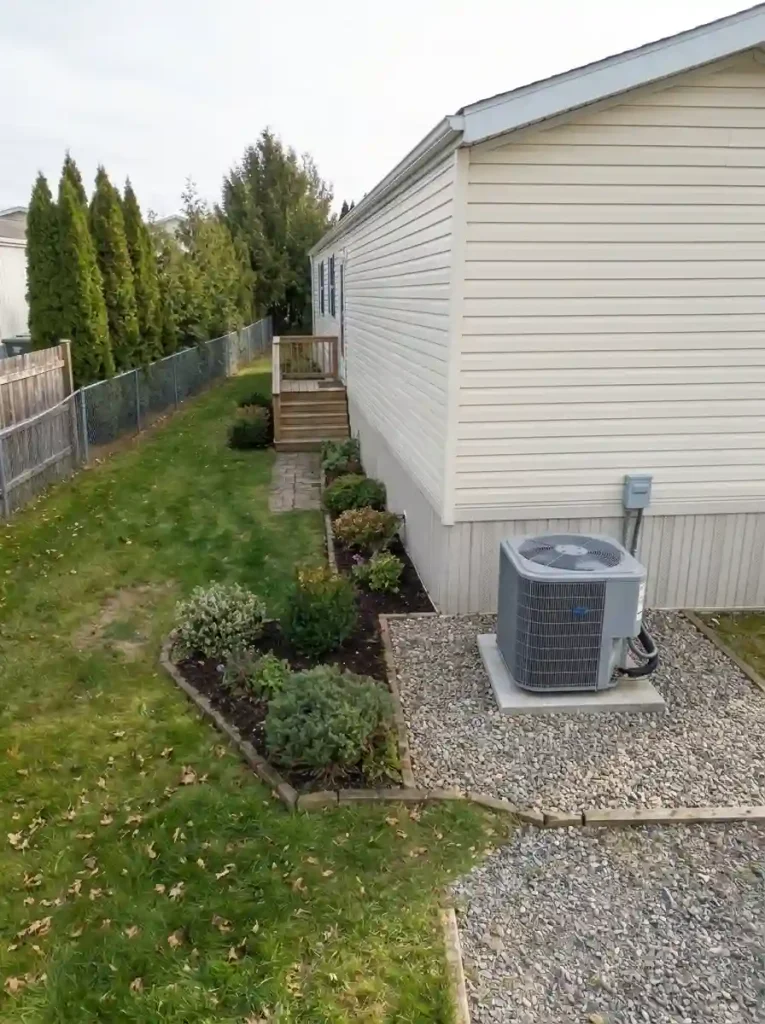
An outdoor air conditioning unit can be especially noticeable beside a narrow single-wide home, where there may be little distance between the equipment and the main garden.
Fortunately, making the area look organized doesn’t require concealing it completely.
An open gravel surround, a neat boundary between the equipment area and lawn, and carefully positioned plants beyond the required clearance can give the service zone a more intentional appearance.
Before installing anything, identify the equipment model and consult its installation instructions. Trane’s landscaping guidance for outdoor HVAC units explains the importance of adequate airflow, vegetation management, and maintenance access.
A decorative screen may be suitable only when its position and construction satisfy the equipment’s requirements, including overhead clearance and access to service panels and electrical disconnects.
On exceptionally narrow lots, an attractive but fully exposed equipment area is preferable to a crowded enclosure.
UTILITY ZONE / CONSTRAINT CHECK
Can your AC landscaping idea work?
Keep the service zone open
Confirm the model’s airflow, overhead and service requirements before adding gravel or edging.
Check the screen position
Even a slatted screen can restrict airflow. Confirm distances, electrical access and service approach.
Remove the tight enclosure
Move dense planting away from the unit or retain an open, tidy service area.
8. Choose Shrubs That Stay Below Your Single Wide Windows
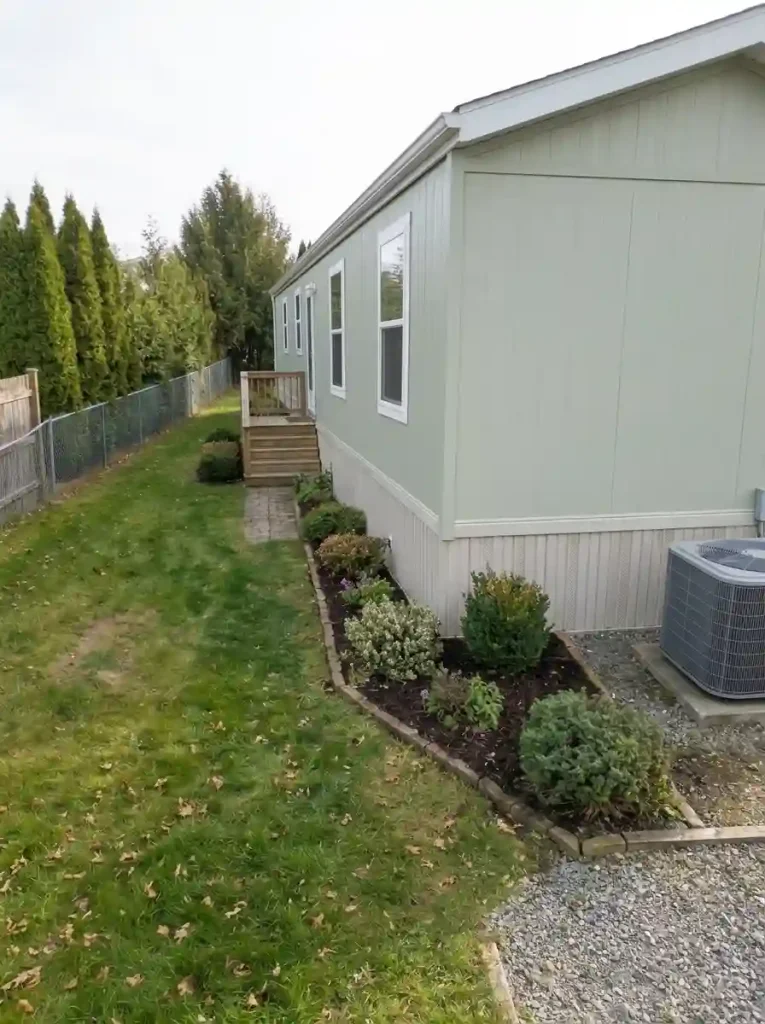
Would the shrub you’re considering still fit beneath your window five years from now?
That question is particularly important around single-wide homes, where low windows and shallow planting beds can limit the available vertical and horizontal space.
Measure the height from the intended planting surface to the bottom of the window. Then check the mature dimensions of the exact plant cultivar.
Suitable options to investigate include:
- Compact spirea varieties for appropriate sunny locations.
- Smaller hydrangea cultivars where growing conditions suit them.
- Dwarf evergreen shrubs for year-round structure.
- Low-growing perennials where woody shrubs would become too large.
A nursery label describing a plant as dwarf does not automatically mean it will fit your particular window or garden bed.
Also preserve access to designated emergency escape windows. Where space is especially limited, a low perennial border may be more suitable than permanent shrubs.
9. Build Privacy Along One Boundary Instead of Enclosing the Entire Lot
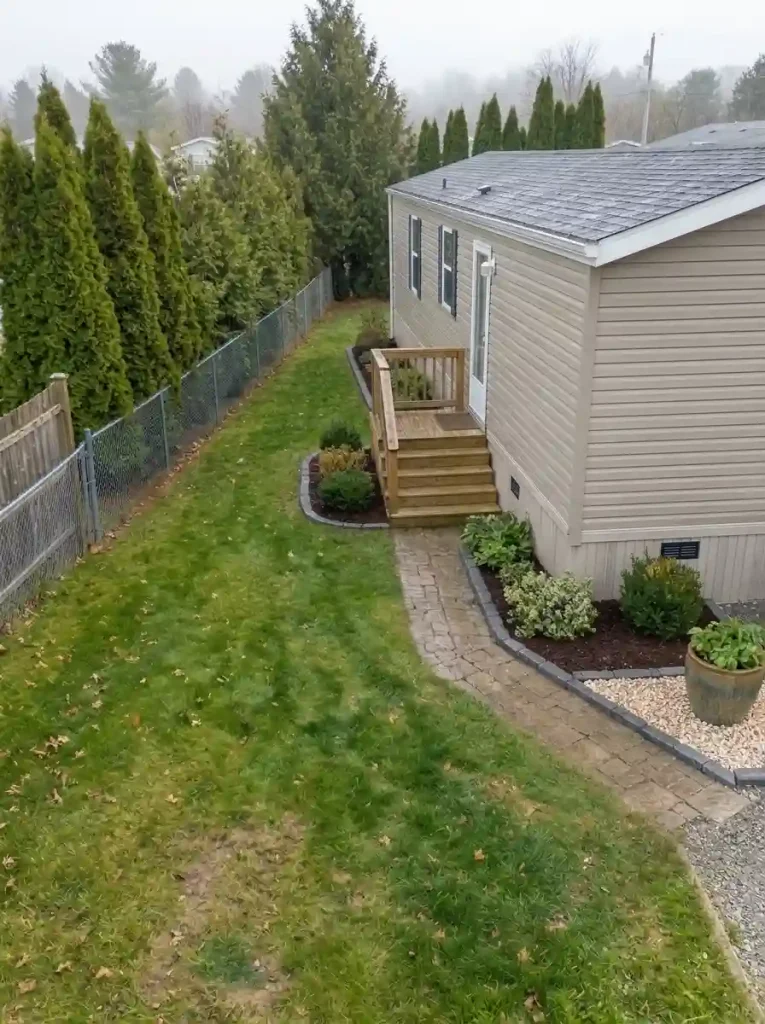
Imagine sitting on your front porch and discovering that the only unwanted view comes from a neighboring driveway. Surrounding the entire single-wide lot with tall fencing or dense evergreen planting would solve a much larger problem than the one you actually have.
Targeted privacy landscaping offers a more efficient solution.
Stand or sit in the area where privacy matters. Identify the specific view you would like to soften, then mark the boundary section that could provide screening without consuming unnecessary space.
A permitted timber privacy panel, a short evergreen border, or a coordinated combination of planting and screening may be sufficient.
Check community rules, property boundaries, underground utilities, and required access before adding permanent features. Keep driveway visibility open.
By screening one carefully chosen area, you can preserve the attractive open character of the rest of your yard.
10. Turn Awkward Drainage Areas Into Planned Landscape Transitions
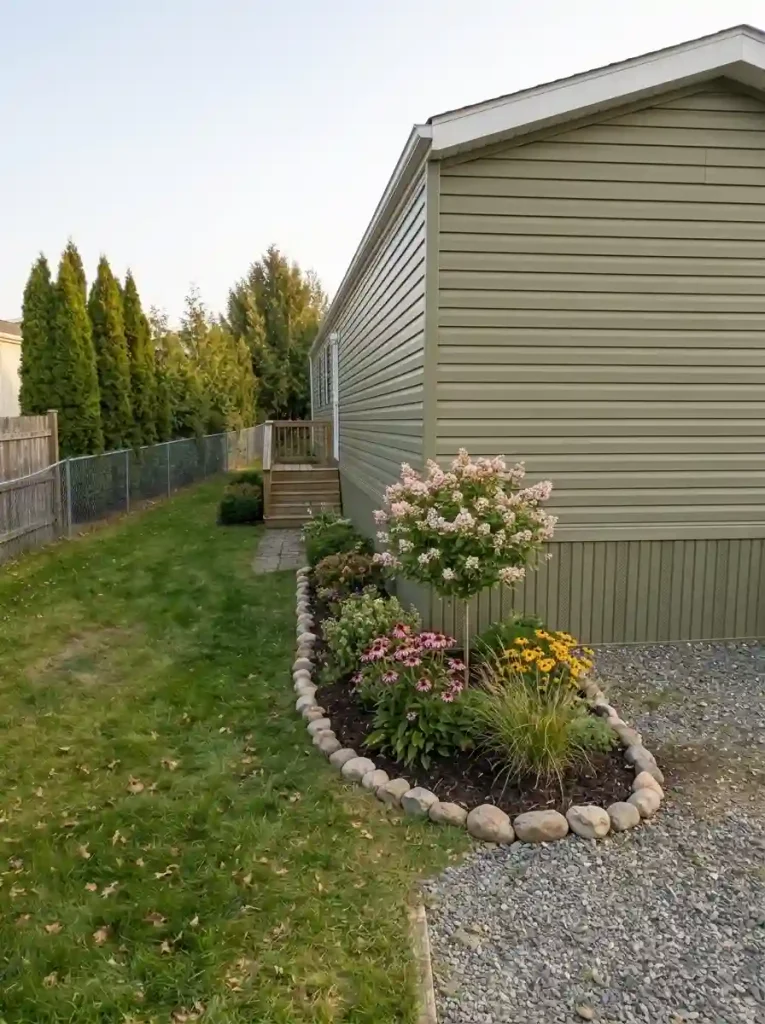
Decorative landscaping should never hide an unresolved water problem.
The narrow spaces around manufactured homes can make runoff difficult to manage, particularly where nearby driveways, neighboring lots, or existing garden edges influence how rainwater moves.
After a period of rainfall, inspect the property from the entrance to the rear boundary. Notice recurring puddles, erosion, and areas where water moves toward or beneath the home.
The federal manufactured-home installation standards in 24 CFR § 3285.203 address site drainage and protecting the area beneath the structure from water accumulation.
Where an established drainage route already works, preserve it when adding decorative stone or planting. Avoid introducing raised borders that interrupt runoff.
Persistent pooling, erosion, or water collecting beneath the home requires appropriate professional assessment before landscaping proceeds.
Gravel may improve the appearance of a suitable surface, but adding it over a wet area does not automatically resolve the underlying drainage issue.
11. Keep One Continuous Lawn Panel for a More Spacious Appearance
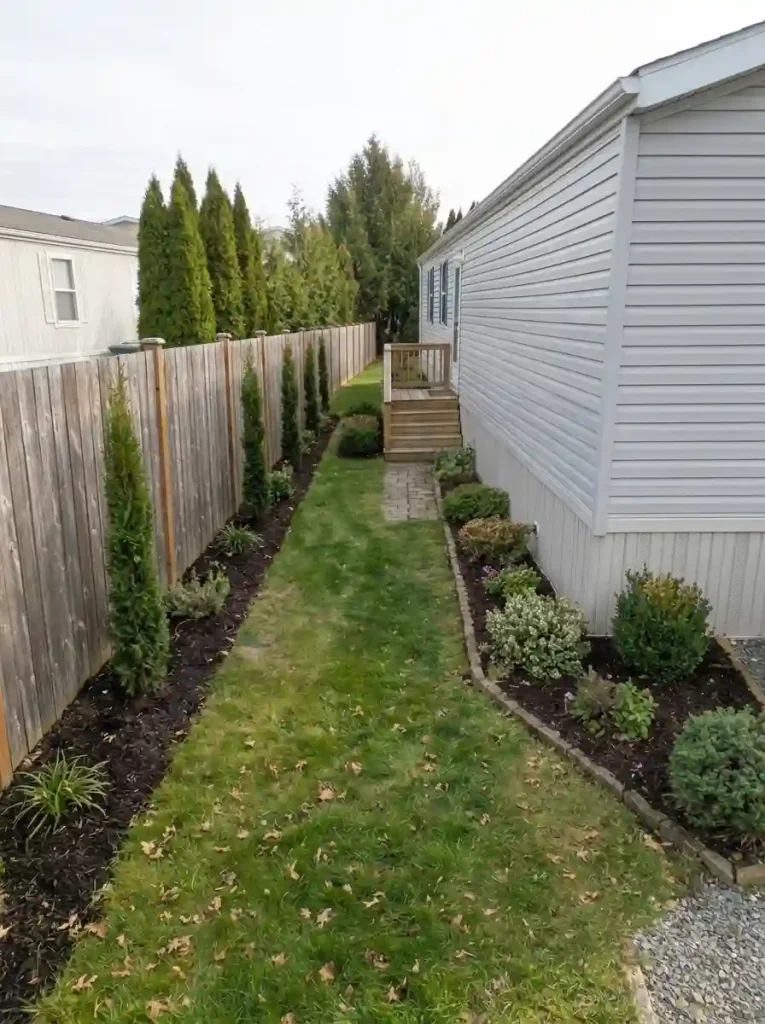
On a small single-wide property, open lawn can be just as valuable as a beautifully planted garden.
Several flower beds scattered across the center of the yard may leave narrow, disconnected grass sections that are awkward to mow and difficult to use. Moving most planting toward the perimeter often creates a more flexible outdoor area.
Consider consolidating decorative planting along the front exterior, one boundary, or an exposed corner. Preserve the largest practical uninterrupted area for recreation, temporary seating, or simply visual breathing room.
In regions where maintaining grass is difficult or water-intensive, the same spatial principle can be applied to a suitable open courtyard or other locally appropriate low-maintenance surface.
Should you prefer a permanent seating zone, these mobile home patio ideas for small yards offer ways to incorporate outdoor living within a modest property.
SPACE LAB / SAME LOT, NEW ARRANGEMENT
See what happens when planting moves to the edge
Fragmented lawn: scattered beds interrupt the center and create awkward mowing routes.
Continuous lawn: grouped perimeter planting preserves a larger connected area for play, seating or mowing.
12. Transform an Exposed Short-End Corner Into a Compact Garden Feature
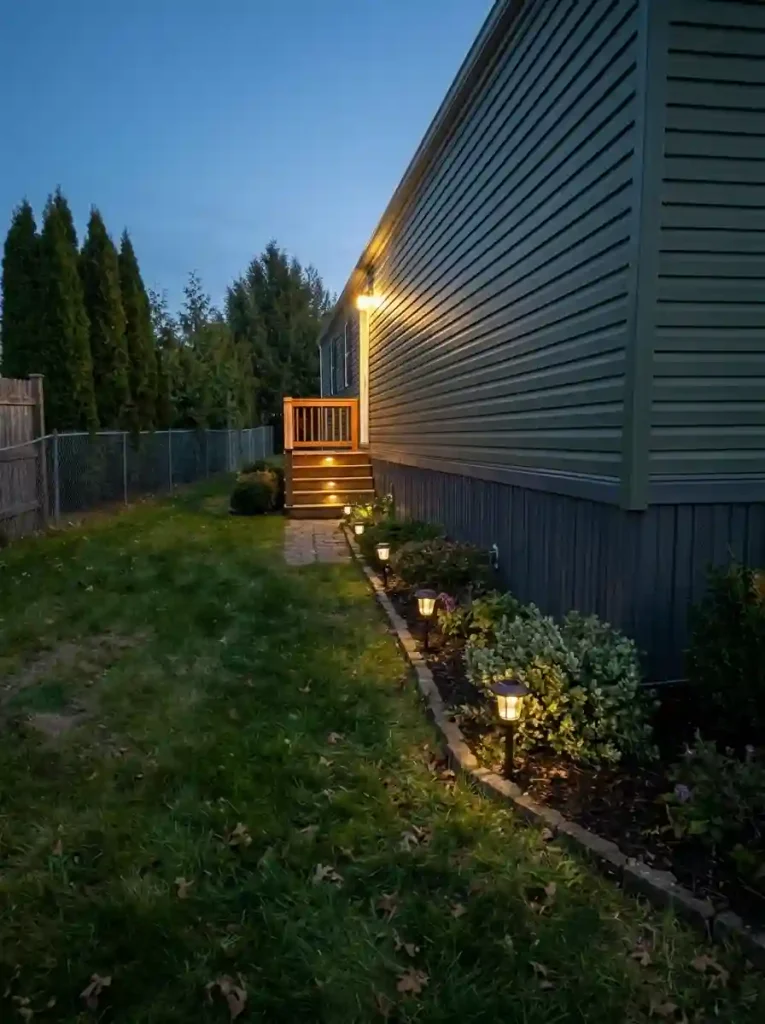
The short end of a single-wide home is often overlooked, especially when most attention goes toward decorating the long front exterior.
Yet on a corner lot or a property facing a driveway, that narrow end may be the first area visitors notice.
Create a compact feature garden with one appropriately sized focal plant, a lower supporting group, and a well-defined border.
A small flowering shrub could anchor a sunny corner surrounded by regional perennials and ornamental grasses. In a shaded location, contrasting foliage textures may provide greater interest than flowers.
Before committing to the arrangement, view the corner from the road or usual parking area.
Keep driveway sightlines and service access clear. The feature should improve the home’s visual identity from the main approach without creating another obstruction on an already restricted lot.
13. Use Slim Vertical Plantings Where a Full Hedge Will Not Fit
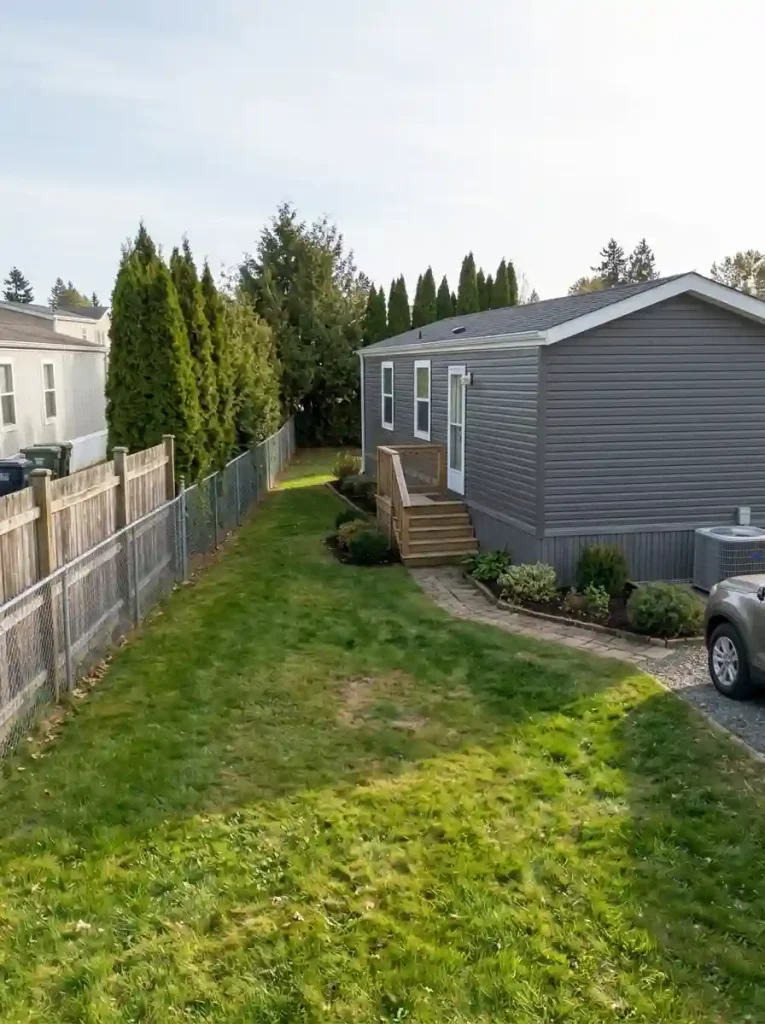
Tall greenery can soften a privacy fence and visually balance a single wide’s horizontal roofline. The challenge is finding plants that provide vertical interest without spreading across the available passage.
Choose your approach according to the actual space.
Very restricted width: A permitted freestanding screen or another narrow, non-planted feature may be more practical than woody vegetation.
Moderately narrow planting bed: Explore columnar evergreen varieties that suit your local growing conditions.
A deeper boundary bed: Combine an upright focal plant with lower companion planting for a layered effect.
Columnar junipers and selected narrow arborvitae varieties may be worth investigating in suitable climates. Check the mature height and width of each named cultivar, including the space needed for maintenance.
A narrow nursery container does not indicate a narrow mature plant. Leave enough room for growth without relying on constant pruning to preserve the passage.
14. Illuminate the Landscape at Ground Level With Warm Solar Lights
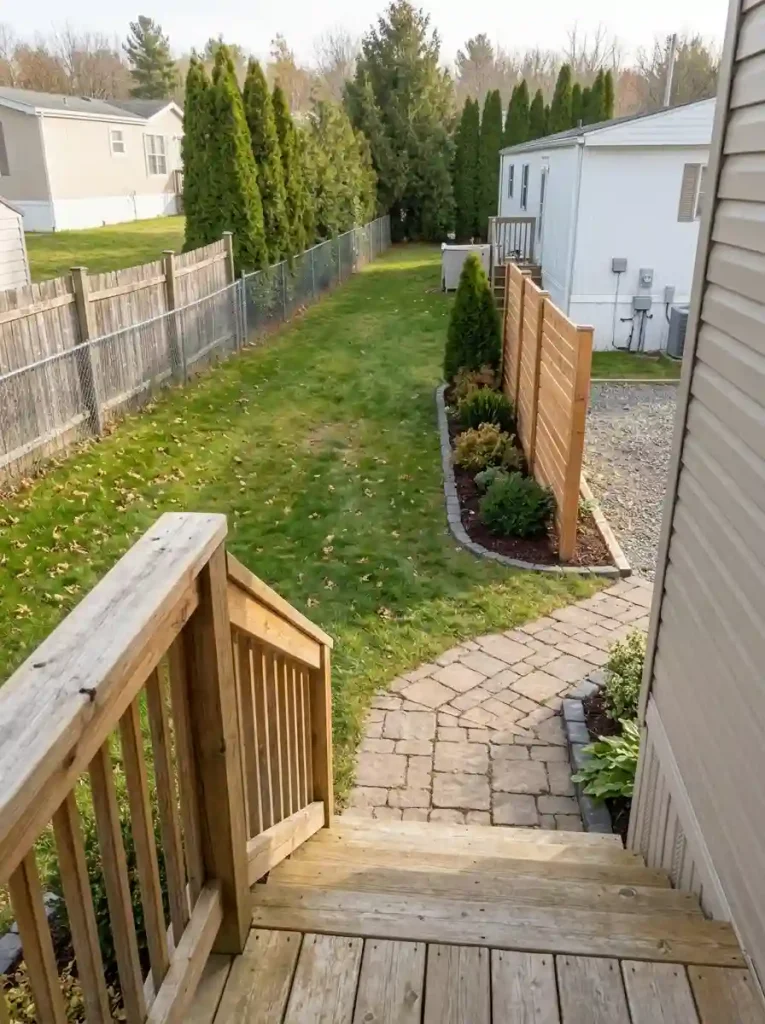
At dusk, warm garden lights can completely change the atmosphere of a modest single-wide yard.
A few softly illuminated planting groups, a visible path toward the entrance, and light reflecting from natural stone or timber can give the exterior an inviting evening appearance.
Walk through the yard after dark before deciding where to place the fixtures. Look for pathway bends, changes in surface level, and decorative areas that disappear into shadow.
Warm-white solar lights around 2700–3000K are a useful aesthetic starting point for a cozy appearance. Actual brightness, fixture spacing, and solar exposure should determine the final arrangement.
Place lights where they will not interfere with mowing or walking.
Decorative solar stakes can enhance the atmosphere, but reliable entrance and stair lighting should remain a separate priority wherever safe nighttime movement is necessary.
15. Replace a Difficult-to-Mow Side Strip With Low-Maintenance Ground Cover
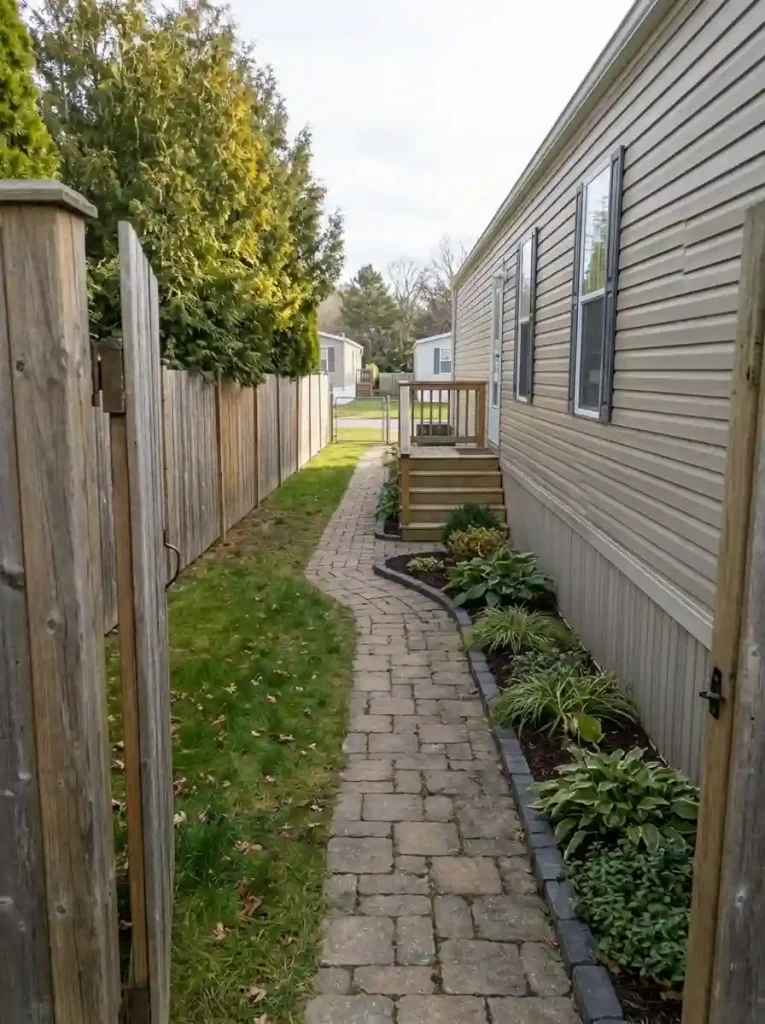
A narrow strip between the home and a neighboring fence can become one of the most frustrating parts of a single-wide landscape. Grass may be awkward to mow there, while larger plants would obstruct the passage.
Start with a simple width calculation.
Suppose the available strip measures 72 inches and you have identified 48 inches of non-overlapping space that must remain reserved for walking and other required clearances.
That leaves 24 inches of potential planting width before accounting for any additional maintenance needs.
For a shaded strip, locally suitable sedges or other low-growing plants may work. In a sunny, dry area, investigate regionally adapted ground covers with manageable spread. Where planting would compromise access, use an appropriate non-planted surface or retain a clear walkway.
Avoid invasive spreading plants that could extend into neighboring lots. The most successful side-yard treatment is the one that reduces maintenance without sacrificing necessary access.
WIDTH BUDGET / PLANTING CALCULATOR
How much room is left for plants?
Remaining planting width
48 − 36 = 12 in. Compare mature plant spread with this space.
48 − 48 = 0 in. Keep the strip clear.
48 − 60 = -12 in. Short by 12 in; revise the layout, not required clearances.
48 − 72 = -24 in. Short by 24 in; revise the layout, not required clearances.
60 − 36 = 24 in. Compare mature plant spread with this space.
60 − 48 = 12 in. Compare mature plant spread with this space.
60 − 60 = 0 in. Keep the strip clear.
60 − 72 = -12 in. Short by 12 in; revise the layout, not required clearances.
72 − 36 = 36 in. Compare mature plant spread with this space.
72 − 48 = 24 in. Compare mature plant spread with this space.
72 − 60 = 12 in. Compare mature plant spread with this space.
72 − 72 = 0 in. Keep the strip clear.
96 − 36 = 60 in. Compare mature plant spread with this space.
96 − 48 = 48 in. Compare mature plant spread with this space.
96 − 60 = 36 in. Compare mature plant spread with this space.
96 − 72 = 24 in. Compare mature plant spread with this space.
16. Add a Small Pollinator Garden Without Losing Usable Yard Space
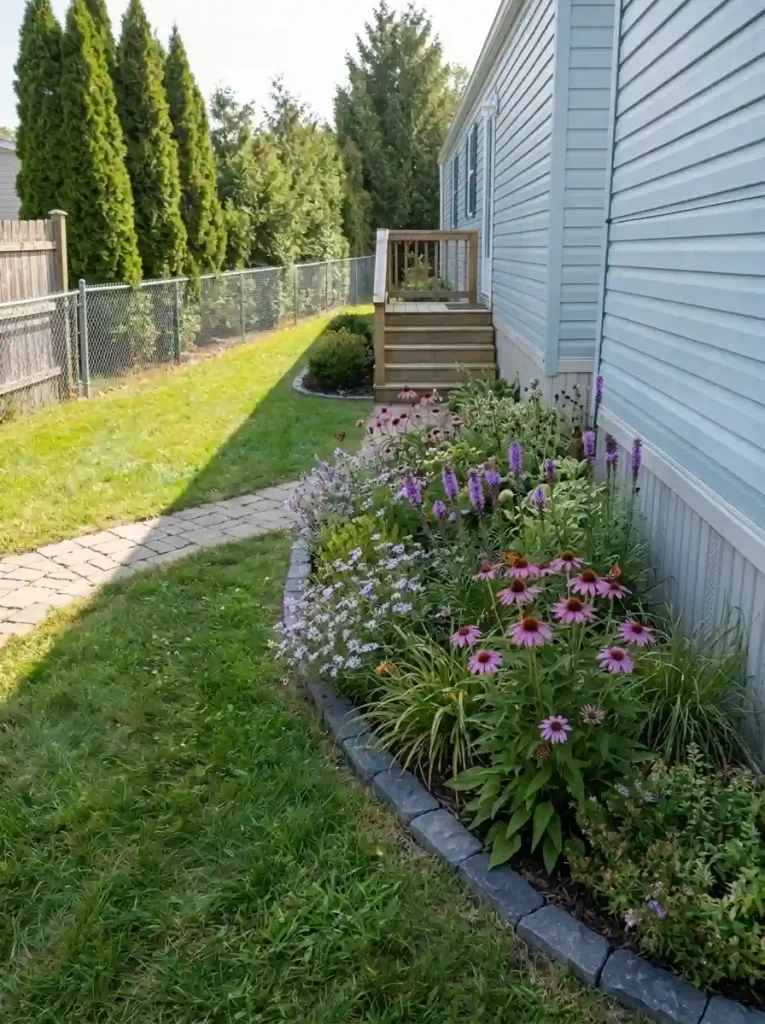
A compact pollinator garden can introduce colorful flowers, seasonal activity, and a more natural character to a single-wide property. It does not need to occupy the entire front lawn.
Choose one suitable perimeter planting pocket, ideally where the growing conditions match the plants you intend to use.
Cornell Cooperative Extension’s guide to creating pollinator-friendly gardens recommends combining suitable native plants with different flowering periods.
Depending on your region, native coneflowers, asters, blazing stars, or appropriately selected milkweeds may provide inspiration.
Start with a small group of compatible species and allow room for their eventual growth. A compact collection of plants with complementary blooming periods offers more sustained interest than a large assortment flowering at once.
Position the garden away from heavily used steps and narrow door approaches, especially where household members prefer to avoid frequent insect activity.
17. Use Movable Container Gardens on Rented Mobile Home Lots
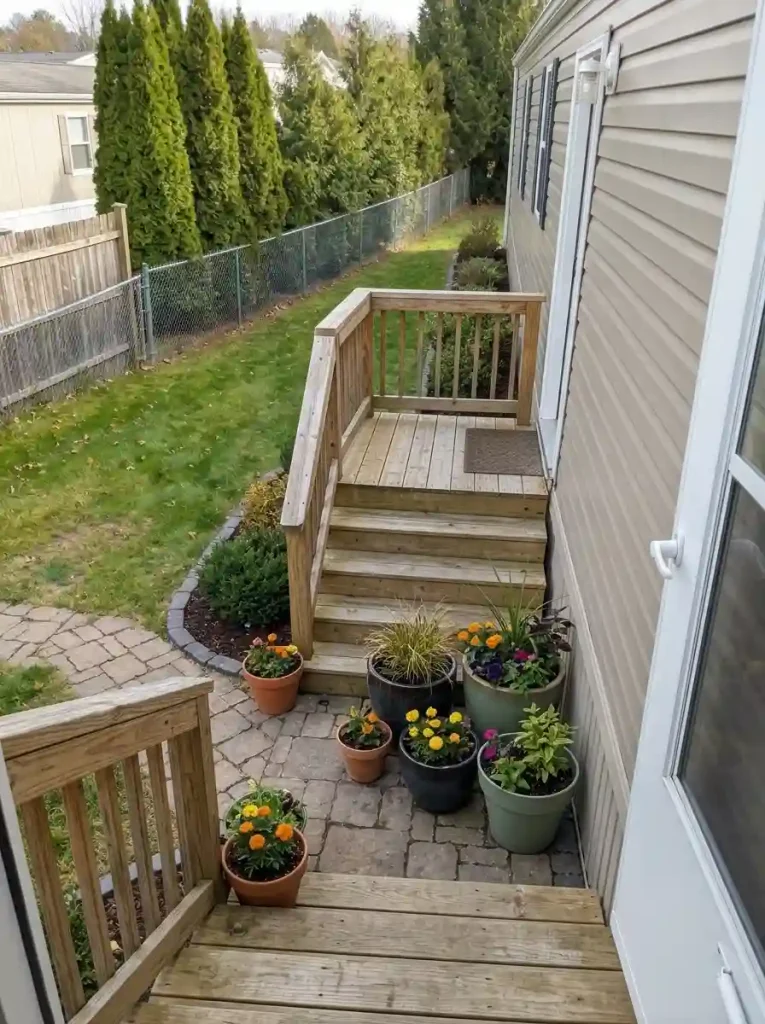
When you rent a lot in a manufactured-home community, permanent planting and excavation may require permission. Containers offer a flexible alternative that can still produce a beautifully landscaped entrance.
A coordinated group of pots near the porch, an approved patio, or another suitable outdoor area can introduce different foliage heights without permanently changing the property.
Before purchasing containers, check:
- Whether their placement complies with community rules.
- Whether doors, stairs, and shared routes remain unobstructed.
- Whether the pots are stable and have appropriate drainage.
- Whether they can be moved when maintenance or relocation is necessary.
- Whether the plants suit the available sunlight and watering routine.
Choose containers in two or three complementary finishes to create a coordinated appearance.
Lightweight planters can be particularly useful for residents who may relocate, although they must remain sufficiently stable for local wind conditions. Avoid placing heavy pots on structures that have not been assessed for the additional load.
18. Soften Raised Deck Skirting With an Accessible Planting Border
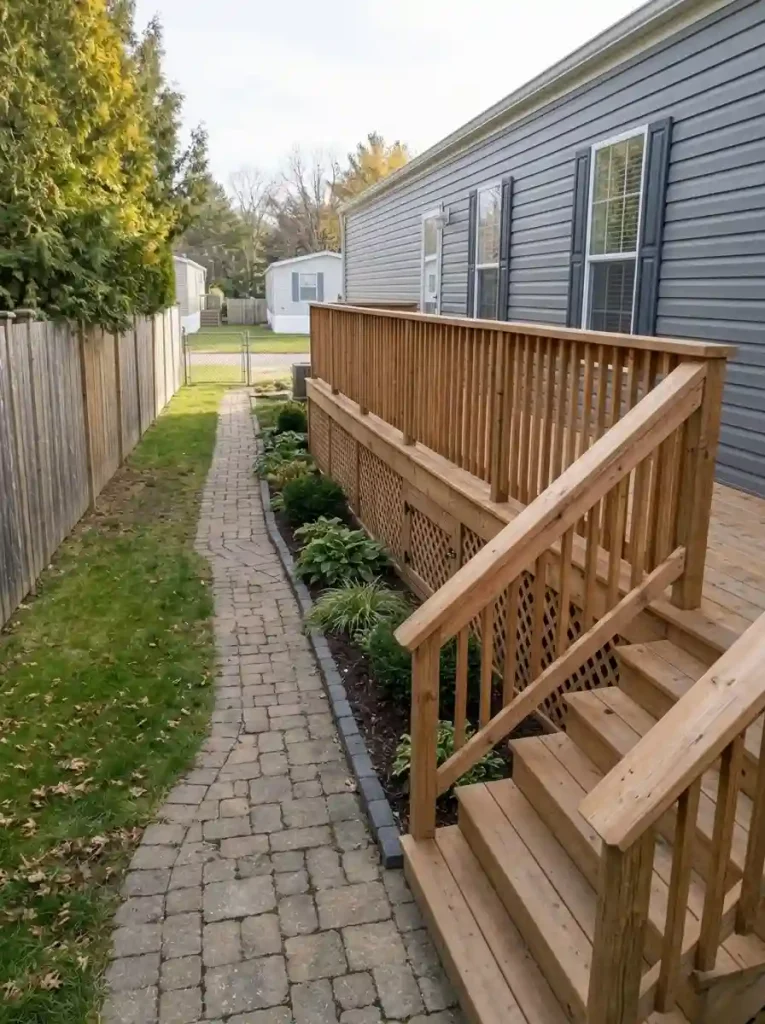
The visible gap between a raised deck and the lawn can make an outdoor living area feel disconnected from the rest of a single-wide property.
Low planting groups along selected portions of the deck edge help create a softer transition from timber to grass.
However, access requirements take priority over visual continuity. Deck inspection points, removable panels, utilities, and any nearby manufactured-home skirting vents must remain usable.
For manufactured homes subject to the relevant installation standards, 24 CFR § 3285.505 establishes crawlspace ventilation and access provisions.
Use removable containers or interrupted planting groups around areas requiring access. Place permanent shrubs only where their mature growth will not interfere with inspection or maintenance.
This approach gives the deck a garden-like setting without turning the surrounding planting into a permanent barrier.
19. Upgrade Existing Garden Edges Before Buying More Plants
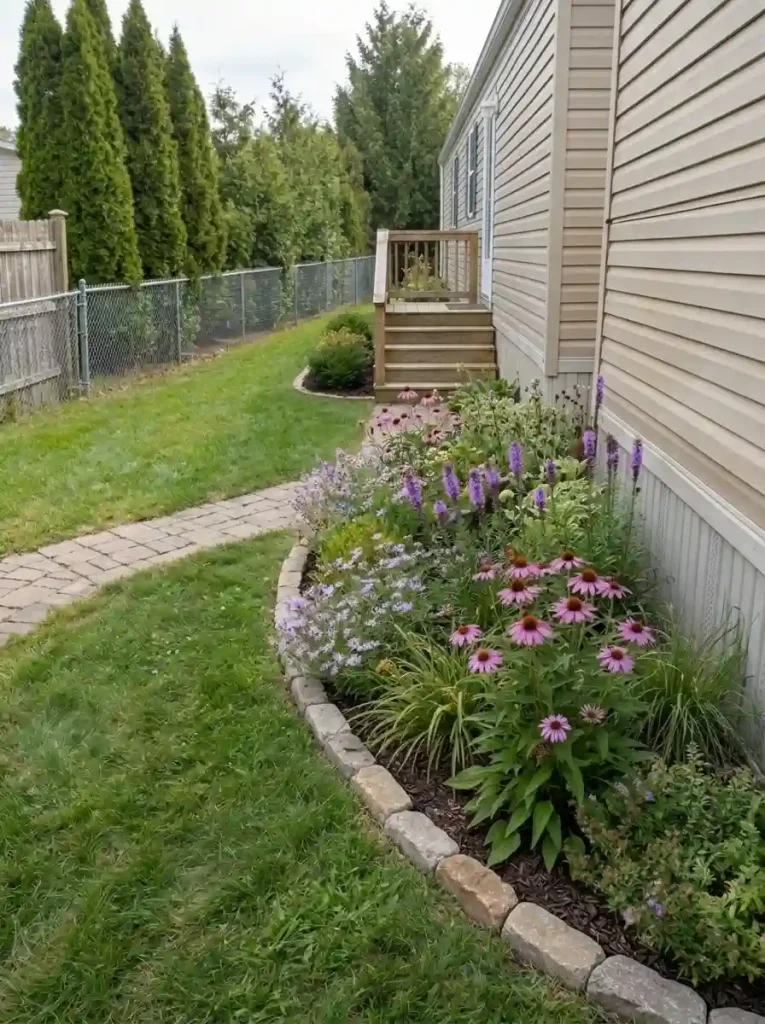
An attractive single-wide landscape doesn’t necessarily require an entirely new collection of plants.
Sometimes the most noticeable improvement comes from restoring what is already there.
| Existing landscape problem | First improvement |
|---|---|
| Grass spreading into beds | Restore the existing garden edge |
| Healthy but crowded plants | Review appropriate pruning or relocation |
| Deteriorated mulch | Replenish suitable existing material |
| Unstable decorative edging | Repair or replace the affected sections |
| Unrelated garden features | Remove unnecessary elements |
Measure the length and area of the existing beds before buying materials.
For example, a rectangular bed measuring 20 feet by 2 feet covers 40 square feet. If the appropriate additional mulch depth is one inch, the approximate material volume is 3.3 cubic feet, excluding irregularities and any allowance for waste.
Prioritize drainage and necessary access repairs before cosmetic purchases.
For additional affordable property improvements, explore these mobile home exterior ideas on a budget.
WEEKEND PROJECT / PRIORITY FINDER
What should you improve first?
Resolve functional issues
Check drainage and restore required access. Seek professional assessment for persistent pooling or equipment concerns.
Work with existing plants
Check mature size and suitable pruning or relocation before buying replacements.
Refresh the garden edge
Repair loose edging and measure the bed before replenishing suitable mulch.
Add one focal feature
Choose a compact entrance or corner planting and repeat existing materials.
20. Design a Four-Season Planting Mix for a Narrow Front Bed
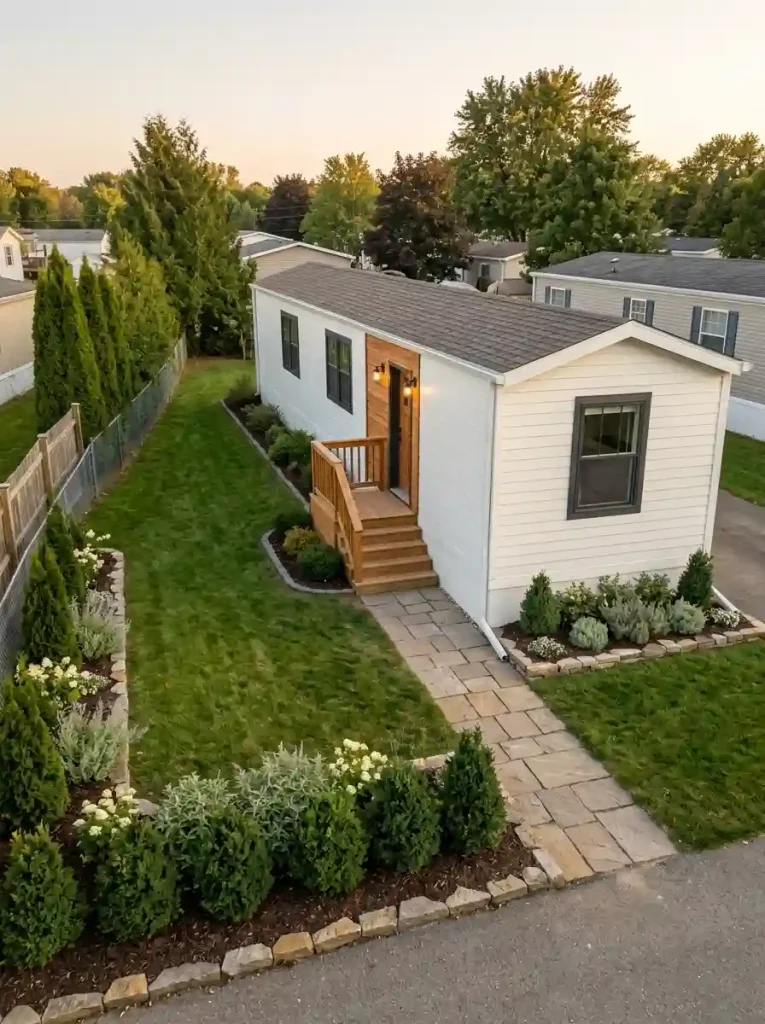
A narrow front garden has limited capacity to accommodate plants that contribute beauty for only a short period. Choosing vegetation with different seasonal strengths allows a small single-wide landscape to remain interesting throughout more of the year.
Build around a simple seasonal sequence.
Spring — Early interest: Select suitable emerging foliage or early-flowering perennials.
Summer — Color and texture: Introduce longer-blooming plants and attractive foliage combinations.
Fall — Changing character: Consider regional plants with autumn color or decorative seed heads.
Winter — Garden structure: Preserve interest with suitable evergreens, persistent foliage, ornamental stems, or attractive dormant plant forms.
A compact evergreen combined with a few complementary flowering perennials can provide more lasting visual value than several short-lived decorative arrangements.
Actual flowering times, cold tolerance, and winter appearance depend on the growing region. In warmer climates, choose a sequence that reflects local seasonal patterns.
21. Coordinate the Entire Single Wide Landscape With One Restrained Design Palette
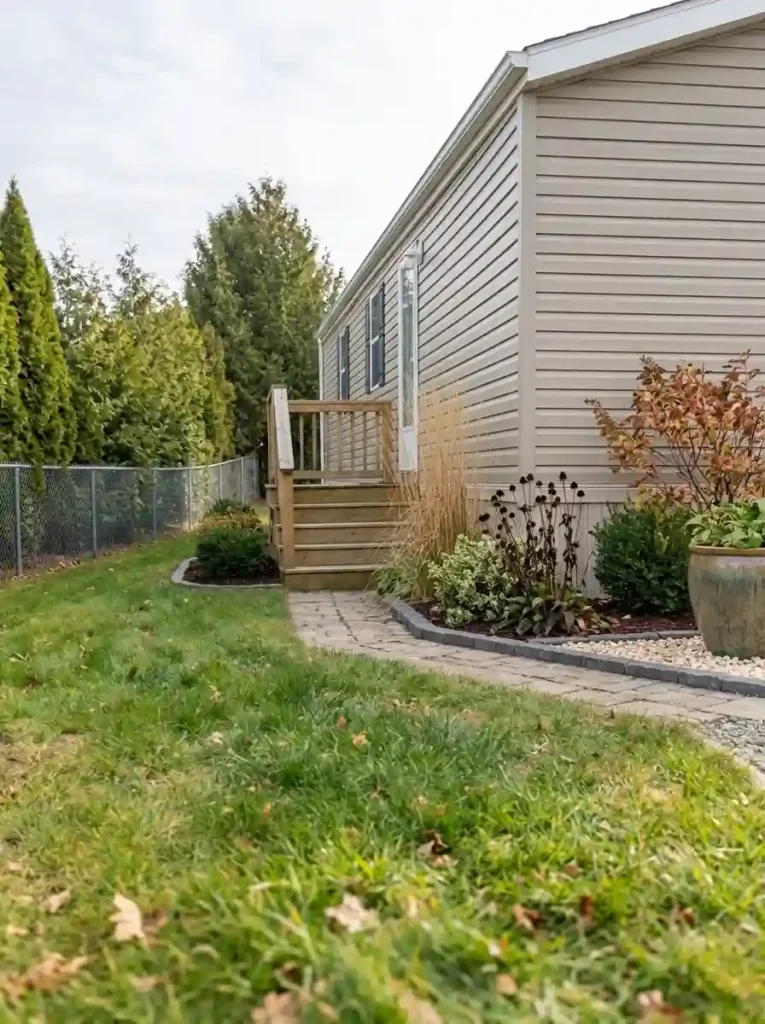
The finishing touch is often the relationship between the landscape and the home’s existing exterior colors.
A sage-green single wide can look beautiful with cedar-toned timber, cream flowers, dark bark mulch, and deep evergreen foliage. A white exterior with black trim may suit natural stone, silver-green plants, and carefully placed warm lighting.
Before buying another decorative item, identify the materials and colors already present on your property.
Choose a dominant garden material, a complementary edging finish, and a restrained selection of foliage or flower colors. Carry those elements through the entrance garden, foundation planting, and boundary features.
Allow each area to have its own function while maintaining a consistent visual identity.
The same principle appears in these mobile home exterior makeover ideas, where coordinated architectural finishes and landscaping contribute to a more cohesive overall appearance.
Final Thoughts
Beautiful single wide landscaping ideas don’t need to involve major construction, expensive materials, or a yard filled with plants.
Begin with a simple weekend project. Observe how your outdoor space is used, check drainage and access requirements, and outline one potential planting area with a removable marker.
Once any necessary permissions and utility checks are complete, restore an existing garden edge, refresh an appropriate planting bed, or introduce a compact group of plants near the entrance.
Build the rest of the landscape gradually, using the available space as your guide.
A thoughtfully landscaped single-wide home should feel welcoming from the street, comfortable to move around, and manageable throughout the year. Sometimes the most beautiful improvement is knowing exactly where to plant—and where to leave the yard open.