

A double-wide gives Halloween decorating something a compact entry does not: width. That extra frontage can support larger, more dramatic ideas, but it also makes weak composition easier to notice. If the door, every window, each porch post, the steps, landscaping, and mailbox all receive equal attention, the exterior can start looking like several unrelated Halloween displays lined up beside one another.
The strongest Halloween double wide exterior decor usually works from the architecture outward. One zone leads, supporting areas repeat part of its palette or shape, and several surfaces remain intentionally calm. That structure lets bats, floating witch hats, branches, jack-o’-lanterns, skulls, ghosts, and dramatic lighting feel playful without losing polish.
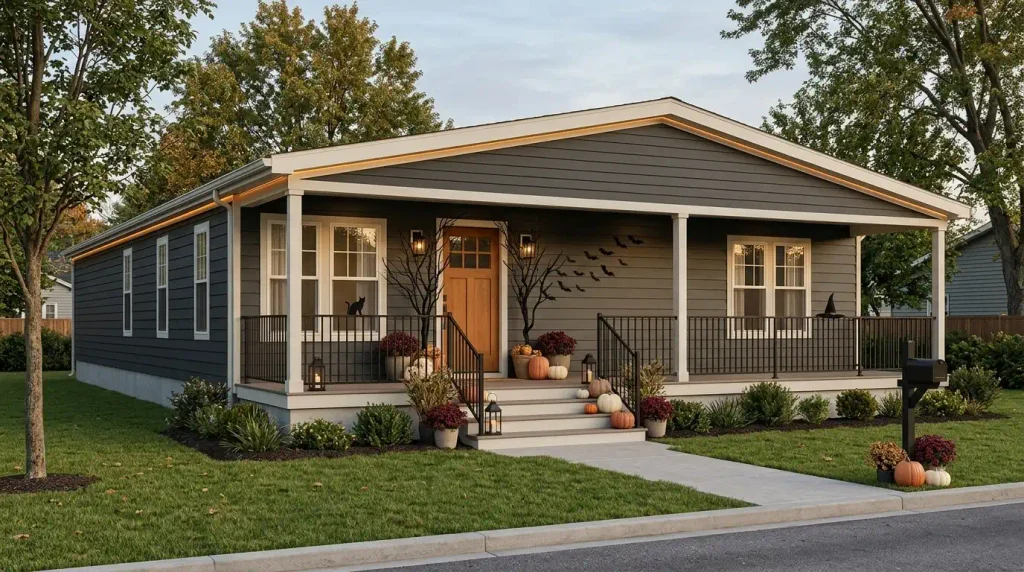
These 21 ideas move from the curb toward the façade, windows, porch ceiling, steps, landscape, and nighttime view. Start with the whole house before buying another decoration. The façade mapper in Idea #2 will help you decide exactly where your strongest Halloween moment belongs.
1. Judge the Whole Double-Wide From the Curb Before You Add Halloween Decor
Stand far enough away that the full front elevation fits comfortably inside your phone camera. A double-wide can give the eye several strong targets at once: an entrance, a long porch, paired windows, steps, landscaping, and sometimes a detached mailbox.
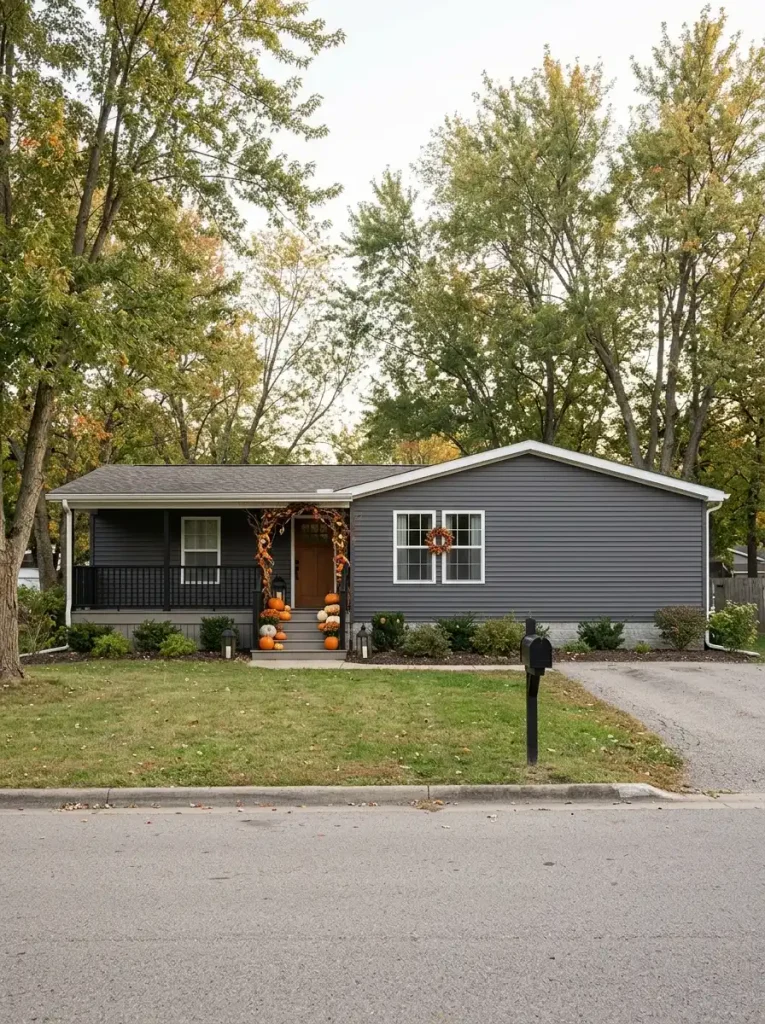
Assign those areas three roles:
- Lead: the Halloween feature you want noticed first.
- Support: smaller details that repeat its palette, material, or shape.
- Quiet: undecorated siding, lawn, porch floor, or architecture that separates the stronger moments.
A useful test is to shrink your photograph on-screen. If three different displays still demand equal attention, the exterior probably needs editing before it needs another prop.
For a broader look at how mobile-home façades behave as one curb-view composition, continue with StylishGalore’s fall mobile home exterior decor guide. For Halloween, keep that whole-house discipline while allowing one spooky element to become more theatrical.
2. Choose the Halloween Anchor That Fits Your Double-Wide’s Front Layout
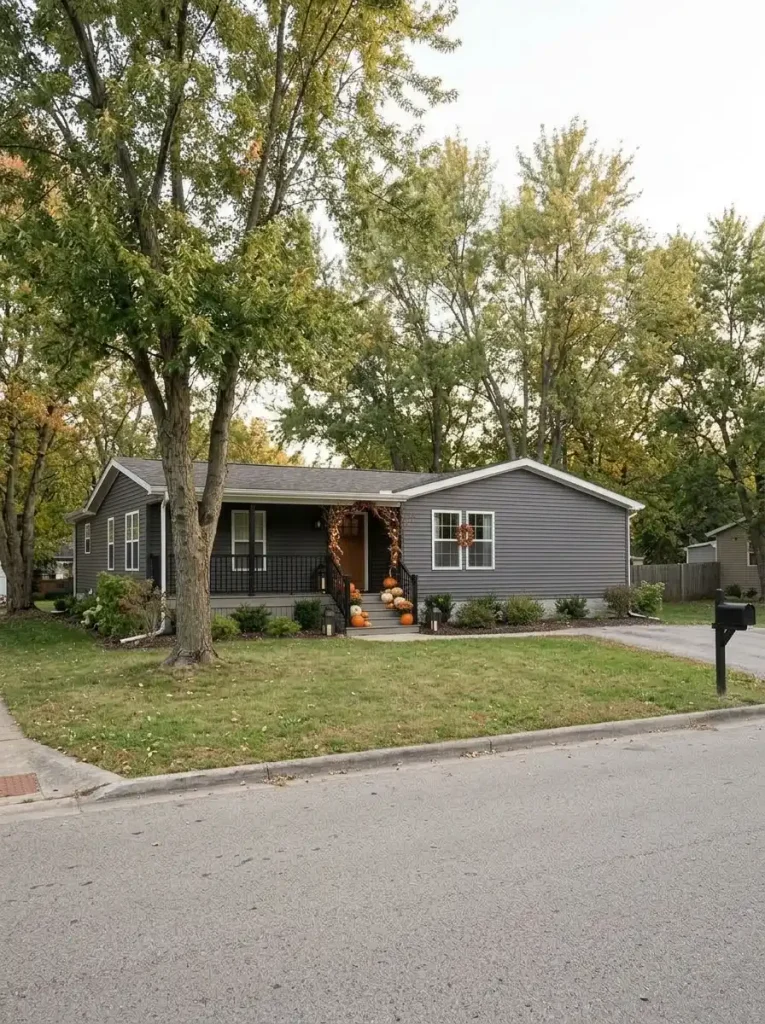
A centered door, an offset entrance, and a long porch-dominant elevation should not receive the same décor pattern.
A centered entrance can naturally organize decorations on both sides. An offset door often needs a visual counterweight farther across the frontage. A long covered porch can handle a larger overhead or side-bay installation because the architecture already gives the eye a horizontal framework.
Use this mapper before spreading decorations from end to end.
Double-Wide Façade Anchor Mapper
Choose the frontage that most closely resembles your home. The highlighted area should carry the strongest Halloween visual weight.
Door
Entry
Porch bay
The exercise is useful because it determines where not to decorate. Once the lead zone is decided, every other Halloween purchase has to justify why it belongs somewhere else.
3. Build a Classy Halloween Palette From the Siding, Door and Roof You Already Have
Permanent exterior finishes already supply much of your color scheme.
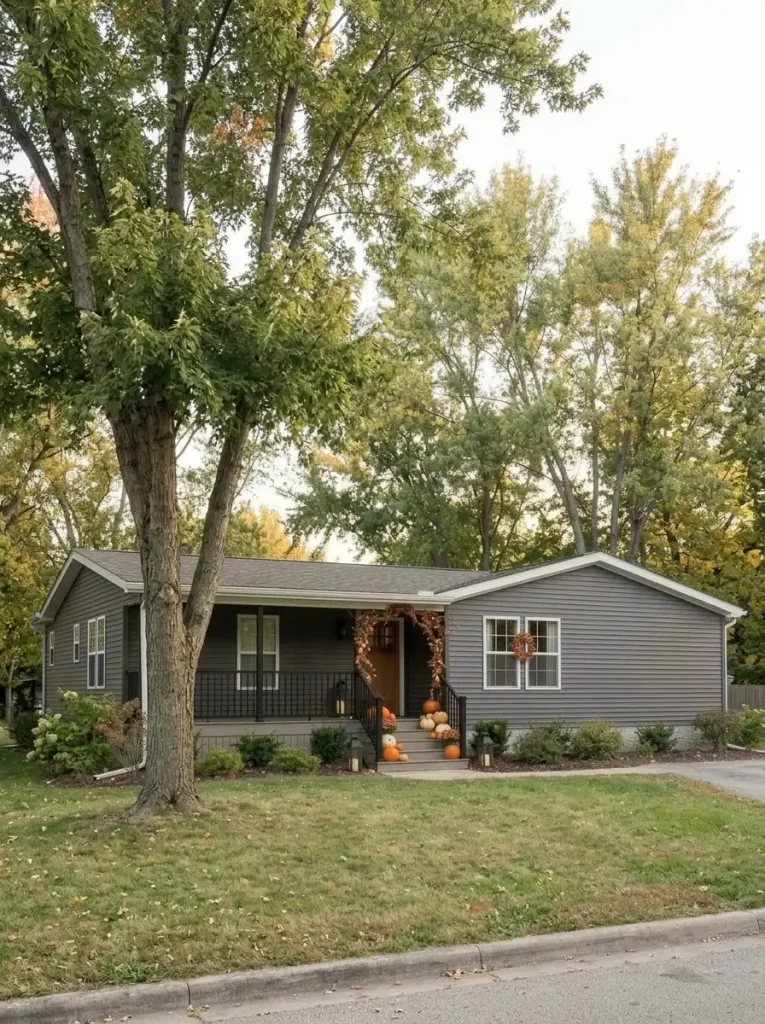
Warm beige or cream siding pairs naturally with charcoal, muted pumpkin, dark brown, and oxblood. Cool gray siding can support black, bone, burgundy, and weathered olive. A white exterior with a black door can carry an even stricter black-and-ivory scheme, with orange appearing only where you want the eye to stop.
Give every seasonal color one role:
- Base: relates to the existing house.
- Support: repeats across several areas.
- Accent: appears in the smallest quantity and marks focal points.
That limit prevents every inexpensive Halloween object from introducing another competing hue.
If you want the polished result without turning the exterior into an expensive shopping project, StylishGalore’s cheap Halloween decor ideas for mobile homes that look high-end owns the deeper budget side of that problem.
Exterior Palette Matcher
Start with the permanent color you see most from the curb.
4. Balance an Off-Center Entry With One Tall Dark Accent and One Low Pale Cluster
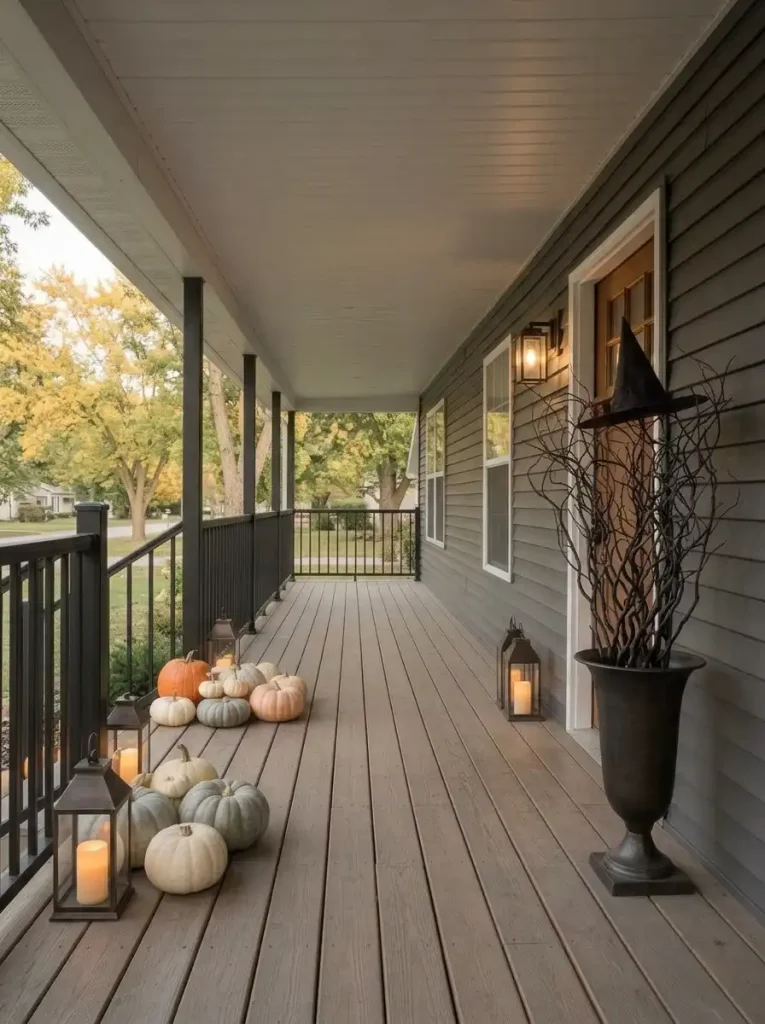
An entrance located toward one side of a double-wide can look stranded when all the seasonal décor hugs the doorway.
Mirroring two tall arrangements is not the only solution. Give the narrower side of the entrance a stronger vertical accent—bare branches, a tall dried-grass bundle, or a dark witchy silhouette. Across the door, build a wider composition closer to the floor with pale pumpkins, low lanterns, or compact mums.
Then step back until the doorway occupies only a small part of your field of view.
What should you change?
If both sides look like equal towers, lower one. If the door still seems disconnected from the remaining façade, increase the low counterweight before adding another vertical piece.
Wide-Entry Balance Lab
Read the tall accent as punctuation and the low cluster as visual ballast. When both sides demand equal attention, reduce height on the supporting side.
5. Treat the Front Window Pair as One Coordinated Halloween Composition
Paired windows are already connected by the architecture. Decorating them as two unrelated Halloween scenes breaks that relationship.
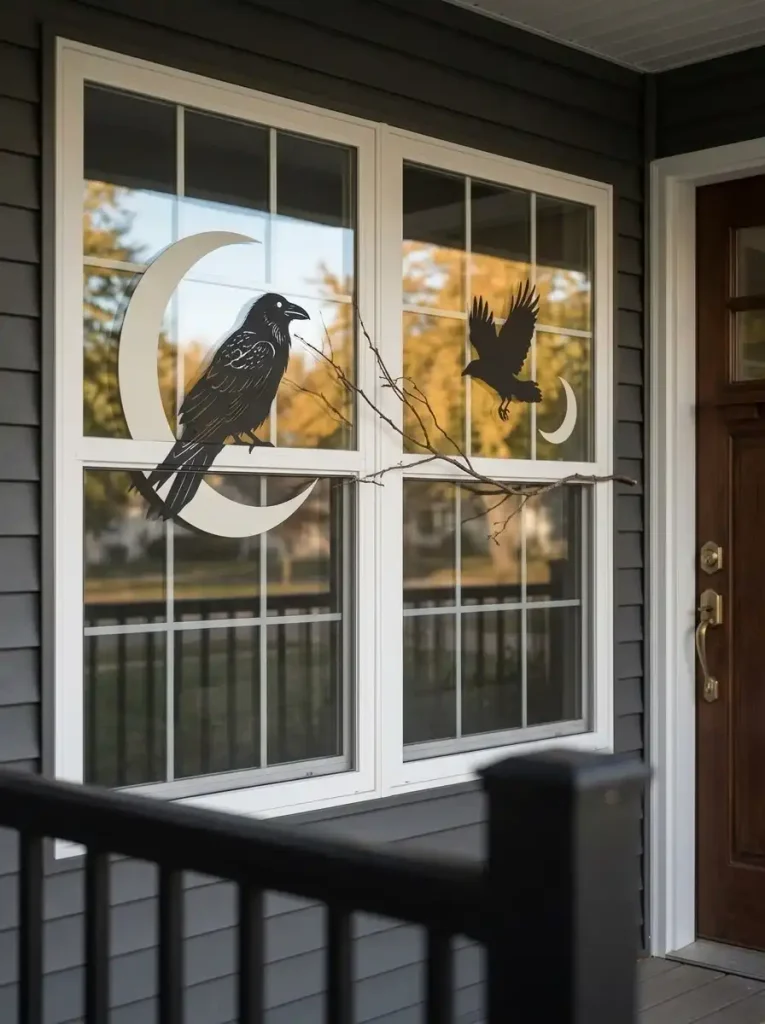
Give one window the stronger image—a large moon, raven branch, ghost silhouette, or dense bat grouping. Let the neighboring window carry a smaller echo of the same visual language. You can also use a sparse branch or garland line across the siding between them to make the pair feel deliberately linked.
Check the windows twice: once in daylight and once after interior lights become visible through the glass.
If both sides carry the same visual weight, simplify one. The pair becomes more interesting when one window starts the story and the second finishes it.
6. Send a Bat Flight Across One Siding Bay Instead of Scattering Bats Everywhere
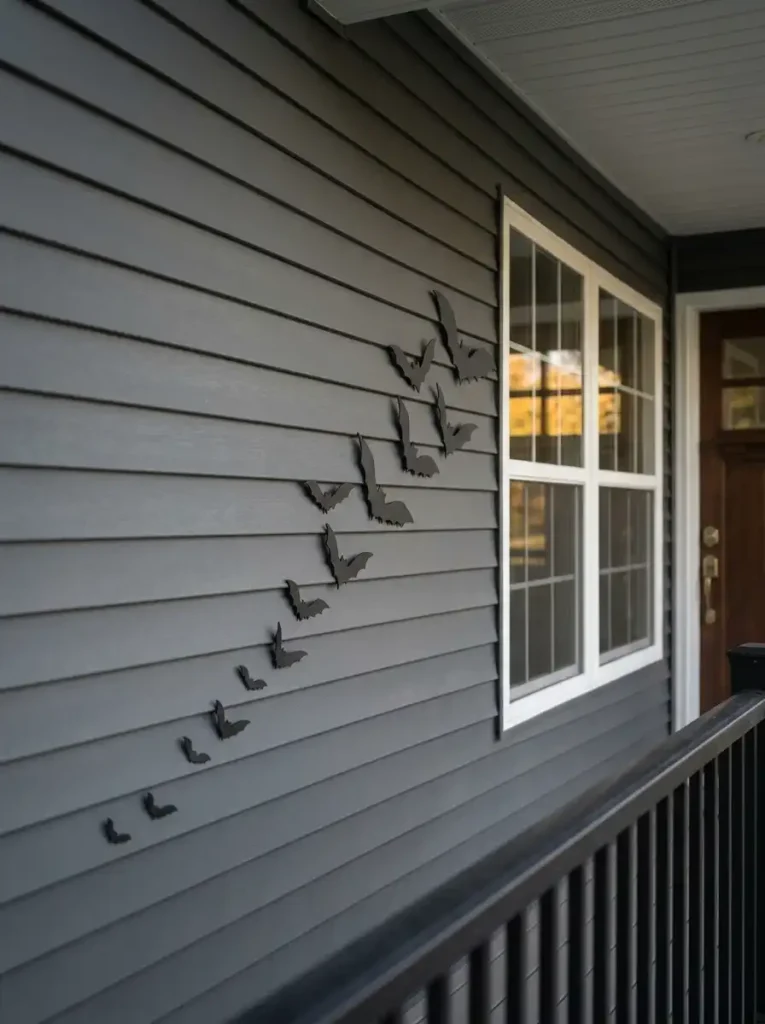
A bat installation becomes stronger once it has a visible direction.
Choose one open section of siding. Start with smaller silhouettes near an architectural edge, then increase scale gradually as the flight moves diagonally toward a window, porch post, or roofline. Keep the bats close enough to read as one movement but irregular enough to avoid a rigid stripe.
Then decide where the flight ends.
Covering the entire façade turns the bats into background pattern. Stopping within one bay leaves untouched siding around the movement, making the black silhouettes easier to read from farther away.
From the curb, you should notice the sweep first and the individual bats second.
7. Float a Small Ghost Group Along the Outer Porch Bay, Not the Main Route
A covered double-wide porch gives suspended Halloween décor plenty of vertical room. The best location is usually an outer bay where the ghosts can move visually without taking over the entrance.
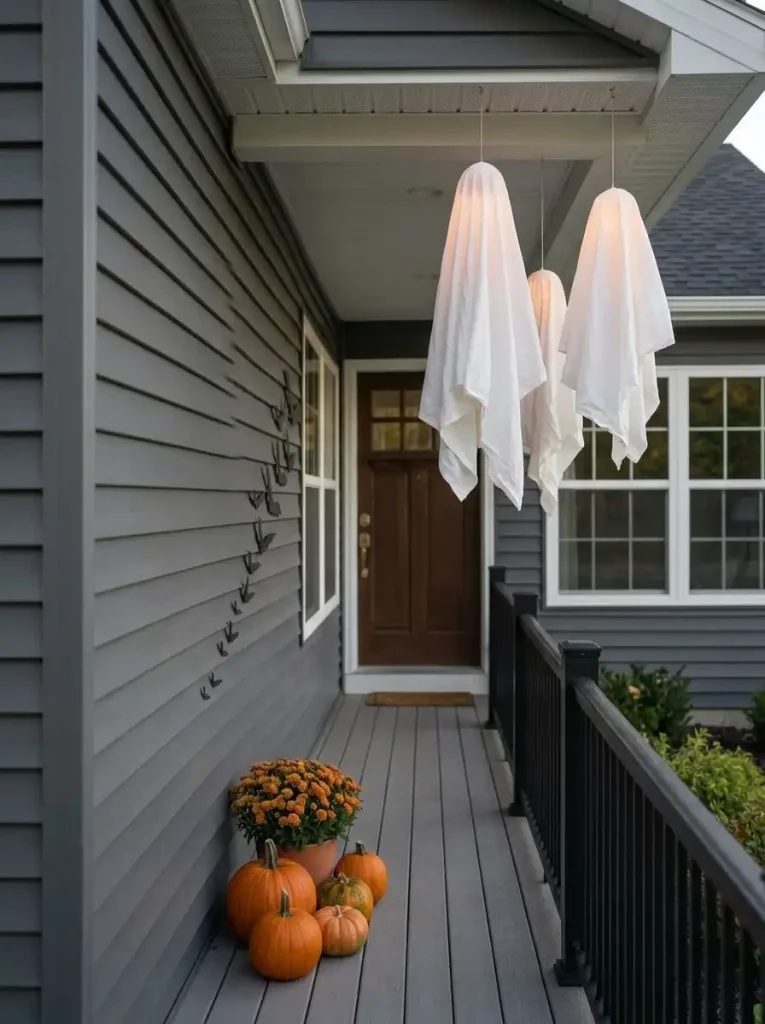
Hang two or three simple white ghost forms at noticeably different heights. Dark or muted siding creates enough contrast for them to show during the day, while evening light softens the white fabric after sunset.
Keep the main doorway and its immediate ceiling area calmer.
StylishGalore’s Halloween entryway ideas for small mobile homes owns the deeper compact-entry treatment, including how to shift Halloween impact onto doors, trim, windows, and narrow unused edges. On a double-wide porch, the useful change is moving that vertical drama into a secondary bay so the larger frontage gains depth without making the arrival point busier.
8. Hang Matte-Black Witch Hats High Enough to Read as a Canopy
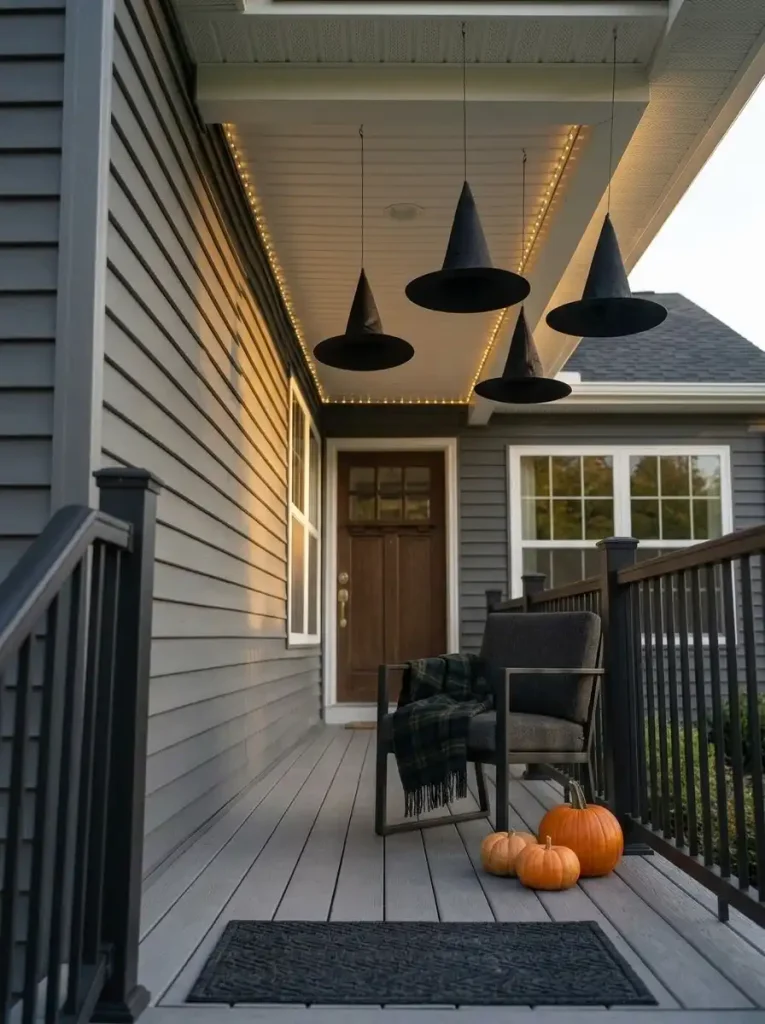
A handful of floating witch hats can fill a long porch ceiling more effectively than another row of objects on the floor.
Choose one bay—such as the seating area—and hang a sparse group with noticeable height variation. Keep enough separation between the silhouettes that each hat remains recognizable from several steps away.
Avoid stretching the installation across every ceiling bay. The concentrated group gives the porch one strong overhead event while the doorway and outer sections remain calmer.
Before installation, check the actual ceiling surface and the instructions for the hanging products or hardware you intend to use. When the intended attachment does not suit the surface or conditions, move the idea to a freestanding structure. The visual effect is optional; improvised mounting is unnecessary.
9. Taper Jack-o’-Lanterns Down One Side of the Steps
Pumpkins look more dynamic on steps when their density changes from top to bottom.
Start with one or two larger pieces near the porch. Continue the line with medium pumpkins through the middle steps and finish with smaller pumpkins toward the bottom. Add one dark lantern, a white pumpkin, or burgundy flowers to interrupt a solid orange run.
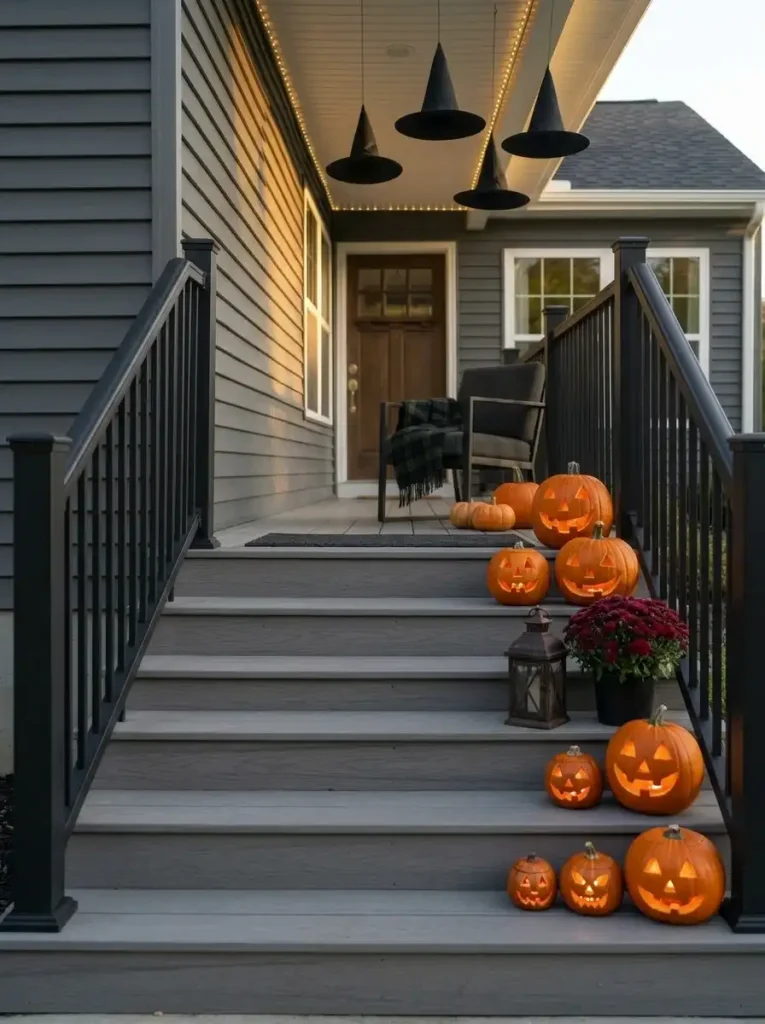
Keep the middle of the staircase visually open.
That open route does two jobs: it preserves the normal sense of approach and gives the pumpkin cascade a cleaner edge.
Take a straight-on photograph afterward. If the arrangement forms one heavy orange block at the bottom, move some visual weight higher until the eye naturally travels toward the entrance.
10. Turn One Porch Corner Into an After-Dark Halloween Table Moment
If your double-wide has a porch deep enough for an outdoor table you already use, let that routine become part of the seasonal display.
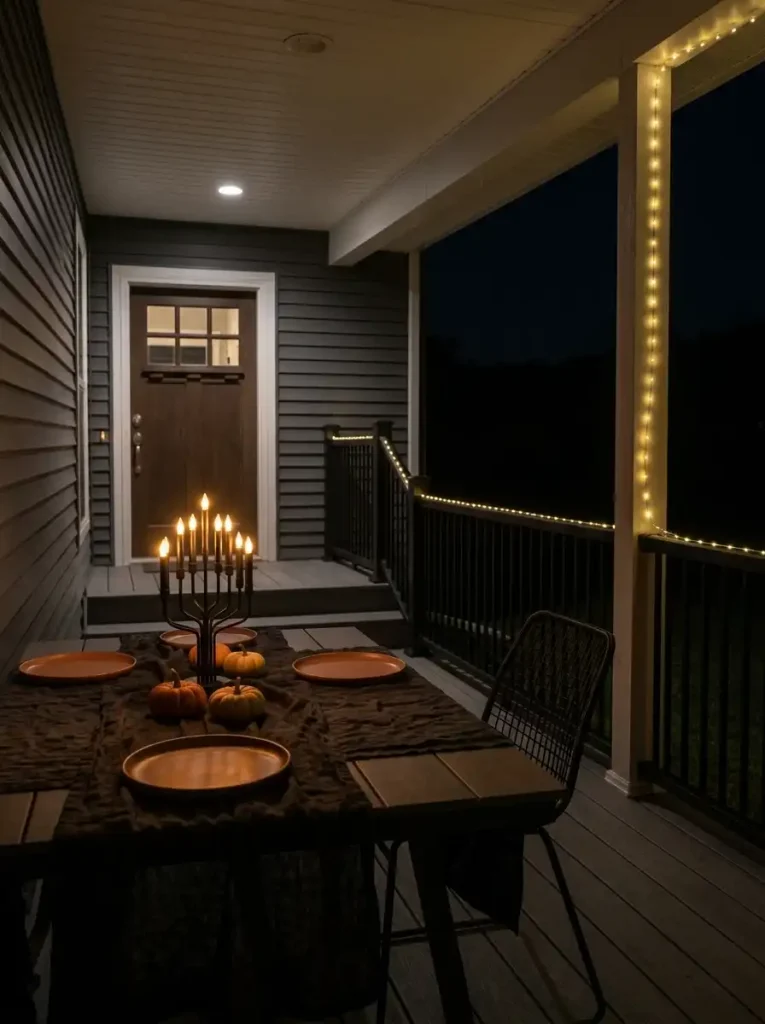
Keep the setup low and functional: a dark table covering, muted plates, several small pumpkins, and one compact LED-candle or branch centerpiece. Trace one nearby beam or railing line with warm light so the dining zone still feels connected to the porch architecture.
The table should remain usable.
This idea does not fit a shallow platform where furniture would consume the main route. In that case, choose an overhead or wall-based treatment from another section. The useful decision is whether Halloween can enhance a real porch activity without making the space harder to use.
11. Turn a Blank Siding Bay Into a Broom, Lantern and Olive-Tree Gothic Still Life
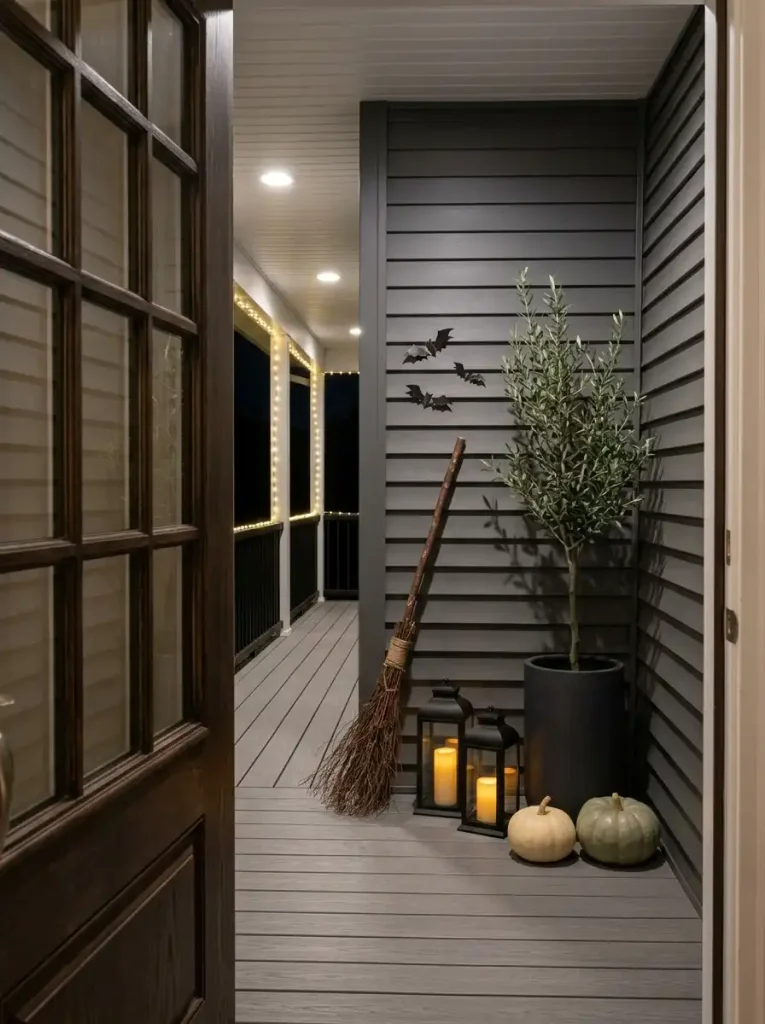
A long façade often benefits from one quieter composition between larger Halloween moments.
Lean a rustic twig broom diagonally against an empty wall bay. Set two or three dark lanterns near its base and add one tall potted olive, eucalyptus, or restrained leafy plant behind the group. A few black bats can link the display to the wider Halloween theme if that section of siding still looks disconnected.
The arrangement works because it combines three different directions:
- the broom creates a diagonal;
- the plant introduces vertical height;
- the lanterns provide low visual weight.
If another nearby display already uses branches, skulls, or dramatic height, keep this still life especially simple. Its job is to provide a pause, not another climax.
12. Use Cornstalks or Dried Grasses Only on the Posts That Actually Frame the Entry
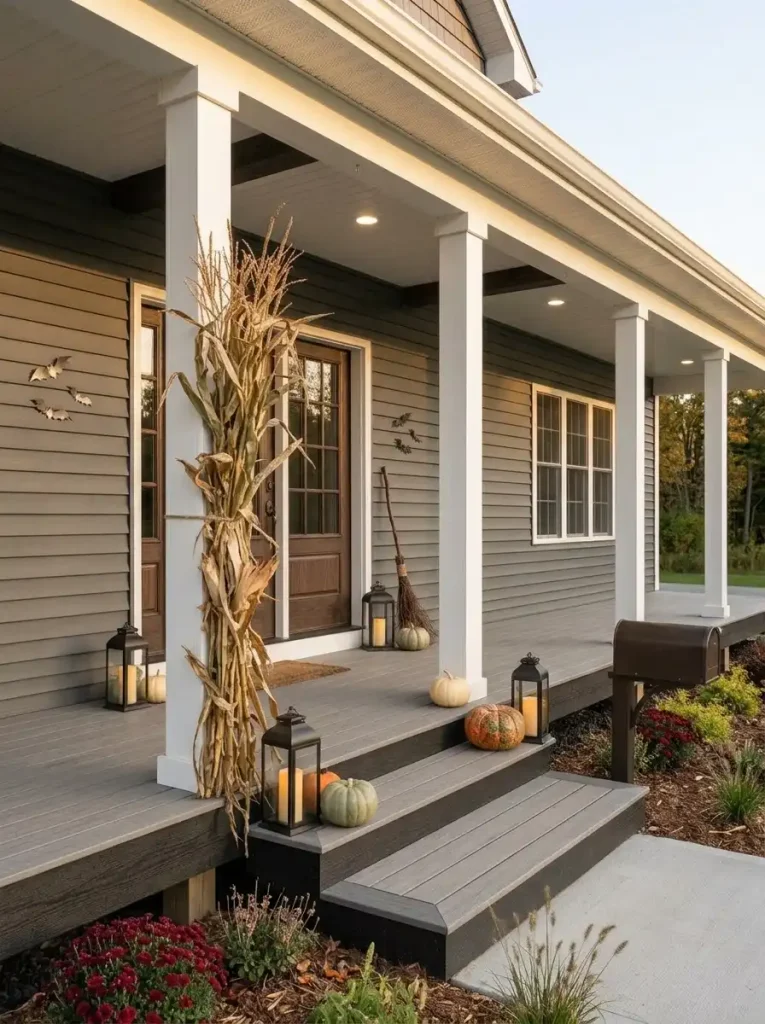
A long double-wide porch may have several posts. Wrapping every one with dried seasonal material creates a repeating pattern that can overpower the entrance.
Identify the two posts that most clearly frame the door and concentrate cornstalks, dried grasses, or narrow branch bundles there. Keep the remaining supports visibly exposed.
Low pumpkins or dark lanterns at the bases can complete the gateway without requiring another full display farther along the porch.
Step back before adding more material. If the bundles make the entrance appear narrower or conceal too much of the post structure, reduce their width. You want the dried texture to identify the arrival zone while allowing the porch architecture to remain obvious.
13. Build a Bare-Branch Arch When the Wide Doorway Needs One Theatrical Gesture
A broad entrance can handle a more sculptural Halloween move.
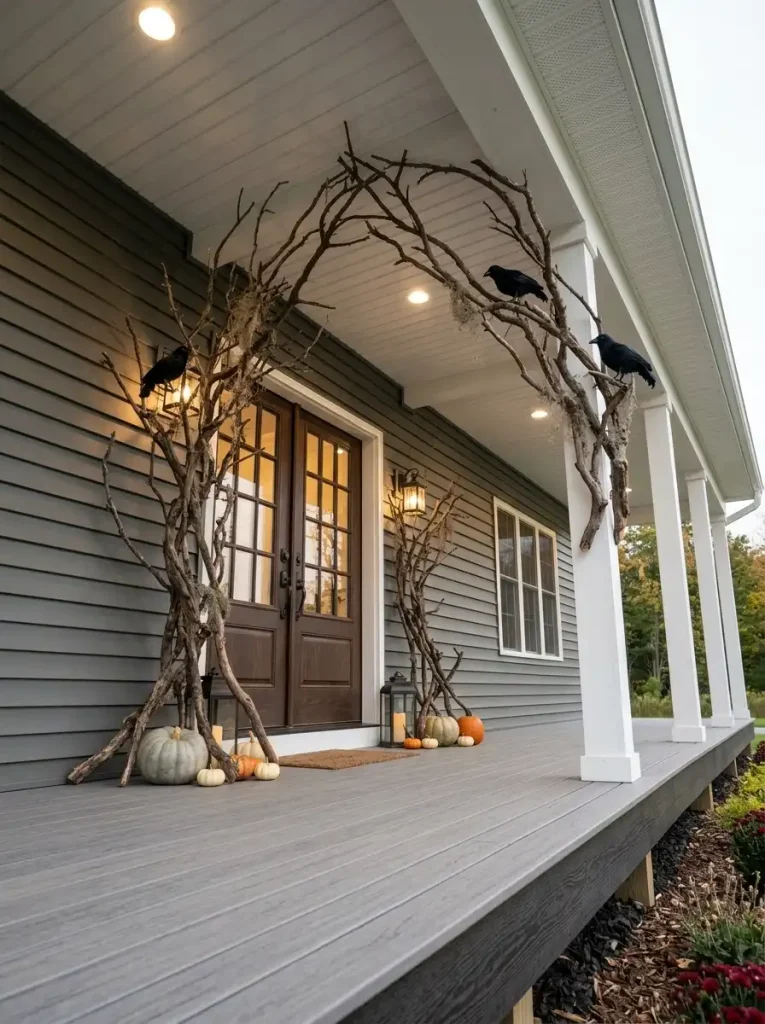
Place tall bare branches on both outer sides of the doorway and allow their upper forms to lean visually inward, suggesting an arch without filling the entire space above the door.
Use only a few additions on the branches—perhaps a raven, sparse moss, or several small pumpkins. Dense ornamentation weakens the branch silhouette and changes the display from architectural to decorative.
This works best around an entrance with relatively simple trim. A door already surrounded by shutters, sconces, strong railing lines, and multiple signs may benefit from a cleaner vertical pair instead.
Keep the actual door movement and approach free of the branch structure, and use attachment methods appropriate to the exterior surface and product instructions.
14. Stack Crates Vertically for a Raven-and-Skull Cabinet of Curiosities
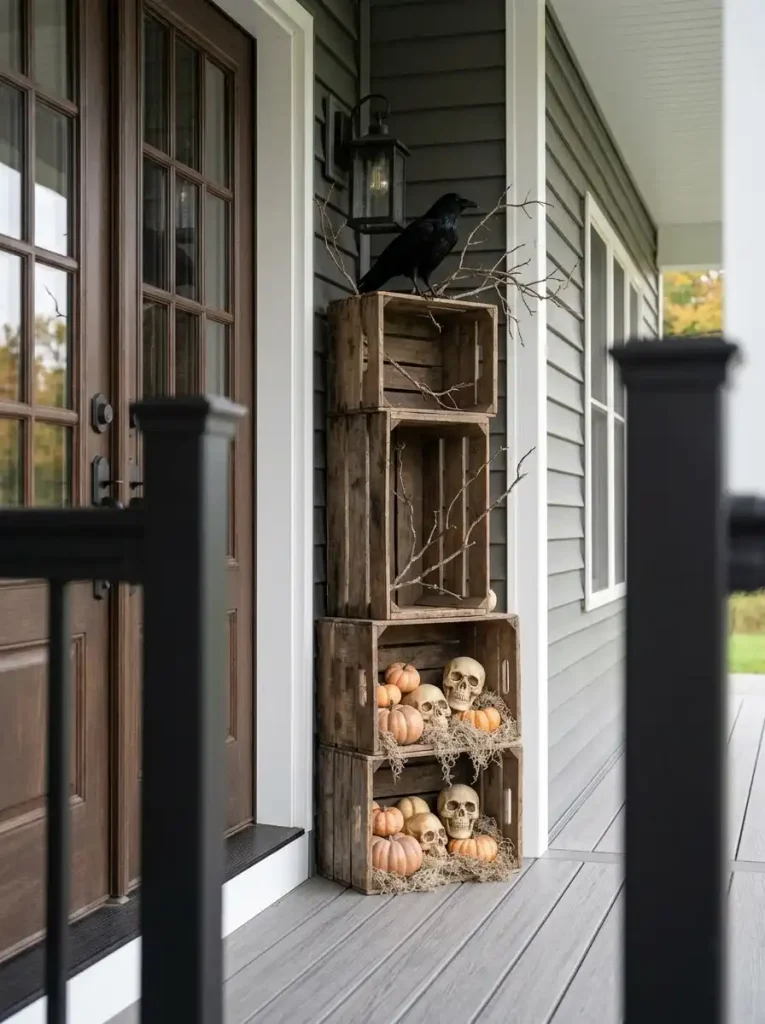
Several small Halloween objects can disappear across a double-wide exterior when they are spread too thinly. Consolidating them into one vertical display gives them more visual authority.
Build an irregular stack of decorative crates in a protected porch zone. Keep larger pumpkins and heavier-looking faux skulls in the lower half. Use more open crate space through the middle, then finish the upper area with one raven or a sparse branch.
The tower should feel denser near the floor and lighter near the top.
For construction ideas, removable handmade projects, and material-focused Halloween DIYs, StylishGalore’s DIY Halloween decor ideas for mobile homes is the deeper specialist. Here, the crates are being used primarily as a composition tool.
Vertical Footprint Stack
15. Use a Decorative Ladder-and-Hay-Bale Tower When the Porch Needs Height
A broad porch corner does not always need more objects at floor level. Sometimes it needs one stronger vertical shape.
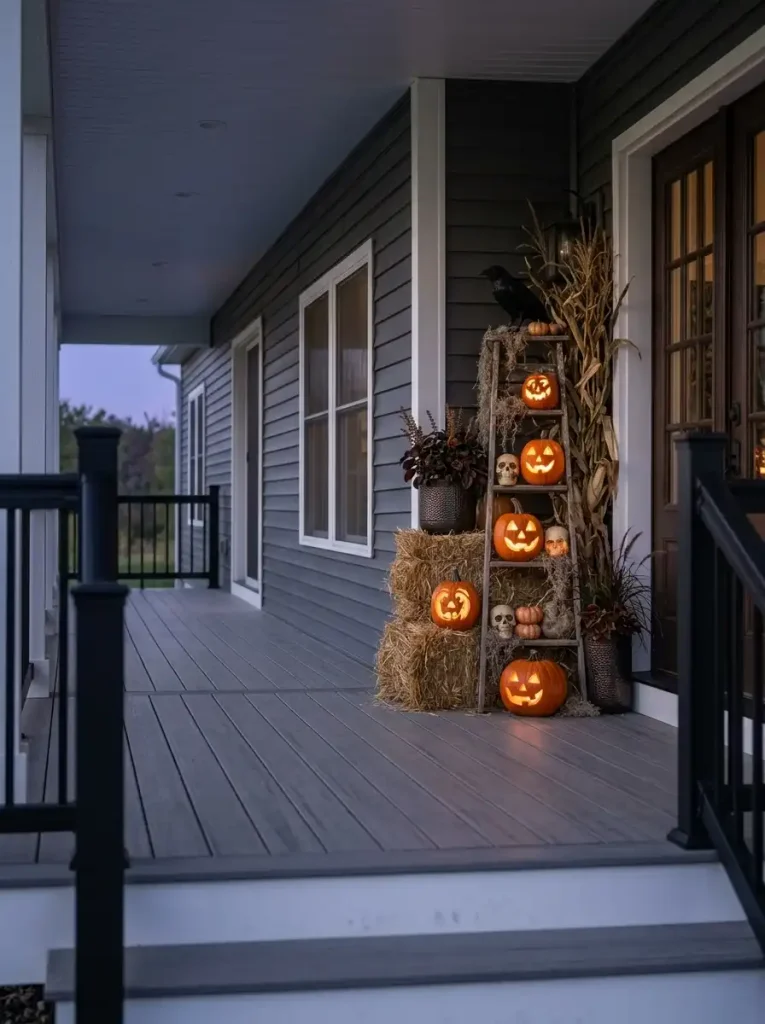
Place a narrow decorative ladder or tiered stand against a suitable wall area and use one or two hay bales to anchor the bottom. Distribute several pumpkins, dark planters, or small Halloween objects at different heights. A tall dried-corn bundle behind the ladder can complete the silhouette.
Watch the top of the arrangement.
Once the display visually reaches a nearby window line, beam, or porch trim, adding another upper object contributes little. Stop there and preserve open space around the tower.
This works particularly well at the far end of a long porch, where the vertical composition can act as a visual bookend without filling the central floor.
16. Echo the Main Halloween Palette at the Mailbox Without Building a Second Scene
A curbside mailbox can introduce the Halloween story before visitors reach the porch, but it should never become a rival focal point.
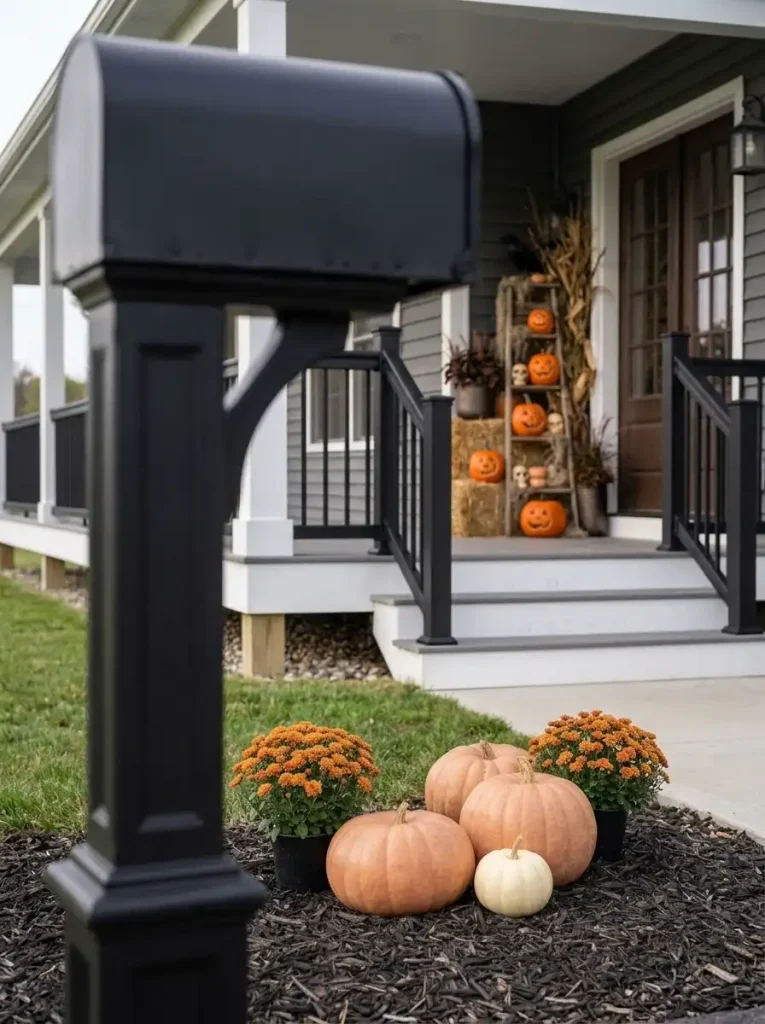
Repeat only one or two materials from the house display. Try a few muted pumpkins with mums, one ivory pumpkin with dark foliage, or a small branch paired with black ribbon.
Keep the composition low and allow the mailbox to remain visually recognizable.
Then stand near the road and compare it with the entrance. If the mailbox catches your eye first because its flowers are brighter or its pumpkin grouping is larger, subtract from the curb display.
For a property with a longer setback, this small repetition can make the mailbox and house feel connected without decorating every foot of lawn between them.
17. Use Low Pumpkin-and-Mum Islands to Connect the Far Ends of a Long Front Elevation
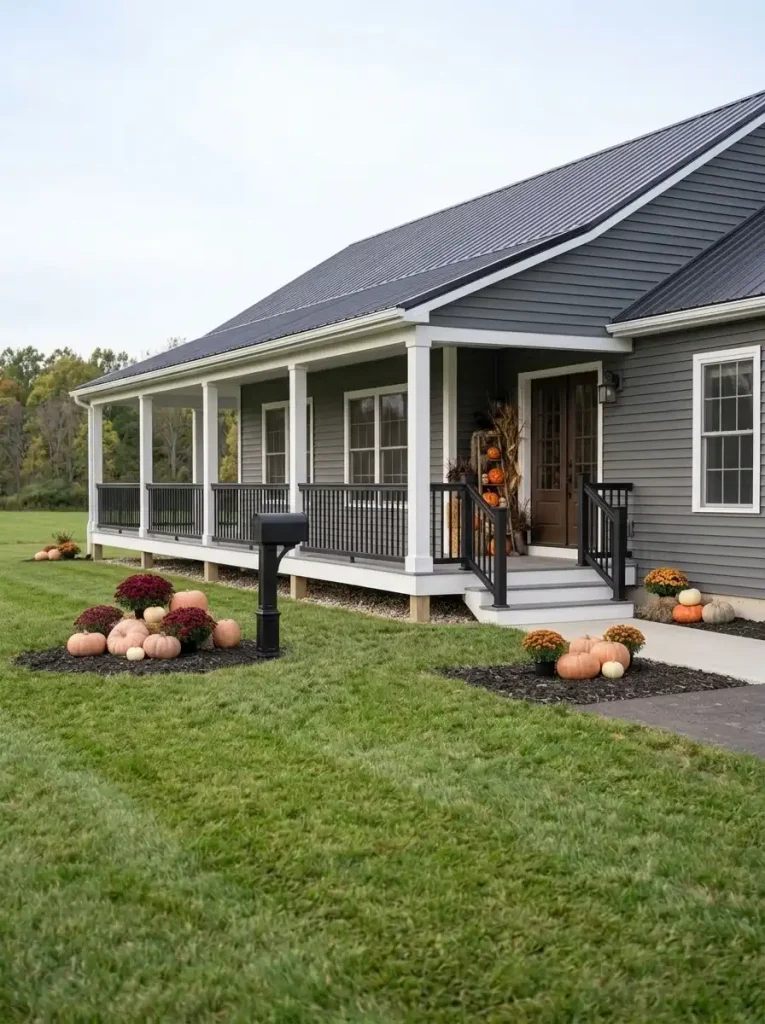
A decorated doorway can look isolated on a long double-wide façade, especially when landscaping creates large gaps between the entrance and outer corners.
Use several low seasonal clusters to bridge that visual distance.
One grouping might hold three pumpkins and a dark mum near a foundation bed. A second could contain two pumpkins beside existing foliage at the opposite porch corner. Make the clusters noticeably different in size so the landscape does not look like a repeated retail display.
Keep them below major window and railing lines.
Once the eye can travel naturally from one end of the house to the entry and across to the other end, the landscape has done enough. Open lawn and uncovered beds are part of the composition.
18. Make the House the Decoration With One Monochrome Monster-Face Graphic
A double-wide’s broad façade can support one playful oversized concept that would dominate a much smaller entry.
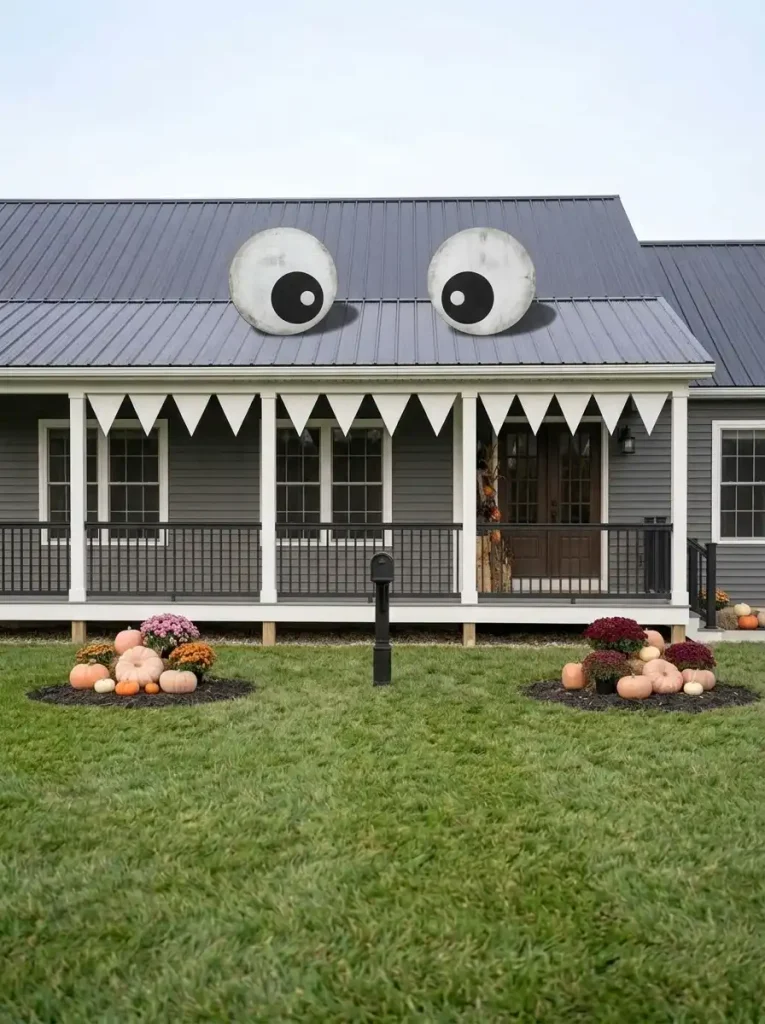
Use large black-and-white eyes high across a blank section of the façade and a simplified row of triangular teeth around a recessed porch opening. The architecture becomes the Halloween character.
Then remove almost everything else.
A few low pumpkins or plants can remain near the base, but bats, hanging ghosts, extra signs, branch towers, and multiple lighting themes will compete with the graphic.
This approach suits a simple frontage with large uninterrupted planes. Homes with many shutters, roof breaks, ornate rails, or dense landscaping already have more visual information, so the monster treatment may feel less clear.
Use the curb test: when the face reads instantly from a distance, the concept has enough scale.
19. Trace One Existing Railing or Eave Line With Warm Halloween Light
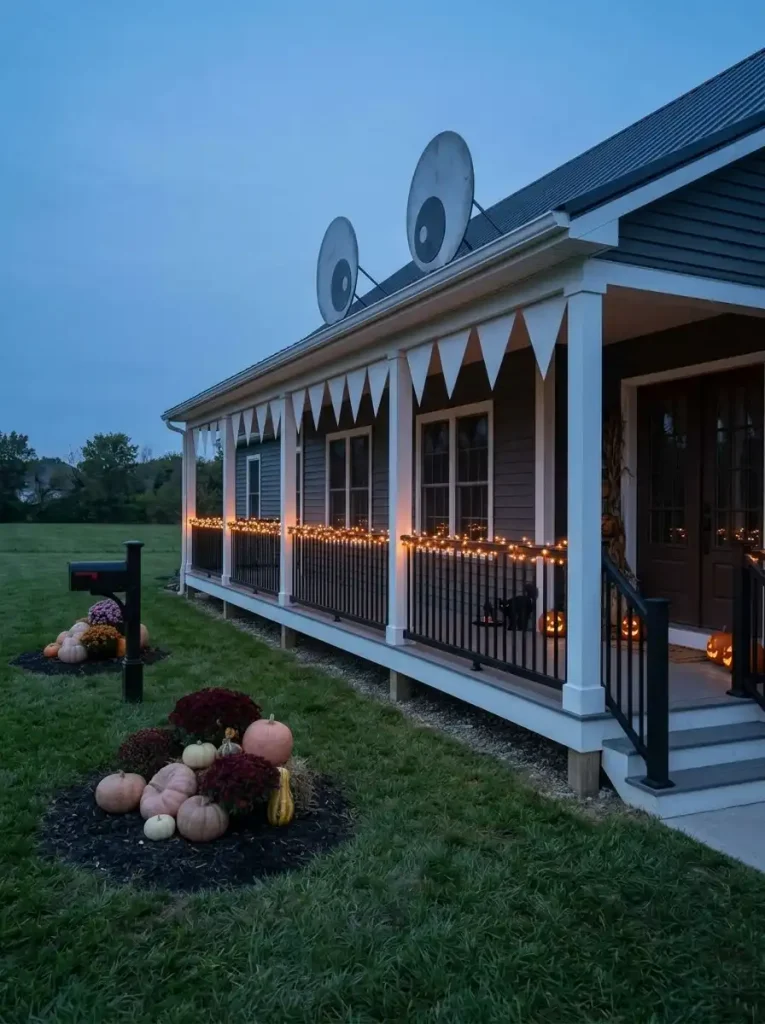
Night lighting becomes easier to understand when it follows architecture that is already there.
Pick one continuous line: a porch railing, beam, eave, or entry frame. Keep the lighting on that route and allow jack-o’-lanterns or lanterns to provide smaller pools of glow below it.
Warm amber or warm-white light works especially well with natural pumpkins, black silhouettes, dried foliage, and wood because it reinforces the existing material palette without introducing another dominant color.
Avoid bouncing the strand between unrelated posts, roof edges, windows, and shrubs simply because extra length remains.
Use products only in conditions their manufacturers identify as suitable, and follow the supplied installation guidance. If the desired effect depends on improvised electrical arrangements, simplify the lighting plan.
20. Build Nighttime Depth With Door Glow, Porch Glow and One Yard Accent
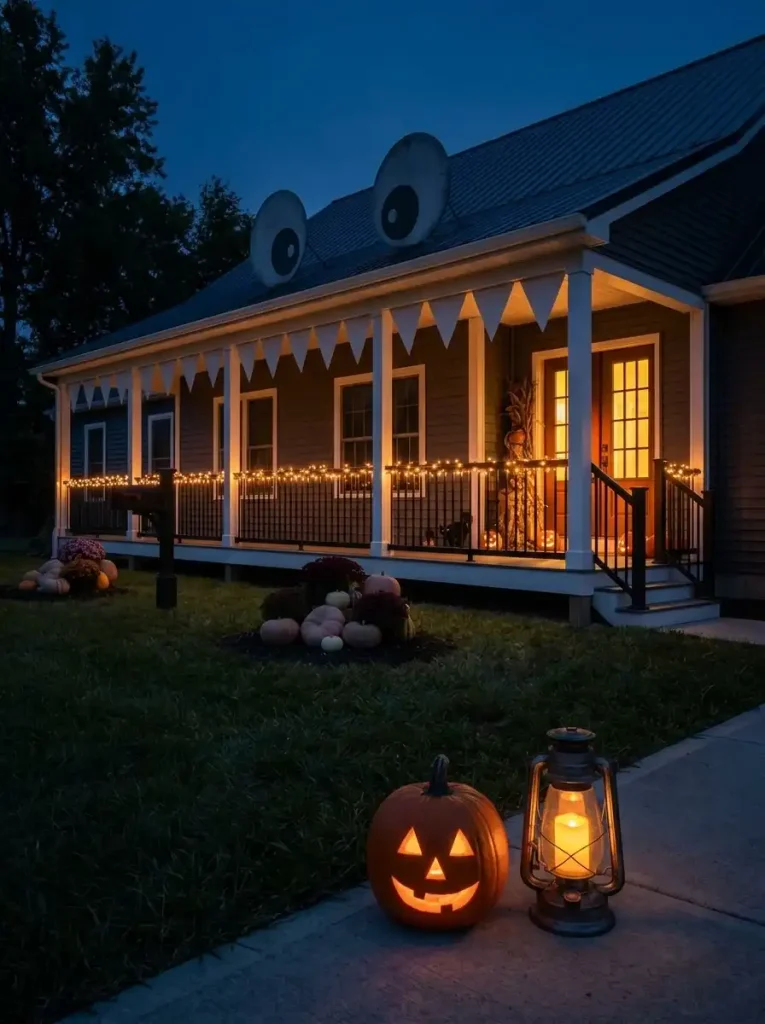
A long exterior can become visually flat after dark when all the illumination sits on one plane.
Use three depths:
- Door glow — strongest: this remains the visual destination.
- Porch glow — softer: enough light to reveal railings, pumpkins, seating, and silhouettes.
- Yard accent — restrained: one lantern or glowing pumpkin closer to the curb pulls the eye toward the house.
Then assess the home from the normal street view.
If every light source appears pressed against the siding, the foreground lacks depth. If the yard accent becomes the brightest object, reduce it until the door leads again.
Night Depth Lab
Mark the layers you already have. An unchecked layer identifies something to inspect, not an automatic instruction to add another light.
Keep surrounding sources lower in intensity so the entry remains the destination.
Visible form is enough. The whole porch does not need equal brightness.
Recheck it from the curb. The foreground should pull the eye inward without becoming the focal point.
21. Run the Four-View Classy Edit: Curb, Door-Open, Dusk and Photo
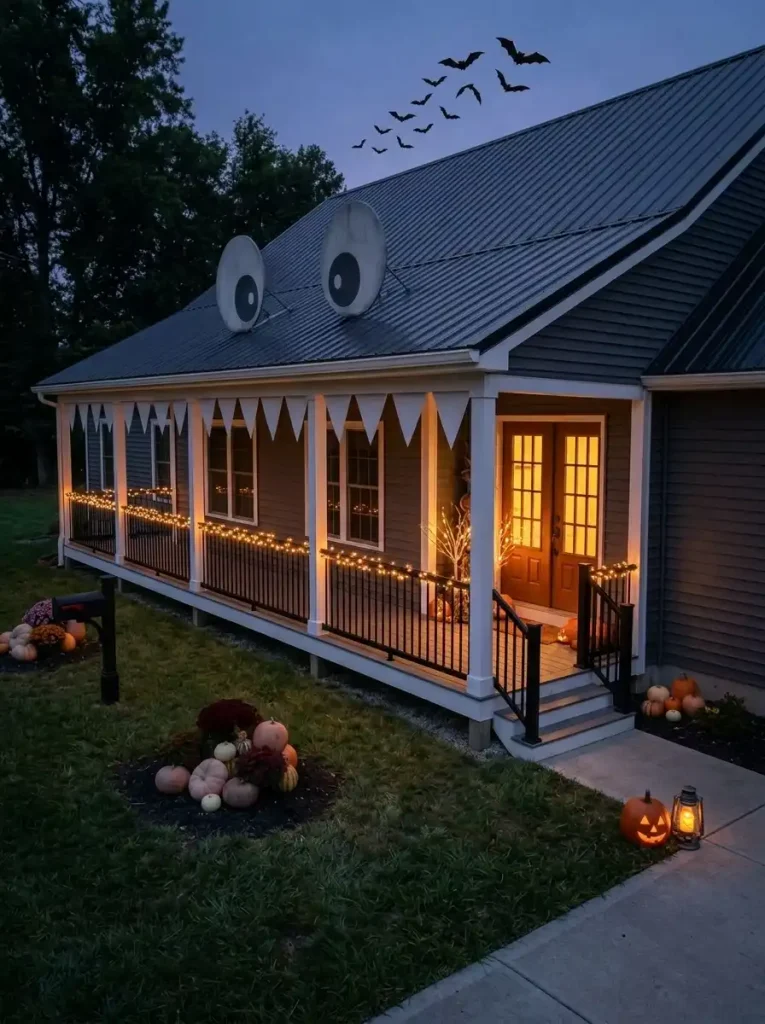
Close-up decorating hides problems that become obvious once you change viewpoint.
Use four final checks:
Curb view: Does one feature clearly lead?
Door-open view: Does the entrance still look clean and usable when the door is in its normal open position?
Dusk view: Are the doorway, porch, and foreground arranged in a clear brightness hierarchy?
Photo view: Does your phone image reveal orange clumps, repeated towers, empty gaps, or several competing focal points?
Remove one object from the zone that appears busiest and inspect the same view again. When the composition loses nothing important, that object was not helping.
Four-View Finish Audit
Check each box only after viewing the exterior from that position or time of day.
A Classy Halloween Exterior Needs One Clear Story
A successful double-wide Halloween exterior does not depend on using fewer spooky ideas. It depends on deciding where each idea earns attention. Start with one strong architectural anchor, let nearby areas repeat only part of its palette or material language, and preserve enough quiet siding, porch floor, and landscaping to separate the major moments.
Once that structure is working, dramatic pieces such as branch arches, witch hats, monster graphics, glowing pumpkins, and layered night lighting can feel intentional instead of crowded.
Do one last check from the curb and another after dark. Edit the busiest zone first. Very often, the finishing move is subtraction.
Save this article to Pinterest so you can return to these Halloween double-wide exterior decor ideas when you start decorating.