Some of the prettiest Christmas decorations are the ones that have already lived a few lives. A faded pink glass bauble, a turquoise ornament with worn gold stripes, or a delicate silver bell discovered in a thrift-store box can bring more character to a room than an entire set of matching new decorations.
But displaying those treasures in a mobile home takes a little creativity. A narrow living room may not have space for another Christmas tree, a small dining table needs to remain usable, and delicate vintage ornaments can easily get knocked over on crowded shelves.
The most charming thrifted Christmas ornament displays for mobile homes work with the space you already have. Think wooden accordion racks turned into ornament galleries, antique frames filled with colorful glass, old candlesticks holding Christmas finials, and small collections arranged inside vintage bowls.
These 15 ideas explore ways to showcase secondhand ornaments while preserving walking space, everyday furniture, and the nostalgic character that makes vintage Christmas decorating so appealing.
Before decorating, inspect older ornaments for cracked glass, loose caps, and damaged finishes. Handle fragile pieces over a padded surface and support the glass body when lifting them. The National Museums Scotland’s guidance on handling glass objects offers useful principles for caring for delicate finds. Any wall-mounted or hanging display also needs appropriate support; Command’s official hanging instructions specifically warn against using its adhesive hooks for valuable or irreplaceable items.
1. Turn a Vintage Wooden Accordion Rack Into an Ornament Gallery
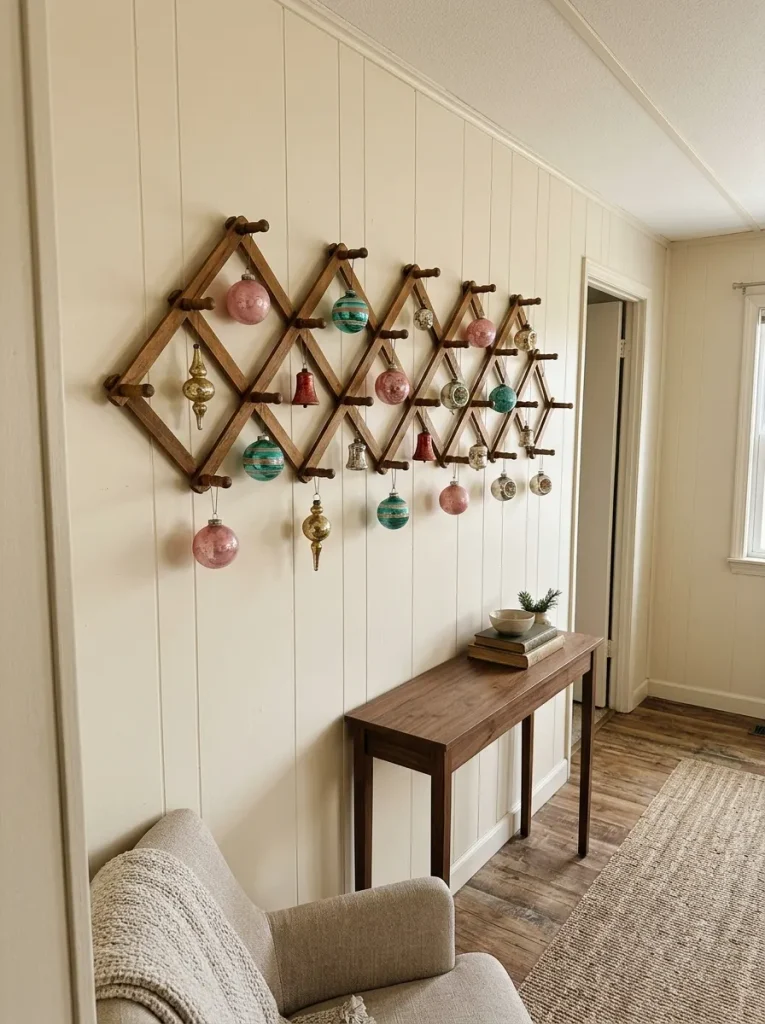
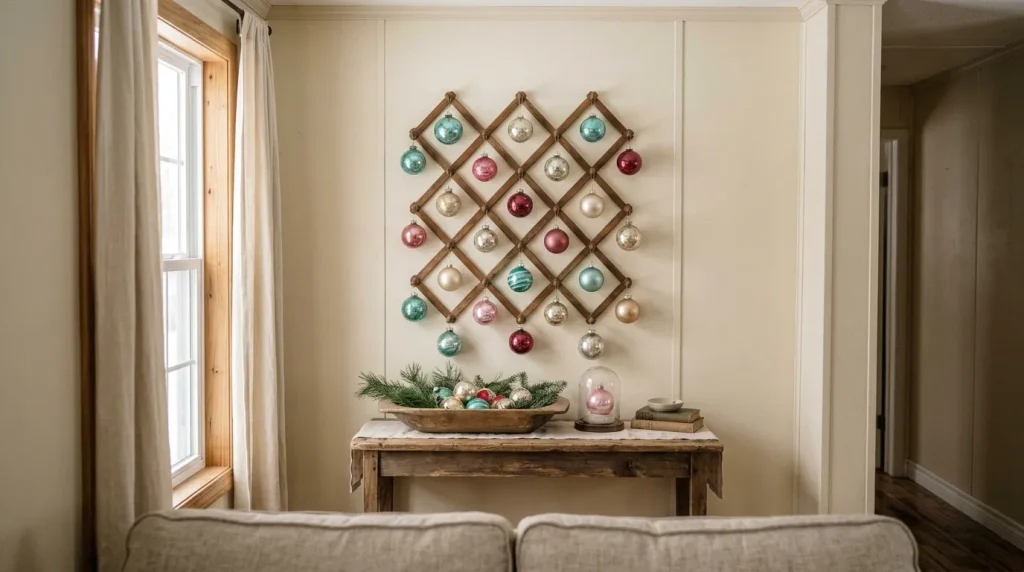
An old wooden accordion rack might be one of the most useful thrift-store discoveries for Christmas decorating in a small mobile home.
When expanded, its crisscrossing wooden strips create a series of diamond-shaped openings. Those openings become natural frames for colorful vintage ornaments, turning an ordinary piece of wall storage into a festive display.
Imagine a medium-tone wooden rack above a narrow living-room cabinet. Bright turquoise ornaments hang beside faded pink baubles, while silver bells and gold-striped glass pieces fill a few of the remaining openings. The warm wood provides enough visual structure to make the mismatched collection feel intentional.
Build the arrangement in three stages:
- Find the right wall. Choose a relatively quiet area above existing furniture, away from swinging doors and narrow walkways. Check that the rack’s pivots and pegs are sound and that the actual wall and mounting hardware can safely support the decorated weight.
- Establish a loose color rhythm. Place three or four of your largest ornaments first, spreading them across the rack. Fill some surrounding openings with smaller pieces while leaving others empty.
- Check the side view. Walk past the installation and make sure hanging ornaments do not project into a route where shoulders, bags, or furniture could catch them.
A useful trick is to leave occasional empty diamonds between the decorations. That exposed wood gives each ornament its own space and prevents a busy collection from looking tangled.
For a single-wide mobile home, consider a short vertical arrangement on a narrow wall section. If the wall is wider, the rack can stretch horizontally above an existing sideboard.
An ornament wall, composed.
Explore how wall width, ornament density and sentimental value change the best arrangement.
Best for: Collections of lightweight, sound ornaments and an available wall with suitable, verified mounting support.
2. Nest a Mini Christmas Tree in a Thrifted Dough Bowl of Ornaments
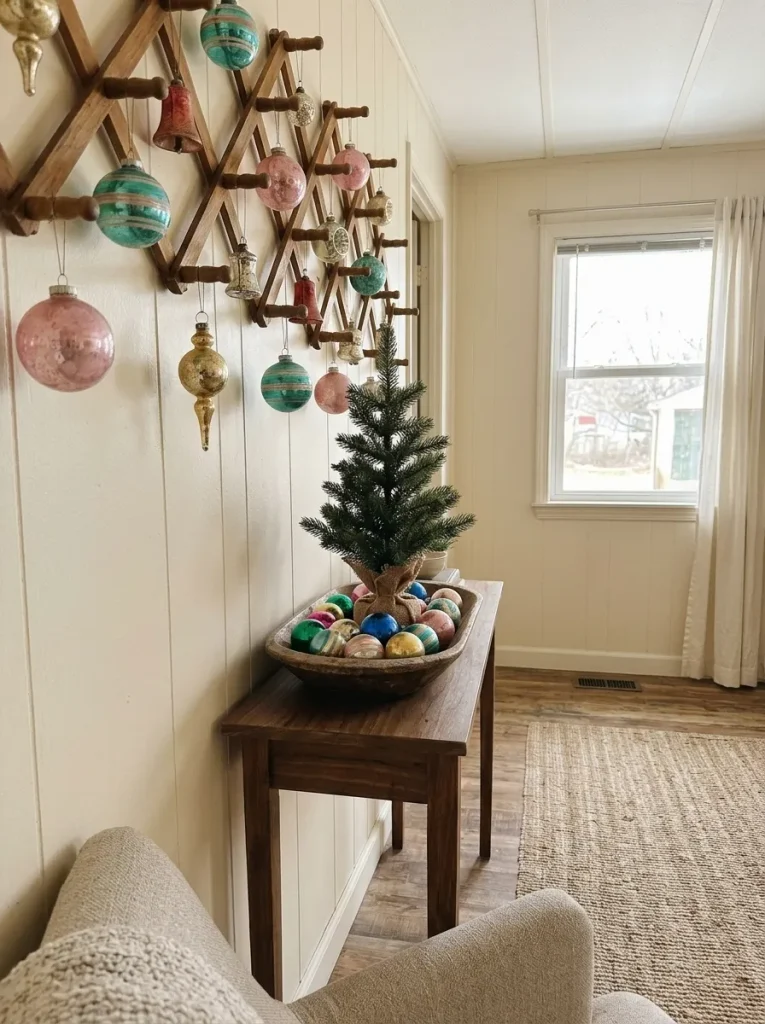
A shallow wooden dough bowl filled with old Christmas ornaments has a relaxed, collected quality that looks especially inviting in a small home.
The beauty comes from the contrast between the bowl’s worn wooden surface and the reflective finishes of vintage glass. A tiny evergreen tree standing near the center adds height, while the surrounding ornaments form a colorful base.
Picture a weathered oval bowl on a dresser, filled with muted emerald, faded gold, turquoise, and deep blue ornaments. A small evergreen rises through the center, making the arrangement look like a miniature Christmas landscape.
You can recreate the effect without purchasing an elaborate centerpiece.
Start with a bowl that fits comfortably on your existing furniture. Place a stable miniature tree inside, securing its base independently so it cannot topple. Arrange several ornaments around it on discreet soft supports that prevent the glass pieces from rolling together.
The most important editing decision is when to stop adding ornaments.
One visible layer often looks better than a deep pile because the distinctive colors and painted details remain visible. A few small gaps between the ornaments also reveal the character of the wooden bowl.
For a mobile-home living room, an existing dresser, sideboard, or console usually offers a more dependable location than a busy coffee table.
If you prefer placing it near your seating area, explore these Christmas coffee table styling ideas for small mobile-home living rooms to help preserve enough space for everyday use.
Small-space advantage: The entire arrangement stays within one movable container and can be stored as separate components after Christmas.
3. Create a Christmas Ornament Gallery Inside an Antique Gold Frame
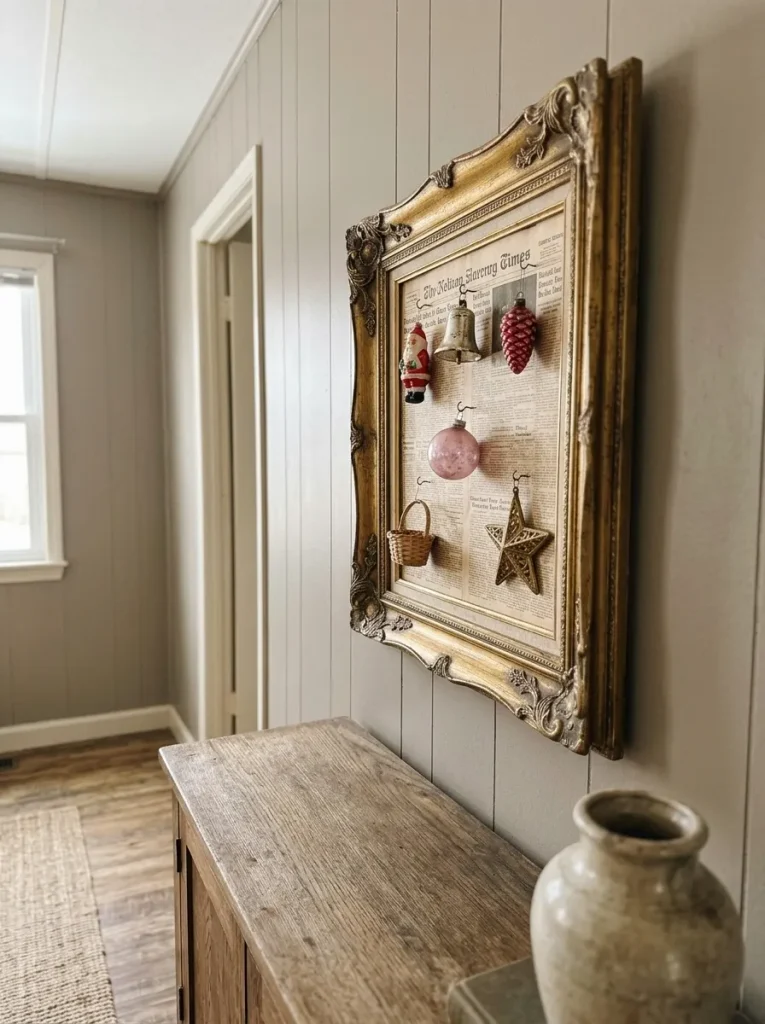
An ornate antique picture frame can make a collection of thrifted Christmas ornaments feel like an exhibition of tiny holiday treasures.
This is particularly appealing when the ornaments have completely different shapes: little glass Santas, painted bells, metallic pinecones, miniature baskets, and decorative stars.
An aged gold frame provides a common visual border, allowing those unrelated pieces to sit together without appearing chaotic.
For the background, choose a reproduction of aged newspaper, a vintage-style music sheet, or neutral patterned paper. Its subtle texture will complement the ornaments without overpowering their colors.
How should the ornaments be displayed?
For a flat decorative composition, an open frame can work if the ornaments have secure, independent supports attached to a properly constructed backing.
For fragile or sentimental pieces, a purpose-built shallow shadowbox with suitable protective mounts is the stronger choice.
The backdrop paper should never be responsible for carrying an ornament’s weight.
Try a deliberately uneven arrangement: Place one larger ornament near the center, surround it with several smaller shapes, and leave some background visible. That gives the eye a clear starting point and makes the display look collected over time.
In a compact mobile home, place the finished frame above a stationary sideboard or dresser rather than in a narrow hallway where people regularly brush against the wall.
A medium-size frame is often enough to hold a meaningful collection without creating another large visual feature.
Styling detail: Tarnished gold, dusty rose, deep cranberry, and antique silver make an especially attractive combination against warm, aged-looking paper.
4. Hang a Cluster of Vintage Ornaments From Soft Satin Ribbons
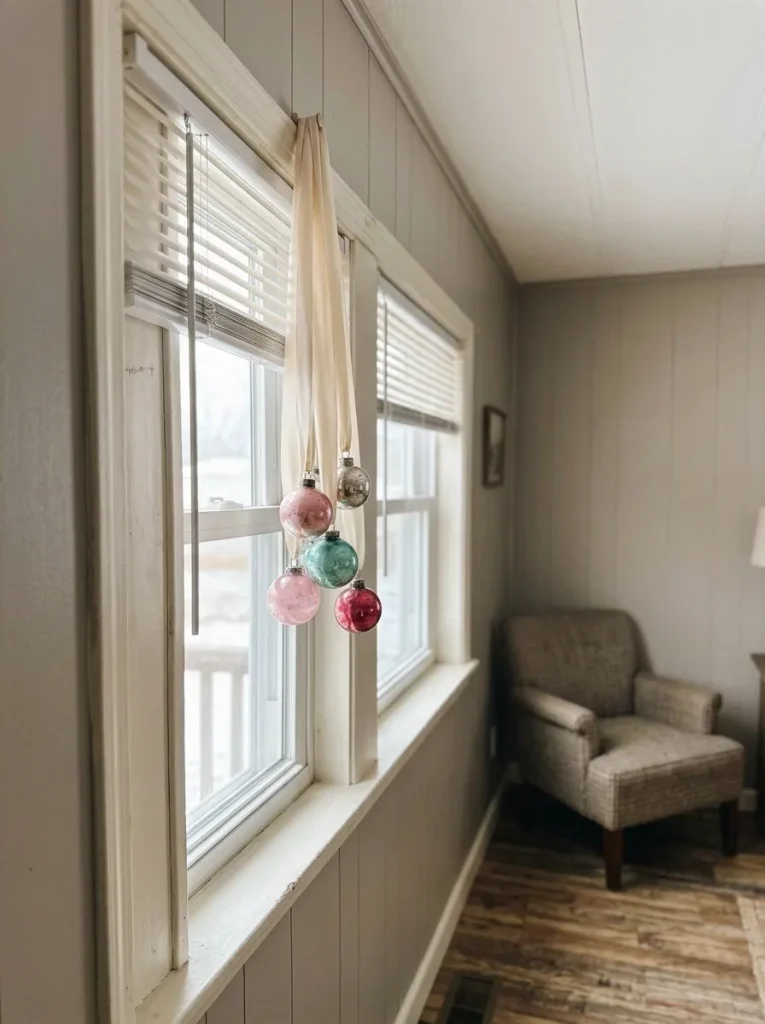
A small group of colorful glass ornaments suspended from satin ribbons can transform an overlooked corner into a Christmas focal point.
The effect feels delicate because the ornaments appear to float at different heights. Their reflected colors become even more beautiful near daylight.
Imagine several faded pink, turquoise, champagne, and red glass baubles hanging from wide cream ribbons near a bright window. The ribbons form soft vertical lines, while the ornaments create an irregular cluster that narrows toward the bottom.
The arrangement works best with variation, not symmetry.
Use different ribbon lengths so the ornaments form a loose cascading silhouette. Let one larger bauble become the visual center, with smaller ornaments appearing above and below it.
Before hanging anything, consider where the cluster will live.
- Near a window, make sure blinds, curtains, handles, and opening panels can operate without contact.
- In a living-room corner, check the clearance from nearby seating and walking routes.
- Over a cabinet, keep the lowest ornament high enough that doors and stored objects cannot strike it.
Use a verified support suitable for the entire installation, and check that each ornament’s cap and hanger are secure. Avoid attaching the cluster to moving blind components or relying on adhesive hooks for delicate heirlooms.
For more ways to decorate small windows without filling the sill, see these Christmas window decorating ideas for mobile homes.
Best visual trick: Keep all ribbons within one color family, even when the ornaments are mismatched. Cream, champagne, or muted velvet ribbons allow colorful vintage glass to remain the star.
Three silhouettes. Three spatial decisions.
Change the ribbon drop to explore an appropriate location and styling approach.
Best starting point for a quiet wall beside a window. The shorter ornaments can be positioned beyond blind and handle movement.
Use the progressive heights over stationary furniture where the lowest ornament remains above doors, objects and routine reach.
Only consider a long drop above a low-contact area with a verified hanging point. Avoid active windows and any walking corridor.
5. Display Long Glass Christmas Finials on Mismatched Brass Candlesticks
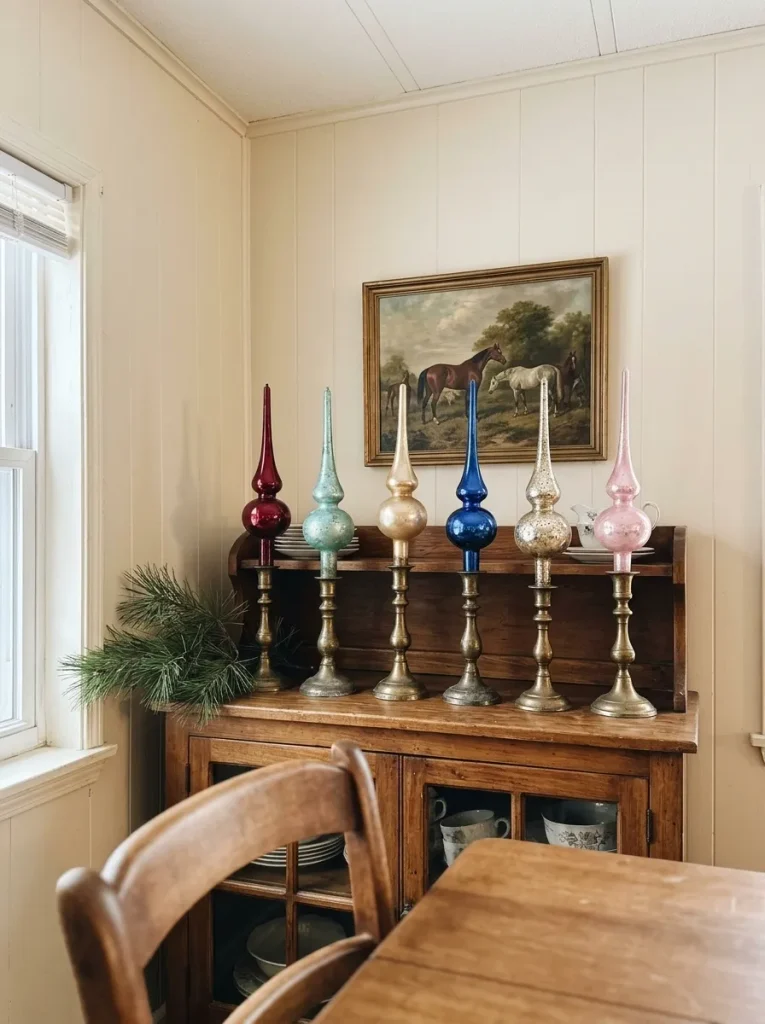
Vintage Christmas tree finials deserve attention beyond the top of a tree.
Many older finials have exaggerated shapes: slender pointed tips, rounded glass centers, narrow necks, and faded metallic finishes. Arranged upright on antique brass candlesticks, they become a sculptural Christmas collection.
The combination is particularly beautiful on a small dining-room hutch.
Imagine several brass candlesticks of different heights holding compatible red, blue, silver, and champagne-colored glass finials. Behind them, an old framed painting provides a dark, traditional background, while a simple evergreen branch adds a seasonal touch.
The brass finishes do not need to match. Some can be polished, others tarnished, and a few might have decorative bases.
That variation makes the arrangement feel naturally collected.
Check the fit before styling
A glass finial is not automatically compatible with a candlestick.
Some finials have delicate open bases or narrow attachment areas that cannot safely carry their weight. Use a purpose-made ornament display adapter or suitable individual support where appropriate. Never force antique glass over a candlestick opening.
If the ornament wobbles, choose a horizontal padded display instead.
A strong composition starts with three different heights. Place the tallest finial slightly off center, then balance it with shorter ornaments on either side.
For compact mobile-home furniture, keep the entire arrangement comfortably within the surface rather than spreading every candlestick across the hutch.
The candlesticks are display supports only. Do not light candles beneath or beside these glass decorations. The U.S. Consumer Product Safety Commission’s holiday decorating guidance emphasizes keeping burning candles away from decorations and other combustible materials.
6. Give a Small Silver Christmas Tree Its Own Vintage Cabinet Nook
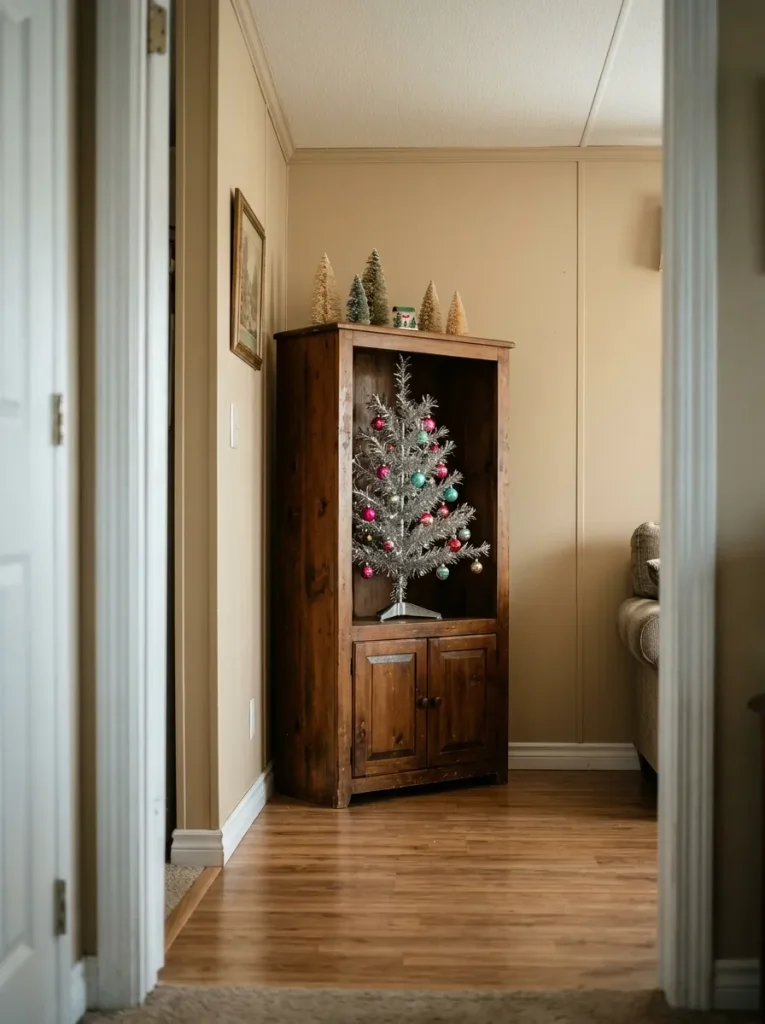
A vintage silver Christmas tree displayed inside an existing cabinet can create a surprisingly magical holiday scene.
The confined space makes the tree feel like a miniature exhibition, while metallic branches reflect the colors of antique ornaments.
This idea is especially effective with bright mid-century-style decorations: pink glass balls, turquoise finials, red-striped ornaments, and small reflective pieces.
Picture a narrow silver tree inside an open cabinet compartment. Its branches hold a carefully edited collection of colorful ornaments, while a few miniature bottle-brush trees sit on top of the cabinet.
The contrast between the simple cabinet structure and the sparkling decorations creates a strong focal point.
Before decorating, measure three things:
| Check | What matters |
|---|---|
| Interior opening | The tree and ornaments need clearance on every side. |
| Door movement | Cabinet doors must open fully without touching the display. |
| Furniture stability | The cabinet, tree stand, and ornaments must remain stable together. |
If the compartment is too shallow, choose a smaller tree or reduce the ornament size. A tightly packed silver tree loses the distinct outlines that make vintage ornaments interesting.
For a narrow single-wide mobile home, an existing bookcase or cabinet can be more practical than adding another freestanding Christmas tree.
One important safety detail: Do not put electric light strings on a metallic tree. The CPSC warns that faulty lights on metallic trees can create an electrical shock hazard. Rely on ordinary ambient room lighting or a separate, suitable light source that does not contact the metallic tree.
If your cabinet cannot accommodate even a miniature tree, consider one of these wall-mounted Christmas tree ideas for mobile homes as an alternative, provided the chosen design has appropriate mounting support.
A tiny room inside a room.
Test three common conflicts before turning a cabinet niche into a vintage tree display.
Keep the tree centered, the caps clear, and the cabinet secure. Re-check with the actual ornaments installed.
Extra width is needed for ornament tips, handling and airflow. Try a smaller tree or fewer branches.
Move the tree deeper or choose a different cabinet. Even occasional contact can break old glass.
Confirm the cabinet is stable and appropriately secured before adding a concentrated decorative load.
7. Make a Hanging Ornament Sculpture With Graduated Metal Rings
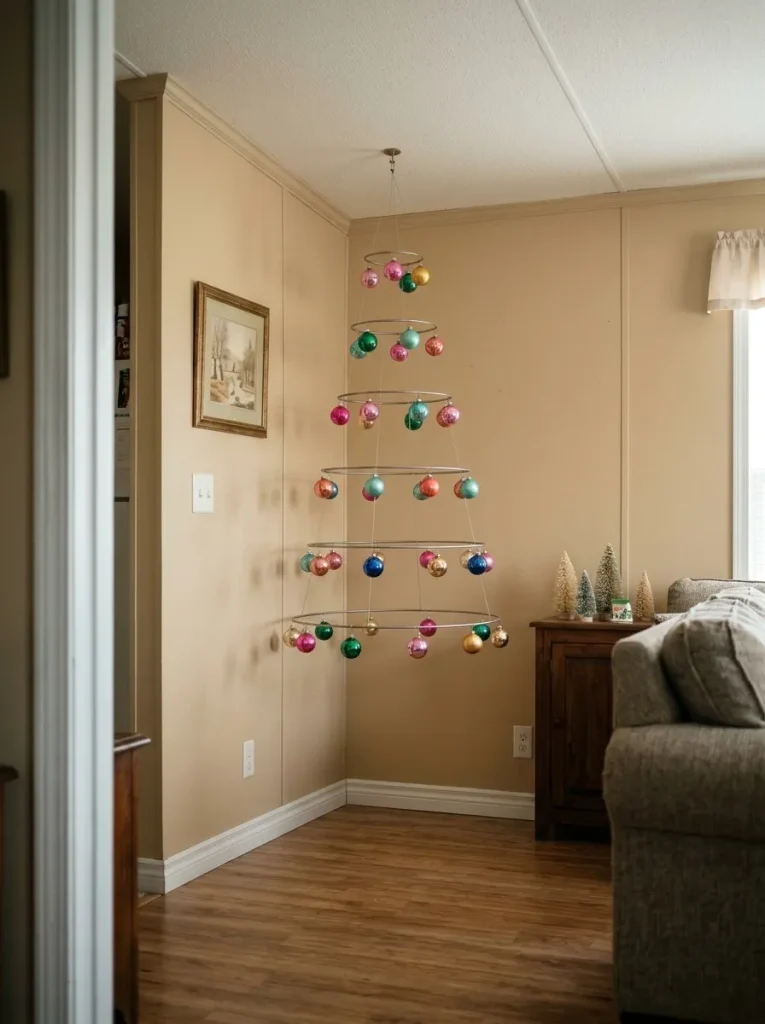
For a more dramatic interpretation of vintage Christmas decorating, consider the tiered ornament sculpture created with graduated metal rings.
The photograph that inspired this idea shows several circular wire levels arranged into a Christmas-tree silhouette. Colorful antique ornaments hang from the rings, making the entire structure resemble an upside-down chandelier or floating tree.
What makes the design interesting is its transparency.
Unlike a dense artificial Christmas tree, the open rings allow the wall behind them to remain visible. That visual lightness can be appealing in a compact room.
However, a suspended installation introduces important structural considerations.
Only proceed with a ceiling-hung version when:
- The actual supporting structure and mounting method have been verified for the intended installation.
- Every ring, connector, hanger, and ornament attachment is appropriate for the full assembled load.
- The display cannot contact a ceiling fan, door, heater, curtain, or normal walking route.
- Fragile and irreplaceable glass ornaments are excluded from any arrangement where movement or a falling-object hazard remains.
An attractive ceiling hook is not proof that the supporting structure can carry the installation. Professional assessment may be appropriate for a substantial suspended sculpture.
A more practical mobile-home interpretation
Use a stable freestanding tiered metal display stand on an existing sideboard, with lightweight, shatter-resistant ornaments arranged around its levels.
You can preserve the same colorful tree silhouette without committing to an overhead installation.
Best for: A small collection of inexpensive ornaments and a suitable existing display area. The more elaborate hanging version is a specialty installation, not a quick renter-friendly project.
A floating tree needs grounded decisions.
Review the conditions that must be assessed before choosing a ceiling-suspended ornament sculpture.
Concept elevation only. Never treat an ornamental drawing as a mounting specification.
One or more conditions remain unverified. Use a stable freestanding tiered stand and shatter-resistant ornaments.
With all considerations identified, review the actual hardware and final assembly with the qualified installer. A display may still be unsuitable.
8. Repurpose a Vintage Mug Tree as a Mini Ornament Stand
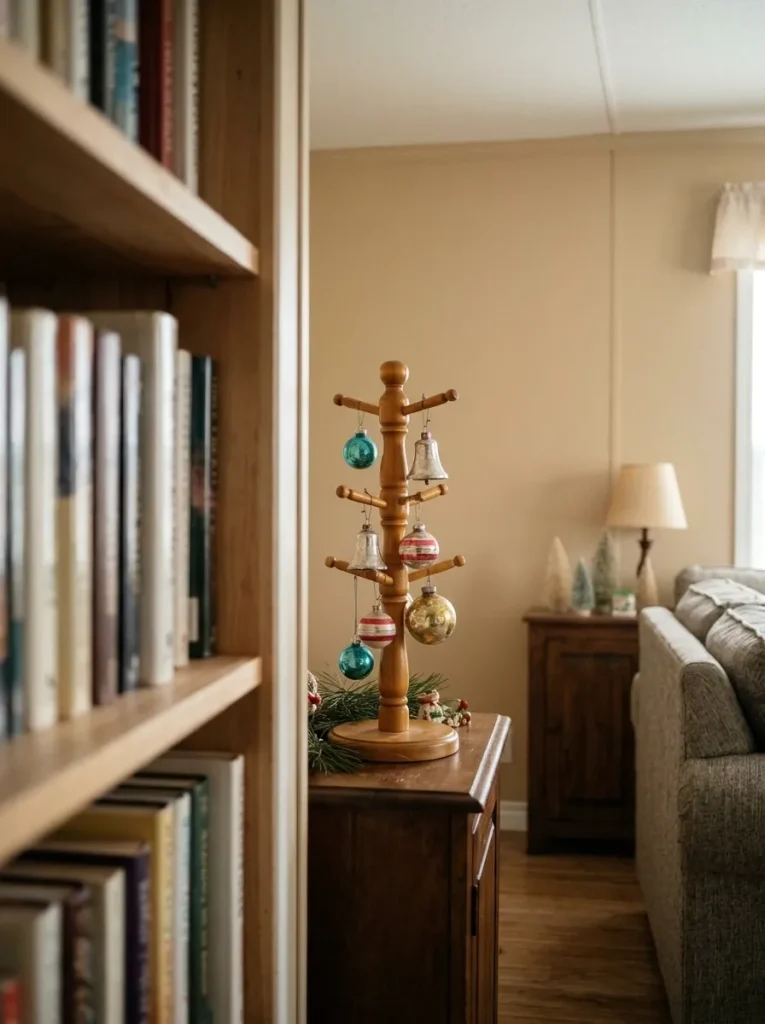
Not every Christmas ornament display needs a Christmas-themed object.
A vintage wooden mug tree can become a charming little ornament stand, particularly when its turned wooden pegs and warm finish already have an old-fashioned character.
This is an excellent thrift-store item to look for because mug trees are compact and designed to hold hanging objects at different heights.
Imagine a honey-colored wooden mug tree carrying six small vintage ornaments: two turquoise balls, a red-striped bell, a faded gold bauble, and a pair of miniature silver decorations.
The ornaments appear as a vertical collection, with each piece visible from a different angle.
The balance test
Place the empty mug tree on a level surface. Hang one lightweight ornament, then add another on the opposite side.
Continue until the composition feels balanced, stopping before the ornament loops can slide off the pegs or the stand becomes unstable.
Some mug trees have shallow pegs or narrow bases that are unsuitable for hanging glass ornaments. Those should be skipped or used only for appropriate lightweight, shatter-resistant decorations.
A small stand on a living-room bookcase can be particularly successful because the existing furniture provides a ready-made display location.
Avoid placing fragile glass ornaments on a kitchen counter where the stand will be moved repeatedly during food preparation.
Finishing idea: Let the wood remain visible. Covering every inch with greenery or ribbons would hide the very detail that makes the thrifted object charming.
9. Turn a Thrifted Printer’s Tray Into an Ornament Shadowbox
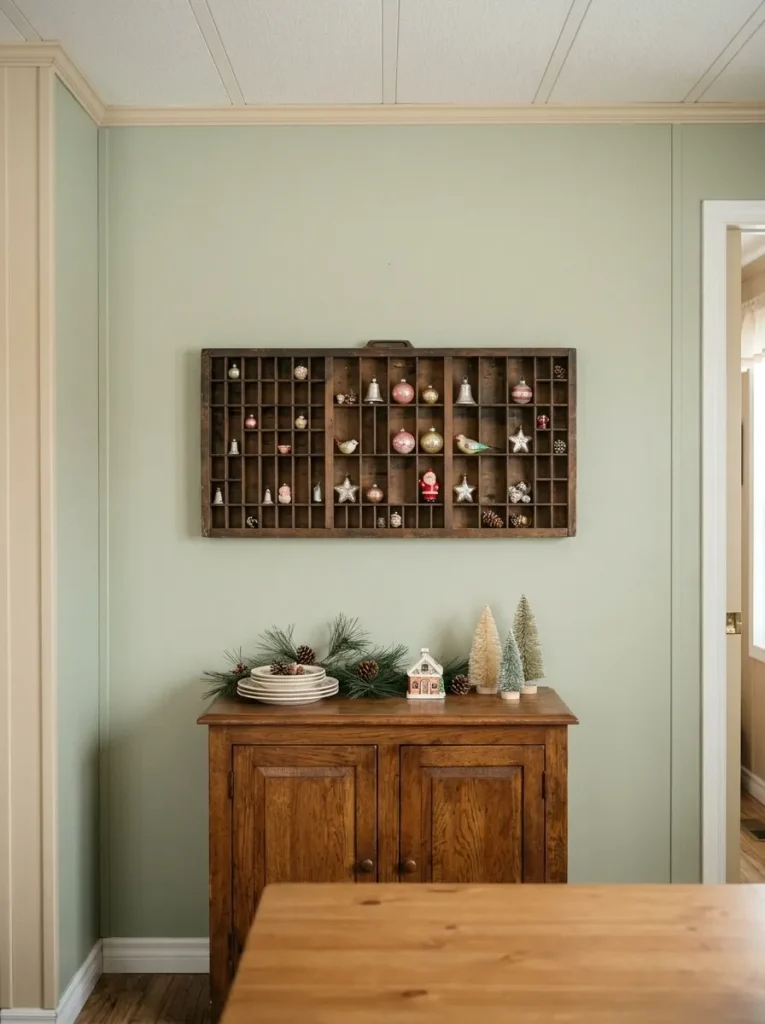
A vintage printer’s tray offers a different kind of Christmas display: one built around tiny compartments and individual discoveries.
These old wooden trays were made with multiple divisions, giving you a natural structure for displaying miniature ornaments.
They are especially useful for pieces that might disappear on a full-size Christmas tree, including tiny bells, painted glass birds, miniature Santa figures, and delicate ornaments shaped like little houses.
The tray creates a clear visual order without demanding that the ornaments match.
Arrange by shape before color
Try placing tall finials in deeper compartments, round ornaments in wider spaces, and smaller decorative figures in the remaining sections.
Leave some compartments empty so the arrangement has breathing room.
Each piece needs an appropriate soft support or retainer. A compartment alone does not securely hold an ornament when the tray is mounted vertically.
Should the tray hang or sit?
A wall-mounted arrangement can work when the tray, individual ornament restraints, and mounting hardware are suitable for the installation.
For a renter or anyone uncertain about wall support, a smaller tray placed securely on a stable dresser may be preferable. It must still be positioned so that it cannot slide or fall.
This idea is most successful with a collection of miniature ornaments. Larger glass baubles belong in a bowl, display stand, or other arrangement where they have sufficient clearance.
10. Protect a Favorite Heirloom Ornament Under a Vintage Glass Cloche
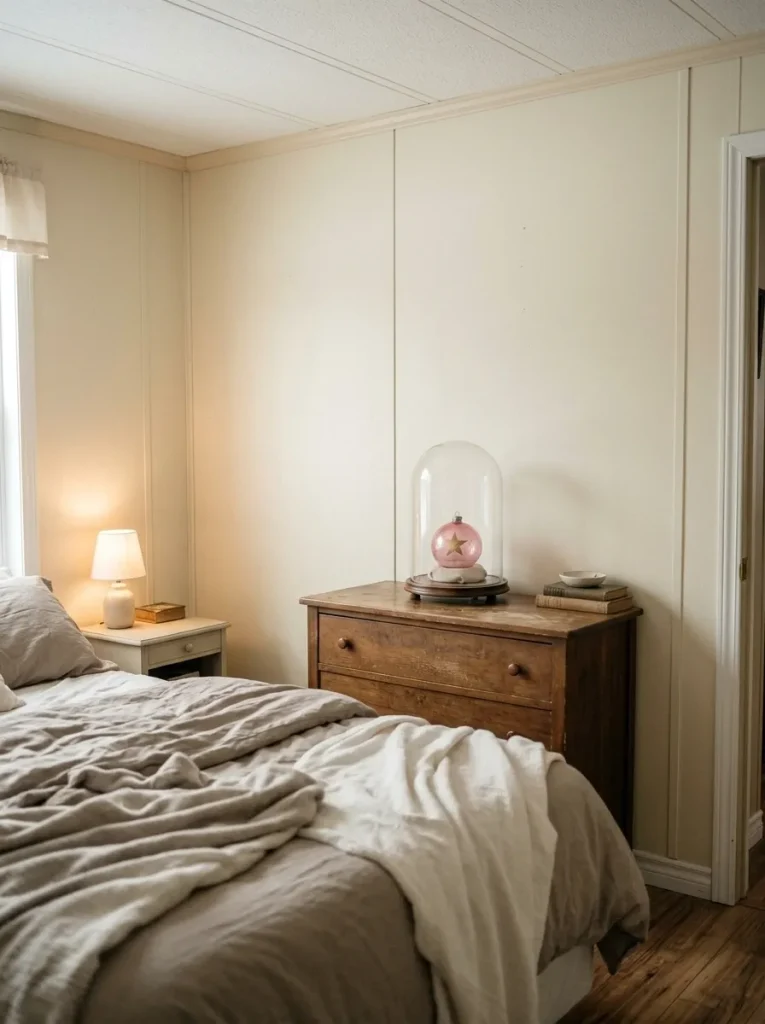
Some Christmas ornaments are too meaningful to disappear among dozens of others.
Perhaps it is a faded glass Santa inherited from a grandparent, a hand-painted decoration from childhood, or the first ornament purchased for a family Christmas tree.
A vintage glass cloche can give that single ornament a beautiful focal position.
The composition is simple: one ornament, a suitable display base, and a transparent dome that allows the piece to be admired from different directions.
What makes this idea special is the restraint. Empty space around the ornament becomes part of the display.
Choose a cloche large enough that the ornament does not touch the glass. Support the piece on a stable, appropriately padded base, and make sure the dome can be lifted without catching any projecting details.
Avoid gluing or taping the ornament directly to the base, especially if it has a delicate or aging finish.
Where should it go?
A bedroom dresser or stable cabinet in a low-contact area is generally more suitable than a narrow entry table where bags, keys, and shopping items are frequently placed.
If the ornament has cracked glass, loose pieces, or actively flaking paint, keeping it in protected storage may be the wiser option.
Best for: One sentimental ornament that deserves attention without repeated handling.
One ornament. The right setting.
Choose its condition, room traffic and desired display; get a more protective recommendation when necessary.
Use a stable cloche with adequate glass clearance and a soft individual support. Keep the dome easy to lift without contact.
For a sound replaceable ornament on a low-contact surface, a stable supported pedestal may work. Inspect the base before use.
Busy locations invite bumps. Move the ornament to a calm dresser or use safe cushioned storage; enclosure alone cannot fix poor placement.
Cracked glass or failing finishes call for careful isolated storage and minimal handling. Seek conservation advice for important pieces.
11. Create a Sparse Ornament Tree With Thrifted Branches and a Stoneware Crock
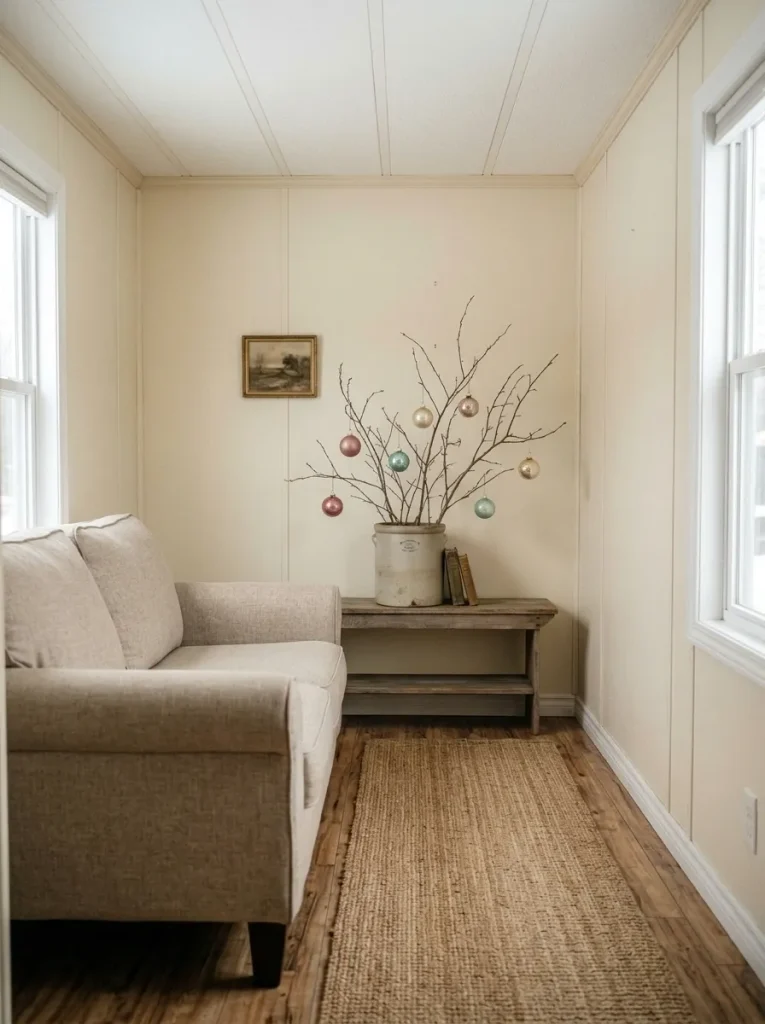
A handful of decorative branches in an old stoneware crock can become a wonderfully understated Christmas ornament display.
This idea borrows the silhouette of a Christmas tree without relying on dense greenery.
Imagine a worn cream-colored crock standing on a narrow console. Several graceful branches rise from the opening, each carrying one or two small vintage ornaments.
The branches introduce height and movement, while the ornaments provide little flashes of pink, turquoise, amber, and silver.
The empty space between branches matters just as much as the decorations themselves.
Start with the vessel
Choose a broad, stable crock that can accommodate an independently secured branch arrangement. Avoid unstable containers, cracked pottery, or branches with weak and sharp tips.
Place the vessel on the furniture where it will actually be displayed, then evaluate how far the branches extend.
If the outer branches reach beyond the cabinet edges or into a walking route, trim the arrangement or choose shorter branches.
The display is particularly attractive against a plain wall because the irregular branch shapes become easy to see.
A useful editing rule: Try one lightweight ornament per suitable branch before adding more. Overloading the tips can create an uneven or unstable arrangement.
For fragile antique ornaments, a supported tabletop container may be a safer choice than hanging them on decorative branches.
12. Elevate a Small Ornament Collection on a Vintage Wire Fruit Stand
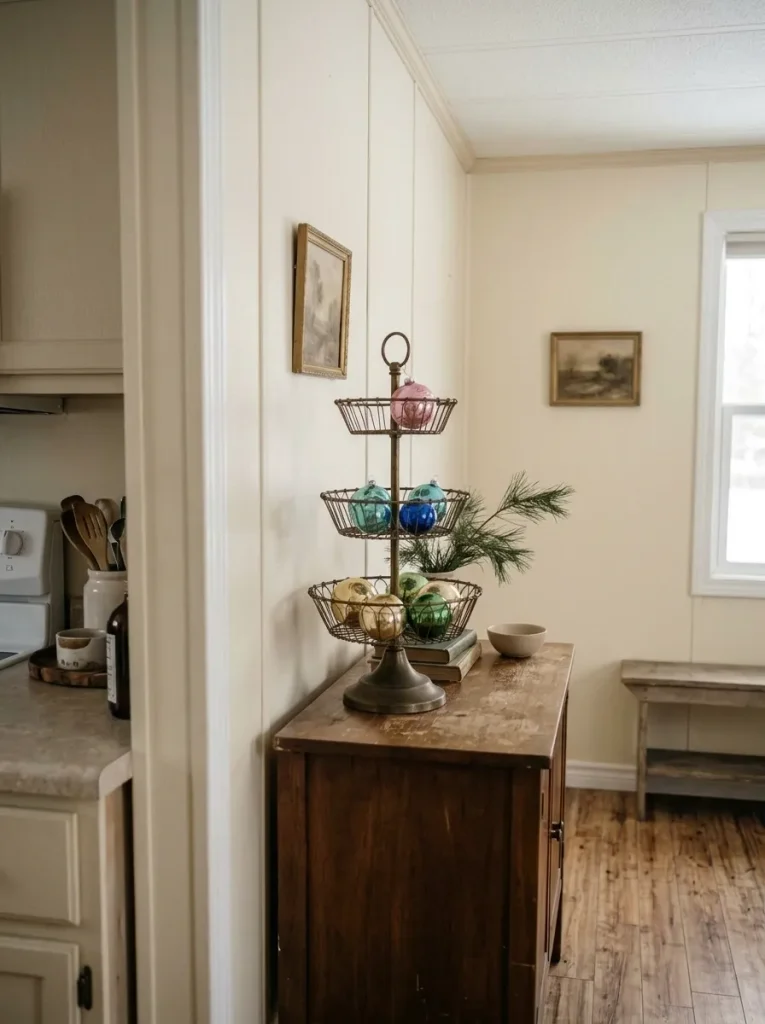
An old tiered fruit stand can bring a sense of height and organization to a collection of secondhand Christmas ornaments.
The open wire structure gives the display a light appearance, while the separate tiers naturally divide the ornaments into groups.
For example, larger gold and green ornaments might occupy the bottom level, smaller turquoise and blue decorations could fill the middle, and one beautiful pink ornament could become the focal point at the top.
The arrangement feels layered without requiring a wide surface.
Build it from the bottom upward.
First, check that the stand is stable and has no sharp or weakened wire sections. Add appropriate liners or individual supports so ornaments cannot roll through gaps.
Place larger, less-fragile pieces on the bottom tier, where they establish a visual base. Keep the upper levels lighter and more open.
A collection of a few carefully positioned ornaments can look more interesting than a stand packed to capacity.
When this idea does not work
A fruit stand may be too tall for a shallow shelf or too wide for a narrow kitchen counter.
In that situation, use a lower bowl or move the arrangement to an existing sideboard.
For other ways to decorate open furniture without overwhelming the room, see our Christmas shelf styling ideas for mobile homes without a fireplace.
Small-space advantage: Multiple ornaments can be viewed vertically while occupying one contained tabletop footprint.
13. Frame a Few Colorful Baubles Inside a Vintage Embroidery Hoop
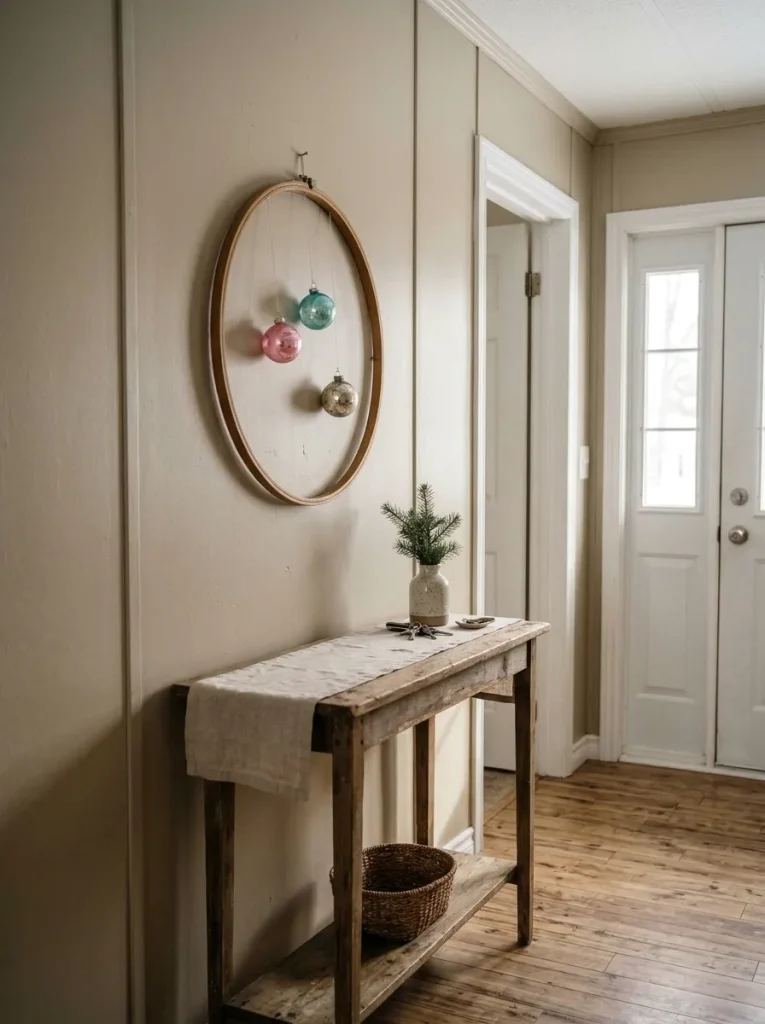
An oversized vintage embroidery hoop can become an airy Christmas ornament display with a softer appearance than a traditional picture frame.
Its circular outline naturally draws attention toward whatever hangs inside.
Picture a wide wooden embroidery hoop with three small ornaments arranged at different heights: one faded pink glass ball, one turquoise bell, and a tiny silver star.
The generous space around the decorations allows the individual shapes to stand out.
Unlike a dense wreath, the hoop keeps most of the background wall visible.
That quality can be helpful in a narrow mobile-home room where too many dark or bulky decorations make the space feel crowded.
What should support the ornaments?
An embroidery hoop is a craft component, not necessarily a load-bearing display fixture. Inspect its fastening mechanism and use a secure, appropriately supported arrangement for any hanging pieces.
Small, lightweight, shatter-resistant ornaments are a more forgiving choice than heavy antique glass.
Position the hoop on a suitable stationary wall away from doors and frequent movement.
For styling, resist the urge to fill the circle. Three ornaments of different sizes can create a stronger composition than a dozen competing decorations.
Alternative approach: Use the hoop as a decorative border around a separately supported miniature ornament display, so the hoop itself carries no fragile glass.
14. Sort Thrifted Christmas Baubles Into Clear Vintage Glass Jars
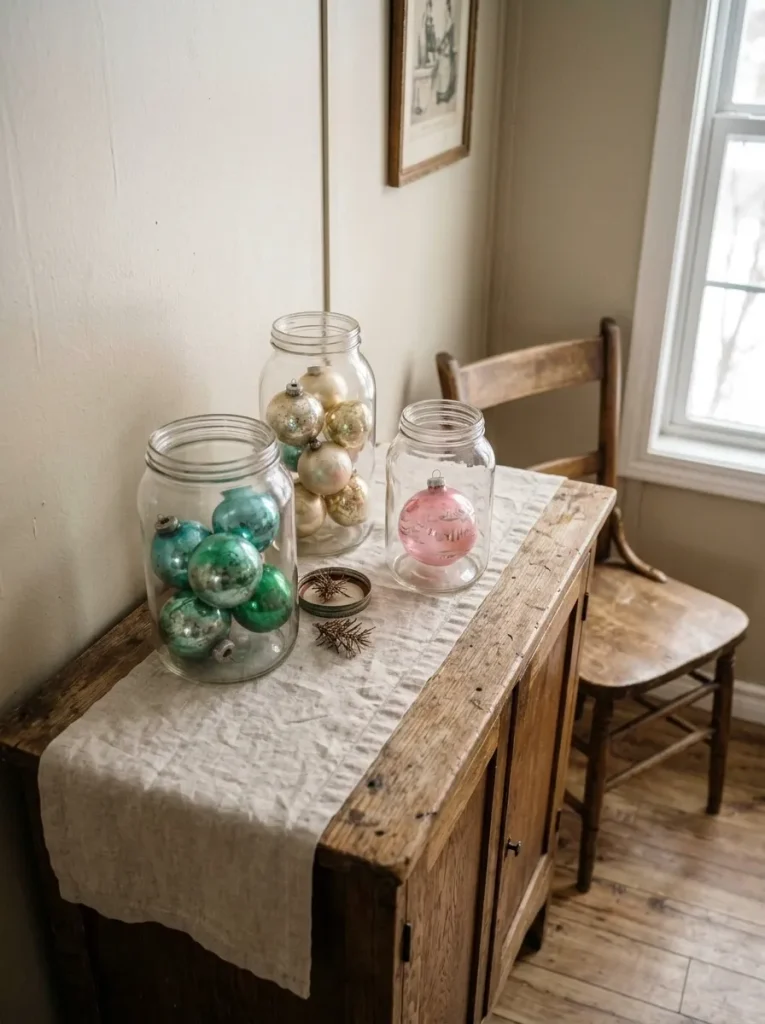
Clear glass jars are wonderfully effective for displaying the colors and finishes of thrifted Christmas ornaments.
You may already have a few broad vintage jars, old candy containers, or clear decorative canisters that could be repurposed.
The glass allows the collection to be seen from several sides, while the container creates a defined boundary that keeps the arrangement from spreading across the furniture.
Try building a small color collection:
- Champagne and gold: Warm metallic ornaments with faded stripes or delicate painted details.
- Turquoise and emerald: Jewel-toned baubles that make an eye-catching grouping against pale furniture.
- Blush pink and cranberry: Soft vintage pinks balanced with a few deeper red accents.
The jars do not need to match perfectly, but their shapes should work together when placed on the same surface.
Should you fill every jar?
Not necessarily.
A single oversized ornament inside a broad glass container can be particularly attractive because its decorative finish remains visible from every angle.
For a fuller jar, choose sound, appropriately sized ornaments that fit without squeezing against one another. Use protective separation where necessary.
Avoid putting cracked, flaking, or irreplaceable ornaments into tightly packed glass containers. Narrow openings and hard surfaces can damage fragile finishes during placement and removal.
Set the jars on a stable dresser or hutch where they cannot be bumped easily.
Styling detail: Mix one tall container with two lower shapes for a collection that looks deliberately arranged without becoming too formal.
15. Open a Vintage Jewelry Case to Display Christmas Ornaments With Family Stories
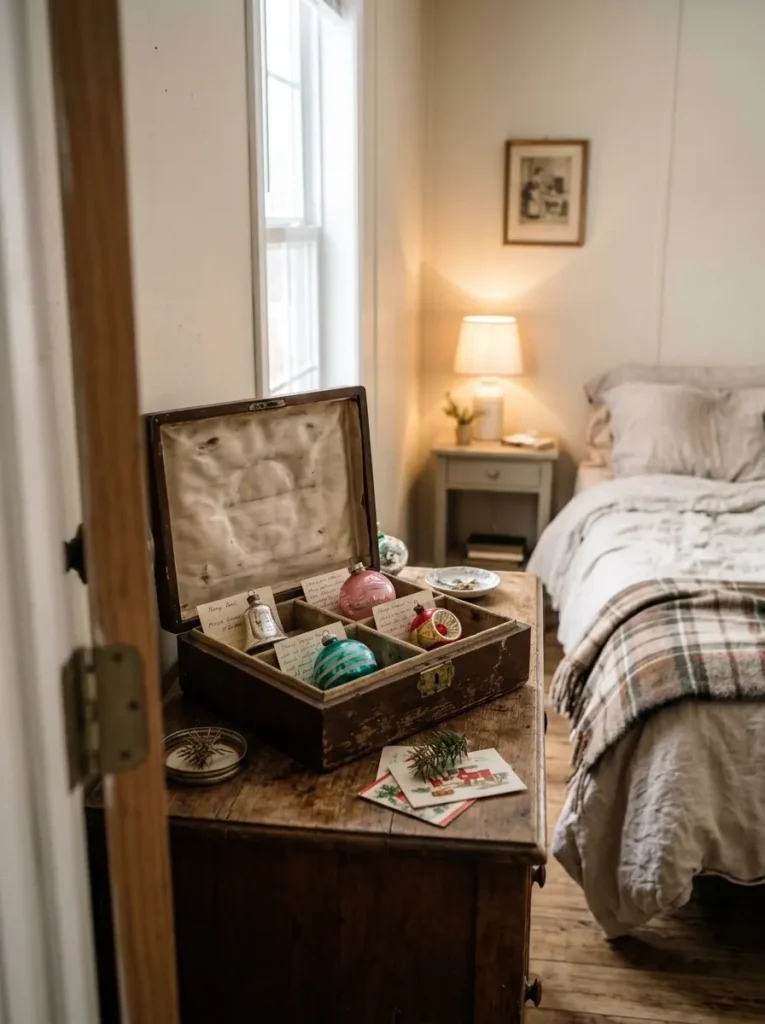
An old jewelry case can become one of the most personal Christmas decorations in your mobile home.
Many thrifted jewelry boxes have small divided compartments, lined drawers, decorative hinges, or a softly aged exterior. Those details make them appealing homes for tiny vintage ornaments.
Imagine a small wooden jewelry case resting open on a bedroom dresser. Inside are several carefully supported Christmas decorations: a miniature glass bell, a faded silver star, an ornament inherited from a grandparent, and a small bauble bought during a memorable family trip.
A few handwritten cards identify the year or story behind the pieces.
Suddenly, the display becomes more than seasonal decoration.
It becomes a small family collection that can be enjoyed every Christmas.
Choose what belongs inside
Ask three questions about each ornament:
- Does it have a story worth sharing? A meaningful memory may be more interesting than an expensive or unusual ornament.
- Is it safe to handle? Pieces with unstable glass, cracked finishes, or loose components may be better protected in storage.
- Does it fit comfortably? The ornament must rest on suitable support without rubbing against the case walls or lid.
Give each displayed piece its own cushioned area. Avoid shutting a jewelry case over ornaments that extend above their compartments.
The case works beautifully on a dresser or a stable shelf where it can remain open without interfering with everyday routines.
For more ways to give secondhand objects a meaningful place in your rooms, explore these thrifty mobile-home decorating ideas.
The finishing touch: Include a small note explaining the memory behind your favorite ornament. Years later, those handwritten stories may become as treasured as the decorations themselves.
Curate the story, not the clutter.
Match a small collection to the number of independently padded case compartments. The tray redraws and the storage plan changes with your choices.
Counts are an editing aid, not a fit guarantee. Check actual ornament diameter, glass condition, padding and lid travel.
Choose the two ornaments with the clearest stories; cushion the remaining piece separately.
Three memories fit by count. Leave a spare compartment as a visual pause.
A sparse museum-style arrangement makes each piece easy to appreciate.
Prioritize the two most meaningful pieces. Keep three in separate padded storage.
Tell four stories in the open case; protect the fifth ornament in storage.
Five individually supported pieces create a complete little archive without overfilling.
Use this tiny case as a rotating seasonal feature, not permanent storage for all eight.
Exhibit half the collection this year, then rotate favorites next season.
Keep six stories visible and protect the remaining two in separate supports.
How to Choose the Best Thrifted Christmas Ornament Display for Your Mobile Home
Before picking an idea, look at the space where the display will live.
An accordion rack can make use of a properly supported wall, while a dough bowl or fruit stand can bring holiday color to existing furniture. A cabinet nook works well for a miniature Christmas tree, and a small cloche or jewelry case can protect ornaments with sentimental value.
The right choice also depends on your collection.
If you have dozens of colorful but inexpensive ornaments, a larger wall gallery or tiered arrangement may help you display more of them. If most of your pieces are fragile heirlooms, individual protected displays usually make more sense.
Consider the room’s everyday routine as well. A beautiful display loses its appeal if you must move it every time you prepare dinner, open the blinds, or walk through a narrow hallway.
For older glass, minimize unnecessary handling. The University of Illinois preservation guidance for glass and ceramic objects emphasizes protective storage, careful support, and avoiding unnecessary contact between fragile objects.
You can also begin with one small arrangement this Christmas. Choose a favorite group of ornaments, find a thrifted object that displays them well, and evaluate how the finished piece looks from the doorway.
A carefully edited collection often brings more character than filling every available surface with decorations.
Final Thoughts
Thrifted Christmas ornaments have a charm that new matching sets cannot always reproduce. Their faded colors, unusual shapes, and little signs of age bring a sense of history into a home.
And you do not need a large house or another full-size Christmas tree to enjoy them.
A wooden wall rack, an old brass candlestick, a shallow bowl, or a vintage jewelry case can give those familiar decorations an entirely new purpose.
Choose a display that complements your mobile home’s proportions, protect delicate ornaments, and allow a little empty space around your favorite pieces.
The loveliest Christmas collection is not necessarily the biggest one. It is the one you can enjoy comfortably, safely, and year after year.
Save this article on Pinterest so you can return to these thrifted Christmas ornament display ideas whenever you discover another vintage holiday treasure.