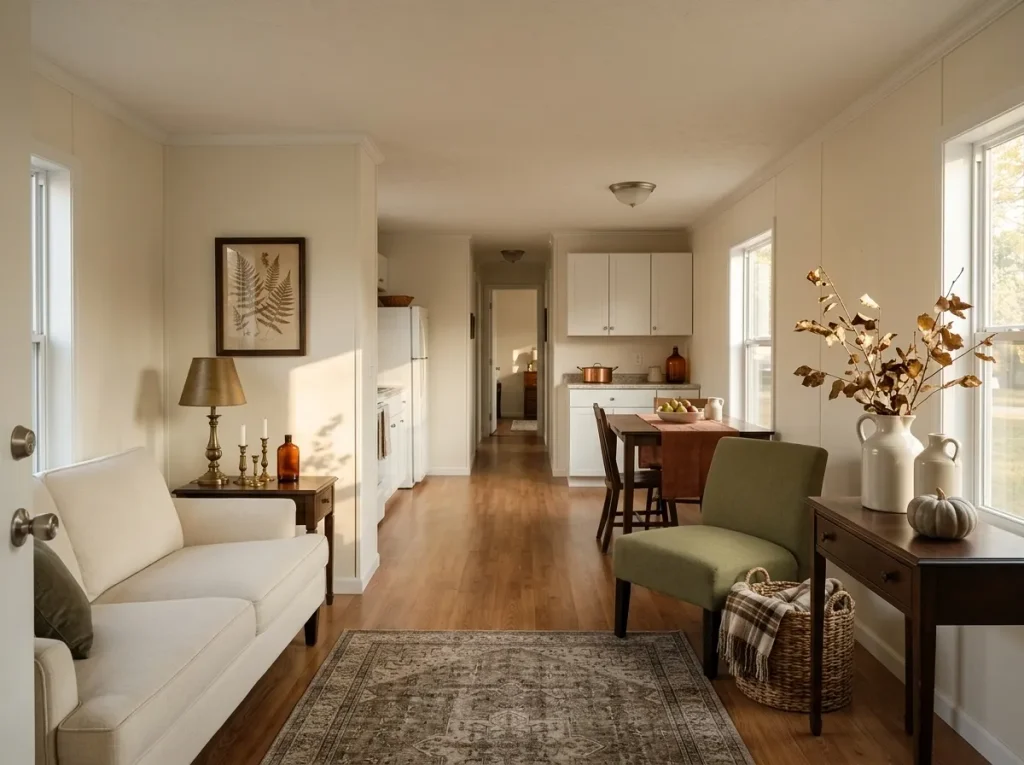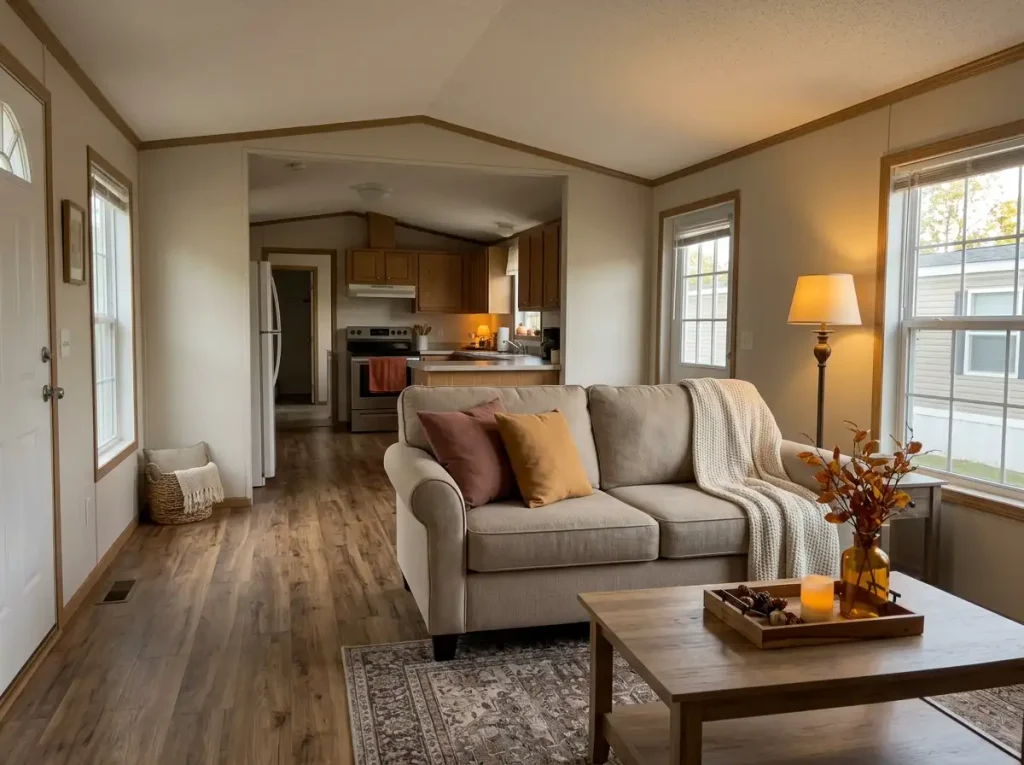
A bag full of mini pumpkins, faux leaves, ribbon, and seasonal stems can feel like a bargain at the dollar store. The trouble often starts when every item needs somewhere to sit. In a mobile home, a few tiny decorations spread across the sink ledge, coffee table, kitchen counter, and entry console can make the whole interior feel busier without making it feel much more like fall.
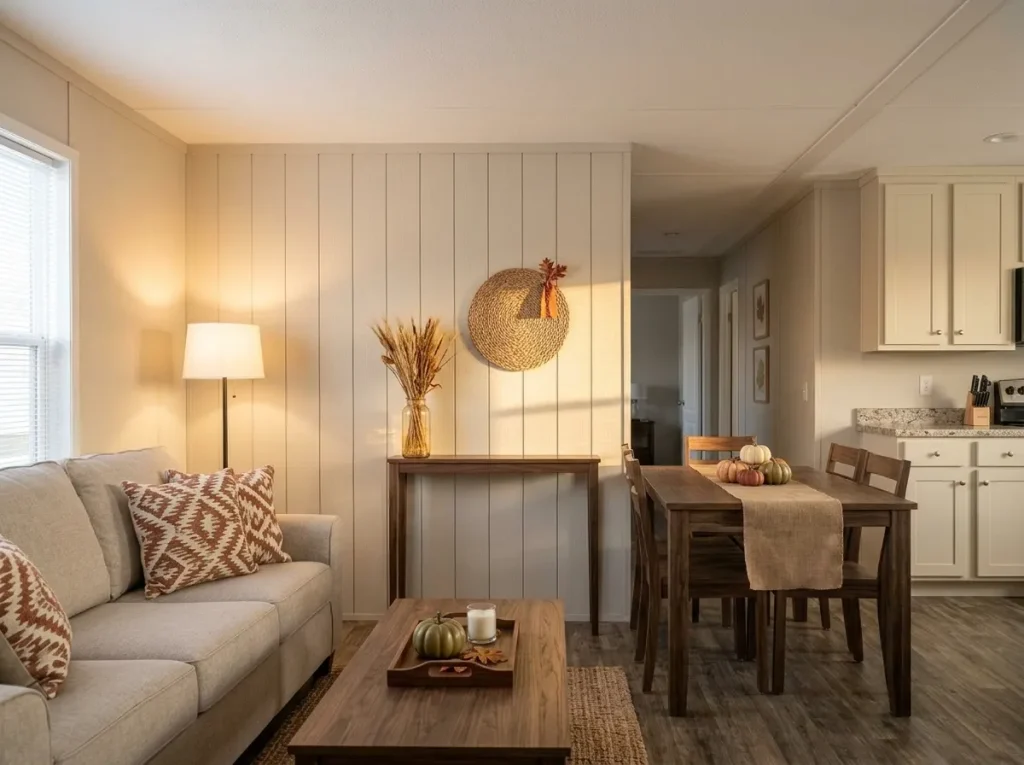
The better approach to dollar store fall mobile home decor is to ask how much visual work each inexpensive piece can do. A tall arrangement can replace several tabletop objects. A slim garland can turn a window into a seasonal focal point. A removable tray can warm up a kitchen without permanently sacrificing prep space.
These 17 ideas focus on that kind of leverage. Some use vertical space, some work with architectural edges, and others upgrade things you already own. The aim is not to display every autumn item you can find. It is to make a few low-cost materials feel intentional enough to change the entire view.
1. Recolor Craft Pumpkins Into One Quiet Mobile-Home Palette
Small craft pumpkins become visually noisy surprisingly quickly when every piece has a different shade, shine, pattern, and finish. That matters more in a mobile home because the kitchen, dining area, and living room may all be visible within the same long sightline. Six inexpensive pumpkins can begin reading as six separate decorations instead of one seasonal idea.
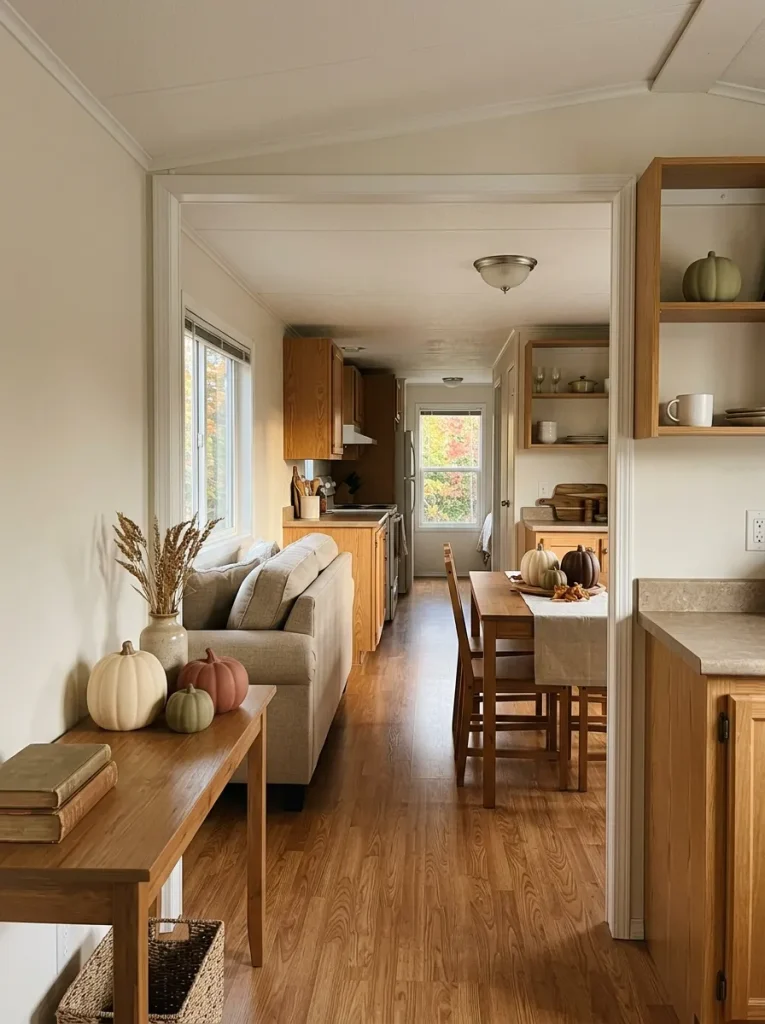
Choose one dominant neutral, one autumn color, and one small accent before you start placing anything. Cream with muted rust and olive can suit warm wood. Mushroom, terracotta, and deep brown can settle beautifully against beige upholstery. You do not have to repaint every pumpkin; change only the pieces that fight the palette.
Then perform a doorway test. Stand far enough away to see several rooms together. If your eye notices individual pumpkin colors before it notices the overall autumn mood, simplify again.
A useful stopping rule: once three related tones repeat naturally through the visible area, additional colors usually add complexity faster than impact.
For more detailed techniques on improving inexpensive finishes, connect this section to StylishGalore’s Dollar Store Home Decor guide.
2. Build One Tall Harvest Vase That Replaces Five Small Decorations
A narrow mobile-home surface rarely needs five miniature fall objects. It often needs one composition with enough height to be noticed from farther away.
Start with a simple vase, jar, pitcher, or other stable container you already own. Add inexpensive faux branches, autumn leaves, seed stems, or a few gathered-looking twigs. Keep the base relatively narrow and let the arrangement gain presence upward. On a console, dining cabinet, or unused corner of a counter, that vertical silhouette can influence the whole connected room while preserving most of the usable surface.
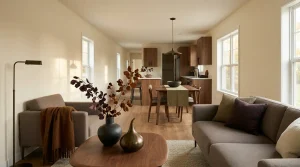
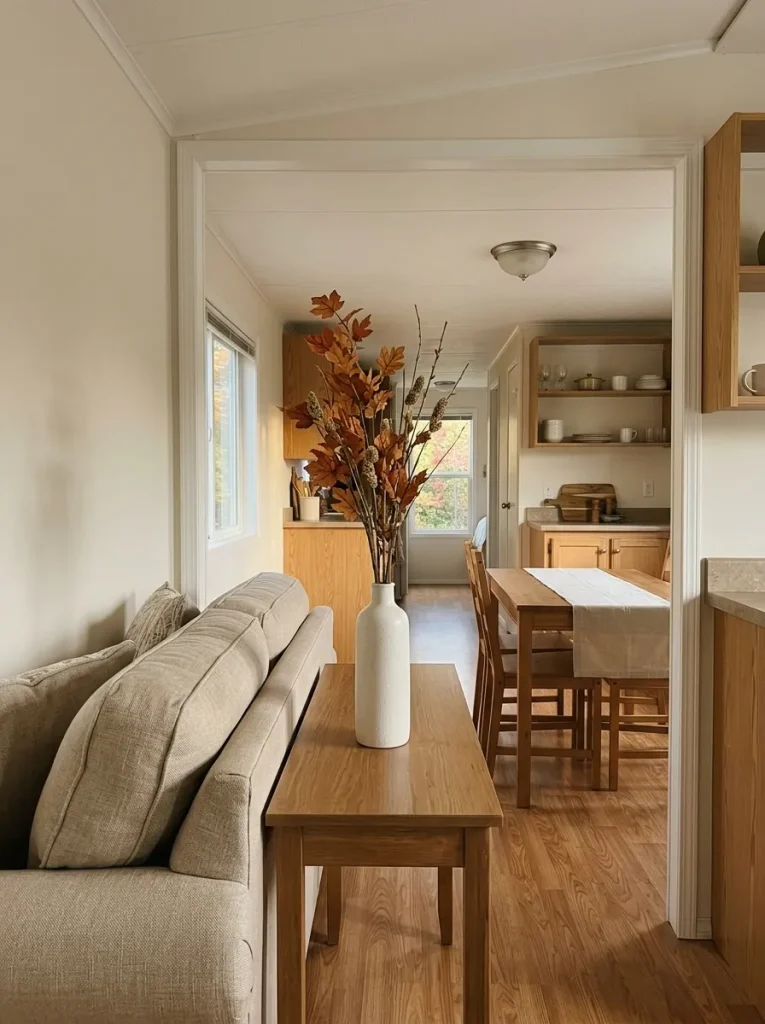
The important decision is not really which stems should I buy? It is which part of my home can carry the season without stealing useful space?
Dollar-Store Impact Router
Impact-per-inch planner
Where should your next dollar-store fall idea go?
Choose the condition that describes your home. The strongest route creates seasonal presence without taking over useful space.
CHOOSE YOUR BIGGEST CONSTRAINT
Small-home rule: the best bargain is rarely the decoration with the lowest price. It is the one that influences the largest useful view while occupying the least valuable space.
A tall vase is strongest when several rooms can see it. If only the person standing directly beside it notices the arrangement, the same materials may work harder somewhere else.
3. Trace the Sink Window With a Slim Leaf-and-Light Garland
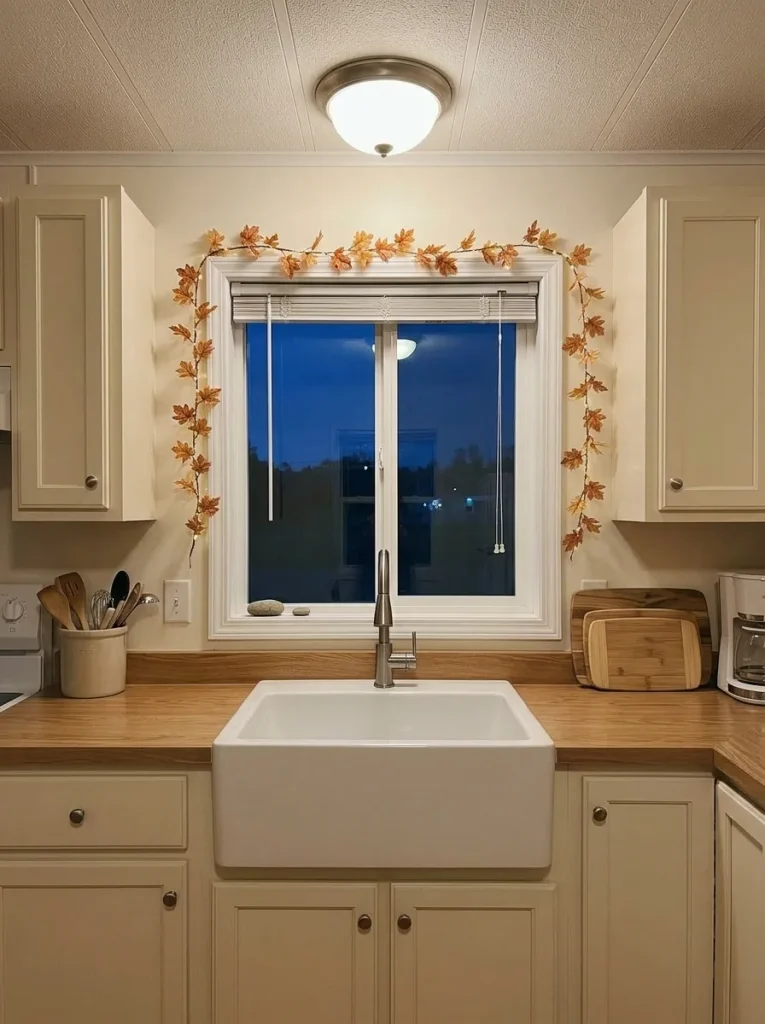
Picture a small mobile-home kitchen after dinner. The counter has been cleared, the sink is empty, and one narrow line of autumn leaves follows the window frame. From the adjoining dining or living area, that edge reads as a complete seasonal feature even though almost none of the work surface has been decorated.
That is why the window frame can be more valuable than the sill.
Use a light faux-leaf strand or a restrained mix of leaves and flexible vine. If you add micro-lights, use a product appropriate for the intended location and follow its instructions. Keep blind controls, handles, latches, curtains, and normal window operation free.
Do it when: the window already sits on an important kitchen sightline and the surrounding counters need to remain practical.
Skip it when: the frame is visually busy, the treatment interferes with window use, or the kitchen already has a stronger seasonal focal point.
Connect this section contextually to StylishGalore’s Fall Mobile Home Kitchen Decor specialist guide for deeper kitchen-wide styling.
4. Put Fall on a Movable Counter Tray, Not Across the Whole Counter
The fastest way to make a compact kitchen frustrating is to turn every open patch of counter into permanent seasonal real estate.
A tray solves a different problem: it gives the decoration a boundary and an exit strategy.
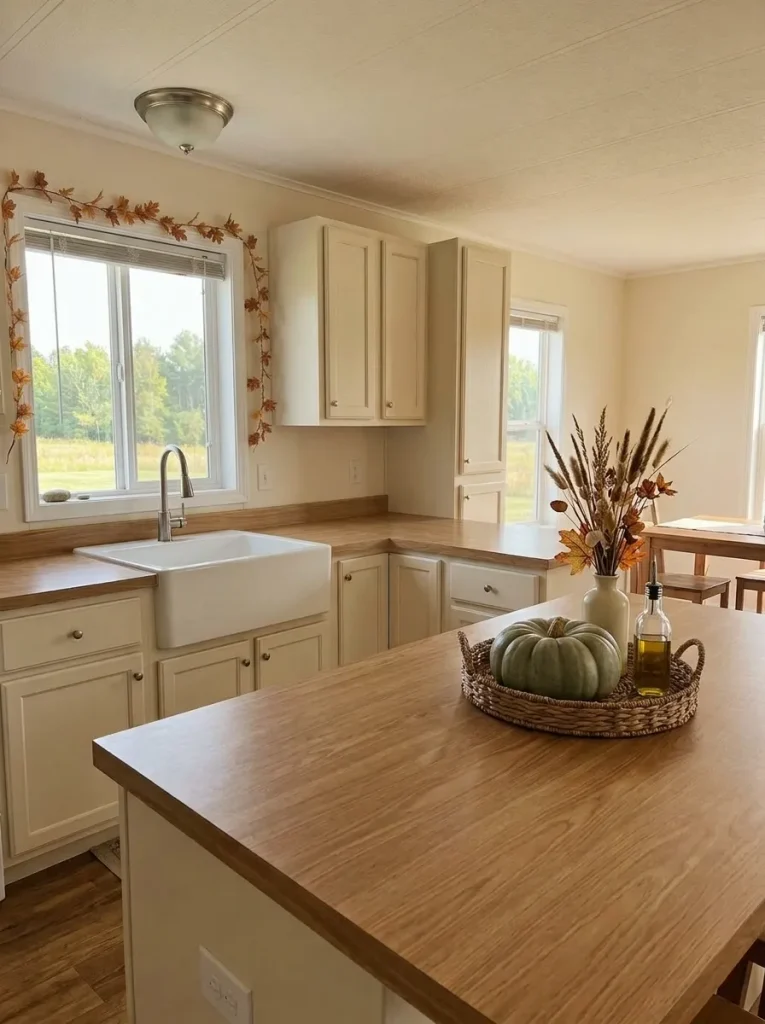
Place one compact seasonal arrangement inside it—perhaps a small pumpkin, one narrow stem, and a useful everyday object that already belongs there. The exact objects matter less than keeping their combined footprint visibly contained. When you need the work surface, the entire fall layer moves in one action.
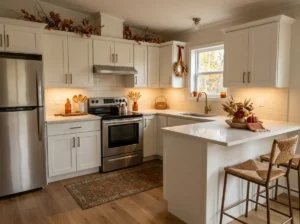
That distinction matters in a mobile-home kitchen with a short counter run. A charming display that has to be dismantled every time you prep food is not really working with the room.
Counter Footprint Boundary
Give fall décor a boundary
The seasonal layer should occupy one clearly defined zone while the larger part of the counter continues doing its everyday job.
The tray passes when the counter still looks usable before you ever touch it. If the decorations visually spill beyond their boundary, edit the arrangement until the empty work area becomes obvious again.
5. Wrap Existing Pillows With Low-Cost Napkins or Scarves
A seasonal pillow can feel inexpensive at checkout and surprisingly expensive once you need somewhere to store four of them for the other nine months of the year.
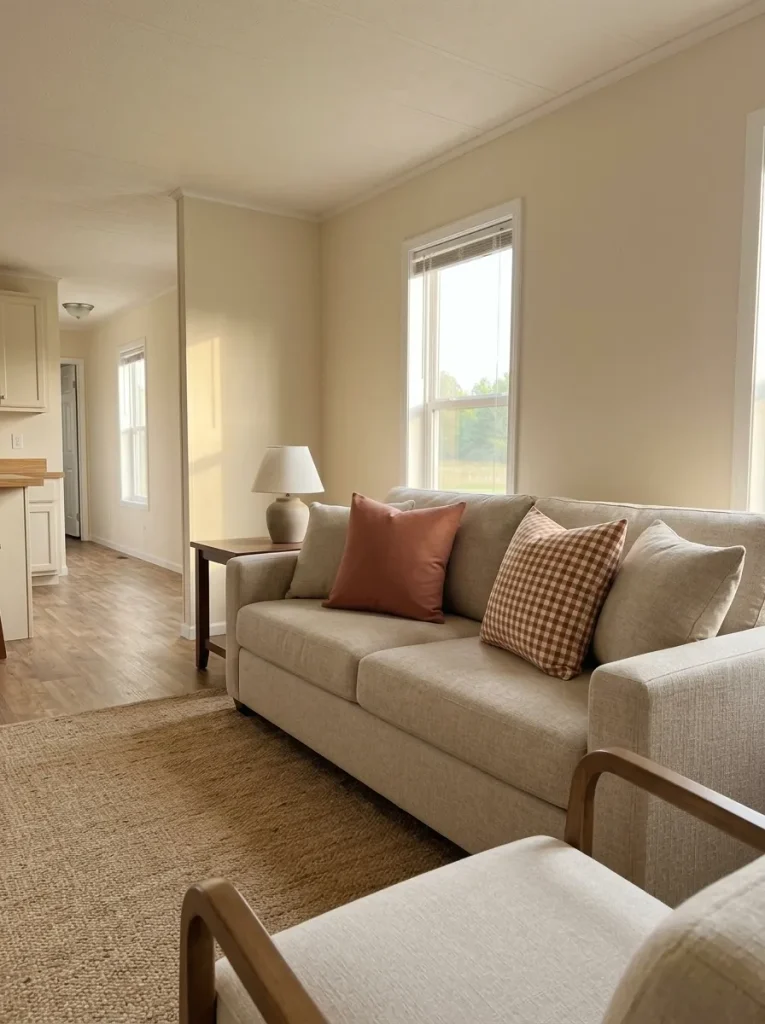
For a mobile home with limited closets, the better test is: can the pillow already on the sofa become the fall pillow?
Look for oversized cloth napkins, scarves, simple seasonal fabric, or inexpensive textile remnants in a warm tone that already works with the room. Wrap or cover an existing insert so the temporary fabric changes the visible color and texture without adding another bulky cushion to storage. Keep the treatment secure and tidy at the back; the front should still read as a normal usable pillow.
One or two transformed cushions usually have more impact than adding autumn fabric to every seat. Let the sofa remain the visual anchor and use the temporary covers as seasonal punctuation.
Connect this section to StylishGalore’s Fall Mobile Home Living Room Ideas specialist guide if the reader wants to continue into rugs, lighting, furniture, and whole-room fall styling.
6. Make a Half-Frame Door Garland That Leaves the Entry Visually Open
A common budget-decor mistake is treating a small mobile-home entrance like a wide farmhouse porch. A thick garland goes across the top, down both sides, pumpkins collect around the threshold, and suddenly the doorway—the part that should feel open and welcoming—looks squeezed between decorations.
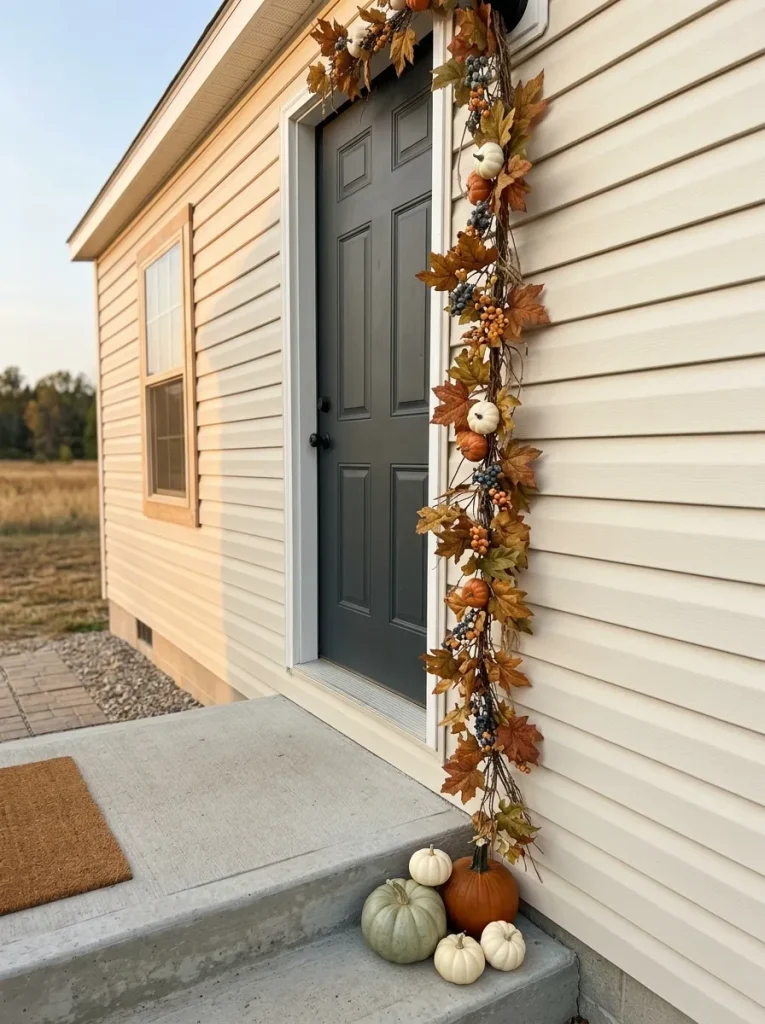
Try concentrating the fall material on one side of the frame and part of the top. Faux leaves, flexible twig garland, inexpensive berry stems, and a few small pumpkins can build enough asymmetry to make the door feel deliberately decorated without surrounding it on every edge.
Step back to the normal approach path before adding the final layer. You should still notice the door opening first and the seasonal treatment second. If the décor visually narrows the entrance or interferes with ordinary door, step, or handrail use, edit it back.
The broader exterior composition belongs in StylishGalore’s Fall Mobile Home Porch Decorating Ideas specialist article.

7. Edge a Plain Burlap Runner With Faux Leaves Without Crowding the Table
A dining table does not need a tall centerpiece to look autumnal. In a compact mobile home, the table may also be a homework surface, coffee stop, extra prep zone, or the easiest place to set down groceries. A decoration that occupies the center can therefore create more friction than atmosphere.
Move the seasonal detail to the outer edge of the runner.
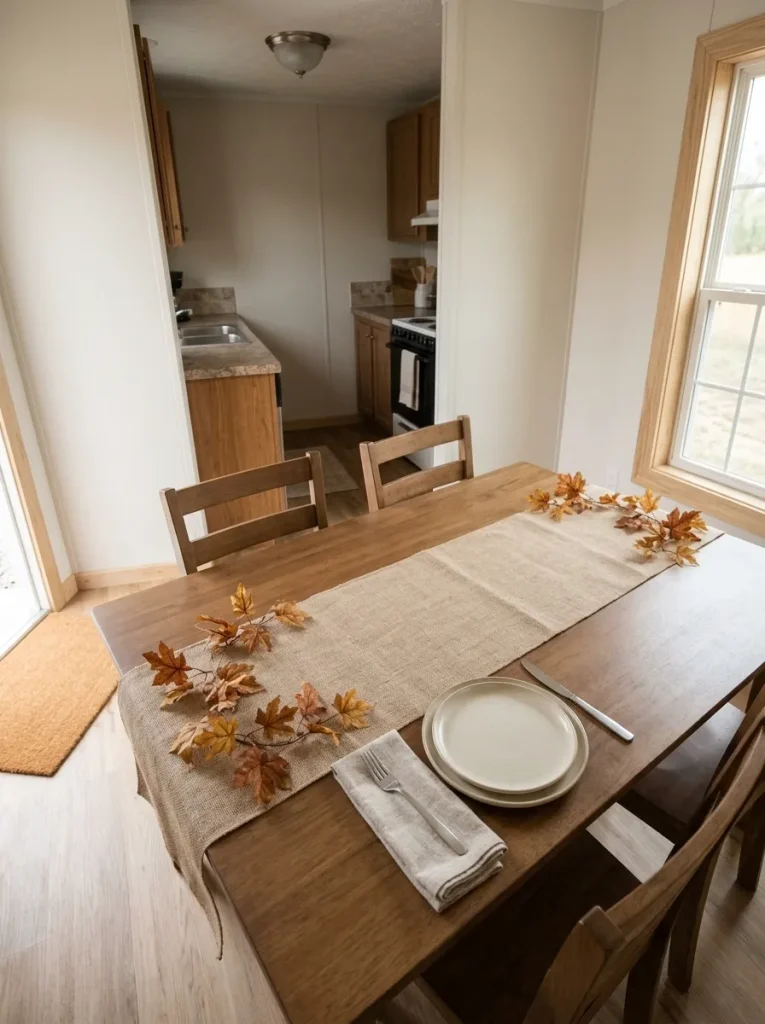
Start with a simple burlap, woven, or neutral fabric runner. Attach or arrange inexpensive faux leaves in a restrained rhythm near the two long edges, allowing the center strip to remain visually quiet. A few rust, ochre, and brown leaves usually read more clearly than covering every inch.
From a seated position, the table still feels warm and textured; from above, the leaf border frames the usable middle.
Stop once the perimeter is recognizable. If another layer of leaves would make plates, bowls, laptops, or serving pieces compete with the decoration, the runner has already reached its useful limit.
8. Turn Scrap Fabric Into a Soft Harvest Knot Garland
Hard seasonal objects are not always the best bargain for a small home. Pumpkins, lanterns, signs, and ceramic pieces all require somewhere to sit during autumn and somewhere to live after autumn.
A fabric garland solves both problems with very little storage bulk.
Cut scrap fabric, inexpensive napkins, old seasonal textiles, or low-cost remnants into narrow strips. Mix perhaps two quiet patterns with one solid fall tone, then knot them around twine at deliberately loose intervals. The finished piece should have enough repetition to register as a garland while retaining small gaps between the fabric clusters.
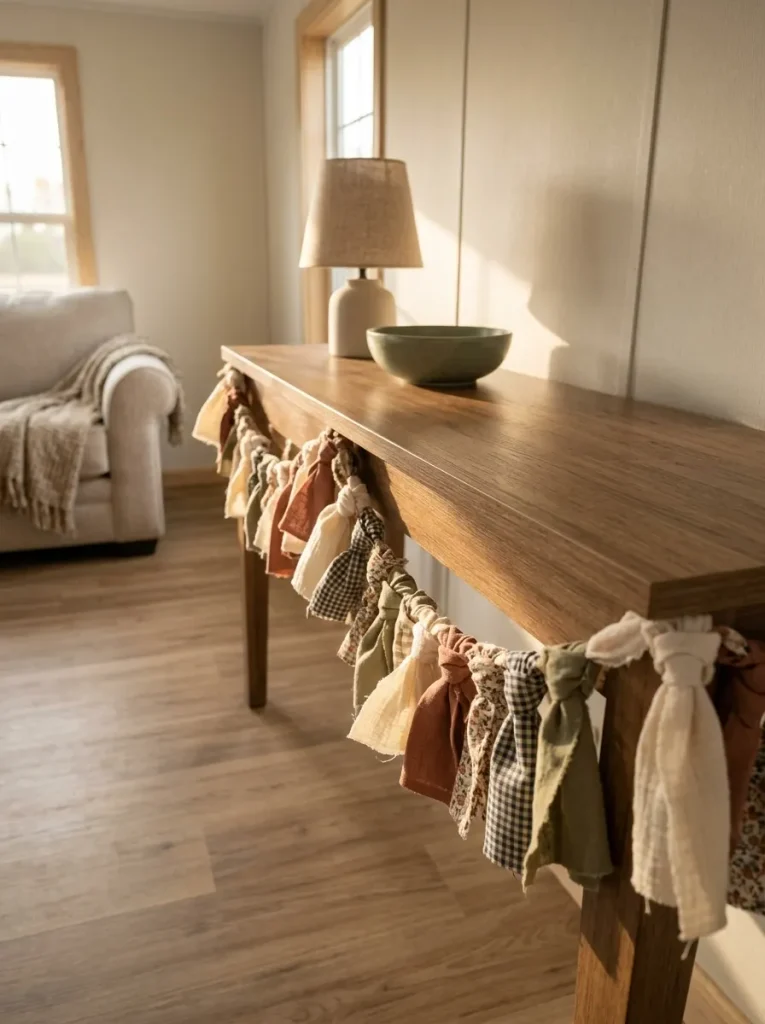
Use it along a narrow wall shelf, the front of a console, a short stretch of cabinetry, or another place where a rigid object would project too far into the room.
The important edit happens before the final knot: view the garland from across the space. If it reads as one soft autumn line, stop. More fabric will usually make it denser without making it more visible.
9. Raise a Tiny Porch Display With Two Low Crate-Style Risers
A small porch display often looks underwhelming because every inexpensive object sits at the same height. The natural response is to buy more pumpkins. Height can solve the problem with fewer pieces.
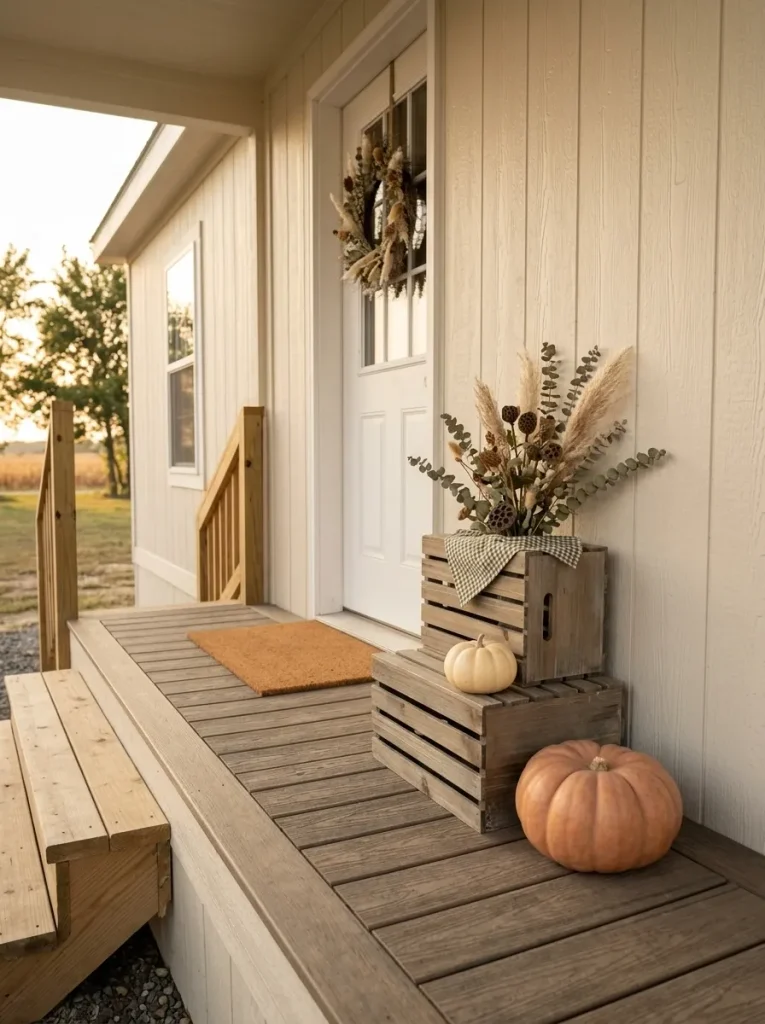
Use two stable, outdoor-appropriate risers or crate-style platforms to create a low–middle–high sequence inside one compact decorative zone. A larger pumpkin can anchor the floor level, a second seasonal piece can occupy the middle, and foliage or a taller object can create the upper point. The eye reads the group vertically, so the display gains presence without having to spread across the entire landing.
Porch Impact Footprint
Build upward before the display spreads outward
Boundary test: if the arrangement begins moving into the normal entry route, add height or remove an object before widening the footprint.
The important tradeoff is footprint versus height. If the display needs another row of pumpkins and a separate lantern grouping to feel finished, edit back to the strongest three levels and preserve the everyday approach to the door.
10. Hang a Twig-and-Mini-Pumpkin Mobile Only in a Dead Ceiling Zone
Can inexpensive fall décor work overhead in a mobile home?
Sometimes—but only when the ceiling zone is genuinely unused.
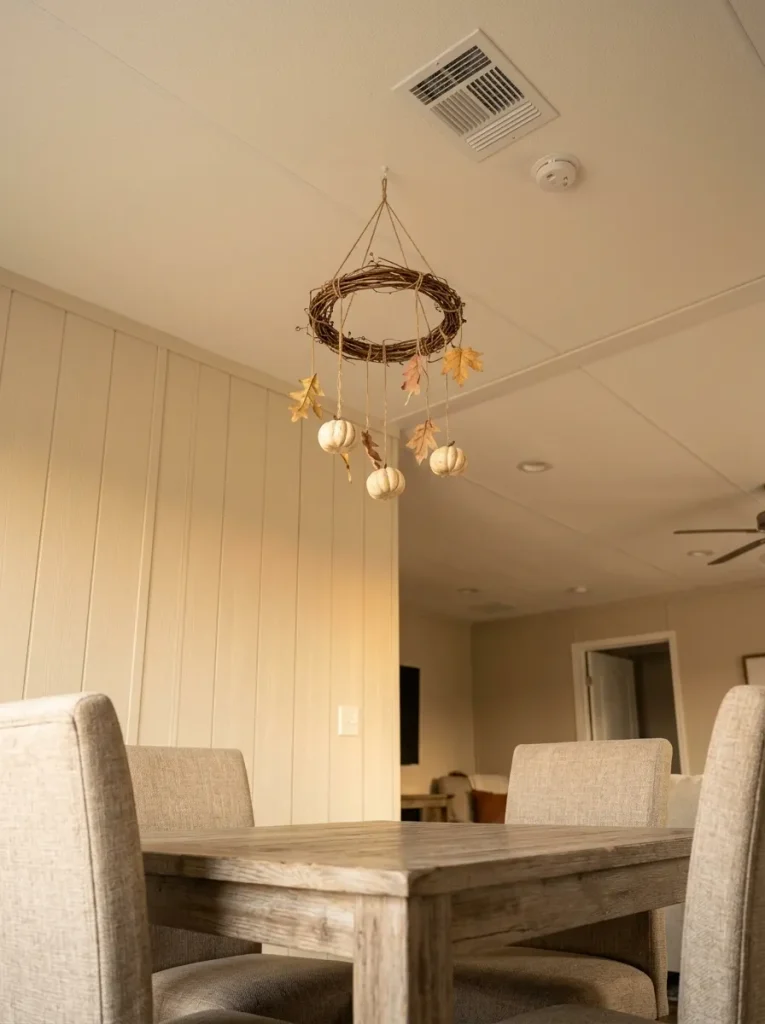
A twig ring or lightweight branch arrangement with small faux pumpkins can make a striking seasonal feature over a dining table or another static zone because it moves the visual emphasis away from floors and furniture. The same idea becomes a poor fit when it occupies a normal walking route, competes with a ceiling fan or fixture, or makes a modest-height ceiling feel even lower.
Hang or Skip?
Does this overhead spot earn a fall mobile?
Choose what is directly beneath or beside the proposed location. The answer should depend on how the space already works—not on how attractive the mobile looks by itself.
Keep it visually light.
A genuinely unused zone over static furniture may support a lightweight seasonal accent when there is a suitable attachment method and the finished piece does not interfere with normal room use.
Keep active movement space visually clear.
An overhead decoration gains little if people feel they are moving beneath or around it every time they cross the room. Use the same materials on a wall, window edge, or tabletop zone.
Do not build seasonal décor around active fixtures.
Fans, lighting, vents, detectors, and similar functional elements should remain unobstructed. Shift the seasonal focal point to architecture that does not need to move, ventilate, illuminate, or operate.
A hanging feature may make the ceiling feel heavier.
When the room already reads as low overhead, a tall vase, wall cascade, or framed vertical arrangement can create height without suspending another visual layer above the furniture.
The mobile earns its place only when the unused overhead zone is the reason the idea works. If you have to justify it simply because the room needs “more fall,” use those pumpkins and leaves somewhere flatter and easier to live with.
11. Put One Battery-LED Glow Cluster Where Two Rooms Can See It
One tiny light on every shelf does not necessarily make a mobile home feel warmer. It can create a series of unrelated bright dots competing along the same sightline.
A stronger evening move is to choose one controlled glow point that can be seen from more than one adjoining zone.
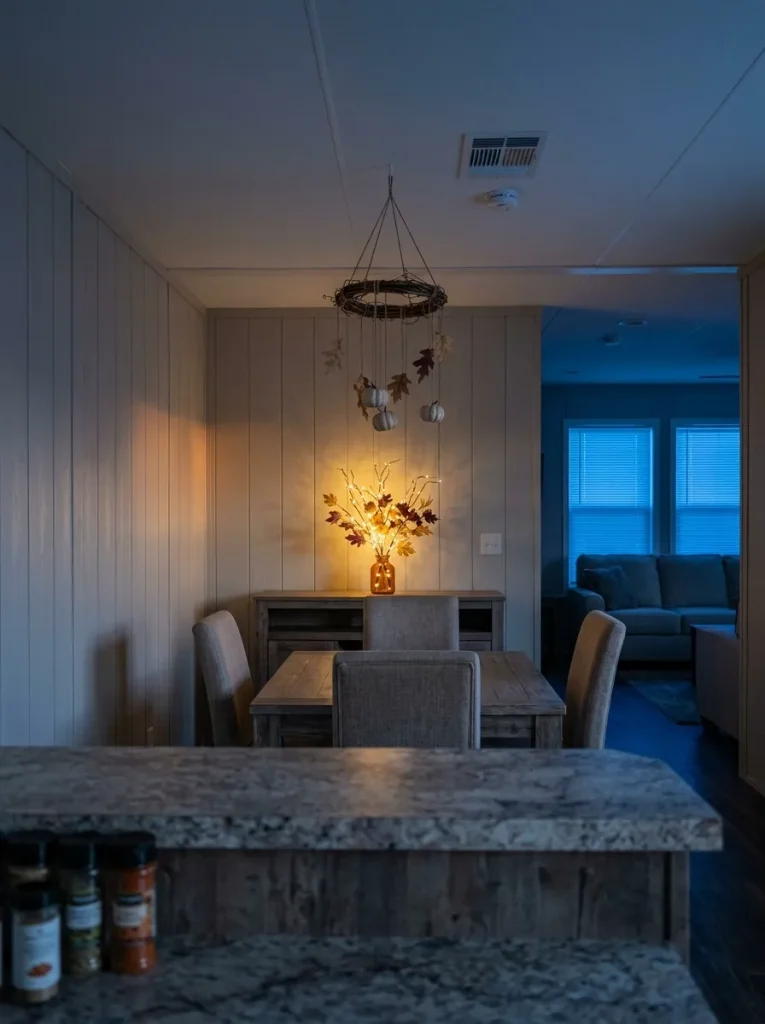
A simple dollar-store arrangement might combine a battery-powered LED strand with a few branches, leaves, or a translucent container. Position the cluster where the kitchen, dining area, or living room can borrow some of its warmth when the main room lights are softer.
Two-Room Glow Map
Let one inexpensive glow point influence two spaces
If the light only works after every other room gets its own illuminated fall piece, the first location was too visually isolated. Move the original glow to the stronger shared sightline before buying more.
12. Use Three Cheap Frames to Stretch Autumn Up a Long Wall
A long blank wall in a mobile home can tempt you to solve the problem with one oversized seasonal sign. Three smaller frames can create a more adaptable autumn rhythm, especially when inexpensive frames are already easy to source.
Use the repetition, not the artwork alone, as the design tool.
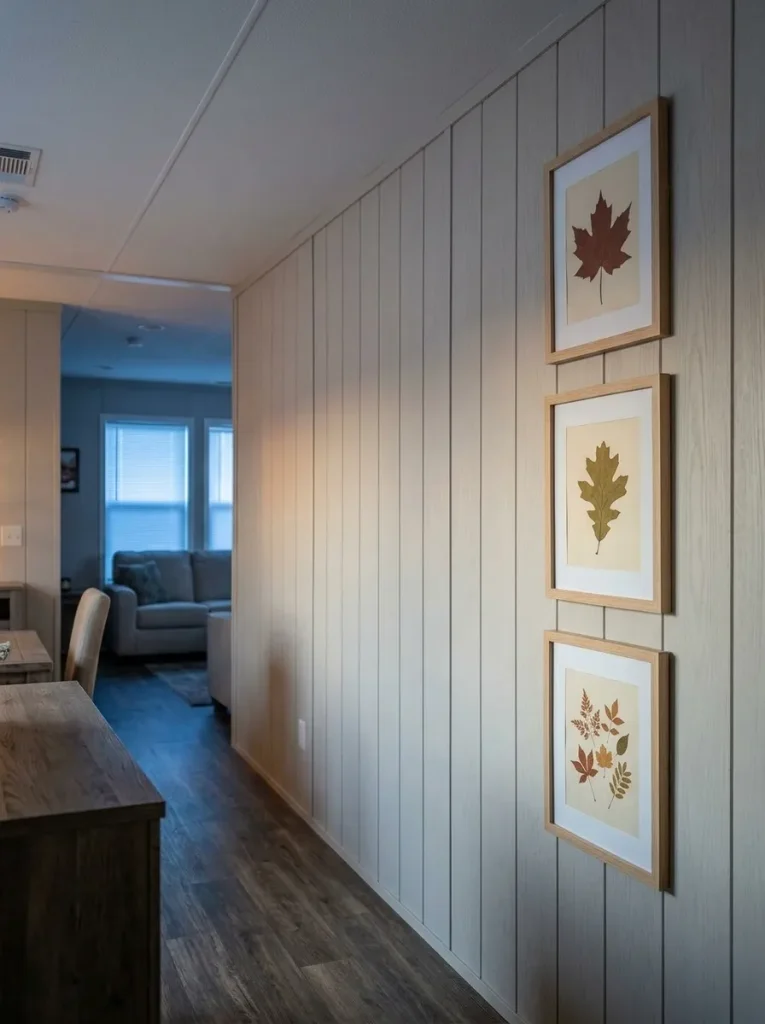
Keep the frames related in color or finish and place simple seasonal imagery inside: pressed-looking leaves, warm abstract prints, botanical silhouettes, or restrained autumn photography. Align them vertically where the room needs height or horizontally where you want the eye to continue along the long axis.
The group should be readable as one composition before someone can identify what is inside each frame.
This idea is weaker on a wall that already holds a television, open shelving, a gallery collection, or multiple strong architectural details. There, another trio may simply create another competing system. Save the inexpensive frames for a wall where repetition can supply the missing structure.
13. Move Fall Texture to the Wall With a Woven Placemat or Shallow Basket
What if there is no useful tabletop left?
Then fall texture does not have to sit on furniture at all.
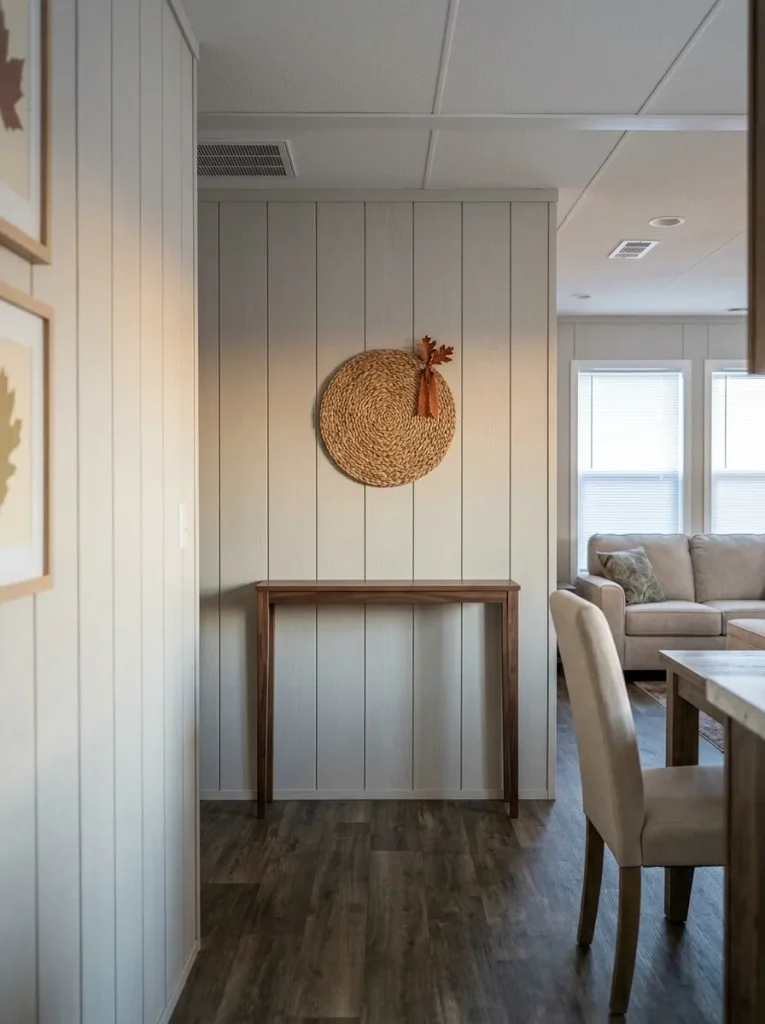
A woven placemat, shallow basket, charger, or similarly flat natural-fiber piece can become a low-depth wall accent. Add only a restrained seasonal cue—a short ribbon, a small leaf cluster, or a narrow piece of foliage—so the woven texture remains the dominant material.
This works particularly well when the floor plan is already furnished closely enough that baskets, extra stools, floor lanterns, and freestanding seasonal props would consume more breathing room.
The wall treatment should appear intentional from the nearest normal viewing position. If the object reads like a placemat randomly hung on a wall, the styling needs stronger composition or a better location. If it reads as texture first and inexpensive source material second, the intervention is doing its job.
14. Style One Shelf With a Tall–Round–Quiet Formula
Before buying shelf décor, decide what the shelf actually lacks.
If it already contains books, photographs, ceramics, baskets, and small objects, another collection of mini pumpkins will rarely improve it. The more useful fall move may be to edit first and give three visual roles to what remains.
Tall creates direction. A narrow branch or stem works.
Round introduces the recognizable seasonal form. One pumpkin may be enough.
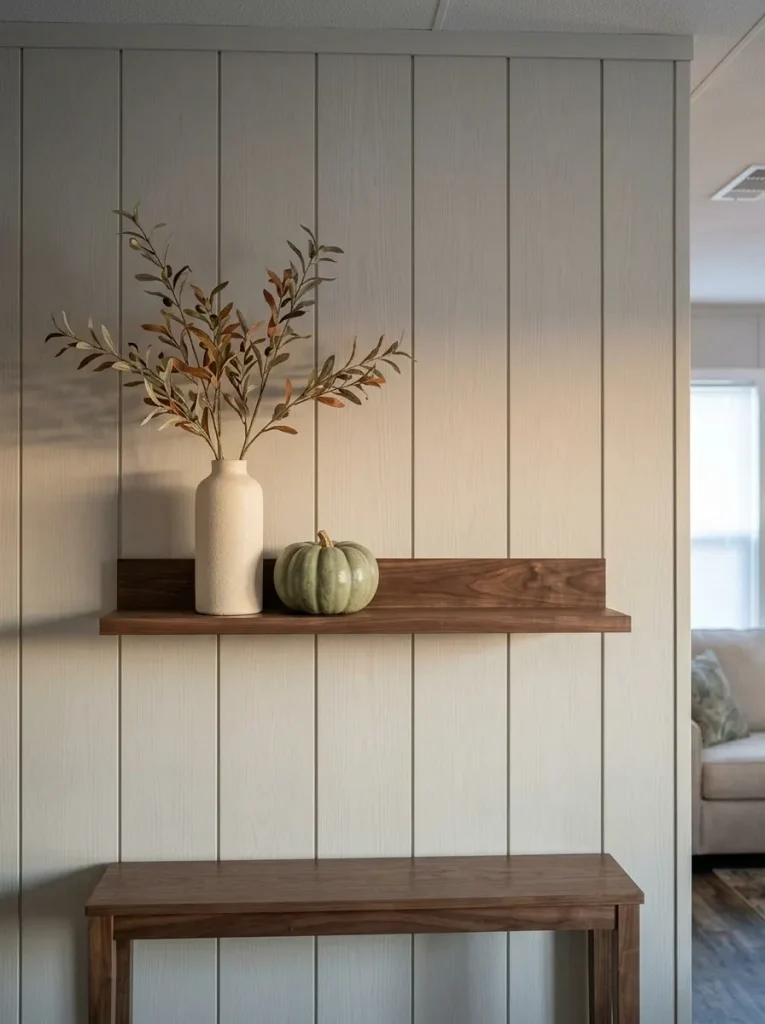
Quiet is the open section that allows both objects to register.
That last part is not wasted shelf space. In a compact interior, negative space separates the seasonal moment from everything else visible around it.
Stand at the room entrance once you finish. If you can identify the fall vignette as one clear group without studying the shelf, it has enough information.
Connect this section to StylishGalore’s broader Cozy Fall Mobile Home Decorating Ideas guide for readers who want a whole-home autumn system.
15. Keep the Entry Functional With a Tiny Fall Drop-Zone Arrangement
You come home carrying keys, a phone, mail, perhaps a bag, and the first available surface has been filled with decorative pumpkins. The arrangement may look attractive in a photograph and fail the first ordinary evening you live with it.
Treat the entry as two overlapping systems: arrival first, decoration second.
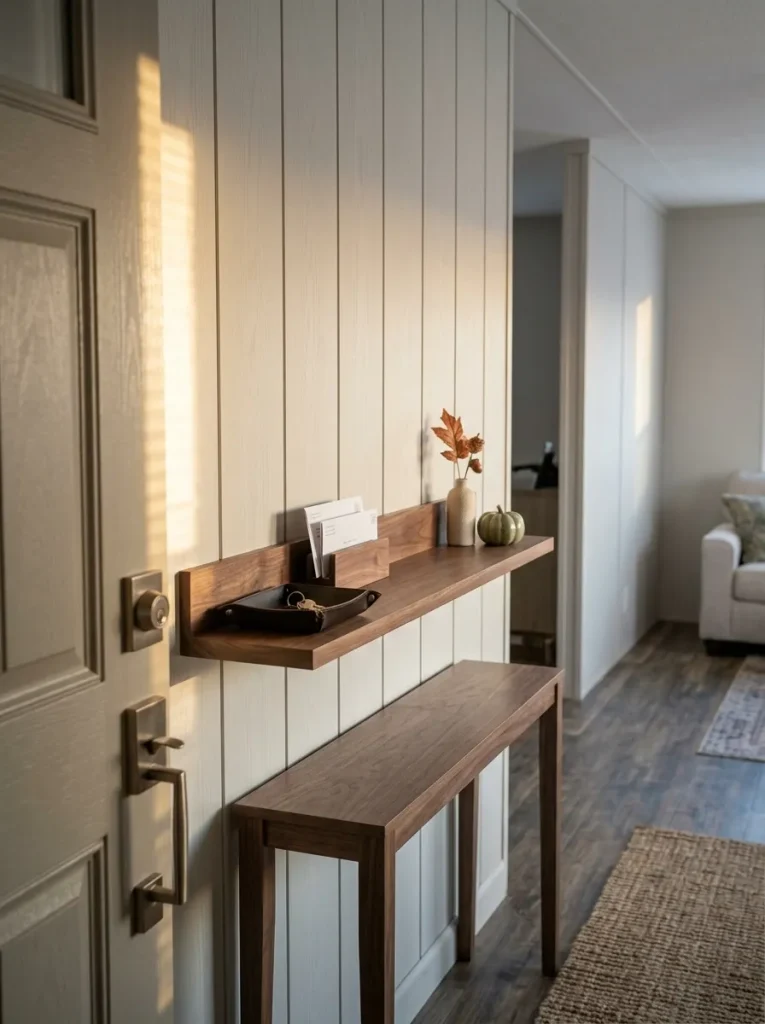
Reserve the easiest-to-reach portion for the objects that genuinely arrive with you. Then give fall a smaller defined position—a narrow vase, one mini pumpkin, or a tiny seasonal dish—far enough from the working zone that everyday items do not slowly migrate through the display.
This is especially useful on a slim console or wall shelf where every extra inch changes how easy the surface feels to use.
Watch the arrangement for several normal days. If keys and mail repeatedly land on top of the seasonal pieces, that is evidence that décor has occupied the wrong part of the entry. Shrink it or move it.
16. Make a Low Harvest Bowl Look Full With Fewer Mini Pumpkins
If you want the abundance of a harvest display without buying a pile of small objects, start with the container.
A shallow bowl or low basket visually gathers inexpensive mini pumpkins into one shape. Mix a few sizes and let some pieces sit slightly higher using hidden lightweight filler appropriate to the container, so the top line does not look perfectly flat. Add only a small amount of leaf or berry material around the gaps.
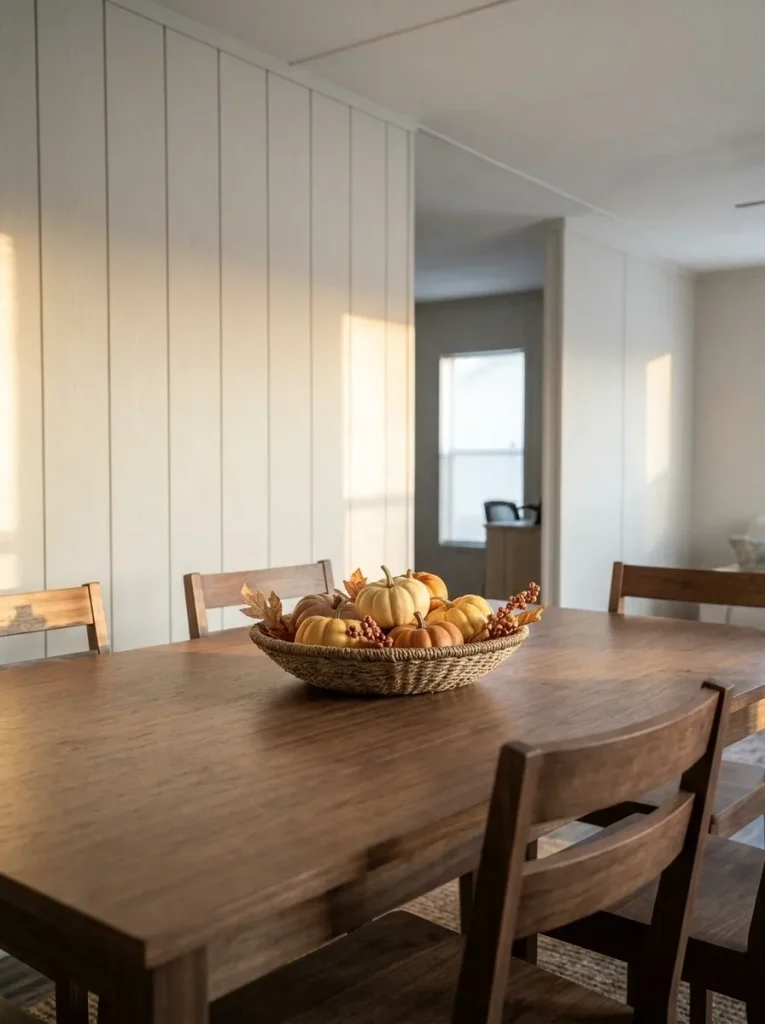
The bowl works because its rim tells the eye to interpret several cheap pieces as one complete arrangement.
That makes it useful on a dining table, coffee table, or console where a scattered collection would occupy more visual area.
Keep the finished composition low where people need sightlines across the surface. If you have to keep adding pumpkins merely to hide the container itself, either choose a smaller vessel or let more of the bowl remain visible. The container is part of the design, not something the décor has to bury.
17. Run a Flat Leaf Cascade Beside a Mirror So the Reflection Doubles the Color
A mirror can make one inexpensive seasonal intervention appear to occupy more of the room without actually adding another object.
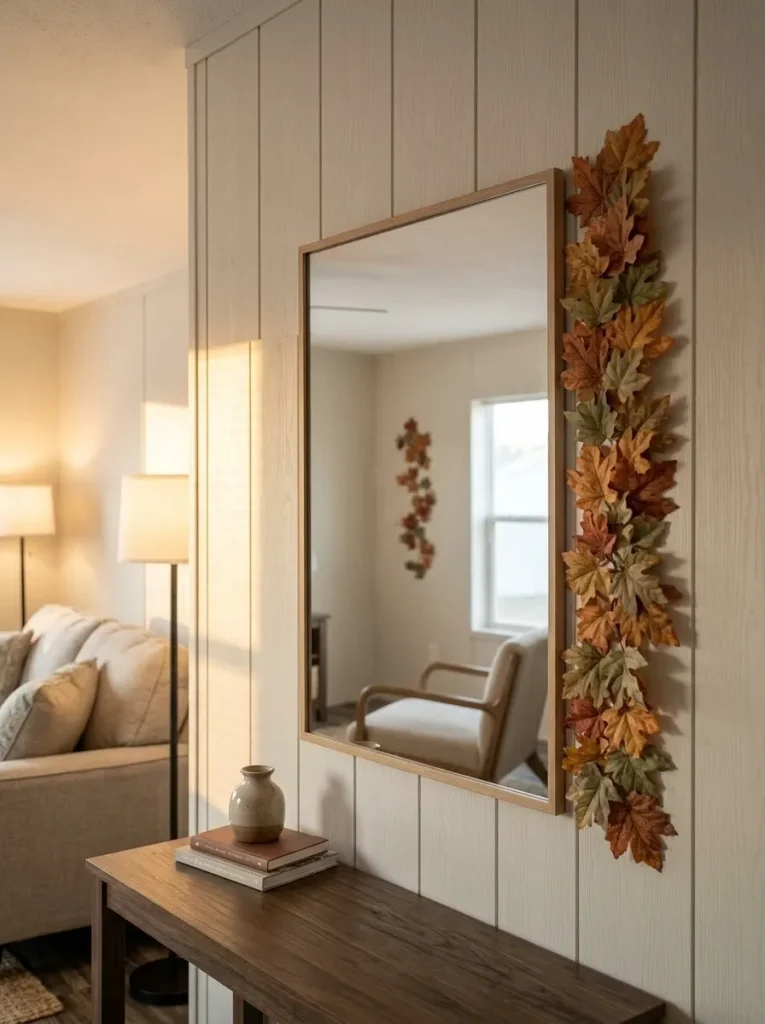
The strongest placement is usually not a thick garland covering the mirror frame. Try a flat, controlled cascade beside part of the mirror so the real leaves and their reflection are visible at the same time. Because the material stays close to the wall, the arrangement consumes almost no floor or furniture space.
The question is where the mirror sends the color.
Reflection Multiplier
Place the color where the mirror can repeat it
The reflection should expand the seasonal moment while the real decoration remains thin enough to leave the wall and mirror visually readable.
Test the placement
Test it from the doorway, not from six inches away. If the reflection carries the leaf color deeper into the room while the actual cascade remains thin and controlled, the mirror is doing part of the decorating for you.
That is exactly the kind of leverage inexpensive fall décor needs in a small mobile home.
Final Thoughts
Dollar-store fall decorating becomes much more convincing when inexpensive materials are treated as design ingredients, not a collection that needs to be displayed all at once.
Choose one place where fall can travel visually: a window frame, a tall vase, a mirror, a doorway, or one evening glow point. Add one tactile layer such as fabric, woven fiber, burlap, or foliage. Then look at the room from the next connected space before buying anything else.
In a mobile home, a decoration that preserves the counter, walkway, table, and entry while changing the larger view is doing far more work than a cart full of tiny seasonal objects.
The best stopping point is simple: the home should clearly feel like fall while still feeling easier to live in than it is to decorate.