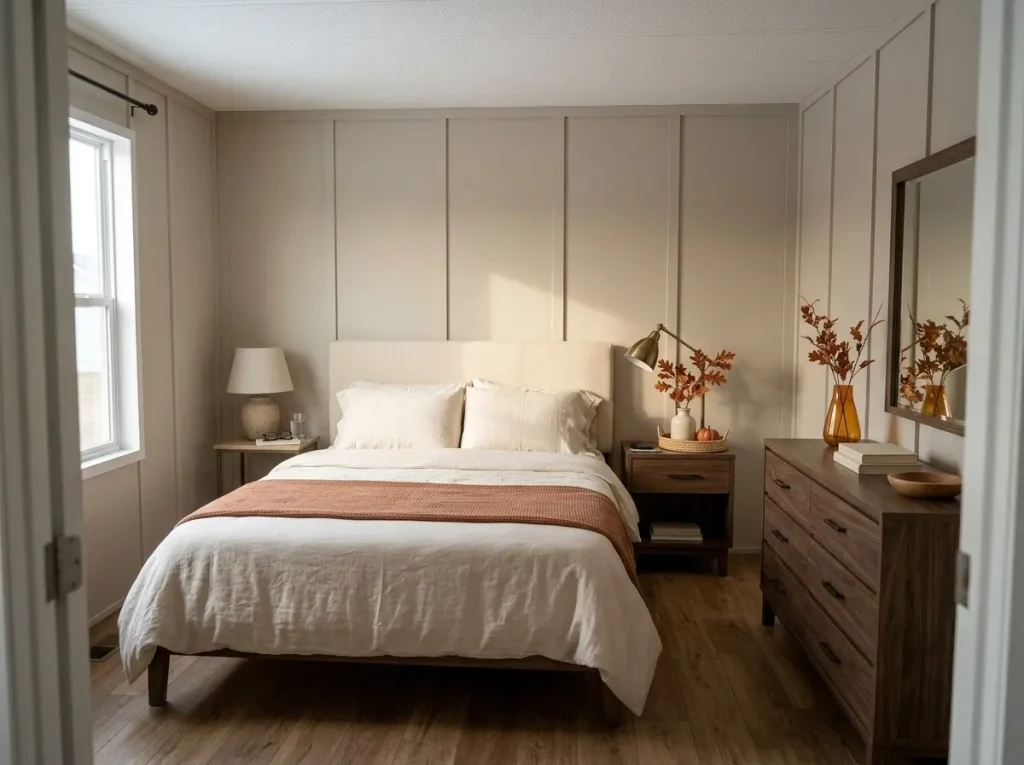
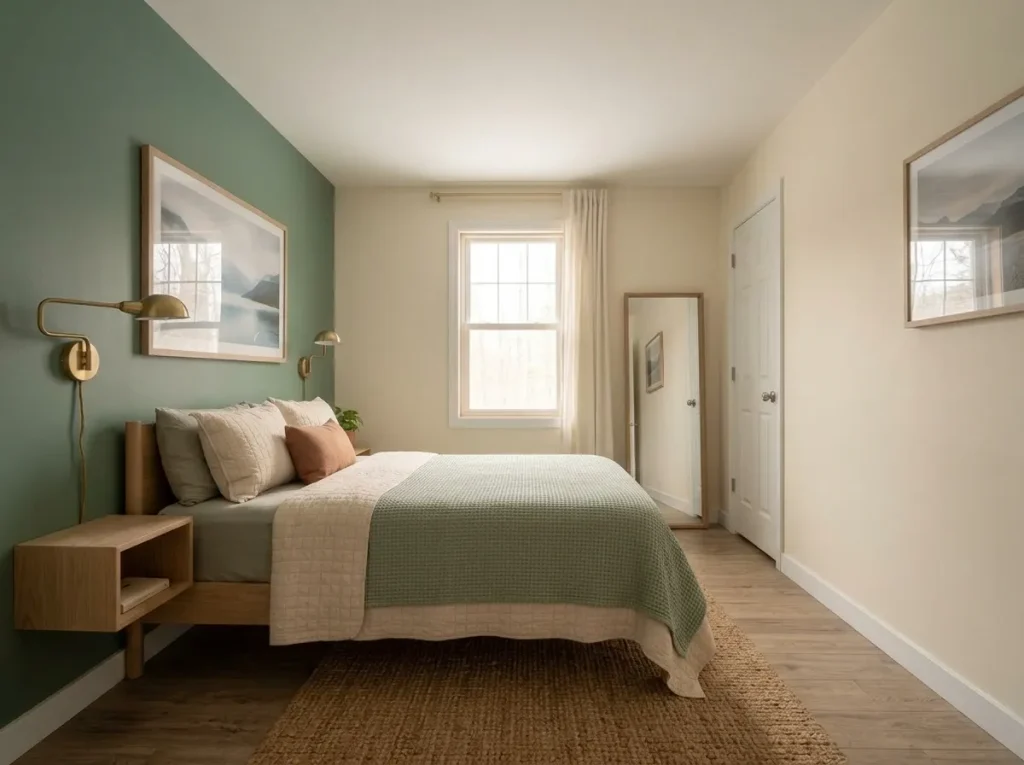
A small bedroom in a single wide can hold all the right furniture and still feel awkward. The problem is rarely square footage alone. Beds, closet doors, windows, dresser drawers, and the route from the doorway often compete for the same narrow strip of usable space.
That is why the most useful single wide bedroom ideas begin with how the room works before deciding how it should look. A better bed position can recover more usable space than another organizer. Moving a lamp off a nightstand may make the entire bedside easier to use. Even color, curtains, rugs, and wall decor become more effective once circulation is protected.
The 21 ideas below respond to those real single-wide constraints. Some are quick decorating changes; others involve rethinking furniture, storage, or the role of an entire wall.
You do not need all 21. Start with the part of your bedroom that causes the most daily friction and build outward from there.
1. Start With the Bed-and-Walkway Envelope, Not the Decor
Walk into the bedroom and ignore the styling for a moment.
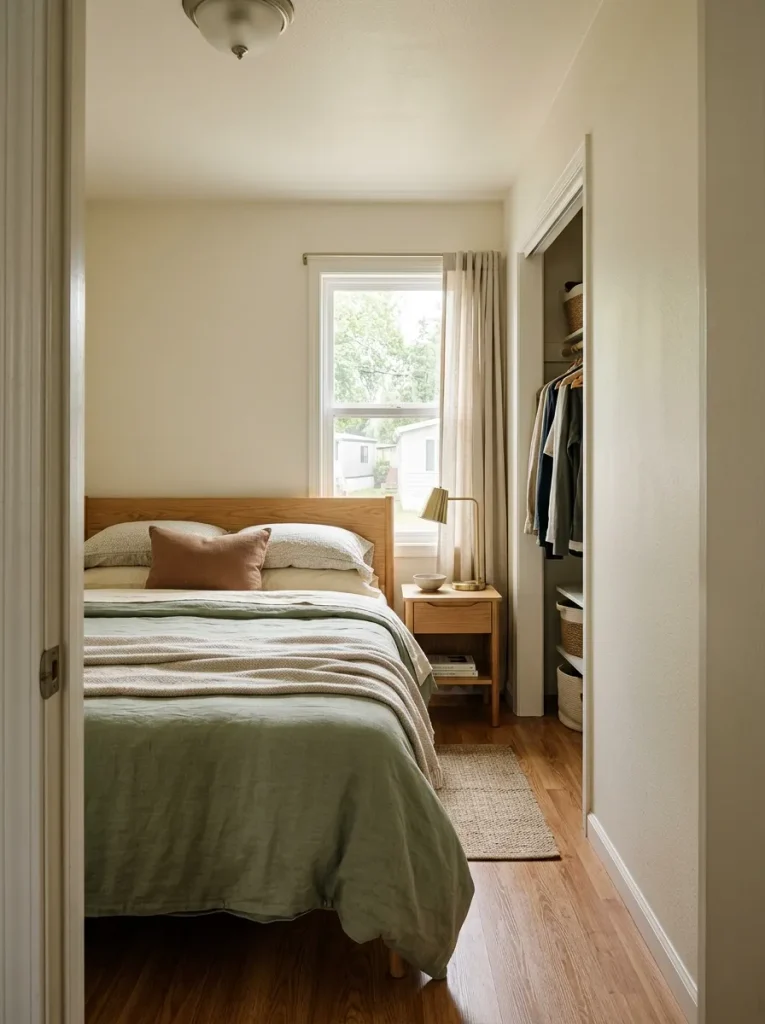
Where does your body naturally travel from the door to the bed, closet, window, dresser, and back out again?
In many small single-wide bedrooms, those routes overlap because the bed consumes most of the room’s center. A layout can look balanced from the foot of the bed yet become frustrating every morning if you have to turn sideways to reach the closet or squeeze between a nightstand and bed frame.
Before buying smaller furniture, identify which route is actually under pressure.
The interactive map below turns that observation into a first decision.
Bedroom Pressure Map
What happens when you walk past the bed?
Choose the situation closest to your bedroom. Both the room diagram and the recommendation below change with your answer.
Your circulation already works.
Do not move the bed just because the room is small.
Prioritize next: storage efficiency, visual weight, lighting, or styling.
You have a pressure problem, not necessarily a room-size problem.
Temporarily remove the easiest nearby piece—often a nightstand, bench, deep dresser, or projecting bed frame—and walk the route again.
Prioritize next: recover usable depth before adding anything new.
Layout needs attention before decorating.
If a door, drawer, or furniture edge repeatedly interrupts the route, decorative upgrades will not solve the main problem.
Prioritize next: test another bed wall or eliminate one floor-standing piece.
Use this as a room-specific diagnostic rather than a universal measurement rule.
A room with comfortable circulation does not need to be reorganized simply because it is small. If the route is tight or blocked, solve that pressure first. Storage, lighting, rugs, and bedding will all become easier to judge afterward.
2. Which Wall Actually Has the Fewest Interruptions?
The most symmetrical wall is not automatically the best bed wall.
In a single-wide bedroom, one side may contain the entry door, another the closet, and a third a window that limits headboard placement. Put the bed on the wall with the prettiest centered view and you can accidentally push the daily circulation route into the narrowest remaining space.
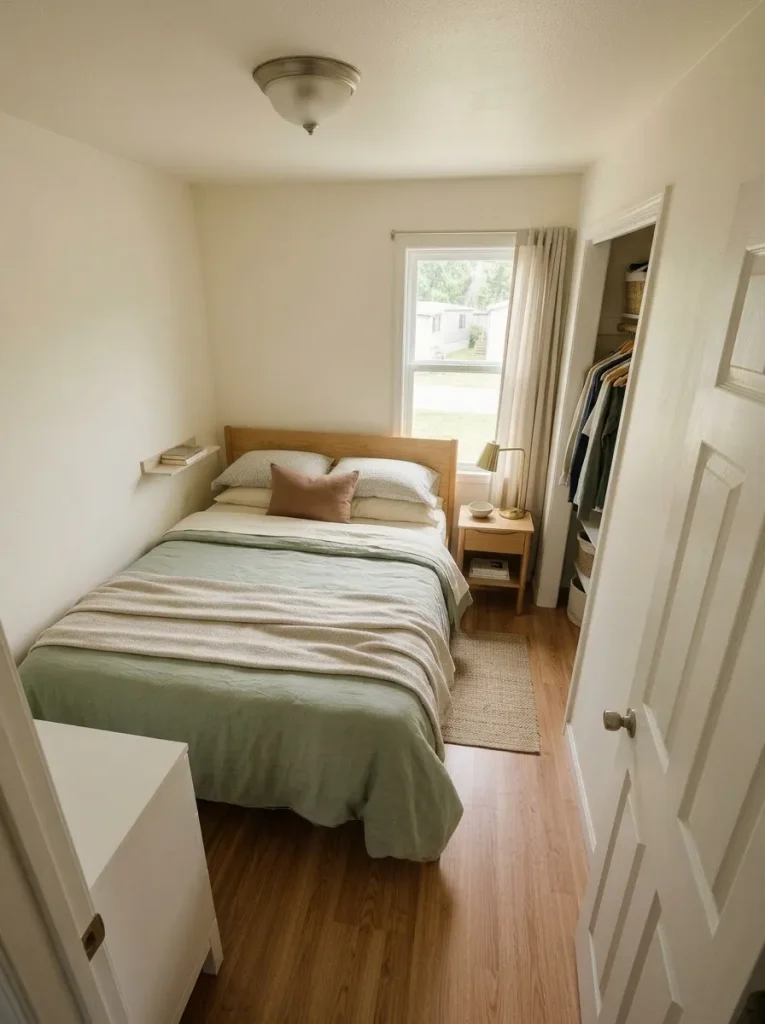
Compare the realistic options before moving anything permanently:
- Which wall lets the closet operate without the bed interfering?
- Which creates the clearest door-to-bed route?
- Where can at least one useful bedside function fit?
- Does the proposed headboard interfere with an outlet, switch, vent, or useful window area?
The winning wall may be visually imperfect.
That is acceptable.
An off-center bed with comfortable movement can perform much better than a perfectly centered bed that turns the room into an obstacle course.
Decision: choose bed orientation from the room’s real interruptions first. Build visual balance around the position that functions best.
3. A Heavy Footboard Can Make the Whole Room Feel Shorter
Stand at the bedroom doorway and look toward the far wall.
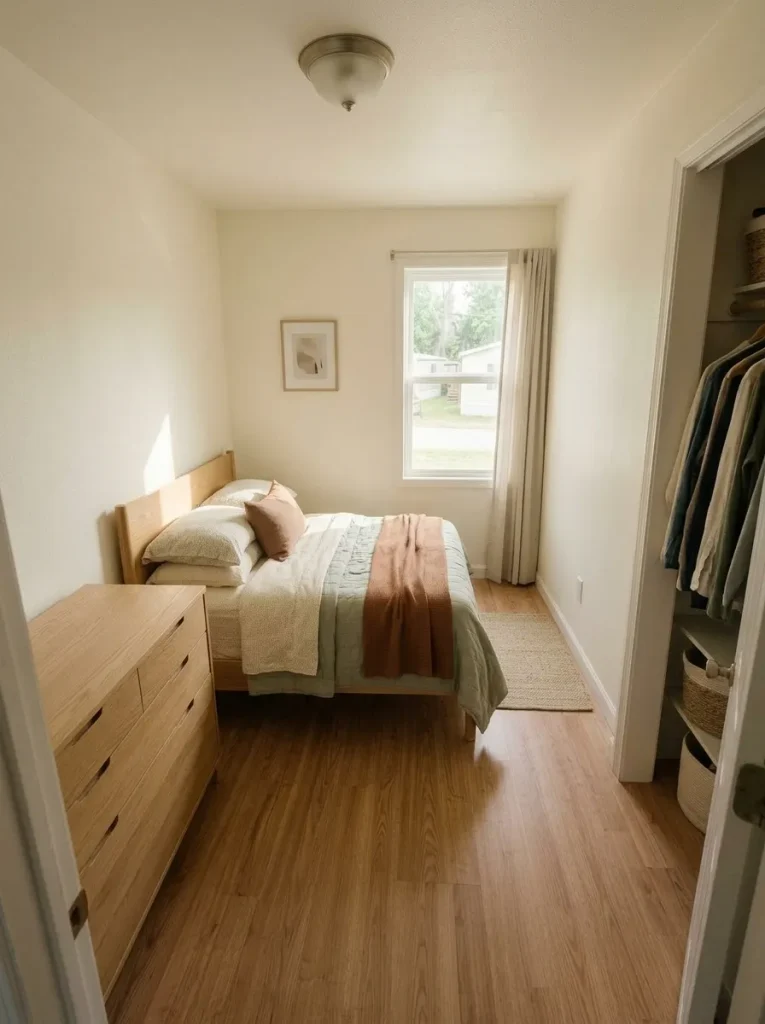
In a narrow room, your eye encounters the foot of the bed before it reaches the pillows, window, artwork, or far wall. A tall footboard, chunky bench, deep storage chest, or thick upholstered frame can therefore form a strong visual barrier across the room’s long view.
The furniture may physically fit while making the remaining floor appear more compressed.
If you already own a substantial bed, test the effect before replacing it. Remove the bench or anything sitting directly beyond the footboard and photograph the same doorway view again. If the far side suddenly becomes easier to see, you have identified visual bulk as part of the problem.
For more whole-home applications of scale and sightlines, explore these single wide interior ideas that make a narrow home feel bigger.
Keep a substantial footboard when: the approach remains comfortable and the piece contributes something valuable.
Simplify the foot area when: the doorway view appears to end at the bed.
4. Give Repeat-Wear Clothes a Landing Zone That Isn’t the Walkway
Think about the clothes that are neither freshly clean nor ready for the laundry basket: tomorrow’s jeans, tonight’s pajamas, or the sweater worn for two hours.
Those pieces often end up on a chair.
In a small single-wide bedroom, the chair itself can become the bigger problem. Once clothing collects on it, a temporary habit occupies a permanent patch of valuable floor.
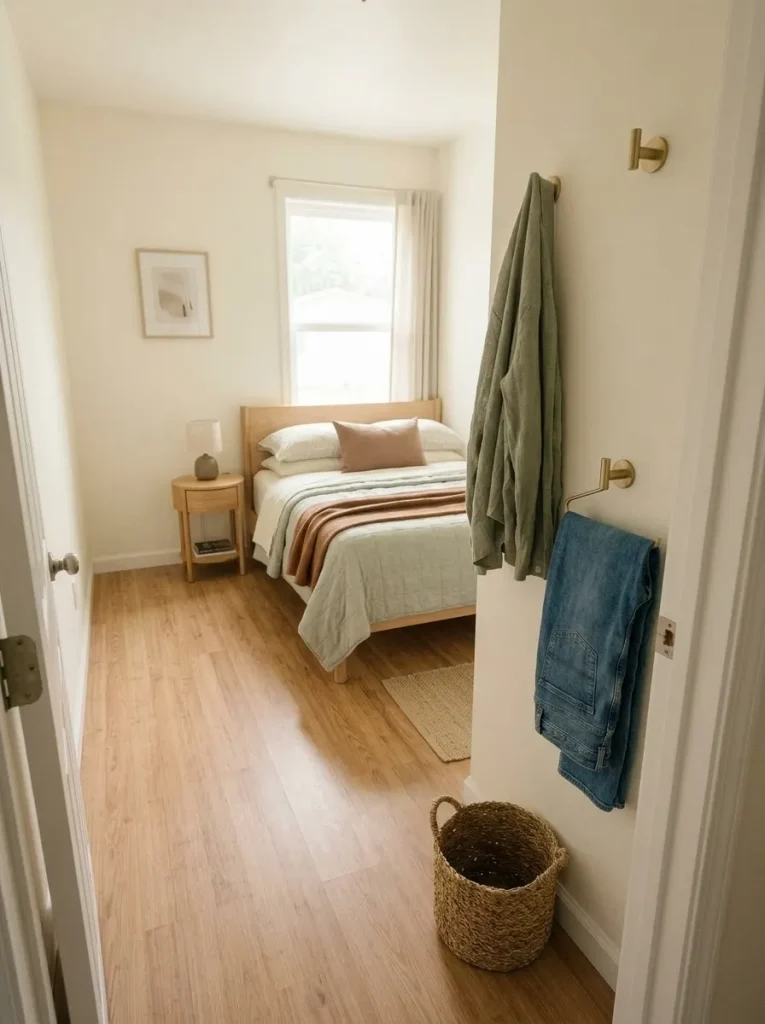
Give that routine a shallower home.
- Use a small set of hooks, an appropriate over-door organizer, or a designated wall zone.
- Reserve one compact basket for repeat-wear pieces if folding works better.
- Keep the zone near the closet or dressing area.
- Set a capacity limit. When the space is full, reset it.
This is not about organizing every garment perfectly. It is about keeping a predictable habit out of the circulation path.
Decision: if a chair exists mainly to hold temporary clothing, test whether the function can leave the floor while the furniture leaves the room.
5. Free the Bedside Surface by Moving Light Upward
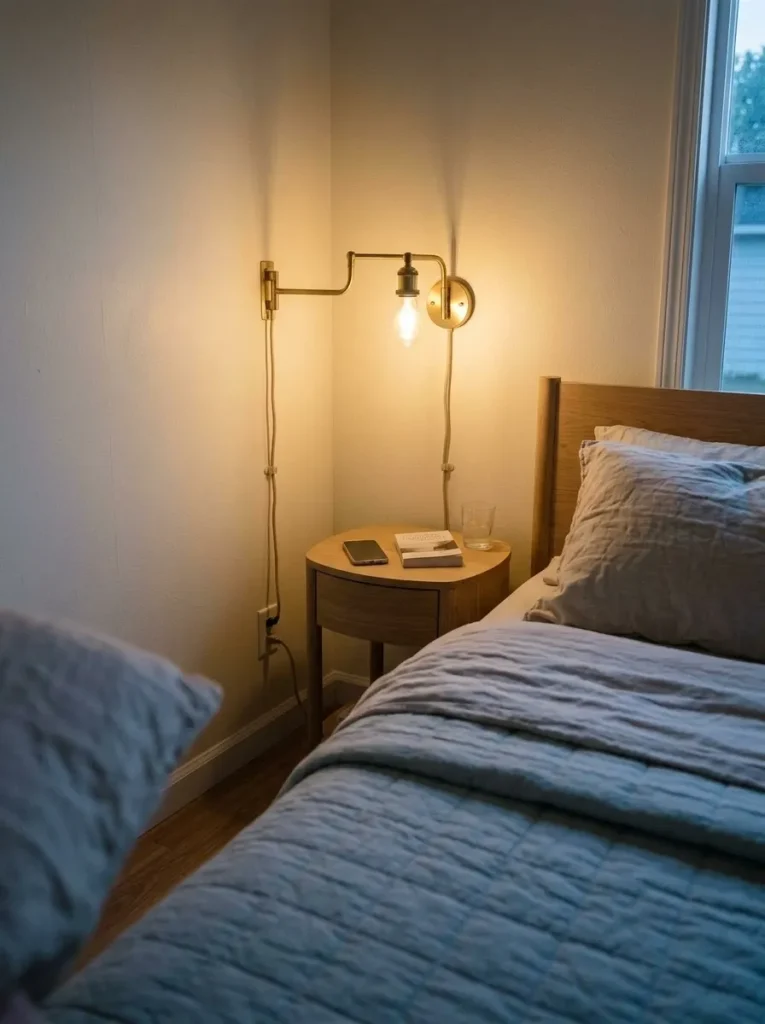
A compact nightstand can work perfectly until a lamp occupies half of it.
Once the lamp base, phone, charger, water glass, and book compete for one surface, the bedside starts functioning like an undersized shelf.
Moving the light source upward can change the usefulness of that entire zone without enlarging the furniture.
A suitable plug-in wall light can provide one non-permanent route where its cord and installation work safely for the room. Other rooms may suit a compact reading light or another space-efficient fixture.
Judge the choice at night.
Lie in bed and notice what you actually need to reach. If removing the lamp base would leave enough room for those items, storage capacity is probably not the immediate issue—the light is occupying the most valuable surface.
Keep a tabletop lamp when the nightstand comfortably supports it. Move lighting off the surface when the lamp forces daily essentials toward the edge.
6. Let the Bed Carry Storage You Would Otherwise Add as Furniture
Storage becomes especially efficient when it occupies a footprint the room has already surrendered.
That makes the bed valuable.
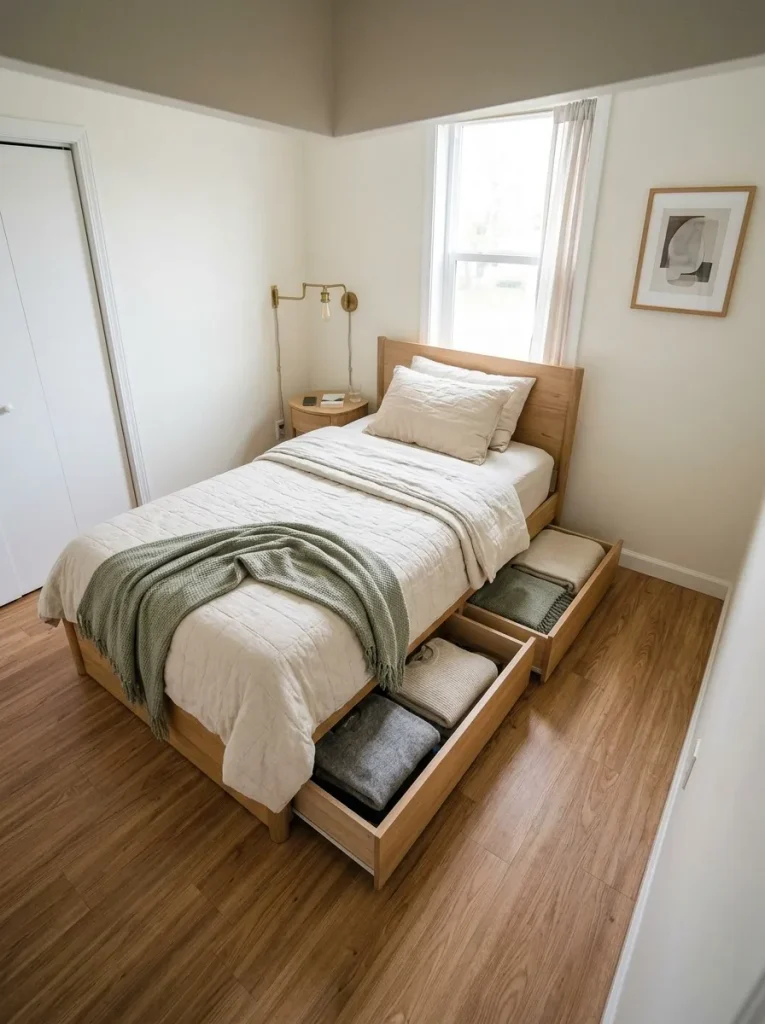
Under-bed containers, built-in drawers, or a storage-style bed can sometimes absorb spare linens, seasonal clothing, shoes, or less frequently used belongings without adding another chest or cabinet.
Ask a stricter question than “How much can I store under here?”
Ask:
Which separate furniture piece could disappear if the bed handled this category?
If bedding moves beneath the mattress and the blanket chest at the foot is no longer needed, the storage has improved circulation as well as capacity.
Access matters too. Drawers need room to open. Lift-up storage has a different use pattern. Boxes that require moving furniture every time may remain theoretically useful but practically inconvenient.
For a broader collection of options after you decide hidden capacity makes sense, explore these bedroom storage solutions.
Stop point: once bed storage removes a redundant floor-standing piece, keeping additional open floor can become more valuable than squeezing in even more capacity.
7. Frame the Headboard With Shallow Storage, Not Full-Depth Furniture
The wall behind the bed may be one of the few places where a single-wide bedroom can gain useful storage without placing another object directly in the walking route.
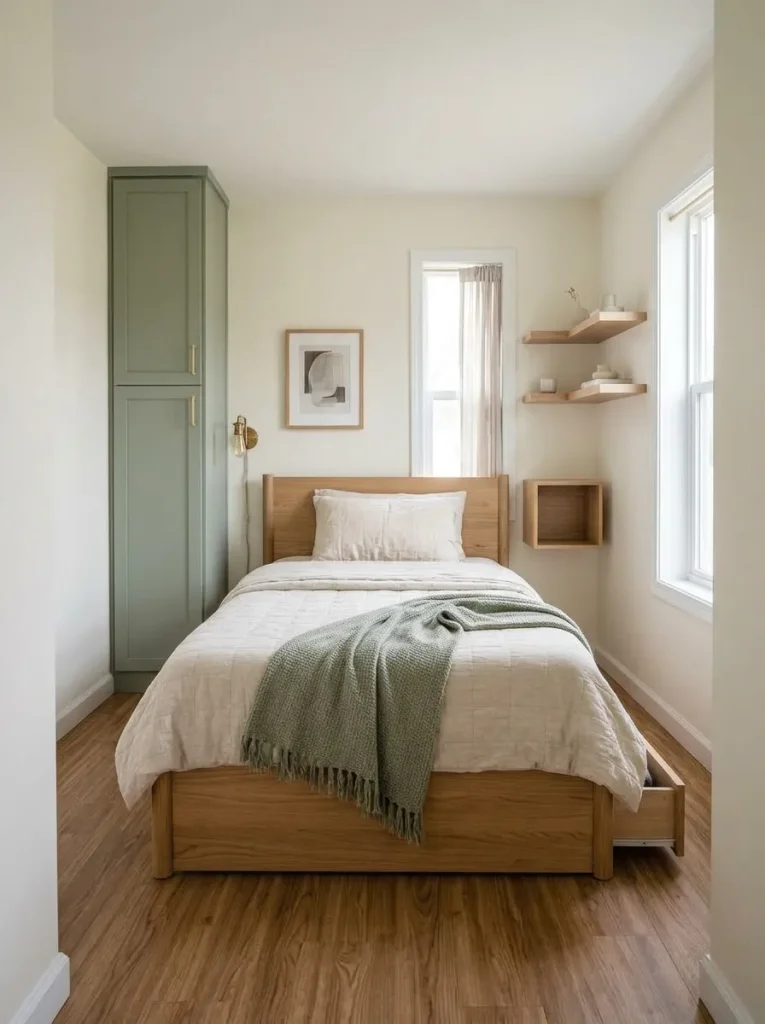
That does not mean every bed should be surrounded by cabinetry.
Deep towers can feel imposing next to the mattress. Matching units may also be unrealistic when one side meets a window, doorway, switch, or especially narrow passage.
The better question is how much visual and physical storage the wall can actually carry.
Headboard Storage Fit Studio
How much storage should the bed wall carry?
Choose the configuration closest to what your bedroom could realistically support.
Two towers: best for a genuinely uninterrupted wall.
Use this when both sides of the bed can take shallow storage without squeezing circulation or windows.
- Highest storage capacity.
- Strongest symmetry.
- Skip if either tower feels forced.
One tower: best when the architecture is asymmetric.
Let the wider side carry storage while the tighter side stays visually lighter.
- Useful beside a window or doorway.
- Avoids fake symmetry.
- Often better for single-wide constraints.
Floating storage: best when floor depth matters most.
Choose this when you need light bedside storage while preserving visible floor around the bed.
Leave it clear when storage is already adequate.
More cabinetry is not automatically an upgrade. In a very tight room, open wall can provide more value than extra capacity.
Conceptual layout only. Mounted storage should always be selected and installed appropriately for the actual wall and product.
Two matching towers are only one possibility.
A bedroom with a window or tight passage may work better with a single tower. Another room may need only one shallow floating shelf.
Use vertical storage when it replaces floor pressure. Do not add it merely because the wall is empty.
8. Keep Tall Storage on One Side of the Room
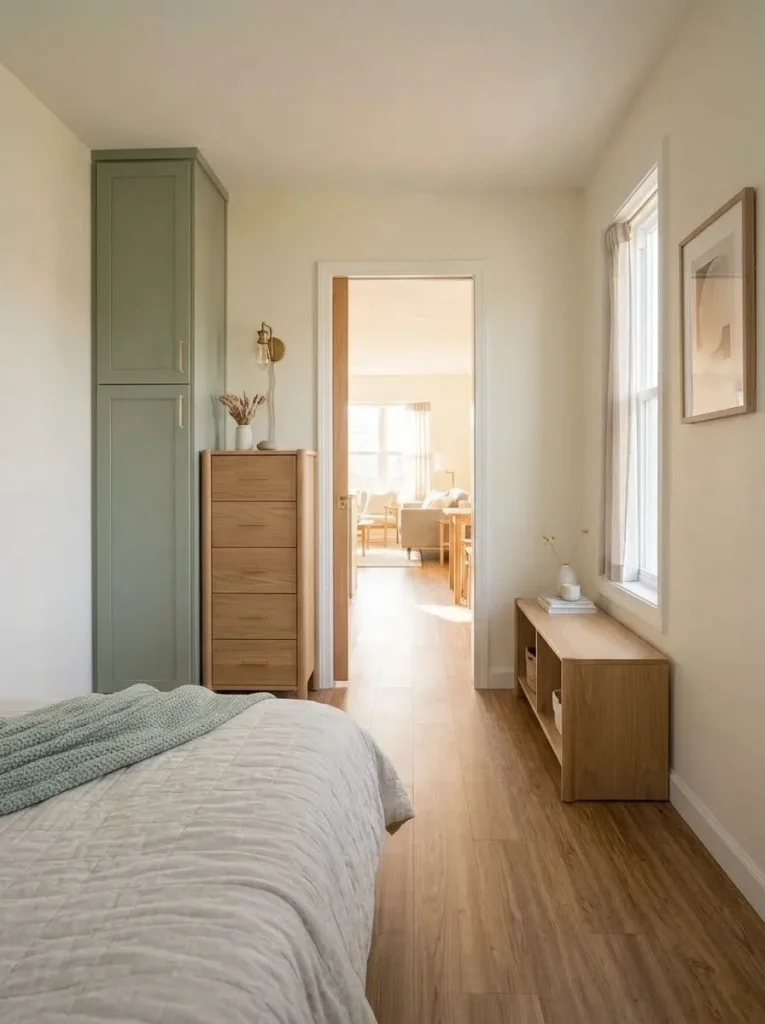
Two tall pieces facing one another can change the character of a narrow bedroom.
A wardrobe on one wall and another high chest directly opposite it create strong vertical edges on both sides of the same passage. The floor may technically remain open, but the room begins to read like a corridor between furniture.
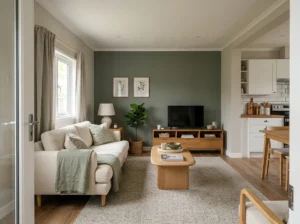
If you already have substantial vertical storage, sit on the bed and look toward the doorway. Then repeat the view while temporarily removing or visually clearing the easier opposing piece.
If the room feels calmer, you have learned something useful: your storage capacity may be adequate, but its visual distribution is too heavy.
Concentrate tall storage where the wall can support it. Let the opposite side use lower furniture, wall-mounted elements, or simply more open wall.
Decision: keep opposing tall pieces only when neither one visually squeezes the main route.
9. Choose a Dresser by Drawer-Swing Space, Not Width Alone
A dresser can fit neatly against a wall and still be too large for the room.
Its closed dimensions tell only part of the story.
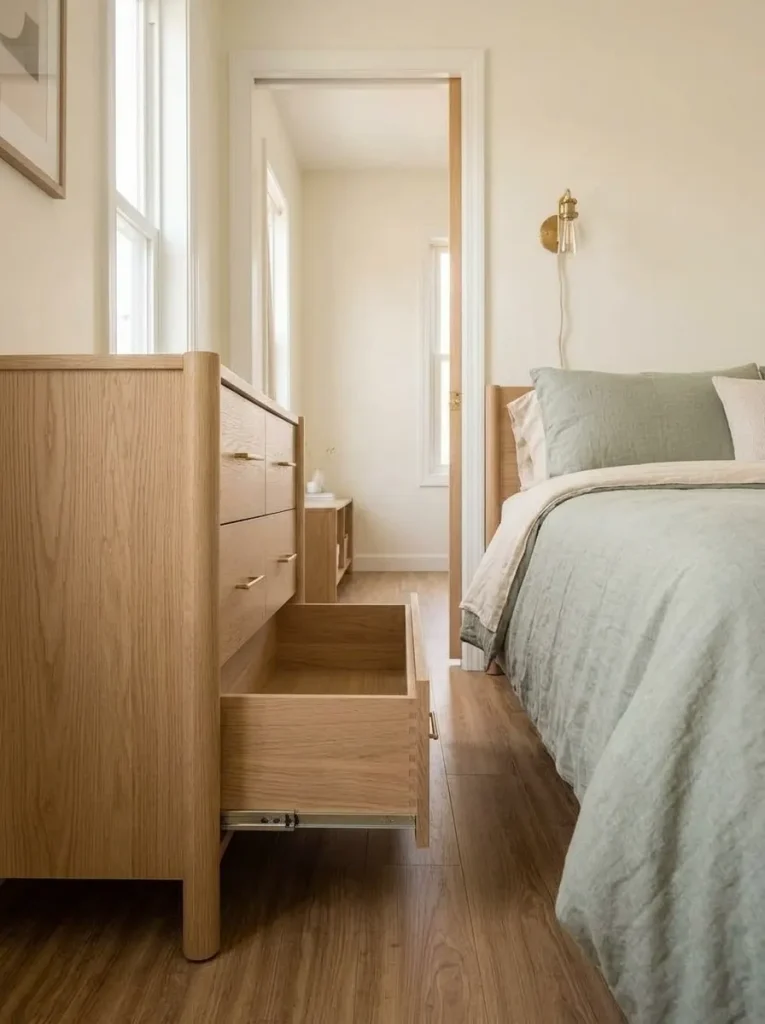
In a small single-wide bedroom, the working space between the dresser and bed may already be limited. A deep open drawer can turn that passage into a temporary dead end.
A dresser that is slightly narrower but considerably shallower may work better than a wider piece that technically fits the wall.
Judge it by its working footprint, not only its closed footprint.
Dresser Clearance Test
What happens when the deepest drawer is open?
Select the situation closest to your room. The diagram and recommendation change together.
Your dresser is probably workable.
The furniture’s working footprint still leaves the bedroom usable.
Decision: keep it unless another issue—storage efficiency, style, or visual bulk—justifies changing it.
Compare depth before replacing width.
A slightly shallower dresser may improve daily movement without sacrificing as much storage as a much narrower piece.
Decision: prioritize shallower depth if drawer use is the pressure point.
The dresser is using more room than its closed footprint suggests.
Move it to another wall, compare a shallower piece, or transfer part of its storage into the bed footprint.
Decision: do not judge this dresser as a successful fit simply because it fits while closed.
10. Protect the Closet Zone From “Temporary” Furniture
Closet problems often begin outside the closet.
A hamper, shoe basket, floor mirror, small stool, or occasional chair gets placed nearby because the location feels convenient. Soon, opening the closet requires moving something first.
That repeated interruption matters in a compact single-wide bedroom because the same floor strip may also serve the entry route or bedside passage.
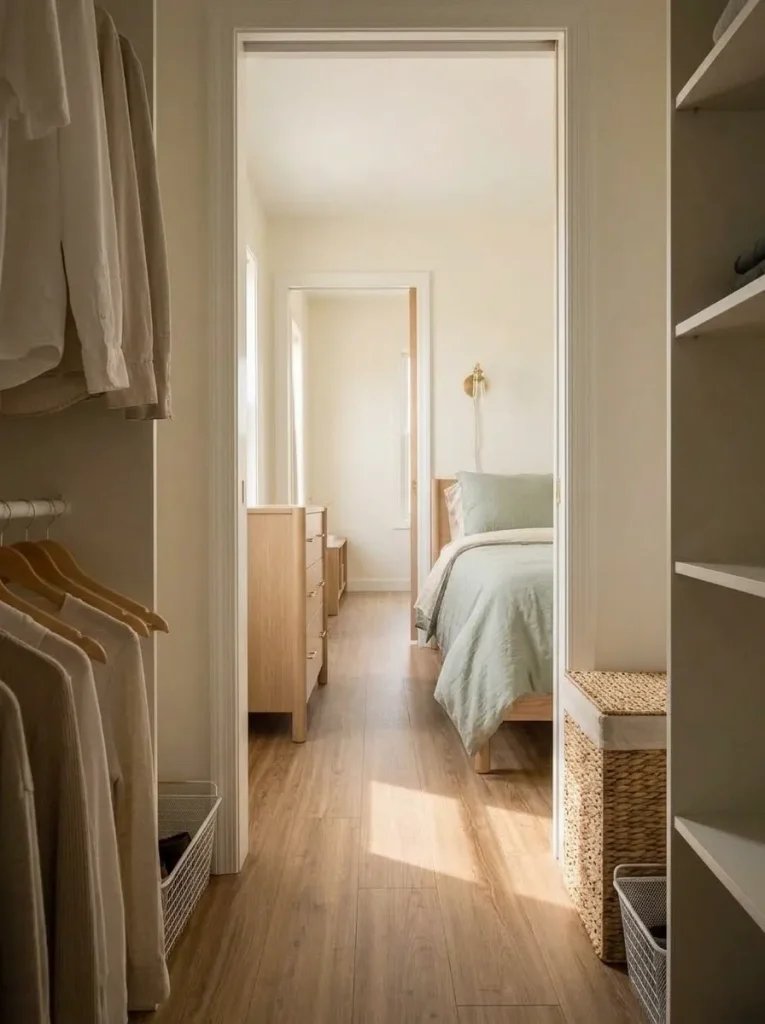
Run one real morning sequence.
Open the bedroom door. Reach the closet. Take out clothing. Use the dresser. Get dressed. Put something back.
Notice every item you move, step around, or bump.
Those objects are telling you which space must remain operational.
A beautiful basket is not useful in that location if it gets kicked aside every morning.
Decision: treat the closet approach as working space. Move optional furniture away from it before trying to improve the closet itself.
11. Small Corners Work Harder With Floating Shelves Than Floor Cabinets
A narrow corner beside a bed or window may be too small for a useful cabinet but still capable of contributing.
That makes it a good candidate for shallow vertical use.
A restrained set of floating corner shelves can hold a book, small plant, photograph, or bedtime item while leaving the floor beneath visible. Keeping that floor exposed reduces the sense that every edge of the bedroom has been occupied.
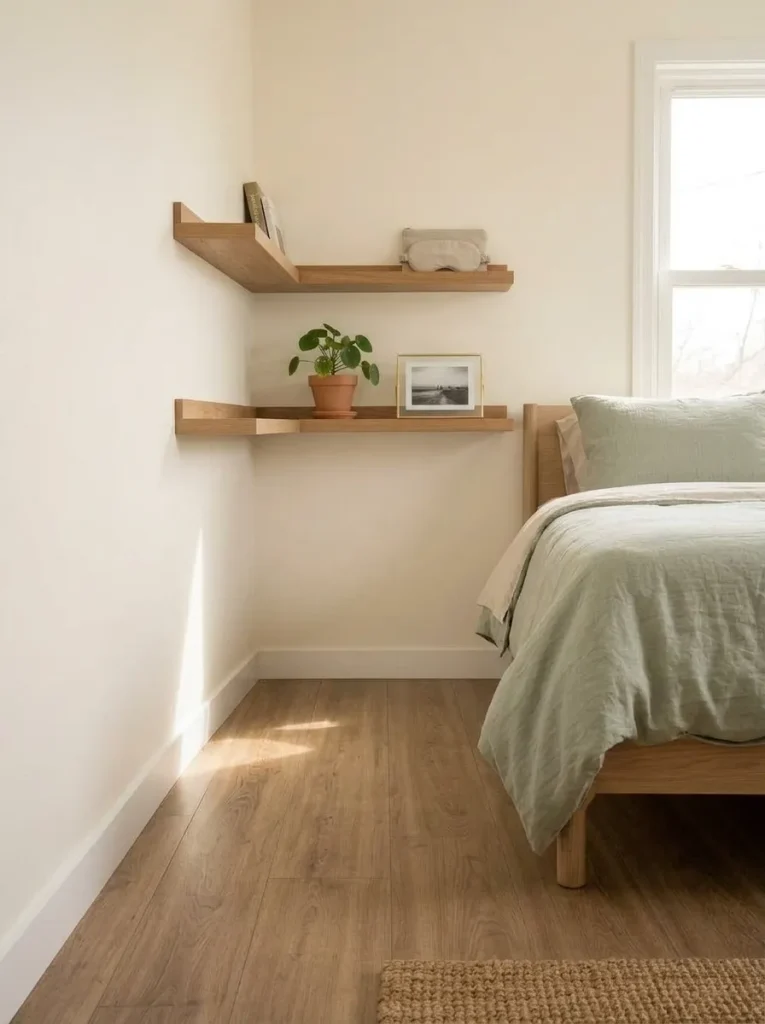
Do not assume more shelves equal better storage.
One or two useful surfaces may be enough. If you create a tall column of heavily styled shelves, you have simply replaced one visual block with another.
Test the corner empty first.
If the room already has adequate storage and the corner gives the bed valuable breathing room, leave it alone.
Use floating storage when the corner needs a function. Preserve emptiness when the room needs visual relief more.
12. When the Window Forces the Bed Off-Center, Make the Asymmetry Deliberate
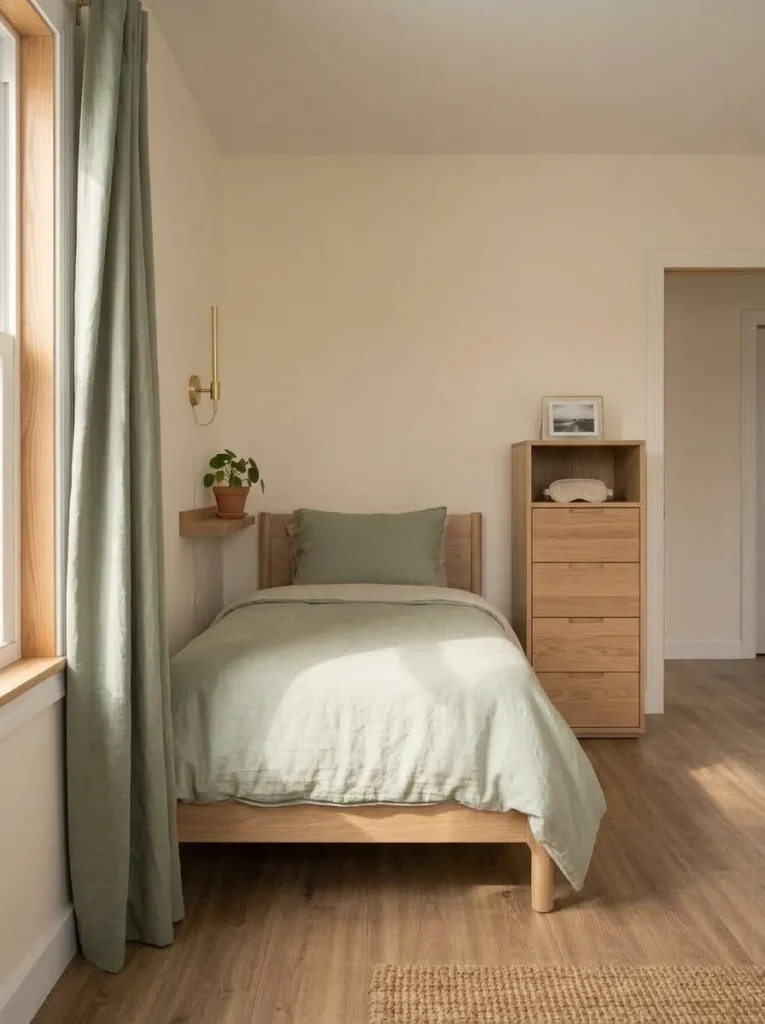
Not every single-wide bedroom offers a clean, centered bed wall.
A window may occupy one side, a closet may interrupt another, and the most practical bed position may leave noticeably different space on each side.
Do not force identical nightstands into unequal gaps.
Let the wider side carry the heavier function—a nightstand, small dresser, lamp, or storage tower—while the narrow side stays lighter with a wall light, compact surface, or nothing at all.
The composition can still feel balanced because visual balance does not require identical objects.
This article only needs the bedroom-level decision. If your room has several awkward openings or asymmetric zones, the guide to single wide decorating ideas for narrow and awkward spaces explores those conditions in greater depth.
Choose asymmetry when it improves access. Do not sacrifice function to manufacture symmetry the architecture does not support.
13. Hang Curtains to Strengthen the Wall Around the Window
Curtains affect more than privacy.
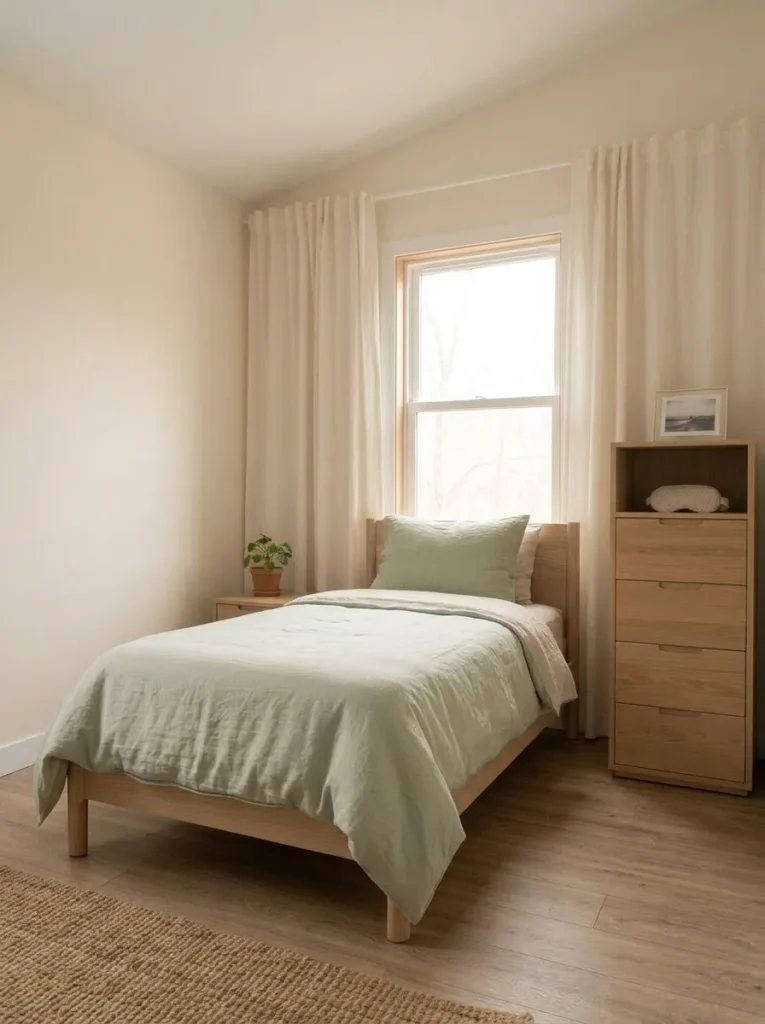
In a small bedroom, they help determine whether the window reads as an isolated opening or as part of a larger wall composition.
A relatively narrow window on a broad wall can often feel more substantial when its curtain treatment visually frames more of that wall. A window already squeezed between the bed and another opening may need the opposite approach: less fabric volume and fewer competing layers.
Stand at the doorway and look at the window together with the headboard, artwork, shelves, and bedside lighting.
If all of those elements peak at similar heights or compete for attention, simplify one of them.
Keep curtain fabric clear of furniture that catches or crushes it during normal use.
Decision: let the curtain treatment strengthen a weak or fragmented wall. Keep it quieter when the window already sits inside a visually busy zone.
14. Give the Room One Large Color Field
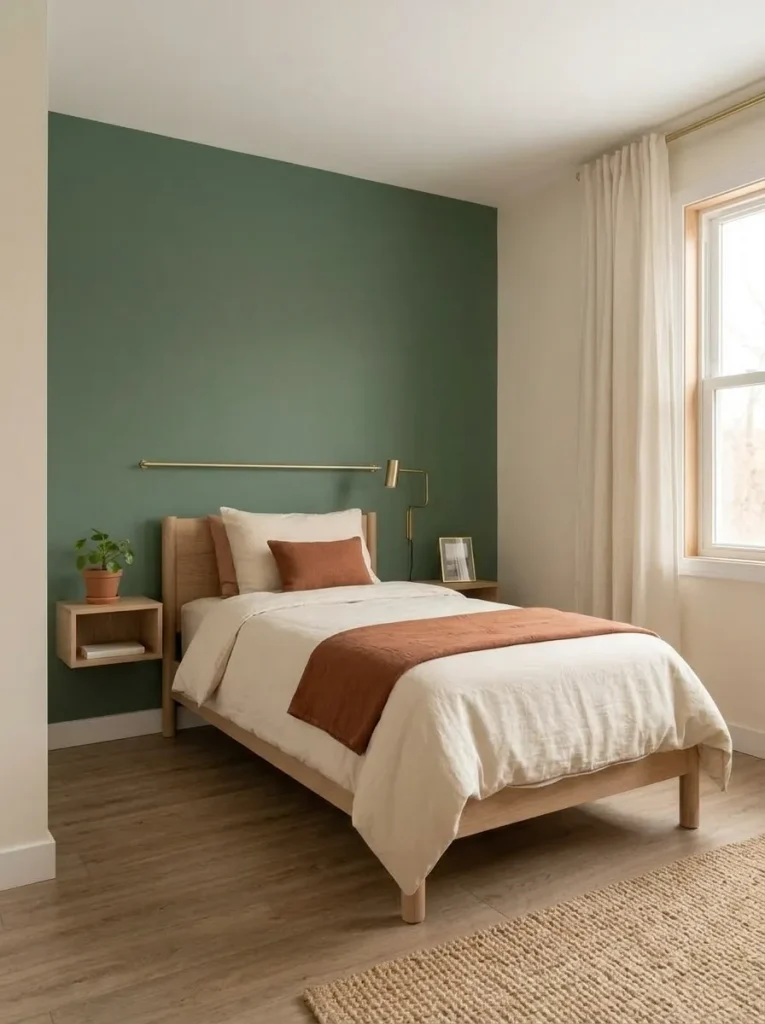
Small bedrooms do not have to be pale.
What often makes them feel visually scattered is fragmented color—many small accents competing throughout a compact room.
A larger, deliberate color field gives the eye a clearer place to land.
That field could come from the bed wall, bedding, built-in storage, or another major surface.
Color Weight Map
Where should the strongest color live?
Select the surface you want to carry the room’s strongest color. The visual model and styling recommendation will change.
Let the architecture carry the color.
A deeper headboard wall can create one controlled focal field.
Keep bedding and smaller objects quieter so the room has one obvious anchor.
Let the bed carry the color.
This works well when the walls are broken by doors, windows, or rental limitations.
Keep the architecture calmer and repeat the bedding hue only a few times elsewhere.
Use color as punctuation, not a field.
If the room already has visible wood, cabinetry, curtains, or strong architecture, another large block of color may be unnecessary.
Use one smaller accent and let the room breathe.
Deep green, rust, navy, muted sage, or another intentional hue can work beautifully in a compact bedroom when the color has a clear role.
The room becomes harder to read when every small object tries to become the accent.
15. Calm the Ceiling Plane Before Adding More Wall Decor
Look upward before buying another framed print.
The ceiling belongs to the room’s visual composition, yet it is easy to ignore while decorating the walls.
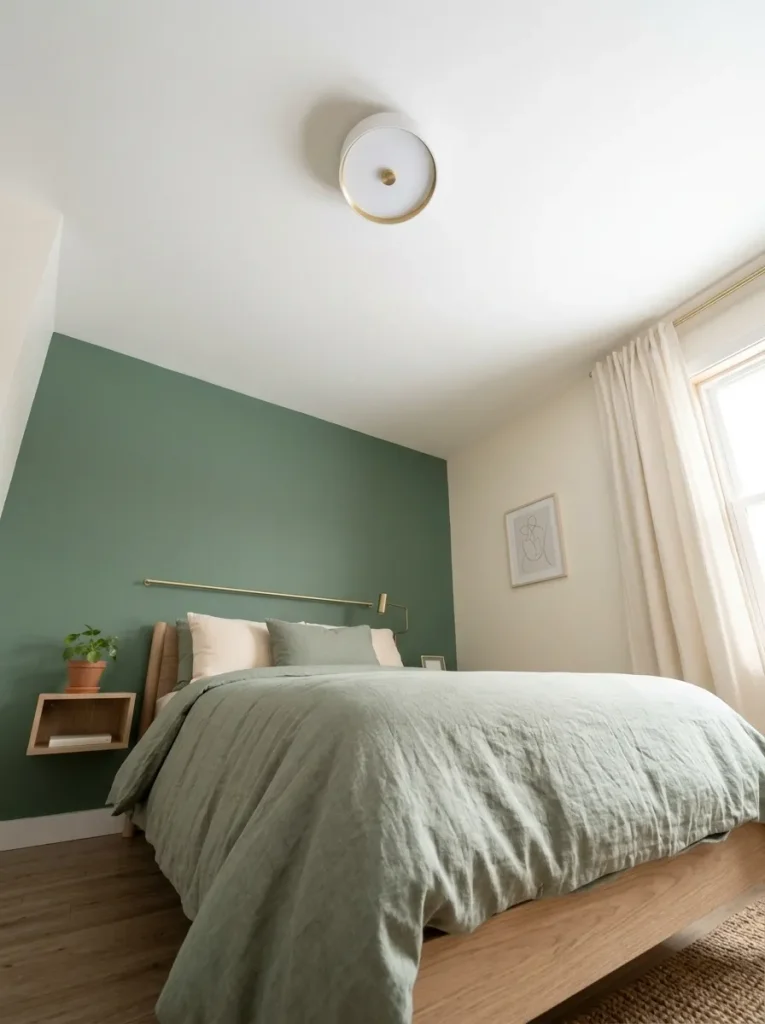
A fan, multi-light fixture, strong beam, contrasting vent, or other noticeable ceiling feature may already create plenty of activity in the upper part of a small bedroom. Adding tall shelves, multiple wall signs, and artwork all around it can make that upper zone feel crowded.
Photograph the bedroom from normal eye level or bed height and include the ceiling in the frame.
Then identify what your eye notices first.
If the ceiling fixture already acts like a focal element, give surrounding walls more restraint. If the upper plane is quiet, the room may comfortably handle a stronger wall composition.
Decision: balance the ceiling and walls as one visual field. Do not decorate every empty wall without checking what is already happening above it.
16. Build Warmth With Bedding Texture Instead of More Objects
When a bedroom feels unfinished, the instinct is often to add another object.
Try changing the largest soft surface first.
A quilt, woven blanket, linen-look duvet, textured throw, or a few carefully chosen cushions can introduce depth and warmth without consuming another inch of floor.
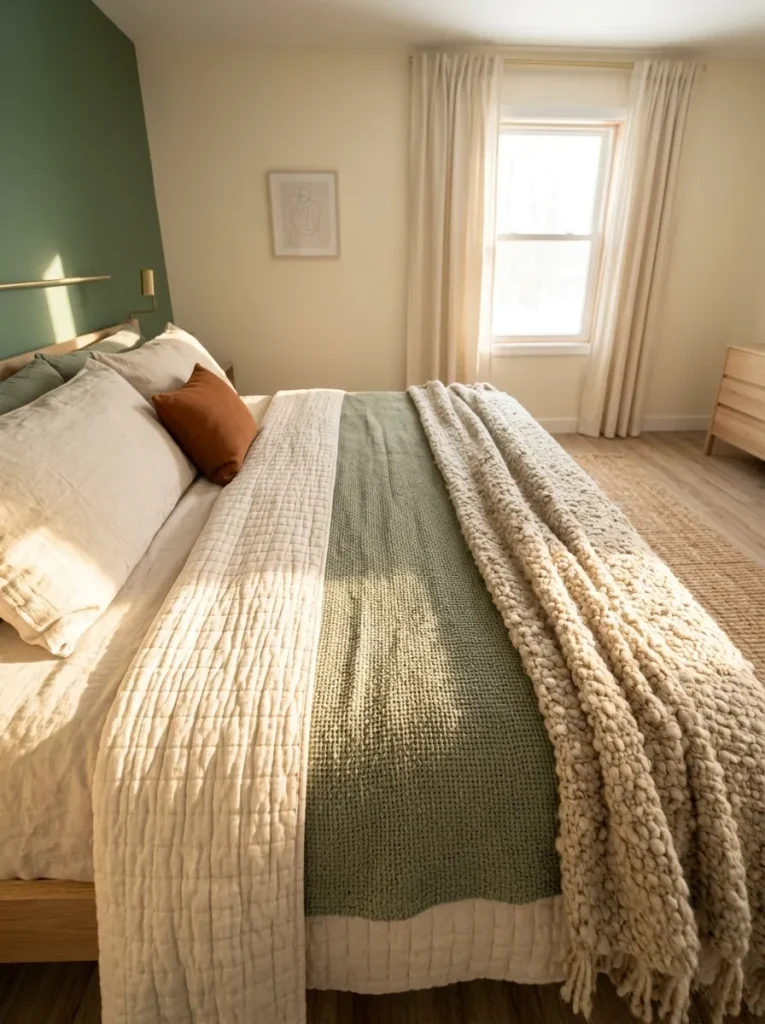
This is especially useful in a single-wide bedroom already carrying storage furniture, a strong headboard, or visible cabinetry. Soft materials counter those harder edges without adding another cabinet, stool, basket, or decorative table.
Keep the textures related.
One chunky throw, one quieter quilted surface, and a limited cushion mix often create more coherence than many unrelated patterns.
Stand at the doorway after making the bed. If the room already feels warmer, stop there.
Decision: when the problem is atmosphere rather than function, let the bed deliver the extra layer before adding another object to the room.
17. Let the Rug Reveal a Clean Walking Border Around the Bed
A bedroom rug is not only a decorative pattern beneath furniture.
It changes how the remaining floor is understood.
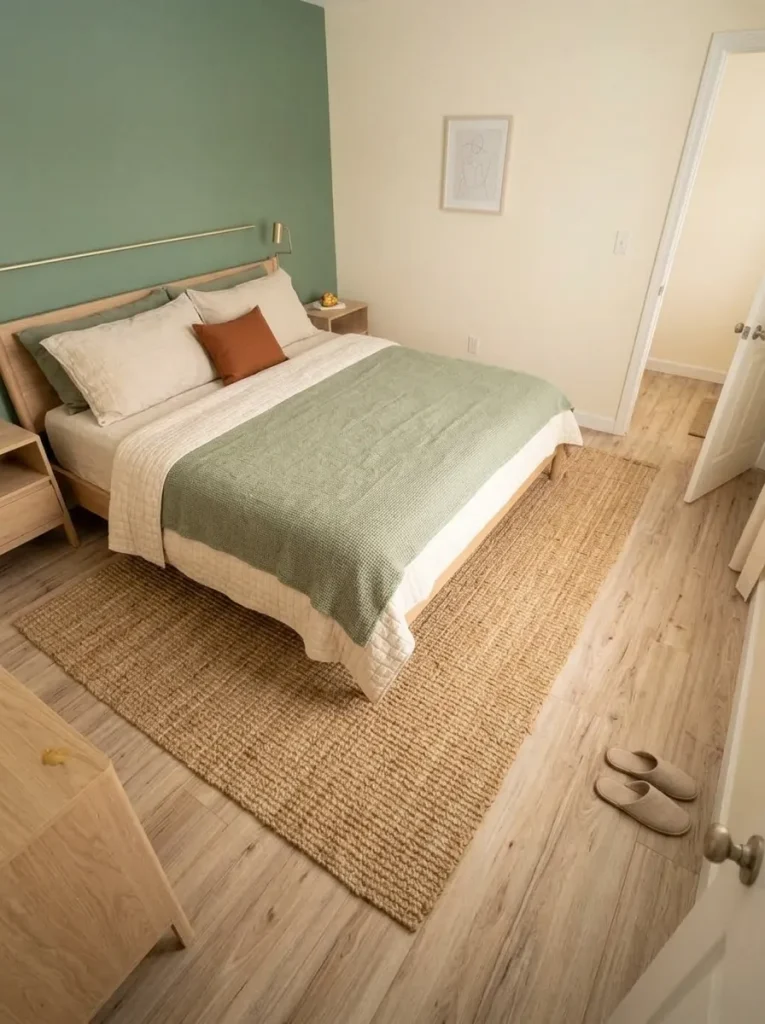
If the rug stops at awkward points, almost disappears under the bed, or creates narrow strips of flooring around several edges, the floor can look more fragmented.
The useful question is whether the rug connects visually with the bed while leaving the room’s main movement route easy to understand.
Rug + Walking Border Test
What is your rug doing to the floor plane?
Choose the situation closest to your bedroom. The rug diagram and recommendation will change.
The rug is doing its job.
It belongs visually to the sleeping zone while the main route remains understandable.
Decision: keep the placement unless another furniture interaction causes trouble.
The rug may be visually disconnected.
A very small rug can read like an unrelated island instead of helping the bed form one coherent zone.
Decision: compare a larger rug or reposition the existing one so more of it relates visibly to the bed.
The rug is competing with circulation.
If its edge repeatedly sits underfoot near a door or narrow passage, the textbook placement is not serving this room.
Decision: reposition, rotate, or reduce the rug so the walking border becomes clearer.
Do not force the rug into a standard arrangement when doors, furniture, or an asymmetric bed position make that arrangement impractical.
Choose the configuration that creates the clearest relationship between bed, rug, and usable floor.
18. Place a Mirror Where It Returns Daylight, Not Clutter
A mirror visually multiplies whatever sits in front of it.
That can work in your favor—or make a busy bedroom look twice as busy.
Place a mirror where it catches a brighter or calmer view and it may return light, greenery, or visual depth into the room. Aim it toward an open closet, laundry pile, television, or crowded shelf and those elements become part of the mirror composition too.
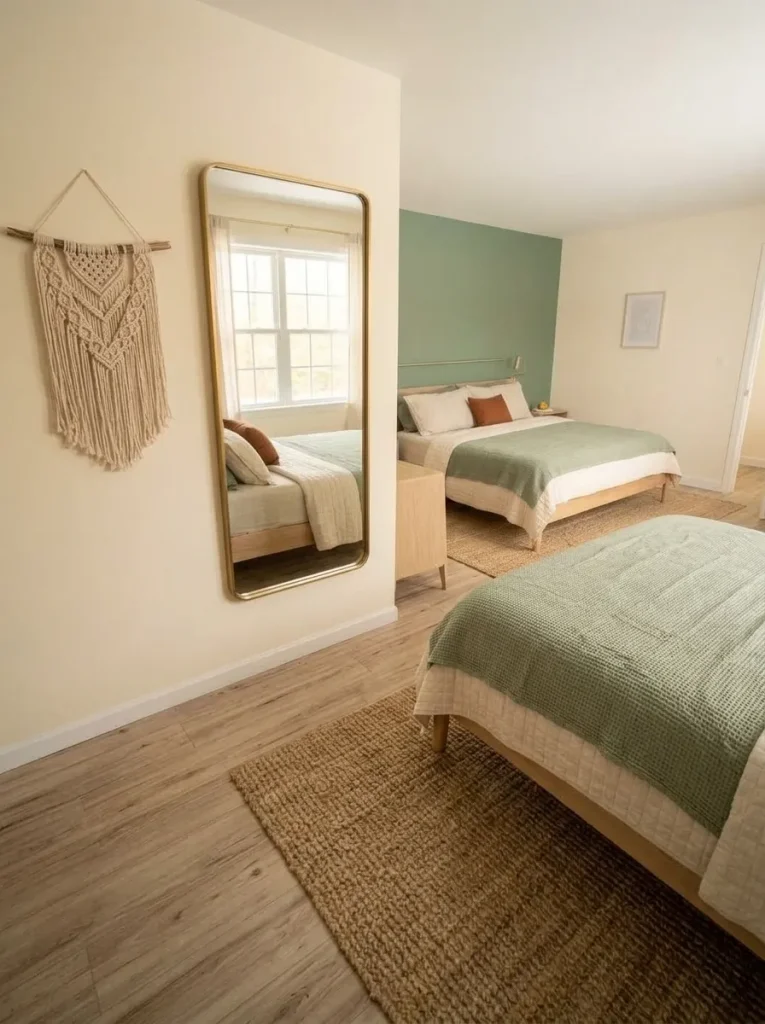
Test the location before hanging anything.
Stand where the mirror would go and take a photograph facing outward. That photograph approximates the scene the mirror will repeat.
If two possible walls are available, compare their reflected views instead of judging the empty walls themselves.
A full-length mirror can also support the dressing routine, but its position should not interfere with drawers or doors.
Decision: choose the mirror location for the reflected scene and daily use, not merely because that wall happens to be empty.
19. A Slim Work or Vanity Zone Can Share the Bedroom Without Taking It Over
Some small bedrooms have to support more than sleep.
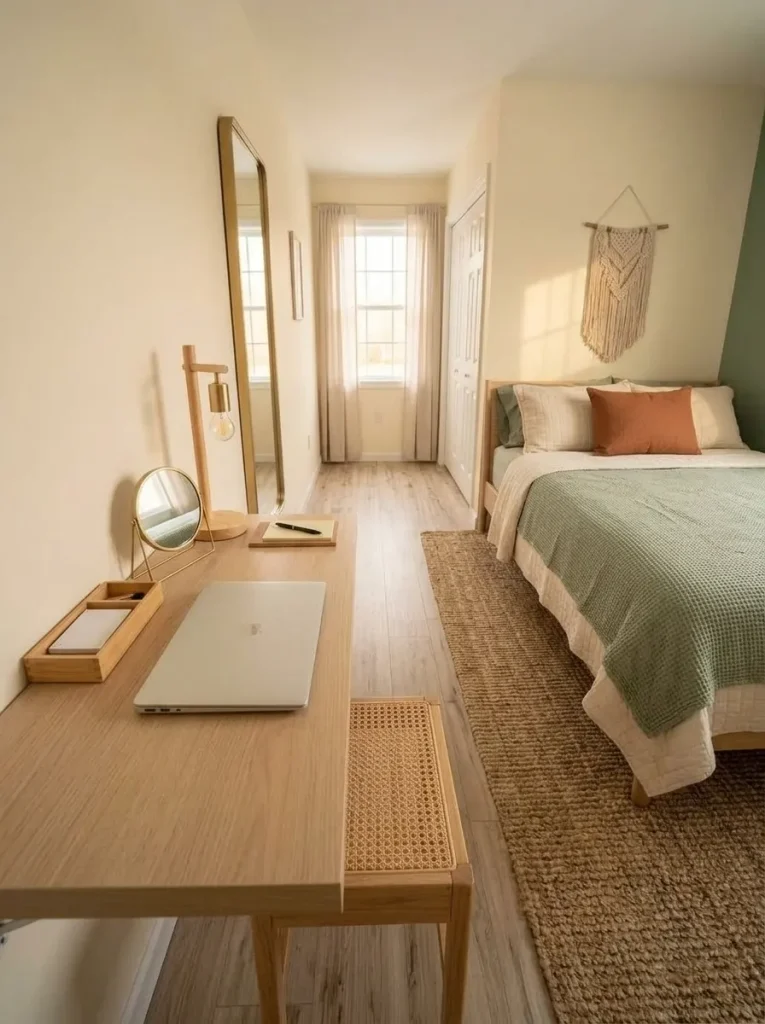
A laptop, makeup routine, study session, or compact dressing station may genuinely need a place.
The secondary function should still remain subordinate to the bedroom.
Begin with the door-to-bed and door-to-closet routes. If a desk or vanity would intrude into either path, the proposed location is already asking too much of the room.
Then control depth.
A shallow surface with a chair that tucks away usually places less pressure on the bedroom than a deep workstation surrounded by extra storage. For occasional use, a wall-mounted surface may require even less visual territory.
The final test happens after the activity ends.
Can the chair tuck away? Can the surface reset quickly? Does the room once again read primarily as a bedroom?
Add the secondary zone only when it solves a real routine without becoming the largest visual system in the room.
20. On Broken Walls, One Strong Art Composition Beats Many Small Pieces
A single-wide bedroom may already contain plenty of interruptions: windows, doors, closet openings, switches, shelves, and the headboard.
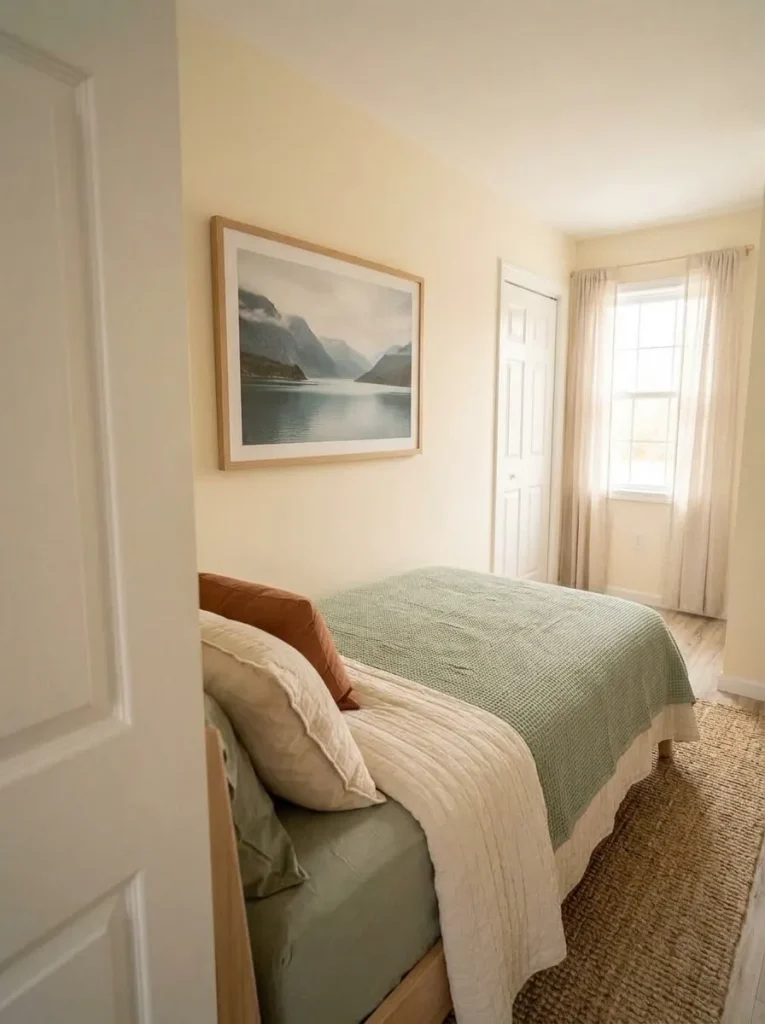
If you place a separate decorative item into every leftover patch, those interruptions become more noticeable.
Search for one wall area capable of holding a deliberate composition.
That might be:
- one larger landscape above the bed,
- a pair of coordinated botanical prints beside a window,
- a tight three-piece photograph group,
- or one vertical artwork on a narrow wall.
Then leave smaller fragments of wall quieter.
The practical test is subtraction.
Remove two of the weakest pieces and photograph the room again. If the strongest artwork suddenly looks more intentional, the smaller objects were competing with it.
Decision: use art to establish one clear visual hierarchy. Empty wall around that hierarchy is part of the composition, not unfinished space.
21. Finish With a Doorway Edit in Daylight and at Night
A bedroom can feel finished while you are standing inside it and still look crowded the instant you enter.
That is why the last edit should happen from the doorway.
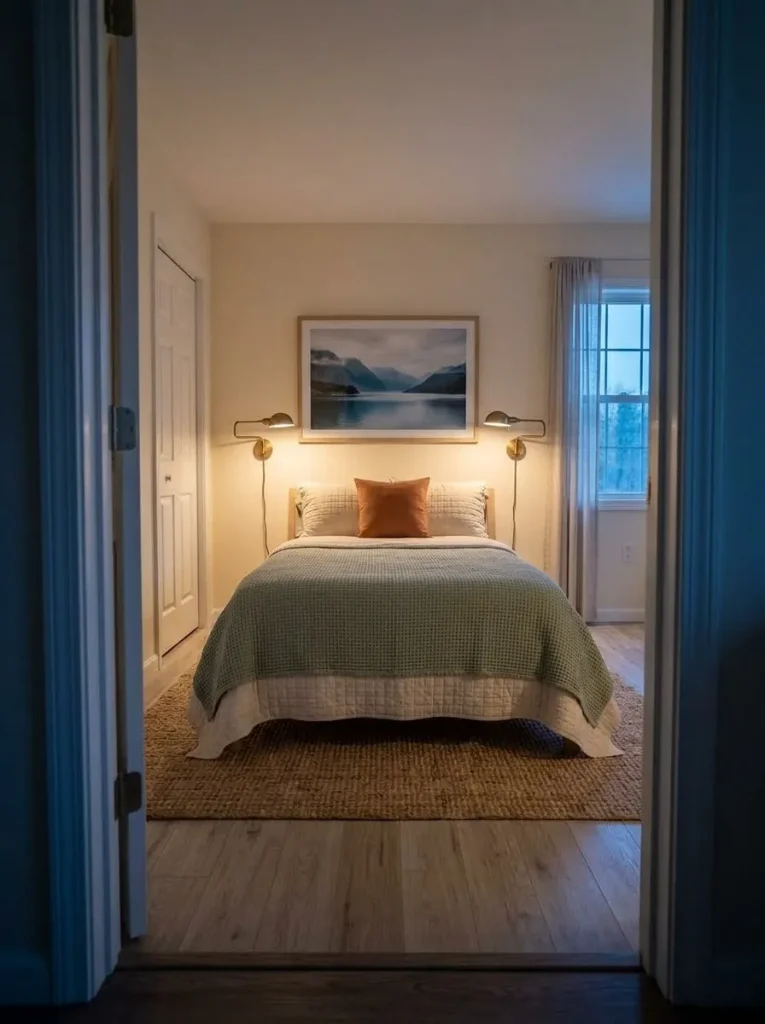
Do it twice: once in daylight and again with the lighting you normally use at night.
Different problems may appear in each condition.
Doorway Edit
What should happen to the first thing you notice?
Stand outside the bedroom and identify the element that grabs your eye first. Then choose what you think should happen to it.
Keep it when it deserves to lead.
If the bed wall, artwork, window, or major color field feels intentional and circulation already works, preserve it as the focal point.
- Reduce competing accessories nearby.
- Let secondary walls stay quieter.
- Repeat the doorway check at night.
Modify it when the function is useful but the visual weight is too strong.
Do not replace it immediately. First simplify its surroundings or change how it relates to nearby furniture.
- Remove smaller competing decor.
- Reduce bedding or shelf clutter.
- Change placement before changing the object itself.
Remove it when it creates pressure without earning its space.
A chair, bench, decorative table, or secondary cabinet can become the room’s loudest object even when it contributes very little.
- Remove it temporarily.
- Photograph the doorway again.
- Only bring it back if the room loses useful function.
Repeat this test once in daylight and once with your normal evening lighting. The visual priority can change after dark.
Repeat the doorway test at night.
Lamps, dark corners, screens, and reflective surfaces can change the hierarchy once daylight disappears.
Once you know which element deserves to lead, the remaining editing becomes easier.
If you want to continue the same space-conscious thinking throughout the home, explore these single wide mobile home decorating ideas next.
Final Thoughts
The strongest single wide bedroom ideas solve the room’s biggest pressure point before adding more decor. Start with the bed, walking route, closet access, and furniture that consumes the most usable depth. Once those relationships work, storage, lighting, color, textiles, and artwork become much easier to refine.
A small bedroom does not have to imitate a larger one to feel comfortable. Clear movement, useful furniture, controlled visual weight, and one deliberate focal idea can give the room a much calmer identity.
Choose the one change that would improve your daily routine most and test that first.
Save this guide to Pinterest so these single-wide bedroom ideas are easy to find when you are ready to work on your room.