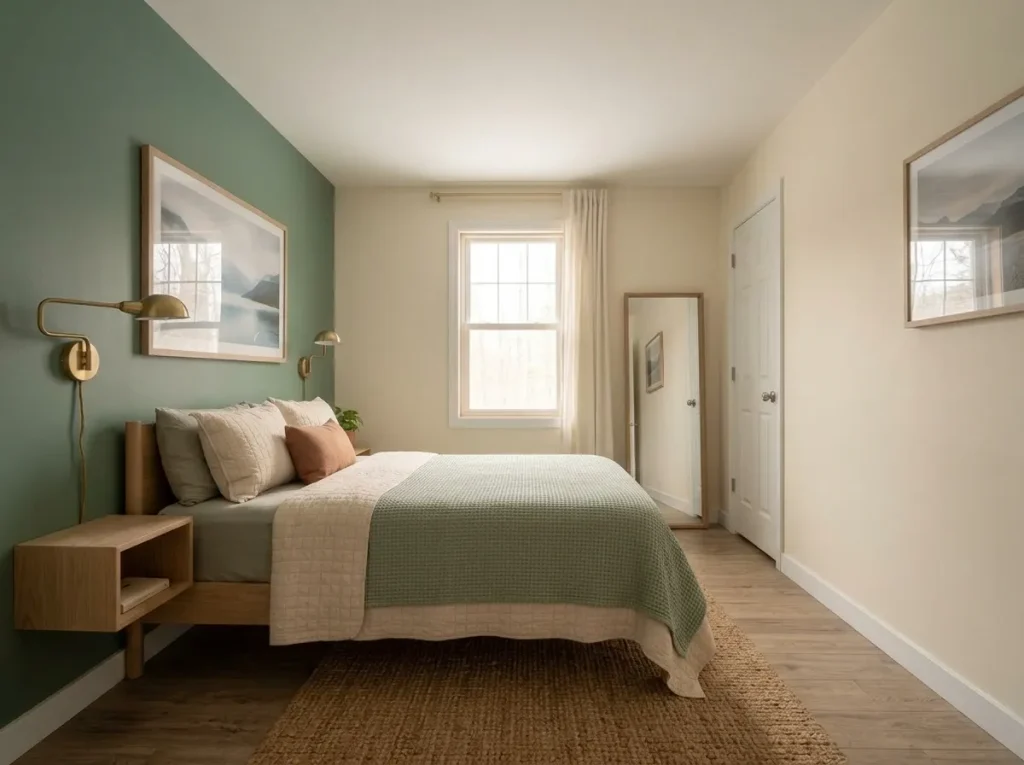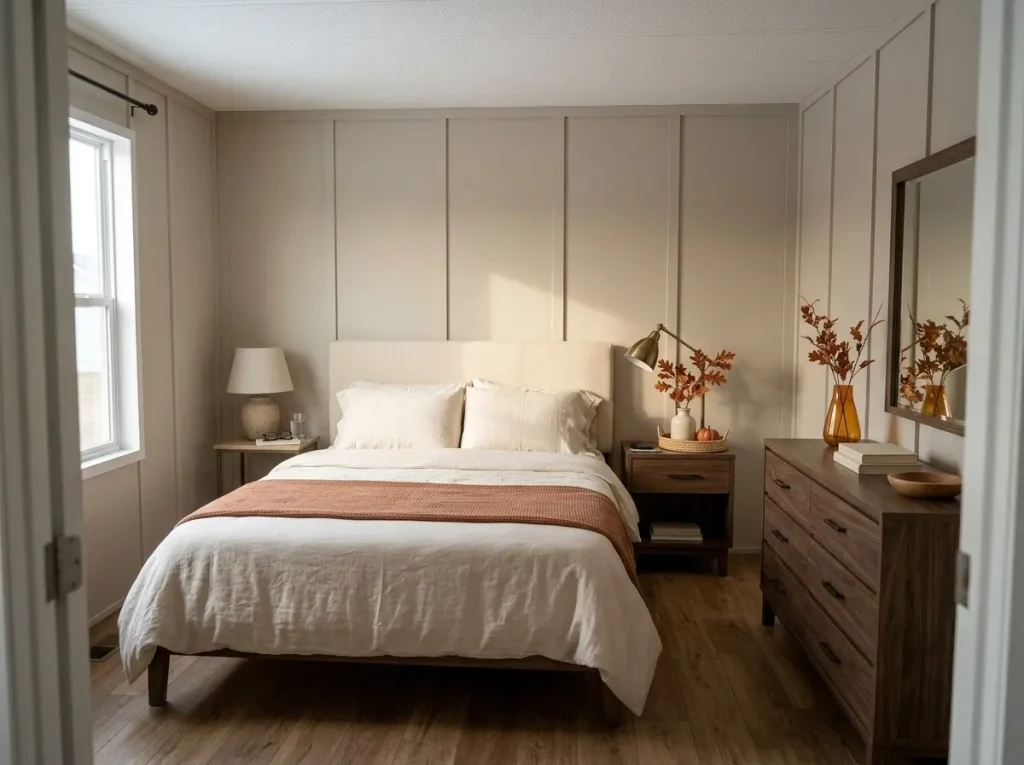
A small mobile home bedroom can run out of usable space long before it actually runs out of square footage. The bed takes the largest footprint, closet doors need room to operate, and even an ordinary dresser can consume the narrow strip you rely on for walking.
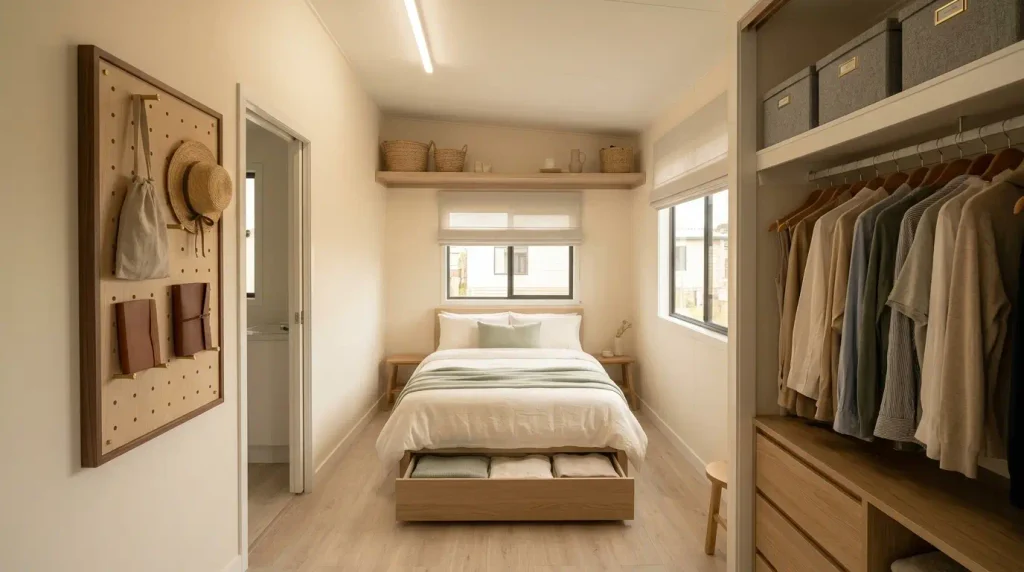
That is why the best mobile home bedroom storage ideas are not simply about fitting more organizers into the room.
They are about deciding where storage can live without making everyday movement harder.
Sometimes the answer is beneath the mattress. In another bedroom, one shallow wall cabinet can replace several smaller pieces. A room with almost no closet may need one organized clothing wall, while a bedroom with adequate storage can actually improve when furniture is removed.
The 19 ideas below focus on those decisions. You will see ways to use the bed footprint, awkward wall strips, vertical space, closet boundaries, corners, and furniture you already need—while keeping the bedroom comfortable enough to live in, not merely impressive in a storage photo.
1. Before You Add Storage, Sort the Bedroom by Reach Frequency
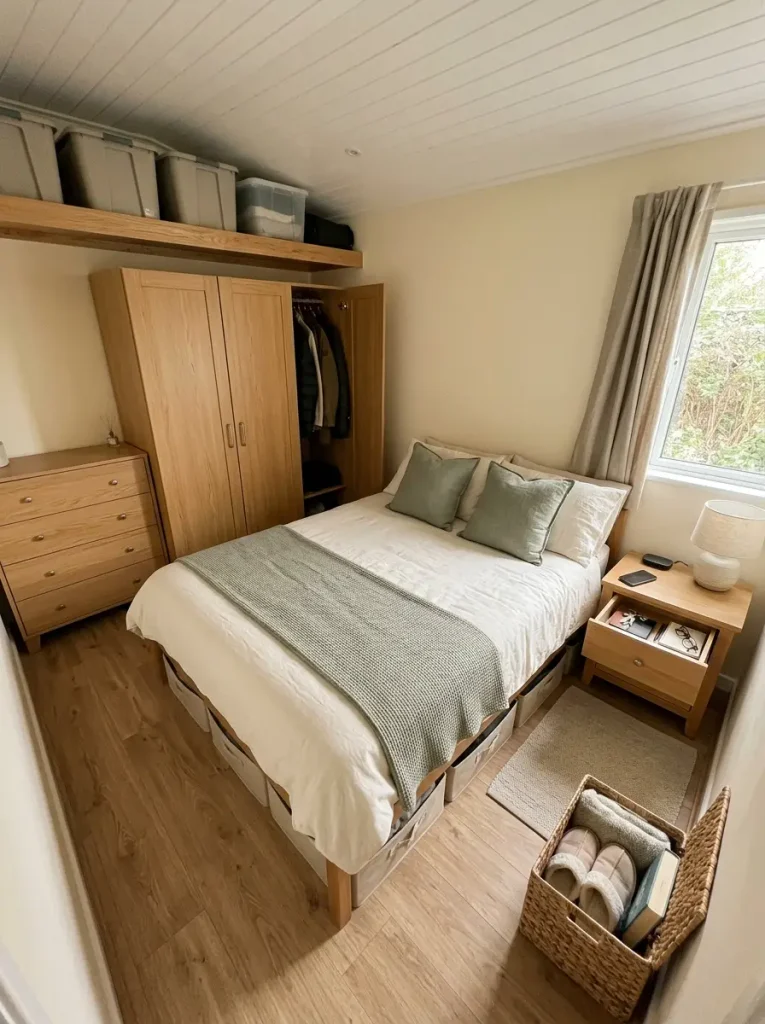
Start with the objects, not the organizers.
A compact mobile home bedroom becomes frustrating when its easiest storage holds things you rarely touch while everyday belongings spill onto the bed, dresser, chair, or floor. That is a storage-location problem, even when the room technically has enough total capacity.
Separate your belongings into three practical groups:
- things you reach for almost every day,
- things you use occasionally,
- items that can disappear for weeks or months.
Daily clothing, chargers, glasses, medication, or work items deserve the easiest reach. Spare bedding and seasonal pieces can tolerate slower access.
This distinction matters more in a small mobile or manufactured-home bedroom because drawers, cabinet doors, baskets, closet fronts, and walking paths often compete within the same limited area.
Before buying anything, use the Storage Pressure Map below to identify which zone deserves attention first.
For broader bed placement, circulation, furniture scale, and decorating decisions beyond storage, continue with 25 Mobile Home Bedroom Ideas.
Storage Pressure Map
Storage Pressure Map
What is actually running out of room?
Choose the problem you notice most often. The first storage move changes because clutter, closet overflow, bulky items, missing closets, and oversized furniture are five different problems.
The useful outcome is not “buy more storage.” It is knowing which storage problem you actually have.
That decision should guide every idea that follows.
2. Hide Bulky, Occasional Items Under a Lift-Up Bed
A lift-up bed makes the most sense when the bedroom needs large-volume storage without frequent retrieval.
Think spare comforters, extra pillows, luggage, seasonal clothing, sentimental boxes, or bedding you rotate occasionally. Those categories take up disproportionate space in a small mobile home bedroom, yet they do not need the easy access of socks, sleepwear, chargers, or everyday clothes.
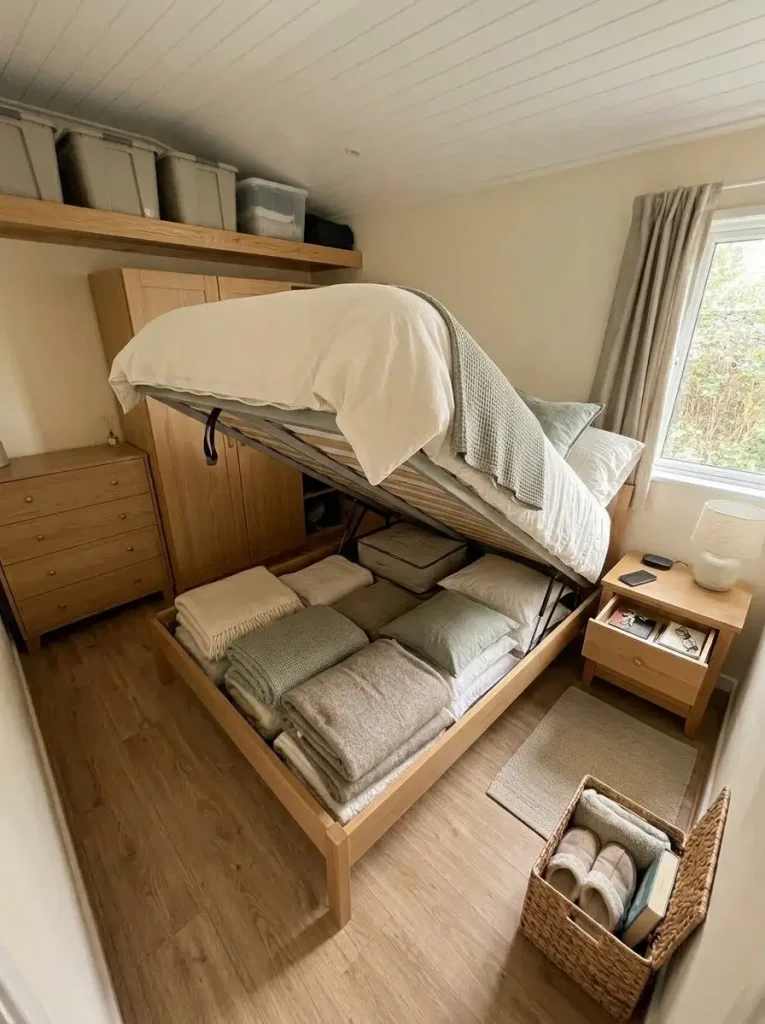
The mattress footprint already occupies the floor, so storing beneath it can add capacity without placing another dresser or cabinet around the perimeter.
There is a tradeoff: lifting a mattress platform is a bigger action than opening a standard drawer. That makes the space less appealing for belongings you expect to reach every morning.
A useful sorting rule is:
High-volume + low-frequency = strong lift-up-bed candidate.
If you already own a standard bed, do not replace it purely for the storage feature until you know what would actually live underneath. Gather the intended items together first. If the category fits ordinary under-bed containers, a simpler solution may be enough.
The upgrade earns its footprint when it can remove another bulky storage piece from the bedroom—not merely hide miscellaneous objects.
3. Use Bed Drawers Only on the Side That Can Actually Open
Built-in bed drawers look almost perfect for a compact bedroom: storage is hidden, low, and contained inside furniture the room already needs.
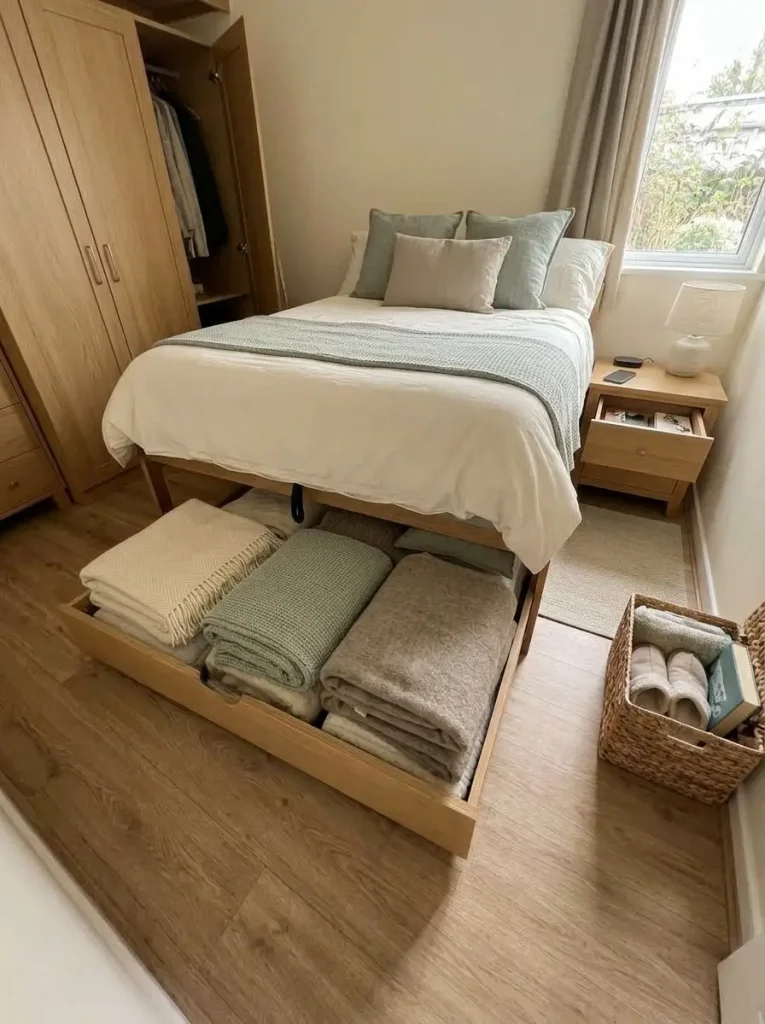
But a drawer is useful only when the bedroom gives it real operating space.
A drawer facing a wall, nightstand, closet opening, or narrow walking route can technically exist while remaining annoying to use. That is especially relevant in mobile home bedrooms where the bed may already sit close to one side wall.
Test the movement before choosing the mechanism. Mark the approximate drawer front with removable tape or place a box beside the bed and pretend you need to pull it toward you. Then stand where you would normally stand to reach the contents.
Use the access tester below to compare drawers, lift-up storage, and simpler containers.
Drawer vs. Lift-Up Access Test
Under-Bed Access Planner
How much working room does your bed actually have?
Choose the situation closest to your bedroom. The planner compares the access pattern first—then recommends the storage mechanism that is most likely to stay convenient.
Use the clear side for your easiest under-bed storage.
When one side of the bed opens onto comfortable floor space, side drawers can work well because you have room both to pull them outward and to stand beside them while retrieving belongings.
When the bed hugs a wall, access from above can make more sense.
A side-opening drawer needs floor beside the bed. If that side is already compressed by a wall, lift-up storage can use more of the mattress footprint without requiring a separate drawer aisle.
Do not over-engineer an already constrained bed zone.
When both sides are tight, shallow removable containers are a useful trial because they let you discover whether under-bed storage is genuinely practical before committing to a more elaborate frame.
For everyday belongings, convenience matters more than maximum volume.
Choose a mechanism you can operate quickly without lifting bedding, moving furniture, or kneeling in an awkward gap. Daily retrieval changes the storage decision more than raw capacity does.
The important question is not which bed stores the most.
It is which storage mechanism you will still find convenient six months from now.
4. Turn One Bed Wall Into a Shallow Storage Frame
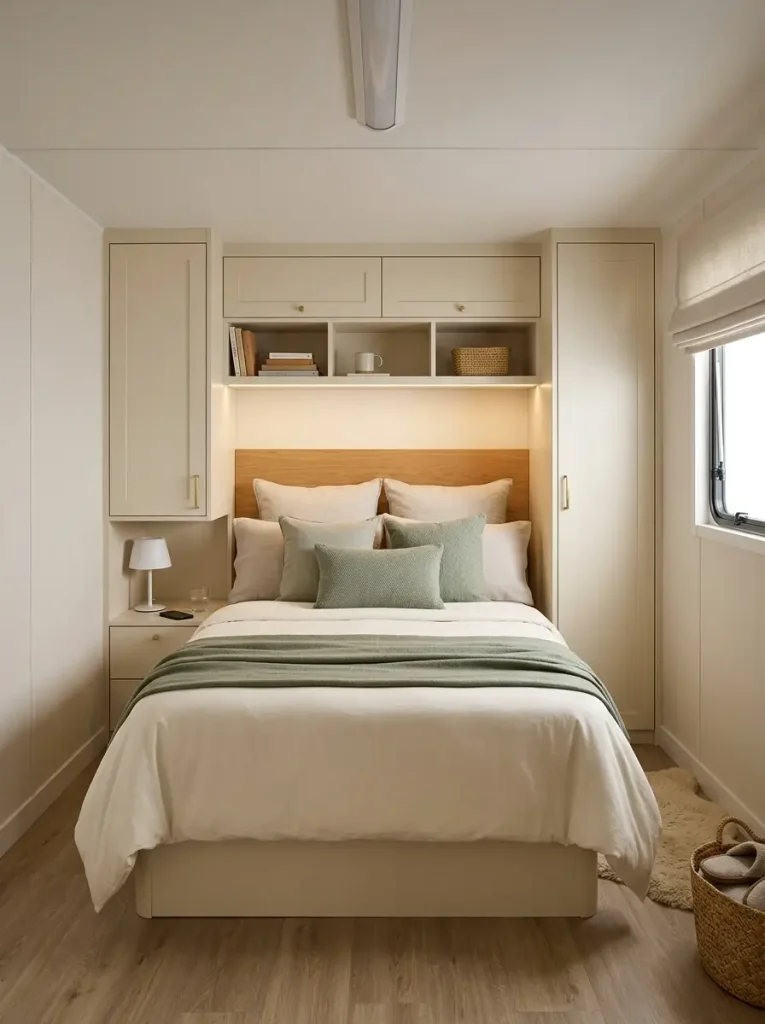
When a small bedroom contains a dresser, two nightstands, a bookcase, and an undersized closet, the problem is not only how much floor those pieces occupy.
It is also the number of separate furniture edges the room has to absorb.
A coordinated bed wall can consolidate several jobs into one zone: shallow bedside drawers, tall closed storage, a few open niches, and—in some rooms—carefully planned storage above the headboard. That can release another wall entirely.
This does not mean every mobile home bedroom should be wrapped in cabinetry. Windows, switches, doors, vents, ceiling conditions, and circulation may make a symmetrical built-in composition inappropriate.
Let the existing room decide how much of the wall should be used.
This matters particularly in a single wide, where bed orientation and circulation are tightly connected. For that broader layout problem, see 21 Single Wide Bedroom Ideas for Small Rooms.
Bed-Wall Storage Composer
Bed-Wall Storage Composer
How much of the bed wall should storage actually occupy?
Choose the condition closest to your bedroom. The wall elevation, storage intensity and recommended configuration change together.
Use two shallow towers to consolidate several separate pieces.
When the bed wall is genuinely open on both sides, coordinated storage can absorb the jobs of separate nightstands, a small dresser and miscellaneous shelving while keeping those functions concentrated in one zone.
Let the uninterrupted side carry most of the storage.
A window, doorway or other architectural interruption is a reason to stop forcing symmetry. One substantial storage tower can provide useful capacity while the interrupted side remains open and easier to use.
Keep the bed wall light and move capacity somewhere else.
When both sides of the bed already feel compressed, adding tall cabinetry can make the sleeping zone feel even more enclosed without solving the actual storage problem.
The best bed-wall upgrade may be no added storage at all.
If your belongings already have workable homes, extra cabinetry can solve a problem the bedroom does not have. An open wall can provide visual relief that is especially valuable in a compact room.
Treat this as a configuration decision, not a built-in formula.
Mounted shelving or cabinetry should use hardware and installation methods appropriate to the specific product and the actual construction of your home. The spatial idea is transferable; the attachment method is not universal.
5. Let One Side Stay Light When the Room Won’t Support Symmetry
A small bedroom often becomes more crowded when you try to make both sides of the bed match.
One side may have comfortable wall width while the other collides with a window, closet edge, entry door, or narrow walking route. Forcing identical nightstands or matching tall cabinets into those unequal conditions can waste the better side and overfill the tighter one.
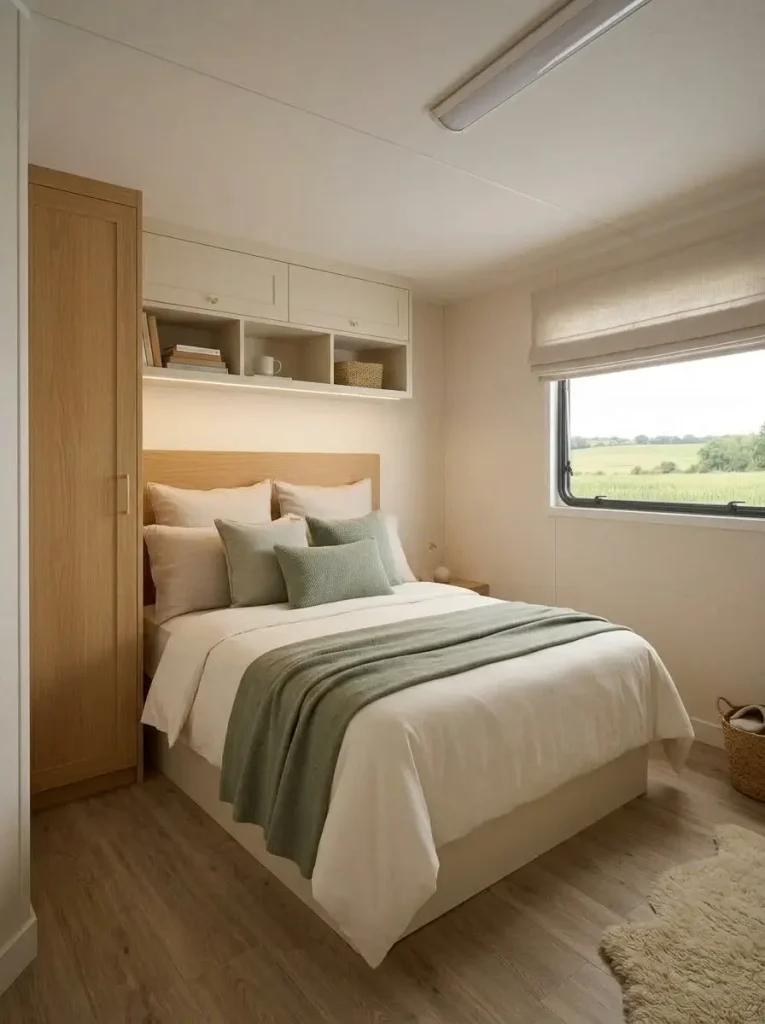
Use functional asymmetry.
Let the more generous side handle the heavier storage job—a narrow drawer unit, tall cabinet, or a combination of bedside surface and closed storage. On the constrained side, keep only the function you truly need.
That may mean a compact floating surface, lighting that does not consume a tabletop, or simply enough space for one small nighttime essential.
Then judge the arrangement from the doorway, not only from the center of the bed.
The question is whether the whole room feels balanced, not whether every object has a twin.
If matching furniture requires blocking an opening, narrowing the main route, or choosing pieces too small to be genuinely useful, stop chasing symmetry.
Use the stronger side. Let the other side breathe.
6. Convert a Skinny Wall Recess Into a Vertical Bin Tower
Some of the most useful storage in a small mobile home bedroom comes from spaces too narrow for normal furniture.
Look beside a closet, between a built-in and a wall, near the bedroom entrance, or at the end of an existing cabinet. A slim recess may not hold a dresser, but it can sometimes accept narrow removable bins, shallow shelves, or a vertical storage column.
The strength of the idea is category control.
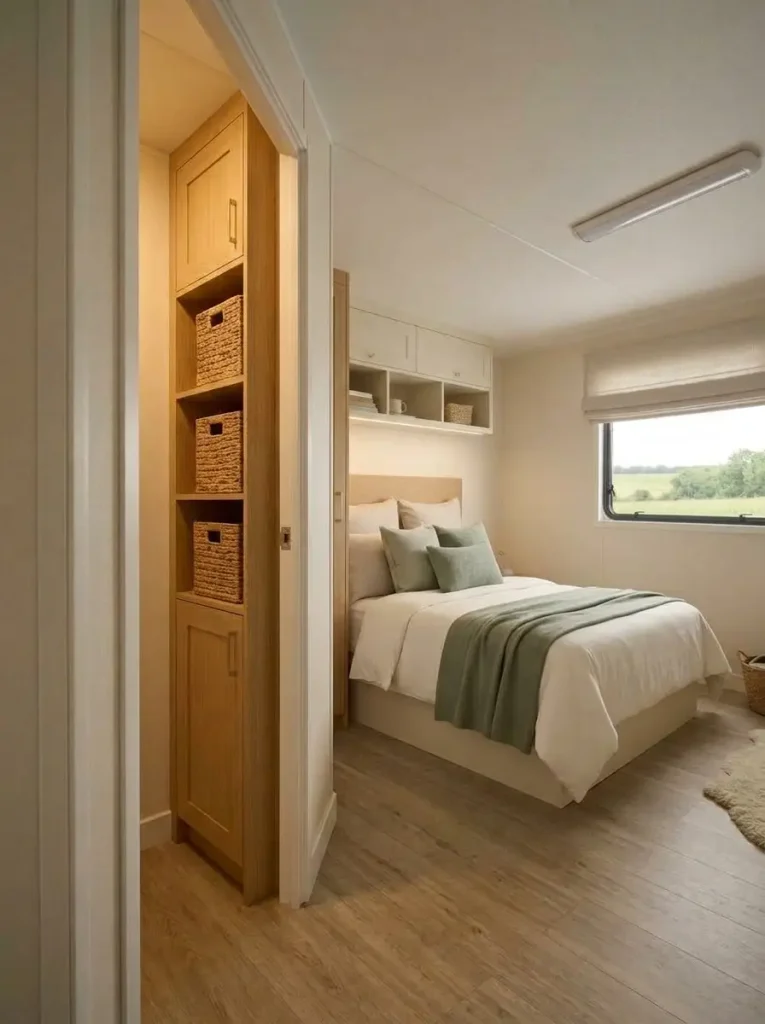
Give each level one job. Lightweight accessories can live higher. Frequently used folded items belong around comfortable reach height. Less attractive or infrequently used belongings can sit in contained bins lower down.
Before committing to the gap, check whether it already serves another function.
A strip beside a door may belong to the door’s operating zone. A narrow section near a closet may feel fine until the closet itself is open. A shelf at the edge of the main bed route may force your body to turn every time you pass.
If accessing the recess creates friction with another opening, the gap is not truly free.
Best use: a narrow vertical cavity that is currently empty and does not interrupt an opening.
Skip it when: the storage can be reached only by standing in the path of a bedroom or closet door.
7. Claim the Strip Behind a Door Without Blocking Its Swing
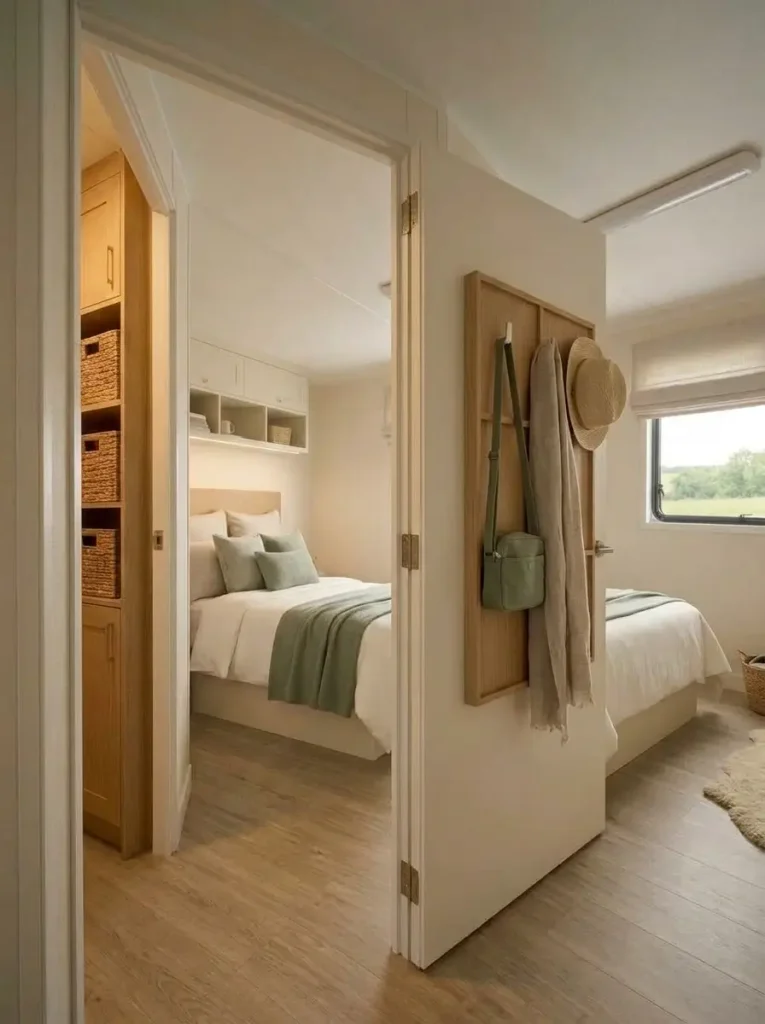
The wall behind a bedroom door often appears unusable because the door covers it when open.
That does not always mean the entire zone must remain empty.
A very shallow organizer, hook rail, slim accessory panel, or lightweight hanging solution can sometimes occupy part of that wall while the door continues to work normally. It is particularly useful for the small categories that otherwise migrate onto dresser tops and chair backs.
Test the proposal with the door fully open.
Use a cardboard mock-up or removable tape to represent the depth. Open and close the door several times, then retrieve an item from the proposed storage position.
Check three things:
- Does the door still reach the position you normally use?
- Can you retrieve belongings without awkwardly trapping yourself between the door and bed?
- Does the entrance still feel open enough from the main approach?
If any answer is consistently negative, reduce the depth or leave that strip alone.
The objective is to capture genuinely unused depth, not to convert a comfortable doorway into another storage obstacle.
8. Use a Soft Closet Front When a Swinging Door Eats the Useful Zone
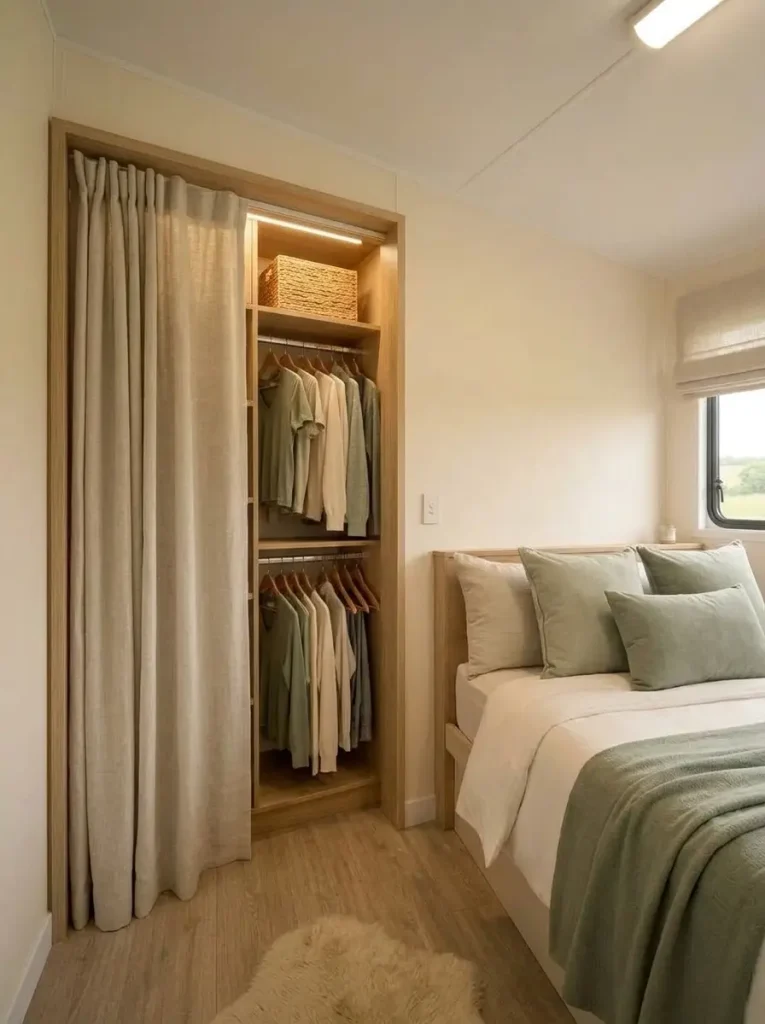
A closet door affects more than the closet.
In a small mobile home bedroom, its swing can influence where the bed sits, whether a bedside unit fits, and how much floor remains usable in front of the wardrobe.
When the front itself creates the pressure, changing that front can sometimes unlock more useful space than reorganizing the closet interior.
A curtain can remove the door-swing arc and soften the closet visually. An open closet creates immediate access but asks more of the organization inside. Keeping the existing closed front may still be best when it operates comfortably and visual concealment matters most.
Use the selector below as a starting point.
Closet Front Decision
Closet Front Studio
Which closet front fits the way your bedroom actually works?
Choose the pressure you want to solve first. The closet preview and decision profile change together so you can compare space, concealment, access and reversibility.
Remove the door swing from the bedroom floor plan.
When a hinged closet door interferes with the bed, a nightstand or the main walking route, a soft fabric front can free that operating zone while still allowing the closet to disappear visually when closed.
Keep the closet visually quiet when concealment matters most.
If exposed clothing makes the bedroom feel permanently busy, a closed closet front can be worth preserving. The stronger move may be improving the organization behind the doors rather than removing the doors themselves.
Choose immediate access when the closet is part of your daily routine.
An open closet removes the extra opening step and keeps everyday clothing immediately visible. The tradeoff is that hangers, baskets and shelves become part of the bedroom’s visual composition.
Favor a solution that can leave with you.
When permanent alterations are undesirable, a lightweight curtain-style front may provide concealment and eliminate door-swing pressure without committing the room to a major closet rebuild.
A softer front is not automatically superior.
If the existing closet door works comfortably, contains visual clutter, and does not interfere with furniture, keeping it can be the better decision.
9. No Closet? Build One Clean Clothing Wall Instead of Scattering Racks
A bedroom without a useful closet does not need storage on every available wall.
Spreading a garment rack, shoe shelf, drawer unit, baskets, hooks, and folded-clothing shelves across several corners can make a compact mobile home bedroom feel even smaller because your eye repeatedly encounters storage infrastructure.
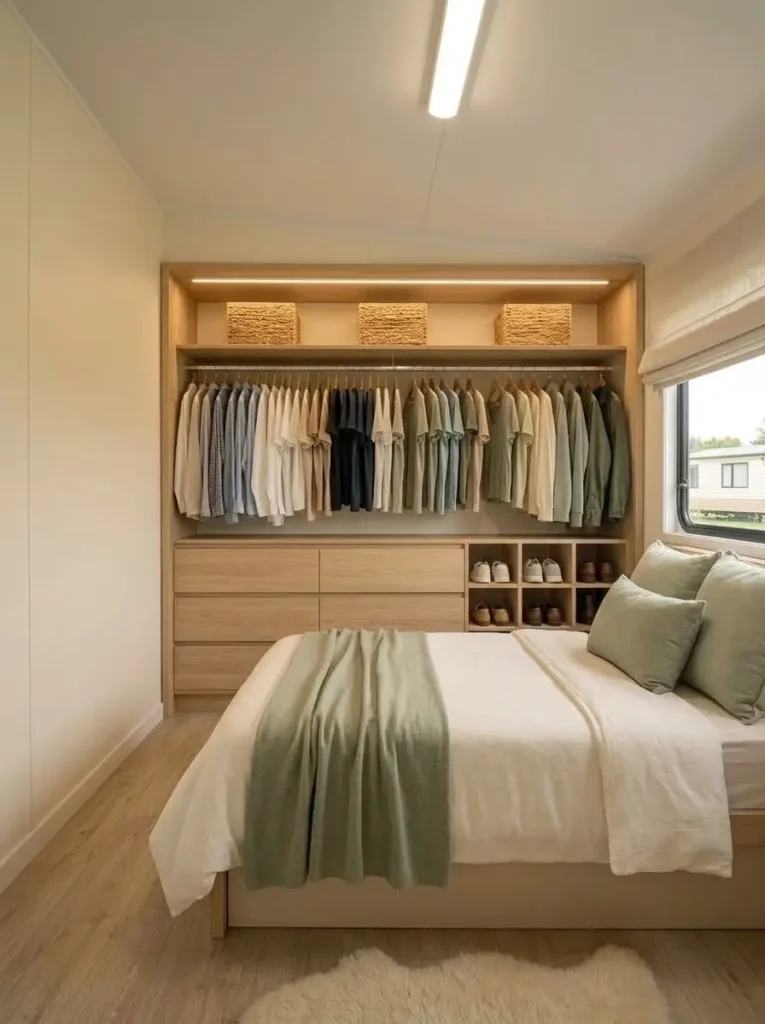
Try the opposite approach: consolidate the wardrobe.
Choose one appropriate uninterrupted wall and organize the storage vertically:
- high shelf for low-frequency items,
- hanging rail for garments,
- folded storage or drawers around easy reach,
- shoes toward the bottom,
- baskets for irregular categories,
- closed containers for visually messy belongings.
A curtain can conceal part of the system if exposed clothing starts to dominate the bedroom.
If you need a wider catalog of bedroom organizers beyond this property-specific layout problem, continue with 36 Smart Bedroom Storage Solutions.
Here, however, the important decision is spatial.
One disciplined clothing zone usually creates less visual fragmentation than a smaller amount of storage distributed across five separate corners.
10. Give Accessories a Vertical Home on a Pegboard Side Panel
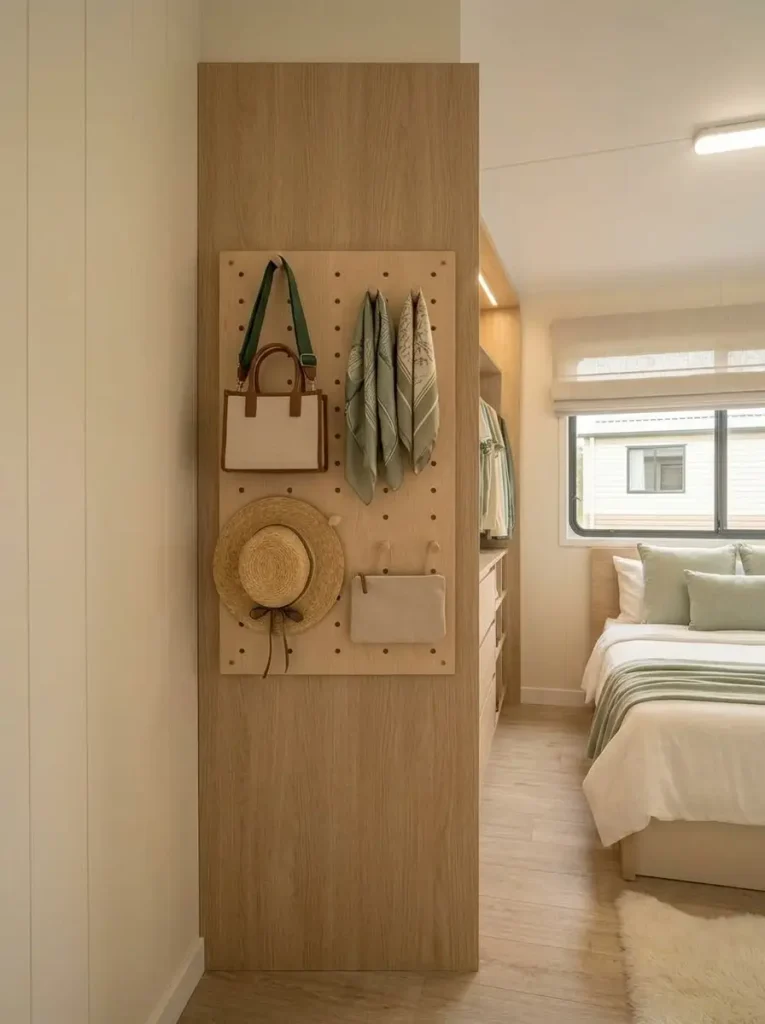
The side of a wardrobe or tall shelving unit can become useful without increasing the furniture’s floor footprint.
A pegboard-style side panel works best for lightweight, flexible-access categories: hats, small bags, scarves, jewelry organizers, headphones, or other accessories that otherwise migrate onto doors, chairs, and dresser tops.
This can be particularly useful in a narrow mobile home bedroom where another freestanding accessory cabinet would cost more circulation space than the items deserve.
Think of the panel as a secondary storage layer, not permission to cover every vertical surface.
Start with the belongings already creating visible clutter. Give each category a defined zone and leave open space between groups so the panel still reads as an organized surface.
The stop signal is physical.
If bags, hooks, or accessories project far enough into the bed route that you brush against them, the side panel has reached its functional limit.
Vertical space is useful only while the adjacent circulation space remains comfortable.
11. Trade a Wide Dresser for a Taller, Shallower Storage Piece
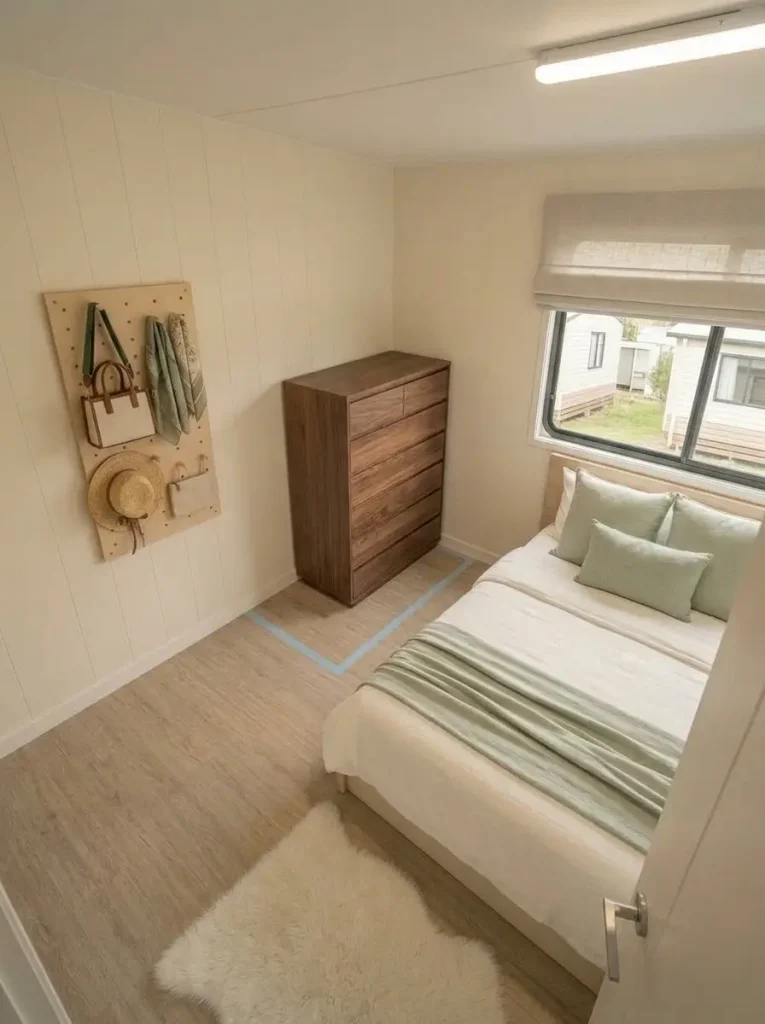
A dresser can hold plenty and still be the wrong shape for a small mobile home bedroom.
The problem is often width plus depth.
A broad chest may consume a long section of usable wall while projecting into the route around the bed. A taller, shallower piece may return some of that floor area without automatically eliminating the categories the dresser currently stores.
Do not compare furniture by drawer count alone.
Compare what the bedroom pays for the capacity:
- How much wall does the piece consume?
- How far does it project into the room?
- Does it affect the route to the closet or bed?
- Which belongings genuinely require drawers?
For broader primary-bedroom decisions combining storage, visual hierarchy, furniture scale, and finish, see 15 Mobile Home Primary Bedroom Ideas That Feel More Luxurious.
Floor-Footprint Exchange
Dresser Footprint Lab
Is your dresser earning the floor space it takes?
Choose the issue that best describes your current dresser. The room plan and recommendation change together so you can separate a footprint problem from an organization problem.
Reduce the furniture footprint before adding more storage.
If the dresser makes the route around the bed feel compressed, its exterior dimensions are causing the problem. A taller, shallower piece may preserve useful capacity while giving part of the room back to circulation.
A cluttered dresser top does not automatically mean the dresser is too large.
The surface may be functioning as an unplanned landing zone for daily belongings. Replacing the furniture can leave the same behavior unresolved if those objects still have nowhere else to go.
If every drawer has a real job, capacity matters more than silhouette.
A slimmer piece is useful only if it can still hold the categories the current dresser manages. Going vertical can help, but the replacement needs to be judged by usable storage rather than exterior appearance alone.
A dresser that fits, opens easily and stores useful categories is already succeeding.
Not every wide piece in a compact bedroom is a mistake. If circulation remains comfortable and the drawers genuinely support daily life, replacing it can create a project without solving a real problem.
The best replacement is sometimes no replacement at all.
If the dresser works, keep it. Storage decisions improve when the bedroom’s actual problem—not the existence of a new idea—drives the change.
12. Send Rarely Used Belongings Above the Door or Closet
High storage works because it accepts a limitation: it is harder to reach.
That makes it poor territory for everyday clothes and potentially useful territory for items you need only occasionally.
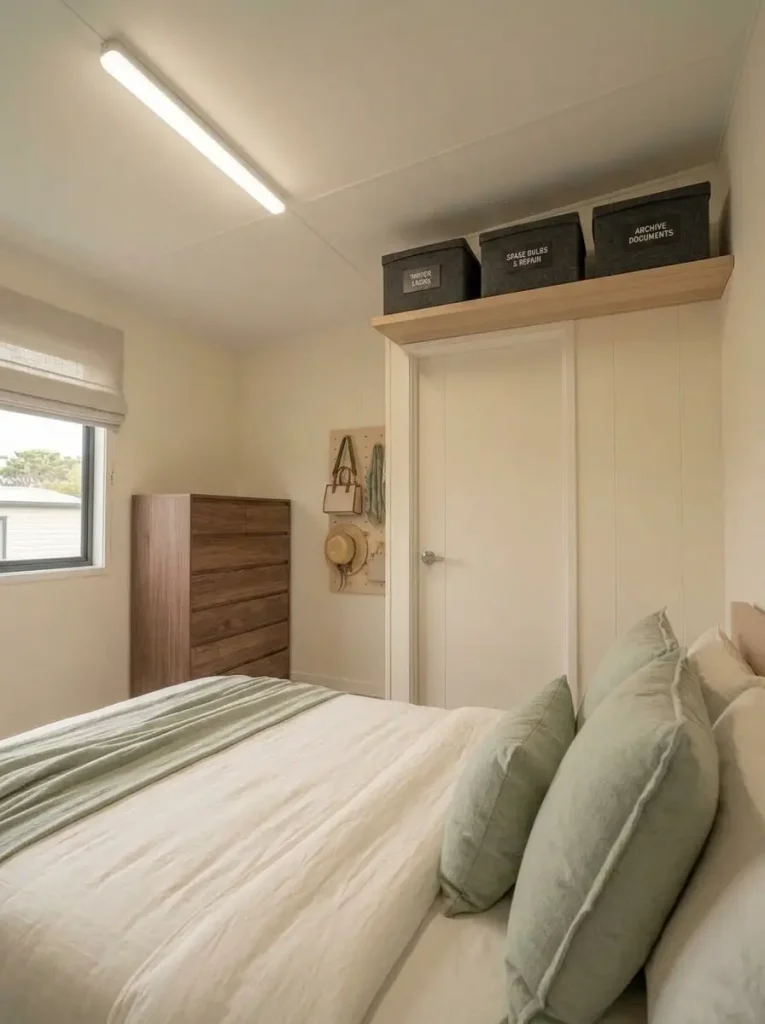
Possible candidates include:
- seasonal accessories,
- lightweight keepsake boxes,
- spare soft furnishings,
- empty travel bags,
- infrequently used decor.
Do not treat the entire upper perimeter as automatically available.
A compact mobile home bedroom may already have a low-feeling ceiling, tall cabinetry, or limited visual breathing room. A continuous row of bulky boxes overhead can make the room feel more enclosed even when it technically increases capacity.
Retrieval matters too.
If reaching an upper container means moving the bed, climbing on unsuitable furniture, or struggling with a heavy box, relocate that category to an easier zone.
The better rule is:
Send low-frequency, manageable belongings higher. Keep daily and awkward-to-handle items lower.
Visually, a few repeated containers usually feel calmer than an irregular line of bags and cartons.
13. Use Corner Shelves for Gaps Standard Furniture Cannot Reach
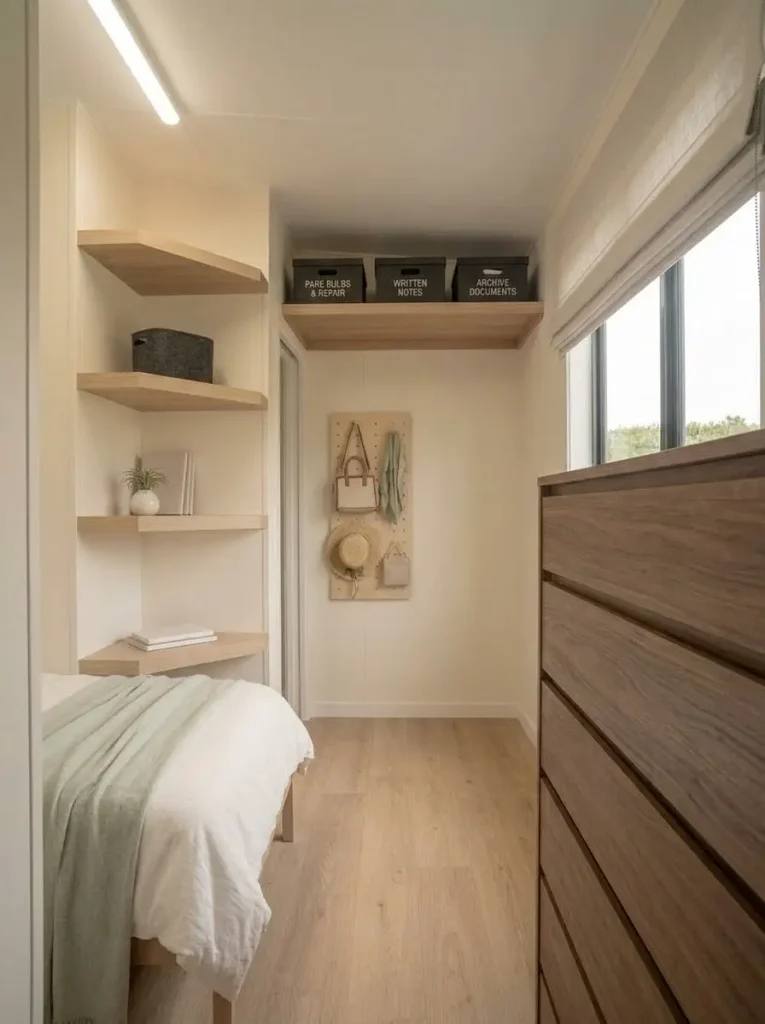
A corner becomes valuable only when it solves a problem that ordinary furniture cannot.
The temptation is to add corner shelves because the space looks empty. In a small bedroom, emptiness may already be contributing visual relief.
Diagnose the corner first.
If two walls meet beside the bed and neither supports a normal bookcase, shallow corner shelves can hold books, contained accessories, or a few useful objects without introducing another broad furniture face.
A corner beside a closet can also work when the shelves stop before the closet’s operating zone.
The wrong corner is one on the bedroom’s primary route.
Try a simple shoulder test. Walk past the proposed shelf location several times while carrying bedding or a laundry basket.
If you instinctively turn your body to clear the corner, reduce the projection or skip the shelf.
Corner storage should make use of geometry the bedroom already struggles to furnish. It should not create a new geometry problem.
14. Float the Bedside Zone When the Floor Edge Is Too Tight
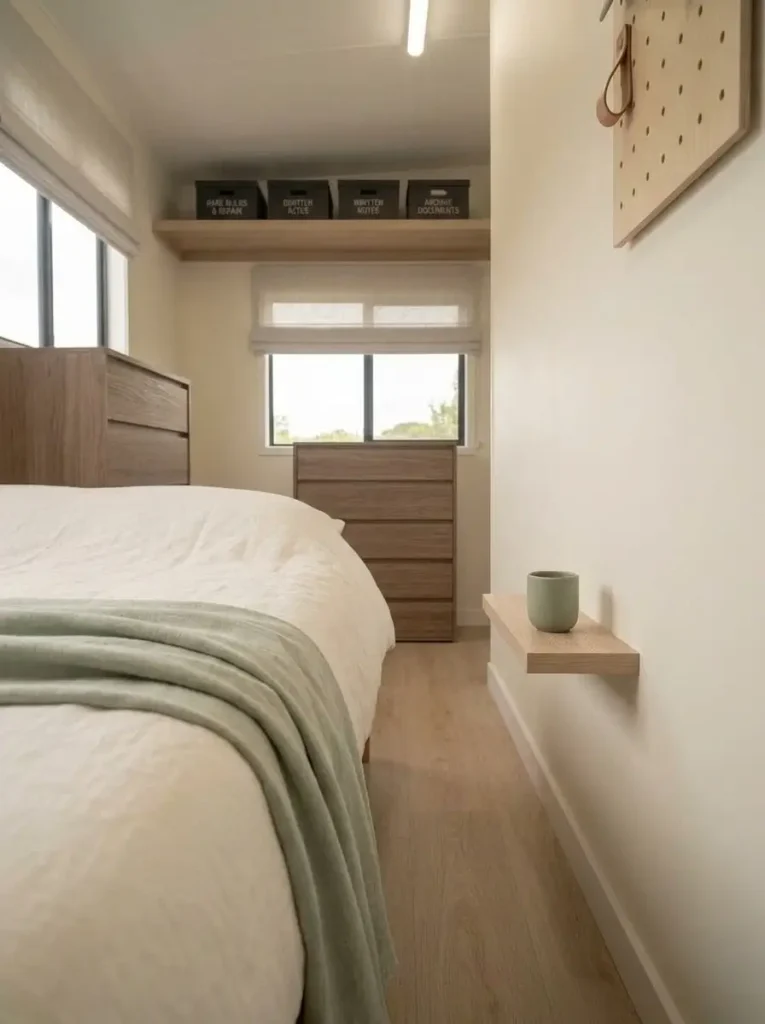
A nightstand is useful because it provides a landing surface.
Its legs and cabinet body are optional.
When the strip beside the bed is narrow, a small floating surface can provide room for a phone, book, glass, or alarm while leaving more of the floor edge visually open.
That can be especially useful in a small mobile home bedroom where a standard nightstand would tighten the approach to the bed or collide with another opening.
The idea has a clear limitation:
A floating shelf provides surface, not necessarily meaningful storage.
If you rely on bedside drawers for medication, electronics, personal items, or clothing, replacing a productive cabinet with a tiny ledge may solve the wrong problem.
Audit the bedside load.
If your regular nighttime belongings fit comfortably on a modest surface, floating the zone may be worthwhile.
If the bedside area is one of your highest-value storage locations, preserve its capacity and recover space elsewhere.
Any mounted product should be installed according to the actual product requirements and the construction of the specific wall; there is no universal mobile-home fixing method.
15. Make a Twin or Guest Bed Store What the Room Cannot
A secondary bedroom often offers a different storage opportunity because the bed may be smaller and the room may have fewer daily-access demands.
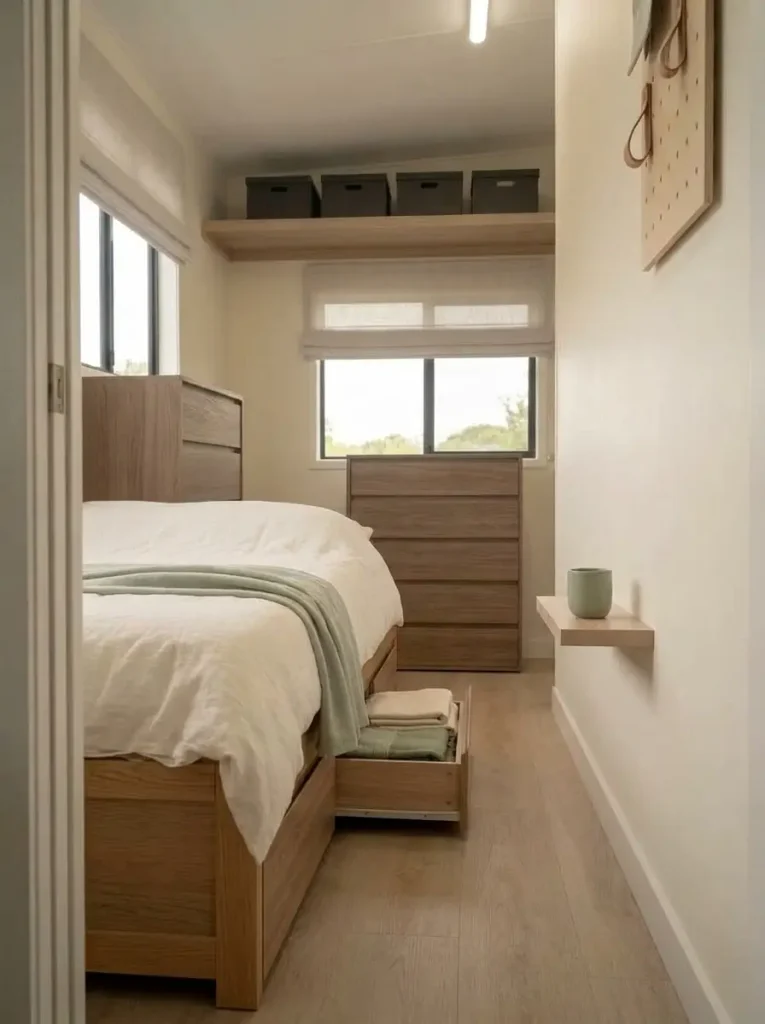
That makes a twin bed, daybed, or compact guest bed a strong candidate for integrated drawer storage.
Drawers beneath the sleeping surface can absorb spare linens, occasional clothing, books, craft supplies, or guest-related belongings without requiring a second broad furniture piece.
This works especially well when the alternative would be both a bed and a separate dresser competing for the same narrow floor area.
Imagine the drawer at full extension before choosing the frame.
A drawer that opens directly into another wall, chair, closet front, or main route will quickly become inconvenient.
Also protect the room’s guest function.
Secondary bedrooms easily become overflow-storage rooms. If every drawer is packed with household belongings, a visitor has nowhere to unpack.
Let the bed support two jobs.
Do not let storage erase the first one.
16. Put Storage at the Foot of the Bed Only After a Walkway Test
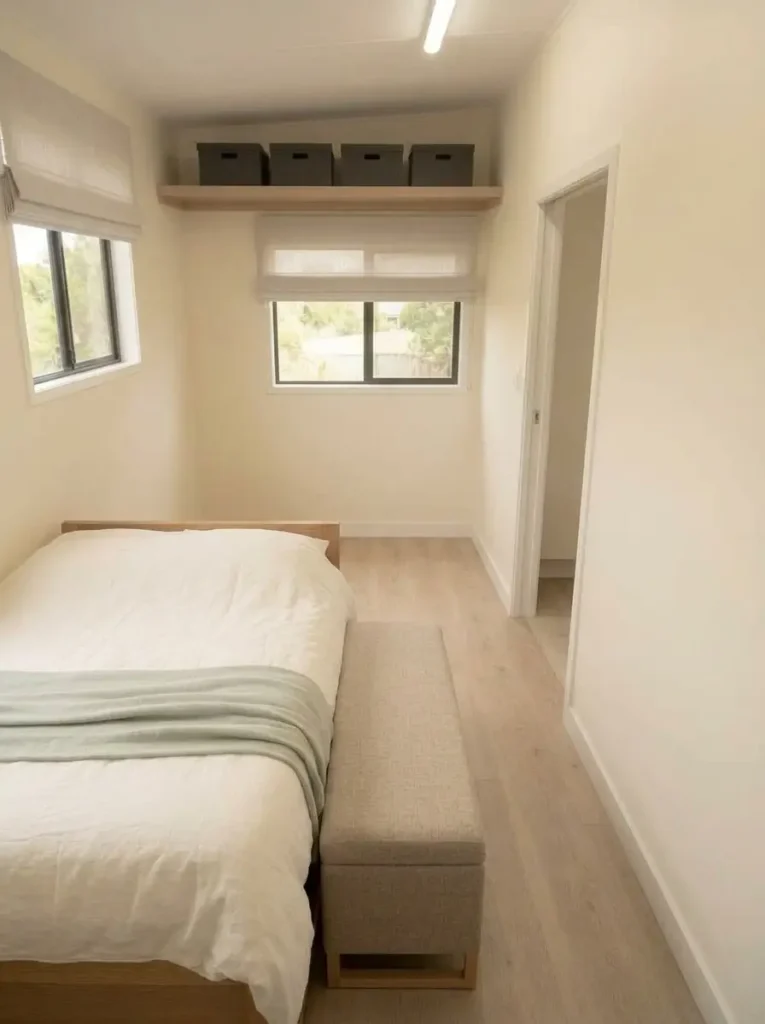
A storage bench or chest at the foot of the bed can look like an efficient final layer.
Sometimes it is.
It can contain blankets, extra pillows, bags, or clothing while also providing a place to sit. But in many small mobile home bedrooms, the foot of the bed belongs to the main circulation route.
That makes this idea conditional.
Before buying anything, reproduce the approximate footprint with boxes or removable tape.
Then use the bedroom normally:
- walk around the bed,
- open the door,
- access nearby drawers,
- carry a laundry basket through the room,
- approach the closet.
Now ask:
Does the extra storage improve the room more than the new obstacle harms it?
If the route becomes noticeably awkward, the answer is no.
A narrower piece may pass the test. In other bedrooms, preserving a completely open strip at the foot of the bed delivers more everyday value than another compartment ever could.
17. Make Open Storage Look Quieter With Repeated Containers
Open storage becomes visually expensive when every visible object has a different shape, edge, and color.
That effect is amplified in a compact mobile home bedroom because much of the room can often be seen from one doorway view.
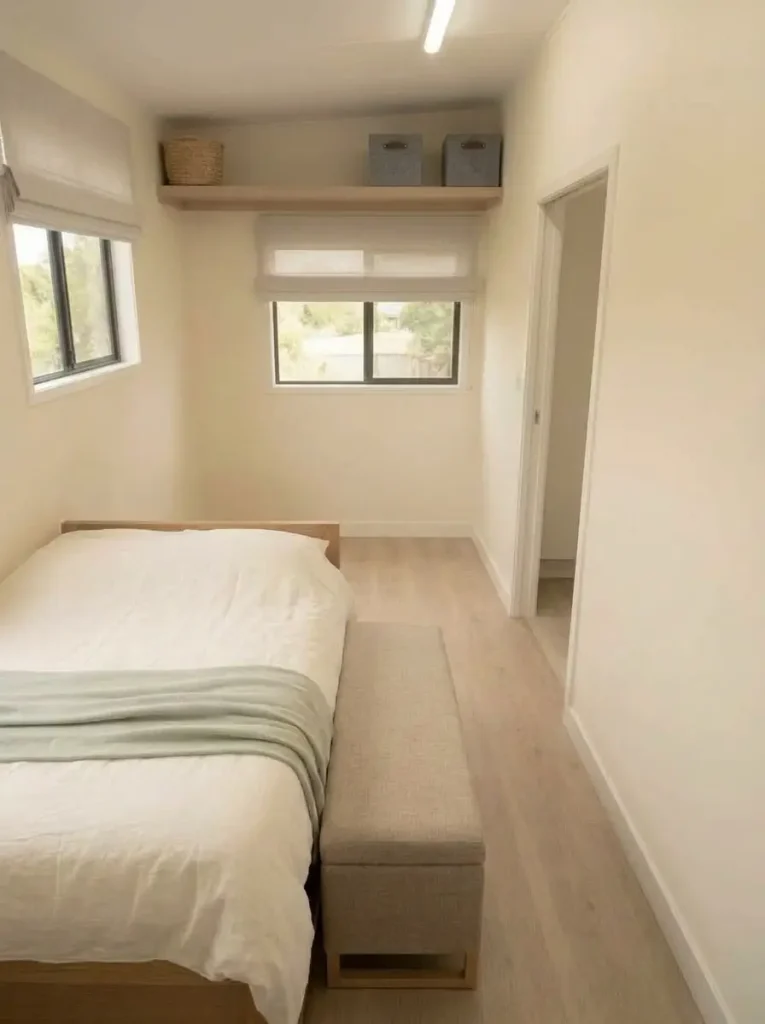
The shelving may technically be organized while the bedroom still feels busy.
Repeated containers can reduce that visual noise. Coordinated baskets, fabric bins, uniform hangers, or a limited set of boxes allow several categories to read as one system.
You do not need everything to match perfectly.
Use a simple editing sequence:
First: leave attractive or frequently used items exposed.
Second: contain small irregular objects.
Third: group similar categories together.
Last: remove storage containers that exist only because a shelf was empty.
That last step prevents the organization system itself from becoming clutter.
An open shelf does not become more successful because every inch is occupied.
A little empty space can make the storage you genuinely need look more intentional.
18. Turn the Closet Floor Into a Drawer or Bin Zone Without Trapping Long Clothes
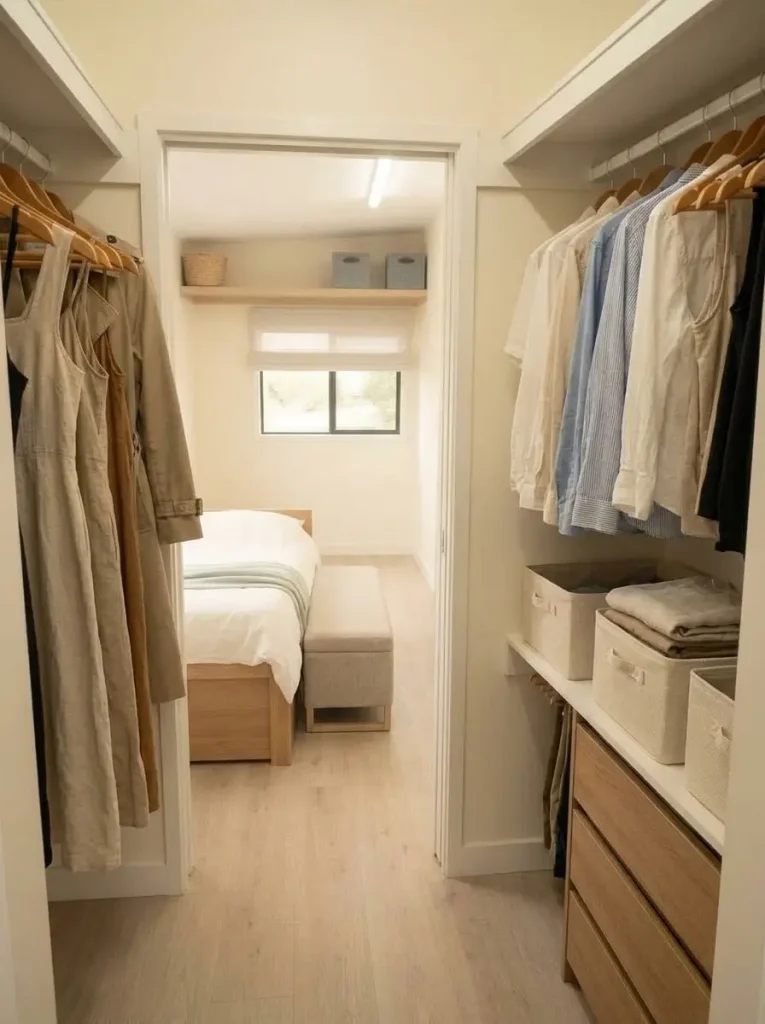
The bottom of a closet is often treated as one continuous storage strip even though different sections need different vertical clearance.
Start with the clothes already hanging there.
Dresses, coats, and longer garments may need the lower area beneath them. Shirts, jackets, and shorter pieces create a different opportunity.
Group hanging garments by length before adding a drawer unit or bins.
Then place lower storage only beneath sections where the clothing ends high enough for the new storage to remain easy to use.
The sequence matters:
- edit the wardrobe,
- group by hanging length,
- identify the genuinely open lower zone,
- choose drawers, shoes, or bins only for that zone.
For a deeper closet-organization specialist, continue with 40 Tiny Closet Solutions.
For this article, the bigger mobile-home decision is whether the closet can absorb more of the bedroom’s storage before another floor-standing piece is added outside it.
19. Know When More Storage Is Making the Bedroom Worse
The final storage idea is to stop.
Small-space advice often treats every empty wall, gap, corner, bed base, door, and upper zone as a problem waiting to be optimized. Follow that logic far enough and the bedroom can become a storage system with a mattress inside it.
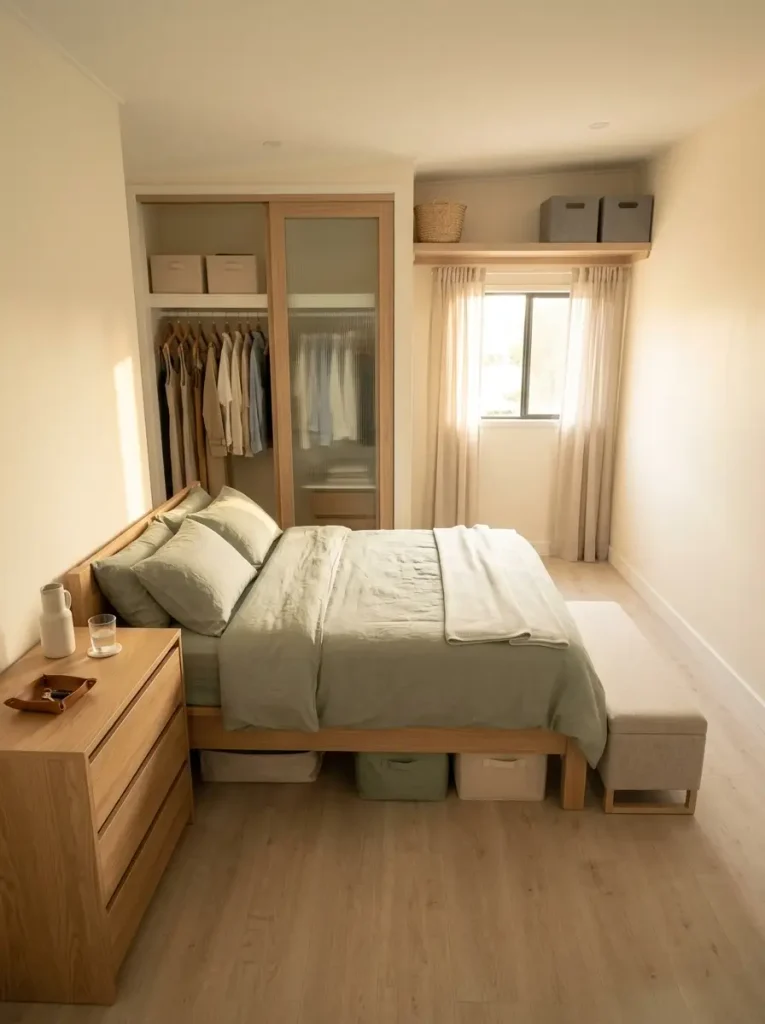
Capacity is only one measure of success.
A good small mobile home bedroom also needs:
- comfortable movement,
- furniture that opens easily,
- a clear approach to the bed,
- enough visual pause,
- storage you can genuinely reach,
- surfaces that are not permanently crowded,
- and a sense that the room’s main identity is still bedroom.
Use the audit below after implementing several storage changes.
Storage Saturation Audit
Storage Saturation Check
Is your bedroom storage still helping?
Choose the result that feels closest to your room.
Your storage is earning its space.
The room gained capacity without losing easy movement or access.
Storage is taking too much floor space.
Move one category under the bed, into the closet, or into a shallower piece.
The problem is access, not capacity.
Move everyday belongings into the easiest drawers, shelves, or closet zones.
Too many storage systems are visible.
Combine categories, close some storage, and remove low-value organizers.
The most efficient room is not the one with the highest possible storage density.
It is the one where the amount of storage matches the amount of belongings without damaging the way the bedroom feels and works.
Final Thoughts: Make Storage Serve the Bedroom
The strongest mobile home bedroom storage ideas have one principle in common: they use space that can carry storage without becoming more valuable for another purpose.
That may mean putting bulky bedding beneath the mattress, turning one uninterrupted wall into a controlled wardrobe, using a narrow recess conventional furniture cannot reach, or sending low-frequency belongings upward so the floor remains easier to navigate.
But the opposite decision can be equally important.
Sometimes the right move is to keep a working dresser. Leave one side of the bed visually open. Preserve an empty corner. Refuse to squeeze a storage bench into the main route. Stop adding baskets once every meaningful category already has a home.
A small mobile home bedroom does not need every inch to work harder.
It needs the right inches to work harder.
Start with the pressure point that affects you every day. Fix that one first, live with the change, and only then decide whether the bedroom genuinely needs more capacity.
Save this guide to Pinterest so you can return to the 19 ideas when you are ready to tackle your bedroom one storage zone at a time.