

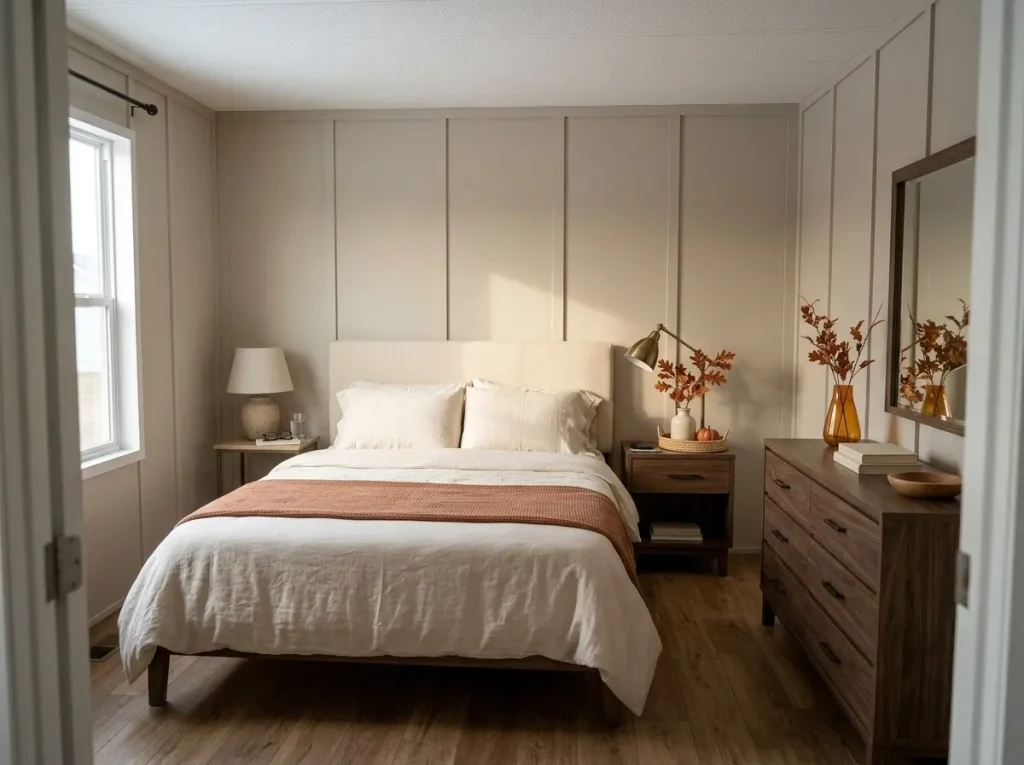
Fall decorating gets more complicated when the surfaces you want to style are also the surfaces you use every morning and night. In a compact manufactured-home bedroom, a nightstand may need to hold a lamp, phone, water, glasses, charger, and book within very little space. A dresser has its own workload: jewelry, perfume, grooming items, folded clothes, and drawers that still need to open comfortably.
That is where thoughtful fall bedroom styling ideas for a mobile home become more useful than simply adding pumpkins everywhere.
The strongest autumn surfaces fit the seasonal layer around the room’s routines, furniture scale, windows, narrow walking paths, and existing visual weight. Some nightstands should carry almost no seasonal decor. A dresser may need one deliberate arrangement instead of several tiny accents. Occasionally, the most effective fall styling decision is removing something.
These 17 ideas focus specifically on making nightstands and dressers feel warmer and more seasonal while keeping a small mobile-home bedroom comfortable enough to use every day.
1. Give Every Nightstand and Dresser a Daily-Use Budget Before You Decorate
The quickest way to overcrowd a compact bedroom surface is to assume every empty inch is available for decorating. It is not.
Start by identifying what the furniture already supports during an ordinary morning or evening. A bedside table may permanently need a lamp, phone, water glass, medicine, reading glasses, or book. A dresser may regularly hold perfume, jewelry, grooming products, or a charging station.
Only the area remaining after those functions are protected becomes your seasonal decorating budget.
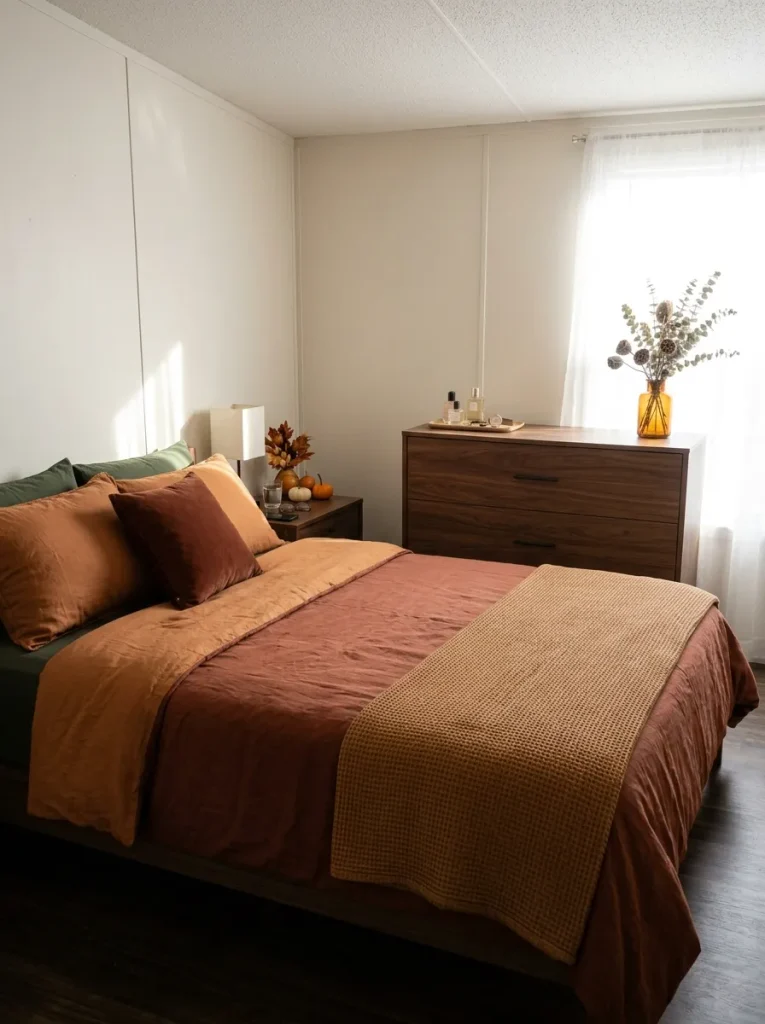
That distinction carries extra weight in a small mobile-home bedroom because furniture may sit close to the mattress, window, wall, doorway, or circulation route. A tabletop can look attractive in a photograph yet become irritating the first evening you actually use it.
For a broader seasonal plan covering the bed, textiles, walls, lighting, and whole-room composition, continue with our guide to cozy fall mobile home bedroom decor.
Find Your Surface Pressure
Use this planner before buying or placing additional autumn accessories.
Surface Pressure Planner
How much fall decor can this surface actually handle?
Choose the option closest to your nightstand or dresser. The result changes according to how much everyday work the furniture already performs.
You can support one complete fall composition
The surface has enough freedom for a clear seasonal arrangement, but keep it unified. A vase, one smaller accent, and one grounding element will usually feel stronger than several unrelated miniatures.
Give fall decor one defined zone
Keep daily necessities together, then assign one back corner or side of the furniture to autumn styling. Avoid scattering seasonal objects between items you reach for every night.
Let one object carry most of the fall signal
A dried stem, amber vessel, or compact framed print can create the mood without forcing you to relocate useful objects whenever you use the bedroom.
Make the existing objects feel more seasonal
Do not add another object unless something leaves. Use the lamp shade, book cover, existing vase, dish, or textile to introduce fall color and texture without consuming more usable space.
Small-bedroom principle: the harder the furniture works every day, the quieter its seasonal styling should become.
The amount of autumn decor should be decided after you know how hard the furniture already works.
2. Let One Nightstand Carry the Stronger Fall Moment
Matching nightstands do not need matching quantities of fall decor.
Two equally busy bedside tables can make a compact bed wall look visually squeezed even when neither arrangement seems excessive by itself. Pick one side to carry the stronger seasonal signal—perhaps an amber vase with one branch, a small pumpkin beside the lamp, or a warm framed print. Keep the opposite side quieter with its lamp and one restrained object.
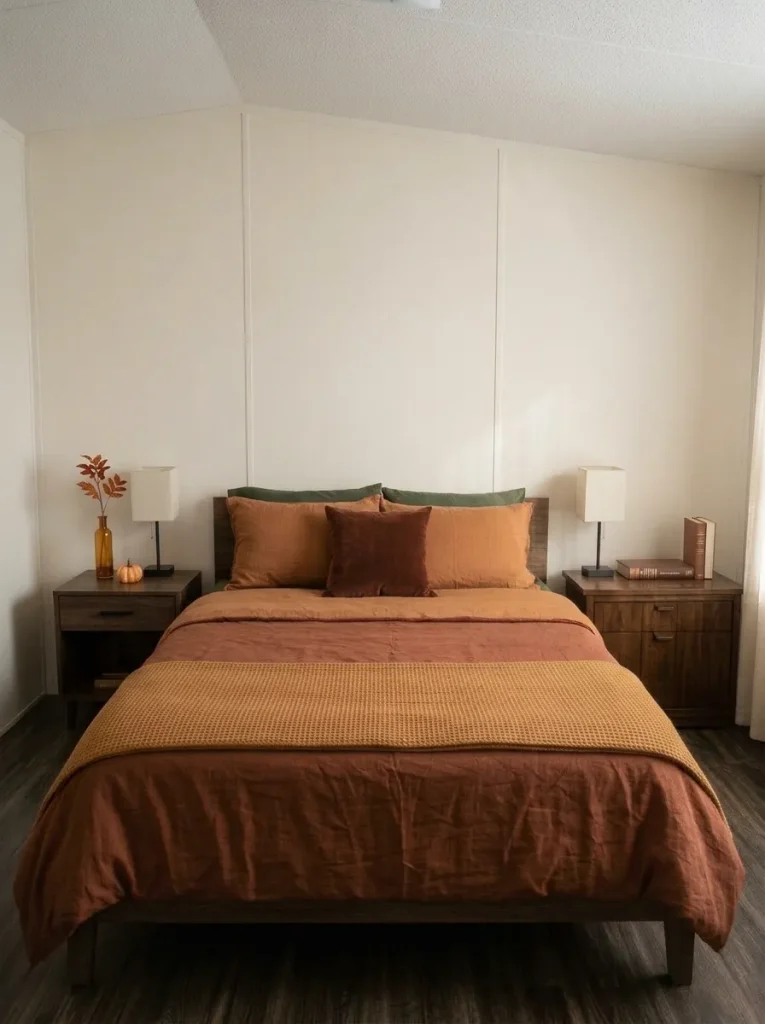
Let the room determine which side leads.
A nightstand beside a window, doorway, vanity, or narrow walking route usually benefits from less visual weight. The more enclosed side of the bed can often support the stronger composition.
Use a doorway test. Stand at the bedroom entrance and look at both nightstands simultaneously. If your eye lands on two separate decorative clusters competing for attention, simplify the side that already sits near another visual feature.
Controlled asymmetry can make a small bedroom feel more intentional than perfect mirroring because the two sides begin working as one composition rather than two mini displays.
3. Place Tall Fall Decor Where It Cannot Crowd the Bed or Walking Edge
A vase of copper leaves, seed heads, or dried branches can create more autumn character than several small ornaments because it gives the room height without using much tabletop area.
Placement determines whether that advantage survives everyday use.
On a narrow nightstand, put taller decor toward the rear wall corner, away from the mattress edge where a sleeve, blanket, or reaching hand could catch it. On a dresser bordering the main walking path, position a vase away from the side people pass most frequently.
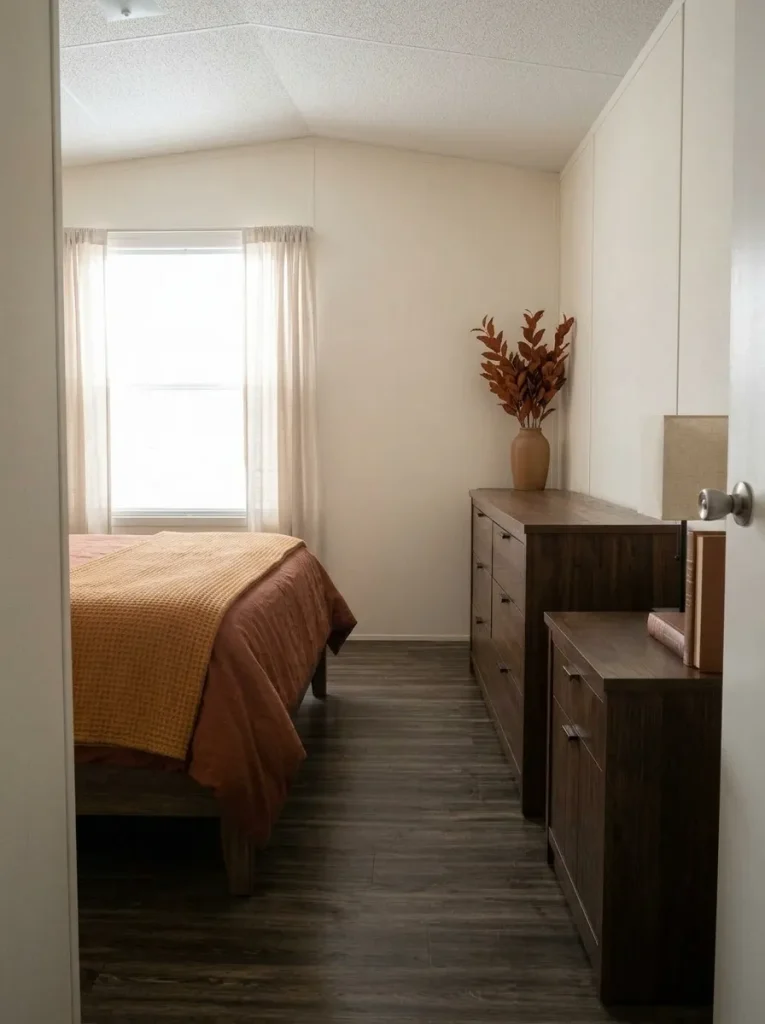
Run three checks before keeping the arrangement:
- Sit on the bed and reach naturally toward the nightstand.
- Walk past the furniture at normal speed.
- Open the nearest drawer completely.
If the foliage interferes with any of those actions, shorten it, move it backward, or choose a more stable vessel.
Ceiling height matters too. In a manufactured-home bedroom with a comparatively low ceiling, exaggerated branches can make the wall feel vertically compressed.
Stop adding height while there is still visible wall around the arrangement.
The stems should suggest autumn without becoming a second piece of architecture.
4. Use a Tray as a Boundary, Not Permission to Add More Decor
A tray earns its place when it tells several small objects where they belong.
It becomes a problem when the border is treated as an invitation to fill every remaining inch.
On a dresser, perfume, a jewelry dish, one candle, and perhaps a small seasonal accent may already be sufficient. Leaving empty space inside the tray separates those objects visually and allows them to register as one composition from across the bedroom.
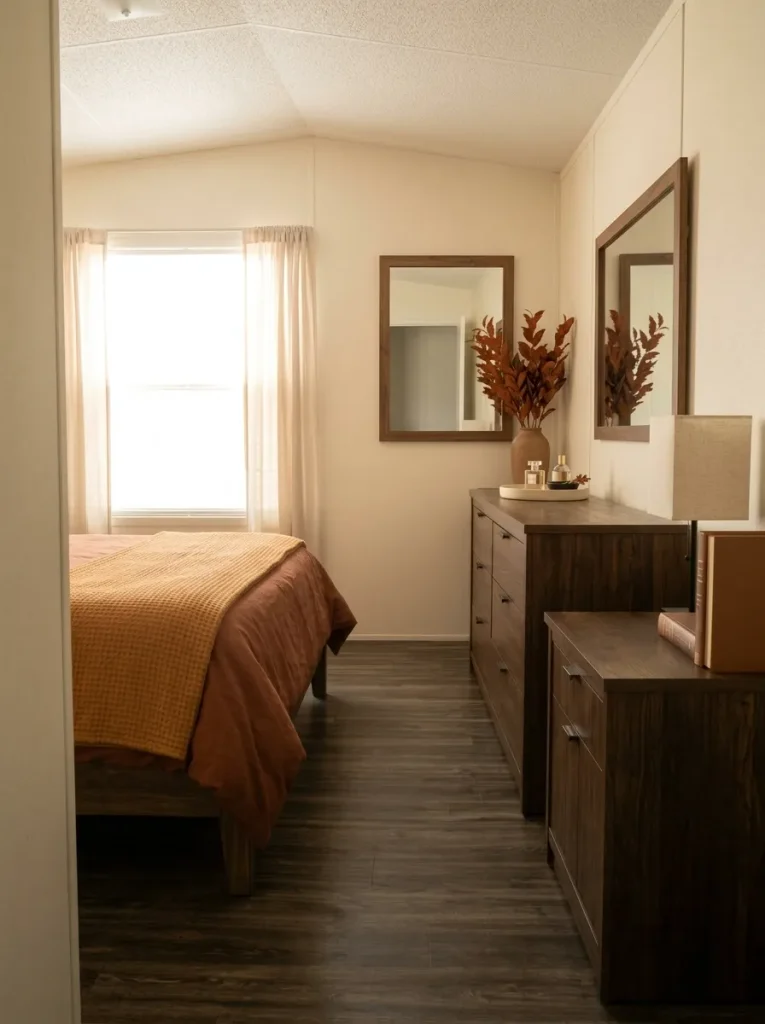
Nightstands require an even stricter test.
If adding a tray forces the phone, water glass, or glasses toward the tabletop edge, the tray is too large or the surface does not need one.
Should This Surface Use a Tray?
Tray Boundary Test
Should this surface actually use a tray?
A tray should solve an organization problem. Choose what currently happens on the surface before giving the tray valuable space.
Keep the furniture visually open
A tray may add more visual mass than organization when only one or two items need a home. Group them directly and preserve the remaining open surface.
A modest tray can earn its footprint
Use it to consolidate related everyday items. Leave part of the tray visibly empty, then add one small fall accent only if the composition still has breathing room.
Do not compress clutter into a rectangle
If the surface is already overloaded, a tray will probably make the same quantity of objects feel denser. Remove or relocate items before introducing another layer.
A tray succeeds only when it reduces visual disorder without reducing the amount of tabletop you genuinely need.
5. Protect the Front Edge of the Surface for Things You Actually Touch
The rear portion of a nightstand is often better decorating territory than the front.
Keep the lamp, vase, framed accent, or small branch closer to the wall. Preserve the front edge for objects that appear temporarily during normal use—a phone, tea mug, reading glasses, jewelry, or the book you are currently reading.
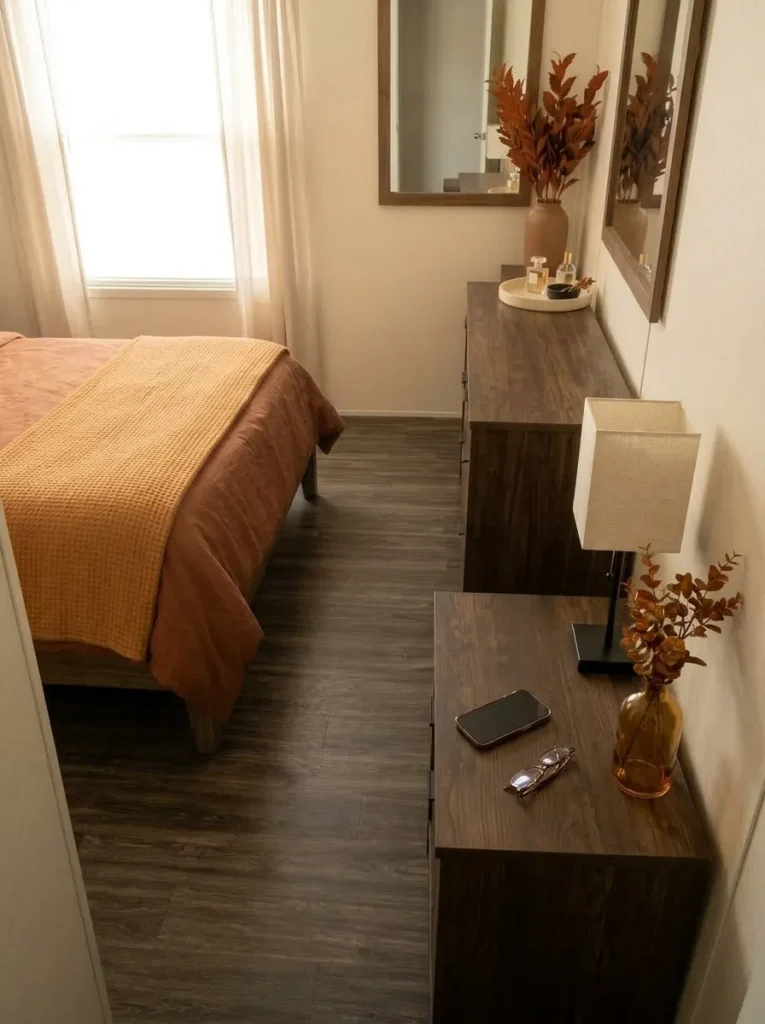
That distinction becomes especially useful beside a mobile-home bed where a narrow table may sit only inches from the mattress. Decorations along the front edge force daily objects into unstable corners or onto the bed.
A dresser benefits from the same zoning idea. Seasonal decor can occupy a controlled rear band while the front remains usable for setting down clothing, handling jewelry, or getting ready.
Imagine the top divided horizontally:
Working strip: front area kept mostly clear.
Styling strip: decorative area farther back.
The exact depth does not need to be measured. Test it through use.
If an ordinary evening forces decorative objects out of position, the styling strip has expanded too far.
6. Let the Bedside Lamp Carry Part of the Fall Palette
A lamp already occupies some of the most valuable space on a small nightstand, so let it participate in the seasonal scheme.
A warm linen shade, dark wood base, aged brass, amber-toned ceramic, or softly textured shade can supply enough autumn character that another pumpkin, candle, or ornamental object becomes unnecessary.
That strategy is especially useful in compact mobile-home bedrooms where the lamp may already consume a large percentage of the tabletop.
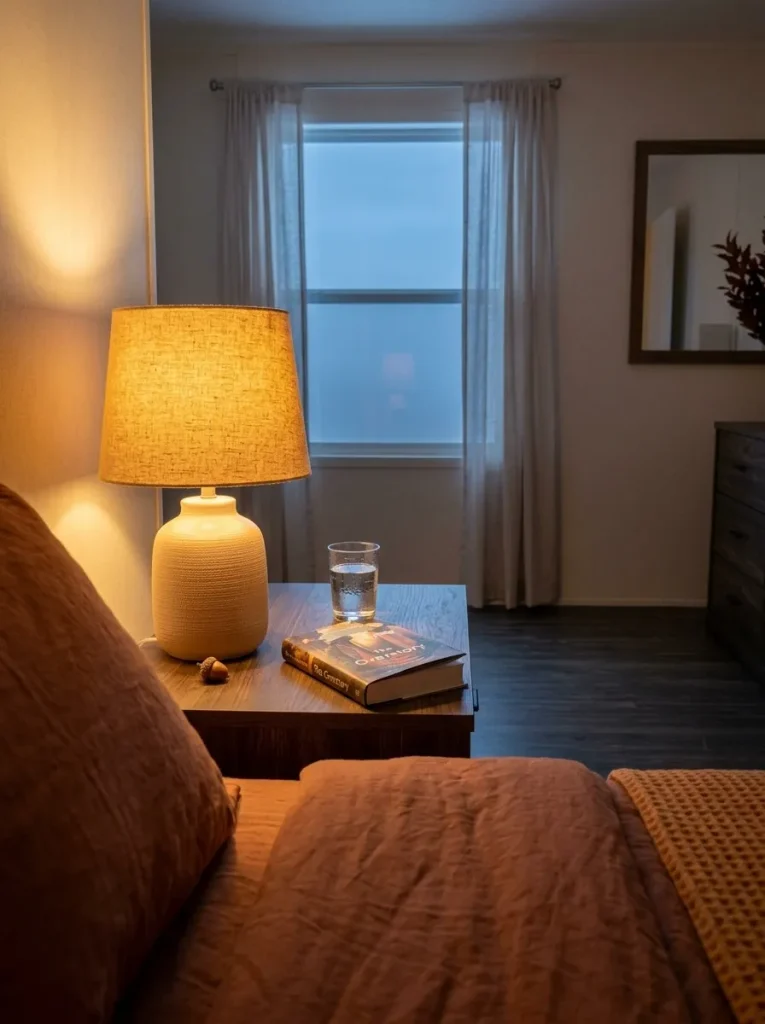
Treat it as decor that also performs a job.
Observe the lamp both during daylight and after dark. A shade that appears fairly neutral in the afternoon may become noticeably warmer once illuminated, which can reduce how much rust, orange, or brown the rest of the nightstand needs.
For deeper help coordinating these seasonal tones with furniture, flooring, and bedding, see our guide to fall bedroom color ideas for mobile homes.
Let the Lamp Replace Extra Decor
Lamp Accent Rail
Let the lamp decide how much more fall decor you need
The warmer and more seasonal the lamp already feels, the less work the remaining tabletop has to do.
7. Give Perfume, Jewelry and Grooming Items One Quiet Home on the Dresser
Everyday items can make a dresser look fragmented faster than seasonal decor does.
Perfume bottles, watches, hair accessories, lotion, jewelry, and grooming products often migrate across the surface because each object is useful independently. Add fall accessories between them and the dresser can quickly become a collection of unrelated visual points.
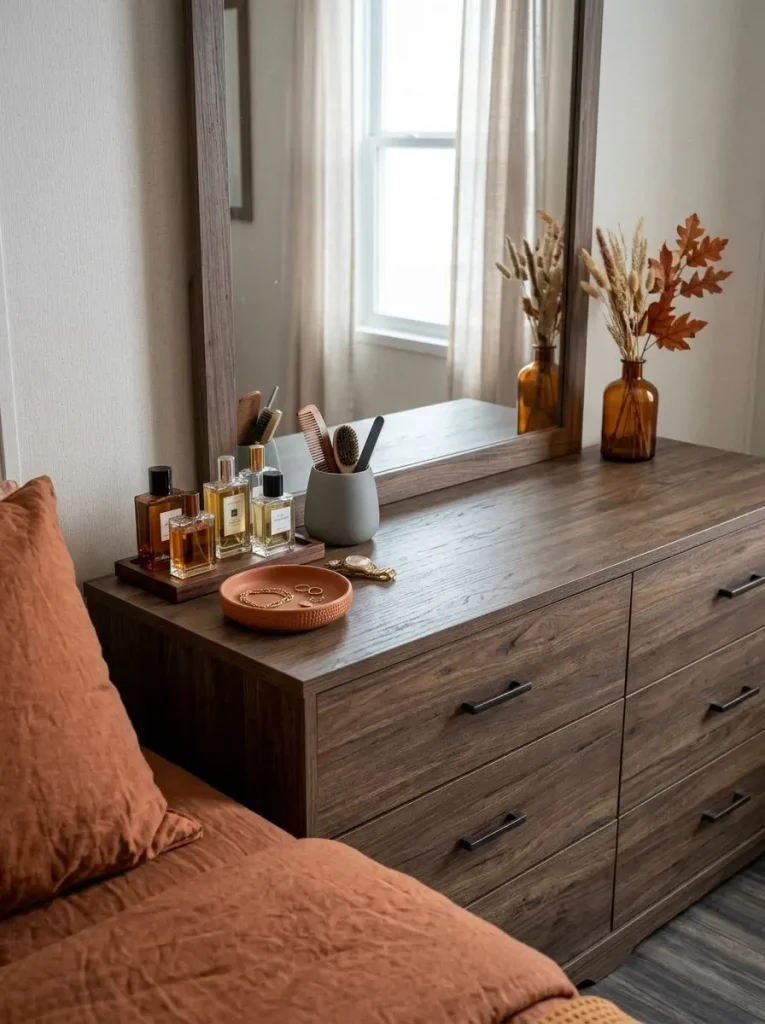
Consolidate items by routine.
A shallow dish can hold jewelry. Perfume bottles can stay together on a compact base. Regular grooming products may fit inside one discreet container or the top drawer when access remains convenient.
The purpose is not to hide everything.
It is to make the daily-use items read as one controlled group.
This distinction is valuable on a small mobile-home dresser because visual order often matters more than emptiness. A dresser can contain several useful objects and still look calm when each category has a clear address.
Stand at the bedroom doorway and look toward the dresser. If the functional items appear as a coherent zone rather than six isolated objects, the seasonal styling will also read more clearly.
Only then decide whether the remaining surface truly needs a branch, candle, pumpkin, framed print, or nothing else.
8. Use One Dried Stem or Branch as the Vertical Autumn Signal
One natural element can provide a strong autumn cue while occupying very little horizontal area.
That makes dried eucalyptus, wheat, rust-toned leaves, seed heads, or a sculptural branch particularly useful on narrow bedroom furniture. The eye notices the organic silhouette and vertical movement before it counts how many objects are present.
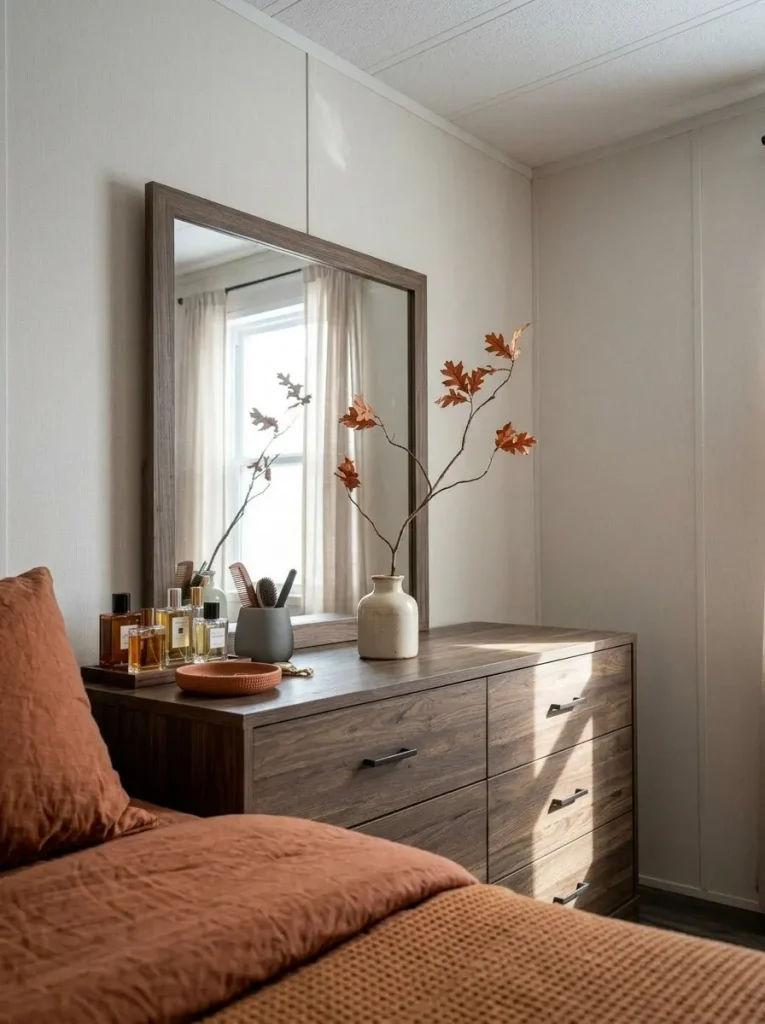
Scale it to the furniture.
A small nightstand generally needs a modest arrangement with visible wall around it. A wider dresser can support greater height, but the vase should still feel proportionate to the furniture below.
Nearby architecture sets another limit.
If the stems collide visually with framed art, a mirror, shelf, curtain rod, or low ceiling, shorten the arrangement.
Position the vase slightly off-center and toward the rear so the stems rise without interfering with hand movement.
A single branch can make the room feel distinctly autumnal without turning the surface into a seasonal merchandise display.
9. Add a Dresser Textile Only When It Improves the Surface
A dresser runner, narrow scarf, or folded textile can introduce fall color and softness quickly, but fabric is not automatically an upgrade.
On a compact dresser, material can bunch beneath objects, collect dust, interfere with cleaning, make bottles less stable, or visually shorten an already small surface.
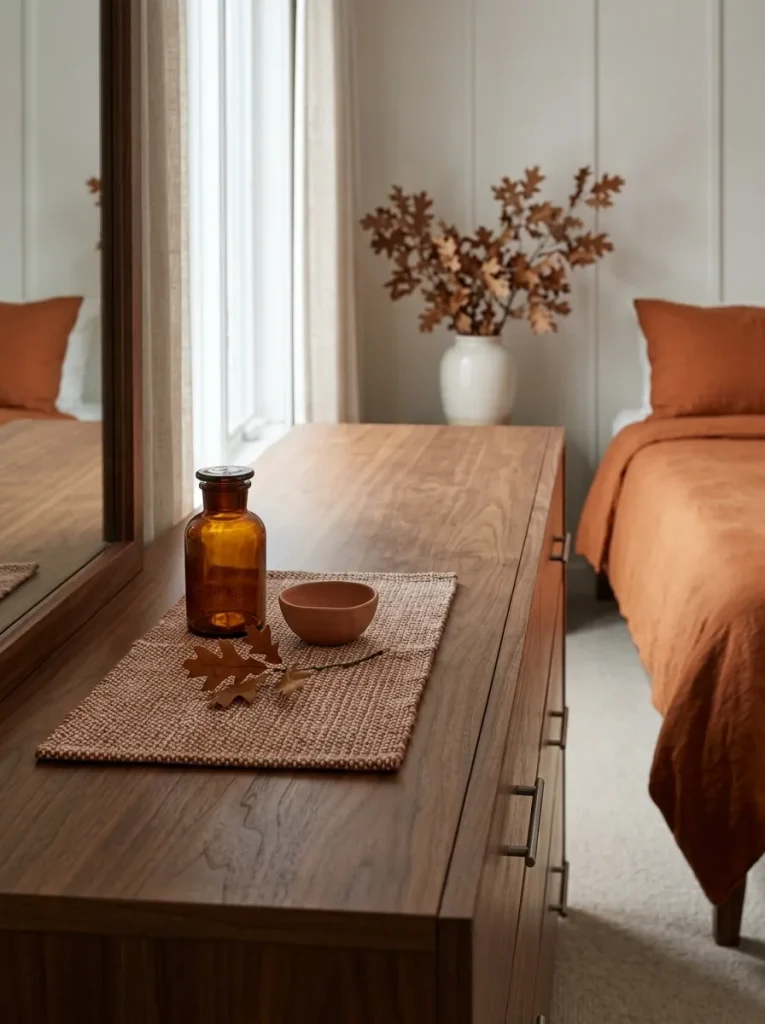
Use textile when it solves a specific styling problem.
Perhaps the dresser feels visually hard and flat. Maybe the room needs a controlled amount of rust, plaid, or woven texture. Several small objects may benefit from sharing a softer visual foundation.
Skip it when the dresser’s wood grain, painted finish, or existing material already contributes enough warmth.
Try a simple comparison.
Style the dresser without fabric and take a phone photograph from normal standing distance. Add the textile and take the same photo again.
Keep the second version only when the surface becomes calmer, warmer, or more coherent.
For narrow furniture, a folded textile beneath one arrangement may work better than covering the full dresser top. The furniture remains visible and most of the surface stays easy to use.
10. Balance Mismatched Nightstands by Visual Weight, Not Matching Accessories
Small bedrooms frequently use bedside tables that are not identical.
One side may have a compact drawer chest while the other uses a taller table, stool, or narrow cabinet. Trying to make them look matched through identical lamps, pumpkins, books, and vases can make the furniture differences more obvious.
Balance their visual weight instead.
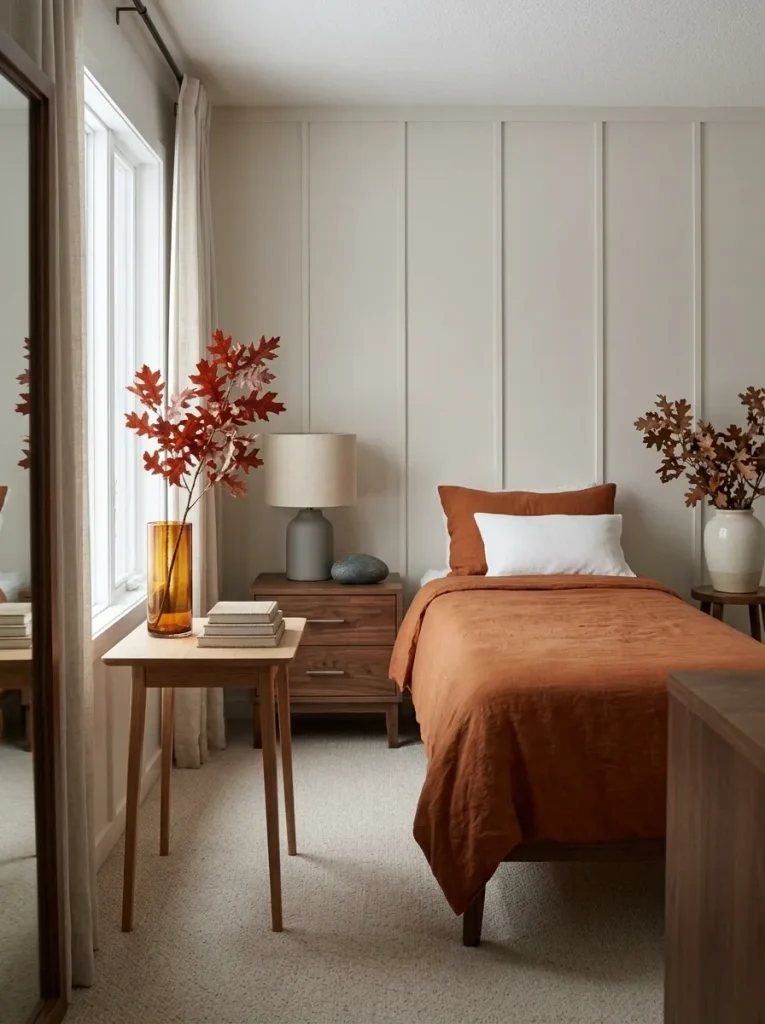
A larger or darker nightstand already carries more presence, so it often needs fewer decorative objects. A smaller or lighter table can accept one taller or warmer accent because it needs a little more visual strength.
Stand at the foot of the bed and compare both sides before adding seasonal decor.
Which side already feels heavier?
Give the stronger autumn accent to the lighter side.
Balance the Two Sides of the Bed
Visual Weight Balancer
Which side of the bed already feels heavier?
Choose the existing room condition first. The stronger fall accent usually belongs on the visually lighter side—not automatically on both.
Let the right side carry the stronger fall accent
The left already has more visual mass. Keep it restrained and use one taller, warmer, or more noticeable seasonal element on the right.
Give the left side the stronger seasonal note
The right already carries more weight. Let it remain quiet and use the left nightstand to introduce the taller branch, warmer object, or stronger seasonal color.
Create hierarchy without disturbing the balance
Both sides already feel stable. Choose one as the seasonal lead and let the other remain supportive so the bed wall gains a clear focal hierarchy.
Decorate to correct the imbalance the room already has—not to manufacture symmetry through duplicate accessories.
11. Keep the Window-Side Nightstand Lower and Visually Lighter
A nightstand beside a window already occupies a visually active part of the room.
Curtains create vertical lines. The window frame interrupts the wall. Daylight introduces contrast. Outdoor foliage may bring another layer of color and movement.
Adding tall branches, stacked decor, and several autumn objects to that same surface can make it feel crowded quickly.
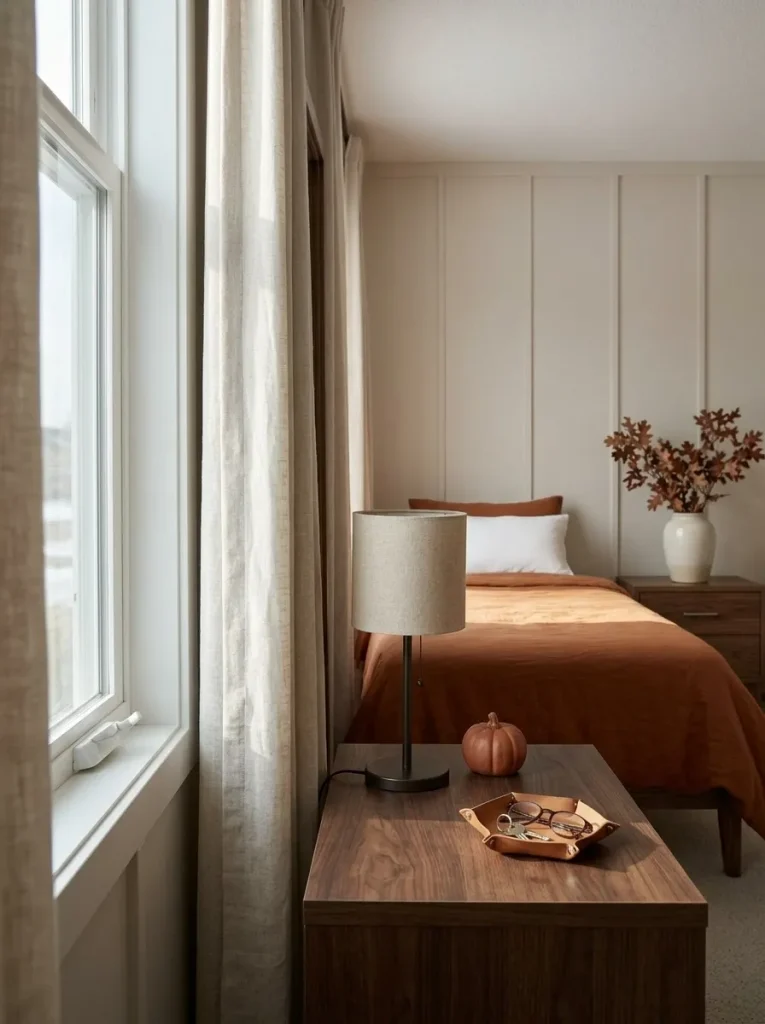
Keep the window-side arrangement lower than the opposite bedside composition when the window is visually prominent.
A short amber vase, compact ceramic pumpkin, small dish, or low decorative object usually makes better use of this position than a tall floral arrangement.
Furniture placement changes the rule slightly.
If the nightstand sits partly beneath the window, keep it especially restrained. If a generous section of wall separates the nightstand from the window, greater height may be comfortable.
Check the curtain movement as well. Fabric should not brush foliage or unstable accessories.
The window already brings architecture, light, and potentially fall scenery into the bedroom. Allow it to perform some of the visual work.
12. Use Real Bedside Books as Part of the Composition—Not Decorative Filler
Books can create useful horizontal structure beneath a small vase, lamp, or dish, but they should belong to the person using the nightstand.
A perfectly color-coordinated stack of unread books may look attractive initially and become inconvenient once the bedroom returns to normal use.
If you genuinely read in bed, keep one or two current books in the arrangement. Their pages, covers, and stacked form provide enough texture to participate in the decor naturally.
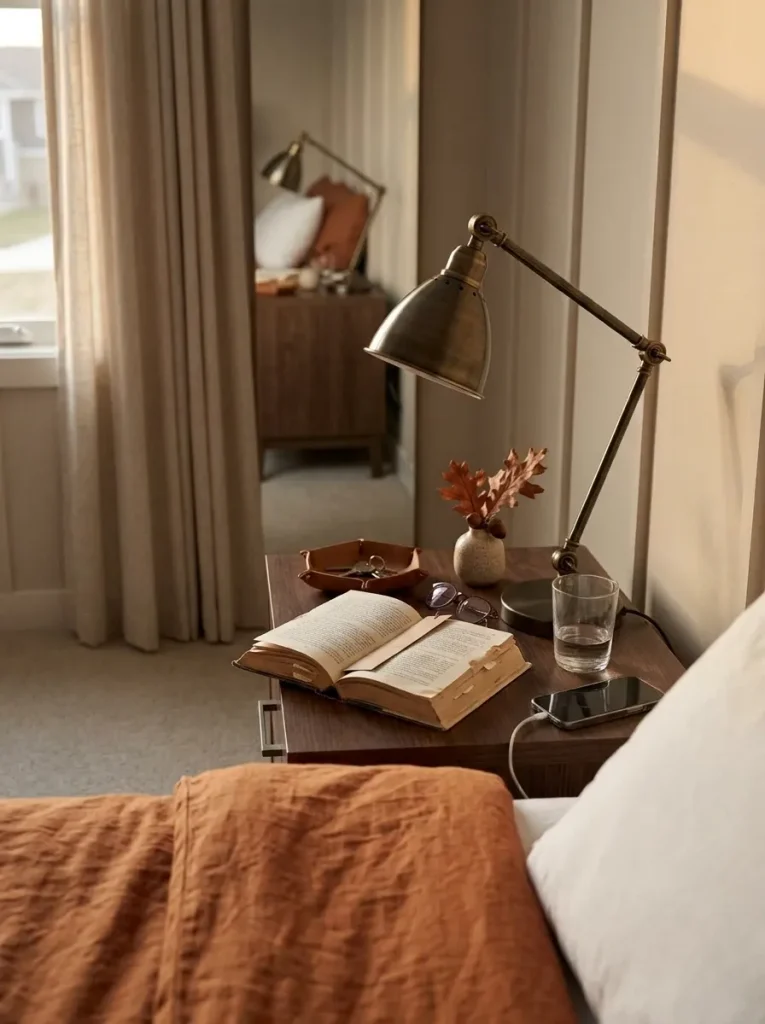
Place something on top only when the book remains easy to pick up.
If you do not read at night, skip the stack.
That choice matters on compact furniture because every decorative layer changes the usable footprint and height of the nightstand. A book stack may raise a lamp awkwardly, cover an outlet, or consume the exact spot needed for glasses and a phone.
Ask one question before styling with books:
Would these naturally remain here in November even if nobody photographed the room?
If yes, integrate them.
If not, choose another grounding element.
13. Build a No-Pumpkin Fall Surface With Wood, Amber Glass and Earthy Texture
Pumpkins are a clear autumn symbol, but a bedroom does not need them to feel seasonal.
Natural wood, amber glass, aged metal, woven fiber, stoneware, dried botanicals, and muted earthy textiles can communicate fall through material temperature and texture instead.
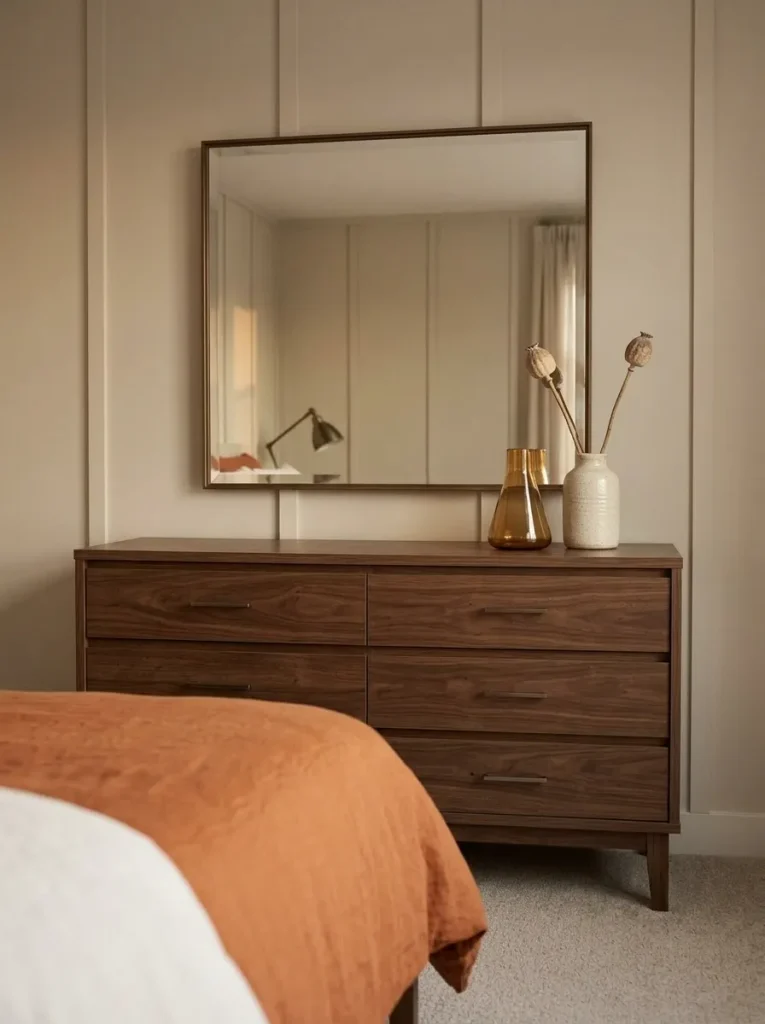
This approach works particularly well in small mobile-home bedrooms because materials can establish atmosphere without increasing object count dramatically.
Build around three roles:
- one warm solid such as walnut, terracotta, or dark wood;
- one light-catching element such as amber or smoked glass;
- one organic or tactile note such as linen, woven fiber, dried stems, or raw ceramic.
These roles do not need three new purchases.
The dresser may already provide the warm wood. A lamp might contribute metal. In that case, one amber vessel and a dried branch could finish the composition.
Compose a Fall Surface Without Pumpkins
No-Pumpkin Material Composer
Build a fall surface through materials instead of symbols
Choose the furniture finish you already have. The suggested material mix changes so the autumn styling adds contrast without covering the surface.
Let the furniture provide the brown note
The dresser or nightstand already supplies natural warmth. Add translucency and softer texture rather than stacking several more brown objects on top.
Introduce light materials so the arrangement does not disappear
Deep furniture handles autumn colors beautifully, but another cluster of dark brown objects can become visually heavy. Give the surface lighter separation.
Use stronger earth tones to give the surface depth
White or pale furniture provides enough contrast for deeper terracotta, smoked glass, aged metal, or dark wood accents without making the dresser feel heavy.
This approach also makes the seasonal styling easier to keep from September through November because it does not depend on an obvious holiday motif.
14. Add a Halloween Layer You Can Remove in One Move
There is no need to rebuild the nightstand or dresser when October arrives.
First create a complete fall composition. Then place one removable Halloween accent over it—a small black ceramic pumpkin, miniature ghost, dark taper holder, compact framed print, or another single black-and-rust detail.
Keep that layer easy to lift away.
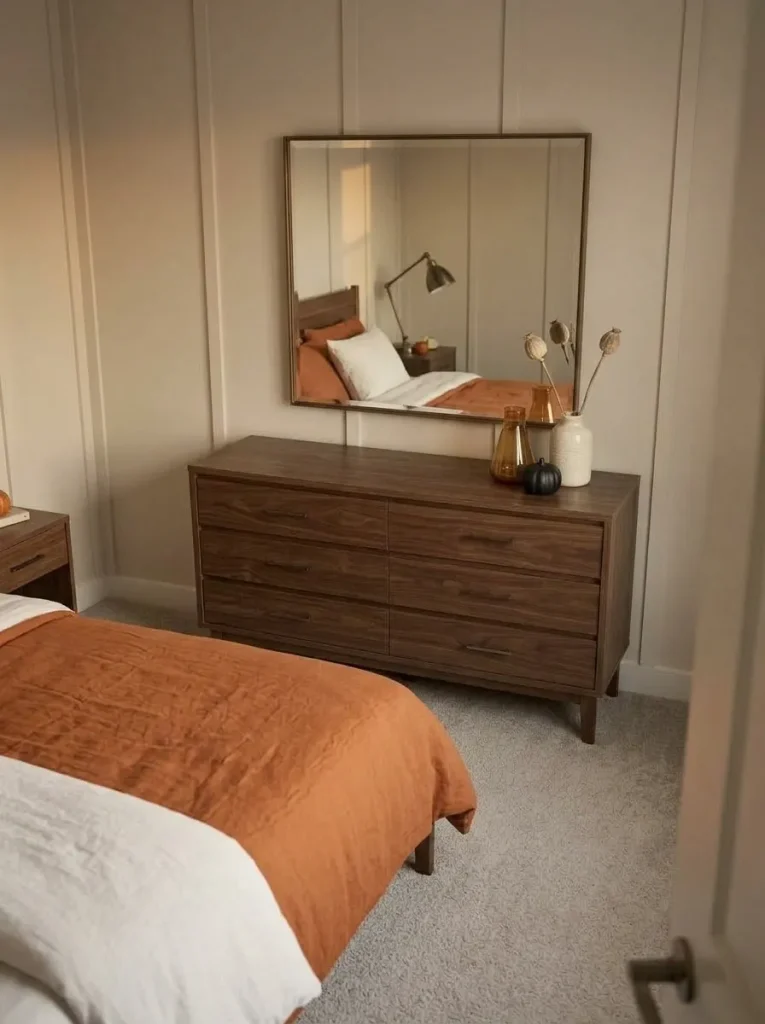
When Halloween ends, the autumn foundation stays finished.
The method is useful in a small mobile-home bedroom because seasonal storage is limited too. Five separate Halloween accessories may look fun for several weeks, but all five eventually need somewhere to go.
One removable layer creates the transition without multiplying clutter.
Readers who want the bedroom to become distinctly Halloween-focused can continue into our dedicated guide to Halloween mobile home bedroom decor.
Test the composition by mentally removing the Halloween piece.
If the dresser or nightstand still looks complete, the autumn base is doing its job.
If the surface suddenly looks unfinished, too much of the composition depends on the temporary holiday layer.
15. Use a One-In, One-Out Rule for Every Seasonal Object
The easiest way to prevent autumn accessories from accumulating is to make every new decorative object replace something.
Want to add a ceramic pumpkin?
Choose which existing decorative item temporarily leaves.
Adding an amber vase?
Move the previous decorative bottle elsewhere for the season.
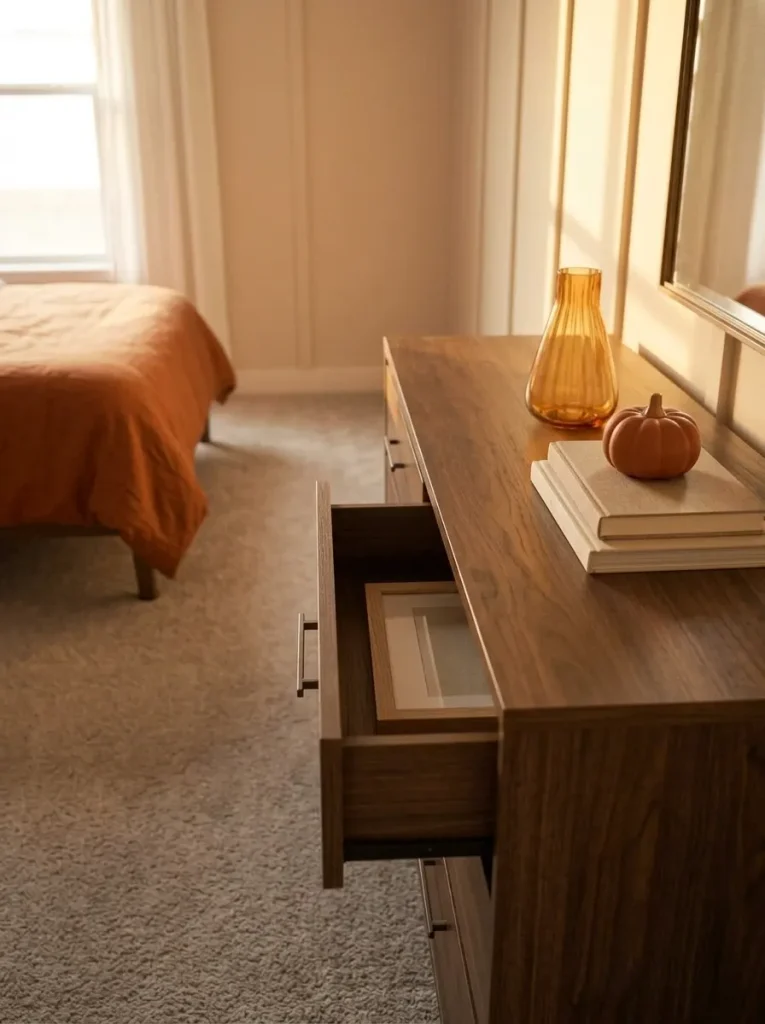
Introducing a framed autumn print?
Store or relocate the decorative frame that previously occupied that space.
This rule becomes particularly useful on compact bedroom furniture because the physical capacity is fixed. More decor does not create additional surface area; it divides the same area into smaller pieces.
It also forces better comparison.
Instead of decorating around objects that no longer contribute much, you begin choosing which item deserves the space most.
Daily necessities are exempt. A phone charger, medication, or glasses should not lose a functional position just because a decorative accessory arrived.
Ask:
Is the new fall object stronger than something already occupying decorative space?
If yes, make the substitution.
If no, the dresser or nightstand is already finished.
16. Let One Bedroom Surface Stay Almost Bare
Seasonal decor gains clarity when every horizontal surface is not decorated at the same intensity.
If both nightstands, the dresser, vanity, windowsill, shelves, and bench all contain obvious autumn arrangements, the eye loses its resting place.
That visual density has a stronger effect in a small mobile-home bedroom because the furnishings are physically closer together.
Choose one visible surface to stay almost bare.
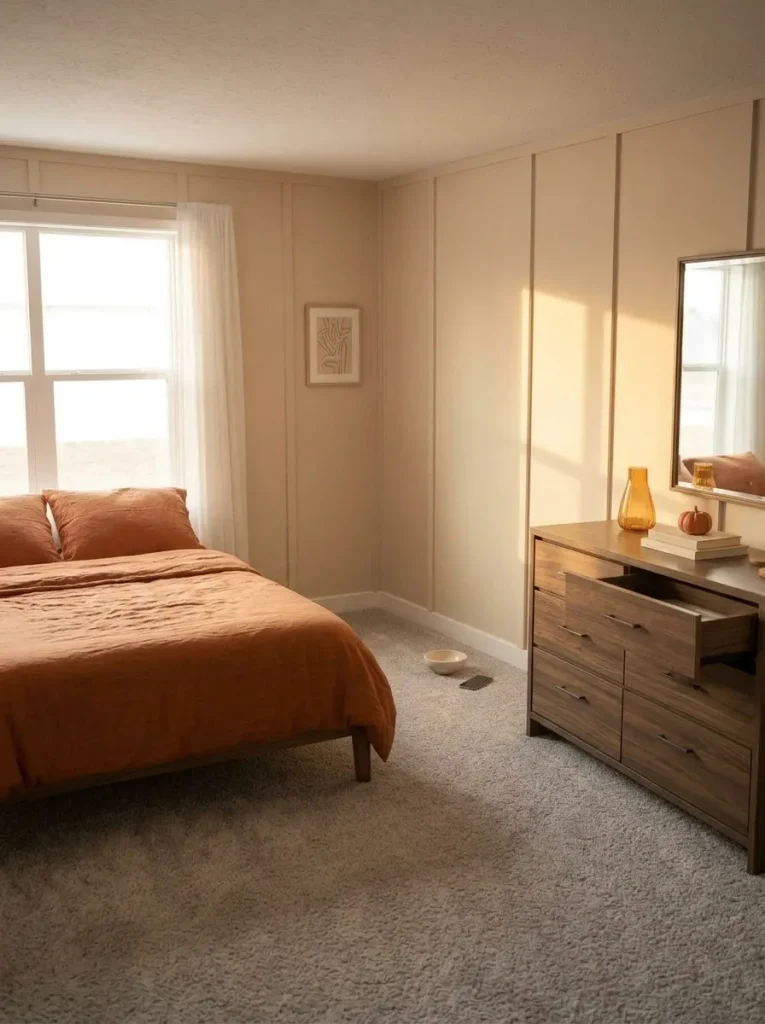
It could be the nightstand nearest the window, one end of the dresser, or another small surface already carrying daily necessities.
Keep the functional pieces and perhaps one quiet material note.
The open area now separates the stronger seasonal compositions.
Use your phone camera as a quick diagnostic. Photograph the bedroom from the doorway. A photograph compresses the room visually and often makes competing tabletop clusters easier to notice.
If every horizontal plane contains multiple accents, remove one complete arrangement.
Editing one entire zone often produces a cleaner improvement than taking a single object from five crowded zones.
Fall atmosphere comes from hierarchy, not maximum coverage.
17. Finish With a 60-Second Nightstand-and-Dresser Reset
The most successful seasonal arrangement survives ordinary life.
Use the bedroom normally for a day or two before deciding the styling is finished. Charge the phone. Open drawers. Read in bed. Take off jewelry. Put down a glass. Get dressed.
Then notice what moved.
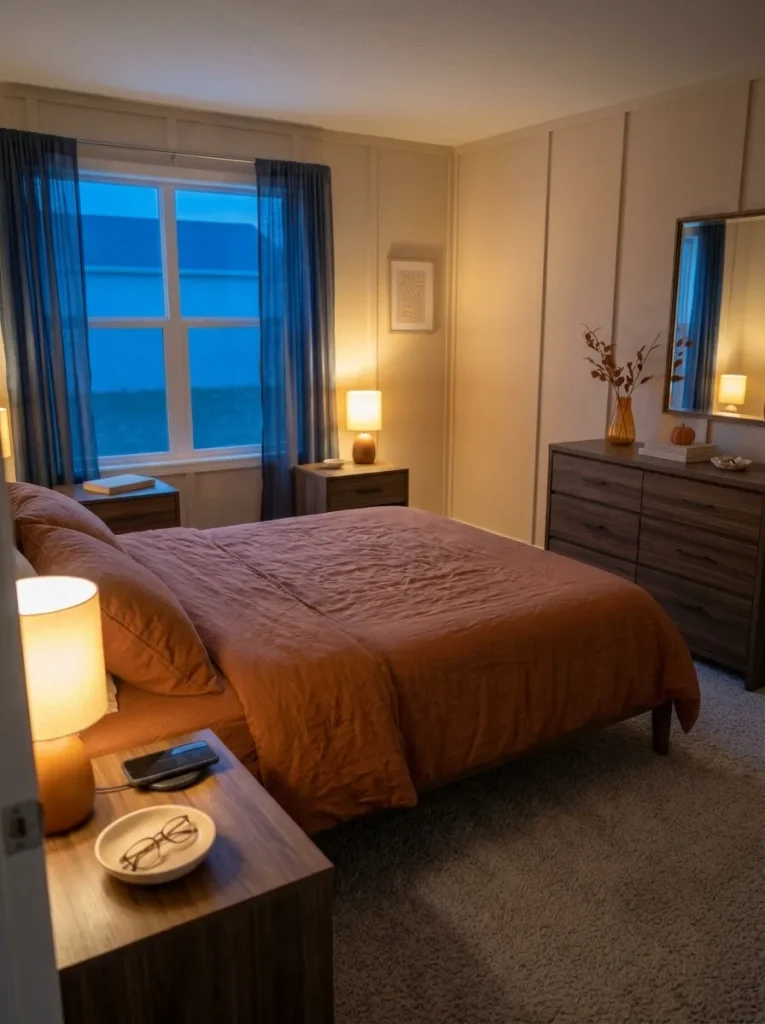
If restoring the surfaces requires re-stacking decorations, repositioning several objects, or moving useful items out of the way, the arrangement is too fragile.
A strong setup returns to order quickly because every object already has a logical home.
The 60-Second Fall Surface Reset
60-Second Reset Sweep
Can the bedroom recover without being restyled?
Use this short sequence at the end of the day. When these four moves restore the nightstands and dresser, the fall styling is working with your routine.
Return the essentials
Put the phone, glasses, books, jewelry, and grooming items back into their normal homes.
Clear the working edge
Remove cups, clothing, packaging, and temporary objects that landed in the front-use zone.
Correct one focal object
Straighten only the branch, tray, framed piece, or seasonal anchor that visually leads the surface.
Stop
Do not rebuild every object. The styling should already look composed once ordinary items return home.
A fall bedroom should still function on an ordinary tired Tuesday night. That is a more useful test than whether every tabletop looks perfect immediately after styling.
Make Fall Styling Work With the Bedroom You Actually Use
The strongest fall bedroom styling ideas for a mobile home usually begin with editing before adding.
Protect the objects you reach for every day. Give decorative pieces clear boundaries. Let lamps, furniture finishes, books, and existing materials contribute to the autumn palette so seasonal atmosphere does not always require another accessory.
One nightstand can carry more visual weight than the other. A dresser can have an intentionally empty section. One branch may create a clearer fall signal than five small pumpkins.
Most importantly, judge the bedroom after it has been lived in.
When the nightstands still support bedtime routines, dresser drawers remain easy to use, the walking path stays comfortable, and the surfaces recover in about a minute, the autumn layer has become part of the bedroom rather than something merely sitting on top of it.