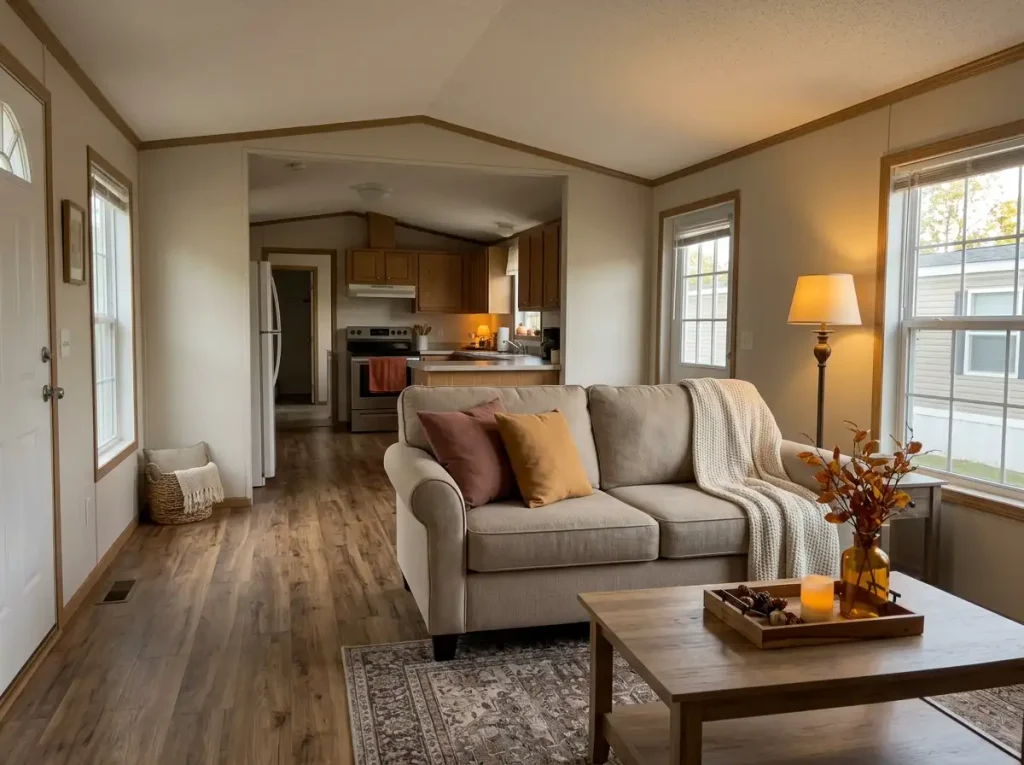
Pumpkins can make a small mobile home feel instantly ready for fall—but they can also take over surprisingly fast. A few decorations on the kitchen counter, another group near the entry, and two more beside the sofa may be enough to make connected rooms feel crowded instead of cozy.
The best DIY pumpkin decor for a mobile home works differently. It uses walls, doors, narrow vertical zones, removable displays, soft materials, and pieces that earn the space they occupy. Some projects replace several smaller decorations; others collapse or store nearly flat once autumn is over.
The 15 ideas below focus on things you can actually make, modify, or assemble yourself—not simply another list of pumpkins to buy. You will also find practical small-space tools that help match each project to your available surface, storage tolerance, and decorating habits.
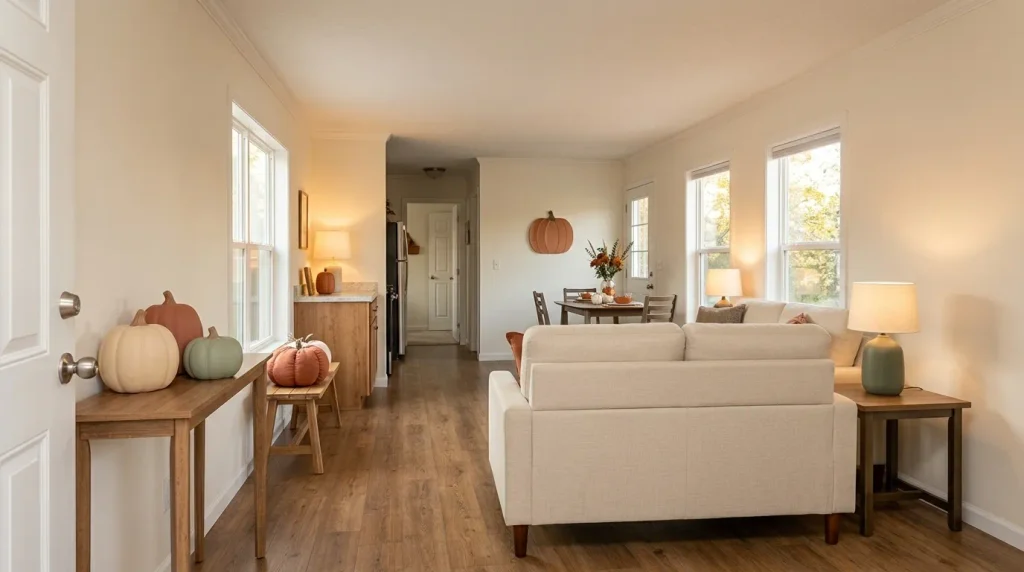
The aim is simple: create a strong pumpkin-filled fall mood without asking a compact home to surrender the counters, walkways, and storage space it needs every day.
1. Give Foam Pumpkins a Handmade Ceramic-Look Finish
Cheap foam pumpkins become more useful when you stop treating them as finished decorations and start treating them as raw material.
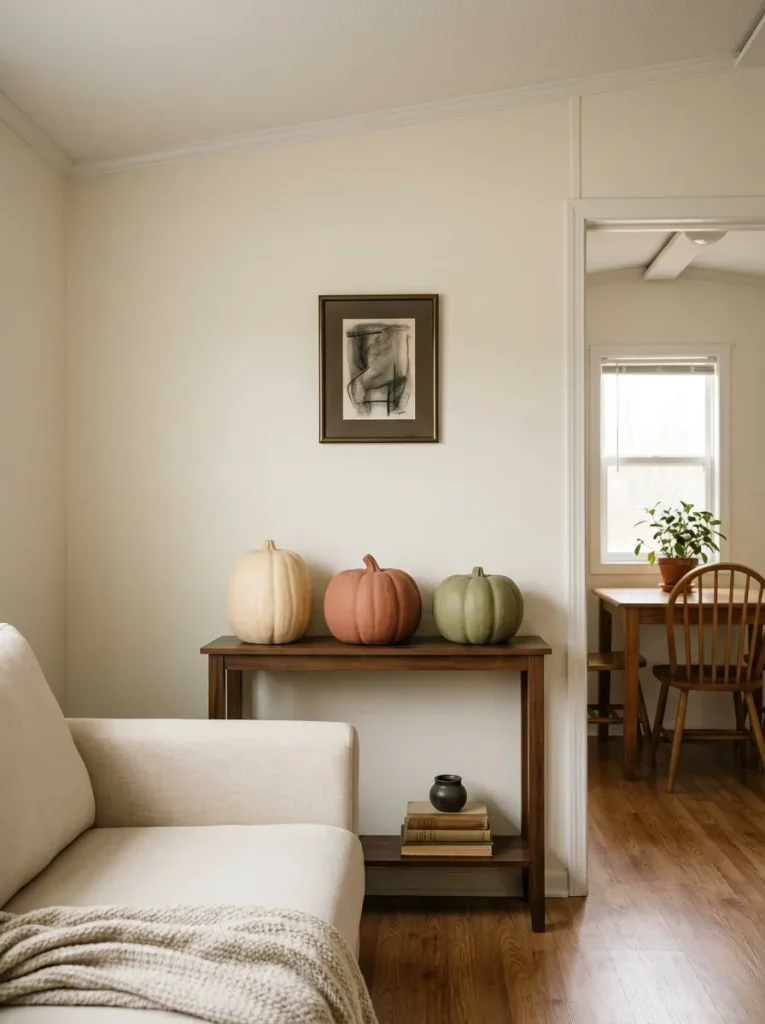
Choose two or three pumpkins that already fit the surface you want to decorate. Keep their shapes varied, then unify them with matte craft paint in a restrained palette such as warm ivory, muted terracotta, soft olive, mushroom, or dusty orange. Use paint suitable for the pumpkin material and test it first on a hidden area.
This matters in a small mobile home because connected rooms allow color and shine to repeat across a much larger visual field. Several glossy orange pumpkins can register as separate objects even when they sit together. Similar matte finishes let the eye read the collection as one quieter composition.
Do the repainting before buying additional pumpkins. Return the finished group to the room and view it from the doorway or from across the main living area.
If it already carries enough fall color, stop.
For more inexpensive seasonal transformations, 17 Dollar Store Fall Decor Ideas for Mobile Homes continues the low-cost decorating approach without requiring a major seasonal spend.
Small-space decision: if the pumpkins fit physically but make the room look busy, change their finish before changing their quantity.
2. Fill a Clear Cylinder With Mini Pumpkins and Autumn Stems
A narrow vase can create the visual impact of a much wider pumpkin arrangement while occupying only one small footprint.
Start with a stable clear cylinder or straight-sided glass container. Fill its lower section with lightweight mini faux pumpkins in two closely related colors. Above them, create height with autumn stems such as eucalyptus, muted leaves, dried-looking grasses, pampas, or a few orange flowers.
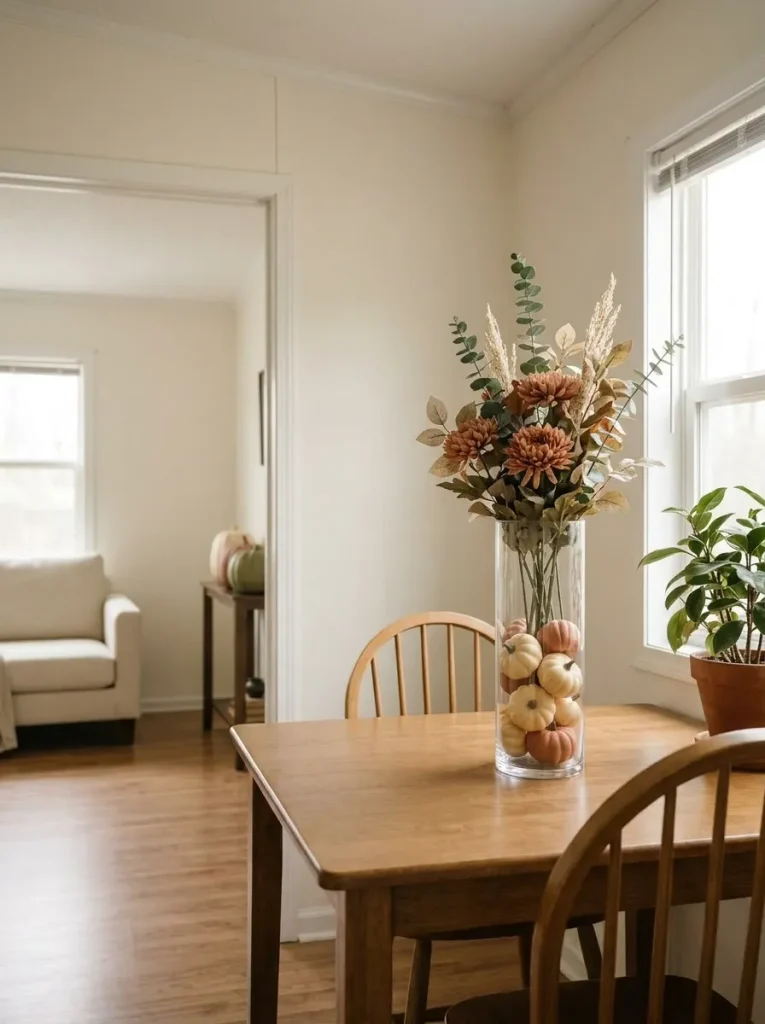
The transparent container matters because the pumpkins become part of the vertical arrangement instead of spreading around its base.
That makes this especially useful on a narrow console, dining surface, bedroom dresser, or protected kitchen corner where horizontal space is valuable.
Before adding another stem, view the piece from the longest sightline in the home. If the upper arrangement already carries the fall palette into the neighboring space, leave breathing room around it.
For whole-home color and seasonal continuity, 25 Cozy Fall Mobile Home Decorating Ideas explores the wider fall-decor layer.
Small-Space Pumpkin Project Selector
Use the three tracks below separately. The strongest project for your home is usually one that appears repeatedly across your space, storage, and effort choices.
Small-space decision studio
Which Pumpkin DIY Actually Fits?
This version uses CSS only. It does not depend on JavaScript, so each selection changes visible output even when WordPress strips scripts.
Choose one answer in each track. The three result cards below update immediately so you can build a shortlist from space, storage, and effort.
Keep the project contained.
Best fits: cylinder vase, removable counter tray, fabric pumpkins, jar lanterns, or functional catchall.
Favor one bounded composition and leave the rest of the surface visibly open.
Move the season upward.
Best fits: welcome board, window-edge cascade, wall pumpkin, headboard garland, magnets, or reversible panel.
Use the wall, trim, door, or appliance side before sacrificing another horizontal surface.
Concentrate the exterior display.
Best fits: one-sided crate tower or asymmetrical pumpkin wreath.
Choose one porch edge or the door as the dominant seasonal zone.
Design for collapse.
Prioritize: flat wall pumpkin, garland, paper pumpkins, magnets, or reversible panel.
Avoid adding another rigid seasonal object unless it replaces something you already store.
Let compressible pieces do more.
Prioritize: fabric pumpkins, soft garlands, and paper-based projects.
Removable stems and soft filling reduce offseason volume.
You can use dimensional pieces selectively.
Prioritize: painted pumpkins, cylinder vase, tray, lanterns, or catchall.
Keep the rigid bin as the storage limit.
Choose the fast transformation route.
Best fits: painted pumpkins, cylinder vase, fabric pumpkins, paper pumpkins, lanterns, or magnets.
Use materials you can finish in one sitting and display immediately.
Choose a project with one real craft step.
Best fits: counter tray, window cascade, wreath, garland, or reversible panel.
You get more customization without turning the project into a construction job.
Choose structure over embellishment.
Best fits: welcome board, crate tower, wood-slat pumpkin, reversible panel, or functional catchall.
Spend the effort on the form itself so the finished piece needs fewer accessories.
3. Build a Vertical Stacked-Pumpkin Welcome Board for a Narrow Entry
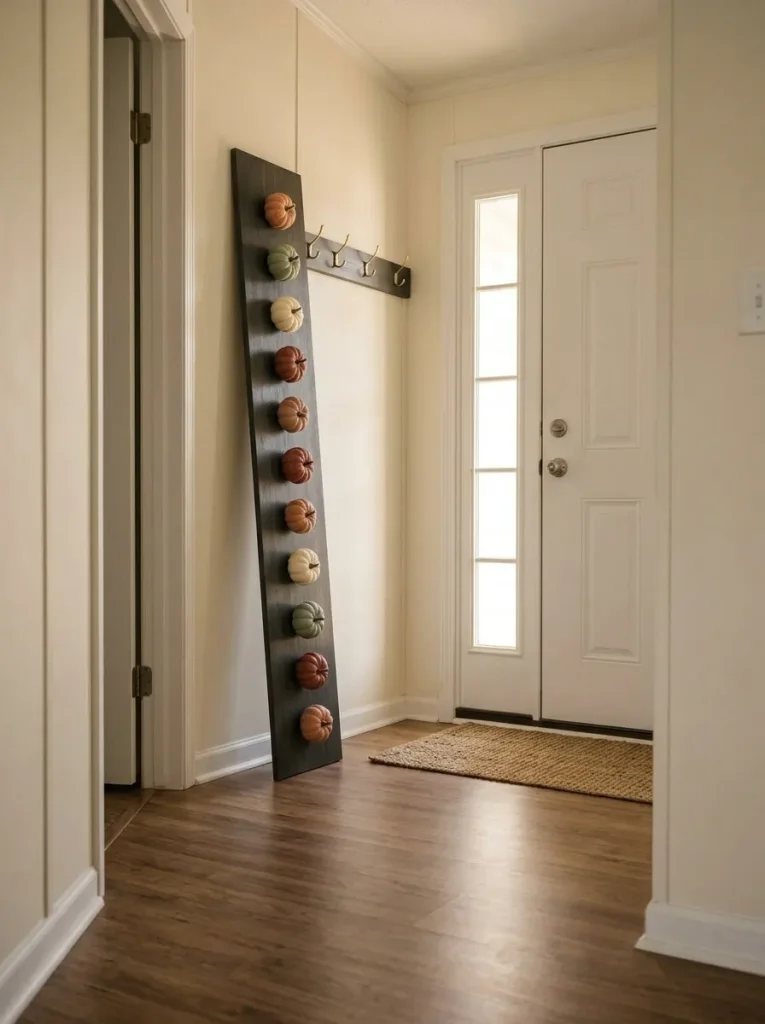
A front entry does not need a wide console or a cluster of floor pumpkins to make a seasonal statement. A tall pumpkin board turns the same visual idea upward.
Start with one narrow painted board and arrange a column of lightweight faux pumpkins or flat pumpkin forms down its center. Keep enough dark or neutral backing visible between the shapes for the project to read as one composition. Letters can spell a short welcome message, or the pumpkins can remain unlettered when the entry already contains signage.
The important decision is where the board ends.
Position it against the quieter wall side of the entry so the project uses a visually empty vertical strip without widening into the route you use to enter the home.
Renters can treat the board as a freestanding seasonal object. If you choose to mount it, use an attachment method suitable for the actual surface and product.
Step several feet back.
The eye should register one vertical pumpkin feature—not one board plus seven disconnected ornaments.
Stop point: once the stacked silhouette reads clearly from the doorway, extra ribbon, leaves, bows, and floor pumpkins are more likely to dilute it than improve it.
4. Turn Two Small Crates Into a One-Sided Porch Pumpkin Tower
Two crates can create useful height on a small mobile-home porch, provided they behave as one compact unit.
Use sturdy crates with broad, stable bases. Place the larger one low, then turn the second so its opening faces another direction. The arrangement gains several display levels while keeping the composition concentrated.
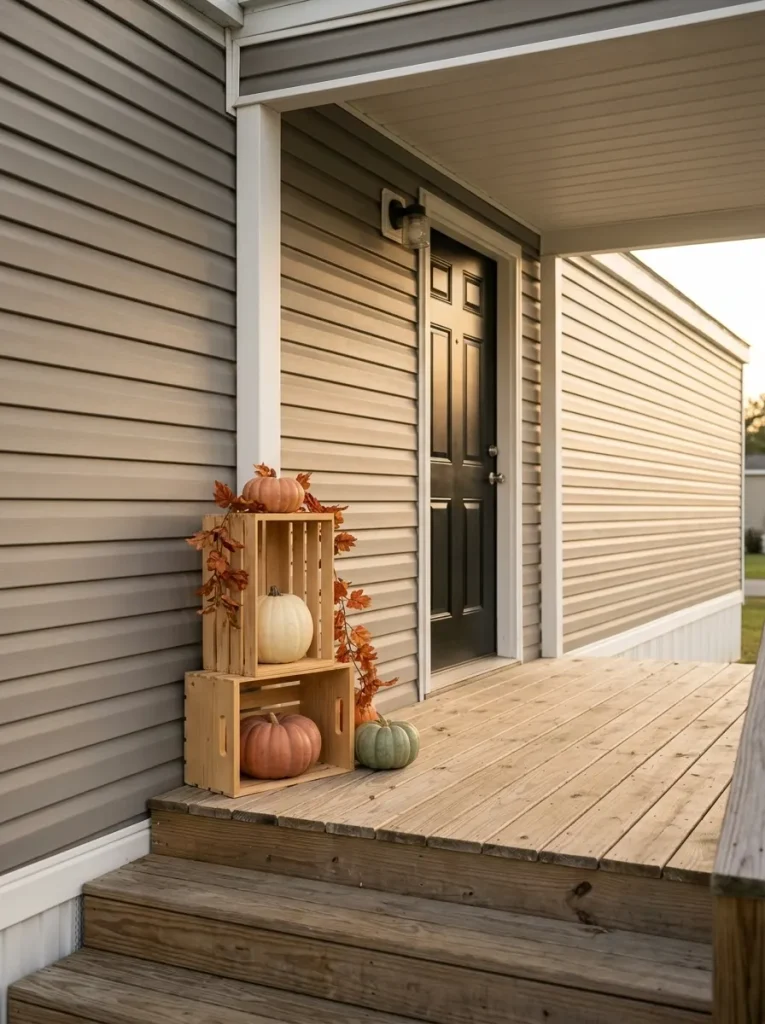
Pumpkins can sit inside one opening, on the upper surface, and near the base. Let foliage visually connect those levels without extending far beyond the crates.
Test the empty structure before styling it.
If the arrangement rocks, shifts easily, or only looks balanced after it spreads into the approach area, change the configuration first.
This project is about constructing a compact vertical display. Broader decisions involving steps, rugs, planters, seating, and the full entry composition belong in 19 Fall Mobile Home Porch Decorating Ideas.
One-Side Porch Composer
Choose the condition closest to your porch. The visual recommendation changes according to which part of the landing needs to remain clearer.
Porch footprint map
Which Side Should Carry the Pumpkins?
Select the side that must stay clearer. Both the porch diagram and written recommendation change instantly without JavaScript.
Build the two-crate tower on the right.
Keep pumpkins and foliage inside or immediately beside the tower so the display stays concentrated on one side.
Stop signal: if the arrangement needs pumpkins on the left to feel complete, the composition has become too wide.
Mirror the crate tower to the left.
Turn one crate opening forward and use the second for height. Keep foliage and loose pumpkins within that same left-side footprint.
Stop signal: if the right side starts carrying accessories too, simplify the tower before expanding it.
Reduce the project to one crate.
Use one vertical crate with one pumpkin inside and another above. The landing gets a seasonal focal point without a full two-crate footprint.
Stop signal: if even one crate visually crowds the approach, move the seasonal focal point to the door.
5. Build a Removable Two-Level Pumpkin Tray for a Short Kitchen Counter
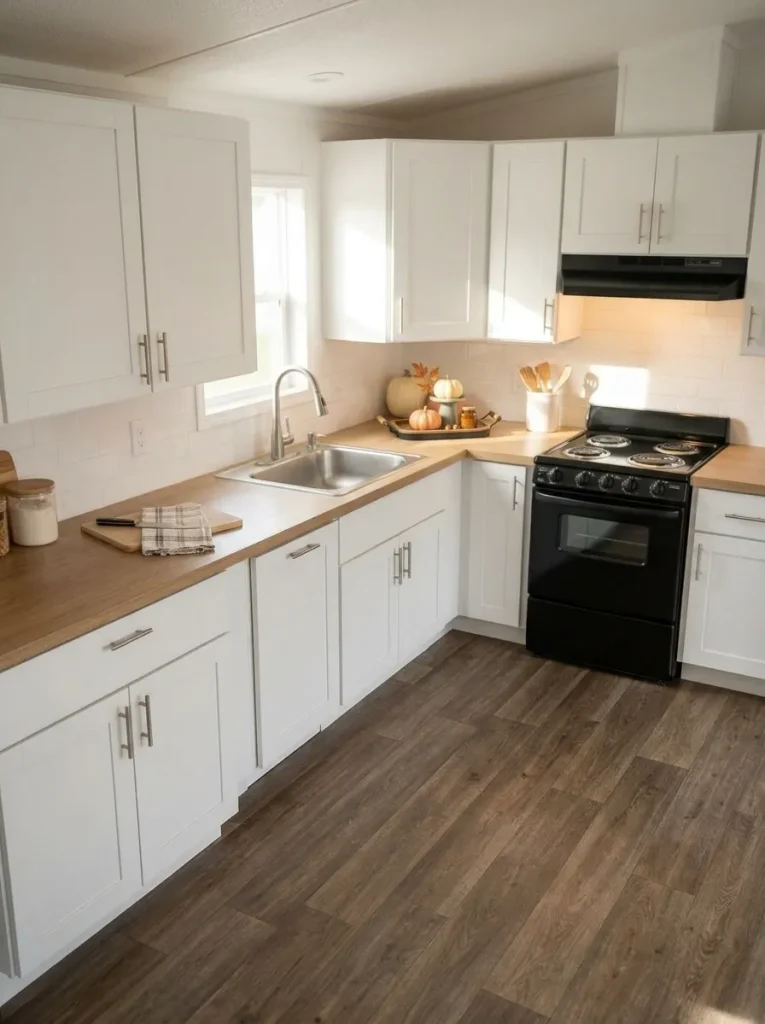
A pumpkin display can be physically small and still become inconvenient when each object has to be moved separately before you can cook.
Build the arrangement around one removable base.
A compact tray, narrow board, or shallow handled basket can form the lower level. Place one short, stable riser inside it so a mini pumpkin or small jar can sit above another element without expanding sideways.
Keep the upper piece lighter than the base and preserve enough empty tray area for the collection to read as an intentional arrangement.
Then test it during an ordinary kitchen task.
Can you pick up the entire display and recover the work surface immediately?
If yes, the project protects the counter’s daily function. If several pieces stay behind, remove or combine them.
For kitchen-wide decisions involving counters, cabinets, appliance finishes, and seasonal focal points, continue with 17 Cozy Fall Mobile Home Kitchen Decor Ideas.
The One-Move Counter Reset Test
How Many Moves Does Your Counter Need?
Kitchen reality checkKeep the design.
The entire display leaves the work zone in one action, which is ideal for a counter used every day.
You have plenty of functional margin.
One-move removal is excellent even on a lightly used surface, so you can focus on visual balance.
Combine the two pieces.
Two separate moves create friction on a counter used every day.
Acceptable, but still improvable.
Two moves are tolerable here, though combining the pieces will make the display easier to live with.
Edit before styling more.
Several loose objects create repeated clearing work on a high-use surface.
The display is still too fragmented.
Even on an occasional-use counter, several separate objects make the surface harder to reset.
6. Make a Lightweight Pumpkin Cascade Along an Unused Window Edge
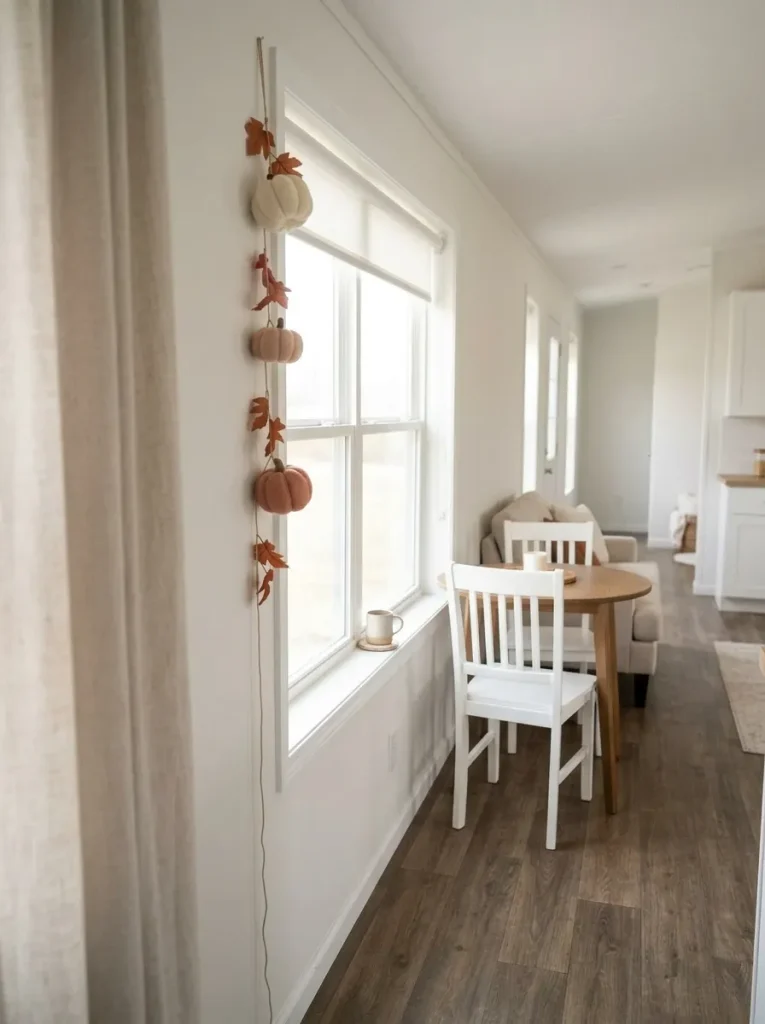
Not every pumpkin needs a shelf.
A narrow window edge can carry a surprisingly strong seasonal detail when lightweight pumpkin forms and leaves move vertically instead of spreading across the sill.
Use small foam, paper, felt, or other lightweight pumpkin shapes connected by ribbon, clear cord, or a thin faux-leaf strand. Keep the sequence loose enough for wall or trim to remain visible between the pieces.
Choose one side of the window, not the entire frame.
That asymmetry gives the eye a clear path and prevents a compact room from gaining another visually heavy rectangle.
Before attaching anything, open the curtain, blind, and window. The project should occupy genuinely unused space without interfering with something you handle daily.
A useful sequence might be:
- one small pumpkin near eye level,
- two or three leaves moving downward,
- a second pumpkin lower on the edge,
- a final leaf cluster tapering away.
Avoid filling every gap.
The strongest version looks like autumn color drifting along one edge of the room.
Best for: bedrooms, dining corners, or living-room windows where tabletop space is already scarce.
Skip it when: curtains repeatedly catch the pieces or the design only feels complete after décor begins spreading across the sill.
7. Cut a Flat Wood-Slat Pumpkin for a Wall That Cannot Spare Depth
Some of the most useful pumpkin décor in a small mobile home barely projects from the wall.
Create a flat pumpkin from thin wood strips, lightweight craft board, or another material suited to your tools and skill level. Arrange short vertical pieces into a pumpkin silhouette, secure them to an appropriate backing, and finish the shape with paint or stain.
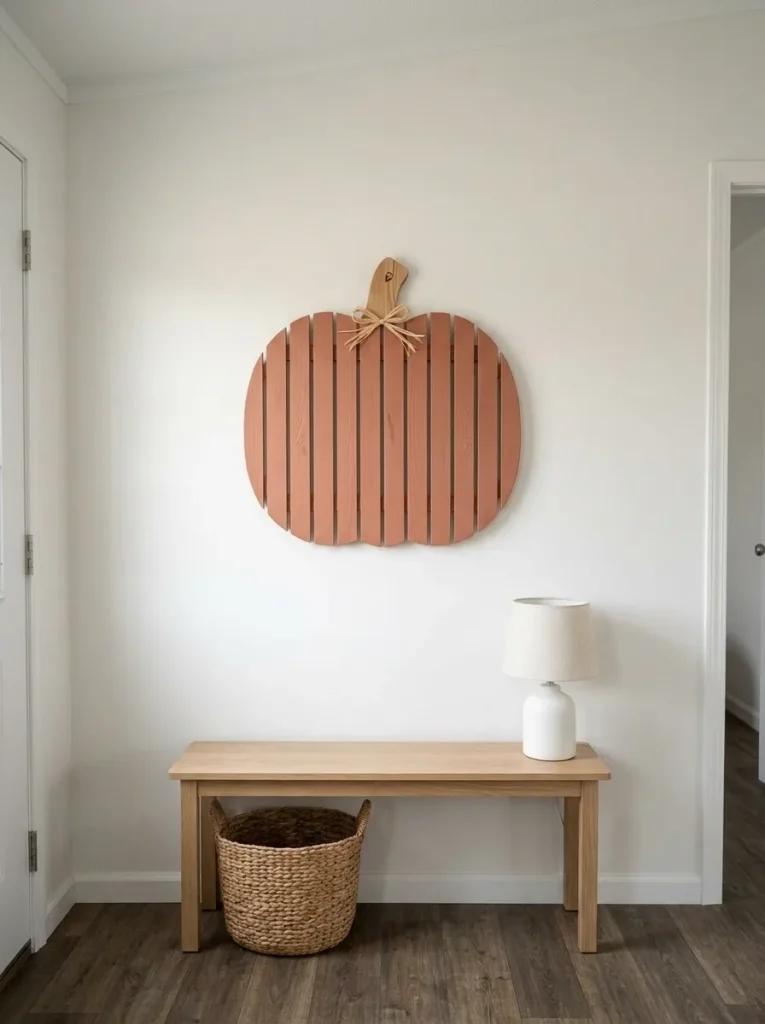
A narrow stem and small raffia tie are enough to communicate the season.
The important feature here is depth.
A shelf display often needs the shelf itself plus pumpkins, stems, frames, and surrounding breathing room. A flat wall pumpkin creates a large recognizable seasonal shape while leaving the floor, counter, and furniture below untouched.
It works particularly well above:
- a narrow bench,
- a small dining nook,
- the wall beside a bedroom door,
- an entry drop zone,
- or a console that already handles practical items.
Use the wall test
Stand where the room is normally viewed.
If the pumpkin silhouette reads clearly from that position, the craft is finished.
Extra bows, signs, leaves, or mini wreaths can make the object more detailed at close range while weakening the wall composition from across the home.
For a compact interior, the longer view deserves priority.
DIY decision: choose this project when you want one visually substantial pumpkin without storing another dimensional tabletop accessory.
8. Make No-Sew Fabric Pumpkins From Old Textiles
Fabric pumpkins solve a problem rigid seasonal décor cannot: they compress.
Use leftover fabric, an old pillowcase, worn seasonal textiles, or another material you are comfortable repurposing. Cut a simple circle or use an appropriate fabric tube, gather the material around soft filling, then shape it into a pumpkin.
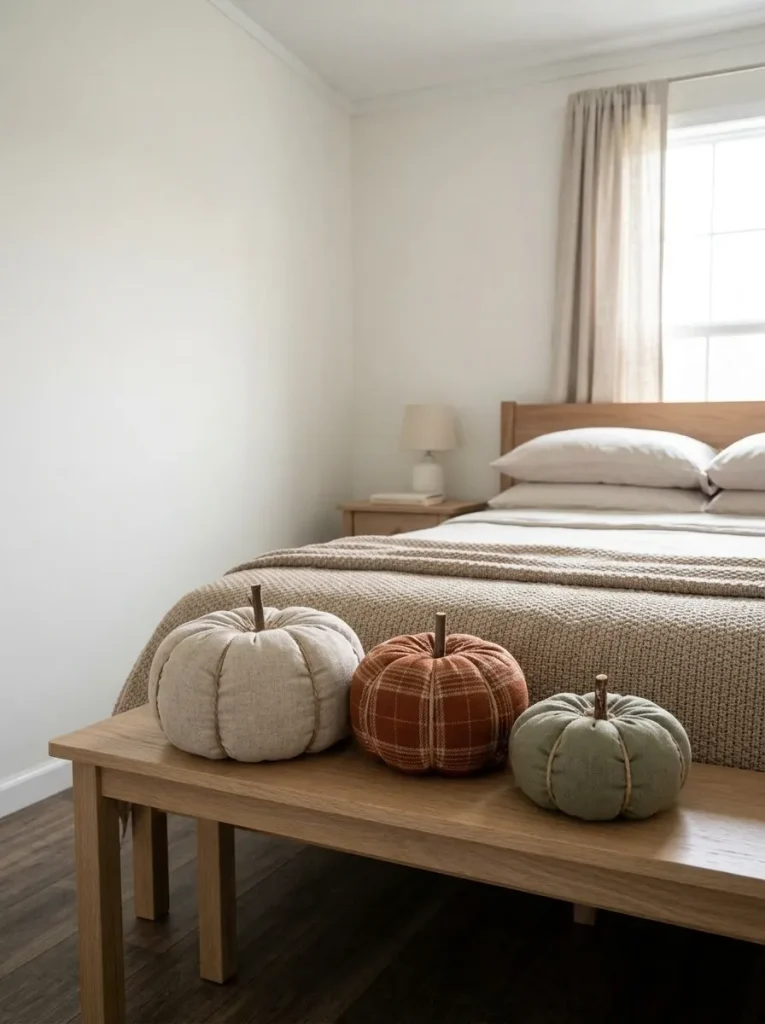
Twine wrapped around the outside can emphasize the pumpkin sections. A short twig, fabric roll, or craft stem can finish the top.
The quality of the result depends more on fabric choice than complicated construction.
Try one restrained palette:
- oatmeal + rust,
- cream + olive,
- warm plaid + solid brown,
- charcoal + muted orange,
- or two similar neutrals with one deeper accent.
Soft pumpkins are especially practical on a bed, bench, upholstered chair, or open basket because they do not introduce another hard decorative object into a compact room.
Storage is easier too. If your construction allows removable stems, group the pumpkins together and compress them into a seasonal textile bin.
That can justify several soft pieces where several rigid faux pumpkins would consume too much offseason volume.
Bed test: one or two fabric pumpkins can provide the seasonal signal. If you have to relocate a pile every night before sleeping, simplify it.
9. Create a Slim Pumpkin-and-Leaf Garland Across the Headboard Zone
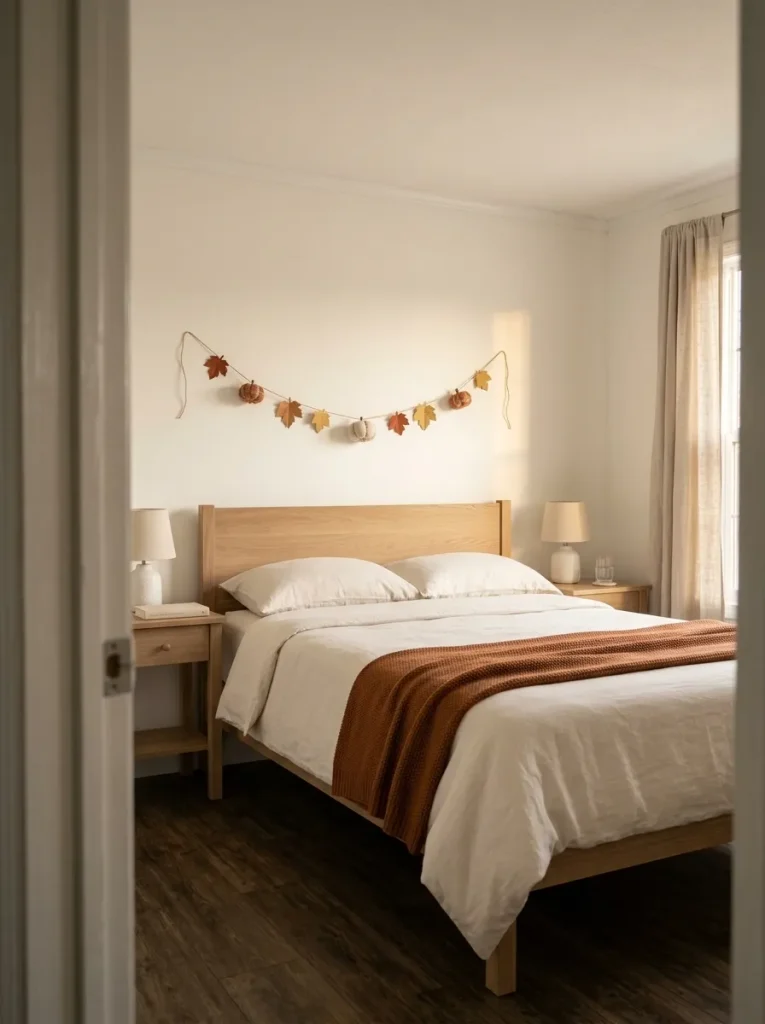
A small mobile-home bedroom may have only a handful of realistic surfaces for seasonal décor.
That makes the wall above or immediately behind the bed useful.
Create a shallow garland using lightweight pumpkin forms, narrow faux foliage, felt leaves, fabric scraps, or a restrained mix. Leave visible wall between the seasonal elements so the garland feels airy instead of forming a dense horizontal stripe.
Then ask a more useful question than “How full can this be?”
Can this one feature carry enough fall character that the nightstands stay practical?
A successful headboard garland can leave bedside surfaces almost untouched—lamp, water, phone, book, or whatever you actually use—while moving the autumn detail to another plane.
For a wider bedroom strategy involving bedding, window treatments, lighting, color, and furniture surfaces, continue with 17 Cozy Fall Mobile Home Bedroom Ideas.
Bedroom edit rule
After installing the garland, remove one pumpkin-shaped accessory from the bed or dresser before deciding whether the room needs more.
One strong feature often makes several smaller ones unnecessary.
10. Make an Asymmetrical Mini-Pumpkin Wreath for the Front Door
A compact entry often benefits from one clear seasonal destination.
Start with a simple wreath base and concentrate most of the decorative weight on one side instead of covering the entire circumference. Group several lightweight mini pumpkins together, weave in a short run of leaves or stems, then let the rest of the wreath stay comparatively quiet.
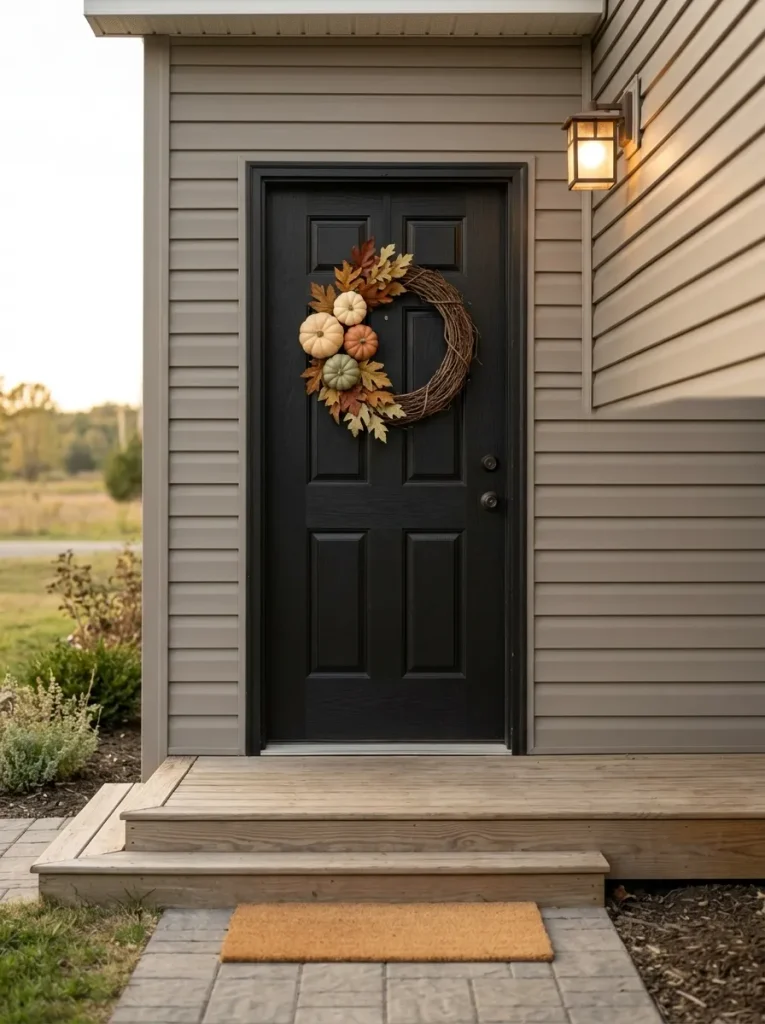
That asymmetry reduces the quantity of material while strengthening the focal point.
A useful composition might look like this:
upper-left cluster
three mini pumpkins + foliage
middle
a short taper of leaves
remaining circumference
mostly exposed wreath base
Reverse the composition if the opposite side relates better to your porch.
Then step outside and view the door together with the light fixture, siding, mat, steps, and any pumpkins already on the landing.
If the wreath and the floor display are both trying to dominate the entry, simplify one.
For full-porch planning, 19 Fall Mobile Home Porch Decorating Ideas covers the broader composition.
Best small-porch sequence: wreath first, floor pumpkins second.
You may find that once the door has enough seasonal identity, the landing needs much less décor than expected.
11. Fold Paper Pumpkins That Store Almost Flat After Fall
A pumpkin can be attractive in October and still become a storage problem in January.
Paper pumpkins reverse that tradeoff.
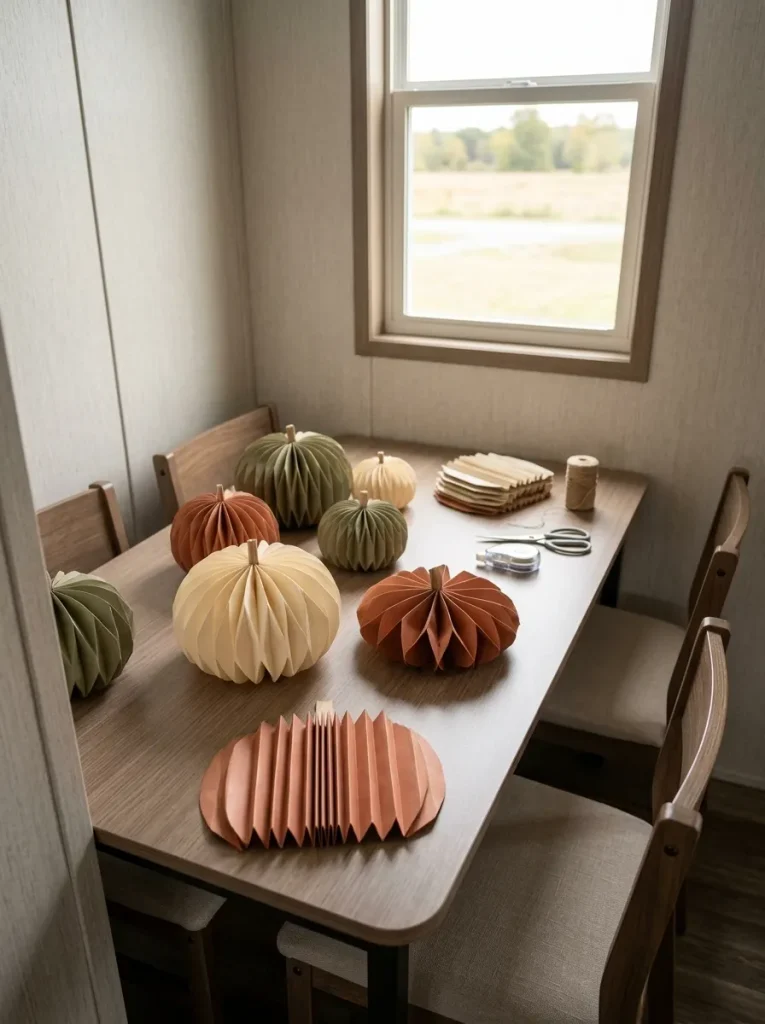
Use heavyweight craft paper or cardstock appropriate for your folding method. Repeated folded circles, accordion segments, or joined pumpkin-shaped panels can create a dimensional form during fall and collapse into a much thinner package when the season ends.
That makes paper particularly useful in a mobile home with limited closet or utility storage.
Plan the offseason version before construction begins.
Ask:
- Can it fold nearly flat?
- Can the stem detach?
- Will several pieces nest together?
- Does it require a rigid storage box?
- Could the same neutral paper still work with next year’s palette?
A project that takes a little longer to make but stores at a fraction of the volume may be the stronger small-home choice.
Seasonal Storage Burden Comparator
Select the amount of seasonal volume your home can realistically spare after fall.
Off-season reality
How Much Storage Can This Pumpkin Earn?
Select your real storage tolerance. The meter and recommendations change immediately.
LOAD
Design for collapse.
Choose projects that become nearly flat after fall and do not demand a dedicated tote.
Let compressible texture do more work.
Soft dimensional décor can share the same storage zone as other seasonal textiles.
You can justify selected dimensional pieces.
A vase, tray, lantern set, or small faux-pumpkin collection can fit the plan, but the bin remains the boundary.
A useful pumpkin DIY is therefore designed for January storage as deliberately as October display.
12. Turn Small Glass Jars Into Battery-Lit Pumpkin Lanterns
Fall décor changes after sunset.
A small living room or dining area often needs fewer decorative objects at night because a little warm light carries farther visually than another group of pumpkins.
Reuse clean glass jars as pumpkin-inspired lanterns. Depending on the finish you prefer, tint or paint the outside in translucent or matte orange, add simple vertical pumpkin lines or a removable pumpkin face, and place a small battery-powered LED light inside.
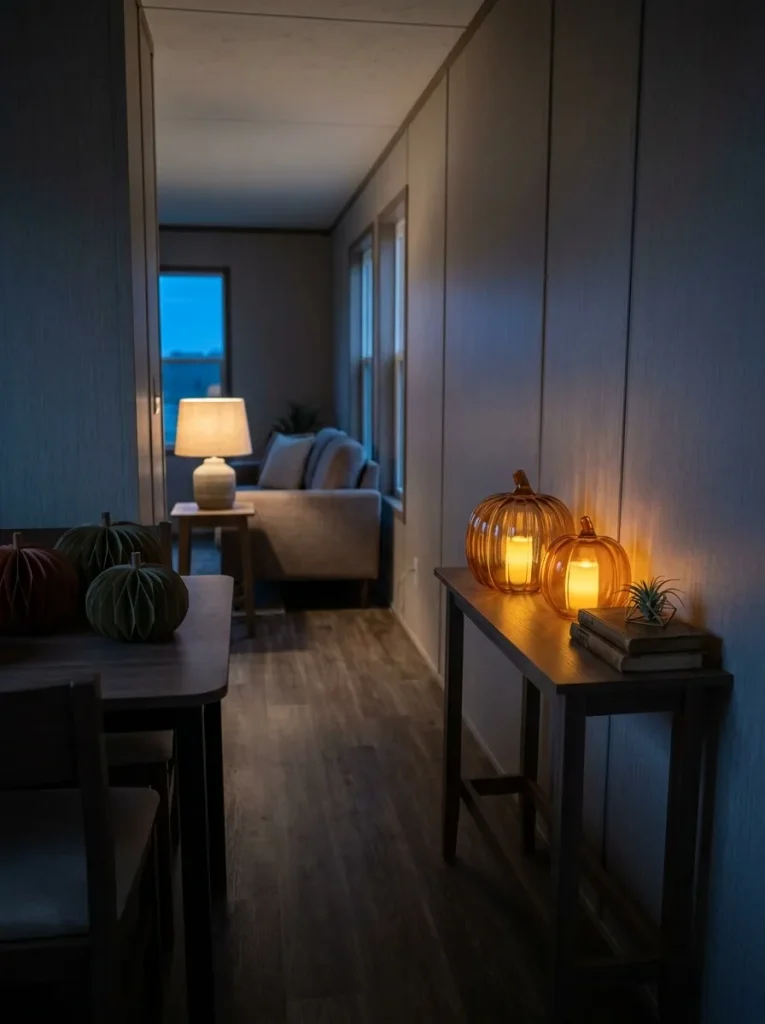
Keep the daytime design restrained.
Two versions work particularly well:
Quiet fall version
Muted amber or terracotta finish with a simple stem detail.
October version
Orange finish with a removable dark pumpkin face.
The second treatment lets the same object shift toward Halloween without creating an entirely separate set of decorations.
Place one or two lanterns where their light can be seen from another part of the home—a stable shelf, console, dining surface, or protected ledge.
One warm cluster can establish evening atmosphere.
Five small glowing objects scattered across connected rooms can make the interior feel fragmented.
Decision rule: where several warm lamps are already visible, use one lantern as an accent. In a darker corner with little evening character, a coordinated pair may be more useful.
13. Make Mini-Pumpkin Magnets for the Fridge Side or a Metal Board
The refrigerator already occupies visual space.
Its unused side can therefore host seasonal décor without adding another tray, shelf, or basket to the kitchen.
Create lightweight mini-pumpkin magnets from felt, painted lightweight craft shapes, paper forms, or very small faux pumpkin pieces. Attach magnets suited to the object’s weight and intended surface.
Then avoid covering the whole refrigerator.
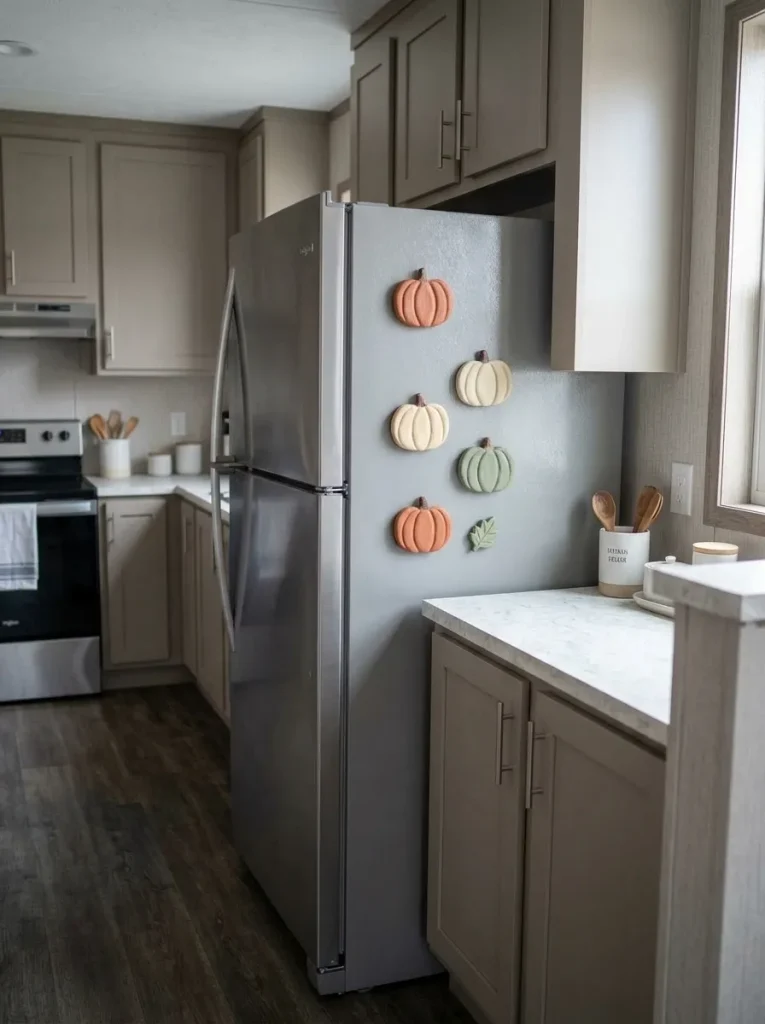
Three to five pieces arranged as a loose vertical composition tend to read more deliberately than a random scatter.
Try:
top
one pumpkin
middle
two offset pumpkins
lower
one pumpkin + one small leaf
Leave generous empty space between the objects.
A vertical arrangement turns the appliance side into a tiny seasonal composition. A dense scatter risks looking like temporary clutter.
If the refrigerator side is not visible from the room, try the same idea on an appropriate magnetic message board or another metal surface you already use.
The project only earns its place when it participates in a view you actually experience.
Skip it when: magnets begin competing with calendars, notes, children’s artwork, or another useful household system.
The surface’s everyday role still comes first.
14. Build a Reversible Pumpkin Panel for Fall and Halloween
One of the most storage-efficient seasonal projects has two faces.
Create a slim reversible panel from lightweight craft board, thin wood, or another suitable material.
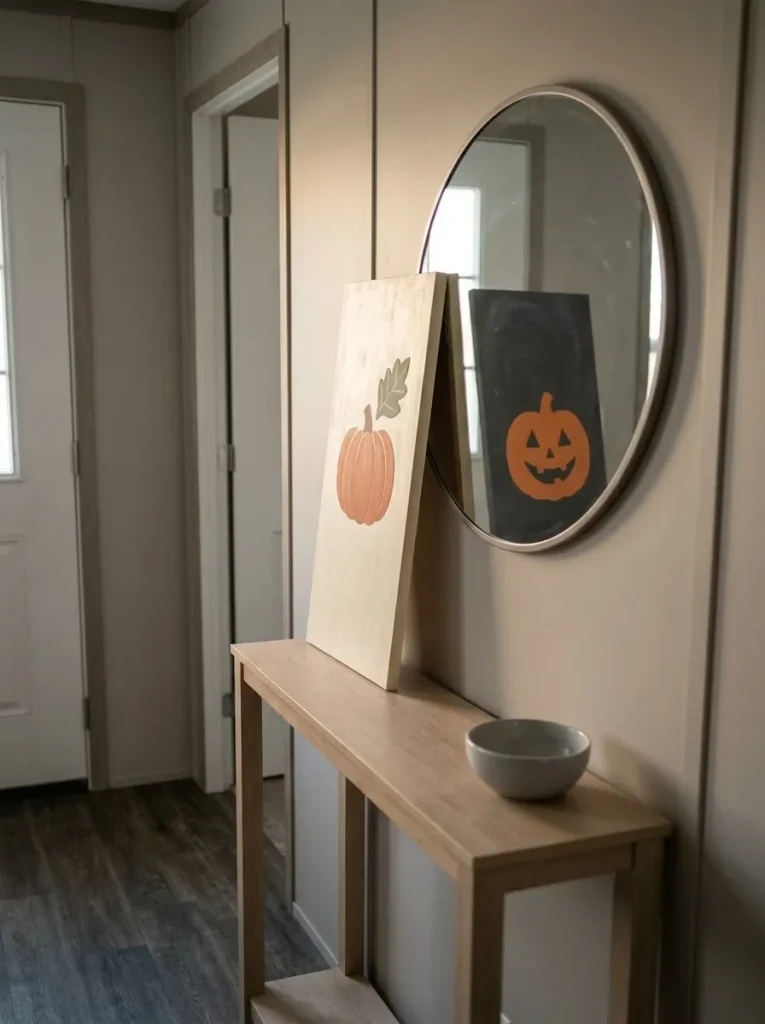
Give the fall side a restrained pumpkin composition using warm ivory, terracotta, muted green, natural wood, or another palette that works with your autumn rooms.
Turn it over and let the Halloween side become darker or more graphic:
- a black pumpkin silhouette,
- a jack-o’-lantern face,
- orange against charcoal,
- a moon-and-pumpkin composition,
- or another simple October motif.
Its advantage is physical as much as visual.
One object performs the work of two seasonal decorations.
Decide where the finished panel will live before decorating it.
If it sits on a narrow shelf, keep the base shallow. If it leans, make the construction stable for that use. If it hangs, plan the attachment so it does not visually spoil the reverse side.
The seasonal transition becomes simple:
September / early fall
warm pumpkin side
↓
October
flip to the Halloween side
↓
after Halloween
return to the calmer fall face if desired
Avoid making either side depend on several loose accessories.
A reversible decoration is most useful when flipping the panel is almost the entire seasonal reset.
15. Turn a Small Lidded Basket Into a Functional Pumpkin Catchall
The final project earns its footprint by hiding something your home already needs to store.
Start with a small round or softly structured lidded basket that suits the scale of your entry, living room, or bedroom.
Add a removable stem to the lid using a lightweight craft element, fabric-covered form, or small wood piece. A subtle leaf can finish the pumpkin shape.
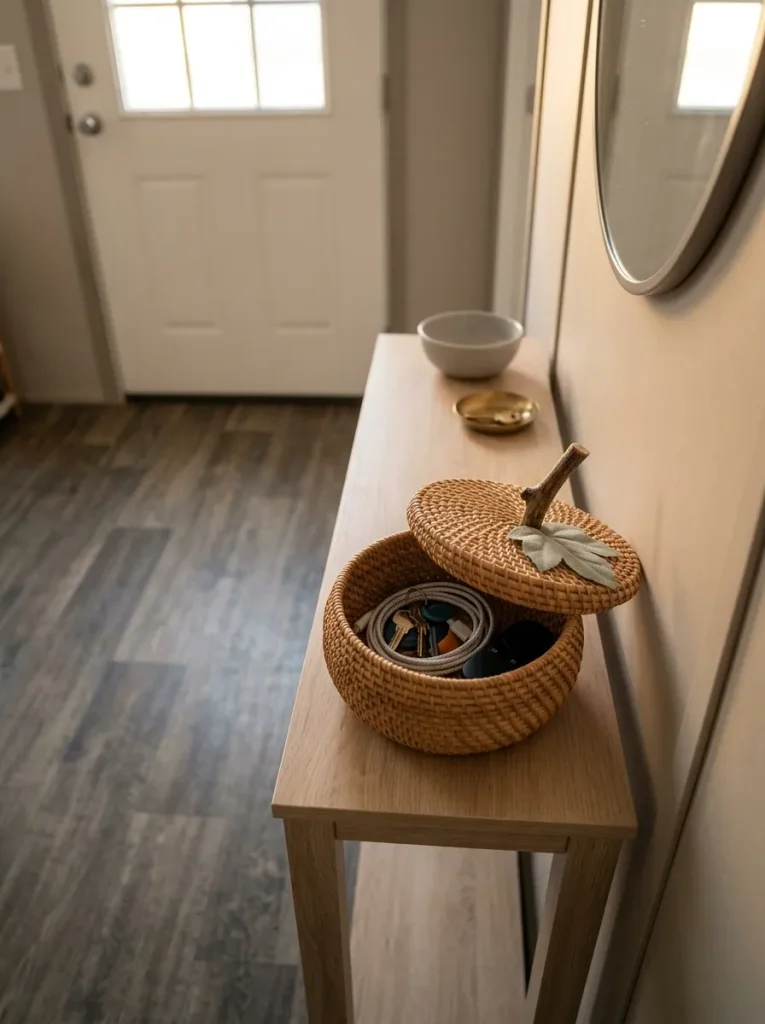
The basket should still open normally.
Inside, store something the room regularly struggles to contain:
- keys,
- chargers,
- remotes,
- dog accessories,
- small entry items,
- bedside odds and ends,
- or another category of everyday clutter.
Now the object is not merely a pumpkin sitting on valuable furniture. It becomes a seasonal shell around useful storage.
Choose a basket you would still want after fall. Remove the stem and leaf, and it can return to neutral everyday use without joining the seasonal bin.
Pumpkin Loadout Audit
Use this final tool after selecting your favorite DIYs. It identifies the point where another pumpkin would add less than removing one.
Final whole-home edit
Does the Next Pumpkin Still Earn a Place?
Choose both inputs. The saturation score and advice below change for all six combinations.
Your pumpkin moments are sparse and separated, so one new project can still add variety without crowding the overall view.
You only have a few pumpkin moments, but several are visible together. A new piece should replace repetition rather than create another competing cluster.
Three or four separated pumpkin moments can still work, but another one should replace something weaker or add function.
Several pumpkin moments are now visible at once, so they begin behaving like one composition.
Pumpkins appear across most surfaces even though the moments are somewhat separated. The home has little visual capacity left for another standalone feature.
Most sightlines already contain pumpkins, and several are visible together. The stronger design move is subtraction.
A useful test remains after the craft is finished: if removing the stem would still leave you with a basket worth owning, the project has earned its footprint.
A Smaller Pumpkin Collection Can Create a Stronger Fall Home
DIY pumpkin décor works best in a small mobile home when every project has a reason to occupy space. Give one area the main seasonal moment, move another project onto a wall or door, protect everyday counters, and let offseason storage influence what you make.
You do not need every surface to prove that fall has arrived. A few coordinated pumpkin moments can travel through connected rooms more effectively than many unrelated decorations.
Once your strongest pieces are in place, walk the home from the entry and remove anything that competes with them. If you want to carry the same restraint into the rest of the season, continue with 25 Cozy Fall Mobile Home Decorating Ideas.
Save this article to Pinterest so your favorite pumpkin DIYs are easy to find when you start decorating.