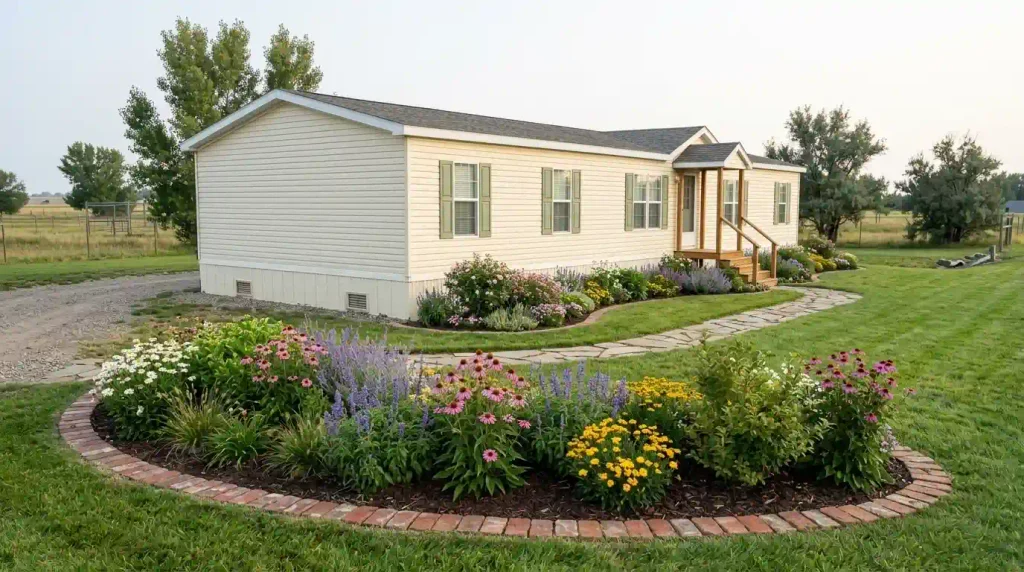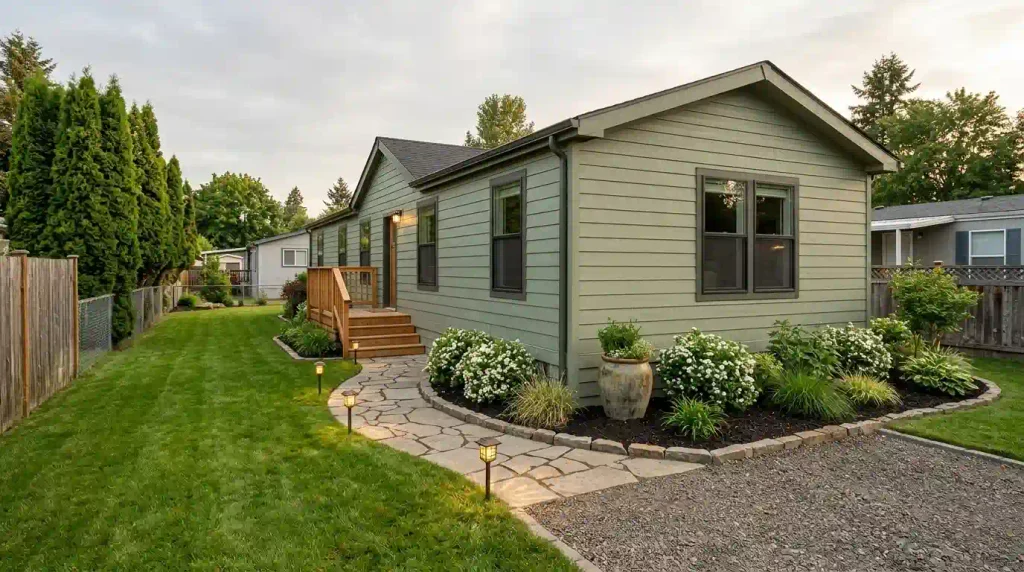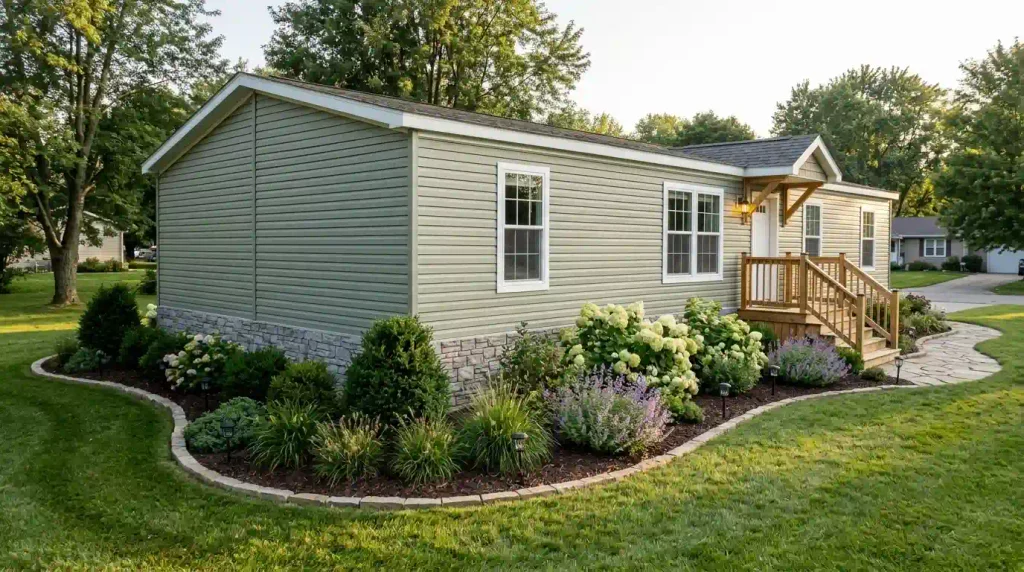
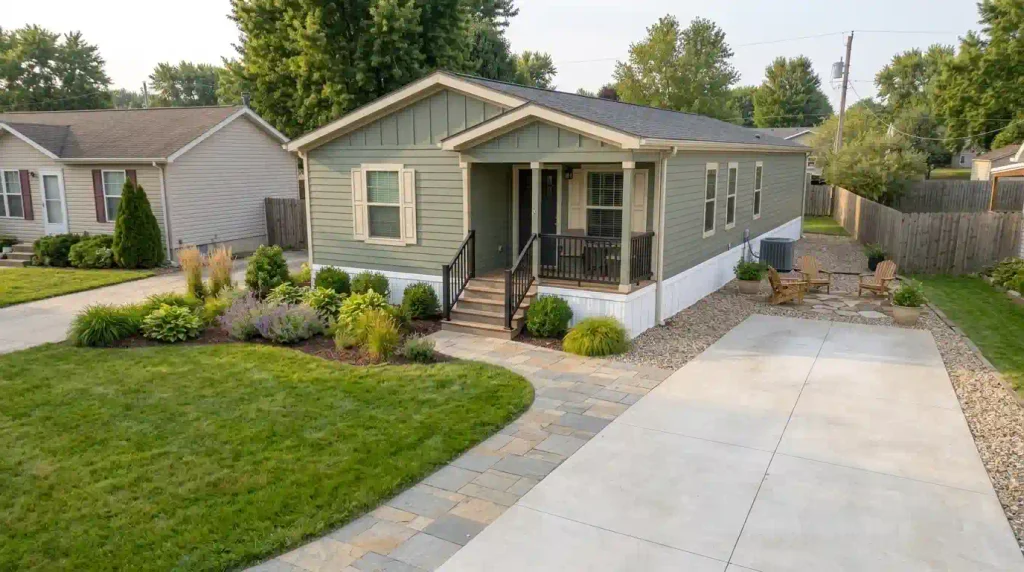
A garden can look wonderful on planting day and become a burden by midsummer. The tiny lawn beside the driveway needs edging, the flowerpots dry out before dinner, and shrubs that once seemed perfectly sized begin crowding the front steps.
The challenge is particularly noticeable around manufactured homes. Narrow side yards, raised entrances, skirting openings and shared community boundaries can leave very little room for landscaping mistakes.
The most effective low-maintenance mobile home landscaping ideas reduce the work built into the yard itself. Keep grass where it serves a purpose, select plants for their mature size, cover exposed soil appropriately and preserve the routes needed to care for the home.
Whether you’re improving a rented single-wide lot or a double-wide with a generous garden, these 19 ideas will help you create a welcoming landscape with fewer recurring chores. Start with the maintenance problem that bothers you most, then use the material comparisons and practical planning guidance to find a solution suited to your property.
1. Design Your Yard Around the Chores You Want to Eliminate
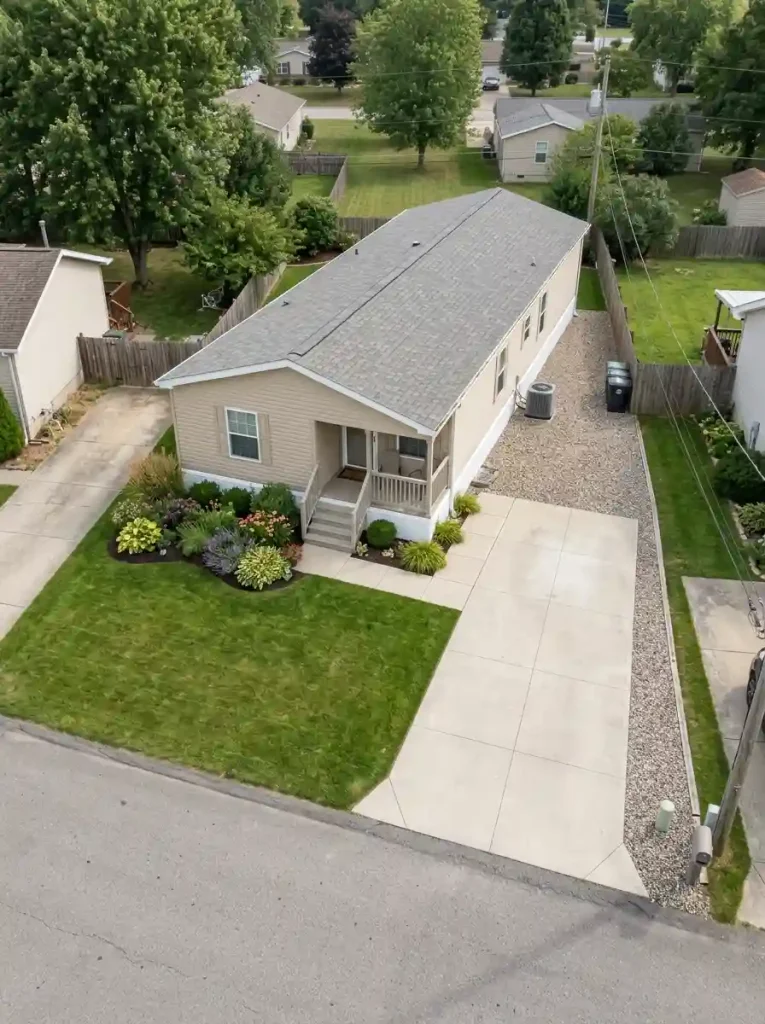
Before visiting the garden center, spend one normal maintenance session noticing where your time goes. A yard with one continuous lawn and a demanding flower bed needs a different solution from a yard with several small grass strips.
- Mowing: Identify awkward corners and isolated grass patches.
- Watering: Note which containers or beds dry out fastest.
- Weeding: Locate the bare soil where weeds repeatedly return.
- Pruning: Identify plants that keep growing into access routes.
On a small manufactured-home lot, reserve your most detailed planting for a visible area near the entrance. Keep less prominent service zones uncomplicated. For overall design inspiration, explore these mobile home landscaping ideas.
Make your garden work for you.
Choose the chore that takes the most time. Explore the part of the yard to improve first.
Before changing the yard: Preserve drainage, service access and required ventilation. Confirm community permissions on rented lots.
2. Keep One Easy-to-Mow Lawn Instead of Several Tiny Grass Patches
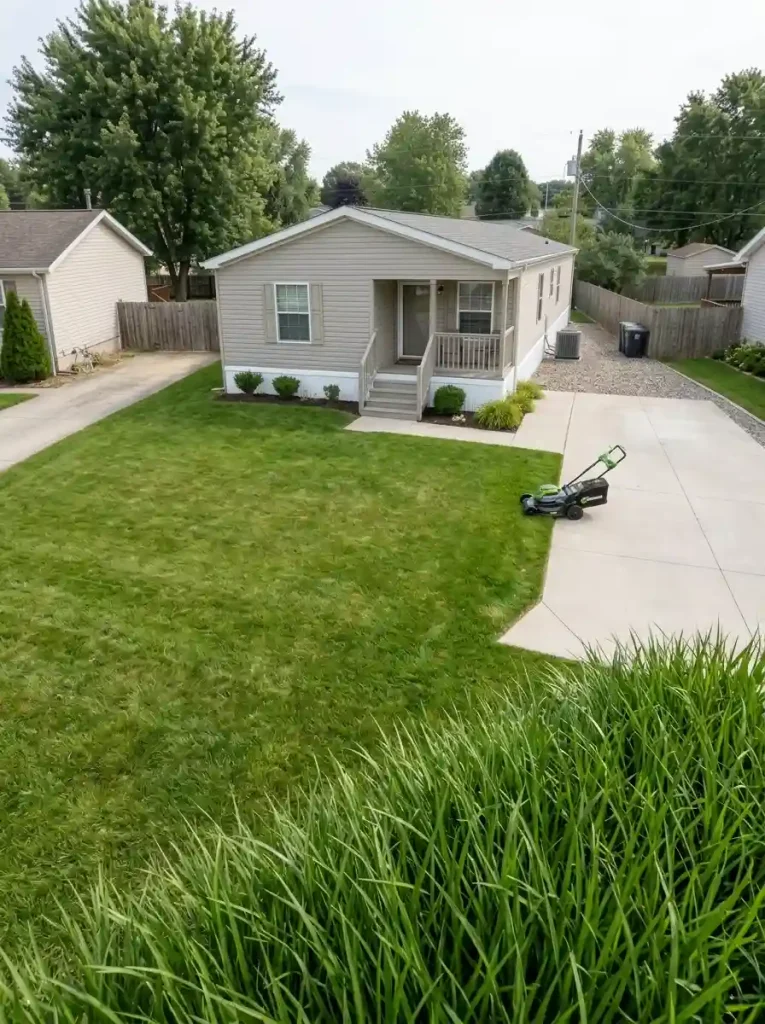
A continuous stretch of grass beside a double-wide can be easier to maintain than several much smaller patches around a single-wide. Each interruption adds another turn, edge or obstacle to negotiate.
Try walking the mowing route before changing anything. Can the mower turn comfortably between the driveway and the porch? Do you have to lift it over an edging strip or reverse repeatedly near the steps? Mark the grass that causes those problems and consider converting only those sections into suitable low-care surfaces.
Keep a useful lawn for pets, play or relaxation; remove the fragments that serve no real purpose.
3. Create Garden Beds You Can Maintain Without Stepping Into Them
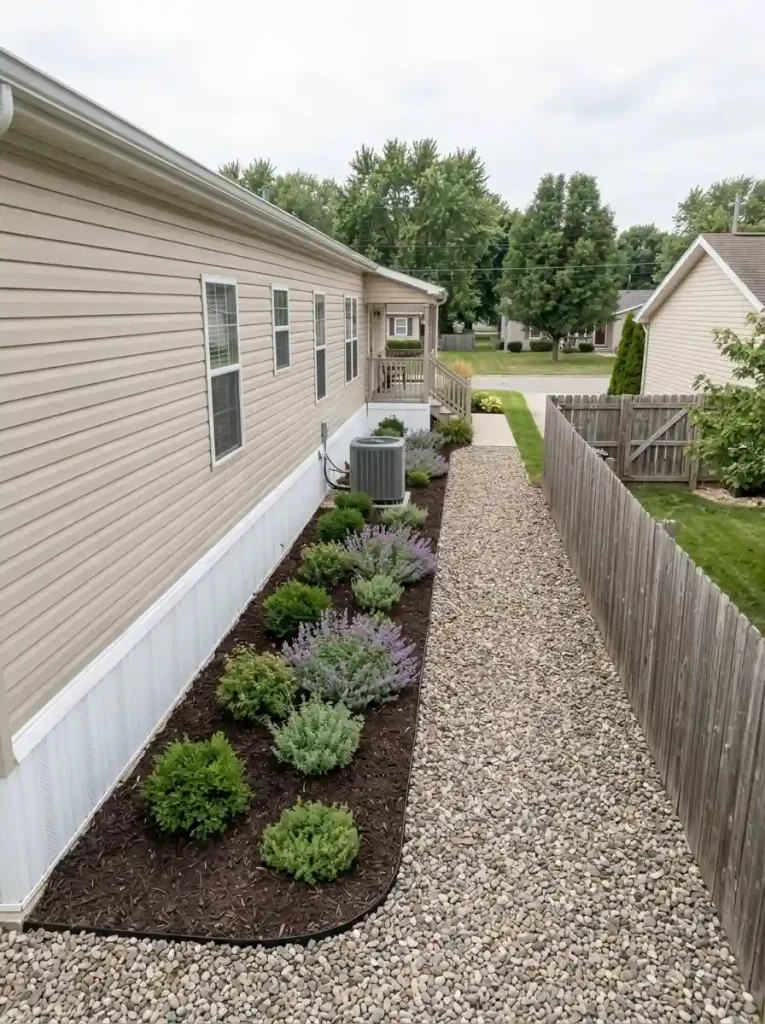
Can you comfortably reach every plant from outside the bed?
In a narrow planting border along a manufactured home’s skirting, the back row can become difficult to weed or prune without stepping through the foliage. Before planting, mark the proposed outline with a hose and test your reach while standing on the intended maintenance route. Allow for mature plant spread, too. A wider bed is reasonable if you have access from both sides; otherwise, a shallower planting pocket may be more practical.
These flower bed ideas for mobile homes offer inspiration for the visual arrangement.
4. Give Your Mobile Home a Clear, Easy-Care Perimeter
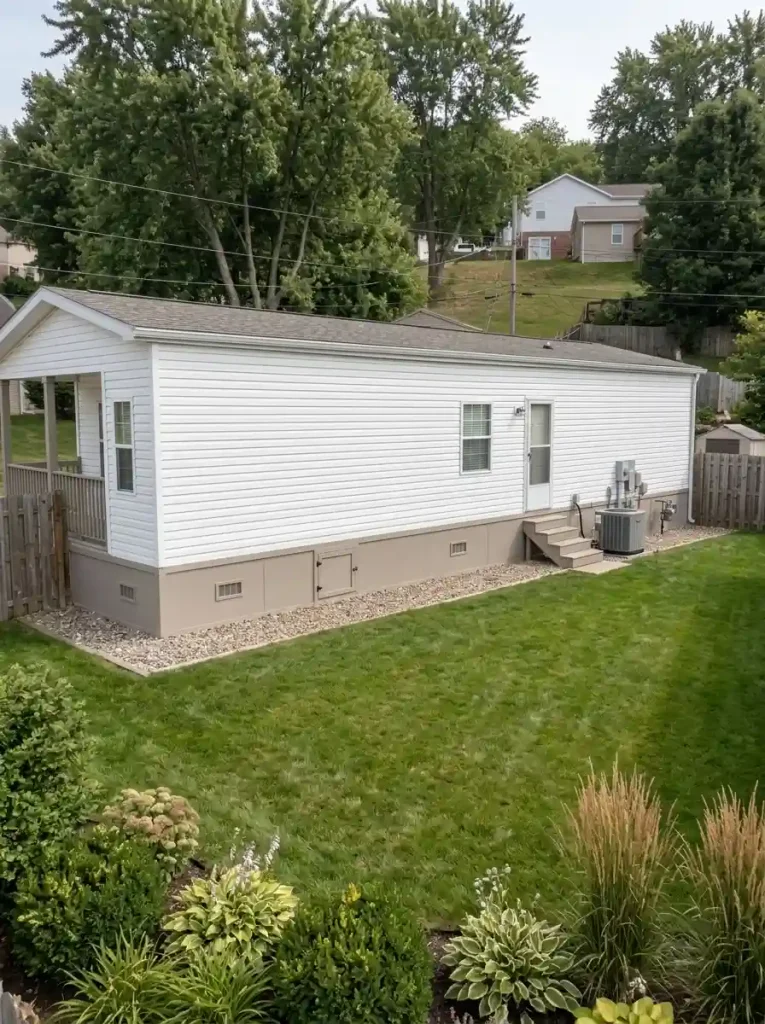
Protect the home before decorating the space around it. Dense planting can conceal skirting openings and turn routine inspections into a job that requires pruning or moving heavy containers.
| Home feature | Landscaping check |
|---|---|
| Skirting vents | Leave ventilation openings unobstructed. |
| Access panels | Keep the approach and opening clear. |
| Outdoor HVAC | Follow the equipment manufacturer’s airflow and service clearances. |
| Exhaust outlets | Keep the outlet and required clearance free of foliage and debris. |
The federal manufactured-home crawlspace ventilation and access standard explains these essential functions. Avoid raising soil, mulch or gravel against skirting; follow the home’s installation requirements.
A clear, inspectable strip can look intentional without being filled with plants.
5. Replace High-Maintenance Grass With the Right Ground Surface
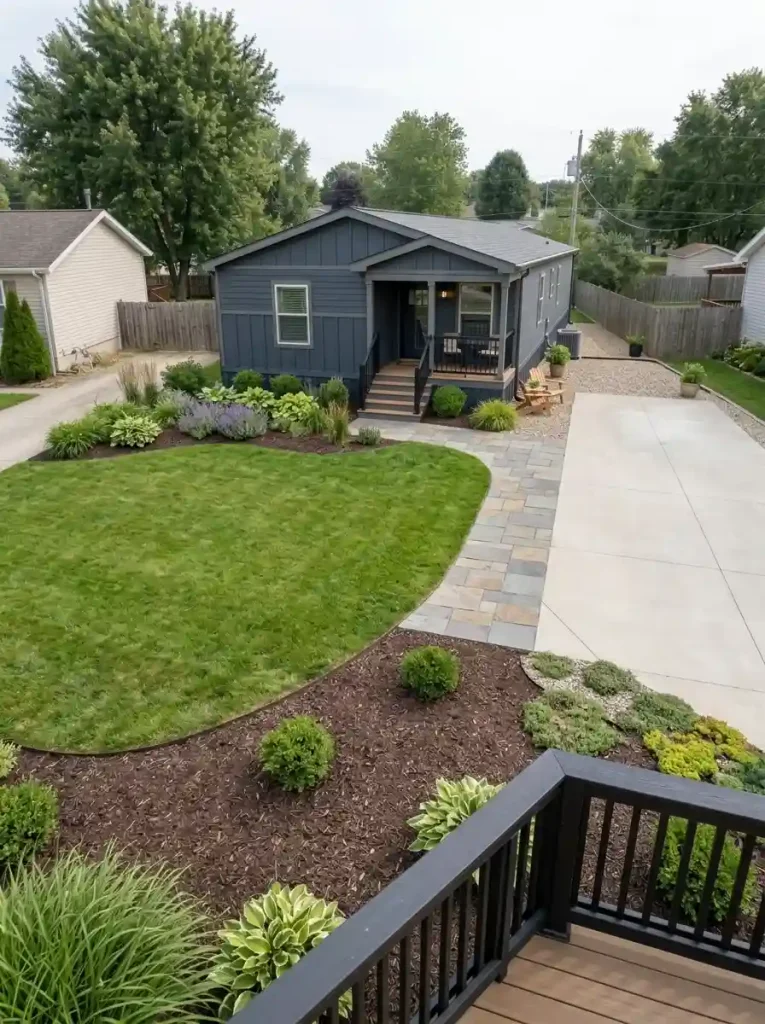
The easiest surface to maintain depends on what happens there. A decorative strip beneath a window has different requirements from the everyday route to a raised entrance.
| Surface | Suitable use | Work that remains |
|---|---|---|
| Organic mulch | Planting beds | Replenishment and weed checks |
| Living ground cover | Suitable low-traffic ground | Establishment and spread control |
| Gravel | Selected low-debris areas | Raking, weeds and stone migration |
| Firm paving | Frequently used paths | Joint care and settlement checks |
| Suitable turf | Play and pet space | Mowing and seasonal care |
The EPA’s water-smart landscaping guidance encourages matching landscape choices to intended use.
Retain existing surfaces that already work well; replacing them unnecessarily adds cost and installation work.
Find the right ground surface.
Open the yard use you are planning. Compare its most practical options, limitations and remaining chores.
01 · Frequently used walking route
Benefit: Stable walking surface when correctly installed.
Upkeep: Check joints, settlement and drainage.
Trade-off: Less mowing, but stones may migrate and footing may be difficult.
Choose: A firmer surface when reliable access is needed.
02 · Decorative garden bed
Benefit: Covers exposed soil and reduces moisture loss.
Upkeep: Inspect depth, replenish selectively and keep clear of skirting.
Benefit: Living coverage after establishment.
Upkeep: Check local invasiveness, growth habit and watering needs.
03 · Recreation and pet space
Benefit: Flexible open space for everyday use.
Upkeep: Mowing, seasonal care and appropriate irrigation.
Benefit: Defined sitting or dining zone.
Trade-off: Check heat exposure, drainage and intended activities.
Material rule: Keep the existing surface when it works well. Check local drainage, accessibility, heat, maintenance and installation requirements before replacing it.
6. Choose Gravel That Suits Your Yard’s Actual Conditions
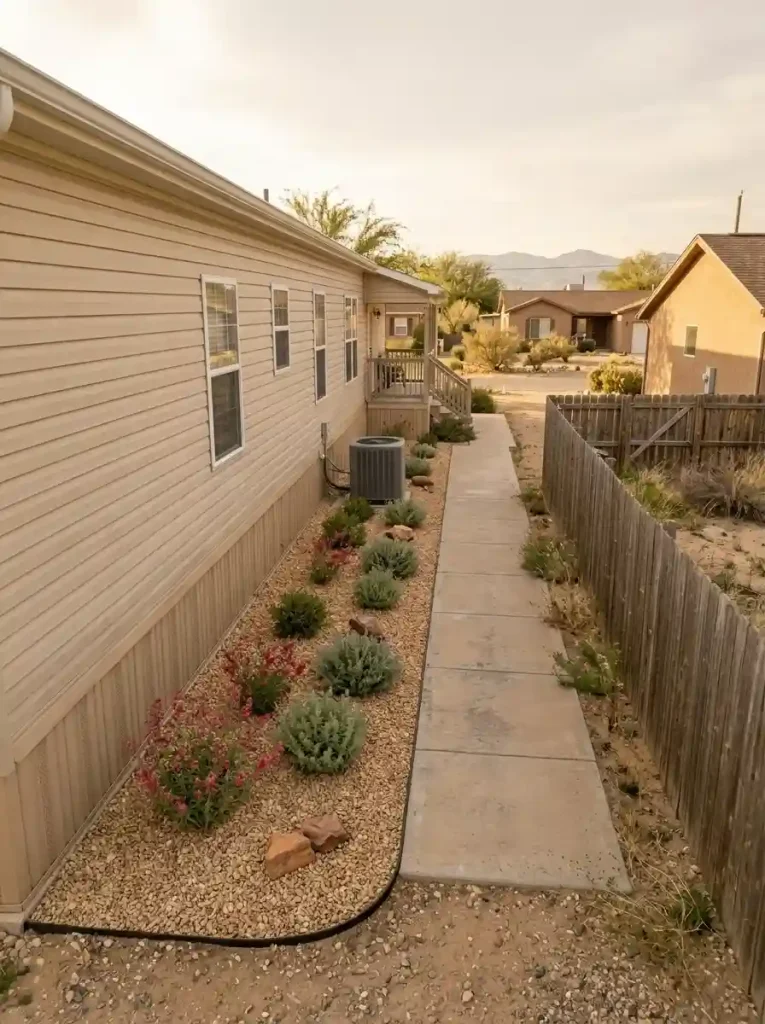
Gravel is a mowing alternative, not a maintenance-free surface.
Beneath a deciduous tree, fallen leaves and fine debris can accumulate between stones and provide a place for weeds to establish. In exposed sunny locations, stone may increase heat around susceptible plants. Loose aggregate can also migrate across a sloping driveway edge or make walking difficult.
On a compact single-wide lot, a small contained gravel accent may be a better choice than covering the entire frontage. Inspect the area after wind and rain before committing to a larger installation.
Use an edging and base appropriate for the surface, and select a firmer material where stable footing is needed. Avoid changing drainage or covering access openings.
7. Use Mulch Strategically to Reduce Weeding and Watering
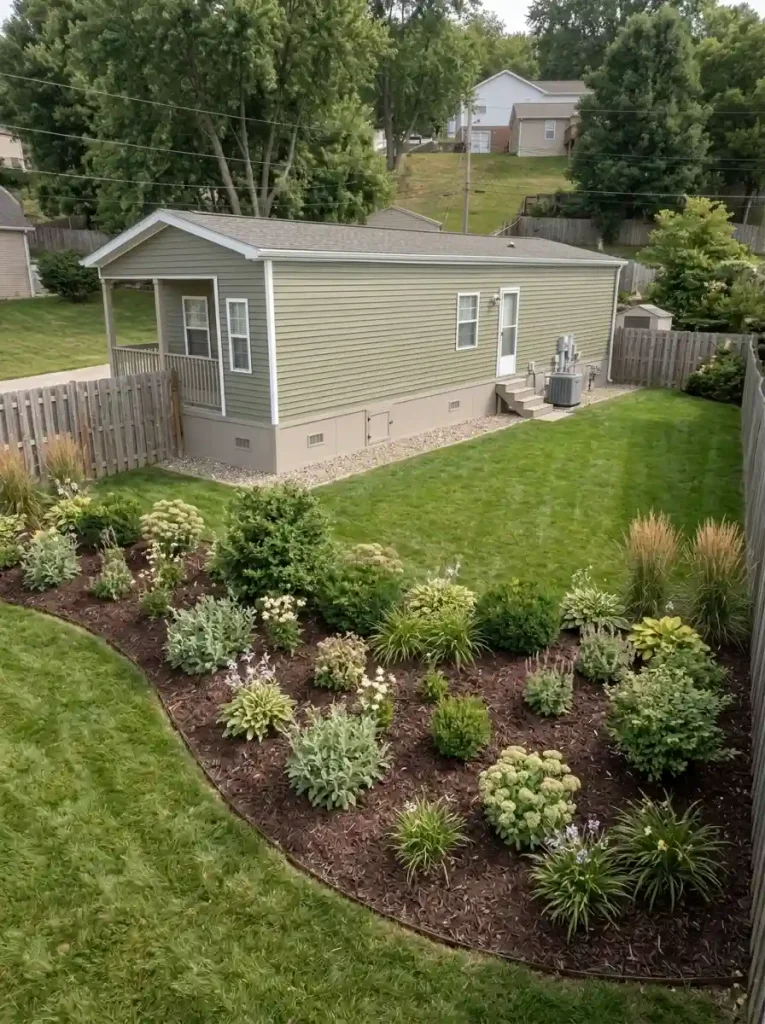
Fresh mulch may look like the finishing touch, but its most useful job is beneath the surface: shielding soil from drying out and suppressing some emerging weeds. In a narrow garden alongside a manufactured home, an appropriately covered bed can reduce repeated weeding without expanding the planting area.
Remove established weeds first. Penn State Extension recommends two to three inches of organic mulch for tree and shrub planting areas; finer materials may need shallower coverage.
Keep mulch away from stems, trunks and skirting. Check the remaining depth before adding more next season, and investigate persistently wet soil before replenishing the layer.
8. Install Garden Edges That Make Mowing Easier
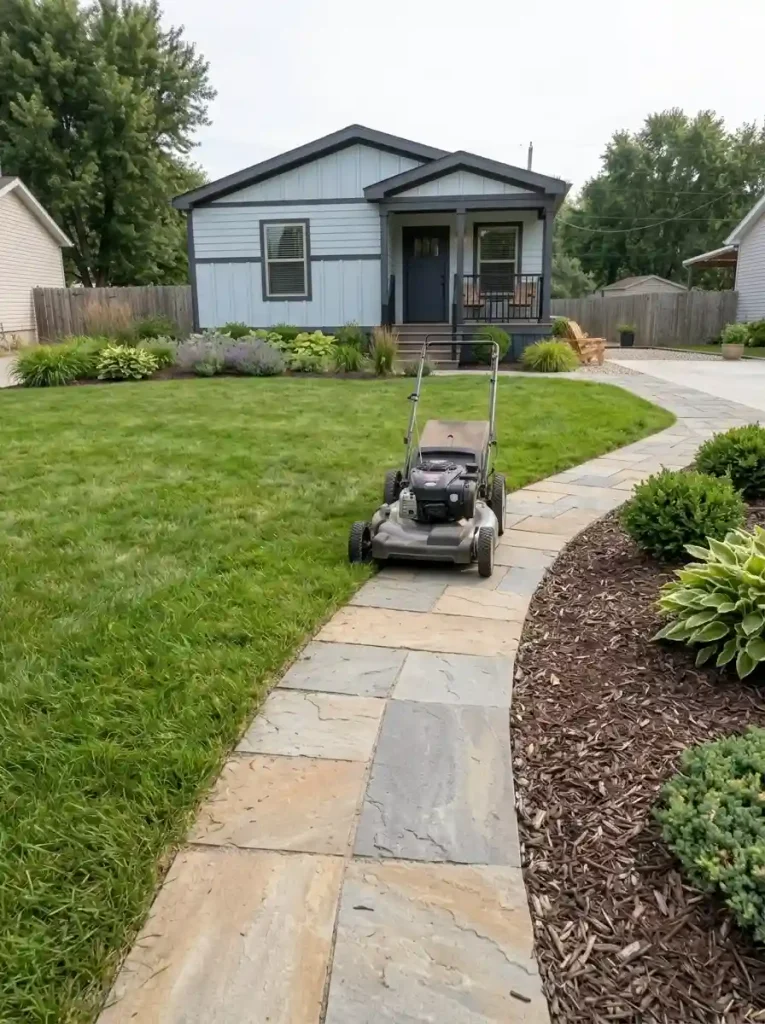
Imagine pushing a mower along the front garden and finishing the edge in the same pass. A properly installed low-profile mowing strip may make that possible by supporting the outer wheel while the mower cuts nearby grass.
Test the proposed edge with your actual mower, taking account of its wheel position and turning space. Tight curves around porch posts or high decorative borders can still require separate trimming. On a shallow manufactured-home frontage, uncomplicated lines often work best.
Before installation: Contact 811 before disturbing the ground, follow local locating requirements and check with the property manager about private utility lines.
Design an edge your mower can follow.
Before digging: Follow local utility-location requirements, contact 811 in the US and check whether private lines need separate locating.
9. Plant Shrubs That Naturally Stay the Right Size
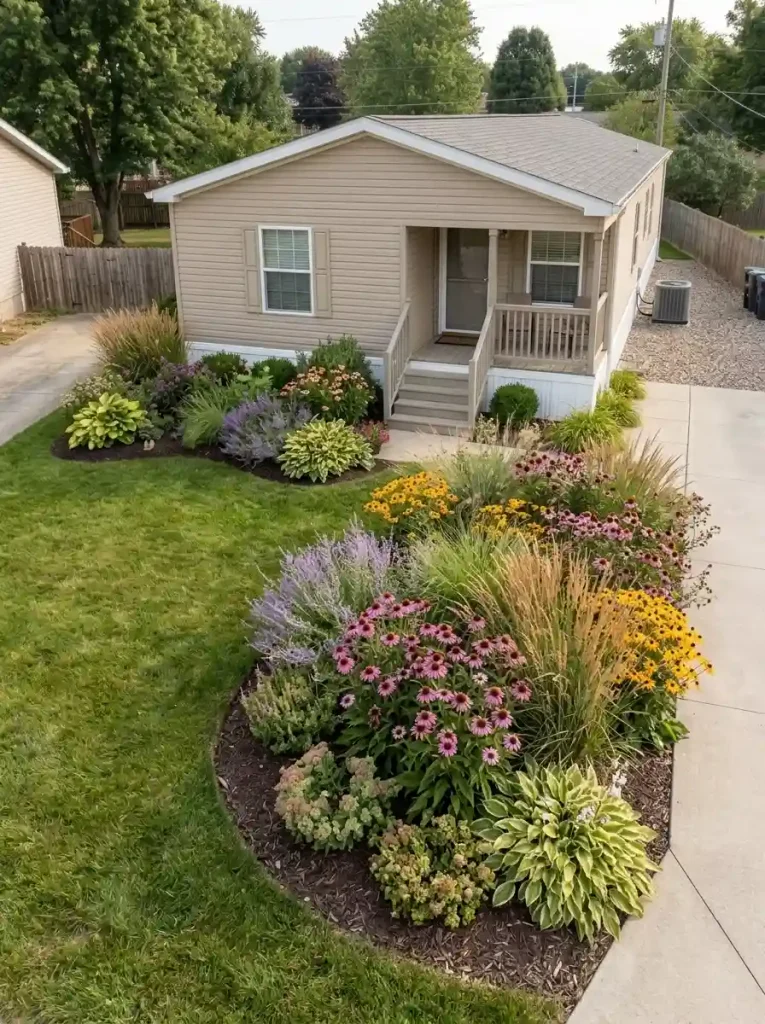
At the nursery, two shrubs may look almost identical in their containers. Their mature dimensions can tell a very different story.
Your available width should determine the plant, not the plant’s current size.
Measure the usable planting space after allowing for the walkway, windows, skirting access and equipment clearances. Compare that measurement with the cultivar’s expected mature spread and height.
A naturally compact shrub suited to local growing conditions can soften the long exterior of a single-wide without repeatedly growing across the path. Avoid buying a fast-growing variety on the assumption that pruning will keep it permanently small.
Even plants labeled dwarf need their mature dimensions checked.
10. Choose Native and Climate-Adapted Plants That Thrive With Less Attention
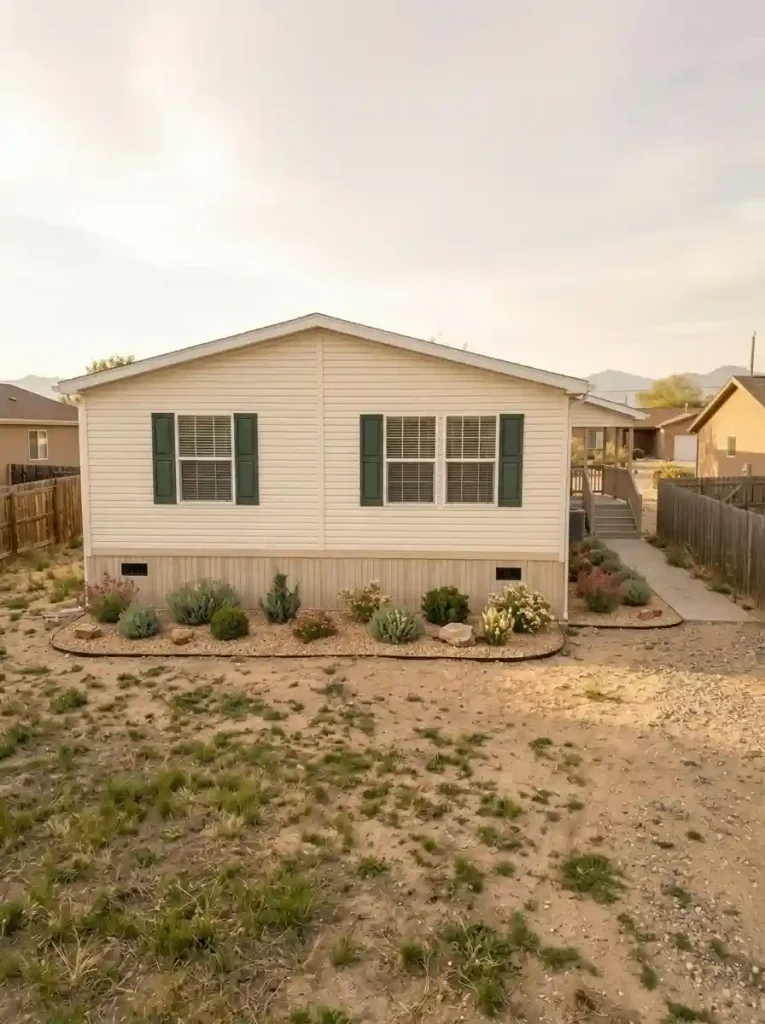
Plant shopping becomes much easier once you know your yard’s conditions. A sunny driveway-side bed may be hot and dry while the shaded side of the same manufactured home stays cooler and damper.
Use the EPA’s regional plant-selection resources or your local cooperative extension to identify suitable species. Locally appropriate penstemons may suit some dry, sunny gardens; certain native sedges can work in suitable shaded sites. Neither is universally appropriate.
Before purchasing, check:
- Sunlight and soil drainage.
- Regional hardiness and mature dimensions.
- Local invasive-plant guidance.
- Establishment and long-term watering needs.
Plan for establishment watering even when mature plants are expected to tolerate drought. Choosing plants for the actual site reduces the work of trying to compensate for unsuitable conditions.
11. Build Your Garden Around Long-Lived, Reliable Perennials
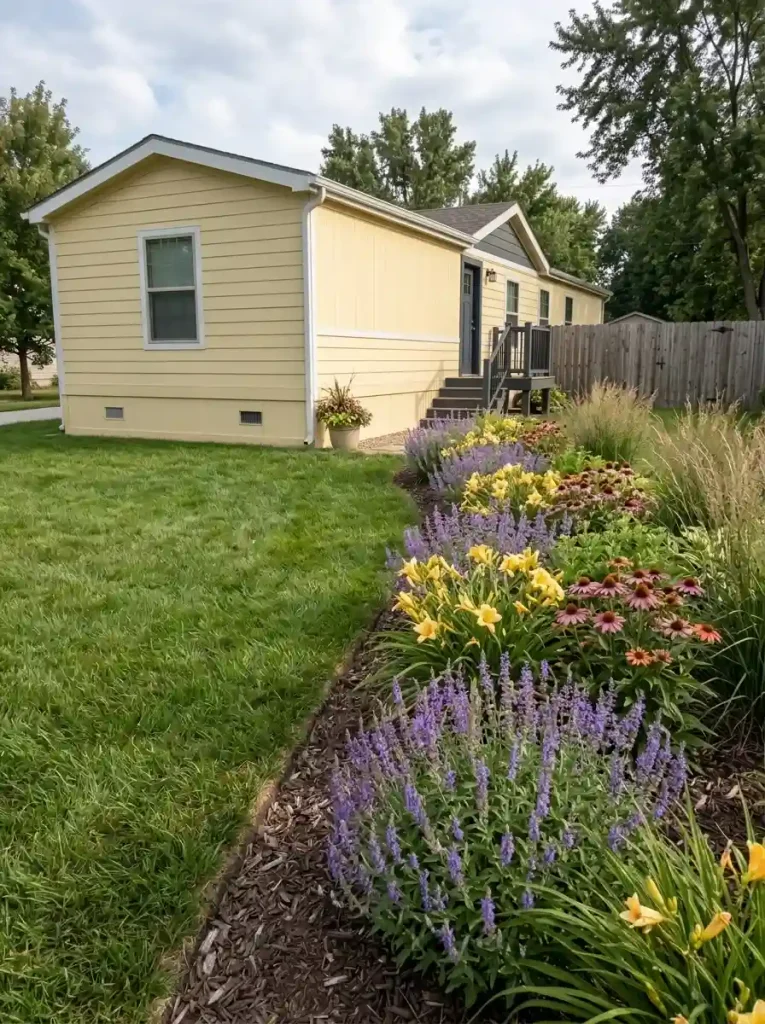
An annual-heavy border: Fresh seasonal color, but repeated purchases, planting and cleanup.
An established perennial border: A permanent planting framework, with maintenance that varies by species and may include division or cutting back.
For a long mobile-home frontage, repeat a small selection of suitable perennials and foliage plants along the visible garden border. Before purchasing, check how frequently the plants need dividing, staking or deadheading and whether they spread aggressively.
Keep a small area near the steps for optional annual color. The garden can change with the seasons without requiring an entirely new planting scheme every year.
12. Group Plants According to Their Watering Needs
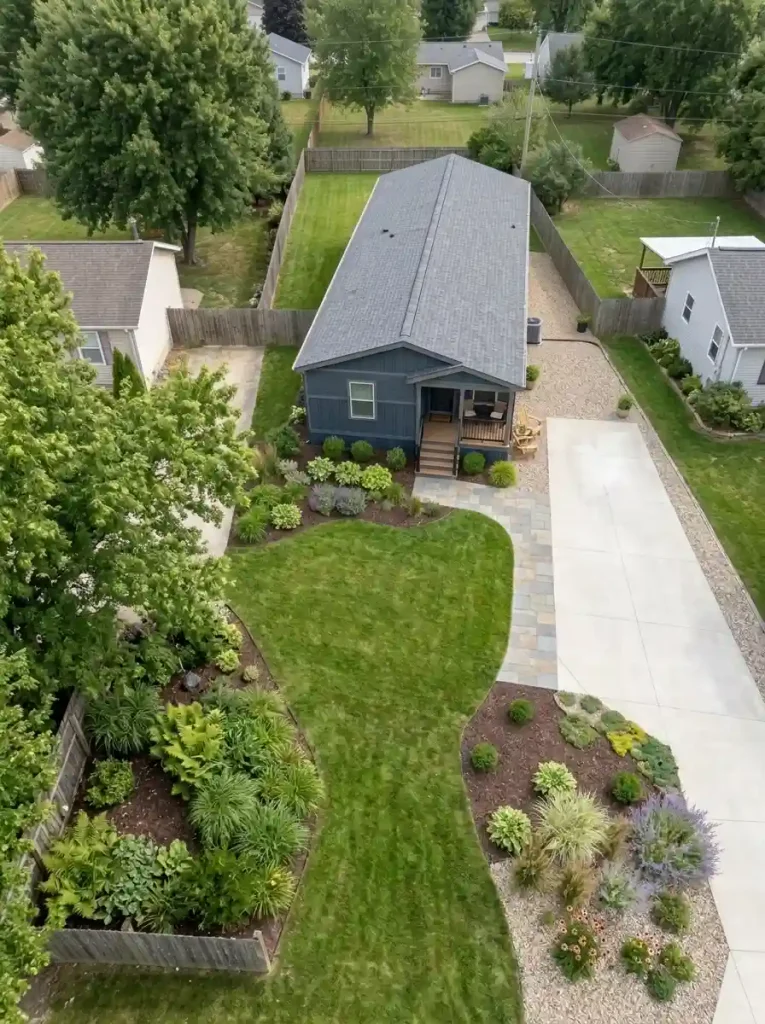
The sun-facing end of a manufactured home may dry faster than a sheltered bed beneath the porch. Giving both areas the same watering schedule can waste water or leave plants struggling.
Hydrozoning groups plants with similar moisture needs into suitable irrigation zones. Sketch your existing beds, mark differences in exposure and check how quickly the soil dries after watering. Move incompatible plants when the season and species permit, or adjust their watering separately.
The EPA’s watering guidance recommends considering plant needs, sun exposure and irrigation method together.
Important distinction: A naturally damp planting location is not a substitute for correcting water accumulation near the home.
Plant together. Water together.
Select every condition that exists in your yard. Compare plant groups side by side.
Protect the home: Persistent water near skirting or supports requires drainage assessment. Hydrozones describe plant needs, not universal watering schedules.
13. Create a Low-Maintenance Privacy Screen Along One Boundary
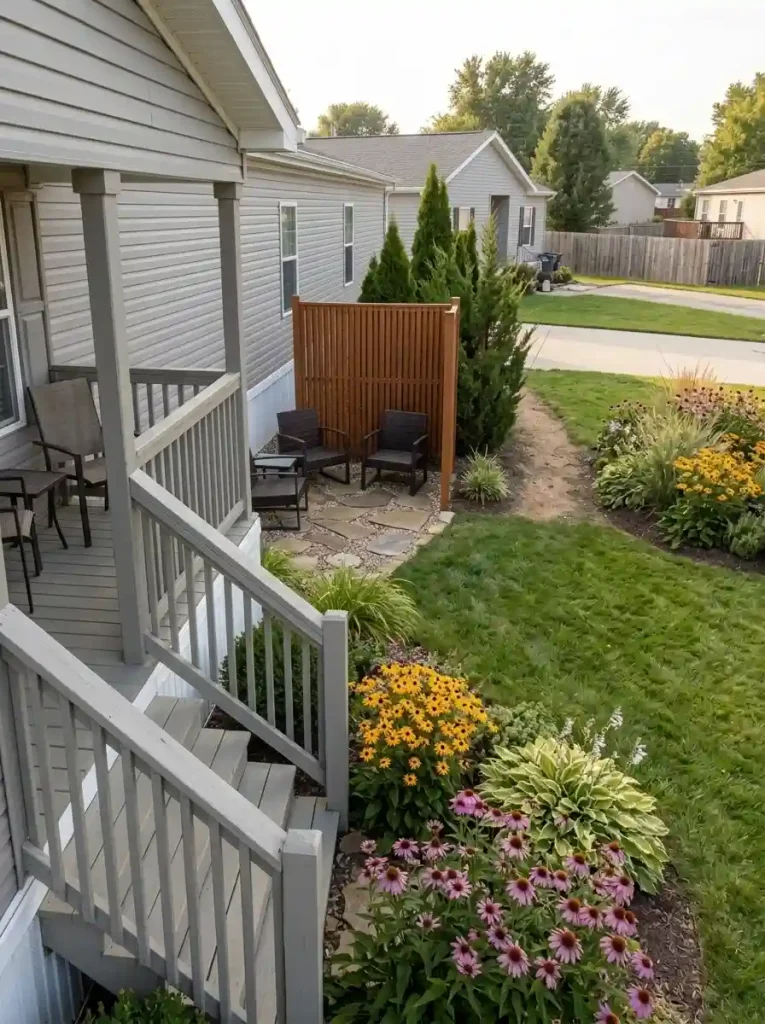
Suppose the neighbor’s driveway is visible from your porch, but the rest of the yard feels comfortable. Screening that one sightline may provide all the privacy you need.
A small cluster of appropriately sized upright plants can be easier to manage than a long formal hedge requiring frequent clipping. An approved, appropriately installed screen may suit a rented lot where permanent planting is restricted.
Stand at the usual seating position to check where screening is actually needed; avoid blocking equipment access or required escape routes. For other compact-lot configurations, see these single wide landscaping ideas.
14. Replace Thirsty Container Collections With a Few Self-Watering Planters
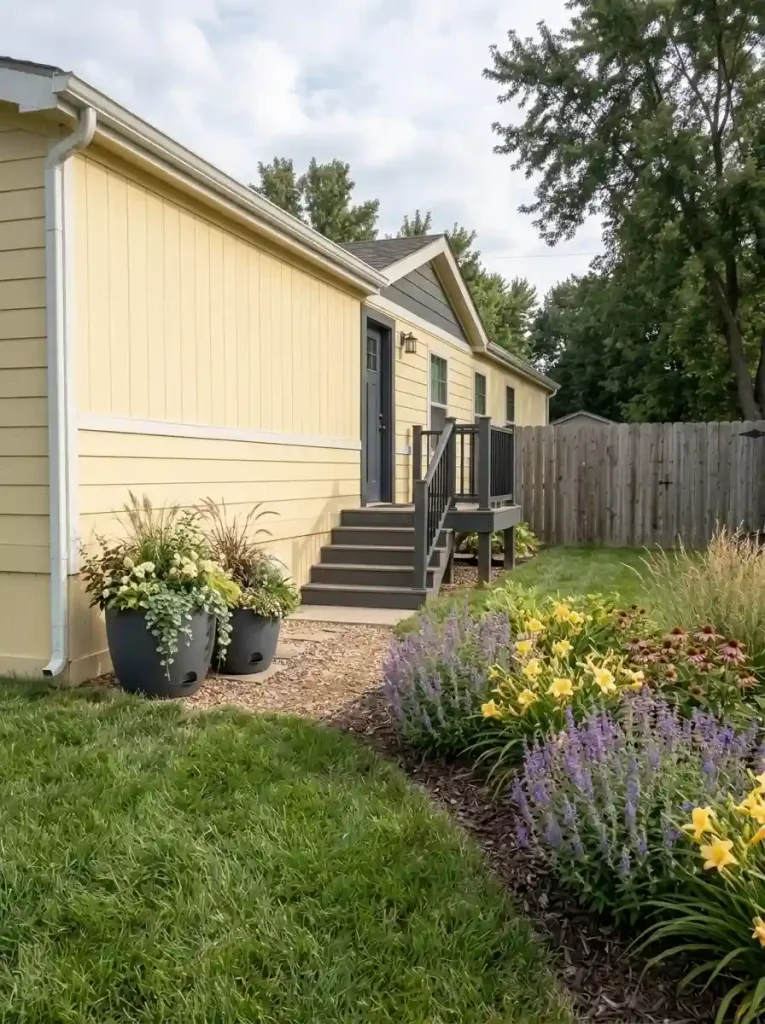
Choose one generous planter near a porch corner or a matching pair on either side of a spacious entrance, provided the landing and walking route remain clear. Consolidating several small pots can reduce the number of containers you need to check during hot weather. Reservoir-style planters may further extend watering intervals for compatible plants. Look for an overflow opening, appropriate growing medium and a reservoir you can refill easily. Plants that prefer dry roots may be better in conventional free-draining pots. On rented manufactured-home lots, movable planters offer seasonal flexibility without permanently altering the ground.
15. Simplify Garden Watering With Targeted Drip Irrigation
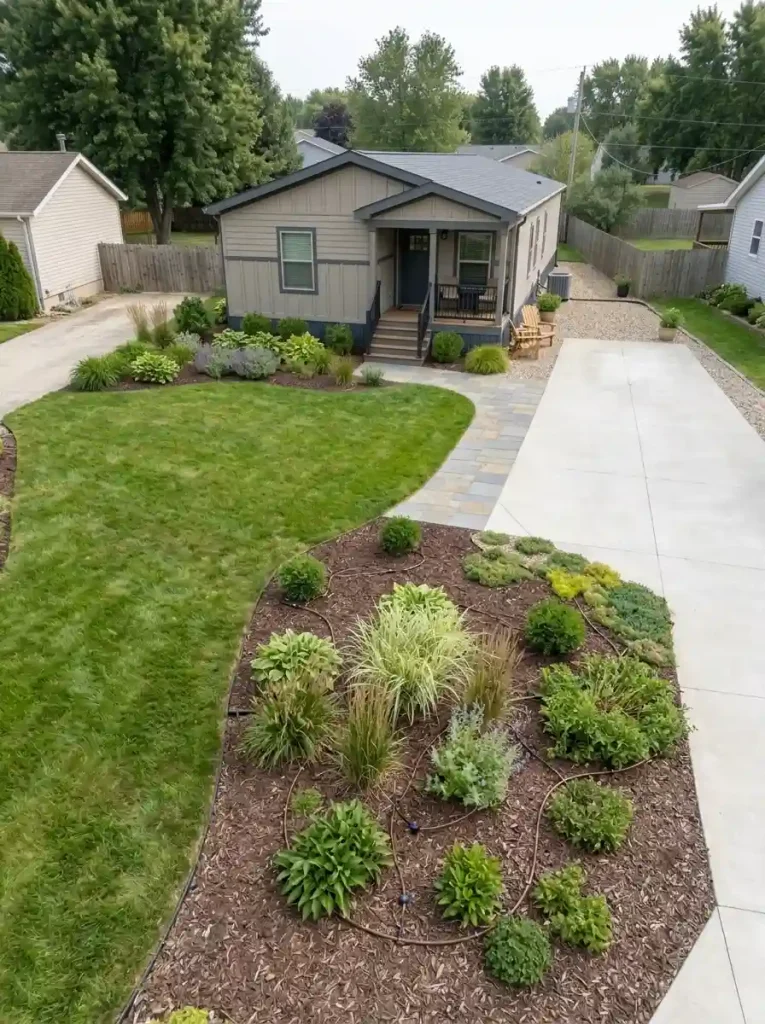
Dragging a hose between separate planting areas along a long single-wide becomes an unnecessary routine when suitable beds can be watered more directly. Drip irrigation can reduce manual work by delivering water near the plants’ root zones.
- Identify which beds need supplemental water and group compatible plants.
- Select components appropriate for the water supply, pressure and local backflow-protection requirements.
- Position tubing where it won’t obstruct paths or skirting access.
- Adjust the schedule for rainfall, soil moisture and establishment needs.
- Check emitters for leaks, clogs and displacement; prepare the system for freezing conditions where necessary.
Avoid directing irrigation toward the home. Ask an irrigation professional about installation requirements if the water connection or layout is uncertain.
16. Turn an Awkward Side Yard Into an Easy-Care Service Path
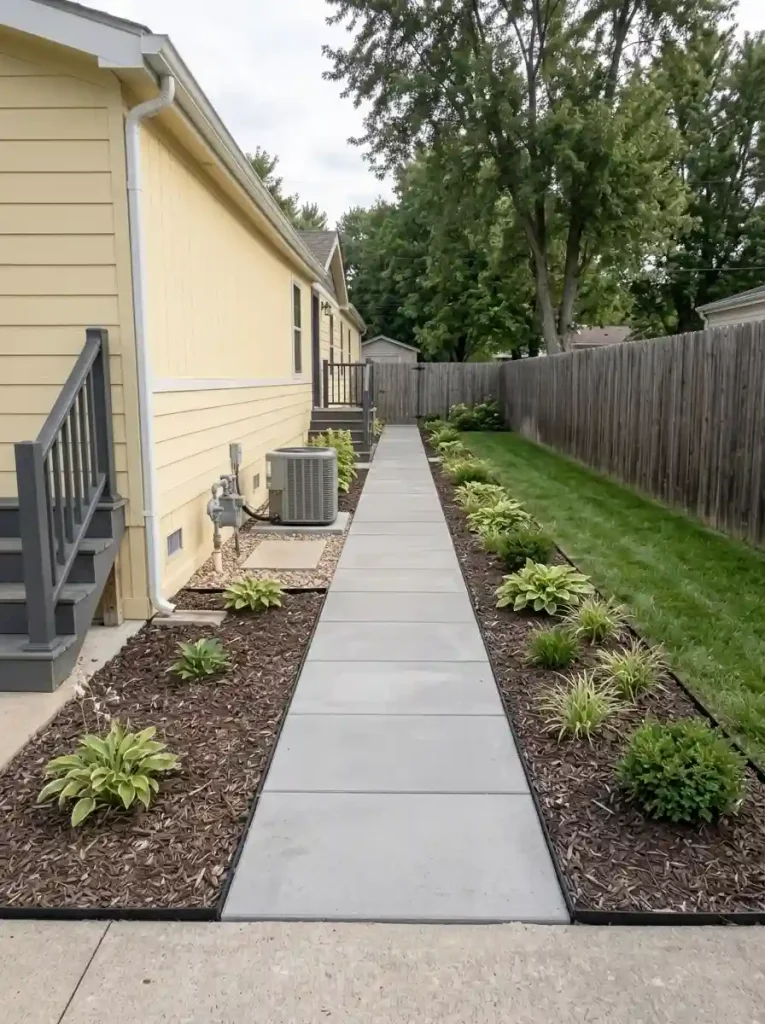
Walk from the driveway to the outdoor equipment and skirting access panel as though you were carrying a toolbox. Where do you have to squeeze past plants, step over loose stones or move containers?
A stable, unobstructed route can eliminate those daily frustrations and simplify maintenance visits. On narrow manufactured-home lots, keep decorative planting on the side of the route that leaves sufficient room for access, including at mature plant size. Retain functioning drainage and select a surface appropriate for footing and local conditions.
A service path should remain usable without rearranging the garden.
17. Let Rainwater Management Guide Your Landscaping Choices
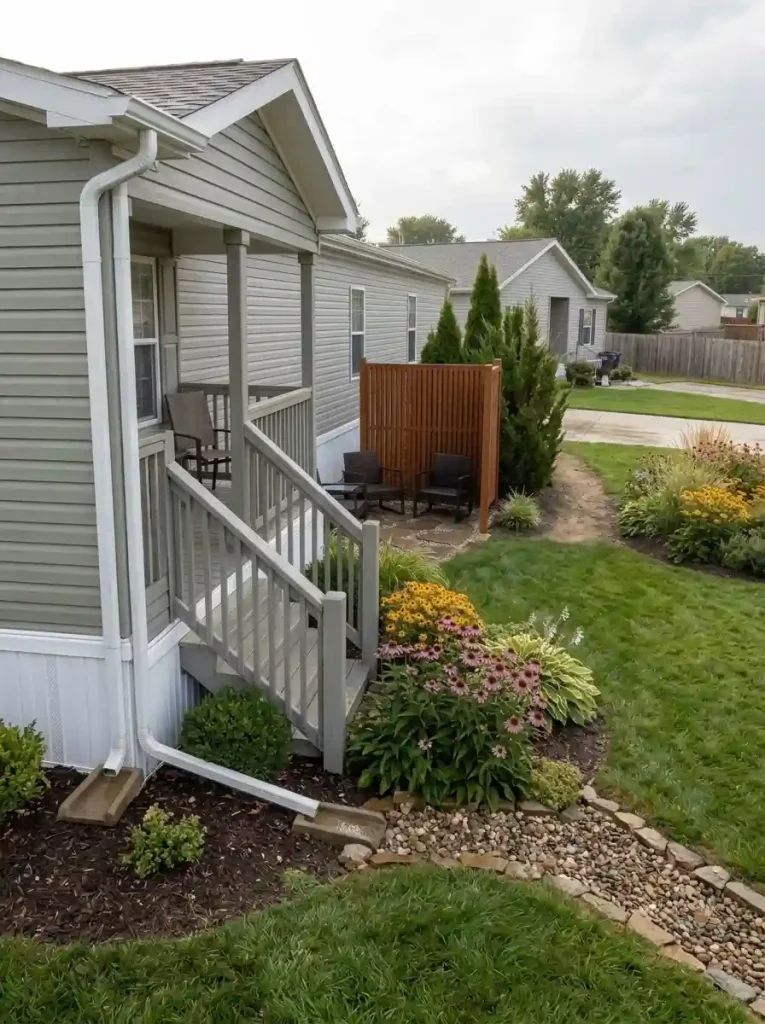
After a heavy rain, observe the yard from a safe location. Water pooling near skirting, erosion around steps or sediment collecting across the path are warning signs that should influence landscaping plans.
The federal manufactured-home site drainage standard requires surface water to be directed away from the home to protect its foundation supports.
New borders, paving or raised beds should not interrupt a functioning drainage route. Keep roof runoff discharge areas clear and seek qualified assessment for persistent pooling, erosion or suspected grading problems. On rented lots, report these concerns to the property manager as well.
Decorative stone cannot correct an underlying drainage defect simply by hiding it.
18. Use a Seasonal Garden Routine That Prevents Bigger Jobs
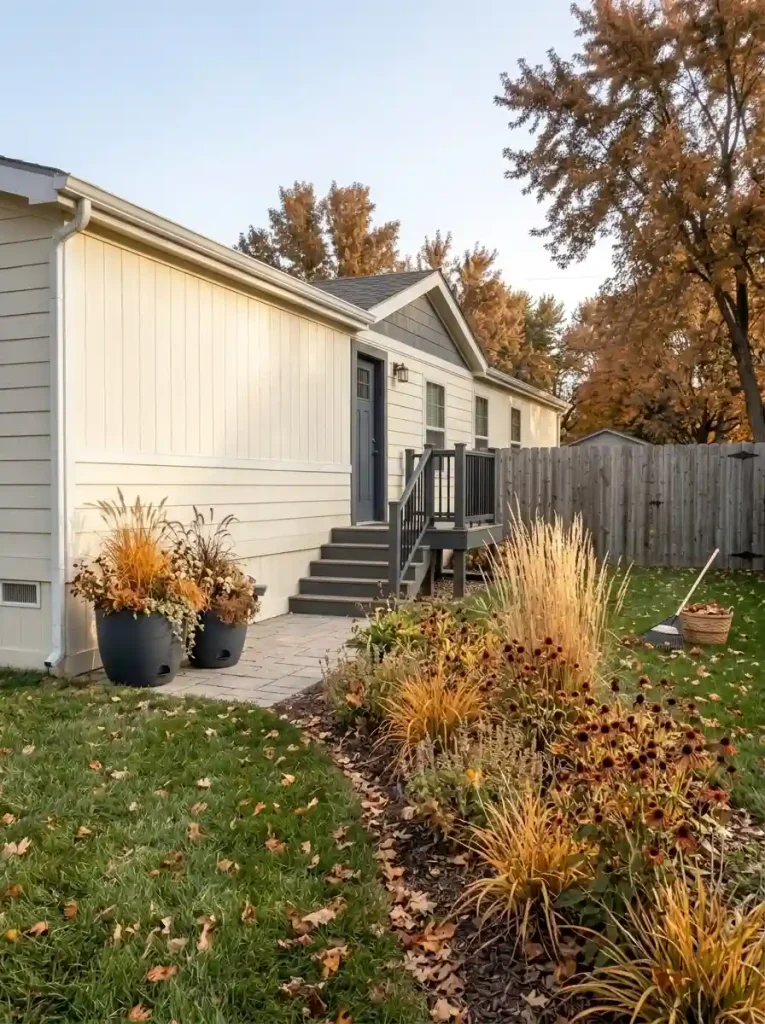
A lower-maintenance yard still needs occasional attention. Small preventive checks can make the difference between a manageable job and a weekend spent restoring an overgrown garden.
| Season | Useful preventive check |
|---|---|
| Spring | Inspect winter damage, mulch and irrigation. |
| Summer | Check soil moisture, weeds and access routes. |
| Fall | Clear debris from paths and around ventilation openings; prepare irrigation for cold weather if needed. |
| Winter | Observe the yard after storms and note drainage or access problems. |
Adapt the schedule to your climate. After each season, identify the feature that required disproportionate effort and decide whether it deserves a redesign.
Small jobs. A simpler year.
Tick off the jobs you complete. Use the four seasons as a flexible framework, not a fixed schedule.
19. Convert Your Yard Into a Low-Maintenance Landscape One Zone at a Time
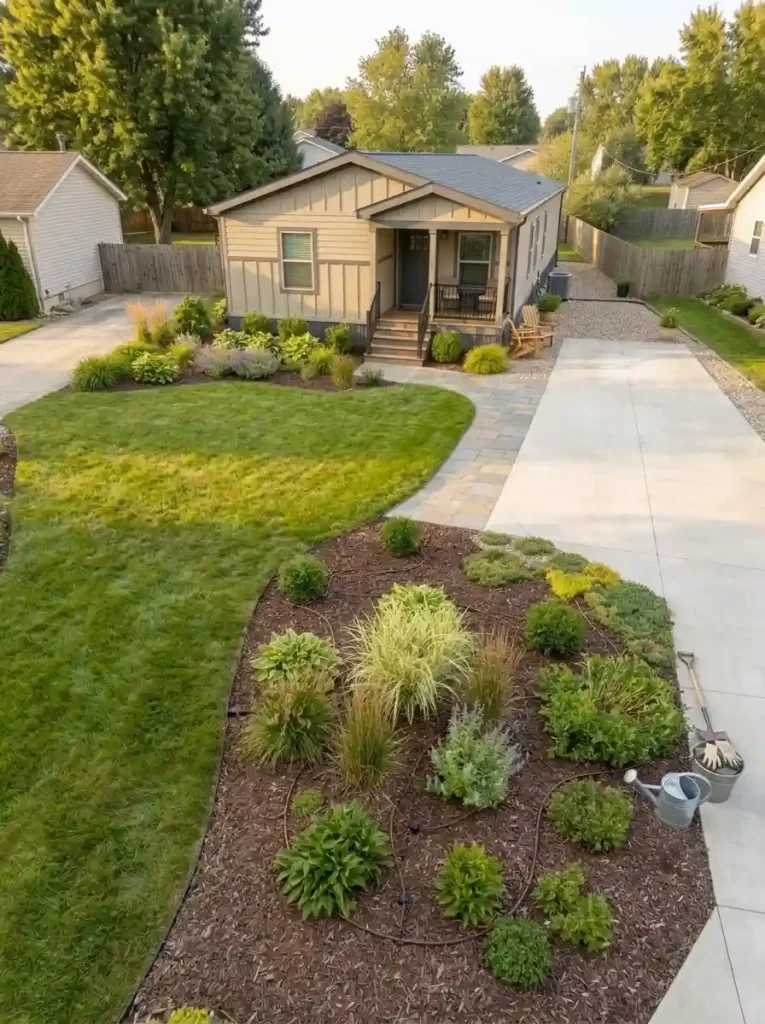
Begin with a small trial area, such as an awkward strip beside the driveway or a troublesome bed near the front entrance. Before making changes, address necessary drainage or access issues and confirm permissions.
Track three things during normal maintenance:
- How often the area needs attention.
- Which tasks remain.
- Whether the space still works for everyday use.
Compare the new arrangement with your original routine after the plants have established and through representative weather conditions. Expand only when the improvement is genuinely easier to maintain.
For an affordable first project, explore these mobile home front yard ideas. A modest successful change is more useful than a complete makeover that introduces unfamiliar chores.
Transform one zone. Then expand.
Use this sequence to test whether a landscaping change genuinely reduces recurring work.
-
Protect the home
Review drainage, required access, utility locations and community permissions before altering the yard.
Move on when essential site issues are addressed. -
Choose a trial zone
Pick one recurring frustration and record the original maintenance routine.
Move on when you know what improvement you want to test. -
Establish the change
Install suitable materials and plants. Allow for establishment care and normal weather variation.
Do not judge new planting too early. -
Compare before expanding
Review remaining chores, frequency and day-to-day usability. Refine the trial before repeating it elsewhere.
Expand only when the result is genuinely easier to maintain.
Example trial: awkward grass strip
- Before
- Separate mowing and edge trimming beside the driveway.
- Change
- Replace the unused strip with a suitable contained surface or planting.
- After establishment
- Record weed checks, debris removal and remaining trimming during normal yard care.
Success: Less recurring effort without compromising drainage, access or everyday yard use.
Final Thoughts
A beautiful manufactured-home landscape doesn’t have to look elaborate to feel thoughtfully designed. Healthy, well-sized plants, clear pathways and a simple arrangement of ground surfaces can create a welcoming exterior that fits your everyday life.
Start with the chore that takes up the most time. Simplify one difficult lawn area, replace one unsuitable planting group or consolidate the containers near your entrance. Keep the parts of the garden you enjoy, and make changes where they solve an actual problem.
Allow new planting time to establish before judging the outcome. As the garden settles in, you’ll have a clearer idea of which improvements deserve to be repeated—and more opportunities to enjoy the outdoor space you’ve created.