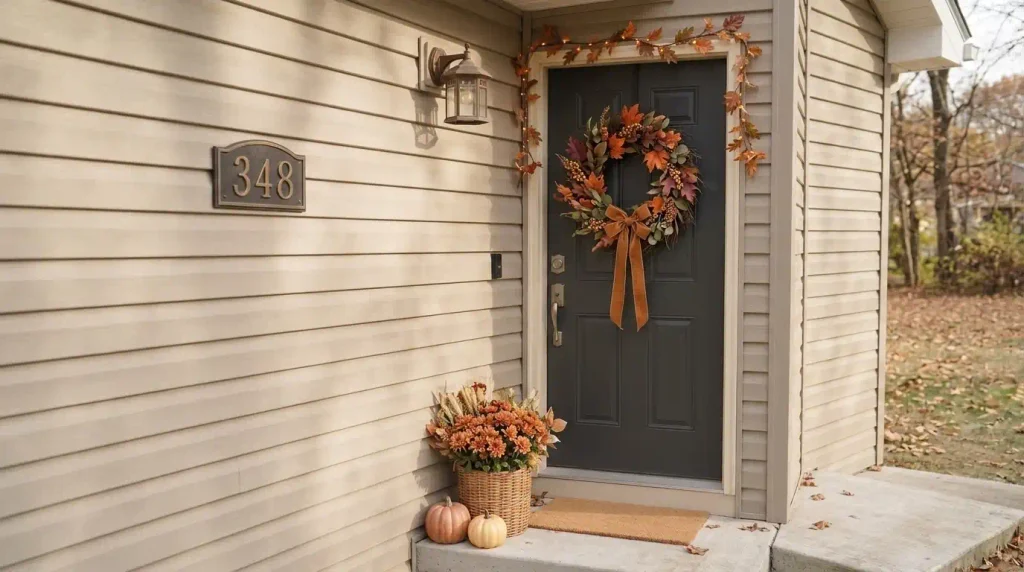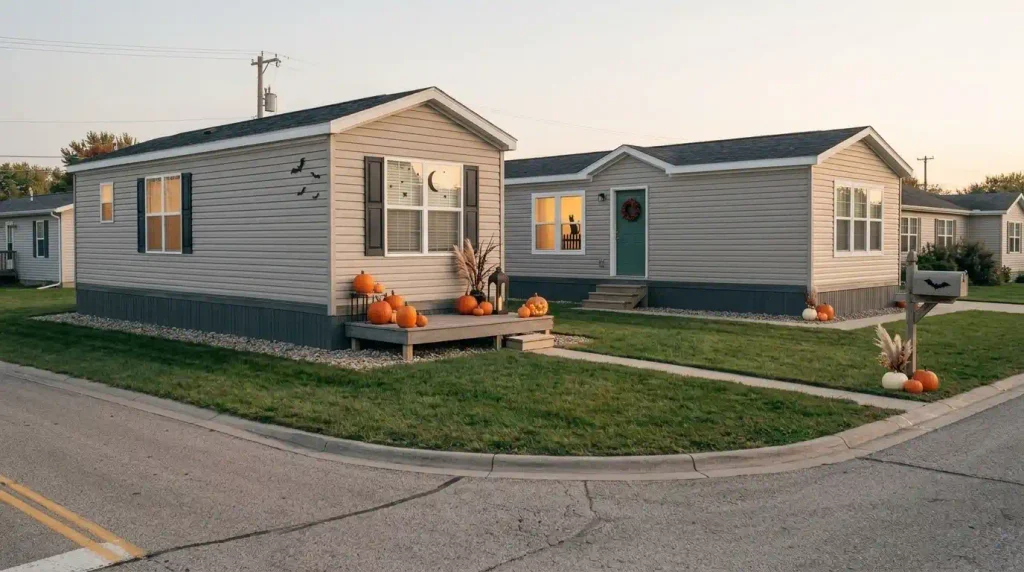
A manufactured home can look especially good in fall because the season naturally changes the landscape around it—deeper foliage color, softer light, richer textures, and a cleaner transition from yard to façade. The trick is making those changes work with the home’s architecture instead of piling autumn décor around the front door.
Strong fall manufactured home curb appeal starts farther back. What matters from the street is different from what matters beside the steps, and the best results connect the façade, landscaping, windows, entry, and ground plane into one clear composition.
Start with the big picture first. The pumpkins can come later.
1. Start With a Fall Curb-View Reset
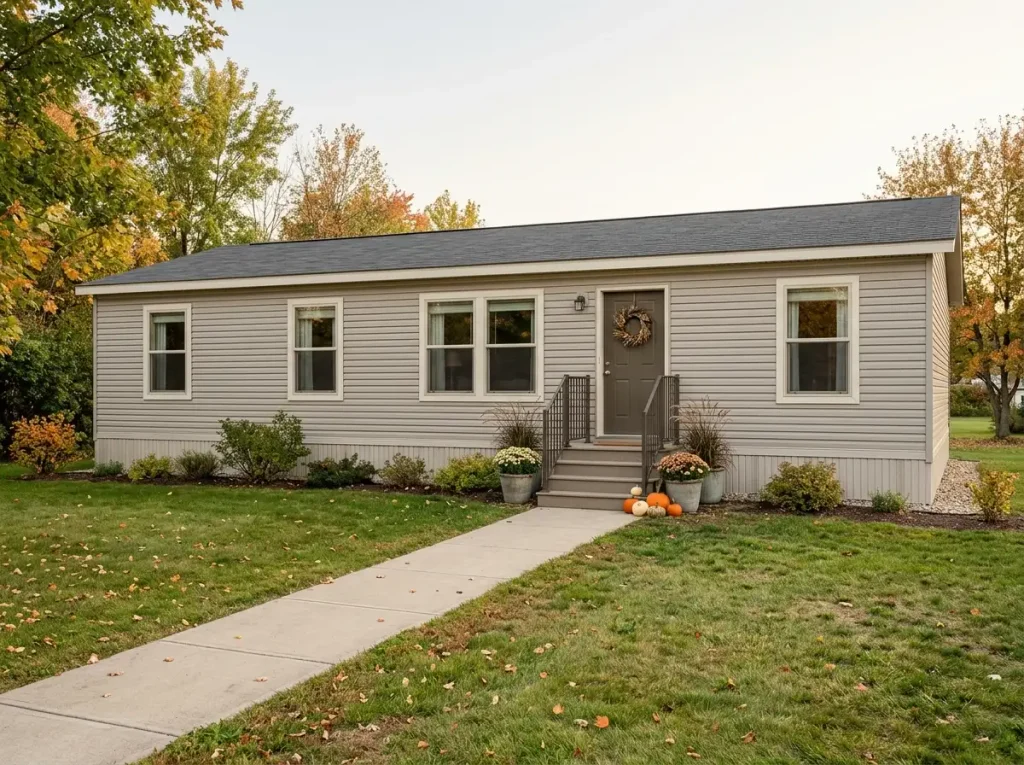
Before buying anything for fall, walk out toward the street or the end of the driveway and turn around.
Better yet, take a quick phone photo of the entire front of your home. A photograph makes scattered clutter much easier to notice than standing five feet from the porch does.
Fall often exposes problems that summer greenery was quietly hiding. Empty pots remain after annuals fade. Garden tools migrate toward the house. Fallen leaves collect against steps. Small decorations from earlier in the year compete with the stronger autumn colors beginning to appear around them.
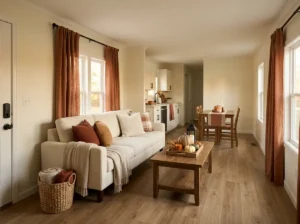
On a long manufactured-home façade, that visual noise can spread from one end of the elevation to the other.
The first improvement may therefore cost nothing: decide what no longer deserves attention.
Remove or relocate things that do not contribute to the fall picture, including:
- empty or mismatched planters
- faded summer accessories
- unused outdoor furniture
- loose garden supplies
- damaged decorations
- excess objects around the steps
- seasonal debris along the foundation
Do not aim for an empty exterior. Aim for a clearer hierarchy.
From the road, you should be able to identify the entrance first, understand the basic shape of the landscaping second, and notice smaller seasonal details only as you move closer.
That order matters.
Once the exterior reads clearly at a distance, the next decisions become much easier.
2. Build Your Fall Palette Around the Siding, Roof and Skirting
Do not start with a generic collection of orange fall décor.
Start with the colors that are already too large to ignore.
Your siding, roof, skirting, door, shutters, steps, and permanent hardscape create the background for every seasonal item you add. A fall palette feels more polished when it responds to those fixed surfaces.
For example, a warm cream or beige exterior can handle rust, tobacco brown, muted pumpkin, olive, and deep red without creating harsh contrast. Cooler gray siding may look stronger with burgundy, copper, muted gold, evergreen, or brown-based neutrals.
A darker exterior may need fewer deep colors and a little more contrast so seasonal details do not disappear from the curb.
The goal is not to match everything.
Think in three layers:
Base color: the home’s dominant permanent finish.
Seasonal bridge: one autumn tone that already relates comfortably to that finish.
Accent: one deeper or brighter color used sparingly where you want attention.
So a light taupe manufactured home might move through:
taupe → muted rust → deep burgundy
while a cooler gray exterior could move through:
gray → copper brown → subdued mustard
This gives you a palette before you choose a single pumpkin, planter, wreath, or textile.
It also prevents the common problem where each fall item looks attractive on its own but the full exterior feels disconnected.
Two or three seasonal color families are usually enough.
3. Give the Ground Plane a Cleaner Fall Frame
Sometimes the front door is not the reason a fall exterior feels unfinished.
Look lower.
The line where the manufactured home meets the yard has a surprisingly large effect on curb appeal, especially across a long elevation. When bed edges disappear, summer plants decline, weeds interrupt the foundation line, or several ground materials compete, the entire house can look less settled in the landscape.
Fall is a useful moment to restore that structure.
Start by removing declining seasonal growth and obvious debris. Re-establish clean bed edges where planting beds already exist, tidy gravel or other established ground surfaces, and refresh worn areas only when the material suits the site.
You are creating a frame beneath the home—not another decorative display.
A simple foundation area often looks stronger than a busy one because the eye can read three layers clearly:
home → landscape edge → open yard
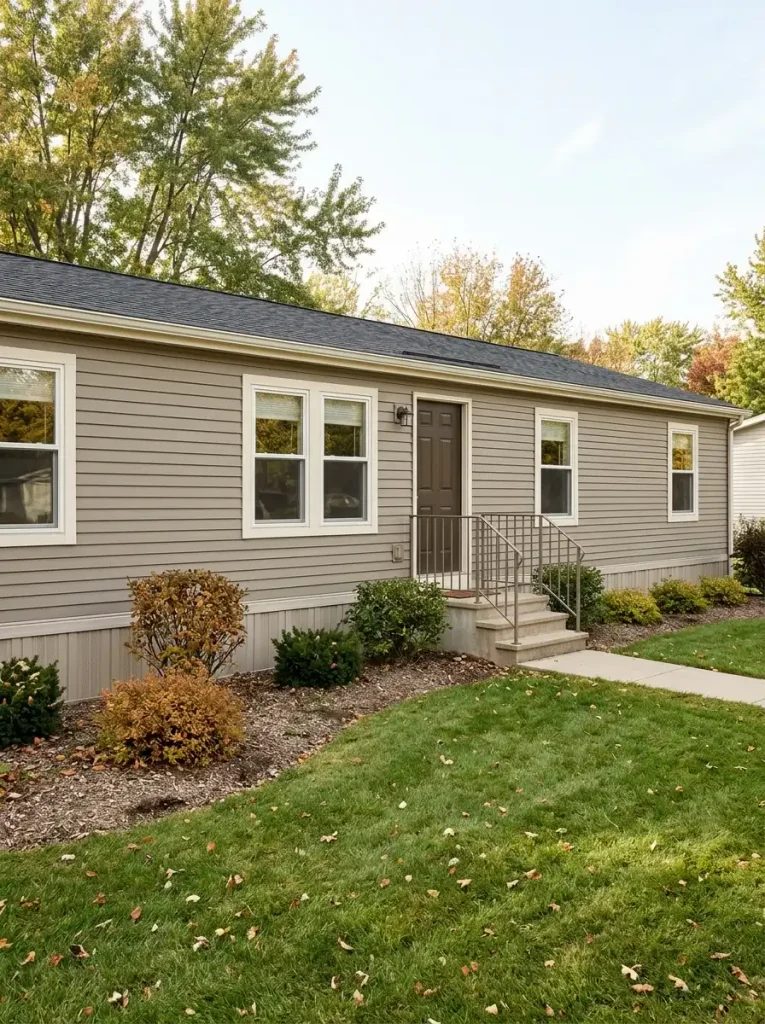
That relationship becomes particularly useful around visible skirting.
You do not need to hide every inch of the base with plants. A consistent ground plane can make the transition feel intentional before any containers are introduced.
Homes without traditional planting beds can use the same principle.
On a gravel or low-maintenance lot, the improvement might simply be cleaner edges, fewer competing objects, and a more deliberate connection between the path, home, and open ground.
The finished result should make the manufactured home look anchored to its site.
If the landscaping calls more attention to its messiness than to its shape, the frame still needs editing.
4. Turn Repeated Windows Into an Autumn Rhythm
A row of windows is not just part of the architecture. On many manufactured homes, it can become one of the easiest ways to create continuity across a long front elevation.
The key is not decorating every window.
Repeating an identical fall treatment at each opening can quickly make the façade look mechanical. A better approach is to use selected windows as architectural beats.
Imagine five front-facing windows.
You might emphasize the first, third, and fifth with restrained seasonal cues while allowing the spaces between them to stay quiet.
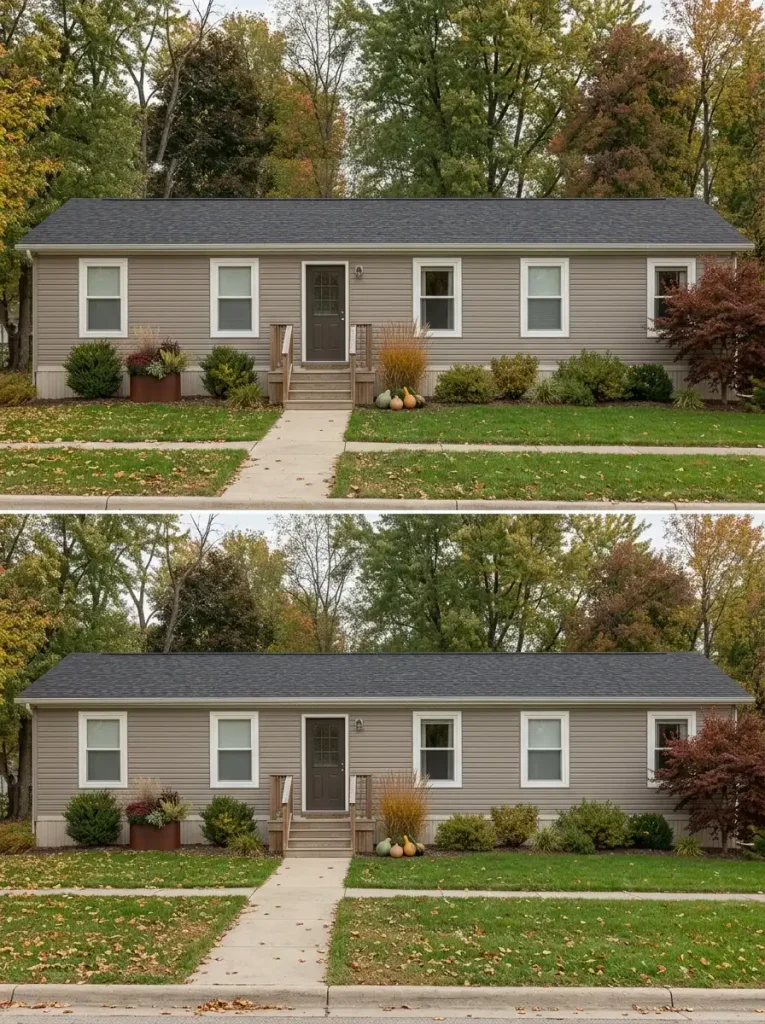
From farther away, the eye registers a rhythm across the home without seeing five separate decorating projects.
The seasonal signal can vary according to what the architecture allows.
A window box may contribute autumn foliage where one already exists. A nearby planter can establish the same connection without attaching anything to the window.
Existing shutters can provide enough emphasis that only the surrounding landscape needs seasonal color.
The principle is:
repeat the relationship, not necessarily the object.
One window might relate to a planter below it. Another could align with a deeper fall-colored shrub or existing landscape feature.
A third may need no physical decoration at all if the neighboring entry already supplies enough color.
From the curb, those repeated relationships help break a wide façade into readable intervals.
Stop once the eye moves naturally across the front of the home.
If every window starts demanding equal attention, rhythm has become repetition.
5. Give the Entrance One Strong Vertical Fall Anchor
A long manufactured-home façade naturally pulls the eye sideways.
If the entrance is compact, a collection of small decorations can disappear against that horizontal shape.
This is where one stronger vertical element can do more than five tiny ones.
A tall planter, upright branch arrangement, narrow lantern grouping, or another weather-appropriate vertical accent can give the doorway enough height to register from the driveway.
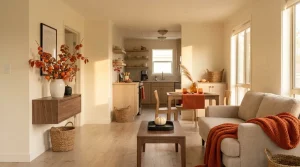
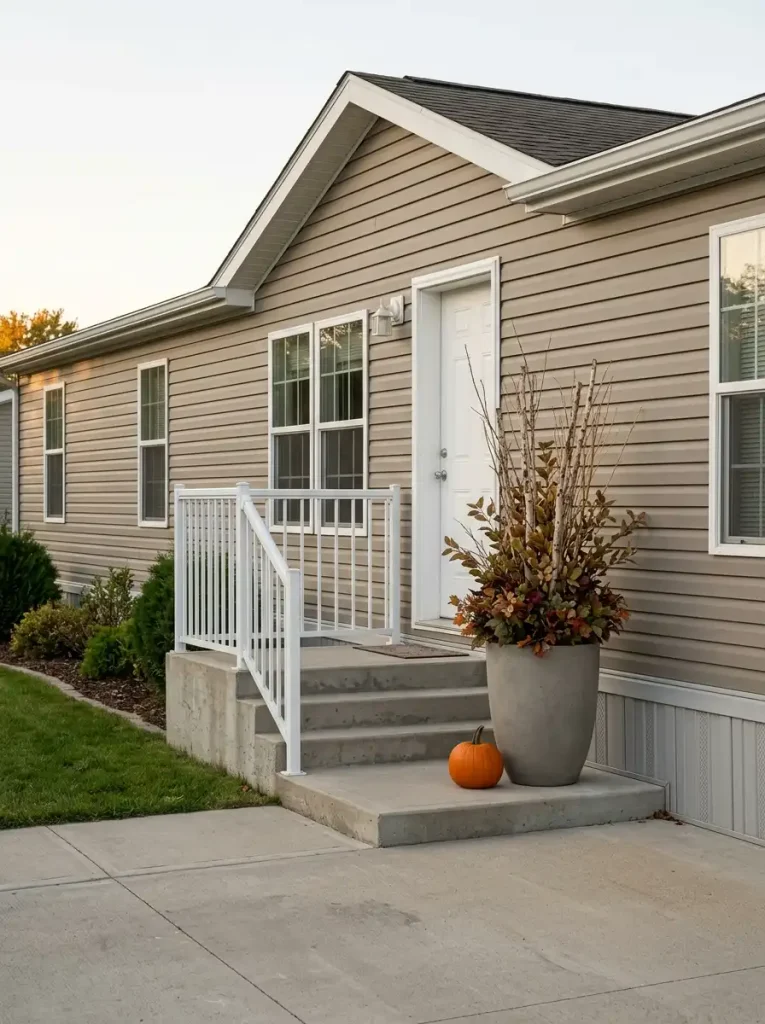
The aim is not to make the entry look oversized. It is to make its position obvious.
Think about the relationship between the door and the seasonal element beside it.
A substantial planter extending into the lower portion of the doorway’s overall height often creates more curb presence than several low objects scattered across the steps.
A narrow composition also preserves more usable floor space than a wide decorative cluster.
Keep the established fall palette from earlier sections, but let scale do the work here.
If wind exposure is strong, avoid tall lightweight pieces that can tip or become unstable.
A heavier planter, a lower but upright foliage form, or an accent positioned closer to a sheltered wall can create a similar vertical effect.
The curb-view test is simple:
Can you identify the entrance before you can identify the individual decorations?
If yes, the scale is working.
If all you see is a collection of small objects once you reach the steps, the entry still needs a clearer anchor.
6. Use Fall Containers to Connect Skirting and Landscape
Fall containers can solve a different problem than decorating the door.
They can soften the transition between the manufactured home’s lower edge and the landscaping below it.
Visible skirting is not automatically something that needs to be hidden.
In many cases, the stronger approach is to make the area around it feel deliberate. A few well-positioned containers can introduce intermediate height between low ground material and the siding above.
That creates a sequence such as:
ground plane → seasonal foliage → skirting → siding
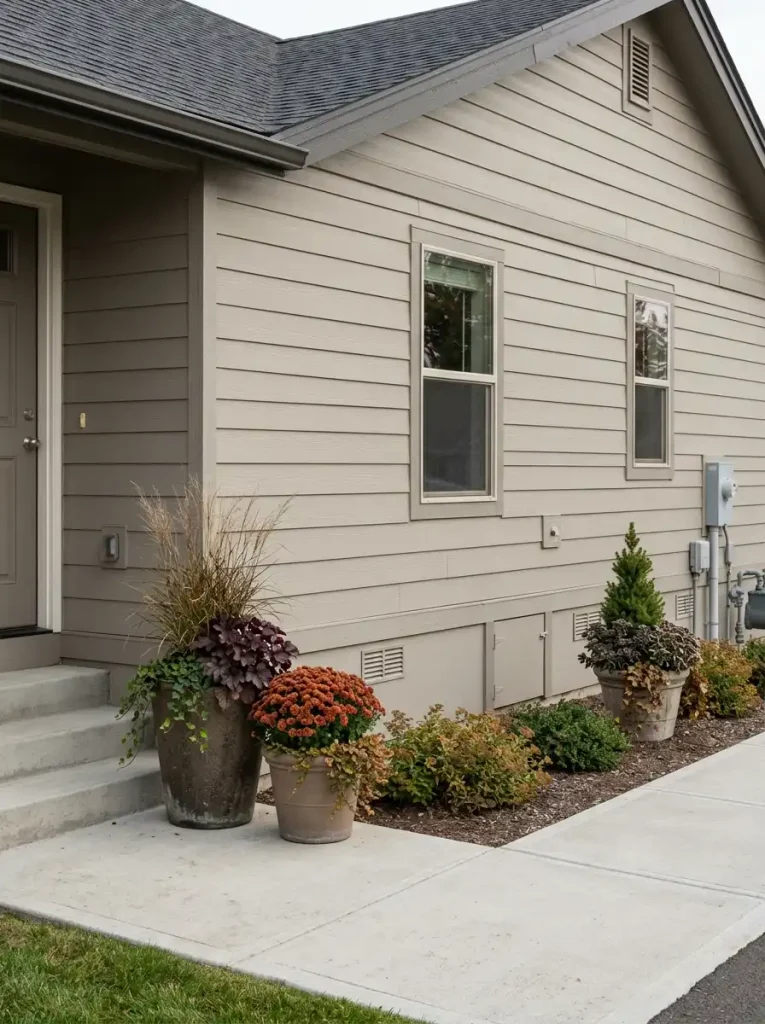
rather than an abrupt point where the yard simply stops at the home.
The most useful container groupings usually rely on varied form, not a large number of plant varieties.
One taller element can establish height.
A fuller middle layer can add body.
A lower trailing or mounded form can visually meet the ground.
The exact plants should depend on your local fall temperatures, sunlight, growing conditions, and frost timing, so avoid treating any single autumn plant as universally suitable.
The container itself matters too.
A pot that relates to the siding, steps, trim, or another permanent exterior finish often looks more integrated than a brightly themed vessel that only works for a few weeks.
For homes with gravel, shallow beds, poor soil, or rental restrictions, containers can be especially practical because they introduce seasonal landscape structure without requiring a new permanent planting bed.
Placement still matters more than quantity.
Do not create an uninterrupted row of pots across the entire skirting. That can make the lower façade feel heavy and may interfere with access, ventilation areas, utilities, or maintenance points.
Concentrate containers where they connect meaningful zones:
- beside the entry
- near the end of a foundation bed
- at a transition between walkway and façade
- near an architectural break
- where the lower edge otherwise feels abrupt
The containers are doing their job when the yard and home feel connected.
They are not doing their job when they look like unrelated pots temporarily parked against the skirting.
7. Carry the Fall Story From the Walkway to the Door
Do not line the whole walkway with pumpkins.
A stronger arrival sequence usually needs fewer signals.
If all of the seasonal interest sits at the entry, the yard can feel disconnected from the front door until a visitor is almost standing on the steps.
Introducing one or two restrained fall cues earlier in the approach can make that progression feel intentional.
Think of the walkway in three stages:
hint → repeat → arrival
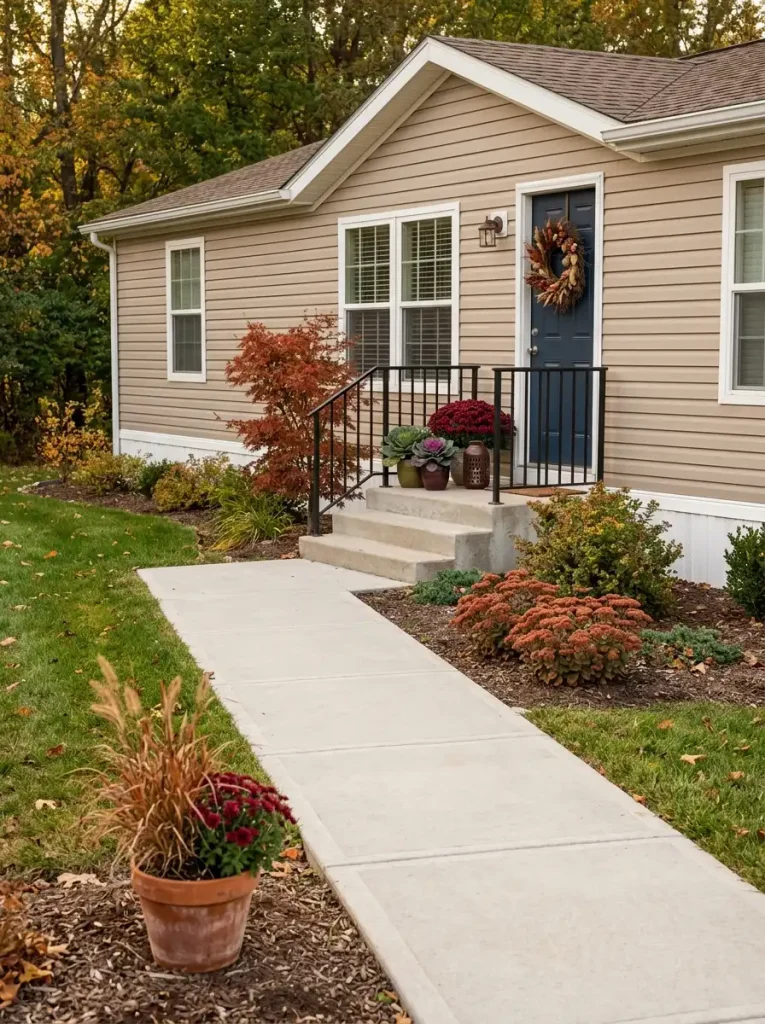
A low planter near the beginning of the path might establish the first seasonal note.
Farther ahead, another accent can repeat one color or material.
The strongest concentration then belongs near the entrance.
The pieces do not need to match.
For example, muted rust foliage near the path could connect to a deeper rust container at the steps. A natural wood tone farther out might echo a similar texture near the doorway.
This carries the autumn atmosphere forward without turning the walkway into a decorative border.
Short paths need even less.
On a compact lot, one intermediate cue may be enough. If the steps are already close to the driveway, nearby landscaping can perform the same job without adding anything directly to the walking surface.
Always preserve comfortable circulation.
Railings, walking width, step edges, ramps, and normal access should remain clear.
Seasonal styling should guide the eye toward the entrance, not make the visitor navigate around it.
When you look from the beginning of the path, the sequence should feel obvious but restrained.
If you notice the decorations before you notice where the path leads, remove one.
8. Make a Tiny Landing—or No Porch at All—Feel Intentional
A manufactured home does not need a large porch to have a strong fall entrance.
When landing space is limited, stop treating the floor as the only available decorating zone.
Use the areas around the threshold.
Depending on the home’s layout, that may include:
- the door itself
- the wall beside the doorway
- the outer edge of the steps
- the landscaping beside the landing
- a nearby planter
- the beginning or end of the walkway
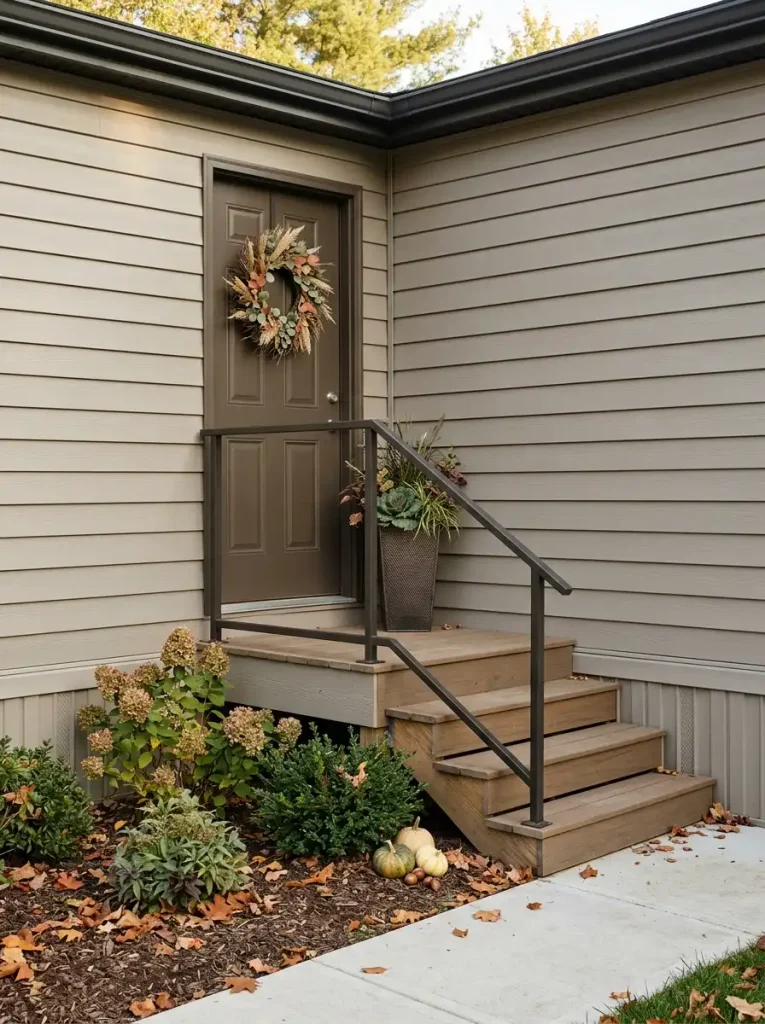
This shifts seasonal interest outward while keeping the actual entry functional.
A narrow landing with a wreath, one vertical planter beside the door, and a small accent positioned outside the walking line can often look more complete than a larger porch filled with unrelated objects.
If there is no porch at all, let the arrival sequence do more of the work.
The door can provide close-view seasonal detail. A container beside the steps can create a lower transition. The walkway or nearby landscape can carry autumn color outward.
You are building an entry zone, not trying to invent a porch that does not exist.
Function should set the limit.
If decorations make the door awkward to open, narrow the steps, interfere with a handrail, obscure access, or force someone to move around objects, the composition has gone too far.
Move decorative weight to the side rather than continuing to add upward or inward.
This is especially useful on small manufactured-home entries because strong curb presence does not require much floor area when the surrounding façade and landscape participate in the composition.
A successful small entry should feel deliberate from a distance and comfortable when you actually use it.
If the design looks good in a photograph but makes entering the home inconvenient, it is not finished.
9. Choose Fall Textures That Can Handle Real Weather
A fall display can look beautiful on the day you arrange it and noticeably worse after the first wet, windy week.
Before choosing a material, decide whether its location is sheltered or fully exposed.
A covered landing can support more delicate seasonal textures.
An uncovered step, deck edge, walkway, or foundation area needs pieces suited to outdoor conditions.
Soft woven textures, untreated decorative paper, lightweight dried material, and delicate indoor accessories may photograph well but can become impractical when moisture or wind reaches them.
Reserve vulnerable pieces for genuinely protected spots—or leave them inside.
More exposed areas generally benefit from sturdier choices such as:
- outdoor-rated planters
- solid wood or weather-suitable natural accents
- stable lantern-style décor intended for exterior placement
- durable branches or foliage arrangements
- heavier containers that are less likely to shift
- outdoor textiles intended for exposed environments
Placement can improve durability too.
An item tucked beside the façade experiences a different level of exposure than the same item positioned at the outside edge of a landing.
A lightweight decoration in a sheltered corner may be perfectly reasonable while the same piece could become frustrating in an open, windy yard.
Fall conditions vary widely by region, so there is no single material formula that works everywhere.
Look at what your own exterior receives:
- afternoon sun
- blowing rain
- damp mornings
- wind
- early frost
- long dry periods
Then decorate for that location.
If an item requires constant rescuing, drying, repositioning, or replacing, it is probably in the wrong spot—or it is the wrong material for the job.
Good fall curb appeal should survive normal life outside.
10. Pair One Lasting Curb Upgrade With Temporary Fall Style
Not every dollar in a fall curb-appeal project needs to disappear into storage when the season ends.
A useful budget rule is simple:
Put some of your money into the part you will still appreciate after the autumn décor comes down.
That permanent or reusable improvement does not need to be dramatic.
Depending on the home, it might be:
- a better planter you can restyle through several seasons
- clearer, cleaner-looking house numbers
- refreshed edging around an existing landscape bed
- an improved year-round doormat or entry surface
- a well-chosen exterior fixture installed appropriately
- a simple permanent landscape improvement
- a neutral container that works beyond fall
Then place the temporary seasonal layer around it.
A quality neutral planter, for example, may hold autumn foliage now, evergreen material later, and spring planting several months from now.
The container remains part of the curb appeal even though its contents change.
This approach is especially useful when you want fall styling to make the manufactured home look better without temporarily hiding exterior weaknesses.
The season becomes an extra layer—not the entire design.
For renters, the same principle still works.
Favor reusable containers, removable door accents, portable seasonal pieces, and other additions permitted by your rental or community rules.
You do not need permanent alterations to create lasting value.
Sometimes “lasting” simply means buying one versatile item you will use five different ways instead of five objects that only work in October.
11. Use Shorter Fall Evenings to Improve the Exterior
By the middle of fall, you may see your own home after sunset more often than you did during summer.
That makes evening curb appeal worth considering.
Lighting can strengthen the entrance without adding another planter, wreath, or decorative object.
A softly illuminated doorway, readable house number, or restrained path light can preserve the hierarchy created during daylight.
The effect should be subtle.
You are not trying to turn the manufactured home into a seasonal light display.
Look at the exterior around dusk from the driveway, walkway, and approach to the door.
Ask three questions:
Where does my eye go first?
Can I understand where the entrance is?
Are any lights dramatically brighter than everything around them?
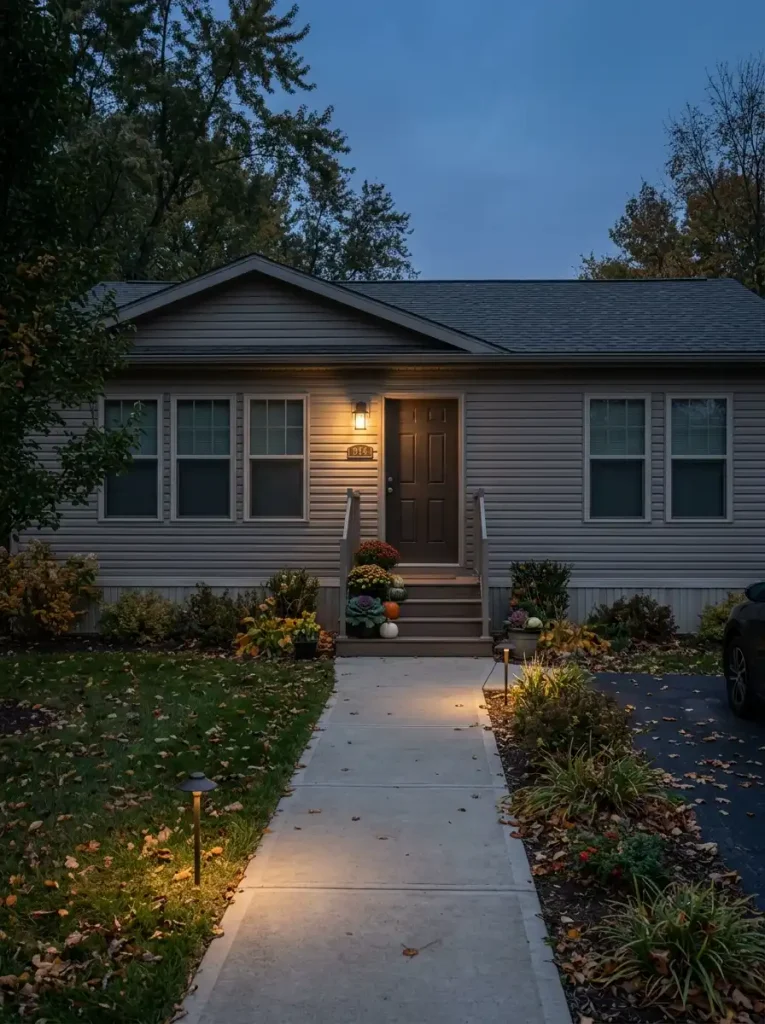
If one fixture creates uncomfortable glare while the doorway remains dark, adding more lights may not solve the problem.
Improving placement, direction, or overall balance can be more effective.
Decorative fall lighting should remain secondary to normal exterior visibility.
Use products intended for the outdoor location where they will be placed, keep cords and equipment out of walking areas, and avoid improvised electrical setups.
Permanent electrical changes should follow product requirements and applicable local standards.
For homes with very little landing space, lighting has another advantage:
it adds presence without occupying the floor.
A modest light near the entry can reinforce the doorway after dark while the path and landscape provide quieter supporting cues.
The best nighttime result still looks like your home.
It simply remains readable after the sun goes down.
12. Know What to Remove as Fall Fades
The last stage of good fall curb appeal is knowing when to take something away.
Do not wait for a universal calendar date.
Use the condition of the display.
A practical late-fall removal order is:
deteriorating → highly seasonal → reusable → permanent
Start with natural materials that are collapsing, rotting, badly faded, frost-damaged, or otherwise no longer helping the exterior.
Those pieces have stopped looking intentionally seasonal.
Next, reduce the strongest harvest-specific signals as your landscape and local weather begin moving toward winter.
The exterior does not need to switch overnight. Let it simplify gradually.
Reusable neutral pieces can stay longer.
A substantial planter, understated lantern, natural container, simple door treatment, or established landscape structure may continue to look appropriate after the most obvious fall elements are gone.
The permanent improvements from earlier should remain.
That is the payoff.
Your house numbers still look better. The landscape edge remains cleaner. The useful containers still belong there. The entrance can still be understood after dark.
Fall leaves the exterior in better condition than it found it.
In a mild climate, this transition may happen later and more gradually.
In a place where freezing weather or snow arrives early, declining plant material and exposed seasonal pieces may need attention sooner.
Condition is the better signal.
Once an item looks tired enough that you notice its deterioration before you notice its seasonal character, remove it.
A good fall display should know when to end.
Let Fall Highlight the Home, Not Hide It
The strongest fall curb appeal does not come from covering a manufactured home in seasonal objects.
It comes from improving the underlying exterior first, then allowing autumn color, texture, landscaping, and light to strengthen what is already there.
That gives you a useful final test.
Remove the pumpkins, temporary foliage, and other short-lived accents in your imagination.
If the home would still look cleaner, more connected, and easier to approach, the fall refresh worked.
The season added character without becoming the whole design.
Frequently Asked Questions
When should I start decorating a manufactured home for fall?
Use local seasonal conditions instead of one national date.
Early fall is a useful time to clear declining summer elements, tidy the landscaping, and establish the underlying exterior structure. Stronger autumn accents can follow as foliage, temperatures, and daylight begin changing in your area.
What if fall foliage barely changes where I live?
You can create a believable fall exterior without pretending your climate looks like New England.
Emphasize deeper neutrals, natural texture, restrained seasonal containers, warmer evening lighting, and materials suited to your actual weather.
Let local landscape conditions remain authentic.
What if my manufactured-home community limits exterior decorating?
Check your lease, community standards, or property rules before attaching décor, modifying landscaping, changing fixtures, or placing objects in shared areas.
When permanent changes are restricted, prioritize freestanding containers, removable door accents, portable seasonal pieces, and other additions permitted by your community.