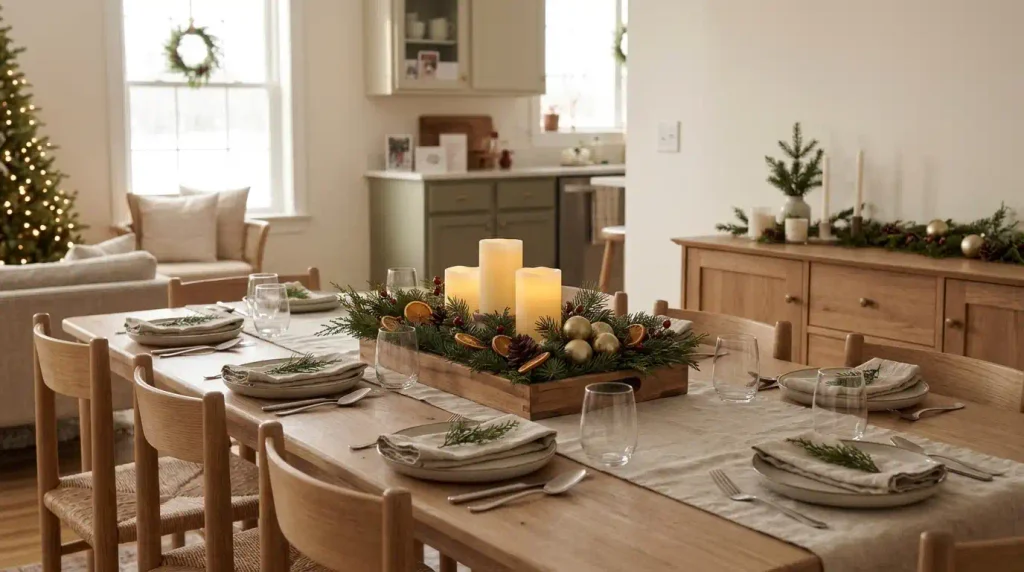
A beautiful Christmas table doesn’t need a florist’s budget. Sometimes the most memorable detail is a clear vase filled with candy canes, a handful of pinecones painted into tiny trees, or a few glowing jars assembled from things already in the cupboard.
The challenge is turning those simple supplies into something that looks intentional and actually works on your table. An arrangement can photograph beautifully yet wobble, block conversation, or leave nowhere for the serving dishes. The best DIY holiday centerpieces balance festive style with easy assembly, sensible proportions, and materials you can reuse.
These 19 projects include no-fuss arrangements, low-cost Christmas crafts, and a few more involved pieces for a creative afternoon. Each idea explains what to gather, how to put it together, and the detail that makes it suitable for a dining table, coffee table, or sideboard.
Before you begin: The greenery, paper, wood, dried citrus, and fabric used in these projects are combustible. Choose flameless LED candles for integrated displays, and follow the instructions supplied with battery lights and other craft materials.
Find the centerpiece you actually have time to make
Choose your available crafting window. The recommendations below change with the time required to prepare, assemble, and finish each project.
Double-layer ornament vase bouquet
Use a stable clear vase, a weighted inner stem-holder, shatter-resistant ornaments, and short artificial evergreen and berry picks. Conceal the holder with baubles; no drying time needed.
Your first move: place the empty vase on your table and check that the finished greenery can stay below the sightline across seated guests.
Painted pinecone mini trees
Paint dry pinecones green, add tiny decorative berries, and attach them to small wooden bases. Include extra drying time if your paint or adhesive requires it.
Your first move: choose tapered, naturally balanced pinecones before purchasing any decorative extras.
Freestanding holiday hoop
Assemble a securely supported decorative ring, test its stability, then hang lightweight ornaments and add compatible battery-operated lights.
Your first move: test the empty hoop and base before adding the weight of ornaments or lighting.
1. Make a Candy Cane and Evergreen Vase Centerpiece
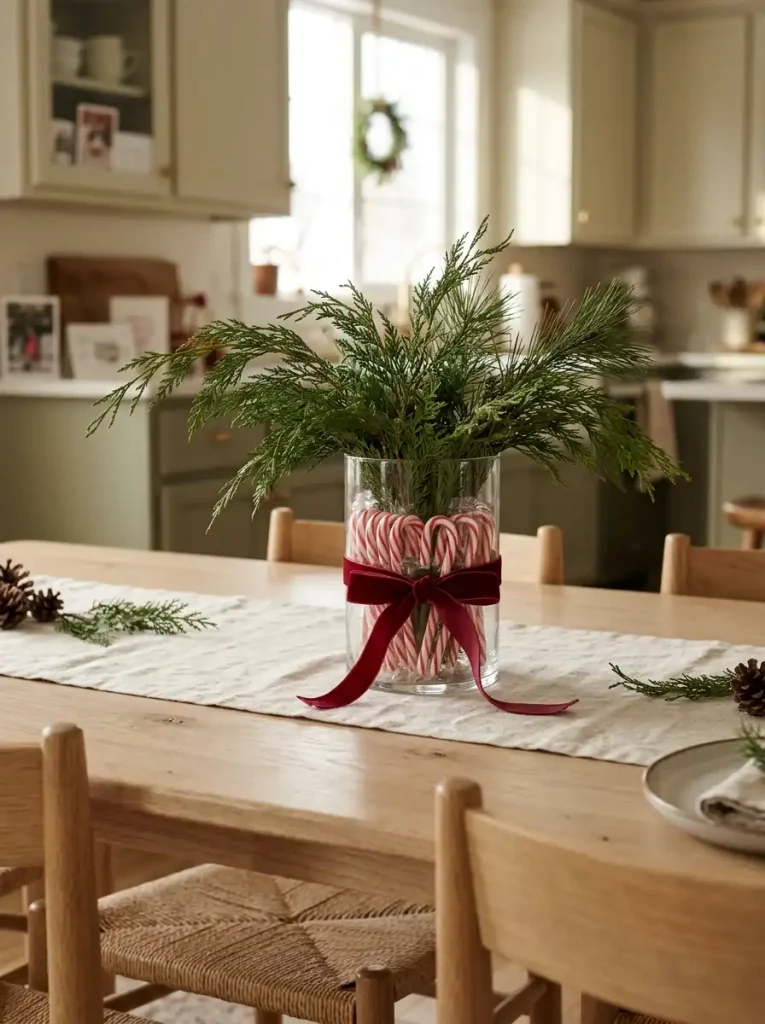
A bouquet of red-and-white candy canes rising through soft green branches looks nostalgic without requiring any flower-arranging experience. The striped candy provides the color; feathery artificial cedar or fir fills out the silhouette. A red ribbon makes the vase feel finished.
Gather: A sturdy clear vase, individually wrapped candy canes, artificial evergreen picks or fresh greenery, a smaller watertight insert if needed, and ribbon.
Put it together:
- Wash and dry the outer vase. If your greenery is fresh, place a smaller watertight container inside it for the stems and water.
- Stand wrapped candy canes in the dry outer space between the two containers. If using artificial greenery, keep the whole vessel dry.
- Build the foliage from the center outward, using short side branches to conceal the inner insert while leaving some candy hooks visible.
- Tie a neat bow around the outside, then turn the arrangement to check its appearance from every seat.
The nested-container method keeps moisture away from the candy and its wrapping. For dinner, trim tall branches below your seated sightline; for a sideboard, let a few stems rise higher. If the vase feels top-heavy, use less greenery or choose a wider vessel. Keep the candy decorative, especially once it has been handled as part of the arrangement.
2. Build a Double-Layer Glass-Vase Ornament Bouquet
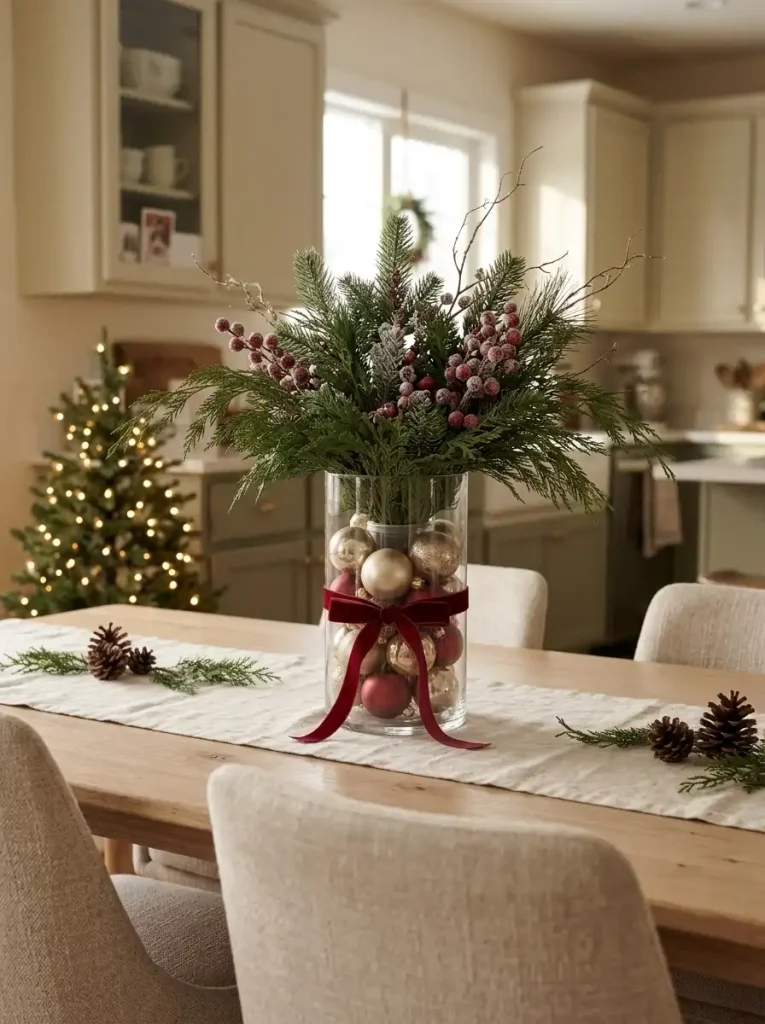
This project gives a transparent vase two jobs: ornaments create a sparkling layer below, while a compact evergreen-and-berry bouquet rises above the glass. Unlike a simple bowl of baubles, the inner stem holder separates the two elements and makes the arrangement easier to rebuild next year.
Materials and assembly
Use a wide, stable clear cylinder, a smaller weighted container that fits inside it, shatter-resistant ornaments, artificial evergreen stems, and a few berry picks.
- Place the small weighted container in the middle of the empty vase. It must stand securely before you add anything else.
- Fill the dry gap around the insert with small ornaments, alternating matte red, antique gold, and champagne finishes. Don’t force them against the glass.
- Arrange evergreen stems inside the central holder, beginning with the tallest pieces and working down to shorter branches at the rim.
- Add berry sprays sparingly. Rotate the vase and remove any stems that make one side noticeably heavier.
Choose the finish deliberately: Matte ornaments reduce glare in a sunny dining nook; mixed metallics are lovely on a buffet where evening lights can reflect in the glass. Use unbreakable baubles if children or pets can reach the arrangement. If you’re working with inherited or secondhand pieces, see these thrifted Christmas ornament display ideas for mobile homes before placing fragile keepsakes near the table edge.
3. Create a Lighted Holiday Hoop With Hanging Ornaments
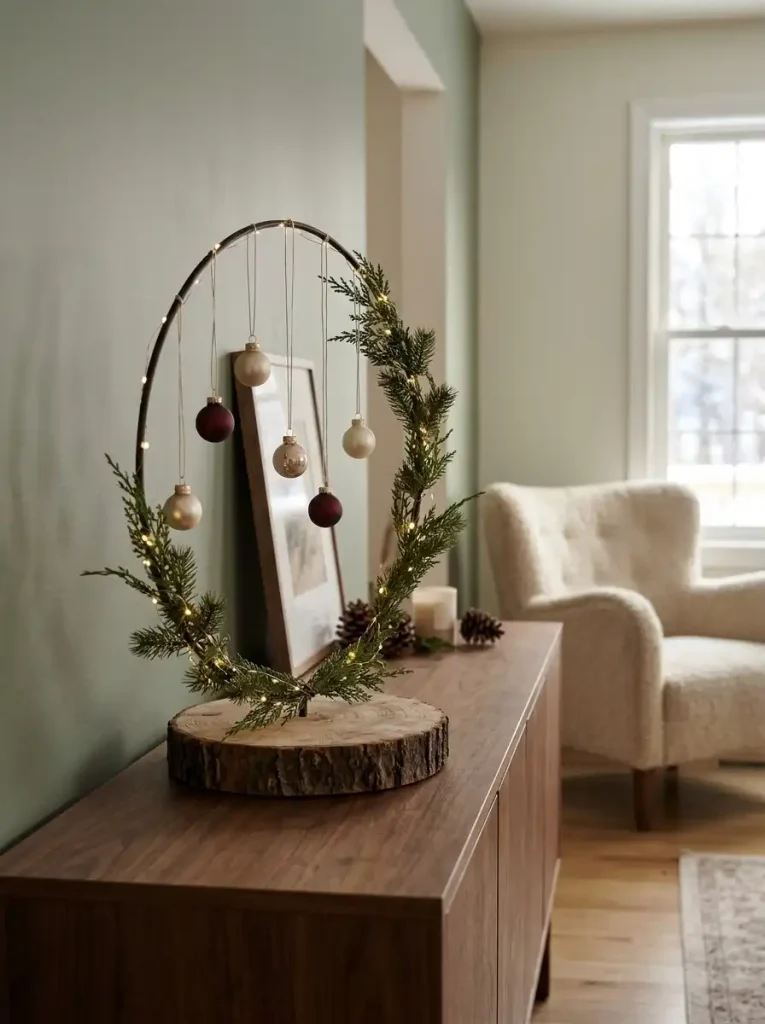
A circle of greenery and warm-white lights frames a few ornaments like little pieces of jewelry. Its open center makes the design surprisingly airy, but the ring must be securely supported before you decorate it.
Start with the structure. Fit a lightweight craft hoop into a compatible, purpose-made stand or securely fastened mounting bracket on a substantial wooden base. Avoid relying on hot glue or a shallow improvised slot to carry the hoop and ornaments. Test the empty stand for wobble on a level tabletop.
Once the base is secure, hang three to five lightweight shatter-resistant ornaments using short, securely tied cords. Vary their lengths without letting the lowest ornament touch the base. Add a small sweep of artificial evergreen along one side of the hoop, then wind on battery-operated lights approved for the intended use. Leave the battery control accessible.
Decide where it belongs: A smaller hoop with fewer ornaments may work on a dining table if it doesn’t interrupt conversation. A taller one makes a better console or buffet display. If the ring twists, rocks, or tips during a gentle stability check, remove the decorations and improve the support before displaying it.
Match the hoop to its support
A hanging display is only as good as its base. Select the approximate diameter to see the construction priority and the best placement.
Small dining-table accent
A lightweight hoop with a purpose-made stable stand is the easiest size to keep unobtrusive.
- Hang just 2–3 small ornaments.
- Check base grip and stability before lights.
- Best for a compact table or shelf.
Stop if the stand rocks or the hoop rotates.
Statement with controlled scale
Additional diameter increases the leverage on the mounting joint. Choose a heavier, wider-purpose base.
- Distribute ornaments evenly.
- Keep the lowest ornament above the wood.
- Best on a wide dining table or console.
Don’t rely on a thin slot in a lightweight wood disc.
Console display, not a conversation barrier
A large hoop has greater tipping potential and can block views across a table. Use engineered mounting hardware and a substantial base.
- Use exceptionally light ornaments.
- Test the assembly without decorations first.
- Prefer a wall-side console or buffet.
If you cannot secure a stable base, choose a smaller hoop.
4. Arrange Three Winter-White Holiday Candle Hurricanes
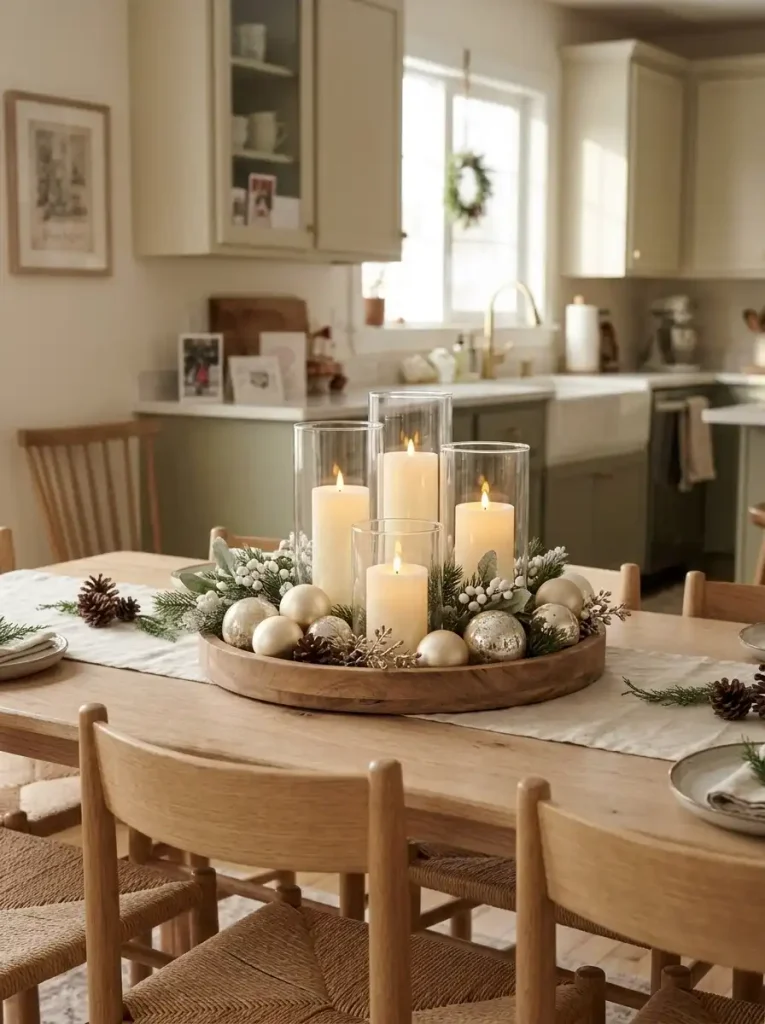
Three clear hurricane vases can turn a few pinecones and faux winter stems into an elegant centerpiece. The magic comes from unequal heights: one tall vessel, one medium cylinder, and one shorter glass, grouped so their outlines overlap without hiding each other.
For each vessel, choose a stable battery-operated LED pillar candle and a handful of small ornaments, artificial greenery, white berries, or miniature pinecones. Use flameless candles throughout this arrangement. The decorations should sit around a stable candle holder, never inside its battery compartment or controls.
Try giving the three vessels different roles:
- Tallest: A simple ivory LED pillar and a few evergreen accents, leaving plenty of clear glass visible.
- Medium: A champagne ornament, one textured pinecone, and a small amount of winter foliage.
- Shortest: A lower light with white berries and one repeated metallic detail to connect the group.
Bring the vases together on a wide wooden tray with a small gap between each glass base. Check that the tray stays level when lifted. If the collection feels crowded, remove an ornament before removing a vase; the three heights are the design’s strongest feature.
For additional arrangements and styles, browse these holiday centerpiece ideas for festive meals. The U.S. Fire Administration’s candle guidance recommends flameless alternatives and keeping any burning candle at least 12 inches from materials that can catch fire.
5. Turn a Pinecone Into a Miniature Christmas Tree
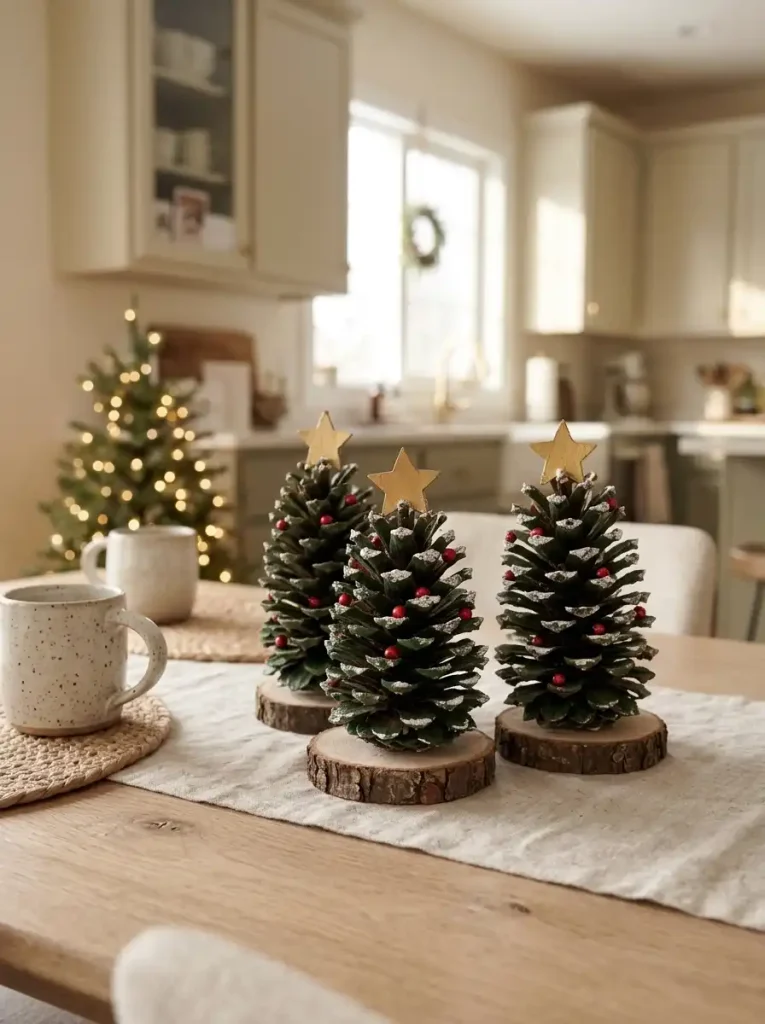
A naturally tapered pinecone already has the silhouette of a little evergreen. Green paint, tiny red decorations, and a wooden base are enough to turn it into a charming handmade Christmas tree.
The easy sequence:
- Select a clean, completely dry, open pinecone that can stand upright without leaning dramatically.
- Brush the outer scales with green craft paint, leaving a little brown visible in the deeper recesses. Let it dry as directed.
- Dab a few scale tips with white paint for a snowy look. Add miniature red beads or pom-poms with suitable craft adhesive.
- Fix a lightweight star to the top and secure the pinecone to a stable wood-slice base. Let the adhesive cure before moving it.
One tree suits a breakfast table; three different sizes make a stronger dining centerpiece. Arrange them with small gaps so their outlines remain recognizable. Keep the design on the simpler side if the pinecones themselves are large or heavily textured.
A practical shortcut: Paint and dry the trees on one day, then add the ornaments on another. This avoids smudges and prevents tiny beads from slipping before the paint has cured. Keep small removable parts away from young children and pets.
6. Build a Rustic Dried-Orange and Cinnamon Centerpiece
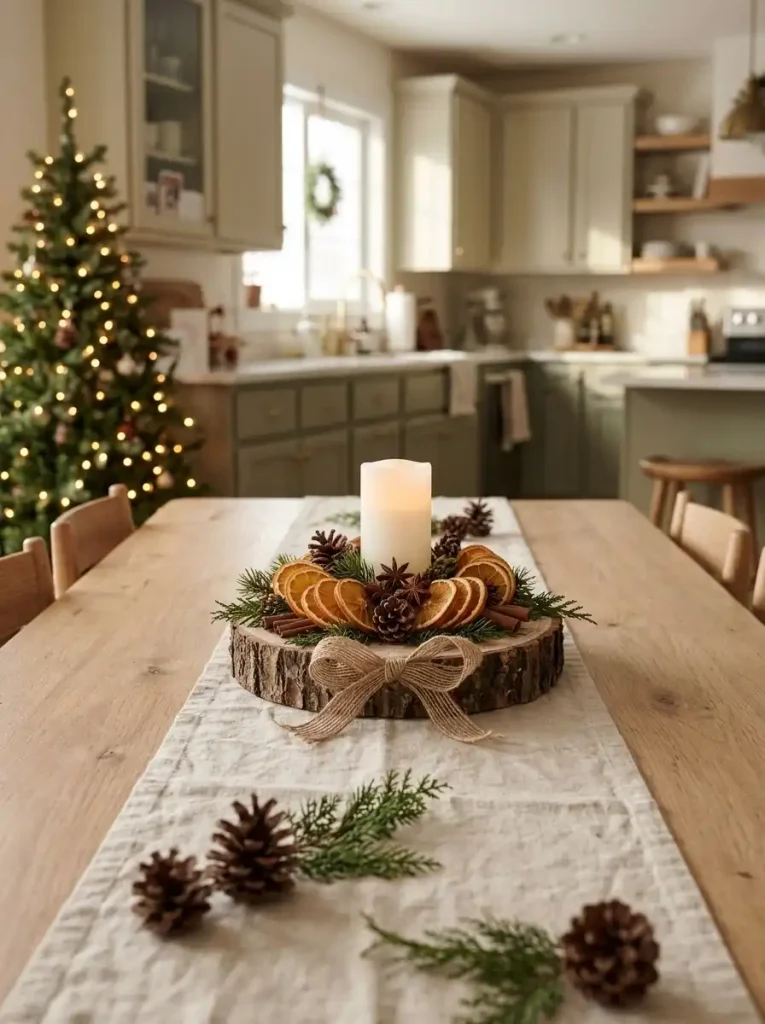
Golden orange slices, rough bark, star anise, and cinnamon sticks bring beautiful texture to a holiday table. Their contrasting shapes create a layered display even when you use only a small wooden base.
Gather: A level wood slice or tray, dried orange rounds, cinnamon sticks, pinecones, artificial evergreen, natural twine, and one stable flameless candle.
Position the LED candle slightly behind the center. Overlap two or three orange slices in front of it, standing one at an angle if you can secure it. Tuck a few cinnamon sticks toward the back; distribute pinecones to balance the oranges’ round shapes. Finish with short evergreen sprigs and a small twine bow.
Decide how much detail to add
| Location | What works best |
|---|---|
| Small round dining table | One flameless candle, three citrus slices, one pinecone |
| Rectangular dining table | A low oval tray with citrus grouped toward both ends |
| Sideboard | A wider wood slice with extra greenery and taller stems |
Leave part of the wood exposed so the natural surface contributes to the composition. Dried botanicals can collect moisture or deteriorate in storage, so inspect them before reusing them. Never combine these combustible materials with an open flame.
Which light belongs in your centerpiece?
Select a lighting option for a specific assembly recommendation. Dry citrus, pine needles, fabric, and paper require extra care around heat.
Build around a flameless pillar
Use a battery-operated LED candle in a stable holder. Dried oranges, pinecones, and faux greenery can frame it without needing a live flame.
First action: check the battery access and keep the candle upright within its support.
Check the decorative light’s instructions
Use a strand approved for the intended setting. Keep wires intact and do not seal lights inside a container unless the manufacturer permits enclosed use.
First action: choose an accessible location for the battery pack and inspect the strand before installation.
Separate the flame completely
Do not put a burning candle among greenery, dried citrus, paper, fabric, or a decorative foam base. If a real candle is essential, use a stable holder in a separate, clear location at least 12 inches from combustibles.
Better project choice: use flameless lighting for the integrated centerpiece.
Reference: U.S. Fire Administration candle safety.
7. Make a Frosted Glass Winter Wonderland Centerpiece

A miniature snowy tree seen through an unfrosted window in a glass jar feels like a tiny winter landscape. The balance between opaque frost and clear glass matters more than the number of miniature decorations inside.
Begin with a clean, dry wide-mouth jar. Follow the instructions for a frosting product designed for glass, applying it only to the exterior and masking an oval viewing window. Allow the finish to dry and cure as directed; don’t put the coating on a surface that may contact food.
Make the interior scene separately. Secure a lightweight bottle-brush tree to a small removable base, surround it with a modest amount of artificial snow, and lower the completed insert into the jar. Add a ribbon around the rim if you want a little color.
Check from the front: You should see the entire tree and some empty space around it. If the frosting hides the top or the snow covers the trunk, reduce the material rather than adding more objects. Use a battery-operated light only if the product is approved for that enclosure, and keep electronics away from loose snow or moisture.
This centerpiece works best where someone can view its tiny scene up close—a breakfast nook, hallway console, or cozy coffee table.
8. Stack Wood Slices Into a Tiered Christmas Candle Display

A stepped platform gives three small candles a sense of occasion without needing a large flower arrangement. Bark-edged wooden discs supply the rustic character; the different levels let every light be seen.
Build for stability first
Choose a broad, flat base and three smaller wood slices. To create the supports, use a purpose-made tiered craft stand or properly fitted wooden uprights secured with suitable woodworking joints and fasteners. Glue alone is not a dependable way to support heavy glass holders on tall platforms.
Before decorating, place the empty LED holders on the platform and check that each sits fully within its wooden disc. Test the whole construction for wobble, rocking, and flex. If it moves, rebuild the supports or use a ready-made stable tiered stand.
Only then add small evergreen picks, pinecones, and ornaments along the lower base, keeping them clear of the candle controls. Use flameless votives in stable holders.
A taller version is best on a sideboard, where it can be appreciated from a distance. For dining, keep the uprights shorter and make sure guests can see across the table. Finish with one small linen or burlap bow near the bottom; the timber’s visible bark is already an attractive decorative detail.
9. Light Up Mason Jars With Dried Oranges and Evergreen
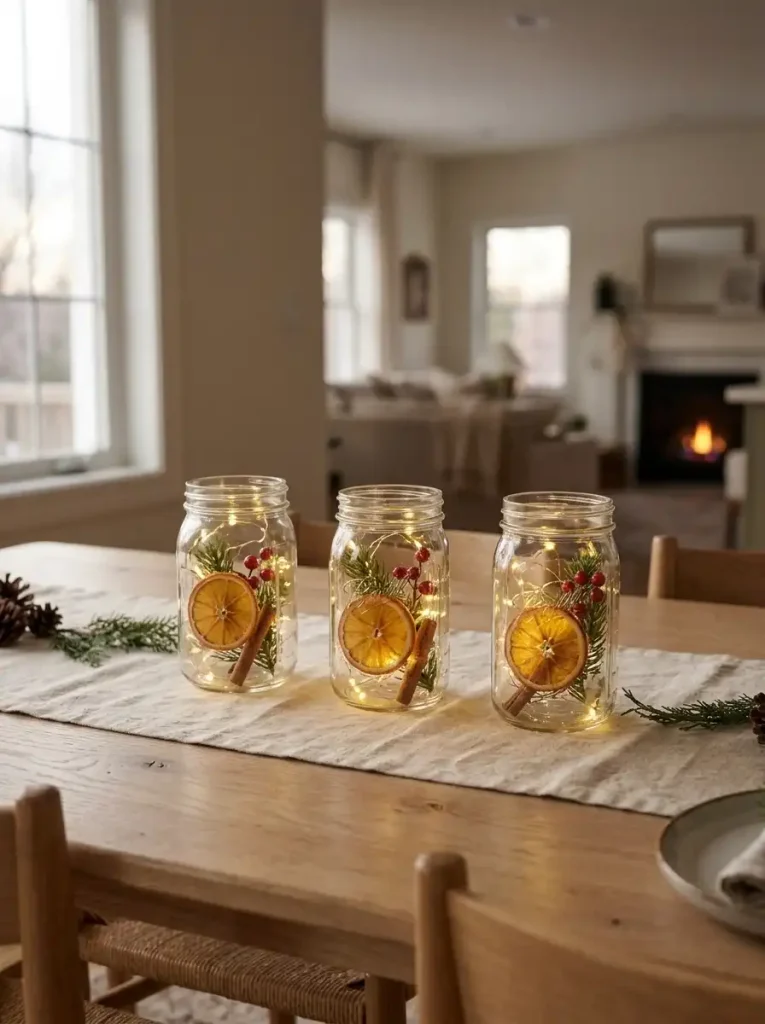
A cluster of softly glowing jars is an easy way to make a winter table feel welcoming after dark. Dried orange slices catch the light beautifully, while cinnamon sticks and a few evergreen tips create a natural Christmas palette.
Make one jar before committing to a whole set. Dry the jar thoroughly. Stand a dried orange slice against the interior glass and support it with a short cinnamon stick or a small artificial stem. Add a few decorative berries near the bottom, then position a battery-powered micro-light strand according to its instructions. Choose a strand expressly suitable for the intended arrangement; don’t seal lights into a closed container unless the manufacturer permits it.
For a small table, one generously sized jar on a coaster may be all you need. Three coordinated jars on a wooden tray suit a longer tabletop. A row of five works better on a buffet, where it won’t compete with food and glassware.
Resist the temptation to fill every gap. Clear glass allows the light to glow through the citrus. Overpacking the jar hides the effect and may crowd the light strand or its wiring. Keep battery access convenient, inspect wires for damage, and remove the lights before cleaning or storing the jars.
Inside a glowing holiday mason jar
A layered visual guide to keeping the jar luminous without stuffing every inch with decorations. Decorative pieces must remain dry and the battery pack accessible.
Leave clear space around the top so the decoration does not hide the glow.
Keep dry or artificial sprigs lightly supported behind the citrus.
Stand one dried orange slice near the front glass; avoid overfilling.
Use a few artificial berries and a small amount of decorative material to keep the bottom grounded.
Lighting rule: Only use a battery-operated light strand suitable for the installation, following its instructions about enclosure and battery access. The visual glow shown here is illustrative.
10. Make a Long Holiday Candle Runner With a Foam-Tube Base
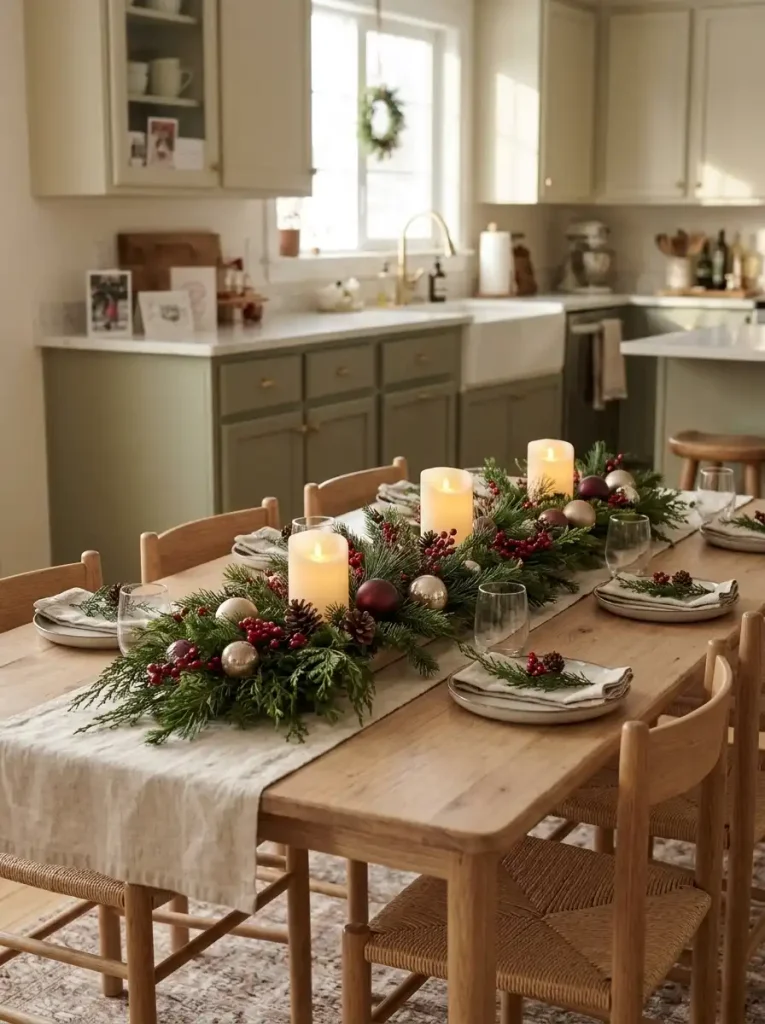
A pair of inexpensive foam pipe-insulation tubes can help organize a long, low line of greenery, berries, and ornaments. The result looks like an abundant Christmas garland but can be made in sections that fit your table.
Build the framework
Choose unused, clean pipe-insulation foam and a rigid serving tray or long, stable decorative board. Position two foam lengths along the sides of the tray, leaving the central rigid surface exposed. Use a method appropriate to your tray and foam to keep the tubes from rolling or separating; ties must be secure and should not cause the tray to rock. If you cannot stabilize the foam, switch to a purpose-made artificial garland as your base.
Insert short artificial evergreen stems into the foam’s existing slit or secure them with suitable lightweight craft fasteners. Cover the visible foam gradually, then add red berry picks, pinecones, and shatter-resistant gold ornaments. Avoid driving sharp picks through the tray or allowing wire ends to protrude.
Add light without loading the foam
Place three stable battery-operated LED candles directly on the rigid tray, not on top of the foam. If the tray is too narrow to support them flat, omit the glass holders and use lightweight LED accents that the manufacturer approves for the arrangement.
Test the finished runner with dinner plates and serving dishes in place. A long centerpiece should leave a usable route for food and conversation. For compact holiday dining spaces, see these Christmas table settings for small mobile home dining nooks.
Skip this method if the foam cannot be secured, children may pick at it, or the table is too narrow. The foam is a greenery-positioning aid—not a structural support for glass or a heat-resistant candle base.
11. Fold Paper Christmas Trees for a Handmade Table Forest
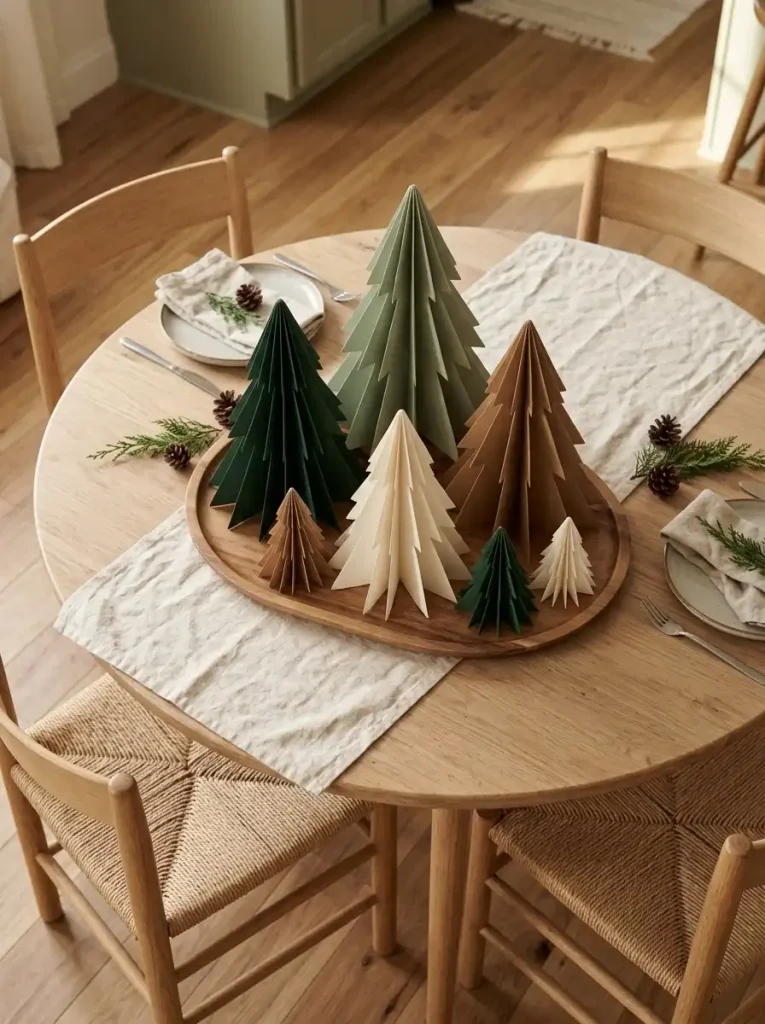
A little forest of folded paper trees offers the charm of an expensive seasonal display for the cost of a few sheets of cardstock. Three related colors—perhaps deep green, sage, and ivory—make the finished collection feel coordinated.
Here’s one simple three-dimensional method:
- Draw or print a symmetrical Christmas tree silhouette. Use it to cut four matching trees from medium-weight cardstock.
- Fold each tree vertically down the center. Glue the right half of one folded tree to the left half of the next, repeating until all four form a dimensional shape.
- Join the remaining faces, gently spread the sections evenly, and secure the finished tree to a small flat base if it needs support.
- Repeat at two other heights, allowing the adhesive to cure before arranging the pieces.
Group five to seven trees on a low tray. Place taller trees toward the back, with shorter versions in front, then turn the tray to see whether the silhouettes remain distinct from the chairs around the table.
Which paper should you choose? Thin paper folds easily but may not stand reliably; very stiff board resists neat creases. Test one tree before cutting the rest. Keep the display dry and away from flames, drinks, and damp greenery. Many folded designs can be stored flat or in shallow boxes for next year.
12. Use Mini Gift Boxes to Create a Layered Holiday Display
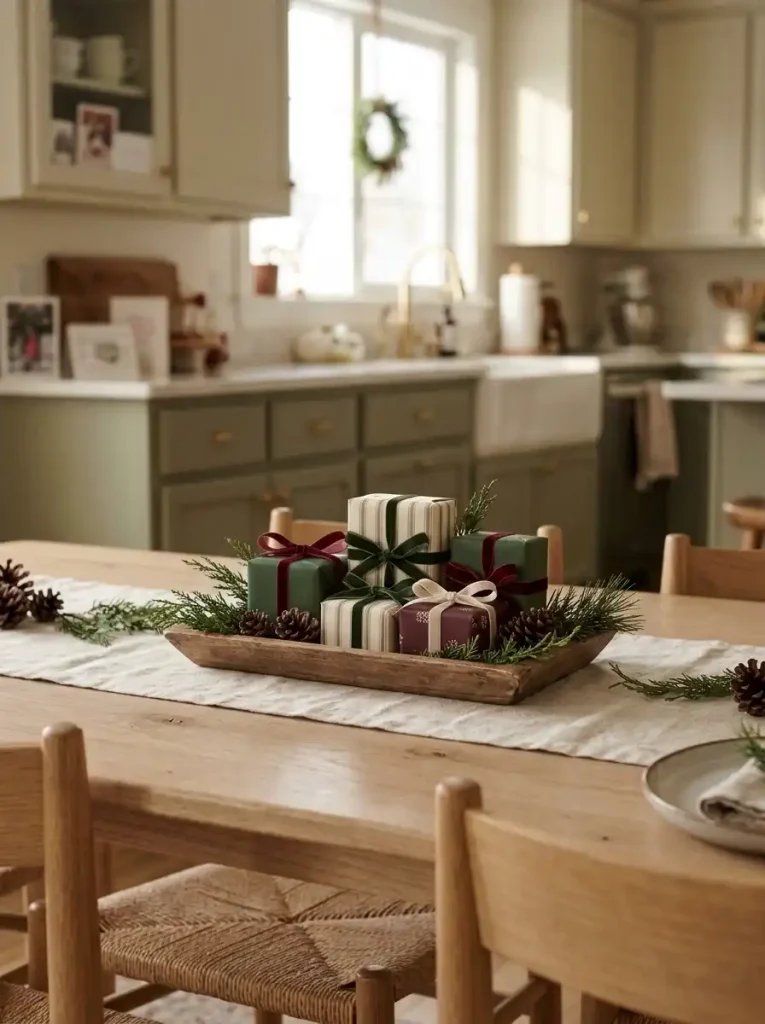
Tiny wrapped packages make a cheerful centerpiece because they bring structure, pattern, and the anticipation of Christmas morning to the table. You can use empty cartons and leftover wrapping paper—no gifts required.
Start with three to five sturdy small boxes. Reinforce weak corners, wrap them neatly, and choose one main paper pattern plus one plain companion. For instance, combine red-and-white stripes with solid forest green, or use cream paper with champagne ribbon.
Arrange the largest box toward the rear of a shallow tray. Position two smaller packages in front, angling one slightly so their edges don’t form a rigid wall. Add a low artificial evergreen sprig and a couple of small ornaments to link the pieces.
A simple test: Remove the biggest bow and look again. If you can suddenly see all the parcels and ribbons more clearly, the bow was too dominant. Use a narrower ribbon or place the oversized bow on an actual present.
This is an easy craft for renters because the display needs no permanent alterations. Keep the boxes lightweight and avoid placing them beside open flames or immediately next to drinks that could spill over the paper.
13. Create a Mini Snowy Village Under a Glass Cloche

A cloche makes a tiny Christmas village feel like a curated miniature world. The dome creates a visible boundary, so the scene needs only a few pieces to appear complete.
Plan the interior before adding snow. Measure the usable height and width of your glass dome, accounting for its curved sides. Set out one small house, one bottle-brush tree, and one miniature supporting detail on the base. Lower the empty dome over them as a test. If anything touches the glass or blocks the house, choose smaller pieces.
Once the layout fits, secure objects to a removable insert or base as appropriate. Add a thin layer of artificial snow and a short path leading toward the door. The house should remain recognizable from the side where people will view the centerpiece.
The three-part scene
- A main building gives the eye a destination.
- One tree or cluster of trees establishes the winter setting.
- A low detail—a tiny bench, figure, or path—makes the scene feel inhabited.
Leave enough empty space to read all three elements. Compared with an open tabletop village, the cloche is easier to contain and reposition, though it needs a solid base and careful handling. Use lights only if they are suitable for enclosed display and don’t crowd the scene or battery compartment.
14. Transform Empty Tin Cans Into Christmas Floral Vases
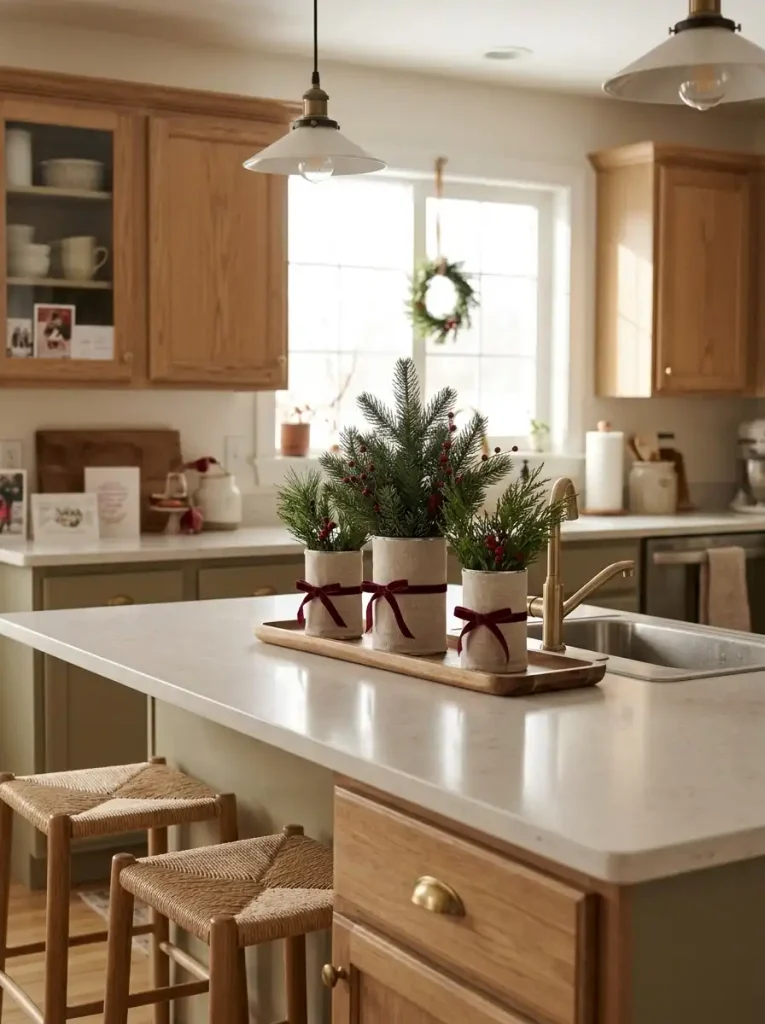
Three ordinary food cans can become matching holiday vases with a little leftover fabric or paper. Their identical cylindrical form makes the group look cohesive, even if the contents are gathered from different boxes of decorations.
Prepare them carefully. Remove labels, wash and dry each can, and check the rim. Use cans with safe, smooth edges; discard any container with a sharp lip that cannot be safely protected. If you’re adding fresh stems, insert a suitable watertight liner and protect the tabletop from moisture.
Wrap each can in linen, kraft paper, or a muted Christmas fabric, keeping the covering away from the opening where it might get wet. Add one restrained ribbon band. Arrange short artificial evergreen branches with a few berry sprigs, varying the stem heights across the three cans.
Try a straight line for a rectangular table or a compact triangle for a small round one. The arrangement should read as one grouping, so repeat the same wrapping material across every vase.
Use it where it can breathe. A grouped can display is lovely on a kitchen island or sideboard; on a coffee table, keep it lower and leave room for daily items. These Christmas coffee table styling ideas for small mobile home living rooms offer additional ways to balance decoration and usable surface.
What can you make with what you own?
Choose your best available material. The two project paths, first step, and material to avoid change with your selection.
Go luminous or wintry
Start here: Check jar dryness and stability. Avoid pooling water near batteries.
Build a lightweight holiday forest
Start here: Pick one color family. Keep paper and fabric away from real flames.
Make an aromatic woodland arrangement
Start here: Decide whether you want a dry reusable display or a fresh short-lived one.
Turn everyday containers into decor
Start here: Check stability and sharp metal rims before any decorating.
15. Arrange Living Rosemary Pots on a Rustic Holiday Tray

Little rosemary plants have an evergreen-like appearance that suits the season without requiring glitter or artificial snow. Three small pots can make a fresh, fragrant centerpiece that you can care for after the decorations come down.
Choose healthy plants in containers with drainage. Keep each pot on a saucer or inside a waterproof tray, then dress the outside with a removable ribbon or simple fabric sleeve. Leave the drainage openings free and protect the roots from standing water.
Position the tallest pot at the back or center, with two shorter pots framing it. Tuck a few pinecones between the containers, keeping them out of the damp soil. For a softer look, use cream-colored pots and plain linen ribbons; for traditional Christmas, try deep green ribbon with a tiny red accent.
A living display has a time limit on the table. Rosemary needs suitable light and care, so move the plants back to an appropriate growing location between gatherings if the dining area is too dim. Follow the plant supplier’s guidance on watering, light, and temperature.
This project suits anyone who prefers natural decorations and wants an arrangement that can live beyond the holiday meal. Skip permanent paint, heavy ornaments, or glued decorations on the plants.
16. Make a Soft Christmas Centerpiece With Fabric Bows
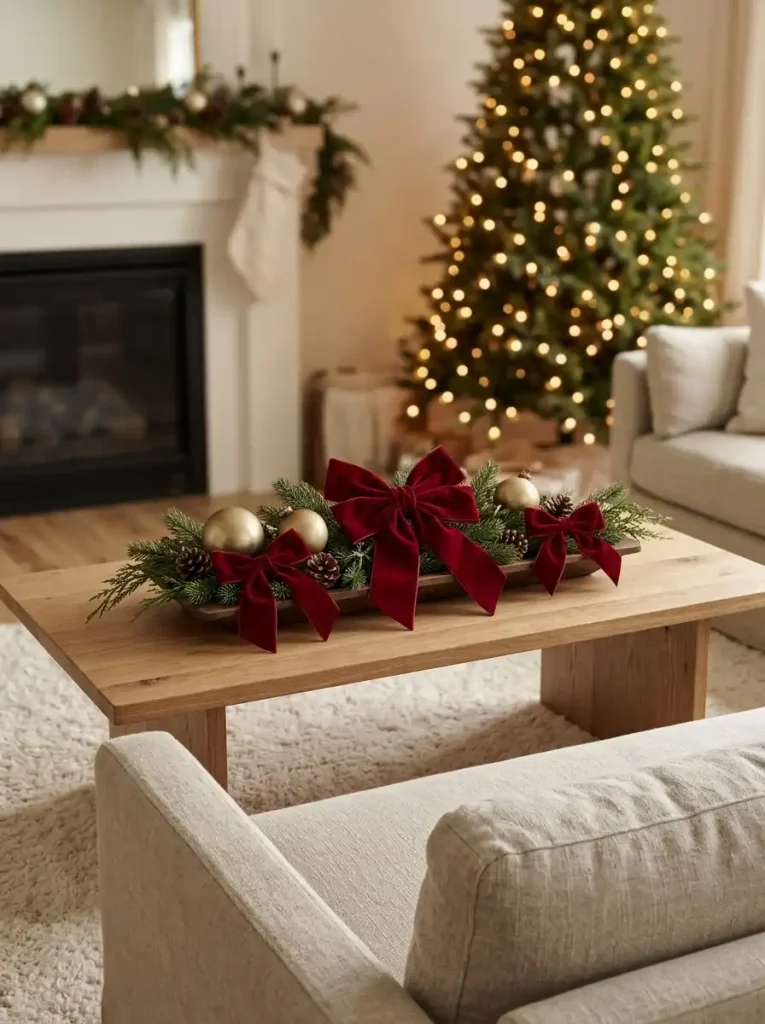
Velvet and linen bring a softness that glass baubles and metallic ornaments can’t quite reproduce. A few handmade bows can become a low, beautiful centerpiece for a room that already has plenty of sparkle.
The three-bow composition
Cut ribbon or fabric strips long enough to make one generous central bow and two smaller ones. If using fabric, finish fraying edges with an appropriate fabric method. Form the loops neatly and secure the centers with matching thread or ribbon.
Place a shallow tray on the table. Attach the bows to removable, stable decorative supports, then surround them with short artificial evergreen sprigs and a handful of small ornaments. Keep the largest bow off-center so the arrangement feels relaxed.
Choose your texture: Cranberry velvet suits traditional Christmas decorations. Natural linen brings a Scandinavian or farmhouse quality. Cotton in a small check looks cheerful on a breakfast table.
A useful finishing rule is to use fewer bows when the fabric is visually busy. Three bold plaid bows can overwhelm a small tray, while three plain velvet bows create a calmer shape. Avoid open flames near fabric, and store the finished bows loosely to preserve their loops.
17. Display Handmade Clay Stars in a Winter Branch Arrangement
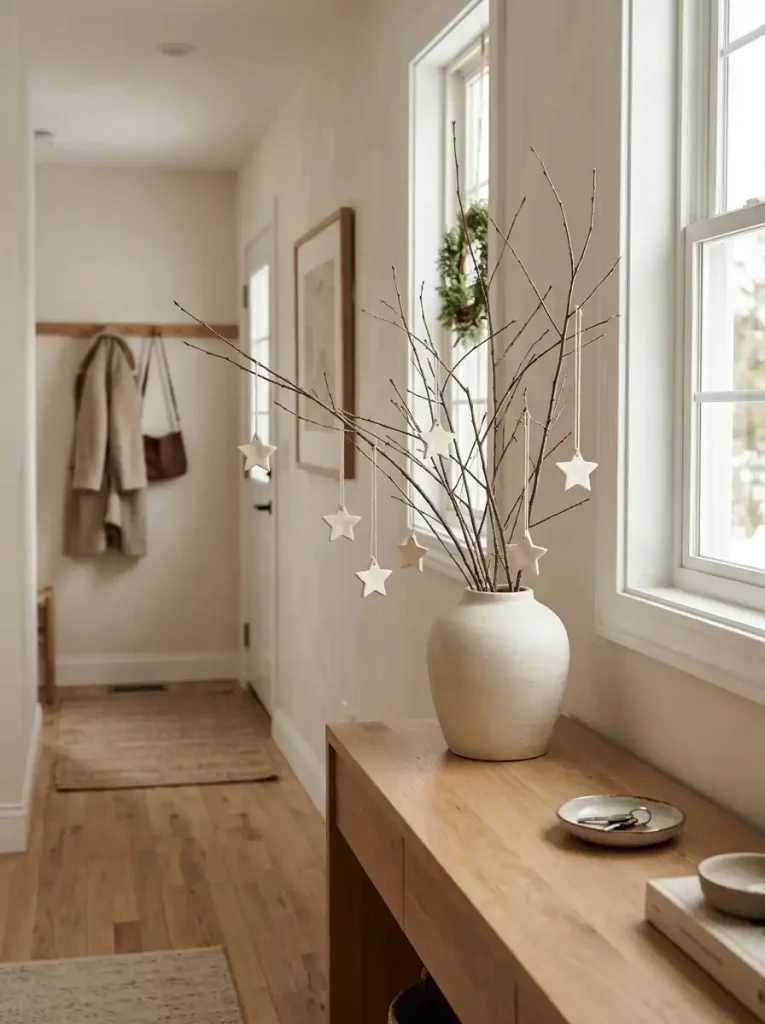
Bare branches hung with handmade stars create a Christmas centerpiece with almost no visual clutter. The spaces between the twigs are just as important as the ornaments themselves, giving the arrangement a light, sculptural character.
Make the stars first. Roll air-dry clay evenly according to its instructions, cut small star shapes, and make hanging holes before drying. Keep the stars relatively small so they won’t pull branches out of position. Allow them to dry completely, then add a subtle paint finish if desired.
Choose several sturdy dry branches and place them in a stable, weighty vase. Use an internal support or proper floral holder if needed to keep them from leaning. Tie the dry stars with short cords, spacing them so they don’t collide when the arrangement is gently moved.
Inspect the silhouette from the intended viewing position. If one branch looks too heavy, remove an ornament or shorten that branch. A few ivory stars and one muted gold detail are often enough.
A tall branch display usually belongs on a sideboard or hallway console. For a dining table, use shorter stems and fewer hanging pieces so guests can see across the setting. Keep breakable clay ornaments away from table edges and places where children or pets may pull the cords.
18. Make a Holiday Spice Bowl With Orange Pomanders
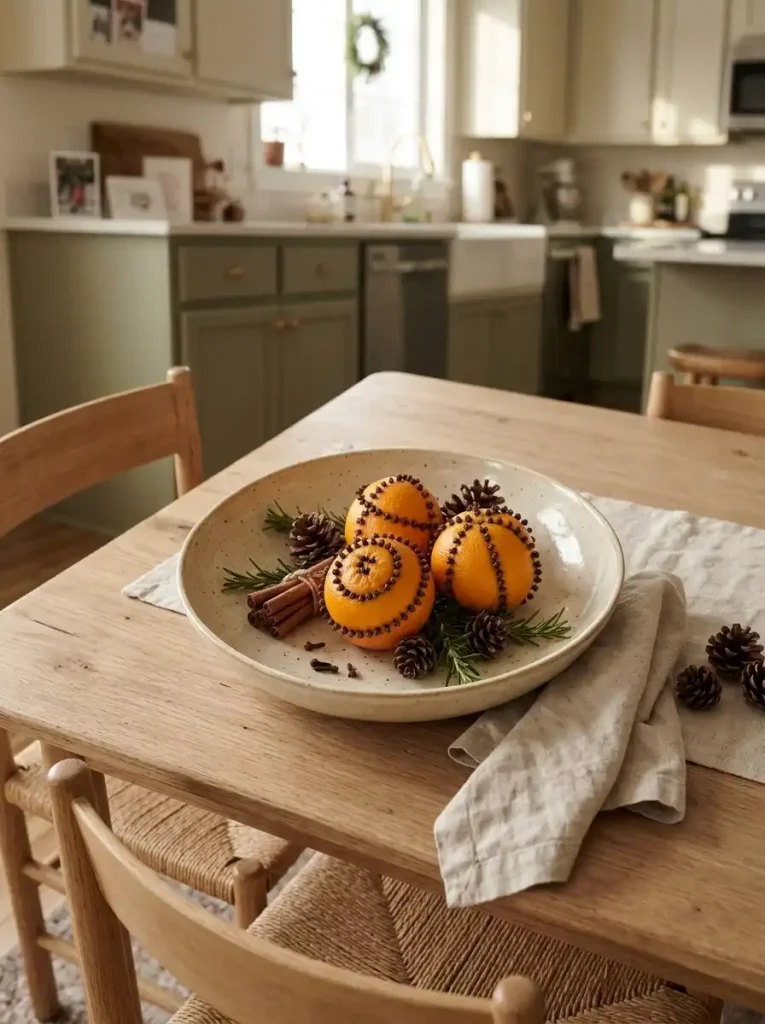
Fresh oranges decorated with whole cloves make a natural Christmas centerpiece with striking color and a familiar seasonal scent. Unlike a purely decorative arrangement, this one changes over time as the fruit ages.
Decorate the fruit
- Select firm oranges without bruises or soft spots.
- Sketch a simple stripe or spiral pattern with a washable guide, or plan it by eye.
- Make small starter holes carefully with a suitable tool, then press whole cloves into the peel.
- Repeat on two or three oranges, alternating densely decorated sections with visible orange skin.
Arrange the finished fruit in a shallow ceramic or wooden bowl with cinnamon sticks, pinecones, and a few short rosemary or artificial evergreen sprigs. One undecorated orange can provide a useful visual pause among the patterned pomanders.
Fresh or dried? Fresh pomanders make a lively short-term display. Check them frequently and discard any fruit that becomes soft, leaks, or grows mold. A fully dried version may last longer, but the drying method requires time, suitable conditions, and its own inspection before storage.
Use this centerpiece on a kitchen island or an informal holiday table where its fragrance can be enjoyed. Keep decorative ingredients distinct from food intended for serving, and store nothing damp with your keepsake ornaments.
The centerpiece storage atlas
Before putting away a handmade centerpiece, separate its pieces by how they age. Mixing fresh ingredients with keepsake ornaments can damage what you hoped to reuse.
Pack dry + reusable
Wood slices, glass jars, dried paint-finished pinecones, ornaments, cloches and sturdy artificial greenery.
Action: Clean and dry fully. Wrap breakables separately; protect painted surfaces from scratching.
Refresh next season
Ribbons, battery light strands, dried citrus and delicate craft-paper shapes.
Action: Check condition and dryness. Remove batteries for long storage according to manufacturer guidance.
Do not seal away
Fresh greenery, spent orange pomanders, damp natural materials or items showing mold.
Action: Dispose of or compost suitable untreated materials according to local guidance.
19. Build a Removable Holiday Centerpiece on a Serving Tray
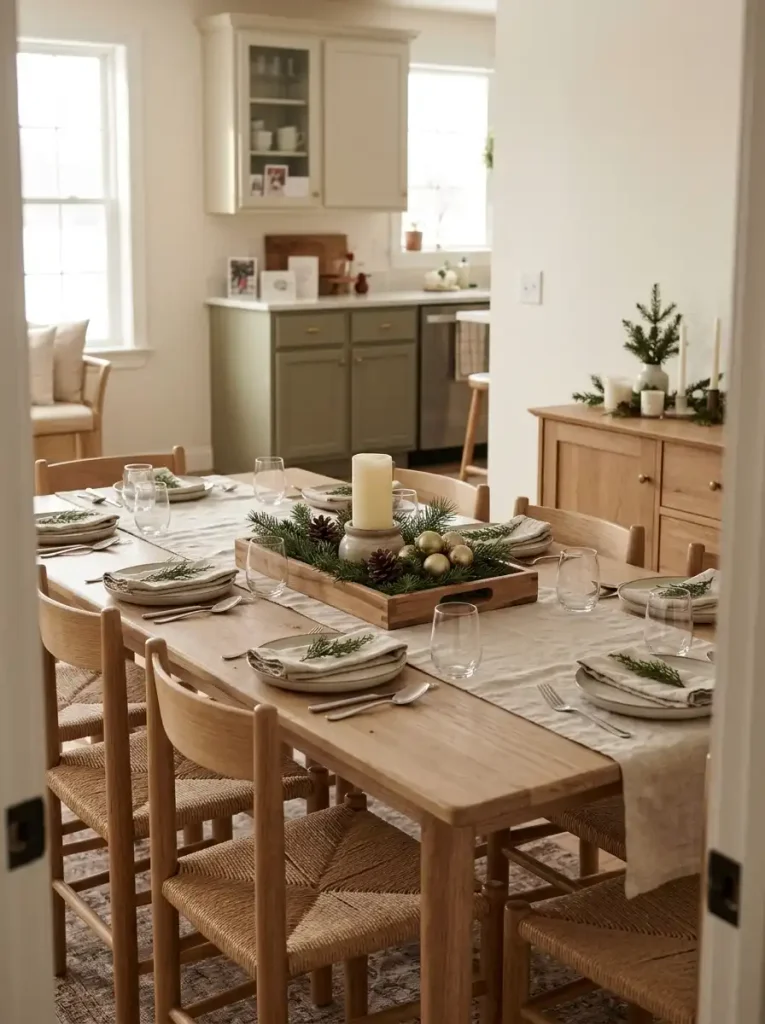
The most useful holiday centerpiece may be the one you can lift away in seconds. A portable tray lets you enjoy a beautiful setting before guests arrive and clear the middle of the table when the meal begins.
Start with real table space. Set an empty rigid tray between your usual plates, glasses, and serving dishes. Check whether everyone can reach their place setting and whether the tray can be lifted without brushing the glasses. If it crowds the table now, a decorated version will be worse.
Build the display around one main piece, such as a small ceramic tree or flameless candle in a stable holder. Add short artificial evergreen pieces and three or four decorative accents. Secure loose items so they can’t slide, and avoid tall or fragile objects that make the load awkward to carry.
The two-minute hosting test
- Sit in every dining position and check the line of sight across the table.
- Put down two serving dishes to confirm that the remaining surface is usable.
- Lift the tray level with both hands and move it a short distance. Stop if anything tips, rolls, or shifts.
If you regularly use one small table for eating, working, and entertaining, the suggestions in 17 small mobile home dining area ideas can help you protect its everyday function.
A removable arrangement works particularly well with a shallow wooden tray, a battery candle, pinecones, and muted gold ornaments. When dinner starts, move it to a stable console or sideboard—without dismantling your work.
Final Thoughts: Make the Centerpiece Fit Your Celebration
The loveliest DIY holiday centerpieces use a few ordinary materials well. A glass jar can hold a miniature winter scene, dried oranges can bring warmth to a rustic wood slice, and folded cardstock can become an entire little Christmas forest.
Choose one project that matches the supplies you have and the way you use your table. Check stability before adding delicate details, use flameless lighting with combustible decorations, and make room for plates and conversation. Save the reusable pieces together when the season ends.
Your finished centerpiece doesn’t have to look store-bought. Its charm comes from the choices, textures, and small handmade touches that make your home feel ready for the holidays.