Christmas has a way of multiplying everything in the kitchen. One morning, the counter holds a kettle, a cutting board, and perhaps a bowl of fruit. By December, that same surface is competing with cookie tins, Christmas dishes, baking ingredients, festive mugs, and decorations that seem too pretty to put away.

In a small mobile home, even the loveliest holiday display can become frustrating when there is nowhere left to prepare dinner.
Thoughtful holiday kitchen organization helps you enjoy the season without sacrificing the space your kitchen needs to function. A few strategically arranged shelves, temporary storage systems, and organized holiday stations can make a compact kitchen feel festive and comfortable throughout December.
The most practical approach is to think about how your kitchen changes during the holidays. Ordinary weekdays require clear counters and accessible everyday dishes. Baking afternoons introduce mixers, cookie cutters, and cooling racks. Family gatherings demand serving space and room for people to move around safely.
These 17 holiday kitchen organization ideas bring together cozy Christmas styling, clever storage, and realistic solutions for single-wide and double-wide mobile homes. Most can be accomplished with baskets, trays, containers, and cabinets you already have.
1. Set a Holiday Counter Budget Before the Decorations Come Out
Imagine a narrow mobile-home kitchen counter with a coffee maker at one end and just enough room to chop vegetables at the other. Add a festive garland, two Christmas mugs, a decorative cake stand, and a miniature evergreen tree, and suddenly the counter looks beautiful but barely functions.

Before decorating, identify which parts of your counter must remain available for everyday activities.
Divide the available space into three categories: essential daily preparation, temporary seasonal activity, and optional holiday display.
Try placing your usual cutting board on the counter, opening the nearest drawers, and checking whether you can comfortably access the sink and refrigerator.
If a decorative arrangement interrupts these movements, it needs a different location.
Your Three-Mode Holiday Counter Plan
| Kitchen mode | Main counter priority | What stays accessible | What moves away |
|---|---|---|---|
| Everyday December | Regular meal preparation | Coffee maker, daily utensils, small seasonal display | Extra platters and baking tools |
| Holiday baking | Mixing, measuring, and cooling | Recipe ingredients, mixer, baking equipment | Decorative trays and unused serving pieces |
| Christmas hosting | Safe cooking and food service | Essential preparation tools, selected servingware | Baking supplies and decorative clutter |
This approach is particularly useful in single-wide mobile homes, where one continuous counter may need to support several different tasks.
A small Christmas arrangement can still be part of the kitchen. Position it on a secondary surface or in an underused display area that does not interfere with cooking.
The Holiday Counter Planner
The same counter has three different jobs in December. Choose the activity to see what receives priority and what must move.
protected Coffee
and mugs Tiny
display
Leave your usual cutting area free. A seasonal tray can stay only where cabinet doors, the sink, and meal preparation remain practical.
Move: extra platters and baking tools back into storage.
measure Cooling
handoff Tools
in use
Bring out the recipe kit and mixer only for the session. Choose an appropriate cooling location before heating the oven.
Move: display trays, excess mugs, and gift boxes away from active preparation.
work area Food
handoff Plate
pickup
Place guest pickup at the dining-facing end where suitable. Keep incoming hot and cold dishes on an appropriate route to safe holding.
Move: the baking kit and extra decorations to their assigned storage positions.
Conceptual relationships, not measured counter plans. Check your own appliance access, suitable surfaces, and circulation.
The deciding question: Can the decoration remain in place during your busiest kitchen activity?
If the answer is no, make it removable.
2. Rotate Christmas Dishes Into Reachable Cabinets Without Overstuffing Them

Christmas dinnerware is often stored in a high cupboard or packed away for most of the year. Once December arrives, digging through stacks of everyday plates to retrieve a festive bowl becomes an unnecessary chore.
A temporary cabinet rotation solves the problem without adding storage furniture.
Begin by identifying the dishes your family actually uses during the holidays. Perhaps you enjoy Christmas-tree breakfast plates, vintage green transferware bowls, or a collection of seasonal mugs.
Move these frequently used items into the most accessible cabinet positions.
Everyday pieces that receive less use during December can temporarily move to a suitable secondary cupboard or storage area.
Avoid placing two complete dinnerware collections on a shelf that comfortably supports only one. Keep stacks stable, account for the weight of ceramic dishes, and observe the cabinet manufacturer’s applicable load guidance.
Try the one-hand test: Open the cupboard and retrieve your most-used Christmas plate. If you must hold back another stack or move several unrelated items, the arrangement is too crowded.
The seasonal rotation should make the cupboard easier to use.
If your kitchen needs more permanent improvements, explore these small mobile-home kitchen ideas that maximize every inch for year-round cabinet and storage solutions.
3. Create a Christmas Plate Station That Does Not Steal Your Prep Space
A short stack of Christmas plates can make an ordinary kitchen feel welcoming before a single meal is served.

Think of delicate green-patterned dinnerware, vintage Christmas-tree plates, or coordinated red-and-white ceramics arranged on a wooden surface with a small evergreen accent.
The arrangement is especially charming when it connects visually with a dining nook.
However, seasonal plates need to be accessible without interfering with meal preparation.
Consider a mobile-home kitchen that opens directly into a small dining area. The dining-facing end of a sideboard, hutch, or suitable existing counter may provide a better location for a temporary plate station than the main food-preparation surface.
For a holiday meal, arrange the plates shortly before serving and position folded napkins nearby.
Then test the journey from the plate station to the dining table. Guests should be able to collect a plate without crossing an active cooking area.
There is also a difference between decorative presentation and everyday storage.
If your family uses Christmas plates every morning, keep them in a convenient cabinet. Bring out a styled plate stack for occasional meals when it genuinely improves serving.
Best small-kitchen arrangement: A temporary plate station near the dining space, with the main counter left available for cooking.
4. Turn One Open Shelf Into a Working Christmas Mug Collection
Open shelving is one of the prettiest ways to decorate a Christmas kitchen, particularly when festive mugs and everyday dishes share the display.
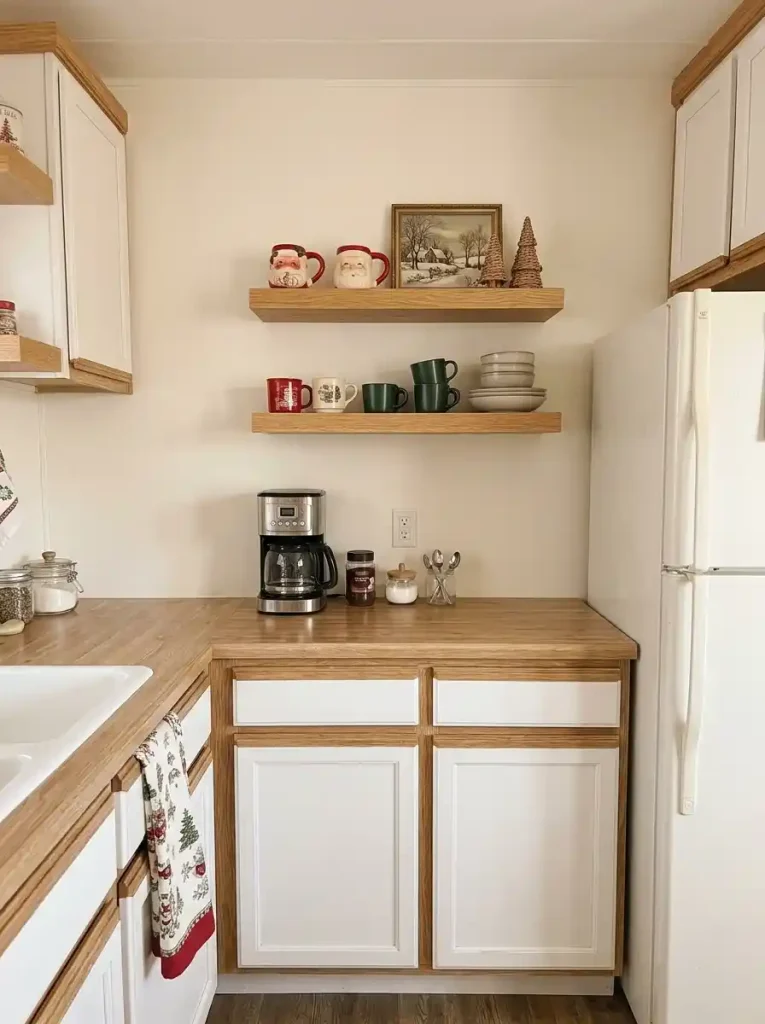
A shelf filled with red-and-white cups, white ceramic bowls, miniature evergreen trees, and a small framed winter print can create a cozy vintage Christmas atmosphere.
The challenge is keeping those objects easy to use.
Start with the mugs your household reaches for most often. Place them at a comfortable height, allowing enough room to remove each cup without knocking into another.
Position heavier bowls and dishes on appropriately supported shelves.
Once these practical items have their places, introduce a restrained amount of seasonal decoration.
A small bottlebrush tree or secured evergreen accent may be enough to establish the holiday mood.
A Simple Christmas Shelf Arrangement
Display level: Lightweight, stable seasonal accessories that do not need frequent handling.
Everyday level: Frequently used mugs and cups arranged with accessible handles.
Heavier-item level: Bowls and plates placed on shelving appropriate for their weight.
These are organizational roles, not universal shelf-height rules. Adapt the arrangement to the actual installation, household reach, and shelf capacity.
To test the finished display, remove the mug farthest from the shelf edge and return it.
If ornaments need moving first, simplify the arrangement.
For decorative displays throughout the rest of your home, explore these Christmas shelf styling ideas for mobile homes without a fireplace.
Let the Shelf Work Before It Decorates
Arrange by access frequency and appropriate support, then add the Christmas detail around the practical pieces.
Keep accents light and stable, with no loose greenery around heat.
A mug should come out without lifting another object.
Observe shelf load guidance; use sturdy, appropriate storage for heavy ceramics.
The diagram illustrates an organizational principle; exact shelf placement depends on the installation and household reach.
In the kitchen, attractive styling should never make frequently used dishes difficult to retrieve.
5. Keep a Hot Cocoa Kit Together in a Removable Tray
A cozy Christmas hot chocolate station sounds wonderful until it occupies the only counter available for making dinner.
In a compact mobile-home kitchen, the most useful beverage station may be one that can disappear into a cupboard between uses.

Choose a shallow tray, small handled basket, or stable wooden container that fits your existing storage space.
Gather the hot chocolate ingredients and accessories your household regularly uses: cocoa mix, clean stirrers, candy canes, and suitable shelf-stable toppings.
Store the Christmas mugs on a nearby accessible shelf.
When someone wants hot chocolate, bring out the tray and place it on an appropriate counter. Afterward, return the supplies to their designated location.
A removable station avoids the visual clutter of several half-empty packages scattered around the coffee maker.
For a traditional Christmas look, try a wooden tray, small clear jars, red-and-white accents, and a compact collection of Santa mugs.
Keep the display modest enough to move easily.
Milk, fresh whipped cream, and other perishable ingredients must remain refrigerated until needed. Follow the storage instructions for each product, and keep hot liquids and electrical appliances positioned safely.
Choose a removable cocoa kit when: Your kitchen has limited counter space, you prepare hot chocolate occasionally, or you need the same surface for meal preparation.
A permanent drink station makes more sense only when the space can support it without interrupting ordinary kitchen tasks.
6. Organize Christmas Cookies and Candy in Refillable Glass Jars
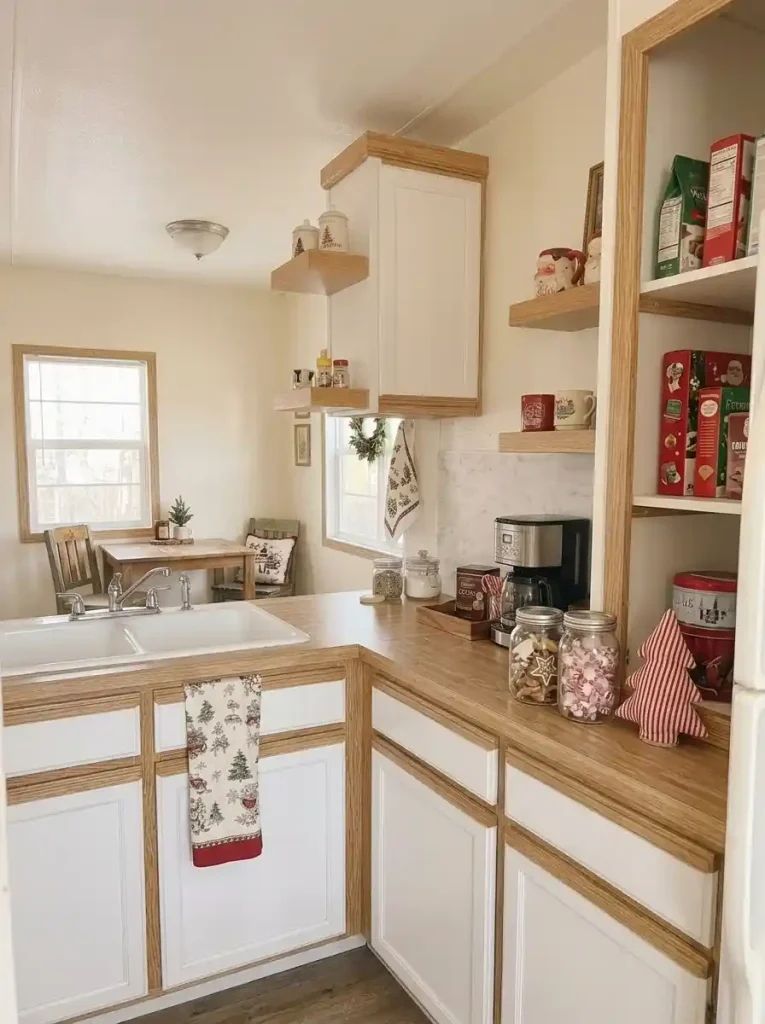
Large glass jars filled with Christmas cookies, candy canes, or individually wrapped treats can turn a practical storage area into a charming seasonal display.
They work especially well in kitchens with white cabinets, wood shelving, and a traditional red-and-green Christmas palette.
But the most attractive treat station is not necessarily the one with the most containers.
Begin with the sweets your family actually eats.
A jar of candy canes, a suitable container of dry cookies, and one smaller collection of wrapped chocolates may be enough.
Choose food-safe containers appropriate for the contents. Use airtight storage when needed for freshness, and keep foods that require refrigeration chilled.
Place the display on a stable surface away from heat, moisture, and active food preparation.
Keep backup supplies in their original suitable packaging or designated pantry containers until needed.
The Refill Rule
When a display jar becomes low, refill it from the stored supply and immediately return the remaining package to its assigned location.
This avoids a familiar holiday problem: one beautiful jar surrounded by several open bags of candy.
Glass is not always the best option for a busy household with young children. Durable, food-safe alternatives may provide a more practical arrangement.
The organization advantage: Your kitchen gets a festive display and an easy-to-monitor treat collection without requiring a large portion of the counter.
7. Build a Pull-Out Holiday Baking Basket for Ingredients You Actually Use
Holiday baking involves a surprising number of small objects.

Cookie cutters, measuring spoons, piping tips, sprinkles, parchment paper, and ingredient packages can quickly spread across a narrow counter.
The solution begins before you take out the mixer.
Create a temporary baking kit based on the recipe or activity you plan to complete.
For example, a cutout-cookie session may require measuring tools, cutters, parchment, and the shelf-stable ingredients listed in your recipe.
A cake-decorating session may involve piping bags, tips, food-safe sprinkles, and appropriate decorating tools.
There is little reason to bring out both collections at once.
Choose the Kit for Today’s Activity
| Activity | Supplies to group | Supplies to store separately |
|---|---|---|
| Cutout cookies | Cutters, measuring tools, parchment, suitable dry ingredients | Chilled dough, eggs, dairy, and other perishables |
| Cookie decorating | Piping tools, small bowls, suitable shelf-stable decorations | Perishable frosting and fillings |
| Gift packaging | Food-safe bags or boxes, labels, clean utensils | Ribbons and decorative materials until packaging is appropriate |
A compact basket or washable container can hold the active supplies beside your preparation area.
Once the session is over, return everything to its assigned storage position.
Do not use the basket as a substitute for refrigeration. Temperature-sensitive foods should remain properly stored until needed.
Build Only the Kit Today’s Recipe Needs
Choose a task. The active supply list and the storage caution change with it.
03 / Packing kit
- Food-safe bags or boxes
- Labels and a pen
- Clean tongs or utensils
- Ribbon and tags kept separate from unwrapped food
Start after: the cookies are fully cooled and ready for suitable packaging.
For households with limited cabinet space, this system can be particularly effective because it organizes a temporary activity without permanently dedicating an entire drawer or counter to Christmas baking.
8. Give Cookie Cutters, Piping Tips, and Sprinkles a Dedicated Small Drawer
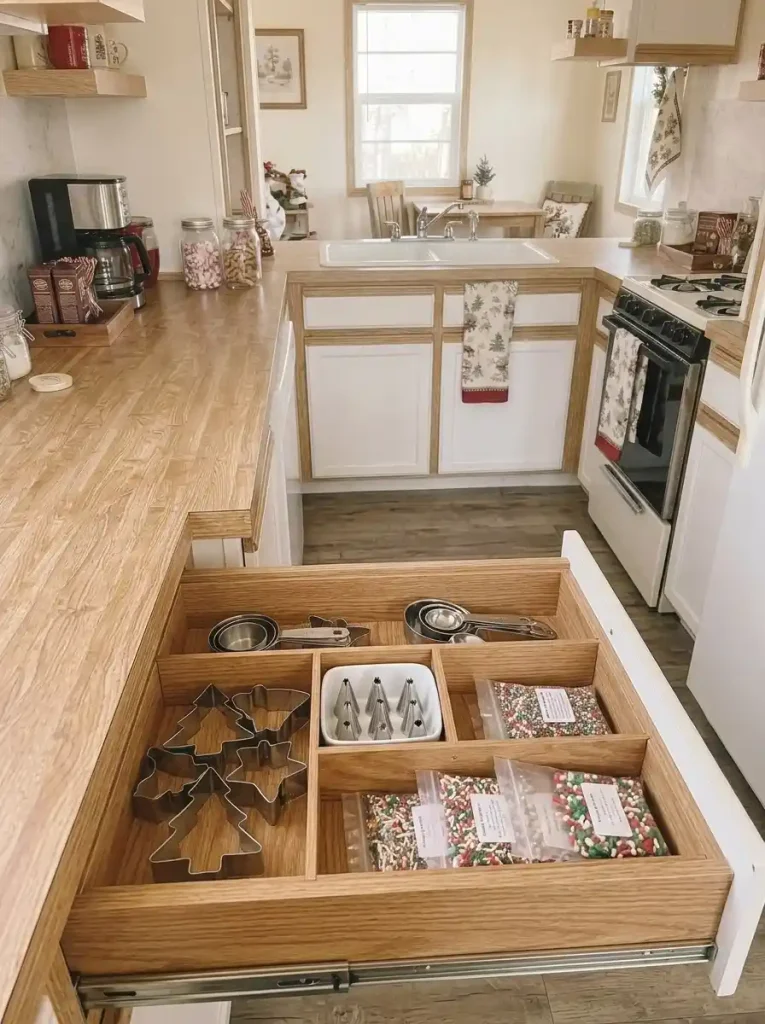
One narrow drawer may be enough for your holiday baking accessories.
The problem is usually not the number of objects but the way small tools overlap, tangle, and disappear beneath larger items.
Empty the drawer and group everything according to how you use it.
Keep flat cookie cutters together, place small piping tips in a compact container, and separate measuring tools from closed sprinkle packages.
A washable drawer insert may help prevent smaller pieces from migrating across the drawer.
However, dividers can consume valuable space, particularly in shallow mobile-home cabinetry.
Measure the usable interior before purchasing anything.
Small lidded containers may be more suitable for piping tips, while cookie cutters often need only a simple box or adjustable compartment.
Sharp accessories should be safely protected and stored away from young children’s reach.
A useful decision rule: If every item can already be found and returned without unloading the drawer, a new organizer is unnecessary.
Focus on retrieval, cleaning, and ease of use.
A perfectly coordinated drawer is less useful than one that still works when your hands are covered in flour.
9. Protect a Cookie-Cooling and Gift-Packaging Landing Strip
The busiest moment of holiday baking often begins after the cookies leave the oven.
Hot baking sheets need a suitable place to land. Cookies need room to cool. Decorating supplies appear, and gift boxes begin occupying whatever counter space remains.
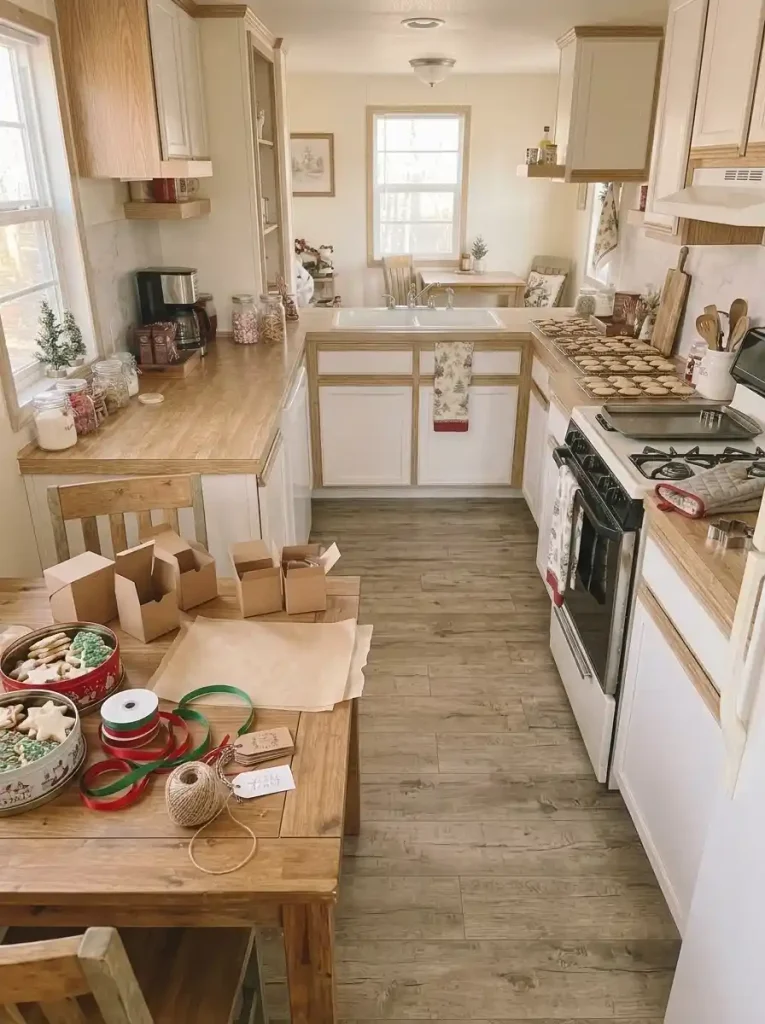
A small kitchen can become crowded even when the baking itself is well organized.
The solution is to plan the movement of each batch.
First, establish an appropriate heat-safe landing location for hot trays and cooling racks, away from children, pets, and active walkways.
Once baked goods have cooled sufficiently, move them to a separate clean decorating or packaging area.
A nearby dining table may provide useful packaging space when the kitchen counter is needed for cooking and cooling. Protect the furniture appropriately and keep food-contact surfaces clean.
Paper bags, ribbon, gift tags, and boxes should remain away from burners and hot equipment until they are needed.
Consider the timing of each activity.
The same surface may support more than one step, provided the previous task has finished and the area is suitable for the next one.
The stop signal: If another hot baking sheet has nowhere safe to go, pause the next batch until adequate space becomes available.
This simple workflow decision prevents an enjoyable baking afternoon from turning into a kitchen full of obstacles.
10. Park the Stand Mixer Where It Can Be Used Without Rearranging the Kitchen
A stand mixer can be one of the most useful appliances during Christmas baking.
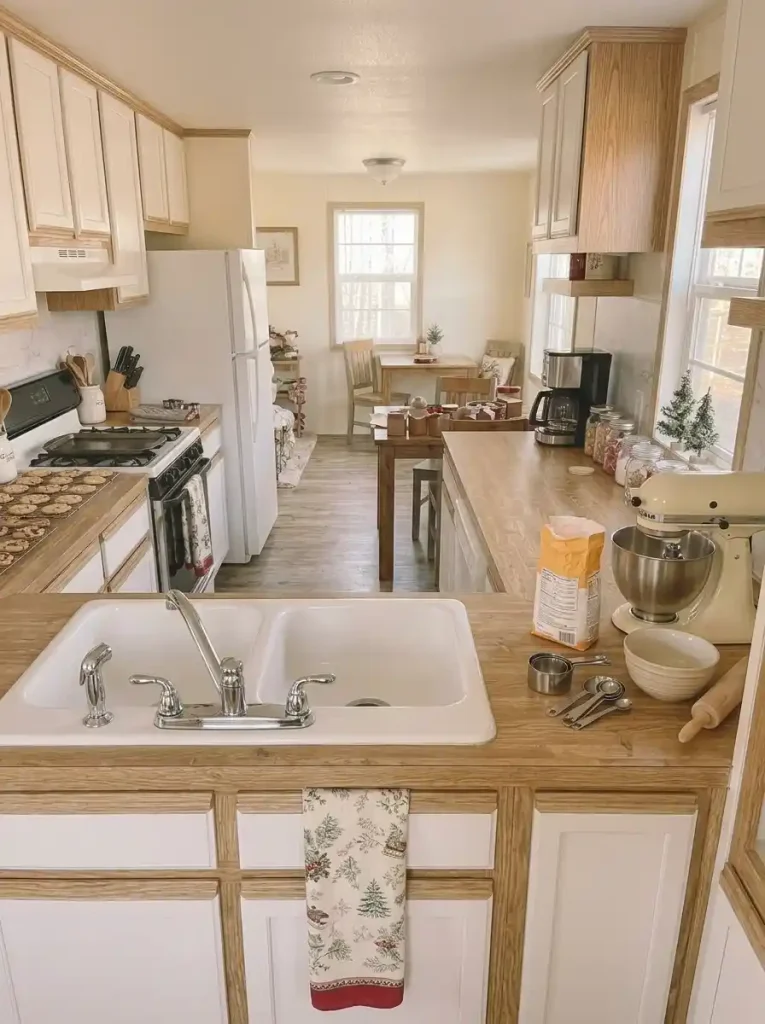
It can also occupy a surprisingly large portion of a compact kitchen.
The space required includes more than the appliance’s base. You need to account for access to the bowl, movement of attachments, safe cord positioning, and the opening of surrounding cabinets.
Before deciding where the mixer belongs, place it on a suitable stable surface with the appliance unplugged.
Attach the bowl, check the space required for normal operation, and confirm that nearby drawers and cabinet doors can still open comfortably.
Then consider how often you will use it.
For frequent holiday bakers: A designated temporary mixer position may be practical during an active baking week, provided it does not obstruct everyday kitchen tasks.
For occasional bakers: Bringing the mixer out for individual sessions may preserve much more usable counter space throughout December.
Avoid placing the appliance on an unstable decorative riser or using an extension cord as an automatic solution to poor positioning.
Follow the manufacturer’s operating, electrical, and clearance instructions.
If the mixer prevents easy refrigerator access or leaves nowhere to measure ingredients, choose another location.
A thoughtfully parked appliance should support baking without requiring you to reorganize the entire kitchen every time you use it.
11. Give Holiday Serving Boards and Platters an Easy-to-Reach Home
Holiday serving pieces have an inconvenient habit of being wider, heavier, and more awkward than everyday dishes.

A large Christmas platter may occupy most of a cupboard shelf, while a collection of wooden serving boards can become difficult to retrieve when stacked horizontally.
Before organizing these items, look at your actual holiday menu.
Which pieces will you use for the main dish, appetizers, cookies, or desserts?
Keep those items accessible during the days leading up to the gathering.
Heavy ceramic platters generally belong on appropriately supported lower shelves where they can be retrieved safely.
Flat boards may fit in a suitable vertical divider, provided they remain stable and cannot tip when another item is removed.
Avoid precarious stacks of oversized pieces.
Now consider whether every festive serving tray genuinely earns its storage space.
If an everyday serving dish works just as well, using it may be the better choice.
A small kitchen benefits from a carefully selected serving collection.
The practical test: Can you retrieve the largest platter you need without unloading the rest of the cupboard?
If not, change the storage arrangement before your holiday meal.
12. Make Temporary Refrigerator Space for Holiday Prep and Leftovers

Holiday refrigerator organization deserves as much attention as the visible kitchen shelves.
A small refrigerator can become crowded with ingredients, desserts, chilled drinks, prepared dishes, and leftovers, sometimes before the main gathering has even started.
The first step is to create space before buying the extra food.
Check what is already in the refrigerator and plan meals around suitable ingredients that should be used soon.
Then estimate the refrigerated storage your holiday menu will require.
Keep raw meat and poultry securely contained and separated from ready-to-eat foods to help prevent cross-contamination.
Use a refrigerator thermometer to check that the temperature remains 40°F (4°C) or below, and avoid overcrowding so chilled air can circulate.
Organize Your Refrigerator in Three Stages
| Holiday stage | Storage priority | Main decision |
|---|---|---|
| Preparing ahead | Recipe ingredients, protected ready-to-eat foods, safely separated raw foods | Do you have sufficient safe capacity for the planned menu? |
| Serving day | Chilled dishes and backup portions | Can you serve smaller quantities while keeping backups refrigerated? |
| After the gathering | Promptly chilled leftovers in shallow, covered containers | Which foods should be eaten or frozen first? |
For large amounts of cooked food, divide leftovers into shallow containers for more efficient cooling and refrigerate promptly.
According to the USDA’s guidance on handling leftovers safely, perishable leftovers should be refrigerated within two hours, or within one hour when temperatures are above 90°F (32°C). Refrigerated leftovers generally should be used within three to four days or frozen for longer storage.
Three Stages of a Holiday Refrigerator
Switch between preparation, serving, and cleanup. These are conceptual categories, not fixed shelves that override food-safety rules.
Make room before shopping
- Plan meals around existing perishables.
- Keep raw foods securely contained and separate from ready-to-eat foods.
- Confirm the fridge stays at or below 40°F (4°C).
Bring food out in smaller batches
- Keep perishable backups refrigerated.
- Track time outside temperature control.
- Maintain cold foods at 40°F (4°C) or below when holding for service.
Clear the table promptly
- Transfer food into shallow containers for quicker cooling.
- Refrigerate perishables within two hours; one hour above 90°F (32°C).
- Use refrigerated leftovers within USDA-recommended storage periods.
Follow USDA/FDA food-safety advice and the refrigerator manufacturer’s instructions. Actual food placement depends on refrigerator design and contamination control.
Safe storage matters more than creating a picture-perfect refrigerator.
If the holiday menu exceeds your available refrigerated capacity, reduce the quantity, adjust the preparation schedule, or arrange appropriate additional cold storage before cooking.
13. Set Up a Temporary Landing Spot for Incoming Holiday Food
Holiday guests often arrive carrying more than presents.

One person brings a casserole, another arrives with dessert, and someone else has a large container of food that needs refrigeration.
Without a designated receiving area, these items quickly accumulate on whichever counter looks available.
That may be the exact surface the cook needs.
Choose a stable, accessible landing spot near the kitchen entrance or adjoining dining area.
The surface should be suitable for the items being received, with appropriate heat protection for hot dishes.
Make sure guests can approach it without crossing an active cooking route.
The receiving area is only a temporary handoff point. Foods requiring refrigeration or hot holding must move promptly to suitable temperature-controlled locations.
For serving, the FDA’s guidance on safe holiday buffets recommends maintaining hot foods at 140°F (60°C) or above and cold foods at 40°F (4°C) or below.
Small serving portions can help reduce the amount of perishable food sitting out at once.
If your gathering requires a complete self-serve arrangement, the guide to setting up a Thanksgiving buffet in a narrow mobile-home kitchen provides more detailed layout inspiration.
For everyday Christmas entertaining, the essential decision is simple:
Where can someone safely place an incoming dish without interrupting the person cooking?
Answer that before the first guest arrives.
14. Organize Christmas Napkins, Tea Towels, and Oven Mitts by Their Jobs
A collection of festive kitchen textiles can make a room feel instantly ready for Christmas.

Red-and-white striped tea towels, embroidered napkins, and patterned oven mitts are attractive details, particularly in traditional farmhouse-style kitchens.
But matching colors do not mean the items belong together.
Clean guest napkins, everyday dishcloths, and protective cooking accessories serve very different purposes.
Organize them according to their jobs.
Keep clean entertaining napkins close to the dining area, where guests or family members can reach them while setting the table.
Store clean, dry oven mitts in an accessible place away from burners and other cooking heat.
Give used dishcloths and towels a designated route to laundering so they do not become mixed with clean linens.
A shallow drawer divider or an existing basket may be enough to separate these categories.
There is no need to purchase several matching storage containers if the kitchen already has a practical system.
Think in three roles: serve, cook, and wash.
This makes it easier for everyone in the household to find the correct item and return it to the right place.
15. Keep Christmas Decorations Outside Heat and Splash Zones
Christmas kitchen decorations can be surprisingly difficult to position safely.

A beautiful evergreen garland might hang too close to the stovetop. A ribbon may interfere with a cupboard or appliance. A decorative candle could sit beside paper towels or another flammable object.
Before adding seasonal accessories, inspect the areas around your range, oven, sink, and countertop appliances.
Look for locations exposed to direct heat, grease, splashes, steam, or frequent movement.
Keep combustible decorations and other flammable materials away from cooking equipment.
The National Fire Protection Association’s cooking-safety guidance specifically recommends keeping materials that can catch fire away from the stovetop.
Always follow appliance-specific clearance and ventilation requirements.
An artificial garland, decorative fabric, or battery-operated accent is not automatically suitable for every kitchen position.
For a safer visual effect, consider a framed winter landscape, miniature evergreen, or decorative arrangement on an appropriate cool, stable shelf away from active cooking.
A Christmas display on the dining-facing side of the kitchen may also create a charming focal point without interfering with food preparation.
For more specific inspiration, see these Christmas kitchen cabinet wreath ideas for mobile homes.
Whichever style you choose, check that the cabinet doors, appliances, and surrounding work surfaces can still be used normally.
The most successful holiday kitchen decorations contribute atmosphere without becoming obstacles or hazards.
16. Plan a Two-Person Holiday Cooking Route for a Narrow Kitchen
A compact kitchen can function beautifully for one cook and feel crowded the moment someone else offers to help.

Picture a typical Christmas afternoon.
One person is preparing vegetables near the sink. Another opens the refrigerator, turns toward the oven, and tries to carry a hot dish to the dining table.
A temporary cocoa station or decorative plate display may suddenly become a serious inconvenience.
Before a busy holiday meal, rehearse how two people will use the kitchen.
Choose a Route That Fits Your Kitchen Layout
One-wall mobile-home kitchen
When the sink, preparation area, and cooking equipment share one wall, keep the main work run accessible.
Move guest-facing activities, such as drink preparation and plate collection, toward an appropriate dining-side location.
The test is whether someone can access the oven while another person completes a separate task safely.
Galley mobile-home kitchen
A narrow galley can create conflicts when people work directly opposite each other.
Assign tasks to suitable separate ends where practical, and avoid opening opposing appliance doors at the same time.
Remove seasonal displays that narrow the central walkway.
Check whether someone carrying a hot dish can move without squeezing past another person.
L-shaped mobile-home kitchen
An L-shaped arrangement may concentrate several activities around the inside corner.
Keep that turn clear of stools, temporary serving trays, and decorative collections.
Place the guest pickup area away from the main cooking corner if the layout permits.
Test whether cabinet doors and appliance access remain usable when both people are working.
These are practical workflow examples, not universal construction measurements.
Whatever the configuration, preserve safe passage, normal appliance operation, and unobstructed exits.
Where Can the Second Cook Move?
Choose the layout closest to yours. Each view identifies a different collision risk and a practical way to stage temporary holiday supplies.
Do not build a second preparation station inside the only active run. Move guest drinks or plate collection toward the dining space.
Rehearsal: Can someone pass while the oven door is open?
Assign compatible tasks to opposite ends and remove displays that narrow the center path. Stagger oven and dishwasher use where practical.
Rehearsal: Can two people work without crossing behind a hot dish?
Keep seasonal trays and stools away from the corner where the sink, range, and prep activity may converge.
Rehearsal: Can someone turn with a platter while cabinet doors are in normal use?
Illustrative workflow layouts only; not construction plans or universal clearance specifications.
The final test: If a holiday station forces someone to pass dangerously close to hot equipment, move the station before the gathering.
17. Pack Holiday Kitchen Extras So January Feels Organized Again
A well-organized Christmas kitchen should be easy to restore when the season ends.

This begins with recognizing which additions were temporary.
Your festive dishes, cocoa supplies, baking equipment, and decorative accessories may have occupied useful positions throughout December, but everyday kitchen items will need those locations again.
When putting Christmas away, work through four simple stages.
Step 1: Clear the Seasonal Displays
Remove Christmas decorations and temporary stations.
Finish dealing with any remaining food appropriately, then clean the reusable accessories before storage.
Step 2: Sort Everything by Its Everyday Role
Separate ordinary kitchen equipment from seasonal dishes, baking accessories, and purely decorative pieces.
Items used throughout the year should return to their normal locations.
Step 3: Protect and Label Holiday Extras
Wash and completely dry appropriate containers and accessories before packing.
Cushion fragile pieces, group related items together, and label storage boxes clearly.
Make sure the selected storage location is suitable for the contents.
Step 4: Restore Everyday Kitchen Access
Return daily dishes, cooking tools, and appliances to convenient positions.
Remove temporary baskets or dividers that no longer serve a useful purpose.
Take a moment to record which seasonal items you actually used.
Perhaps two Christmas treat jars were enough, even though you owned six. Maybe the cocoa tray worked beautifully while the extra serving stand remained in storage all month.
That information can make next December much easier.
For larger seasonal collections, explore these holiday decoration storage ideas for after Christmas.
Return to the Everyday Kitchen
Complete food handling and wash the seasonal accessories.
Separate everyday dishes, seasonal tools, and decorative extras.
Dry everything fully; cushion fragile pieces and label groups.
Return everyday dishes and working tools to their prime positions.
A good storage system should make unpacking next year as straightforward as putting everything away now.
Conclusion: Give Every Holiday Item a Temporary Job
Creating a beautiful holiday kitchen in a small mobile home does not require additional cabinets, expensive organizers, or counters covered in Christmas decorations.
It begins with understanding how the space needs to function throughout the season.
Keep everyday meal-preparation surfaces accessible. Bring frequently used Christmas dishes into convenient cabinets, organize holiday baking supplies around actual activities, and create small, removable stations for drinks and treats.
A few carefully chosen details—vintage Christmas mugs, a small evergreen arrangement, coordinated dinnerware, or neatly displayed sweet jars—can provide the festive atmosphere without overwhelming the room.
Before purchasing another storage container, live with the arrangement through one ordinary weekday and one busy holiday activity. Notice which items are easy to reach and which continually need moving.
Those observations are more useful than filling every available shelf.
When the season ends, clean, sort, pack, and return the kitchen to its regular routine.
The best holiday kitchen organization ideas make Christmas feel special while allowing the kitchen to work comfortably every day.