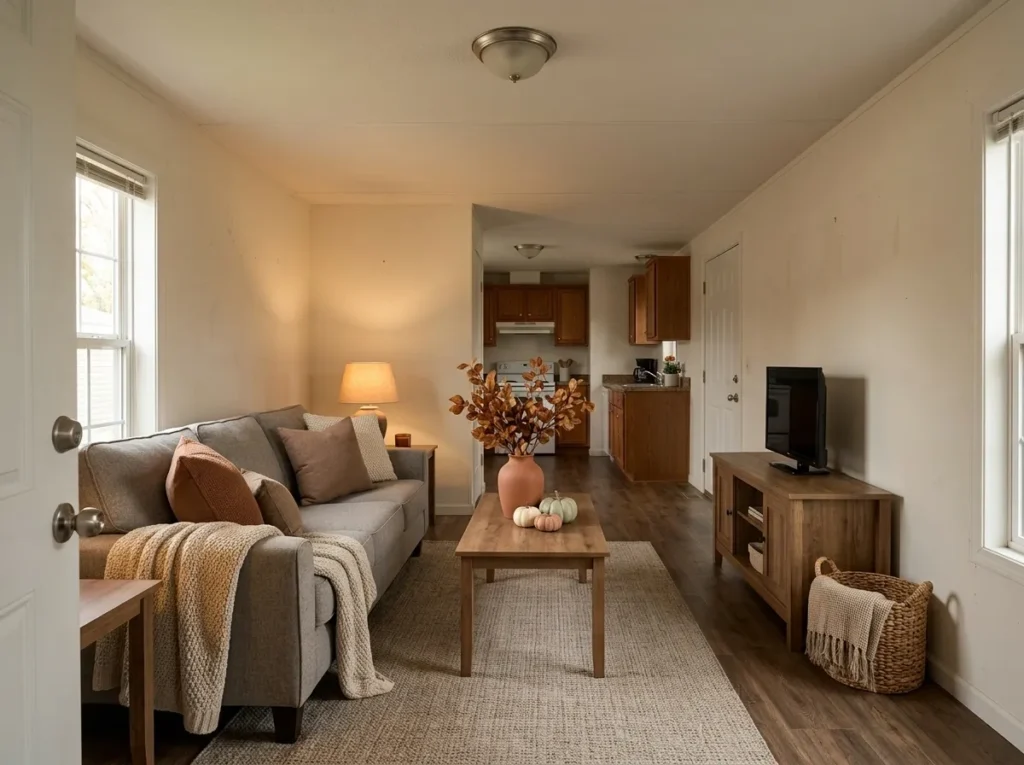
An older mobile home can feel especially dated when fall arrives—not because the home suddenly needs remodeling, but because seasonal décor gets layered over finishes that already compete for attention.
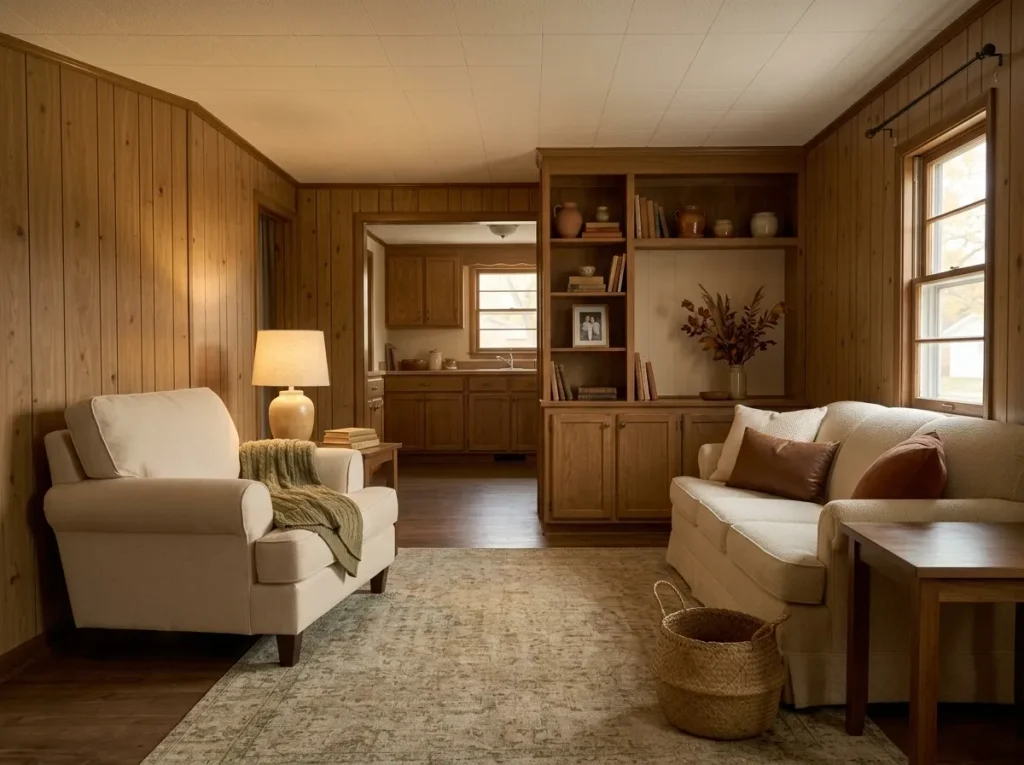
Wood trim, paneled walls, older flooring, basic doors, original cabinets, and inherited built-ins may all still be perfectly usable. The problem is often that those features no longer feel connected to the colors, textiles, lighting, and objects around them.
That is where thoughtful fall updates for an older mobile home can make a much bigger difference than another round of decorating.
The goal here is not to disguise the age of your home. It is to decide which original features deserve to stay, which ones need a softer visual setting, and which small updates will actually improve the way the space feels.
Throughout these ideas, use one simple framework:
Keep → Soften → Cover → Update → Defer
If a feature is sound, test a cosmetic solution before replacing it. If something shows signs of damage, moisture, electrical trouble, plumbing problems, instability, or another functional issue, move it out of the seasonal-decor category and deal with the underlying problem first.
1. Start by Saving One Original Feature
Before deciding that an older mobile home needs to look newer, find one feature that already gives it personality.
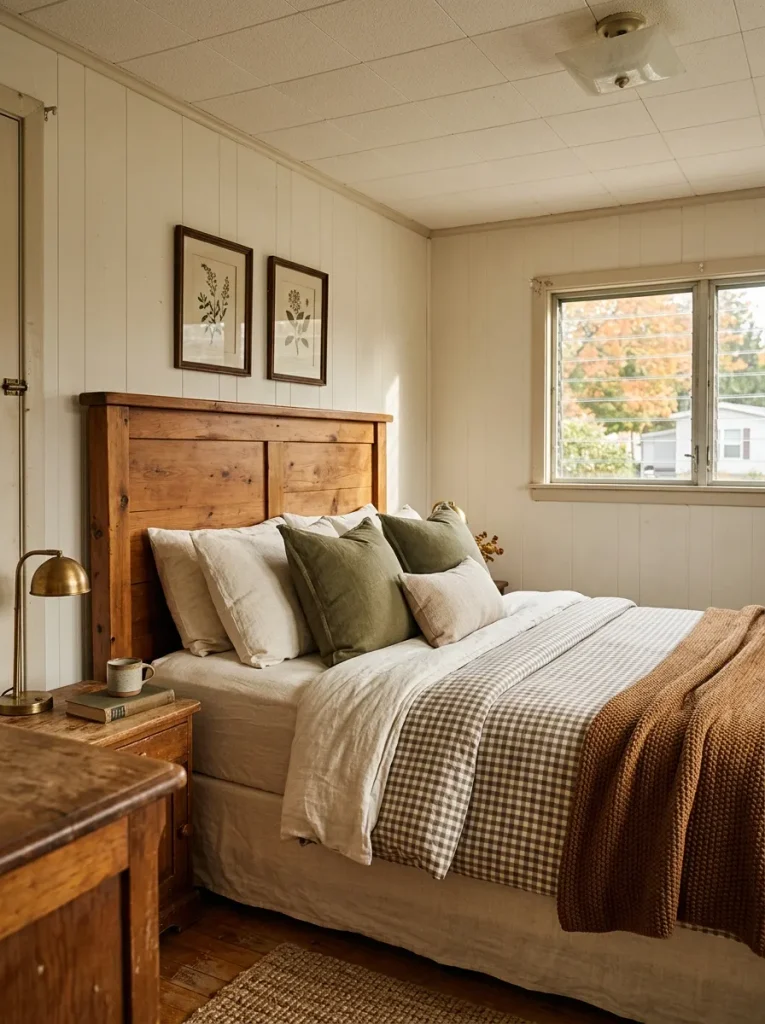
It might be a warm wood headboard, original kitchen cabinetry, an older built-in shelf, dark window trim, a vintage interior door, or even a section of wall paneling. When every dated feature is automatically treated as something to hide, the finished room can lose the very detail that would have made it memorable.
Photograph the room and mentally remove everything except the feature you are considering.
Does that feature look genuinely worn out?
Or does it simply look unsupported by what surrounds it?
A traditional wood bed, for example, can feel beautifully collected once the bedding shifts toward cream, muted ochre, brown gingham, tobacco, or soft olive. The bed has not changed. Its context has.
That is the first decision to make before buying anything:
If the feature is sound and visually interesting, let it become the anchor for the update.
Older Feature Triage
What does this dated feature actually need?
Choose the action closest to the feature in front of you. The recommendation below changes instantly without JavaScript.
A sound feature earns a cosmetic test before replacement.
Make the feature part of the story.
The feature is sound and already has character. Build around it with quieter neighboring finishes, warmer textiles, and one or two repeated tones.
Lower the contrast around it first.
The feature may be fine while trim, patterns, frames, or nearby colors are making it look harsher than it is.
Use a reversible layer.
A rug, curtain, runner, slipcover, or removable textile can hide a visually weak area while leaving a serviceable feature intact.
Change the small component carrying the age.
The entire feature may not be the problem. Hardware, a shade, rod, handle, or neighboring finish can be the detail dating the whole zone.
Pause the cosmetic project.
If you see moisture, movement, unsafe wiring, plumbing trouble, instability, or another functional concern, styling should not hide it.
2. When Panel Walls Feel Busy, Reduce the Contrast—Not the Character
Older mobile-home wall panels often get blamed for making a room look dated, although the surface itself may not be the real problem.
Consider everything crossing the wall.
Dark crown trim. Contrasting baseboards. Several small frames. A patterned curtain. Multiple wood finishes. Decorative signs. Tall furniture.
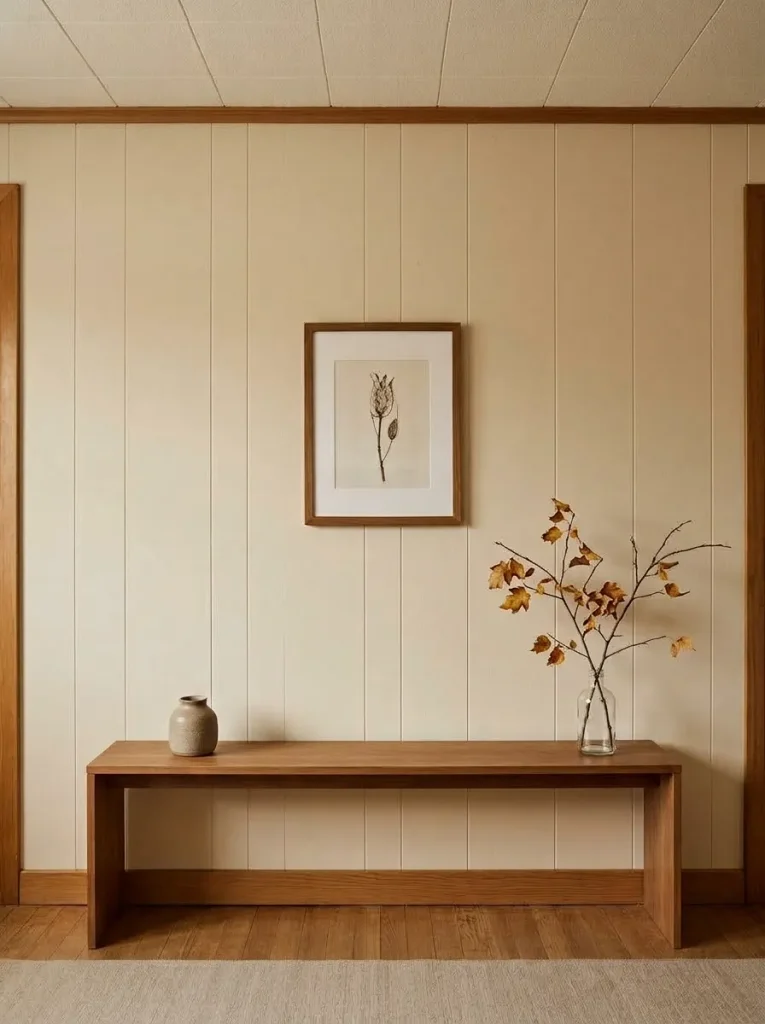
By the time all of those elements are layered together, the paneling is only one line among many.
Before painting or covering it, temporarily remove the smallest wall décor and take another photograph. If the wall immediately feels calmer, you have learned that visual competition was doing more damage than the paneling itself.
From there, rebuild slowly.
One larger artwork may work better than six small frames. A quiet textile can make dark trim feel deliberate. Repeating one wood tone elsewhere gives an older panel finish context.
Fall is especially useful for this because warm brown, olive, cream, tobacco, muted rust, and woven textures naturally cooperate with many older mobile-home finishes.
Practical rule: when the original surface is sound, simplify what crosses it before changing the surface itself.
3. Does the Window Really Need Replacing?
An older window can make a room feel dated long before the window itself becomes the problem.
Look at the composition around it first.
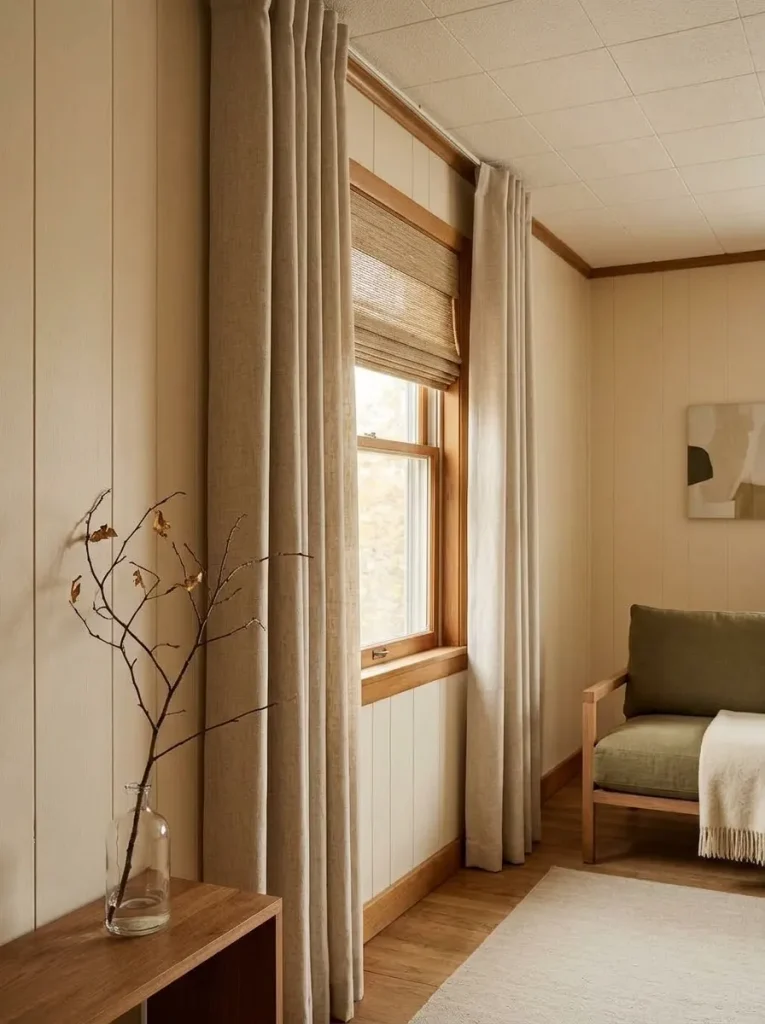
Is a short curtain making the opening look smaller?
Are the rod, blinds, trim, wall color, and fabric all competing?
Has a shelf been squeezed too close to the top of the window?
Is a heavy valance drawing attention to an otherwise simple frame?
Remove the treatment temporarily.
The bare-window test separates the actual opening from all the decorating decisions surrounding it. If the window suddenly appears cleaner and larger, the refresh can stay cosmetic.
Rebuild the area with one clear direction: softly textured neutral curtains, restrained gingham, a simple woven shade, or one autumn branch arrangement positioned beside the frame.
Wood trim does not have to be painted just because it is older. Cream linen, oatmeal, mossy green, muted plaid, and tobacco brown can make warm trim feel intentionally traditional.
If the window has a functional problem—such as damage, poor operation, leakage, or another installation concern—the decision is no longer purely decorative.
4. One Hardware Family Can Update an Entire Sightline
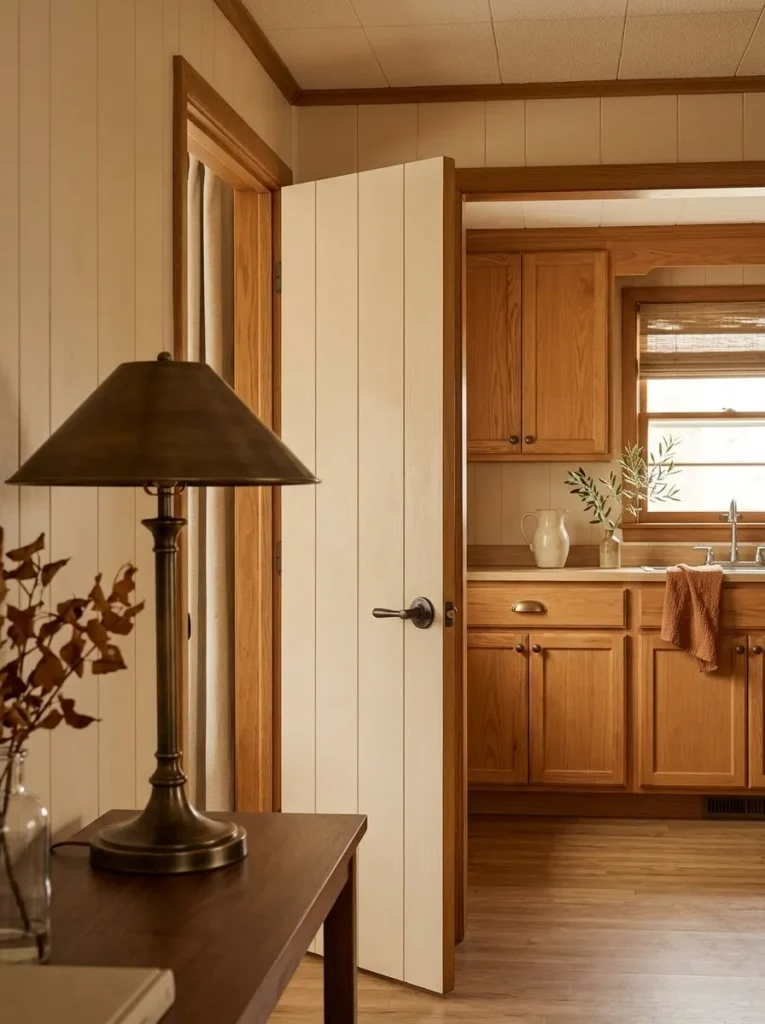
Walk through your mobile home and notice what repeats at hand level.
Cabinet pulls.
Interior-door knobs.
Curtain rods.
Hooks.
Lamp details.
Small metal accents.
In older homes, these pieces often come from several decades of individual updates. None may look especially bad by itself, yet together they create visual fragmentation.
Do not begin by replacing every piece of hardware.
Stand in the living room and look toward the kitchen. Which finishes can you see from that one position?
If several visible touchpoints are unrelated, coordinating only those pieces can produce more continuity than changing an isolated detail somewhere else.
A dark bronze cabinet pull can relate to a curtain rod. An aged-brass lamp can echo warm cabinetry. Matte black may work in a room where the existing dark trim already creates stronger contrast.
The pieces do not need to match exactly.
They simply need to belong to the same visual family.
Update the hardware when:
- several different finishes are visible together;
- one inexpensive component makes a larger feature look older;
- adjacent rooms need a small repeating detail.
Leave it alone when:
- the existing finish already relates to the room;
- replacing it would only satisfy the urge to make something “new”;
- the hardware has useful character worth keeping.
5. Give the Lamps You Already Own a Warmer Fall Identity
Turn on the lamps before sunset and look at the room from the doorway.
Some older living rooms feel perfectly comfortable during the day but become flat at night. The immediate reaction may be to replace the fixture.
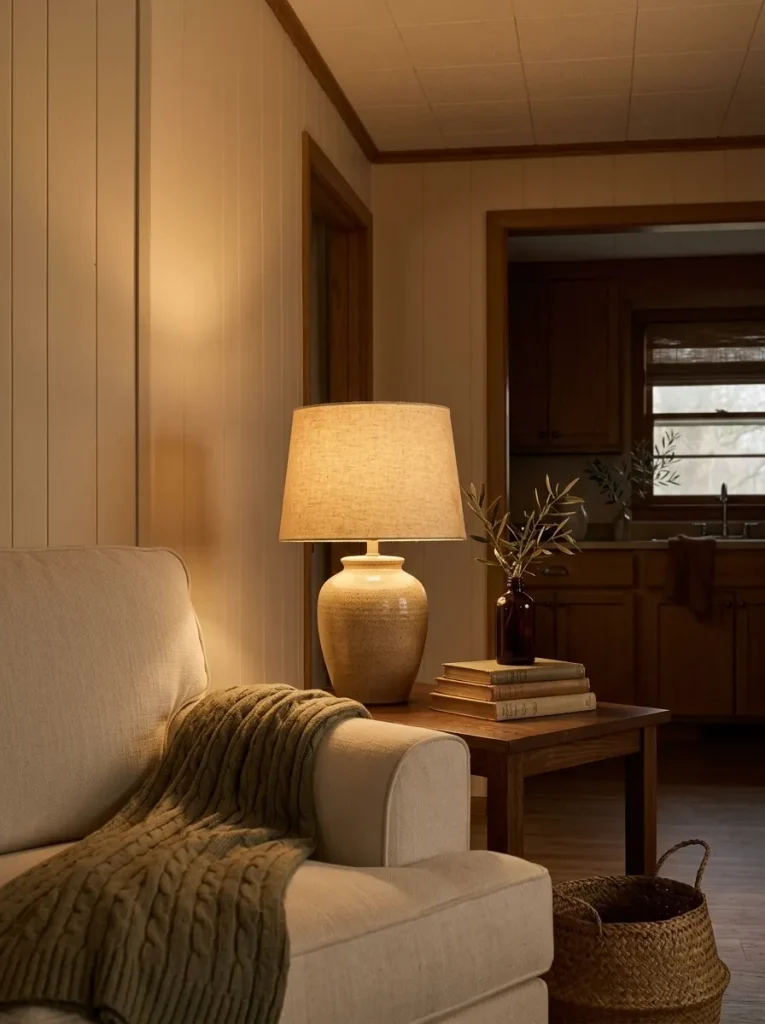
Look at the light around it first.
A traditional ceramic lamp or older wood-base lamp can fit fall beautifully once its shade, placement, and surroundings are working together.
A calmer shade can soften the object. Moving the lamp beside a textured chair can create a better pool of light. A woven basket, stack of books, wood table, or dried arrangement nearby may connect the lamp to the rest of the fall palette.
The lamp itself has not become modern.
It has become relevant again.
For this update, judge what the light does to the corner—not how fashionable the fixture looks in isolation.
One warm seating corner can contribute more evening atmosphere than several extra seasonal accessories.
If the fixture or its wiring appears damaged, leave the electrical issue outside the cosmetic project.
6. A Rug Can Make Tired Flooring Feel Chosen
Flooring occupies so much visual space that an older finish can influence the entire room.
That does not automatically mean it needs replacing.
Stand at the main doorway and notice where your eye lands.
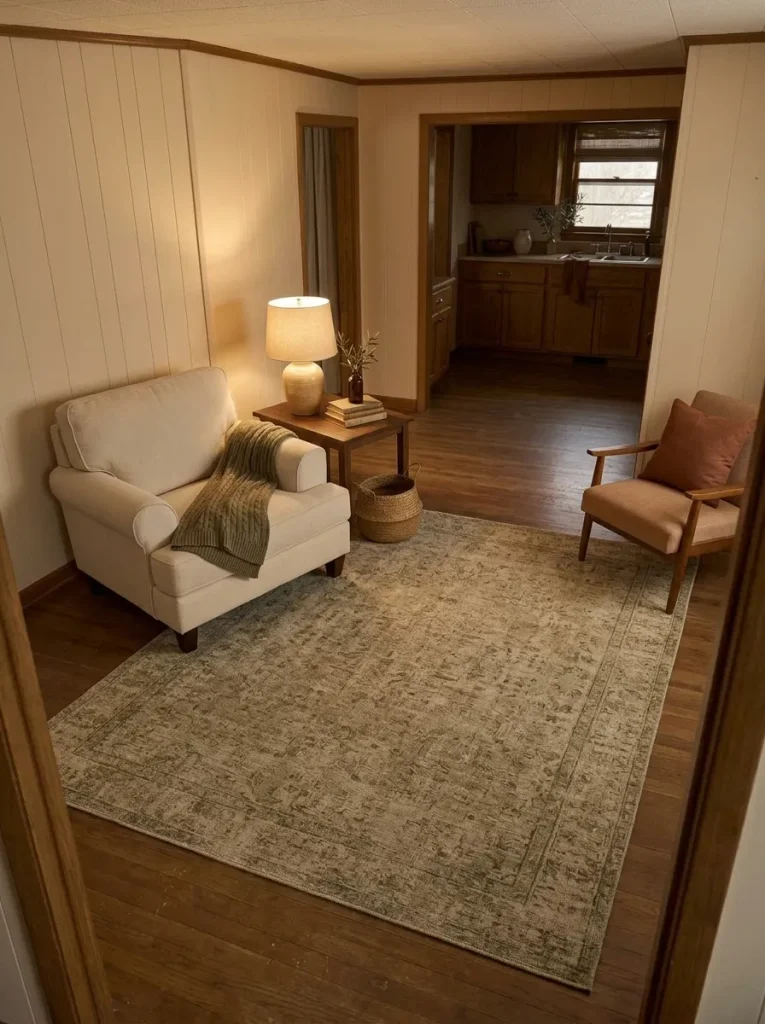
If a large expanse of older vinyl, laminate, or wood-look flooring dominates the view, a properly scaled rug may change the hierarchy enough to let the floor become background.
The important part is scale.
In a mobile-home living room, a tiny floating rug can emphasize the amount of exposed flooring around it. A larger rug that relates to the main seating arrangement usually feels more deliberate.
For fall, look at oatmeal, brown, faded olive, tobacco, muted rust, taupe, or a restrained vintage-style pattern.
The rug does not need to hide every inch.
It needs to tell the eye where the room begins.
Flooring Decision Test
Is the floor visually dated—or actually a flooring project?
Choose the condition closest to what you see. The result changes from styling advice to a stop signal when the problem is no longer cosmetic.
A reversible layer may be enough.
If the floor is stable and your concern is color or pattern, use a correctly scaled rug to organize the seating area and reduce how much of the floor dominates the room.
A rug should not become camouflage.
Lifting, softness, moisture-related damage, instability, or another physical failure changes the project. The visual update can wait until the underlying condition is addressed.
Name the problem before choosing the solution.
If you are unsure whether the floor is merely unattractive or physically compromised, do not let the fall makeover force a premature buying decision.
A rug is a decorating solution for a visual problem.
It should never become camouflage for a functional one.
7. Let the Built-In or Media Wall Hold the Richest Autumn Layer
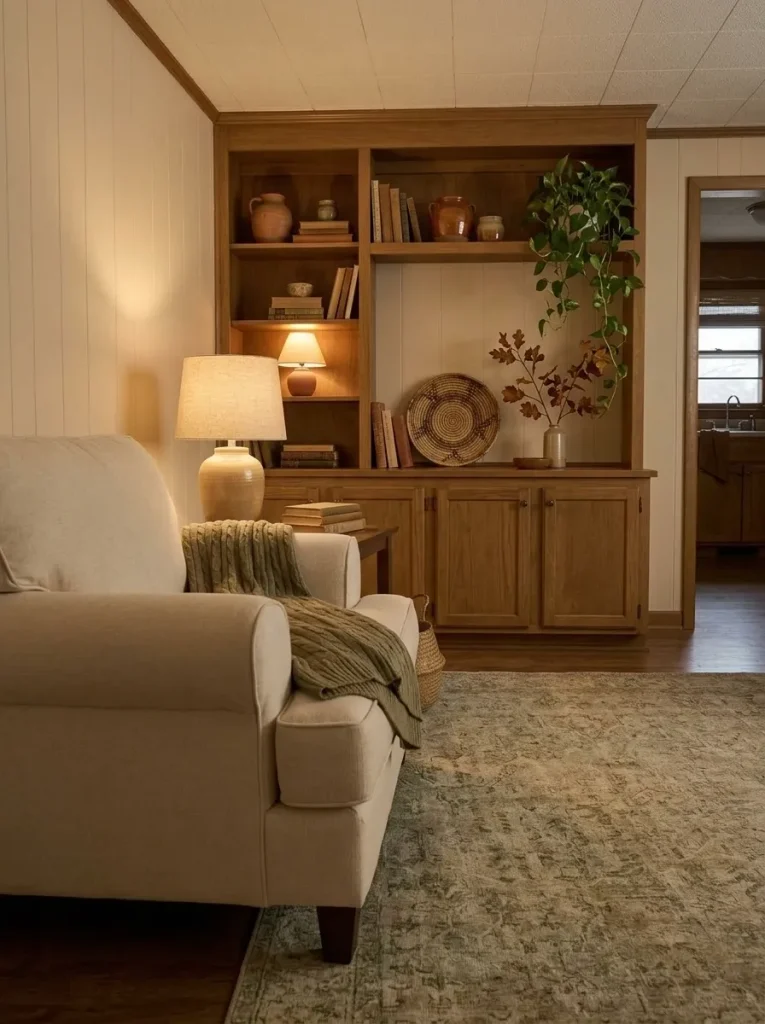
Older mobile homes often have one area that already carries more visual weight than everything around it.
It may be a fireplace wall, media cabinet, built-in shelving unit, long ledge, or television wall.
Let that zone do more seasonal work.
A few books, one trailing plant, a darker pottery piece, a woven basket, dried foliage, and restrained warm lighting can create enough fall depth to carry the entire room.
Then leave secondary surfaces quieter.
The benefit is hierarchy.
When every table, shelf, and ledge receives the same amount of seasonal décor, a compact living room can become visually dense very quickly. Concentrating the strongest styling in one existing focal area allows the rest of the room to breathe.
Try photographing the room in grayscale.
If five different surfaces still demand equal attention, remove something from two or three of them.
The primary focal area should remain obvious even without orange pumpkins or bright seasonal signs.
For more general room-by-room atmosphere, continue to the broader guide on making an older mobile home feel cozy for fall.
8. Refresh the Kitchen at the Sink Window, Not Across Every Counter
Picture a compact older kitchen with limited prep space, serviceable cabinets, a dated window surround, and nowhere obvious to decorate.
The easiest mistake is filling every open corner.
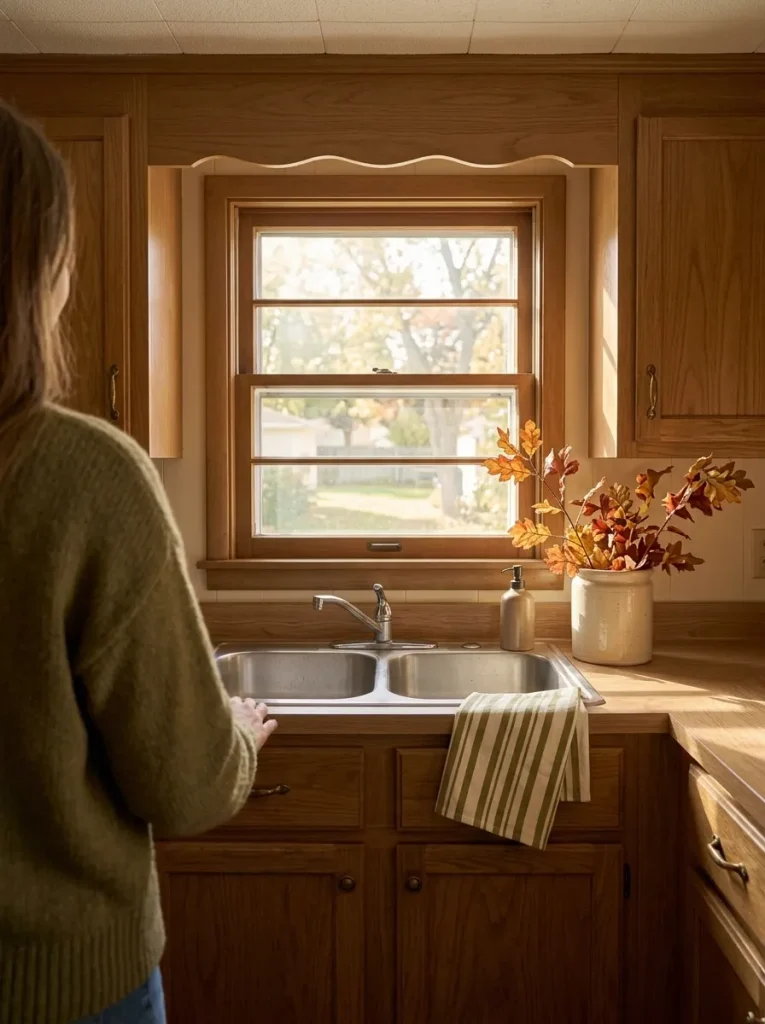
That makes the kitchen less useful and can make its proportions feel even tighter.
Build one intentional fall moment instead.
The sink or window area usually works well because it already attracts the eye. A compact arrangement might include:
one autumn branch arrangement + one useful towel + one small ceramic or amber-toned object.
That is enough.
Keep the actual working surface clear.
If the window trim is warm wood, use rust, wheat, cream, olive, or tobacco nearby. If the cabinetry is pale, one darker seasonal note may supply all the contrast the kitchen needs.
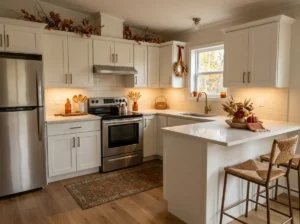
Then step into the adjacent room and look back.
If that one small zone already communicates fall, stop decorating the rest of the counters.
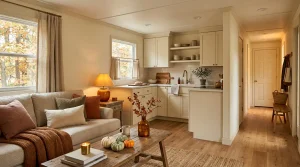
The kitchen still needs to function as a kitchen.
For a deeper cosmetic project, continue into mobile home kitchen makeover ideas on a budget.
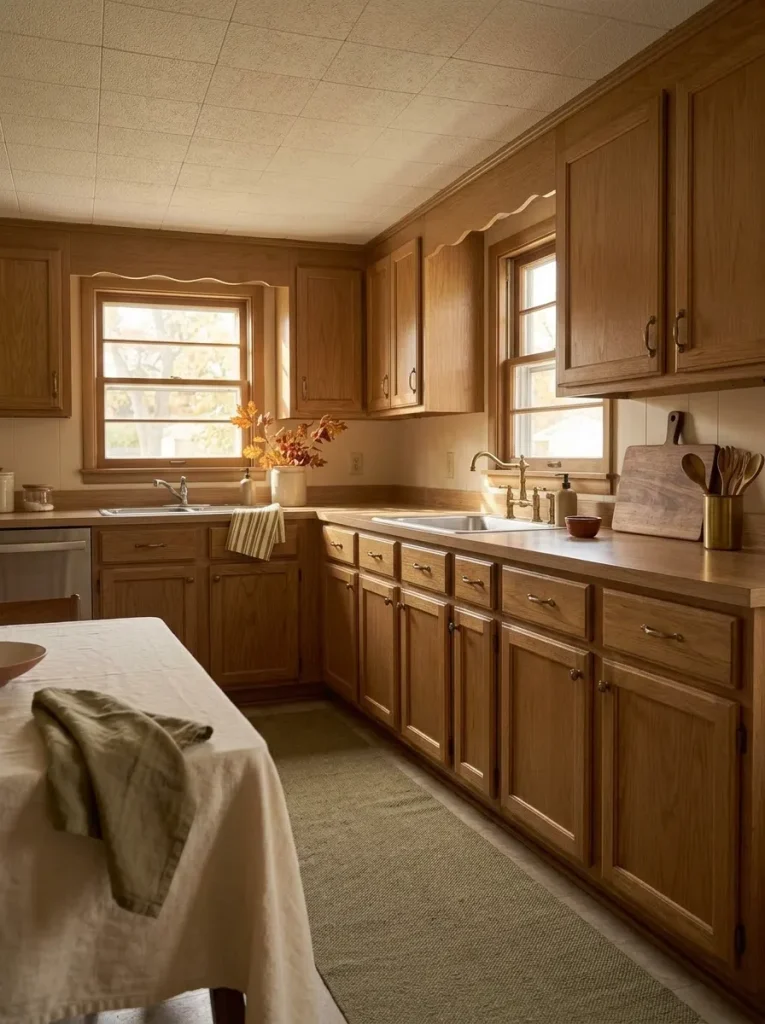
9. Warm Old Cabinets With Materials That Bridge Their Tone
Honey oak, golden brown, and orange-toned cabinets are often labeled “dated,” but the surrounding palette may be exaggerating the problem.
Look at what sits beside the wood.
Cool gray walls.
Blue-white light.
Sharp black-and-white accessories.
Very cool counters.
Strong silver finishes.
When the cabinetry is the only visibly warm material in the kitchen, its orange or golden undertone becomes more noticeable.
The quickest test is not paint.
It is color bridging.
Cream softens the contrast. Olive balances warmth without fighting it. Aged brass connects to golden tones. Dark brown adds depth. Muted rust can reinforce fall without becoming bright pumpkin orange.
The purpose is not to make everything warm.
It is to stop the cabinets from carrying the entire room’s warmth by themselves.
Warm-Wood Fall Bridge Lab
Choose the finish you already have—then choose how you want the room to feel.
Both inputs change the result. There is no JavaScript and no form submission.
1. Existing finish
2. Desired fall mood
Honey Oak + Light & Cozy
Use warm cream to lower contrast, soft olive to balance the golden undertone, and a small aged-brass note to make the cabinet warmth feel deliberate.
Honey Oak + Earthy & Rich
Lean into the warmth with olive, tobacco brown, oatmeal, and a controlled rust accent so golden oak becomes part of the fall material story.
Honey Oak + Quiet & Modern
Lower saturation rather than cooling the room aggressively. Mushroom, gray-olive, espresso, and muted brass help the oak recede.
Medium Walnut + Light & Cozy
Lighten the field with ivory and sage, then repeat camel or antique gold so walnut no longer feels like the lone dark object.
Medium Walnut + Earthy & Rich
Flax, forest olive, brick rust, and repeated walnut create a richer fall palette that respects the existing cabinetry.
Medium Walnut + Quiet & Modern
Putty and stone green soften the contrast while charcoal brown and soft bronze make medium walnut feel restrained.
Orange-Toned Wood + Light & Cozy
Cream and gray-green cool the visual temperature gently while walnut brown grounds the palette and wheat keeps it seasonal.
Orange-Toned Wood + Earthy & Rich
Moss and cocoa give the wood stronger contrast while oat and muted terracotta keep the palette warm and cohesive.
Orange-Toned Wood + Quiet & Modern
Bone, eucalyptus, taupe, and blackened bronze reduce saturation around orange-toned wood and create a calmer result.
Cream Laminate + Light & Cozy
Let the pale cabinetry stay quiet while sage, natural wood, and a controlled amber note create the warmth.
Cream Laminate + Earthy & Rich
Linen, olive, dark brown, and rust give pale cabinetry more depth and make the kitchen feel grounded for fall.
Cream Laminate + Quiet & Modern
Warm white, muted sage, taupe, and soft black create restrained contrast that makes cream laminate feel cleaner and more intentional.
Before painting the cabinets, test those bridging colors with items you already own.
Use towels.
A runner.
A wood cutting board.
A bowl.
Artwork.
If the cabinetry suddenly feels easier to live with, that small experiment has saved you from making a permanent decision too quickly.
10. In the Bathroom, Change the Largest Fabric Plane First
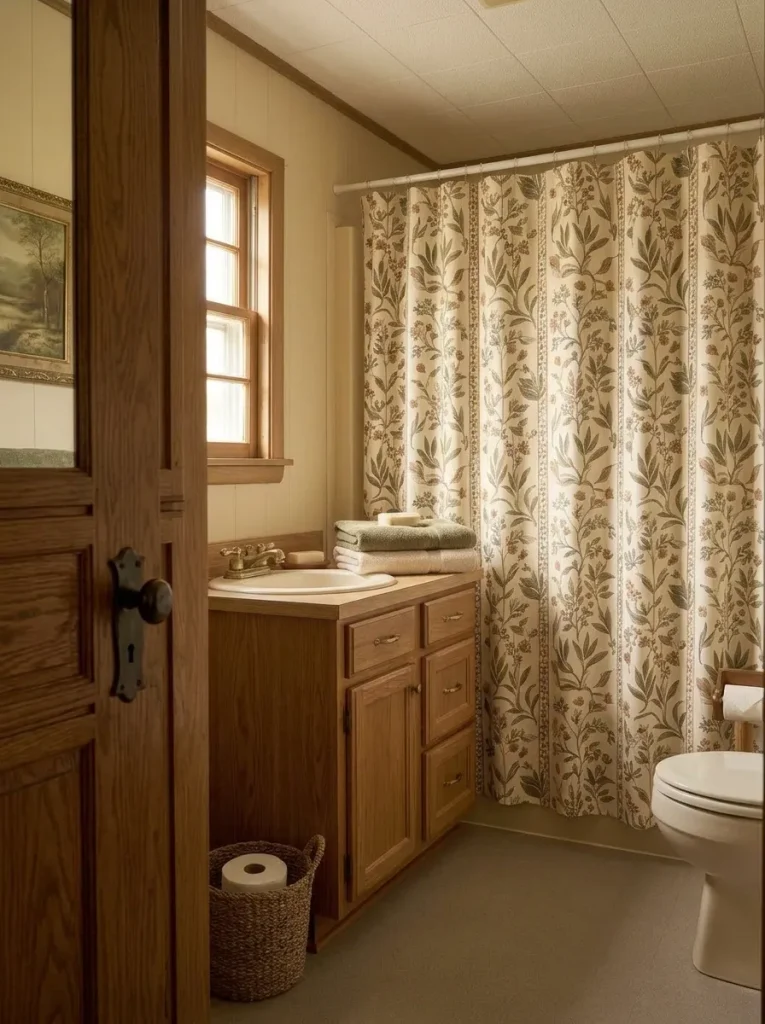
A compact mobile-home bathroom gives you fewer places to decorate, which can actually make the update easier.
Start with the shower curtain.
It is often the largest soft surface in the room, so it can change the relationship between the vanity, floor, walls, towels, and older fixtures in one move.
Choose the curtain before buying the accessories.
A dark botanical print containing olive, cream, rust, tobacco, or muted orange can establish the entire autumn palette. A quieter oatmeal or flax-colored curtain works if you prefer the color to come through towels and one small floral arrangement.
Then evaluate the bathroom again.
If the room already feels finished, stop.
A small space does not automatically need matching baskets, several candles, pumpkins, signs, jars, faux foliage, and shelf décor.
A shower curtain, coordinated towels, and one natural texture may already be enough.
For more room-specific inspiration, continue into neutral fall mobile home bathroom decor.
11. Turn the Bed Into the Bedroom’s Fall Update
Imagine an older bedroom with a traditional wood bed, plain walls, inherited nightstands, and no desire for another renovation project.
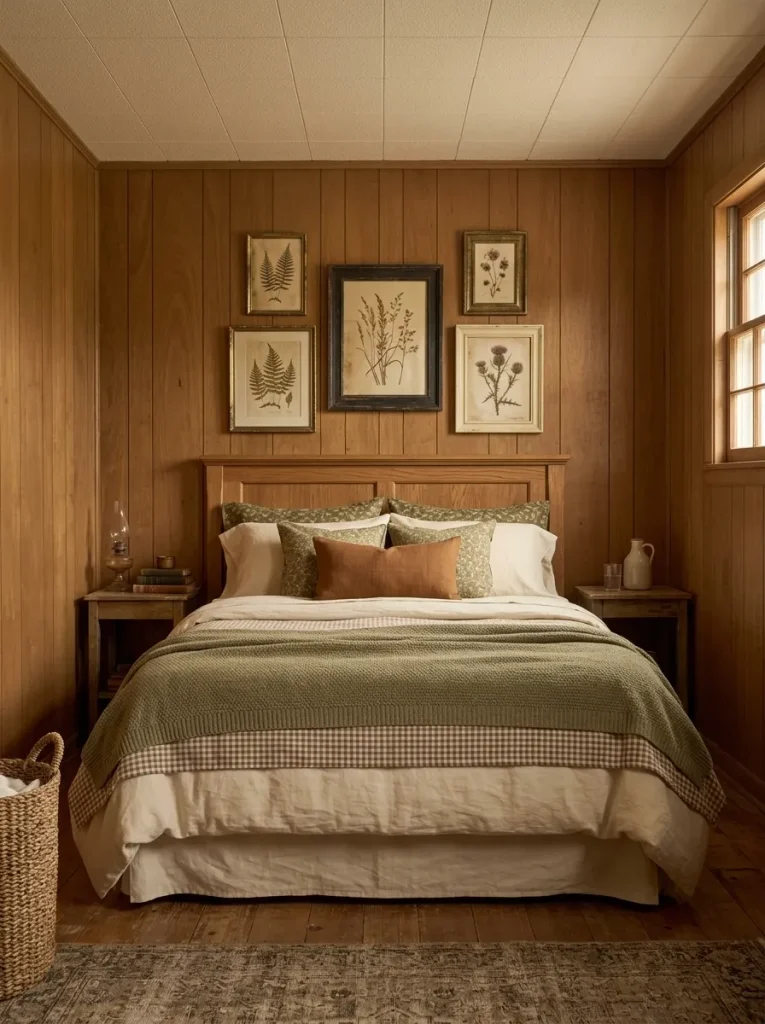
The bed can carry nearly the entire seasonal update.
Start with one dominant textile.
A striped quilt.
Muted plaid.
Brown-and-cream gingham.
A textured neutral duvet.
A soft olive coverlet.
Then use the pillows to connect that textile to the color of the bed frame instead of introducing several unrelated fall shades.
Now look above the headboard.
A small collection of vintage-looking art, family photographs, botanical prints, or older frames can give the traditional bed a reason to exist in the room.
The same furniture that previously looked dated may suddenly feel collected.
That is the difference between an old piece sitting awkwardly among newer décor and an old piece becoming part of the room’s story.
If the bedroom is narrow, keep the lower half calmer.
A patterned quilt, patterned bed skirt, and heavily patterned rug can compress the room visually. Let the bed carry the richest textile layer and allow the floor to become a quieter supporting surface.
The room does not need pumpkins to read as fall.
Warm material, deeper textile, and a better relationship between old furniture and new fabric can do it.
12. Use Interior Doors to Connect Rooms Updated at Different Times
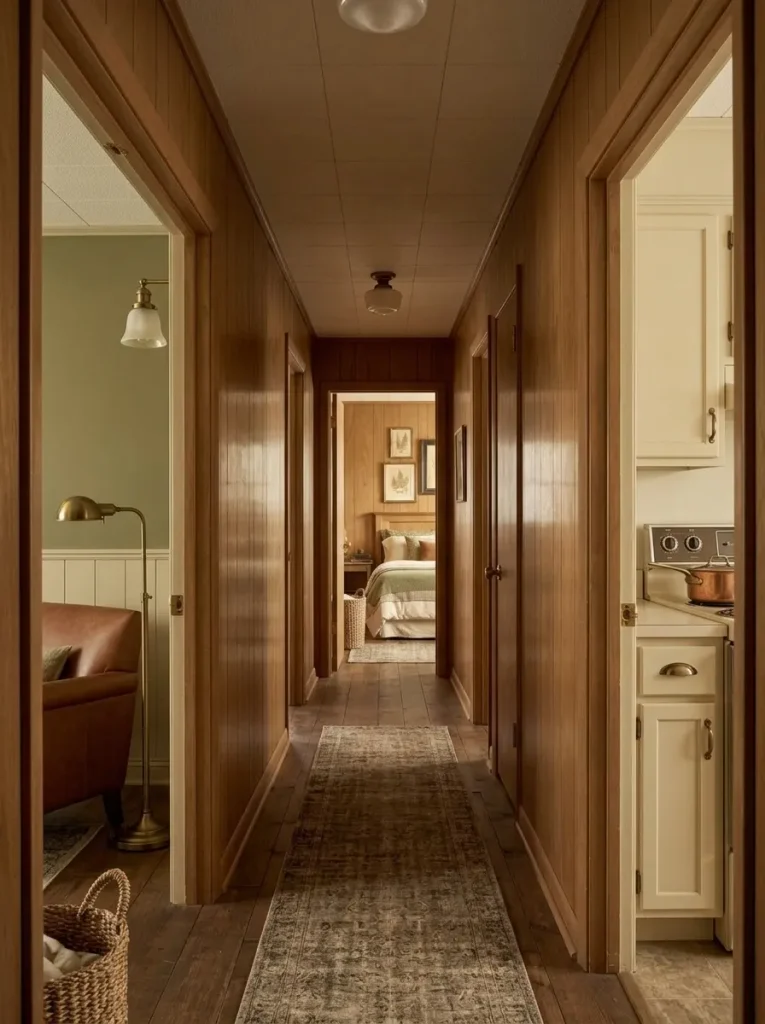
Older mobile homes are rarely updated all at once.
One bedroom may have newer flooring.
The hall may still have original trim.
The living room could have recently painted walls.
The kitchen may keep its older cabinetry.
That mixture can work perfectly well, but the transitions between rooms may make the house feel more pieced together than necessary.
Interior doors can help.
You do not automatically need to replace them.
Look at the relationship between three things:
door surface + surrounding trim + hardware
If several doors are visible from the hallway or main living space, repeating one element gives the eye something consistent to follow.
Whole-Home Continuity Path
What is making connected rooms feel unrelated?
Select the main disconnect. The complete four-room route changes below.
Start with the finish that repeats at hand level. You do not need matching rooms; you need one metal family that survives the walk between them.
REPEAT ONE FINISHBedroom
Keep the existing door.
Choose hardware that relates to the bed frame or nearby lamp metal.
Hallway
Repeat the metal family.
The hallway is the connector because several doors are often visible at once.
Living Room
Echo one touchpoint.
A curtain rod, lamp detail, or cabinet pull can carry the finish without becoming a matched set.
Kitchen
Close the route.
Let one visible hardware family connect the last doorway to existing cabinetry.
Reduce the number of competing edge colors. When every doorway and ceiling line is outlined differently, the eye reads fragmentation first.
CALM THE EDGESBedroom
Choose the quieter edge.
Keep either the wall relationship or the wood relationship dominant.
Hallway
Use the corridor as the reset.
Simplify the most repeated trim line so it does not interrupt every doorway.
Living Room
Support the main wall color.
Let trim contrast help a focal area or visually disappear where it adds no value.
Kitchen
Respect cabinet warmth.
Avoid a trim tone that makes existing cabinetry look accidentally orange or gray.
Give different doors one shared visual rule. Door styles can vary and still feel intentional when hardware, trim, or color relationships repeat.
SHARE ONE RULEBedroom
Keep useful character.
A warmer or older door can stay if its hardware relates to the room.
Hallway
Pick the repeated rule.
Use the same knob family, trim relationship, or color logic across doors seen together.
Living Room
Let one doorway recede.
Not every door needs to become a focal point; the main room should still lead.
Kitchen
Finish with the strongest connection.
Tie the last visible door to cabinet wood or the metal finish repeated elsewhere.
Connect rooms by relationship, not by copying décor. Repeat one material, one color role, or one contrast pattern through the transitions.
CONNECT THE ROUTEBedroom
Choose the anchor relationship.
For example, warm wood + cream + olive becomes the starting language.
Hallway
Carry one piece forward.
Repeat the olive, wood, or dark metal—not the entire bedroom palette.
Living Room
Translate, do not duplicate.
Use the same relationship at a larger scale through rug, art, or lighting.
Kitchen
Resolve the last transition.
Let cabinet tone or hardware pick up one element from the connected spaces.
This is particularly useful when adjacent rooms feel as though they belong to different houses.
If the existing doors already work together visually, leave them alone.
Continuity is a solution to fragmentation—not another excuse to replace something functional.
13. Edit Open Shelves Until the Home Feels Collected, Not Crowded
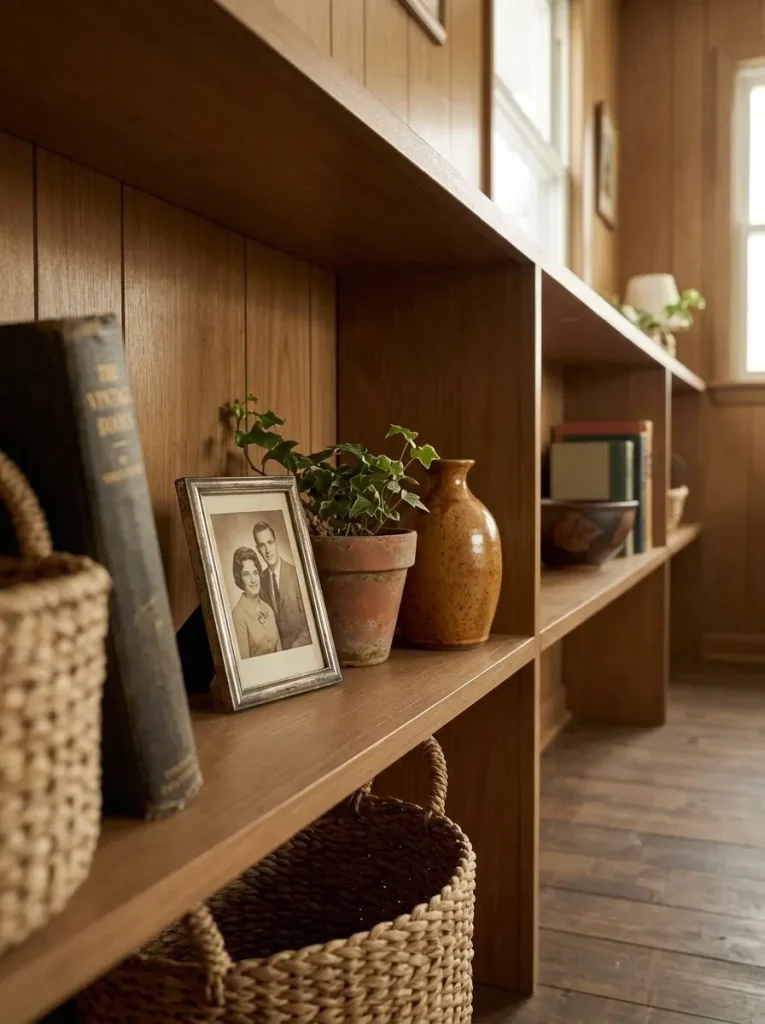
An older mobile home can accumulate meaningful objects quickly.
Family photographs.
Vintage clocks.
Old books.
Inherited ceramics.
Small baskets.
Faux plants.
Seasonal decorations.
Objects that have simply always lived on the shelf.
The problem is rarely that these items are old.
The problem appears when every object is asked to perform at the same time.
A better fall shelf starts with subtraction.
Remove everything.
Return the largest or most meaningful piece first.
Add one lower object beside it.
Leave an actual empty area.
Then move to the next shelf.
That negative space is important because it lets the older objects look intentional instead of accidental.
Keep the pieces that contribute to at least one of these:
- the existing material story of the home;
- personal or family history;
- the fall palette already established elsewhere.
A random seasonal object that contributes to none of those can usually stay in storage.
The visual stop signal is simple.
If you can identify individual pieces from across the room, the shelf is probably close to finished.
If everything merges into one uninterrupted strip of texture, edit again.
14. Finish the Front Door Zone Without Building a Porch
Before-and-after mobile-home images can create a misleading comparison.
The “before” may show a plain façade and simple steps.
The “after” suddenly contains a full porch, new structure, landscaping, dramatic exterior lighting, shutters, new colors, railing, and an entirely different arrival experience.
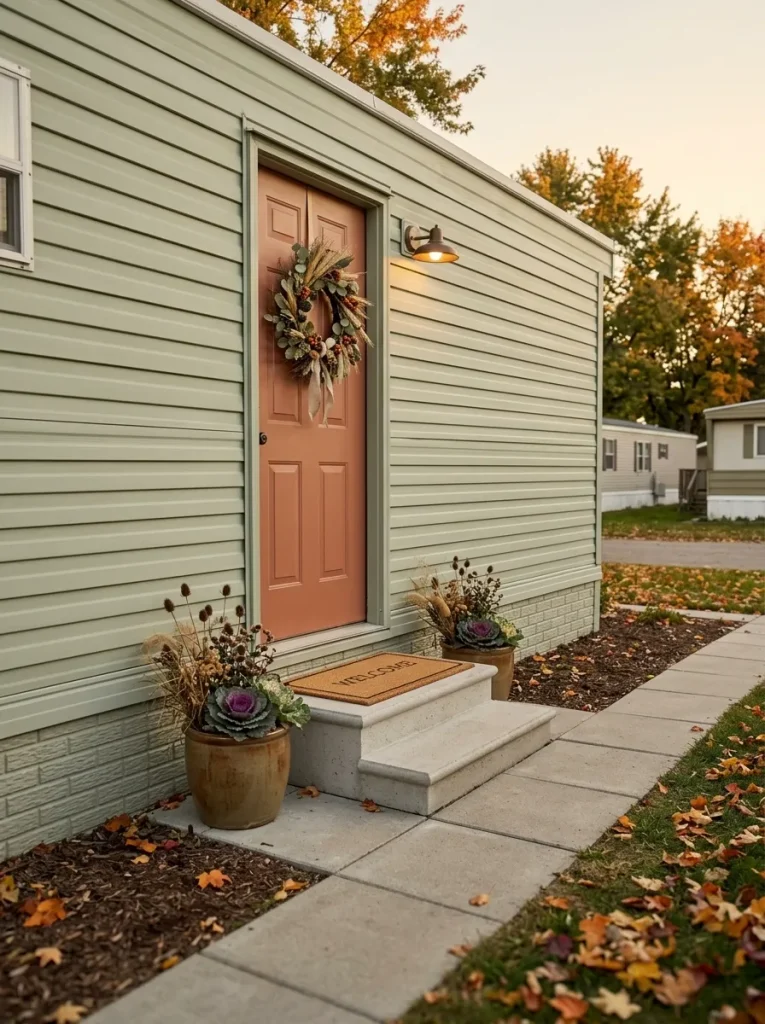
The atmosphere can be useful inspiration.
The construction scope is a different project.
For a no-remodel fall update, extract the entry hierarchy from those transformations.
Start with what already exists.
- Clean the door and immediate step area.
- Make the door the visual destination with one wreath or restrained seasonal accent.
- Use a mat large enough to relate visually to the doorway.
- Add one or two planters to frame the entry.
- Remove small items that make the area look scattered.
- Let existing functional lighting help identify the door after dark.
Then stop.
Do not allow “make the entrance warmer” to turn into an accidental construction project.
A new porch, deck, railing system, structural attachment, siding repair, exterior electrical modification, or similar work belongs to a different scope.
For decorating-oriented exterior inspiration, continue into fall mobile home exterior ideas.
For larger seasonal renovation or weather-readiness work, use the separate fall mobile home renovation projects guide.
The transferable lesson from dramatic exterior makeovers is still valuable:
Make the entrance unmistakable.
You may be able to accomplish that without reproducing any of the construction around it.
15. Take the Same Photo Twice Before You Call the Home “Dated”
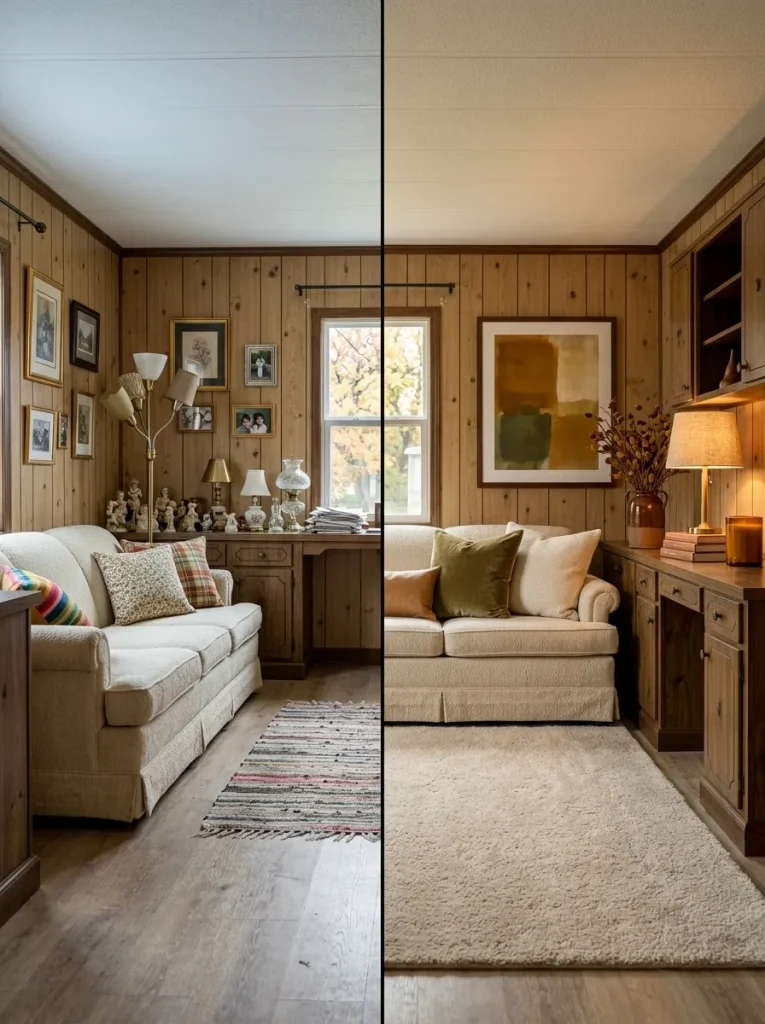
This last update costs nothing.
Before you begin the fall refresh, take one photograph from the most revealing angle in each major room.
Do not choose the prettiest corner.
Choose the view that honestly shows the flooring, furniture, trim, openings, wall finishes, and proportions.
After completing your updates, return to the same spot.
Use roughly the same camera height.
Face the same direction.
Try to use similar daylight.
Then compare the two photographs before deciding what still needs replacing.
Before / After Photo Evaluator
Does the room still need a remodel—or just another edit?
Review the six criteria below, then choose the band that matches your photo. The recommendation changes instantly without JavaScript.
If you see moisture, softness, instability, electrical or plumbing trouble, choose the final option even if the photo looks better.
Keep editing before buying.
The room may still need subtraction, better scale, or a clearer focal point. Avoid assuming the next purchase has to be a remodel.
The room is improving—name the one remaining problem.
Several relationships are working now. Pause shopping and identify the specific feature that still bothers you; a targeted edit may solve more than another broad makeover.
You may already be done.
Most of the room is functioning visually and practically. Showing age is not the same as needing renovation, so give yourself permission to stop.
Pause the cosmetic project.
A suspected functional problem matters more than the decorating result. Keep the before/after photo, but move this area out of the styling workflow until the condition is properly assessed.
The comparison matters because memory is unreliable.
Once you begin focusing on a dated feature, it can become the only thing you see.
A photograph restores context.
Maybe the brown flooring is still there—but now the rug gives it a quieter role.
Maybe the panel wall is unchanged—but it is no longer covered by twelve unrelated frames.
Maybe the oak cabinets remain—but cream, olive, brown, and aged metal now connect them to the room.
Those are meaningful updates even though nothing has been demolished.
If the remaining concern is now specific and functional, you have learned something equally useful. You can address that one problem deliberately instead of deciding the entire home needs remodeling.
Cozy Fall Does Not Require Erasing an Older Mobile Home
A convincing fall update should leave an older mobile home feeling more like itself—not less.
That may mean keeping the wood bed.
Keeping the cabinets.
Keeping the paneling.
Keeping the older floor for another season.
Keeping the built-in that would never appear in a newly staged house.
The transformation comes from helping those features belong together.
Start with the surfaces that occupy the most visual space. Reduce unnecessary contrast. Give older materials better neighbors. Use textiles where they can do the work of a much larger project. Concentrate seasonal décor around natural focal points. Repeat a few finishes across connected rooms. Protect the countertops, pathways, seating, and storage that still need to function every day.
Most importantly, separate these two thoughts:
“I do not like how this looks right now.”
and
“This feature genuinely needs replacing.”
They are not the same problem.
That distinction can save an older mobile home from unnecessary projects while still giving you the warmer, layered feeling you wanted for fall.
And once the home feels settled, stop.
An older mobile home can still show its age and look beautiful at the same time.
Save this article to Pinterest before you start your fall refresh so you can return to the Keep → Soften → Cover → Update → Defer framework as you work through each room.