

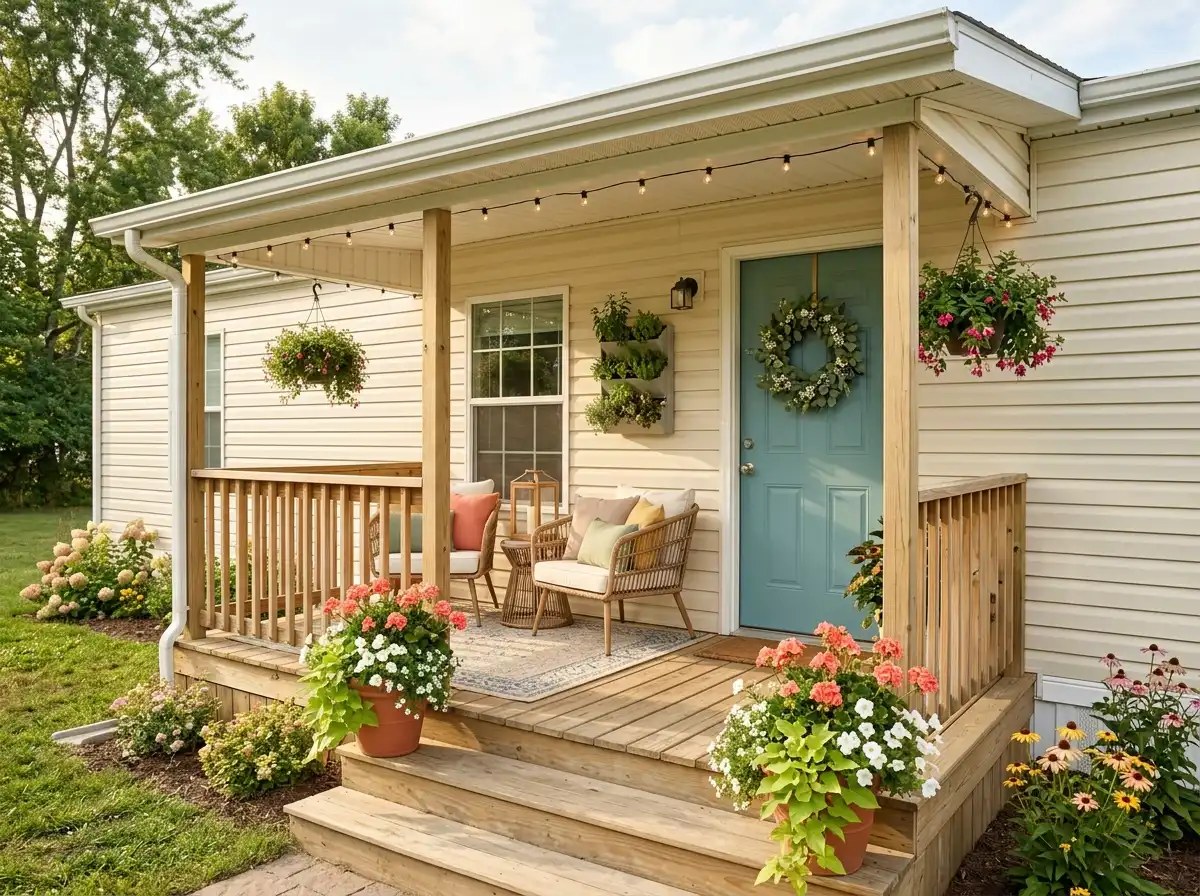
A small porch can completely change how a mobile home feels in summer. Because the porch sits right against the exterior, even a few thoughtful updates can make the whole home look brighter, more welcoming, and more finished.
The trick is not squeezing in as many decorations as possible. On a compact porch, every chair, planter, rug, and hanging basket affects how easily you can move through the space and how open it feels from the yard.
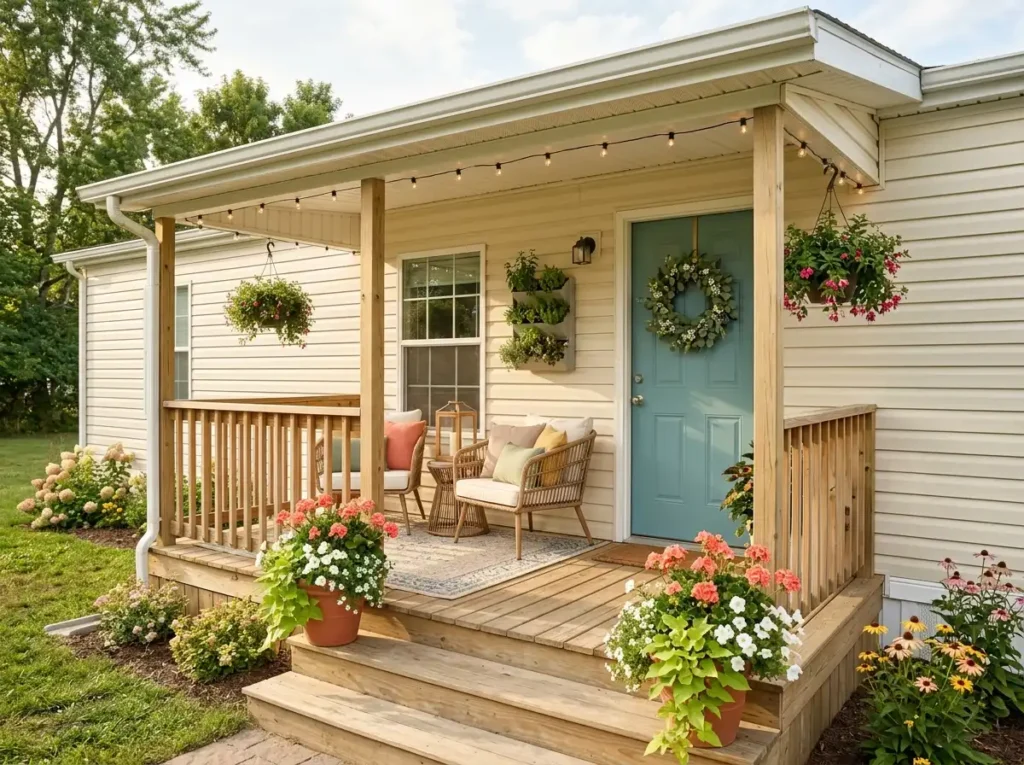
Good summer mobile home porch decor balances comfort with breathing room. Fresh greenery, lighter textiles, warm wood, seasonal color, shade, and evening lighting can all work beautifully when they have a clear purpose.
You also do not need a full renovation. Some of the strongest changes come from improving one large surface, rearranging furniture, or concentrating plants where they create the most visual impact.
These ideas range from simple styling updates to larger porch improvements, so you can start with the change that best fits your space, budget, and summer routine.
1. Refresh the Porch Floor With a Clean Summer Finish
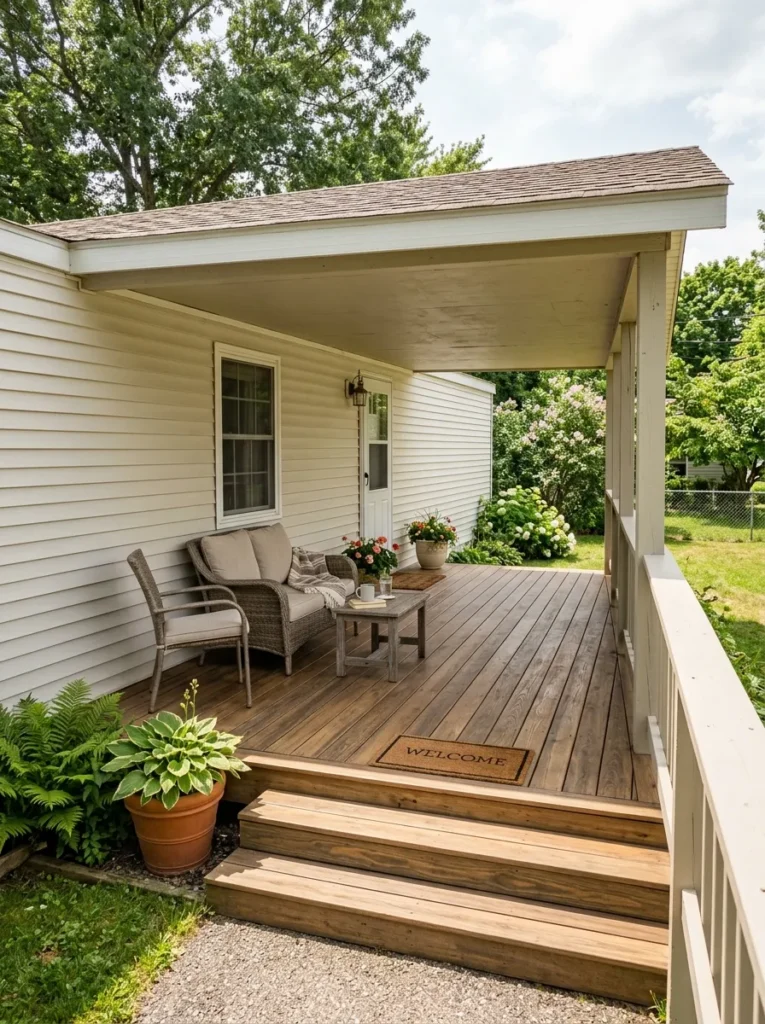
One of the fastest ways to make an older porch look intentionally designed is to improve the surface underneath everything else. When faded boards, unfinished pressure-treated lumber, or a tired painted floor dominate the view, even attractive furniture can feel temporarily placed.
A new floor finish gives the entire porch a visual foundation. Natural-toned stain keeps visible wood grain and works especially well with white, cream, sage, or warm beige siding. An opaque porch paint creates a cleaner architectural look when the existing boards vary noticeably in color.
Color matters more on a small mobile-home porch because the floor often occupies a large percentage of what you see from the yard. Very dark finishes can make a narrow covered porch feel visually heavier, while mid-tone wood, softened gray-brown, or muted greige tends to keep the floor grounded without overpowering the seating.
Think about maintenance before choosing purely for appearance. Summer foot traffic, planters, furniture legs, dust, and rain all leave marks, so extremely pale or high-gloss finishes may demand more attention.
From the yard, the finished floor should support the porch rather than become its loudest feature.
2. Paint the Porch Ceiling to Make It Feel Like an Outdoor Room
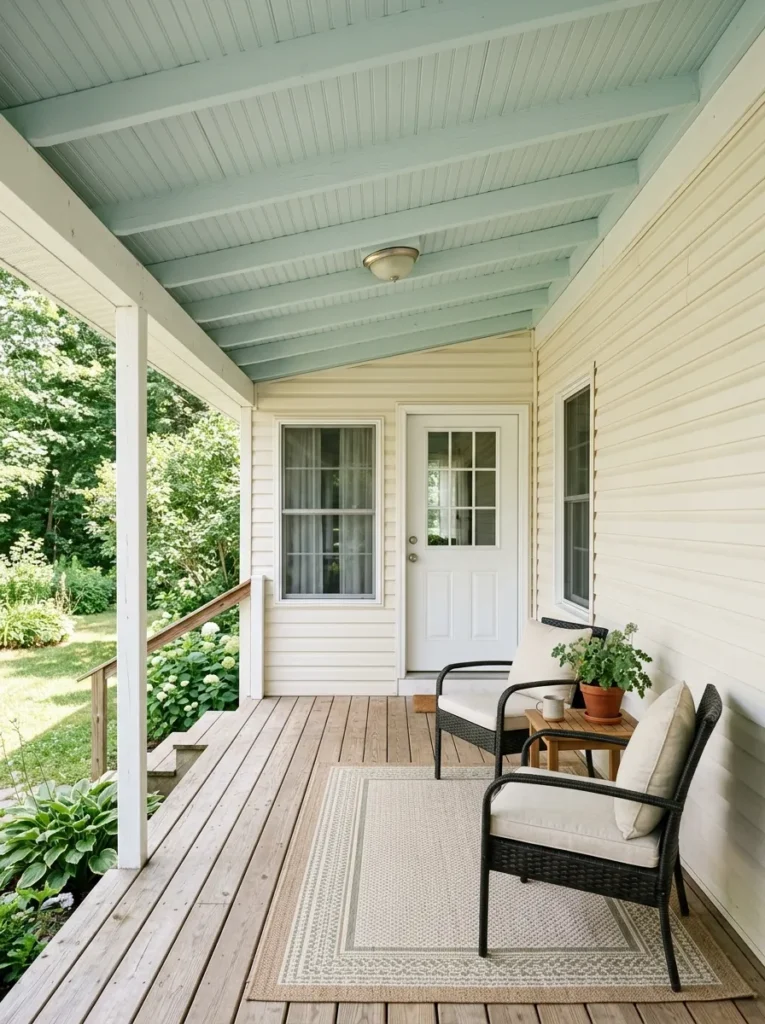
Look up before buying another accessory. On many covered mobile-home porches, the ceiling is one of the largest surfaces in the space, yet it is often treated as something that should simply disappear.
Giving that plane an intentional finish changes the upper boundary of the porch. Soft white keeps things bright, a pale blue-green introduces a light summer character, and exposed or wood-toned finishes can create a warmer porch that feels more architectural.
Light changes those colors throughout the day. A ceiling that looks beautifully crisp in indirect morning light can become noticeably brighter under strong reflected afternoon sun. That is one reason softer finishes and quieter undertones often feel more comfortable than an aggressively bright or glossy surface.
The ceiling also needs to relate to what is beneath it. Natural wood overhead works especially well when the floor or furniture repeats some warmth, while a subtle painted ceiling can provide contrast above darker siding.
Choose the ceiling finish as part of the whole porch palette—not as an isolated fifth wall.
And before painting exterior ceiling materials, make sure the coating is appropriate for the actual surface and exposure conditions.
3. Choose Slim Seating That Leaves a Real Walking Path
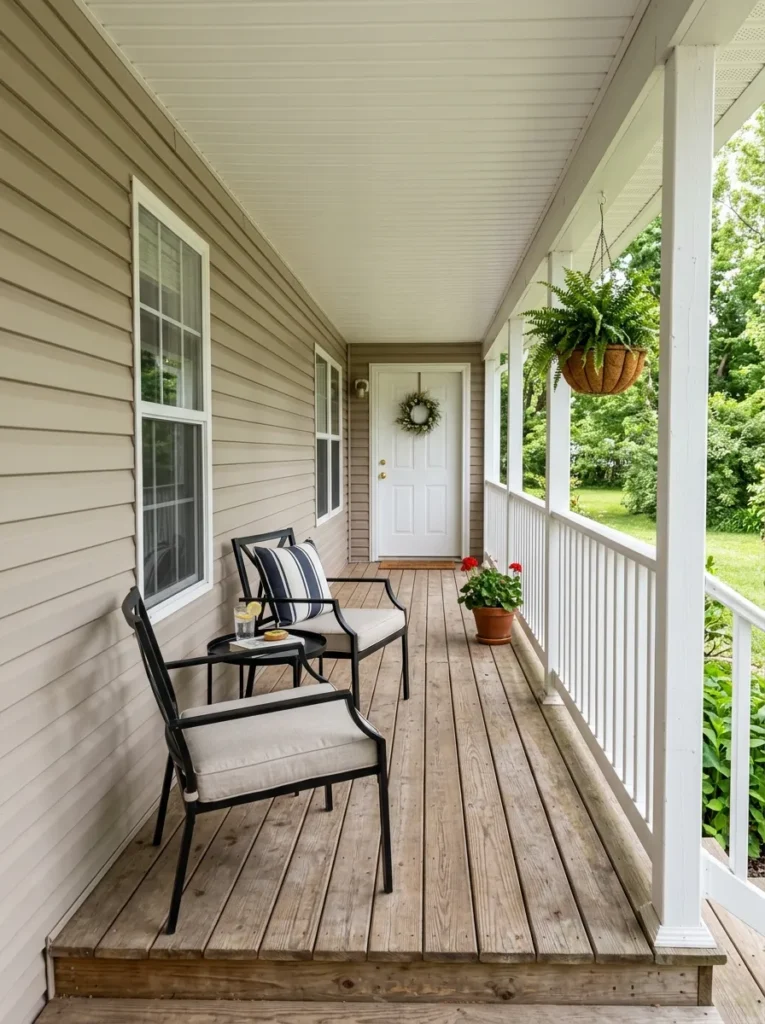
A small porch does not necessarily need less seating. It needs seating with the right visual and physical depth.
A pair of oversized lounge chairs may look comfortable in a showroom but consume the usable center of a narrow porch. Slimmer armchairs, an open-frame loveseat, or a bench placed against the siding can provide similar everyday function while allowing the doorway and steps to remain connected.
The best choice depends on how you use the porch. A couple who drinks coffee outside may value two separate chairs and a small table. A family may get more usable seating from one compact bench or loveseat. An especially shallow porch may work better with a single chair plus a movable stool than with a matching furniture set.
Look at the furniture underneath as well as around it. Open legs, slender arms, and visible floor area make seating feel lighter because the eye can continue through the piece instead of stopping at a solid block.
Before buying anything, mark the approximate furniture footprint on the porch.
If the route to the door suddenly feels like a squeeze, the furniture is too deep for the space—even if the overall width technically fits.
What makes one chair look visually lighter than another?
4. Use an Outdoor Rug to Create a Defined Seating Zone
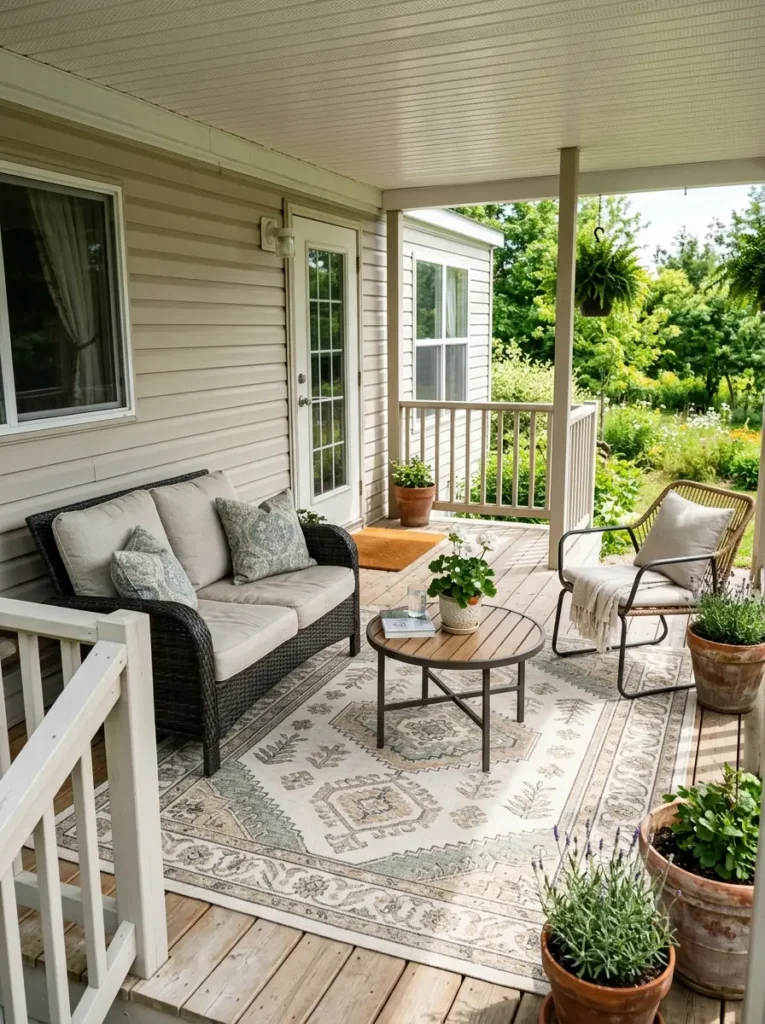
Furniture + shared rug contact = one readable seating zone.
That simple relationship matters on a mobile-home porch because many porches are essentially long platforms attached to the house. Without an architectural break between the front door, seating and open floor, furniture can appear to be floating independently.
An outdoor rug creates that missing boundary. Instead of trying to cover the entire porch, choose a size and shape that explains where the seating belongs. A rectangular rug works naturally beneath a small conversation area, while a runner may make more sense on a very narrow porch where furniture sits mainly against one wall.
The common mistake is buying a rug that fits only beneath the coffee table. That creates a decorative island in the middle while the chairs remain visually disconnected around it.
Try to let at least part of the main seating visibly engage the rug. Even partial furniture contact helps the eye interpret the pieces as one composition.
There is an exception: extremely small entry porches may not have enough room for a seating rug at all. In that case, keep the floor visually open and concentrate textile pattern at the door.
5. Make One Compact Porch Swing the Focal Seat
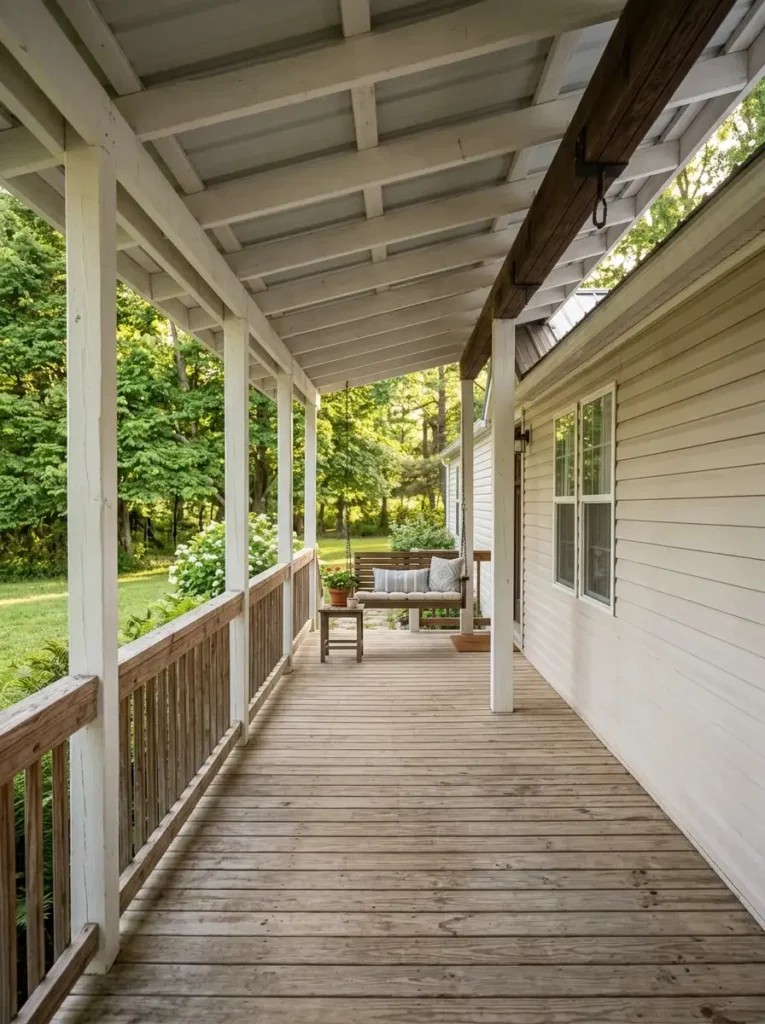
Imagine a narrow porch with two chairs, another little bench, three side tables, and barely enough room to reach the door. Now remove most of that furniture and give the far end of the porch one memorable seat.
A compact porch swing can do exactly that. It creates a destination at one end of a long covered porch while leaving the center visually quieter. Instead of spreading equal furniture weight everywhere, one distinctive seat becomes the focal point and the remaining pieces can support it.
The best location is usually where the swing does not interrupt the entrance route, doors, windows, or frequently used steps. Leave enough surrounding breathing room that the movement of the swing does not conflict with tables, railings, planters, or passing people.
This is also where aesthetics must give way to structure. A hanging swing should only be installed where the supporting structure and mounting method are suitable for it. Do not assume a porch ceiling or decorative beam can carry the load simply because it looks substantial.
If hanging is not appropriate, use the same design idea with a freestanding porch swing or compact glider.
6. Add a Ceiling Fan Where the Porch Actually Needs the Airflow
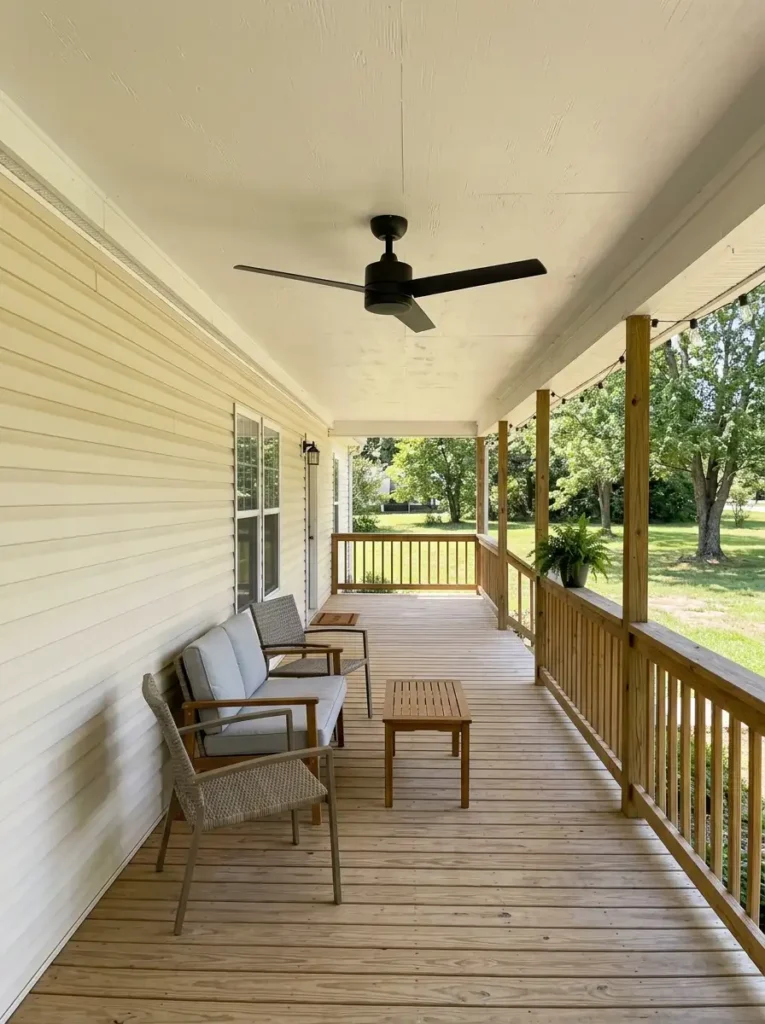
Before choosing a fan for its color or blade style, look at where people actually sit.
On a long mobile-home porch, the geometric center of the ceiling may not be the functional center of the space. If the chairs and loveseat occupy one end, a fan mounted far away from them can look perfectly symmetrical while doing very little for comfort.
A useful porch fan should relate to the seating zone first. It also needs enough surrounding clearance to operate safely without conflicting with beams, hanging baskets, light fixtures, or low ceilings.
A few things deserve attention before installation:
- Exposure: Choose a fan rated appropriately for the porch’s actual outdoor conditions.
- Ceiling height: Low ceilings may require a closer-to-ceiling configuration rather than a long downrod.
- Furniture position: Center airflow over where people spend time, not automatically over the total porch footprint.
- Visual competition: If you already have prominent string lights or hanging plants, keep the fan design comparatively simple.
A fan with a light kit can also replace one overhead fixture, reducing ceiling clutter.
The design test is simple: when you sit down, the fan should feel connected to that seating area rather than floating somewhere else above the porch.
7. Add Roll-Down Shades Only Where the Summer Sun Hits Hardest
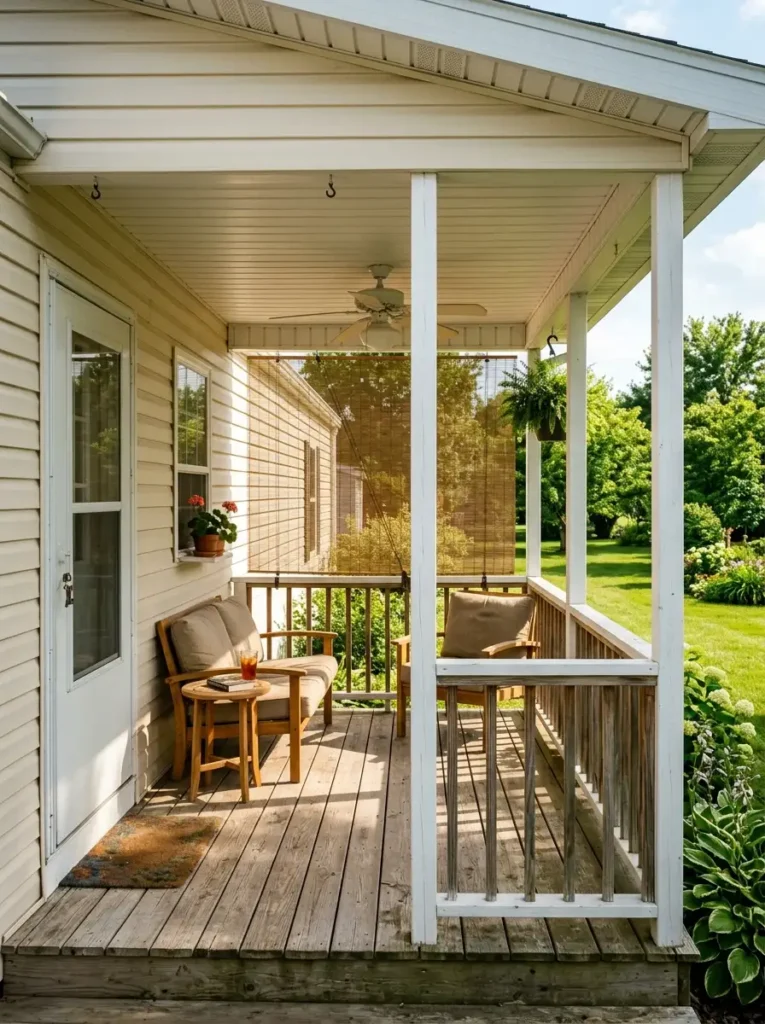
A porch can be completely comfortable at 10 a.m. and nearly unusable by late afternoon. That does not automatically mean every opening needs to be covered.
Morning-heavy sun: A light-filtering shade may be enough to soften glare without making the porch feel enclosed.
Hot western exposure: Prioritize the side where low afternoon sun enters directly. A solar shade or outdoor bamboo-style blind can reduce harsh light while allowing the rest of the porch to remain open.
Already shaded porch: Additional screens may add more visual weight than comfort. In this case, preserving airflow and the yard view may matter more.
The important design move is selective coverage. A narrow mobile-home porch depends heavily on borrowed visual depth from the yard. When every opening is covered, the space can suddenly feel much smaller.
Shade color matters too. Darker screens generally create stronger visual boundaries, while natural or mid-tone materials blend more quietly with wood, beige siding, and garden greenery.
Choose a material intended for the conditions it will face, and make sure the shade can be secured appropriately when wind becomes a factor.
The shared rule is simple: block the problem direction—not the entire outdoors.
8. Use Outdoor Curtains to Frame the Porch Instead of Closing It In
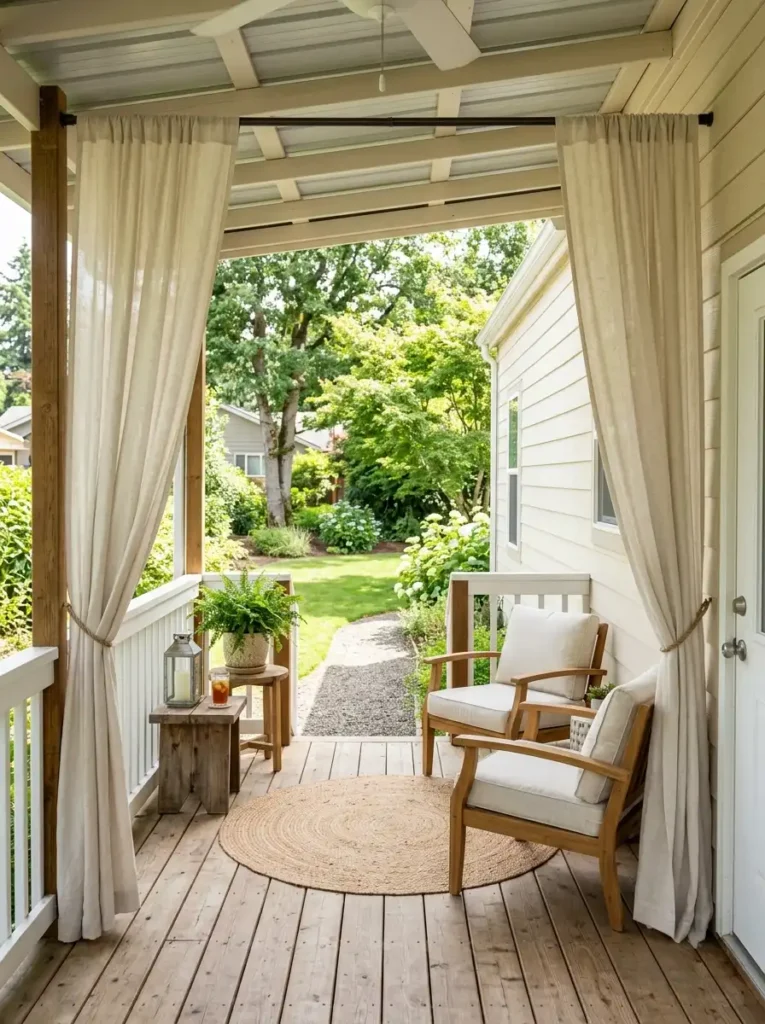
Common move: hang fabric across nearly every open side of the porch.
That can create privacy, but on a small mobile-home porch it can also replace an airy outdoor space with what feels like a narrow fabric room.
Better move: use outdoor curtain panels as architectural frames.
Place panels at the ends of a seating zone, beside a particularly exposed corner, or around one view you want to soften. When the center remains open, the fabric adds movement and softness without completely removing the visual connection to the yard.
The length matters. Panels should feel deliberate rather than like indoor curtains temporarily moved outside. Too much fabric pooling on a porch floor becomes harder to keep clean and can look heavy in a compact space.
Color also changes the perceived enclosure. Cream, soft flax, muted stripe, or pale natural tones usually disappear into bright summer surroundings more easily than dark opaque panels.
There are situations where fuller coverage makes sense, especially when privacy is genuinely important. But even then, think about whether every panel needs to remain closed all the time.
Use curtains to edit the view, not automatically erase it.
9. Turn Blank Siding Into a Vertical Planter Wall
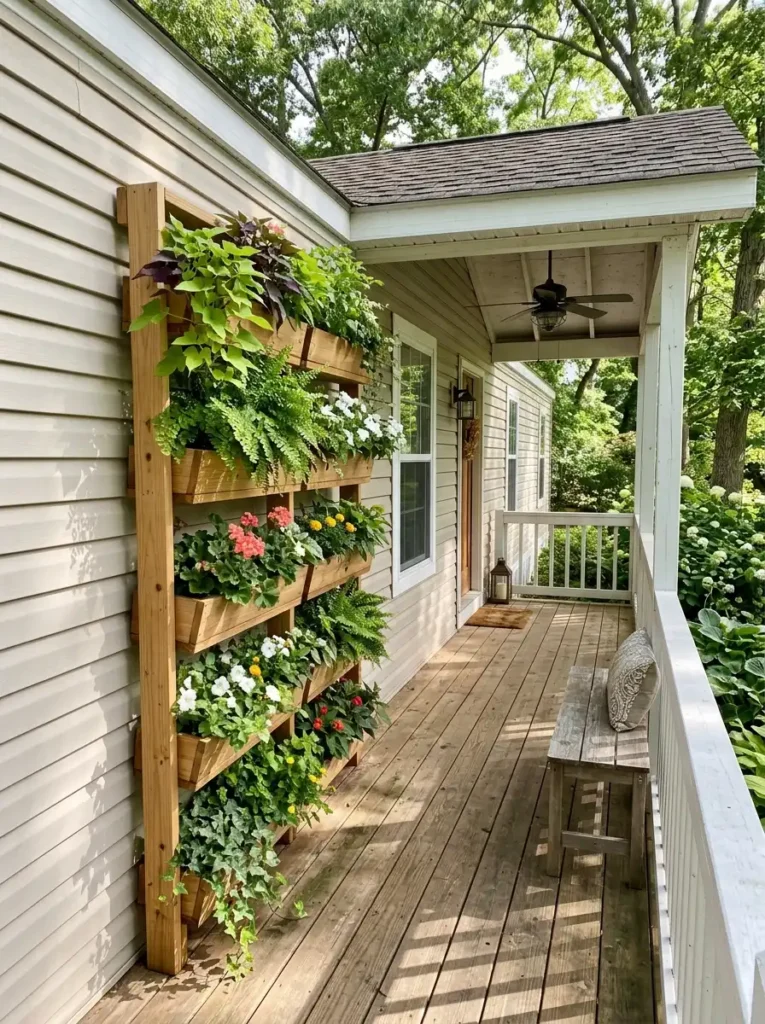
Long stretches of exterior siding can make a porch feel unfinished even when the floor and furniture are attractive.
A vertical planting system changes that wall without consuming the walking space beneath it.
Instead of lining six individual pots along the floor, move much of that greenery upward. Wooden planter boxes, wall-mounted pots, pocket-style planters, or a freestanding vertical frame can create one concentrated garden feature while leaving the porch easier to navigate.
That shift has four useful consequences.
The eye moves upward, which helps a low covered porch feel more layered.
The floor becomes quieter because fewer containers compete with chair legs, tables, and the walking path.
Repeated rows of greenery introduce rhythm along otherwise plain horizontal siding.
And one concentrated plant wall can look more abundant than the same number of plants scattered around the porch.
Do not fill every inch. Leave visible siding around the composition so the garden has an edge. Without that breathing room, a lush wall can quickly become a heavy green block.
Plant choice should also respond to the real light conditions on that wall. A shaded porch wall and a hot sun-exposed wall will not support the same summer planting equally well.
10. Add Railing Flower Boxes Without Sacrificing the Yard View
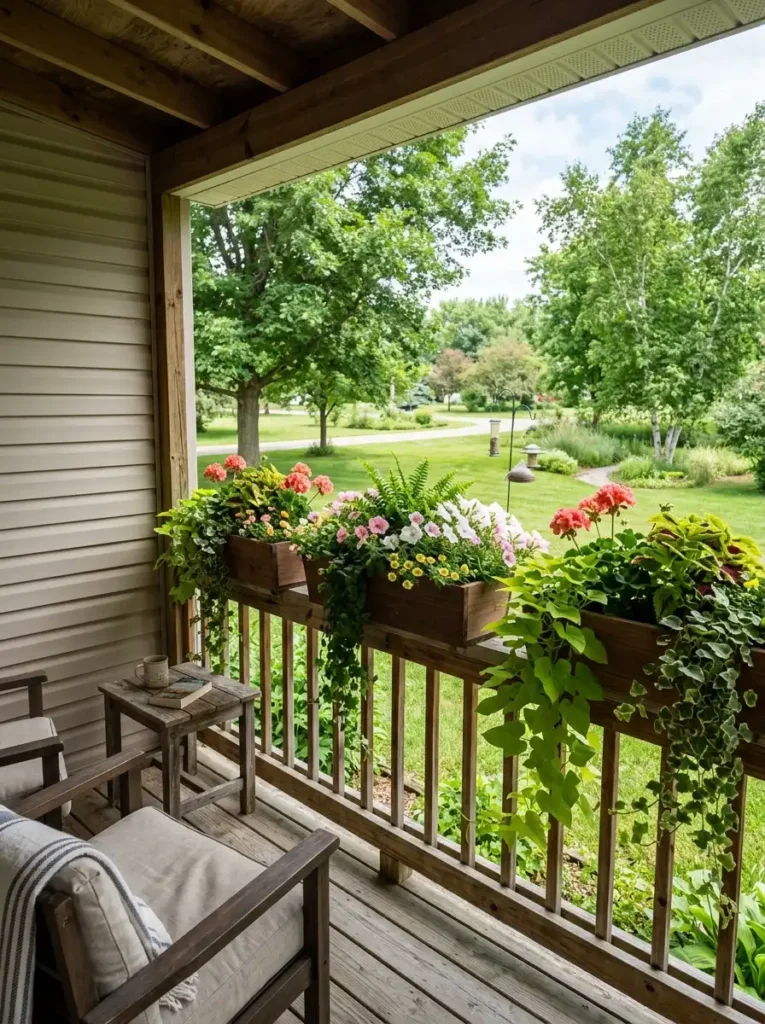
Stand inside the porch and look outward before deciding how tall the flowers should be.
Railing boxes are especially useful on a mobile-home porch because they add seasonal color without occupying valuable floor space. They also reinforce the long horizontal edge of the porch, which can make a compact deck appear visually broader.
The problem begins when the planting becomes so tall that the railing turns into a green wall.
Use the view as your guide:
- From a seated position: You should still be able to see beyond the planting rather than staring directly into a dense band of stems.
- From the doorway: Flowers should decorate the porch edge without becoming the first solid object blocking the yard.
- From outside: The boxes should visually connect the home to the garden rather than hide the porch railing completely.
A useful planting mix combines moderate-height flowers with lower foliage and some trailing growth that falls outward or below the rail.
That downward movement is particularly valuable. It creates abundance without adding all of the visual volume at eye level.
For a small porch, the stopping point arrives when the flowers frame the view—not when every inch of railing has been filled.
11. Build a Hanging-Basket Canopy Without Crowding the Ceiling
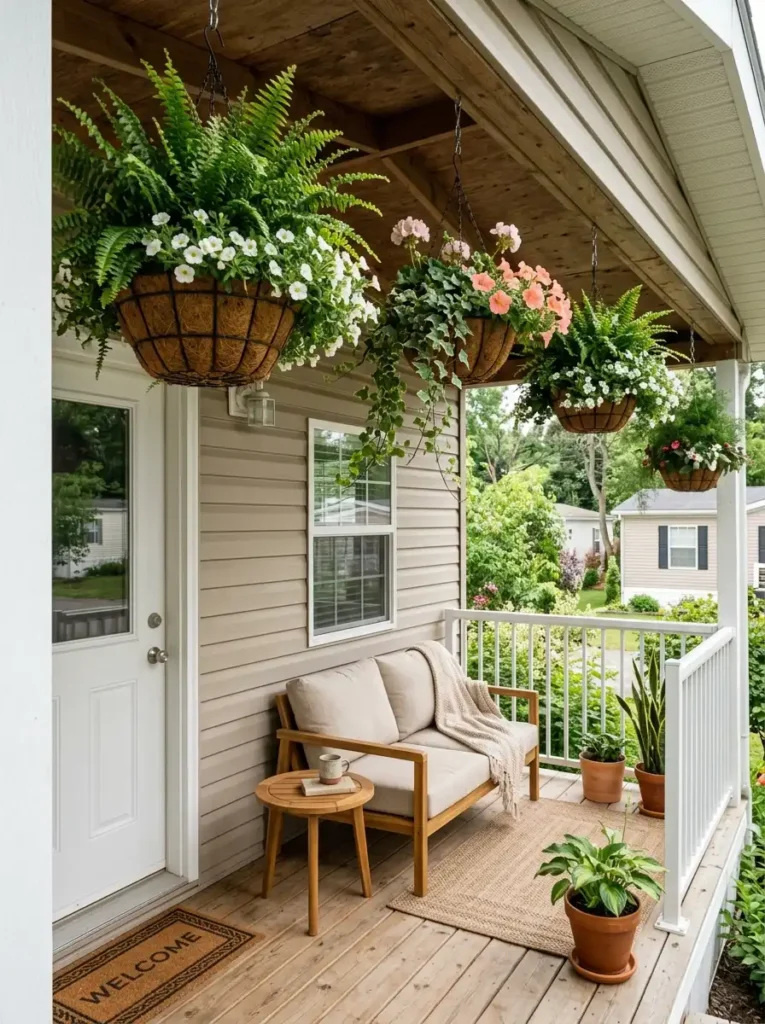
Hanging baskets are valuable on a small porch because they create greenery without taking away floor space. The mistake is assuming that more baskets automatically produce a more lush summer look.
Overhead foliage carries strong visual weight. When baskets appear every few feet, especially beneath a low porch roof, the ceiling can begin to feel lower and busier than it actually is.
A stronger arrangement usually has three layers.
Heavy layer: two or three generous hanging baskets positioned where they relate to corners, seating, or structural posts.
Supporting layer: a quieter furniture and planter arrangement below them, so greenery does not compete at every height.
Quiet layer: enough visible ceiling, siding, railing, and floor to keep the porch from becoming visually saturated.
Placement does not have to be perfectly symmetrical. In fact, a slight variation in spacing often feels more residential than identical baskets arranged like merchandise along a store aisle.
Also consider what happens as plants grow. A basket that seems modest in May may trail much farther by midsummer.
The best stopping point is reached while each plant still has room to be seen individually. Once every basket merges into one continuous overhead mass, the porch has lost much of the breathing room that makes the greenery feel special.
12. Frame the Steps With Oversized Summer Planters
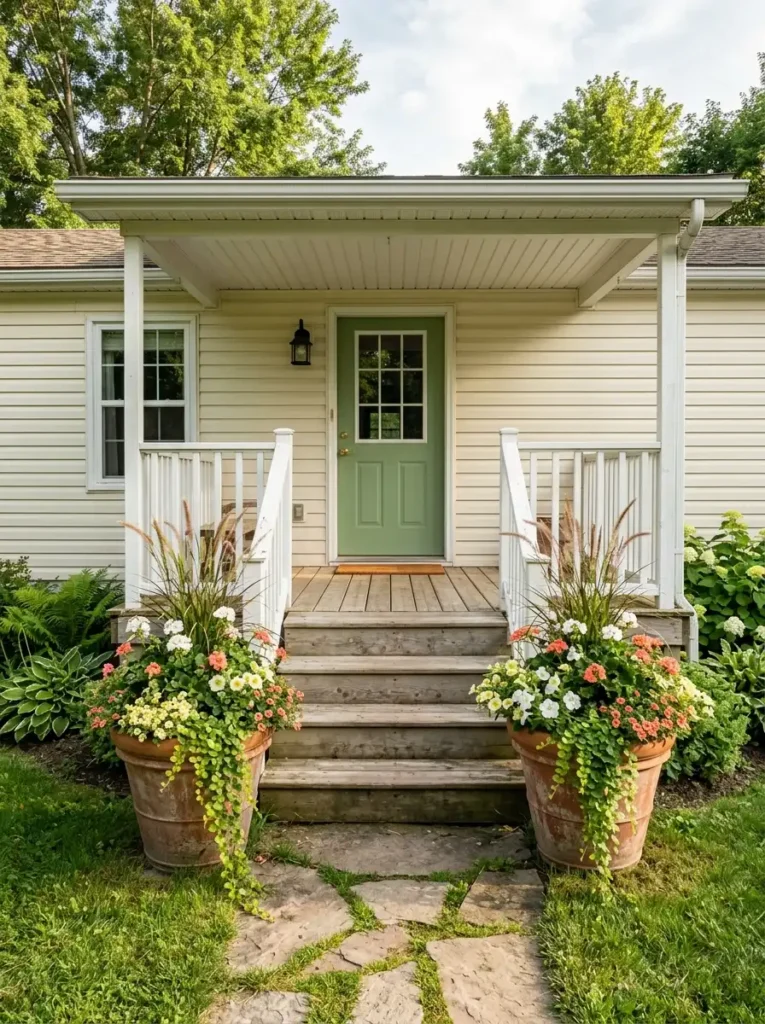
The easiest way to make an entry look cluttered is to surround it with many tiny pots that never develop enough visual weight to relate to the steps or front door.
Wrong: five or six small containers lined tightly around the stairs. Each introduces another rim, another patch of soil, another plant shape, and another object for the eye to process.
Better: consolidate that decoration into two substantial planters or one large vessel paired with a smaller companion. The same number of plants can suddenly look more intentional because their visual mass is organized.
Best when: the planter scale relates to the architecture. Wide wooden steps can support generous containers, while a very small landing may need one larger pot placed beside—not directly on—the main path.
Symmetry is useful when the entrance itself is centered and formal. An asymmetric grouping works well when the stairs enter from one side or when a railing already creates uneven visual weight.
Planter color should support the house rather than add another unrelated accent. Black, aged terracotta, warm wood, soft gray, or muted ceramic tones allow flowers and foliage to carry the seasonal color.
From the yard, you should notice the entry composition first and the individual pots second.
13. Use Tiered Plant Stands Instead of Scattering Pots Everywhere
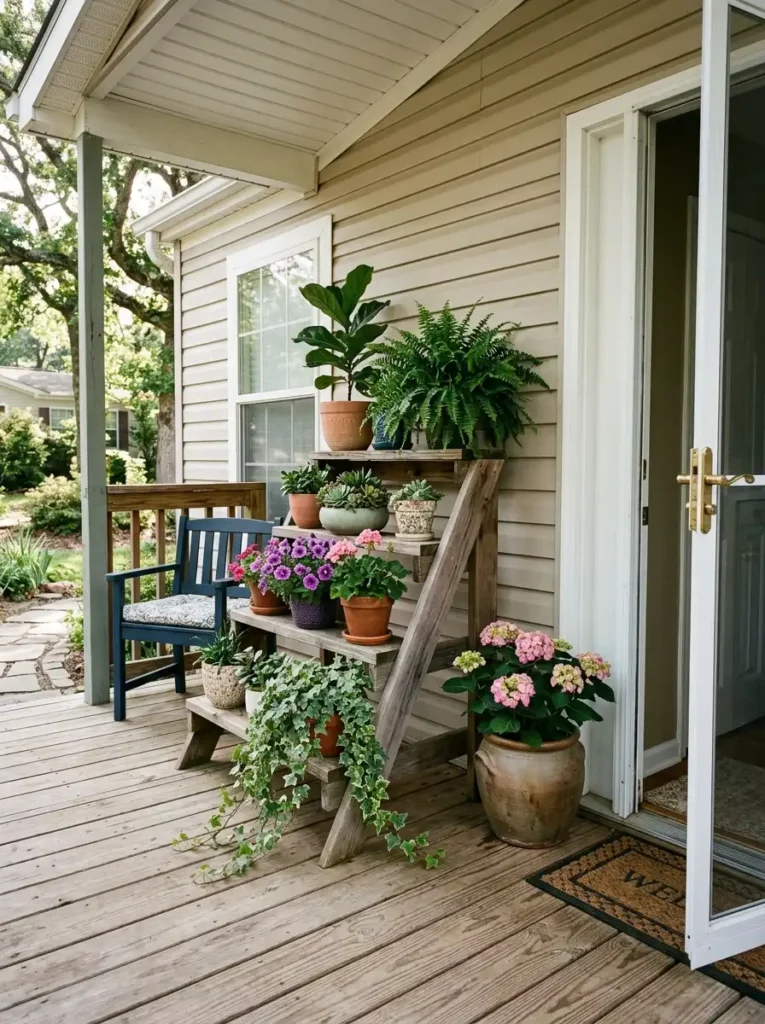
A porch can hold plenty of plants and still feel calm. The important question is not always how many plants you own, but how many separate places they occupy.
Start by looking for competition. One pot beside the door, two beneath a window, three around the chair legs, another beside the stairs, and several along the railing can create constant visual interruption even when every plant is attractive.
Move related containers together.
A tiered plant stand, stacked weather-safe crates, sturdy stepped shelf, or one designated garden corner lets plants overlap visually. Different heights become part of one composition instead of separate pieces scattered across the porch.
Then protect the empty floor you have created. That negative space improves circulation and makes the grouped greenery look more deliberate.
Only add something back if the newly empty area genuinely feels unfinished. Often it will not.
A useful trick is to vary leaf shape and plant height inside the group rather than varying container location. One upright plant, a rounded foliage plant, and one trailing variety can create more depth than placing three similar pots in three different corners.
The finished porch should feel greener—but strangely less cluttered.
14. Paint the Front Door a Summer Color That Works With the Siding
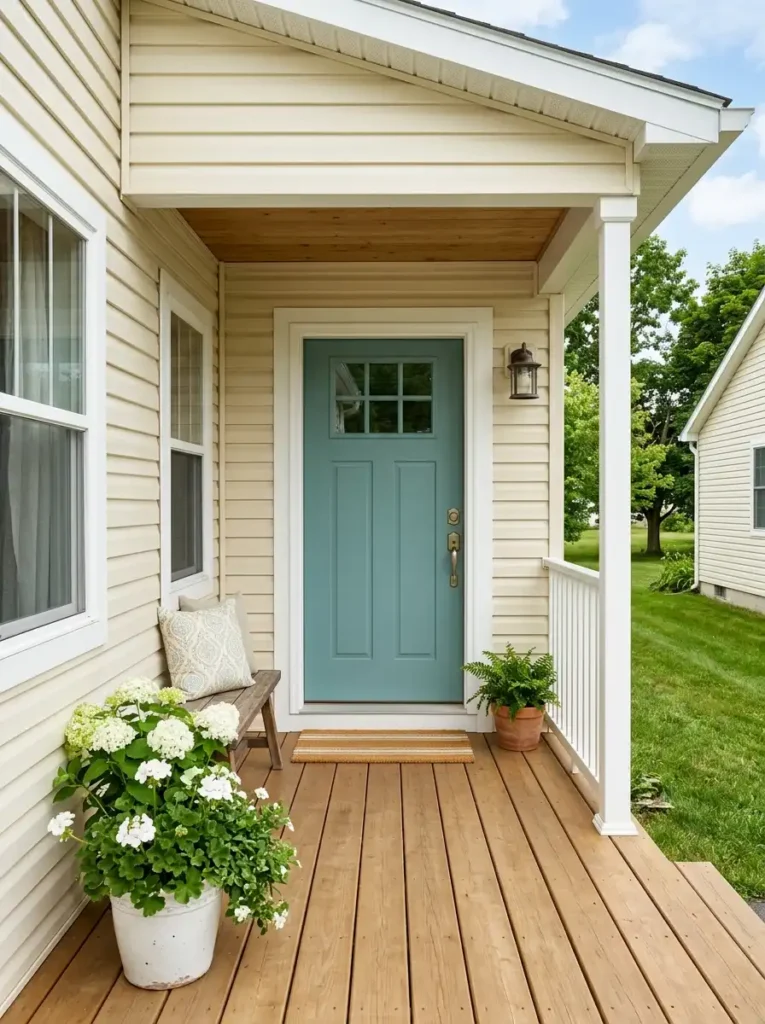
A cheerful front door can carry almost all the seasonal color a simple porch needs—but the best shade depends on what surrounds it.
If your siding is warm beige, tan, or cream
Look for colors that share some warmth. Muted turquoise, leafy green, coral, or a softened golden yellow can feel lively without appearing disconnected from the exterior.
If your siding is cool gray
Cleaner blue-green, dusty teal, deeper green, or restrained berry tones tend to create more comfortable contrast than an orange-heavy color that fights the siding’s cooler cast.
If your siding is white
You have the widest range. Turquoise, garden green, coral, butter yellow, and even stronger pink-red tones can work because the architecture provides a relatively neutral frame.
The important point is to evaluate paint on the actual exterior, not only from a digital image or small swatch. Sunlight dramatically changes saturation, and a color that looks sophisticated indoors can become much brighter outside.
Once the door becomes the focal point, allow nearby elements to support it. Repeat the color lightly in a pillow, flower, or small textile if desired, but avoid matching every planter and accessory to it.
One confident door color is usually stronger than six competing summer accents.
15. Build One Summer Textile Palette Instead of Mixing Random Patterns
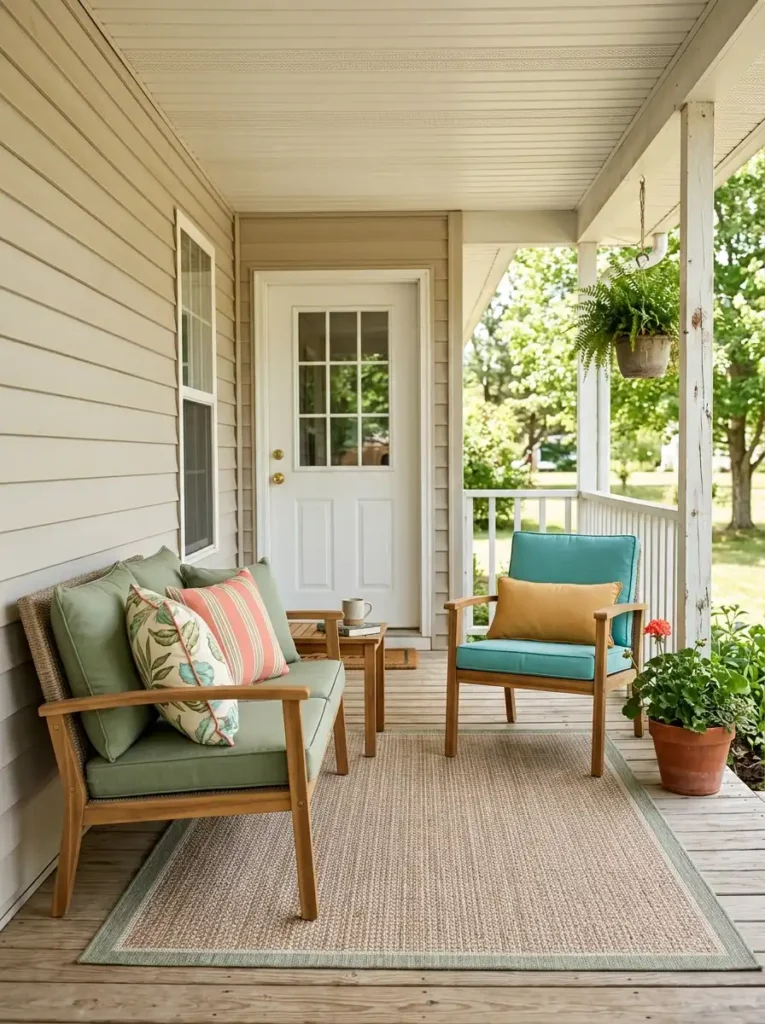
One dominant pattern + one smaller pattern + solids + quiet space.
That formula allows a small porch to feel colorful without turning every chair into a separate visual event.
Imagine a compact loveseat with one medium-scale floral pillow. Add a smaller stripe or check beside it, then use solid cushions to give those patterns somewhere to rest. The patterns do not need to match exactly; they need a clear hierarchy.
Scale is often more important than motif. A floral and a stripe can coexist easily when one reads as the dominant pattern and the other is visibly smaller. Two medium-scale prints with equal contrast are more likely to compete because both demand attention at the same level.
Color distribution helps too. Let one main porch color carry most of the textile area, support it with a secondary tone, then use the brightest summer shade sparingly. This keeps coral, turquoise, yellow, or garden pink feeling intentional rather than scattered.
There is an exception to the formula: an eclectic porch can support more pattern when the architecture and furniture are otherwise visually quiet. Even then, repeat at least one color across the different prints to create a link.
The goal is not perfect matching. It is making every textile look as though it belongs to the same conversation.
16. Add a Narrow Drink Station Without Blocking the Walkway
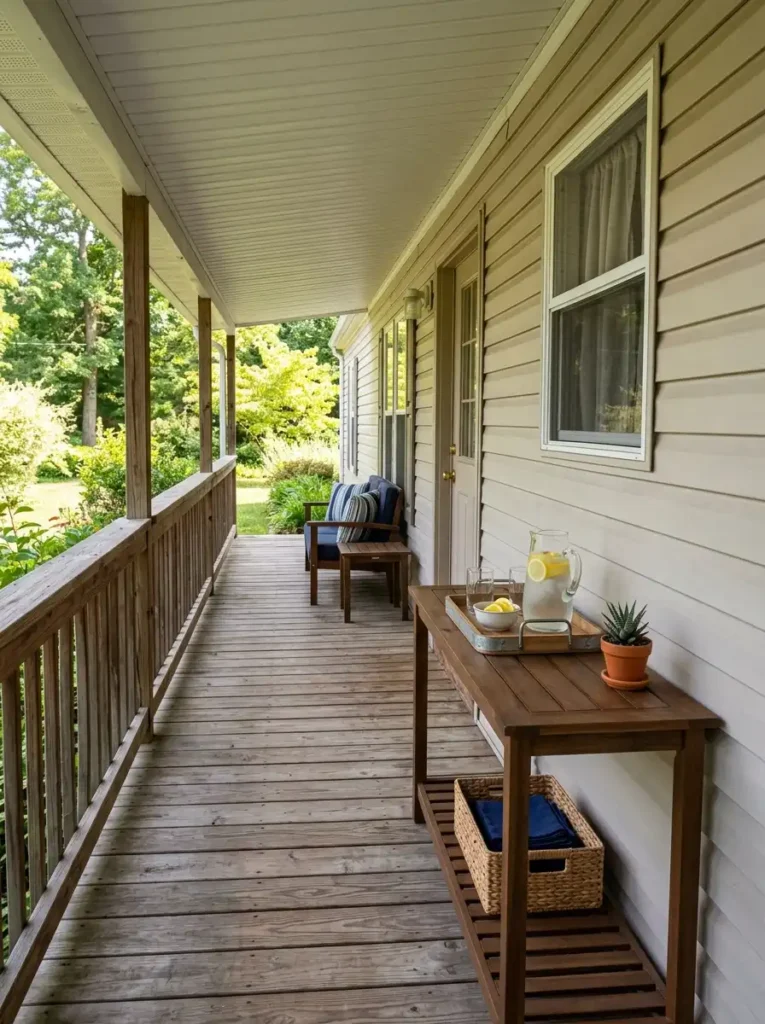
A summer porch becomes more useful when it can handle more than sitting. A slim serving surface can hold cold drinks, outdoor dinner supplies, gardening essentials, or a tray for morning coffee without requiring another large piece of furniture.
Spend here: choose the narrowest weather-appropriate console, cart, or work surface that still performs the job. Depth matters more than width on a tight mobile-home porch because every extra inch projects into the circulation lane.
Save here: the styling. A tray, pitcher, glasses, basket, or small planter you already own may be enough to make the station feel finished.
Reuse here: an existing cart, narrow table, or shelving piece may work if its materials and placement are suitable for the porch conditions. There is little reason to buy a decorative “outdoor bar” if something simpler already solves the function.
Placement should follow the wall rather than interrupt the center of the porch. An underused stretch of siding near the seating area often works better than the space beside the front door.
The non-obvious advantage is architectural: a narrow console can make a blank wall look intentionally occupied without filling the porch with another seating piece.
Stop decorating once the surface still has enough empty room to actually serve a drink.
17. Use a Trellis Screen for Privacy Without Closing the Porch In
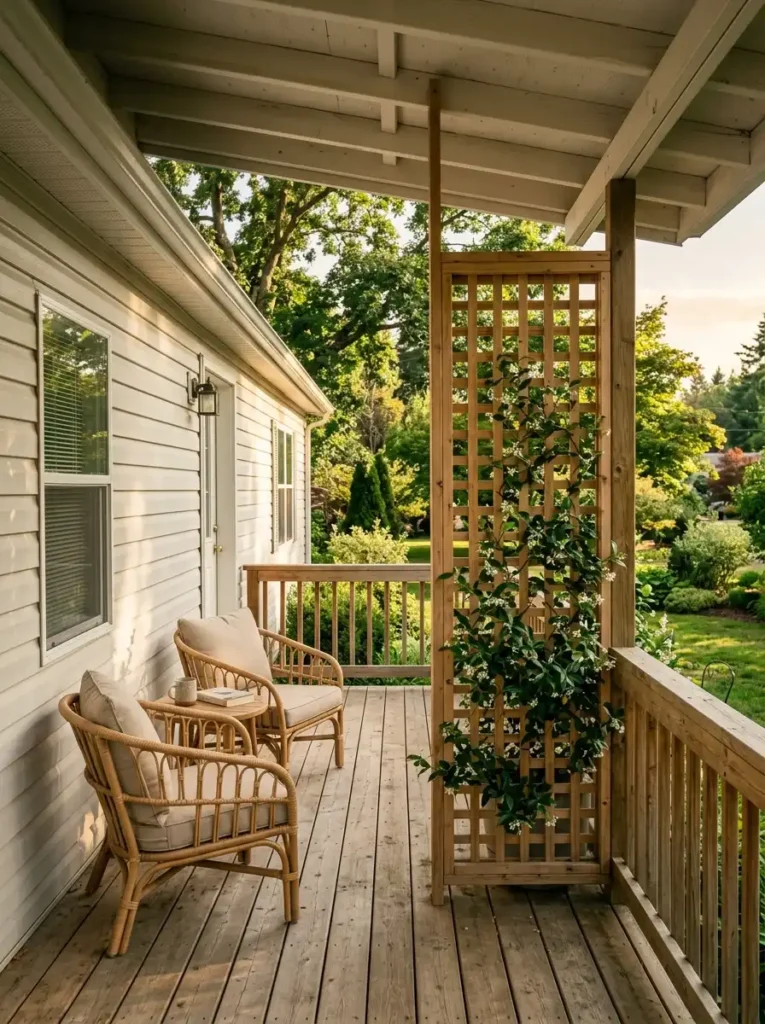
More privacy does not automatically require more coverage.
That matters on a small porch because a completely opaque panel may stop a neighbor’s sightline, but it also stops your own eye from traveling beyond the edge of the deck. A porch that once borrowed depth from the yard can suddenly feel much narrower.
A trellis or lattice screen creates a useful middle condition. The structure interrupts direct views while gaps preserve airflow, daylight, and glimpses of the landscape.
Climbing greenery can soften it further, but resist the urge to cover the entire screen immediately. A partially planted trellis often feels lighter than a dense wall of mature vines, especially beside an already shaded seating area.
Placement matters more than total width. If privacy is needed only on the side facing a neighboring driveway, road, or adjacent porch, screen that exposure rather than wrapping the entire space.
This also gives the porch a stronger visual edge. The screen can define where the seating zone ends without needing another large piece of furniture.
Aim for filtered privacy, not automatic opacity.
If you can sit comfortably without feeling exposed while still seeing sky, yard, and some distance beyond the porch, the screen is doing enough.
18. Turn the Doorway Into One Strong Summer Welcome Moment
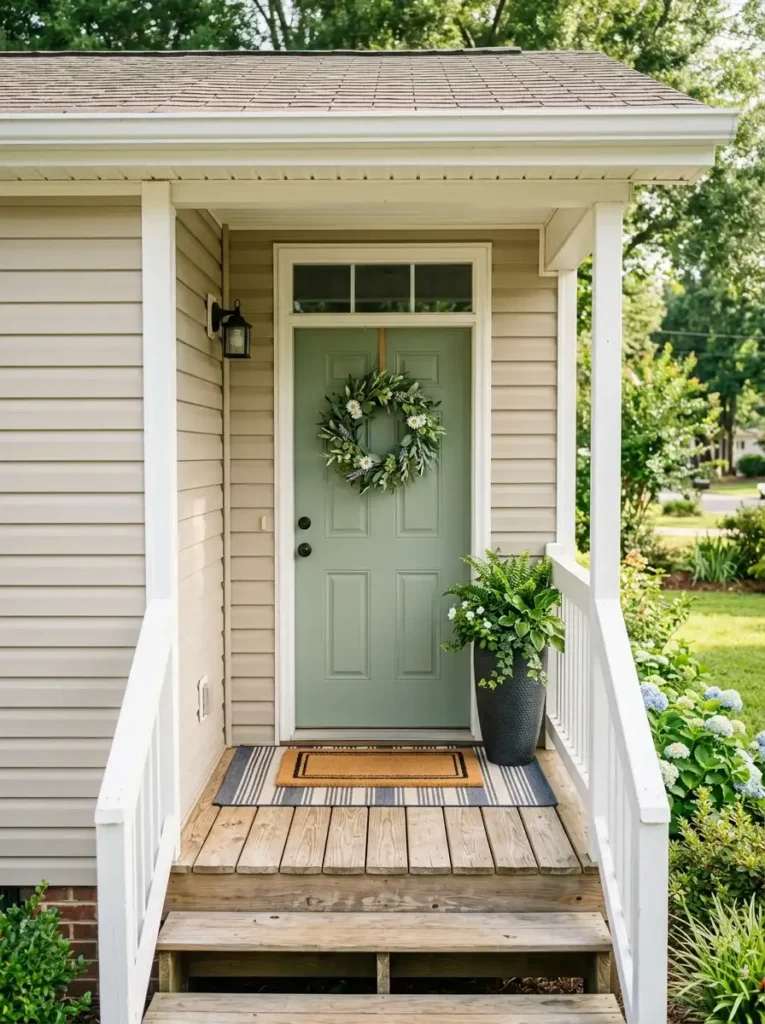
Approach the porch from the yard and notice what your eye sees in order.
1. The front door should register first.
It is the natural architectural destination. If a large sign, oversized planter, or heavily patterned mat attracts more attention than the door itself, the visual hierarchy has reversed.
2. Let the wreath or door decoration support that focal point.
Keep its scale strong enough to be visible from several feet away, but not so large that it visually consumes the entire door.
3. Build the ground layer next.
A clean outdoor mat can work alone, or you can layer it over a slightly larger patterned rug when the landing has enough width. The ground layer should reinforce the doorway rather than spread into the main walking route.
4. Add a vertical accent only if the composition still needs one.
A narrow welcome sign, tall planter, or lantern can help visually connect the floor to the door height. It is optional—not a requirement.
This sequence works because the elements behave like one vertical composition instead of four unrelated decorations scattered around the siding.
From the yard, squint slightly at the porch.
You should still see door first, details second.
19. Run String Lights Along the Porch Architecture
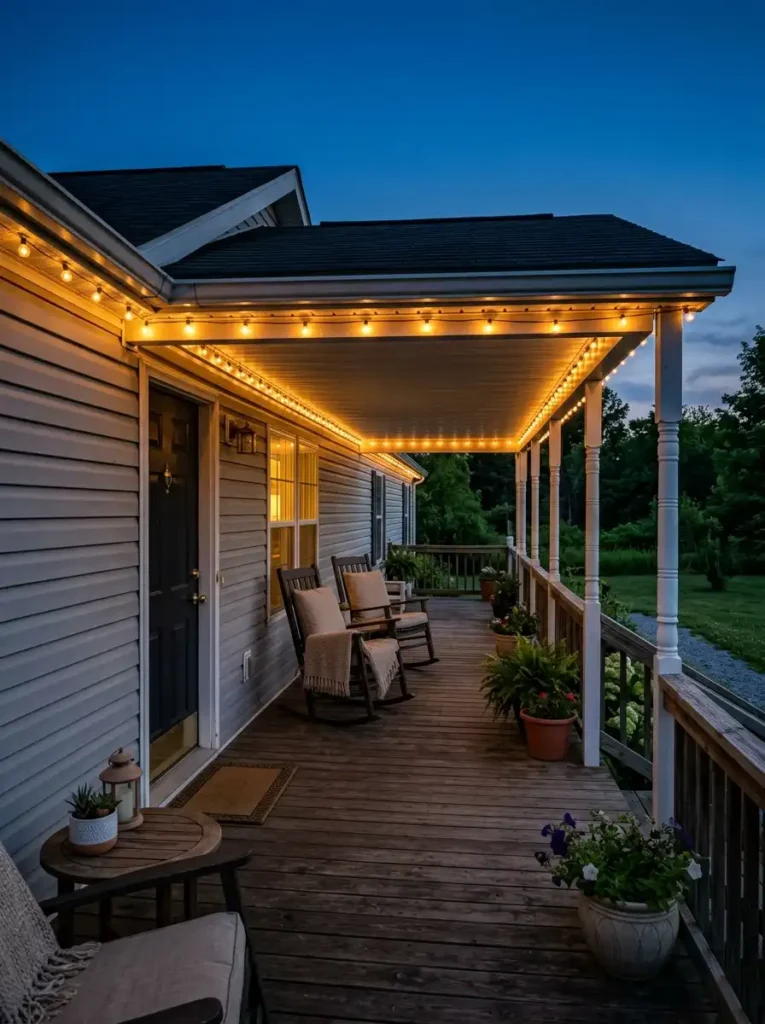
Let the porch tell the lights where to go.
String lights usually look most intentional when they follow a structural line that already exists: the outer beam, ceiling edge, railing line, or length of a covered seating area.
Random zigzags can create plenty of light, but they also introduce another pattern overhead. On a narrow mobile-home porch that already contains ceiling boards, beams, hanging plants, and perhaps a fan, that extra visual movement can quickly become busy.
A long, clean run has a different effect. It reinforces the porch’s horizontal dimension, visually stretches the space, and creates a soft perimeter glow after sunset.
Warm color temperature matters. Very cool blue-white bulbs can make wood, wicker, cream siding, and warm textiles feel disconnected from the lighting. Softer warm-white bulbs generally support the relaxed atmosphere people expect from summer porch lighting.
Spacing also affects the mood. Closely packed bulbs create a stronger decorative statement, while more generous spacing tends to feel quieter and architectural.
There is one exception: a large, open porch may support a deliberate canopy pattern when the lights themselves are meant to become the main nighttime feature.
For a compact porch, however, start with the edges.
When the lights switch on, you should notice the shape of the porch, not just a tangle of glowing cords.
20. Layer Lanterns at Different Heights for a Softer Evening Porch
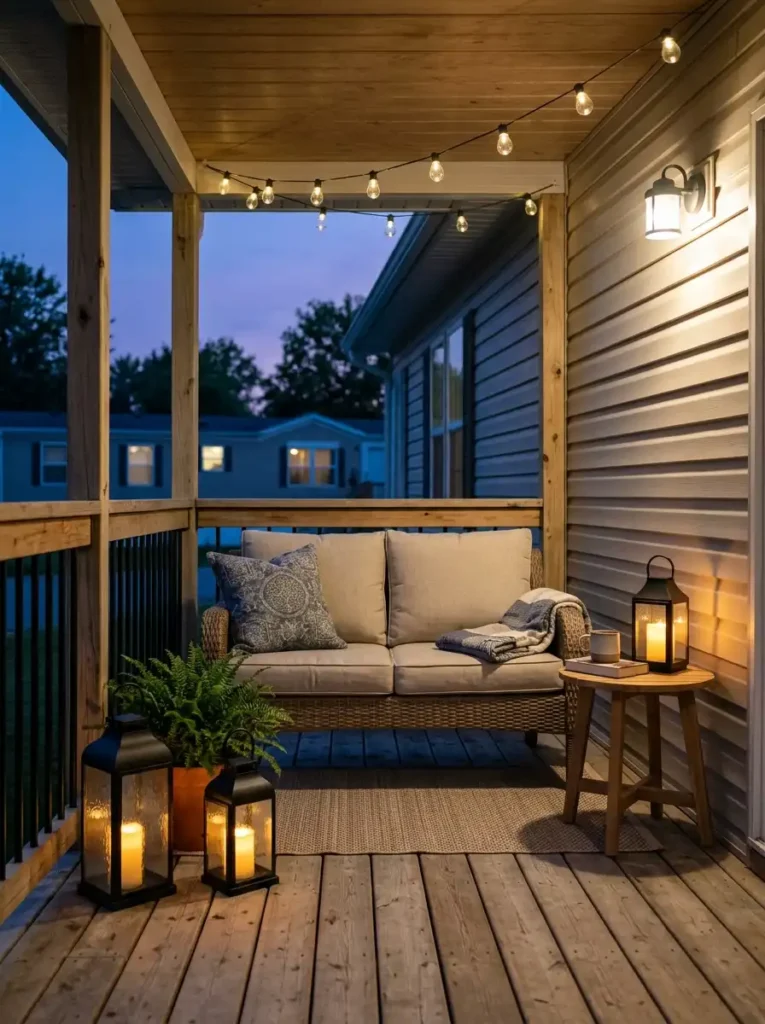
A porch lit only from the ceiling can be bright enough while still feeling visually flat.
Bring some of the light closer to where the furniture is.
A floor lantern beside a chair creates a low pool of light that makes the seating zone feel grounded rather than washed evenly from above.
Move the next source upward. A small lantern on a side table or console introduces a middle layer around seated eye level.
Keep the highest source quieter. Existing wall lights or the string lights from the previous idea can provide general illumination without needing to carry the entire atmosphere themselves.
The materials matter after dark too. Glass lanterns produce sharper highlights; woven or perforated lanterns create texture; matte metal silhouettes disappear more easily into a darker porch.
You do not need many sources.
The goal is simply to avoid putting every glow at the same height. When low, middle, and high illumination overlap softly, furniture gains depth and the porch feels more intimate.
Use outdoor-appropriate lighting methods for the actual location and exposure, and keep anything hot or flame-based away from flammable materials, children, pets, and busy circulation areas.
The best evening porch is not the brightest one. It is the one where you can see comfortably without losing the softness of nighttime.
21. Add Solar Step and Railing Lights for a Finished After-Dark Look
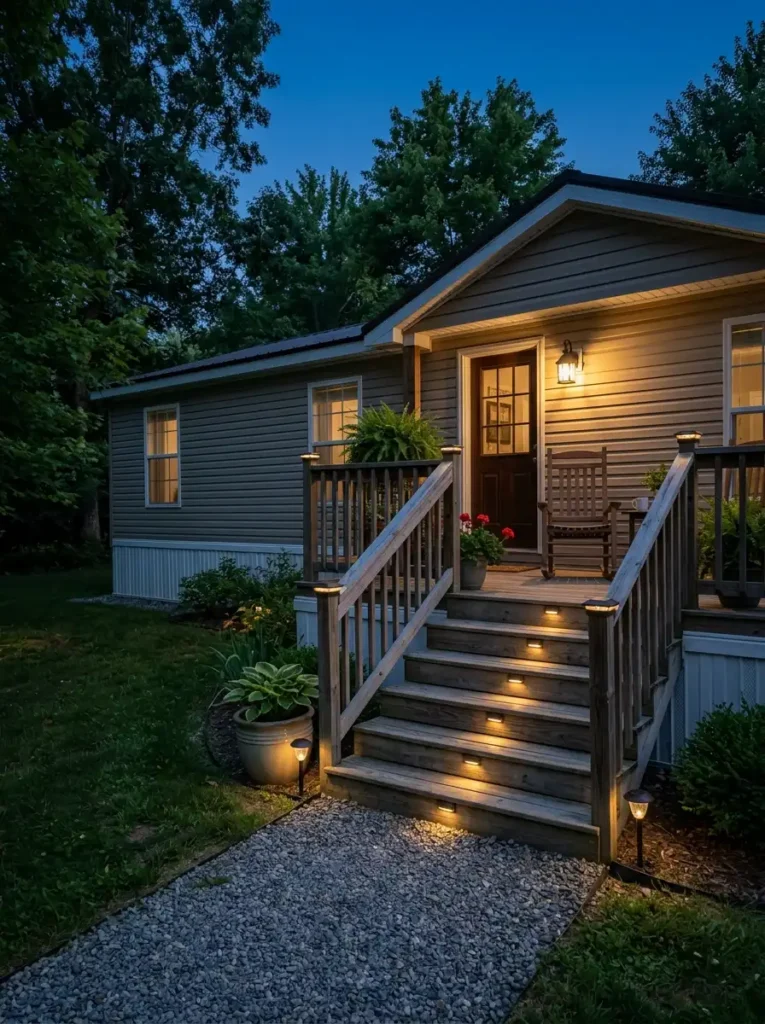
A porch should still make visual sense once the decorative lights are turned down.
Steps
Put the strongest low-level illumination where elevation changes. The purpose is to make tread edges and transitions easier to recognize—not to turn every stair into a glowing display.
Railings
Post-cap or subtle railing lights can help outline the porch perimeter. Keep them softer than the main entry light so the eye follows the architecture without being distracted by a row of equally bright fixtures.
Planter Edges
A small amount of light near a large planter or landscape boundary can help reveal obstacles while adding depth around the porch.
The Stop Point
Do not illuminate every available post, pot, stair, and railing section simply because a solar fixture can be placed there.
One more detail matters: color temperature.
Warm string lights paired with icy-blue solar fixtures can make the porch look like two unrelated lighting schemes. If possible, keep visible light sources within a similar warm family.
After dark, walk toward the porch from the yard.
You should be able to identify the steps, entrance, and outer edge quickly—without feeling as if the lighting itself has become the main decoration.
Conclusion: Start With the Change Your Porch Needs Most
The best summer mobile home porch decor does not come from adding everything at once. Start with the problem that affects the space most. If the porch feels worn, refresh the floor or ceiling. If it feels cramped, improve the furniture layout before buying more decor.
For a porch that already functions well but looks plain, greenery, a stronger front-door color, an outdoor rug, or one coordinated textile palette can create plenty of seasonal personality without overwhelming a smaller space.
If your porch is already comfortable during the day, focus on the evening experience with warm string lights, layered lanterns, or subtle step lighting.
Save the ideas that fit your porch now, then build the look gradually as your space, budget, and summer routine allow.