

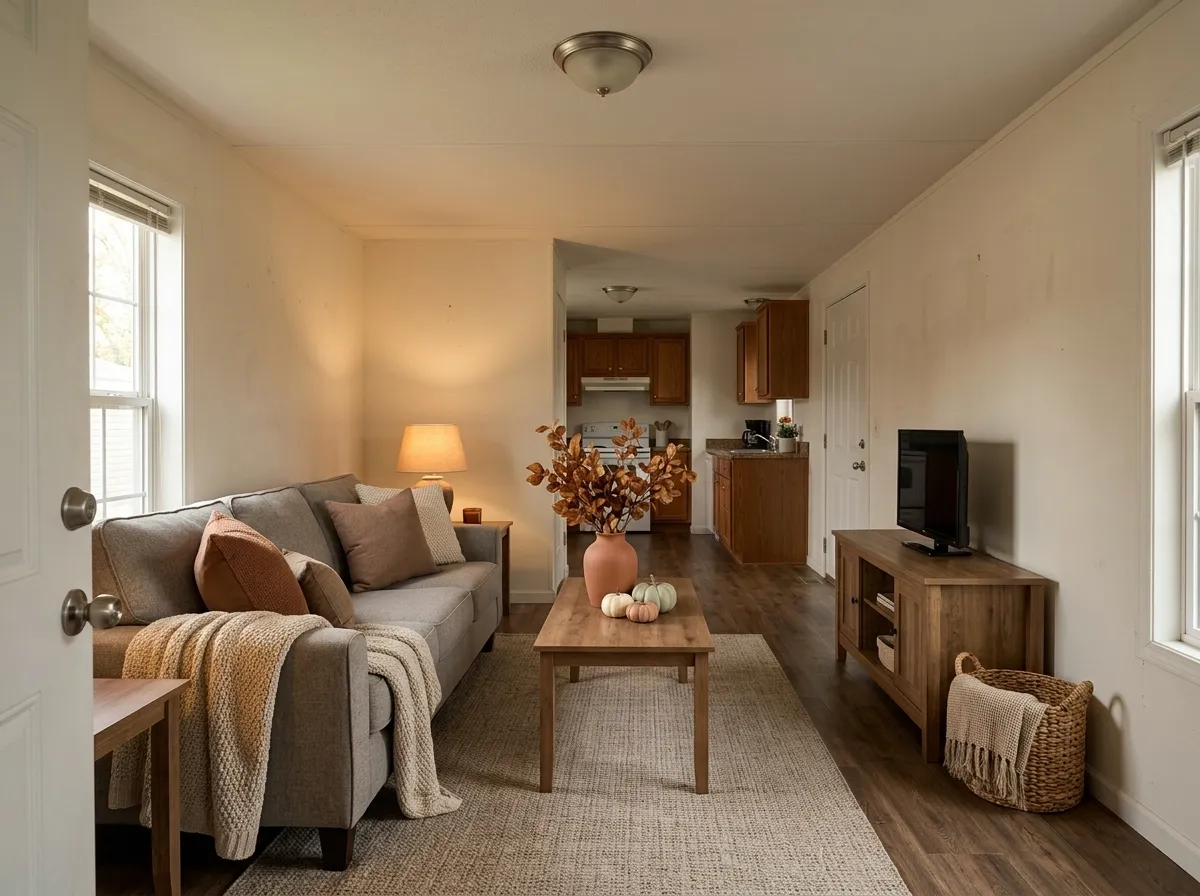
An older mobile home can feel especially inviting in fall, but the answer is rarely to fill every table, shelf, and corner with pumpkins. In a compact home, every decorative layer carries more visual weight. Add too much at once and the room can quickly feel darker, narrower, and busier instead of warm.
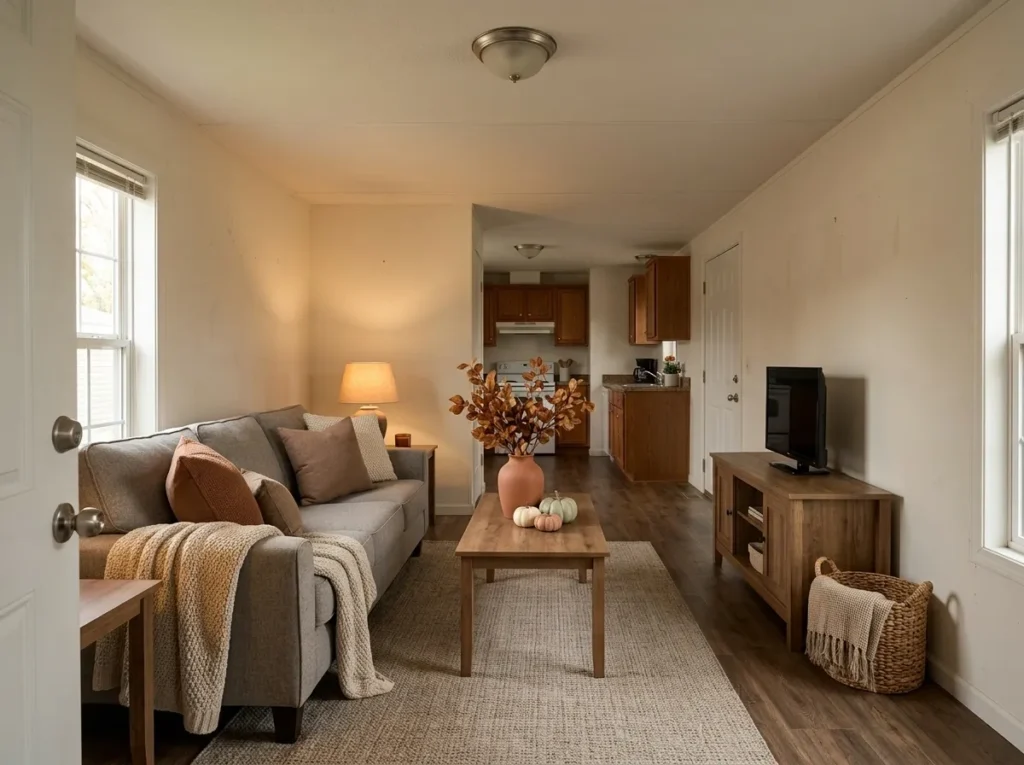
A successful old mobile home fall makeover starts with the home itself: the way you see the living room from the doorway, how the furniture relates to the walkway, where evening light falls, and which existing finishes already bring warmth into the space.
That matters because older mobile homes often have connected sightlines, modest ceiling heights, and less unused surface area than larger houses. One heavy curtain, an oversized pile of pillows, or six small seasonal displays can influence the entire room.
The goal is not to disguise the home’s age. It is to make its existing rooms feel softer, calmer, and more intentional for the season.
We will work in the order that creates the biggest visual change with the least clutter: first diagnose what feels wrong, then edit, warm the lighting, and rebuild the living area around one comfortable anchor. Only after those foundations work will the autumn colors, textiles, and seasonal details begin to matter.
1. Start Your Old Mobile Home Fall Makeover With a Room Audit
Before moving a sofa or buying a single fall pillow, stand where you normally enter the living room.
Do not look at individual objects yet. Look at the whole scene.
What catches your eye first? Is it the sofa, the window, a collection of small decorations, a dark corner, or a piece of furniture interrupting the walkway? An older room often feels “dated” when the real problem is more specific: weak lighting, scattered visual weight, competing colors, or too many small items with no clear hierarchy.
Diagnose the room, not its age
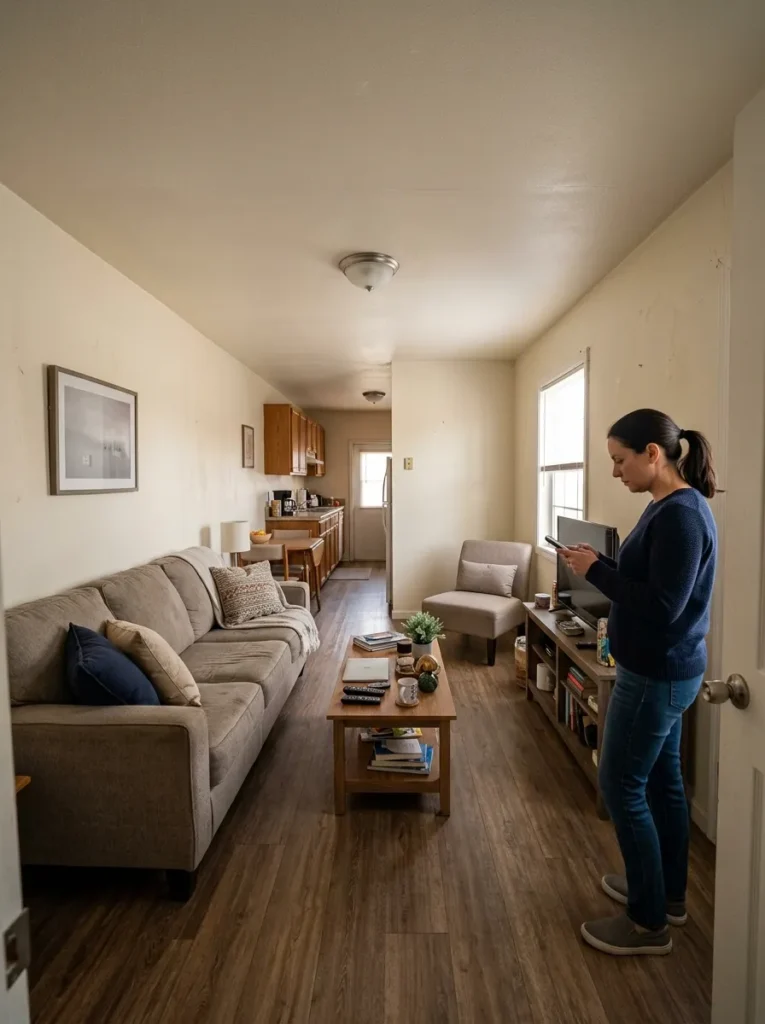
Separate what you see into five categories:
Layout: Does the seating feel connected, or does each piece seem to sit on its own?
Light: Does the room have useful light at eye level, or is one ceiling fixture doing all the work?
Texture: Are most visible surfaces hard and smooth, with little softness to balance them?
Color: Do the walls, flooring, upholstery, and décor relate, or are several unrelated warm and cool tones competing?
Clutter: Are many small objects asking for attention at the same time?
Take a quick phone photo from the doorway if you are struggling to judge the space. A photograph flattens the scene slightly, which can make visual clutter and awkward furniture relationships much easier to spot.
Your task is not to create a long renovation list. Identify the three highest-impact problems.
For example:
- harsh overhead lighting
- too many unrelated tabletop objects
- a seating area that does not read as one zone
Those three observations are far more useful than deciding that the entire home needs to be replaced or redecorated.
Room check: If your audit has already turned into a shopping list, return to the doorway. Every problem should first be classified as layout, light, texture, color, or clutter.
not its age.
Stand at the main entrance and identify the three conditions creating the most visual friction before you buy or add anything.
2. Clear the Visual Noise Before You Add Anything Seasonal
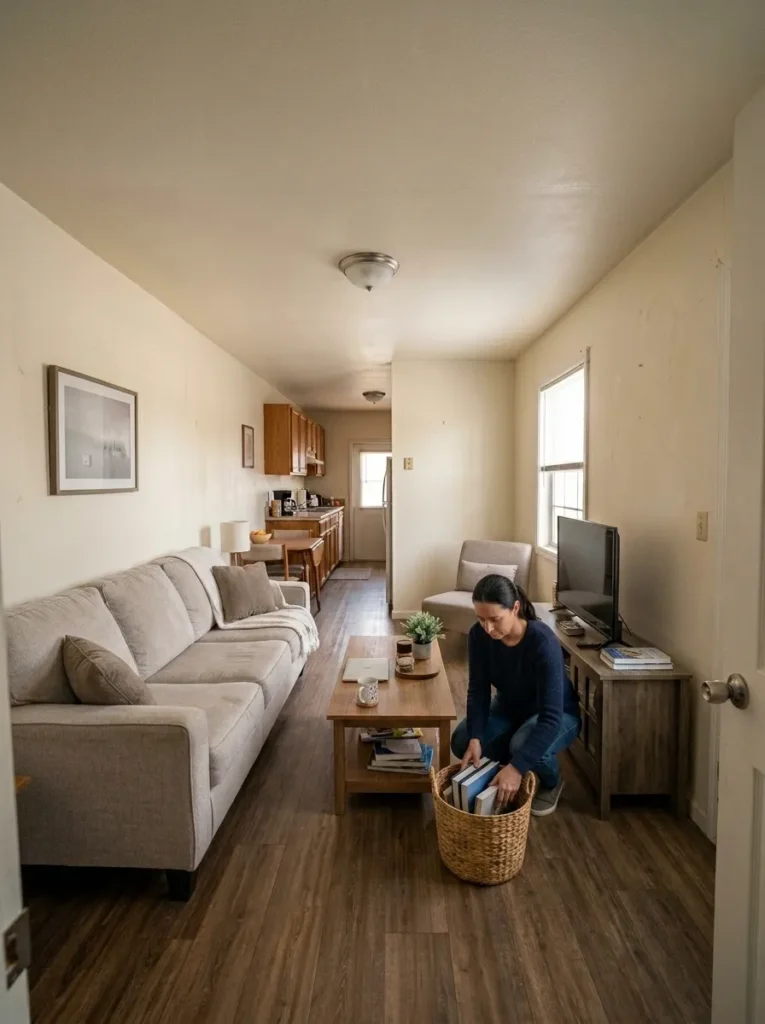
The fastest way to make a compact room feel more intentional may be to remove décor before adding fall décor.
Do not empty the room completely. Instead, edit the pieces that compete with the architecture, furniture, and surfaces you actually want people to notice.
KEEP
Keep objects that are functional, personally meaningful, or already work with the direction of the room.
A wood bowl, neutral ceramic vase, woven basket, favorite framed photograph, or simple lamp may already fit beautifully into a fall room. Seasonal decorating does not require replacing everything you own.
MOVE
Some useful objects are simply in the wrong place.
A basket may work better beside the sofa than under a console. A lamp may create more warmth beside the seating area than tucked against an unused wall. Move pieces that could support the new composition before deciding they are wrong for it.
REMOVE
Temporarily remove:
- duplicate small accessories
- pillows in several unrelated colors
- tired artificial greenery
- tiny objects scattered across multiple tables
- decorative pieces that compete with the colors you intend to use for fall
Put them in a basket or another room rather than immediately discarding them.
The important word here is temporarily.
You will be able to judge those objects much more clearly after the large visual relationships are fixed.
REUSE LATER
Once the room has lighting, texture, and a stronger focal point, bring back only the objects that solve a specific need.
That might be an empty corner, a bare console, or a color that needs to repeat once more.
If returning an object does not improve the composition, leave it out.
The room should now feel easier to read. You should see the sofa, window, main tables, and walking path before your eye begins counting accessories.
Stop removing when the room feels calm but still lived in. A cozy home needs breathing room, not emptiness.
3. Warm the Evening Light Before You Warm the Color Palette
Warm is a quality of light. It does not mean making the room dark.
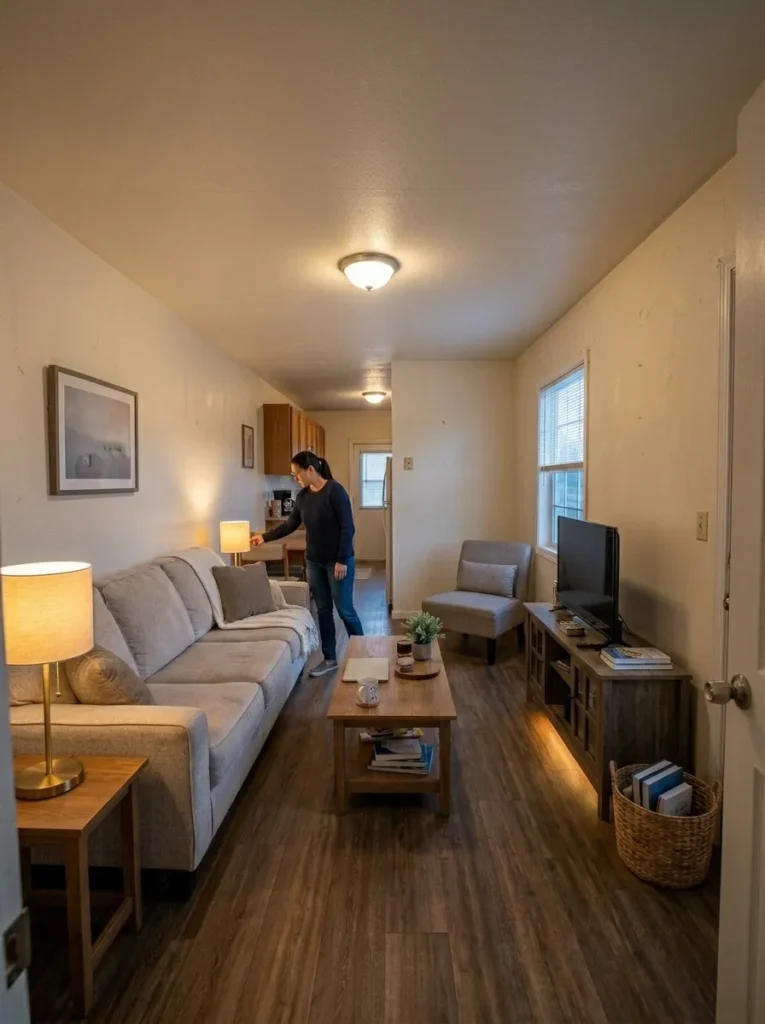
This distinction matters enormously in a smaller mobile home. Deep rust pillows, brown throws, dark wood, and fall greenery can look rich in balanced light but heavy when the room depends on a single ceiling fixture.
Before choosing more autumn color, improve the way the room feels after sunset.
Start with the overhead light you already have, but do not ask it to create the entire mood. Ceiling lighting is useful for general visibility. It is rarely enough on its own to make a seating area feel intimate.
Add or reposition a lamp near the place where you actually sit.
A table lamp beside the sofa or a slim floor lamp near a chair creates light closer to eye level. That lower source softens the contrast between the bright ceiling and darker corners while visually pulling attention toward the seating zone.
If you already own a lamp, try moving it before buying another.
Think in three layers
Broad light lets you use the room safely and comfortably.
Eye-level light makes the seating area feel warmer and more settled.
Low accent light can add atmosphere near a console or shelf, but it should support the room rather than become the only visible light source.
The effect should be obvious without becoming dramatic.
When the lighting is right, you should still be able to see the walkway, locate objects easily, and recognize the room’s colors accurately. The corners can be quieter than the center of the room, but they should not disappear.
If everything turns yellow, murky, or cave-like, you have not created coziness. You have simply reduced visibility.
Judge the room in the evening from the doorway. The sofa or main seating area should feel visually welcoming before you add another seasonal accessory.
Each layer solves a different problem. The room feels most comfortable when they overlap without competing.
overall visibility + safe movement
comfort + visual focus
depth + evening atmosphere
4. Rebuild the Living Area Around One Cozy Anchor
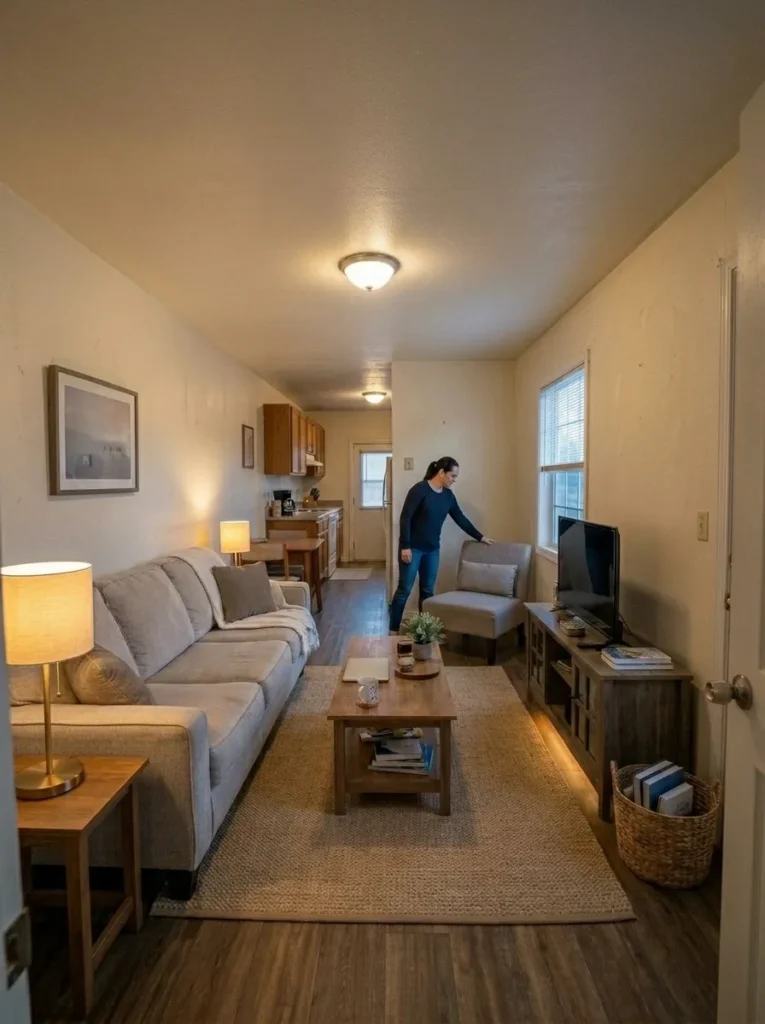
A cozy room is not created only by soft things. It is created when the furniture belongs together.
This is particularly important in a narrow mobile-home living room. If the sofa sits against one wall, a chair floats at the opposite edge, the coffee table feels detached, and a small rug sits beneath only the table, the room can feel visually scattered even when every individual item is attractive.
The goal is to make the seating area read as one comfortable zone while preserving the route people use to move through the home.
1. Find the real seating zone
Stand in the doorway again and identify the portion of the room used for sitting and conversation.
Do not let the room’s outer walls automatically determine the arrangement. The furniture should relate primarily to the other furniture in the seating group.
If everything is pushed tightly against separate walls, see whether one lighter piece, such as an accent chair or small side table, can move slightly inward without restricting movement.
2. Let the rug connect rather than decorate
If you already have an area rug, judge it in relation to the full seating group rather than the center of the floor.
A rug that appears to belong only to the coffee table can make the furniture look like separate islands.
You do not need a universal measurement to fix this. Look for a visual relationship: the rug should feel substantial enough to participate in the seating arrangement while leaving the surrounding floor deliberate rather than accidental.
If your room already feels grounded without a rug, do not buy one simply because fall décor photographs often contain one.
3. Reposition the supporting pieces
Once the sofa and main anchor are clear, adjust the chair, coffee table, and side table around them.
Move one piece at a time.
A small shift can be enough to make the conversation area feel connected without narrowing the route through the room.
Check the coffee table from the main seat. It should feel accessible rather than floating far away or blocking the passage.
4. Walk through the room before you style it
Now physically use the main route.
Walk from the entry toward the kitchen or adjoining area. Open any nearby door. Sit down. Stand up. Move around the coffee table.
If the room looks cozy but requires you to turn sideways around furniture, the arrangement is not finished.
The successful version should give you two messages at once:
This is one connected seating area.
This is still an easy room to move through.
Anchor → connect → clear.
Once those three things are working, stop rearranging.
From this point forward, the textiles and seasonal details will have a stable composition to support instead of trying to create structure by themselves.
Once the room itself feels warmer and more grounded, you need surprisingly little “fall décor” to make autumn visible.
Connect.
Clear.
Furniture should form one readable seating zone without stealing space from the route through the home.
shared center
to adjoining room
5. Soften the Hard Surfaces With Two or Three Tactile Layers
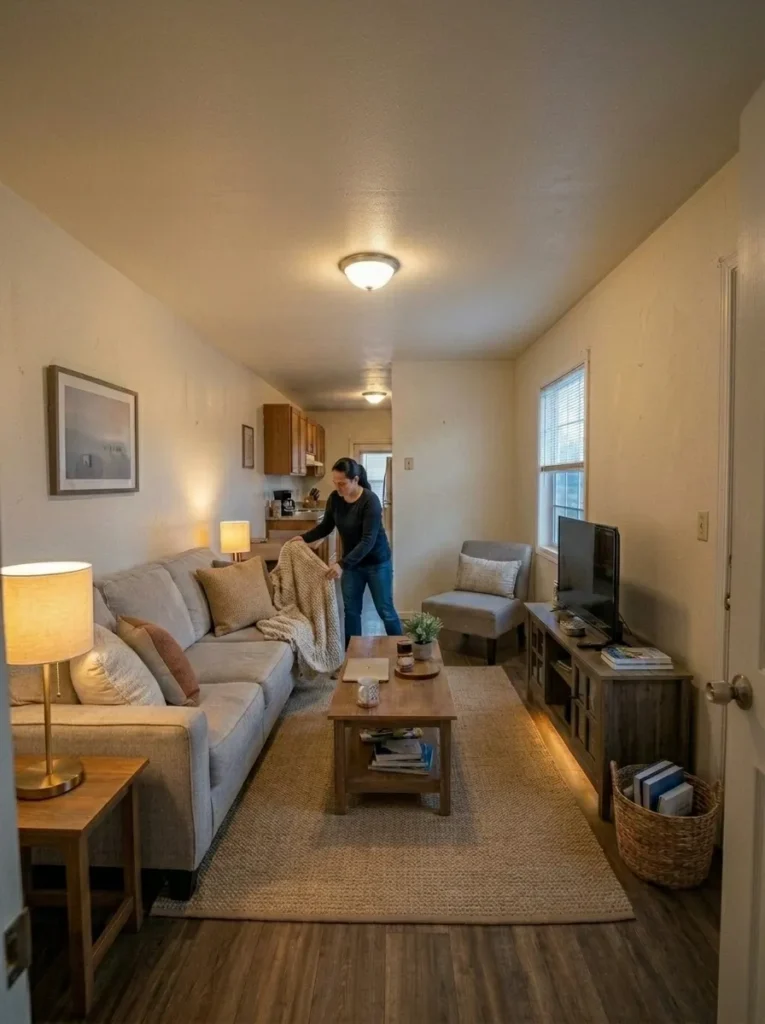
Once the furniture feels connected, resist the urge to cover it with every blanket and pillow that looks autumnal.
In a compact mobile home, texture works best through contrast, not quantity.
Look around the room and identify the surfaces that currently dominate. You may have smooth upholstery, wood-look flooring, painted walls, laminate furniture, metal hardware, or cabinetry visible from the adjoining kitchen. None of those surfaces are a problem. They simply need something softer to play against.
Start with the largest soft layer
If the sofa is the main visual anchor, introduce one substantial textile there first.
A woven throw can soften a broad upholstered surface without changing the furniture itself. Let it fall naturally over one section of the sofa rather than folding it into an overly perfect display.
If you already have a rug that properly anchors the seating group, count that as one major tactile layer. You do not need another simply because rugs appear in fall inspiration photos.
Add a texture that behaves differently
The next layer should not look or feel almost identical to the first.
If your throw is soft and loosely woven, choose a pillow with a denser linen-look weave, subtle nubby surface, or restrained pattern.
If the sofa itself has visible texture, keep the added textiles simpler.
A useful material sequence might look like:
smooth upholstery → woven throw → coarser pillow or basket
The visual interest comes from the difference between them.
Use natural materials where fabric would be too much
Not every source of coziness has to be another textile.
A woven basket beside the sofa, matte ceramic vessel on a table, warm wood tray, or aged metal detail can create tactile depth without making a small living room feel padded from wall to wall.
This is particularly useful when the mobile home already has:
- fabric upholstery
- carpeted areas
- upholstered dining chairs
- multiple curtains
- several existing cushions
In that situation, introducing another natural material may create more balance than introducing another blanket.
Watch what the textiles do to the furniture
Step back after each addition.
Can you still see the shape of the sofa?
Do the arms, seat, and back still read clearly?
Can someone actually sit down without moving five decorative cushions?
If not, the layering has passed the point of comfort and entered visual congestion.
A throw should make the room look softer, not make the sofa disappear.
The same applies to pillows. Two or three coordinated covers with different tactile qualities often contribute more than a pile of small seasonal cushions.
Your tactile checkpoint
You usually have enough when the room contains three distinguishable surface experiences:
something smooth
something soft
something visibly woven, coarse, or natural
Once those contrasts are easy to see, another beige blanket or rust pillow may only repeat information the room already has.
Stop when the texture changes are visible without hiding the furniture beneath them.
6. Choose Fall Colors That Work With the Finishes You Already Have
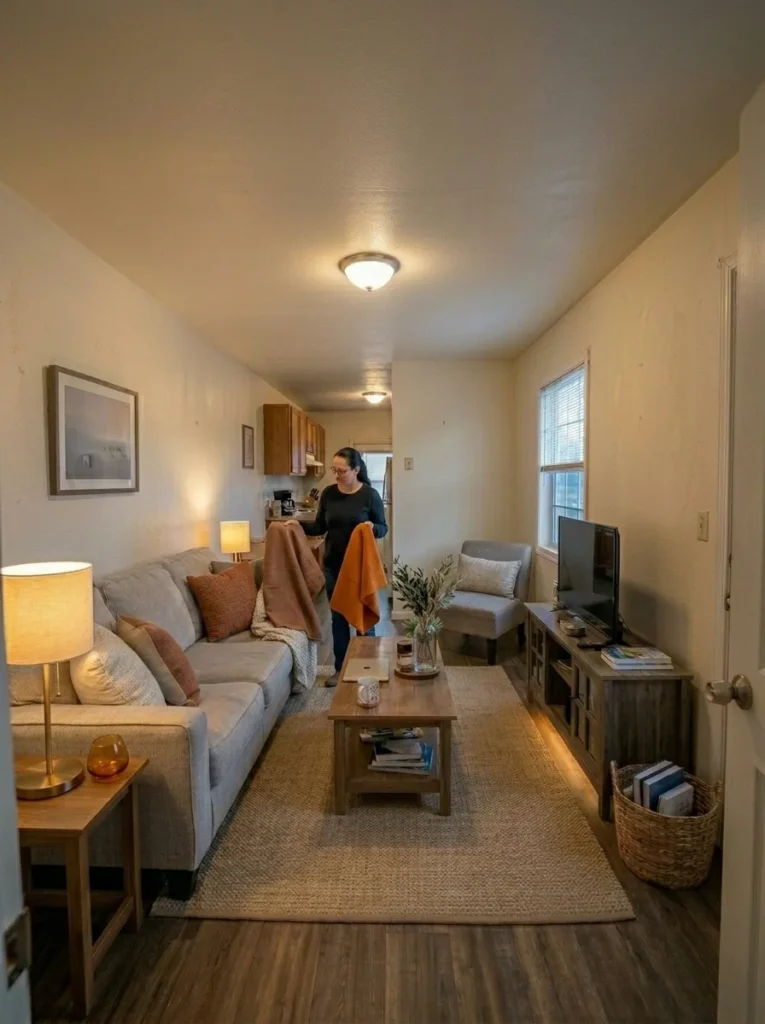
Fall color should look as though it belongs to your home even after October ends.
That becomes much easier when you stop choosing colors by season alone and start choosing them by role.
Your walls, floor, sofa, cabinetry, and wood furniture already form the largest part of the palette. They are not background problems to overcome. They are the starting point.
Use this formula:
Existing Neutral + Earthy Bridge + Seasonal Accent + Natural Counterpoint
The first color already exists in the home.
The second connects the permanent room to autumn.
The third makes the season recognizable.
The fourth prevents the palette from becoming one-note.
For example:
Cream + rust + amber + muted olive
Cream keeps the largest areas quiet. Rust links naturally with wood and brown finishes. Amber supplies a clearer autumn note. Olive introduces a natural counterpoint without fighting the warmth.
Another room might work better with:
Oatmeal + tobacco + muted pumpkin + sage
Or:
Warm gray + cinnamon + burgundy + aged brass
These are examples, not mandatory palettes. Your own permanent finishes decide which direction makes sense.
Read the undertone before choosing the accent
Place the textile or décor color beside the sofa, floor, or cabinetry rather than evaluating it alone in your hand.
A bright orange pillow may look cheerful in a shop but excessively saturated beside honey-toned flooring and brown cabinetry.
A deeper rust may connect those same finishes more naturally.
If your existing room leans cool-neutral, an extremely yellow-orange palette can feel disconnected. Cinnamon, muted red-brown, burgundy, taupe, and warm cream may create a better bridge.
Repeat a successful color instead of adding another one
Suppose a rust pillow looks excellent against your sofa.
Rather than adding mustard, burgundy, pumpkin orange, forest green, and brown next, repeat that rust once more in a smaller location.
It could appear as:
- a stripe in a throw
- one ceramic detail
- dried foliage
- a small textile in the adjoining room
Repetition creates intention.
Constant novelty creates visual noise.
What if the room becomes too brown?
Older mobile homes can already contain substantial wood, beige, tan, or brown. Adding only rust, camel, tobacco, and dark orange can make the entire interior visually collapse into one warm mass.
Use a lighter or cooler natural counterpoint.
That might be:
- warm cream
- oatmeal
- muted olive
- dusty sage
- soft stone
- restrained black or aged metal
The goal is not to remove warmth. It is to give the warm colors enough contrast to remain visible.
A simple test
Look at the room from several feet away.
Can you identify:
- one dominant neutral base
- one repeated earthy bridge
- one clearly seasonal accent family
If yes, the palette is probably doing enough.
If every pillow, throw, branch, pumpkin, and tabletop object is a different fall color, remove the least connected one before adding anything else.
Permanent finishes should carry most of the visual weight. Fall colors work better when they support those finishes instead of competing with them.
7. Put Fall Décor Where the Eye Naturally Stops
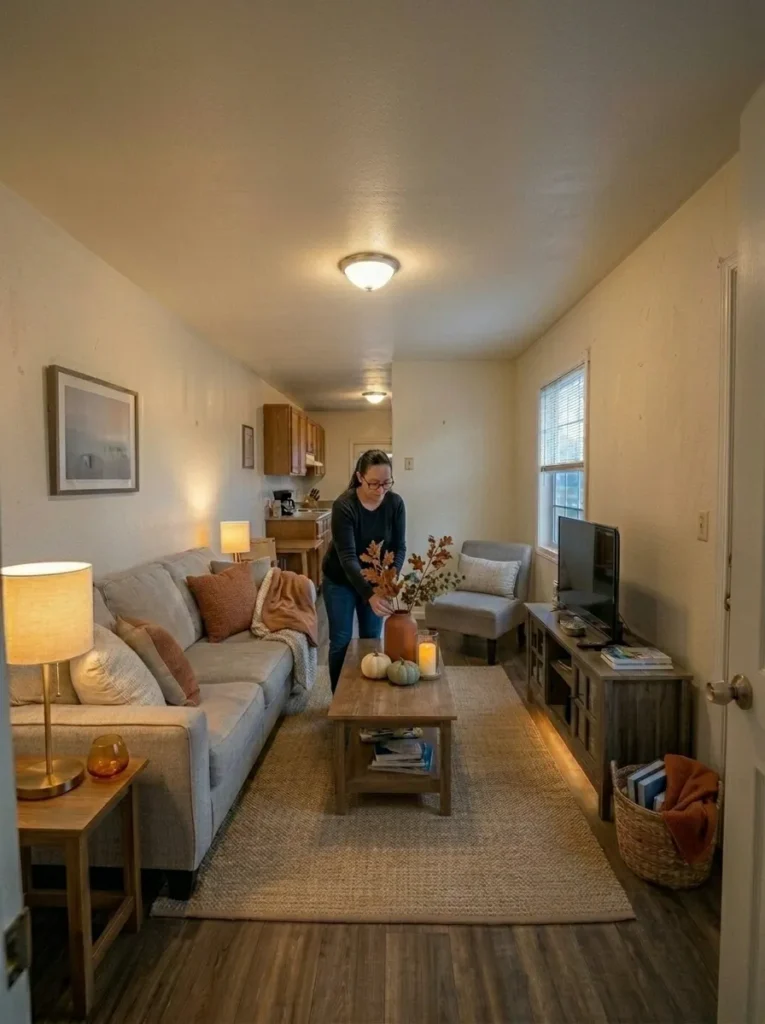
Where should the pumpkins, branches, candles, bowls, and seasonal objects actually go?
In a compact room, there are two basic approaches.
Option A: Concentrate the season
Choose one area the eye already notices.
That might be:
- a console visible from the entry
- the coffee table
- one open shelf
- a dining table
- a small cabinet beneath wall art
Create one stronger autumn composition there, then use a much quieter seasonal echo elsewhere.
For an older mobile home with connected sightlines, this is usually the safer approach because the room receives a clear hierarchy.
You might place a matte ceramic vessel with natural branches on the console, add one or two small muted gourds nearby, then repeat only the branch color or ceramic material on the coffee table.
The second location does not need to become another full fall display.
Option B: Distribute small pieces throughout the room
This can work when the interior has plenty of negative space and very few objects to begin with.
The risk is that five small fall moments can become five competing focal points.
One pumpkin on the coffee table, another on the television console, a leaf garland at the window, several objects on a shelf, and another group near the entry may technically be “small,” but together they can dominate a narrow room.
The decision rule
Concentrate before you distribute.
Finish one primary focal point first.
Step back.
If the room already reads as autumn from the doorway, you do not need to keep proving the season on every remaining surface.
Build a focal grouping with different visual roles
Instead of lining up several equally sized seasonal objects, give them different jobs.
For example:
Height: natural branches or foliage.
Weight: one larger ceramic or woven vessel.
Seasonal cue: one or two small pumpkins or gourds.
Quiet space: part of the tabletop deliberately left open.
This creates a composition rather than a collection.
The empty space is part of the arrangement.
Avoid the “fall shop aisle” effect
Literal seasonal décor becomes much more noticeable in a small home because the viewer sees multiple areas at once.
Mixing natural materials with only a few obvious autumn symbols keeps the room from feeling themed.
You can often remove half of the explicitly seasonal pieces and make the home feel more autumnal because the remaining objects become easier to notice.
The test is simple:
Stand at the entry.
If you immediately sense fall without counting individual pumpkins, the seasonal layer is strong enough.
Stop styling when the focal point carries the season and the surrounding room still has breathing room.
8. Carry One Cozy Thread Into the Entry, Kitchen, and Bedroom
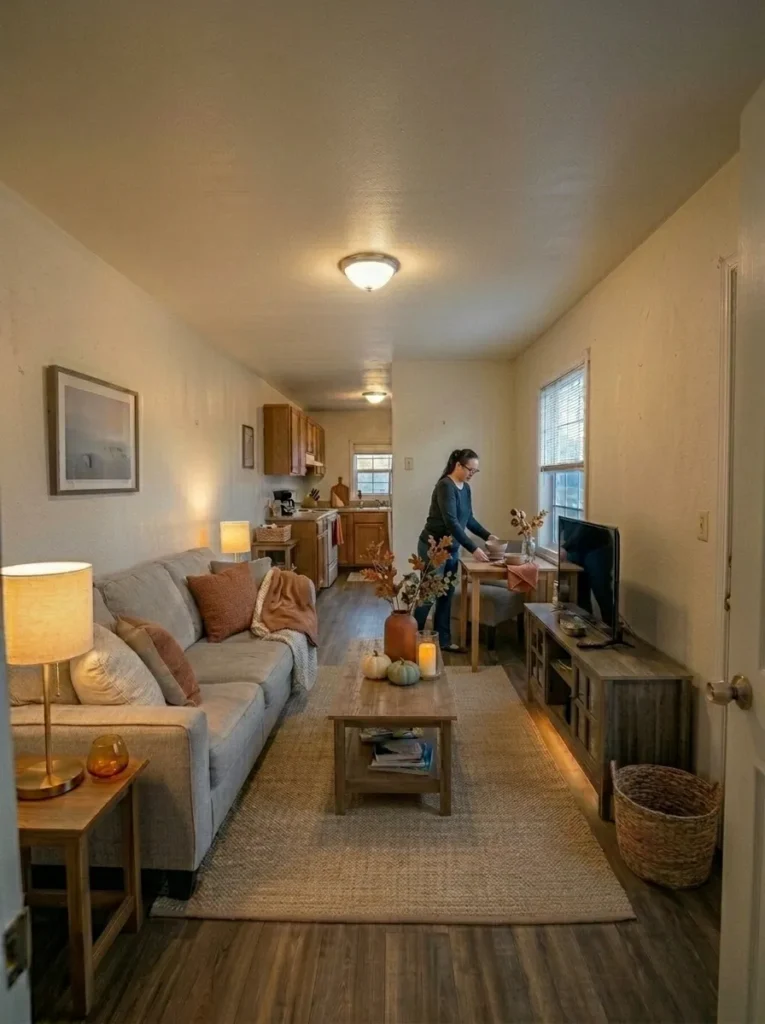
The living room may be the visual anchor, but in many mobile homes it does not exist in isolation.
From one standing position you may see part of the entry, kitchen cabinetry, dining area, or hallway. That means secondary rooms can either support the fall makeover or make it feel abruptly disconnected.
The solution is not to decorate every space exactly the same way.
Choose one thread from the completed living room and let each adjoining zone interpret it differently.
Entry: repeat the season immediately, but briefly
The entry only needs one clear cue.
If the living room uses rust, natural branches, and woven texture, the entry might receive:
- one rust-toned textile
- a small woven basket
- one simple branch arrangement
- a warm LED lantern
Do not rebuild the entire living-room vignette beside the front door.
The entry’s job is to introduce the mood.
Kitchen or dining area: repeat material before décor
Kitchen surfaces are already visually active.
Cabinet doors, hardware, counters, appliances, dishes, and food-storage items create more information than a living-room wall.
Rather than filling the counters with fall objects, repeat a material from the living room.
For example:
- the same warm wood tone in a serving board
- a woven basket holding everyday items
- one matte ceramic bowl
- a restrained rust or olive textile
- a natural centerpiece on the dining table
Functional repetition often looks more sophisticated than placing pumpkins between appliances.
Bedroom: repeat softness
The bedroom does not need to become a second fall living room.
Use the gentlest part of the palette.
If the main room carries rust, camel, cream, and olive, the bedroom might repeat only cream and muted rust through:
- one throw
- two pillow covers
- warm bedside lighting
- one understated natural branch
The relationship will still be visible without copying the exact décor.
Repeat the idea, not the object
This is the distinction that keeps a small home coherent.
If the living room has a woven basket, the kitchen does not need the exact same basket.
If the sofa has rust pillows, the bedroom does not need the exact same pillows.
Repeat:
color
or
material
or
lighting warmth
or
natural texture
instead.
That creates continuity without making the home look staged as one matching set.
Use the home’s natural sightlines
Stand where the living room meets the kitchen or hallway.
Can you see one visual connection between the spaces?
Perhaps the rust pillow in the foreground relates to a small kitchen textile in the background.
Maybe the woven living-room basket relates to a natural dining centerpiece.
Perhaps the warm lamp in the living room visually leads toward a softer light in the next space.
You only need enough repetition for the eye to make the connection.
When every visible room shares the exact same number of pumpkins, identical plaid, and matching signs, repetition becomes duplication.
Stop when the adjoining spaces feel related without looking copied.
Change how each room uses it.
Connected spaces feel intentional when they share a color, material, or lighting quality without repeating identical seasonal arrangements.
9. Fix the Room if It Still Feels Cold, Dark, or Overdecorated
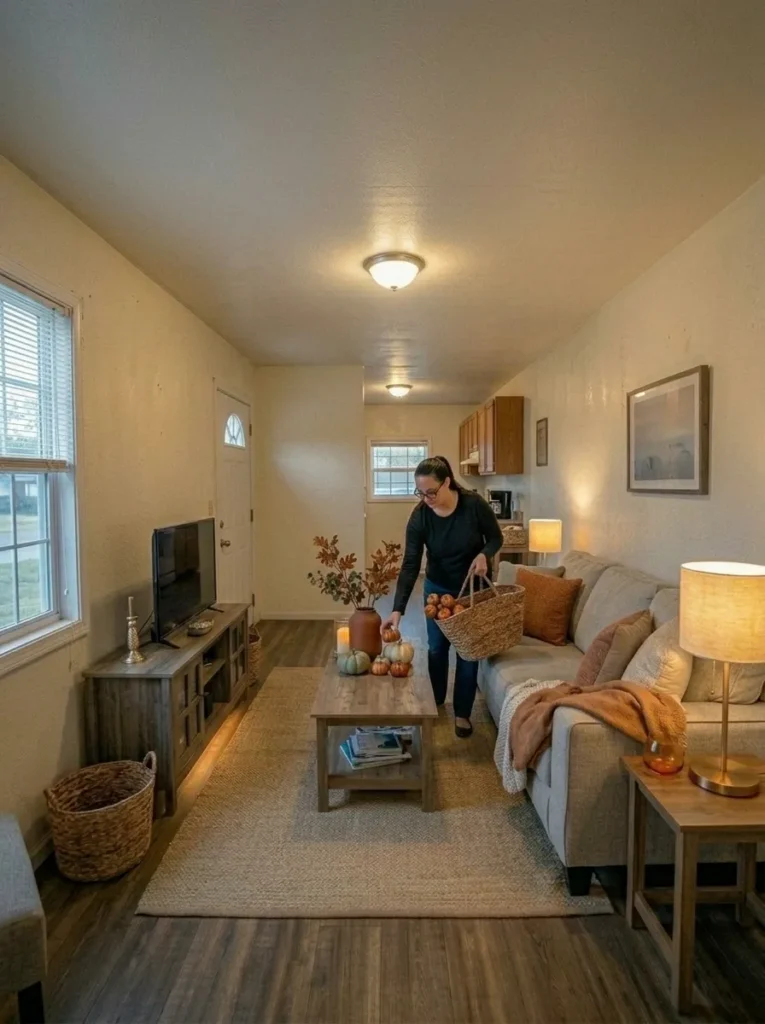
By this point, the room should already have better lighting, a clearer seating arrangement, tactile layers, a controlled fall palette, and a few deliberate seasonal moments.
So if it still does not feel cozy, do not assume you need more décor.
A nearly finished room is much easier to correct when you identify the symptom first.
If the room still feels cold
Look at the lighting and material balance before changing the color palette.
A room can contain rust pillows, pumpkins, wood furniture, and autumn branches and still feel visually cold if the light is flat or most of the visible surfaces remain smooth.
Likely cause: too much reliance on overhead lighting or not enough material contrast.
Adjustment: turn on the eye-level lamp, move it closer to the seating area if needed, and check whether one softer or more tactile layer is missing.
You may not need another color at all.
Recheck: sit where you normally relax in the evening. The seating area should feel visually warmer than the surrounding circulation zone without becoming dim.
If the room feels dark and heavy
This often happens when “fall” becomes shorthand for using every deep warm color at once.
Rust, burgundy, brown, tobacco, dark olive, and pumpkin can all be beautiful, but they do not all need to occupy the same small room at equal intensity.
Likely cause: too much visual weight in the textiles and accessories.
Start by removing one of the darkest small layers.
Then check the largest surfaces:
- Are the curtains swallowing too much daylight?
- Is the sofa covered with several dark pillows?
- Has the throw created another large brown or rust block?
- Are too many dark decorative objects grouped together?
If necessary, reintroduce warm cream, oatmeal, pale stone, or another lighter neutral already present in the home.
You are not undoing the fall palette.
You are giving it enough contrast to remain visible.
Recheck: the room should still feel autumnal in daylight, not only after the lamps are switched on.
If the room feels busy or themed
This is usually an object-density problem rather than a color problem.
Look specifically for small, literal seasonal pieces.
You might have:
- several pumpkins
- leaf garlands
- signs
- artificial foliage
- miniature seasonal figurines
- candles
- baskets
- decorative trays
- several different pillow patterns
Individually, none may seem excessive.
Together, they can make a compact mobile home feel more like a seasonal display than a lived-in room.
Likely cause: too many objects are performing the same job.
Adjustment: remove the smallest and most repetitive pieces first.
Do not dismantle the strongest focal arrangement.
Instead, protect it by quieting the areas around it.
A console with a branch arrangement, ceramic vessel, and two small gourds can remain. The extra pumpkin on the television stand, another one on the coffee table, and three more on a shelf may not be helping.
Recheck: can you still sense fall when several obvious seasonal objects are gone?
If yes, the edited version is stronger.
Correct the earliest faulty layer
When several things seem wrong at once, use this order:
Light → Large Textile → Color → Small Décor
Why this sequence?
Because an incorrect early layer can make everything added afterward look wrong.
Poor lighting can make a good color palette appear dull.
An overly heavy rug or throw can make balanced accessories feel excessive.
A confused palette can make simple décor look random.
Small accessories should be the last thing you blame.
Make one correction.
Step back.
Then reassess before changing anything else.
If the room improves noticeably after removing or repositioning one item, stop there for a moment.
A finished room rarely needs five simultaneous fixes.
actually feel like?
Choose the closest symptom, correct its earliest likely cause, then recheck the whole room before changing another layer.
It still feels cold +
It feels dark and heavy +
It looks busy or themed +
10. Do the Doorway Test, Edit, and Stop
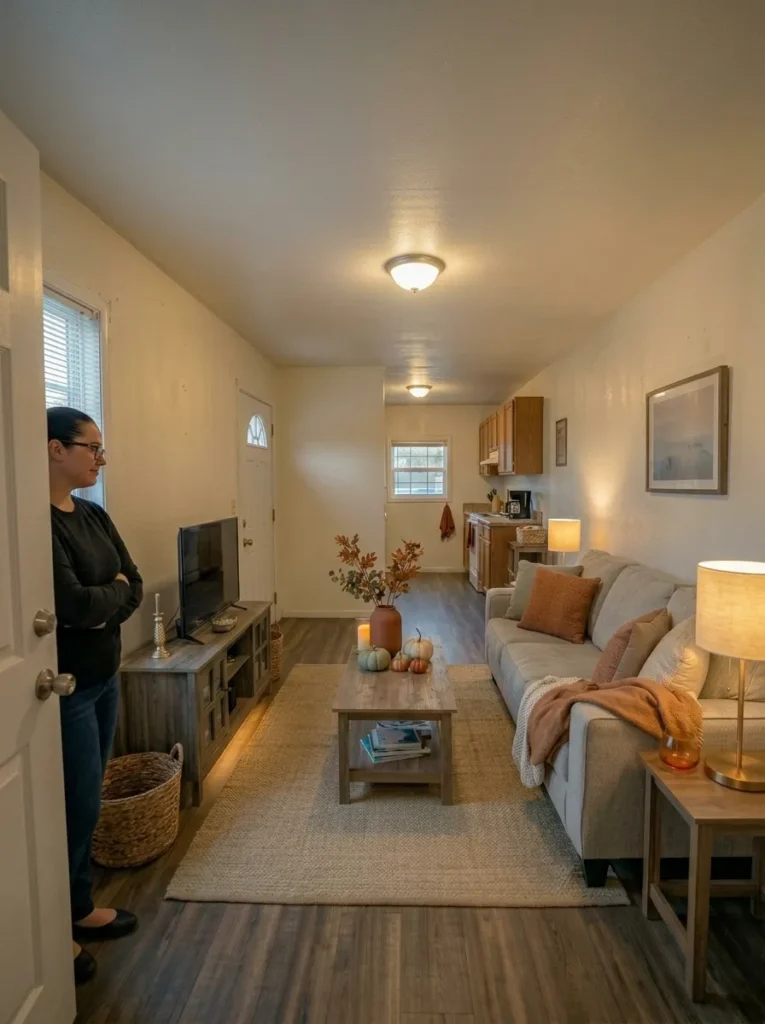
The final part of an old mobile home fall makeover is not adding the finishing touch.
It is deciding that you already have enough.
Walk out of the living room for a few minutes.
Then return through the entrance you use most often.
Do not immediately look for individual decorations.
Let your first impression answer the question.
1. What does your eye see first?
There should be a clear answer.
Perhaps it is the softened seating area, the warm lamp beside the sofa, the window framed by fabric, or one intentional fall arrangement.
If your eye jumps between several small seasonal objects, the focal hierarchy may still be too weak.
Remove one competing item and re-enter.
2. Is the main walkway obvious?
A cozy room still needs to function.
You should be able to understand how to move from the entry through the living area toward the kitchen, hallway, or adjoining room without visually tracing a path around baskets, stools, decorative floor pieces, or furniture corners.
If seasonal decorating has narrowed the route, the floor-level accessory should usually be the first thing reconsidered.
3. Can you still see empty space?
Look at:
- tabletops
- sofa cushions
- wall surfaces
- floor edges
- shelves
- kitchen counters visible from the living room
There should still be places where nothing decorative is happening.
Negative space is not unfinished space.
It is what allows texture, color, and focal décor to be noticed.
A room in which every visible surface carries something seasonal often feels less cozy because the eye never gets a chance to rest.
4. Does the room feel like fall before you inspect the objects?
This is one of the strongest signs that the makeover is finished.
From the doorway, you should notice an overall combination of:
- warmer light
- softer surfaces
- grounded furniture
- earthy color
- natural materials
- restrained seasonal cues
You should not need to identify a leaf garland or count pumpkins to understand the season.
Autumn should be present in the room atmosphere, not only in the merchandise.
5. Would removing one more thing improve the room?
This final question is more useful than asking what else you could add.
Try mentally removing one pillow, one small pumpkin, one basket, one decorative tray, or one tabletop object.
Would the composition become clearer?
If yes, remove it physically and look again.
If the room loses something important, put it back.
This is not minimalist decorating for its own sake.
It is editing until every visible layer earns its place.
The final cozy formula
Warm Light + Grounded Furniture + Tactile Contrast + Controlled Fall Color + Negative Space = Cozy
Seasonal objects sit on top of that formula.
They cannot replace it.
If the home already communicates warmth from the doorway, the main path remains easy to use, the sofa still looks like somewhere people can actually sit, and the fall palette feels related to the finishes you already own, the makeover is complete.
If another object would not solve a real lighting, layout, texture, color, or functional problem, stop adding.
feel finished?
Judge the complete room before judging another accessory. If these five conditions are working, the strongest next move may be to stop.
A Cozy Fall Mobile Home Should Still Feel Like Your Home
The most successful fall refresh does not erase the fact that a mobile home is compact, connected, or older.
It works with those realities.
A narrower room benefits from clearer circulation. Lower ceilings benefit from visual restraint. Connected sightlines make repeated color and material more important. Existing wood, brown, cream, beige, and neutral finishes can become part of the autumn palette rather than something you feel pressured to replace.
That is why a good old mobile home fall makeover often involves less shopping than expected.
You may move a lamp.
Remove several small objects.
Pull a chair slightly inward.
Add one useful textile.
Repeat a rust or olive accent.
Style one strong seasonal focal point.
Then stop.
The change comes from how those decisions work together.
When you walk through the door and notice warm light, a comfortable seating zone, soft texture, earthy color, and a room that still has space to breathe, fall is already there.
You do not need another pumpkin to prove it.