
The holidays are full of joy and celebration. They can also leave behind a trail of clutter, starting right at your front door. What was once a festive space is now a jumble of new gifts, extra coats, and shoes without a home. It can feel overwhelming.
Your entryway sets the tone for your entire house. A messy one can make your whole home feel chaotic. Restoring order doesn’t require a massive overhaul. You just need a few clever ideas to reclaim your space.
This guide offers simple and smart solutions. We will show you how to transform your entryway from a cluttered drop zone into a welcoming and organized space. Get ready to tidy up and start the new year with a fresh, clean entrance.
1. The Uncluttered Welcome Station
Item Name: Minimalist Entryway Bench and Organizer
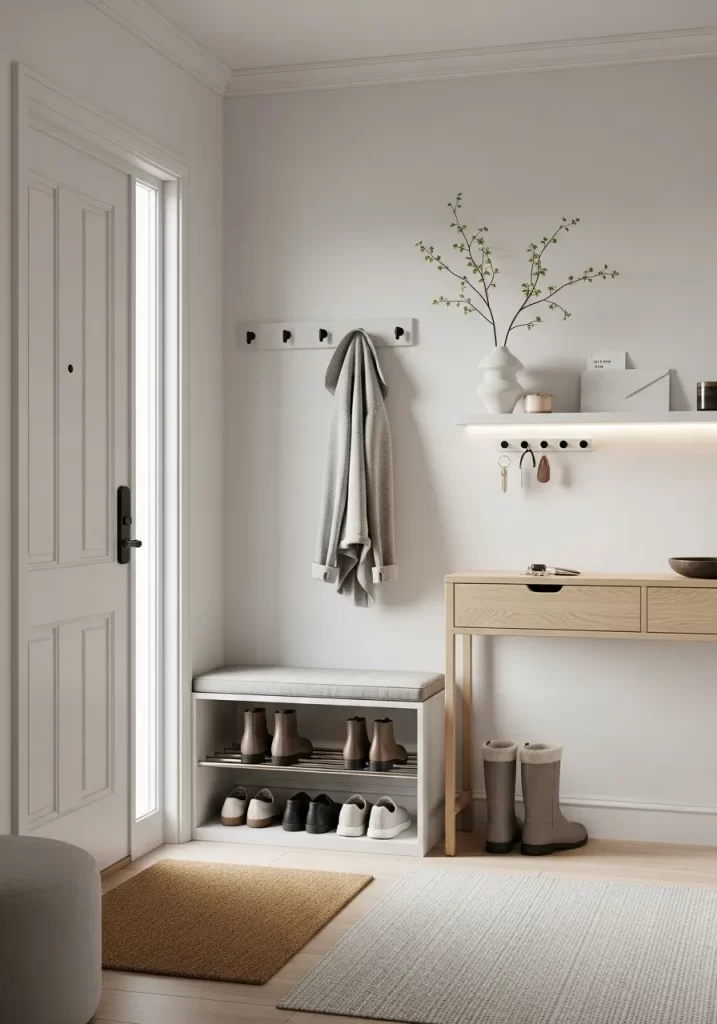
This entryway design creates a calm and orderly first impression. It uses simple pieces to build a functional space. A cushioned bench provides a comfortable spot to take off shoes, which can be stored neatly on the shelves below. The light wood table offers a place for mail or other small items you grab on your way out.
Everything has a designated spot. Coats and bags go on the wall hooks, while keys hang from their own small rack. This approach prevents clutter from building up by the door. The setup feels open and bright, making the space feel larger.
DIY Instructions: Make a Simple Wooden Key Holder
Here is a guide to creating the small key rack seen in the photo.
What You’ll Need:
- A small, flat piece of wood (about 12 inches long and 3 inches wide).
- 4-5 small wooden dowels or shaker pegs.
- Strong wood glue.
- A ruler and a pencil.
- Sandpaper (to smooth any rough edges).
- Picture hanging strips or screws to attach it to the wall.
Step-by-Step Guide:
- Prepare the Wood: First, take your sandpaper and gently rub all the edges of the wood plank. This makes it smooth and safe to touch. Wipe away any dust with a cloth when you are done.
- Measure for the Pegs: Use your ruler to find the center of the wood plank. With your pencil, make small, light marks where you want each key peg to go. Try to space them out evenly, maybe 2 inches apart.
- Attach the Pegs: Squeeze a small circle of wood glue onto the flat end of one peg. Press it firmly onto one of the pencil marks you made on the wood. Hold it in place for about a minute to help it stick.
- Repeat for Other Pegs: Continue gluing the rest of your pegs onto the marks you made. Make sure they are all standing up straight.
- Let the Glue Dry: Set the key holder down on a flat surface and let it rest. The glue needs time to become strong. It is best to leave it for at least a few hours, or overnight, without touching it.
- Hang Your Creation: Once the glue is completely dry, your key holder is ready. Attach picture hanging strips to the back, or ask an adult to help you use screws to fix it to the wall near your entryway. Now you have a handsome spot for your keys!
2. The Farmhouse Mudroom Hub
Item Name: Rustic All-in-One Hall Tree
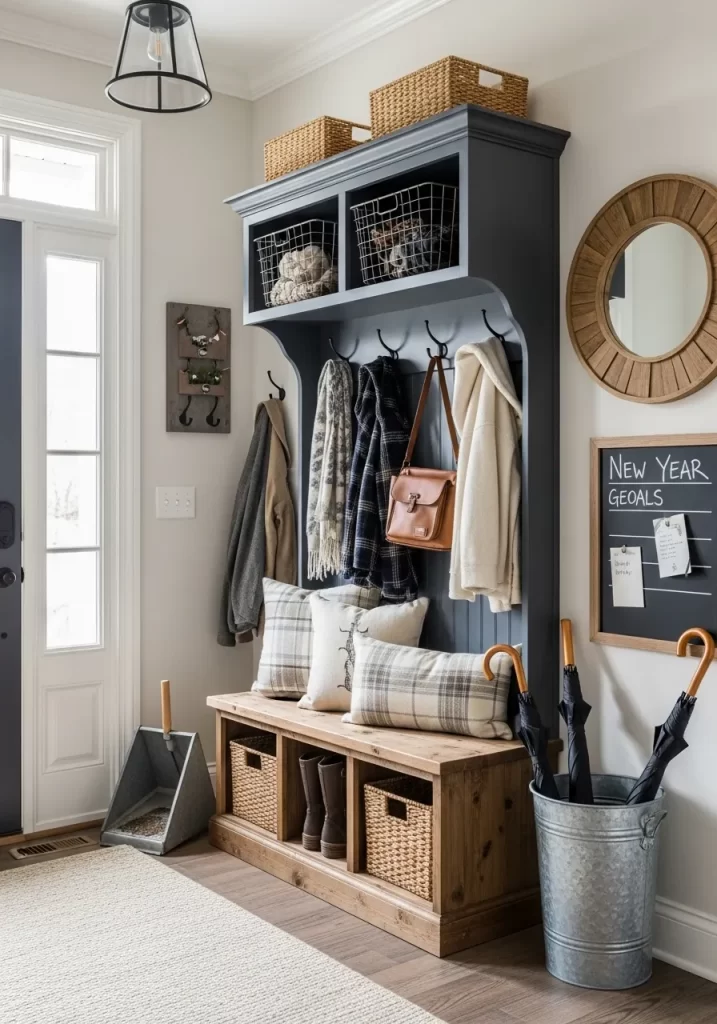
This setup brings a cozy, farmhouse feel right to the doorway. The dark blue hall tree stands out, offering plenty of storage in one unit. Wire baskets on the top shelves can hold winter hats and gloves, keeping them out of sight but easy to find. The hooks are ready for jackets and bags, preventing them from landing on the floor.
A wooden bench provides a place to sit while putting on boots. Underneath, woven baskets create storage for shoes or other items. A nearby chalkboard is a nice touch for leaving family messages or writing down reminders. It’s a practical system that keeps the whole family organized.
DIY Instructions: Create a Family Message Chalkboard
Here’s how to make a simple chalkboard for your entryway.
What You’ll Need:
- An old picture frame with the glass removed.
- A piece of thin wood or sturdy cardboard that fits inside the frame.
- Chalkboard paint (you can find this at a craft store).
- A small paintbrush or foam brush.
- Newspaper to protect your workspace.
- Chalk.
Step-by-Step Guide:
- Get Your Board Ready: Take the backing out of the picture frame. This will be your chalkboard. If you are using a new piece of wood or cardboard, make sure it is cut to the right size to fit snugly in the frame.
- Paint the Board: Lay down some newspaper. Place your board in the middle. Open the chalkboard paint and stir it well. Use your brush to paint a thin, even layer of paint all over one side of the board. Let it dry completely, which might take about an hour.
- Add a Second Coat: Once the first layer is dry, paint a second one. This helps make sure the whole board is covered and will work well as a chalkboard. Let the second coat dry fully. This might take a few more hours.
- Prepare the Surface: Before you can write on it, you need to “season” the chalkboard. Take a piece of chalk and lay it on its side. Rub the entire surface of the board with the chalk until it’s all dusty. Then, wipe it clean with a dry cloth or eraser.
- Put it in the Frame: Carefully place your new chalkboard into the picture frame and secure the back.
- Hang it Up: Your message board is now ready to use! Hang it on the wall in your entryway. You can write “Welcome,” list your goals, or leave fun notes for your family.
3. The Industrial Command Center
Item Name: Modular Wall Organizer with Pegboard
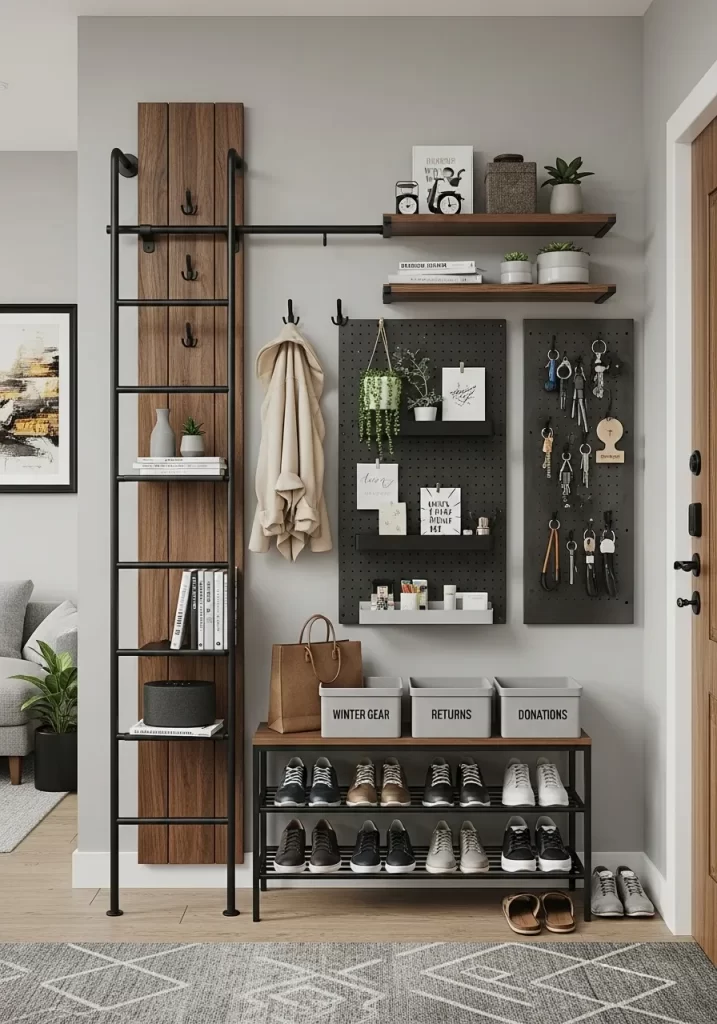
This entryway uses a smart, industrial-style system to organize a busy wall. It combines wood and black metal for a modern look. A tall ladder shelf holds books and decorative items, while a lower shoe rack keeps footwear off the floor. This design makes great use of vertical space.
The system features pegboards, which are very useful for hanging keys, small notes, and even little plants. Different hooks and shelves can be moved around on the pegboard to fit your needs. It’s a flexible solution that can change as your storage needs change, keeping everything from mail to winter gear in its place.
DIY Instructions: Make Your Own Mini Pegboard Organizer
You can create a small pegboard section for hanging keys and notes.
What You’ll Need:
- A small pegboard (you can find these at hardware stores, maybe 1 foot by 1 foot).
- A few pegboard hooks.
- Four screws and washers (make sure the screw head is bigger than the pegboard hole).
- A screwdriver.
- A pencil and a ruler.
Step-by-Step Guide:
- Choose Your Spot: Decide where on the wall you want your mini organizer to go. Hold the pegboard against the wall and use a pencil to mark the wall through the four corner holes of the pegboard.
- Prepare for Screws: Ask an adult to help with this part. You may need to drill small pilot holes on your marks to make it easier to put the screws in.
- Create a Gap: For the hooks to fit, the pegboard needs to be a little bit away from the wall. A washer will help create this tiny gap. Place a washer on a screw.
- Attach the Pegboard: Line up the hole in the pegboard with the first mark on the wall. Push the screw with the washer on it through the pegboard hole and into the wall. Use the screwdriver to tighten it, but don’t make it super tight yet.
- Secure All Corners: Repeat step 4 for the other three corners. Once all screws are in, tighten them all so the pegboard is secure against the wall but still has that small gap from the washers.
- Add Your Hooks: Now for the fun part! Put the pegboard hooks into the holes wherever you like. You can hang keys, little baskets for mail, or even a calendar.
4. The Woven Basket Wall
Item Name: Airy Farmhouse Entry with Basket Storage
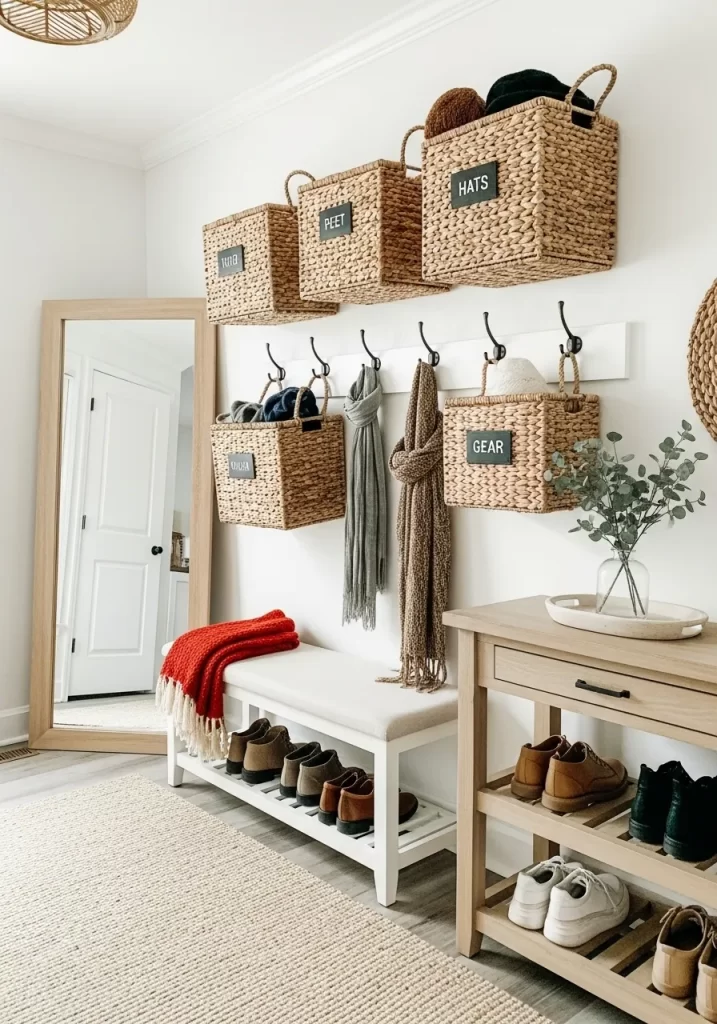
This entryway feels bright and welcoming. It uses natural textures like woven baskets and light-colored wood to create a calm atmosphere. A row of sturdy hooks holds everyday items like scarves and hats. The real storage magic happens in the baskets hanging on the wall.
These baskets are labeled for different categories like “Hats” and “Gear,” so everyone knows where their things belong. A simple white bench offers a place to sit and has a shelf for shoes below. The large mirror not only helps for a last-minute check before leaving but also makes the space feel bigger and brighter.
DIY Instructions: Create Labeled Basket Tags
Make simple tags to label your storage baskets.
What You’ll Need:
- A few small rectangles of black cardstock or thin plastic.
- A white paint pen or chalk marker.
- A hole punch.
- Some string or twine.
- Scissors.
Step-by-Step Guide:
- Cut Your Tags: If your cardstock isn’t already cut, use scissors to cut it into small rectangles, about 3 inches long and 2 inches wide. You can make the corners rounded if you like.
- Punch a Hole: Use the hole punch to make a hole in the center of one of the shorter sides of each tag. This is a good place for the string to go.
- Write Your Labels: Think about what you will put in each basket. Using your white paint pen, write a label on each tag. You could write “Hats,” “Gloves,” “Scarves,” or even people’s names. Try to write clearly in the middle of the tag.
- Let it Dry: Set the tags aside for a few minutes. This allows the paint or chalk marker to dry completely so it doesn’t smudge.
- Add the String: Cut a piece of string or twine about 6 inches long for each tag. Thread one end of the string through the hole you punched. Then, tie a simple knot to create a loop.
- Attach to Baskets: Now you can loop the string around the handle of your baskets or through the weave of the basket itself. Your baskets are now clearly labeled and ready to help you stay organized!
5. The Family Command Center Nook
Item Name: All-in-One Entryway Organizer with Tech Station
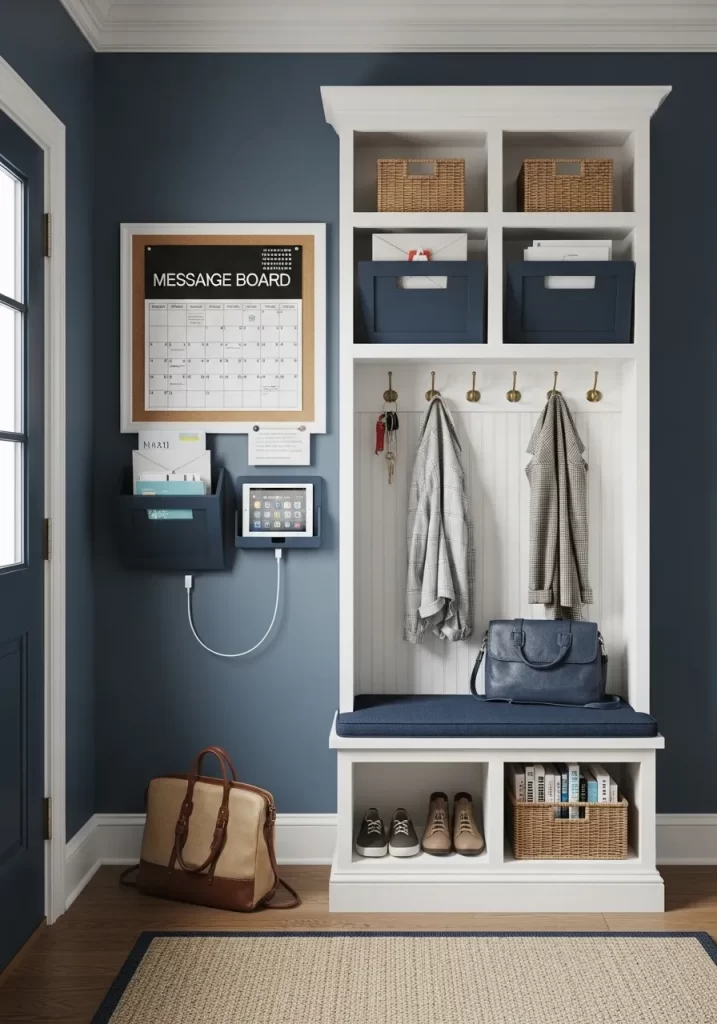
This entryway is designed for a busy family. It’s a true command center built into a compact nook. A tall, white storage unit provides hooks for coats and bags, along with upper and lower shelves for baskets and shoes. The blue cushion on the bench adds a pop of color and comfort.
What makes this space special is the organization wall. A large message board with a calendar keeps track of everyone’s schedule. Below it, a mail holder sorts incoming and outgoing letters. There’s even a wall-mounted charging station for a tablet, ensuring electronics are powered up and ready to go.
DIY Instructions: Craft a Simple Cork Message Board
You can make a message board to pin notes and reminders.
What You’ll Need:
- A simple picture frame (an 8×10 or larger works well).
- A roll of cork or a flat cork tile that fits the frame.
- Scissors or a craft knife.
- Strong glue or a hot glue gun.
- A few fun pushpins.
Step-by-Step Guide:
- Prepare Your Frame: Open the back of the picture frame and remove the glass and any paper inside. You will only need the frame and the backing board.
- Measure and Cut the Cork: Place the backing board on top of your cork sheet. Trace around it with a pencil. Carefully cut the cork along the line you traced. Ask an adult for help if you are using a craft knife.
- Glue the Cork: Apply a good amount of strong glue to the front of the backing board. Make sure you cover the surface evenly. Carefully place your cut piece of cork on top of the glue. Press it down firmly all over.
- Let It Set: Place a few heavy books on top of the cork to keep it flat while the glue dries. Wait for at least an hour for the glue to set properly.
- Reassemble the Frame: Once the glue is dry, put the backing board (with the cork now attached) back into the frame. Secure the back of the frame.
- Ready for Messages: Your message board is complete! Hang it on the wall and use your pushpins to stick up important papers, photos, or fun reminders for your family.
6. The Cheerful Family Drop Zone
Item Name: Colorful Cubby and Hook System
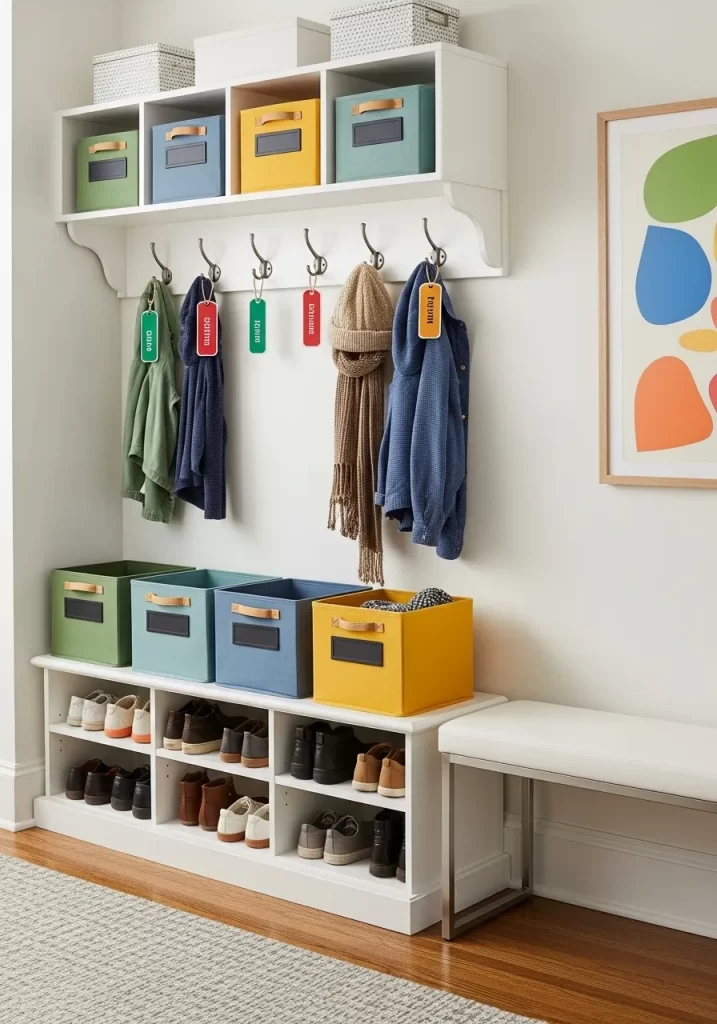
This entryway is bright, cheerful, and full of smart storage for a family with kids. A long white shelf unit provides two levels of organization. On top, colorful fabric bins sit inside cubbies, great for storing seasonal items. The sturdy hooks below are ready for backpacks and coats.
The bench underneath doubles as a shoe rack, with multiple cubbies to keep footwear tidy. The different colored bins make it easy to assign a color to each family member. This helps kids learn to put their things away in their own special spot. Even the coat hooks have colorful name tags to stop any confusion.
DIY Instructions: Make Personalized Coat Hook Tags
Create colorful tags so everyone knows which hook is theirs.
What You’ll Need:
- Colored craft paper or cardstock in different colors.
- A black marker.
- Scissors.
- A hole punch.
- String or colorful ribbon.
- Optional: Laminating sheets to make them last longer.
Step-by-Step Guide:
- Cut Out Your Tags: Cut the colored paper into tag shapes. A simple rectangle or a shape with one angled corner works well. Make one tag for each person in your family, maybe using their favorite color.
- Write the Names: Using the black marker, neatly write one person’s name on each tag. You can use your best handwriting or bubble letters.
- Punch the Hole: Use the hole punch to make a hole at the top of each tag.
- Protect Your Tags (Optional): If you have laminating sheets, you can ask an adult to help you laminate the tags. This will make them stronger and protect them from rain or snow on wet jackets.
- Add the String: Cut a piece of string or ribbon for each tag, about 5 inches long. Thread the string through the hole and tie it into a loop.
- Hang on the Hooks: Loop the string over each coat hook. Now everyone has their own designated spot to hang their things!
7. The Hidden Hallway Closet
Item Name: Integrated Minimalist Storage Cabinet
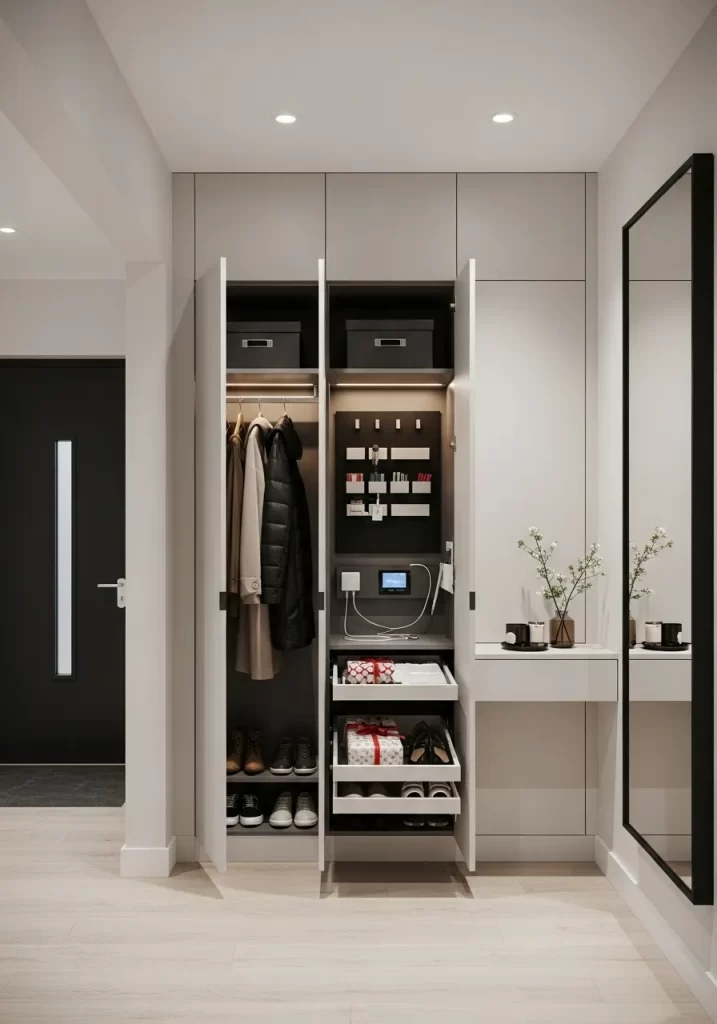
For those who prefer a completely clutter-free look, this solution is excellent. It’s a built-in closet system that hides everything behind clean, flat doors. When closed, it blends right into the wall, creating a smooth and modern hallway. This approach keeps all the entryway mess completely out of sight.
Inside, the cabinet is a powerhouse of organization. There’s a rod for hanging coats, preventing wrinkles. Multiple pull-out shelves and drawers are used for shoes, bags, and even wrapped gifts. A built-in panel holds keys and charges a phone, showing that even hidden storage can be highly functional.
DIY Instructions: Organize a Drawer with Cardboard Dividers
You can bring order to a messy drawer with simple, custom-fit dividers.
What You’ll Need:
- A sturdy cardboard box.
- A ruler.
- A pencil.
- A strong pair of scissors or a box cutter.
Step-by-Step Guide:
- Measure Your Drawer: First, pull out the drawer you want to organize. Use your ruler to measure how wide, long, and deep it is on the inside. Write these three numbers down.
- Cut the Main Divider: You’ll start by making a divider that goes the long way. On your cardboard, measure and draw a rectangle that is the same length as your drawer and the same depth (height). Cut this piece out. This will be your main divider.
- Cut the Smaller Dividers: Now, you will make smaller dividers that go across. Measure and cut a few more cardboard rectangles. These should be the same depth as your drawer, but their length should be the width of your drawer.
- Make the Slits: Take your long divider. Decide where you want your smaller dividers to cross it. At each of those spots, cut a slit from the top edge down to the middle of the cardboard. Now, take your smaller dividers and cut a slit from the bottom edge up to the middle.
- Fit Them Together: Slide the smaller dividers onto the long divider where you cut the slits. The slits should lock together like puzzle pieces, creating little compartments inside your drawer.
- Organize Your Stuff: Place your new divider grid inside the drawer. Now you have separate sections for your gloves, hats, sunglasses, and other small items!
8. The Mobile Entryway Station
Item Name: Rolling Cart Organizer
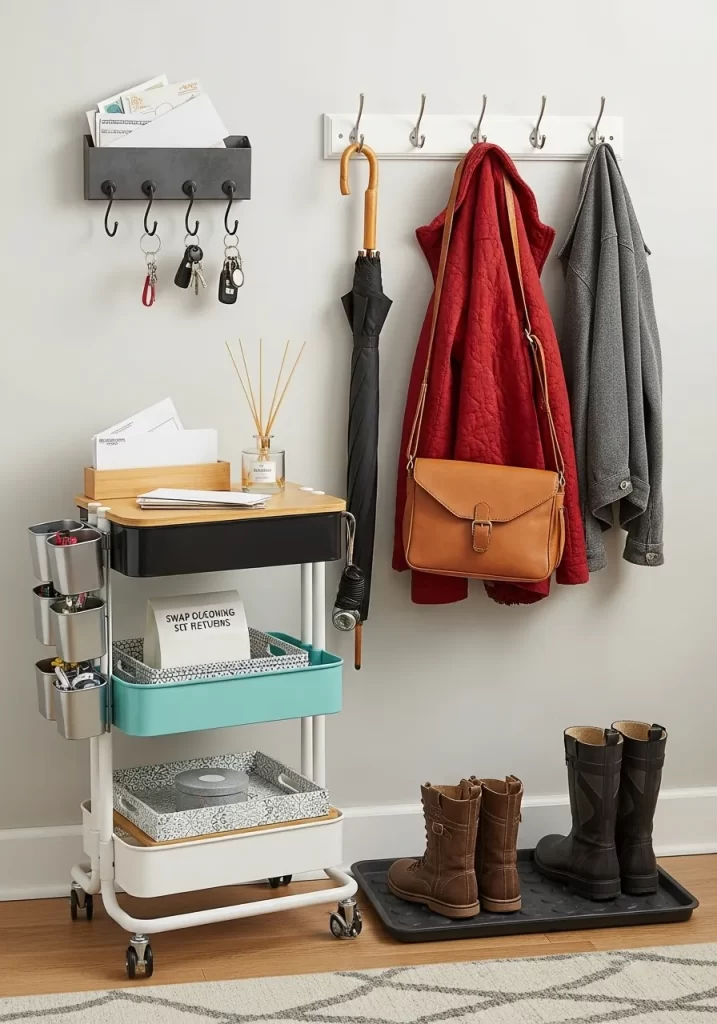
This entryway solution is clever, especially for small spaces or apartments. Instead of big furniture, it uses a simple rolling cart as a mobile “drop zone.” The cart’s different levels can be used to sort mail, hold keys, and store items that need to be returned to the store.
This setup is very flexible. The cart can be moved out of the way when you have guests. Next to the cart, a simple rack of wall hooks handles coats and bags. A rubber tray on the floor provides a dedicated spot for wet or muddy boots, protecting the floor. It’s a simple, budget-friendly way to create order.
DIY Instructions: Set Up a “Returns” Bin on Your Cart
Designate one tier of your cart for items you need to take back to the store or mail.
What You’ll Need:
- A bin or basket that fits on one of the shelves of your rolling cart.
- A piece of paper or a tag.
- A marker.
- Tape or a clothespin.
Step-by-Step Guide:
- Choose Your Bin: Find a small box, bin, or basket. It should be big enough to hold a few things but small enough to fit nicely on one level of your cart.
- Make a Label: Take your piece of paper or tag. With your marker, write the word “RETURNS” in big, clear letters. You want to be able to see it easily.
- Attach the Label: If you are using tape, simply tape the label to the front of the bin. If you have a clothespin, you can clip the paper label right onto the edge of the bin.
- Place it on the Cart: Set your newly labeled bin on one of the shelves of your rolling cart. The middle or bottom shelf is usually a good spot.
- Start Using It: The next time you buy something you need to return, or have a package to mail, put it directly into this bin.
- Remember to Check It: When you are getting ready to go out to run errands, make it a habit to look in your “RETURNS” bin. Grab whatever is inside and take it with you. No more forgetting things at home!
9. The Nature-Inspired Nook
Item Name: Live-Edge Bench with Branch Coat Rack
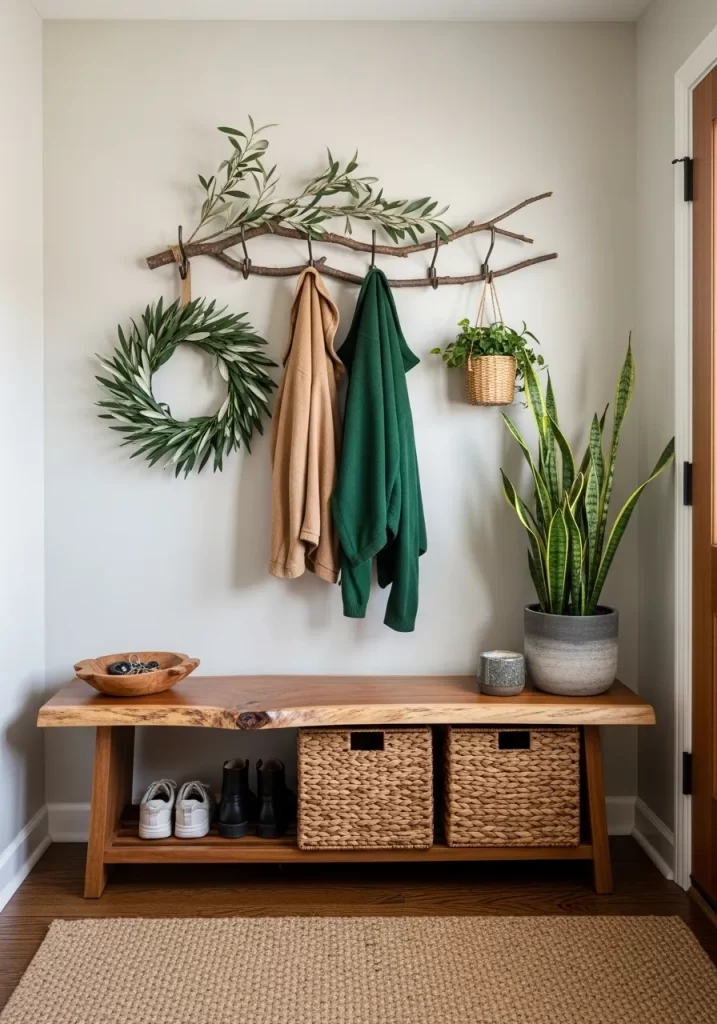
This entryway brings the beauty of the outdoors inside. The main piece is a beautiful bench made from a single piece of wood, showing its natural, “live” edge. It provides a warm, rustic spot to sit. Underneath the bench, two large woven baskets are perfect for hiding away shoes and clutter.
The most creative feature is the coat rack. It’s made from a real tree branch mounted on the wall, with sturdy hooks added for hanging coats and bags. This, along with the fresh plants and a simple wreath, creates a calm and organic feel. It proves that entryway storage can be both functional and a piece of natural art.
DIY Instructions: Create a Tree Branch Coat Rack
Make a unique coat rack using a branch from your yard.
What You’ll Need:
- A sturdy, interesting-looking tree branch (about 3-4 feet long and 2-3 inches thick).
- A few strong coat hooks with screws.
- Sandpaper.
- A screwdriver.
- Strong wall-mounting brackets or long screws for hanging.
Step-by-Step Guide:
- Find and Clean Your Branch: Look for a fallen branch that is strong and dry. Avoid any rotting wood. Brush off all the dirt and leaves. If it’s damp, let it dry inside for a few days.
- Smooth the Branch: Use sandpaper to smooth down any sharp or splintery spots. You don’t want to snag your coat! You can leave the bark on for a rustic look or peel it off for a smoother finish.
- Position Your Hooks: Lay the branch on the floor. Decide where you want your coat hooks to go. Place them on the branch and use a pencil to mark where the screws will go. Try to space them out evenly.
- Attach the Hooks: Ask an adult to help with this step. It’s easier to make small starter holes with a drill before putting in the screws. Then, use a screwdriver to attach each hook securely to the branch. Make sure they are tight and don’t wiggle.
- Plan to Hang it: Decide how you will hang your branch on the wall. You can use sturdy wall brackets that the branch can rest in, or you can use long screws that go through the branch and into the wall. This part definitely needs an adult’s help to make sure it’s safe and strong enough to hold heavy coats.
- Mount it on the Wall: Following your plan, securely mount your new branch coat rack on the wall. Now you have a one-of-a-kind piece of art that is also super useful!
10. The Entryway Art Gallery
Item Name: Floating Shelf with Gallery Wall Storage
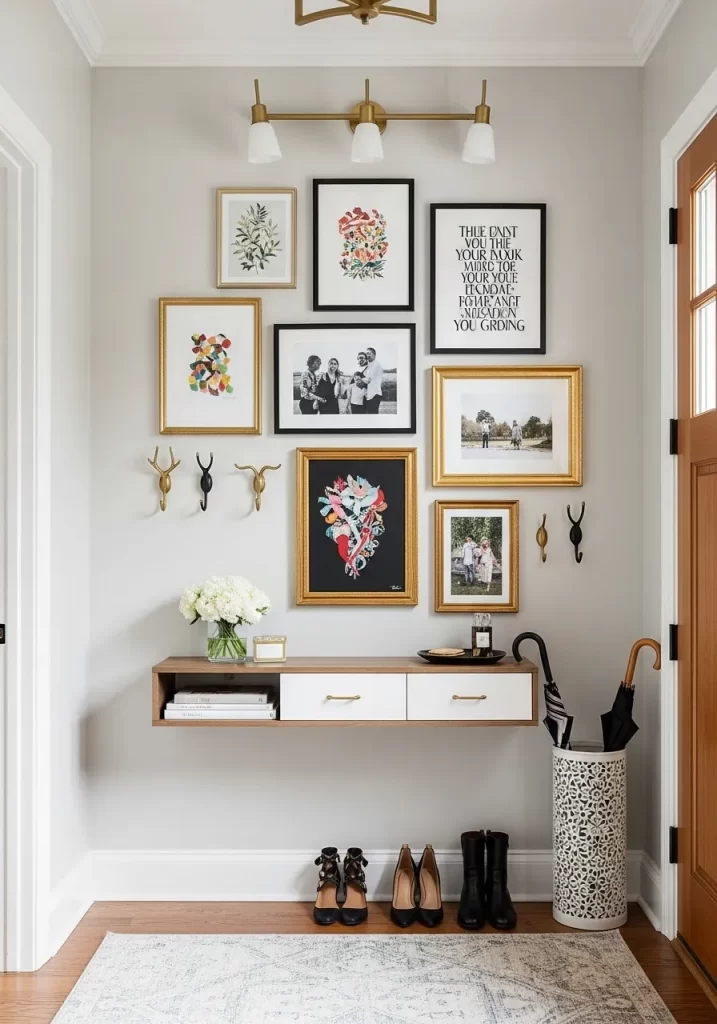
This entryway proves that storage can be stylish. The main focus is a beautiful gallery wall filled with a mix of framed art and family photos. It turns a plain wall into a personal and engaging space. This approach blends decoration with practicality.
Tucked neatly into the design are useful storage elements. A sleek, floating shelf offers a surface for keys, mail, and a small vase of flowers. A few decorative hooks are mixed in with the picture frames, providing a place to hang a coat or a guest’s bag. An umbrella stand sits beside the shelf, keeping wet umbrellas contained and off the floor.
DIY Instructions: Plan a Small Gallery Wall
Learn how to arrange pictures on a wall before you make any holes.
What You’ll Need:
- The picture frames you want to hang.
- A large piece of paper, like wrapping paper or craft paper.
- A pencil.
- Scissors.
- Tape that is safe for walls (like painter’s tape).
Step-by-Step Guide:
- Trace Your Frames: Lay your big piece of paper on the floor. Place one of your picture frames on top of it. Use your pencil to trace around the frame. Do this for all the frames you want to hang.
- Cut Out the Shapes: Use your scissors to cut out each of the paper shapes you traced. You should now have a paper template for each of your picture frames.
- Arrange Them on the Wall: Using your painter’s tape, stick the paper templates onto the wall where you want to create your gallery. This is the fun part! You can move them around as much as you want without making any marks on the wall. Try different arrangements until you find one you love.
- Mark for Nails: Once you are happy with your arrangement, it’s time to mark where the nails will go. For each paper template, find the spot on the back of the real frame where the hook is. Measure where that spot is, and then make a small pencil mark in the same spot on your paper template on the wall.
- Hang the Pictures: Ask an adult to help you put nails or picture hooks on the marks you made. Then, you can take down the paper templates and hang your actual frames. Your beautiful gallery wall is complete!
11. The Pet-Friendly Mudroom
Item Name: Organized Hall Tree with Pet Station

This entryway is built for a household with furry friends. A white, built-in unit features classic beadboard paneling, giving it a clean and timeless look. Numerous hooks are available for hanging coats, jackets, and especially dog leashes and harnesses. A storage bench with a deep blue cushion offers a spot to sit and contains hidden storage inside.
What makes this space great for pet owners is the dedicated pet zone. A small, low shelf is designed to hold food and water bowls, keeping them off the main walkway. A basket nearby can store pet toys and grooming supplies. It’s a thoughtful design that considers the needs of every family member, pets included.
DIY Instructions: Create a Personalized Leash Holder
Make a special spot just for your pet’s leash and collar.
What You’ll Need:
- A small wooden plaque or a short piece of a 1×4 board.
- A screw-in hook.
- Paint in your favorite color.
- A small paintbrush.
- A marker or paint pen.
- Picture hanging hardware for the back.
Step-by-Step Guide:
- Paint Your Plaque: First, paint your wooden plaque with the color you chose. You might need to apply two coats to get a nice, solid color. Let it dry completely.
- Write Your Pet’s Name: Once the paint is dry, use your marker or paint pen to write your pet’s name on the plaque. You could also draw a small paw print or a bone next to their name.
- Attach the Hook: Decide where you want the hook to go, usually in the bottom center of the plaque. Ask an adult to help you gently screw the hook into the wood. Twist it until it is tight and facing upwards, ready to hold a leash.
- Add Hanging Hardware: Turn the plaque over. Ask an adult to help you attach a small sawtooth hanger to the back so you can hang it on the wall.
- Hang it Up: Find a good spot near the door and hang up your new leash holder. Now your pet’s leash has its own special place!
12. The Earthy and Rustic Entry
Item Name: Natural Wood and Metal Wall Organizer

This entryway combines natural elements with industrial touches. A long wooden shelf provides space for plants and storage boxes, supported by strong metal brackets. Below it, a row of simple black hooks is ready for coats and tote bags. The use of raw, natural materials makes the space feel grounded and calm.
A highlight of this design is the decorative driftwood branch hanging on the wall, which adds a unique, sculptural element. A simple wooden bench holds fabric bins for smaller items, while bamboo baskets below can store shoes or umbrellas. It’s a look that is both functional and connected to nature.
DIY Instructions: Make a Driftwood Key Hanger
Use a piece of driftwood to create a simple and beautiful key holder.
What You’ll Need:
- A piece of clean, dry driftwood (about 1-2 feet long).
- A few small screw-in hooks or decorative nails.
- A hammer (if using nails).
- Twine or rope for hanging.
Step-by-Step Guide:
- Prepare Your Driftwood: Make sure your driftwood is clean and completely dry. Brush off any sand or dirt.
- Add the Hooks: Decide where you want your keys to hang. If you are using screw-in hooks, an adult can help you twist them into the bottom of the driftwood. If you are using small nails, gently tap them into the wood with a hammer, angling them slightly upwards.
- Create a Hanger: Cut a piece of twine or rope about twice the length of your driftwood. Tie one end of the rope securely to one end of the driftwood. Tie the other end of the rope to the other end of the driftwood.
- Check Your Work: Hold the driftwood up by the rope to make sure it hangs evenly. You can adjust the knots if you need to.
- Hang and Use: Place a nail or a strong hook on the wall and hang your new driftwood key holder from the rope. It’s a lovely, natural way to keep your keys organized.
13. The Glamorous Welcome
Item Name: Marble and Velvet Console with Gold Accents
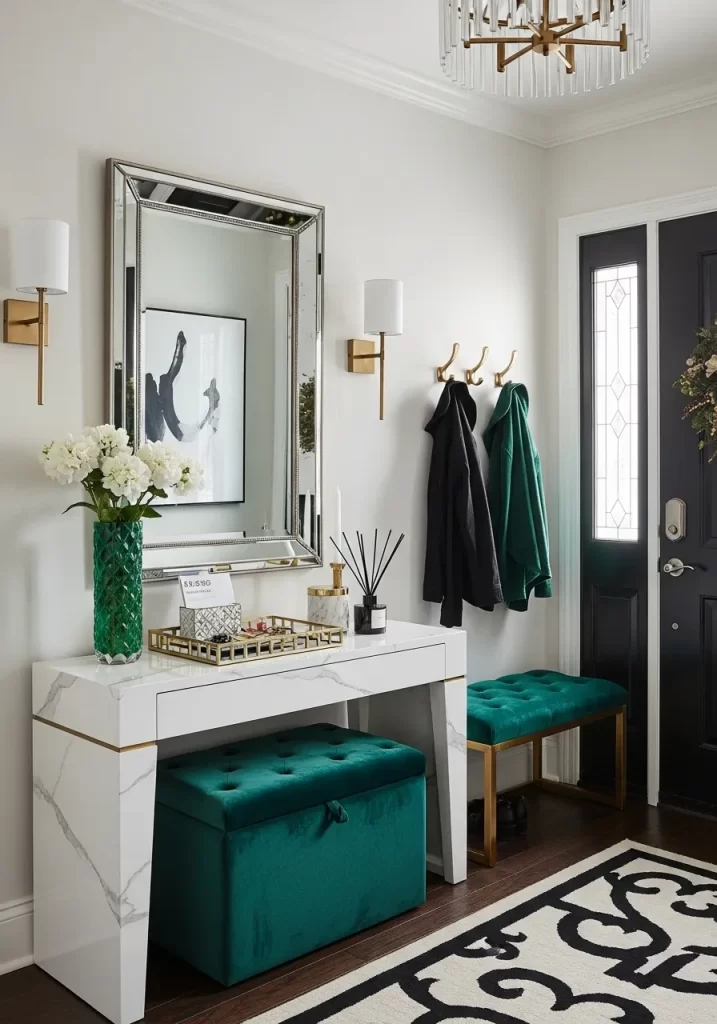
This entryway makes a bold and luxurious statement. A sleek console table with a white marble finish and gold trim sets a glamorous tone. It provides a surface for a vase of fresh flowers, a decorative tray for keys, and a pleasant room diffuser. The look is clean, bright, and very elegant.
Pops of rich, emerald green velvet add color and texture. A cushioned bench and a storage ottoman provide seating and a place to hide away shoes or bags. The gold details are carried through in the wall hooks and light fixtures, tying the whole sophisticated look together.
DIY Instructions: Decorate a Tray with Gold Leaf
Give a simple tray a glamorous makeover using gold leaf.
What You’ll Need:
- A plain wooden or plastic tray.
- A bottle of metal leaf adhesive (also called “size”).
- A package of imitation gold leaf sheets.
- Two soft, clean paintbrushes.
- A clear sealer spray.
- Newspaper.
Step-by-Step Guide:
- Prepare Your Workspace: Lay down newspaper to protect your table. Make sure your tray is clean and dry.
- Apply the Adhesive: Use one of your paintbrushes to apply a thin, even layer of the adhesive to the area of the tray you want to be gold. You could cover the whole inside, or just make a fun pattern. Let the adhesive sit for about 15-20 minutes until it feels tacky, like a sticker.
- Apply the Gold Leaf: Carefully pick up a sheet of gold leaf and lay it gently over the tacky adhesive. Pat it down with your fingers or the clean, dry paintbrush. Don’t worry if it cracks or breaks; that is part of the look. Keep adding sheets until all the sticky areas are covered.
- Brush Off the Excess: Use your dry paintbrush to gently brush away all the loose bits of gold leaf that didn’t stick to the adhesive. Keep brushing until the surface is smooth.
- Seal Your Work: To protect the gold leaf, take the tray outside or to a well-ventilated area. An adult should help you spray a light, even coat of the clear sealer over the gold leaf. Let it dry completely.
- Display Your Tray: Your beautiful new tray is ready! Place it on your entryway table to hold keys, mail, or decorative items.
14. The Moody and Modern Mudroom
Item Name: Monochromatic Built-In Hall Tree

This entryway uses a single, deep color to create a dramatic and sophisticated look. The entire built-in unit, from the upper cubbies to the bench and paneling, is painted in a dark, moody blue-gray. This makes the space feel cohesive and very intentional. The simple black hooks blend in, keeping the look sleek.
Texture is important in this design. A large piece of textured art, painted in the same color, adds interest to the wall. A cozy knit throw on the bench and a woven basket on the floor soften the look. This shows that a dark color scheme can feel warm and inviting.
DIY Instructions: Create Your Own Textured Art
Make a piece of art with interesting bumps and ridges.
What You’ll Need:
- A blank canvas.
- A tub of drywall joint compound or spackle.
- A putty knife or an old credit card.
- Paint in the color of your choice.
- A paintbrush.
Step-by-Step Guide:
- Scoop the Compound: Open your tub of joint compound. Use your putty knife to scoop up a good amount.
- Spread it on the Canvas: Plop the compound onto your canvas. Use your putty knife to spread it around. You don’t have to be neat! The goal is to create texture. You can make swoops, lines, or just rough patches. Cover as much of the canvas as you like.
- Build Up Texture: Keep adding more compound and spreading it until you are happy with the design and the texture. You can make some parts thicker than others.
- Let it Dry Completely: This is the most important step. You need to let the joint compound dry all the way through. This could take a whole day, or even two days if it’s very thick.
- Paint Your Art: Once the texture is hard and completely dry, it’s time to paint. Use your paintbrush to cover the entire canvas, including all the bumps and grooves, with your chosen color.
- Let it Dry and Hang: Let the paint dry, and your custom textured art piece is ready to hang on the wall!
15. The Geometric and Playful Entry
Item Name: Modern Graphic Hallway with Hexagon Shelves
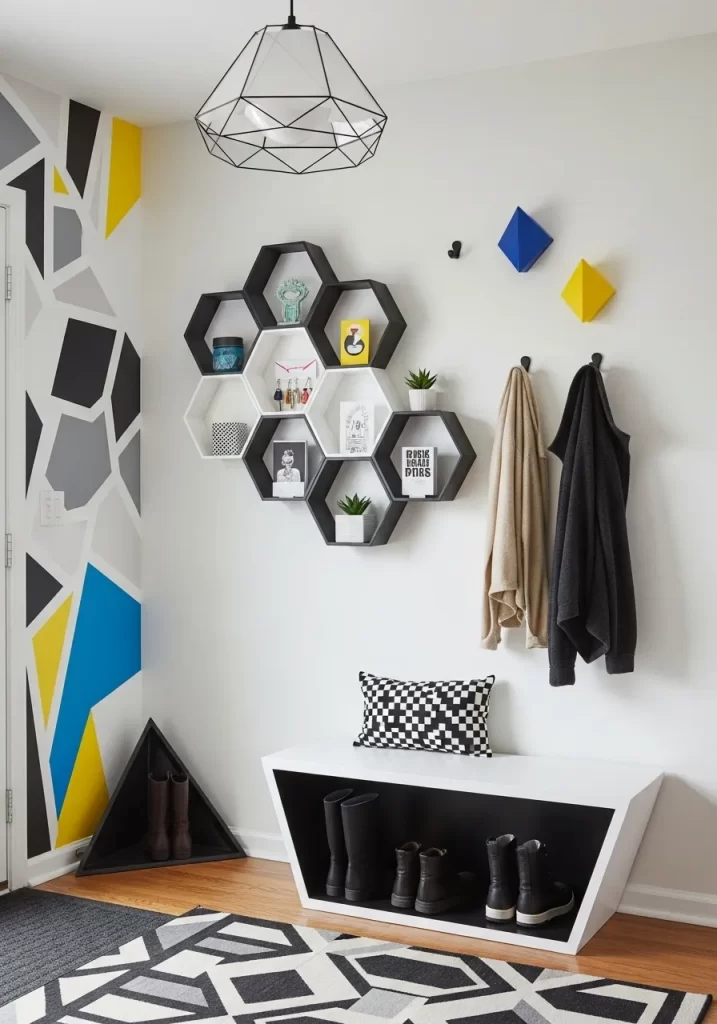
This entryway is full of energy and personality. A bold geometric mural painted on the wall immediately catches the eye. The use of black, white, gray, yellow, and blue creates a fun and modern vibe. This design proves that an entryway can be a place for creative expression.
The storage is just as creative. A cluster of hexagon-shaped shelves acts as both storage and wall art. They are great for displaying small plants and favorite objects. A sharp, angular bench provides a place to sit and store boots underneath. Even the rug and pillow feature graphic patterns that match the room’s theme.
DIY Instructions: Paint a Simple Geometric Shape on Your Wall
Add a pop of color to a wall with a crisp, painted triangle or square.
What You’ll Need:
- Painter’s tape.
- A ruler or level.
- A pencil.
- A small can of paint in a fun color.
- A small paintbrush.
- Newspaper or a drop cloth.
Step-by-Step Guide:
- Plan Your Shape: Decide what shape you want to paint. A triangle in a corner or a simple square can look really cool. Use your ruler and pencil to lightly draw the shape on the wall.
- Tape the Edges: This is the secret to getting super sharp lines. Carefully place the painter’s tape along the outside edges of the shape you drew. Press the edges of the tape down firmly so no paint can sneak underneath.
- Protect Your Floor: Lay down your newspaper or drop cloth on the floor below where you will be painting.
- Time to Paint: Open your paint and stir it. Use your paintbrush to fill in the shape you taped off. Make your brush strokes smooth and even.
- Peel the Tape: Here’s the magic trick. While the paint is still a little bit wet, carefully and slowly peel off the painter’s tape. Pull it away from the painted area at an angle.
- Let it Dry: Let your new shape dry completely. You now have a fun, graphic accent that makes your wall much more interesting!
16. The Chic and Airy Welcome
Item Name: Elegant Glass and Gold Console Nook
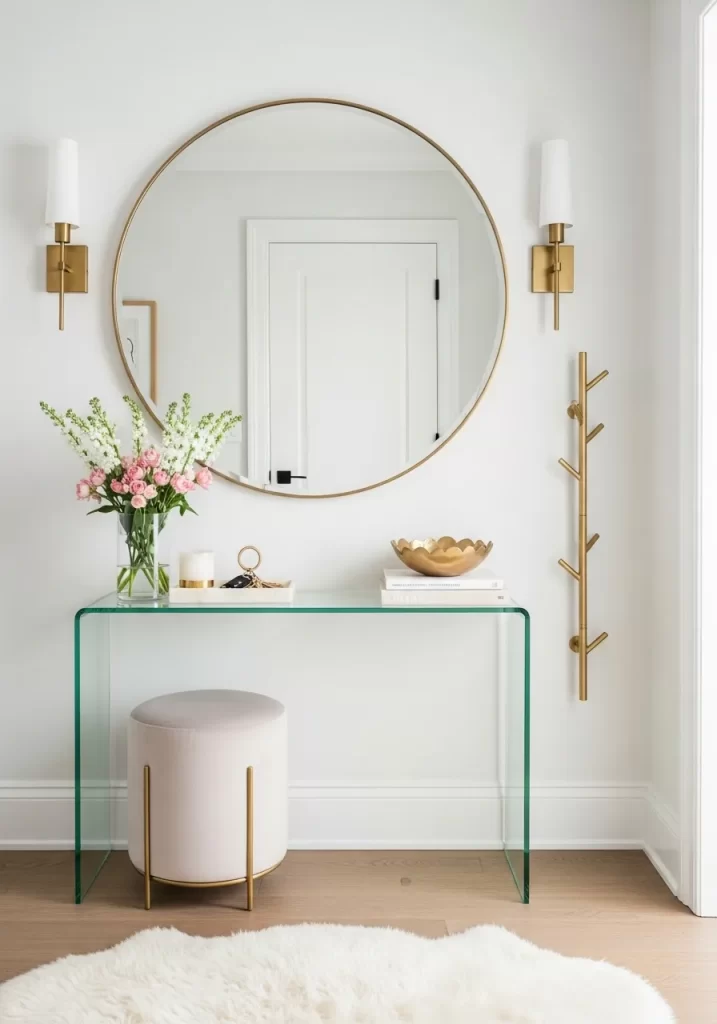
This entryway is the definition of light and elegant. A console table made entirely of clear glass seems to float in the space, which helps a small area feel open and uncluttered. On top, a simple tray holds keys next to a vase of flowers and a book, keeping it tidy. The large, round mirror with a thin gold frame makes the whole space feel bigger and brighter.
Softness and warmth are added with a plush, fuzzy rug on the floor and a small, upholstered stool. The metallic accents are all a brushed gold, from the mirror and wall lights to the modern coat rack on the wall. It’s a sophisticated look that is both simple and welcoming.
DIY Instructions: Make a No-Sew Faux Fur Stool Cover
Give a plain stool a cozy and stylish makeover.
What You’ll Need:
- A small, round stool.
- A piece of faux fur fabric, large enough to cover the top and sides of the stool seat.
- A pair of sharp scissors.
- A staple gun.
Step-by-Step Guide:
- Prepare Your Stool: If the seat of your stool can be removed, take it off. If not, you can just flip the whole stool upside down.
- Position Your Fabric: Lay your faux fur fabric on the floor with the fuzzy side down. Place your stool seat (or the upside-down stool) in the center of the fabric.
- Start Stapling: Ask an adult to help you with the staple gun. Pull one side of the fabric up and over the edge of the seat and place one staple in the middle to hold it.
- Work on Opposite Sides: Go to the side directly opposite and pull the fabric tight. Put a staple in the middle of that side. Now do the same for the other two opposite sides. Your fabric should be held in place with four staples, like a plus sign.
- Fill in the Gaps: Continue pulling the fabric tight and adding staples all the way around the edge of the seat. Place staples every inch or two.
- Fold the Corners: When you have folds or corners, tuck them in neatly (like you are wrapping a present) and use a few extra staples to hold the folds in place.
- Trim and Finish: Once everything is stapled, trim any extra fabric from the bottom. Re-attach the seat to the stool legs, and you have a brand new, super soft and stylish stool!
17. The Ultimate Pegboard Organizer
Item Name: Backlit Wall-Sized Pegboard System

This entryway takes the idea of a pegboard and expands it to create an entire wall of organization. A huge sheet of pegboard is the backdrop for a fully customizable storage system. Shelves, baskets, hooks, and clips can be moved anywhere on the board, making it easy to change the layout whenever you need to.
This setup can hold everything: mail, keys, gloves, a calendar, and even plants. A warm light glowing from behind the pegboard makes it a real feature wall. Below, a simple wooden bench with a cushion provides seating, and metal shelves underneath handle all the shoes.
DIY Instructions: Add Simple Backlighting to a Board
Make a message board or piece of art glow from behind.
What You’ll Need:
- A corkboard, canvas, or your DIY pegboard.
- A strip of battery-powered LED fairy lights.
- Tape (strong packing tape or duct tape works best).
- Batteries for the lights.
Step-by-Step Guide:
- Prepare Your Board: Turn your board over so you are looking at the back.
- Position the Battery Pack: Find a spot near the bottom corner to place the battery pack for the lights. Use a strong piece of tape to secure it to the back of the board. Make sure you can still open it to change the batteries.
- Tape the Lights: Turn the lights on so you can see where you are placing them. Start taping the light string around the inside edge of the back of your board. Place a piece of tape every few inches to hold the wire in place.
- Create Your Pattern: You can run the lights just around the border, or you can zigzag them across the back for a brighter glow. Make sure the little light bulbs are pointing outwards, away from the board.
- Check Your Work: Once all the lights are taped down, flip your board over and turn on the lights. It should have a nice, soft glow around the edges.
- Hang it Up: Hang your board on the wall. When you turn on the lights, it will create a cool, glowing effect that makes your board stand out.
18. The Coastal Cottage Entry
Item Name: Breezy Beach-Inspired Hallway
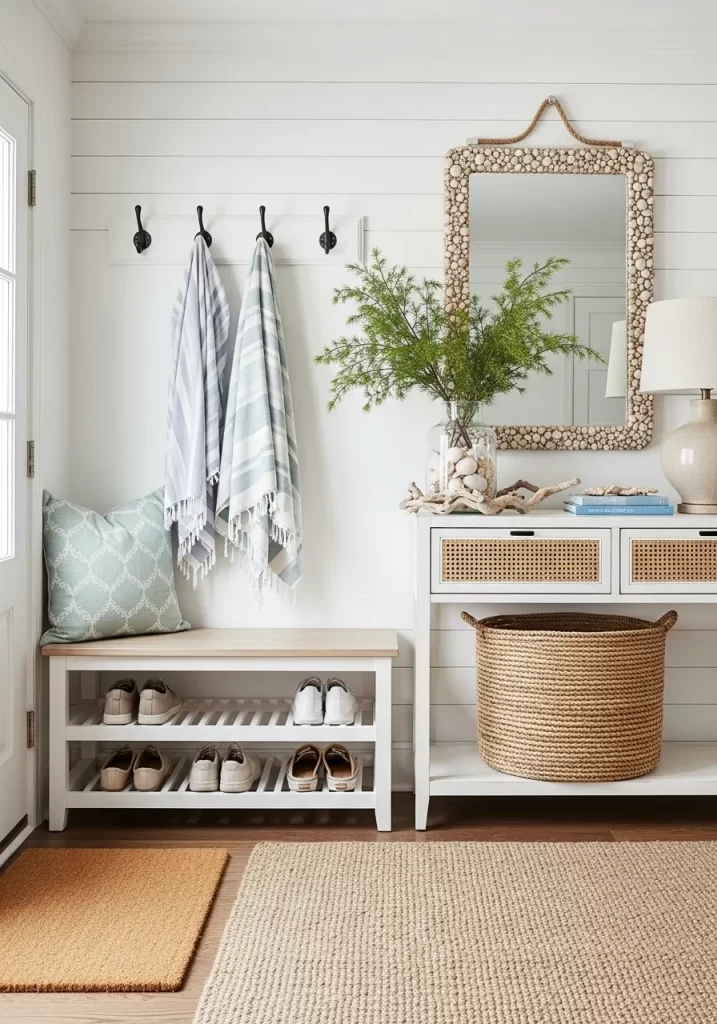
This entryway has a light and airy feel, like a cozy beach cottage. The walls are covered in white shiplap, which adds texture and a classic coastal vibe. Simple black hooks are mounted on a piece of wood, ready for beach towels or light jackets.
A white bench with slatted shelves below is great for shoes to air out. A nearby console table has drawers with woven rattan fronts, adding to the natural, beachy texture. The standout piece is the mirror, framed with dozens of tiny seashells. It’s a charming and relaxed space that feels like a mini-vacation.
DIY Instructions: Make a Seashell Picture Frame
Decorate a plain picture frame with shells you’ve collected.
What You’ll Need:
- A plain, flat-surfaced picture frame.
- A collection of small seashells.
- A hot glue gun and glue sticks.
- Newspaper.
Step-by-Step Guide:
- Set Up Your Space: Lay down newspaper on your work surface. Arrange all your little shells so you can see the different shapes and sizes. Make sure your picture frame is clean.
- Plan Your Design: Before you start gluing, try laying the shells out on the frame. You can make a pattern or just place them randomly. It’s a good idea to put the bigger shells on first.
- Start Gluing: Ask an adult to help you with the hot glue gun. Put a small dot of hot glue on the back of a shell.
- Press it On: Quickly and carefully press the shell onto the frame where you want it to go. Hold it for a few seconds until the glue sets.
- Keep Going: Continue gluing your shells one by one. You can overlap them and fit smaller shells into the gaps between the bigger ones. Keep adding shells until you have covered the whole frame.
- Let it Cool and Display: Let the glue cool down completely. Then, you can put your favorite beach photo inside and display your beautiful, handmade seashell frame!
19. The Classic Two-Tone Hall Tree
Item Name: Farmhouse Hall Tree with Shoe Storage
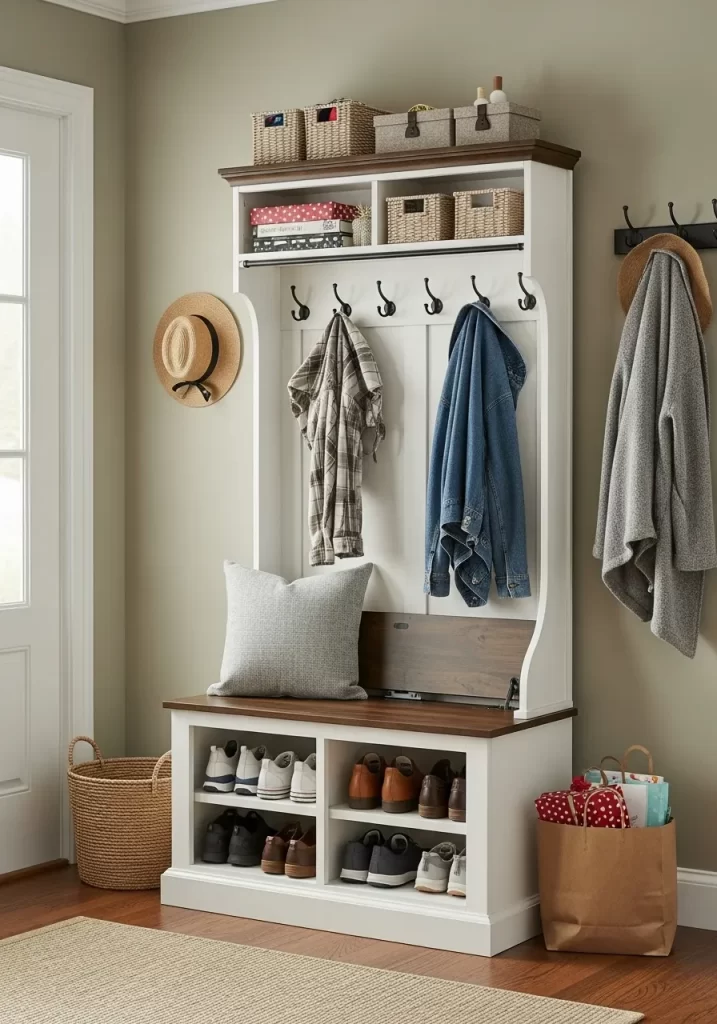
This hall tree is a classic piece that works well in many homes. It combines a clean white finish with warm wood accents for a timeless farmhouse look. A tall back provides plenty of space for a row of hooks, which can hold coats, hats, and backpacks for the whole family.
The base is a sturdy bench, giving you a convenient place to sit while you get ready. The wooden bench seat can even flip up, revealing a hidden storage compartment inside. Below the bench, open cubbies are sized to hold pairs of shoes, keeping them organized and easy to grab on the way out the door.
DIY Instructions: Make a Simple No-Sew Bench Cushion
Add comfort and color to a wooden bench with an easy cushion.
What You’ll Need:
- A piece of foam that is the same size as your bench top (about 2-3 inches thick).
- A piece of fabric that is about 6 inches wider and 6 inches longer than your foam.
- A staple gun.
- A thin piece of plywood cut to the same size as the foam.
Step-by-Step Guide:
- Layer Your Materials: Lay your fabric on a clean floor, with the pretty side facing down. Place the foam in the center of the fabric. Finally, place the plywood on top of the foam. You should have a sandwich of plywood, foam, and fabric.
- Start Stapling: An adult needs to help with the staple gun. Pull the fabric on one of the long sides up and over the edge of the plywood. Place a staple in the middle to hold it.
- Pull and Staple the Other Side: Go to the opposite side. Pull the fabric very tight and staple it to the middle of that side.
- Do the Short Sides: Now do the same thing for the two shorter sides. Pull the fabric snug and put a staple in the middle of each.
- Finish Stapling: Keep pulling the fabric tight and adding staples all the way around the plywood, about every two inches.
- Fold the Corners: When you get to the corners, fold them neatly like you are wrapping a gift. Tuck the fabric in and use a few extra staples to hold the tidy folds in place. Place your new cushion on top of your bench for a comfortable seat!
20. The Mid-Century Modern Entry
Item Name: Retro-Inspired Console and Bench
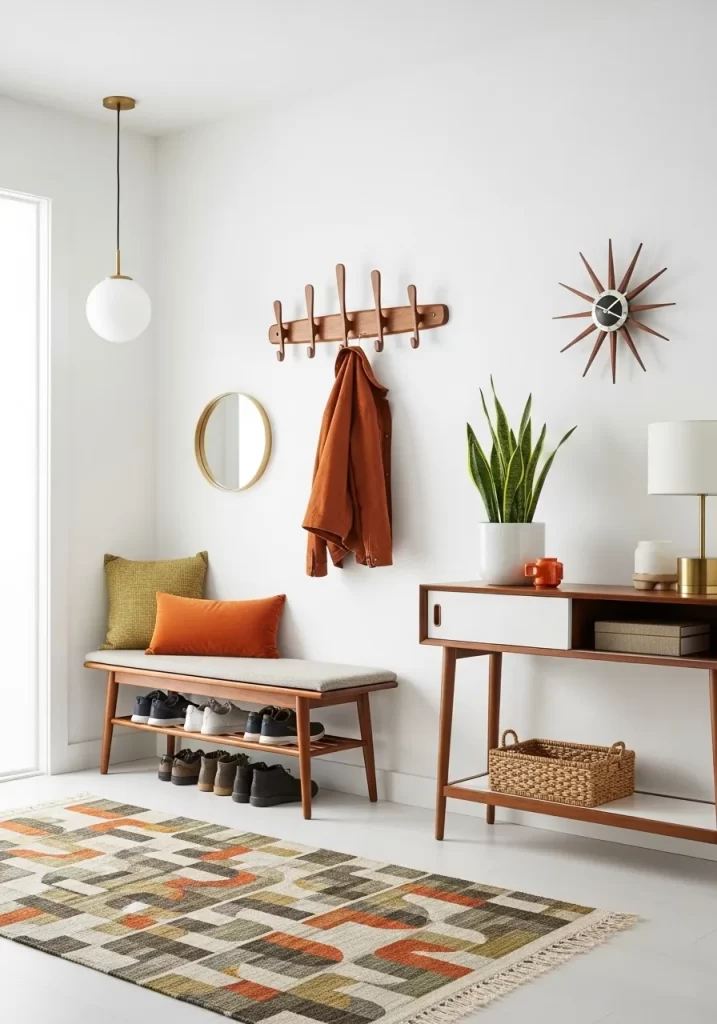
This entryway has a cool, retro style inspired by designs from the 1950s and 60s. The furniture features clean lines, warm teak-colored wood, and tapered, angled legs. A sleek console table provides a surface for a plant and a lamp, with a handy drawer for storage.
A matching bench with a simple cushion offers seating and has two tiers of shoe storage below. The coat rack on the wall has smooth, upward-pointing pegs that are both stylish and functional. A starburst clock on the wall completes the mid-century modern look. It’s a stylish space that is uncluttered and very welcoming.
DIY Instructions: Create a Simple Starburst Clock
Make a cool, retro-style decoration using wooden skewers.
What You’ll Need:
- A simple, small, round clock mechanism or a small round piece of wood.
- A pack of long wooden barbecue skewers.
- A hot glue gun.
- Gold or black spray paint.
- Newspaper.
Step-by-Step Guide:
- Prepare Your Skewers: You can leave the skewers their natural wood color, or you can paint them. To paint them, lay them on newspaper outside and have an adult help you spray paint them. Let them dry completely.
- Get Your Centerpiece Ready: You will be gluing the skewers to the back of your clock or your round piece of wood.
- Start Gluing: Using the hot glue gun with an adult’s help, put a line of glue on the back of the clock. Press one of the skewers into the glue so it sticks out like a sun ray.
- Create the Main Points: Glue four skewers on to create the main points of a clock: 12, 3, 6, and 9 o’clock. This helps you space the rest out evenly.
- Fill in the Gaps: Continue gluing skewers all the way around the clock. You can make them all the same length, or you can trim some to be shorter to create a pattern.
- Let it Dry and Hang: Let the glue dry completely. Now you can hang your awesome new starburst clock on the wall for a touch of retro style!
21. The Zen Minimalist Entry
Item Name: Japanese-Inspired Hallway Organizer

This entryway design is calm and peaceful. It uses natural light wood and simple shapes to create a serene feeling, inspired by Japanese design. A low, slatted bench provides seating and a place for shoes on the shelf underneath. The area feels open and uncluttered.
A unique feature is the bamboo rack on the wall, made for holding house slippers for family and guests. A simple wooden peg rail holds a coat, and a soft paper lantern gives off a warm glow. This space is all about having only what you need, and keeping everything tidy.
DIY Instructions: Make a Simple Dowel Shoe Rack
Create a minimal shoe rack similar to the bench’s lower shelf.
What You’ll Need:
- Two short wooden boards for the sides (about 12 inches long).
- Four long, thick wooden dowels for the shelves (about 24 inches long).
- A drill with a drill bit the same size as your dowels.
- Wood glue.
- A pencil and a ruler.
Step-by-Step Guide:
- Mark Your Holes: Take one of the side boards. Use your ruler and pencil to make four marks where you will drill holes for the dowels. Make two marks near the top edge and two near the bottom edge. Repeat this on the second side board, making sure the marks are in the exact same spots.
- Drill the Holes: Ask an adult to help you with the drill. Carefully drill a hole on each mark you made. Don’t drill all the way through the wood; go about halfway in.
- Add Glue: Squeeze a little bit of wood glue into each of the holes on one of the side boards.
- Insert the Dowels: Push one end of each wooden dowel into the glue-filled holes. Tap them gently to make sure they are all the way in. You should now have one side piece with four dowels sticking out of it.
- Attach the Other Side: Squeeze wood glue into the holes of the second side board. Carefully line up the open ends of the dowels with the holes and press the second side piece on.
- Let It Dry: Wipe away any extra glue that squeezed out. Let your new shoe rack sit for several hours to let the glue dry completely. Now you have a simple, stylish place for your shoes.
22. The Cozy Library Entrance
Item Name: Study-Inspired Mudroom and Reading Nook

This entryway feels more like a cozy, personal library than a simple hallway. Dark wood bookshelves line the walls, filled with books and interesting objects. This creates a warm, inviting atmosphere right from the front door. It’s a space that encourages you to slow down and relax.
Storage is cleverly worked into the design. A comfortable armchair in the corner creates a small reading nook. A bench with a plaid cushion provides seating and hidden storage for shoes or bags. Brass hooks on the wall are ready for coats, and a copper bin holds umbrellas, blending function with classic style.
DIY Instructions: Create Decorative “Book” Storage Boxes
Disguise a plain storage box to look like a stack of old books.
What You’ll Need:
- A plain cardboard or wooden box with a lid.
- Paper that you can print on (or brown paper bags).
- A printer (or colored markers).
- Scissors.
- Glue or decoupage medium.
- A paintbrush for the glue.
Step-by-Step Guide:
- Find Book Spines: On the internet, search for “vintage book spines printable.” Find an image you like that has a few book spines next to each other. With an adult’s help, print it out so it’s the same height as your box. If you don’t have a printer, you can draw your own on brown paper!
- Cut Them Out: Carefully cut out the printed book spines. If you printed a whole row, you can keep them together as one long strip.
- Measure Your Box: Measure the width of your box. You might need to print a few copies of the book spines to have enough to wrap around the whole box.
- Glue Them On: Using your paintbrush, apply a thin layer of glue to one side of your box. Carefully press the paper book spines onto the glue, smoothing out any bubbles.
- Wrap the Box: Continue gluing the paper spines all the way around the sides of your box. Let the glue dry completely.
- Store Your Things: You now have a storage box that looks like a row of antique books! It’s a great place to hide away things like mail, keys, or other small items on a shelf.
23. The Urban Industrial Loft Entry
Item Name: Loft-Style Shelving and Bench
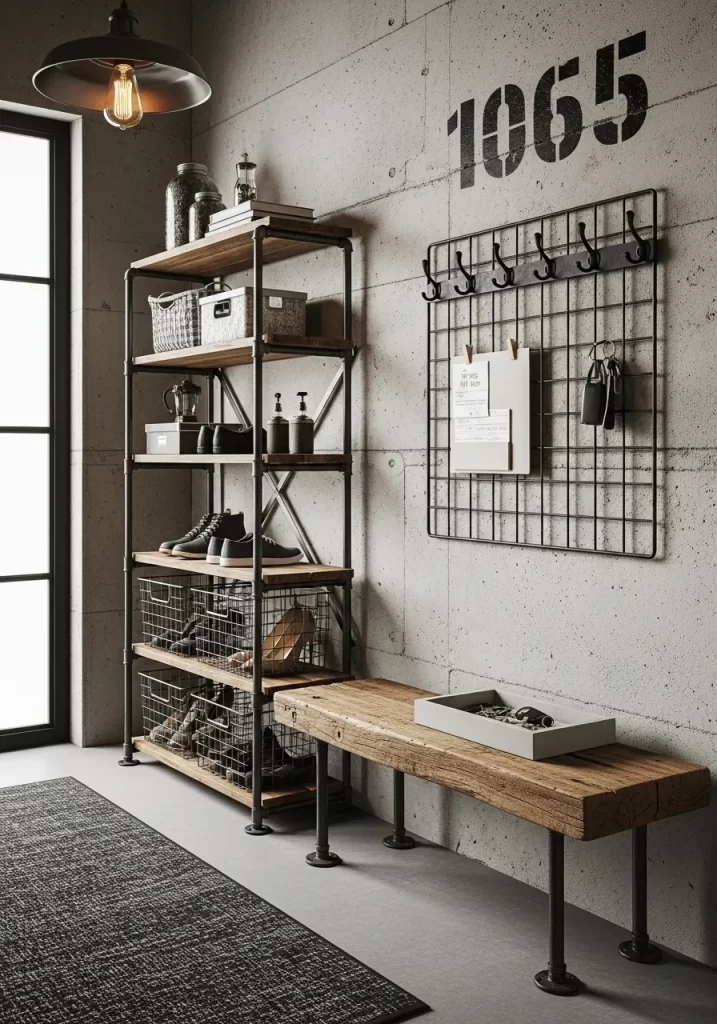
This entryway has a strong, industrial look, like something you would find in a city loft. The concrete wall and exposed pipe legs on the bench create a raw, urban feel. A tall shelving unit made of dark metal and wood offers plenty of vertical storage for everything from boots to decorative jars.
A long, thick wooden bench provides ample seating. The wall features a wire grid panel with hooks for coats and keys, which is a flexible and modern storage solution. The stenciled number on the wall adds a final graphic touch that completes the industrial theme.
DIY Instructions: Make a Stenciled House Number Sign
Create a cool, industrial-style sign with your house or apartment number.
What You’ll Need:
- A flat piece of wood or a canvas.
- Number stencils (you can buy these at a craft store).
- Black craft paint.
- A stencil brush or a small sponge.
- Painter’s tape.
- A paper plate.
Step-by-Step Guide:
- Position Your Stencils: Decide where you want the numbers to go on your board. Place the number stencils on the wood and use a few small pieces of painter’s tape to hold them in place so they don’t move.
- Get Your Paint Ready: Squeeze a small amount of black paint onto a paper plate.
- Load Your Brush: Dab your stencil brush or sponge into the paint. Then, dab most of the paint off onto a clean part of the paper plate. This is called a “dry brush” technique, and it prevents paint from leaking under the stencil.
- Start Stenciling: Hold the stencil down with one hand. With the other hand, use a straight up-and-down tapping motion to apply the paint over the stencil. Don’t brush side-to-side. Tap, tap, tap until the number is filled in.
- Reveal Your Work: While the paint is still slightly wet, carefully lift the stencils straight up off the board. You should have a crisp, clean number.
- Let it Dry: Let the paint dry completely. You can hang your new sign on the wall or just lean it against a shelf for an instant industrial touch.
24. The Ultimate Family Locker System
Item Name: Custom Mudroom with Individual Lockers
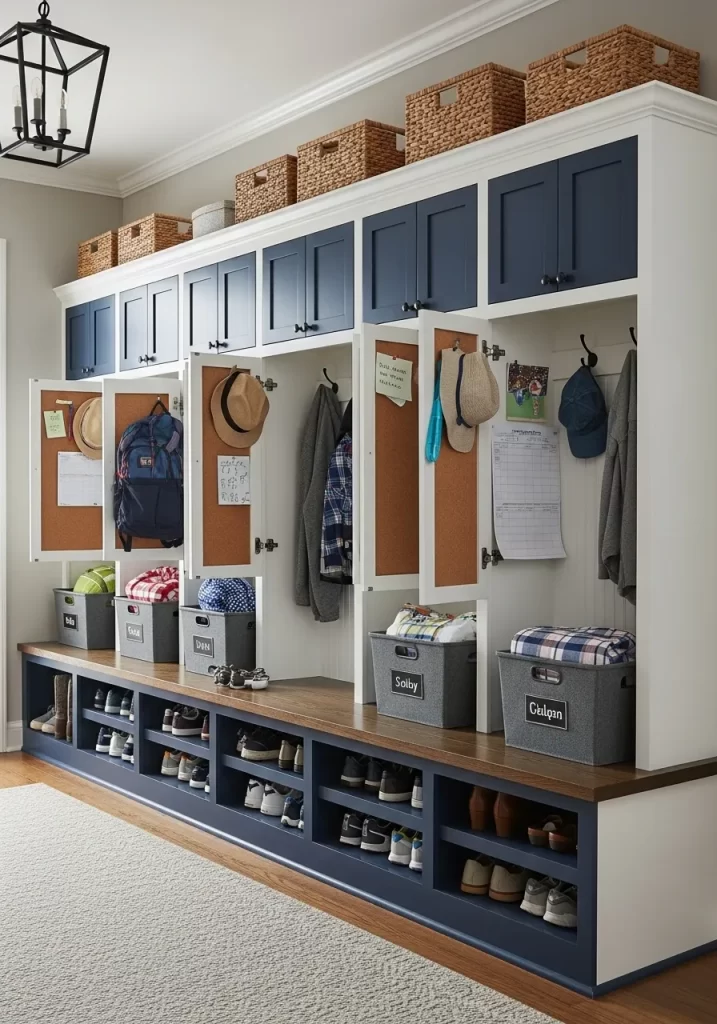
This is a dream entryway for a large, busy family. A long, built-in unit provides a personal locker for each family member. The combination of white and dark blue gives it a classic, clean look. Each locker has hooks inside for a backpack and jacket, and a cubby above for storage bins.
The inside of each cabinet door is a mini command center, with a corkboard for posting schedules, artwork, and reminders. A long wooden bench runs the entire length of the unit, and below it are dozens of shoe cubbies to handle everyone’s footwear. This system is designed to keep a family completely organized.
DIY Instructions: Add a Corkboard Inside a Cabinet Door
Turn the back of any cabinet door into a handy message center.
What You’ll Need:
- A roll of thin cork with a self-adhesive back.
- A ruler or measuring tape.
- A pencil.
- Scissors or a craft knife.
Step-by-Step Guide:
- Measure Your Door: Open the cabinet door where you want the corkboard. Use your measuring tape to measure the flat, recessed panel on the inside of the door. Write down the height and the width.
- Mark the Cork: Unroll your self-adhesive cork sheet with the paper backing facing up. Use your ruler and pencil to draw a rectangle on the paper that is the exact same size as your cabinet door panel.
- Cut the Cork: Carefully cut along the lines you drew. It’s important to cut it straight so it fits nicely. Ask an adult for help if you’re using a craft knife.
- Check the Fit: Before you peel off the backing, hold your cut piece of cork up to the cabinet door to make sure it’s the right size. Trim it a little if you need to.
- Stick it On: Carefully peel the paper backing off the cork. Start at one of the top corners and press the sticky cork onto the cabinet door panel. Slowly smooth it down from top to bottom, pressing out any air bubbles as you go.
- Ready for Pins: Let it sit for about an hour to make sure the adhesive is stuck on well. Now you have a secret spot to pin up notes, photos, or your school schedule!
25. The Cozy Scandinavian Corner
Item Name: Hygge-Inspired Entryway Nook
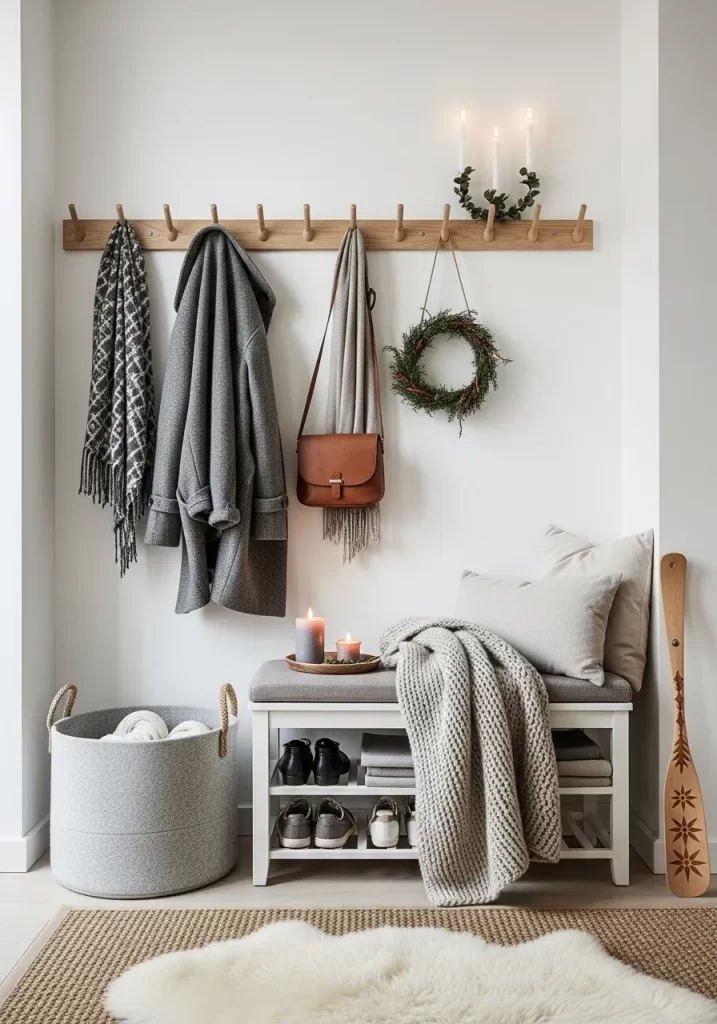
This entryway creates a feeling of warmth and comfort, known as “hygge.” The style is simple and clean, using a light color palette and natural materials. A long wooden peg rail offers plenty of space for hanging coats and scarves. The round, smooth pegs are a classic Scandinavian design element.
A simple white bench with a soft gray cushion provides a place to rest. A cozy knit blanket and pillows make it feel extra inviting. Candles add to the warm atmosphere, while a large felt basket on the floor is a stylish spot for storing extra blankets or yarn.
DIY Instructions: Make a Tiny Holiday Wreath for a Hook
Create a small, simple wreath to add a touch of green to your wall.
What You’ll Need:
- A flexible green branch from a bush or tree (like pine, eucalyptus, or olive).
- A small piece of thin floral wire or twine.
- Scissors or garden clippers.
Step-by-Step Guide:
- Get Your Branch: Find a nice, bendy green branch. It should be about 12-15 inches long. Use clippers to snip it from the plant.
- Form a Circle: Gently bend your branch into a circle shape. Overlap the two ends by about two inches.
- Secure the Ends: Hold the overlapping ends together with one hand. With your other hand, take a small piece of floral wire or twine and wrap it tightly around the two ends to hold them together. Twist the wire or tie a tight knot.
- Tuck in Any Loose Bits: If there are any small leaves or stems sticking out, you can gently tuck them into the wrapped wire to hide it and make your wreath look neater.
- Add a Hanger (Optional): You can tie a small loop of twine to the top of your wreath to make it easier to hang.
- Hang and Admire: Your simple, natural wreath is all done! Hang it from one of the pegs on your coat rack to bring a little bit of the outdoors inside.
26. The High-Tech Smart Entry
Item Name: Futuristic Smart Home Hub
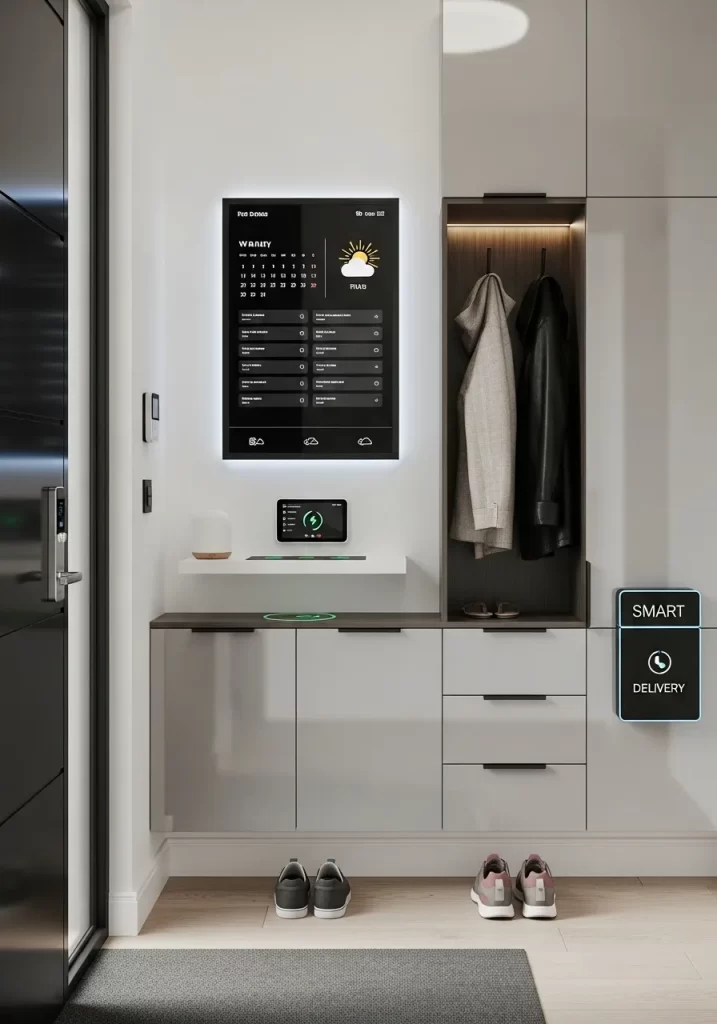
This entryway is designed for a connected, modern life. The look is sleek and minimalist, with flat, handleless cabinets. The centerpiece is a large, wall-mounted digital screen that acts as a family command center. It can display the weather, a calendar, and a to-do list, keeping the whole family in sync.
Below the screen, a small shelf holds a tablet and includes a wireless charging pad for a phone, eliminating messy cables. The built-in closets provide hidden storage for coats and shoes. There is even a secure “smart delivery” box for packages. This is what the entryway of the future might look like.
DIY Instructions: Create a Family Device Charging Station
Make a simple organizer to charge your family’s phones and tablets neatly.
What You’ll Need:
- A sturdy shoebox or a wooden box.
- A power strip with a few outlets.
- A craft knife or scissors.
- Decorative paper or paint (optional).
Step-by-Step Guide:
- Decorate Your Box (Optional): If you want your charging box to look nice, you can cover it with decorative paper or paint it your favorite color. Let it dry completely.
- Make an Opening for the Cord: At the bottom of one of the short sides of the box, carefully cut a small hole. It should be just big enough for the plug of your power strip to fit through.
- Create Cable Holes: On one of the long sides of the box, near the top edge, cut a few small, round holes. Make one hole for each device you want to charge.
- Set Up the Power Strip: Place your power strip inside the box. Thread the main plug out through the small hole you made in the side and plug it into the wall.
- Organize Your Cables: Plug your charging cables into the power strip inside the box. Thread the other end of each cable out through one of the small holes you made along the top edge.
- Charge Your Devices: Put the lid on your box. Now you can plug your phones or tablets into the cables. The messy power strip and extra wires are hidden inside the box, keeping your counter looking tidy.
27. The Vintage and Repurposed Entry
Item Name: Eclectic Hallway with Found Objects

This entryway is full of charm and creativity, using vintage items in new and interesting ways. An old, weathered ladder leans against the wall, serving as a unique rack for hanging scarves and blankets. A vintage steamer trunk provides both seating and a large amount of hidden storage.
The coat rack is a clever creation made from an old window frame and a rustic shutter. The shutter is great for tucking mail into or clipping keys onto. Even the shoe rack is inventive, using an old suitcase opened up on a metal stand. This style shows that you can create a functional space with things you might find at a flea market.
DIY Instructions: Turn a Shutter into a Mail and Key Holder
Repurpose an old wooden shutter into a rustic organizer.
What You’ll Need:
- A small, old wooden shutter.
- A few small hooks.
- A screwdriver.
- A wire brush.
- Picture hanging wire.
Step-by-Step Guide:
- Clean the Shutter: Use a wire brush to scrub off any loose paint, dirt, or dust from the shutter. You want to keep the old, weathered look, but make sure it’s clean.
- Add Your Hooks: Decide where you want your keys to hang. This usually works best on the solid frame part of the shutter at the bottom. An adult can help you screw in a few small hooks.
- Attach Hanging Wire: Turn the shutter over to the back. Screw two small screws into the top corners of the shutter frame. Cut a piece of picture hanging wire and wrap it securely around the two screws to create a hanger.
- Hang Your Organizer: Put a strong nail or hook on your wall and hang your shutter.
- Get Organized: The angled slats of the shutter are great for tucking letters and postcards into. Your keys can hang from the new hooks at the bottom. It’s a useful and decorative piece with a lot of character.
28. The Traditional and Formal Foyer
Item Name: Classic Entryway with Antique-Style Furnishings

This entryway is elegant and timeless. It is designed to be a formal welcoming area rather than a busy drop zone. A beautiful wooden console table with curved legs, known as a demilune table, is the main piece of furniture. It holds two classic lamps and a pot of white orchids, creating a sense of balance and grace.
A large, ornate mirror with a silver frame hangs above the table, making the space feel grand and bright. The seating consists of two delicate, upholstered chairs that add to the formal feel. This kind of entryway is more about making a beautiful first impression than about heavy-duty storage.
DIY Instructions: Make an Easy Faux Flower Arrangement
Create a beautiful flower arrangement that will last forever.
What You’ll Need:
- A nice vase or pot.
- A block of floral foam.
- A few stems of high-quality fake flowers (like orchids or hydrangeas).
- Fake greenery or moss.
- A knife to cut the foam (adult supervision needed).
Step-by-Step Guide:
- Fit the Foam: Ask an adult to help you cut the block of floral foam so that it fits snugly inside your vase. It should be just below the rim of the vase.
- Cover the Foam: Take your fake moss or greenery and spread it over the top of the foam. This will hide the green foam and make your arrangement look more realistic.
- Add Your Main Flowers: Take your main flower stems. Decide how tall you want them to be and trim the stems if needed. Push the end of the stems firmly into the floral foam. You can put the tallest flower in the middle.
- Fill it Out: Continue adding your other flower stems around the main one. Turn the vase as you work to make sure it looks good from all sides.
- Add Smaller Greens: Use smaller pieces of greenery to fill in any gaps around the base of the flowers. This will make the arrangement look full and lush.
- Find the good Spot: Your beautiful, long-lasting flower arrangement is complete! Place it on your entryway table to add a touch of elegance.
29. The Warm Southwestern Welcome
Item Name: Minimalist Entry with Natural Tones
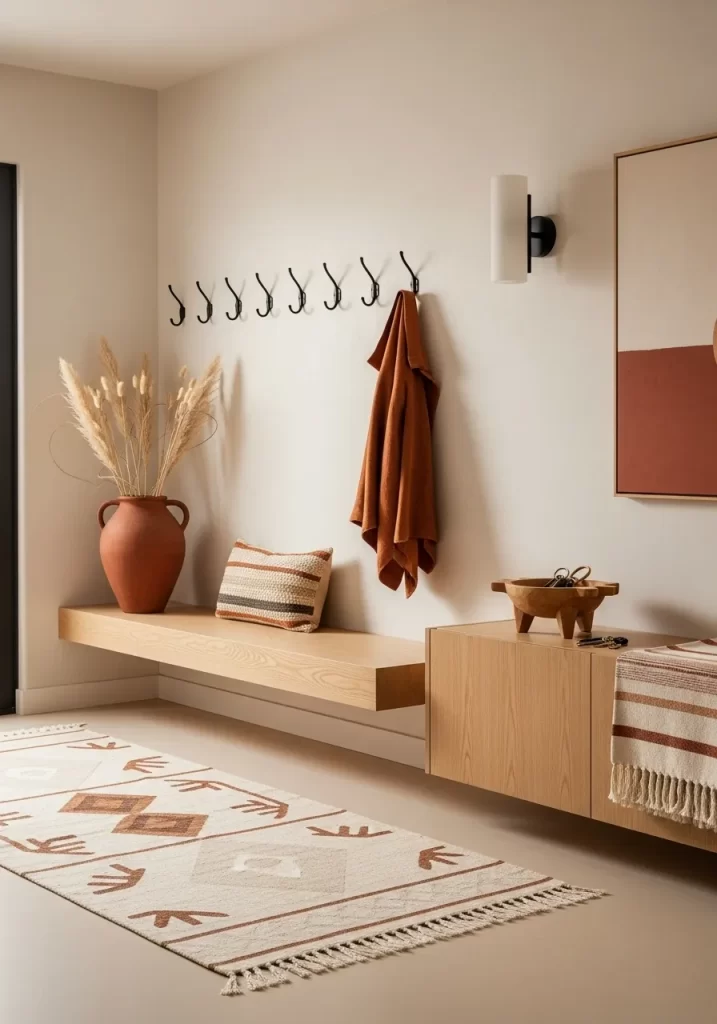
This entryway feels warm, calm, and connected to the earth. It uses a palette of neutral colors, natural wood, and terracotta to create a welcoming, Southwestern-inspired space. A simple floating wood bench seems to hover above the floor, keeping the look light and open.
A row of simple, black J-hooks provides a place for coats without adding clutter. A large terracotta vase holding dried pampas grass adds texture and a natural element. A low wooden cabinet offers concealed storage, while a patterned rug brings a touch of tribal-inspired design to the floor.
DIY Instructions: Make a Simple Yarn Tassel
Create a small tassel to decorate a pillow, a basket handle, or a key chain.
What You’ll Need:
- A ball of yarn in a color you like.
- A small, flat piece of cardboard (about 4 inches tall).
- Sharp scissors.
Step-by-Step Guide:
- Wrap the Yarn: Hold the end of the yarn against the cardboard. Start wrapping the yarn around the cardboard, over and over again. Wrap it about 40 or 50 times to get a nice, full tassel.
- Tie the Top: Cut a separate piece of yarn about 10 inches long. Slip it under all the wrapped yarn at the top of the cardboard and tie a very tight double knot. This piece will be your tassel’s hanger.
- Cut the Bottom: Slide the wrapped yarn off the bottom of the cardboard. You should have a thick loop of yarn. Use your scissors to cut through the bottom of all the loops.
- Form the Head: Cut another piece of yarn about 12 inches long. A few inches down from the top knot, wrap this new piece of yarn tightly around all the strands several times. This will create the little “head” of the tassel. Tie a secure knot.
- Trim the Ends: Let all the yarn strands hang down. Use your scissors to give the bottom of your tassel a little haircut so all the ends are even.
- Decorate! Your tassel is finished! Use the top strings to tie it onto a pillow, a door key, or the handle of a basket.
30. The Smart and Compact Hallway
Item Name: Space-Saving All-in-One Entry Unit
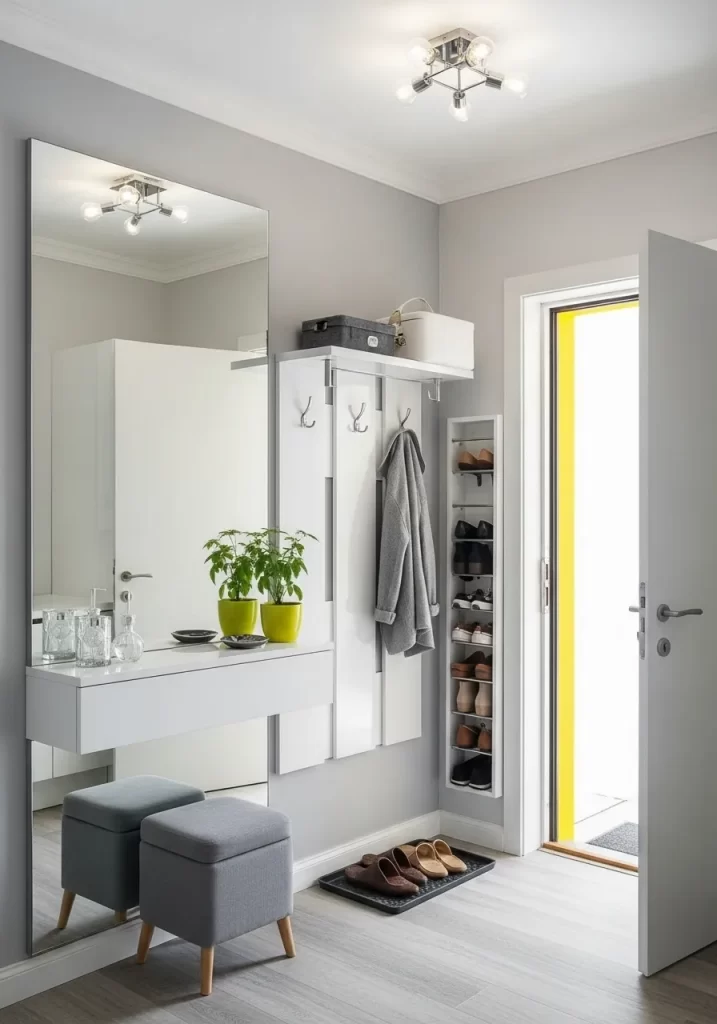
This design is a brilliant solution for a small or narrow entryway. It combines several functions into one sleek, wall-mounted unit to save precious floor space. A large mirror makes the hallway feel bigger, while a small floating shelf below it creates a spot for keys and a couple of small plants.
The unit includes a few coat hooks for everyday jackets. The cleverest part is the vertical shoe storage. A tall, slim cabinet pulls out to reveal multiple tilted shelves, storing many pairs of shoes in a very small footprint. It’s a modern and highly efficient way to keep a small space tidy.
DIY Instructions: Make a Tiny Floating Key Shelf
Create a very small shelf just for your keys, using hidden brackets.
What You’ll Need:
- A small, thick piece of wood (about 12 inches long and 4 inches deep).
- Two small “keyhole” hangers.
- A ruler and pencil.
- A drill.
- Screws and wall anchors.
Step-by-Step Guide:
- Prepare Your Shelf: Make sure your piece of wood is smooth. You can sand it or paint it if you like.
- Mark the Back: Turn your shelf over. You are going to carve out two spots for the keyhole hangers to sit flush with the wood. Place a hanger on the back of the shelf and trace around it. Do this for both hangers.
- Drill the Holes: This step needs an adult’s help. You need to use a drill bit that is the same size as the large round part of the keyhole hanger. Carefully drill down inside the area you traced, creating a recess for the hanger to sit in.
- Attach the Hangers: Screw the keyhole hangers into the recesses you made on the back of the shelf. They should be level with the surface of the wood.
- Mark the Wall: Hold your shelf up to the wall where you want it to hang. Use a level to make sure it’s straight. Make a pencil mark on the wall through the top of each keyhole.
- Mount on the Wall: An adult can now put screws (with wall anchors for support) into the wall on the marks you made. Leave the screws sticking out just a little bit. Line up the keyholes on your shelf with the screws and slide it down into place. Now you have a tiny floating shelf!
31. The Collector’s Cubby System
Item Name: Display-Oriented Hall Tree with Glass Cabinet
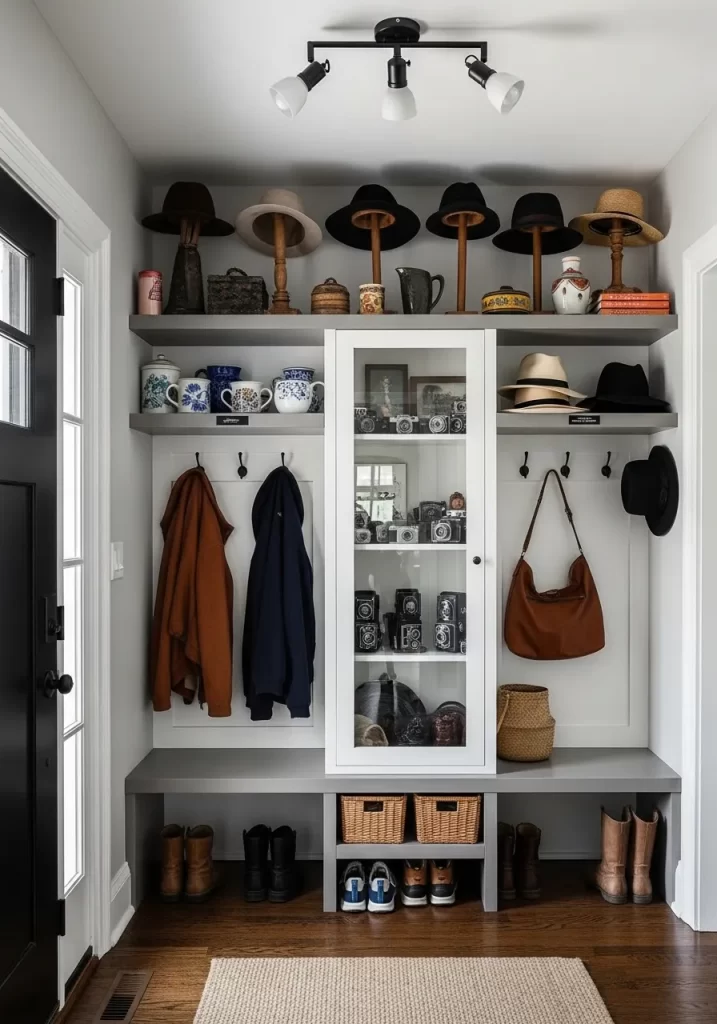
This entryway is perfect for someone who loves to collect and display interesting items. The built-in unit combines open shelving with a central glass-front cabinet, creating a unique focal point. The top shelves are used to display a collection of hats on stands, along with decorative mugs and pitchers.
The glass cabinet is designed to showcase smaller treasures, like a collection of vintage cameras. Below, a long bench provides seating. The open shelves underneath are for woven baskets, keeping shoes out of sight. It’s a highly personalized space that combines practical storage with a curated display.
DIY Instructions: Make a Display Stand for Hats or Small Items
Elevate your collected items with a simple wooden stand.
What You’ll Need:
- A small piece of wood for the base (e.g., a 4×4 inch square).
- A wooden dowel (about 1 inch thick and 6-10 inches tall).
- A small, flat wooden circle for the top (e.g., 3-4 inches across).
- Wood glue.
- Sandpaper.
- Optional: Wood stain or paint.
Step-by-Step Guide:
- Smooth the Wood: Use sandpaper to smooth all the edges and surfaces of your three wooden pieces.
- Attach the Dowel to the Base: Put a dot of wood glue in the very center of your square base. Stand the wooden dowel upright on the glue, making sure it’s straight. Let the glue dry completely.
- Attach the Top Circle: Put a dot of wood glue on the very top of the wooden dowel. Carefully place the small wooden circle on top, making sure it’s centered. Let this glue dry completely as well.
- Stain or Paint (Optional): Once all the glue is dry, you can stain or paint your display stand if you want. Let it dry thoroughly.
- Display Your Treasures: Your new display stand is ready! Use it to show off a favorite hat, a small vase, or a unique figurine in your entryway.
32. The Modern Monochrome Hallway
Item Name: Sleek Black and White Entryway
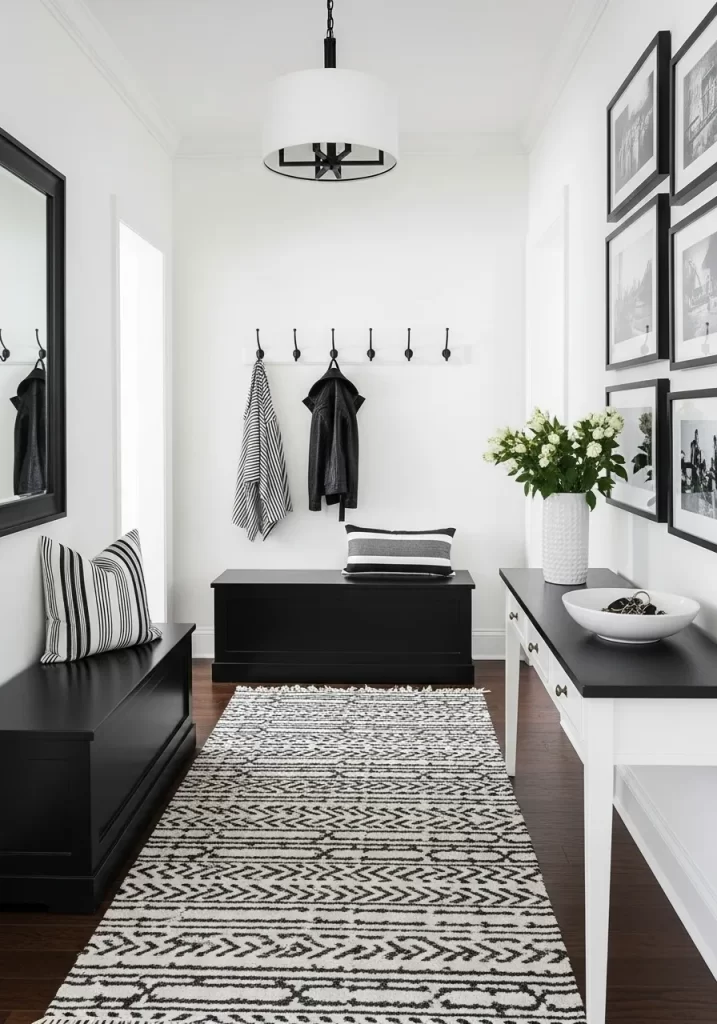
This entryway is a study in modern simplicity, using a classic black and white color scheme. The long, white walls are a clean backdrop for the dark, sleek furniture. Two black storage benches offer plenty of seating and hidden space for clutter, keeping the look minimalist.
A row of black coat hooks stands out against the white wall, ready for jackets and towels. A large, rectangular mirror with a black frame amplifies the light and space. The geometric patterned rug adds visual interest and ties the whole sophisticated, monochromatic look together.
DIY Instructions: Create a Monochromatic Striped Pillow Cover (No-Sew)
Add a stylish striped pillow to your bench without any sewing.
What You’ll Need:
- A plain white pillow cover.
- Black fabric paint.
- Painter’s tape (about 1 inch wide).
- A small foam brush or stencil brush.
- Newspaper or cardboard.
Step-by-Step Guide:
- Prepare Your Pillow Cover: Wash and dry your pillow cover to remove any sizing. Iron it flat. Place a piece of newspaper or cardboard inside the pillow cover to prevent paint from bleeding through to the other side.
- Tape Your Stripes: Decide how wide you want your black stripes to be. Use the painter’s tape to create evenly spaced stripes across the pillow cover. Make sure the tape is pressed down firmly, especially along the edges.
- Paint the Stripes: Squeeze a small amount of black fabric paint onto a paper plate. Use your foam brush to carefully paint inside the taped-off sections. Apply the paint in thin, even coats. You might need two coats for good coverage.
- Remove the Tape: While the paint is still slightly wet, carefully peel off the painter’s tape. Pull it slowly and at an angle to get crisp lines.
- Let it Dry: Let the fabric paint dry completely, which might take several hours. Some fabric paints need to be heat-set with an iron (check the instructions on your paint bottle).
- Insert the Pillow: Once dry, remove the newspaper/cardboard from inside and insert your pillow. Your stylish, striped pillow is ready for your entryway bench!
33. The Corner Nook Organizer
Item Name: L-Shaped Built-In Hall Tree
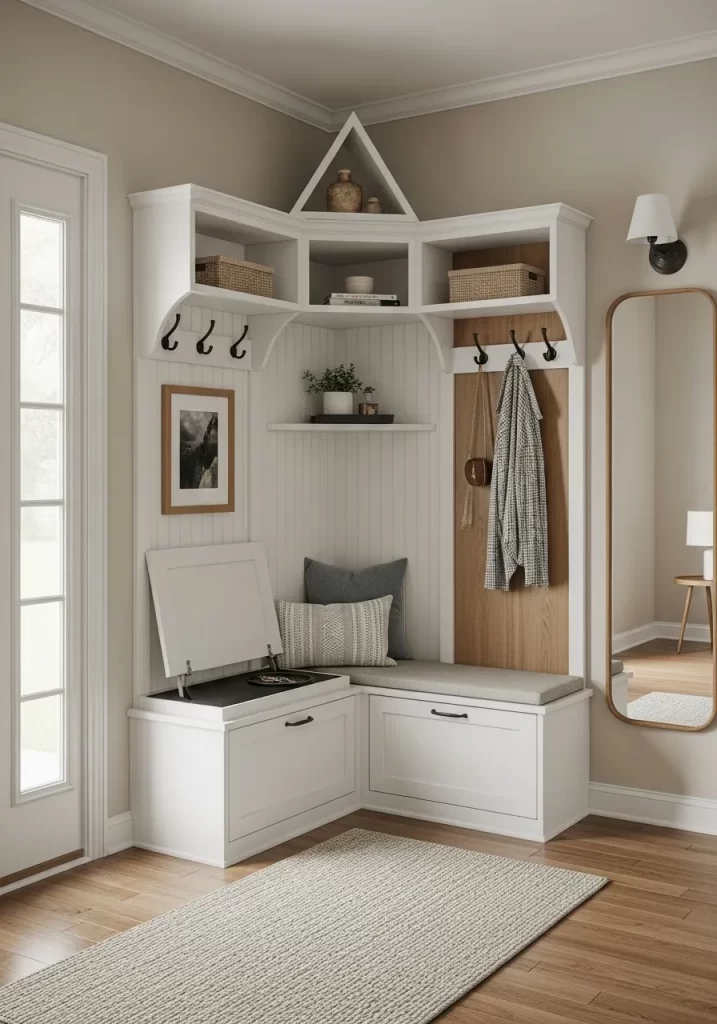
This entryway makes smart use of a corner space by featuring a custom L-shaped built-in unit. The white paneling and shelving create a bright and clean look, maximizing storage in a compact area. Upper cubbies with woven baskets hold seasonal items, while a lower floating shelf provides a spot for plants.
The bench offers comfortable seating, with a cushion and pillow. One side of the bench also has a lift-top storage compartment, perfect for hiding away bulkier items. Multiple hooks are placed on both sides of the corner, ensuring plenty of hanging space for coats, bags, and hats.
DIY Instructions: Build a Small Corner Floating Shelf
Add a practical and decorative shelf to any corner.
What You’ll Need:
- Two small, flat pieces of wood cut into triangles (about 8-10 inches on each short side).
- Two small corner shelf brackets (or L-brackets).
- A drill.
- Screws and wall anchors.
- A level.
- A pencil.
- Wood stain or paint (optional).
Step-by-Step Guide:
- Prepare Your Wood: Sand and, if desired, stain or paint your triangular pieces of wood. Let them dry completely.
- Attach Brackets to Shelves: Place one of the triangular shelves upside down. Position a bracket underneath, along one of the longer sides (the hypotenuse), and screw it into the wood. Repeat for the other bracket and shelf.
- Mark the Wall: Hold one of your shelves in the corner where you want it to go. Use a level to ensure it’s straight. Use your pencil to mark where the screw holes for the brackets will be on the wall.
- Install Wall Anchors: Drill pilot holes at your marks. If you’re drilling into drywall, insert wall anchors into the holes for extra stability.
- Mount the Shelf: Place the shelf bracket over the wall anchors/holes and screw the bracket into the wall. Repeat for the second shelf, making sure it’s at the same height or a pleasing distance.
- Decorate: Place a small plant or a decorative item on your new corner shelf. It adds both style and a little extra storage to your entryway!
34. The Modern Minimalist Drop Zone
Item Name: Sleek Wall-Mounted Organizer
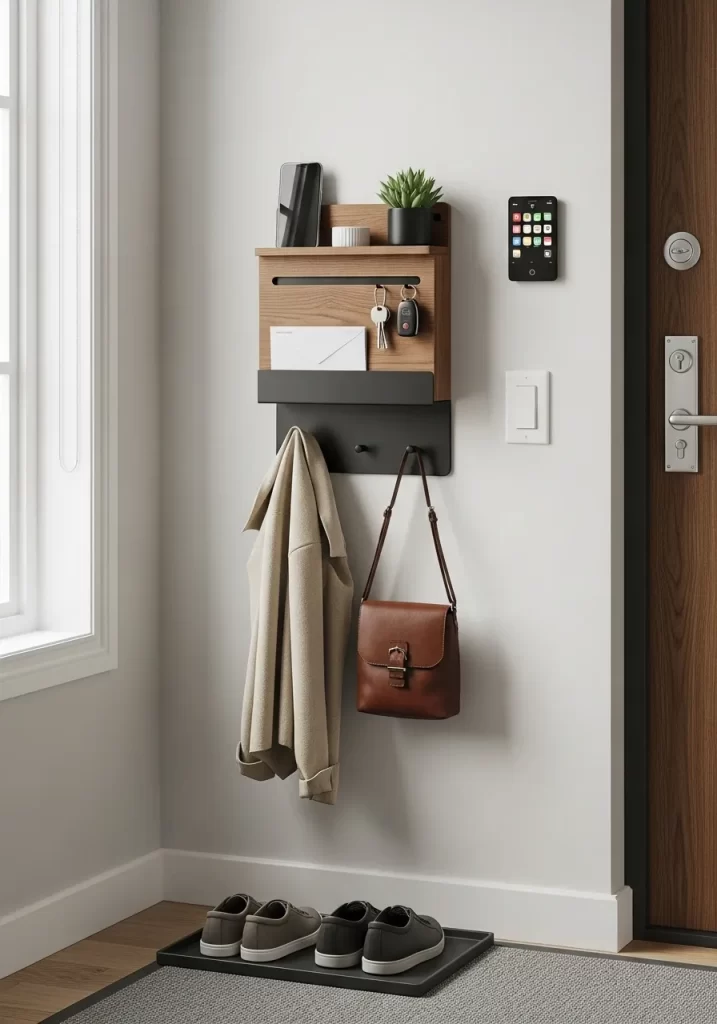
This entryway embraces clean lines and simple functionality. A sleek, wall-mounted organizer made of natural wood and black metal combines several key functions in a compact design. It features a small shelf for displaying a plant or other decor.
Below the shelf, a mail slot keeps papers organized. Hooks are integrated into the unit for keys and a small bag. A simple J-hook is positioned below for a coat. The design is all about efficient use of space, ensuring everything has a designated place while keeping the area clutter-free.
DIY Instructions: Craft a Simple Wall-Mounted Mail Slot
Make a sleek slot to hold your incoming and outgoing mail.
What You’ll Need:
- Two pieces of flat wood (one for the back, one for the front panel – the front should be shorter).
- One piece of wood for the bottom.
- Wood glue.
- Small nails or screws.
- A hammer or screwdriver.
- A ruler and pencil.
Step-by-Step Guide:
- Measure and Cut: Decide how wide and tall you want your mail slot to be. The back piece will be the tallest. The front piece will be shorter, creating the “slot.” The bottom piece will be the depth. Ask an adult to help you cut the wood to these sizes.
- Assemble the Base: Apply wood glue to the long edges of the bottom piece of wood. Stand the tall back piece on one long edge, and the shorter front piece on the other long edge. Make sure they are aligned.
- Secure with Nails/Screws: Ask an adult to help you put small nails or screws through the side of the back and front pieces, into the bottom piece, to secure it. This will create a U-shape.
- Let it Dry: Wipe away any excess glue and let the glue dry completely.
- Mount to Wall: To hang it, you can use two small keyhole hangers on the back of the tall wood piece. An adult can help you drill small recesses and screw in the keyhole hangers.
- Organize Your Mail: Hang your new mail slot on the wall. Now you have a stylish place to drop your mail as soon as you walk in the door, keeping your counter clear!
35. The Adventure Hub Entry
Item Name: Travel-Themed Mudroom Command Center
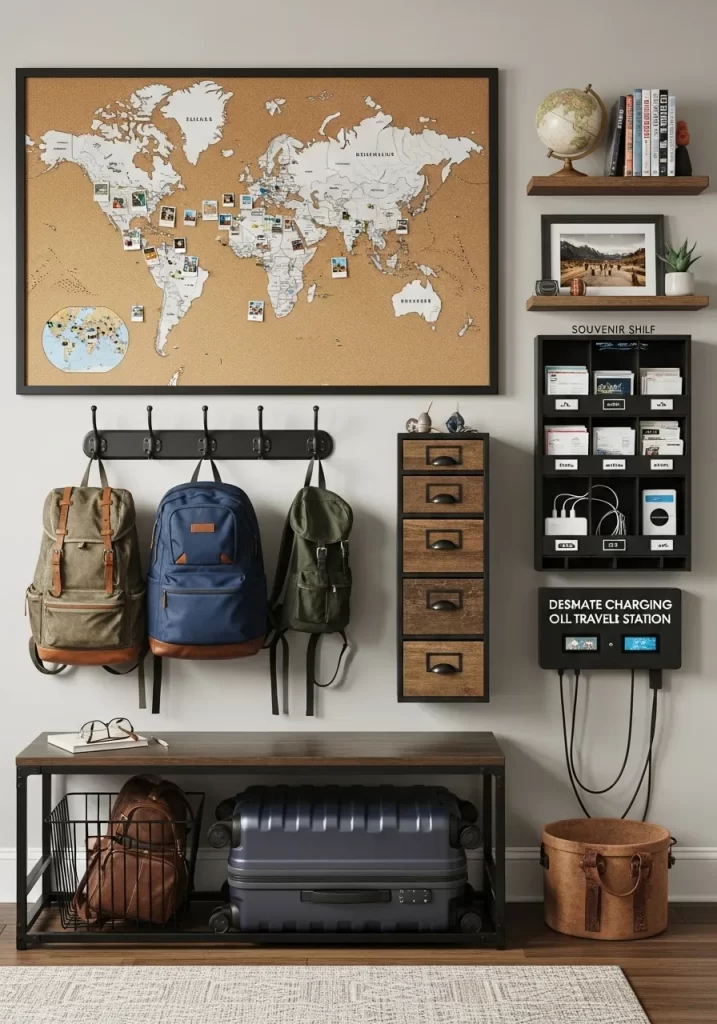
This entryway is designed for the adventurous spirit, with a clear focus on travel and exploration. A large cork map of the world dominates the wall, perfect for pinning photos from past trips and planning future ones. This makes the space feel personal and inspiring.
Below the map, a simple bench with an open metal basket holds bags and luggage. A rustic-looking cabinet with small drawers provides storage for smaller items like passport holders or travel souvenirs. A wall-mounted charging station ensures all devices are ready for the next journey. This setup is both functional and a constant reminder of the world waiting to be explored.
DIY Instructions: Create a Travel Photo Wall Display
Turn your travel photos into a fun, pin-up display.
What You’ll Need:
- A large corkboard.
- Your favorite travel photos (printed).
- Small decorative pushpins.
- String or twine.
- Optional: Mini clothespins.
Step-by-Step Guide:
- Hang Your Corkboard: Hang your large corkboard on a prominent wall in your entryway.
- Arrange Photos: Lay out your printed travel photos. You can arrange them by trip, by color, or just in a way that looks good to you.
- Pin Them Up: Use your decorative pushpins to attach the photos to the corkboard. You can overlap them slightly or leave space between each.
- Add String (Optional): If you want to connect related photos, cut a piece of string or twine. Pin one end of the string next to a photo, stretch it to another related photo, and pin it down there. You can create a web of connections!
- Use Mini Clothespins (Optional): Instead of pinning the photos directly, you can string lines of twine across the corkboard and use mini clothespins to clip your photos onto the lines.
- Enjoy Your Memories: Every time you walk into your entryway, you’ll be reminded of all the amazing places you’ve been and the adventures that await!
Tackling the clutter after the holidays can feel like a big job. Your entryway is the best place to start. A tidy entrance creates a sense of calm that flows through the rest of your home. You have seen many ways to bring order back to this important space.
You don’t need a huge budget or a lot of time. Many of these solutions use simple pieces and smart thinking. Choose the ideas that fit your home and your family’s needs. Creating a functional and beautiful entryway is within your reach. Now you have the tools to make it happen.
Key Takeaways
- Give Everything a Home: Use hooks for coats, shelves for shoes, and baskets for small items. When everything has a designated spot, clutter disappears.
- Use Your Walls: Vertical storage is your best friend in a small space. Shelves, pegboards, and wall-mounted units lift the mess off the floor.
- Hide What You Can: Storage benches, closed cabinets, and decorative boxes are great for hiding things you don’t want to see every day.
- Make it Personal: An organized entryway doesn’t have to be boring. Add a mirror, a plant, or a piece of art to make the space feel like your own.