
Does your home feel a bit… full?
Sometimes, too much stuff can make a space feel chaotic. It is easy to get overwhelmed by clutter.
Minimalist decor offers a fresh start. It is not about having an empty room.
It is about choosing items with purpose. It’s about creating a space that feels calm and open.
This guide gives you 42 simple ideas. You can start small or plan a big change. Let’s explore how to reset your aesthetic.
1. Create Simple Abstract Line Art
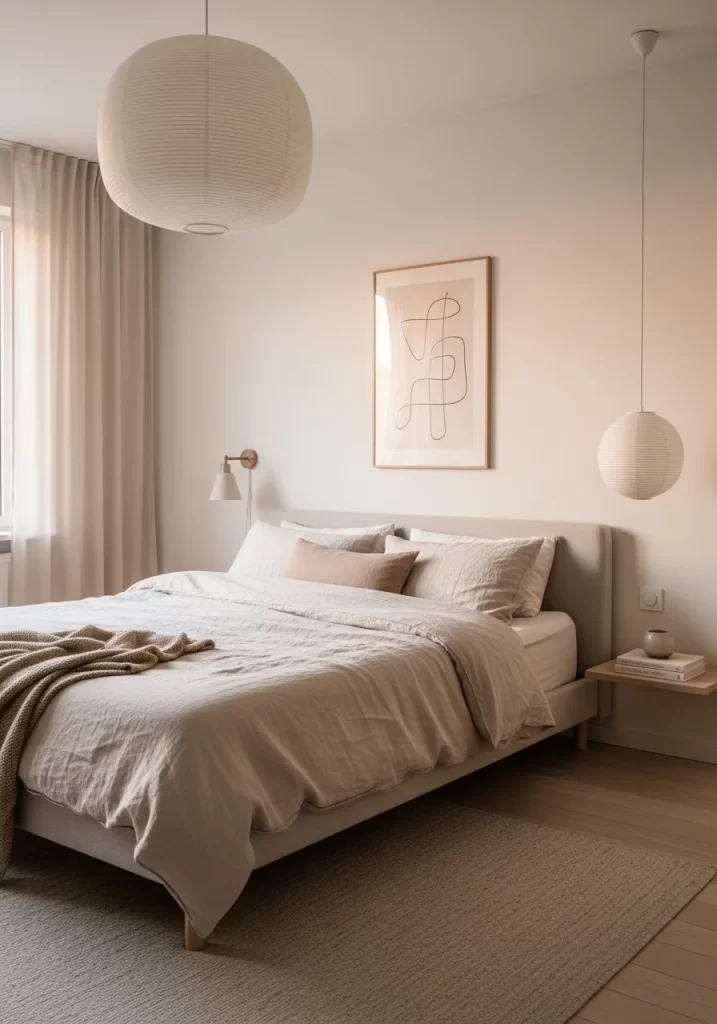
This bedroom shows how one simple piece of art can define a space. The room is calm, with soft linen bedding and gentle paper lanterns. Everything is clean and uncluttered.
Above the bed, a single framed picture features abstract line art. This type of art uses one continuous line to create a shape. It’s simple but interesting to look at.
It draws the eye without overwhelming the room. The thin wood frame matches the light wood of the bedside table. This creates a connected, thoughtful look.
DIY: Easy One-Line Abstract Art
What You Need:
- A piece of thick white paper (cardstock is good).
- A black marker (a permanent marker works well).
- A simple picture frame (like the light wood one in the photo).
- A pencil and an eraser (these are for practice).
Step 1: Get Your Idea
- Think of a simple shape. It could be a face, a flower, or just a random, flowing squiggle. You can look online for “one-line art” to get some easy ideas.
Step 2: Practice Your Drawing
- On a scrap piece of paper, practice drawing your shape. The main rule is to do it without lifting your marker from the paper. It should look like one single, connected line.
Step 3: Make Your Final Art
- Take your good piece of white paper. You can lightly draw your shape with a pencil first if you feel nervous.
- When you are ready, take your black marker and trace over your pencil line. Try to be smooth and steady.
- Let the ink dry completely. Then, use your eraser to gently remove any pencil marks you can still see.
Step 4: Frame Your Art
- Open the back of your picture frame.
- Place your new one-line drawing inside. Make sure it’s straight.
- Close the back of the frame. You now have a simple, modern piece of art to hang above your bed.
2. Install a Floating Wooden Book Ledge
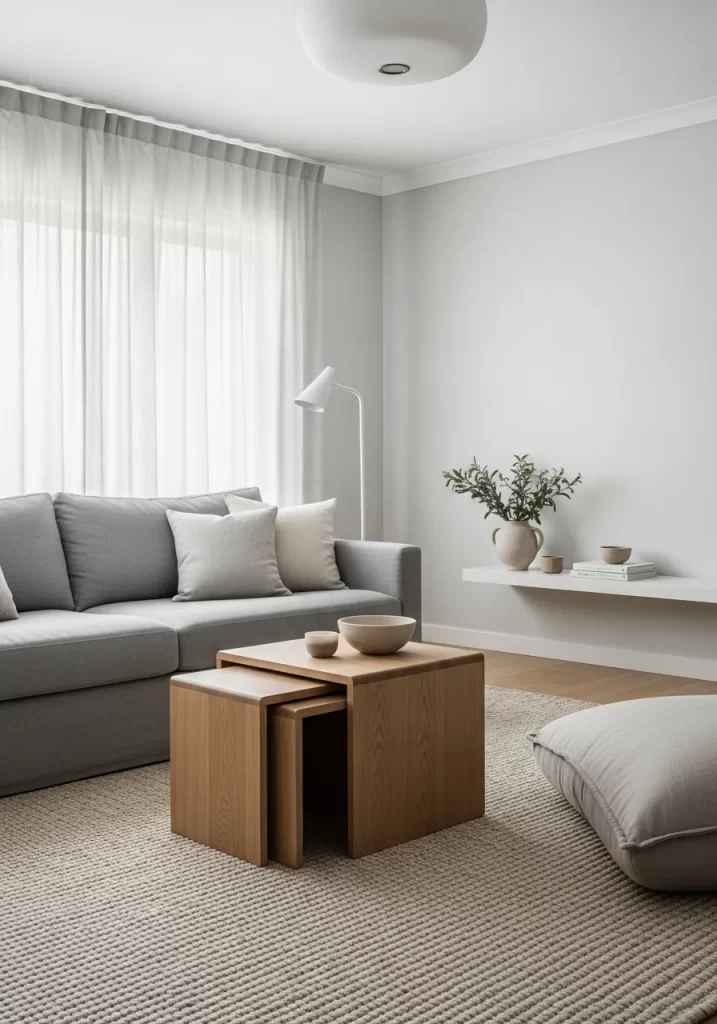
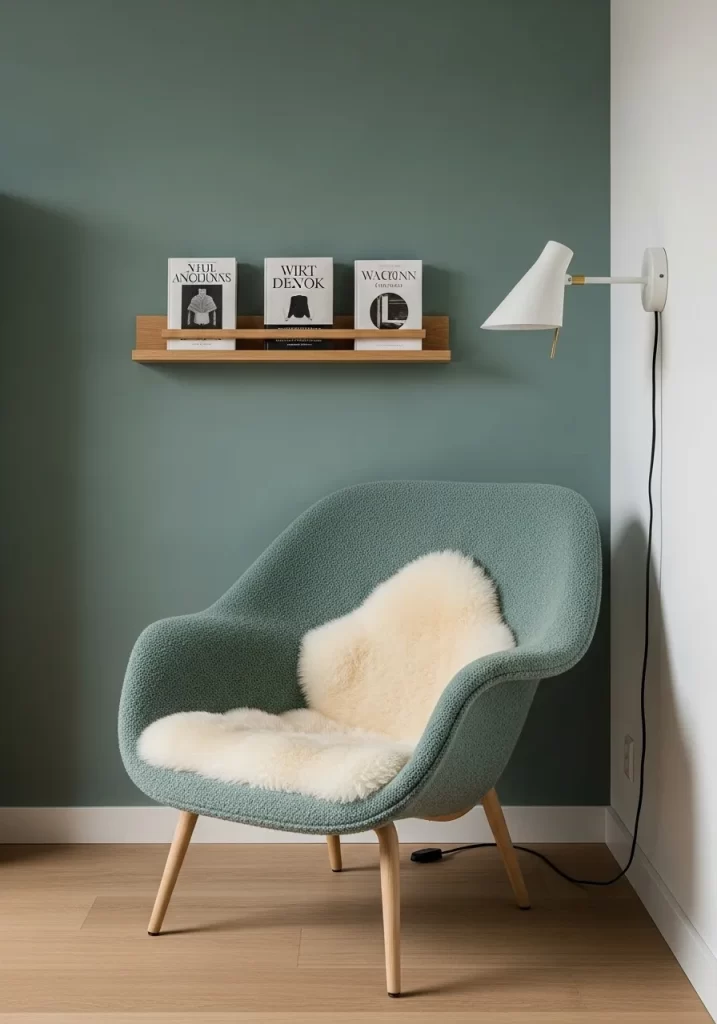
This quiet corner feels cozy. The soft teal chair and warm wall lamp create a nice spot for reading. A simple wooden ledge on the wall holds a few books.
This shelf is a great example of minimalist design. It displays the books like art, keeping them organized without a big, heavy bookcase. The natural wood adds warmth to the cool-toned wall. It’s a functional and beautiful way to store your favorite reads.
DIY: Simple Wooden Book Ledge
What You Need:
- A flat piece of wood (like a 1-inch by 4-inch pine board, cut to the length you want).
- Sandpaper (medium and fine grit).
- Wood stain or paint (optional).
- A drill.
- Two or three “L-brackets” (small, L-shaped metal pieces).
- Screws for the wall (and wall anchors if you can’t drill into a wall stud).
- Small screws to attach the wood to the brackets.
- A level (a tool to make sure it’s straight).
Step 1: Prepare Your Shelf
- Take your piece of wood. Use the medium sandpaper to smooth any rough edges.
- Go over it again with the fine sandpaper to make it very smooth.
- Wipe off all the dust with a cloth.
- If you want, paint or stain the wood and let it dry completely.
Step 2: Attach Brackets to the Wall
- Decide where you want your shelf. Hold it against the wall.
- Use your level to make sure the shelf is perfectly straight.
- Make a small pencil mark on the wall where the bottom of the shelf will be.
- Hold your L-brackets against the wall under your pencil line. Mark the screw holes.
- Drill holes for your wall screws. If you are not in a wall stud (the hard wood beams in the wall), push a wall anchor into the hole first.
- Screw the L-brackets to the wall.
Step 3: Attach the Shelf
- Place your wooden board on top of the brackets.
- Use the small screws to attach the wood to the brackets from underneath. This stops the shelf from sliding off.
3. Hang a Paper Sphere Lantern
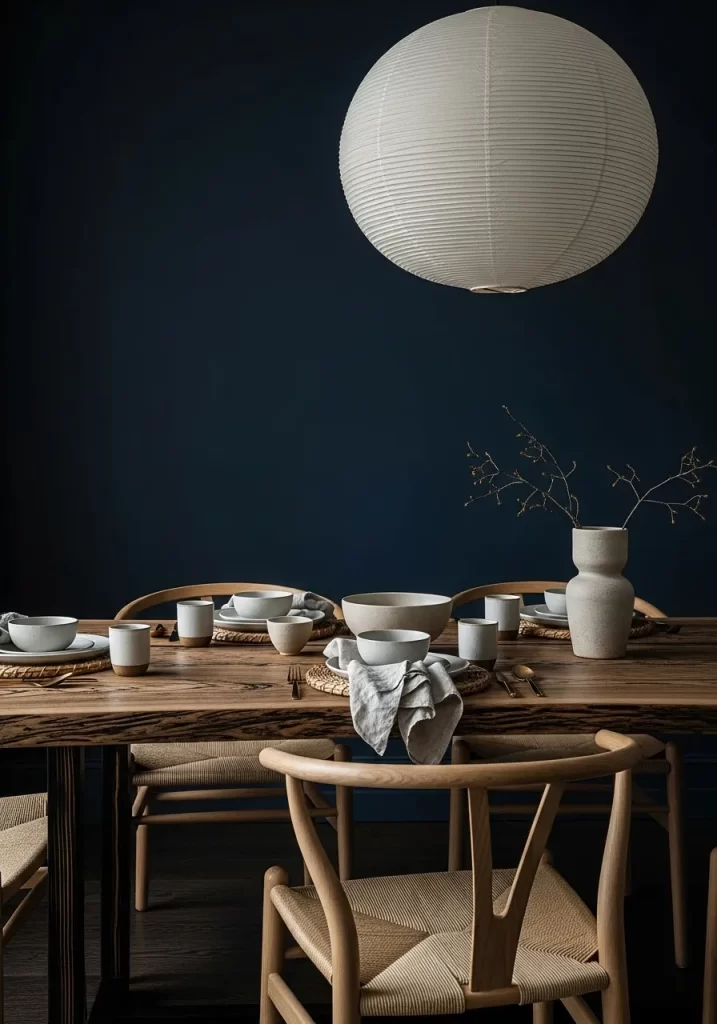
A large, round paper lantern hangs over this dining table. It gives off a soft, gentle light. The lantern is lightweight and simple.
Its white color stands out against the dark blue wall. This light fixture adds texture to the room. It matches the natural materials of the wooden table and woven chairs. It’s a classic piece that brings a feeling of calm to the dining space.
DIY: How to Hang a Paper Lantern Light
What You Need:
- A paper lantern (you can buy these online or at party stores).
- A simple pendant light cord kit (this is a cord with a light socket on one end and a plug on the other).
- A light bulb (an LED bulb is good because it stays cool).
- A ceiling hook (a small hook that screws into the ceiling).
Step 1: Open the Lantern
- Most paper lanterns come folded flat. Carefully open it.
- Inside, there should be a wire frame. Gently insert this frame into the lantern. It will pop the lantern into its round shape.
- There will be a hook or loop at the top of the wire frame.
Step 2: Install the Light Cord
- Take your pendant light cord. Pass the socket end through the large opening at the top of the lantern.
- Attach the cord to the wire frame. Most cords have clips, or you can loop the cord over the frame’s hook. The light bulb should hang in the middle of the lantern.
- Screw in your light bulb.
Step 3: Hang the Lantern
- Decide where you want the light. Ask an adult to help you screw the ceiling hook into the ceiling.
- Drape the plug-in cord over the hook.
- Plug the cord into the wall. You can use small wall clips to run the cord neatly down the wall if you like.
4. Use Wooden Nesting Tables
This living room uses smart, space-saving furniture. The wooden coffee tables are a “nesting” set. This means one table is slightly smaller and can slide underneath the other.
You can pull them apart when you need more surface area for guests. You can push them together to save space when you are done. The simple square shape and light wood color match the room’s clean feel. They are useful without adding clutter.
DIY: Style Wooden Crates as “Nesting” Tables
Making real nesting tables is very hard. Here is an easy way to get a similar look.
What You Need:
- Two wooden crates from a craft store. One must be slightly smaller than the other.
- Sandpaper.
- Paint or wood stain (any color you like).
- A paintbrush and a cloth.
Step 1: Sand the Crates
- Wooden crates can have rough edges or splinters.
- Use your sandpaper to sand all the edges and flat sides until they are smooth.
- Wipe away all the dust with a cloth.
Step 2: Paint or Stain the Crates
- Paint or stain your crates. A natural wood stain will look like the picture.
- Make sure to get the inside and outside.
- Let them dry completely. You might need two coats of paint.
Step 3: Arrange Your “Tables”
- Turn the crates on their sides, so the opening faces out.
- Place the larger crate where you want your coffee table.
- Slide the smaller crate underneath the larger one. You can have it sticking out a little bit.
- You now have two table surfaces and some storage space inside the crates.
5. Create a Clean, Modern Mantel
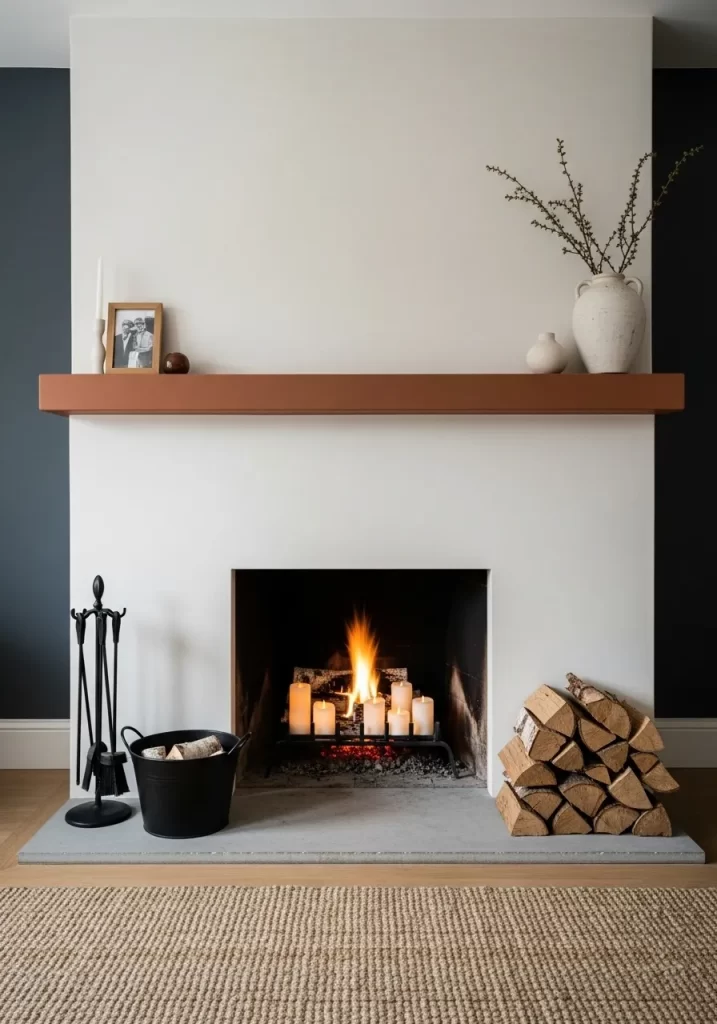
The fireplace is the center of this room. It has a very simple, clean design. A single piece of terracotta-colored wood serves as the mantel shelf.
This long, straight line adds a touch of warm color against the white and dark blue walls. Instead of a large fire, a collection of white pillar candles sits inside the hearth. This gives the cozy glow of a fire without the mess. A few simple items sit on top.
DIY: Faux Fireplace with Candles
What You Need:
- An empty fireplace (or just a clear, safe spot on a stone or tile floor).
- A collection of 5 to 7 white pillar candles.
- Get candles that are different heights and widths. This makes it look more interesting.
- A large, heat-proof tray (metal or ceramic is good) (optional).
Step 1: Clean Your Space
- If you are using a real fireplace, sweep it out so it’s clean of any ash or dust.
Step 2: Arrange Your Candles
- Place your candles inside the fireplace. You can put them on a tray first, or right on the fireplace floor.
- Group them together. Put the tallest ones in the back and the shorter ones in the front.
- Move them around until they look like a nice cluster. Don’t put them too close, or they might melt each other.
Step 3: Light and Enjoy
- Carefully light the candles.
- The different flames will create a warm, flickering glow that feels like a fire.
- Safety Rule: Always stay in the room when candles are burning. Ask an adult to blow them out before you leave.
6. Add a Floating Wood Vanity
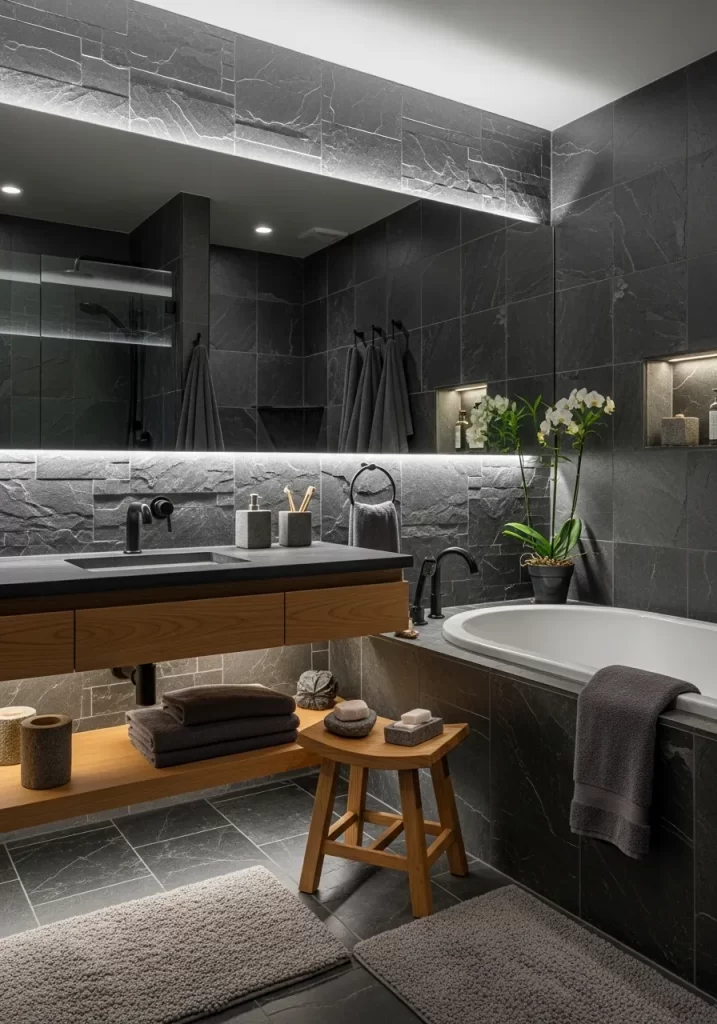
This bathroom uses dark, textured tiles to create a moody, spa-like feel. To balance the dark color, a light wood vanity “floats” on the wall.
It does not have legs. This makes the room feel more open and easier to clean underneath. The vanity has a simple flat top and a long open shelf below for towels. The natural wood grain brings warmth to the stone tiles.
DIY: Build a Simple “Floating” Shelf
A full vanity is a very hard job. Here is how to make a simple floating shelf for towels.
What You Need:
- A thick, strong piece of wood (like a 2-inch by 6-inch board).
- A waterproof sealer (like Polyurethane) and a brush.
- Sandpaper.
- Two or three heavy-duty “floating shelf” brackets (these are metal rods that hide inside the wood).
- A drill.
- A level.
- A stud finder (a tool to find the strong wood beams in the wall).
Step 1: Prepare the Wood
- Sand your wood board until it is very smooth.
- Wipe off the dust.
- Brush on the waterproof sealer. This is very important for a bathroom. Let it dry. You may need to do 2-3 coats.
Step 2: Install the Brackets
- Use the stud finder to find the studs in your wall. You must attach these brackets to the studs.
- Hold the bracket against the wall and use your level to make it straight. Mark the screw holes.
- Drill holes and screw the brackets securely into the wall studs.
Step 3: Drill Holes in Your Shelf
- This is the tricky part. You need to drill holes into the edge of your wood shelf that are the same size as the metal rods on the bracket.
- Measure very carefully where the rods are. Mark those spots on the back edge of your wood.
- Drill straight holes into the wood. Make them deep enough for the rods.
Step 4: Mount the Shelf
- Slide the holes in your wood shelf onto the rods in the wall. Push it all the way back until it is flat against the wall.
7. Embrace Low-Profile Seating
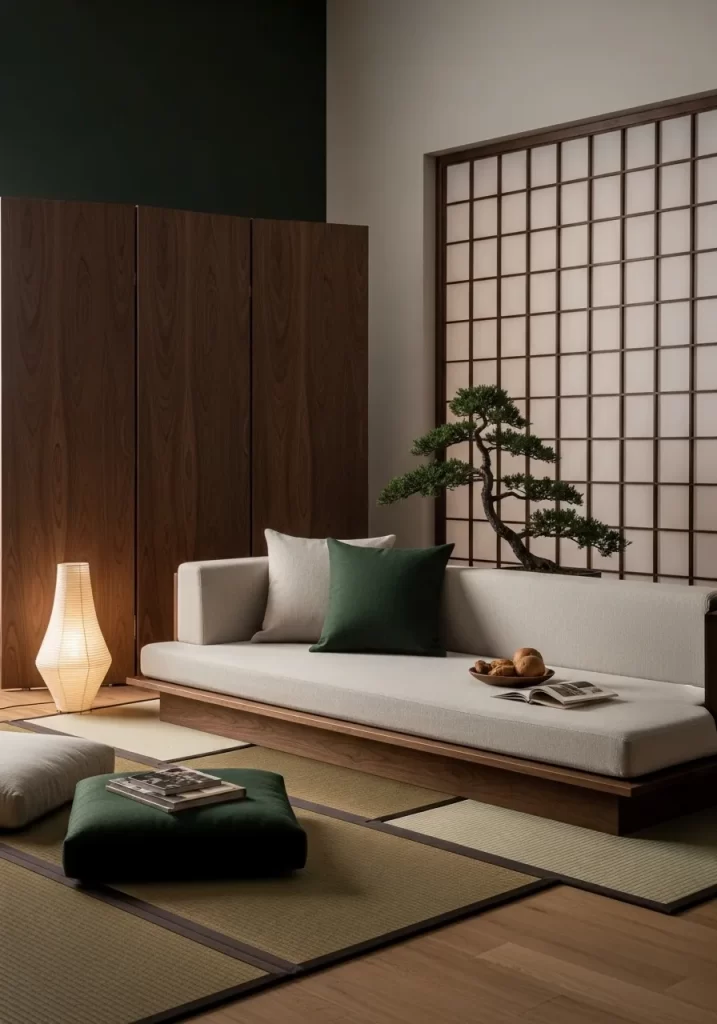
This room feels very calm and grounded. It mixes Japanese and Scandinavian (Japandi) design. The sofa is very low to the ground.
This low-profile furniture makes the ceiling feel higher. It creates a relaxed, lounge-like atmosphere. The colors are all-natural: wood, beige, and a deep forest green. A shoji screen window and tatami-style mats complete the peaceful look.
DIY: Make a Simple Floor Cushion Seat
What You Need:
- Two large, firm square pillows (you can find “floor cushions” or “outdoor cushions” at a store).
- A large piece of strong fabric (like canvas or linen).
- A sewing machine or a needle and strong thread.
- Scissors and measuring tape.
Step 1: Stack and Measure
- Stack your two cushions on top of each other.
- Measure the width, length, and the total height of the stack.
Step 2: Cut Your Fabric
- You need to cut fabric to wrap around your cushions like a present.
- You will need two main pieces:
- One long piece that wraps all the way around the sides (the height).
- Two square pieces for the top and bottom.
- Remember to add 1 extra inch to every measurement for sewing.
Step 3: Sew the Cover
- Sew the long side piece into a big loop.
- Take one of your square pieces (for the top) and sew it to one edge of the loop.
- You now have a box with an open bottom.
- Sew the second square piece (for the bottom) to the other edge of the loop. BUT, leave one whole side open.
Step 4: Stuff and Finish
- Turn your fabric cover right-side-out.
- Stuff your two cushions inside through the hole you left open.
- Neatly fold the fabric edges of the open side in.
- Use your needle and thread to sew the last side closed by hand.
8. Use a Simple Wooden Stool
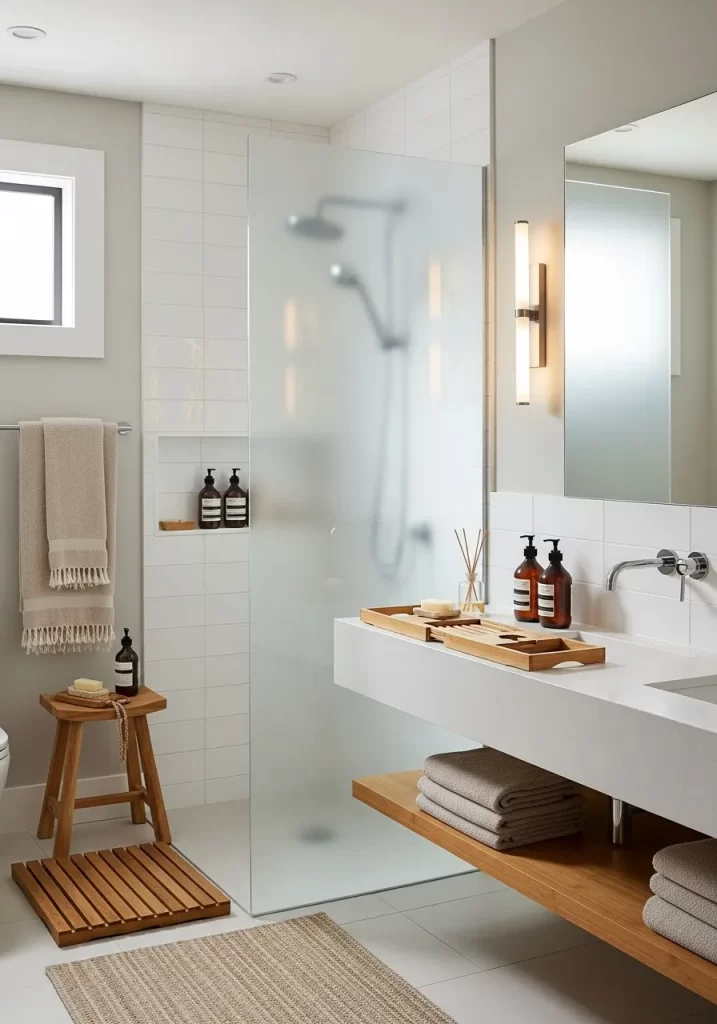
This light, airy bathroom feels clean and fresh. A small, simple wooden stool sits by the shower. This one piece adds a lot of character.
It brings a natural, spa-like element to the white-tiled room. You can use it to hold a towel, a bar of soap, or a small plant. The warm wood contrasts nicely with the cool white and glass. It’s a useful and stylish item that doesn’t take up much space.
DIY: Easy Three-Legged Stool
What You Need:
- A round, flat piece of wood for the top (about 12-15 inches wide).
- Three wooden dowel legs (about 1.5 inches thick and 18 inches long).
- Three “angle top plate” hardware pieces (these are small metal plates that hold the legs at an angle).
- A drill and screws.
- Sandpaper.
- Waterproof sealer (for a bathroom).
Step 1: Prepare Your Wood
- Sand the round top and the three legs until they are smooth.
- Wipe off the dust.
Step 2: Attach the Hardware
- Turn your round wood top upside-down.
- Place the three metal plates on the wood. Space them out evenly, like a triangle.
- Make sure the angled part points outward, away from the center.
- Use your drill and screws to attach the three plates to the wood top.
Step 3: Attach the Legs
- Take your wooden dowel legs.
- Twist them by hand into the holes in the metal plates. Keep twisting until they are very tight.
Step 4: Seal the Stool
- Turn your stool over. It’s done!
- Because it’s for a bathroom, use a brush to apply a waterproof sealer to all the wood. Let it dry.
9. Mount a Floating Entryway Console
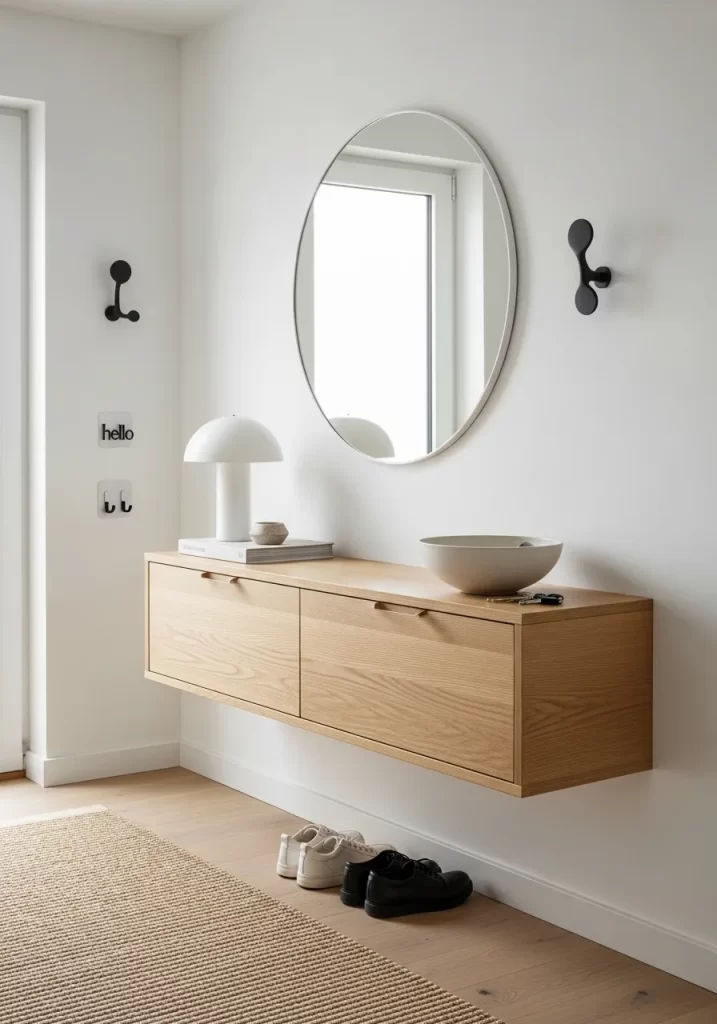
This entryway is bright and welcoming. A wooden console cabinet floats on the wall, leaving the floor clear. This makes the small space feel larger.
It gives you a place to drop your keys and mail. The round mirror above it softens the straight lines of the cabinet. A few simple hooks on the wall are for coats. Everything has a purpose. The light wood and white walls keep the area feeling open.
DIY: How to Hang a Floating Cube Shelf
A full cabinet is hard to build. This is how you hang a simple cube shelf for a similar look.
What YouNeed:
- A pre-made “floating cube” or small rectangular shelf (you can buy these at many stores).
- The hardware that comes with the shelf (usually a metal bar and screws).
- A drill.
- A level.
- A stud finder.
Step 1: Find the Studs
- Decide where you want your shelf.
- Use the stud finder to find the strong wood beams in the wall. Mark them with a pencil.
- Your shelf will be strongest if you attach it to these studs.
Step 2: Attach the Bracket
- Most floating shelves come with a metal bar that you attach to the wall first.
- Hold this bar against the wall. Place your level on top of it to make sure it is perfectly straight.
- Mark the screw holes that line up with your wall studs.
- Use your drill to screw the bracket bar to the wall.
Step 3: Hang the Shelf
- The wooden cube shelf will have matching holes in the back.
- Simply slide the shelf onto the bracket bar.
- It should fit tightly and look like it’s floating on the wall. You now have a spot for your keys.
10. Style Rustic Open Shelves
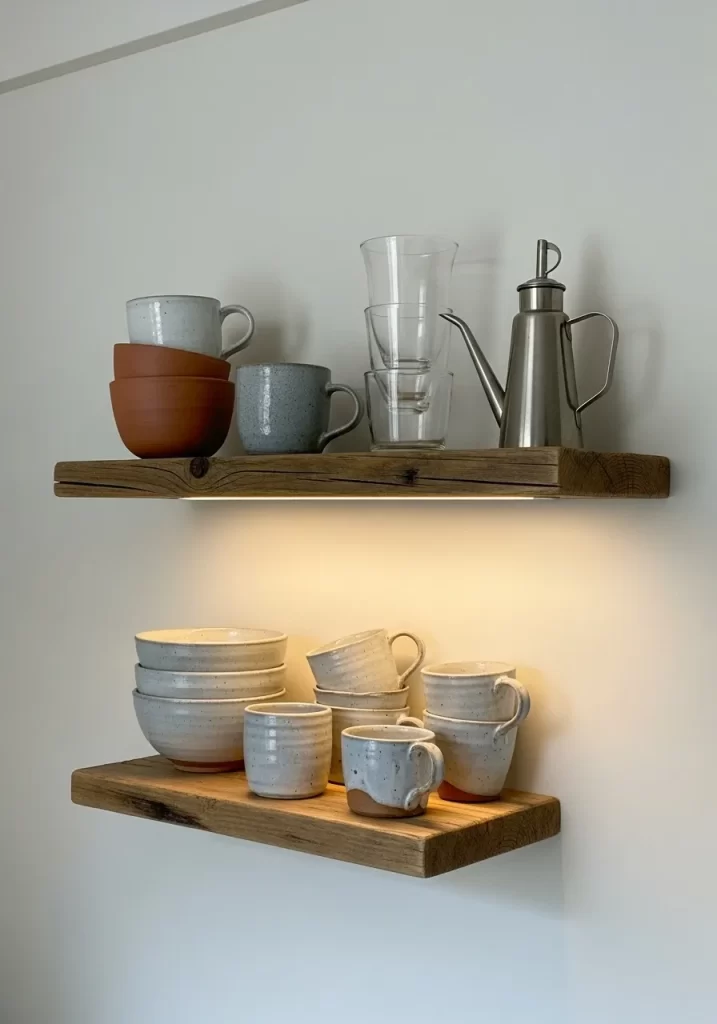
These simple wooden shelves display everyday items beautifully. The wood is thick and has a rustic, natural edge. This adds texture and warmth to the plain white wall.
The shelves hold a collection of handmade-style pottery. The mugs and bowls are in soft, earthy colors like tan, grey, and terracotta. Grouping similar items together creates a clean, organized look. An LED light strip under the top shelf highlights the items below.
DIY: Install Easy Rustic Shelves
What You Need:
- Two wooden boards (you can get “live edge” boards for this rustic look).
- Sandpaper.
- Four strong shelf brackets (simple L-shaped metal brackets).
- A drill.
- A level.
- Screws for the wall (and wall anchors).
- Small screws to attach the wood to the brackets.
Step 1: Prepare the Boards
- Sand your wooden boards. For a rustic look, just sand enough to remove splinters. Keep the rough texture.
- Wipe off the dust. You can stain them or leave them natural.
Step 2: Mark Your Wall
- Decide where you want your shelves. Hold the first bracket against the wall.
- Use your level to make sure it’s straight up and down. Mark the screw holes.
- Measure where the second bracket for that shelf will go. Mark its holes.
- Do the same for the second shelf. Make sure your two shelves are lined up.
Step 3: Attach the Brackets
- Drill holes for your wall screws. Use wall anchors if you are not drilling into a wall stud.
- Screw all four brackets tightly to the wall.
Step 4: Attach the Shelves
- Place your wooden boards on top of the brackets.
- Use your small screws to drill up from the bottom of the bracket into the wood shelf. This locks it in place.
- Now you can style your shelves with your favorite mugs.
11. Build a Skinny Hallway Table
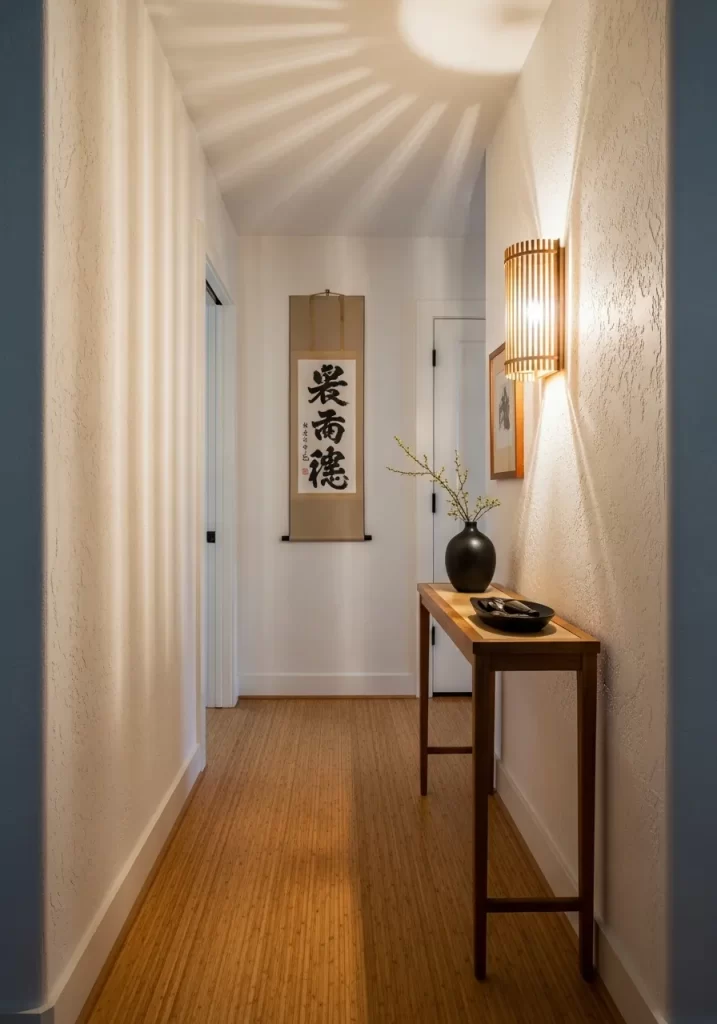
This narrow hallway feels calm and welcoming. A very thin wooden table, called a console table, stands against one wall. It provides a small surface without blocking the path.
The table holds a simple black vase and a small dish. A bamboo-style wall light and a hanging scroll add to the peaceful, Asian-inspired feel. The light wood of the table and floor keeps the small space from feeling dark.
DIY: Easy Skinny Console Table
What You Need:
- One long, skinny piece of wood for the top (like a 1-inch by 6-inch board).
- Four wooden legs (you can buy pre-made 28-inch tall table legs).
- Four “straight top plate” hardware pieces (these are flat metal plates to attach legs).
- A drill and screws.
- Sandpaper.
- Wood stain or paint.
Step 1: Prepare Your Wood
- Sand the wooden top piece until it is smooth on all sides and edges.
- Wipe away all the dust with a cloth.
- Stain or paint the top piece and let it dry completely.
Step 2: Attach the Hardware
- Turn your wooden top upside-down on the floor.
- Place one “straight top plate” in each of the four corners.
- Use your drill and screws to attach all four plates to the wood top.
Step 3: Attach the Legs
- Take your four wooden legs.
- Twist them by hand into the holes in the metal plates. Keep twisting until they are very tight.
Step 4: Place Your Table
- Turn your new table over. It will be very skinny.
- Place it against the wall in your hallway. Because it is so skinny, it is best to place it where people will not bump into it.
12. Create a Simple Meditation Corner
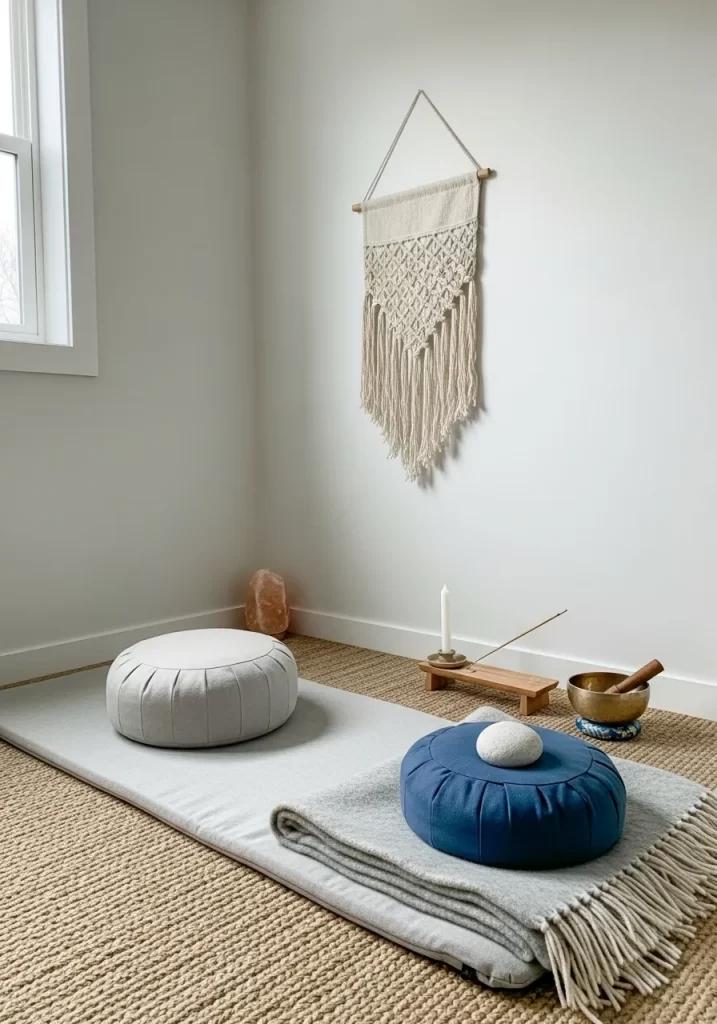
This quiet corner is set up for relaxation. A simple macrame wall hanging adds soft texture to the plain white wall. It gives the space a handmade, cozy feel.
On the floor, a mat and some round cushions (called zafus) create a comfortable spot to sit. A singing bowl, incense, and a candle are ready for a moment of peace. This space shows you only need a few simple items to make a calm retreat.
DIY: Simple Macrame Wall Hanging
What YouNeed:
- A wooden dowel or a clean, straight stick from outside (about 1-2 feet long).
- Thick cotton macrame cord or yarn.
- Scissors.
- A piece of string (for hanging).
Step 1: Cut Your Cords
- Decide how long you want your wall hanging to be.
- Cut many pieces of your cotton cord. Each piece needs to be four times as long as you want your final hanging to be. (e.g., for a 2-foot long hanging, cut 8-foot long cords). 10-20 cords is a good start.
Step 2: Attach Cords to the Stick
- Take one piece of cord. Fold it in half to make a loop at one end.
- Place the loop under your stick.
- Pull the two long ends of the cord over the stick and through the loop.
- Pull it tight. This is called a “Lark’s Head Knot.”
- Do this with all your cords, side by side, until the stick is full.
Step 3: Make Simple Knots (Optional)
- You can just leave the cords hanging straight down for a simple look.
- Or, you can take two cords next to each other and tie a simple knot. Do this in rows to make a pattern.
Step 4: Trim the Bottom
- Let all the cords hang straight.
- Use your scissors to trim the bottom. You can cut it straight across or in a “V” shape.
Step 5: Add a Hanger
- Cut one last piece of string.
- Tie each end to the ends of the wooden stick.
- Hang your new macrame on the wall.
13. Choose Two-Tone Kitchen Cabinets
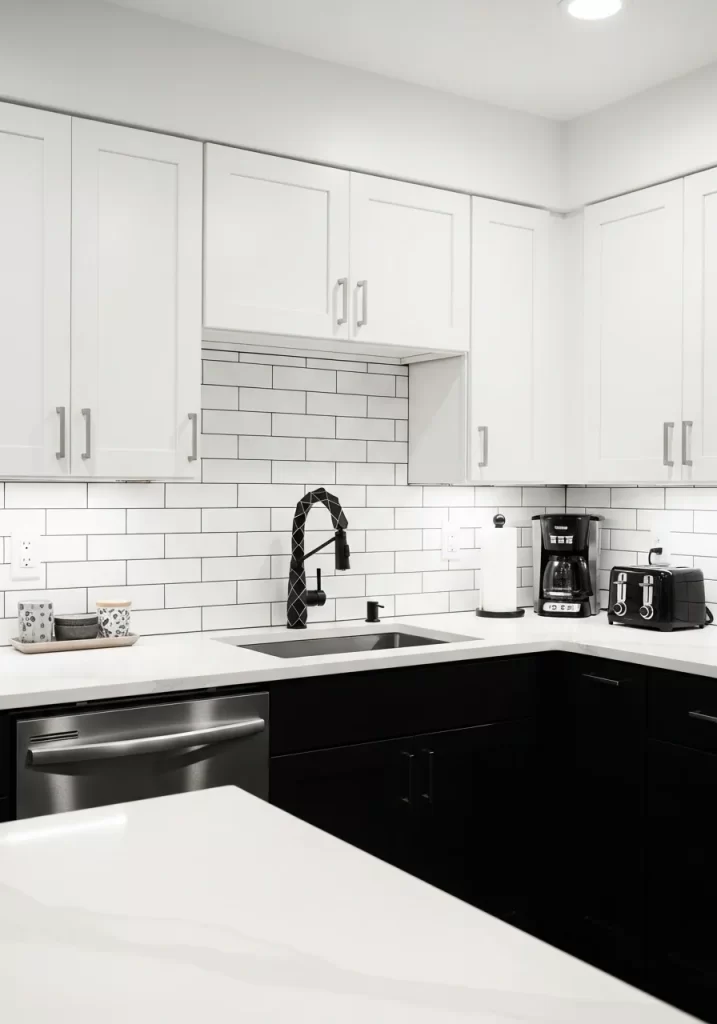
This kitchen uses a strong, simple contrast. The top cabinets are all white, which makes the room feel bright and open. The bottom cabinets are all black.
This two-tone look is modern and clean. It grounds the space. The white subway tile backsplash connects the two colors. Simple, silver bar handles on all the cabinets create a unified look.
DIY: Paint Your Cabinets Two-Tone
This is a big job, but you can do it! Here is a simple way.
What You Need:
- Sandpaper (medium grit).
- Painter’s tape.
- A good primer (ask for a “bonding primer” at the paint store).
- Paint for cabinets (one can of white, one can of black).
- Small paint rollers and brushes.
- A screwdriver.
- Cleaning cloths and spray cleaner.
Step 1: Get Ready (Prep)
- Use your screwdriver to remove all the cabinet doors and drawers.
- Take off all the handles and hinges. Put them in a plastic bag so you don’t lose them.
- Label your doors (like “under sink”) with tape so you know where they go back.
Step 2: Clean and Sand
- Wipe down all the doors, drawers, and cabinet frames with your cleaner. They must be very clean.
- Use your sandpaper to lightly sand everything. You just want to scuff up the old finish so the new paint will stick.
- Wipe all the sanding dust off with a clean, damp cloth.
Step 3: Prime Everything
- Use your brush and roller to paint a thin coat of primer on everything.
- Paint the frames, the doors, and the drawers.
- Let the primer dry completely.
Step 4: Paint Your Colors
- Paint all your top doors and top cabinet frames white.
- Paint all your bottom doors, drawers, and bottom cabinet frames black.
- Let them dry. You will need to paint a second coat. Let it dry for a long time (maybe a whole day).
Step 5: Put it Back Together
- Carefully put all the handles and hinges back on.
- Use your screwdriver to hang the doors back in their original spots.
14. Hang Clustered Glass Pendants
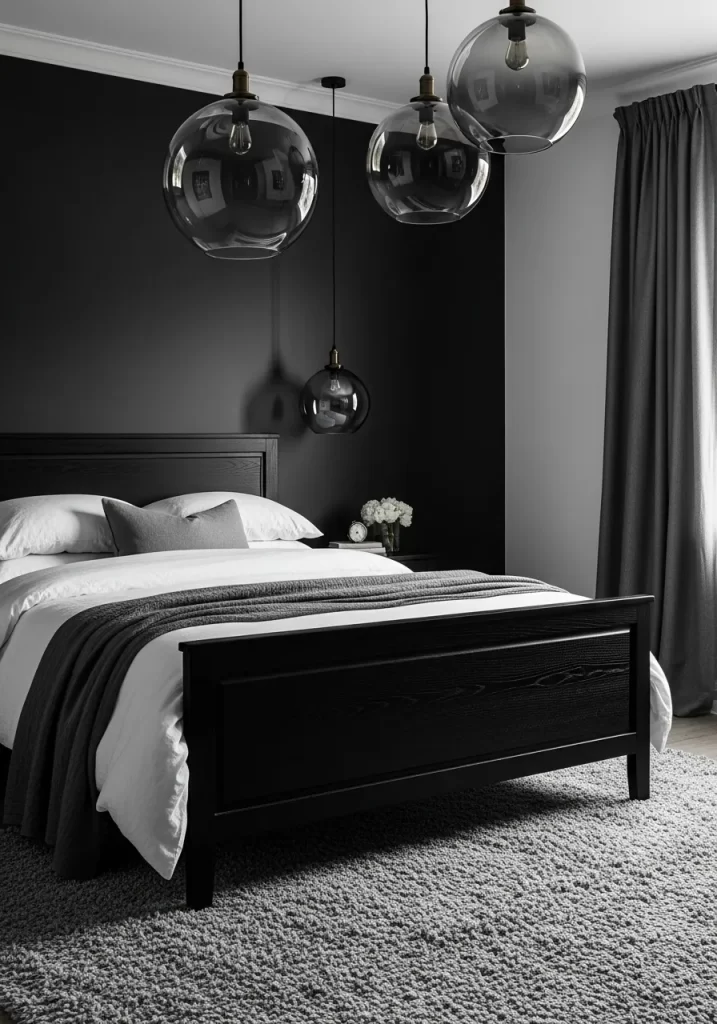
This bedroom uses dark, bold colors. A black accent wall and a black bed frame create a cozy space. To add light, a cluster of glass globe pendants hangs from the ceiling.
These clear glass lights feel airy. They don’t block the view. Grouping them at different heights makes an interesting focal point. The exposed bulbs inside add a simple, industrial touch.
DIY: Clustered Pendant Lights
What You Need:
- Three plug-in pendant light cord kits (the kind with a socket on one end and a plug on the other).
- Three clear glass shades (you can buy these separately).
- Three “Edison” style light bulbs (the ones that look old).
- Three ceiling hooks.
Step 1: Assemble Your Lights
- Take your first light cord. Attach the glass shade to the socket end (most shades have screws to tighten).
- Screw in one of your Edison bulbs.
- Do this for all three lights.
Step 2: Plan Your Cluster
- Decide where you want your lights to hang (over a corner or bed).
- Hold them up at different heights until you like how they look as a group. One high, one medium, one low is a good pattern.
Step 3: Install the Hooks
- Ask an adult to help you screw the three ceiling hooks into the ceiling.
- Place them close together in a small triangle shape.
Step 4: Hang the Lights
- Drape the cord of your longest (lowest-hanging) light over one hook.
- Drape the medium light over the second hook.
- Drape the shortest (highest-hanging) light over the third hook.
- Plug the cords into the wall. You can tape the three cords together and run them down the wall as one.
15. Use Sculptural Black Vases
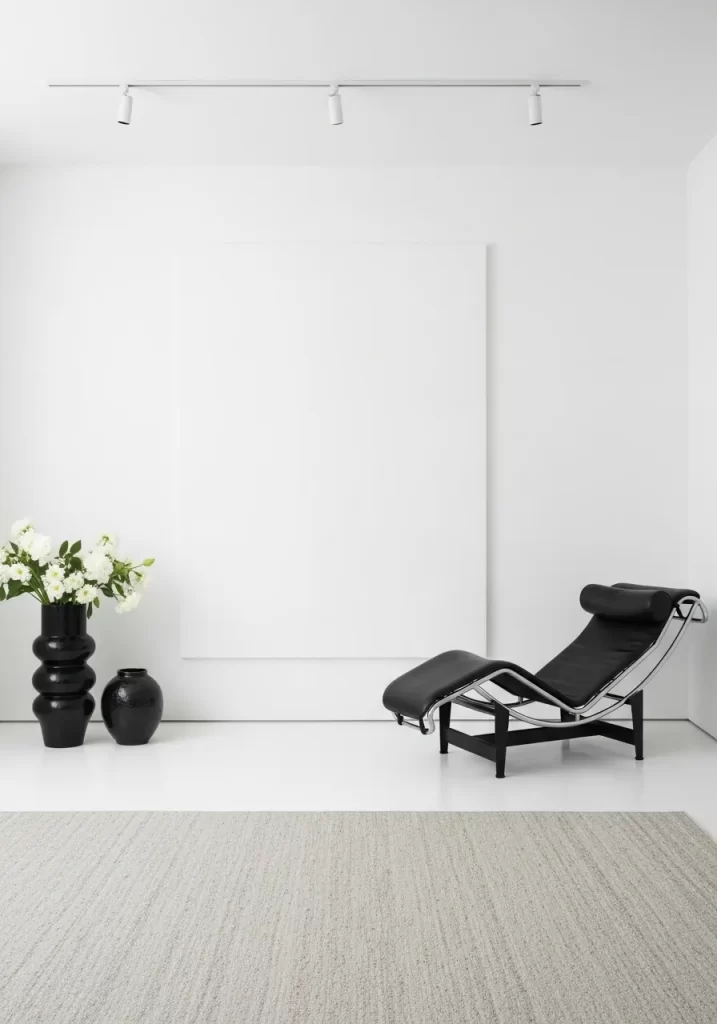
This room is extremely simple. The walls are all white. The only furniture is a black and chrome lounge chair and a simple grey rug.
What makes the room feel designed are the two large, black vases. Their interesting, curvy shapes look like art sculptures. They add a strong visual element to the empty space. A few white flowers provide a soft contrast.
DIY: Matte Black “Sculptural” Vases
What You Need:
- Old vases, bottles, or jars from a thrift store. Look for interesting shapes.
- A can of matte black spray paint (one that works on glass/ceramic).
- Newspaper or a drop cloth.
- Baking soda (optional).
- Craft paint (optional).
Step 1: Clean Your Vases
- Wash your old vases with soap and water.
- Make sure they are completely dry.
Step 2: Create a “Clay” Texture (Optional)
- If you want your vases to look less like glass and more like clay, here is a trick.
- Pour some craft paint (any color) into a bowl.
- Mix in spoonfuls of baking soda until the paint is thick and gritty, like frosting.
- Use a paintbrush to dab this thick paint all over your vase. Let it dry. This will give it a rough, handmade texture.
Step 3: Spray Paint
- Go outside or to a very well-ventilated area.
- Spread out your newspaper.
- Place your vases on the newspaper.
- Hold the spray paint can about 1 foot away. Spray in light, even strokes.
- Let it dry for 30 minutes, then spray a second coat.
- Let them dry completely.
16. Set Up a Ladder Desk
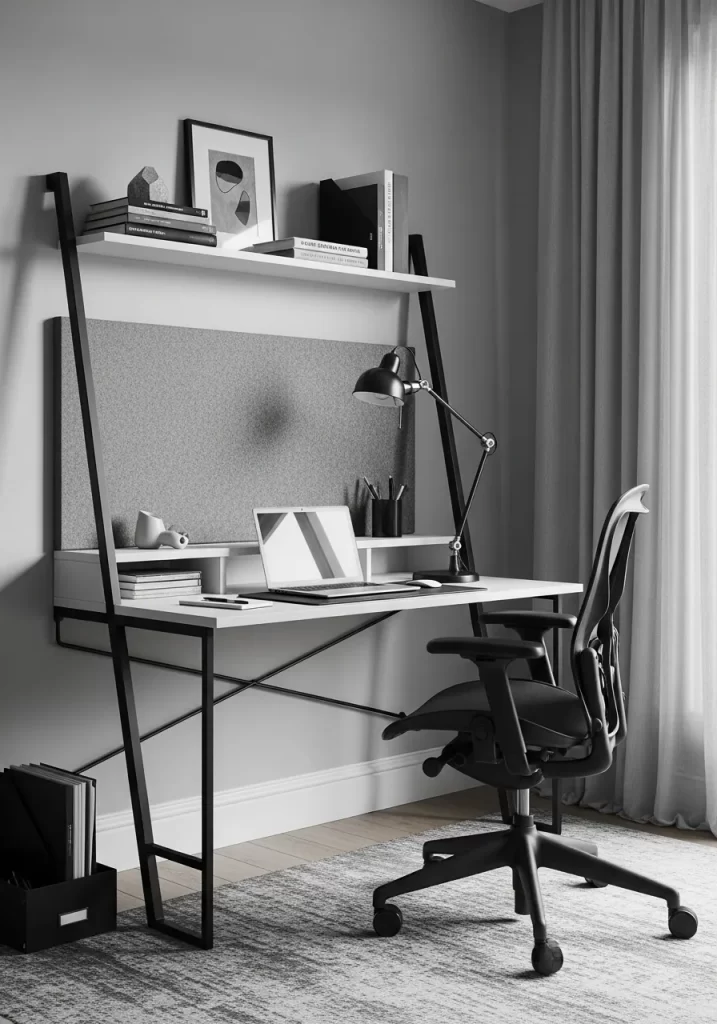
This home office is smart and efficient. It uses a “ladder desk,” which leans against the wall. This design combines a desk and shelves into one piece of furniture.
It takes up very little floor space. The design is open and airy. A grey pinboard is attached to the wall for notes. The simple black and white color scheme keeps the workspace feeling calm and focused.
DIY: Simple Leaning Ladder Shelf
A ladder desk is complex. Here is how to make a simple ladder shelf.
What You Need:
- Two long wood boards for the sides (like 1-inch by 3-inch boards, 6 feet long).
- Three smaller wood boards for the shelves (like 1-inch by 6-inch boards).
- Cut the shelves: one 2 feet long, one 1.5 feet long, one 1 foot long.
- A drill and screws.
- Sandpaper.
- Paint (optional).
Step 1: Prepare Your Wood
- Sand all your wood pieces until they are smooth.
- Wipe off the dust.
- You can paint or stain all the pieces now and let them dry.
Step 2: Mark the Side Pieces
- Lay your two long side pieces on the ground, parallel to each other.
- You want the shelves to be spaced out.
- Use a tape measure. Make a mark at 2 feet from the bottom, 3.5 feet, and 5 feet on both side pieces.
Step 3: Attach the Shelves
- Place the longest shelf (2 feet) at your bottom marks (2 feet).
- Drill through the outside of the long side piece into the edge of the shelf. Put two screws on each side.
- Place the medium shelf (1.5 feet) at your middle marks (3.5 feet). Screw it in.
- Place the shortest shelf (1 foot) at your top marks (5 feet). Screw it in.
Step 4: Lean It
- Carefully stand your new shelf up.
- Lean it against the wall. The bottom will stick out, and the top will rest on the wall. For safety, it is good to put one “L-bracket” at the top to secure it to the wall.
17. Install Sleek Picture Ledges
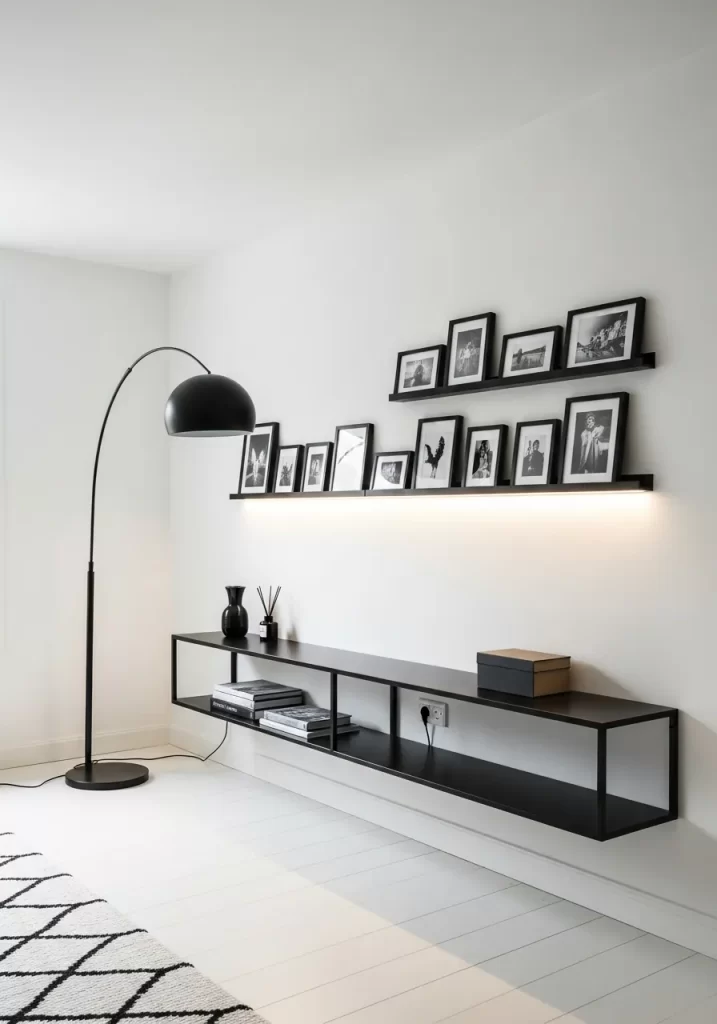
This room uses simple black lines to create a gallery wall. Two long, thin picture ledges are hung on the wall.
This is an easy way to display art. You can lean the frames on the ledge instead of hanging each one. It lets you change and rearrange your photos easily. An LED light strip under the top ledge washes the wall with a soft glow.
DIY: Picture Ledge with LED Light
What You Need:
- A pre-made picture ledge (you can buy these at IKEA or hardware stores).
- A drill.
- A level.
- Screws and wall anchors.
- A stick-on LED light strip (the kind that comes on a roll).
Step 1: Hang the Ledge
- Decide where you want your ledge.
- Hold it against the wall. Place your level on top to make sure it is straight.
- Mark the screw holes on the wall with a pencil.
- Drill your holes. Push in wall anchors if you need to.
- Hold the ledge back up and screw it firmly to the wall.
Step 2: Add the Light
- Take your LED light strip. Peel off the paper backing to reveal the sticky side.
- Carefully press the light strip onto the bottom of your picture ledge, so it’s hidden from the front.
- Run the power cord neatly down the wall.
Step 3: Style Your Ledge
- Gather your favorite framed photos.
- Lean them on the ledge. You can overlap them slightly to create a casual, layered look.
- Turn on your light.
18. Hang a Strap-Mounted Mirror
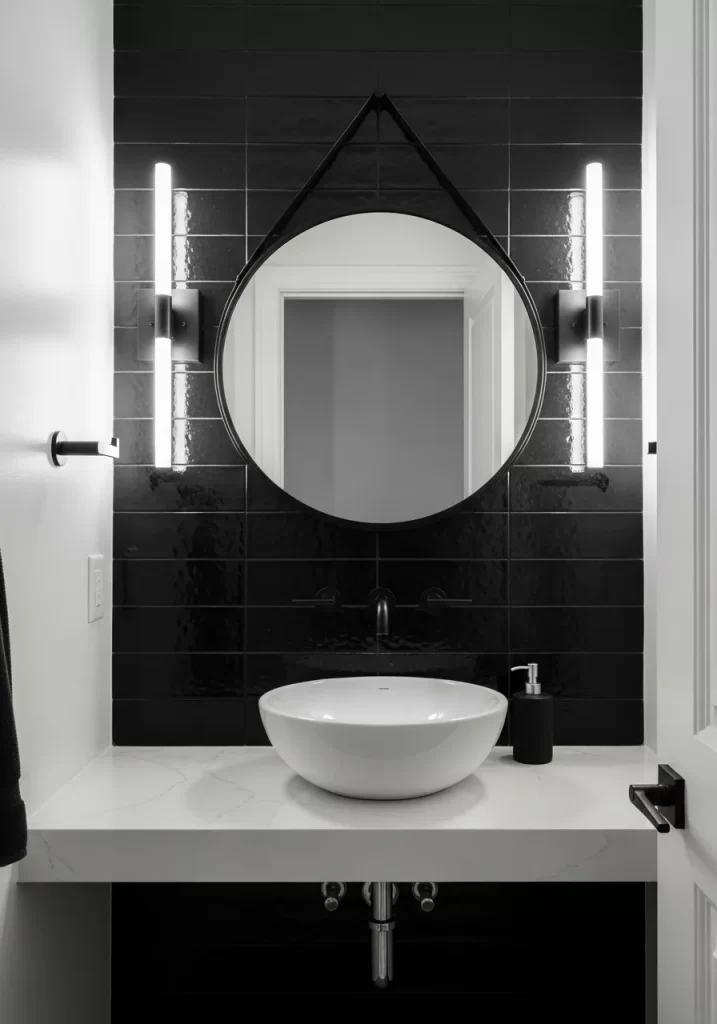
This small bathroom makes a bold statement. The wall behind the sink is covered in glossy, black rectangular tiles.
A large, round mirror hangs over the tiles. It is held up by a black leather strap, which adds a unique, modern detail. Two simple, vertical tube lights on either side light up the space. The white bowl sink and white counter pop against the dark background.
DIY: Faux-Strap Hanging Mirror
What You Need:
- A simple round mirror (one with a frame is easiest).
- A wide belt (leather or faux-leather).
- A heavy-duty wall hook (like a nice coat hook).
- Strong glue (like E-6000 or Gorilla Glue).
- Scissors or a utility knife.
Step 1: Install Your Hook
- Decide where you want the top of your mirror loop to be.
- Ask an adult to help you install the heavy-duty hook securely into the wall. Use a wall anchor.
Step 2: Prepare the Strap
- Cut the buckle off the belt. You just want the long, flat strap.
- Find the spot on your mirror’s frame where you want to attach the strap (at the top).
- Put a large amount of strong glue on the back of the mirror’s frame.
- Press the middle of your belt strap into the glue. Let it dry completely (this might take a full day).
Step 3: Hang the Mirror
- Once the glue is 100% dry, gently lift the mirror.
- Hang the mirror on the wall using its original hanging hardware (the hook on the back). The mirror should hang on its own.
- Now, take your strap, loop it, and place the loop over the decorative wall hook you installed.
- Adjust the strap so it looks like it is holding the mirror. It is just for decoration, but the effect is the same.
19. Start a Kitchen Window Herb Garden
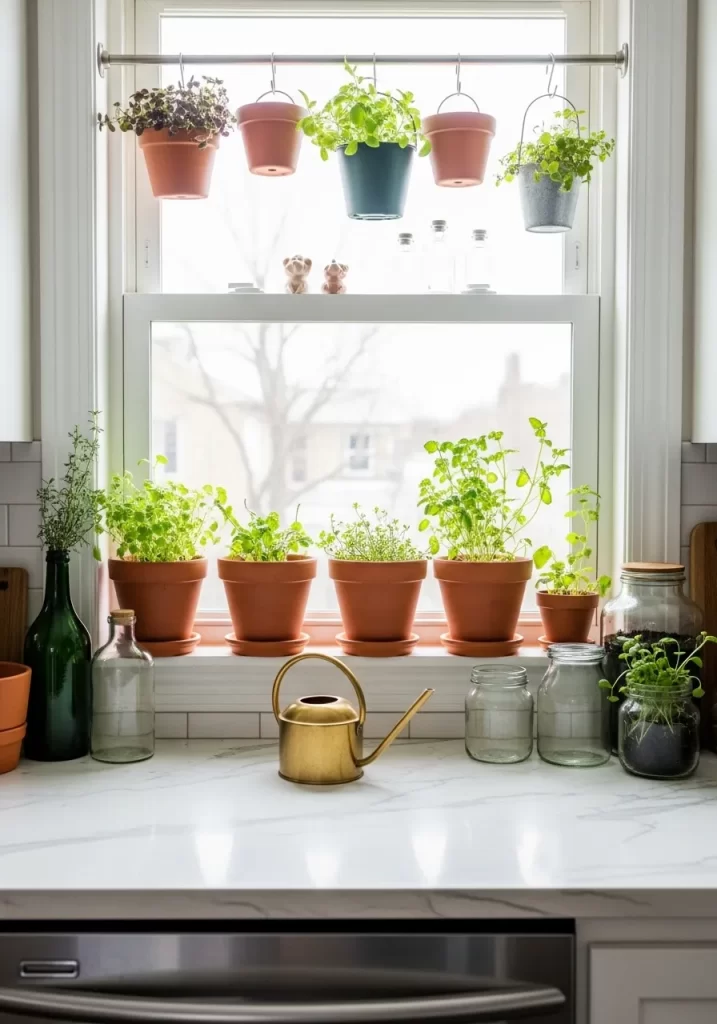
This bright kitchen window is full of life. It’s used as a vertical garden. A simple tension rod (like for a shower curtain) is placed inside the window frame.
Small pots with green herbs hang from the rod using S-hooks. On the windowsill below, more terracotta pots are lined up. This is a smart way to use a small space. It brings nature inside and gives you fresh herbs for cooking.
DIY: Easy Window Herb Garden
What You Need:
- A spring-loaded “tension rod” (it should be the right size to fit inside your window frame).
- Several small, lightweight pots (plastic or coir pots are good).
- “S-hooks” (you can find these in the kitchen or hardware section).
- A drill.
- Herb plants or seeds (like mint, basil, and parsley).
- Potting soil.
Step 1: Prepare Your Pots
- If your pots don’t have a hole for hanging, you need to make one.
- Carefully use a drill to make one small hole near the rim of each pot.
Step 2: Install the Rod
- Take your tension rod.
- Push it against one side of your window frame, squeeze it, and fit it into the other side.
- Make sure it is tight and secure.
Step 3: Plant Your Herbs
- Fill your pots with soil.
- Plant your small herb plants or seeds in the pots.
- Water them.
Step 4: Hang Your Pots
- Put one S-hook through the hole in your first pot.
- Hook the other end of the S-hook over the tension rod.
- Repeat this for all your pots. You now have a hanging garden.
20. Paint a Faux Headboard Arch
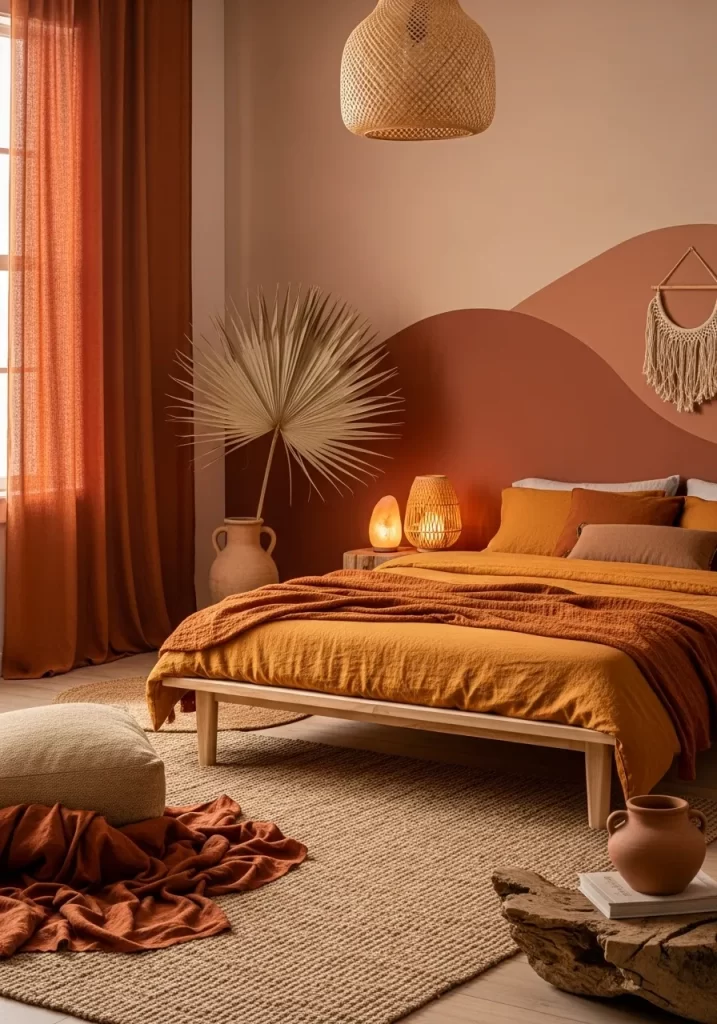
This bedroom is warm and inviting. The wall behind the bed has a large, painted arch in a warm terracotta color. This arch acts as a “faux headboard.”
It adds a soft, organic shape to the room and creates a strong focal point. The color matches the curtains and bedding. Rattan and woven lights and tables add to the earthy, bohemian feel.
DIY: Easy Painted Wall Arch
What YouNeed:
- A can of paint in the color you want your arch to be.
- A paintbrush and a small paint roller.
- Painter’s tape.
- A pencil.
- A long piece of string.
- A thumbtack or a piece of tape.
Step 1: Plan Your Arch
- Decide how wide you want your arch to be.
- Use your painter’s tape to tape two long, vertical lines for the sides of your arch. Make sure they are straight.
Step 2: Draw the Curved Top
- Find the center point between your two tape lines.
- Cut a piece of string that is half the width of your arch. (e.g., if your arch is 3 feet wide, cut a 1.5-foot string).
- Tie one end of the string to your pencil.
- Tape or tack the other end of the string to the wall, right at the top of your center line.
- Pull the string tight and move your pencil from one side to the other, drawing the top curve of your arch. The string keeps your circle shape.
Step 3: Paint Your Arch
- Use your paintbrush to carefully paint along the pencil line and the tape edges.
- Use your small roller to fill in the middle of the arch.
- Let it dry, and then paint a second coat.
Step 4: The Reveal
- Once the paint is completely dry, slowly peel off the painter’s tape.
- You will have a clean, sharp arch on your wall.
21. Hang Indoor Plants in Your Bathroom
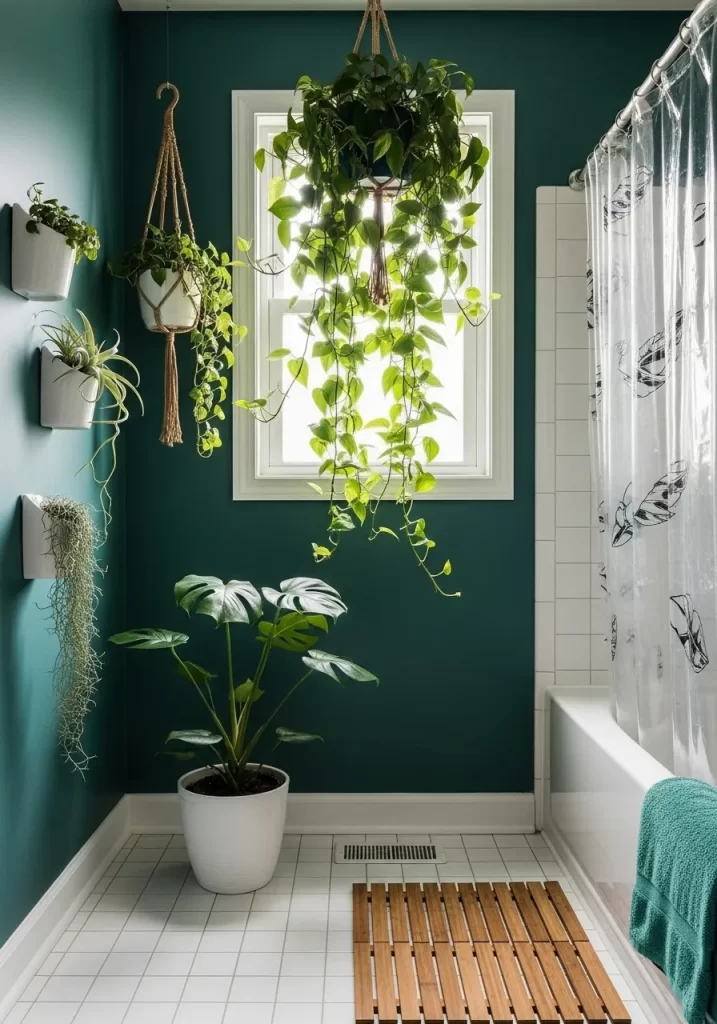
This bathroom uses a deep green wall color that feels like a forest. Many green plants hang from the ceiling or sit in wall-mounted planters. This brings a lively, fresh feeling to the room.
One large plant sits on the floor. The white pots and simple macrame hangers keep the focus on the plants. This is a lovely way to add natural elements and purify the air in your bathroom.
DIY: Simple Hanging Plant Arrangement
What You Need:
- Three small, lightweight plants (like Pothos or spider plants).
- Three simple white pots with drainage holes.
- Three S-hooks.
- Three ceiling hooks.
- Potting soil.
- A drill.
- A strong, thin rope or thick twine.
Step 1: Pot Your Plants
- Fill your pots with potting soil.
- Plant your herbs in the pots.
- Water them gently.
Step 2: Make Your Hangers
- Take one pot. Cut two pieces of rope, each about 3 feet long.
- Tie one end of the first rope to one side of the pot (near the rim).
- Tie one end of the second rope to the opposite side of the pot.
- Bring the two loose ends of the ropes together above the plant. Tie them in a strong knot. Make a loop at the top of the knot.
- Repeat for all three pots. Make each one a different length if you want.
Step 3: Install Ceiling Hooks
- Decide where you want your plants to hang in the bathroom. Ask an adult to help you screw the three ceiling hooks into the ceiling. Space them out nicely.
- Make sure you are screwing into a ceiling beam, or use a strong ceiling anchor.
Step 4: Hang Your Plants
- Attach an S-hook to the loop of each plant hanger.
- Hook the S-hook onto the ceiling hook.
- Step back and admire your green oasis!
22. Showcase a Tall Driftwood Branch
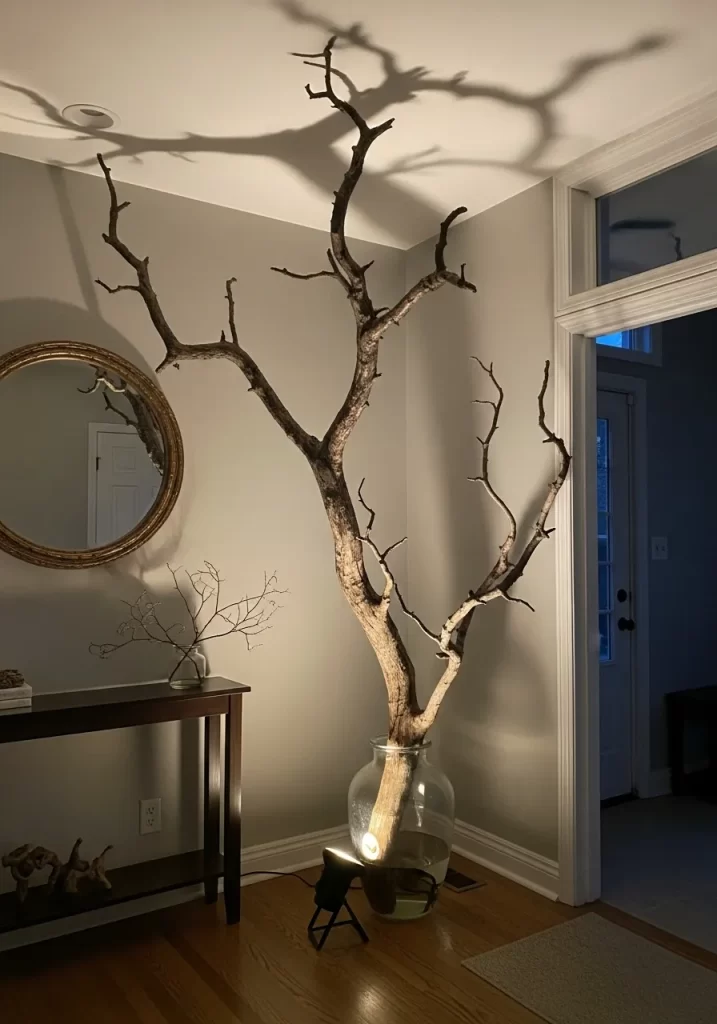
This entryway makes a bold statement with a very tall, sculptural branch. It stands in a clear glass vase, reaching high towards the ceiling.
A small spotlight on the floor shines up, making dramatic shadows on the wall. This turns a simple branch into a piece of art. It brings the raw beauty of nature indoors. A smaller branch on the console table continues the theme.
DIY: Display a Large Branch as Art
What You Need:
- A large, interesting branch found outside (make sure it’s dry and clean).
- A tall, heavy clear glass vase or jar.
- Rocks, sand, or heavy marbles (to put in the vase).
- A small spotlight or upward-facing lamp.
Step 1: Find Your Branch
- Go for a walk in nature. Look for a branch that is tall and has cool shapes.
- Make sure it is completely dry. If it is wet, let it dry for a few weeks in a garage.
- Clean any loose bark or dirt from the branch.
Step 2: Secure the Branch
- Place your heavy glass vase where you want your art piece to go.
- Carefully place the bottom of your branch into the vase.
- Pour rocks, sand, or heavy marbles around the bottom of the branch inside the vase. This will hold the branch steady so it won’t tip over.
Step 3: Add Lighting
- Place your small spotlight or lamp on the floor, pointed up at the branch.
- Turn it on, and watch the cool shadows it makes on the ceiling and walls.
23. Add a Long, Linear Pendant Light
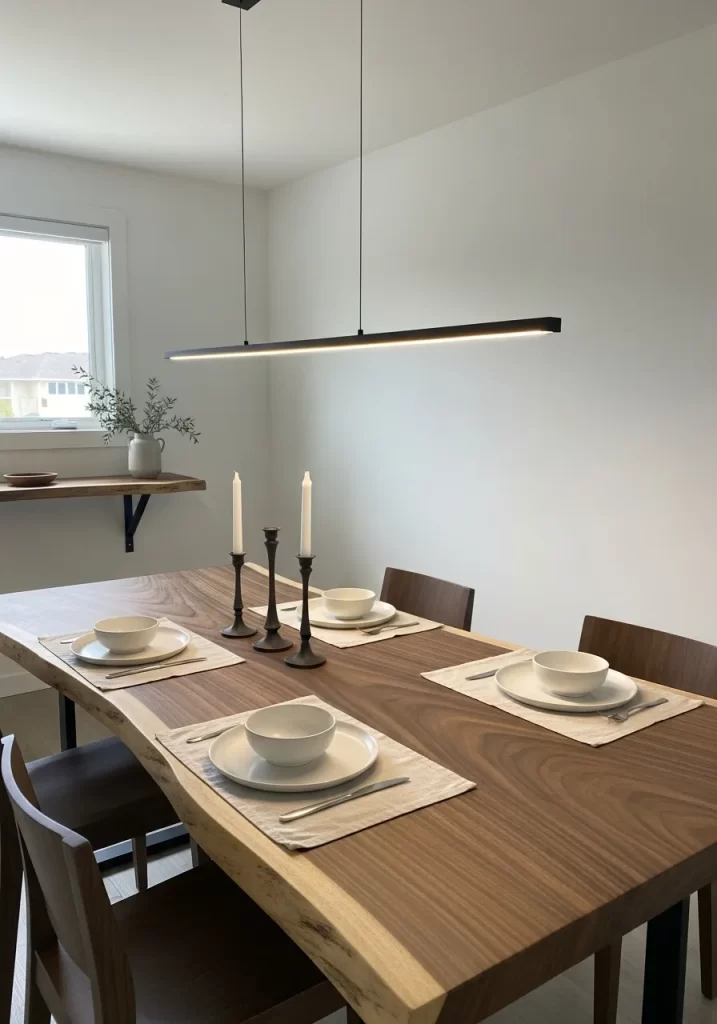
This dining room feels fresh and modern. A long, thin black light fixture hangs above the live-edge wooden table. This type of light is called a linear pendant.
It gives a lot of light across the whole table. Its simple shape matches the clean lines of the room. The black color also stands out against the white ceiling, creating a strong design element.
DIY: Faux Linear Pendant Light
Installing a real linear pendant light is a job for an electrician. Here’s how to create a similar look with plug-in lights.
What You Need:
- Two or three plug-in pendant light cord kits (the kind with a light bulb socket).
- Two or three “tube” LED light bulbs (these are long, skinny light bulbs).
- A straight, thin piece of wood or metal (like a paint stirrer, but longer and black).
- Black electrical tape.
- Two ceiling hooks.
- Command strips (the strong kind).
Step 1: Assemble Your Lights
- Screw your tube LED bulbs into the sockets of your pendant cords.
Step 2: Connect the Lights
- Lay your thin piece of wood or metal on a flat surface. This will be your “bar.”
- Use black electrical tape to tape the light cords to the “bar.” Tape them evenly spaced along the bar.
- Hide the cords by taping them along the back of the bar, leaving the light bulbs hanging down from the front.
Step 3: Hang the “Bar”
- Decide where you want your linear light to hang above your table.
- Ask an adult to help you screw two ceiling hooks into the ceiling, spaced far apart.
- Loop a piece of the light cord over each hook so the “bar” hangs straight and flat.
- You can use Command strips on the back of the “bar” to stick it to the ceiling, giving it a more “floating” look.
- Plug in the cords to an outlet. You can hide the excess cord with wall clips.
24. Create a Plant Wall Shelf
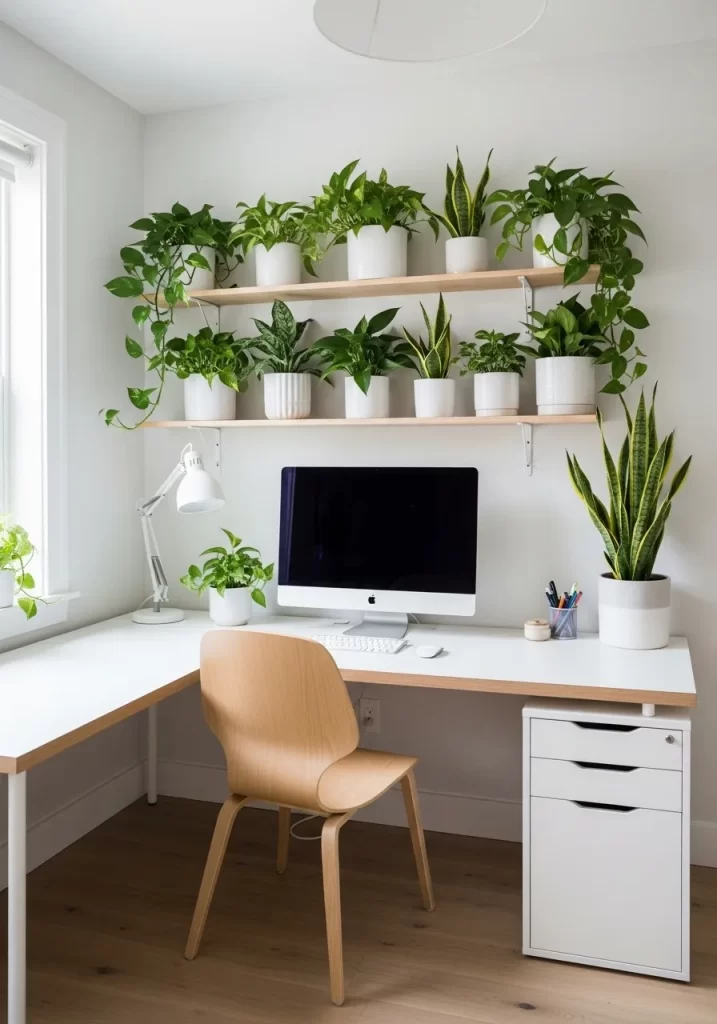
This home office is full of natural energy. Two long, wooden shelves are hung above the desk. They are completely filled with green plants in white pots.
This turns a plain wall into a living feature. The different types of plants add varied shapes and textures. It brings nature indoors, which can make you feel calmer and more focused while working.
DIY: Plant Shelf for Your Desk
What You Need:
- Two small, flat wooden shelves (you can buy these at craft stores or cut them from a board).
- Four small “L-brackets” (the metal corner pieces).
- A drill and screws.
- A level.
- Wall anchors (if you don’t hit a wall stud).
- Five to seven small plants in white pots.
Step 1: Prepare Your Shelves
- Sand your wooden shelves until smooth.
- Wipe off the dust.
- You can paint or stain them if you like.
Step 2: Mark for the First Shelf
- Decide where you want your bottom shelf to be above your desk. Hold it against the wall.
- Use your level to make sure it is straight. Make small pencil marks where the L-brackets will go.
Step 3: Install First Shelf Brackets
- Drill holes at your pencil marks. Push in wall anchors if needed.
- Screw two L-brackets securely to the wall.
- Place your wooden shelf on top of the brackets and screw it in from underneath.
Step 4: Install Second Shelf
- Measure about 1 foot above your first shelf. This is where your second shelf will go.
- Repeat steps 2 and 3 to install the second shelf above the first one. Make sure it is straight.
Step 5: Add Your Plants
- Arrange your potted plants on your new shelves. Mix up the heights and types of plants for a visually pleasing display.
25. Design with Industrial Track Lighting
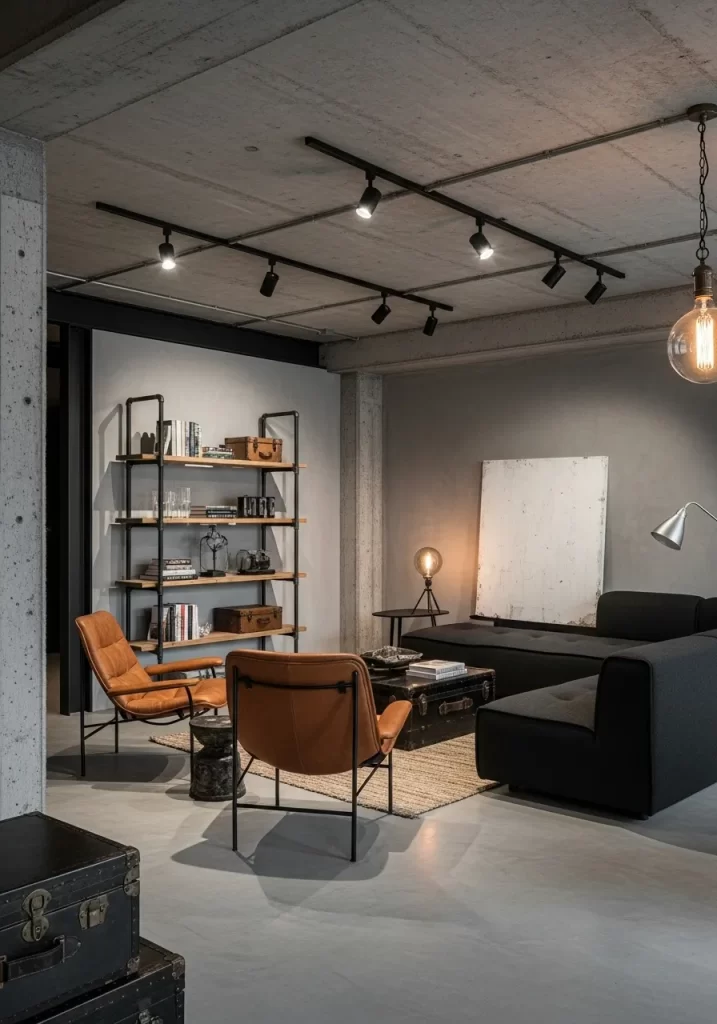
This living room has a strong, industrial feel. The ceiling is concrete, and black metal tracks with spotlights run across it. This is called track lighting.
It lets you point the lights exactly where you need them. The black tracks stand out against the grey ceiling. This type of lighting is very modern and functional, fitting the minimalist style. It keeps the space feeling open and uncluttered from hanging lights.
DIY: Industrial Style Spotlight Wall
Installing real track lighting is complex. Here’s how to get a similar look with plug-in spotlights on a wall.
What You Need:
- Three to five small, plug-in LED spotlights (look for ones with a black finish).
- Black painter’s tape or black electrical tape.
- Small “Command hooks” (the clear kind that stick to walls).
- A long power strip or extension cord (black if you can find one).
Step 1: Plan Your “Track”
- Decide on a wall where you want to create this look.
- Use black painter’s tape to make a long, straight line on the wall. This will be your “track.”
Step 2: Attach Spotlights
- Take your plug-in spotlights. Peel off any sticky backs they have (or use Command strips).
- Stick them evenly spaced along your black tape “track.”
- Point them in different directions to highlight different areas.
Step 3: Hide the Cords
- Take the power cords from your spotlights.
- Gather them together and run them down the wall, hiding them as much as you can behind the spotlight.
- Use Command hooks to hold the cords neatly along the wall and down to your power strip or outlet.
- Plug all the spotlights into the power strip.
Step 4: Turn on the Lights
- Turn on your spotlights. You’ve created a cool, industrial-style lighting effect.
26. Set Up an Industrial Kitchen System
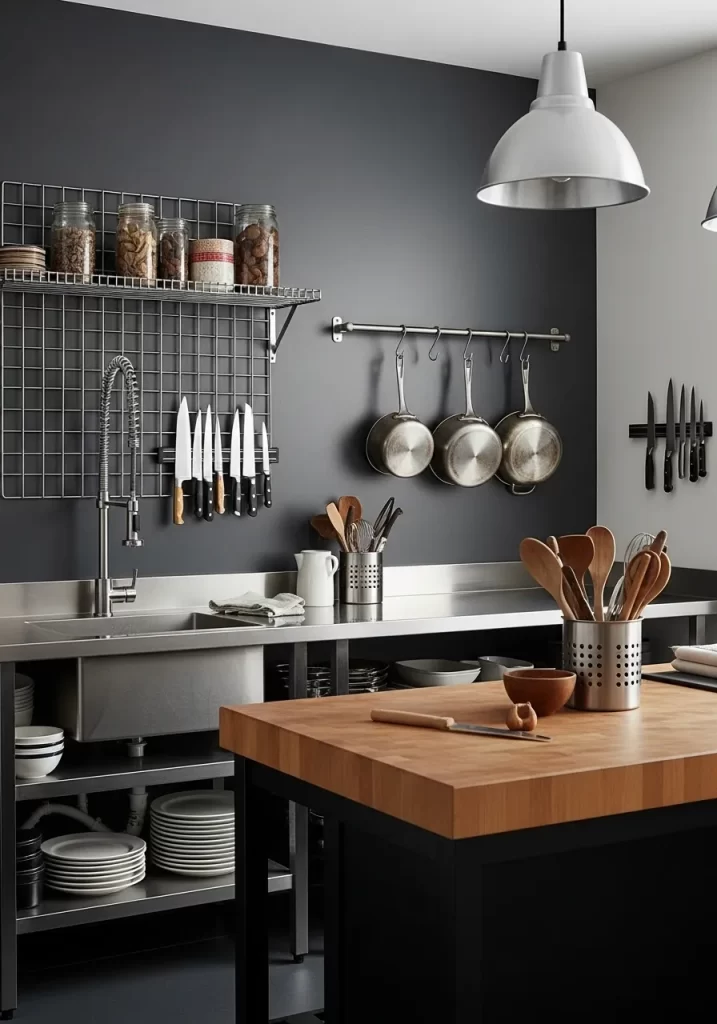
This kitchen is designed for serious cooking. It uses an industrial style, with open metal shelving and stainless-steel countertops.
Pots, pans, and knives are hung on rails. This keeps everything visible and easy to grab. It is very practical. The dark grey walls highlight the metal and wood elements. A large wooden butcher block island adds warmth to the cool metal.
DIY: Simple Hanging Utensil Rail
What You Need:
- A metal towel bar (the kind that screws into the wall).
- Two wall anchors and screws.
- A drill.
- A level.
- “S-hooks” (about 5-8 of them).
- Your favorite kitchen utensils (wooden spoons, spatulas).
Step 1: Install the Towel Bar
- Decide where you want your rail to go above your counter. Hold it against the wall.
- Use your level to make sure it is perfectly straight. Mark the screw holes with a pencil.
- Drill holes at your marks. Push in wall anchors if needed.
- Screw the towel bar securely to the wall.
Step 2: Organize Your Utensils
- Take your S-hooks.
- Hang one S-hook over the towel bar.
- Hang one kitchen utensil (like a wooden spoon) from the bottom of the S-hook.
- Repeat with all your utensils, spacing them out on the rail.
27. Embrace an Open Closet Rack
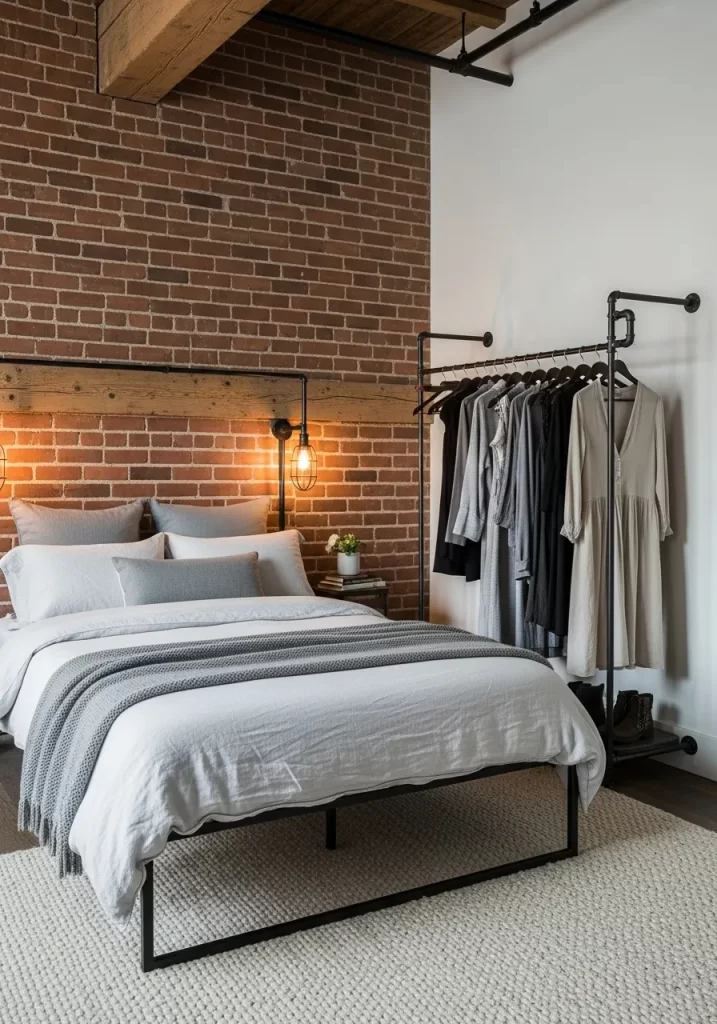
This bedroom mixes rustic brick walls with modern touches. Instead of a bulky closet, a simple black pipe rack holds clothes.
This “open closet” is very minimalist. It keeps the space feeling airy. You can see all your clothes easily. It also highlights well-chosen items. A warm wooden beam above the bed and hanging lights add a touch of industrial charm.
DIY: Simple Garment Rack
What You Need:
- Two long metal pipes for the vertical sides (about 5-6 feet tall).
- One shorter metal pipe for the top hanging bar (about 2-3 feet long).
- Four “flange” pipe fittings (these are round bases that screw into the wall).
- Four “elbow” pipe fittings (these connect pipes at a corner).
- A drill and screws.
- A stud finder.
- A level.
Step 1: Plan Your Rack
- Find two wall studs where you want your rack to go. They need to be spaced out by the length of your short pipe.
Step 2: Assemble the Sides
- Take one long pipe. Screw an elbow fitting onto the top.
- Screw a flange fitting onto the bottom.
- Repeat for the second long pipe.
Step 3: Attach to the Wall
- Hold one assembled side piece against the wall. Line up the flange with a wall stud.
- Use your level to make sure the pipe is straight up and down. Mark the screw holes for the flange.
- Drill holes into the stud (no anchors needed here!). Screw the flange securely to the wall.
- Do the same for the second side piece.
Step 4: Add the Hanging Bar
- Take your short pipe (the hanging bar).
- Screw it into the elbow fittings on both side pipes. Twist until it is tight.
- Now you have an open rack to hang your clothes.
28. Install a Geometric Stair Railing
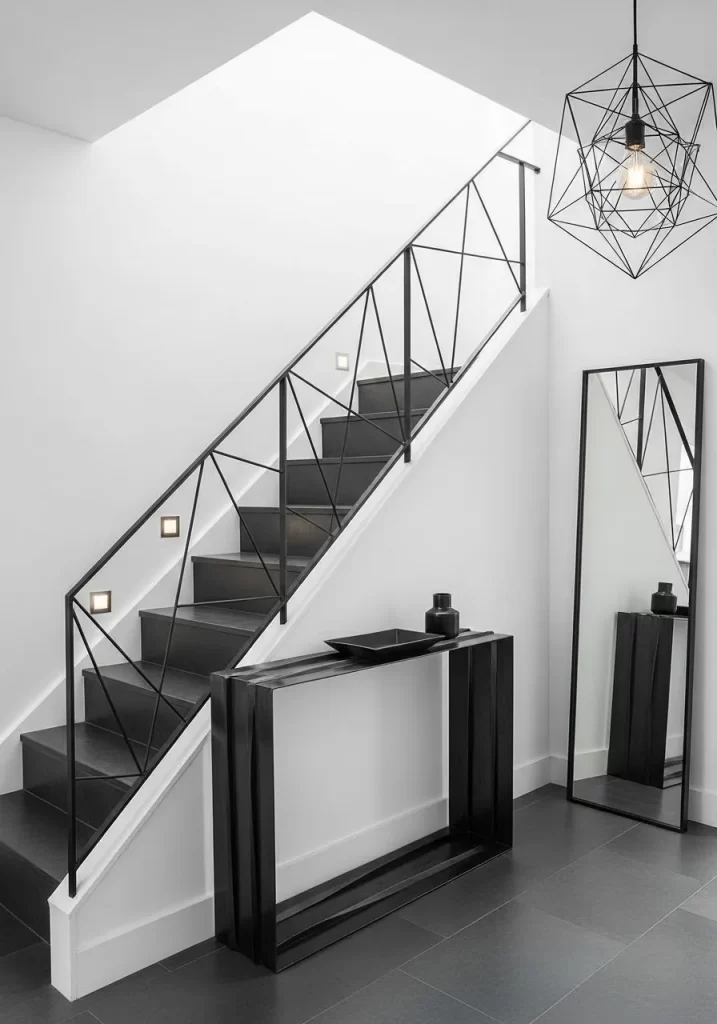
This staircase is very modern and striking. The railing is made of thin black metal lines that create a cool geometric pattern.
This design is simple yet eye-catching. It feels light and open, not heavy like a solid railing. The black lines stand out against the white walls and dark stairs. Small square lights are built into the wall. This shows how even functional items can be art.
DIY: Geometric Wall Art (Not a Railing!)
Building a safe stair railing is a job for experts. Here’s how to make a cool geometric wall art piece.
What You Need:
- Several long, thin pieces of black craft wood or metal strips.
- Strong glue (like E-6000 or construction adhesive).
- A ruler or tape measure.
- A pencil.
- A level.
- A miter box and saw (to cut angles, ask an adult for help).
Step 1: Plan Your Design
- On a piece of paper, sketch a simple geometric pattern you like. Think of triangles or zigzags.
- Decide where on your wall you want this design to go.
Step 2: Measure and Cut
- Measure the length of each line in your design.
- Carefully cut your black wood or metal strips to these lengths.
- If your design has angles, use the miter box and saw to cut angled ends on your strips so they fit together.
Step 3: Mark Your Wall
- Use your pencil and ruler to lightly draw your geometric pattern on the wall.
- Use your level to make sure your lines are straight.
Step 4: Glue the Strips
- Put a thin line of strong glue on the back of your first strip.
- Carefully press it onto the wall, lining it up with your pencil mark.
- Hold it in place for a moment.
- Repeat for all your strips, building up your geometric pattern. Let the glue dry completely.
29. Choose a Concrete Double Sink
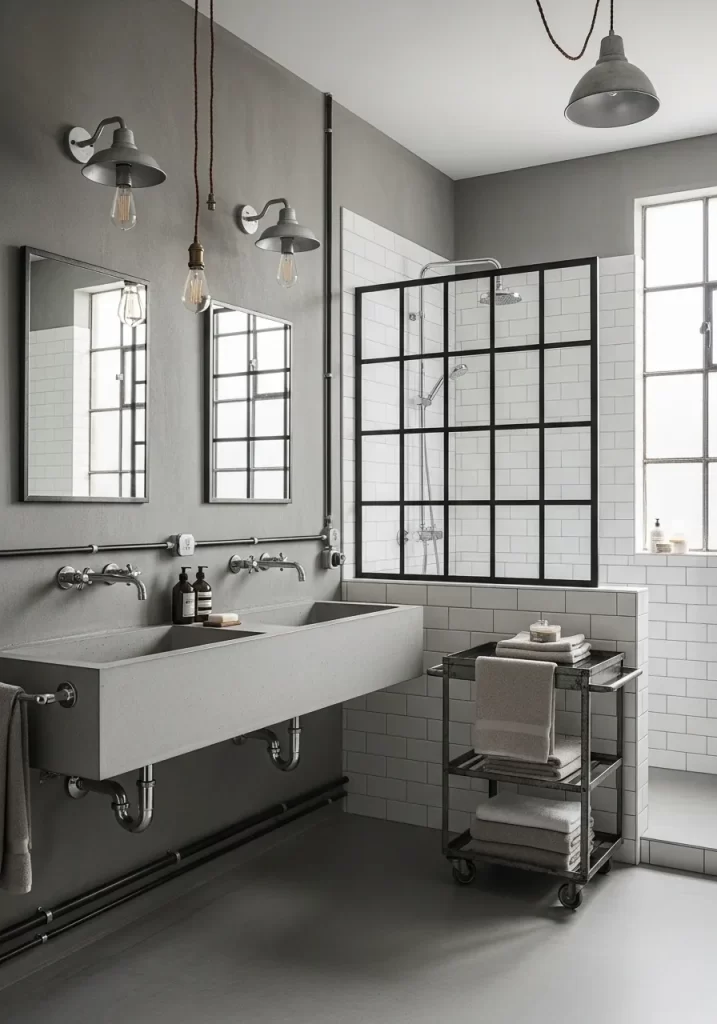
This industrial-style bathroom is very unique. It features a long, wide sink made of concrete. This double sink sits under two tall, thin mirrors.
The concrete has a raw, natural texture. It looks very strong and modern. Exposed pipes under the sink add to the industrial feel. Small, exposed bulb lights and metal sconces give off a warm glow against the grey walls.
DIY: Faux Concrete Countertop
Creating a real concrete sink is very difficult. Here’s how to make a plain countertop look like concrete.
What You Need:
- A roll of “concrete effect” contact paper (you can find this online or at craft stores).
- Scissors or a utility knife.
- A ruler or tape measure.
- A smooth, flat tool (like a credit card or a squeegee).
- A clean, flat countertop (like a bathroom or kitchen counter).
Step 1: Clean Your Countertop
- Clean your countertop very well with soap and water.
- Make sure it is completely dry and smooth.
Step 2: Measure and Cut Contact Paper
- Measure your countertop.
- Carefully cut the contact paper to fit, adding an extra inch on all sides.
Step 3: Apply the Contact Paper
- Peel off a small section of the backing paper from one edge of the contact paper.
- Carefully line up the sticky edge with the edge of your countertop.
- Press it down smoothly.
- Slowly peel off more of the backing paper, pressing the contact paper down as you go. Use your smooth tool (credit card) to push out any air bubbles.
- If you get a bubble, gently peel back a bit and re-stick.
Step 4: Trim the Edges
- Once all the contact paper is down, use your utility knife to carefully trim away any extra paper around the edges.
- You now have a countertop that looks like concrete.
30. Install Floor-to-Ceiling Shelving
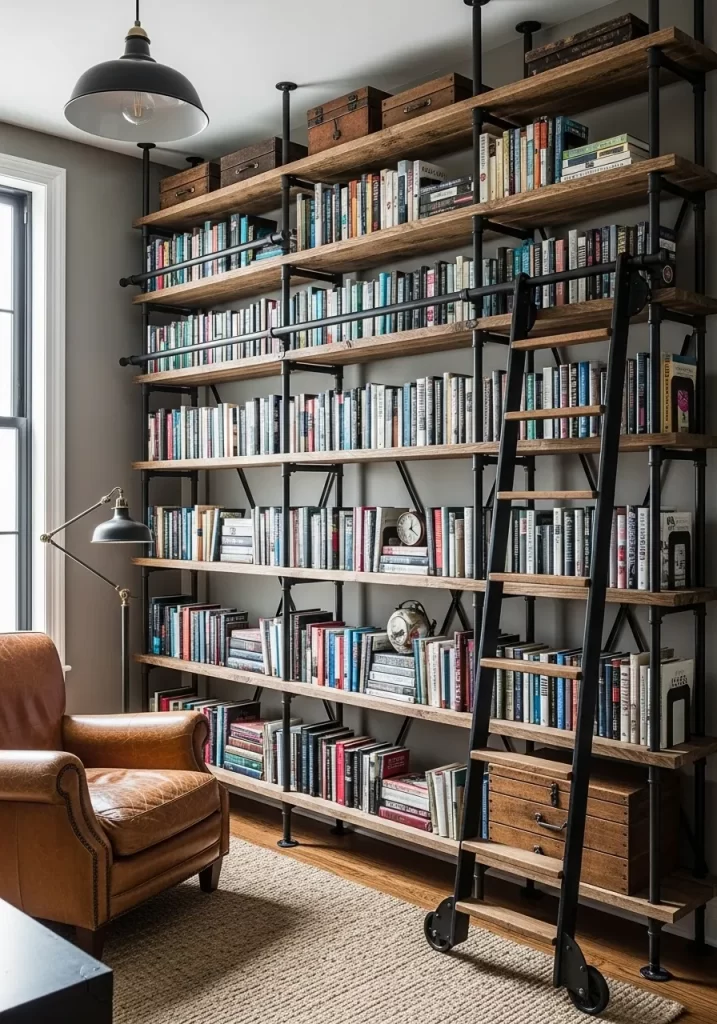
This room is a book lover’s dream! Very tall, industrial-style bookshelves cover an entire wall. They reach all the way from the floor to the ceiling.
These shelves are made of wood and black metal, giving them a strong, minimalist look. A rolling ladder helps you reach books on the top shelves. This kind of shelving is a beautiful way to display many books and keep them organized.
DIY: Simple Floor-to-Ceiling Bookshelf (without ladder)
A full floor-to-ceiling unit with a ladder is a big project. Here’s how to create a tall, simple shelf look.
What You Need:
- Four tall, thin wooden boards for the vertical supports (about 8 feet tall).
- Many shorter wooden boards for the shelves (all the same length, e.g., 3 feet long).
- Many “L-brackets” (2 for each shelf).
- A drill and screws.
- A level.
- A stud finder.
- Wood stain or paint.
Step 1: Prepare Your Wood
- Sand all your wooden boards until smooth.
- Wipe off the dust.
- Stain or paint all the pieces now and let them dry completely.
Step 2: Attach Vertical Supports
- Use your stud finder to find wall studs where you want your shelves to go.
- Hold one tall board against the wall. Use your level to make sure it’s straight.
- Drill screws through the board into the wall studs, at the top, middle, and bottom.
- Repeat for the other three tall boards, spacing them evenly across the wall.
Step 3: Attach the Shelves
- Decide how far apart you want your shelves (e.g., 1 foot apart).
- Starting from the bottom, measure up and make a small pencil mark on each vertical board for your first shelf.
- Attach two L-brackets to the wall at these marks, lining them up with two of your vertical supports.
- Place your first shelf on the brackets and screw it in from underneath.
- Repeat this for all your shelves, working your way up the wall.
- Make sure each shelf is level before screwing it down.
31. Incorporate a Pop of Primary Color
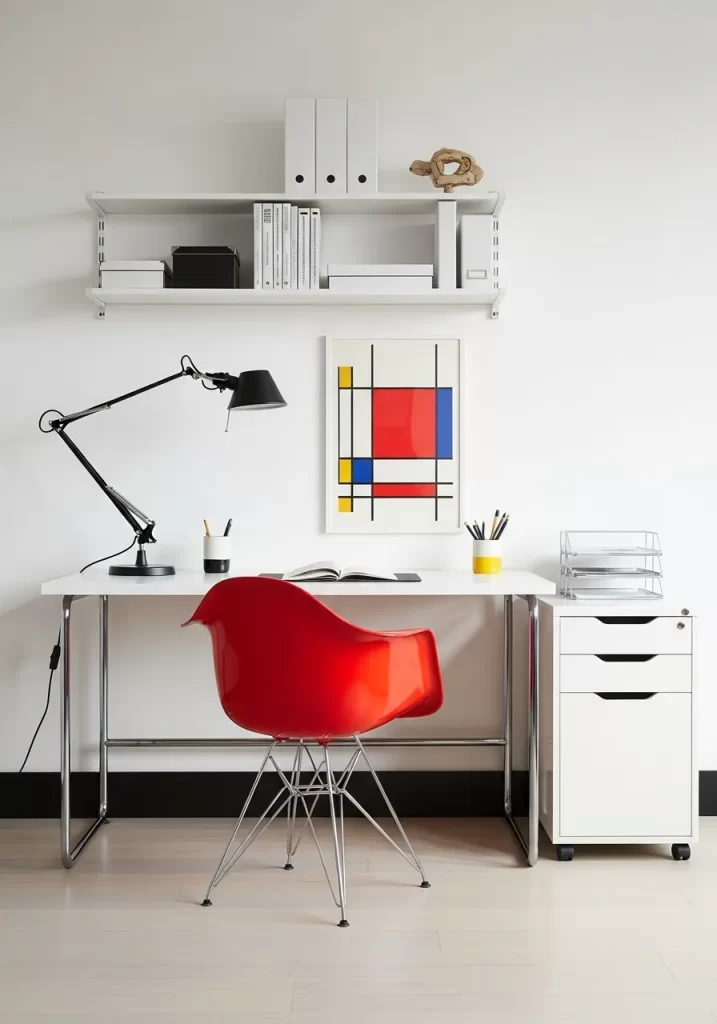
This office is bright and energetic. The room itself is mostly white. A single, bold red chair stands out as a strong color accent.
The modern abstract art on the wall also uses bright primary colors. Simple white shelves above the desk hold organized boxes and binders. This shows how a minimalist space can still be fun and lively with just one or two colorful pieces.
DIY: Paint a Chair for a Color Pop
What You Need:
- An old chair (wood or plastic works well).
- Sandpaper (medium and fine grit).
- Painter’s tape (if there are parts you don’t want to paint).
- Spray primer (for wood or plastic).
- A can of spray paint in a bright color (like red, blue, or yellow).
- Newspaper or a drop cloth.
Step 1: Clean and Sand Your Chair
- Wipe down your chair very well to remove any dirt or grease.
- Use medium sandpaper to gently sand the whole chair. This helps the new paint stick.
- Go over it with fine sandpaper to make it super smooth.
- Wipe off all the sanding dust.
Step 2: Tape (if needed)
- If your chair has parts you do not want to paint (like metal legs you want to keep silver), carefully tape them off with painter’s tape.
Step 3: Prime the Chair
- Go outside or to a very well-ventilated area.
- Spread out your newspaper or drop cloth.
- Place your chair on the newspaper.
- Spray a thin, even coat of primer all over the chair. Let it dry completely.
Step 4: Paint Your Color
- Once the primer is dry, spray thin, even coats of your bright-colored paint onto the chair.
- Let each coat dry for 30 minutes before spraying another. You might need 2-3 coats.
- Let the chair dry for a full day before sitting on it.
32. Choose Integrated Kitchen Appliances
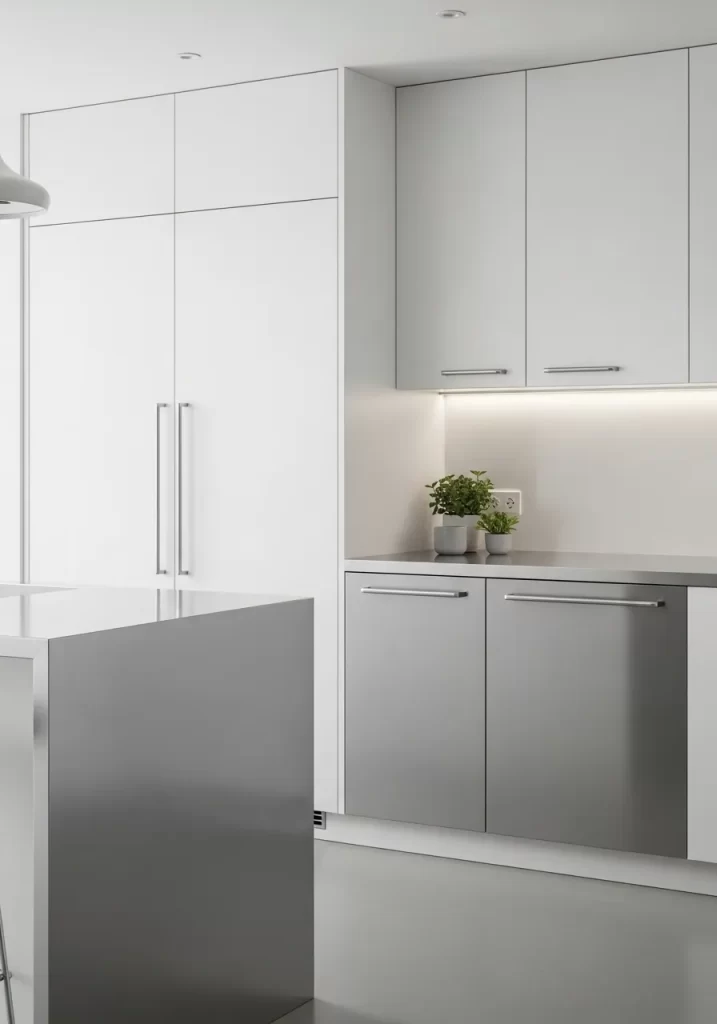
This kitchen is incredibly sleek and modern. The refrigerator and dishwasher blend right into the cabinets. They have the same white and grey fronts as the rest of the kitchen.
This creates a very smooth, unbroken look. You can barely tell where the appliances are. This “integrated” design is a hallmark of minimalism, as it reduces visual clutter. Under-cabinet lighting adds a warm glow.
DIY: Cover Your Dishwasher with Contact Paper
Changing major appliances is a big job. Here’s a simple way to make a stainless-steel dishwasher blend in more.
What You Need:
- A roll of “brushed steel” or “stainless steel effect” contact paper.
- Scissors or a utility knife.
- A ruler or tape measure.
- A smooth, flat tool (like a credit card or a squeegee).
- A clean dishwasher front.
Step 1: Clean Your Dishwasher
- Wipe down the front of your dishwasher very well with a cleaner.
- Make sure it is completely dry and smooth.
Step 2: Measure and Cut Contact Paper
- Measure the front panel of your dishwasher.
- Carefully cut the contact paper to fit, adding an extra inch on all sides.
Step 3: Apply the Contact Paper
- Peel off a small section of the backing paper from one edge of the contact paper.
- Carefully line up the sticky edge with the top edge of your dishwasher.
- Press it down smoothly.
- Slowly peel off more of the backing paper, pressing the contact paper down as you go. Use your smooth tool (credit card) to push out any air bubbles.
- If you get a bubble, gently peel back a bit and re-stick.
Step 4: Trim the Edges
- Once all the contact paper is down, use your utility knife to carefully trim away any extra paper around the edges.
- Be extra careful around the handle. You now have a dishwasher that looks like stainless steel.
33. Arrange Modular Wall Shelving
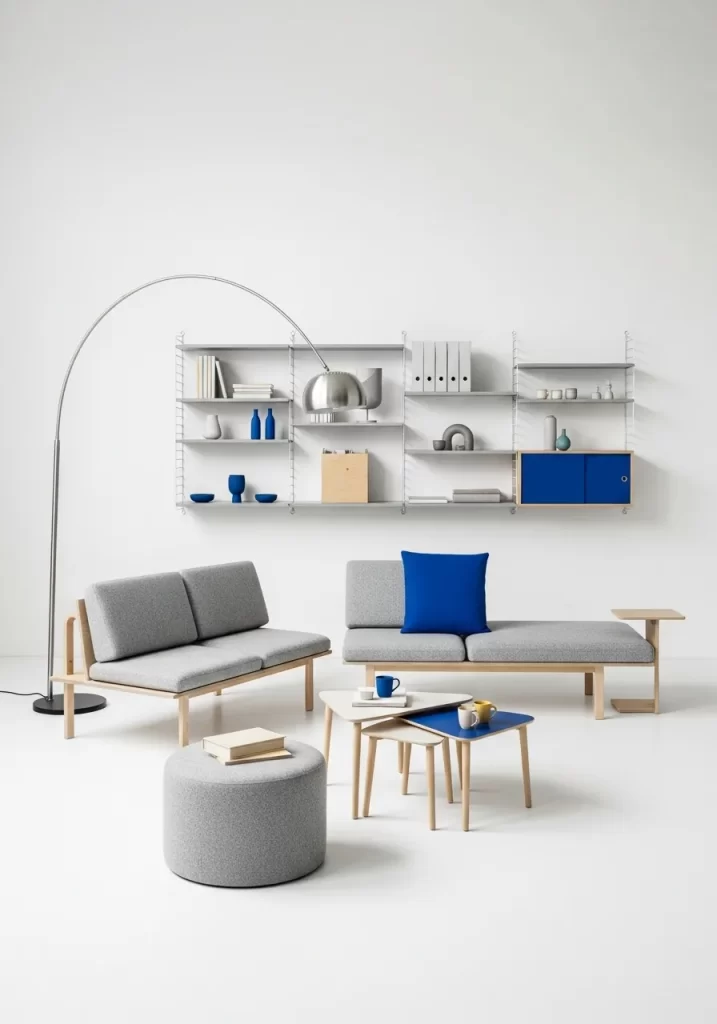
This living room uses a “modular” shelving system on the wall. This means it’s made of smaller pieces that you can arrange in different ways.
These shelves are light and airy, not heavy. They provide lots of space for books and decorative items without making the room feel cluttered. A bright blue cabinet adds a pop of color, making the white wall more interesting.
DIY: Simple “Modular” Cube Shelves
Building a complex modular system is hard. Here is how to create a simple modular look with cube shelves.
What You Need:
- Three to five lightweight square or rectangular cube shelves (you can buy these at most stores).
- A drill and screws.
- A level.
- Wall anchors (if needed).
- Your favorite books and decorations.
Step 1: Plan Your Layout
- Lay your cube shelves on the floor. Arrange them in a pattern you like.
- You can line them up, stack them, or make a staggered design. Take a picture of your favorite arrangement.
Step 2: Install First Shelf
- Hold your first cube shelf against the wall where you want it. Use your level to make sure it’s straight.
- Mark the screw holes on the wall.
- Drill holes and push in wall anchors if you can’t hit a wall stud.
- Screw the first shelf securely to the wall.
Step 3: Install Remaining Shelves
- Now, use your picture and your ruler to measure the distance between your first shelf and where the next one goes.
- Install each remaining shelf one by one, making sure they are level and spaced correctly.
- Step back often to check your design.
Step 4: Style Your Shelves
- Once all the shelves are up, arrange your books and small decorations. Keep it simple and uncluttered for a minimalist look.
34. Choose Floating Glass Nightstands
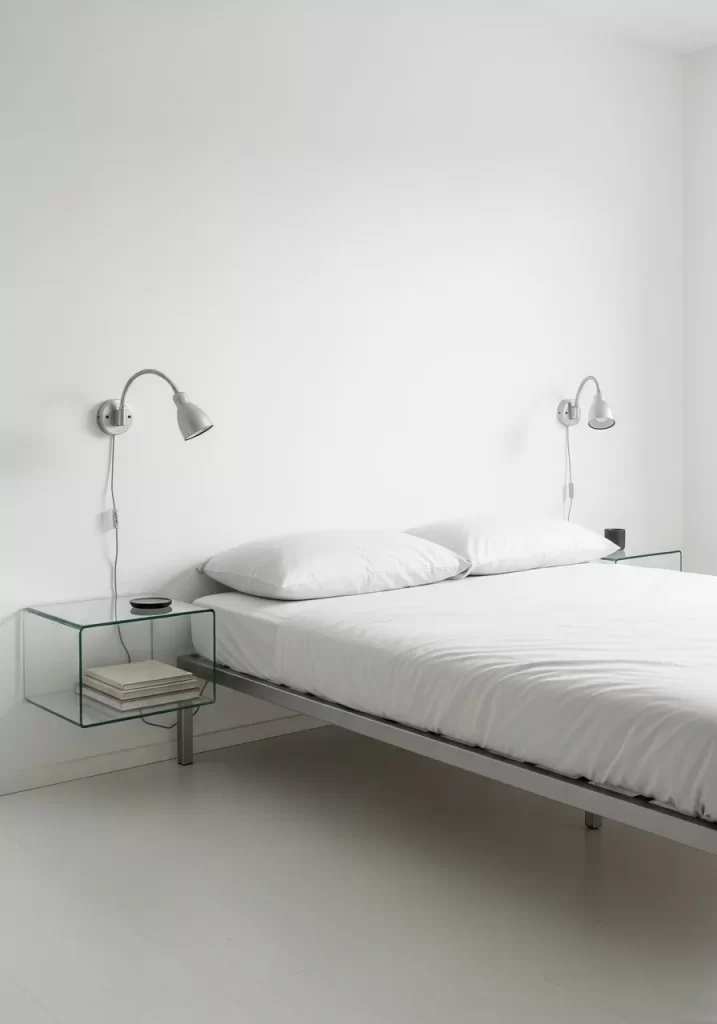
This bedroom is very simple and serene. The walls and bedding are all white. Two small glass tables float next to the bed.
These nightstands appear to be made of clear glass. They do not block any light or take up much visual space. This makes the room feel very open and bright. Wall-mounted lamps keep the surfaces clear.
DIY: Faux Floating Glass Shelf Nightstand
Glass furniture is special. Here is how to make a shelf look like floating glass.
What You Need:
- A clear acrylic shelf (you can buy these, or use a clear plastic cutting board).
- Two small, clear acrylic brackets (these are almost invisible).
- A drill and screws.
- A level.
- Wall anchors (if needed).
- Command strips (the clear kind).
Step 1: Clean Your Shelf
- Wipe your acrylic shelf clean.
Step 2: Install Brackets
- Decide where you want your shelf. Hold one clear acrylic bracket against the wall.
- Use your level to make sure it’s straight. Mark the screw holes.
- Drill holes and push in wall anchors if needed.
- Screw the first bracket securely to the wall. Repeat for the second bracket, making sure they are spaced correctly for your shelf.
Step 3: Attach the Shelf
- Place your clear acrylic shelf on top of the two clear brackets.
- You can use clear Command strips or a small dab of clear construction adhesive to secure the shelf to the brackets so it won’t slide off.
- Let any glue dry completely.
35. Create an Accent Wall Decal
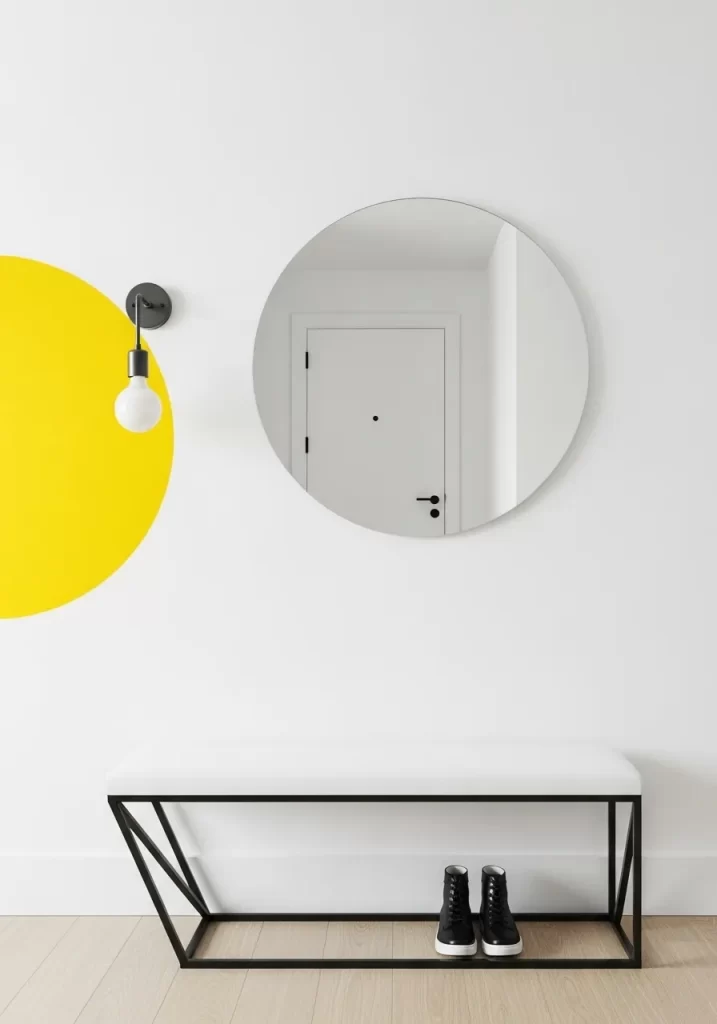
This entryway is bright and inviting. A bold yellow circle is painted or applied as a decal on the wall. This adds a fun, modern touch.
A simple black wall light hangs in front of it. A round mirror hangs nearby, reflecting the light. A white bench with a black frame provides a spot to sit. The yellow circle brings color without being overwhelming.
DIY: Easy Wall Circle Decal
What You Need:
- A large roll of removable wall decal paper in a bright color (like yellow).
- A large compass (you can make one with string).
- A pencil.
- Scissors or a utility knife.
- A smooth, flat tool (like a credit card).
Step 1: Draw Your Circle
- Decide how big you want your circle.
- On the back of your decal paper, draw a large circle.
- To make a compass: Tie a string to a pencil. Tape the other end of the string to the center of your decal paper. Make the string as long as half the width of your circle. Hold the string tight and draw your circle with the pencil.
Step 2: Cut Your Circle
- Carefully cut out your circle using scissors or a utility knife.
Step 3: Apply the Decal
- Clean the wall where you want the circle to go. Make sure it’s dry.
- Peel off a small section of the backing paper from your decal circle.
- Carefully line up the sticky edge with the wall.
- Slowly peel off more of the backing, pressing the decal onto the wall with your smooth tool. Push out any air bubbles as you go.
Step 4: Enjoy Your Accent
- Step back and admire your new, colorful wall accent.
36. Set Up a Montessori Kids’ Room
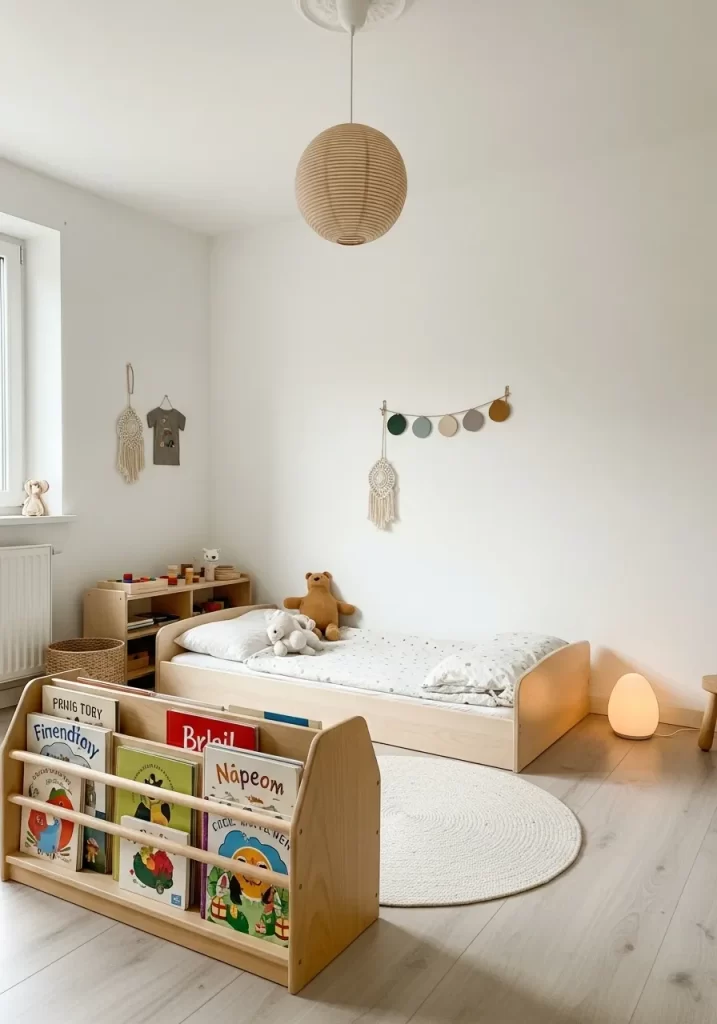
This child’s room is simple and focused on play. The bed is low to the ground. A wooden bookshelf facing forward displays book covers, making them easy for a child to choose.
The room is very light and bright, with white walls and natural wood furniture. A round rug and a few soft toys make it cozy. This style of room helps children explore and play independently.
DIY: Front-Facing Bookshelf
What You Need:
- A thin wooden board for the back (about 3 feet tall, 2 feet wide).
- Three thin wooden boards for the shelves (about 2 feet long).
- Three very thin wooden strips for the “lips” of the shelves (about 2 feet long).
- Small nails or screws.
- Wood glue.
- Sandpaper.
Step 1: Prepare Your Wood
- Sand all your wood pieces until they are smooth.
- Wipe off the dust.
Step 2: Attach the Shelves
- Lay your large backboard flat on the floor.
- Decide where you want your shelves to be (e.g., 1 foot apart).
- Put wood glue on the back edge of your first shelf board.
- Carefully place it on the backboard at your mark. Nail or screw it into place from the back.
- Repeat for the other two shelves.
Step 3: Add the “Lips”
- Take one thin wooden strip. This will be the “lip” that holds the books on the shelf.
- Put wood glue on the back of the strip.
- Place it on the front edge of your first shelf board. Nail or screw it into place.
- Repeat for the other two shelves.
Step 4: Finish and Fill
- Let all the glue dry completely.
- You can paint or stain your bookshelf if you like.
- Once dry, stand it up and fill it with your child’s books, facing forward.
37. Hang Sheer White Curtains
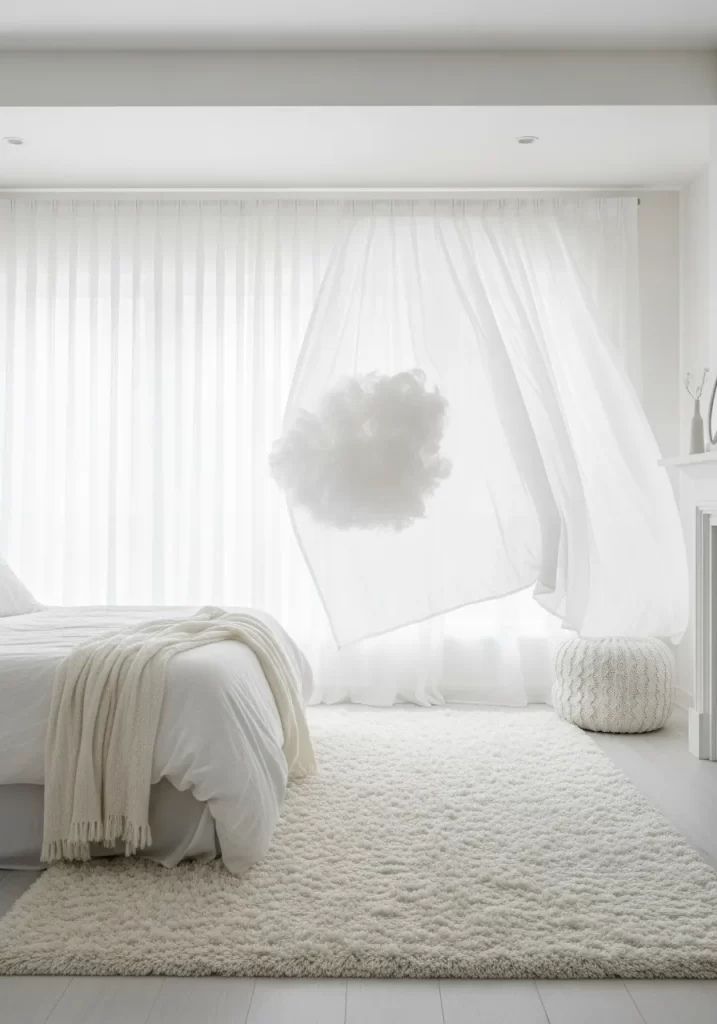
This bedroom feels dreamy and airy. White, flowing curtains hang across a wide window. They are sheer, meaning you can see a little bit through them.
These curtains soften the light coming into the room. They billow gently, adding movement to the space. The all-white color scheme creates a peaceful and calming atmosphere. A fluffy cloud decoration hangs in the window, adding a whimsical touch.
DIY: Simple Sheer Curtains
What You Need:
- Two long pieces of sheer white fabric (like voile or organza).
- A tension rod (the kind that fits inside your window frame).
- A sewing machine or fabric glue.
- Scissors and measuring tape.
- Iron (optional).
Step 1: Measure Your Window
- Measure the width of your window. Your fabric pieces should be at least 1.5 to 2 times wider than your window for a nice gathered look.
- Measure the height of your window. Add about 6 inches to this for hems.
Step 2: Prepare Your Fabric
- If your fabric is wrinkled, iron it smooth.
- Cut your two pieces of sheer fabric to your measured sizes.
Step 3: Hem the Edges
- Fold over each edge of your fabric by about 1 inch. Press it down.
- Fold it over again by another 1 inch. This hides the raw edge.
- Sew or use fabric glue to secure the hems on the two side edges and the bottom edge of both curtain panels.
Step 4: Create the Rod Pocket
- At the top of each curtain panel, fold over the fabric by about 2-3 inches. Press it.
- Sew or glue this down to create a “pocket” for the tension rod. Make sure the pocket is wide enough for your rod to slide through.
Step 5: Hang Your Curtains
- Slide one curtain panel onto the tension rod.
- Install the tension rod inside your window frame.
- Slide the second curtain panel onto the rod next to the first.
- Gather them gently for a flowing, airy look.
38. Use Ghost Chairs
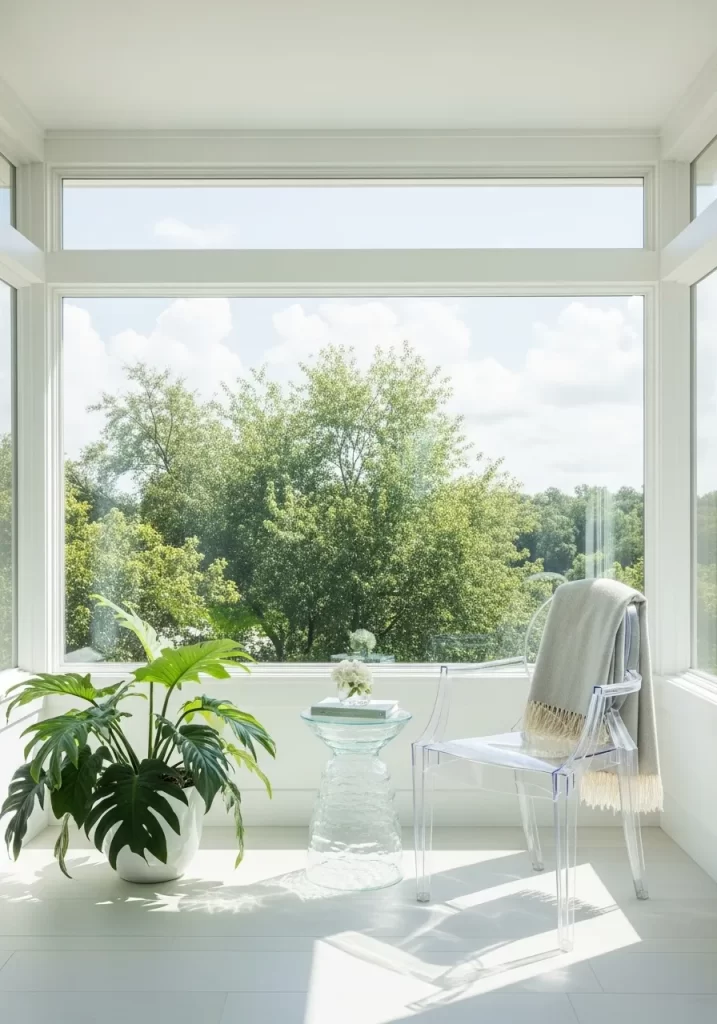
This bright room is filled with sunshine. Large windows offer a view of green trees. In one corner, there is a clear “ghost chair” and a glass side table.
This chair is made of clear acrylic, so it almost disappears. It does not block the view outside. This makes the small corner feel bigger and lighter. It is a modern, minimalist choice for a sunny spot.
DIY: Decorate a Clear Chair
Buying a real ghost chair can be expensive. You can make any clear chair special.
What You Need:
- A clear plastic or acrylic chair (you might find one at a yard sale).
- Fine sandpaper (optional, if you want to scuff for paint).
- Clear glass paint or clear spray paint for plastic (optional).
- A soft blanket or throw.
Step 1: Clean Your Chair
- Wipe your clear chair very well to remove any smudges or dirt.
Step 2: Add Color (Optional)
- If you want to add a hint of color, you can use clear glass paint or spray paint made for plastic.
- Important: Test a small, hidden spot first to make sure it looks good and sticks.
- Spray or paint thin, even coats, letting each dry before the next. This will give it a translucent, colored look.
Step 3: Add a Blanket
- Drape a soft, light-colored blanket or throw over the back of the chair.
- This adds texture and a cozy feel without hiding the clear nature of the chair.
39. Choose a Rippled Circular Mirror
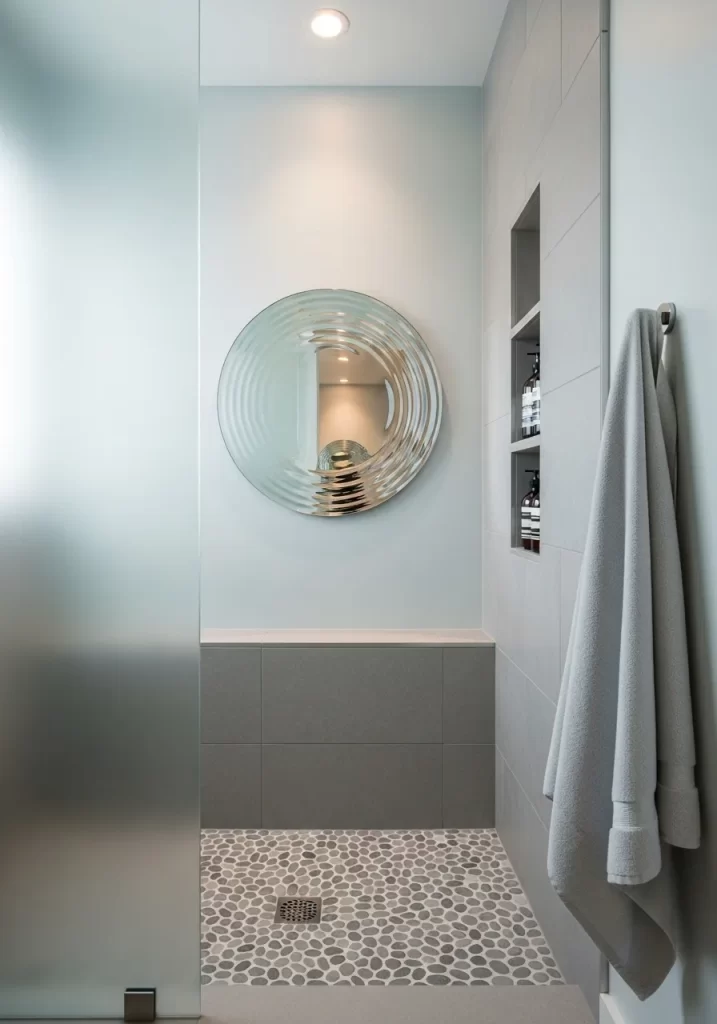
This bathroom is simple and soothing. Soft grey tiles and a frosted glass shower create a calm space. A unique round mirror hangs on the wall.
This mirror has a rippled texture, like water. It catches the light in a special way, adding interest to the room. It’s a single, artistic touch that keeps the minimalist feel without being boring. Built-in shelves provide a tidy spot for bottles.
DIY: Textured Circle Mirror
What You Need:
- A simple round mirror (with a thin frame or frameless).
- Hot glue gun and glue sticks.
- A strong wall hook.
- A pencil and string (to draw circles).
Step 1: Clean the Mirror
- Clean your mirror glass very well.
Step 2: Draw Your Design (Lightly)
- Important: You are going to put glue on the mirror glass itself, so if you ever want to remove it, it might be hard.
- Using a pencil and a string compass (like for the wall decal), lightly draw some wavy circles on the mirror. Make them look like ripples.
Step 3: Apply Hot Glue
- Turn on your hot glue gun.
- Carefully trace over your pencil lines with a thin line of hot glue.
- Work quickly, as hot glue dries fast. You can make the ripples go from the center out.
- Let the hot glue cool and dry completely.
Step 4: Hang Your Mirror
- Hang your mirror securely on a wall hook.
- The hot glue will create a cool, rippled texture on your mirror.
40. Use a Sculptural Table Vase
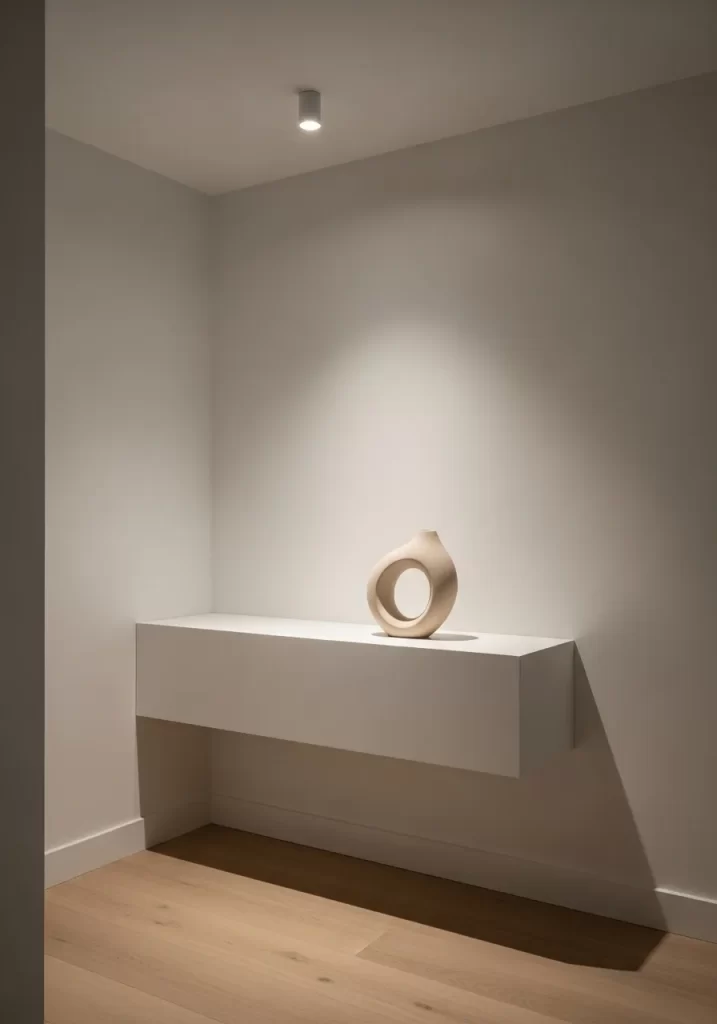
This quiet corner features a clean white floating console table. On top, a single, unusual vase sits like a piece of art.
The vase is a light, natural color and has a unique shape, almost like a donut. It’s simple but very eye-catching. A small spotlight from above highlights its shape. This shows how one carefully chosen item can make a minimalist space feel special.
DIY: Make a Faux “Sculptural” Vase
What You Need:
- An empty plastic bottle or jar with an interesting shape.
- Thick twine or rope.
- Hot glue gun and glue sticks.
- Scissors.
- White or light-colored spray paint (matte finish is good).
- Newspaper or drop cloth.
Step 1: Clean Your Bottle
- Wash your plastic bottle or jar very well. Make sure it’s completely dry.
Step 2: Wrap with Twine
- Put a dot of hot glue at the bottom of your bottle. Press the end of your twine into it.
- Start wrapping the twine tightly around the bottle, adding a thin line of hot glue every few inches to hold it.
- Wrap all the way up to the top of the bottle. Cut the twine and secure the end with a final dot of glue.
- Let all the glue dry.
Step 3: Paint Your “Vase”
- Go outside or to a well-ventilated area.
- Spread out your newspaper.
- Place your wrapped bottle on the newspaper.
- Spray thin, even coats of your white or light-colored matte spray paint all over the twine.
- Let each coat dry for 30 minutes before spraying another. You might need 2-3 coats to completely cover the twine and make it look like one solid piece.
Step 4: Display Your Art
- Once completely dry, display your new sculptural vase on a console table or shelf.
41. Design an All-White Living Space
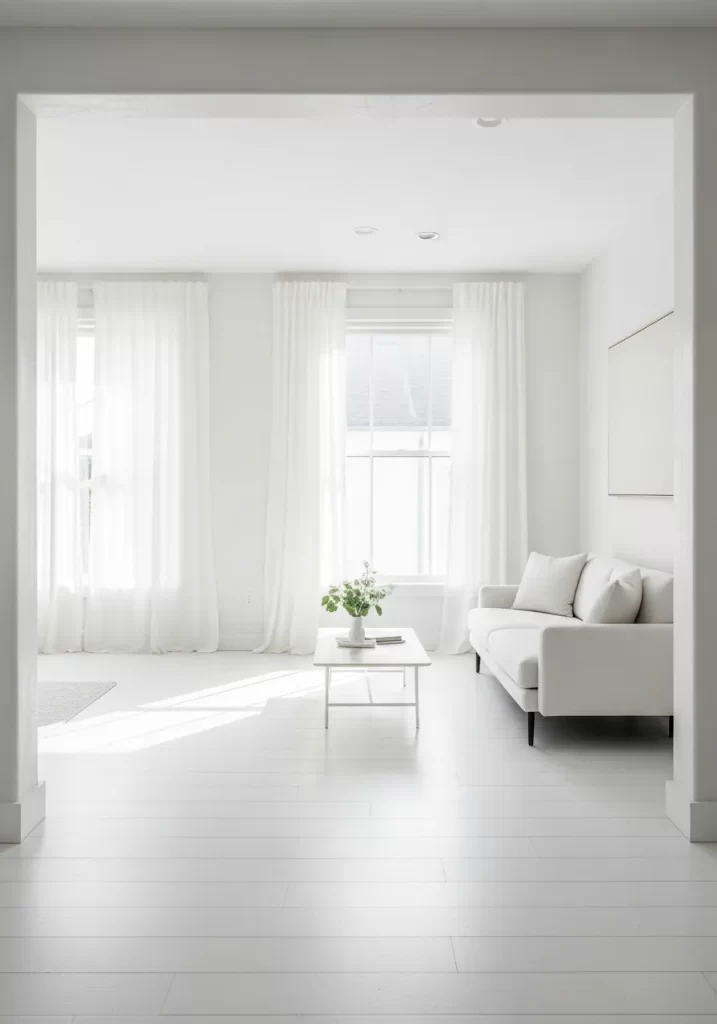
This living room is a picture of calmness, drenched entirely in white. The walls, floor, curtains, and sofa are all shades of white.
This monochromatic approach makes the room feel incredibly spacious and airy. Natural light floods through the windows, making the space feel clean and expansive. A simple coffee table and a vase of greenery add quiet touches. This pure white aesthetic offers a true reset for your home.
DIY: Create an All-White Vibe
What You Need:
- White paint for walls.
- White paint for wooden floors (if applicable).
- White sheer curtains.
- A white sofa (or a white slipcover for an existing sofa).
- White throw pillows.
- A small, simple coffee table.
- A white vase and some green branches (from your yard or a craft store).
Step 1: Paint Your Walls White
- Clear out the room.
- Carefully paint all your walls with a clean, crisp white paint. Two coats will give you the best coverage. Let it dry completely.
Step 2: Paint Your Floor White (Optional)
- If you have wooden floors and want to go all-in, you can paint them white too. Use a special floor paint that can handle foot traffic. This is a bigger job, so you might need help from an adult.
Step 3: Hang White Curtains
- Install a simple curtain rod above your windows.
- Hang your sheer white curtains. Let them hang long, almost touching the floor.
Step 4: Style Your Sofa
- Place your white sofa (or put a white slipcover on your old sofa).
- Arrange some fluffy white throw pillows on it.
Step 5: Add Finishing Touches
- Put your simple coffee table in front of the sofa.
- Place the white vase with green branches on the table. This adds a touch of nature and a quiet contrast to all the white.
42. Opt for Undercabinet LED Lighting
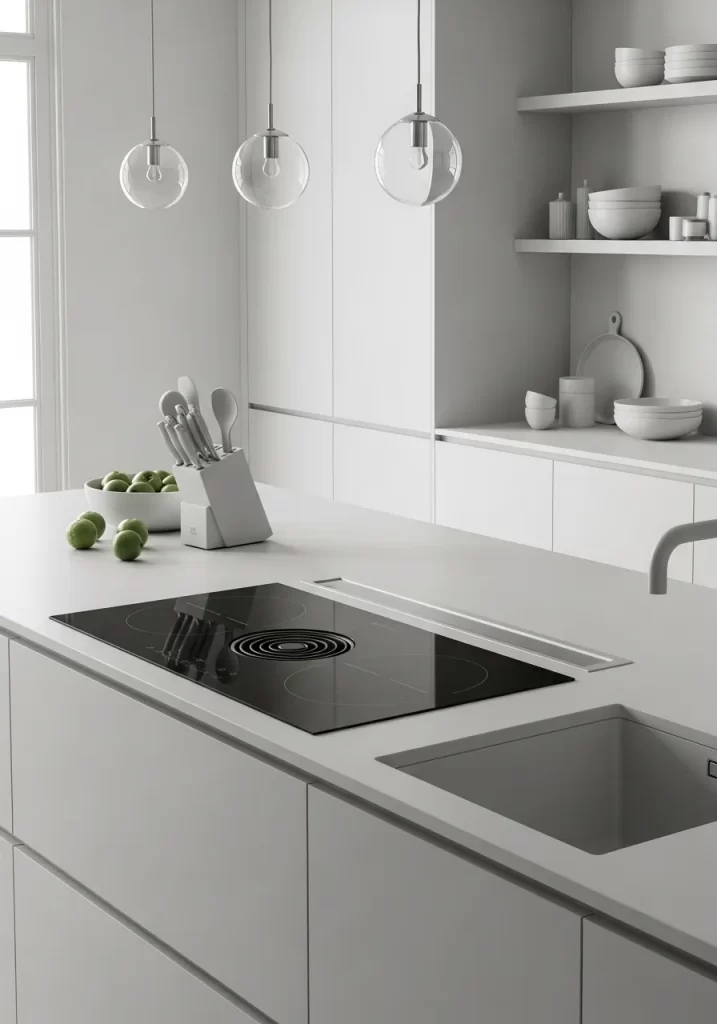
This kitchen looks incredibly neat and modern. All the cabinets are a subtle grey or white. To make the countertops bright, a strip of LED lighting runs underneath the upper cabinets.
This “undercabinet lighting” helps you see when you are preparing food. It also adds a soft, inviting glow to the kitchen. This simple lighting choice makes the whole space feel more polished and functional.
DIY: Install Stick-On LED Strip Lights
What You Need:
- A roll of stick-on LED strip lights (check that it comes with a power adapter and is suitable for kitchens).
- Scissors (most LED strips can be cut at marked spots).
- A clean cloth and rubbing alcohol.
- Small “Command hooks” or cable clips (optional, for neatness).
Step 1: Clean Under Your Cabinets
- Wipe down the underside of your kitchen cabinets where you want to stick the lights. Make sure it’s clean and dry.
- Use rubbing alcohol on the cloth to get rid of any grease. Let it dry completely.
Step 2: Measure and Cut (if needed)
- Measure the length you need for your LED strip.
- If your strip is too long, find the marked spots (usually with a scissor icon) and carefully cut the strip with scissors.
Step 3: Stick the Lights
- Peel off a small section of the paper backing from the LED strip to show the sticky side.
- Press the sticky side firmly onto the underside of your cabinet.
- Slowly peel off more backing paper and continue sticking the strip along the entire length you measured. Press firmly as you go.
Step 4: Plug It In and Tidy
- Run the power cord from the LED strip neatly down to an electrical outlet.
- You can use small Command hooks or cable clips to hold the cord in place along the cabinet or wall.
- Plug in your lights. Now you have bright, clean lighting in your kitchen.
Embracing a minimalist style doesn’t happen overnight.
It’s a journey of small, thoughtful choices. It is about what you keep, not just what you remove.
A simple home can bring a lot of peace. It gives your mind room to breathe.
You have 42 new ideas. You don’t need to tackle them all.
Pick one project this weekend. You might be surprised by how good a simpler space feels.
Key Takeaways
- Start with Small Changes: You don’t need to change everything. A simple DIY art piece or a new set of shelves can make a big impact.
- Function is Key: Choose items that are both beautiful and useful, like nesting tables or a skinny console.
- Use Natural Textures: Wood, linen, plants, and paper lanterns add warmth to simple spaces.
- Floating Furniture Creates Space: Hanging shelves, vanities, and consoles make a room feel larger and less cluttered.
- Lighting Shapes the Mood: From paper lanterns to undercabinet LEDs, light is a key part of minimalist design.