

The kitchen is arguably the most important room in your home, yet one key area often falls flat: the backsplash. This central surface is where functionality meets artistic expression, but all too often, we settle for simple, uninspiring tile choices. Your cooking space deserves more personality. It needs a statement.
If you are ready to banish blandness and bring genuine stunning design into your kitchen, you have come to the right place. We have curated 42 unique, engaging, and transformative backsplash ideas that cater to every style and budget. Whether you crave rustic warmth, high-gloss glamour, or bold geometric patterns, inspiration awaits.
Prepare to explore materials from metallic panels and reclaimed wood to dramatic slab murals and textured mosaics. We also provide step-by-step DIY instructions for each design, making this the ultimate guide to transforming your cooking space from boring to magnificent.
1. Striking Waterfall Slab Backsplash
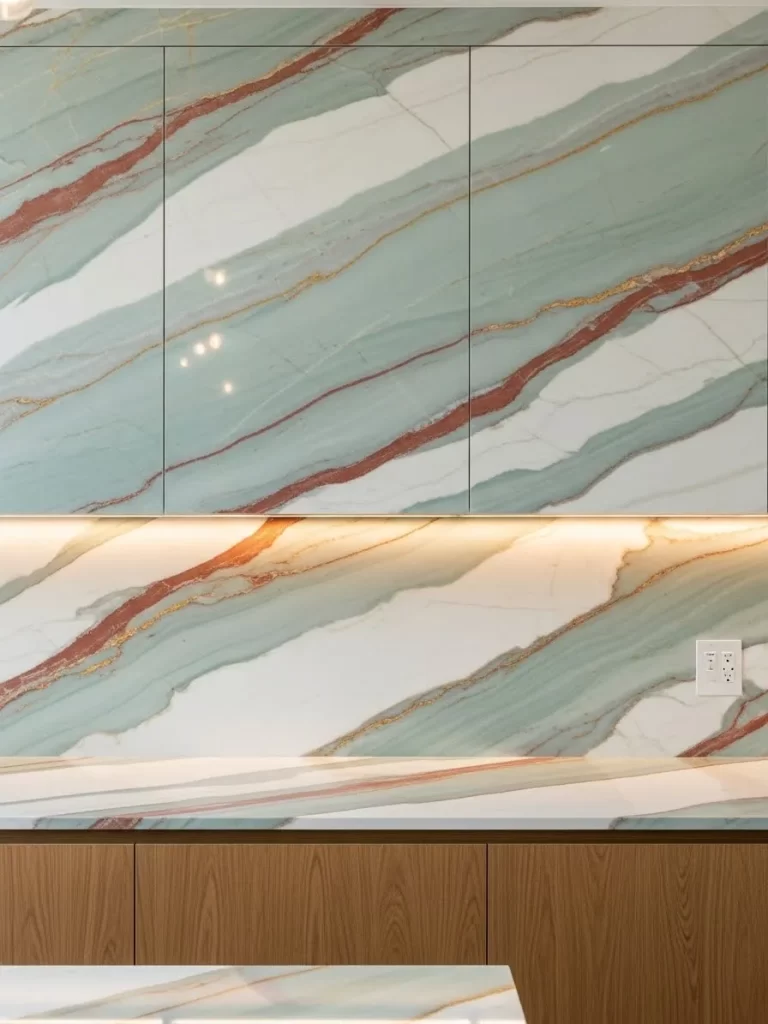
This stunning design proves your kitchen backsplash is anything but boring. The expansive, continuous slab of natural stone immediately draws the eye, transforming the entire cooking space. Beautiful veins of russet and shimmering gold streak across a cool, mint green background. This choice adds an unmatched layer of sophistication and high-end luxury to the room.
Extending the same material up the wall and onto the cabinet faces creates an incredible, monolithic effect, mimicking a smooth waterfall. Utilizing dramatic stone like this elevates a simple kitchen into a showcase of texture and color. Choosing a bold material for your wall treatment offers a magnificent way to achieve a truly customized and memorable kitchen remodel.
Materials Required
- Large slab of exotic natural stone (e.g., green quartzite or marble)
- Thick-set mortar adhesive suitable for heavy stone
- Grout (color matched to the stone’s base color)
- Sealer specifically designed for natural stone
- Silicone caulk (for sealing edges and transitions)
- Thin metal trim or color-matched edging (optional, for exposed edges)
Equipment Required
- Wet saw with a diamond blade (rent one if needed)
- Notched trowel (size appropriate for heavy slab installation)
- Level and measuring tape
- Grout float and sponge
- Safety glasses and gloves
- Power drill with a hole saw attachment (for cutting around outlets)
- Caulking gun
- Mixing bucket and drill mixer attachment (for mortar)
DIY Instruction Steps
- Preparation is Key: Clear the entire countertop space beneath the backsplash area. Remove all existing backsplashes, if present, taking care not to damage the drywall. Thoroughly clean the wall surface so it is completely dry and free of grease or debris. Mark the slab’s placement boundaries lightly on the wall using a pencil and level.
- Mortar Mixing: In your mixing bucket, combine the thick-set mortar powder with water according to the manufacturer’s directions. Use the drill mixer attachment to mix until the consistency is like thick peanut butter. Let the mortar sit for about 5 to 10 minutes (this is called slaking).
- Applying Adhesive: Use the notched trowel to spread the mortar evenly over a small section of the wall where the first slab piece will go. Hold the trowel at a 45-degree angle to create consistent ridges. Work in sections so the mortar does not dry before you place the stone.
- Slab Placement: Carefully lift the first section of the stone slab with a helper. Align the bottom edge with the countertop and press the stone firmly into the mortar. Use a rubber mallet and a block of wood to gently tap the entire surface of the stone, ensuring full contact and eliminating air pockets. Immediately check the stone for level and plumb.
- Cutting and Fitting: Use the wet saw to cut any necessary pieces, such as those around corners or edges. Use the power drill with the hole saw attachment to carefully cut circular openings for electrical outlets, checking measurements multiple times before cutting.
- Grouting (If Applicable): If your design requires multiple pieces with seams, allow the mortar to cure completely, usually 24 to 48 hours. Then, push the grout into the seams using the grout float. Wipe off excess grout with a damp sponge, rinsing the sponge often.
- Sealing the Stone: After the grout has fully cured (check the package for timing), apply the natural stone sealer across the entire backsplash surface following the product instructions. Natural stone is porous and needs sealing to resist stains and moisture.
- Finishing Edges: Apply a thin, consistent bead of silicone caulk where the backsplash meets the countertop and any adjacent walls. This seals against water intrusion. Wipe away excess caulk immediately for a clean finish.
2. Handcrafted Earthy Brick Backsplash
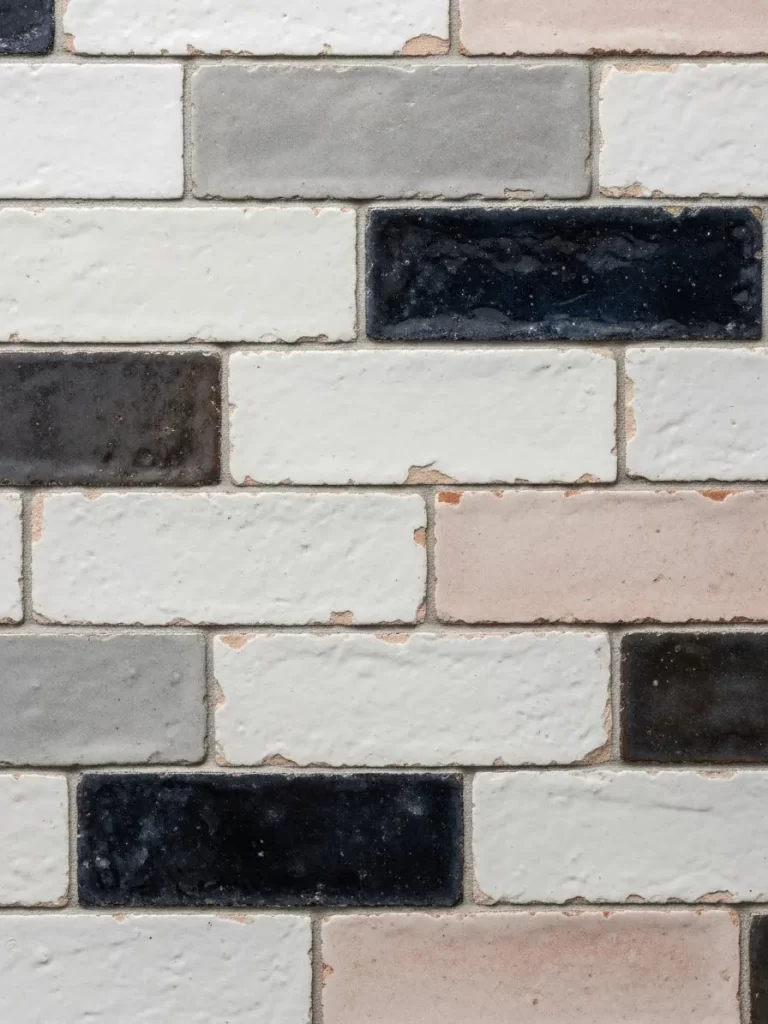
Say goodbye to a boring kitchen with this charming backsplash featuring varied, handcrafted brick-like tiles. The subtle differences in texture and color among the tiles create a wonderfully organic and artisanal feel. Shades of creamy white, soft grey, dark charcoal, and a delicate blush pink come together in an appealing blend.
Each tile possesses a unique, slightly imperfect edge, adding to its rustic allure and character. This choice introduces a sense of warmth and history to the cooking space. The textured surface catches light in an interesting way, adding depth and visual interest. This backsplash offers a homely yet sophisticated alternative to standard subway tiles, making your kitchen feel genuinely unique.
Materials Required
- Handcrafted brick-look tiles (in desired color variations)
- Thin-set mortar adhesive
- Unsanded grout (a neutral or slightly contrasting color works well)
- Grout sealer (optional, but helps with stain resistance)
- Tile spacers (1/8 inch or 1/16 inch, depending on desired grout lines)
- Silicone caulk
Equipment Required
- Tile cutter or wet saw (a manual snap cutter may suffice for these tiles)
- Notched trowel (1/4 inch square-notch is often appropriate)
- Level and measuring tape
- Grout float and sponge
- Safety glasses and gloves
- Bucket and drill mixer attachment (for mixing mortar and grout)
- Caulking gun
- Pencil
- Utility knife (for opening caulk tube)
DIY Instruction Steps
- Prepare Your Wall: Ensure the wall surface is clean, dry, and smooth. Remove any existing backsplash and sand down any bumps. Use a level and pencil to draw a reference line across the wall where the bottom of your first row of tiles will sit. This ensures a straight start.
- Mix the Mortar: Combine the thin-set mortar powder with water in a bucket, following the manufacturer’s instructions. Use a drill with a mixer attachment for a consistent, lump-free mixture, aiming for a peanut butter-like consistency. Let it slake for 5-10 minutes.
- Apply Mortar and Set Tiles: Starting from your reference line and working upwards, spread a thin, even layer of mortar onto a small section of the wall using your notched trowel. Angle the trowel to create uniform ridges. Press the first tile firmly into the mortar, twisting it slightly to ensure good contact. Place tile spacers between each tile to maintain consistent gaps.
- Continue Tiling: Work in small sections, always checking for level and plumb as you go. Vary the tile colors randomly or follow a planned pattern for an artistic effect. You will likely need to cut tiles to fit at the ends of rows or around outlets. Use a tile cutter or wet saw for precise cuts.
- Let Mortar Cure: Allow the mortar to cure completely, typically 24-48 hours, before moving to the next step. Avoid disturbing the tiles during this time.
- Grout the Tiles: In a clean bucket, mix the unsanded grout with water to a creamy consistency. Using a rubber grout float, spread the grout diagonally across the tile faces, pushing it firmly into all the grout lines. Work in manageable sections.
- Clean Excess Grout: After grouting a section, wait about 10-20 minutes for the grout to set slightly. Then, use a damp (not soaking wet) sponge to gently wipe off excess grout from the tile faces. Rinse your sponge frequently in clean water.
- Final Touches: Once the grout has dried and been cleaned, apply a bead of silicone caulk along the bottom edge where the backsplash meets the countertop, and at any vertical corners. This seals against moisture. If desired, apply a grout sealer to protect the grout lines.
3. Geometric Chevron Marble Backsplash

Transform your kitchen into a modern marvel with this eye-catching geometric chevron backsplash. Bold black and pristine white marble tiles are arranged in a dynamic V-pattern, creating movement and depth. The natural veining within the marble adds an organic contrast to the sharp, contemporary lines.
Adding another layer of sophistication are the thin, gleaming gold metallic strips interspersed within the pattern. These metallic accents catch the light, introducing a touch of luxurious glamour to the entire cooking space. This design is anything but boring; it serves as an artistic focal point, blending classic materials with a modern aesthetic. It truly elevates a kitchen’s style quotient.
Materials Required
- Marble chevron tiles (black and white, pre-mounted on mesh sheets or individual)
- Gold metallic trim pieces (if not pre-integrated into tile sheets)
- White thin-set mortar adhesive (non-staining, suitable for marble)
- Unsanded grout (light grey or white is often suitable)
- Marble and grout sealer
- Tile spacers (if using individual tiles)
- Silicone caulk
Equipment Required
- Wet saw with a diamond blade (essential for precise cuts on marble)
- Notched trowel (size appropriate for your tile sheets, often 3/16 inch V-notch)
- Level and measuring tape
- Grout float and sponge
- Safety glasses and gloves
- Mixing bucket and drill mixer attachment
- Caulking gun
- Pencil
- Utility knife
DIY Instruction Steps
- Precise Wall Preparation: Prepare your wall by ensuring it’s clean, dry, and flat. Use a level and pencil to draw a plumb (vertical) line down the center of your backsplash area. This provides a central starting point for symmetrical placement of the chevron pattern. Also, draw a horizontal line at the desired height of the first full row.
- Mortar Mixing for Marble: Combine the thin-set mortar powder with water in a bucket, following the manufacturer’s instructions. Use a drill with a mixer attachment for a consistent, lump-free mixture, aiming for a peanut butter-like consistency. Let it slake for 5-10 minutes.
- Initial Tile Placement: Starting from your central plumb line, apply mortar to a small section of the wall using your notched trowel. Begin placing the first tile sheet, carefully aligning its central point with your plumb line and its bottom edge with your horizontal guide. Press firmly into the mortar.
- Continuing the Pattern: Continue applying mortar and placing tile sheets, working outwards from the center. Ensure the chevron pattern remains consistent and the gold metallic strips are properly aligned. Use tile spacers if your tiles are individual pieces to maintain uniform grout lines.
- Cutting Marble: This pattern will require precise cuts. Use a wet saw with a diamond blade to cut tile sheets to fit edges, corners, and around outlets. Take extra care with marble, as it can chip if not cut properly.
- Curing Time: Allow the mortar to cure completely, typically 24-48 hours, before moving to the next step. Avoid disturbing the tiles during this time.
- Grouting: Mix your unsanded grout to a smooth, creamy consistency. Using a rubber grout float, spread the grout diagonally across the tile faces, pushing it firmly into all the grout lines. Work in manageable sections.
- Clean Excess Grout: After grouting a section, wait about 10-20 minutes for the grout to set slightly. Then, use a damp (not soaking wet) sponge to gently wipe off excess grout from the tile faces. Rinse your sponge frequently in clean water.
- Sealing and Caulking: Once the grout has dried and been cleaned, apply a bead of silicone caulk along the bottom edge where the backsplash meets the countertop and any vertical corners. This seals against moisture. If desired, apply a grout sealer to protect the grout lines.
4. Industrial Concrete Slab Backsplash
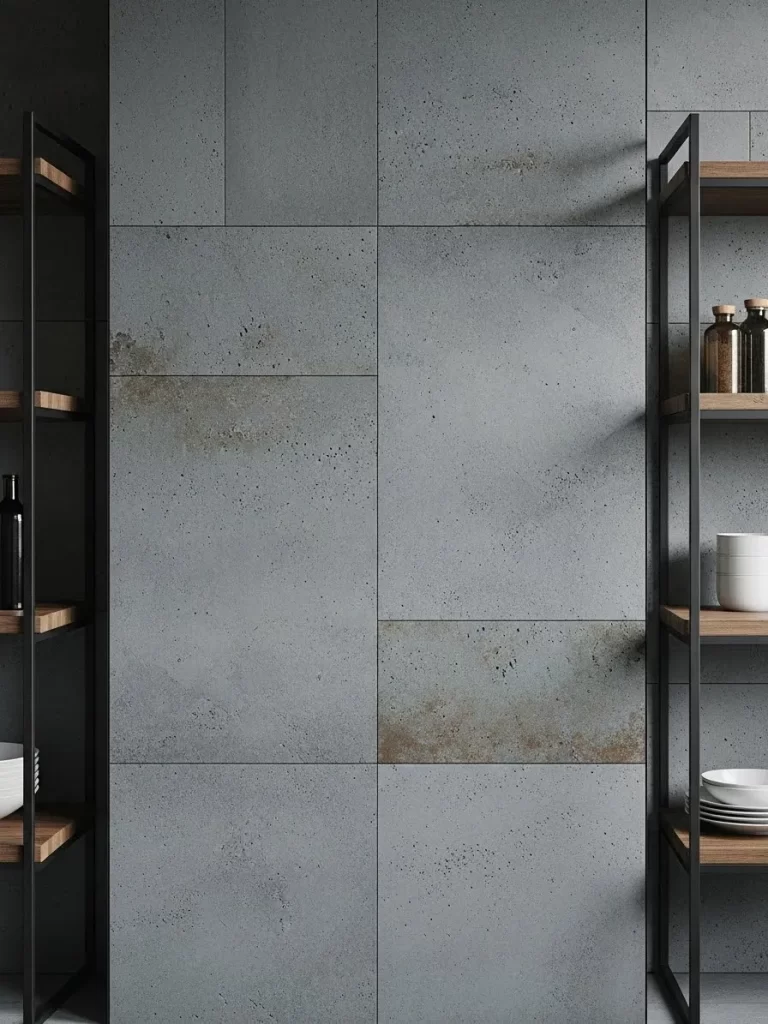
This bold kitchen backsplash features large format concrete-look tiles, instantly bringing an urban, industrial edge to the space. The cool grey tones with subtle variations and dark flecks give the appearance of raw, exposed concrete. Some tiles even show hints of warm, rusty patina, adding character and an aged effect.
Choosing this kind of material for your cooking space provides a strong, minimalist statement that moves away from traditional backsplash materials. The simplicity of the large rectangular shapes creates clean lines and a modern aesthetic. It pairs wonderfully with open shelving and dark metal frames, as seen here, creating a cohesive, contemporary design. This backsplash makes a strong case for concrete’s ability to elevate a kitchen from boring to incredibly stylish.
Materials Required
- Large format concrete-look tiles
- Polymer-modified thin-set mortar adhesive (flexible and strong for large tiles)
- Unsanded grout (grey or charcoal to match the industrial look)
- Grout sealer (highly recommended for concrete-look materials)
- Tile spacers (small, 1/16 inch or less, for tight grout lines)
- Silicone caulk (grey or clear)
Equipment Required
- Wet saw with a diamond blade (essential for large, potentially thick tiles)
- Notched trowel (size appropriate for large format tiles, often 1/2 inch U-notch or square-notch)
- Level and measuring tape
- Grout float and sponge
- Safety glasses and gloves
- Mixing bucket and drill mixer attachment
- Caulking gun
- Pencil
- Utility knife
DIY Instruction Steps
- Thorough Wall Preparation: Ensure your wall surface is completely clean, dry, and structurally sound. Any bumps or imperfections will show under large tiles. If necessary, skim-coat the wall to create a truly flat surface. Use a level to draw a horizontal line where the bottom edge of your first row of tiles will sit.
- Mix the Mortar: Mix the polymer-modified thin-set mortar with water in a bucket. Follow the manufacturer’s instructions precisely, aiming for a thick, peanut butter-like consistency. Allow the mortar to slake for 5-10 minutes.
- Back-Buttering Tiles (Optional but Recommended): For large format tiles, it is often a good practice to “back-butter” each tile. This means applying a thin layer of mortar directly to the back of the tile in addition to the wall, ensuring maximum adhesion and preventing voids.
- Set the First Row: Apply mortar to a section of the wall, using your large notched trowel to create uniform ridges. Carefully place the first tile onto the wall, aligning it with your drawn line. Press firmly and twist slightly to set it into the mortar. Insert small tile spacers to maintain minimal grout lines.
- Continue Tiling: Work methodically across and up the wall, using the level frequently to check for plumb and level. For large tiles, use a level or a straightedge across several tiles to ensure they are all flush. You will need a wet saw for any cuts, especially around outlets or at wall ends.
- Curing Period: Let the mortar cure completely, which typically takes 24-48 hours. Avoid putting any pressure on the newly installed tiles.
- Grouting: Mix your chosen grey or charcoal unsanded grout. Using a rubber grout float, spread the grout over the tiled surface, pushing it firmly into all the narrow grout lines.
- Grout Cleanup: After about 15-20 minutes, use a damp sponge to gently wipe off excess grout from the tile faces. Rinse your sponge often in clean water. You may need to do a second, lighter wipe after the grout hazes a bit more.
- Seal and Caulk: Once the grout has cured (check product instructions), apply grout sealer to protect the surface. Finish by applying a bead of grey or clear silicone caulk where the backsplash meets the countertop and at any corners.
5. Vibrant Moroccan Lantern Tile Backsplash

Bring a burst of color and exotic flair to your kitchen with this stunning Moroccan-inspired lantern tile backsplash. The rich blues, aquamarines, and playful yellow accents create a truly engaging and unique visual experience. Each glossy, arabesque-shaped tile reflects light beautifully, adding depth and vibrancy.
The intricate pattern is bordered by a decorative trim tile at the bottom, featuring delicate yellow floral motifs against a white and blue background. This thoughtful detail provides a polished finish and enhances the overall Mediterranean feel. This backsplash is a world away from boring, offering a dynamic and cheerful element that transforms your cooking space into a vibrant and inviting area. It truly serves as an artistic statement.
Materials Required
- Lantern (arabesque) shaped ceramic or porcelain tiles (in various blue, aqua, and yellow colors)
- Decorative trim tiles (for the bottom border)
- White thin-set mortar adhesive
- Unsanded grout (white or light grey works well to make the colors pop)
- Grout sealer (optional, but recommended for easy cleaning)
- Tile spacers (if needed, depending on tile style)
- Silicone caulk (white or clear)
Equipment Required
- Wet saw with a diamond blade (for precise cuts on these unique shapes)
- Notched trowel (3/16 inch V-notch or similar, suitable for smaller tiles)
- Level and measuring tape
- Grout float and sponge
- Safety glasses and gloves
- Mixing bucket and drill mixer attachment
- Caulking gun
- Pencil
- Utility knife
DIY Instruction Steps
- Precise Wall Layout: Clean your wall thoroughly, ensuring it’s dry and smooth. Use a level and pencil to draw a horizontal line for the top edge of your decorative trim tiles, and another for the bottom edge of your main lantern tiles. This helps maintain a straight and level installation for the intricate pattern.
- Mix the Mortar: Prepare your white thin-set mortar according to the manufacturer’s instructions. A smooth, creamy consistency, like peanut butter, is what you are aiming for. Allow the mixture to slake for 5-10 minutes before use.
- Install Trim Tiles First: Begin by applying mortar to the area where the trim tiles will go. Carefully set the decorative trim tiles along your bottom horizontal line. Ensure they are level and spaced evenly. Let these set for a few hours before proceeding, if possible, to give them a stable base.
- Place Lantern Tiles: Once the trim is stable, apply mortar to a section above the trim tiles. Start placing your lantern tiles, varying the colors as desired to create your vibrant pattern. Press each tile firmly into the mortar, ensuring good contact. Use spacers if your tiles are not pre-mounted on mesh sheets.
- Cutting Intricate Shapes: This is where the wet saw is invaluable. You will need to make precise cuts to fit the lantern tiles at the edges, corners, and around any outlets. Take your time with these cuts to maintain the aesthetic of the pattern.
- Curing Time: Allow the mortar to cure completely. This typically takes 24-48 hours. Do not attempt to grout before the tiles are firmly set.
- Grouting the Backsplash: Mix your unsanded white or light grey grout. Using a rubber grout float, spread the grout diagonally across the tiled surface, pushing it firmly into all the unique curves and lines of the lantern tiles and the trim.
- Clean Excess Grout: After grouting a section, wait 10-20 minutes for the grout to set slightly. Then, use a damp sponge to gently wipe off excess grout from the tile faces. Rinse your sponge frequently with clean water.
- Seal and Caulk: Once the grout has fully cured (refer to product instructions), consider applying a grout sealer for added protection. Finally, apply a neat bead of silicone caulk where the backsplash meets the countertop and at any vertical corners. This seals against moisture.
6. Serene Vertical Wood Panel Backsplash
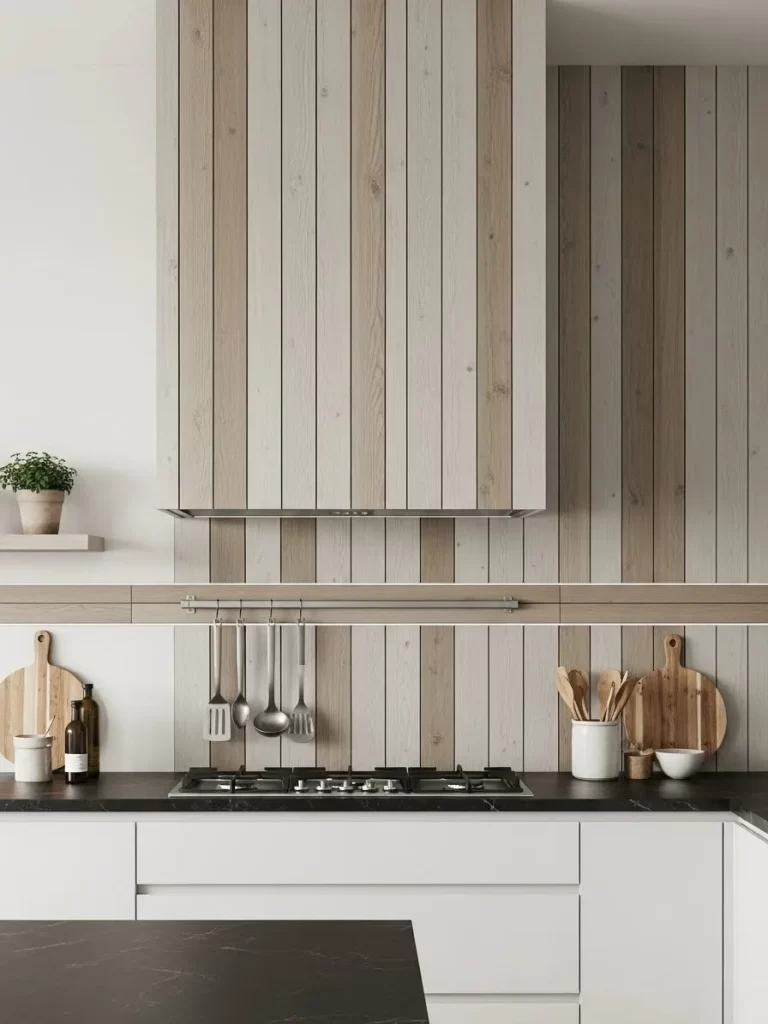
Escape the boring with this calm and contemporary kitchen backsplash featuring vertical wood paneling. The varying natural tones of the wood, from light beige to warm honey, create a subtle yet appealing striped effect. This design extends upwards, beautifully concealing the range hood, for a truly integrated and streamlined look.
This choice brings warmth and organic texture into the cooking space, providing a refreshing alternative to traditional tile. The vertical orientation helps to visually heighten the room, making it feel more spacious and open. Paired with minimalist white cabinets and dark countertops, this wood paneling transforms the kitchen into a tranquil and stylish retreat, showcasing natural beauty in a modern way.
Materials Required
- Wood planks or panels (engineered wood, laminate, or solid wood strips, pre-finished or ready for finishing)
- Construction adhesive (strong, moisture-resistant)
- Finishing nails or brad nails (if supplemental fastening is desired)
- Wood filler (color matched to your wood)
- Wood sealer or clear coat (if wood is not pre-finished)
- Silicone caulk (clear or color-matched to wood)
Equipment Required
- Miter saw or circular saw (for precise cuts on wood panels)
- Measuring tape and pencil
- Level and stud finder
- Caulk gun
- Brad nailer (optional, if using finishing nails)
- Jigsaw (for cutting around outlets)
- Sandpaper (fine grit, for smoothing edges if needed)
- Clean cloths for wiping excess adhesive/sealant
- Safety glasses
DIY Instruction Steps
- Wall Preparation and Planning: Ensure your wall is clean, dry, and free from grease. Use a stud finder to locate and mark wall studs, as these provide solid anchoring points if you choose to nail. Measure your backsplash area carefully, determining how many panels you need and planning any cuts for outlets or specific lengths.
- Cutting the Panels: Using a miter saw or circular saw, cut your wood panels to the desired lengths. For the area behind the range hood, ensure cuts are accurate to create a flush, seamless look. Use a jigsaw to carefully cut out openings for electrical outlets.
- First Panel Installation: Apply a zigzag bead of construction adhesive to the back of your first panel. Start in a corner, or from the center if working symmetrically, ensuring the panel is plumb using your level. Press the panel firmly against the wall. If using, secure with a few brad nails into the studs for extra hold.
- Continuing Installation: Apply adhesive and attach subsequent panels, working your way across the wall. Keep panels tightly together for a seamless appearance. Frequently check with your level to ensure everything remains straight.
- Around Obstacles: For areas around outlets or switches, carefully fit the pre-cut panels. For the range hood area, ensure the panels are cut to butt up neatly against the hood’s edges for a built-in appearance.
- Filling and Finishing (if applicable): If you used brad nails, fill the small holes with color-matched wood filler and allow it to dry. Lightly sand smooth if needed. If your wood is not pre-finished, apply a wood sealer or clear protective coat according to the product instructions, ensuring it can withstand kitchen moisture.
- Sealing Edges: Apply a thin, neat bead of clear or wood-colored silicone caulk along the bottom edge where the wood meets the countertop, and at any vertical corners. This creates a moisture barrier and a clean finish.
7. Playful Retro Terrazzo Backsplash

Your kitchen backsplash is anything but boring when it features this cheerful terrazzo-style design. The lively composition of irregularly shaped aggregates in vibrant red, warm yellow, and several shades of blue brings a fantastic, mid-century modern vibe to the cooking space. The overall effect is a speckled, multicolored pattern set against a creamy, light background.
This fun, speckled surface adds immense personality and a graphic punch to the area. An orange-red accent line running horizontally across the middle adds a subtle decorative division, enhancing the retro aesthetic. Utilizing the same material for both the counter and the backsplash creates a seamless, cohesive look. This pattern offers a unique way to incorporate several colors without overwhelming the minimalist wood cabinets.
Materials Required
- Large format terrazzo-look porcelain slabs or engineered stone panels
- Epoxy thin-set mortar adhesive (recommended for engineered or large format slabs)
- Color-matched grout (minimal lines, matching the background color)
- Decorative orange-red trim piece (if replicating the line)
- Silicone caulk (clear or matching the background color)
Equipment Required
- Wet saw with a diamond blade (for large, straight cuts)
- Notched trowel (size appropriate for large slabs, often 1/2 inch U-notch)
- Level and measuring tape
- Grout float and sponge
- Safety glasses and gloves
- Mixing bucket and drill mixer attachment
- Caulking gun
- Pencil
- Utility knife
DIY Instruction Steps
- Meticulous Wall Prep: Clean the wall surface thoroughly so it is completely dry and smooth. Since these large format materials are rigid, the wall must be perfectly flat. Use a level and measuring tape to plan the exact placement of your slabs, accounting for the horizontal red trim if you are including it.
- Mortar Preparation: Mix the epoxy thin-set mortar according to the product instructions. Epoxy mortar offers great adhesion and water resistance, making it suitable for this application. Ensure a thick, consistent mixture.
- Slab and Trim Installation: Apply mortar to the first section of the wall using your large notched trowel. Carefully place the bottom terrazzo slab, aligning it with the countertop and pressing firmly. Ensure it is plumb and level. Next, install the decorative red trim piece (either a thin metal strip or a piece of schluter trim) following the manufacturer’s directions, ensuring it is perfectly straight. Then, install the top slab section.
- Full Coverage and Cutting: Use a rubber mallet and a block of wood to gently tap the slabs, ensuring full coverage and setting them securely into the adhesive. Immediately check the stone for level. You will need a wet saw for any cuts, especially around outlets, remembering the “measure twice, cut once” rule is especially crucial for large slabs.
- Curing: Allow the mortar to cure completely, typically 24-48 hours, before proceeding to the next step.
- Minimal Grouting: Only grout the thin seams between the slabs and around the decorative trim. Push the minimal grout into these lines using the grout float. Wait a short time, then wipe off excess grout with a damp sponge.
- Final Sealing: Apply a thin, consistent bead of silicone caulk where the backsplash meets the countertop and around all vertical edges. This creates a neat, water-tight finish.
8. Shimmering Iridescent Mosaic Backsplash

This captivating kitchen backsplash uses small glass mosaic tiles to create an ocean-like expanse of color and light. The deep blue tones are overlaid with an iridescent finish that shifts in hue, showcasing flashes of purple, green, and gold. This shimmering quality is especially enhanced by the under-cabinet lighting, transforming the entire wall into a dynamic, watery surface.
Choosing a small-scale tile like this allows for incredible texture and depth, moving far beyond a standard, flat wall treatment. The rich, jewel-toned colors provide a luxurious contrast against the white countertop, turning a functional area into an artistic statement. This backsplash adds an element of drama and reflectivity, ensuring the cooking space feels constantly energized and stunning.
Materials Required
- Glass mosaic tiles (iridescent finish, usually pre-mounted on mesh sheets)
- White thin-set mortar adhesive (non-sanded is sometimes used for small mosaics)
- Unsanded grout (dark grey or black to emphasize the blue, or white for contrast)
- Grout sealer (highly recommended)
- Silicone caulk (clear)
Equipment Required
- Tile nippers or small wet saw (for making curved or precise cuts on individual mosaic pieces)
- Notched trowel (very small V-notch, 1/8 inch or less, suitable for mosaic sheets)
- Level and measuring tape
- Grout float (epoxy grout float is sometimes smoother for glass) and sponge
- Safety glasses and gloves
- Mixing bucket and drill mixer attachment
- Caulking gun
- Pencil
- Utility knife
DIY Instruction Steps
- Smooth Wall Surface: The wall must be very smooth and clean. Imperfections will be visible through or beneath glass tiles. Mark a horizontal starting line with a level where the bottom edge of the mosaic will sit.
- Mortar Preparation and Application: Mix your white thin-set mortar. White mortar is essential to avoid discoloring the transparent glass tiles. Use the very small notched trowel to spread a thin, even layer of mortar across a small section of the wall. Avoid applying too much; you do not want the mortar squeezing out excessively between the tiny tiles.
- Setting Mosaic Sheets: Gently press the first mosaic sheet into the mortar, using a wood block and light tapping to ensure complete contact across the entire sheet. Place the next sheet, carefully aligning the edges so the pattern continues seamlessly. Adjust any misaligned individual tiles quickly before the mortar sets.
- Cutting the Sheets: Use scissors or a utility knife to cut the mesh backing for larger edge cuts. For cutting individual glass squares, use tile nippers or a small wet saw. This is often necessary around outlets.
- Curing the Mortar: Allow the mortar to cure completely, typically 24 hours. The tiles must be firmly attached before grouting.
- Grouting: Mix your unsanded grout. Using the rubber grout float, spread the grout diagonally across the surface, pushing it firmly into all the narrow gaps. Wipe away as much excess grout as possible from the tile faces using the edge of the float.
- Sponge Cleanup: Wait about 10-15 minutes, then use a damp (not soaking wet) sponge to gently clean the tile faces. Glass is prone to haze, so rinse your sponge often and change the water frequently for effective cleaning.
- Seal and Caulk: Once the grout is fully cured, apply grout sealer to the finished surface. Finish by applying a bead of clear silicone caulk where the backsplash meets the countertop and any adjacent walls to prevent water intrusion.
9. Geometric Terracotta Tile Accent
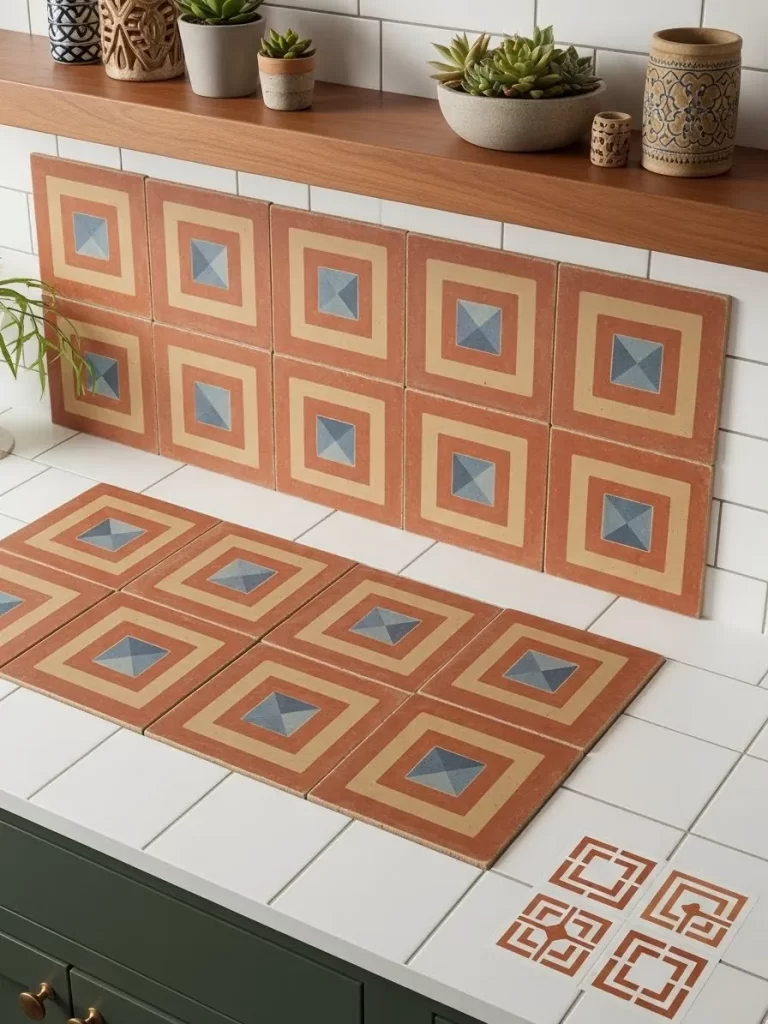
This artistic idea shows how to completely change a boring kitchen wall by using a distinct, high-impact pattern in a key area. Large format terracotta-toned cement tiles feature a strong geometric design—a series of layered squares in tan and slate blue—creating a captivating focal point. These decorative tiles are placed centrally, highlighting a shelf and cooking area.
The rich, earthy colors of the pattern offer a beautiful, warm contrast to the surrounding basic white subway tile backsplash. This approach is clever; it uses less expensive, plain tile for most of the area while investing in a small quantity of truly special, patterned tile for maximum visual effect. The vibrant, deep hues and bold lines provide an unforgettable, custom look to the cooking space.
Materials Required
- Geometric cement or terracotta tiles (patterned)
- Basic subway tiles (white or a neutral color, optional for surrounding area)
- Cement tile sealer (essential for protecting porous cement/terracotta tiles)
- Thin-set mortar adhesive (white or non-staining)
- Unsanded grout (light grey or white)
- Tile spacers (for both accent and field tiles)
- Silicone caulk
Equipment Required
- Wet saw with a diamond blade (for straight, clean cuts)
- Notched trowel (size appropriate for the tile size)
- Level and measuring tape
- Grout float and sponge
- Safety glasses and gloves
- Mixing bucket and drill mixer attachment
- Caulking gun
- Pencil
- Clean cloths
DIY Instruction Steps
- Sealing Tiles First: Cement and terracotta tiles are highly porous. Before installation, you must apply a penetrating sealer to all sides of the accent tiles, following the product directions. This prevents moisture and mortar from staining the tiles.
- Layout and Planning: Determine the center of your accent area and mark the wall. Since you are creating a focal point, the layout must be centered and symmetrical. Draw a horizontal guide line for the bottom row.
- Mortar and Placement: Mix your white thin-set mortar. Apply mortar to the central accent area using the notched trowel. Start placing the decorative tiles from the center point, working outwards. Press firmly and use tile spacers to maintain consistent joint widths.
- Field Tile Installation (Optional): If using surrounding field tiles (like the white subway tiles), continue placing those around your geometric accent tiles, ensuring the grout lines match up where the different tile types meet. Use the wet saw for cuts required at edges and corners.
- Curing: Let the mortar dry completely, usually 24 hours or more. The tiles must be set before grouting.
- Grouting Carefully: Mix your unsanded grout. Work carefully when spreading the grout over the cement tiles, pushing it into the joints with the rubber float. Wipe off excess grout almost immediately, as cement tiles can absorb pigment from the grout, even after pre-sealing.
- Final Cleaning and Sealing: After the grout has cured, perform a final, thorough cleaning. Once completely dry, apply a second coat of penetrating sealer to the entire accent tile surface and grout lines, following the manufacturer’s instructions, for maximum protection.
- Caulking: Apply a neat bead of silicone caulk along the bottom edge where the backsplash meets the countertop, and at any vertical corners. This seals against moisture.
10. Aged Copper Patina Wall Panels
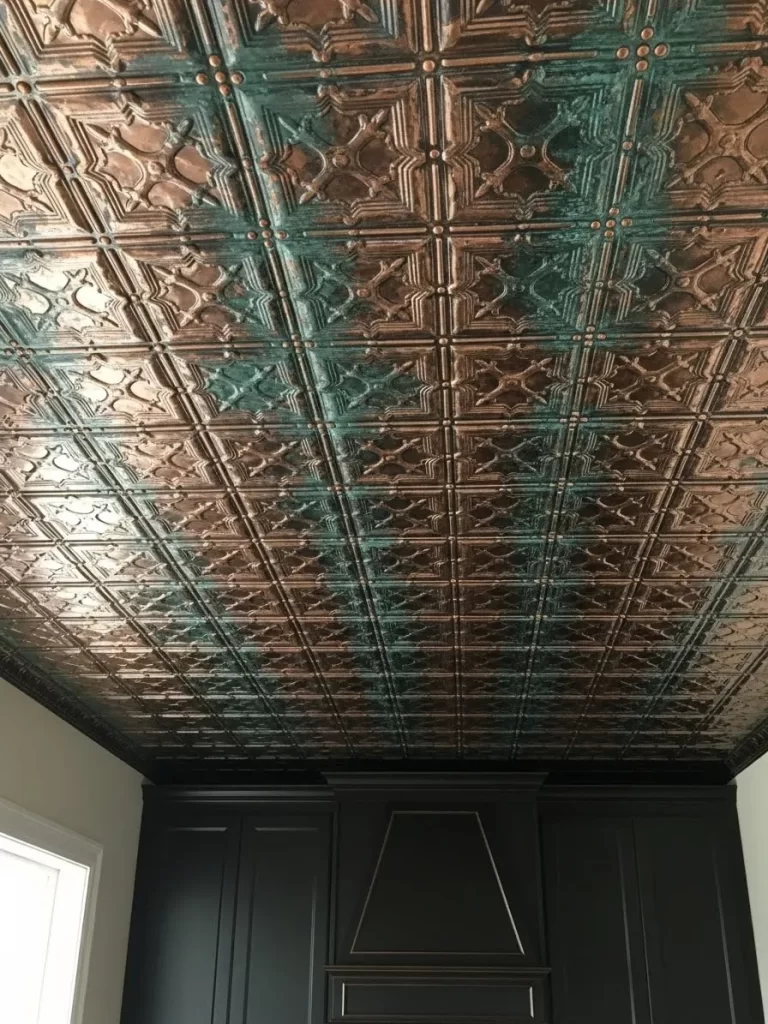
This magnificent idea transforms a kitchen backsplash with the rich, textured look of aged metal ceiling tiles. These embossed panels, with their repeated geometric patterns, introduce a deep sense of history and artisanal craftsmanship. The warm copper color features a beautiful patina, where vibrant streaks of teal and green oxidation provide a striking contrast.
Using material like this on a kitchen wall creates an unforgettable, textural focal point. The metallic shine and dimensional patterns immediately upgrade the cooking space, moving it far beyond the realm of boring tile. This style works exceptionally well in industrial or rustic kitchens, providing a unique metallic gleam and an antique aesthetic that feels both luxurious and authentic.
Materials Required
- Embossed metal ceiling panels (often tin or aluminum with a faux copper finish)
- Construction adhesive (high-strength, suitable for metal)
- Finishing nails or brad nails (small, to secure edges)
- Color-matched caulk or trim pieces (for finishing edges and corners)
- Tin snips or aviation shears
Equipment Required
- Measuring tape and level
- Caulk gun
- Brad nailer (optional)
- Straightedge
- Safety glasses and gloves
- Clean cloths
DIY Instruction Steps
- Wall Inspection and Layout: Ensure the wall surface is clean, dry, and flat. Measure the area carefully. Determine the center point of the backsplash and plan your layout so that any necessary cuts fall equally on the top/bottom or sides for a symmetrical look. Draw your central guide lines.
- First Panel Placement: Apply a strong bead of construction adhesive in a zigzag pattern to the back of the first panel. Begin by aligning the first panel precisely in your planned starting point (often the center of the wall) to ensure a straight line. Press the panel firmly against the wall.
- Securing the Edges: Use small brad nails or finishing nails to secure the edges of the panel, especially the corners. These nails will likely be hidden by the overlapping flange of the next panel, depending on the panel type.
- Continuing Installation: Apply adhesive and butt the next panel up tightly against the first, ensuring the patterned edges lock together (if using interlocking panels). Continue this process across the wall, checking for level frequently.
- Cutting the Panels: For cuts around outlets, switches, or wall edges, use tin snips or aviation shears. Cut slowly and precisely. Wear gloves, as the cut metal edges can be sharp.
- Edge Finishing: Once all panels are in place, the edges that meet the countertop or the upper cabinets need a clean finish. You can use thin strips of color-matched wood trim, metal edge trim, or a bead of color-matched silicone caulk to seal and conceal the cut edges.
- Final Wipe Down: Wipe down the finished surface with a clean, dry cloth to remove any fingerprints or dust.
11. Dimensional Beveled White Subway Tile
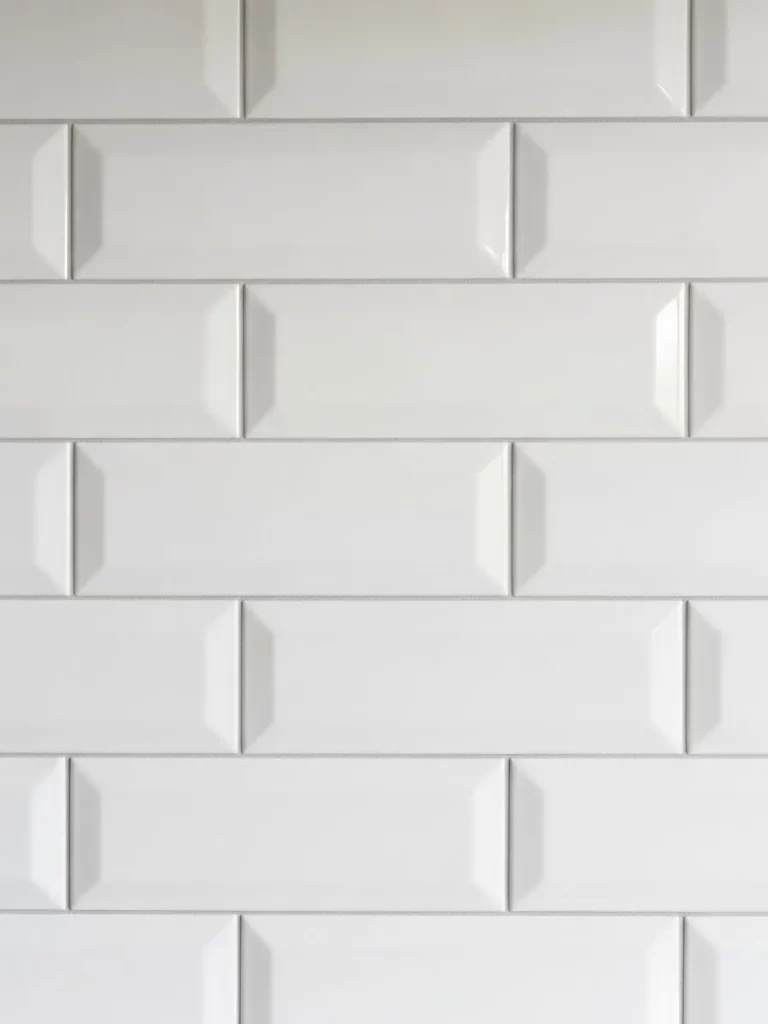
A classic look receives a subtle, yet effective, upgrade with this beveled subway tile backsplash. While remaining pristine white, the raised, angled edges introduce a three-dimensional element that standard flat subway tiles lack. The gentle shadowing created by the bevels adds visual depth and texture to the cooking space.
This tile choice is genuinely versatile, working well in both traditional and modern kitchen designs. The glossy finish helps reflect light, making the area feel brighter and more spacious. Utilizing a light grey grout emphasizes the distinctive shape and pattern of each individual tile. This style proves that a simple color choice can still deliver striking sophistication when texture is included.
Materials Required
- White ceramic or porcelain beveled subway tiles
- White thin-set mortar adhesive
- Unsanded grout (light grey or white)
- Tile spacers (1/8 inch or 1/16 inch, standard for subway tile)
- Silicone caulk (white or clear)
Equipment Required
- Wet saw or manual tile cutter
- Notched trowel (3/16 inch V-notch or similar)
- Level and measuring tape
- Grout float and sponge
- Safety glasses and gloves
- Mixing bucket and drill mixer attachment
- Caulking gun
- Pencil
- Utility knife
DIY Instruction Steps
- Layout Planning: Clean the wall surface thoroughly. Use a level and pencil to find the center of your backsplash area. It’s best to start in the center and work outward to ensure symmetry. Draw a reference line for the bottom edge of your first tile row.
- Mortar Mixing: Mix your white thin-set mortar with water to achieve a smooth, creamy consistency. Allow the mortar to slake (rest) for about 5 to 10 minutes before application.
- Tiling the First Row: Apply a small section of mortar to the wall using the notched trowel, creating uniform ridges. Start by setting your first tile onto the wall along your reference line. Press firmly, twisting slightly to secure it. Insert tile spacers at the end of the tile and on top.
- Creating the Pattern: Continue tiling, typically in a brick or running bond pattern (offsetting each row by half a tile). Ensure the vertical alignment of the tiles is consistent. Check frequently with your level. Use the wet saw or tile cutter for cuts needed at the ends of rows or around outlets.
- Curing: Allow the mortar to dry completely, usually 24 hours, before attempting to grout. Remove all the tile spacers.
- Grouting: Mix your chosen light grey or white unsanded grout. Using a rubber grout float, spread the grout diagonally across the surface, pushing it firmly into all the grout lines, paying extra attention to the beveled edges.
- Cleanup: Wait about 15-20 minutes for the grout to set up slightly. Use a damp sponge to gently wipe off excess grout from the tile faces. Rinse your sponge often with clean water to prevent spreading a grout haze.
- Final Sealing: After the grout has fully cured, apply a thin, neat bead of white or clear silicone caulk where the backsplash meets the countertop and any adjacent walls to create a waterproof seal.
12. Rustic Hexagon Slate Backsplash
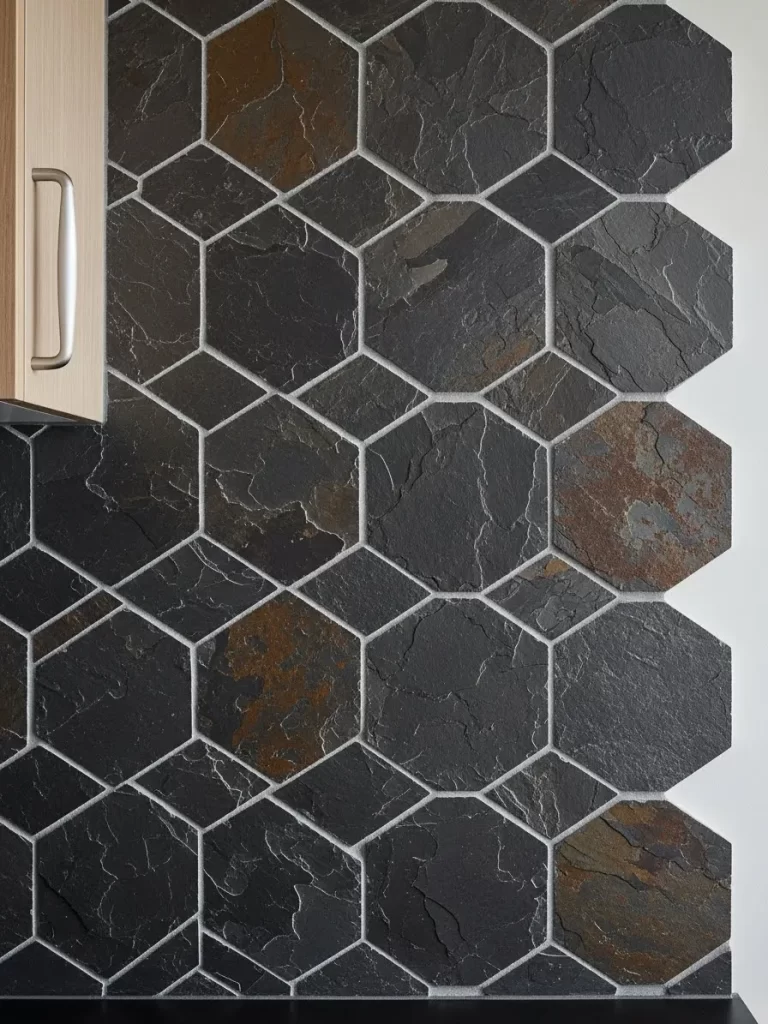
Move away from boring square tiles with this textural backsplash featuring large hexagon shapes cut from natural slate. The dark, earthy tones—ranging from deep charcoal to black—are subtly punctuated by hints of warm rust and copper inherent in the natural stone. This material choice offers a wonderfully rugged and organic appearance.
The geometric hexagon pattern provides a strong modern shape, while the cleft surface of the slate adds an appealing, rustic texture. This design cleverly fills the space between the countertop and the cabinet, extending the pattern irregularly along the vertical edge for an engaging finish. The light grout lines make the dramatic shapes pop, enhancing the modern farmhouse or industrial feel.
Materials Required
- Natural slate hexagon tiles (usually 8-10 inches across)
- Black thin-set mortar adhesive (to help the dark tiles blend)
- Sanded grout (light grey or white, for the wider joints common with slate)
- Stone and grout sealer (essential for natural slate)
- Tile spacers
- Silicone caulk (black or clear)
Equipment Required
- Wet saw with a diamond blade (mandatory for cutting natural slate)
- Notched trowel (size appropriate for large tiles, often 1/4 inch or 3/8 inch U-notch)
- Level and measuring tape
- Grout float and sponge
- Safety glasses and gloves
- Mixing bucket and drill mixer attachment
- Caulking gun
- Pencil
DIY Instruction Steps
- Pre-Sealing Slate: Slate is highly porous; before you install, apply a stone sealer to the faces of the tiles, following the product instructions. This prevents the mortar and grout from staining the dark stone.
- Layout and Wall Prep: Clean the wall thoroughly. Mark a central vertical line and a horizontal reference line to ensure the hexagon pattern is aligned and symmetrical. Slate can be heavy, so ensure the wall is sturdy.
- Mortar Mixing: Mix your dark or black thin-set mortar. The thicker consistency is helpful for setting heavy, uneven slate tiles. Allow it to slake for 5-10 minutes.
- Setting Tiles: Apply mortar to a small section of the wall. Begin placing the tiles from your central starting point. Press each hexagon firmly into the mortar, ensuring the tile sits flat despite its natural surface variations. Use tile spacers consistently.
- Edge Cuts: Use the wet saw to cut tiles where they meet the countertop, cabinets, or wall edges. For the irregular top edge, plan the cuts to make the pattern appear organic and random, as shown in the picture.
- Curing Time: Allow the mortar to cure for at least 24 hours. Remove the spacers.
- Grouting: Mix your light grey or white sanded grout. Because slate has a textured surface, spread the grout carefully with the rubber float, ensuring you pack the joints completely.
- Cleaning Slate: Wait a short time (5-10 minutes), then gently wipe the tiles with a damp sponge. Slate is naturally uneven, so be thorough but gentle to avoid pulling the grout out of the joints. Rinse the sponge frequently.
- Final Sealing and Caulking: After the grout cures, apply a final coat of stone sealer to the entire surface. Apply black or clear silicone caulk along the bottom edge where the backsplash meets the countertop for a water seal.
13. Bold Rainbow Gloss Subway Tile
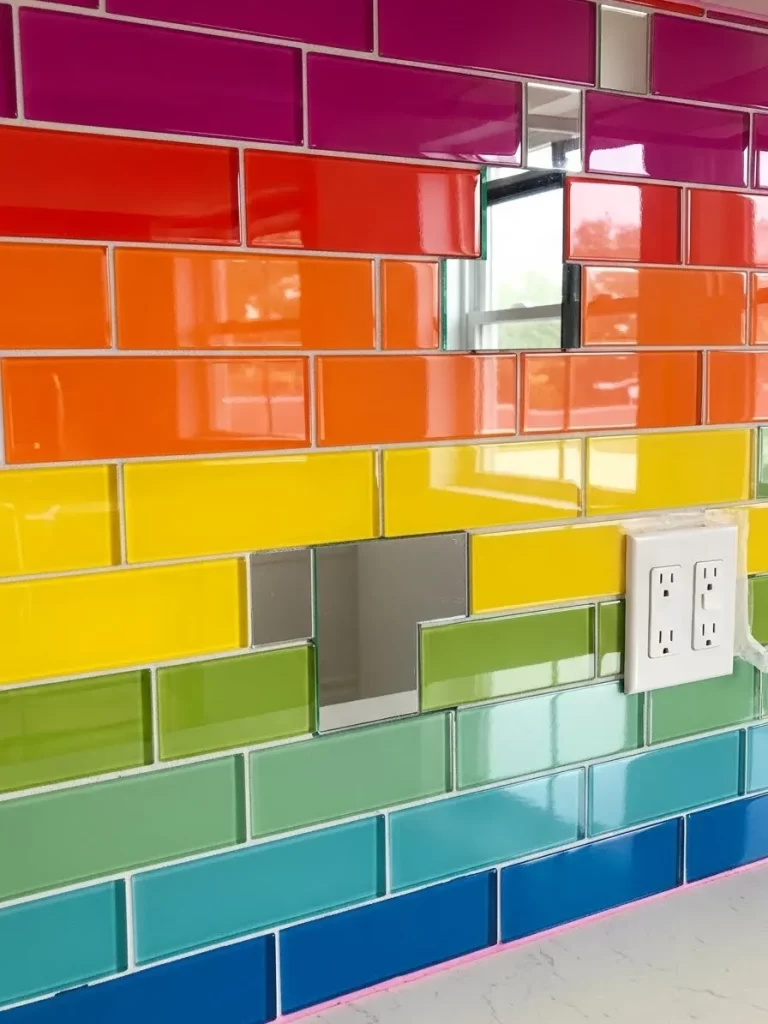
Transform a boring kitchen with a spectacular explosion of color using this vibrant rainbow subway tile backsplash. Each row features a different, high-gloss color—from deep blue and teal through green, yellow, orange, and fuchsia—creating a truly cheerful and dramatic statement wall. The colors are applied in distinct horizontal bands, mimicking the appearance of a spectrum.
The glossy finish of the ceramic tiles enhances the richness of each hue and reflects surrounding light beautifully. Interspersed mirrored tiles introduce unexpected sparkle and dimension, adding another layer of visual interest to the vibrant pattern. This backsplash is unapologetically fun and makes the cooking space feel energetic and custom-designed for a playful personality.
Materials Required
- High-gloss ceramic subway tiles (in a full range of rainbow colors)
- Mirrored subway tiles (optional, for accent)
- White thin-set mortar adhesive
- Unsanded grout (white is chosen here to make the colors pop)
- Tile spacers (small, 1/16 inch)
- Silicone caulk (white)
Equipment Required
- Wet saw or manual tile cutter
- Notched trowel (3/16 inch V-notch or similar)
- Level and measuring tape
- Grout float and sponge
- Safety glasses and gloves
- Mixing bucket and drill mixer attachment
- Caulking gun
- Pencil
- Utility knife
DIY Instruction Steps
- Color Layout Planning: Clean and prepare the wall surface. Measure the height of the backsplash and plan the specific width of each color band to ensure the pattern ends correctly at the top and bottom. Mark the wall with horizontal lines for each color change. This is essential for a straight rainbow effect.
- Mortar Preparation: Mix your white thin-set mortar. Keep the mixture consistent, aiming for a peanut butter-like texture. Allow it to slake for a few minutes.
- Starting Installation: Begin with the bottom color row. Apply mortar to a small section of that row, using the notched trowel. Set the first tile, pressing firmly. Continue setting the row in a running bond (brick) pattern, using tile spacers consistently.
- Changing Colors: Once the first row of tiles is complete, move to the next color band, ensuring the new color starts precisely on your pencil line. Continue working upwards, changing colors according to your pre-planned layout. Carefully incorporate the mirrored tiles into the pattern as desired.
- Cutting: Use the wet saw or tile cutter for cuts needed at the ends of rows and to fit around outlets. Be extra gentle when cutting mirrored glass tiles to prevent chipping.
- Curing Time: Allow the mortar to cure completely, usually 24 hours. Remove all the tile spacers.
- Grouting: Mix your white unsanded grout. Using a rubber grout float, spread the grout diagonally across the tiles, forcing it into all the joints.
- Cleaning: Wait approximately 15 minutes, then use a damp sponge to gently wipe off excess grout from the high-gloss tile faces. Rinse the sponge often to prevent a white grout haze from setting on the vibrant colors.
- Finishing: Once the grout is dry, apply a clean, thin bead of white silicone caulk where the backsplash meets the countertop for a finished, water-resistant seal.
14. Modern Vertical Brick Accent Wall
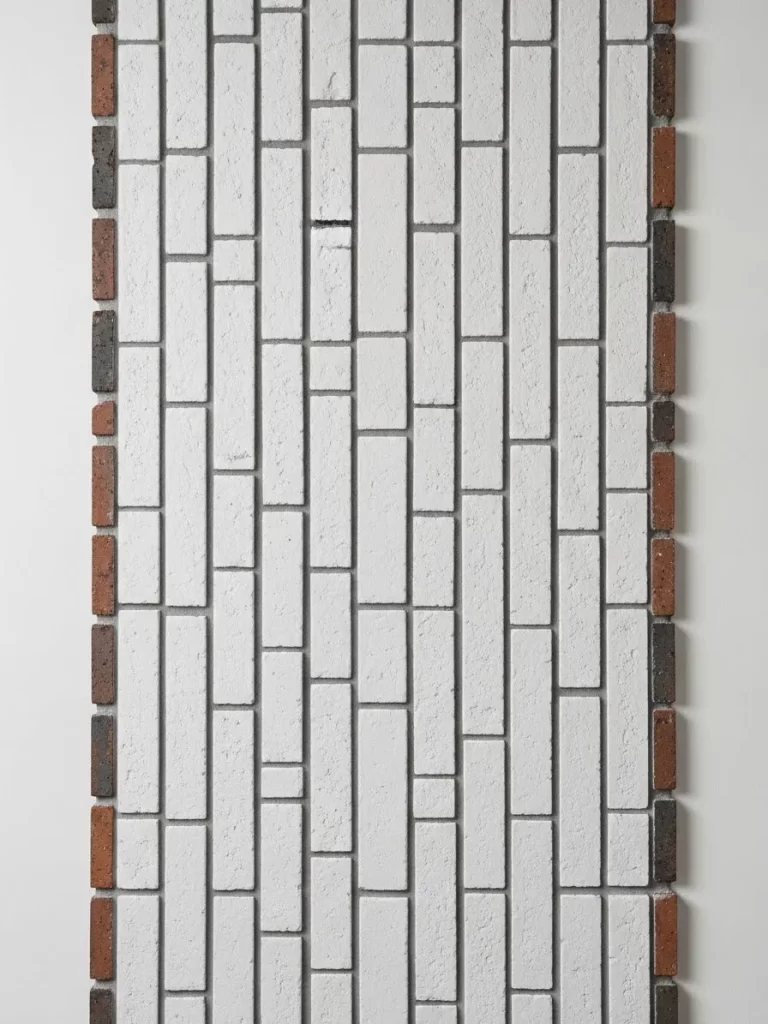
Reject the boring diagonal patterns with this dynamic stacked brick backsplash, presented in a clean, vertical orientation. The majority of the slim, long bricks are a pristine, textured white, creating a light and airy feel. This vertical placement emphasizes height and offers a contemporary take on traditional masonry.
Adding distinct visual framing are the contrasting rows of thin, earthy brown and charcoal bricks placed on the left and right edges. This mix of texture and color transforms the backsplash into a strong architectural feature, making the entire area appear custom. The slight variation in brick depth adds a subtle shadow line and genuine dimension to the wall surface.
Materials Required
- Slim, long “brick veneer” tiles (mostly white, with small amounts of brown/charcoal for accent)
- White polymer-modified thin-set mortar adhesive
- Unsanded grout (light grey, to match the joints shown)
- Tile spacers (1/4 inch or similar, to create the thick, industrial grout lines)
- Silicone caulk (white or clear)
Equipment Required
- Wet saw with a diamond blade (for clean cuts)
- Notched trowel (size appropriate for the long, narrow tiles)
- Level and measuring tape
- Grout float and sponge
- Safety glasses and gloves
- Mixing bucket and drill mixer attachment
- Caulking gun
- Pencil
DIY Instruction Steps
- Wall Preparation and Layout: Ensure the wall is clean and dry. Use a level and measuring tape to meticulously plan the width of the accent area, ensuring the contrasting edge bricks are placed symmetrically. Draw a vertical line to guide the start of your main white brick pattern.
- Mortar Preparation: Mix your white thin-set mortar, aiming for a consistency that will hold the slim tiles without excessive slump. Allow the mixture to slake briefly.
- Installing Edge Bricks: Start by applying mortar to the narrow sections where the brown and charcoal accent bricks will go. Set these contrasting bricks in a vertical stack, following your layout plan precisely. Use spacers to maintain thick, consistent joint lines.
- Installing Main White Bricks: Apply mortar to the central, main section of the wall. Set the long, white bricks in a vertical stacked pattern. You may need to vary the length of the white bricks slightly to create the staggered ends seen in the image, ensuring all joints remain the same width.
- Continuity Check: Check with your level constantly to ensure all vertical lines remain straight. Use the wet saw to cut bricks to fit the top, bottom, and around any outlets.
- Curing: Allow the mortar to cure for at least 24 hours. Remove all spacers.
- Grouting: Mix your light grey unsanded grout. Using a rubber grout float, push the grout firmly into the thick joints. Work in small sections, wiping excess grout off as you go, before it hardens on the textured white surface.
- Final Sealing: Apply a thin, neat bead of white or clear silicone caulk along the bottom edge where the bricks meet the countertop for a clean, water-resistant finish.
15. Panoramic Mountain Mural Backsplash
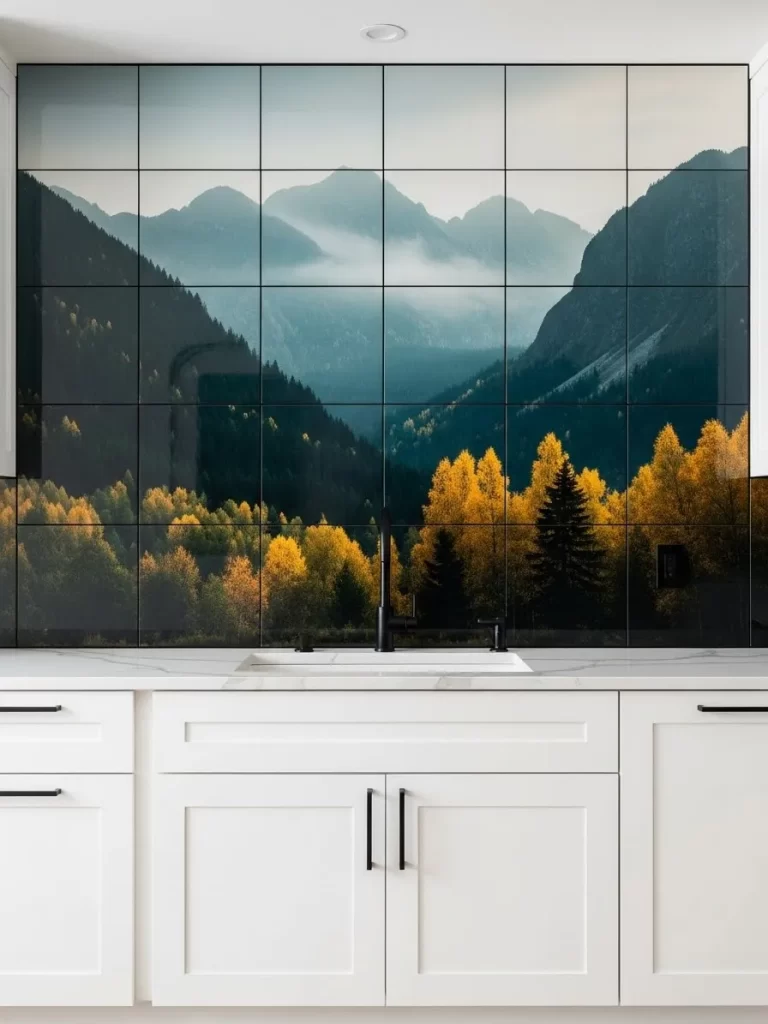
Replace a boring backsplash with this breathtaking panoramic mural, bringing the majesty of nature right into your cooking space. The image, broken into large, square porcelain or glass tiles, captures a foggy mountain range overlooking a valley of vibrant yellow autumn trees. This is a truly stunning artistic statement.
This full-wall graphic acts as a singular, dramatic piece of art, serving as a striking focal point above the sink area. The dark and mysterious tones of the mountains contrast beautifully with the bright gold foliage below. Using a full mural like this offers an incredibly high-impact, custom look that makes the minimalist white cabinets and countertop feel grounded and sophisticated.
Materials Required
- Custom-printed large-format porcelain or glass tiles (pre-numbered to form the mural)
- White polymer-modified thin-set mortar adhesive (for large tiles)
- Minimal-joint grout (color matched to the tile background, often black or dark grey)
- Silicone caulk (black or white)
Equipment Required
- Wet saw with a diamond blade (for straight cuts on large tiles)
- Notched trowel (large U-notch or square-notch, suitable for large format tiles)
- Level and measuring tape
- Grout float and sponge
- Safety glasses and gloves
- Mixing bucket and drill mixer attachment
- Caulking gun
- Pencil
- Utility knife
DIY Instruction Steps
- Mural Mapping and Wall Prep: Clean and dry the wall. Tape a large paper template of the mural layout onto the wall, if provided by the manufacturer. If not, carefully measure the total area and draw a grid, numbering each square where the corresponding tile will go. Draw a central vertical and horizontal line.
- Mortar Preparation: Mix your white thin-set mortar to a creamy, firm consistency. Allow it to slake briefly.
- Setting the Center Tile: Begin applying mortar to the central area of the wall. Start by setting the central tile of the mural (using your numbered map). Press firmly, ensuring it is perfectly level and plumb, as all other tiles will align with this one.
- Continuing the Image: Work outwards from the center, applying mortar and setting the adjacent tiles according to your numbering map. Use the large notched trowel and also “back-butter” the large tiles (apply a thin layer of mortar to the back of the tile) to ensure full coverage.
- Aligning the Image: Pay exceptional attention to aligning the edges of the large tiles so the printed image connects seamlessly. Use a level across several tiles to ensure the surface remains flat. Use the wet saw to cut tiles that fit around the edges of the backsplash area or around the faucet/outlets.
- Curing: Allow the mortar to cure completely, which may take 48 hours, before moving on.
- Minimal Grouting: Mix your dark or black grout. Apply the grout sparingly, focusing only on filling the narrow joints between the large tiles. Wipe off excess grout almost immediately using a damp sponge, as you want the joints to be as inconspicuous as possible.
- Final Finish: Apply a thin, neat bead of silicone caulk (black for maximum drama, or white to match the cabinet) where the backsplash meets the countertop and any adjacent walls for a water-tight seal.
16. Organic River Pebble Mosaic
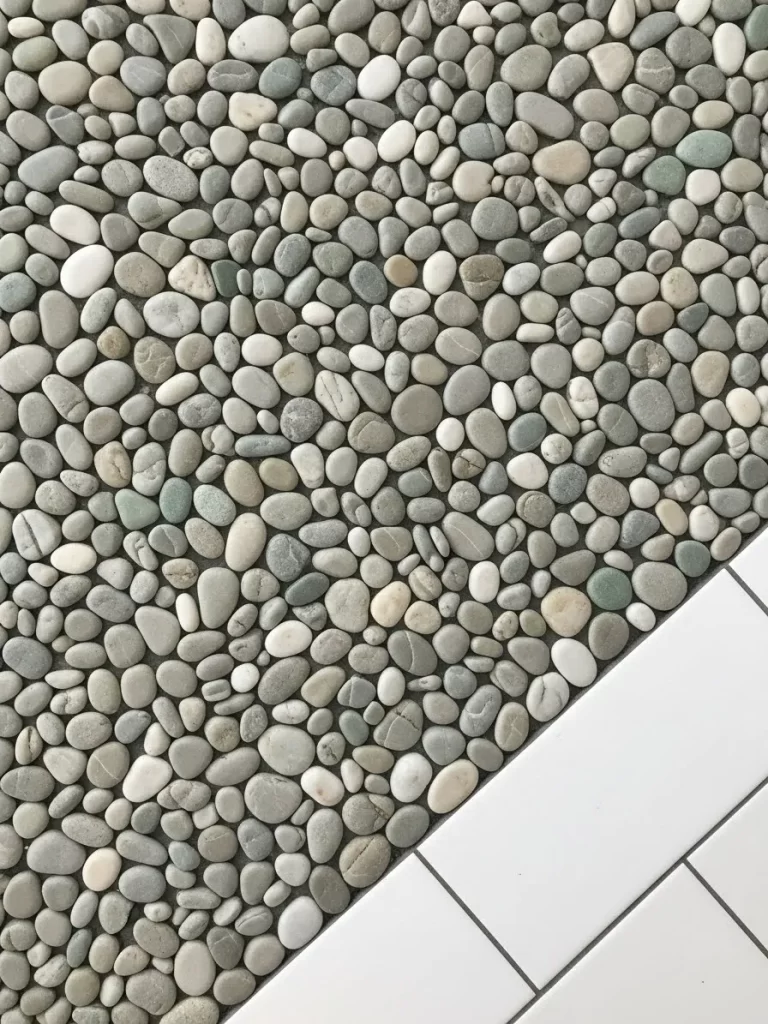
This naturally appealing backsplash introduces incredible texture and an organic feel to your cooking space using sliced river pebbles. The stones, in a blend of soft greys, whites, and subtle greens, are set tightly together to create a smooth, undulating surface. This unexpected choice immediately transforms a boring wall into a tactile, spa-like feature.
The variation in size and shading among the pebbles creates a deep, natural texture that is visually engaging. This image shows a creative installation where the pebble mosaic meets a section of white subway tile at a sharp diagonal, emphasizing the contrast between the organic texture and the clean, geometric lines. Utilizing this material brings the calming essence of the outdoors right into your kitchen environment.
Materials Required
- Flat-sliced natural river pebble mosaic tile sheets (usually mesh-backed)
- Thin-set mortar adhesive (polymer-modified, white or light grey)
- Sanded grout (dark grey or charcoal, to match the shade of the wet pebbles)
- Grout sealer (highly recommended for natural stone)
- Silicone caulk (clear)
Equipment Required
- Wet saw with a diamond blade (for cutting the mesh and making straight cuts)
- Notched trowel (size appropriate for mosaic, often 3/16 inch V-notch)
- Level and measuring tape
- Grout float and sponge (and possibly a cloth for initial pebble wipe)
- Safety glasses and gloves
- Mixing bucket and drill mixer attachment
- Caulking gun
- Utility knife or scissors (for cutting mesh)
DIY Instruction Steps
- Wall Preparation: Clean the wall surface thoroughly. If you are creating a diagonal line with another material, as shown, draw this line clearly on the wall using a level and pencil.
- Mortar Mixing: Mix your thin-set mortar. Keep the consistency thick enough to support the weight of the pebbles without allowing them to “slump” down the wall. Let the mortar slake for a few minutes.
- Applying Mortar: Using the notched trowel, apply mortar to a small section of the wall. Because the pebbles are irregular, ensure the mortar is spread evenly beneath the entire area of the mesh sheet.
- Setting the Pebbles: Press the first mosaic sheet firmly into the mortar. Twist it slightly to ensure every pebble is embedded. Continue setting the sheets, fitting them tightly together so the seams disappear. For the diagonal cut, use the wet saw to cut the mesh backing and the pebbles themselves along your pre-drawn line.
- Tamping: Gently tamp the entire surface with a flat, clean board or a grout float before the mortar cures. This helps ensure all the pebbles are seated at a consistent depth, leading to a smoother finish.
- Curing: Allow the mortar to cure for at least 24 hours.
- Grouting: Mix your dark grey sanded grout. Because the joints are wide and uneven, push the grout firmly into all the gaps using the rubber grout float. Work in small areas.
- Cleaning the Pebbles: This step requires care. Wait about 10 minutes, then use a damp sponge to wipe off the excess grout. You may need to use a soft cloth to clean the rounded tops of the individual pebbles, taking care not to pull the grout out from between them. Rinse the sponge/cloth frequently.
- Sealing and Caulking: After the grout cures (check instructions), apply a natural stone sealer to the pebbles and grout lines. Finish by applying a bead of clear silicone caulk where the backsplash meets the countertop and any adjacent materials.
17. Luxurious Antiqued Mirror Panels
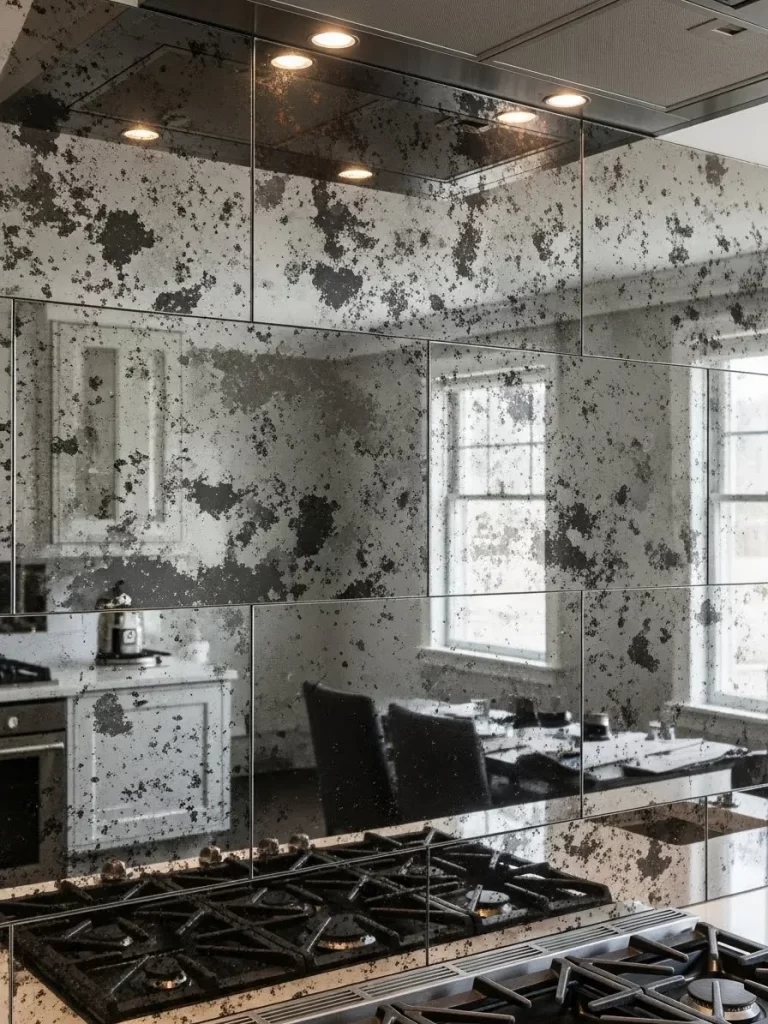
Elevate your kitchen from boring to opulent with this dramatic antiqued mirror backsplash. Large, rectangular glass panels feature a distressed, speckled finish that mimics the look of aged mercury glass. This design beautifully reflects light from the recessed ceiling fixtures, making the cooking space feel significantly larger and brighter.
The intentional imperfections and dark mottling of the mirror create a soft, diffused reflection, preventing the backsplash from feeling overly busy or distracting. This material choice offers an incredible layer of texture and glamour, contrasting elegantly with the modern gas range and stainless steel features. Using this custom mirror paneling is a sophisticated way to introduce vintage charm and shine into a contemporary setting.
Materials Required
- Antiqued or distressed mirror glass panels (custom cut to size)
- Specialized mirror mastic or strong construction adhesive (must be safe for mirror backing)
- Clear silicone caulk (for sealing the edges)
- J-channel or thin metal trim (optional, for finishing exposed edges)
Equipment Required
- Level and measuring tape
- Caulk gun
- Glass suction cups (helpful for lifting and positioning large panels)
- Glass cleaner and soft cloth
- Safety glasses and gloves
DIY Instruction Steps
- Wall Preparation: The wall must be extremely clean, dry, and flat, as mirror panels will reflect any surface irregularities. Measure the exact dimensions for each panel placement. Use a pencil and level to lightly mark the placement lines for each mirror piece.
- Adhesive Application: Apply the mirror mastic adhesive to the back of the first panel. Do not cover the entire back; apply it in vertical beads or “S” shapes. It is essential to use a mastic specifically rated for mirrors to avoid damaging the silver backing.
- Panel Installation: With a partner, lift the first panel using suction cups. Carefully align the panel with your marked lines and press firmly onto the wall. If the panel requires a cut for an outlet, ensure this is done professionally before installation.
- Continuing the Grid: Install the adjacent panels, leaving a minimal, uniform gap between each piece to create a subtle grid effect. Use shims or spacers at the bottom edge to maintain a consistent gap from the countertop.
- Curing: Allow the adhesive to cure completely, which may take several days, depending on the product instructions. Do not clean or put pressure on the mirrors during this time.
- Finishing and Sealing: Once cured, carefully remove any shims. Apply a thin, neat bead of clear silicone caulk where the mirror panels meet the countertop. If the edges of the mirrors are exposed, install a J-channel or thin metal trim around the perimeter for a polished, finished edge.
- Final Cleaning: Clean the surface using a soft cloth and non-ammonia mirror cleaner.
18. Interlocking Two-Tone Puzzle Tile
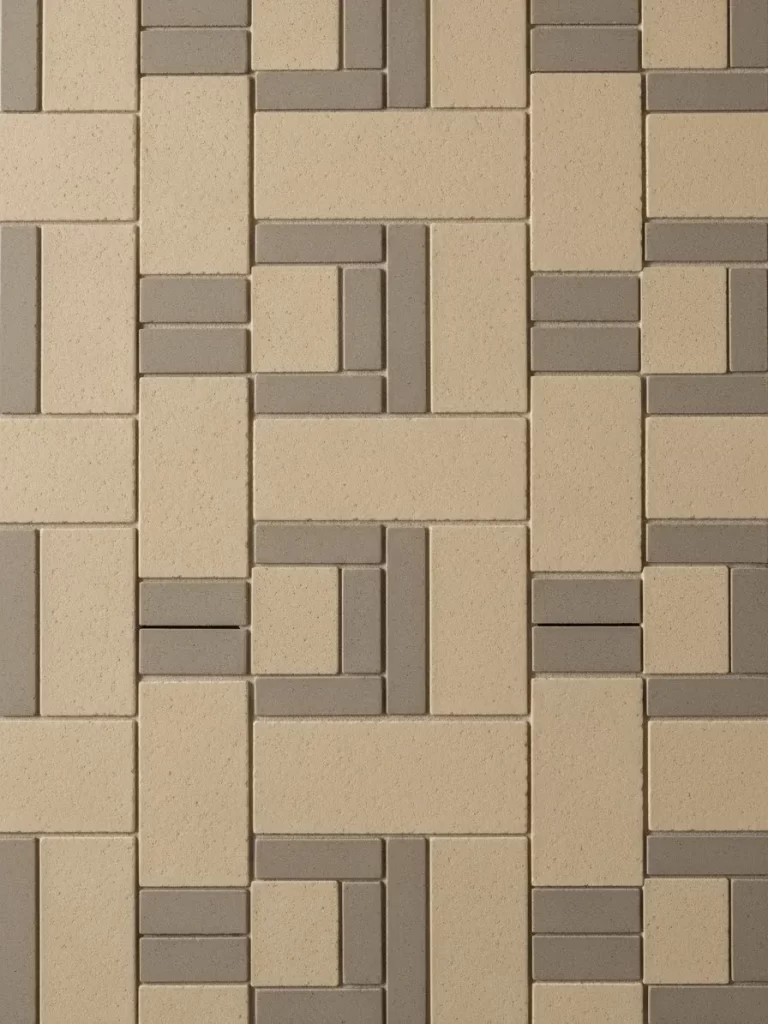
Introduce an intriguing geometric pattern to your cooking space with this two-tone interlocking tile backsplash. The design features a complex, repeating pattern of beige rectangles and squares nested within a darker grey framework. This creates a mesmerizing, maze-like arrangement that is genuinely far from boring.
The tiles are subtly textured, likely ceramic or concrete-look porcelain, giving the surface a soft, matte quality. The contrast between the warm, creamy beige and the cool, flat grey defines the pattern beautifully, offering depth and visual interest without relying on vibrant color. This backsplash choice provides a strong, contemporary architectural element, proving that neutral tones can still deliver a powerful design punch.
Materials Required
- Interlocking geometric tiles (two-tone, usually mesh-backed)
- White thin-set mortar adhesive (non-staining)
- Unsanded grout (color-matched to the dark grey tile, or slightly lighter)
- Tile spacers (if using individual tiles, though usually mesh-backed)
- Silicone caulk (grey or beige)
Equipment Required
- Wet saw or manual tile cutter
- Notched trowel (size appropriate for the tile modules)
- Level and measuring tape
- Grout float and sponge
- Safety glasses and gloves
- Mixing bucket and drill mixer attachment
- Caulking gun
- Pencil
- Utility knife
DIY Instruction Steps
- Wall Preparation and Centering: Ensure the wall is clean, dry, and flat. Use a level and pencil to find the center of your backsplash area. This pattern looks best when centered, so plan the layout to ensure cuts on the left and right sides are symmetrical.
- Mortar Preparation: Mix your white thin-set mortar to a firm, creamy consistency. Allow the mixture to slake for a few minutes.
- Setting the Tiles: Apply mortar to a small area of the wall. Begin setting the first tile module (or mesh sheet) at your center mark. Press firmly, ensuring the tile module is level and plumb. Continue installing, carefully aligning the edges so the complex pattern continues seamlessly from one piece to the next.
- Continuing the Pattern: Continue applying mortar and placing subsequent modules, carefully aligning the edges so the complex pattern continues seamlessly from one piece to the next. Use scissors or a utility knife to cut the mesh backing when fitting the sheets around obstacles or at the edges of the wall. Use the wet saw for precise cuts on the tiles themselves.
- Curing: Allow the mortar to cure for at least 24 hours.
- Grouting: Mix your unsanded grout, color-matched to the darker tile. Using a rubber grout float, spread the grout diagonally across the tiles, forcing it into all the joints.
- Cleanup: Wait approximately 15 minutes, then use a damp sponge to gently wipe off excess grout from the tile faces. Rinse the sponge often to prevent a grout haze from setting on the two-toned surface.
- Final Caulking: Apply a thin, neat bead of color-matched silicone caulk where the backsplash meets the countertop for a finished, water-resistant seal.
19. Iridescent Mother-of-Pearl Backsplash
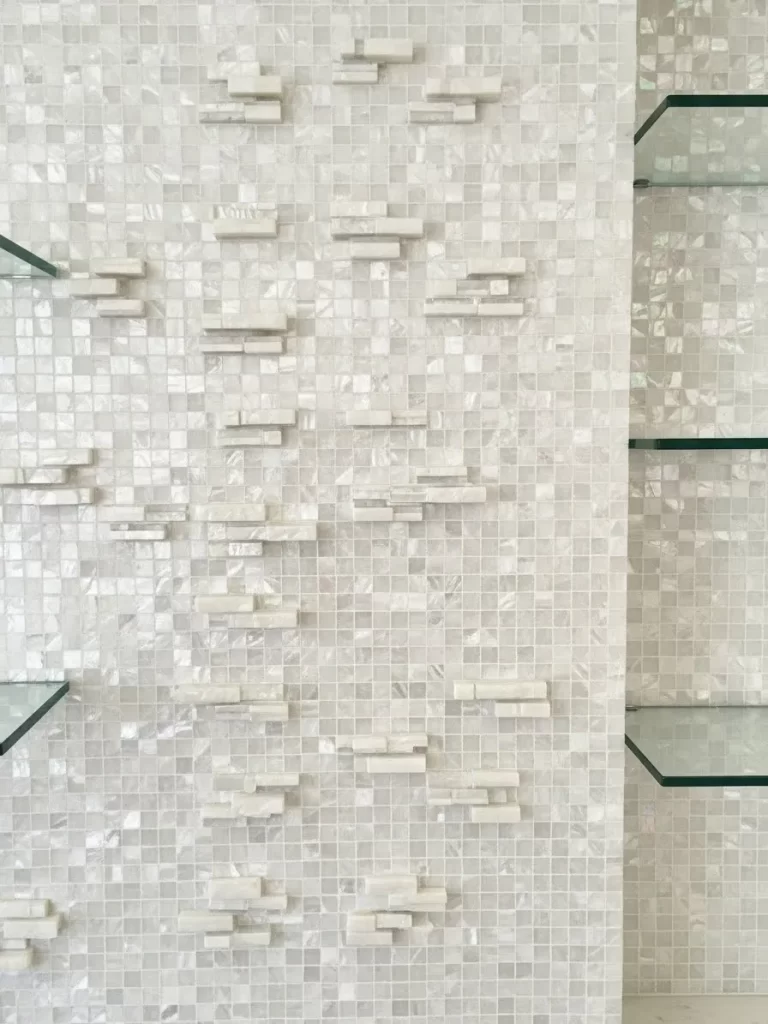
For an absolutely dazzling kitchen, consider this mother-of-pearl mosaic tile backsplash. The tiny, iridescent squares shimmer with every shift of light, displaying subtle hues of pink, green, and blue across the creamy white surface. This material brings an unparalleled sense of luxury and coastal elegance to the cooking space.
This wall is further enhanced by small, rectangular bars of pure white shell tile strategically placed in horizontal, scattered groupings. These dimensional accents float above the main mosaic, creating fascinating shadow lines and adding an extra layer of texture. This shimmering, multi-layered design is genuinely captivating and will make your backsplash the undisputed focal point of your kitchen.
Materials Required
- Mother-of-pearl mosaic tile sheets (mesh-backed)
- White thin-set mortar adhesive (epoxy-based is sometimes preferred for shell/glass)
- Unsanded grout (white, or a slightly off-white that matches the shell)
- Silicone caulk (clear)
Equipment Required
- Tile nippers or small wet saw (for making precise cuts on shell pieces)
- Notched trowel (very small V-notch, 1/8 inch, suitable for small mosaics)
- Level and measuring tape
- Grout float (epoxy grout float is ideal) and sponge
- Safety glasses and gloves
- Mixing bucket and drill mixer attachment
- Caulking gun
- Pencil
DIY Instruction Steps
- Clean Wall and Layout: The wall must be very smooth and clean. Imperfections will show through the shimmering shell. Mark a horizontal starting line with a level.
- Mortar Preparation: Mix your white thin-set mortar. Keep the mortar thin and consistent; you want minimal mortar squeezed up between the tiny tiles. Allow it to slake briefly.
- Setting Base Mosaic: Apply mortar to a small section of the wall. Press the first mosaic sheet firmly into the mortar, using a flat board or float to gently tamp the surface and ensure full, even contact. Align the seams carefully so the pattern flows continuously.
- Adding Dimensional Accents: If your design includes the floating dimensional bars, apply a tiny dab of thin-set mortar or a small amount of construction adhesive to the back of each bar and press them into the desired locations on top of the already set mosaic sheets.
- Cutting: Use tile nippers or a wet saw to cut sheets to fit at the edges and around obstacles. Be very careful with delicate shell material, which can be brittle.
- Curing: Allow the mortar and accent adhesive to cure completely, typically 24 hours.
- Grouting Carefully: Mix your white unsanded grout. Work carefully with the rubber grout float, spreading the grout diagonally and ensuring it fills the joints without coating the tops of the iridescent shell pieces too thickly. Do not push too hard on the dimensional accents.
- Cleaning: Wait a short time (about 10-15 minutes), then use a damp sponge to gently clean the surface. Rinse the sponge often to prevent a haze. Buffing with a dry, lint-free cloth after drying can enhance the shine.
- Sealing: Apply a thin, neat bead of clear silicone caulk where the backsplash meets the countertop for a water-tight seal.
20. Minimalist Carved Marble Panel
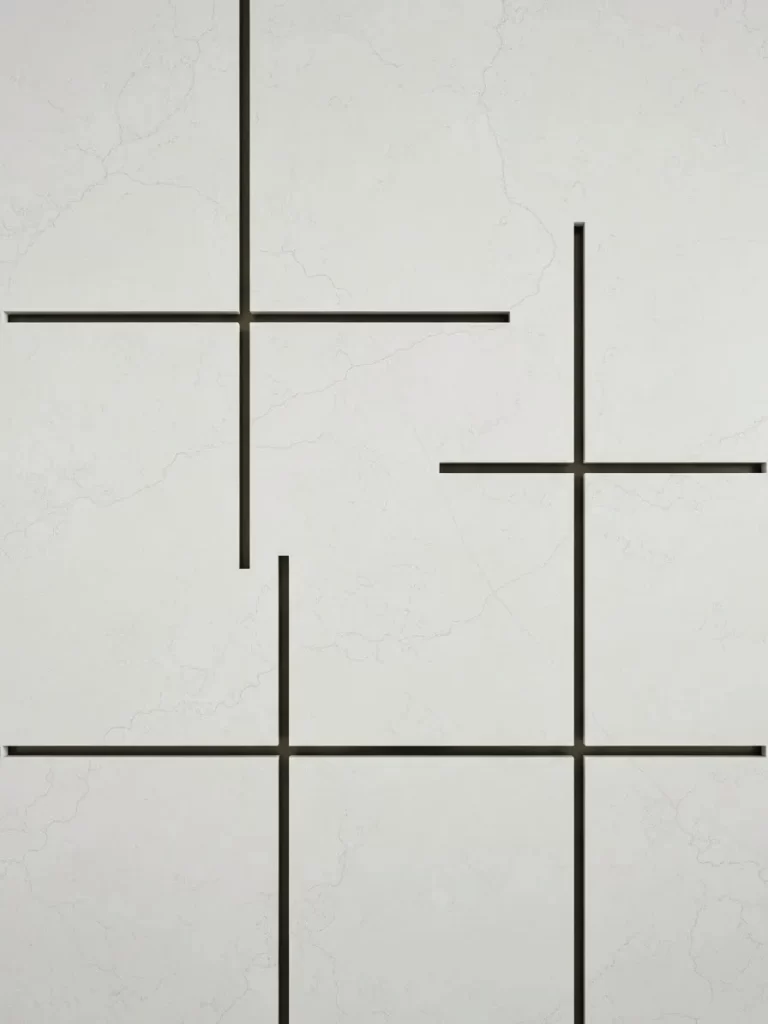
This sleek design demonstrates how to achieve an ultra-modern, high-end look that is definitely not boring. The backsplash is composed of large, monolithic slabs of light-colored stone, likely a white quartz or marble with subtle veining. The real stunning feature is the precise, geometric routing or carving of thin black lines directly into the stone panels.
The design features bold, asymmetric cross shapes and intersecting vertical lines that create an artistic, three-dimensional graphic. The minimalist aesthetic is maintained through the continuous surface of the stone, while the black linear details introduce strong, contemporary contrast. This is a subtle yet incredibly impactful way to customize a stone slab, turning a standard material into a piece of modern kitchen sculpture.
Materials Required
- Large-format quartz or marble-look engineered stone slabs
- Black metal Schluter trim strips (or similar linear inlay material)
- Specialized epoxy adhesive (for bonding stone and metal inlay)
- Epoxy thin-set mortar (for installing the slab)
- Silicone caulk (clear or white)
Equipment Required
- Heavy-duty suction cups (for handling large slabs)
- Level and measuring tape
- Notched trowel (large size, 1/2 inch U-notch or square-notch)
- Caulking gun
- Pencil and straightedge
- Safety glasses and gloves
- Mixing tools (for epoxy adhesive and mortar)
DIY Instruction Steps
- Professional Fabrication: Note: The stone slab must be professionally fabricated, cut, and routed with the channels for the black lines before it is brought on site for installation.
- Wall Preparation: Clean and dry the wall thoroughly. Mark your placement lines carefully.
- Inlay Installation (Pre-step to wall mount): Before mounting the slab to the wall, use the epoxy adhesive to set the black metal Schluter trim strips into the routed channels of the stone slab. Ensure they sit flush with the surface. Allow this adhesive to cure fully.
- Mortar Mixing and Application: Mix your epoxy thin-set mortar. This provides superior adhesion for heavy slabs. Apply the mortar evenly to the wall using the large notched trowel.
- Slab Installation: With a partner and suction cups, lift the prepared slab. Carefully align it with the countertop and the marked wall lines. Press firmly. Use a rubber mallet and a wood block to gently tap the entire surface, ensuring full mortar contact.
- Curing: Allow the mortar to cure for at least 48 hours.
- Sealing and Caulking: Apply a thin, neat bead of clear or white silicone caulk where the slab meets the countertop and any adjacent walls. This seals the installation and accommodates any minor movement.
21. Bold Color Block Mosaic Accent
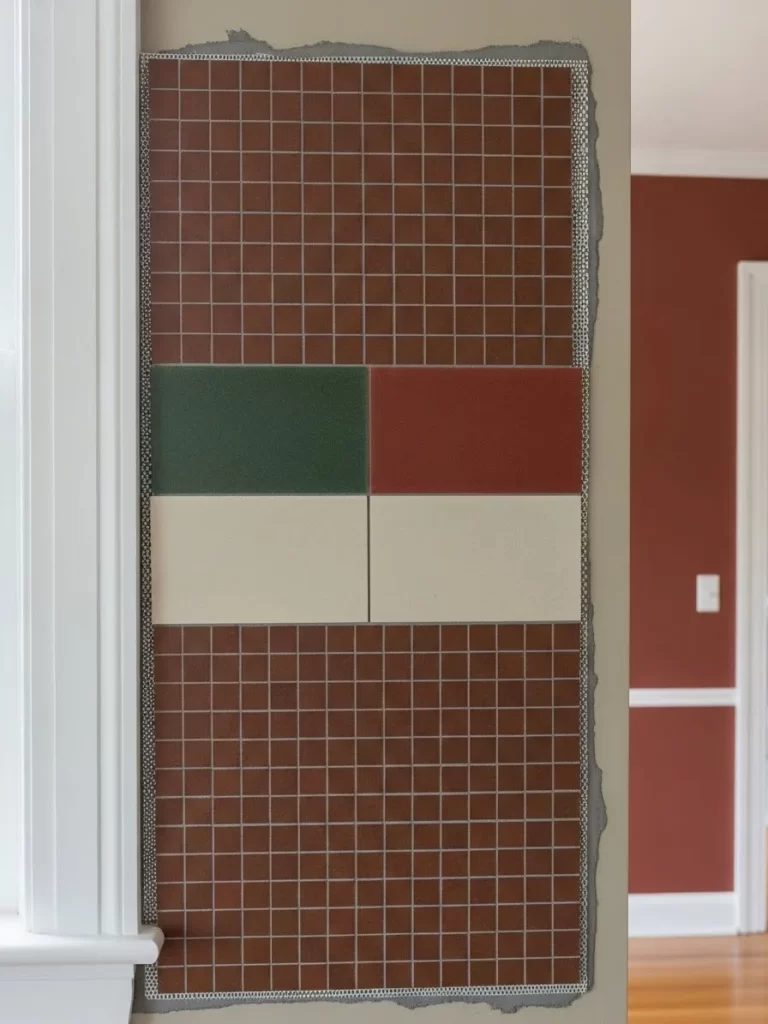
This vibrant idea offers a highly customized and artistic way to refresh a boring kitchen with color. The design uses small, square mosaic tiles in a deep terracotta tone for the majority of the backsplash area. A central, vertical accent panel breaks up the grid, featuring large square tiles in striking colors: forest green, deep crimson, and creamy off-white.
This combination of different tile sizes—tiny squares surrounding large ones—creates an exciting contrast in scale and texture. The bold color blocking transforms the backsplash into a strong architectural feature, reminiscent of a vintage European flag or heraldic shield. This is a truly bespoke approach that adds immense character and focal impact to a simple wall space.
Materials Required
- Terracotta-toned small square mosaic tiles (mesh-backed)
- Large format square tiles (in green, crimson, and off-white)
- Thin-set mortar adhesive (white or light grey)
- Unsanded grout (white, or a light grey)
- Tile spacers (small, 1/16 inch)
- Silicone caulk (white)
- Metal edging/trim (optional, for neat border around the mosaic)
Equipment Required
- Wet saw (for cutting both large and small tiles)
- Notched trowel (size appropriate for both small mosaic and large tiles)
- Level and measuring tape
- Grout float and sponge
- Safety glasses and gloves
- Mixing bucket and drill mixer attachment
- Caulking gun
- Pencil
DIY Instruction Steps
- Wall Prep and Planning: Clean the wall. Precisely measure and draw the boundaries for the central color block accent panel. Draw horizontal lines to indicate where the different colors of the large accent tiles will sit.
- Mortar Application: Mix your thin-set mortar. Apply mortar to the central accent area first, using the appropriate sized notched trowel for the large tiles.
- Setting Accent Tiles: Carefully set the large accent tiles (green, crimson, off-white) into the mortar, ensuring they are perfectly level and aligned with your drawn lines. Use spacers between them.
- Setting Mosaic Tiles: Switch to the smaller notched trowel. Apply mortar to the surrounding area. Begin setting the terracotta-toned mosaic sheets, starting where they meet the large accent tiles. Ensure the tiny mosaic squares are aligned with the grout lines of the larger tiles for a cohesive look.
- Edge Finishing (Optional): If using metal trim, cut and set it around the perimeter of the entire backsplash area simultaneously with the tiles, pressing it into the mortar.
- Curing: Allow the mortar to cure for at least 24 hours. Remove all spacers.
- Grouting: Mix your white or light grey unsanded grout. Using the rubber grout float, spread the grout over the entire surface, pushing it firmly into the small joints of the mosaic and the larger joints of the accent tiles.
- Cleanup: Wait approximately 15 minutes, then use a damp sponge to wipe off excess grout, paying attention to cleaning both the smooth surfaces of the large tiles and the uneven surface of the mosaic.
- Final Caulking: Apply a thin, neat bead of white silicone caulk where the backsplash meets the countertop and around the vertical perimeter for a water-tight seal.
22. Classic Delft Blue Accent Tile
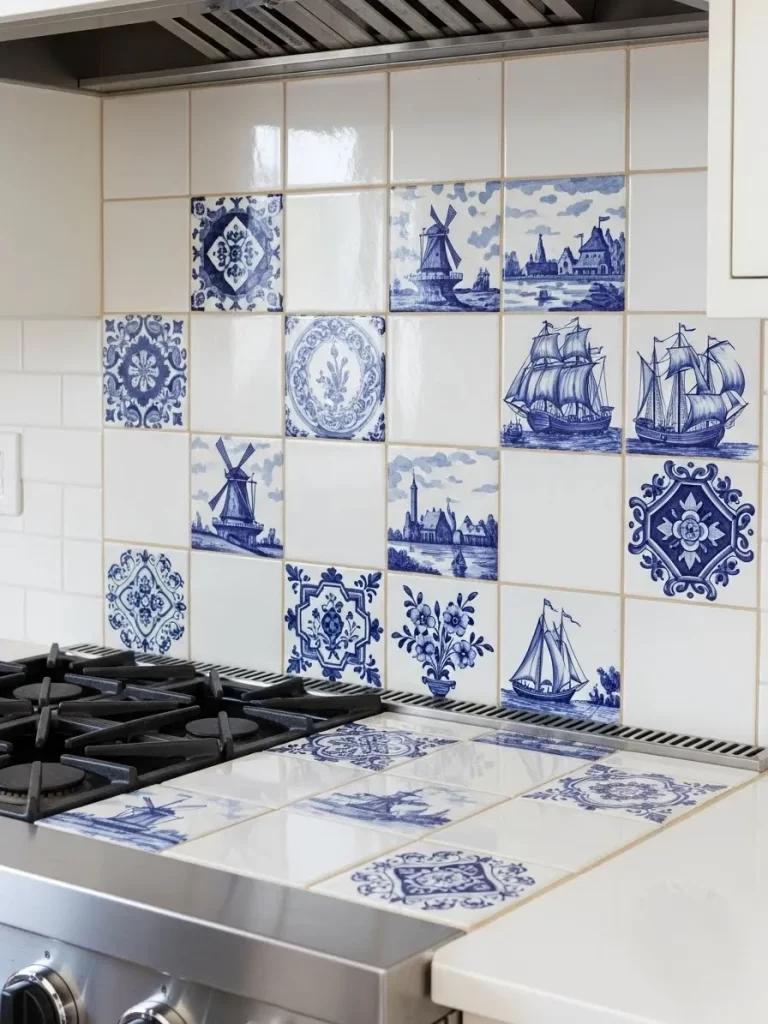
Give your kitchen backsplash a charming European upgrade with an artistic arrangement of hand-painted blue and white tiles. These tiles, reminiscent of classic Delftware, feature a variety of intricate designs including sailing ships, windmills, floral motifs, and detailed geometric patterns. This approach moves far beyond a boring, single-tile look.
The decorative squares are interspersed among simple white subway tiles, creating an elegant focal point above the range. This design successfully blends historical artistry with modern simplicity. The rich cobalt blue stands out beautifully against the white background, transforming the area into a bespoke, heritage-inspired display.
Materials Required
- Hand-painted blue and white ceramic accent tiles (various patterns)
- White ceramic subway tiles (for the field/surrounding area)
- White thin-set mortar adhesive
- Unsanded grout (white or light grey)
- Tile spacers (1/8 inch or 1/16 inch)
- Silicone caulk (white)
Equipment Required
- Wet saw or manual tile cutter
- Notched trowel (size appropriate for the tiles, often 3/16 inch V-notch)
- Level and measuring tape
- Grout float and sponge
- Safety glasses and gloves
- Mixing bucket and drill mixer attachment
- Caulking gun
- Pencil
DIY Instruction Steps
- Layout and Centering: Clean the wall. Precisely measure the area above your range where the patterned accent block will sit. Mark the central axis of this area with a vertical plumb line. Draw horizontal lines to indicate the outer boundaries of the accent tile block.
- Mortar Preparation: Mix your white thin-set mortar to a smooth, creamy consistency. Allow the mixture to slake for a few minutes.
- Setting Accent Tiles: Begin by applying mortar to the central section. Start setting the patterned blue and white tiles, working outwards from the center to ensure symmetry. Press firmly and use spacers to maintain uniform gaps. Mix up the patterns randomly for a truly classic look.
- Setting Field Tiles: Continue applying mortar to the surrounding areas. Use the white subway tiles to fill in the rest of the backsplash, ensuring their grout lines align neatly with the edges of the decorative accent tiles.
- Cutting: Use the wet saw or tile cutter for cuts needed at the edges, corners, and around outlets.
- Curing: Allow the mortar to cure completely, usually 24 hours. Remove all the tile spacers.
- Grouting: Mix your white unsanded grout. Using a rubber grout float, spread the grout diagonally across the entire surface, pushing it firmly into all the joints.
- Cleanup: Wait approximately 15 minutes, then use a damp sponge to gently wipe off excess grout from the tile faces. Rinse the sponge often to prevent a grout haze.
- Final Sealing: Apply a thin, neat bead of white silicone caulk where the backsplash meets the countertop for a water-resistant seal.
23. Dark Textured Brick with Volcanic Rock Hood
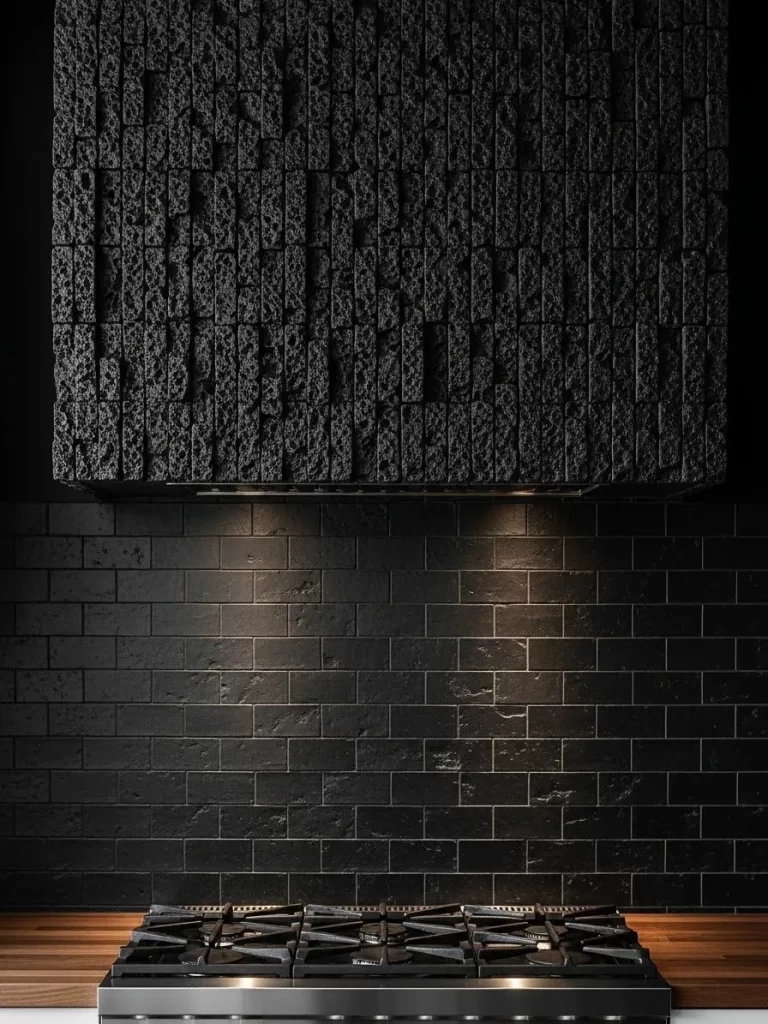
Achieve a dramatic and sophisticated kitchen transformation with this black textured backsplash. The wall features charcoal-colored brick veneer tiles that have a deliberate, rugged surface, absorbing light beautifully. The dark tone offers an elegant contrast to the warm wooden countertop.
Adding another layer of striking texture, the range hood is fully encased in deeply textured, short black stone pieces, resembling volcanic rock. This monolithic, rough-hewn material visually anchors the cooking space. The combination of the matte, black brick and the high-texture stone creates an unforgettable, stunning design that is both modern and fiercely industrial.
Materials Required
- Black or charcoal brick-look ceramic or porcelain tiles (for the backsplash)
- Textured black lava stone or basalt linear tiles (for the hood cladding)
- Dark grey thin-set mortar adhesive (polymer-modified for durability)
- Black sanded grout (to minimize joint visibility)
- Stone and grout sealer (for porous materials if using real stone)
- Silicone caulk (black)
Equipment Required
- Wet saw with a diamond blade (for precise cuts on both materials)
- Notched trowel (size appropriate for the tiles)
- Level and measuring tape
- Grout float and sponge
- Safety glasses and gloves
- Mixing bucket and drill mixer attachment
- Caulking gun
DIY Instruction Steps
- Wall and Hood Prep: Clean and dry all surfaces. Ensure the range hood structure is capable of supporting the weight of the stone cladding. Mark all horizontal and vertical reference lines.
- Backsplash Installation (Brick): Mix the dark thin-set mortar. Apply mortar to the backsplash area. Set the black brick tiles in a running bond (brick) pattern, using spacers to maintain minimal joint lines. Ensure all rows are level. Use the wet saw for cuts around the edges.
- Hood Cladding Installation (Textured Stone): Once the backsplash is set, move to the hood. Apply mortar to a small section of the hood structure. Start setting the textured black stone pieces, ensuring the pieces fit tightly together to maximize texture. You will need to make numerous small cuts with the wet saw to wrap the corners neatly.
- Curing Time: Allow the mortar to cure for 48 hours, especially for the vertical stone cladding on the hood.
- Grouting: Mix the black sanded grout. Use the rubber grout float to push the grout firmly into the joints of both the backsplash and the hood cladding. The goal is to make the joints recede visually.
- Cleanup: Wait a short time, then use a damp sponge to gently clean the excess grout. Be careful around the highly textured stones to avoid pulling grout out of the joints.
- Sealing and Caulking: If using real stone, apply a stone sealer to the entire surface. Apply a thin, neat bead of black silicone caulk where the backsplash meets the countertop and around the base of the hood.
24. Elegant Diamond Marble Mosaic
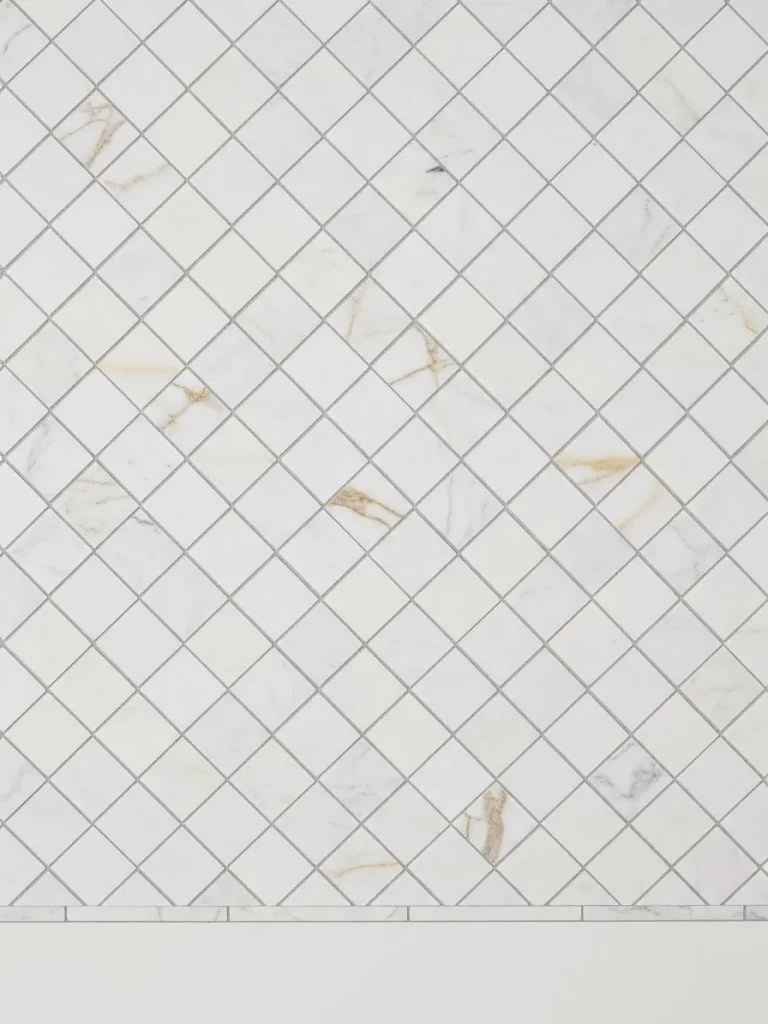
Reject a boring kitchen with this luxurious diamond-patterned marble mosaic. Tiny square marble tiles are set on the diagonal, creating a classic, sophisticated diamond grid across the entire wall. The white marble features beautiful, subtle veining in hues of soft grey and warm gold, adding richness and depth.
The light grout lines contrast subtly with the stone, emphasizing the geometric pattern. The diagonal orientation adds height and movement, instantly elevating the cooking space. This choice uses natural stone, providing an unmatched texture and sense of enduring elegance that works perfectly with a simple, solid-colored lower border or countertop. This is a stunning and timeless upgrade.
Materials Required
- White marble mosaic tiles set in a diagonal (diamond) pattern (usually mesh-backed)
- White thin-set mortar adhesive (non-staining, suitable for marble)
- Unsanded grout (light grey or white)
- Marble sealer
- Silicone caulk (white or clear)
Equipment Required
- Wet saw with a diamond blade (for cutting the stone tiles)
- Notched trowel (small V-notch, 1/8 inch or similar)
- Level and measuring tape
- Grout float and sponge
- Safety glasses and gloves
- Mixing bucket and drill mixer attachment
- Caulking gun
- Pencil
DIY Instruction Steps
- Pre-Sealing: Marble is porous; before installation, apply a penetrating sealer to the faces of the marble tiles. This helps prevent staining from mortar and grout.
- Wall Prep and Layout: Clean the wall. Find the center of the backsplash and draw a central vertical and horizontal line. Since the tiles are set on a diamond, your horizontal starting line must be level.
- Mortar Preparation and Application: Mix your white thin-set mortar. Use the small notched trowel to spread a thin, even layer of mortar to a small section of the wall. Avoid excessive mortar that would squeeze through the joints.
- Setting Mosaic Sheets: Align the first mosaic sheet carefully with your center lines. Press firmly into the mortar. Continue placing adjacent sheets, aligning the seams meticulously so the diamond pattern flows continuously across the wall. Use the wet saw to cut the sheets along the edges, corners, and around obstacles.
- Curing: Allow the mortar to cure completely, typically 24-48 hours.
- Grouting: Mix your light grey or white unsanded grout. Using a rubber grout float, spread the grout diagonally, pushing it firmly into all the narrow joints.
- Cleanup: Wait a short time (about 15 minutes), then use a damp sponge to gently clean the excess grout from the marble faces. Rinse the sponge often to prevent haze.
- Final Sealing and Caulking: Once the grout is cured, apply a second coat of marble and grout sealer. Apply a thin, neat bead of white or clear silicone caulk where the backsplash meets the countertop for a water-tight finish.
25. High-Gloss Emerald Herringbone Feature
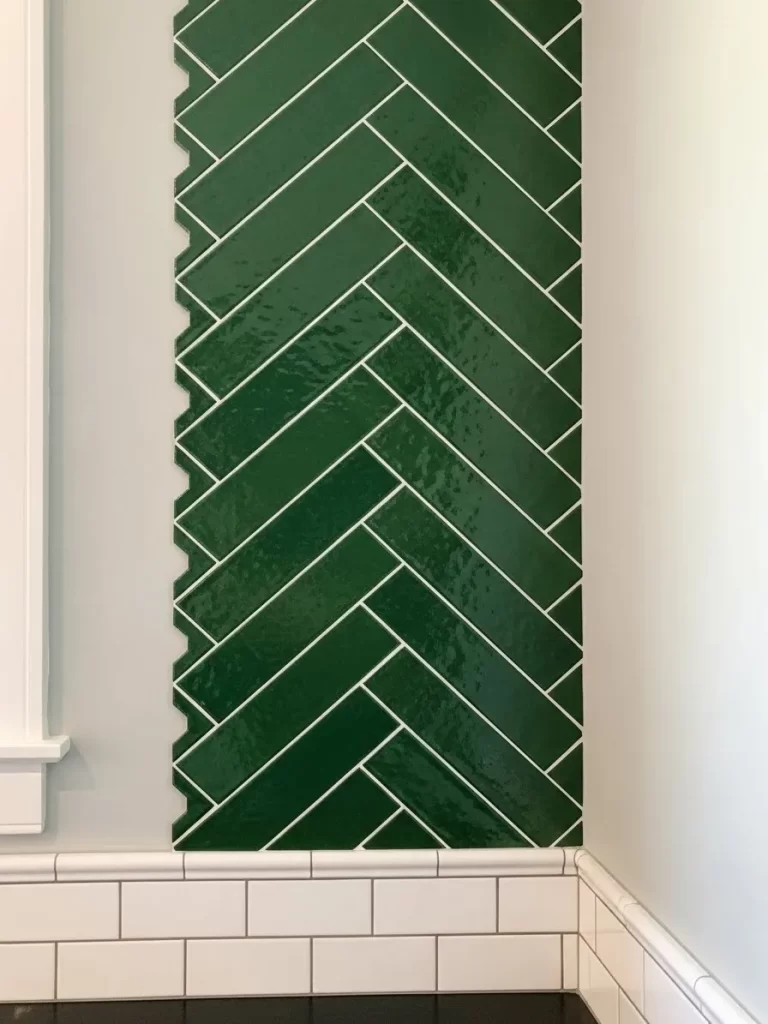
This vivid backsplash showcases how a bold color and dynamic pattern can transform a kitchen wall into a piece of art. Long, slim ceramic tiles in a rich, glossy emerald green are set in a dramatic vertical herringbone pattern. This orientation adds significant visual height and energy to the space.
The clean white grout lines contrast sharply with the deep green, emphasizing the intricate zig-zagging pattern and geometric precision. The feature is installed as a vertical accent panel with a striking, jagged edge that contrasts with the surrounding smooth white walls and base tile. Choosing this deep, luxurious green makes the cooking area feel instantly sophisticated and far from boring.
Materials Required
- High-gloss emerald green slim ceramic subway tiles
- White thin-set mortar adhesive
- Unsanded grout (bright white)
- Tile spacers (small, 1/16 inch)
- Silicone caulk (white)
Equipment Required
- Wet saw (essential for the complex angle cuts required for herringbone)
- Notched trowel (3/16 inch V-notch or similar)
- Level and measuring tape
- Grout float and sponge
- Safety glasses and gloves
- Mixing bucket and drill mixer attachment
- Caulking gun
- Pencil and straightedge
DIY Instruction Steps
- Precise Layout: Clean the wall. Precisely measure the width of your accent panel. Find the exact vertical center line and a horizontal reference line for the starting point of the herringbone V-pattern. Draw a faint line on the wall for the zig-zag border edge.
- Complex Cutting (Crucial Step): You must pre-cut the tiles that form the jagged edges and the tiles for the V-point of the herringbone pattern. Use a wet saw set to a 45-degree angle for accurate cuts. Label the pieces.
- Mortar Application: Mix your white thin-set mortar. Apply mortar to the starting area of your accent panel.
- Setting Tiles: Start setting the V-point of the herringbone pattern on your horizontal reference line. Work outwards, carefully setting each piece. The tiles should meet at precise 90-degree angles in the ‘V’. Use spacers to maintain consistent white grout lines. Continue working up and outwards, inserting the pre-cut jagged edge pieces last.
- Curing: Allow the mortar to cure for at least 24 hours. Remove all spacers.
- Grouting: Mix your bright white unsanded grout. Using a rubber grout float, spread the grout over the entire surface, pushing it firmly into the narrow joints.
- Cleanup: Wait approximately 15 minutes, then use a damp sponge to gently wipe off excess grout from the high-gloss surface. Rinse the sponge often to prevent haze.
- Final Caulking: Apply a thin, neat bead of white silicone caulk where the backsplash meets the countertop for a clean, water-resistant seal.
26. Modern Corrugated Metal Panel
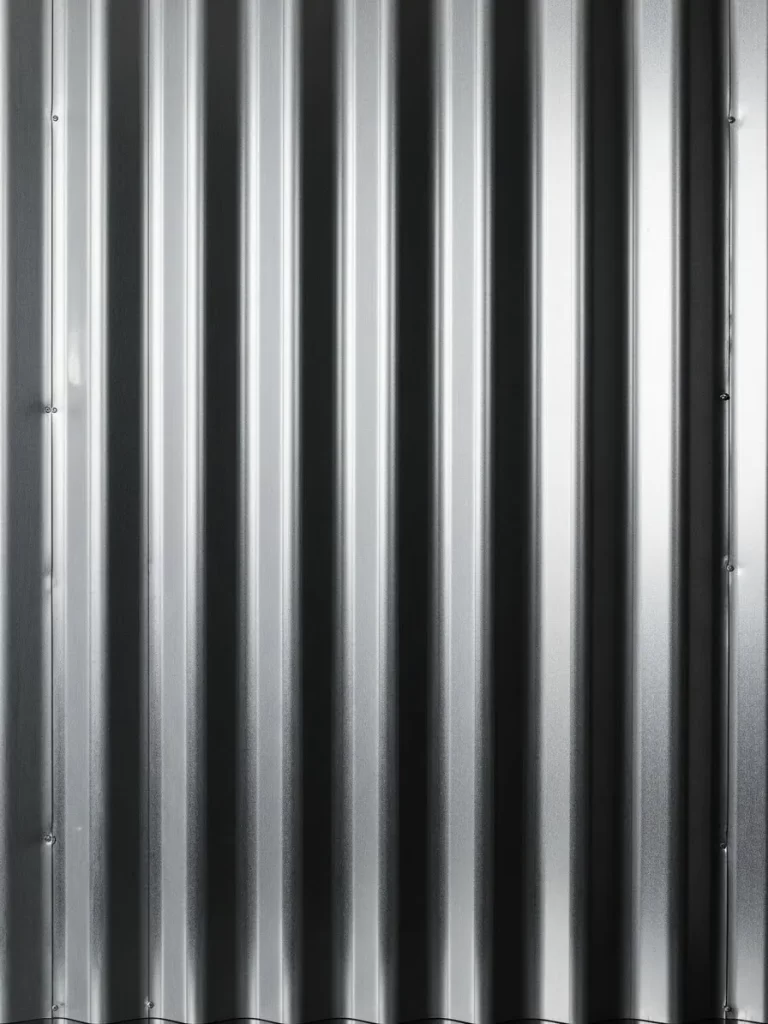
For a striking industrial look that is decidedly not boring, consider cladding your kitchen backsplash in sleek corrugated metal. This material features vertical ridges and valleys that create a fantastic textural play of light and shadow, giving the entire wall surface a kinetic quality. The reflective silver finish is contemporary and clean.
This lightweight, durable material provides an immediate industrial chic aesthetic, working well with stainless steel appliances and minimalist design. The vertical orientation helps to emphasize the height of the cooking space. Installing this metal panel is a straightforward, budget-friendly way to achieve a high-impact, stunning feature wall that contrasts beautifully with natural wood or painted cabinets.
Materials Required
- Corrugated metal panels (lightweight aluminum or galvanized steel)
- Construction adhesive (high-strength, suitable for bonding metal to wall)
- Pop rivets or self-tapping screws (optional, for mechanical fastening)
- J-channel or metal trim (for finishing exposed edges)
- Silicone caulk (clear)
Equipment Required
- Metal snips or circular saw with a metal cutting blade (for precise cuts)
- Measuring tape and level
- Caulk gun
- Power drill
- Safety glasses and gloves
- Stud finder
DIY Instruction Steps
- Wall Prep and Layout: Ensure the wall is clean and flat. Use a level and measuring tape to plan the placement of the panels. Use a stud finder to locate and mark studs if you plan on using screws or rivets.
- Cutting the Panel: Measure the exact height and width required. Use metal snips or a circular saw with a metal cutting blade (wear eye protection!) to cut the panel to size, taking care to make clean cuts. Cut out openings for any electrical outlets using snips.
- Applying Adhesive: Apply a strong bead of construction adhesive in a zigzag pattern to the back of the metal panel, avoiding the edges where caulk will go.
- Panel Installation: Carefully align the panel with the countertop and cabinet edges. Press the panel firmly against the wall. Use screws or pop rivets along the top and bottom edges (and into studs if available) for mechanical security, covering the screw heads with the final trim piece.
- Finishing Edges: Install J-channel or thin metal trim around the perimeter of the panel (top, sides, bottom) to conceal any raw or cut edges for a professional look. Secure the trim with clear silicone caulk or small screws.
- Sealing: Apply a thin bead of clear silicone caulk where the panel meets the countertop for a water-tight seal. Wipe down the entire surface with a soft cloth to remove fingerprints.
27. Multi-Toned Stacked Stone Veneer
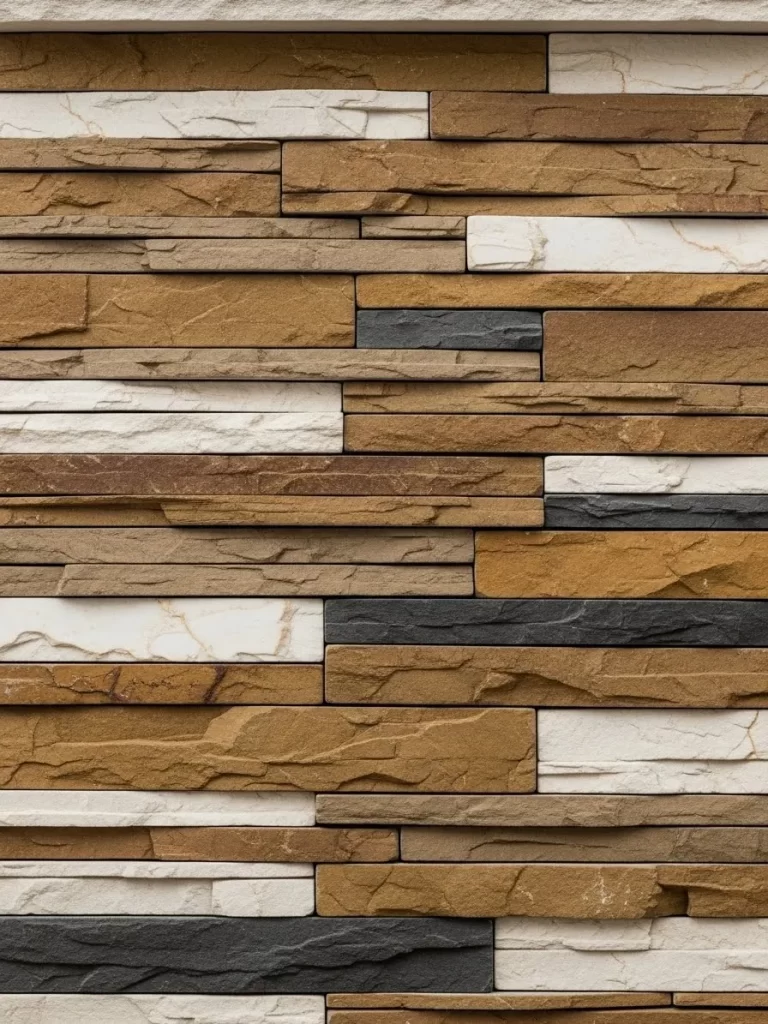
Achieve a magnificent rustic texture with this stacked stone veneer backsplash. The linear stone pieces are installed without visible grout lines, creating a rugged, seamless look. This design features an appealing mix of natural colors: warm rust, dark charcoal, creamy white marble, and various tones of sandy brown.
The intentional mix of colors and materials—some stones appear smooth, others rough and cleft—provides incredible depth and variation. Using this material offers a strong organic element that transforms the cooking space into a feature wall inspired by nature. This three-dimensional surface catches light and shadow beautifully, offering a sophisticated alternative to flat tile backsplashes.
Materials Required
- Natural stacked stone veneer panels (typically Z-shaped interlocking pieces)
- Thin-set mortar adhesive (polymer-modified, in a neutral color)
- Stone sealer (recommended if stone is not pre-sealed)
- Silicone caulk (clear)
Equipment Required
- Wet saw with a diamond blade (mandatory for cutting natural stone)
- Notched trowel (size appropriate for the panel backing)
- Level and measuring tape
- Safety glasses and gloves
- Mixing bucket and drill mixer attachment
- Caulking gun
- Pencil
DIY Instruction Steps
- Wall Prep and Planning: Ensure the wall is strong, clean, and flat. Use a level to draw a horizontal reference line for the bottom edge of the first panel. Find the center of the backsplash and plan your layout to avoid thin slivers of stone at the corners.
- Mortar Preparation: Mix your thin-set mortar. Keep the mixture thick and consistent to support the weight of the stone panels. Allow it to slake for a few minutes.
- Setting the Panels: Apply a thick layer of mortar to a small section of the wall. Start installing the first row of panels along your reference line. Press firmly and slightly twist the Z-shaped pieces to ensure they lock tightly together.
- Continuing Upwards: Continue installing panels, making sure the interlocking edges of the panels butt up perfectly to hide the seams. Crucial: Use the wet saw to make clean, straight cuts for the edges and around outlets. It is often necessary to cut individual stone pieces off the mesh backing to achieve a neat fit at the edges.
- Curing: Allow the mortar to cure completely, typically 48 hours, before proceeding.
- Sealing and Caulking: Grouting is not required, as these are meant to be dry-stacked. Once cured, apply a stone sealer to the entire surface if the product is not pre-sealed. Apply a thin, neat bead of clear silicone caulk where the stone meets the countertop for a water-tight finish.
28. Whimsical Pastel Scallop Tile
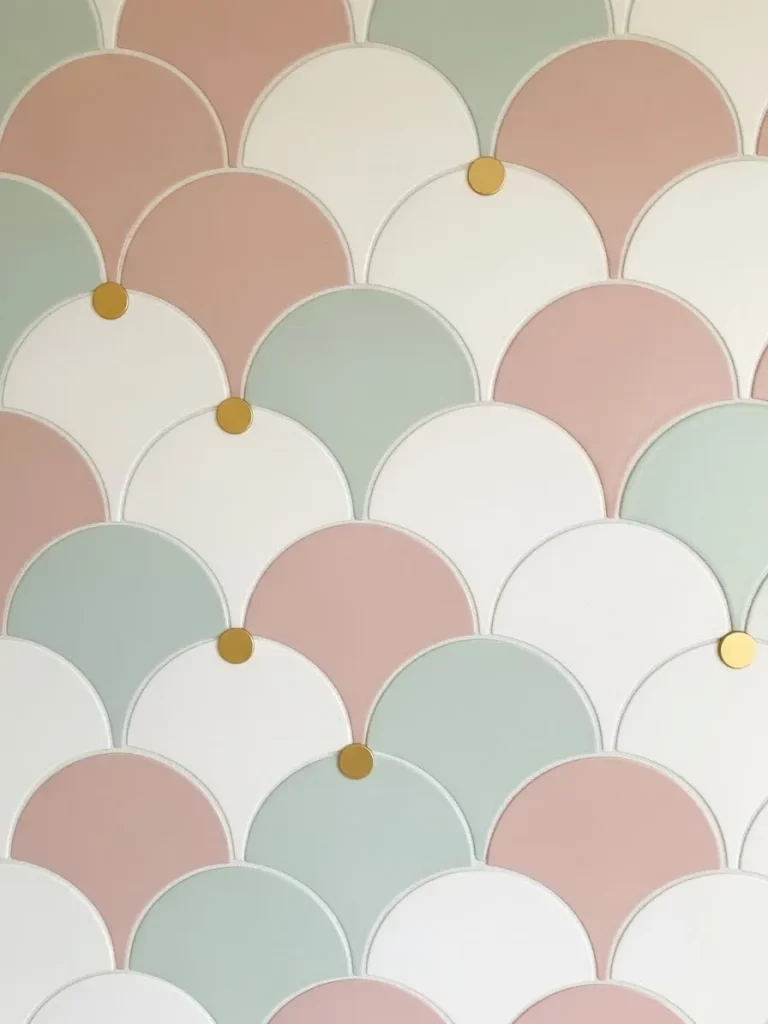
This whimsical backsplash uses fan-shaped or scallop tiles (also known as fish scale tiles) to create a beautiful, feminine design that is anything but boring. The tiles are arranged in repeating vertical waves of soft pastel colors: creamy white, pale mint green, and blush pink. This color palette is light and airy.
Adding a final touch of charm, small, round gold metallic discs are placed strategically at the intersection of some of the fan shapes. These tiny accents introduce a delicate sparkle and luxurious detail. The gentle, rounded lines and playful colors transform the cooking space into a soothing, stylish area with a subtle, mermaid-inspired elegance.
Materials Required
- Fan/Scallop/Fish Scale ceramic or porcelain tiles (in pastel colors, usually mesh-backed)
- Small round gold metallic accents (if not pre-integrated)
- White thin-set mortar adhesive
- Unsanded grout (white or light grey)
- Silicone caulk (clear or white)
- Strong adhesive (for attaching separate metallic accents)
Equipment Required
- Wet saw (for cutting the curved edges)
- Notched trowel (small V-notch, 1/8 inch or similar)
- Level and measuring tape
- Grout float and sponge
- Safety glasses and gloves
- Mixing bucket and drill mixer attachment
- Caulking gun
- Pencil
DIY Instruction Steps
- Layout and Planning: Clean the wall. Carefully measure and plan your layout. Draw a central vertical line and a horizontal line for the bottom edge of the first row of scallop tiles.
- Mortar Preparation: Mix your white thin-set mortar. Keep the consistency smooth and creamy. Allow it to slake briefly.
- Setting Tiles: Apply mortar to a small section of the wall. Begin setting the scallop sheets from your center point, ensuring the colors are rotated according to your desired pattern. Press firmly and align the sheets meticulously so the seams blend into the pattern. The wet saw will be necessary for cutting around the edges and outlets, requiring precise curved cuts.
- Curing: Allow the mortar to cure for at least 24 hours.
- Grouting: Mix your white unsanded grout. Using a rubber grout float, spread the grout diagonally, pushing it firmly into the joints between the curved shapes.
- Cleaning: Wait a short time, then use a damp sponge to gently clean the excess grout. Be careful not to pull the grout out of the narrow joints.
- Adding Gold Accents (If Separate): Once the grout is dry and cured, use a strong adhesive to carefully glue the small gold metallic discs onto the desired intersection points in the pattern.
- Final Caulking: Apply a thin, neat bead of clear or white silicone caulk where the backsplash meets the countertop for a water-tight seal.
29. Monochromatic Dimensional Facet Tile
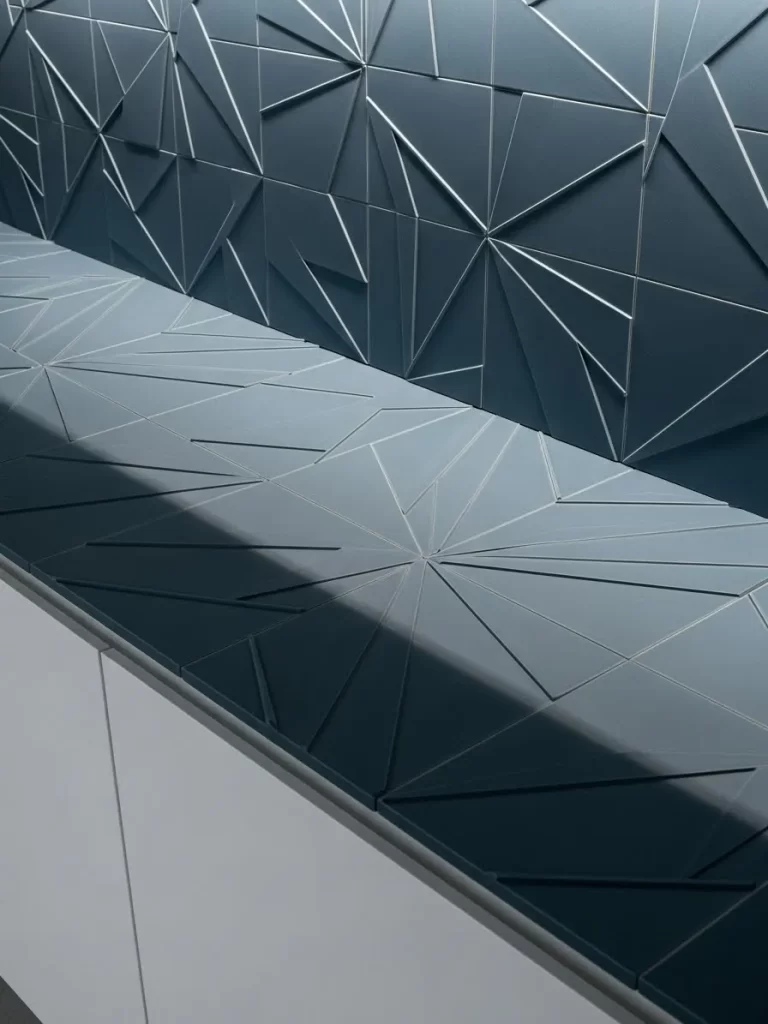
Ditch the boring flat walls with this striking dimensional tile backsplash that introduces texture and modern geometry. The tiles feature a flat, matte grey-blue surface with raised, pointed ridges and valleys, creating a complex, faceted design reminiscent of a crystal or folded paper. Thin, light lines highlight the raised edges, enhancing the three-dimensional effect.
The monochromatic color scheme keeps the look sleek and sophisticated, allowing the intricate, angular texture to be the star of the show. This design is also applied to the low shelf above the countertop, ensuring a continuous, integrated look that grounds the entire cooking space. This choice is stunning and architectural, perfect for a high-end, contemporary kitchen.
Materials Required
- Dimensional ceramic or porcelain tiles (geometric facet pattern)
- Thin-set mortar adhesive (color-matched to the tiles or dark grey)
- Unsanded grout (light grey or white, for contrast)
- Silicone caulk (grey or color-matched to the tiles)
Equipment Required
- Wet saw with a diamond blade (precise cuts are essential for dimensional tiles)
- Notched trowel (size appropriate for the tile backing)
- Level and measuring tape
- Grout float (stiff edge for the recesses) and sponge
- Safety glasses and gloves
- Mixing bucket and drill mixer attachment
- Caulking gun
- Pencil
DIY Instruction Steps
- Wall Preparation and Layout: Ensure the wall is clean and flat. This pattern needs to be centered for maximum impact, so find the vertical center line and a horizontal reference line for the bottom row.
- Mortar Preparation: Mix your thin-set mortar. Keep the mixture consistent, aiming for a thick, peanut butter-like texture to support the dimensional tiles. Allow it to slake for a few minutes.
- Setting Tiles: Apply mortar to a small area. Begin setting the first tile at your center starting point, aligning it with your reference lines. Press firmly, making sure the tile sits level. Continue setting the tiles, aligning the edges carefully so the geometric pattern flows from one tile to the next.
- Cutting: Use the wet saw to make precise cuts for the edges and around obstacles. Cutting dimensional tiles requires care to ensure the patterns meet neatly.
- Curing: Allow the mortar to cure completely, typically 24 hours.
- Grouting (Carefully): Mix your light grey or white unsanded grout. Using a rubber grout float, push the grout firmly into the narrow gaps. Due to the dimensional surface, you may need a small plastic tool or your finger to push the grout into the recesses and corners of the facets.
- Cleaning: Wait a short time, then use a damp sponge to gently clean the surface. This tile surface will require thorough cleaning to remove any residual grout from the valleys.
- Final Caulking: Apply a thin, neat bead of color-matched silicone caulk where the backsplash meets the countertop for a water-tight seal.
30. Rustic Stamped Reclaimed Wood Planks
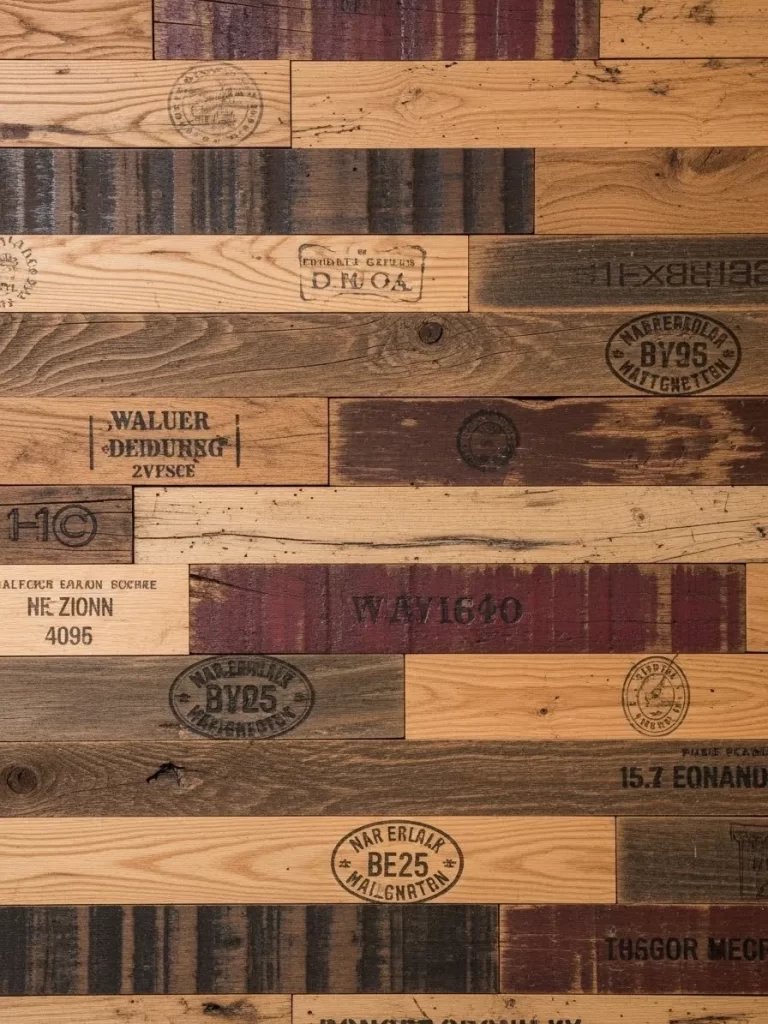
Here is a unique way to use wood in your kitchen without being boring: rustic stamped reclaimed wood planks. These genuine wood pieces feature a horizontal pattern with variations in tone, from pale blonde to deep mahogany and even rich burgundy stains. Adding immense character are the random industrial stamps, numbers, and lettering that resemble crate markings.
The variation in color, texture, and the horizontal orientation of the planks makes this a visually warm and appealing choice. This backsplash choice offers an earthy, organic contrast to sleek appliances or painted cabinets. It’s a custom-look wall treatment that provides texture and a backstory to the entire cooking space.
Materials Required
- Stamped reclaimed or engineered wood plank panels (pre-finished)
- Construction adhesive (high-strength, suitable for wood)
- Finishing nails or brad nails (optional, for added security)
- Wood filler (color-matched to the dominant wood tone)
- Silicone caulk (clear)
Equipment Required
- Miter saw or circular saw (for straight cuts)
- Measuring tape and level
- Caulk gun
- Brad nailer (optional)
- Jigsaw (for cutting around outlets)
- Stud finder
- Safety glasses
DIY Instruction Steps
- Wall Preparation and Planning: Clean the wall thoroughly. If using nails, locate and mark the wall studs. Determine the center of your backsplash area and draw a level reference line for the bottom edge of the planks. Plan the layout to ensure a random, appealing mix of colors and stamped planks.
- Cutting the Planks: Using a miter saw, cut the planks to various lengths, ensuring the plank ends are staggered for a natural look. Use a jigsaw to cut out openings for electrical outlets.
- Applying Adhesive: Apply a strong bead of construction adhesive in a zigzag pattern to the back of the first plank. Start at your reference line and press the plank firmly onto the wall.
- Continuing Installation: Continue applying adhesive and placing planks, working across the wall and upward. Ensure the edges of the planks are tightly butted together. Check for level every few rows. If using a nailer, secure a few brad nails into the studs for extra hold.
- Finishing: Fill any nail holes with wood filler and wipe clean. Allow the adhesive to cure completely.
- Sealing Edges: Apply a thin, neat bead of clear silicone caulk where the wood meets the countertop and any adjacent walls. This seals against moisture intrusion.
31. Intricate Moroccan Star Pattern Tile
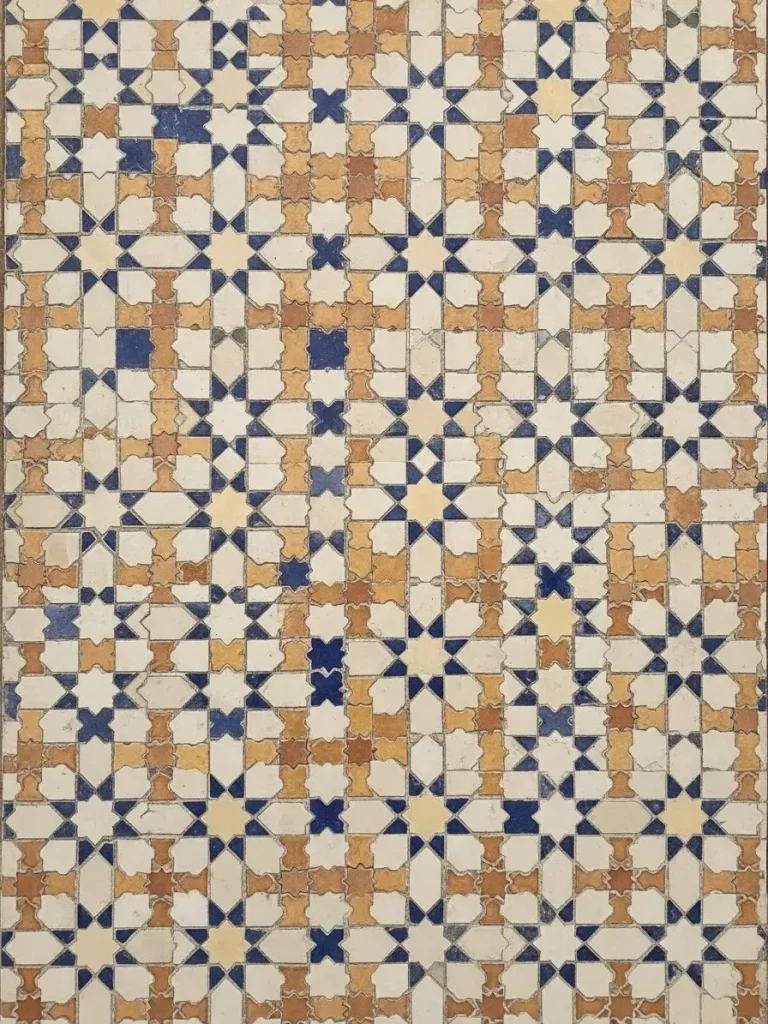
Bring a rich cultural flair to your kitchen with this intricate star-pattern cement tile. This backsplash features a repeating geometric pattern of eight-pointed stars formed by pieces in off-white, warm terracotta, and deep blue. The hand-crafted look, complete with slightly faded and uneven coloring, offers an authentic, vintage aesthetic.
The small, interlocking shapes create a mesmerizing visual texture that covers the wall in a continuous, complex tapestry. This design is genuinely far from boring, lending a beautiful depth and historical context to the entire cooking space. The pattern feels vibrant yet grounded, making it an excellent choice for a rustic, Mediterranean, or bohemian kitchen style.
Materials Required
- Moroccan-style cement tiles (or cement-look porcelain tiles)
- Cement tile sealer (mandatory for real cement tiles)
- Thin-set mortar adhesive (white or light grey)
- Unsanded grout (color-matched to the light portion of the tile)
- Silicone caulk (clear or white)
Equipment Required
- Wet saw with a diamond blade (essential for cement/porcelain)
- Notched trowel (size appropriate for the tiles)
- Level and measuring tape
- Grout float and sponge
- Safety glasses and gloves
- Mixing bucket and drill mixer attachment
- Caulking gun
- Pencil
DIY Instruction Steps
- Sealing Tiles First: Crucial Step: If using real cement tiles, apply a penetrating sealer to all sides of the tiles before installation. This prevents staining from the mortar and grout.
- Wall Prep and Centering: Clean the wall. This pattern must be centered perfectly. Find the vertical and horizontal center lines and plan the layout to ensure the pattern looks balanced across the entire area.
- Mortar Preparation: Mix your thin-set mortar. Keep the consistency smooth and let it slake for a few minutes.
- Setting Tiles: Apply mortar to a small area. Begin setting the first tile at your center starting point, aligning it with your reference lines. Press firmly. Continue setting the tiles, ensuring the complex geometric patterns align perfectly from one tile to the next. Use spacers if necessary, though these tiles often require minimal joints.
- Cutting: Use the wet saw for cuts required at the edges, corners, and around outlets. Take extra care, as cement tile can be brittle.
- Curing: Allow the mortar to cure completely, usually 24-48 hours.
- Grouting: Mix your light-colored unsanded grout. Work carefully. Spread the grout diagonally across the tiles, pushing it firmly into the joints. Wipe off excess grout almost immediately, as cement tiles can absorb pigment quickly, even after pre-sealing.
- Final Sealing and Caulking: After the grout cures, apply a second coat of penetrating sealer to the entire surface. Finish by applying a thin, neat bead of clear or white silicone caulk where the backsplash meets the countertop.
32. Sleek Piano Key Vertical Mosaic
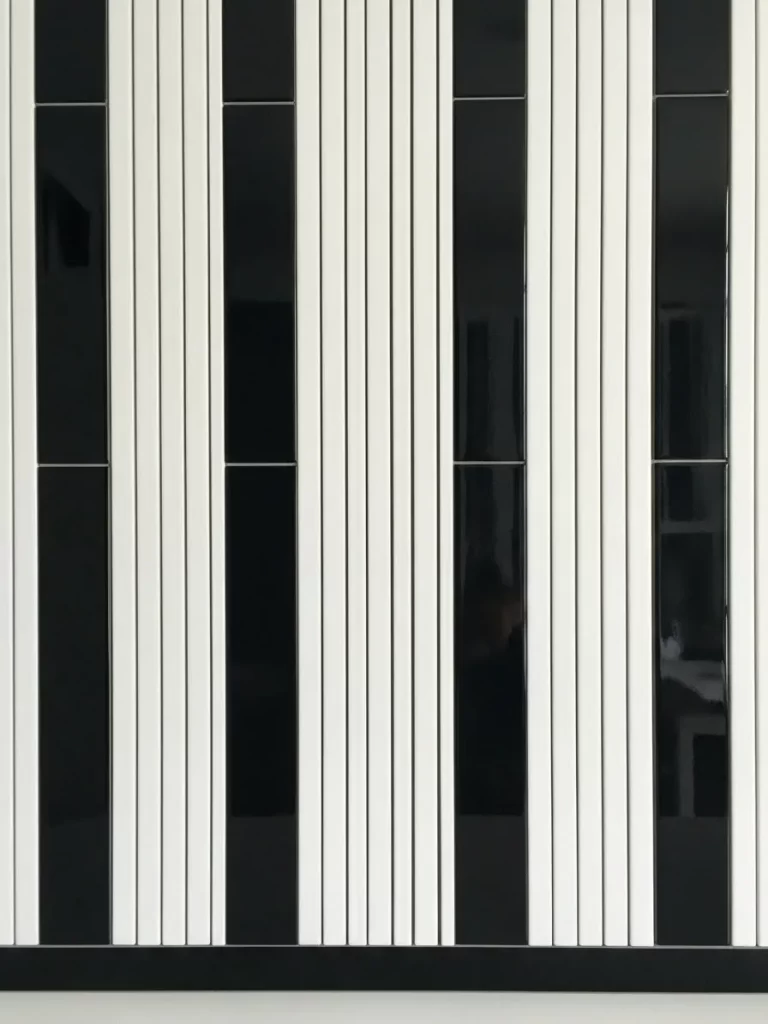
This striking backsplash design offers a sophisticated, contemporary twist on a simple color palette. Thin, long rectangular tiles in high-gloss black and matte white are set vertically, creating a bold, striped pattern that resembles piano keys. The vertical lines add significant height to the cooking space.
The varying lengths and strategic placement of the black tiles interrupt the rhythm of the stripes, adding an asymmetrical, modern flair. This high-contrast, graphic design is genuinely engaging and provides a dynamic, bespoke look that is far from boring. The sleek, shiny surfaces reflect light beautifully, enhancing the clean, black-and-white aesthetic of a minimalist kitchen.
Materials Required
- Vertical bar mosaic tiles (black and white, high-gloss and matte, usually mesh-backed)
- White thin-set mortar adhesive
- Unsanded grout (white, to blend with the white keys)
- Silicone caulk (black or white)
Equipment Required
- Wet saw (for clean, vertical cuts)
- Notched trowel (small V-notch, 1/8 inch or similar)
- Level and measuring tape
- Grout float and sponge
- Safety glasses and gloves
- Mixing bucket and drill mixer attachment
- Caulking gun
- Pencil
DIY Instruction Steps
- Layout and Alignment: Clean the wall. Find the center of the backsplash and draw a central vertical line. This is key for symmetry in a strong vertical design. Mark a horizontal reference line for the bottom edge.
- Mortar Preparation: Mix your white thin-set mortar. Keep the consistency thin and even to prevent excessive squeeze-out between the narrow vertical tiles. Allow it to slake briefly.
- Setting Mosaic Sheets: Apply mortar to a small area. Begin setting the first mosaic sheet at your center starting point, aligning it perfectly with your central and horizontal reference lines. Press firmly. Continue placing the sheets, aligning the vertical lines and the subtle horizontal joints between the sheets meticulously to maintain the continuous striped look.
- Cutting: Use the wet saw to make clean cuts for the sides and around outlets. It’s important to cut straight along the grout lines where possible to maintain the visual flow.
- Curing: Allow the mortar to cure for at least 24 hours.
- Grouting: Mix your white unsanded grout. Using a rubber grout float, spread the grout over the surface, pushing it firmly into the narrow vertical joints. The goal is for the white grout to disappear into the white tiles, emphasizing the black keys.
- Cleanup: Wait a short time, then use a damp sponge to gently clean the excess grout. Be careful to wipe thoroughly across both the glossy black and matte white surfaces.
- Final Caulking: Apply a thin, neat bead of white or black silicone caulk where the backsplash meets the countertop for a finished, water-resistant seal.
33. Dramatic Ocean Wave Slab Mural

Your kitchen will be anything but boring with this spectacular ocean wave slab mural. This is not tile; it is a single, continuous piece of custom-printed or resin-based slab, creating a photo-realistic depiction of a turquoise ocean wave crashing. White and grey marble veining surrounds the vivid blue wave, and streaks of copper run through the crests, adding luxurious drama.
This full-wall mural is an intense focal point, offering an immediate sense of movement and immersion. Using a seamless slab material like this eliminates grout lines, enhancing the smooth, fluid look of the image. This choice provides an unmatched stunning artistic statement, turning the backsplash into the main feature of the entire cooking space.
Materials Required
- Large custom-printed resin or porcelain slab panel
- Epoxy thin-set mortar adhesive (or specific adhesive recommended by the slab manufacturer)
- Silicone caulk (white or clear)
- Metal edging/trim (optional, for exposed edges)
Equipment Required
- Heavy-duty suction cups (mandatory for handling large, heavy slabs)
- Level and measuring tape
- Notched trowel (large size, 1/2 inch U-notch or square-notch)
- Caulking gun
- Power tools for cutting (only if minor trimming is required, usually done by professionals)
- Safety glasses and gloves
DIY Instruction Steps
- Professional Fabrication: Note: The slab must be custom-ordered and cut to the exact size of your backsplash area by a professional before arriving on site.
- Wall Preparation: Clean and dry the wall. The wall must be flat and structurally sound to support the weight of the slab. Draw a level reference line for the bottom edge.
- Mortar Preparation: Mix the epoxy thin-set mortar. Keep the consistency firm and mix thoroughly.
- Mortar Application: Apply the mortar evenly to the entire backsplash area using the large notched trowel. Also, “back-butter” the back of the slab with a thin layer of mortar to ensure maximum contact.
- Slab Installation (Two People Minimum): With a partner and suction cups, lift the slab. Carefully align the bottom edge with the countertop and press the slab firmly onto the wall. Use shims at the bottom to maintain a small gap for caulk. Use a rubber mallet and a wood block to gently tap the entire surface, ensuring full mortar contact.
- Curing: Allow the mortar to cure completely, which may take 48-72 hours.
- Sealing and Caulking: Remove shims. Apply a thin, neat bead of clear or white silicone caulk where the slab meets the countertop and any adjacent walls. This seals the installation against moisture and finishes the edges cleanly.
34. Cheerful Golden Penny Round Mosaic
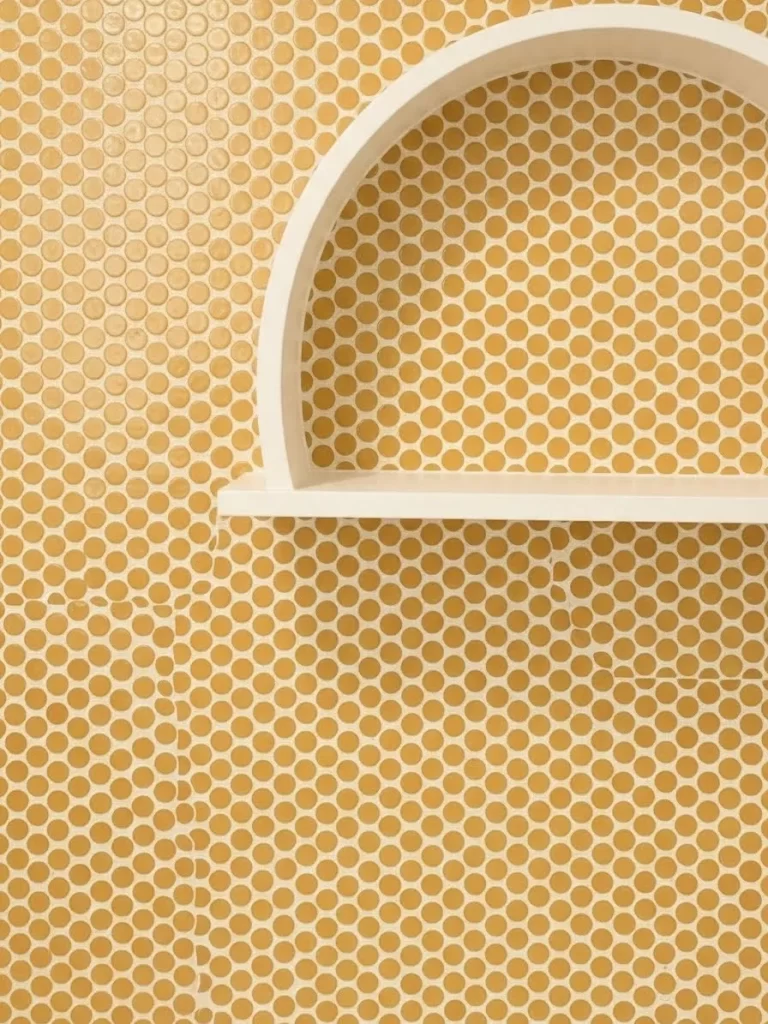
Inject a dose of playful energy into your kitchen with this bright yellow penny round mosaic backsplash. The tiny, perfectly round ceramic tiles are arranged in a dense, repeating grid, giving the surface a continuous, bubble-like texture. The cheerful, golden-yellow color ensures the wall is instantly memorable and far from boring.
The slightly contrasting white grout lines highlight the circular shapes, adding to the visual appeal. This texture pairs beautifully with the simple, white arched shelf, creating a cozy and retro-inspired feel. Choosing a sunny, unexpected color like this for a small, classic shape provides an engaging pop of warmth and personality to the entire cooking space.
Materials Required
- Penny round mosaic tiles (yellow ceramic, usually mesh-backed)
- White thin-set mortar adhesive
- Unsanded grout (white)
- Silicone caulk (white or clear)
Equipment Required
- Wet saw or tile nippers (for making small cuts)
- Notched trowel (very small V-notch, 1/8 inch or similar)
- Level and measuring tape
- Grout float and sponge
- Safety glasses and gloves
- Mixing bucket and drill mixer attachment
- Caulking gun
DIY Instruction Steps
- Wall Preparation: Clean the wall. Mark your horizontal reference line for the bottom edge. The wall must be very smooth; rough surfaces will show through the thin mosaic sheets.
- Mortar Preparation: Mix your white thin-set mortar. The consistency should be thin and smooth, as too much mortar will squeeze out and cover the small tiles. Allow it to slake briefly.
- Setting Mosaic Sheets: Apply mortar to a small area of the wall. Press the first mosaic sheet firmly into the mortar, using a flat board or float to gently tamp the surface and ensure full, even contact. Continue placing adjacent sheets, aligning the patterns meticulously to eliminate visible seams.
- Cutting: Use tile nippers to make small cuts around outlets. Use the wet saw for making straight cuts at the edges.
- Curing: Allow the mortar to cure completely, typically 24 hours.
- Grouting (Crucial Step): Penny rounds require careful grouting. Mix your white unsanded grout. Using the rubber grout float, spread the grout over the surface, pushing it firmly into the many small joints. Ensure every joint is packed.
- Cleaning: Wait a short time (about 15 minutes). Use a damp sponge to wipe off the excess grout. Be patient and rinse the sponge frequently to clean the rounded tops of the tiles thoroughly, preventing grout haze.
- Final Caulking: Apply a thin, neat bead of white or clear silicone caulk where the backsplash meets the countertop for a water-tight seal.
35. Subtle Textured Square Panel
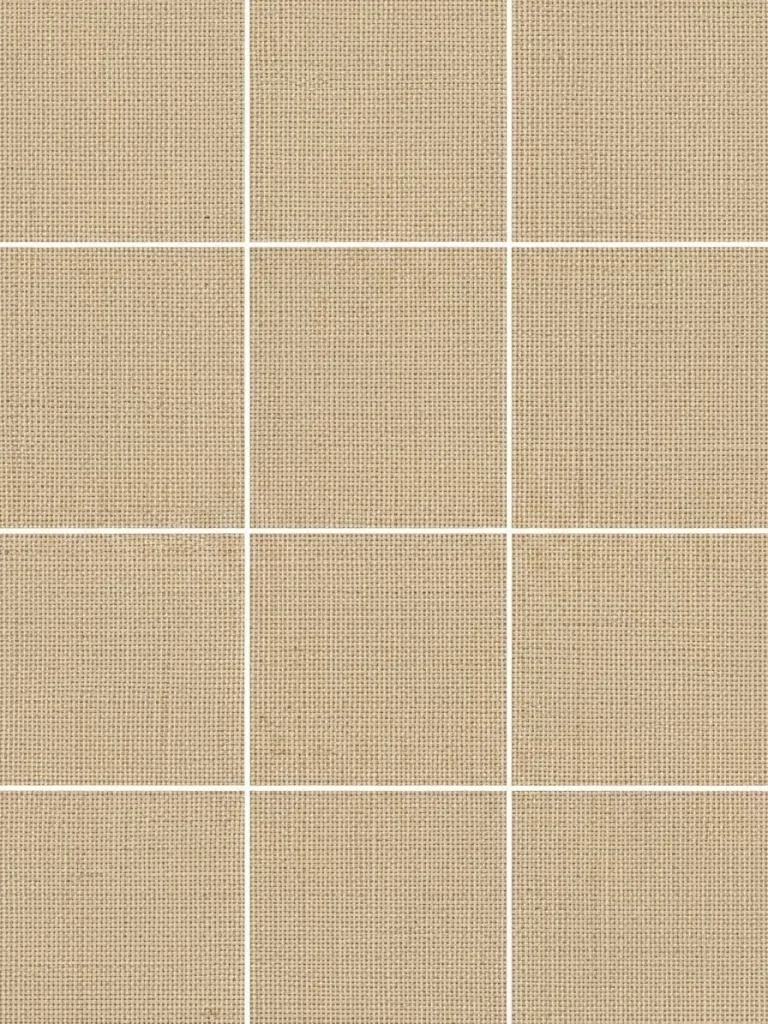
This backsplash is anything but boring, demonstrating that texture can be just as engaging as color. Large square tiles are finished with a subtle, woven or fibrous texture, giving the impression of rough burlap or linen. This choice offers an earthy, organic feel to the cooking space without introducing strong color or a busy pattern.
The light tan, natural color is warm and grounding, contrasting beautifully with the bright white grout lines that define the grid. The large square format keeps the look contemporary and clean. This tile is stunning in its simplicity, proving that sophisticated design can be achieved through tactile surfaces and quiet, neutral tones.
Materials Required
- Large square ceramic or porcelain tiles with a woven texture
- White thin-set mortar adhesive
- Unsanded grout (bright white)
- Tile spacers (small, 1/16 inch or 1/8 inch)
- Silicone caulk (white or clear)
Equipment Required
- Wet saw or manual tile cutter
- Notched trowel (size appropriate for the large tiles, often 1/4 inch)
- Level and measuring tape
- Grout float and sponge
- Safety glasses and gloves
- Mixing bucket and drill mixer attachment
- Caulking gun
DIY Instruction Steps
- Wall Prep and Centering: Clean the wall. Find the vertical center line and a horizontal reference line for the bottom row. This ensures the large square tiles are balanced across the wall.
- Mortar Preparation: Mix your white thin-set mortar. Keep the mixture firm and consistent. Allow it to slake for a few minutes.
- Setting Tiles: Apply mortar to a section of the wall. Begin setting the first tile at your center starting point, aligning it with your reference lines. Press firmly. Use tile spacers to maintain uniform, narrow grout lines. Continue setting the tiles in a straight stack (not staggered).
- Cutting: Use the wet saw for clean, straight cuts required at the edges and around outlets.
- Curing: Allow the mortar to cure for at least 24 hours. Remove all spacers.
- Grouting: Mix your bright white unsanded grout. Using a rubber grout float, spread the grout over the surface, pushing it firmly into the joints.
- Cleaning (Texture Caution): Wait approximately 15 minutes. Use a damp sponge to gently clean the excess grout. Be cautious with the textured surface; ensure the sponge does not scrape grout out of the joints but thoroughly cleans the woven pattern on the tile face. Rinse the sponge often.
- Final Caulking: Apply a thin, neat bead of white silicone caulk where the backsplash meets the countertop for a water-resistant seal.
36. Three-Dimensional Hexagon Pattern
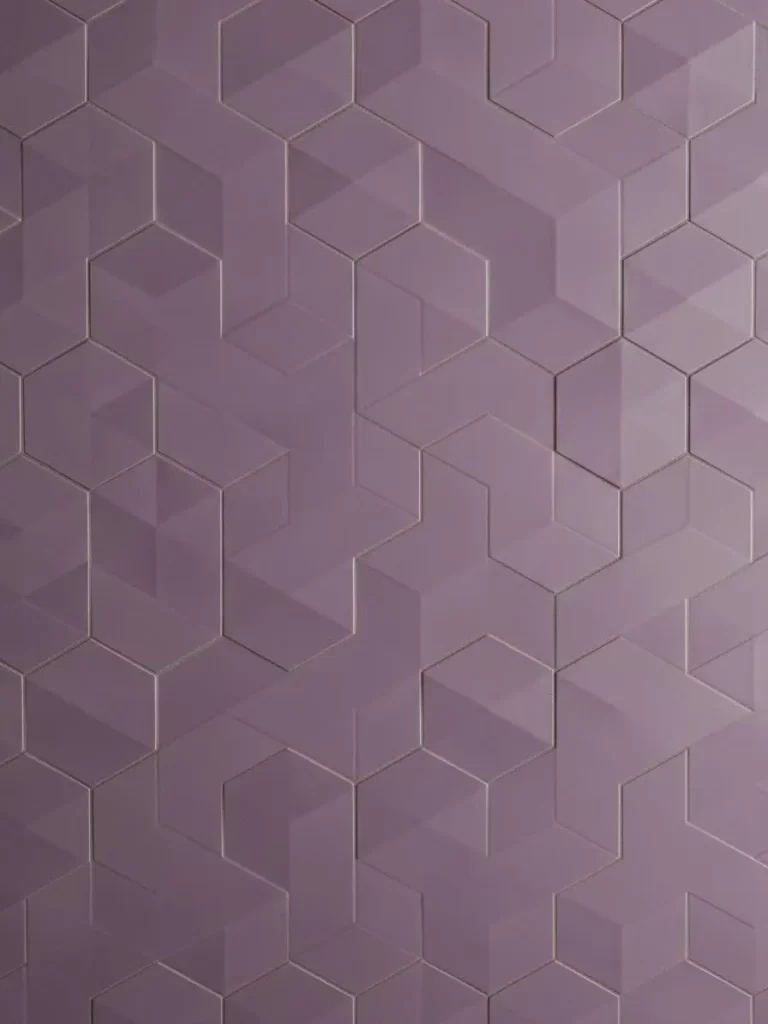
Escape the boring with this dynamic three-dimensional geometric backsplash, created using oddly shaped tiles that fit together to form hexagons. The matte mauve or dusty purple color is unexpectedly sophisticated and provides a soft, yet modern, backdrop. The clever shape of the tiles creates an optical illusion of cubes or pyramids, giving the entire surface a faceted appearance.
Subtle grey grout lines outline the repeating pattern, enhancing the sense of depth and movement. This backsplash is highly textural and stunning, providing an element of contemporary art to the cooking space. The use of a single, uniform color ensures the dramatic three-dimensional form is the primary focal point.
Materials Required
- Dimensional geometric tiles (matte ceramic or porcelain)
- Thin-set mortar adhesive (color-matched to the tiles or light grey)
- Unsanded grout (light grey or white, for contrast)
- Silicone caulk (color-matched or clear)
Equipment Required
- Wet saw with a diamond blade (precise cuts are essential)
- Notched trowel (size appropriate for the tile modules)
- Level and measuring tape
- Grout float (stiff edge for the recesses) and sponge
- Safety glasses and gloves
- Mixing bucket and drill mixer attachment
- Caulking gun
- Pencil
DIY Instruction Steps
- Wall Preparation and Centering: Clean the wall. This pattern must be centered perfectly. Find the vertical center line and a horizontal reference line for the bottom row. Plan the layout to ensure the hexagon shapes are balanced.
- Mortar Preparation: Mix your thin-set mortar. The consistency should be thick and firm to support the dimensional weight and shape of the tiles. Allow it to slake for a few minutes.
- Setting Tiles: Apply mortar to a small area. Begin setting the first tile at your center starting point. Press firmly, ensuring the complex edges align perfectly to continue the three-dimensional pattern. Continue setting the tiles, checking frequently with a level.
- Cutting: Use the wet saw to make the numerous angled cuts required for the edges, corners, and around outlets. The cuts must be precise for the pattern to look seamless.
- Curing: Allow the mortar to cure completely, typically 24 hours.
- Grouting (Carefully): Mix your light grey or white unsanded grout. Using a rubber grout float, push the grout firmly into the narrow gaps. Due to the deep recesses, you will need a small tool or your finger to ensure the grout fills the narrow joints without covering the flat surfaces of the dimensional pieces.
- Cleaning: Wait a short time, then use a damp sponge to gently clean the surface. Be thorough in cleaning the recesses.
- Final Caulking: Apply a thin, neat bead of color-matched or clear silicone caulk where the backsplash meets the countertop for a water-tight seal.
37. Layered Marble Mosaic with Gold Veins
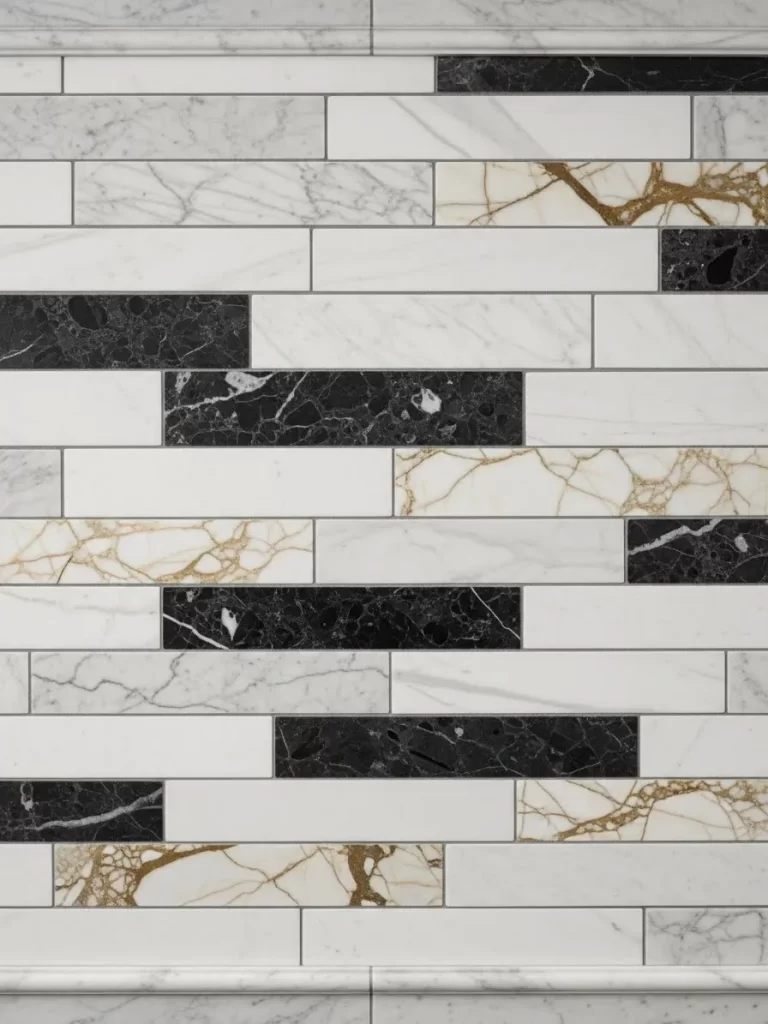
This luxurious linear backsplash proves mixing materials achieves an unforgettable look. The design features slim, rectangular tiles of three distinct marbles: pristine white Carrara, dramatic black Nero Marquina, and a high-end white marble with bold gold veining. The tiles are installed in a staggered, random layout that provides fantastic movement.
The combination of white and black marble offers a classic, graphic contrast. The inclusion of the gold-veined pieces introduces a striking, rich detail that elevates the entire cooking space. Using thin, dark grey grout lines helps separate the varied materials while maintaining a clean, contemporary aesthetic. This choice creates a truly bespoke and stunning feature wall.
Materials Required
- Slim rectangular marble tiles (mixed colors: white, black, gold-veined)
- White thin-set mortar adhesive (non-staining, suitable for marble)
- Unsanded grout (dark grey)
- Marble sealer
- Silicone caulk (white or clear)
Equipment Required
- Wet saw with a diamond blade (mandatory for cutting marble)
- Notched trowel (size appropriate for slim tiles)
- Level and measuring tape
- Grout float and sponge
- Safety glasses and gloves
- Mixing bucket and drill mixer attachment
- Caulking gun
DIY Instruction Steps
- Pre-Sealing Tiles: Marble is porous; before installation, apply a penetrating stone sealer to the faces of all the marble tiles. This prevents moisture and grout from staining the stone.
- Wall Prep and Layout: Clean the wall. Draw a horizontal reference line for the bottom edge. Plan your layout to ensure the three marble types are distributed randomly and evenly across the wall.
- Mortar Preparation: Mix your white thin-set mortar. Keep the consistency thick and creamy. Allow it to slake for a few minutes.
- Setting Tiles: Apply mortar to a small area of the wall. Begin setting the tiles, starting from the bottom reference line. Follow a running bond or staggered pattern, manually mixing the black, white, and gold-veined pieces to achieve a randomized distribution. Use spacers to maintain uniform grout lines.
- Cutting: Use the wet saw for cuts required at the ends of rows and around outlets. Take extra care with the brittle marble.
- Curing: Allow the mortar to cure completely, typically 24-48 hours. Remove all spacers.
- Grouting: Mix your dark grey unsanded grout. Using a rubber grout float, spread the grout diagonally, pushing it firmly into all the narrow joints. The dark grout will help highlight the crisp edges of the linear tiles.
- Cleanup and Final Sealing: Wait a short time, then use a damp sponge to gently clean the excess grout from the marble faces. Rinse the sponge often. After the grout cures, apply a second coat of marble and grout sealer to the entire surface. Apply a thin, neat bead of white or clear silicone caulk where the backsplash meets the countertop.
38. Sleek Interlocking Geometric Brick
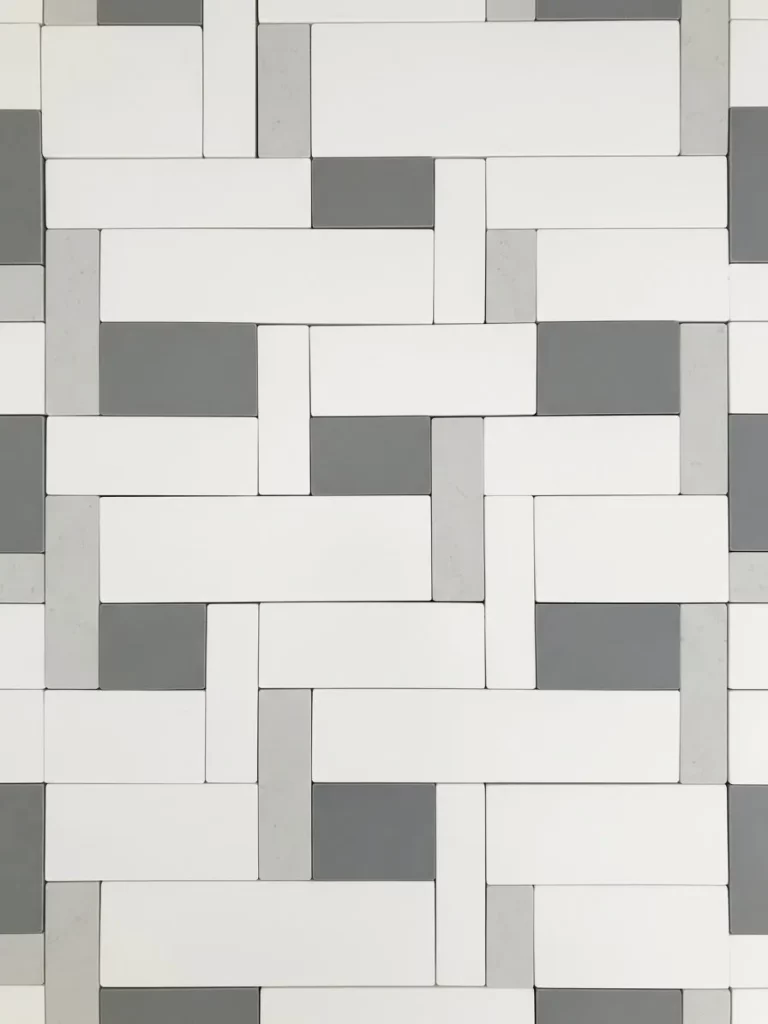
This sophisticated backsplash uses a complex, interlocking pattern of rectangular tiles in varying sizes and neutral shades. The white and grey tones—including bright white, light grey, and a darker charcoal—are arranged in a maze-like design that provides a visually engaging puzzle. The varied sizes of the tiles create a dynamic visual puzzle.
The clean, uniform color palette ensures the focus remains on the intricate pattern and the slight variations in texture among the grey and white surfaces. This modern, graphic design elevates the cooking space, providing a subtle yet highly customized architectural element. This is a bold choice for anyone who wants a high-impact pattern without using bright colors.
Materials Required
- Interlocking rectangular mosaic sheets (white, light grey, dark grey tiles)
- White thin-set mortar adhesive
- Unsanded grout (light grey, to blend with the neutral tones)
- Silicone caulk (white or light grey)
Equipment Required
- Wet saw or manual tile cutter
- Notched trowel (size appropriate for the tile sheets)
- Level and measuring tape
- Grout float and sponge
- Safety glasses and gloves
- Mixing bucket and drill mixer attachment
- Caulking gun
- Pencil
DIY Instruction Steps
- Layout and Centering: Clean the wall. This interlocking pattern looks best when centered. Find the vertical center line and a horizontal reference line for the bottom row. Plan the layout to ensure cuts on the edges maintain symmetry.
- Mortar Preparation: Mix your white thin-set mortar. Keep the consistency smooth and let it slake for a few minutes.
- Setting Mosaic Sheets: Apply mortar to a small area of the wall. Begin setting the first mosaic sheet at your center starting point. Press firmly. Continue placing the sheets, meticulously aligning the interlocking edges so the pattern flows seamlessly. Use the wet saw for cuts required at the edges and around obstacles.
- Curing: Allow the mortar to cure completely, typically 24 hours.
- Grouting: Mix your light grey unsanded grout. Using a rubber grout float, spread the grout diagonally, pushing it firmly into all the joints.
- Cleanup: Wait approximately 15 minutes, then use a damp sponge to gently wipe off excess grout from the tile faces. Rinse the sponge often.
- Final Caulking: Apply a thin, neat bead of white or light grey silicone caulk where the backsplash meets the countertop for a water-resistant seal.
39. Playful Abstract Paint Splatter Tile
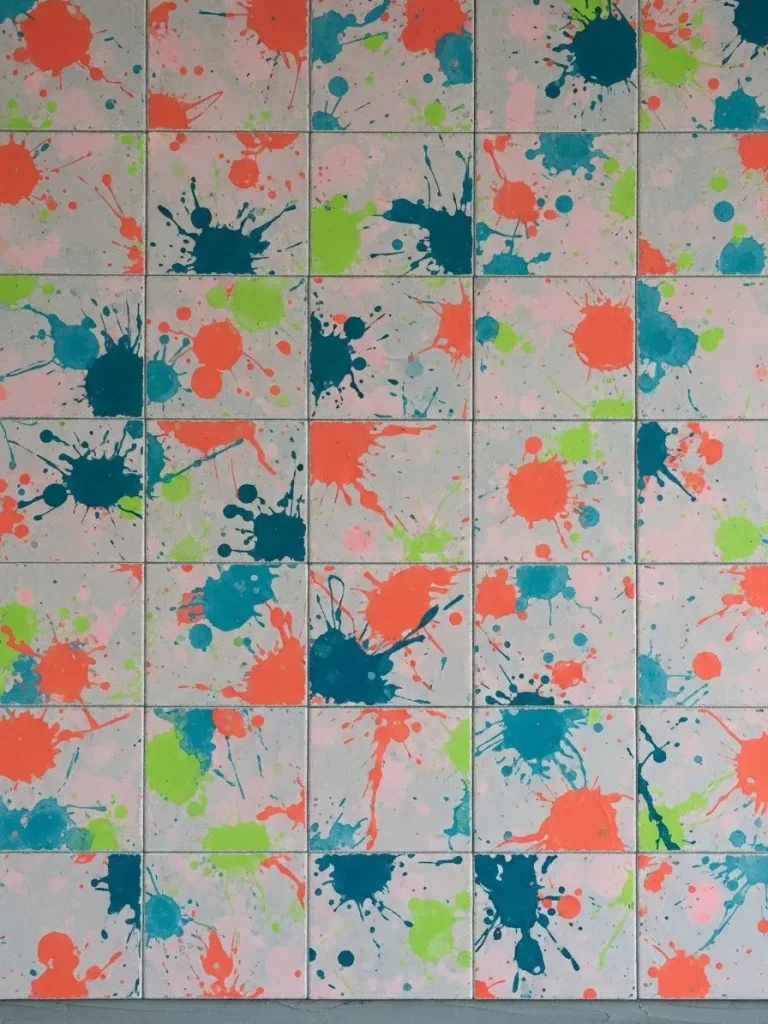
This vibrant backsplash proves that a kitchen can be an artistic masterpiece. Large format square tiles feature a bold, abstract pattern of neon paint splatters in colors like bright orange, neon green, and electric teal, all set against a light grey background. This design is high energy and truly unique.
The irregular, chaotic pattern contrasts beautifully with the uniformity of the square tile shape. Using tiles like this instantly transforms a boring wall into a playful, stunning focal point inspired by modern street art. This choice is ideal for an energetic space that doesn’t take itself too seriously, bringing a burst of unexpected color into the cooking area.
Materials Required
- Large format square tiles (with paint splatter pattern)
- White thin-set mortar adhesive
- Unsanded grout (light grey, to blend with the tile background)
- Tile spacers (small, 1/16 inch)
- Silicone caulk (clear or grey)
Equipment Required
- Wet saw or manual tile cutter
- Notched trowel (size appropriate for the large tiles)
- Level and measuring tape
- Grout float and sponge
- Safety glasses and gloves
- Mixing bucket and drill mixer attachment
- Caulking gun
DIY Instruction Steps
- Layout and Pattern Matching: Clean the wall. Mark your horizontal reference line. Lay out the tiles dry on the floor first, ensuring you understand how the paint splatters flow from one tile to the next (if they are meant to match) or if a random pattern is desired.
- Mortar Preparation: Mix your white thin-set mortar. Keep the consistency firm. Allow it to slake for a few minutes.
- Setting Tiles: Apply mortar to a section of the wall. Begin setting the tiles, following your pre-planned pattern (random or matched flow). Press firmly, using tile spacers to maintain narrow grout lines.
- Cutting: Use the wet saw for cuts required at the edges and around outlets.
- Curing: Allow the mortar to cure for at least 24 hours. Remove all spacers.
- Grouting: Mix your light grey unsanded grout. Using a rubber grout float, spread the grout diagonally, pushing it firmly into all the joints.
- Cleanup: Wait approximately 15 minutes, then use a damp sponge to gently wipe off excess grout. The smooth surface should clean easily, but rinse the sponge often.
- Final Caulking: Apply a thin, neat bead of clear or grey silicone caulk where the backsplash meets the countertop for a water-resistant seal.
40. Backlit Translucent Glass Subway Tile
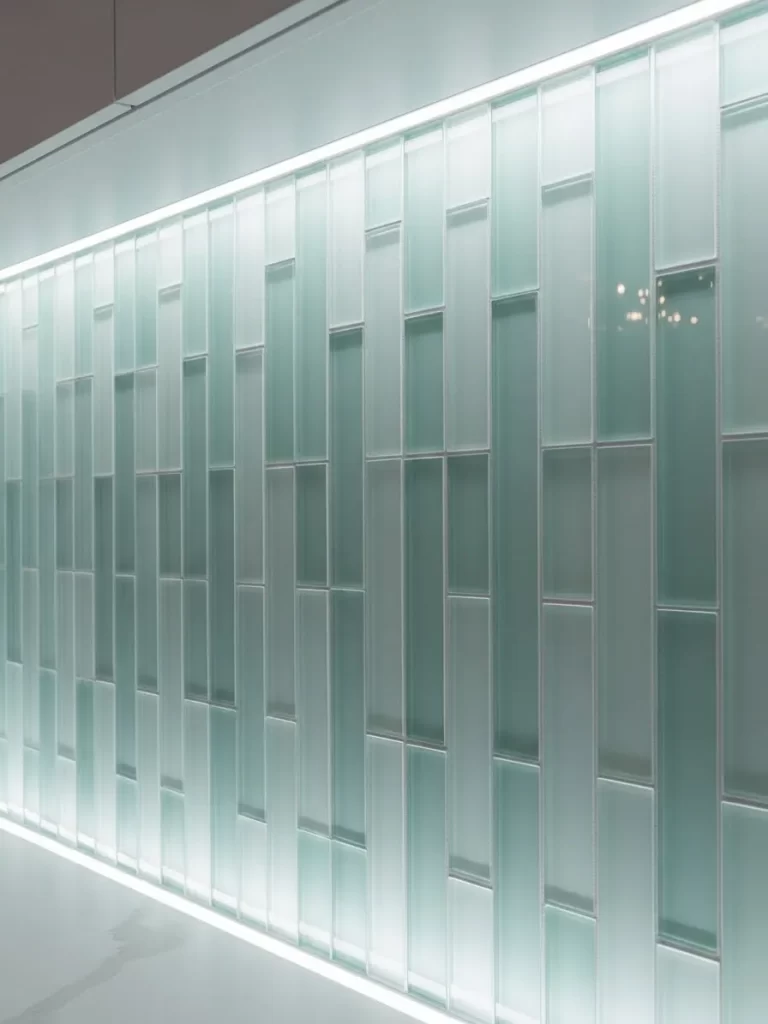
This ethereal backsplash creates a beautiful, glowing feature wall that is absolutely not boring. The wall is clad in slim, rectangular glass tiles in a subtle seafoam green or frosted aqua tone, set in a staggered brick pattern. The key to this stunning design is the integrated backlighting.
The translucent quality of the glass tiles allows light from behind to diffuse softly, bathing the entire surface in a gentle glow. This installation makes the wall appear weightless and luminous. The light emphasizes the subtle differences in the glass and the crisp, clean lines of the pattern, turning a traditional subway tile shape into an incredibly modern and visually rich design element.
Materials Required
- Translucent or frosted glass subway tiles (slim, rectangular shape)
- White thin-set mortar adhesive (non-staining, suitable for glass)
- Unsanded grout (white or light grey)
- LED light panels or waterproof LED light strips (for backlighting)
- Power supply/driver (for LED lights)
- Tile spacers
- Silicone caulk (clear)
Equipment Required
- Wet saw (with a glass-specific diamond blade)
- Notched trowel (small V-notch, 1/8 inch)
- Level and measuring tape
- Grout float and sponge
- Safety glasses and gloves
- Electrical wiring tools (wire strippers, connectors)
- Caulking gun
DIY Instruction Steps
- Electrical and Light Prep (Professional Recommended): Crucial Step: The wall surface must be prepared with a space (a niche or framing) behind the tiles to house the LED light panels. Install the LED panels or strips evenly across this backing area, wiring them to a power source. Test the lights and ensure they are evenly distributed.
- Wall Prep for Tiles: Clean and dry the light panel surface. Draw your horizontal reference line.
- Mortar Preparation: Mix your white thin-set mortar. Use white mortar to maximize light transmission. Keep the mixture thin, as excessive mortar will block the light. Allow it to slake briefly.
- Setting Tiles: Apply a thin layer of mortar to a small area of the illuminated wall. Set the glass tiles in a staggered pattern, pressing gently but firmly. Do not twist or use excessive pressure, which can squeeze too much mortar out or break the glass.
- Cutting: Use a wet saw with a glass blade for cuts required at the edges and around obstacles.
- Curing: Allow the mortar to cure completely, typically 24 hours.
- Grouting: Mix your white unsanded grout. Spread the grout over the surface, pushing it firmly into the joints.
- Cleanup: Wait a short time, then use a damp sponge to gently clean the excess grout. Be careful to remove all haze, as it will be obvious when backlit.
- Final Caulking: Apply a thin, neat bead of clear silicone caulk where the backsplash meets the countertop.
41. Classic Painted Beaded Wainscoting
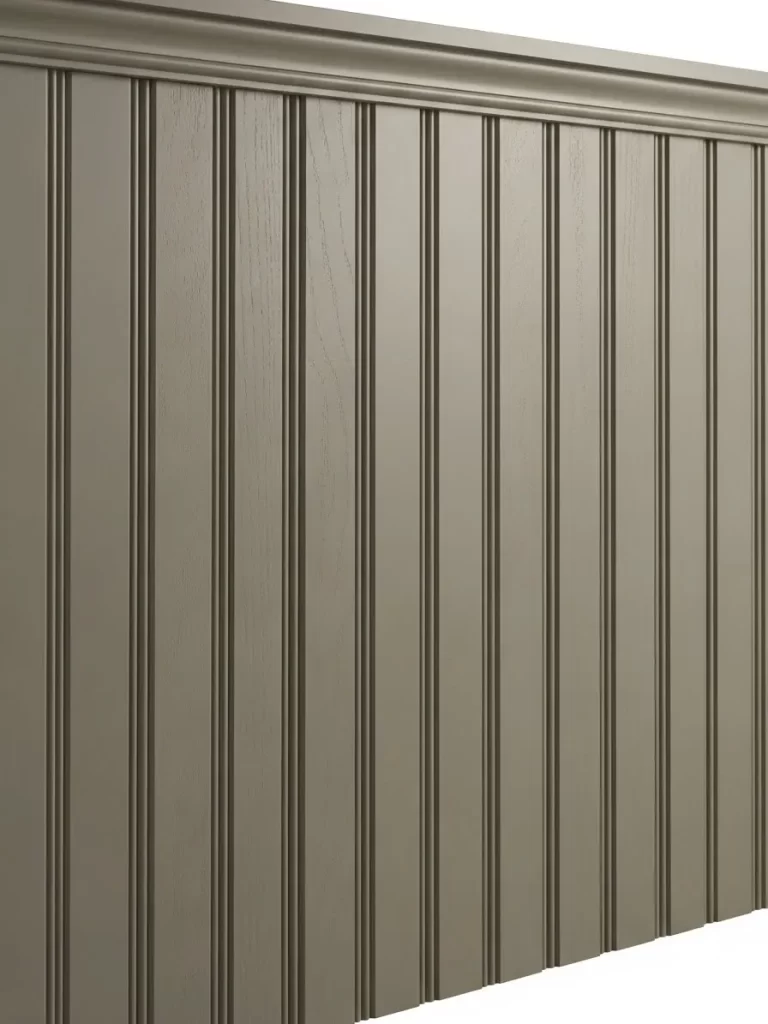
Bring a timeless architectural element to your kitchen with a backsplash crafted from painted beaded wainscoting. This traditional wood paneling features recessed grooves (or beads) running vertically down the surface, adding a subtle shadow line and classic texture. The uniform matte taupe or greige paint color is sophisticated and modern.
Wainscoting provides a warm, cottage-inspired feel that works exceptionally well in transitional kitchens. The top is finished with a detailed chair rail or moulding, providing a beautiful, polished visual break. This design is genuinely far from boring, offering a clean, simple, yet structurally interesting alternative to tile, transforming the cooking space into a cozy and custom-feeling room.
Materials Required
- Beaded wainscoting panels (moisture-resistant MDF or wood)
- Decorative trim/moulding (for the top edge)
- Construction adhesive
- Finishing nails or brad nails
- Wood filler
- Silicone caulk (paintable)
- Paint and primer (moisture-resistant, semi-gloss finish recommended)
Equipment Required
- Miter saw or circular saw (for cutting panels and moulding)
- Measuring tape and level
- Brad nailer
- Caulking gun
- Sandpaper (fine grit)
- Safety glasses
- Paint brush and roller
DIY Instruction Steps
- Wall Prep and Reference: Clean the wall. Determine the final height of your wainscoting, including the top trim, and draw a level reference line across the wall.
- Cutting Panels: Measure and cut the wainscoting panels to fit the wall section. Use a jigsaw to cut out openings for electrical outlets.
- Panel Installation: Apply construction adhesive to the back of the first panel in a zigzag pattern. Press the panel firmly onto the wall, starting from a corner or a central point. Use a few finishing nails along the top and bottom edges (and into studs if available) to secure it. Continue installing panels, fitting the tongue-and-groove edges tightly together.
- Installing Top Trim: Cut the decorative moulding to fit the length of the wall. Apply a thin bead of adhesive to the back, align it precisely with your reference line, and secure it with finishing nails. Cut the corners at a 45-degree angle (mitered) for a clean look.
- Filling and Sealing: Fill all nail holes with wood filler and allow to dry, then lightly sand smooth. Apply a bead of paintable caulk along the seams where the panels meet the countertop and where the trim meets the paneling.
- Painting: Prime the entire surface. Apply two coats of high-quality, moisture-resistant paint, ensuring the paint gets into all the vertical grooves. A semi-gloss or satin finish is best for easy cleaning in a kitchen.
42. Mixed Metallic Pebble Mosaic
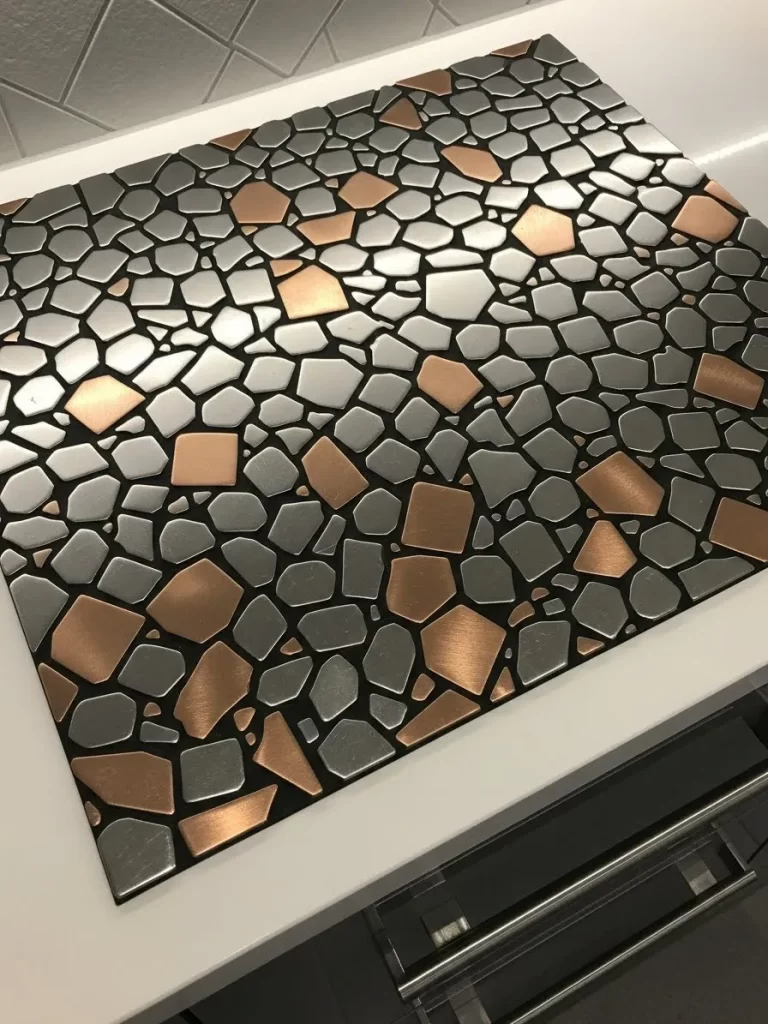
We conclude our list of stunning ideas with this visually striking, multi-metallic pebble mosaic. The irregular, organically shaped tiles are crafted from brushed metal in two contrasting tones: warm copper and cool silver/pewter. These pieces are set on a dark or black backing, which makes the metallic shapes pop.
The combination of the rugged, random shape with the sleek, modern material creates an incredible tension. The interplay between the silver and copper tones provides a rich, contrasting gleam that changes with the light. This backsplash is genuinely engaging, offering a unique textural statement that is simultaneously industrial, luxurious, and completely customized for a high-impact kitchen design.
Materials Required
- Mixed metallic pebble mosaic tiles (copper and silver/pewter, usually mesh-backed)
- Strong construction adhesive (epoxy or polyurethane-based)
- Dark grout (black or charcoal, often required to fill the gaps)
- Grout sealer (optional, but good for stain resistance)
- Silicone caulk (black or clear)
Equipment Required
- Tile nippers or small wet saw (for making curved or precise cuts on metal pieces)
- Notched trowel (small V-notch, 1/8 inch or similar)
- Level and measuring tape
- Grout float (for dark grout) and sponge
- Safety glasses and gloves
- Mixing bucket (if mixing grout)
- Caulking gun
DIY Instruction Steps
- Wall Preparation: Clean the wall surface thoroughly. Mark your horizontal reference line.
- Adhesive Preparation: Mix your construction adhesive or prepare your mortar. Follow manufacturer instructions, ensuring the adhesive is strong enough to bond metal to the wall.
- Setting Mosaic Sheets: Apply the adhesive to a small area of the wall. Press the first mosaic sheet firmly into the adhesive. Continue placing adjacent sheets, aligning the irregular pebble shapes carefully so the seams disappear.
- Cutting: Use tile nippers to make small cuts around outlets. Use a small wet saw or metal snips for straight cuts at the edges, being careful to wear gloves and safety glasses when cutting metal.
- Curing: Allow the adhesive to cure completely, typically 24-48 hours.
- Grouting: Mix your dark (black or charcoal) grout. Using a rubber grout float, spread the grout over the surface, pushing it firmly into all the crevices between the metallic pebbles. The dark grout will make the metal shapes stand out vividly.
- Cleaning: Wait a short time, then use a damp sponge to gently clean the excess grout. Be patient and careful to thoroughly clean the metallic surfaces without scratching them. Rinse the sponge often.
- Final Caulking: Apply a thin, neat bead of black or clear silicone caulk where the backsplash meets the countertop for a water-tight seal.
You have now traveled through 42 stunning and transformative backsplash concepts, proving definitively that your kitchen wall should never be boring again. The backsplash is more than just a barrier against splashes; it is the ultimate canvas for your home’s aesthetic.
From the organic texture of river pebbles to the high-contrast drama of dark, textured brick, each idea offers a chance to imprint genuine personality onto your cooking space. Whether you opt for a bold pattern, a subtle texture, or a shimmering metallic surface, choosing a distinctive material can redefine your entire kitchen’s atmosphere.
Ready to start your transformation? Grab your notched trowel, select your favorite engaging design from this list, and get ready to create a truly bespoke, memorable focal point in your home.
Key Takeaways to Transform Your Kitchen
Texture Over Trend: Introducing three-dimensional texture—like stacked stone or dimensional facet tiles—is the quickest way to elevate a space, regardless of color.
The Power of Contrast: Utilizing high-contrast color palettes (black and white marble, emerald green with white grout) instantly creates a graphic, striking focal point.
Go Beyond Tile: Consider non-traditional materials like corrugated metal, reclaimed wood panels, or continuous slab murals for a truly custom and unique look.
DIY is Accessible: Many of the most transformative ideas, from mosaic sheeting to wood paneling, are achievable for the average homeowner using basic tools and detailed instructions.