
Does your kitchen feel boring? You spend time there every day. But the room feels flat. It lacks personality.

You have probably overlooked a key feature. The wall between your counters and cabinets sets the tone for the entire space.
A stale backsplash can make the whole kitchen feel dated.
Many people think replacing a backsplash is a difficult, messy, and costly job. This does not have to be true.
We found 40 stunning ideas to refresh your cooking space. This list moves beyond simple tile.
It includes smart panels, rustic wood, and bold, artistic patterns. Many of these ideas are simple DIY projects. You can start them this weekend.
Get ready to transform your kitchen for 2026.
1. The Backlit Botanical Panel
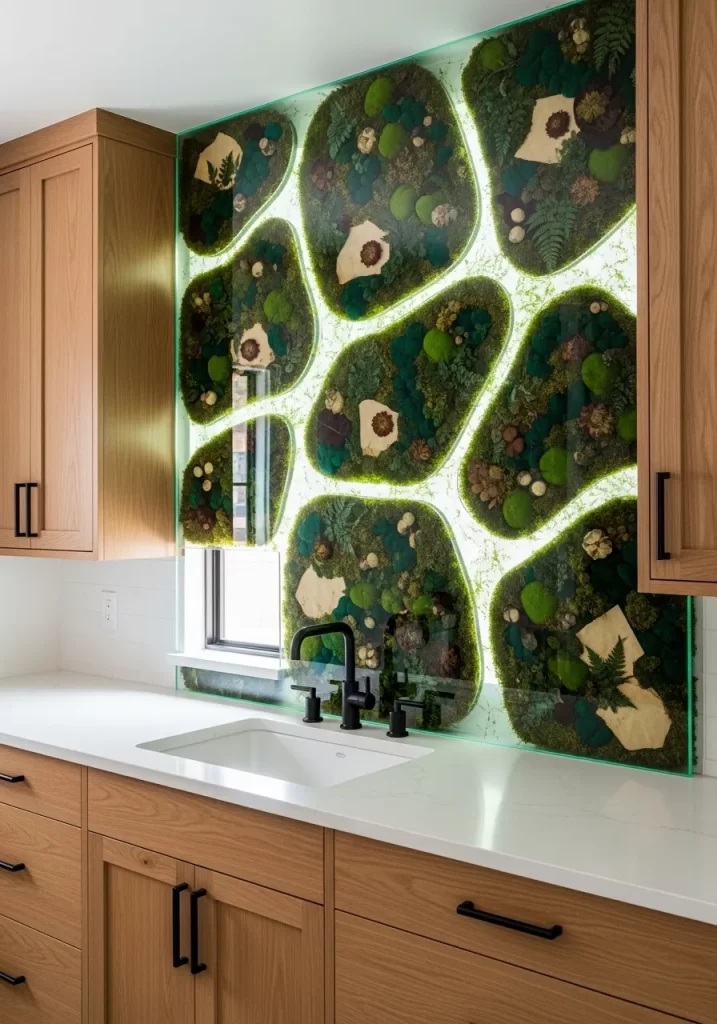
Bring the outdoors straight into your kitchen. This unique backsplash is a custom-lit panel. It holds real, preserved moss, ferns, and other dried plants.
The arrangement looks like glowing green cells. Soft LED lights placed behind the panel create this effect. The light shines through the plants, showing off their interesting textures. It makes the whole wall feel alive.
This backsplash becomes the main focus of the room. It adds a natural, calming feeling to the modern space.
DIY Faux Botanical Backsplash
This is a big project, so ask an adult for help with any cutting or electrical parts! We will make a “shadow box” that looks like this.
Stuff You Need:
- A big, deep picture frame (like a shadow box) or build a thin box from 1×2 wood strips.
- A sheet of clear plexiglass or acrylic that fits your frame.
- A sheet of frosted window film or thin white paper (like parchment paper).
- LED light strips (the kind that stick on).
- Fake moss, fake small plants, and dried leaves from a craft store.
- Hot glue gun and glue sticks (ask an adult to help!).
- Strong glue or clips to hold the front on.
Step-by-Step:
- Build Your Box: If you are building a box, have an adult help you cut four pieces of wood to make a rectangle. Glue and nail them together. Then, add a solid back piece.
- Add the Lights: Carefully stick the LED light strips all around the inside edges of the box. Make sure the power cord can reach out the back or bottom.
- Soften the Glow: Cut the frosted film or white paper to fit perfectly inside the box, lying flat on the back. This stops you from seeing bright dots and makes the light look soft.
- Plant Your Garden: Lay your box flat. Arrange all your fake moss, leaves, and plants on top of the paper. Make a cool design you like.
- Glue it Down: Once you love your design, have an adult help you use the hot glue gun. Carefully lift each plant piece, add a dot of glue, and stick it back down.
- Add the Window: Clean the plexiglass front so it’s super shiny. Place it on top of your box. Use strong glue or small clips to lock it in place.
- Hang it Up: Ask an adult to help you mount your new art light-box on the wall. Plug it in and watch your kitchen glow!
2. The Rustic Wood Plank Wall
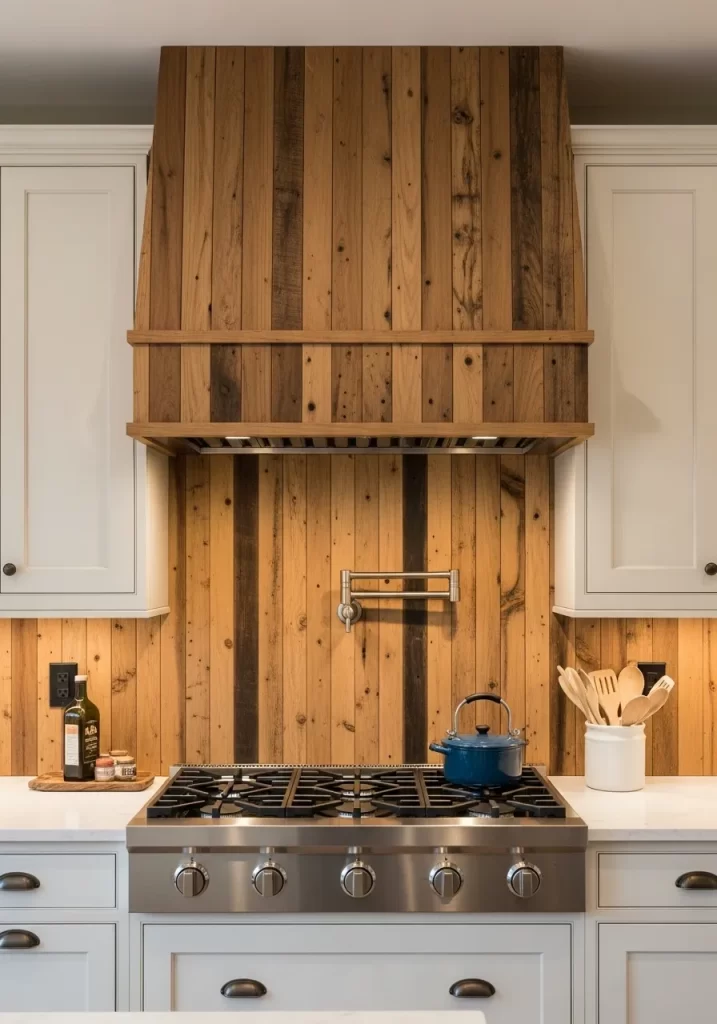
This kitchen uses reclaimed wood planks. They cover the wall from the counter right up to the range hood. The different wood tones, from dark to light, add warmth. It feels like a cozy cabin.
The vertical lines of the boards draw your eyes up. This look contrasts nicely with the clean white cabinets. It’s a strong, natural statement.
DIY Faux Wood Plank Backsplash
This is a great project, but ask an adult to help with any cutting!
Stuff You Need:
- Peel-and-stick vinyl wood planks (get the thin, light kind).
- Measuring tape and a pencil.
- A utility knife (for an adult to use).
- A level (the tool with the bubble).
- Cleaning spray and a clean rag.
Step-by-Step:
- Clean Your Wall: Your wall must be super clean and dry. Wipe it all down with cleaner and a rag. Wait for it to dry completely.
- Draw a Straight Line: Use your level and pencil to draw a light, straight line where your first row of planks will sit. This makes sure you don’t end up with a crooked wall.
- Measure and Cut (Adult Job): Measure the space. If you get to an outlet, hold the plank up and draw a box where the outlet is. Have an adult carefully cut the box out with the utility knife.
- Peel and Stick: Take your first plank. Peel off the paper backing.
- Press it on: Line it up with your pencil line. Press it hard against the wall. Rub it all over with your hands to make it stick well.
- Stagger Your Planks: For the next row, start with a plank cut in half. This makes the seams look random, like a real wood floor.
- Finish the Wall: Keep going. Mix up the different colors of planks if you have them. Press every plank down firmly until the whole wall is covered.
3. The Modern Stacked Stone
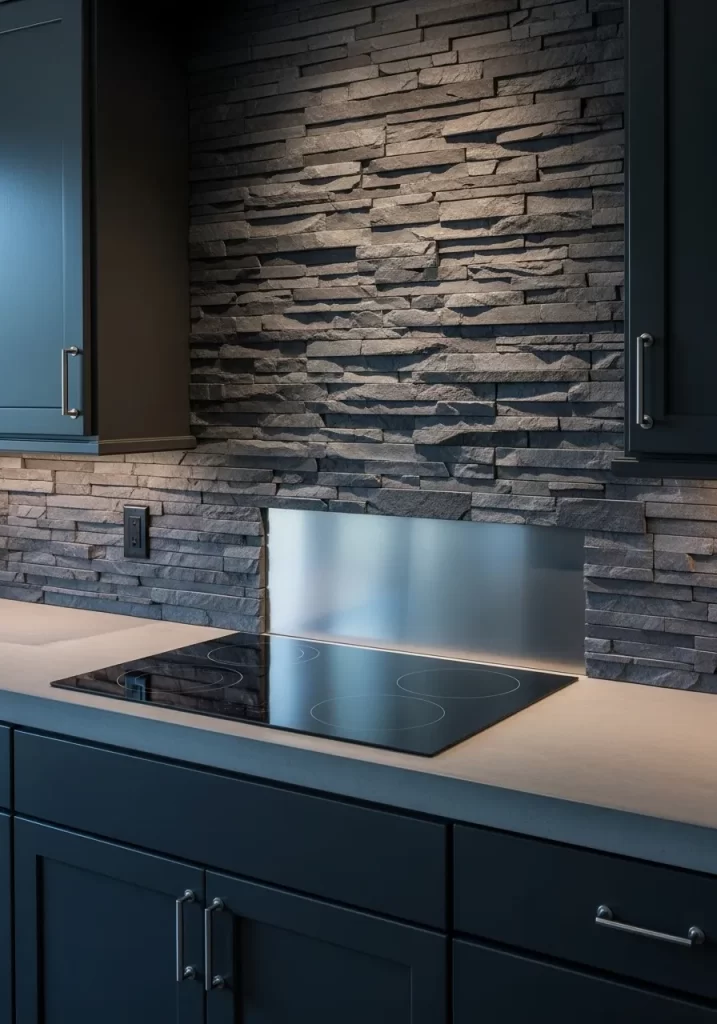
This backsplash uses dark, stacked stone. The rough texture of the rock creates deep shadows. It feels strong and moody.
The stones are thin and layered, giving the wall a rugged look. This design works well with the dark cabinets and simple countertops. Under-cabinet lights show off the texture. A sleek metal panel sits behind the stove to make cleaning easier.
DIY Faux Stacked Stone Panel Wall
These panels can be heavy, so ask an adult for help lifting and gluing.
Stuff You Need:
- Faux stone “panels” (they are usually in 2-foot long sections).
- Strong construction glue (like Liquid Nails).
- A caulk gun (to squeeze the glue).
- A level, measuring tape, and pencil.
- A saw (for an adult to use).
- Cleaning supplies.
Step-by-Step:
- Clean the Wall: Scrub the wall so it’s free of any dust or grease. Let it dry 100%.
- Find the Center: Find the middle of your wall. Use your level to draw a straight up-and-down pencil line. You will start here and work your way out.
- Load the Glue (Adult Job): An adult needs to put the big tube of glue into the caulk gun.
- Glue the First Panel: Take your first fake stone panel. Squeeze the glue on the back in a big “S” shape.
- Press to the Wall: Press the panel onto the wall, starting at the bottom center. Hold it there for 30 seconds. Use your level to make sure it’s perfectly straight.
- Lock the Next Piece: These panels often have edges that lock together like puzzle pieces. Add glue to the next panel and lock it in place next to the first one.
- Cut End Pieces (Adult Job): When you get to the end of the wall or an outlet, measure it. Have an adult cut the panel to fit using a saw.
- Keep Going: Keep adding rows, locking them together, until your new stone wall is complete.
4. The Mint Green Penny Rounds
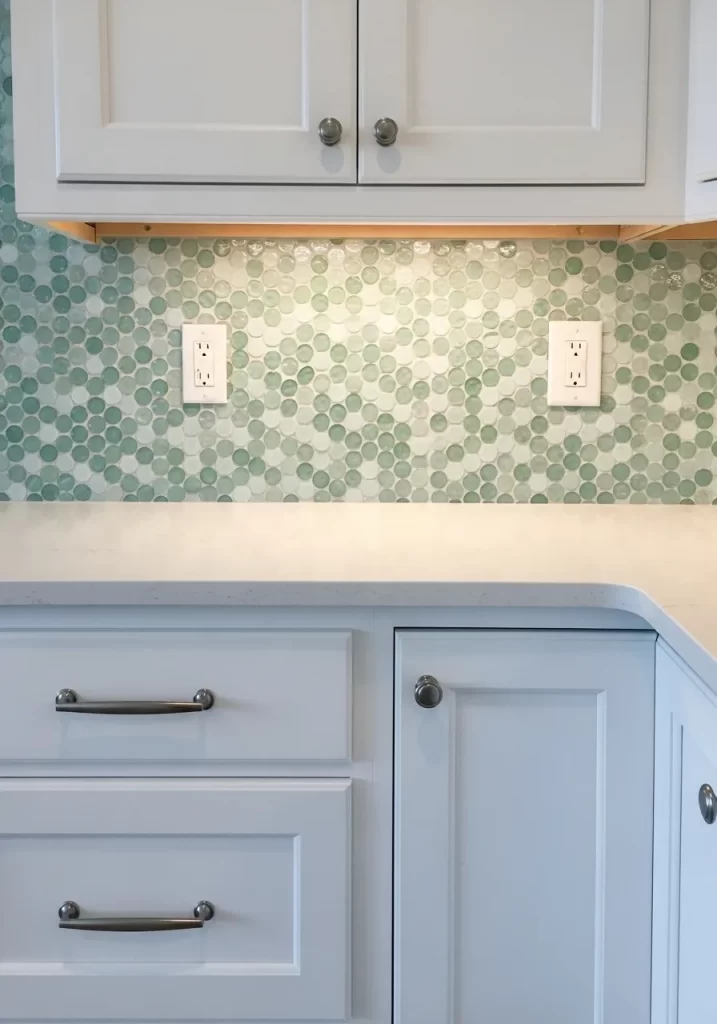
Small, round “penny” tiles create a playful look. These tiles are a soft, minty green color. Some are shiny, and some are matte.
This mix catches the light in different ways. The white grout makes each little circle pop. It’s a clean, bright, and happy style. It adds a bit of fun to the simple white cabinets and counter.
DIY Easy Peel-and-Stick Penny Tile
This is one of the easiest ways to add tiles!
Stuff You Need:
- Peel-and-stick penny tile “mats” (they come in square sheets).
- Scissors or a utility knife (for an adult to use).
- A level and a pencil.
- Measuring tape and a cleaner.
Step-by-Step:
- Clean and Dry: Your wall must be perfectly clean and dry. Any dust will stop the tiles from sticking.
- Draw a Straight Line: Use your level to draw a straight pencil line. This will be the guide for your first row of tile sheets.
- Measure and Cut (Adult Job): Measure your wall. The tile mats are often square. You will need to cut them to fit around outlets or at the end of the wall. An adult can do this with a utility knife.
- Peel the Back: Take your first tile mat. Carefully peel off the paper backing. Don’t let the sticky side touch anything!
- Stick it!: Carefully line up the mat with your pencil line. Press it onto the wall.
- Press Firmly: This is the most important part. Rub your hands all over the mat. Press hard on every single little tile to make sure it sticks.
- Link Them Up: The mats are designed to link together. Line up the next mat and stick it right next to the first one. Keep going until you’re done.
5. The Fossil Leaf Botanical Tiles
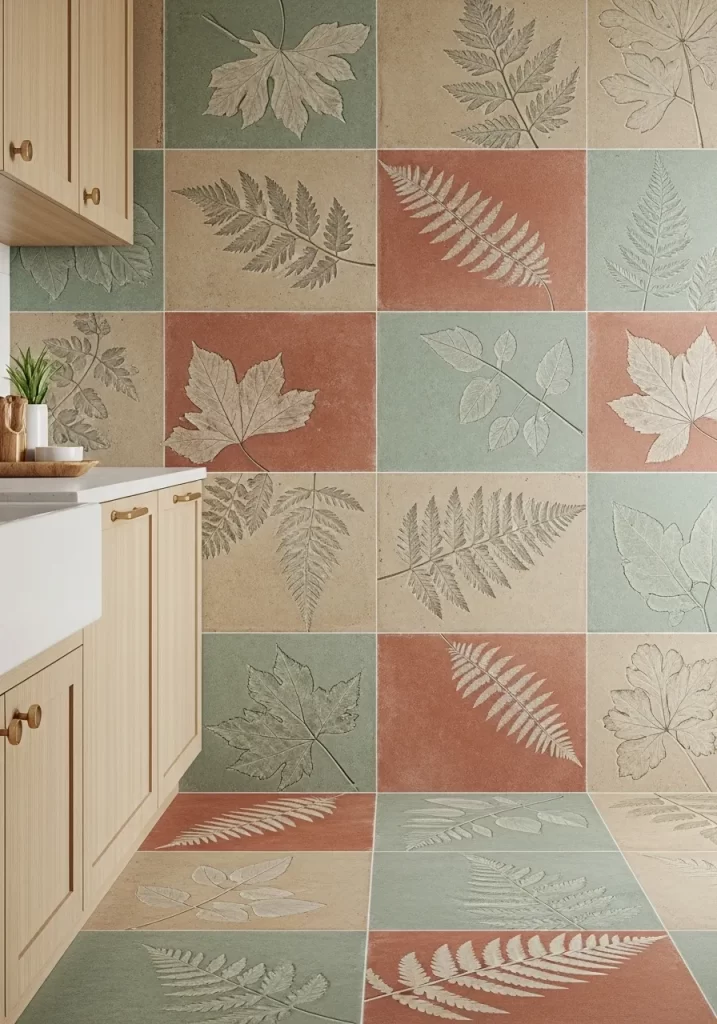
This design brings nature inside in a different way. These are large square tiles made of terracotta or concrete. Each tile has a plant design pressed into it, like a fossil.
You can see ferns and big maple leaves. The tiles use soft, earthy colors like tan, rust-red, and sage green. They are arranged in a checkerboard pattern. It creates a calm, rustic, and very unique wall.
DIY Fossil Leaf Stepping Stones
This is a fun and messy project. You can use these as wall art.
Stuff You Need:
- Quick-set concrete mix or air-dry clay.
- A bucket for mixing, water, and a strong stirring stick.
- Old square plastic containers (like for takeout food).
- Non-stick cooking spray.
- Pretty leaves from your yard (ferns and maple leaves work great).
Step-by-Step:
- Find Your Leaves: Go outside and find 5-6 interesting leaves. Get ones with cool shapes and lots of veins.
- Prep Your Molds: Spray the inside of your square plastic containers with cooking spray. This stops the concrete or clay from sticking.
- Mix it Up (Adult Job): Have an adult help you mix the concrete in the bucket. Follow the directions on the bag. You want it to be like thick oatmeal. (If using air-dry clay, just knead it.)
- Pour the Molds: Pour the mix into your containers. Fill them about halfway up. Tap the containers gently on the ground to get out any air bubbles.
- Press the Leaves: Gently lay your leaves on top of the wet concrete or clay. Press them down firmly so they make a deep shape.
- Let it Dry: This is the hard part. You have to wait! Let it dry for at least a full day.
- The Reveal: Once it’s hard, turn the container over and pop out your tile. Carefully peel the real leaf out of the front. You’ll have a fossil!
- Mounting: Have an adult help you hang these on the wall with strong picture hangers.
6. The Rich Oxidized Metal Panels
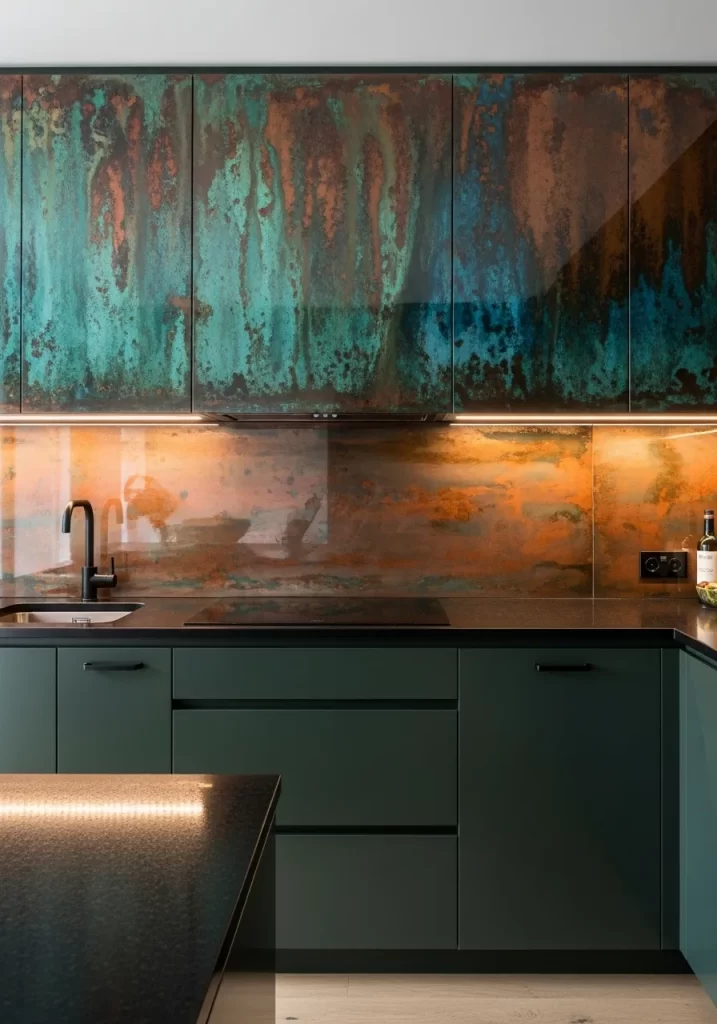
This kitchen makes a bold statement. The backsplash and upper cabinets are covered in large panels. They look like rusted, oxidized metal.
Deep teal blues mix with fiery oranges and reds. The high-gloss finish reflects light, making it look dramatic and artistic. This style pairs well with the dark, simple lower cabinets. It turns the entire wall into a piece of abstract art.
DIY Faux Rusted Paint Effect
This is a really fun painting project!
Stuff You Need:
- A smooth board or panel cut to fit your wall (ask an adult).
- Primer (dark grey or black is best).
- Spray bottles (like for plants).
- Craft paints (dark blue, teal, bright orange, reddish-brown).
- Water and paper towels.
- Clear gloss sealer (spray can).
Step-by-Step:
- Prime the Board (Adult Job): Have an adult help you cut a thin piece of plywood to fit your backsplash space. Paint it with the dark primer. Let it dry.
- Make Your Paint Bottles: Fill three spray bottles with water. Add a lot of blue paint to one, teal to another, and orange to the third. Shake them up well.
- Spray the “Rust”: Lay your board flat. Lightly spray the orange paint in a few spots.
- Spray the “Patina”: While the orange is still wet, spray the blue and teal paints over it and around it. Let the colors run together and drip.
- Blot and Dab: Use a wadded-up paper towel to dab at the paint. This blends the colors and makes them look more natural. You can’t mess this up!
- Add Drips: You can tip the board up and spray more water at the top. This lets the paint drip down like real rust.
- Dry and Seal (Adult Job): Let it dry completely. Then, have an adult spray it with 2-3 coats of clear gloss sealer. This makes it shiny and waterproof.
- Install: An adult can help you attach the finished art panel to the wall.
7. The Playful Iridescent Terrazzo

Terrazzo is back, but with a new twist. This backsplash uses a white base. Instead of just stone chips, it includes colorful pieces of glass and shiny, iridescent flakes.
These special flakes catch the light. They sparkle with blue, pink, and purple. It’s a fun, bright, and modern look. The design continues from the wall right onto the matching countertop.
DIY Colorful “Faux-razzo” Paint
This is like making your own polka dots, but with fun shapes!
Stuff You Need:
- A clean, painted wall (white or light grey is best).
- Small craft paint brushes.
- 3-4 craft paint colors (like light blue, pink, grey, black).
- Clear glitter paint (optional).
- Clear waterproof sealer (for an adult).
Step-by-Step:
- Start with a Clean Wall: Make sure your wall is clean and painted a light color.
- Make the Big Shapes: Dip your brush in your first color (like grey). Paint random, blobby shapes on the wall. Make some small, some medium. Spread them out.
- Add More Colors: Clean your brush. Use your next color (like blue) to paint more blobs. It’s okay if they are close to the other ones.
- Add the Smallest Shapes: Use your last color (like black or pink) to paint tiny little “chip” shapes. This fills in the empty spaces.
- Add Sparkle (Optional): If you want it to sparkle, you can paint a few of your bigger blobs with clear glitter paint.
- Step Back: Keep adding shapes until it looks balanced and fun. You are making your own pattern!
- Seal It (Adult Job): When it’s all dry, have an adult paint over the whole thing with a clear, waterproof sealer to protect it.
8. The Fluted White Marble

This backsplash adds amazing texture. It uses white marble tile that has been carved with thin, vertical grooves. This is called “fluted” or “reeded.”
The light from the brass wall lamp hits the curves. This creates soft shadows. It makes a simple white wall very interesting. The stone has soft grey veins. It looks elegant and sophisticated. The vertical lines make the wall feel taller.
DIY Easy “Fluted” Wall
You can get this look using a special kind of bendy wood.
Stuff YouNeed:
- “Pole wrap” or “tambour” (it’s a bendy sheet of half-round wood strips).
- Measuring tape.
- A saw (for an adult to use).
- Strong construction glue.
- A caulk gun (to squeeze the glue).
- White paint and a paintbrush.
Step-by-Step:
- Measure Your Wall: Measure the height and width of your wall.
- Cut the Wrap (Adult Job): Have an adult help you cut the pole wrap sheets to fit your wall. This stuff can be tricky to cut straight.
- Paint it: Paint the “bumpy” side of your pole wrap sheets. Use a good white paint. Let it dry completely.
- Glue it Up (Adult Job): Load the construction glue into the caulk gun. Squeeze the glue on the back (the flat side) of your painted sheet in an “S” shape.
- Press to Wall: Carefully press the sheet onto the wall. Start at one end and rub it all over.
- Add the Next Sheet: Do the same for the next sheet. Line up the grooves so they look like one giant piece.
- Finishing Touches: You can add a small piece of wood trim at the top and bottom (painted white) to make it look extra finished.
9. The Seamless Quartzite Slab
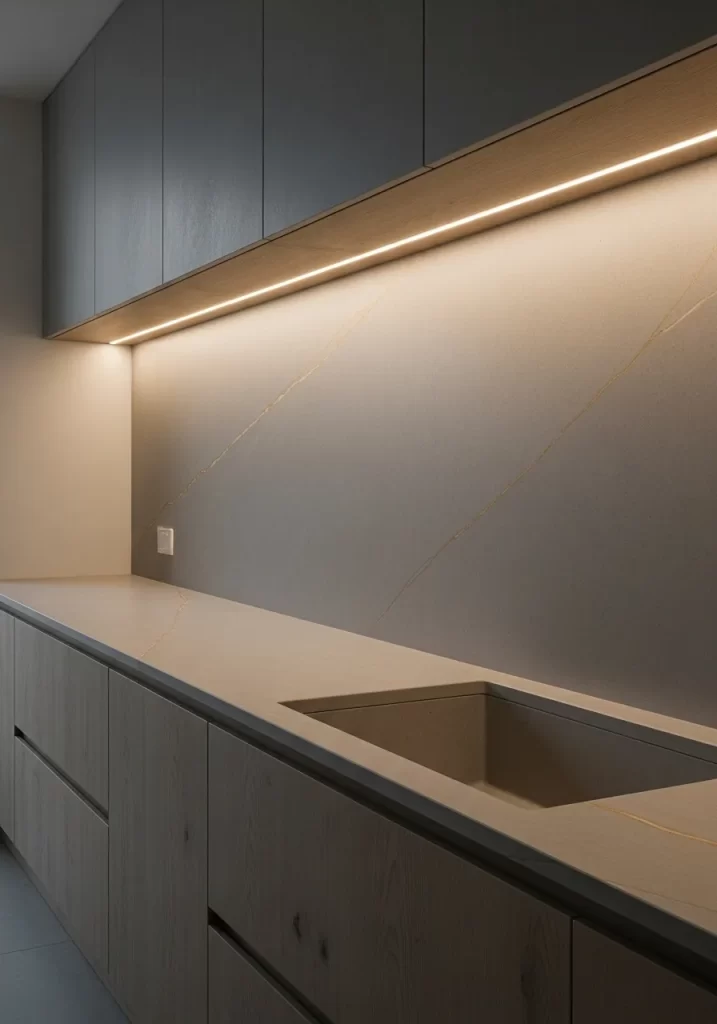
For a clean, minimal look, this kitchen uses one giant piece of stone. This is a slab backsplash. There are no grout lines to clean.
The stone is a calm, neutral color, like beige or grey. Thin, diagonal veins of gold or brown run through it. This adds a little bit of pattern without being busy. The under-cabinet light makes the stone glow softly. It is simple and very high-end.
DIY Faux Stone Slab (Paint Effect)
You can get this look with paint and a feather!
Stuff You Need:
- A smooth board or your plain wall.
- Light grey or beige wall paint (for the base).
- A small, thin craft brush.
- A feather (like from a craft store).
- Two craft paint colors (one dark grey, one gold).
- A cup of water.
- Clear waterproof sealer (for an adult).
Step-by-Step:
- Base Coat: Paint your wall or board with your main base color (light grey or beige). Let it dry completely.
- Mix Your Vein Color: Get a paper plate. Mix a little dark grey paint with some water. You want it to be thin and watery.
- Paint the Vein: Dip your small craft brush in the watery grey paint. Paint a long, wiggly, diagonal line across the wall.
- Soften the Vein: While it’s still wet, dip the feather in plain water. Gently drag the feather along your painted line. This will make it look soft and blurry, like a real stone vein.
- Add Gold: Clean your brush. Dip it in the gold paint. Paint another very thin, wiggly line right next to your soft grey line.
- Repeat: Do this 2-3 more times in different spots. Make them all go in the same general direction.
- Seal it (Adult Job): Let it all dry. Have an adult paint over it with a clear, waterproof sealer.
10. The Bookmatched Backlit Onyx
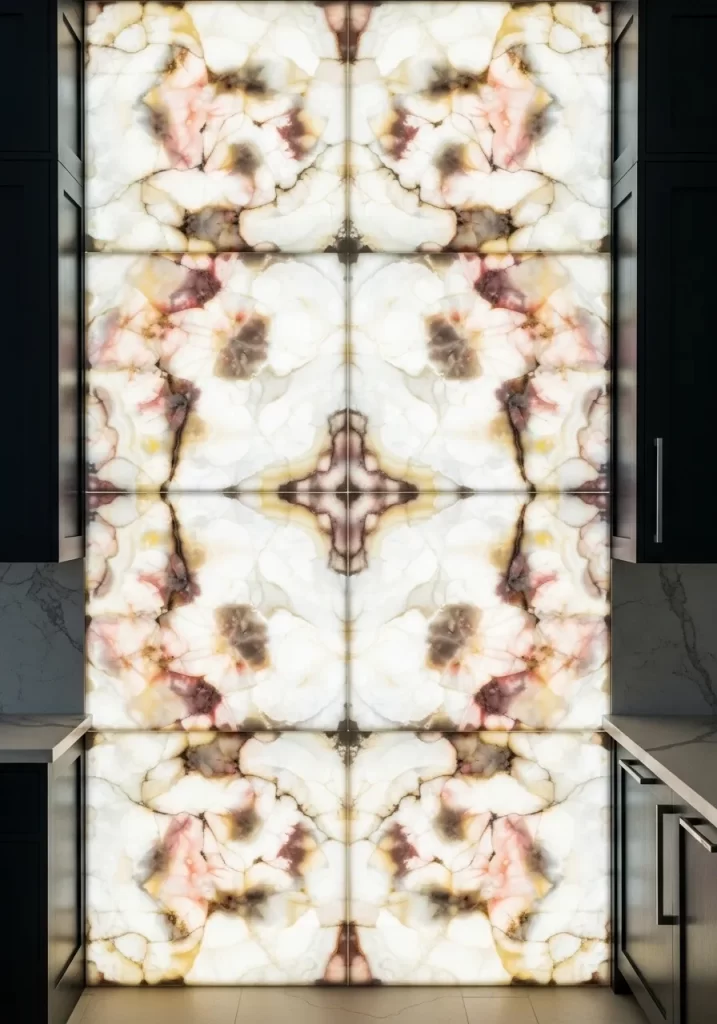
This is the height of luxury. The backsplash is made from thin slices of onyx, a type of stone. It is “bookmatched,” which means two slabs are cut and opened like a book to create a mirror image.
The pattern looks like a butterfly. The most amazing part is the light. Lights are placed behind the stone, making the whole wall glow from within. It turns the backsplash into a major art installation.
DIY Faux “Glowing Stone” Art
This is tricky, but the result is amazing. It makes a glowing piece of art.
Stuff You Need:
- A clear sheet of plexiglass.
- Tracing paper (or parchment paper).
- 3-4 colors of “alcohol ink” (brown, yellow, pink work well).
- Rubbing alcohol and an eye-dropper or straw.
- A picture frame (the same size as your plexiglass).
- LED light strips (the sticky kind).
Step-by-Step:
- Make the “Stone”: Lay your plexiglass flat. Squeeze a few drops of your first color (yellow) onto it.
- Move the Ink: Use your straw to blow the ink around. Or use an eye-dropper to add drops of rubbing alcohol. This makes the ink spread in cool patterns.
- Add More Colors: Add drops of pink and brown. Blow them around. Let them mix and swirl. You are trying to make it look like a fancy rock.
- Let it Dry: This paint dries fast. Keep adding layers until you like the look.
- Build the Light Box (Adult Job): Take your picture frame and remove the glass and back. Have an adult help you stick the LED light strips to the inside edge of the frame, facing inward.
- Add the Diffuser: Cut a piece of tracing paper to fit the frame. This softens the light.
- Assemble: Put your painted “stone” (the plexiglass) into the frame. Put the tracing paper right behind it.
- Hang and Glow: Hang your new art on the wall and plug it in. It will glow like the real thing!
11. The Ultra-Minimalist Painted Panel

Sometimes the best backsplash is no backsplash at all. This kitchen uses a smooth, plain wall painted in a clean, soft white. It creates a calm and open feeling.
This look is about simplicity. It allows the light green-blue cabinets and wooden cutting boards to be the main focus. Using a durable, washable paint is the key. This makes the wall easy to wipe down.
DIY Smooth Painted Backsplash
The secret to this look is making the wall perfectly smooth before you paint.
Stuff You Need:
- Fine-grit sandpaper (and a sanding block).
- Spackling paste (to fill holes).
- Putty knife.
- Painter’s tape.
- A good quality primer.
- Durable, “scrubbable” semi-gloss or satin paint.
- Paint roller and tray.
Step-by-Step:
- Prep the Wall (Adult Job): An adult needs to fill any tiny nail holes with spackling paste. Let it dry.
- Sand Smooth (Adult Job): Use the sandpaper to gently sand the wall. You want it to be as smooth as a chalkboard. Wipe all the dust off with a damp cloth.
- Tape Your Edges: Carefully put painter’s tape along the countertop and under the cabinets. This gives you a clean line.
- Prime Time: Roll on one coat of primer. Primer helps the paint stick and makes the color look even. Let it dry.
- Paint Your Color: Roll on your final paint color. Go in a “W” shape to get it nice and even.
- Second Coat: Let the first coat dry completely (a few hours). Then, add one more coat. This makes it strong.
- Peel the Tape: Pull off the painter’s tape while the paint is still a little bit wet. This gives you a crisp edge.
12. The Seamless Stainless Steel
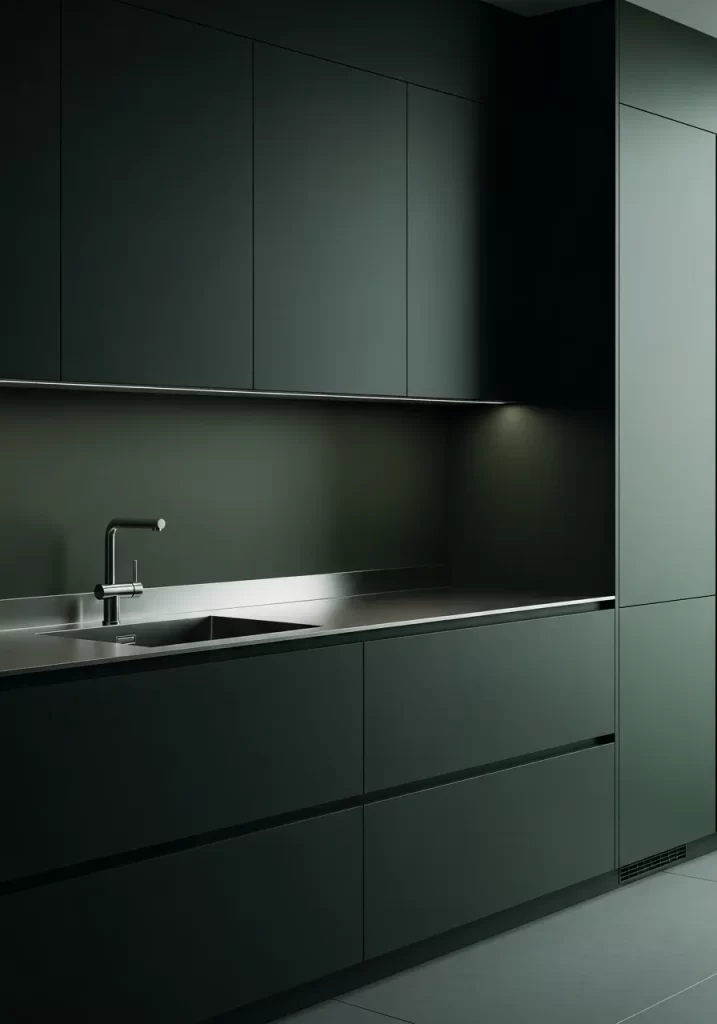
This kitchen has a professional, restaurant-style look. The countertop and backsplash are made from one continuous piece of stainless steel.
There are no seams or grout lines. This makes it very hygienic and simple to clean. The metal reflects the dark cabinets and under-cabinet lights. It’s a sleek, modern, and industrial design.
DIY Faux Stainless Steel Panel
Real steel is hard to cut. This method uses a special sticky paper.
Stuff You Need:
- Peel-and-stick stainless steel contact paper (vinyl).
- A measuring tape and pencil.
- A smoothing tool (or a credit card).
- A utility knife or sharp scissors (for an adult to use).
- Cleaning spray and a rag.
Step-by-Step:
- Clean Your Wall: Your wall must be 100% clean and dry. Any little speck of dust will make a bump.
- Measure and Cut (Adult Job): Measure your wall. Have an adult cut the contact paper. Leave a little extra, just in case.
- Peel a Little: Peel back just the top 3-4 inches of the paper backing. Don’t peel the whole thing!
- Stick the Top: Line up the top edge and press it onto the wall.
- Smooth and Peel: Slowly pull the paper backing down with one hand. At the same time, use your other hand to smooth the vinyl with the credit card. Go from the middle out to the sides.
- No Bubbles!: This smoothing part is important to push out any air bubbles.
- Trim the Edges (Adult Job): Once it’s all on, have an adult use the utility knife to carefully trim any extra vinyl from the edges.
13. The Wavy Plaster Finish
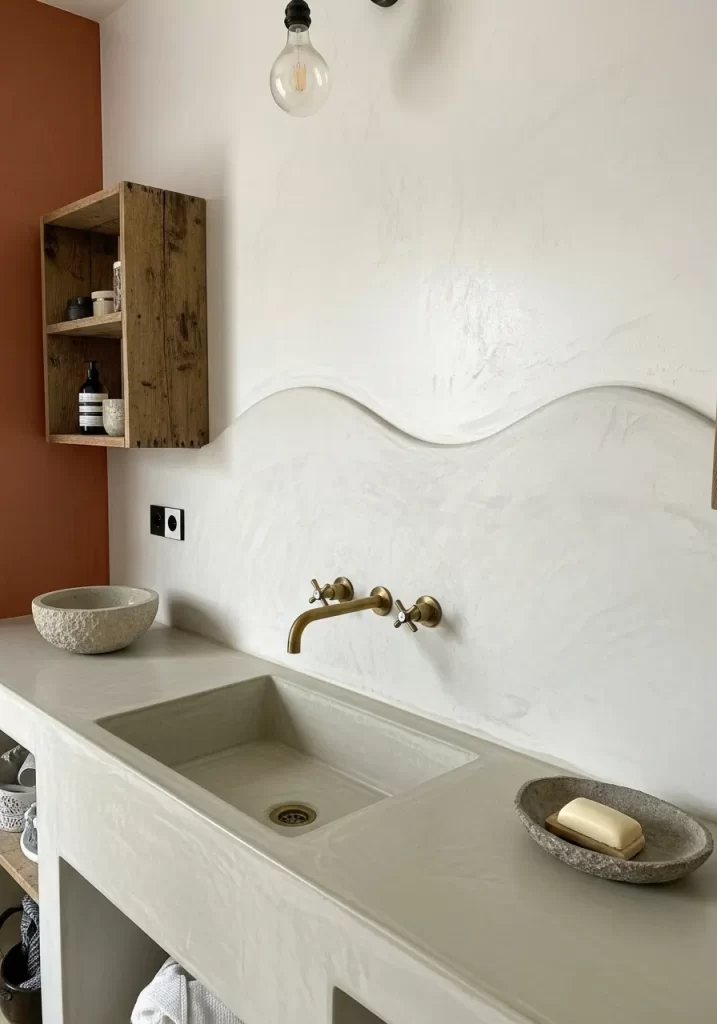
This kitchen feels soft and handmade. The backsplash is made of a smooth, waterproof plaster, like Tadelakt. It covers the wall in one seamless piece.
The most unique part is the top edge. It is not straight. It has a gentle, organic wave shape. This makes the wall feel like a piece of art. It pairs well with the rustic wood shelf and stone sink.
DIY Faux Plaster Wave
You can get this look with drywall mud.
Stuff You Need:
- A pencil.
- Painter’s tape.
- Pre-mixed joint compound (drywall mud).
- A wide putty knife.
- A damp sponge.
- Paint (in a light, earthy color).
- Clear, waterproof sealer (for an adult).
Step-by-Step:
- Draw Your Wave: Use a pencil to lightly draw a wavy line across your wall.
- Tape the Line: This is the tricky part. Carefully put painter’s tape along the wall above your pencil line. Follow the curve.
- Spread the Mud (Adult Job): Get some joint compound on your putty knife. Spread a thin layer on the wall below your tape line. Go right up to the tape.
- Make it Smooth: Use the damp sponge to gently pat and smooth the “mud.” You want it to look soft, not rough.
- Peel the Tape: Carefully pull off the painter’s tape before the mud dries. This will leave your clean, wavy edge.
- Let it Dry: Let it dry for a full day. It might need a very light sanding (adult job).
- Paint and Seal (Adult Job): Paint your new plaster wall. When it’s dry, an adult must add 2-3 coats of clear, waterproof sealer to protect it.
14. The Continuous Travertine Flow
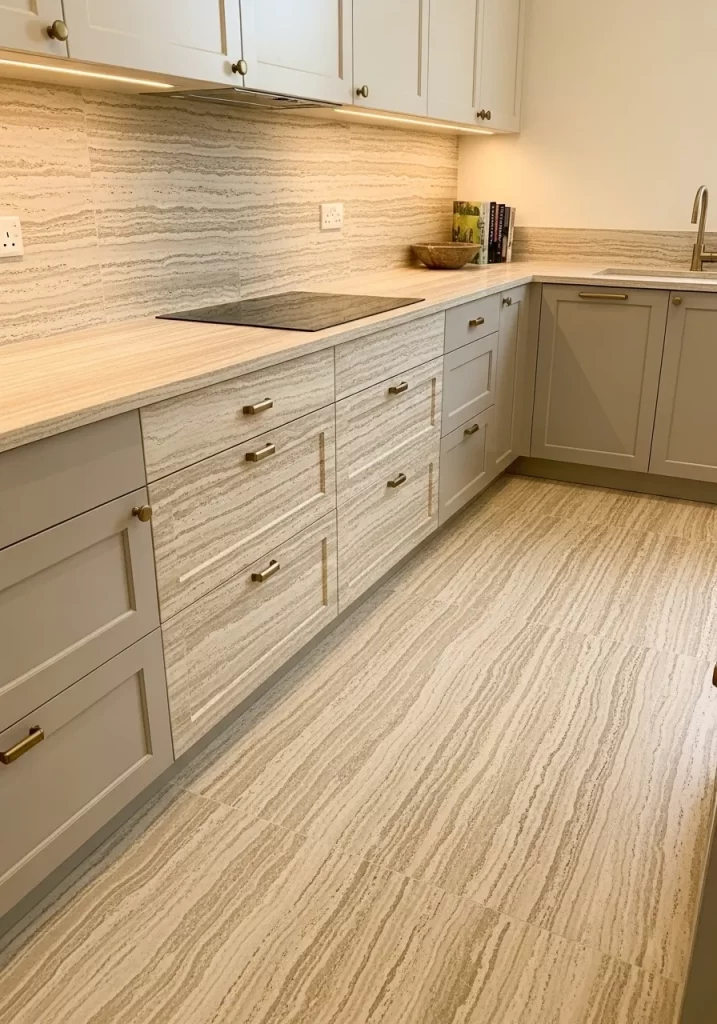
This design creates a powerful, flowing look. A single material, a type of stone like travertine, is used on the floor, the cabinet doors, and the backsplash.
The stone has strong horizontal lines and a soft, sandy color. By using the same material everywhere, the room feels unified and connected. The horizontal pattern makes the kitchen feel wider. It’s a very calm and high-end design.
DIY Faux Travertine Paint Effect
This paint trick is called “dragging.”
Stuff You Need:
- Base paint (light tan or beige).
- A second, darker paint (brownish-grey).
- Clear paint glaze.
- A paint tray, roller, and brush.
- A “graining” tool or a dry, stiff-bristled brush.
Step-by-Step:
- Paint the Base: Paint your whole wall with the light tan base coat. Let it dry completely.
- Mix the Glaze: In your paint tray, mix 1 part of your darker paint with 4 parts of the clear glaze. This makes the paint see-through.
- Roll on the Glaze: Working in one section, roll the dark glaze mixture on top of your dry base coat.
- Drag It!: Before the glaze dries, take your dry, stiff brush. Press it at the top of the wall. Drag it all the way to the bottom in one smooth, straight line.
- Repeat: Lift your brush and do it again right next to your first line. Don’t overlap too much. This dragging pulls the dark paint and makes it look like stone veins.
- Keep Going: Do this across the whole wall. Always drag in the same direction (top-to-bottom, or side-to-side).
- Seal It (Adult Job): Let it dry. An adult should add a clear waterproof sealer.
15. The Cobalt Blue Grid
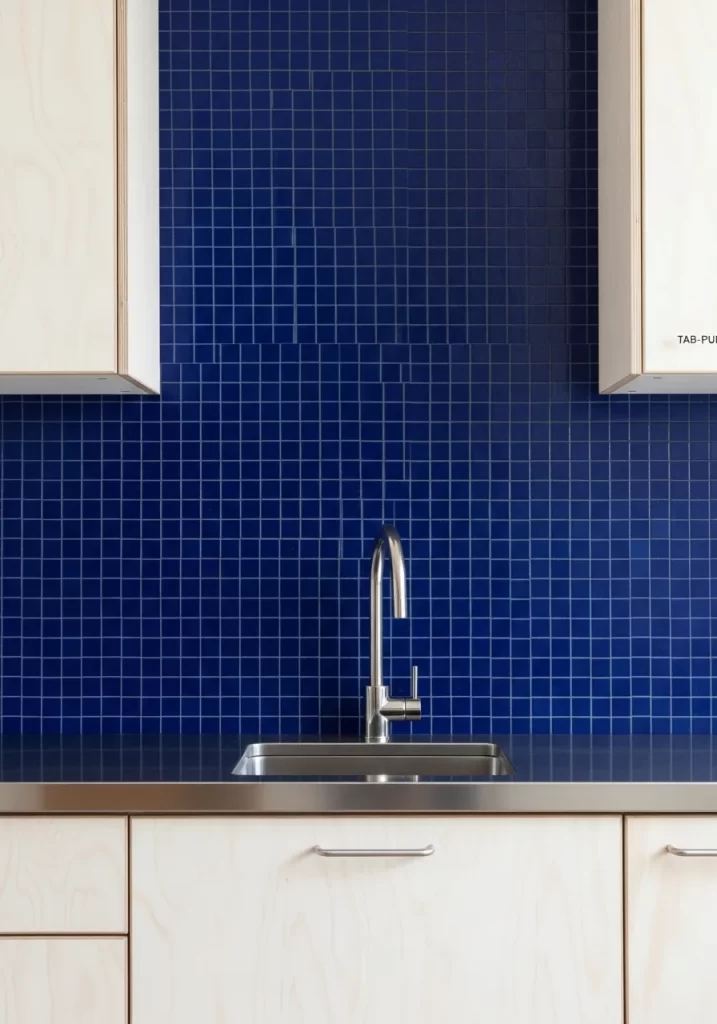
This is a bold, classic look. The wall is covered in tiny square tiles of a deep, bright cobalt blue. They are set in a simple, tight grid.
The white grout between the tiles makes each tiny square stand out. This design is very clean and graphic. It adds a powerful pop of color to the simple, light-wood cabinets. It feels both retro and modern.
DIY Easy Peel-and-Stick Grid Tile
This is just like the penny tiles, but with squares.
Stuff You Need:
- Peel-and-stick blue square tile “mats” (they come in sheets).
- A level and a pencil.
- A utility knife or sharp scissors (for an adult to use).
- A measuring tape.
- A cleaner and a rag.
Step-by-Step:
- Clean and Dry: Your wall must be perfectly clean. Any dust or grease will stop the sheets from sticking.
- Draw a Line: Use your level to draw a straight pencil line. This will be your starting guide.
- Measure and Cut (Adult Job): Have an adult help you measure and cut the tile sheets to fit around outlets or at the end of a wall.
- Peel the Back: Take your first sheet. Peel off the paper backing.
- Stick it!: Carefully line up the sheet with your pencil line. Press it onto the wall.
- Press Hard: Rub your hands all over the sheet. You need to press on every single little tile to make it stick properly.
- Link Them Up: The tile mats are made to link together. Stick the next one right beside the first, making sure the grout lines match up.
16. The Antiqued Mirror Panel

This backsplash adds a feeling of glamour and space. It uses large panels of “antiqued” mirror. This is not a clear mirror. It has a smoky, aged look.
The mirror reflects light and makes the kitchen feel bigger. The aged finish hides small splashes and fingerprints. It looks very elegant with the dark navy cabinets and brass fixtures.
DIY Faux Antiqued Mirror
You can make this using a special spray paint.
Stuff You Need:
- A piece of glass or clear plexiglass (ask an adult to get it cut to size).
- Krylon “Looking Glass” mirror-effect spray paint.
- A spray bottle with a 50/50 mix of water and white vinegar.
- Paper towels.
- Black spray paint (optional).
Step-by-Step:
- Clean the Glass: Clean the glass perfectly. Any fingerprint will show.
- Work Outside (Adult Job): This is a job for an adult in a well-ventilated area (like outside).
- Mist the Glass: Lay the glass flat. Lightly mist the back of the glass with your vinegar-water bottle. You want tiny water beads.
- Spray Mirror Paint (Adult Job): Spray a light, even coat of the “Looking Glass” paint over the water beads (on the back).
- Wait and Blot: Wait one minute. The paint will start to dry around the water. Gently blot the water beads with a paper towel. This lifts the paint and creates the “aged” spots.
- Repeat (Adult Job): Do this 2-3 more times with very light coats.
- Back it in Black (Adult Job): Once it’s dry, spraying a light coat of black paint over the mirror paint (on the back) will protect it.
- Install (Adult Job): An adult must install the panel with the painted side facing the wall.
17. The Smart Glass LED Panel
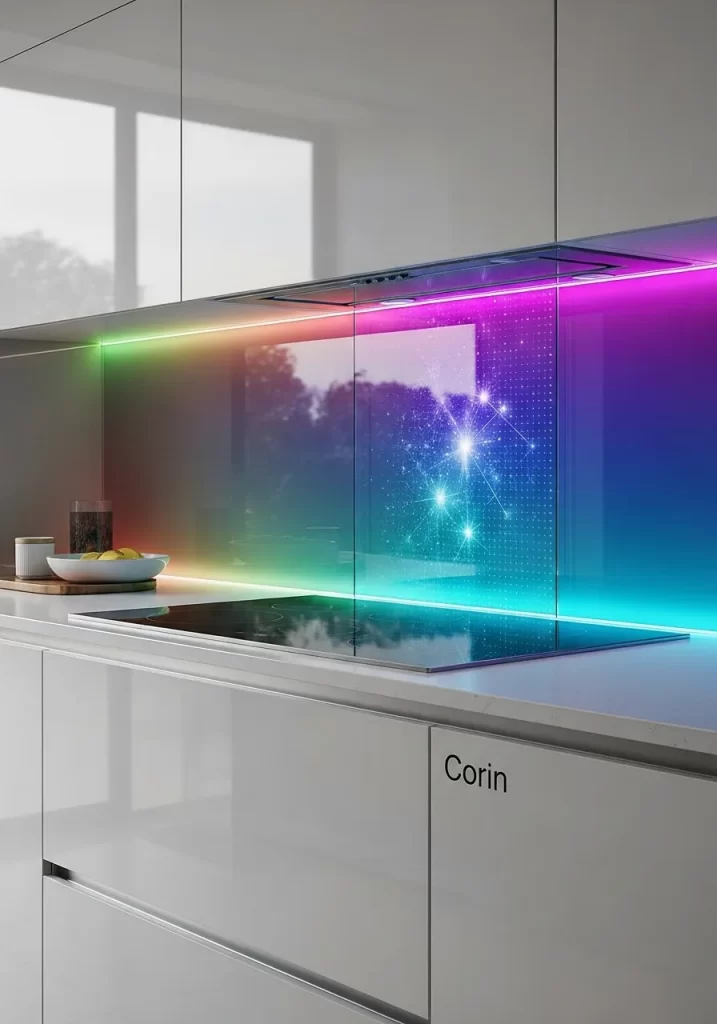
This kitchen looks futuristic. The backsplash is a smooth panel of glass. It has a glowing pattern of stars or constellations.
The magic is the edge-lighting. LED light strips are hidden along the top and bottom. They light up the glass and the design. The lights can even change colors, from green to blue to purple. It turns the wall into a piece of high-tech art.
DIY Glowing Edge Art
You can make your own glowing panel.
Stuff You Need:
- A sheet of clear plexiglass.
- An etching tool (or even just a nail).
- A simple design (like stars).
- LED light strips (the sticky kind).
- A thin wood frame or “channel.”
Step-by-Step:
- Get Your Panel (Adult Job): Have an adult get a sheet of plexiglass cut to fit your space.
- Trace Your Design: Print or draw some simple stars. Tape the paper to the front of the plexiglass.
- Etch the Back: Flip it over. Use your etching tool (or nail) to “trace” your design onto the back of the plexiglass. You are just scratching the plastic. These scratches will catch the light.
- Build the Frame (Adult Job): An adult needs to make a simple frame for at least the top and bottom edges.
- Add Lights (Adult Job): Stick the LED light strips inside the frame, pointing at the edge of the plexiglass.
- Assemble: Slide the plexiglass into the frame.
- Mount and Glow: Mount it on the wall. When you turn on the lights, your scratches will glow.
18. The Portuguese Tile Accent
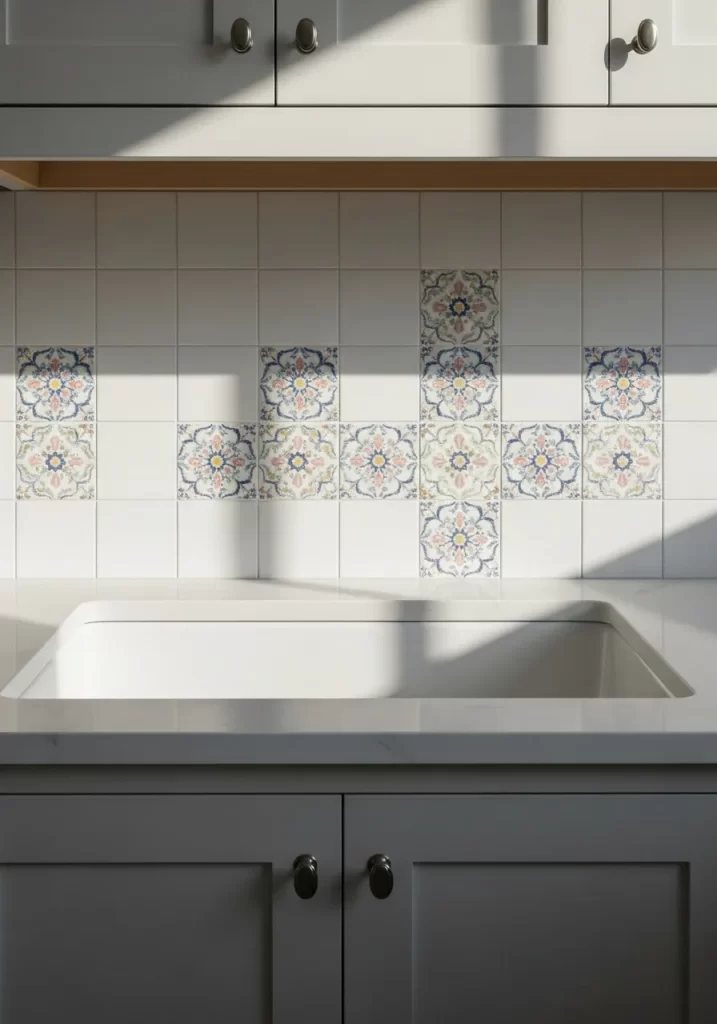
This backsplash is clean and classic, with a colorful surprise. Most of the wall is simple, white square tile. This is affordable and bright.
In a special pattern, colorful tiles are swapped in. These have a blue, yellow, and pink design, like tiles from Portugal or Spain. They are arranged in a “plus” sign shape. This adds a personal, custom touch.
DIY Tile Sticker Accents
This is one of the easiest updates you can do!
Stuff You Need:
- Your existing plain tile backsplash.
- Tile “stickers” or “decals” (find a pattern you like online).
- Cleaning spray and a rag.
- A credit card or smoothing tool.
Step-by-Step:
- Plan Your Pattern: Look at your wall. Decide where you want the “special” tiles to go. You can make a plus sign, a diagonal line, or just a random pattern.
- Clean Your Tiles: This is the most important step. Clean the real tiles you are going to cover. They must be 100% clean, dry, and free of any grease.
- Peel Your Sticker: Carefully peel the backing off one tile sticker.
- Stick it On: Line up the sticker with the corners of the real tile.
- Smooth it Out: Gently press the sticker on, starting from the middle. Use a credit card to smooth it out to the edges. This pushes out any air bubbles.
- Repeat: Keep going until your new pattern is complete!
19. The Integrated Smart Screen
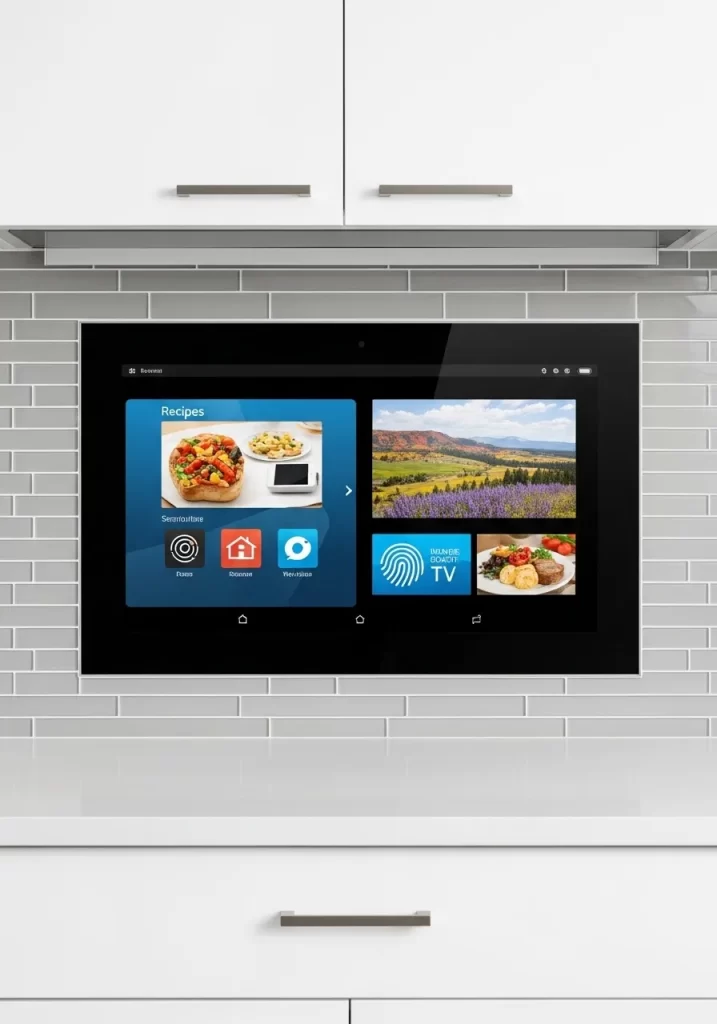
This is the ultimate kitchen helper. The backsplash is made of clean, grey subway tiles. Built right into the wall, and sitting flush with the tiles, is a large smart screen.
This turns the wall into a command center. You can look up recipes, watch cooking videos, or talk to family while you work. It’s a very functional and high-tech design.
DIY Tablet Wall Mount
You can get this look without cutting into your wall.
Stuff You Need:
- Your tablet (like an iPad).
- A “low-profile” or “flush” tablet wall mount (you can buy these online).
- A level (the tool with the bubble).
- A pencil.
- A screwdriver (for an adult).
Step-by-Step:
- Find a Safe Spot: Pick a spot on your wall. Make sure it’s not right over the stove (too much steam) or the sink (too much water).
- Mark Your Spot (Adult Job): Have an adult hold the wall mount bracket against the wall. Use the level to make it perfectly straight. Mark the screw holes with a pencil.
- Install Bracket (Adult Job): An adult needs to screw the bracket into the wall.
- Attach to Tablet: The kit will have a second piece. This piece attaches to the back of your tablet or your tablet’s case.
- Click it On: Click your tablet onto the wall bracket. Now you have a recipe screen!
- Be Safe: Make sure the charging cord is tucked away safely and not dangling near water or flames.
20. The Modular Control Panel
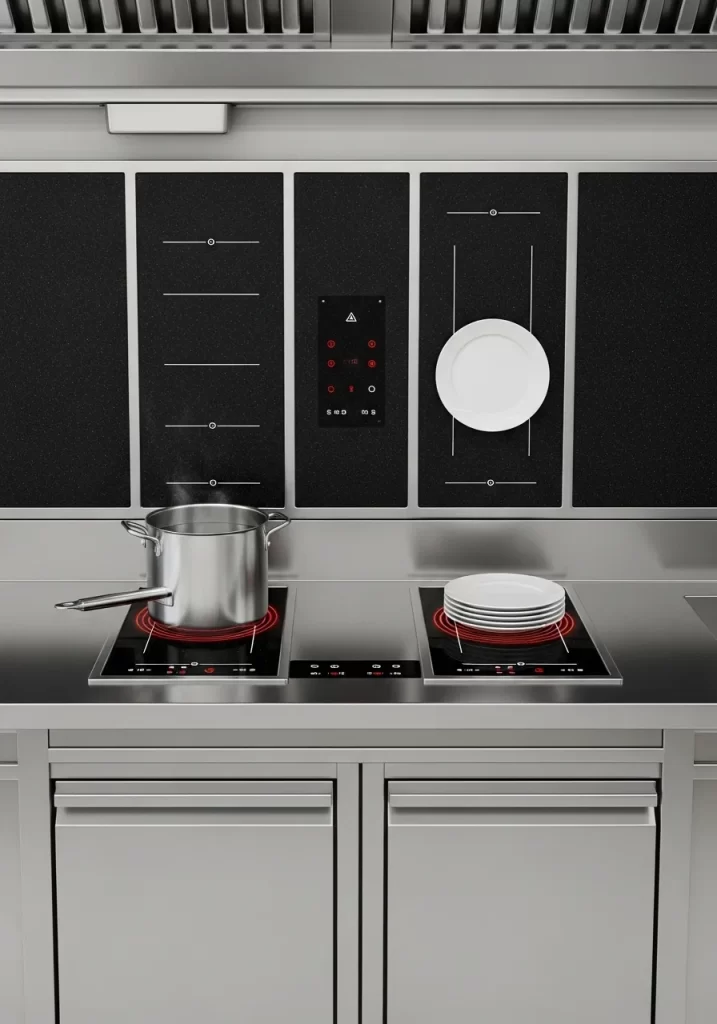
This kitchen looks like it’s from a science fiction movie. The backsplash is made of sleek, black panels. It is part of a high-tech cooking system.
These are not just tiles. They are modular panels. Some are blank, and others are-touch-screen controls for the cooktop. The entire wall is part of the appliance. It is seamless, black, and very industrial.
DIY Faux High-Tech Panel
You can get this look with paint and tape.
Stuff You Need:
- Matte black paint (or black peel-and-stick chalkboard vinyl).
- Thin, white or silver pinstripe tape (the kind for cars or crafts).
- A ruler or measuring tape.
- Scissors (for an adult).
- A cleaner and a rag.
Step-by-Step:
- Make it Black: First, your wall needs to be black. An adult can either paint the backsplash area with matte black paint, or you can cover it with black chalkboard vinyl (this is easier).
- Let it Dry: Make sure the paint is totally dry (or the vinyl is stuck on well).
- Plan Your Panels: Use your ruler to decide how big you want your “panels” to be.
- Tape Your Lines (Adult Job): Have an adult help you stick the pinstripe tape on the wall. Use the ruler to make sure the lines are perfectly straight.
- Create “Controls”: You can add smaller pieces of tape inside your new rectangles. Make small plus signs, circles, or lines to look like fake buttons.
- Step Back: Keep adding tape until it looks like a high-tech control panel.
21. The Classic White Subway Tile
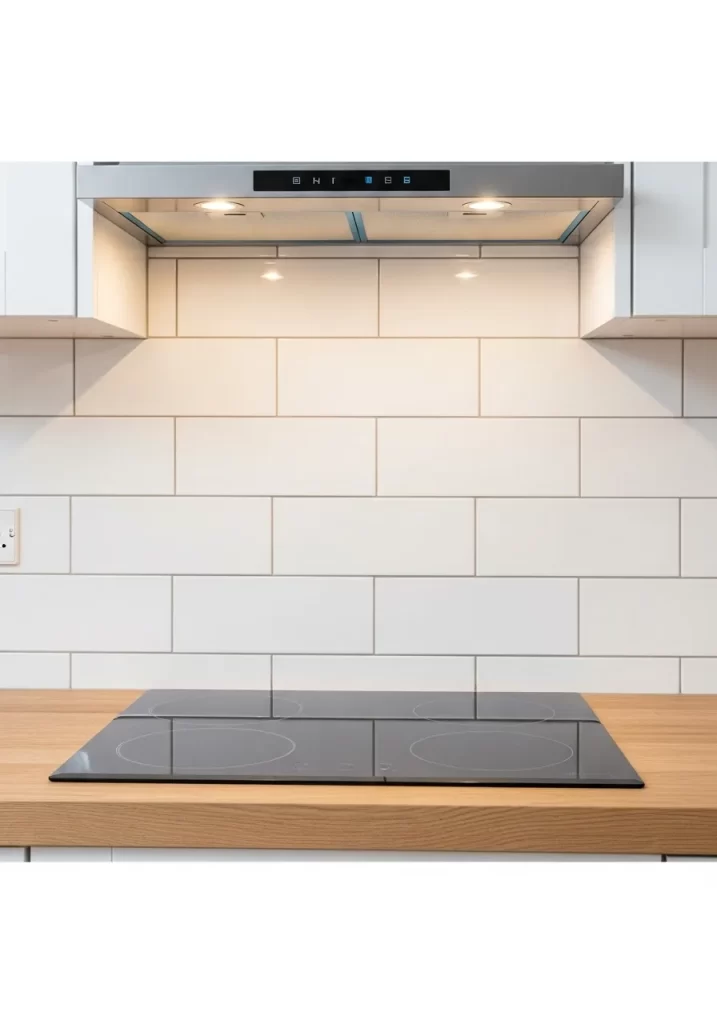
This kitchen features a timeless design. The backsplash is made of bright white subway tiles. These rectangular tiles are laid in a simple, offset pattern.
The white grout makes each tile stand out. This design feels clean and fresh. It brightens the space and offers a versatile backdrop. It’s a popular choice for many styles.
DIY Classic Subway Tile Look
You can get this classic look with peel-and-stick tiles.
Stuff You Need:
- Peel-and-stick white subway tile sheets.
- A measuring tape and pencil.
- A utility knife or sharp scissors (for an adult).
- A level.
- Cleaning spray and a rag.
Step-by-Step:
- Clean the Wall: Clean your wall so it’s free of any dust or grease. It needs to be very dry.
- Draw Your Guide: Use your level and pencil to draw a straight line where the bottom of your first tile sheet will go.
- Measure and Cut (Adult Job): Measure your space. Have an adult cut the tile sheets to fit around outlets or at the ends of the wall. Remember to cut them so they look “offset.”
- Peel and Stick: Carefully peel off the backing from your first tile sheet.
- Press Firmly: Line it up with your guide line. Press it onto the wall. Rub it all over with your hands to make sure it sticks.
- Offset the Next Row: For the next row, start with a sheet cut in half. This creates the classic subway tile “staggered” look.
- Keep Going: Continue adding sheets, pressing firmly, until the wall is covered.
22. The Cork Herringbone & Pegboard Mix

This kitchen features an unexpected blend of textures. The backsplash behind the stove uses cork in a herringbone pattern. Next to it, and on the range hood, is a gray pegboard.
The cork adds warmth and a soft feel. The pegboard offers a practical space for hanging tools. This combination of natural and industrial materials creates a lively, modern, and eclectic space.
DIY Cork Herringbone & Pegboard Panels
This is two projects in one! Ask an adult for help with cutting.
Stuff You Need (Cork):
- Thin cork tiles or cork sheets (you can cut these into strips).
- Wood glue.
- A cutting mat and utility knife (adult job).
- A ruler and pencil.
Stuff You Need (Pegboard):
- A sheet of pegboard (lightweight, thin).
- Paint (if you want to change its color).
- Screws and a drill (adult job) or strong construction adhesive.
Cork Herringbone Steps:
- Cut Cork Strips (Adult Job): Measure your space. Have an adult cut cork into strips of the same size.
- Draw a Center Line: Draw a light pencil line straight up the middle of your backsplash area.
- Start the Herringbone: Take two cork strips. Put glue on the back of each. Lay them down to form a “V” shape, with the point on your center line.
- Keep Gluing: Continue adding strips, creating the “V” pattern. Press each one firmly. Let the glue dry completely.
Pegboard Steps:
- Cut Pegboard (Adult Job): Have an adult cut the pegboard to fit the other backsplash areas and the range hood.
- Paint (Optional): If you want a specific color, paint the pegboard and let it dry.
- Mount (Adult Job): An adult can screw the pegboard into wall studs or use strong construction glue to attach it securely.
23. The Illuminated Rainbow Floor Grout
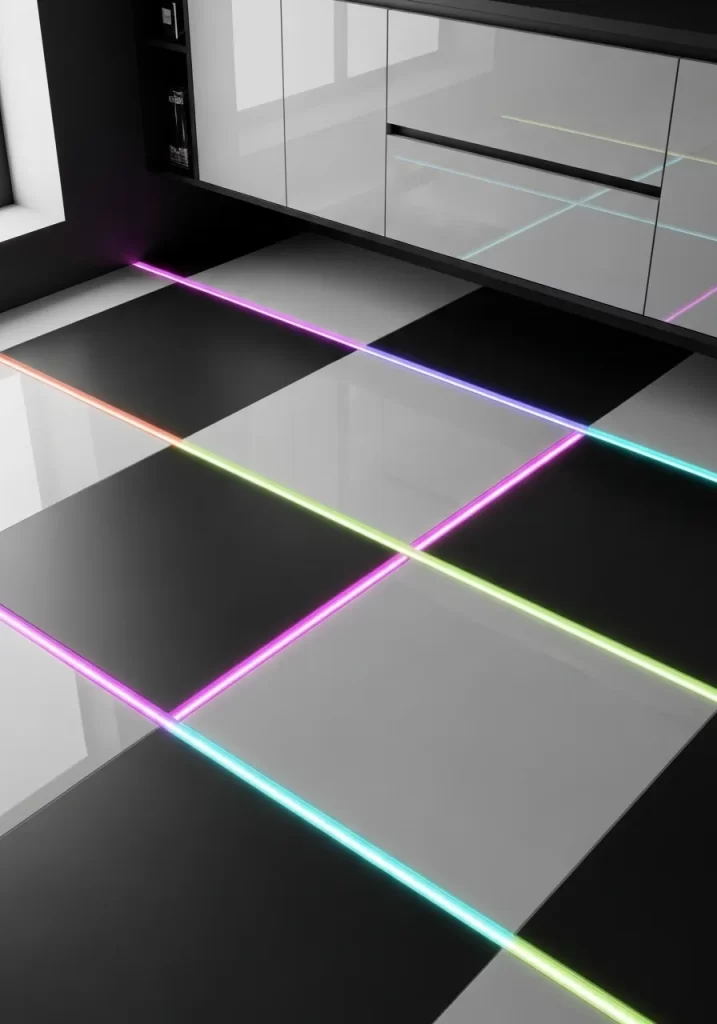
While not a traditional backsplash, this innovative floor treatment shows how light can transform a space. The kitchen features classic black and white checkered floor tiles.
The striking element is the grout lines. They glow with different colors—pink, green, blue. This effect comes from special LED strips embedded in the grout. It creates a dynamic and playful atmosphere.
DIY Glowing Floor Lines (Wall Version)
We’ll make this a wall art piece to learn the idea. This project is for older kids with adult help.
Stuff You Need:
- A large, dark-colored board (like black foam board).
- Glow-in-the-dark paint (various colors: pink, green, blue).
- Thin painter’s tape or electrical tape.
- A ruler and pencil.
- Small paintbrushes.
Step-by-Step:
- Create Your “Tiles”: On your black board, use your ruler and pencil to draw a grid of squares.
- Tape the “Grout”: Carefully lay strips of painter’s tape along your pencil lines. You’re creating the grout lines.
- Paint the “Grout”: Paint the exposed tape lines with your glow-in-the-dark paints. Use different colors for different lines. You might need a few coats for it to glow well.
- Let it Dry: Let the paint dry completely.
- Peel the Tape: Carefully peel off the tape. You should have glowing lines on your black board.
- Hang it Up: Hang your glowing art piece on the wall where it can “charge” in the light. Turn off the lights to see it glow!
24. The Energy Indicator Light Buttons
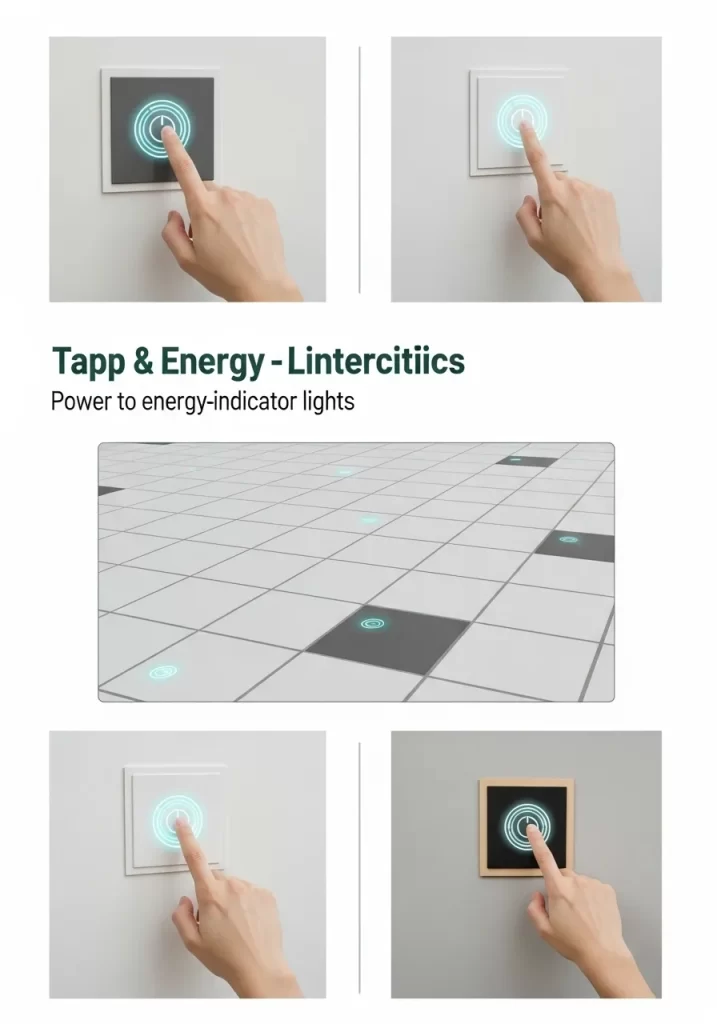
This image displays smart home switches, which aren’t backsplashes, but the idea of embedded light can inspire a kitchen design. The panels show illuminated buttons, like energy indicators.
These glowing circles offer a clean and modern look. The light gives a visual cue and a futuristic feel. This concept can be adapted for subtle lighting or smart features in a kitchen backsplash.
DIY Faux Light-Up Buttons (Wall Art)
This project uses LED sticker lights for a similar effect.
Stuff You Need:
- A smooth, painted board (white or grey).
- Small, battery-operated LED puck lights (or stick-on LED circles).
- Clear contact paper (optional, to cover them).
- A pencil.
Step-by-Step:
- Choose Your Spots: Decide where you want your “buttons” to go on your board. Lightly mark with a pencil.
- Stick on Lights: Peel off the backing from your LED puck lights. Stick them onto the marked spots.
- Cover (Optional): If you want a smooth surface, you can cover the whole board with clear contact paper, pressing firmly around the lights.
- Turn On!: Press your new “buttons” to turn them on and off.
25. The Artisan Checkerboard Squares
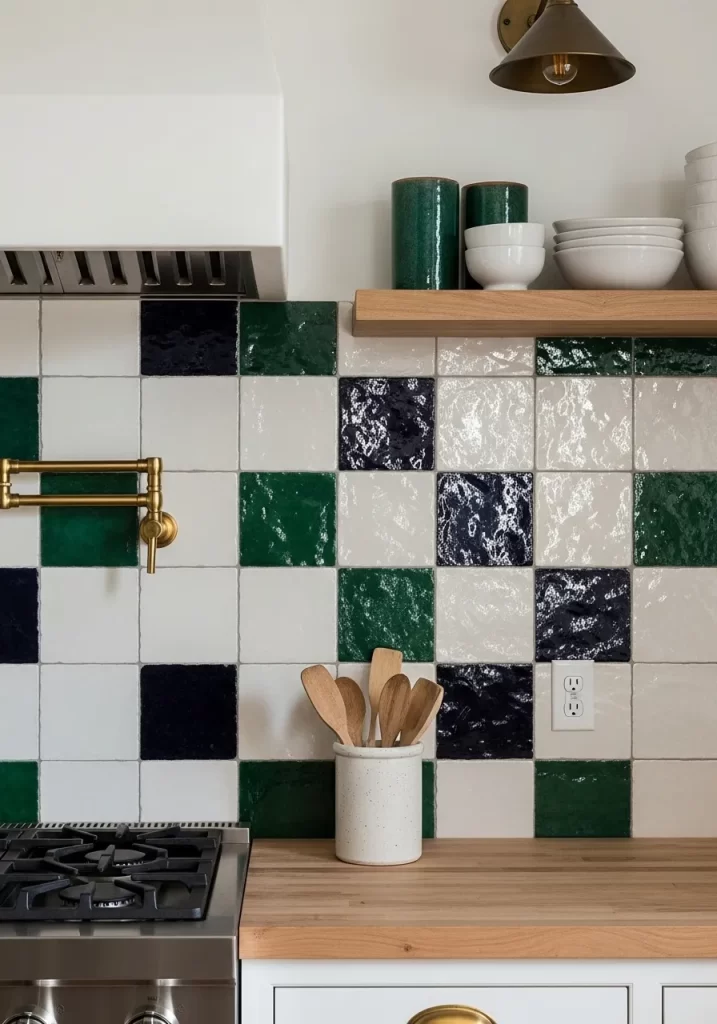
This backsplash offers a vibrant, handmade aesthetic. Large square tiles are arranged in a checkerboard pattern. They come in bright white, deep forest green, and dark navy blue.
Each colored tile has an imperfect, glossy finish, suggesting an artisan touch. The irregular texture catches the light beautifully. This design adds character and a playful energy to the kitchen.
DIY Painted Checkerboard Tiles
You can turn plain tiles into colorful ones with special paint.
Stuff You Need:
- Existing plain white (or light colored) tile backsplash.
- Painter’s tape (thin).
- Ceramic or tile paint (deep green, dark blue).
- Small paintbrushes.
- Clear tile sealer (adult job).
Step-by-Step:
- Clean Your Tiles: Clean your existing tiles thoroughly. Make sure they are super dry.
- Plan Your Pattern: Decide which tiles you want to paint green and which you want to paint blue. Maybe you’ll leave some white.
- Tape Off Tiles: Carefully put painter’s tape around the edges of the tiles you plan to paint. This keeps your lines neat.
- Paint Your Colors: Paint the first color (like green) on your chosen tiles. Let it dry completely.
- Second Color: Clean your brush. Paint your second color (like blue) on the other chosen tiles.
- Peel the Tape: Once the paint is dry, carefully peel off all the painter’s tape.
- Seal it (Adult Job): An adult must apply a clear tile sealer over all the painted tiles. This makes them waterproof and durable.
26. The Vertical Striped Harmony
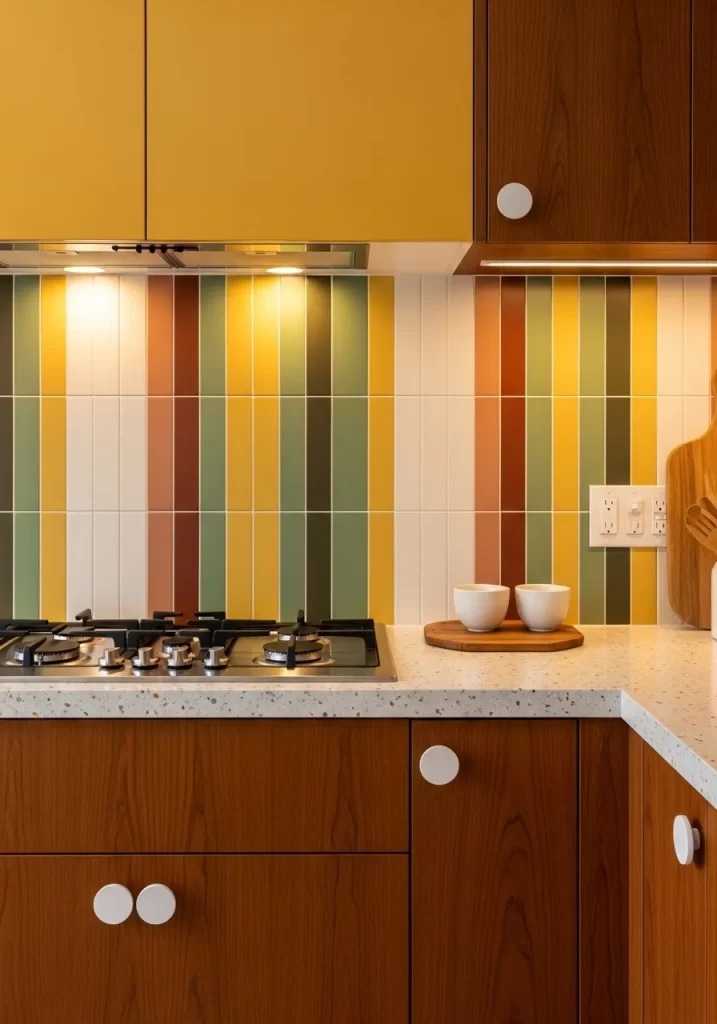
This backsplash creates a bold, linear statement. It uses long, thin rectangular tiles laid vertically. They feature a striking palette of warm colors.
Bright yellow, deep orange, muted green, and rich red-brown are arranged in stripes. The white grout provides separation and emphasis. This design adds height and a lively, retro-inspired feeling to the kitchen.
DIY Vertical Striped Wall Art
You can make a similar artwork using painted wood strips.
Stuff You Need:
- A thin, smooth board cut to your backsplash size (adult job).
- Acrylic craft paints (yellow, orange, green, red-brown, white).
- Paintbrushes (small and medium).
- Painter’s tape (medium width).
- A ruler and pencil.
Step-by-Step:
- Paint Your Board White: Paint your whole board with white paint. Let it dry completely.
- Draw Your Stripes: Use a ruler and pencil to draw vertical lines across the board. Make them the same width.
- Tape Your First Stripe: Put painter’s tape outside the lines of your first stripe. You are painting inside the tape.
- Paint First Color: Paint your first stripe (like yellow). Carefully remove the tape while the paint is still a little wet. Let it dry.
- Tape Again: Once the yellow is dry, tape around the next stripe you want to paint.
- Paint Next Color: Paint your second color (like orange). Remove tape.
- Keep Going: Keep repeating the taping, painting, and drying process for all your colors.
- Hang it Up: Once all the paint is dry, your adult can help you hang your new striped art panel on the wall.
27. The Confetti Terrazzo Dream
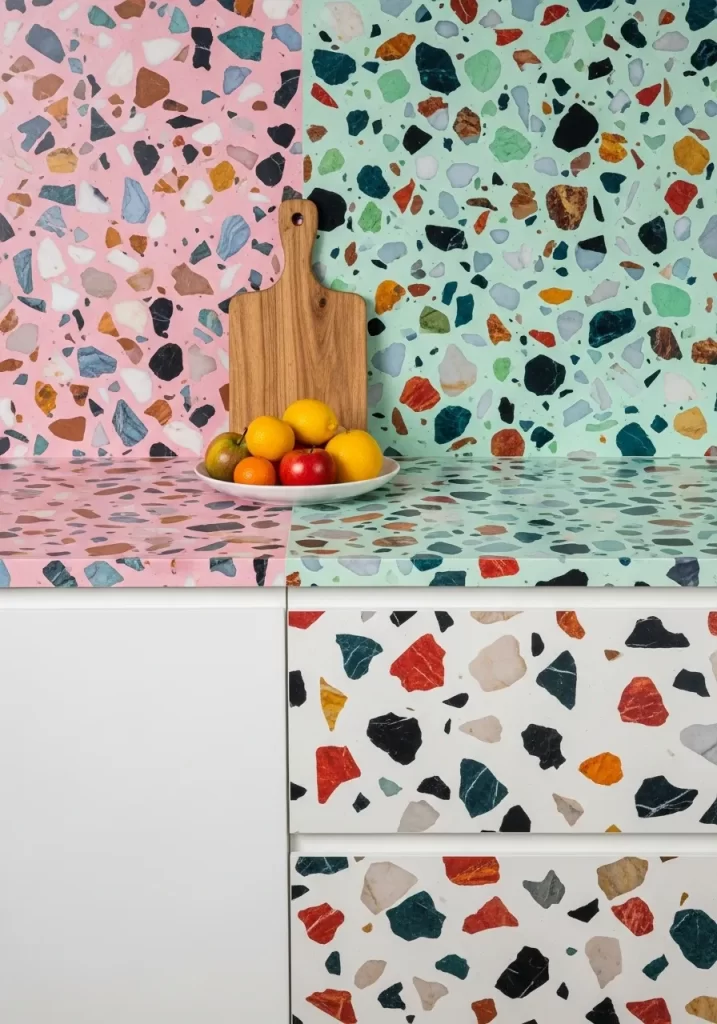
This backsplash and countertop are bursting with color. They feature a terrazzo design filled with large, irregularly shaped chips. The pattern covers everything.
Vivid red, bright orange, deep blue, forest green, and black chips are set in either a light pink or a soft mint green background. This playful and energetic design makes the kitchen feel happy and vibrant.
DIY Confetti Contact Paper
You can make a similar effect with colorful paper and clear contact paper.
Stuff You Need:
- A large sheet of clear contact paper.
- Lots of colorful paper (red, orange, blue, green, black).
- Scissors.
- A pencil.
- Your existing smooth backsplash or a large board.
Step-by-Step:
- Make “Confetti”: Take your colorful paper. Use scissors to cut out lots of different sized and shaped “chips.” Make them look like little pebbles.
- Arrange Your Confetti: Peel the backing off your clear contact paper. Lay it sticky side up. Arrange your paper confetti all over the sticky side. Make a fun, random pattern.
- Cover and Smooth: Carefully place another sheet of clear contact paper on top, sticky side down. Press it down to seal in the confetti. Use your hands to smooth out any bubbles.
- Attach to Wall: An adult can help you attach your new confetti panel to the wall. You can use spray adhesive or small nails.
28. The Elaborate Patterned Medallion
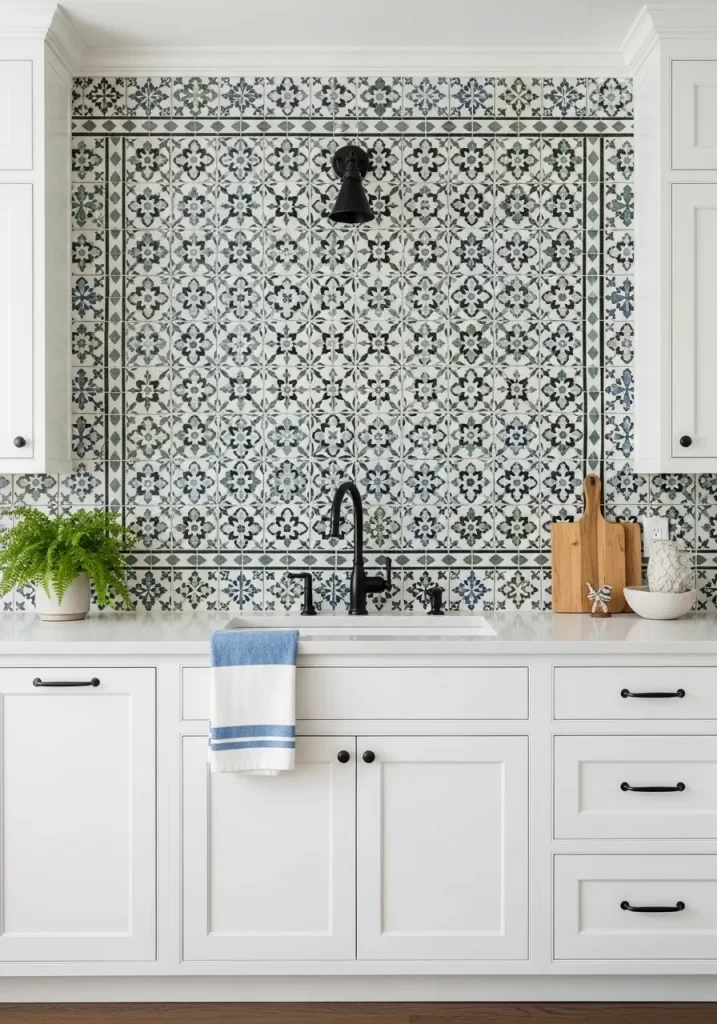
This kitchen features a stunning focal point behind the sink. A large, square medallion of intricately patterned tiles forms the centerpiece of the backsplash.
The pattern is complex, with shades of white, light blue, and deep green. It’s bordered by simpler, matching tiles. This design feels traditional and elegant. It makes the sink area special.
DIY Stenciled Tile Medallion
You can create a patterned “medallion” on your existing plain tiles.
Stuff You Need:
- Your existing plain tile backsplash.
- A large tile stencil with a fancy pattern.
- Stencil brush or sponge.
- Craft paints (blue, green, grey, white).
- Painter’s tape.
- A small dish for paint.
- Clear tile sealer (adult job).
Step-by-Step:
- Clean Your Tiles: Clean the tiles you want to decorate thoroughly. They must be dry.
- Find Your Center: Find the middle of your backsplash above the sink. This is where your medallion will go.
- Tape the Stencil: Place your stencil carefully on the tiles. Use painter’s tape to hold it in place.
- Dab, Don’t Brush: Put a tiny bit of paint on your brush or sponge. Dab it straight down onto the stencil. Don’t rub or brush, or the paint will go under the stencil.
- Use Different Colors: Carefully use different colors for different parts of your stencil design.
- Lift Carefully: Once you’ve dabbed all your colors, carefully peel off the stencil before the paint dries.
- Let it Dry & Repeat: Let the paint dry. If you want a bigger pattern, you can carefully re-position the stencil and repeat.
- Seal It (Adult Job): An adult needs to apply a clear tile sealer over all the stenciled areas.
29. The Playful Geometric Puzzle
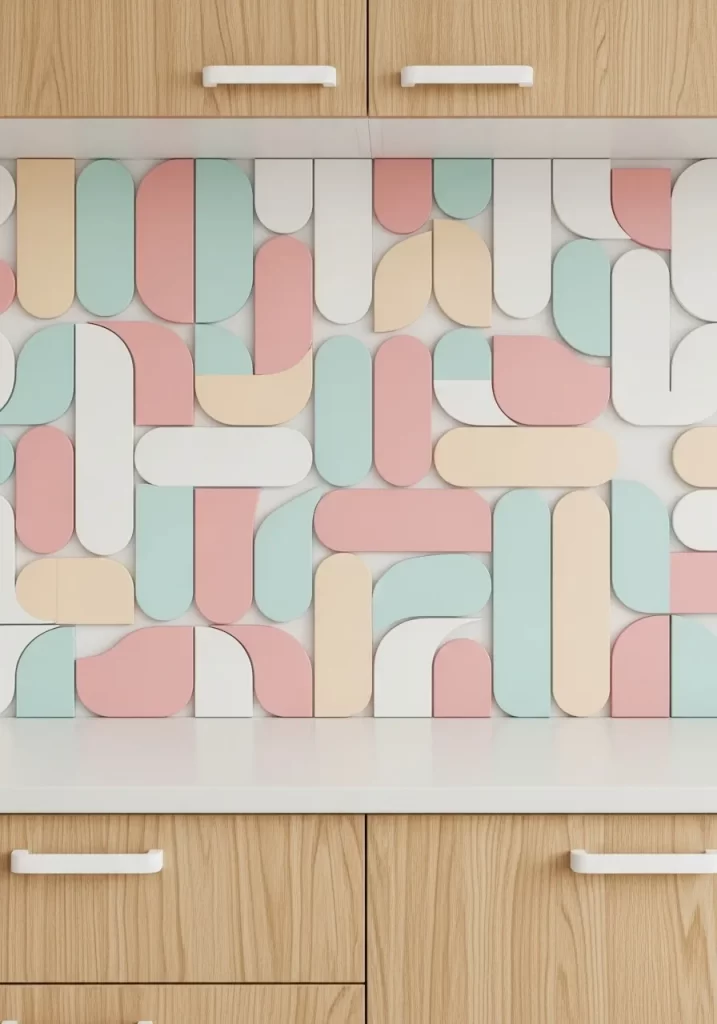
This backsplash is a cheerful and modern design. It uses a mix of rounded, geometric shapes in soft, pastel colors. Light pink, mint green, and pale yellow pieces interlock like a puzzle.
Some shapes are half-circles, some are long ovals. They create a fun, dynamic pattern against a white background. This playful look adds personality and softness to the kitchen.
DIY Geometric Shape Art
You can cut out and stick on colorful foam shapes.
Stuff You Need:
- Large sheets of craft foam (pink, mint green, pale yellow, white).
- Scissors.
- A pencil.
- A ruler or templates for your shapes (like a cup for circles).
- Double-sided tape or safe-for-walls adhesive putty.
Step-by-Step:
- Draw Your Shapes: On your craft foam, use a pencil to draw different shapes: half-circles, ovals, long rectangles. Make some big, some small.
- Cut Them Out (Adult Job): An adult can help you carefully cut out all your shapes.
- Plan Your Puzzle: Lay your shapes out on a table first. Arrange them in a way you like. Make them interlock or overlap.
- Stick Them On: Take your double-sided tape or putty. Stick a piece on the back of each foam shape.
- Build Your Wall Art: Start sticking your shapes onto your clean wall. Press each one firmly.
- Create Depth: You can layer some shapes on top of others to make it look even cooler.
30. The Art Deco Fan Tiles
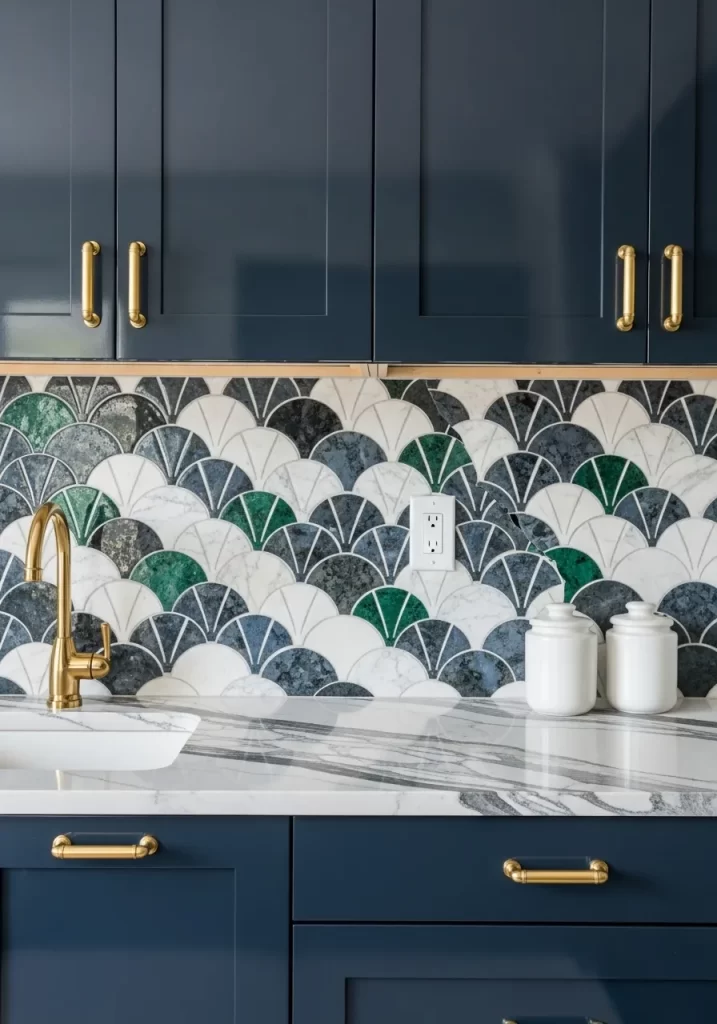
This backsplash showcases a beautiful, elegant pattern. It uses fan-shaped, or “scallop” tiles. These are arranged to create a repeating, interlocking design.
The tiles feature a mix of white, grey, deep blue, and emerald green, often with subtle marble veining. The golden faucet and cabinet hardware emphasize the Art Deco feel. It’s a rich and sophisticated statement.
DIY Painted Fan-Shape Design
You can paint a fan-shape pattern onto a plain wall or board.
Stuff You Need:
- A large piece of cardboard or plastic (for your stencil).
- Scissors or a utility knife (adult job).
- Pencil.
- Painter’s tape.
- Small craft brushes.
- Craft paints (dark blue, green, grey, white).
- Your smooth, painted wall or board.
- Clear waterproof sealer (adult job).
Step-by-Step:
- Make Your Stencil (Adult Job): Draw a half-circle on your cardboard. Then draw another, smaller half-circle inside it. Cut out the bigger half-circle, and then cut out the smaller half-circle so you have a fan shape. This is your stencil.
- Position First Fan: Tape your stencil onto the wall.
- Paint Your Fan: Paint inside your stencil with your first color (like dark blue). Use a small brush to get the edges neat.
- Lift and Reposition: Carefully remove the stencil. Let it dry a little. Now, move the stencil so it slightly overlaps the first fan, like a real fan tile pattern.
- Paint the Next: Paint the next fan, perhaps with a different color (like green).
- Keep Going: Continue painting, alternating colors, until you have a whole pattern.
- Seal it (Adult Job): Once all the paint is dry, an adult must apply a clear, waterproof sealer over the painted area.
31. The Embossed Tin Tile Mosaic
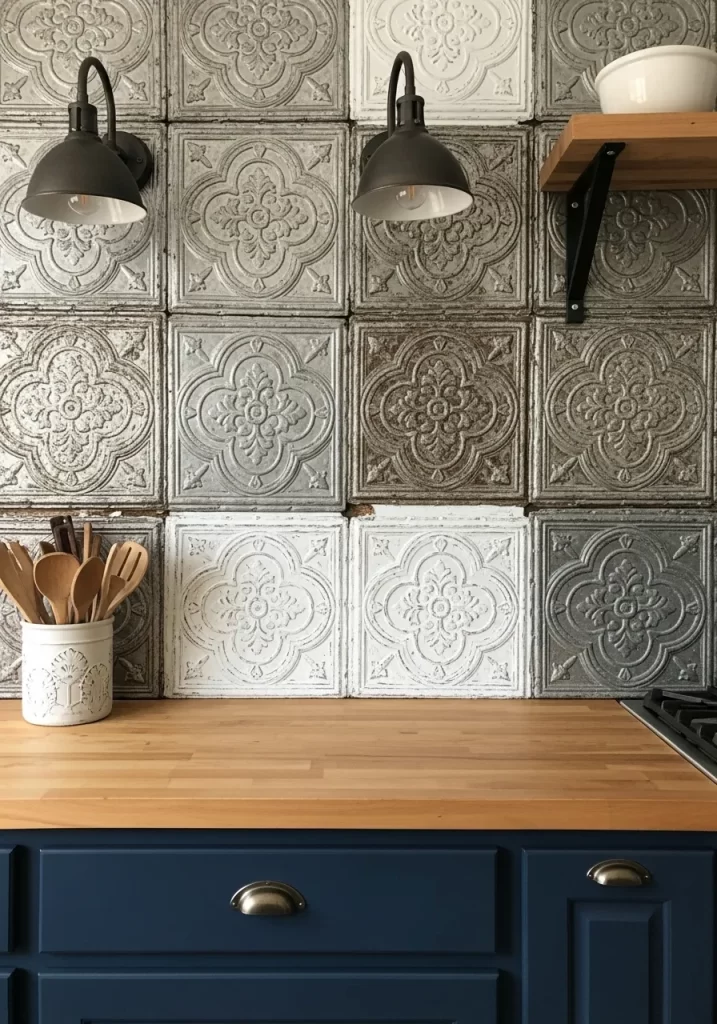
This kitchen embraces a vintage, farmhouse-style charm. The entire backsplash is covered in square, embossed tin tiles. These metal tiles have intricate, raised patterns.
The tiles are a mix of white, silver, and slightly distressed finishes. They create a beautiful mosaic with a rustic, antique feel. The dark wall lights shine down, highlighting the rich textures.
DIY Faux Tin Tile Look
You can get a similar look with peel-and-stick ceiling tiles.
Stuff You Need:
- Lightweight, decorative ceiling tiles (often made of PVC or plastic, with embossed patterns).
- Spray paint (silver, white, or a mix of both).
- Strong adhesive (like Liquid Nails) or double-sided mounting tape.
- Utility knife or strong scissors (adult job).
- Measuring tape and pencil.
Step-by-Step:
- Measure and Cut (Adult Job): Measure your backsplash area. Have an adult cut the tiles to fit. You might need to cut some in half or around outlets.
- Paint Your Tiles (Adult Job): Lay your tiles out flat in a well-ventilated area. Spray paint them with your chosen colors. You can do some white, some silver, and maybe lightly distress some for an antique look. Let them dry completely.
- Plan Your Pattern: Arrange the painted tiles on the floor to see how you want them to look on the wall.
- Attach to Wall: Apply strong adhesive to the back of each tile, or use mounting tape. Press each tile firmly onto the wall.
- Repeat: Continue attaching tiles until your wall is covered. Make sure they line up neatly.
32. The Mondrian-Inspired Blocks
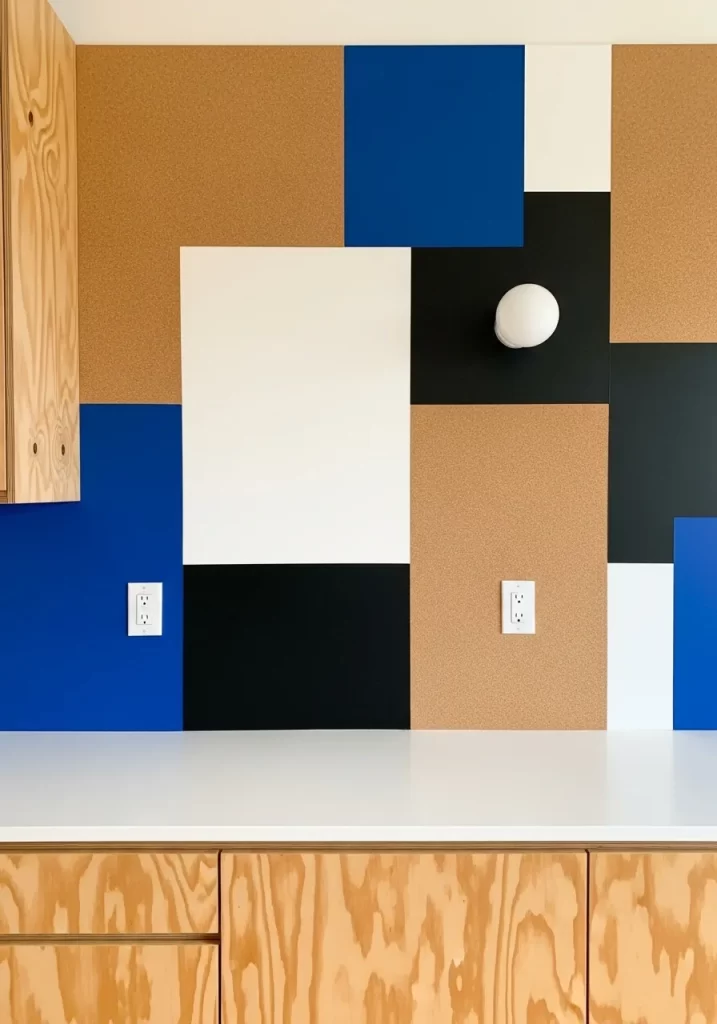
This backsplash makes a bold, artistic statement, reminiscent of Piet Mondrian’s paintings. It features a geometric design of large, rectangular and square blocks.
The blocks are made from different materials: natural cork, bright blue, crisp white, and deep black. This creates a striking, modern, and abstract pattern that adds vibrant energy to the kitchen.
DIY Geometric Block Wall Art
You can recreate this abstract look with painted wood panels or cork boards.
Stuff You Need:
- Thin sheets of wood or cork board.
- Craft paints (blue, black, white).
- Wood glue or strong adhesive.
- Utility knife or saw (adult job).
- Measuring tape and pencil.
- Painter’s tape.
Step-by-Step:
- Cut Your Shapes (Adult Job): Have an adult cut your wood or cork sheets into various size rectangles and squares.
- Paint Your Blocks: Paint some of your wood pieces blue, some black, and some white. Leave some of the cork pieces natural. Let all the paint dry.
- Plan Your Layout: Arrange your painted and natural blocks on the floor. Play with the design until you like how they fit together.
- Attach to Wall: Apply wood glue or strong adhesive to the back of each block. Press them firmly onto your clean backsplash area.
- Create a Grid (Optional): If you want perfect lines, you can use painter’s tape to mark out a grid on your wall first, then stick the blocks within the grid.
33. The Raw Concrete Texture
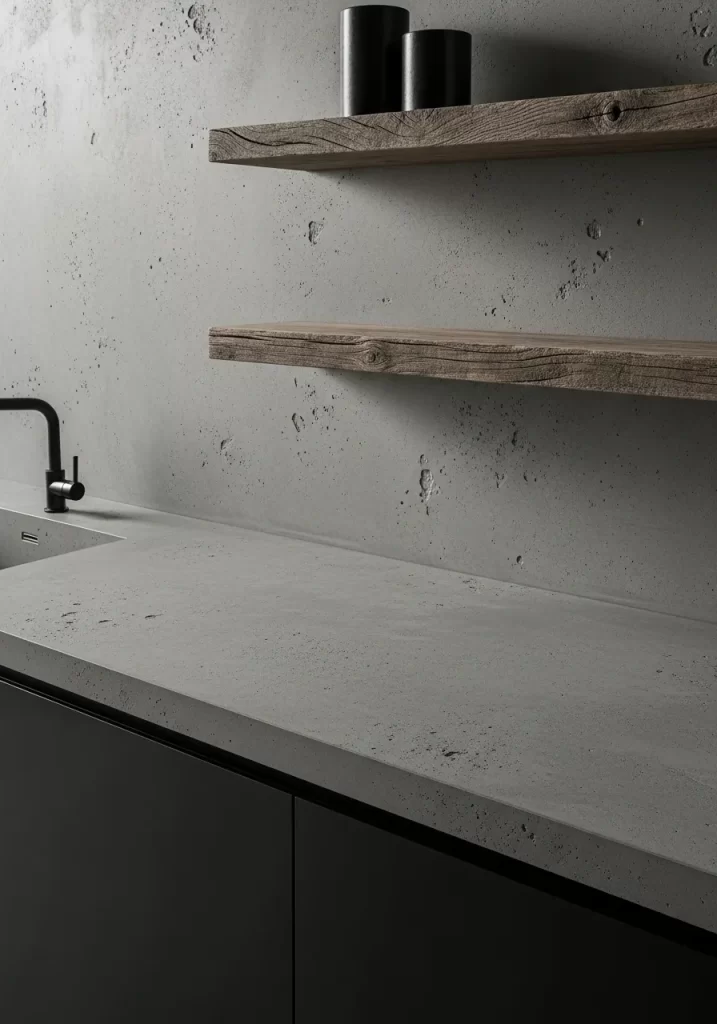
This kitchen features an industrial and minimalist aesthetic. The backsplash and countertop are made from raw, unfinished concrete.
The concrete has a rough, textured surface with subtle imperfections, adding character. The seamless flow from counter to wall creates a unified look. This design pairs well with simple shelves and dark cabinets for a modern, understated feel.
DIY Faux Concrete Finish
You can create a concrete look with special paint and plaster.
Stuff You Need:
- Concrete-effect paint (available at craft or hardware stores).
- Drywall joint compound or Venetian plaster.
- A wide putty knife or trowel.
- Sandpaper (fine grit).
- Primer (grey is best).
- Paintbrush.
- Clear matte sealer (adult job).
Step-by-Step:
- Prime the Wall: Paint your backsplash area with grey primer. Let it dry.
- Apply Plaster (Adult Job): Have an adult use the putty knife to spread a thin, uneven layer of joint compound or plaster over the primed wall. You want some texture and subtle swirls. Let it dry completely (at least 24 hours).
- Light Sanding (Adult Job): Gently sand any rough spots to smooth them slightly.
- Paint Concrete Effect: Paint over the textured wall with your concrete-effect paint. Use a brush to dab and blend for a natural look.
- Seal it (Adult Job): Once dry, an adult needs to apply 2-3 coats of a clear matte sealer to protect the finish.
34. The Industrial Pegboard Organizer
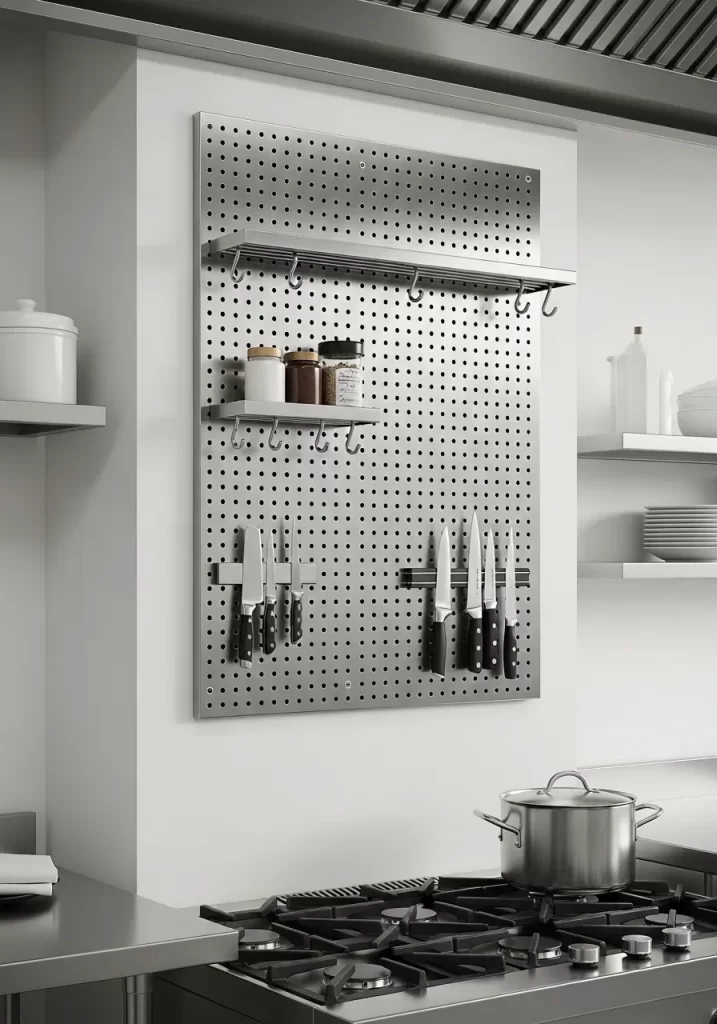
This kitchen uses a practical and industrial-style backsplash. A large stainless steel pegboard covers the wall behind the stove.
It’s equipped with shelves and hooks to store cooking utensils, knives, and spices. This design offers maximum organization and a clean, minimalist aesthetic. It’s perfect for a busy cook.
DIY Pegboard Storage Backsplash
This is a great functional project.
Stuff You Need:
- A large sheet of metal or heavy-duty pegboard.
- Pegboard hooks and shelves (various sizes).
- Screws and a drill (adult job) or strong wall anchors.
- Measuring tape and pencil.
- A level.
Step-by-Step:
- Measure Your Space: Measure the area where you want your pegboard.
- Mounting Points (Adult Job): Have an adult hold the pegboard against the wall. Use a pencil to mark where the mounting holes will go. Make sure it’s level.
- Install Pegboard (Adult Job): An adult needs to use a drill to create pilot holes if necessary, then securely screw the pegboard to the wall. Make sure it’s very stable.
- Add Hooks & Shelves: Now for the fun part! Add your pegboard hooks and shelves. Arrange them to hold your kitchen tools and spices. You can change the layout whenever you like!
35. The Corrugated Metal Statement
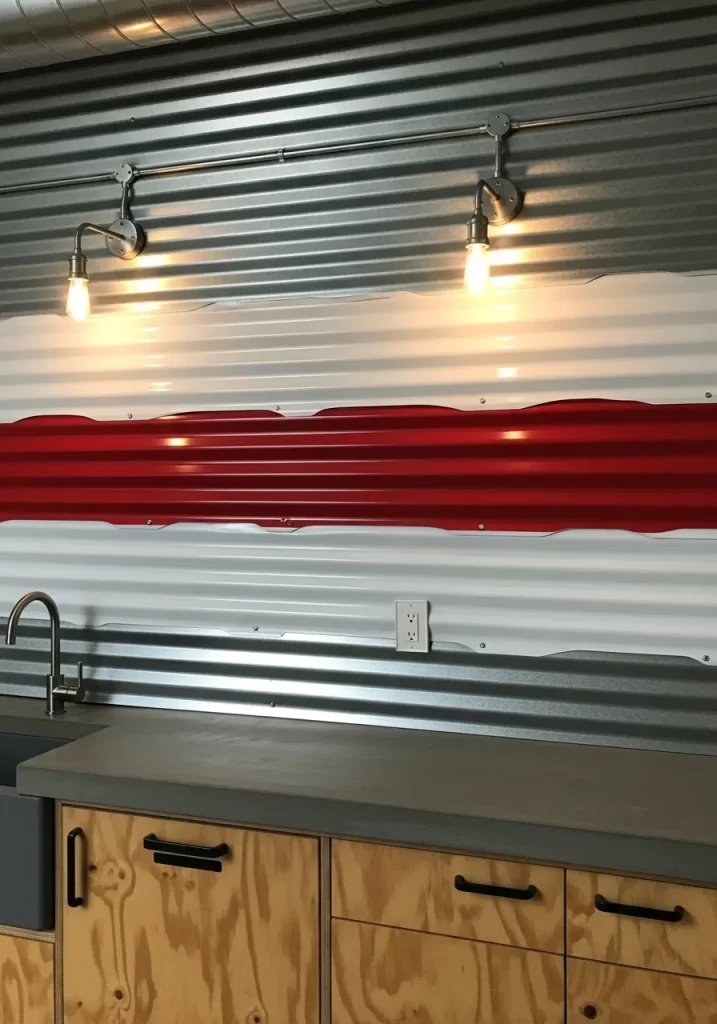
This kitchen features a bold, industrial backsplash made from corrugated metal. The metal panels are horizontally oriented, creating a wavy, textured surface.
A striking red corrugated strip runs through the middle, adding a pop of color and visual interest. The industrial lights emphasize the metallic texture. This design feels edgy and modern.
DIY Faux Corrugated Metal (Paint Effect)
You can create a corrugated look with paint and a special roller.
Stuff You Need:
- A smooth board or your wall.
- Base paint (silver or grey).
- Red paint (for the stripe).
- A paint roller.
- A “texture roller” or “wood graining tool” (to create lines).
- Painter’s tape.
- A ruler and pencil.
- Clear gloss sealer (adult job).
Step-by-Step:
- Paint the Base: Paint your board or wall with the silver/grey base paint. Let it dry.
- Draw Your Stripe: Use a ruler and pencil to draw two horizontal lines for your red stripe.
- Tape Off Stripe: Use painter’s tape to mask off the area for your red stripe.
- Paint the Stripe: Paint the red stripe. Remove the tape while the paint is still a little wet. Let it dry.
- Create Corrugation (Adult Job): This is where the texture tool comes in. Have an adult use the texture roller (or wood graining tool) to gently drag horizontal lines through slightly damp silver paint (you might need to paint a thin, new layer of silver paint over the dry base for this to work). This creates the wavy texture. Practice on scrap paper first!
- Seal It (Adult Job): Once all the paint is dry, an adult needs to apply a clear gloss sealer.
36. The Distressed White Brick
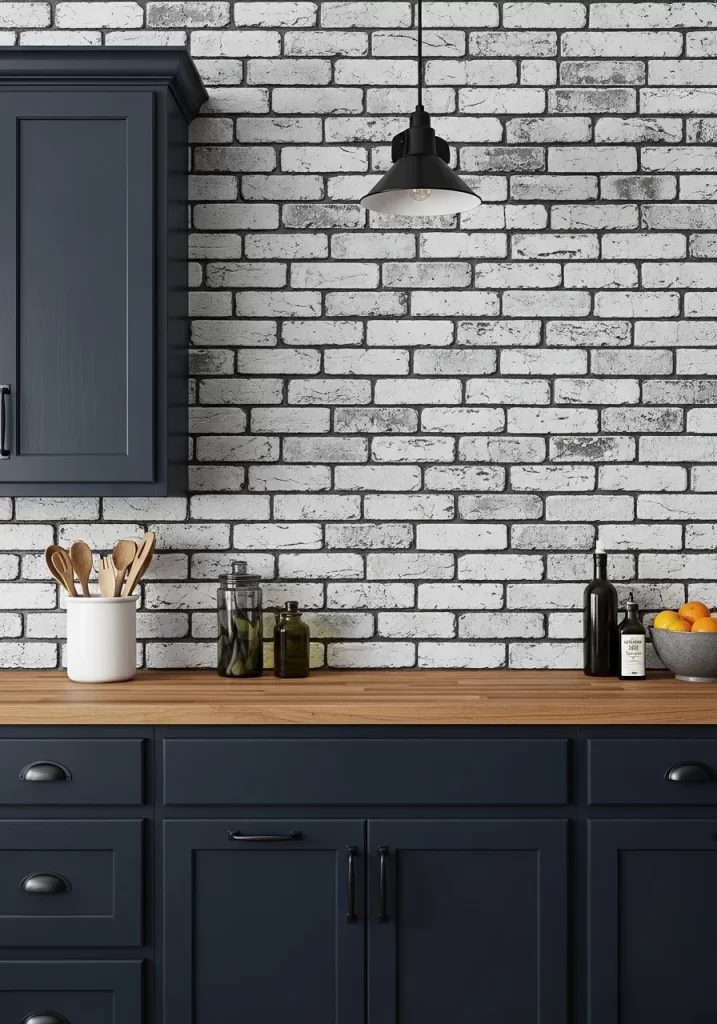
This kitchen offers a classic, rustic charm with a distressed brick backsplash. The wall is covered in traditional brick, which has been painted white and then lightly aged.
The subtle distressing allows some of the natural brick color and texture to show through. This creates a warm, inviting, and slightly industrial feel. It pairs well with dark cabinets and wooden countertops.
DIY Faux Distressed Brick Wall
You can create a similar look using brick stencil and paint.
Stuff You Need:
- A large brick stencil.
- White paint.
- Grey or brown paint (for “distressing”).
- A stencil brush or sponge.
- Painter’s tape.
- A sponge or rag (for distressing).
- Clear matte sealer (adult job).
Step-by-Step:
- Prep Your Wall: Your wall should be a light color. If not, paint it white first and let it dry.
- Position Stencil: Tape your brick stencil onto the wall.
- Paint the “Bricks”: Use your stencil brush or sponge to dab white paint over the stencil. You want full coverage.
- Remove and Repeat: Carefully remove the stencil and reposition it to continue your brick pattern across the wall. Let it dry completely.
- Distress the Bricks: Now for the fun part! Dab a little bit of grey or light brown paint onto a damp sponge or rag. Gently wipe and pat some of the painted bricks. You want to make them look old and worn, letting some of the wall color show through. You can’t mess this up!
- Seal It (Adult Job): Once dry, an adult needs to apply a clear matte sealer to protect your faux brick.
37. The Riveted Metal Panels
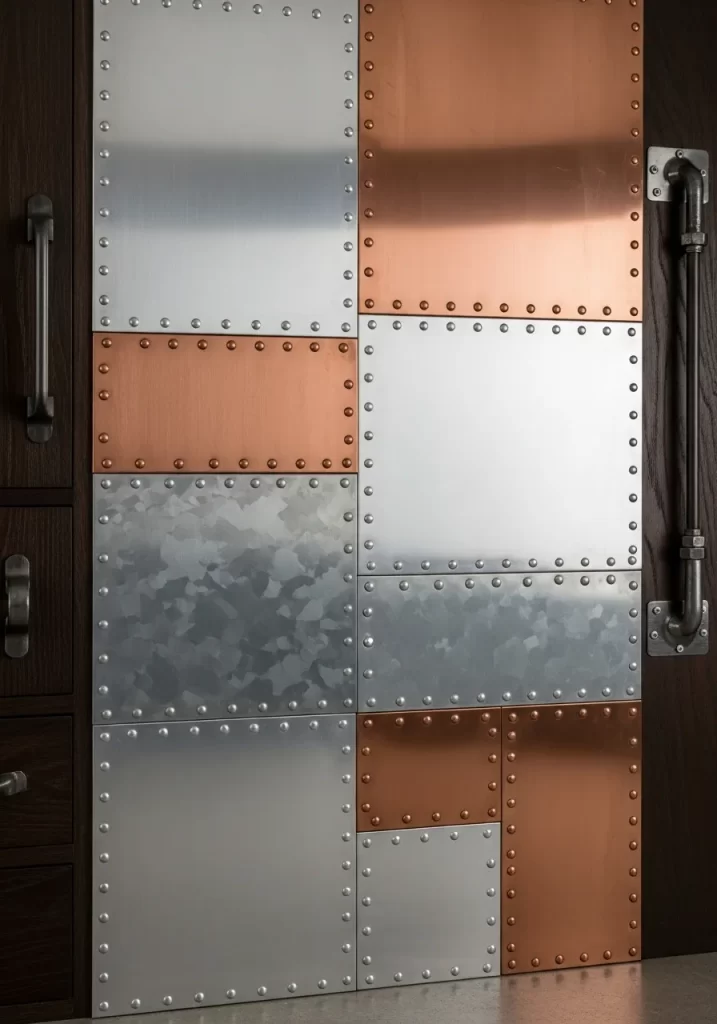
This kitchen has a bold, steampunk or industrial-inspired design. The backsplash is covered in square metal panels. Each panel is riveted, giving it a strong, mechanical look.
The panels are a mix of polished silver, galvanized steel, and warm copper. This patchwork creates a rich, textured surface. The contrasting metals add depth and visual interest.
DIY Faux Riveted Metal Panels
You can make this with aluminum foil tape and foam board.
Stuff You Need:
- Foam board or thin plywood cut into squares.
- Aluminum foil tape (wide rolls).
- Copper-colored spray paint.
- A small, round object (like the end of a paintbrush) for “rivets.”
- Strong adhesive.
- Utility knife (adult job).
Step-by-Step:
- Cut Panels (Adult Job): Have an adult cut foam board or thin plywood into squares (the size of your desired panels).
- Cover with Foil Tape: Cover some of the squares completely with aluminum foil tape. Smooth it down.
- Copper Panels (Adult Job): Spray paint other squares with copper-colored spray paint. Let them dry.
- Create “Rivets”: On all your panels, use the back of a paintbrush or a blunt tool to gently press in small circles around the edges. This makes them look like rivets.
- Plan Your Layout: Arrange your silver and copper panels on the floor to create a pattern you like.
- Attach to Wall: Use strong adhesive to glue each panel securely to your backsplash area.
38. The Backlit Perforated Screen
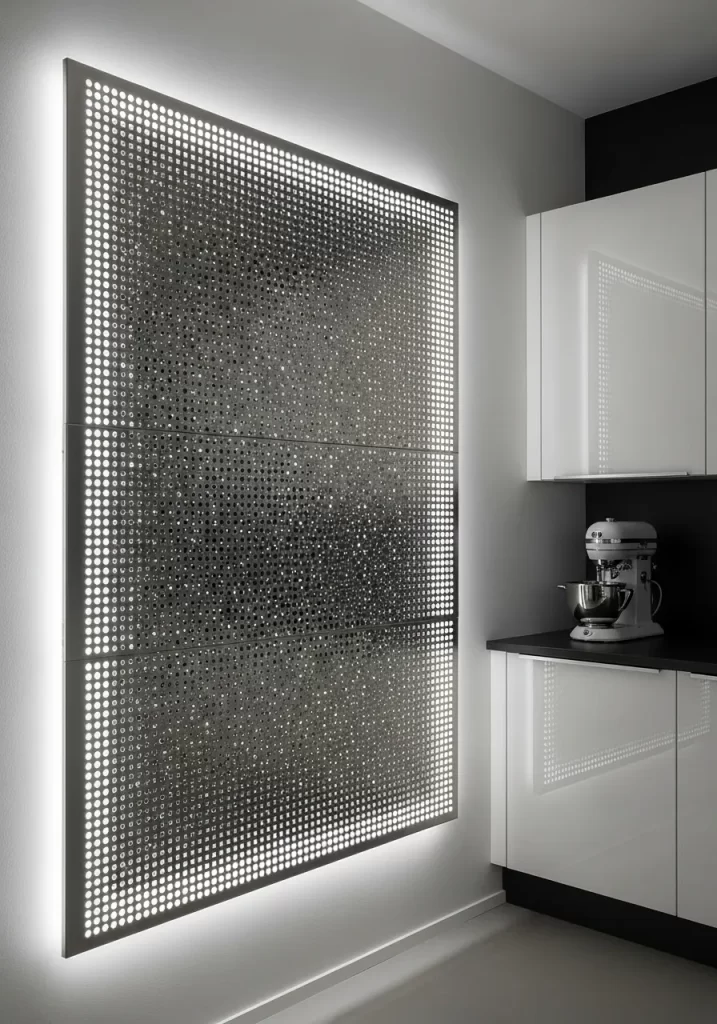
This kitchen features a dramatic, high-tech backsplash. A large, dark perforated (holed) metal screen covers the entire wall.
Hidden LED lights are placed behind the screen. When lit, the light shines through the tiny holes, creating a mesmerizing, glowing effect. It turns the wall into a dynamic art piece that can change the mood of the room.
DIY Backlit Perforated Art Panel
You can make a smaller version of this for your wall.
Stuff You Need:
- A sheet of perforated metal or thick, black poster board (if using poster board, you’ll need a hole punch).
- LED strip lights (battery-operated or plug-in, with adhesive backing).
- A thin wood frame (adult job) to create space behind the panel.
- Screws or strong adhesive for mounting (adult job).
Step-by-Step:
- Prep Your Panel: If using poster board, draw a grid and use a hole punch to create many small holes across the sheet. If using perforated metal, it’s ready!
- Build a Space (Adult Job): An adult needs to create a small frame (like 1-inch thick wood strips) to mount behind your perforated panel. This creates space for the lights.
- Attach Lights (Adult Job): Stick the LED light strips to the inside edges of your small frame, facing inward.
- Mount the Panel (Adult Job): Mount your perforated panel over the frame with the lights. Make sure it’s securely attached so light doesn’t leak from the edges.
- Light it Up: Plug in your LED lights. The light will shine through the holes, creating your glowing effect!
39. The End-Grain Butcher Block
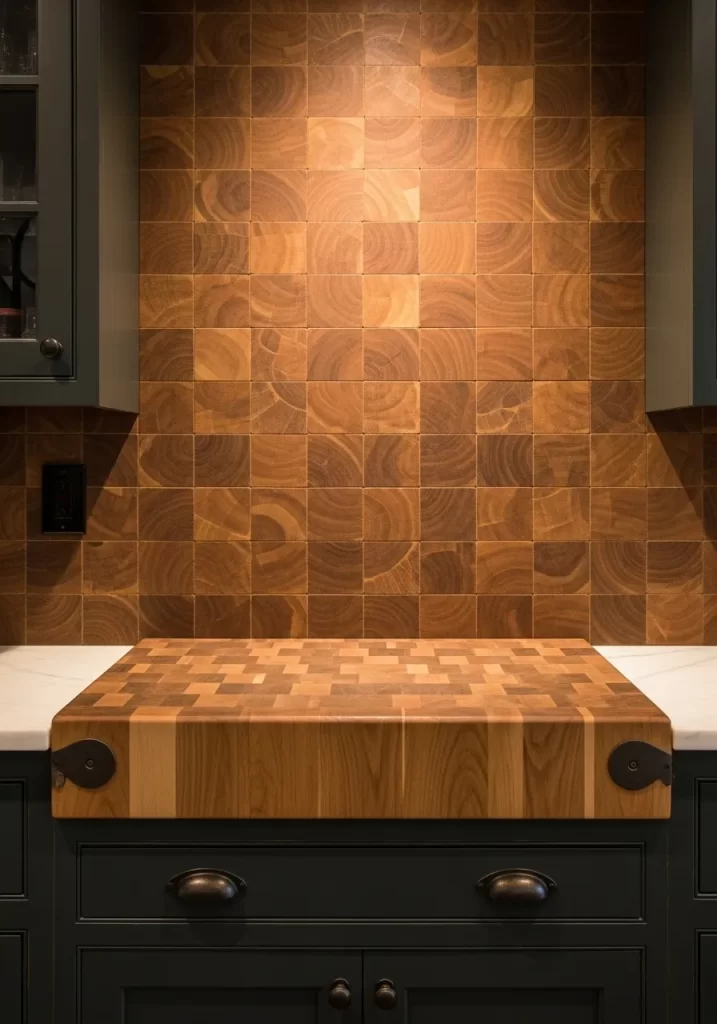
This kitchen features a warm, organic backsplash made from end-grain wood blocks. These are small squares of wood, cut from the end of the log, showing the tree rings.
The blocks are arranged in a grid pattern. Each piece of wood has unique grain and color variations, creating a rich, earthy mosaic. It offers a natural, rustic, and very tactile surface.
DIY Faux End-Grain Blocks (Paint Effect)
You can mimic the end-grain look with paint and a sponge.
Stuff You Need:
- A smooth board or your wall.
- Light brown or tan base paint.
- Dark brown, medium brown, and black craft paints.
- A sponge (natural sea sponge works best, or a regular sponge torn unevenly).
- A small paintbrush.
- Clear matte sealer (adult job).
Step-by-Step:
- Paint Base: Paint your board or wall with the light brown/tan base paint. Let it dry.
- Draw Grid: Use a ruler and pencil to draw a grid of squares on your wall.
- Sponge “Grain”: Dip your sponge into one of the darker brown paints. Dab it lightly into one of your squares. Reload the sponge with another shade of brown and dab it again, overlapping slightly. This creates a “wood grain” effect.
- Add Rings: Use a small paintbrush and black paint to draw a few faint, irregular circles inside each square to look like tree rings.
- Vary Each Square: Make each square a little different. Use more light brown in some, more dark in others.
- Seal it (Adult Job): Once all the paint is dry, an adult must apply a clear matte sealer to protect the faux wood.
40. The Vertical Ribbed Panels
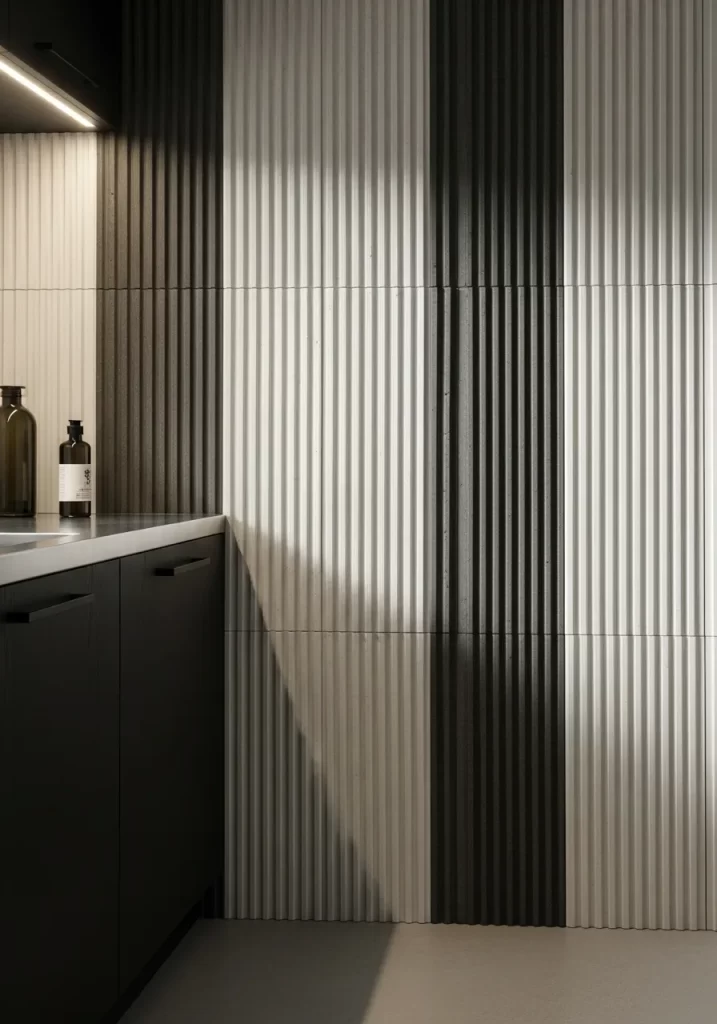
This kitchen features a very clean and contemporary backsplash. It uses panels with vertical ribs or flutes. The pattern creates strong lines and subtle shadows.
The panels alternate between light grey and black, creating a bold, striped effect. The texture adds depth and visual interest without being too busy. It’s a modern and sophisticated choice.
DIY Vertical Ribbed Wall
You can use “pole wrap” or “tambour” sheets for this.
Stuff You Need:
- “Pole wrap” or “tambour” sheets (these are flexible sheets with vertical wood strips).
- Black paint and light grey paint.
- Paintbrushes.
- Strong construction glue.
- A caulk gun.
- Utility knife or saw (adult job).
- Measuring tape and pencil.
Step-by-Step:
- Measure and Cut (Adult Job): Measure your backsplash area. Have an adult cut the pole wrap sheets to fit.
- Paint Your Strips: Paint some of your sheets black and others light grey. Make sure to get into all the grooves. Let them dry completely.
- Plan Your Stripes: On the floor, arrange your black and grey sheets in the stripe pattern you want (e.g., black, grey, black, grey).
- Attach to Wall (Adult Job): Load your caulk gun with construction glue. Apply glue to the back of a black sheet and press it firmly onto the wall.
- Add the Next: Apply glue to a grey sheet and press it next to the black one, making sure the ribs line up.
- Keep Going: Continue attaching the alternating striped sheets until your wall is covered.
A kitchen update does not need to mean a complete renovation.
As we saw, changing just one wall can have a massive impact. Your backsplash is a chance to show your personality.
You explored 40 different paths. Some were classic, like subway tile. Others were futuristic, like smart glass.
The step-by-step instructions show that you can achieve these looks yourself. A beautiful kitchen does not have to be expensive.
Your cooking space should inspire you. Choose the idea that you love. It is time to make your kitchen feel new again.
Key Takeaways
Here is what you need to remember from this guide:
- A backsplash is a major focal point. Changing it can change the whole room.
- You do not need a large budget. Paint, stencils, or peel-and-stick tiles are great options.
- DIY projects let you create a custom look for less.
- Texture adds depth. Consider fluted, stacked, or plastered finishes.
- Your backsplash can be functional. Pegboards and smart screens add utility.