
Hallways are the forgotten spaces in our homes. We walk through them every day. We rarely ever see them. They become blank, boring passages. Just a way to get from one room to another.
This is a missed opportunity. The hallway is your home’s first impression. It sets the tone. It connects every other room. A good hallway guides you. A great one tells a story.

Your hallway can be more than a simple path. It can be a gallery. It can be a library. It can be a quiet retreat. You just need a new perspective.
This list is about transforming that uninspired space. You will find 37 creative ways to add personality. These ideas range from simple paint tricks to full-scale DIY projects. It is time to make your hallway a destination.
1: The Modern Curiosity Cabinet
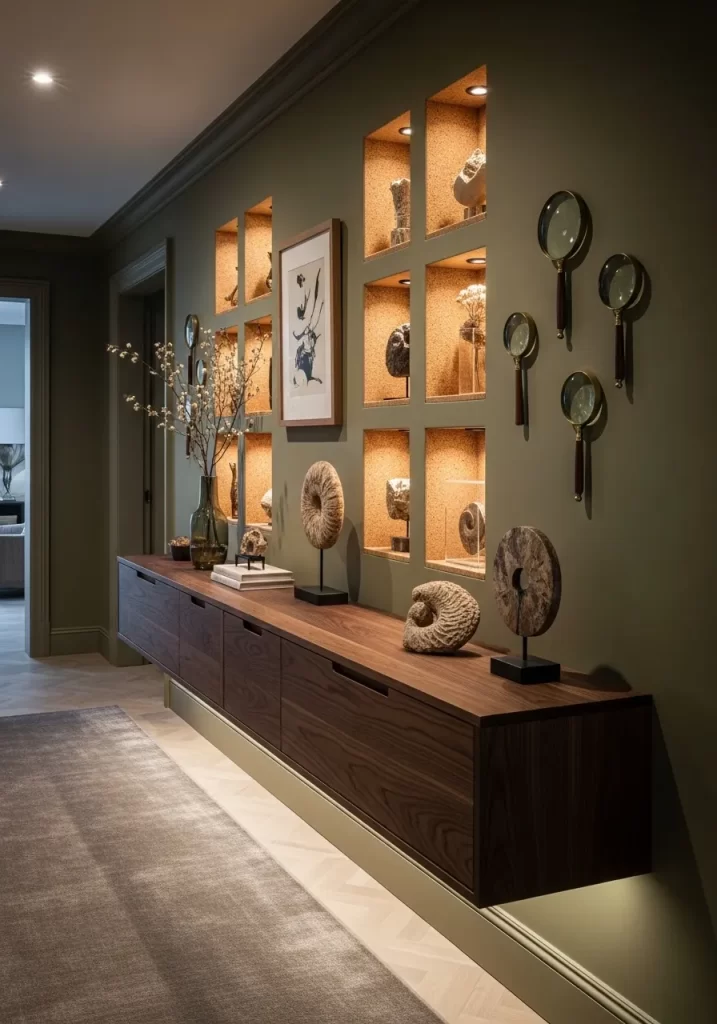
Forget blank walls. This hallway creates a personal museum. The deep, moody paint provides a dramatic backdrop. A long, dark wood credenza seems to float, anchored by a soft glow from beneath.
The real story is the set of built-in display niches. Each cork-backed cubby is individually lit. This simple lighting turns fossils, minerals, and artifacts into gallery-worthy pieces. Even the wall art, a set of vintage-style magnifying glasses, fits the naturalist theme. This space is no longer just for walking. It becomes a destination.
DIY Faux-Recessed Display Boxes
You can get this look without cutting into your drywall. You will build simple, front-less boxes that attach to the wall.
Tools & Materials:
- 1×4 lumber (pine is fine)
- Thin (1/4 inch) plywood or backerboard
- Saw (a miter box gives clean cuts, but a hand saw works)
- Wood glue
- Small nails (1.5-inch brad nails) and hammer
- Measuring tape and pencil
- Sandpaper (medium grit)
- Paint or wood stain
- Roll of cork sheet
- Craft glue or spray adhesive
- Battery-powered LED puck lights (peel-and-stick)
- Wall screws and anchors (if not hitting a stud)
- Level
Instructions:
- Plan Your Box: Decide on a size. A 12-inch by 12-inch square is a good start. Your 1×4 board is actually 3.5 inches deep. This will be the depth of your box.
- Cut the Frame:
- Cut two pieces of your 1×4 board to 12 inches long (for the top and bottom).
- Cut two pieces to 10.5 inches long (for the sides). Why 10.5? Because they will fit between the top and bottom pieces (12 inches – 0.75-inch board – 0.75-inch board = 10.5 inches).
- Assemble the Frame:
- Lay the 12-inch (top) piece on your work surface.
- Apply wood glue to one end of a 10.5-inch (side) piece. Stand it up to make an ‘L’ shape with the top piece, making sure the edges are flush.
- Nail through the top piece down into the side piece to secure it. Repeat for the other side.
- Glue the ends of the 12-inch (bottom) piece. Fit it between the two side pieces and nail it in place. You now have a square frame.
- Add the Backing:
- Measure your frame. It should be 12×12 inches. Cut your thin plywood to this exact size.
- Apply a thin bead of wood glue along the entire back edge of your frame.
- Carefully place the 12×12 plywood backer onto the glue. Secure it with small nails every few inches.
- Finish the Box:
- Lightly sand all edges to make them smooth.
- Wipe away the dust. Paint or wood stain the box (inside and out) to your desired color. Let it dry completely.
- Add the Cork Liner:
- Measure the inside of your box (it should be 10.5 x 10.5 inches).
- Cut a square of the cork sheet to these measurements.
- Apply craft glue or spray adhesive to the back of the cork.
- Press it firmly onto the plywood backing inside the box.
- Install the Light:
- Peel the backing off your battery-powered puck light.
- Stick it firmly to the inside top of the box (the “ceiling”).
- Mount to Wall:
- Hold your finished box against the wall. Use a level to make sure it’s straight.
- Secure it by driving screws from the inside of the box (through the cork and plywood backing) into the wall. Use drywall anchors if you aren’t drilling into a wall stud.
Make a few of these boxes and arrange them in a grid to create your own hallway museum.
2: The Futuristic Flow

This hallway moves beyond simple walls. It uses light and curves to guide you. The design is seamless. Softly rounded corners and glossy white panels create a continuous, flowing feel.
The ceiling glows with a soft, diffused light, like a futuristic skylight. This removes any harsh shadows. More light runs along the floor, tracing the path. The design is minimal but warm. It turns a simple walkway into a smooth, clean experience.
DIY Cove and Floor Lighting Effect
This project uses LED strips to create the same glowing effect along your ceiling and baseboards without any rewiring.
Tools & Materials:
- LED light strips (choose a “warm white” color)
- Plastic diffuser channels (these are covers for the strips to hide the dots)
- Measuring tape
- Scissors (to cut the LED strips on the marked lines)
- Cleaning cloths and rubbing alcohol
- Power drill and small screws (if channels aren’t self-adhesive)
- Cord concealer kit (a plastic track to hide the power cord)
Instructions:
- Plan Your Path: Decide where the lights will go. This works best along the top edge where the wall meets the ceiling, or the bottom edge at the floor.
- Clean the Surface: Wipe down the entire length of the wall edge or baseboard with rubbing alcohol. The surface must be clean and dry for the adhesive to stick.
- Install Diffuser Channels:
- Measure and cut your plastic diffuser channels to fit the length of your wall.
- Most channels have a self-adhesive back. Peel and stick them in place. If not, secure them with small screws every few feet.
- Install LED Strips:
- Measure your LED strip against the channel. Cut the strip only on the marked copper “cut” lines.
- Peel the adhesive backing off the LED strip.
- Press the strip firmly inside the plastic channel you just mounted.
- Add the Cover:
- Once the strip is in, snap the frosted plastic cover onto the channel. This is the key step. It “diffuses” the light, creating a solid glow instead of seeing little dots.
- Manage the Cord:
- Run the power cord to the nearest outlet.
- Use the cord concealer kit. Stick the backing to the wall, place the cord inside, and snap the top cover on. Paint the concealer to match your wall.
3: The Eclectic Gallery
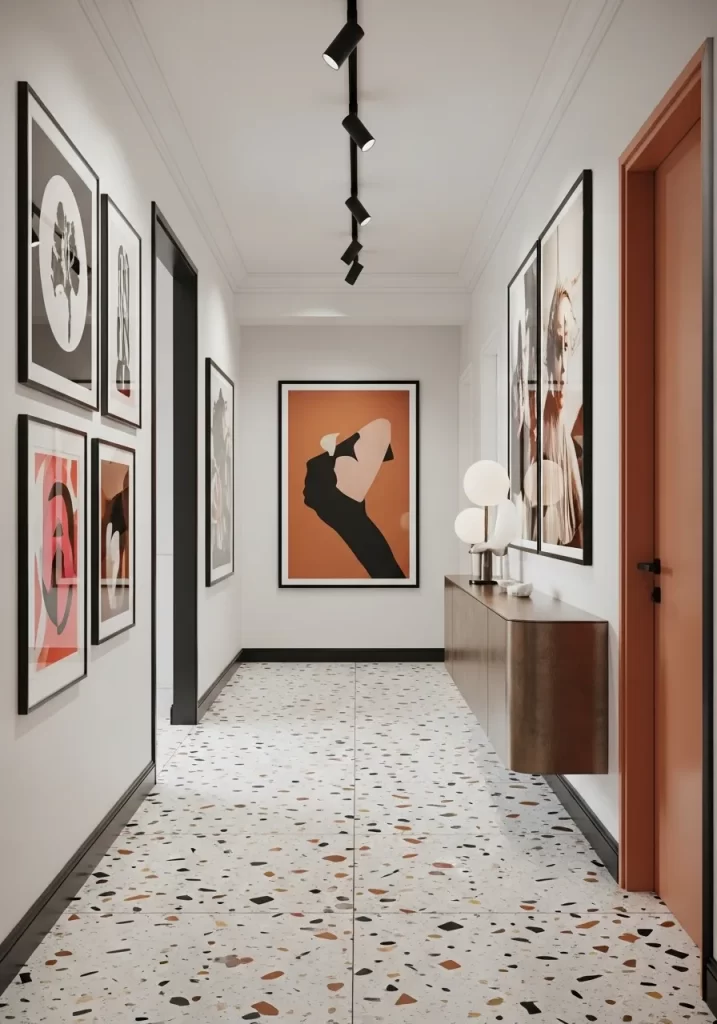
This hallway proves that floors can be art. The space is built on bold contrast. Bright white walls create a blank canvas. This clean backdrop makes the other elements stand out.
A striking terrazzo-style floor is the foundation. Its colorful, random pattern adds energy. The walls are lined with a gallery of graphic, modern prints in simple black frames. A warm-toned floating console and matching door add a final touch of personality. Track lighting focuses on the art, just like in a real gallery.
DIY Faux Terrazzo Floor
You can get this high-end look on a budget using paint and your existing floor (or peel-and-stick tiles).
Tools & Materials:
- A base floor (vinyl, tile, or concrete. Or plain peel-and-stick vinyl tiles)
- Paint: 3-4 small craft paint bottles in your chosen “chip” colors (e.g., black, tan, terracotta)
- Natural sea sponges (torn into small, irregular pieces)
- Paper plates
- Clear, water-based floor-grade polyurethane sealer
- Paint roller for sealer
Instructions:
- Prep Your Base: Your starting floor must be spotlessly clean and dry. If you’re using new peel-and-stick tiles, apply this effect before you stick them to the subfloor.
- Set Up Your Paint: Pour a small amount of each paint color onto separate paper plates.
- Create Your “Stamps”: Tear your sea sponges into 3-4 small pieces, one for each color. The irregular, torn edges are what make the shapes look natural.
- Start Stamping:
- Take your first sponge. Dip it lightly into the first color (e.g., black). Dab off any excess.
- Press the sponge onto the floor in a random pattern. Twist your wrist. Space the dabs out.
- Layer Colors:
- Take your second sponge and second color. Dab this color in the empty spaces.
- Repeat with your third and fourth colors. The goal is a random, layered cluster of “chips.”
- Let the paint dry completely (a few hours).
- Seal for Durability:
- This is the most important step. Pour the clear floor sealer into a paint tray.
- Use a roller to apply a thin, even coat over the entire floor.
- Let it dry according to the can’s instructions.
- Apply a second, and preferably a third, coat. This protects the paint from foot traffic.
4: The Arched Passageway
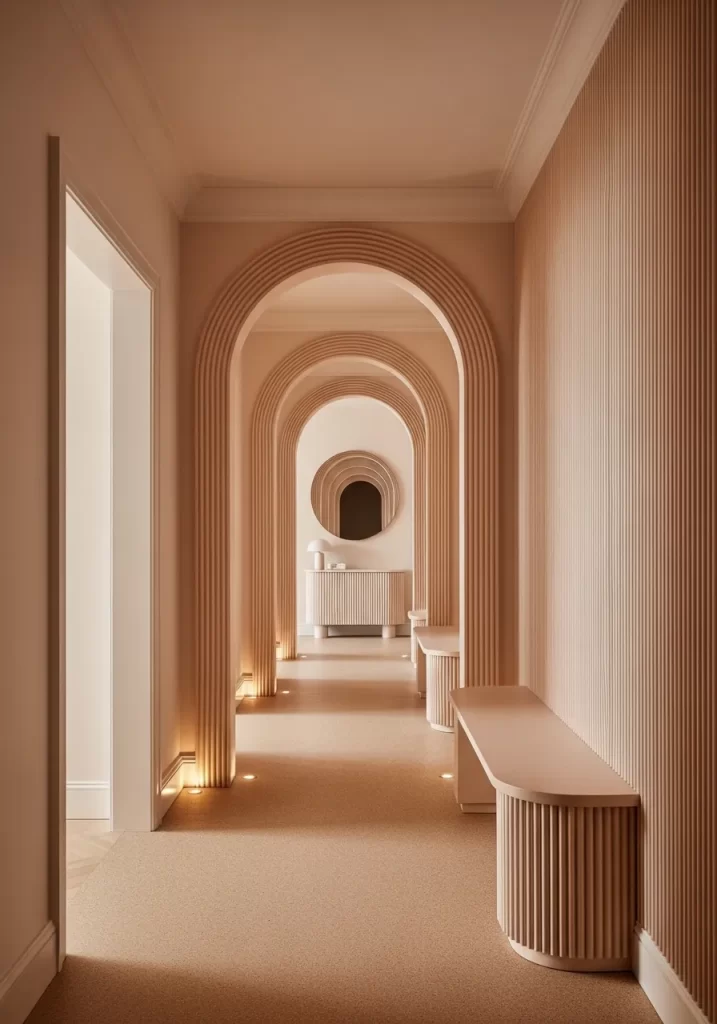
This hallway uses repetition to create a powerful effect. A series of rounded arches transforms a long, simple space into a grand architectural feature. The eye is naturally drawn down the corridor.
The entire space is coated in a soft, uniform color, which unifies the walls, arches, and built-in benches. Vertical fluted paneling adds a layer of texture that catches the light. Small lights at the base of each arch wash the wall, highlighting the curves and adding a gentle warmth.
DIY Fluted Wall Panel
You can create this expensive-looking fluted texture using simple wood moulding.
Tools & Materials:
- Half-round wood moulding (you can find this at any hardware store)
- Miter saw or a hand saw with a miter box
- Measuring tape
- Level
- Construction adhesive (like Liquid Nails)
- Caulk gun
- Paint (to match your wall or as an accent)
- Sandpaper (fine grit)
Instructions:
- Plan Your Wall: Choose the section of wall you want to cover. You can do a full wall or just a partial accent.
- Prep the Wall: Make sure the wall is clean, dry, and smooth.
- Cut Your Moulding:
- Measure the height of your wall.
- Use your saw to cut your half-round moulding strips to that exact height. You will need many of them, so work in batches.
- Install the First Strip:
- Apply a wavy bead of construction adhesive to the back of one strip of moulding.
- Press it onto the wall in a corner.
- Use your level to make sure it is perfectly vertical. This first piece guides all the others.
- Continue the Pattern:
- Apply adhesive to your next strip.
- Press it onto the wall, snugly against the first piece.
- Wipe away any adhesive that squeezes out.
- Repeat: Keep adding strips one by one, checking with your level every few pieces to make sure you aren’t drifting.
- Finish the Look:
- Let the adhesive cure for 24 hours.
- Once dry, paint the entire wall, including all the new moulding. The paint will fill any tiny gaps and make it look like a single, solid panel.
5: The Retro Color Block
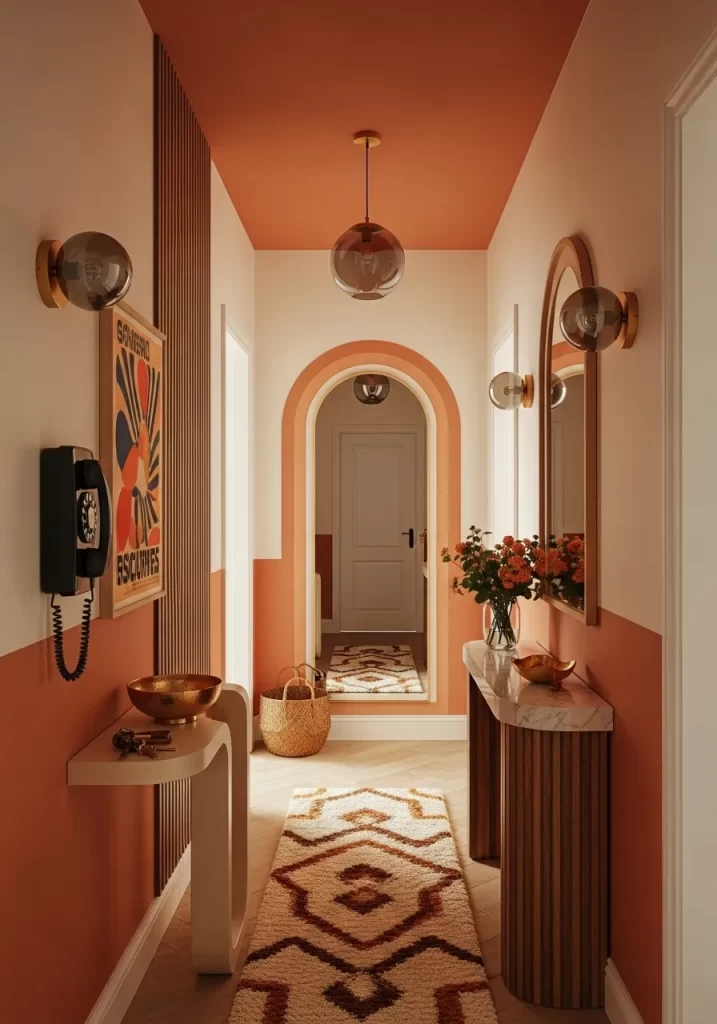
This hallway is full of warm, retro energy. It uses a “color drenching” technique to make a strong statement. A rich, earthy terracotta paint boldly covers the lower half of the wall.
The color continues up and over the arched doorway and across the entire ceiling. This creative choice makes the space feel cozy and intentional. The upper wall is left bright white, which keeps it from feeling too heavy. A patterned runner, globe lights, and vintage-style art complete the 70s-inspired look.
DIY Color Block Wall and Arch
This paint job is a high-impact, low-cost update you can do in a weekend.
Tools & Materials:
- High-quality painter’s tape (this is key)
- Your two paint colors (e.g., terracotta and white)
- Paint rollers and trays
- An angled paintbrush
- Level
- Measuring tape
- Pencil
Instructions:
- Choose Your Height: Decide where you want your color dividing line. A traditional “chair rail” height (about 32-36 inches from the floor) works well.
- Draw Your Guide Line:
- Use your measuring tape to mark this height in a few spots along the wall.
- Use your level to connect these marks with a faint, straight pencil line.
- Tape the Line:
- Apply your painter’s tape just above the pencil line.
- Press the edge of the tape down firmly with your fingernail or a credit card. This prevents the paint from bleeding underneath.
- Paint the Bottom:
- Use your roller to paint the wall below the tape with your accent color (e.g., terracotta).
- Use your angled brush to paint the baseboards the same color.
- Paint the Arch:
- Carefully use your angled brush to paint the trim and the inside of the archway with the same terracotta color.
- Remove the Tape:
- Do not wait for the paint to dry fully.
- While the paint is still slightly tacky, slowly pull the painter’s tape off at a 45-degree angle. This gives you the sharpest, cleanest line.
6: The Wabi-Sabi Walkway
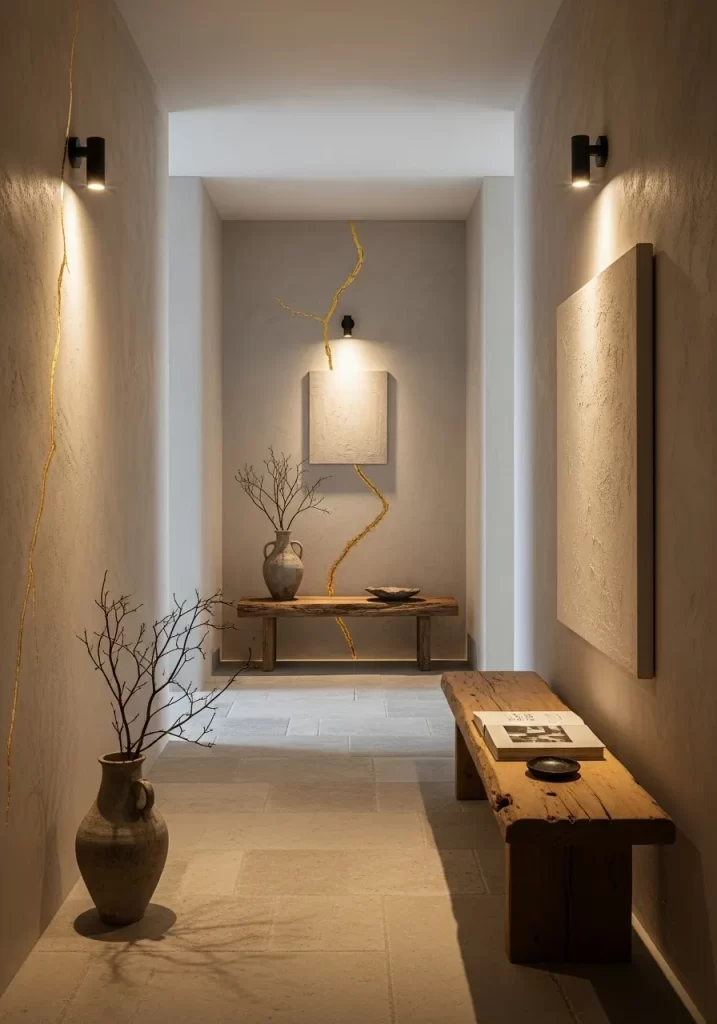
This hallway finds beauty in raw, simple materials. It feels calm and grounded. The walls have a soft, uneven plaster texture. The light is gentle, coming from small, focused sconces.
The furniture is rustic and minimal. Weathered wooden benches provide a place to rest. A simple vase holds dry branches. The most striking detail is a thin, golden line that snakes up the wall and over a simple canvas, like a crack mended with gold. This “kintsugi” effect celebrates imperfection as art.
DIY Golden “Kintsugi” Wall Crack
This project adds a unique, artistic touch to any wall, inspired by the Japanese art of mending.
Tools & Materials:
- Pencil
- Metallic gold craft paint (or a gold leaf kit for an advanced look)
- A very fine-tipped artist’s brush
- Plaster joint compound (pre-mixed is easiest)
- A small putty knife (optional)
Instructions:
- Plan Your “Crack”: Use your pencil to lightly draw a branching, “organic” line on your wall. Look at photos of cracked ice or a river system for inspiration. Don’t make it too straight.
- Add Texture (Optional but recommended):
- Scoop a small amount of joint compound onto your putty knife.
- Spread a very thin, slightly raised layer of the compound directly over your pencil line.
- Let it dry completely. This creates a subtle, raised “scar” for the gold to sit on.
- Apply the Gold (Easy Method):
- Use your fine-tipped artist’s brush.
- Carefully paint your pencil line (or over your dried plaster line) with the metallic gold paint.
- Take your time. You may need two coats to get a solid, rich color.
- Apply the Gold (Advanced Method):
- If using a gold leaf kit, paint the special adhesive (called “size”) over your line.
- Let it get tacky (follow the kit’s instructions, usually 15-20 minutes).
- Gently press the gold leaf sheets onto the tacky line.
- Use a soft, dry brush to whisk away all the excess gold.
7: The Coastal Air
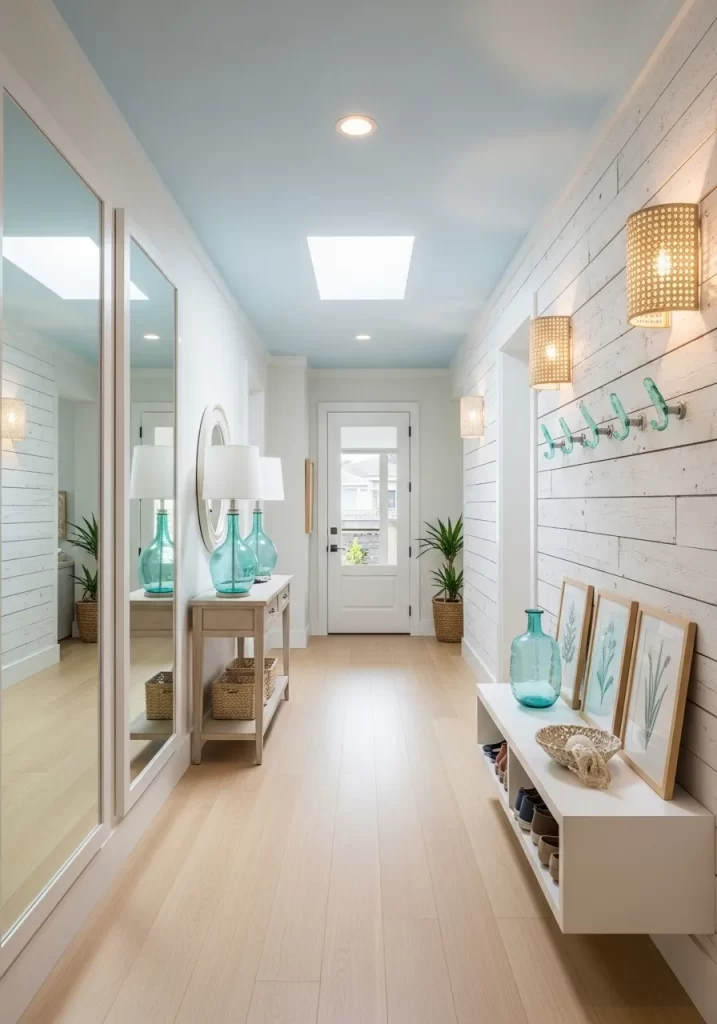
This hallway is bright, open, and relaxed. It feels like a breezy coastal home. The walls use white horizontal shiplap, which adds subtle texture and makes the space feel wider.
A massive, full-length mirror on one wall captures and bounces light, making the hallway feel twice its size. The real trick is the ceiling. It’s painted a soft, sky blue, which draws the eye upward and adds an airy, open feeling. Natural materials like woven light shades and glass lamps complete the beach-house vibe.
The “Fifth Wall” Painted Ceiling
Painting your ceiling is a simple trick to completely change the feel of a room.
Tools &Materials:
- High-quality painter’s tape
- Drop cloths (to cover the entire floor)
- Your chosen ceiling paint (e.g., sky blue)
- An angled paintbrush
- A paint roller
- An extension pole for the roller (this saves your back)
- A paint tray
Instructions:
- Prep the Room: Move as much as you can out of the hallway. Cover the floor completely with drop cloths.
- Tape the Walls:
- This is the most critical step. Apply your painter’s tape in a very straight line along the top edge of all four walls.
- This tape line creates your sharp edge between the wall color and the new ceiling color. Press it down firmly.
- “Cut In” the Edges:
- Pour some paint into a small container.
- Use your angled brush to paint a 2-3 inch border on the ceiling, right up against the tape.
- Do this around the entire perimeter of the room and around any light fixtures.
- Roll the Ceiling:
- Attach your roller to the extension pole.
- Pour your paint into the paint tray. Load the roller, removing any excess.
- Roll the paint onto the main part of the ceiling. Work in small sections, rolling in one direction and then rolling again in a perpendicular direction to get even coverage.
- Remove the Tape:
- Let the paint dry for an hour or so until it’s just tacky.
- Slowly pull the tape off at a 45-degree angle. This reveals your crisp, new ceiling.
8: The Moody Maximalist
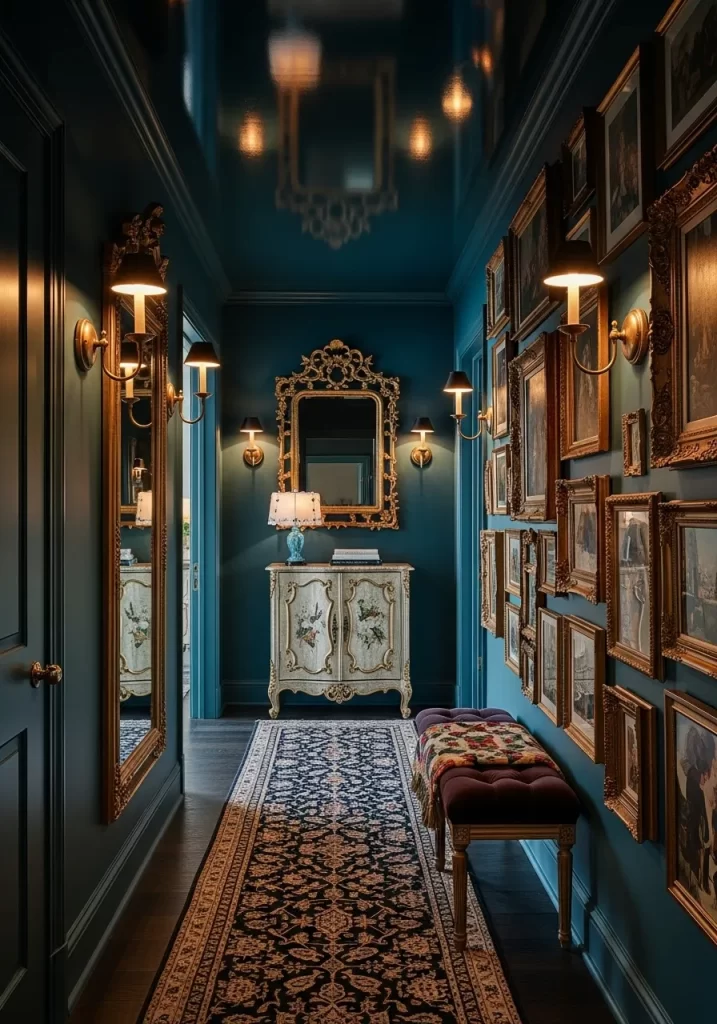
This hallway is dramatic and full of personality. It proves that small spaces can handle bold choices. The walls, ceiling, and trim are all “drenched” in a deep, glossy teal.
This high-gloss finish is the key. It reflects light like a jewel box, adding depth and glamour. One entire wall is covered in a gallery of gold-framed pictures. The frames are all different styles, but the matching gold color unifies them. A patterned rug and plush bench add even more texture.
DIY Mismatched Gold Gallery Wall
This is a fantastic way to turn cheap, secondhand frames into a high-end, cohesive art collection.
Tools & Materials:
- A collection of picture frames in various shapes and sizes (thrift stores are great for this)
- Metallic gold spray paint
- A drop cloth or old sheet
- Your photos or art prints
- Picture hanging hooks and nails
- A level
Instructions:
- Prep Your Frames:
- Clean all the frames.
- Remove the glass and the backing from each frame. Set them aside somewhere safe.
- Spray Paint:
- Take your empty frames to a well-ventilated area (outside is best).
- Lay them on your drop cloth.
- Hold the spray paint can about 8-12 inches away. Apply a light, even coat. Don’t try to cover it all at once.
- Let it dry for 20 minutes, then apply a second coat. Get the sides and edges.
- Reassemble:
- Once the frames are completely dry (a few hours), put the glass back in.
- Add your art or photos and secure the backings.
- Plan Your Layout:
- Lay all your new gold frames on the floor.
- Arrange them in a cluster. Move them around until you find a balance you like. Start with the biggest frame in the middle and build out.
- Hang Your Art:
- Starting with your main, central frame, hang it on the wall. Use your level.
- Work your way out, one frame at a time, copying the layout you made on the floor.
9: The Zen Corridor
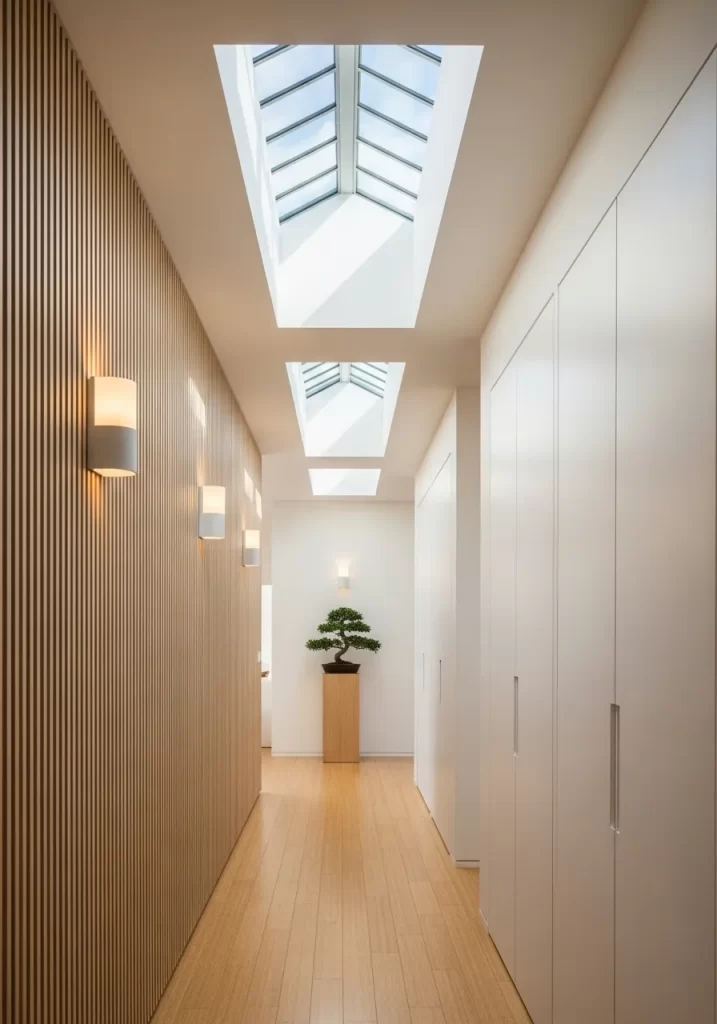
This hallway is a lesson in calm, minimalist design. It feels clean and open. The space is flooded with natural light from a series of large skylights.
One wall features vertical wood slats. This adds natural warmth and texture, and makes the ceiling feel taller. The opposite wall is all seamless, handle-free white cabinets, hiding all the clutter. The only decoration is a single bonsai tree on a simple pedestal. It acts as a focal point, like a living sculpture.
DIY Vertical Wood Slat Accent Wall
This project adds modern texture and warmth to any plain wall.
Tools & Materials:
- 1×2 lumber (pine is low-cost, oak is more durable)
- Wood stain or clear sealer (optional)
- Miter saw or hand saw
- Measuring tape
- Level
- Construction adhesive
- A brad nailer (this makes it much faster, but you can use small finish nails and a hammer)
- A “spacer” block (a small piece of wood, even another piece of 1×2)
Instructions:
- Prep the Wall:
- Decide if you want to paint the wall first. A dark color (like black or charcoal) behind the wood slats creates a strong, modern contrast.
- Cut Your Slats:
- Measure the height of your wall.
- Cut your 1×2 boards to this height. You will need many.
- Finish the Slats:
- It is much easier to stain or seal your slats before you put them on the wall.
- Apply your wood stain or sealer to all your cut slats. Let them dry.
- Install the First Slat:
- Start in one corner. Apply a bead of construction adhesive to the back of a slat.
- Press it into the corner. Use your level to make sure it is perfectly vertical.
- Secure it with a few brad nails.
- Use Your Spacer:
- Place your spacer block snugly against the edge of the slat you just installed.
- Install the Next Slat:
- Apply adhesive to your next slat.
- Press it firmly against the other side of your spacer. This creates a uniform gap.
- Nail this slat in place.
- Repeat:
- Move your spacer. Place it against the slat you just installed. Add the next slat.
- Repeat this process—slat, spacer, slat, spacer—all the way across the wall.
10: The Brutalist Entry
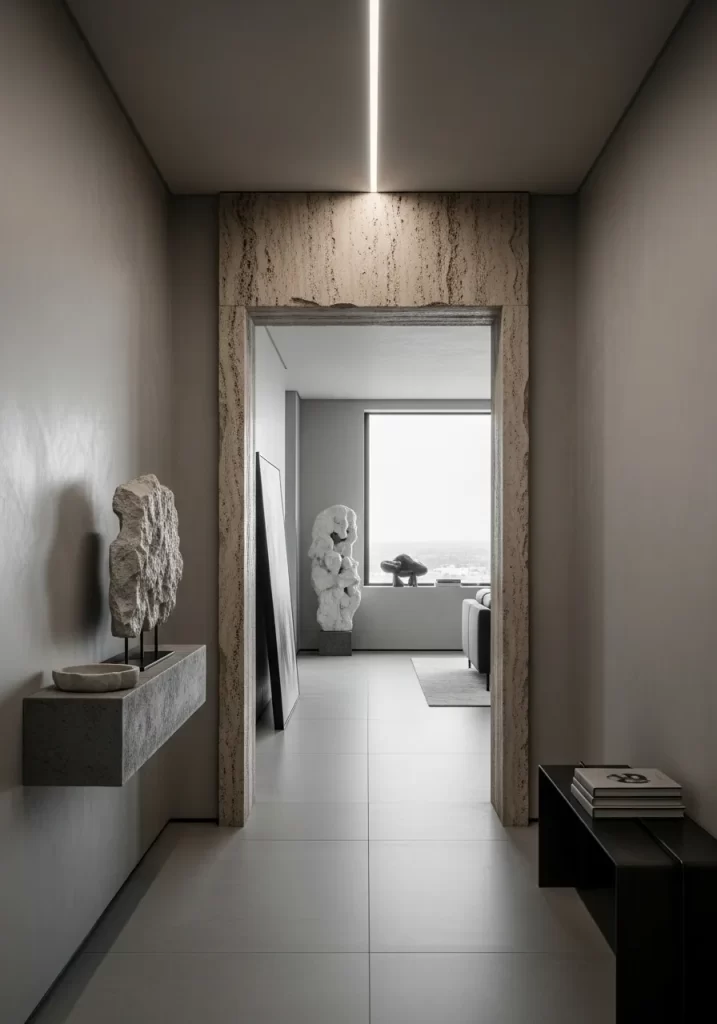
This hallway makes a statement with raw, strong textures. The walls are finished in a smooth, polished grey, like concrete. This creates a calm, industrial backdrop.
The main feature is the doorway. It is framed with a thick, rough-cut stone that looks almost unfinished. This makes the transition from one space to the next feel heavy and important. The decor is minimal: a simple floating shelf, a black metal bench, and sculptural objects that add to the raw, tactile feel of the space.
DIY Faux Concrete Wall
You can create this textured, industrial look with paint and a simple drywall compound.
Tools & Materials:
- A base coat of grey latex paint
- Pre-mixed joint compound (or plaster of Paris)
- A 6-inch or 10-inch drywall trowel or wide putty knife
- A paint tray
- A small can of a slightly darker grey paint (optional)
- Clean rags
Instructions:
- Base Coat: Paint your wall with the base coat of grey paint. Let it dry completely.
- Mix Your “Concrete”:
- Scoop a good amount of joint compound into your paint tray.
- Pour in a small amount of your base grey paint and mix it. You want a thick, spreadable consistency, like thick frosting.
- Apply the Texture:
- Scoop up some of your mixture with the trowel.
- Start at the top of the wall. Spread the mixture in long, sweeping, random motions.
- Don’t try to make it smooth. You want the lines and high/low spots from the trowel. This is what creates the texture. Cover the whole wall.
- Add Depth (Optional):
- While the compound is still wet, put a few dabs of the darker grey paint on your trowel.
- Lightly pull the trowel over the wall again. This will blend the darker color in, creating variation and depth.
- Soften the Look:
- Let it dry for about an hour. If some spots are too “spiky,” you can gently knock them down with a clean rag or the flat of your trowel.
- Let the whole wall dry for 24-48 hours.
11: The Illuminated Grid Wall
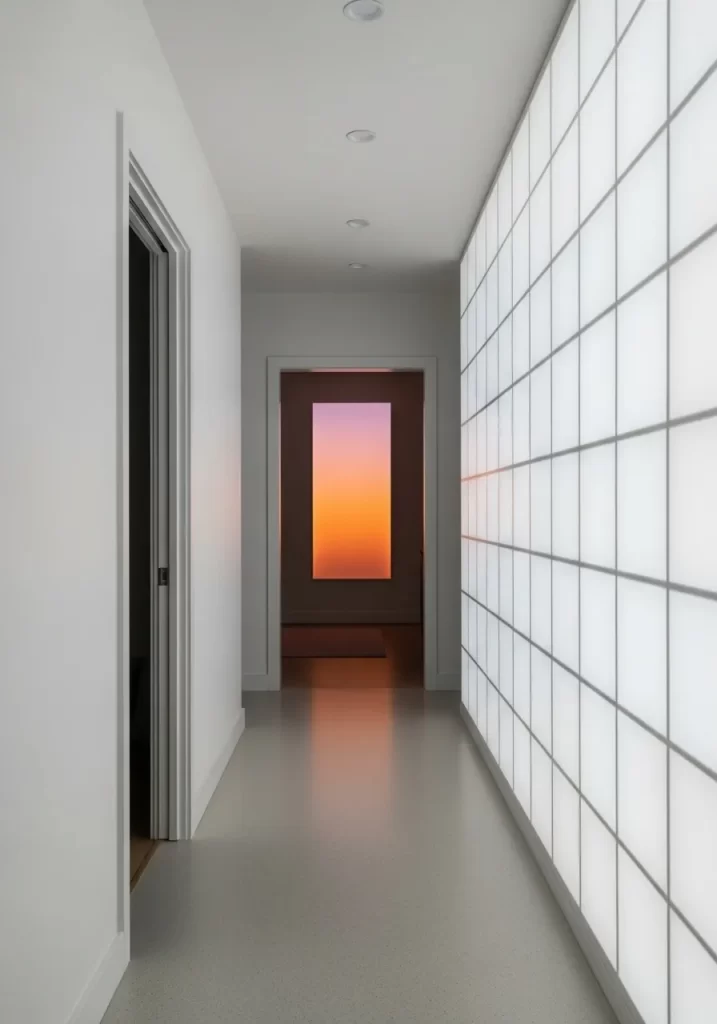
This hallway uses light as architecture. It feels both modern and traditional, like a glowing shoji screen. One entire wall is a grid of frosted white panels, lit from within. This feature provides a soft, even light that brightens the whole space without any harsh glare.
At the far end, a doorway with a colored glass panel glows like a sunset. This creates a beautiful focal point, drawing you forward. The rest of the hallway is kept simple, with smooth white walls and a polished floor. The light does all the work.
DIY Faux Backlit Panel
This project fakes the look of an expensive, custom-built light wall using simple materials.
Tools & Materials:
- Several large, plain white artist canvases (e.g., four 24×24 inch)
- Wood furring strips (1×2 lumber)
- Battery-powered LED light strips (warm white)
- Measuring tape and pencil
- Level
- Screws and a drill
- Wall anchors
Instructions:
- Plan Your Grid: Lay your canvases on the floor to decide on your grid pattern (e.g., 2×2).
- Build a “Float” Frame: You will build a simple wood frame on the wall that is slightly smaller than your canvas grid. This frame will hold the lights and make the canvases “float.”
- If your grid is 48×48 inches, build a frame on the wall that is about 44×44 inches.
- Screw the 1×2 furring strips into the wall. Use a level. Add a cross-brace or two in the middle for support.
- Attach the Lights:
- Peel the backing off your LED light strips.
- Stick them all over the wood frame you just built. Criss-cross the middle. The more lights, the more even the glow.
- Mount the Canvases:
- Now, simply hang your canvases directly onto the wood frame.
- The 1×2 frame pushes the canvases about an inch off the wall. This leaves space for the LED light to glow and diffuse behind them.
- Turn on the lights. The canvas fabric acts as a perfect diffuser, hiding the bulbs and creating a soft, high-end glow.
12: The Modern Rustic Cabin
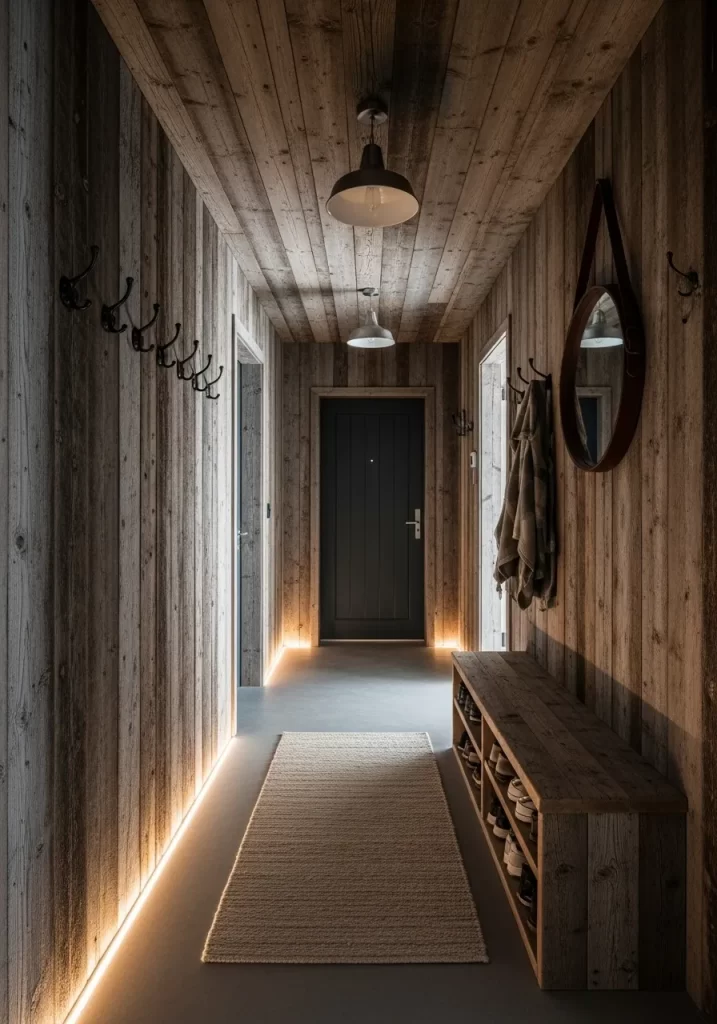
This hallway wraps you in warmth. It feels like a modern cabin. The walls and ceiling are completely covered in vertical, weathered wood planks. This creates a very cozy, enclosed feeling.
The rustic wood is balanced by sharp, modern details. A smooth, polished concrete floor provides a clean base. Thin LED light strips are recessed at the bottom of the walls, washing the floor with a warm glow. A simple wood bench and industrial hooks add function without clutter.
DIY Faux Weathered Wood Wall
You can get this reclaimed look using new, cheap pine boards and a simple aging technique.
Tools & Materials:
- Common 1×6 pine boards (enough to cover your wall)
- Wire brush
- Wood stain (a mix of grey and dark brown)
- Old rags
- Sandpaper
- Brad nailer and nails (or construction adhesive)
- Miter saw
Instructions:
- Beat Up the Wood: This is the fun part. You need to make the new wood look old.
- Lay the boards out. Scrape them with the wire brush (always going with the grain).
- Hit them with a hammer. Denta few edges. Create some history.
- Create the Stain:
- Pour some of the grey stain and some of the brown stain into a container. Mix them to get a muted, barn-wood color.
- You can also water down the stain for a more subtle “wash.”
- Apply the Stain:
- Use a rag to wipe the stain onto the boards.
- Immediately wipe most of it off with a clean rag. You want to color the wood, not paint it. Let the grain show.
- Let the boards dry completely.
- Install the Wall:
- Start in a corner. Place your first board vertically against the wall. Use a level to make sure it’s straight.
- Secure it with a brad nailer (or use construction adhesive on the back).
- Place the next board snugly beside it and secure it. Repeat all the way across the wall.
13: The Mid-Century Divider
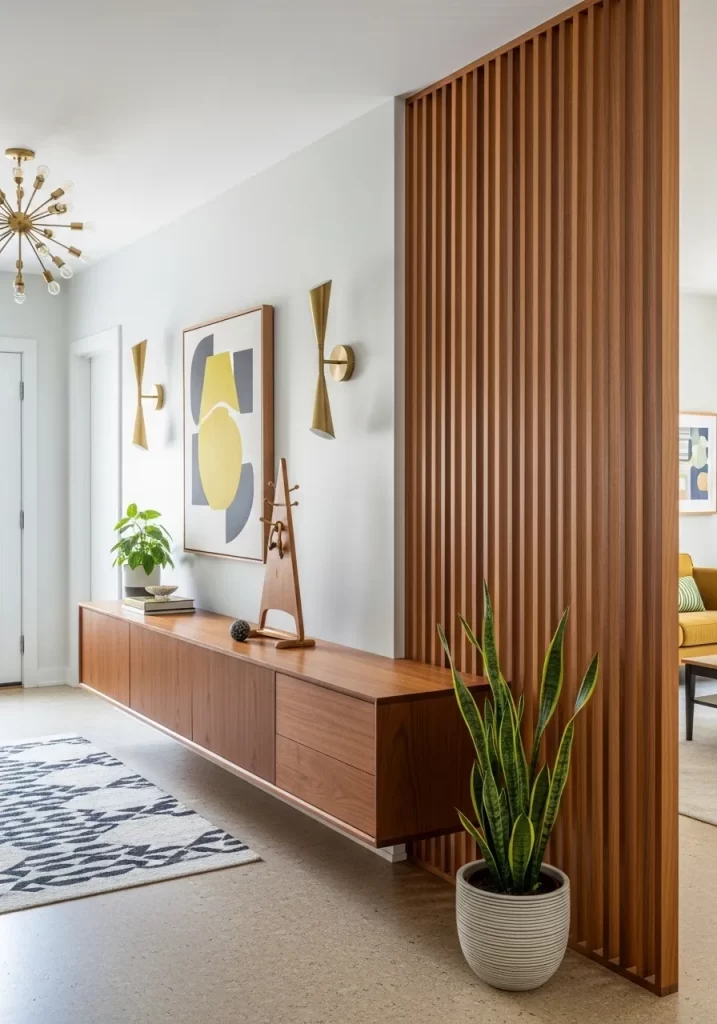
This entryway is stylish and smart. It uses classic mid-century design. A long, floating credenza in a warm teak wood provides storage for keys and mail. It hovers just above the floor, which makes the hallway feel more open.
The main feature is a vertical wood slat wall. This partition elegantly separates the hallway from the living area. It creates a sense of entry without blocking light or sight. Gold “sputnik” lights and abstract art complete the retro, sophisticated feel.
DIY Freestanding Slat Divider
This project builds a simple, non-structural slat wall that’s great for renters.
Tools & Materials:
- 1×3 lumber (for the top and bottom plates)
- 1×2 lumber (for the vertical slats)
- Wood stain (e.g., teak or walnut)
- Wood screws
- Measuring tape
- Saw
- Drill
- A “spacer” block (a piece of 1×2 cut to 2 inches)
Instructions:
- Measure Your Space: Measure the height of your ceiling. Subtract 1/8 inch to make it fit. Also, decide on the width of your divider (e.g., 3 feet).
- Build the Frame:
- Cut two pieces of your 1×3 board to your chosen width (e.g., 3 feet). These are your top and bottom plates.
- Cut two 1×2 boards to your ceiling height (minus the 1/8 inch). These are your end slats.
- Stain Everything: It is much easier to stain all your cut pieces now, before you assemble. Let them dry.
- Assemble the “Ladder”:
- Lay the top and bottom plates on the floor, parallel to each other.
- Place one end slat at the very end, fitting it between the top and bottom plates. Screw it in place from the top and bottom.
- Repeat with the other end slat. You now have a simple rectangle.
- Add the Slats:
- Take your spacer block and place it against one of the end slats.
- Place your next 1×2 slat against the spacer.
- Screw this slat in from the top and bottom.
- Move the spacer. Place it against the slat you just installed. Add the next slat.
- Repeat this process until your divider is filled.
- Stand It Up: Carefully tilt your finished divider up. The 1/8-inch gap should make it a snug fit. You can add small felt pads to the top and bottom to protect your ceiling and floor.
14: The Soft Fabric Wall
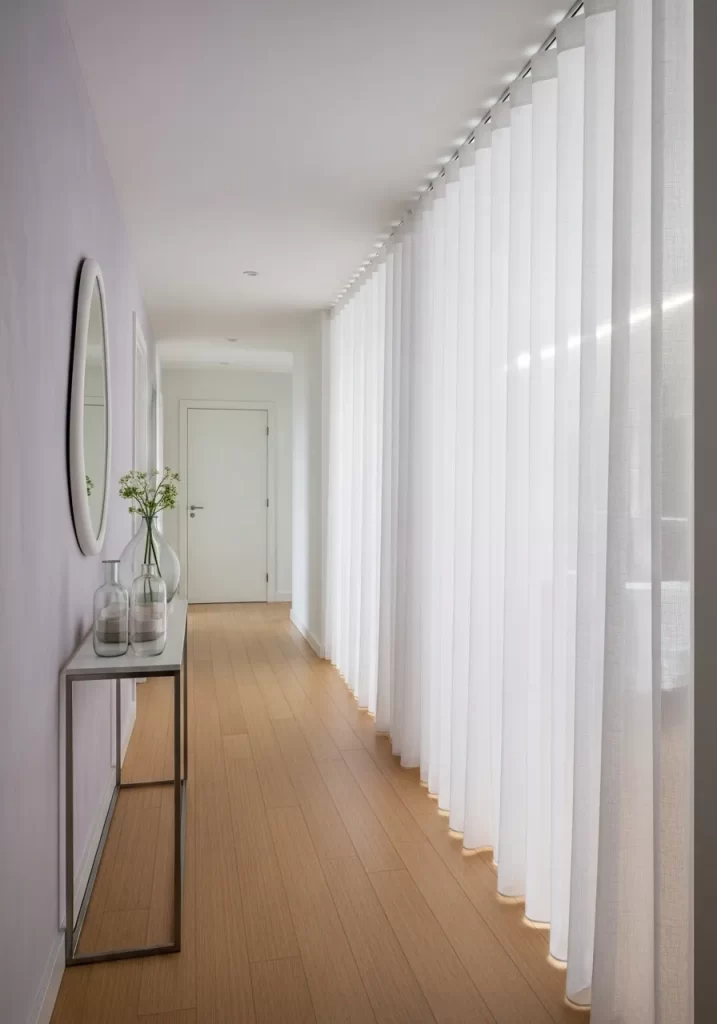
This hallway feels soft, calm, and serene. It challenges the idea that a hallway must have two hard walls. One wall is painted a pale, soothing lavender. It adds just a hint of color.
The opposite wall is made entirely of floor-to-ceiling sheer white curtains. This “wall of fabric” is a clever trick. It can hide a messy row of shelves, a fuse box, or just a plain wall. It softens the light and adds a flowing, gentle texture. The light wood floor and slim console table keep the look minimal.
DIY Ceiling-Mounted Curtain Wall
This is a simple way to hide a wall or create the illusion of a window.
Tools & Materials:
- A ceiling-mount curtain track (this is better than a rod)
- Sheer, lightweight curtains (measure your ceiling height first)
- Drill
- Wall anchors (if not drilling into ceiling joists)
- Screws
- Stud finder
- Level
Instructions:
- Find the Joists: Use your stud finder to locate the joists in your ceiling. It’s always best to screw the track into these solid beams. Mark their locations with a pencil.
- Plan the Track:
- Hold the track against the ceiling. You want it to be a few inches away from the wall you are covering.
- Use a level to make sure it’s straight.
- Mark the drill holes on the ceiling, aligning them with your joist marks as much as possible.
- Install the Track:
- Drill your pilot holes.
- If a hole is not in a joist, tap a drywall anchor into it.
- Hold the track up and secure it with screws.
- Hang the Curtains:
- Slide the curtain hooks or rollers (that came with your track) into the track.
- Hang your sheer curtains. You want them to be long enough to just “kiss” the floor.
15: The Living Moss Wall
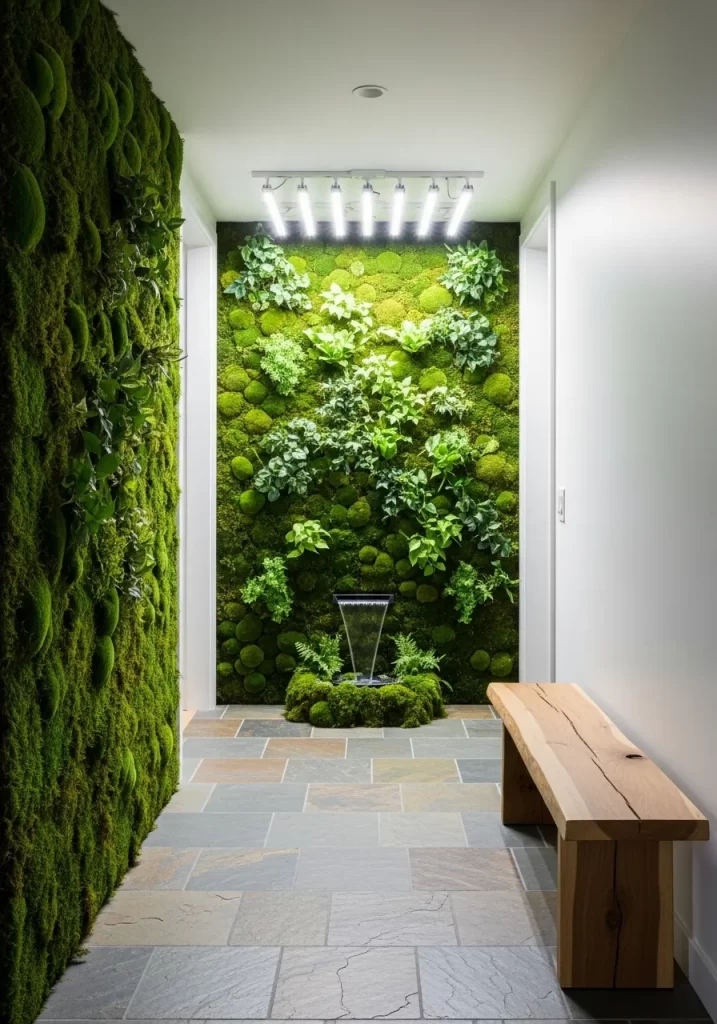
This hallway brings the outdoors in, in a powerful way. It’s a full biophilic experience. A large section of the wall is a living vertical garden. It’s covered in different kinds of lush moss and hanging plants.
The varied shades of green and the different organic textures make the wall a piece of living art. A small, built-in water feature adds the gentle, calming sound of a fountain. This design engages sight, smell, and sound. A simple wood bench and natural slate floor complete the earthy, spa-like feel.
DIY Faux Moss Wall Art
A living wall is a lot of work. This DIY gives you the same green, textured look with zero maintenance.
Tools & Materials:
- A large, empty picture frame (or make a simple wood box frame)
- A piece of plywood or foam board, cut to fit the frame
- Hot glue gun and many glue sticks
- Bags of preserved moss (you can buy this at craft stores)
- Different types of moss (e.g., sheet moss, reindeer moss, bun moss)
- Optional: Faux air plants, preserved ferns, or small pieces of driftwood
Instructions:
- Create Your Base:
- Secure your plywood or foam board to the back of your frame. This is your “canvas.”
- Map It Out:
- Lay your different mosses and elements on the board before gluing.
- Think about creating “drifts” of color or texture. Place your larger pieces (like bun moss or driftwood) first.
- Start with the Base:
- Apply hot glue to a section of your board.
- Press the flat “sheet moss” down to cover the base. This is your background. Cover the whole board.
- Add Dimension:
- Now, start layering.
- Apply a generous dot of hot glue and press your “bun moss” (the round, clumpy kind) on top of the sheet moss.
- Use the “reindeer moss” (the light, airy kind) to fill in gaps.
- Add Accents:
- Glue in your faux plants or ferns. Have them peek out from behind the moss.
- There is no wrong way to do this. The goal is a lush, natural, and varied texture.
- Hang It: Let the glue cool completely, then hang your “moss art” on the wall.
16: The Mondrian Color Block
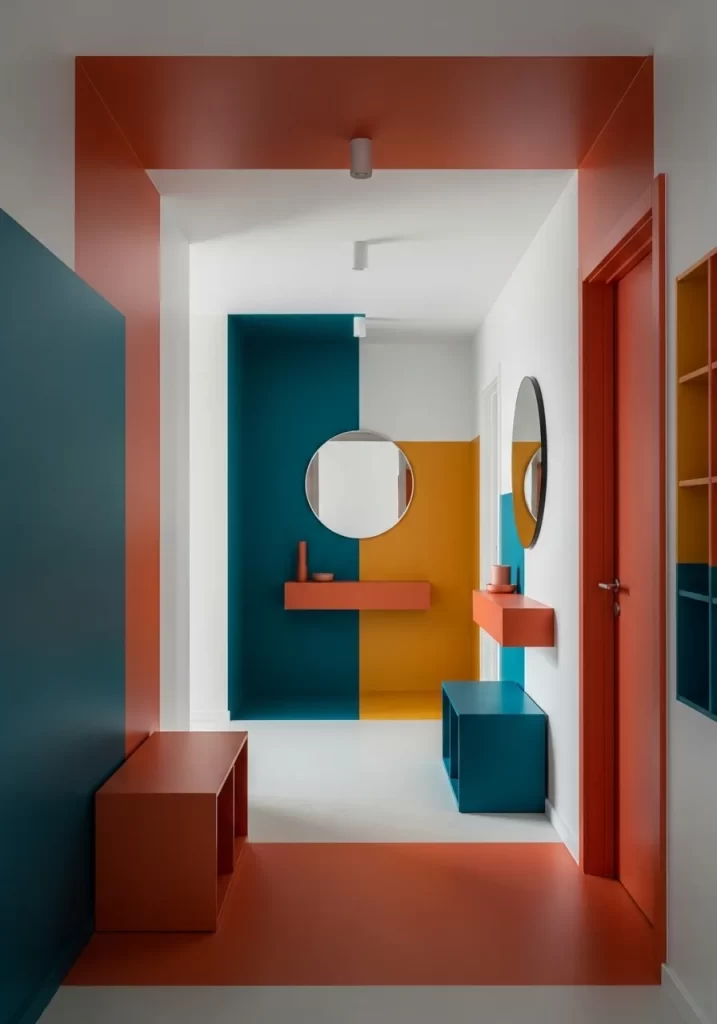
This hallway is fearless and fun. It uses geometry and bold, primary-inspired colors to create a high-energy space. The design is like a 3D Mondrian painting.
A deep, saturated teal defines one area. A block of bright mustard yellow meets it at a sharp line. A punchy, terracotta orange frames the doorway and even runs onto the floor. This “color mapping” defines different zones. Simple round mirrors and cube-shaped benches echo the clean, geometric theme.
DIY Geometric Color Block Painting
This high-impact paint job is all about sharp lines and careful planning.
Tools & Materials:
- High-quality painter’s tape (like FrogTape)
- Your 3-4 chosen paint colors
- A base color (white)
- Level and pencil
- Small paint rollers and trays
- Paintbrushes
- A credit card or putty knife
Instructions:
- Paint the Base: Start by painting the entire hallway your base color (e.g., white). Let it dry completely for at least 24 hours.
- Design Your Shapes: Use your pencil and level to lightly draw your geometric shapes on the walls.
- Tape Your First Color:
- Apply painter’s tape along the outside edge of your first shape (e.g., the yellow block).
- Pro Tip: Use the credit card to press down the edge of the tape. This “seals” it.
- Paint Your First Color:
- Paint inside the taped-off area with your first color.
- While the paint is still tacky, slowly peel the tape off at a 45-degree angle. This gives you a razor-sharp line.
- Let It Dry. Really.
- You must let this first color dry completely (24 hours). If you don’t, the tape for your next color will pull it off.
- Tape and Paint Your Second Color:
- Once the first block is dry, tape off your second shape (e.g., the teal block).
- You will now be taping on top of your freshly painted wall. This is why a quality tape and dry paint are so important.
- Paint your second color. Remove the tape.
- Repeat the process for all your shapes.
17: The Art Deco Entry
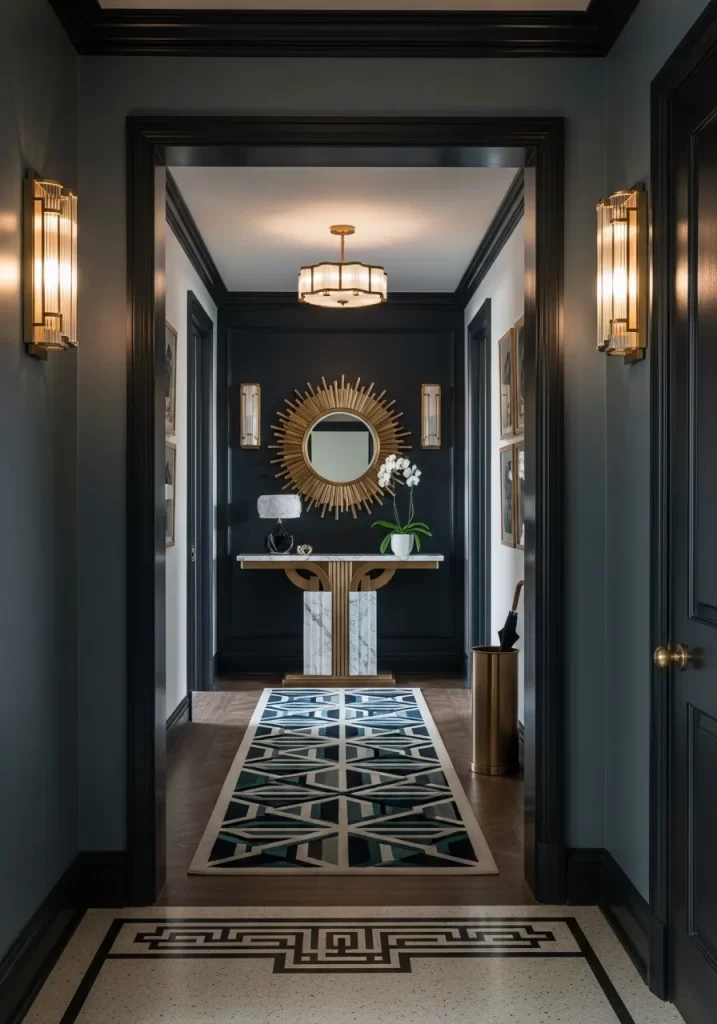
This hallway is pure, formal glamour. It uses dark, moody colors and rich materials to create a sophisticated, timeless look. The walls are a deep, sophisticated charcoal or navy blue.
This dark backdrop makes the metallic details pop. A striking gold sunburst mirror hangs over a geometric marble and brass console table. The door and ceiling trim are painted a contrasting black, framing the view. A bold, geometric runner on the floor leads the eye forward. This space feels balanced, luxurious, and confident.
DIY Faux Painted Floor Runner
This is a great way to add the look of a high-end runner to a plain wood or vinyl floor.
Tools & Materials:
- High-quality painter’s tape
- Porch & Floor paint (this is durable) in 2-3 colors (e.g., white, black, blue)
- Measuring tape
- Level or a straight edge
- Paint rollers and trays
- Angled paintbrush
Instructions:
- Plan Your Runner:
- Decide on the width of your runner (e.g., 24 inches) and its “border” (e.g., 2 inches).
- Use your measuring tape to mark the outer edges of the runner down the length of your hall.
- Tape the Main Field:
- Use your painter’s tape to tape off the main, large, central rectangle. This will be your base color.
- Paint the Base:
- Paint the area inside your tape with your base color (e.g., white).
- Let it dry completely. Remove the tape.
- Tape the Border:
- Let the base color cure for a day.
- Now, tape off the border. You will place tape on the inside edge of your white runner, and on the outside (on the floor).
- Paint the Border:
- Paint the area between your two tape lines with your border color (e.g., black).
- Remove the tape while it’s still tacky.
- Add a Pattern (Optional):
- Once everything is dry, you can use tape to create a geometric pattern (like diamonds or stripes) on top of the white base field.
- Tape, paint, and peel, one color at a time.
18: The Hallway Library
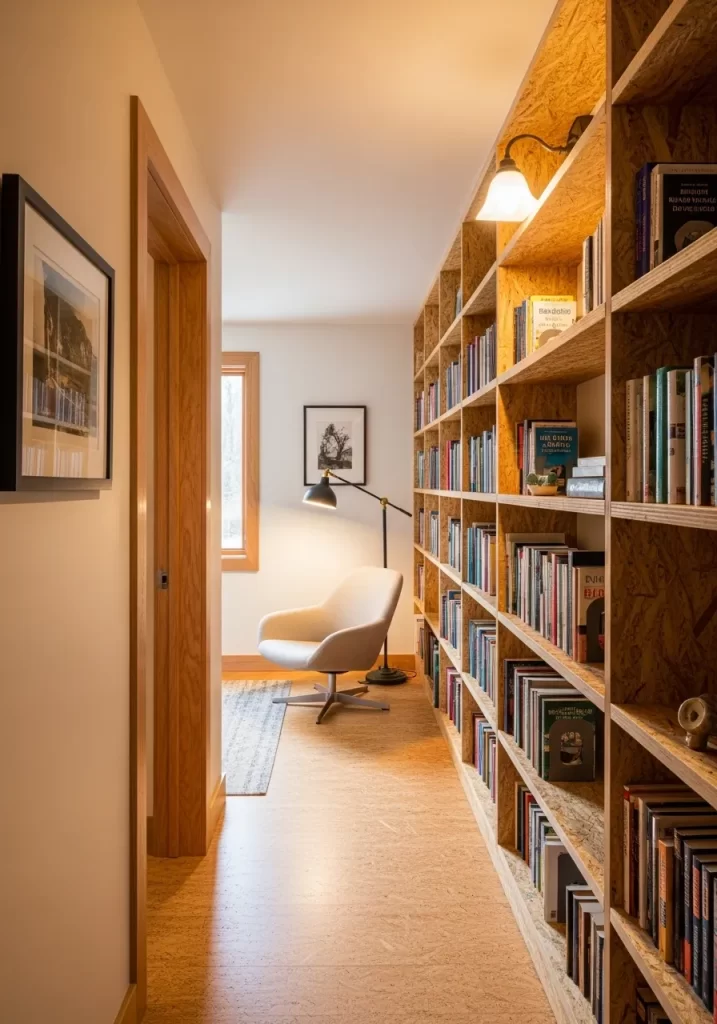
This design is smart, functional, and full of character. It turns a “wasted” hallway into a cozy, useful space. One entire wall is transformed into a floor-to-ceiling library.
The shelves are built from raw, textured OSB (oriented strand board). This is a strong, industrial, and very low-cost material. It gives the custom built-in a modern, unfinished look. The shelves are packed with books, adding color and personality. A reading chair and lamp at the end of the hall create a small, welcoming destination.
DIY Industrial OSB Bookshelf
This project uses OSB for a strong, modern, and budget-friendly bookshelf.
Tools & Materials:
- Sheets of 3/4-inch OSB
- A circular saw
- Measuring tape and straight edge
- Drill
- Wood screws (2.5-inch)
- Sandpaper (medium grit)
- Clear polyurethane sealer (optional, but recommended)
Instructions:
- Plan Your Shelf:
- Measure your wall. Decide on the depth of your shelves (e.g., 10 inches).
- Plan your vertical supports. You’ll need one every 24-32 inches.
- Cut Your Pieces:
- Have the hardware store “rip” your OSB sheets into 10-inch-wide planks. This saves a lot of work.
- Cut your vertical supports to the full height of your wall (floor to ceiling).
- Cut your horizontal shelves to fit between the vertical supports (e.g., 24 inches wide).
- Sand the Edges: The cut edges of OSB are sharp. Run sandpaper over all cut edges to smooth them.
- Assemble the First “Box”:
- Attach one vertical support to the wall (screw it into the studs).
- Attach a second vertical support 24 inches over.
- Install your horizontal shelves between these two supports.
- Drill pilot holes, then drive screws through the vertical supports directly into the ends of the horizontal shelves.
- Continue Building:
- Add your next vertical support 24 inches over.
- Install the next set of horizontal shelves.
- Repeat this process, building one “bay” at a time until you fill the wall.
- Seal It: OSB can shed small wood chips. Brush on a coat of clear polyurethane to seal the surface and give it a slight sheen.
19: The Reflective Passage
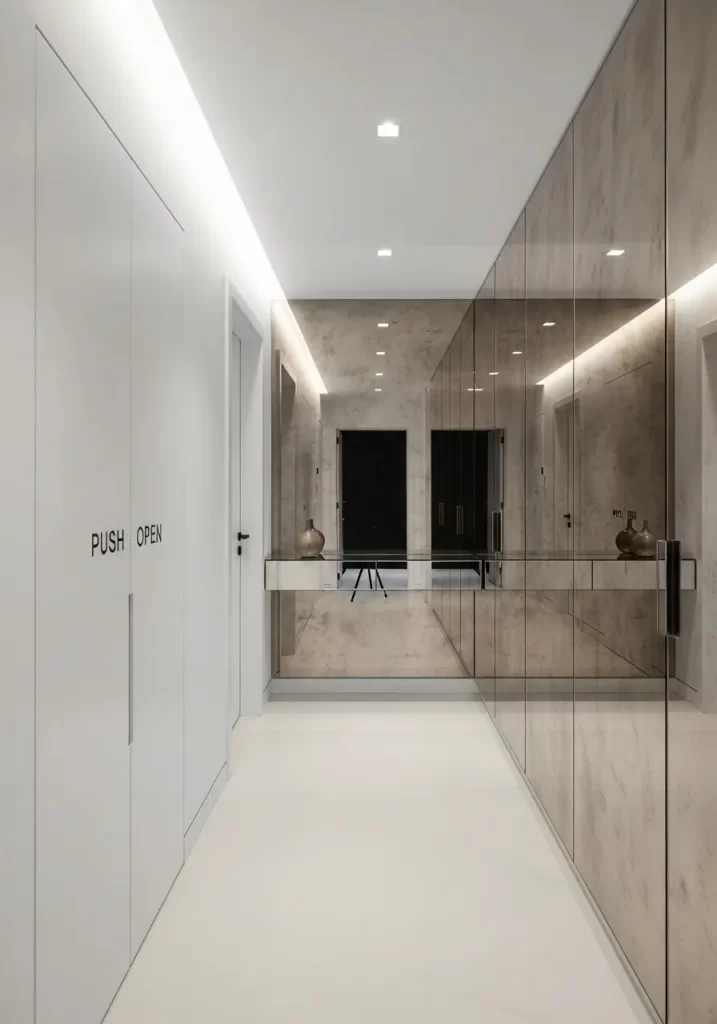
This narrow hallway uses a classic trick to feel wide and bright. One entire wall is covered in floor-to-ceiling smoked mirror panels. This reflects the opposite wall and all the light, creating a powerful illusion of space.
The opposite wall is not plain. It’s covered in a light, textured wallpaper (like linen or plaster). This adds warmth and keeps the hall from feeling like a cold “hall of mirrors.” A simple glass shelf seems to float on the mirrored wall, holding just two simple vases. The look is minimal, clean, and very sleek.
DIY Peel-and-Stick Mirror Wall
You can get this look without the cost and hassle of custom glass.
Tools & Materials:
- Peel-and-stick mirrored acrylic tiles
- Level
- Measuring tape
- Cleaning cloths and rubbing alcohol
- A utility knife (for trimming)
Instructions:
- Prep the Wall: This is the most important step. The wall must be perfectly clean, dry, and smooth.
- Wipe the entire wall down with rubbing alcohol.
- Any dust or bump will prevent the tiles from sticking flat.
- Find Your Starting Line:
- You want your first row of tiles to be perfectly level.
- Use your level to draw a faint, straight horizontal line in the center of the wall. You will build up and down from this line.
- Apply the First Tile:
- Peel the backing off your first mirror tile.
- Carefully align its bottom edge with your pencil line.
- Press it firmly onto the wall, starting from the center and smoothing outwards.
- Build Your Wall:
- Place your next tile snugly against the first. Do not overlap them.
- Work your way out from the center, completing one row at a time.
- Then, start the next row, making sure all the edges are tight.
- Trim the Edges:
- When you get to a corner or the edge of the wall, measure the gap.
- Mark the mirror tile and score it deeply with your utility knife. You can then (carefully) snap the tile along the line.
- Peel and stick your cut piece.
20: The Natural Cork Wall
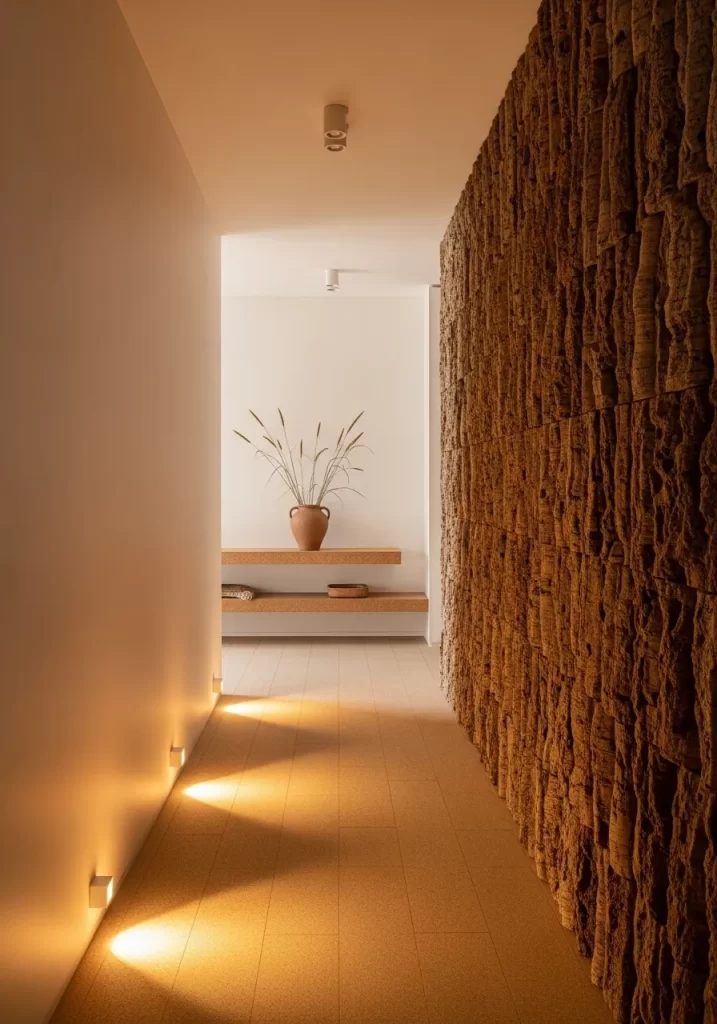
This hallway is all about raw, natural texture. It feels warm, quiet, and organic. One entire wall is covered in panels of raw cork bark. This is the same material used for corks, but left in its rugged, natural state.
The thick, rough surface is a powerful visual feature. It also has a practical benefit: it’s amazing at absorbing sound, making the hallway feel quiet. The opposite wall is left smooth and white for contrast. Small lights at the floor level “graze” the cork, highlighting its deep texture.
DIY Cork Sheet Wall
This project gives you the warmth and sound-dampening of cork in a more refined, easy-to-install way.
Tools & Materials:
- Rolls of cork sheet (1/4-inch thick is good)
- Heavy-duty contact cement or V.O.C.-free cork adhesive
- A small, disposable paint roller
- A utility knife with many sharp blades
- A metal straight edge or T-square
- A level
- Pencil
Instructions:
- Prep the Wall: The wall must be clean, smooth, and dry.
- Unroll the Cork: Unroll your cork sheets and let them lie flat on the floor for 24 hours. This lets them relax so they don’t curl on the wall.
- Draw a Level Line:
- Your first piece is the most important.
- Use your level to draw a perfectly vertical line from floor to ceiling, one “sheet-width” away from the corner.
- Apply Adhesive:
- This is a two-part process.
- Use your roller to apply a thin, even coat of contact cement to the wall section you are about to cover.
- Apply a thin, even coat to the back of your first cork sheet.
- Let both surfaces dry to the touch (follow the can’s instructions, usually 15-20 minutes).
- Hang the Cork:
- Be careful! Contact cement sticks instantly. You get one shot.
- Carefully align the edge of your cork sheet with your vertical pencil line.
- Once it’s aligned, press the sheet onto the wall. Smooth it down firmly with your hands.
- Trim and Repeat:
- Place your next sheet snugly against the first.
- Use your sharp utility knife and straight edge to trim the cork at the ceiling and floor. Change blades often, as cork will dull them quickly.
21: The Sky Ceiling
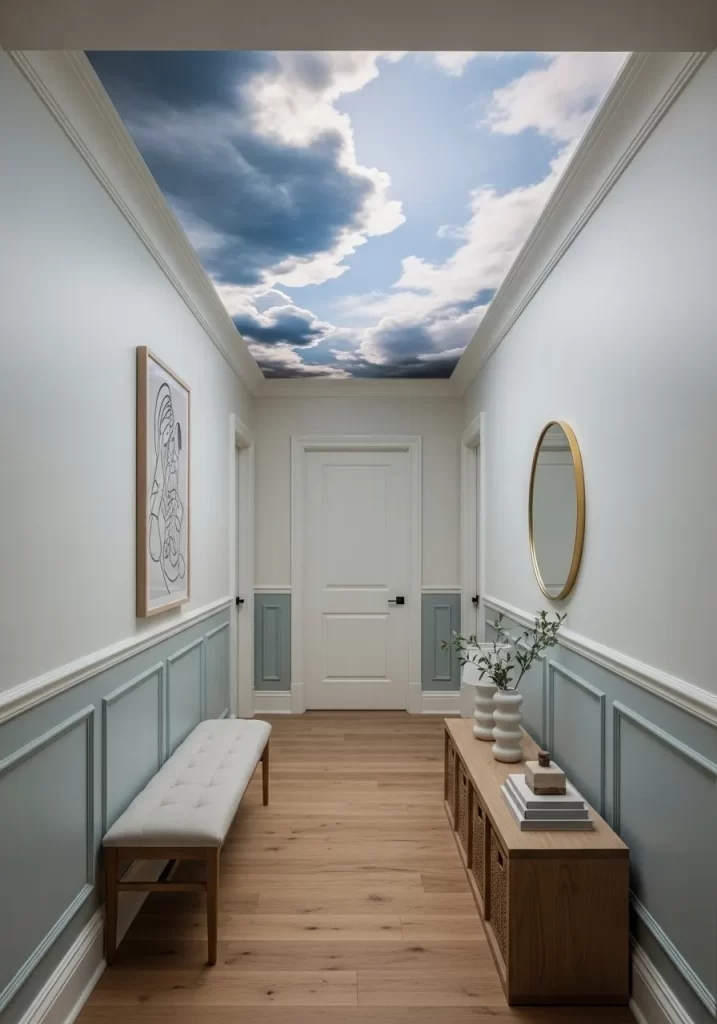
This hallway brings the outdoors right into your home. The ceiling becomes an actual window to the sky. A custom-printed ceiling mural shows a vibrant blue sky with fluffy clouds. This design choice opens up the entire space.
Below this airy ceiling, the walls feature classic wainscoting painted a soothing pale blue. Simple white trim and light wood floors ground the space. A minimalist bench and a woven console table offer practical spots for everyday items. An oval mirror with a gold frame completes the elegant, light-filled look.
DIY Sky Mural Ceiling
This high-impact project uses peel-and-stick wallpaper for a dramatic ceiling transformation.
Tools & Materials:
- Peel-and-stick wallpaper with a sky/cloud design
- Measuring tape
- Pencil
- Smoothing tool (a plastic squeegee)
- Utility knife with fresh blades
- Step ladder or scaffolding
Instructions:
- Clean the Ceiling: The ceiling must be clean and dry. Wipe it down to remove any dust or cobwebs.
- Measure and Cut:
- Measure the width of your ceiling.
- Unroll the wallpaper and cut the first strip slightly longer than your ceiling.
- Check if your wallpaper has a repeating pattern. If so, lay out your strips on the floor and match the pattern before cutting. Number them on the back to keep track.
- Find Your Starting Point:
- Start in a corner of your ceiling.
- Peel back about 6-12 inches of the paper backing from your first strip.
- Apply the First Strip:
- Carefully align the wallpaper to the ceiling corner.
- Press the exposed adhesive portion to the ceiling.
- Slowly peel more of the backing off, working your way across the ceiling.
- Use your smoothing tool to press the wallpaper firmly, pushing out any air bubbles as you go. Work from the center of the strip outwards.
- Continue and Trim:
- Align your next strip carefully, matching the pattern if applicable.
- Repeat the application process.
- Use a sharp utility knife to trim the excess wallpaper at the edges where the ceiling meets the wall. Change blades often for a clean cut.
22: The Collector’s Showcase
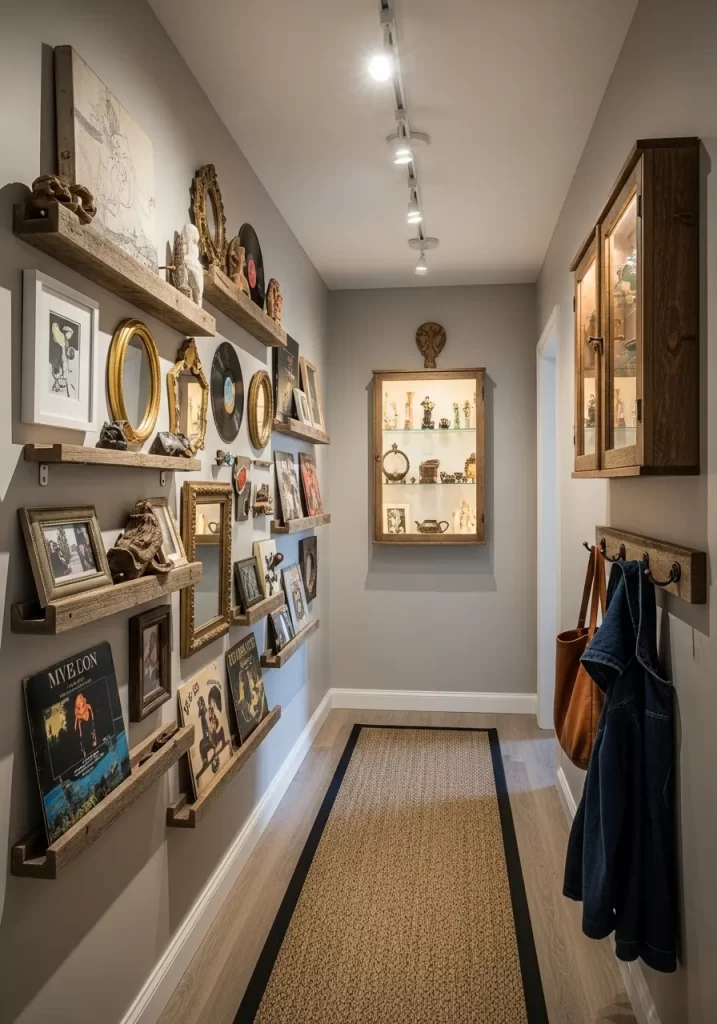
This hallway celebrates personal style and cherished objects. It feels like a walk through someone’s visual diary. One wall is covered in a layered display of open shelving and art. Rough-hewn wooden shelves hold a curated collection of framed art, vintage mirrors, and decorative pieces.
The display is varied, not perfectly symmetrical. Smaller art pieces lean against the wall. This gives it a relaxed, lived-in feel. A recessed, lit display cabinet at the end acts as a special showcase. A simple woven rug and track lighting complete the gallery atmosphere.
DIY Floating Picture Ledge Shelves
These shelves are easier to install than full bookshelves and let you change your display often.
Tools & Materials:
- Pre-made picture ledge shelves (or cut your own 1×4 lumber for the base and a 1×2 for the lip)
- Level
- Measuring tape
- Pencil
- Drill
- Screws and wall anchors (if not hitting studs)
- Stud finder
Instructions:
- Plan Your Layout:
- Decide how many shelves you want and how far apart they should be.
- Lay out your art and objects on the floor to visualize what will go on each shelf.
- Mark Your First Shelf:
- Use a stud finder to locate studs in your wall. Mark them.
- Hold your first shelf against the wall. Use a level to make sure it’s straight.
- Mark the screw holes on the wall.
- Install the Shelf:
- Drill pilot holes at your marks.
- If you hit a stud, drill directly. If not, insert wall anchors.
- Screw the shelf securely to the wall.
- Repeat for All Shelves:
- Measure the distance you want between shelves (e.g., 12 inches).
- Mark and install the next shelf. Repeat until all your shelves are up.
- Arrange Your Art:
- Place your framed art and objects on the shelves.
- You can lean pictures against the wall for a casual look. Overlap frames slightly. The beauty of a picture ledge is that you can easily rearrange the display without new nail holes.
23: The Terra Cotta Corridor
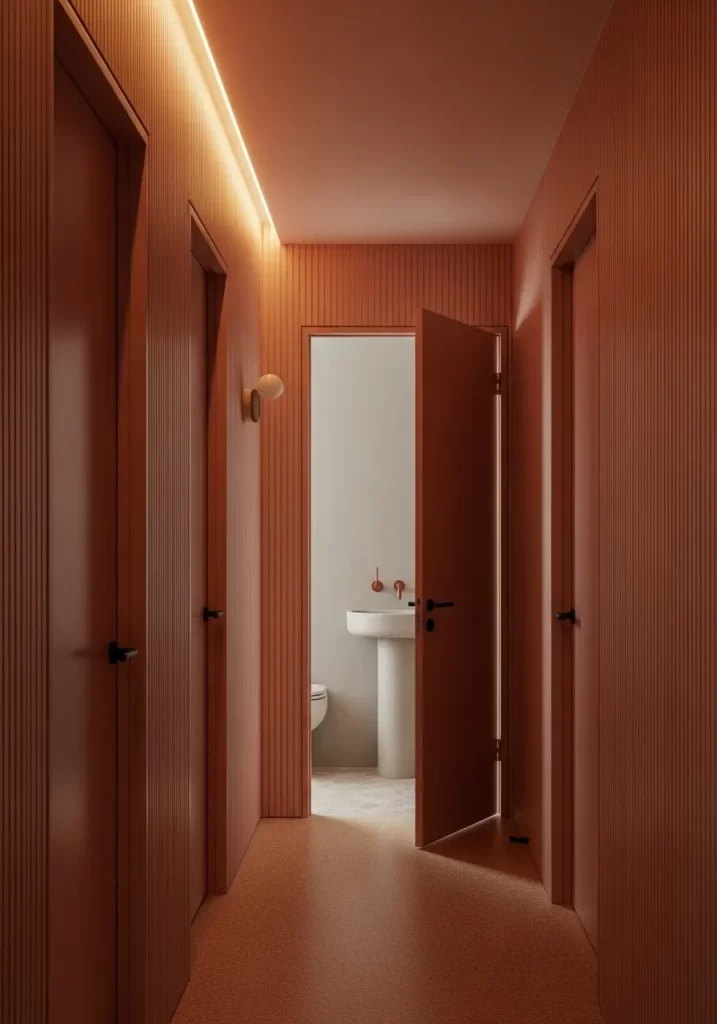
This hallway wraps you in warmth with its rich, earthy tones. The walls and even the doors are completely covered in a deep, ruddy terra cotta color. This monochromatic approach creates a strong, cohesive design.
The wall surface is subtly textured with fine vertical fluting, which adds depth and catches the light. A recessed LED strip along the top of one wall washes the ceiling and wall with a soft glow. A simple round sconce provides an additional, gentle light. This hallway feels like a cozy, modern retreat.
DIY Vertical Fluted Wall Panels
This technique creates the illusion of sophisticated architectural fluting using common materials.
Tools & Materials:
- Thin wood strips (like lattice or thin MDF strips)
- Wood glue
- Small finish nails or brad nailer (optional)
- Measuring tape
- Level
- Paint (your desired terra cotta color)
- Paintbrush
- Spacing guide (a piece of wood cut to your desired gap, e.g., 1/2 inch)
Instructions:
- Prep the Wall: Ensure the wall is clean and smooth. Paint the wall your desired base color before adding the strips. This makes it easier.
- Cut Your Strips: Measure the height of your wall from floor to ceiling. Cut all your wood strips to this exact length.
- Install the First Strip:
- Start in a corner. Apply a thin line of wood glue to the back of your first strip.
- Press it firmly against the wall. Use a level to make sure it’s perfectly vertical.
- If using nails, secure it with a few small finish nails.
- Use Your Spacer:
- Place your spacing guide (e.g., a 1/2-inch wide piece of wood) against the side of the strip you just installed.
- Install the Next Strip:
- Apply glue to the next strip.
- Press it against the other side of your spacer. This guarantees an even gap.
- Secure it with nails if using.
- Repeat and Paint:
- Continue this process across the entire wall.
- Once all the strips are installed and the glue is dry, paint the entire wall again, including the strips and the gaps. This unifies the look and makes it appear as one cohesive fluted surface.
24: The Industrial Loft Passage
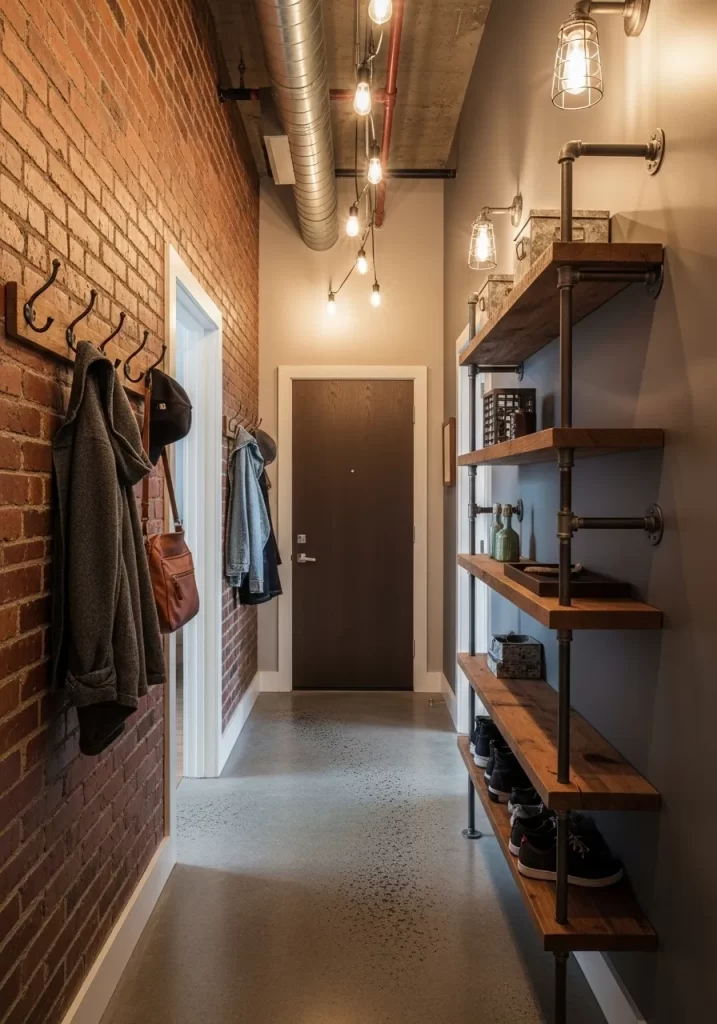
This hallway embraces raw, urban textures. It feels edgy and strong. One wall is exposed red brick. This brings a rustic, warm element to the space. The ceiling features exposed ductwork and industrial-style pipe lighting with bare bulbs.
Opposite the brick, a custom-built shelving unit uses galvanized steel pipes and rustic wood planks. This creates a functional storage area for shoes and accessories. Metal coat hooks on the brick wall add more utilitarian style. The concrete floor completes the robust, factory-inspired aesthetic.
DIY Industrial Pipe Shelving
This project gives you strong, stylish, and customizable shelving using plumbing pipes.
Tools & Materials:
- Black iron or galvanized steel pipes (various lengths for vertical supports)
- Matching pipe fittings (flanges, elbows, tees)
- Wood planks (for shelves)
- Drill
- Screws and wall anchors
- Measuring tape
- Level
- Wood stain or sealer (for planks)
Instructions:
- Design Your Shelf: Sketch out your desired shelf height and width. This will help you know how many pipes and fittings you need.
- Stain Your Wood: Stain or seal your wood planks now, before assembly. Let them dry completely.
- Assemble the Pipe Sections:
- Twist the pipe pieces together.
- For a wall-mounted unit, you will have vertical pipe sections connected by horizontal pipe sections.
- Attach a “flange” (a round base) to the ends of the pipes that will connect to the wall.
- Mark and Drill:
- Hold your first pipe section against the wall. Use a level.
- Mark the screw holes through the flanges onto the wall.
- Drill pilot holes and insert wall anchors (if not hitting studs).
- Attach to Wall:
- Screw the pipe sections securely to the wall.
- Ensure all parts are straight and level.
- Add the Shelves:
- Once the pipe framework is on the wall, simply place your stained wood planks on top of the horizontal pipe sections.
- You can secure them with small pipe clamps or L-brackets if you want them firmly attached.
25: The Muted Zen Retreat
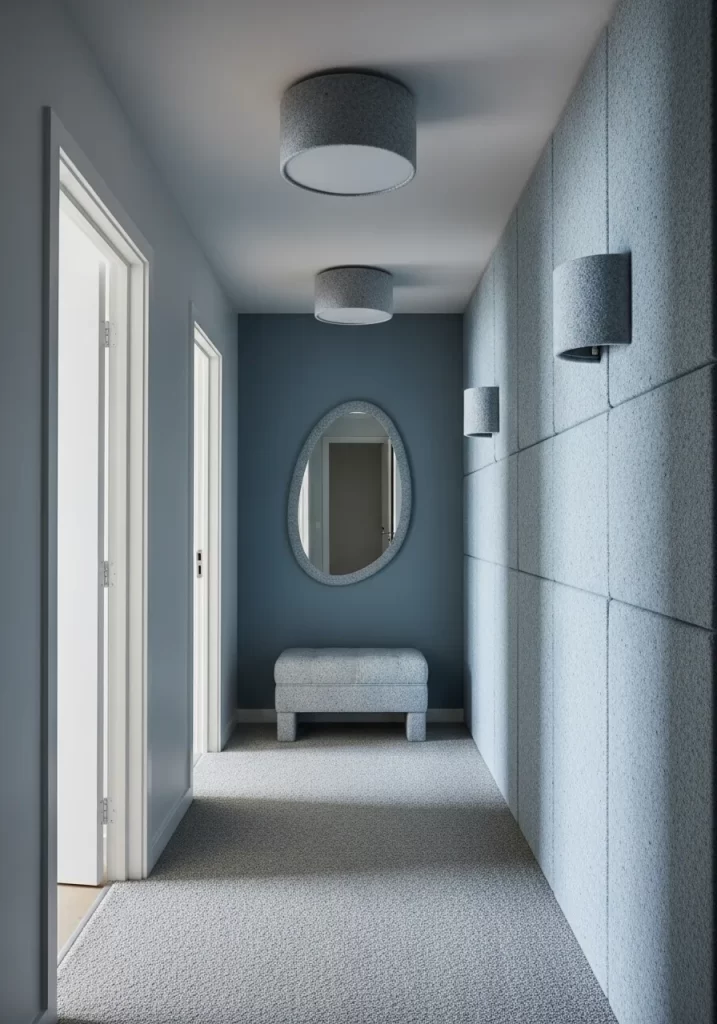
This hallway is calming and quiet. It uses soft textures and a monochromatic color scheme. The walls are painted a soothing grey-blue, creating a backdrop for subtle tactile elements.
One wall features large, square acoustic panels. These add texture and also help dampen sound, making the space feel more peaceful. Cylindrical ceiling lights and matching fabric sconces reinforce the soft, rounded forms. An oval mirror and a small upholstered bench in a matching grey complete the serene, understated design.
DIY Fabric Acoustic Panels
These panels add style and absorb sound, making hallways feel less echoey.
Tools & Materials:
- Acoustic foam panels (often sold in squares)
- Fabric (a textured, tight-weave fabric like linen or felt in your desired color)
- Plywood or MDF cut to the size of your foam panels
- Heavy-duty spray adhesive (for fabric)
- Staple gun and staples
- Picture hanging hardware (D-rings or sawtooth hangers)
- Measuring tape
- Scissors
Instructions:
- Cut Your Bases: Have your plywood or MDF cut to the size of your foam panels. This will be the sturdy backer.
- Attach Foam to Board:
- Spray one side of the plywood/MDF and one side of the acoustic foam with spray adhesive.
- Carefully press the foam onto the board. Let it dry.
- Wrap with Fabric:
- Lay your fabric face down. Place your foam-covered board (foam side down) in the center of the fabric.
- The fabric should be large enough to wrap around the foam and board, with at least 2-3 inches to spare on each side.
- Start with one long side. Pull the fabric taut and staple it to the back of the plywood/MDF.
- Repeat on the opposite long side, pulling the fabric very taut so it’s smooth on the front.
- Neatly fold and staple the corners like you’re wrapping a gift.
- Add Hanging Hardware:
- Screw D-rings or sawtooth hangers to the back of the plywood/MDF.
- Hang Your Panels:
- Decide on your grid layout.
- Use a level to make sure your first panel is straight.
- Hang your panels, spacing them evenly to create the desired grid effect.
26: The Sunset Glow Corridor
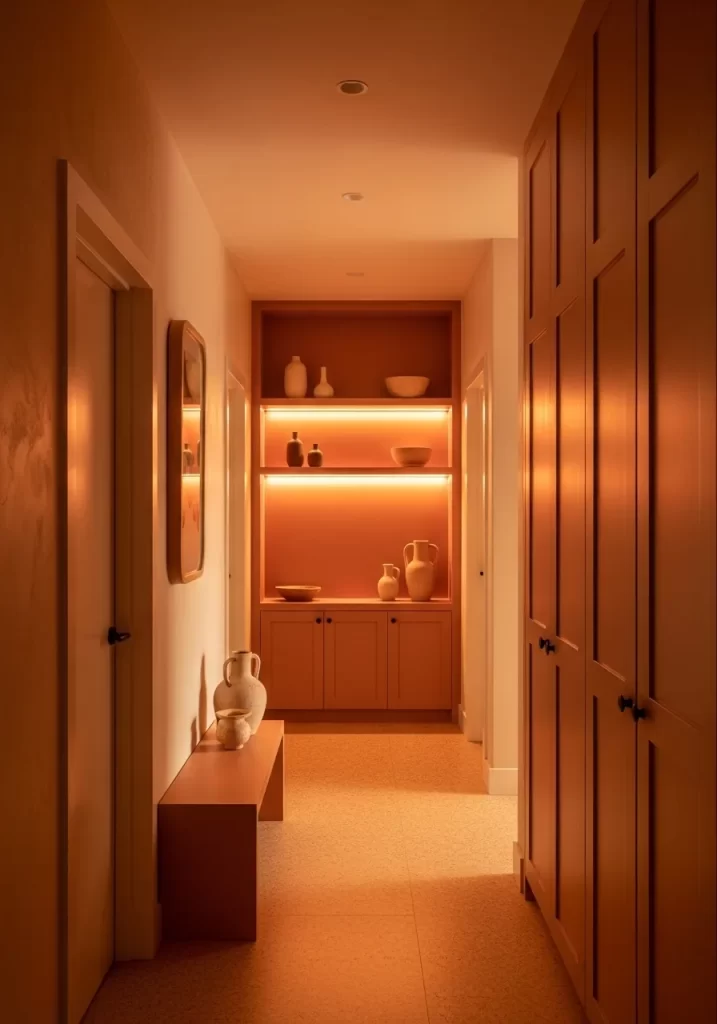
This hallway bathes you in a warm, inviting light. It uses warm light and a rich color palette to create an intimate, inviting feel. The walls are painted a beautiful, soft terracotta or peach color.
The end of the hallway features a built-in recess with open shelving and a lower cabinet. This alcove is painted a slightly darker shade, making it a focal point. LED strip lighting under each shelf washes the items with a soft, ambient light, creating a glowing effect. The entire space feels like it’s bathed in a permanent sunset.
DIY Lit Recessed Shelving
You can create this look by building a simple box and adding LED strips.
Tools & Materials:
- Plywood (1/2-inch or 3/4-inch)
- Miter saw or hand saw
- Wood glue
- Small finish nails or brad nailer
- Paint (your desired color)
- LED strip lights (battery or plug-in, warm white)
- Measuring tape
- Level
- Sandpaper
Instructions:
- Measure Your Space: Measure the width and depth of your hallway recess. Decide on the number and height of your shelves.
- Cut Your Pieces:
- Cut two side pieces (for the vertical supports).
- Cut your top and bottom pieces.
- Cut your shelves. Remember, the shelves will fit between the vertical supports.
- Assemble the “Box”:
- Lay a side piece flat. Apply wood glue along the edges where shelves will sit.
- Position your shelves. Use a level.
- Nail through the side piece into the ends of the shelves.
- Attach the other side piece. You now have a ladder-like structure.
- Paint It: Paint the entire unit (before installing) with your chosen color. Let it dry completely.
- Install the Lights:
- Peel the adhesive backing from your LED strips.
- Stick them to the underside of each shelf, towards the front edge.
- Run the wires discreetly behind the unit or drill a small hole for them.
- Install in Recess:
- Slide your assembled unit into the hallway recess.
- Secure it to the walls by screwing through the side pieces into the wall studs.
- Hide any power cords with a cord concealer or by running them behind the unit to an outlet.
27: The Sculptural White Passage
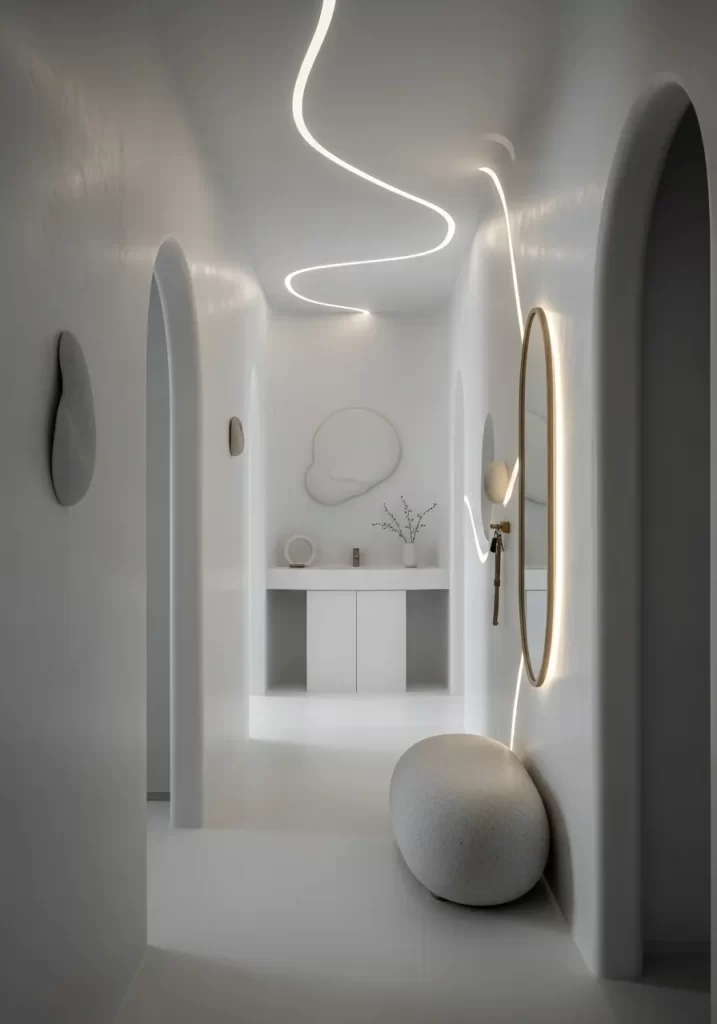
This hallway is an exercise in pure form and light. It feels ethereal and artistic. The entire space is painted a bright, uniform white, from walls to floor. This creates a clean, gallery-like canvas.
The walls are softened by gentle arches that frame doorways. A wavy, winding LED light strip snakes across the ceiling, acting as a dynamic art installation. The furniture is sculptural and minimal: an oval mirror with a thin light outline, a simple white console, and a smooth, stone-like bench. It feels like walking through a cloud.
DIY Wavy Ceiling Light Strip
This creative light installation turns a simple LED strip into a piece of art.
Tools & Materials:
- Flexible LED light strip (with adhesive backing)
- Small, clear cable clips (with adhesive backing or screw-in)
- Pencil
- Measuring tape
- Your imagination
Instructions:
- Plan Your Wave:
- Lightly draw a wavy or meandering line on your ceiling with a pencil.
- Experiment with gentle curves or more dramatic zig-zags. The beauty of this is its organic feel.
- Clean the Ceiling: Wipe down the ceiling with a damp cloth, then dry it completely.
- Apply the Clips:
- Place your clear cable clips along your pencil line, every 12-18 inches. These will hold the LED strip in place.
- If using adhesive clips, press them firmly. If screw-in, drill pilot holes and secure them.
- Install the LED Strip:
- Peel the backing off the LED strip a little at a time.
- Gently press the LED strip into the clips, following your pencil line.
- Work slowly, making sure the strip is securely held in each clip.
- Connect to Power:
- Run the power cord to your nearest outlet.
- If you want a truly wireless look, you can use battery-powered LED strips, but they may need more frequent battery changes.
28: The Inner Garden Atrium
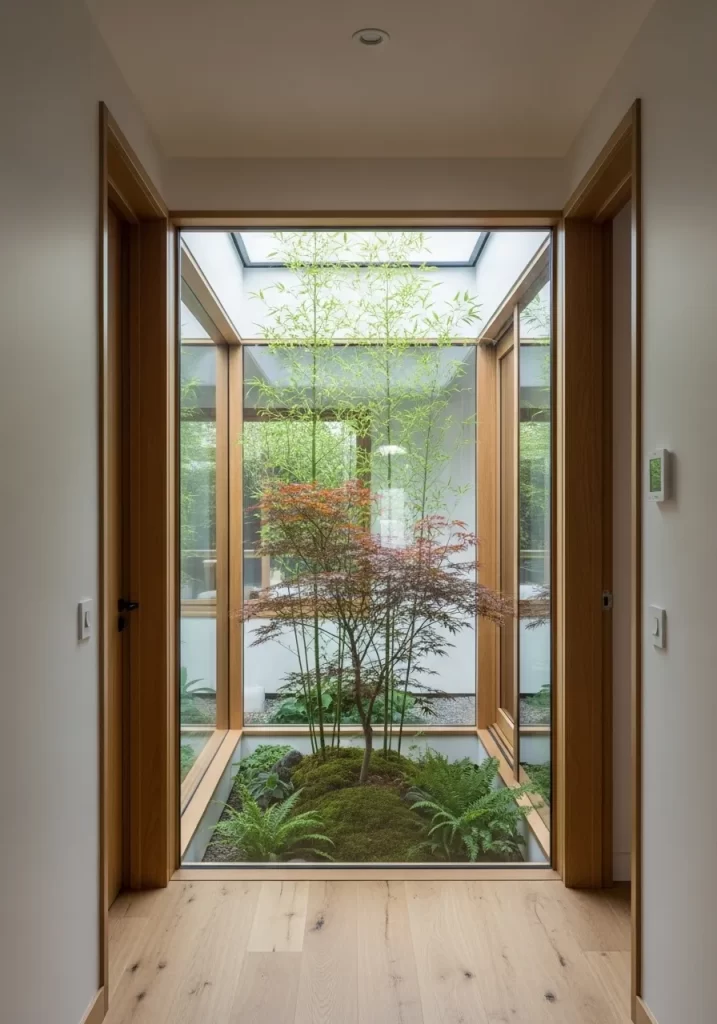
This hallway is more than a passage. It’s a tranquil viewing experience. The end of the hallway opens onto a lush, internal courtyard or atrium. It’s enclosed by tall glass panels with thin wooden frames.
Inside, small trees and various ferns create a mini-ecosystem. A skylight above floods the space with natural light. This design brings a living, breathing element into the home. It gives you a serene, green view that changes with the seasons, making the hallway feel open and connected to nature.
DIY “Atrium” Faux Plant Wall
This project brings the look of a green atrium to a plain end wall, without major construction.
Tools & Materials:
- Large sheets of plywood or hardboard (cut to fit your end wall)
- Artificial turf (small roll for the “ground”)
- Various high-quality artificial plants (ferns, small trees, leafy vines)
- Hot glue gun and plenty of glue sticks
- Construction adhesive
- Wood trim (for framing)
- Paint (white, for the frame)
- Screws and drill
Instructions:
- Mount the Base:
- Attach the plywood or hardboard sheets directly to your end wall using screws. This is your canvas.
- Add the “Ground”:
- Cut the artificial turf to fit the bottom portion of your plywood.
- Use hot glue or construction adhesive to secure it firmly.
- Build Your Garden:
- Start with your largest artificial plants (e.g., small trees). Position them where you want them.
- Use hot glue and possibly small screws to attach their bases to the plywood.
- Next, fill in with your ferns and leafy plants, layering them to create depth.
- Use hot glue to attach plants directly to the plywood, building up a lush scene.
- You can even add some small, clean pebbles or decorative rocks at the base.
- Frame It Out:
- Once your garden is complete, cut your wood trim pieces to frame the entire plywood section.
- Paint the trim white.
- Nail the painted trim around the edges of your faux garden to create the look of a window frame.
29: The Slatted Coat Wall
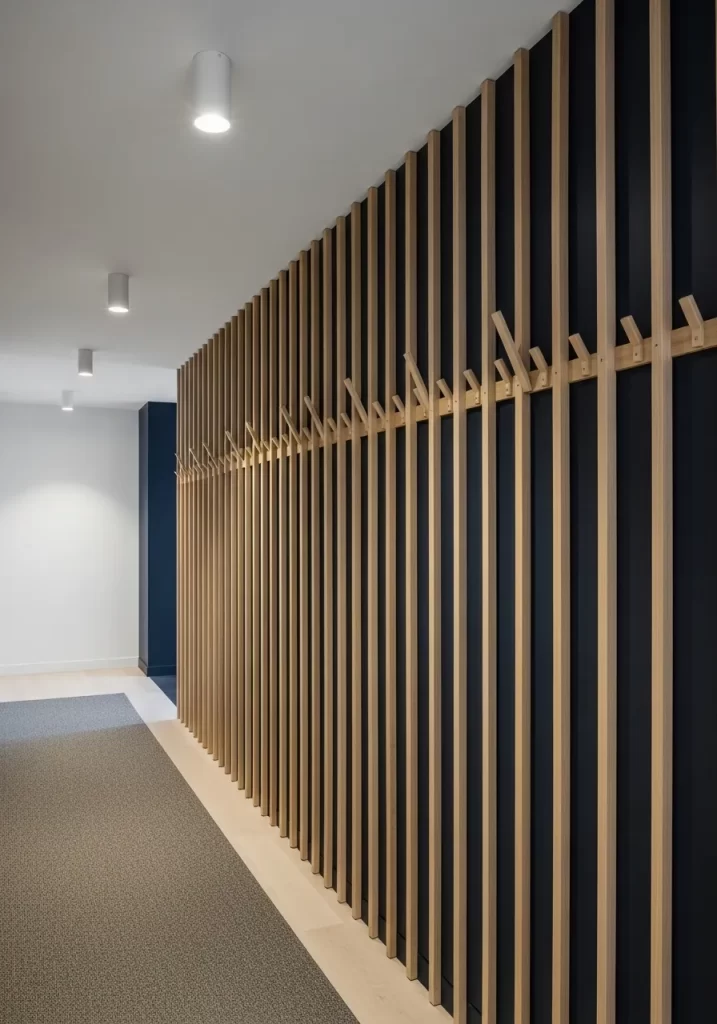
This hallway is a study in modern minimalism and smart function. It uses vertical wooden slats against a dark accent wall. This creates a strong visual pattern. The dark wall recedes, making the natural wood pop.
The genius here is the integrated coat rack. Some of the wooden slats extend out from the wall at an angle, becoming sculptural, minimalist hooks. This clever design provides storage without clutter. The simplicity of the form makes it a piece of art in itself. A plain rug and track lighting keep the focus on the wall.
DIY Integrated Wood Slat Coat Hooks
This project turns an accent wall into a functional, artful coat rack.
Tools &Materials:
- 1×2 wood lumber (for vertical slats)
- 1×2 wood lumber (for angled hooks)
- Dark paint (for the accent wall)
- Saw (miter saw for precise angles)
- Wood glue
- Longer wood screws (2.5-3 inches)
- Drill
- Level
- Stud finder
- Sandpaper
Instructions:
- Paint the Wall: Paint the wall your dark accent color. Let it dry completely.
- Cut Vertical Slats: Cut your 1×2 lumber to the height of your wall. These are your main vertical pieces.
- Cut the Hooks:
- For each hook, cut a 1×2 piece about 6-8 inches long.
- On one end of each hook piece, cut a 45-degree angle. This will be the end that faces up.
- Sand Everything: Sand all cut edges smooth.
- Install Vertical Slats:
- Attach your first vertical slat to the wall using wood glue and screws. Ensure it’s level.
- Use a spacer (another 1×2) to create even gaps as you install the rest of your vertical slats.
- Attach the Hooks:
- Decide where you want your hooks.
- Apply wood glue to the flat end of a hook piece.
- Drill pilot holes through the back of one of your installed vertical slats and into the end of your angled hook piece.
- Secure the hook firmly with a long wood screw. The screw should go through the slat and deep into the hook.
- Repeat for all your hooks.
30: The Frosted Glass Gateway
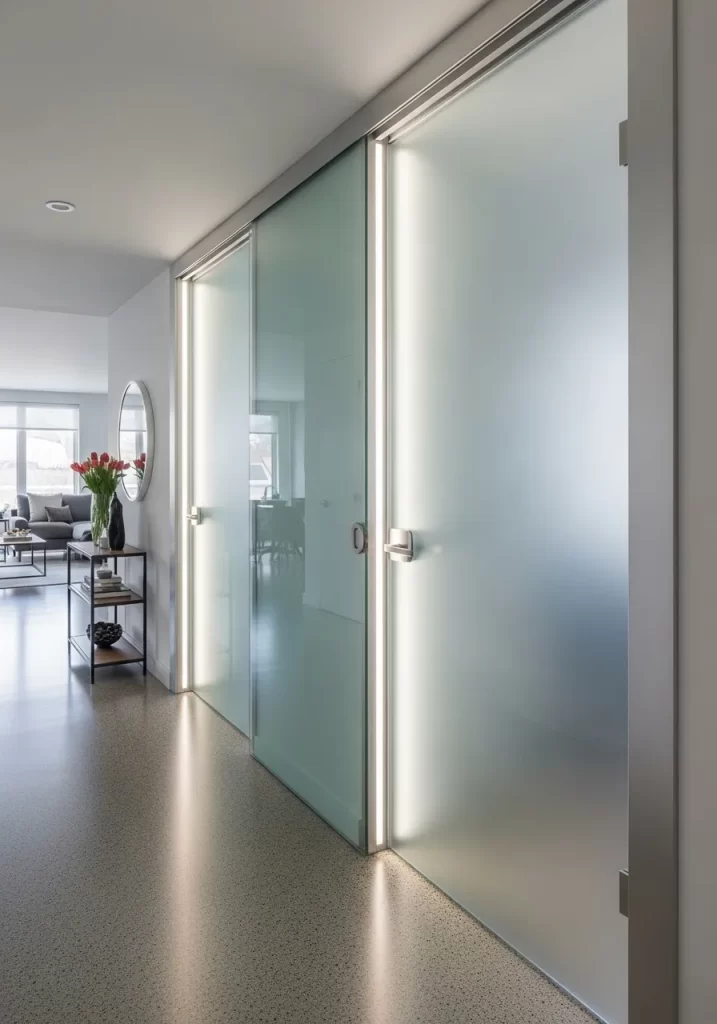
This hallway is sleek, luminous, and discreet. It uses frosted glass panels as doors, letting light pass through while maintaining privacy. The design is modern and minimalist.
Each frosted glass panel is framed by a vertical strip of soft LED light. This creates a gentle glow that highlights the entryway and adds ambient light to the hallway. The rest of the space is kept simple, with smooth white walls and a polished floor. This ensures the luminous doorways remain the star of the show.
DIY Frosted Window Film for Doors
You can mimic the look of frosted glass on existing doors or glass panels.
Tools & Materials:
- Frosted window privacy film (comes in rolls)
- Spray bottle with soapy water (a few drops of dish soap in water)
- Squeegee or plastic smoothing tool
- Utility knife with a fresh blade
- Measuring tape
- Cleaning cloth
Instructions:
- Clean the Surface: Thoroughly clean the glass on your door or panel. Any dust or smudges will show through the film.
- Measure and Cut:
- Measure the exact dimensions of your glass pane.
- Cut the privacy film slightly larger than your measurements (about 1/2 inch extra on all sides). You will trim it precisely once it’s on the glass.
- Spray the Glass: Liberally spray the entire glass surface with the soapy water solution. This makes the film slide and allows you to reposition it.
- Apply the Film:
- Peel the backing off the privacy film (this can be tricky, you might need two people for large pieces).
- Carefully place the adhesive side of the film onto the wet glass.
- The soapy water will allow you to slide and reposition the film until it’s exactly where you want it.
- Squeegee Out Bubbles:
- Once positioned, use your squeegee. Start from the center and firmly push the water and any air bubbles out towards the edges.
- Wipe away excess water with a clean cloth.
- Trim the Edges:
- Use your utility knife and a straight edge (like a ruler) to carefully trim the excess film right along the edge of the glass. Change blades often for a clean cut.
31: The Blush Tone Entry
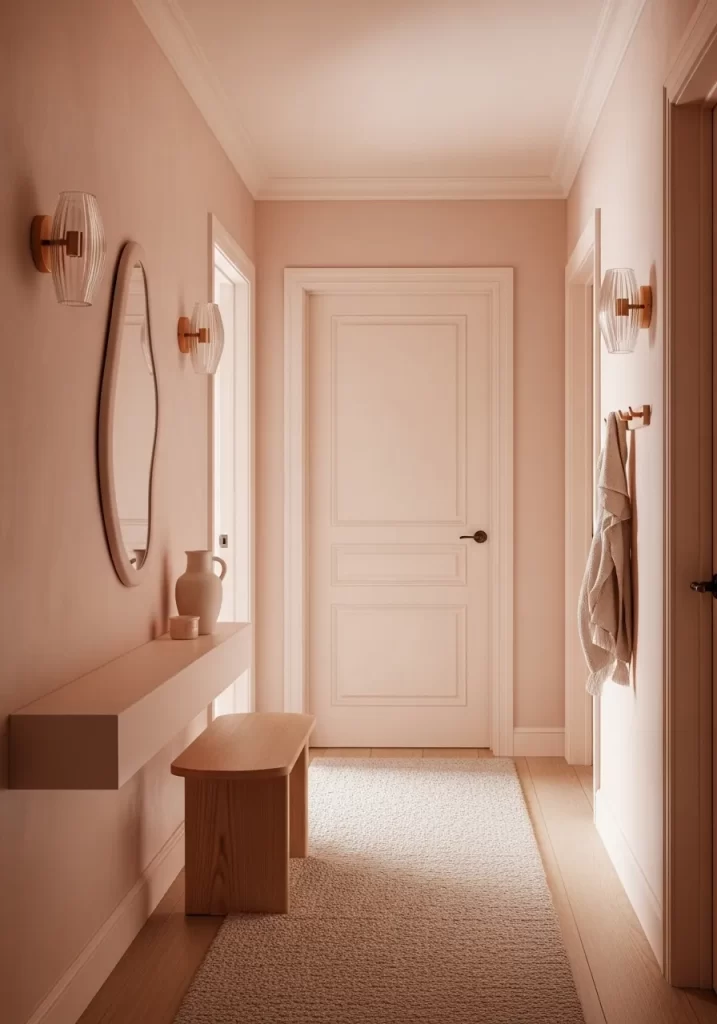
This hallway is soft, inviting, and utterly elegant. It’s bathed in a beautiful, warm blush pink. This monochromatic color choice extends across the walls and even the central door, creating a cohesive and calming atmosphere.
The space is kept minimal. A clean, floating shelf provides a spot for a vase and a subtle mirror. A simple wooden bench offers a moment to pause. Cylindrical glass sconces cast a warm glow, adding to the gentle ambiance. This hallway feels like a soft embrace.
DIY Floating Shelf
A floating shelf adds visual interest and surface area without heavy legs.
Tools & Materials:
- A sturdy wood board (e.g., 2×8 or 2×10) cut to your desired length
- Floating shelf brackets (these hide inside the shelf)
- Drill
- Level
- Measuring tape
- Pencil
- Stud finder
- Wood filler
- Paint or stain
Instructions:
- Prep the Shelf: Sand your wood board smooth. If you plan to paint or stain it, do so now and let it dry completely.
- Locate Studs: Use your stud finder to mark the location of wall studs where you want to mount the shelf. This provides the strongest support.
- Install Brackets:
- Position your first bracket on the wall, making sure it’s level.
- Mark the screw holes onto the wall.
- Drill pilot holes. Screw the bracket securely into the studs.
- Repeat for any other brackets needed, ensuring they are perfectly aligned.
- Prepare the Shelf for Brackets:
- Hold your finished shelf board up to the installed brackets.
- Mark where the brackets touch the back of the shelf.
- Drill holes into the back of your shelf that match the diameter and depth of your floating shelf rods. You want a snug fit.
- Mount the Shelf:
- Carefully slide the shelf onto the bracket rods.
- Push it firmly against the wall.
- If there are any visible gaps, use a bit of wood filler and touch-up paint.
32: The Dramatic Marble Accent
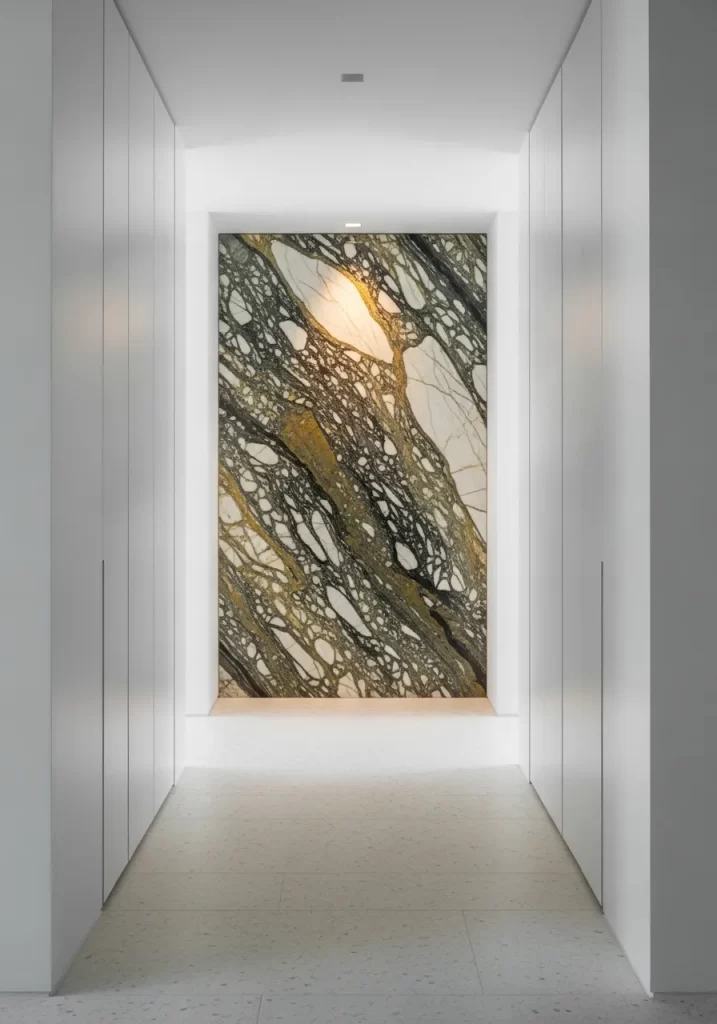
This hallway is strikingly modern and dramatic. It uses clean lines and a powerful natural material. The space is lined with sleek, handle-free white cabinets on both sides, providing immense hidden storage.
At the very end, the hallway opens to reveal a single, magnificent slab of veined marble. The marble’s pattern is bold, with rich black, white, and golden tones. It acts as a stunning piece of art, lit from above by a discreet spotlight. This focused display elevates a simple hallway into a luxurious experience.
DIY Faux Marble Slab Art
You can create the look of a large marble slab using paint and a touch of artistic flair.
Tools & Materials:
- Large sheet of plywood or MDF (cut to size for your end wall)
- White or light grey base paint
- Black, dark grey, and gold craft paints
- Feather or thin artist’s brush
- Small natural sponge
- Clear acrylic glaze or topcoat
- Small spray bottle with water
- Wood screws and drill (for mounting)
- Sandpaper
Instructions:
- Prep the Board: Sand your plywood/MDF smooth. Paint it with your white or light grey base color. Let it dry completely.
- Sketch Veins: Lightly sketch some large, winding, organic “veins” onto your board with a pencil. Don’t make them too regular.
- Paint the Veins:
- Using a thin artist’s brush, paint along your pencil lines with black or dark grey paint. Make some veins thicker and some very thin, like cracks.
- While the paint is still wet, lightly spray with water to make the paint bleed and soften.
- Use a clean, damp sponge to gently dab and soften some of the hard lines, creating a more natural marble effect.
- Add Gold Accents:
- Once the first layer of veins is dry, add some thinner, delicate gold veins with your fine brush.
- You can also use a small piece of natural sponge to gently dab very diluted gold paint in areas, creating a “shimmer.”
- Seal It: Let all the paint dry completely. Apply several coats of clear acrylic glaze or topcoat to give it a smooth, glossy, marble-like finish.
- Mount It: Screw the finished faux marble board directly to your end wall.
33: The Luminous Lines
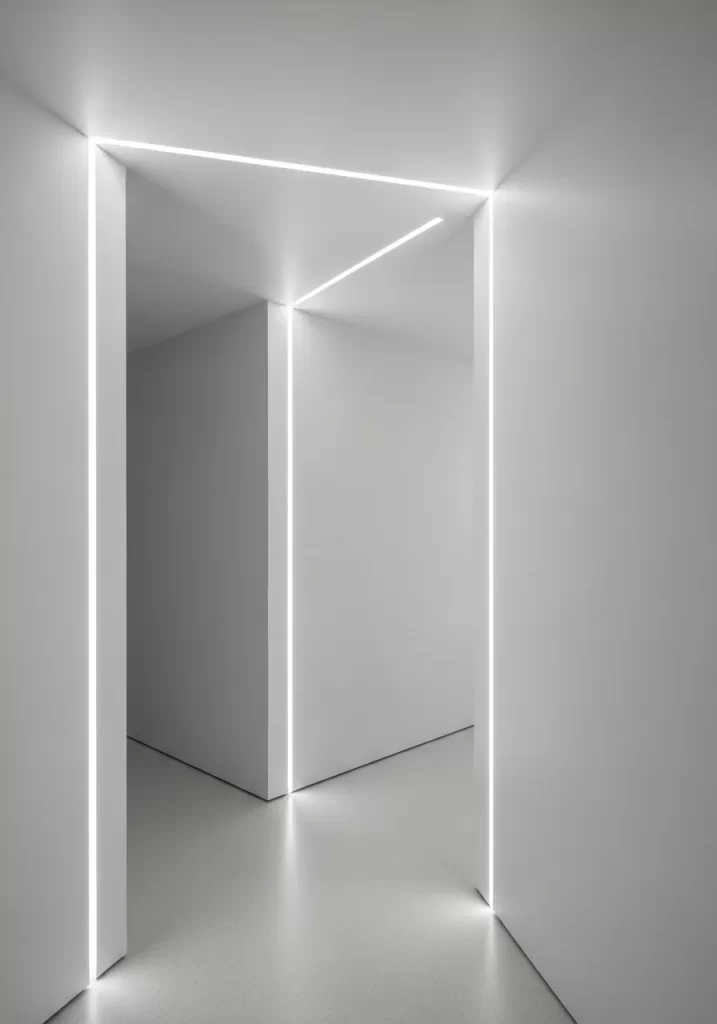
This hallway is an exploration of light as architecture. It feels like stepping into a futuristic art installation. The entire space is stark white, making the light itself the main feature.
Thin, continuous lines of LED light are recessed into the walls, floor, and ceiling. These lines wrap around corners, defining the geometry of the space. The light is bright and crisp, casting soft shadows that enhance the clean, minimalist aesthetic. This design is both simple and profoundly impactful.
DIY LED Strip Light Corners
You can recreate this effect using LED strips and corner mounting channels.
Tools & Materials:
- LED light strips (choose a “cool white” or “daylight” color)
- Aluminum LED corner profiles/channels (these are L-shaped and hide the strip)
- Measuring tape and pencil
- Saw (to cut aluminum channels)
- Drill
- Screws
- Power drill and small screws
- Cord concealer kit (if needed)
Instructions:
- Plan Your Lines: Decide where your lines will go—along a ceiling edge, down a wall corner, or along the floor.
- Measure and Cut Channels:
- Measure the lengths of your desired light lines.
- Cut your aluminum LED channels to these lengths. For corners, you might need to miter cut the channels (cut at a 45-degree angle) for a seamless join.
- Mount the Channels:
- Position your first channel on the wall/ceiling. Use a level.
- Mark the screw holes. Drill pilot holes.
- Secure the channels with small screws.
- Install LED Strips:
- Peel the adhesive backing off the LED strip.
- Press the strip firmly inside the aluminum channel.
- Add the Diffuser:
- Snap the frosted plastic cover onto the aluminum channel. This diffuses the light, creating a continuous line rather than showing individual LED dots.
- Connect Power:
- Run the power cord to your nearest outlet.
- Use cord concealer to hide the power cord along the wall.
34: The Indoor Jungle Path
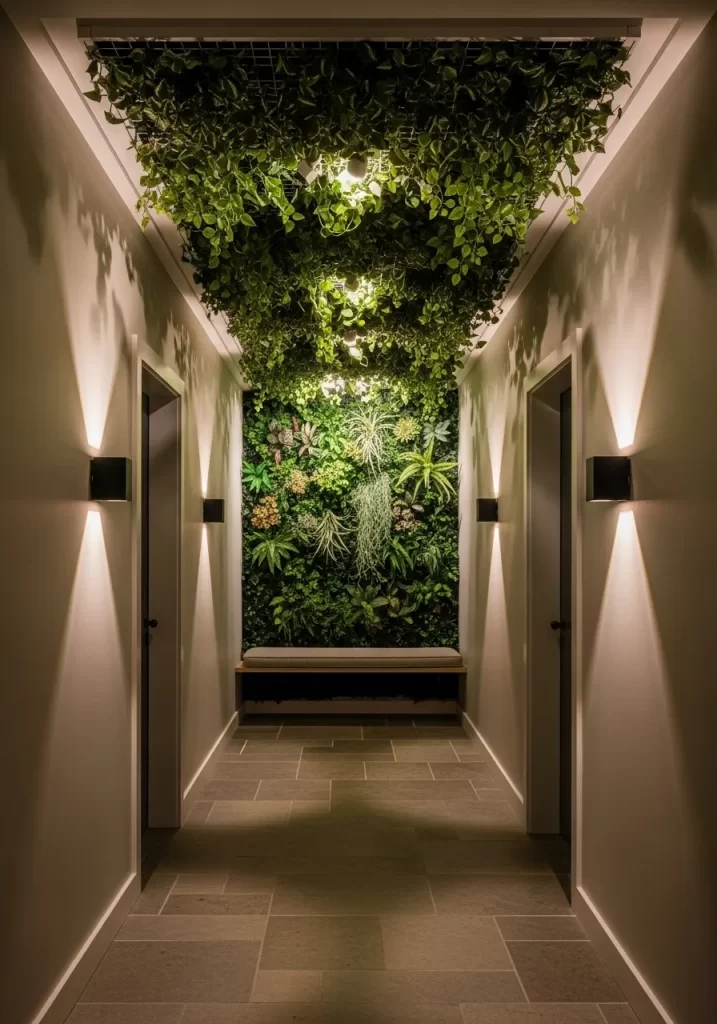
This hallway creates an immersive, natural experience. It brings the lushness of a jungle indoors. The end wall is a full vertical garden, packed with different shades and textures of green plants.
Above, the ceiling is also covered in trailing, artificial foliage, hanging down like a green canopy. This layering of plants creates a truly enveloping effect. Upward-facing lights on the floor and spotlights in the ceiling illuminate the greenery, making it glow. A simple wooden bench offers a quiet spot for reflection.
DIY Faux Ceiling Vines and Wall Garden
You can achieve this lush look with high-quality artificial plants and a bit of creativity.
Tools & Materials:
- Artificial plant wall panels (often 10×10 or 20×20 inches, with a plastic grid backing)
- Artificial vine garlands (various lengths and leaf types)
- Hot glue gun and many glue sticks
- Zip ties (small)
- Small screws and drill
- Fishing line or clear string
- Grid ceiling tiles (if you have them, otherwise use plywood)
Instructions:
- Mount Wall Panels:
- Screw the artificial plant wall panels directly to your end wall. They usually snap together, making it easy to cover the whole surface.
- Create the Ceiling Base:
- If you have a grid ceiling, you can attach vines directly to it.
- If not, mount sheets of plywood to your ceiling (painted green or dark). This will be your base for the vines.
- Attach Ceiling Vines:
- Take your artificial vine garlands. Use small screws or zip ties to secure the ends of the vines to your ceiling base (or grid).
- Let the vines hang and drape naturally. Layer different types of vines to create a lush, varied look.
- Use hot glue to attach some vines more firmly if needed.
- Blend Wall and Ceiling:
- Use smaller vine pieces and hot glue to blend the top edge of your wall garden with the hanging ceiling vines. You want it to look continuous.
- Add Accents:
- Tuck in some individual artificial plants or flowers into the wall garden panels to add more detail and realism.
35: The Playful Terrazzo Floor
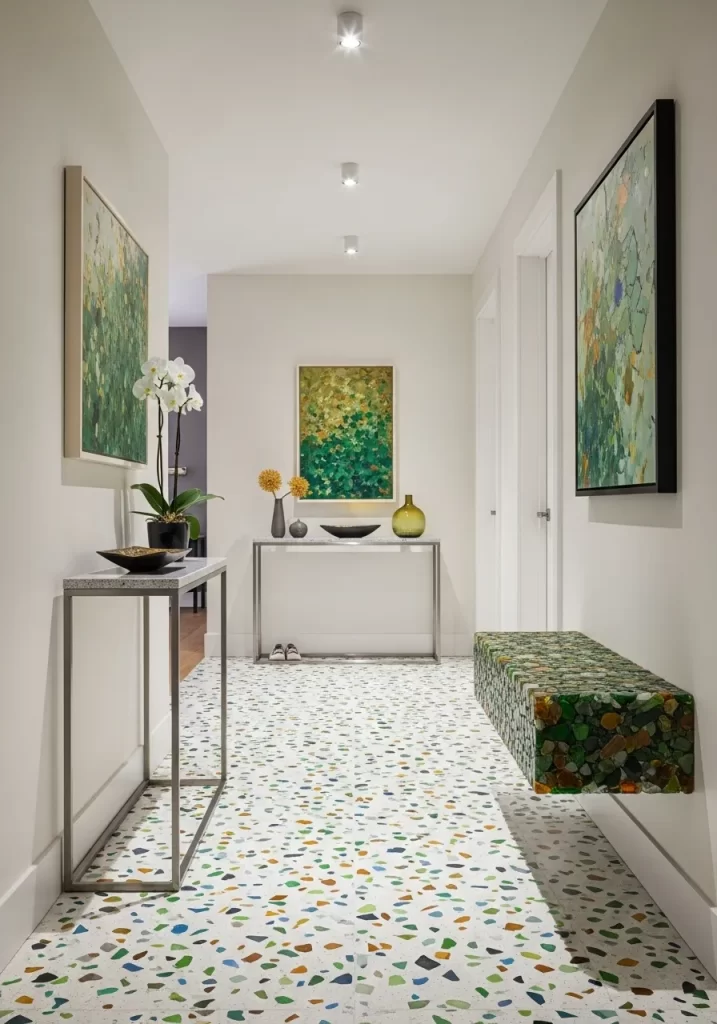
This hallway is cheerful and bright. It uses a dynamic, multi-colored terrazzo-style floor. This vibrant pattern injects immediate energy into the space. The walls are kept a crisp, neutral white.
The decor is minimal, letting the floor be the star. Modern abstract art on the walls echoes the green and yellow tones of the floor. Sleek, stainless steel console tables add a touch of sophistication. A unique, floating bench made of colorful “sea glass” chips provides an unexpected, playful touch.
DIY Painted Terrazzo Floor
This DIY replicates the fun, speckled look of terrazzo without the expense of real stone.
Tools & Materials:
- Base floor paint (white or very light grey)
- 3-4 craft paint colors for the “chips” (green, orange, blue, black)
- Small artist’s brushes (various sizes)
- Small natural sponges, torn into irregular shapes
- Clear, water-based floor-grade polyurethane sealer
- Paint roller for sealer
Instructions:
- Prep the Floor: Ensure your floor is perfectly clean, dry, and smooth. Paint it with your base color (white or light grey) and let it dry completely.
- Create “Chips” with Sponges:
- Pour a small amount of your first chip color (e.g., green) onto a paper plate.
- Dip an irregularly torn piece of sponge into the paint. Dab off excess.
- Lightly press the sponge onto the floor, creating random, irregular shapes. Space them out.
- Layer Colors:
- Repeat with your second, third, and fourth chip colors.
- Vary the size and shape of your dabs. Overlap some colors. The goal is a random, natural look.
- Add Fine Details:
- Once the sponged layers are dry, use a fine artist’s brush to draw some very thin, hair-like lines of black or a contrasting color within some of the “chips.” This mimics the fine veins in real terrazzo.
- Seal for Durability:
- Let all the paint dry for at least 24 hours.
- Roll on a thin, even coat of floor-grade polyurethane sealer.
- Allow it to dry fully according to product instructions.
- Apply a second and third coat for maximum protection against wear and tear.
36: The Scalloped Archway
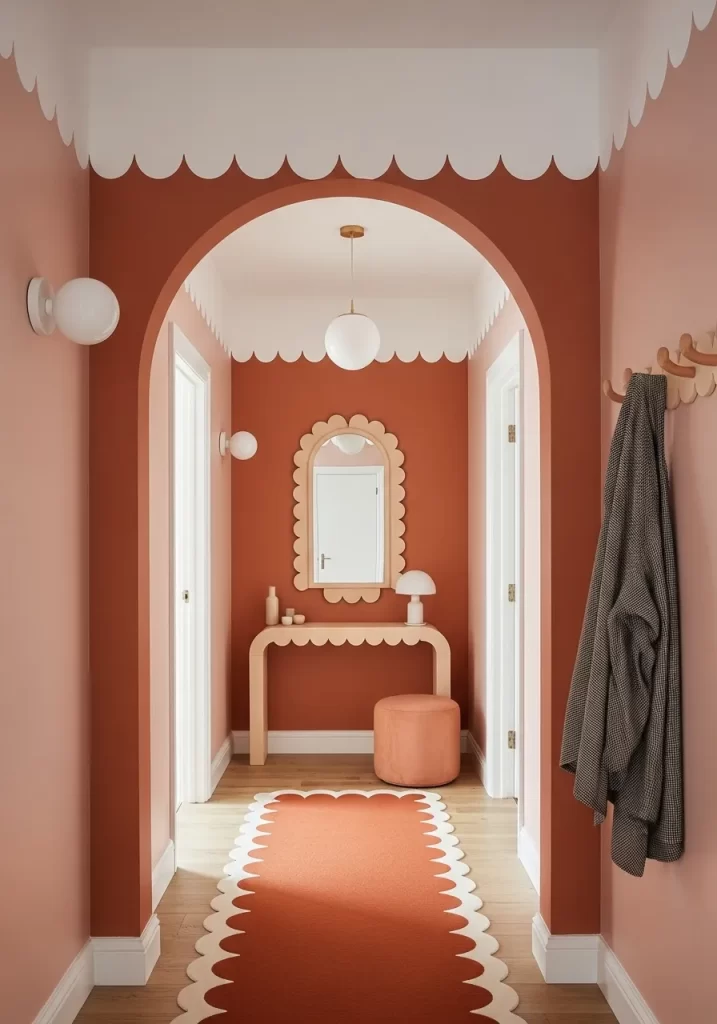
This hallway is charming and whimsical. It uses playful shapes and warm colors to create a welcoming, storybook feel. The walls are painted a rich, inviting terracotta.
A large, classic archway frames the view down the hall, but with a twist: its edges are adorned with playful white scalloped trim. This same scalloped detail is echoed along the top of the walls, just below the ceiling. A scalloped runner and mirror reinforce the theme. It’s a space that feels both traditional and surprisingly fun.
DIY Scalloped Wall and Arch Trim
You can create this whimsical look using cut-out shapes and paint.
Tools & Materials:
- Thin MDF or hardboard (for the scallops)
- Pencil
- String and thumbtack (for drawing perfect arcs)
- Jigsaw (to cut the scallops)
- Sandpaper
- Wood glue
- Small finish nails or brad nailer (optional)
- White paint (for the scallops)
- Paint (your desired wall color)
Instructions:
- Draw Your Scallops:
- On your MDF/hardboard, decide on the size of your scallops.
- Use a thumbtack and string to draw perfect arcs. Tie the string to the thumbtack, hold the thumbtack at the center point of your arc, and use a pencil on the other end of the string to draw the curve.
- Draw a series of these arcs to create your scalloped pattern.
- Cut the Scallops:
- Carefully cut out your scalloped shapes using a jigsaw. Take your time for smooth cuts.
- Sand all edges of the scallops until very smooth.
- Paint Your Wall: Paint your hallway walls with your chosen color (e.g., terracotta). Let it dry.
- Paint the Scallops: Paint your cut-out scallops white. Let them dry.
- Attach the Scallops:
- Apply wood glue to the back of your first scallop piece.
- Carefully align it where the wall meets the ceiling or around your archway.
- Press it firmly. Use a few small finish nails to secure it if desired.
- Repeat, attaching all your scallop pieces. You can butt them up against each other for a continuous look.
- Caulk and Touch-Up: Use a thin bead of caulk to fill any gaps between the scallops and the wall. Touch up with white paint if needed.
37: The Streamlined Closet Nook
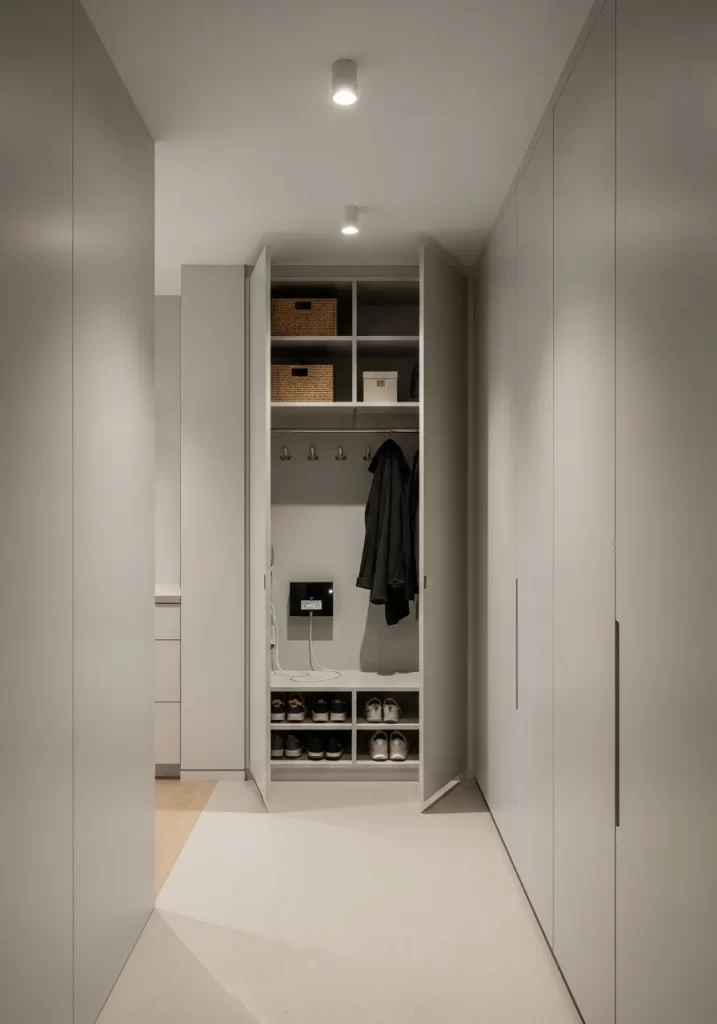
This hallway is incredibly efficient and clutter-free. It uses integrated storage to maximize space. The walls are painted a calm, light grey.
One end of the hallway features a deep, built-in closet nook. The doors are sleek and handle-free, blending seamlessly into the wall. When opened, they reveal a perfectly organized space for coats, shoes, and baskets of accessories. Overhead spotlights ensure everything is well-lit. This design is about practical, hidden storage that maintains a clean, minimal aesthetic.
DIY Hallway Closet Organizer
You can transform a simple closet into a super-functional, minimalist entryway zone.
Tools & Materials:
- Plywood or melamine boards (for shelves and dividers)
- Measuring tape
- Saw (circular or hand saw)
- Drill
- Screws
- Closet rod and brackets
- Hooks (for coats)
- Storage baskets
Instructions:
- Measure Your Closet: Measure the width, depth, and height of your existing hallway closet.
- Plan Your Layout:
- Decide where you want shelves (for shoes, baskets).
- Plan for a coat rod and hooks.
- Sketch out your ideal layout, noting all the measurements for your shelves and dividers.
- Cut Your Boards:
- Cut your plywood or melamine boards according to your plan (e.g., shoe shelves, top shelves).
- Install Vertical Supports (if needed):
- If you’re building specific cubbies, install vertical support boards first. Screw them directly into the side walls of the closet.
- Install Shelves:
- Start with the bottom shoe shelves. Use a level to mark their height.
- Screw small cleats (thin strips of wood) into the side walls.
- Rest your shelves on these cleats, or screw directly through the side walls into the shelves for stronger support.
- Install any upper shelves for baskets or storage.
- Install Coat Rod and Hooks:
- Mark the height for your coat rod.
- Screw the coat rod brackets securely into the side walls (or into a back support board).
- Install the coat rod.
- Screw individual hooks directly into the back wall of the closet for hanging items.
- Add Accessories: Place your storage baskets on the shelves. This system ensures everything has a home, keeping the hallway tidy.
Your hallway does not need to be an empty, uninspired corridor. It holds real potential. That blank space is a canvas, not a lost cause.
You have seen how light can change everything. You saw how texture adds warmth. Even a bold coat of paint or a row of hooks can make a powerful statement.
You do not need to do everything at once. Start with one idea. Build a single shelf. Paint the ceiling. Hang a gallery wall.
Take back your hallway. Turn that simple passage into a meaningful part of your home.
Key Takeaways
- Treat Walls as Art: Use bold paint, install fluted panels, or create a personal gallery.
- Light is a Material: Use LED strips, backlit panels, and focused sconces to create mood.
- Texture Adds Warmth: Add wood slats, cork, fabric panels, or even faux brick.
- Be Smart with Storage: Floating credenzas, built-in shelves, and smart hooks remove clutter.
- Floors and Ceilings Matter: A painted ceiling or a patterned floor can define the entire space.
- Make it Personal: A hallway is a great place for a curiosity cabinet or a library.