
The hallway is often the most forgotten space in a home. We rush through it every day, on our way to somewhere else. It becomes a simple path, a connector between rooms, holding little character of its own.

But this narrow space is full of potential. It is the first impression for guests and a constant in your daily routine. It deserves to be more than just a walkway. It can be a gallery, a library, or a garden. It can tell a story.
You don’t need a grand foyer to make a statement. With a bit of creativity, any hallway can become a destination. This guide offers 37 distinct ideas to transform your overlooked corridor into a space that reflects your style and welcomes you home.
1. Create a Sophisticated Gallery Wall
Item Name: Monochromatic Gallery Wall
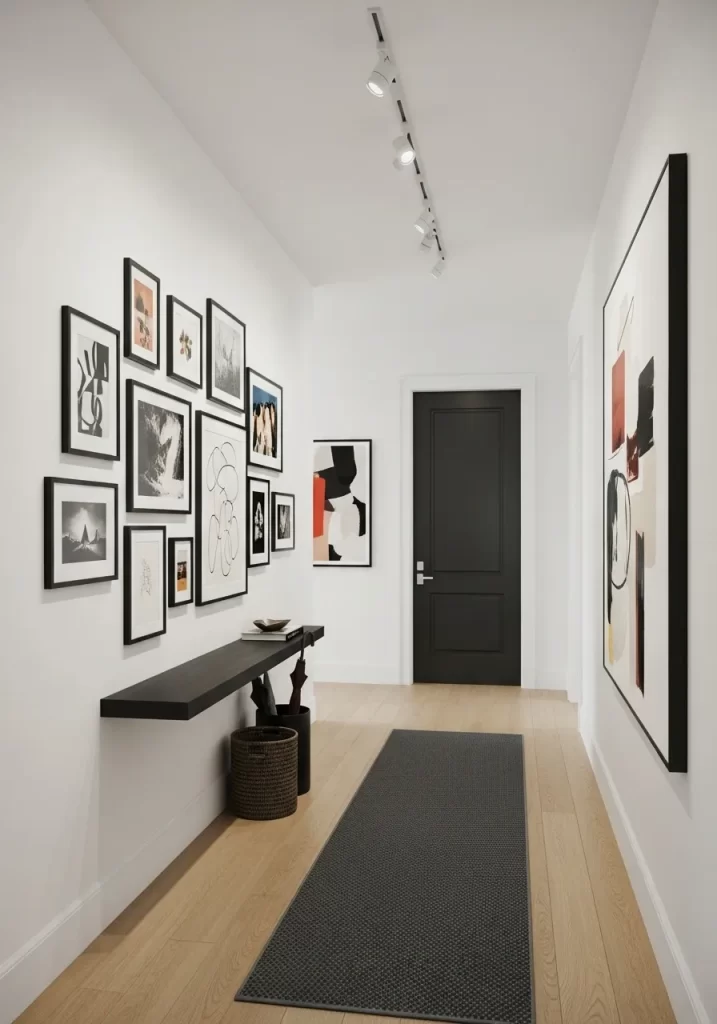
Blank walls can make a hallway feel empty and long. A gallery wall brings instant personality to the space. This arrangement uses black frames of different sizes to create a single, impressive piece of art. The consistent color ties everything together, making it look clean and intentional.
Adding a simple floating shelf below the gallery provides a place for small items. It anchors the display without taking up floor space. This approach turns a simple walkway into a personal art exhibit, showing off your favorite photos or prints in a stylish way.
DIY: Your Own Simple Gallery Wall
Here is how you can make a cool picture wall, step-by-step. It’s like putting a puzzle together on your wall!
What You’ll Need:
- Pictures or art prints
- Frames (all one color, like black)
- Paper (like newspaper or wrapping paper)
- Scissors
- Tape
- A hammer and nails
- A pencil
- A level (a tool that helps you hang things straight)
Step 1: Pick Your Pictures First, choose the photos and art you want to show. For this look, black and white pictures work great. You can use family photos, drawings, or cool patterns you find online.
Step 2: Get Your Frames Find frames for all your pictures. It’s okay if they are big, small, square, or rectangle. The important part is to have them all be the same color so they match.
Step 3: Plan on the Floor Don’t hang them up yet! First, trace each frame onto your paper and cut out the shapes. Use these paper shapes to plan your design on the floor. Move them around until you find a layout you really like.
Step 4: Tape it on the Wall Once you love your floor design, lightly tape the paper shapes onto the wall exactly where you want the frames to go. Use your level to make sure the papers are straight.
Step 5: Time for Nails Now, look at the back of your frame to see where the nail should go. Hammer a nail right through the paper into the wall in that spot. Do this for all your paper shapes.
Step 6: Hang and Admire! Carefully tear the paper off the wall. Now you have perfectly placed nails. Hang your pictures on the nails, take a step back, and look at the awesome gallery wall you made!
2. Add Farmhouse Functionality
Item Name: Rustic Farmhouse Entry Bench

This hallway is warm, welcoming, and very practical. A sturdy wooden bench provides a place to sit and take off shoes, with built-in cubbies for storage. This keeps the entryway tidy and organized. A row of hooks above the bench is handy for hanging coats, bags, and hats.
The decor has a cozy, rustic charm. A black-and-white buffalo check rug, a large wall clock, and a picture of a country scene all add to the farmhouse feel. The lighting is simple and functional, with black metal sconces that match the other dark accents in the space.
DIY: Simple Coat Hook Rack
Let’s make a rustic-looking rack to hang your coats and bags. It’s super easy and looks great.
What You’ll Need:
- A wooden board (any size you like)
- Sandpaper
- Paint or wood stain (optional)
- A few cool-looking hooks or knobs
- A screwdriver and screws
Step 1: Get Your Board Ready Take your wooden board and make sure it’s smooth. If it has any rough spots, use the sandpaper to smooth them down. You can leave the wood natural, or you can paint or stain it to match your room. Let it dry completely.
Step 2: Plan Your Hooks Lay your board on a flat surface. Place your hooks on the board and move them around until you like the spacing. Use a ruler to make sure they are evenly spaced apart.
Step 3: Mark the Spots Once you’re happy with where the hooks are, use a pencil to mark the spots where the screws will go.
Step 4: Attach the Hooks Take your screwdriver and screw the hooks onto the board in the spots you marked. Make sure they are on there nice and tight.
Step 5: Hang it Up Ask an adult to help you securely hang your new coat rack on the wall. Now you have a special spot to hang all your stuff!
3. Go Bold with Bohemian Style
Item Name: Earthy Bohemian Nook

This hallway is full of warmth and personality. The patterned wallpaper has a hand-drawn, organic feel that makes the space feel cozy. Natural materials are everywhere, from the woven pendant lights to the wicker baskets on the floor.
A long, carved wooden table provides a surface for interesting objects, and a large floor mirror makes the hallway feel bigger and brighter. Different textures, like pampas grass, macrame wall hangings, and a patterned rug, all work together to create a relaxed and free-spirited vibe.
DIY: Woven Basket Wall Art
You can make a cool, textured display on your wall using shallow baskets. It’s like creating a collage with different shapes and weaves.
What You’ll Need:
- A few shallow, lightweight baskets or woven placemats
- Small nails
- A hammer
Step 1: Go on a Basket Hunt! Look for baskets at a thrift store or a craft store. Find ones that are flat or very shallow, like the kind you might serve bread in. Look for different sizes, colors, and weaving patterns.
Step 2: Plan Your Layout on the Floor Before you put any holes in the wall, arrange your baskets on the floor. Move them around until you find a design that you like. You can overlap them or group them close together.
Step 3: Hang the Biggest Basket First Start with your largest or most central basket. Find a spot in the basket’s weave where you can push a small nail through. Hammer the nail into the wall to hang the basket.
Step 4: Add the Others Now, add your other baskets around the first one, following the design you made on the floor. Use one or two small nails for each basket to make sure they are secure.
Step 5: Step Back and Enjoy That’s it! You have a beautiful, textured piece of wall art that adds a lot of warmth and personality to your space.
4. Keep it Light with Scandinavian Design
Item Name: Bright and Airy Scandi Hall
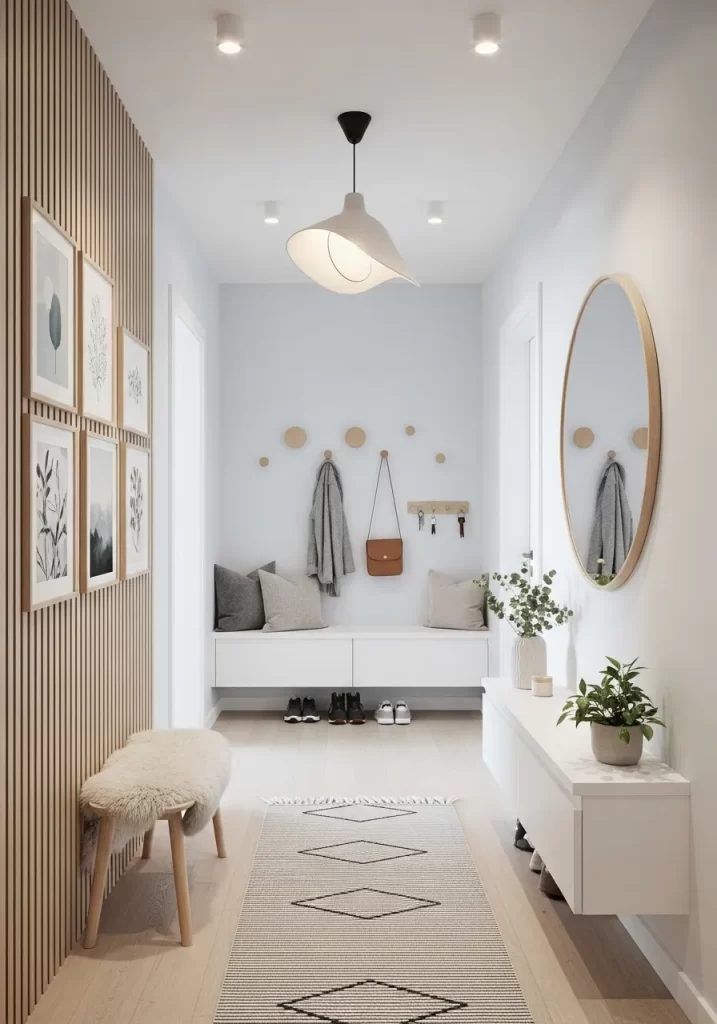
This hallway feels clean, calm, and simple. A wall of light wood slats adds warmth and texture without feeling heavy. The rest of the space is painted white, which makes it feel bright and open. The furniture is functional and has clean, simple lines.
A few carefully chosen decorations, like the round mirror and a small plant, add a touch of softness. Everything has a purpose, from the wall hooks for coats to the bench with hidden storage. This style is all about creating a space that is both beautiful and useful.
DIY: Simple Wooden Peg Coat Rack
Let’s make a modern and simple rack for your coats using round wooden pegs.
What You’ll Need:
- A wooden board
- A few round wooden dowels (about 1 inch thick)
- A saw
- A drill with a drill bit the same size as your dowels
- Wood glue
- Sandpaper
Step 1: Prepare Your Board Make sure your main wooden board is smooth and clean.
Step 2: Cut Your Pegs Use a saw to cut your wooden dowel into smaller pieces, each about 3 or 4 inches long. These will be your pegs. Use sandpaper to smooth the cut ends.
Step 3: Mark Your Holes Decide where you want your pegs to go on the board. You can line them up straight or stagger them for a more playful look. Use a ruler to space them out evenly and mark the spots with a pencil.
Step 4: Drill the Holes Drill a hole at each spot you marked. Don’t drill all the way through the board! Drill about halfway through.
Step 5: Glue in the Pegs Put a little bit of wood glue into each hole. Then, push a wooden peg firmly into each hole. You can gently tap them with a hammer to make sure they are in all the way.
Step 6: Let it Dry and Hang Wipe away any extra glue and let it dry. Once it’s dry, hang your new, modern coat rack on the wall.
5. Mix it Up with Industrial Chic
Item Name: Urban Industrial Entryway
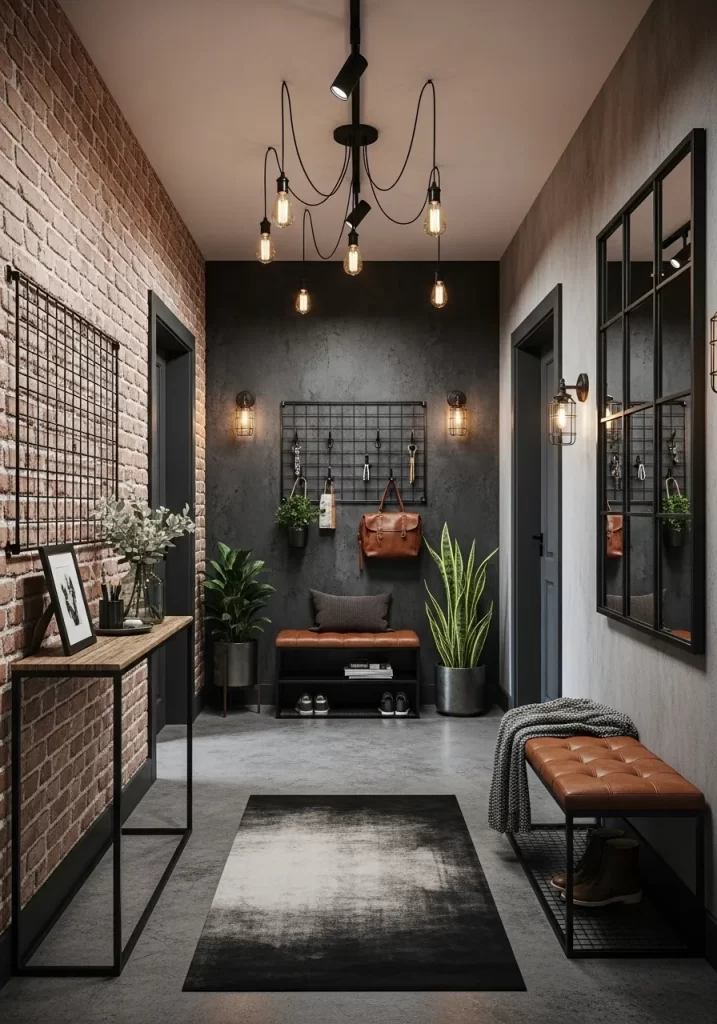
This hallway has a cool, edgy vibe, like a converted city loft. One wall is covered in exposed red brick, which adds a lot of texture and character. The other walls are a dark, moody gray. The furniture is made from a mix of metal and wood.
Black metal grids on the wall are a stylish way to hang and organize things. The lighting is functional and has an industrial feel, with exposed bulbs and metal cages. This design combines rough, raw materials with clean, simple shapes for a look that is both tough and stylish.
DIY: Faux Exposed Brick Wall
You can get that cool brick look without having to do any messy construction. It’s all about clever painting!
What You’ll Need:
- A ruler and a pencil
- A rectangular kitchen sponge
- Paint in a brick color (like terracotta red) and a gray or white for the “mortar”
- A paper plate
Step 1: Paint Your “Mortar” First, paint your entire wall the color you want the lines between the bricks to be. A light gray or an off-white works well. Let it dry completely.
Step 2: Draw Your Guidelines Use your ruler and pencil to lightly draw horizontal lines across your wall. These are the guides for your rows of bricks.
Step 3: Get Your Sponge Ready Pour some of your brick-colored paint onto a paper plate. Dip your sponge into the paint, but then dab some of it off. You don’t want the sponge to be dripping with paint.
Step 4: Start Stamping! Press the sponge onto the wall to create your first brick shape. Then, leave a small gap and stamp the next one. Continue this all the way across your first row.
Step 5: Stagger the Next Row For the second row, start your first brick in the middle of the brick above it. This creates the classic staggered brick pattern.
Step 6: Finish the Wall Keep stamping your brick shapes until the whole wall is covered. Don’t worry if they are not all exactly the same. Real bricks aren’t perfect either! Let it dry, and you have a cool industrial-style wall.
6. Go Glam with Hollywood Regency
Item Name: Bold and Glamorous Foyer
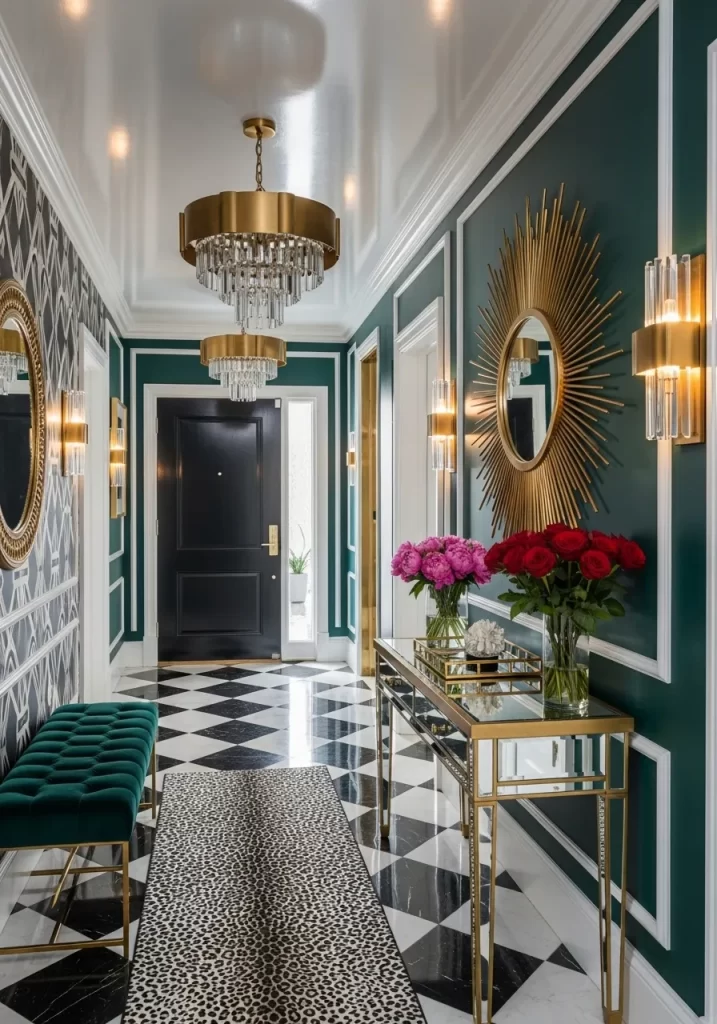
This hallway is all about making a grand entrance. The wallpaper has a bold, geometric pattern, while the opposite wall is painted a deep, dramatic green with crisp white molding. The floor is a classic black-and-white checkerboard, adding to the high-contrast look.
Gold is a key feature here. A large, sunburst mirror, shiny console table, and glamorous light fixtures all have a brilliant gold finish. Rich textures, like the velvet bench and the leopard print runner, add to the feeling of luxury. This style is confident, glamorous, and full of drama.
DIY: Gold Sunburst Mirror
You can make a very glamorous sunburst mirror using simple craft supplies.
What You’ll Need:
- A small, round mirror
- Long wooden skewers or thin dowels
- A hot glue gun
- Gold spray paint
- A piece of cardboard a little bigger than your mirror
Step 1: Prepare Your “Rays” You can leave your skewers all the same length, or you can cut them into a few different lengths to make your sunburst more interesting.
Step 2: Glue on the Rays Place your mirror face down on the piece of cardboard. Use your hot glue gun to glue the skewers to the back of the mirror. Start by gluing on four main rays at the top, bottom, and sides (like a compass). Then, fill in the spaces between them with more rays. Keep going until your sunburst is as full as you like.
Step 3: Let the Glue Dry Give the hot glue a few minutes to cool down and harden completely.
Step 4: Time to Paint It’s best to do this step outside. Place your mirror on some newspaper. Shake your can of gold spray paint well. Spray a light, even coat all over the skewers. Make sure to cover the sides of the skewers too. You might need a second coat.
Step 5: Let it Dry and Hang Let the paint dry completely. Then, find the perfect spot to hang your dazzling new mirror.
7. Bring in a Coastal Breeze
Item Name: Serene Coastal Entryway
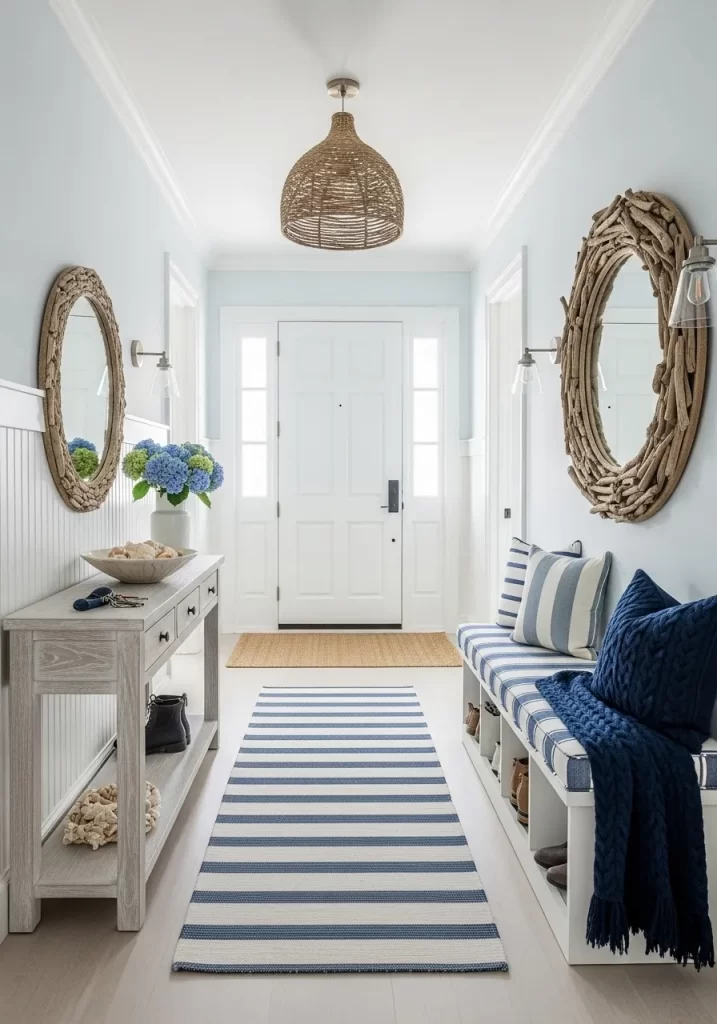
This hallway feels like a relaxing day at the beach. The walls are painted a light, airy blue, and white wainscoting adds a classic, coastal touch. The furniture has a simple, weathered wood finish, like it’s been softened by the sea air.
Natural textures are key to this look. The mirrors are framed with driftwood, the light fixture is made of woven rope, and a simple jute rug lies by the door. The blue and white striped cushions on the bench are a classic nautical pattern. It all comes together to create a space that is calm, bright, and casual.
DIY: Simple Rope-Wrapped Vase
Let’s give a plain glass vase a beachy makeover using some rope.
What You’ll Need:
- A simple glass vase or jar
- A roll of rope (like sisal or jute)
- A hot glue gun
Step 1: Start at the Bottom Put a dab of hot glue on the very bottom edge of your vase. Press the end of your rope into the glue to secure it.
Step 2: Wrap and Glue Start wrapping the rope around the vase. After every wrap or two, add another small line of hot glue to the vase and press the rope into it. This will keep the rope from slipping.
Step 3: Keep it Tight As you wrap, make sure to push the rope down so that each new row is tight against the one below it. You don’t want any glass showing through.
Step 4: Keep Going! Continue wrapping and gluing until you reach the top of the vase.
Step 5: Finish it Off When you get to the top, cut the rope. Put a final dab of hot glue on the vase and press the end of the rope into it securely.
Step 6: Add Some Flowers Your new coastal-inspired vase is ready. You can fill it with flowers, or even some tall beach grass for an extra beachy feel.
8. Play with Mid-Century Modern Shapes
Item Name: Colorful Mid-Century Hall
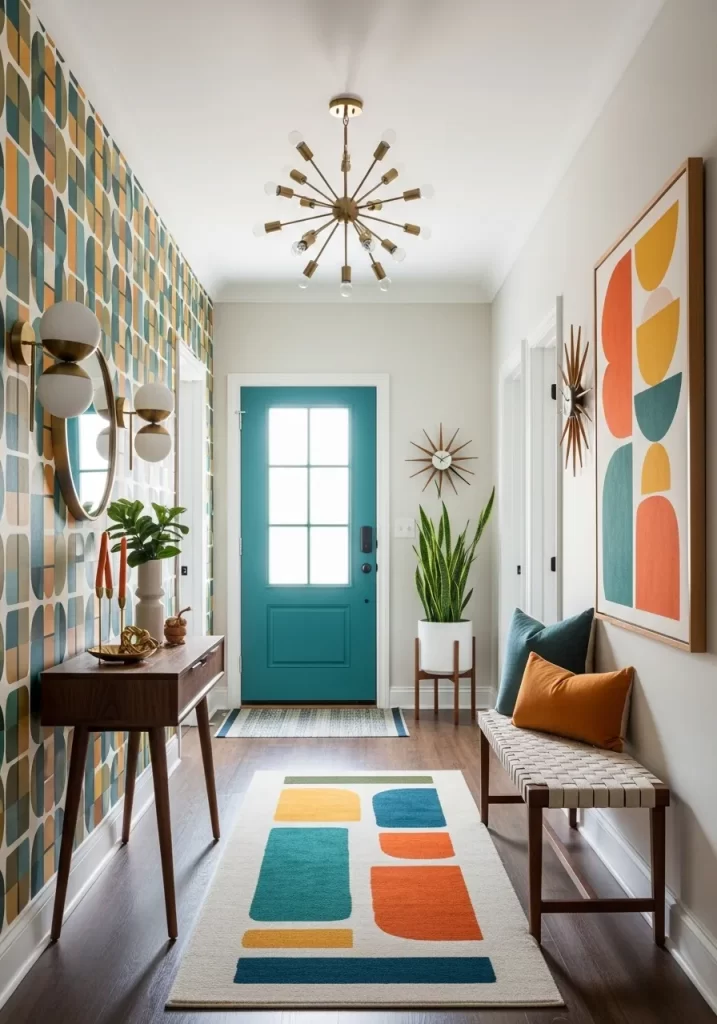
This hallway is fun, vibrant, and full of interesting shapes. The wallpaper has a colorful, geometric pattern that is classic Mid-Century Modern. The furniture has clean lines and tapered, peg-like legs, which are a signature of this style.
The accessories are also very sculptural, from the starburst clock to the sputnik-style chandelier. A piece of large, abstract art pulls all the colors from the room together. This design is optimistic and playful, with a love for simple forms and beautiful function.
DIY: Make a Mini Sputnik Sculpture
You can make a small decorative object that looks like a cool, spiky satellite.
What You’ll Need:
- A small styrofoam ball
- Wooden skewers
- Small wooden beads
- Gold or brass spray paint
Step 1: Get Everything Ready It’s easiest to paint all your pieces before you put them together. Take your skewers and beads outside and spray paint them with your metallic paint. Let them dry.
Step 2: Start Building Take one of your painted skewers and push it into the styrofoam ball. Don’t push it all the way through.
Step 3: Add More Spikes Keep adding more skewers, poking them into the ball at all different angles. You want it to look like a starburst or a spiky sea urchin.
Step 4: Add the Beads Once all your skewers are in place, you can add a little bit of glue to the tip of each skewer and stick a painted wooden bead on the end. This gives it a more finished look.
Step 5: Paint the Center You can either spray paint the center ball before you start, or you can use a small brush and some craft paint to carefully paint the styrofoam ball between the spikes.
Step 6: Let it Dry and Display Let everything dry completely. Now you have a cool, sculptural object to put on a shelf or a table.
9. Create a Moody Library Nook
Item Name: Sophisticated Hallway Library
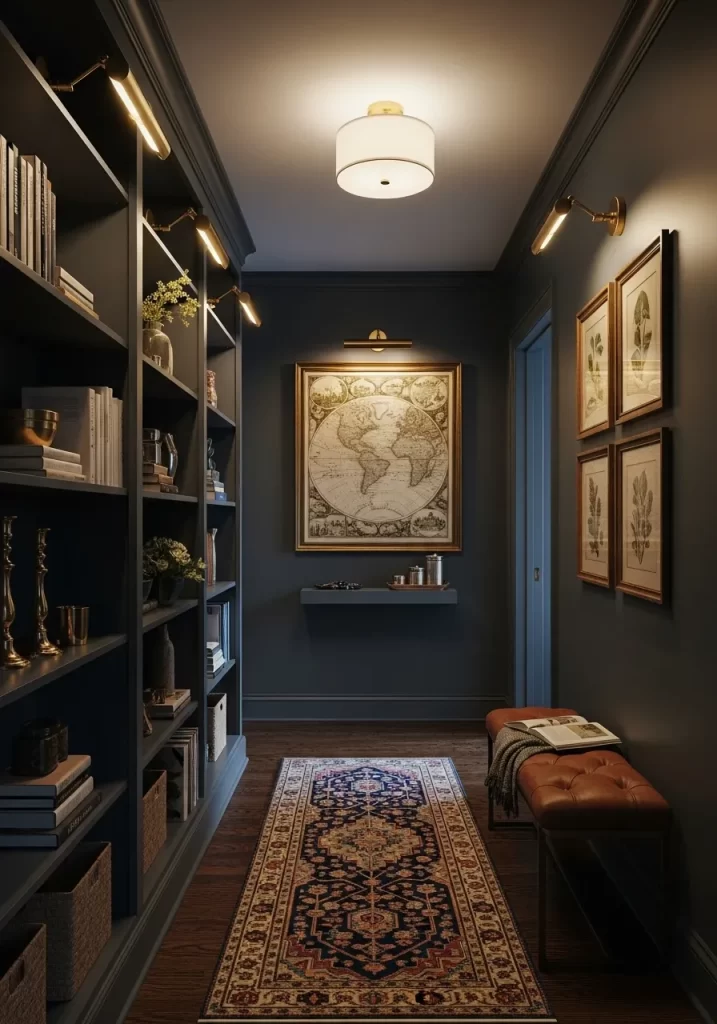
This hallway is transformed into a dark and cozy library. Floor-to-ceiling bookshelves line one wall, providing tons of storage for books and decorative items. The dark paint color on the walls and shelves creates a sophisticated, intimate feeling.
Smart lighting is used to highlight the decor. Small, adjustable picture lights are mounted on the bookshelves, and another light shines down on a large, framed map at the end of the hall. A leather bench and a classic runner add to the traditional, scholarly atmosphere.
DIY: Floating Bookshelf
This is a fun trick that makes it look like your books are magically floating on the wall.
What You’ll Need:
- A sturdy, hardcover book you don’t mind using for this project
- A small metal L-bracket
- Strong glue (like E6000 or Gorilla Glue)
- A few screws
- A drill
Step 1: Glue the Bracket Open your hardcover book to the last page. Squeeze a good amount of strong glue onto one side of your L-bracket. Press the glued side of the bracket down onto the inside of the back cover of the book. The other side of the bracket should be sticking out.
Step 2: Glue the Pages Squeeze more glue on top of the bracket and on the inside of the back cover. Now, close the book, pressing all the pages down onto the bracket and the glue.
Step 3: Press and Dry Place some heavy books on top of your project book to press it all together tightly. Let the glue dry for at least 24 hours.
Step 4: Attach it to the Wall Ask an adult to help you with this part. Use your drill to screw the part of the bracket that is sticking out of the book directly into the wall.
Step 5: Add More Books! Your shelf is now the book itself! You can stack a few more books on top of it. It will look like they are all floating in mid-air.
10. Embrace Japanese Minimalism
Item Name: Serene Japandi Hallway
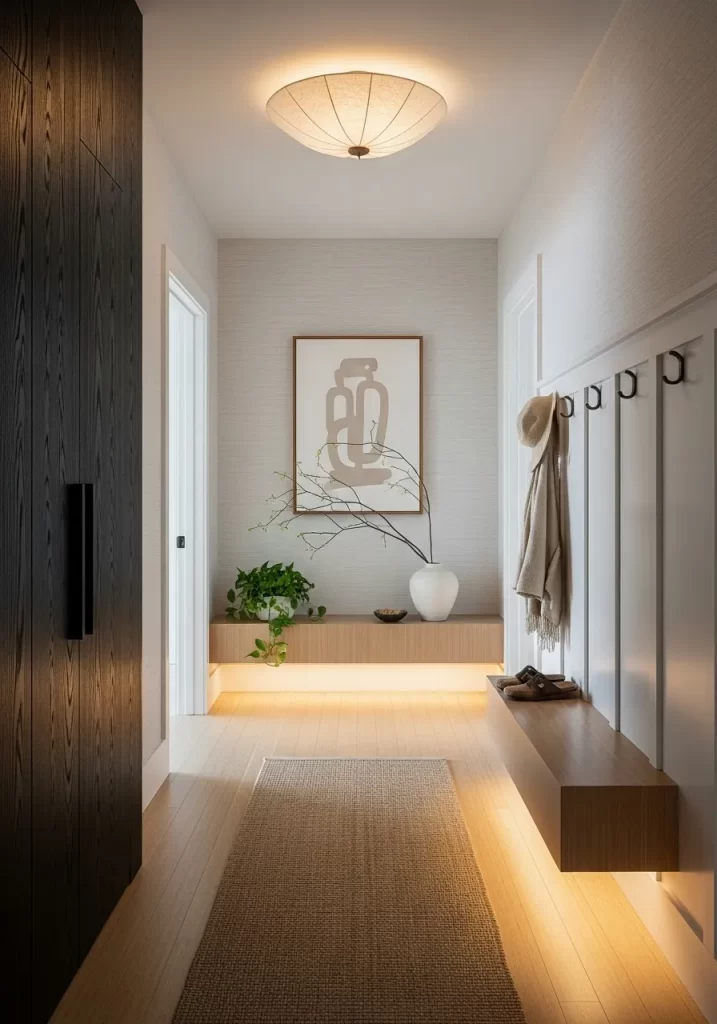
This hallway is calm, simple, and very peaceful. The design mixes Japanese minimalism with Scandinavian function. The color palette is light and neutral, and natural materials like wood and paper are used throughout.
The lighting is soft and gentle, with LED strips hidden under the benches to create a warm glow. A simple paper lantern provides a soft light from above. There are very few decorations, but each one is chosen carefully, like the single piece of abstract art and the branch in a simple vase. This style is all about creating a space that feels uncluttered and serene.
DIY: Simple Paper Lantern
You can make a beautiful, modern paper lantern with just a few supplies.
What You’ll Need:
- A sheet of nice paper or vellum
- A ruler and a pencil
- A craft knife or scissors
- A hole punch
- A piece of string or ribbon
- A battery-operated LED candle (important: do not use a real candle!)
Step 1: Cut Your Paper Decide how tall you want your lantern to be. Cut your paper into a rectangle. The length of the rectangle will be how big around your lantern is.
Step 2: Fold the Paper Fold your rectangle in half lengthwise (like a hot dog bun).
Step 3: Cut the Slits Starting from the folded edge, use your scissors or craft knife to cut straight lines towards the open edge. Stop cutting about an inch from the open edge. Cut these slits about one inch apart all the way down the folded paper.
Step 4: Unfold and Shape Carefully unfold your paper. You will have a sheet with lots of slits in the middle. Gently bring the two short ends of the paper together to form a cylinder. The slits will bulge out to create the lantern shape. Overlap the edges slightly.
Step 5: Secure the Lantern You can use a stapler, tape, or glue to secure the seam where the edges meet.
Step 6: Add a Handle Use your hole punch to make two holes on opposite sides of the top of your lantern. Thread your string or ribbon through the holes and tie a knot to make a handle.
Step 7: Light it Up! Turn on your battery-operated candle and place it in the middle of your lantern. Now you have a beautiful, glowing decoration.
11. Curate a Cabinet of Curiosities
Item Name: Eclectic Maximalist Gallery
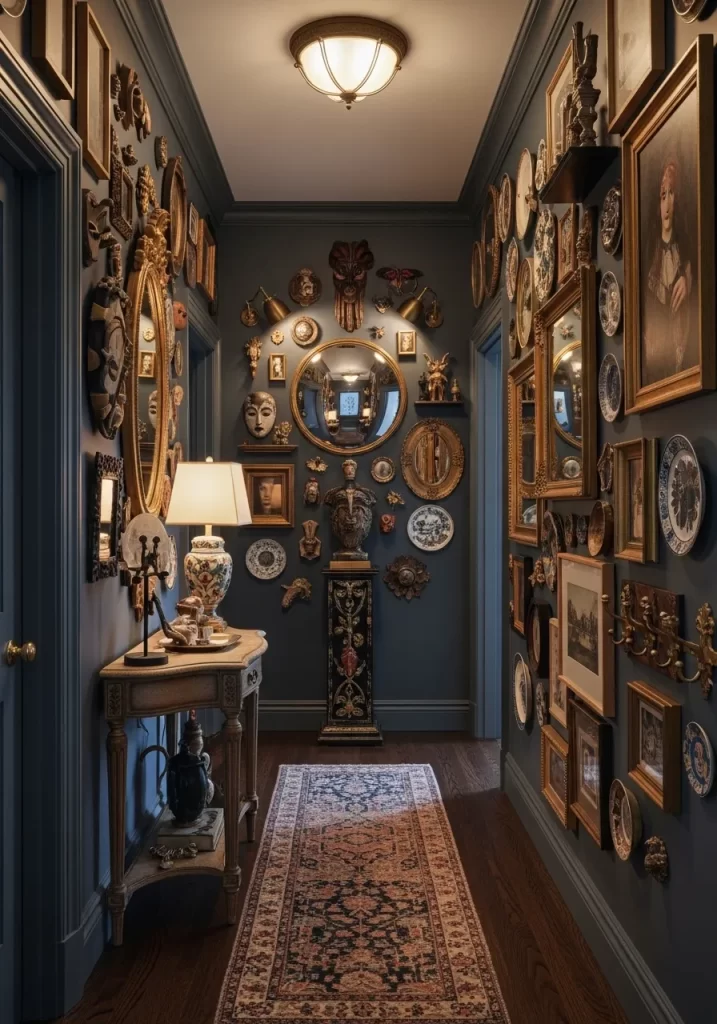
This hallway is filled with interesting objects from top to bottom. The dark walls make the gold frames and unique pieces stand out. It feels like a personal museum, with every spot on the wall telling a story. Masks, plates, small paintings, and mirrors are arranged in a busy, exciting way.
A classic console table and a tall pedestal provide surfaces for more treasures, like a lamp and a sculpture. This style is all about showing off your personality and the things you love to collect. It turns a simple hallway into a fascinating journey.
DIY: Your Own Mini Curiosity Shelf
Let’s make a small shelf to show off your favorite little things. It’s like a tiny museum you create yourself.
What You’ll Need:
- A small floating shelf
- Your collection of small, cool objects (shells, cool rocks, small toys, old keys)
- Sticky tack or small display stands
- Screws and a screwdriver to hang the shelf
Step 1: Go on a Treasure Hunt First, gather your treasures! Look around your room and house for small items that you find interesting. Maybe it’s a cool-looking stone from a walk, a tiny action figure, or a pretty seashell.
Step 2: Install Your Shelf Ask an adult to help you hang the small floating shelf on the wall. Choose a spot where you’ll see it every day.
Step 3: Arrange Your Collection Now, plan where everything will go. Put taller things in the back and shorter things in the front. You can group things by color or by theme.
Step 4: Make Them Stand Up Some of your items might not stand up on their own. You can use a little ball of sticky tack on the bottom to hold them in place. This will keep them from rolling off the shelf.
Step 5: Add a Background (Optional) You can make your display even cooler by taping a piece of scrapbook paper or a picture to the wall behind your shelf.
Step 6: Change it Up! The best part about your curiosity shelf is that you can change it whenever you find a new treasure. Keep your collection fresh and interesting!
12. Grow an Indoor Jungle
Item Name: Lush Botanical Hallway
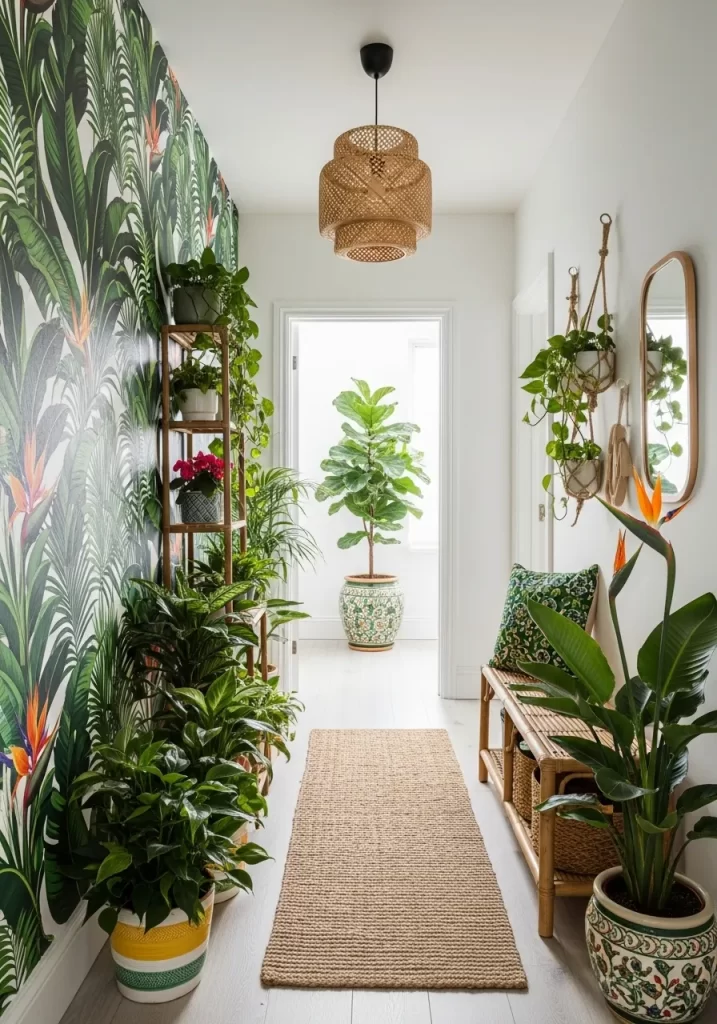
This hallway brings the outdoors inside with a burst of green. A vibrant wallpaper covered in tropical leaves makes you feel like you’ve stepped into a rainforest. The space is filled with many different kinds of real plants, from tall ones on the floor to smaller ones on shelves.
Woven textures, like the jute rug and the rattan light fixture, add to the natural, earthy feel. The simple wooden furniture doesn’t compete with the bold wallpaper, allowing the plants to be the stars. This design creates a fresh, lively, and calming atmosphere.
DIY: Simple Macrame Plant Hanger
Let’s make a cool hanging home for one of your plants. It’s like making a special swing for it!
What You’ll Need:
- Macrame cord or thick yarn
- Scissors
- A metal or wooden ring
- A small potted plant
Step 1: Cut Your Cords Cut eight long pieces of your cord. A good length is to make each one as long as you are tall. This gives you plenty of cord to work with.
Step 2: Attach to the Ring Take all eight pieces of cord and thread them through your ring. Slide the ring to the middle of the cords. You should now have 16 strands hanging down from the ring.
Step 3: Make Your First Knots Separate the 16 strands into four groups, with four strands in each group. About two inches below the ring, tie a simple knot in each group of four. Try to make the knots line up.
Step 4: Create the Net Now, we’ll make the part that holds the pot. A few inches below your first set of knots, take two strands from one group and two strands from the group next to it. Tie these four strands together in a knot. Do this all the way around. You’re making a diamond pattern.
Step 5: Make a Second Row of Knots Repeat Step 4. Go down a few more inches and again, take two strands from one group and two from the neighboring group and tie them together. This creates the net that will hold your pot securely.
Step 6: Tie the Bottom Gather all 16 strands together at the bottom. Tie one big, strong knot to secure them all together. You can leave the ends long and frayed for a tassel look. Now, carefully place your plant pot inside the net and find a place to hang it!
13. Charm with French Country Style
Item Name: Graceful French Provincial Entry

This hallway has a soft and timeless beauty. The delicate, patterned wallpaper and stone floor give it an old-world, European feel. The furniture is elegant, with curved legs and a gentle, weathered finish. An ornate, oversized mirror makes the space feel grand and bright.
A classic chandelier adds a touch of sparkle, while fresh flowers bring life and color. Simple details like the standing coat rack and the cushioned bench are both useful and beautiful. The whole space feels graceful, romantic, and very peaceful.
DIY: Give Furniture a “Weathered” Look
You can make a new piece of wood furniture look old and full of character, just like the table in the picture.
What You’ll Need:
- A small wooden table or shelf
- Two colors of flat paint (a dark one and a light one)
- A paintbrush
- An old candle or wax block
- Sandpaper
- A clean cloth
Step 1: Paint a Base Coat First, paint your entire piece of furniture with the darker paint color. This is the color that will peek through later. Let it dry completely.
Step 2: Add Some Wax Take your candle or wax block and rub it on the edges and corners of your furniture. Also, rub it lightly in a few random spots on the flat surfaces. The paint won’t stick to the wax, which helps create the old, worn look.
Step 3: Paint the Top Coat Now, paint over the whole thing with your lighter paint color. Cover the wax and everything. You might need two coats. Let it dry completely.
Step 4: The Magic Sanding Step Take your sandpaper and start sanding the spots where you put the wax. As you sand, the top layer of paint will come off easily, revealing the darker color underneath. This makes it look like the paint has naturally worn away over time.
Step 5: Sand a Little More Lightly sand the rest of the piece to make it feel smooth. Don’t press too hard, you just want to soften it up.
Step 6: Wipe it Down Use your clean cloth to wipe away all the dust from sanding. Now you have a beautiful piece of furniture that looks like it has a long and interesting history.
14. Dazzle with Art Deco Design
Item Name: Geometric Art Deco Hall
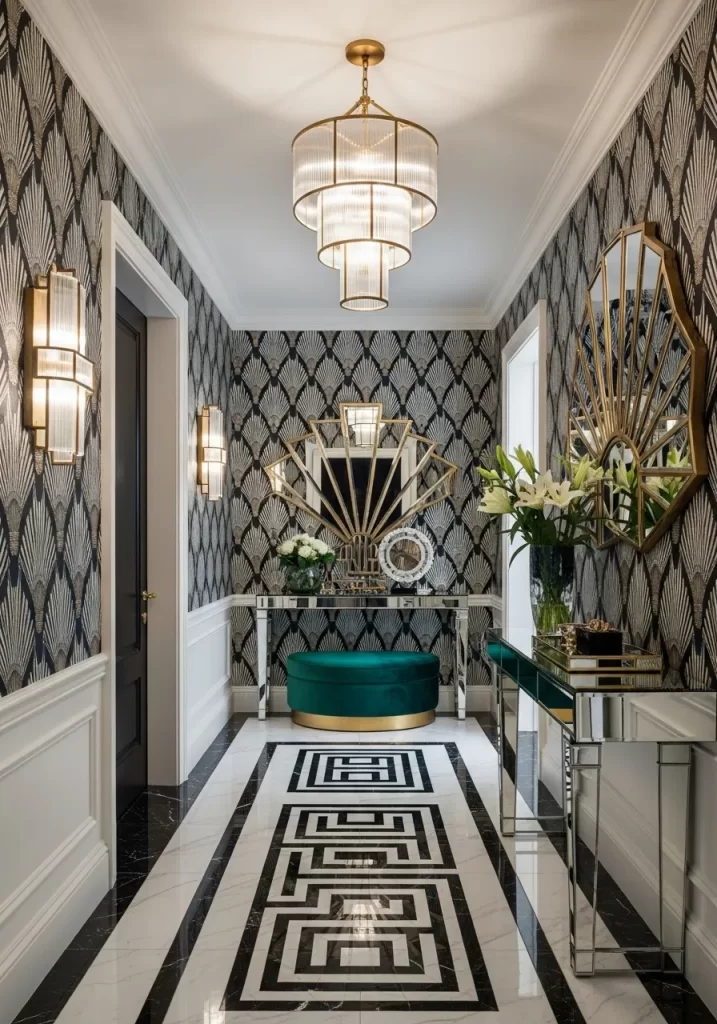
This hallway is all about glamour and bold patterns. The wallpaper features a striking fan design in black, white, and gold, which is a classic Art Deco look. Mirrored and glass furniture makes the space feel bright and luxurious, reflecting light all around.
The light fixtures are layered and geometric, adding to the dramatic effect. A fan-shaped mirror and a plush green stool continue the theme of elegant shapes and rich materials. Even the floor has a bold, graphic pattern, making this a truly dazzling entryway from top to bottom.
DIY: Art Deco Gold Tape Art
Let’s make a simple but very glamorous piece of art using tape. It will look like it came right out of the 1920s.
What You’ll Need:
- A piece of black cardstock or a black canvas
- A roll of thin, metallic gold washi tape or striping tape
- A ruler
- A pencil
- Scissors
Step 1: Plan Your Design Art Deco style loves straight lines and repeating patterns. You can create a sunburst, a series of steps, or interlocking squares. Lightly sketch your design on the black paper with a pencil. Using a ruler will help you get your lines perfectly straight.
Step 2: Start Taping Cut your first piece of gold tape. Carefully place it along one of your pencil lines. Press it down smoothly with your finger to make sure there are no bubbles.
Step 3: Build Your Pattern Keep adding pieces of tape, following your design. If you’re making a sunburst, all your lines will start from one point. If you’re making steps, you’ll use lots of short horizontal and vertical lines. Take your time to get it right.
Step 4: Trim the Edges If any of your tape pieces go over the edge of the paper, just flip it over and use your scissors to trim them neatly.
Step 5: Frame It Your high-contrast, geometric masterpiece is done! Put it in a simple black or gold frame to complete the look. It’s an easy way to add a touch of Art Deco glam to any room.
15. Travel with a Global Bazaar Style
Item Name: Warm and Worldly Moroccan Hall
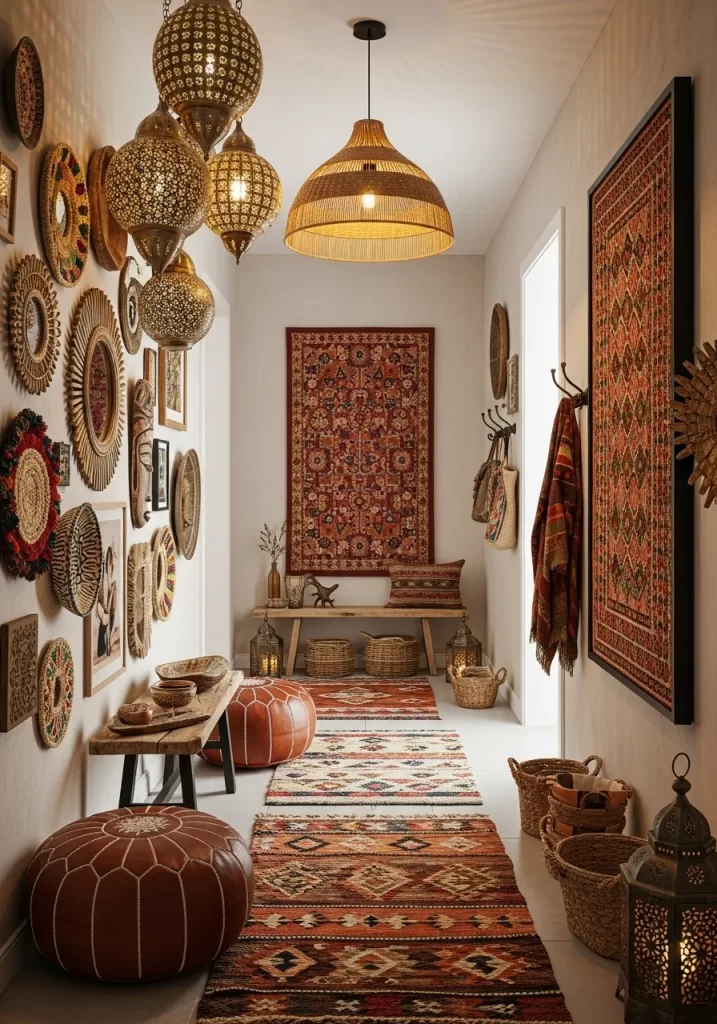
This hallway is filled with the colors and textures of a faraway market. Intricate metal lanterns hang from the ceiling, creating beautiful light patterns. The walls are decorated with woven plates, textiles, and mirrors, giving the space a rich, layered feel.
Warm colors, especially reds and oranges, are used in the rugs and wall hangings. Leather poufs and a low wooden bench provide casual seating. The whole space feels well-traveled, cozy, and full of handmade treasures from around the world.
DIY: Easy Yarn Tassels
Tassels are a fun way to add a pop of color and texture to almost anything. Let’s make some!
What You’ll Need:
- Yarn in your favorite colors
- A small, rectangular piece of cardboard (about the size of your hand)
- Scissors
Step 1: Wrap the Yarn Take your yarn and start wrapping it around the cardboard. Don’t wrap it too tightly. Keep wrapping until it’s as thick as you want your tassel to be. The more you wrap, the fluffier your tassel.
Step 2: Secure the Top Cut a separate, small piece of yarn. Slide it between the cardboard and your wrapped yarn at the top. Tie a tight double knot. This holds all the loops together.
Step 3: Cut the Bottom Slide the yarn off the cardboard. You will have a bundle of loops. Take your scissors and cut through all the loops at the bottom, opposite of the knot you just tied.
Step 4: Make the Tassel’s “Neck” Cut another piece of yarn. A little way down from the top knot, wrap this piece tightly around the bundle of yarn several times. This creates the little head of the tassel. Tie a secure knot to hold it in place. You can tuck the ends of this knot into the tassel to hide them.
Step 5: Trim the Bottom The ends of your tassel might be a little uneven. Use your scissors to give it a final trim so all the strands are the same length.
Step 6: Decorate! You’ve made a tassel! You can make a bunch and tie them onto baskets, doorknobs, or the ends of a blanket to add a bit of global flair.
16. Embrace High-Contrast Minimalism
Item Name: Bold Black and White Entry
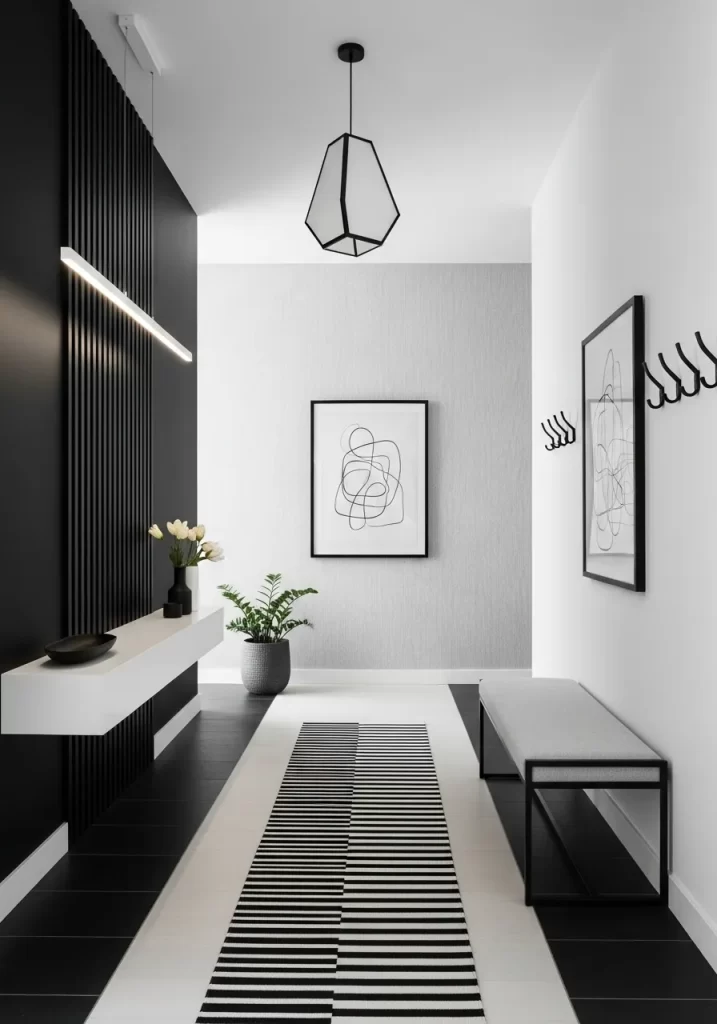
This hallway makes a powerful statement with just two colors. A feature wall of black vertical slats adds amazing texture and depth. A crisp white floating console stands out against it, creating a sharp, clean line. The floor uses black and white tiles to guide the eye.
The decor is kept simple and deliberate. A single piece of abstract line art, a geometric pendant light, and a sleek gray bench are all that’s needed. This design is all about the beauty of simple forms, strong lines, and a dramatic, focused color scheme.
DIY: Scribble Line Art
You can create a cool, modern piece of art that looks like the one in the picture. The best part is, you can’t mess it up!
What You’ll Need:
- A piece of thick white paper
- A black marker (a thicker one works well)
- A picture frame
Step 1: Get Ready to Scribble Put your piece of paper on a flat surface. Take the cap off your marker. The idea is to draw one single, long, looping line without lifting the marker from the paper.
Step 2: Just Draw! Place your marker somewhere on the paper and just start moving your hand. Make loops, squiggles, and lines that cross over each other. Fill up the page with your continuous line. Don’t think about it too much, just let your hand wander.
Step 3: Know When to Stop Keep going until you feel like the page has a good balance of black lines and white space. Then, you can finally lift the marker.
Step 4: Let it Dry Give the marker a minute to dry so it doesn’t smudge.
Step 5: Frame Your Art Place your new abstract masterpiece in a simple black frame. It’s a super fast and fun way to create a piece of modern art that is totally unique to you.
17. Relax with English Country Charm
Item Name: Timeless English Country Hallway

This hallway feels like a cozy room in a classic countryside home. The walls are covered in a beautiful, muted green floral wallpaper. Rich, dark wood furniture, like the chests of drawers and the hall tree, feels sturdy and timeless.
A gallery of classic paintings in ornate gold frames adds to the traditional feel. Soft lighting from table lamps and wall sconces creates a warm and inviting glow. Everything in this space, from the umbrella stand to the floral runner, works together to create a feeling of comfort and history.
DIY: “Age” Paper with Tea
You can make a new piece of paper or a print look like a very old, vintage treasure using tea.
What You’ll Need:
- A piece of paper (a map, a drawing, or just plain paper)
- A black tea bag
- A cup of hot water
- A shallow pan or baking sheet
- Paper towels
Step 1: Brew Some Strong Tea Put the tea bag in your cup and pour hot water over it. Let it sit for about 10 minutes. You want the tea to be very dark and strong.
Step 2: Prepare Your Paper Place your piece of paper flat in the shallow pan. To make it look even older, you can carefully tear the edges a little bit or crumple it into a ball and then flatten it out again.
Step 3: “Paint” with Tea Take the wet tea bag out of the cup (let it cool a bit so you don’t burn your fingers). Squeeze it out a little and then use it like a paintbrush to dab the tea all over your paper. You can also pour some of the tea from the cup over the paper.
Step 4: Make it Splotchy For a more authentic look, let some tea puddle in certain spots. This will make some areas darker than others, just like real old paper.
Step 5: Let it Dry Very carefully, lift the wet paper out of the pan and place it on some paper towels to dry. You can also let it dry in the pan. It will curl up as it dries. Once it’s completely dry, you can press it inside a heavy book for a day to flatten it out.
Step 6: Frame Your “Antique” Your paper now looks like it’s been around for ages! Frame it and hang it on your wall for a touch of vintage charm.
18. Have Fun with Whimsical Patterns
Item Name: Playful Eclectic Entryway
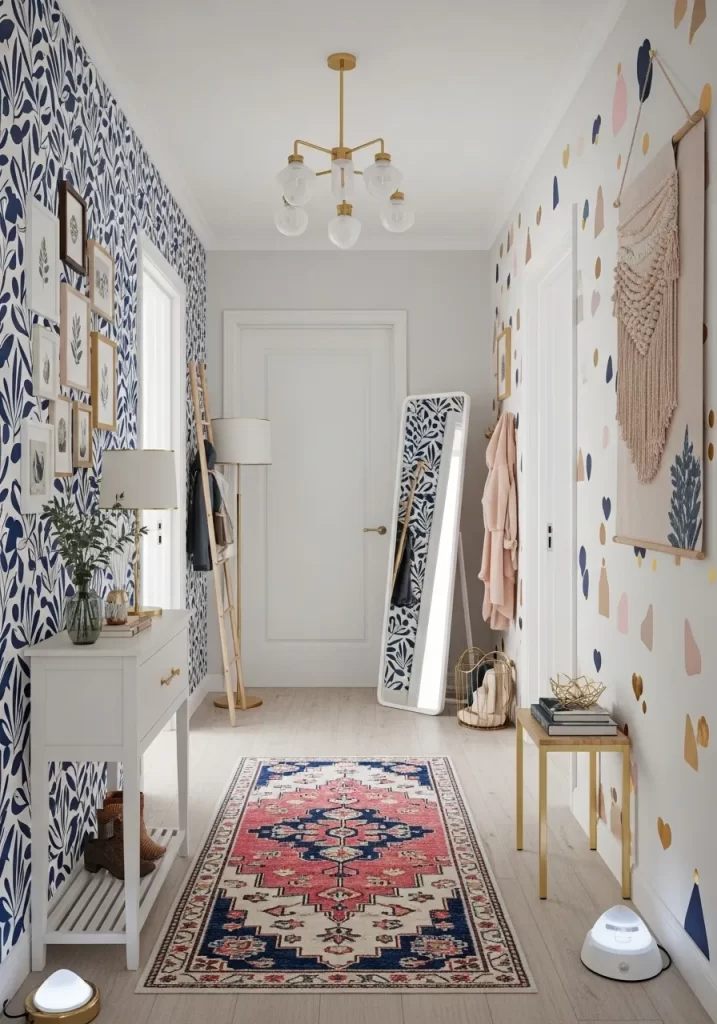
This hallway is all about mixing patterns and having fun. On one side, a dark blue wallpaper with a white leaf design creates a bold backdrop. On the other side, the wall is decorated with playful, hand-painted shapes in soft colors.
The furniture is light and modern, with gold accents that add a little shine. A colorful rug ties all the different elements together. This space shows how you can mix different styles and patterns to create an entry that is full of personality and charm.
DIY: Removable Wall Decals
You can add fun shapes to your wall without using paint. These decals are easy to make and easy to remove.
What You’ll Need:
- A roll of removable vinyl or contact paper in a few different colors
- A pencil
- Scissors
- A squeegee or a credit card
Step 1: Choose Your Shapes Decide what kind of shapes you want on your wall. You can do simple circles, triangles, or maybe some fun abstract blobs like in the picture.
Step 2: Draw and Cut Flip your vinyl or contact paper over to the back. Use your pencil to draw your shapes on the paper backing. Then, carefully cut them out with your scissors. Make a bunch of them in all your different colors.
Step 3: Plan Your Layout Before you stick them on, you can use a tiny piece of regular tape to temporarily place your decals on the wall. Move them around until you find a design you like. This is like a practice run.
Step 4: Peel and Stick Once you’re happy with your design, it’s time to stick them on for real. Peel the paper backing off one of your decals. Carefully place it on the wall where you want it to go.
Step 5: Smooth It Out Use a squeegee or the edge of a credit card to smooth the decal from the center out to the edges. This pushes out any air bubbles and makes sure it’s stuck on flat.
Step 6: Finish Your Wall! Keep peeling and sticking your decals until your pattern is complete. When you’re ready for a change, they should peel right off without hurting the paint.
19. Find Peace in Wabi-Sabi Simplicity
Item Name: Natural and Rustic Wabi-Sabi Hall
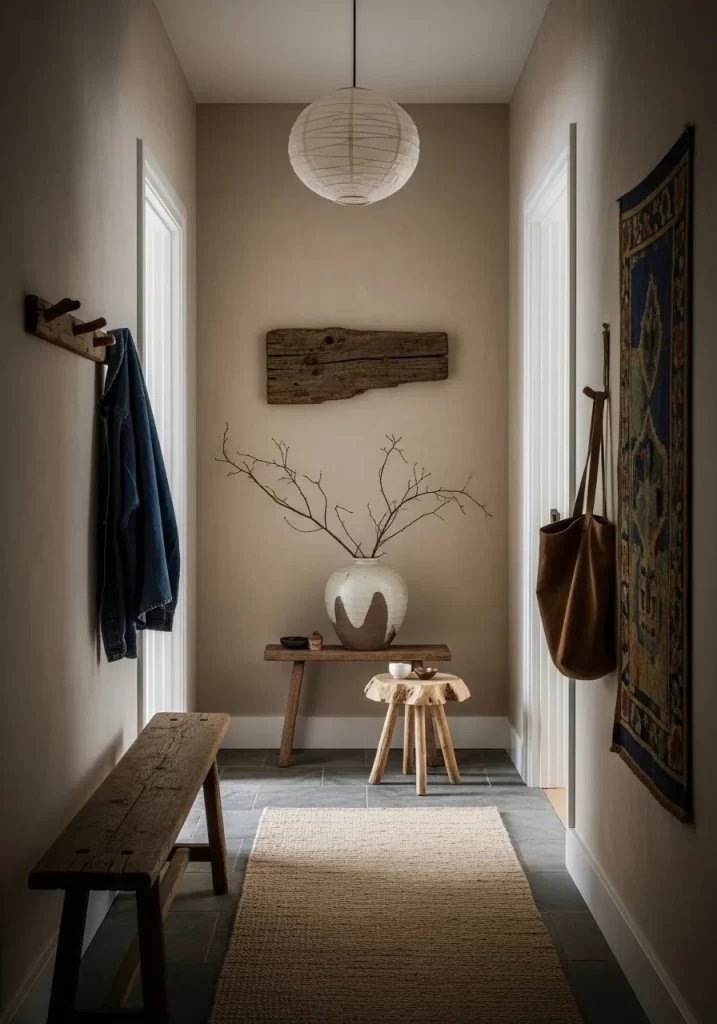
This hallway celebrates the beauty of simple, natural, and imperfect things. The walls have a soft, plaster-like texture, and the colors are calm and earthy. The furniture is made from rough, unfinished wood, showing off its natural grain and knots.
The decorations are minimal and organic. A gnarled branch in a simple vase, a piece of weathered wood on the wall, and a woven rug add texture. This style isn’t about being new and shiny; it’s about finding peace and beauty in things as they are.
DIY: Decorative Branch Display
Bring a beautiful piece of the outdoors inside. A simple branch can be a stunning piece of art.
What You’ll Need:
- A cool-looking branch
- A bucket of water and a scrub brush (if the branch is dirty)
- Sandpaper (optional)
- A large, heavy vase or pot
Step 1: Find the Right Branch Go for a walk in a park or your backyard and look for a fallen branch that has an interesting shape. Look for one with nice curves or smaller branches coming off it. Make sure it’s strong and not rotting.
Step 2: Clean it Up If your branch is dirty or has loose bark on it, give it a good cleaning. Use a scrub brush and water to scrub off any dirt. Let it dry completely in the sun. If there are any sharp or splintery parts, you can smooth them with sandpaper.
Step 3: Find a “Vase” You need a vase or pot that is heavy enough to hold your branch without tipping over. A simple ceramic or stone pot works great for this look.
Step 4: Arrange Your Display Place your clean, dry branch in the vase. You might need to turn it a few times to find the best angle. You can put some sand or small rocks in the bottom of the vase to help hold the branch steady.
Step 5: Find the Right Spot Place your new, natural sculpture in your hallway where it can be admired. It’s a simple, beautiful way to connect your home with nature.
20. Pop with Bright and Bold Art
Item Name: Energetic Pop Art Entry
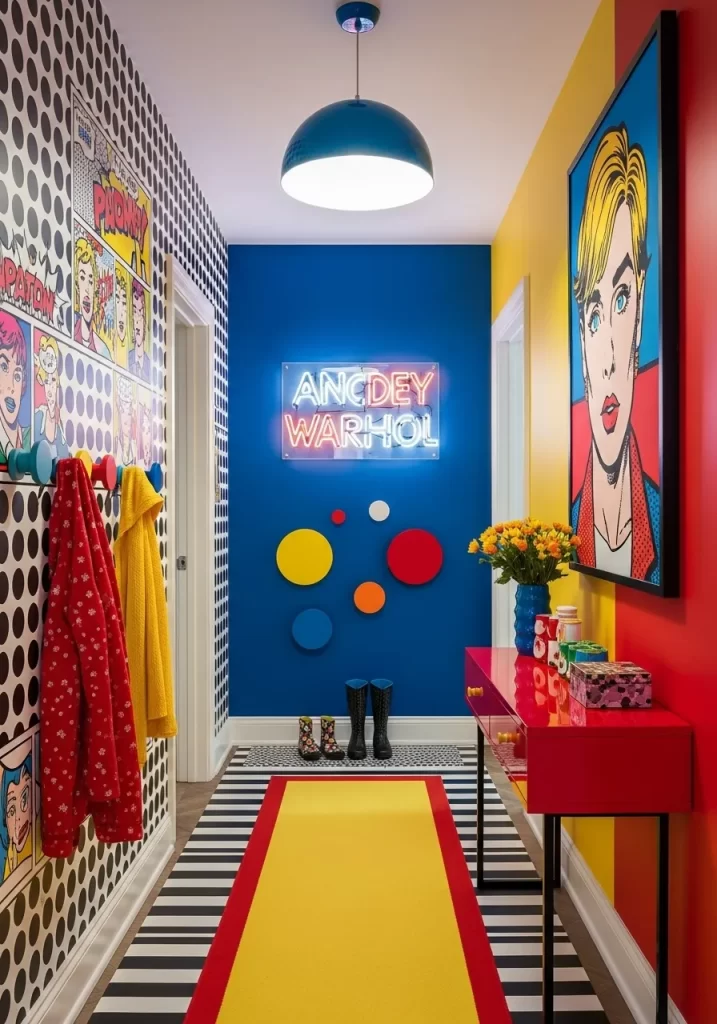
This hallway is an explosion of color and fun. One wall is covered in a wallpaper that looks like a comic book page, with bright graphics and dots. The other walls are painted in bold primary colors: red, yellow, and blue.
A neon sign and a large piece of pop art add to the playful, energetic vibe. The furniture is simple in shape but bold in color, like the bright red console table. This design is all about being loud, confident, and not taking itself too seriously.
DIY: Make Your Own Pop Art Portrait
Let’s turn a photo of you or your pet into a cool piece of pop art, like the art of Andy Warhol.
What You’ll Need:
- A simple photo with a clear subject (a portrait works best)
- A piece of thin paper and a pencil
- A canvas
- Carbon paper (for tracing)
- Acrylic paints in bright, crazy colors (like yellow, pink, blue)
- A black marker
- Paintbrushes
Step 1: Simplify Your Photo Place the thin paper over your photo. With a pencil, trace only the main shapes—the outline of the hair, the eyes, the mouth, the line of the jaw. Don’t worry about shading or small details.
Step 2: Transfer Your Drawing Place your canvas down. Put the carbon paper on top of it, dark side down. Then, place your tracing on top of the carbon paper. Trace over your pencil lines again, pressing firmly. When you lift the papers, the outline will have transferred onto your canvas.
Step 3: Go Wild with Color Now it’s time to paint! There are no rules for color. Paint the hair blue, the face yellow, and the lips green. Fill in the main shapes with your bright, flat colors. Don’t try to blend them. You want solid blocks of color.
Step 4: Paint the Background Choose another bright color and paint the entire background.
Step 5: Add the Black Outline Once all the paint is completely dry, take your black marker. Carefully trace over all the lines of your original drawing. This black outline is what gives it that classic comic book or pop art look.
Step 6: Hang Your Masterpiece You’ve created a vibrant, fun portrait that is completely unique. Hang it in your hallway to make a big, colorful statement.
21. Go for a Desert Modern Look
Item Name: Terracotta Earth-Toned Hallway

This hallway feels like a sunny, desert escape. The warm, earthy colors and natural textures create a calm and inviting space. An arched niche in the wall makes a special spot for displaying simple pottery. A woven leather bench provides seating and adds another layer of texture.
The artwork is large and abstract, using the same warm tones found throughout the space. Dried pampas grass and a cactus bring a touch of the desert landscape indoors. This style is all about simplicity, warmth, and connecting with natural elements.
DIY: Easy Air-Dry Clay Pinch Pots
Let’s make some small bowls out of clay, just like the ones in the picture. You don’t even need a kiln to bake them!
What You’ll Need:
- A block of air-dry clay
- A small bowl of water
- A flat, smooth work surface
- Your hands!
Step 1: Get a Ball of Clay Start with a piece of clay about the size of a golf ball. Roll it around in your hands to make it a smooth, round ball.
Step 2: Start Pinching Hold the ball in one hand. Gently press the thumb of your other hand into the center of the ball. Don’t push all the way through!
Step 3: Form the Bowl Now, start pinching the clay between your thumb on the inside and your fingers on the outside. Slowly turn the ball in your hand as you pinch. You will see the walls of the bowl start to get thinner and taller.
Step 4: Smooth it Out Keep pinching and turning until your pot is the shape you want. If the clay gets any cracks, just dip your finger in the water and smooth them out. You can make the top edge smooth or leave it a little wavy.
Step 5: Let it Dry Place your finished pinch pot on a flat surface to dry. It can take a day or two for it to become completely hard.
Step 6: Decorate! Once your pot is dry, you can leave it as is for a natural look, or you can paint it. These little pots are great for holding keys, jewelry, or just for decoration.
22. Design a Functional Schoolhouse Mudroom
Item Name: Vintage Schoolhouse Entry
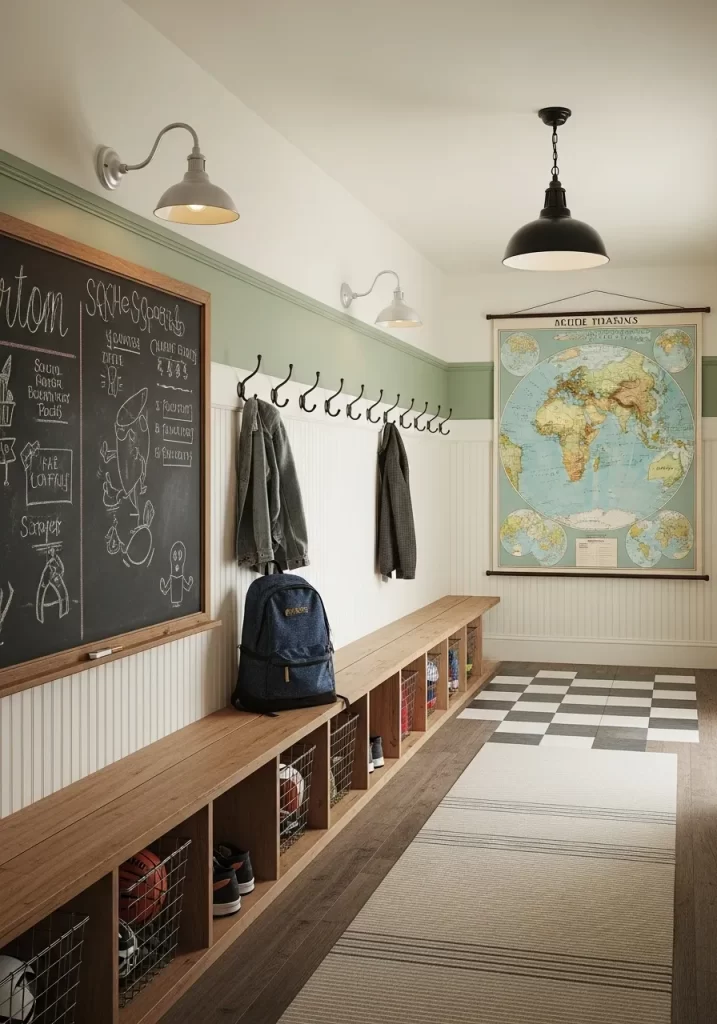
This hallway is built for busy lives. It has a classic, organized feel, like an old-fashioned schoolhouse. A very long wooden bench provides plenty of seating and has cubbies underneath for shoes and sports equipment. Wire baskets keep everything neat and easy to find.
A huge chalkboard on the wall is a fun spot for writing notes, lists, or doodles. Above the bench, a long row of hooks can hold lots of jackets and backpacks. A large, pull-down map adds to the vintage school theme and brings a bit of color to the space.
DIY: Make Your Own Framed Chalkboard
A chalkboard is great for messages and drawings. You can easily make your own in any size you want.
What You’ll Need:
- A flat piece of wood or an old picture frame with the glass removed
- Chalkboard paint
- A paintbrush or small roller
- An old picture frame (optional, for a border)
- Chalk
Step 1: Prepare Your Surface Make sure your piece of wood is clean and smooth. If you are using an old picture frame, take out the glass and the backing. You will be painting the backing board.
Step 2: Paint the First Coat Stir your chalkboard paint really well. Use your brush or roller to apply a thin, even coat of paint to your board. Let it dry completely. This might take an hour.
Step 3: Paint a Second Coat For a really good chalkboard surface, you need at least two coats. Once the first coat is dry, paint a second coat in the opposite direction. (If you painted up-and-down the first time, paint side-to-side this time). Let it dry.
Step 4: Cure the Chalkboard This is a very important step! Before you can write on it, you need to “season” the surface. Take a piece of chalk and lay it on its side. Rub the side of the chalk over the entire painted surface until it’s all covered. Then, wipe it all off with a dry cloth.
Step 5: Frame and Hang If you used a picture frame, you can now put your newly painted chalkboard back inside. Hang it on the wall, grab some chalk, and start writing!
23. Indulge in Moody Luxury
Item Name: Dramatic Jewel-Toned Hallway
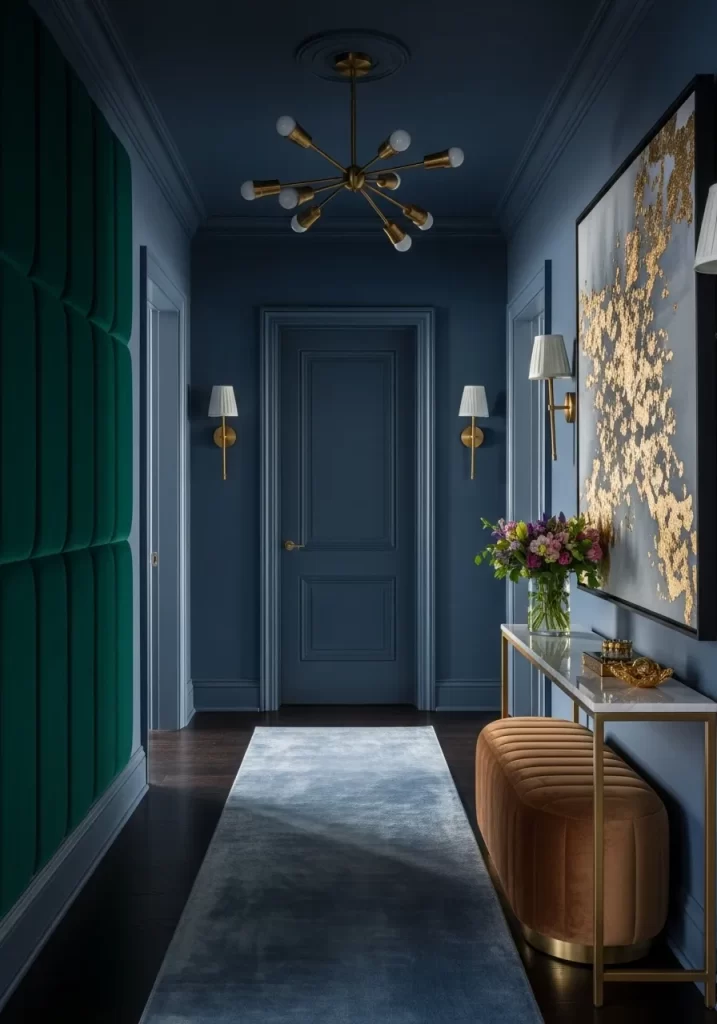
This hallway is rich, dark, and dramatic. The walls, the doors, and the ceiling are all painted the same deep shade of blue, which makes the space feel very cozy and enveloping. A wall of upholstered panels in a deep emerald green adds a soft texture and a bold splash of color.
Gold accents, like the modern sputnik chandelier and the thin console table, shine against the dark walls. A large piece of abstract art with gold leaf catches the light beautifully. This design uses color, texture, and metallic finishes to create a space that feels both luxurious and comfortable.
DIY: Easy Gold Leaf Abstract Art
You can make a very fancy-looking piece of art using gold leaf. It’s surprisingly easy and looks like a million bucks.
What You’ll Need:
- A blank canvas
- Paint in a dark color (like blue or black)
- A paintbrush
- Gold leaf flakes (imitation is fine)
- Craft glue
- A small, soft, dry paintbrush
Step 1: Paint Your Background Cover your entire canvas with your dark paint color. Let it dry completely.
Step 2: Plan Your Gold Design Decide where you want your gold leaf to go. You can make a random, splashy design like in the picture, or create a specific shape.
Step 3: Apply the Glue Use a paintbrush to apply a thin layer of craft glue to the canvas in the spots where you want the gold.
Step 4: Add the Gold Leaf This is the fun part! While the glue is still wet, generously sprinkle the gold leaf flakes over it. Don’t be shy! Gently pat the flakes down with your fingers.
Step 5: Let it Dry Let the glue dry for about an hour. It needs to be completely dry before you move to the next step.
Step 6: Brush Away the Excess Take your soft, dry paintbrush. Gently brush it over the canvas. All the loose gold leaf that didn’t stick to the glue will brush away, leaving your shiny design behind. You now have a very glamorous piece of art to hang in your hallway.
24. Create a 2D Cartoon Illusion
Item Name: Hand-Drawn Sketch Hallway
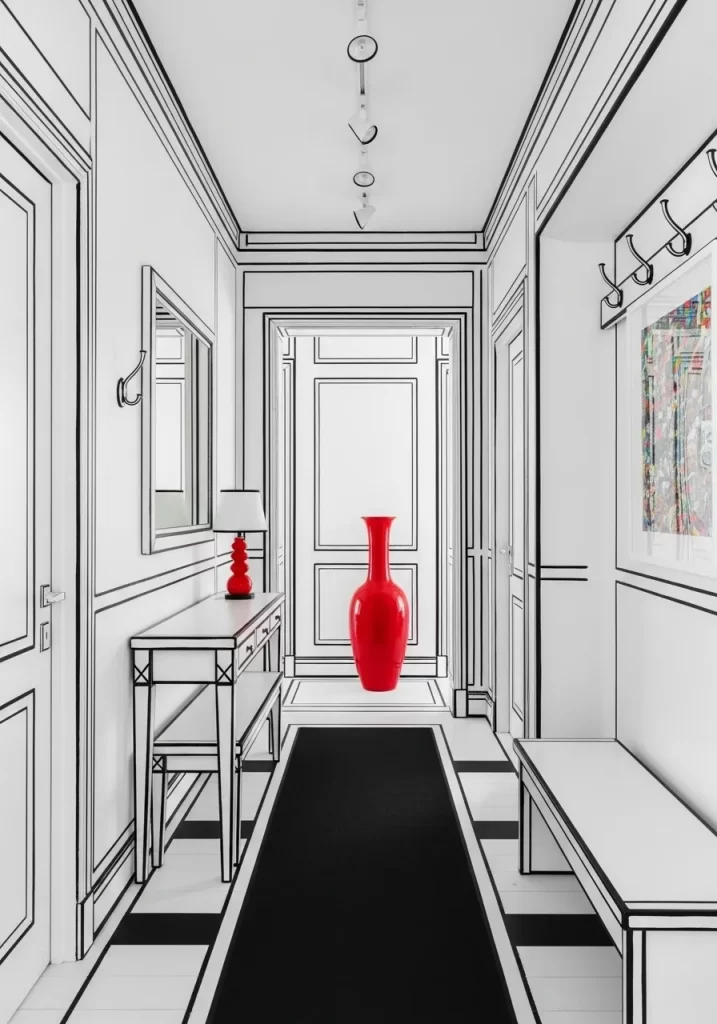
This hallway looks like it was pulled right out of a comic book. The entire space is white, but every edge and detail is outlined in black. This creates a fun optical illusion that makes the 3D room look like a flat, 2D drawing.
The doors, the moldings, the furniture, and even the coat hooks are all given a hand-drawn look with black lines. A single, bright red vase provides a powerful pop of color in the otherwise black-and-white world. This is a very creative and playful design that turns a simple hallway into a work of art.
DIY: “Sketch” Your Own Accessories
You can use this cool 2D trick on smaller items to give them a cartoon look. A simple wooden box is a great place to start.
What You’ll Need:
- A simple object, like a plain wooden box or a white vase
- A thick black permanent marker
- A ruler
Step 1: Choose Your Object Find a simple, light-colored object with clear edges. A plain wooden storage box, a white picture frame, or a simple ceramic vase would work well.
Step 2: Start with the Main Edges Take your black marker and your ruler. Carefully draw a black line along all the main edges of your object. For a box, this would be all the corners where the sides meet.
Step 3: Add Some Detail Lines To make it look more hand-drawn, add some extra little lines. You can add small “hatch” marks in the corners or draw a slightly wobbly line next to your straight line. This makes it look less machine-made and more like a real sketch.
Step 4: Don’t Forget the Top and Bottom Make sure to outline the top and bottom edges of your object as well.
Step 5: Let it Dry Give the marker a minute to dry completely so it doesn’t smudge.
Step 6: Display Your Creation Place your newly cartoonish object on a shelf. It will be a fun and surprising piece of decor that plays a trick on the eyes.
25. Cultivate a Serene Spa Atmosphere
Item Name: Zen-Inspired Minimalist Hall
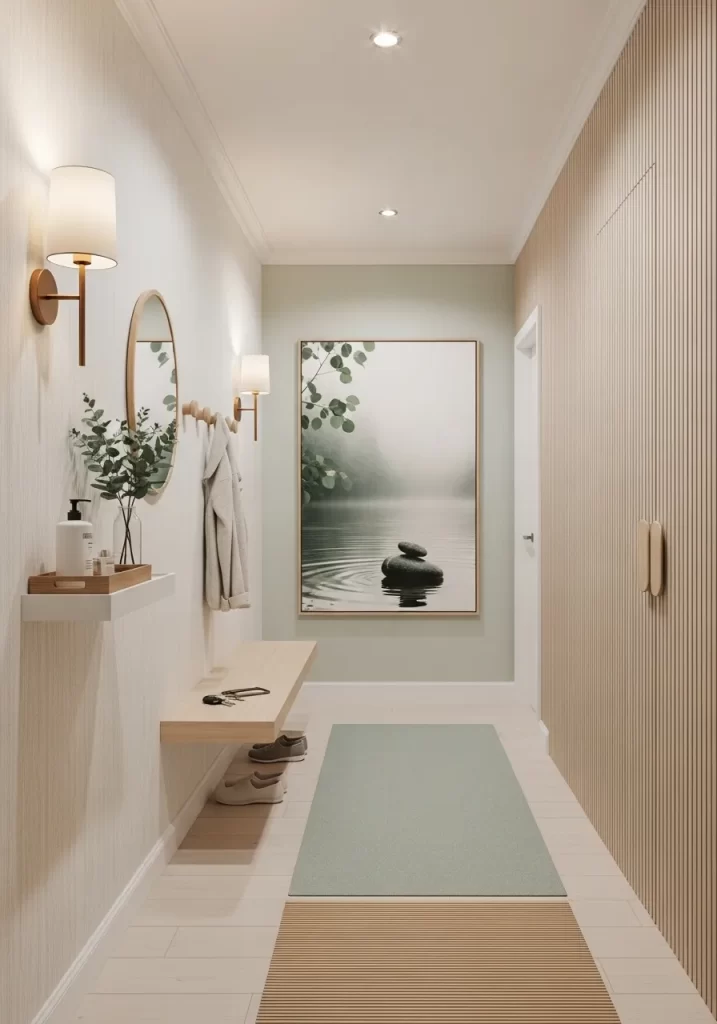
This hallway is designed to be a peaceful, calming space. Soft, muted colors and natural materials are used throughout. One wall features light wood slats, which add warmth and texture, while the other is a soft sage green. The lighting is gentle, coming from simple wall sconces.
A single, large piece of art showing a tranquil water scene is the main focus. The furniture is minimal, with just a simple floating bench and a small shelf. This design is all about creating a clean, uncluttered, and relaxing environment.
DIY: Your Own Mini Zen Garden
A small zen garden is a great way to bring a little bit of calm into your home. It’s a tiny sandbox for you to relax with.
What You’ll Need:
- A shallow dish or tray
- Fine sand (you can find this at a craft store)
- A few smooth stones
- A small rake (you can use a fork or make one from twigs)
Step 1: Fill Your Tray Pour the sand into your shallow dish. Fill it about halfway to the top. Shake it gently to make the surface of the sand smooth and flat.
Step 2: Place Your Stones Take your smooth stones and arrange them in the sand. You can use one, two, or three stones. Don’t overthink it; just place them wherever feels right to you.
Step 3: Rake the Sand Now, use your tiny rake or a fork to draw lines and patterns in the sand. You can make wavy lines around the rocks or straight lines across the whole garden. The idea is that this repetitive motion is very calming.
Step 4: Find a Peaceful Spot Place your mini zen garden on a shelf or table in your hallway.
Step 5: Change It Up Whenever you want a moment of calm, you can rearrange the stones or rake a new pattern in the sand. It’s a little interactive piece of art for your home.
26. Throw it Back to the ’70s
Item Name: Groovy Retro Revival Hallway
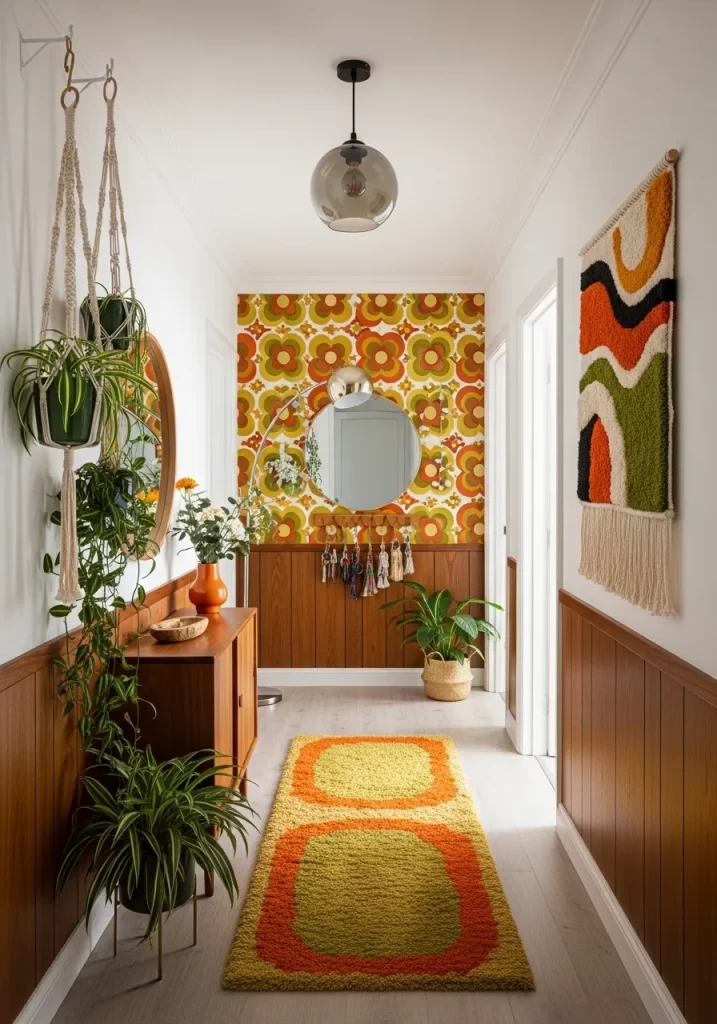
This hallway is a fun trip back in time to the 1970s. A bold wallpaper with a large, geometric flower pattern in orange and green sets a groovy tone. The bottom half of the walls are covered in warm wood paneling, which was very popular in that era.
The textures are playful, from the fuzzy shag rug to the woven wall art. Macrame plant hangers and lots of houseplants add to the natural, bohemian vibe. This design is all about embracing bold patterns, warm colors, and a fun, laid-back attitude.
DIY: Retro Yarn Art
Let’s make a piece of textured wall art that looks straight out of the ’70s. It’s like painting with yarn.
What You’ll Need:
- A piece of cardboard or a canvas
- Pencil
- Craft glue
- Yarn in a few retro colors (like orange, yellow, and brown)
- Scissors
Step 1: Draw Your Design On your cardboard or canvas, draw a simple, groovy design. Wavy lines, rainbows, or simple swirls work really well for this style.
Step 2: Outline in Yarn Squeeze a thin line of glue along one of your pencil lines. Take a piece of yarn and press it down onto the glue. This will create the outline of your first shape.
Step 3: Fill it In Now, fill in that shape with more yarn. Apply glue to a small section inside your outline. Then, lay pieces of yarn side-by-side until the section is filled. You can also do a spiral pattern, starting from the outside and working your way in.
Step 4: Add More Colors Keep outlining and filling in your shapes with your different colors of yarn. Make sure the yarn pieces are packed tightly together so you can’t see the cardboard underneath.
Step 5: Let it Dry Once your entire design is filled with yarn, let the glue dry completely.
Step 6: Hang Your Art Your textured, retro art is ready to hang. It’s a fun and colorful way to add some vintage flair to your wall.
27. Channel Classic Parisian Elegance
Item Name: Elegant Neoclassical Hallway
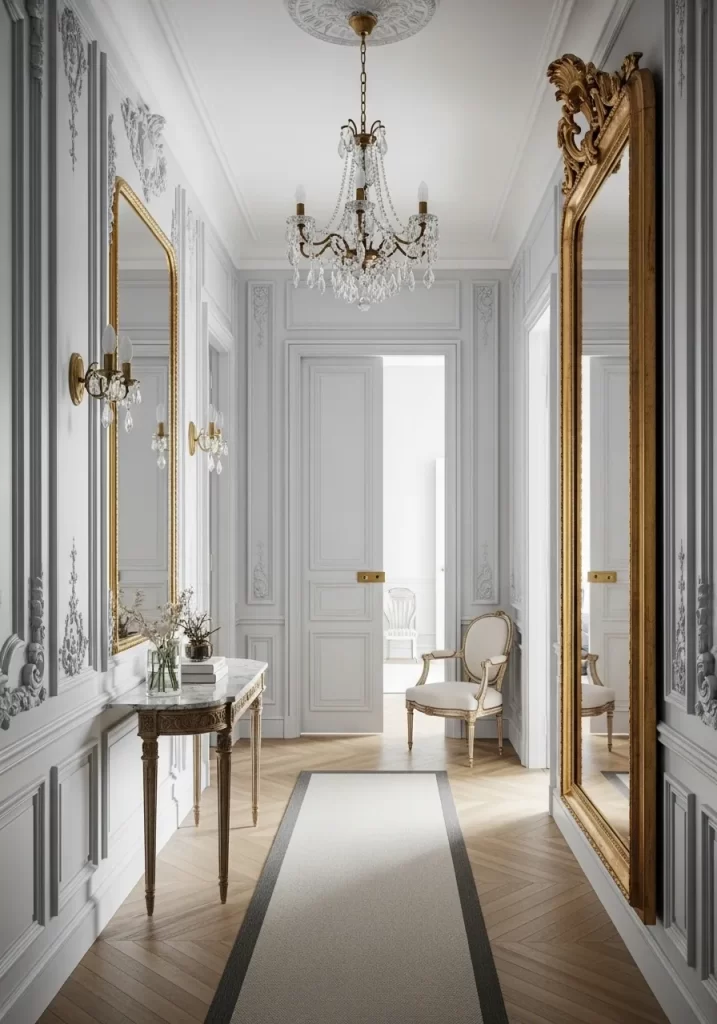
This hallway is the picture of classic, Parisian grace. The walls are covered in ornate decorative molding, called boiserie, which adds depth and a sense of history. The color palette is light and airy, with soft grays and whites that make the space feel bright.
Large, gilded mirrors with elaborate frames make the hallway feel even bigger and more grand. A crystal chandelier hangs from a decorative ceiling medallion, adding sparkle and light. The furniture is delicate and antique-inspired, completing this timelessly elegant look.
DIY: An Antique-Look Gilded Frame
You can give any cheap picture frame a fancy, antique gold finish with just a little bit of paint.
What You’ll Need:
- An old picture frame with some details or curves
- Gold metallic spray paint
- Black or dark brown craft paint
- A paper towel or an old rag
Step 1: Prepare Your Frame Make sure your frame is clean and dry. If it has glass, take it out. It’s best to do your spray painting outside on some newspaper.
Step 2: Spray it Gold Shake your can of gold spray paint well. Apply a thin, even coat of paint all over the frame. Let it dry for about 20 minutes, then apply a second coat to make sure it’s fully covered. Let it dry completely.
Step 3: Add the “Age” Now we’ll make it look old. Squeeze a little bit of the black or brown craft paint onto a paper plate. Dab your paper towel or rag into the paint, then wipe most of it off. You want your rag to be almost dry.
Step 4: Rub and Wipe Lightly rub the dark paint over the details of your frame. The dark paint will settle into the crevices and low spots. Immediately after you apply it, use a clean part of the rag to wipe away the excess. This leaves the dark paint only in the recessed areas, making the details pop and giving the frame an aged look.
Step 5: Let it Dry Let the dark paint dry. Now your frame looks like an expensive antique! Find a nice piece of art or a mirror to put inside it.
28. Create a Dark Academia Study
Item Name: Scholarly Dark Academia Hall
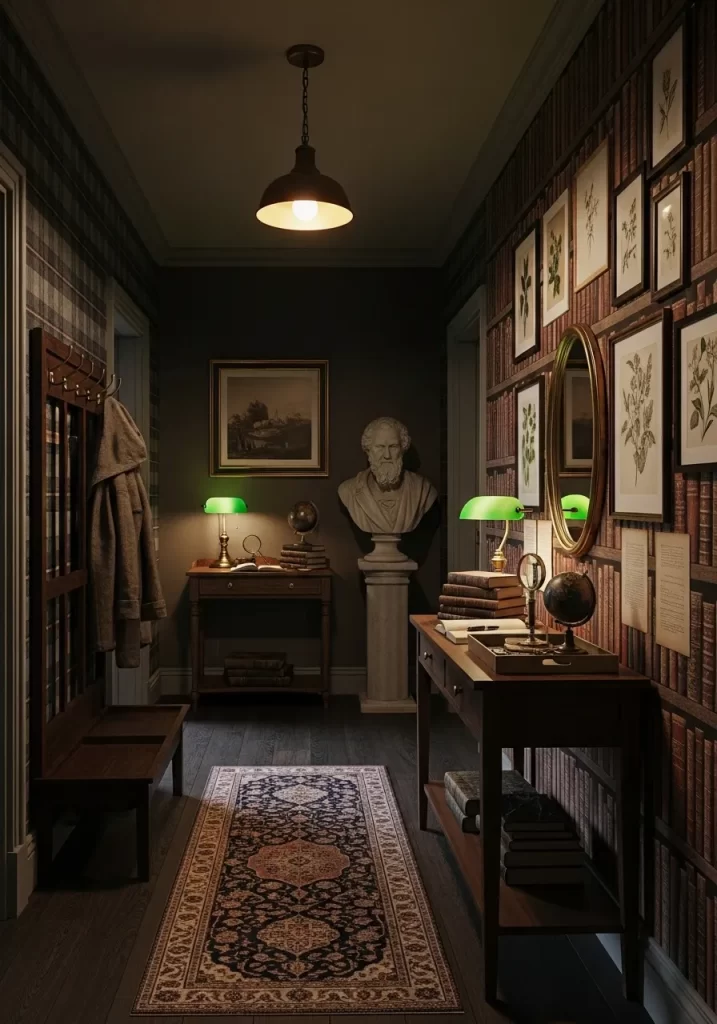
This hallway feels like a secret corner of a university library. The walls are covered in dark wallpaper—one with a classic plaid pattern and another that looks like shelves full of old books. This instantly creates a cozy, studious atmosphere.
Dark wood furniture, like the console tables and hall tree, adds to the traditional feel. The space is filled with scholarly objects: a classical bust on a pedestal, globes, stacks of books, and framed botanical prints. Green banker’s lamps provide a warm, focused light for late-night reading.
DIY: Framed Vintage-Style Prints
You can create a wall of smart-looking art by framing prints that you find online.
What You’ll Need:
- A printer
- White or cream-colored cardstock paper
- A collection of simple, matching frames
- Access to the internet
Step 1: Find Your Images Go online and search for “free printable vintage botanical art” or “public domain scientific illustrations.” Many museums and libraries offer high-quality images for free. Look for things like drawings of plants, animals, or old maps.
Step 2: Download and Print Save your favorite images to your computer. Print them out on your cardstock paper. Cardstock is thicker than regular paper and will look much nicer in the frames.
Step 3: Trim to Fit If you need to, use scissors or a paper cutter to trim your prints so they fit perfectly inside your frames.
Step 4: Frame Them Up Carefully place each print into a frame. Make sure they are straight and there’s no dust under the glass.
Step 5: Create a Grouping Hang your new collection of framed art on the wall. Group them together to create a gallery wall. It’s a very simple and affordable way to make your hallway look distinguished and intelligent.
29. Go for Moody and Modern
Item Name: Sleek and Moody Modern Hallway
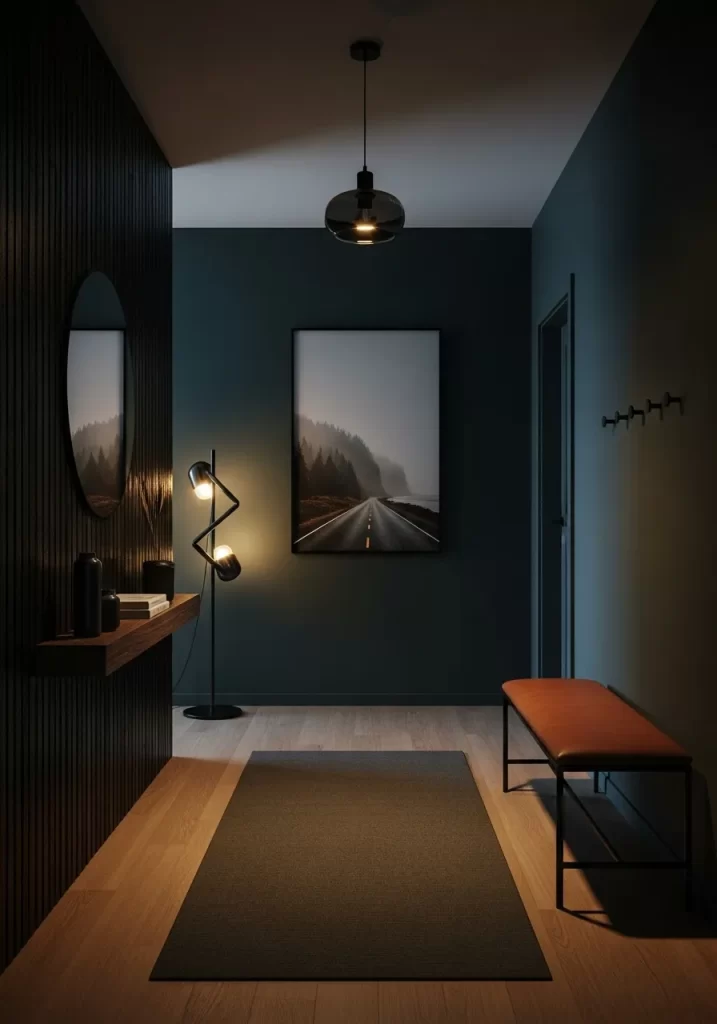
This hallway uses darkness to create a calm and sophisticated mood. The walls are painted a deep, dramatic color, while one wall is covered in dark vertical wood slats for texture. This makes the space feel intimate and modern.
The lighting is soft and intentional, with a simple pendant light and a stylish floor lamp highlighting certain areas. A large, atmospheric photograph serves as the only piece of wall art, drawing you in. The furniture is minimal and clean-lined, like the simple leather bench and floating shelf.
DIY: A Simple Wooden Photo Ledge
A photo ledge is a very thin shelf that is great for displaying pictures because you can easily change them without putting new holes in the wall.
What You’ll Need:
- Two wooden boards of the same length (one about 3 inches wide, one about 2 inches wide)
- Wood glue
- A few small nails and a hammer
- Sandpaper
- Paint or wood stain
- Screws and a drill to hang it
Step 1: Build the “L” Shape Take your wider board and lay it flat. This will be the bottom of your shelf. Apply a line of wood glue along one of the long edges.
Step 2: Attach the Back Take your narrower board and stand it up on the glued edge of the wider board. This will create a 90-degree angle, or an “L” shape. This tall piece is the back of your shelf that will go against the wall.
Step 3: Secure it Wipe away any excess glue that squeezed out. For extra strength, carefully hammer a few small nails through the bottom board up into the back piece.
Step 4: Sand and Finish Once the glue is dry, use sandpaper to smooth the whole shelf. Then, you can paint it or stain it to match your decor.
Step 5: Hang it on the Wall Ask an adult to help you screw the shelf into the wall. Make sure it’s level. Drill the screws through the back piece of the shelf directly into the wall. Now you have a sleek, modern ledge to lean your favorite photos and art against.
30. Grow a Charming Cottage Garden
Item Name: Fresh Botanical Cottage Hallway

This hallway feels like a walk through a blooming garden. A beautiful wallpaper with delicate wildflowers covers the top half of the wall, while the bottom half is painted a soft, calming sage green. The space is filled with fresh flowers, both in vases and on the pillow.
A collection of framed botanical prints adds to the garden theme. The furniture is made of light-colored wood, which keeps the space feeling bright and casual. This design is all about bringing the freshness and charm of a country garden inside your home.
DIY: Frame Your Own Pressed Flowers
Pressing flowers is a beautiful way to preserve a piece of your garden or a special bouquet.
What You’ll Need:
- Fresh flowers and leaves
- A heavy book
- A few sheets of paper towel or parchment paper
- A picture frame (a floating frame where you can see through the glass works great)
Step 1: Choose Your Flowers Pick some flowers from your garden. Flowers that are naturally flat, like violets, daisies, and ferns, work best.
Step 2: Prepare for Pressing Open your heavy book to somewhere in the middle. Lay a sheet of paper towel down on the page. Arrange your flowers and leaves on the paper towel, making sure they don’t overlap.
Step 3: Press Them Place another sheet of paper towel on top of your flowers. Very carefully, close the heavy book. The weight of the book will press the flowers flat and help them dry out. You can even stack more heavy books on top for extra weight.
Step 4: Be Patient! This is the hardest part. You need to leave the flowers pressing in the book for at least two to three weeks. Don’t peek! They need time to dry completely.
Step 5: Reveal Your Flowers After a few weeks, carefully open the book. Your flowers will be flat, dry, and delicate. Use tweezers to gently lift them off the paper.
Step 6: Frame Your Creation Arrange your beautiful pressed flowers on the glass of your frame. If you’re using a floating frame, you can create a lovely see-through composition. Close up the frame and hang your piece of natural art.
31. Frame the View with Bold Arches
Item Name: Dramatic Sculptural Archway Hall
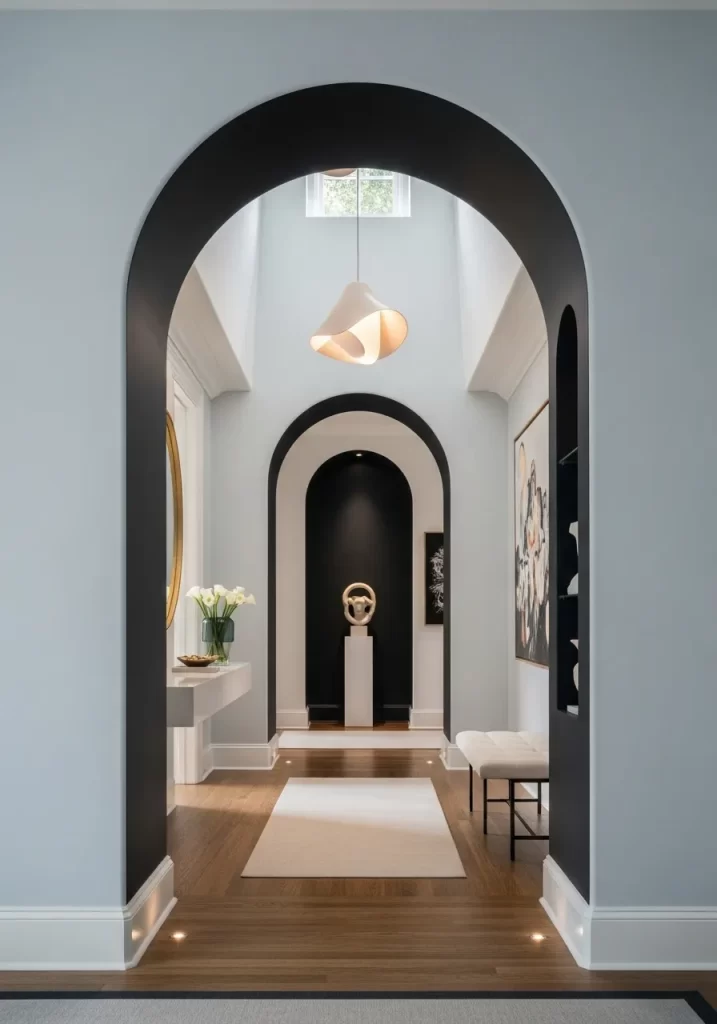
This hallway uses architecture to create a stunning effect. A series of bold, dark arches creates a beautiful sense of depth and leads your eye through the space. The contrast between the dark archways and the light-colored walls is dramatic and sophisticated.
The decor is kept very minimal to let the architecture be the main feature. A simple pendant light hangs from above, and a single sculpture on a pedestal is highlighted at the end of the hall. This design shows how a strong architectural element can be the most powerful decoration of all.
DIY: Paint a Faux Arch
You can get the look of a beautiful archway just by using paint. It’s a great way to create a focal point on a flat wall.
What You’ll Need:
- A pencil
- A long piece of string
- A thumbtack
- Painter’s tape
- A level
- Paint in the color you want for your arch
- A paintbrush
Step 1: Decide the Size First, decide how wide and how tall you want your arch to be. Use your level and pencil to draw the two vertical side lines. Use painter’s tape to tape off the outside of these lines.
Step 2: Find the Center Use a tape measure to find the exact center point between your two vertical lines. Mark this spot with your pencil.
Step 3: Draw the Curve Now, let’s make the curved top. Tie one end of your string to the pencil. Pin the other end of the string to the center point you marked using the thumbtack. The length of the string should be half the width of your arch. Keeping the string tight, swing the pencil from the top of one vertical line to the other. You will have drawn a perfect semi-circle.
Step 4: Tape the Curve This part takes patience. Tear off small pieces of painter’s tape and carefully stick them along the outside of the curved line you drew.
Step 5: Time to Paint Your arch is all taped off. Now, grab your paintbrush and fill in the arch with your paint color. You will probably need two coats.
Step 6: The Big Reveal Wait for the paint to be almost dry, but not completely. Carefully and slowly peel off all the painter’s tape. You will have a beautiful, crisp painted arch on your wall!
32. Go All-In with One Color
Item Name: Monochromatic Teal Hallway
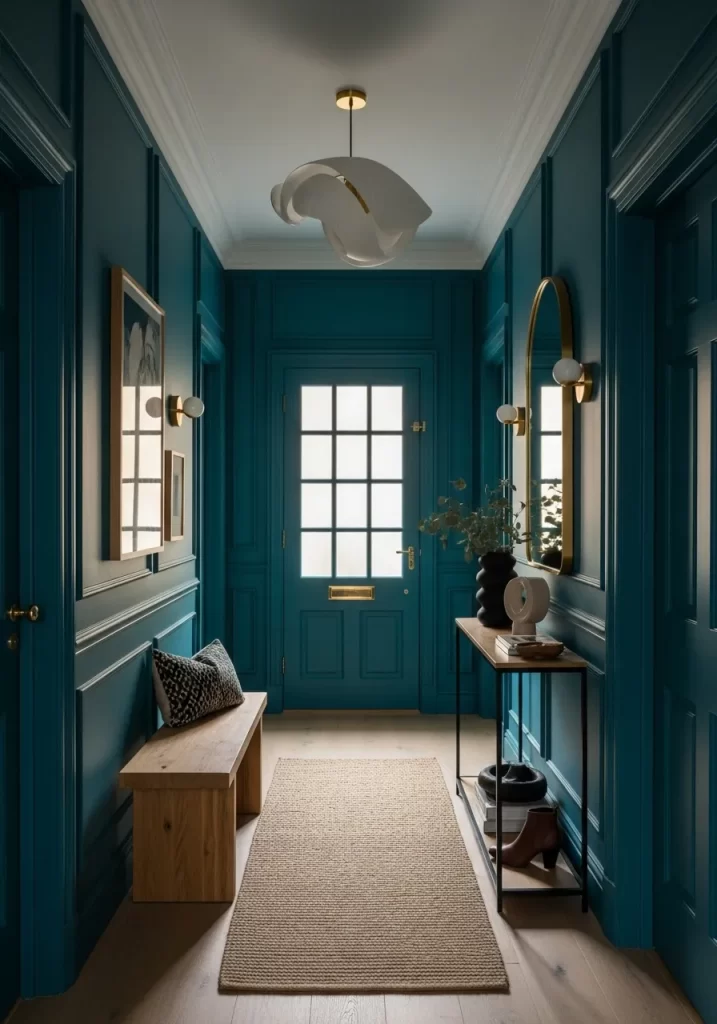
This hallway makes a bold and confident statement by using one beautiful color for everything. The walls, the door, and all the detailed molding are painted in the same rich shade of teal. This technique, called color drenching, makes the space feel cohesive and surprisingly spacious.
The texture of the wall paneling adds depth and interest, so the single color doesn’t feel flat. A simple wooden bench and a natural fiber rug provide a warm contrast to the cool teal. Gold accents on the mirror and light fixtures add a final touch of warmth and elegance.
DIY: How to Pick a Bold Paint Color
Choosing a dark or bright color can be scary, but it can make a room look amazing. Here’s how to choose wisely.
What You’ll Need:
- Paint sample pots in a few colors you like
- White poster board or foam board
- Tape
Step 1: Find Inspiration Look at pictures online or in magazines to see what bold colors you are drawn to. Don’t just think about the color itself, but the feeling it creates.
Step 2: Get Samples Go to the paint store and get a few small sample pots of the colors you’re considering. Don’t try to choose from the tiny paper swatches.
Step 3: Paint a Big Sample Don’t paint the samples directly on your wall! Instead, paint a large square of each color onto a piece of white poster board. Paint two coats. This creates a big, movable sample.
Step 4: Test it in Your Space Tape your painted poster boards up on the wall in your hallway. Now, you can see what the color really looks like in your home’s lighting.
Step 5: Watch it All Day Leave the samples up for a full day. Look at them in the morning light, in the afternoon, and at night with the lights on. Colors can change a lot depending on the light.
Step 6: Make Your Choice! After watching your samples, one color will likely stand out as your favorite. Now you can buy the full can of paint with confidence and get ready to transform your space.
33. Create Calm with Natural Textures
Item Name: Neutral and Textural Sanctuary Hall

This hallway is a masterclass in creating a calm, soothing space. The color palette is very simple, with only soft whites and warm beiges. The interest comes from all the different textures. A rough jute rug, rustic wooden tables, and woven storage baskets all feel wonderful and natural.
The artwork is also textural, with raised, plaster-like designs that you want to reach out and touch. The soft light from the paper lantern and the simple table lamp adds to the peaceful feeling. This is a space that feels grounded, warm, and very serene.
DIY: Textured Plaster Art
You can make a very stylish and expensive-looking piece of art using a canvas and some wall plaster.
What You’ll Need:
- A blank canvas
- A small tub of pre-mixed joint compound or wall plaster
- A putty knife or an old credit card
- A comb or other textured tools (optional)
Step 1: Get Your Canvas Ready Place your canvas on a flat surface that you can get messy.
Step 2: Slap on the Plaster! Scoop up some joint compound with your putty knife. There are no rules here! Plop it onto the canvas and start spreading it around. You can make it thick in some spots and thin in others.
Step 3: Create Texture Use your putty knife to make interesting patterns. You can make swoops, ridges, or choppy marks. You can drag the teeth of a comb through the plaster to create lines. Have fun and experiment with different shapes.
Step 4: Let it Dry This is the most important part. Plaster can take a long time to dry, especially if it’s thick. Let your canvas sit for at least 24 to 48 hours until it is completely hard and white.
Step 5: Leave it or Paint it You can leave your art the natural white color of the plaster for a minimalist look. Or, once it’s dry, you can paint over it with a single color.
Step 6: Hang it Up Your high-end, textural art is complete. It’s a simple project that adds a huge amount of style to your wall.
34. Step into the Future
Item Name: High-Tech Futuristic Corridor
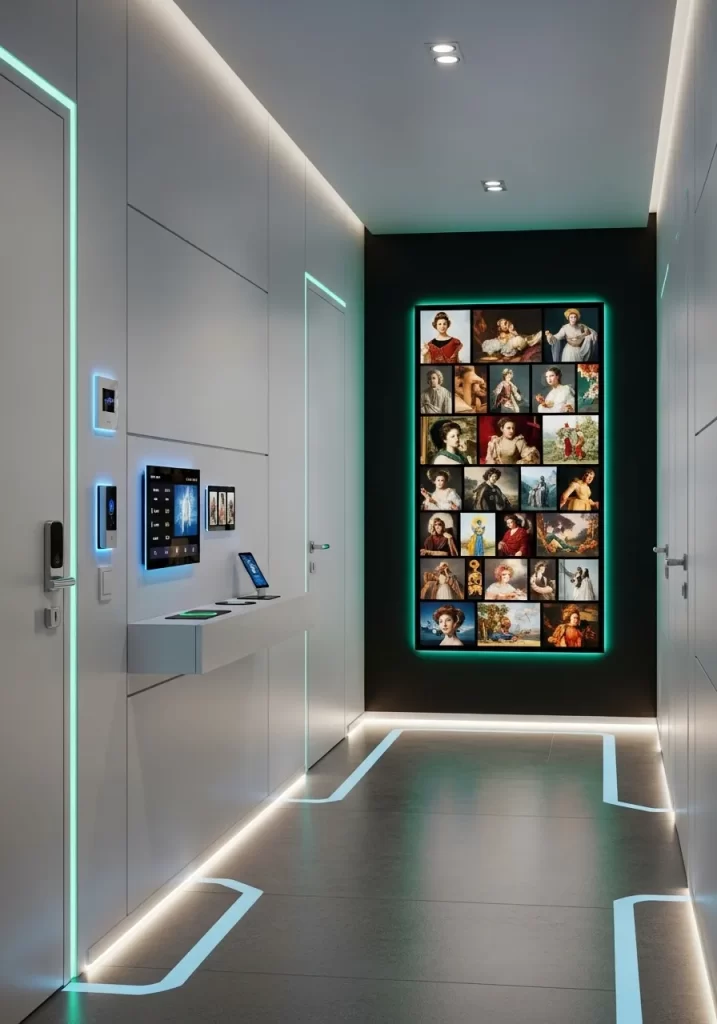
This hallway looks like something from a science fiction movie. It’s sleek, minimal, and filled with cool technology. Glowing strips of LED lights are embedded in the floor and around the doors, creating a futuristic pathway.
A smart home control panel is mounted on the wall, allowing for control of lights and other systems. At the end of the hall, a large digital screen displays a grid of classic paintings, mixing old art with new technology. The overall look is clean, sharp, and very cutting-edge.
DIY: Easy Peel-and-Stick LED Lights
You can add a futuristic glow to almost anything with LED light strips. It’s one of the easiest ways to add a lot of impact.
What You’ll Need:
- A roll of self-adhesive LED light tape
- Scissors
- A clean cloth
- A power outlet
Step 1: Choose Your Spot Decide where you want to add your lights. They look great under a shelf, behind a headboard, or along the bottom of a cabinet.
Step 2: Clean the Surface Use your clean cloth to wipe down the surface where you will be sticking the lights. The adhesive will stick much better to a clean, dust-free surface.
Step 3: Measure and Cut Unroll your light strip and hold it up to the spot you chose. Most light strips have designated cut marks on them (often with a little scissor symbol). You can only cut on these marks. Use your scissors to cut the strip to the length you need.
Step 4: Peel and Stick Peel the paper backing off the light strip to reveal the sticky side. Carefully press the strip onto your clean surface. Go slowly and press firmly as you go to make sure it’s stuck on well.
Step 5: Plug it In Plug the power adapter into the end of the light strip and then plug it into the wall.
Step 6: Enjoy the Glow! Use the remote that came with your lights to turn them on. You can usually change the colors, the brightness, and even make them flash or fade. It’s an instant way to add a high-tech vibe to your space.
35. Build a Hallway of Fun
Item Name: Interactive Kid’s Museum Hall
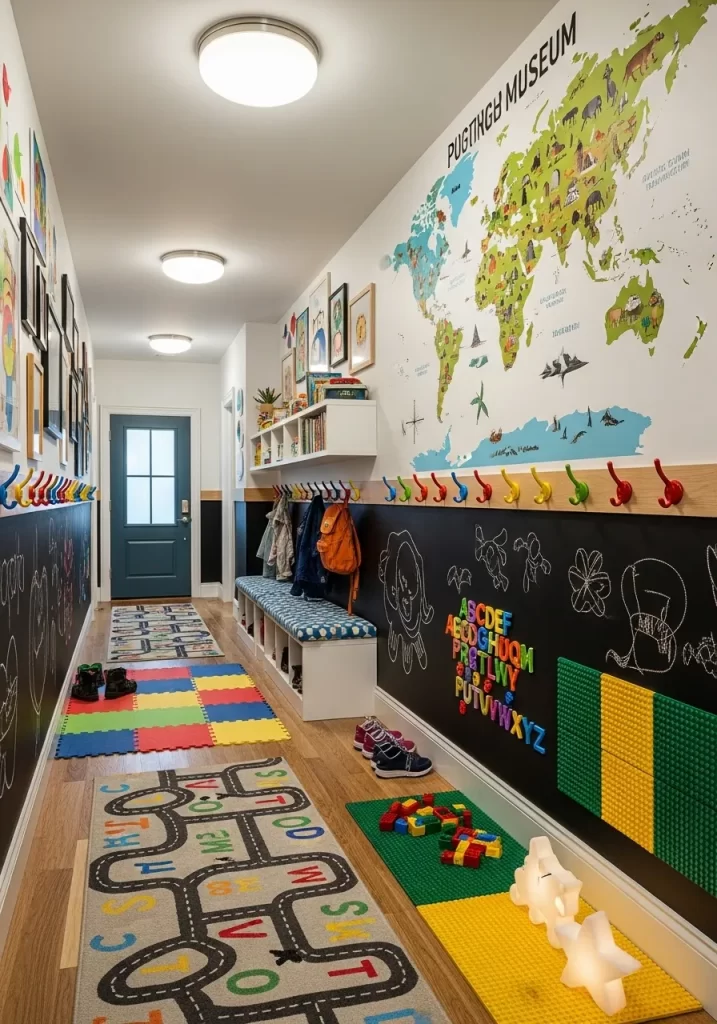
This hallway is designed for play and creativity. It’s a space that is full of color, texture, and things to do. The bottom half of the walls are covered in chalkboard paint, providing an endless canvas for drawings. There are even LEGO base plates mounted on the wall for building.
A giant, colorful world map is both educational and fun to look at. The floor has a mix of soft foam tiles and a road-themed rug, encouraging play. Brightly colored hooks are placed at a kid-friendly height, making it easy for them to hang up their own things.
DIY: Make a LEGO Wall
A LEGO wall is an amazing play space that gets the toys off the floor and turns them into art.
What You’ll Need:
- Several large LEGO baseplates (the flat green or blue squares)
- Strong construction adhesive or Command strips designed for heavy items
- A level
- A tape measure
- A pencil
Step 1: Plan Your Wall Decide how big you want your LEGO play area to be. Use your tape measure to figure out how many baseplates you will need to fill the space.
Step 2: Draw a Guideline Use your pencil and your level to draw a straight line on the wall where the bottom of your LEGO plates will go. This will make sure your whole wall is straight.
Step 3: Stick on the First Plate If using adhesive, apply it to the back of your first baseplate in an “S” shape. Press the plate firmly onto the wall, aligning it with your guideline in one corner. Press all over for about 30 seconds. If using Command strips, follow the package instructions.
Step 4: Add the Next Plate Take another LEGO plate and click it onto the side of the one that’s already on the wall using a few LEGO bricks to connect them. This ensures they are perfectly spaced. Now, apply your adhesive to the back and press this second plate onto the wall.
Step 5: Keep Going! Continue adding plates, using loose LEGO bricks to connect them before you stick them to the wall. This is the secret to making sure all your plates are lined up perfectly so you can build across them.
Step 6: Let it Set Let the adhesive cure for at least 24 hours before you start building on your new wall. Then, grab your bucket of bricks and let the creativity begin!
36. Organize a Natural History Exhibit
Item Name: Symmetrical Naturalist’s Gallery
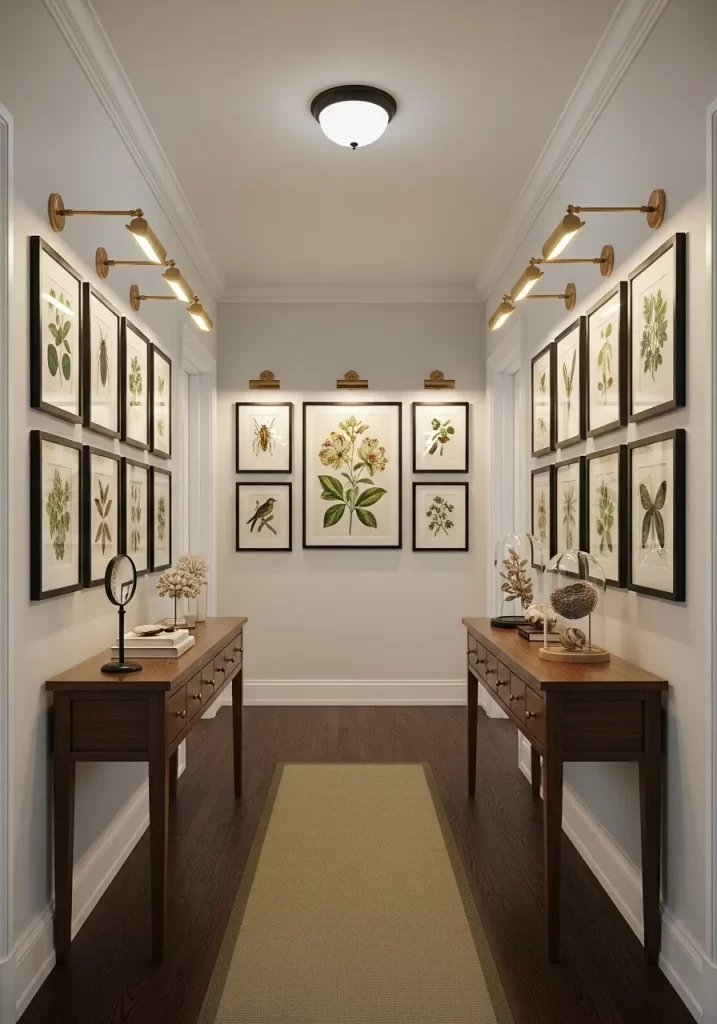
This hallway is neat, organized, and very sophisticated. It feels like a beautiful exhibit in a natural history museum. Two identical console tables face each other, creating a perfect sense of balance and symmetry.
The walls are lined with grids of framed botanical and insect prints. The identical black frames and white mats make the collection look unified and important. Art lights are mounted above the frames, highlighting the artwork and making the space feel like a real gallery.
DIY: How to Hang a Symmetrical Grid Gallery
A grid of pictures looks very sharp and organized. It takes a little planning, but the result is worth it.
What You’ll Need:
- Your collection of framed art (all frames should be the same size)
- A tape measure
- A pencil
- A level
- Picture hanging nails and a hammer
Step 1: Do the Math This is the most important part. First, measure the whole width of your wall. Then, measure the width of one of your frames. Decide how much space you want between each frame (e.g., 2 inches). Now, you can figure out the total width of your art display and center it on the wall.
Step 2: Mark for the First Frame Once you know where your grid should start, hold up your first frame (the top-left one). Use your level to make sure it’s straight. Lightly mark the top corners with your pencil.
Step 3: Mark for the Nail Measure the back of your frame to see how far down from the top of the frame the nail needs to go. Measure that same distance down from your pencil mark on the wall and mark the spot for the nail.
Step 4: Hang the First Frame Hammer your nail in and hang your first picture. Use your level to double-check that it’s straight.
Step 5: Hang the Top Row Now, measure the distance you wanted between frames (e.g., 2 inches) from the side of the first frame and make a mark. This is where the next frame starts. Repeat steps 2, 3, and 4. Continue until your whole top row is hung.
Step 6: Hang the Rows Below To hang the next row, measure your desired vertical distance down from the bottom of the first frame and make your marks. Use your level to make sure the tops of the new row will line up perfectly. Keep going until your beautiful, organized grid is complete!
37. Paint a Path of Color
Item Name: Graphic Rainbow Stripe Archway

This hallway uses paint in a very creative and artistic way to turn a simple doorway into a major design feature. A series of colorful, painted stripes follows the curve of the arch, flows down the wall, and continues along the floor.
The bold lines of color create a sense of movement and draw your eye through the space. The design is playful, graphic, and completely unique. It shows that you don’t need expensive art when you can make the architecture itself into a work of art with a little bit of paint and imagination.
DIY: How to Paint Perfect Stripes
Painting clean, crisp stripes is easy if you have the right tool: good painter’s tape.
What You’ll Need:
- A pencil
- A level or a ruler
- High-quality painter’s tape (it’s worth getting the good stuff!)
- Paint for your stripes
- A small paintbrush or roller
Step 1: Plan Your Stripe Use your pencil and level to lightly draw guidelines on the wall where you want your stripe to be.
Step 2: Tape the Edges This is the secret step. Place your painter’s tape on the outside of your pencil lines. Run your finger or a credit card along the edge of the tape to seal it tightly to the wall. This prevents the paint from bleeding underneath.
Step 3: Seal the Tape (The Pro Trick!) Here is a trick for extra-sharp lines. Take the original base color of your wall and paint a thin line right over the edge of the tape that’s on the inside of your stripe. This seals the edge, so if any paint bleeds, it will be the color that’s already there. Let this dry.
Step 4: Paint Your Stripe Now, paint your stripe color between the two pieces of tape. You may need two coats.
Step 5: The Grand Finale Wait until the paint is tacky but not fully dry. Carefully and slowly pull the painter’s tape off at a 45-degree angle. You should have a perfectly crisp, professional-looking stripe.
Your hallway is a blank canvas. After seeing these 37 different approaches, it’s clear that no transitional space has to be uninspired. From a single piece of art to a wall of interactive fun, the possibilities are endless.
You don’t need a massive budget or professional help. Many of these powerful transformations begin with a simple can of paint, a collection of your favorite photos, or a creative DIY project you can complete in an afternoon. The first step is yours to take.
Choose an idea that speaks to you. Start small. Make the journey through your home as beautiful as the rooms themselves. Create a home that feels complete, from the front door to the furthest corner.
Key Takeaways
- Treat Your Hallway Like a Room: Give your corridor the same design attention you would a living room or bedroom. It is a vital part of your home’s story.
- Walls Are Your Canvas: Use bold wallpaper, dramatic paint, gallery walls, or architectural molding to add instant personality to a narrow space.
- Embrace Texture and Lighting: Rugs, plants, textiles, and smart lighting can make a hallway feel cozier, brighter, and more inviting.
- Function Can Be Beautiful: Incorporate stylish storage solutions like benches, hooks, and console tables to keep the space organized and useful.
- DIY Makes it Personal: A simple, hands-on project is often the most effective way to add character and create a space that is uniquely yours.