For many of us, the guest room starts with the best intentions—a cozy space dedicated to welcoming friends and family. Slowly, however, this room transforms. It often becomes the quiet corner where unwanted furniture goes to retire, where seasonal clothes wait indefinitely, and where miscellaneous boxes collect dust. It essentially becomes the household’s “dumping ground.”
Reclaiming this space is about more than just tidying up. It is about restoring a boundary in your home and creating a truly peaceful, multi functional area. We understand the struggle of needing extra storage while still wanting a stylish, comfortable room for visitors.
This comprehensive guide offers 39 practical, actionable solutions designed to aggressively contain clutter. We focus on smart, discreet storage and organization systems that allow your guest room to function beautifully as both a comfortable retreat and a well managed extension of your home. Get ready to transform that dumping ground into the haven it was always meant to be.
1. The Organized Open Linen Shelves
Relevant Item Name: Accessible Guest Comfort Cabinet
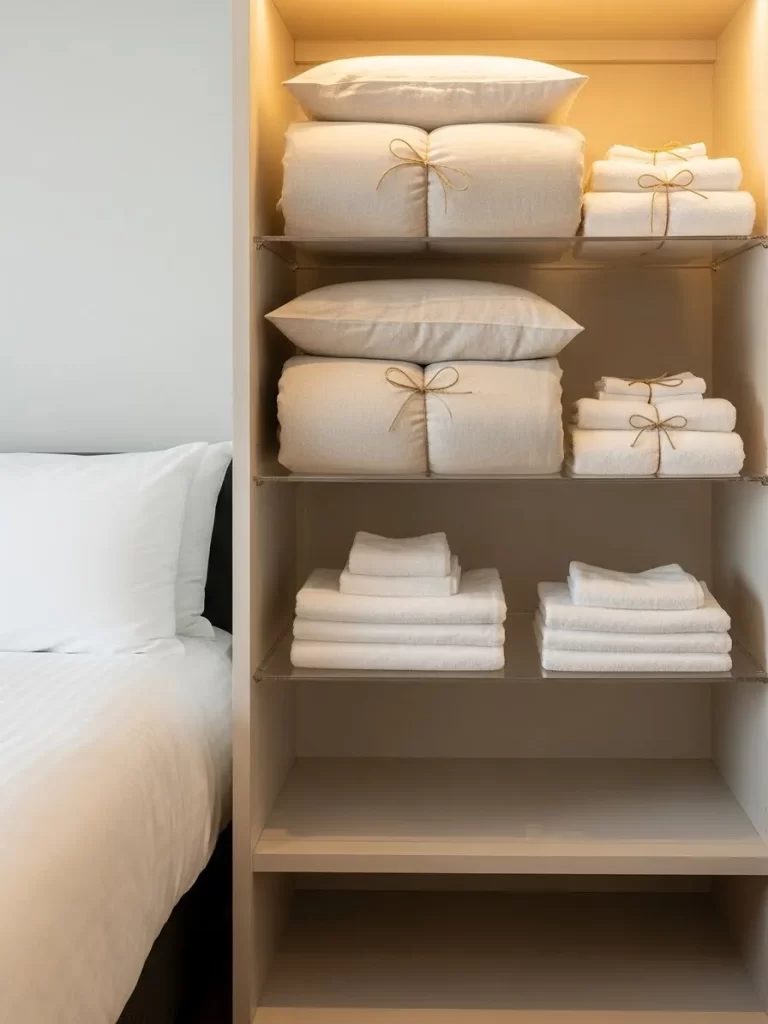
This photograph showcases how simple built-in shelving can transform linen storage from clutter into a clean, hotel-quality display. The light wood or painted cabinet houses several clear shelves, making it easy to see exactly what is available for guests.
Notice how all the bedding is uniformly white or a natural linen color, creating a soothing and minimalist aesthetic. The pillows, comforters, and towels are neatly stacked, with the larger items tied with a rustic twine bow, suggesting they are fresh and ready for use.
Placing these shelves right next to the bed means everything a guest might need—extra blankets, fresh towels, or a spare pillow—is within easy reach. This organization method eliminates the need to rummage through drawers or closets, keeping your guest room functional and welcoming instead of just a disorganized storage area.
DIY Project: Creating Open Shelf Linens
If your guest room is overwhelmed by extra bedding, try this simple system to make everything look pristine and accessible. This DIY focuses on the organization and presentation of the linens, rather than building the cabinet itself.
Materials Required List
- A supply of fresh, clean linens (towels, blankets, pillows)
- Natural jute twine or thin rope (about 1/8 inch thickness)
- A sturdy, accessible shelf or open cabinet in the guest room
- Lavender sachets or cedar blocks (optional, for freshness)
Equipment Required List
- Measuring tape (for uniform folding)
- Scissors (for cutting twine)
- Iron and ironing board (optional, but highly recommended for crisp folding)
DIY Instruction Step by Step
- Preparation is Key: Start by washing and thoroughly drying all the linens you plan to store on the open shelves. Ironing large items like blankets and sheets will make folding much crisper and professional looking.
- Achieve Folding Uniformity: Lay out your comforters, blankets, and sheets flat. Use a measuring tape to ensure you fold them into consistent rectangular shapes. Aim for a fold width that is slightly less than the depth of your shelf so they sit perfectly without hanging over.
- The Pillow Tuck: For pillows, gently compress them and place them flat on the top shelves. Try to keep them symmetrical and centered for a balanced look.
- Towel Folding Technique: Master the triple fold for towels. Fold the towel in half lengthwise, then fold it into thirds across the width. This method gives a thick, spa-like rectangular shape that stacks beautifully.
- The Twine Tie: Take your folded blankets or comforters. Cut a length of jute twine long enough to wrap around the center of the folded item. Wrap the twine once horizontally around the middle, pull it taut, and tie a simple, attractive bow on the top center. This secures the fold and adds a decorative touch.
- Arrangement and Placement: Place the largest items (comforters, blankets) on the middle shelves, as they usually require the most space. Stack the folded towels neatly on the lower or side shelves. Ensure you leave a small amount of breathing room between stacks.
- Add Freshness (Optional): Tuck a small lavender sachet or a cedar block behind the stacks on the shelf (not directly on the fabric) to keep the linens smelling fresh and inviting for your next visitor.
2. Under Bed Space Saver Drawers
Relevant Item Name: Accessible Seasonal Storage Containers
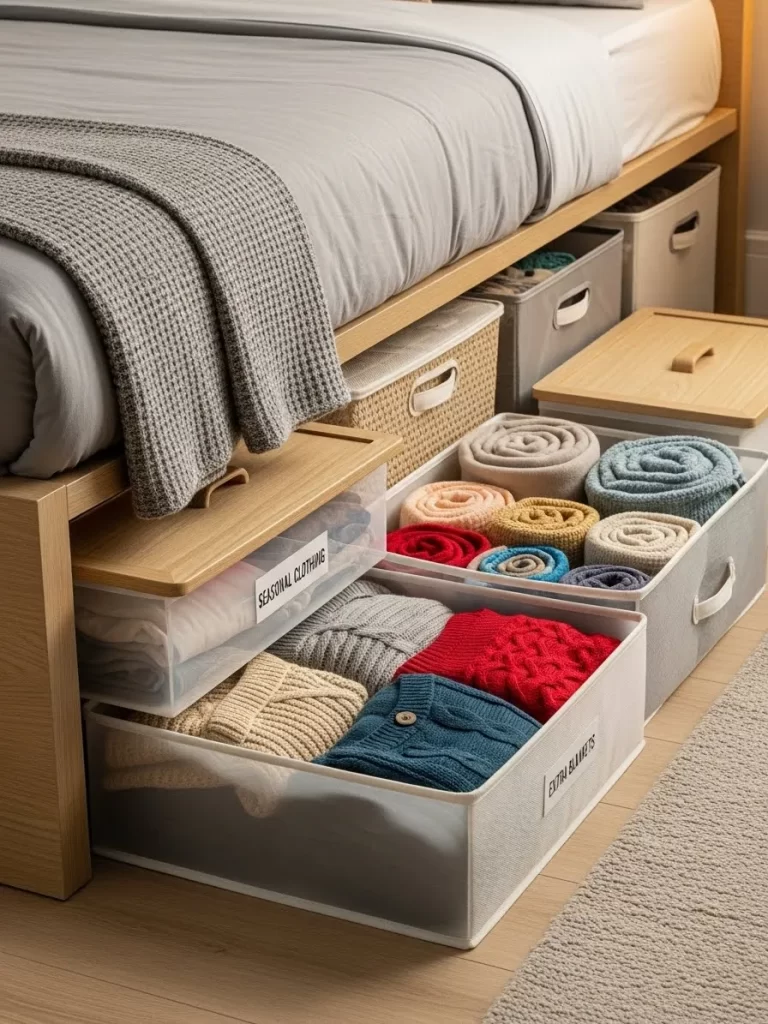
This picture highlights a brilliant way to use the often-forgotten space beneath a bed. Instead of allowing the floor under the bed to become a dust bunny collector or a chaotic spot for misplaced items, it has been transformed into organized storage.
Different styles of containers are utilized here, including breathable fabric boxes, woven baskets, and clear acrylic drawers with wooden tops. Each container serves a specific function, clearly separating seasonal clothing from extra blankets.
Rolling up or neatly folding items like sweaters and throws maximizes the storage capacity and makes selection effortless. This clever arrangement hides clutter while keeping essential items readily available, ensuring the guest room remains a restful retreat.
DIY Project: Under Bed Storage Boxes
Creating structured storage beneath your bed is an effective way to stop miscellaneous items from collecting on the floor.
Materials Required List
- Two to four large, shallow fabric storage boxes or bins with handles (non-woven polypropylene is a good choice)
- One sheet of cardboard or plastic paneling (sized to fit the bottom of your chosen bins for added rigidity)
- Label-making materials (cardstock, markers, or a label printer)
- Clear packing tape or strong craft glue
- Items to be stored (extra blankets, off-season clothing, or pillows)
Equipment Required List
- Scissors or a box cutter
- Ruler or tape measure
- Iron (optional, for crisp fabric folds)
DIY Instruction Step by Step
- Reinforce the Bins: Many inexpensive fabric bins lack a sturdy base, which causes them to slump when pulled out. Cut your cardboard or plastic paneling to exactly match the dimensions of the bin’s bottom. Place this reinforcement piece inside the bin to keep the shape consistent and help it slide smoothly.
- Sort Your Contents: Separate the items you want to store into logical categories, such as “Extra Blankets,” “Seasonal Clothing,” or “Guest Amenities.” This initial sorting prevents the bins from becoming disorganized dumping grounds.
- Fold for Efficiency: Roll your blankets and throws tightly to save space, as shown in the image. Fold sweaters and clothing using a KonMari or similar folding method to create small, neat squares or rectangles. This uniformity allows you to stack more items vertically inside the shallow bins.
- Label Everything Clearly: Cut your chosen label material (cardstock or printed label) into easy-to-read rectangles. Write the contents clearly, such as “WINTER SWEATERS” or “EXTRA THROWS.” Affix the label to the end of the storage bin that faces outward using clear packing tape or strong craft glue.
- Placement Under the Bed: Gently slide the filled, labeled bins under the bed frame. Ensure they are placed far enough under the bed so they do not impede walking space or make the room look crowded. The handles should face outward for effortless retrieval.
3. The Rustic Ladder Shelf
Relevant Item Name: Decorative Vertical Towel Organizer
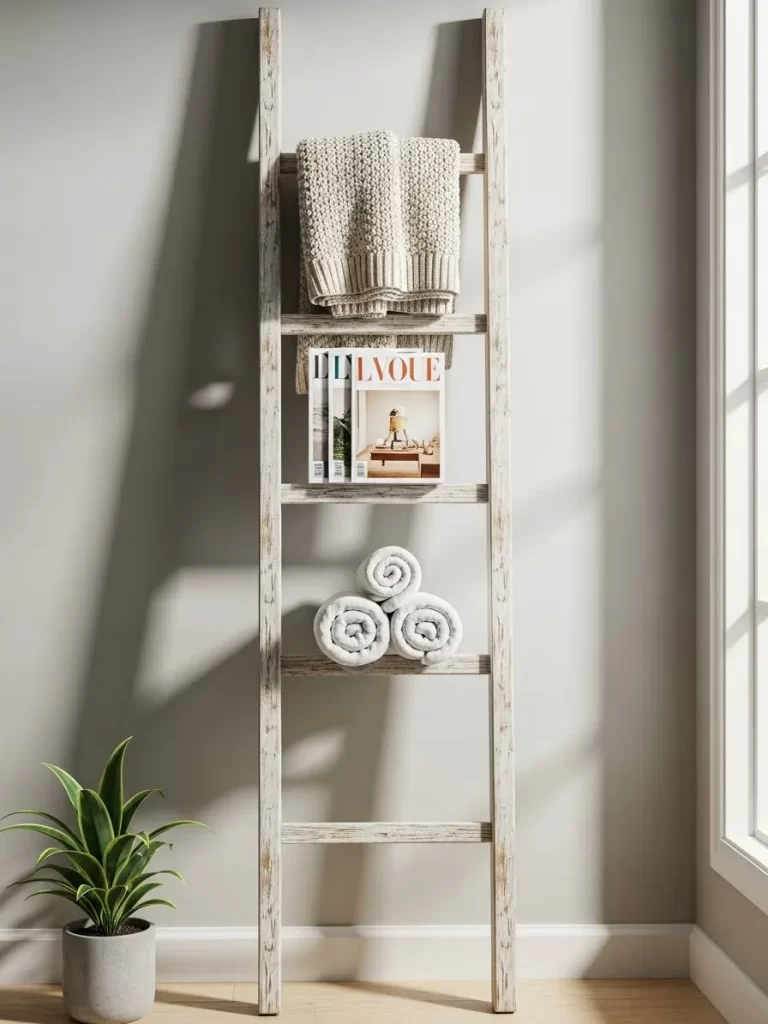
This charming image shows a stylish, tall ladder leaning against a wall, repurposed as clever vertical storage. The distressed, weathered finish of the wood adds a rustic warmth to the room’s decor.
Instead of traditional wall shelving, the rungs of this ladder provide a unique and easily accessible spot for guest items. A cozy, chunky knit throw is draped over the top rung, ready for a chilly night.
Magazines are tucked into the middle rung, offering entertainment, and fluffy white towels are rolled and stacked on a lower rung. This design maximizes vertical space while keeping the floor area free, turning necessary storage into an attractive decorative feature.
DIY Project: Rustic Blanket Ladder
You can construct a simple, functional blanket ladder that instantly elevates your guest room’s style while providing storage.
Materials Required List
- Two wooden poles or 2×2 lumber pieces, each about 6 feet long (for the side rails)
- Four wooden dowels or 1×2 lumber pieces, each about 18 inches long (for the rungs)
- Wood glue
- Sandpaper (medium and fine grit)
- Stain or whitewash paint, and an old rag or brush
Equipment Required List
- Drill and drill bits
- Measuring tape
- Clamps
- Safety goggles
- Miter saw (or have the wood cut at the store)
DIY Instruction Step by Step
- Cut the Components: Cut your two side rails to the desired length (around 6 feet is standard). Cut the four rung pieces to a consistent width (around 18 inches). Sand all cut edges smooth using medium-grit sandpaper to prevent splinters.
- Mark Rung Placement: Lay one side rail flat. Measure and mark the positions for your four rungs. Start the first mark about 12 inches down from the top, and space the remaining three marks 12 to 15 inches apart. Repeat this exact marking process on the second side rail.
- Drill Pocket Holes (or use dowel joints): If using pocket holes (for strong joints that are easy for a novice), use a pocket hole jig to drill two holes at each end of the four rung pieces. If using dowel joints, drill holes directly into the side rails where the marks are, ensuring they are slightly smaller than your dowel ends.
- Assemble the Frame: Apply wood glue to the ends of the rungs. Attach the rungs to the side rails at your marked locations. Use clamps to hold the structure tightly while the glue dries, ensuring the ladder frame is square and stable.
- Add the Finish: Once the glue is completely dry (follow the glue’s instructions, typically 24 hours), lightly sand the entire ladder with fine-grit sandpaper. Apply your desired whitewash paint or rustic stain using a brush or rag, wiping off excess for a distressed look. Allow it to dry fully.
- Style and Display: Lean the finished ladder against an empty wall in your guest room. Drape blankets and throws over the top rungs, and use small baskets or roll-up magazines and towels for the lower rungs.
4. The Wall Mounted Desk and Shelves
Relevant Item Name: Floating Corner Workspace Unit
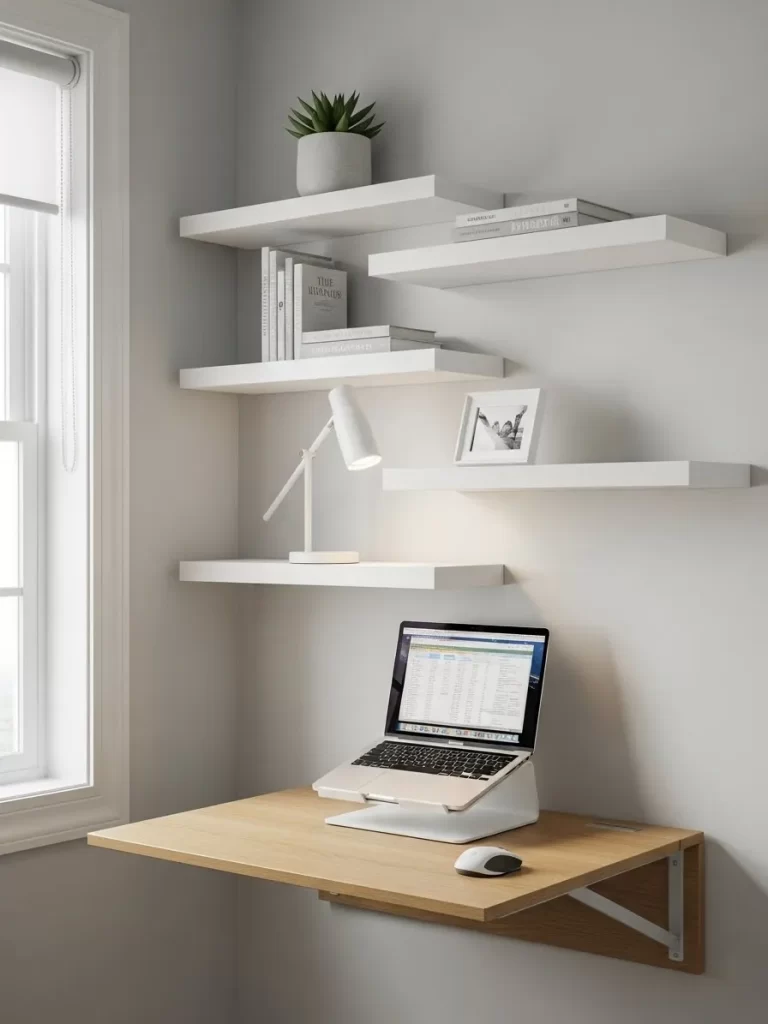
This image demonstrates a clever use of an empty wall space, creating a multifunctional area that works as both a desk and storage. The clean, white floating shelves are mounted on the wall without visible supports, giving a modern, airy feel.
The shelves are staggered, adding visual interest while holding a few essential items: books, a small potted plant, and a task lamp. Keeping the styling minimal prevents the shelves from becoming another messy storage spot.
Below the shelves, a fold down wooden desk provides a working surface for a laptop. This compact solution transforms a previously empty corner into a useful spot for work or writing, making the guest room useful beyond just sleeping. The desk can be folded up when not in use, instantly reclaiming floor space.
DIY Project: Simple Floating Shelves
Installing basic floating shelves is a great way to use vertical space for decor or light storage without the bulk of a bookcase.
Materials Required List
- Two to three pre-cut wooden shelf boards (pine or MDF, thickness 1 to 1.5 inches)
- Floating shelf support brackets or heavy-duty mounting hardware (the style with long rods that insert into the shelf)
- Wall anchors and screws (appropriate for your wall type: drywall, plaster, or stud)
- Level
Equipment Required List
- Stud finder
- Drill and drill bits
- Measuring tape
- Pencil
- Safety goggles
DIY Instruction Step by Step
- Plan and Measure: Determine the exact placement and spacing of your shelves. Use a pencil to lightly mark the height for the lowest shelf first, ensuring there is enough space above the desk area. Use a stud finder to locate wall studs; if you can attach the supports directly to studs, the shelf will be much stronger.
- Install the Brackets: Hold your first shelf bracket up to the wall at the marked height. Use your level to ensure the bracket is perfectly horizontal before marking the screw holes. Drill pilot holes into the wall. If you are not hitting a stud, insert appropriate wall anchors before driving the mounting screws to secure the bracket firmly.
- Attach the Shelf: For most floating shelf hardware, you will now slide the wooden shelf board onto the mounted support rods or bracket. If the shelf is hollow, it slides over the whole bracket. Ensure the shelf is snug and flush against the wall.
- Stagger and Repeat: Move up to the next shelf. Instead of stacking it directly above the first, offset it slightly to the left or right, as seen in the image, for a more decorative, asymmetric look. Repeat steps 2 and 3 for the remaining shelves, checking the level each time.
- Test and Style: Gently apply pressure to each shelf to ensure it is securely attached. Place light items on the shelves, such as a stack of books, a small lamp, or a picture frame. Remember to keep the weight load light to maintain safety.
5. The Organized Luggage
Relevant Item Name: Portable Seasonal Storage Cases
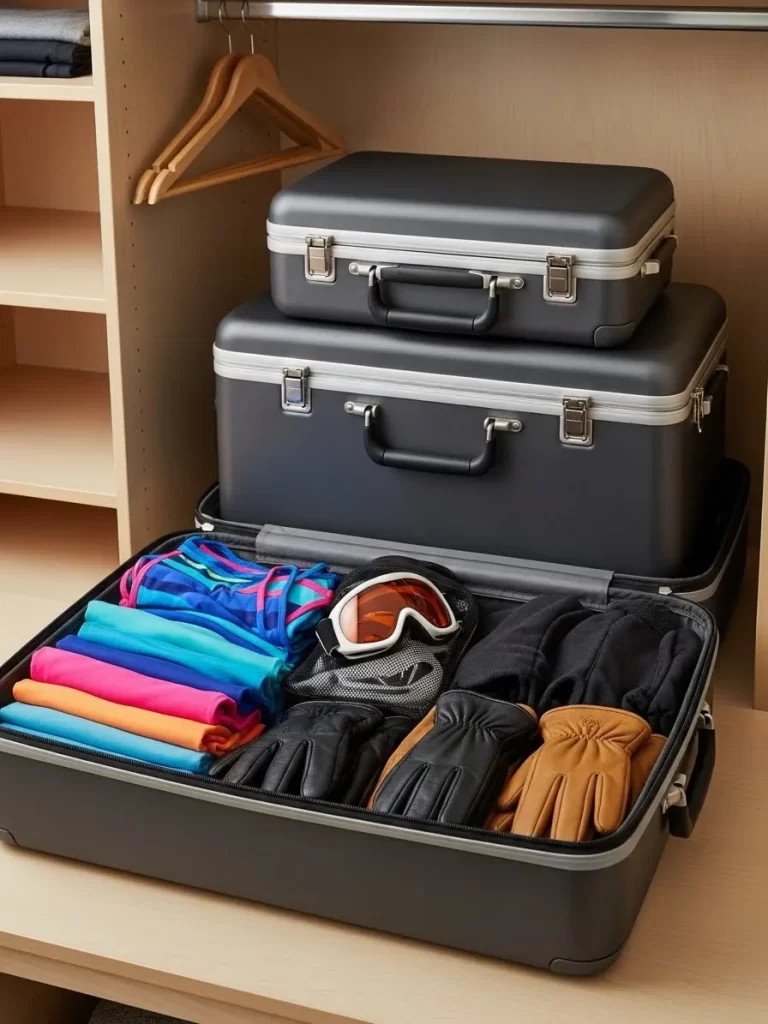
This picture provides an excellent tip for using unused luggage as long term storage. Instead of storing empty suitcases haphazardly in the closet, they are stacked neatly, maximizing vertical space.
The open case reveals a systematic approach to storing specialty or seasonal items. Items like ski goggles, gloves, and brightly colored athletic wear are neatly rolled and packed inside.
Hard-shell suitcases, especially, offer a sturdy, protective, and dust-free environment for clothing and gear that isn’t needed often. This method ensures that the items are protected and contained within an attractive, portable unit, keeping the guest room closet tidy and functional.
DIY Project: Converting Suitcases to Storage
This is more of a system reorganization than a physical DIY build, focusing on how to use existing luggage most effectively.
Materials Required List
- Clean, empty, and durable suitcases or travel bags
- Vacuum seal bags (optional, for soft items like blankets or clothing)
- Moth repellent cedar chips or lavender bags
- Clear packing cubes or small organizing pouches
Equipment Required List
- Cleaning cloth and mild spray cleaner
DIY Instruction Step by Step
- Clean and Refresh the Luggage: Thoroughly wipe down the interior and exterior of the suitcases, ensuring they are free of dust or lingering travel odors. Leave the cases open for a few hours to air them out completely before packing.
- Select Your Seasonal Items: Gather the items you rarely use but need to keep safe, such as heavy winter gear, summer vacation clothing, or camping supplies. Sorting items by season or activity ensures you know exactly which case to open when you need something.
- Pack with Care: To maximize space and keep items fresh, roll or tightly fold clothing. If storing bulky items like coats or pillows, use vacuum seal bags to compress them before placing them inside the suitcase. This saves considerable space.
- Add Scent and Protection: Place a few cedar chips or lavender bags inside the suitcase before closing it. These natural repellents help keep moths and musty smells away from the contents during long-term storage.
- Label for Identification: Attach a simple, sturdy tag or label to the handle of each suitcase. Write a clear summary of the contents, for example, “WINTER SKI GEAR” or “SUMMER BEACH CLOTHES.” This prevents you from having to open every case to find one item.
- Vertical Storage: Stack the filled suitcases neatly on a wide, sturdy shelf inside the guest room closet. Place the largest, heaviest case on the bottom and the smallest on top to prevent tipping and maximize the vertical storage capacity.
6. The Zoned Closet
Relevant Item Name: Dual Purpose Wire Shelf System
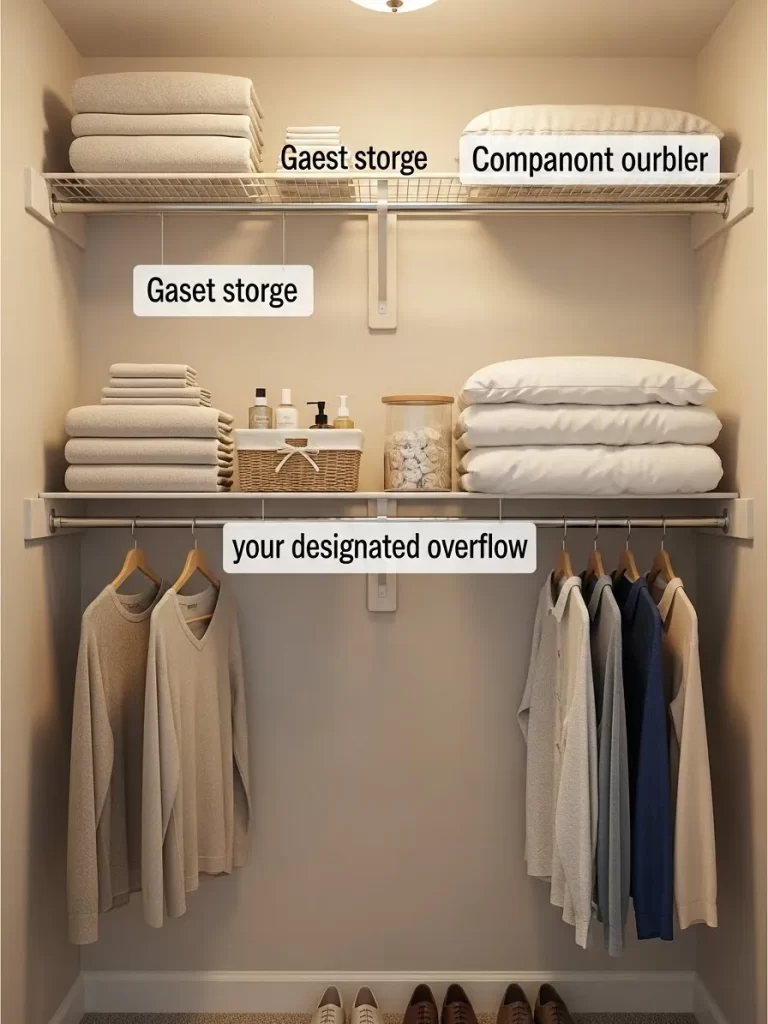
This image illustrates how to share a closet successfully without creating a mess. The closet is clearly divided into two zones: the upper shelves and the left side are designated for Guest Storage, while the right side is labeled as Your Designated Overflow.
The top shelves hold neatly stacked guest towels and pillows, making them readily available and easy to access. The bottom hanging rods are split: one side has uniform casual clothes (the overflow), and the other side is left mostly empty for the visitor’s hanging items.
The use of wire shelving and simple baskets ensures that every item has a specific home. This system eliminates the confusion and frustration of finding space when a guest arrives, proving that sharing storage can still be organized.
DIY Project: Creating Zoned Closet Storage
Setting up a dual-purpose closet requires clear boundaries and the right shelving components. This project focuses on installing a secondary shelf and hanging rod.
Materials Required List
- Wire shelving kit (with brackets and anchors) or melamine shelving board
- Secondary closet rod or bar (adjustable length is easiest)
- Appropriate screws and heavy-duty drywall anchors
- Labels or small signs for zoning
- Cleaning supplies
Equipment Required List
- Drill and drill bits
- Level
- Stud finder
- Measuring tape
DIY Instruction Step by Step
- Clear and Clean the Space: Completely empty the closet. Wipe down the walls, floor, and existing shelving to start with a clean slate.
- Map Out Your Zones: Decide exactly how much space (e.g., one third, one half) will be dedicated to guest use and how much will be your overflow. Use your measuring tape to mark a vertical line down the center of the wall to separate the two zones.
- Install the Secondary Rod (Optional): If you need two hanging sections, install a vertical divider (a piece of wood secured to the floor and ceiling) on your zone line. Attach a secondary closet rod from this divider to the side wall on one half of the closet, or install an adjustable second bar below the main one in the guest zone.
- Install or Upgrade Shelving: If you need more shelves, use the stud finder and level to install the wire shelving system or melamine boards above the hanging area. Ensure the shelves are evenly spaced and secured with anchors rated for a high weight load.
- Implement Visual Boundaries: Use simple labels or hang small signs: “GUEST LINENS” and “PERSONAL OVERFLOW” to clearly distinguish the zones. This makes the system understandable for everyone.
- Organize and Refill: Place guest items (towels, toiletries in baskets) only on the designated shelves. Hang your overflow items only in your zone, leaving the guest’s designated hanging space open and empty.
7. The Mobile File Caddy
Relevant Item Name: Portable Command Center Caddy
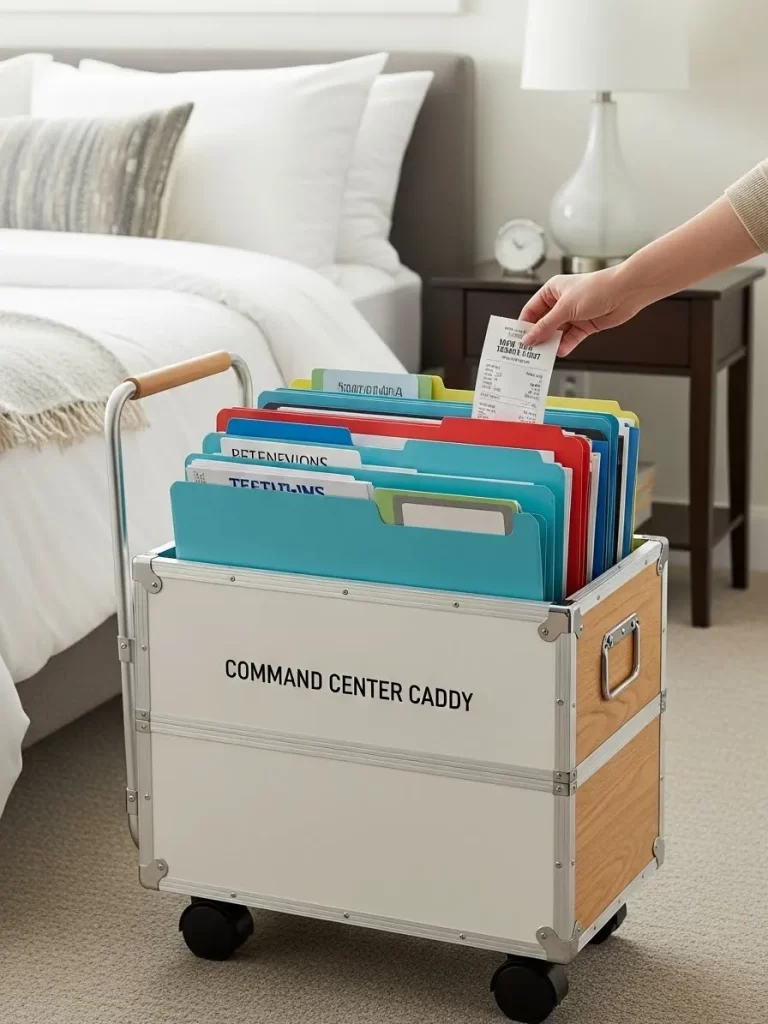
This image offers a fantastic solution for those whose “dumping ground” includes paper, bills, and random office supplies. The item shown is a sturdy rolling metal caddy with a handle, designed to hold colorful file folders.
The file folders are used to organize important papers, receipts, and documents, keeping them upright and easily visible. The caddy’s structure, which resembles a small trunk, provides a secure, contained space.
The fact that it is on wheels is the crucial element; it allows all of the household paperwork to be quickly rolled out of the guest room and into an office or storage area when a visitor arrives. It successfully transforms the space back into a welcoming guest room in moments.
DIY Project: Utility Cart File Storage
You can convert a basic, sturdy utility cart or small wooden crate into a functional, mobile filing system.
Materials Required List
- A sturdy wooden crate or small metal toolbox
- Four caster wheels (two fixed, two swivel)
- Screws or bolts suitable for the wheels and cart base
- Drawer or cabinet handle (for pulling the cart)
- Colorful hanging file folders and corresponding metal frame or rails (optional, depends on cart type)
Equipment Required List
- Scissors or a box cutter
- Ruler or tape measure
- Iron (optional, for crisp fabric folds)
DIY Instruction Step by Step
- Prepare the Cart Base: Flip your crate or toolbox upside down. Measure and mark the four corners where the wheels will be attached. The wheels should be placed as close to the corner as possible for stability.
- Attach the Wheels: Drill pilot holes for the wheel screws or bolts. Secure the four caster wheels to the bottom of the cart using the appropriate hardware. Place the two swivel wheels on one short end of the cart and the fixed wheels on the opposite end; this arrangement allows for easy steering.
- Install the Pull Handle: Determine which end of the cart you want to be the front. Measure the handle placement and drill holes on the front face. Screw a sturdy cabinet or drawer pull handle into the front for easy pushing and pulling.
- Create the Filing System: If your cart is wide enough, you can install a metal file frame rail across the top inner edges. Otherwise, use plastic or cardboard dividers to create sections. Label these sections (e.g., “RECEIPTS,” “BILLS,” “KID’S ARTWORK”).
- Load and Mobilize: Sort your papers and place them into the hanging folders or dividers. When a guest arrives, simply grab the handle and roll the entire filing system discreetly into a closet or another room until your visitor departs.
8. The Dedicated Ironing Station
Relevant Item Name: Tall Utility Cabinet with Appliance Storage
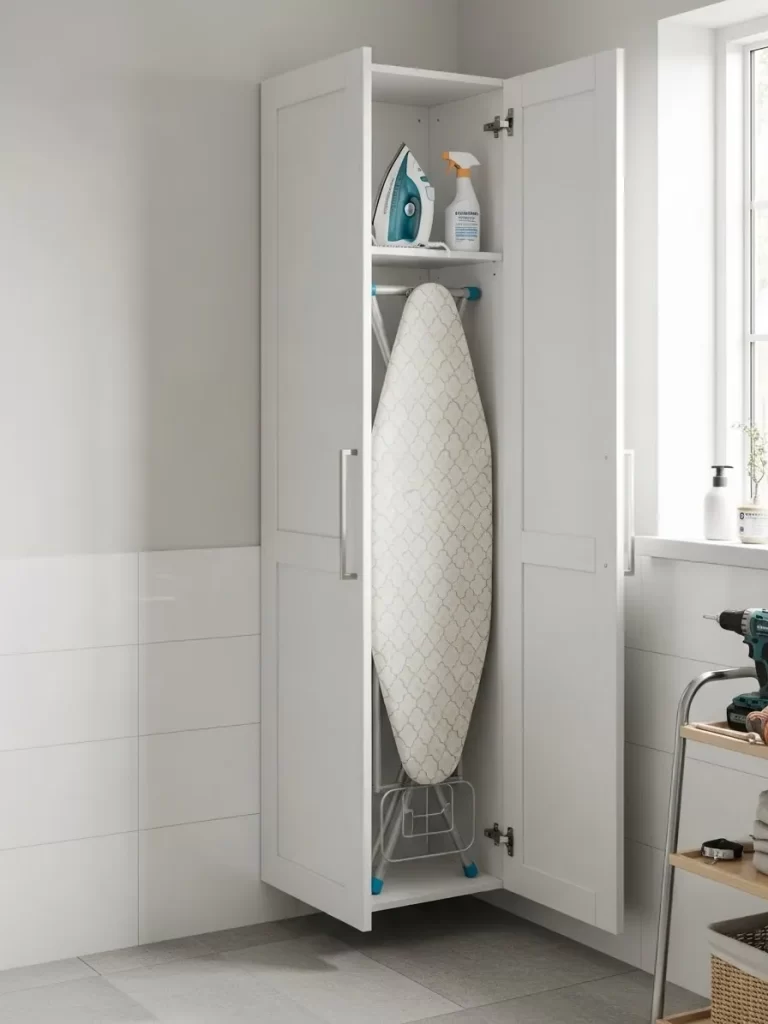
This image solves the issue of storing large, awkward household items like ironing boards and vacuums, which often end up leaning messily in the corner of a guest room. It shows a tall, narrow cabinet designed specifically for utility storage.
The ironing board folds up and slides vertically into the main body of the cabinet, keeping it completely out of sight. Above the board, a small, deep shelf holds the iron, starch, and cleaning sprays.
Having a dedicated, closed cabinet ensures the room maintains a clean, uniform look. This solution demonstrates that even necessary but unsightly household tools can be stored in an organized, tidy manner within a shared space.
DIY Project: Converting a Cabinet for Ironing Storage
If you have an existing tall linen cabinet or a spot for a new utility cabinet, you can customize the interior to fit an ironing board.
Materials Required List
- A tall, narrow cabinet (at least 15 inches deep and 24 inches wide is recommended)
- Two small, heavy-duty utility hooks (J-shaped or U-shaped)
- Measuring tape and pencil
- Appropriate screws for the hooks and cabinet material
- Small wooden shelf and brackets (if not already present inside)
Equipment Required List
- Drill and drill bits
- Screwdriver
- Stud finder (if wall mounting the cabinet)
- Safety goggles
DIY Instruction Step by Step
- Measure the Ironing Board: Fold your ironing board completely and measure its height and width. This measurement will determine the hook placement inside the cabinet. The cabinet must be taller than the folded board.
- Mark Hook Placement: Inside the cabinet, stand the folded ironing board up against the back wall. Mark two spots on the wall where the hook points should be placed to securely hold the board’s metal frame or legs. These marks should be high enough to allow the bottom of the board to rest a few inches above the cabinet floor.
- Install the Hooks: Predrill small pilot holes at your marked spots. Secure the two heavy-duty utility hooks firmly into the back wall of the cabinet using appropriate screws. Ensure they are strong enough to support the board’s weight.
- Install the Upper Shelf: If your cabinet does not have a shelf for the iron, install a small, fixed shelf about two thirds of the way up the cabinet. This shelf is for the iron, spray bottles, and starch. Use a level to ensure it is straight.
- Test and Organize: Hang the folded ironing board onto the installed hooks. Place the iron and supplies on the upper shelf. The entire ironing station is now contained and out of sight, ready to reclaim your guest room space.
9. The Hidden Fitness Zone
Relevant Item Name: Decorative Woven Hamper with Lid

This image provides a creative solution for storing workout gear, which often piles up in the guest room. The focus is on a stylish, tall woven wicker basket or hamper with a lid.
The basket’s natural texture and decorative white macramé pattern allow it to blend seamlessly into the room’s decor, looking like an attractive piece of furniture. However, lifting the lid reveals it is a storage space for rolled-up yoga mats and hand weights.
This approach keeps exercise equipment accessible but neatly contained. It stops the room from feeling like a messy gym while maintaining the functionality of keeping gear close by. The item is truly dual-purpose: decor on the outside, storage on the inside.
DIY Project: Creating a Fitness Gear Basket
You can easily adapt any large, lidded basket or hamper to serve as a designated, hidden spot for your fitness equipment.
Materials Required List
- One large, sturdy woven basket or hamper with a removable lid
- Three to five simple felt furniture pads (small, round)
- Permanent marker or paint pen (for labeling the lid’s underside)
- Contents: rolled-up yoga mats, small hand weights, jump rope, resistance bands
Equipment Required List
- None required for this simple adaptation
DIY Instruction Step by Step
- Select the Basket: Choose a basket that is tall enough to hold your rolled yoga mats vertically without them sticking out when the lid is on. The material should be sturdy enough not to tip over easily.
- Pad the Base (Optional): If your basket is being stored on a delicate floor (like hardwood), peel and stick the felt furniture pads to the bottom edges or corners of the basket. This protects the floor from scratches when you slide the basket.
- Prepare the Gear: Roll up all yoga mats as tightly as possible, using the attached straps or a simple piece of string to secure them. Place hand weights (if small enough) inside a simple cloth bag or wrap them in a small towel to prevent them from scratching the basket’s interior.
- Arrange the Contents: Place the heaviest items (the hand weights) on the bottom of the basket for stability. Stand the rolled yoga mats up vertically around the perimeter. Place smaller items like resistance bands or jump ropes in the center gap.
- Label the Lid (Optional): Turn the lid over. Use a permanent marker or paint pen to write a small, discreet label on the inside of the lid, such as “FITNESS GEAR,” so everyone knows what is stored inside without opening it unnecessarily.
- Placement: Close the lid and place the basket near a wall or next to an accent chair. It now functions as a decorative item that holds your clutter completely out of sight.
10. The Upholstered Storage Bench
Relevant Item Name: End of Bed Ottoman Trunk
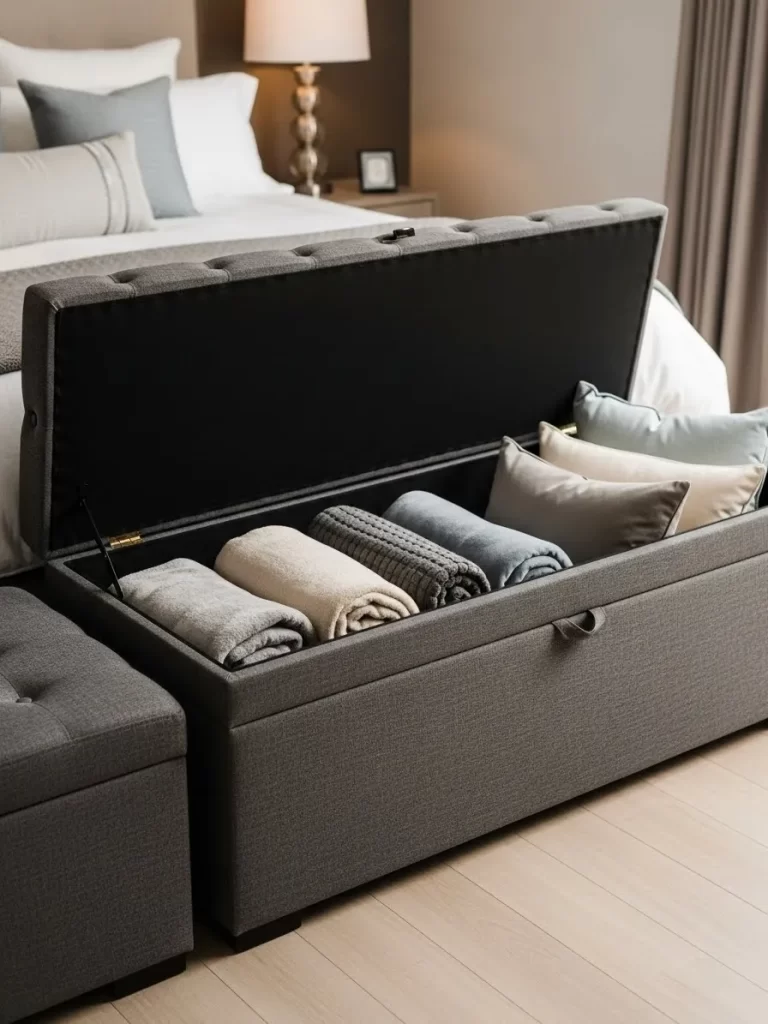
This beautiful image shows a stylish, functional storage piece placed at the foot of the bed. It is an upholstered storage bench or ottoman with a hinged lid, featuring classic tufting for an elegant look.
The bench is deep and wide, providing substantial storage capacity. When opened, it reveals a tidy space where extra pillows, rolled blankets, and throws are neatly contained.
This piece solves two problems at once: it provides extra seating or a place to lay clothes while dressing, and it completely hides the typical clutter of extra bedding. By utilizing this piece, the room remains elegant, and essentials are close at hand but out of sight.
DIY Project: Ottoman Storage Liner and Divider
While building the ottoman is complex, you can easily customize the inside of an existing or newly purchased storage bench to maximize organization and prevent a messy storage drop zone.
Materials Required List
- One large upholstered storage ottoman or trunk
- Two pieces of thin, sturdy cardboard or plywood (for dividers)
- Fabric or felt (to cover the dividers)
- Strong double-sided tape or fabric glue
- Measuring tape
Equipment Required List
- Box cutter or utility knife (for cutting cardboard)
- Iron (optional, for fabric glue activation)
DIY Instruction Step by Step
- Measure the Interior: Measure the length, width, and depth of the ottoman’s interior space. This ensures your dividers will fit snugly without needing to be permanently attached.
- Cut the Dividers: Cut your cardboard or plywood into two rectangular divider panels. The height of the panels should be about one inch shorter than the interior depth. The length of the panels will depend on how you want to divide the space (e.g., three equal sections).
- Cover the Dividers: Cover the divider panels with felt or fabric using strong double-sided tape or fabric glue. This gives the interior a softer, finished look that matches the ottoman’s interior and prevents cardboard dust. Allow the glue to dry thoroughly.
- Insert the Dividers: Place the covered divider panels inside the ottoman, ensuring they stand upright and create neat, designated sections for different items (e.g., a section for pillows, one for rolled blankets, and one for books).
- Roll and Place the Contents: Roll blankets tightly and stack them neatly in their assigned section. Place pillows vertically or horizontally, depending on the section’s size. Keep like items together.
- Enjoy the Clutter Free Zone: Close the lid. The ottoman now functions as a highly organized, dual-purpose piece of furniture that adds sophistication to the room while keeping your excess items perfectly concealed.
11. The Colorful Display Bookcase
Relevant Item Name: Multifunctional Guest Library and Linen Cabinet
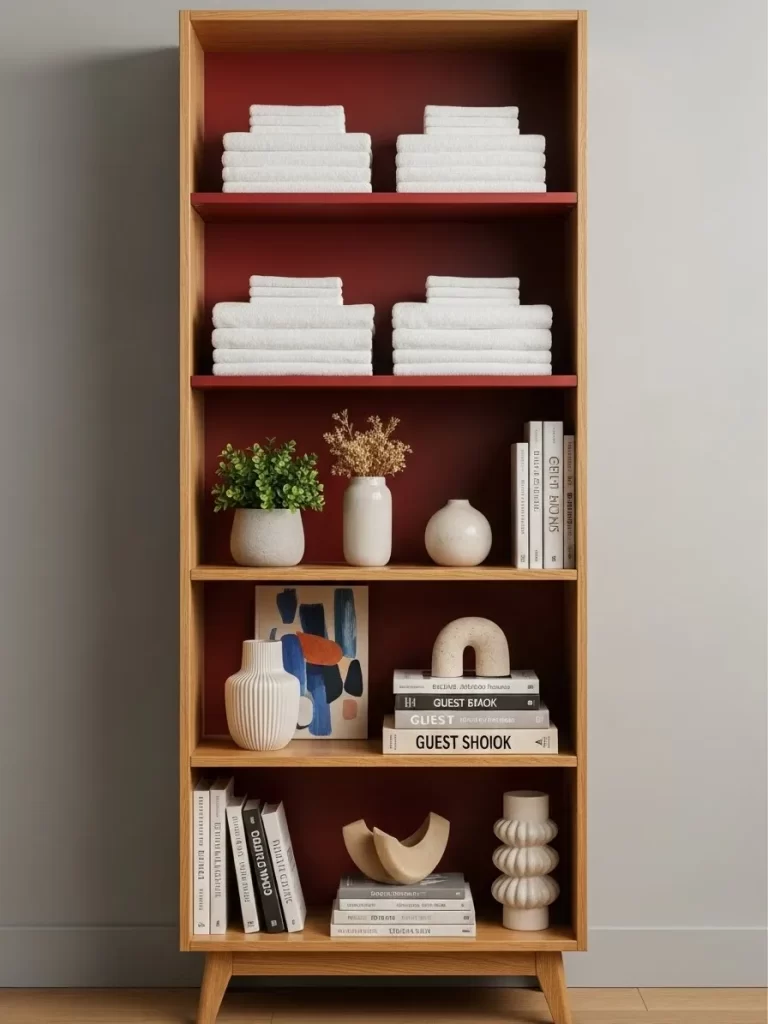
This striking bookcase brilliantly merges guest essentials with decorative home styling. The natural wood frame provides warmth, contrasting beautifully with the rich, deep red color painted on the back panel.
The top two shelves are dedicated to linens, where stacks of crisp white towels are folded uniformly for easy access and a clean look. The remaining shelves are used for decorative objects, books, and small, pleasing accents.
Mixing utility and aesthetics this way ensures the storage is not only functional but actually enhances the room’s character. Everything has its own distinct space, preventing the shelves from turning into a messy catchall area.
DIY Project: Bookcase Back Panel Accent Color
Adding a splash of color to the back panel of a basic bookcase instantly transforms it into a custom piece that highlights your organized items.
Materials Required List
- One bookcase with removable or exposed back paneling
- One quart of interior latex paint in your chosen accent color
- Painter’s tape
- Medium grit sandpaper
- Primer (optional, but recommended for dark or slick surfaces)
- Small paint roller and brush
Equipment Required List
- Screwdriver or power drill (to remove the back panel)
- Drop cloth
- Utility knife (to score tape edges)
DIY Instruction Step by Step
- Empty and Disassemble: Completely empty the bookcase of all items. If the back panel is thin, fibrous board secured with small nails, carefully remove it using a screwdriver or pry bar. If it is built in, you will tape off the inner frame.
- Prepare the Surface: If painting the removable panel, place it on a drop cloth. Lightly sand the entire surface of the panel to help the paint adhere well. If painting the fixed back, use painter’s tape to neatly tape off the inside edges of the wooden frame of the bookcase.
- Apply Primer (if needed): If your panel is very dark or has a shiny surface, apply a thin coat of primer. Allow it to dry completely according to the manufacturer’s instructions.
- Paint the Accent Color: Apply your chosen accent paint color using the small roller for large, flat areas and the brush for the corners. Apply two thin coats for rich, even coverage, allowing the first coat to dry fully before applying the second.
- Reassemble and Style: Once the paint is completely dry, remove the painter’s tape carefully or reattach the painted back panel to the bookcase using the original hardware. Restock the shelves, placing the uniform linen stacks on the top shelves and artfully arranging books and decorative objects below.
12. Labeled Archive Boxes
Relevant Item Name: Climate Controlled Archival Containers

This image addresses one of the biggest guest room clutter culprits: long term storage. The photo shows multiple stacks of uniform, labeled cardboard boxes, suggesting a systematic approach to archiving items.
Each box is clearly marked with large, handwritten labels specifying contents and dates, such as “Christmas Decorations 2023” or “Old Photos 1990s.” The use of gloves suggests these items are handled carefully and stored for long periods.
Storing items this way—uniform, well-sealed, and clearly identified—removes the need to open every box to find something, which often leads to messes. This strategy moves genuinely archived materials out of the guest room and into proper long term storage, like an attic or basement.
DIY Project: Creating Uniform Archival Storage
This system focuses on standardizing your miscellaneous storage to make things look cleaner and easier to relocate.
Materials Required List
- Several medium-sized, sturdy, uniform cardboard boxes (moving boxes or bankers boxes work well)
- Large, plain white adhesive labels or thick cardstock
- Permanent black marker (extra bold tip)
- Clear packing tape
- Packing paper or bubble wrap (for fragile items)
Equipment Required List
- Scissors
- Ruler
DIY Instruction Step by Step
- Gather the Clutter: Collect all the loose items that are currently cluttering your guest room (old papers, seasonal decorations, memorabilia). Group them into logical categories.
- Pack Carefully: Line the bottom of your uniform boxes with a layer of packing paper if the items are fragile. Place the grouped items into the boxes, ensuring heavier items are on the bottom. Do not overpack the boxes to the point where the lid cannot close flat.
- Seal and Secure: Seal all the flaps of the box securely with clear packing tape to keep out dust and bugs. Run a line of tape along all the seams for added protection.
- Create Clear Labels: Take your adhesive labels or cardstock. Write the contents of the box clearly and concisely using the bold marker (e.g., “HALLOWEEN LIGHTS” or “FAMILY LETTERS”). Write the year or decade if relevant. The label should be readable from a distance.
- Apply Labels Uniformly: Apply the label to the same spot on every box—preferably the top center or the short side that will face outward when stacked. This consistency is what makes the storage look so clean and organized.
- Relocate: Move the now-labeled and organized boxes out of the guest room and into their designated long term storage area.
13. The Hidden Medicine Cabinet
Relevant Item Name: Wall Mounted Mirror Storage Unit

This clever solution tackles the problem of toiletries and personal items cluttering dresser tops. The image shows a handsome wooden mirror, which is actually a recessed or surface-mounted storage cabinet.
The mirror face hides the inner shelving, which can house medicines, toothbrushes, contact lens supplies, or other small items. A level placed on top suggests the unit is being securely installed for permanent use.
By utilizing the wall space above a dresser or desk, this mirror cabinet eliminates countertop clutter while providing a necessary functional element to the room. The clean, simple wood frame matches the dresser below for a cohesive, calm aesthetic.
DIY Project: Installing a Mirror Storage Cabinet
Installing a surface-mounted mirror cabinet is a straightforward project that adds significant hidden storage.
Materials Required List
- One surface-mount mirror storage cabinet
- Wood screws (appropriate length for wall type and cabinet hardware)
- Wall anchors (if not mounting into studs)
- Pencil
- Level (at least 18 inches long)
Equipment Required List
- Stud finder
- Drill and drill bits
- Measuring tape
- Safety goggles
DIY Instruction Step by Step
- Determine Placement: Decide on the cabinet’s height. It should be centered over the dresser and positioned so the mirror is comfortable for an average height person to use. Lightly mark the top and center point on the wall with a pencil.
- Locate Studs: Use a stud finder to see if you can attach the cabinet directly to a wall stud. Mounting into a stud provides the strongest support, but wall anchors can be used for drywall.
- Mark the Mounting Holes: Hold the cabinet against the wall at the desired location. Use your level across the top edge to ensure it is perfectly straight before marking the screw holes. Mark the locations of the mounting screws directly onto the wall through the cabinet’s predrilled holes.
- Drill and Anchor: Set the cabinet aside. Drill pilot holes at the marked locations. If you are not in a stud, insert the appropriate wall anchors now, tapping them flush with the wall surface.
- Mount the Cabinet: Hold the cabinet back up to the wall, lining up the holes. Insert and tighten the screws. Ensure the cabinet is firmly secured and does not wobble.
- Organize the Contents: Once installed, open the cabinet and transfer small, loose items—toothbrushes, lotions, small electronics—from the dresser top to the newly created shelves inside, completely clearing the surface below.
14. The Rolling Toy Cart
Relevant Item Name: Mobile Entertainment Storage Unit
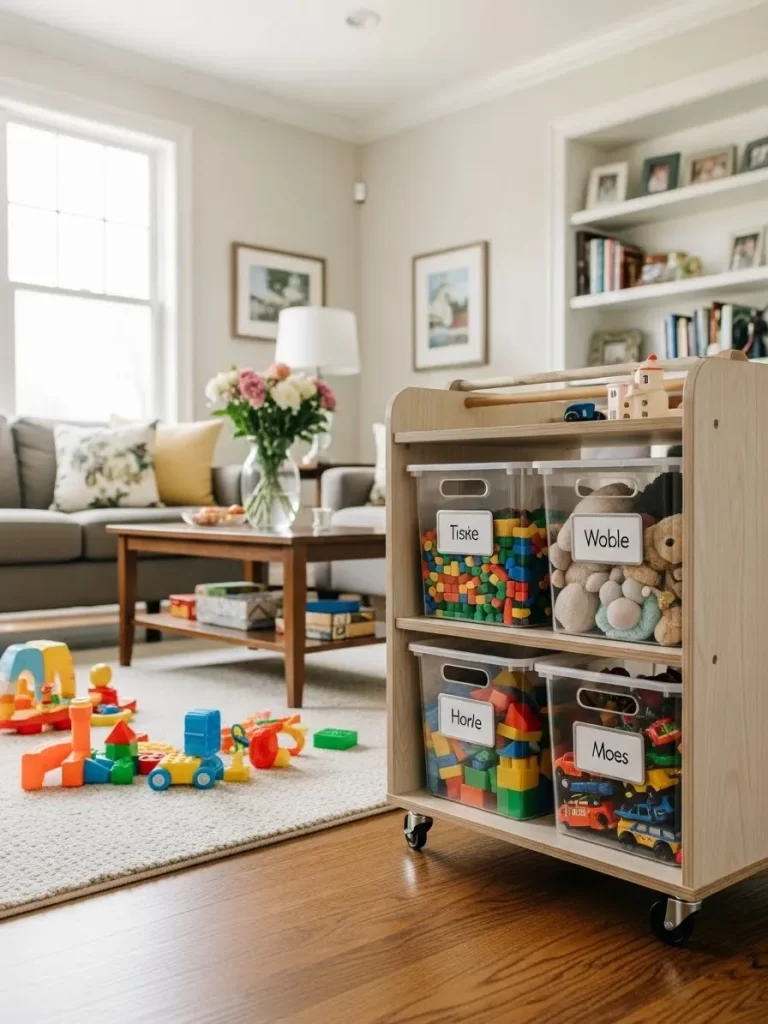
This photograph provides an excellent solution for the common issue of child related clutter in a multi-purpose guest space. A light wood, mobile cart on wheels contains several clear, labeled storage bins.
The clear bins allow instant identification of the contents, which include colorful building blocks, stuffed animals, and small cars. The labels, though simple, help keep the categories separate, encouraging quick cleanup.
The cart’s wheels are its biggest asset; when visitors arrive, the entire toy collection can be easily rolled out of the guest room and into a dedicated play area or closet. This prevents the room from perpetually looking like a childcare center.
DIY Project: Customizing a Rolling Toy Cart
You can transform a basic utility cart or bookshelf into a rolling toy storage station that keeps clutter contained and portable.
Materials Required List
- A small, open shelving unit or crate (preferably wood or sturdy plastic)
- Four swivel caster wheels and screws
- Clear plastic storage bins that fit the shelf dimensions
- Label paper or white vinyl and permanent markers
Equipment Required List
- Drill and drill bits
- Screwdriver
- Measuring tape
- Safety goggles
DIY Instruction Step by Step
- Assemble the Cart: Fully assemble your chosen shelving unit. If using a pre-made cart, ensure the frame is square and stable.
- Attach the Wheels: Flip the cart over. Measure the corners and mark where the caster wheels will be placed. Drill pilot holes and securely screw the four swivel caster wheels into the base. Swivel wheels ensure the cart can turn and maneuver easily around furniture.
- Prepare the Bins: Select clear plastic bins that slide easily onto the shelves. Sort the toys into categories (e.g., “Blocks,” “Stuffed Animals,” “Cars”).
- Create Visual Labels: Cut your label material into uniform sizes. Use the permanent marker to write the content of the bins clearly and boldly. Place the label on the front of the bin. For younger children, a picture label can be added next to the word.
- Load and Deploy: Place the filled, labeled bins back onto the shelves of the rolling cart. When the guest room is needed, simply push the cart into an adjacent closet, a garage, or a living area for the duration of the visit, keeping the guest room pristine.
15. The Hidden Craft Closet
Relevant Item Name: Multi-Level Hobby Command Center
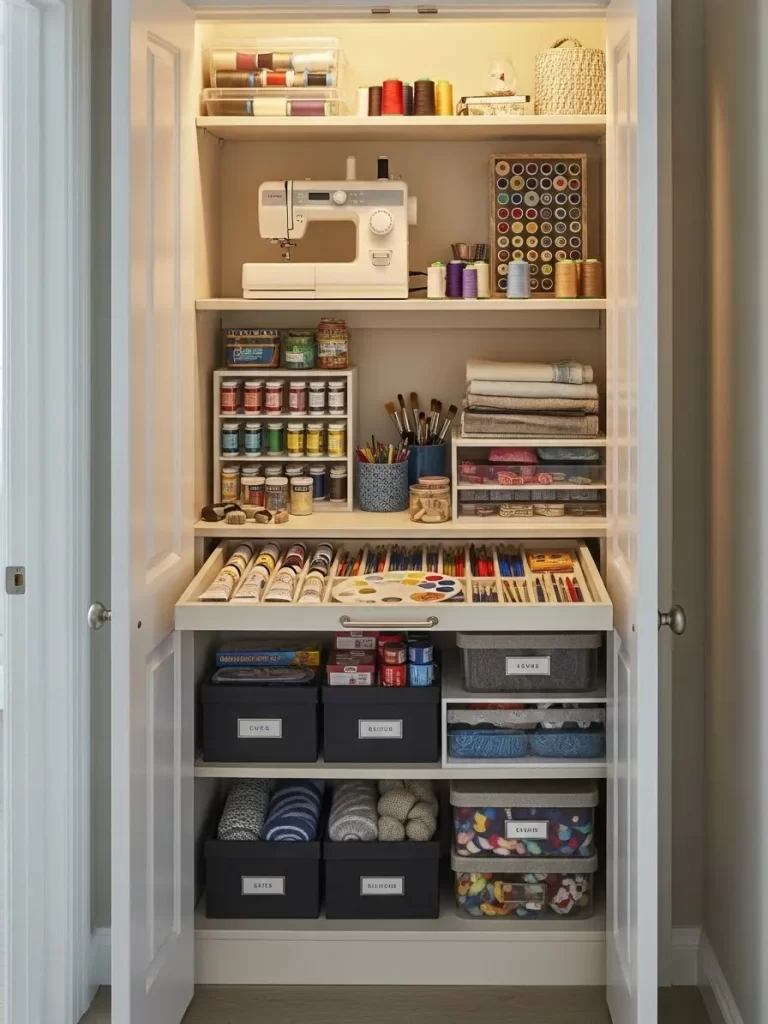
This image offers deep inspiration for those who use their guest room closet as a creative or hobby space. The closet has been fully customized with multiple shelves, drawers, and specific organizers for craft supplies.
There is a sewing machine ready on one shelf and stacks of fabrics and threads neatly sorted above and around it. A pull-out tray drawer is filled with painting supplies, markers, and paint tubes, keeping them within easy reach but off the floor.
The lower shelves utilize uniform, labeled bins (“COBS,” “EXITS”) for hiding larger or miscellaneous materials. This highly structured system proves that a space can be used for hobbies and guests, provided the clutter is aggressively contained.
DIY Project: Installing a Pull-Out Craft Drawer
Adding a pull-out drawer to an existing closet shelf maximizes accessibility and prevents items from getting lost in the back.
Materials Required List
- One shallow wooden box or tray (sized to fit the shelf width)
- Two sets of drawer slides (one set for each side of the tray)
- Screws (short screws for the slides, longer screws for mounting the runners)
- Small pull handle
- Sandpaper and paint or stain (optional, for the wooden tray)
Equipment Required List
- Drill and drill bits
- Screwdriver
- Measuring tape
- Level
DIY Instruction Step by Step
- Prepare the Tray: Sand the wooden tray smooth and apply paint or stain if desired, allowing it to dry completely.
- Install Slides to Tray: Separate the two parts of your drawer slides. Attach one half of the slide mechanism (the inner runner) to the bottom side edges of your wooden tray using the short screws. Ensure they are placed evenly and straight.
- Install Slides to Shelf: Hold the other half of the slide mechanism (the cabinet runner) to the underside of the closet shelf where the drawer will sit. Use the measuring tape and level to ensure it is perfectly straight and parallel to the other runner. Screw the cabinet runners firmly into the underside of the shelf.
- Insert the Drawer: Carefully slide the tray (with its attached runners) onto the mounted cabinet runners until it locks into place. Test the drawer, making sure it slides smoothly.
- Attach the Handle: Screw a small pull handle to the front center of the tray for easy access.
- Organize: Fill the drawer with small, frequently used craft supplies like paint tubes, brushes, markers, or beads. Now, you can easily pull the entire collection out for use and slide it away for a tidy closet when guests arrive.
16. The Bulk Storage System
Relevant Item Name: Industrial Long Term Archiving Shelves
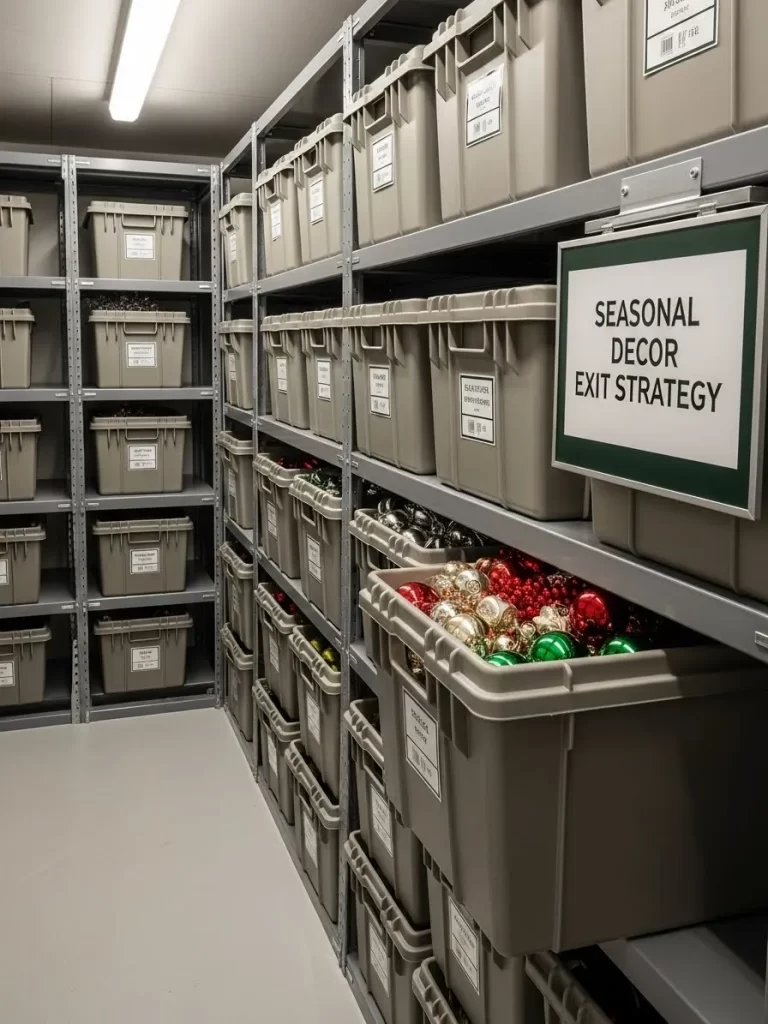
This image shows the ultimate “exit strategy” for items that absolutely should not be in the guest room: seasonal decorations and bulk overflow. A room full of industrial metal shelving holds rows of uniform, heavy-duty storage totes.
Each tote is labeled and stacked neatly, maximizing vertical space. One tote pulled out clearly shows Christmas ornaments, proving this is where serious overflow storage belongs.
A large, professional sign reinforces the concept of a “Seasonal Decor Exit Strategy.” This solution emphasizes that true clutter reduction involves relocating non-essential items to a dedicated, organized bulk area, completely freeing up the guest room.
DIY Project: Creating a Bulk Storage Exit Strategy
The key to this system is uniformity and clear labeling to make items easy to find and move.
Materials Required List
- Multiple heavy-duty plastic storage totes with lids (all the same color and size for uniformity)
- Large, consistent labels or cardstock
- Permanent marker (extra bold tip)
- Sturdy metal shelving unit (optional, but highly recommended)
Equipment Required List
- None, though a dolly or hand truck is helpful for moving heavy bins.
DIY Instruction Step by Step
- Invest in Uniform Bins: Purchase enough of the exact same style of sturdy, stackable bins to hold all your seasonal and bulk items. This consistency is the most important factor in creating a visually tidy storage area.
- Sort the Inventory: Empty the old, mismatched containers currently in your guest room. Sort contents into new categories: “Spring Decor,” “Holiday Lights,” “Old Tax Documents,” etc.
- Fill and Pack: Pack the new bins, ensuring the lids close tightly. Use newspaper or bubble wrap to protect fragile items. Distribute weight evenly among the bins for easier stacking and moving.
- Label Prominently: Create large, clear labels using the same size and font (or handwriting) for every bin. Write the contents boldly and include the year or season. Place the label on the front face of the bin so it is readable when stacked.
- Stack and Relocate: Stack the filled bins on the sturdy metal shelving unit, placing the heaviest bins on the bottom. Crucially, move this entire organized system to a dedicated storage spot—a basement, attic, or garage—not back into the guest room. The guest room should only hold things a guest would need immediately.
17. The Bedside Amenity Box
Relevant Item Name: Decorative Guest Comfort Chest
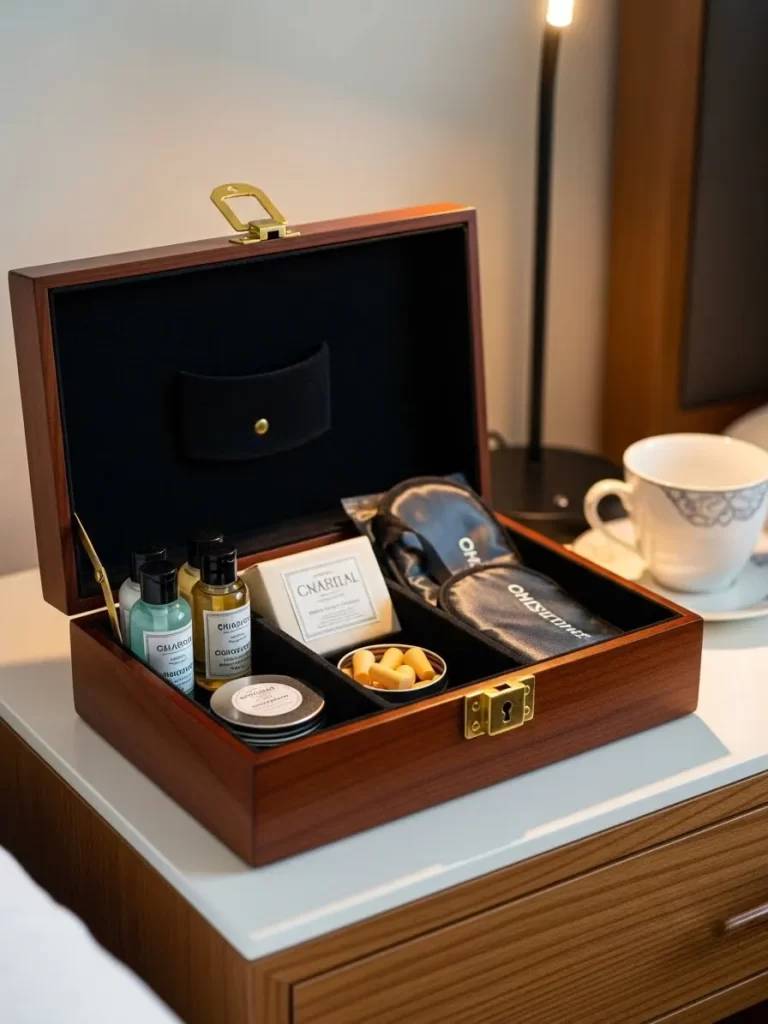
This beautiful wooden box offers a refined, contained spot for guest toiletries and small amenities. The polished dark wood and brass hardware give it an elegant, high-end feel, like a luxury hotel.
Inside, the box holds small bottles of shampoo, soap, an eye mask, and even a small bowl of snacks. Everything is neatly separated into custom compartments, preventing the items from rolling around and creating a mess.
Placing this chest right on the bedside table ensures all essential comforts are available to the guest without them having to search through drawers or ask. This solution elevates hospitality while keeping the small, necessary items completely organized.
DIY Project: Customizing an Amenity Box
You can transform a simple cigar box, jewelry box, or craft store wooden box into a refined amenity chest with custom dividers.
Materials Required List
- One wooden box with a hinged lid
- Velvet or felt fabric (black or deep color is recommended for luxury look)
- Thin cardboard or balsa wood sheets (for dividers)
- Strong fabric glue or hot glue gun
- Small brass hinge and clasp (optional, for upgrading a basic box)
- Small guest amenities (mini toiletries, eye mask, snacks)
Equipment Required List
- Scissors
- Ruler
- Box cutter or craft knife
DIY Instruction Step by Step
- Prepare the Box: If the box is unfinished, sand it and stain or paint the exterior to your desired finish. If the interior is plain, cut the velvet or felt fabric to line the bottom and sides of the box neatly, securing it with fabric glue.
- Measure and Cut Dividers: Determine the best layout for your amenities. Measure the internal width and length. Cut the cardboard or balsa wood into strips that match the box’s depth to act as dividers.
- Cover the Dividers: Cover the cardboard strips completely with the same velvet or felt fabric. This gives the interior a professional, cohesive finish.
- Assemble the Grid: Apply glue to the edges of the covered dividers and carefully place them inside the box to form the custom compartments. Hold them in place for a few moments until the glue sets.
- Fill and Display: Once the glue is dry, place your chosen amenities into the designated compartments: toiletries, sleep masks, a small snack, or a note pad. Close the lid and place the entire tidy chest on the guest nightstand.
18. The Entryway Key Organizer
Relevant Item Name: Floating Key and Mail Drop Station
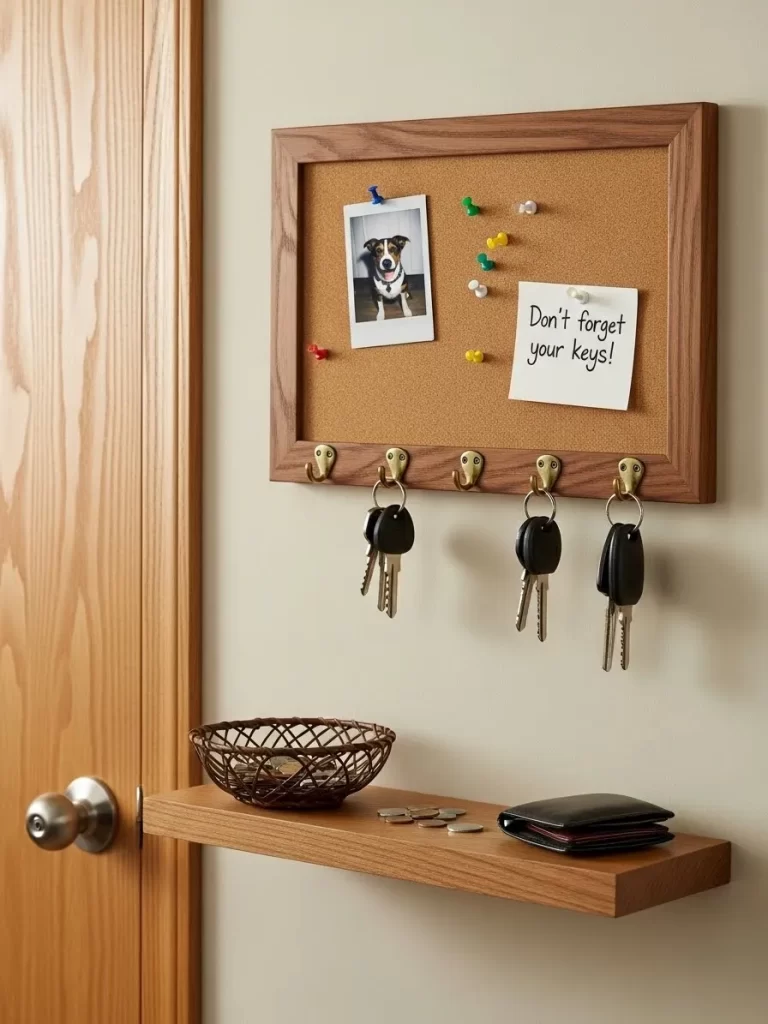
This image solves the small but persistent problem of finding a dedicated spot for keys, wallets, and pocket change, which often land randomly on the nearest table. A small wall mounted cork board and floating shelf combination is used here.
The cork board section features hooks along the bottom edge for hanging keys and a surface for pinning reminder notes. Below this, a simple wooden floating shelf provides a clean surface for a wallet, coins, and a small catchall dish.
Placing this near the door—even the guest room door—gives guests a designated drop zone for their essentials. This simple vertical solution keeps the flat surfaces in the room clear of everyday pocket clutter.
DIY Project: Cork Board and Shelf Organizer
You can combine a basic cork board and a simple floating shelf to create this functional entry organizer.
Materials Required List
- One small, framed cork board
- One wooden shelf board (about 12 inches long)
- Floating shelf mounting hardware or brackets
- Four to six small, brass utility hooks
- Screws and wall anchors
Equipment Required List
- Drill and drill bits
- Screwdriver
- Level
- Pencil
- Measuring tape
DIY Instruction Step by Step
- Mark Key Hook Placement: Take the cork board and mark evenly spaced points along the bottom edge of the frame where the key hooks will go.
- Install the Key Hooks: Predrill small pilot holes at your marked spots. Screw the brass utility hooks securely into the bottom frame of the cork board.
- Mount the Shelf: Below where the cork board will hang, measure and mark the height for your floating shelf. Use the level to ensure the shelf brackets are straight before drilling and installing them firmly into the wall with screws and anchors.
- Attach the Shelf Board: Secure the wooden shelf board to the installed brackets.
- Mount the Cork Board: Above the shelf, align the cork board. Use the level to ensure it is straight. Mark the hanging points for the board and attach it to the wall, making sure it is high enough that the keys do not brush against the shelf below.
- Use the Station: Pin up important reminder notes and pictures on the cork. Hang keys on the hooks and place wallets and phones on the clean shelf surface below.
19. The Purged Dresser Drawer
Relevant Item Name: Guest Ready Empty Drawer Space

This image is less about a specific decorative item and more about an organizational philosophy. It shows a perfectly clean, empty wooden dresser drawer, ready for a guest’s belongings.
A simple “To Do List” note pad rests on the dresser, with the task “Unused Dresser Drawers Purge” written clearly. This reinforces the idea that guest room drawers should not be used for overflow storage.
The best tidy solution is to have an empty, designated spot waiting for your visitor. By purging your own random contents, you ensure guests have space for their unpacked clothes, which keeps them from living out of their suitcase and cluttering the room.
DIY Project: The Drawer Purge and Reset
This focuses on cleaning and preparing the dresser for a visitor, not on construction.
Materials Required List
- Mild all-purpose cleaner
- Cleaning cloth or paper towels
- Drawer liners (optional, for a fresh smell)
- Small trash bag
Equipment Required List
- None
DIY Instruction Step by Step
- Empty Completely: Pull out all the dresser drawers in the guest room. Take everything out—old papers, spare batteries, seasonal clothes, mismatched socks. Place the items in a temporary box for sorting later. The drawers must be completely empty.
- Deep Clean the Interior: Spray a small amount of mild cleaner onto a cloth. Wipe down the interior of the drawers, paying attention to the corners. Wipe them dry completely to prevent moisture buildup.
- Add a Fresh Scent (Optional): If using a drawer liner, cut it to fit the bottom of each drawer and lay it flat. Alternatively, place a few drops of a calming essential oil (like lavender) on a cotton ball and tuck it into the back corner of the drawer.
- Reset and Reclaim: Slide the drawers back into the dresser. The drawers should remain completely empty and available for the next guest. Place a simple note on top of the dresser that says, “Please feel free to use the drawers!”
20. The Over Door Tech Organizer
Relevant Item Name: Vertical Mesh Accessory Caddy
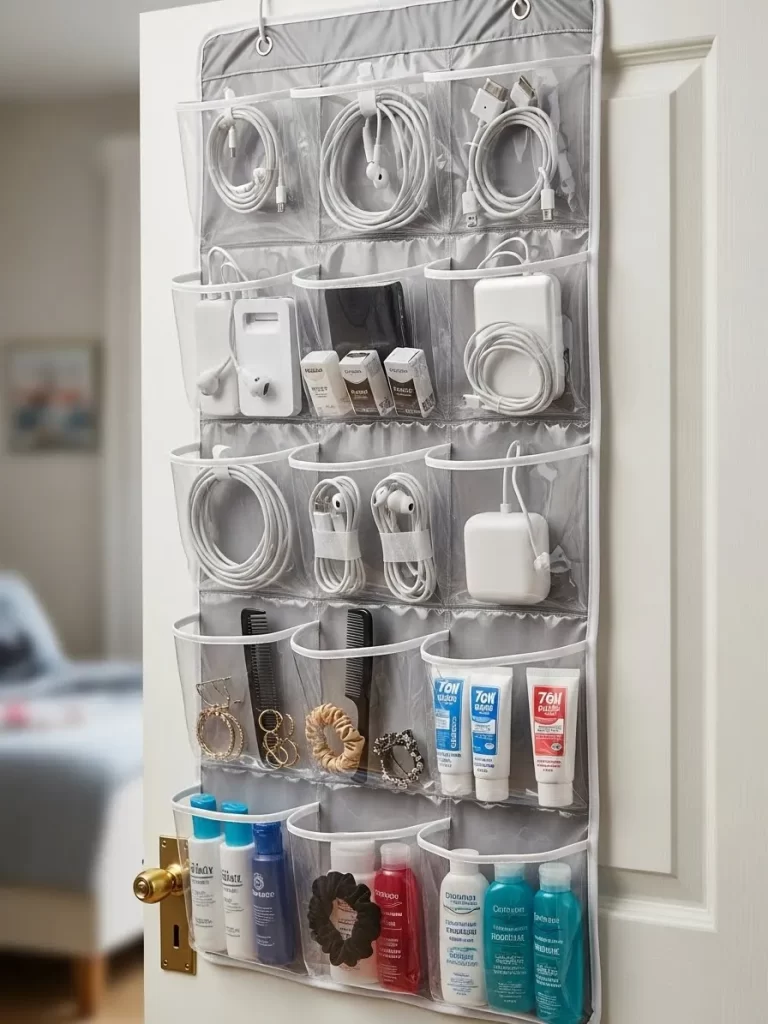
This picture presents a genius way to manage small electronics and toiletries that often clutter surfaces. An over the door organizer made of clear vinyl or mesh hangs vertically, using otherwise wasted space.
Each pocket holds a different item: tangled cables are coiled neatly in one pocket, chargers and power blocks in another. Lower sections hold hair accessories, combs, and travel sized lotions.
This vertical solution keeps everything visible, separated, and off of the bedside tables or bathroom counters. It is easily installed over the back of the guest room door, making all those small essentials readily accessible without adding a visual mess.
DIY Project: Installing and Populating the Caddy
Setting up an over the door organizer is a simple, non-permanent fix for small item clutter.
Materials Required List
- One clear vinyl or mesh over the door pocket organizer
- Over the door hooks or hanging loops (usually included with the caddy)
- Velcro or zip ties (for bundling cables)
- Small label stickers and a marker (optional)
Equipment Required List
- None
DIY Instruction Step by Step
- Prep the Door: Ensure the top edge of the guest room door is clean. Assemble the caddy by attaching the included metal or plastic hooks to the loops at the top of the organizer.
- Hang the Caddy: Hang the assembled caddy over the top edge of the guest room door. Ensure the door can still close easily with the hooks in place.
- Coil and Contain Cables: Gather all the miscellaneous electronic cables, chargers, and headphones that tend to lie around. Coil each cable neatly into a loop. Secure them with small Velcro straps or thin zip ties so they maintain their shape.
- Categorize and Place: Dedicate the top rows of pockets to electronic items (one pocket per charger). Dedicate the middle and bottom rows to guest toiletries, combs, hair ties, or extra small soaps. Keep categories together.
- Label for Clarity (Optional): If needed, use small label stickers on the outside of the pockets to indicate the contents, such as “CHARGERS,” “COMBS,” or “TOOTHPASTES.”
- Enjoy the Clear Surfaces: The organizer is now using vertical space effectively, completely clearing the dresser and nightstands of small item clutter.
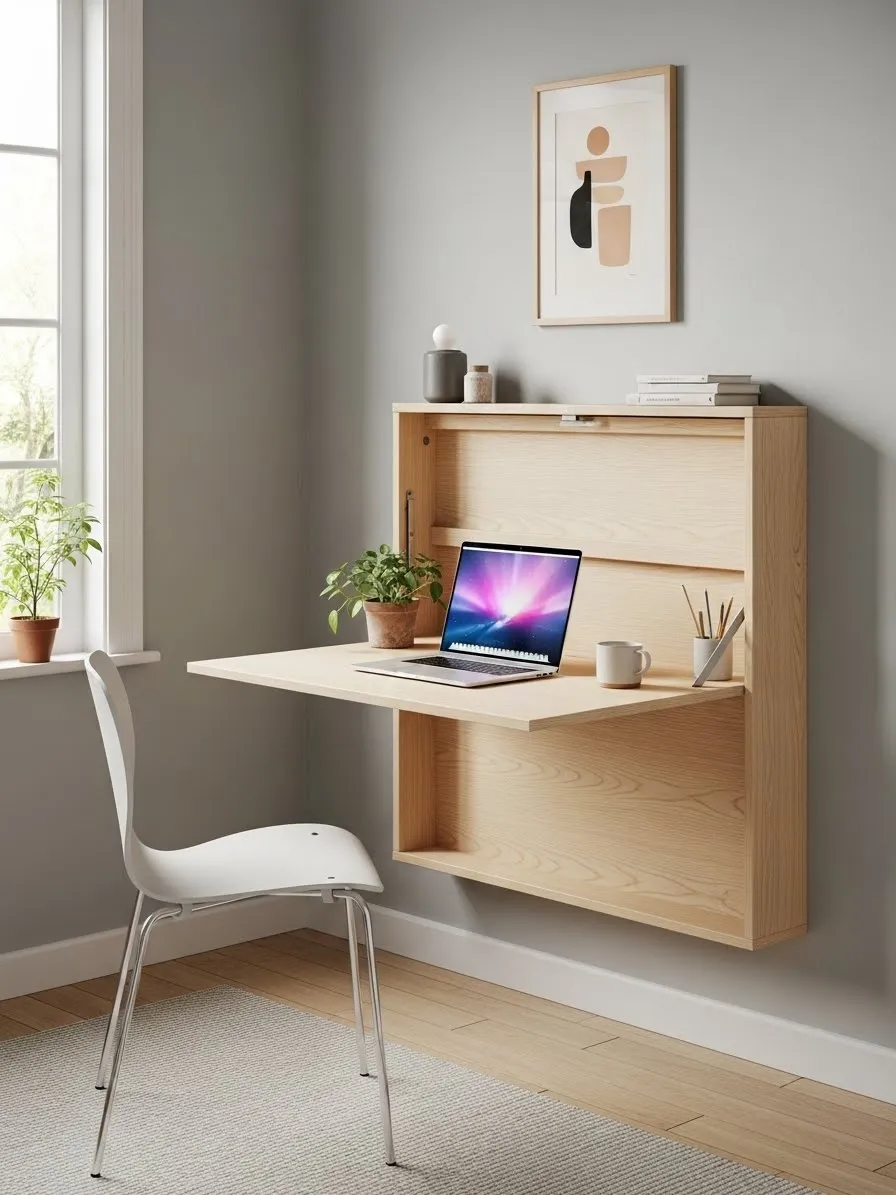
21. The Fold Down Floating Desk
Relevant Item Name: Retractable Wall Mounted Office Nook

This image displays a highly efficient solution for incorporating a workspace into a guest room without permanently sacrificing floor space. A simple, light wood cabinet unit is mounted directly to the wall, featuring a hinged panel that folds down to create a desk.
When folded up, the unit looks like a shallow wall cabinet, blending seamlessly into the room’s decor. When opened, the laptop sits on the surface, ready for use, and small supplies like pens and a notebook are neatly tucked into the small interior shelves.
This retractable design makes the room instantly multifunctional. It provides a useful work area when needed and instantly reclaims precious space and tidiness when the work is done. A simple chair can be easily moved away when not in use.
DIY Project: Building a Simple Fold Down Desk
Building a custom, small fold down desk requires basic carpentry skills and strong wall mounting hardware.
Materials Required List
- One piece of strong plywood or MDF board (for the desk surface, e.g., $30 \text{ inches} \times 18 \text{ inches}$)
- Two sturdy folding shelf brackets (rated for high weight capacity)
- Two hinges (heavy duty)
- Wood screws and heavy-duty wall anchors (appropriate for wall material)
- Safety latch or chain (to hold the desk up when closed)
- Stain, paint, or varnish (for finishing)
Equipment Required List
- Drill and various drill bits
- Stud finder
- Level
- Measuring tape
- Sandpaper (medium and fine grit)
DIY Instruction Step by Step
- Prepare and Finish the Wood: Sand the desk surface board until smooth. Apply your desired stain, paint, or varnish, ensuring all sides and edges are fully finished and allowed to dry completely.
- Attach Folding Brackets: Flip the finished desk surface upside down. Measure and mark where the two folding brackets will attach to the underside, about three inches from the side edges. Screw the brackets firmly to the wood.
- Determine Wall Height: Stand in the guest room and decide the comfortable working height for the desk (typically around 30 inches from the floor). Use your measuring tape and pencil to mark the desired height on the wall.
- Mount the Brackets to the Wall: Use a stud finder to locate wall studs for the strongest attachment. Hold the desk surface (with the attached brackets) against the wall at the marked height. Use your level across the top edge to ensure the desk is straight. Mark the screw holes for the brackets.
- Drill and Secure: Drill pilot holes and install heavy-duty wall anchors if you are not drilling into studs. Screw the brackets securely to the wall.
- Install Safety Latch (Optional): If you want the desk to latch securely up against the wall when closed, install a small safety latch or chain mechanism on the side of the desk and the adjacent wall, ensuring it is easy to operate.
- Test and Use: Test the desk by placing a laptop and gently leaning on it to ensure stability. This piece of furniture is now ready to reclaim your floor space.
22. The Vertical Gallery Wall with Hooks
Relevant Item Name: Multifunctional Art and Robe Display
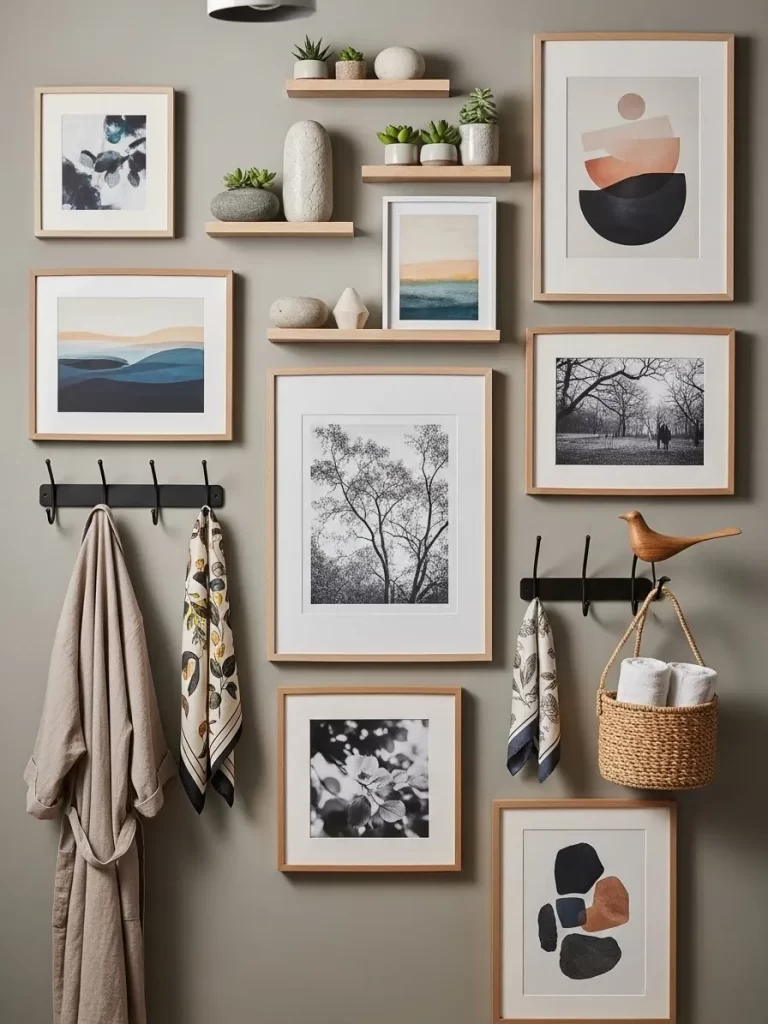
This beautiful composition integrates art, decoration, and highly functional storage into one statement wall. The arrangement features multiple framed artworks of varying sizes, hung closely together to create a cohesive gallery.
The clutter solution is provided by the black utility hooks interspersed among the frames. These hooks allow for robes, towels, or even decorative scarves to be hung vertically, keeping them off the chair or bed.
Small floating shelves holding succulents and small stones are also tucked between the frames, adding dimension without bulk. This setup proves that storage doesn’t need to be unsightly; it can be fully incorporated into the room’s decorative scheme, making the guest room truly feel like a welcoming retreat.
DIY Project: Creating a Gallery Wall with Utility Hooks
Merging wall art with practical hanging storage is a visually effective way to tidy a room.
Materials Required List
- A collection of framed artwork and photos (varying sizes for visual interest)
- Two to three sets of black metal utility hooks or a short hook rail
- Wall anchors and screws
- Pencil
- Small floating shelves (optional)
Equipment Required List
- Drill and drill bits
- Level (small, torpedo level works well)
- Measuring tape
- Hammer
DIY Instruction Step by Step
- Plan the Layout: Lay all your framed art and hooks on the floor first. Experiment with arrangements, grouping the art tightly together and positioning the hook rails or individual hooks where they complement the art, usually below a key piece.
- Mark the Wall: Begin by hanging the largest piece of art or the center hook rail. Hold the piece against the wall and use your level to ensure it is straight. Lightly mark the exact spots for the screws or picture hangers.
- Install the Hooks: Install the hook rails or individual hooks first, as these are functional and need to be sturdy. Drill pilot holes, insert wall anchors if needed, and secure the hooks firmly. Use the level to make sure they are perfectly horizontal.
- Hang the Art: Follow the marked spots to hang the art frames around the installed hooks, ensuring the frames are close together for a cohesive gallery feel. Step back often to check the visual balance.
- Add Shelves (Optional): If using small floating shelves, install them in open spaces between the frames. Keep the styling very minimal, like one small plant or stone, to maintain the focus on the art and not add clutter.
- Tidy with Style: Hang a cozy robe and a neatly folded towel from the installed hooks. This turns the functional storage into part of the art display.
23. The Uniform Hanging Closet
Relevant Item Name: Symmetrical Wardrobe Display
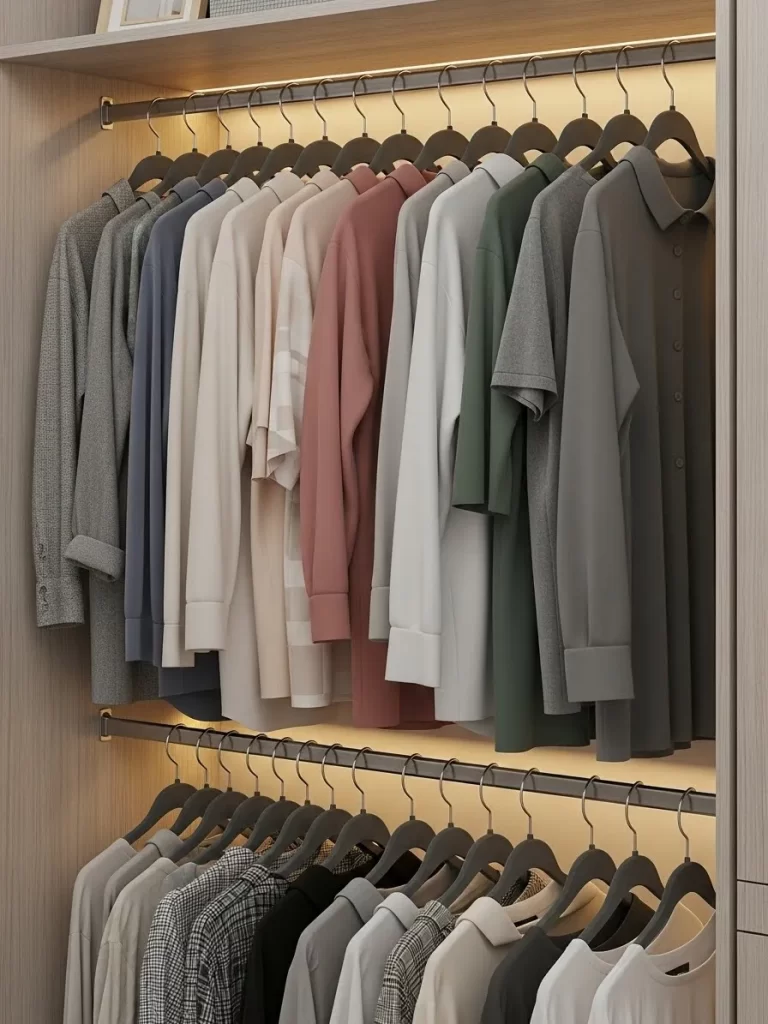
This photograph perfectly illustrates how consistency transforms a cluttered closet into a serene, boutique like display. The two-tier hanging system maximizes the closet’s height, doubling the usable space.
The key to this tidy look is the uniformity of the hangers—all are slim, matching black velvet or felt, which saves space and reduces visual chaos. Additionally, all the clothes are arranged by color and type, creating a pleasing, graded color spectrum.
Even the lighting is optimized with under shelf light strips, ensuring the closet contents are bright and easy to see. A closet arranged this way encourages proper hanging and stops clothes from piling up on the floor or chairs.
DIY Project: Achieving Uniform Hanger Closet
This is an organization project focused on simple upgrades to maximize space and reduce visual clutter.
Materials Required List
- Replacement set of slim, uniform velvet or felt hangers (buy enough to replace all existing hangers)
- LED strip lights with adhesive backing (battery powered is simplest)
- Mild cleaner and cloth
Equipment Required List
- Screwdriver (to remove any old fixtures if needed)
- Measuring tape
DIY Instruction Step by Step
- Purge and Empty: Take every single item out of the closet. This is a great time to evaluate what you really need. Wipe down the closet rods and shelving thoroughly.
- Install Lighting (Optional): Measure the length of the closet rods or the underside of the top shelf. Cut the adhesive LED strip lights to length. Peel off the backing and firmly press the lights onto the underside of the top shelf or directly above the lower hanging rod. This instantly improves visibility.
- Replace Hangers: Transfer all remaining clothes from old, mismatched plastic or wire hangers to the new uniform, slim hangers. The slim profile saves several inches of space across the length of the rod.
- Organize by Color and Type: Hang the clothes back onto the rods, grouping them by type first (shirts, jackets, dresses). Within each group, arrange them in a light to dark color gradient. This visual order makes the closet seem expansive and calm.
- Maintain the Look: Ensure all hangers face the same direction. The uniformity of the hangers and the organized color arrangement eliminate the visual clutter that often contributes to the “dumping ground” feeling.
24. The Color Coded Floating Bookshelves
Relevant Item Name: Decorative Floating Book Display
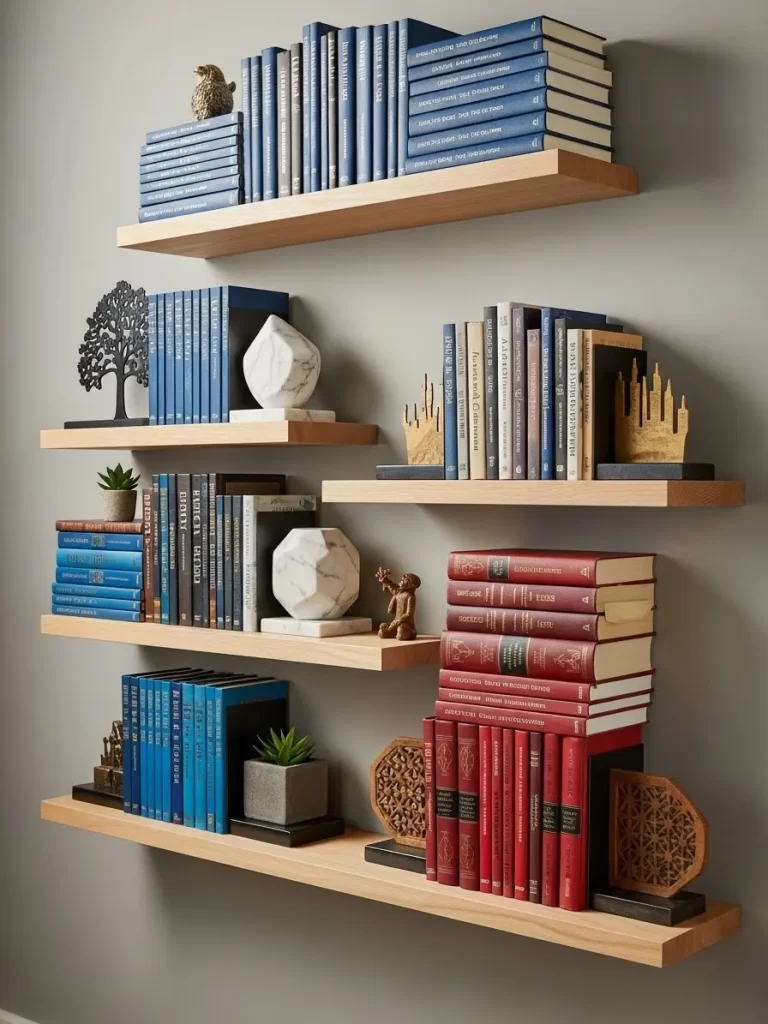
This stunning display uses the simplicity of floating wooden shelves to create an architectural feature that is tidy and visually interesting. The key to the organization is the purposeful arrangement of the books.
The books are organized both by color (deep reds, rich blues, neutral spines) and by how they are placed—some stacked horizontally with decorative objects on top, and others arranged vertically with elegant bookends.
Mixing books with minimal decorative items like marble spheres and small metallic sculptures prevents the shelves from looking cluttered or overcrowded. This approach turns a necessary element, like book storage, into an intentional piece of decor.
DIY Project: Styling the Color Coded Shelves
This project focuses entirely on the arrangement and aesthetics of an existing or newly installed set of floating shelves.
Materials Required List
- An existing collection of books
- Small, elegant decorative objects or sturdy bookends
- Small potted plants or succulents
- Microfiber cloth (for dusting)
Equipment Required List
- None
DIY Instruction Step by Step
- Clear and Clean: Completely empty the shelves. Wipe down all surfaces and dust the book spines.
- Group the Books: Sort your books by the dominant color of their spine. Create distinct color groupings (e.g., all blue spines together, all red spines together).
- Vary Placement: On one shelf, start with a vertical stack of books. On the next shelf, begin with a horizontal stack. Alternate the placement patterns across the shelves to break up the monotony and add movement.
- Incorporate Decorative Elements: Place your small sculptures or plants next to the horizontal stacks of books, using them as anchors. Use stylish, heavy bookends to hold the vertical stacks in place. Remember, less is more; only select objects that truly complement the aesthetic.
- Achieve Balance: Step back and adjust. The goal is visual balance. If one shelf looks too heavy, shift a horizontal stack to a vertical arrangement. The final look should appear curated and intentional, not haphazardly placed.
25. The Hidden Window Seat Storage
Relevant Item Name: Custom Built In Reading Nook with Storage
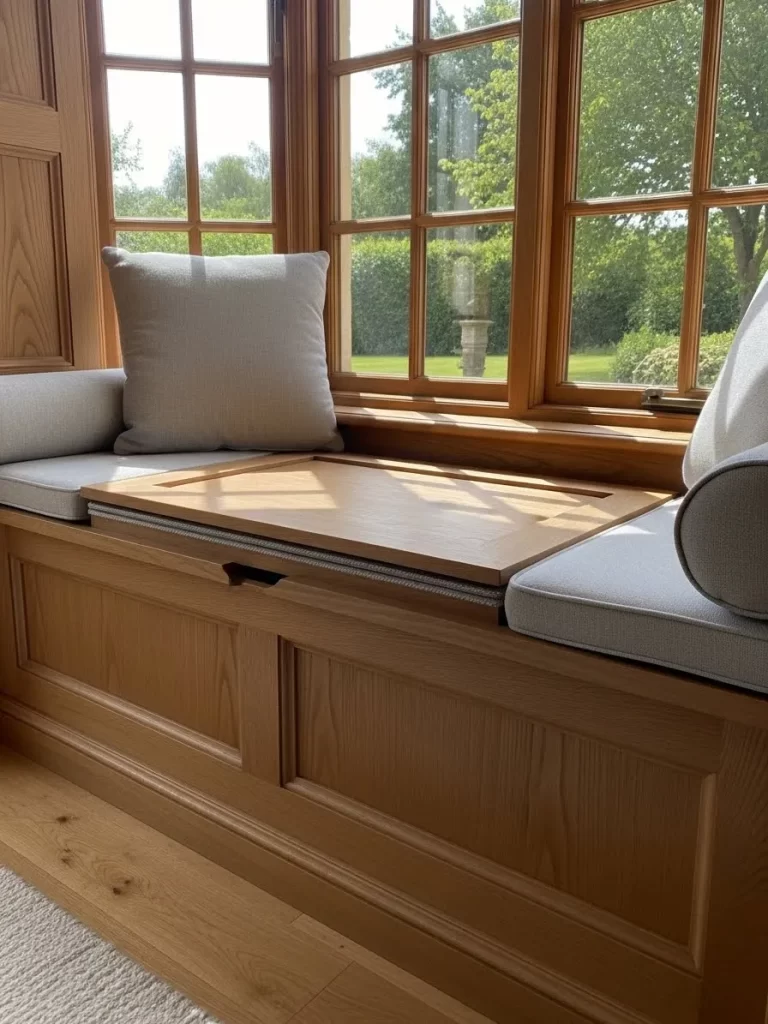
This photo showcases a truly custom and architectural solution: a built in window seat that seamlessly incorporates hidden storage. The beautiful wood paneling and custom cushions make this an appealing reading nook.
The key to its tidiness is the lift up lid in the center of the seat cushion, revealing deep storage beneath. This space is designed to hold large items like extra bedding, seasonal decor, or sentimental keepsakes.
The window seat maximizes the use of natural light and window space while providing comfortable seating and massive hidden storage. This eliminates the need for bulky storage furniture, making the guest room feel open and well designed.
DIY Project: Adding Storage to a Bench Seat
If you have a built-in or freestanding bench, you can adapt it to provide lift top storage. This instruction focuses on adding the hinged top.
Materials Required List
- A strong wooden bench or existing window seat structure
- Plywood or MDF board (cut to fit the top opening of the bench)
- Two to three heavy duty butt hinges
- Small lift handle or knob
- Screws (appropriate length for wood thickness)
- Sandpaper
Equipment Required List
- Drill and drill bits
- Screwdriver
- Measuring tape
- Pencil
DIY Instruction Step by Step
- Measure the Opening: Measure the exact length and width of the storage opening at the top of the bench. Cut the plywood or MDF lid to match these dimensions precisely. Sand the edges until very smooth.
- Position the Hinges: Place the lid in position on the bench. Place the two to three butt hinges evenly along the back edge of the lid. Mark the screw holes on both the lid and the back frame of the bench.
- Install the Hinges: Drill small pilot holes for the screws. Securely screw one side of the hinges to the back edge of the bench’s structure and the other side of the hinges to the back edge of the lid. Ensure the lid opens and closes smoothly.
- Attach the Handle: Decide where you want the handle to be placed on the front edge of the lid. Mark and drill pilot holes. Screw a small pull handle or knob onto the lid for easy lifting.
- Add Cushion and Use: Place your custom cushion back onto the seat. The storage is now completely hidden beneath the seat, ready to house your clutter and reclaim your room.
26. The Mobile Craft Cart
Relevant Item Name: Rolling Multitier Supply Caddy
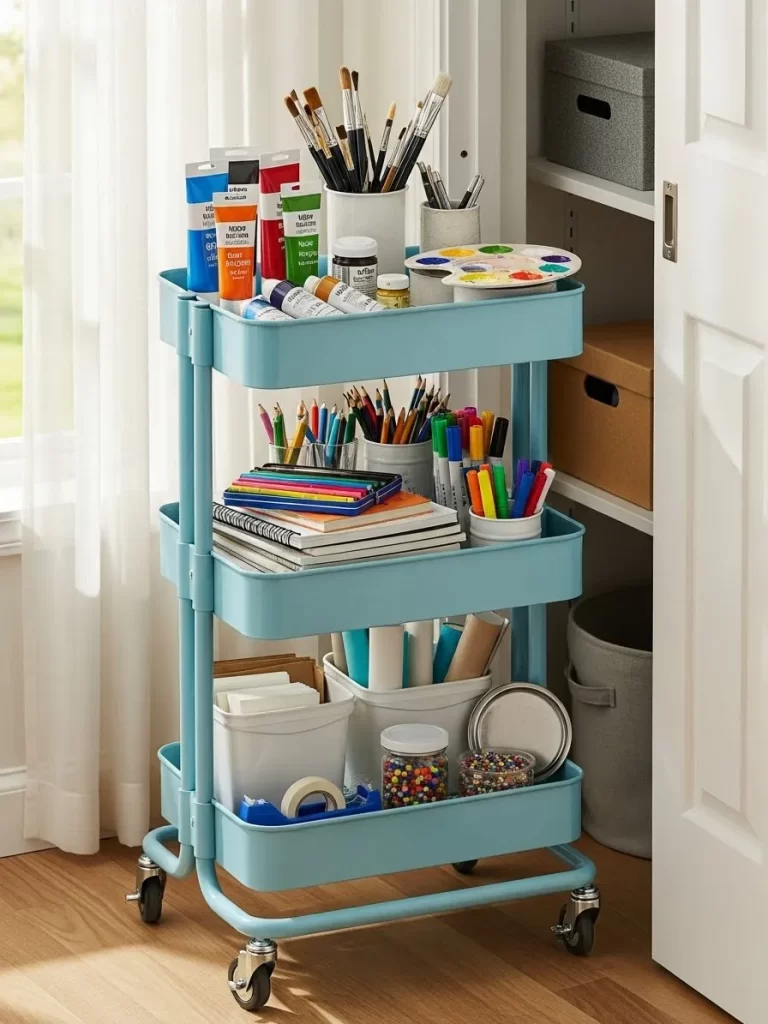
This photo features a highly popular and practical piece of organization furniture: a three-tier metal cart on caster wheels. This light blue cart is dedicated entirely to art supplies, showing how to organize a major source of clutter.
The top tier holds tall paint tubes and brushes in clean white canisters. The middle tier contains drawing pads, pencils, and markers. The bottom tier holds bulk items like glue, tape, and colorful embellishments.
Because it is mobile, this entire craft station can be wheeled out of the guest room to a work area when needed and then quickly returned and tucked away into a closet when guests arrive. It ensures the room is kept tidy and ready for visitors.
DIY Project: Setting Up the Multitier Utility Cart
This organization project focuses on maximizing the utility of a standard rolling cart for supplies.
Materials Required List
- One three-tier rolling utility cart (usually metal)
- Small, white plastic or metal containers/mugs (for pens, brushes)
- Clear plastic jars with lids (for beads, glitter, or small parts)
- Supplies to be organized (paints, pencils, paper)
Equipment Required List
- None (carts are typically assembled with basic hand tools provided)
DIY Instruction Step by Step
- Assemble the Cart: Follow the manufacturer’s instructions to fully assemble the three-tier utility cart, ensuring all four caster wheels are securely attached.
- Define Tier Functions: Assign a function to each tier: Top (most frequently used, tall items like brushes), Middle (medium items like paper and pencils), Bottom (heavy or bulkier items like paint cans and tape).
- Containerize Small Items: Place pencils, pens, and markers upright in the small, uniform white containers on the middle or top tier. Use the clear, lidded jars to hold small, colorful items like beads, buttons, or glitter, making them easy to see and access.
- Load the Tiers: Load the tiers according to your plan. Keep the paint tubes standing upright on the top tier. Stack sketch pads and notebooks neatly on the middle tier. Place the heavier items and supplies on the bottom tier for stability.
- Test Mobility: Test the cart by pushing it around the room. Ensure the weight is balanced and nothing is falling out. When the guest room is needed, simply roll the entire cart into a closet or storage room for effortless tidiness.
27. The Bedside Cable Organizer
Relevant Item Name: Desktop Charging Accessory Box
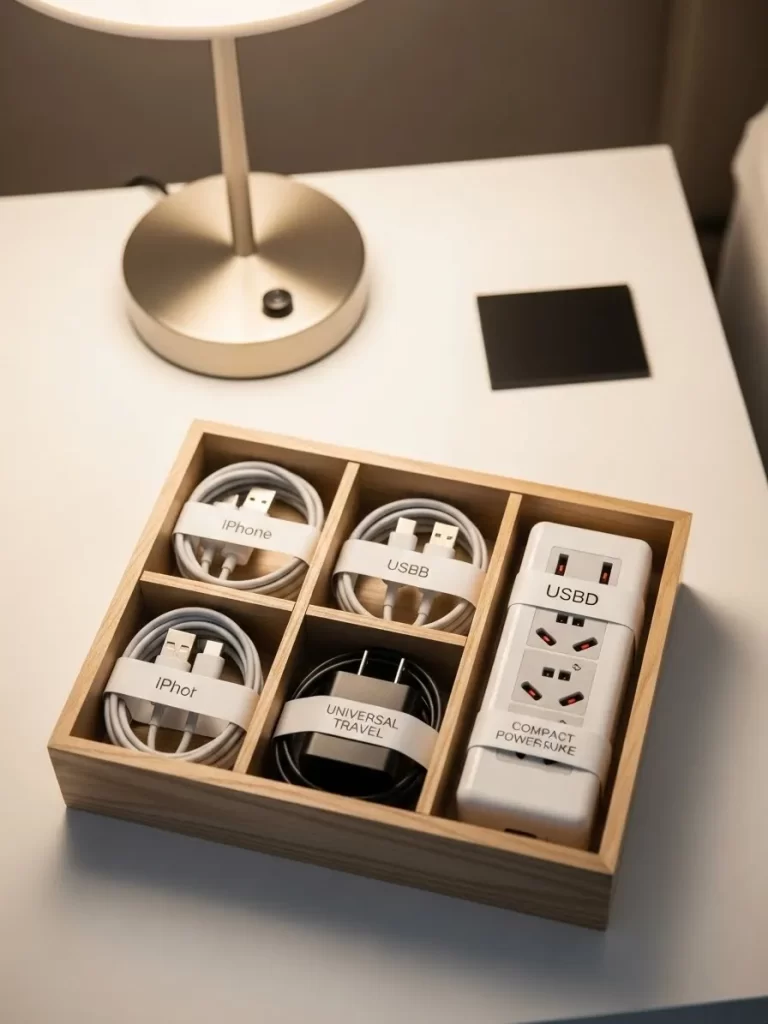
This small but mighty solution tackles the modern problem of charging cables cluttering the nightstand. The image displays a small wooden box with six dedicated compartments.
Each compartment neatly holds a coiled charging cable, which is secured by a white band labeled with its function (“iPhone,” “USBC,” “Universal Travel”). One larger section holds a compact travel power strip or adapter.
This box keeps all necessary guest charging accessories contained, organized, and easily accessible on the nightstand, preventing the common mess of tangled wires that makes a room feel instantly chaotic. The simple wooden construction keeps the look clean and natural.
DIY Project: Creating a Bedside Cable Box
You can easily divide a basic wooden tray or box to create compartments for cable management.
Materials Required List
- One shallow wooden box or tray (with or without a lid)
- Thin balsa wood or stiff cardboard (for dividers)
- Wood glue or strong craft glue
- White Velcro strips or paper bands
- Labels or markers
Equipment Required List
- Ruler
- Craft knife or scissors
DIY Instruction Step by Step
- Measure the Box: Measure the interior length, width, and depth of your chosen wooden box. Plan a simple grid layout with equal sized squares for each cable.
- Cut and Glue Dividers: Cut the balsa wood or cardboard into strips that match the depth of the box. Glue the strips together in an interlocking grid pattern that fits snugly inside the box. Alternatively, glue the strips directly into the bottom of the box to form the compartments.
- Coil and Label Cables: Gather your universal charging cables. Coil each cable neatly into a tight loop. Secure the loop with a white Velcro strip or a simple paper band. Use a permanent marker to write the cable’s function (e.g., “ANDROID,” “TABLET”) directly on the band.
- Load the Box: Place one coiled, labeled cable into each compartment. Place the power adapter or travel plug in the largest remaining compartment.
- Placement: Place the finished, organized cable box on the guest room nightstand. This small, tidy solution makes a big difference in reducing surface clutter.
28. The Decorative Laundry Hamper
Relevant Item Name: Bamboo Slat Waste and Linen Basket
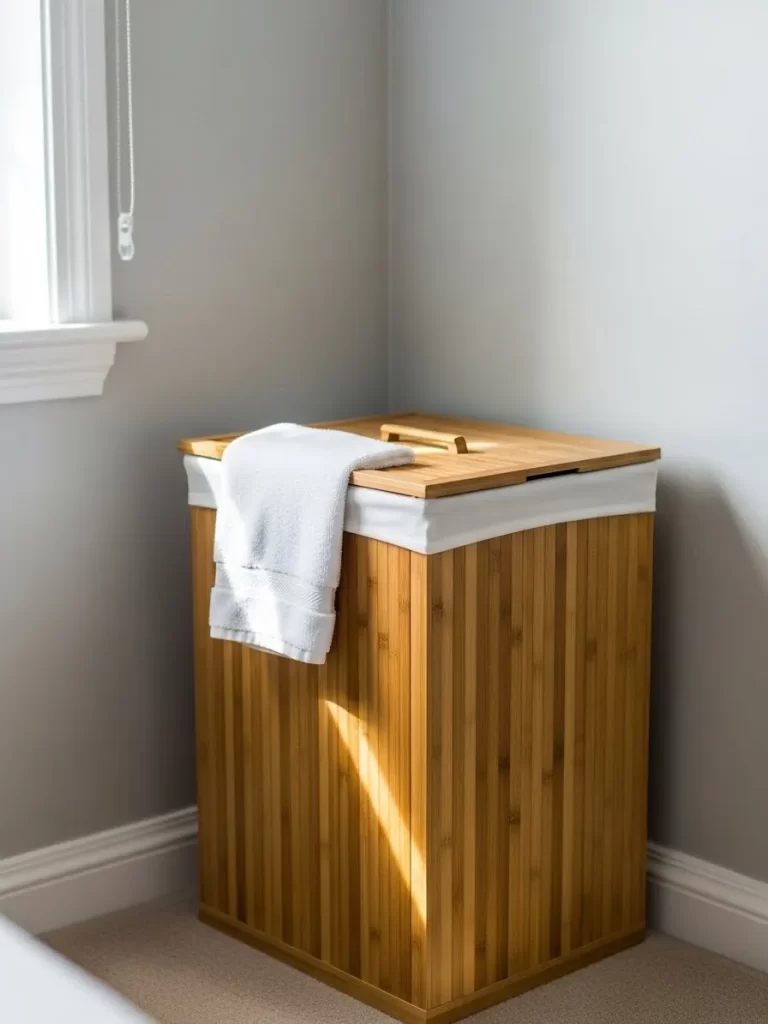
This photo addresses the universal clutter issue of discarded clothing. The solution is a tall, rectangular laundry hamper made of attractive vertical bamboo slats, blending naturally into the corner of the room.
The hamper has a simple lid, which keeps used laundry completely out of sight. A white cloth liner is visible at the top, which can be pulled out for easy transfer of the laundry.
Placing a fresh, white towel draped neatly over the lid serves as a subtle reminder to the guest that this container is available for their used linens. This piece of furniture turns a necessary eyesore into a cohesive, decorative element.
DIY Project: Hamper Refresh and Liner
This project focuses on revitalizing an existing or basic hamper to make it more aesthetically pleasing and functional.
Materials Required List
- One basic or slatted laundry hamper
- One large laundry bag or piece of washable canvas/cotton fabric (for the liner)
- Drawstring cord or thick ribbon
- Sewing machine or needle and thread
Equipment Required List
- Measuring tape
- Scissors
DIY Instruction Step by Step
- Measure for the Liner: Measure the height, length, and width of the hamper’s interior. Add eight inches to the height and three inches to the length and width measurements for seam allowances and the drawstring casing.
- Sew the Liner: Cut the fabric according to your measurements. Sew the side seams to create a large bag shape. Create a drawstring casing by folding the top two inches of the bag over and stitching it down, leaving a small opening to thread the cord.
- Thread the Drawstring: Thread the drawstring cord or thick ribbon through the casing. Tie the ends securely.
- Place and Display: Insert the finished liner into the hamper, pulling the drawstring cord to gather the excess fabric neatly around the top edge of the hamper. Place the lid on top. Set the hamper in an inconspicuous corner of the guest room, transforming it from a clutter collector to a tidy storage solution.
29. The Freecycle Furniture Exit
Relevant Item Name: Clutter Removal Strategy (Donation or Sale)

This image tackles the largest source of guest room clutter: the unwanted furniture that was simply moved there to “get it out of the way.” The photo shows a well worn, outdated armchair placed on the curb with a large cardboard sign reading “FREE.”
A few articles of clothing are tossed on top, suggesting the chair was previously used as a clothes dumping ground. The strategy here is not to reorganize the item, but to decisively remove it from the home.
Using a freecycle or donation approach quickly clears the biggest, bulkiest items from the guest room, immediately reclaiming the space and allowing for a fresh start. This is the ultimate decluttering solution for permanent messes.
DIY Project: Furniture Removal and Donation
This is an action plan for getting rid of bulky, unwanted items permanently.
Materials Required List
- Large sheet of cardboard
- Thick, black permanent marker
- Packing tape or strong string
- Cleaning supplies (for the item)
Equipment Required List
- None
DIY Instruction Step by Step
- Select the Clutter: Identify the single largest piece of unwanted furniture or equipment currently clogging the guest room (e.g., old chair, unused treadmill, broken dresser).
- Clean and Prepare: Give the item a quick cleaning, wiping off dust and stains. This makes it more appealing for donation or pickup.
- Create the Sign: Use the cardboard and bold marker to create a clear, simple sign. Write “FREE” or “DONATION” clearly and largely. You may add a line like “Must take today.”
- Schedule Removal: Contact your local donation center for pickup or arrange for a bulk trash pickup through your municipal service. If offering it free on the curb, check local rules for placement timing.
- The Final Exit: Move the item permanently out of the guest room and place it on the curb or in the designated pickup location. The resulting empty space is the most effective tidy solution of all.
30. The Pegboard Utility Station
Relevant Item Name: Over Door Customizable Tool Organizer
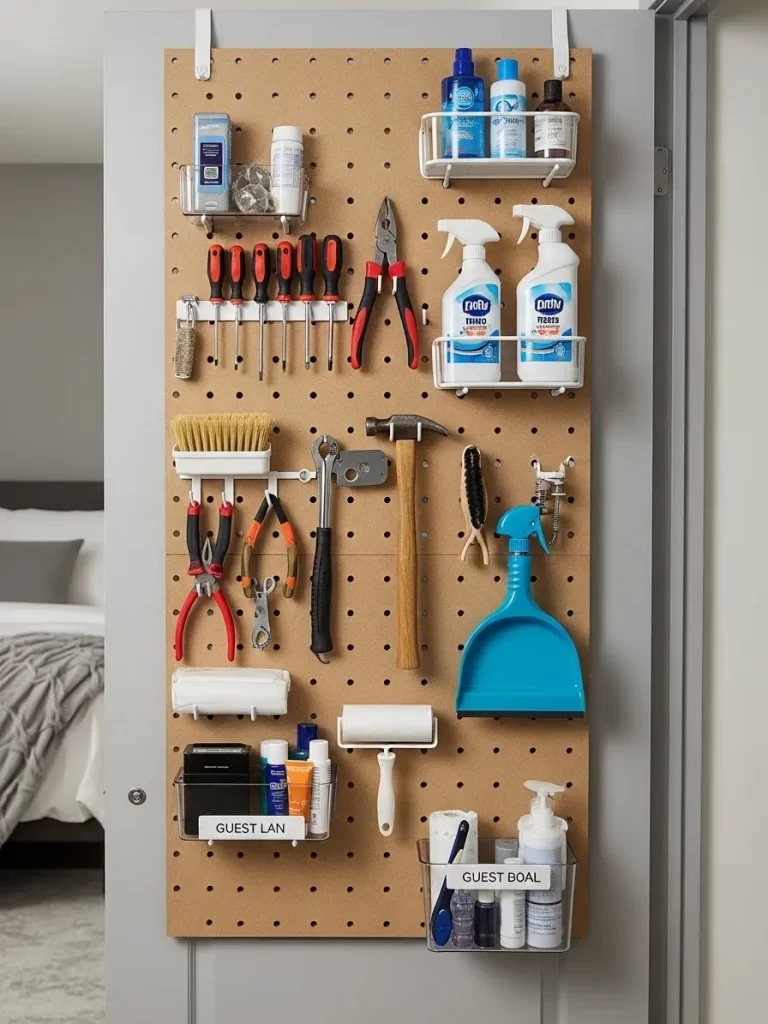
This incredible image demonstrates maximizing vertical, unused space behind a door with a customizable pegboard system. This setup is often used for tools, but it brilliantly houses maintenance and cleaning supplies for a guest room area.
Hooks are used to hang small hand tools and brushes, while several white plastic caddies are clipped into the pegboard to hold cleaning sprays, sponges, and small repair items. Each caddy is clearly labeled, like “GUEST LAN” for guest laundry or “GUEST BOAL” for general supplies.
This organization system keeps all utility items off the floor and surfaces, contained in one highly functional area. The entire board hangs over the door using simple hooks, making it easily removable if needed.
DIY Project: Creating an Over Door Pegboard Organizer
This is a great DIY project for containing small, miscellaneous items using vertical space.
Materials Required List
- One sheet of fiberboard pegboard (pre-cut to door size is easiest)
- Four J-shaped over door hooks
- Assorted pegboard hooks, baskets, and small plastic caddies designed to attach to pegboard
- Screws and washers (for attaching the over door hooks to the board)
Equipment Required List
- Drill and drill bits
- Measuring tape
- Screwdriver
DIY Instruction Step by Step
- Prepare the Pegboard: Take the pegboard and measure the top edge. Mark two points where the over door hooks will attach to hold the board. These should be evenly spaced.
- Attach the Over Door Hooks: Drill pilot holes at the marked points on the pegboard. Place a washer over the screw head and securely attach the top of the J-shaped over door hooks to the back of the pegboard. The long hook should extend over the top edge.
- Install Pegboard Accessories: Hang the assembled pegboard over the guest room door. Now, start attaching the various pegboard accessories. Hang the long hooks for hand tools like hammers or pliers. Clip the small baskets or caddies onto the board for holding cleaning sprays, batteries, or spare lightbulbs.
- Categorize and Label: Place cleaning supplies, small tools, and other utility items into the baskets. Use a label maker or a strip of masking tape to clearly label each caddy (e.g., “CLEANING,” “TOOLS,” “FIRST AID”).
- Tidy Door: Your door is now a hyper-organized utility station, freeing up shelves and drawers inside the guest room.
31. The Vertical Fabric Pocket Organizer
Relevant Item Name: Wall Mounted Woven Utility Panel
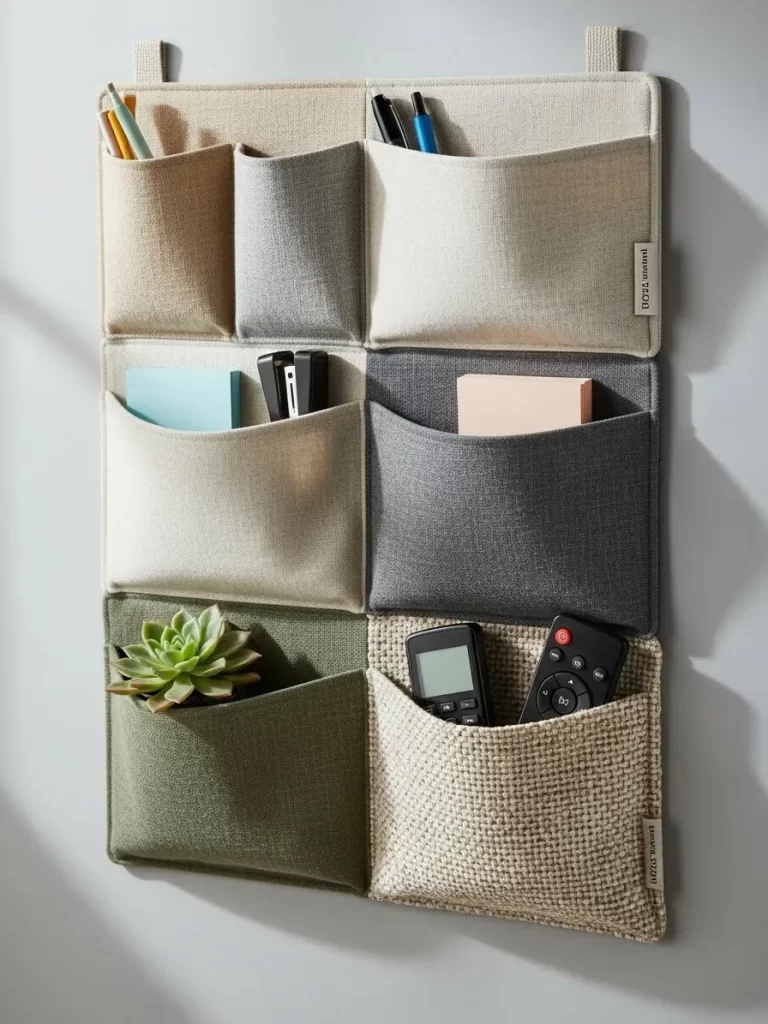
This image features a cozy, textile based solution for managing small items that often end up scattered on a nightstand or desk. It is a multi pocket fabric hanging panel in soothing, neutral tones of beige, gray, and sage green.
Each pocket is made of sturdy woven material, giving it a soft yet durable feel. The pockets neatly hold various small items: pens, staplers, reminder notes, remote controls, and even a small potted succulent.
Hanging this organizer on a wall next to the bed or desk keeps tiny clutter contained and visually pleasing. This vertical storage system utilizes unused wall space, preventing the flat surfaces below from becoming dumping grounds.
DIY Project: Creating a Fabric Wall Organizer
You can easily sew a simple, decorative fabric organizer, or adapt a purchased one, to maximize storage in your guest room.
Materials Required List
- Pre-sewn multi pocket fabric organizer (simplest option)
- Or: Sturdy woven fabric (like canvas or burlap) for the base and pockets
- Matching thread
- Wooden dowel or metal rod (for hanging)
- Hanging loops (attached to the back of the organizer)
- Sewing machine or needle and heavy duty thread
Equipment Required List
- Scissors
- Ruler
- Iron and ironing board
DIY Instruction Step by Step
- Prepare the Pockets: If you are sewing the organizer, cut the fabric for the pockets into squares or rectangles. Fold and press the top edge of each pocket piece under for a clean hem.
- Stitch the Pockets: Lay the pocket pieces onto the main backing fabric. Arrange them in a grid pattern. Stitch the side and bottom edges of the pockets to the backing fabric, leaving the top edge open. Ensure the stitching is strong, especially at the corners.
- Create the Hanging Rod Channel: Fold the top edge of the entire organizer fabric over by about two inches and stitch it down to create a channel for the wooden dowel or rod.
- Insert and Hang: Insert the wooden dowel through the top channel. The dowel or rod can rest on wall brackets or be hung with a simple piece of rope attached to the ends.
- Fill and Tidy: Fill the pockets with small items that frequently cause clutter, such as remote controls, reading glasses, pencils, and notepads. This organization keeps surfaces clear and essentials close.
32. The Cube Shelf Display
Relevant Item Name: Modular Display and Hidden Storage Unit
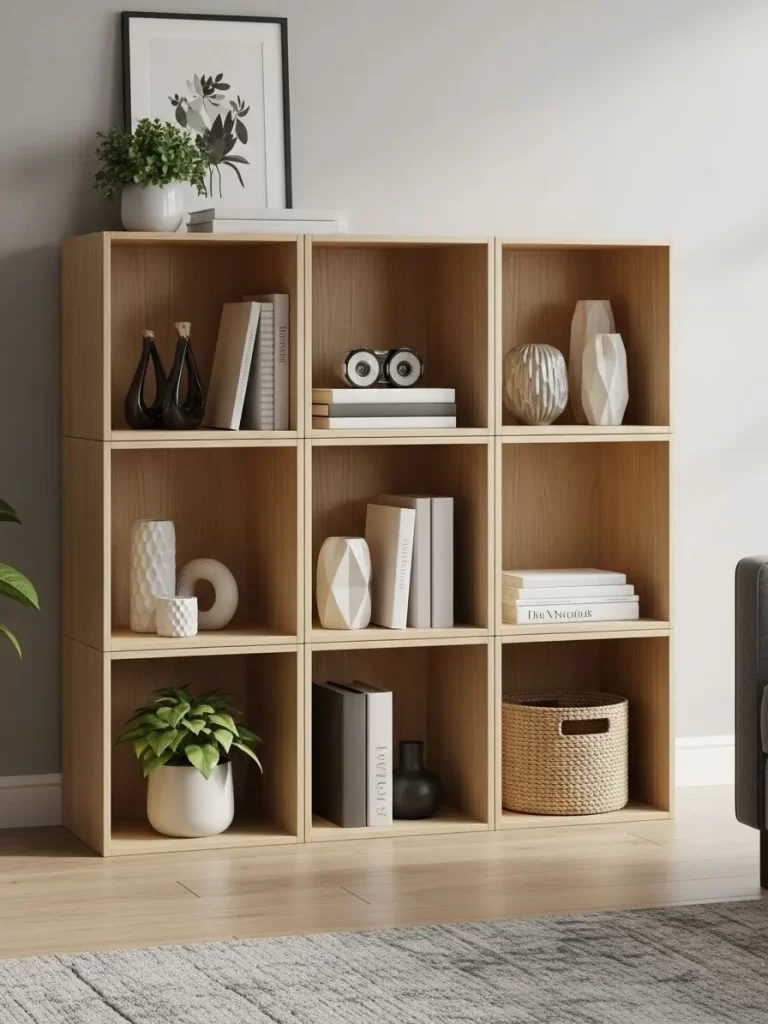
This image features a highly popular and versatile piece of furniture: a modular cube shelving unit constructed from nine interlocking wooden cubes. Its light wood finish keeps the look contemporary and airy.
The unit effectively balances decorative display with necessary storage. Some cubes hold stacks of books and interesting vases, while others house attractive woven baskets.
The baskets are key to the tidiness; they completely hide any miscellaneous items, such as extra cables, cleaning cloths, or even children’s toys. Using uniform baskets within a uniform shelving unit ensures a clean, organized, and sophisticated look.
DIY Project: Styling the Cube Shelf for Tidy Storage
This project focuses on styling a cube shelf unit to look intentional and organized, preventing it from becoming a nine-cubby dumping ground.
Materials Required List
- One cube shelving unit (nine or six cubes)
- Several woven baskets or fabric storage bins that fit snugly into the cubes
- A collection of books and decorative vases/objects
Equipment Required List
- None
DIY Instruction Step by Step
- Assess and Assign: Look at the nine cubes. Mentally assign a purpose to each: Storage (hidden behind a basket) or Display (open shelf for books/vases). Aim for a balance, perhaps using four cubes for storage and five for display.
- Insert Hidden Storage: Place the uniform woven baskets or fabric bins into the assigned storage cubes. These baskets will house all the items you want out of sight. Put small, messy items inside these containers.
- Style the Display Cubes: Arrange books and objects in the open display cubes. Vary the arrangement: In one cube, stack books horizontally. In the adjacent cube, stand books vertically. Mix in small, non-clutter decorative items.
- Break Up Clutter: Never use a cube to hold a messy mix of items. If a cube must hold small items, use an attractive lidded jar or small tray to contain them before placing them on the shelf.
- Final Polish: Place a small potted plant or a framed photo on top of the unit to complete the look. The combination of open display and hidden, contained storage keeps the guest room looking sophisticated and organized.
33. The Welcoming Empty Drawer
Relevant Item Name: Nightstand Open Storage Reminder
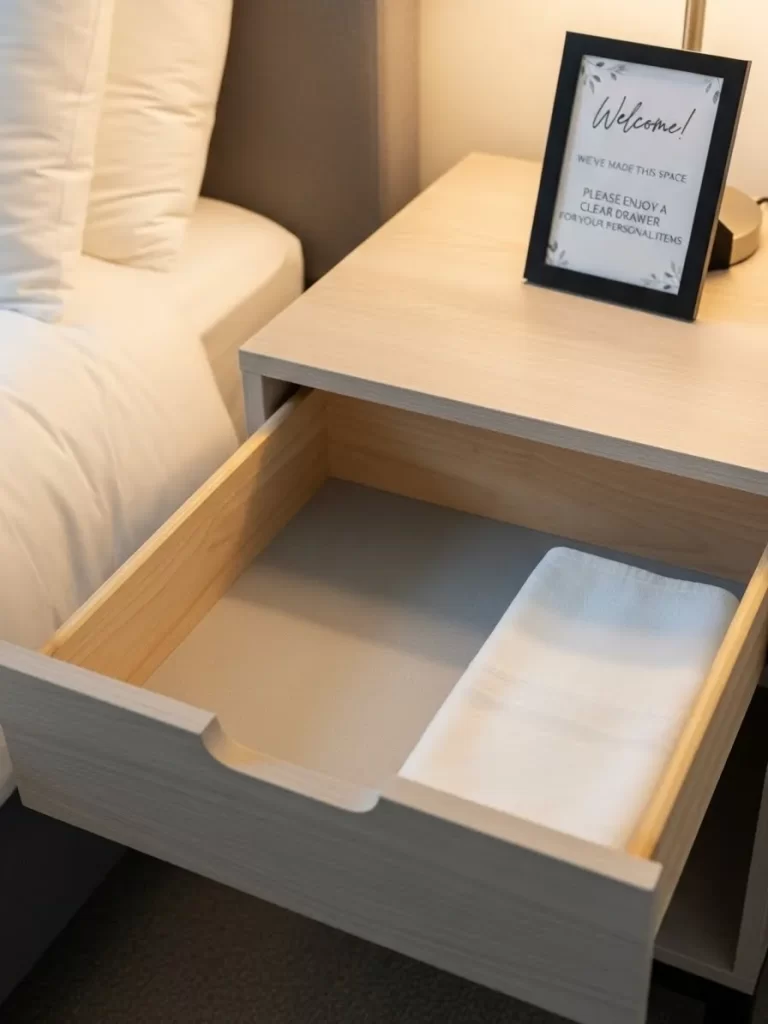
This simple, inviting photo reinforces the concept of making space available for guests. It shows a light wood nightstand with a clean, empty drawer pulled open, ready for a visitor’s use.
The focal point is the small framed sign on the nightstand that reads, “Welcome! We have made this space. Please enjoy a clear drawer for your personal items.” A neatly folded hand towel resting inside the drawer adds a touch of thoughtful hospitality.
This solution proves that sometimes the best organization is simply intentional emptiness. Providing a dedicated, clear space encourages guests to put away their personal items, which helps keep the nightstand surface clutter free.
DIY Project: Creating a Guest Welcome Sign
This project focuses on communication, which is key to ensuring guests use the available organized space.
Materials Required List
- Small picture frame (e.g., $5 \times 7$ inches)
- Cardstock or thick paper
- Printer or decorative marker
- Small hand towel
Equipment Required List
- Computer and printer (optional, for decorative font)
DIY Instruction Step by Step
- Design the Message: Use a computer to design a simple, warm message with an appealing font. The message should clearly state that the drawer is for the guest’s use. Print the message onto cardstock and cut it to fit the frame.
- Frame the Welcome: Place the printed message inside the picture frame.
- Prepare the Drawer: Follow the steps in solution 19 to completely empty and wipe clean one drawer in the nightstand or dresser.
- Fold the Towel: Fold a fresh, clean hand towel neatly into a slim rectangle and place it flat in the corner of the empty drawer. This visually cues the guest that the drawer is prepared for them.
- Place the Sign: Set the framed welcome sign prominently on top of the nightstand or dresser next to the cleared drawer. This small gesture conveys warmth and encourages tidy behavior.
34. The Apothecary Jars
Relevant Item Name: Decorative Clear Storage Canisters
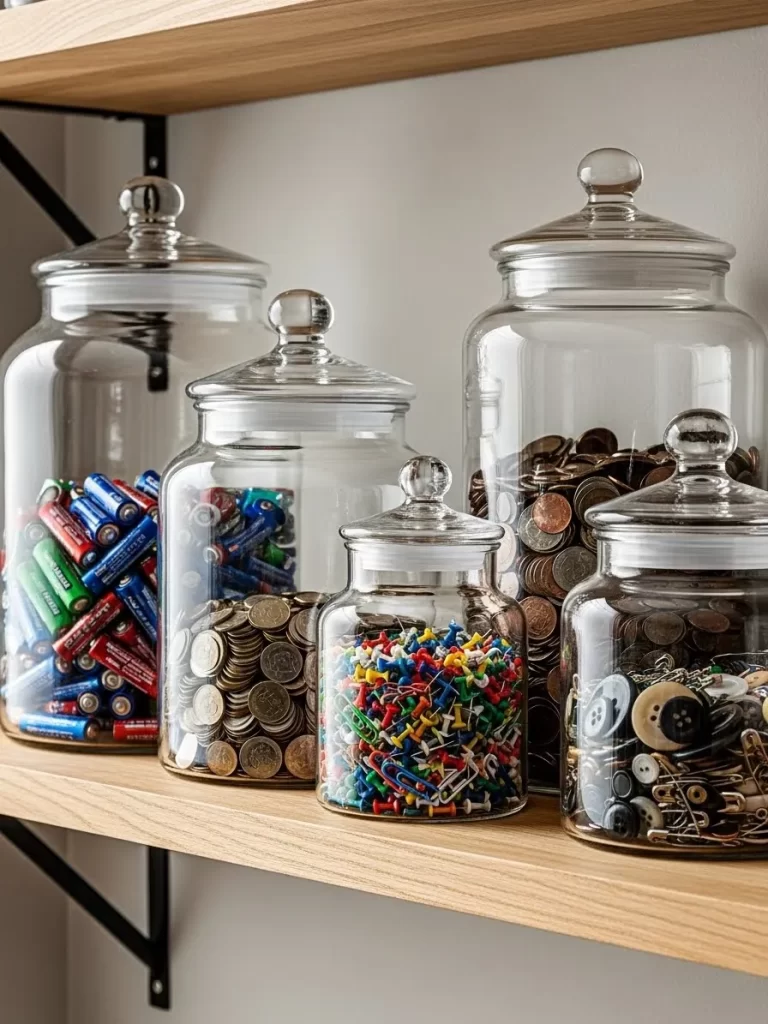
This captivating image shows a fun, effective way to organize the small, loose bits and pieces that tend to end up in messy junk drawers. A row of clear glass apothecary jars with attractive dome lids lines a shelf.
The transparency of the glass turns otherwise mundane items into colorful visual displays. One large jar holds a vibrant collection of batteries, another is filled with coins, and a smaller jar contains brightly colored thumbtacks.
Jars like these are useful for storing small repair items, spare hardware, buttons, or craft supplies. They provide a dust-free, contained home for the items, simultaneously reducing clutter and adding an interesting decorative element to the shelving.
DIY Project: Organizing Small Parts with Glass Jars
This is an easy project using readily available containers to bring order to tiny clutter.
Materials Required List
- Three to five clear glass apothecary jars with lids (various sizes are attractive)
- Contents: Small, loose items like batteries, spare change, office supplies, or buttons
- Mild soap and water (for cleaning the jars)
Equipment Required List
- None
DIY Instruction Step by Step
- Clean the Jars: Wash the glass jars and lids thoroughly with warm, soapy water. Dry them completely, ensuring there is no moisture left inside.
- Categorize the Clutter: Gather all the small, loose clutter currently floating around the guest room drawers and surfaces. Sort them into categories, such as “Hardware,” “Coins,” “Batteries,” or “Small Office Supplies.”
- Fill for Display: Carefully place one category of item into each glass jar. Try to fill the jars nearly full. If using colorful items (like thumbtacks or batteries), the color becomes part of the decor.
- Lid and Placement: Secure the lids tightly to keep the contents dust free and out of reach of children or pets. Place the finished jars neatly grouped together on an open shelf. Grouping items by container creates a tidy look, even if the contents are miscellaneous.
35. The Contained Tool Box
Relevant Item Name: Repair Essentials Drawer Integration
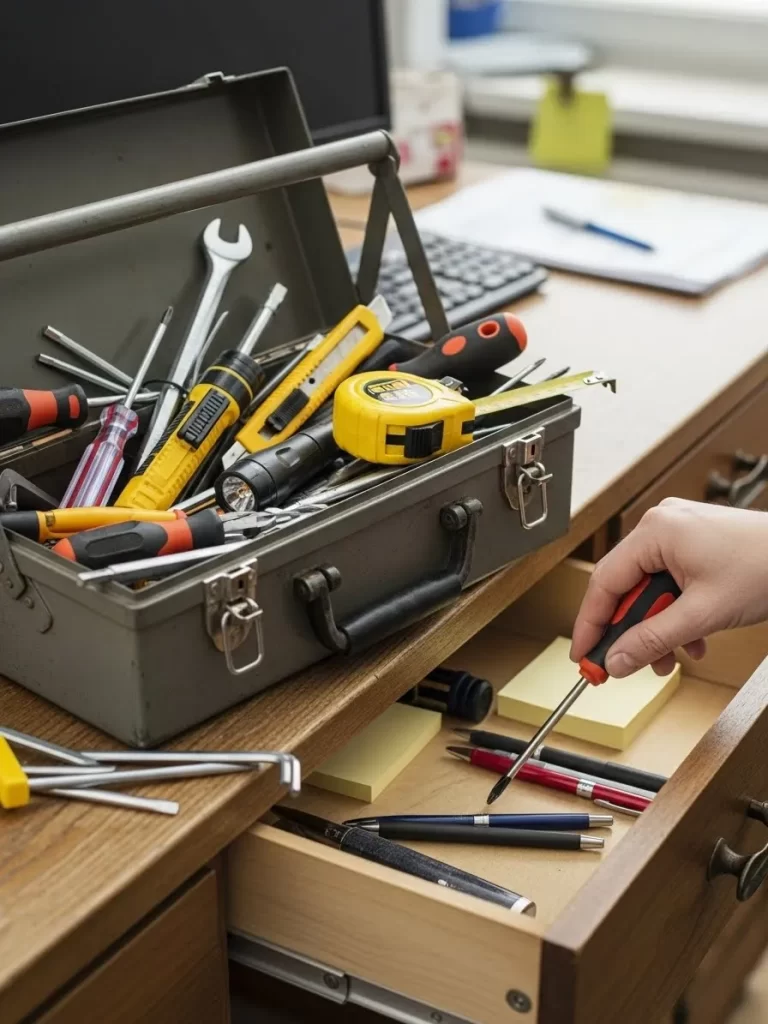
This close up image focuses on the problem of tools and small repair kits spilling over into desk drawers. It shows a metal toolbox filled with screwdrivers, wrenches, and tape measures sitting neatly on a desk.
A hand is seen placing a screwdriver back into a wooden drawer, which is currently filled with pens, sticky notes, and paperclips. This illustrates the importance of separating tool storage from office supply storage.
The metal toolbox provides a designated, portable home for all repair items, preventing them from mixing with desk supplies. The separation ensures that when you need a pen, you find a pen, and when you need a screwdriver, you grab the clearly defined toolbox.
DIY Project: Defining a Portable Tool Kit
The goal here is to make sure all tools are contained in one spot, ensuring they do not colonize the guest room drawers.
Materials Required List
- One portable metal toolbox or sturdy plastic caddy with a handle
- Small repair items (hammer, screwdriver set, measuring tape, small wrench)
- Velcro strips or rubber bands (for bundling wires/tape measures)
- Label maker or strong label sticker
Equipment Required List
- None
DIY Instruction Step by Step
- Gather All Tools: Collect every tool, bit, and piece of hardware currently scattered across your guest room area.
- Clean and Bundle: Wipe down all the tools. Use Velcro strips or rubber bands to bundle items that belong together, such as different sized screwdriver bits or small coils of wire.
- Load the Toolbox: Place the heavier tools (hammer) on the bottom of the toolbox. Neatly organize the screwdrivers and tape measures in the upper trays or slots. Ensure the lid closes easily without strain.
- Label Externally: Attach a clear, simple label, such as “HOUSEHOLD REPAIRS” or “TOOLS,” to the exterior of the toolbox.
- Remove from Guest Room: Place the contained and labeled toolbox on a shelf in a dedicated utility closet or garage. If it must stay in the guest room, place it discreetly inside the back of a closet, ensuring it is not consuming prime drawer or desk space.
36. The Personalized Memory Box
Relevant Item Name: Decorative Keepsake Storage Trunk
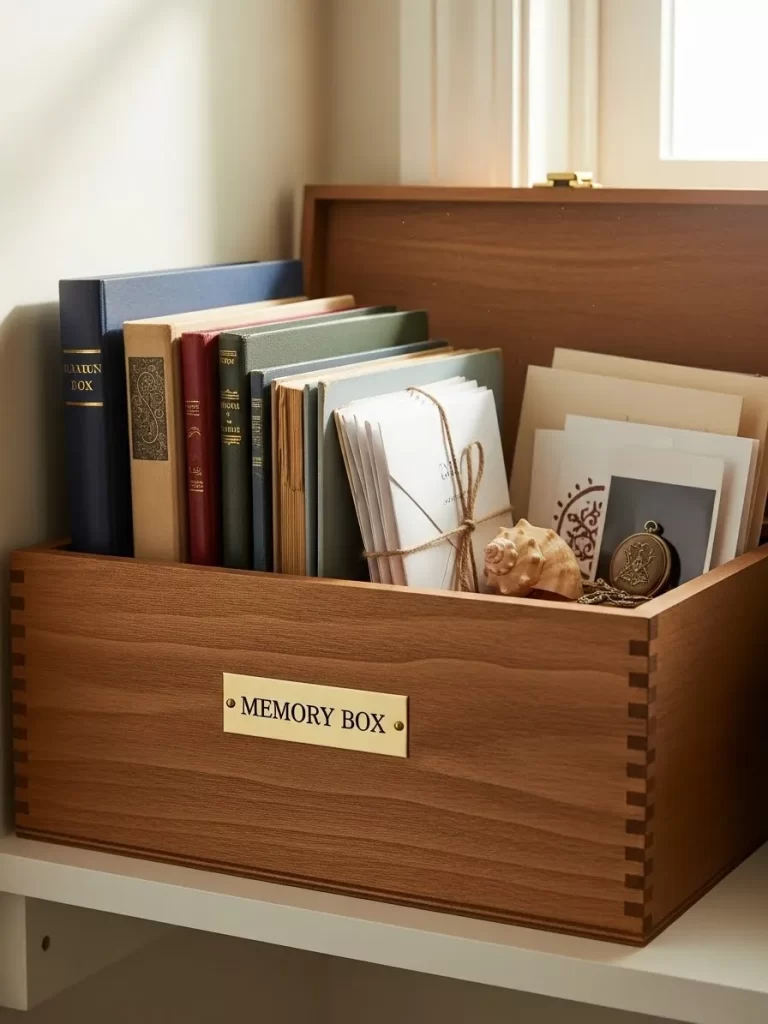
This beautiful solution is about organizing sentimental clutter: letters, photos, and heirlooms that are too important to throw away but contribute to drawer mess. It features a handsome wooden box with dovetail joinery and a brass plate reading “MEMORY BOX.”
The box is large enough to hold vertically stacked photo albums, bundles of tied letters, and small trinkets. The hinged lid keeps the valuable contents dust free and completely out of sight.
By assigning a beautiful, dedicated container to sentimental items, you prevent them from becoming disorganized clutter. This box keeps important memories contained and tidy on a shelf, rather than scattered across the room.
DIY Project: Creating a Memory Box
You can upgrade a plain wooden box to a dignified memory trunk worthy of holding your most treasured keepsakes.
Materials Required List
- One sturdy wooden box with a hinged lid
- Brass plaque or metal label plate
- Small screws or strong adhesive (for attaching the plaque)
- Wood stain or paint (optional, for finishing)
- Sentimental items (letters, photos, small mementets)
Equipment Required List
- Drill and small drill bit (if attaching plaque with screws)
- Screwdriver
- Sandpaper
DIY Instruction Step by Step
- Prepare the Box: If the wooden box is unfinished, sand the exterior smooth. Apply a rich wood stain or paint color and allow it to dry completely.
- Attach the Plaque: Center the brass plaque on the front face of the box. If using screws, mark the hole spots, drill very small pilot holes, and carefully attach the plaque with the screws. If using adhesive, apply a strong glue and press the plaque firmly into place, allowing it to set overnight.
- Organize Contents: Gather all the loose, sentimental items. Place letters and photos into neat stacks and tie them with a simple piece of twine or ribbon.
- Load the Box: Stand the bundles of letters and small books upright inside the box. Place small trinkets or jewelry into small velvet bags before placing them inside. The aim is to make the inside look as neat as the outside.
- Display: Place the closed, personalized memory box neatly on a shelf in the guest room closet or on a clean dresser top, symbolizing that your memories are now organized and contained.
37. The Wall Mounted Television
Relevant Item Name: Floating Entertainment Display
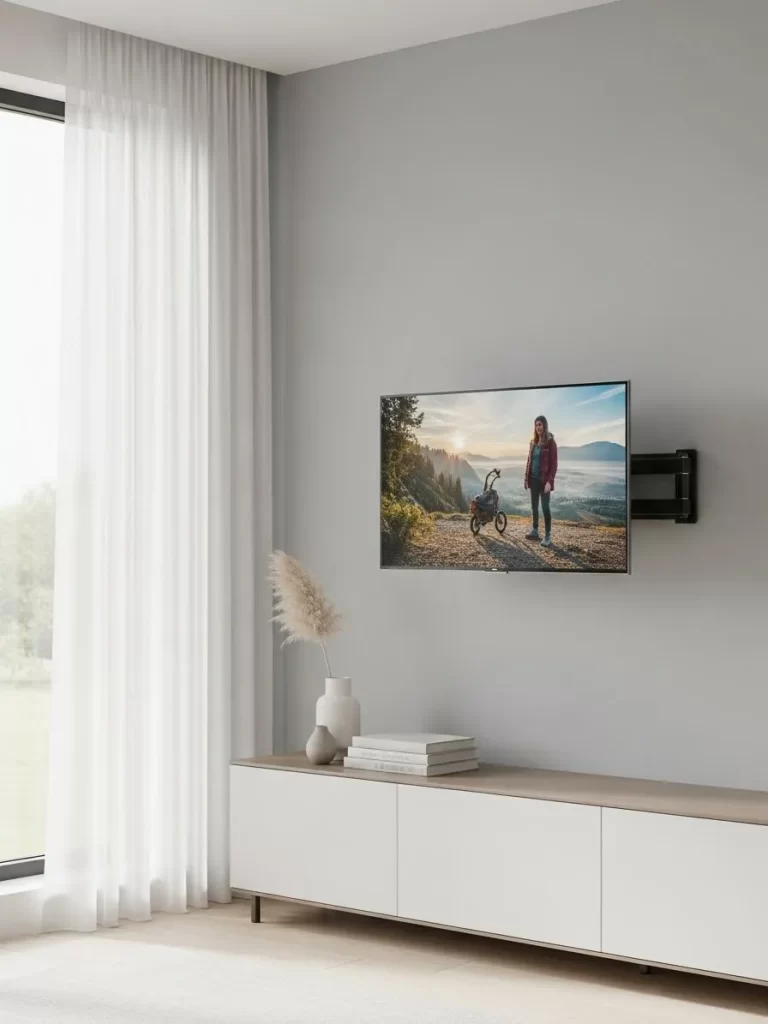
This clean, contemporary image solves the clutter issue often caused by media equipment. The television is wall mounted on an articulated arm, keeping it flush against the wall and removing the need for a bulky TV stand or entertainment console.
The media console below is floating (wall mounted with no legs), adding storage without taking up visual or physical floor space. This console is kept minimal, holding only a few books and a simple vase.
Wall mounting all electronics and choosing floating storage keeps the room feeling spacious, minimalist, and clutter free. There are no exposed wires or large pieces of furniture to disrupt the calm aesthetic.
DIY Project: Minimalist Floating Media Console
Focus on simplifying the storage beneath the television to eliminate the mess associated with electronics.
Materials Required List
- A simple, low profile floating media console (wall mounted cabinet)
- Wall anchors and mounting screws (rated for high weight)
- Cable ties or wire concealing raceway
- Level
Equipment Required List
- Stud finder
- Drill and drill bits
- Screwdriver
- Measuring tape
DIY Instruction Step by Step
- Mount the Console: Decide on the console’s height (typically about 18 to 24 inches from the floor). Use the stud finder and level to mark the mounting spots. Drill pilot holes, install wall anchors (if needed), and secure the floating console to the wall using heavy-duty screws.
- Mount the TV (if needed): If you are mounting the TV, ensure the mount is installed directly into wall studs above the floating console.
- Conceal the Wires: Use cable ties to gather and bundle all the power cords and HDMI cables neatly. Run the bundles through a simple wire concealing raceway or conduit that is painted to match the wall. This eliminates the visual clutter of tangled wires.
- Style with Restraint: Store necessary items like spare remotes inside the console doors or drawers. Keep the top surface extremely minimal—only a small stack of books and one or two pleasing objects. The absence of clutter around the screen creates a tidy, restful environment.
38. The Shoe Basket
Relevant Item Name: Decorative Woven Footwear Caddy
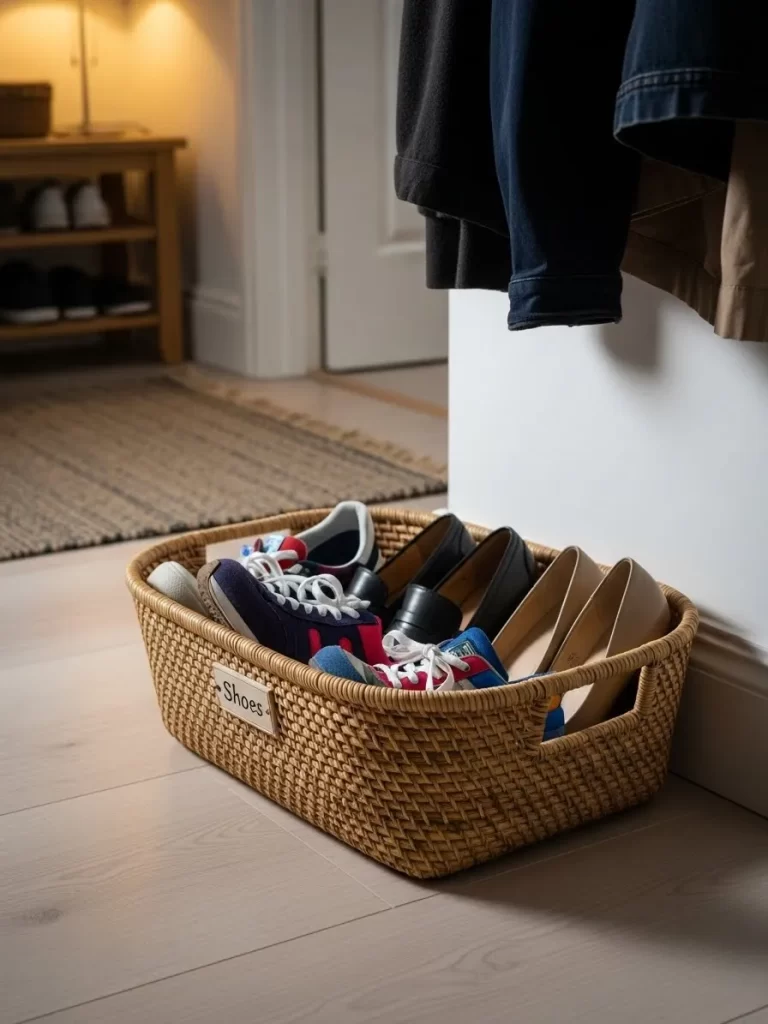
This photo offers a simple but highly effective way to manage the clutter of shoes, which often end up kicked off near the door or under the bed. It features a wide, low woven basket with handles, placed near the entryway of the room.
The basket holds several pairs of shoes, from sneakers to flats, keeping them entirely contained. The natural, warm tone of the basket provides an inviting, organized alternative to a messy shoe pile.
This dedicated, low profile container keeps footwear accessible but off the main floor space. It visually tidies the room by defining a clear boundary for the typically messy area near the door or closet entrance.
DIY Project: Defining a Shoe Drop Zone
This is an easy, non-permanent project focusing on containerization to keep the floor tidy.
Materials Required List
- One large, sturdy woven basket or fabric bin with handles
- Baking soda or cedar chips (for freshness)
- Label tag and marker (optional)
Equipment Required List
- None
DIY Instruction Step by Step
- Select the Container: Choose a basket that is wide and shallow enough to hold two to four pairs of shoes without them sticking up too high. Natural woven material is both durable and attractive.
- Add Freshness: Sprinkle a light layer of baking soda inside the bottom of the basket or place a few small cedar chips under the shoes. This helps absorb odors and keeps the area fresh.
- Load the Shoes: Place the shoes neatly inside the basket. Pair them up and arrange them so the soles are facing down or pressed against the sides.
- Label (Optional): Attach a simple, hand written label that says “SHOES” to the handle or the front of the basket.
- Placement: Place the finished basket near the closet entrance or next to the door. This clearly designated drop zone encourages immediate, organized storage of shoes upon entry.
39. The Built In Wardrobe System
Relevant Item Name: Integrated Guest Closet and Workspace
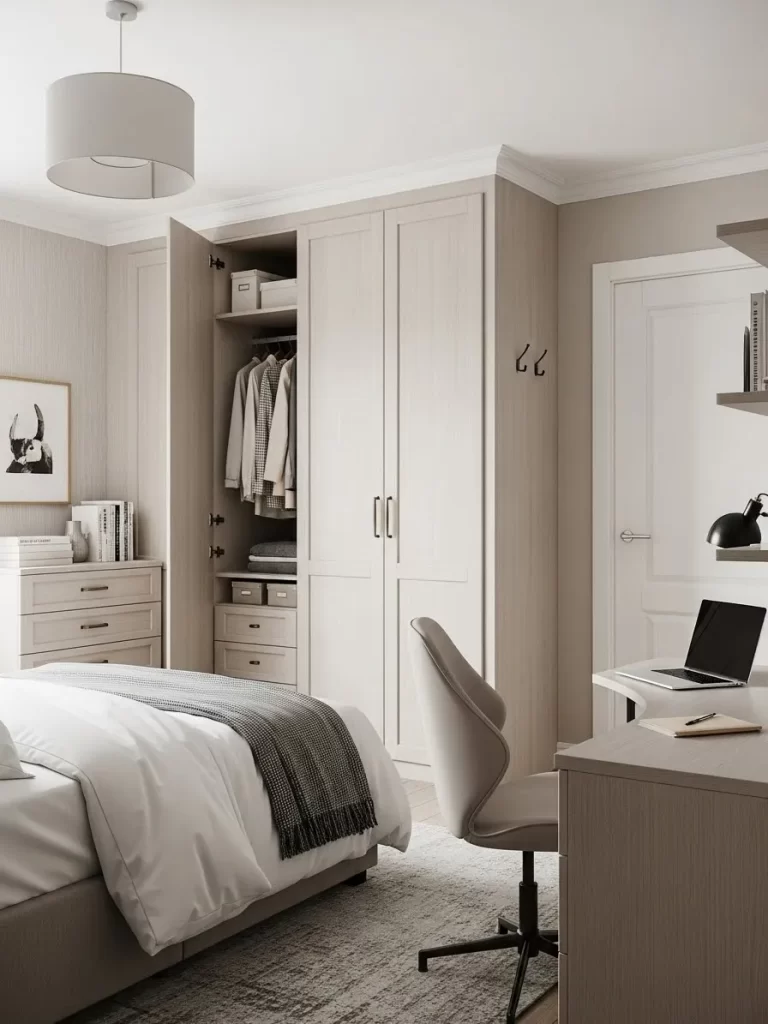
This image provides a sophisticated, large scale solution for multi functional spaces. The room features a full height, custom built wardrobe system with clean, paneled doors.
The tidy feature here is the integrated organization behind the doors: one side opens to reveal hanging clothes, internal drawers, and shelves for organized storage, while the doors hide the clutter from view. This system also accommodates a small desk and shelving unit nearby.
Choosing a cohesive, neutral color palette for the entire wardrobe and room creates a sense of calm and order. The built in nature of the storage ensures that every loose item—from clothes to supplies—has an established, hidden home.
DIY Project: Maximize Vertical Closet Storage
If you have a large, standard closet, you can maximize its tidiness by utilizing the vertical space with drawer organizers and small boxes.
Materials Required List
- Fabric or wooden drawer organizers (small boxes for socks, underwear)
- Two to three uniform lidded boxes (for shelves)
- Labeling materials (stickers and markers)
- Drawer slide mechanism (if adding drawers to a shelf)
Equipment Required List
- Drill and screwdriver (if installing internal shelving or drawers)
- Measuring tape
DIY Instruction Step by Step
- Measure and Define Zones: Measure the height and depth of your closet shelves. Define zones for different items: hanging clothes, folded items, and items stored in boxes.
- Containerize Small Items: Purchase or utilize small fabric drawer organizers. Sort and place socks, underwear, and accessories into these organizers, and place the organizers inside the existing dresser or on a lower shelf. This prevents small items from mixing.
- Utilize Lidded Boxes: Use the uniform lidded boxes for upper shelves. Store out of season clothes, spare toiletries, or extra towels in these boxes. Label each box clearly on the front edge.
- Install Supplemental Hanging Space: If space allows, install a second, lower hanging rod to double the capacity for hanging shirts and trousers.
- Keep it Closed: The beauty of the wardrobe system is the closed door. Ensure the storage is neat enough that the doors can always close easily, keeping the guest room looking completely calm and free of visual clutter.
Transforming a cluttered guest room takes time and dedication, but the results are profoundly rewarding. By implementing the 39 tidy solutions outlined here, you move beyond temporary fixes to establish systems that prevent clutter from accumulating again. Every basket, label, and hidden storage space helps enforce the room’s primary purpose: hospitality and calm.
Remember that great organization relies on two main strategies: the Exit Strategy (permanently removing unwanted items) and the Container Strategy (giving every necessary item a clear, attractive home). You now have the blueprints for both. Feel empowered to reclaim every square foot of your space, turning that disorganized storage area back into a room you are proud to share.
Key Takeaways
Focus on Vertical and Hidden Storage: Maximize unused wall space with floating shelves, pegboards, and vertical organizers (Solutions 3, 22, 30). Always choose furniture that provides hidden storage, such as lift up benches or cabinets, to hide large items completely (Solutions 10, 25).
Embrace Uniformity: Visual clutter is often reduced simply by using containers that match. Use uniform hangers in the closet and uniform boxes or baskets for open shelving to create a cohesive, calming aesthetic (Solutions 6, 23, 32).
Prioritize Guest Experience: Intentionally leave space empty for your guests, such as purged dresser drawers or empty closet space, and provide necessary amenities in contained, labeled boxes (Solutions 17, 19, 33). This hospitality cue encourages guests to put away their own belongings.
Define Clear Boundaries: Use the “Exit Strategy” to permanently remove bulky, unwanted furniture or long term seasonal clutter to dedicated storage areas outside the room (Solutions 16, 29). For items that must remain, use mobile carts so they can be easily wheeled out before a visitor arrives (Solutions 7, 14, 26).