Do you look at your walls and feel a distinct lack of personality, maybe a little too much white space? That feeling is your home telling you it’s time for an upgrade that truly reflects your unique style. Buying pre-made art can be expensive and often feels generic, like it came straight from a mass-produced catalog.
The solution is easier and more rewarding than you think: DIY wall art. Creating your own décor is the simplest way to inject soul, color, and story into your living space. Each piece becomes a reflection of your hands, your taste, and your memories.
We believe everyone has a hidden artist waiting to emerge, regardless of skill level. We have compiled 40 creative, achievable projects designed to eliminate blank wall syndrome forever. Get ready to personalize your home with texture, color, and style, all on a budget.
1. Dimensional Chevron Wood Wall Art
Description
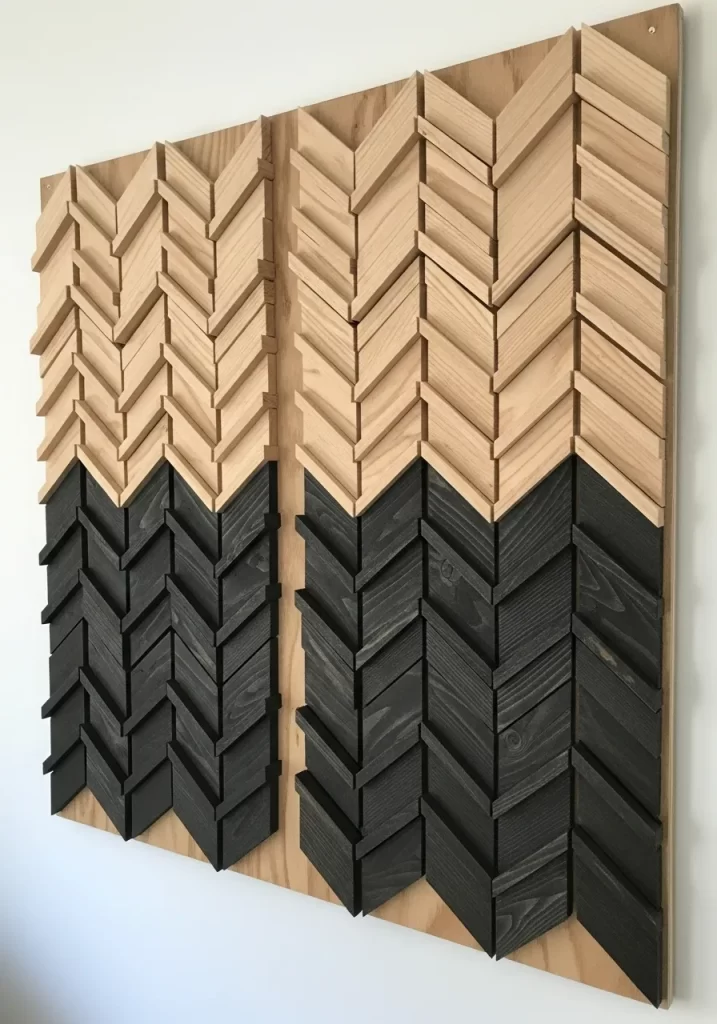
Do you ever look at a blank wall and feel like it needs a touch of texture? This geometric wood art adds incredible depth and rustic sophistication to any room. Using simple wood pieces cut into precise angles, you can arrange them on a backing board to create a striking, three-dimensional chevron pattern. The contrast between the natural light wood and the deep charcoal stain provides an immediate visual anchor.
This approach gives you total freedom to customize the colors and scale to match your existing décor. Imagine it hanging above a sofa or as a statement piece in your entryway. Building this takes patience and precision, but the result is a truly unique and personalized piece of home art that feels professionally crafted. It’s a wonderful way to introduce an organic, modern feel to your space.
Materials Required
- Plywood Backing Board: One piece (e.g., 2 ft x 3 ft, or your desired size).
- Thin Wood Strips/Lath: Enough to cover the backing board when cut into small pieces (approximately 1.5 inches wide, 1/4 inch thick).
- Wood Stain (Black/Charcoal): One can.
- Clear Wood Sealer or Polyurethane: One can (optional, for protection).
- Wood Glue: Strong adhesive suitable for wood.
- Sandpaper: Medium-grit (around 120) and fine-grit (around 220).
Equipment Required
- Miter Saw or Miter Box and Hand Saw: Essential for precise 45-degree cuts.
- Clamps: To secure wood when cutting (if using a miter box).
- Measuring Tape and Pencil: For marking wood accurately.
- Safety Glasses: Mandatory for cutting.
- Gloves: For staining.
- Rag or Foam Brush: For applying stain and sealer.
DIY Instruction Step-by-Step
Step 1: Prepare the Backing Board
- Decide on the final size and shape of your artwork. Cut your plywood backing board to this size.
- Use the medium-grit sandpaper to smooth out any rough edges or surfaces on the plywood. Wipe away all the sawdust with a damp rag. This ensures the wood glue adheres properly.
Step 2: Measure and Cut the Wood Pieces
- The chevron pattern is created by cutting many small pieces of wood with 45-degree angles on both ends. This creates a small trapezoid shape.
- Measure and mark your wood strips. Each piece needs to be exactly the same length (e.g., 4 inches long from tip to tip).
- Set your miter saw (or miter box) to 45 degrees. Make sure the angle on the first end of the piece faces one direction, and the angle on the second end faces the opposite direction.
- Cut a large quantity of these small pieces. Estimate how many you need to cover your board with a slight gap, then cut extra—it is always better to have too many pieces than too few.
Step 3: Sand and Stain the Pieces
- Lightly sand all the cut wood pieces using the fine-grit sandpaper. This smooths the edges and prepares the wood to absorb the stain evenly.
- Divide your pieces into two groups based on the image: one group for the natural wood color and one group for the dark stain.
- In a well-ventilated area, put on gloves and apply the black/charcoal wood stain to the second group of pieces using a rag or foam brush. Wipe off the excess stain after a few minutes, following the product instructions.
- Allow the stained pieces to dry completely. Drying time can vary, so check the stain can for guidance.
Step 4: Layout the Design and Mark the Guide Line
- Lay the backing board flat. Use a ruler and pencil to draw a straight guide line across the center of the board. This line will separate the light wood section from the dark stained section.
- Now, start arranging your pieces on the board without glue. Begin at the top center and work your way outward and downward. Arrange the pieces so that the ‘point’ of the chevron is centered and the pieces create a clean V-shape. Crucially, ensure the stained pieces align perfectly with the light pieces along the central guide line. This dry-fit confirms your layout before gluing.
Step 5: Glue the Pieces to the Board
- Starting with the top layer (the light wood pieces), apply a small, consistent amount of wood glue to the back of the first piece.
- Press the piece firmly onto the backing board, ensuring it is perfectly aligned with the center mark and the top edge.
- Continue gluing the light pieces row by row, working downward. Use a few small scrap pieces as spacers if you want uniform, tiny gaps between the pieces, or push them together for a tighter look.
- Once the light wood section is complete, repeat the process for the dark stained pieces, ensuring they meet the light pieces exactly on your drawn guide line. Allow the entire assembly to dry fully under a heavy weight (like heavy books) or clamps to ensure a strong bond.
Step 6: Finish and Hang
- Once the glue is completely dry (usually 24 hours), apply a clear wood sealer or polyurethane over the entire surface for added durability and a professional finish (optional).
- Attach heavy-duty picture hanging hardware to the back of the plywood backing board. Since this piece is heavy due to the amount of wood, ensure you use proper wall anchors when hanging it in your home.
2. Alcohol Ink Marble Art Tiles
Description
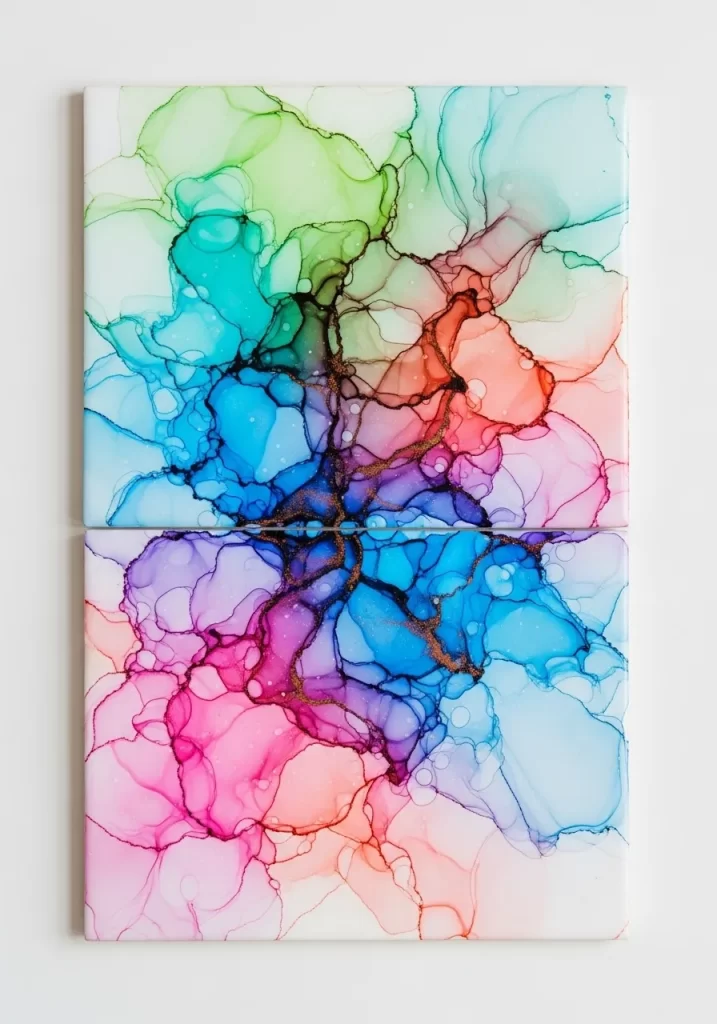
Creating art with alcohol inks is a mesmerizing way to introduce vibrant color and organic movement into your home. These small pieces use non-porous tiles as a base, allowing the highly pigmented inks to spread and bloom in unique, painterly ways. The result is a look strikingly similar to natural marble or agate, but with a rainbow of custom colors.
Look closely and you will see metallic gold accents tracing the veins, adding a touch of luxury. This technique is incredibly freeing and therapeutic because you have limited control over the final outcome, making every piece genuinely original. You can use these tiles individually as coasters or group several together to form a larger, cohesive wall display.
Materials Required
- Ceramic Tiles (Glossy White): Square or rectangular tiles (4×4 or 6×6 inches recommended).
- Alcohol Inks: Choose a selection of three to five complementary colors, plus a metallic ink (like gold or copper).
- 91% or 99% Isopropyl Alcohol (Rubbing Alcohol): Essential for blending and movement.
- Clear Spray Sealer/Varnish: Designed for use with alcohol ink to prevent fading and smudging.
Equipment Required
- Gloves and Face Mask: Mandatory, as alcohol inks are potent and can stain skin.
- Small Plastic Cup: For mixing alcohol.
- Small Pipette, Straw, or Mini Blower: For manipulating the ink on the tile.
- Protective Surface Cover: Disposable plastic or old newspaper to protect your work area.
DIY Instruction Step-by-Step
Step 1: Set Up Your Workspace Safely
- Work in a well-ventilated area, preferably outdoors or near an open window. Put on your gloves and face mask before starting.
- Cover your table or workspace with a protective sheet, as the inks can easily stain surfaces.
- Ensure your ceramic tiles are clean and dry. Wipe them down with a little rubbing alcohol to remove any oils or dust.
Step 2: Apply the Inks and Alcohol
- Start by dropping a few drops of your first color of alcohol ink onto the center of the tile. Do not worry about placement too much.
- Immediately follow with drops of your second and third colors around the edges of the first color. Add a few drops of the metallic ink last.
- Squeeze a small amount of rubbing alcohol onto the inked area using a pipette, or dip a small brush into the alcohol and lightly touch the ink.
Step 3: Create the Marbled Effect
- You must now encourage the inks to spread and blend. Use a straw or a small blower to gently blow the inks across the tile, moving them outwards from the center.
- For a softer, marble look, tilt the tile slowly in different directions, allowing the alcohol to carry the color. Add more rubbing alcohol as needed to keep the colors moving fluidly.
- If you want to create fine lines or “veins,” add one or two drops of a darker ink and quickly tilt the tile or add a few tiny drops of pure alcohol right next to the dark spot.
Step 4: Dry and Seal the Art
- Let the tile art dry undisturbed for at least two hours, or until all the alcohol has evaporated and the surface is dry to the touch.
- Once dry, take the tiles back to a well-ventilated area to seal the artwork. Apply several thin coats of the clear spray sealer specifically made for alcohol inks. Let each coat dry fully before applying the next. This step stops the color from reactingivate or fading.
3. Pressed Botanical Glass Frames
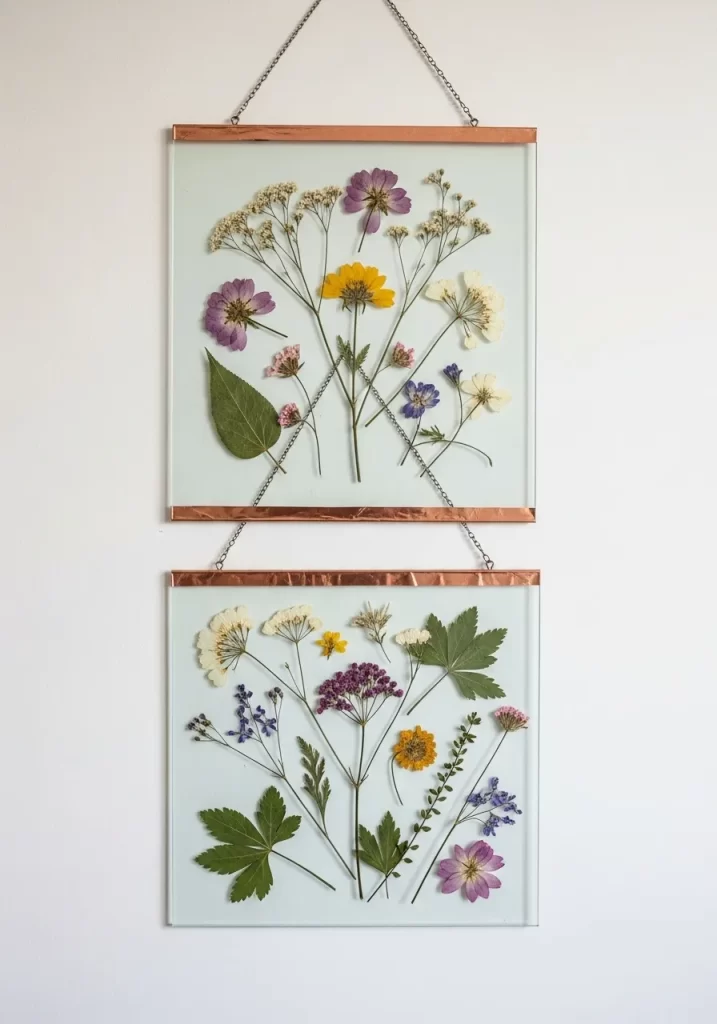
Description
This delicate DIY brings the beauty of nature indoors and captures the ephemeral quality of flowers and foliage. By pressing natural elements between two sheets of glass, you create a timeless piece that functions as a window to the outside world. The simple floating glass technique allows light to pass through the pressed blooms, making the colors glow.
Copper tape and chain give these frames a refined, vintage feel, recalling classic botanical illustration. You can collect flowers from your own garden or from a special event, making the art deeply personal and memorable. These pieces look gorgeous hung in a pair or grouped with varying sizes, adding an airy, organic element to any wall display.
Materials Required
- Clear Glass Sheets: Two matching pieces per frame (ensure edges are safely filed).
- Assorted Dried and Pressed Flowers and Leaves: Collect thin, flat botanicals.
- Copper Foil Tape: Self-adhesive tape used for stained glass (width approximately 1/4 inch).
- Metal Hanging Chain: Thin chain for suspending the frames.
- Small Metal Rings or Jump Rings: For attaching the chain.
Equipment Required
- Glass Cutter and Grinder (Optional):T If you are cutting your own glass; otherwise, buy pre-cut glass.
- Ruler and Scissors: For measuring and cutting chain and tape.
- Pliers: Small needle-nose pliers for opening and closing jump rings.
DIY Instruction Step-by-Step
Step 1: Press and Prepare the Botanicals
- Gather your chosen flowers. Ensure they are thin, fresh, and fully dry before use.
- Press the flowers for several weeks inside a heavy book or a dedicated flower press. Place them carefully between sheets of parchment paper or blotting paper. They must be completely flat and dry before moving to the next step.
Step 2: Arrange the Display
- Lay one piece of clear glass flat on your workspace.
- Carefully arrange your pressed botanicals onto the glass. Experiment with density and composition until you are happy with the layout. Hint: Use tweezers for the smallest flowers.
- Once the arrangement is final, gently place the second piece of glass directly on top, creating a glass sandwich with the botanicals inside. Hold the two pieces together with small clips while you work on the edges.
Step 3: Copper Foil the Edges
- Starting on one corner, carefully wrap the sticky side of the copper foil tape around the four edges of the glass sandwich. The tape should be centered so half wraps over the front and half wraps over the back.
- Ensure the tape is smooth and free of bubbles. Use your fingernail or a plastic tool to burnish (rub firmly) the tape down, especially at the corners, to secure the glass pieces together.
- Use a small piece of excess copper tape to create a little loop or attachment point at the top edge of the frame. Burnish this loop firmly onto the existing tape.
Step 4: Attach the Chain for Hanging
- Determine the length you want your frame to hang. Cut a piece of metal chain to that length.
- Use the pliers to open a jump ring. Thread the jump ring through the copper tape loop you created in the last step and through the end link of the chain. Close the jump ring securely.
- Repeat this process if you are using two attachment points (one on each corner) for a balanced hang. Now you have a beautifully framed piece ready to showcase your collected flowers.
4. Geometric Vinyl Record Art
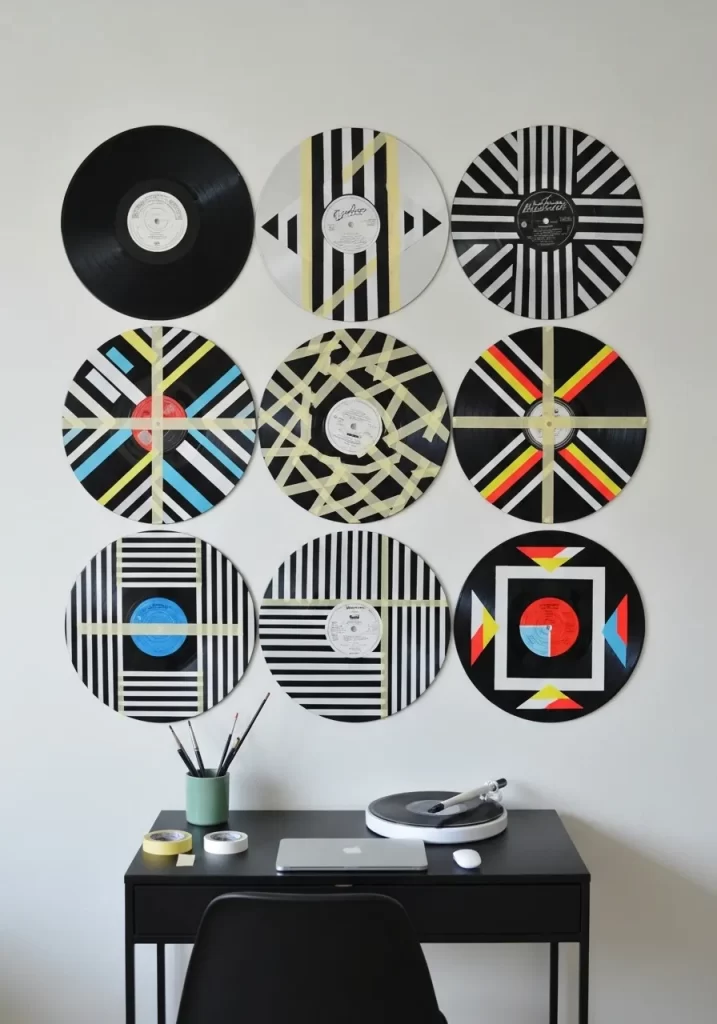
Description
Give your old, scratched vinyl records a second life as striking, graphic wall art. This project transforms vintage music relics into modern, abstract pieces using bright paints and sharp, clean lines. By utilizing simple painter’s tape, you can mask off intricate geometric patterns that pop with bold colors against the black vinyl.
This method allows for endless creativity; you can try chevron stripes, radial bursts, or intersecting squares. Grouping nine records together creates a powerful gallery wall effect with an immediate statement. This is an awesome way to showcase your love for music while adding a vibrant, mid-century modern flair to a study or living area.
Materials Required
- Vinyl Records (LP size): Nine records (or your desired number). Old, damaged records are perfect.
- Acrylic or Spray Paint: Two to five contrasting, bright colors (plus white if you want a base layer).
- Painter’s Tape (Various Widths): Essential for creating sharp lines.
- Clear Spray Varnish: To seal the finished artwork.
Equipment Required
- Craft Knife: For trimming tape precisely.
- Cutting Mat: To protect your table when using the craft knife.
- Pencil and Ruler: For planning and marking your geometric patterns.
- Gloves: For handling paint and spray varnish.
DIY Instruction Step-by-Step
Step 1: Clean the Records and Plan the Design
- First, thoroughly clean your records to remove dust or grease. Use a mild soap solution and ensure they are completely dry.
- Decide on the nine patterns you want to use. Sketch them out lightly on paper first so you have a plan for each record before applying tape.
Step 2: Apply the Tape to Mask the Designs
- Using the ruler and pencil, lightly draw guide lines onto the surface of the first record.
- Apply the painter’s tape along these guide lines. Press down firmly on all edges of the tape, especially where you want the color separation to be crisp. This step is crucial for preventing paint bleed.
- Use the craft knife to carefully trim the tape around the center label and the outer edge of the record, making sure the label area is protected if you want it visible.
Step 3: Paint the Records
- Place the taped record on a protected surface.
- Apply the paint in thin, even layers. If using acrylic paint, use a small, dense foam brush or dab the color on to prevent it from seeping under the tape. If using spray paint, ensure you are in a well-ventilated area. Apply two or three thin coats rather than one thick one.
- Allow the paint to become dry to the touch before proceeding.
Step 4: Remove the Tape and Seal
- Before the paint is completely cured (slightly damp is often best), carefully peel back the painter’s tape at a sharp angle. Slowly peel away all the tape, revealing the bold geometric design underneath. If there is any minor bleed, you can use a small brush and black paint to touch it up.
- Once all nine records are fully dry, apply a coat of clear spray varnish to protect the paint and give them a finished look.
- Use a strong adhesive hook or mounting putty on the back of each record to arrange them on your wall in a perfect grid pattern.
5. Boho Macrame Yarn Wall Hanging
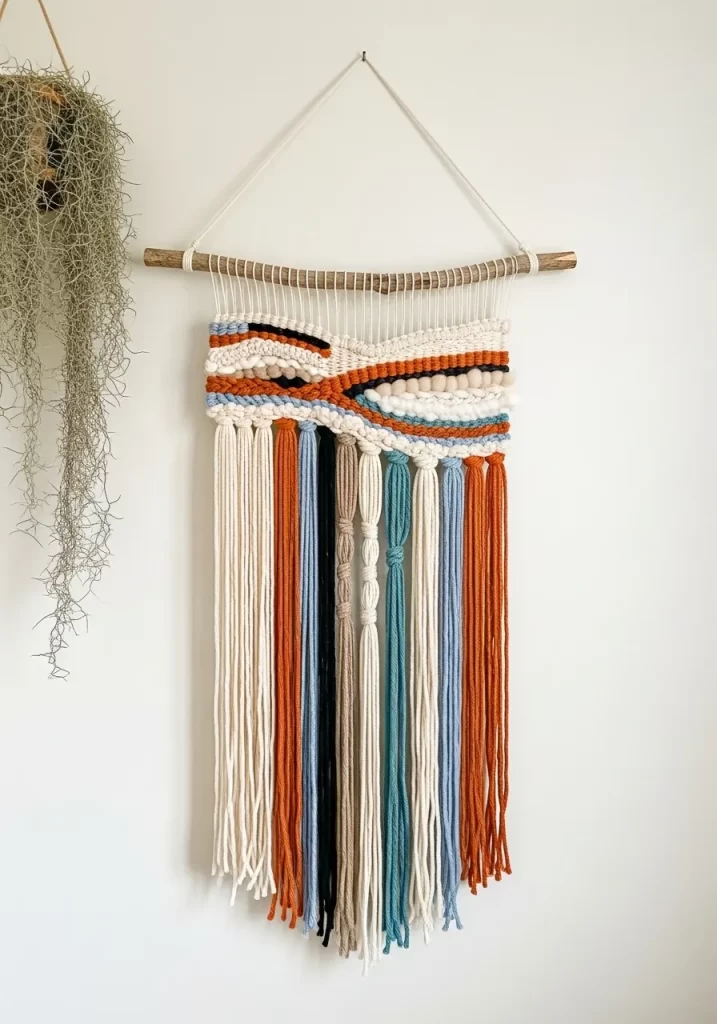
Description
Textural wall hangings instantly add warmth and a bohemian touch to any room. This easy weaving and knotting project uses a simple stick or dowel as the base to create a dense, colorful piece. Combining various yarn weights and colors, you can achieve a wonderfully rich, layered look.
The upper section features basic weaving and intricate wrapping knots, while the bottom uses long, colorful strands to create dynamic movement. This piece uses soft neutrals mixed with bold orange and teal, making it a great focal point for a living room or bedroom. The beautiful fringe and various textures give the piece an organic, earthy appeal that is highly sought after in modern home design.
Materials Required
- Driftwood or Wooden Dowel: A straight piece about 15–20 inches long.
- Assorted Yarn/Rope: A variety of textures, weights, and colors (thick white cotton rope, neutral yarns, and pops of color like teal, orange, and black).
- Thin String or Twine: For the initial warp and the final hanging loop.
Equipment Required
- Sharp Scissors: For cutting rope and yarn.
- Measuring Tape: For consistent lengths.
- Tapestry Needle (Optional): Helpful for weaving finer yarn.
DIY Instruction Step-by-Step
Step 1: Prepare the Dowel and Hanging Loop
- Ensure your dowel or stick is smooth and clean.
- Cut a long length of thin string or twine and tie a simple, secure knot to the ends of the dowel to create a hanging loop. This loop is what you will use to place the finished art on your wall.
Step 2: Attach the Yarns (Lark’s Head Knots)
- Cut all your various yarns into long lengths (at least twice the length you want the final hanging to be). You will be folding them in half.
- To attach the yarns to the dowel, use a Lark’s Head Knot. Fold a strand in half, creating a loop. Place the loop over the top of the dowel, then pull the two tail ends through the loop and tighten gently.
- Continue using the Lark’s Head Knot to attach all your different colored yarns across the dowel, ensuring the knots are snug but not tight.
Step 3: Create the Woven/Knotted Section
- This step involves building the dense, patterned area at the top. You can use several techniques here:
- Simple Weaving: Using a long piece of yarn (the weft), weave it over and under the vertical strands (the warp) that are already attached to the dowel. Push each row down tightly.
- Rya Knots: Attach short bundles of yarn to the top woven section to create plush, fuzzy texture.
- Cobra Knots/Square Knots: Use pairs of adjacent strands to create simple macrame knots to define stripes or shapes within the upper area. Reference a basic macrame guide for these knots.
- Work downward until this textured section is about one-third of the way down the entire hanging.
Step 4: Trim and Finish the Fringe
- Once the knotted section is complete, the remaining long strands form the fringe. You can leave some strands straight and braid or twist others to introduce variety.
- Lay the entire piece flat on a clean surface. Use your sharp scissors to trim the bottom fringe. The example image shows a straight, flat bottom, but you could also cut a gentle V-shape or an asymmetrical angle.
- Give the piece a final gentle shake to loosen the strands before hanging.
6. Upcycled Window Pane Message Board
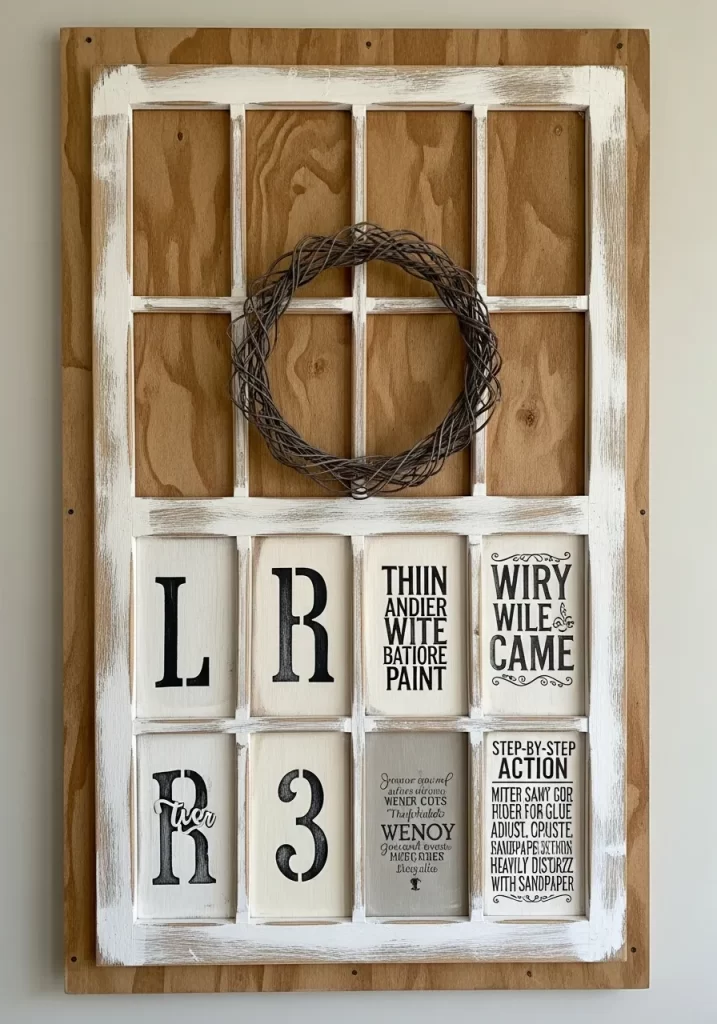
Description
Transform an old, discarded window sash into a stunning piece of farmhouse or rustic-inspired wall décor. The antique window frame, when distressed with a crisp white paint, creates instant architectural interest and character. Instead of glass, small wooden panels are placed in the panes, which serve as customizable art surfaces.
The unique layout of the panes allows you to display a collection of small, stenciled words, numbers, and graphics. To finish the look, a simple grapevine wreath is centered in the upper panes, adding a cozy, natural element. This project is charming and highly adaptable, letting you change the messages or images seasonally to keep your home feeling fresh.
Materials Required
- Old Wooden Window Sash: An antique window frame with multiple small panes (check that the wood is sound).
- Thin Wooden Panels: Enough small panels to fit into the lower panes (substitute for glass).
- White Chalk Paint or Acrylic Paint: For the distressed frame.
- Dark Wax or Sandpaper: For creating the distressed, aged effect.
- Black Paint or Vinyl Stencils: For creating the letters and graphics on the panels.
- Grapevine Wreath: Small to medium size.
Equipment Required
- Paint Brush (Stiff bristles): For applying and distressing the paint.
- Sandpaper (Coarse and Fine): For distressing the frame.
- Safety Gloves and Drop Cloth: For painting.
- Hot Glue Gun or Small Nails: For securing the wooden panels into the frame.
DIY Instruction Step-by-Step
Step 1: Prep the Frame and Panels
- If the old window still has glass, carefully remove it and discard it safely. Clean the frame thoroughly.
- Give the entire frame a base coat of your chosen white chalk paint. Do not worry about streaks; a distressed finish looks best when the base coat is a little imperfect. Let the paint dry completely.
- Sand the edges and areas that would naturally show wear (like corners and raised spots) using coarse sandpaper. This exposes the raw wood underneath and creates the distressed look. Optionally, you can rub dark wax into the sanded areas for an aged finish.
- Paint your smaller wooden panels in a complementary color (like white, gray, or cream) and allow them to dry.
Step 2: Create the Panel Art
- Plan the layout of your messages or designs across the panels.
- Use stencils and black paint or pre-cut vinyl decals to transfer your letters, numbers, and graphics onto the small wooden panels. Ensure the paint is fully dry before handling the panels.
Step 3: Assemble and Attach the Wreath
- Place the finished wooden panels into the recessed pane sections of the window frame from the back.
- Secure them in place using a few dots of hot glue or small finishing nails so they do not shift.
- Center the grapevine wreath over the upper pane sections. Use a thin piece of wire or twine attached to the back of the frame to secure the wreath in place.
Step 4: Final Mounting
- Attach strong picture hanging hardware to the back of the window frame. This piece can be surprisingly heavy.
- Mount the finished art securely onto your wall, ensuring it is level and centered.
7. Geometric Straw and Yarn Mobiles
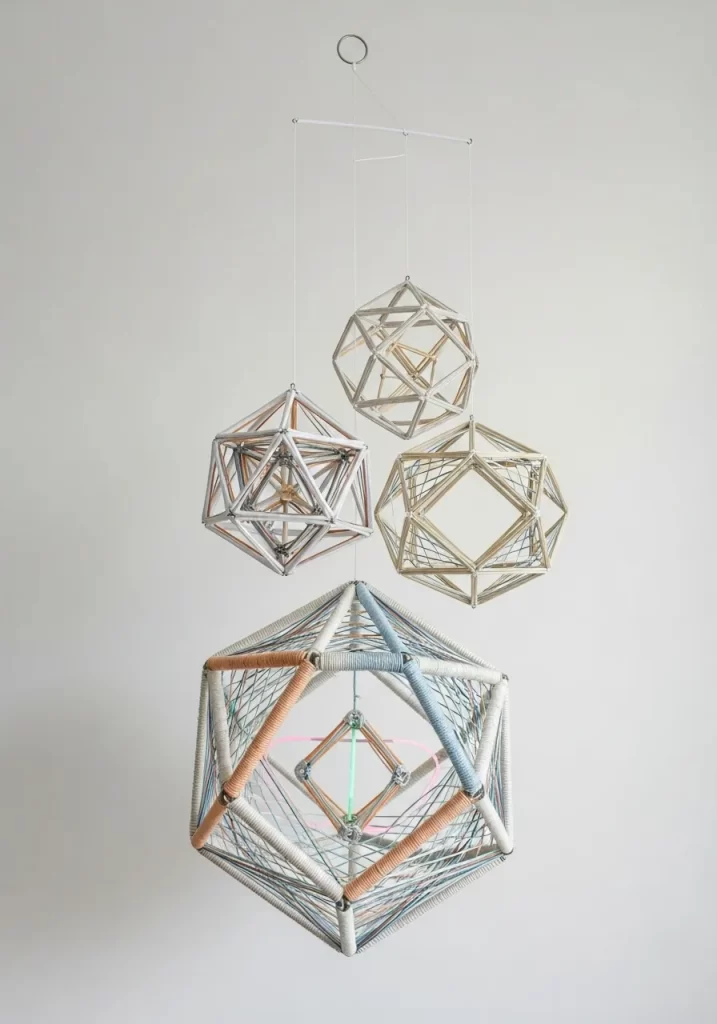
Description
Bring a touch of mid-century modern geometry and vibrant color to your home with these unique hanging sculptures. Using simple materials like paper straws and various yarns, you can construct complex three-dimensional shapes that seem to float effortlessly. These abstract forms, known as polyhedra, are built using basic stringing techniques.
Wrapping the structural sticks with colored yarn and string adds texture and a pop of customized color. When hung, the mobile creates dynamic shadows and movement, especially when placed near a window. This project is an excellent way to introduce a sophisticated, architectural element into a casual space, showcasing your creative geometry skills.
Materials Required
- Paper Drinking Straws: Uniformly sized straws (you can also use thin wooden sticks or dowels).
- Yarn or Embroidery Floss: Various colors for wrapping and stringing.
- Thin Thread (Strong): For connecting the shapes and hanging the mobile.
- Large Metal Ring or Hook: For suspending the entire mobile.
Equipment Required
- Needle (Long and Sharp): Must be able to pass easily through the center of the straws.
- Sharp Scissors: For cutting straws and thread.
- Ruler: For consistent straw length.
DIY Instruction Step-by-Step
Step 1: Cut the Straws and Plan the Shape
- Decide on the geometric shape you want to create (e.g., cube, octahedron, icosahedron). You will need many equal lengths for this.
- Use the ruler and sharp scissors to cut the paper straws into identical segments. For a standard size, pieces 3–4 inches long work well.
- Tip: The image shows the sticks wrapped with yarn first. If you choose this look, wrap the straws tightly and completely with colored yarn before cutting them into the segments you need.
Step 2: String the Base Shape
- Cut a long, single piece of strong thread—it should be at least three times the length of the straw pieces you are using, plus extra for handling.
- Using the needle, thread the cut straw segments together. Start by creating a simple polygon base (like a pentagon or a hexagon) by stringing the required number of segments and tying the thread ends together.
- Do not cut the thread yet; you must continue using the same thread to build the three-dimensional form.
Step 3: Build the Three-Dimensional Structure
- Continue stringing the segments together, creating the sides and then the top faces of the polyhedron shape. You will need to pass the needle back through previously strung pieces to form stable triangular or rectangular faces.
- Periodically pull the thread tight and adjust the straws to ensure the shape is sturdy and maintains its geometry.
- Once the shape is complete, tie the thread off with a secure double knot and trim the excess.
Step 4: Assemble and Hang the Mobile
- If you are making multiple shapes, repeat Steps 1–3 for each one.
- Use a long, single piece of thin thread to suspend each completed geometric shape from the large metal ring or hook. Adjust the thread length so the shapes hang at different heights.
- Tie the top thread of the main ring to a simple wall hook, ensuring the mobile is balanced and can spin freely.
8. Faux Floral Coffee Filter Wall Display
Description
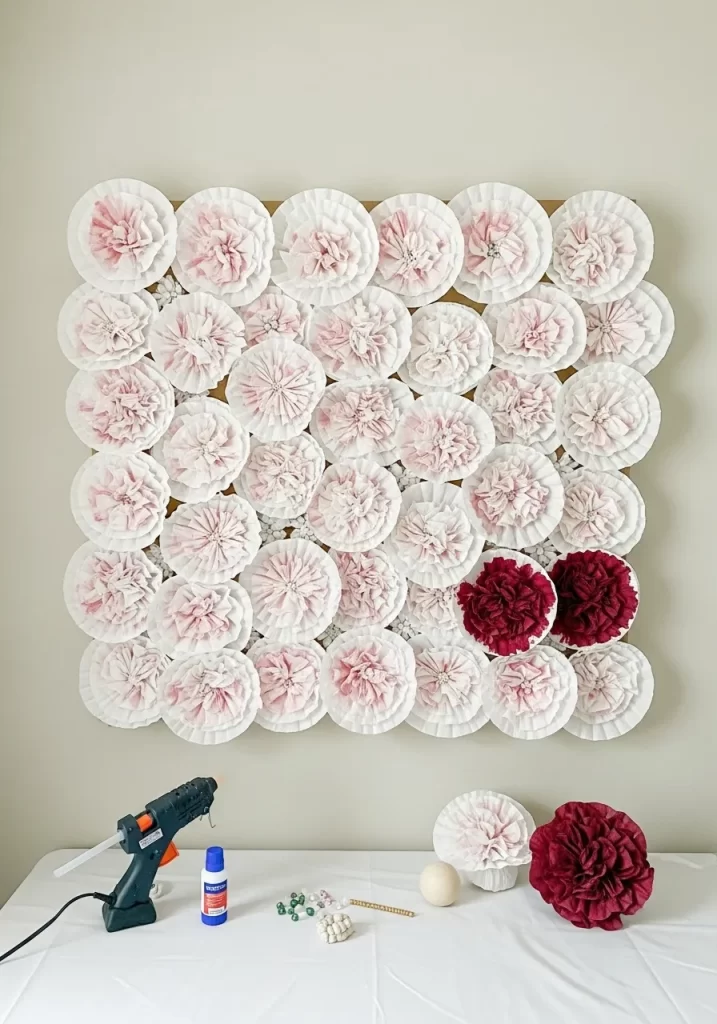
This delicate and textural wall art is built entirely from inexpensive coffee filters, proving that beautiful décor does not require costly materials. The crinkled paper filters are stained with gentle pink and red hues, creating the realistic look of layered carnations or peonies. Arranged in a tight grid, the pieces create a large, impressive display with incredible depth.
The flowers are set against a backing board, giving the piece a framed, polished feel. This kind of arrangement introduces an incredibly soft, romantic, and feminine element to a bedroom, nursery, or dining room. It is a fantastic afternoon project that results in a huge, custom floral statement with minimal crafting skill required.
Materials Required
- White Basket-Style Coffee Filters: Several hundred large filters.
- Acrylic Paint (Light Pink, Dark Red/Burgundy): For staining the edges of the flowers.
- Plywood or Cardboard Backing Board: Cut to your desired size.
- Hot Glue Sticks: Used in large quantity for assembly.
Equipment Required
- Hot Glue Gun (High Temp): Essential for quickly and securely attaching the flowers.
- Shallow Dish or Tray: For mixing the watercolor wash.
- Small Sponge or Paint Brush: For dabbing the color onto the filters.
- Measuring Tape: For marking the grid on the backing board.
DIY Instruction Step-by-Step
Step 1: Create the Coffee Filter Flowers
- Take about five or six coffee filters and stack them together. Gently pinch the center of the stack and twist the filters until they form a tightly gathered ‘stem’ at the bottom and a ruffled ‘bloom’ at the top.
- Dip the very bottom of the twisted stem into a tiny amount of hot glue and hold it tightly until it dries. This holds the flower shape.
- Repeat this process until you have enough flowers to completely cover your backing board.
Step 2: Apply Color to the Blooms
- Mix a small amount of light pink acrylic paint with water in the shallow dish to create a light watercolor wash.
- Gently dab the edges of the filter paper blooms into the wash, or use a damp brush to apply the color, concentrating it on the edges and allowing the color to bleed inward. This mimics natural flower coloring.
- Create a few accent flowers using the dark red/burgundy wash, like the example image.
- Allow all the flowers to dry completely before assembly.
Step 3: Prepare the Backing Board
- If you are using plywood, paint it a neutral color (like white or cream) and allow it to dry.
- Use a pencil and measuring tape to lightly draw a grid pattern onto the backing board. This helps ensure your flowers are spaced evenly in straight rows and columns.
Step 4: Attach the Flowers
- Starting at a top corner, place a large dollop of hot glue onto the grid mark where the first flower will go.
- Immediately press the glued stem of the first flower firmly onto the board and hold until the glue sets.
- Continue this process row by row, ensuring the flowers are tightly packed so that they touch or slightly overlap. This creates a dense, voluminous look. The overlap is what hides the backing board.
- Once all the flowers are attached, secure hanging hardware to the back of the board.
9. Modular Industrial Pipe Shelving
Description
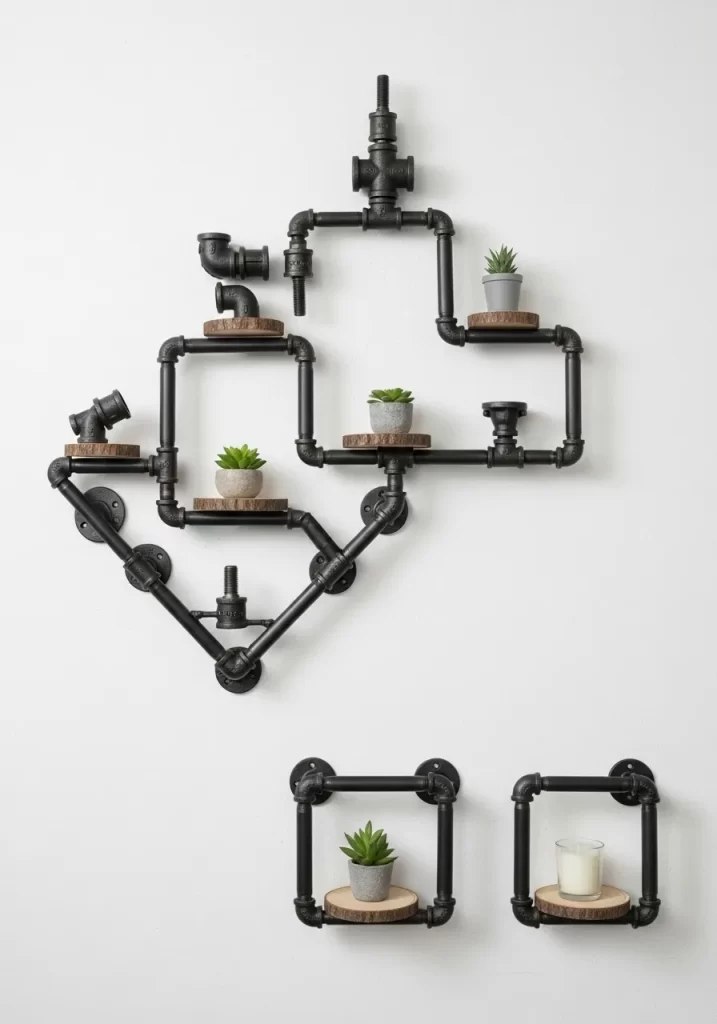
Embrace the urban aesthetic with this striking industrial-style pipe shelving unit. Using standard black iron piping and fittings, you can construct a dynamic, multi-level arrangement that is both a storage solution and a sculptural wall piece. The raw, dark metal contrasts beautifully with the warm, natural wood slices used as miniature shelves.
The modular design gives you total freedom to design the shape; you can create a single heart shape like the example or expand it across an entire wall. This look works wonderfully in lofts, offices, or any space needing a masculine, utilitarian touch. The shelves are perfect for displaying small succulents, candles, or other light, decorative items.
Materials Required
- Assorted Black Iron Pipe Pieces: Various lengths of threaded pipe (6 inches, 8 inches, 10 inches, etc.).
- Assorted Iron Fittings: Elbows (90-degree), T-connectors, and couplers.
- Floor Flanges: Round base pieces with screw holes, used to secure the unit to the wall.
- Circular Wood Slices or Small Boards: Used as the shelves.
- Wood Stain or Sealer (Optional): For finishing the wood slices.
- Heavy-Duty Wall Screws and Anchors: For securing the heavy structure to the wall studs or drywall.
Equipment Required
- Pipe Wrench: For tightening the pipe pieces securely.
- Power Drill: With a screw-driving bit for mounting to the wall.
- Level and Pencil: For marking the wall accurately.
DIY Instruction Step-by-Step
Step 1: Plan and Pre-Assemble the Structure
- Lay out all your pipe pieces and fittings on the floor. Sketch your desired design on paper first so you know exactly which length of pipe goes where.
- Begin threading the pipes and fittings together according to your design. Start with the central sections and work outward. Hand-tighten all connections first, then use the pipe wrench for a final, secure tightening.
- Make sure all the floor flanges (the circular wall attachment points) are pointing exactly where they need to be to sit flush against the wall.
Step 2: Prepare the Shelves
- If using raw wood slices, lightly sand them and apply a wood stain or sealer if desired. Allow them to dry completely.
- Identify where the shelves will sit on the pipe structure—they will usually sit right on top of a T-connector or coupler.
Step 3: Mount the Structure to the Wall
- Hold the assembled pipe structure against the wall where you want it mounted. Use a level to ensure the horizontal pipe sections are straight.
- Use a pencil to lightly mark the screw holes of one or two of the floor flanges that are central to the design.
- Remove the pipe structure. Install the appropriate wall anchors in your marked spots if you are not drilling directly into a stud.
- Mount the entire structure to the wall, starting with the pre-marked central flanges. Once the center is secure, you can adjust the rest of the structure and mark and install the screws for the remaining flanges. The pipe wrench can help you rotate pieces into final alignment.
Step 4: Place the Shelves
- Once the pipe is fully secured to the wall, place your prepared wood slices onto the designated connection points.
- Since these are meant for light items, you may choose to leave the wood slices loose. For added security, you can use a small amount of heavy-duty adhesive on the underside of the wood where it rests on the pipe.
10. Photo Transfer Wood Blocks
Description
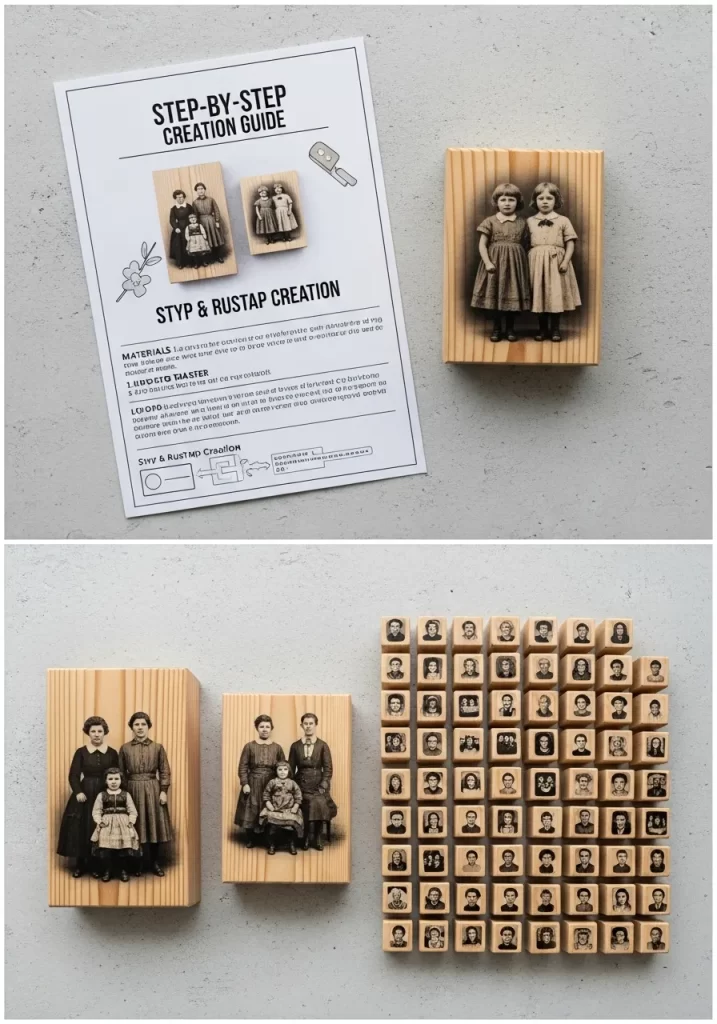
Preserve cherished memories in a unique, tangible way by transferring vintage or modern photographs onto natural wood blocks. This clever DIY gives a photograph a gorgeous, rustic, and slightly weathered look as the wood grain subtly shows through the image. The chunky wood block adds depth and stands out compared to a traditional flat photograph.
This technique works especially well with high-contrast, black and white images, evoking an antique family heirloom feel. You can use large blocks as standalone wall art or create a grid of dozens of small blocks, each featuring a different face, for a fascinating genealogy wall. This project offers a truly heartfelt and personalized way to celebrate your family’s history.
Materials Required
- Smooth Wood Blocks: Various sizes (ensure they are sanded flat).
- Photocopies (Laser Print Only): Images printed with a laser printer, in reverse/mirrored orientation.
- Gel Medium (Matte or Gloss): Used for the image transfer.
- Clear Wood Sealer (Optional): For finishing the piece.
- Water in a Dish or Bowl: For wetting the paper.
Equipment Required
- Sponge or Rag: For wetting and rubbing the paper.
- Foam Brush: For applying the gel medium.
- Brayer or Credit Card: For smoothing the paper.
DIY Instruction Step-by-Step
Step 1: Prepare the Image and Wood
- Select your desired photo and have it laser-printed onto plain printer paper. Crucially, the image must be printed in reverse (mirrored), especially if it contains text.
- Ensure your wood block is smooth and clean. You do not need to stain or seal it for the transfer, but a light sanding helps the gel medium adhere well.
Step 2: Apply Gel Medium and Position the Image
- Using a foam brush, apply a generous, even layer of gel medium directly onto the face of the wood block. The layer should be thick enough so you cannot see the wood grain perfectly, but not so thick that it is dripping.
- Immediately and carefully place the printed side of the paper face down onto the gel medium. The image should be touching the medium.
- Use a brayer or the edge of a credit card to firmly smooth out the paper, working from the center outward to push out any bubbles and air. Do not move the paper once it is placed.
- Allow the block to dry completely for at least 12–24 hours. The longer it dries, the better the transfer will be.
Step 3: Remove the Paper Backing
- After the gel medium is completely dry, wet your sponge or rag with lukewarm water.
- Gently begin to dab the back of the paper (the white side) with the damp sponge until the paper is fully saturated.
- Using your fingertip, slowly and lightly begin to rub the wet paper off. The paper fibers will peel away, leaving the toner (the image) embedded in the layer of gel medium on the wood.
- Continue rubbing and wetting gently until all the white paper residue is gone and the wood grain is visible through the transferred image. Be careful not to rub too hard, or you could remove the image itself.
Step 4: Seal and Finish
- Let the block dry fully. You can now see the final transferred image.
- Apply a coat of clear wood sealer or another thin layer of gel medium over the entire transferred surface to protect the image.
- Attach a saw-tooth hanger to the back if you want to hang it, or leave it freestanding on a shelf.
11. Decoupage Sheet Music Wall Letters
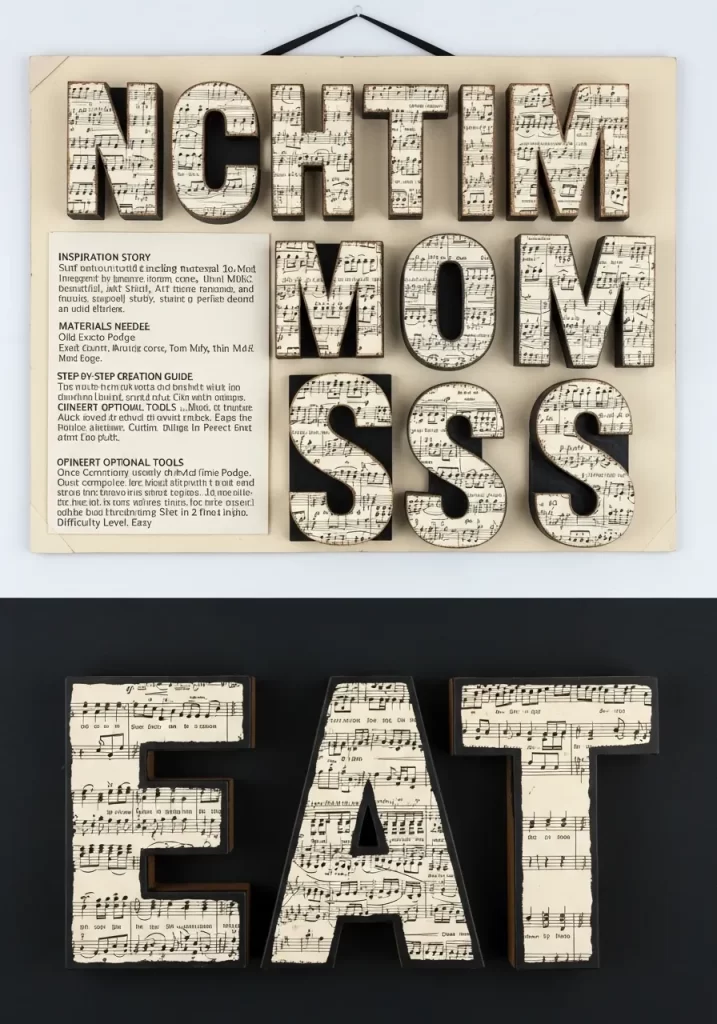
Description
Transform simple wooden or cardboard letters into charming, personalized wall décor using vintage sheet music. This project is a wonderful way to give depth to typography, particularly for those who love music or have a classic, cozy aesthetic. The notes and staves of the paper create an unexpected texture and visual interest across the dimensional forms.
You can select sheet music from a favorite song or a public domain composition to make the piece even more meaningful. The dark, sturdy backing of the letters makes the aged paper pop, creating a beautiful contrast. These pieces look gorgeous spelling out a word like “EAT” in a kitchen or a family initial in an entryway. They offer a simple way to add architectural personality to a plain wall.
Materials Required
- Dimensional Wood or Cardboard Letters: Prefabricated letters of your choice.
- Sheet Music Paper: Photocopies of vintage or modern sheet music (enough to cover the letters).
- Mod Podge (Matte or Gloss Finish): Decoupage medium and sealant.
- Brown or Black Acrylic Paint: For painting the edges of the letters.
Equipment Required
- Foam Brushes: For applying Mod Podge.
- Sharp Scissors or Craft Knife: For precise cutting around the letter edges.
- Pencil and Ruler: For tracing.
DIY Instruction Step-by-Step
Step 1: Prep the Letters
- Use a foam brush to paint the sides and edges of your wood or cardboard letters with brown or black acrylic paint. This gives a nice, crisp outline when the paper is applied.
- Allow the painted edges to dry completely before moving on.
Step 2: Trace and Cut the Sheet Music
- Lay your sheet music face down on your workspace. Place the first letter face down onto the back of the music paper.
- Use a pencil to carefully trace the outline of the letter onto the paper.
- Cut out the traced shape with sharp scissors or a craft knife. You may want to cut the pieces slightly larger than the letter outline to ensure full coverage.
Step 3: Apply the Sheet Music
- Use a clean foam brush to apply a thin, even layer of Mod Podge directly onto the front surface of the letter.
- Carefully align and place the sheet music cutout onto the glued surface. Smooth the paper down immediately, working from the center outward to push out any wrinkles or bubbles.
- Wipe away any excess glue that seeps from the edges. Allow this layer to dry for about 20 minutes.
Step 4: Seal and Finish
- Once the first layer of Mod Podge is dry, apply a final thin coat over the entire surface of the paper. This seals the sheet music and provides a protective, finished look.
- Allow the finished letters to cure fully (usually several hours, or as directed by the Mod Podge container).
- Attach a small saw-tooth hanger to the back of each letter for hanging.
12. Colorful Beaded Tassel Mobile
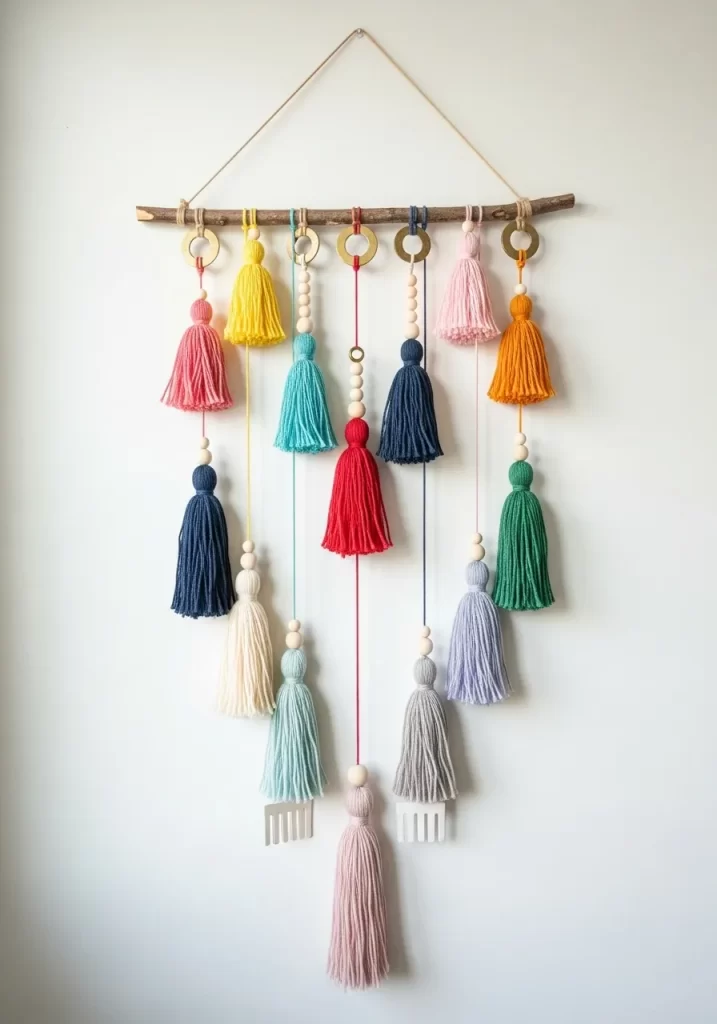
Description
Introduce a wave of fun, joyful color and texture with this whimsical tassel mobile. Hanging from a simple piece of driftwood, the piece features large, vibrant yarn tassels anchored by wooden beads and simple rings. The combination of soft yarn with hard geometric elements creates an appealing visual contrast.
Each tassel is a different hue, from sunny yellow to deep navy, making this a fantastic way to pull together an eclectic color palette in any room. The staggered lengths and varying bead placements create dynamic movement, ensuring the piece catches the eye. This hanging feels bohemian and playful, adding a lighthearted decorative element to a craft room, child’s room, or gallery wall.
Materials Required
- Driftwood or Dowel Rod: One piece approximately 12–18 inches long.
- Yarn: Various colors of medium-weight yarn.
- Wooden Beads: Assorted sizes (some small, some large).
- Small Wooden or Metal Rings: For attaching the tassels to the dowel.
- Thin Twine or String: For hanging the mobile.
Equipment Required
- Sharp Scissors: For cutting and trimming the tassels.
- Fork or Small Cardboard Piece: Used as a form for wrapping the tassels.
DIY Instruction Step-by-Step
Step 1: Make the Tassels
- Decide on the size of your tassels. Wrap the yarn around a piece of cardboard or a fork many times—more wraps mean a fuller tassel.
- Carefully slide the looped yarn off the cardboard. Tie a small piece of yarn tightly around the top loop to secure the bundle.
- Cut another small piece of yarn and tie it securely around the tassel bundle about an inch or two from the top, creating the tassel’s “neck.”
- Cut the bottom loops open with sharp scissors to create the fringe. Trim the fringe so the bottom of the tassel is even. Repeat this process until you have all your colorful tassels.
Step 2: String the Tassels
- Cut a long length of yarn or thread (matching the tassel color is best). Thread one end of the string through a small bead, then through the center of the tassel neck, and then through another bead. The beads will sit above the tassel.
- Tie a secure knot after the top bead to keep the tassel assembly in place. Leave a long tail of string above the top bead for hanging.
Step 3: Assemble and Attach to the Dowel
- Take your driftwood piece. Use the thin twine to create a simple hanging loop on the ends of the driftwood.
- Tie the top strings of your finished tassels to the wooden or metal rings.
- Slide the rings onto the driftwood. Arrange the tassels along the rod, playing with different hanging heights and staggering the colors. Secure the rings in place with a small knot tied to the driftwood.
13. Abstract Geometric Mural Canvas
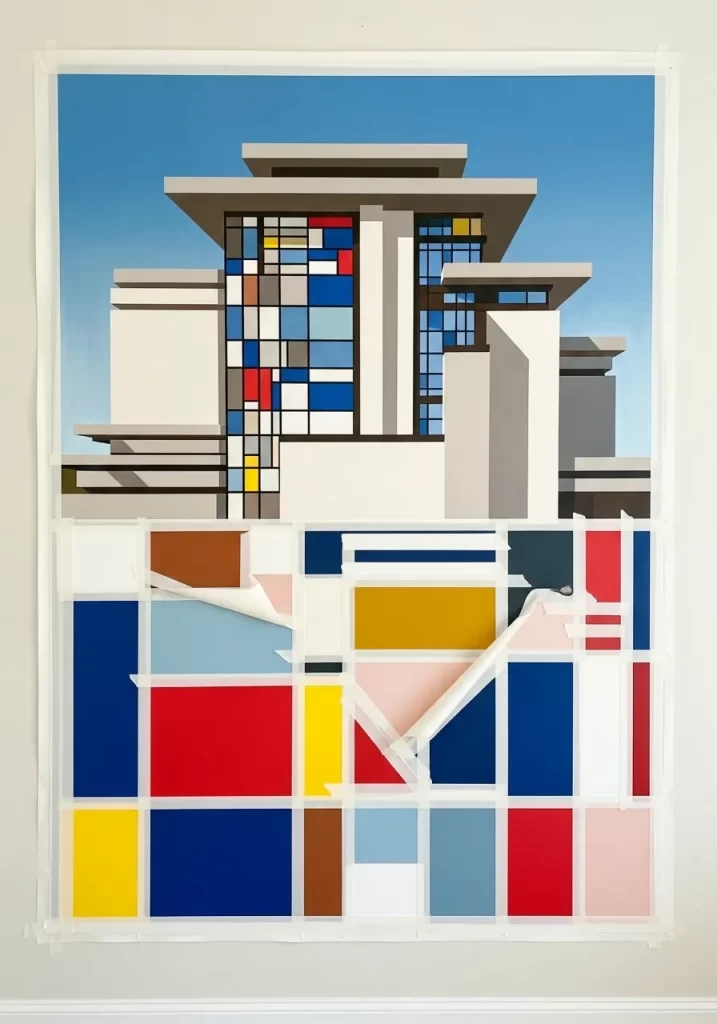
Description
This large-scale artwork uses the principles of abstract geometric design to create a stunning, color-blocked composition. Inspired by mid-century architecture and the De Stijl movement, this piece uses precise lines and contrasting blocks of color for maximum impact. The complex overlay of neutral tones and primary hues gives the painting an architectural, layered appearance.
You do not need to be a talented painter; the entire composition is achieved using painter’s tape to mask sharp edges and define shapes. The scale makes this an ultimate statement wall piece for a spacious living area or a modern office. This style is incredibly versatile and allows you to customize the color palette to perfectly match your space.
Materials Required
- Large Stretched Canvas: As big as your space allows.
- Acrylic Paint: Various colors, including primary colors, neutrals (gray, white), and earth tones.
- Painter’s Tape (Various Widths): Essential for masking sharp lines.
Equipment Required
- Ruler and Pencil: For measuring and drawing guide lines.
- Paint Brushes and Rollers: Small foam rollers are great for smooth, even coats.
- Utility Knife or Craft Knife: For trimming tape edges.
DIY Instruction Step-by-Step
Step 1: Plan and Draw the Design
- First, sketch your geometric design on paper. Plan which sections will be horizontal, vertical, and which will overlap.
- Lightly draw the guide lines of your design onto the canvas with a pencil and ruler.
Step 2: Tape and Paint the Base Colors
- Apply painter’s tape over the lines that you want to remain unpainted or that will be covered by subsequent colors. Ensure the tape edges are firmly pressed down to prevent paint bleed.
- Start by painting the largest, most dominant background color areas (like the large blue sky section in the example). Use a roller for a smooth, even application.
- Let the first colors dry completely.
Step 3: Layer the Geometric Shapes
- Once the first layers are dry, apply new layers of tape to mask off the areas you just painted, defining the next set of shapes (e.g., the white architectural boxes).
- Paint the secondary colors (like the grays and whites of the building structure). Peel the tape immediately after painting and before the paint cures to reveal crisp lines.
- Allow those shapes to dry, then re-tape smaller sections (like the colorful window grid) to add the final, detailed color blocks. This process requires patience and multiple drying cycles.
Step 4: Finishing Touches
- Once all sections are painted and dried, go back and touch up any small areas where the paint may have bled under the tape using a fine brush.
- The resulting clean, bold composition needs no frame and can be hung directly on the wall.
14. Sea Glass and Driftwood Shadow Box

Description
Capture the serene, calming colors of the coast with this lovely shadow box display. It collects natural elements like smooth sea glass, driftwood, and pebbles found on beachcombing adventures. Arranged against a neutral linen background, the varied shapes and muted aquatic colors create a beautiful piece of organic, textural art.
The deep frame gives the pieces dimension, allowing them to cast soft shadows. Adding a layer of fine sand at the bottom and small wooden letters makes the piece personalized and anchors the collection. This type of art is a wonderful way to commemorate a favorite vacation spot or bring a calming, beachy vibe to a sunroom or bathroom.
Materials Required
- Shadow Box Frame (Deep): One frame with a depth of at least 1.5 inches.
- Linen or Burlap Fabric: Cut to fit the back of the shadow box.
- Sea Glass, Pebbles, and Driftwood: Collected pieces in various shapes and sizes.
- Fine Craft Sand: For the bottom section of the box.
- Small Wooden Letters: For spelling a word or name (optional).
Equipment Required
- Strong Craft Glue (or Hot Glue Gun): For securing heavy items.
- Ruler and Pencil: For laying out the grid.
- Mounting Pins: For securing the fabric.
DIY Instruction Step-by-Step
Step 1: Prep the Shadow Box
- Carefully disassemble the shadow box, removing the backing board.
- Stretch the linen or burlap fabric tightly over the front of the backing board. Secure the edges on the back using strong glue or small tacks. This creates a soft, natural base.
- Pour a shallow layer of craft sand onto the very bottom of the shadow box. Use a thin line of glue along the edge to hold the sand in place.
Step 2: Arrange the Elements
- Lay the backing board flat and begin arranging your collected items. Start with the driftwood pieces as they will act as natural dividers or focal points.
- Strategically place the sea glass and pebbles, grouping colors and shapes together to create a pleasing pattern. Ensure the pieces are spread out enough to appreciate their individual shapes. The example uses a fairly symmetrical grid layout.
- Place your small wooden letters into the sand at the bottom of the box.
Step 3: Glue Everything in Place
- Once you are satisfied with the arrangement, take photos or make a light sketch of the layout. Then, carefully remove one piece at a time.
- Apply a small amount of strong craft glue to the back of the item and press it firmly back into its place on the fabric-covered backing board. This is especially important for the heavier pebbles and driftwood.
- Allow the entire arrangement to dry for several hours before reassembling the frame.
Step 4: Final Assembly
- Carefully place the fully glued backing board back into the shadow box frame. Secure the frame closures.
- Hang the piece on the wall where it can catch natural light to highlight the translucent sea glass.
15. Continuous Line Embroidery Art
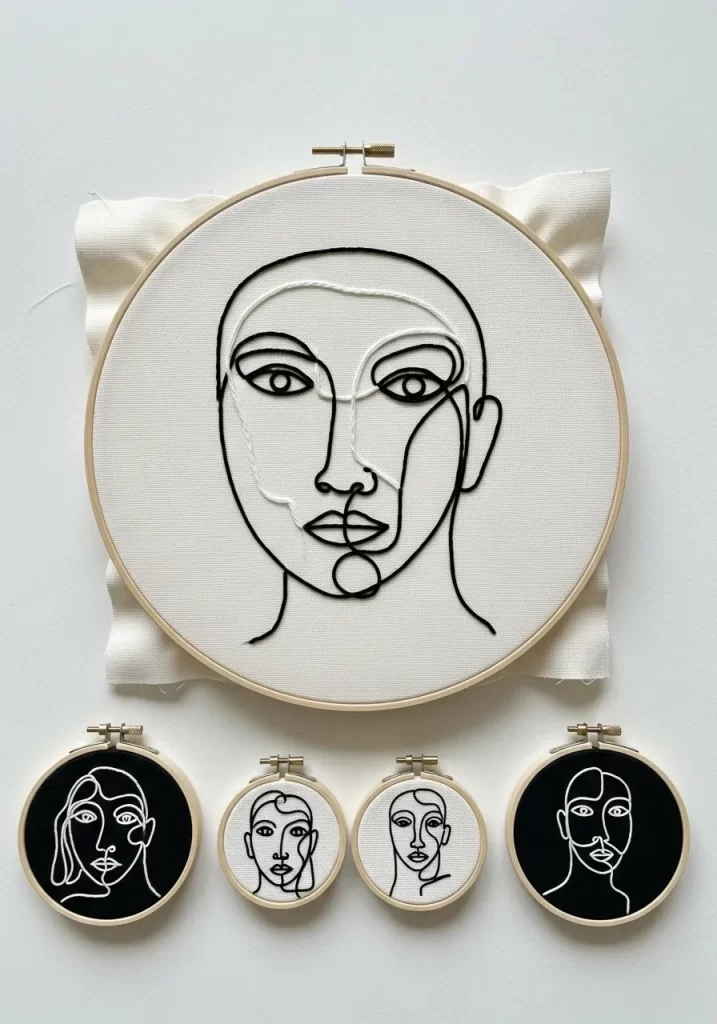
Description
This modern take on embroidery brings the clean, minimalist look of continuous line drawing to fiber art. The design uses a single strand of yarn or thread to define a stylized human face, creating a wonderfully abstract portrait. The black thread provides high contrast against the neutral fabric, making the lines pop.
Creating small variations in thread color (like the white accent line) adds subtle dimension and interest to the design. These hoops look fantastic when grouped in various sizes, creating a sophisticated, gallery-style display. This art is accessible to a beginner and uses simple stitching to produce a piece that feels both contemporary and handmade.
Materials Required
- Embroidery Hoops: Various sizes (one large, several small).
- Fabric: Plain white, cream, or black cotton or linen fabric.
- Embroidery Floss or Thin Yarn: Black, white, or any color for the line drawing.
- Paper and Marker: For planning the design.
Equipment Required
- Sharp Embroidery Needle: With an eye large enough for the floss or yarn.
- Sharp Scissors: For trimming thread.
DIY Instruction Step-by-Step
Step 1: Transfer the Design
- First, draw your continuous line face design onto a piece of paper. The line should be simple and never lift from the page.
- Secure your fabric tightly into the embroidery hoop.
- Tape your paper design to the fabric. Use a light source (like a window or light box) to lightly trace the design onto the fabric using a heat-erasable pen or a very light pencil.
Step 2: Begin the Backstitch
- Thread your needle with a long strand of your chosen embroidery floss (black for the main line).
- Begin stitching using a simple backstitch technique along the traced lines. The backstitch is created by moving the needle forward one stitch length, then bringing the needle back to where the previous stitch ended.
- The goal is to make the line appear continuous and smooth. Maintain a consistent stitch length for a clean finish.
Step 3: Complete the Portrait and Finish the Hoop
- Continue stitching the entire design. If you want to change colors (like the white highlight), simply knot off the old thread on the back and start the new color with a fresh knot.
- When the design is complete, remove the fabric from the hoop. Trim the excess fabric to about an inch around the edge of the hoop.
- Secure the loose fabric edge to the back of the wooden hoop using a running stitch or strong glue. This keeps the back neat.
Step 4: Group and Hang
- Display the finished hoops by leaning them against a wall or hanging them in a staggered group using small nails.
16. Mediterranean Tile Mosaic Mirror
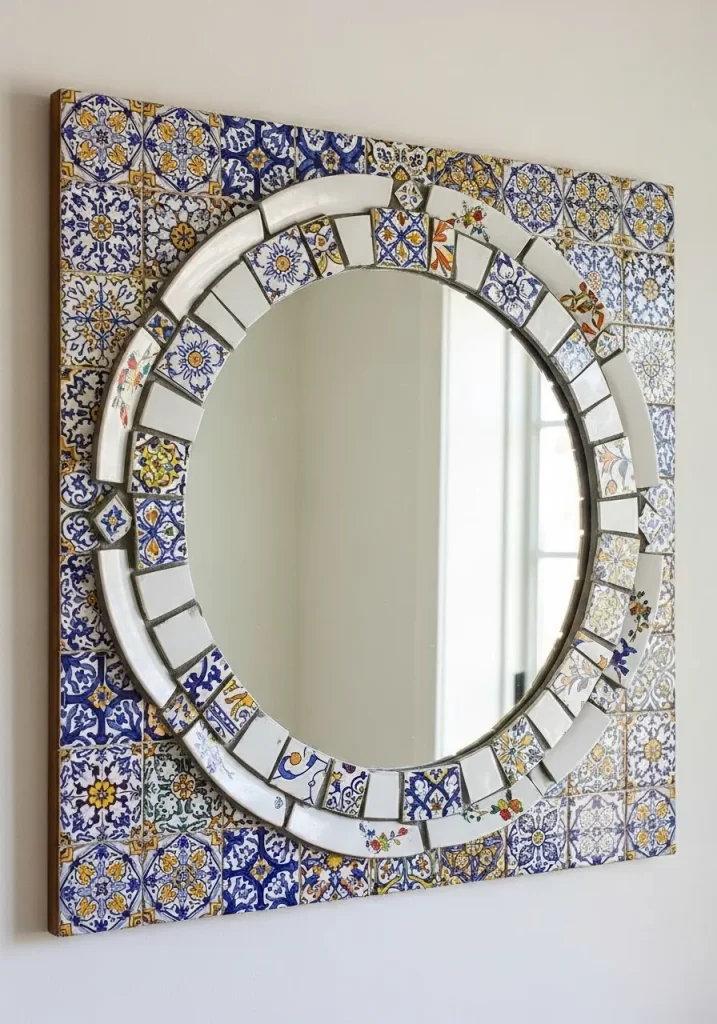
Description
Add a vibrant, Mediterranean flair to your home with this stunning mosaic mirror frame. This project surrounds a simple circular mirror with beautifully patterned ceramic tiles, creating a large, colorful statement piece. The contrasting white, solid-colored tiles or grout create visual separation and make the intricate blue and yellow patterns pop.
The large, circular shape softens the geometric edges of the square tiles, resulting in a cohesive design. The overall feel is wonderfully rustic and sunny, reminiscent of a villa in Spain or Italy. This mirror instantly becomes a focal point and is a fantastic way to introduce a complex color palette into a plain room.
Materials Required
- Round Mirror: With a flat back.
- Plywood Backing Board: Cut to a square shape, slightly larger than the mirror.
- Patterned Ceramic Tiles: Assorted blue, yellow, and white patterned tiles (Spanish or Portuguese style).
- Plain White Tiles: For the inner ring and accent pieces.
- Tile Adhesive: Strong glue for securing tiles to wood.
- White Grout: For filling the spaces between the tiles.
- Tile Nippers: Used to cut tiles into small, irregular pieces.
Equipment Required
- Putty Knife or Trowel: For applying adhesive and grout.
- Sponge: For cleaning excess grout.
- Gloves: For handling grout.
- Safety Glasses: Mandatory for cutting tile.
DIY Instruction Step-by-Step
Step 1: Prep the Board and Mirror
- Glue the mirror onto the center of the plywood board using strong adhesive. Allow it to dry.
- Ensure your plywood backing board is securely prepared for hanging (attach hardware now).
Step 2: Lay the Background Tiles
- Start laying the patterned ceramic tiles around the mirror, covering the remaining exposed plywood.
- Use a tile nipper to carefully trim the tiles that sit right against the edge of the mirror, shaping them to fit the curve.
- Continue laying the tiles, leaving small, uniform gaps for the grout. Allow the tiles to set fully.
Step 3: Create the Mosaic Ring
- Use the tile nippers to break the plain white tiles into small, irregular pieces. You will need enough to create a thick ring around the mirror edge.
- Apply adhesive to the spaces directly surrounding the mirror. Carefully place the broken white tile pieces to form a mosaic ring. This layer adds dimension and highlights the mirror’s shape. Allow to dry.
Step 4: Grout and Finish
- Mix your white grout according to the manufacturer’s directions.
- Wearing gloves, use a putty knife to spread the grout over the entire tiled surface, pushing it firmly into all the gaps between the tiles.
- Wait about 10–15 minutes (or as directed). Use a damp sponge to wipe away the excess grout from the tile faces, smoothing the joints as you go. Be careful not to wipe away too much from the gaps.
- Once the grout is dry and cured, buff the tiles clean with a dry rag.
17. Upcycled Pallet Vertical Planter
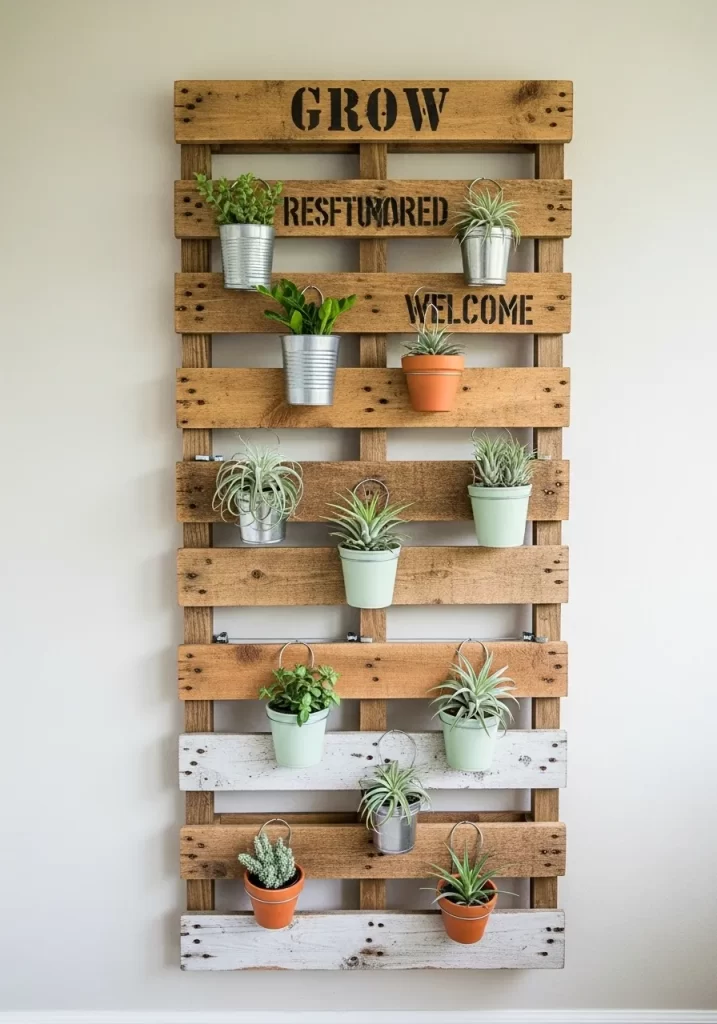
Description
Transform a discarded wooden pallet into a fantastic vertical gardening display that introduces an appealing, rustic texture to a bare wall. This arrangement is highly practical for holding small potted plants, succulents, or herbs. The rough, reclaimed wood is sanded and treated with a mix of stains and white wash, giving it an attractive, weathered look.
You can stencil a simple message or word at the top for an added layer of personalization and charm. The staggered galvanized metal and terracotta pots hang easily, adding variety in color and texture. This piece is a powerful way to bring life and green vibrancy into an outdoor space, balcony, or even a brightly lit indoor wall.
Materials Required
- Wooden Pallet: One standard size pallet (ensure wood is safe and untreated with harsh chemicals).
- Wood Stain (Assorted Colors): Light, medium, and dark stain, plus white paint for the wash.
- Stencils and Black Paint: For the lettering.
- Small Pots/Pails: Galvanized metal pails or terracotta pots.
- S-Hooks or Small Metal Brackets: For hanging the pots.
Equipment Required
- Power Sander or Sandpaper (Coarse and Fine): Essential for smoothing rough wood.
- Safety Gloves and Glasses: For sanding and treating wood.
- Paint Brushes and Rags: For applying stain and white wash.
- Hammer and Nails/Screws: For reinforcement and attaching brackets.
DIY Instruction Step-by-Step
Step 1: Disassemble and Prepare the Wood
- Carefully examine the pallet for loose boards and exposed nails. Remove or pound down any dangerous nails.
- Use the power sander to smooth the entire surface of the pallet boards. This is crucial for eliminating splinters and preparing the wood for staining.
Step 2: Apply Finishes
- Apply a white wash (watered-down white paint) to the bottom one or two horizontal planks, wiping off the excess quickly to let the wood grain show through.
- Apply various shades of wood stain to the remaining boards to achieve a varied, multi-toned effect like the image. Apply the stain with a rag and wipe off the excess to control the intensity. Allow all finishes to dry completely.
- Use stencils and black paint to apply your chosen word (like “GROW”) onto the top boards.
Step 3: Attach Hardware and Assemble
- Determine the placement for your potted plants. Mark where each pot or pail will hang.
- Secure small S-hooks, cup hooks, or metal brackets directly to the front face of the pallet planks where the pot handles will rest. Ensure they are strongly attached.
- Once the hardware is secure, hang the potted plants filled with your favorite succulents or small trailing plants.
Step 4: Mount to the Wall
- Pallets are very heavy. Use heavy-duty mounting hardware on the back of the pallet.
- Find the studs in your wall and use long, strong screws to secure the pallet directly to the wall studs. This ensures the unit will safely bear the weight of the pots and soil.
18. Marbled Paint Texture Grid
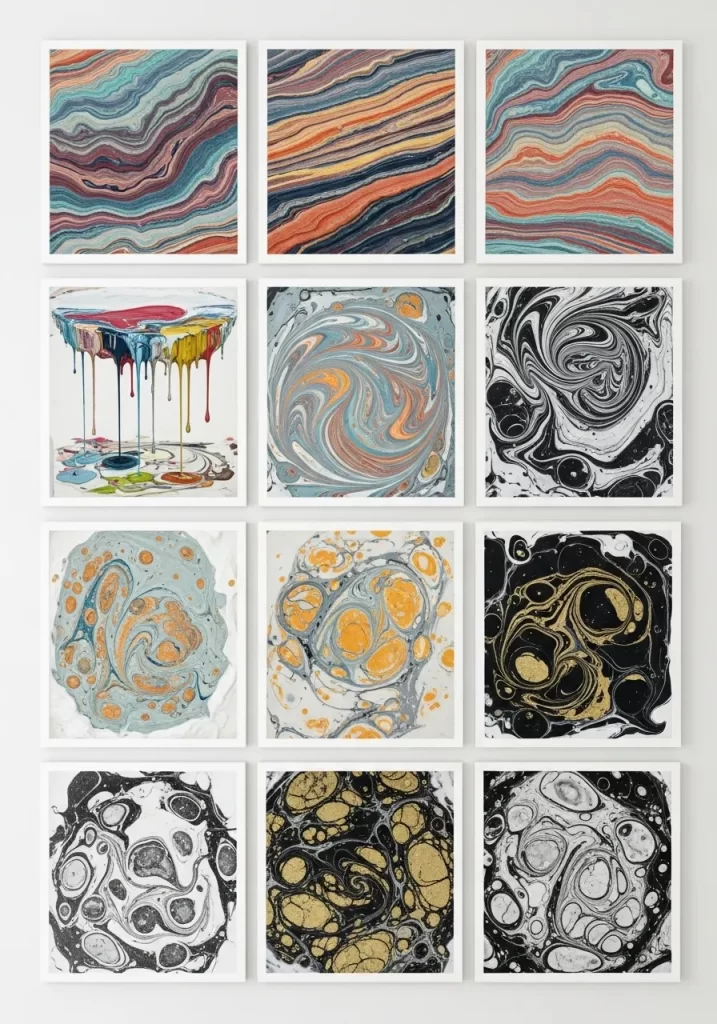
Description
Create a striking, multi-panel gallery wall using various paint swirling and marbling techniques. This collection demonstrates the gorgeous variety achievable through fluid paint application, resulting in textures that mimic natural agate, flowing lava, or wood grain. The unifying factor across all 12 panels is the square white frame, which gives the diverse patterns a cohesive, organized look.
From rich, earthy swirls to dramatic black, white, and gold blobs, each piece offers intense texture and color depth. This art is visually stunning and requires no traditional painting skill, relying instead on chemical and physical mixing of paint. It is a powerful way to achieve a high-end, contemporary art look without a large investment.
Materials Required
- Small Square Canvases or Art Boards: Twelve matching pieces.
- Acrylic Paints: Various colors (blues, oranges, greens, black, white, and metallic gold).
- Pouring Medium: Additive that thins paint for fluid art.
- Silicon Oil (Optional): Creates cells or bubbles in the paint.
- White Frames: Twelve matching frames (optional, but highly recommended).
Equipment Required
- Small Cups or Containers: For mixing paint colors.
- Stirring Sticks: For mixing.
- Blow Torch or Heat Gun (Optional, use with caution): To bring cells to the surface.
- Plastic Drop Cloth: Essential for a very messy process.
DIY Instruction Step-by-Step
Step 1: Prep the Paint Mix
- In separate plastic cups, mix each of your acrylic paint colors with the pouring medium. Follow the medium manufacturer’s instructions, aiming for a consistency like warm honey.
- For some colors, add a drop or two of silicon oil to promote the creation of cells and bubbles.
Step 2: Apply the Marbling Techniques
- Place a canvas flat on your protected surface. There are three main techniques used in the image:
- Puddle Pour (Center Row): Pour several contrasting colors into a single cup, do not stir. Quickly flip the cup over onto the canvas and lift it, allowing the paint to spread into a circular puddle. Tilt the canvas gently to move the paint.
- Swirl/Dirty Pour (Bottom Rows): Pour all desired colors into one cup, gently swirling them once. Pour the contents of the cup directly onto the canvas and tilt the canvas gently until the entire surface is covered.
- Layer Pour (Top Row): This requires dripping or pouring lines of color horizontally across the canvas and using a stick or comb to drag the colors through each other to create the wave-like texture.
- If you used silicon oil, wave a heat gun or blow torch over the surface briefly to encourage the paint to separate into interesting cells.
Step 3: Dry and Frame
- Allow the painted canvases to dry flat for at least 24–48 hours. They must be fully cured before framing.
- Once dry, place the completed marbled art inside the twelve matching white frames.
- Use a level and measuring tape to hang the twelve framed pieces on your wall in a symmetrical, four-by-three grid.
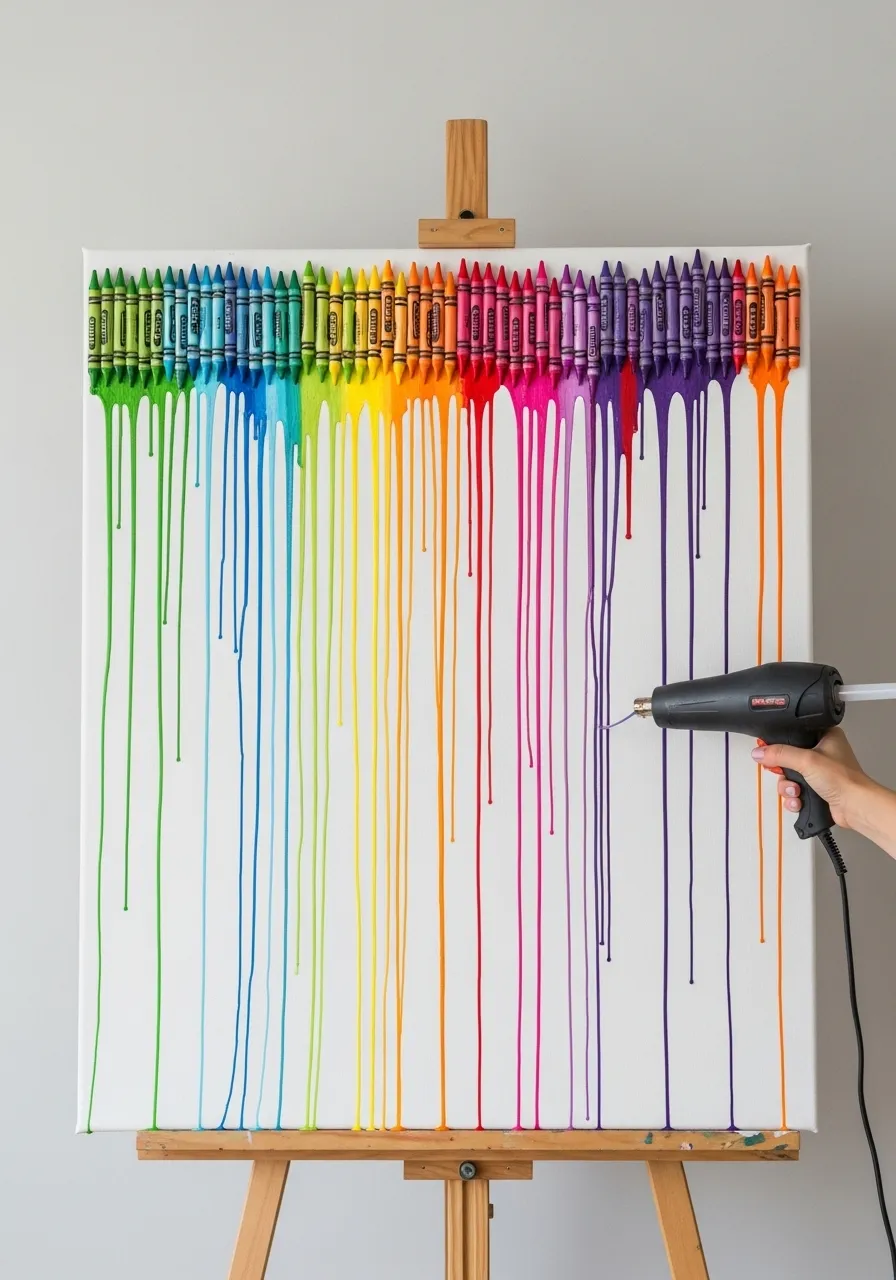
19. Rainbow Melted Crayon Canvas
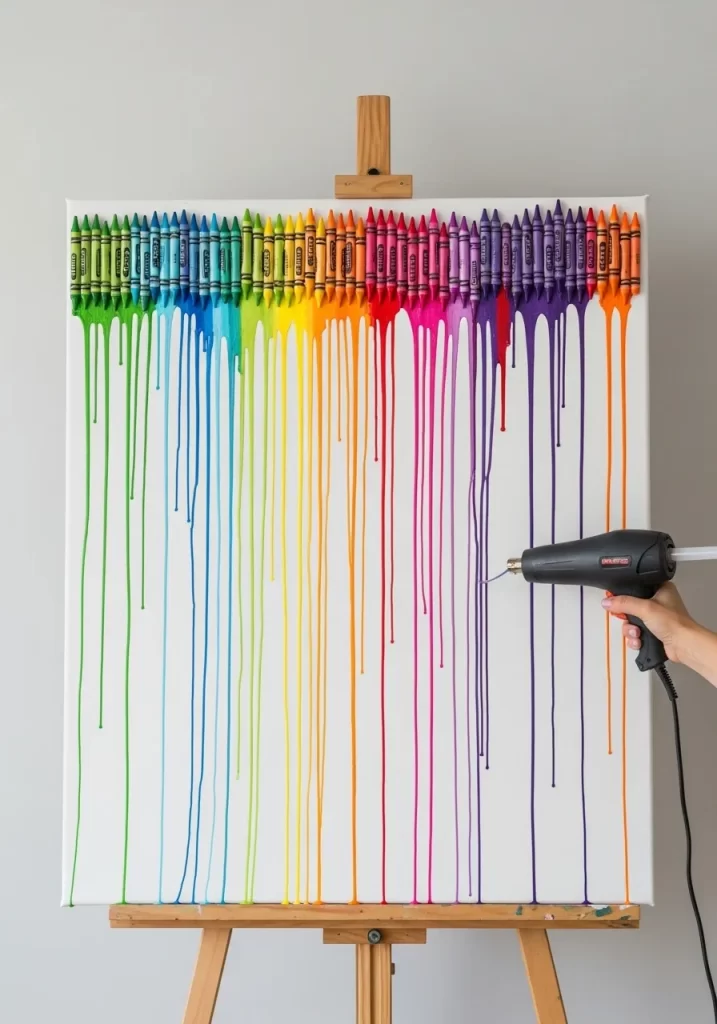
Description
Create a burst of pure color with this incredibly fun and vibrant piece of melted crayon art. The project uses a row of crayons glued to the top of a white canvas and melted with a heat source, allowing the wax to drip dramatically down the surface. The organized rainbow gradient at the top transforms into a free-flowing cascade of saturated color below.
This piece is a fantastic way to introduce a playful, modern element into a casual living space or office. Since the colors blend slightly as they melt, the resulting drips have wonderful natural variations. It is a genuinely unique process art piece that is striking and uplifting.
Materials Required
- Stretched Canvas: Any size (a vertical canvas works best).
- Crayons (High Quality): One full box with a wide range of colors.
- Hot Glue Sticks: For attaching crayons to the canvas.
Equipment Required
- Hot Glue Gun (High Temp): Essential for securing the crayons.
- Hair Dryer (High Heat): The heat source used to melt the wax.
- Newspaper or Drop Cloth: To protect the floor and surrounding surfaces.
DIY Instruction Step-by-Step
Step 1: Prep the Crayons and Canvas
- Remove all the paper wrappers from the crayons. This allows the color to melt cleanly.
- Arrange the crayons along the top edge of the canvas in the order you want them to melt (a rainbow spectrum is popular).
- Use the hot glue gun to apply a thick line of glue to the side of the crayon and press it firmly against the top edge of the canvas. Hold each one for a few seconds until secure.
Step 2: Protect the Area
- This step is very messy. Place your canvas upright on an easel or lean it against a protected wall.
- Lay down newspaper or a drop cloth on the floor underneath and around the canvas to catch the excess dripping wax.
Step 3: Melt the Crayons
- Hold the hair dryer above the crayons, pointing the heat downward toward the canvas. Use the highest heat setting and low fan speed.
- The wax will slowly start to melt and flow down the canvas. You can hold the hair dryer in one spot to encourage a thicker, faster flow, or move it back and forth to maintain the drips across the entire width.
- Continue melting until the drips reach the desired length.
Step 4: Dry and Display
- Once you are satisfied with the drips, turn off the hair dryer and allow the entire canvas to cool and dry completely. The wax will harden quickly.
- Hang the finished art piece, which is ready to display without a frame.
20. Enchanted Forest Living Moss Art
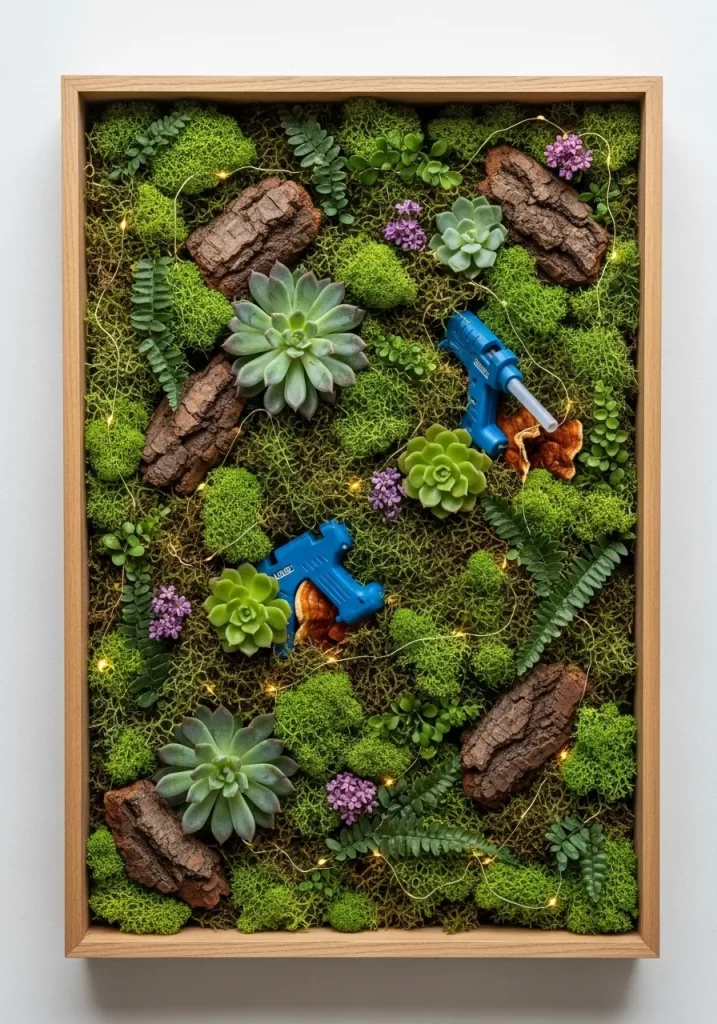
Description
Bring the calming presence of nature indoors with a beautiful, low-maintenance moss garden framed for the wall. This shadow box display uses stabilized, preserved moss and other natural elements to create a miniature forest landscape. The deep green moss provides an incredibly soft, textural background for bark, ferns, and small faux succulents.
Tiny battery-operated fairy lights are nestled within the moss, giving the piece a magical, glowing effect in the evening. This art is a fantastic way to introduce a biophilic, or nature-loving, element to a living room, bathroom, or hallway. It is a stunning, unique piece that requires no watering or sunlight.
Materials Required
- Deep Shadow Box Frame: Wooden frame with a deep recess.
- Preserved Moss (Assorted): Various shades and textures (e.g., sheet moss, pillow moss).
- Natural Elements: Small pieces of bark, dried ferns, and tiny pinecones.
- Faux Succulents or Small Plastic Flowers: For color accents.
- LED Fairy Lights: Battery-operated strand with thin wire.
- Styrofoam or Cardboard: To line the back of the frame if more depth is needed.
- Hot Glue Sticks: Used generously for attaching the moss.
Equipment Required
- Hot Glue Gun (High Temp): Essential for securely attaching the materials.
- Scissors or Wire Cutters: For trimming moss and lights.
DIY Instruction Step-by-Step
Step 1: Prep the Frame
- Remove the glass (if applicable) and backing board from the shadow box.
- If the frame recess is very deep, you can glue a layer of styrofoam or thick cardboard to the back to bring the moss closer to the front edge.
Step 2: Create the Moss Base
- Starting at the bottom, apply a generous amount of hot glue to a small section of the backing board.
- Immediately press the largest sheets of preserved moss firmly onto the glue. Work in small sections, completely covering the entire backing board with a thick, plush layer of moss. This creates the primary backdrop.
Step 3: Add the Lights and Large Elements
- Take your strand of fairy lights. Planning from the back corner where the battery pack will rest, gently weave the wire over and under the moss, distributing the lights evenly across the surface. Secure the battery pack to the back of the frame where it can be easily reached.
- Next, glue down the largest, heaviest elements, such as the pieces of bark. These should look naturally placed and slightly embedded in the moss.
Step 4: Final Layering
- Fill in the remaining areas by attaching the faux succulents, ferns, and small pinecones. Use the hot glue gun to attach them securely to the moss base. The goal is to create natural-looking groupings with varied heights.
- Once all elements are glued, place the completed moss board back into the frame and secure it. Your maintenance-free forest is complete!
21. Framed Fabric Quilt Squares Grid
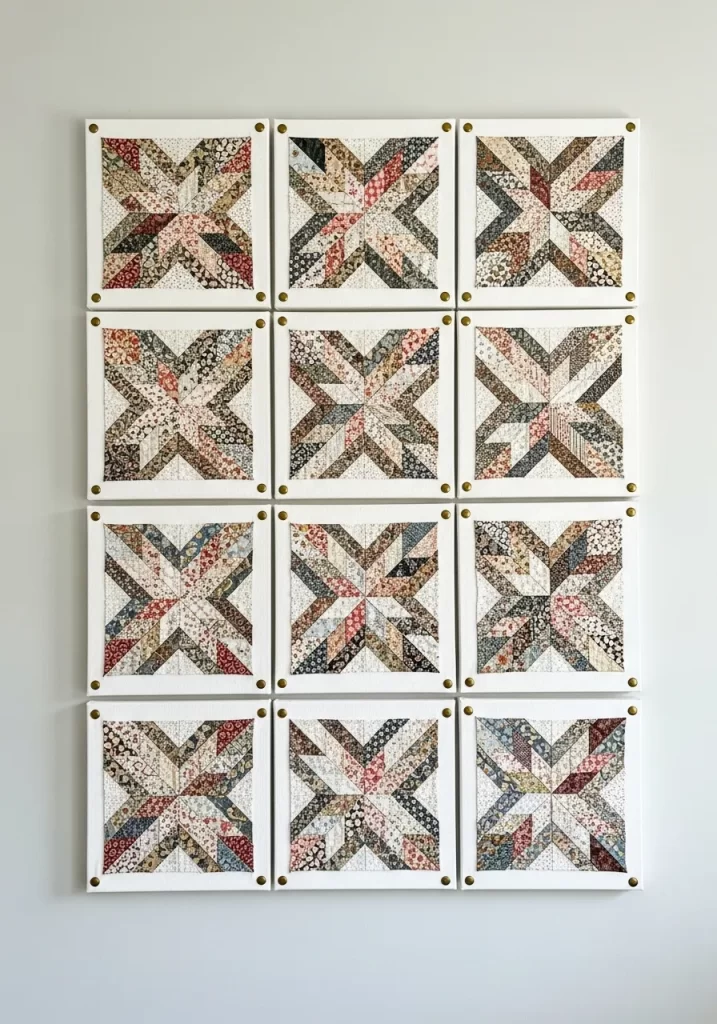
Description
This project transforms textile scraps into a sophisticated, gallery-style display by showcasing small quilt squares within individual frames. Each square uses a log cabin or star quilt pattern crafted from small pieces of patterned fabric. When grouped, the collection of matching frames creates a beautiful, unified piece of large-scale art.
The varied fabric designs, from subtle florals to muted geometric prints, give the piece a wonderfully rich, layered texture. Brass furniture tacks used in the corners of the inner frames add an unexpected touch of rustic hardware. This art is a charming and cozy way to celebrate the tradition of quilting and introduce an antique, farmhouse aesthetic to a living room or hallway.
Materials Required
- Small Square Fabrics: Assortment of patterned cotton or linen scraps.
- Backing Fabric: A plain, neutral fabric cut to the size of the inner frame opening.
- White Frame Backing Boards: Twelve matching boards (or your desired number).
- Thin White Wood Strips: For creating the inner frame on the board.
- Small Brass Tacks or Upholstery Nails: For decoration.
- Fabric Glue or Strong Adhesive: For securing the fabric and wood strips.
Equipment Required
- Sewing Machine (Optional): For stitching quilt pieces together.
- Rotary Cutter and Mat: For precisely cutting small fabric strips.
- Ruler and Pencil: For marking the inner frame.
- Hammer: For attaching the brass tacks.
DIY Instruction Step-by-Step
Step 1: Sew the Quilt Squares
- Decide on a simple pattern (like a four-point star or geometric block). Use the rotary cutter to cut your patterned fabrics into the small, precise shapes required for the chosen design.
- Sew the small fabric pieces together to create twelve matching square blocks. Ensure each block is slightly larger than the inner display area of the frame board.
- Once sewn, press the blocks flat with an iron and trim them to the final display size.
Step 2: Prepare and Frame the Boards
- Take your twelve white frame backing boards. Measure and mark the placement for the inner white wood strips which will form the frame border inside the board.
- Glue the thin white wood strips onto the board, creating a small raised inner frame. Allow the glue to dry.
- Apply a thin layer of fabric glue to the recessed center of the board. Carefully place the finished quilt square onto the glue, centering the design.
Step 3: Add the Tacks and Finish
- Once the quilt squares are secure, hammer a small brass tack into each corner of the inner white frame strip, pinning the strip to the backing board. This gives the piece a decorative, finished touch.
- Repeat the process for all twelve squares.
- Attach hanging hardware to the back of each individual board.
Step 4: Hang in a Grid
- Use a level and measuring tape to precisely mark the wall.
- Hang the twelve framed pieces in a tight, symmetrical grid pattern, ensuring the spacing between them is perfectly uniform.
22. Abstract Paper Cutout Collage
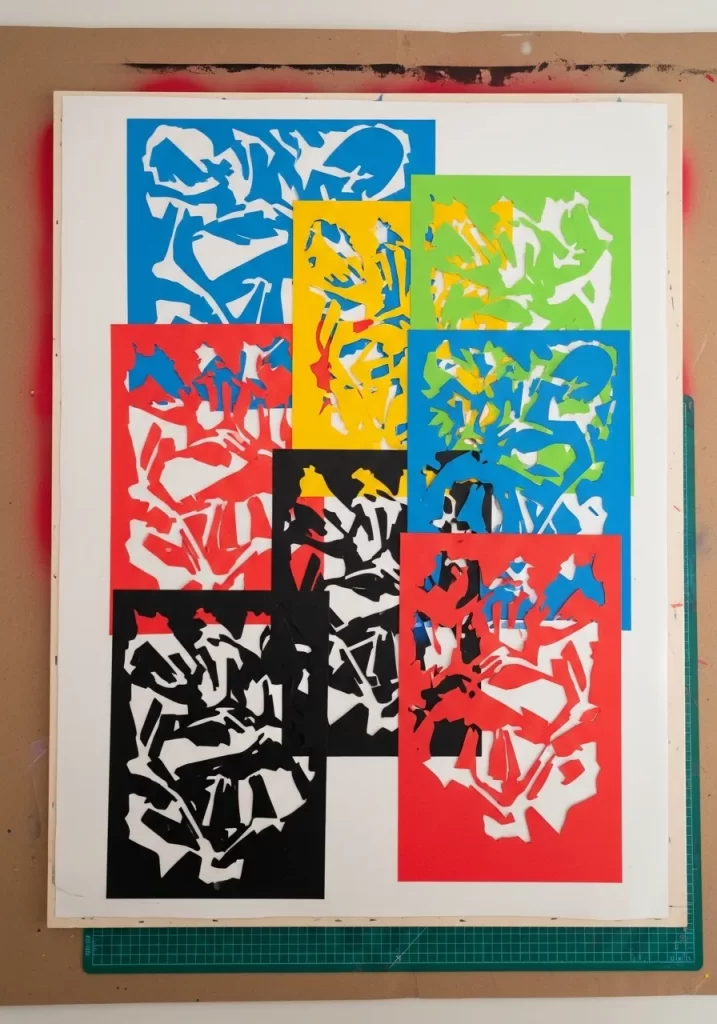
Description
Create a bold and graphic statement by layering brightly colored paper to mimic the cutout style of a modern abstract painter. This dynamic piece relies on solid blocks of color and organic, free-form shapes that interlock and overlap. Cutting the shapes from a mix of primary and secondary colors creates visual energy and movement.
This collage technique is accessible to anyone and allows for spontaneous design, as the final composition is determined by how the pieces fit together. The layering of paper creates subtle shadows and a multi-dimensional texture not found in a flat print. The use of repeating abstract shapes in different colors gives the overall composition a sense of rhythm and contemporary art flair.
Materials Required
- Large Stretched Canvas or Thick Art Board: The base for the artwork.
- Colored Construction or Cardstock Paper: Several sheets each of bright colors (red, blue, yellow, green, black).
- White Cardstock: For a subtle background layer.
- Strong Glue Stick or Spray Adhesive: For mounting the paper.
Equipment Required
- Sharp Scissors or Craft Knife: For cutting the abstract shapes.
- Cutting Mat: To protect the surface.
- Ruler (Optional): For cutting the final mounting squares.
DIY Instruction Step-by-Step
Step 1: Cut the Abstract Shapes
- Using scissors or a craft knife, begin free-cutting organic, winding, and abstract shapes from your brightly colored cardstock. Do not overthink the shapes; simply cut interesting lines and curves.
- Repeat the cutting process until you have a large pile of interlocking pieces in various colors.
Step 2: Create the Collage Base Panels
- Cut several sheets of white cardstock into matching square or rectangular panels (the size shown in the image). These will be the individual canvases for the cutouts.
- Take one panel. Begin arranging a mix of your abstract colored shapes on the white background. Let them overlap and intersect to build a complex, layered design.
Step 3: Glue and Layer
- Once you are satisfied with the arrangement on the first panel, use a strong glue stick or spray adhesive to firmly attach the paper pieces to the white panel.
- Repeat this collage process for the remaining white panels, ensuring each one has a slightly different arrangement and color focus.
- Once the glue is dry, use spray adhesive to attach the completed white panels onto the large canvas or art board in a staggered, overlapping pattern like the example.
Step 4: Frame and Display
- The large canvas may need no frame, but you can add a simple wooden border if desired.
- Hang the piece prominently where the bold colors can create a dynamic focal point.
23. Light-Up Constellation Canvas
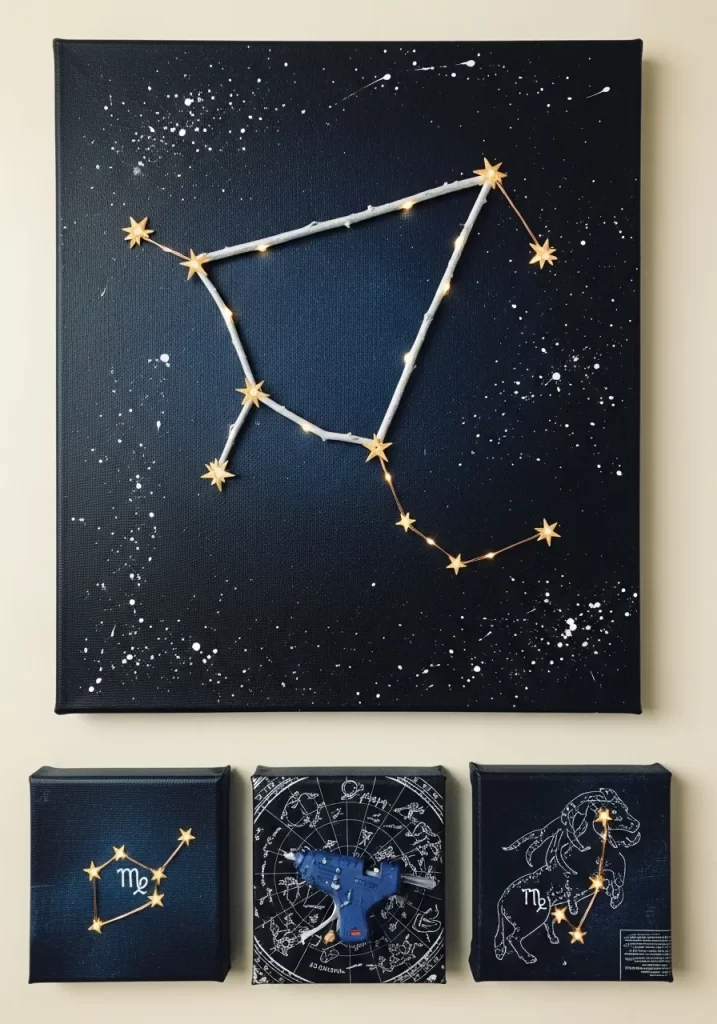
Description
Capture the magic of the night sky with a personalized constellation canvas that softly illuminates. This project uses a dark, painted canvas as the backdrop for a chosen star sign or constellation shape. Twisted white branches or sticks trace the primary lines of the constellation, adding a beautiful, dimensional quality.
Tiny, battery-operated fairy lights are used as the stars themselves, creating a warm, cozy glow. The background is easily created with simple paint splatters, mimicking the look of faraway galaxies. This piece works wonderfully as night-light décor in a child’s room or as a subtle, celestial feature in a living area.
Materials Required
- Stretched Canvas: One square canvas (medium size).
- Acrylic Paint (Black or Deep Navy): For the background.
- White Acrylic Paint: For the star splatter effect.
- Thin, Twisted Sticks or Branches: Enough to trace the main constellation lines.
- Battery-Operated LED Fairy Lights: Thin wire strand with small, warm white lights.
- Small Star-Shaped Accents (Optional): Tiny metallic stars or cutouts.
- Hot Glue Sticks: For attaching branches and lights.
Equipment Required
- Hot Glue Gun: Essential for quick, secure attachment.
- Paint Brush and Stiff Bristle Brush (or old toothbrush): For splatter painting.
- Pencil and Constellation Map: For tracing the design.
DIY Instruction Step-by-Step
Step 1: Paint the Night Sky Background
- Paint the entire canvas with a generous coat of black or deep navy acrylic paint. Allow it to dry completely.
- Dip a stiff bristle brush or old toothbrush into the white acrylic paint (thinned slightly with water). Hold the brush over the canvas and use your thumb to flick the bristles, creating a fine spray of white star splatters across the dark surface. Let the splatters dry completely.
Step 2: Trace and Glue the Branches
- Choose your constellation (e.g., Orion, Libra). Lightly sketch the outline of the main lines onto the canvas.
- Break or trim your thin sticks to the lengths needed to trace the lines of the constellation.
- Use the hot glue gun to glue the branches securely onto the canvas, following your sketched guide.
Step 3: Attach the Lights (Stars)
- Take your strand of LED fairy lights. Plan where the battery pack will rest on the back of the canvas.
- Apply small dots of hot glue where the main stars should be (where the branches connect or at the constellation points). Press the light bulbs into the glue.
- Carefully glue the remaining wire along the back of the branches or lightly across the canvas to connect the dots, hiding the wire as much as possible. Secure the battery pack to the back of the canvas.
Step 4: Final Touches
- Glue the optional star-shaped accents directly over the light bulbs or where additional stars are needed.
- Hang the finished piece and turn on the lights to see your starry night come alive.
24. Fingerprint Family Tree Mural
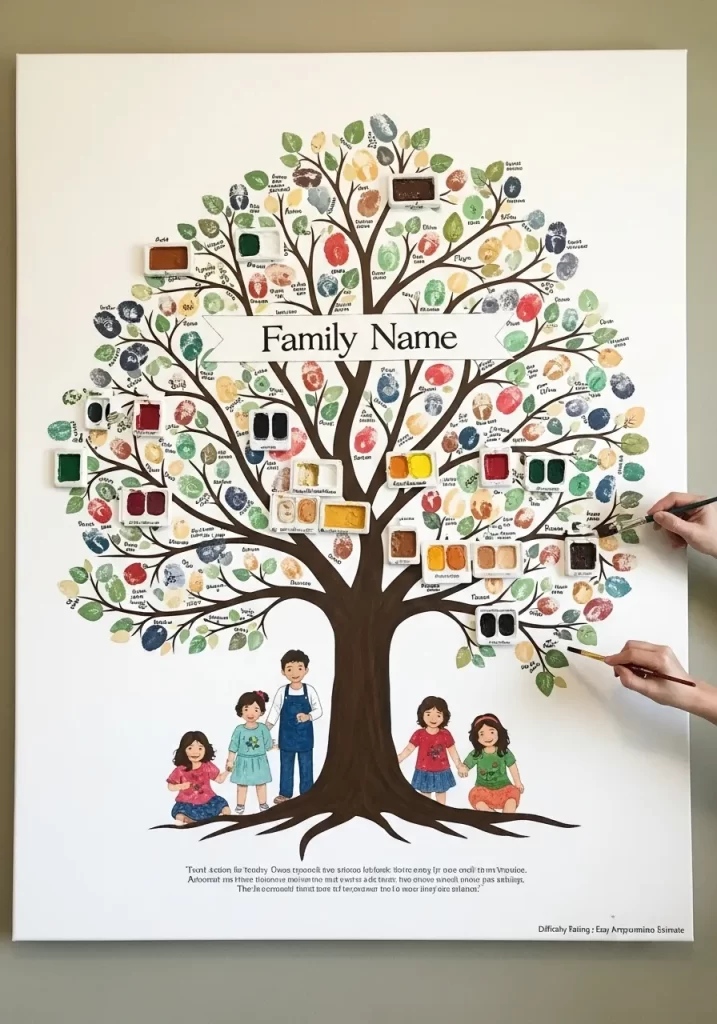
Description
This sentimental project creates a collaborative family tree portrait using the fingerprints of everyone involved. The large canvas features a beautifully painted tree trunk and branches, while the colorful fingerprints of family members form the leaves and fruit. Names are labeled below each print, turning the art into a wonderful visual family record.
The resulting piece is deeply personal and is a wonderful way to involve children in the creation of home décor. It captures a specific moment in time, making it a treasured family heirloom. Hung in a living room or foyer, this mural is a conversation starter and a constant reminder of family connection.
Materials Required
- Large Stretched Canvas: The size should accommodate many prints.
- Acrylic Paints (Brown, Green, Assorted Bright Colors): For the tree and the fingerprints.
- Paint Markers (Fine Tip, Black): For writing names.
- Small Paint Palettes: To hold the fingerprint ink.
Equipment Required
- Paint Brushes (Large and Small): For painting the trunk and branches.
- Damp Towels or Wipes: For cleaning fingers during the printing process.
- Fine-Tipped Marker: For labeling the names.
DIY Instruction Step-by-Step
Step 1: Paint the Tree Structure
- Using the large brushes and brown acrylic paint, paint a large, sturdy tree trunk onto the canvas. Allow it to dry.
- Add many main branches and smaller twigs extending outward, following the natural flow of a tree. Let the brown paint dry fully.
- Use the green paint to add small, fine leaves and foliage to the branches where the fingerprints will go, providing a base layer of color.
Step 2: Prepare for Fingerprinting
- Squeeze small amounts of the various bright colors of acrylic paint (red, blue, yellow, etc.) onto the small paint palettes. These will act as the “fingerprint ink.”
- Gather your family members and have damp wipes ready nearby for cleaning fingers.
Step 3: Create the Fingerprint Leaves
- Starting with the parents or oldest family members, instruct them to gently press a fingertip into one of the paint colors, ensuring their finger is covered but not dripping.
- Have them carefully press their painted fingertip onto the canvas, placing the print on a branch to form a leaf or fruit.
- Immediately clean their finger with the wipes. Repeat the process with different colors and different fingers until the tree looks full and vibrant.
Step 4: Label and Personalize
- Allow all the paint to dry completely.
- Use the fine-tipped black paint marker to write the name of the person who made the print directly below or next to their fingerprint.
- Add the family name onto a painted banner across the trunk.
- Optionally, paint small figures of the children below the tree.
25. Embossed Clay Tile Wall Grid
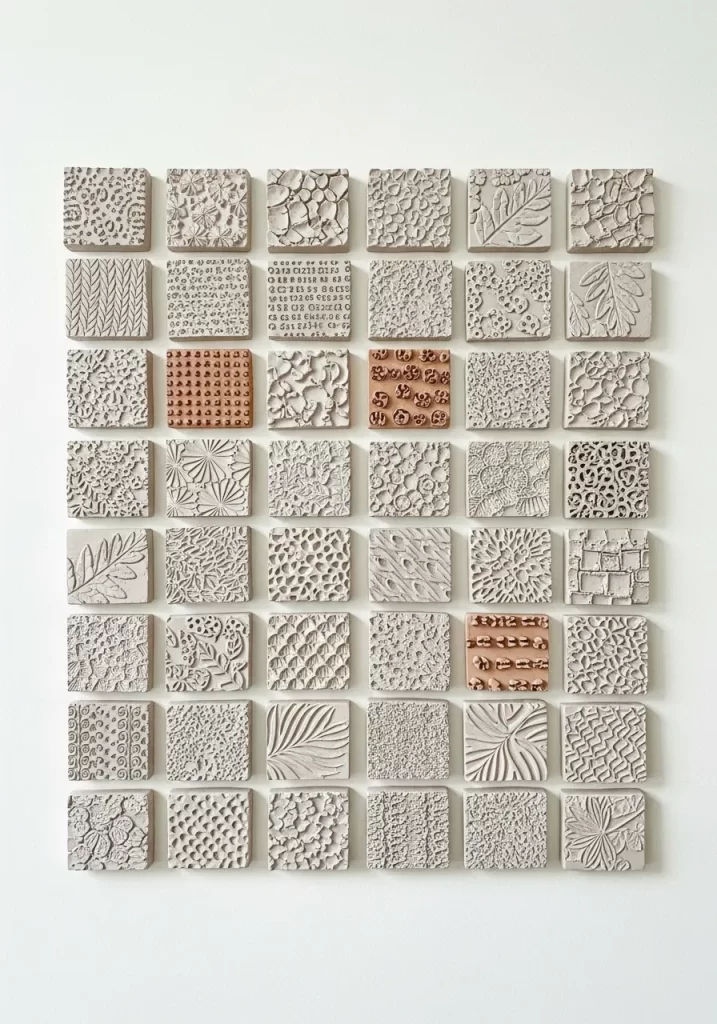
Description
Create a sophisticated, textural wall display using small, squared tiles pressed with organic and geometric patterns. This project uses air-dry clay to form the tiles, which are then imprinted with various objects to create an embossed effect. When painted in a uniform, neutral color, the focus shifts entirely to the depth and texture of the patterns.
The grid arrangement of the tiles creates a subtle, woven look, turning a collection of simple squares into a large, architectural art piece. This art is incredibly versatile and can adapt to any décor style, from bohemian with leafy textures to modern with clean, geometric patterns. The single terracotta-colored accent tile adds a nice, subtle pop of color variation.
Materials Required
- Air-Dry Clay (White or Terracotta Color): Enough to form 36 tiles (or your desired amount).
- Neutral Acrylic Paint (White, Cream, or Light Gray): For painting the tiles.
- Various Objects for Texturing: Leaves, textured fabric, stamps, lace, geometric tools.
- Plywood or Cardboard Backing Board: Cut to display size (optional).
Equipment Required
- Rolling Pin: For rolling out the clay.
- Ruler and Craft Knife: For cutting the square tiles precisely.
- Sponge: For smoothing the clay edges.
- Paint Brush: For painting the finished tiles.
DIY Instruction Step-by-Step
Step 1: Roll and Cut the Tiles
- Knead the air-dry clay until it is soft and workable.
- Use the rolling pin to roll out the clay evenly to a consistent thickness (about 1/4 to 1/2 inch thick).
- Use the ruler and craft knife to cut the clay into identical squares (e.g., 4×4 inches). Use a damp sponge to smooth and clean the edges of each tile.
Step 2: Create the Embossed Textures
- Take each square tile and press a chosen texture object firmly onto the surface. For example, press a leaf into the clay, peel the leaf off carefully, and you are left with the embossed pattern.
- Try using geometric stamps, lace, or a crocheted placemat to create variety in texture. Ensure the pattern is deep enough to be clearly visible but not so deep that it compromises the tile structure.
- Repeat until all tiles have a unique texture. Place a few tiles aside to dry unpainted (or paint them terracotta) for an accent.
Step 3: Dry and Paint
- Lay all the textured tiles flat on a non-stick surface (like parchment paper) and allow them to dry completely. This can take 24–72 hours, depending on humidity.
- Once dry, paint the majority of the tiles with a smooth, even coat of your chosen neutral acrylic paint. The paint should sit on the surface, emphasizing the raised texture.
- Paint your accent tiles (or leave them the raw terracotta color).
Step 4: Mount the Grid
- The tiles can be mounted directly to the wall using strong, permanent adhesive mounting squares.
- Alternatively, you can glue them onto a painted plywood backing board first.
- Carefully mark a grid onto your wall or board with a pencil to ensure the tiles are hung with uniform spacing and perfect alignment.
26. Multi-Tone Chevron Wood Accent Wall
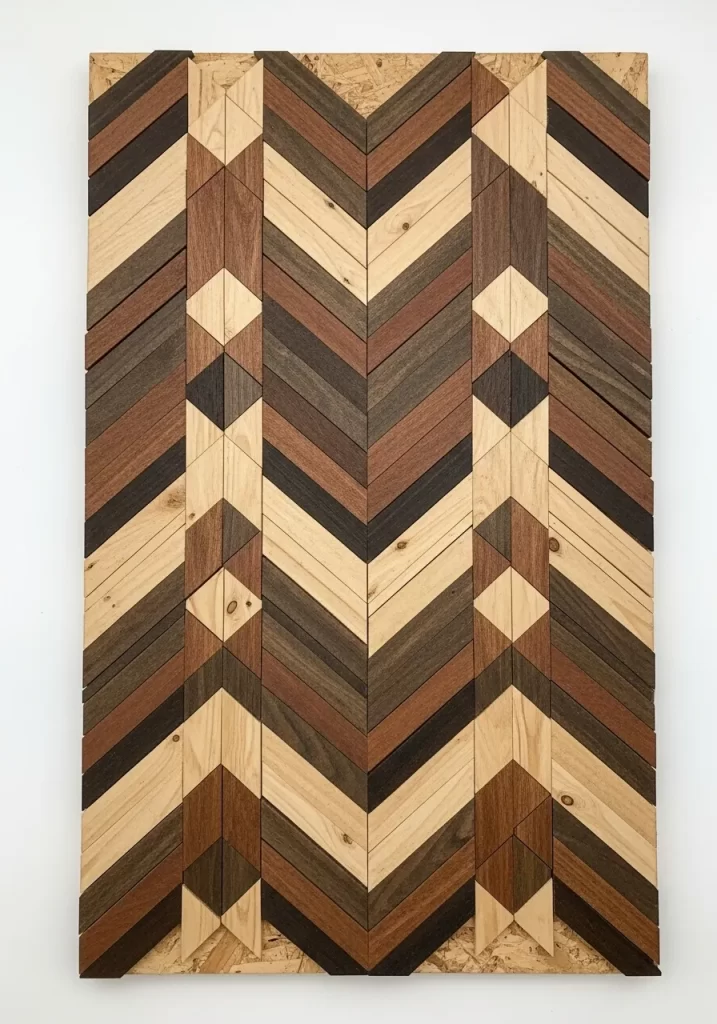
Description
This textural wood piece uses a combination of varying wood stains to create a stunning, intricate chevron and diamond pattern. Different shades of brown, black, and natural wood are cut and arranged to create a striking optical illusion of depth and repeating geometric forms. The mixture of tones gives the art a rustic, yet modern feel, perfect for a feature wall in a dining room or living area.
The beauty of this pattern lies in the precise cutting and the rich variety of wood grain. It is a fantastic way to introduce a massive, custom focal point into a home without resorting to traditional paint or wallpaper.
Materials Required
- Plywood or OSB Backing Board: Cut to your desired size.
- Thin Wood Strips/Lath: Enough to cover the entire board (approximately 1/4 inch thick).
- Wood Stains (Various Tones): Light oak, dark walnut, gray, and black.
- Wood Glue: Strong adhesive.
- Sandpaper: Medium-grit.
Equipment Required
- Miter Saw or Miter Box and Hand Saw: Essential for precise 45-degree cuts.
- Measuring Tape and Pencil: For marking wood accurately.
- Gloves and Rags: For applying stain.
DIY Instruction Step-by-Step
Step 1: Prep and Cut the Wood Strips
- Cut your plywood or OSB backing board to the size you want the finished art to be.
- Cut your thin wood strips into equal segments with a 45-degree angle on both ends. This creates the chevron shape. Ensure every piece is identical in length and thickness.
Step 2: Stain the Pieces
- Divide the cut pieces into several batches.
- Apply a different wood stain to each batch (light, medium, dark, and black). Use a rag to wipe the stain onto the wood, following the wood grain, and wipe off the excess.
- Leave one batch natural (unstained). Allow all the stained pieces to dry completely.
Step 3: Arrange and Glue the Pattern
- Lightly draw a central vertical guide line and diagonal lines on the backing board to help maintain alignment.
- Begin gluing the strips. The pattern is built by alternating the direction of the V-shape (upward-facing chevron, then downward-facing chevron).
- Carefully follow a precise color pattern as you glue: lay down a strip of light, then medium, then dark, and repeat. Use the different stained strips to create vertical columns of opposing V-shapes.
- Crucially: Use the various color combinations to form the illusion of diagonal diamond shapes running down the center column, as seen in the image. This requires careful alignment of the 45-degree angles.
Step 4: Finish and Hang
- Allow the entire assembly to dry for a full 24 hours under some weight.
- Attach heavy-duty hanging hardware to the back of the board.
27. Abstract Mirrored Box Display
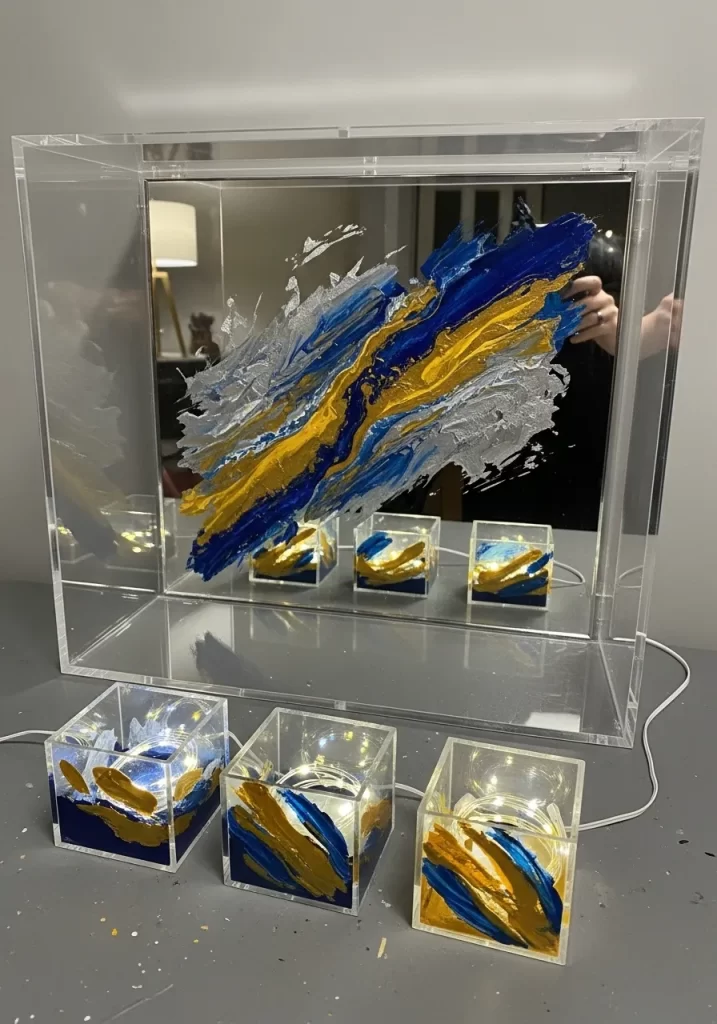
Description
This three-dimensional art piece uses an acrylic shadow box and mirrored backing to amplify the depth of a vibrant abstract design. The primary canvas is the mirrored background, which features a dynamic slash of gold, blue, and silver fluid paint. The reflection creates an illusion of the art extending into a deeper space.
Small, matching painted blocks in the foreground reinforce the design and serve as candle holders or risers. The entire assembly is lit with an internal light source, creating a beautiful glowing effect. This art is a gorgeous, contemporary focal point that works wonderfully on a console table or as a dimensional wall shelf.
Materials Required
- Clear Acrylic Display Box: One large box (or frame with deep sides).
- Acrylic Mirror Sheet: Cut to fit the back of the box.
- Small Clear Acrylic Blocks: Three to four matching cubes.
- Acrylic Paints: Gold metallic, deep blue, and silver metallic.
- Pouring Medium: For making the paint fluid.
- LED Strip Lights or Fairy Lights: To be installed inside the top edge.
Equipment Required
- Hot Glue Gun or Strong Clear Adhesive: For securing the mirror and lights.
- Foam Brush or Palette Knife: For applying the abstract paint.
DIY Instruction Step-by-Step
Step 1: Prep and Paint the Mirror
- Ensure the acrylic mirror sheet is clean and remove any protective film.
- Mix your blue, gold, and silver acrylic paints with a pouring medium to make them fluid.
- Using a foam brush or palette knife, apply the paint in a thick, abstract, diagonal swath across the center of the mirror. Do not over-blend the colors; the goal is to keep the distinct metallic and blue streaks visible.
- Allow the painted mirror to dry completely.
Step 2: Paint the Small Blocks
- Repeat the painting technique on the outside of the three small acrylic blocks. Try to keep the colors and style consistent with the main mirror piece.
- Once dry, place a small amount of fairy lights inside each block before sealing the tops with a piece of clear acrylic or thick plastic.
Step 3: Assemble the Display Box
- Secure the painted mirror inside the large acrylic display box, gluing it firmly to the back wall.
- Place a line of LED strip lights or thin fairy lights along the inside top edge of the box and secure them with adhesive. The lights should illuminate the painted mirror surface.
- Place the three small painted light blocks inside the large display box, arranging them at the base in front of the mirror.
Step 4: Mount or Display
- This art is often displayed on a flat surface, but you can also attach mounting brackets to the back of the acrylic box for secure wall installation.
28. Knotted Jute Rope Sunburst Mirror

Description
Transform a simple round mirror into a gorgeous, textural sunburst piece using thick jute or sisal rope. The design creates a striking bohemian statement with a natural, earthy feel. The body of the frame is wrapped tightly in rope, while the “rays” are formed by simple, yet chunky crown knots and tassels.
The warmth of the natural fiber contrasts beautifully with the sharp reflection of the glass. This art is a fantastic, relatively simple project that requires repetitive knotting to achieve the voluminous, rich texture that makes it stand out. It adds an instant coastal or casual, layered feel to an entryway or bathroom.
Materials Required
- Round Mirror (Unframed or Framed): Any size.
- Plywood Backing Board: Cut slightly larger than the mirror to support the rope frame.
- Thick Jute or Sisal Rope: Many yards will be needed.
- Hot Glue Sticks: Used generously for securing the rope.
- Strong Adhesive: For securing the mirror to the backing board.
Equipment Required
- Hot Glue Gun (High Temp): Essential.
- Sharp Utility Knife or Scissors: For cutting the thick rope.
DIY Instruction Step-by-Step
Step 1: Prep the Base
- Glue the mirror onto the center of the plywood backing board using strong adhesive. Allow it to dry. The exposed plywood around the mirror will be your working surface.
Step 2: Wrap the Frame
- Apply a line of hot glue around the edge of the mirror. Start tightly wrapping the thick jute rope around the mirror edge, pressing the first coil firmly into the glue.
- Continue applying glue and wrapping the rope in tight, concentric circles around the mirror. This will create the main circular frame. Continue wrapping until the wrapped frame is about 4–6 inches wide.
Step 3: Create the Knots and Tassels
- Cut several pieces of rope into equal lengths (about 12–15 inches long).
- To create the ornamental “sunburst” knots, you will use a simple crown knot or overhand knot repeated near the end of the rope piece. Reference a basic rope knotting guide for the crown knot, which is essentially an intertwining of three strands.
- Once the knot is tied, the remaining short ends of the rope are left loose to form a small tassel. Repeat this for all the rope pieces.
Step 4: Attach the Knots
- Apply a generous amount of hot glue to the knot end of one rope piece. Press the knot firmly onto the wrapped frame, spacing it evenly from the mirror.
- Continue gluing the knotted rope pieces around the entire perimeter of the wrapped frame, maintaining even spacing between each one.
- Allow all glue to set fully before hanging. The piece will be heavy, so use robust mounting hardware.
29. Light-Up Paper Cut Shadow Box

Description
This mesmerizing piece creates an illusion of infinite depth using layers of precisely cut paper shapes and integrated LED lighting. The art is built from many sheets of paper, each cut with a slightly different, undulating pattern. When stacked inside a deep shadow box, the shapes create a 3D tunnel effect that seems to stretch into a digital abyss.
A gradient of color (from white to deep navy) is used to enhance the feeling of depth and mystery. The warm LED lights installed along the inner top frame give the edges a soft glow, dramatically highlighting the contours and shadows of the paper layers. This project requires patience but yields a stunning, contemporary art piece that functions as both sculpture and ambient lighting.
Materials Required
- Deep Shadow Box Frame: With a light-colored wood finish.
- Cardstock or Thick Paper: Multiple sheets in a gradient of colors (white, light blue, medium blue, dark blue, navy).
- LED Strip Lights (Warm White): One strand with an adhesive back.
- Thin Spacers (Foam Tape or Small Wood Strips): To separate the paper layers.
- Strong Spray Adhesive or Glue Stick: For mounting paper layers.
Equipment Required
- Craft Knife or Cutting Machine: For precise cutting of the paper shapes.
- Pencil: For drawing the shapes.
- Ruler and Mat: For measuring and cutting.
DIY Instruction Step-by-Step
Step 1: Design and Cut the Paper Layers
- Draw an organic, wavy, non-symmetrical frame shape onto the first sheet of paper.
- For the second sheet, draw a similar but slightly smaller and slightly more irregular frame shape inside the first one.
- Continue this process for all your colored sheets of paper, creating a nested series of decreasingly smaller, distorted frame cutouts.
- Carefully cut out each shape using a craft knife or cutting machine.
Step 2: Prepare the Light and Backing
- Take the deepest colored paper (navy) and use it as the back of the stack.
- Place the LED strip lights along the inside top edge of the shadow box frame, securing them with adhesive. Ensure the wire and battery pack can be discretely hidden on the outside or back.
Step 3: Stack the Layers
- Begin assembling the stack, starting with the largest, lightest colored frame layer. Place small, even pieces of foam tape or thin spacers on the back of the paper.
- Carefully glue or stick the paper layer into the shadow box, centering it.
- Repeat with the next layer (slightly smaller, slightly darker), placing the spacers on the back and adhering it inside the previous frame. The spacers are essential as they create the necessary shadow and depth.
- Continue until the smallest, darkest layer is placed, creating the illusion of a deep tunnel.
Step 4: Assemble and Display
- Place the final, solid navy backing sheet at the very back of the stack.
- Secure the back of the frame, plug in or turn on the LED lights, and hang the piece.
30. License Plate Map Art

Description
Create a colorful, highly personalized piece of wall art by transforming vintage license plates into a map of the United States. This collage uses the unique color, graphics, and typography of old plates to construct the outline of the country. This piece is a wonderfully nostalgic and meaningful way to commemorate road trips, hometowns, or family moves.
Mounted onto a simple piece of natural plywood, the finished map contrasts beautifully with the warm, rustic wood grain. This style is chunky and impactful, making it a fantastic statement piece for a man cave, den, or rustic office. It is a fantastic celebration of Americana and travel history.
Materials Required
- Plywood Backing Board: Large piece, sanded smooth.
- Assorted Vintage License Plates: As many as needed to cover the area of the map.
- Map Template: A printed outline of the United States (or a specific state).
- Strong Industrial Adhesive or Screws: For securing the license plates.
- Wood Frame: For bordering the finished piece (optional).
Equipment Required
- Jigsaw or Tin Snips: For cutting the metal license plates.
- Metal File: For smoothing sharp edges after cutting.
- Safety Glasses and Gloves: Mandatory for cutting metal.
- Power Drill: For pre-drilling holes (if using screws).
DIY Instruction Step-by-Step
Step 1: Cut the Map Template
- Secure your printed map template onto the plywood backing board using masking tape.
- Use a permanent marker to trace the outline of the United States onto the plywood. This serves as your guide.
Step 2: Cut the License Plates
- Wearing safety glasses and gloves, use the tin snips or a jigsaw to cut the license plates into irregular pieces. The pieces need to be small enough to conform to the curves and edges of the map outline.
- As you cut, keep in mind where the best colors and numbers are located. File down any sharp edges on the metal pieces to ensure safety.
Step 3: Assemble the Map
- Begin applying the metal pieces, starting at one corner of the map outline. Place the pieces right up to the edge of the traced line, but not over it.
- Apply a strong industrial adhesive to the back of each piece and press it firmly onto the plywood. Overlap the metal pieces slightly so no wood shows through within the map boundary.
- Continue piecing together the “puzzle” until the entire shape of the United States is covered with the colorful metal.
Step 4: Final Touches
- Once the entire map is complete and the adhesive is dry, you can trace the border of the map with a fine black marker or paint for a clean, crisp edge.
- Attach a sturdy wooden frame to the plywood border (optional).
- Mount the finished art to the wall using heavy-duty hardware.
31. Gold Leaf & Stenciled Canvas Art
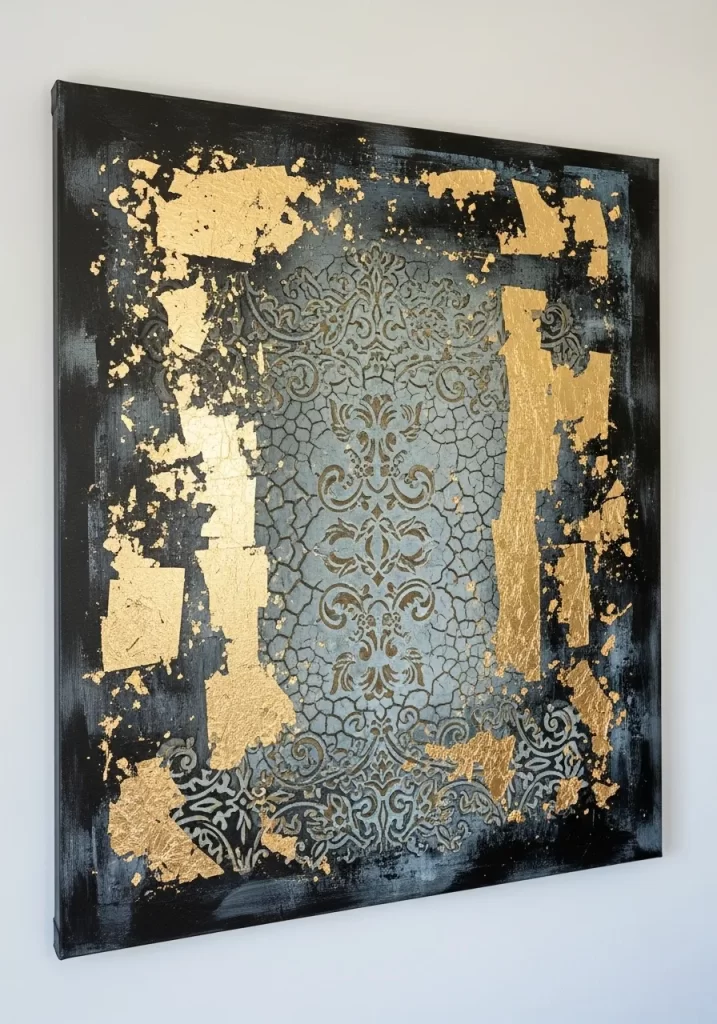
Description
This elegant and dramatic canvas combines the luxurious shimmer of gold leaf with the rich texture of a distressed stencil pattern. The dark, textured background, achieved with a simple paint wash, makes the metallic accents and intricate design truly pop. The distressed edges and visible brushstrokes add to its artisanal charm.
The central damask or mandala-inspired stencil adds a touch of classic pattern, while the raw, uneven application of gold leaf gives it a modern, deconstructed feel. This piece is striking and sophisticated, perfect for adding a touch of glamour and visual interest to a living room, bedroom, or entryway.
Materials Required
- Stretched Canvas: One square canvas (medium to large size).
- Acrylic Paint (Black or Deep Charcoal Gray): For the background.
- Light Blue or Gray-Blue Acrylic Paint: For the stencil base.
- Gold Metallic Acrylic Paint: For stenciling.
- Gold Leaf Sheets and Adhesive (Gilding Size): For the metallic accents.
- Damask or Mandala Stencil: One reusable stencil.
- Clear Spray Sealer (Optional): To protect the gold leaf.
Equipment Required
- Paint Brushes (Large Flat, Small Stencil Brush): For application.
- Palette Knife or Sponge: For distressing the background.
- Soft Brush or Cotton Swab: For applying gold leaf.
- Gloves: For handling gold leaf.
DIY Instruction Step-by-Step
Step 1: Create the Textured Background
- Paint the entire canvas with a base coat of black or deep charcoal gray acrylic paint. Allow it to dry completely.
- Using a small amount of lighter gray or blue paint, lightly brush over the black, creating a distressed, weathered look with visible brushstrokes. Use a palette knife or a dry brush technique for varied texture. Allow to dry.
Step 2: Stencil the Central Design
- Position your damask or mandala stencil in the center of the canvas. Secure it with painter’s tape to prevent shifting.
- Using a stencil brush and the gold metallic acrylic paint (or a light blue/gray-blue), dab the paint directly over the stencil. Use a very light hand and minimal paint to prevent bleeding under the stencil.
- Carefully remove the stencil to reveal the pattern. If desired, you can gently distress the edges of the stencil with a damp cloth for a worn look. Allow the stenciled paint to dry completely.
Step 3: Apply the Gold Leaf
- Once the stencil is dry, apply a thin, even layer of gold leaf adhesive (gilding size) to the areas where you want the gold leaf to appear. The image shows gold leaf applied in large, uneven blocks around the stencil. Allow the adhesive to become tacky (check product instructions).
- Carefully place gold leaf sheets onto the tacky areas. Gently press them down with a soft brush or cotton swab.
- Once the gold leaf is adhered, use the soft brush to gently rub away the excess, revealing the shimmering gold and creating a naturally distressed, flaky effect around the edges.
Step 4: Seal and Display
- Once the gold leaf is fully adhered and excess removed, you can apply a light coat of clear spray sealer to protect the gold leaf from tarnishing and flaking.
- Hang the finished canvas as a striking focal point.
32. Minimalist Wooden Strip Art
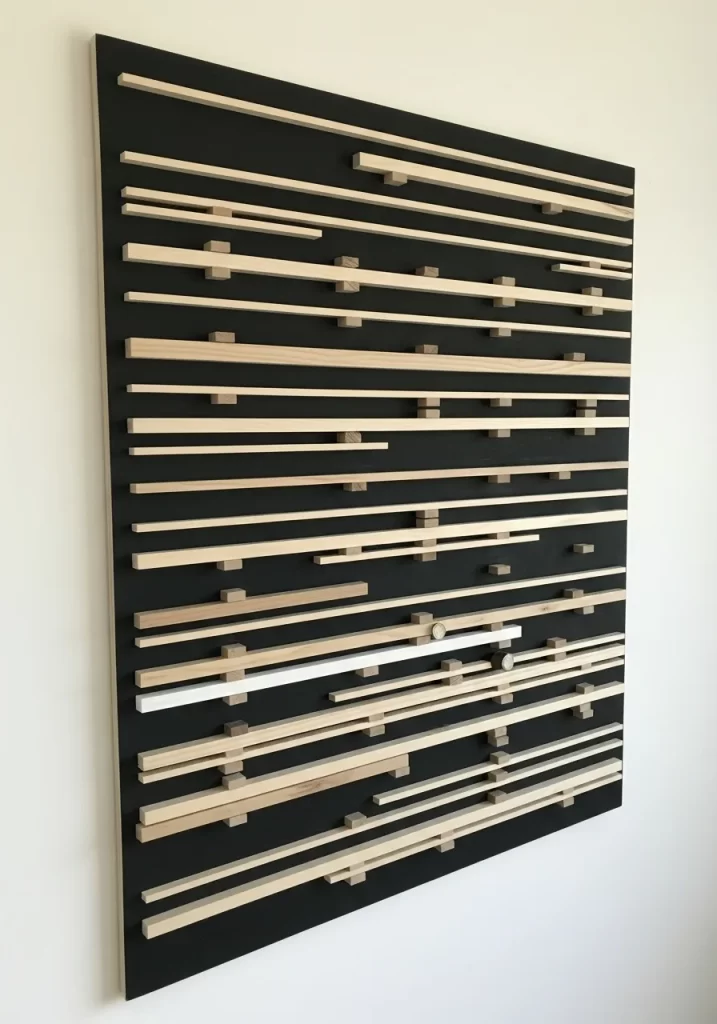
Description
This abstract piece uses thin strips of natural wood arranged in an irregular, horizontal pattern on a dark background. The variations in strip length and the subtle, organic gaps between them create a sense of rhythm and visual flow. The raw wood grain provides warmth against the crisp black canvas, adding a natural, yet modern, touch.
The seemingly random placement is carefully balanced, with some strips extending beyond others, giving the art a dynamic, almost musical quality. This piece is perfect for a contemporary home or office, offering a subtle architectural texture without overwhelming a space. It’s a wonderful way to bring a minimalist, earthy feel to a clean-lined interior.
Materials Required
- Plywood or MDF Board: Cut to your desired size, painted matte black.
- Thin Wooden Strips: Assorted lengths and thicknesses (e.g., balsa wood or pine craft sticks).
- Wood Glue: Strong adhesive.
- Fine Grit Sandpaper: For smoothing wood strips.
Equipment Required
- Ruler and Pencil: For measuring and marking.
- Small Hand Saw or Craft Knife: For cutting wood strips.
- Clamps (Optional): For holding pieces while glue dries.
DIY Instruction Step-by-Step
Step 1: Prepare the Base Board and Wood Strips
- Paint your plywood or MDF board with a matte black acrylic paint. Ensure full coverage and allow it to dry completely.
- Cut your wooden strips into various lengths. Aim for a mix of short, medium, and long pieces to create visual interest.
- Lightly sand the edges of the wooden strips to remove any splinters and give them a smooth finish.
Step 2: Plan the Arrangement
- Lay out all the cut wooden strips on your painted black board without gluing them yet.
- Experiment with different arrangements, creating a horizontal flow with irregular gaps and varying end points. The goal is to create a balanced, yet seemingly random pattern.
- Once you are happy with the layout, take a photo or sketch it to remember the exact positions.
Step 3: Glue the Wooden Strips
- Working one strip at a time, apply a thin, even line of wood glue to the back of each wooden strip.
- Carefully place the strip onto the black board in its planned position, pressing it firmly. Use a ruler to ensure each strip is straight and parallel to the others, even with the varying lengths.
- Continue until all wooden strips are glued in place. Allow the glue to dry completely (overnight is best) with some weight on top if possible.
Step 4: Mount and Display
- Attach robust hanging hardware to the back of the board.
- Hang the piece on a prominent wall where its textural qualities can be appreciated.
33. Dynamic Light Trails Triptych
Description
This high-energy art captures the vibrant pulse of a city at night through stunning long-exposure photography. The triptych format breaks a single, continuous image across three separate canvases, creating a panoramic view. The streaks of red and blue light from passing vehicles create an abstract, fluid motion against the sharp outlines of city skyscrapers.
The reflective wet streets enhance the glow of the lights, adding to the dynamic effect. This art is perfect for adding a modern, urban edge to a contemporary living space, office, or entertainment room. It’s a striking piece that evokes speed and metropolitan energy.
Materials Required
- Digital Image: A high-resolution, long-exposure photograph of city light trails.
- Three Stretched Canvases (Matching Size): For the triptych.
Equipment Required
- Professional Printing Service: To print the image across three canvases.
- Measuring Tape and Level: For precise hanging.
DIY Instruction Step-by-Step
Step 1: Select and Prepare the Image
- Choose a high-resolution digital photograph of city light trails. For the best triptych effect, the image should be wide and have a clear horizontal flow.
- Using image editing software, crop the image to your desired aspect ratio. Plan how the single image will be divided across three canvases. It’s important to ensure that key elements are not cut off awkwardly at the canvas edges.
Step 2: Print the Triptych Canvases
- Send your image to a professional canvas printing service. Specify that you want the image printed as a triptych across three equally sized stretched canvases.
- The printing service will ensure the image is correctly divided and wrapped around the edges of each canvas.
Step 3: Hang the Triptych
- Measure the total width of your three canvases, including the desired spacing between them (typically 1–2 inches).
- Mark the center point on your wall where the entire triptych will be hung.
- Using a level and measuring tape, precisely mark the hanging points for each of the three canvases. It is crucial for the canvases to be perfectly aligned horizontally and with uniform spacing between them.
- Hang the canvases securely, stepping back often to check alignment.
34. Bold Geometric Tape Art Canvas
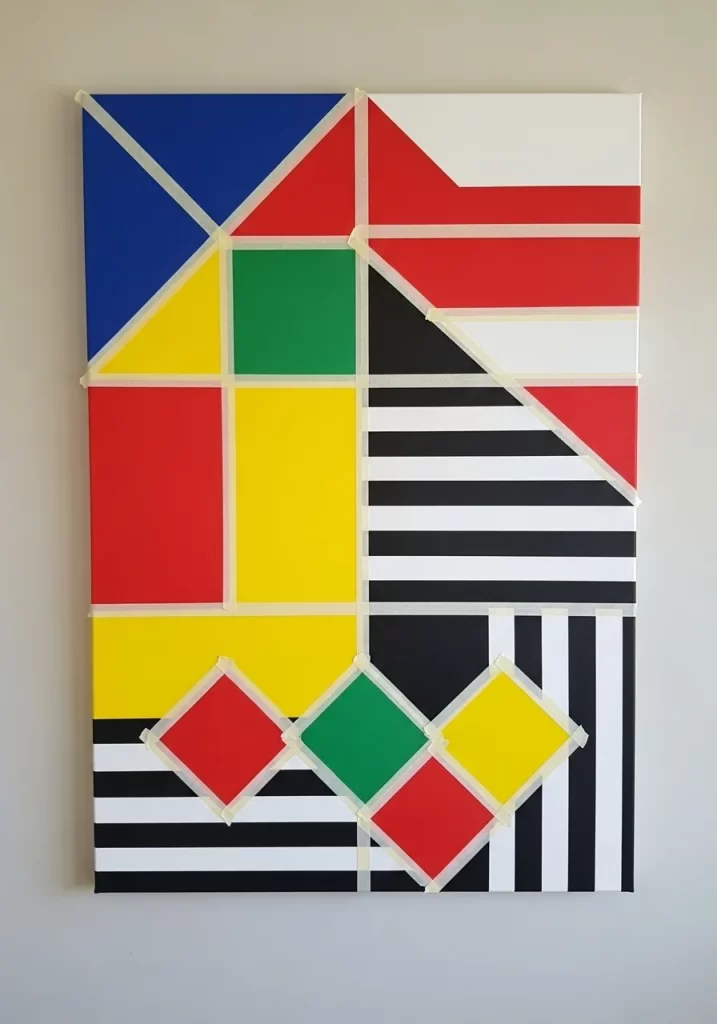
Description
This canvas bursts with graphic energy, using sharp lines and blocks of primary colors to create a dynamic geometric composition. Inspired by modernist art, the design combines bold red, blue, and yellow with crisp black and white stripes and triangles. The careful use of painter’s tape ensures every line is perfectly clean and defined.
The interplay of solid color blocks and striped patterns creates a fascinating visual rhythm. This piece makes a powerful contemporary statement and is a fantastic way to introduce a controlled burst of vibrant color and modern design into a living room, office, or child’s play area. It requires patience and precision but no artistic drawing skill.
Materials Required
- Stretched Canvas: One rectangular canvas.
- Acrylic Paints: Red, Blue, Yellow, Black, White.
- Painter’s Tape (Various Widths): Essential for masking.
Equipment Required
- Ruler and Pencil: For measuring and drawing guide lines.
- Paint Brushes or Foam Rollers: For applying paint smoothly.
- Craft Knife: For trimming tape precisely.
DIY Instruction Step-by-Step
Step 1: Plan the Design
- Sketch your geometric design onto a piece of paper first. Plan out the various color blocks, stripes, and diagonal lines.
- Lightly transfer your design onto the canvas using a pencil and ruler.
Step 2: Tape the First Layer
- Starting with your first color areas, carefully apply painter’s tape along the edges of the shapes you want to remain white, or that will be painted with the first color. Press down firmly on all tape edges to ensure no paint bleeds underneath.
- Paint the first color (e.g., the large blue triangle at the top left). Allow the paint to dry completely.
Step 3: Layer Colors and Patterns
- Once the first color is dry, apply new painter’s tape to cover the areas you just painted or to define new shapes for the next color. For stripes, use thin strips of tape to create the stripe pattern.
- Paint the next section. Immediately peel the tape off after painting each section (before the paint is fully cured) to reveal crisp lines.
- Repeat this process of taping, painting, and peeling for each color block and stripe pattern. This step-by-step approach ensures clean lines and prevents colors from mixing.
Step 4: Final Touches
- Once all sections are painted and dry, inspect the canvas for any small areas where paint may have bled. Use a fine brush and matching paint to touch up these imperfections.
- The finished canvas requires no frame due to its clean, graphic style.
35. Industrial Wire Basket Organization Grid
Description
This functional and stylish wall organization system uses individual black wire baskets arranged in a neat grid pattern. Each basket is backed with a rustic wooden block and features an industrial-style number plate, giving it a vintage, locker-room feel. The combination of dark metal and natural wood creates a rugged yet refined aesthetic.
This piece is incredibly versatile for organization, offering a designated spot for mail, keys, small notes, or even tiny potted plants. The staggered numbers add to its charm and create a unique visual pattern. This system is perfect for an entryway, mudroom, home office, or even a craft room, bringing practical storage with a chic, industrial edge.
Materials Required
- Small Black Wire Baskets: Twenty matching baskets (or your desired number).
- Wooden Blocks/Backing: Small, rectangular wooden pieces cut to fit inside the back of each basket.
- Metal Number Plates: Small rectangular metal plates with numbers (or stencils to create numbers).
- Gold Paint Pen or Vinyl Numbers: For numbering the plates.
- Wall Screws and Anchors: For securing the baskets to the wall.
Equipment Required
- Power Drill: For attaching baskets to the wall.
- Level and Measuring Tape: For precise alignment.
- Strong Adhesive: For attaching number plates.
DIY Instruction Step-by-Step
Step 1: Prepare the Wooden Backings
- Cut your wooden blocks to fit snugly inside the back of each wire basket.
- Lightly sand the wooden blocks and apply a clear sealer or light wood stain if desired to enhance the wood grain. Allow to dry.
Step 2: Number the Plates
- If using blank metal plates, use a gold paint pen or vinyl numbers to apply a unique number to each plate (e.g., 01, 02, 03, etc.).
- Allow the numbers to dry completely.
Step 3: Assemble the Baskets
- Place a wooden block inside the back of each wire basket. Secure it in place with a small amount of strong adhesive or tiny screws through the wire.
- Attach the numbered metal plate to the front of each wooden block (or directly to the wire mesh if preferred) using adhesive or small bolts.
Step 4: Mount the Grid to the Wall
- Using a level and measuring tape, carefully mark out the exact grid pattern on your wall. Ensure each basket will be perfectly aligned horizontally and vertically, with uniform spacing between them.
- Using a power drill, install wall anchors at your marked points (if not drilling into studs).
- Hold each basket in place and use screws to securely fasten it to the wall through the pre-drilled holes in the back of the basket (or through the wire itself).
36. Nautical Rope Script Art

Description
This charming piece transforms thick nautical rope into decorative script lettering, creating a personalized and textural word art. The word “love” (or any chosen word) is formed from the rope, bringing a tangible, maritime feel to the art. The contrasting colored yarn wraps on sections of the rope add small, unexpected pops of color.
Mounted on a simple craft paper or wood background, the chunky white rope creates striking dimension and shadow. This art is perfect for adding a coastal or rustic touch to a living room, bedroom, or entryway. It’s a great way to showcase a meaningful word or phrase with a unique, tactile material.
Materials Required
- Thick White Cotton Rope (Nautical Rope): Several yards.
- Kraft Paper or Canvas Board: The backing for the art.
- Colored Yarn or Embroidery Floss: For wrapping sections of the rope.
- Strong Craft Glue (or Hot Glue): For attaching the rope.
Equipment Required
- Pencil: For sketching the script.
- Sharp Scissors: For cutting rope and yarn.
- Hot Glue Gun (Optional): For quick adhesion.
DIY Instruction Step-by-Step
Step 1: Prepare the Background and Rope
- Cut your kraft paper or canvas board to your desired size. If using kraft paper, you can glue it to a stiffer backing board.
- Take sections of your white nautical rope. Using your colored yarn or embroidery floss, tightly wrap small sections of the rope to create colored accents. Secure the yarn ends with a tiny dot of glue.
Step 2: Sketch the Script
- Lightly sketch your chosen word (e.g., “love,” “home,” “family”) in a cursive or script font onto the background board using a pencil. Make sure the letters are large enough for the thick rope to form.
Step 3: Form and Glue the Rope Script
- Take a long piece of the prepared rope. Begin to form the rope along your sketched lines, shaping it carefully into the letters.
- Apply a continuous bead of strong craft glue (or hot glue) to the back of the rope as you work, pressing it firmly onto the background board. Hold each section for a few seconds to ensure it adheres.
- Where letters connect or overlap, ensure the rope ends are neatly tucked or glued down for a seamless appearance. Trim any excess rope cleanly with sharp scissors.
Step 4: Dry and Hang
- Allow the glue to dry completely and cure for several hours (or overnight) to ensure the rope is firmly attached.
- Attach hanging hardware to the back of the board.
37. Watercolor Wash & Pixel Grid Art
Description
This contemporary art piece combines the soft, organic flow of watercolor washes with the precise, controlled structure of a pixelated grid. The upper section features layers of pastel watercolor, softly blending into a gradient of sky blue, yellow, and blush. The uneven edges and subtle variations in pigment create a painterly, atmospheric effect.
Below this fluid top section, a striking contrast is created with a clean, light blue pixel grid. The individual squares vary subtly in shade, forming a fascinating, almost digital texture. This piece is perfect for a modern, minimalist space, offering a balance of softness and structure, as well as traditional and contemporary techniques.
Materials Required
- Heavy Watercolor Paper: One large sheet.
- Watercolor Paints: Light blue, yellow, light pink, and a darker blue.
- Artist’s Tape: For securing the paper.
- Ruler and Pencil: For drawing the pixel grid.
Equipment Required
- Large Flat Watercolor Brush: For applying washes.
- Small Square Brush: For painting individual pixels.
- Two Water Containers: One for clean water, one for rinsing brushes.
- Hair Dryer (Optional): For speeding up drying.
DIY Instruction Step-by-Step
Step 1: Tape the Paper and Apply First Wash
- Secure the watercolor paper to a flat, rigid surface (like a drawing board) using artist’s tape around all four edges. This prevents buckling.
- Wet the upper half of the paper evenly with clean water using your large flat brush.
- Load your brush with light blue watercolor and apply a broad, horizontal wash across the top. While still wet, gently blend in yellow, then pink, then a deeper blue, allowing the colors to softly mix. You can sprinkle a pinch of salt onto the wet dark blue for interesting texture.
- Allow the watercolor wash to dry completely (you can use a hairdryer on a cool setting).
Step 2: Draw the Pixel Grid
- Once the top section is dry, use a pencil and ruler to draw a perfect grid of small squares in the lower section of the paper. Ensure the lines are light and even.
- Decide on a palette of 3-4 shades of light blue watercolor for your pixels. Mix them in separate wells on your palette.
Step 3: Paint the Pixel Grid
- Using a small square brush, begin painting the individual squares of your grid.
- Vary the shades of blue as you paint, creating an irregular, pixelated pattern. Do not paint adjacent squares with the exact same shade; this creates visual interest.
- Maintain crisp edges on each square. Allow the grid to dry completely.
Step 4: Frame and Display
- Carefully remove the artist’s tape from the paper.
- Frame the finished artwork in a simple, modern frame to highlight the contrasting textures.
38. Boho Macrame Wall Organizer with Pockets
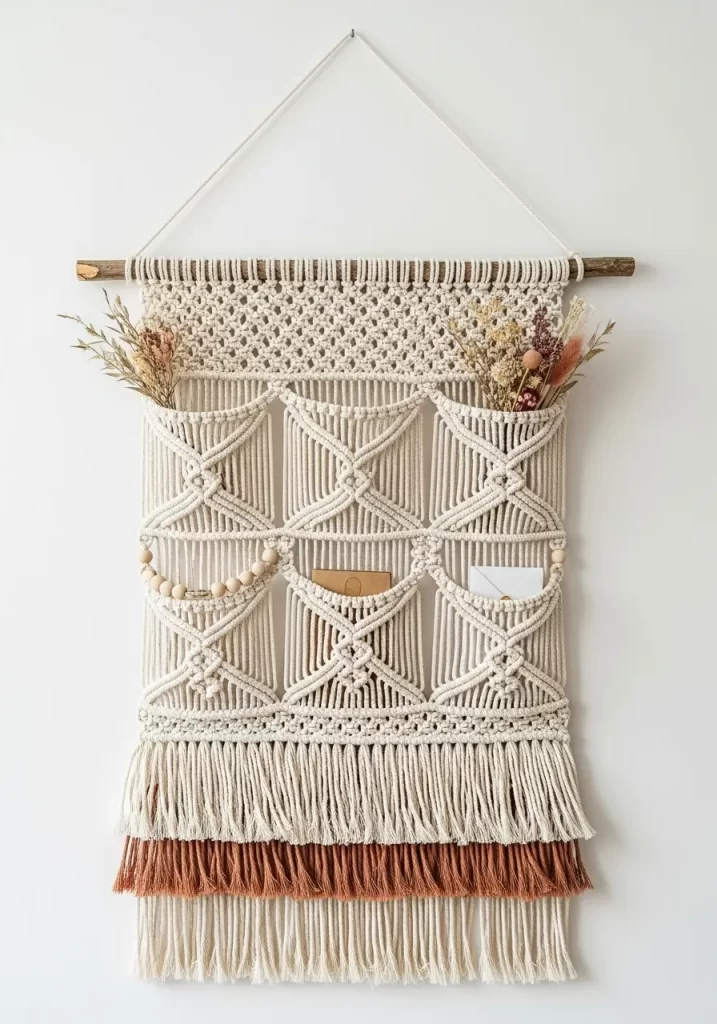
Description
This intricate macrame wall hanging is not only beautiful but also highly functional, featuring integrated pockets for organization. Crafted from natural cotton rope, it showcases a variety of macrame knots that create a rich tapestry of texture and pattern. The natural white rope gives it a calming, bohemian aesthetic.
The design includes two large pockets perfect for storing dried flowers, letters, or other small treasures, adding a lovely decorative and practical element. The bottom is finished with a tiered fringe of natural and rust-colored rope, adding another layer of texture. This piece is a fantastic way to introduce a handmade, organic feel to an entryway, bedroom, or craft space.
Materials Required
- Driftwood or Wooden Dowel: One piece approximately 18–24 inches long.
- Natural Cotton Macrame Rope (3-5mm): Many yards will be needed.
- Colored Yarn/Rope (Rust, White): For the bottom fringe accents.
- Thin Twine or Rope: For the main hanging loop.
Equipment Required
- Sharp Scissors: For cutting rope and trimming fringe.
- Measuring Tape: For consistent lengths.
DIY Instruction Step-by-Step
Step 1: Attach Rope to the Dowel
- Cut a long piece of thin twine and tie a loop to the ends of the driftwood for hanging.
- Cut many long lengths of macrame rope. Fold each length in half and attach them to the driftwood using a Lark’s Head Knot. Fill the entire dowel with these attached ropes. These are your “warp” strings.
Step 2: Create the Top Knotted Section
- Begin tying various macrame knots across the top section of the hanging. Square knots, half knots, and spiral knots are common.
- Create a dense, patterned section across the top (like the woven-looking area in the image) using repetitive knotting techniques. This forms the foundation of the piece.
Step 3: Form the Pockets
- To create the pockets, you will need to tie a series of knots that form an upward-curving shape. Use a combination of square knots and half-hitch knots to create the diamond-like patterns that define the pocket structure.
- At the base of each pocket, you will need to gather and knot the ropes to create a bottom, making it functional. The image shows two larger pockets at the top and smaller, decorative “pockets” in the middle.
Step 4: Add the Fringe and Finishing Touches
- Below the pockets, continue with a simpler knotting pattern or leave the ropes flowing free.
- At the very bottom, add layers of colored yarn or rope (like the rust-colored layer) by tying them onto the existing ropes.
- Trim the bottom fringe evenly with sharp scissors, or create a layered, organic look.
- Hang the macrame wall organizer on the wall.
39. Minimalist Textured Palette Knife Art
Description
This minimalist art piece relies on pure texture and subtle color contrast to create a powerful statement. The canvas is divided vertically into two sections, one in a cool gray and the other in a crisp white. Both sides are covered in thick, expressive palette knife strokes, giving the surface incredible depth and dimension.
The rough, impasto texture creates a sense of raw, modern elegance. This art piece is perfect for a contemporary or industrial interior, where it can provide a sophisticated focal point without relying on complex imagery. It is a striking exploration of form and surface, making it a fantastic DIY project for an aspiring abstract artist.
Materials Required
- Stretched Canvas: One square canvas (medium to large size).
- Acrylic Paint (Medium Gray, White): Heavy body acrylics are best for texture.
- Modeling Paste or Texture Medium (Optional): To build up extra texture.
Equipment Required
- Palette Knife (Assorted Sizes): Essential for applying the paint.
- Painter’s Tape: For creating the straight dividing line.
DIY Instruction Step-by-Step
Step 1: Prepare the Canvas and Divide
- Using a ruler and pencil, lightly draw a straight vertical line down the center of your canvas, dividing it into two equal halves.
- Apply painter’s tape precisely along one side of this line, masking off the half you do not want to paint first. Press the tape down firmly.
Step 2: Apply the First Textured Color
- Scoop a generous amount of gray acrylic paint (or a mix of paint and modeling paste for extra thick texture) onto your palette knife.
- Begin applying the paint to the unmasked half of the canvas. Use the palette knife to create thick, uneven, expressive strokes. Experiment with different directions and pressures to create varied textures, building up layers of paint.
- Immediately and carefully peel off the painter’s tape while the paint is still wet to reveal a clean, straight edge. Allow this half to dry completely.
Step 3: Apply the Second Textured Color
- Once the gray half is completely dry, apply painter’s tape along the newly defined straight edge of the gray section, masking it off to protect it.
- Repeat the process from Step 2, applying thick white acrylic paint (or white paint with modeling paste) to the remaining unpainted half of the canvas.
- Create rich, varied texture with your palette knife.
- Immediately and carefully peel off the painter’s tape while the white paint is still wet to reveal the final clean dividing line.
Step 4: Dry and Display
- Allow the entire canvas to dry completely. Due to the thick layers of paint, this may take 24–48 hours.
- The finished textured art is ready to hang without a frame.
40. Neon String Art Map
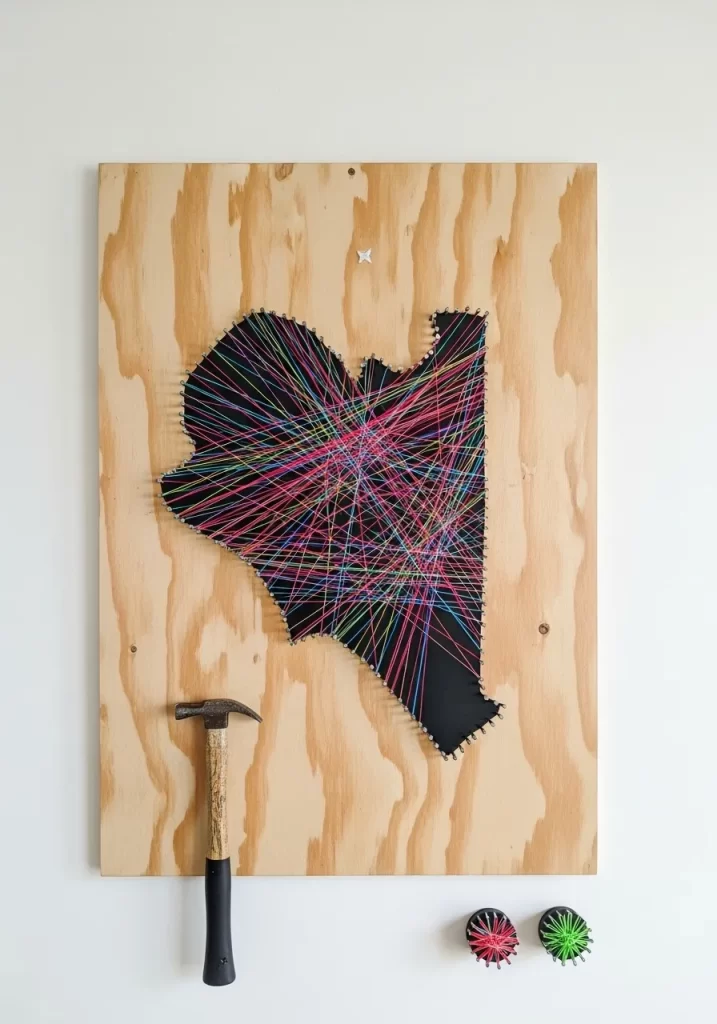
Description
This vibrant and energetic piece transforms a simple map outline into a dazzling display of neon string art. Using a dark, solid backing behind the map, colorful threads are stretched between dozens of small nails, creating a dense, geometric web of color. The contrast between the bright strings and the dark background makes the colors pop dramatically.
This project allows for incredible personalization, whether it is a map of a favorite state, country, or even a personal symbol. The overlay of colors creates unexpected blends and a dynamic sense of movement. This art is a fantastic, modern way to commemorate a place and adds a unique, eye-catching focal point to a contemporary space or a child’s bedroom.
Materials Required
- Plywood or MDF Board: Cut to your desired size.
- Black Felt or Fabric: Cut to fit the outline of your chosen map shape.
- Small Nails or Pins: Many small nails (e.g., 3/4 inch brad nails).
- Embroidery Floss or Thin String: Various neon or bright colors.
- Map Template: Printed outline of your chosen map (e.g., a state, country).
Equipment Required
- Hammer: For driving nails.
- Pencil: For tracing the map.
- Strong Craft Glue: For securing the felt.
- Scissors: For cutting string.
DIY Instruction Step-by-Step
Step 1: Prepare the Base Board and Map Template
- Sand your plywood or MDF board smooth.
- Print your chosen map template (e.g., a state, country) to the desired size. Cut out the map shape from the paper.
- Glue the black felt or fabric onto the plywood board. Once dry, place your paper map template onto the felt and lightly trace its outline with a pencil or chalk.
Step 2: Hammer the Nails
- Along the entire traced outline of your map, begin to hammer small nails into the board. Space the nails evenly, about 1/2 to 3/4 inch apart. Ensure all nails are hammered to the same depth.
- Make sure the nails are sturdy enough to withstand the tension of the string.
Step 3: Create the String Art
- Choose your first color of neon string. Tie one end of the string in a secure knot around one of the nails on the outline.
- Begin to randomly stretch the string across the map shape, wrapping it around other nails on the perimeter. The goal is to create intersecting lines that fill the entire map area.
- Continue wrapping and stretching, ensuring the string remains taut. When you want to change colors, tie off the current string with a secure knot around a nail and start a new color from another nail.
- Layer multiple colors of string, creating a dense, vibrant web until the entire map interior is filled with color.
Step 4: Final Touches
- Once the string art is complete, ensure all knots are secure.
- Attach hanging hardware to the back of the board.
Finding the motivation to start a large decorating project can be the toughest part, but the reward of a personalized home is immense. We have now explored 40 creative ways to transform bare walls into canvases of expression. From the rustic charm of the Dimensional Chevron Wood Art to the modern, illuminated depth of the Light-Up Paper Cut Shadow Box, every technique offers a path to custom décor.
The beauty of DIY lies in the freedom to adapt every material list and instruction. Feel free to swap neon colors for muted tones, or trade a city map for a constellation outline. Your home is waiting for its story, and these projects give you the tools to write it, one beautiful piece at a time.
Key Takeaways
- Customization is Key: Handmade art allows you to perfectly match colors, scale, and textures to your existing furniture and room design.
- Texture Adds Depth: Projects using wood, rope, metal, or thick paint (like Minimalist Textured Palette Knife Art) instantly make a room feel richer and more layered.
- Budget-Friendly Decor: Many high-impact projects, such as Faux Floral Coffee Filter Wall Display or Geometric Vinyl Record Art, creatively reuse inexpensive or upcycled materials.
- Mix Media for Interest: Do not be afraid to combine materials—paper, paint, fabric, and light—to create unique, eye-catching focal points in any space.