
Your home is your story. Yet, so often, the biggest storytellers—the walls—are left completely blank. They are empty pages in a book waiting to be written. A bare wall can make a room feel unfinished and impersonal. It lacks the character that turns a simple space into a sanctuary.
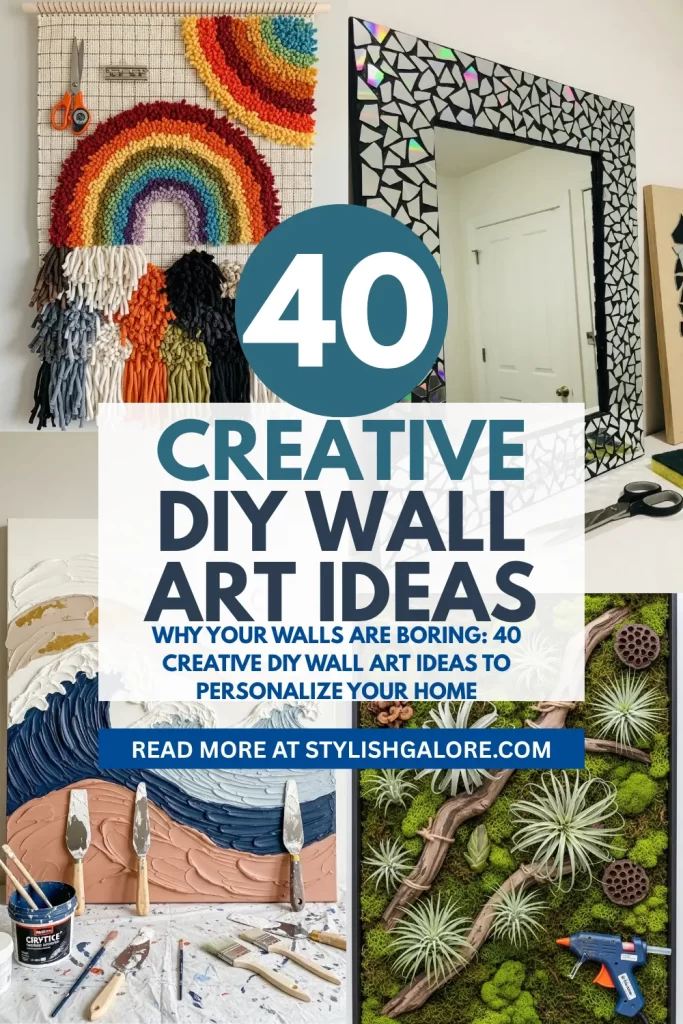
But filling those walls doesn’t require a massive budget or a degree in fine art. It just takes a little bit of creativity and the courage to make something with your own hands. Personalizing your home is about infusing it with your personality, your memories, and your style.
This guide is here to help you do just that. We’ve gathered 40 creative DIY wall art ideas that anyone can tackle. From simple fabric hangings to textured plaster sculptures, there is a project here for every skill level and every style. It’s time to pick up a tool and turn those boring walls into beautiful reflections of you.
1. Textured Ocean Wave Art
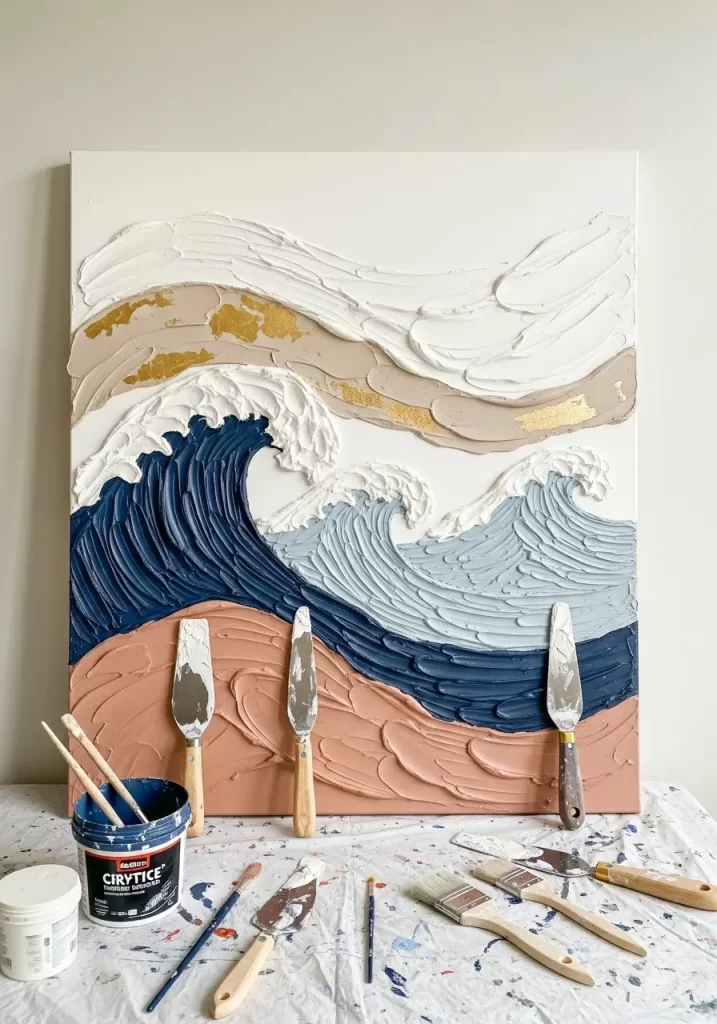
Bring the calming motion of the sea into your home. This art piece uses thick texture to create a sense of movement. The raised waves cast small shadows that change as the light moves through the room. It adds a dynamic, three-dimensional element to any space.
Different colors define the sea, surf, and sand. The deep blues of the ocean meet the crisp white of the foam. Touches of gold catch the light, like sun reflecting on water. This artwork turns a blank wall into a peaceful coastal scene. It’s a simple project with a stunning result.
DIY Instructions: How to Create Your Own Wave Art
What You’ll Need:
- A blank canvas (any size you like)
- A tub of pre-mixed joint compound or spackling paste
- Acrylic paints (different shades of blue, white, beige, and a sandy pink/brown)
- Palette knives or old plastic butter knives
- A few small bowls or paper plates for mixing
- A pencil
- Optional: Gold leaf flakes
Step-by-Step Guide:
- Prepare Your Canvas: Place your canvas on a covered surface. Use your pencil to lightly draw the basic shapes of your waves and sand onto the canvas. This will be your guide.
- Mix Your Colors: Scoop some of the joint compound into your bowls. Add a little bit of acrylic paint to each bowl and mix it up. Create all the colors you want for your ocean, waves, and sand.
- Build the Sand and Sea: Start with the sandy color. Use a palette knife to scoop up the colored paste and spread it along the bottom part of your canvas. Next, do the same with your darkest blue, then the lighter blue above it.
- Create the Waves: Now for the fun part! Take your white-colored paste. Plop it along the lines where your different colors meet. Use the tip of your palette knife to pull the paste upwards, making little peaks just like splashing waves.
- Let It Dry Completely: This is very important. The paste is thick, so it needs a long time to dry. Let it sit for at least 24 to 48 hours until it’s hard.
- Add a Little Shine (Optional): If you want some sparkle, put tiny dabs of glue where you want the gold flakes to go. Gently press the gold leaf on top.
- Hang Your Masterpiece: Once everything is dry, your ocean art is ready to be hung on the wall for everyone to enjoy!
2. Rustic Rope Mandala
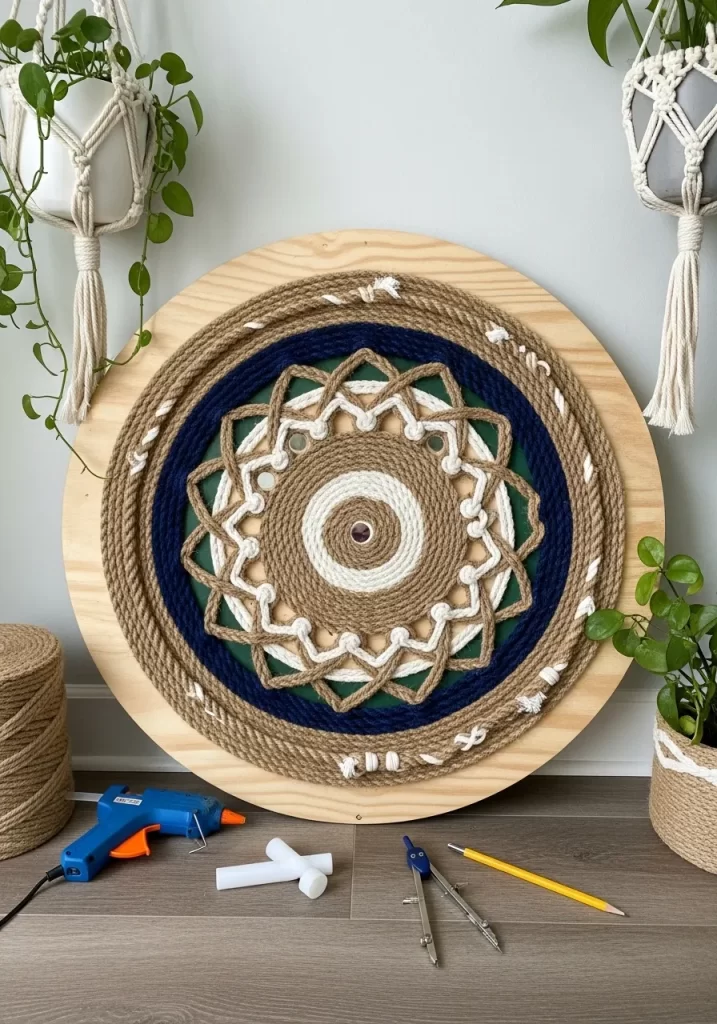
Introduce some bohemian charm to your room with a rope mandala. This design uses coiled and woven ropes to form an intricate, circular pattern. The natural texture of the jute rope, combined with colored strands, creates a warm and inviting focal point. It feels both earthy and artistic.
This piece is built on a simple wooden base, letting the handmade pattern shine. The layers of rope add depth and shadow, making the design pop. It is a wonderful way to fill a large space with a single, impactful piece of art.
DIY Instructions: How to Make a Rope Mandala
What You’ll Need:
- A round wooden board
- Ropes in different colors and thicknesses (natural jute, white cotton, blue, etc.)
- A hot glue gun with plenty of glue sticks
- A pencil
- A compass or a large bowl to draw circles
Step-by-Step Guide:
- Plan Your Design: Place the wooden board on your work surface. Use the compass or bowl to draw circles on the board. These will be your guides for placing the rope.
- Start in the Center: Begin with a small coil. Take the end of one rope, add a dot of hot glue, and start curling it into a tight spiral. Glue as you go.
- Glue the Center Down: Once your center coil is the size of your innermost circle, glue it firmly to the middle of the board.
- Build Your Rings: Work your way outwards. Squeeze a line of hot glue along your next pencil circle and carefully press the rope onto it. Do this ring by ring with different colored ropes.
- Add Fancy Details: To make the fancy loops, cut small pieces of rope. Fold them in half to make a loop and glue the ends down inside one of your rings. Repeat all the way around to make a flower-like pattern.
- Let It Set: Allow the hot glue to cool and harden completely.
- Display Your Work: Add a hook to the back of the board and hang your new mandala art.
3. Geometric Tape Mural
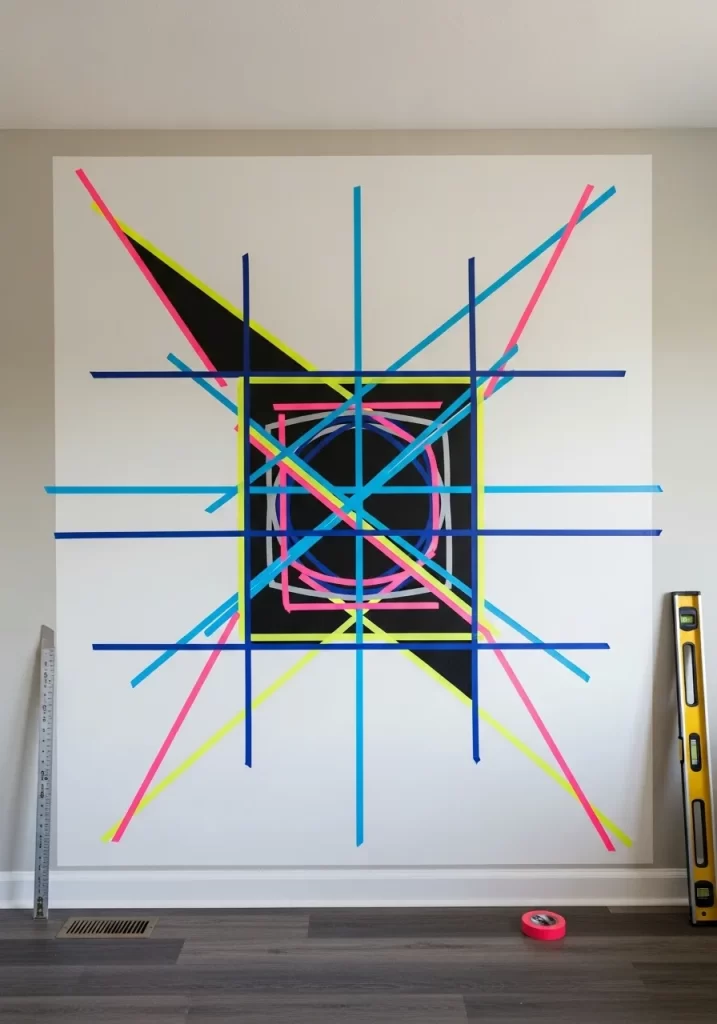
Transform a wall with just a roll of tape. This project uses colorful tape to create a striking geometric mural. The sharp lines and bold colors produce a modern, energetic look. It’s an excellent choice for a temporary design, as the tape can be removed without damaging the wall.
The abstract pattern is created by overlapping strips of tape at various angles. A dark, painted square in the middle anchors the design, making the bright neon lines stand out even more. This method allows you to craft a large-scale piece of art that is both affordable and completely unique.
DIY Instructions: How to Create a Tape Mural
What You’ll Need:
- A blank wall or a large canvas
- Painter’s tape in different bright colors (like pink, blue, yellow)
- A ruler or a level
- Scissors
- Optional: Black paint for a center square
Step-by-Step Guide:
- Choose Your Spot: Decide where you want your mural. Make sure the wall is clean and dry.
- Create a Center Point (Optional): If you want a black square like in the picture, use painter’s tape to make a large square outline. Paint inside the lines and let it dry completely before peeling the tape off.
- Lay Your First Line: Take your first color of tape. Use a ruler or level to make sure it’s straight. Press a long strip of tape across your wall or canvas.
- Start Crossing Lines: Now take another color. Place this strip so it crosses over your first one. You can make it go at any angle you like.
- Keep Building: Continue adding more and more strips of tape. Overlap them, run them parallel, and crisscross them to build your design. There are no rules, so just have fun with it!
- Trim the Edges: Once you are happy with your design, use scissors to carefully trim any tape ends that go past the edge of your canvas or the area you want to decorate.
- Step Back and Admire: That’s it! You have a cool, modern piece of art that you can change whenever you want.
4. Vintage Botanical Frames
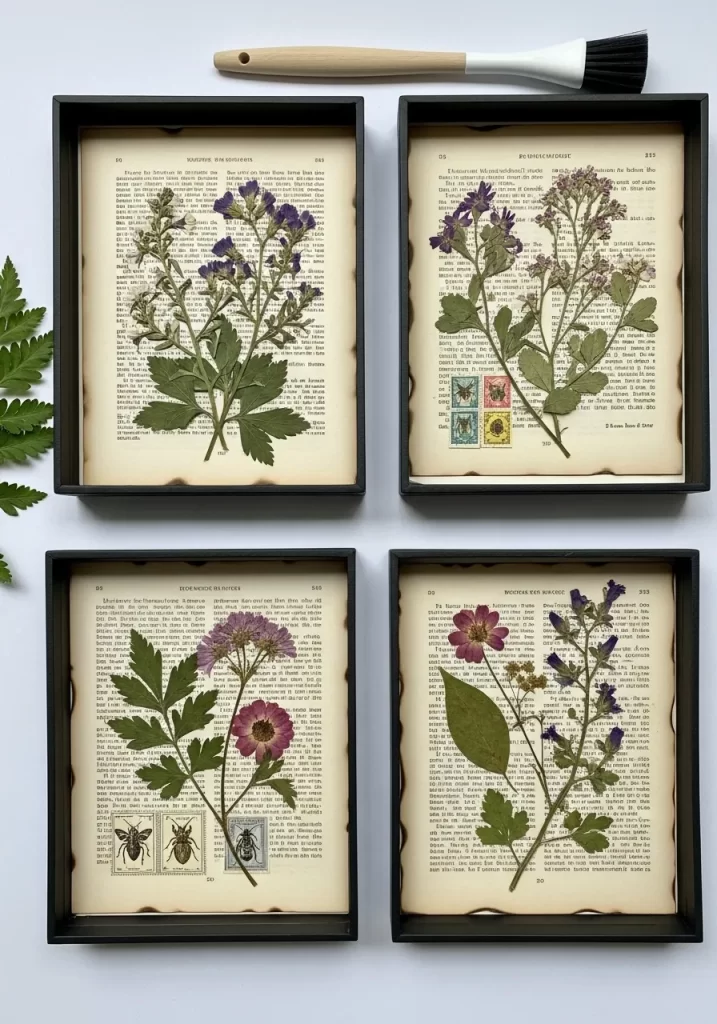
Capture the delicate beauty of nature inside a frame. This art style pairs pressed, dried flowers with pages from old books. The combination creates a timeless, romantic feeling. Each frame tells a small story, blending natural science with literature.
The flowers are carefully arranged on the aged paper, which may even have interesting text or illustrations. Placed inside simple, dark shadow boxes, the botanicals stand out. Grouping four frames together makes for a lovely gallery wall that brings a touch of the garden indoors.
DIY Instructions: How to Frame Pressed Flowers
What You’ll Need:
- Pressed and dried flowers (you can press them in a heavy book for a week or two)
- Pages from an old book you don’t mind taking apart
- Shadow box frames
- Craft glue or a glue stick
- Tweezers (to handle the delicate flowers)
Step-by-Step Guide:
- Choose Your Pages: Carefully remove a few pages from an old book. Look for pages with nice-looking text or a yellowed, aged color.
- Arrange Your Flowers: Place a book page on your work surface. Use tweezers to gently pick up your pressed flowers and arrange them on the page. Try different layouts until you find one you like.
- Glue Them in Place: Once you have your design, carefully lift each flower or leaf. Put a few tiny dots of glue on the back and gently press it back onto the page. Use very little glue so it doesn’t squish out.
- Prepare the Frame: Open the back of your shadow box frame. Most frames come with a backing board.
- Mount Your Artwork: Glue your finished book page onto the backing board of the frame. This will keep it from sliding around.
- Put It All Together: Carefully place the backing board back into the frame and secure it.
- Create a Collection: Make a few more in the same way. Hang them together on your wall to create a beautiful set.
5. Ethereal Ink Bloom
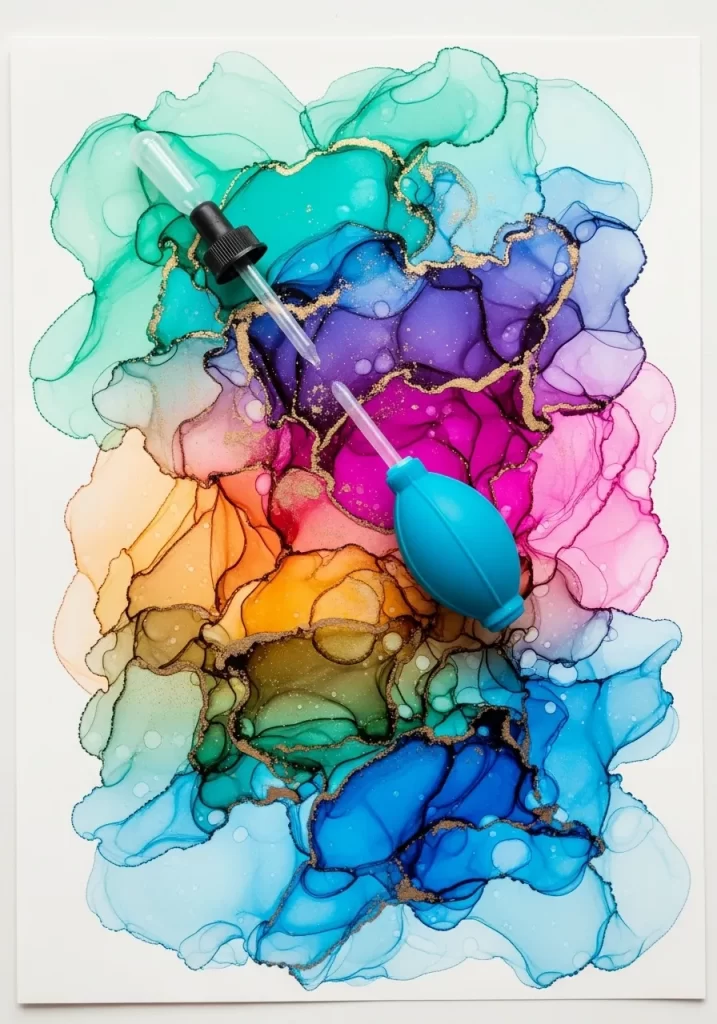
Create a stunning piece of fluid art with alcohol inks. This technique produces vibrant, flowing patterns that look like colorful smoke or blooming flowers. The way the inks blend and separate creates organic shapes that are impossible to plan, so every single piece is one-of-a-kind.
Gold metallic ink is often mixed in, adding elegant veins that shimmer in the light. The colors appear transparent, layering over each other to create new shades. This art is mesmerizing to look at and surprisingly fun to make, as you watch the colors come to life.
DIY Instructions: How to Paint with Alcohol Inks
What You’ll Need:
- Yupo paper (a special slick, non-absorbent paper)
- Alcohol inks in several colors
- 91% or higher isopropyl alcohol
- A small squeeze bottle or dropper for the alcohol
- A small air blower (like one for cleaning keyboards) or a simple drinking straw
Step-by-Step Guide:
- Set Up Your Space: Work in a well-ventilated area and cover your table, as alcohol inks can stain.
- Drop Your Colors: Squeeze a few drops of your first alcohol ink color onto the Yupo paper. Then add a drop of a different color right next to it.
- Add Alcohol to Blend: Squeeze a few drops of the isopropyl alcohol onto the ink drops. You’ll see the colors start to spread out and blend together.
- Move the Ink with Air: Use your air blower or straw to gently blow the inks across the paper. This will create soft, wavy edges. Push the colors into each other to see how they mix.
- Layer and Build: Keep adding more ink and more alcohol. Let some areas dry a little before adding new colors on top to create layers. Add drops of metallic gold ink for some sparkle.
- Let It Dry: Once you are happy with your creation, leave it flat to dry completely. It usually dries pretty quickly.
- Frame Your Art: Alcohol ink art looks fantastic in a simple frame with a mat, which helps the bright colors stand out.
6. Abstract Woven Tapestries
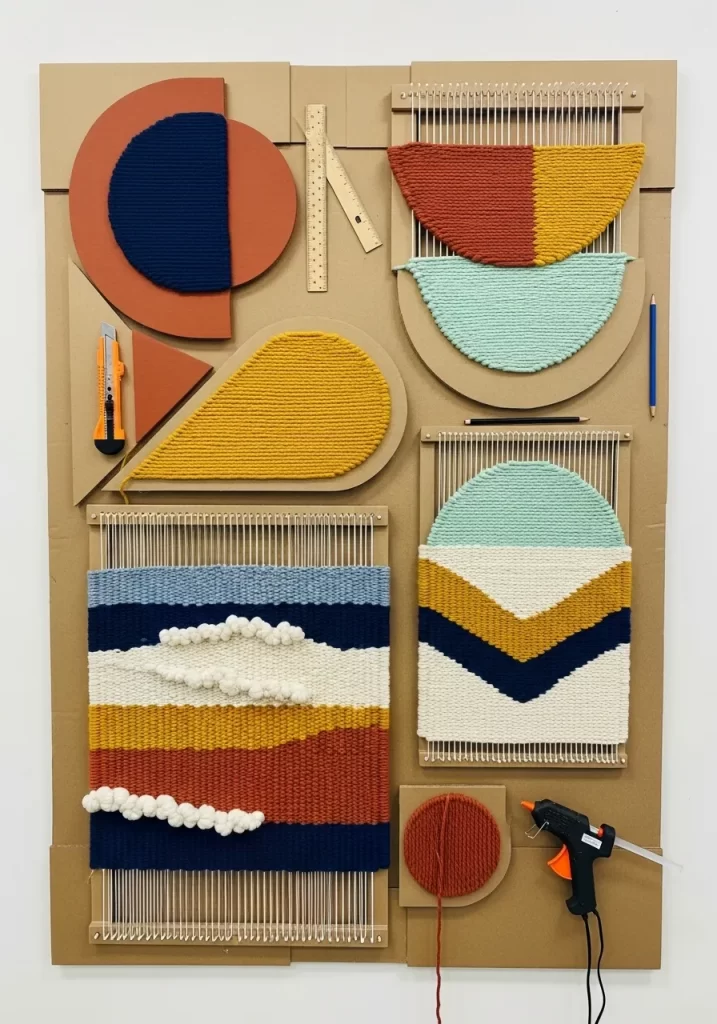
Weaving is not just for blankets. You can create amazing modern art by weaving yarn onto custom-shaped looms. This project uses looms made from cardboard cut into circles, semi-circles, and other geometric forms. The result is a collection of small, textured tapestries.
Each piece uses a different color palette, from earthy tones to sunset colors. Some have fluffy, cloud-like textures, while others have clean, straight lines. Grouping these unique weavings together on a single board creates a large, gallery-style piece that is full of texture and personality.
DIY Instructions: How to Weave on a Cardboard Loom
What You’ll Need:
- Sturdy cardboard
- Pencil and ruler
- Craft knife or strong scissors
- Yarn in different colors and textures
- A large needle or a piece of thin cardboard to use as a shuttle
Step-by-Step Guide:
- Make Your Loom: Draw a shape on your cardboard, like a circle or a square. Use the craft knife to cut it out. Then, cut small, evenly spaced notches along the top and bottom edges of your shape.
- String the Loom (Warp): Take one color of yarn. Tuck the end into a notch on the back. Now string the yarn straight down to the opposite notch, then loop it around the back and up to the next notch. Continue until all the notches are filled. This is your “warp.”
- Start Weaving (Weft): Thread a long piece of a different colored yarn through your needle. This is your “weft.” Start at one side and guide the needle over the first warp string, under the second, over the third, and so on, all the way across.
- Weave Back: For the next row, do the opposite. Go under the strings you went over before, and over the strings you went under. Push the yarn down so it’s snug against the row below it.
- Change Colors: To change colors, just finish a row and snip the yarn, leaving a small tail at the back. Start the new color on the next row.
- Finish Your Weaving: When you’re done, cut the warp strings from the back of the loom. Tie the loops together in pairs to secure your weaving.
- Display Your Art: You can hang your little tapestries as they are or mount them together on a larger board.
7. Sun-Kissed Nature Prints
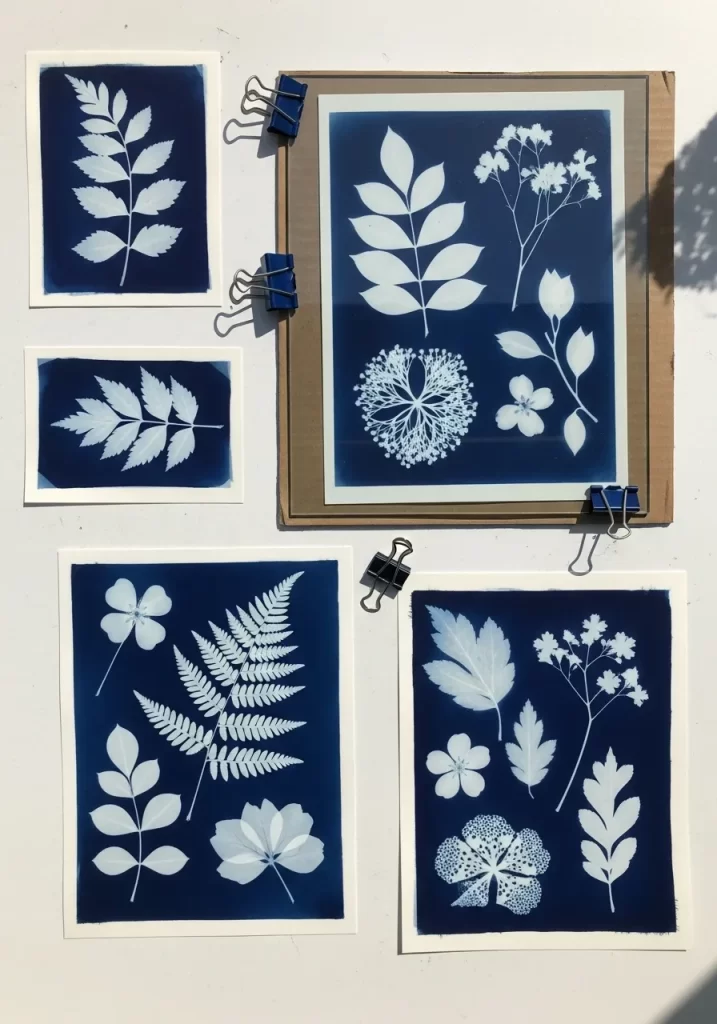
Use the power of the sun to create beautiful, detailed prints of plants. This process is called cyanotype, a simple photographic method that results in a striking indigo blue image. You can capture the exact silhouette of any leaf, fern, or flower you find.
The technique is magical to watch. White paper is coated with special chemicals, and when an object is placed on it in the sun, the paper exposed to light turns blue. The area blocked by the plant remains white. This creates a crisp, elegant image that highlights the delicate shapes found in nature.
DIY Instructions: How to Make Sun Prints
What You’ll Need:
- A cyanotype kit or pre-treated cyanotype paper
- A collection of leaves, flowers, and ferns
- A piece of clear glass or acrylic (from a picture frame is fine)
- A tray or tub larger than your paper
- Access to bright, direct sunlight
Step-by-Step Guide:
- Collect Your Plants: Go on a nature walk and gather interesting-looking leaves and flowers. Flatter items work best.
- Prepare Your Print: In a dim room away from sunlight, take out a piece of your cyanotype paper. Arrange your leaves and flowers on top of it.
- Secure Your Design: Carefully place the piece of glass on top of the plants and paper. This holds everything in place so you get a sharp image.
- Expose to Sunlight: Take your setup outside into the bright sun. The paper will start to change color, often from a yellow-green to a bronze or gray color. This usually takes about 5 to 15 minutes, depending on how sunny it is.
- Rinse and Reveal: Bring your print back inside. Remove the glass and plants. Immediately submerge the paper in a tray of cool water. Gently swish it around for a few minutes. You will see the image appear as the paper turns a brilliant blue!
- Let It Dry: Hang your print up to dry in the shade. As it dries, the blue will become even deeper.
- Frame Your Prints: Once dry, your sun prints are ready to be framed and displayed.
8. Faux Stained Glass Panel
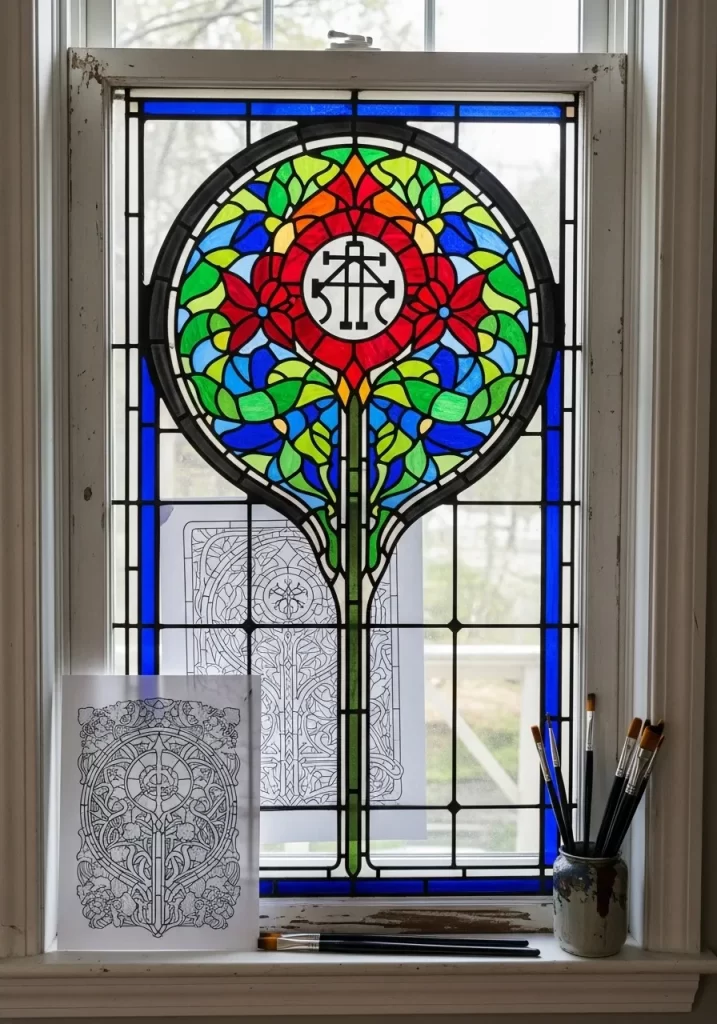
Get the brilliant color of stained glass without the difficult work of cutting glass. You can mimic the look using a simple glass panel and special paints. This project lets you create intricate, colorful designs that come to life when the sun shines through them.
The design starts with bold, black outlines, just like the lead lines in real stained glass. Then, the sections are filled with vibrant, transparent colors. The light catches these colors and projects them into the room. It’s a wonderful way to add a custom, artistic touch to any window.
DIY Instructions: How to Make Faux Stained Glass
What You’ll Need:
- A picture frame with a real glass panel
- Black liquid leading or black dimensional paint
- Transparent glass paints in various colors
- A printed design on paper
- A few small paintbrushes
- Tape
Step-by-Step Guide:
- Prepare Your Glass: Carefully remove the glass panel from the picture frame. Clean it very well with glass cleaner so there are no fingerprints.
- Trace Your Design: Place your printed design on your work surface. Lay the clean glass panel directly on top of it. Tape the corners down so nothing moves.
- Create the Outlines: Use the black liquid leading to trace all the lines of your design onto the glass. Squeeze the bottle gently to get a steady, raised line. Let this dry completely. It might take a few hours.
- Fill in the Colors: Now it’s time to paint. Squeeze a small puddle of glass paint into one of the outlined sections. Use a paintbrush to gently spread the paint so it fills the whole area up to the black lines. The paint should be thick enough that you can’t see through it easily.
- Paint All Sections: Continue filling in all the other sections with your different colors.
- Let It Dry: Let the paint dry flat for at least 24 hours, or as long as the paint instructions say. It will become clear and shiny as it dries.
- Re-frame and Hang: Once it’s totally dry, put the glass panel back in its frame. You can hang it on a wall or place it on a windowsill to catch the light.
9. Recycled Bottle Cap Mosaic
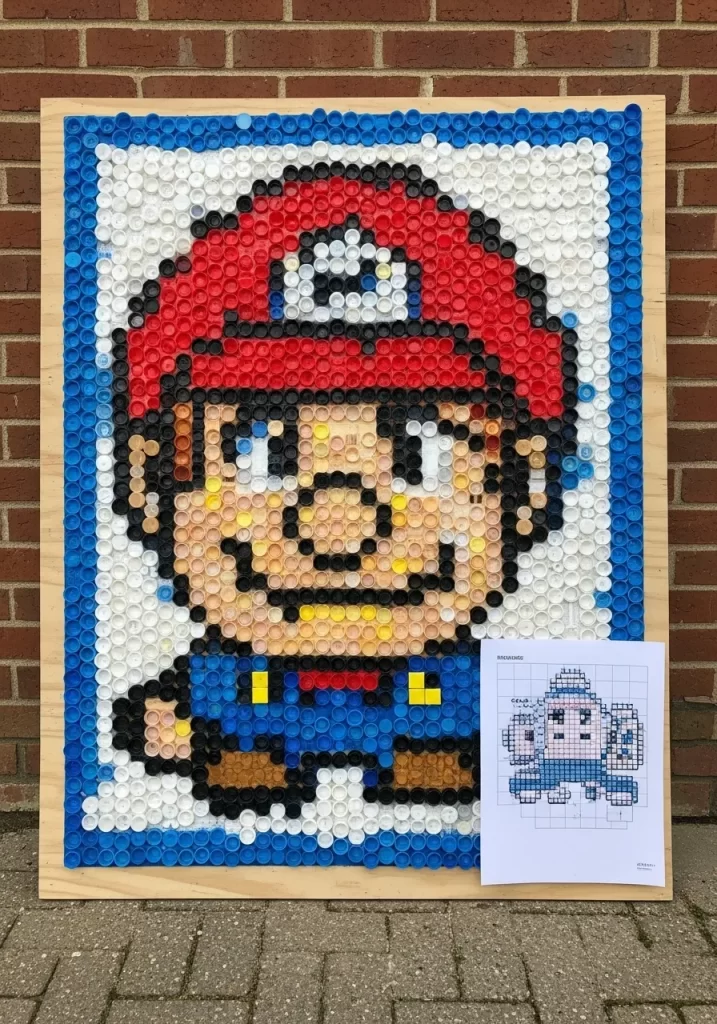
Turn everyday trash into an amazing piece of pop-culture art. This project uses hundreds of colorful plastic bottle caps to create a large mosaic. By arranging the caps like pixels in a picture, you can recreate your favorite video game characters or any other design.
It is a fun, eco-friendly way to make a statement piece. The process is like a giant puzzle, as you find the right color and place for each cap. The finished art is textured, colorful, and a great conversation starter. It shows that you can make something incredible out of the simplest materials.
DIY Instructions: How to Create a Bottle Cap Mosaic
What You’ll Need:
- Lots and lots of plastic bottle caps in different colors
- A sturdy board for your base (like plywood or MDF)
- A strong glue (like a construction adhesive or E6000)
- A printed picture of a pixelated character to use as a guide
Step-by-Step Guide:
- Collect and Clean: Start collecting bottle caps. Ask friends and family to save them for you. Once you have a big collection, wash and dry them all.
- Prepare Your Base: Make sure your board is clean. You can paint it a single color, like white or black, if you want.
- Plan Your Layout: Place your printed guide next to your board. You can draw a light grid on your board with a pencil to match the grid on your paper.
- Start Gluing: Begin at one corner. Look at your guide to see what color the first “pixel” is. Find a bottle cap of that color. Squeeze a good amount of strong glue on the back and press it firmly onto the board.
- One Cap at a Time: Continue gluing caps one by one, following your pixel art guide. Place them very close together so the board doesn’t show through.
- Fill It All In: This part takes patience, so put on some music and enjoy the process. Keep going until your entire picture is filled in.
- Let It Dry: Let the glue dry completely for at least a day to make sure all the caps are securely attached.
- Hang Your Art: Add heavy-duty hangers to the back of the board and display your awesome recycled masterpiece.
10. Personalized Soundwave Art

Turn a sound into a piece of visual art. This project takes the soundwave of a meaningful audio clip—like a favorite song, a laugh, or the words “I love you”—and displays it on a canvas. It is a deeply personal and modern way to capture a memory.
The soundwave can be painted, drawn with markers, or even created with string art. The visual shows the unique peaks and valleys of the specific sound. Adding a splash of color to one end of the soundwave gives it a creative touch. It’s a minimalist design that carries a lot of meaning.
DIY Instructions: How to Make Soundwave Art
What You’ll Need:
- A blank canvas
- A computer and internet access
- A printer
- Black paint pens or markers
- A pencil
- Optional: Colored paints for an accent
Step-by-Step Guide:
- Record Your Sound: Use your phone to record a short audio clip. It could be you saying something, a pet’s bark, or anything you want.
- Create the Soundwave Image: Go to a free online soundwave generator website. Upload your audio file, and it will create an image of your soundwave. Save and print this image.
- Transfer the Design: Use a simple pencil transfer method. Rub the back of your printed paper with a pencil, covering the whole soundwave area. Then, place the paper onto your canvas (pencil-side down) and trace over the soundwave lines. A faint pencil outline will be left on the canvas.
- Fill It In: Carefully trace and fill in the soundwave outline on your canvas using your black paint pens or markers. Take your time to get the lines crisp and clean.
- Add a Splash of Color (Optional): If you want to add color, pick a spot on your soundwave. Use a small brush and colored paints to create a gradient or a pop of color on some of the lines.
- Let It Dry: Make sure all the paint and marker is completely dry.
- Display Your Memory: Your personal soundwave art is now ready to hang on the wall. It’s a secret message that only you know the meaning of!
11. Shaving Cream Marbled Geodes
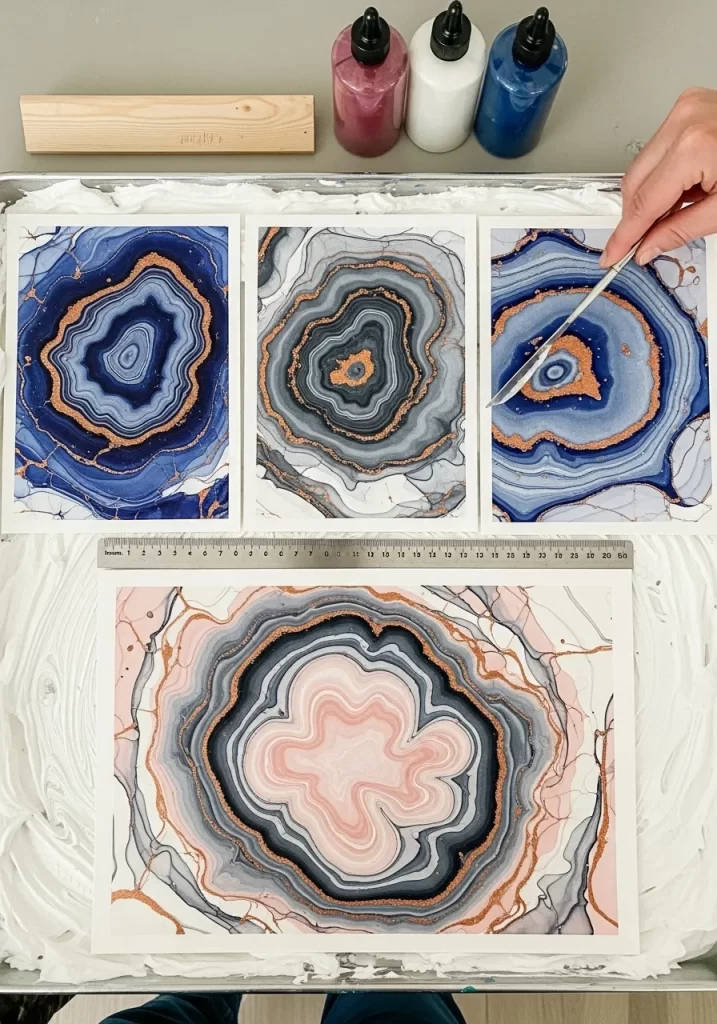
Create the look of expensive geode art with a surprising household item. This method uses shaving cream and paint to produce beautiful marbled patterns. The flowing lines and rich colors mimic the natural layers of a stone agate slice. Each piece has an organic, unpredictable design.
Adding fine lines of metallic paint enhances the geode effect, giving it a touch of glamour. You can create a whole set of these prints to display together. This technique is wonderfully messy and gives you a sophisticated result from simple, fun materials.
DIY Instructions: How to Make Marbled Paper
What You’ll Need:
- A shallow pan or baking sheet
- Plain white shaving cream (the cheap foam kind)
- Liquid acrylic paints or food coloring
- Watercolor paper or thick cardstock
- A stick or a skewer
- A flat scraper, like a ruler or piece of cardboard
Step-by-Step Guide:
- Make a Foam Bed: Fill your shallow pan with a layer of shaving cream. Spread it out so it’s flat and even.
- Add Your Colors: Drip different colors of paint or food coloring all over the top of the shaving cream.
- Swirl the Colors: Take your stick and gently drag it through the colors to create a swirly, marbled pattern. Don’t mix it too much, or the colors will get muddy.
- Make a Print: Take a piece of your paper and lay it flat on top of the colored shaving cream. Press down gently all over so the whole paper touches the foam.
- Lift and Scrape: Carefully peel the paper up. It will be covered in colored foam. Lay it flat and use your scraper to wipe all the shaving cream off in one smooth motion. The marbled pattern will be left behind on the paper!
- Let It Dry: Let your marbled paper dry completely.
- Add Details: Once dry, you can use a gold paint pen to draw lines on your art to make it look even more like a geode.
12. Industrial Pipe Shelving
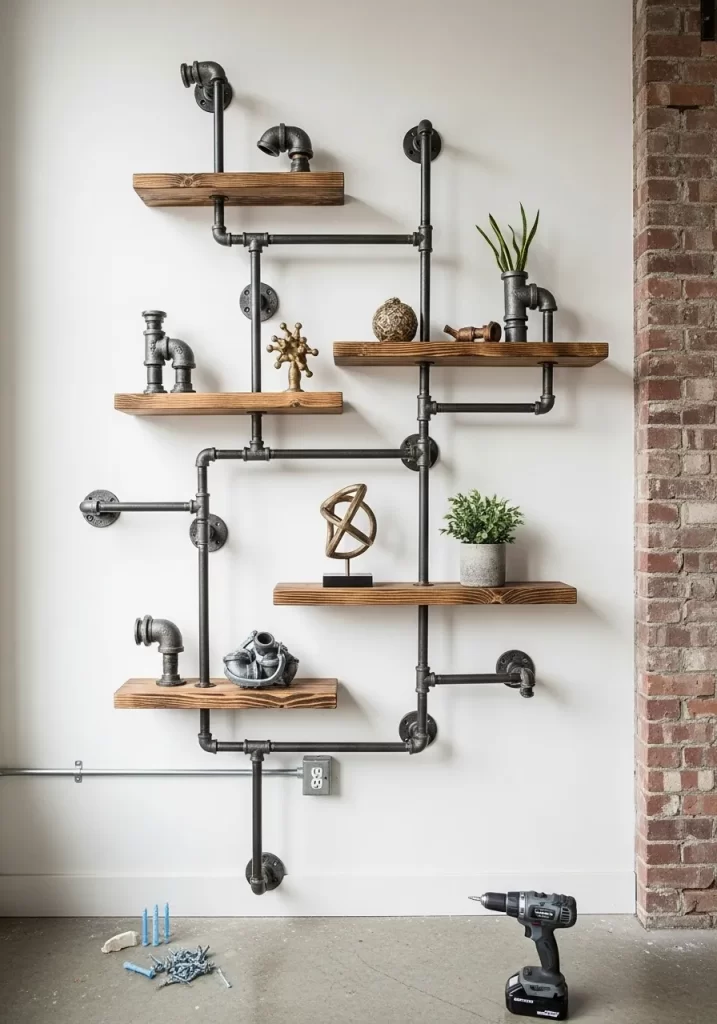
Combine storage and art with custom-built pipe shelving. This project uses plumbing pipes and wooden boards to create a functional and stylish wall unit. The dark metal pipes give it a strong, industrial look, while the warm wood shelves soften the design.
The layout can be as simple or as complex as you like, with shelves at different heights and positions. It is a practical way to display books, plants, and other decorative items. This shelving unit does more than justhold things; it becomes a major design feature of the room.
DIY Instructions: How to Build Pipe Shelves
What You’ll Need:
- Metal pipes and fittings (threaded and available at hardware stores)
- Wooden boards for the shelves
- Pipe wrenches
- A drill and screws
- Wall anchors
- Sandpaper and wood stain (optional)
Step-by-Step Guide:
- Plan Your Shelf: Draw a picture of how you want your shelf to look. This will help you figure out how many pipes, elbows, and T-fittings you need.
- Prepare the Shelves: If your wooden boards are rough, sand them until they are smooth. You can stain them a color you like and let them dry completely.
- Assemble the Pipes: Following your drawing, start twisting the pipes and fittings together. Use the pipe wrenches to make sure every connection is very tight. Build the whole metal frame first.
- Attach to the Wall: Hold your finished pipe frame against the wall where you want it to go. Use a level to make sure it’s straight. Mark where the screw holes are on the wall.
- Secure It: Drill holes where you made your marks. If you aren’t drilling into a wall stud, push wall anchors into the holes. Then, hold the frame back up and screw it tightly to the wall.
- Place the Shelves: Lay your wooden boards on top of the pipe arms you created for them.
- Decorate: Now you can put all your favorite things on your new industrial shelf!
13. Decoupage World Map
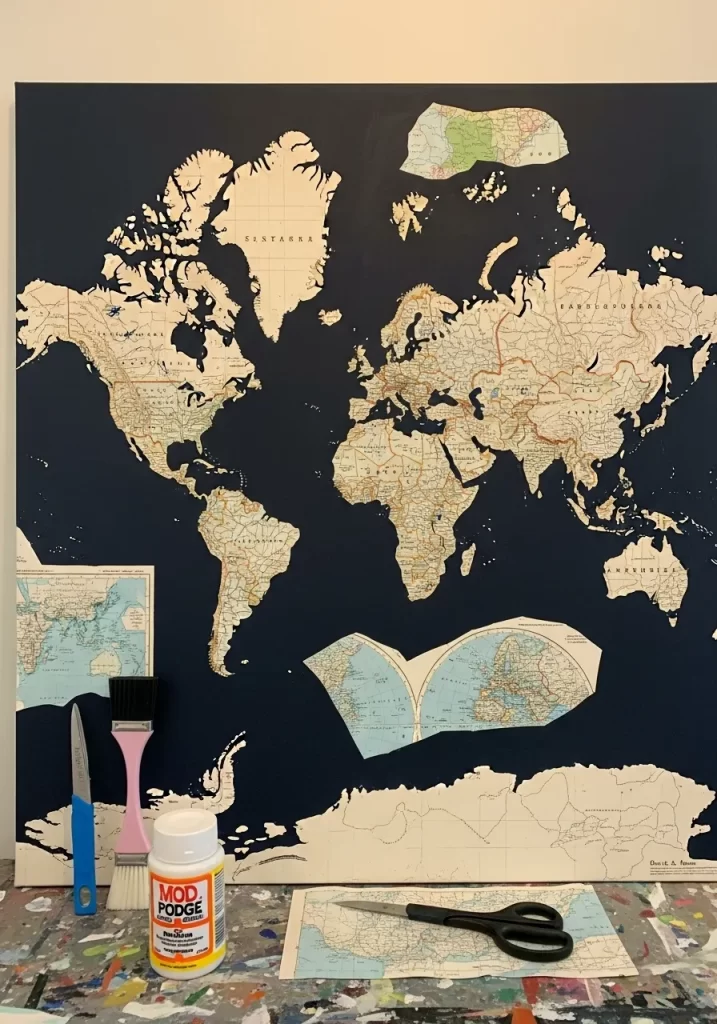
Display your love for travel with a custom world map canvas. This project involves cutting up maps and arranging them on a painted background. The result is a personal piece of art that looks both vintage and modern. It’s a creative way to use old maps or atlases.
A dark blue canvas makes the light-colored continents stand out. Using a decoupage medium like Mod Podge seals the map pieces and gives the artwork a uniform, finished look. You can even use this project to highlight places you’ve been or dream of visiting.
DIY Instructions: How to Make a Map Canvas
What You’ll Need:
- A large blank canvas
- An old atlas or map printouts
- Acrylic paint for the background (e.g., navy blue)
- Mod Podge or similar decoupage glue
- A paintbrush for painting and one for gluing
- Scissors
- A pencil
Step-by-Step Guide:
- Paint Your Ocean: Paint the entire canvas with your background color. Let it dry completely. You might need to do two coats.
- Cut Out Your Land: Carefully cut out the continents and islands from your maps. You can choose to cut them out precisely or in rougher shapes for a more abstract look.
- Arrange Your World: Lay your canvas flat. Arrange the map pieces on top of it to form the world map. Move them around until you are happy with the placement.
- Glue a Piece Down: Pick up one map piece. Use a brush to apply a thin layer of Mod Podge to the back of it. Place it back on the canvas and press it down firmly.
- Keep Gluing: Do this for all your map pieces, one by one, until the whole map is glued down.
- Seal Your Artwork: Once all the pieces are on, brush a generous layer of Mod Podge over the entire canvas, including the painted parts. This will seal everything and give it a nice finish.
- Let It Dry: Let the Mod Podge dry completely. It will look white when it’s wet but will dry clear.
14. Fabric-Wrapped Canvases
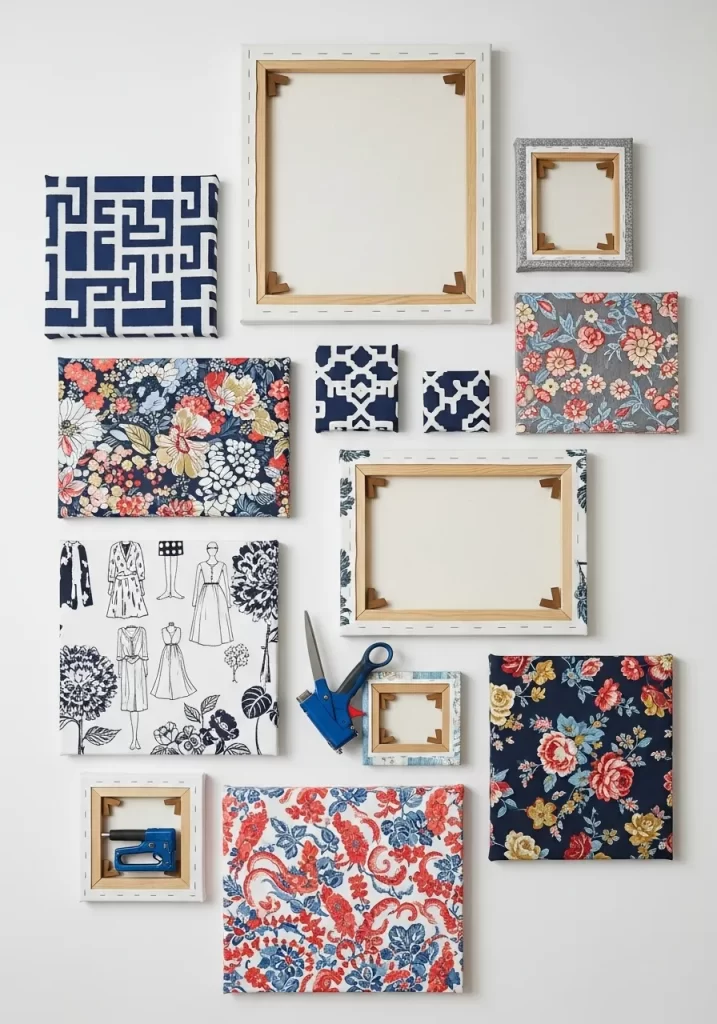
Give your walls a quick and colorful update with fabric-wrapped canvases. This is one of the easiest ways to create custom art. All you need to do is stretch patterned fabric over a blank canvas or a wooden frame. The result is a clean, professional-looking piece.
You can mix and match different patterns and sizes to create a beautiful gallery wall. This project is great for using up leftover fabric scraps. It is a no-paint, no-mess way to bring color, pattern, and texture to your room.
DIY Instructions: How to Wrap a Canvas with Fabric
What You’ll Need:
- Blank artist canvases or empty wooden stretcher frames
- Your favorite patterned fabric
- A staple gun
- Scissors
Step-by-Step Guide:
- Cut Your Fabric: Lay your fabric flat, pattern-side down. Place your canvas face down on top of it. Cut the fabric so that you have about two inches of extra fabric on all four sides.
- Staple the First Side: Pull one side of the fabric tightly across the back of the wooden frame. Use the staple gun to put one staple in the middle of that side.
- Staple the Opposite Side: Go to the opposite side. Pull the fabric very tight and put a staple in the middle of that side. The fabric should now be taut across the front of the canvas.
- Staple the Other Two Sides: Do the same thing for the top and bottom edges. Pull the fabric tight and put one staple in the middle of each.
- Keep Stapling: Now, continue adding staples on all four sides, working from the middle outwards towards the corners. Keep pulling the fabric tight as you go.
- Fold the Corners: When you get to the corners, fold them neatly like you are wrapping a present. Pull the fabric tight and secure it with a few staples.
- Trim and Hang: Trim any extra fabric from the back. Your new fabric art is ready to hang!
15. Wood-Burned Nature Scene
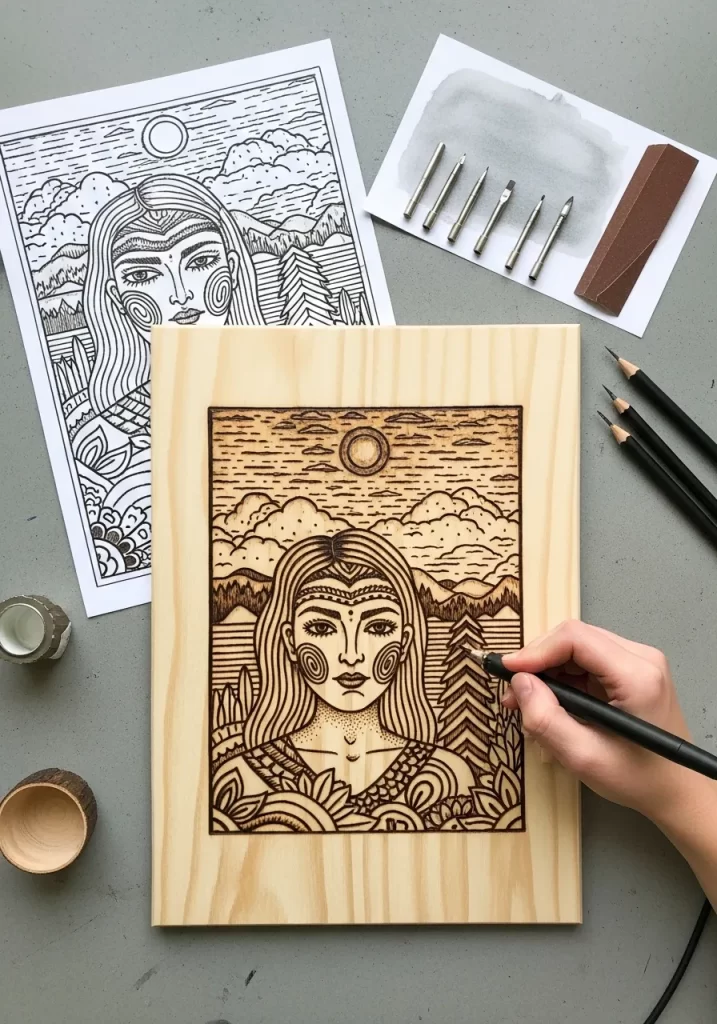
Create rustic and detailed art by drawing with heat. This technique, called pyrography, uses a special hot tool to burn designs into a piece of wood. The process creates permanent lines with a beautiful, natural brown coloring. It allows for very fine details and shading.
This piece features a stylized portrait set against a landscape of mountains and clouds. Using a pattern makes it easy to get a complex design right. The finished art has a warm, earthy feel and highlights the natural grain of the wood.
DIY Instructions: How to Try Wood Burning
What You’ll Need:
- A piece of soft, light-colored wood (like basswood or pine)
- A wood-burning tool (pyrography pen)
- A printed design
- Graphite paper for transferring
- A pencil
Step-by-Step Guide:
- Safety First: The wood-burning tool gets very hot! Always work in a clear space and be careful where you set the tool down.
- Sand Your Wood: Make sure your piece of wood is very smooth. Sand it lightly and wipe away any dust.
- Transfer Your Design: Place the graphite paper on the wood, dark side down. Put your printed design on top. Use a pencil to trace all the lines of your design. The pressure will transfer the lines onto the wood.
- Heat Up Your Tool: Plug in your wood-burning tool and let it heat up. It will have different tips for different kinds of lines. Start with a standard tip.
- Start Burning: Hold the tool like a pen. Gently trace over your pencil lines with the hot tip. Move slowly and steadily. You don’t need to press hard.
- Build Up Your Lines: Go over the lines a few times to make them darker. You can use different tips to create different textures or shading.
- Erase and Finish: Once you are done, you can gently erase any leftover pencil marks. Your wood-burned art is complete!
16. Recycled CD Mosaic Mirror
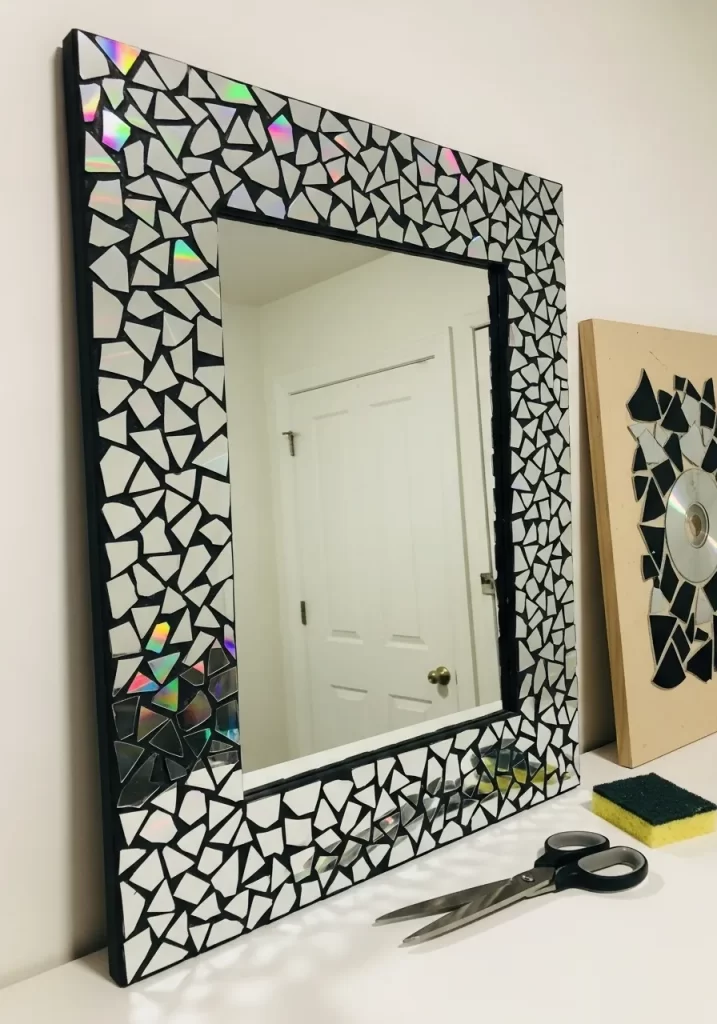
Give an old mirror a spectacular, shimmering makeover. This project uses broken pieces of old CDs or DVDs to create a mosaic frame. The pieces reflect light and flash with rainbow colors, creating a dazzling effect. It is a clever way to upcycle outdated media into something beautiful.
The broken shards are glued onto a plain mirror frame, fitting together like a puzzle. The small gaps between the pieces can be left open or filled with grout. This craft turns a simple object into a unique and eye-catching piece of decor.
DIY Instructions: How to Make a CD Mosaic
What You’ll Need:
- An old mirror with a flat frame
- A stack of old CDs or DVDs
- Strong scissors
- Strong craft glue or a hot glue gun
- Optional: Black paint for the frame
Step-by-Step Guide:
- Prepare the Mirror: If you want, paint the frame of the mirror a solid color, like black. This will make the shiny pieces stand out more. Let it dry.
- Break the CDs: This is the fun part! Use strong scissors to carefully cut the CDs into small, random shapes. The shiny layer might peel a bit, which is okay. Be careful, as the edges can be sharp.
- Start Gluing: Squeeze a dot of glue onto the mirror frame. Press one of the CD pieces onto the glue, shiny side up.
- Build Your Mosaic: Continue gluing on pieces one by one. Fit them together like a puzzle, leaving a tiny bit of space between each one. Cover the entire frame.
- Let It Dry: Let the glue dry completely so all the pieces are stuck on securely.
- Clean and Hang: Gently clean the mirror glass. Your shiny new mosaic mirror is ready to be hung on the wall.
17. Punched Tin Star Panels
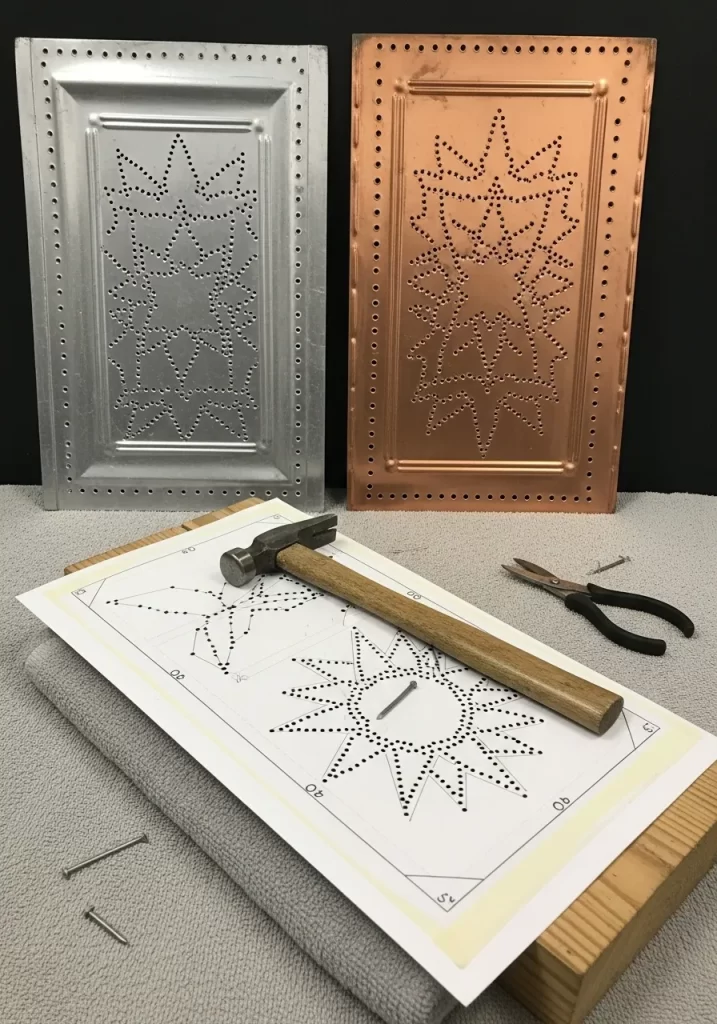
Add a touch of rustic, colonial charm to your decor with punched tin panels. This traditional craft involves using a hammer and a nail to punch small holes into a thin sheet of metal. The holes form a pattern, creating a simple yet beautiful piece of decorative art.
These panels feature a classic star design. When light hits the panel, the punched design stands out. You can use sheets of tin, copper, or even aluminum from a craft store. The finished pieces can be framed or used as decorative inserts in a cabinet door.
DIY Instructions: How to Make Punched Tin Art
What You’ll Need:
- A thin sheet of craft metal (like aluminum or copper)
- A hammer
- A nail
- A printed pattern
- A thick piece of cardboard or a soft block of wood
- Tape
Step-by-Step Guide:
- Prepare Your Surface: Place your sheet of metal on top of the cardboard or wood block. This soft surface underneath will allow the nail to punch through the metal cleanly.
- Attach Your Pattern: Tape your printed pattern directly onto the front of the metal sheet. Make sure it won’t slip around.
- Start Punching: Place the tip of the nail on one of the dots on your pattern. Gently tap the top of the nail with your hammer. You want to make a clear hole, but you don’t need to hit it too hard.
- Follow the Dots: Continue punching a hole for every single dot on your pattern. Try to make your hammer taps consistent so the holes are all about the same size.
- Remove the Pattern: Once you have punched all the holes, carefully remove the tape and the paper pattern.
- Display Your Work: Your punched metal panel is now finished! You can frame it or hang it as is for a simple, rustic look.
18. Copper Air Plant Hangers
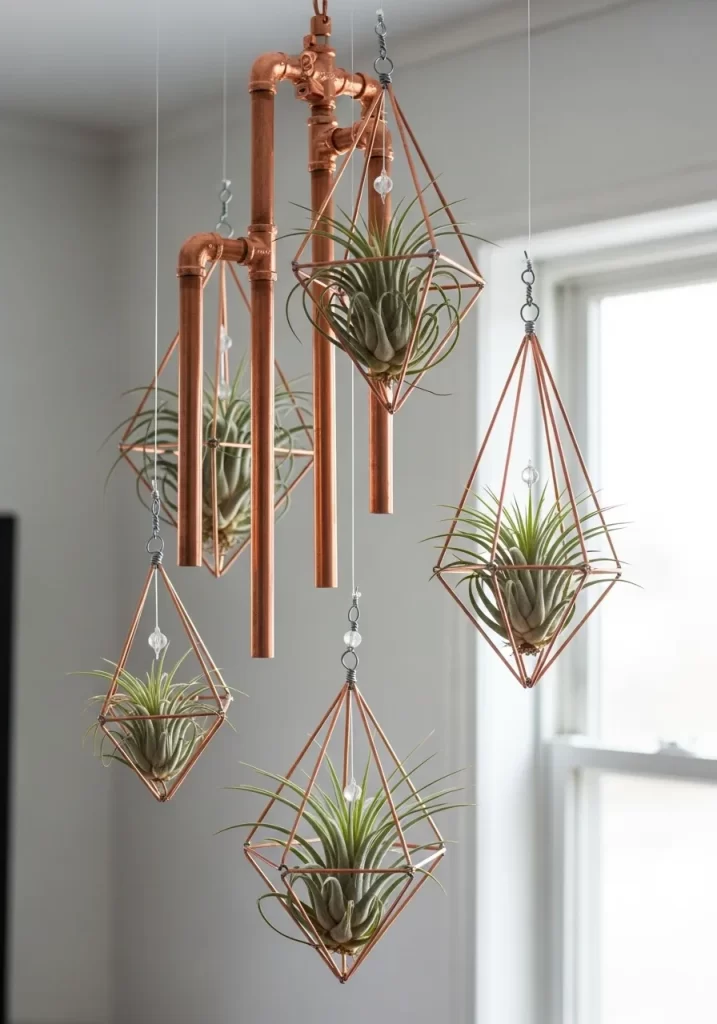
Create a floating garden in your home with these geometric air plant holders. The project uses copper materials to construct minimalist, diamond-shaped cages for tillandsia (air plants). The warm, metallic shine of the copper contrasts beautifully with the green of the plants.
These hangers are lightweight and can be suspended from the ceiling at different heights. They create a graceful, airy display that draws the eye upward. It is a modern and elegant way to bring a touch of nature into your living space without taking up any floor or table space.
DIY Instructions: How to Make Geometric Plant Holders
What You’ll Need:
- Thin copper or brass tubing
- Thin craft wire
- A small pipe cutter
- A ruler
- Air plants
Step-by-Step Guide:
- Cut Your Pieces: For a diamond shape, you will need to cut 8 pieces of tubing of the same length. For example, you could cut eight pieces that are each 4 inches long.
- Make Two Squares: Cut a long piece of wire. Thread four pieces of tubing onto the wire. Pull the wire tight and twist the ends together to form a square. Repeat this to make a second square.
- Join the Squares: Place one square flat. Take the second square and hold it directly above the first. Cut four short pieces of wire. Use these to connect the corners of the bottom square to the corners of the top square.
- Create the Point: As you join the squares, you can pinch two opposite corners together to create the top and bottom points of the diamond. Or, you can join two squares at an angle to form the shape. Twist the wires tightly to secure the shape.
- Add a Hanging Loop: At the top corner of your shape, create a small loop with the wire so you can hang it.
- Add Your Plant: Gently place an air plant inside your new geometric holder.
- Hang It Up: Use clear fishing line to hang your plant holders from the ceiling.
19. Expressive Coffee Portrait
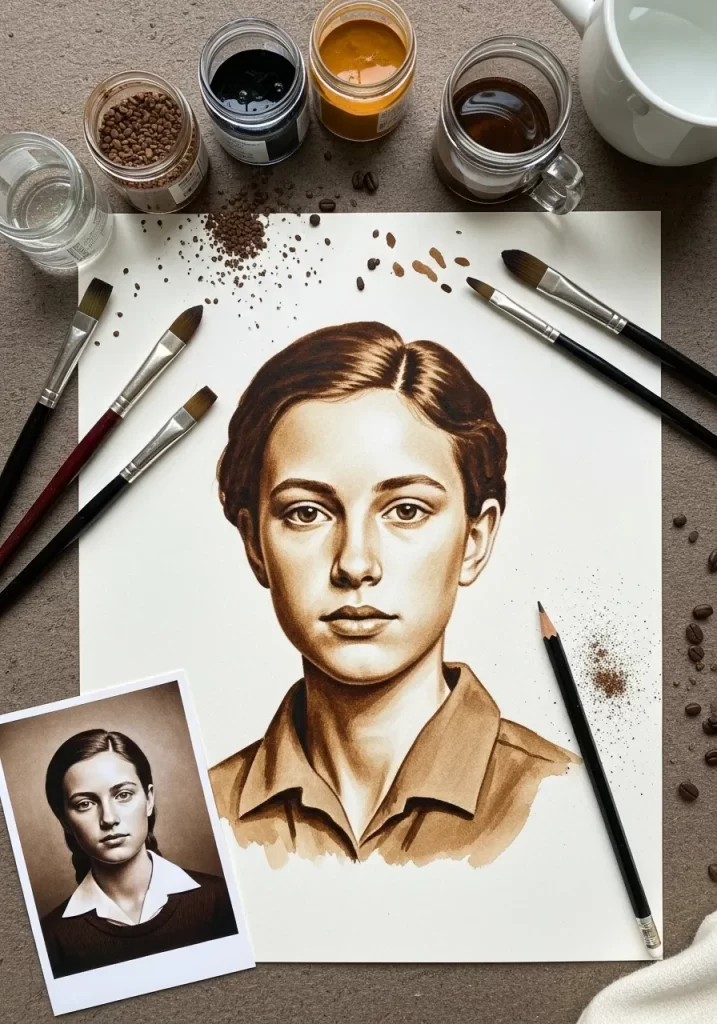
Paint a portrait using a surprising medium: coffee. This unique art technique uses instant coffee mixed with water to create a range of brown, sepia tones. The effect is similar to watercolor painting, resulting in soft, layered shades that give the artwork a warm, vintage feel.
By using more coffee for dark areas and more water for light areas, you can achieve impressive depth and realism. The painting surface is simple paper, and the tools are just regular paintbrushes. This project shows that you can create a beautiful, expressive piece of art with simple ingredients from your kitchen pantry.
DIY Instructions: How to Paint with Coffee
What You’ll Need:
- Instant coffee granules
- A few small cups or a paint palette
- Hot water
- A set of paintbrushes
- Thick watercolor paper
- A pencil and a reference photo
Step-by-Step Guide:
- Sketch Your Portrait: Lightly sketch the outline of your portrait onto the watercolor paper using your pencil and reference photo.
- Mix Your “Paints”: In your cups, mix different amounts of instant coffee and hot water. Make one cup that is very dark (lots of coffee, little water), one that is medium, and one that is very light (little coffee, lots of water).
- Start with the Lightest Color: Begin by painting the lightest areas of your portrait with your lightest coffee mixture. Just like with watercolors, you start light and build up to dark.
- Add Mid-Tones: Let the first layer dry a little. Now, use your medium-strength coffee paint to add in the shadows and define the features of the face.
- Use Dark Tones for Detail: Use your darkest, strongest coffee mixture for the darkest parts of the portrait, like the pupils of the eyes, dark hair, and deep shadows.
- Let It Dry Completely: Allow your painting to dry fully. The colors might lighten a little as they dry.
- Frame Your Art: Your coffee portrait is now ready to be framed. And your room will smell faintly of coffee!
20. Giant Paper Flower Display
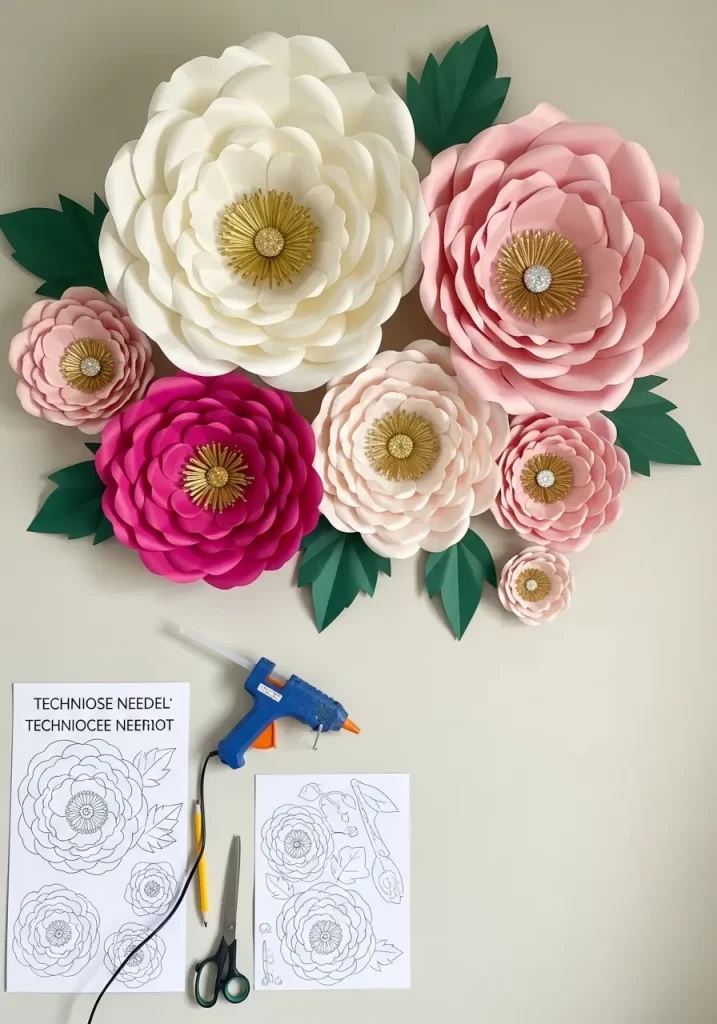
Make a huge impact with a bouquet of giant paper flowers. This project turns simple sheets of colored paper into a stunning, three-dimensional wall display. The oversized blossoms add a soft, whimsical, and romantic touch to any room.
Each flower is built petal by petal, creating lush layers. The centers are often detailed with metallic or fringed paper to add texture. You can arrange a cluster of different sizes and colors to create a beautiful composition that will never wilt or fade.
DIY Instructions: How to Make Giant Paper Flowers
What You’ll Need:
- Cardstock paper in different colors
- A hot glue gun
- Scissors
- A pencil
- Flower petal templates (you can find these online and print them)
Step-by-Step Guide:
- Cut Out Your Petals: Use your templates to trace and cut out many petals from your cardstock. You will need several sizes: large for the outer layer, medium for the middle, and small for the center.
- Shape the Petals: To make the petals look real, give them some shape. Cut a small slit at the bottom of each petal. Overlap the two cut edges and secure them with a dot of hot glue. This will make the petal curve. You can also gently curl the top edges of the petals outwards with your fingers or a pencil.
- Create a Base: Cut out a circle from the cardstock. This will be the base you glue all your petals onto.
- Build the First Layer: Start with your largest petals. Glue them around the edge of your circle base.
- Add More Layers: Now take your medium-sized petals. Glue them down in a circle just inside the first layer, covering the spots where the big petals meet. Keep building layers, working your way towards the center with smaller and smaller petals.
- Make the Center: For the flower’s center, you can cut a strip of paper, fringe it with scissors, roll it up, and glue it in the very middle.
- Create a Collection: Make several flowers in different sizes and colors. Arrange and glue them directly onto your wall, or onto a large piece of foam board that you can hang.
21. Recycled Paper Coil Portrait

Create a stunning portrait with a unique, textured look. This art is made from hundreds of tiny coils of rolled paper, likely from old magazines. The different colored paper coils act like dots of paint, forming a larger image from a distance. It’s an amazing way to recycle paper into something personal.
The three-dimensional nature of the coils adds incredible texture and depth. The overall shape creates a silhouette, while the varied colors within the coils provide the detail. This project is a patient and rewarding process that results in a truly one-of-a-kind piece.
DIY Instructions: How to Make a Paper Coil Mosaic
What You’ll Need:
- Old magazines or colored paper
- A wooden board or thick cardboard
- White craft glue
- A toothpick or a quilling tool
- Scissors or a paper cutter
- A pencil
Step-by-Step Guide:
- Cut Your Strips: Cut the magazine pages into many long, thin strips. About half an inch wide is a good start.
- Roll Your Coils: Take one strip of paper. Use a toothpick or quilling tool to start rolling the strip into a tight coil. When you get to the end, put a tiny dab of glue on it to keep it from unrolling. Make lots and lots of coils in different colors.
- Draw Your Outline: On your board, use a pencil to draw a simple outline of the shape you want to make, like a silhouette of a person’s head.
- Start Gluing: Squeeze a small puddle of glue onto a paper plate. Dip the bottom of one of your paper coils into the glue.
- Fill in Your Shape: Place the gluey coil down inside your pencil outline. Continue doing this, placing coils right next to each other until your whole shape is filled in.
- Let it Dry: The glue needs to dry completely. This might take several hours.
- Hang It Up: Once everything is solid, your textured paper portrait is ready to be displayed.
22. Interactive Magnetic Word Wall
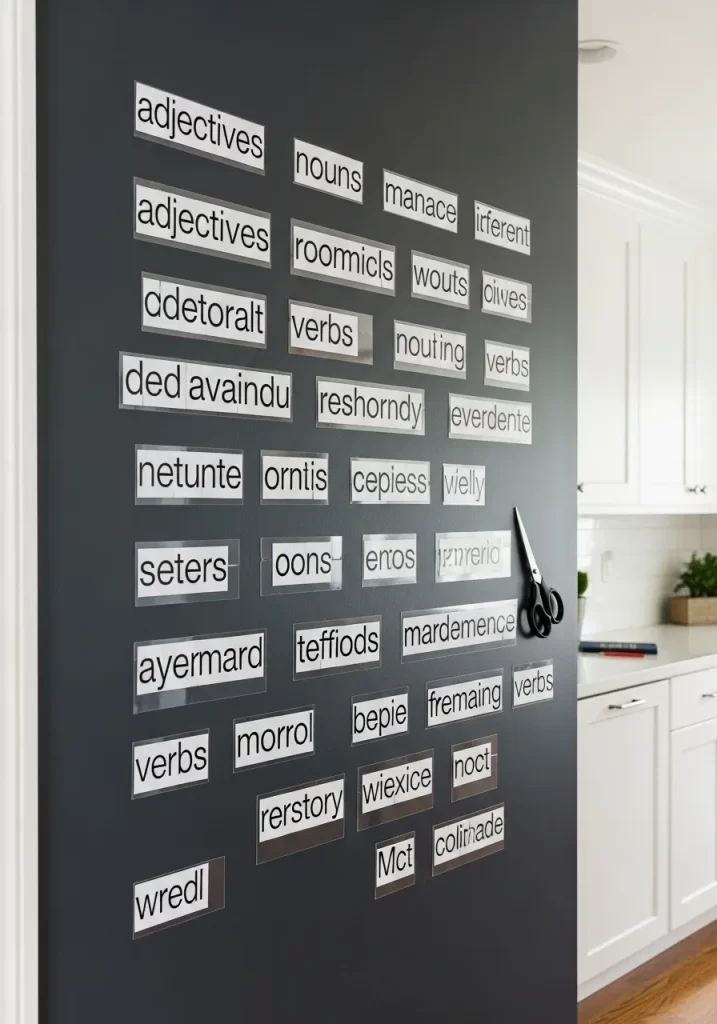
Turn your wall into a canvas for creativity with magnetic words. This project is a larger version of the poetry magnets you see on refrigerators. It invites family and friends to play with language, leave messages, or create silly sentences. The art is never the same from one day to the next.
A dark, smooth wall makes the white word blocks pop. You can create your own words, mixing everyday language with fun, made-up terms. It is a simple concept that adds a huge amount of fun and personality to a kitchen or a creative space.
DIY Instructions: How to Make a Magnetic Word Wall
What You’ll Need:
- A smooth wall or a large board
- Magnetic paint
- A paint roller
- Adhesive magnet sheets
- A printer and plain white paper
- Scissors
Step-by-Step Guide:
- Paint Your Wall: Apply the magnetic paint to your wall according to the instructions on the can. You will need to apply several coats to make the magnetic pull strong enough. Let it dry completely.
- Create Your Words: On your computer, type up a long list of words. Use a clear, bold font. Print them out on plain paper.
- Cut Out the Words: Carefully cut each word out, leaving a small border around it.
- Make Them Magnetic: Peel the backing off an adhesive magnet sheet. Carefully stick your sheet of printed words onto the sticky side.
- Cut Out the Magnets: Use your scissors to cut out each individual word. You now have a custom set of word magnets.
- Start Playing: Stick your new word magnets onto your magnetic wall and start creating poems, lists, and funny phrases.
23. Rustic Window Frame Planter
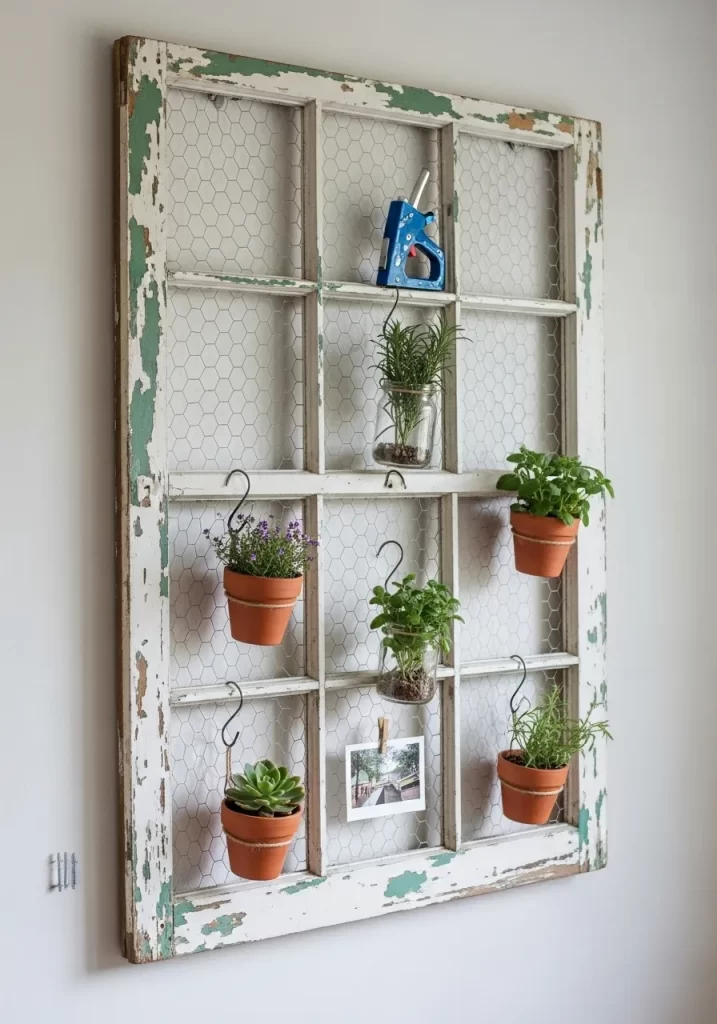
Bring the outdoors in with an upcycled window frame. This project turns an old, weathered window into a charming display for small plants and herbs. The peeling paint gives it a rustic, farmhouse character. It is a beautiful way to add life to a blank wall.
Chicken wire replaces the glass panes, creating a grid to hang things from. Small terracotta pots and glass jars are attached with simple S-hooks. This creates a vertical garden that is both decorative and useful, especially for a kitchen herb garden.
DIY Instructions: How to Make a Window Herb Garden
What You’ll Need:
- An old wooden window frame
- Chicken wire
- A staple gun
- Wire cutters
- Small S-hooks
- Small pots, jars, and your favorite plants
Step-by-Step Guide:
- Prepare the Window: Carefully remove any remaining glass from the window frame. Clean the frame, but you can leave the peeling paint for a rustic look.
- Attach the Wire: Roll out the chicken wire. Place it over the back of the window frame. Use the staple gun to attach the wire securely to the wooden frame. Staple it every few inches.
- Trim the Excess: Use wire cutters to carefully trim any extra chicken wire from around the edges of the frame.
- Hang the Frame: Attach heavy-duty picture hangers to the back of your window frame and hang it on the wall.
- Add Your Plants: Loop an S-hook through the chicken wire. Hang a small pot or a jar with a wire handle from the hook.
- Fill Your Garden: Continue hanging your plants until you are happy with the arrangement. Remember to take them down to water them!
24. Gilded Watercolor Agate Slices
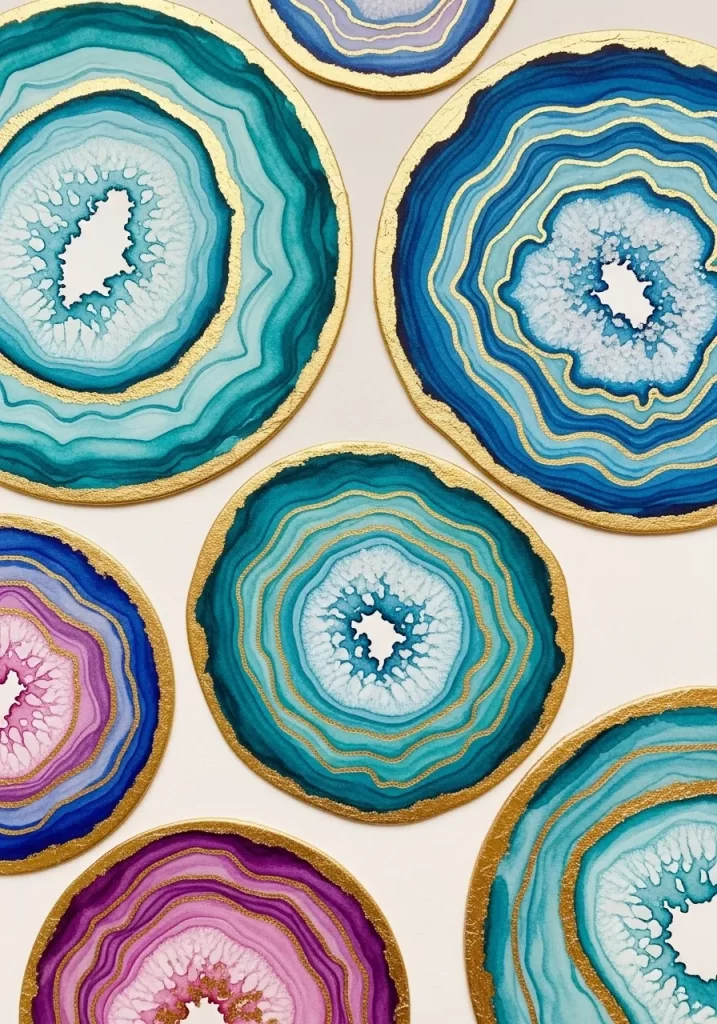
Capture the beauty of natural stone with paint and paper. This artwork mimics the look of polished agate slices, with their beautiful rings of color. The flowing watercolors blend together to create soft, organic patterns, just like real geodes.
Each piece is unique, with different color combinations from deep blues to vibrant purples. A thick, golden edge is painted around each slice, adding a touch of elegance and shine. Grouping several of these paper “stones” together creates a rich and colorful display.
DIY Instructions: How to Paint Watercolor Agates
What You’ll Need:
- Thick watercolor paper
- Watercolor paints
- A paintbrush and a cup of water
- A gold paint pen or gold leaf glue and foil
- Scissors
- A pencil and a round object for tracing (like a cup)
Step-by-Step Guide:
- Get Your Paper Wet: Use your brush to paint a circle of plain water onto your paper.
- Drop in Color: While the paper is still wet, dip your brush in a watercolor paint and gently touch it to the wet circle. The color will spread out beautifully. Add a few different colors and watch them blend.
- Build the Rings: Let the first layer dry a bit. Then, paint smaller, darker rings of color inside your first shape to create the layered look of an agate. Let some areas remain white.
- Let It Dry: Let your painting dry completely.
- Cut It Out: Once dry, use scissors to cut out your agate shape. You can make it a perfect circle or a more wobbly, natural shape.
- Add the Gold Edge: Carefully use your gold paint pen to trace around the entire edge of your paper agate. Make the line thick and shiny.
- Create a Collection: Make a few more agate slices in different colors and sizes. You can mount them on a canvas or stick them directly to the wall.
25. Textured Punch Needle Rainbow
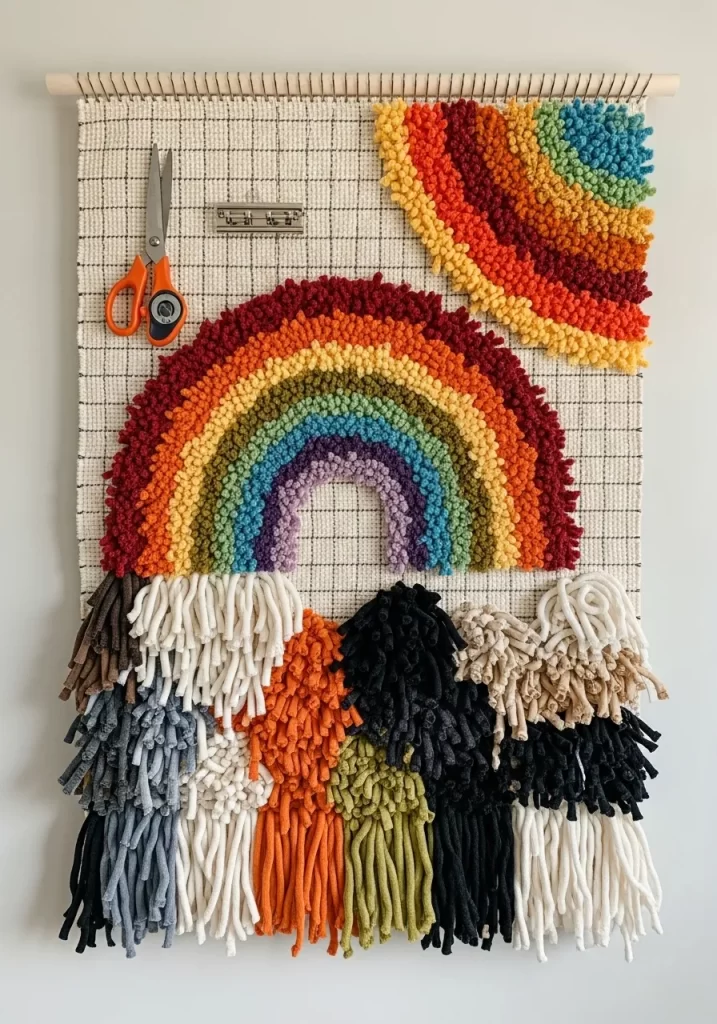
Add a burst of color and soft texture to your wall with a punch needle hanging. This piece is wonderfully tactile, with thousands of plush yarn loops creating a shaggy, fun surface. The bright, cheerful rainbow is a classic design that brings happiness to any room.
The bottom of the piece is finished with a fringe of thick, colorful tassels that add movement and even more texture. The whole piece is hung from a simple wooden dowel, giving it a relaxed, bohemian feel. It’s like a fluffy, soft sculpture for your wall.
DIY Instructions: How to Make a Punch Needle Hanging
What You’ll Need:
- A punch needle tool
- A wooden frame or embroidery hoop
- Monk’s cloth or another loose-weave fabric
- Yarn in rainbow colors and other shades
- A marker
- Scissors
Step-by-Step Guide:
- Set Up Your Frame: Stretch your monk’s cloth tightly over your frame or hoop. It should be tight like a drum.
- Draw Your Design: Use a marker to draw a big rainbow shape onto the fabric.
- Thread Your Needle: Thread your punch needle tool with your first color of yarn according to its instructions.
- Start Punching: From the back side of the fabric, push the needle all the way through and pull it back out, just to the surface. Move over a tiny bit and punch again. Keep doing this to fill in the first arc of your rainbow. The loops will form on the other side.
- Fill in the Rainbow: Change colors and fill in all the arcs of your rainbow.
- Remove and Trim: Once your design is finished, take the fabric off the frame. Trim the extra fabric, leaving a border around your design.
- Add Tassels: To make tassels, wrap yarn around your hand many times, then tie it at the top and cut the bottom loops. Attach these to the bottom edge of your rainbow piece.
- Hang It: Attach your finished punch needle art to a wooden dowel for hanging.
26. Natural Treasures Wind Chime

Create a wall hanging that tells a story of your adventures. This piece uses a piece of weathered driftwood as a base to hang various natural treasures. Items like sea glass, smooth stones, feathers, and pinecones dangle from simple strings, creating a personal and rustic mobile.
Each object is a memory of a walk on the beach or in the woods. Some stones are wrapped in wire to add a decorative touch. This is more than just a decoration; it’s a collection of beautiful moments, bringing the peace of the outdoors into your home.
DIY Instructions: How to Make a Driftwood Mobile
What You’ll Need:
- A nice piece of driftwood
- String or fishing line
- Your collection of found natural objects (stones, shells, etc.)
- A hot glue gun or strong craft glue
- Optional: Thin craft wire and pliers
Step-by-Step Guide:
- Clean Your Treasures: Make sure your driftwood and all your other found objects are clean and dry.
- Prepare the Hanger: Cut a long piece of string. Tie each end to the ends of your driftwood piece so you can hang it.
- Attach the Strings: Cut several pieces of string in different lengths. These will be for your dangling objects. Tie them along the length of the driftwood.
- Attach Your Objects: This is where you get creative. You can tie the string directly around some objects. For others, like flat stones, you can wrap them in wire first, making a little loop at the top to tie the string to. For light items like feathers, a dot of hot glue might be easiest.
- Design Your Mobile: Attach one or two objects to each dangling string. Vary the heights and spacing to make it look interesting.
- Check the Balance: Once all your objects are attached, lift the mobile by its hanger string to make sure it hangs nicely.
- Find the Right Spot: Hang your new nature mobile near a window or on a wall where you can enjoy it.
27. Topographic Map String Art
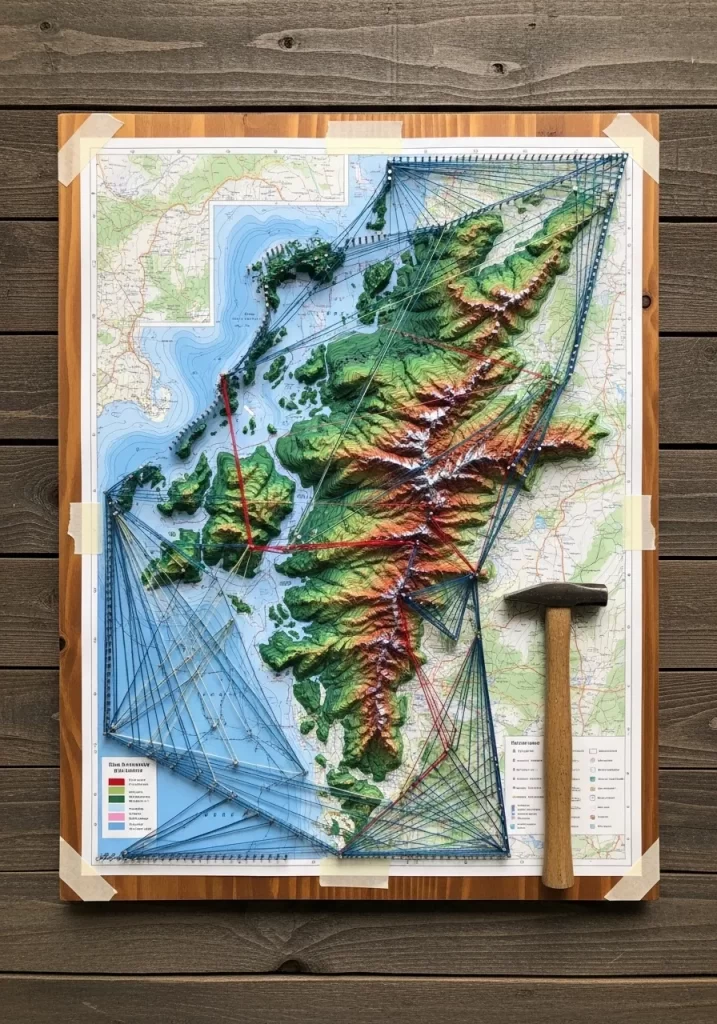
Combine geography and geometry with this intricate string art map. The project starts with a topographical map, which shows the mountains and valleys of an area. Nails are then hammered along coastlines or borders, turning the map into a unique loom for creating string patterns.
This piece highlights a specific island, with blue and red string crisscrossing the map to connect different points. This could represent travel routes, historical connections, or just a beautiful abstract design. The layers of map, 3D terrain, and string create a piece with amazing depth and personal meaning.
DIY Instructions: How to Make Map String Art
What You’ll Need:
- A printed map of a place you love
- A corkboard or a piece of soft wood
- Small nails with heads
- A small hammer
- Embroidery floss or thin string in different colors
Step-by-Step Guide:
- Mount Your Map: Attach your map to the corkboard or wood. You can use glue or tape.
- Place Your Nails: Decide where you want your string to connect. Hammer nails into those points. You can also hammer nails all along the outline of a country or state. Space them about half an inch apart. Make sure they are all hammered in to the same depth.
- Tie Your First Knot: Choose a color of string. Tie the end of it tightly around one of your nails.
- Start Weaving: Stretch the string across the map to another nail and loop it around. Then, stretch it to another nail, and another. You can connect the dots to outline a shape, or you can crisscross the middle to create geometric patterns.
- Experiment with Patterns: There are no rules! Zig-zag back and forth, make starburst shapes, or just connect random points. Use different colors to make different parts of your design stand out.
- Finish It Off: When you are done, tie the end of the string to the last nail and snip off any extra.
28. Faux Concrete Block Wall
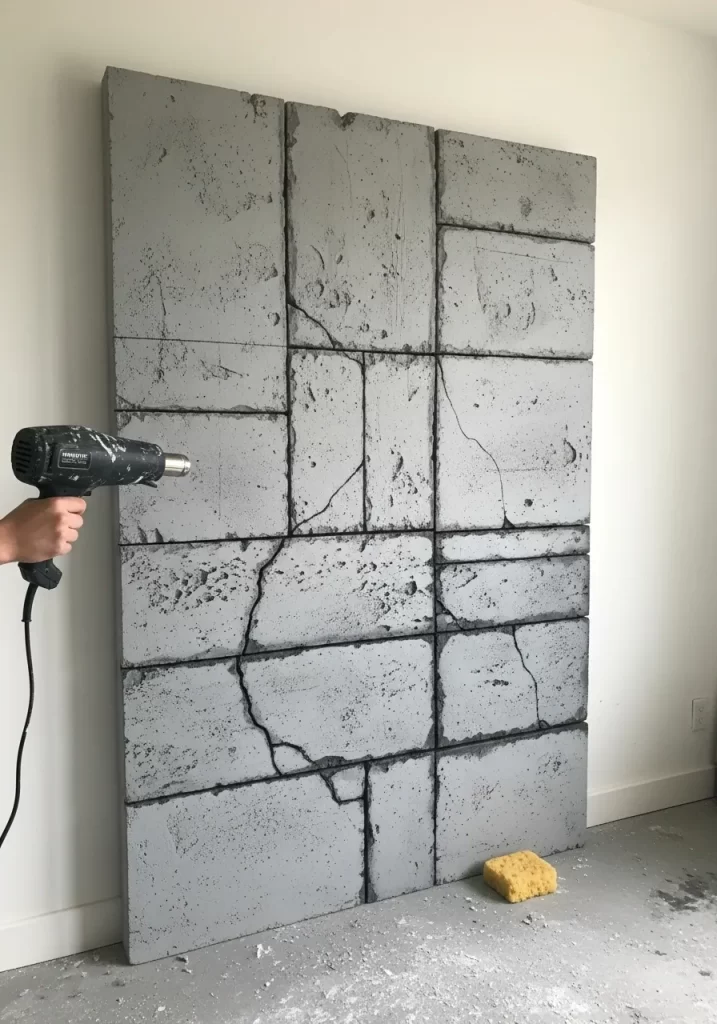
Get a cool, industrial vibe without a ton of construction. This project creates the look of a heavy, cracked concrete block wall using lightweight foam. It is a brilliant way to make a dramatic accent wall that is surprisingly easy to build and remove.
The foam panels are cut and shaped to look like large stone blocks. A heat gun can be used to add texture and realistic-looking cracks. A clever paint job with different shades of gray and black makes the illusion complete.
DIY Instructions: How to Make a Faux Concrete Wall
What You’ll Need:
- Large sheets of rigid foam insulation from a hardware store
- A craft knife or utility knife
- A heat gun
- Gray and black acrylic craft paint
- A paintbrush and a sponge
- Construction adhesive to attach it to the wall
Step-by-Step Guide:
- Safety First: When using a heat gun, work in a well-ventilated area and keep it away from flammable things.
- Cut Your Blocks: Use the craft knife to carefully cut your foam sheets into different sized rectangular “blocks.”
- Add Texture: Use the heat gun on a low setting and hold it a few inches away from the foam. As the foam warms up, it will bubble and melt slightly, creating a stone-like texture. You can also use a knife to carefully carve cracks into the foam.
- Paint the Base Coat: Paint all of your foam blocks with a base coat of medium-gray paint. Let them dry.
- Add Shadows and Age: Water down some black paint. Use a sponge to dab this dark paint into the cracks and along the edges of your blocks. This makes them look old and shadowy.
- Mount the Blocks: Plan your layout on the floor first. Then, apply construction adhesive to the back of each block and press it firmly onto the wall. Leave small gaps between them for the “grout lines.”
- Enjoy Your New Wall: Step back and enjoy your rugged, industrial-looking wall.
29. Custom Neon-Effect Sign
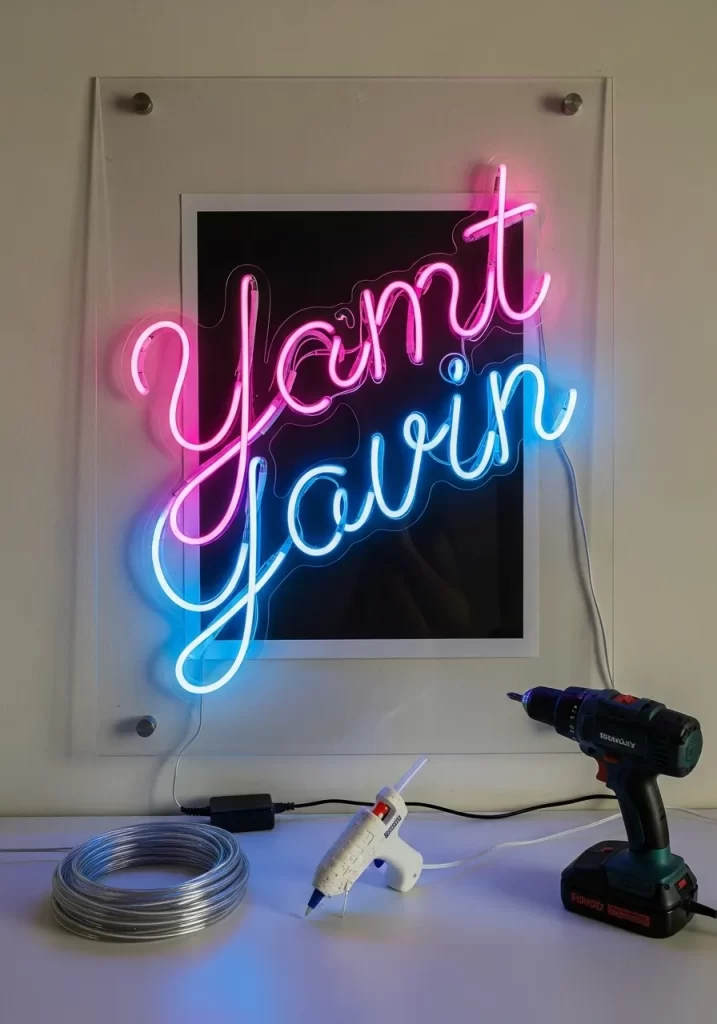
Light up your room with a custom sign that looks just like real neon. This project uses a flexible, glowing wire called EL wire to spell out a name or a favorite word. It gives you the cool, vibrant glow of a neon sign at a fraction of the cost.
The glowing wire is attached to a clear acrylic sheet, making it look like the letters are floating. The two-tone pink and blue colors create a fun, energetic look. It is a fantastic way to add a personal and modern touch to your wall decor.
DIY Instructions: How to Make a Faux Neon Sign
What You’ll Need:
- A sheet of clear acrylic or plexiglass
- EL wire with a battery pack
- A hot glue gun or clear super glue
- A printed word or design
- A drill with a small drill bit
- Tape
Step-by-Step Guide:
- Create Your Template: On your computer, type out the word you want in a cursive font and print it. Make sure it’s the size you want your final sign to be.
- Position Your Guide: Place the acrylic sheet over your printed template. Tape it down so it doesn’t move.
- Start Gluing: Carefully trace the first letter of your word by applying a thin line of hot glue directly onto the acrylic. Immediately press the EL wire into the glue. Hold it for a few seconds until it sets.
- Trace the Whole Word: Continue this process, adding glue and pressing the wire down, until you have traced your entire word.
- Hide the Wires: Figure out where the wire needs to connect to the battery pack. Drill a small hole in the acrylic at that spot. Thread the end of the wire through the hole to the back.
- Light It Up: Connect the EL wire to its battery pack. Turn it on and watch your new sign glow!
- Mount Your Sign: You can use special standoff screws to mount your sign so it floats just off the wall.
30. Woven Paper Landscape

Create a beautiful landscape scene with an interesting woven texture. This artwork is made by weaving strips of colored paper through a prepared background. The interaction of the vertical and horizontal strips creates a unique visual effect that’s part picture, part pattern.
This piece shows a vibrant sunset over a forest. The background image of the trees is cut into vertical strips, which acts as the loom. Then, horizontal strips of colored paper representing the sunset are woven through. It is a clever and creative technique for blending colors.
DIY Instructions: How to Weave a Paper Picture
What You’ll Need:
- A sheet of thick paper with a picture on it (like a forest scene)
- Several sheets of colored paper
- A craft knife and a cutting mat
- A ruler
- Glue or tape
Step-by-Step Guide:
- Prepare Your Loom: Place your picture on the cutting mat. Use the ruler and craft knife to cut straight vertical lines from the top of the picture to the bottom. Stop cutting about an inch from the top and bottom edges. Space your cuts about half an inch apart.
- Cut Your Weaving Strips: Take your colored paper. Cut it into long horizontal strips that are the same width as your vertical cuts (e.g., half an inch wide).
- Start Weaving: Take your first colored strip. Weave it through the slits in your picture by going over the first vertical strip, under the second, over the third, and so on, all the way across.
- Weave the Next Row: Take your second colored strip. This time, do the opposite. Go under the first vertical strip, over the second, and so on.
- Continue Weaving: Keep adding more colored strips, alternating the over-under pattern each time, until you have filled the whole picture.
- Secure the Edges: Once you’re done, you can put a little dab of glue or a piece of tape on the ends of each strip on the back to hold them in place.
- Frame Your Art: Your woven masterpiece is ready to be framed.
31. Upcycled Denim Quilt Hanging
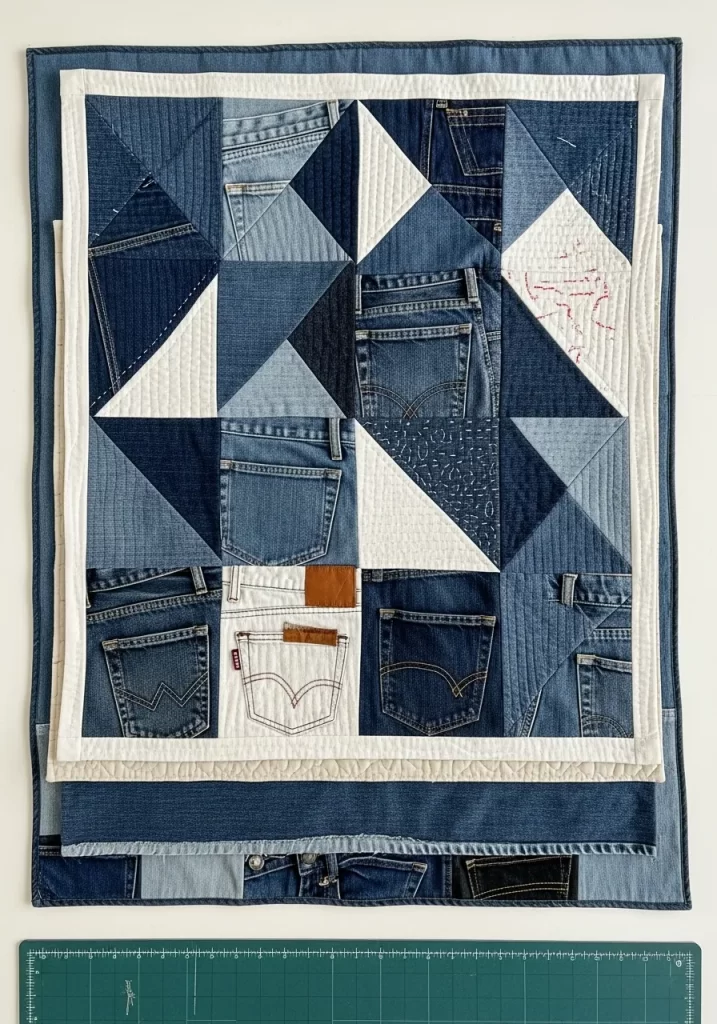
Give old jeans a new life as a piece of modern art. This project uses scraps from different pairs of jeans to create a patchwork quilt with a geometric design. The variety of blue washes, combined with white and cream fabrics, creates a beautiful and textured look.
This isn’t just a blanket; it’s a piece of art meant for the wall. The quilting adds another layer of texture, and you can even see small details like jean pockets and seams. It’s a sustainable and stylish way to preserve memories and add a cozy, rustic touch to your home.
DIY Instructions: How to Make a Denim Wall Hanging
What You’ll Need:
- Old jeans in various shades of blue
- Some white or cream-colored cotton fabric
- A sewing machine
- A rotary cutter, cutting mat, and ruler
- Batting and a backing fabric
- Thread
Step-by-Step Guide:
- Cut Your Squares: Cut your old jeans and cotton fabric into squares of the same size (e.g., 4×4 inches).
- Create Half-Square Triangles: To make the triangle design, take one denim square and one white square. Place them right-sides together. Draw a diagonal line from one corner to the opposite. Sew a quarter-inch seam on both sides of the line. Cut on the line, and you will have two triangle-squares.
- Arrange Your Design: Lay out your squares and triangle-squares on a flat surface. Arrange them in a pattern you like.
- Sew the Rows: Sew the squares together to form rows. Press the seams open with an iron.
- Sew the Rows Together: Sew your finished rows together to create the quilt top.
- Make the Quilt Sandwich: Lay your backing fabric down, then the batting, then your finished quilt top. Pin the layers together.
- Quilt It: Sew through all three layers to quilt them together. You can sew straight lines or more complex patterns. Trim the edges and add a border to finish it off.
32. Sculptural Plaster Fabric Art
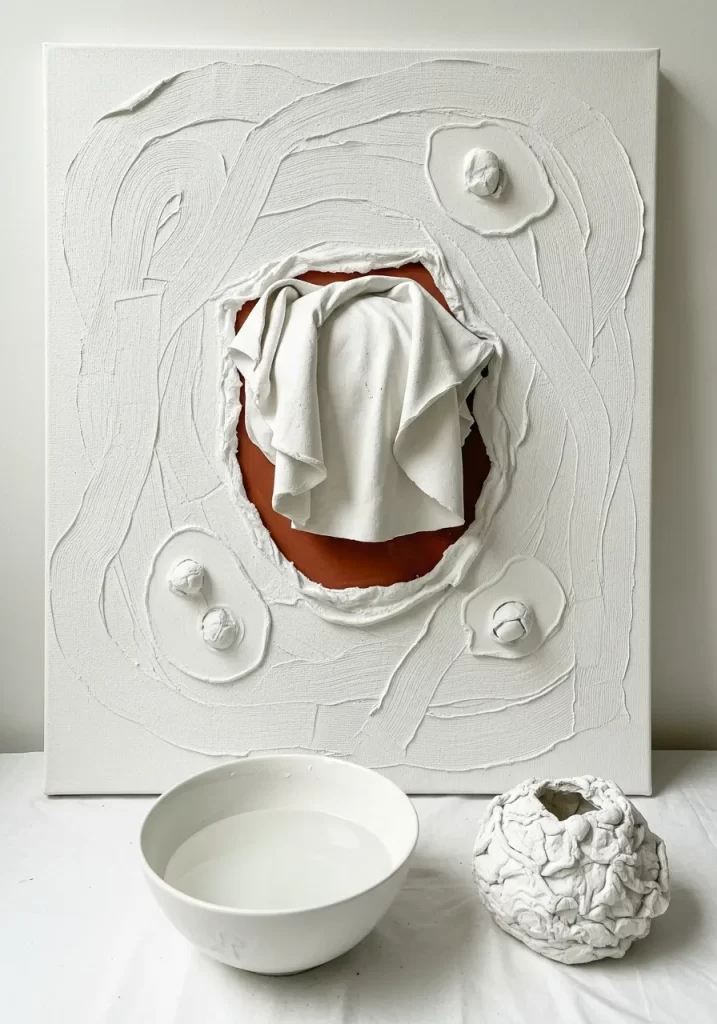
Create a stunning piece of three-dimensional art with a surprisingly simple process. This technique involves dipping fabric into plaster or a similar hardening medium and draping it on a canvas. As it dries, the fabric freezes in place, capturing every fold and wrinkle.
The result is a minimalist, sculptural piece with incredible texture. The contrast between the soft, draped fabric and the rough, textured background adds to the visual interest. Painting the entire piece a single color, like white, emphasizes the play of light and shadow on its surface.
DIY Instructions: How to Make Plaster Fabric Art
What You’ll Need:
- A blank canvas
- Plaster of Paris or pre-mixed joint compound
- A piece of fabric (like old cotton or linen)
- A bowl for mixing
- Water
- Optional: Acrylic paint for the canvas and texture
Step-by-Step Guide:
- Prepare Your Canvas: If you want, you can paint your canvas a background color. You can also spread some joint compound on it with a palette knife to create a textured background. Let this dry.
- Mix Your Plaster: In your bowl, mix the Plaster of Paris with water according to the package directions. It should be a smooth, pancake-batter consistency.
- Soak Your Fabric: Submerge your piece of fabric in the plaster mixture. Make sure it gets completely coated.
- Drape and Sculpt: Squeeze out the excess plaster. Carefully lift the fabric out and drape it onto your canvas. Arrange the folds and wrinkles until you are happy with the shape.
- Let It Harden: This is the most important part. Leave the canvas flat and let the plaster dry and harden completely. This could take 24 hours or more.
- Paint (Optional): Once it is rock-hard, you can paint the entire piece, fabric and all, a single color to unify it.
- Hang Your Sculpture: Your unique, textured art is ready to be displayed.
33. Vibrant Paper Collage
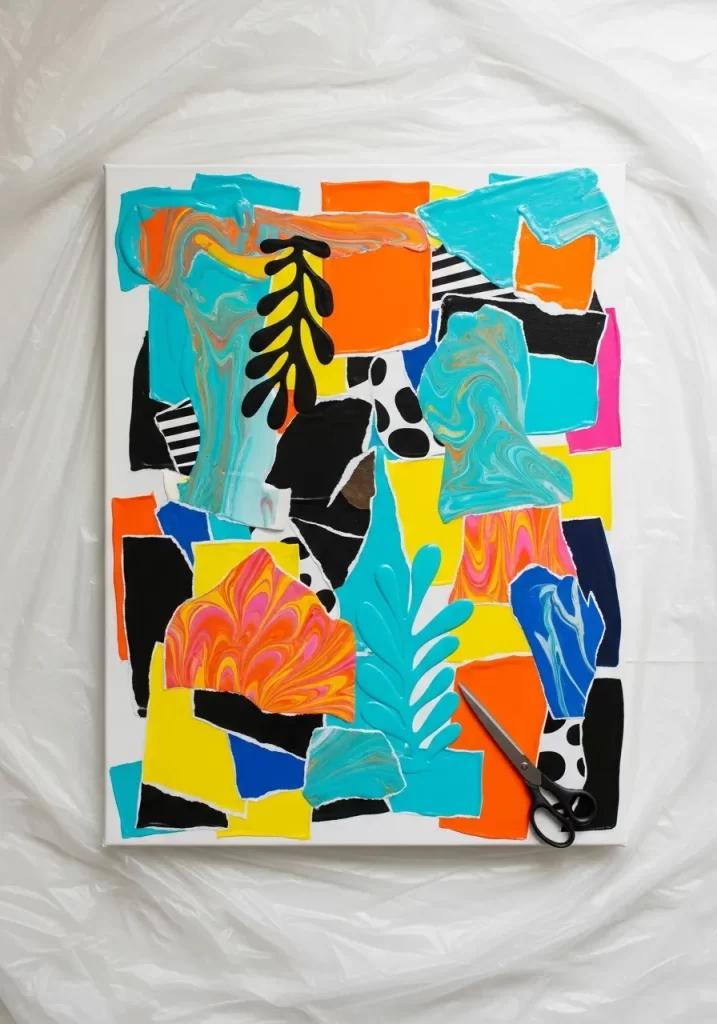
Unleash your creativity with a bold and energetic paper collage. This project is all about playing with color, shape, and pattern. Pieces of painted paper, patterned scraps, and solid colors are torn and cut, then layered to create a dynamic composition.
There are no rules here—the torn edges and overlapping shapes add to the artwork’s charm. Some pieces can even be made with interesting techniques like paint pouring to add more texture. It is a joyful and spontaneous way to create a piece of abstract art that is entirely your own.
DIY Instructions: How to Make a Paper Collage
What You’ll Need:
- A blank canvas or a piece of thick paper
- Various colored and patterned papers (scrapbooking paper, painted paper, magazine pages)
- Scissors
- A glue stick or Mod Podge
- Optional: Acrylic paints and brushes to create your own papers
Step-by-Step Guide:
- Gather Your Papers: Collect a wide variety of papers. If you want, you can create your own by painting, stamping, or marbling plain paper.
- Cut and Tear: Start cutting and tearing your papers into different shapes and sizes. Don’t think too much about it; just create a pile of interesting pieces.
- Start Arranging: Begin laying your paper pieces onto your canvas. Don’t glue anything down yet. Play with the arrangement, overlapping pieces and moving them around until you see a composition you like.
- Glue It Down: Once you have a layout you’re happy with, start gluing the pieces down. It’s often easiest to start with the bottom layer and work your way up.
- Keep Layering: Continue adding more pieces, building up your collage until the whole canvas is covered in a way that feels balanced and exciting.
- Seal It (Optional): If you want to protect your collage and give it a uniform finish, you can brush a coat of Mod Podge over the entire finished piece.
- Let It Dry: Let the glue dry completely, and your vibrant collage is ready to hang.
34. Wine Cork Mosaic
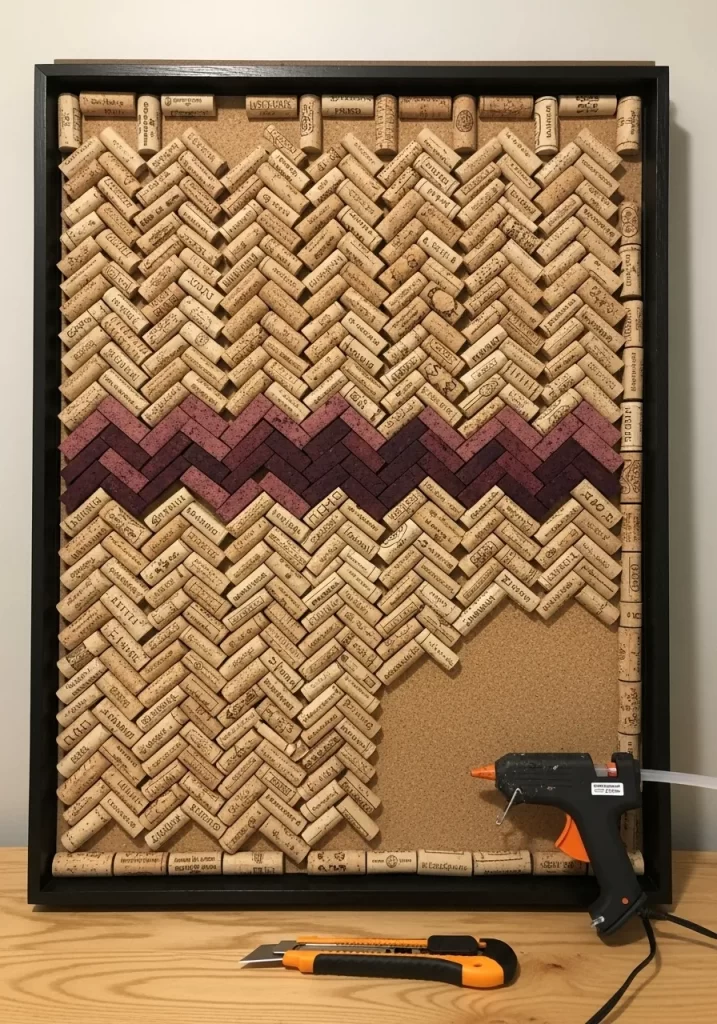
Save your wine corks to create a piece of art that’s full of memories. This project arranges wine corks into a patterned mosaic within a shadow box frame. The different shades of the corks, some stained red from the wine, add natural color variation.
This design features a classic herringbone pattern with a colorful chevron stripe through the middle. It’s a wonderful way to commemorate special occasions and trips. The finished piece is textured, rustic, and a great conversation starter for any wine lover.
DIY Instructions: How to Make a Cork Mosaic
What You’ll Need:
- A lot of used wine corks
- A shadow box frame
- A hot glue gun
- A craft knife
- Optional: A cork board liner for the frame
Step-by-Step Guide:
- Prepare Your Corks: You will need a lot of corks. To make a flat mosaic, you’ll need to carefully cut each cork in half lengthwise with the craft knife. An adult should do this part.
- Prepare Your Frame: Open your shadow box. If you want, you can glue a thin sheet of cork board to the back for a nice, even surface.
- Plan Your Design: Lay out your halved corks inside the frame without gluing them. Arrange them in the pattern you want, like the herringbone pattern in the picture.
- Start Gluing: Once you have your pattern planned, start gluing the corks down one by one. Apply a line of hot glue to the back of a cork half and press it firmly in place.
- Create Your Pattern: Continue gluing the corks down, following your design. You can use the red-stained ends of the corks to create colorful stripes or accents.
- Fill the Frame: Keep going until the entire surface is covered.
- Let It Cool: Let the hot glue cool and set completely before closing the shadow box and hanging your new artwork.
35. Layered Photo Ledges
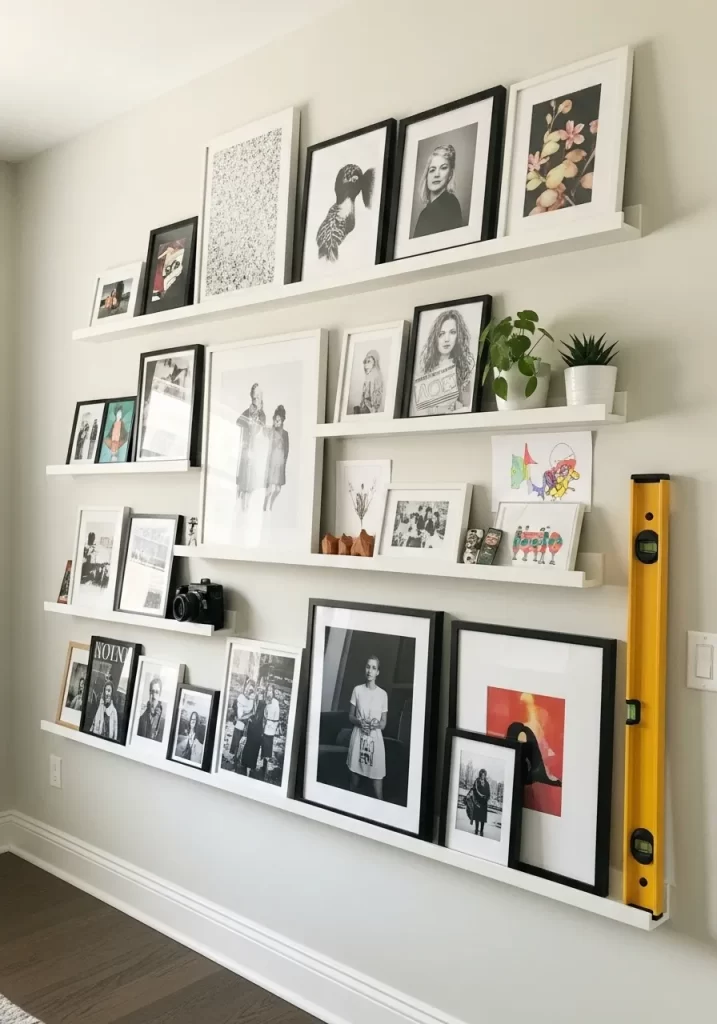
Create a sophisticated and personal gallery wall with photo ledges. This display method is more flexible than hanging individual frames. The thin, floating shelves allow you to easily swap out pictures and art, and to layer frames of different sizes for a dynamic look.
This beautiful arrangement mixes family photos, art prints, and even a small plant. The key is to vary the sizes and orientations of the frames. Using a mix of black and white frames creates a cohesive look, even with different styles of art. A level is essential to get those perfectly straight lines.
DIY Instructions: How to Create a Ledge Gallery
What You’ll Need:
- Several picture ledge shelves
- A drill and screws
- Wall anchors
- A level
- A tape measure
- A collection of framed photos and art
Step-by-Step Guide:
- Plan Your Layout: Decide where you want your ledges on the wall. Use the tape measure to plan the spacing. You can have them perfectly aligned or staggered.
- Mark for the First Ledge: Hold the first ledge against the wall. Place your level on top of it and adjust until the bubble is perfectly in the middle. Use a pencil to mark where the screw holes are.
- Install the Ledge: Drill holes on your marks. If you’re not drilling into a wall stud, push wall anchors into the holes. Then, hold the ledge up and screw it securely to the wall.
- Install the Other Ledges: Repeat the process for your other ledges, using your tape measure to make sure the spacing is correct.
- Arrange Your Art: This is the fun part. Start placing your framed pictures on the ledges. Don’t be afraid to overlap them.
- Layer and Style: Place larger frames in the back and smaller ones in the front. Mix in other objects like a small plant, a vintage camera, or your child’s drawings to add personality.
- Change It Up: The best part of a ledge gallery is that you can change the art and photos whenever you want a fresh look!
36. Living Moss & Air Plant Frame
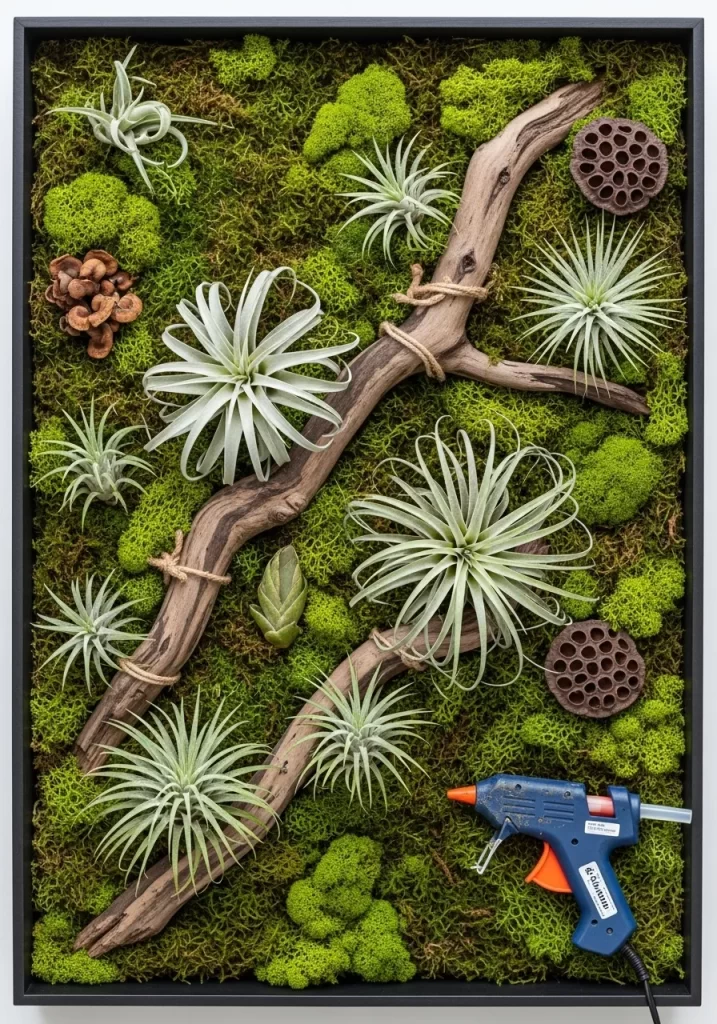
Create a vertical garden that looks like a lush, living painting. This project uses a shadow box frame filled with preserved moss, driftwood, and air plants to create a vibrant, three-dimensional piece of art. It’s a wonderful way to bring nature indoors without needing soil or a lot of watering.
The different textures and shades of green from the moss create a rich backdrop. The sculptural shapes of the air plants and driftwood add focal points. This living art requires very little maintenance and brings a sense of calm and nature to any room.
DIY Instructions: How to Make a Living Moss Wall
What You’ll Need:
- A shadow box frame
- Preserved moss in different colors and textures
- A hot glue gun
- A few interesting pieces of driftwood or small branches
- Air plants (Tillandsia)
- Optional: Dried seed pods or other natural elements
Step-by-Step Guide:
- Prepare the Frame: Remove the glass from the front of your shadow box frame.
- Create the Background: Start by gluing down the moss to cover the entire back panel of the shadow box. Use generous amounts of hot glue. Mix the different types of moss to create a textured, natural look.
- Add the Wood: Arrange your pieces of driftwood on top of the moss. Once you like the placement, secure them with plenty of hot glue.
- Place the Air Plants: Air plants don’t need soil, so you can just nestle them into your design. You can gently tuck them between the driftwood and the moss. You can also use a tiny bit of glue on their very base to hold them, but be careful not to smother them.
- Add Final Touches: Glue on any other decorative elements you have, like dried lotus pods or pinecones.
- Care and Hanging: To care for your art, take it down once a week and lightly mist the air plants with water. Hang it in a spot with bright, indirect light.
37. Geometric Wood Block Mosaic
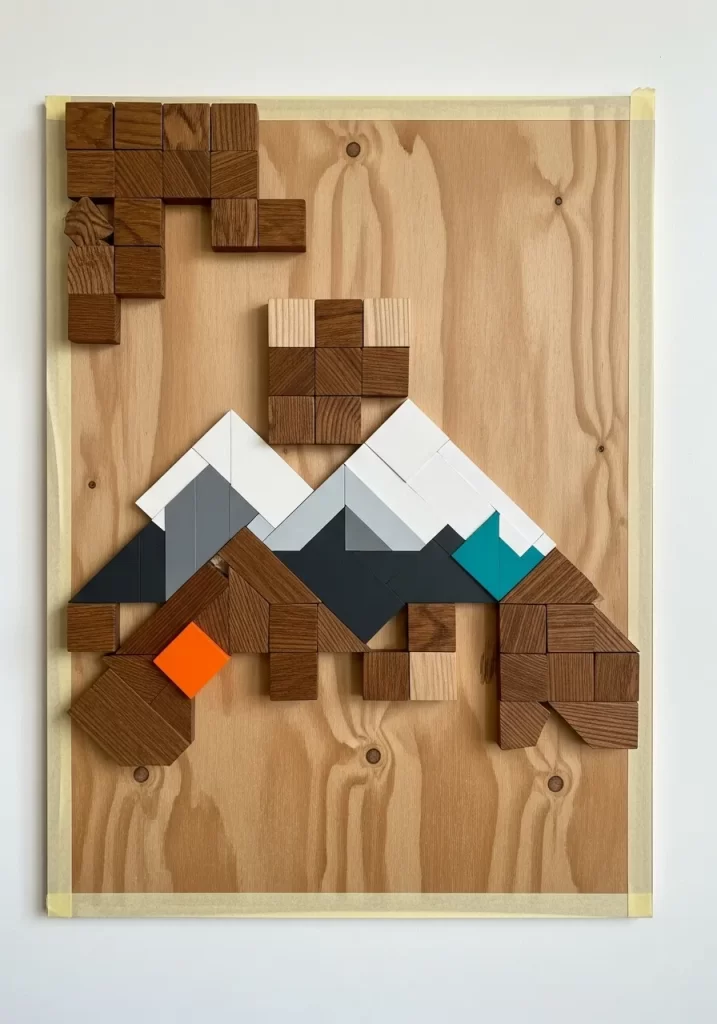
Create a modern, abstract piece of art with a warm, natural feel. This project uses small wooden blocks, some stained and some painted, to create a mosaic on a plywood backer board. The different shapes—squares and triangles—are arranged to form a stylized mountain landscape.
The beauty of this piece comes from the combination of textures and tones. The natural wood grain contrasts with the flat, painted surfaces. The three-dimensional quality of the blocks adds depth and shadow. It is a sophisticated piece that feels both geometric and organic.
DIY Instructions: How to Make a Wood Block Mosaic
What You’ll Need:
- A piece of plywood for the base
- Small wooden blocks or square dowels you can cut into blocks and triangles
- Wood stain
- Acrylic paint in a few colors
- Wood glue
- A saw (if you need to cut your own blocks)
Step-by-Step Guide:
- Prepare Your Blocks: Cut your wood into small squares and triangles. If you buy pre-cut blocks, you can skip this step.
- Color Your Pieces: Divide your blocks into groups. Leave some plain, stain some a darker wood color, and paint the others with your acrylic paints. Let everything dry completely.
- Plan Your Design: Lightly sketch your design onto the plywood base. Or, you can just start arranging the blocks on the board without a plan and see what you create.
- Start Gluing: Once you have an arrangement you like, start gluing the blocks down one by one. Apply a small amount of wood glue to the back of each block and press it firmly onto the plywood.
- Build Your Picture: Continue placing and gluing your blocks, fitting them together like a puzzle to create your mountain scene or abstract pattern.
- Let It Dry: Let the wood glue cure completely, which usually takes several hours.
- Hang It: Add a picture hanger to the back of the plywood, and your modern wood mosaic is ready for the wall.
38. Block-Printed Fabric Hanging
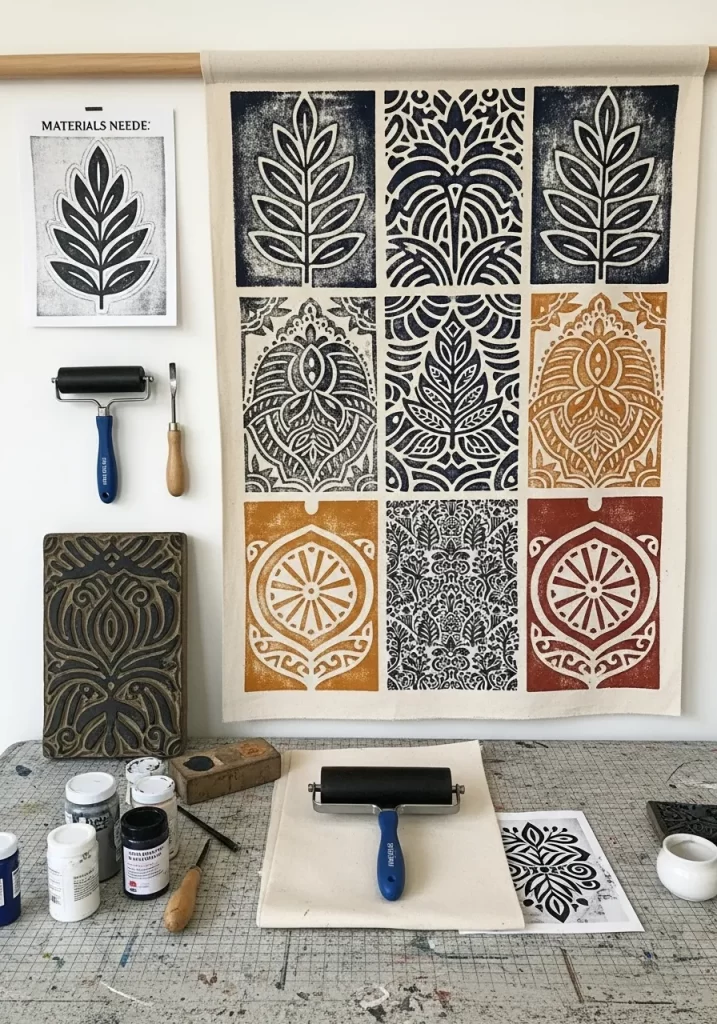
Create a beautiful, patterned wall hanging using the timeless art of block printing. This project involves carving a design into a block, applying ink to it, and stamping it onto fabric. The result is a piece of art with a charming, handcrafted look.
This hanging features several different block designs printed in a grid pattern. The slight variations in each print are part of what makes it beautiful. The finished fabric is hemmed at the top and bottom and hung from a simple wooden dowel, giving it a relaxed, tapestry-like feel.
DIY Instructions: How to Do Block Printing
What You’ll Need:
- A piece of plain fabric, like cotton or linen
- A linoleum block or a rubber carving block
- Lino-cutting tools
- Block printing ink
- A brayer (a small roller)
- A flat surface for rolling ink (like a piece of glass or a plastic tray)
Step-by-Step Guide:
- Design and Carve: Draw your design onto the carving block. Use the lino-cutting tools to carefully carve away the areas you do not want to be printed. Remember, whatever is left raised will be what shows up in your print.
- Prepare Your Ink: Squeeze a small amount of ink onto your flat surface. Use the brayer to roll the ink out into a thin, even layer.
- Ink Your Block: Roll the inky brayer over your carved block. Make sure the entire raised surface is evenly coated with ink.
- Make a Print: Carefully place your inked block face down onto your fabric. Press down firmly and evenly all over the back of the block.
- Lift and Reveal: Gently lift the block straight up to reveal your print.
- Create Your Pattern: Re-ink your block and continue stamping to create a pattern on your fabric.
- Heat-Set and Finish: Let the ink dry completely. To make it permanent, iron the fabric (follow the ink’s instructions). You can then hem the edges and create a channel for a dowel to hang it.
39. Bohemian Scarf Display

Turn your beautiful collection of scarves into a colorful piece of wall art. This is a wonderfully simple and effective way to add a soft, bohemian touch to a room. All it takes is a natural branch and a selection of your favorite scarves.
The scarves are simply tied onto the branch, allowing their patterns and textures to take center stage. The variety of colors and prints creates a rich, layered look. This is a great solution for both decorating a wall and storing your scarves in a way that you can easily see and access them.
DIY Instructions: How to Create a Scarf Hanging
What You’ll Need:
- A sturdy, interesting-looking tree branch
- A collection of your favorite scarves
- String or twine for hanging
Step-by-Step Guide:
- Find and Clean Your Branch: Find a fallen branch from your yard or a park. Make sure it’s strong enough to hold the scarves. Clean off any dirt and let it dry.
- Create a Hanger: Cut a long piece of string or twine. Tie each end securely to the ends of the branch. This will be what you use to hang it.
- Tie On Your Scarves: Take your first scarf. Fold it in half. Drape the folded loop over the branch from the front. Then, pull the two loose ends of the scarf through the loop and tighten it. This is called a lark’s head knot.
- Add More Scarves: Continue tying on all of your scarves. You can arrange them in a color gradient, mix up the patterns, or create any arrangement you like.
- Hang and Admire: Hang your new scarf display on the wall. You can easily swap out scarves for a new look whenever you like!
40. Digital Art Projector Wall
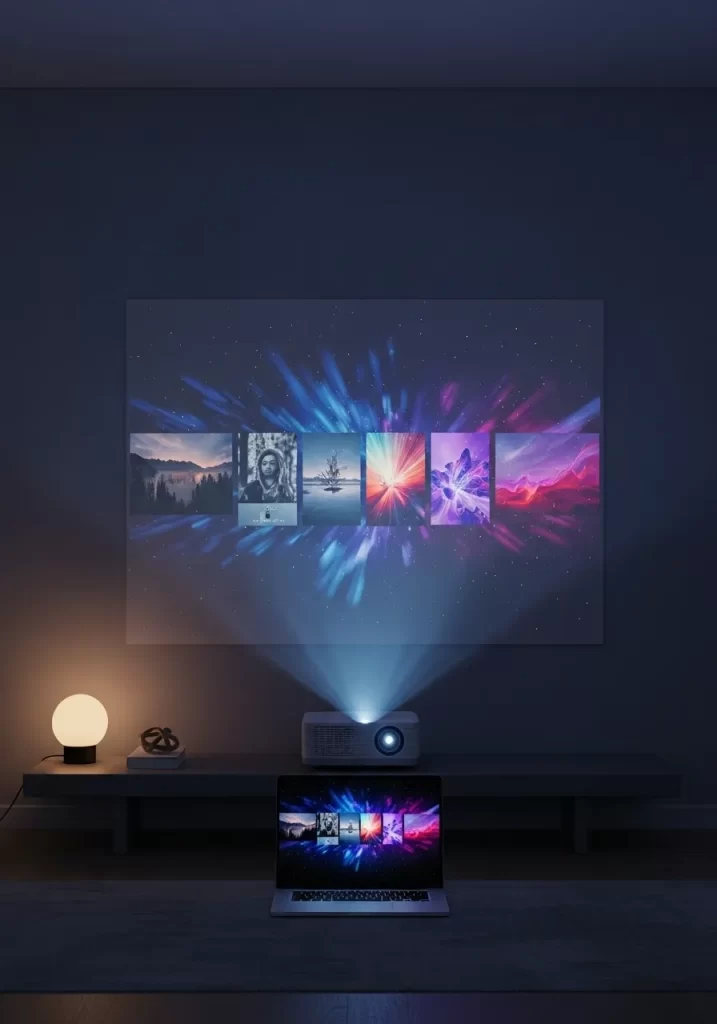
Turn your wall into a dynamic, ever-changing art gallery with a digital projector. This modern approach to wall decor allows you to display any image you want, from famous paintings to family photos to abstract digital art. It is the ultimate in customizable wall decor.
A small, minimalist projector can cast a large, high-resolution image onto a plain wall. You can change the art to match your mood, the season, or the occasion. It is a tech-savvy way to ensure your walls are never, ever boring.
DIY Instructions: How to Set Up a Projector Wall
What You’ll Need:
- A digital projector
- A laptop or other media source
- A blank, light-colored wall
- A small table or shelf for the projector
Step-by-Step Guide:
- Choose Your Spot: Find a blank wall in a room that you can make relatively dark. Lighter colored walls work best.
- Position Your Projector: Place your projector on a stable surface directly opposite the wall. Plug it in and turn it on.
- Connect Your Device: Connect your laptop to the projector using an HDMI cable or wireless connection.
- Adjust the Image: Use the projector’s settings to focus the image and adjust the size and shape (keystone correction) so that it looks like a perfect rectangle on your wall.
- Create a Slideshow: Gather a collection of your favorite high-resolution images. You can find famous artworks online, use your own photos, or buy digital art. Put them into a folder or a slideshow program on your computer.
- Display Your Art: Display your first image or start your slideshow.
- Change It Anytime: The best part is that you can instantly change the art with just a few clicks. You can have a new masterpiece on your wall every single day!
You’ve now explored 40 different paths to transforming your home. Each idea is more than just a craft; it’s an opportunity to make your space truly yours. Your walls don’t have to be boring. They can be a gallery of your creativity, your memories, and your adventures.
The most important step is the first one. Don’t be afraid to try something new, to make a mess, or to experiment with color and texture. The goal is not to create a flawless masterpiece. The goal is to enjoy the process and to create a home that feels like a genuine extension of yourself.
So, pick a project that sparked your interest. Gather your materials, put on some music, and start creating. Your walls are waiting.
Key Takeaways
- Personalization Makes a Home: Your walls are a canvas to express your personality and tell your story.
- Creativity is for Everyone: You don’t need to be a professional artist to create beautiful, impactful wall art.
- Upcycle with Purpose: Everyday items like jeans, wine corks, and magazines can be transformed into stunning decor.
- Texture Adds Dimension: Projects using materials like plaster, yarn, and wood add depth and interest that flat prints cannot.
- Start Simple: Don’t feel overwhelmed. Choose an easy project to build your confidence and have fun with the creative process.