
Does your bathroom feel a little bland? It’s a room you use every day, yet it’s often the last space we think about decorating. A boring bathroom can make your morning routine feel dull.

But transforming this small space doesn’t require a full renovation. You can bring in a huge amount of personality and style with a few simple changes. A pop of color might be all it takes to make the room feel brand new.
This guide is filled with easy and creative ways to add life to your bathroom. From simple paint projects to clever accessory swaps, you’ll find inspiration for every style and budget. Get ready to turn your boring bathroom into a space you love.
1. Introduce Two-Tone Walls
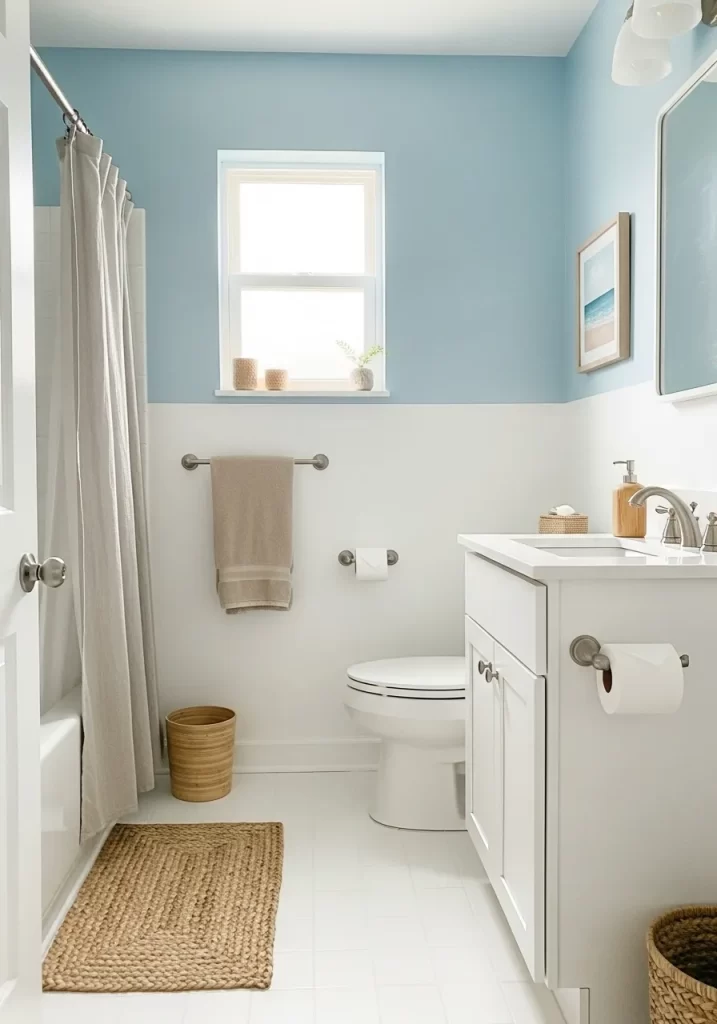
A simple coat of paint can completely change a room. Consider painting just the top half of your bathroom walls. This technique adds a beautiful splash of color without overwhelming the space. It also creates an interesting visual line that can make the ceiling feel higher.
The soft blue in this example brings a sense of calm, like a clear sky. It pairs well with the crisp white lower wall, making the bathroom feel bright and open. This is a straightforward way to introduce personality into a plain bathroom.
DIY Instructions: How to Create a Two-Tone Wall
Creating this look is a fun weekend project. Here’s how you can do it step-by-step.
What you will need:
- Two colors of paint (one for the top, one for the bottom)
- Painter’s tape
- A measuring tape
- A pencil
- A level (a ruler with a bubble in it)
- Paint rollers and brushes
- A paint tray
Step-by-Step Guide:
- Paint the First Color: First, paint the entire wall with your lighter color (in this case, white). Let it dry completely. This might take a few hours or even a full day. Check the paint can for instructions.
- Decide Your Line Height: Now, decide how high you want your second color to go. A good spot is usually about one-third or one-half of the way up the wall. Use your measuring tape to measure from the floor up to this spot.
- Mark the Wall: Use your pencil to make a few small marks at your chosen height along the wall.
- Draw a Straight Line: Place your level on the wall, connecting your pencil marks. The bubble in the middle of the level will tell you if your line is perfectly straight. When the bubble is right in the center, use your pencil to draw a light, straight line all the way around the room.
- Apply Painter’s Tape: Carefully place the painter’s tape along the line you just drew. Make sure the edge of the tape is exactly on the line. Press down on the tape firmly with your finger to seal it so no paint can sneak underneath.
- Paint the Second Color: Now for the fun part! Use your roller and brushes to paint the top section of the wall with your second color (the blue). Paint right over the edge of the tape. Don’t worry, the tape will protect your straight line.
- Remove the Tape: While the paint is still a little bit wet, gently pull the painter’s tape off the wall. Pull it at an angle, away from the painted area. You should have a nice, clean line.
- Let it Dry: Let your new wall dry completely. Then you can stand back and admire your awesome work!
2. Warm Up with Coordinated Textiles
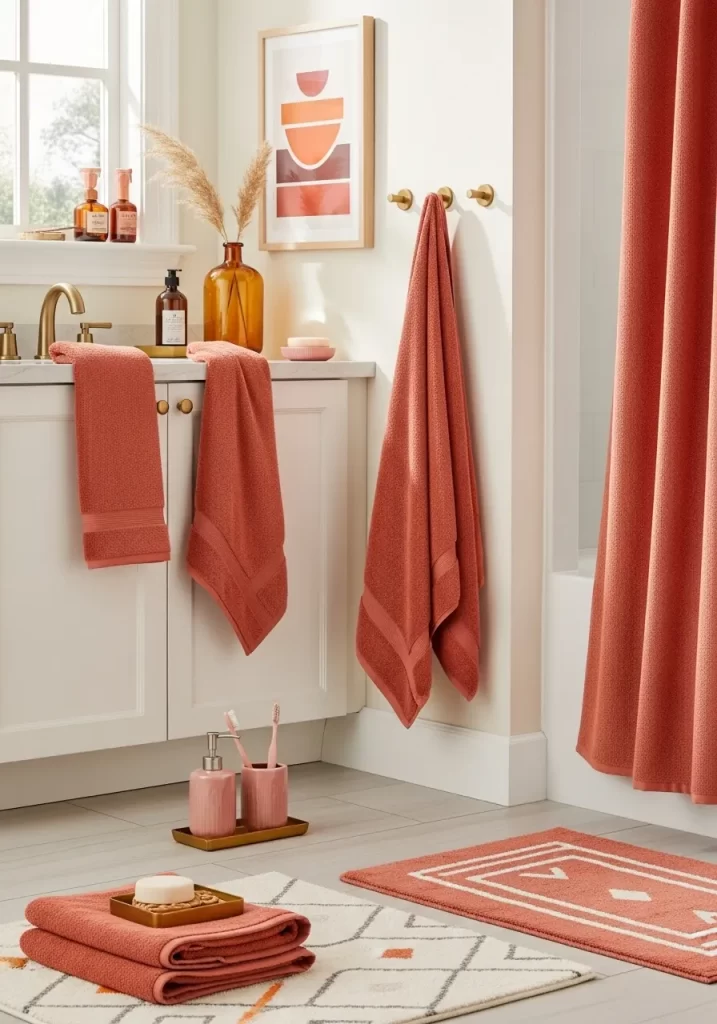
You can transform your bathroom without a single drop of paint. Simply coordinating your towels, rugs, and shower curtain can introduce a rich, warm feeling. This is one of the easiest ways to bring in a dominant color.
A warm coral or terracotta shade makes the whole space feel more inviting and comfortable. These items work together to create a unified and thoughtful look. It’s a quick update with a big impact.
DIY Instructions: How to Coordinate Your Bathroom Linens
Choosing matching textiles is a simple design trick anyone can do.
What you will need:
- A main color idea
- Shower curtain
- Bath towels, hand towels
- Bath mat or rug
- Optional: matching soap dispenser or cups
Step-by-Step Guide:
- Pick a Hero Color: First, decide on one color you really like. This will be the main color for your bathroom accessories.
- Start with the Biggest Item: The shower curtain is the largest piece of fabric, so find one in your chosen color first. This will be the anchor for the room.
- Find Matching Towels: Look for bath towels, hand towels, and washcloths that are the same color as your shower curtain. It’s okay if the shade is a little different, as long as they look good together.
- Get a Matching Mat: Find a bath mat that also matches your color scheme. This will help tie the whole look together from top to bottom.
- Add Small Details: If you want, you can find other small items like a soap dispenser, toothbrush holder, or a small vase in the same color family to finish the look.
3. Go Bold with Patterned Tiles
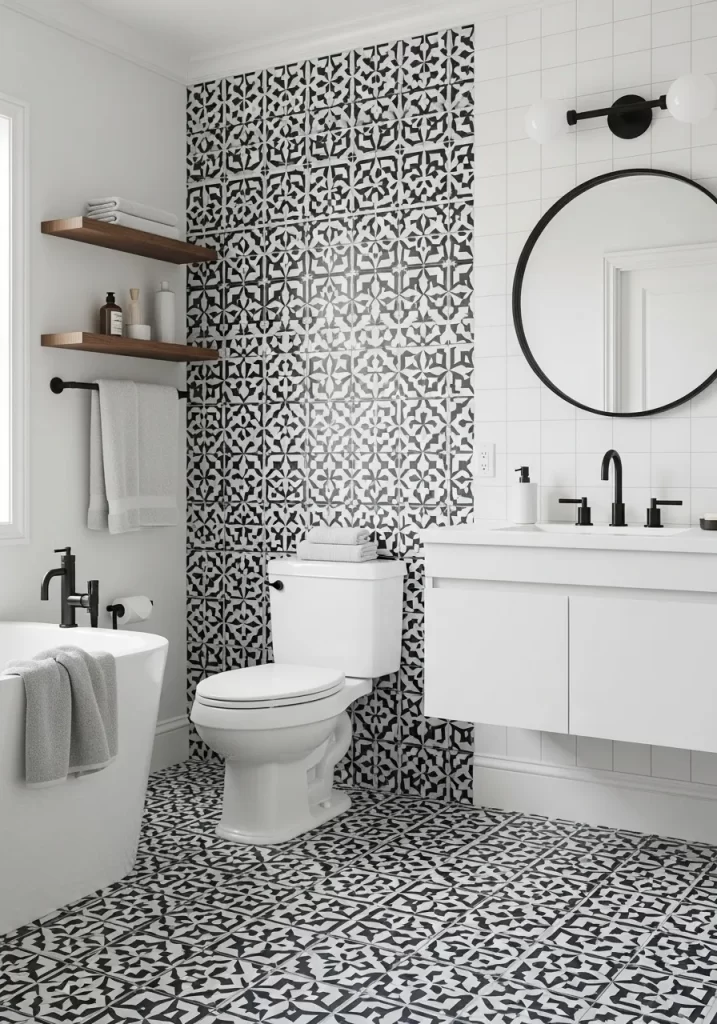
For a truly dramatic change, patterned tiles make a huge statement. They bring energy and a custom-designed feel to the bathroom. Using the same tile on the floor and up an accent wall is a great way to make the space feel cohesive.
The black and white geometric pattern is timeless yet modern. It adds a lot of visual interest without using bright colors. This approach turns a simple wall or floor into a work of art.
DIY Instructions: How to Use Peel-and-Stick Tiles
You can get this look without the mess of real tile and grout by using peel-and-stick tiles.
What you will need:
- Peel-and-stick tiles
- A measuring tape
- A utility knife or strong scissors
- A ruler or straight edge
- A cleaning cloth and spray
Step-by-Step Guide:
- Clean the Surface: Your wall or floor must be very clean and dry. Use a cloth and cleaner to wipe it down and then let it dry completely.
- Plan Your Layout: Find the center of your wall or floor. It’s usually best to start tiling from the center and work your way out to the edges.
- Peel and Stick the First Tile: Gently peel the paper backing off your first tile. Carefully place it on the floor or wall, lining it up with your center starting point. Press down firmly all over the tile.
- Add More Tiles: Place the next tile right up against the edge of the first one. Make sure the pattern lines up. Continue placing tiles one by one.
- Cut Tiles for the Edges: When you get to a wall or corner, you will need to cut a tile. Measure the space carefully. Use a ruler and utility knife to score a line on the tile, and then you should be able to snap it. A grown-up can help with this part.
- Stick the Cut Pieces: Place your custom-cut pieces along the edges to finish the job.
4. Create a Bathroom Jungle
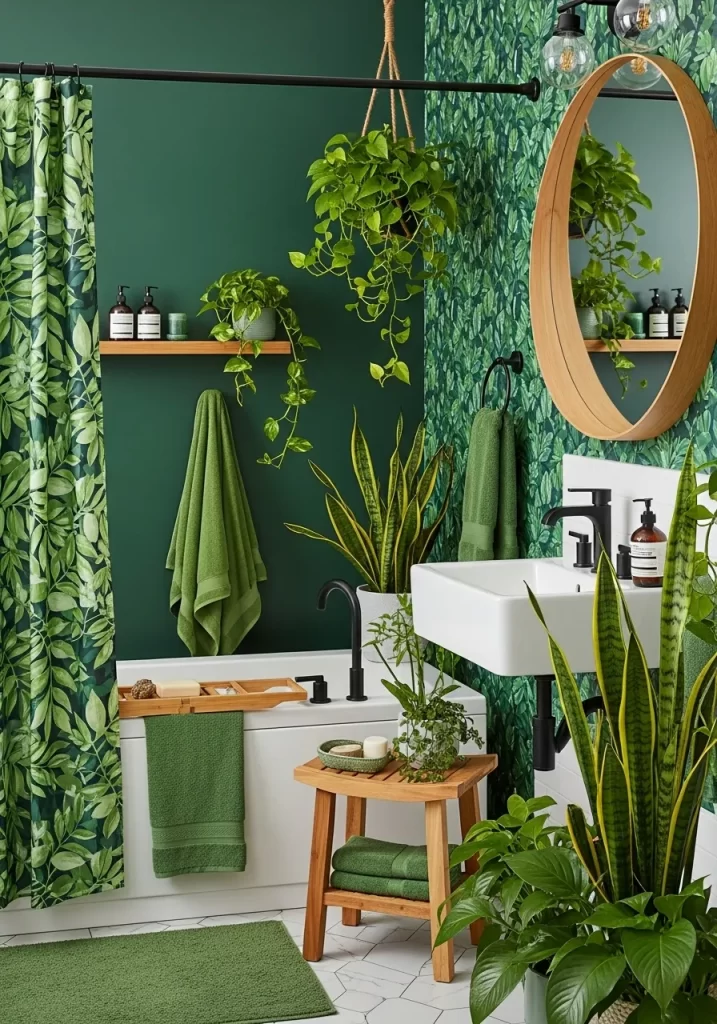
Turn your bathroom into a green oasis by filling it with plants. The mix of a green accent wall, a leafy shower curtain, and lots of real plants creates a vibrant, fresh atmosphere. It feels like you are stepping into a relaxing spa.
Plants that enjoy humidity, like snake plants and pothos, will be very happy in a bathroom. The natural wood elements and simple mirror help balance the bold green. This design brings the outdoors in.
DIY Instructions: How to Make a Simple Rope Plant Hanger
Hanging plants saves counter space and looks amazing.
What you will need:
- Jute rope or thick twine
- Scissors
- A small plant in a pot
- A metal or wooden ring (optional)
- A ceiling hook
Step-by-Step Guide:
- Cut Your Ropes: Cut four long pieces of rope. They should all be the same length. A good length to start with is about as long as you are tall.
- Tie a Knot: Take all four pieces of rope and tie them together in a big knot at one end. Leave a little bit of rope at the end like a tassel.
- Place Your Pot: Put your plant pot right on top of the knot.
- Make Your Net: Separate the ropes into four pairs of two. About halfway up the pot, tie each pair of ropes into a knot.
- Create the Top: Now, take one rope from one pair and one rope from the neighboring pair and tie them together a few inches above your last knots. Do this all the way around. This will create a net that holds your pot.
- Finish with a Top Knot: Gather all the ropes together at the top and tie another big knot to hang it from. You can slide a ring on before this knot if you have one.
- Hang Your Plant: Ask a grown-up to help you screw a hook into the ceiling. Hang your new plant holder on the hook.
5. Embrace Classic Black and White
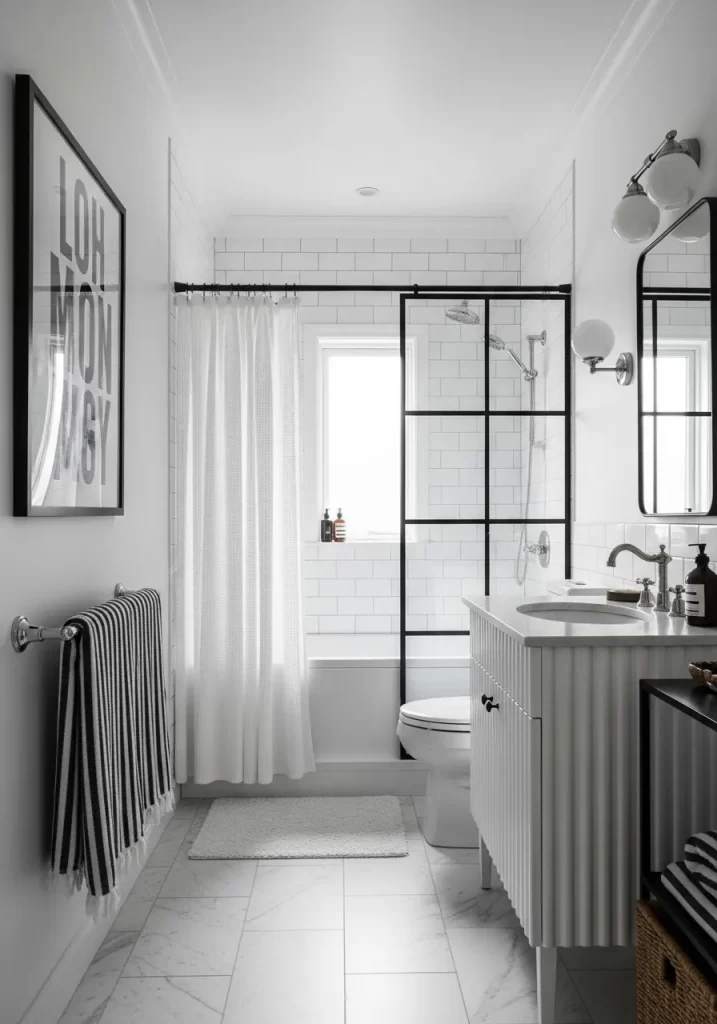
You don’t need bright hues to make a statement. A strong black and white color scheme is classic and stylish. The contrast itself provides the “pop” your bathroom needs.
In this room, the striped towels, the black frame of the shower door, and the large graphic poster add personality. These bold patterns and lines keep the simple color palette from feeling boring. It creates a sophisticated and clean look.
DIY Instructions: How to Create Your Own Graphic Wall Art
You can make your own cool art for the bathroom wall in just a few steps.
What you will need:
- A large picture frame
- A piece of white poster board that fits the frame
- Black craft paint or a thick black marker
- A pencil
Step-by-Step Guide:
- Think of a Design: Decide what you want to create. It could be your initials, a simple word, stripes, or a big geometric shape. Simple and bold is best.
- Sketch it Out: Lightly draw your design on the poster board with a pencil. This way you can erase it if you make a mistake.
- Fill it In: Use your black paint or marker to carefully fill in your pencil sketch. Take your time to make the lines neat.
- Let it Dry: If you used paint, let it dry completely.
- Frame Your Art: Once it’s dry, place your new artwork inside the frame.
- Hang it Up: Find a good spot on your bathroom wall and hang your custom creation.
6. Add Earthy Towels and Rugs
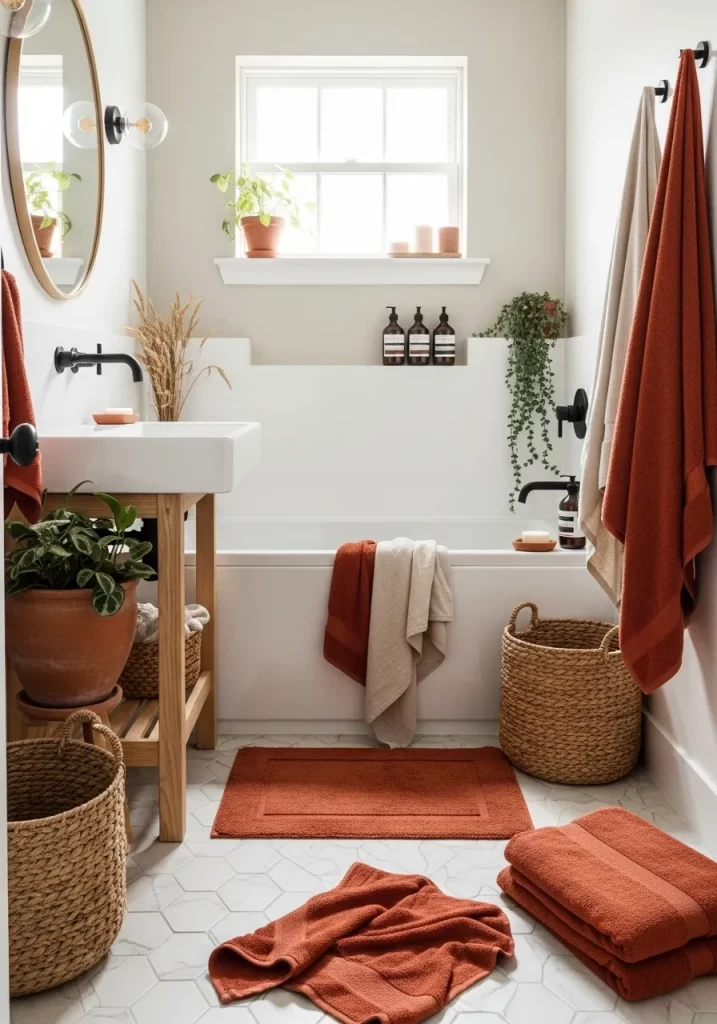
Adding color can be as simple as swapping out your old towels and rugs. Choosing an earthy, warm color like rust or terracotta instantly makes a neutral bathroom feel more grounded and cozy.
The rich color of the towels and mats stands out against the white walls and light wood. It’s a simple change that brings in both color and texture. Pairing them with woven baskets enhances the natural, calming feel of the space.
DIY Instructions: How to Decorate a Woven Basket
Give a plain wicker basket a custom touch with this easy craft.
What you will need:
- A plain woven basket (wicker or seagrass)
- Yarn or thick string in one or more colors
- Scissors
- Optional: large craft pom-poms
Step-by-Step Guide:
- Make Pom-Poms (Optional): If you want to add pom-poms, you can make them by wrapping yarn around your fingers, tying it in the middle, and then snipping the loops.
- Create a Tassel: To make a tassel, wrap yarn around a small piece of cardboard. Slide it off, tie a string tightly around the top, and then cut the bottom loops.
- Attach Your Decorations: Decide where you want to put your decorations. You can tie a few tassels or pom-poms onto the basket’s handle or around the top rim.
- Add a Yarn Wrap: For another look, you can wrap colored yarn around the basket’s handles to give them a pop of color. Just tie a knot to start, wrap the yarn tightly, and tie another knot to finish.
7. Try a Jewel-Toned Paint Color
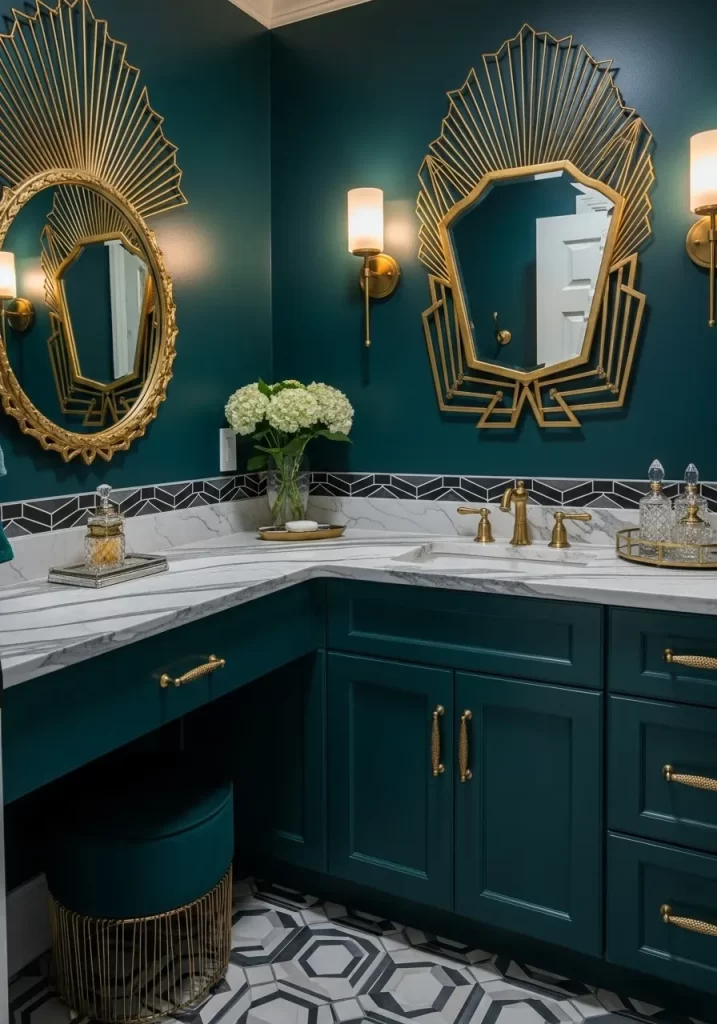
Don’t be afraid to use dark, rich colors in a bathroom. A deep jewel tone, like this luxurious teal, can make the space feel incredibly cozy and elegant. It’s a bold move that has a big payoff.
The dark walls make metallic items, like the gold mirrors and light fixtures, really shine. This contrast creates a feeling of glamour and sophistication. It turns a regular bathroom into a special retreat.
DIY Instructions: How to Update Your Cabinet Hardware
Changing the knobs and handles on your vanity is a quick and easy update.
What you will need:
- New knobs or pulls
- A screwdriver
- A cloth for cleaning
Step-by-Step Guide:
- Choose New Hardware: Pick out new knobs or handles. Make sure the screw holes will line up with the ones already on your drawers and doors. The easiest way is to take an old one with you to the store.
- Unscrew the Old Hardware: Open your cabinet doors and drawers. Use a screwdriver to loosen and remove the screws holding the old hardware in place.
- Clean the Surface: Wipe down the front of the doors and drawers where the old hardware used to be.
- Screw in the New Hardware: Take a new knob or pull and the screw that came with it. From the inside of the door, push the screw through the hole.
- Attach the Knob: From the outside, screw the new knob onto the screw until it’s snug. Repeat for all your doors and drawers.
8. Play with Pastel Accessories
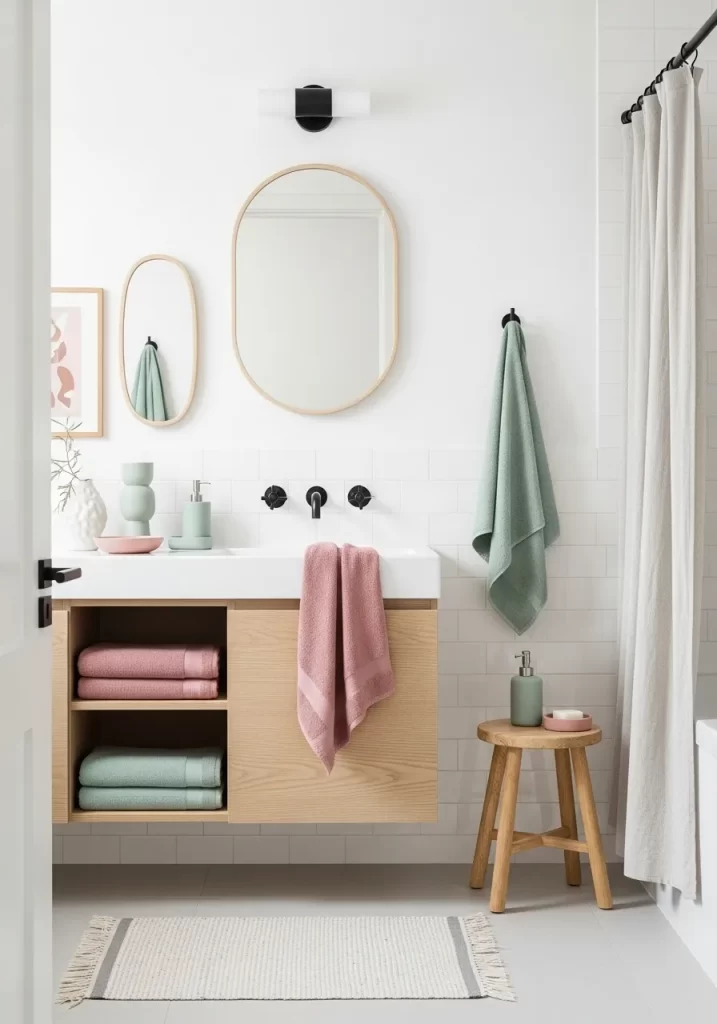
If you prefer a softer look, pastel colors are a wonderful choice. Light and airy shades of mint green and dusty pink can make a bathroom feel cheerful and fresh.
The key is to sprinkle these colors around the room. Use them for towels, a soap dispenser, a vase, or a small dish. This spreads the color out and keeps the space feeling balanced and bright, rather than overly sweet. It’s a fun and gentle way to add personality.
DIY Instructions: How to Paint a Soap Dispenser
Give a plain soap dispenser a colorful makeover.
What you will need:
- A plain ceramic or glass soap dispenser
- Craft paint that works on glass/ceramics
- A small paintbrush
- Painter’s tape
- Clear spray sealant (optional, for protection)
Step-by-Step Guide:
- Clean Your Dispenser: Wash the soap dispenser with soap and water and let it dry completely.
- Tape Off the Pump: Use painter’s tape to carefully cover the pump mechanism and any other part you don’t want to get paint on.
- Paint Your First Coat: Use your paintbrush to apply a thin, even layer of your chosen pastel paint. Don’t worry if it looks a little streaky.
- Let it Dry: Let the first coat of paint dry completely. Check the instructions on the paint bottle to see how long it takes.
- Paint a Second Coat: Once the first coat is dry, add a second coat of paint to make the color solid and bright.
- Seal it (Optional): After the second coat is totally dry, you can take it outside or to a well-ventilated area and spray it with a clear sealant. This will help protect the paint from water. Let the sealant dry.
- Remove the Tape: Carefully peel off the painter’s tape. Fill it with soap and you’re done!
9. Paint Your Vanity a New Color
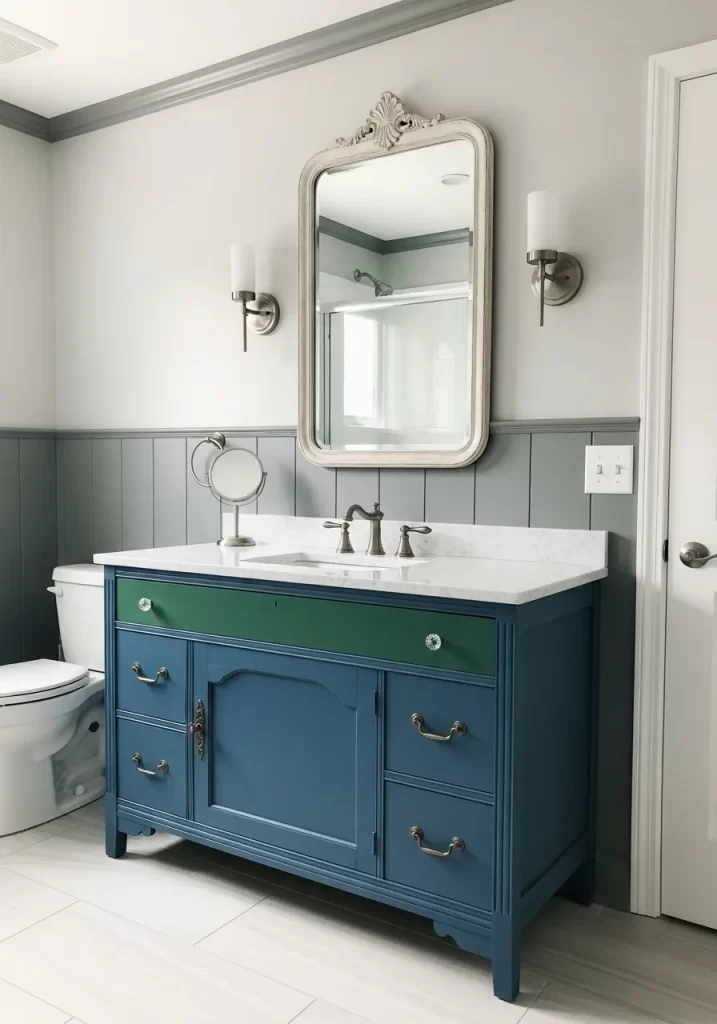
The bathroom vanity is often the centerpiece of the room, so giving it a new coat of paint is a fantastic update. Instead of a boring wood or white finish, try a color that stands out.
Using two different colors, like the deep blue and surprising pop of green on this vanity, is even more creative. It adds a custom, designer touch to the whole bathroom. This project can turn an old piece of furniture into something you love.
DIY Instructions: How to Paint a Bathroom Vanity
This is a bigger project, but it’s totally doable over a weekend.
What you will need:
- Sandpaper (medium grit)
- Cleaner and a cloth
- Painter’s tape
- Primer
- Paint in your chosen colors
- Paintbrushes and a small roller
- A screwdriver
Step-by-Step Guide:
- Prep the Vanity: Ask a grown-up to help you remove the doors and drawers. Use the screwdriver to take off all the knobs and handles.
- Clean and Sand: Clean all the surfaces you plan to paint. Then, use sandpaper to lightly scuff up the old finish. This is an important step because it helps the new paint stick.
- Wipe Away Dust: Use a damp cloth to wipe away all the dust from sanding.
- Tape it Off: Use painter’s tape to protect any areas you don’t want to paint, like the countertop or the inside of the vanity.
- Apply Primer: Paint one coat of primer on everything. Primer is a special base coat that helps your color look even and last longer. Let it dry.
- Paint Your Color: Now, use your brush and roller to apply your main paint color. Let it dry completely, and then add a second coat if it needs it.
- Add a Second Color (Optional): If you’re adding a second color, use painter’s tape to create a clean line, then paint the new section.
- Reassemble: Once everything is completely dry, carefully put the doors, drawers, and hardware back on.
10. Paint the Door a Surprise Color
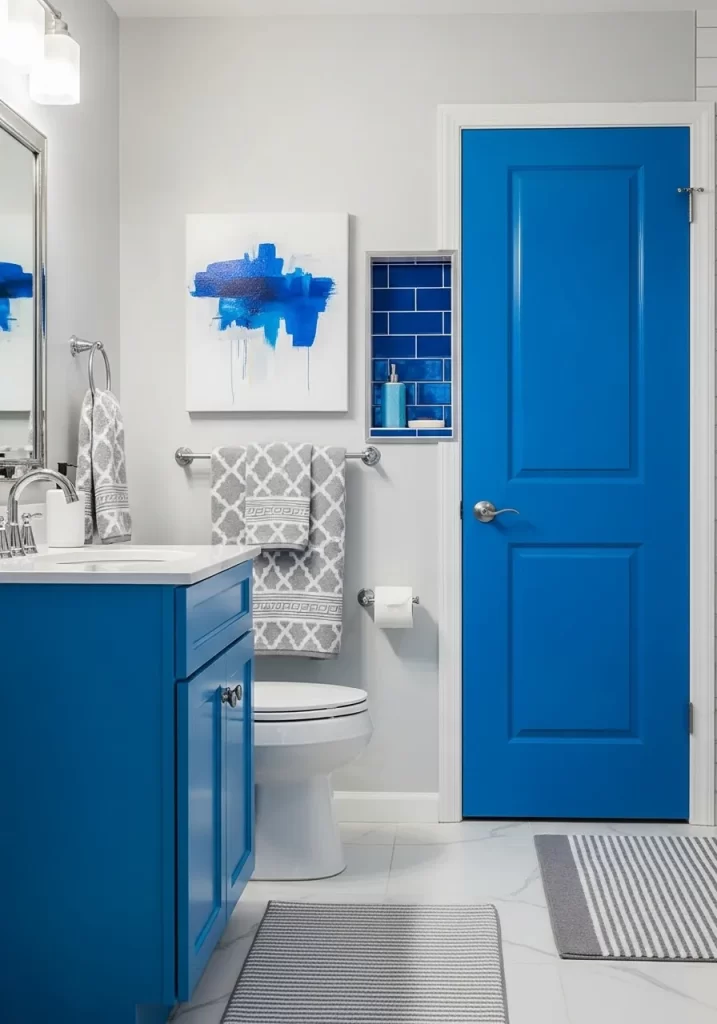
Think beyond the walls for a place to add color. The back of the bathroom door is a wonderful, unexpected spot for a bold and exciting shade. It adds an element of surprise when you close the door.
Painting the door a vibrant blue, and then matching the vanity to it, makes the design feel very intentional and put-together. It’s a clever trick that connects two different parts of the room and makes the whole space pop.
DIY Instructions: How to Paint an Interior Door
A painted door can be a fun and easy project.
What you will need:
- Paint in a fun color
- A small paint roller and tray
- An angled paintbrush
- Painter’s tape
- A drop cloth to protect the floor
- A cloth and cleaner
Step-by-Step Guide:
- Clean the Door: Wipe the entire door down with a cloth and some mild cleaner to remove any dirt or fingerprints. Let it dry.
- Tape the Hardware: Carefully place painter’s tape around the doorknob and the hinges to protect them from paint.
- Protect the Floor: Lay a drop cloth on the floor under the door to catch any drips.
- Paint the Details First: Use your angled paintbrush to paint the recessed or detailed parts of the door first.
- Roll the Flat Parts: Next, use your small roller to paint the large, flat sections of the door. The roller will give you a nice, smooth finish.
- Let it Dry and Add a Second Coat: Let the first coat dry completely. It will probably look a little patchy. A second coat will make the color look solid and amazing.
- Remove the Tape: Once the second coat is dry to the touch, you can carefully pull off the painter’s tape. It’s best to do this before the paint has hardened completely.
11. Embrace the Dark and Moody
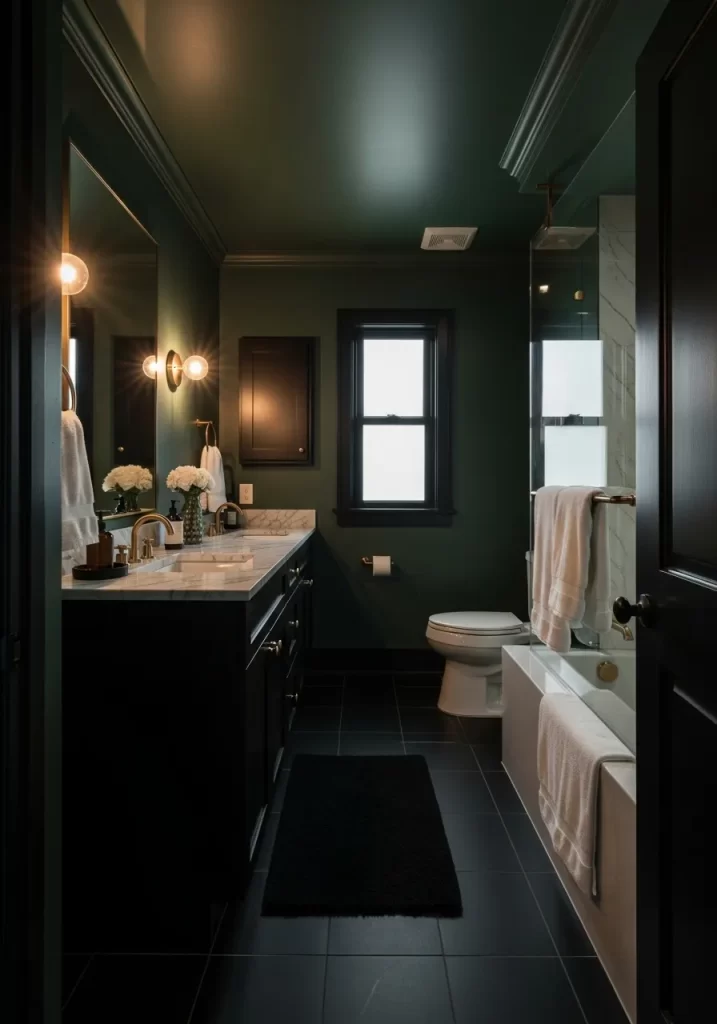
Painting a room a dark color can be intimidating, but the result is stunning. A deep, dark green or charcoal on the walls and even the ceiling creates a cozy and very sophisticated space. It makes the bathroom feel like a private, luxurious escape.
Good lighting is important with dark walls. The warm glow from the light fixtures reflects beautifully off the dark paint. Lighter elements, like the white towels and marble countertop, provide a sharp contrast that keeps the room from feeling too heavy.
DIY Instructions: How to Choose Bathroom Light Bulbs
The right light bulb can change the entire mood of a room.
What you will need:
- New light bulbs
- A sturdy step stool
Step-by-Step Guide:
- Check Your Fixture: First, look at your light fixture to see what kind of bulb it needs. You can usually find this written on the fixture itself or on the old bulb.
- Think About “Temperature”: Light bulbs come in different “color temperatures.” For a cozy, warm glow like in the picture, look for bulbs labeled “Warm White” or “Soft White.” They will have a number around 2700K. For a brighter, more natural light, look for “Cool White” or “Daylight” (around 4000K-5000K).
- Choose the Right Brightness: Brightness is measured in “lumens.” For a bathroom, you generally want bright light around the mirror for getting ready. A bulb with 800-1000 lumens is a good choice for vanity lights.
- Install the New Bulbs: Make sure the light switch is turned off. Carefully unscrew the old bulbs and screw in the new ones. Turn the light on to see your new look!
12. Go Monochromatic with a Peachy Glow
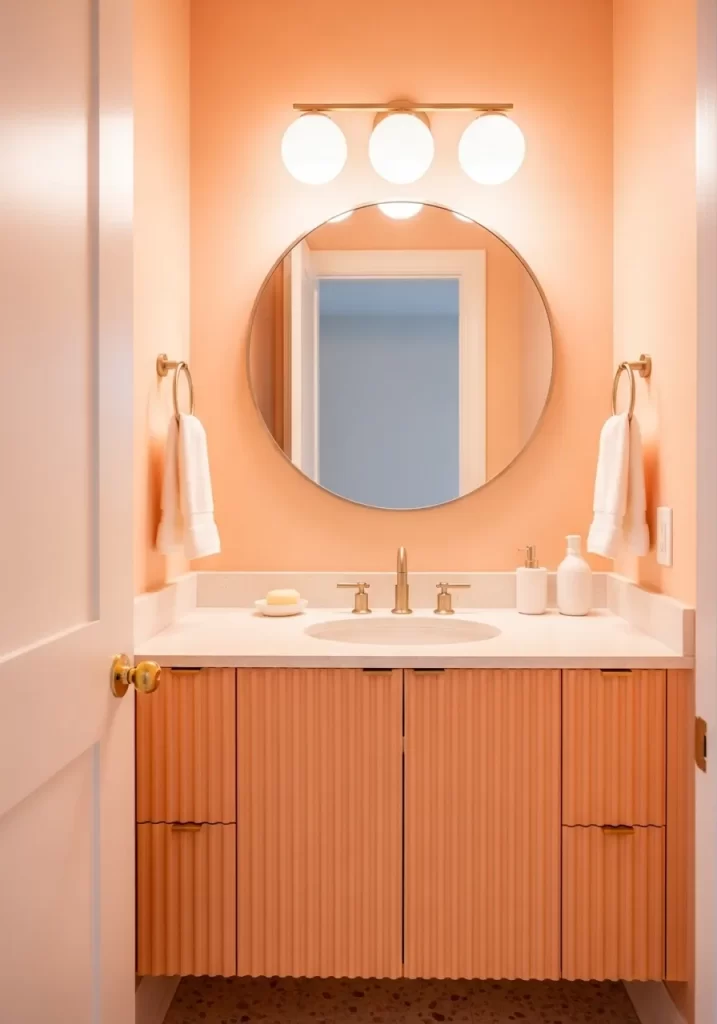
Using one main color throughout a space creates a very chic and intentional design. This bathroom uses a warm, peachy apricot color on both the walls and the vanity. It wraps the room in a soft, welcoming glow.
To keep a single-color room interesting, use different textures. The smooth painted walls contrast with the vertically striped, or “fluted,” texture on the vanity doors. This adds depth and a modern touch.
DIY Instructions: How to Create a Fluted Vanity
You can give a plain, flat-front vanity this high-end look yourself.
What you will need:
- Half-round wood moulding strips (you can find these at a hardware store)
- A small saw
- A measuring tape
- Strong wood glue
- Sandpaper
- Paint or primer that matches your vanity
Step-by-Step Guide:
- Measure and Cut: Measure the height of your vanity doors or drawer fronts. Carefully cut the half-round moulding strips to that same height. You will need many pieces to cover the front.
- Sand the Edges: Lightly sand the cut ends of your moulding pieces to make them smooth.
- Glue Them On: Apply a line of wood glue to the flat back of a moulding strip. Press it firmly onto the edge of your vanity door. Place the next strip right up against it. Continue this until the entire surface is covered.
- Let it Dry: Let the glue dry completely. Follow the instructions on the glue bottle.
- Paint to Match: Once dry, paint the new fluted surface to match the rest of your vanity. This will make it look like one single piece.
13. Create a Calming Lavender Retreat
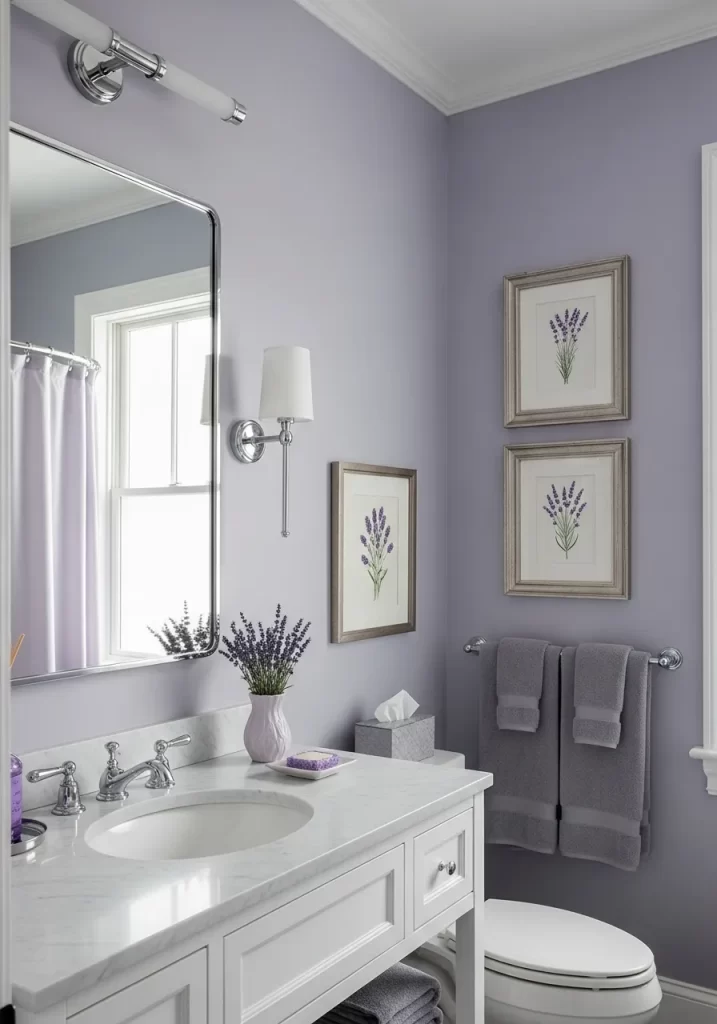
Soft, gentle colors can turn your bathroom into a peaceful sanctuary. A lovely lavender or lilac on the walls is incredibly calming. It’s a color that feels both sophisticated and relaxing, making it a great choice for a bathroom.
To create a complete look, carry the color throughout the space. Matching towels, a shower curtain, and even artwork with hints of lavender will make the room feel harmonious and thoughtfully designed.
DIY Instructions: How to Make Pressed Flower Art
Create your own beautiful art using real flowers.
What you will need:
- Fresh flowers (like lavender sprigs)
- A heavy book
- Two pieces of paper towel or wax paper
- A picture frame
Step-by-Step Guide:
- Prepare Your Flowers: Open your heavy book to the middle. Lay one piece of paper towel on the page. Arrange your flowers on the paper towel, making sure they don’t overlap.
- Press the Flowers: Place the second piece of paper towel on top of the flowers. Carefully close the book. The weight of the book will press the flowers flat.
- Wait Patiently: Leave the flowers in the book for at least one to two weeks. You can put more heavy books on top to help.
- Reveal Your Flowers: After a couple of weeks, carefully open the book. Your flowers will be flat and dry.
- Frame Your Art: Gently arrange your pressed flowers on the backing of your picture frame. You can use a tiny dot of glue to hold them in place if you need to. Put the frame back together and hang your creation.
14. Add a Pop of Primary Color
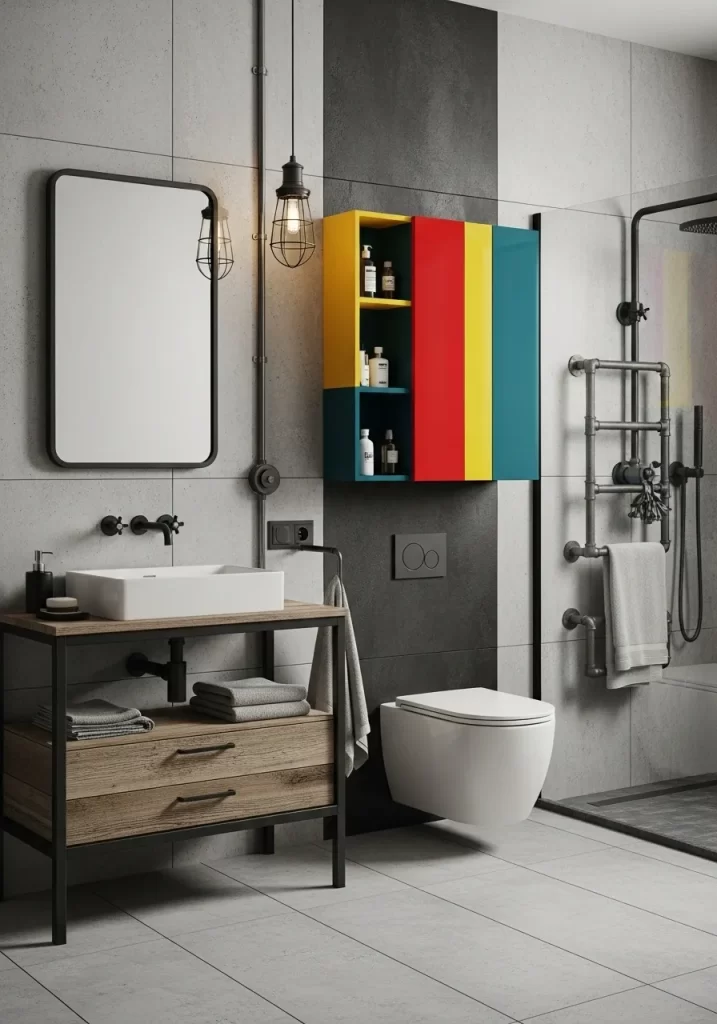
Even a very modern and industrial bathroom can have a playful side. In a space with a lot of neutral grey, wood, and metal, a single piece of furniture in bright, bold colors becomes an amazing focal point.
This wall cabinet uses blocks of primary colors—red, yellow, and blue. It’s an unexpected and fun element that adds a ton of personality. It shows that you don’t need to paint the whole room to make a big color statement.
DIY Instructions: How to Paint a Color-Block Cabinet
Turn any simple cabinet into a modern piece of art.
What you will need:
- A simple cabinet or shelf
- Sandpaper
- Paint in several bright colors
- Painter’s tape
- Small paintbrushes
Step-by-Step Guide:
- Prep the Cabinet: If your cabinet has a shiny finish, lightly sand it so the new paint will stick better. Wipe away all the dust.
- Plan Your Design: Decide which parts of the cabinet you want to paint in which color. You could paint the outside one color and the inside shelves different colors.
- Tape Off Your First Section: Use painter’s tape to create clean, straight lines for your first color. Press the tape down firmly.
- Paint the First Color: Paint your first section. You may need two coats.
- Remove Tape and Let Dry: Remove the tape while the paint is still a little wet. Let it dry completely.
- Tape and Paint the Next Color: Once the first section is totally dry, use painter’s tape to mask it off. Then paint your next section with a new color.
- Repeat: Keep repeating this process until all your sections are painted. The key is to let each color dry before you tape over it.
15. Try a Fresh Mint Vanity
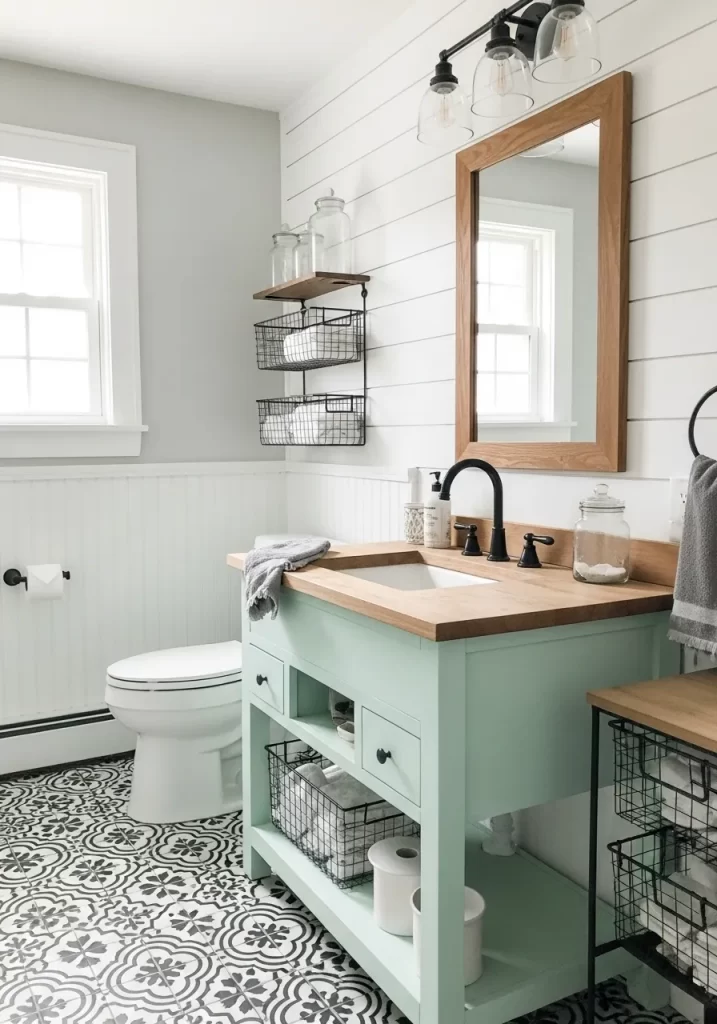
For a look that is clean, fresh, and calming, a soft mint green is a wonderful choice. Painting the vanity this color adds a gentle splash of style without being too loud. It brings a bit of a modern farmhouse or coastal feel to the room.
This soft green looks beautiful next to natural wood tones, crisp white shiplap walls, and bold black fixtures. The patterned floor tile adds another layer of interest, but the minty vanity remains the sweet and simple star.
DIY Instructions: How to Create a “Shiplap” Wall
Get the popular farmhouse look with this simple wall treatment.
What you will need:
- Thin plywood sheets (1/4 inch thick is good)
- A measuring tape
- A level
- A saw
- Construction adhesive or a nail gun
- Paint
Step-by-Step Guide:
- Cut Your Planks: Ask a grown-up to help you cut the plywood into long planks. A standard width is 6 inches.
- Find and Mark Studs: Use a stud finder to locate the vertical wooden beams inside your wall. Mark them with a pencil. This is where you will nail the planks.
- Install the First Plank: Start at the top of the wall. Use your level to make sure the first plank is perfectly straight. Attach it to the wall studs using a nail gun or construction adhesive.
- Use Spacers: To get that classic shiplap gap, place a couple of coins (like nickels) on top of your first plank before you add the next one.
- Add the Next Plank: Rest the next plank on top of the coins and attach it to the wall. Remove the coins.
- Continue Down the Wall: Keep adding planks, using your coin spacers each time, until you have covered the whole wall.
- Paint the Wall: Once all the planks are up, you can paint them your desired color (like white).
16. Energize with Sunny Yellow and Cool Grey
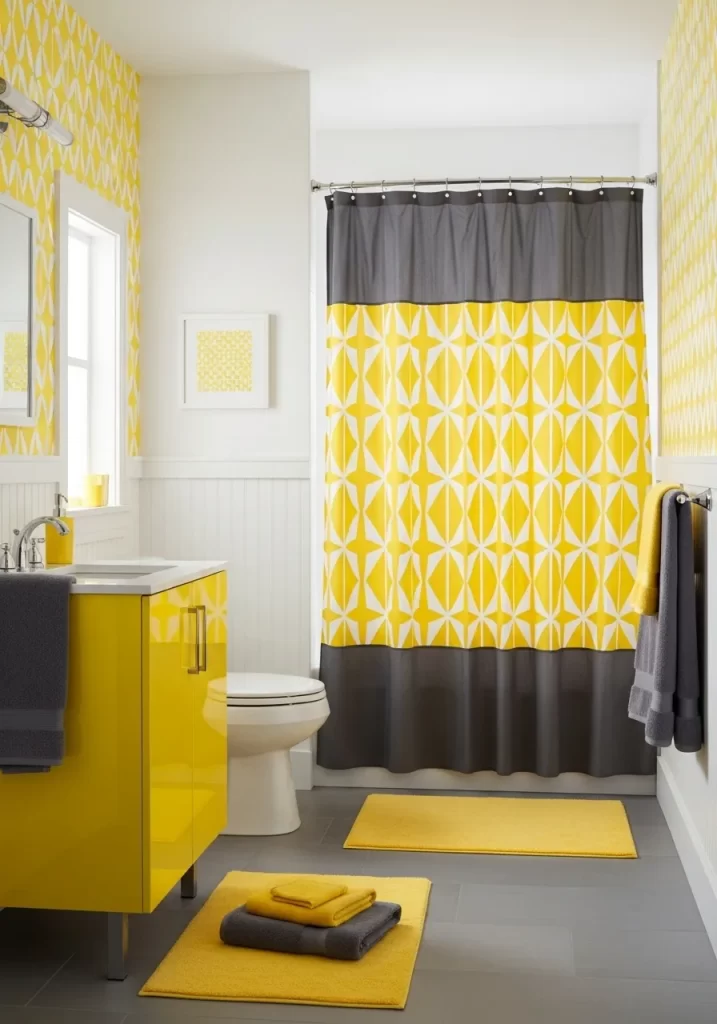
There’s no color happier than a bright, sunny yellow. Using it in a bathroom is a great way to make your morning routine feel more energetic and cheerful. It’s like bringing a ray of sunshine inside.
To keep a bold color like yellow from taking over, it’s smart to pair it with a calm neutral like grey. The grey floor, towels, and shower curtain band balance the bright yellow perfectly. The geometric patterns on the shower curtain and wallpaper add to the fun, modern vibe.
DIY Instructions: How to Stencil a Wall
Stenciling is an easy way to get a wallpaper-like pattern without the hassle.
What you will need:
- A large wall stencil in a pattern you like
- Paint (one color for the wall, one for the stencil)
- A small foam roller or a stencil brush
- Painter’s tape
- A paper plate
Step-by-Step Guide:
- Paint the Base Color: First, make sure your wall is painted in your main background color and is completely dry.
- Position Your Stencil: Start at the top corner of your wall. Use painter’s tape to hold the stencil firmly in place.
- Load Your Roller: Pour a small amount of your stencil paint onto a paper plate. Roll your foam roller in the paint, then roll it on a clean part of the plate to get most of the paint off. This is called “off-loading” and it’s the most important step to prevent drips.
- Roll Over the Stencil: Lightly roll the paint over your stencil. Use gentle pressure. It’s better to do two light coats than one heavy one.
- Move the Stencil: Carefully remove the stencil. You should see a clean pattern. Line up the stencil with the part you just painted (most stencils have guide marks) and repeat the process.
- Continue Across the Wall: Keep going until your whole wall is covered in the pattern.
17. Go Wild with Color Blocking
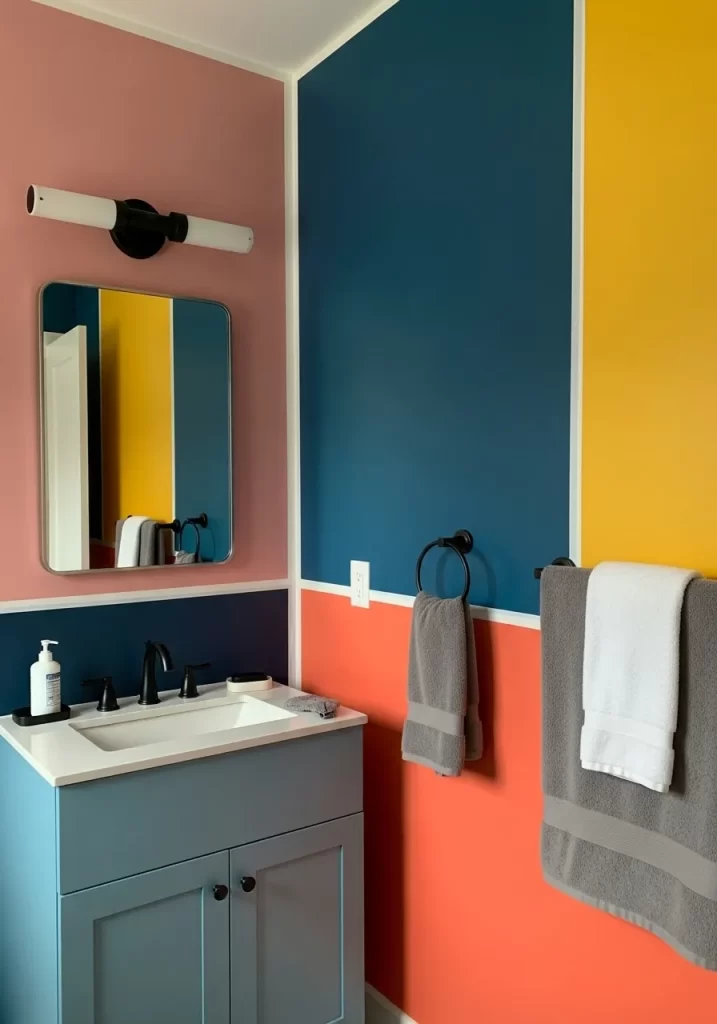
Why choose one color when you can have several? Color blocking is a bold and artistic technique where you paint large, solid blocks of different colors right next to each other. It turns your walls into a modern art masterpiece.
This bathroom combines several colors—pink, blue, yellow, and coral—in a creative way. A chair rail or a painted line can help to divide the colors and make the design look intentional. This is for someone who truly loves color and isn’t afraid to show it.
DIY Instructions: How to Plan a Color-Blocked Wall
The key to a good color-block design is a good plan.
What you will need:
- Paper and colored pencils
- A measuring tape and pencil
- A level
- Painter’s tape
- Paint in several colors
Step-by-Step Guide:
- Draw Your Design: On a piece of paper, draw a simple sketch of your bathroom wall. Use colored pencils to try out different color-blocking ideas until you find one you love.
- Measure and Mark Your Wall: Once you have a plan, use your measuring tape to transfer the design to your actual wall. Use a pencil and a level to draw straight lines for your different color blocks.
- Tape Off the First Color: Choose one color to start with. Carefully apply painter’s tape along the pencil lines for that section.
- Paint Your First Block: Paint the first section. Let it dry, and apply a second coat if needed.
- Let it Dry Completely: This is very important. You must wait until the first block of color is totally dry before you can tape over it to paint the next one.
- Tape and Paint the Next Block: Once the first block is dry, tape off the next section and paint it with your second color. Repeat until your design is complete.
18. Use Muted, Earthy Tones
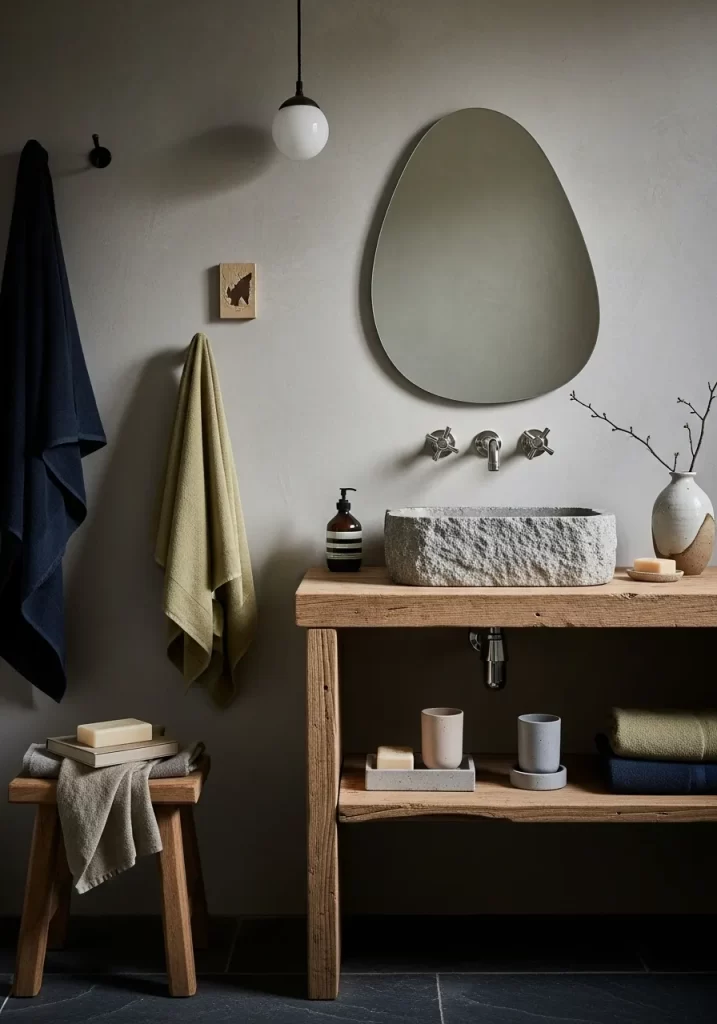
Color doesn’t always have to be bright and loud to make an impact. A palette of muted, earthy colors—like olive green, deep navy, and warm greige—can create a very calm, organic, and sophisticated bathroom.
This style is less about a single “pop” of color and more about texture and natural materials. The rough stone sink, the raw wooden vanity, and the soft, natural-fiber towels all work together. The irregularly shaped mirror adds to the unique, handcrafted feel.
DIY Instructions: How to Create a Textured Paint Finish
Give your walls the look of aged plaster or stucco.
What you will need:
- Paint in a flat finish
- Joint compound (also called drywall mud)
- A paint tray
- A putty knife or trowel
Step-by-Step Guide:
- Mix Your Texture: In a paint tray, mix about three parts paint to one part joint compound. Stir it up until it’s a thick, pancake-batter-like consistency.
- Apply to the Wall: There is no “right” way to do this, which is the fun part! You can use a roller for a base coat, but the real texture comes from using a putty knife.
- Get Creative: Scoop some of the paint mixture onto your putty knife and spread it on the wall in different directions. You can make swooshing motions, short choppy motions, or random patterns.
- Build Up Layers: Don’t try to cover everything at once. Work in small sections and build up the texture. Let some areas be thicker than others.
- Let it Dry: This kind of finish will take longer to dry than regular paint. Once it’s fully dry, it will have a beautiful, matte, and chalky texture.
19. Pair Cheerful Yellow with Periwinkle Blue
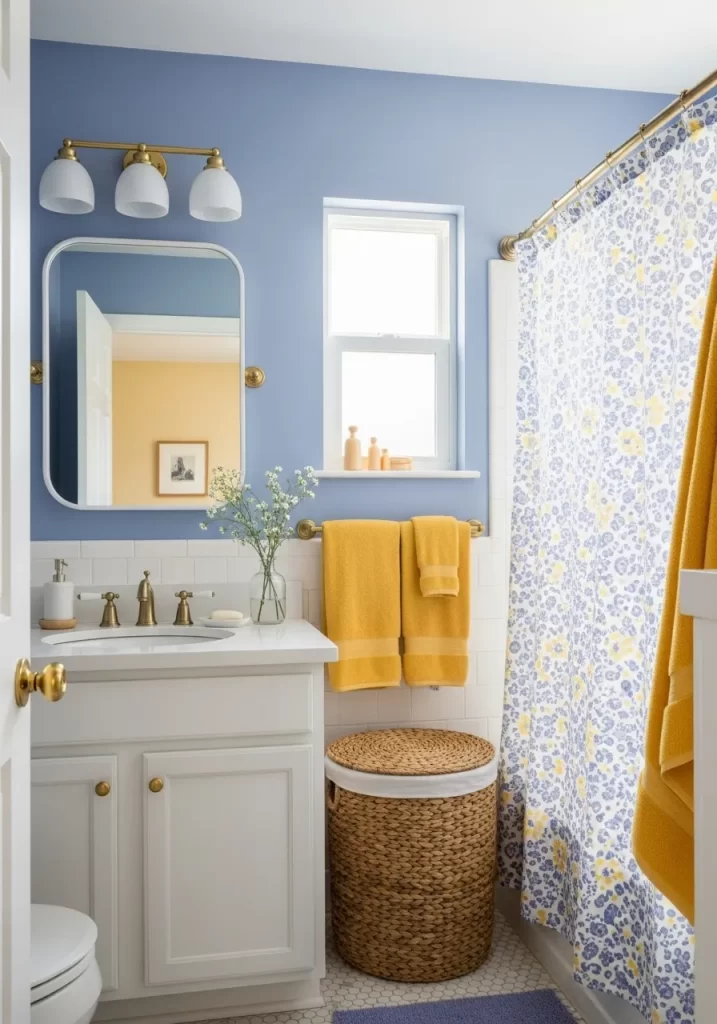
This color combination is a classic for a reason—it’s full of charm and happiness. The periwinkle blue on the walls is soft and soothing, like a summer sky. Adding bright, sunny yellow towels and accessories provides a perfect, energetic contrast.
The patterned shower curtain cleverly brings both colors together, along with some white, to make the whole room feel connected. This look is fresh, clean, and has a slightly cottage-like, friendly feel.
DIY Instructions: How to Dye Your Own Towels
Can’t find towels in the exact color you want? Dye your own!
What you will need:
- Plain white cotton towels
- Fabric dye in your chosen color (like yellow)
- A large bucket or stainless steel sink
- Salt or vinegar (check the dye package)
- Rubber gloves
Step-by-Step Guide:
- Prepare Your Towels: Wash your new white towels to remove any factory finish. Leave them damp.
- Prepare the Dye Bath: Fill your bucket or sink with hot water. Put on your rubber gloves. Following the instructions on the dye package, mix the dye powder or liquid into the water. You may also need to add salt or vinegar, which helps the color stick.
- Dye the Towels: Submerge your damp towels in the dye bath. Use a large spoon or your gloved hands to swish them around constantly for about 10-15 minutes to make sure the color is even.
- Let Them Soak: After the initial stirring, let the towels soak for another 30 minutes to an hour, depending on how dark you want the color.
- Rinse and Wash: Carefully take the towels out and rinse them under cool water until the water runs clear. Then, wash them in the washing machine on a warm cycle with a little bit of detergent and dry them as usual.
20. Get Groovy with Retro Orange
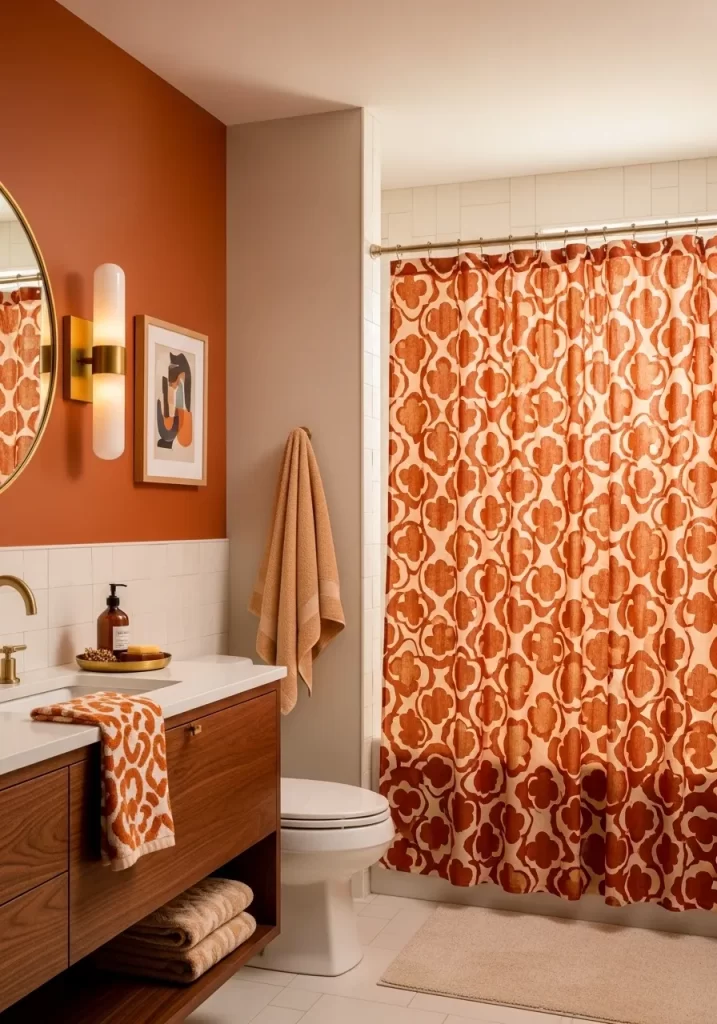
Travel back in time with a fun, retro-inspired color scheme. A warm and earthy burnt orange on an accent wall immediately sets a cool, 7s mood. It’s a color that is both energetic and cozy at the same time.
The star of this bathroom is the shower curtain, which features a bold, vintage pattern that pulls the whole look together. The warm wood of the vanity and the simple gold accents are the perfect finishing touches for this groovy style.
DIY Instructions: How to Make a Stamped Tea Towel
You can use this technique to add patterns to hand towels.
What you will need:
- A potato
- A kitchen knife
- A plain cotton hand towel
- Fabric paint
- A paper plate
Step-by-Step Guide:
- Make Your Stamp: Ask a grown-up to help you cut a potato in half. Then, carefully carve a simple shape into the flat side of the potato. A simple flower, a half-circle, or a square works well.
- Prepare Your Paint: Squeeze some fabric paint onto a paper plate.
- Stamp Your Fabric: Press the flat side of your potato stamp into the paint, making sure it’s evenly coated.
- Practice First: Do a few practice stamps on a scrap piece of paper or fabric to get a feel for it.
- Create Your Pattern: Carefully press the stamp onto your hand towel. Lift it straight up to avoid smudging. Repeat the stamp to create a pattern all over the towel.
- Let it Dry: Let the fabric paint dry completely.
- Heat Set the Paint: To make the paint permanent, follow the instructions on the paint bottle. Usually, this involves ironing the back of the fabric or putting it in the dryer.
21. Soothe with Sage Green

A subtle touch of color can be just as impactful as a bold one. Soft sage green brings a calming, natural feeling to a bathroom. It’s a gentle color that pairs beautifully with neutral walls, like beige or grey, and modern black fixtures.
This approach proves you don’t need to paint walls to add color. By choosing a shower curtain, towels, and a bath mat in the same soothing shade, you create a cohesive and serene look. It’s a simple, elegant way to refresh a space.
DIY Instructions: How to Choose a Great Shower Curtain
A new shower curtain can instantly change your bathroom’s style.
What you will need:
- A measuring tape
- A shower curtain
- Shower curtain rings or hooks
Step-by-Step Guide:
- Measure First: Before you go shopping, measure from the shower curtain rod to the floor. You want your curtain to be long enough to hang nicely, but not so long that it bunches up on the floor.
- Pick a Fabric: Shower curtains come in many materials. A simple cotton or linen curtain (like the one in the picture) gives a relaxed feel. Vinyl curtains are waterproof but often need a fabric one in front to look nice.
- Think About Color: Choose a shower curtain in a color you love. It’s a big piece of fabric, so it will really set the tone for the room.
- Hang it High: For a more luxurious look, you can mount your shower curtain rod a few inches higher and wider than the shower opening. This makes the space feel bigger.
- Add the Rings: Unfold your new curtain. Open your curtain rings and thread one through each hole at the top of the curtain. Hook the rings over the rod, and you’re done!
22. Go Maximalist with Wallpaper and Art
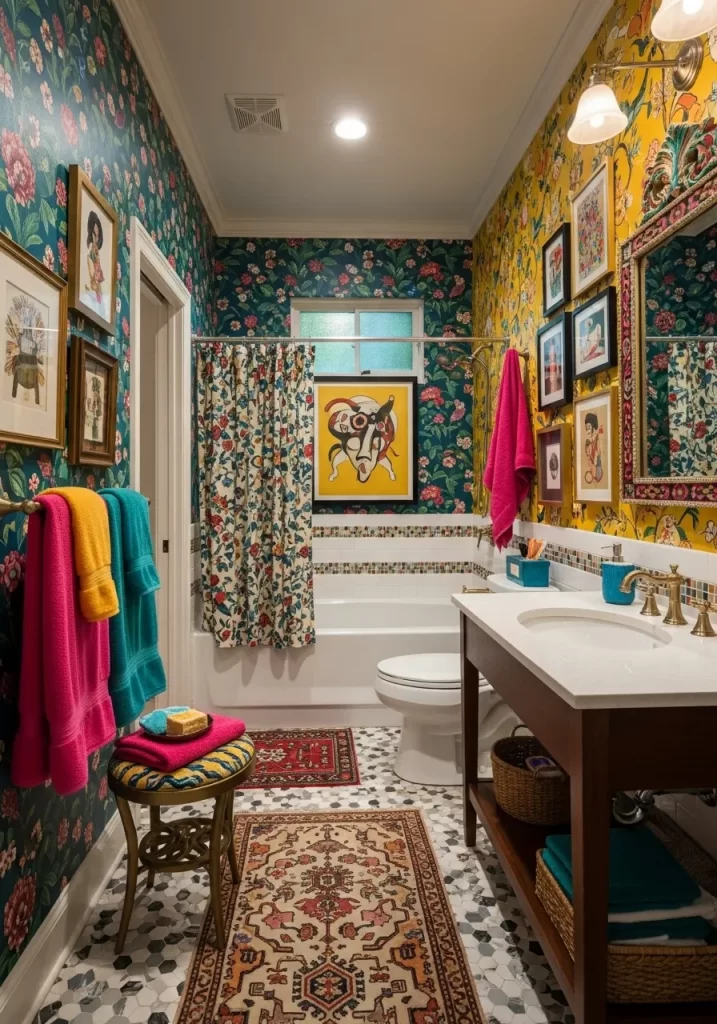
For those who believe more is more, a maximalist bathroom is a joyful explosion of pattern and color. This style is all about layering different elements you love to create a space that is uniquely you. Don’t be afraid to mix two different wallpapers.
The key is to find a common thread. Here, a floral theme connects the two wallpapers. A gallery wall of quirky art and brightly colored towels adds even more personality. This approach turns a small room into a fascinating jewel box.
DIY Instructions: How to Create a Gallery Wall
Turn a blank wall into a personal art collection.
What you will need:
- A collection of framed pictures and art
- Craft paper or newspaper
- Scissors and tape
- A hammer and nails or picture hooks
- A level
Step-by-Step Guide:
- Trace Your Frames: Lay each of your frames face down on a piece of craft paper and trace around it. Cut out these paper shapes.
- Plan Your Layout: Use tape to arrange the paper shapes on your wall. You can move them around as much as you want without making any holes. Try to keep the spacing between frames similar.
- Check Your Arrangement: Step back and look at your paper arrangement. Use a level to make sure frames that are in a row are straight.
- Mark for Nails: Once you love the layout, make a mark on each piece of paper where the nail for that frame should go.
- Hammer Time: Hammer a nail directly through the mark on each piece of paper.
- Remove the Paper and Hang: Tear the paper templates off the wall. Now you can hang your actual frames on the nails.
23. Add a Coastal Touch with Blue and White
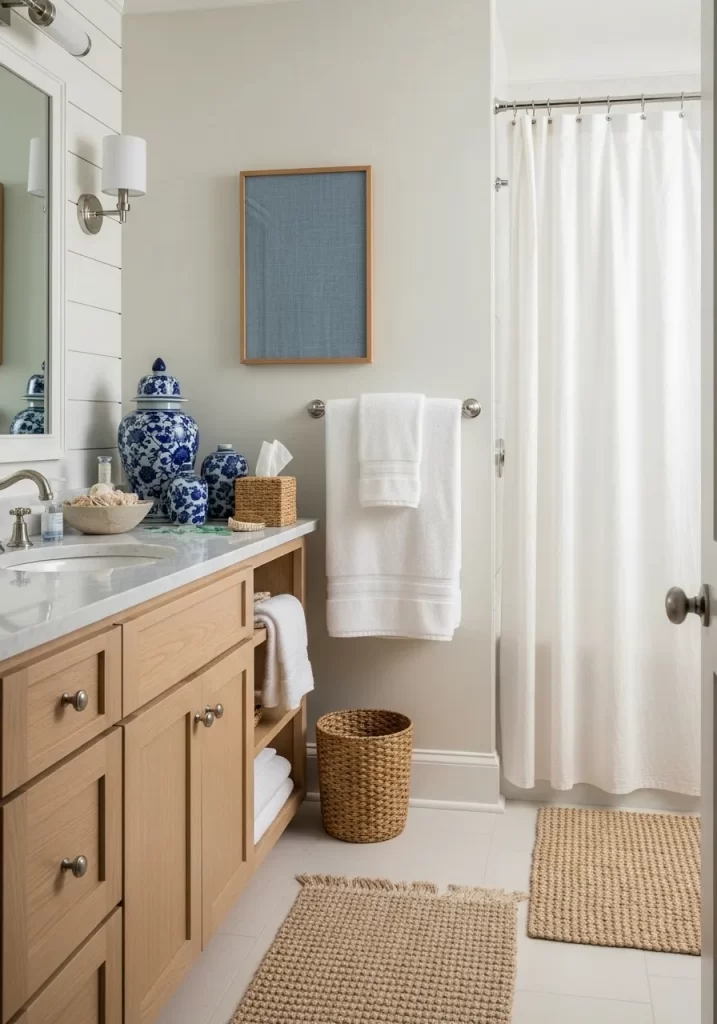
You can create a breezy, coastal feeling without painting everything blue. This style is about using carefully chosen accessories to hint at the seaside. Classic blue and white porcelain, like ginger jars, adds a timeless and elegant touch.
Pairing these accents with a light wood vanity, woven baskets, and jute rugs enhances the natural, beachy vibe. The color comes from the decor, not the walls, making it an easy style to achieve and change later.
DIY Instructions: How to Make Fabric-Covered Wall Art
Create custom art that perfectly matches your decor.
What you will need:
- An artist’s canvas or a sturdy piece of cardboard
- A piece of fabric (like blue burlap or linen)
- A staple gun
- Scissors
Step-by-Step Guide:
- Cut Your Fabric: Lay your fabric out on a flat surface, with the pretty side facing down. Place your canvas or cardboard on top of it. Cut the fabric so you have about two inches of extra material all the way around.
- Staple the First Side: Starting in the middle of one side, pull the fabric taut and use the staple gun to place a staple in the center of the back of the canvas frame.
- Staple the Opposite Side: Go to the opposite side. Pull the fabric very tight and place another staple in the middle.
- Continue Stapling: Keep adding staples, working from the center of each side out towards the corners. Always pull the fabric tight before you staple.
- Fold the Corners: When you get to the corners, fold them neatly like you are wrapping a present. Pull the fabric tight and add a few extra staples to hold the corner folds in place.
- Trim and Hang: Trim any extra fabric from the back and your new art is ready to be framed or hung as is.
24. Gleam with Copper and Rose Tones
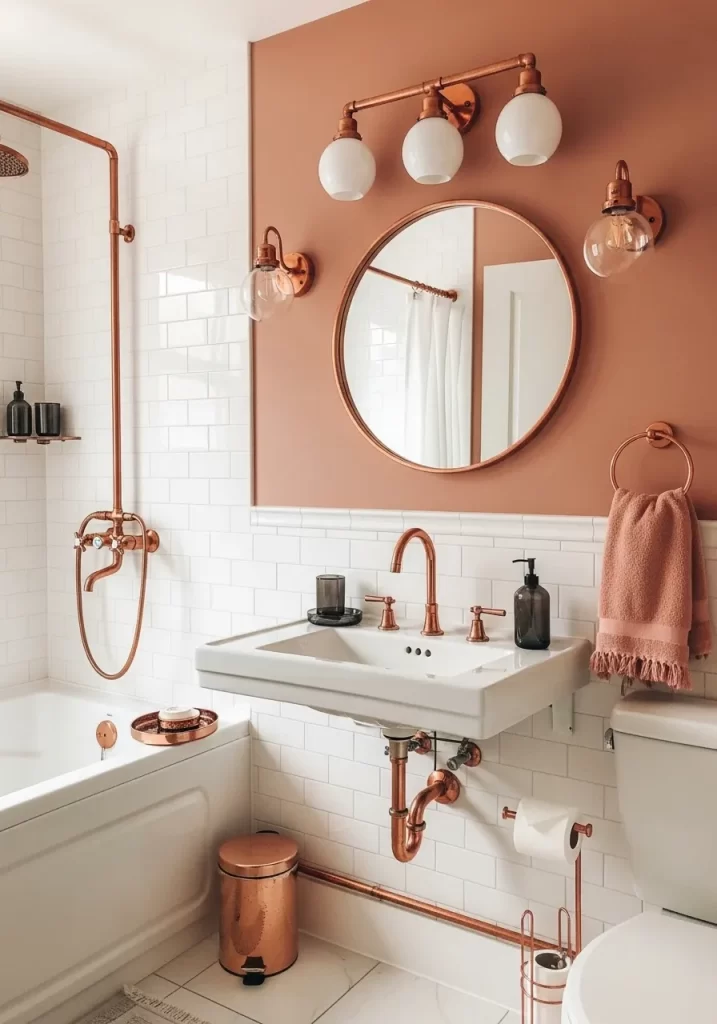
Warm metal tones can make a bathroom glow. Pairing a dusty rose or terracotta accent wall with copper or rose gold fixtures creates a stunning and cohesive look. The warm metal reflects the warm paint color, wrapping the room in a rich, inviting light.
This combination feels both modern and a little bit glamorous. The shiny metal stands out beautifully against the simple white subway tiles. It’s a sophisticated way to use color and metallic finishes together.
DIY Instructions: How to Use Metallic Spray Paint
Give ordinary items a glamorous metallic finish.
What you will need:
- An item to paint (like a trash can or picture frame)
- Metallic spray paint (in a copper color)
- A drop cloth or old newspaper
- Fine-grit sandpaper (optional)
Step-by-Step Guide:
- Work Outside: Spray paint has strong fumes, so this is a job for outdoors or in a very well-ventilated garage.
- Prep Your Item: Make sure the object is clean and dry. If it’s a shiny material, it’s a good idea to lightly scuff the surface with sandpaper to help the paint stick.
- Protect Your Area: Lay down your drop cloth to protect the ground from overspray.
- Shake the Can: Shake the spray paint can really well for at least a minute. You should hear the little ball rattling inside.
- Spray in Light Coats: Hold the can about 8-10 inches away from your object. Press the nozzle and spray in a steady, sweeping motion. The key is to apply several very light coats, not one thick one.
- Let it Dry Between Coats: Let the first coat dry for about 15-20 minutes before you spray the next one. This will prevent drips.
- Let it Cure: Once you are happy with the coverage, let the item dry completely. It might take a full 24 hours for the paint to fully harden, or “cure.”
25. Have Fun with a Retro Pink and Mint Combo
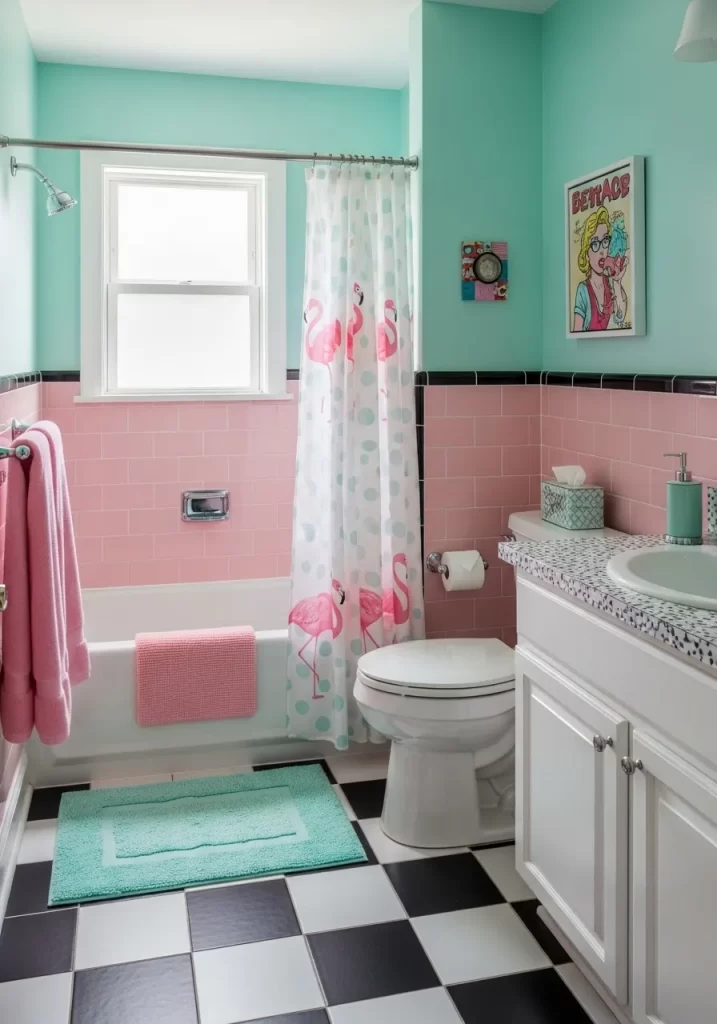
Embrace a playful, vintage vibe with a classic color combination. Bubblegum pink tiles and bright mint green walls instantly create a fun, retro atmosphere reminiscent of a 1950s diner. This look is cheerful, bright, and full of personality.
Don’t be afraid to add fun, thematic accessories like a flamingo shower curtain. The bold, black-and-white checkerboard floor grounds the sweet colors and adds another layer of vintage charm. It’s a style that is all about not taking itself too seriously.
DIY Instructions: How to Paint a Checkerboard Floor
This bold floor is easier to paint than you might think.
What you will need:
- Floor cleaner
- Porch and floor paint in two colors (like black and white)
- A paintbrush and roller
- A measuring tape and pencil
- A long ruler or straightedge
- Painter’s tape
Step-by-Step Guide:
- Clean and Prep: Clean your floor very well and let it dry completely.
- Paint the Base Color: Paint the entire floor with your lighter color (white). You will likely need two coats. Let it dry for at least a full day.
- Draw Your Grid: Use your measuring tape and pencil to divide your floor into a grid of equal squares. A good size is 12×12 inches. Use your ruler to draw the lines.
- Tape Off the Squares: This is the most important part. Apply painter’s tape to the outside of the squares that you are going to paint black. You will be painting every other square.
- Paint the Black Squares: Carefully paint inside the taped-off squares with your black paint.
- Remove the Tape: While the black paint is still a bit wet, carefully remove the painter’s tape to reveal your crisp lines.
- Let it Cure: Let the floor dry and cure for a few days before walking on it or moving furniture back in.
26. Create Depth with Vertical Tiles
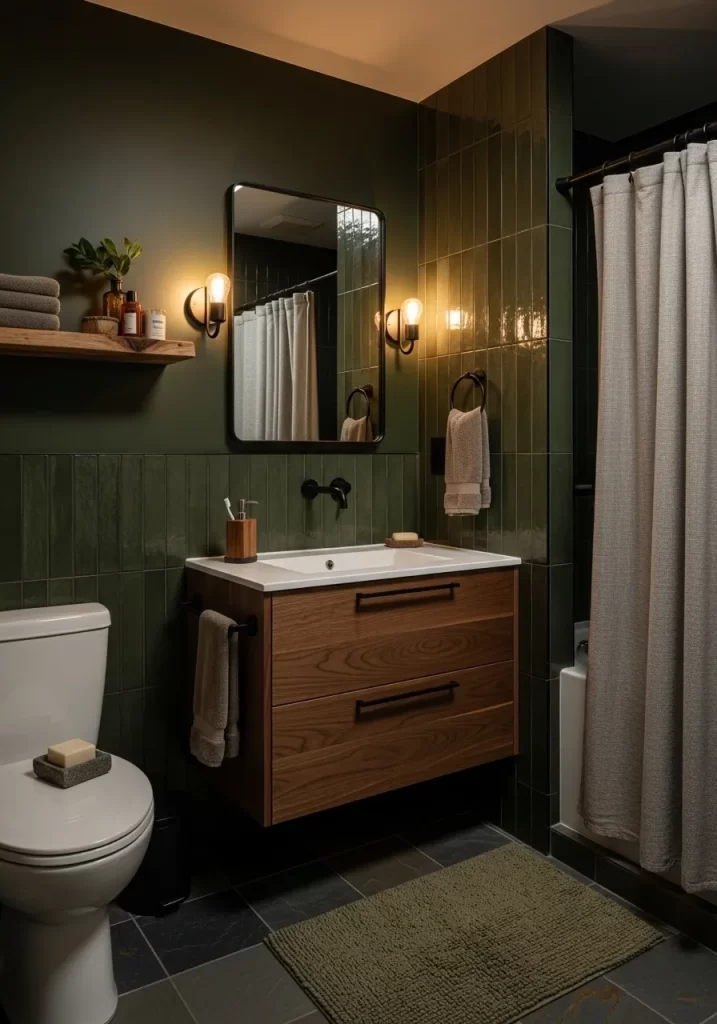
Your wall material itself can be a source of rich color. A wall of deep olive green tiles adds texture, depth, and a sophisticated mood to a bathroom. The glossy finish of the tiles reflects light, which keeps the dark color from feeling flat.
Arranging long, thin tiles vertically is a clever design trick. It draws the eye upward and can make a room with standard-height ceilings feel much taller. This look is modern, a little bit masculine, and very elegant.
DIY Instructions: How to Install a Floating Shelf
Add storage and style with a simple wooden shelf.
What you will need:
- A wooden board
- Floating shelf hardware (a bracket that gets hidden inside the shelf)
- A drill
- A level
- A stud finder
Step-by-Step Guide:
- Find the Studs: Decide where you want your shelf. Use a stud finder to locate the solid wooden beams inside the wall. Mark these spots with a pencil. You must attach the shelf to these studs for it to be strong.
- Mount the Bracket: Hold the metal shelf bracket against the wall. Use your level to make sure it is perfectly straight. Use a pencil to mark where the screw holes are.
- Drill Pilot Holes: Drill small “pilot” holes on your marks. This makes it easier to screw the bracket in.
- Attach the Bracket: Screw the bracket securely into the wall studs using the screws that came with it.
- Slide on the Shelf: Most floating shelves are hollowed out in the back. Simply slide the wooden shelf part onto the metal rods of the bracket. It should be a snug fit.
- Secure the Shelf: There are usually small screws that you use to secure the shelf to the bracket from underneath, so it can’t slide off.
27. Paint a Dreamy Ombre Accent Wall
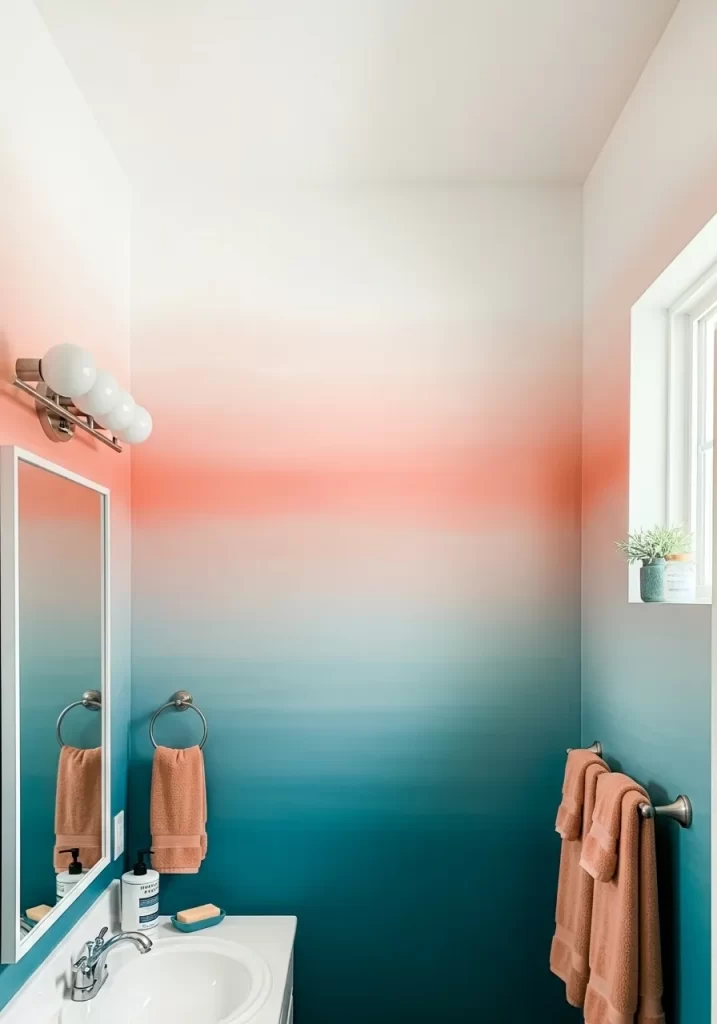
Turn your wall into a piece of watercolor art with an ombre paint effect. This technique involves blending several colors together so they fade into one another seamlessly. It creates a soft, dreamy look that is very unique and beautiful.
Choosing colors from the same family, like the deep teal and light coral here, creates a harmonious look that feels like a sunset. This is a creative way to use multiple colors on a wall without the harsh lines of color blocking.
DIY Instructions: How to Paint an Ombre Wall
This artistic effect is fun to create.
What you will need:
- Paint in three colors (a dark, a medium, and a light)
- Three paint rollers and trays
- A large, clean paintbrush
- A spray bottle with water
Step-by-Step Guide:
- Paint Your Stripes: Divide your wall into three horizontal sections. Paint the bottom section with your darkest color, the middle with your medium color, and the top with your lightest color. Don’t worry about being perfectly neat where they meet.
- Work While Wet: You need to do the next step while the paint is still wet, so work quickly!
- Blend the First Seam: Take your clean paintbrush. Use crisscross strokes (like making an ‘X’) to blend the line between the bottom and middle colors.
- Blend the Second Seam: Clean your brush or use a new one. Use the same ‘X’ stroke motion to blend the line between the middle and top colors.
- Soften the Look: If the lines still look too harsh, you can lightly mist the wall with your water bottle and continue to gently brush the colors together. The water helps the paint move and blend.
- Step Back: Step back often to look at your work. The goal is a soft, gradual fade from one color to the next.
28. Surprise with a Neon Accent
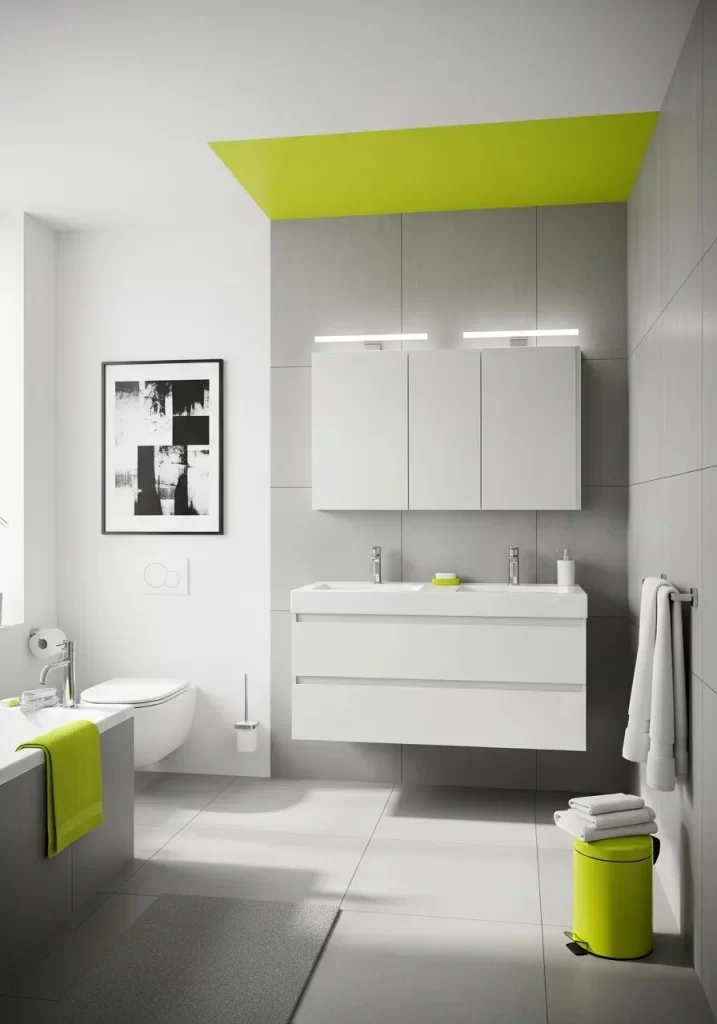
In a sleek, modern bathroom, a single splash of a vibrant, unexpected color can make a huge statement. Most of this room is cool grey and white, which makes the jolt of electric lime green incredibly powerful.
Painting the ceiling is a fantastic way to add color without overwhelming a room. It draws the eye up and adds architectural interest. Repeating that same bold color in small accessories, like a trash can and a towel, makes the design feel purposeful and fun.
DIY Instructions: How to Paint a Ceiling
Painting a ceiling is like painting a wall, but upside down!
What you will need:
- A drop cloth
- Painter’s tape
- An angled paintbrush (“cutting in” brush)
- A paint roller with an extension pole
- A paint tray
- Ceiling paint in your chosen color
Step-by-Step Guide:
- Protect Everything: Cover your entire floor and any fixtures with a drop cloth. Gravity is not your friend here!
- Tape the Edges: Use painter’s tape to tape off the top edge of your walls where they meet the ceiling.
- Cut In First: Use your angled paintbrush to paint a 2-3 inch border all the way around the ceiling. This is called “cutting in” and it means your roller won’t have to get too close to the wall.
- Roll the Rest: Attach your roller to the extension pole. Load it with paint and roll it in the paint tray to get rid of the excess.
- Paint in Sections: Paint the ceiling in small, overlapping sections (about 3×3 feet). Paint in a “W” or “N” pattern to spread the paint, then go back over it in straight lines to even it out.
- Let Dry and Recoat: Let the first coat dry completely. A second coat will give you a much more solid and professional-looking finish.
29. Go Classic with Navy and Gold
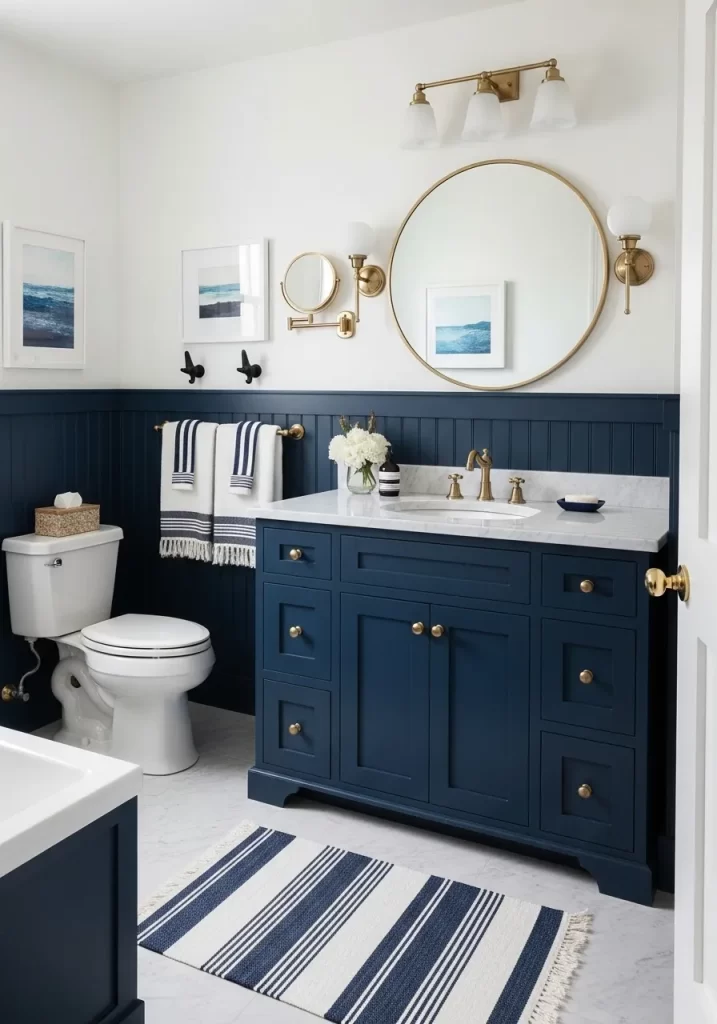
For a look that is timeless, elegant, and a little bit nautical, you can’t go wrong with navy blue and gold. Painting the lower half of the walls and the vanity a deep navy creates a rich, sophisticated foundation for the room.
The crisp white on the top half of the walls keeps the space from feeling too dark. Shiny brass or gold fixtures, like the mirror, lights, and faucets, pop beautifully against the dark blue. It’s a classic color combination that always feels stylish.
DIY Instructions: How to Install Beadboard Paneling
Get this classic, coastal look with easy-to-install panels.
What you will need:
- Beadboard panels
- A measuring tape
- A saw (a jigsaw or circular saw)
- Construction adhesive
- A nail gun (optional, but helpful)
- A level
Step-by-Step Guide:
- Measure Your Walls: Measure the length of the walls you want to cover and the height you want the paneling to be (usually 3-4 feet is good).
- Cut Your Panels: Use your saw to cut the large beadboard panels to the correct height. You will also need to cut out sections for any outlets or light switches.
- Apply Adhesive: Squeeze a wavy line of construction adhesive onto the back of your first panel.
- Place the First Panel: Press the first panel into place on the wall. Start in a corner. Use your level to make sure it is perfectly straight up and down.
- Secure it: Press firmly all over the panel to help the glue stick. If you have a nail gun, you can add a few nails along the top and bottom for extra hold.
- Add the Next Panel: The edges of beadboard panels are designed to lock together. Apply glue to your next panel and fit it snugly against the first one. Continue around the room.
- Finish and Paint: You can add a piece of decorative trim along the top for a finished look. Then, caulk the seams and paint it your desired color.
30. Add Drama with a Painted Ceiling
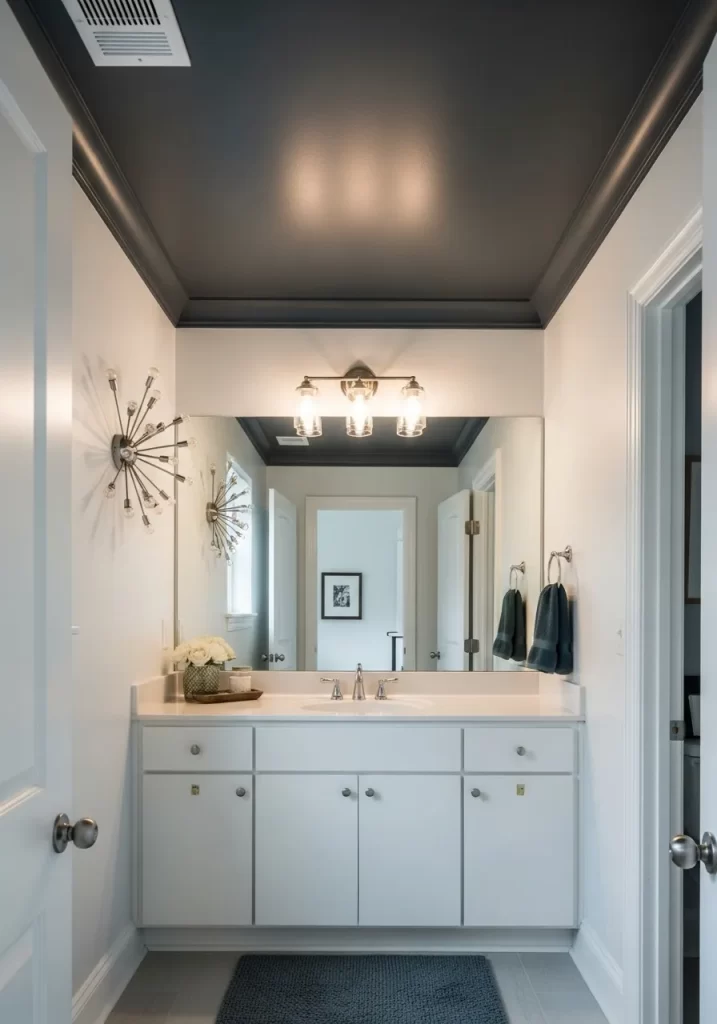
Painting the ceiling a dark, dramatic color is a bold design choice that can have a stunning effect. In a simple, all-white bathroom, a dark charcoal or black ceiling instantly adds depth and a sense of intimacy. It makes the space feel cozier and more sophisticated.
Extending the ceiling color down onto the top few inches of the wall, like a thick stripe, enhances the effect. It’s an architectural trick that makes a plain room feel custom-designed. This is a great way to add drama without changing anything else in the room.
DIY Instructions: How to Get a Super-Crisp Paint Line
The secret to a perfect line is in the tape technique.
What you will need:
- Painter’s tape
- A putty knife or credit card
- A small amount of the wall’s paint color (white, in this case)
- A small paintbrush
Step-by-Step Guide:
- Apply Your Tape: Once you’ve decided where your line will be, apply your painter’s tape to the wall.
- Seal the Tape: This is the most important step. Run the edge of a putty knife or a credit card along the edge of the tape. This presses it down firmly and helps prevent paint from bleeding underneath.
- Paint Over the Edge: Take a little bit of your original wall color (the color you are taping over). Use a small brush to paint a thin layer right over the edge of the tape that you want to be crisp.
- Let it Seal: Let this thin layer of paint dry completely. What this does is seal the edge of the tape. If any paint was going to bleed under the tape, it’s the color that’s already there, so it will be invisible.
- Paint Your New Color: Now, you can paint your new, dark ceiling color. Paint right up to and over the tape’s edge.
- Remove the Tape: While your dark paint is still a bit wet, gently pull off the tape at a 45-degree angle. You should be left with a perfectly sharp line.
31. Create a Bold Red Accent Wall
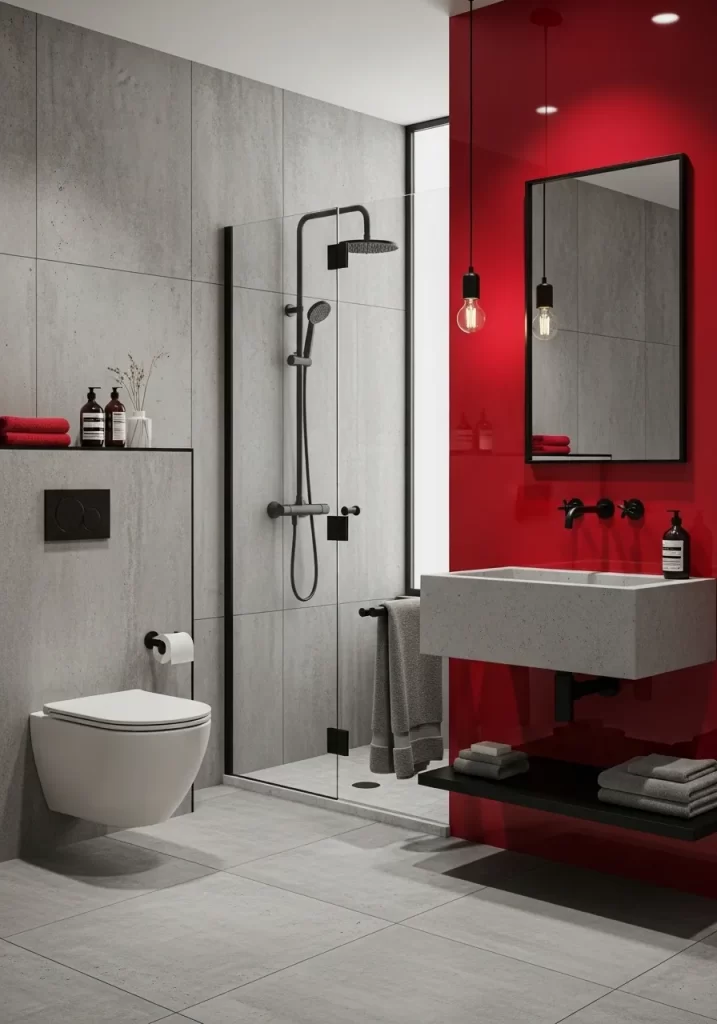
A single accent wall painted in a vibrant, powerful color can completely transform a modern bathroom. This fiery red wall creates an immediate focal point and injects a huge amount of energy into the space. It is a daring choice that pays off.
The bold red provides a stunning contrast to the cool, industrial feel of the grey concrete-look tiles. Simple black fixtures and small touches of red in the towels help to tie the whole look together. This shows how one courageous move can define an entire room.
DIY Instructions: How to Paint a Flawless Accent Wall
Making one wall stand out is an easy weekend update.
What you will need:
- Paint in a bold color
- A drop cloth
- Painter’s tape
- An angled paintbrush
- A paint roller and tray
Step-by-Step Guide:
- Choose Your Wall: Pick a wall that you want to be the center of attention. Often, it’s the wall behind the vanity or a solid wall with no doors or windows.
- Prep the Room: Move everything away from the wall you’re painting. Cover the floor with a drop cloth.
- Clean the Wall: Wipe down the wall with a damp cloth to remove any dust or dirt. Let it dry.
- Tape Your Edges: Apply painter’s tape along the ceiling, baseboards, and the corners where your accent wall meets the other walls.
- Cut In with a Brush: Use your angled brush to paint a 2-3 inch border along all the taped edges.
- Roll the Middle: Use your roller to fill in the rest of the wall. Roll in a “W” shape to distribute the paint, then go over it with straight, overlapping strokes.
- Apply a Second Coat: Let the first coat dry. Bold colors almost always need a second coat to look rich and even.
- Remove Tape: Gently remove the painter’s tape while the second coat is still slightly damp.
32. Tile Your Shower in a Rich Jewel Tone
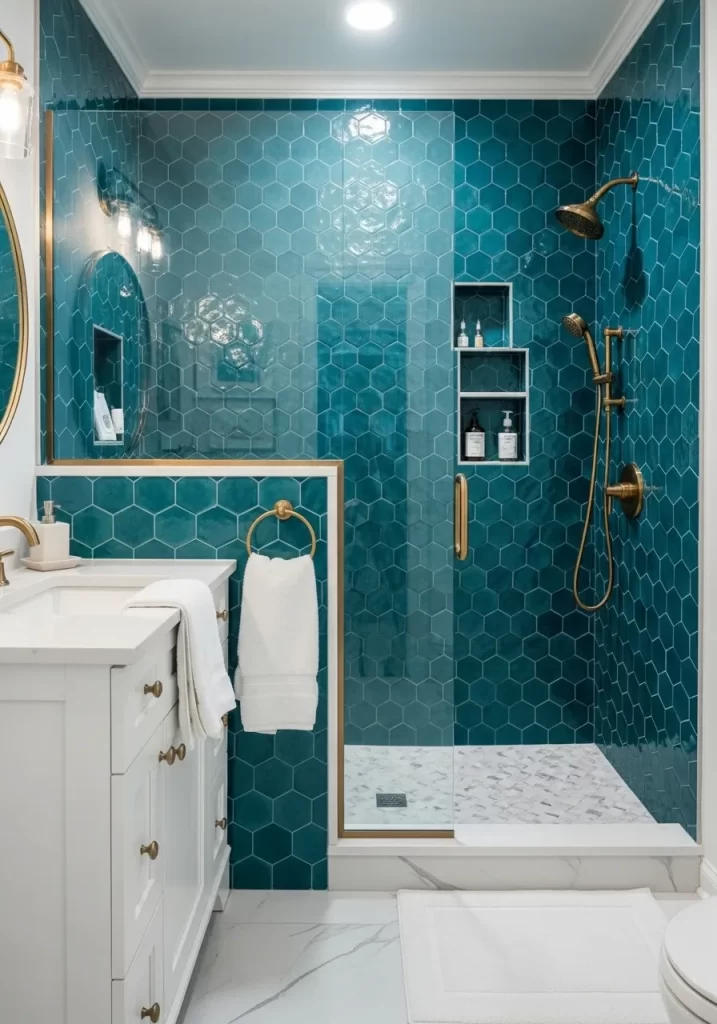
Your shower doesn’t have to be boring white. Tiling the entire shower enclosure in a deep, saturated jewel tone creates a spectacular centerpiece for the bathroom. This rich peacock teal makes the shower feel like a luxurious escape.
The hexagonal tile shape adds modern geometric flair, while the glossy finish beautifully catches the light. Warm brass or gold fixtures are a wonderful complement to the cool teal, enhancing the feeling of opulence. This is a commitment, but one that results in a truly custom look.
DIY Instructions: How to Refresh Your Grout
You can give old tile a new look by changing the grout color.
What you will need:
- Grout cleaner
- A stiff brush
- Grout colorant or stain
- A small applicator brush
Step-by-Step Guide:
- Clean the Grout Thoroughly: The most important step is to get your existing grout as clean as possible. Use a good grout cleaner and a stiff brush to scrub away any soap scum or mildew. Let it dry completely.
- Choose Your Color: Grout colorant comes in many shades. You can refresh your current color or change it completely.
- Apply the Colorant: Most grout colorants come in a bottle with a small brush or wheel applicator. Carefully apply the colorant directly onto the grout lines.
- Wipe Away Mistakes: Keep a damp cloth handy. If you get any colorant on the face of the tile, wipe it away quickly before it has a chance to dry.
- Let it Dry: Work in small sections. Let the colorant dry according to the package directions.
- Apply a Second Coat (If Needed): If you are making a big color change (like from white to black), you might need a second coat to get even coverage.
- Seal the Grout: Once the colorant is fully cured, it’s a good idea to apply a grout sealer to protect your work and keep it clean.
33. Warm Up with a Spicy Hue
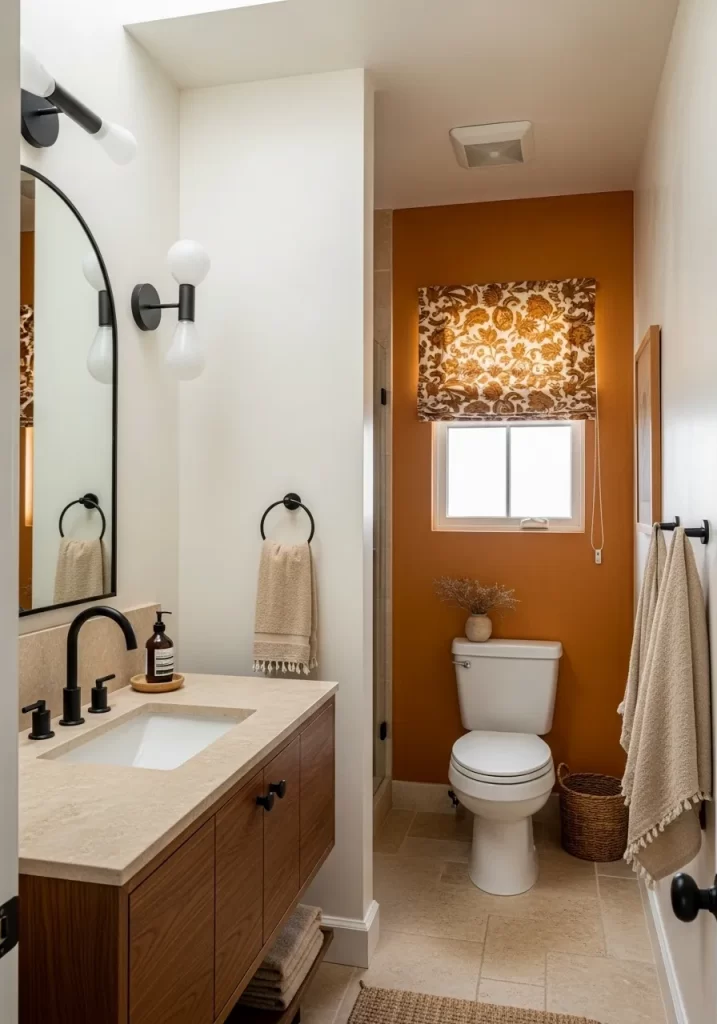
An earthy, spicy color can make a bathroom feel incredibly cozy and stylish. This warm terracotta or rusty orange accent wall brings a welcoming and grounded feeling to the space. Using it on just one wall adds a beautiful splash of color without overwhelming a small room.
A patterned window treatment is a fantastic way to add another layer of design. The floral Roman shade complements the warm wall color and adds a touch of softness and texture. It’s a thoughtful detail that makes the room feel complete.
DIY Instructions: How to Make a No-Sew Faux Roman Shade
Get the elegant look of a Roman shade with this simple hack.
What you will need:
- An inexpensive vinyl mini-blind that fits your window
- Fabric of your choice
- Fabric glue or a hot glue gun
- Scissors
- A measuring tape
Step-by-Step Guide:
- Prepare the Blind: Unroll the mini-blind so it is fully extended.
- Cut the “Ladder” Cords: Look for the thin, string “ladders” that hold the slats in place. Carefully cut these thin strings on both the front and back. Do NOT cut the thick main cord that you use to pull the blind up and down.
- Remove Extra Slats: Once the ladder strings are cut, you can slide out most of the vinyl slats. Leave a few slats in place—one at the top, one at the bottom, and maybe 3-4 spaced evenly in between.
- Cut Your Fabric: Lay your fabric pretty-side-down. Place the blind on top. Cut your fabric so it is about one inch wider and longer than the blind.
- Glue the Fabric: Fold the edges of the fabric over and glue them to the back of the blind for a clean hem. Then, run a line of glue along each of the remaining vinyl slats and press the fabric down firmly.
- Let it Dry: Let the glue dry completely.
- Hang Your Shade: Hang your new shade just like you would a regular mini-blind. When you pull the cord, the fabric will now fold up into nice, neat pleats.
34. Unify with a Modern Purple Palette
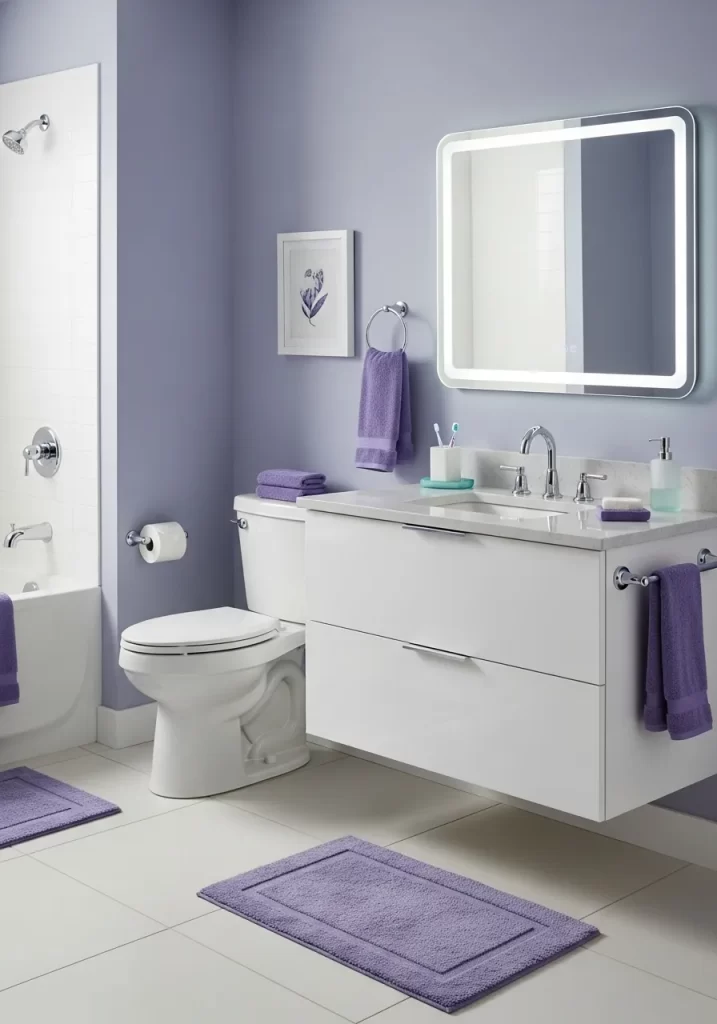
This bathroom demonstrates how to use a distinct color like purple in a way that feels clean, fresh, and modern. The soft, dusty purple on the walls provides a beautiful backdrop without being too intense. Committing to the color creates a big impact.
The key to this look is coordination. Perfectly matching towels and bath mats reinforce the color scheme and make the design feel very intentional. The use of a simple, white floating vanity and a sleek illuminated mirror keeps the overall style contemporary and uncluttered.
DIY Instructions: How to Paint a Custom Bath Mat
Create a bath mat that perfectly matches your unique color scheme.
What you will need:
- A plain, low-pile bath mat (cotton works well)
- Fabric paint or all-surface craft paint
- Painter’s tape
- A stencil brush or foam pouncer
- A paper plate
Step-by-Step Guide:
- Wash and Dry the Mat: Start with a clean, dry bath mat.
- Create Your Design: Use painter’s tape to create a simple pattern. You could make stripes of different widths, a border, or a simple geometric design like a large square or chevron. Press the tape down firmly.
- Pour Your Paint: Squeeze some paint onto a paper plate.
- Paint Your Design: Dip your stencil brush into the paint and dab off the excess. Use an up-and-down pouncing motion to apply the paint inside your taped-off areas. This helps prevent the paint from bleeding under the tape.
- Apply a Second Coat: Let the first coat dry, then apply a second coat for solid color coverage.
- Remove the Tape: Carefully remove the painter’s tape while the paint is still a little bit wet.
- Let it Cure: Let the paint dry and cure completely before using the mat. Check the paint bottle for specific instructions, as some may require heat-setting with an iron.
35. Pair Dusty Rose with Lush Greenery
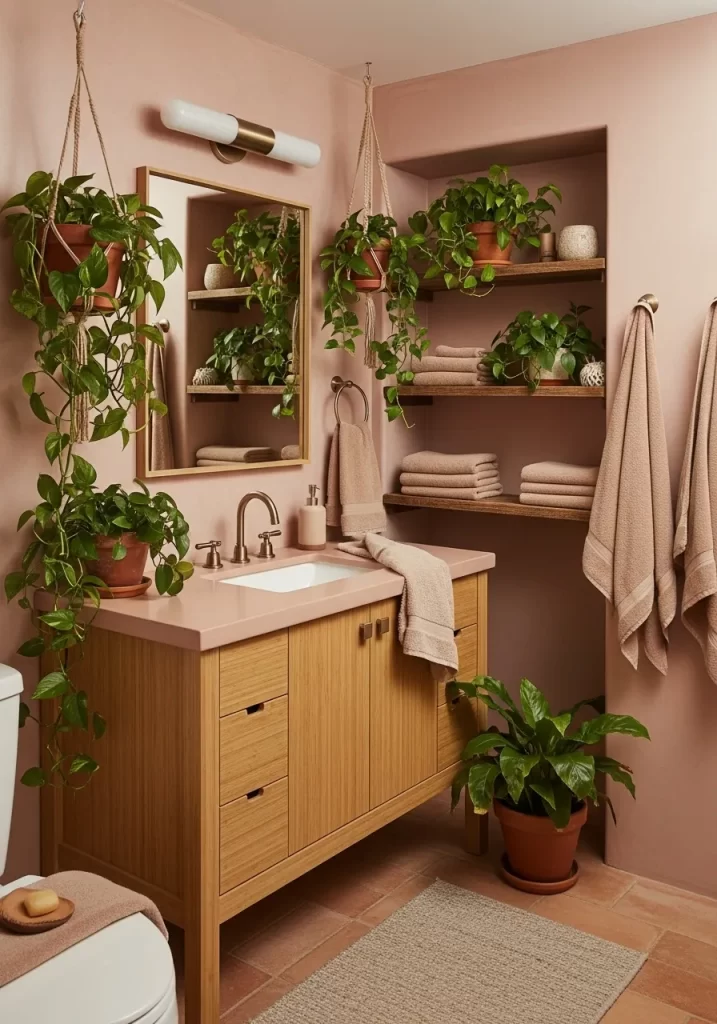
For a look that is soft, earthy, and beautifully on-trend, try pairing dusty rose walls with lots of lush green plants. This warm, muted pink is a sophisticated and calming backdrop that makes the vibrant green of the plant leaves truly pop.
This combination creates an organic, bohemian feel. Natural textures are the perfect complement. A light wood vanity, terracotta pots, and a simple woven rug enhance the connection to nature. This is a wonderful way to create a bathroom that feels both stylish and full of life.
DIY Instructions: How to Pot a Plant for Your Bathroom
Choose the right plant and pot it correctly for a humid environment.
What you will need:
- A plant that loves humidity (like a pothos, fern, or snake plant)
- A decorative pot with a drainage hole
- Potting soil
- Small rocks or broken pottery pieces (optional)
Step-by-Step Guide:
- Choose Your Plant and Pot: Make sure your decorative pot is slightly larger than the plastic pot the plant came in. A drainage hole at the bottom is very important to prevent the plant’s roots from rotting.
- Add Drainage (Optional): You can place a small layer of rocks at the bottom of the pot. This can help keep the drainage hole from getting clogged with soil.
- Add Soil: Fill the bottom of your new pot with a few inches of fresh potting soil.
- Transfer the Plant: Gently squeeze the sides of the plant’s original plastic pot to loosen it. Carefully turn it on its side and slide the plant out.
- Place it in the New Pot: Place the plant on top of the soil in the new pot. Check the height—you want the top of the plant’s soil to be about an inch below the rim of the pot.
- Fill with Soil: Add more potting soil around the sides of the plant, gently patting it down until the pot is full.
- Water it In: Give your newly potted plant a good drink of water until you see water coming out of the drainage hole at the bottom. Let it drain completely before placing it on its saucer.
Your bathroom doesn’t have to be a forgotten, purely functional room. As we’ve seen, there are countless ways to inject color and style into the space. A small change can make a significant difference in how the room feels and how you feel starting your day.
Whether you decide to paint a bold accent wall, swap out your towels for a vibrant hue, or fill a corner with lush greenery, the power to refresh your space is in your hands. We hope these ideas have inspired you to look at your bathroom in a new light.
Don’t be afraid to try something new. Pick a project that excites you and get started on creating a bathroom that is anything but boring.
Key Takeaways
- Paint is Powerful: A new color on the walls, vanity, or even the ceiling is a high-impact way to change your bathroom’s look.
- Textiles Make a Difference: Swapping your shower curtain, towels, and rugs is a quick, easy, and non-permanent way to introduce a new color scheme.
- Accessorize Thoughtfully: Small details like a soap dispenser, wall art, or unique hardware can tie a room together and add a touch of personal style.
- Embrace Nature: Bringing in plants adds literal life and a fresh pop of green that complements almost any color palette.
- DIY is Your Friend: You don’t need a big budget to make big changes. Many of the most stylish updates can be done yourself with a little time and creativity.